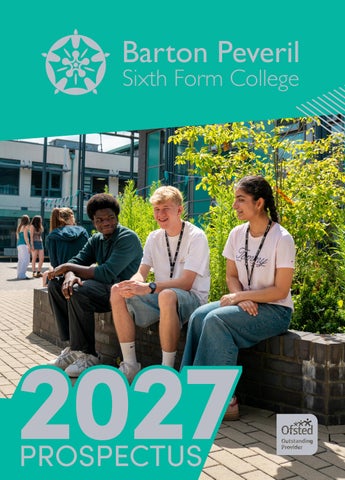
PROSPECTUS
Choosing where to continue your education after GCSEs is a big decision, and I’m delighted you’re considering Barton Peveril Sixth Form College. We’re a community that’s ambitious for our students, not only in their academic achievements but also in their personal growth. You’ll find a uniquely warm and focused atmosphere here, where our dedicated staff provide a supportive and encouraging environment. Our modern campus and excellent facilities are a testament to our commitment to giving you the best possible experience. Sixth form is a transformative time, and we see ourselves as a vital bridge between school and adult life. Our aim is to equip you with the skills, knowledge, and confidence to access whatever future you aspire to, whether that's a top university, a competitive apprenticeship, or a fulfilling career. We want your time with us to be enjoyable and for you to achieve more than you thought possible. The habits and attitudes you develop here will stay with you, helping you to flourish long after you leave. I hope you enjoy exploring everything Barton Peveril has to offer, and I look forward to meeting you soon. Nicola Carcone, Principal
83%
A* - C Grades in A levels
82%
D*- D Grades in Vocational Courses
EXCEPTIONAL VALUE ADDED
WELCOME
WELCOME
FULLY EQUIPPED sports facilities including our on-site Gym
Home to our own
300+ SEATER Rose Theatre
9.5M
Bespoke Art & Design Building
State-of-the-art
£6.5M SCIENCE CENTRE
9.5M
Business and Humanities Building
Why Barton?
Page 6
Learning Support
Page 8
The Access+ Programme
Page 10
Health & Wellbeing Support
Page 11
Sustainability at Barton
Page 12
The Tutor Programme
Page 13
Preparing for the Future
Page 14
Completing a Placement
Page 15
Oxbridge Applications
Page 16
The Aspire Programme
Page 17
AI at Barton
Page 18
The Glyn Library
Page 19
Art & Design Building
Page 20
Student Support Hub
Page 21
Clubs and Societies
Page 22
Example College Timetable
Page 24
CONTENTS
CONTENTS
Q-XTRA Achieve | Connect | Enrich
Page 26
Over 140 Q-XTRA Options
Page 28
Competitive Sports and Teams
Page 29
Choosing your Programme of Study
Page 30
Courses Art and Design
Page 32
Business and Law
Page 40
English and Modern Foreign Languages
Page 48
Humanities
Page 58
Mathematics and Computing
Page 66
Media, Film and Technology
Page 72
Performing Arts
Page 80
Psychology, Criminology & Geography
Page 90
Science
Page 96
Social Science
Page 104
Sport
Page 108
Alumni
Page 112
Index
Page 114 5
WHY BARTON
WHY BARTON? AT BARTON PEVERIL, OUR MISSION IS TO ENRICH EVERY STUDENT AND EQUIP YOU WITH THE CONFIDENCE TO THRIVE!
We are an ambitious, kind, and environmentally conscious community where everyone is encouraged to be themselves. By focusing on your individual needs and living our values, Learn, Enjoy, Achieve, we challenge you to reach your full potential and step out into the world ready to make a difference.
PUTTING
YOU
FIRST
EXCEPTIONAL OUTCOMES
We are consistently ranked among the top sixth forms in the country, delivering the region's best results: • 98.7% A Level Pass Rate (59% A*–B) • Nearly 1 in 3 A Level students achieved an A* or A • 99% Vocational Pass Rate (82% Distinction* or Distinction)
YOUR BRIDGE TO THE FUTURE
From day one, our teachers and dedicated careers team help shape your bespoke study programme. Whether your goal is university or the workplace, you will join an inclusive alumni network that includes world-class academics, Olympians, Oscar winners, and industry leaders. We care deeply. We include everyone. We challenge you to succeed.
6
“Barton Peveril is a place where we learn, love and grow. All the staff are super supportive no matter what career path you decide to enter.” Vibhavi Saparamadu - Second Year Student
WHY BARTON
OVER £30M INVESTED IN OUR CAMPUS IN THE LAST 10 YEARS STUDY ON A STATE-OFTHE-ART CAMPUS
LEARN
Barton Peveril offers a vibrant and modern, university-like setting. Our ongoing investment into cutting-edge facilities, specialist buildings, a well-equipped library, and numerous study and social spaces creates a modern and professional environment.
FIND BALANCE BEYOND THE CLASSROOM
ENJOY
A standout college experience is about more than your lessons. We encourage you to immerse yourself in our community, explore your passions, and make lasting memories through our diverse range of extracurricular activities and cross college events.
LAUNCH YOUR FUTURE CAREER AT BARTON
ACHIEVE
Turn your ambitions into reality with expert UCAS guidance, work placement and apprenticeship support, and employer-led classroom activities. Through specialist "Careers In..." days and industry networking, we give you the competitive edge to stand out.
7
LEARNING SUPPORT
LEARNING SUPPORT LOCATED IN THE NEWLY REFURBISHED STUDENT SUPPORT HUB, WE ARE COMMITTED TO PROVIDING STUDENTS WITH THE TOOLS AND SUPPORT THEY NEED TO EXCEL IN THEIR STUDIES AND PREPARE FOR FUTURE SUCCESS
We offer a comprehensive range of services designed to reduce learning barriers and enhance students’ academic skills. Whether they need help with time management, organisation, research techniques, essay writing or presentation skills, we have AI tools, assistive technologies and a range of strategies and resources to support them to learn smarter, not harder.
SUPPORT FOR ALL STUDENTS We understand that every student learns differently. That's why we offer personalised support tailored to their specific needs. If they have an identified additional need or learning difference, our dedicated team of experienced and highly skilled staff is here to help students identify their strengths, address their challenges, and develop effective study strategies throughout their time at college.
WE OFFER A RANGE OF SUPPORT AVAILABLE TO ALL:
8
−
Weekly timetabled support sessions (1.5hrs/week all year).
−
Short courses designed to develop specific skills, e.g executive functioning, time management and organisation research and presentation skills.
−
Coaching and mentoring to help students with the transition to college and to achieve their academic potential.
LEARNING SUPPORT
AWARD WINNING
student support
Students make
EXCELLENT progress
STUDENTS WITH SPECIAL EDUCATIONAL NEEDS AND DISABILITIES (SEND) Barton Peveril is a fully inclusive college where students with additional needs thrive, achieving outcomes that surpass those of their peers. Our supportive environment fosters a strong sense of belonging for all members of our college community. We provide personalised, scaffolded support to students with EHCPs and SEND. We reduce barriers to learning and personal and social development while fostering resilience and independence.
PREPARING FOR THE FUTURE The skills students develop throughout their time at college will not only help them succeed in their chosen courses but also prepare them for university and beyond. We focus on developing critical thinking, analytical skills, and independent learning, which are essential for academic and professional success. We are here to help students every step of the way on their academic journey.
9
THE ACCESS+ PROGRAMME
THE ACCESS+ PROGRAMME BRIDGING GAPS, BUILDING FUTURES
At Barton Peveril, we are committed to equity and fairness. The Access+ Programme removes barriers to education, ensuring every student, regardless of background, can reach their full potential and thrive after college.
MASTER SIX ESSENTIAL PILLARS Your interactive weekly sessions and workshops provide real-world skills divided into six key areas: −
Care-experienced students or young carers
−
Free College Meals or Bursary/Support Fund recipients
−
Students from service families
−
Students resitting GCSE Maths and English
−
Students who attended a school with below-average GCSE results
AVAILABLE THROUGH THE ACCESS+ PROGRAMME −
Career Development: Work placements and exclusive support from the Social Mobility Foundation.
−
Financial Support: Help funding IT equipment, bus passes, course resources, and UK trips.
−
Personalised Guidance: Dedicated progress monitoring from SPAs & Teachers, tailored tutor support, and online mentoring with Brightside.
−
10
Enrichment: University visits, specialised workshops, guest lectures, and trips.
For more information visit https://barton-peveril.ac.uk/ college-life-introduction/ the-access-programme/
HEALTH AND WELLBEING SUPPORT
HEALTH & WELLBEING SUPPORT A HEALTHY MIND AND BODY ARE THE FOUNDATION OF YOUR SUCCESS
Located in our newly refurbished Student Support Hub, our professional Health & Wellbeing team is here to help you build resilience, manage your health, and thrive during your time at college.
SERVICES AVAILABLE TO YOU − Professional Counselling: Single drop-in appointments or regular weekly sessions to talk things through. − Mental Health Toolkit: Six structured Cognitive Behaviour Therapy (CBT) sessions to build practical coping strategies. − ELSA Support: Tailored emotional literacy programmes to boost self-esteem, improve communication, and handle transitions. − College Nurses: On-hand support for physical health needs, medical requirements, and individual health issues. − Peer Wellbeing Mentors: One-to-one support from fellow students who are safeguardingtrained and hold a Level 2 Counselling Award. − Q-XTRA Programmes: Brainwaves 6 week interactive course focused on selfmanagement and empowering you to take charge of your mental health. − External Referrals: Direct connections to specialist outside agencies when you need extra or ongoing care.
11
SUSTAINABILITY AT BARTON
SUSTAINABILITY AT BARTON AT BARTON PEVERIL, WE RECOGNISE EDUCATION'S PIVOTAL ROLE IN SHAPING THE FUTURE As a forward-thinking institution, we are committed to fostering academic and pastoral excellence and a sense of responsibility towards our planet and the community. Sustainability is not just a buzzword for us; it is a guiding principle that we want to infiltrate every aspect of the college community. Sustainability is not just about the present; it is an investment in the future. Barton Peveril Sixth Form College empowers students to become responsible leaders who understand the importance of sustainable practices in their respective fields. Our student leadership group collaborated with the College's Sustainability Coordinator to put on the ‘Big Barton Give Back Day', an event that was created to engage the College in all things sustainable. Students were able to partake in activities such as clothes swaps, food bank donations, sustainable purchasing, art projects and various other initiatives.
12
WE ARE REALLY PROUD OF THE INITIATIVES WE HAVE INSTIGATED AND CONTINUE TO WORK ON: − Solar Panels − More vegan and vegetarian options − Stock fair trade products in our cafés − Double glazed windows − Motion sensor LED Lights
THE TUTOR PROGRAMME
THE TUTOR PROGRAMME NAVIGATE YOUR COLLEGE JOURNEY WITH DEDICATED GUIDANCE Tutoring is the cornerstone of your Barton Peveril experience. Every week, you will meet with your personal tutor, a dedicated mentor who gets to know you individually, supports your well-being, and acts as your official referee for university or job applications.
MASTER SIX ESSENTIAL PILLARS Your interactive weekly sessions and workshops provide real-world skills divided into six key areas: −
Academic Success: Master expert revision strategies, time management, and the ethical use of campus AI tools.
−
Life Skills: Build critical financial literacy, understand employment law, and navigate digital safety.
−
Future Planning: Receive step-by-step UCAS support, CV writing workshops, and interview preparation.
−
Healthy Relationships: Understand boundaries, mutual respect, and positive conflict resolution.
−
Health & Wellbeing: Learn practical techniques to manage exam stress, balance life, and improve sleep.
−
Inclusion & Community: Explore global citizenship, celebrate neurodiversity, and practice active allyship.
13
PREPARING FOR THE FUTURE
PREPARING FOR THE FUTURE WE ARE FOCUSED ON RAISING ASPIRATIONS, DEVELOPING CAREER AWARENESS AND ENABLING YOU TO REACH YOUR FULL POTENTIAL Whether you wish to pursue university, an apprenticeship or go into employment, you can benefit from the support of our dedicated careers team who provide: − 1:1 careers guidance − Careers workshops and group guidance − UCAS personal statement support − CV and application checking − Interview support and more We also arrange a wide variety of careers-focused events throughout the year, including our Higher Education Fair, Futures Fair, and 'Careers in...' days.
14
80%
of students went on to study at Higher Education destinations
COMPLETING A PLACEMENT
COMPLETING A
PLACEMENT GAIN EXPERIENCE, BUILD YOUR NETWORK
All our students are expected to undertake at least three days of placement experience during their time at college. Our work placement programme benefits from excellent links with renowned employers, who provide challenging and constructive placement opportunities. Placements can take place throughout the year (e.g. three hours per week, across two study periods) or as a block placement - recommended dates for these vary by course.
Every student has access to our dedicated
200
PLACEMENT COORDINATOR
Over employers and organisations engaged with our students last year
PLACEMENT "During my work experience, I learnt the different roles and responsibilities that can be found in a single business, which far exceeded my expectations. I also learnt that communication and time management skills are essential." Student Feedback 2025
PROTECT YOUR FUTURE
Many students will undertake part-time work whilst at college. We recognise the skills this can develop but ask students not to exceed 8 hours of paid work per week as this can affect your performance in your studies. 15
OXBRIDGE APPLICATIONS
OXBRIDGE APPLICATIONS
OVER 70 BARTON PEVERIL STUDENTS WERE OFFERED PLACES TO STUDY AT THE UNIVERSITIES OF OXFORD AND CAMBRIDGE IN THE LAST THREE YEARS. Our students achieved a success rate well above the average for their peers in the most elite independent and grammar schools, including Eton and Winchester College. If you have the desire and potential to secure a place at Oxford or Cambridge, Barton Peveril has a dedicated Oxbridge support service that has previously included: − The opportunity to be mentored by an Oxbridge graduate − Academic extension opportunities − Support with work experience, summer school applications, and personal statements − Mock interview practice from Winchester College − Workshops, taster lectures and seminars from representatives from both Oxford and Cambridge
Over 70 Oxbridge offers in the past 3 years
− Visits to each of the universities and their respective colleges
GUY DOMINY
Tailored application and interview support
NOW STUDYING:
Mathematics and Philosophy at the University of Oxford
20+
Oxbridge Mentors
ZOE GOODING
NOW STUDYING:
Geography at the University of Cambridge
16
37% of students invited to interview at Oxbridge are offered places
TOP UNIVERSITIES RECRUIT STUDENTS WHO CAN EXPLORE THEIR SUBJECTS BEYOND THE CURRICULUM AND WHO ARE CREATIVE THINKERS WITH A THIRST FOR LEARNING
THE ASPIRE PROGRAMME
THE ASPIRE PROGRAMME
The Aspire programme is a timetabled programme of lectures, activities and support for these students to enhance their post college prospects by enabling them to explore their subjects further. Students who wish to pursue applications to Oxbridge or in Medicine, Veterinary or Dentistry courses can benefit from intensive guidance. Top academic thinkers and leaders in their field have participated in the programme giving talks on a range of subjects, including: − Criminal Justice and Policing − Moral Psychology − Myth busting prescriptivism (linguistics) − Advancements in cancer surgery − When the Sahara was green − Ion thrusters - the future of space travel
30
visiting speakers giving lectures on their specialist areas
TILLY PHILLIPS Dedicated
ASPIRE
communications
UNIVERSITY visits and trips
NOW STUDYING:
Animation at the University for the Creative Arts "Aspire has been a really helpful tool for me. Support has been amazing as instead of adding extra pressure on our subjects, it has shown me all of the exciting opportunities after college, which has really motivated me in my exams." Class of 2025
17
AI AT BARTON PEVERIL
AI AT BARTON
OUR AIM IS TO DEVELOP CONFIDENT, DIGITALLY LITERATE INDIVIDUALS WHO ARE READY TO THRIVE IN MODERN LIFE. WE TEACH STUDENTS HOW TO USE ARTIFICIAL INTELLIGENCE SAFELY, ETHICALLY, AND EFFECTIVELY.
INTRODUCING BARTON AI
Once taught how to use AI safely, every student receives free access to Barton AI, our bespoke, education-focused AI platform. Designed with enhanced safety measures and secure data protection, Barton AI provides a reliable and protected space for students to explore the potential of AI in their learning.
YOUR DIGITAL ASSISTANT: BARTON BUDDY
Barton Buddy is our AI-powered assistant, created to support students in navigating college life with ease. Integrated across key systems, Barton Buddy answers questions, helps students find important information, and connects them to the resources they need, whenever they need them.
PERSONAL DEVELOPMENT FOR LIFE BEYOND COLLEGE We’ve developed the Barton Personal Development platform, a digital space where students can build life skills that matter. From managing personal finances to planning a career and supporting their wellbeing, this AI-supported resource empowers students to take control of their future with confidence and clarity.
FIND OUT MORE For further information and to explore how we’re using AI to support learning, wellbeing, and future readiness, please scan the QR code at the top of the page.
18
ACCESS AN EXCEPTIONAL HUB FOR INDEPENDENT LEARNING The Glyn Library provides the ultimate environment for focused study, research, and collaboration. Equipped with cutting-edge technology and expert staff, it is designed to support your academic success every step of the way.
THE GLYN LIBRARY
THE GLYN LIBRARY A SPACE TO FOCUS & COLLABORATE −
Study your way: Utilise over 100 individual study spaces, quiet study pods, and bookable group collaboration rooms.
−
Explore extensive collections: Access core textbooks, e-books, academic journals, digital newspapers, and a vibrant fiction and manga collection.
−
Get expert 1-2-1 support: Book dedicated time with our library team for personalised guidance on research, academic writing, and referencing.
CAMPUS-WIDE DIGITAL EXCELLENCE −
Utilise technology: Connect to over 2,500 campus-wide PCs, Macs, and Chromebooks loaded with industrystandard software like Adobe Creative Cloud.
−
Create without limits: Benefit from free Microsoft Office, unlimited Google Drive storage, custom Library AI support, and professional large-format printing.
19
THE ART & DESIGN BUILDING
ART & DESIGN BUILDING BARTON PEVERIL HAS EXPANDED ITS FACILITIES WITH THE OPENING OF ITS ICONIC NEW ART & DESIGN BUILDING
This state-of-the-art building provides outstanding spaces for students studying Fine Art, Photography and Moving Image, Graphics, Textiles, and Product Design, as well as bespoke accommodation for the UAL Level 4 Foundation Art and Design course. This project, supported by a £4M Government grant, marks a significant investment in the college's commitment to providing exceptional resources for its Art and Design students.
£9.5M
Specialist Building
1850m2
State-of-the-Art Space
20
STUDENT SUPPORT HUB
STUDENT SUPPORT HUB
THE HAMPSHIRE BUILDING UNDERWENT A £3.2 MILLION RENOVATION TO CREATE THE NEW STUDENT SUPPORT HUB AT BARTON PEVERIL
It is a dedicated space designed to assist students with every aspect of college life. The Hub serves as the first port of call for a range of services, including academic skills, careers guidance and wellbeing support. Our friendly and knowledgeable teams are on hand to provide personalised help and connect students with the resources they need to thrive. − Transport − Bursaries − Trips − Enrichments
£3.2M
Student Support Hub Renovation
BESPOKE
Student Health & Wellbeing Centre
200
Newly created study spaces 21
CLUBS AND SOCIETIES
CLUBS AND SOCIETIES FIND YOUR PEOPLE AND PURSUE YOUR PASSIONS Our vibrant clubs and societies, many of which are student-led, offer something for everyone. We empower you to take the lead, whether it's by creating new groups or shaping existing ones.
CLUBS • Architecture Society • Barton’s Brilliant Book Club • Biology Revision Club • Business Club • Chess Club • Computer Science Coding • Crochet Club • Film Club • Formula One Club • Game Development Club • Law Society • Linguistics Club • Magic: The Gathering Club • Politics Society • Students With Academic Goals • Traditional Card Game Club • Vegan & Vegetarian Society • Warhammer 40K 22
CLUBS AND SOCIETIES
CONNECT, SHARE, AND SUPPORT ONE ANOTHER ED&I student societies play a vital role in shaping a positive, inclusive, and empowering college experience by ensuring that every student feels seen, heard, and valued. These student-led societies create safe and welcoming spaces where individuals from different backgrounds, identities, and lived experiences can build friendships, celebrate diversity, and foster a genuine sense of belonging.
ED&I • Afro-Caribbean society • Asian Society • Bible Study group • Christian Union • Eastern European Society • Feminist Society • Filipino Society • GIST • Men's Shed group • Muslim Society • Pride • Sikh Society • South Asian Society • Ukrainian Society 23
EXAMPLE COLLEGE TIMETABLE
COLLEGE TIMETABLE A WELL-STRUCTURED TIMETABLE IS YOUR ROADMAP TO ACADEMIC SUCCESS, ENSURING YOU BALANCE YOUR STUDIES, EXTRACURRICULARS, AND PERSONAL TIME EFFECTIVELY Designated study periods empower you to take ownership of your learning. Utilise this time effectively to manage your workload and proactively address any class work or assignments. To cultivate a well-rounded student experience, we encourage you to explore the diverse Q-XTRA offerings, incorporating enriching activities and fulfilling experiences into your academic journey. Take a look at an example student timetable below:
EXAMPLE STUDENT TIMETABLE: MONDAY
TUESDAY
WEDNESDAY
THURSDAY
FRIDAY
PERIOD 1 08:45 - 10:15
STUDY PERIOD
CHEMISTRY
PERSONAL DEVELOPMENT
MATHS
STUDENT LEADERSHIP GROUP
PERIOD 2 10:30 - 12:00
CHEMISTRY
MATHS
POLITICS
TUTOR
STUDY PERIOD
PERIOD 3 12:45 - 14:15
POLITICS
STUDY PERIOD
ASPIRE
STUDY PERIOD
CHEMISTRY
PERIOD 4 14:30 - 16:00
DEBATING
NETBALL
STUDY PERIOD
POLITICS
MATHS
“I use my study periods to stay on top of my work. This helps me be more organised.” Esther Oloruntuyi - Second Year Student
24
25
Q-XTRA | ACHIEVE | CONNECT | ENRICH
Q-XTRA ACHIEVE | CONNECT | ENRICH BEYOND THE GRADE: WHY Q-XTRAS MATTER Academic results are your ticket to the interview, but your people skills are what win you the offer. In an increasingly competitive world, leading universities like Southampton and Winchester are looking for more than just high marks; they want "well-rounded" individuals who can communicate, lead, and adapt. With 74% of UK employers now prioritising "human" skills like problem-solving and teamwork over technical knowledge alone, our Q-xtra - ACE Programme ensures you don't just leave here with a certificate, you leave with the character and realworld experience that the Hampshire job market is looking for.
INTRODUCING Q-XTRA AND THE ACE PROGRAMME Q-Xtra is our personal development framework running alongside your studies, designed to help students maintain health, contribute to the community, and develop employability skills that universities and businesses demand.
“I chose this college because of the extensive selection of Q-XTRAs, which enable me to stay active and develop essential life skills, in addition to contributing positively to the community.” Nyasha Gutura - Second Year Student 26
SCAN HERE TO LEARN MORE!
Q-XTRA | ACHIEVE | CONNECT | ENRICH
ACHIEVE: YOUR COMPETITIVE EDGE
GAIN ADDITIONAL QUALIFICATIONS, STRETCH YOUR KNOWLEDGE, AND STAND OUT FROM THE CROWD!
CONNECT: YOUR COMMUNITY IMPACT
MAKE AN IMPACT AND DEVELOP PROFESSIONAL SKILLS BY VOLUNTEERING, SUPPORTING COMMUNITY PROJECTS OR UNDERTAKING A WORK PLACEMENT.
ENRICH: YOUR PERSONAL GROWTH
DE-STRESS, BUILD CONFIDENCE & FIND YOUR PEOPLE! YOU CHOOSE ACTIVITIES MATCHING YOUR PASSIONS AND FUTURE GOALS. OPPORTUNITIES ARE CATEGORISED INTO THREE CLEAR STRANDS: ACHIEVE, CONNECT, & ENRICH (ACE) 27
Q-XTRA | OVER 140 Q-XTRA OPTIONS
OVER 140
Q-XTRA OPTIONS
For more information visit https://barton-peveril.ac.uk/q-xtra/
LEAVE COLLEGE WITH MORE SKILLS AND EXPERIENCES
ACHIEVE:
Art Upskill, AS Further Maths, British Sign Language, City/ Zen Competition, Coding, Coding for STEM Students, Computer Science Extension, Conversational Spanish, Core Academic Skills, Core Academic Support, Counselling, Crime Scene Investigation, Data Science and AI, Emergency First Aid, English Extension, English for Academic Purposes, Extended Project Qualification (EPQ), Fitness Instructing, Football Coaching, Japanese, LAMDA Public Speaking, Linguistics Club, Literacy Toolkit, Mandarin Chinese, Mathematical Studies, Maths Extension, Maths Olympiad for Girls, Mental Health First Aid, Paediatric First Aid, Performing Arts Enrichment Options, Robotics, Spanish for Beginners, Subject Extensions, Supported Study, Wildlife Surveying
CONNECT:
Ambassador, Aspire, College Ambassador, Community Ambassador, Debating and Disagreeing Well, Duke of Edinburgh’s Award (All Levels), Eco Gardening, Future Business Leaders, Get Hired, Get into Teaching, Maritime Archaeology Trust Volunteering, Med/Vet Prep, Mentoring, STEM Ambassador, Stocks and Shares, Student Leadership Programme, Student Mentor, Volunteer Food Bank, Volunteer Local Community, Young Enterprise
ENRICH:
Badminton, Basketball, Cricket, Elite Hampshire Cricket programme, Fitness Suite, Football, Futsal, Hockey, Indoor Climbing, Netball, Padel Tennis, Rugby, Self Defence, Table Tennis, Talented Athletes Scheme (TASS), Volleyball
*THESE MAY ALSO BE CHOSEN FOR ACHIEVE Afro-Caribbean, Architecture, Asian, Barton Baking, Bible Study, Chess, Choir, Christian Union, College Production, Creative Writing, Dance Company, Dance Live, Dance Workshop, Digital Music Production, Driving with Confidence, Drama Company, Dungeons and Dragons, Eastern European, Efficient Minds, Ensembles, Feminism, Formula One, Gist, K-Pop, Life Drawing, Linguistics, Men’s Shed, Model United Nations, Multi-Media Creatives, Music Theory Skills, Nourish and Flourish, Philosophy, Plant-Based, Pokemon, Pride, Radio & Video Production, Rambert Grades, Rubik’s Cubing, S.W.A.G, Sikh, Sports Journalism, Stage Crew, Street Food Adventures, Sustainability, Ukrainian Society, Warhammer, Work Smarter 28
Q-XTRA | SPORTS
COMPETITIVE SPORTS AND TEAMS THERE ARE MANY OPPORTUNITIES FOR ATHLETES TO COMPETE AT A HIGH STANDARD Our students excel in individual and team sports, competing both regionally and nationally in a variety of matches and competitions.
ELITE
RECREATIONAL
If you have your sights set on competing in your chosen sport at top flight level, our Elite Sport Programmes provide the perfect grounding for your future success. Anyone can apply for a place on the Elite Sport Programmes.
• Badminton • Basketball • Fitness Instructor (Level 2) • Fitness Studio • Football Development • Futsal • Indoor Climbing • Martial Arts (Choi Kwang Do) • Netball • Padel • Pickleball • T1 Touch Rugby • Table Tennis • Volleyball
SPORT
The programmes are designed to develop promising and talented young sportsmen and women physically and technically. They will help improve your performance in the sport, as well as within your studies, providing you with a unique chance to combine training and playing with full-time education. You’ll have the opportunity to train three times a week alongside your studies, which includes two skills based / technical sessions and one strength and conditioning session.
SPORTS AND
ACTIVITIES
THE HAMPSHIRE
CRICKET PROGRAMME The Hampshire Cricket Programme provides students an opportunity to train and play cricket. Students will receive specialist coaching from Cricket Coaches and take part in fixtures. Any student can apply for a place on the programme.
TASS (Talented Athlete Scholarship Scheme)
A programme to support athletes competing at the highest level manage their academic and sporting commitments.
29
CHOOSING YOUR PROGRAMME OF STUDY
CHOOSING YOUR
PROGRAMME
OF STUDY
OUR GOAL IS TO ENROLL YOU IN COURSES THAT GIVE YOU THE BEST CHANCE OF FUTURE SUCCESS STEP 1: THE COLLEGE PROGRAMME
STEP 2: CALCULATE YOUR GCSE SCORE
Every student builds a program combining:
This will help you to see the suitability of certain subjects. Calculate your average GCSE score:
• 3 Core Courses: Choose 3 A Levels, Vocational courses, or a mix of both. (A 4th A Level is available depending on your GCSEs). • 3 Q-XTRA Courses: Choose an option from Achieve, Connect and Enrich to build skills, support your wellbeing, meet people and prepare for your future.
30
AVERAGE GCSE SCORE
=
Sum of Top 8 GCSEs (including Math & English*) 8
Add together your top 8 GCSE grades (including Maths and English*), then divide by 8 to calculate your average grade
STEP 4: BEFORE YOU APPLY
Use your average score as guidance to find your best path:
• Subject Entry Requirements: Check specific course pages for any extra requirements.
• Average 7 or above: Ideal for the Aspire Programme with 3 or 4 A Levels. Consider if your future career requires traditional academic choices or you plan to progress to a competitive field. • Average between 4 and 7: High flexibility! Choose 3 A Levels, a full Vocational Programme, or a Mixed Programme (combining both). Reflect on whether exams or coursework suit your learning style best, and check individual subject requirements to see what fits. • 5 GCSEs at Grade 4 or below (inc. English): Best suited for a full Vocational Programme, Mixed Programme, or a restricted selection of A Levels. Coursework-heavy options provide an excellent, proven route to top grades, universities, and apprenticeships.
Quick Checklist:
• Apply Early: The College is oversubscribed; late applicants go on a waiting list.
CHOOSING YOUR PROGRAMME OF STUDY
STEP 3: EXPLORE YOUR OPTIONS
• Upcoming Educational Reforms: The government will be introducing new V Levels in 2027. Full details have not yet been shared, but we will update applicants directly if any changes affect your chosen programme. Please note: This does not affect A Level courses
ENTRY REQUIREMENTS
• 5 GCSEs at Grade 4 or above
• Must include one English GCSE • Average GCSE score helps determine your suitability for courses • English & Maths resit required (grade 3 or below) *Please note that students cannot resit GCSE Mathematics & GCSE English at the same time
31
ART & DESIGN FIND OUT MORE
barton-peveril.ac.uk/courses
32
ART & DESIGN
COURSES Fine Art A Level
Page 34
Graphic Communication A Level
Page 35
Photography A Level
Page 36
Film & Moving Image A Level
Page 37
Product Design A Level
Page 38
Textiles A Level
Page 39
ALANA COLLETT
NOW STUDYING:
Primary Education at the University of Portsmouth
CHARLIE TEKEI
NOW STUDYING:
Graphic and Communication Design at the University of Leeds
FIRST CLASS facilities, including dedicated art studios
MARLA LANZA VALENCIANO NOW STUDYING:
Architecture and Planning at UWE Bristol
33
ART & DESIGN | FINE ART
FINE ART A LEVEL
ENTRY REQUIREMENTS: • Studying Art and/or Design at GCSE is advantageous but not essential HOW YOU WILL BE ASSESSED: • 60% Personal Investigation • 40% Externally Set Assignment
WHAT YOU WILL LEARN: Studying Fine Art will give you the chance to experience both traditional and contemporary methods through a broad range of materials and techniques. You will be encouraged to express your personal feelings and emotions through art, taking inspiration from the work of artists as well as responding to history and culture. After studying Fine Art, you will have constructed a professional portfolio which demonstrates transferable skills and attitudes such as problem solving, self confidence, independent working and visual thinking. INSIGHT INTO TOPICS:
Sasha Wong
Formerly of Swanmore College SUBJECTS Fine Art, English Language And Literature, Japanese, Mathematics Q-XTRAS Aspire, Extended Project Qualification, Instramental/ Vocal Lessons
FIRST YEAR TOPICS
SECOND YEAR TOPICS
− Technique workshops in drawing, painting and mixed media surfaces
− A 60% coursework project that focuses on your specialised skills
− Observing composition through collage and creative photography
− Reflective analysis of own work via a 1000-3000 word project log
− Exploring 3D sculpture and paper manipulation
− Studio time on multiple final pieces
− Digital skills in Adobe Photoshop, Wacom tablets and film animation
− Verbally discussing contexts and ideas in teacher and peer tutorials
− Personal projects with an emphasis on development of own interests and written analysis of artists work
− A 40% externally set assignment where you select a themed exam question
WHERE CAN FINE ART TAKE YOU? Fine Art is a versatile subject that opens doors to competitive higher education courses and a range of creative industries. Many of our students choose to take a one year Foundation Art Diploma after the A Level before specialising in architecture or design industry roles in interior, concept and animation. It is often studied as a subject to support career choices in STEM such as medical or book illustration.
34
ART & DESIGN | GRAPHIC COMMUNICATION
GRAPHIC COMMUNICATION A LEVEL
WHAT YOU WILL LEARN: Graphic Communication provides students with an immersive experience into many art disciplines. Projects start with extensive research into existing products and designers’ work, before developing visuals that creatively meet the design brief. You will gain experience in using the Adobe Design Suite and Wacom Drawing Tablets alongside traditional art practises such as printing, paper cutting, folding, and book binding.
ENTRY REQUIREMENTS: • GCSE in an Art or Design Subject is advantageous but not essential. HOW YOU WILL BE ASSESSED: • 60% Personal Investigation • 40% Externally Set Assignment
Students benefit from visiting artists who deliver lectures and workshops on their craft. Students also have the opportunity to enter various national art competitions and to exhibit their work in the end of year Art Show. INSIGHT INTO TOPICS: − Responding to a Design Brief
− Composition and Layout
− Creative Photography
− Adobe Illustrator
− Digital Collage and Layering − Drawing, Texture and Mark Making − Typography − Logos and Branding − Outcome Development, Templates & Packaging − Wacom Tablet Drawing − Colour Theory
− Adobe Photoshop − Adobe InDesign − GIF Creation − 3D Outcomes − Printmaking − Cricut Paper Cutting − Personal Project Development − Critical Analysis of Design Work
Nicholya Jaunky Formerly of Brookfield Community School
SUBJECTS Graphic Communication, English Literature, Psychology Q-XTRAS College Ambassador, Sport - Fitness Suite
WHERE CAN GRAPHIC COMMUNICATION TAKE YOU? Graphic Communication gives excellent transferable skills such as, creative thinking, time management, budgeting, meeting a deadline, communication skills, IT skills and problem solving that will support all future career pathways including progression to university and apprenticeships and then into employment. Popular career choices amongst students include roles such as a Graphic Designer, Illustrator, Magazine and Print Designer, Creative Director, Interior Designer, Architect, Visual Journalist, Web Designer, Logo Designer, Package Designer.
35
ART & DESIGN | PHOTOGRAPHY
PHOTOGRAPHY A LEVEL
ENTRY REQUIREMENTS: • Studying Art and/or Design at GCSE is advantageous but not essential • Access to your own Digital SLR camera and lens is required (high-end mobile phone cameras will be considered). HOW YOU WILL BE ASSESSED: • 60% Personal Investigation • 40% Externally Set Assignment
WHAT YOU WILL LEARN: A Level Photography explores photography in both creative and commercial form. It is practical in nature and you will learn many aspects of professional practice including camerawork, location, studio, Photoshop, portfolio production and self-promotion. Creative workshops build skills and confidence, while contextual studies develop written work to university-level standards. Experienced teaching staff guide you towards the development of your own professional practice and employability; this includes project management, working with AI technology, teamwork and independent thinking. If you want to be the best in your field and stand out from the crowd, this course is an excellent qualification that fully prepares you for your future. We complement a wide range of other pathways including Media, IT, Science and other Art subjects. INSIGHT INTO TOPICS:
Arlo Moss-Coleman
− Extensive camera skills − Photoshop skills
− Self Promotion and Website Development
Formerly of St George Catholic College
− Professional Photographic Studio
− Professional printing and mounting
SUBJECTS Photography, Biology, Chemistry
− Sustainable Alternative Processes
Possible pathways: − Documentary and Reportage
− Experimental and Creative Techniques
− Media and Advertising
− Developing skills of written analysis
− Close Up and Forensics
Q-XTRAS Aspire, Badminton, College Ambassador, Driving Theory, School Mentor
− Finding your confidence and exploring personal ideas − Using Critical Analysis to Support Practical Work
− Wildlife and Conservation − Fashion and Portraiture − Photography for Graphic Design
WHERE CAN PHOTOGRAPHY TAKE YOU? The combination of practical and theoretical skills means this course leads to a range of options in further study and employment. Students often choose our one year Foundation Art Diploma and then progress onto university to study subjects such as Photography, Film Production or Media Studies. Destinations are diverse and there may also be opportunities within areas such as science and healthcare digital imaging.
36
ART & DESIGN | FILM & MOVING IMAGE
FILM & MOVING IMAGE A LEVEL
WHAT YOU WILL LEARN: A Level Film and Moving Image is a well-established course for students passionate about the creative industries and the endless possibilities of film, animation, and visual storytelling. The course offers a hands-on, practical approach, helping you build the technical skills and creative insight needed to produce professional-quality work and strong, individual coursework. In the early stages, you’ll take part in dynamic film and animation workshops introducing a broad range of tools, techniques, and industry practices, before moving on to an extended personal project where you’ll explore your own vision, voice, and filmmaking style. This course builds both creative confidence and technical expertise, providing a strong portfolio and a solid foundation for future progression. INSIGHT INTO TOPICS: − DSLR Skills (Photo and Movie Modes)
− Personal Investigation Project Development
− Film & Photography Techniques
− Developing your personal film style
− Variety of film and animation workshops
− Using critical analysis to support practical work
− Editing with Adobe Premiere Pro & After Effects
− Developing cinematography, editing & sound
− Personal Project Development
− Preparing for higher education and employment
− Typography − Introduction to critical analysis of films − Genre − Cinematography
− Building a Showreel and Website Development for Self Promotion
ENTRY REQUIREMENTS: • GCSE in an Art or Design Subject is advantageous but not essential. • Access to your own Digital SLR Camera with Movie Mode and lens. HOW YOU WILL BE ASSESSED: • 60% Personal Investigation • 40% Externally Set Assignment
Sean Jardine
Formerly of Embley School SUBJECTS Film & Moving Image, Mathematics, Music Q-XTRAS Aspire, Choir, Duke of Edinburgh (Gold), Driving Theory, Instramental/ Vocal Lessons
− End of year show and portfolio presentation
− Sound WHERE CAN FILM & MOVING IMAGE TAKE YOU?
This exciting and diverse course prepares students for university and careers in the fast-growing creative, commercial, and film industries. Blending practical and theoretical skills, it opens a wide range of pathways into further study and employment. Many students progress to our Level 4 Foundation Art Diploma, followed by university degrees such as Film Production, Wildlife Media, Animation, or Moving Image — or enter directly into employment or apprenticeships.
37
ART & DESIGN | PRODUCT DESIGN
PRODUCT DESIGN A LEVEL
ENTRY REQUIREMENTS: • GCSEs to include a minimum Grade 4 in Mathematics. • GCSE in Design Technology is advantageous but not essential. HOW YOU WILL BE ASSESSED: • 50% Coursework • 50% Examination
WHAT YOU WILL LEARN: Product Design lets you delve into the creation of the products that surround us. You will learn to combine practical and theoretical skills, creating innovative products in a specialism of your choice. For example, each year students design sports equipment, architectural models, jewellery, furniture and many other products to fit real life needs. Throughout the course, you will learn the theory behind the design decisions which guide your work. You will develop your creativity and presentation skills, including the use of CAD and hand rendering. You will have the opportunity to work with a large range of materials and processes in order to produce a number of scaled models and working prototypes. INSIGHT INTO TOPICS: − Materials and Their Uses
− Design Drawing
− Ergonomics
− CAD and 3D Printing
Formerly of Wyvern College
− Safety
− History of Design
SUBJECTS Engineering, Product Design, Textiles
− Environmental Issues
− Colour and Shape Theory
− Furniture
− Design Issues
− Architectural Models
− Personal Choice of NEA
Yara Chernova
Q-XTRAS College Ambassador
WHERE CAN PRODUCT DESIGN TAKE YOU? Product Design leads students into a varied range of pathways, from our Foundation Art Diploma through to university, apprenticeships and employment. Students journey into an exciting breadth of careers from Product Designers and Architects through to Design Engineers.
38
ART & DESIGN | TEXTILES
TEXTILES A LEVEL
WHAT YOU WILL LEARN: “When I put my signature on a dress, I regard myself as the creator of a work of art.” - Paul Poiret This course is based on textiles and fashion as an art form. Enthusiasm, creativity, originality and self-discipline are all important attributes required. Textiles encourages you to be highly inventive and innovative with materials, processes and techniques. Inspired by your own observations, concepts, historical and contemporary artists and designers, you will explore fashion and textiles as art forms through fashion, body adornment, millinery, sculpture, fibre art and installation.
ENTRY REQUIREMENTS: • GCSE in an Art or Design Subject is advantageous but not essential. HOW YOU WILL BE ASSESSED: • 60% Personal Investigation • 40% Externally Set Assignment
INSIGHT INTO TOPICS: − Portfolio of Skills − Exploring decorative techniques in stitch, collage, print, photographic experimentation and construction methods in mixed media, assemblage, weave, knit, macrame and crochet − Learning through teacher workshops, individual development, collaborative design and making challenges
− Exploring design through hand rendering, studio photography, digital editing and in-situ visualisations − Reflection and critical analysis of own work and of artists and designers − Self promotion through portfolio development, pitch presentation, digital sketchbook and online presence
Natalia Rus
Formerly of Upper Shirley High School SUBJECTS English Literature, French, Textiles Q-XTRAS Aspire, Extended Project Qualification, Placement
WHERE CAN TEXTILES TAKE YOU? Textiles equips students with key transferable skills that are suitable to both academic and creative pursuits. Many of our students choose to take a one year Foundation Art Diploma or alternatively progress straight onto a degree with top graduate prospects. Students have gone on to study degrees at institutions including UAL, London College of Fashion, Ravensbourne, Edinburgh College of Art and Bournemouth (AUB). Students also progress into a varied breadth of careers, from Designers and Stylists through to Advertising and Branding professionals.
39
BUSINESS & LAW FIND OUT MORE
barton-peveril.ac.uk/courses
40
Business A Level
Page 42
Business Level 3 BTEC National Diploma
Page 43
Economics A Level
Page 44
Law A Level
Page 45
Applied Law Level 3 BTEC Extended Certificate
Page 46
BUSINESS & LAW
COURSES
KATIE HILL
NOW STUDYING: Criminology at the University of Exeter
SAHIL SINGH
NOW STUDYING:
Accounting with Finance at the University of Portsmouth
Visits from academics and industry
EXPERTS
GEORGIE WHITCHURCH NOW STUDYING: Law at the University of Southampton
41
BUSINESS & LAW | BUSINESS
BUSINESS A LEVEL
ENTRY REQUIREMENTS: • GCSEs to include a minimum Grade 4 in Mathematics and English. HOW YOU WILL BE ASSESSED: • 100% Examination
WHAT YOU WILL LEARN: Choosing Business will give you a good understanding of business marketing practices, creating and developing products and services to attract customers, micro and macro business principles impacting business strategic decision making, how markets are affected by world events, and how to assess a firm's financial health. Business supports students in the development of business concepts and theories which are applied to a range of real-world contexts, giving students a holistic understanding of business as well as developing quantitative and qualitative skills relevant to business contexts. INSIGHT INTO TOPICS: Marketing and People − The Marketing Mix and Strategy − Managing People
Tay Thompson
− Entrepreneurs and Leaders
SUBJECTS Business, Criminology, Media Studies
− Raising Finance
Q-XTRAS College Ambassador, Cyber Security
− External Influences
Formerly of Hamble School
Managing Business Activities − Financial Planning − Resource Management
Business Decisions and Strategy − Business Objectives and Strategy − Business Growth − Influences on Business Decisions − Assessing Competitiveness − Managing Change Global Business − Global Markets and Business Expansion
WHERE CAN BUSINESS TAKE YOU? Business not only leads to greater confidence in the workplace but also opens the door to a myriad of career opportunities. Studying Business will help students develop a broad knowledge of business operations as well as gaining unique business skills, such as understanding customer needs, marketing, finance, operations and global business competitiveness and strategy. Students can expect to gain many valuable transferable skills, which can be transferred to further study and the workplace.
42
BUSINESS & LAW | BUSINESS BTEC
BUSINESS
LEVEL 3 BTEC NATIONAL DIPLOMA EQUIVALENT TO TAKING TWO A LEVEL SUBJECTS ENTRY REQUIREMENTS:
WHAT YOU WILL LEARN: This course gives students an understanding of how businesses of all shapes and sizes are run locally, nationally and internationally. You will gain a wide understanding of businesses and how they operate, with the practical skills required to work in this sector or to study at a higher level.
• GCSEs to include a minimum Grade 4 in Mathematics and English. • Minimum of a Merit Grade if you have completed a Level 2 course in Business. HOW YOU WILL BE ASSESSED:
INSIGHT INTO TOPICS: − Exploring Business
− Principles of Management
− Developing a Marketing Campaign
− Managing an Event
− Personal and Business Finance
− Recruitment and Selection
• 60% Coursework • 40% Examination
− International Business
− Work Experience WHERE CAN BUSINESS TAKE YOU? This practical course leads students into numerous pathways, from further study at university to apprenticeships and into employment. Students progress onto a range of courses and careers, including Marketing, Finance, Law, Event Management and Accounting.
Ahmad Amini
Formerly of Romsey School SUBJECTS Business, Economics Q-XTRAS Sport - Fitness Suite
BEYOND THE SYLLABUS Our enrichment programme works around how real businesses operate; how our students can set up their own business and alongside this, build employability skills such as presenting, accounting and managerial skills. There are also opportunities to network with local business entrepreneurs and to be mentored. TRIP DESTINATIONS Trips to Dubai, Thorpe Park, Disneyland Paris and Solent University.
43
BUSINESS & LAW | ECONOMICS
ECONOMICS A LEVEL
ENTRY REQUIREMENTS: • GCSEs to include a minimum Grade 5 in Mathematics and English. • Minimum average GCSE score of 5.
WHAT YOU WILL LEARN: Economics lets you explore society’s production of goods on a local, national and international level. You will explore, assess and comment on the current economic climate, tackling questions such as: − How do we solve the problem of single-use plastic? − What happens in a recession?
HOW YOU WILL BE ASSESSED:
− What makes Google so powerful?
• 100% Examination
− Why do we waste so much food when some people don’t have enough? − What stops poor countries from developing? − Why have petrol prices gone up so much? INSIGHT INTO TOPICS: − How do markets work?
Delali Dotse-Atsutse
− What happens when markets don’t work?
Formerly of The Kings School, Fair Oak
− How do you judge the success of an economy?
SUBJECTS Economics, Information Technology, Mathematics
− What causes inflation, unemployment and recessions?
Q-XTRAS Basketball, Placement
− How can Governments solve economic problems? − How do businesses grow?
− Why do businesses behave the way they do? − What can Governments do to control business behaviour? − Globalisation and International Trade − What causes poverty and inequality? − What strategies can poorer countries use to develop their economies?
WHERE CAN ECONOMICS TAKE YOU? Economics builds written, numerical and analytical skills so it will prepare students for any degree courses that require these skills, for example: Economics, Politics, Sociology, Geography, Business and Finance, and Mathematics. Students can use these skills to progress into a range of careers including: Banking and Finance, Accountancy, Stockbroking, Journalism, Economist.
44
BUSINESS & LAW | LAW
LAW A LEVEL
WHAT YOU WILL LEARN: The Law course has been created to inspire, nurture and build an interest in law. The varied content is designed to develop knowledge and skills for the further study of law, and related subjects such as business. You will explore the nature of law in a wide context and investigate how the law interacts with society, morality and justice. Topics are brought to life and made relatable by bringing in examples locally and nationally from news articles, social media and other media outlets to fuel discussion on how the law operates, and how it ought to operate.
ENTRY REQUIREMENTS: • GCSEs to include a minimum Grade 5 in English. • Minimum average GCSE score of 5.5. HOW YOU WILL BE ASSESSED: • 100% Examination
If you like reading, researching and debating current issues and want to understand the implications of legal decisions on our lives – Law is for you. INSIGHT INTO TOPICS: − English Legal System
− Law Making
− Criminal Law
− Contract Law
− Tort Law
− Nature of Law
WHERE CAN LAW TAKE YOU? Students have progressed to careers in the legal sector, including: Solicitor, Barrister, Legal Executive, Paralegal, Legal Secretary. Other careers including; Human Resources, Policing and other related fields. These careers can be accessed via traditional degree routes as well as Degree Apprenticeships in the Legal Sector and beyond.
Beth Bowers
Formerly of Romsey School SUBJECTS Criminology, History, Law Q-XTRAS Badminton, Forensic Psychology, College Ambassador
45
BUSINESS & LAW | APPLIED LAW
APPLIED LAW
LEVEL 3 BTEC NATIONAL EXTENDED CERTIFICATE EQUIVALENT TO TAKING ONE A LEVEL SUBJECT
ENTRY REQUIREMENTS: • GCSEs to include a minimum Grade 4 in English.
WHAT YOU WILL LEARN:
HOW YOU WILL BE ASSESSED:
Applied Law lets you explore our legal system, the people in it, who influences our law-makers and what happens when you break the law or someone wrongs you.
• 50% Examination • 50% Coursework
INSIGHT INTO TOPICS: − Dispute Solving in Civil Law
− Contract Law
− Investigating Aspects of Criminal Law and the Legal System
− Formation of a contract
− Applying the Law − Criminal Law − Fatal Offences
− Types of Terms − Validity of a contract − Discharging a contract − Remedies
− Property offences
Daniel Elek
Formerly of Weston Secondary School SUBJECTS Engineering, French, Law Q-XTRAS Extended Project Qualification, Sport - Fitness Suite
− Defences − Police Powers WHERE CAN APPLIED LAW TAKE YOU? Applied Law leads students onto further study at university, onto apprenticeships and into employment. Students studying a BTEC gain access into a range of careers due to the transferable skills gained on the course. Students have progressed to careers in the legal sector, including: Solicitor, Barrister, Legal Executive, Paralegal, Legal Secretary. Other careers including: Human Resources, Policing and other related fields. These careers can be accessed via traditional degree routes as well as Degree Apprenticeships in the Legal Sector and beyond.
46
47
ENGLISH & LANGUAGES FIND OUT MORE
barton-peveril.ac.uk/courses
48
English Language A Level
Page 50
English Language & Literature A Level
Page 51
English Literature A Level
Page 52
French A Level
Page 53
German A Level
Page 54
Spanish A Level
Page 55
Japanese GCSE
Page 56
ENGLISH & LANGUAGES
COURSES
AMELIA MACLENNAN NOW STUDYING:
Modern Languages at the University of Southampton
MEGAN ROBINSON NOW STUDYING:
Psychology, Philosophy & Linguistics at the University of Oxford
Opportunity to
IMMERSE
yourself in another culture
DIANA BAYTIMIROVA NOW STUDYING:
French Studies with Business at the University of London Institute in Paris 49
ENGLISH & LANGUAGES | ENGLISH LANGUAGE
ENGLISH LANGUAGE A LEVEL
ENTRY REQUIREMENTS: • GCSEs to include a minimum Grade 4 in English. • Minimum average GCSE score of 4. HOW YOU WILL BE ASSESSED: • 80% Examination • 20% Coursework
WHAT YOU WILL LEARN: You will explore the English Language in all its forms, understanding how language ‘works’ in a variety of contexts. You will initially investigate how language can be used to manipulate meanings, examining real life texts from modern political speeches to social media profiles and advertisements. Then you will delve into linguistic research in child language acquisition, language change, and sociolinguistic issues such as how ethnicity, gender and identities affect language. You will conduct your own research (students have recently investigated topics including Ecolinguistics and Forensic Linguistics) and will develop your understanding of journalism, writing about language issues and your own interests while consciously shaping your use of language for a variety of media and audiences. INSIGHT INTO TOPICS:
Sophie Edwards
Formerly of Hounsdown School SUBJECTS English Language, Law, Sociology Q-XTRAS Driving Theory, Get Into Teaching, Preparing For Uni
− Language and Representation
− Language Change
− Social and Regional Diversity
− Language and Ethnicity
− Attitudes to Language − Child Language Acquisition − Journalism
− World Englishes − Independent Language Investigation − Forensic Linguistics − Language and Discrimination
WHERE CAN ENGLISH LANGUAGE TAKE YOU? English Language opens up many pathways for its students, at university and beyond. Pathways include Creative Writing, Law, Linguistics, many English degrees, Journalism, Teaching, History, and Economics. Any communication based degree or job would consider having studied English at A Level as an advantage.
50
ENGLISH & LANGUAGES | ENGLISH LANGUAGE & LITERATURE
ENGLISH LANGUAGE & LITERATURE A LEVEL
WHAT YOU WILL LEARN: English Language & Literature is a stylistics course, which delves into the style and effect of writers’ language choices. It combines analytical skill, linguistic terminology, analysis of written style and creative writing to help students examine a range of fiction, nonfiction, poetry and drama. Throughout the course you will be able to gain an understanding of many modes of communication and how the context of production and reception has shaped the creation and audience perception of the texts themselves.
ENTRY REQUIREMENTS: • GCSEs to include a minimum Grade 4 in English. • Minimum average GCSE score of 4. HOW YOU WILL BE ASSESSED: • 80% Examination • 20% Coursework
The course covers a range of text types and skills so students who’ve enjoyed both Language and Literature at GCSE, or those who like Creative Writing, excel when choosing the combined A Level. INSIGHT INTO TOPICS: − The Handmaid’s Tale − The Paris anthology − The poetry of John Donne
− The Great Gatsby (recreative writing) − A Streetcar Named Desire
− Non-Examined assessment on Poor and a text of your choice WHERE CAN ENGLISH LANGUAGE & LITERATURE TAKE YOU? English Language & Literature leads students onto many paths, at university and beyond. Pathways include Creative Writing, Law, Linguistics, many English degrees, Journalism, Teaching, History, and Economics. Any communication based degree or job would consider having studied English at A Level as an advantage.
Evie Barrow Formerly of Ballard School SUBJECTS Drama And Theatre, English Language And Literature, Music Q-XTRAS Aspire, Badminton, Choir, Drama Company, Instramental/Vocal Lessons
51
ENGLISH & LANGUAGES | ENGLISH LITERATURE
ENGLISH LITERATURE A LEVEL
ENTRY REQUIREMENTS: • GCSEs to include a minimum Grade 4 in English. • Minimum average GCSE score of 4. HOW YOU WILL BE ASSESSED: • 80% Examination • 20% Coursework
WHAT YOU WILL LEARN: English Literature is the fascinating study of fiction in all its forms: poetry, drama and prose. You will learn how to read critically and with empathy, gaining an admirable appreciation of the complex issues that have always gripped the English speaking world. You will learn to express your opinions and understandings in academic writing where ideas are debated through close analysis of language and contextual and critical interpretations. 21st century novels are valued as highly as Medieval poetry with some of the most celebrated authors studied and appraised in lively lessons delivered by genuinely passionate teachers. INSIGHT INTO TOPICS: − The poetry of Ted Hughes and Sylvia Plath
Jess Moorhouse
Formerly of Cams Hill School SUBJECTS English Language, English Literature, Sociology Q-XTRAS Aspire, British Sign Language, Journalism, Placement, Student Leadership, College Ambassador
52
− Prose fiction from 1880 to 1910 − Doctor Faustus by Christopher Marlowe and Enron by Lucy Prebble
− Unseen Poetry − King Lear by William Shakespeare − The Merchant’s Tale by Geoffrey Chaucer
− The Road by Cormac McCarthy and one other novel of your choice WHERE CAN ENGLISH LITERATURE TAKE YOU? An ability to appreciate the written word, the cogent thought processes and the emotional literacy fostered by English Literature are in high demand across higher education courses and all employment. As such, students follow their academic desires into numerous fields and professions: the arts, the humanities, law, marketing, publishing, journalism and the sciences.
ENGLISH & LANGUAGES | FRENCH
FRENCH A LEVEL
WHAT YOU WILL LEARN: French will help you build your listening, reading, speaking and writing skills to a high level of fluency and accuracy. You will acquire a very broad vocabulary and understanding of French grammar as well as a knowledge of the French-speaking world (through the topics, the film and the novel).
ENTRY REQUIREMENTS: • GCSEs to include a minimum Grade 6 in French. • Minimum average GCSE score of 5. HOW YOU WILL BE ASSESSED:
INSIGHT INTO TOPICS: − The changing nature of family life, the cyber society, the place of voluntary work, heritage, music, cinema, all within the context of France − Study of the film L'Auberge Espagnole
− France as a diverse society, social exclusion, criminals, young people and their political commitment demonstrations and strikes, politics and immigration, all within the context of France − Study of the book Kiffe Kiffe Demain
WHERE CAN FRENCH TAKE YOU? French opens many pathways for students, at university and beyond. There are a wide variety of courses available at university-level, depending on whether you want to broaden your knowledge of French on its own or mix it with another subject. Subjects and sectors include Law, European or International relations, Business and Marketing, Education, and another language. These are just a few examples.
• 50% Listening, Reading & Writing • 20% Writing (literature) • 30% Speaking
Kirsty Chappell
Formerly of Thornden School SUBJECTS Classical Civilisation, French, Geography Q-XTRAS Aspire, Brass Ensemble, Creative Writing, Duke of Edinburgh (Gold), Musical Theatre
OPPORTUNITY TO CONVERSE with native speakers
53
ENGLISH & LANGUAGES | GERMAN
GERMAN A LEVEL
ENTRY REQUIREMENTS: • GCSEs to include a minimum Grade 6 in German. • Minimum average GCSE score of 5. HOW YOU WILL BE ASSESSED: • 50% Listening, Reading & Writing • 20% Writing • 30% Speaking
WHAT YOU WILL LEARN: German offers a fantastic opportunity to develop your listening, speaking, reading and writing skills within the context of the German speaking world, broadening your vocabulary and learning more complex grammar. In the first year you will learn about the changing state of family life, the digital world and youth culture, as well as traditions, festivals, life in Berlin and the world of the Arts within the German speaking world. In the second year you will broaden your studies looking at multiculturalism, politics and reunification. INSIGHT INTO TOPICS:
Millie Aked
Formerly Home Educated SUBJECTS History, Politics, German Q-XTRAS Aspire
54
− Changing state of family life, the digital world and youth culture, traditions, festivals, life in Berlin
− Students learn about multiculturalism, politics and reunification
− The world of the Arts within the German speaking world
− Students will work on an individual research project; as part of their speaking exam
− Study of the Film Goodbye Lenin
− Study of the play Andorra
WHERE CAN GERMAN TAKE YOU? There is such a wide variety of courses and careers available after studying German. At university-level you can broaden your knowledge of German literature and History or mix it with Business Skills. In employment, as well as the traditional careers of interpreting and translation, German is useful for any profession requiring a high level of writing and communication skills. In our increasingly globalised world, German graduates can work in cross-cultural contexts. What is more, the current government is developing closer ties with Europe. Young people can expect some exciting opportunities to study and work within the European Union.
ENGLISH & LANGUAGES | SPANISH
SPANISH A LEVEL
WHAT YOU WILL LEARN: This A Level will enhance your use of Spanish in the spoken and written modes, which will improve your ability to communicate with Spanish speakers from around the world. By studying this course you will gain a broadened vocabulary and a wider understanding of Spanish cultures. INSIGHT INTO TOPICS: − Lots and lots of grammar! − Modern & Traditional values in the Hispanic World − The role of the Internet in an ever changing world − Equal rights in the hispanic world − The influence of celebrity − Regional and cultural identities in Spain − Cultural Heritage in Spain and Latin America
− Migration in the hispanic world
ENTRY REQUIREMENTS: • GCSEs to include a minimum Grade 6 in Spanish. • Minimum average GCSE score of 5. HOW YOU WILL BE ASSESSED: • 100% exam (50% Listening, Reading & Writing, 20% Writing and 30% Speaking)
− Racism and integration in hispanic countries − Young people and their attitudes towards politics − Monarchies and dictatorships − Social movements in the hispanic world − Study of the book Como Agua Para Chocolate
− Study of the film Volver
Jasmine Constantin Formerly of St Annes Catholic School
SUBJECTS Criminology, Law, Spanish Q-XTRAS College Ambassador
WHERE CAN SPANISH TAKE YOU? Spanish can take you into a variety of professions including: Interpreter, Translator, Teacher, Travel and Tourism. A qualification in a language lends itself to so many careers given the deficit in people in the workforce with language skills.
55
ENGLISH & LANGUAGES | JAPANESE
JAPANESE
CERTIFICATE (Q-XTRA) / GCSE (Q-XTRA)
ENTRY REQUIREMENTS: • Certificate: Minimum College entry requirements • GCSE: Level 1 or equivalent in Japanese. HOW YOU WILL BE ASSESSED: • In class assessments in all four skills (Certificate) • End of year assessment (GCSE) • 25% Speaking • 25% Listening • 25% Reading • 25% Writing
WHAT YOU WILL LEARN: Japanese is an additional course to your three A level (or equivalent) subjects. Both the Certificate and GCSE courses are stand-alone one year courses. In the Certificate course, you will learn how to read and write Hiragana, Katakana and some Kanji. This is not an easy task unless you are very committed. Through topics, you will gain a basic knowledge and understanding of the new language. Students can study further, to obtain a GCSE, in their Second Year. You will learn more grammar, Kanji (200 altogether) and vocabulary to express yourselves more fluently. INSIGHT INTO TOPICS: − Introduction − Shopping and Dining
Allan Bisiorek
Formerly of Cantell School SUBJECTS Classical Civilisation, Economics, Japanese, Product Design Q-XTRAS Badminton
− Daily Routine − Socialising and Finding the Way (Certificate) − Identity and Culture
− Local Area, Holiday and Travel − School − Future Aspiration, Study and Work − International and Global Dimension (GCSE)
WHERE CAN JAPANESE TAKE YOU? Japanese has led students on to many courses and career pathways, including Japanese Studies, Linguistics, and combined degrees (Teaching English as a Foreign Language, Film Studies, Business Studies) with Japanese. Many career sectors would consider candidates who have studied other languages to have an advantage in communication. It may also assist those who might wish to teach English in Japan, for example as part of the JET scheme, following graduation.
56
57
HUMANITIES FIND OUT MORE
barton-peveril.ac.uk/courses
58
HUMANITIES
COURSES Classical Civilisation A Level
Page 60
History A Level
Page 61
Philosophy A Level
Page 62
Politics A Level
Page 63
Religious Studies A Level
Page 64
JESSICA SMITH
NOW STUDYING:
History at the Oxford Brookes University
OLLIE WATREMETZ NOW STUDYING:
Philosophy, Politics and Economics at the University of Oxford
Subjects are a great foundation for
UNIVERSITY
AMELIA TREASURE NOW STUDYING:
Classics at the University of Cambridge
59
HUMANITIES | CLASSICAL CIVILISATION
CLASSICAL CIVILISATION A LEVEL
ENTRY REQUIREMENTS: • GCSEs to include a minimum Grade 4 in English Literature and English Language. • GCSE History is not required, but advantageous. • Minimum average GCSE score of 4. HOW YOU WILL BE ASSESSED: • 100% Examination
WHAT YOU WILL LEARN: Classical Civilisation… if you think it sounds old and out of date, you’d be wrong! The issues faced in the ancient world turn out to be just like our own issues. Classical Civilisation offers you the chance to study a whole variety of new things. You’ll do some literature by reading the first ever written story (Homer’s Odyssey) and the most famous book in Roman history (Virgil’s Aeneid). Alongside that, you’ll explore the myths and reality of the Greek gods, and how they were worshipped. Finally, you will study some history by looking at the Persian Wars, arguably the founding event of Western civilisation. Classical Civilisation: new topics, different skills, and issues that we still wrestle with today. INSIGHT INTO TOPICS:
Ruby Brooks
Formerly of Wildern School SUBJECTS Fine Art, Classical Civilisations, English Literature Q-XTRAS Eco Gardening, Life Drawing, Placement
− The Odyssey - Story and Outline − Greek Religion - Gods, Sacred Sites and Religious Experience − The Invention of the Barbarian - Greece and the Persian Wars − The Aeneid - Story and Outline
− Greek Religion Rituals, Priests and the Philosophy of Greek Religion − The Invention of the Barbarian - Persia, the Amazons and the Reality of the Barbarian − The Aeneid - Themes and Explanation
− The Odyssey - Themes and Explanation WHERE CAN CLASSICAL CIVILISATION TAKE YOU? Studying Classical Civilisation offers many routes after College. Many students go on to study courses related to Classical Civilisation at university: Classics, Ancient History, and Archaeology. Classical Civilisation also offers good preparation for any History or English Literature course, alongside Journalism, Business and Education degrees and into professions such as Teaching, Broadcasting, Journalism, Archaeology and Academic Research.
60
HUMANITIES | HISTORY
HISTORY A LEVEL
WHAT YOU WILL LEARN: At Barton Peveril we offer you the choice of topics that you can study; we call this Route A and B. So, do you want to focus on the Tudors alongside the Russian Revolution or do you want to study Germany across the twentieth century alongside Britain from the post war to the almost present day? The former will allow you to explore how strong states develop by comparing early and modern examples whilst the latter will allow you to focus on exclusively modern history. There is a coursework component worth 20% of your grade with Route A focussing on Civil Rights in the USA and Route B on an aspect of the Tudors (note that you must study at least 200 years of history and therefore why this is not a modern example).
ENTRY REQUIREMENTS: • GCSEs to include a minimum Grade 4 in English. • GCSE History is not required, but advantageous. • Minimum average GCSE score of 4. HOW YOU WILL BE ASSESSED: • 80% Examination • 20% Coursework
INSIGHT INTO TOPICS: Route A
Route B
− The Tudors 1485-1603
− The Quest for political stability: Germany 1871-1991
− Revolution and Dictatorship: Russia 1917-1953 − A Personal Investigation on Civil Rights in the USA
− The Making of Modern Britain: 1951-2007 − A Personal Investigation on the Tudors
WHERE CAN HISTORY TAKE YOU?
Ethan Cooke
Formerly of Applemore College SUBJECTS History, Psychology, Sport Q-XTRAS Rugby
History offers many transferable skills that lead students on to study History at university. As well as History many students study Politics and International Relations or Law, which is also a favourite due to the analytical skills that you develop. As with academic options, the careers available for History students are incredibly varied, including Teaching, Broadcasting, Journalism, Archaeology and Heritage, Academic Research, Law, and Finance.
61
HUMANITIES | PHILOSOPHY
PHILOSOPHY A LEVEL
ENTRY REQUIREMENTS: • GCSEs to include a minimum Grade 5 in English and Mathematics. • Minimum average GCSE score of 5.5. HOW YOU WILL BE ASSESSED: • 100% Examination
Beth Llewellyn-Holt
Formerly of Applemore College SUBJECTS Biology, Chemistry, Philosophy Q-XTRAS Aspire, Chemistry - Med/Vet, Duke of Edinburgh (Gold) Award, Extended Project Qualification
62
WHAT YOU WILL LEARN: Philosophy teaches you how to sharpen your thinking, reasoning, and problem solving skills, whilst developing your ability to listen, articulate and write. Through the study of Epistemology, Ethics, Philosophies of Religion and Mind you will explore fascinating concepts and arguments from European philosophy over the last 2500 years. INSIGHT INTO TOPICS: − Epistemological Studies (The Theory Of Knowledge)
− Metaphysics of God (Philosophy of Religion)
− Moral Philosophy (Ethics)
− Metaphysics of Mind (What are we?)
WHERE CAN PHILOSOPHY TAKE YOU? There are a myriad of courses and careers that pertain to Philosophy, including Philosophy, Politics and Ethics (PPE), Religion and Ethics, Politics, Banking, Business, Social Work, Education and Academia, and Law. Philosophy is a great joint honours degree (linking well with subjects in the arts, sciences and mathematics) and stepping stone into numerous careers because of its widely transferable skills.
HUMANITIES | POLITICS
POLITICS A LEVEL
WHAT YOU WILL LEARN: “In our age,” said George Orwell, “there is no such thing as ‘keeping out of politics’. All issues are political issues, and politics itself is a mass of lies, evasions, folly, hatred, and schizophrenia.” Politics is the study of where power lies, who has power (and what they do with it), who doesn’t (and what they do about it), and why. We ask fundamental questions like what is democracy, and is it the best form of government? Why do people form political parties, and what do they believe? We look at voting systems, the media, Parliament, the EU and Brexit. We also study American politics, and ideologies from Liberalism to Anarchism. All issues are political issues.
ENTRY REQUIREMENTS: • GCSEs to include a minimum Grade 4 in English. • Minimum average GCSE score of 4. HOW YOU WILL BE ASSESSED: • 100% Examination
INSIGHT INTO TOPICS: − Democracy and Participation
− US Constitution
− Political Parties
− US Congress
− Electoral Systems
− US Presidency
− Voting Behaviour and the Media
− US Supreme Court and Civil Rights
− The UK Constitution − Parliament
− US Democracy and Participation
− The Prime Minister and the Executive
− Liberalism − Conservatism
− Relations Between the Branches
− Socialism
Poppy Abbott
Formerly of Hamble School SUBJECTS Economics, History, Politics Q-XTRAS Aspire, Extended Project Qualification
− Anarchism
WHERE CAN POLITICS TAKE YOU? Although Politics degrees are the most obvious destination, related courses like International Relations, Law, Sociology, and History are also popular. A Level Politics is valued by universities and employers and is useful for any course or job that focuses on essay writing or critical thinking. Such careers include working in the Civil Service and Public Sector, Journalism, International Development, careers in the media, and International Governance in organisations like the UN. Politics can take you to the very top. Barack Obama, 44th President of the United States, graduated from Columbia University with a degree in Political Science in 1983.
63
HUMANITIES | RELIGIOUS STUDIES
RELIGIOUS STUDIES A LEVEL
ENTRY REQUIREMENTS: • GCSEs to include a minimum Grade 4 in English. • Minimum average GCSE score of 4. HOW YOU WILL BE ASSESSED: • • • •
100% Examination 2 hours - Buddhism 2 hours - Ethics 2 hours - Philosophy
WHAT YOU WILL LEARN: Religious Studies at A Level offers you fascinating opportunities to study broad and varied, real-world topics: The major concepts of Buddhism and how they apply in different cultures and societies in the 21st Century; Ethics, which covers a vast range of normative and applied ethical theories and their thinkers but also what underpins ethical decision making; and Philosophy of Religion, which covers issues such as the nature and existence of God, miracles, religious experience, self death and afterlife and more. INSIGHT INTO TOPICS: − Introduction to Buddhism
Poppy House
Formerly of St Annes Catholic School SUBJECTS Performing Arts: Acting, Religious Studies Q-XTRAS Aspire, Netball, Placement
64
− Normative Ethical Theories and applied Ethics
− Philosophy of religion, issues of self and religious language
− Introduction to Philosophy of Religion
− Buddhism in the 21st century
− Applied Buddhism
− Advanced ethics and metaethics WHERE CAN RELIGIOUS STUDIES TAKE YOU? Religious Studies opens up avenues into many university courses, from Theology and Religious Studies through to Cultural Studies and Anthropology. Religious Studies is a great joint honours degree and goes with a vast range of subjects, including the arts, sciences, mathematics. Religious Studies also lends itself to the world of work, including careers in Politics, Banking, Business, Law, Academia, Government roles, and work in the media sector.
65
MATHS & COMPUTING FIND OUT MORE
barton-peveril.ac.uk/courses
66
MATHS & COMPUTING
COURSES Computer Science A Level
Page 68
Mathematics A Level
Page 69
Further Mathematics A Level
Page 70
BARRY VERNON
NOW UNDERGOING:
Degree Apprenticeship with Dyson Institute of Engineering and Technology
EMILY TREE
NOW STUDYING: Mathematics at the King's College London
Students compete in
NATIONAL COMPETITIONS
DOUGIE HOWELLS NOW STUDYING:
Mathematics at the University of Cambridge
67
MATHS & COMPUTING | COMPUTER SCIENCE
COMPUTER SCIENCE A LEVEL
ENTRY REQUIREMENTS: • GCSEs to include a minimum 6 in Mathematics and 5 in Computer Science, if taken • You do not need to have any programming experience • Minimum average GCSE Score of Grade 4. Studying Computer Science at top universities will require you to take A Level Mathematics.
WHAT YOU WILL LEARN: Computer Science can roughly be divided into theory and programming. The theory will give you a broad overview of how information is generated, stored and transferred within and between computer systems. We will use logic and mathematics to understand computers and software, and you will develop your critical thinking skills to explore the impacts that computing has on society. For programming, after studying Computer Science at Barton Peveril, you will be able to pick up a completely new language with ease. We will teach you fundamental and advanced programming skills in C#, Assembly, Haskell and SQL.
HOW YOU WILL BE ASSESSED:
INSIGHT INTO TOPICS:
• 80% Examination • 20% Coursework
− Introduction to the Internet (packet-switching and TCP/IP)
− Finite state automata and regular expressions
− Operating Systems, translators and other system software
− Context-free languages
− Database design (SQL)
− Algorithmic Complexity (Big-O notation)
Sam Culmer Formerly of The Westgate School
SUBJECTS Computer Science, Mathematics, Media Studies Q-XTRAS Placement, Robotics
− Fundamentals of data structures and algorithms − Mathematics for Computer Science − Representation of hexadecimal and floating point binary numbers
− Representation of data and compression
− Advanced networks (the DNS, asymmetric encryption, routing, wireless networks, client-server networks and database concurrency) − Big Data
− Advanced logic circuits (boolean algebra, adders and flip-flops) WHERE CAN COMPUTER SCIENCE TAKE YOU? Computer Science opens doors into a multitude of degrees and employment in Computer Science, Software Engineering, Cybersecurity and Artificial Intelligence. Career pathways include Data Analysis, Games Development, Software Testing and Engineering, and Computer Science Research.
68
MATHS & COMPUTING | MATHEMATICS
MATHEMATICS A LEVEL
WHAT YOU WILL LEARN: A-Level Maths is divided up into 2/3 Pure, 1/6 Mechanics and 1/6 Statistics. The tools and algebraic skills that you develop on this course will push you quickly beyond GCSE. The course will introduce you to rates of change, areas under curves, a deeper understanding of trigonometry, pulley problems, and probability distributions. There is something for everyone here, from those who want to take mathematics to the next level, to those interested in a STEM-based career, to those who just love algebra.
ENTRY REQUIREMENTS: • GCSEs to include a minimum Grade 7 in Mathematics. • Minimum average GCSE score of 5.5. HOW YOU WILL BE ASSESSED: • 100% Examination
INSIGHT INTO TOPICS: Pure
Mechanics
− Algebra & Functions
− Graphs of Motion
− Exponentials & Logarithms
− SUVAT
− Graph Transformations
− Forces & Newton’s Laws
− Coordinate Geometry & Circles − Differentiation & Integration − Proof − Trigonometry − Sequences and Series − Numerical Methods − Differential Equations − Binomial Expansion − Parametric Equations
− Variable Acceleration − Moments − 2D SUVAT & Variable Acceleration − Projectiles Statistics − Probability
Adam Perry
Formerly of Toynbee School SUBJECTS French, Mathematics, Physics Q-XTRAS Aspire, Sport - Fitness Suite, Table Tennis
− Measures of Central Tendency & Variation − The Binomial Distribution − Correlation & Causation − The Normal Distribution − Discrete Random Variables − Hypothesis Testing
WHERE CAN MATHEMATICS TAKE YOU? A-Level Maths opens doors. It supports subjects like Physics, Chemistry, Psychology and Geography, and pairs well with Further Maths or Computer Science. Whether you’re aiming for Medicine, Engineering or Economics, Maths builds the problemsolving skills top courses and careers demand.
69
MATHS & COMPUTING | FURTHER MATHEMATICS
FURTHER MATHEMATICS
A LEVEL (AS LEVEL ALSO AVAILABLE)
ENTRY REQUIREMENTS: • GCSEs to include a minimum Grade 7 in Mathematics (Grade 8 recommended). • Minimum average GCSE score of 5.5. HOW YOU WILL BE ASSESSED: • 100% Examination
WHAT YOU WILL LEARN: Further Mathematics is a fascinating course delving into a variety of different areas and is taken in addition to Mathematics. Topics covered include imaginary and complex numbers, using algorithms to solve real world problems, various discrete probability distributions and numerical methods for integrating and differentiating functions. Further Mathematics is not only complementary to your study of Mathematics but also introduces you to new and interesting concepts. Additional modules are available in the second year. INSIGHT INTO TOPICS: Core
Statistics
− Matrices
− Discrete Probability Distributions
− Complex Numbers − Roots of Polynomials − Sequences and Series
− Chi-Squared Tests Numerical Methods
Elise Higgins
− Proof by Induction
Formerly of Bitterne Park School
− Polar Coordinates
SUBJECTS Chemistry, Further Mathematics, Mathematics, Physics
− Hyperbolic Functions
Q-XTRAS Aspire, Duke of Edinburgh (Gold), Engineering, Placement
− Bivariate Data
− Differential Equations Modelling with Algorithms
− Working with Errors − Polynomial Interpolation − Root finding − Numerical Calculus
− Algorithms − Modelling with Graphs and Networks − Linear Programming − Simplex Method WHERE CAN FURTHER MATHEMATICS TAKE YOU? Most Further Mathematics students go onto university, with some progressing to degree apprenticeships or employment. Fields of further study range from Data Science, Engineering and Computer Science to Architecture, Accountancy and Environmental Science.
70
71
MEDIA, FILM & TECHNOLOGY FIND OUT MORE
barton-peveril.ac.uk/courses
72
Film Studies A Level
Page 74
Information Technology Level 3 Cambridge Advanced National
Page 75
Media: Creative Digital Technologies Level 3 Cambridge Technical Diploma
Page 76
Media Production: Digital Media Level 3 Cambridge Technical Diploma
Page 77
Media Production: Video & Moving Image Level 3 Cambridge Technical Diploma
Page 78
Media Studies A Level
Page 79
MEDIA, FILM & TECHNOLOGY
COURSES
JAMIEN OYAWALE NOW STUDYING:
Animation at Buckinghamshire New University
APRIL ORMAN
NOW STUDYING:
Media, Industry and Innovation at the University of Brighton
DEDICATED facilities and technology
SABIR AHMED
NOW STUDYING:
Digital Marketing at the University of Portsmouth
73
MEDIA FILM & TECHNOLOGY | FILM STUDIES
FILM STUDIES A LEVEL
ENTRY REQUIREMENTS: • GCSEs to include a minimum Grade 4 in English. HOW YOU WILL BE ASSESSED: • 70% Examination • 30% Coursework
WHAT YOU WILL LEARN: In Film Studies you will study a variety of diverse texts that will expand your love of film to new heights. You will analyse how a director constructs scenes to manipulate audience reactions whilst also exploring how films debate and discuss social issues such as race, sexuality, and politics. Understanding how films are made and why, will help you to read a film text on a higher level. You will also have the opportunity to make your own short film using our state-of-the-art facilities or even write a screenplay and storyboard as part of your coursework. This is your chance to be creative and explore your own style and voice. INSIGHT INTO TOPICS:
Eliana Van Gelder
Formerly Home Educated SUBJECTS English Language, English Literature, Film Studies, Politics Q-XTRAS Aspire, Get Into Teaching
− Global Film
− Hollywood 1930-1990
− Silent Film
− American Film from 2005 and Beyond
− British Film − Documentary
− Experimental Film
− Practical Coursework WHERE CAN FILM STUDIES TAKE YOU? There are many different types of Film courses and careers available. Some courses are traditional Film Studies much like an extension to the A Level with a mix of academic lectures and creative projects and there are also many practical Filmmaking courses at universities. Many of our students go on to study at Pinewood Studios for a year. Film is a huge business in the UK. Star Wars, Black Widow, Cruella, Small Axe, and more were all filmed here, providing thousands of jobs and billions to the UK economy. If you want to get into the film business, there are many ways to do so. Studying Film can also lead to careers in other sectors such as Journalism, Marketing, PR, Theatre, and many more.
74
MEDIA FILM & TECHNOLOGY | INFORMATION TECHNOLOGY
INFORMATION TECHNOLOGY
LEVEL 3 CAMBRIDGE ADVANCED NATIONAL EXTENDED CERTIFICATE EQUIVALENT TO TAKING ONE A LEVEL SUBJECT ENTRY REQUIREMENTS:
WHAT YOU WILL LEARN: Join us on a digital journey that equips you with essential skills for the future tech-driven world. Through theory and hands-on practice, gain a strong foundation in vocational IT and Computing. This course will provide a comprehensive understanding of application development principles, covering software, planning, and industry-standard briefs in immersive tech and software development. Explore the future of technology with us. INSIGHT INTO TOPICS:
COURSEWORK:
Fundamentals of Application development
Designing and communicating UX/UI solutions
− Types of software used in application design
− Planning the UX/UI solution
− Application design
Website development
− Designing the UX/UI solution − Software development models − Communicating the UX/UI − Planning application solution development projects − Reviewing the UX/UI solution − Scoping Human computer interface and interaction Developing Application Software − Application software considerations − Data flow in application software − Application software security − Operational considerations − Legal considerations
− Planning and designing the high-fidelity website prototype − Creating the high-fidelity website prototype − Testing and reviewing the high-fidelity website prototype Immersive Technology Solution Development
• GCSEs to include a minimum Grade 4 in English and Mathematics. HOW YOU WILL BE ASSESSED: • 40% Examination • 60% Coursework
Zoe Diaz
Formerly of St Annes Catholic School SUBJECTS Information Technology, Media: Creative Digital Technologies Q-XTRAS Aspire, Dungeons and Dragons, Life Drawing, Placement
− Planning and designing the high-fidelity immersive technology prototype
WHERE CAN INFORMATION TECHNOLOGY TAKE YOU? Both the subject-specific knowledge, understanding and skills, and broader transferable skills developed through these units, will help you progress to further study in related areas such as: web and user experience, web and mobile development, creative computing, computing, computer games development, computer science, and future technology.
75
MEDIA FILM & TECHNOLOGY | MEDIA: CDT
MEDIA: CREATIVE DIGITAL TECHNOLOGIES LEVEL 3 CAMBRIDGE TECHNICAL DIPLOMA EQUIVALENT TO TAKING TWO A LEVEL SUBJECTS
ENTRY REQUIREMENTS: • GCSEs to include a minimum Grade 4 in English. HOW YOU WILL BE ASSESSED: • 30% Examination • 70% Coursework
WHAT YOU WILL LEARN: Media: Creative Digital Technologies is an exciting opportunity to work on a number of digital media products from concept to delivery. It is a vocational diploma that enables you to develop practical skills in 3D modelling, digital animation, graphic design and game development, whilst building upon a foundation of transferable design principles and media language. You will begin your journey grappling with a simple game design project before developing your 3D skills and sampling every aspect of the development process in a longer term 3D animation project. The syllabus is designed to advance technical and soft skills gradually over two years, enabling you to become confident in your strengths and take advantage of the insight gained in working on vocational activities. Alongside practical skills development, you will analyse and evaluate media products and the wider media industry.
Aliesha Tyler Formerly of Oasis Academy Sholing
SUBJECTS Graphic Communication, Media: Creative Digital Technologies Q-XTRAS Placement
INSIGHT INTO TOPICS: − Interactive Media Products
− 3D Digital Animation
− Media Products and Audiences
− Create an Audio / Visual Product
− Graphic Design
− Social Media and Globalisation
− Create a Media Product − Pre-production and Planning − 3D Modelling
− Game Development − Comics and Graphic Novels − Create a Media Profile
WHERE CAN MEDIA: CREATIVE DIGITAL TECHNOLOGIES TAKE YOU? Media: Creative Digital Technologies can lead to careers across multiple industries including game development, animation, visual effects, design, architecture and many other careers in the creative industries.
76
MEDIA FILM & TECHNOLOGY | MEDIA PRODUCTION: DIGITAL MEDIA
MEDIA PRODUCTION: DIGITAL MEDIA
LEVEL 3 CAMBRIDGE TECHNICAL DIPLOMA EQUIVALENT TO TAKING TWO A LEVEL SUBJECTS ENTRY REQUIREMENTS:
WHAT YOU WILL LEARN: Media Production: Digital Media is particularly suited to students who want to work in the creative design industries, both traditional and online. This course is designed for people who enjoy learning in a practical, work-related way. The course provides a high quality, industry recognised qualification that acknowledges the skills, settings, job roles, principles and values involved in the Media Industry. This course is suited to students who want to experience a range of different digital media techniques, from print design, comics, interactive media products, animation, advertising (print or video), and photography. Also, students will benefit from having the opportunity to produce a range of media forms and genres, there is a focus on exploring concepts of ethnic diversity, gender and other contemporary social issues. INSIGHT INTO TOPICS: Coursework:
− Interactive Media Product
− Creating a poster series for a horror film
− Portfolio
− Photography − Advertising − Graphic Design − Journalism − Comics and Graphic Novels − Animation
Examined: − Media Products and Audiences − Pre-production and Planning
• GCSEs to include a minimum Grade 4 in English. • Merit in a Vocational Media course if taken. HOW YOU WILL BE ASSESSED: • 30% Examination • 70% Coursework
Lily Godfrey
Formerly of Noadswood School SUBJECTS Media Production: Digital Media, Psychology Q-XTRAS Get Into Teaching, Placement
− Social Media and Globalisation
WHERE CAN MEDIA PRODUCTION: DIGITAL MEDIA TAKE YOU? Students commonly go on to study a creative course at university, such as Photography, Graphic Design, Media Production or Advertising. Some students also continue onto the Foundation Diploma in Art and Design at Barton Peveril. Many students then progress onto careers in the industry, working in creative roles across the corporate, charity and marketing sectors.
77
MEDIA FILM & TECHNOLOGY | MEDIA PRODUCTION VMI
MEDIA PRODUCTION: VIDEO & MOVING IMAGE LEVEL 3 CAMBRIDGE TECHNICAL DIPLOMA EQUIVALENT TO TAKING TWO A LEVEL SUBJECTS
ENTRY REQUIREMENTS: • GCSEs to include a minimum Grade 4 in English. • Merit in a Vocational Media course if taken. HOW YOU WILL BE ASSESSED: • 70% Examination • 30% Controlled Assessment
WHAT YOU WILL LEARN: Media Production: Video & Moving Image is particularly suited to students who want to work in Video Production, or in the Film and Television Industries. This course is designed for people who enjoy learning in a practical, work-related way. The course provides a high quality, industry recognised qualification that acknowledges the skills, settings, job roles, principles and values involved in the Media Industry. As well as having the opportunity to produce a range of media forms and genres, there is a focus on exploring concepts of ethnic diversity, gender and other contemporary social issues. INSIGHT INTO TOPICS:
Jasmine Dietrich
Formerly of Hamble School SUBJECTS Film Studies, Media Production: Video & Moving Image Q-XTRAS Aspire, British Sign Language
Practical
Examined
− Creating the Opening for A Netflix TV Show
− Media Products and Audiences
− Short Film Production
− Pre-production and Planning
− Special and Visual Effects
− Social Media and Globalisation
− Scriptwriting − Cinematography − Advertising − Music Video − Sound Design − Portfolio
WHERE CAN MEDIA PRODUCTION: VIDEO & MOVING IMAGE TAKE YOU? Students commonly go on to study a creative course at university, such as Film, TV Production, Scriptwriting or Animation. Many students then transfer these skills into roles in the industry. This course is ideal for students that have ambitions to work in the Film or TV industry or for those who want to make video content for companies across many sectors.
78
MEDIA FILM & TECHNOLOGY | MEDIA STUDIES
MEDIA STUDIES A LEVEL
WHAT YOU WILL LEARN: Media Studies is the perfect choice for anyone who enjoys engaging with media products across a range of platforms including music videos, advertising and online streaming services. With an emphasis on theoretical approaches, this subject will provide you with the knowledge and understanding to deconstruct the variety of messages that the media present to us on a daily basis. Media Studies introduces you to a challenging mix of academic research, analysis and debate. The subject also contains a strong focus on the concepts of ethnic diversity, gender and other contemporary social issues.
ENTRY REQUIREMENTS: • GCSEs to include a minimum Grade 4 in English. HOW YOU WILL BE ASSESSED: • 70% Examination • 30% Controlled Assessment
INSIGHT INTO TOPICS: − Music Videos
− TV in the Global Age
− Film Industry
− Mainstream and Alternative Magazines
− Video Games − Advertising and Marketing − Radio
− Online and Participatory Media
WHERE CAN MEDIA STUDIES TAKE YOU? There are a variety of different types of Media Studies courses available at university. Many are centred around Media and Communications with a mix of academic lectures and creative projects and there are also many practical Production courses at universities. Some popular degrees are associated with specialisms in Journalism or Creative Design such as Graphics.
Wolfe Jones
Formerly of Kings School, Winchester SUBJECTS Media Studies, Performing Arts: Musical Theatre Q-XTRAS Aspire, Musical Theatre Show, Placement
Media Studies also leads to a variety of different pathways due to the breadth of study and the blending of academic disciplines with a practical skill set. This can lead to careers in Journalism, Graphic Design, Marketing, Advertising, Public Relations, Events Management, TV and Film Production as well as more contemporary careers within the online media landscape.
79
PERFORMING ARTS FIND OUT MORE
barton-peveril.ac.uk/courses
80
Dance A Level
Page 82
Drama and Theatre A Level
Page 83
Music A level
Page 84
Music Technology A Level
Page 85
Performing Arts: Acting Level 3 Cambridge Technical Diploma
Page 86
Performing Arts: Musical Theatre Level 3 Cambridge Technical Diploma
Page 87
Popular Music Performance Level 3 Subsidiary Diploma
Page 88
PERFORMING ARTS
COURSES
ISLA CROLL
NOW STUDYING:
Jazz at the Royal Welsh College of Music and Drama
JOSH CLARK
NOW STUDYING:
Composition at the Royal College of Music
EXCELLENT facilities, including the College’s own Rose Theatre
KATHERINE AXELSEN NOW STUDYING:
Music at the University of Oxford
81
PERFORMING ARTS | DANCE
DANCE A LEVEL
ENTRY REQUIREMENTS: • GCSEs to include a minimum Grade 4 in English. • Previous dance experience to include GCSE Dance or equivalent. Or grades obtained through a dance school. HOW YOU WILL BE ASSESSED: • 50% Written Examination • 50% Practical Examination
WHAT YOU WILL LEARN: Dance enables you to study both Contemporary and Jazz styles. You will explore both styles, applying the theory you learn to your practical work. We organise workshops with professional companies and practitioners to enhance your learning, whilst also providing multiple performance opportunities. We also provide extensive support for applications to dance colleges. After studying Dance at Barton Peveril you will have grown in confidence and developed a unique choreographic voice, possessing the dedication, motivation, teamwork and organisational skills that are fundamental for life after college. INSIGHT INTO TOPICS: − Practical Technique in Contemporary and Jazz Dance
− Safe Studio Practice, Alignment and a Healthy Approach to Training
− Performance Skills for the Dancer
− Critical Engagement with your own work
Formerly of Wildern School
− Choreography
SUBJECTS Dance, Performing Arts: Musical Theatre
− Dance History and its Context
− Analysis of Dance as an Art Form
Q-XTRAS Dance Workshop, Musical Theatre Show
WHERE CAN DANCE TAKE YOU?
Mia Palmer
Our Dance students have an excellent reputation at successfully gaining places at top universities for dance, in addition to securing places at top conservatoires and dance colleges. Dance will also develop your creative and intellectual capacity, giving you many transferable skills including teamwork, communication and problem solving. These skills can be applied in employment.
82
PERFORMING ARTS | DRAMA & THEATRE
DRAMA AND THEATRE A LEVEL
WHAT YOU WILL LEARN: In Drama and Theatre you will build performance, design and directing skills through practical lessons, while gaining the written communication skills necessary to flourish in the examined paper in theory lessons. In each lesson you will unpick and analyse scripts for meaning and discover how historical context impacts upon theatre performances, whilst also viewing and critiquing the work of professional companies. You will experiment and push your imagination by exploring the techniques of a variety of influential theatre directors and companies (Theatre Practitioners). You will choose which practitioners and styles you specialise in. Teamwork and creativity are key skills for success in life and this course gives you plenty of opportunities to develop them.
ENTRY REQUIREMENTS: • GCSEs to include a minimum Grade 4 in English. HOW YOU WILL BE ASSESSED: • 40% Written Examination • 30% Devised Performance • 30% Performance of an Extract
INSIGHT INTO TOPICS: − Antigone by Sophocles − Theatre Practitioners: including The Paper Birds, Berkoff, Theatre Alibi and Frantic Assembly, Stanislavski, and Katie Mitchell − Live Theatre Analysis including theatre trip/s
− Creating Original Drama - Devising performance − Our Country’s Good by Timberlake Wertenbaker − Making Theatre: Performance of an extract of a script
Gilbert Downs
Formerly of Cams Hill School SUBJECTS Drama And Theatre, Geography, Media Studies Q-XTRAS Musical Theatre Production
WHERE CAN DRAMA AND THEATRE TAKE YOU? Recent alumni have gone on to study and work within the sector. Degree progression routes include Drama and performance related courses through to study in areas such as Nursing, Law, Film and Media, Psychology, Music and Classics. Students have also gone into a diverse range of careers from Teaching to Events Management, Police and Law Enforcement, Health and Counselling services, Hospitality management, Advertising and PR, Finance and Business.
83
PERFORMING ARTS | MUSIC
MUSIC A LEVEL
ENTRY REQUIREMENTS: • Confident performing ability - at least Grade 5 standard (ABRSM or Trinity). • Good understanding of music theory (ideally Grade 5 Theory ABRSM). HOW YOU WILL BE ASSESSED: • 60% Practical Work (35% performance & 25% composition, or vice versa) • 40% Written Examination
Seth Clarke Formerly of Toynbee School SUBJECTS Mathematics, Music, Physics Q-XTRAS Aspire, Chamber Choir, Instrumental / Vocal Lessons, Jazz Workshop, Music Theory, Pit Band
WHAT YOU WILL LEARN: In Music you will develop your musical expertise through solo and ensemble performance work throughout the course. You will benefit from free one-to-one tuition on your instrument/voice to hone your musical skills. You will be taught the craft of composition by focusing on the techniques associated with different music styles, and will learn how to aurally recognise key features in a range of musical styles. You will analyse a wide range of music styles, and a focused set of set works: including symphonic music from 1750 to 1900, examples of music from the early twentieth century, and examples of pop and rock music. INSIGHT INTO TOPICS: − Performing
− Composition skills
− Appraising and analysis skills
− Pop and Rock Music 19602000
− The development of the symphony
− Composition to a set brief
− Listening skills WHERE CAN MUSIC TAKE YOU?
− Music of the early 20th Century
Many students progress to conservatoire or university to study music after A Level Music at Barton (with strong links with the Royal College of Music, the Royal Academy of Music, the Guildhall School of Music, Trinity Laban, the Royal Welsh and Northern Colleges of Music, the Tonmeister course at Surrey University and the University of Oxford). During the A Level course students develop a portfolio of employment options, which might combine teaching, performance, sound design, conducting, arrangement, and other related areas. The transferable skills developed as a musician are also seen as highly desirable in any academic route and in professions that place a high value on teamwork, analysis and problem-solving. Music graduates can be well placed to enter areas as diverse as accountancy and the legal profession.
Opportunities to
PLAY IN VENUES across the south
84
PERFORMING ARTS | MUSIC TECHNOLOGY
MUSIC TECHNOLOGY A LEVEL
WHAT YOU WILL LEARN: Music Technology allows you to explore the skills, theory and techniques involved in mastering music production. You will develop skills in a wide variety of creative production techniques, in Logic Pro X, focusing on synthesis, sampling, and creative use of effects and will benefit from state-of-the-art recording facilities that enable you to explore the techniques associated with multitrack recording. Theoretical elements will teach you about the history of music production from the 1940s onwards to enhance your understanding of the sector. INSIGHT INTO TOPICS:
ENTRY REQUIREMENTS: • Confident performing ability - at least Grade 5 standard (ABRSM or Trinity). • Good understanding of music theory (ideally Grade 5 Theory ABRSM). HOW YOU WILL BE ASSESSED: • 40% Course Work (20% recording & mixing, 20% composition) • 60% Examination (25% listening & analysis, 35% practical & theory)
− Recording & Production: Learn to capture audio from real and virtual instruments, collaborate with musicians, and refine recordings through editing, processing, and mixing. − Technology-Based Composition: Develop musical skills through compositions inspired by films, samples, and prose, using synthesis, sampling, and audio manipulation. − Listening & Analysing: Explore recording and production techniques across eras and styles, interpreting their purpose in various recordings. − Producing & Analysing: Apply music production skills to edit, arrange, correct, and mix audio and MIDI files based on a given brief. WHERE CAN MUSIC TECHNOLOGY TAKE YOU?
Becky Baldwin
Formerly of Testwood School SUBJECTS Computer Science, Music Technology, Popular Music Performance Q-XTRAS Jazz Workshop, Soul Band, Music Production
Many musicians develop a portfolio of progression options, which might combine sound design, composing for games and media, teaching, performance, sound engineering, arrangement, and other related areas both in academia and in employment. The transferable skills developed as a musician are also seen as highly desirable in any profession that places a high value on teamwork, analysis and problem-solving.
85
PERFORMING ARTS | ACTING
PERFORMING ARTS: ACTING
LEVEL 3 CAMBRIDGE TECHNICAL DIPLOMA EQUIVALENT TO TAKING TWO A LEVEL SUBJECTS
ENTRY REQUIREMENTS: • GCSEs to include a minimum Grade 4 in English. • All students will need to audition for the course. HOW YOU WILL BE ASSESSED: This course has a mixture of: • Practical Assessments • Coursework • Exams
Gaby Dosvora
Formerly of Oasis Academy Lords Hills SUBJECTS Information Technology, Performing Arts: Acting Q-XTRAS Netball
WHAT YOU WILL LEARN: The Performing Arts Acting Diploma is a high-energy, two-year journey designed to turn your passion into a career. You won’t just be sitting at a desk; you’ll be on your feet, diving into everything from classical drama to gritty contemporary styles while expanding your creative range and technical mastery. Along the way, you will develop your own unique practice and style, helping you figure out exactly who you are as an artist and deciding the best next step for your future, whether that's drama school, university, or the industry. Because being a great actor is only half the battle, we also give you the "inside track" on the business. You’ll master the essentials of arts administration and event planning, gaining a deep understanding of the real-world demands of the industry so you can finish the course with the confidence to land the role or even run the show. INSIGHT INTO TOPICS: − Acting Technique
− Preparing to Work in the Performing Arts sector
− Classical Theatre
− Directing
− Arts Administration
− Influential Performance Practice
− A Proposal for a Commissioning Brief
− Combined Arts
− Performing Repertoire
WHERE CAN PERFORMING ARTS: ACTING TAKE YOU? The combination of practical and theoretical work leads students to a vast range of options after college. Students go on to study Performing Arts at Drama Schools and Universities. This comprehensive preparation also supports students in pursuing courses and roles beyond the performing arts industry.
Trips to
PRODUCTIONS across the UK
86
PERFORMING ARTS | MUSICAL THEATRE
PERFORMING ARTS: MUSICAL THEATRE
LEVEL 3 CAMBRIDGE TECHNICAL DIPLOMA EQUIVALENT TO TAKING TWO A LEVEL SUBJECTS ENTRY REQUIREMENTS:
WHAT YOU WILL LEARN: The Performing Arts: Musical Theatre Diploma offers you the chance to explore and refine your practical skills and repertoire as well as your theoretical understanding of the industry. The course focuses on building both your creative understanding and providing vocational opportunities essential for a sustainable and successful career in the industry. By completing the Diploma, you will gain experience in research and event planning, preparing for auditions, alongside analysing influential practitioners works' such as Fosse, Ailey, Sondheim, Brecht, Godber, and many others. Furthermore, you will have had the opportunity to perform in a range of styles for numerous audiences, including large-scale productions, cabaret evenings, and intimate showcases. You will be taught by subject specialists with current industry experience. The curriculum ensures comprehensive preparation for professional work, offering the opportunity to take part in full-scale productions as part of the course, a vast number of Q-XTRA opportunities that span all three disciplines of the Performing Arts, and participation in our annual Careers Week. INSIGHT INTO TOPICS: − Singing Technique − Acting Technique − Dance Technique − Arts Administration
− A Proposal for a Commissioning Brief − Preparing to Work in the Performing Arts Industry
• GCSEs to include a minimum Grade 4 in English. • All students will need to audition for the course. HOW YOU WILL BE ASSESSED: This course has a mixture of: • Practical Assessments • Coursework • Exams
George Clifford
Formerly of Upper Shirley High SUBJECTS Medical Science, Performing Arts: Musical Theatre Q-XTRAS Musical Theatre Show, Placement
− Influential Performance Practitioners
WHERE CAN PERFORMING ARTS: MUSICAL THEATRE TAKE YOU? The combination of practical and theoretical work leads students to a vast range of options after college. Students go on to study Performing Arts at Dance/Drama Schools and Universities, with a view to work within the industry, as well as alternative pathways including Events Management, Teaching/ Instructing and Creative Arts.
87
PERFORMING ARTS | POPULAR MUSIC PERFORMANCE
POPULAR MUSIC PERFORMANCE
LEVEL 3 SUBSIDIARY DIPLOMA EQUIVALENT TO TAKING ONE AND A HALF A LEVELS
ENTRY REQUIREMENTS: • GCSEs to include a minimum Grade 4 in Music (if taken) and Grade 6 in Performance Skills. • Students must have the ability to read music and have an understanding of Music Theory (ABRSM), up to Grade 5. The exam does not have to be taken before you start at college, but it would be preferable if you have. HOW YOU WILL BE ASSESSED: • 100% Coursework
Bella Hutley
WHAT YOU WILL LEARN: This Popular Music Performance course offers aspiring musicians a rigorous preparation for Higher Education and conservatoire training. You will focus on becoming a versatile and skilled musician, equipped with the practical tools needed to progress toward a career in the music industry. You will receive free one-to-one instrumental or vocal tuition to refine your technique. In class, you will develop critical musicianship skills such as sight-reading, transcription, relative pitch, and ensemble performance. You will also deepen your understanding of functional harmony and chord substitutions. By the end of the course, you will have set personal goals and action plans to support your progression to the next level of study. INSIGHT INTO TOPICS: − Ensemble Music (Pop & Jazz)
Formerly of Thornden School
− Session Musician
SUBJECTS Performing Arts: Musical Theatre, Popular Music Performance
− Planning a Career in Music
Q-XTRAS Instramental/Vocal Lessons, Time And Organisation Mastery
− Improvising Music − Advanced Harmony Techniques − Auditioning for Music − Live Music Performance
WHERE CAN POPULAR MUSIC PERFORMANCE TAKE YOU? Modern musicians often build dynamic 'portfolio careers,' combining performance with roles such as teaching, conducting, arranging, and producing. However, the training you receive goes beyond music. The discipline required to master an instrument fosters highly transferable skills -including teamwork, analytical thinking, and problem-solving -which are valued in every professional sector.
88
89
PSYCHOLOGY, CRIMINOLOGY, & GEOGRAPHY FIND OUT MORE
barton-peveril.ac.uk/courses
90
Psychology A Level
Page 92
Criminology Level 3 Diploma
Page 93
Geography A Level
Page 94
PSYCHOLOGY, CRIMINOLOGY & GEOGRAPHY
COURSES
NELLIE PODESTA
NOW STUDYING:
Biochemistry at the University of Reading
MEGAN KIMBERLEY NOW STUDYING:
Psychology at the Royal Holloway, University of London
LECTURES
from academics and industry professionals
SANNE HENSON
NOW STUDYING:
Psychology and Language Science at the University College London
91
PSYCHOLOGY, CRIMINOLOGY & GEOGRAPHY | PSYCHOLOGY
PSYCHOLOGY A LEVEL
ENTRY REQUIREMENTS: • GCSEs to include a minimum Grade 4 in Mathematics, English and Science. • Minimum average GCSE score of 5. HOW YOU WILL BE ASSESSED: • 100% Examination
WHAT YOU WILL LEARN: Psychology is the study of the human mind and behaviour. On the course, we delve into a wide variety of different and everyday behaviours, exploring their causes. Human mental and brain functions are broken down and understood. Are behaviours caused by your culture or are they universal to everyone? Is behaviour a result of your biology or your environment? Psychology is a new science that has originated within the past 150 years and it encompasses such a vast array of behaviours. On the course, we explore everything from the scientific topics of biopsychology and memory to the topics of relationships and clinical psychology. INSIGHT INTO TOPICS:
Harini Kamalathasan Formerly of Thornden School SUBJECTS Biology, Mathematics, Psychology Q-XTRAS Extended Project Qualification, Counselling Award
92
− Social Influence
− Biopsychology
− Memory
− Research Methods
− Attachment
− Issues and Debates
− Clinical Psychology and Mental Health
− Relationships
− Approaches to Psychology
− Forensic Psychology
− Schizophrenia
WHERE CAN PSYCHOLOGY TAKE YOU? Psychology can benefit a vast range of courses at universities. Students tend to apply for courses ranging from Psychology and Sociology to Medicine and Law. Students also progress into employment within the sector, remove , in professions such as psychiatry, and beyond in professions including marketing, social work and teaching.
PSYCHOLOGY, CRIMINOLOGY & GEOGRAPHY | CRIMINOLOGY
CRIMINOLOGY
LEVEL 3 APPLIED DIPLOMA EQUIVALENT TO TAKING ONE A LEVEL SUBJECT ENTRY REQUIREMENTS:
WHAT YOU WILL LEARN: Criminology will provide you with an insight into criminal behaviour and why individuals commit crimes by examining a range of criminological theories. You will also study the various types of crime in society and consider reasons for why crime may go unreported. Through the study of a number of real life cases, you will gain knowledge of how a case proceeds through the Criminal Justice System, considering each stage of the process from analysing a crime scene through to courtroom proceedings. You will also examine the issue of social control and how this is achieved.
• GCSEs to include a minimum Grade 4 in English. • Minimum average GCSE score of 4. HOW YOU WILL BE ASSESSED: • 50% Examination • 50% Controlled Assessment
INSIGHT INTO TOPICS: − Changing Awareness of Crime
− Crime Scene to Courtroom
− Criminological Theories
− Crime and Punishment
WHERE CAN CRIMINOLOGY TAKE YOU? Criminology offers students routes into university, apprenticeships and employment. At university, students often study Criminology or combine Criminology with another subject such as Criminal Justice, Law or Psychology. When entering employment, students explore careers including the National Probation Service, the Courts, the Police, and the Prison Service.
Emily Birks
Formerly of Crestwood Community School SUBJECTS Biology, Chemistry, French Q-XTRAS Aspire, Extended Project Qualification
93
PSYCHOLOGY, CRIMINOLOGY & GEOGRAPHY | GEOGRAPHY
GEOGRAPHY A LEVEL
ENTRY REQUIREMENTS: • GCSEs to include a minimum Grade 4 in English, Mathematics, and Geography if studied. HOW YOU WILL BE ASSESSED: • 80% Examination • 20% Coursework
WHAT YOU WILL LEARN: With the growing importance of climate change, migration, environmental degradation, geopolitics and international relations, Geography is one of the most relevant and up-to-date courses you can choose to study. You will gain a fundamental understanding of how the physical landscape is formed and how human interaction with it needs managing. Geography will also provide you with complex transferable skills, including analysis of data, data manipulation, and the ability to express your views in a coherent and logical manner. Above all, after studying Geography you will have the potential to become a well informed global citizen, able to make your mark on the world and make a positive difference to the people you meet. INSIGHT INTO TOPICS:
Charlotte Black
Formerly of Brookfield Community School SUBJECTS Geography, Further Mathematics, Mathematics, Physics Q-XTRAS Aspire, College Ambassador
94
− Hazards − Changing Places − Water and Carbon Cycles − NEA Coursework and Fieldwork Opportunities
− Global Systems and Global Governance − Resource Security − Coastal Systems and Landscapes
WHERE CAN GEOGRAPHY TAKE YOU? Geography is a facilitating subject that equips students with numerous transferable skills that enable progression onto further study and employment within and beyond the sector. Students progress onto the study of courses such as Geography, Geology, Marine Science, and Disaster Hazard Management before entering professions ranging from Environmental Consultants through to Volcanists.
95
SCIENCE FIND OUT MORE
barton-peveril.ac.uk/courses
96
SCIENCE
COURSES Biology A Level
Page 98
Chemistry A Level
Page 99
Engineering Cambridge Advanced National (Extended Certificate)
Page 100
Environmental Science A Level
Page 101
BTEC Medical Science National Extended Certificate
Page 102
Physics A Level
Page 103
HANNAH REED
NOW STUDYING:
Biochemistry at the University of Manchester
HARRISON OVENDEN NOW STUDYING:
Chemical Engineering and Biotechnology at the University of Cambridge
Access to
STATE-OFTHE-ART facilities
FRANCESCA NICE NOW UNDERGOING:
Degree Apprenticeship in Electromechanical Engineering with Babcock 97
SCIENCE | BIOLOGY
BIOLOGY A LEVEL
ENTRY REQUIREMENTS: • GCSEs to include a minimum Grade 6 in either Combined Science or Biology, a Grade 6 in Mathematics and a Grade 5 in English. • Minimum average GCSE score of 5.5. HOW YOU WILL BE ASSESSED: • 100% Examination
WHAT YOU WILL LEARN: Biology allows you to understand the processes that sustain life on Earth. In the first year you will explore biological molecules, how organisms are able to exchange substances with their internal and external environments, and the importance and sources of variation in organisms. In the second year you build on these principles and link them to various processes in organisms such as how organisms respond to changes in their internal and external environment, how energy is transferred with organisms and through ecosystems and how gene technology is used to alter gene expression. INSIGHT INTO TOPICS:
Izabela Trifidou
Formerly of Romsey School SUBJECTS Biology, Chemistry, Psychology Q-XTRAS Aspire, Chemistry - Med/Vet, Counselling (Level 2), Extended Project Qualification, Placement
− Biological molecules
− Biodiversity
− Enzymes
− Photosynthesis
− Nucleic acids
− Respiration
− Cell structure
− Energy and Ecosystems
− Transport across cell membranes
− Response to stimuli
− Cell recognition and the immune system
− Homeostasis
− Exchange − Mass transport − DNA, genes and protein synthesis − Genetic diversity
− Nervous coordination − Inherited change − Populations and evolution − Populations in ecosystems − Gene expression − Recombinant DNA technology
WHERE CAN BIOLOGY TAKE YOU? A large proportion of our students continue their interest in Biology to degree level, on courses including: Biomedical Science, Biochemistry, Biological Sciences, Allied Healthcare degrees, Medicine, Veterinary Medicine, Nursing, Sports Science, and Pharmacy. Biology also leads to a wide variety of careers, from healthcare and medicine to environmental management and bioengineering.
98
SCIENCE | CHEMISTRY
CHEMISTRY OCR A CHEMISTRY A LEVEL
WHAT YOU WILL LEARN: Chemistry is a practical subject and experimental work provides you with important practical skills, as well as enhancing your understanding of chemical theory. You will begin by learning about fundamentals of chemistry and then progress to developing important chemical ideas for inorganic and physical chemistry and the basic concepts of organic chemistry. Your knowledge of inorganic chemistry will be expanded in the second year and a more quantitative and mathematical approach will be used to describe the qualitative chemical phenomena encountered in the first year. You will also expand your knowledge of organic chemistry, developing further your analytical techniques for the identification of organic structures.
ENTRY REQUIREMENTS: • GCSEs to include a minimum Grade 6 in either Combined Science or Chemistry, a Grade 6 in Mathematics and a Grade 5 in English. • Minimum average GCSE score of 5.5. HOW YOU WILL BE ASSESSED: • 100% Examination • Practical Endorsement
INSIGHT INTO TOPICS: − Development of Practical Skills in Chemistry − Foundations in Chemistry − Periodic Table and Energy
− Core Organic Chemistry − Physical Chemistry and Transition Elements − Organic Chemistry and Analysis
WHERE CAN CHEMISTRY TAKE YOU? Chemistry can lead to a variety of options after college, both at university and in employment. Many students go on to study and work in fields such as Chemistry, Biochemistry, Pharmacology, Pharmacy, Biomedical Science, Forensic Science, Chemical Engineering, Economics, Dentistry, Medicine and Veterinary Medicine.
Nour Abdelsalam Formerly of Crestwood Community School SUBJECTS Biology, Chemistry, Mathematics Q-XTRAS Aspire, Badminton, College Ambassador, Extended Project Qualification
Access to
STATE-OF-THE-ART
facilities
99
SCIENCE | ENGINEERING
ENGINEERING ENTRY REQUIREMENTS: • GCSEs to include a minimum Grade 4 in English, Mathematics and Science • If Triple Science is taken, a minimum Grade 4 in Physics is required. HOW YOU WILL BE ASSESSED: • 40% Examination • 60% Coursework
LEVEL 3 CAMBRIDGE ADVANCED NATIONAL EXTENDED CERTIFICATE EQUIVALENT TO TAKING ONE A LEVEL SUBJECT
WHAT YOU WILL LEARN: Our Engineering course will provide you with the fundamental knowledge and skills across several Engineering fields. You will gain numerous practical-based skills as well as in-depth knowledge of the inner workings of a breadth of Engineering topics. You will start with learning the theory that governs your Engineering choices. By studying this course, you will have the potential to become a capable Engineer. Later in the course, you will start to look at how to present your ideas/research through reporting and gaining new skills in design and creative thinking. INSIGHT INTO TOPICS:
Venita Kamara
− Maths for Engineering
− Electrical Engineering
Formerly of Wildern School
− Science for Engineering
− Computer Aided Design
SUBJECTS Computer Science, Engineering, Mathematics
− Mechanical Engineering
− Material Science
− Electronics and Computer Aided Design
− Environmental Engineering
Q-XTRAS Engineering In Industry
WHERE CAN ENGINEERING TAKE YOU? Students often progress onto university or employment for engineering and computer science related degrees and employment roles but also explore pathways leading to academia and work in areas such as law, sports science and IT. We support students navigating entrance requirements and finding courses suitable for them. Students have also previously earned Degree Apprenticeships with the world’s biggest employers, including IBM, Exxon Mobil and the Dyson Institute.
Details on this page may be subject to change.
100
SCIENCE | ENVIRONMENTAL SCIENCE
ENVIRONMENTAL SCIENCE A LEVEL
WHAT YOU WILL LEARN:
ENTRY REQUIREMENTS:
Environmental Science explores the major activities carried out by society alongside the impacts these have on the planet and its support systems. We look at the natural processes impacting life on Earth, the ways that humans can alter these and how sustainability can be achieved.
• GCSEs to include a minimum Grade 5 in Mathematics, Grade 4 in English and Science.
You will cover content on a range of very topical issues, which allow you to take the knowledge you gain in the classroom and apply it to the world around you.
• 100% Examination
HOW YOU WILL BE ASSESSED:
In addition, you will develop a range of wider skills such as practical sampling techniques, drawing out conclusions from data and developing solutions to problems. INSIGHT INTO TOPICS: − Conditions for life on Earth
− Mining and mineral resources
− Conservation
− Fishing & aquaculture
− Life processes in the biosphere
− Forestry
− The atmosphere and climate change
− Energy resources
− The hydrosphere
− Agriculture − Pollution − Sustainability
WHERE CAN ENVIRONMENTAL SCIENCE TAKE YOU? Students studying this course take progression routes into a wide range of university courses, including Environmental Science, Marine Biology, Biological Sciences, Geography, Geology, Ecology, and Conservation. There are also a breadth of career options related to Environmental Science, with direct careers including Conservation, Environmental Monitoring, and Agricultural Management and other areas ranging from Product Design through to Business and Healthcare.
Connor Preston Formerly of Mountbatten School
SUBJECTS Environmental Science, Further Mathematics, Mathematics, Physics Q-XTRAS Aspire, Engineering In Industry, Placement
101
SCIENCE | MEDICAL SCIENCE
MEDICAL SCIENCE
LEVEL 3 BTEC NATIONAL EXTENDED CERTIFICATE EQUIVALENT TO TAKING ONE A LEVEL SUBJECT
ENTRY REQUIREMENTS: • GCSEs to include a minimum Grade 4 in Combined Science, English, and Mathematics. HOW YOU WILL BE ASSESSED: • First year: 50% Examined units 50% Coursework • Second year: 67% Examination 33% Coursework
Isla Curtis
Formerly of Mountbatten School SUBJECTS History, Medical Science, Psychology Q-XTRAS Paediatric First Aid
WHAT YOU WILL LEARN: Medical science builds on what you will have learned in GCSE Biology, with a focus on medicine and diagnostics. The course has a mixture of examined content and coursework, and these will be spread throughout the two years, rather than traditional A levels which have exams at the end of second year. The course awards you with Distinction*, Distinction, Merit, Pass as grades A, C and E respectively at A level. INSIGHT INTO TOPICS: Unit 1:
Unit 3:
− Human Physiology, Anatomy and Pathology
− Practical Microbiology and Infectious Diseases
− Human body systems, cell ultrastructure, and how substances are transported. This is an examined unit.
− Methods of pathogenicity and infectious agents, growth of microorganisms and health and safety in a laboratory environment. This is a coursework unit.
Unit 2: − Health Issues and Scientific Reporting − The immune system, its dysfunction and genetic technologies. The validity and reliability of information used in health science reporting. This is an examined unit.
WHERE CAN MEDICAL SCIENCE TAKE YOU? BTEC Medical Science is a course designed to support your university application. It is a good choice for those looking to study nursing, midwifery, sports science, sports therapy, physiotherapy. It is not an option if you wish to study medicine. We do not advise students to study A level Biology alongside BTEC Medical Science. Students studying BTEC Medical Science are encouraged to study Health and Social Care alongside for example.
102
SCIENCE | PHYSICS
PHYSICS A LEVEL
WHAT YOU WILL LEARN: Physics is a practical subject, with experimental work that will provide you with important practical skills as well as enhancing your understanding of theory. You will begin by studying Mechanics, which will help to refresh and develop the mathematical skills that underpin the course, before progressing onto areas of study including waves and electricity. In the second year you will develop your understanding by applying these principles to field theory and nuclear physics. By the end of the course, you will have gained an understanding of Physics from the smallest particles to the origins of the Universe.
ENTRY REQUIREMENTS: • GCSEs to include a minimum Grade 6 in either Combined Science or Physics, a Grade 6 in Mathematics and a Grade 5 in English. • Minimum average GCSE score of 5.5. • It is strongly recommended to study A Level Mathematics alongside this subject. HOW YOU WILL BE ASSESSED:
INSIGHT INTO TOPICS: − Mechanics and Materials − Waves
− Fields and their Consequences − Electric, Magnetic and Gravitational Fields
− Particle Physics − Electricity
− Thermal Physics
− Further Mechanics
− Nuclear Physics
− Circular and Simple Harmonic Motion
− Astrophysics
WHERE CAN PHYSICS TAKE YOU? Physics can lead to a variety of options after college, both at university and in employment. Many students go on to study and work in fields such Physics, Engineering, Medical Physics, Security and Defence, Telecommunications, Space Technologies, Meteorology, Sustainable Energy, Geophysics, Academic and Industrial Research and Teaching.
• 100% Examination
Farhan Farhan Formerly of Oasis Academy Mayfield
SUBJECTS Further Mathematics, Mathematics, Physics Q-XTRAS Aspire, Badminton, Maths Extension, Robotics
LECTURES
from industry professionals
103
SOCIAL SCIENCE FIND OUT MORE
barton-peveril.ac.uk/courses
104
SOCIAL SCIENCE
COURSES Health and Social Care Level 3 Cambridge Technical Diploma or Extended Diploma
Page 106
Sociology A Level
Page 107
MOLLY HIGDON
NOW STUDYING:
Occupational Therapy at the University of Southampton
GABBY MARSHALL NOW STUDYING:
Child Nursing at the University of Southampton
Visits from prestigious academic and
INDUSTRY EXPERTS
LILY DERMOTT NOW STUDYING: Adult Nursing at the Cardiff University
105
SOCIAL SCIENCE | HEALTH AND SOCIAL CARE
HEALTH AND SOCIAL CARE ENTRY REQUIREMENTS:
• GCSEs to include a minimum Grade 4 in English and Science. • Minimum average GCSE score of 4. HOW YOU WILL BE ASSESSED: Diploma: • 45% Coursework • 55% Examination Extended Diploma: • 55% Coursework • 45% Examination
Nissi Pasipanodya Formerly of Mountbatten School
SUBJECTS Health And Social Care, Mathematics Q-XTRAS Placement
LEVEL 3 CAMBRIDGE TECHNICAL DIPLOMA EQUIVALENT TO TAKING TWO A LEVEL SUBJECTS OR LEVEL 3 EXTENDED DIPLOMA EQUIVALENT TO TAKING THREE A LEVEL SUBJECTS
WHAT YOU WILL LEARN: Health & Social Care will give you an insight into the Health and Social Care sector, which is ideal for those pursuing careers as Nurses, Midwives, Paramedics, Occupational Therapists, Social Workers, and Primary Teachers. On the course you will learn the theory and research behind real life practice. After studying Health and Social Care at Barton Peveril you will be able to practically apply theoretical knowledge to real life scenarios, earning many transferable skills in the process. Health & Social Care can be taken as a Diploma (equivalent to two A Levels) or an Extended Diploma (equivalent to three A Levels). INSIGHT INTO TOPICS: − Anatomy and Physiology
− Public Health
− Equality and Diversity
− Health Promotion
− Infection Control
− Safeguarding
− Health and Safety
− Personalisation
− Mental Health
− Physiological Conditions
− Building Positive Relationships
− Promoting Positive Behaviour
WHERE CAN HEALTH AND SOCIAL CARE TAKE YOU? Health & Social Care offers transferable skills that lead students into many different academic and employment opportunities, including Nursing, Midwifery, Paramedic Science, Social Work, Primary Teaching, Occupational/Physio/Speech and Language Therapy.
106
Details on this page may be subject to change.
SOCIAL SCIENCE | SOCIOLOGY
SOCIOLOGY A LEVEL
WHAT YOU WILL LEARN: Sociology is the study of society and of people and their behaviour. Sociology provides you with an insight into the workings of society. It looks at the impact of social structures on individuals and the multiple interactions between groups of people within society. Sociologists study a wide range of topics. This includes topics such as education, families and households, beliefs in society, and crime and deviance. Sociologists create theories to explain human behaviour and the workings of society. You will be able to assess and critique sociological theories such as Marxism, Feminism, Postmodernism and Social Action theories that focus on the past and present after studying this course, as well as being aware of important government legislation. INSIGHT INTO TOPICS: − Education and research methods
− Beliefs
− Family and households
− Crime and deviance with theory and methods
WHERE CAN SOCIOLOGY TAKE YOU? Sociology leads into further study pathways in courses ranging from Sociology and Anthropology through to International Relations and Education. Sociology students often enter employment in a variety of professions, which include Teaching, Social Work, Marketing, Local Government and Criminal Justice roles.
ENTRY REQUIREMENTS: • Minimum average GCSE score of 4.5 • GCSEs with a minimum of Grade 4 in English Language. HOW YOU WILL BE ASSESSED: • 100% Examination
Camsy Onwufuju
Formerly of Regents Park Community College SUBJECTS Computer Science, Further Mathematics, Mathematics, Sociology Q-XTRAS College Ambassador, Duke of Edinburgh (Gold) Award
LECTURES
from industry professionals
107
SPORT FIND OUT MORE
barton-peveril.ac.uk/courses
108
SPORT
COURSES Physical Education A Level
Page 110
Sport Level 3 Extended Certificate, Diploma and Extended Diploma
Page 111
GRACIE JENVEY
NOW STUDYING:
Chiropractic at the AECC University College
LEON BAKER
NOW UNDERGOING:
Professional Olympic Diving at Team GB
ELITE
sports programmes also available as a Q-XTRA opportunity
ELLA MORRIS
NOW UNDERGOING: Professional Football at Tottenham Hotspur
109
SPORT | PHYSICAL EDUCATION
PHYSICAL EDUCATION A LEVEL
ENTRY REQUIREMENTS: • GCSEs to include a minimum Grade 4 in English, Mathematics and Science. • In order to be assessed practically in PE, it is a requirement that students are actively competing in an Eduqas Specification approved sport on a regular basis. HOW YOU WILL BE ASSESSED: • 70% Written Examination • 15% Practical Performance • 15% Coursework
WHAT YOU WILL LEARN: Physical Education gives you an in-depth insight into the many components underpinning sport, from the practical elements of physical activity to the science behind it. After studying Physical Education at Barton Peveril you will be able to explain how to optimise physiological performance using theory, analyse the psyche of elite performers and understand the impact of 21st century society on sport. INSIGHT INTO TOPICS: − Anatomy and Physiology
− Sport and Society
− Training for Optimal Performance
− Contemporary Issues in Sport
− Biomechanics
− Practical Performance Assessment
− Skill Acquisition − Sport Psychology
Siena Fernandes Formerly of Upper Shirley High School
SUBJECTS Business Studies, Physical Education, Spanish Q-XTRAS Aspire, Netball, Business - Stocks And Shares
110
− Evaluation and Analysis of Performance
WHERE CAN PHYSICAL EDUCATION TAKE YOU? Our students progress onto a wide variety of courses related to physical education and sport at the best universities in the United Kingdom. The mixture of practical and theoretical elements makes the options available after studying Physical Education wide and varied. Many students go on to work and study in Sports Science, Physiotherapy, Sports Therapy, Strength and Conditioning, Sports Psychology, Sports Performance Analysis, Sports Development, Teaching, Coaching and Sports Journalism.
Details on this page may be subject to change.
SPORT | SPORT
SPORT
LEVEL 3 CTEC EXTENDED CERTIFICATE EQUIVALENT TO TAKING ONE A LEVEL SUBJECT OR LEVEL 3 CTEC DIPLOMA EQUIVALENT TO TAKING TWO A LEVEL SUBJECTS OR LEVEL 3 CTEC EXTENDED DIPLOMA EQUIVALENT TO TAKING THREE A LEVEL SUBJECTS
WHAT YOU WILL LEARN: Sport at Barton Peveril combines scientific and practical elements to equip learners with the vital employability skills required for university or a career in sport. In the first year students focus on the anatomy of a sports performer and learn to be a sports coach, which is then applied to the role of the PE Teacher involving work experience gained by completing a six week coaching experience in a primary school. In the second year, students then learn to develop more specialist skills in relation to sport, for example how to treat sports injuries, how to mentally prepare athletes for competition and how to plan and deliver a sporting event and project. INSIGHT INTO TOPICS: Certificate
Extended Diploma (units above plus)
− Body Systems
− Fitness Instructing
− Sports Coaching − Sport Event Organisation Diploma (units above plus) − Practical Skills in Sport − Performance Analysis − Sports Injuries
− Group Exercise to Music
ENTRY REQUIREMENTS: • GCSEs to include a minimum Grade 4 in English • GCSE Combined Science at Grade 4 is advantageous (Extended Diploma). HOW YOU WILL BE ASSESSED: Extended Certificate: • 42% Examination • 58% Coursework Diploma: • 33% Examination • 67% Coursework Extended Diploma: • 30% Examination • 70% Coursework
Esta Roberts
Formerly of St Edmunds Catholic School SUBJECTS Psychology, Sport Q-XTRAS Placement
− Business in Sport − Biomechanics − Nutrition in Sport and Exercise
− Sport Psychology WHERE CAN SPORT TAKE YOU? Students gain higher than average UCAS points when studying on the sport courses and this opens up opportunities to study a range of courses at some of the best universities in the UK and abroad.
Details on this page may be subject to change.
111
ALUMNI
ALUMNI
BARTON PEVERIL EMPOWERS ITS STUDENTS TO CONFIDENTLY VENTURE ONTO THEIR CHOSEN CAREER PATHS AND ACHIEVE REMARKABLE SUCCESS. Year after year, our alumni make their mark, progressing to universities, apprenticeships, and fulfilling employment opportunities across local, national, and international landscapes.
SAM FEAR Formerly of The Romsey School Studied: English Language, French, Geography Where are they now? Now studying French Studies at the University of London Institute in Paris
ERIN COOPER Formerly of Swanmore College Studied: Drama and Theatre, English Literature, Film Studies Where are they now? Now studying Communications at the University College London
CHARLOTTE GOODCHILD
Formerly of The Hamble School Studied: Computer Science, Maths, Further Maths, Physics Where are they now? Charlotte is now studying Physics at the University of Oxford 112
IMMANUEL SHIBU ormerly of St George F Catholic College Studied: Business Studies, Criminology, Engineering Where are they now? Now studying Accounting and Finance at the University of Leicester
ALUMNI
SCARLETT RIXON Formerly of Thornden School Studied: Drama & Theatre, Performing Arts - Musical Theatre Where are they now? Now studying Musical Theatre at Italia Conti
JOSH KAITHARAM Formerly of Wildern School Studied: Computer Science, Maths, Further Maths, Where are they now? Now studying Computer Science and Mathematics at the University of Bath
HAZEL TAYLOR Formerly of Brookfield Community School Studied: Biology, Psychology, Applied Science Where are they now? Now studying Midwifery at the University of Plymouth
DANIEL BURNETT
Formerly of The Hamble School Studied: Maths, Further Maths, Physics Where are they now? Daniel is now studying Engineering at University of Oxford
SAM POWELL
JASMINE LARSEN
Formerly of Upper Shirley High School Studied: Business, Engineering, Maths Where are they now? Now undertaking an Apprenticeship with BT
Formerly of The Gregg School Studied: Environmental Science, Geography, Physical Education Where are they now? Now studying Geography at Loughborough University
113
INDEX
INDEX Why Barton?
Page 6
The Glyn Library
Page 19
Learning Support
Page 8
Art & Design Building
Page 20
The Access+ Programme
Page 10
Student Support Hub
Page 21
Health & Wellbeing Support
Page 11
Clubs and Societies
Page 22
Sustainability at Barton
Page 12
Example College Timetable
Page 24
The Tutor Programme
Page 13
Q-XTRA Achieve | Connect | Enrich
Page 26
Preparing for the Future
Page 14
Q-XTRA Over 140 Options
Page 28
Completing a Placement
Page 15
Q-XTRA Competitive Sports & Teams
Page 29
Oxbridge Applications
Page 16
Choosing your Programme of Study
Page 30
The Aspire Programme
Page 17
Courses
Page 32
AI at Barton
Page 18
Alumni
Page 112
023 8036 7200 enquiries@barton.ac.uk barton-peveril.ac.uk Chestnut Avenue Eastleigh Hampshire SO50 5ZA
JOIN THE CONVERSATION bartonpeverilcollege
@ BartonPeverilOfficial
@ bartonpeveril