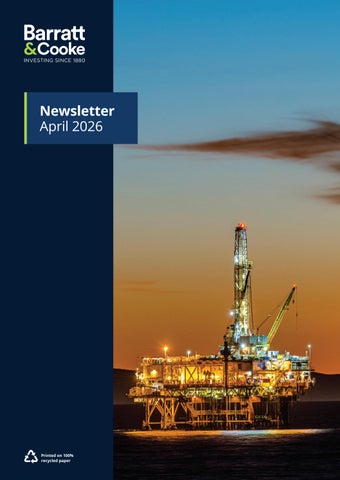
Is oil really ‘liquid gold’?
Three things in life are certain: death, taxes and that by the time this newsletter lands on your doorstep (or in your inbox) it will be out of date. With 7th April 2026 a critical date in the Iranian war, the data in this newsletter is taken from 31st March (to be consistent with the new quarterly reporting process) but I opted to pen it over the Easter weekend, escaping my desk for a brilliant trip to Fakenham races. Subsequently, I had to tear most of it up (following the Trump ceasefire 90 minutes before the ultimatum for Iran) but by the time it went to print on 10th April the ceasefire was in jeopardy. Let us pray the true end of the war is close, as another escalation remains a significant concern; we are not out of the woods yet. Suffice to say equity and bond market volatility has been extraordinary over the last few weeks.
Despite oil falling to $94 per barrel on 8th April 2026 (having been $109 the evening before), I still feel there is more than a degree of validity in this title. Not least because:
1. The war in Iran is not over (though the Strait of Hormuz appears to be reopening).
2. There will be supply chain issues.
3. There is now the possibility of a huge tax (said to be circa $2m) imposed on some ships passing through the waters of Hormuz.
4. The UK is particularly vulnerable given our reliance on energy imports; you could say we are ‘held to ransom’ by them.
Bill Shankly was once quoted as saying:
“some people believe football is a matter of life and death. I am very disappointed with that attitude, I can assure you it is much, much more important.”
Homer in the Iliad referred to oil (olive oil) as “liquid gold”, more recently this quote has been adapted to describe the value of petroleum. I would argue, like Shankly, that oil is “much, much more important” than gold. Gold is of course a ‘store asset’ but the whole world order currently relies on “the black stuff” for industry, transportation, to power the grid and a plethora of other functions, not least bitumen and tar for road infrastructure (so there is little hope for drivers, not only with prices at the pumps but an ever increasing number of potholes).
It was not that long ago that wars in Ukraine and Gaza were dominating headlines. However, more recently, we have seen Donald Trump overturn the leader of Venezuela, try to ‘buy’ Greenland (despicable) and now he wages war on Iran.
The Nobel Peace Prize committee were absolutely right in their adjudication last year (I’m not sure why María Corina Machado gave him her ‘gong’). Indeed, the ‘Trump grump’ after failing to win the coveted prize seems to have propelled him and his ‘Secretary of War’ (rather than ‘defence’ which sums up the Americans’ stance), Pete Hegseth, to become more and more unhinged in both their language and their plans.
It could be said that Trump has become even more unpredictable than Sir Keir Starmer is predictable (with rudderless leadership and a total lack of accountability for each disastrous outcome), whilst I question Hegseth’s antagonistic rhetoric throughout the war, culminating with statements following the ceasefire such as “Iran begged for this ceasefire” and that Trump “achieved victory with a capital V”.
Gold is of course a ‘store asset’ but the whole world order currently relies on “the black stuff”
Let’s go back to the motive behind the invasion and to give the US leader marginal credit, if his rationale was to:
1. Stop Iran from building a nuclear arsenal.
2. Bring an end to the appalling genocide in the region.
3. Curb the aspirations of a country which, allegedly, is the biggest sponsor of terrorism.
Then there certainly was a degree of credibility behind some sort of action. However, I think we were all troubled on the eve of the ceasefire when he ramped up his narrative with less ‘sweary’ but more haunting words that “a whole civilisation will die” and he would “send them back to the stone age” by bombing all bridges and infrastructure. Iran’s response was to surround these assets with human shields comprising women and children with little concern for the value of life; but if 30,000 had been killed in the lead up to the war this was an unsurprisingly brutal form of defence.
So, where are we now?
In a two-week ceasefire brokered by Pakistan (amazing), with a ten-point plan for peace, the Strait of Hormuz is supposed to be ‘open’ but with a toll, and we are yet to see quite how ‘open’ it is (according to ship tracking data only a handful of vessels have transited since the pause in fighting was announced). The Ayatollah and his henchmen have certainly shown some flex in their muscle, demonstrating how much utter chaos a blockade in this stretch of water can cause for the whole world. Furthermore, whilst President Trump has agreed to the temporary ceasefire, it does not appear that Benjamin Netanyahu has, as Israel continues to bomb Lebanon, Iran’s closest ally. The whole Middle East currently has the characteristics of a touchpaper, and one wonders if the Americans have empowered Netanyahu too much as for the peace to be lasting he, too, needs to curb his prolific appetite to attack.
The implications of the war have been far reaching and no more so than for China (who buy around 86% of Iranian produced oil and which makes up approximately 16% of their total consumption) and India who are also more reliant upon the supply of oil from the Middle East than the US or Europe. I wonder if, perhaps, there was an ulterior motive to the war here. One might think this is a coincidence until you appreciate that China buys 55% of Venezuelan oil and, as we know, Greenland is not just a route through from Russia to the US, but sits on considerable reserves of natural resources.
Whilst the UK continues to burn fossil fuels (albeit at very high prices), heavy rationing has been imposed across Asia as they prepare for substantial disruption. It is difficult to deduce the exact amount of Iranian oil that the UK consumes, as reports vary, but 7% of ‘deemed’ total UK consumption is said to have come via the Strait of Hormuz. I use the word ‘deemed’ as actually, in reality, it is much higher as we import a large amount from refineries in the Netherlands and Belgium which is ‘deemed’ to be Dutch and Belgian oil and gas, but plenty of that is actually extracted in and around Iran.
It is also important to remember that it takes circa 40 days for oil tankers to make their way from the Gulf to UK/European shores and therefore, I am afraid to say, that we are yet to see the real implications of the supply chain ‘drying up’ as millions of gallons of fuel was making its way here before the Strait of Hormuz was closed (on 2nd March 2026). You will recall that during both the Covid-19 pandemic and Russia-Ukraine war, supply chain issues were delayed and became more pronounced deeper into, and indeed after, these events as considerable inventories (stockpiles) masked the problem until they became depleted.
Various stances from the UK have been muddled and confusing:
• A worrying interview on LBC when John Healey demonstrated that our Secretary of State for Defence had no idea how many battleships are in service. The one which was eventually deployed (HMS Dragon), had to dock for further repairs on reaching the Mediterranean as the clean water filters were not working.
• We are unsure as to whether US bases on UK soil can actually be used or not, but we have certainly learnt of the importance of Diego Garcia in the Chagos Islands as a strategic defence post, which the UK Government are soon to ‘give’ away. Moreover the defence of a UK base in Cyprus which came under attack left a lot to be desired.
• We heard reports that Ed Miliband (Secretary of State for Energy, or probably more specifically, Secretary of State for ‘renewable’ Energy), was going to grant a licence to extract oil and gas from the North Sea… but then he didn’t.
Incidentally, the UK imports a large amount of oil and natural gas from Norway, who obtain this from their North Sea reserves and consequently the Norwegian Government reaps the reward of taxation at the UK’s expense. Whilst the ‘higher ground’ the UK adopts on renewable energy might be admirable, a considered reversion would appear sensible.
The hypocrisy in our stance is overwhelming, as in order to try and meet ‘net zero’ targets in the UK, where energy is priced on hugely prohibitive multiples versus the rest of the world (predominantly due to excessive taxes), we simply end up pushing manufacturing abroad to places like Asia, who burn fuel (including coal with far ‘dirtier’ consequences than our cleaner fossil fuel solutions). These products then have to be shipped back (more fuel) to the UK for consumers to purchase them.
Playing by these clean energy rules appears to be rather akin to being one of the few countries which abides by ‘International Law’ (and International Bureaucracy) on the global stage. Until all countries commit to cleaner energy targets the exercise creates an unlevel playing field which, in turn, is deeply prohibitive for the UK, not only in terms of prices where we witnessed the impact of tariffs on goods manufactured abroad this time last year, but also in terms of the jobs market.
UK unemployment
• Currently 5.2% or 1.87m people (a 5-year high) are unemployed.
• Of which youth (16-24 years old) unemployment stands at a massive 16%.
• And let us not forget that these figures exclude those who are unable to work. Of course there are considerable numbers who deserve, and need, to be looked after by the state, but there is also a huge swelling of those with more spurious claims that the state has chosen to support, whilst absolutely hammering ‘working people’ and business on every form of tax known to man.
Whilst the ‘higher ground’ the UK adopts on renewable energy might be admirable, a considered reversion would appear sensible.
Back to energy, which is the key driver of another force at work, inflation, or more simply “the cost of living”. This Government came into office with CPI inflation back at 2% yet the last reported figure (for the 12 months to February 2026) was 3.0%. Moreover, that is of course for the period prior to the start of the Iran war. At the next data point on the 22nd April 2026 (or certainly the one after) CPI inflation is likely to climb well above 4%. In time, if the peace lasts, this might well taper back towards target, but we fear the short-term supply chain issues will take a lengthy period to resolve and if the Strait of Hormuz does not remain fully open, I’m afraid the numbers may climb much higher.
Sir Keir Starmer will not let the Conservative party forget that inflation hit double digits in their last term, but neither will he even acknowledge the caveat of the Russian invasion and specifically the implications of the sabotage of the Nord Stream pipes, which run under the Baltic Sea from Russia to Germany. Perhaps, sadly for the UK population, the ‘chickens are coming home to roost’.
Unfortunately, if we were to open up the North Sea and ‘tap’ into our own natural resources, this probably would not have a huge effect on the price at the petrol pump as this (ex our own enormous taxes) is governed by international markets. However, what it would do is ease pressures on supply and shore up our own energy security i.e. whilst it would be expensive, at least we would have access to energy. The freezing of the marine traffic through Hormuz left us exposed and vulnerable, but we are hopeful that the seriousness of this recent situation will encourage our leader in this regard, Ed Miliband, and his Lieutenant (Starmer) to make the right decision.
Whilst speaking of ‘security’ we are similarly hopeful (but not expectant) that farmers, who once again are suffering far more than the inflation figures would insinuate (with the cost of fertiliser etc.), start to receive some financial support and perhaps even a tiny bit of empathy from this Government who seem to have persecuted them from the very start of their tenure. Food security, energy security and defence security must become the top priorities for Government NOW and remain as such. Though it appears the leadership are utterly incompetent and have learnt nothing from the spike in prices (including fertiliser) arising from other conflicts in very recent memory.
Gold has, in the past, been considered a ‘safe haven’ asset during times of geopolitical uncertainty, but this has not proved to be the case during this conflict. Indeed, with the price having risen well ahead of itself, it fell 11.3% in March whilst oil has risen 53% from its year to date low.
Below
The war, oil, inflation and other forces at work have caused considerable volatility in stockmarkets:
During March we saw a sharp pull-back in almost all equity sectors except oil & gas and mining. Even the ‘unstoppable’ Magnificent 7 technology stocks de-rated as markets truly got the ‘jitters’ until the ceasefire. That said, where does one allocate capital in a time of such uncertainty?
• Gold: has not proved to be as robust as it has been in the past.
• Property: not on the tempering of a boom run, specifically with worries around unemployment and mortgages not hugely dissimilar from the subprime mortgage collapse, nor with the taxes this Government are imposing on landlords.
• Farmland: not with this Government.
• Cash in the bank: not with this inflation except sufficient for liquidity and emergencies.
• Bitcoin: No! Walking to an American football match at the Tottenham Hotspur Stadium on 7th October 2025 a US currency trader told me bitcoin was ‘the only thing to invest in’. It stood at £91,848 in sterling terms at the time and by 31st March 2026 it had fallen by 44.4% to £51,080.
• Bonds and Gilts: with rate cuts unlikely to be as fast or aggressive as predicted early in the year, when three rate cuts were priced in (now likely to be one), it just shows how rapidly market expectations for the trajectory of interest rates can change.
It really is a riddle of Riemann hypothesis proportions. That said, over the longer-term equities have delivered and unlike many other assets they do also provide an income for cash flow, if required. Indeed, on the day after the ceasefire was announced, we saw how resilient they can be with multiple holdings increasing 4%-10%. Where appropriate, exposure to oil, through Shell and an Energy ETF, has helped during the conflict and despite a pullback in price on 8th April 2026 (Shell down 6%) these investments have served portfolios well during a challenging period.
During March we saw a sharp pull-back in almost all equity sectors except oil & gas and mining.
Other news and events
The vast majority of the narrative above has clearly been on the war and the implications of the cost of fuel, which affects all people and all business, even those that we think perhaps are immune from it.
Technology, for example, where the cooling of data centres is absolutely key and the ‘mining of bitcoin’ requires vast amounts of energy. So, in order to ensure that this newsletter at least touches on other important developments since the start of the year I bullet point other news and events:
• Unilever, which is widely held across portfolios, is set to demerge its food business, including Knorr and Hellmann’s (my favourite) to focus on beauty, wellbeing and home care. This corporate action will take some time to complete.
• The Doctors have decided to strike AGAIN for more pay. We’ll see if the Government cave in AGAIN, further adding to the Treasury deficit.
• Kemi Badenoch continues to try and skewer the Prime Minister in her six questions each week, but never gets an answer.
• Reform gained another heavyweight Conservative MP in Suella Braverman.
• Mandelson ‘resigned’ (Kemi did finally get an answer on this question).
• Lindsey Vonn crashed in the Winter Olympics.
• Andrew Mountbatten-Windsor spent an evening in Aylsham.
• The US Supreme Court blocked President Trump’s tariff tirade, so he simply imposed a global tariff of 10% on everything (this would have been the big news if it wasn’t for the war).
• China set its lowest GDP growth target for a decade as it braces for an economic slowdown.
• I am delighted to say that our colleague Shaira Bale, having passed her exams, and having completed extensive training, has become an Investment Manager, though she will still be helping me! Fantastic, well done Shaira.
And there was a final, rather sobering, thought:
In the recent March 2026 OBR publication, the charts reveal that for the first time in modern history the UK has reached a fiscal threshold. According to the latest data, the total bill for ‘social protection’, which encompasses the state pension and the rising cost of disability and working-age benefits, has now surpassed the total revenue raised from income tax.
With the welfare and pensions bill now forecasted at £333 billion against £331 billion in income tax receipts for the 2025/26 fiscal year, the UK’s primary tax on labour is effectively a closed loop. Every pound collected from workers is now fully absorbed by transfer payments before a single penny is allocated to the NHS, education or defence. This ‘crossover’ signals a permanent shift in the UK’s structural fiscal position, indicating that the core functions of the state must now be funded entirely by secondary taxes or increased borrowing. What happens if there is a recession, or unemployment continues to rise? A responsible Government would cut welfare spending accordingly, but we know the ‘Welfare Party’ will do no such thing due to backbench pressure.