Temple Beth Or will present its Annual Corned Beef Lunch fundraiser 11 a.m.-1:30 p.m., Tuesday, March 10. All orders must be preordered at templebethor.com/ corned-beef.
Lunch orders feature
1/3-pound Carnegie Deli corned beef or Mrs. Goldfarb's Unreal Corned Beef (plant-based) on rye, with cole slaw, a pickle, brownie, and beverage for $22. Also available for purchase
are cheesecake slices at $6 each, Carnegie Deli corned beef or Mrs. Goldfarb's by the pound for $22, delivery of 10 or more lunches at $10 per address between 10 a.m. and 2 p.m., and dinner orders to-go between 5 and 7 p.m.
Temple Beth Or is located at 5275 Marshall Rd., Washington Township.
To pay for orders by check, call Donna Brodnick at 937-4353400.
UCLA Prof. of Religion Simon J. Joseph will lead the 46th Annual Ryterband Symposium in Judaic Studies, with two programs Wednesday, March 11 at United Theological Seminary.
Joseph specializes in early Judaism and Christian origins; he has published on topics including the emergence of the early Jesus tradition and its relationship to the Dead Sea Scrolls, the rise of new religious movements, and indigenous religion in America.
His documentary films explore the role of religion in contemporary society, culture, and politics.
Joseph is also the cofounder of The Mitakuye Foundation, a nonprofit that aims to empower Native American youths.
At 4 p.m., Joseph will present the lecture, An indigenous
Judaean Mystic: Redescribing Jesus in Second Temple Judaism.
He'll lead a screening and discussion of his documentary Holy Man: The USA vs. Douglas White at 7 p.m.
Narrated by Martin Sheen, Joseph's 2011 documentary
Chabad Challah/Babka Bake speaker among first hostages released by Hamas
Judith Raanan, who with her 17-year-old daughter, Natalie, were the first hostages Hamas released, Oct. 20, 2023, will share her story of survival, hope, and faith at Chabad's Mega Challah/Babka Bake for women and girls, 7 p.m., Thursday, March 19.
A dual U.S.-Israeli citizen who lives in Evanston, Ill., she and her daughter were kid-
napped from Kibbutz Nahal Oz by Hamas-led terrorists on Oct. 7, 2023.
The mother and daughter were in Israel for Judith's mother's 85th birthday and celebrated Simchat Torah at her kibbutz, about a mile from the Gaza border.
investigates the wrongful conviction and 17-year incarceration of Lakota healer Douglas White.
Holy Man won Best Documentary and Best Director at the 2011 Red Nation Film Festival, and Best Film and Best Cinematography at the 2011 Native American Film Festival of the Southeast.
Both presentations are free and open to the public.
The Ryterband Symposium is a collaboration of The University of Dayton, United Theological Seminary, and Wright State University.
United Theological Seminary is located at 4501 Denlinger Road, Trotwood.
For more information, contact UTS Prof. Anthony Le Donne at acledonne@united. edu.
Judith and Natalie Raanan were among the 251 hostages that Hamas and other Palestinian terror groups abducted to Gaza that Saturday morning. Judith Raanan began telling her story at the urging of her Chabad rabbi in Evanston, Ill., Rabbi Meir Hecht, according to Chabad.org.
The Chabad Women's Circle program is open to girls ages 10 and up. The cost is $36 per person. Chabad is located at 2001 Far Hills Ave., Oakwood.
RSVP by March 15 at chabaddayton.com/cwc.
Prof. Simon J. Joseph
Judith Raanan
Sprinkler pipe break displaces Beth Abraham Synagogue, Hillel Academy
Thanks to kindness of community, programs & services relocate for now, with little disruption.
By Marshall Weiss The Observer
When members of Beth Abraham Synagogue met for Shabbat services Saturday morning, Feb. 21, that week's Torah portion spoke of God's command that the Israelites build the Mishkan, a portable sanctuary, "That I may dwell among them."
This was also the once-a-year Shabbat when sisterhood and men's club lead every aspect of the services.
In her d'var Torah (sermon), sisterhood board member Judy Chesen said of the Mishkan that "God wanted the people to become partners and to work together to create something amazing."
"Thursday evening, when our congregants heard that there was a pipe that had leaked onto the second and first floors of the synagogue, they could not come fast enough to lend their support in any way they could," Chesen continued from a platform in the multipurpose
As of press time, it's not known when Beth Abraham Synagogue's building in Oakwood will reopen.
room of the Boonshoft Center for Jewish Culture and Education in Centerville.
"Many worked at the synagogue until midnight to pack up sacred objects to keep them from harm.
Others made phone calls to summon members to the synagogue. The unity and holy community that we have worked so hard to achieve was visible in the compassion and intensity with which our people worked. Today, we held our services in a different location, however, we took our mikdash (sanctuary) with us."
festivities will take place at Beth Jacob Congregation, with members of both synagogues sharing in the celebration and Megillah reading.
For now, Hillel Academy Jewish Day School — based on Beth Abraham's third floor — has relocated to Temple Beth Or, months before its planned move there for the next school year.
"If it wasn't for the kindness of this community, this could really be a crisis," Beth Abraham President Julie Liss-Katz said. "It's been an overwhelming outpouring. All the organizations' offers of support have been amazing. Every Jewish organization in town has offered to do what they can for us. It speaks very kindly of our Jewish community. There are so many heroes in this story."
A valve on the fire suppression system broke at about 5:30 p.m., Thursday, Feb. 19 in the synagogue building, located at Sugar Camp in Oakwood.
"It was hard to get the water turned off," said Beth Abraham Building Committee Chair Matt Arnovitz, who has worked in commercial real estate for more than 40 years.
&
Beth Abraham's next Shabbat service was scheduled to be held at Temple Israel. Its Purim
Bark Mitzvah Boy
"For 30, 40 minutes, it flooded the whole second floor because that's where the pipe is.
Continued on Page Six
With the release in early February of Jewish Federations of North America's survey of U.S. Jews' views on Zionism, JTA has put together a comprehensive package of analysis and opinion pieces considering the data from several angles. We share some of these pieces in our pages this month. The survey indicates that the word Zionism itself is something of a Rorschach test: its meaning is in the mind of the beholder. Previous surveys of U.S. Jews over the last few decades have rarely incorporated the term Zionism. For example, according to the JFNA survey, only 37% of U.S. Jews said they are Zionists, but 88% agreed with the statement, “Israel has the right to exist as a Jewish, democratic state," a definition Zionists often use to describe their own views. Based on the JFNA survey, 7% of U.S. Jews said they are anti-Zionists, with 14% of U.S. Jews between 18 and 34 in this category. There's much more to parse beginning on Page Eight.
Stanley, a lifelong Daytonian, spent 35 years teaching government in Dayton City Schools. Connie, a longtime social worker and former Director of Programs and Services for Older Adults at the Jewish Community Center, continues to serve as a Certified Medicare Counselor well into her 90s. A community leader and co-founder of OLP’s With Pen In Hand writing group, Connie was inducted into the Ohio 2025 Senior Citizens Hall of Fame. The Blums have been a cherished part of the OLP family for seven years.
This is a comfortable place to live and all your needs are met— meals, cleaning, transportation, socializing– and it’s filled with friendly, caring sta
Beth Abraham Pres. Julie Liss-Katz
Beth Abraham Bldg. Chair Matt Arnovitz
University
Caruso, jewishobserver@jfgd.net
Daniel, sdaniel@jfgd.net 937-610-1555
smyers@jfgd.net 937-610-1555
The Dayton Jewish Observer, Vol. 30, No. 7. The Dayton Jewish Observer is published monthly by the Jewish Federation of Greater Dayton, a nonprofit corporation, 525 Versailles Dr., Dayton, OH 45459.
Views expressed by columnists, in readers’ letters, and in opinion pieces do not necessarily reflect the opinion of staff or layleaders of The Dayton Jewish Observer or the Jewish Federation of Greater Dayton. Acceptance of advertising neither endorses advertisers nor guarantees kashrut.
The Dayton Jewish Observer Mission Statement
To support, strengthen and champion the Dayton Jewish community by providing a forum and resource for Jewish community interests.
Goals
• To encourage affiliation, involvement and communication.
• To provide announcements, news, opinions and analysis of local, national and international activities and issues affecting Jews and the Jewish community.
• To build community across institutional, organizational and denominational lines.
• To advance causes important to the strength of our Jewish community including support of Federation agencies, its annual campaign, synagogue affiliation, Jewish education and participation in Jewish and general community affairs.
• To provide an historic record of Dayton Jewish life.
Jennifer Holman
Jude Cohen
Temple Beth Or wrapped up the yearlong celebration of its 40th anniversary — and the 40year tenure of Rabbi Judy Chessin (3rd from L) with The Ruby Ball, Jan. 31 at Moraine Country Club. Shown here with the rabbi are (L to R) 40th anniversary Co-Chairs Stephanie Kirtland and Rachel Haug Gilbert, committee member Larry Glickler, Ruby Ball Co-Chairs Linda and Scot Denmark, and committee member Sue Gruenberg.
Rachel Haug Gilbert
Temple Beth Or Pres. Mark Gruenberg wears his ruby red finest for the congregation's Ruby Ball, Jan. 31.
Jeff Blumer
of Dayton Alumni Chair in the Humanities Prof. Sam Dorf (L) and Culinary historian and author Michael Twitty sat down for a conversation after Twitty's speech about foodways, Southern food, race, and identity on Feb. 5 at the Roger Glass Center for the Arts as part of UD's Food & Cultural Festival. Twitty also joined students for a cooking class and for UD's Black History Month Lunch Kick-Off.
Devorah Mangel
Tammy Winkler shows the craft she made at Chabad Women's Circle's Tu B'Shevat dinner, Feb. 1.
JCC Youth Theatre presented the musical Joseph and the Amazing Technicolor Dreamcoat, produced by Jennifer Holman, directed by Krystal Jasmin Combs, with music direction by Jay Weiss, Feb. 21 and 22 at PNC Arts Annex.
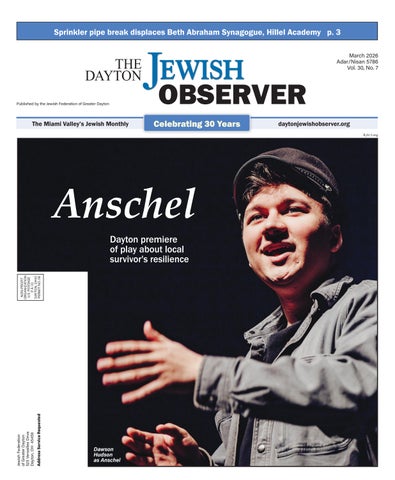
Dayton premiere of play based on book about local survivor's resilience
Anschel at Dayton Art Institute March 15
By Marshall Weiss The Observer
"From the first draft he sent me, I loved it. It just clicked," Renate Frydman, the Miami Valley's longtime champion of Holocaust education, says of playwright Michael London's one-person play Anschel. It's based on Frydman's 2017 book about her late husband's story of survival in Nazi-occupied Poland as a slave laborer and then as a partisan fighter, when he was only a youth, after his parents and two sisters were murdered.
After three readings in Dayton in 2024 and its premiere at the JCC of Greater Columbus last year, the one-person play will have its local premiere — presented by the Dayton Art Institute and The Human Race Theatre Company — at 2 p.m., Sunday, March 15 at the DAI. Wittenberg University senior Dawson Hudson plays Anschel in the production, directed by
Annie Pesch.
London is a member of the Ohio Playwrights Circle; he adapted the book about Anschel "Charlie" Frydman into a play on commission from the Jewish Federation of Greater Dayton, with grants from the Leon Norman and Mildred Miriam Nizny Memorial Fund and the Eleanor and John Kautz Fund of The Dayton Foundation.
When London and Frydman first met about the possibility of adapting her book into a play, London didn't think he was the playwright for the job.
"When I read it, I thought this is an important story, a good piece, and it's valuable," says London, who specializes in historical plays. A resident of the Brookville area, he travels regularly to London, England, where he is the playwrightin-residence at the Benjamin Franklin House.
"My instinct as a writer was probably not going to match what her expectations were."
Frydman had a traditional play in mind with various characters telling different parts of the story.
"I'm the Dramatist Guild of America's representative for
Ohio," London says. "I work with writers all over the country."
He told Renate he would connect her with someone else.
"She looked at me and said, 'Well, what would you do?'"
He envisioned the story told only by Anschel as a young man.
"I would want the audience to become as close to that young man and understand his experience as possible."
Frydman then told London she wanted him to write it.
He told her he
See what our patients have say: -
Jay W.
Call (937) 395-3622 or visit www.emcohio.com to become a member today!
wanted to find an actor in his early 20s to portray Anschel.
"The number of times you've ever been to a theatre and seen a live performance by a solo actor who's male and 20 years old is almost never," London says.
"It's just not done in theatre. It's so difficult. I've had writers, friends of mine in Chicago and New York tease me — 'You're going to do what?' — That's
very challenging for any actor, let alone a younger actor who may not have breadth of experience to command that stage by themselves and deal with having the show on your back.
"However, as I've told them in rehearsal, 'If you can pull it off, it's one hell of a ride for the audience.'"
Anschel is set on his 21st birthday, in Hanover, Germany in 1949.
The Dayton Art Institute and The Human Race Theatre Co. present the play Anschel by Michael London, 2 p.m., Sunday, March 15 in the DAI's Rose Auditorium, 456 Belmonte Park N., Dayton. Tickets are $7 and are available at daytonartinstitute.org/ events/anschel and at the door.
Three young actors performed for the three 2024 readings in Dayton. London secured two other
Daniel Opris, D.O.
Barry Taylor, M.D.
Beth Duvall, M.D.
Dawson Hudson, a senior at Wittenberg University, portrays Anschel Frydman in the one-person play Anschel.
Renate Frydman Michael London
Kyle Long
Continued on Page Six
DAYTON
Anschel
Continued from Page Five
young actors for the Columbus premiere. One moved to New Zealand for graduate work at a university. The other, Hudson, received a standing ovation after the Columbus performance and continues in the role.
Part of a 'resilience trilogy'
Frydman says the play — which is appropriate for grades six and up — is at its core, about a young person who has the resilience to keep himself going.
"I use the word resilience a lot in my speeches to young people now," she says. "From 13 to 17, Anschel occasionally had help from this person or that person, but mostly, he managed to survive on his own. The more I think about what he did, the more impossible it seems."
London says a goal of his writing is to reveal some truth that the audience either doesn't know or has forgotten. The truth he found in Anschel, he says, "is the kind of resilience that each of us can find in ourselves, that Anschel found in himself. The question is, are we able to find it?"
to rescue."
The second and third plays were in the planning stages when he met Frydman.
He's since completed the second in the series, Varian, a one-person play about American writer and editor Varian Fry's time in Vichy France during World War II. There, he helped rescue anti-Nazis and Jews, including artists Marc Chagall and Max Ernst, writer and poet André Breton, and philosopher Hannah Arendt. Funding for Varian came from the Jewish Federation Innovation Grant program.
Readings of Varian were held in January at Wright State University and the Boonshoft Center for Jewish Culture and Education.
Yet to be written is London's two-person play about sisters Ida and Louise Cook, tentatively titled The English Girls.
The sisters, who lived in London, helped 29 Jews escape the Nazis in Germany and Austria in the lead-up to World War II, mostly after Kristallnacht in November 1938.
Anschel forms the first of three Holocaust-related plays from London, which he describes as a "resilience trilogy," because "there's a resilience it takes to survive, there is a resilience that it takes
Beth Abraham
Continued from Page Three Obviously, all that water goes from the second floor to the first floor."
Arnovitz commended the Oakwood Public Safety Department and Capt. Chuck Balaj for their fantastic help.
They carried the Torah scrolls out of the synagogue and loaded them into Arnovitz's vehicle in short order.
"And then we met (Jewish Federation Security Director) John Davis, who opened up the Federation building. We put the Torahs in his office and covered them with tallesim (prayer shawls)."
The Torah scrolls, Arnovitz said, weren't in immediate danger, but the humidity levels in the building posed a threat.
"The Torahs were elevated on the bima (stage) so there was no water really near them. We were more concerned with the humidity. There's no sense taking any risk with the sacred scrolls."
Along with all prayer books, sacred books, ritual objects, and business records, congregants emptied the entire library of its books, most of which are
The development process for The English Girls, London says, is funded by the Montgomery County Arts District through Culture Works.
Immediately after the Dayton performance, Frydman, London, Pesch, and Hudson will lead a talk-back session with the audience.
now stored at Schear Financial Services, next door to the synagogue at Sugar Camp, and at religious school Director Elyssa Wortzman's art studio nearby.
"We're using a restoration company that is fantastic," Arnovitz said.
As of press time, Liss-Katz and Arnovitz didn't know when the building will reopen. "There is an adjuster who is coming on Feb. 25," Liss-Katz said.
"The process of water mitigation has begun, and we are working closely with insurance adjusters and restoration professionals to develop a comprehensive recovery plan," she wrote in a Feb. 23 email to congregants. "At the same time, there are many building, construction, insurance, and related personnel on site. For everyone’s safety, please do not come to the synagogue until further notice."
She also shared that Beth Abraham's religious school is meeting in a nearby building at Sugar Camp.
Liss-Katz asked people to check bethabrahamdayton.org for service and program locations.
"We'll figure out where we fit for each event, where the best option is for us."
Renate Frydman's 2017 book, Anschel's Story: Determined to Survive, about her late husband, is the basis of Michael London's play Anschel.
Medicine & the Holocaust conference
Wright State University Boonshoft School of Medicine presented the conference Medicine and the Holocaust: Modern Implications for Professional Identity, Bioethics, and Health Professions Education on Feb. 3. Speakers (L to R) were Dr. David B. Shuster, clinical assistant prof., Dept. of Orthopedic and Plastic Surgery, Boonshoft School of Medicine; Hedy S. Wald, clinical prof. of family medicine, Alpert Medical School at Brown University and member of the Lancet Commission on Medicine, Nazism, and the Holocaust; and Dr. Ashley Fernandes, prof. of pediatrics, Nationwide Children's Hospital, and assoc. dir. of the Center for Bioethics at The Ohio State University College of Medicine. When Fernandes was with the Boonshoft School of Medicine, he was one of the organizers of its Physicians and the Holocaust course in 2008. Shuster took over the course in 2014.
BabkaChallahBake Mega
Thursday, March 19 | 7:00 pm CHABAD OF GREATER DAYTON
With former hostage
For Women and Girls 10 and up
This event is included with your CWC membership. Individual event $36. RSVP by March 15: www.chabaddayton.com/cwc
This event was made possible with much thanks to the “Esther and Deneal Feldman Jewish Experience Fund.”
Judith Raanan and her daughter Natalie, from Chicago, had traveled to Israel to celebrate the 85th birthday of Judith’s mother at Kibbutz Nahal Oz. On Simchat Torah they were kidnapped by Hamas terrorists. After a horrifying two weeks, they were the first to be released from the terrorists held by Hamas.
Vic and Kathy have always believed in planning for the future without putting life on pause. At Bethany Village, they’re surrounded by neighbors who understand the journey of raising kids, selling a home, and starting fresh, o ering support through every step of the transition. And with a full continuum of care available on campus, they have peace of mind knowing their future needs are covered, freeing them to focus less on tomorrow and more on enjoying today.
Most U.S. Jews do not identify as ‘Zionists,’ even when they support Israel, JFNA survey finds
The survey also found that 7% of U.S. Jews identify as antiZionist, rising to 14% among young
By Andrew Lapin, JTA
Only one-third of American Jews say they identify as Zionist, even as nearly nine in 10 say they support Israel’s right to exist as a Jewish and democratic state, according to a new survey conducted by Jewish Federations of North America.
The findings of the survey reveal that American Jews do not have a mutually agreed upon definition of Zionism — with those identifying as anti-Zionist and those identifying as Zionist ascribing sharply different meanings to the term.
For example, about 80% of anti-Zionist Jews say “support-
ing whatever actions Israel takes” is a tenet of Zionism, while only about 15% of selfidentified Zionists share the belief, according to the survey.
The survey marks the most detailed assessment of the sentiments of American Jews about Zionism by a major Jewish organization in the United States, finding that 14% of Jews ages 18 to 34 identify as anti-Zionist and that the only demographic with a majority of self-identified Zionists was millennials between 35 and 44.
tenor of American Jewish support for Israel — and divided Jewish communities.
The divisions, JFNA is concluding based on the data, are real but often overstated — a matter of concern as Jewish communities and institutions decide whether and how to engage with Jewish critics of Israel.
American Jews do not have a mutually agreed upon definition of Zionism.
The survey comes as tensions following the Oct. 7 attack, Israel’s war in Gaza, and the election of New York City Mayor Zohran Mamdani have put a sustained spotlight on the
“If we misread the trend about ‘Zionism’ to mean that large numbers of Jews, especially young Jews, are turning against the existence of Israel itself, we will draw the wrong conclusions and take the wrong actions,” Mimi Kravetz, JFNA’s chief impact officer, wrote in an essay about the survey’s findings. “We risk responding with anger when the moment calls for
THE NATION
steady leadership, pulling away when the moment calls for connection, and defensiveness when the moment calls for listening and understanding.”
Kravetz’s comments add JFNA, the umbrella organization of hundreds of local Jewish Federations in the United States and Canada, to an emerging group of Jewish leaders calling to open dialogue with Jews who have recently taken stands against Israel or in support of its opponents.
JFNA would continue to define itself as Zionist, Kravetz noted, “in large part because we adhere to the historic definition,” but she conceded that the term had undergone “definition creep.”
Conducted in March 2025 by the research firm Burson, the survey posed a variety of questions to more than 1,800 Jewish and more than 4,100 total respondents about their relationship to Israel and Zionism, as well as about their beliefs about the definition of Zionism.
It was new territory for studies of American Jews. While a major 2021 survey of American Jews by the Pew Research Center had polled Jews on their relationship to Israel, that survey had avoided the use of the word “Zionism.” Other major Jewish groups that conduct population surveys have in the past typically avoided closely interrogating Jewish opinions about Zionism.
JFNA’s venture into this territory came as part of the umbrella group’s series of post-Oct. 7 Jewish trend studies, which have also revealed what the group has termed a “surge” of Jewish engagement.
Overall, more than 70% of Jewish adults who responded to JFNA’s survey agreed that “I feel emotionally attached to Israel,” and 60% said Israel made them proud to be Jewish. At the same time, nearly 70% also agreed that “I sometimes find it hard to support actions taken by Israel or its government.”
One of the survey’s big sticking points emerged around self-identified Zionists. Only 37% of Jews surveyed said they identified as Zionist, while 7% labeled themselves anti-Zionist and another 8% said they were nonZionist. Another 18% said they weren’t
sure, while 30% said none of the labels described them.
At the same time, 88% of surveyed Jews believed that “Israel has the right to exist as a Jewish, Democratic state” — traditionally one of the most historically accepted definitions of Zionism. Seven percent of Jews disagreed with that sentiment, equal to the number who consider themselves anti-Zionist.
Respondents were also quizzed on what views they believed constituted “a part of Zionist beliefs.” Among Jews, 36% said Zionism only meant “the right of the Jewish people to have a Jewish state.” More than one in four Jewish respondents said they thought Zionists were expected to be “supporting whatever action Israel takes,” and 35% said Zionism meant “believing Israel has a right to the West Bank and Gaza Strip.”
Smaller numbers of Jews indicated that they thought “believing Palestinians are a made-up population” and “believing Jews are superior to Palestinians” were also core Zionist tenets.
To Kravetz, these results indicate that some Jews “are not rejecting Israel’s existence or the idea of a Jewish state. They are reacting to an understanding of Zionism that includes policies, ideologies, and actions that they oppose, and do not want to be associated with.”
That is especially true for younger Jews, according to the survey, which shows stark differences along age lines.
Less than half of Jews under 44 agreed that “in general, Israel makes me feel proud to be Jewish.”
The lowest share of Jews who agreed that Israel has a right to exist as a Jewish and democratic state came from the same age group — though even then about three in four, a sizable majority, agreed with the statement.
Uneasiness in describing oneself as Zionist held true across nearly every age range, with only around 35% of Jews in most demographics using the term to describe themselves.
Of the Jewish respondents, 37% were Reform, 17% were Conservative, 9% were Orthodox and 30% identified as other or as no particular denomination.
Survey results shared with JTA broke down respondents by age range, but
MARCH 31 - APRIL 5
SCHUSTER CENTER
Participants at the Celebrate Israel Parade up Fifth Avenue in New York City, May 18, 2025.
Alexi Rosenfeld/Getty Images
Art and Music Café
Saturday, April 18th 6:30 p.m. at Temple Beth Or
Doors open at 6:30 p.m., with wine & cheese reception (non-alchoholic beverages also provided) Live music from 7:00pm to 9:00pm
Featuring ‘Little Mary and friends’ With acoustic Blues, Folk and Yiddish favorites throughout the evening Including the Folk and Oldies stylings of ‘Marc and Steve’ More musicians to be announced & some items available for purchase, including glass sculptures, hand-crafted wood designs, photography and more...
$25.00 admission/donation for this long awaited, artsy, fundraiser! (this is an adult only event, please!) For tickets, please visit: https://templebethor.com/art-music-cafe
What to do with anti-Zionist Jews? Try talking to them, some Jewish researchers say
By Andrew Lapin, JTA
A survey showing that only around one-third of American Jews identify as Zionists set off shock waves in the Jewish world in February, triggering speculation about what could have caused so many Jews to spurn a label once thought as nearly synonymous with Jewish identity.
From his home in Israel, Robbie Gringras had a different reaction.
“I wasn’t surprised,” he said about the survey, conducted by Jewish Federations of North America. “I have a feeling many more of these pieces are now going to come out.”
Together with Abi Dauber Sterne, Gringras runs For The Sake of Argument, an organization that consults on how to hold “healthy arguments” focusing on Judaism and Israel. A few months ago, the two embarked on a project few other Jewish groups would attempt: interviewing dozens of Jewish American antiZionists directly about what turned them away from Israel.
specifically are thinking.
Avowed anti-Zionists make up a relatively small portion of American Jews, according to the JFNA study: 7% overall, and 14% among Jews ages 18-35. But they shared a consistent story, according to Gringras and Sterne’s findings, which they released Feb. 12.
“Throughout all the answers to this question we heard an unmistakable theme: These people report that they reached their rejection of Israel in response to the behavior of Jewish Israelis and Jewish Americans,” Gringras and Sterne write.
Gringras said he understands that the takeaways might be disconcerting to Jewish leaders, who might be drawn to the theory that Jewish anti-Zionists have taken that stance as a result of ignorance, or because of the influence of non-Jewish progressives with no attachment to Israel. But he said he believes the findings can have a positive impact on those who encounter them.
Brandeis University researcher Matt Boxer said he felt “vindicated” by JFNA’s survey. He’s embarked on his own, very similar, multi-year survey project asking American Jews to define Zionism, supported in part by the AntiDefamation League, where Boxer was a former fellow.
When Boxer first distributed his own survey in 2022 with open-ended responses, he received negative feedback from all corners, even death threats, in a sign of just how sensitive even raising the subject can be.
'The moment that the leadership is thinking about this, is confronting this, then good things will happen.'
Temple Beth Or
“I have a lot of faith in people who confront things and think about them,” Gringras said. “So the moment that the leadership is thinking about this, is confronting it, then good things will happen.”
Gringras and Sterne are not alone in trying to more deeply understand how contemporary Jews think about Zionism — which the JFNA survey shows does not have an agreed-upon definition — and what Jewish anti-Zionists more
“I’ve had people tell me I’m an antisemite just by asking the questions, by having people tell me what these things mean,” he said. “And I’ve had people telling me I’m committing genocide against Palestinians.” Even so, turnout was strong. More than 1,800 American Jews, from all over the world, submitted usable responses on whether they describe themselves as a Zionist or anti-Zionist, and what they thought the terms meant. Some synagogues and similar Jewish spaces circulated the survey within their communities. The results, which Boxer first presented in 2024, largely mirrored JFNA’s own findings (a study Boxer had also consulted on, and which was led by one of his former graduate students).
“It’s so much deeper than we’ve left room for in our discourse,” Boxer said. He described what he called “the ‘Rashomon’ effect,” a reference to the classic 1950 Japanese film in which the same event is retold from drastically different points of view. The same thing has happened with Zionism, he said: Every
Robbie Gringras, For the Sake of Argument cofounder.
Screenshot
Jew has their own definition.
“We’ve made this out to be a binary: If you’re Zionist you’re good, if you’re anti-Zionist you’re bad,” he said. “But it’s so much more complicated than that.”
Boxer is currently polishing off a new paper based on the data, exploring the Jews — including many self-declared Zionists — who described Israel as an apartheid state.
In 2024 Boxer’s senior colleague, the social researcher Janet Aronson, surveyed 800 Jewish anti-Zionists. “It’s not a group that we just want to dismiss out of hand,” said Aronson, who heads Brandeis’ Jewish studies center and has conducted population studies for local Jewish Federations for years.
Referring to the combined number of declared anti- and non-Zionists found in the JFNA survey, she added, “I think 15% is a lot of people.”
The push for more and higher-quality dialogue with Jewish anti-Zionists comes as the larger Jewish world is grappling with the seeming collapse of the Zionist consensus, expressed in everything from reactions to Oct. 7 to the election of Zohran Mamdani as mayor of New York City. Some Jewish leaders are calling to extend olive branches to Jewish anti-Zionists, while others want to close the big tent to them.
spaces. That stands in contrast to what they say is a common misconception of the population: that Jewish anti-Zionists don’t know or don’t care about Judaism and other Jews.
For example, the Movement Against Antizionism, a new advocacy group founded by the McGill University doctoral student Adam Louis Klein, defines Jewish anti-Zionists as “those who seek safety or acceptance by echoing the accusations leveled against their own people.” The group draws a historic line connecting the Hellenistic Jews of the Maccabee era, through Jewish Soviet Bundists, to the modern-day anti-Zionist group Jewish Voice for Peace — all Jews that it says identify not with their own people but with antisemites in their broader society.
Some Jewish leaders are calling to extend olive branches to Jewish anti-Zionists, while others want to close the big tent to them.
The researchers studying Jewish anti-Zionism don’t see things quite the same way. While none of the studies claims to be representative of the Jewish anti-Zionist population, 40% of Aronson’s respondents either worked or had previously worked in Jewish organizations — echoing the profile of the day school and camp alums who founded the activist group IfNotNow a decade ago. Many of them became involved in anti-Zionist minyans or similar upstart Jewish spaces that reject Zionism — a growing rallying cry among left-wing Jews.
Those who do engage with Jewish anti-Zionists, these researchers say, will likely encounter a group of people who are very knowledgeable about Judaism and often grew up in Zionist
“Those are people who we would expect to be current and incoming leaders of the Jewish community,” Aronson said. “What does it mean for the Jewish community when they say, ‘We’re not Continued on Page 26
At U.S. Commission on Civil Rights hearing, Jewish students warn against politicizing campus antisemitism
By Jackie Hajdenberg, JTA
Instead of practicing with her a capella group or preparing to lead Shabbat services, University of Maryland senior Tekoa Sultan-Reisler spent her Friday afternoon Feb. 20 testifying about campus antisemitism in front of the United States Commission on Civil Rights.
She shared that she had witnessed antisemitism at her school, and heard about it from other students in J Street U, the college division of the liberal proIsrael lobby that she leads. But she was also very clear on another point: She did not want Jewish college students’ pain to be used for a political agenda.
“Jewish students do not want to be used as a pretext to justify this divisive and xenophobic action of the administration,” Sultan-Reisler said in her testimony. “Instead, protecting students’ right of free speech and expression would allow all students to feel safe on campus, regardless of faith or ethnicity.”
Sultan-Reisler and other students who testified similarly criticized the Trump administration’s decision to defund universities that did not comply with its terms for addressing anti-
semitism. They took the stand on the second day of a two-part hearing called by the civil rights commission in an independent investigation — the first — into how the federal government has responded to campus antisemitism.
The commission, which has the power to issue subpoenas, is appointed by Congress and the president and currently has a narrow Democratic majority. A bipartisan group of representatives requested the antisemitism investigation in 2024.
The session followed several tense exchanges the day before as commission members pressed those testifying — including representatives of antisemitism watchdogs StandWithUs and the Brandeis Center — on whether the Department of Education’s Office of Civil Rights should have its full funding back, and the costs and benefits of different government agencies’ own civil rights offices.
They also made partisan jabs, with many accusing either the Biden or Trump administration of failing to protect Jewish students.
Craig Trainor, former acting assistant secretary for civil rights at the U.S.
Department of Education, criticized the Biden administration for its slow pace in resolving antisemitism discrimination complaints at universities.
“The Biden Education Department’s Offices for Civil Rights’ policy agenda was deeply unserious and counterproductive and its response to the antisemitic harassment and violence consuming America’s college campuses was weak and ineffective,” Trainor said.
Kevin Rachlin, vice president for government relations and Washington director of the The Nexus Project, meanwhile, lambasted the Trump administration’s attempt to shrink the Office of Civil Rights.
“By closing those offices, by removing those personnel, by reducing those resources, you have effectively hobbled the very organization that is dedicated to protecting not just Jewish students but all students,” Rachlin said.
Like her peers who testified over the past two days, Sultan-Reisler recounted specific incidents of antisemitic intimidation.
She recalled that in November 2023, the words “Holocaust 2.0” were written in chalk on the campus sidewalk, and during an on-campus demonstration, a student waved the flag of Hezbollah, a designated terrorist organization.
But she said she didn’t think the Trump administration’s response to allegations of campus antisemitism had made her safer.
Others who testified, including many non-students and older adults, said they thought the Biden administration had been too reserved in tackling campus antisemitism and praised the Trump administration’s heavier-handed tactics.
The commission is accepting written testimonials until March 20. The commission’s report is expected by the end of the 2026 fiscal year.
Harvard University student Tova Kaplan testifies before the U.S. Commission on Civil Rights briefing on antisemitism on college and university campuses, Feb. 20.
Screenshot
March 2026
UPCOMING EVENTS
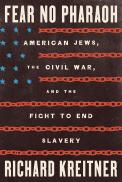
SUNDAY, MARCH 8, 9:45 - 11:45AM CABS — Richard Kreitner, Fear No Pharaoh
TUESDAY, MARCH 10, 5:30 - 7:30PM BBYO Battle of the Paddles
THURSDAY, MARCH 12, 6 - 8PM BBYO Just Roll With It
SUNDAY, MARCH 15, 4 - 6PM Jr. Youth Group Goes to Scene75
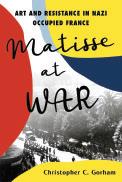
SUNDAY, MARCH 22, 2 - 4PM CABS — Christopher Gorham, Matisse at War
MARCH 23 through 27, 9AM - 5PM JFS Mitzvah Mission Week
SUNDAY, MARCH 29, 10AM - 1PM PJ Library March to Freedom: A Passover Adventure
April 22, 6 - 9PM
March 2026
Richard Kreitner
Sunday, March 8 at 9:45AM
Temple Israel
130 Riverside Drive, Dayton, 45405
Cost: $10
Includes brunch
Fear No Pharaoh: American Jews, the Civil War, and the Fight to End Slavery
Richard Kreitner turns to the story of the engagement of American Jews in the moral and political dramas of the Civil War era. Kreitner tells the story through the lives of six American Jews who shaped the complexities of the time. Among those who are included are Judah P. Benjamin, a brilliant Louisiana senator who became Je erson Davis’ confidant, and Ernestine Rose, an ardent abolitionist. As they struggle to make sense of a polarized time, American Jews debated with one another about religion, morality, and politics — conversations that prefigure many of our own.
Sunday, March 22 at 2PM
Bethany Village
The Village Center/Serr Grand Room
6443 Bethany Village Drive, Dayton, 45459
No cost
Christopher C. Gorham Matisse at War: Art and Resistance in Nazi Occupied France
itzvah
In partnership with Temple Israel as part of the Ryterband Lecture Series and Miami Valley Jewish Genealogy & History
Christopher Gorham, a lawyer, educator, and acclaimed author of The Confidante, has written a book about a lesser-known segment of the life of Henri Matisse. Rather than focus on his earlier paintings, Gorham delves into Matisse’s wartime creativity and moral resolve. After several personal crises, Matisse decided to stay in France. The consequences were grave. His daughter was tortured and deported to Ravensbrück. Later, she was able to escape. Through the horrors of war, Matisse continued to produce works of art even though they were condemned by the Nazis. He produced The Fall of Icarus, and the much-lauded book, Jazz
ission m itzvah m ission m itzvah m ission m itzvah m ission
Monday, March 23 – Friday, March 27, 9AM – 5PM
The Boonshoft CJCE, 525 Versailles Dr., Centerville, 45459
Back by popular demand, JFS is hosting another Mitzvah Mission! This time it is all week long! Help us feed guests at St. Vincent de Paul’s shelters with frozen casseroles and provide high-need items for People and Paws of Greater Dayton, a local pet-food pantry. JFS will take your donations and deliver them directly to St. Vincent de Paul and People and Paws. If you have any questions, please contact Jacquelyn Archie, JFS administrative assistant, at jarchie@jfgd.net or at 937-610-1555.
High-Need Items for People and Paws
Dry puppy food, dry kitten food, paper towels, disinfectant (form of wipes, spray, or liquid)
Frozen Macaroni & Cheese Casserole Recipe
• 1-1/2 lbs. (24 oz.) elbow macaroni
• 2 lbs. cheese, melted
• 1 can (10.5 oz.) cream of celery soup
• 2-1/2 cups milk
Cook macaroni and drain. Melt cheese separately and add to macaroni. Add milk and soup. Mix well. Pour into sprayed pan. Cover loosely and place in refrigerator until completely cooled. Then cover tightly with sturdy foil lid and freeze. Casserole should be frozen for 36 hours.
LOOKING FOR A GREAT PRESCHOOL EXPERIENCE FOR YOUR CHILD?
Open enrollment begins March 1.
Our second infant room is now open! We currently have limited availability. Don't miss your opportunity to join our JCC Preschool family.
Please reach out to our director, Katie Lagasse, with questions or to schedule a tour at klagasse@jfgd.net or 937-610-1794.
JCC Preschool
at
Questions? Contact Jennifer Holman at jholman@jfgd.net
Sunday, March 29, 10AM – 1PM
Join Temple Beth Or and PJ Library families of all ages for an epic Passover Adventure! Families will move from Temple Beth Or (5275 Marshall Rd, Washington Township, 45429) to the Boonshoft Center for Jewish Culture & Education (525 Versailles Dr, Centerville, 45459), bringing the Exodus to life. Stations, costumes, food, and community all come together during this interactive program!
No cost. RSVP at jewishdayton.org/events by March 27 This program is funded by the Esther and DeNeal Feldman Jewish Experience Fund.
Questions? Please contact Kate Elder at kelder@jfgd.net
March 2026
Legacies, Tributes, & Memorials
JEWISH FEDERATION OF GREATER DAYTON ENDOWMENT FUND
In honor of Meredith A. Cline’s 70th birthday
In honor of Mary Rogers and her wonderful music
Sue and Joe Gruenberg
In memory of Richard “Dick” Feiner
Mary Rita and Norman Weissman
HOLOCAUST PROGRAMMING FUND
In honor of Rabbi Judy Chessin’s 40 years with Temple Beth Or
Helene Gordon
JOE BETTMAN MEMORIAL TZADIK AWARD
In honor of Melissa Sweeny’s birthday
Joan and Peter Wells
JOAN AND PETER WELLS AND REBECCA LINVILLE FAMILY, CHILDREN AND YOUTH FUND
In honor of Sylvia Heyman and Richard Broock’s birthdays
Joan and Peter Wells
JEWISH COMMUNITY RELATIONS COUNCIL
In memory of June Youra Beverly Louis
JEWISH FAMILY SERVICES ENDOWMENT FUND
In honor of Sue and Howard Ducker’s 50th wedding anniversary Je rey Kantor JFS
Did you know you can honor a friend or family member through a Legacy, Tribute or Memorial?
A donation to one of the Jewish Foundation's many endowment funds benefits our Jewish community while honoring a loved one. For more information, please contact Janese R. Sweeny, Esq. CFRE, at 937-401-1542.
SCHOLARSHIPS & STUDENT LOANS
Heuman Scholarship & Interest-free Student Loan applications are now available.
Completed applications are due March 27.
Are you a member of the Dayton Jewish community who will be enrolled at a two- or four-year college, technical program, or graduate school in the 2026-2027 academic year? If so, you may be eligible to apply for a college scholarship and/or interest-free student loan through the Jewish Federation of Greater Dayton. It is easy to apply for both incredible opportunities at the same time on a single unified application.
To request the application and to learn more about the Heuman Scholarship and interest-free student loans, please contact Alisa Thomas, executive assistant, at 937-610-1796 or athomas@jfgd.net
SCHOLARSHIPS AVAILABLE FOR SLEEPAWAY CAMP AND TRAVEL TO ISRAEL
Completed applications are due by March 27.
Is your child planning to attend a Jewish sleepaway camp or travel to Israel this summer? If so, you may be eligible to apply for scholarships through the Jewish Federation of Greater Dayton. To request an application and to learn more about these opportunities, please contact Alisa Thomas, executive assistant, at 937-610-1796 or athomas@jfgd.net.
Funding for these scholarships is made possible through the Carole Rabinowitz Youth Jewish Experience Fund, the Joan & Peter Wells and Rebecca Linville Family, Children and Youth Fund, and the Wolfe Marcus Youth Travel to Israel Fund.
OPINION
It’s not just the kids: Only 1/3 of U.S. Jews 75+ call themselves ‘Zionists’
A new JFNA survey finds strong support for Israel but widespread discomfort with the 'Zionist' label among the youngest and oldest Jews.
By Andrew Silow-Carroll JTA
The newest Jewish Federations of North America survey has already generated its share of anxious headlines: Only 37% of American Jews say they identify as Zionists.
Seven percent call themselves anti-Zionist, 8% nonZionist, and 18% aren’t sure. Another 30% say none of the labels offered describe them.
And yet 88% say Israel has the right to exist as a Jewish, democratic state.
One eye-catching, and perhaps unsurprising finding in the survey is that younger Jews are more likely to declare themselves anti-Zionists. Only 35% of Jews ages 18-34 accept the Zionist label.
But look closer and another intriguing generational breakdown stands out: Contrary to conventional wisdom, older Jews are not more likely to identify as Zionists. In fact, only 33% of Jews ages 75 and older say they use the term to describe themselves.
Why would the youngest and oldest cohorts in the study have strikingly similar attitudes about the word “Zionism”? (The only demographic with a majority — 55% — of self-identified Zionists was millennials between 35 and 44.)
The answer may lie less in changing attitudes toward Israel than in the long, complicated evolution of a word.
For Jews now in their late 70s and beyond, the reluctance to use “Zionist” may have roots in how the term was used — or not used — after Israel’s founding.
Middlebury College sociologist Ted Sasson, a scholar in residence at the Israel-based Institute for National Security Studies, argues that even when Jews were celebrating the establishment of Israel, they remained anxious about their own standing as loyal Americans and used the label more sparingly than we might assume.
“Zionism was always a minority political movement
among American Jews,” said Sasson, author of The New American Zionism (2014).
“They came increasingly to support Israel, but as the most powerful Jewish community in the world mobilizing support as an act of faith and commitment and responsibility, but not one that they would describe as Zionist.”
That ambivalence about the ideology of Zionism was famously captured in the 1950 agreement between David Ben-Gurion, Israel’s first prime minister, and Jacob Blaustein, a leader of the American Jewish Committee.
Blaustein pledged that American Jews would support nation-building in Israel with their dollars and advocacy; in exchange, Ben-Gurion said Israel would not interfere with American Jewish affairs, suggest Jews should owe their first loyalty to Israel, or, crucially, call for large-scale immigration of American Jews to Israel.
'A most dedicated friend to Israel'
The Jewish establishment’s views on Zionism were exemplified in Max Fisher, a Detroit philanthropist and general chair of the United Jewish Appeal in the 1960s.
According to a profile of Fisher by Boris Smolar, the longtime editor in chief of JTA, Fisher was “not a Zionist” yet “a most dedicated friend of Israel.”
“For American Jews to be a Zionist meant to contemplate aliyah and to declare oneself in exile,” said Sasson, 60, using the Hebrew term for Jewish immigrating to Israel. “So ‘Zionism’ already in the 1950s and ’60s was not used by American Jews to describe their commitment to Israel.”
Instead, he notes, “Americans call themselves ‘proIsrael,’ and that captures how American Jews think about their Diaspora responsibilities as protectors and mobilizers on behalf of the Jewish state.”
That distinction may help
So, what do you think?
explain why older Jews — who grew up raising money for Israel, marching for Soviet Jews’ right to immigrate to Israel or celebrating Israel’s unexpected military victories — don’t necessarily see themselves as Zionists.
The state existed; their role was to support it, not necessarily to join an ideological movement.
Such ambivalence about “Zionism” was not universal, however. Sylvia Barack Fishman, emerita professor of contemporary Jewish life at Brandeis University, grew up in the Modern Orthodox Bnei Akiva youth movement, which actively encouraged aliyah (as opposed to haredi, or ultra-Orthodox, Jews, many of whom opposed the establishment of a modern political Jewish state on theological grounds).
Now 80, she recalls that nearly all of her bunkmates at the movement’s Camp Moshava in Rolling Prairie, Ind. eventually moved to Israel.
Those who stayed behind, she said, represented the distinction between “proIsrael” and “Zionist.”
“When you’re looking at people over 75, I think their idea of a Zionist is a person who goes to live in Israel,” she said. “So, you know, ‘are you a Zionist?’ ‘No, I live in Queens. What kind of a Zionist could I be?’”
Today, when Zionism has come under attack in leftist circles where she had devoted her career as a feminist pioneer, Pogrebin describes a more cautious relationship with the label: “I am only comfortable calling myself a ‘liberal Zionist,’ then explaining myself, not just letting it out there, because it’s become so radioactive.”
For her, a liberal Zionist believes both Israelis and Palestinians have a specific cultural and national identity, which could be expressed in two states or perhaps a confederation. She rejects the idea of a single binational state of Jews and Palestinians.
Pogrebin said external rhetoric has reshaped the emotional resonance of the word “Zionism” for Jews younger than she. “Opponents made (Zionism) a dirty word, and somehow the ‘Z’ had the same kind of power on the left that we (Jews) fear from the swastika,” she said.
The answer may lie less in changing attitudes toward Israel than in the long, complicated evolution of a word.
Fishman compares the word’s trajectory to another charged identity marker.
“What has happened to the word ‘Zionist’ for young people is a process of delegitimization, very similar to what happened to the word ‘feminist,’” said Fishman.
tacks and the war that followed, said Fishman, the left had succeeded in stigmatizing “Zionism.”
“For Jews under 30, the word Zionism has become equivalent to ‘White supremacist’ in many circles,” she said, describing their peers’ anti-Zionist attitudes. “So it’s not that the majority of them don’t care about Israel, but to be a Zionist means that you think Jews are better than other people...It has so many negative connotations and people under 30 are notoriously sensitive to what their peer groups think.”
The result, she says, is strategic avoidance: “They’re not going to fight a battle over a word. So just like those women who were world-class feminists, but didn’t want to be called a feminist, these people may care a lot about Israel, but they just do not want to fight that particular battle.”
The youngest and oldest American Jews may converge on deploying (or avoiding) the word “Zionist,” but still view Israel across a yawning gap of experience and memory.
Shaped by
historical experience as much as ideology
As Harvard scholar Derek Penslar describes it in his 2023 book Zionism: An Emotional State, Jews who came of age in the 1970s and early ’80s grew up when Israel’s pivotal wars of 1967 and 1973 were a living memory, and the 1990s Oslo peace process “could give young Jews a sense of hope and a belief that Israel embodied (their) liberal values.”
“In contrast,” writes Penslar, “university-age Jews in the 21st century lived in a radically different environment — darker and more foreboding on every front.”
Writer and activist Letty Cottin Pogrebin, 86, who did grow up in Queens, said she called and still calls herself a Zionist — with an explanation.
“I grew up calling myself a Zionist. We had to argue, though, that being a Zionist didn’t require moving to Israel. It just required letting your dollars go to Israel and your heart go to Israel, and your body stay here in the Diaspora,” she said.
While interviewing Jewish women leaders in Israel and the United States for a forthcoming book, she said many of her subjects were to call themselves “feminists,” a term that had long been derided by its critics.
“There are many who actually were groundbreakers, doing astonishing things for other women, and they told me they would only agree to an interview if I did not use the word ‘feminist’ in the same sentence with their name,” she said.
Even before the Oct. 7 at-
Many have only known Israel under Prime Minister Benjamin Netanyahu and a series of increasingly right-wing governments.
Pogrebin agrees that her understanding of Zionism was shaped by historical experience as much as ideology. “I was a child during the Holocaust, but I was a very alert child. I was aware that my parents were scared to death,” she said. “You don’t forget that; you’ve internalized it.”
The JFNA survey was greeted with good news/bad Continued on Page 18
OPINION
‘Anti-Zionists want to target Jews without looking racist. The USSR gave them the perfect playbook’
Anti-Zionism is not a reaction to Israel but a political movement in its own right, Vanderbilt sociologist Shaul Kelner argues.
By Jane Prinsley
The Jewish Chronicle (U.K.)
As a sociology professor, Shaul Kelner is interested in patterns of behavior. Watching anti-Zionism take hold across the West, he began examining the social dynamics that lead people to mobilize against a community.
Speaking via video link from Nashville, Tenn., the Vanderbilt University professor of Jewish studies explained his view: anti-Zionism needs to be confronted separately from antisemitism, understood as its own political phenomenon, and examined independently from debates on Israel.
“Anti-Zionism is what antiZionism does,” he argues in an essay published in the latest edition of the Shalom Hartman Institute's journal, Sources
Just as antisemitism has little to do with "semites," Kelner writes, anti-Zionism has little to do with Zionists. Anti-Zionism is a “political mass movement defined not by abstract ideas but by lived praxis.”
Kelner has taught Jewish studies and sociology at Vanderbilt University for 20 years. His research and books have focused on American Jewish political engagement overseas, particularly activism to free Soviet Jewry during
Jews 75+
Continued from Page 17
the Cold War. Speaking after the publication of the essay, he explained, “I spent the last 12 years immersed in studying American Jewish activism to free Soviet Jews. That work got me connected to studying Soviet anti-Zionism.”
Kelner believes the antiZionism that grips many academic institutions cannot be understood without grappling with its Soviet roots.
In the USSR, he explained, the state was ideologically committed to opposing antisemitism, which it associated with fascism, Nazism, and German nationalism, but it wanted to target the Jews.
“They were fighting against the Nazis, so they could not embrace this Nazi ideology. And yet they wanted to persecute Jews – so they needed to find other justifications to do that.”
The solution was linguistic. “They framed it as not opposing Jews but opposing Zionism.”
Jews who identified as Jewish were accused of being Zionist nationalists and enemies of the state while those who assimilated or downplayed their Jewish identity were condemned as “rootless cosmopolitans."
“You were damned if you
news reactions. Many welcomed the finding that a majority feel an attachment to Israel, but disagreed on who might be to blame for the reluctance to embrace the “Z” word.
For the Greater Philadelphia branch of the rightwing Zionist Organization of America, the gap between the majority who told JFNA they feel emotionally attached to Israel and the roughly one-third who identify as Zionist is a sign of the failure of the “education systems,” Jewish institutions, and Jewish families to teach “what Zionism actually is.”
“Zionism is the belief and movement for Jewish self-determination and security in our historic, legal and God given homeland,” the chapter posted on Facebook. “Zionism is not merely a political movement (although some elements are). Rather, it is a peoplehood movement. As what Zionism is gets diluted,
So, what do you think?
did and damned if you didn’t,” Kelner said. “You embrace your Jewishness; you were a Zionist. You deny it; you were a cosmopolitan. Nowadays they would say ‘globalist.’”
For Kelner, this history matters because the language used today mirrors that of this period.
“Both the rhetoric we hear from the left about Zionists and from the right about globalists, has roots in 20th-century Soviet politics,” he said.
don’t accept the premises of the group doing the othering. You study the group itself: its motivations, its practices, and its effects.”
That approach becomes particularly important when confronting anti-Zionist Jews, who present themselves as moral or ideological critics of Israel rather than participants in a movement that has adopted antagonist practices against most Jews.
What feels different now though, Kelner went on, is in the Soviet Union antiZionism was imposed from above by a government people often distrusted, whereas in the U.S. and parts of Europe today, it is “a bottom-up mass movement, populated by true believers.”
“You pick your poison,” he said.
One of his key points is that Jews have been responding to anti-Zionism in the wrong way – and too often letting the debate become trapped in arguments about Israel.
“This is part of the anti-Zionist playbook. They shift the focus onto conversations about Israel, rather than keeping attention on how anti-Zionists are treating Jews here,” he said. But this is flawed. “You
Kelner does not deny that many Jews enter these anti-Israel spaces through genuine concern about the Jewish state and its policies.
“Often it begins with a critique of Israel,” he said. “But once people enter those spaces, something shifts. They find a movement that gives them language, that gives them community.”
At protests, rituals have evolved that sometimes fill a void left by declining religious and communal life. There are rules and regulations – the vast Boycott, Divestment, Sanctions list of rules is just one such example.
At Vanderbilt, Kelner notes that a major football victory for the university was an unlikely factor that helped defuse a potential encampment erupting.
“For students looking for ritual and belonging, they
the Jewish People is diluted — and endangered.”
On the left, the survey offered proof that the Jewish establishment has itself tarnished the “Zionist” brand by discouraging criticism of Israel’s flaws and advocacy of democratic values in the country.
“I personally don’t think the terms Zionism and anti-Zionism serve us any longer,” wrote Rabbi Jill Jacobs, CEO of the rabbinic human rights group T’ruah, in a JTA essay. “We need a new vocabulary to describe the conviction that most American Jews actually have: a deep connection to Israel and belief that it should be a Jewish and democratic state, and a willingness to fight for Palestinians’ rights and to criticize the Israeli government.”
The JFNA survey may ultimately reveal less a collapse of Zionism than a transformation in how American Jews talk about themselves.
The JFNA survey may ultimately reveal less a collapse of Zionism than a transformation in how American Jews talk about themselves.
found it – it just happened to be around football rather than politics.”
When it comes to Jews joining in anti-Israel protests, Kelner said: “Any system of oppression creates incentives to participate in it, and I think that anti-Zionist oppression is no different. Look at racism, sexism and homophobia. You will always find members of that community who for a variety of reasons will participate in the othering of their own group.”
Social pressure plays a powerful role, particularly among young progressive Jews. “There are real social costs to standing up against anti-Zionism when it becomes the dominant political culture of your peers,” he added. Education, Kelner believes, is a crucial missing piece. “If everyone knew the historical costs of Soviet anti-Zionism – when Jews were harassed, surveilled, and imprisoned in its name – they would be less likely to pick up the mantle. We tend to frame all antiJewish politics as antisemitism. So when Jews are involved in anti-Zionist movements the rest can say, truthfully, ‘I don’t hate Jews. Why are you calling me antisemitic?’
“If they knew what had been done to Jews in the name of anti-Zionism, they would be far less eager to embrace that label,” Kelner wagered.
Perhaps then the word “Zio” would not be bandied about so casually, as if a shorthand for evil incarnate.
The oldest generation absorbed Israel into a sense of communal responsibility; younger Jews navigate a world in which ideological labels are heavily politicized and Israel is for many a pariah state. Both cohorts may support Israel deeply while resisting a word whose meaning has shifted.
Or perhaps what’s lacking is a time horizon, and the generations can’t be understood without measuring how their attitudes change over the years. It’s possible that the people with the highest hopes about Israel’s future could be the most disappointed by its present.
“I have many, many (Jewish) friends who call themselves anti-Zionist and non-Zionist,” said Pogrebin. “It’s an arc that they have come to. After years of fidelity to the Zionist dream, they’ve come to believe it impossible.”
Prof. Shaul Kelner
Classes
Beth Jacob Classes: W. Rabbi Agar on Zoom. Call to register, 937-274-2149. Tuesdays, 7 p.m.: Torah Tuesdays. Thursdays, 7 p.m.: Thursdays of Thought.
Chabad Classes: Wednesdays, 7:30 p.m.: Talmud Class in person & Zoom. Call for Zoom link & location. Fridays, 9:30 a.m.: Women’s Class. Call for location. 2001 Far Hills Ave, Oakwood. 937-643-0770.
Temple Beth Or Classes: Sat., March 14, 28, 10 a.m.: Apocryphal Study in person & Zoom. Thurs., March 19, 6 p.m.: Navigating Loss w. Andy Chaet. Thurs., March 26, 7 p.m. The Jewish Short Story. Register at templebethor.com/calendar. 5275 Marshall Rd., Wash. Twp. 937-435-3400.
Temple Israel Classes: Sundays, 11:45 a.m.: Everyday Moral Dilemmas. Register w. projectzug.org & also email Rabbi Bodney-Halasz, rabbi@ tidayton.org. Wednesdays, 10 a.m.: Torah Study Commentary in person & Zoom. For Zoom info. email info@tidayton.org. Saturdays, 9:15 a.m.: Virtual Torah Study on Zoom. For Torah Study Zoom info. email Fran Rickenbach, franwr@gmail. com. Tues., March 3, 10, 24, noon: Talmud Study in person & Zoom. Fri., March 13, 11 a.m.: Living w. Loss. Thurs., March 19, 3:30 p.m.: Living w. Ambiguous Loss. Sat., March 21, 9:15 a.m.: Torah Study in person and Zoom. tidayton.org/calendar. 130 Riverside Dr., Dayton. RSVP to 937-496-0050.
Family
Hillel Academy’s Tiny Tinkerers STEAM Kitchen: Sun., March 8, 10 a.m. Free. Parents & children 2-5. To RSVP & for location, contact Meryl Hattenbach, mhattenbach@daytonhillel.org.
Beth Abraham Rhythm ‘n’ Ruach: Fri., March 13, 5:306:15 p.m. For location, go to bethabrahamdayton.org.
Hillel Academy Tea Party for Grandparents & Special Friends: Mon., March 16, 1 p.m. Free. RSVP to Meryl Hattenbach, mhattenbach@daytonhillel.org. At Temple Beth Or, 5275 Marshall Rd., Wash. Twp. 937-435-3400.
Temple Israel Prayer & Play: Sat., March 21, 10 a.m. Infants–2nd grade. 130 Riverside Dr., Dayton. 937-496-0050.
PJ Library March to Freedom: Sun., March 29, 10 a.m. Free. RSVP by March 27 at jewishdayton.org/events. Questions, email Kate Elder, kelder@jfgd.net. Program starts at Temple Beth Or, 5275 Marshall Rd., Wash. Twp. Ends at Boonshoft CJCE, 525 Versailles Dr., Centerville. 937-610-1555.
Youths & Teens
BBYO Battle of the Paddles: Tues., March 10, 5:30 p.m. $16. For info. & RSVP, email Jennifer Holman, jholman@jfgd.net. Pickleball Kingdom, 985 S. Main St., Centerville.
BBYO Just Roll w. It: Thurs., March 12, 6 p.m. Bring money for food. Info. & RSVP email Jennifer Holman, jholman@jfgd. net. jewishdayton.org/event. Location on registration.
Jr. Youth Group Goes to Scene75: Sun., March 15, 4 p.m. $30. RSVP by March 9. Register at jewishdayton.org/ events. For info., email Jennifer Holman, jholman@jfgd. net. Scene75, 6196 Poe Ave., Dayton.
Chabad CKids Pesach Seder Spellbook: Sun., March 22, 4 p.m. Free. RSVP at chabaddayton.com/ckids. 2001 Far Hills Ave, Oakwood. 937-643-0770.
Adults
Temple Israel Sacred Stitching: Tues., March 3, 17, 31 11 a.m. Make items for donation w. JCRC’s Upstander initiative. For info., email Alexandria King, garyuzzking@hotmail.com. 130 Riverside Dr., Dayton. 937-4960050.
Temple Israel’s Ryterband Lecture Series & Brunch: $10. Sundays, 9:45 a.m. March 8: Richard Kreitner, Fear No Pharaoh: American Jews, the Civil War, & the Fight to End Slavery March 15: Michelle Shapiro Abraham, Creating Belonging: Building a Community Where Everyone Feels at Home. March 22: Sandra Doninger, Advanced Directives: How to Make Them Uniquely You. 130 Riverside Dr., Dayton. 937-496-0050.
Anschel Performance: Sun., March 15, 2 p.m. $7. Register at daytonartinstitute.org/events/ anschel. The Dayton Art Institute, 456 Belmonte Park N., Dayton.
Temple Israel So a Rabbi Walks into a Bar: Thurs., March 18, 5:30 p.m. Contact temple for location, 937-4960050.
CALENDAR
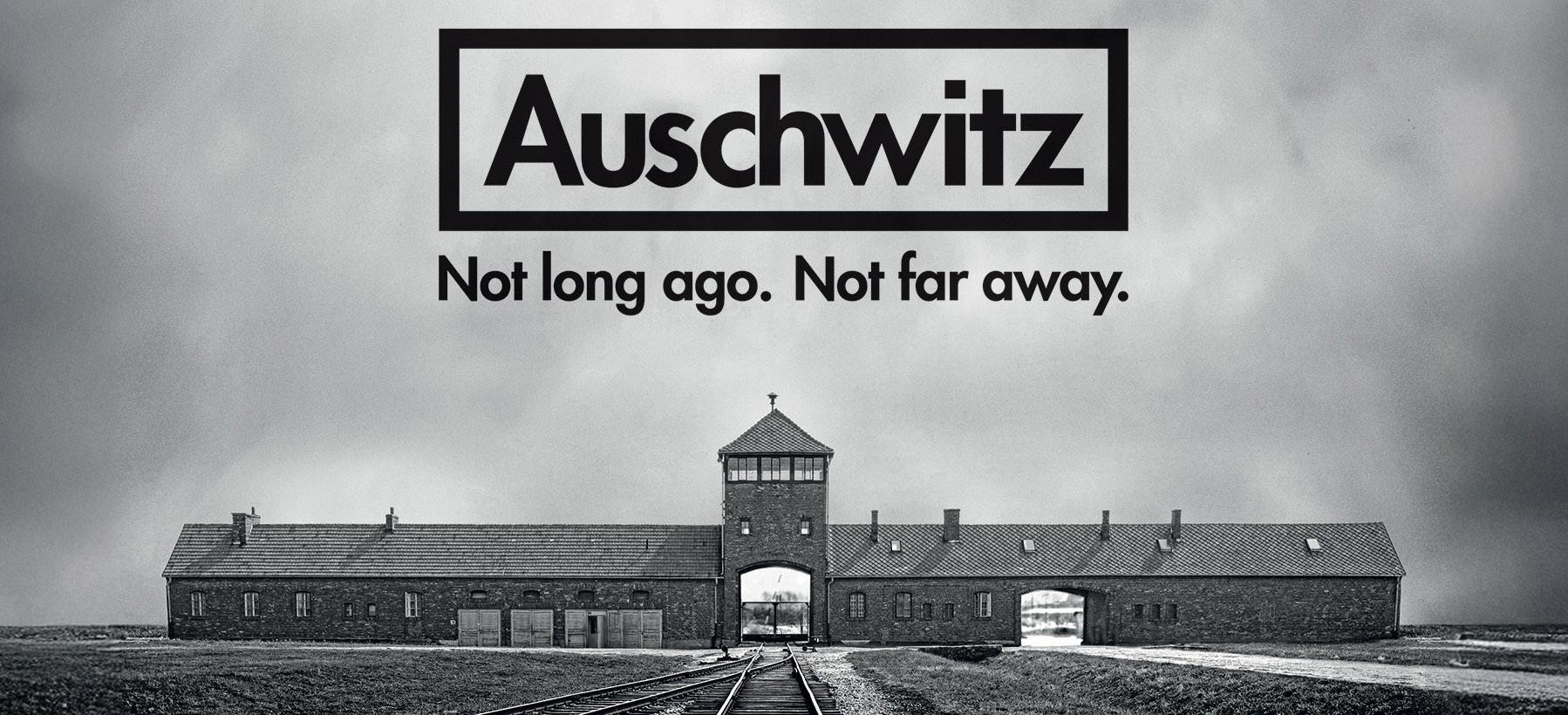
Temple Beth Or Tour of Auschwitz Exhibit: Sun., March 22, 2 p.m. $26. Register at templebethor.com/calendar. Union Terminal, 1301 Western Ave., Cincinnati.
Beth Abraham Men's Club Deli Dinner Movie Night & Raffle Drawing: Sun., March 22, 6 p.m. $20. For location and to RSVP by March 18, call 937293-9520.
Temple Beth Or – Roy Lichtenstein: Art, Life, & Jewish Roots: Tues., March 24, 6:30 p.m. Free. Presentation by Dr. Carol Salus. More info. & RSVP by March 22 at templebethor. com/calendar. 5275 Marshall Rd., Wash. Twp. 937-435-3400.
Women
Chabad Rosh Chodesh Society: Sundays, 9:45 a.m. $15. March 1: Reaching & Reaping Genuine Joy. March 22: Working Wonders w. Words. RSVP at chabaddayton.com/rcs. 2001 Far Hills Ave., Oakwood. 937-6430770.
JCC 12th Annual Women’s Seder: Thurs., March 12, 6 p.m. $54. Collecting new art supplies for donation. RSVP to 937-610-1555. Contact Stacy Emoff for info., semoff@jfgd.net. Boonshoft CJCE, 525 Versailles Dr., Centerville.
Chabad Mega Challah/Babka Bake: Thurs., March 19, 7 p.m. $36. W. Judith Raanan. Women & girls 10 & up. RSVP at chabaddayton.com/cwc. 2001 Far Hills Ave, Oakwood. 937643-0770.
Men
Chabad Bagels, Lox & Tefillin: Sun., March 1, 9:30 a.m. 13+ welcome. 2001 Far Hills Ave., Oakwood. 937-643-0770.
JCC Cultural Arts & Book Series
See Page 14
Community
Temple Beth Or Corned Beef Lunch: Tues., March 10, 11 a.m.-1:30 p.m. Preorder at templebethor.com/event/cornedbeef-2026. 5275 Marshall Rd., Wash. Twp. 937-435-3400.
Temple Anshe Emeth Shabbat Across America: Shabbat service & dinner: Fri., March 13, 6 p.m. 320 Caldwell St., Piqua. Contact Steve Shuchat, 937726-2116, ansheemeth@gmail. com.
JFS Mitzvah Mission Week: Mon., March 23-Fri., March 27, 9 a.m.-5 p.m. Mac & Cheese recipe & list of high-need items
to donate at jewishdayton.org/ events. More info. & make an appt. to drop off, email Brian Kerstine, bkerstine@jfgd.net. Boonshoft CJCE, 525 Versailles Dr., Centerville.
Purim
Temple Beth Or K-POP Demon Hunters: Sun., March 1, noon. Free. Megillah, Mingle, & Mitzvah: Mon., March 2, 6:15 p.m. Free. RSVP for both at templebethor.com/calendar. 5275 Marshall Rd., Wash. Twp. 937-435-3400.
Beth Abraham Purim at Beth Jacob Congregation: Mon., March 2, 4:30 p.m. $20 adults, $10 kids (3-10). 4:30-6:15 p.m.: Carnival Games. 5:15 p.m.: Dinner. 6:20 p.m.: Costume parade. 6:30 p.m.: Shpiel. 8:30 p.m.: Megillah. RSVP at bethabrahamdayton.org/events/purim. At Beth Jacob Congregation, 7020 N. Main St., Harrison Twp.
Temple Israel Jew Pop Purim Protectors Carnival: Mon., March 2, 6 p.m. Free. tidayton. org/calendar. 130 Riverside Dr., Dayton. RSVP to 937-496-0050.
Chabad Young Professionals & JFGD YAD Royal Purim Celebration: Mon., March 2, 6:30 p.m. $18. Call to RSVP, 937643-0770 or chabaddayton.com/ calendar. Poelking Lanes South, 8871 Kingsridge Rd., Dayton.
Beth Jacob Yee Haw, It’s Purim: Mon., March 2, 7:30 p.m. Free. 7:30 p.m.: Minchah. 8:30 p.m.: Megillah. 7020 N. Main St., Harrison Twp. 937-2742149.
Chabad Purim in the Circus: Tues., March 3, 5:30 p.m. $20 adults, $7.50 child. RSVP at chabaddayton.com/calendar. 2001 Far Hills Ave, Oakwood. 937-643-0770.
A Miami Valley Tradition
DAYTON THE reetings
OBSERVER
1. Select your greeting size. Check off your selection: A, B, or C.
Warm Passover greetings from The Mensch Family A
This is a 1-column-inch size. (Does not include graphic) Only $15
2. Select your greeting. Check off your selection.
□ Happy Passover
□ A sweet and joyous Passover
□ Happy Passover to our friends
□ Our warmest wishes for a joyous Passover
□ Warm Passover greetings from
□ Best wishes to all for a Happy Passover
□ Wishing all of Dayton Happy Passover
□ We wish the Dayton Jewish community a Happy Passover
□ Other
MAZEL TOV!
The Simcha Family B
Happy Passover
This is a 2-column-inch size. (Includes graphic)
$30
Joseph Efraim Davis will celebrate his bar mitzvah on March 14 at Beth Jacob Congregation. Joey is the son of Rich Davis and the late and beloved Susan Jacobs Davis. He is the brother of Jake Davis. He is the grandson of Rachel Jacobs and the late Steven Jacobs of Dayton, Phyllis Davis and the late Arnold Davis of Florida. Joey attended Hillel Academy of Greater Dayton and now attends The Miami Valley School. Joey also plays bass in the MVS Jazz Band.
innovators, and changemakers from the last nine graduating years. MU's charter year was 1809, the inspiration for "18 of 9." Addison is a staff attorney with Fair Shake Environmental Legal Services in Cleveland. The firm litigates environmental cases representing individual and nonprofit clients. Proud parents are Patty and Mike Caruso
Best wishes to all for a Happy Passover The Haimishe Family
This is a 3-column-inch size. (Includes graphic)
$45
Peter Benkendorf, founder of The Collaboratory, has announced the successful completion of its Miami Valley Medical Debt Relief Campaign project. As reported by The Dayton Daily News, The Collaboratory raised $137,850, which it used to buy up and eliminate $21.95 million in qualifying medical debt for 15,378 people. Benkendorf notes that each dollar the campaign received eliminated about $178 in medical debt. Next up, Peter says, is The Collaboratory's Cars4Work, in collaboration with The Equity Center and Impact Garage. "We are ensuring that transportation is not a barrier to employment or employability by providing affordable, reliable transportation to individuals who are working their way out of poverty, through recovery, or are formerly incarcerated," he says. The Collaboratory is actively looking for people to donate vehicles.
3. Print the name(s) as you would like them to appear
The League of Women Voters of the Greater Dayton Area will honor Bonnie Beaman Rice as one of its five 2026 Dangerous Dames of Dayton, Tuesday, March 24 at UD's Daniel J. Curran Place. Along with Bonnie's myriad community advocacy and volunteer activities, she serves as chair of Dayton's Jewish Community Relations Council.
Miami University has named Addison Caruso one of its "18 of 9" alumni award honorees for the 2025-26 year. It's MU Alumni Association's way of recognizing 18 leaders,
H. Solomon has been elected president of the Lincoln Society of Dayton. This is the group that funded the 11-foot-tall bronze statue of Lincoln by sculptor Mike Major that was unveiled at Courthouse Square in 2016; it was also instrumental in the 2024 installation at the Dayton VA of a statue of Lincoln signing legislation to establish the National Asylum for Disabled Volunteer Soldiers. The society holds monthly meetings at Woodbourne Library in Centerville.
Steven was also elected to his second three-year term on the board of the Central Ohio Public Information Network, which increases awareness and education of the role of public information officers during a crisis, assists with training opportunities for greater disaster communications skills among its members, and facilitates requests for emergency communication backup support from members able to assist qualified organizations that serve community needs. Steven is the external relations lead for the Central and Southern Ohio Region of the Red Cross and a public information instructor with the Ohio Emergency Management Agency.
Send your Mazel Tov announcements to mweiss@jfgd.net.
Steven
Addison Caruso
Bonnie Beaman Rice
Peter Benkendorf
Steven H. Solomon gets the approval of Abe, portrayed by John W. King.
Mary Solomon
JFNA survey
not by other factors such as denomination; individuals were randomly assigned to receive certain questions.
The debate over Zionism remains fraught. The last few years have seen increased demonization of “Zionists,” alongside shifting definitions of the term, among progressives and far-right figures on social media and college campuses.
At the same time, new advocacy groups like The Jewish Majority and the Movement Against Antizionism have called for shunning those expressing anti-Zionist or antiIsrael sentiment from Judaism’s big tent.
Still, more Jewish researchers are looking to better understand the intra-Jewish divide over Zionism and the various ways Jews understand the term.
For The Sake of Argument, an organization that promotes “healthy arguments” and works with several mainstream Jewish groups including JFNA, recently undertook its own interview series with Jewish antiZionists. Co-directors Robbie Gringas and Abi Dauber Sterne on Feb. 12 published findings from their conversations with about 30 participants.
“It’s great that people are starting to talk about the elephant in the room,” Gringas told JTA from Israel. “We, the Jewish world, don’t yet know what to do with this. And in the meantime, we have to find a way to not break each other’s hearts as much as we have been.”
The pair’s main takeaway from their interviews, Gringas said, was that Jewish anti-Zionists were “sad, if not brokenhearted, about the ways in which they not only find no expression for their Judaism, but also find the Judaism that they’re meeting very challenging.” He added, “The people we met were very knowledgeable about Israel and about Judaism. They were rich human beings.”
The fact that more institutional Jewish groups are interested in learning about what motivates Jewish anti-Zionism is a positive step, Gringas said, adding that it fits the current challenges of the Jewish moment.
“We need to recognize that the world’s changed. We’re in a different time,” he said. “We’re not in a transition. We’re in a rupture. And we need to confront it and think about it carefully.”
RELIGION
Not what it seems
By Rabbi Haviva Horvitz
Temple Beth Sholom
There are many Jewish holidays throughout the year, and most of them have a component that is geared toward teaching our children about Judaism.
For example, we build a physical booth on Sukkot that teaches us what it was like to live outside in temporary dwellings during our travels through the desert.
We dance with the Torah and give out sweets on Simchat
Perspectives
Torah to remind us that learning is enjoyable. During the Pesach Seder, we are instructed to teach each of our children at his or her level of understanding.
But Purim is different. At first glance, one might think that Purim is for children, but it is not what it seems. I maintain that Purim is a holiday for adults, complete with an R- or even X-rated story, heavy drinking of alcohol, and gambling.
During a typical Cha nukah celebration today, our children “gamble” with chocolate gelt and dreidels. Historically, there were times when our ancestors had to hide their studying with activities such as games that were more acceptable to the non-Jewish governments.
The name of this holiday, Purim, comes from the Hebrew word pur, which means lots (as in lottery). When he decided to kill all the Jews, Haman (boo!!!) determined when he would do so via a lottery. For some,
Purim has become a good day to buy lottery tickets and go to casinos.
There are a number of important scenes in the story that take place at parties. These events include a great deal of alcohol.
Adults celebrating Purim today are encouraged to get so drunk that the lines between good and evil, blessed be Mordechai and cursed be Haman (boo!!!) are blurred.
hid her Judaism until the time was right.
Is there a lesson here for our children? Or do adults need a reason to let go a little?
Megillat Esther itself is not a story for children. Why did King Ahashverus want his beautiful Queen Vashti to attend his party? And why did she say no? If showing off her beauty required her to be naked, as commentators have discussed, that is not a lesson I would want to teach my children.
Shabbat Candle Lightings
March 6: 6:16 p.m.
March 13: 7:24 p.m.
March 20: 7:31 p.m.
March 27: 7:38 p.m.
Bigtan and Teresh were hiding their plans to kill the king. Even The Almighty is hidden from us in this story. Mordechai was dressed in a costume of sorts and paraded down Main Street as a reward for saving the king. So, what do we do? We conceal our true selves and wear costumes and masks. One can argue that people dress up in costumes on Purim to symbolize the hidden nature of the miracles in the story and to remind us that The Almighty’s presence is often concealed in our everyday lives today.
The Almighty's presence is often concealed in our everyday lives today.
For that matter, have you ever questioned what really happened at the “beauty contest?”
There are many different aspects of this story that the rabbis discuss, and most of us don’t learn them until college or rabbinic school.
These aspects support my thesis that the holiday of Purim is not for children and is not what it seems. However, isn’t that the whole point of Purim?
Throughout the story, we learn of concealment and things being not what they seem to be. For example, Esther
Perhaps the main reason for the holiday of Purim is also concealed. For me, this holiday is merely preparation for the upcoming celebration of Pesach.
We are given time to let loose, to dance, to party, to eat and drink a month before we spend a week with no chametz (foods prohibited during Passover).
There is food in the house that we might not finish eating before Pesach, but rather than throw it away, we bake and give these goodies to friends and neighbors. It is easier to eat the treats we receive than find an excuse to bake for ourselves.
Therefore, I encourage you to take this opportunity to put your worries aside, dress up and let your hair down, eat, drink, dance, celebrate...possibly even buy a lottery ticket.
Have a good time. Listen to the story, maybe even twice, so you don’t miss a word. Tomorrow, we start preparing for Pesach.
March • Adar/Nisan
Purim
Feast of Lots
March 3/14 Adar Commemorates the rescue of the Jews in ancient Persia. The reading of the Book of Esther, costumes, grogers (noisemakers), and eating hamantashen are part of this festival.
WORSHIP SERVICES
Beth Abraham Synagogue Conservative Rabbi Aubrey L. Glazer Saturdays, 9:30 a.m. 937-293-9520
See website for service locations, bethabrahamdayton.org.
Beth Boruk Temple Reform
Cantor Andrea Raizen
2810 Southeast Pkwy., Richmond, Ind. bethboruk@yahoo.com. Friday night Shabbat service monthly, September through May. For schedule, go to bethboruktemple.com.
Beth Jacob Congregation
Modern Orthodox Rabbi Leibel Agar Saturdays, 9:30 a.m. Evening minyans upon request. 7020 N. Main St., Dayton. 937-274-2149. bethjacobcong.org
Chabad of Greater Dayton
Rabbi Nochum Mangel
Associate Rabbi Shmuel Klatzkin Youth & Prog. Dir. Rabbi Levi Simon. Beginner educational service Saturdays, 9:30 a.m. 2001 Far Hills Ave. 937-643-0770. chabaddayton.com
Temple Anshe Emeth Reform
Worship led by Jese Shell Fri., March 13, 6 p.m. 320 Caldwell St., Piqua. Contact Steve Shuchat, 937-7262116, ansheemeth@gmail.com. ansheemeth.org
Yellow Springs Havurah Independent Antioch College Rockford Chapel. 1st & 3rd Saturday each month. Contact Len Kramer, 937-5724840 or len2654@gmail.com.
Rabbi Haviva Horvitz
JEWISH FAMILY EDUCATION
Being healers
In the news series
Nearly 30% of Americans Say Mental Health Struggles Are Blocking 2026 Goals, New Talkspace Study Finds.
Feeling Adrift Drives Anxiety, Depression in Young Adults.
For teens, the loneliness epidemic is not a myth.
Millennials, Gen Z Suffering Increased Rates Of Psychosis, Schizophrenia.
Nearly half of teens say social media is bad for youth mental health, report finds.
Candace R. Kwiatek
‘It’s an unseen epidemic:’ Substance abuse disorder rising among older adults, expert says.
America Has Reached Peak Therapy. Why Is Our Mental Health Getting Worse?
The U.S. mental health landscape is alarming, with recent data highlighting a crisis. As of 2025, over 23% of adults — 61.5 million people — experience mental illness, a rate mirrored by adolescents (12-17) with diagnosed conditions, and both age brackets heavily driven by anxiety and depression.
Young adults (18-25) face the highest burden at 33.2%. Tragically, suicide is now the second leading cause of death for ages 10-24, and the 11th overall.
Mental illness results from complex interactions among biological, psychological,
social, and environmental factors — a dynamic interplay of nature and nurture.
To illustrate, researchers are exploring possible links between the 2010s popularization of smartphones and social media and a decline in mental health that became apparent shortly thereafter, particularly among adolescents and young adults.
Explanations have included the constant notifications and “refreshing” that drive addictive-like behaviors, disrupted sleep cycles from late-night “blue light” technology use, and exposure to cyberbullying and negative content.
Excessive screen time is also under investigation which, for perspective, currently ranges from 7 to 9 hours daily, 40% to 50% of adolescents’ waking hours.
But these scientific explanations, important as they are, leave out a critical factor highlighted by former U.S. Surgeon General Dr. Vivek Murthy: “I really do think there is a deeper spiritual crisis that we are experiencing…It’s a crisis of meaning, of loneliness, and a crisis of purpose…If we look solely at people’s well-being through the lens of physical health, I don’t think we will be able to fully address the deeper challenges to fulfillment that we are facing. We have to expand the lens to include not just physical but also mental, social, and spiritual (well-being…that) all need tending to
and nurturing.”
Murthy’s holistic approach to medicine mirrors that of the 12th-century physician and philosopher Maimonides, who famously recognized the human being as an inseparable unit of body and soul.
Furthermore, Murthy’s analysis of the current spiritual crisis highlights the need for meaning, purpose, and community — core tenets of Judaism with deep biblical roots that remain highly relevant to mental health and healing.
In Genesis, God creates humankind in the divine image. Because every individual is "a whole world in itself," each person is irreplaceable and responsible for their own unique contribution to the world — regardless of physical condition, social status, or life circumstances. A life that is deliberate, inherently valuable, and purposeful is a life filled with meaning.
Genesis then records God’s command to humankind to “fill and master the earth.” This mandate entails more than just physical expansion. It calls individuals and communities to study the earth and its inhabitants and apply that knowledge to productive, creative endeavors as faithful stewards. Judaism further illuminates this responsibility, teaching that "Each and every person is obligated to say: ‘The world was created for me.’”
tions — whether by guarding one’s speech, providing a meal to someone in need, or planting a butterfly garden. A life dedicated to learning, successful and creative stewardship of creation, and uplifting the world through holy actions is one filled with purpose.
Judaism’s most significant and actionable value is its profound emphasis on community. This focus is rooted in the creation narrative, where God observes, “It is not good for the human to be alone.”
By simply being present in community, we become active participants in mutual healing and support.
Judaism asserts that in-person social interaction is essential for a healthy life, deeply impacting both mental and physical wellbeing.
(fixing or) eliminating a condition or disease… Healing is a different relationship…The purpose is to find meaning in the moment.”
When asked by Remen about what things help, those experiencing physical or mental challenges most often respond that someone “Listened to me for as long as I needed to talk.” “Talked to me in the same way after my loss as they did before my loss,” “Sat with me.” “Held my hand.“
Remen also shares the importance of talking about what’s important to them, by asking meaningful questions: What’s it been like? What have you learned? What’s been the hardest part? The good part? What did you discover? How has there been an important change?
Remen concludes, "It’s about seeing the human in everyone, and not just the illness.” And it’s about being healers.
The Talmud illustrates this beautifully through the story of Rabbi Yochanan. Though a renowned scholar and healer, Yochanan found himself overwhelmed by physical and emotional distress.
Far from promoting ego, this perspective empowers everyone to sustain the world through intentional, holy ac-
Literature to share
Jewish Roots of American Liberty: The Impact of Hebraic Ideas on the American Story, edited by Wilfred M. McClay and Stuart Halpern. Are you aware of how the Jewish Bible, thought, and tradition inspired America’s formation and provided the foundations for its identity, from its principles and institutions to its culture? Whether the answer is yes or no, this newly published, highly readable anthology is worth exploring. The joint
From daily prayer and Torah study to the celebration of Shabbat and holidays, Jewish life is designed to take place within a communal context. By simply being present in community, we become active participants in mutual healing and support — “Healers, not fixers,” Dr. Rachel Naomi Remen explains. “Curing is
effort of two renowned history scholars and writers, Jewish Roots includes many notables among its chapter authors including Jonathan Sarna, Ariel Clark Silver, Meir Soloveichik, and Daniel Dreisbach. At the nation’s 250th anniversary, it's a perfect time to learn more about America’s roots so we can more successfully build toward its future.
On All Other Nights: A Passover Celebration in 14 Stories, edited by Chris Baron, Joshua Levy, and Naomi Milliner. Perhaps the most widely celebrated Jewish
When his colleague, Rabbi Hanina, visited and attempted to offer comfort through theological discourse, he found Yochanan too burdened by pain to engage. Moving beyond words, Rabbi Hanina simply offered his hand. That physical connection lifted Yochanan’s spirits.
When the Talmud questions why such a great healer could not heal himself, it offers a timeless reminder: "A prisoner cannot free himself from prison.”
ritual, the Passover Seder is the centerpiece of this weeklong Jewish springtime holiday. More than 2,000 years old, the Seder is an interactive, choreographed, 14-step meal filled with rituals, special foods, and songs that retell the biblical Exodus story. A perfect addition to this season is this award-winning anthology aimed at intermediate grades. It’s a collection of 14 short stories in varied genres crafted by popular middleschool authors, each of which reimagines a different step of the Seder while highlighting its themes of freedom, gratitude, joy, and remembrance.
FOOD
Caramel Macchiato Hamantashen
By Rabbi Yael Buechler, The Nosher
Hamantashen are one of my favorite Jewish foods to bake — and eat. As a child, I remember helping my mother to gently tape wax paper to our wooden kitchen table to prepare for the sticky mess that would ensue when rolling copious amounts of hamantashen dough. I think this was the only time we used wax paper — and I still stock it in my own kitchen for this occasion.
This recipe for Caramel Macchiato Hamantashen was adapted from the The Spice and Spirit of Kosher-Jewish Cooking by Esther Blau, which was a staple cookbook in my home growing up.
While I am a hamantashen purist, loving the simplest of apricot-filled hamantashen, I decided to expand my hamantashen repertoire with this creation.
These easy hamantashen are soft and sweet on the outside, with the perfect inside burst of melted espresso morsels in a juicy caramel sauce. I use Nestle Toll House Espresso Morsels and the caramel-flavored Smucker’s Sundae Syrup, but any espresso baking chips or caramel syrup would work.
Note: The hamantashen dough needs to refrigerate for a few hours, and preferably overnight.
When you are ready to roll the dough, have the following items nearby to make the rolling process smoother:
• Rolling surface (wax paper, a silicone baking mat or flat plastic cutting board)
• 1 cup of flour in a bowl
• Rolling pin (if you don’t have a rolling pin, try an unopened wine bottle or tall plastic cup)
• Plastic cup (about 3.5 inches in diameter)
• Prep bowl filled with caramel syrup
• Prep bowl filled with espresso baking chips
• Spoons for caramel and chips
• Prep bowl with ½ cup water
• 4 baking trays with greased baking sheets
For the dough
½ cup margarine, vegan butter or unsalted butter, melted
½ cup canola oil
1 cup sugar
3 eggs
½ cup orange juice (store-bought is fine)
2 tsp. baking powder
4 cups flour
For the filling
½ cup espresso baking chips
2/3 cup caramel syrup + extra to drizzle on top once baked
Melt half a cup of margarine. Combine the melted margarine with a half cup of canola oil and one cup sugar in a large bowl.
Add three eggs (I check each one individually for blood spots in a small bowl first) and stir them into the mixture.
Pour in half a cup of orange juice and mix.
Slowly add two cups of flour and the baking powder. Add the remaining two cups of flour and mix until all of the dough is clumped together.
Cover the bowl of dough and place into the refrigerator to rest for a few hours or overnight.
Preheat your oven to 350 degrees.
Place dough on your lightly floured rolling surface, one handful at a time (this makes the rolling process more manageable).
Sprinkle flour on your rolling pin and roll the handful of the dough until it’s about 1/8-inch thick.
Continue to gently add flour on your dough if it is too sticky.
Use a plastic cup to twist out circles in the dough and place these circles on your baking sheets (spaced about one inch away from each other).
Add three to four espresso baking chips and a half teaspoon of caramel syrup to the center of each circle.
Fold the circles into a triangle in the shape of Haman’s hat and pinch the corners tight. Dip your fingers into the bowl of water and gently dampen the corners of the hamantashen to help the hamantashen remain sealed while they bake in the oven.
Caramel is a softer filling so having a tight seal on your corners is helpful.
Bake the hamantashen for eight to 10 minutes at 350 degrees until golden. Let them cool on a separate cooling tray or plate.
If you are serving your Caramel Macchiato Hamantashen right away, drizzle caramel sauce on top.
If you are saving your hamantashen for later (which is tough because they are so delicious), place them in containers and save the drizzling for when it is time to serve them.
This Purim treat pairs perfectly with your favorite cup of coffee.
Rabbi Yael Buechler
Arts&Culture
Richard Kreitner’s Fear No Pharaoh unpacks the myths surrounding Civil War-era Jews and slavery
Book Review by Julia M. Klein The Forward
Fear No Pharaoh: American Jews, the Civil War, and the Fight to End Slavery
By Richard Kreitner • Farrar, Straus and
Giroux, 416 pages, $32
The central thesis of Richard Kreitner’s Fear No Pharaoh is unsurprising: In the 19th century, American Jews, like their compatriots, were all over the map in their attitudes toward slavery.
Geography was a key factor, but not necessarily determinative. Some Jews in the South were slave owners. But some northern Jews were slave traders; others were abolitionists; yet others chose to sit on the antebellum sidelines or inhabit the (shrinking) ideological middle ground.
Kreitner posits that the diverse Jewish reactions to slavery, secession, the Civil War, and its aftermath had complicated roots. They reflected differing interpretations of Jewish tradition, plus a desire for acceptance and a fear of antisemitism. He attempts to unpack these nuances, in part, by examining six historical figures, all Jewish immigrants.
His principal subjects range politically from Judah P. Benjamin, the famous Louisiana lawyer, U.S. senator, and secretary of state for the Confederacy, to August Bondi, who bore arms alongside the radical abolitionist John Brown in the contested territory of “Bleeding Kansas” before the Civil War.
Also firmly on the abolitionist side were the atheist and women’s rights activist Ernestine Rose, the only
Professor Simon J. Joseph
woman of the six, and the uncompromising Baltimore Rabbi David Einhorn. “Slavery is immoral and must be abolished,” declared Einhorn, who was later forced to resign his post. "(I)f the Union is based on immoral foundations, it is not fit to survive.”
Two other rabbis profiled by Kreitner espoused views that have aged less well. Isaac Mayer Wise, the architect of American Reform Judaism, counseled a silent neutrality. To Wise, preserving the United States as a Jewish refuge “meant keeping quiet about the oppression of others,” Kreitner writes. New York’s Orthodox Rabbi Morris J. Raphall, by contrast, cited scriptural texts in defense of slavery, while acknowledging that the brutal American version fell short of
Award-winning documentary filmmaker exploring the role of religion in contemporary society, culture, & politics 7 pm
Screening & discussion of the award-winning documentary Holy Man: The USA vs. Douglas White
4 pm An indigenous Judaean Mystic: Redescribing Jesus in Second Temple Judaism A
Richard Kreitner explores the tenuous whiteness of Jews and the slavery that helped enable it.
Eva Deitch
the standards of Mosaic law.
It is not quite accurate to call Fear No Pharaoh a group biography, itself a challenging genre. Kreitner is trying for something even more ambitious: a comprehensive cultural history of American Jews in relation to these charged 19thcentury issues and events. He touches on the career of the Lehman brothers, who made a fortune in the cotton trade before turning to banking; the Newport, R.I. slave trader Aaron Lopez; and the U.S. War Department’s telegraph operator, Edward Rosewater, who did not, contrary to myth, transmit the Emancipation Proclamation.
Many other names pop up briefly. So, too, do milestones such as Gen. Ulysses S. Grant’s notorious General Orders No. 11, expelling Jews from Unionoccupied areas of Tennessee, Kentucky, and Mississippi. An overbroad attempt to address black-market trading, the 1862 order was rescinded by President Abraham Lincoln about two weeks later.
The author’s point is to show that “the story of slavery and White supremacy in America and the story of Jews in America,” often told separately, are, in fact, “thoroughly intertwined.” Kreitner, who has written previously on secession and literary travel, accomplishes this intertwining with fluidity and grace. But the profusion of characters and detail and the attendant narrative detours weigh the book down.
was co-opted as a powerful metaphor by both slaves and their Civil Rights-era descendants — and reappropriated by Jews, Kreitner says.
The best-known of the book’s main characters is Benjamin, the subject of several biographies. Kreitner repeatedly laments that the former Confederate managed to burn most of his papers, a grave loss to history. Even so, he emerges as a profoundly charismatic and gifted figure.
In 1842, in defending an insurance company, Benjamin riffed on Shylock’s famous soliloquy from The Merchant of Venice to underline the humanity of enslaved Africans. But after he became a sugar plantation owner and U.S. senator, his rhetoric changed. He embraced secession, predicted war, and was dubbed “the brains of the Confederacy.” In February 1865, in a last-ditch appeal for manpower, Benjamin proposed that the South emancipate its enslaved workers in exchange for enlistment in the Confederate Army. The proposal, unsurprisingly, went nowhere.
It didn't help that the abolitionist movement was imbued with Christian fervor and often struck anti-Jewish notes.
Benjamin was not the only figure whose views evolved. After Lincoln’s April 1865 assassination, the previously noncommittal Wise exhorted his listeners to “be the chosen people to...break asunder, wherever we can, the chains of the bondsman” and “the oppressive yoke of tyranny.”
Among the conflicts Kreitner identifies is the tension between the demands of ethics and social justice and the desire of Jews to assimilate and prosper. As long as Black people were enslaved, Jews had little problem maintaining their precarious status as “White” in a race-conscious society, he argues. Antislavery advocacy potentially imperiled that status, Kreitner suggests — or so some Jewish leaders believed. It didn’t help that the abolitionist movement was imbued with Christian fervor and often struck anti-Jewish notes.
The Jewish history of persecution and pogroms in Europe, as well as the biblical narrative of Exodus, provided an ideological counterweight. Enshrined in the Passover ritual, the story of Israelites escaping from bondage in Egypt
Tracing this ambiguous history, Kreitner finds the roots of the Black-Jewish Civil Rights alliance, “never as stable or secure as often imagined.”
Still, he chooses optimism over despair, borrowing the idealistic words of Bayard Rustin, organizer of the 1963 March on Washington. Fighting for justice “is your heritage,” Rustin told his Jewish allies in commemorating Temple Emanu-El’s 125th anniversary in 1970. “Let nothing tear you away from it.”
The JCC Cultural Arts & Book Series presents author Richard Kreitner, 9:45 a.m., Sunday, March 8 as part of Temple Israel Brotherhood's Ryterband Lecture & Brunch Series. 130 Riverside Dr., Dayton. In partnership with Miami Valley Jewish Genealogy & History. $10 includes kosher brunch. Register at jewishdayton.org/events.
Confederate leader Judah P. Benjamin
Reform Judaism's Rabbi Isaac Mayer Wise
The Time Is Now.
Several years ago, the community came together and created Jewish Cemeteries of Greater Dayton to protect and preserve the eternal homes of our loved ones.
Research showed the need to raise $5 million for an endowment fund. Thanks to the boards of Beth Abraham, Beth Jacob and Temple Israel, as well as hundreds of donations, we are just $200,000 away from reaching our goal.
Once completed, JCGD will ensure the sanctity of our cemeteries and financial security for each congregation.
You can turn our dream into reality.
Now is the time to make your pledge.
Try talking to them
Continued from Page 11 going to be part of these Jewish institutions, we need to start our own’? What a loss to the Jewish community, this pipeline of leadership and energy.”
Most of Gringras and Stern’s interviewees, likewise, “talked of a childhood and Jewish education that embraced the centrality of Israel,” the report states. “Their Israel journeys did not begin with an ideological rejection of Zionism. Yet nearly all of them underwent a paradigm shift, and now see Israel through primarily anti-Zionist eyes.”
First-person accounts from the report describe painful breaks with the Jewish community. They shared stories of being cut off by family members for asking their opinions about Israel’s human rights record, or of being rebuked by rabbis for suggesting that postOct. 7 donations should be directed to Israeli healthcare services rather than the military.
“It is far, far easier to come out as gay than to come out as anti-Zionist,” one subject said. Another interviewee, who grew up in a religious Zionist family that lived for a time in a settlement in the West Bank, stated, “I know that my parents are terribly sad that I am no longer a Zionist. I think they don’t realize how sad I am, too, that I am no longer a Zionist.”
“We weren’t meeting people who didn’t care,” Gringras summarized, describing their subjects as “sad, if not brokenhearted, about the way in which they not only find no expression for their Judaism, but also find the Judaism that they’re meeting very challenging.”
Gringras and Sterne are far from anti-Zionists themselves. Both are Jewish emigres to Israel; Sterne has held senior roles with the Jewish Agency and Hillel International, while Gringras is a former leader of the Jewish Agency’s Israel Education Laboratory. They founded For the Sake of Argument in 2022, with support from funders such as the Jim Joseph Foundation and the Natan Fund — realizing, in Gringras’ estimation, that “the way to learn about Israel, to be engaged in Israel, is to be engaged in its arguments.”
Talking to anti-Zionists wasn’t the project’s initial plan. At first, For The Sake of Argument sought out to explore what they’d theorized was a purely generational divide in Jewish views on Israel. But, the report’s authors say, they soon realized that age wasn’t the appropriate framing for the divide. Some younger subjects “expressed deep support for Israel,” the found, and some older ones “were deeply critical.”
The real divide, they determined, “is over Israel itself, between Zionists and anti-Zionists.” So they pivoted to interviewing anti-Zionists directly — with connections made via intermediaries, mostly on the
East Coast, and the wording of questions carefully constructed in advance with “the assumption that no one is born Zionist or anti-Zionist.”
In fact, some interview subjects said that, far from being born anti-Zionist, they only made the leap in the aftermath of Oct. 7 and the subsequent war in Gaza, out of distress over Israel’s behavior during the war. Some made asks of their Jewish leaders, such as to remove the Israeli flag from the bima (synagogue stage), that they had not previously considered.
All of it, the paper said, came from a place of deep identification with and concern for the Jewish community amid the anti-Zionists’ beliefs that it was aligning itself with an immoral cause.
The researchers all say Jewish leaders should conduct similar interviews within their own communities, to understand the real contours of sentiment about Israel. For the Sake of Argument plans to offer programming to help facilitate such dialogue. Aronson emphasized that those conversations would ideally come from a place of mutual respect and vulnerability.
“I don’t think it will be effective if it comes from this position of, ‘We are mainstream Judaism, we are willing to have a conversation with you,’” she said. “It can only be done if it’s really from a willingness that all sides need to be open and listening to each other.”
Aronson noted that Zionist Jewish leaders, following one of JFNA’s own conclusions from its report, may see it as their job to try to convince their counterparts why Zionism matters. That approach could easily backfire, she said.
“For these highly engaged anti-Zionists who have gone through serious Jewish education and involvement, they actually have already heard all of the arguments that mainstream Judaism has to present,” she said. “I think that’s one of the reasons why they say, ‘We don’t need to hear your side.’ Because they’ll say, ‘We have learned it. You’ve taught it to us and we reject it.’”
Boxer noted that in many of the Jewish population surveys he’s worked on, “community after community” has told him they struggle to broach conversations about Zionism. That makes them all the more essential, he said. “I think it’s going to be painful, but we have to have these conversations,” Boxer said.
All the researchers agreed on something else: The divide between Zionist and anti-Zionist Jews is deep, and concerning. “We don’t know what to do,” Gringras and Sterne admit in the report. Aronson concurred.
“I don’t know how we put the community back together. I don’t know that this is a bridgeable line, to be honest,” she said. “This is certainly not the first time in Jewish history when people have left and made their own tents.”
One-year subscription to The Observer and acknowledgment in The Observer ($18 value)
$36 Double Chai
One-year subscription, acknowledgment in The Observer and one free one-column holiday greeting ($33 value)
One-year subscription, acknowledgment in The Observer and one free three-column holiday greeting ($63 value)
One-year subscription, one-year acknowledgment in The Observer and three free three-column holiday greetings ($153 value) $100 Angel
Guardian Angel
One-year subscription, one-year acknowledgment in The Observer and three free three-column holiday greetings ($153 value)
$1,000 Champion
All listed in Guardian Angel, plus the gratitude of knowing how much you help support Jewish journalism in the Miami Valley. ($153 value) $500 Sustainer
New Guardian Angels
Joan & Peter Wells
Ted Wendeln
Renewing Angels
Phyllis Finkelstein
David & Susan Joffe
Scott & Brenda Meadow
New Angels
Diane & Jim Duberstein
Susan Kahn Rapoport
Double Chai
Alan & Becky Elovitz
Judith B. Fergus
Michael & Christine Marmer
Diane Rubin Williams & Ralph Williams
Subscribers
Susan Gooch
Donna Kabakoff
Dave Morter
Mike & Dee Saxon
Deborah L. Wallace
Current Champions +
Joan Knoll
Howard Michaels Andrea Scher Rabiner
Current Champions
Elaine & John Gaglione
Harriet Klass
William Marwil
Milton Nathan Lee and Patti Schear
Current Sustainer
Laurence A. Lasky
Current Guardian Angels
Steven Adler
Buck Run Commercial Doors & Hardware
Roger Chudde
Dr. Douglas & Mrs. Bethany Einstein
Tara & Adam Feiner
Bruce & Debbie Feldman
Marni Flagel
Marc & Cindy Fox
Bella Freeman
Marsha & Stephen Goldberg
Debby & Bob Goldenberg
Carol Graff
Susan & Jonas Gruenberg
Robert & Vicky Heuman
Linda & Steve Horenstein
Laurie & Eddie Leventhal
Todd & Gabriele Leventhal
Judy Lipton
Drs. Perry & Renata Lubens
Gary Pacernick & Peggy Weller
Bernard Rabinowitz
Brenda Rinzler
Susan & Nathaniel Ritter
Zerla Stayman
Steve & Shara Taylor
Temple Anshe Emeth
Current Angels
Jeffrey Abrahams
Elaine Abramson
Karen & Steve Arkin
Donald Arnett
Dr. Joshua & Julie Atkin
K.W. Baker & Assoc., LLC
The Barrett Family
Skip & Ann Becker
Jack & Maryann Bernstein
Sylvia Blum & Family
Tara & Dan Brodbeck
Judith & Steven Carne
Mr. & Mrs. Matt Carper
Keri & Don Cohen
Natalie R. Cohn
Thomas & Katherine Cruse
Scot & Linda Denmark
Judge Susan Dlott
Bill & Melinda Doner
Marilyn Donoff
Phil & Louisa Dreety
Howard & Sue Ducker
Irwin Dumtschin
Beverly Farnbacher
Lynn Foster
Jeff Froelich, Cindy Pretekin & Families
Renate Frydman Ph.D
Dr. Felix Garfunkel
Mr. Roger J. Gebhart
Donna D. Gibson
Mrs. Jack Goldberg
Kim & Shelley Goldenberg
Lynn & David Goldenberg
Judi & George Grampp
Art & Joan Greenfield
Sydney & Lois Gross
Harold & Melissa Guadalupe
Joel & Judi Guggenheimer
Dr. Stephen Harlan
Ralph E. & Sylvia S. Heyman
Rachel Jacobs
Michael Jaffe
Joseph & Marsha Johnston
Ronald & Mary Kahn
Linda Ohlmann Kahn & Dennis
Kahn
Jeffrey Kantor
Susan & Stanley Katz
Elli Kent
Debbie & Norbert Klopsch
Beth Kolotkin
Edye Leuin
Iris Levi
Meredith Moss Levinson
Levy Family
Ellie Lewis
Beverly A. Louis
Helen Markman
Marvin & Susan Mason
Bonnie Mendelson
Suzi & Jeff Mikutis
Kristen Mitchem
Robin & Tim Moore
Irvin & Gayle Moscowitz
Bobbie & Jack Myers
Nora & Bob Newsock
Lori Ohlmann
Ann Paddock
Karyn & Robert Posner
Roberta & Richard Prigozen
Sharyn Reger
Sumner Saeks
Alice & Burt Saidel
Barbara Sanderow
Les Sandler
Linda Schoonover
Annie & Craig Self
Felice Shane
Katherine Sher & Jared Serota
Michael & Marcie Sherman
Diane Slovin
Sue & Bruce Soifer
Susan Spiegel & Lisa Hanauer
Jerome Spiegel
Jeff & Cathy Startzman
Myron Stayman
Maggie Stein
Rina Thau & Col. Jeffrey Thau, USAF, (Ret)
Bob & Suzanne Thum
Rex & Louise Tincher
The Waldman Family
Ronald Wasserstrom
Judith Weber
Donald & Caryl Weckstein
Paula Schwartz Weiss
Mr. Michael & Mrs. Karen Weprin
Ronald Bernard & Judy Woll
5PM at THE BOONSHOFT CENTER FOR JEWISH
Jonah Platt is one of America’s most trusted voices on modern Jewish identity, culture, and current events. He hosts the award-winning podcast Being Jewish with Jonah Platt, known for deeply honest and personal conversations with notable Jewish figures and allies like Jason Alexander, Van Jones, Ti any Haddish, and Sheryl Sandberg.
Being Jewish is the #1 Jewish podcast in the world, including the #1 English language Jewish podcast in Israel. The show is a 2025 W3 Award winner for Best Host, a Webby Award Honoree for Best Indie Podcast, and a Religious Communicators Council Award winner for Best Audio/Visual Program.
Jonah uses his platform to empower, educate, and explore issues a ecting the Jewish community — with his signature positivity, nuance, and compassion. His op-eds have appeared in Variety, The Forward, USA Today, and The Times of Israel.
A deeply engaged advocate for Jewish life and values, Jonah Platt is a trusted source of clarity, comfort, and courageous conversation — both at home and around the world.