Barker Institute Research Agenda 2026-2027 (May 26)
School-based Educational Research
2026 - 2027
We acknowledge the Dharug, Darkinjung, Wonnarua and Yolŋu peoples who are the traditional custodians of the land on which Barker College, Darkinjung Barker, Ngarralingayil Barker and Dhupuma Barker stand. We pay respect to the Elders past, present and emerging of the Dharug, Darkinjung, Wonnarua and Yolŋu nations and extend that respect to other Indigenous people within the Barker College community.
Preamble
Barker College is a leader in coeducational Christian education characterised by transformative global impact shaped by social cohesion, justice, and hope.
It achieves this as an Anglican community inspiring each learner, every experience, every day.
The Barker Institute contributes to building and fostering this learning community by bringing together and working with Barker’s rich intellectual resources to facilitate learning and growth throughout the School and the wider community. This goal is realised by the Barker Institute shaping and affecting conditions where independent and collaborative research takes place, and is supported, sustained, and shared.
The Barker Institute is one of the original school-based centres of educational research. Its primary function is to engage in educational research that inspires thought and action, inquires to create new knowledge, informs policy, improves practice, and includes students, educators and academics. Each of these actions involve, but also extend far beyond, the Barker Community. The Barker Institute also provides opportunities for members of the Barker community to contribute to a wider and ongoing dialogue about teaching and learning to drive education forward. It is a learning hub that enables professional learning and
support for staff seeking to be better teachers, particularly where professional learning involves research-related activities or studies.
One of the most important distinctives of the Barker Institute from other educational research centres is that its research takes place in the context of a community whose constituent members are simultaneously experienced educational researchers and experienced educational practitioners. The work of the Barker Institute benefits from a perspective informed by the interplay between understanding educational research discourse and being in the classroom.
The Barker Institute uses the rich intellectual resources of Barker College to facilitate learning and growth throughout the school and the wider community.
Introduction
The Barker Institute Research Agenda is a document published every two years that identifies high-level priority domains on which it will work.
The Research Agenda combines the guiding statements of Barker College with the mission and vision of the Barker Institute to bring together and work with Barker’s rich intellectual resources to facilitate learning and growth throughout the school, the local and global community.
Purpose of the Barker Institute’s Research
The Barker Institute will engage in a range of research projects that seek to impact education by connecting external research to the Barker context, facilitating staff research, conducting research to impact education at Barker, throughout Australia and abroad. The work undertaken by the Barker Institute can be mapped across four tiers. While some research institutions choose to focus on a subset of these tiers, it is the four of them in combination which represent an authentic outworking of the Barker College Mission, Vision, and Values in the research context.
The Barker Institute collaborates, conducts and disseminates first-hand research to inform education beyond the School gates.
The Barker Institute conducts first-hand research to assess, inspire and inform Barker activities.
ReseaRching to impact education
The Barker Institute supports staff as researcher and research-informed decision makers.
ReseaRching to impact Barker
The Barker Institute collates, interprets, informs and applies current research to present contexts.
Facilitating staff research
Interpreting and applying Research
Our Research
Strategic Research Programs and Research Domains
The research of the Barker Institute will align with the five domains that represent its interests and where the Barker Institute seeks to impact education as a school-situated research centre. Through the Strategic Research Programs and within each Research Domain, the Barker Institute will generate, synthesise, and curate rigorous research. The Barker Institute will undertake these tasks to present high-quality evidence that is relevant and accessible to education practitioners, policymakers, and leaders.
The Barker Institute identified the research domains through a combination of recognising issues facing education that warranted further investigation and pursuing interests that were immediately relevant to Barker College’s educational context. Continuous consultation with educational practitioners, policymakers and leaders in Australia and further afield remains part of the process by which the Barker Institute defines and reviews its five research domains, ensuring its agility in forming and conducting individual research projects. It is anticipated that work in the research domains may continue into future years, beyond that of the timeline laid out by this document.
Research as Educator Professional Learning and Development
The Barker Institute supports educational practitioners and leaders in engaging in research as a form of professional learning and development. It recognises the importance of empowering educators to take initiative and act independently in their professional growth. By facilitating engagement in action research projects, the Barker Institute provides a platform for educators to investigate their own practices actively, solve problems, and innovate within their educational settings. This enhances their teaching competencies and fosters a culture of curiosity, creativity and continuous learning and improvement, helping to prepare educators to navigate the complexities of the evolving educational landscape.
Partnerships
The Barker Institute will continue to develop partnerships with other educational institutions to enhance its work, position itself to engage in broader dialogues about teaching and learning, and to ensure its research has impact. Initial work in this area has been undertaken with some positive results. Universities, research organisations, and other schools are examples of those with whom the Barker Institute collaborates and through which it evolves its professional network.
TheBarker Journey
Learning , and the DevelopingMind
Strategic Research Programs
Strategic Research Programs represent the most substantial and strategically significant expressions of the work of the Barker Institute.
Unlike Research Domains, which articulate broad areas of inquiry and may encompass multiple discrete studies, Strategic Research Programs are sustained, structured, and strategically focused bodies of research centred on clearly defined questions of significance to contemporary schooling.
These programs are transdisciplinary in scope and trans-domain in reach. They integrate expertise across the Institute’s priorities while maintaining conceptual coherence and methodological rigour. Designed to generate cumulative insight over time, they strengthen school improvement, deepen professional reflection, and contribute meaningfully to national and international educational discourse. As enduring pillars of the Research Agenda, they provide continuity, depth, and strategic direction, ensuring that research at Barker remains purposeful, coherent, and directed toward human flourishing.
The Barker Journey
The Barker Journey is a decade-long longitudinal study capturing student voice across the full arc of schooling. Through interviews, surveys, and mixed-methods analysis, it examines learning, wellbeing, character formation, belonging, and the evolving experience of schooling. The program generates sustained insight into the conditions that enable young people to flourish within a complex and changing world. Its findings inform whole-school strategy and practice, while offering transferable insights to educational leaders seeking to align institutional culture, learning design, and student development.
This program may explore questions such as:
• What will schools need to do to meet authentically the educational needs of this generation and the next?
• How does the current generation of students perceive learning and what does this current generation of students expect of their school experience?
• How does the Barker educational journey shape this generation?
AI, Learning, and the Developing Mind
AI, Learning, and the Developing Mind investigates the cognitive, ethical, and pedagogical implications of generative artificial intelligence in school contexts. It explores how AI influences thinking, learning processes, assessment, academic integrity, and the development of young minds. Integrating perspectives from the humanities, educational psychology, digital innovation, and ethics, the program seeks to establish principled, research-informed frameworks for the responsible, humancentred integration of AI. In doing so, it positions Barker at the forefront of thoughtful engagement with one of the defining educational challenges of our time.
AI, Learning, and the Developing Mind may explore questions such as:
• How is generative artificial intelligence reshaping the intellectual formation, thinking habits, and learning processes of young people?
• What vision of human development, integrity, and wisdom should guide schools as they integrate AI into teaching, learning, and assessment?
• How can schools respond strategically to AI in ways that cultivate discernment, preserve independent thinking, and promote human flourishing in an increasingly AI-mediated world?
Publication, Influence, and Global Engagement
Findings from the Institute’s Strategic Research Programs are published in Learning in Practice and disseminated through the Barker Institute’s public platforms. The growing national and international engagement with this work reflects both its intellectual rigour and its practical relevance. As these programs continue to mature, the Institute will extend their influence through scholarly publication, professional dialogue, and strategic partnerships with schools seeking to undertake similarly coherent and high-impact research. In this way, Barker’s research contributes not only to internal improvement, but to the broader advancement of education in service of social cohesion, responsible innovation, and enduring hope.
Domain 1
Classroom Experience
The Barker Institute will undertake research projects that will provide researchinformed practical advice and guidance to educational practitioners and leaders about classroom experience.
The aim of projects within this domain is to investigate how classroom environments can best support the academic development, wellbeing and character formation of all students. It recognises that excellence in boys’ education, girls’ education and coeducation, alongside inclusive practices for learners with differing abilities, gifts, backgrounds and circumstances, are central to creating classrooms in which all students can flourish.
In doing so, this domain supports the school’s strategic intent of Demonstrated Excellence by pursuing research that lifts the quality and impact of classroom learning.
Rationale
Building on Barker College’s extensive experience with coeducation, including its transition to being fully coeducational from Pre-K to Year 12 across multiple campuses, this domain acknowledges the growing need to understand the lived classroom experience of students in diverse learning communities. Coeducational classrooms reflect the realities of contemporary society and the workplace, offering rich opportunities for inclusive educational practices that meet the needs of every learner to ensure that all learners benefit from teaching approaches that value difference and diversity.
Potential projects may explore questions such as:
• How do coeducational and inclusive classroom practices shape students’ academic development, wellbeing and sense of belonging across different stages of schooling?
• In what ways do teachers design learning, assessment and classroom cultures that are responsive to gender, ability, background and individual learning needs?
• How can the thoughtful use of technology, including artificial intelligence, enhance differentiated instruction and inclusive classroom experiences while preserving human connection and professional judgement?
Targeted Publications
In addition to disseminating research and thinking through its website, social media networks and its journal Learning in Practice, the Barker Institute will work towards publishing research from this domain in journals such as:
• Australian Journal of Education
• Australian Educational Researcher
• Oxford Review of Education
Domain 2
Christian Education
The Barker Institute will undertake research that explores, articulates, and advances a distinctive vision of Christian education from an Anglican perspective, grounded in theological conviction, educational excellence, and global responsibility.
The aim of projects within this domain is to investigate how Christian schooling can form young people intellectually, morally, and spiritually for lives of faithful service and influence in an increasingly complex, pluralistic, and interconnected world.
This work deepens the School’s focus on Community and Relationships by exploring how Christian formation nurtures belonging, connection, and shared purpose.
Rationale
As an Anglican school, Christian education remains a defining dimension of Barker College’s identity, yet it requires ongoing, intentional articulation if it is to remain coherent, credible, and formative in a rapidly changing global context. There is a need to examine how Christian convictions meaningfully shape learning, teaching, leadership, and student formation in contemporary practice which involves rich cultural diversity and ethical complexity. This research domain recognises that Christian education is not confined to religious instruction, but is expressed through the integration of faith, intellect, character, and purpose across the life of the school. By engaging critically with theology, pedagogy, and lived school culture, research in this domain seeks to support alignment between mission and practice, and to explore how Christian schooling contributes to human flourishing, discernment, and service. This research will also contribute to emerging conversations in global Christian education, offering research-informed insights that strengthen identity, guide practice, and sustain a hopeful, Christcentred vision of education.
Potential projects may explore questions such as:
• How are Christian beliefs and values understood, interpreted, and enacted by students and staff across curriculum, pedagogy, and school culture at Barker College?
• In what ways does a Christian educational framework shape students’ intellectual development, character formation, and sense of purpose in a pluralistic and globally connected world?
• How can alignment between theological vision, teaching practice, leadership, chaplaincy, and institutional culture be strengthened to sustain a coherent and credible model of Christian education in contemporary Australian schooling?
Targeted Publications
In addition to disseminating ongoing research in and thinking around humanitarian education via its website, social media networks, and its journal Learning in Practice, the Barker Institute will work towards publishing its research in this area in such journals as:
• International Journal of Christianity and Education
• Journal of Christian Education
• Journal of Anglican Studies
Domain 3
Character and Enterprise Education
The Barker Institute will undertake research projects that will provide research-informed practical advice and guidance to educational practitioners and leaders about character and enterprise education.
The aim of these projects will be to contribute to the fostering of successful learners who are confident and compassionate contributors to their communities, serving society as ethical citizens.
This research advances the School’s emphasis on Compassion, Wellbeing and Character Education by examining how students develop the dispositions needed for ethical, resilient, and purposeful lives.
Rationale
Facing the challenges of the 21st century requires a deliberate effort to cultivate personal growth in students and to foster the ability to fulfill social and community responsibilities as global citizens. This has profound implications for schools and the teaching and learning that takes place within them. Research has shown that students’ capabilities beyond the academic learning of knowledge and skills are important predictors of achievement. Fostering and developing character traits that equip individuals to impact and change their world is increasingly valued, as is the provision of opportunities to engage in practical experiences. These character-based practical experiences ensure learning is not just theoretical but also genuinely experiential, developing capacity and confidence. In this lies an opportunity for Barker, as an outworking of its commitment to the Christian faith, to investigate further how schools can best position themselves to provide learning opportunities for students to acquire and strengthen virtues, values and the competencies that will help them make wise choices for a well-rounded life and a thriving society.
Potential projects may explore questions such as:
• Why is character and enterprise education important?
• What traditional and innovative models of teaching best facilitate character and enterprise education?
• How can the effectiveness of character and enterprise education be both monitored and measured?
Targeted Publications
In addition to disseminating ongoing research in and thinking around character and enterprise education via its website, social media networks, and its journal Learning in Practice, the Barker Institute will work towards publishing its research in this area in such journals as:
• Journal of Character Education
• International Journal of Lifelong Education
• International Journal of Christianity & Education
Domain 4 Humanitarian Education
The Barker Institute will undertake research projects that will provide research-informed practical advice and guidance to educational practitioners and leaders about Humanitarian Education.
The aim of projects within this domain is to contribute to the capacity of educational practitioners and leaders to develop learning environments where linguistically and culturally diverse students, such as those with First Nations or refugee backgrounds, can access meaningful learning from within the safety and security of their own cultural heritage and identity.
This domain contributes to the School’s commitment to Doing Good by informing educational practices that foster social responsibility, intercultural understanding, and global citizenship.
Rationale
With a concern for our shared humanity, Barker College seeks to be a school where students learn about and engage with diverse cultures in ways that recognise commonalities and differences, create connections with others, and cultivate mutual respect. Barker seeks a culturally responsive education, where a student’s cultural strength and purpose sit alongside the academic expectations of the Australian curriculum. This aligns with Barker’s belief that education is an empowering and enabling right for First Nations students and children and young people from a refugee background. This presents an opportunity to further investigate approaches to schooling that best meet the educational needs of linguistically and culturally diverse students, including those with First Nations or refugee backgrounds. It also opens avenues for research to take place on how intercultural learning and understanding can be explicitly valued and taught with greater intentionality, in the context of supporting schools to have a transformative global impact framed by social cohesion, justice and hope.
Potential projects may explore questions such as:
• How might learning and teaching inspire and empower linguistically and culturally diverse students, including those with First Nations or refugee backgrounds, to achieve goals relating to their studies, their identity, and their life after school?
• How might intercultural learning and understanding help prepare young people to have a transformative global impact framed by social cohesion, justice, and hope?
• How might schools best design, implement, and evaluate authentic and impactful intercultural learning in the context of humanitarian education?
Targeted Publications
In addition to disseminating ongoing research in and thinking around humanitarian education via its website, social media networks, and its journal Learning in Practice, the Barker Institute will work towards publishing its research in this area in such journals as:
• Intercultural Education
• Journal of Refugee Studies
• Journal of International Humanitarian Action
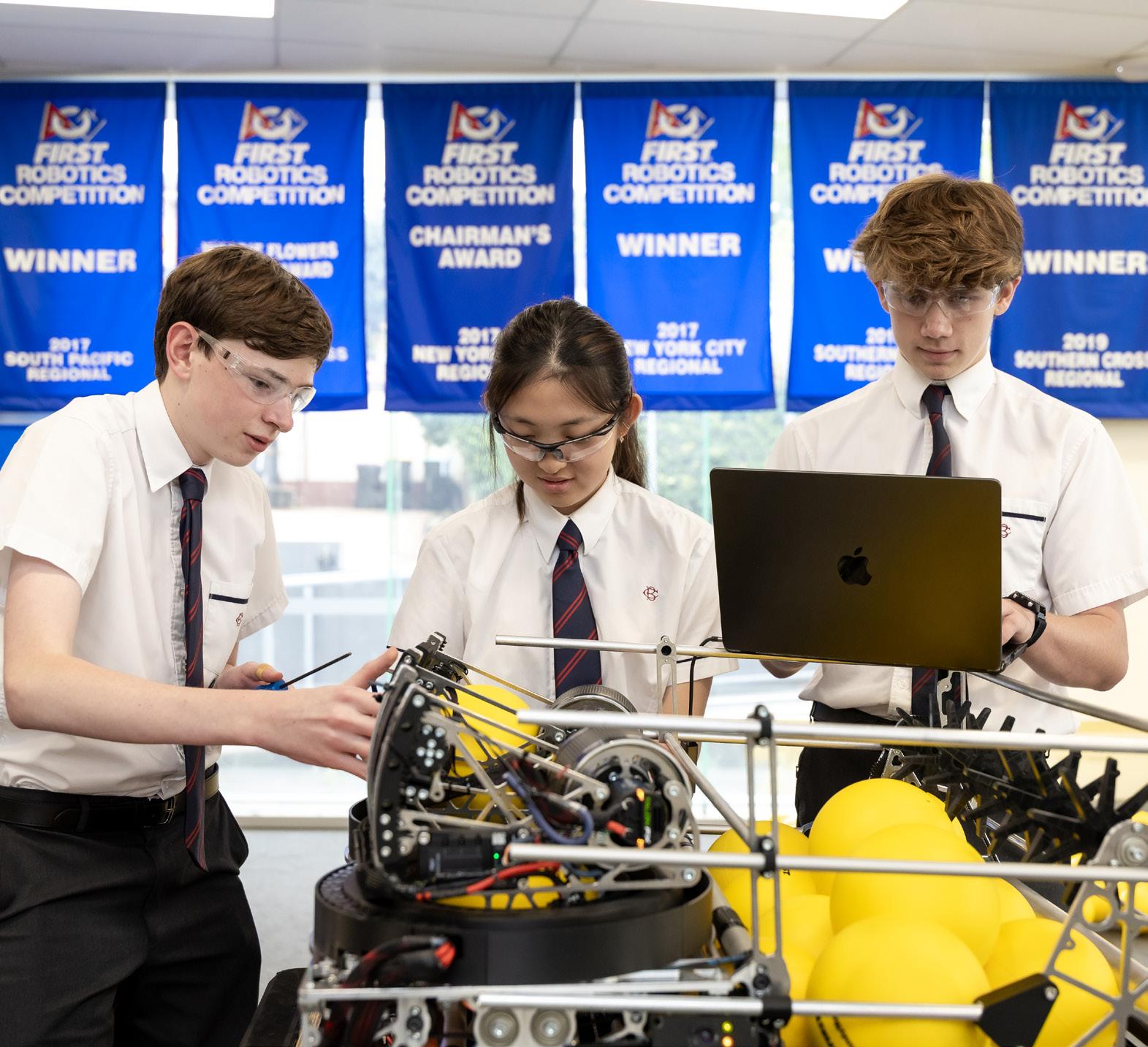
Domain 5 Robotics & Innovation
Barker Institute will undertake research projects that are future-oriented involving innovations in education, with a particular focus on Robotics, Technology, and Engineering.
The aim of these projects will be to provide educational practitioners and leaders with an evidentially-based understanding of issues and topics that will inform the future of education as well as novel approaches to meet the growing strategic needs of those involved in the education of children and young people. A key focus of this domain is robotics-related educational innovation that prepares students for an evolving workplace through new forms of training.
This research reflects the School’s priority of Innovation and Institute by driving inquiry into technologies and learning models shaping the future of education.
Rationale
Never before has so much been asked of education. Primary and secondary schools are asked to prepare all students, regardless of their background, for life long learning in a technology-saturated world. Teachers are asked to foster deeper understanding at the same time as caring for student social-emotional development. Such things are asked of education because the desired future requires it. The nature of work and civic participation is evolving at an unprecedented rate. For example, advances in automation, artificial intelligence, and social media are driving rapid changes in how we interact with each other and what skills hold value. In the world students will inherit, their ability to adapt, think critically, and work effectively with others will be essential for both their own success and the well-being of society. Such a dynamic environment presents challenges that warrant further investigation, particularly in how innovations in education can best support those who shape student learning experiences as students progress toward and into adulthood, navigating and contributing to a world that is vastly different from that of previous generations.
Potential projects may explore questions such as:
• How might schools best design learning for students today and into the future so that they will possess the knowledge, skills and dispositions required for success?
• Are our research and innovation systems prepared for an era of global, open and internet intensive inquiry?
• What systematic changes and innovations need to be made to enable industry-relevant learning for the techenabled workplace.
Targeted Publications
In addition to disseminating ongoing research in and thinking around the future of and innovation in education via its website, social media networks, and its journal Learning in Practice, the Barker Institute will work towards publishing its research in this area in such journals as:
• International Journal of Artificial Intelligence in Education: Official Journal of the International AIED Society
• Asia-Pacific Journal of Futures in Education and Society
• International Journal of Innovation in Education