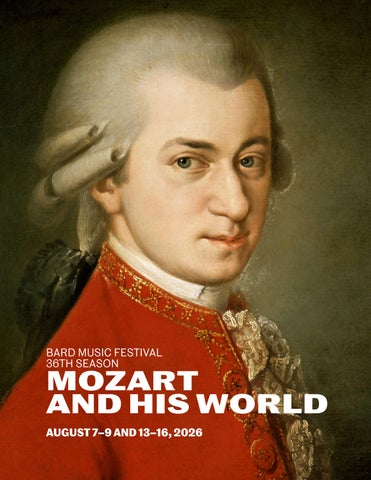
BARD MUSIC FESTIVAL 36TH SEASON
MOZART AND HIS WORLD AUGUST 7–9 AND 13–16, 2026
BARD MUSIC FESTIVAL REDISCOVERIES
MOZART AND HIS WORLD August 7–9 and 13–16, 2026
Leon Botstein and Christopher H. Gibbs, Artistic Directors Simon P. Keefe, Scholar in Residence 2026 Irene Zedlacher, Executive Director Raissa St. Pierre ’87, Associate Director
Founded in 1990, the Bard Music Festival has established its unique identity in the classical concert field by presenting programs that, through performance and discussion, place selected works in the cultural and social context of the composer’s world. Programs of the Bard Music Festival offer a point of view. The intimate communication of recital and chamber music and the excitement of full orchestral and choral works are complemented by informative preconcert talks, panel discussions by renowned musicians and scholars, and special events. In addition, each season University of Chicago Press publishes a book of essays, translations, and correspondence relating to the festival’s central figure. By providing an illuminating context, the festival encourages listeners and musicians alike to rediscover the powerful, expressive nature of familiar compositions and to become acquainted with less well-known works. Since its inaugural season, the Bard Music Festival has entered the worlds of Brahms, Mendelssohn, Richard Strauss, Dvořák, Schumann, Bartók, Ives, Haydn, Tchaikovsky, Schoenberg, Beethoven, Debussy, Mahler, Janáček, Shostakovich, Copland, Liszt, Elgar, Prokofiev, Wagner, Berg, Sibelius, Saint-Saëns, Stravinsky, Schubert, Carlos Chávez, Puccini, Chopin, Rimsky-Korsakov, Korngold, Nadia Boulanger, Rachmaninoff, Vaughan Williams, Berlioz, Martinů, and Mozart. The 37th annual festival in 2027 will be devoted to the life and work of George Gershwin.
The Bard Music Festival 2026 program book was made possible by a gift from Helen and Roger Alcaly. The Bard Music Festival is generously supported by Helen and Roger Alcaly, the Bettina Baruch Foundation, Jeanne Donovan Fisher, the H & L Family Foundation, Edna and Gary Lachmund, the Marstrand Foundation, Denise Simon and Paulo Vieira da Cunha, Felicitas S. Thorne, the Wise Music Family Foundation, the Bard Music Festival Board, and Bard Music Festival members. The Fisher Center is generously supported by Jeanne Donovan Fisher, the Henry L. Kimelman Family Foundation, Rebecca Gold Milikowsky, Daniel Shapiro, Stephen E. Simcock, the Martin and Toni Sosnoff Foundation, Felicitas S. Thorne, the Advisory Board of the Fisher Center, Fisher Center members and general fund donors, The Shubert Foundation, and the New York State Council on the Arts with the support of the Office of the Governor and the New York State Legislature. Programs and performers are subject to change. Please make certain that the electronic signal on your watch, pager, or cellular phone is switched off during the performance. The taking of photographs and the use of recording equipment are not allowed. COVER Wolfgang Amadé Mozart, Barbara Krafft, 1819 OPPOSITE Banquet in the Redoutensaal, Vienna, Martin van Meytens, 1763
2 BARD MUSIC FESTIVAL 2026
MOZART—PAST AND PRESENT It’s always productive to renew, refresh, and reevaluate our relationship with Wolfgang Amadé Mozart and his music. In 1790, when Mozart was still alive, distinguished German lexicographer Ernst Ludwig Gerber acknowledged his brilliant skill as a pianist but also recognized him as a perplexing composer whose harmonies were difficult to follow and whose works, moreover, required repeated listening in order to be understood. Revising and expanding his dictionary 22 years later, Gerber replaced his doubts with explicit, unequivocal praise: Mozart was a “meteor on the musical horizon” who accelerated musical advances by more than half a century. While Mozart did not see himself as a musical revolutionary, he quickly became one for others. In short, we see and hear things in Mozart that would never have occurred to the man himself. Our engagement with him and his world, then, involves not only recapturing aspects of his working environment but also acknowledging and grappling with past and present images of him—and recalibrating or changing our views in the process. Mozart’s life comprised many different, interrelated strands that required continual flexibility and change on his part. From his earliest years onward, he was a prodigious performer and composer on the keyboard, widely recognized as one of the greatest in Europe, who had a gift for improvisation to rival J. S. Bach’s. As the Paris-based German critic Friedrich Melchior Grimm pointed out in December 1763 about the 7-year-old prodigy who had recently embarked on his three-and-a-half-year Grand Tour of central and northern Europe: “ . . . what is really incredible is to see him improvise for an hour on end and in doing so give rein to the inspiration of his genius and to a mass of enchanting ideas, which moreover he knows how to connect with taste and without confusion.” A quarter of a century later, just three years before Mozart’s death, Joachim Daniel Preisler, a Danish actor visiting Vienna, went to Mozart’s home and “had the happiest hour of music that has ever fallen to my lot. This small man and great master twice extemporized on a pedal pianoforte, so wonderfully! So wonderfully that I quite lost myself. He intertwined the most difficult passages with the most lovely themes.” The combination of virtuoso performer and remarkable compositional creator—including as an improviser—yielded some of the 18th century’s greatest keyboard music, such as the piano concertos Mozart wrote in Vienna. The piano concertos also point to Mozart’s identity as an enterprising musician who constantly had to seek out opportunities to promote—and profit financially from—his multifarious talents. He acted as an impresario for many of his concertos, playing them in his own concerts at diverse Viennese venues such as the Trattnerhof (a residential building), the Mehlgrube (a casino and restaurant), and the Burgtheater (the national theater). He also staged concerts featuring his instrumental and vocal works when traveling in northern, central, and southern Europe. Furthermore, as a source of income and reputational enhancement, Mozart began publishing music as an 8-year-old in Paris with four violin sonatas dedicated to two French noblewomen. Formal publications made an especially prominent contribution to his compositional portfolio between 1781 and 1791, when he worked as a freelance musician in Vienna; there, he published his six string
The Apotheosis of Mozart, etching by Leopold Schmidt, 1856
MOZART AND HIS WORLD 3
quartets dedicated to Joseph Haydn (1785); both the Fantasia and Piano Sonata in C Minor, K475 and 457, respectively (1785); five piano trios; two piano quartets; three string quintets; and his three “Prussian” string quartets (1791). Mozart wrote music across a wider range of genres than any other late 18th-century composer, moving seamlessly between (for example) sacred music, stage works, and small- and large-scale chamber and orchestral music. While the eminent and widely traveled music historian Charles Burney took the view in the mid-1770s that “in general, those succeed best in writing for the church, stage, or chamber, who accustom themselves to that particular species of composition only,” Mozart proved him resolutely wrong. As well as instrumental works, he composed operas and dramatic music, learning his trade on three trips to Italy with his father, Leopold, between 1769 and 1773, during which he premiered three prestigious, well-received works of opera seria at Milan’s Teatro Regio Ducale: Mitridate, re di Ponto; Ascanio in Alba (celebrating a dynastic marriage between Archduke Ferdinand Karl of Austria and Maria Beatrice d’Este); and Lucio Silla. Following further success in the mid-1770s with the opera buffa La finta giardiniera in Munich and the serenata Il re pastore in Salzburg, he wrote his seven unalloyed operatic masterpieces: Idomeneo for Munich (1781); the German Singspiel Die Entführung aus dem Serail (1782), which was a hit early in his Viennese career; Le nozze di Figaro (1786), Don Giovanni (1787) for Prague, and Così fan tutte (1790), all to libretti by the Italian poet Lorenzo Da Ponte; and La clemenza di Tito for Prague and Die Zauberflöte (1791) in the final months of his life. In every operatic work—early-, mid-, and late-career alike—he had to accommodate the desires and predilections of his illustrious principal singers, who usually had higher profiles and commanded larger salaries than him. Guglielmo d’Ettore, in the title role in Mitridate, required Mozart to write four different versions of one particular aria, and the autograph scores of his last seven operas contain adjustments and additions to accommodate international stars such as Nancy Storace and Francesco Benucci (Figaro), Caterina Cavalieri (Die Entführung as well as Viennese revivals of Don Giovanni and Figaro), and Adriana Ferrarese del Bene (Così and the revival of Figaro). Mozart had a remarkable ability to make virtue out of necessity, using imposed limitations as spurs to creativity. As a musician and person, Mozart was also flexible. He nurtured his urbane, sophisticated musical style during the protracted early trips around Europe with his family, on which he encountered an abundance of contemporary music by composers of different nations across the continent (“as you know,” he wrote to his father in 1778, “I can more or less adopt or imitate any kind and any style of composition”), and developed this style further in the thoroughly cosmopolitan environment of 1780s Vienna. Yet when he wanted, he could write in down-to-earth, humorous ways, such as in “Ein musikalischer Spass” (A Musical Joke), K522, with its deliberate errors, meanderings, uninspired material, and musical breakdowns. As both a child and an adult, he mixed freely with musicians and others, apparently as happy among the lower and middle classes as with nobility and royalty, and in letters demonstrated a sometimes subtle but more often coarse and ribald sense of humor. Above all, he revealed himself time and again as completely absorbed in music. Less than four weeks after one of the greatest personal tragedies of his life—the death of his mother in July 1778, while he was on a trip with her in Paris—he wrote to Leopold: “You know that I am, so to speak, stuck in music, that I am involved with it the whole day and that I like to plan, study, think it over.”
4 BARD MUSIC FESTIVAL 2026
Given the volume and diversity of Mozart’s achievements, and the breadth and depth of his experiences, it is no surprise that a variety of opinions and viewpoints on his life and music have appeared in the 235 years since his death. Mozart’s first biographer, Friedrich Schlichtegroll, promoted his total absorption in music, relying on information gleaned (via an intermediary) from Mozart’s sister, Nannerl. Eminent biographers Alexander Oulibicheff (1794–1858) and Otto Jahn (1813–69) took up this mantle, regarding Mozart’s life and music in effect as a single, fused entity. While some 19th-century writers, critics, and musicians focused on his status as a proto-Romantic figure—orienting themselves toward predominantly minor-mode works like the Requiem, Don Giovanni, and Piano Concerto No. 20, K466—or saw him as a musical stepping stone between Haydn and Beethoven, others associated him with musical classicism; for Robert Schumann, “cheerfulness, repose, grace, the main features of ancient works of art, are those of Mozart’s school.” Major late 19th-century scholarly projects, such as the catalogue of Mozart’s entire oeuvre by Ludwig von Köchel and the complete edition of his works from Breitkopf & Härtel, attempted above all to capture and represent a musical colossus. More modestly, fictional works such as Eduard Mörike’s Mozart’s Journey to Prague (1855) advance biographical tropes of Mozart’s obliviousness to financial and worldly concerns and his immersion in music, painting a picture of a man and musician that resonates with the mid-19th-century’s Romantic sensibilities. Much 20th-century scholarship—including the Neue MozartAusgabe (a complete edition of Mozart’s works that took more than half a century to finish, from 1956 to 2007) and updated versions of Köchel’s catalogue—was built on achievements of the past, all with the intention of situating Mozart in increasingly wellinformed biographical, historical, cultural, and critical contexts. While the principal motivation of this scholarship was to distance Mozart from the myths and legends that emerged around him in earlier times, thus recreating his late 18th-century environment as closely as possible, such myths and legends have been more recently embraced as positive hermeneutic agents—for example, in Peter Shaffer and Miloš Forman’s Amadeus as well as in scholarship on the Requiem. With a bewildering array of Mozart images in our collective consciousness, this year’s Bard Music Festival provides opportunities to reexamine these images and reconsider Mozart’s multitiered identity. We can reassess Mozart’s musical-historical position, including his influences and rivalries, and ponder his own evaluations of his works (such as his view of the Quintet for Piano and Winds as his best to date in 1784, and his reworkings of both Piano Concerto No. 5, K175, from 1773, and Davide penitente, K469—a cantata adapted from his C-minor Mass). We can also experience the arrangement of his works by others (including Johann Nepomuk Hummel’s chamber version of the C-minor piano concerto, K491). Furthermore, we are encouraged to think deeply about Mozart’s close relationships with theatrical traditions and cultures—and about the benevolent message conveyed by Die Entführung, one of his infrequently performed operatic masterpieces. When we refresh and reevaluate our relationship with Mozart, we discover the continued relevance of his profound humanity in our own deeply troubled world. This is his greatest posthumous gift to us all. —Simon P. Keefe, University of Sheffield; Scholar in Residence, Bard Music Festival 2026
MOZART AND HIS WORLD 5
The Scale of Love, Jean-Antoine Watteau, ca. 1717–18
6 BARD MUSIC FESTIVAL 2026
SELECTIVE CHRONOLOGY
The Death of General Wolfe, Benjamin West, 1770
Empress Maria Theresa, Jean-Étienne Liotard, 1762
Christoph Willibald von Gluck, Joseph-Sifrède Duplessis, 1775
1756 Born January 27 to Leopold and Maria Anna Mozart; baptized Johannes Chrysostomus Wolfgangus Theophilus January 28 at Salzburg Cathedral Seven Years’ War begins with Austria and France against Great Britain and Prussia 1757 Russia allies with Austria as the Seven Years’ War expands; publication of Edmund Burke’s A Philosophical Enquiry into the Origin of our Ideas of the Sublime and Beautiful; Johann Christian Bach composes Missa da Requiem 1758 Prussia defeats France and Russia, but falls to Austria at the Battle of Hochkirch; pianist Josepha Auernhammer born 1759 Prussia is defeated by France, Russia, and Austria; publication of Voltaire’s Candide; dramatist and poet Friedrich Schiller born; composer George Frideric Handel dies 1760 Russia and Austria raid Berlin; Prussia defeats Austria at the Battle of Torgau; King George II of England dies and is succeeded by his grandson, George III; publication of the first of James Macpherson’s Ossian books; composer Luigi Cherubini born 1761 Learns his first piano piece, a scherzo by Georg Christoph Wagensei France proposes peace with England; William Pitt (the Elder) resigns from British cabinet and as “leader” of the Seven Years’ War; publication of Jean-Jacques Rousseau’s Julie ou La nouvelle Héloïse 1762 Travels with father and sister, Nannerl, to Munich where they perform for Elector Maximilian III Joseph; travels to Vienna for the first time and is received by Emperor Francis I and Empress Maria Theresa at Schönbrunn Palace; he and Nannerl perform almost daily at court and in aristocratic houses; falls ill with erythema nodosum (an inflammatory condition); travels to Pressburg (now Bratislava) and returns to Vienna before arriving home in Salzburg Russia ends war with Prussia, and Tsar Peter III is overthrown by his wife, Catherine II (the Great); Austria and Prussia sign an armistice; Christoph Willibald Gluck’s Orfeo ed Euridice premieres in Vienna; Constanze Weber born 1763 Falls ill with rheumatic fever; departs with family for first European tour, performing in Munich, Augsburg, Schwetzingen, Frankfurt am Main, Koblenz, Brussels, and at residence of Count Maximilian Emanuel Franz von Eyck in Paris Seven Years’ War ends; France relinquishes India and the New World to England and Louisiana to Spain while Prussia keeps Silesia; publication of Voltaire’s Traité sur la tolérance; Vienna’s Kärntnertortheater reopens after fire 1764 Received at Versailles and performs for Louis XV; remains in Paris for five months and publishes first compositions (four violin sonatas); received in London by King George III April 27; remains in London for 15 months, gives concerts with Nannerl, and meets J. C. Bach and singer Giovanni Manzuoli; composes his first symphonies Catherine II enacts peasant reforms in Russia and puts Stanisław August Poniatowski on Polish throne; Great Britain imposes Sugar Act on American colonies; J. C. Bach starts concert series in London with Carl Friederich Abel 1765 Publishes Opus 3 sonatas for keyboard and violin, dedicated to Queen Charlotte; passes Daines Barrington’s musical test—which Barrington later describes in his Account of a very remarkable young Musician (1771); family departs London July 24; suffers health problems alongside father in Lille; at The Hague, contracts typhoid fever and is critically ill through late January 1766 Holy Roman Emperor Francis I dies and is succeeded by his son Joseph II; Great Britain imposes Stamp Act on American colonies, prompting the Stamp Act Congress and Declaration of Rights and Grievances; publication of Horace Walpole’s The Castle of Otranto; singer Nancy Storace, the first Susanna, and composer Thomas Attwood born 1766 Performs concerts in Utrecht, Amsterdam, and Antwerp; returns to Paris and is painted by Michel-Barthélémy Ollivier; travels to Switzerland and remains for two months; stops in Donaueschingen and Munich; arrives home in Salzburg at the end of November
MOZART AND HIS WORLD 7
Pitt is elected British Prime Minister; England repeals Stamp Act; writer Germaine de Staël and composer Franz Xaver Süssmayr born 1767 Composes cantata Die Schuldigkeit des ersten und fürnehmsten Gebotes; travels to Vienna in September; flees the city’s smallpox outbreak but contracts the disease in Bohemia and suffers temporary blindness as a result; performs with Nannerl in Brünn (now Brno) before family returns to Vienna Mason-Dixon line completed; Gluck’s Alceste premieres; John Quincy Adams and Andrew Jackson born 1768 Received at court in late January; works on opera buffa La finta semplice at Emperor Joseph II’s behest, but is unable to secure a performance; one-act opera Bastien und Bastienne is staged in Dr. Franz Anton Mesmer’s home; conducts Waisenhausmesse (Mass in C Minor), K139, and a lost trumpet concerto, K47c, at Orphanage Church, with imperial family present In Boston, public meeting bans all goods imported from England; Dissolution of the Massachusetts Assembly; outbreak of Russo-Turkish war (1768–74); James Cook starts his first circumnavigation of the globe; publication of Lawrence Sterne’s A Sentimental Journey 1769 Upon return to Salzburg, Missa Brevis, K65, is celebrated at the Kollegienkirche; serenatas in D, K100, and G, K63, are performed; composes Mass in C Major (“Dominicus”), K66, for Father Dominicus Hagenauer; accepts unpaid post of Konzertmeister; travels to Italy with his father Virginia protests London’s political treason trials; Spain occupies California; Arthur Wellesley, First Duke of Wellington, German naturalist Alexander von Humboldt, and Napoleon Bonaparte born 1770 Performs in various cities in Italy—including Verona, Milan, Bologna, Florence, Rome, and Naples—and meets influential people, such as the Grand Duke Leopold of Tuscany, later Holy Roman Emperor Leopold II; hears Gregorio Allegri’s Miserere at St. Peter’s Basilica and subsequently transcribes it from memory; Pope Clement XIV pronounces him a knight of the Order of the Golden Spur; admitted to Bologna’s Accademia Filarmonica; begins composing Mitridate on commission, then conducts first three performances at the Teatro Regio Ducale, with great success Boston Massacre; John Adams (later the second US president) defends British Captain Thomas Preston and eight of his soldiers to ensure a fair trial; MarieAntoinette marries Louis-Auguste, Dauphin of France; Thomas Gainsborough paints A Portrait of a Young Gentleman (“The Blue Boy”); poets William Wordsworth and Friedrich Hölderlin and composers Anton Reicha and Ludwig van Beethoven born 1771 Receives a diploma from Verona’s Accademia Filarmonica; gives concerts in Venice; receives a contract from Milan’s Teatro Regio Ducale to write Lucio Silla; departs Italy for Salzburg in March but returns to Milan in August; composes Ascanio in Alba which premieres at the Teatro Regio Ducale October 17 in celebration of the marriage of Maria Beatrice d’Este and Archduke Ferdinand Karl of Austria; arrives back in Salzburg mid-December Russia’s success in Türkiye causes unease in Prussia and Austria; Antonio Salieri’s Armida premieres; novelist Walter Scott born 1772 Composes Il sogno di Scipione for enthronement of new archbishop of Salzburg, Count Hieronymus von Colloredo; archbishop grants him permission to return to Milan for rehearsals and premiere of Lucio Silla First partition of Poland; American colonists attack and burn the British Royal Navy’s HMS Gaspee, a revenue boat, in the Providence River 1773 Writes motet Exsultate, jubilate, K165, for castrato Venanzio Rauzzini; returns to Salzburg in March; family moves to a larger flat on Hannibal-Platz; travels with his father to Vienna, where Empress Maria Theresa is "very gracious," but he is unable to secure a position; gives concerts, plays in churches, and returns to Salzburg in September Pope Clement XIV dissolves Society of Jesus (Jesuits); Great Britain’s
8 BARD MUSIC FESTIVAL 2026
Johann Joachim Winckelmann, Angelica Kauffmann, 1764
Johann Christian Bach, Thomas Gainsborough, ca. 1776
The Mozart Family, Johann Nepomuk della Croce (attr.), 1780–81
The Glorification of the Emperor Joesph II, Franz Anton Maulbertsch, before 1777
Constanze Mozart, Joseph Lange, ca. 1782
implementation of Tea Act leads to in the Boston Tea Party; Philadelphia Museum founded 1774 Composes serenatas, concertos, and abridged masses for Archbishop Colloredo; commissioned to write La finta giardiniera and travels with father to Munich for rehearsals Louis XVI succeeds Louis XV and enacts economic, political, and military reforms; First Continental Congress meets in Philadelphia and drafts Declaration of Rights and Grievances; Great Britain closes Boston Harbor; publication of Johann Wolfgang von Goethe’s The Sorrows of Young Werther; Gluck’s Iphigénie en Aulide premieres; painter Caspar David Friedrich is born 1775 Performs his Litaniae de venerabili altaris sacramento, K125, in Munich; premieres La finta giardiniera at Salvator Theater; Misericordias Domini, K222, is performed; family returns to Salzburg, where he gives concerts for Archduke Maximilian Franz of Austria, a guest of Archbishop Colloredo; composes serenades, masses, and violin concertos Famine in Paris; peasants revolts quashed in Bohemia and Russia; battles of Lexington and Concord begin War of Independence in America, and George Washington is made Commander-in-Chief; Pierre-Augustin Caron de Beaumarchais’s Le barbier de Séville premieres; novelist Jane Austen is born 1776 “Haffner” Serenade, K250, is performed for the nuptials of Marie Elisabeth Haffner Opposition to Marie-Antoinette rises in France; Declaration of Independence is signed; painter John Constable and German writer and composer E. T. A. Hoffmann are born 1777 Multiple requests for leave to travel are denied by Archbishop Colloredo, who ultimately asserts that “father and son have permission to seek their fortunes elsewhere”; departs Salzburg with mother in September in search of a permanent position in either Munich or Mannheim; befriends musicians Christian Cannabich and Johann Baptist Wendling; falls in love with singer Aloysia Weber; stays in Mannheim for five months, despite his father’s urgings to leave for Paris Great Britain attempts to stop the American Revolution, but are beaten at battles of Princeton and Saratoga; premiere of Joseph Haydn’s opera Il mondo della luna 1778 Travels to Paris with mother in March; ballet music for Jean-Georges Noverre’s Les petits riens is performed at the Paris Opéra; Symphony in D Major, K297, is performed; mother dies unexpectedly July 3; leaves Paris in late September and, in December, stays with the Weber family in Munich; dedicates violin sonatas K301–306 to Maria Elisabeth, Electress of the Palatinate Great Britain end its occupancy of Philadelphia; Austria and Prussia enter War of the Bavarian Succession; Rousseau and composer Thomas Linley die; pianistcomposer Johann Nepomuk Hummel born 1779 Appointment as court organist by Archbishop Colloredo; receives new contract in February, requiring him to perform, instruct, and compose as part of his post; commissioned to write a new opera Bavarian War is ended by Treaty of Teschen and Austria secures Innviertel; Great Britain wins Battle of Brier Creek in Georgia; Louis XVI ends and prohibits serfdom in royal domains 1780 Leaves Salzburg for Munich in November; rehearsals for Idomeneo begin in December Empress Maria Theresa dies; her son, Joseph II, initiates reforms; Gordon Riots begin in London; French troops arrive in America; Great Britain is defeated in North Carolina; Aloysia Weber marries painter Joseph Lange; painter Jean-AugusteDominique-Ingres is born 1781 Idomeneo premieres successfully in January; ordered to join Archbishop Colloredo in Vienna, and arrives March 16; appointment with Colloredo causes him to miss a concert attended by Joseph II, and asks to be dismissed—in response to which he is physically kicked out by Count Karl Joseph Felix Arco; lodges with the Webers again, and falls in love with
MOZART AND HIS WORLD 9
Aloysia’s younger sister, Constanze; receives libretto for Die Entführung aus dem Serail; participates in piano contest with Muzio Clementi Louis XVI dismisses finance minister Jacques Necker; Great Britain’s communications with North America are cut by French naval fleet; Great Britain surrenders in Yorktown under Charles Cornwallis; serfdom abolished in Bohemia; Haydn composes Op. 33 String Quartets; composer Josef Mysliveček dies 1782 Requests father’s consent to marry Constanze; forms relationships with prominent members of society, but is unable to secure a permanent post; begins a concert series at the Augarten; Entführung premieres with great success; writes Symphony No. 35, K385, for friend Siegmund Haffner; marries Constanze at St. Stephen’s Cathedral; conducts Entführung October 8, in honor of Russian Grand Duke and Dutchess; plays a concert at the Kärntnertortheater with pupil Josepha Auernhammer William Pitt (the Younger) pushes for economic reforms in Great Britain and begins peace talks with United States in Paris; Joseph II places clergy under the supervision of the state; Paisiello’s Il barbiere di Siviglia premieres; J. C. Bach and librettist Metastasio die 1783 Joseph II attends the performance of his Rondo in D Major, K382, and his Piano Concerto No. 13, K415; receives first concert review in Carl Friedrich Cramer’s Magazin der Musik in Hamburg; first son, Raimund Leopold, is born June 17, dies August 19 while parents are in Salzburg; still in Salzburg, the incomplete Mass in C Minor, K427, is performed with Constanze singing soprano; in Linz, composes Symphony No. 36 in C Major, K425 Treaty of Paris is signed between France, Spain, Great Britain, and United States; Great Britain recognizes the independence of its former colonies; Russia takes Crimea; John Broadwood patents piano pedal; Gotthold Ephraim Lessing’s Nathan the Wise premieres; Montgolfier brothers succeed in first untethered hot-air balloon flights; novelist Stendhal born 1784 Begins to catalogue his compositions, starting with his Piano Concerto K449; gives 17 concerts between February 26 and March 31; plays Violin Sonata K454 with Regina Strinasacchi to an audience including Joseph II; attends a performance of Giovanni Paisiello’s Il rè Teodoro in Venezia at which he suffers abdominal colic and develops a kidney infection; second son, Carl Thomas, is born September 21; joins freemasons at the Zur Wohltätigkeit lodge Pitt puts East India Company under control of government; Joseph II makes German the official language of administration in Hungary; composer and music theorist Padre Martini dies; composers Louis Spohr and Ferdinand Ries born 1785 Gives concerts throughout February and March; performs quartets K458, 464, and 465 with father in the presence of Joseph Haydn; dedicates these and three additional quartets to Haydn at a later date; cantata Davide penitente, K469, performed in March; composes cantata Die Maurerfreude, K471; Maurerische Trauermusik, K477, is performed at Zur gekrönten Hoffnung lodge; plays Concerto in E-flat, K482, at the Burgtheater in December; portrait by Hieronymus Löschenkohl printed in calendar for 1786 Holy Crown of Hungary moved to Vienna; Affair of the Diamond Necklace discredits Marie-Antoinette (though she was not involved) and French monarchy 1786 Der Schauspieldirektor is performed at Schönbrunn Palace February 7, as is Salieri’s Prima la musica e poi le parole; conducts first performance of Idomeneo in Vienna; premieres of Concerto in C Minor, K491, and Le nozze di Figaro; third son, Johann Thomas Leopold, is born October 18, dies November 15 Pitt enacts reforms on government finances; protests against Joseph II’s reforms begin in Belgium; Frederick II “the Great” of Prussia dies and is succeeded by his nephew, Frederick William II; Martín y Soler’s Il burbero di buon core and Una cosa rara and Carl Ditters von Dittersdorf’s Singspiel Doktor und Apotheker premiere; composer Carl Maria von Weber born 1787 Travels with Constanze to Prague for performances of Figaro; is commissioned to compose another opera for following season; father
10 BARD MUSIC FESTIVAL 2026
Adoration of the Magi, Martin Johann Schmidt, 1784
Tennis Court Oath, June 20, 1789, Jacques-Louis David, 1790s
Set design, A Turkish Palace, for The Abduction from the Seraglio, Giuseppe Quaglio, 1790s
The Militiaman’s Departure, Johann Peter Krafft, 1813
Michael Haydn, Franz Xaver Hornöck, ca. 1805
Set design, The Magic Flute: Fire and Water Karl Friedrich Schinkel, 1816
dies in Salzburg May 28; returns to Prague, where Figaro is performed in celebration of marriage of Archduchess Maria Theresia and Prince Anton of Saxony; premieres Don Giovanni October 29; named court Kammermusicus (“chamber musician”); first daughter, Theresia Constanzia Adelheid Friedericke Maria Anna, born December 27 Austria abolishes capital punishment and enacts life sentences with hard labor in its stead; riots in Paris and Austrian Netherlands (Belgium); Parlement of Paris is exiled; Jacques-Louis David exhibits The Death of Socrates at the Paris Salon; Johann Heinrich Wilhelm Tischbein paints Goethe in the Roman Campagna and Goethe at the Window; Salieri’s Tarare and Martín’s L’arbore di Diana premiere; Gluck dies; Beethoven visits Vienna and is said to have met Mozart 1788 First performance of Don Giovanni in Vienna unsuccessful; composes final three symphonies—No. 39, K543, No. 40, K550, and No. 41, K551; daughter Theresia Constanzia dies June 29; requests loans from friend Michael Puchberg as financial position declines; conducts his reorchestration of Handel’s Acis and Galatea, K566 Austria sides with Russia in its war with Türkiye; King George III exhibits first symptoms of bipolar disorder; Louis XVI calls meeting of the French EstatesGeneral and reinstates Necker to reform France’s finances; Salieri’s Axur, re d’Ormus premieres; poet George Gordon Lord Byron born; C. P. E. Bach dies 1789 Conducts his reorchestration of Handel’s Messiah, K572; borrows money to travel to Germany with Prince Karl Lichnowsky; portrait drawn by Dora Stock in Dresden; concerts in Leipzig; plays in Berlin for King Frederick William II; returns to Vienna in June; second daughter, Anna Maria, born and dies November 16; Clarinet Quintet, K581, performed at Burgtheater French Estates General meets in Versailles, where Third Estate declares itself the National Assembly and takes Tennis Court Oath; Louis XVI dismisses Necker once again; Bastille is stormed in Paris; Washington is unanimously elected first president of the United States; Austria takes Belgrade; publication of William Blake’s Songs of Innocence 1790 Così fan tutte premieres at Burgtheater January 26 with great success; unable to secure position of second Kapellmeister; adapts Handel’s Alexander’s Feast, K591, and Ode for St. Cecelia, K592; collaborative opera Der Stein der Weisen premieres; travels to Frankfurt for coronation of Leopold II as Holy Roman Emperor and gives an ill-attended concert October 15; travels via Mainz and Mannheim and plays in Munich for King Ferdinand IV and Queen Maria Carolina of Naples; returns to Vienna Maximilien Robespierre is elected president of Jacobin Club; Joseph II dies and is succeeded by his brother, Leopold II; Philadelphia is named United States capital; Haydn leaves for London 1791 Plays his Piano Concerto, K595, at Jahnscher Saal; granted unsalaried position as assisant to the ailing Leopold Hofmann, Kapellmeister at St. Stephen’s Cathedral; son Franz Xaver Wolfgang Mozart born July 26; asked to compose La clemenza di Tito for the coronation of Leopold II as King of Bohemia; receives commission for a requiem; travels to Prague for coronation, where Don Giovanni is performed September 2, followed by La clemenza di Tito September 6; conducts the premiere of Die Zauberflöte in Vienna September 30, which is then given 20 times throughout October; Kleine Freimaurer-Kantate, K623, performed at the inauguration of a new masonic temple; falls ill and is bedridden; gives instructions to Süssmayr on how to finish the Requiem; sings through the Requiem along with friends from the Freihaustheater; dies just before 1 a.m. December 5 in the presence of Constanze and his sister-in-law Sophie Weber Louis XVI and French royal family attempt to escape but are arrested in Varennes and forcibly returned to Paris; Washington, DC, is founded; publication of James Boswell’s Life of Samuel Johnson; Angelica Kauffmann paints Muses of Tragedy and Comedy; premiere of Haydn’s London Symphonies Nos. 95 and 96; dramatists Franz Grillparzer and Eugène Scribe, composer Giacomo Meyerbeer, and inventor Samuel F. B. Morse are born
MOZART AND HIS WORLD 11
Self-portrait of the Artist Hesitating Between the Arts of Music and Painting, Angelica Kauffmann, 1794
12 BARD MUSIC FESTIVAL 2026
WEEKEND ONE AUGUST 7–9
THE PERILS OF GENIUS PROGRAM ONE
The Many Facets of Mozart Friday, August 7 Sosnoff Theater 7 pm Performance with commentary by Leon Botstein Wolfgang Amadé Mozart (1756–91)
Sonata in D Major, for piano four-hand, K381 (1772) Allegro Andante Allegro molto Piers Lane and Danny Driver, piano Eine kleine deutsche Kantate, K619 (1791) (Ziegenhagen) Die ihr des unermesslichen Weltalls Schöpfer ehrt Joshua Blue, tenor Kayo Iwama, piano Quintet in E-flat Major for Piano and Winds, K452 (1784) Largo—Allegro moderato Larghetto Allegretto Alexandra Knoll, oboe Shari Hoffman, clarinet Karl Kramer-Johansen, horn Gina Cuffari, bassoon Danny Driver, piano
INTERMISSION Mozart/Michael Haydn (1737–1806)
From Symphony No. 37 in G Major, K444 (1783–84) Allegro con spirito The Orchestra Now Leon Botstein, conductor
MOZART AND HIS WORLD 13
Wolfgang Amadé Mozart
Ch’io mi scordi di te?, K505 (1786) Katrina Galka, soprano Anna Polonsky, piano Sinfonia concertante in E-flat Major, K364 (1779–80) Allegro maestoso Andante Presto Grace Park, violin Barry Shiffman, viola Symphony No. 31 in D Major, “Paris,” K297 (1778) Allegro assai Andante Allegro The Orchestra Now Leon Botstein, conductor
PROGRAM ONE NOTES
Mozart distinguished himself from late 18th-century contemporaries by writing music of remarkable quality across all musical genres throughout his career. He astonished audiences with his keyboard playing from his earliest years onward, including on the Grand Tour of central and northern Europe (1763–66) and during trips to Italy (1769–73). The Sonata in D Major for piano four-hands, K381, probably dates from summer-autumn 1772, shortly before the third Italian trip that focused on the composition and premiere of the opera Lucio Silla in Milan. After an ebullient and vivacious first movement, Mozart writes a poignant, cantilena-like Andante, clearly inspired by the lyricism of his recent vocal music, and an upbeat, extroverted finale. No doubt the sonata was intended from the outset as one he could play with his highly talented sister, Nannerl; at any rate, they performed it together at court in Salzburg on September 3, 1780. He subsequently brought it out in 1783 with the Viennese publisher Artaria, alongside another four-hand sonata, K358, in B-flat Major. In addition to piano sonatas, Mozart was also a prolific composer of piano-related chamber and orchestral music. The Quintet for Piano and Winds in E-flat Major, K452, premiered on April 1, 1784, at the Burgtheater in Vienna, as the seventh of nine items on the program of Mozart’s annual high-profile academy. Other items included a symphony, arias, a keyboard improvisation, and the piano concertos K450 in B-flat and K451 in D. A few days later, Mozart related his view of the concert to his father: “I composed two grand concertos and then a quintet [K452], which received enthusiastic applause. I myself consider it to be the best work I have ever written.” The scoring for piano, oboe, clarinet, horn, and bassoon partially explains its uniqueness. Mozart exploited the timbral possibilities available to him throughout, situating the piano sometimes in dialogue with the wind band as a whole and elsewhere with individual and smaller combinations of instruments. The slow introduction, exposition, and recapitulation of the first movement are characterized by elaborate interactive patterns, while the Larghetto features audacious harmonic progressions that include three full measures of changing diminished chords over a chromatically rising bass
14 BARD MUSIC FESTIVAL 2026
View of Vienna with St. Charles’s Church, Bernardo Bellotto, ca. 1761
line toward the end. In the pianistically virtuosic sonata-rondo finale, Mozart often promotes the quintet as public chamber music rather than as a concerto-related work, for example by having the winds contribute prominently to the “Cadenza in tempo” section. “Ch’io mi scordi di te?—Non temer, amato bene,” K505, is another unique work by Mozart, combining characteristics of a concert aria and a piano concerto. He wrote it for himself and Nancy Storace—who created the role of Susanna at the Figaro premiere—to perform at her farewell concert at the Kärtnertortheater in Vienna on February 23, 1787, shortly before she returned to her home country, England; he reused a text set for an aria inserted into his Viennese revival of Idomeneo. Mozart’s participation as the instrumental soloist, as well as the aria’s temporal proximity to the great sequence of Viennese piano concertos that ended with K491 in C minor and K503 in C major (1786), render audible invocations of the concertos inevitable. In any case, dialogue among the soloists and the orchestra lends the aria a florid, spirited charm. Mozart’s works for solo instruments and orchestra include the Sinfonia concertante in E-flat Major, K364, for violin and viola. It dates from 1779–80, a profoundly unhappy period for Mozart, when he was desperate to break free from court employment in Salzburg to seek his fortune elsewhere. While his principal compositional responsibility at that time (as court organist) was to write sacred works for the Salzburg court and cathedral, he chose instead to produce mainly instrumental works intended for private concerts in the hope that a portfolio of such works would help him procure alternative employment. In a number of stylistic respects, the Sinfonia concertante foreshadows standard practices in Mozart’s concertos from his final decade. For example, following dialogue among
MOZART AND HIS WORLD 15
orchestral instruments in the opening ritornello, the solo violin and viola are delicately introduced at the opening of the solo exposition via high, sustained notes emerging out of the prevailing orchestral texture. Also as in later works, the first-movement cadenza gives the impression of improvisation, even though in fact it is written down. The deeply expressive C-minor slow movement is a forerunner to the great minor-mode middle movements in the piano concertos K456 in B-flat, K482 in E-flat, and K488 in A. In the two years leading up to the composition of the Sinfonia concertante, Mozart experienced a difficult trip to central Germany and France (1777–79), during which his mother died, he was rejected by his first love, Aloysia Weber (though he did later manage to win her sister, Constanze), and he failed to procure a desired post away from Salzburg. However, the premiere of his “Paris” Symphony, K297, at the Concert spirituel in the French capital was one of the trip’s unambiguous musical successes. Above all, Mozart attuned the style of his work to the perceived tastes of the French public, writing to his father, Leopold: “I can answer for its pleasing the few intelligent French people who may be there. . . . I still hope, however, that even asses will find something in it to admire—and, moreover, I have been quite careful not to neglect le premier coup d’archet [the convention of opening a work with a strident, often unison passage]—and that is quite sufficient.” At the end of the first movement, he brought back a passage from the middle that he knew would be popular and was greeted by “shouts of ‘Da capo.’” Furthermore, he wrote a second Andante middle movement at the request of the director of the Concert spirituel, Joseph Le Gros, even though—according to Mozart—the original version was a “great favorite” among Parisian connoisseurs. Finally, he played with his audience at the beginning of the finale: “I began with two violins only, piano for the first eight bars— followed instantly by a forte; the audience, as I expected, said ‘hush’ at the soft beginning, and when they heard the forte, began at once to clap their hands.” Mozart engaged pragmatically with other composers’ music, just as he attempted in practical ways to please his audiences. For example, he worked on a cantata, “Per la ricuperata salute di Ophelia,” K477a (1785), with Antonio Salieri and “Cornetti,” celebrating the return to good health of Storace (which we hear on Program 5), and collaborated on a Singspiel, Der Stein der Weisen (1790), at Emanuel Schikaneder’s Theater an der Wieden shortly before composing Die Zauberflöte. In late 1783 or early 1784 he also wrote a slow introduction to the first movement of Michael Haydn’s Symphony in G. The reason for Mozart writing the introduction is unclear, although it is possible he intended to use the symphony at one of his numerous Viennese concerts. On December 14, 1784, a year or so after appending his introduction to the Haydn symphony, Mozart became a Freemason. He wrote several masonic works in the remaining years of his life, including Eine kleine deutsche Kantate (Little German Cantata, K619) in July 1791. Scored for voice and piano, it moves freely between gentle lyricism and stridency. The utopian text about love, fraternity, and peace by his fellow Freemason Franz Heinrich Ziegenhagen subsequently appeared in 1792 in a volume of Ziegenhagen’s writings, with Mozart’s name on the title page. Just a few months after his death, then, Mozart’s reputation—built on multifaceted achievements—already carried weight beyond the musical world. —Simon P. Keefe, University of Sheffield; Scholar in Residence, Bard Music Festival 2026
16 BARD MUSIC FESTIVAL 2026
PANEL ONE
Gottlieb or Amadé? Who Was Mozart? Saturday, August 8 Olin Hall 10 am – noon Christopher H. Gibbs, moderator; Leon Botstein; Scott Burnham; Elaine R. Sisman
PROGRAM TWO
Fathers and Sons Saturday, August 8 Olin Hall 1 pm Preconcert Talk: Byron Adams 1:30 pm Performance Carl Philipp Emanuel Bach (1714–88)
Piano Sonata in A Major, “Prussian Sonata No. 6,” Wq 48/6 (1740–42) Allegro Adagio Allegro Anna Polonksy, piano
Wolfgang Amadé Mozart (1756–91)
“An die Freude,” K53 (1768) (Uz) “Wie unglücklich bin ich nit,” K147 (1774) (anon.) Lisa Marie Rogali, mezzo-soprano Kayo Iwama, piano
Giovanni Battista Martini (1706–84)
From 12 Sonate d’intavolatura Sonata No. 2 in D Major, B4.1.2 (pub. 1742) Preludio Allegro Adagio Corrente Aria Paolo Bordignon, harpsichord
Wolfgang Amadé Mozart
String Quartet in F Major, K168 (1773) Allegro Andante Menuetto and Trio Allegro Luosha Fang ’11 and Jenny Huenigen, violin William Frampton, viola Raman Ramakrishnan, cello
INTERMISSION
MOZART AND HIS WORLD 17
Wolfgang Amadé Mozart
From La finta giardiniera, K196 (1775) “Geme la tortorella” From Lucio Silla, K135 (1772) “Strider sento la procella” Catherine Creed, soprano Kayo Iwama, piano
Leopold Mozart (1719–87)
From 12 Duets (1770) No. 1 Andante No. 4 Tempo di Menuetto No. 5 Alla Breve Grace Park and Luosha Fang ’11, violin
Wolfgang Amadé Mozart
Sonata in C Major for Piano and Violin, K296 (1778) Allegro vivace Andante sostenuto Rondo: Allegro Grace Park, violin Michael Stephen Brown, piano
Johann Christian Bach (1735–82)
Sextet in C Major, W.B78 (ca. 1783) Allegro Larghetto Rondo: Allegro Alexandra Knoll, oboe Luosha Fang ’11, violin Raman Ramakrishnan, cello Karl Kramer-Johansen, horn Brittaney Pertsas, horn Anna Polonsky, piano
PROGRAM TWO NOTES
During the 18th century, travel was a difficult adventure under the best of circumstances. Plans often went awry at various points; accommodation and food could be unsatisfactory; carriages were uncomfortable, with temperamental horses jolting passengers over treacherous roads; and the possibility of accident or illness was ever present. Mozart’s first Italian tour, which began in 1769, included a harrowing incident during which his father, Leopold, was injured as he prevented Wolfgang from being thrown from the carriage. A few years earlier, when they had been visiting London, Leopold fell dangerously ill. During his protracted recuperation, his 8-year-old son often visited Johann Christian Bach (henceforth JC), the music master to Queen Charlotte. The youngest son of Johann Sebastian Bach, JC was 14 years old when his father died. He was then sent to Berlin where he studied under his half-brother Carl Philipp Emanuel (CPE), who had been trained in jurisprudence at the universities of Leipzig and Frankfurt an der Oder and was already a highly lauded and influential composer. CPE was famous for
18 BARD MUSIC FESTIVAL 2026
his symphonies, concertos, chamber music, and, especially, for keyboard sonatas. The opening work on this program is the last of a set of six published in 1742. Known as the “Prussian Sonatas,” these pieces beautifully exemplify the empfindsamer Stil (style of sensibility). A composer of rare intellectual gifts, CPE exercised a strong influence on Haydn, Mozart, and Beethoven, but the effect of his style on his younger brother JC was relatively modest. In 1754, JC left Berlin for Bologna, where he studied with Padre Giovanni Battista Martini, a Franciscan priest who was one of the most respected musical pedagogues and music historians in Europe. Aside from the youngest Bach, his pupils included André Grétry, Josef Mysliveček, and, in 1769, Mozart. Martini was considered a master of strict counterpoint, including that of the 16th-century Roman School exemplified by the music of Palestrina. His skill is reflected in the impressive fugue that comprises the second movement of his Sonata No. 2 in D Major, published in 1742. With the exception of his early sacred music, JC’s works rarely employ learned counterpoint, although he certainly knew how to write it. Perhaps his study with Padre Martini helped him to develop his own idiom; he cultivated a lyrical, Italianate, and galant style. Settling in Milan, JC enjoyed success as an opera composer and was also appointed second organist of the city’s famed cathedral. Around 1760, he converted to Catholicism, which he practiced for the rest of his life. (Unlike his predecessor in England, George Frideric Handel, he composed only a single, rather pompous, Anglican anthem.) As JC and his Italian wife were childless, the couple was enchanted by the precocious and affectionate young Mozart. Leopold Mozart, Peter Anton Lorenzoni, ca. 1766 Bach taught him composition over the course of five months. Although Mozart later undertook lessons with Padre Martini, his most important teachers were his father and Johann Christian Bach. Leopold was a cultivated autodidact, a gifted composer, and a skilled violinist whose treatise on violin technique was translated into many languages and still used long after his death. Leopold methodically taught music to both his children, Wolfgang and his older sister Maria Anna (Nannerl). It was JC, however, who vastly expanded Mozart’s musical horizons. His keyboard sonatas, three of which Mozart transformed into piano concertos, mark an important stage in the cultivation of the fortepiano instead of the harpsichord. The keyboard figuration found throughout JC’s Sextet in C Major, which was published posthumously, suggests that he
MOZART AND HIS WORLD 19
wrote it with a pianoforte, rather than a harpsichord, in mind. Bach’s influence on Mozart was profound. Upon learning of his death in 1782, Mozart exclaimed, “What a loss to the musical world!” Mozart enjoyed his visits to JC’s household, which the little boy doubtless experienced as a respite from the hushed atmosphere surrounding his father’s sickbed. He certainly felt at ease with Bach and his wife. One eyewitness, the composer William Jackson, noted the bond between the two: “More than once they presented this affecting picture of the elder musician enveloping the younger.” In London, Mozart’s command of the English language progressed rapidly, and both he and Nannerl received a warm welcome from the genial King George III. The English court, including the royal consort Queen Charlotte and her large brood of children, was remarkably domestic and unpretentious for the time. Mozart’s compositional mastery developed exponentially during those months in London. Leopold wrote that “what he knew when we departed Salzburg but foreshadowed what he knows now.” His growing skill is evident in the vocal music that he composed soon after departing England. His charming Lied “An die Freude” was written in 1768, while “Wie unglücklich bin ich nit” derives its expressivity in part through subtle modifications of the phrase lengths. Furthermore, he began to master the genre of opera, which is clear from “Strider sento la procella,” an aria from an opera seria, Lucio Silla, and “Geme la tortorella,” a cavatina from an opera buffa, La finta giardiniera. Mozart’s ability to quickly absorb new influences while honing his technique is evident from his String Quartet in F Major. He had composed his first quartet in 1770 during his Italian tour. That initial effort was an uncomplicated piece indebted to the music of Giovanni Battista Sammartini (1700–75). Three years later, Mozart produced a set of six string quartets that evince decided technical advancement, probably influenced by Haydn’s groundbreaking quartets, Opp. 9, 17, and 20. The second movement of the F-major Quartet is cast as a four-part canon in the dark key of F minor in which the strings are directed to play con sordino (muted). For the finale, Mozart writes a brisk fugue that casts a backward glance to learned Baroque counterpoint, perhaps that of Johann Sebastian Bach. Leopold had meticulously trained his son as a violinist, but Mozart, by all accounts a fine player, preferred the pianoforte. (In later years, he played the viola at string quartet parties.) Mozart’s Sonata in C Major for Piano and Violin bears the dedication “pour Mademoiselle Therese,” referring to Therese Pierron Serrarius, the teenage daughter of the Mannheim court chamberlain in whose house he and his mother had lodged during a visit there. (Mozart called Therese “the house nymph.”) This is one of the finest of his early violin sonatas: a lively first movement in sonata form and a joyous rondo finale frame the second movement at the heart of this ravishing score, a richly expressive Andante in ternary form. —Byron Adams, Emeritus Distinguished Professor, University of California, Riverside
20 BARD MUSIC FESTIVAL 2026
PROGRAM THREE
Mozart and Prague Saturday, August 8 Sosnoff Theater 6 pm Preconcert Talk: Elaine R. Sisman 7 pm Performance: The Orchestra Now, conducted by Leon Botstein, music director Wolfgang Amadé Mozart (1756–91)
Overture to La clemenza di Tito, K621 (1791) Piano Concerto No. 5 in D Major, K175 (1773; rev. 1777–78) Allegro Andante ma un poco adagio Allegro George Xiaoyuan Fu, piano Exsultate, jubilate, K165 (1773) Jana McIntyre, soprano
INTERMISSION Wolfgang Amadé Mozart
Piano Concerto No. 18 in B-flat Major, K456 (1784) Allegro vivace Andante un poco sostenuto Allegro vivace Simone Dinnerstein, piano
Christoph Willibald Gluck (1714–87)
From Die Pilger von Mekka (1763) (Dancourt) Unser dummer Pöbel meint (Les hommes pieusement) Theo Hoffman, baritone
Josef Mysliveček (1737–81)
From Il Bellerofonte (1767) Palesar vorrei col pianto Jana McIntyre, soprano Karl Kramer-Johansen, horn
Wolfgang Amadé Mozart
Symphony No. 38 in D Major, “Prague,” K504 (1786) Adagio—Allegro Andante Finale: Presto
MOZART AND HIS WORLD 21
Prague National Theater, 18th-century engraving
PROGRAM THREE NOTES
Although Mozart spent only a few weeks in Prague over the course of his life, the city plays an important role in narratives about him. This significance stems both from the premieres of several major works in the Bohemian capital and from an intense mythologizing campaign that Prague’s intellectuals set in motion soon after the composer’s death, emphasizing a supposedly unique—even spiritual—relationship between Mozart and the city. An early example of such claims appears in a Bohemian newspaper report about the first Prague production of Le nozze di Figaro in 1786. The reviewer asserts that connoisseurs who have seen the opera in Vienna “are eager to declare that it went much better [in Prague].” This statement anticipates later views. The famous phrase “My Praguers understand me” has often been attributed to Mozart since the 19th century, although there is no evidence that he ever said it. It is nevertheless true that two of Mozart’s later operas, Don Giovanni and La clemenza di Tito, received their world premieres under the composer's direction in what is now the Estates Theatre in Prague. Of the two, La clemenza di Tito is more closely tied to Bohemian history and politics, having been commissioned to commemorate the coronation of Holy Roman Emperor Leopold II as King of Bohemia in 1791. This celebratory allegory—drawing on the story of the Roman emperor Titus’s magnanimity in order to honor the newly crowned ruler—is effectively introduced by the overture’s ceremonial opening theme. Although this gives way to a more lyrical theme in the woodwinds, the opening material returns in the central section, where its gravity is heightened by sharp dynamic contrasts and increased contrapuntal complexity. To underscore the festive character of the opera that follows, the overture’s recapitulation presents the lyrical theme first, before concluding with the returning fanfare.
22 BARD MUSIC FESTIVAL 2026
Whereas the overture to La clemenza di Tito was designed to impress audiences at a royal coronation, Mozart’s Piano Concerto in D Major (1773) functioned as a vehicle for more personal engagement with concertgoers. Mozart frequently performed the work during his travels as well as in Vienna in the years following its completion. Cast in the standard fastslow-fast three-movement form, the concerto opens with a stately gesture, somewhat akin to the opening of the overture to La clemenza di Tito. The festive energy of the first movement contrasts with the calmer, more pastoral character of the second, but returns in the finale. There, the energetic mood—especially evident in the descending whole notes and passages of imitation—is combined with dazzling virtuosity in the piano part. Although Mozart composed the concerto at age 17, he kept it in his repertoire for many years to come and wrote a new finale for it in 1782. (We hear the original version tonight.) To impress the Prague audience, Mozart may equally have performed his Piano Concerto in B-flat Major (1784). Although he was invited to Prague following the success of Le nozze di Figaro there, he had already captured the attention of the city’s music lovers with another opera, Die Entführung aus dem Serail, produced in Prague between April and August 1783, soon after its 1782 Vienna premiere. The concerto’s opening recalls the alla turca styles associated in the opera with non-European characters. The second movement presents a theme that serves as the basis for a set of variations and bears resemblance to Constanze’s second-act aria in Die Entführung aus dem Serail, in which she laments her fate as a captive in a Turkish harem. Emperor Joseph II and Grand Duke Pietro Leopoldo of Tuscany, Pompeo Batoni, 1769
One composition that Mozart certainly conducted during his first concert in Prague was his Symphony No. 38. Although the work was later regarded as further evidence of the composer’s close and cordial relationship with the Bohemian capital, there is no indication that he wrote it specifically for Prague; in fact, he completed it in Vienna in late 1786. Somewhat unusual for symphonies of the 1780s, the “Prague” Symphony has only three movements, lacking the customary minuet. The symphony opens with the longest slow introduction Mozart ever wrote, dominated by a prominent marchlike figure in the timpani that creates a sense of serious drama. This gravity gives way in the ensuing fast section to buffo-like fanfares, which are nevertheless tinged with anxiety
MOZART AND HIS WORLD 23
through recurring syncopations and shifts between major and minor. The second movement is lyrical but punctuated by dramatic outbursts. The finale continues this interplay of comedy and drama, though here the character is more playful than severe. Its opening idea, moreover, closely resembles the duet “Aprite presto aprite” from Act 2 of Le nozze di Figaro, in which Susanna and Cherubino frantically search for an escape route to prevent Cherubino from being discovered by the jealous Count. The vocal selections on today’s concert highlight Mozart and several of his contemporaries, some of whom had strong connections to Prague. The virtuosic sacred motet Exsultate, jubilate, which premiered in January 1773, was composed for the castrato Venanzio Rauzzini, who had created the role of Cecilio in Mozart’s opera seria Lucio Silla, first performed in Milan a few weeks earlier. During his 1772–73 stay in Milan, Mozart was also in contact with the Prague-born composer Josef Mysliveček, then a highly sought-after figure in Italian opera. Mysliveček’s most celebrated work, the opera seria Il Bellerofonte (1767), includes the brilliant aria “Palesar vorrei col pianto,” in which the heroine Argene reflects—often with virtuosic horn accompaniment—on her anguish, despair, and anger at the obstacles to her love for the Corinthian prince Bellerofonte. Like Mysliveček, Christoph Willibald Gluck—another composer known to Mozart and a significant influence on his music—maintained close ties to Prague. Although born in Bavaria, Gluck spent his childhood in northern Bohemia and furthered his musical education in Prague. Despite his cosmopolitan output of French and Italian operas, and the frequent (though incorrect) claim that Czech was his native language, he came in his later years to be regarded as a leading representative of German musical culture. Among Gluck’s most popular works in the 1780s was La rencontre imprévue (The Unexpected Encounter), an opéra-comique later performed in Vienna in German as Die Pilger von Mekka (The Pilgrims of Mecca). Mozart knew the work well, as reflected both in passages of Die Entführung aus dem Serail that echo Gluck’s style and in his 10 Variations on “Unser dummer Pöbel meint,” K455, later used by Tchaikovsky in his Suite No. 4 “Mozartiana.” “Unser dummer Pöbel meint” in German, originally “Les hommes pieusement,” is sung in Act 1 by Calender, a mendicant dervish, who attempts to persuade Osmin, a servant of the opera’s principal male character, to join his order by describing how he feigns poverty while in fact living in abundance. —Martin Nedbal, University of Kansas The Festival thanks Daniel E. Freeman, author of Josef Mysliveček, il Boemo, for providing the materials for “Palesar vorrei col pianto.”
24 BARD MUSIC FESTIVAL 2026
PROGRAM FOUR
Theatrical Life in Vienna: Hanswurst, Leporello, and Papageno Sunday, August 9 Olin Hall 11 am Performance with commentary by Lisa de Alwis; with Catherine Creed, soprano; Aaron Blake, tenor; Devon Russo, bass-baritone; Anna Polonsky and Victoria Schwartzman, piano Wenzel Müller (1767–1835)
From Die Schwestern von Prag (1794) “Ich bin der Schneider Kakadu”
Ferdinand Kauer (1751–1831)
From Das Donauweibchen (1798) “Einst ging ein junger Rittersmann” “Man sagt sich heimlich in das Ohr”
Wenzel Müller
From Das Neusonntagskind (1793) “Lieber, kleiner Gott der Liebe” From Das Sonnenfest der Braminen (1790) “Unbeständig wie der Wind”
Josepha Auernhammer (1758–1820)
Six Variations on “Der Vogelfänger bin ich ja” (ca. 1792) Anna Polonsky, piano
Peter von Winter (1754–1825)
From Das Labyrinth (1798) “Lalalera” “Gelt Weibchen jetzt wirst du mir’s glauben”
Wolfgang Amadé Mozart (1756–91), Johann Baptist Henneberg (1768–1822), Benedikt Schack (1758–1826), Franz Xaver Gerl (1764–1827), and Emanuel Schikaneder (1751–1812) From Der Stein der Weisen (The Philosopher’s Stone) (1790) “Alle Wetter! O ihr Götter!” (attr. Henneberg) “Nun, liebes Weibchen, ziehst mit mir” (attr. Mozart) “Miau” (attr. Mozart) “Mein einziger, liebster Nadir!” (attr. Schikaneder) Paul Wranitzky (1756–1808)
From Oberon, König der Elfen (1789) “Hör, o Schicksal, meine Klagen” “Des Lebens Freuden fühlt’ ich noch nie”
MOZART AND HIS WORLD 25
Mozart, Henneberg, Schack, Gerl, Schikaneder
From Der Stein der Weisen “Du bist erhört, o Weib, dein Bitten drang zu mir”— “In finstrer Höhlenkluft verschlossen” (attr. Gerl)
Peter von Winter
From Das Labyrinth “Dieser Kuss”
Paul Wranitzky
From Oberon, König der Elfen “Dies ist des edlen Hyons Sprache”
Mozart, Henneberg, Schack, Gerl, Schikaneder
From Der Stein der Weisen “Tralleralara! Trallerala!” (attr. Gerl)
PROGRAM FOUR NOTES
Picture Wenzel Müller on the evening of Friday, September 30, 1791. He is the house Kapellmeister and composer at the Theater in der Leopoldstadt, working for Karl Marinelli. A young musician with extensive training, he is conducting tonight’s incidental music to Karl Friedrich Hensler’s three-act Der Orang Outang, oder das Tigerfest (The Orangutan, or The Festival of Tigers). Over at the Theater auf der Wieden, Mozart is conducting the premiere of Die Zauberflöte. One might imagine Müller’s mood. He may have already heard Mozart’s score, or perhaps he will hear it soon. In any case, the people at Emanuel Schikaneder’s Theater auf der Wieden have spent months preparing this single opera and have given Mozart the time to write the score for it. Müller, by contrast, has an actor in an ape costume and a job to deliver music for whatever Marinelli puts in front of him. All those years of studying counterpoint at the monastery, for this? This morning’s program is drawn from a theatrical world that Müller and Mozart inhabited. Unlike those of the imperial court, these were privately financed suburban theaters that operated under imperial privilege and catered to the city’s broader public by offering German-language productions. While audiences visiting the Burgtheater and the Kärntnertortheater enjoyed more prestigious Italian operas and ballets as well as French opéras comiques in translation, the musical offerings of the suburban houses ranged from magical opera to various forms of Possen (farces), pantomimes, and dances. These theaters were known for their elaborate costumes and their impressive machinery, which enabled people to fly or sink, conjured up fire or storm effects, and allowed buildings to transform from huts into temples. Both Marinelli and Schikaneder relied on the improvised Viennese comic tradition that included the figure of Hanswurst—a silly, insatiable, authority-deflating peasant. This character, popularized by Josef Anton Stranitzky early in the century, gave rise to Kasperl in the Theater in der Leopoldstadt and ultimately to Papageno in Die Zauberflöte. Reporting on the popularity of Marinelli’s Theater in der Leopoldstadt in 1789, the Viennese writer Johann Pezzl wrote that he “presents a new farce almost every week” and that “even at the
26 BARD MUSIC FESTIVAL 2026
twenty-fifth performance of many a piece, his house is always full.” To sustain that pace, Marinelli relied on a single in-house composer who could deliver on demand. From 1786 until 1830, that was Müller. Müller produced 10 to 14 new pieces a year and roughly 250 works across his career—among them Das Sonnenfest der Braminen (The Sun Festival of the Brahmins, 1790), Das Neusonntagskind (The New Sunday’s Child, or The Child of Fortune, 1793), and Die Schwestern von Prag (The Sisters from Prague, 1794). He was also at the keyboard nearly every evening, often conducting his own works alongside those of Ferdinand Kauer, the second Kapellmeister, whose Das Donauweibchen (The Danube Nymph, 1798) became one of the most performed pieces of the next half century and eclipsed all of Müller’s popular compositions. Both men must have composed with extraordinary speed. Schikaneder’s Theater auf der Wieden was organized differently. The task of composition was distributed across several house musicians: Johann Baptist Henneberg, the music director; the singer-composers Benedikt Schack and Franz Xaver Gerl, who created the roles of Tamino and Sarastro, respectively; and Schikaneder himself, the first Papageno. Der Stein der Weisen, oder Die Zauberinsel (The Philosopher’s Stone, or The Enchanted Island, 1790), selections from which appear on this program several times, is a clear case of such collaborative work: Henneberg, Schack, Gerl, Schikaneder, and Mozart all contributed to its composition, and the individual composer attributions are recorded in a Hamburg manuscript discovered by the musicologist David Buch in 1996. Schikaneder also commissioned outside composers to write for the Theater auf der Wieden. Paul Wranitzky, a member of the Burgtheater orchestra and later its director, wrote Oberon, König der Elfen Emanuel Schikaneder as Papageno, Ignaz Alberti, 1791 (Oberon, King of the Elves, 1789) for him, and Schikaneder commissioned the Munich Kapellmeister Peter von Winter to write an authorized sequel to Die Zauberflöte: Das Labyrinth, oder Der Kampf mit den Elementen (The Labyrinth, or The Battle with the Elements, 1798). Many of the pieces we are hearing this morning represent the well-known light comic fare of the repertoire. Hanswurst’s lineage runs through much of the program and can be heard, for instance, in Krispin Kakadu’s rapid patter-style song “Ich bin der Schneider Kakadu” (I am Kakadu the tailor) from Müller’s Die Schwestern von Prag. The song
MOZART AND HIS WORLD 27
originally bore the incipit “Ich bin der Schneider Wetz und Wetz”; “Wetz” can be understood as sharpening or grinding, giving the refrain a bawdy double meaning in Viennese usage that was likely censored and later recast as the more innocuous “Kakadu,” which means cockatoo (Beethoven’s Opus 121a variations for piano trio, the “Kakadu Variations,” are based on the song). Mika’s trio with two comic male characters, “Unbeständig wie der Wind” (Fickle as the wind), from Müller’s Das Sonnenfest der Braminen, is sung as she hunts her straying husband, Pirokko, with a pair of garden shears. Das Sonnenfest premiered at the Leopoldstadt two days before Der Stein der Weisen opened at the Theater auf der Wieden, and Schikaneder likely used it as one of the models for the Zauberflöte libretto. Winter’s “Lalalera” and “Gelt Weibchen jetzt wirst du mir’s glauben” (You see, little wife, now you’ll believe me) pick up where Mozart left off and frame Papageno and Papagena’s married life. The keyboard piece we hear on this program comes from inside Mozart’s own circle. Josepha Auernhammer, a Viennese pianist and composer, was Mozart’s recital partner from 1781 onward and may also have proofread the Artaria edition of his violin sonatas K296 and 376–80. Her Six Variations on “Der Vogelfänger bin ich ja,” published by Artaria around 1792, follow the canonical Viennese pattern with figural variations emphasizing the right hand and then the left, a triplet variation, a minor one second to last, and a brilliant major Allegro finale that shifts the meter into 6/8. The final set of songs opens with music from the introduction to Der Stein der Weisen that appeals to Astromonte, the opera’s supernatural authority figure, a morally ambiguous precursor to Sarastro. Mozart’s sister-in-law Josepha Hofer created the title role in Wranitzky’s Oberon, and her coloratura aria already anticipates the Queen of the Night, the role Hofer would later create for Mozart. Gerl composed the music for the evil god of the underworld Eutifronte in Der Stein der Weisen and sang the role a year before he sang Sarastro for Mozart. In Winter’s “Dieser Kuss,” Tamino sends a kiss out to the absent Pamina, just as in Die Zauberflöte her portrait had once brought her to him. This program features rarely heard repertoire that can be enjoyed on its own terms and can also enhance our understanding of Die Zauberflöte. By September 1791, Schikaneder, Schack, Gerl, and Hofer had been collaborating at the Theater auf der Wieden for several seasons, turning out various operas. Die Zauberflöte in its glorious entirety is what happened when that working ensemble met Mozart. —Lisa de Alwis, University of Colorado Boulder
28 BARD MUSIC FESTIVAL 2026
PROGRAM FIVE
Rivalries and Conspiracies Sunday, August 9 Sosnoff Theater 2 pm Preconcert Talk: Dorian Bandy 3 pm Performance: Bard Festival Ensemble, conducted by Dorian Bandy, harpsichord Wolfgang Amadé Mozart (1756–91)
From Der Schauspieldirektor, K486 (1786) Overture
Antonio Salieri (1750–1825), Wolfgang Amadé Mozart, and Cornetti Per la ricuperata salute di Ofelia, K477a (1785) (Da Ponte) Katrina Galka, soprano Dorian Bandy, harpsichord Muzio Clementi (1752–1832)
Piano Sonata in B-flat Major, Op. 24, No. 2 (ca. 1780) Allegro con brio Andante Rondo: Allegro assai Danny Driver, piano
Wolfgang Amadé Mozart
Eight Variations in F Major on Grétry's “Dieu d’amour,” K352 (1786) Piers Lane, piano
INTERMISSION Antonio Salieri and Wolfgang Amadé Mozart
From Prima la musica e poi le parole (1786) (Casti) Der Schauspieldirektor, K486 (1786) (Stephanie) Sinfonia (Salieri) Da schlägt die Abschiedsstunde (Mozart) Pensieri funesti (Salieri) Non dubitar, verrò (Salieri) Là tu vedrai chi sono (Salieri) Cari oggetti del mio core (Salieri) Se questo mio pianto (Salieri) Per pietà, padrona mia (Salieri) Via, largo, ragazzi (Salieri) Cucuzze! che concorso! (Salieri) Bester Jüngling! Mit Entzücken (Mozart) Ich bin die erste Sängerin (Mozart) From Finale: Se questo mio pianto—Per pietà, padrona mia (Salieri) Schlussgesang: Jeder Künstler strebt nach Ehre (Mozart)
MOZART AND HIS WORLD 29
Mademoiselle Silberklang/Tonina Madame Herz/Eleonora Monsieur Vogelsang/Herr Frank Buff/Poet Maestro
Jennifer Zetlan, soprano Katrina Galka, soprano Aaron Blake, tenor Theo Hoffman, baritone Devon Russo, bass-baritone
Concept and English dialogue by Dorian Bandy PROGRAM FIVE NOTES
This afternoon’s program reimagines two musical contests between Mozart and his Italian contemporaries. On Christmas Eve 1781, nine months after Mozart had moved to Vienna and begun to establish himself as one of the city’s leading pianists and composers, Emperor Joseph II staged a keyboard duel between Mozart and the virtuoso Muzio Clementi, then resident in London. Ever a lover of theatrics and tricks, Joseph seems not to have told the two musicians that they would be competing against each other. He timed the event to coincide with a visit from the Grand Duchess Maria Fyodorovna of Russia, and both Mozart and Clementi arrived expecting to perform alone for her. What happened that evening must be pieced together from conflicting and often biased reports. Mozart described the contest in letters to his father, and decades later Clementi recounted it to one of his pupils. Early biographies draw on Clementi’s account, and a memoir by Mozart’s Tyrolean friend Giuseppe Bridi supplies some vivid additions found nowhere else, including the enticing possibility that Joseph wagered 100 ducats on Mozart while the Grand Duchess backed Clementi. The sources agree that Clementi played first, preluding and then performing his Sonata in B-flat Major, Op. 24, No. 2 and a toccata. Mozart answered by improvising a set of variations, though on what theme we do not know. His Eight Variations in F Major, K352, on “Dieu d’amour,” from André Grétry’s Les mariages samnites, have no documented connection with the event and on today’s program they stand in for an improvisation that is lost to us. According to Bridi, Mozart improvised on a theme from Clementi’s sonata—and if so, it was a theme Mozart would remember. The overture to Die Zauberflöte, written a decade later, so closely resembles the Clementi that it is hard to resist imagining that Mozart filed away the unassuming tune for future use. Following their solo performances, the two pianists sight-read manuscripts by Giovanni Paisiello, which the grand duchess had carried from St. Petersburg, and the evening ended as they traded variations on a shared theme. In letters to his father, Mozart dismissed Clementi as a “mere mechanicus” with brilliant technique but who played with “not a kreuzer’s worth of feeling or taste.” He returned to the insult repeatedly over the following months—too long, one suspects, for someone who hadn’t been shaken by the experience. Clementi was more magnanimous, praising Mozart’s graceful playing and singing tone. The emperor, meanwhile, was still telling his visitors about the duel nearly a year afterward. Five years later, Mozart found himself embroiled in another competition organized by Joseph II. This time, the emperor pitted him against Antonio Salieri and commissioned both composers to write short, one-act operatic works that would be performed before a private audience at the Orangerie of Schönbrunn Palace. The event took place on February 7, 1786: Mozart’s German Singspiel Der Schauspieldirektor (The Impresario) was
30 BARD MUSIC FESTIVAL 2026
Antonio Salieri, Willibrord Joseph Mähler, ca. 1800
performed at one end of the room, followed by Salieri’s opera buffa Prima la musica e poi le parole (First the Music, Then the Words) at the other. A broader conflict was playing out in Viennese musical life between German Singspiel and Italian opera, and to set these two comedies against each other on the same afternoon, in the same room, was to stage that struggle in miniature. Both works are backstage dramas. Mozart’s stages a conflict between two vain divas who audition for a new opera company and vie for the role of the prima donna, and Salieri’s follows an Italian composer-poet team that struggles to write a new opera while also managing the egos of their own leading ladies. Joseph wagered in Mozart’s favor, but Salieri’s delightful, farce was judged the clear winner, true to the larger cultural current that was turning steadily in favor of Italian opera.
MOZART AND HIS WORLD 31
The Progress of Love: The Lover Crowned, Jean-Honoré Fragonard, 1771–72
32 BARD MUSIC FESTIVAL 2026
Today’s performance combines the two operas into a single, hybrid work with a new plot. Herr Frank, an impresario, is producing a German Singspiel in Vienna. He has commissioned Mozart to compose the score, but Mozart delivers only a single aria before vanishing to take a better-paying job in Prague—dispatching, in his place, two Italians of enormous confidence and questionable ability. Madame Herz, the soprano, arrives expecting to rehearse. She performs the German aria she has prepared. The Italians are appalled: German singing, they explain, is not singing at all, and they set out to instruct her in the true Italian style, with proper Italian music of their own devising. The lesson is a catastrophe. Herz, insulted, demands that the Italians be dismissed and offers instead to perform a tune from Mozart’s Zaide. The Italians forbid it, banish her to the next room, and set about composing something suitably Italian on her behalf. Privately alarmed, Frank sends for a second soprano—an Italian, who will at least manage the language and style now being foisted upon his production. That soprano, Tonina, arrives to find the Italian poet waiting alone. She inspects the pile of music the two have produced and finds all of it dreadful. When Frank returns with the composer and Herz, the two singers meet—and this encounter, too, does not go well. Affronted to find a rival engaged behind her back, Herz challenges the newcomer. Tonina answers by running through every Italian operatic cliché in existence, and then tries to prove that she can sing in German, too—though a few stubborn Italian words keep slipping in where the German ought to be. This escalates into open warfare, each soprano insisting that she is the prima donna and the other a mere supporting act. Frank throws himself between them. A truce is brokered: both women will be billed as stars, with equal standing, and they attempt to sing the Italian arias the creative team has assembled. At last, Herz makes a practical appeal to her rival: there is a Viennese audience waiting to be won over, and an Italian who can sing for them in German stands to gain. Tonina is persuaded, the company is united at last, and the evening ends in harmony. Although the rivalries that inspired today’s program may seem to suggest that Mozart was constantly at odds with his Italian contemporaries, the cantata Per la ricuperata salute di Ofelia (“For the regained health of Ophelia”) shows that the musicians he sometimes competed against were also his collaborators and friends. The cantata was composed in 1785 as a joint effort by a remarkable group of artists—the text was by Lorenzo Da Ponte, and the music was by Mozart, Salieri, and a third, still unidentified composer—to celebrate the soprano Nancy Storace, who had recently recovered after the loss of her singing voice. During the period Storace was off the stage, she was engaged to perform the role of Ofelia in Salieri’s opera La grotta di Trofonio (a possible precursor to Così fan tutte), and in 1786 she would create the role of Susanna in Mozart and Da Ponte’s Le nozze di Figaro. Lost for over two centuries, the cantata surfaced only in 2015 in a Prague archive and now offers an audible trace of the collaborative relationship these artists shared. —Dorian Bandy, McGill University
MOZART AND HIS WORLD 33
The Transfiguration, Raphael, 1516–20
WEEKEND TWO AUGUST 13–16
THE UNIVERSAL MUsicIAN PROGRAM SIX
Mozart’s Religion “I live with God ever before me” Thursday, August 13 Church of the Messiah, Rhinebeck 7 pm Performance: Alexander Pattavina, organ; Margaret Tigue VAP '20, soprano; Katherine Lerner Lee VAP '23, mezzo-soprano; Jun Mo Yang VAP '24, tenor; Devon Russo, bass-baritone; Bard Festival Chamber Players and Bard Festival Chorale, conducted by James Bagwell, choral director Gregorio Allegri (1582–1652)
Miserere mei, Deus (ca. 1638–39)
George Frideric Handel (1685–1759)
Chandos Anthem No. 4, “O Sing unto the Lord,” HWV 249b (1717–18)
Johann Sebastian Bach (1685–1750)
Fürchte dich nicht, BWV 228, funeral motet (1726?)
Wolfgang Amadé Mozart (1756–91)
Church Sonata in D Major, K245 (1776) God is Our Refuge, K20 (1765)
Thomas Attwood (1765–1838)
O God, Who by the Leading of a Star (1814)
Joseph Haydn (1732–1809)
Missa brevis in F Major, Hob. XXII:1 (1749) Kyrie Gloria Credo Sanctus Benedictus Agnus Dei
Wolfgang Amadé Mozart
Church Sonata No. 6 in B-flat Major, K212 (1775) Vesperae solennes de Confessore, K339 (1780) Dixit Dominus Confitebor tibi, Domine Beatus vir Laudate pueri Dominum Laudate Dominum Magnificat MOZART AND HIS WORLD 35
PROGRAM SIX NOTES
During his lifetime, Mozart experienced the rule of four Austrian monarchs: Empress Maria Theresa, who firmly held the reins of power from 1740 to 1780; her husband and putative coruler, Emperor Francis I, who deferred to his wife during his 25-year coreign; their eldest son, Joseph II, who took over from his mother from 1780 until his death in 1790; and Joseph’s younger brother Leopold II, who was on the throne for only two years before his death in 1792. The most consequential of these Habsburgs for Mozart was Joseph II. This emperor’s paradoxically authoritarian embrace of Enlightenment ideology led to drastic changes to the structure, liturgy, and music of the Roman Catholic Church in Austria. These unpopular reforms were part of “Josephinism,” his overall zeal to modernize the Austro-Hungarian empire. Joseph’s religious agenda ushered in a period known as the Catholic Enlightenment: teaching orders of the Church, such as Augustinians, were encouraged while others, especially contemplative orders, were disestablished. Joseph was one of a consortium of European monarchs who forced the pope to suppress the Jesuits and he encouraged limited use of vernacular liturgies. During this period, Freemasonry was tolerated in many German-speaking lands despite being formally prohibited by the Vatican. (Negative views of Freemasonry developed rapidly in reaction to the French Revolution and Napoleonic wars.) In The Catholic Beethoven, Nicholas Chong observes, “Many supporters of the Catholic Enlightenment . . . were active Freemasons who saw no contradiction between Catholicism and Masonry.” As a child, Mozart traveled across Europe with his family on concert tours. During a protracted stay in London beginning in 1764, the young composer was mentored by Johann Christian Bach, Johann Sebastian’s youngest son. Johann Christian left Germany for Italy, composed operas, converted to Roman Catholicism, and eventually established himself in London. Judging from Mozart’s short contrapuntal motet in English, God is Our Refuge, K20 (1765), Bach may well have introduced the little boy to George Frideric Handel’s music. Handel’s Anglican church music, such as the fourth “Chandos” anthem, “O Sing unto the Lord,” retains an honored place in the repertoire of British sacred music. Years later, at the behest of the wealthy Viennese antiquarian Baron Gottfried van Swieten (1733–1803), Mozart arranged and conducted four of Handel’s scores, including Messiah in 1789. The influence of Messiah upon Mozart’s Requiem is obvious. In 1782, van Swieten furthered Mozart’s study of the music of Johann Sebastian Bach by asking his protégé to arrange selections from the second book of Das wohltemperierte Klavier (ca. 1740) for string trio. In a letter that same year, Mozart wrote to his sister announcing the completion of his Prelude and Fugue in C Major, K394, which was created in response to his wife Constanze’s enthusiasm for the fugues he was arranging for van Swieten. On a trip to Leipzig in 1789, Mozart met Johann Friedrich Doles (1715–97), a former pupil of J. S. Bach’s who eventually succeeded his teacher as Kantor at the Thomaskirche. In Mozart’s honor, Doles organized a performance of Bach’s motet Singet dem Herrn ein neues Lied, BWV 225 (ca. 1727) and enabled his profoundly impressed visitor to inspect scores of Bach’s other motets. Mozart’s ability to speak English, allied with his typically Catholic Enlightenment tolerance for Protestantism, may well have brought him a composition pupil, the British composer Thomas Attwood. Attwood studied with Mozart from 1785 to 1789. Mozart once praised Attwood highly: “He partakes more of my style than any scholar I ever had.” After returning
36 BARD MUSIC FESTIVAL 2026
to Britain, Attwood enjoyed a successful career as both composer and organist: his Anglican service music continues to be performed to this day. The suave voice-leading of Attwood’s anthem, O God, Who by the Leading of a Star (1814), is a reflection of Mozart’s tutelage. Mozart and his father, Leopold, traveled to Italy in 1769, arriving in Rome just in time to attend Holy Week services in the Sistine Chapel. On Wednesday, April 11, they attended the liturgy of Tenebrae and returned two days later on Good Friday. At Tenebrae, Mozart heard Miserere mei, Deus, the Renaissance composer Gregorio Allegri’s setting of Psalm 51 that was reserved exclusively for performance in the Vatican until 1870. After the first service, Mozart wrote down the score from memory; he returned on Good Friday to check his work. The young composer’s transgression against the (not very strictly enforced) prohibition against the dissemination of the Miserere engendered some excellent publicity. Rather than being censorious, Pope Clement XIV bestowed a papal knighthood upon him. In fact, the original form of the Miserere, which opens this concert, is a straightforward example of Renaissance falsobordone—a far cry from the now famous and utterly bogus edition concocted by the Victorian music historian W. S. Rockstro (1823–95). By the mid-18th century, however, the devotional restraint of 16th-century Roman polyphony had long been abandoned in Austria: the graceful, concise, and fashionable galant style was generally favored. The teenage Joseph Haydn composed his delightfully galant Missa brevis in F Major in 1749, near the conclusion of his time as a chorister at St. Stephen’s Cathedral in Vienna. Typical of the Austrian missa brevis style, the Credo is dispatched rapidly by having lines of the text sung simultaneously. Nearing the end of his long career, Haydn was presented with a score of this early Missa brevis in 1805 and remarked that he was pleased by its “melody, and a certain youthful fire.” A generation later, however, use of the “stile antico” style of Baroque counterpoint began to appear in Austria, lending more gravitas to church music. The galant style did not wholly disappear, however. Beginning in the 1770s, Mozart produced a series of refined singlemovement “church sonatas” designed to be played at Mass during the censing and procession after the reading of the Epistle and before the proclamation of the Gospel. The final Kirchensonate was composed in 1780, the same year that Mozart produced one of his finest religious works, Vesperae solennes de confessore, K339. The Office of Vespers is prayed at sunset, generally around 6 p.m. It is centered on several psalms followed by a canticle, usually the Magnificat. (A “confessor” is a male saint who ardently professed the faith but was not martyred.) Mozart follows the format of a solemn vespers during his era: the first movement is a Dixit Dominus; the second sets the psalm Confitebor tibi, Domine; this is succeeded by a joyous Beatus vir; the fourth, Laudate pueri Dominum, is a “stile antico” fugue in Baroque style; Laudate Dominum is a radiant soprano solo with chorus; and an exultant Magnificat concludes the score. In its straightforwardness and concision, Mozart’s Vespers elegantly articulates the musical ideals of the Catholic Enlightenment. —Byron Adams, Emeritus Distinguished Professor, University of California, Riverside
MOZART AND HIS WORLD 37
PROGRAM SEVEN
Beauty, Charity, and Reason Friday, August 14 Sosnoff Theater 6 pm Preconcert Talk: Jessica Waldoff 7 pm Performance: Bard Festival Chorale, James Bagwell, choral director; The Orchestra Now, conducted by James Bagwell Wolfgang Amadé Mozart (1756–91)
Masonic Funeral Music in C Minor, K477 (1785) Laut verkünde unsre Freude (Masonic cantata), K623 (1791) Joshua Blue, tenor Tyler Duncan, baritone
Michael Haydn (1737–1806)
Requiem in C Minor, MH155 (1771) Requiem aeternam Dies irae Domine Jesu Christe—Quam olim Abrahae Versus: Hostias et preces Sanctus Benedictus Agnus Dei Cum sanctis tuis Requiem aeternam Katrina Galka, soprano Lisa Marie Rogali, mezzo-soprano Joshua Blue, tenor Tyler Duncan, baritone
INTERMISSION Wolfgang Amadé Mozart
38 BARD MUSIC FESTIVAL 2026
Davide penitente, K469 (1785) (Mattei) Alzai le flebili voci al Signor Cantiam le glorie Aria: Lungi le cure ingrate Sii pur sempre benigno, oh Dio Duet: Sorgi, o Signore, e spargi Aria: A te, fra tanti affanni Se vuoi, puniscimi Aria: Tra l’oscure ombre funeste Terzetto: Tutte le mie speranze Chi in Dio sol spera—Di tai pericoli non ha timor Katrina Galka, soprano Jennifer Zetlan, soprano Joshua Blue, tenor
The Last Supper, Martin Johann Schmidt, ca. 1768
PROGRAM SEVEN NOTES
Freemasonry played a central role in Mozart’s worldview. Masonic organizations and other secret societies inspired by Masonic ideals, such as the Illuminati, flourished during the Enlightenment. By promoting tolerance, equality, and fraternity among men of different social classes and religious beliefs, they served as important vehicles for the discussion and dissemination of the Enlightenment’s most important ideals. Freemasons were prominently represented among Mozart’s closest associates, both personal and professional. The composer’s own formal involvement began when he was admitted to the lodge Zur Wohltätigkeit (Beneficence) in December 1784, three years after moving to Vienna from Salzburg. He was also involved in activities at a number of other lodges in Vienna during the remaining seven years of his life. Surprising as it may at first seem, Mozart’s attachment to Freemasonry coexisted with a sincere devotion to the Roman Catholic religion, especially apparent from numerous statements that survive in his correspondence. Despite official papal condemnations of
MOZART AND HIS WORLD 39
Freemasonry (technically still in force today), during Mozart’s time it was far from uncommon for committed Catholics in the German-speaking lands also to be active Masons. One of Mozart’s fellow members in Zur Wohltätigkeit, for instance, was Marc Anton Wittola, the editor of the most influential Catholic newspaper in Vienna, Wiener Kirchenzeitung. Joseph Haydn likewise saw no contradiction between his Catholic faith and membership in the Masonic lodge Zur wahren Eintracht (True Concord), which historians regard as the most important in the history of the Viennese Enlightenment because of its size and the social status of its members. Catholic involvement with Freemasonry was particularly associated with a movement known as the Catholic Enlightenment, which consisted of various efforts inspired by Enlightenment ideas to reform the Catholic Church in the German lands. Scholarly interest in this movement has been increasing over the past two decades, as historians have called into question a familiar but overly simplistic view that the Enlightenment was intrinsically opposed to the beliefs of traditional religious institutions such as the Catholic Church. The compatibility of Freemasonry and Catholicism in Mozart’s spiritual outlook and in the society in which he lived makes it appropriate to present examples of his Masonic music alongside works of Catholic sacred music, both by Mozart himself and by Michael Haydn, younger brother of the more famous Joseph and a composer whom Mozart greatly admired. Mozart’s Masonic Funeral Music in C Minor, K477, is a brief instrumental work written in 1785 for memorial services honoring two recently deceased members of the Viennese lodge Zur gekrönten Hoffnung (Crowned Hope). The piece may have existed in two earlier versions before the one that is familiar today, including a first one that featured voices, and the inclusion of clarinet, basset horns, and contrabassoon may not have occurred until the final version. (The basset horn is an instrument closely related to the clarinet.) That these parts mostly double the music in the other wind instruments (oboes and French horns) suggests that Mozart’s motivation for adding them was to create an especially dark tone color appropriate for the somber mood of the piece. In the middle section, Mozart quotes a melody used for the text “Te decet hymnus” in Michael Haydn’s Requiem in C Minor, with which it is extremely likely that Mozart was familiar. Haydn, in turn, derived this melody from a traditional Gregorian chant psalm tone often used for texts of lamentation and mourning. Mozart wrote all of his music intended for Masonic activities in the first year or so after he was admitted to Zur Wohltätigkeit. The one significant exception is the cantata Laut verkünde unsre Freude (Loudly announce our joy), K623, also referred to as the Kleine Freimaurer-Kantate (Little Masonic Cantata). The stylistic features of this piece make it more typical of music for Masonic ceremonies than the Masonic Funeral Music: a men’s chorus singing antiphonally with soloists and an absence of technical virtuosity even in the solo vocal parts. Such features were meant to align with the egalitarian, participatory atmosphere central to Masonic activities. The work was composed in November 1791 to commemorate the opening of a new temple for the Masonic lodge Zur neugekrönten Hoffnung (New Crowned Hope). The author of its text is uncertain, but one plausible candidate is Emanuel Schikaneder, who wrote the libretto for The Magic Flute, which Mozart composed around the same time. The cantata is also biographically significant as the last composition that Mozart completed before his death on December 5, 1791, less than three weeks after conducting its premiere.
40 BARD MUSIC FESTIVAL 2026
Michael Haydn was the most prominent musical figure in Salzburg when Mozart lived there prior to moving to Vienna in 1781. In his own time, Haydn was most recognized for his sacred music, which the writer and music critic E. T. A. Hoffmann regarded as better than that of his more famous brother Joseph. In this respect, Michael Haydn was a significant influence on Mozart’s own religious works: although Mozart did not write much church music after leaving Salzburg, his letters testify to a continued interest in Haydn’s sacred pieces. Scholars have noted obvious resemblances between Haydn’s Requiem in C Minor and some parts of Mozart’s own Requiem, perhaps his most famous piece of sacred music. Haydn’s Requiem was composed for the funeral of Salzburg’s Prince-Archbishop Sigismund Christoph Graf von Schrattenbach in December 1771; as members of the Salzburg Hofkapelle (court orchestra) both Mozart and his father, Leopold, are likely to have taken part in the work’s performance. The emotional intensity of the work may also have been inspired by the death of Haydn’s only child, Aloysia Josepha, a few months before. The extent to which “theatrical” musical styles associated with opera could be employed in works of Catholic sacred music was a hotly debated topic during Haydn’s and Mozart’s time. Haydn’s Requiem reflects a kind of middle way through this debate by employing a traditional contrapuntal ecclesiastical style in some sections while adopting a more “operatic” approach in others, as reflected in virtuosic solo vocal writing and material in the orchestral parts that is more complex and independent of the voices. Mozart composed the cantata Davide penitente (David the penitent), K469, in early 1785 in response to a commission from Vienna’s Tonkünstler-Societät for a musical setting of texts from the Book of Psalms. Although it is one of his lesser known works, much of its musical material will be instantly recognizable to listeners familiar with his monumental Mass in C Minor, K427. (For reasons that are still uncertain, Mozart left this Mass unfinished at his death, even though he oversaw a public performance of its completed sections in Salzburg in 1783.) For eight of the ten movements in Davide penitente, Mozart repurposed the music he had already written for the Kyrie and Gloria movements of the Mass, replacing the texts with Italian paraphrases of psalm texts derived from I libri poetici della Bibbia (1766), which included a translation of the Psalms by Saverio Mattei that was well known in Vienna at the time. It is possible that Lorenzo Da Ponte—librettist for Mozart’s operas Marriage of Figaro, Don Giovanni, and Così fan tutte—helped the composer choose passages from Mattei’s work and adapt the texts to fit the preexisting music from his Mass. Mozart composed entirely new music only for the work’s arias, whose virtuosic vocal writing and prominent woodwind parts easily bring to mind arias from Mozart’s more familiar operatic compositions. —Nicholas Chong, Rutgers University
MOZART AND HIS WORLD 41
The Death of Socrates, Jacques-Louis David, 1787
PANEL TWO
The Age of What? Absolutism and Enlightenment or Revolution and Romanticism? Saturday, August 15 Olin Hall 10 am – noon Simon P. Keefe, moderator; Karen Barkey; Michael P. Steinberg; Jessica Waldoff
42 BARD MUSIC FESTIVAL 2026
PROGRAM EIGHT
The Pinnacle of Achievement Saturday, August 15 Olin Hall 1 pm Preconcert Talk: Simon P. Keefe 1:30 pm Performance Joseph Haydn (1732–1809)
String Quartet in C Major, Op. 33/3, “The Bird,” Hob. III:39 (1781) Allegro moderato Scherzo: Allegretto Adagio ma non troppo Finale: Rondo–Presto Ariel Quartet
Wolfgang Amadé Mozart (1756–91)
Piano Concerto No. 24 in C Minor, K491 (1786), arr. J. N. Hummel (ca. 1830) Allegro Larghetto Allegretto Keith Bonner, flute Luosha Fang ’11, violin Tommy Mesa, cello Piers Lane, piano
INTERMISSION Wolfgang Amadé Mozart
Die Trennung, K519 (1787) (Schmidt) Abendempfindung, K523 (1787) An Chloe, K524 (1787) (Jacobi) Lisa Marie Rogali, mezzo-soprano Erika Switzer, piano String Quintet in G Minor, K516 (1787) Allegro Menuetto: Allegretto Adagio ma non troppo Adagio–Allegro Ariel Quartet Luosha Fang ’11, viola
MOZART AND HIS WORLD 43
PROGRAM EIGHT NOTES
Vienna experienced unprecedented growth during the early years of Emperor Joseph II’s reign. The 1780s Habsburg realm was generally a peaceful place, with people across all levels of society reaping benefits from the spirit of freedom and openness associated with the Enlightenment. Along with peace came ingenuity of thought, greater tolerance among peoples and religions, and a liberalizing ethos fostering advances in governance, science, and philosophy as well as greater experimentation in the arts. The economic hardship and civil unrest associated with the Austro-Turkish War of 1788–91 had not yet transpired, so while prosperity prevailed people were on the move, promoting pivotal encounters among musicians and the unleashing of collaborative potential. Joseph Haydn and Mozart, who likely met early in 1784, were already familiar with one another through their circulating musical publications. Mozart’s dedication to Haydn of six string quartets, composed between 1782 and 1785, engendered a friendship based on mutual respect, which was cut short by Mozart’s untimely death in December 1791 while Haydn was completing his first heroic year in London. In 1779, Haydn negotiated a new contract with his employer, Prince Nikolaus Esterházy, allowing him to sell his music to publishers for broader distribution across Europe. This newfound freedom to work in the open marketplace enabled him to earn additional income beyond his court stipend while simultaneously cultivating a wider audience and gaining international fame. The six string quartets of Opus 33, published in the spring of 1782, were among his first compositions to circulate beyond the Viennese sphere, establishing him as a leading composer in the genre. Haydn’s announcement that these quartets were “composed in an entirely new and special way” may have simply been a marketing pitch, but they nevertheless mark a departure from his earlier efforts. Gone are the fugal finales of Opus 20 (1772) in favor of a lighter, more popular—even humorous—style showcasing tuneful folklike melodies appealing to a broad range of players and listeners. The third quartet of the set is nicknamed “The Bird,” most likely because the grace notes opening the first movement mimic the chirping of birds. Further bird-like chattering can be heard in the repeated eighth notes underpinning this opening melody, bringing charming elements of the natural world into interior salon spaces. This cheerfulness continues in the second dance-like movement that features another new element—the label “scherzo”— suggestive of playfulness. The contrasting slow movement overflows with poignant four-part chordal harmony, leading to a lively, bravura finale with more bird-like figuration and a spirited Turkish-inflected episode evincing Haydn’s musical wit. At the impressionable age of eight, the young child prodigy, Johann Nepomuk Hummel moved from his birthplace in Pressburg (now Bratislava) into the Mozart family home in Vienna, living there for approximately two years while studying keyboard and composition. Hummel’s father, a violinist, had sought the best possible musical education for his only child, thus launching his son’s extraordinary career. Hummel’s meteoric rise as a pianist meant that he was even one of Beethoven’s rivals in Vienna around 1800. In the busy, often chaotic Mozart home, Hummel’s musical education was exceedingly rich. From his vantage point at a practice spinet in an adjacent room, Hummel observed Mozart moving between his writing desk, fortepiano, and billiard table while composing. He likely also witnessed numerous singers, instrumentalists, and other professionals coming and going, this being the time of the premiere of Le nozze di Figaro and the crafting of Don Giovanni. It is also 44 BARD MUSIC FESTIVAL 2026
possible that Hummel observed the composition of three pieces for piano four-hands (K497, K501, and K521), learning firsthand the characteristics of Mozartian pianism and skillful, dialogic exchange between two pianists seated at a single instrument. The autograph of Mozart’s Piano Concerto in C Minor, his second in a minor key written for him to perform at a subscription concert in Vienna in April 1786, shows a sketchily notated score for the soloist—the gaps in the piano part indicating where he improvised during live performance. Since Mozart never wrote out a cadenza for this concerto, Hummel published one that is still used by many soloists today. Hummel’s chamber arrangement of K491 for piano, flute, violin, and cello is one of seven virtuosic arrangements of Mozart concertos completed for the German music publisher Schott in the early 1830s. These arrangements readily convey developments in piano construction and design, and the many advances in keyboard technique and practices that had evolved since Mozart’s day, including the expanded register of the keyboard (Mozart’s piano was five octaves, Hummel’s seven), increased dynamic range, tonal possibilities, embellishment style, and pedalling effects. Couple these with his impressive technique (much admired by Fryderyk Chopin and Franz Liszt) and the result is a significant rethinking of Mozart’s original concerto. Indeed, Hummel uses the concerto as a framework on which to layer his own imaginative keyboard style—particularly evident in the third movement—capitalizing on Mozart’s improvisatory concerto style by employing even greater virtuosic feats. Mozart’s songs constitute chamber music of a more intimate sort, their poetry foreshadowing Romanticism and the growth of Lied composition in the next century under Franz Schubert and others. In sentimental poetic verses touching on love, loss, sorrow, and longing, personal emotions are laid bare, which Mozart then amplifies in plaintive melodies, harmonic shadings, pianistic figurations, and nuances of pacing and emotional display. By heightening poetic inflection and thematic meanings, Mozart’s song settings probe human vulnerability. Three songs composed in summer and fall of 1787 reveal Mozart’s maturity in this genre. “Die Trennung” (The Separation) is a tender lament in F minor for a love now lost. “Abendempfindung” (Evening Feelings) features a throughcomposed melody undergirded by a pervasive arpeggiated accompaniment that aligns with the narrator’s emotional turmoil and distress. The deceptively simple “An Chloe” (To Chloe) explores the joy and excitement of new love. Intertwined with the composition of several late songs is the String Quintet in G Minor, a work saturated with pathos. The addition of a second viola, with its lower timbral quality, only partially explains the darker hue of this piece, since an overriding sense of gloom emerges immediately from the “sighing” descending semitones permeating the opening Allegro. Minor-second intervals also occur in the resolution of several dissonant chords, while an incessantly pulsing, agitated accompaniment further intensifies a sense of anguish. Resignation sets in during the third movement, a sensibility heightened by the sombre tone of the pervading con sordini (muted) strings. The fourth movement begins with a slow introduction that serves to soften the abrupt shift to the parallel major, and it is this dance-like finale in G major that dispels the sorrows that have accrued over the preceding three movements. As despondency gives way to hope, our personal and collective journey as listeners shifts to one of reassurance. Although grief and despair are part of the human experience, so too is the ability to overcome adversity. We are fortunate to have Mozart as our guide in navigating the emotional upheavals of life. —Caryl Clark, University of Toronto MOZART AND HIS WORLD 45
PROGRAM NINE
Family, Friends, and Students Saturday, August 15 Sosnoff Theater 6 pm Preconcert Talk: Christopher H. Gibbs 7 pm Performance: American Symphony Orchestra, conducted by Leon Botstein, music director Franz Xaver Mozart (1791–1844)
Sinfonia (1808)
Maria Theresia von Paradis (1759–1824)
Overture to Der Schulkandidat (1792)
Marianna Martines (1744–1812)
Symphony in C Major (1770) Allegro con spirito Andante ma non troppo Allegro spiritoso
Franz Xaver Süssmayr (1766–1803)
Sinfonia turchesca in C Major, SmWV 403 (ca. 1790) Allegro Adagio Minuet and Trio Finale
INTERMISSION Wolfgang Amadé Mozart (1756–91)
Concerto for Two Pianos in E-flat Major, K365 (1780) Allegro Andante Rondo–Allegro Michael Stephen Brown, piano Orion Weiss, piano Symphony No. 36 in C Major, “Linz,” K425 (1783) Adagio–Allegro spiritoso Andante Minuet and Trio Presto
46 BARD MUSIC FESTIVAL 2026
PROGRAM NINE NOTES
Late 18th-century Vienna was not just a hub for the magnificent achievements of the preeminent composers—the “First Vienna School” of Haydn, Mozart, and Beethoven—but also the center of a much wider and interconnected world of personal relationships, which were an essential aspect of musical life there. We can call it Mozart’s World, or Haydn’s, or Beethoven’s (as the Bard Music Festival has now done for all three over the decades) but we could just as well call it Salieri’s world. All the figures on the program today were connected to him, two (including Mozart’s own son) as his students. Composers do not create in isolation; they learn from teachers, collaborate with colleagues, compete with rivals, and depend on family to nurture (and complicate) their careers. Abraham Mendelssohn once remarked on being the link between a celebrated father, the eminent philosopher Moses Mendelssohn, and the genius of his prodigious son Felix. Wolfgang Amadé, too, was in the middle of his family’s history, and this year the Bard Music Festival features three generations of Mozarts: Leopold, Wolfgang, and Franz Xaver. Wolfgang and Constanze had six children, two of whom survived childhood. Franz Xaver was the last, born just four months before his father’s death. He thus bore the benefits and burdens of the family name without actually knowing his father. Like dad, he was enormously gifted from a young age as a pianist and budding composer. In addition to Salieri, he studied with Johann Nepomuk Hummel, Johann Georg Albrechtsberger, and others. He spent most of his career Carl Thomas and Franz Xaver Mozart, Hans Hansen, ca. 1798 in Lemberg (Lviv), now in Ukraine. The concert opens with his brief Sinfonia, an overture in D major (1808), which bears some initial resonances with the overture to The Magic Flute, premiered the year he was born. From family, we move on to two female friends. Maria Theresia von Paradis was among the leading Viennese pianists of her time, a particularly remarkable distinction because she was blind since early childhood. She was named after the Empress Maria Theresa, for whom her father served as imperial secretary and court councilor. She toured widely and visited the Mozart family in Salzburg in August 1783. Mozart wrote a piano concerto, most likely the B-flat Major, K456, for her to perform. Paradis composed songs, concertos, piano and instrumental music, and three stage works. Der Schulkandidat (The School Candidate) was staged in Vienna’s Theater in der Leopoldstadt in December 1792. Most of this comic opera and libretto are lost, but the brief and bubbling overture was discovered in the 1960s. MOZART AND HIS WORLD 47
The following work by Marianna Martines, written more than 20 years earlier, is sometimes referred to as the first symphony composed by a woman, which is possibly true. More to the point: symphonies composed by women were extremely rare at the time as well as for the century to follow. Why was Martines’s piece a lucky survivor? The answer is a combination of talent, training, and opportunity. She was born in Vienna to a distinguished family of Spanish heritage. Her father, who hailed from Naples, had been sent to the Austrian capital as part of the papal nuncio, the Pope’s embassy. Her family occupied a large apartment in a building that housed notable cultural figures, most importantly the celebrated librettist Pietro Trapassi, remembered by his pen name Metastasio. Metastasio sponsored Martines’s early career and arranged a superlative musical as well as general education. She studied piano with Joseph Haydn and took singing lessons from Nicola Porpora, both of whom lived in the building. She apparently studied composition with Salieri, Johann Adolph Hasse, and others. When Metastasio died in 1782 he left his estate to the six Martines children. Marianna hosted many celebrated musical soirees and it was at such gatherings that she played piano four-hands with Mozart. Her short threemovement Symphony is modestly scored for an ensemble of strings, oboes, horns, trumpets, and timpani and was no doubt performed at her home. Franz Xaver Süssmayr counts as both a friend and a student. He is most famous—or rather infamous—for finishing Mozart’s Requiem at the request of Constanze. It is unclear how Marianna Martines, Anton von Maron, ca. 1773 much Mozart had written, sketched, or relayed verbally about the piece. When something awkward or less satisfactory appears in the score, poor Süssmayr is blamed, putting him in the unenviable situation of getting little credit and a good deal of blame. His Symphony in C Major, Sinfonia turchesca, capitalizes on the fashionable “Turkish” style that Mozart had also pursued, most notably in The Abduction from the Seraglio, which ends this year’s Bard Music Festival tomorrow. The principal musical features are the prominent use of percussion and wind instruments. All four movements of the symphony, except for the “unmarked” second Andante, call upon the style in a work that is often witty and playful, such as the conclusion to the first movement. Early in his career Mozart was a pioneer in writing works for piano four-hands, which he performed with his sister Nannerl. It is natural that he would eventually compose a concerto for two pianos to play with her. The Concerto No. 10 in E-flat Major for two pianos shows up in correspondence in 1781 when Mozart asks his father to send it to him in Vienna. His student and patron Josepha Auernhammer “has been pestering me something
48 BARD MUSIC FESTIVAL 2026
awful about the Double Concerto.” When they played it on November 23 at the Auernhammer home, Mozart enlarged the original instrumentation with parts for clarinets, trumpets, and timpani. The next year the two played the concerto in Vienna’s Augarten, the grounds of the Imperial summer palace. Although Mozart composed many symphonies, his first at age 8, most of them date from early in his career and are rarely performed nowadays. During his final decade, he wrote just six, beginning in 1782 with the “Haffner,” listed in Köchel’s catalogue as No. 35. Mozart’s final three symphonies, composed in the summer of 1788, are known as Nos. 39, 40, and 41. If the math does not compute it is because it turns out Mozart did not write No. 37. (Except for a short introduction to the first movement, it was actually by Michael Haydn.) Mozart composed all six of his late symphonies after moving from his despised hometown of Salzburg and settling in Vienna. The first three were intended for performance elsewhere—the “Haffner” for Salzburg, No. 36 for Linz, and No. 38 for Prague, circumstances that lend these pieces their familiar nicknames. These names, like the earlier “Paris” Symphony we heard on Program One, came long after Mozart’s death and are in no way programmatic or meant to depict a location (as Felix Mendelssohn, Robert Schumann, and other Romantics would later do). Mozart composed the “Linz” in a matter of days when he arrived in the city in the fall of 1783 and needed a symphony to perform (thus Maria Theresia von Paradis, Faustine Parmantié, 1784 to write, copy, and rehearse) that week. He was staying at the estate of Count Johann Joseph Anton Thun-Hohenstein and informed his father on October 31: “You can’t imagine the kindnesses that the family is showering on us. On Tuesday, November 4, I will give a concert in the theater here, and since I have not a single symphony with me, I am writing a new one at full speed, which must be ready by then. I must close, then, for I really have to get to work.” The symphony displays Mozart’s growing symphonic ambitions and mastery of orchestration, acquired in part from his concertos and operatic ventures as well as from moving to Vienna. He uses trumpets and drums in striking ways, evident in the ceremonial slow introduction to the first movement and also in the impressive second-movement Andante. After the expected minuet and trio, the bustling Presto finale is a sheer delight. —Christopher H. Gibbs, Coartistic Director, Bard Music Festival; James H. Ottaway Jr. Professor of Music, Bard College
MOZART AND HIS WORLD 49
The Champagne Aria from Don Giovanni, Max Slevogt, 1902
50 BARD MUSIC FESTIVAL 2026
PROGRAM TEN
A Lasting Influence: Mozart’s Legacy Sunday, August 16 Olin Hall 11 am Preconcert Talk: Richard Wilson 11:30 am Performance Wolfgang Amadé Mozart (1756–91)
Fantasia No. 3 in D Minor, K397 (ca. 1782) Michael Stephen Brown, piano
Ludwig van Beethoven (1770–1827)
7 Variations on "Bei Männern, welche Liebe fühlen," WoO 46 (1801) Tommy Mesa, cello Danny Driver, piano
Franz Liszt (1811–86)
Réminiscences de Don Juan (1841) Orion Weiss, piano
Pablo de Sarasate (1844–1908)
Fantasy on Mozart’s The Magic Flute, Op. 54 (c. 1900) Lun Li, violin Michael Stephen Brown, piano
Pyotr Ilyich Tchaikovsky (1840–93)
From Mozartiana, Suite No. 4, Op. 61 (1887) (arr. for piano) No. 3 Preghiera Danny Driver and Michael Stephen Brown, piano
Anton Reicha (1770–1836)
18 Variations and Fantasy on a Theme from Mozart’s Le nozze di Figaro, Op. 51 (1804) Keith Bonner, flute Luosha Fang ’11, violin Tommy Mesa, cello
Francis Poulenc (1899–1963)
Novelette in C Major, for piano solo, FP 47 (1927) Danny Driver, piano
Richard Strauss (1864–1949)
String Sextet from Capriccio, Op. 85 (1940–41) Ariel Quartet Luosha Fang ’11, viola Tommy Mesa, cello
MOZART AND HIS WORLD 51
PROGRAM TEN NOTES
What did Mozart and his music mean to the generations that came after him? In the 19th century, he was often compared to Raphael—an association suggesting that Mozart personified the same grace, serenity, and perfection for which the Renaissance painter was universally admired. At the same time, Mozart’s darker side, as it appears in Don Giovanni and other works in minor keys, greatly appealed to Romantic sensibilities. Mozart’s melodies, especially those from the operas, continued to serve as source material for sets of variations and virtuoso showpieces; they could also be reimagined in a late Romantic style, as in Tchaikovsky’s Mozartiana. With the passing of time, Mozart’s music came increasingly to symbolize a kind of “Paradise Lost” remembered with great nostalgia, as we can see in several works by Richard Strauss, who loved Mozart more than almost any other composer. Mozart is represented on this program by a work that he left unfinished; providing the missing ending was in itself an act of honoring his legacy. The D-minor Fantasy, which might well be called “proto-Romantic,” opens with a meditative passage of slow broken chords and continues with a heartfelt lament, interrupted, time and again, by more agitated passages. The final section, in D major, is carefree and playful. Mozart, for reasons unknown, neglected to write an ending. One was supplied, prior to the work’s posthumous publication, perhaps by August Eberhard Müller, who was Thomaskantor in Leipzig from 1801 to 1810 (following in the footsteps of J. S. Bach). Beethoven wrote two sets of variations on themes from The Magic Flute, both for cello and piano: one set of 12 (1796) on Papageno’s Act 2 aria, and the present set of seven after Pamina and Papageno’s duet from Act 1 (1801). Such variations on familiar melodies—The Magic Flute was wildly popular in the Vienna of the 1790s—were highly sought after by connoisseurs (Kenner) and music lovers (Liebhaber) alike. Beethoven managed to include most of the usual strategies one finds in works of this type: the variations are jovial, agile, lighthearted, emotional (in the minor mode), playful, lyrical, and witty. Franz Liszt’s Réminiscences de Don Juan (1841) is a quintessentially Romantic take on Mozart’s opera, placing the statue of the Commendatore, presented as a demonic figure, front and center. The solo piano work begins with the appearance of the Statue, which segues into an arrangement of Don Giovanni and Zerlina’s love duet, carefully preserving the alternation between the baritone and the soprano voices. Liszt added two virtuoso variations on the melody, as if responding to Fryderyk Chopin’s very different set of variations on the same theme (1827). In the opera, it is Donna Elvira who prevents the seduction from happening, but in Liszt’s version, the tryst is interrupted by the Stone Guest himself. A scintillating paraphrase of the Don’s famous “Champagne” aria follows; yet, significantly, the work ends with another somber reminder of the Commendatore’s words of doom. Pablo de Sarasate’s Fantasy on the Magic Flute (1908) was the last of the Spanish violinistcomposer’s numerous opera fantasies; it was published the year of his death. Here Sarasate followed his familiar method of stringing together selected melodies from the operas and presenting them in dazzling virtuosic garb. In the opening sequence from The Magic Flute’s Act 1 finale, where Tamino plays his flute and Papageno his glockenspiel, the violin effectively imitates the sound of those instruments. Pamina’s lament from Act 2
52 BARD MUSIC FESTIVAL 2026
serves as a lyrical slow movement. After a section on Papageno’s aria, a brilliant elaboration of Monostatos’s solo (Act 2) provides the climactic ending. Tchaikovsky wrote his fourth orchestral suite, Mozartiana, in 1887, to commemorate the 100th anniversary of the premiere of Don Giovanni. The transcriptions are more than simple orchestrations; they amount to rather radical reworkings of their originals. Thus, the third-movement Preghiera (“Prayer”) is not merely an orchestration of Mozart’s brief motet Ave verum corpus (1791). Tchaikovsky’s direct source was a piano paraphrase that Liszt had made of Mozart’s work and published as part of a composition titled À la Chapelle Sistine (1862). The movement may, then, also be seen as a tribute to Liszt, who passed away a year before Mozartiana was written. At this concert, we shall hear Tchaikovsky’s music in a piano arrangement, which will bring it closer to the Liszt version. Here the prayer is not sung by a devout congregation but is uttered, instead, by a divinely inspired artist. Anton Reicha, born in Prague, spent most of his career in Paris where he taught both Berlioz and Liszt. A renowned professor of counterpoint, he also made a specialty of variation form. In 1804, he published a monumental L’art de varier for piano, in which a simple melody is subjected to no fewer than 57 variations—surely a world record! Figaro’s aria “Se vuol ballare” from Act 1 of Le nozze di Figaro inspired a mere 18 variations for flute, violin, and cello, published the same year as the great compendium. Some of the variations are figurative (embellishing the theme with fast passages), others change the character of the melody to contemplative, whimsical, or, very briefly, stormy and dramatic. Francis Poulenc showed his lifelong love for Mozart in a number of his works, perhaps most famously in the slow movement of his Concerto for Two Pianos (1932). The present short piano piece was written in 1927, at the country home of old family friend Virginie Liénard (it bears a dedication to “Tante Liénard”), and published in 1930 together with a companion piece (a third Novelette was added in 1959). At the beginning, Poulenc goes out of his way to write in pure classical style; later, his classicism becomes a little more “neo,” with occasional echoes of Maurice Ravel’s Le tombeau de Couperin. The action of Strauss’s 15th and final opera, Capriccio, which premiered in 1942, takes place in a chateau near Paris around 1775, and the music contains numerous allusions to the music of that period. In a way, it is an opera about opera, in which a poet and a composer vie for the affection of a beautiful young countess. The work begins with a prelude, scored, most unusually, for a string sextet, a choice that has its own symbolic meaning. This music is being played, as a work by the composer, to entertain the countess and her guests, including the theater director, who sleeps through the entire performance. The sextet represents “absolute” music, without words or program, which does not interest the man of the theater, although the sensitive countess is deeply moved by it. The parts of the six string instruments are woven together in a rich polyphonic tapestry, intriguing in its juxtaposition of distant chords and its combination of broad cantabile (“singing”) melodies with more tempestuous episodes. For all the 18th-century allusions, Strauss remained faithful to his own post-Romantic idiom, which no one handled more beautifully or more convincingly than he. —Peter Laki, Bard College
MOZART AND HIS WORLD 53
Roxelane and the Sultan, Anton Hickel, 1780
54 BARD MUSIC FESTIVAL 2026
PROGRAM ELEVEN
“Too Beautiful”: Mozart’s Abduction from the Seraglio Sunday, August 16 Sosnoff Theater 2 pm Preconcert Talk: Larry Wolff 3 pm Performance: Bard Festival Chorale, James Bagwell, choral director; American Symphony Orchestra, conducted by Leon Botstein, music director; video projection design by John Horzen; dialogue translation by Rafaël Newman; stage direction by Marco Nisticò Wolfgang Amadé Mozart (1756–91) The Abduction from the Seraglio, K384 (1782) (Stephanie, based on Bretzner) Act 1 Act 2 INTERMISSION Act 3 Stefano de Peppo Jana McIntyre, soprano Catherine Creed, soprano Minghao Liu, tenor Aaron Blake, tenor Harold Wilson, bass-baritone
Pasha Selim Konstanze Blondchen, maid of Konstanze Belmonte Pedrillo, servant of Belmonte Osmin, overseer of the Pasha’s country house
SYNOPSIS
Setting Türkiye in the 1700s. Konstanze, a young Spanish noblewoman, has been taken prisoner by pirates, along with Blondchen, her English maid, and Pedrillo, valet to her fiancé Belmonte. The three captives have been sold to Pasha Selim, who has made Pedrillo his gardener and given Blondchen to Osmin, who oversees his palace. Pedrillo has gotten word to Belmonte back in Spain, and he has tracked the trio to the Pasha’s seaside palace. Act 1 Arriving at the palace, Belmonte encounters Osmin, who becomes enraged when asked about Pedrillo. After sending Belmonte away, Osmin harangues Pedrillo, who is in love with Blondchen, when he suggests they make peace. Pedrillo sees Belmonte and informs him that the Pasha wants to make Konstanze one of his wives. Pedrillo comes up with a plan to get Belmonte into the palace and for all of them to escape. The Pasha and Konstanze return from a trip. He has made advances, but treated her respectfully. She insists she is in love with Belmonte and continues to reject Selim. Pedrillo introduces Belmonte to the Pasha as an architect seeking work and Selim invites him to stay. Osmin tries to stop Belmonte and Pedrillo from entering the palace, but they push him aside.
MOZART AND HIS WORLD 55
Act 2 In the palace garden, Blondchen angers Osmin by rebuffing his advances and refusing to accept that she is a slave. Konstanze pines for Belmonte. The Pasha again asks Konstanze to marry him and her refusal to betray her fiancé angers him. Pedrillo tells Blondchen about the escape plan. Pedrillo gets Osmin drunk, clearing the way for the couples to reunite. Act 3 Late that night, Belmonte and Pedrillo bring a ladder to their beloveds’ window. Pedrillo alerts them with a serenade that it’s time to escape. However, his singing wakens Osmin, and the four are locked up. Brought before the Pasha, Belmonte reveals to Selim that his family, the Lostados, are wealthy and will pay a ransom for their return. The Pasha realizes that Belmonte is the son of the man who exiled him from his own country, but rather than seek revenge, Selim frees all four. Osmin is, once again, enraged. The couples praise the Pasha’s humanity as they leave. PROGRAM ELEVEN NOTES
In an ebullient letter on August 1, 1781, Mozart informed his father, Leopold, that he had been asked to write an opera, in “a short space of time,” to present during an upcoming trip to Vienna by the Grand Duke of Russia: “The libretto is quite good. The subject is Turkish and the title is: Belmonte und Konstanze, or Die Verführung aus dem Serail [The Seduction from the Seraglio]. I intend to write the overture, the chorus in Act 1, and the final chorus in the style of Turkish music. . . . I am so delighted at having to compose this opera.” The 25-year-old Mozart had every reason to be enthusiastic, especially when writing to his helicopter father, who had disapproved of his recent move to Vienna. Letters over the coming months chart the compositional process of this German Singspiel in much more detail than for later operas. (None survive, for example, to Lorenzo Da Ponte, with whom he wrote his great Italian trilogy a few years later.) As it turned out, the Grand Duke’s trip was delayed, which allowed Mozart to compose the opera with more care. Although consumed with this project, he did not stop writing other music, teaching, performing, and pursuing plans to make his way in Vienna. As his letters make clear, part of the appeal of Abduction from the Seraglio was the fascination with the exotic music of the East, or rather an imagined East. Even before completing the score, Mozart showed sections of the work to his father. “I have sent you only fourteen bars of the overture,” he wrote, “which is very short with alternate fortes and pianos, the Turkish music always coming in at the fortes. The overture modulates through different keys; I doubt whether anyone, even if his previous night has been a sleepless one, could go to sleep over it.” Surely not: the Turkish style here is conveyed by the prominent use of percussion and piccolo. Both the Turkish style and chorus—about which Mozart commented, “The Janissary chorus is, as such, all that can be desired, that is, short, lively, and written to please the Viennese”—return at the end of the opera to send the characters and the audience on their way. Mozart had already employed the Turkish style (alla turca) in his Violin Concerto in A Major, K219, as he also did in other works. Last night on Program 9, we heard the Turkish Symphony by his student, Franz Xaver Süssmayr. Abduction marks Mozart’s most sustained involvement with this musical style, which took place during a transformative time in relations between the Ottoman Empire and the Habsburg Empire. 56 BARD MUSIC FESTIVAL 2026
The Ottomans had been a force to be reckoned with after the capture of Constantinople in 1453 and a threat to Eastern and Central Europe until the unsuccessful siege of Vienna in 1683. The image of the terrible Turk, the cruel enemy of Christianity, was deployed in European cultural circles with gusto. Even when some cultural exchange was attempted, both sides found it difficult to bridge the gap and the built-in animosity between their peoples. During this time, the Ottomans were building an empire tolerant of religious and cultural diversity, while the Habsburgs were keen on developing a form of religious absolutism that insisted on strict cooperation between the state and the Catholic Church. After the Ottomans’ defeat in 1683, the image of the Turk in Europe began to shift. The Ottoman Empire was no longer seen as a threat, and relations between the Habsburgs and the Ottomans developed on a variety of levels, including increased trade, sustained efforts to learn each other’s languages, the development of road systems, and the beginnings of more sustained cultural interactions. The portrayal of Ottoman characters in Abduction raises questions of tyranny, generosity, and enlightened rule, most pointedly in Mozart’s Pasha Selim, who embodies magnanimity precisely by releasing his captives at the end of the opera. The work’s very premise, a benevolent Muslim ruler who chooses clemency over revenge, was conceived for a European audience wrestling with its own political ideals, not addressed to an Ottoman interlocutor who might dispute the portrait. In the eighteenth century, Empress Maria Theresa and her son Joseph II undertook sweeping social, economic, and educational reforms aimed at creating a new social order. Joseph’s Toleration Patent of 1781 offered different confessional groups and religious minorities religious, civil, and economic rights, albeit strictly within the framework of an absolutist regime. The Ottoman Empire had, early on, developed a multireligious approach that brought about centuries of religious tolerance. Ottoman Islam was moderate and institutionally dependent on the state. The lack of a critical religious body such as the Catholic Church allowed for religious difference, and the establishment of boundaries between groups helped state and community leaders maintain a relative degree of interreligious and interethnic peace. The toleration of non-Muslims, however, began to change with the 18th-century economic boom, during which various European and local actors transformed the conventions on which the multireligious order rested. Trade and economic development furthered inequalities and intensified struggles between state- and European-sponsored groups, deepening divisions within society. To take advantage of trade and economic development, community leaders developed into ethnic entrepreneurs, redefining ethnic and religious boundaries. The result was ethnic and religious competition, rather than religious cooperation and tolerance. It is within this context that the composition of Mozart’s Abduction from the Seraglio should be interpreted. Finished in April 1782, the Singspiel premiered in July in Vienna’s Burgtheater, where German operas were staged at the time. This was the piece that allegedly elicited the Emperor Joseph II’s comment, “Too beautiful for our ears, my dear Mozart, and vastly too many notes.” Mozart is said to have responded, “Just as many as are necessary, your Majesty.” And indeed, the opera was enormously successful, the most often performed across Europe during the composer’s lifetime, and the work that spread his fame far beyond Vienna. —Karen Barkey, Charles Theodore Kellogg and Bertie K. Hawver Kellogg Chair of Sociology and Religion, and Christopher H. Gibbs, Coartistic Director, Bard Music Festival; James H. Ottaway Jr. Professor of Music, Bard College
MOZART AND HIS WORLD 57
The last entry in Mozart’s thematic catalogue, 1791 Die Zauberflöte, La clemenza di Tito, Clarinet Concerto in A major, and Masonic Cantata Laut verkünde unsre Freude 58 BARD MUSIC FESTIVAL 2026
MOZART AND HIS WORLD 59
BIOGRAPHIES Byron Adams is a composer and music historian. His essays have appeared in journals such as 19th-Century Music, The Musical Quarterly, and Music & Letters. He has contributed chapters to The Cambridge Companion to Elgar (2004), The Cambridge Companion to Vaughan Williams (Cambridge, 2013), The Sea in the British Musical Imagination (2015), The Music of Herbert Howells (2014), and (on Fauré’s Requiem) Fauré Studies (2021). In 2007, he was scholar in residence for the Bard Music Festival, and edited the volume Edward Elgar and His World (2007) and, with Daniel M. Grimley, Vaughan Williams and His World (2023). In addition, Adams is an associate editor of The Musical Quarterly and is Emeritus Distinguished Professor of Musicology at the University of California, Riverside. Adams’s music has been performed at the “Warsaw Autumn” International Festival of Contemporary Music; Leith Hill Festival in England; Conservatoire Américain in Fontainebleau, France; and by the Philharmonia Orchestra, West Virginia Symphony, and the male-voice ensemble Cantus. A recording of his Midsummer Music, performed by the Royal Philharmonic conducted by Michael Poll, was released in 2025. The Ariel Quartet (Alexandra Kazovsky and Gershon Gershikov, violin; Jan Grüning, viola; Amit Even-Tov, cello) has captivated audiences worldwide for over 25 years. Formed as teenagers, the Quartet is now faculty quartet in residence at the University of Cincinnati College-Conservatory of Music and recent recipient of Chamber Music America’s Cleveland Quartet Award. The ensemble has performed at Carnegie Hall, Lincoln Center, the Kennedy Center, and internationally. Their acclaimed recordings and frequent collaborations—with artists like Alisa Weilerstein, Inon Barnatan, and the Mark Morris Dance Group—highlight their artistic range. In 2025–26, the Quartet performs with Chamber Music in Oklahoma, The Perlman Music Program/Suncoast, Auburn University’s Gogue Center, and The Crypt Sessions. They are widely celebrated for their Beethoven interpretations and have premiered major works, including Daniil Trifonov’s Piano Quintet. Award winning and deeply committed to education and collaboration, the Ariel Quartet combines artistic excellence with vibrant individuality. James Bagwell is principal conductor of both the Tulsa Symphony Orchestra and Berkshire Bach orchestra and chorus. Additionally, he is associate conductor and academic director of The Orchestra Now and was appointed principal guest conductor of the American Symphony Orchestra in 2009. Bagwell has readied numerous choral performances for the New York Philharmonic, Boston Symphony Orchestra, and American Symphony Orchestra. His choruses have been heard in prestigious music festivals around the world—including the Salzburg, Verbier, and Mostly Mozart Festivals—and, for 20 years, the Bard Music Festival. As guest conductor, he has appeared with major orchestras around the country, including the National, San Francisco, Cincinnati, and Atlanta Symphonies. Bagwell is a professor of music at Bard College as well as the director of performance studies and codirector of the Graduate Conducting Program at the Bard College Conservatory of Music. Dorian Komanoff Bandy performs across the US, Canada, and Europe as a conductor, baroque violinist, and historical keyboardist. His repertoire stretches
60 BARD MUSIC FESTIVAL 2026
from the Renaissance through the 19th century; as an opera conductor, he has served as music director for companies on both sides of the Atlantic; he is the author of Mozart the Performer (2023); and his article on Mozart’s embellishments received the Marjorie Weston Emerson Award from the Mozart Society of America. His other writings include scholarly articles in leading journals as well as essays for general readers. He lectures frequently at New York’s 92nd Street Y and at music schools and festivals across North America. He serves as the vice president of the Mozart Society of America and holds the William Dawson Chair in Musicology and Historical Performance at McGill University’s Schulich School of Music. Karen Barkey is a visiting scholar at the Max Weber Institute, Heidelberg University. Her book Empire of Difference (2008) explores religious coexistence, toleration within the general framework of empire, and state transformation. She has curated two exhibition projects in Thessaloniki and New York, which produced two coedited books: Shared Sacred Sites (2018) and Shared Sacred Sites in the Balkans and the Mediterranean (2018). Choreography of Sacred Spaces: State, Religion and Conflict Resolution (2014; coedited with Elazar Barkan) explores the history of shared religious spaces in three regions once under Ottoman rule: the Balkans, Anatolia, and Palestine/Israel. She has also published Negotiating Democracy and Religious Pluralism (2021) with Sudipta Kaviraj and Vatsal Naresh. Her latest work is The Handbook for Religious Toleration (2025; with Jonathan Laurence). She is writing a book on religious pluralism in the Mediterranean. American tenor Aaron Blake is a Grammy-winning artist whose repertoire encompasses historic masterpieces and contemporary works. He is widely admired for his commanding presence as the High Priest of Amon in Philip Glass’s Akhnaten as well as for his emotionally immediate interpretation of Michel in Martinů’s Julietta. Regularly engaged by the Metropolitan Opera since his debut as Gastone in La traviata, Blake maintains a longstanding artistic relationship with the company. His recent appearances there include Le Remendado in Carmen, Don Basilio in Le nozze di Figaro, The Four Servants in Les contes d’Hoffman, and Don Ottavio in Don Giovanni, among others. His schedule has also included debuts with the Israeli Opera in L’elisir d’Amore and Britten’s War Requiem as well as performances with Cincinnati Opera, Vancouver Opera, Komische Oper Berlin, and many other appearances in the United States and internationally. Blake serves as artist in residence at King University in Bristol, Tennessee. During the 2025–26 season, British-American tenor Joshua Blue made major return engagements with the LA Phil for Mozart’s Requiem at the Hollywood Bowl, Metropolitan Opera to revive his portrayal of Tamino in The Magic Flute, Cathedral of St. John the Divine for a special New Year’s Eve concert of Beethoven’s Symphony No. 9, English National Opera to reprise the character of Ferrando in Così fan tutte, Bard Music Festival for works by Mozart and Michael Haydn, and Austin Opera for Puccini’s Rodolfo in La bohème. Debuts that season include Opéra national de Nancy-Lorraine, Orquestra Sinfônica do Estado de São Paulo, and Opera North. Blue also joins Members of the LA Phil to perform Sueño en mi sueño (Neruda Songs) by Nicolás Lell Benavides at Walt Disney Concert Hall. He sang outdoor concerts with the
Metropolitan Opera as part of their 2026 Summer Recital Series focusing on music for America’s 250th Anniversary, as well as joining Opera Omaha for their summer concert event, Ópera al aire libre. Flutist Keith Bonner’s career spans symphony and opera orchestras, chamber music, Broadway, film, and television. He serves as principal flute of the American Symphony Orchestra, Greater Bridgeport Symphony, and Riverside Symphony, and is the flutist of the Borealis Wind Quintet. He has performed with the Orchestra of St. Luke’s, Orchestra Lumos, Orpheus Chamber Orchestra, and New York City Ballet Orchestra. As a soloist, Bonner has appeared in performances of works by Nielsen, Gluck, Telemann, Bach, and Mozart, among others. An active chamber musician, he has collaborated with the Lenape Chamber Ensemble, Harlem Chamber Players, and Wind Soloists of New York. Bonner teaches flute and chamber music at the 92NY School of Music, Special Music School High School, and as a coach with the New York Youth Symphony. He holds degrees from the Manhattan School of Music and Cleveland Institute of Music. Paolo Bordignon is harpsichordist of the New York Philharmonic, organist and choirmaster of St. Bartholomew’s Church, and performs with the Chamber Music Society of Lincoln Center, Santa Fe Chamber Music Festival, Orpheus Chamber Orchestra, and Camerata Pacifica. Recent performances include concerti with the Philadelphia Orchestra and American Symphony Orchestra. Bordignon has been a frequent recitalist on the Metropolitan Museum of Art’s Appleton organ and recently gave the United States concert premiere of two newly authenticated organ works of J. S. Bach at Alice Tully Hall. He holds Associate of the Royal Conservatory of Music and Fellow of the Royal Canadian College of Organists diplomas, and is a graduate of St. Michael’s Choir School (Toronto), Curtis Institute of Music, and The Juilliard School (doctor of musical arts). Leon Botstein is artistic codirector of Bard SummerScape and the Bard Music Festival, founder and music director of The Orchestra Now (TŌN), music director and principal conductor of the American Symphony Orchestra (ASO), and conductor laureate and principal guest conductor of the Jerusalem Symphony Orchestra (JSO), where he served as music director from 2003 to 2011. He has been guest conductor with the Los Angeles Philharmonic, Royal Philharmonic Orchestra, Aspen Music Festival, Buffalo Philharmonic Orchestra, Mariinsky Theatre, Russian National Orchestra in Moscow, Hessisches Staatstheater Wiesbaden, Taipei Symphony, Simón Bolivar Symphony Orchestra, and Sinfónica Juvenil de Caracas in Venezuela, among others. In May 2025, he led two concerts with TŌN in Koblenz and Nuremberg, Germany, marking 80 years since the surrender of Nazi Germany. With the ASO, he has revived numerous neglected operas and rare repertoire, such as Schoenberg’s massive GurreLieder; Richard Strauss’s early operas, Guntram and Feuersnot; and the United States premiere of Sergei Taneyev’s final work, At the Reading of a Psalm. Albums include The Lost Generation and Exodus, two 2024 releases with TŌN; Strauss’s Die ägyptische Helena and Die Liebe der Danae and Hindemith’s The Long Christmas Dinner with the ASO; a Grammynominated recording of Gavriil Nikolayevich Popov’s First Symphony with the London Symphony
Orchestra; among others. Recent releases include Premieres with violinist Gil Shaham and Transcription as Translation, both with TŌN. He is editor of The Musical Quarterly and author of numerous articles and books, including The Compleat Brahms (Norton), Jefferson’s Children (Doubleday), Judentum und Modernität (Böhlau), and Von Beethoven zu Berg (Zsolnay). Michael Stephen Brown is a composer and pianist, praised by The New York Times as “one of the leading figures in the current renaissance of performercomposers.” A 2025 MacDowell Fellow and 2024 Yaddo Artist, he is composing The Magical Carnival, a chamber work cocommissioned by leading American organizations. Brown has performed extensively across North America, Europe, and Asia, and has received commissions from orchestras, soloists, and chamber music festivals. He is a recipient of the Avery Fisher Career Grant and Lincoln Center’s Emerging Artist Award. A regular artist with the Chamber Music Society of Lincoln Center, he performs worldwide with collaborators including cellist Nicholas Canellakis and violinists Arnaud Sussmann and Pinchas Zukerman. The Orpheus Chamber Orchestra recently premiered his orchestrations of Brahms at Carnegie Hall. In 2025, two albums of his compositions were released, featuring Osmo Vänskä, Ursula Oppens, Jerome Lowenthal, and Susanna Phillips. Scott Burnham is Distinguished Professor of Music at the Graduate Center, City University of New York. He is also Scheide Professor of Music History Emeritus at Princeton University, where he taught from 1989 to 2016. He is the author of Beethoven Hero (1995), a study of the values and reception of Beethoven’s heroic-style music, and Mozart’s Grace (2013), an exploration of beauty in the music of Mozart. More recently, he coedited the book Ways of Hearing (2021), a collection of creative responses to music by various interdisciplinary voices. Burnham has also presented numerous preconcert lectures at Princeton and elsewhere, and he has previously appeared at Bard Festivals dedicated to Beethoven, Schubert, and Sibelius. Soprano Catherine Creed was recently named a winner of the Metropolitan Opera’s Laffont Competition (Houston District) and received an Encouragement Award at the Premiere Opera Foundation International Vocal Competition. Recent roles include Barbarina in Le nozze di Figaro, the cover of Soeur Constance in Dialogues des Carmélites at Wolf Trap Opera Company, Nannetta in Falstaff, and Florestine in The Ghosts of Versailles at Rice University. She earned her master’s from the Shepherd School of Music at Rice University in the studio of Nova Thomas and her bachelor’s from the Eastman School of Music, where she studied with Nicole Cabell and sang many roles, including Zerbinetta in the prologue of Ariadne auf Naxos; was the soprano soloist in Poulenc’s Gloria with the Eastman Philharmonia; and was the first prize winner of the Friends of Eastman Opera Voice Competition, judged by Christine Goerke. Bassoonist Gina Cuffari is a dynamic and versatile musician who performs in a variety of roles in the New York City area. She is the bassoonist of the Orpheus Chamber Orchestra, and principal bassoonist of the American Symphony Orchestra and Riverside Symphony. She is a frequent guest artist with the Chamber Music Society of Lincoln Center and is a member of Sylvan Winds and the Jupiter Symphony
Chamber Players. She has premiered many new works with Alarm Will Sound, and commissions and premieres works that combine her two passions— singing and playing the bassoon—into one performance experience. A dedicated educator, Cuffari is bassoon professor at Stony Brook University and an adjunct professor of bassoon at New York University. She is a frequent guest clinician at Bard College for The Orchestra Now and teaches masterclasses and Singing Through Your Instrument workshops around the country. Lisa de Alwis is a musicologist at the University of Colorado, Boulder, who specializes in late eighteenthand early nineteenth-century Viennese music and culture. Her recent work includes a chapter in the Cambridge Companion to The Magic Flute (2023) and one in the forthcoming Eighteenth-Century Opera and Ballet: Essays in Honor of Bruce Brown from University of Rochester Press. She serves on the Mozart Society of America board and leads the Global Seminar Voices of Vienna through the University of Colorado. Stefano de Peppo was born in Italy and studied voice at Civic Music School in Milan. He made his professional debut in 1990 at Palacio de Bellas Artes in Mexico City, and since then he has sung in many houses throughout the world. In 2000, he moved to New York City, and since then he has performed at Washington National Opera, Los Angeles Opera, Lyric Opera of Chicago, San Diego Opera, Atlanta Opera, Opera Santa Barbara, Opera Colorado, Sarasota Opera, Palm Beach Opera, Glimmerglass Festival, Chautauqua Opera, Minnesota Opera, Nashville Opera, and Arizona Opera, among others. Praised for his powerful bass-baritone, crisp diction, and skills as an actor, he has become known for his comedic roles in Italian operas from the 18th and 19th century. Simone Dinnerstein is an American pianist celebrated for her distinctive artistry and deeply personal interpretations. The Washington Post has praised her “strikingly original ideas and irrefutable integrity,” while The New York Times called her “a unique voice in the forest of Bach interpretation.” She rose to international prominence with her 2007 recording of Bach’s Goldberg Variations and has since performed with leading orchestras, including the New York Philharmonic, London Symphony Orchestra, and Montreal Symphony Orchestra, at venues such as Carnegie Hall, Philharmonie Berlin, and Sydney Opera House. Dinnerstein has released 15 chart-topping albums spanning Bach, Schubert, Philip Glass, and other contemporary composers. Her recent recording, Complicité (2025), marks her return to an all-Bach program. A passionate collaborator and educator, she has premiered works by Glass, Richard Danielpour, and Philip Lasser; founded the concert series Neighborhood Classics; and regularly brings music to underserved communities and nontraditional venues. One of Britain’s most respected pianists, Danny Driver is recognized internationally for his sophistication, insight, and musical depth, inspired by studies at Cambridge University and the Royal College of Music. Concerto engagements have included many major UK orchestras and two appearances at the BBC Proms, while recital highlights have included frequent visits to London’s Wigmore Hall, among them a five-concert “Variations” series currently in progress over two seasons. He made his debut at New York’s Carnegie Hall in 2025 and this summer makes his first visit to Tippet Rise Art Center (Montana). Driver’s
international work has taken him to Canada, Sweden, Finland, Italy, Germany, Australia, China, and Hong Kong. Over the past 15 years he has released many acclaimed recital and concerto recordings on the Hyperion Records label, including music by C. P. E. Bach, Handel, Amy Beach, and Ligeti. Last year’s release of Bach’s Goldberg Variations (Onyx) will be followed by Schumann’s Études Symphoniques in 2026. Driver is a professor of piano at London’s Royal College of Music. Baritone Tyler Duncan has appeared with many of the world’s leading orchestras, including the New York Philharmonic, San Francisco Symphony, Toronto Symphony Orchestra, Tafelmusik, Montreal Symphony Orchestra, Minnesota Orchestra, and Kansas City Symphony. An accomplished opera performer, Duncan has appeared frequently at the Metropolitan Opera in roles including Fiorello in The Barber of Seville and Howie Albert in Terence Blanchard’s Champion. A dedicated advocate for contemporary opera, he has created and performed leading roles in new works, including Raymond in Nic Gotham’s Nigredo Hotel with City Opera Vancouver and the world premiere of Jonathan Berger’s Leonardo at New York’s 92nd Street Y. Paired with pianist Erika Switzer, he has given acclaimed recitals around the world, commissioning and premiering many new works. Their recordings for Bridge Records include English Songs à la française and A Left Coast. Duncan is on the faculty at Bard College, where he mentors the next generation of talented singers in the Vocal Arts Program. Violinist-violist Luosha Fang ’11 has soloed with the Louisville Orchestra, American, and Albany Symphony orchestras; The Orchestra Now; New Japan Philharmonic; Nagoya Philharmonic Orchestra; Hiroshima Symphony Orchestra; Slovak Radio Symphony; and Franz Liszt Chamber Orchestra. She has performed at the Marlboro, Krzyzowa, and Ravinia festivals, and at Carnegie Hall, Kennedy Center, Library of Congress, Muzikgebouw in Amsterdam, Vienna Musikverein, Elbphilharmonie in Hamburg, Wigmore Hall in London, and Auditorio Nacional de Música in Madrid, among others. Fang holds degrees from Bard College, Curtis Institute of Music, and Escuela Superior de Música Reina Sofía in Madrid. She has been violist of the Pavel Haas Quartet in Prague, and teaches at the Bard College Conservatory of Music. Her recording of George Tsontakis’s concerto Unforgettable was released by Naxos. Fang is a winner of the 2019 Classic Strings International Competition (Vienna) and the 2018 Tokyo International Viola Competition. Violist William Frampton enjoys a career of performances around the world as a chamber musician, soloist, and orchestral player. Highlights include more than 100 performances with a string quartet led by Midori Goto in tours of Asia and North America, appearances as guest artist with the Escher and Johannes Quartets, and world premieres of works by J. Mark Stambaugh and Peter Homans. He is principal viola of the American Symphony Orchestra, associate musician with the Metropolitan Opera Orchestra, and member of The Harlem Chamber Players. Frampton is artistic director of music at Bunker Hill, a chamber music series in Southern New Jersey that collaborates regularly with schools, libraries, orchestras, and civic organizations. Festival appearances include Bard SummerScape, Verbier, and IMS Prussia Cove, and as soloist with conductors including Joseph Silverstein, David Hoose, and
MOZART AND HIS WORLD 61
Charles Peltz. He teaches viola and chamber music at The College of New Jersey. American pianist George Xiaoyuan Fu has been praised as “one of the most exciting young pianists of our time” (The Arts Desk). He has performed at leading venues including Carnegie Hall, Wigmore Hall, Konzerthaus Berlin, and the Kennedy Center, and as soloist with the National Symphony Orchestra, Baltimore Symphony Orchestra, North Carolina Symphony, Tanglewood Music Center Orchestra, and Curtis Symphony Orchestra. He has featured in the Aldeburgh, Santa Fe, Ryedale, Presteigne, and Samos Young Artists Music Festivals. His second album, Colouring Book (Platoon Classical), won the 2025 Gramophone Award for Concept Album, following his BBC Music Magazine Award–winning debut, MIRRORS. Fu earned a bachelor’s degree from Harvard University, studied with Jonathan Biss and Meng-Chieh Liu at the Curtis Institute of Music, and then with Christopher Elton and Joanna MacGregor at the Royal Academy of Music. Katrina Galka makes her debut at Bard with these performances. Also this season, she appears for the first time at the Semperoper Dresden as Adele in Die Fledermaus and returns to the roles of Adina in L’elisir d’amore with Utah Opera and Musetta in La bohème with Portland Opera. She sings Clara in A Light in the Piazza (Opera Theatre of Saint Louis), Salonen’s Wing on Wing (LA Philharmonic), and Orff’s Carmina Burana (Oregon Symphony). Upcoming engagements include debuts at the Metropolitan Opera and Dallas Opera. Recent engagements: La ragazza del villaggio and Statua della Vergine in Filidei’s Il nome della rosa (Teatro alla Scala), Olympia in Les contes d’Hoffmann (Opernhaus Zürich), Blondchen in Die Entführung aus dem Serail (Bayerische Staatsoper, Opernhaus Zürich, Staatsoper Hamburg, Atlanta Opera, New Orleans Opera, Opera San José), Janine-Ofwarren in Rouders’s The Handmaid’s Tale (San Francisco Opera), Marie in La fille du régiment (Opera Colorado), Lucia di Lammermoor (New Orleans Opera), Fritzi in Staud’s Die Weiden (Wiener Staastoper), and Cunegonde in Candide (Glimmerglass Festival, Arizona Opera). Christopher H. Gibbs is James H. Ottaway Jr. Professor of Music at Bard College, coartistic director of the Bard Music Festival, and executive editor of The Musical Quarterly. He is a leading authority on the life and music of Franz Schubert and is vice-chair of the Schubert Research Center in Vienna at the Austrian Academy of Sciences. Gibbs edited The Cambridge Companion to Schubert (1997) and is author of The Life of Schubert (Cambridge University Press, 2000), which has been translated into five languages. He coedited Franz Schubert and His World (2014) and Franz Liszt and His World (2006), and is coauthor, with Richard Taruskin, of The Oxford History of Western Music, College Edition (2013; revised 2018, 2025). Gibbs won the Berlin Prize in 2022 and was Anna-Maria Kellen Fellow at the American Academy in Berlin. He is a recipient of the ASCAP-Deems Taylor Award and was a fellow of the American Council of Learned Societies. For the past 26 seasons, he has been program annotator and musicological advisor for the Philadelphia Orchestra and writes regularly for the New York Philharmonic and other leading orchestras. Shari Hoffman serves as associate clarinet with the Metropolitan Opera Orchestra. She is also principal clarinet of the American Symphony Orchestra and second clarinet with the American Ballet Theatre Orchestra. An accomplished and versatile musician,
62 BARD MUSIC FESTIVAL 2026
Hoffman has performed with many of New York City’s top ensembles, including the New York City Opera Orchestra, Orchestra of St. Luke’s, and the Mostly Mozart Festival Orchestra. She is at home in a variety of musical settings and has played in numerous Broadway productions, including My Fair Lady, The King and I, and South Pacific. An active chamber musician and a dedicated educator, she is committed to mentoring the next generation of clarinetists. Originally from the Philadelphia area, she earned both her bachelor’s and master’s degrees from the Eastman School of Music. Her principal teachers include Jon Manasse, Eli Eban, and Kenneth Grant. Baritone Theo Hoffman recently made his French operatic debut as Oreste in a new production of Gluck’s Iphigénie en Tauride at Paris’s OpéraComique, directed by Wajdi Mouawad and conducted by Louis Langrée. He returns to the role at the Grand Théâtre Luxembourg this coming season, which also includes Pélleas et Mélisande in Wiesbaden, Curlew River in Chicago, Carmina Burana in Montpellier, and Ein deutsches Requiem in Nashville. Highlights of recent seasons include performances at the LA Opera, Opera Philadelphia, Seattle Opera, Washington (DC) Concert Opera, Opera Theatre of Saint Louis, Staatsoper Hamburg, Opernhaus Zürich, and the Salzburg Mozartwoche, in roles ranging from Mozart to Philip Glass. Equally known for his recital appearances, he frequently appears at the New York Festival of Song, and his debut recording, Schubert Beatles, was nominated for a Grammy Award in 2026. John Horzen is constantly examining the connective tissue that binds his rhyming loves of producing, designing, and communal music-making in order to find new ways of storytelling. He is a cofounder of Prevision- a full-service VR performance previsualization tool. Horzen’s projection credits include El Coqui Espectacular (Long Wharf Theatre), The Salvagers (Yale Repertory Theatre), Click (Kilbourn Hall), and Eureka Day (Huntington Theatre). He received his MFA in projection design from the David Geffen School of Drama at Yale, and his bachelor’s degree in violin performance from the Blair School of Music at Vanderbilt University. Jenny Huenigen studied violin at the Hanns Eisler School of Music with Johannes Kittel. While still a student, she substituted in the Berlin Philharmonic Orchestra, and in 2002 she joined the Academy of Berlin State Opera. In 2005, she became concertmaster of Jerusalem Symphony Orchestra. As a soloist, she has appeared with the Jerusalem Symphony Orchestra, Israel Symphony Orchestra Rishon LeZion, and Ludwigsburg Festival Orchestra. Pianist Kayo Iwama has concertized extensively with singers such as Stephanie Blythe, Kendra Colton, William Hite, Rufus Müller, Christòpheren Nomura, Lucy Shelton, and Dawn Upshaw throughout North America, Europe, and Japan in venues including the Walter Reade Theater at Lincoln Center, Weill Recital Hall, Boston’s Jordan Hall, Seiji Ozawa Hall at Tanglewood, Kennedy Center, Tokyo’s Yamaha Hall, and Théâtre du Châtelet in Paris. Iwama is associate director of the Graduate Vocal Arts Program at the Bard Conservatory. She has given master classes and served as guest faculty at academic institutions in Asia and the United States, and has served as adjudicator for competitions such as Young Concert Artists. She has participated in the Ravinia, Ojai, Token Creek, and Aldeburgh music festivals, among others, and taught at the Tanglewood Music Center,
where she was coordinator of the Vocal Studies Program. She is also a faculty member of the Marcus Institute for Vocal Arts at The Juilliard School and has taught in the Lindemann Young Artist Development Program at the Metropolitan Opera. Simon P. Keefe is J. R. Hoyle Chair of Music at the University of Sheffield and president of the Royal Musical Association. He is an elected life-member of the Akademie für Mozart-Forschung at the Internationale Stiftung Mozarteum in Salzburg. He is the author of five books, including Mozart’s Requiem: Reception, Work, Completion (2012), which received the Marjorie Weston Emerson Award from the Mozart Society of America; Mozart in Vienna: The Final Decade (2017); and Haydn and Mozart in the Long Nineteenth Century: Parallel and Intersecting Patterns of Reception (2023). In addition, he has edited 10 volumes, including, most recently, Vienna: A Musical History (2026). Oboist Alexandra Knoll was born in Zimbabwe and emigrated to South Africa at age 11. After graduating from high school, she worked professionally for two years in the Natal Philharmonic Orchestra and then moved to the United States for further studies. She is an alumna of the Curtis Institute of Music and The Juilliard School. Knoll is associate principal oboist of the New York City Ballet Orchestra, principal oboist of the American Symphony Orchestra, and a member of New York City Opera. She frequently plays with the Metropolitan Opera, New Jersey Symphony Orchestra, American Composers Orchestra, and The Knights. On Broadway, she was the oboist for Mary Poppins, Fiddler on the Roof, and Miss Saigon and has been featured on recordings by Rufus Wainwright, Lenny Kravitz, Antony and the Johnsons, and Baby Dee. She is on the oboe faculty of the Bard College Conservatory of Music. Karl Kramer-Johansen is a French horn player based in New York City. He is a member of the Dorian Wind Quintet, Jupiter Chamber Players, and Concerts in the Heights, and performs regularly throughout the United States and internationally. He has appeared as guest principal with numerous ensembles, including the St. Paul Chamber Orchestra, Munich Symphony, Orpheus Chamber Orchestra, American Symphony Orchestra, The Knights, Chattanooga Symphony, and New York Pops. From 1997 to 2001, he served as principal horn of the Jupiter Symphony, performing extensively under Jens Nygaard. Solo appearances include performances with the State Hermitage Orchestra of St. Petersburg as part of the 2014 Mozart Marathon in Moscow. He has also given recitals featuring both standard repertoire and lesserknown works, including the modern revival of Heinrich Schenker’s Serenade. He has collaborated with composers including Wolfgang Plagge, Marc-Antonio Consoli, David Del Tredici, Jessica Meyer, Amanda Harberg, and has appeared with contemporary music ensembles such as Argento and Sequitur. KramerJohansen is also active as a composer. Pianist Piers Lane is in high demand worldwide as soloist and collaborative artist. Highlights of past seasons include a performance of Busoni’s Piano Concerto at Carnegie Hall, premieres of Carl Vine’s Second Piano Concerto and Double Piano Concerto (with Kathryn Stott) Implacable Gifts, both written for him, and annual solo recitals at Wigmore Hall. Recent engagements include solo appearances in Australia and a 13-recital tour in New Zealand, Spain, Portugal, the United Kingdom, and the United States. He gives
classes at Chetham’s Summer School in Manchester, England, and at PianoTexas in Fort Worth. He has been artistic director of the Sydney International Piano Competition since 2015. Five times soloist at the BBC Proms in Royal Albert Hall, Lane gave the centenary performance there of Sir Arthur Bliss’s Piano Concerto. Other appearances include the New York premiere of Ferdinand Ries’s Eighth Concerto with The Orchestra Now. He has written and presented more than 100 programs for BBC Radio 3. Mezzo-soprano Katherine Lerner Lee VAP ’23 is an avid recitalist and chamber musician who performs vocal music of all styles, genres, and time periods. Described by Oberon’s Grove as “lyricism personified,” her upcoming season highlights include Handel’s Tolomeo with Opera Essentia, Schoenberg’s The Book of the Hanging Gardens with the 21st Century Consort, and art song recitals throughout the Northeast. She joins the inaugural cohort of Brooklyn Art Song Society’s Young Artist Program for the 2026–27 season. A passionate educator, she is professor of French diction at the Manhattan School of Music and serves on the voice faculty of Concordia Conservatory. She is a proud alumna of Bard’s graduate Vocal Arts Program. Violinist Lun Li won first prize at the 2021 Young Concert Artists Susan Wadsworth International Auditions. As a concerto soloist, he has appeared with the Tokyo, Kyoto, Osaka, Bangor, and Riverside Symphonies; and Chamber Orchestra of the Springs; among others. Recent recital and chamber music highlights include Alice Tully Hall, Morgan Library and Museum, Caramoor Center for Music and the Arts, Bay Chamber Concerts, Tippet Rise Art Center, Brookings Chamber Music Society, and Brooklyn Chamber Music Society. Internationally, he has appeared at Konzerthaus Berlin, Kulturpalast Dresden, and Wiener Konzerthaus, and has toured with the Curtis Institute of Music and Musicians from Marlboro. A passionate chamber musician, he has performed at the Marlboro Music Festival, Verbier, Music@Menlo, Music from Angel Fire, Bard Music Festival, Newport Classical, Bay Chamber Concerts, and Tippet Rise. He performs on the 1735 Stradivarius “Samazeuilh,” generously on loan from the Nippon Music Foundation. Tenor Minghao Liu made his debuts during the 2025–26 season with the Glyndebourne Festival as Narciso in Il turco in Italia; Merola Opera Program in the title role of Le comte Ory; Opera Philadelphia singing Belfiore in Il viaggio a Reims; Opera Omaha as Count Almaviva in Il barbiere di Siviglia; and the San Diego Opera, where he revived his portrayal of Count Almaviva. Recent engagements include Ernesto in Don Pasquale at Opera Naples; covering the role of Nemorino in L’elisir d’amore with Florida Grand Opera; Don Ottavio in Don Giovanni with Opera Tampa; Tamino in Die Zauberflöte at the Miami Music Festival; Pong in Turandot and Count Almaviva with Gulfshore Opera; and Alfred in Die Fledermaus at Opera in Williamsburg. In concert, Liu has performed Mozart’s Mass in C Major and the Verdi Requiem with the Savannah Philharmonic, and a gala Christmas concert, Comfort and Joy, with Master Chorale of South Florida. Soprano Jana McIntyre is a George and Nora London Foundation Award Winner and a finalist in the Metropolitan Opera’s Eric and Dominique Laffont Competition. In the 2025–26 season, she made her debut with Detroit Opera in The Handmaid’s Tale
(Janine/Ofwarren) and returned to San Francisco Opera for Parsifal (Flower Maiden). On the concert stage, she debuted with the Tulsa Symphony Orchestra in Gustav Mahler’s Symphony No. 2. In the 2024–25 season, McIntyre debuted at Opera Theatre of Saint Louis in Britten’s A Midsummer Night’s Dream (Tytania) and returned to Opera Santa Barbara in The Daughter of the Regiment (Marie). She also made her Los Angeles Philharmonic debut in Mendelssohn’s A Midsummer Night’s Dream, conducted by Gustavo Dudamel, with performances in Los Angeles, New York City, and Bogotá. Additional orchestral highlights include her debut with the New York Philharmonic in Boulez’s Pli selon pli: Improvisations sur Mallarmé I and II (conducted by David Robertson). Cuban-American cellist Tommy Mesa has established himself as one of the most charismatic, innovative, and engaging performers of his generation. The recipient of Avery Fisher Artist Program’s 2025 Avery Fisher Career Grant and the Sphinx Organization’s 2023 Medal of Excellence, its highest honor, Mesa has appeared as soloist at the Supreme Court of the United States on four occasions and with major orchestras including the Los Angeles Philharmonic, Cleveland Orchestra, Philadelphia Orchestra, and the symphony orchestras of Indianapolis, Madison, New Jersey, San Antonio, and Santa Barbara, among others. Mesa gave the world premiere of Jessie Montgomery’s cello concerto Divided in 2022 and has been the exclusive soloist since, performing at major halls across the United States and Brazil, including Miami’s New World Center, Nashville’s Schermerhorn Symphony Center, and Carnegie Hall. His orchestral recording debut of the work was released in 2023 on Deutsche Grammophon. Mesa began his position on the cello faculty at the Manhattan School of Music in Fall 2025. Rafaël Newman studied comparative literature at Toronto and Princeton. He lives in Zurich, where he works as a writer and translator and as a dramaturg and performer with Besuch der Lieder, an association promoting the performance of art song. His writing has appeared—in English, French, and German—in publications including the edited anthology Zweifache Eigenheit: Neuere jüdische Literatur in der Schweiz, and his translations of essays and poetry have been published widely. His own poems can be found in journals and collections in Albania, New Zealand, and Poland, among other places, and regularly on Bestiaire intime; his song lyrics have been recorded on two CDs, We Are The NewMen and Everything Is Good; and he has published Live Long Enough, a collection of verse. Newman contributes a monthly essay to the online journal 3 Quarks Daily and has also written reviews for Republik, auxartsetc.ch, and Geschichte der Gegenwart. Italian-born stage director Marco Nisticò is an accomplished artist and former operatic baritone with a career spanning more than two decades on the world’s leading stages. Known for his deep musicality and keen dramatic instincts, he brings a singer’s insight to his directing work, creating productions that highlight the emotional truth and humanity of each character. After a successful singing career that included major roles in the Italian, French, and bel canto repertoire, he turned his focus to directing, where he continues to explore the connection between music and theater. Passionate about nurturing the next generation, Nisticò is also a dedicated mentor to young singers, guiding them
with a focus on storytelling, character development, and honest stagecraft. His productions are praised for their clarity, emotional impact, and respect for the music, while remaining alive and relevant to today’s audiences. Praised by the San Francisco Chronicle as “fresh, different, and exhilarating” and Strings Magazine as “intensely wrought and burnished,” violinist Grace Park captivates audiences with her artistry, passion, and virtuosity. Winner of the Walter W. Naumburg International Violin Competition, she is one of the leading artists of her generation. Park’s most recent appearances include debuts at Stern Auditorium at Carnegie Hall, Rudolfinum Dvořák Hall in Prague, Colorado Music Festival, and with the Sarasota Orchestra. In 2025, Park recorded her first solo album with the Prague Philharmonia and its music director, Emmanuel Villaume, which includes concertos and solo works of Mozart and Dvořák. Her upcoming album, with Sterling Elliott and Eric Jacobsen with the Virginia Symphony, will include the Brahms Double Concerto for violin and cello. She performs on a 1717 Giuseppe Filius Andrea Guarneri on loan from an anonymous sponsor. Alexander Pattavina is associate organist and choirmaster at St. Bartholomew’s Church in New York City. He directs St. Bartholomew’s Choristers, a choir of children ages 8 through 18. At St. Bart’s, he accompanies the choirs and performs on the largest organ in New York. Pattavina earned his bachelor’s and master’s degrees in organ performance from The Juilliard School, where he studied with Paul Jacobs. He has held positions at St. Michael’s Episcopal Church (Manhattan), Christ Church (Bronxville), and the Church of St. Vincent Ferrer (Manhattan) and was director of music and organist at the Church of St. Agnes (Manhattan) for three years. He won First Prize in the 2018 Albert Schweitzer Organ Competition. This past season, he led the Children’s Pre-Chorus at the Metropolitan Opera. His Christmas carol, All in a Stable Cold and Bare, is published by Hal Leonard. His music for two short animated films will premiere at Floyd Bennett Field this fall. Brittaney Pertsas is a strong proponent of chamber music and has performed with various individuals and groups, including the renowned electronic artist Dan Deacon and the critically acclaimed new-music ensemble Mind on Fire. Pertsas has also performed with the National Symphony, Virginia Symphony, Harrisburg Symphony, and played principal horn for the Spoleto Festival’s 2024 season. Her passion projects are Brittany Basement, an avant-garde and electronic free-jazz trio, and Ensemble Vesper, a woodwind quintet dedicated to contemporary repertoire and under-represented composers. She completed her undergraduate degree at the University of Miami and her graduate degree at the Peabody Institute, where she studied with Robert Rearden. She has held fellowships at the Aspen Music Festival, Banff Music Centre, Orford Winds, and Domaine Forget. She is also a sommelier and enjoys working on film sets. Pianist Anna Polonsky has appeared with the Moscow Virtuosi, Buffalo Philharmonic Orchestra, Saint Paul Chamber Orchestra, St. Luke’s Chamber Ensemble, The Orchestra Now, and many others. She has collaborated with the Guarneri, Orion, Daedalus, and Shanghai Quartets, and with such musicians as Mitsuko Uchida, Yo-Yo Ma, Emanuel Ax, and Jaime Laredo. Festival appearances include Marlboro,
MOZART AND HIS WORLD 63
Chamber Music Northwest, Music@Menlo, Cartagena, Bard, and Bargemusic. Polonsky has given concerts in the Amsterdam Concertgebouw, Vienna Konzerthaus, Alice Tully Hall, and Carnegie Hall’s Stern, Weill, and Zankel Halls. Her teachers include Peter Serkin and Jerome Lowenthal. Polonsky serves on the piano faculties of Vassar College, Marlboro, and Kneisel Hall. She also performs in a trio with clarinetist David Shifrin and cellist Peter Wiley. Cellist Raman Ramakrishnan was a founding member of the Horszowski Trio and the Daedalus Quartet, with whom he toured extensively and recorded for Bridge Records and Avie Records. As a recitalist, he has performed in Boston, New York, Philadelphia, Pittsburgh, Seattle, and Washington, DC, and has presented the complete Beethoven Sonatas on a tour across India. He has performed at Bargemusic, Caramoor, with the Chicago Chamber Musicians, and at the Aspen, Bard, Charlottesville, Four Seasons, Kingston, Lincolnshire (UK), Marlboro, Mehli Mehta (India), Oklahoma Mozart, Portland, Skaneateles, and Vail Music Festivals. He has toured with Musicians from Marlboro and was guest principal cellist with the Saint Paul Chamber Orchestra and soloist with the Albany Symphony. As a guest member of Yo-Yo Ma’s Silk Road Ensemble, he has performed in New Delhi and Agra, India, and in Cairo, Egypt. He is an artist member of the Boston Chamber Music Society and is on the faculty of the Bard College Conservatory of Music. Ramakrishnan holds a bachelor’s degree in physics from Harvard University and a master’s degree in music from The Juilliard School. His principal teachers have been Fred Sherry, Andrés Díaz, and André Emelianoff. American mezzo-soprano Lisa Marie Rogali has been praised for her “strong, warm voice” and “spontaneity” on stage. She has garnered particular acclaim for her portrayals of Carmen and Rosina in Il barbiere di Siviglia, bringing these signature roles to opera houses nationwide. She has received top accolades from competitions including the Metropolitan Opera Laffont Competition, the Giulio Gari International Vocal Competition, and the Lotte Lenya Competition, among others. Highlights of Rogali’s 2026–27 season include Cherubino in Le nozze di Figaro with San Diego Opera, Rosina in Il barbiere di Siviglia with Kentucky Opera, Carmen with Opera Montana, and the Major in a touring production of Kurt Weill’s Happy End with The Glimmerglass Festival. She will make her debut as the mezzo-soprano soloist in Verdi’s Requiem with the Louisville Orchestra and make concert appearances at the Bard Music Festival. Bass-Baritone Devon Russo performs frequently as a soloist and ensemble member in opera, contemporary music, and early music throughout the United States and abroad. He has performed with the Metropolitan Opera, Handel and Haydn Society, Boston Lyric Opera, Santa Fe Desert Chorale, Seraphic Fire, Boston Baroque, Trinity Repertory Company, Chorus of Westerly, and Rhode Island Civic Chorale. He has participated in Mozarteum University Salzburg’s International Summer Academy, Tafelmusik Baroque Summer Institute, Source Song Festival, Orford Musique, Voces8 Scholars Programme, Aspen Music Festival and School, and Boston Early Music Festival Young Artists Training Program. He earned his doctorate of musical arts from Boston University and his master’s in vocal performance from the Manhattan School of Music. Russo directs the Opera Theatre at the University of Rhode Island and is director of choral activities at Bryant University.
64 BARD MUSIC FESTIVAL 2026
Born in St. Petersburg, Russia, pianist Victoria Schwartzman performs internationally as a soloist and chamber musician. She has appeared with the Bavarian Radio Symphony Orchestra chamber players and in the New York Philharmonic Ensembles series at Merkin Hall as well as at the Bard Music Festival, Music Mountain Festival, Bargemusic, WMP Concert Hall, and the Nicholas Roerich Museum concert series in New York City. After graduating from the Jerusalem Conservatory, she continued her studies at the Longy School of Music and New England Conservatory, where she worked with distinguished artists including Victor Rosenbaum, Sally Pinkas, and Eteri Andjaparidze. As a concerto soloist, she has performed with the Jerusalem Chamber, Riverside, and Greater Newburgh Symphony Orchestras. Schwartzman serves on the coaching faculty of the Vocal Department at Montclair State University and on the piano faculty of the Bard College Conservatory Preparatory Division. She is cofounder of the Kaleidoscope Arts Chamber Music Concert Series. Violinist and violist Barry Shiffman enjoys a rich and varied career as a performer, recording artist, teacher, and administrator. In 1989, he cofounded the St. Lawrence String Quartet. During his 17 years with the quartet, he appeared in more than 2,000 concerts in venues around the globe. Shiffman served as artist in residence at Stanford University from 1998 to 2006 and as visiting artist at the University of Toronto from 1995 to 2006. He is dean of the Glenn Gould School and Taylor Academy at the Royal Conservatory in Toronto. Since 2017, he has been artistic director of classical programming for Rockport Music on Cape Ann in Massachusetts. He has directed the Banff International String Quartet Competition and Festival at Banff Centre in Alberta, Canada, since 2006. He has served on the jury of the Tchaikovsky and Montreal international violin competitions, as well as London’s Wigmore Hall, Geneva, Banff, and Lyon string quartet competitions. Elaine Sisman is the Anne Parsons Bender Professor of Music at Columbia University, where she has taught since 1982, and was President of the American Musicological Society. She is the author of Haydn and the Classical Variation and Mozart: The “Jupiter” Symphony, and edited Haydn and His World for the Bard Music Festival in 1997. Sisman specializes in music of the 18th and 19th centuries, and has written on such topics as memory and invention in late Beethoven, ideas of pathétique and fantasia around 1800, Haydn’s theater symphonies, the sublime in Mozart’s music, and Brahms’s slow movements. She is completing studies of Haydn’s Metastasio opera L’isola disabitata and of music and melancholy. Her most recent work concerns Haydn’s “poetics of solar time.” Sisman studied piano at Juilliard Pre-College and with Malcolm Bilson at Cornell University. She received her doctorate in music history from Princeton University. She serves on the board of directors of the Joseph Haydn-Institut in Cologne, the Akademie für Mozartforschung in Salzburg, and the Haydn Society of North America, and is associate editor of The Musical Quarterly. Michael P. Steinberg is the Barnaby Conrad and Mary Critchfield Keeney Professor of History, and Professor of Music and German Studies at Brown University. From 2016 to 2018 he served as president of the American Academy in Berlin. At Brown he served as the founding director of the Cogut Center for the Humanities (2005–15) and as Vice Provost for the Arts (2015–16). He was member of the Advisory
Board of the Consortium of Humanities Centers and Institutes (CHCI; 2006–16) and serves as a Governing Board member at Bard College Berlin as well as the Barenboim-Said Foundation USA. His books include The Afterlife of Moses: Exile, Democracy, Renewal (2022), The Trouble with Wagner (2018) as well as the edited volume Makers of Jewish Modernity (2016; winner of the National Jewish Book Award for nonfiction); Listening to Reason: Culture, Music, and Subjectivity in 19th-Century Music (2004), and The Meaning of the Salzburg Festival (2000). He has served as dramaturg on a coproduction of Wagner’s Ring of the Nibelung (Berlin State Opera and Teatro alla Scala, Milan), and was curator of the exhibition “Richard Wagner and the Nationalization of Feeling” at the German Historical Museum. Pianist Erika Switzer collaborates regularly with a variety of artists in major concert settings around the world, such as New York City’s Weill Hall, Frick Collection, and the Kennedy Center. Her performances have been called “precise and lucid” (New York Times), and “intelligent, refined, and captivating” (Le Monde). She has won numerous awards, including best pianist prizes at the Robert Schumann, Hugo Wolf, and Wigmore Hall International Song Competitions. Recent recordings include English Songs à la française and A Left Coast with frequent recital partner, baritone Tyler Duncan. Switzer is a cofounder of the organization Sparks & Wiry Cries, which curates opportunities for creators, performers, and scholars through innovative initiatives that foster a diverse future in art song performance. She is assistant professor of music and director of collaborative piano studies at Bard College and its Conservatory of Music, and holds a doctorate from The Juilliard School. Praised by OperaWire for “a power and seeming effortlessness that [is] quite amazing,” soprano Margaret Tigue VAP ’20’s 2025–26 season includes a fellowship with Cincinnati Song Initiative, and a young artist residency with Napa Valley Opera. In 2025, she participated in Carnegie Hall’s SongStudio Workshop and was a finalist in the McCammon Voice Competition with Fort Worth Opera. Past seasons included performances of the roles of Suor Angelica, Florencia Grimaldi in Daniel Catán’s Florencia en el Amazonas, and Eliza in Nico Muhly’s Dark Sisters with the Boston University Opera Institute. In the spring of 2024, she appeared with the Leipzig Gewandhaus Orchester as the soprano soloist in Stravinsky’s Pulcinella, followed by a recital showcasing repertoire from the Great American Songbook. Tigue is a past fellow at the Music Academy of the West and a twotime fellow of the Tanglewood Music Center. Jessica Waldoff is Carol and Park B. Smith Professor of Music at the College of the Holy Cross in Worcester, Massachusetts. Her research focuses mainly on issues of dramaturgy and representation in opera. She is the author of Recognition in Mozart’s Operas (2006; paperback edition, 2011) and many essays on the music of Mozart and Haydn. She is also the editor of The Cambridge Companion to “The Magic Flute” (2023) and has written essays for a number of opera houses and festivals, including the Royal Opera House at Covent Garden (London), La Monnaie (Brussels), the Gran Teatre del Liceu (Barcelona), the Cleveland Orchestra’s Mandel Opera & Humanities Festival, and the Salzburg Festival. She is a past president of the Mozart Society of America.
Orion Weiss is one of today’s most sought-after soloists and chamber music collaborators, praised as a “brilliant pianist” (The New York Times) with a “headspinning range of colors” (Chicago Tribune). He has performed with major orchestras across North America and at leading venues and festivals worldwide. In 2025, Weiss released Arc III, the final album in his recital trilogy on First Hand Records. Recent highlights include Beethoven violin sonata cycles with James Ehnes, performances with the Chicago Symphony Orchestra and National Symphony Orchestra, appearances across Asia and Europe, and a Chamber Music Society of Lincoln Center tour. American Road Trip, his recording with Augustin Hadelich, won Opus Klassik’s 2025 Best Chamber Music Recording award. An acclaimed chamber musician, Weiss collaborates regularly with artists including James Ehnes, Augustin Hadelich, and Shai Wosner. A native of Ohio, Weiss studied at the Cleveland Institute of Music and Juilliard with Emanuel Ax. Learn more at orionweiss.com. Internationally acclaimed bass Harold Wilson enjoys a successful career on both sides of the Atlantic. As a member of the Deutsche Oper Berlin, he sang more than 30 roles, including Arkel in Pelléas et Mélisande, Raimondo in Lucia di Lammermoor, Sarastro in Die Zauberflöte, Roucher in Andrea Chenier, and Monterone in Rigoletto. He has also performed at the Staatsoper Berlin, Teatro Liceo Barcelona, Théâtre du Capitole Toulouse, Theater Basel, Oper Halle, and Oper Dortmund. In the United States, he can often be seen on the stage of the Metropolitan Opera, and he has appeared with Opera Colorado, Opera Philadelphia, Santa Fe Opera, Palm Beach Opera, Caramoor Festival, Portland Opera, Dayton Opera, Tulsa Opera, Birmingham Opera, Hawaii Opera Theatre, Opera Memphis, Sarasota Opera, Chautauqua Opera, and Opera Delaware. Previous appearances at Bard include the central role of Sir Morosus in Strauss’s Die schweigsame Frau, as the Duc de Norfolk in Saint-Saëns’s Henry VIII, and most recently as Zacharie in Meyerbeer’s Le prophète. Richard Wilson is the composer of three symphonies, six string quartets, and more than 150 other works. His opera, Aethelred the Unready, received a staged production at New York City’s Symphony Space. A recipient of a Bogliasco Foundation Fellowship as well as an Arts and Letters Award in music from the American Academy of Arts and Letters, Wilson has also received the Hinrichsen Award, Stoeger Prize, Cleveland Arts Prize, Burge Eastman Prize, a Frank Huntington Beebe Award, and a Guggenheim Fellowship. Commissions have come from the Naumburg, Koussevitzky, and Fromm foundations as well as the San Francisco Symphony, Chicago Chamber Musicians, and Library of Congress. Wilson has been composer in residence with the American Symphony Orchestra since 1992. In 2016 he retired after teaching for over 50 years at Vassar College. At the 166th Bard College Commencement in May 2026, Wilson was awarded an honorary Doctor of Fine Arts degree. Larry Wolff is Julius Silver Professor of European History at New York University (NYU). His most recent book is The Shadow of the Empress: Fairy-Tale Opera and the End of the Habsburg Monarchy (2023). Other publications include The Singing Turk: Ottoman Power and Operatic Emotions on the European Stage (2016), The Idea of Galicia: History and Fantasy in Habsburg Political Culture (2010), and Inventing Eastern Europe: The Map of Civilization on the Mind
of the Enlightenment (1994). He writes frequently about opera, publishing essays and reviews in the Times Literary Supplement, New York Review of Books, New York Times, New Yorker, Los Angeles Review of Books, and Hudson Review. At NYU he served for four years as director of the Remarque Institute and for five years as codirector of NYU Florence at Villa La Pietra. Wolff is a member of the American Academy of Arts and Sciences. Korean-American tenor Jun Mo Yang VAP ’24 has been acclaimed for his “mesmerizing melodic voice” and “liquid confidence and engaging affability.” His repertoire spans from Baroque to Romantic works, as well as contemporary compositions by living and underrepresented composers. He has premiered “Buffalo Dusk” by Juliana Hall and performed selections from 8 Eichendorff-Lieder by Austrian composer Albin Fries. Recent highlights include performances as tenor soloist in Beethoven’s Ninth Symphony with the Bard Conservatory Orchestra; Davide penitente with Concerts in the Village in Kinderhook, New York; and Mozart’s Requiem with the Sullivan County Community Chorus. In 2024, he appeared as Orphée in Jacques Offenbach’s Orphée aux enfers with the Bard Graduate Vocal Arts Program and in the chorus of Gounod’s Faust with the Berkshire Opera Festival. Soprano Jennifer Zetlan’s recent performances include Ricky Ian Gordon’s The Tibetan Book of the Dead with Grand Rapids Opera, workshops of new operas with American Lyric Theater and Works&Process, the world premiere and a forthcoming recording of Louis Karchin’s Tribute to the Angels, and a premiere of a new work by composer Paul Brantley with the Washington Heights Chamber Orchestra. Recent season highlights include the San Francisco Symphony in Boris Godunov (Xenia) with Michael Tilson Thomas, the soprano soloist in Carmina burana with the Kansas City Symphony, Fauré’s Requiem at The Cathedral of St. John the Divine, and Ginsburg in Scalia/Ginsburg with Opera Delaware. Zetlan made her European debut at the Staatstheater Stuttgart in Purcell’s The Fairy Queen, created the title role in the world premiere of Jane Eyre by Louis Karchin with Center for Contemporary Opera, and concluded a run of Fiddler on the Roof on Broadway. She has also been heard in recital with pianist David Shimoni and composer Ricky Ian Gordon. The American Symphony Orchestra (ASO) was founded in 1962 by Leopold Stokowski with the mission of providing great music for everyone. Leon Botstein expanded that focus when he joined the ASO as music director in 1992 by creating concerts that explore music through the lens of the visual arts, literature, religion, and history, as well as by reviving rarely performed works that audiences would otherwise never hear performed live. ASO’s signature programming includes its Vanguard Series, which features concerts of seldom-performed orchestral repertoire presented at Carnegie Hall, Bryant Park, and other historic venues, and its Chamber Series— curated by ASO’s musicians—offering concert programs dedicated to reflecting the diverse perspectives of American culture. During the summer, ASO is the orchestra in residence at Bard’s SummerScape and performs at the Bard Music Festival. All of ASO’s presentations comprise a yearround series of vital and innovative programming for audiences of all backgrounds. As part of its commitment to expanding the standard orchestral
repertoire and ensuring accessibility to musical masterpieces, ASO offers free streaming of exclusive live recordings on its digital platform, ASO Online. Content includes SummerScape operas, chamber performances, and short films. In many cases, these are the only existing recordings of some of the forgotten works that have been restored through ASO performances. Founded in 2015 by Bard College and led by Leon Botstein, The Orchestra Now (TŌN) is a graduate program that is training the next generation of music professionals, offering a master’s degree or an advanced certificate. The members of the orchestra are graduates of the world’s leading conservatories, and hail from countries across North and South America, Europe, and Asia. Many have gone on to have successful careers in orchestras around the world. TŌN performs dozens of concerts a year at venues including Carnegie Hall, Lincoln Center, The Metropolitan Museum of Art, and the Fisher Center at Bard. In 2025, TŌN performed two concerts in Koblenz and Nuremberg, Germany. The orchestra has performed with numerous distinguished guest conductors and soloists, including Leonard Slatkin, Gil Shaham, Neeme Järvi, Stephanie Blythe, Fabio Luisi, Vadim Repin, Joseph Young, Peter Serkin, Naomi Woo, and JoAnn Falletta. TŌN has released several albums on the Hyperion, Sorel Classics, and AVIE labels. Fall 2025 releases include Premieres with violinist Gil Shaham and Transcription as Translation. Recordings of TŌN’s live concerts from the Fisher Center can be heard regularly on Classical WMHT-FM and WWFM The Classical Network, and the orchestra has appeared over 100 times on Performance Today, broadcast nationwide. The Bard Festival Chorale was formed in 2003 as the resident chorus of the Bard Music Festival. It consists of the finest ensemble singers from New York City and surrounding areas. Many of its members have distinguished careers as soloists and performers in a variety of vocal groups; all possess a shared enthusiasm for the exploration of new and unfamiliar music. The Chorale also serves as the chorus for the American Symphony Orchestra, appearing regularly at Carnegie Hall. Notable performances have included Luigi Nono’s Intolleranza 1960, Bernstein’s “Kaddish” Symphony, Berlioz’s Damnation of Faust, and Schoenberg’s Gurre-Lieder, among many others. The Chorale also serves as the opera chorus for Bard SummerScape, where it has appeared in such highly acclaimed productions as Meyerbeer’s Le prophète and Les Huguenots, Saint-Saën’s Henri VIII, and Taneyev’s Oresteia. James Bagwell serves as the ensemble’s choral director and conductor.
MOZART AND HIS WORLD 65
BARD FESTIVAL CHORALE James Bagwell, Choral Director Soprano Vianca Alejandra (Prog. 6 and 11) Sarah Baumbarten Sarah Benzinger Erin Brittain Kate Bullock Christine Cornell (Prog. 6 and 11) Emily Donato (Prog. 6 and 11) Lori Engle Amber Evans Amy Goldin Rachel Doehring Jackson (Prog. 6 and 11) Laura Jobin-Acosta (Prog. 6 and 11) Berit Johnson Julie Liston Johnson Adrienne Lotto (Prog. 6 and 11) Ellen Taylor Sisson Christine Sperry Amanda Yachechak Alto Biraj Barkakaty Christine Browne-Munz (Prog. 6 and 11) Teresa Buchholz (Prog. 6 and 11) Hai-Ting Chinn (Prog. 6 and 11) Sishel Claverie Perri DiChristina Allison Gish (Prog. 6 and 11) Laura Green Helen Hass Heather Jones Erica Koehring Ema Mitrovic (Prog. 6 and 11) Elizabeth Picker (Prog. 6 and 11) Suzanne Schwing Kirsten Sollek Anna Wilson Abigail Wright Tenor Cristóbal Arias (Prog. 6 and 11) Benjamin Bath Zachary Breshear Jack Cotterell Rashard Deleston Ethan Fran (Prog. 6 and 11) John Kawa Eric William Lamp Alex Longnecker Douglas Purcell Nathan Riehl Nathan Siler (Prog. 6 and 11) Michael Steinberger (Prog. 6 and 11) Sam Strickland Edward Washington II (Prog. 6 and 11) Nathan Wiley (Prog. 6 and 11) Bass CodyRay Caho Robert Fertitta James Gregory Jonathan Guss Nicholas Hay Oliver Holt (Prog. 6 and 11) Steven Hrycelak (Prog. 6 and 11) Juan José Ibarra (Prog. 6 and 11) Muir Ingliss (Prog. 6 and 11) Bert Johnson Andrew Jurden Jonathan Lawlor (Prog. 6 and 11) Guanchen Liu
66 BARD MUSIC FESTIVAL 2026
Steven Moore Charles Sprawls (Prog. 6 and 11) Christopher Tefft Max van Wyck Choral Contractor Nancy Wertsch Principal Music Coach James Bassi
Bassoon Gina Cuffari, Principal Joshua Butcher Horn Karl Kramer-Johansen, Principal Kyle Anderson Trumpet Zachary Silberschlag, Principal Matthew Gasiorowski
AMERICAN SYMPHONY ORCHESTRA
Timpani David Fein, Principal
Leon Botstein, Music Director
Percussion Kory Grossman, Principal Charles Descarfino Sean Statser James Musto David Stevens
Violin I Cyrus Beroukhim, Concertmaster Yukie Handa James Tsao Ashley Horne Naho Parrini John Connelly Patricia Davis Bruno Peña Kathryn Aldous Joel Lambdin Violin II Robert Zubrycki, Principal Wende Namkung Alisa Wyrick Akiko Hosoi Ming Yang Meghan Williams Margarita Milkis Fatima Aaziza Viola William Frampton, Principal Sally Shumway Jason Mellow Debra Shufelt-Dine Adria Benjamin Trevor New Cello Alberto Parrini, Principal Sarah Carter Anik Oulianine Wayne Smith Theo Zimmerman Deborah Assael-Migliore Bass Jordan Frazier, Principal Jack Wenger Louis Bruno Richard Ostrovsky Peter Donovan Flute Keith Bonner, Principal Rie Schmidt Diva Goodfriend-Koven, piccolo (Prog. 11) Oboe Alexandra Knoll, Principal Erin Gustafson, English horn Clarinet Shari Hoffman, Principal Benjamin Baron
Assistant Conductor Zachary Schwartzman Orchestra Librarian Marc Cerri Personnel Manager Matthew Dine
THE ORCHESTRA NOW Leon Botstein, Music Director Violin Lana Auerbach TŌN ’25 Shan (Serena) Bai Yaewon Choi TŌN ’26 Peyton Cook Gökçe Erem Hanyu Feng Yuxuan Feng Emily Garrison Heather Lambert TŌN ’26 Lap Yin Lee Brianne Lugo Haley Maurer Gillia TŌN ’26 Chance McDermott TŌN ’26 Nicholas Pappone Melanie Riordan Luca Sakon Carlos Torres Mingyue Xia Yuchen Zhao Viola Casey Lebkicker Chia-Mei (Lily) Li Carla Mendoza Trejo Enoch Ng Flavia Pájaro-van de Stadt Yuxuan Zhang Cello Hannah Brown Kate Hwang Nohyoon Kwak Shawn Thoma Christiaan Stefanus van Zyl Alfred Western
Bass Jack Corcoran Shion Kim Zacherie Small Nozomi Sugimoto Flute Youbeen Cho Wen-Hsiu (Angela) Lai Oboe Nathalie Graciela Vela David Zoschnick TŌN ’26 Clarinet David Keringer TŌN ’26 Rodrigo Orviz Pevida TŌN ’21 Craig Swink Benjamin Fingland, basset horn David Gould, basset horn Bassoon Shelby Capozzoli Peter Houdalis Horn Lee Cyphers Felix Johnson Jaxson Padgett Jack Sindall Trumpet Gavin Ard Eric Evans APS ’26 Angela Gosse James Lake Trombone Zachary Johnson TŌN ’26 Yuki Mori Charlie Hall, bass trombone Timpani Pei Hsien (Ariel) Lu Cooper Martell Percussion Philip Drembus Cooper Martell Harp Zibin Zhou Keyboard Francis Chung-Yang Huang Alexander Pattavina, portative organ
GERNSHEIM FESTIVAL Rediscovering a Master Exploring the music of 19th-century Jewish composer Friedrich Gernsheim September 18–20, 2026 Bard College Orchestra Concerts Chamber Music Panel Discussion Gernsheim Festival: Rediscovering a Master is graciously underwritten by the E&V ProArte Fund.
TON.BARD.EDU/GERNSHEIM @TheOrchNow
Bard MOZART AND HIS WORLD 67
For over two decades, the Fisher Center at Bard has created exceptional performing arts experiences that challenge and inspire. We thank the following donors for joining our founders, including the late Richard B. Fisher, with their generosity and partnership. Special thanks to those who have supported our programs with their commitments to the Bard College Endowment Challenge. Thank you for ensuring Bard’s continuity as a beacon for higher education, bolstering the development of innovative programs that offer access to rigorous, high-quality education for new populations around the world. DONORS TO THE BARD COLLEGE ENDOWMENT CHALLENGE FOR THE FISHER CENTER AND BARD MUSIC FESTIVAL Anonymous Jamie Albright and Stephen Hart Roger Alcaly and Helen Bodian Bettina Baruch Foundation Carolyn M. Blackwood and Gregory H. Quinn Civis Foundation Michelle R. Clayman Noah Coleman ’92 Jason Drucker ’93 and Joe Ortiz Amy K. and David Dubin Robert C. Edmonds ’68 Jeanne Donovan Fisher Dr. Sanford Friedman and Virginia Howsam Friedman Helena and Christopher Gibbs Matthew M. Guerreiro and Christina Mohr Andrew Gundlach and Barbara Gundlach Susan and Roger Kennedy Dr. Barbara Kenner Edna and Gary Lachmund Alfred* and Glenda Law Lazard Foundation Gideon Lester Anthony Napoli Eileen Naughton and Craig Chesley James and Mary Ottaway Michael Privitera Dr. Irwin Richman and Dr. M. Susan Richman David and Susan Rockefeller Denise S. Simon and Paulo Vieira da Cunha Martin and Toni Sosnoff Felicitas S. Thorne Irene Zedlacher
DONORS TO THE FISHER CENTER Leadership Support Dr. Penny Axelrod ’63 Carolyn Marks Blackwood and Gregory H. Quinn /Nancy and Edwin Marks Family Foundation Annie and Jim Bodnar Katie and Paul Buttenwieser Civis Foundation Ethan Coen and Tricia Cooke Mark Cohen and Jerrold Hyman Jeanne Donovan Fisher Judith R. and Alan H. Fishman The Educational Foundation of America Ronald and Amy Guttman Donald and Gay Kimelman Lizbeth and George Krupp Lucille Lortel Foundation MART Foundation Nina Matis and Alan Gosule Rebecca Gold Milikowsky Anthony Napoli New York State Council on the Arts O’Donnell-Green Music and Dance Foundation OPERA America Mark and Martha Patricof David R. Pozorski and Anna Romanski Michael Privitera The William and Lia G. Poorvu Family Foundation The Righteous Persons Foundation
68 BARD MUSIC FESTIVAL 2026
Rockefeller Brothers Fund Myrna B. Sameth Daniel Shapiro The Shubert Foundation Stephen E. Simcock Denise S. Simon and Paulo Vieira da Cunha The Simons Foundation Howard and Sarah D. Solomon Foundation Mardi Solomon Rowan Solomon Martin and Toni Sosnoff Felicitas S. Thorne Illiana van Meeteren and Terence C. Boylan ’70 Waverley Street Foundation Director Jamie Albright and Stephen Hart Robert Amsterdam ’53 Roland Augustine Michael Berlin and Alessandra Zorgniotti Harvey and Carol Berman Angela Bernstein, CBE Olivia B. Carino Ann Marie Carr Jean M. Churchill Gary DiMauro / Four Seasons Sotheby’s International Realty Irene and Tom Esposito The Ettinger Foundation Catherine C. Fisher Thomas and Bryanne Hamill Barbara and Sven Huseby Chris Kerr and Kirsti Gholson Gil Mandelzis Family Fund Lynn and Nick Nicholas Gail and George Hunt Reeke Kathleen Vuillet Augustine Patron Catherine M. Baiardi Gregory E. Bulger and Richard J. Dix Mary and Kevin Casey Frederick and Jan Cohen Ronald Cohen and Donna Kramer Kara Cross Jason P. Drucker ’93 and Joseph Ortiz Dr. Carola P. Friedman and Dr. Alan D. Egelman Jeffrey and Helen Friedman John Frishkopf John Geller and Alan Skog The Barbara and Robert Glauber Charitable Fund Eileen Guilfoyle and David Moody Adria Hillman Arnold Iovinella Jr. and William Bozzetto Beth Jones / Third Eye Associates Dani Korwin and Anthony DiGuiseppe Prof. Nancy S. Leonard and Dr. Lawrence Kramer Gideon Lester and Tom Sellar Robin Lynn Alan Miles and Drew Glick Dr. M. E. Montemayor Alex Payne and Nicole Brodeur Samuel and Ellen Phelan Judi Powers and Russell Jones Ted Ruthizer and Jane Denkensohn Sherry Salman Karen R. Schlather and R.B. Schlather David Schulz and Marc Miller Susan M. Simon
Ted Snowdon and Duffy Violante Sarah and David Stack Adam Stettner and Rebecca Weller Kornelia Tamm ’00 Pedro and Naomi Torres-Mackie George Wen and Sal Capolarello Howard Zar and Raymond Kurdziel
DONORS TO THE BARD MUSIC FESTIVAL Leadership Support Roger Alcaly and Helen Bodian Michelle R. Clayman Robert C. Edmonds ’68 / Bettina Baruch Foundation Jeanne Donovan Fisher Dr. Sanford Friedman and Virginia Howsam H&L Family Foundation Susan and Roger Kennedy Edna and Gary Lachmund Marstrand Foundation Eileen Naughton and Craig Chesley James and Mary Ottaway Michael Privitera Denise S. Simon and Paulo Vieira da Cunha Felicitas S. Thorne Kathleen Vuillet Augustine Millie and Robert Wise Director Jamie Albright and Stephen Hart Amy K. and David Dubin Robert and Linda Kahn Dr. Shalom and Rachel Kalnicki Burton Kassell Family Foundation of the Jewish Communal Fund Karl Moschner and Hannelore Wilfert Lenore S. Nemeth Edith Penty Myrna B. Sameth Thendara Foundation Anthony and Margo Viscusi Richard and Dee Wilson Patron Jack and Marion A. Auspitz Lydia Chapin and David Soeiro Curtis DeVito and Dennis Wedlick Helena and Christopher Gibbs James Gillson Elena and Fred Howard George and Barbara Kafka Susan Karayannides Alison L. Lankenau Glenda A. Law Evelyn and Don McLean Andrea and Kenneth L. Miron Alexandra Ottaway Drs. M. Susan and Irwin Richman Tatiana Serafin and Mick Kalishman Janet and Michael Sirotta Thomas and Diane Stanley Edward Steinberg and Judy Halpern Ronnie Streichler Irene Zedlacher William C. Zifchak, Esq. *Deceased List current as of April 1, 2026
THE INSPIRATION DOESN’T END WITH SUMMER Experience extraordinary music, theater, dance, opera, and performance all year long at the Fisher Center. When the final applause fades on SummerScape and the Bard Music Festival, a remarkable new season begins. Discover acclaimed artists, bold new productions, and unforgettable performances that surprise, challenge, and inspire. From world-class concerts and opera to groundbreaking theater and dance, the Fisher Center offers exceptional artistic experiences throughout the year. As the cultural heart of the Hudson Valley, the Fisher Center is home to the Bard College Conservatory—which includes the US-China Music Institute, Graduate Vocal Arts, and Graduate Conductors Programs—as well as Fisher Center LAB, The Orchestra Now, Bard’s Theater & Performance and Dance programs, and a vibrant community of artists, at all stages of their careers, who are shaping the future of the performing arts. Keep the inspiration going! Join our newsletter and explore the full season at fishercenter.bard.edu.
Photo: The Orchestra Now, with James Bagwell conducting, performs the score to Jurassic Park
BOARDS Bard College Brandon Weber ’97, Chair Barbara S. Grossman ’73, Vice Chair; Alumni/ae Trustee Charles S. Johnson III ’70, Vice Chair Elizabeth Ely ’65, Secretary Andrew S. Gundlach, Treasurer Fiona Angelini Jonathan Becker, Acting President of the College, ex officio James M. Clark Jr. SR ’76, ex officio Marcelle Clements ’69, Life Trustee Andrew Delbanco Asher B. Edelman ’61, Life Trustee Kimberly Marteau Emerson, ex officio Emily H. Fisher George F. Hamel Jr. The Rt. Rev. Matthew F. Heyd, Honorary Trustee Catharine “Cappy” Bond Hill Mark N. Kaplan, Life Trustee George A. Kellner Fredric S. Maxik ’86 Jo Frances Meyer, ex officio Juliet Morrison ’03 James H. Ottaway Jr., Life Trustee Myran Parker-Brass, ex officio Hilary Pennington Martin Peretz, Life Trustee Lucas Pipes ’08 Stanley A. Reichel ’65, Life Trustee Stewart Resnick, Life Trustee David E. Schwab II ’52, Life Trustee Roger N. Scotland ’93, Alumni/ae Trustee Annabelle Selldorf Jonathan Slone ’84 Thomas J. Vallely James von Klemperer Susan Weber Fisher Center Jeanne Donovan Fisher, Chair Carolyn Marks Blackwood Leon Botstein, ex officio Mark A. Cohen Jason P. Drucker ’93 Stefano Ferrari Alan Fishman Nina Matis Rebecca Gold Milikowsky Anthony Napoli Stephen Simcock Denise S. Simon Martin T. Sosnoff, Emeritus Toni Sosnoff, Emerita Felicitas S. Thorne, Emerita Taun Toay ’05, ex officio Claire Wood Bard Music Festival Denise S. Simon, Chair Jamie Albright Roger Alcaly Leon Botstein, ex officio Michelle R. Clayman Amy Knoblauch Dubin Robert C. Edmonds ’68 Jeanne Donovan Fisher, Emerita Dr. Sanford J. Friedman Christopher H. Gibbs, ex officio George Harrar ’14 Thomas Hesse Robert Kahn Susan Petersen Kennedy Barbara Kenner Gary Lachmund Thomas O. Maggs Andrea Miron Eileen Naughton James H. Ottaway Jr. Michael Privitera Joseph M. Stopper Felicitas S. Thorne Tomas Wise
70 BARD MUSIC FESTIVAL 2026
American Symphony Orchestra Dimitri B. Papadimitriou, Chair Hans-Jürgen Knoch, Vice Chair Jon R. Carter, Treasurer Lawrence E. Apolzon Helen Baron Miriam R. Berger Michael Dorf Jack Kliger Shirley A. Mueller, Esq. Joel I. Berson, Esq., Honorary member L. Stan Stokowski, Honorary member
ADMINISTRATION Bard College Senior Administration Jonathan Becker, Acting President Coleen Murphy Alexander ’00, Vice President for Administration Erin Cannan, Vice President for Civic Engagement Deirdre d’Albertis, Vice President; Dean of the College Malia K. Du Mont ’95, Vice President for Strategy and Policy Peter Gadsby, Vice President for Institutional Research; Registrar Max Kenner ’01, Vice President; Executive Director, Bard Prison Initiative Debra Pemstein, Vice President for Development and Alumni/ae Affairs Taun Toay ’05, Senior Vice President; Chief Financial Officer Stephen Tremaine ’07, Vice President of Network Education; Chief of Staff Dariel Vasquez ’17, Vice President of Strategic Partnerships and Institutional Initiatives Dumaine Williams ’03, Vice President for Student Affairs; Dean of Early Colleges
Fisher Center Artistic Director and Chief Executive Gideon Lester Executive Producer and Chief Operating Officer Aaron Mattocks Administration Thomas Flynn, Director of Finance and Administration Daia Bromberg, Finance and Administration Associate Paul Laibach, Manager, Technical Services Sharonica Littlejohn, Personnel and Special Projects Manager Jazmine Williams, Executive Coordinator and Advisory Board Liaison / Spiegeltent Front of House Operations Manager Producing Jason Collins, Producer and Spiegeltent Curator Carter Edwards, Producer and Partnerships Manager Marco Nisticò, Opera Producer Madeleine Reilly ’22, Assistant Producer and Event Manager / Suddenly Last Summer Company Manager Development Debra Pemstein, Vice President for Development and Alumni/ae Affairs Alessandra Larson, Director of Institutional Advancement and Strategy Will Hogue, Operations Manager Jessica Wolf, Associate Director Linda Baldwin, Events Manager Emily Cavotti, Events, Assistant Manager
General Management Shannon Csorny, General Manager Eleanor Gresham ’24, General Management Coordinator Jess Webber, Programs and Festival Operations Manager Environmental Services Bill Cavanaugh, Environmental Specialist Drita Gjokaj, Environmental Specialist Facilities Carmine Covelli, Facility Operations and Safety Manager Mitchell Holmes, Building Operations Coordinator Peter Servatius ’18, Building Operations Assistant and Fire Panel Watch Staff Hazaiah Tompkins ’19, Building Operations Coordinator Marketing and Audience Services David Steffen, Director Taylor Bartenope, Box Office Supervisor Brittany Brouker, Associate Director of Marketing Michael Hofmann VAP ’15, Associate Director of Audience Services Asa Kaplan ’23, Associate House Manager Hanna Okalava ’27, Assistant House Manager Hasti Safaei IAP ’27, Assistant House Manager Garrett Sager HRA ’23, Marketing Manager Ryan Silverstein, Box Office Supervisor Paulina Swierczek VAP ’19, Box Office Manager Courtney Williams, Audience and Member Services Coordinator Communications Jennifer Strodl, Director Amy Murray, Videographer Publications Mary Smith, Director Jenna Obrizok, Production Manager James Rodewald ’82, Editor Production Jared Goldstein, Director Danelle Morrow, Administrator Jane Briguglio, Associate Manager Audio Lex Morton, Audio Supervisor Costumes and Wardrobe Moe Schell, Costume Supervisor Parker Nelson, Wardrobe Supervisor Sawyer Sa, Assistant Costume Shop Manager Lighting Josh Foreman, Lighting Supervisor Walli Daniels, Electrician Jesse Dewane, Electrician Dale Gibbons, Electrician Nick Hawrylko, Head Electrician / Spiegeltent Lighting Designer Orchestra Stephen Dean, Orchestra Production Manager Marlan Barry, Head Classical Recording Engineer / Producer Emanuel Cohen, Orchestra Stagehand Liz Cohen, Orchestra Stage Manager Dávid Kéringer IAP ’24 TŌN ’26, Assistant Orchestra Stage Manager Michael Lynam, Piano Technician Nora Rubenstone-Diaz ’11, Associate Orchestra Production Manager Ellie Wolfe-Merritt, Orchestra Stage Manager Mara Zaki ’25, Assistant Orchestra Stage Manager
Scenic Rick Reiser, Technical Director Zoe Barash, Carpenter Emma Cummings, Assistant Technical Director Sam Dickson ’19, Carpenter Maggie McFarland ’21, Props Coordinator Mike Murphy, Carpenter Hick Renadette, Head Rigger / Flyperson Video Kat Fitzalingan, Video Supervisor John Gasper, Video Engineer May Pocsy ’22, Video Engineer / Video Supervisor, Suddenly Last Summer Theater & Performance and Dance Programs Jennifer Lown, Program Administrator Sabrina Sa, Artistic and Administrative Assistant
Bard Music Festival Executive Director Irene Zedlacher Artistic Directors Leon Botstein Christopher H. Gibbs Associate Director Raissa St. Pierre ’87 Scholar in Residence 2026 Simon P. Keefe Program Committee 2026 Byron Adams Leon Botstein Christopher H. Gibbs Simon P. Keefe Richard Wilson Irene Zedlacher Director of Choruses James Bagwell Vocal Casting Joshua Winograde General Coordinator Viktor Tóth ’16 TŌN ’21 Lynn Krynicki, Stage Manager, Program 11 Lilly Cadow GCP '22, Rehearsal Coordinator Cori Ellison, Supertitles, Program 11 Skillman Video Group, Streaming Services Marlan Berry, Audio Engineer
American Symphony Orchestra Artistic Staff Leon Botstein, Conductor James Bagwell, Principal Guest Conductor Zachary Schwartzman, Assistant Conductor Administration Natasha Nelson, Acting Executive Director Minerva Johnson, Operations and Audience Development Coordinator Sebastian Danila, Library Manager and Artistic Administrator Tony Melone, Operations Consultant Richard Wilson, Composer in Residence Joshua Winograde, Vocal Casting Director Pascal Nadon, Public Relations
The Orchestra Now Artistic Staff Leon Botstein, Music Director James Bagwell, Associate Conductor and Academic Director Jindong Cai, Associate Conductor Zachary Schwartzman, Resident Conductor Leonardo Pineda ’15 TŌN ’19, Guest Conductor for Educational Partnerships and Music Lecturer Erica Kiesewetter, Professor of Orchestral Practice Keisuke Ikuma, Director of Chamber Music Sima Mitchell, First Year Seminar Faculty Nicolás Gómez Amín GCP ’25, Assistant Conductor
Imran Sherzad ’27 Carlos Villegas Superlano ’29 Htoo Thazin ’28 Carla Mendoza Trejo ’27 Seint Tun ’28 Abdul Bais Wardak ’28 Kaseim Washington ’27 Benjamin Wheeler Development Anne Borzner, Intern Ori Ruthe McMullan, Intern Finance and Administration Reed Rudowsky, Assistant
General Management Administrative Staff Kristin Roca, Executive Director Petra Elek Capabianca ’16 APS ’20 TŌN ’24, Orchestra Manager Grace Anne, Stage Manager and Assistant Orchestra Manager Viktor Tóth ’16 TŌN ’21, Special Events Coordinator and Eastern/Central European Music Curator Matt Walley TŌN ’19, Program Coordinator, Admissions and Artist Relations Sebastian Danila, Music Preparer and Researcher Benjamin Oatmen, Librarian Shawn Hutchison TŌN ’22, Recruitment and Alumni/ae Coordinator Marketing and Development Staff Brian J. Heck, Director of Marketing Nicole M. de Jesús ’94, Director of Development Pascal Nadon, Public Relations
SummerScape Seasonal Staff Audience and Member Services Andrea Ábel ’23, Seasonal House Manager Sophie Berger, Parking Coordinator Sanjit Chidambaran, Intern Brynn Grogan, Senior Assistant House Manager Grace Hill ’26, Seasonal House Manager Rafael E. Rodríguez Matos, Parking Captain Sadie Mormon-Horn, Intern Hasti Safaei IAP ’27, Assistant House Manager Tic Treitler, Intern Maha Abdul Wahab ’25, Senior Assistant House Manager
Company Management Dávid Banoczi-Ruof ’22, Driver Cissie Brotzman, Hospitality Operations Coordinator Emily Cady, Assistant Amit Hevrony, Company Manager, The Egyptian Helen and BMF Mikalah Jenifer ’22, Housing Company Manager Lennon Lotardo, Assistant Eli Miller, Hospitality Manager, Spiegeltent Emma Miller, Hospitality Company Manager Connor O’Donnell, Assistant Company Manager, Spiegeltent Mars Peterson, Housing Operations Coordinator Jill Reitzel, Travel and Transportation Company Manager Sabrina Sa, Company Management Finance and Administration Assistant Shahd Safi ’27, Assistant William Schuyler, Lead Company Manager Owen Setlik ’26, Assistant Wyland Stephenson ’25, Assistant Haley Tamtoro, Assistant Hannah Weisman, Intern Dashay Williams, Driver Spiegeltent Phil Carroll ’20, Host Supervisor Norah Culler, Host Tess Curtis, Host Tariq Ghafoori ’27, Host Sawyer Gracer ’26, Host Adam “Monkey” Krandle, Site Supervisor Jonny Porkpie, Carpenter Ava Reistroffer, Host Laura Wesolowski, Venue Staff
Box Office Marta Baj ’27, Representative Alex Cunningham ’28, Representative Brandon Jones, Representative Caroline Harbour, Representative Lucia Link BGC ’28, Representative Maggie Lyerly ’28, Representative Ariha Shahed ’26, Representative Anjalee Wanduragala, Levy MS ’27, Representative
Production
Front of House Mohammad AbdNikfarjam APS ’24 IAP ’26 Moises Arteaga ’27 Afsatou Badolo ’28 Aine Casey ’26 Elisvanell Celis ’27 Ivy Chen ’28 Jiani Dong ’29 Mona Haidari ’26 Holdan Arbey Silva Acosta TŌN ’26 Michaella Ishimwe ’29 Jalaluddin Jamal ’27 Rebecca Nanyange ’28 Frederick Otieno ’28 Leo Qosimov ’26 Mehria Reshta ’28 Juan Diego Mora Rubio ’27
Costumes and Wardrobe Tilly Adams, Draper Lilly Agneta, Dresser Margaret Andrews, Stitcher Kaimana Apana-Chan, Stitcher Maka Arnold, Dresser Jordan Au, Stitcher Wilbur Flynn Banasik, Dresser Sabrina Barton, Stitcher Ayelet Book, Crafts Artisan Leo Bunger, Stitcher Pia Cárdenas ’26, Dresser Kat Collins, Assistant Wardrobe Supervisor, Suddenly Last Summer Al Eburne ’28, Dresser Devin Zain Elliott, Dresser Bell Hansen, First Hand
Audio Jesse Brady, Sosnoff A2 Danny Dacosta, A2, Suddenly Last Summer Kat Daniels, Sosnoff A2 Keyon Lewis, Audio Engineer, Spiegeltent A. Roberts, Audio Engineer, Lucinda Childs Dance Jason Rosenthal, A2, Suddenly Last Summer
Juno Jacobs, Crafts Artisan Uvenka Jean-Baptiste, Assistant Wardrobe Supervisor, Lucinda Childs Dance and The Egyptian Helen Zane Kealey, Costume Shop Foreperson Fatima Lyda, First Hand Josie Madzik, Dresser Imani Oluoch VAP ’26, Dresser Vivi Potee ’26, Costume Shop Assistant Kira Kristianne Ricarte, Stitcher Vinny Rossi, Dresser / Wardrobe Supervisor, Suddenly Last Summer Wanda Shaffer, Wardrobe Supervisor, Lucinda Childs Dance and The Egyptian Helen Ally Jack Starishevsky, Crafts Artisan Tyler Swartz, First Hand Rex Tans, Dresser Jaclyn Vela-Olsen, Dresser Theo Watson Ley, Dresser Nicole “Nico” Weaver, Dresser Catherine York, Dresser Hair and Makeup Nat Carlson, Makeup Artist, Suddenly Last Summer Matia Emsellem, Hair and Makeup Supervisor, Suddenly Last Summer Elaya Gass, Makeup Artist, The Egyptian Helen Bryan Gonzalez, Hair Stylist, The Egyptian Helen Isaac Grnya, Hair and Makeup Supervisor, The Egyptian Helen Christina Jacobs, Hair Stylist, The Egyptian Helen Elise “Rosae” Rosa, Hair and Makeup Artist, The Egyptian Helen Luanda Sentmanat Blanco, Hair and Makeup Artist, The Egyptian Helen Lighting Ivy Comery, Head Electrician, Suddenly Last Summer Madison Dillon, Lighting Assistant, Spiegeltent Harry Enriquez, Electrician Anna Heath ’27, Electrician Avery Hudgins ’26, Electrician Conor Kimlicko, Electrician Dalyn Kvapil, Light Board Programmer, Lucinda Childs Dance and The Egyptian Helen Yichun Li, Electrician, FollowSpot Caller Catcher Reeves, Electrician Max Rosenfeld, Light Board Programmer, Suddenly Last Summer Alisa Saisakorn, Electrician toby santoro, Electrician Emma E. Smith, Electrician Conor Thiele, Festival Head Electrician Andrew Wilmot, Electrician Production and Stage Management Hannah Ackerman, Intern Nikki Alday, Production Management Assistant Lilly E. Cadow GCP ’22, Senior Festival Coordinator and Assistant Chorus Master Jon Collazo, BMF Special Events Patricia Garvey, Assistant Stage Manager, The Egyptian Helen Hila Gotlieb, Intern Taryn Greenwood, Assistant Orchestra Stage Manager Laura Hirschberg, Production Stage Manager, Spiegeltent Tracy D. Hofmann, Assistant Stage Manager, The Egyptian Helen Lauren Krohn, Livestream Stage Manager, The Egyptian Helen Lynn Krynicki, Production Stage Manager, The Egyptian Helen Yichun Li, Assistant Stage Manager, BMF Maya Liu, Production Assistant, The Egyptian Helen Roscoe McDonald, Production Management Assistant, BMF Ana Muñoz, Assistant Stage Manager, Spiegeltent
Abbey Murray-Stark, Assistant Stage Manager, The Egyptian Helen Robert Strickstein, Assistant Production Manager, BMF Matthew Thomas Strieder ’21, Production Management Assistant, BMF Tic Treitler, Intern Ellie Van Houten, Production Assistant, The Egyptian Helen Piper Vaught, Associate Production Manager Props Nicholas Bernard, Assistant Supervisor Jharrel Liam Bernardo, Artisan Elizabeth Elliott, Artisan Emma Jordan, Artisan Elizabeth “Lizzy” Soglin, Artisan Orchestra Angel Ruiz Araujo ’27, Stagehand Moises Arteaga ’27, Stagehand Piper Holley, Stagehand Beitong Liu ’24 MA ’25, Stagehand Kainani Iara Nitz ’30, Stagehand Dennis O’Keefe IAP ’27, Stagehand Nathaniel Valsania IAP ’27, Stagehand Alison J. Wall, Stagehand Lana Zaki ’28, Stagehand Scenic Luiza Braga, Stagehand/Carpenter Margo Buchanan, Stagehand/Carpenter Thomas Butler, Stagehand/Carpenter Emma Covert, Lead Carpenter Daisy Taysom, Lead Carpenter Artemis Doyle, Stagehand/Carpenter Alden Girsch, Stagehand/Carpenter Jonathan Jensen, Lead Carpenter John Macy ’28, Carpenter Eli McKenna, Assistant Technical Director, Suddenly Last Summer Judus Mckinny, Stagehand/Carpenter Mike Murphy, Carpenter Fiona O’Halloran ’26, Carpenter Cameron Rhode, Assistant Technical Director, The Egyptian Helen Benjamin Sexton, Stagehand/Carpenter Ross Werner Winslow ’25, Stagehand/Carpenter Video KB Ballay, Assistant Video Engineer Marcus Cox ’28, Video Technician Lily Isaacson, Video Technician John McCall Jr., Assistant Video Engineer Doaa Ouf, WATCHOUT Programmer, The Egyptian Helen Ashur Rayis, Video Supervisor, Lucinda Childs Dance and The Egyptian Helen Mila Rybtsova ’26, Video Technician Xavier Vassallo, Video Engineer Ke Xu, WATCHOUT Programmer, Suddenly Last Summer Arrien Zinghini, Video Engineer
MOZART AND HIS WORLD 71
FISHER CENTER The Fisher Center is a premier professional performing arts center and a hub for research and education that demonstrates Bard College’s commitment to the performing arts as a cultural and educational necessity. To support artists, students, and audiences in the examination of artistic ideas, the Fisher Center develops, produces, and presents performing arts across disciplines through new productions and contextrich programs that challenge and inspire. Home is the Fisher Center for the Performing Arts, designed by Frank Gehry and located on the campus of Bard College in New York’s Hudson Valley. This world-class theater building will soon be complemented by a new studio building designed by Maya Lin, scheduled to open in October 2026. More than 200 events and 50,000 visitors are hosted at the Fisher Center each year, and over 300 professional artists are employed annually. As a powerful catalyst of art-making regionally, nationally, and worldwide, the Fisher Center produces 8 to 10 major new works in various disciplines every year. The Fisher Center offers outstanding programs to many communities, including the students and faculty of Bard College, and audiences in the Hudson Valley, New York City, across the country, and around the world. Building on a 166-year history as a competitive and innovative undergraduate institution, Bard is committed to enriching culture, public life, and democratic discourse by training tomorrow’s thought leaders. The Fisher Center was born from the Bard Music Festival, founded in 1990, which, for the first 13 years of its existence, occupied several spaces on campus, including a large tent. Each summer, the Bard Music Festival focuses on the life, work, and influences of one composer, promoting new ways of understanding and presenting the history of music to a contemporary audience. When the Fisher Center and its two theaters opened in 2003, the summer festival expanded to include a fully staged opera, as well as theater and dance performances. The highly acclaimed opera program brings unjustly neglected works to the stage in major productions—often making their US debuts.
©2026 Bard College Published by the Bard Publications Office Printed by Quality Printing, Pittsfield, MA Good faith efforts have been made to trace holders of copyright. We regret any inadvertant omissions.
Cover: Photo ©Giancarlo Costa/All Rights Reserved 2026/Bridgeman Images Inside front cover: Heritage Image Partnership Ltd/Alamy stock photo Page 2: VM/BT/Alamy stock photo Page 6: ©The National Gallery Page 7: Top and center: Wikimedia Commons. Bottom: ©Vienna Museum of Art History Page 8: Top: Wikimedia Commons. Center: ©National Portrait Gallery, London. Bottom: Alinari/Bridgeman Images Page 9: Top: ©Belvedere, Vienna. Bottom: ©Hunterian Museum & Art Gallery/Bridgeman Images Page 10: Top: ©Belvedere, Vienna. Center: Wikimedia Commons. Bottom: ©The National Gallery of Art Page 11: Top: ©Belvedere, Vienna. Center: Lebrecht Music & Arts/Alamy stock photo. Bottom: Artepics/Alamy Stock Photos
Through Fisher Center LAB, the Center’s acclaimed residency and commissioning program, artists are provided with custom-made support toward their innovative projects, and their work has been seen in over 100 communities around the world. Resident choreographer Pam Tanowitz’s 2018 Four Quartets was recognized as “the greatest creation of dance theater so far this century” by The New York Times. In 2019, the Fisher Center won the Tony Award for Best Revival of a Musical for Daniel Fish’s production of Oklahoma!, which began life in 2007 as an undergraduate production at Bard and was produced professionally by the Fisher Center in 2015 before transferring to New York City. Illinoise, a 2023 Fisher Center world premiere from artists Sufjan Stevens, Justin Peck, and Jackie Sibblies Drury was recognized with a Tony Award for Best Choreography following its tour and transfer to Broadway. The Fisher Center is home to several of Bard’s academic programs in the performing arts. Yearround, it hosts performances by the undergraduate Dance Program and Theater and Performance Program; the US-China Music Institute of the Bard College Conservatory of Music; The Orchestra Now (TŌN), a Bard graduate program that is training the next generation of classical-music ambassadors; and students at the Bard Conservatory, the first (and so far only) conservatory to require all its students to pursue a bachelor of arts degree in a field other than music in addition to their specialized music studies. As a hybrid institution, the Fisher Center brings together professional and academic art-making of the highest caliber, where student and professional artists work side by side, learning from each other and informing one another’s practices.
Page 12: Album/Alamy stock photo Page 15: Wikimedia Commons Page 19: Wikimedia Commons Page 22: Lebrecht Music Arts/Alamy stock photo Page 23: ©Vienna Museum of Art History Page 27: APA-Images/Alamy stock photo Page 31: Photo ©Giancarlo Costa/All Rights Reserved 2026/Bridgeman Images Page 32: The Art History Project Page 34: incamerastock/Alamy stock photo Page 39: Wikimedia Commons Page 42: ©The Metropolitan Museum of Art Page 47: Bridgeman Images Page 48: ©NPL-DeA Picture Library/Bridgeman Images Page 49: APA-Images/Alamy stock photo Page 50: Wikimedia Commons Page 54: The Picture Art Collection/Alamy stock photo Pages 58–59: The British Library Archive/Bridgeman Images Page 67: Chronicle/Alamy stock photo Page 69: Photo by Karl Rabe Inside back cover: Lebrecht Music Arts/Bridgeman Images Back cover: Wikimedia Commons
BARD COLLEGE Founded in 1860, Bard College is a four-year residential college of the liberal arts and sciences located 90 miles north of New York City. With the addition of the Montgomery Place and Massena properties, Bard’s campus consists of more than 1,200 parklike acres in the Hudson River Valley. It offers bachelor of arts, bachelor of science, and bachelor of music degrees, with majors in nearly 40 academic programs; advanced degrees through 14 graduate programs; 10 early colleges; and numerous dual-degree programs nationally and internationally. Building on its 166-year history as a competitive and innovative undergraduate institution, Bard College has expanded its mission as a private institution acting in the public interest across the country and around the world to meet broader student needs and increase access to liberal arts education. The undergraduate program at the main campus in upstate New York has a reputation for scholarly excellence, a focus on the arts, and civic engagement. Bard is committed to enriching culture, public life, and democratic discourse by training tomorrow’s thought leaders. For more information about Bard College, visit bard.edu.
LAND ACKNOWLEDGMENT FOR BARD COLLEGE IN ANNANDALE-ON-HUDSON Developed in Cooperation with the Stockbridge-Munsee Community In the spirit of truth and equity, it is with gratitude and humility that we acknowledge that we are gathered on the sacred homelands of the Munsee and Muhheaconneok people, who are the original stewards of this land. Today, due to forced removal, the community resides in Northeast Wisconsin and is known as the StockbridgeMunsee Community. We honor and pay respect to their ancestors past and present, as well as to future generations, and we recognize their continuing presence in their homelands. We understand that our acknowledgement requires those of us who are settlers to recognize our own place in and responsibilities toward addressing inequity, and that this ongoing and challenging work requires that we commit to real engagement with the Munsee and Mohican communities to build an inclusive and equitable space for all.
SUMMERSCAPE 2027 JUNE–AUGUST OPERA THEATER DANCE SPIEGELTENT BARD MUSIC FESTIVAL
HIGHLIGHTS INCLUDE
ERNEST BLOCH’S OPERA
Macbeth 37TH BARD MUSIC FESTIVAL
Gershwin and His World
Declaration of the Rights of Man and the Citizen, Jean-Jacques-François Le Barbier, 1789
Bard