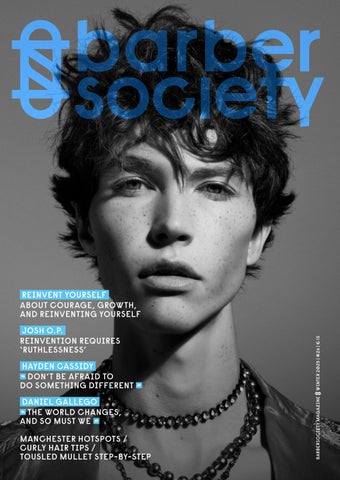
HAYDEN CASSIDY DON’T BE AFRAID TO DO SOMETHING DIFFERENT DANIEL GALLEGO THE WORLD CHANGES, AND SO MUST WE MANCHESTER HOTSPOTS / CURLY HAIR TIPS / TOUSLED MULLET STEP-BY-STEP
BARBERSOCIETY MAGAZINE
JOSH O.P. REINVENTION REQUIRES ‘RUTHLESSNESS’
WINTER 2025 | #26 | € 15
REINVENT YOURSELF ABOUT COURAGE, GROWTH, AND REINVENTING YOURSELF
INTERV IEW
Reinvention requires ruthlessness: Josh O’meara-Patel’s story How a New Year’s Eve disaster turned a geography student into one of barbering’s most influential educators. Text: Ben Copeland
6
@barber.josh.o.p @dfsformula
Visit the show and look & learn from Josh O.P. at BarberSociety Live 2026, Sunday, 12 April 2026!
The worst haircut of my life changed everything
The worst haircut of Josh’s life changed everything. It was New Year’s Eve, he needed a trim, and “like an idiot”, he hadn’t booked an appointment. Standing in his parents’ house, staring at his dad’s clippers in the cupboard, he thought: “It can’t be that hard.” It was that hard. He wore a hat to the party that night. But something about the sound hooked him. “There was something in the way that the sound of the clipper crunching in the hair that it just had me hooked.” One week later, he dropped out of university where he was studying geography and started cutting hair from his mom and dad’s kitchen. That was ten years ago. Today, Josh O’meara-Patel is an internationally recognized barber educator with over 22,000 students across every continent, creator of the patentpending D.F.S. Formula cutting system, and winner of Educator of the Decade at this year’s CT Barber Expo, USA.
The three-month sprint Josh’s career obliterated the traditional path. Three months after that New Year’s disaster, he landed a job at a local barbershop. Three months later, a more upscale shop. Three months after that, the most expensive shop in the city. By one year in, he’d been asked to start teaching. “I’d only been cutting hair a year. I didn’t aim to be an educator. I just posted what I did online and people wanted to see how I did it.” His philosophy became simple: say yes to everything. “I’ve always believed in doing things before you’re ready. My whole idea is if I say yes to a 1,000 things and I only get 500 done, some people look at it as failing 500 times. Whereas I look at it as winning 499 times more than you did, because you only tried one thing.” His first class was in Rotterdam (NL) at just eighteen months in. Teaching clicked immediately. He’d coached sports his whole life and grew up around psychology, his mother’s mental
health struggles making him “emotionally literate quite early on.” When barbering combined with teaching, something aligned. “I remember being like, that’s what I want to do. And I sort of like head down sprint.” He only worked in a barbershop for about three of his ten years cutting hair. “I very early on knew I didn’t want to be a barbershop barber, which sounds really weird. But I always wanted to focus on the teaching side of things.” He still experienced every stage though. “I still did the local shop, the slightly more upscale shop, the inner city shop, rented a chair, owned my own barbershop. I just did it quick because I was like, I haven’t got time to waste.” The method is the product Here’s where it gets interesting: Josh never went to barber school. “I didn’t learn how to cut hair traditionally. What that meant is I ended up just doing what worked for me in my own head.” When he started teaching, people kept asking about his method. That’s when it hit him.
7
INTERV IEW
From an early age, the afternoons of Daniel Gallego (38) revolved around the scissors and clippers. He would often be found in his father’s barber shop in Valencia, Spain, after school —doing his homework or helping to clean after a service. Those beginnings sparked Daniel’s curiosity about the profession. His father taught him the basics, laying the groundwork for the passion that would grow into a vocation in the years to come. Text: David Palacios Rubio
12
Despite traveling and training worldwide, he has always kept his business in his hometown of Valencia. He started working at a unisex salon, but 10 years ago he decided to open his own shop following in his father’s footsteps as a barber. That dedication and commitment to his craft have not gone unnoticed. Over the years, Daniel has earned accolades—including the Fígaro Award and the International Hairdressing Awards—confirming his reputation as a leading professional in the Spanish hairdressing scene. We spoke with him days after his latest award, while he was preparing for his next client in the salon. Because as he believes, life goes on normally despite the recognition of an award.
Chasing perfection: balancing tradition and creativity Interview with Daniel Gallego
Everyday excellence The consistency that Daniel has been achieving along his career has been rewarded. In October, the Figaro Awards— the national awards for hairdressing and barbering in Spain—recognized him for his collection ‘Balance’.
Earlier in June, he also won the award for Best International Men’s Commercial Collection at the International Hairdressing Awards (IHA) held in Manchester and where barbers from around the world showcase their technical skills and artistic vision.
Daniel, who had already won this same award in 2020, describes his winning collection as one that “seeks to create equilibrium between different aspects.” Technically, it bridges two worlds: the everyday barbershop style and the editorial, creative side of men’s hairdressing. “I’ve noticed many editorial stylists come from unisex backgrounds, so with this collection I wanted to build a link—something that connects the daily barbershop reality with the high-concept editorial side,” he says. Even though it’s an editorial collection designed for competitions and magazines, Daniel believes it retains the “barbershop essence.”
Yet, despite the accolades, Daniel believes that the real work happens in the salon, where the day-to-day craft and the happiness of his clients truly define his success. “Doing what you love and getting recognition for it, becoming a reference for others—it’s an honour but also a big responsibility.” Reinvention is key Since he opened his salon in Valencia back in 2015, his principles have always been the same. “My mindset hasn’t changed,” he admits. Elegance and refinement have always been the DNA of Daniel’s creativity. But the profession itself has changed
a lot, meaning that he has also evolved as a professional. He defends reinvention in a profession like hairdressing, which is constantly evolving. “Hairdressing is about trend, change, movement. For me, reinventing oneself is practically an obligation. We can’t stay stuck with old techniques or styles—we have to keep moving forward, ideally anticipating what’s coming next,” he states. Gallego shares an example of when a customer shows him a haircut from social media. “I need to be ahead of the curve. A client should never show me a haircut I’ve never seen before,” he says. He also admits that hairdressers “can’t stay in the past” by writing appointments in a notebook. “We must innovate, digitize, and look for added value in everything we do. 40 years ago, when my father was my age, barbers didn’t think about such things—they just cut 13
32
Collection: Collective Hair: Gianni Cardinale (UK) Photography: Liam Oakes @giancardinale
33
Collection: Collective Hair: Gianni Cardinale (UK) Photography: Liam Oakes @giancardinale
Seven years later: Leah Hayden Cassidy’s career evolution Seven years after her first BarberSociety Magazine interview, the Irish barber reflects on reinvention, community, and building a creative empire in East London. Text: Ben Copeland
44
@hayden_cassidy, @croilondon
INTERV IEW
Hayden will be present at BarberSociety Live 2026, Sunday, 12 April!
Seven years is a lifetime in the barbering world. When BarberSociety last sat down with Leah Hayden Cassidy in 2018, the Dublin native was finding her feet in Berlin, dreaming about Vidal Sassoon scholarships and imagining what life might look like in London or LA. Today, she’s calling from Croí, her third and largest studio in London Fields, where the walls are adorned with 24-karat gold hand-painted signage, and the space doubles as an art gallery, photography studio, and creative headquarters for a community of makers. Croí means “heart” in Gaelic, and it’s become more than just a name. It’s a philosophy that underpins everything Hayden has built.
“I came from a working-class area in Dublin that didn’t have much, but what we did have was a real sense of community,” she recalls. “Neighbours would knock asking for sugar, we’d play football on the street together. People might have looked at us and thought we didn’t have much, but we had everything that was important. We had connection.” From £1,000 to luxury: The COVID pivot When we last spoke to Hayden in 2018, she had just moved to Berlin and was beginning to understand barbering’s borderless nature. After relocating to London with her partner, she threw herself into education, travelling every weekend to teach across Europe. She shadowed her heroes,
including Kevin Luchmun, and applied for that Vidal Sassoon scholarship she’d dreamed about. She didn’t get it. But years later, while educating for Andis at Salon International, the Sassoon educators approached her to praise her stage presence. “It was a full-circle moment,” she laughs. “They had no idea I’d tried to get into their academy before.” Then came March 2020. “I looked at my schedule and realized 99% of my income that year was relying on education and travelling around the world,” she says. “That couldn’t be possible any more.” Within weeks, Hayden found
photography: @barberday & @eoingreally
Everything has come together to create this space that I’m really proud of 45