BWAA-BWM-Edition10-Digital-SinglePages

Page 1


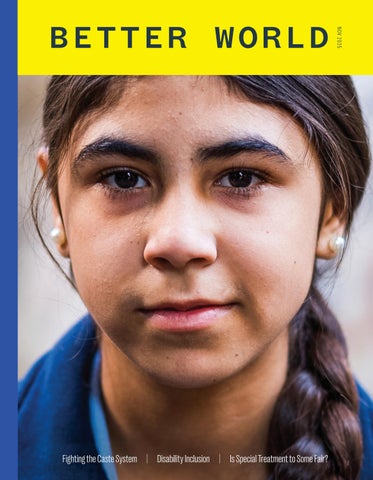
BETTER WORLD

Luke 14:12-14

‘Then Jesus said to his host, “When you give a luncheon or dinner, do not invite your friends, your brothers or sisters, your relatives, or your rich neighbours; if you do, they may invite you back and so you will be repaid. But when you give a banquet, invite the poor, the crippled, the lame, the blind, and you will be blessed. Although they cannot repay you, you will be repaid at the resurrection of the righteous.”’

A Seat At The Table For Everyone

‘Nothing about us, without us.’

Catchy, isn’t it? This phrase dates back to 16th century Poland, where it was part of a protest that brought about democracy and power for the people. In the 1990s, it became the cry of disability inclusion advocates as they too fought against social structures that wanted to define them without consulting them.

Thankfully, we’ve come a long way since then. We, along with our local Christian Partners, are committed to a co-creation process that listens to people and respects the diverse needs of communities. This means that when we start, monitor and hand over projects, they’re inclusive and support people in the ways they determine are necessary.

While one measure of success for any development program is sheer numbers of people reached, an equally important priority is to ensure we’re seeking to serve those

who are most vulnerable in any community. And so, in keeping with our desire to follow Jesus, we and our Partners intentionally seek out those on the farthest margins. Is this fair? Rev Dr. Melinda Cousins from Baptist Churches SA and NT considers this by answering our Curly Question (page 14), ‘Is it fair to show special favour to some?’

What does inclusion mean in practice? We use a framework known as GEDSI—Gender Equality, Disability, and Social Inclusion. By embedding GEDSI goals within the project’s success criteria, some resources are allocated specifically towards increasing accessibility. This might mean installing ramps so wheelchair users can access community spaces, providing support to women seeking their rightful citizenship, or enabling pathways for girls to enter or continue schooling. It will also involve equipping local leaders with skills to continue helping their communities challenge discrimination. Turn to page 10 to see how our Partners are doing this regarding people with disability.

Jesus welcomes all, regardless of gender, racial background, or social status (Galatians 3:28). Following his lead, we and our Christian Partners are breaking down unjust systems that repress the rights and deny the value of people made in the image of God. With several Christian Partners working within countries where people are routinely ostracised because of their caste, it is important that we act in the best interests of those impacted. See page six to learn more about the origins and problems of the caste system.

Finally, we’re excited to celebrate people like you with our new Community of Supporters section on page 12. Thank you for walking with us as together, we help ensure that there’s a seat at the table for everyone—especially the most vulnerable.

Because of Jesus,

BETTER WORLD BRIEFINGS

Our supporters helped our Partner provide aid to 27,569 PEOPLE impacted by the conflict in Lebanon.

JHUMA SEES A BETTER LIFE

Jhuma (pictured above), from rural Nepal, has one of the most important jobs in any community: caring for her husband who has severe asthma, and her nineyear-old granddaughter who has an intellectual disability.

Jhuma could just afford her husband’s medication, but the stress of her caring responsibilities weighed her down. Her struggles deepened when she developed cataracts and started losing her sight but couldn’t afford treatment.

‘I was burdened,’ Jhuma said. ‘Hearing people in the village talk about my family made my heart heavy. I had no place to express my feelings.’

Jhuma’s life changed when she joined a disability support group started by our Partner. There, she learned about disability rights, how to apply for a government disability ID card, and ways to advocate for her granddaughter.

With support from our Partner, Jhuma also underwent cataract surgery, restoring her vision.

Now Jhuma feels more capable—not just because of her improved sight, but from the support her group provides. ‘These meetings are a space for learning and connection,’ she said. ‘I began speaking out in my community, saying, “You are not allowed to call my granddaughter disrespectful names,” and I have stopped using such terms myself.’

‘I feel stronger, more confident, and ready to face the challenges ahead.’

SAYING NO TO DOWRIES

In Nepal, paying a dowry for daughters when they marry often leads to debilitating debt for families. To address this, Partha, chair of her village’s Self Help Group, and her recently married sons chose not to seek a dowry but rely on their livelihoods instead. Her bravery inspired other members of her group, and two more families agreed not to follow the practice!

KENYA

WIDOWS SUPPORTING WIDOWS

In Kenya, losing your spouse leaves you at risk of destitution, especially if you’re living in poverty. In one community, our Partner formed a Self Help Group for widows and widowers, where members deposit weekly savings that can be loaned to other members. With his loan, David (pictured below) established a tree nursery and raises chickens. ‘I’m excited to see my family eating eggs and poultry!’ he said.

THE INVISIBLE NEED AFTER A DISASTER

Disaster recovery addresses many physical needs, but one sometimes ‘invisible’ need is mental health support. After an earthquake devastated Vanuatu last year, our Partner trained pastors and other leaders to run mental health sessions in their provinces. So far, they’ve held 18 group sessions and 50 individual ones—including one for 40 school children in Port Vila—to help people build resilience in the wake of the earthquake.

NEPAL
VANUATU

PATIENTS IN GAZA have received medical care, through the work of our Partners and thanks to our supporters.

BANGLADESH

NO LONGER BED-RIDDEN

Physical therapy is vital for children with physical disability, but in parts of Bangladesh, access is limited. In one community, our Partner opened a centre providing physical therapy for families. Five-year-old Ali, born with clubfoot, started receiving therapy for the first time, while his parents learnt to support his care. He no longer stays in bed and enjoys an active life!

‘I don’t feel invisible anymore. I feel safe, I feel respected, and I know my rights.’

—NASIR, A CHILD WITH DISABILITY FROM BANGLADESH

LEBANON

ID PAPERS OPEN DOORS

Many services in Lebanon, like medical care and shelters, are only available to people with recognised nationality status. Stateless people, and those who lost their ID papers while fleeing conflict, are routinely excluded from receiving care. Recently our Partner helped 106 people obtain papers so they could access services. For one displaced person, this meant being able to undergo lifesaving cancer surgery.

In one year, one of our projects in Nepal helped 384 PEOPLE with disability meet their needs.

CLIMATE GRANT

In Cambodia, communities are at high risk of weather events that threaten food security, such as flooding. Our Partner’s Climate Grant initiative trained 26 young people across 13 communities in environmental stewardship and climate adaptation. Youth like Panha (pictured above) used their skills to lead panel discussions and share information with their community on how to care for the environment and prepare for disasters.

CHILD SAFE SPACES

In Myanmar, powerful earthquakes and ongoing conflict have displaced millions, leaving children at risk of exploitation. Our Christian Partner has established nine Child-Friendly Spaces to care for children’s wellbeing. Managed by emergency workers and trained volunteers, these spaces mean children can play safely, build friendships, develop life skills, and learn about their rights.

BE PART OF SOMETHING BIGGER

◀ Become a Child Sponsor and change more than a child’s life. Change a whole community! bwaa.co/sponsor-today

MYANMAR
CAMBODIA

Defying The Caste System

The ongoing struggle against caste-based discrimination

‘Mina

hadn’t even heard of school as a child.’

Mina grew up believing that she was polluting the world with her existence.

She’s Dalit, meaning her family are considered to be of so little value that they are beneath the caste system that has been active in India, Pakistan, Sri Lanka, Bangladesh, Maldives, Bhutan—and Nepal, where Mina lives—for at least 3,000 years.

The word ‘Dalit’ means ‘beaten down’, a term that emerged during the 1950s to highlight the oppression that people in this group faced due to caste discrimination. It replaced the derogatory term Achhoot which translates to ‘untouchable’.

Dalit people, still frequently referred to as ‘untouchables’, are often barred from social

and private places such as shops, homes, temples, and hospitals. Mina couldn’t share a meal with someone outside of her ethnic group, or even drink from the same tap—like many others, she had to walk a long way to find alternative water sources or wait until higher caste people were done. And being female compounds the discrimination—it’s common for Dalit girls to never receive any education. Mina hadn’t even heard of school as a child.

This discrimination is dehumanising, entrenches poverty, and often exposes people to physical violence. In 2022, a nine-year-old Dalit boy in India was beaten to death by his teacher for mistakenly drinking from a vessel designated for high caste teachers. Dalit women and girls are especially vulnerable, with tens of thousands of sexually violent

crimes perpetrated against them every year. This speaks to an enduring culture of disrespect towards Dalit people, and an all-pervasive denial of their dignity.

But here’s the thing: caste-based discrimination has been illegal in Nepal since 1963. The practice was officially outlawed even earlier in other places.

Mukunda Adhikari, International Programs Manager at Baptist World Aid, was born and raised in Nepal within a Brahmin (high caste) family. He offers personal and professional insight into the continuing prevalence of the practice.

‘Often, the law comes second to cultural norms and beliefs,’ said Mukunda. ‘In my hometown, the Dalit cannot enter the house—I’m talking about today! In the home where I grew up!’

Mukunda explains that people able to leave regional areas head to big cities to avoid discrimination by changing their surname—a person’s caste is identified this way. ‘But in a smaller village, there’s no hiding because everyone knows what family you’ve come from.’

Is change possible?

Mukunda thinks so: ‘People’s worldviews are changing and that’s reducing the impact of the caste system. In Nepal, we’re seeing positive change in each generation and that will continue in the future so there’ll be less discrimination.’

Encouragingly, our Christian Partners in Nepal attest to this change. Children of all backgrounds and castes meet as members of our Child and Youth Clubs where they learn that all people have inherent value and dignity.

Our Christian Partner in Nepal reports, ‘Positive behaviour among school children against caste-based discrimination has also been seen. They’ve started sharing their tiffin (lunch boxes) among their friends, including Dalits and the other so-called lower caste, which was not practiced before.’

There is every reason to believe that castebased discrimination will one day be history,

but until then, Baptist World Aid will make a particular effort to support Dalit people so they can fully participate in their communities.

Now in her late 40s, Mina’s life’s been transformed. After joining our local Christian Partner’s Self Help Group, she developed confidence and new skills to support herself and her family. Through hard work as a goat farmer, Mina emerged from poverty and now gives back to her community, leading others to likewise gain financial stability. ‘Success is only followed by tons of hard work,’ she said.

‘We have every reason to believe that caste-based discrimination will one day be history’

Whereas once Mina was too scared to speak to non-family members, in recent years she’s been elected to local government and uses this position to advocate for her community. But perhaps most poignantly, she invites women of all castes to eat together—in open defiance of the caste system—and see themselves as strong, capable people, ready to change the world.

HOW DID THE CASTE SYSTEM BEGIN?

There are different theories. Some think the caste system started as a division of labour. Another interpretation, from the Hindu religion, is that each caste was formed from the various body parts of the ‘creator’ (e.g. the higher caste is the head, while the lower caste is the feet). There’s also a belief that caste placement is a consequence of actions in a past life.

▲ Kenya: Members of a widow support group started by our Partner learn how to make ropes so they can generate another form of income.

Postcards From

◀ Cambodia: During our Better World Encounter Trip we loved meeting members of a Youth Club started by our Partner, where youth learn about their rights and gain skills for the future.

▶ Cambodia: Lmeury is a preschool teacher at a school supported by our Partner. She loves teaching and recently took part in training to improve her skills.

Our Partners

▼ Nepal: Bina (centre right) is the first Muslim girl in her town to finish year 10! With support from our Partners, her proud parents chose to send her to school.

▼ Indonesia: Our team met Yarni (centre), an inspiring leader who, amongst many other things, created a website where her community can access local information.

▲ Bangladesh: Snigdha (right), a Health Officer, shows mum Sima, how to provide physiotherapy treatment for her son.

BREAKING BARRIERS

HOW DISABILITY INCLUSION TRANSFORMS COMMUNITIES

Florence isn’t someone who excludes. Her husband works in his home country, Sudan, while she lives in Uganda, so she’s effectively a single parent. Despite this, she cares for five ‘adopted’ children alongside her own six—a daily picture of what radical belonging looks like.

Florence has been living with a physical disability since she was five and spent a lot of her life limited by it. When her old wheelchair broke beyond repair, she lost access to community life—the market, her children’s school—and was confined to her home.

‘I used to not move around the community because my mobility device got worn out,’ Florence said. ‘This prevented me from socialising, sharing ideas, or engaging in livelihood activities. I became heavily dependent on my husband for support, which caused me stress.’

Globally, more than 16 per cent of people live with disability (an estimated one billion people), and 80 per cent of them live in low and middle -income countries. Too often, they face both invisible and visible barriers: not only broken footpaths, inaccessible schools, or lack of mobility aids, but also harmful attitudes that exclude them from opportunities to thrive.

In Uganda, people with disability are disproportionately affected by poverty and injustice. Disability and poverty are tightly intertwined. Exclusion leads to fewer opportunities for education and livelihoods, while living in poverty increases the risk of disability through lack of medical care, unsafe work, and poor living conditions. Women and children with disability are especially vulnerable to discrimination and abuse.

When our Partner made it possible for Florence to be assessed by an orthopaedic specialist and fitted with a new wheelchair, the change was profound. Today, Florence participates in community meetings, attends church and activities at her children’s school, and can readily access health services. She’s started chicken farming to help cover school fees and is now the chairperson of a local committee, encouraging others to be engaged in community life.

Florence’s leadership isn’t limited to advocating for others with disability. She’s helping our Partners shape the future of community programs that serve

everyone. ‘When people with disability participate in community life, the entire community benefits,’ said Nerissa Prangnell, International Programs Manager, ‘and having leaders with disability makes the world a fairer place—for everyone.’

This is at the heart of what’s known as GEDSI (Gender Equality, Disability, and Social Inclusion). GEDSI ensures that development programs remove barriers so that everyone—women, children, people with disability, ethnic minorities, the elderly, and other excluded groups—can participate fully. It works on the principle that the success of a program is measured by the progress of people often marginalised.

When communities are inclusive, the ripple effects are wide. For example, children in our child and youth programs, who are seeing their peers with disability treated with dignity, are more likely to carry those attitudes into adulthood, affecting long-term change. One Partner in Uganda said, ‘We’ve a Child Club where the children moved the location to the home of a child with disability because otherwise, they couldn’t come. When children understand what others go through, they check on them; they help them get to school.’

Our Christian Partners are helping remove barriers not by doing the work for people with disability, but by creating pathways for communities to lead change themselves.

In Lebanon, programs are ensuring children with disability can attend school and access therapies like speech support. In Nepal, community campaigns, street dramas, and radio broadcasts have confronted stigma while helping families secure disability identity cards and access government services. In Kenya, mobility aid provision and vocational training are enabling people with disability to create sustainable livelihoods. While in Bangladesh, programs are linking people with disability to markets and training opportunities, farming, business planning, and financial services.

For Florence, the end goal is clear: that everyone has the chance to belong, participate and thrive.

‘I feel deeply happy, appreciated, and empowered within my community,’ she said. ‘I would like to see 100 per cent inclusion of people with disability in communities, so no one is left behind.’

OUR COMMUNITY

STUDENTS SWAP

FAST FASHION FOR FAITHFUL ACTION

It’s lunchtime at St Joseph’s Catholic College in East Gosford, and the classroom is buzzing with excitement as girls browse through racks of donated jeans, dresses and bags. The occasion? A clothes swap run entirely by students and supported by Baptist World Aid.

At St Joseph’s, students are empowered in the Josephite tradition to act justly and lead lives as disciples of Jesus. ‘We have a group that meets weekly to discuss social justice issues,’ said Youth Minister Philippa Mercer. ‘About two years ago, some of the students brought up clothes wastage, so we spent some time learning about this issue and watching documentaries like the ABC’s ‘War on Waste.’

To deepen their understanding, students participated in Baptist World Aid workshops run by School Engagement Lead, Sienna Corkill. ‘The workshops challenge young people to consider how their choices can be an act of faith,’ Sienna said. ‘We look at overconsumption, the impact of clothing production and waste on the environment, and exploitation of garment workers, helping people create real change.’

Inspired by what they learned, the group decided to run a clothing swap to minimise clothing waste.

Students brought in good-quality clothes they no longer wanted and received tokens to ‘shop’ at the swap, along with a copy of the Ethical Fashion Guide. Best of all, the students themselves planned the event, designed posters, and spoke at assemblies about the problem of clothing waste. ‘It was great to see the girls have lightbulb moments and pass it onto their peers,’ Philippa said.

Now in its second year, the swap is still a huge success with more junior students getting involved. And the students are dreaming even bigger; they hope to make the clothes swap a regular event and open it up to the wider community.

‘It was great to show the girls there are so many different ways we can show God’s love and put our faith into action,’ Philippa said.

WANT

TO LEARN MORE ABOUT HOW THE FAST PACE OF FASHION IMPACTS WORKERS AND THE ENVIRONMENT?

◀ Listen to our new six-part podcast series! Behind the Barcode explores what ultra-fast fashion is, why this business model has grown, and how it leads to worker exploitation and environmental harm. Learn with us and be equipped to create change. bwaa.co/advocacy-podcast

OF SUPPORTERS

WE LOVE OUR BETTER WORLD GIFT STALL HOSTS!

We asked Sarah Moeda, a host for 10 years, how Better World Gifts inspires generosity at her church: ‘I’ve seen how children become excited that the card their parents bought provided a goat to a family that needs it,’ Sarah said. ‘If we can link buying the cards to the gospel and Jesus’ own words about helping the poor, children feel that they are part of something important.’

A BOOK WEEK FUNDRAISER

Shout out to Carey Baptist College WA who raised $541.80 for our Middle East Crisis Appeal during Book Week—including a $130 donation from one generous student who gave all their pocket money!

A FAMILY CULTURE OF GENEROSITY

At 96, Brian has much wisdom to share on guiding a family in cheerful generosity.

He and his wife, Barbara, have been Child Sponsors for many years, and Brian has included a gift in his Will to Baptist World Aid. ‘Scripture is full of teaching that God wants us to care for those in need,’ he said. ‘The early church took that teaching to heart.’

Brian has passed his generous heart to his family, including his granddaughter, Jacqui (pictured with Brian). ‘Generosity is something you see more than something you are taught,’ Jacqui said. ‘It’s not that my grandparents sat us down and told us what to do with money, but they showed us through lots of little choices that added up to a picture of what it means to live generously.’

Is It Fair To Show Special Treatment To Some?

Fairness is something of an Australian obsession. We pride ourselves on giving everyone a ‘fair go’. We want the same rules for everyone. Queue-jumping, cheating, and nepotism all spark outrage.

From the playground to the office, the idea of ‘special treatment’ can feel like someone getting more than what we think they deserve. We like the idea of a level playing field. We might even assume that fairness equals justice.

But for followers of Jesus, this poses a problem. Because the Bible doesn’t share that perspective. The God who reveals himself to us in Jesus does not reveal himself as ‘fair’ in this ‘no special treatment’ kind of way.

The Old Testament prophets speak out against injustice, but they don’t connect this to equal treatment. Instead, they consistently point to God’s partiality. Partiality toward the poor, the widow, the orphan, and the foreigner. Amos accuses Israel of

selling the needy for a pair of sandals. Micah says God rejects the oppressors and sides with the oppressed. In Jeremiah, God commends the one who defends the cause of the poor and needy.

Far from treating everyone the same, the prophets accuse the powerful of using ‘fairness’ as a cover for exploitation, while God demands that the weak be given special protection. That’s not neutrality. That’s not treating everyone the same. It’s what we might call special treatment. God, it seems, plays favourites with the vulnerable.

Jesus picks up the same theme. He doesn’t carefully distribute his miracles equally or make sure everyone gets the same ration of his compassion. He sits down with tax collectors and prostitutes. He touches lepers and sinners and is touched by bleeding women and beggars. He seems to gravitate to the undeserving. And he tells provocative parables where the last are first. Workers who turn up for just one hour in the evening are paid the same as those who have

been sweating all day. The younger son who has squandered his inheritance gets a feast while the responsible older son fumes. The poor are blessed while the rich are warned. What society deems ‘deserving’ is irrelevant to Jesus. Instead, he says, ‘Whatever you did for the least of these, you did for me.’

To someone with a deeply engrained sense of the ‘fair go’, these teachings might sound outrageous, even offensive. But to Jesus, this is the kingdom of God breaking in. God’s justice doesn’t maintain a status quo that we might like to call ‘fair’; it overturns it. Mary sings of the hungry filled and the rich sent away empty, just as the prophets dreamed of the oppressed lifted and the proud brought low.

‘God, it seems, plays favourites with the vulnerable’

—MELINDA COUSINS

Grace is special treatment lavished on the undeserving. And grace is always scandalous. It scandalised the Pharisees. It scandalised the elder brother. And it will scandalise anyone who thinks fairness is the ultimate goal.

For in the end, if God were truly fair, none of us would be able to stand before him. If God were fair, every sin would receive its full penalty. The cross is the ultimate act of divine unfairness: the innocent condemned, the guilty freed.

So perhaps the question is not, ‘Is it fair to show special treatment to some?’ but rather, ‘will we join God in showing grace to those in need, knowing none of us deserve it?’

God’s kingdom is not some egalitarian utopia where everyone is treated the same. It is a banquet table where the poor and despised are ushered to places of honour. The real challenge is whether we have the courage to embrace this divine unfairness, not only when it saves us, but when it raises up those whom, if we’re honest, we might rather see kept down.

The kingdom of God is not fair. It is better than fair. It is grace.

Rev Dr Melinda Cousins

DEVOTIONAL

THIRSTY FOR MORE

Read John 4:1-42

God has always been about the business of captivating his people with a mercy like few have ever seen before. The diverse and real women and men whose stories are woven into the Bible’s narrative have this one thing in common: God has pursued them in love.

Enter the Samaritan woman at the well. Her encounter with Jesus changed everything she’d ever known. Jews would avoid Samaria entirely so as not to be ‘exposed’ to those who lived there. So why was Jesus going out of his way, in the middle of the day, to go through Samaria and visit with a woman there? Couldn’t he have gone another route or avoided a conversation altogether, let alone invite one of the longest dialogues recorded in history?

Yes, he could have. But the Samaritan woman was exactly why Jesus came to earth in the first place: to fulfill the thirst of those who many considered damaged goods, unclean, and unworthy.

◀ SCAN HERE TO READ THIS REFLECTION IN FULL ON OUR WEBSITE.

Until Everyone Has A Seat At The Table

Our Christian Partners help communities tackle the challenges holding them back, so that everyone, regardless of who they are, can have a seat at the table.

To support our work, visit bwaa.co/table

Turn static files into dynamic content formats.
Create a flipbook
Issuu converts static files into: digital portfolios, online yearbooks, online catalogs, digital photo albums and more. Sign up and create your flipbook.