In this week’s parsha, Eikev, Moshe Rabbeinu reminds Klal Yisrael what Hashem asks of us:
“To walk in all His ways, to love Him, and to serve Hashem, with all your heart and with all your soul.”
The words “
” remind us that serving Hashem is not limited to the moments we spend in shul or the mitzvos we perform in private. It is reflected in the way we walk through the world, how we speak, how we react, and how others experience us. Wherever a Jew goes, the possibility of Kiddush Hashem goes with him. That message came to mind after a small moment at an Orioles game this week involving Jewish pitcher Dean Kremer. Following an awkward pickoff throw to first baseman Pete Alonso, Kremer got Alonso’s attention and appeared to ask him, twice, “Can you see?” Perhaps he was wondering whether Alonso had lost sight of the ball against the stadium lights or glare from the sky. Perhaps he simply wanted to know whether it was safe to attempt another pickoff throw. Yet almost immediately, the moment was framed by some as Kremer being sarcastic, disrespectful, or critical of his teammate. Social media did what social media often does, turning a brief and unclear exchange into a confident judgment about someone’s character. Sadly, some of the reactions went much further. Because Kremer is Jewish, certain commenters used the moment as an excuse to unleash ugly antisemitic stereotypes, portraying his supposed behavior as somehow typical of Jews. None of us can know exactly what Kremer intended from a few seconds of video, and there may have been nothing wrong with the exchange at all. But the reaction was a painful reminder that a Jew is
sometimes viewed differently. A gesture that would pass unnoticed from someone else can be replayed, analyzed, and assigned a much larger meaning when it comes from someone visibly associated with the Jewish people. Most of us will never stand on a Major League mound with television cameras recording our every movement. Yet, in our own settings, we are also being watched. At work, in a store, on the road, on vacation, or interacting with a neighbor, people may form impressions not only about us, but about the community and Torah we represent. This does not mean that we must live nervously or believe that every misunderstanding is our fault. We cannot control how others choose to interpret us, especially those already looking for reasons to dislike us. Still, knowing that we may be under a microscope can encourage us to pause for an extra moment before speaking, reacting, or allowing frustration to show.
Kiddush Hashem is not reserved for heroic acts or public figures. It belongs to ballplayers, politicians, philanthropists, businesspeople, parents, and children. Often, it is created through something wonderfully ordinary: a patient response, a warm greeting, an honest transaction, or the decision to give someone the benefit of the doubt.
asks us to carry Hashem’s ways wherever our own paths lead. We may not always realize who is watching, what they will notice, or what conclusion they will draw. But perhaps that awareness can gently remind us that every encounter is another quiet opportunity to bring honor to Hashem and His people.
Have a peaceful Shabbos, Aaron M. Friedman
WIN with !
Comfort Year-Round:
Experience stable indoor temperatures, and reduce drafts, with warm winters and cool summers, when you upgrade to spray foam insulation in your
Save Big on Energy Costs:
Cut your heating and cooling bills by 30-50% and make your HVAC system work smarter, not harder.
Breathe Better:
Enjoy improved air quality with reduced drafts and outdoor pollutants, creating a healthier living environment.
Around the Community
Bais Medrash of Ranchleigh Appoints New Rav
With Rabbi Naiman’s recent decision to retire from his position as Rav and assume the role of Rav Emeritus, we take this opportunity to express our profound gratitude and appreciation. We recognize our founding Rav and Rebbetzin, Rabbi Abba Zvi and Rebbetzin Rochel Naiman, whose vision, dedication, and unwavering commitment established the foundation of our kehillah approximately 27 years ago.
From the very beginning of BMR, a trailblazer shul in Ranchleigh, Rabbi and Rebbetzin Naiman set out to build a mikdash me’at, a makom Torah and tefillah marked by serious davening, meaningful learning, and genuine achdus. Through their tireless efforts, they transformed a vision into a shul that has become an anchor for many in the
Ranchleigh/Greenspring area. We are deeply grateful for the remarkable legacy they have created and thank them for laying the foundation upon which our shul will continue to grow and flourish.
At the same time, we are excited to announce the appointment of Rabbi Rafi Neuberger as the new Rav, and welcome him and Mrs. Rochel Neuberger as the new Rav and Rebbetzin of Bais Medrash of Ranchleigh.
The Neubergers have been valued members of BMR for the past ten years and have become an integral part of our kehillah. Rabbi Neuberger’s service as Assistant Rav over the past number of years has allowed him to develop close relationships, while demonstrating his leadership, accessibility, and unwavering commitment to the needs of our members.
By: BJLife Newsroom
A native of Baltimore and a musmach of Ner Yisroel, Rabbi Neuberger brings a deep commitment to Torah, Halacha, and the enduring mesorah that has long guided our shul. We are confident that, with Hashem’s help, he will build upon the strong foundation established by Rabbi Naiman while leading BMR into its next chapter of growth.
We warmly invite the community to join us for our daily minyanim and inspiring shiurim. We encourage you to participate, learn, daven, and grow together with us as we embark on this exciting new chapter.
We wish Rabbi and Mrs. Neuberger much hatzlachah and siyata d’Shmaya as they assume this important responsibility. With the help of Hakadosh Baruch Hu, may
Ateres Welcomes New Mechanchos To Their Administration
We are pleased to introduce two outstanding mechanchos who will be joining the Ateres administration.
Mrs. Chaya Gitty Morgan will serve as our Elementary School Principal and will also be teaching First Grade this year. Mrs. Morgan brings over 25 years of experience in chinuch, having taught and led in schools
in Pittsburgh, Monsey, Toronto, and Baltimore. She is deeply committed to partnering with parents and helping every child feel valued, confident, and excited to learn.
Mrs. Shoshana Sofer will serve as our Preschool Director. A Baltimore native and experienced mechaneches, Mrs. Sofer has a deep passion for early childhood education. Nine years
ago, she founded and has served as Principal of the preschool at K’hal Chassidim Baltimore.
We are grateful that Mrs. Sofer and Mrs. Morgan will be bringing their warmth, expertise, and professionalism to Ateres.
Medrash of Ranchleigh 6618 Deancroft (corner Smith) Baltimore MD 21209
We look forward to the continued growth of Ateres and to the tremendous impact these mechanchos will have on our talmidos and families.
Camp Shpitz Girlz Color War Breakout At Aventura At The Heights Assisted Living!
One of the highlights of our summer at Aventura at The Heights Assisted Living was welcoming the incredible campers from Camp Shpitz Girlz for a truly unforgettable visit!
Our residents had been preparing a special surprise and couldn’t wait to share it. They took center stage and performed a hilarious skit about a “missing camp schedule,” keeping everyone laughing as the mystery unfolded. Just when the campers thought the story was over, the big surprise was revealed, the residents officially broke out Color War for Camp Shpitz Girlz!
The room instantly filled with cheers, excitement, and nonstop smiles as the campers realized what had happened. Watching our residents fully embrace their roles, entertain the campers, and be part of such a memorable camp tradition was incredibly special. It was a beautiful afternoon filled with laughter, connection, and joy, reminding us how meaningful it is to bring different generations together. We were so grateful to welcome Camp Shpitz Girlz to Aventura and create memories that both our residents and the campers will cherish for years to come!
BMR continue to flourish as a vibrant makom Torah, tefillah, and chesed for many years to come.
Bais
Early Childhood Directors Step Away To Recharge, Reflect, And Connect
Throughout the school year, Jewish Educational Services regularly convenes Early Childhood Directors from across the community, creating opportunities for collaboration, problem-solving, and shared learning. This summer, they built on those connections by hosting their very first Early Childhood Directors’ Retreat, a special day designed to recognize and celebrate the incredible work these professionals do every day.
The retreat brought together 22 participants representing 15 early childhood programs, nearly every Jewish early childhood program in our community. While each school has its own culture, philosophy, and unique needs, the day revealed just how much these leaders have in common.
To facilitate the retreat, JES partnered with Miriam Stein of Saddlerock Strategies, who led partici-
pants through engaging conversations about leadership, workplace challenges, time management, staff development, and the often-unseen work that comes with leading a school.
While the retreat offered plenty of practical takeaways, the most powerful feedback centered on something much simpler: connection.
Repeatedly, directors shared how meaningful it was to realize that the challenges they face are often shared by their colleagues. One participant wrote, “The biggest insight from today is to know we all are feeling the same struggles. We are not alone.” Another reflected that she was amazed to discover that most directors are navigating similar issues and appreciated knowing she now has peers she can turn to for support.
From collaborative discussions and problem-solving activities to a reflective walk-and-talk and creative
art experience, the day gave leaders a rare opportunity to step away from the demands of their programs and invest in themselves. Participants left with practical strategies, fresh ideas, and renewed energy for the year ahead.
As directors prepare to welcome children, families, and staff back for a new school year, many shared goals focused on strengthening teacher support, building stronger partnerships with families, developing positive school cultures, and creating opportunities for
professional growth within their teams.
JES knows that strong schools begin with strong leaders. This retreat was a way of expressing gratitude to the dedicated professionals who work tirelessly on behalf of our community’s youngest learners. More than just a day of professional development, it was a celebration of leadership, a chance to build deeper relationships across programs, and a reminder that even in diverse settings, we are stronger when we learn and grow together.
JCNSL By Klaff Sports Physical Therapy Kicks Off Another Exciting Season Of Night Softball
The lights are on and another season of the JCNSL by Klaff Sports Physical Therapy has officially arrived!
Week after week, Baltimore’s premier men’s night softball league brings together local athletes for exciting competition, great camaraderie, and unforgettable moments. The action takes place each Sunday evening on the beautiful Tidy Up fields, expertly maintained by the Baltimore Sports Cards grounds crew. From the perfectly prepared infields to the game-ready outfields, every detail helps create the ideal setting for another memorable season.
The games are also made possible thanks to the expert Mixed by Moses umpiring crew, whose consistent and professional calls have kept every game moving smoothly and fairly. (Note, all umpires have attested they only partake in Moses’ Mixes AFTER games have concluded.) Behind the scenes, the essential equipment and supplies provided by I Heart Remodeling, ensure each game goes off without a hitch.
And, of course, none of this would be possible without the incredible team of writers and correspondents who bring the excitement of the JCNSL to life each week in these BJH articles. A special thank you to the 8th Note Band Editorial Board who ensure each article is accurate and submitted on schedule.
With that, let’s take a look back at some of the biggest moments from Week 2 of JCNSL!
Tov Pizza 9, Web Interactive Technologies 7
Was it a bird? A plane? Nope — it was Eliezer “Cannon” Szajowitz putting on one of the greatest defensive performances ever seen.
Szajowitz launched himself into JCNSL history, throwing out an unbelievable seven runners attempting to score — a defensive feat that may never be matched. Every throw seemed to travel on a rope, finding its target and shutting down rally after rally.
Tov Pizza jumped out quickly, scoring four runs in the first inning and never looking back. The offense
received contributions throughout the lineup, but on this night, the Cannon’s arm stole the show. With the 9-7 victory, Tov Pizza improved to 3-0 and continued its early-season statement that they are the team to beat.
Tov Pizza 9, MDSC 8
With the game tied in the sixth, birthday boy Mayer “Collars and” Kovacs crossed the plate with the go-ahead run, giving Tov Pizza a 9-6 advantage. From there, the “Slices & Toppings” defense was forced into survival mode as MDSC continued applying pressure.
Battling through injuries and relentless late-game intensity, Tov Pizza made the plays when they mattered most. It wasn’t always pretty, but resilience was the name of the game as they slammed the door and secured another thrilling victory.
Klaff Sports Physical Therapy 12, Clothier 10
Team Klaff Sports Physical Therapy (KSPT) announced its arrival in a big way, stunning undefeated Clothier in a heavyweight slugfest.
KSPT exploded out of the gate, scoring six first-inning runs — including five before the first out was recorded. Clothier answered immediately with six runs of its own, setting the stage for a back-and-forth battle.
Eli “Chop Suey” Kelemer launched a three-run moonshot in the fourth inning, but Clothier refused to go quietly. The game was tied 10-10 heading into the sixth inning before KSPT scratched across two clutch runs, highlighted by Moshe “Sludge” Herber’s three-RBI performance.
Then came the knockout punch — the defense. KSPT stranded Clothier runners on third base in the sixth and seventh innings to secure the thrilling victory.
KSPT 11, YL Waitering 10
After falling behind early, Benji “The Gadya Sr.” Friedman launched a game-tying home run to ignite the comeback. Five straight singles in the third inning (led by clutch hitter
Adam “Make ‘em” Klaff) pushed KSPT ahead, but YL Waitering stormed back with eight runs in the later innings to grab a 10-5 lead.
Down to their final outs, Moshe Herber delivered a legendary moment, blasting a bases-clearing triple and finishing the day with four hits. Then Shaya “Machu Picchu” Swiatycki stepped to the plate and delivered the walk-off moment, crushing a two-run double to complete an unforgettable comeback.
The Rosen Team 12 YL Waitering 7
After dropping its first two games of the season, The Rosen Team (TRT) bounced back in impressive fashion.
Brian Ponczak dominated on the mound while the offense produced throughout the lineup. Moe “Ice Cream” Krohn provided one of the highlights of the day with an inside-thepark home run, while Sammy “Putting the horse in front of the” Carter made a spectacular over-the-shoulder catch. Mordy Purec, Levi “Levee” Levine, Avraham Szajowitz, Baruch Glazer, and Yitzy Glazer all contributed key hits.
TRT 11 Clothier 10
TRT built an early lead before Clothier stormed back, but the response was immediate as TRT rallied and reclaimed the lead.
Yechiel “The Layered Onion” Schreck delivered several clutch hits while anchoring second base defensively. David Donaty and Max Reitberger battled through injuries to keep contributing, with Reitberger making one of the day’s top defensive plays by snagging a line drive and completing a double play.
TRT’s win showed exactly what championship teams are made of:
resilience, teamwork, and the ability to respond.
MDSC 13, CREZLY 12
Trailing by six, MDSC slowly chipped away before exploding late and completing a dramatic walk-off victory over CREZLY.
Evan “Under Siege” Sagal and Shmuel “Doctor” Pepper provided the biggest hits of the comeback, delivering key RBIs that kept MDSC within striking distance. MDSC completed the rally by pushing across the winning run and celebrating one of the season’s most exciting victories.
Web Interactive Technologies (WIT) 15, CREZLY 8
In a key win for WIT, Jordy Strauss led the way with an outstanding performance at the plate and on the bases, while David Pensak produced with key hits and excellent defense at shortstop.
Ezra Bernstein and Reuben Turner made several difficult plays at third, while Yoni Strauss, Zecharia Zaslow, Eli Lauer, and Navid Raoofian covered ground in the outfield. Lauer also provided one of the game’s biggest moments with a clutch HR.
Behind the plate, Avi Safran provided leadership and stability at catcher.
DANIELLE RENOV’S
Bestselling Cookbook Series Continues...
Quick Cooking Meat
LOVE MEAT, BUT CLUELESS AT THE BUTCHER SHOP?
Danielle Renov and co-author Estee Chait demystify beef, with clear-cut guides, simple explanations, and wildly craveable recipes.
MASTER YOUR MEAT
OVER 100,000 COPIES OF THIS SERIES IN PRINT!
IN THIS, THE FOURTH IN THE POPULAR MICRO PEAS SERIES, YOU’LL DISCOVER: 55+ recipes (30+ gluten free!), designed for ease of prep and quick cooking
A user-friendly guide to cuts of meat What makes a steak incredible (and how to nail it every time)
How to build a next-level sandwich bar
Weeknight wins, Shabbos showstoppers, and crowd-feeding favorites
Tiferes Yisroel Celebrates 40 Years, And A Tzeischem L’Shalom To The Margolese Family
It marked the end of an era for Congregation Tiferes Yisroel, as the shul celebrated forty years and a “tzeischem l’shalom” BBQ and kumzitz for shul president Binny and Brocha Margolese, and long-time shul member, Mordecai Zev Margolese, in honor of their upcoming move to Orlando, FL.
Beloved by all, the Margoleses will be dearly missed, but the legacy they will leave behind is unparalleled. Binny became shul president in 2018, and during his eight-year tenure the shul has truly flourished. With his charismatic grin and boyish good looks, Binny brought a new energy to the kehillah, one filled with puckish excitement and simcha, and together with his wife Brocha, added a new dimension of chesed and ahavas Yisroel to the shul.
Binny’s dedication to the Rav, to the shul, and to the kehillah was unprecedented, as well as his commit-
By: Lev Avraham Rosenstock
ment to the community and the klal at large. But our loss is Orlando’s gain, as Binny and Brocha embark on a new chapter in their life together, and a new beginning for all.
The evening of celebration began with a delicious BBQ suedah with Knish Shop burgers and dogs and grilled chicken. For some (like myself), this was a very emotional night, as we bade a hearty farewell to our dear friends Binny and Brocha and Mordecai Zev.
After the suedah, everyone gathered outside in the shul parking lot for a kumzitz with music and singing led by Eli Frenkel, Yehuda Tenenbaum, and shul musicians Howard Reznick, Scott Parsowith and Yehuda Schwarz, and singing accompaniment with Rabbi Goldberger.
In celebration of the shul’s fortieth year in the community, HaRav Amrom Yosef Jungreis, Rav and Rosh Kollel
of Khal Chassidim, spoke beautifully about Congregation Tiferes Yisroel and our beloved Rav, and related the significance of the number forty in the Torah and in Judaism.
The entire evening was permeated with ruach and achdus, the two essential elements that make Congregation Tiferes Yisroel such an incredible shul and a pillar in the Baltimore community. I am proud to be a member of such a chashuvah kehillah, which is a reflection of the Rabbi and Rebbetzin and their ahavah for and devotion to all members of klal Yisroel.
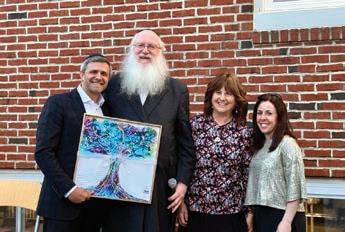
Binny and Brocha were presented with an original painting, “The Tree of Life,” by local artist Temima Reches by Rabbi and Rebbetzin Goldberger for their new home in Orlando. A special thank you and yasher koach to event coordinator Moshe Margolese for organizing such a beautiful shul affair.
We wish Binny and Brocha and Mordecai Zev much hatzlacha and bracha, and although they will be missed, we know that they will be zoche to do great things in Orlando for klal Yisroel and for their new community.
Weeks 7 & 8 Of The Summer 2026 Season Of Charm City Ballers Sponsored By Councilman Isaac “Yitzy” Schleifer Featured Record Breaking Performances And Surprising Results
Fired Up Promotions 86 M&S Enterprise 42 Goldstein Sets Records as Fired Up Annihilates M&S
Avi Goldstein set Charm City Ballers records with 50 points and 28 rebounds while also dishing out 10 assists to complete a triple double as Fired Up Promotions crushed M&S Enterprise 86-42. Goldstein shot over 50% from the field and grabbed 8 offensive rebounds as M&S had no answer to his dominance.
Akiva Stutman added 14 points and 9 rebounds in the win, while Avner Shotz and Abie Hyatt each chipped in 11 points. Aharon Schnur snagged 8 rebounds as Fired Up finished with more than twice as many rebounds as their opponent.
Yoni Bobker was the lone offensive bright spot for M&S, scoring 37 of his team’s 42 points and assisting on one of their other 2 buckets. Mordi Spero grabbed 7 rebounds in the loss as M&S dropped to 3-2.
Advanced Security Lock & Key 60 King David Nursing & Rehab 36
Advanced Wipes Out King David To Grab First Win
Heshey Green scored 32 points and grabbed 11 rebounds as Advanced Security picked up their first win in dominant fashion, controlling the game after a slow start to win 6036. Avi Yudkowsky added 11 points, 9 rebounds, and 4 assists in the victory, while Leon Sheynman and Avraham Frost chipped in 6 points apiece.
Sheynman grabbed 9 rebounds while Noach Schwartz added 8.
King David Nursing & Rehab was led by Yisroel Luchansky with 13 points, 6 assists, and 6 rebounds. Menachem Blackman added 11 points and 9 boards while Elazar Freedman grabbed 8 rebounds in the defeat, as King David dropped to 3-2.
M&S Enterprise 53 Diamond Auto Leasing 45
M&S Locks Down Diamond Auto for Season Sweep
Super sub Jaim Magenzdo led a strong effort on both sides of the court as M&S Enterprise got back in the win column with a 53-45 win over Diamond Auto Leasing. Magenzdo had 24 points and 11 rebounds and helped M&S hold Diamond Auto to just 28% shooting from the field. Mordi Spero hit 4 3s on his way to a 21 point, 12 rebound performance, both season highs.
Eitan Hariri starred as always for Diamond, but it was a slog for even him. He led his team with 24 points, 17 rebounds, and 6 assists but had to fight through a swarm of defenders led by the clingy Magenzdo at all times. Yitzy Hyatt finished with 9 points and 5 rebounds while Aharon Schmell and Yoey Schacht added 5 points each in the defeat.
Orshan Legal Group 58 Fired Up Promotions 52 Reches, Lockdown Zone Carry Huge Orshan Legal Comeback
Orshan Legal overcame a 16 point halftime deficit to grab their second
consecutive win. After giving up 37 first half points including a rain of Abie Hyatt 3s and Avi Goldstein looking like he did the previous week in his record breaking performance, Orshan Legal came out of the half in a zone defense and stifled the Fired Up offense, allowing just 15 points in the second half and fighting off a late Fired Up rally to hang on to their 58-52 win.
Mordy Reches scored 27 points, grabbed 10 rebounds, and dished out 3 assists. Yoseph Orshan added 10 points, 12 rebounds, and 4 assists, Isaac Beletsiky poured in a dozen points, and Avromi Gartenhaus added 7 rebounds and 5 assists. Yehuda Pensak came off the bench with 5 points and 6 rebounds but his impact couldn’t be fully felt on the stat sheet. Hyatt led Fired Up in scoring with 24 points including 6 3s, while Goldstein had a relatively quiet scoring game but flirted with another triple double. He finished with 13 points, 10 rebounds, and 8 assists in the loss. Akiva Stutman added 7 points as well.
613 Seconds with Avi Green, Founder of Safe Green Transit
“Safe Green Transit is not simply a transportation provider. Every bus on the road represents fewer cars in school zones, less congestion on neighborhood streets, and more time returned to parents.”
BJH: Can you tell us a bit about yourself?
Avi Green: I moved to Baltimore from Montreal in 2005 to be closer to family and proceeded to build a career in information technology. I spent fourteen years with a local company before being hired by the United States Air Force in 2019. Today, I serve as a Director in the Air Force and as a member of Hatzalah of Baltimore. In 2023, I began assisting Shomrim of Baltimore with organizational structure and other operational changes. Organized, systematic transportation was not a new concept for me. While working my way through school in Canada, I drove trucks and buses and later managed a commercial vehicle fleet. Long before I entered the technology field, I learned how efficient transportation systems could and should function. I have always enjoyed building systems that
solve problems and helping organizations become more effective. That mission ultimately became Safe Green Transit.
BJH: What is Safe Green Transit?
AG: We are a Baltimore-based community nonprofit organization providing shared bus transportation for frum private school students and other community nonprofit organizations. Over the past two years, our program has grown steadily, and we are expanding our fleet to meet increasing demand for transportation services throughout the community.
Every school morning and afternoon, thousands of parents drive to and from the same schools, creating congestion and parental stress and making life more difficult for everyone. Safe Green Transit (SGT) replaces these individual trips with organized, reliable bus service.
Our mission is simple: to reduce traffic congestion by replacing parent carpools with shared school bus transportation. Last year, the organization reached capacity, providing approximately 520 student rides every school day. Transportation affects quality of life, public safety, and families’ schedules. Every student who rides a bus instead of arriving in a smaller vehicle benefits the entire community.
BJH: How did SGT start?
AG: SGT did not begin in a boardroom. It began while I sat in a carpool line, watching hundreds of parents waiting to drop off or pick up their children. My first thought was, ‘This is crazy, and I know how to fix it.’
Every day, thousands of parents drive
to and from the same schools, creating congestion on neighborhood streets, increasing parental stress, and making arrival and dismissal more difficult for everyone. The purpose of SGT was simply to reduce traffic congestion by replacing individual carpools with shared school bus transportation.
BJH: How does SGT pay for its operations?
AG: Thanks to the generosity of a local donor, several sponsorships are reserved each year for the families of community volunteers who dedicate their time to serving Baltimore.
Approximately 30% of our operating budget now comes from state grants, while the majority continues to be funded directly through local community support.
Rather than relying exclusively on fares or government funding, each bus route is backed by a team of community sponsors who collectively provide the necessary funding. When state or federal grants are awarded, those funds are applied directly to operating costs, reducing and sometimes eliminating the amount needed from individual sponsors. SGT also maintains a Tzedakah Fund, enabling community members to help families who want to participate as sponsors but cannot afford the cost of bringing a route to their area. This fund ensures that financial circumstances do not prevent a student from riding, even if a particular route has not yet secured enough sponsors to underwrite it.
Once a route becomes fully sponsored, any remaining seats are opened to additional eligible riders along that route at no cost.
Because the cost of the route has already been covered, filling those empty seats increases the community benefit without adding operational expenses.
BJH: What is next for SGT?
AG: This September, SGT is preparing to expand to twelve routes and expects to provide more than 800 student rides each school day. Over the course of the year, that would amount to approximately 136,000 rides and prevent 53,550 parent vehicle trips. Those are tens of thousands of trips no longer contributing to congestion around schools and long pickup lines, reducing stress for everyone involved and improving traffic safety across the board.
As we continue to expand year after year, we hope to replicate this success by serving more geographic areas and schools.
BJH: How can readers help?
AG: Our community has shown that when people work together, they can solve problems that affect everyone. As SGT prepares for its largest year yet, the organization continues to seek route sponsors, charitable donors, volunteers, grant partners, businesses, and schools interested in supporting or expanding the program.
Sometimes the best solutions are not new ideas at all. They are proven ideas applied in a way that brings an entire community together. SGT demonstrates that when transportation becomes a shared responsibility, everyone arrives at a better destination.
To learn more, visit www.safegreentransit.org.
The Week In News
The Week In News
Hungarian Pres. Steps Down
Hungarian President Tamas Sulyok’s time in office officially came to an end after he signed a constitutional amendment terminating his own presidency, a move that underscores the country’s dramatic political shift following April’s elections.
The amendment, approved by Prime Minister Peter Magyar’s governing Tisza party, immediately removed Sulyok from office. The legislation argues that the president, who was elected in early 2024 by lawmakers from former Prime Minister Viktor Orban’s Fidesz party, had lost the confidence of the Hungarian public.
Although Sulyok signed the amendment into law, he made it clear that he did so reluctantly.
“I had no choice,” he said, explain-
ing that the legislation complied with Hungary’s constitutional procedures. At the same time, the former Constitutional Court judge warned that the measure damages the country’s democratic institutions.
“The seventeenth amendment to the Constitution has marked a watershed in Hungary’s constitutional democracy,” Sulyok said, arguing that removing public officials in this manner “sets a negative precedent” and weakens the rule of law, the separation of powers, and democratic values.
The move is part of Magyar’s broader effort to dismantle what he describes as the political strongholds left behind by Orban, whose 16 years in power were criticized by opponents for weakening Hungary’s democratic institutions. Magyar’s Tisza party won a landslide victory in April, securing a two-thirds parliamentary majority that allows it to amend the constitution without opposition support.
Former Prime Minister Viktor Orban sharply condemned the decision.
“Tyranny is no longer a threat but reality,” Orban wrote on Facebook. “If this could be done to the President, tomorrow, no one will be safe.”
Following Sulyok’s departure, Parliament Speaker Agnes Forsthoffer will serve as interim president beginning on Monday until Parliament elects a new head of state. Under the amendment, the next president may serve until a new constitution takes effect or for a maximum term of five years.
The constitutional changes also introduce a 12-year term limit for lawmakers and establish a mandatory retirement age of 70 for Constitutional Court judges. The provision will require Constitutional Court President Peter Polt, a longtime Orban ally, to step down.
Magyar hailed the reforms as a step toward restoring accountability, saying they would ensure “power can be constrained” and that the Hungarian state can once again serve its citizens.
Spain Captures World Cup Crown
After a month of unforgettable moments, packed stadiums, and billions of eyes fixed on North America, the 2026 FIFA World Cup came to a thrilling con-
clusion on Sunday as Spain defeated defending champion Argentina 1-0 in extra time to claim its second World Cup title. Ferran Torres became a national hero when he buried the game’s only goal in the 106th minute, ending one of the most tightly contested finals in recent memory.
The championship match, played before a sellout crowd at MetLife Stadium in East Rutherford, New Jersey, featured two of soccer’s biggest storylines: Spain’s rising generation led by teenage sensation Lamine Yamal and Argentina’s veteran squad, likely playing Lionel Messi’s final World Cup match. While many expected an offensive showcase, both teams instead delivered a tactical chess match dominated by disciplined defending and outstanding goalkeeping. Spain controlled possession and repeatedly pressured Argentina’s defense throughout the afternoon, but goalkeeper Emiliano Martínez produced a series of remarkable saves to keep the match scoreless. The breakthrough finally arrived deep into extra time, when Torres pounced on a loose ball inside the penalty area and fired home the decisive goal. Argentina, reduced to ten men after Enzo Fernández received a red card, was un-
Greater Washington Weekday Minyanim Guide
6:15 am Young Israel Shomrai Emunah M-F
6:20 am Ohev Shalom Talmud Torah OLNEY M, Th
6:25 am Southeast Hebrew Cong., Knesset Yehoshua M-F
6:30 am Beth Sholom Congregation M-F
Beit Halevi (Sfardi) M, T Chabad of Silver Spring M-F
Ohev Shalom Talmud Torah OLNEY T, W, F Young Israel Shomrai Emunah S YGW M, Th
6:35 am Ohr Hatorah M, Th
6:40 am YGW S, T, W, F Magen David Sephardic Congregation M-Th
6:45 am Beit Halevi (Sfardi) S, T, W, F
Kemp Mill Synagogue M, Th
Ohr Hatorah T, W, F
Young Israel Shomrai Emunah M, Th
6:50 am Woodside Synagogue/Ahavas Torah M, Th
Silver Spring Jewish Center M-F
Chabad of Upper Montgomery County M-F
6:55 am Young Israel Shomrai Emunah T, W, F
7:00 am Kemp Mill Synagogue T, W, F
Southeast Hebrew Cong., Knesset YehoshuaS Silver Spring Jewish Center S
Woodside Synagogue/Ahavas Torah T, W, F
Young Israel Ezras Israel of Potomac T, W, F
7:05 am Kesher Israel M, Th
7:15 am Kemp Mill Synagogue M, Th
Kesher Israel T, W, F
Ohev Sholom Talmud Torah/The National Synagogue M-F
Ohr Hatorah S
7:30 am Chabad of DC M-F
Chabad of Potomac M-F
JROC M-F
Kemp Mill Synagogue T, W, F
Southeast Hebrew Cong., Knesset Yehoshua M-F
Young Israel Shomrai Emunah S
Young Israel Shomrai Emunah (Sfardi) M-F
7:45 am YGW (Yeshiva Session Only) S-F
8:00 am Beth Sholom Congregation S
Kemp Mill Synagogue S
Kesher Israel S
Ohev Shalom Talmud Torah OLNEYS
Southeast Hebrew Cong., Knesset YehoshuaS
Chabad of Upper Montgomery CountyS
Woodside Synagogue/Ahavas TorahS
8:00 am YGW (High School; School-Contingent) S-F
Young Israel Ezras Israel of PotomacS
Young Israel Shomrai Emunah (Sfardi)S
8:05 am Ezras Israel Congregation of Rockville M, Th
8:15 am Ohr Hatorah S Ezras Israel Congregation of Rockville S, T, W, F
Kehilat Pardes / Berman Hebrew Academy S-F Silver Spring Jewish Center M-F
8:30 am Chabad of DC S Chabad of Potomac S JROC S Ohev Sholom Talmud Torah/The National Synagogue S Silver Spring Jewish Center S YGW (Summer Only) S-F
8:45 am Young Israel Shomrai Emunah S-F
9:00 am Chabad of Silver Spring S Kemp Mill Synagogue S
mincha
2:00 pm Silver Spring Jewish Center S-F
2:10
2:45 pm YGW S-Th
3:00 pm YGW Middle School M-Th School Days
mincha/maariv
Before Shkiah (15-18 minutes), S-TH
Beit Halevi (Sfardi)
Beth Sholom Congregation
Chabad of Potomac
Chabad of Silver Spring
Chabad of Upper Montgomery County
Ezras Israel Congregation of Rockville (20 min before, S-F) JROC
Kemp Mill Synagogue
Kesher Israel
Magen David Sephardic Congregation
Ohev Sholom Talmud Torah/The National Synagogue
Ohr Hatorah
Silver Spring Jewish Center
Southeast Hebrew Congregation
Woodside Synagogue/Ahavas Torah
Young Israel Ezras Israel of Potomac
Young Israel Shomrai Emunah (Asheknaz)
Young Israel Shomrai Emunah (Sefarhadi)
maariv
8:45 pm YGW S-Th
9:15 pm Silver Spring Jewish Center S-Th
9:30 pm
shacharis
The Week In News
able to mount a late comeback.
For Spain, the victory marks its first World Cup championship since 2010 and caps an extraordinary run that saw the team concede just one goal throughout the entire tournament. The triumph also cements Spain’s place atop the soccer world after its recent European Championship success.
U.S. Servicemember Dies in Iraq
The Department of Defense on Monday identified two U.S. soldiers who were killed in Iranian strikes in Jordan.
1st Lt. Tyler James Feehan, 25, and Pvt. Isabella Gonzales, 19, were killed as part of the Friday attack on Muwaffaq Salti Air Base in Jordan. Gonzales, of Carrollton, Texas, died Friday, while Feehan, of Ewa Beach, Hawaii, died Saturday.
Iran’s Islamic Revolutionary Guard Corps had claimed responsibility for the attacks in a statement on Saturday. The Pentagon’s statement says the two were killed “during an enemy attack.” Other American service members suffered injuries, including four who had to be medically evacuated to a hospital in Jordan but have since been discharged, U.S. Central Command said over the weekend.
The deaths, initially announced on Saturday, marked the first American casualties resulting from Iranian strikes since March.
The Defense Department said on Sunday that another service member was killed in action during a controlled detonation of a downed Iranian drone. It added that the U.S. located unidentified remains in Jordan after a service member had been listed as missing in action.
The rising casualty count comes amid
an escalating exchange of fire between the U.S. and Iran during which both sides have sought to attack increasingly sensitive targets. The missile attack in Jordan also resulted in several injuries.
The deaths bring the number of U.S. service members who have died in the nearly five-month war to 17.
“We feel very badly, but you know those great people, those great patriots, were out there fighting that Iran cannot have a nuclear weapon,” President Trump told reporters on Sunday evening.
Following the announcement of the servicemember killed in Iraq, the U.S. military carried out another round of strikes on Iran, for the ninth night in a row. Clashes between the two countries erupted this month over control of the strategic Strait of Hormuz and have spread to ships, power facilities and bridges across the Persian Gulf and Iran.
The Diplomacy Behind UAE’s AI
A former CIA operative played a key role in bridging an intense diplomatic divide between Washington and the United Arab Emirates, ultimately clearing a path for the Gulf state to secure American AI technology.
Former station chief Jonny Gannon was deployed to Abu Dhabi to spy on G42, a major state-backed AI company backed by Sheikh Tahnoon bin Zayed Al Nahyan, the UAE’s national security
adviser. U.S. officials were worried that Beijing was using G42 as a means of stealing technology from the U.S., which treats AI as a way of maintaining its global dominance. Those concerns were further fueled by G42 CEO Peng Xiao’s ties to Chinese tech giants like Huawei and his leadership of a previous firm linked to controversial surveillance operations.
In 2023, the U.S. Commerce Department weighed placing G42 on an export blacklist, which would have effectively barred it from accessing high-end Nvidia microchips. Instead, Gannon’s mission transitioned from a matter of intelligence to one of diplomacy. While spying, Gannon cultivated close relationships with Tahnoon and Xiao, signaling dealbreakers for the U.S., specifically Chinese connections, leading G42 to scrap its Chinese infrastructure — including $150 million worth of Huawei hardware — to comply with American security demands.
Gannon’s intervention led to infighting within the Biden administration. Some officials, particularly ones concerned with Chinese competition, argued that Gannon had “gone native” and was downplaying persistent risks to secure a deal. Others argued that blocking access to the UAE would risk pushing a key military ally away and potentially into Beijing’s orbit.
The latter camp emerged victorious in the end, with the Biden administration implementing a strict regulatory framework allowing controlled chip exports in exchange for the UAE distancing itself from China. Subsequently, the Trump administration expanded chip access.
In partnership with U.S. tech executives — including OpenAI’s Sam Altman and Nvidia’s Jensen Huang — G42 is establishing “Stargate UAE,” a major computing hub meant to boost the country as a global AI power. Meanwhile, Gannon left the CIA last year, though he frequently visits the UAE and has helped national security contractors secure consulting contracts with the Gulf state’s security services.
Zelensky Fires Defense Minister
Thousands of Ukrainians flooded the streets on Thursday to demonstrate against President Volodymyr Zelensky’s firing of popular defense minister Mykhailo Fedorov.
Zelensky said Fedorov often clashed with Gen. Oleksandr Syrskyi, the com-
mander of Ukraine’s armed forces.
“I’m just showing that if the sides can’t resolve an issue, I will have to resolve it,” Zelensky told the press.
Zelensky also fired his prime minister, replacing Yulia Svyrydenko with Serhii Koretskyi, who heads the state energy company Naftogaz.
Fedorov, a 35-year-old tech expert who helped modernize Ukraine’s military, was appointed to the post six months ago. Fedorov has criticized Syrskyi’s more traditional approach to war.
In a social media post, Fedorov noted his contributions to the military, including fiber-optic drones, reconnaissance systems, expanded drone procurement, successful ballistic missile tests, and the like, while admitting that he wasn’t able to finish the Defense Ministry’s organizational transformation “according to NATO standards and common sense,” move procurement to competitive tenders, or build a culture of accountability.
On Facebook, Syrskyi thanked Fedorov for his contributions and expressed hope that the outgoing defense minister “continue to remain in the Ukrainian team.”
In the interim, Zelensky has tapped Maj. Gen. Yevhen Khmara to take on Fedorov’s role.
Col. Pavlo Yelizarov, the deputy commander of Ukraine’s air force, resigned in protest following Fedorov’s firing, asserting that the defense minister’s dismissal will lead to weaker Ukrainian air defenses.
Russian Elites Moving Money Abroad
Over the past year, several members of Russia’s elite have transferred billions of dollars out of the country, amid economic and budgetary concerns and out of fear of confiscation.
Some Russian billionaires have reportedly been investing in cryptocurrency and gold, as well as foreign property and private investment funds, particularly in the Gulf.
Since Russia invaded Ukraine in February 2022, the West hasn’t been
The Week In News
very welcoming to Russian billionaires, with many seeing their overseas assets frozen. Simultaneously, Russia has been targeting members of the elite with high-profile asset seizures. With Russia’s economy suffering a slowdown in 2025, Russian tycoons have struggled with less profit and fewer business opportunities.
According to reports, tens of billions of dollars have left Russia so far in 2026. To move money out of the country, the tycoons must circumvent Western sanctions and fly under the Kremlin’s radar. Moving the money to Dubai or informal routes such as Armenia and Kazakhstan has become an increasingly popular method of evading the West and Russia.
With Russia struggling economically due to its war with Ukraine, President Vladimir Putin has been looking for other ways to revive his country’s economy and may consider pressuring wealthy individuals to contribute some of their wealth.
Since last summer, worries about the stability of Russia’s banking sector have intensified after banking officials raised alarms over the amount of debt on their balance sheets and indicated that the situation was more serious than had been publicly disclosed. In May, the pro-Kremlin Center for Macroeconomic Analysis and Short-Term Forecasting warned that emerging indicators pointed to the possibility of a systemic banking crisis.
930 Dead from Ebola in Congo
At least 930 people have died in Congo’s Ebola outbreak, the country’s Ministry of Health said on Monday, with 37 new deaths recorded in a 24-hour span Friday into Saturday, one of the highest totals.
The deaths were recorded out of the 2,344 cases confirmed as of Saturday, the health ministry said.
The Ebola outbreak that was declared in eastern Congo on May 15 is the fastest-growing Ebola outbreak on record. The Bundibugyo virus responsible for the outbreak is less common than others that cause Ebola disease, and there is no approved vaccine or treatment.
Ebola is highly contagious and can be transmitted to people from wild animals. It spreads in the human population through contact with bodily fluids such as vomit or blood and with contaminated surfaces and materials such as bedding and clothing. The disease is rare but severe and often fatal.
The surge in deaths comes as safety fears have restricted the response in the worst-affected province of Ituri. A total of five provinces have been affected, all in the eastern region where rebel violence is rampant.
At least 36 health workers infected with the virus have died.
The World Health Organization last week expressed concerns that 80% of new Ebola cases were emerging from unknown chains of transmission, a sign the outbreak is spreading faster than health officials can track despite an expanding response.
Congo’s Health Ministry said in its latest update that 724 patients are currently in isolation and in hospitals and that it is intensifying response efforts in affected health zones.
“Patient care and support capacities are consolidating, with 22 new recoveries recorded in 24 hours,” the ministry said.
India’s “Cockroach
Movement” Marches
Thousands of supporters of India’s youth-led “Cockroach Movement” clashed with police in New Delhi on Monday after authorities blocked a planned march to Parliament, escalating one of the largest public protests Prime Minister Narendra Modi has faced during his third term.
The demonstrations began after a nationwide medical school entrance exam paper leak in May forced more than two million students to retake the test. Since then, the movement has grown into a broader campaign against corruption, unemployment, and failures in India’s education system.
Police denied permission for the march, citing overcrowding and security concerns around Parliament as lawmakers opened the monsoon session. Authorities deployed large numbers of police and paramilitary personnel around the protest site at Jantar Mantar.
Television footage showed police using batons to disperse demonstrators gathered behind barricades. Protest organizers also claimed officers fired tear gas at protesters attempting to march, though Delhi Police denied using force, saying the situation was being handled “professionally.”
Protesters chanted, “Dharmendra
Pradhan quit” and “Narendra Modi quit,” calling for the resignations of the education minister and the prime minister.
The movement gained renewed momentum after activist Sonam Wangchuk, who joined the protests last month and began a hunger strike on June 28, was taken to a hospital by authorities over the weekend. In a handwritten note released on Monday, Wangchuk said he would end his fast if the government accepted responsibility for repeated examination paper leaks or if lawmakers pledged to address the issue.
Meanwhile, leaders of the Cockroach Janta Party (CJP), the group spearheading the movement, met briefly with Health Minister J.P. Nadda in an effort to open negotiations. Following the meeting, chief spokesperson Saurav Das said the minister had promised to raise the protesters’ concerns with the government.
The movement’s founder, Abhijeet Dipke, was later detained by police, according to organizers.
Supporters say the protests reflect growing frustration among young Indians facing high unemployment and repeated scandals involving competitive examinations. While India’s overall unemployment rate remains relatively low, unemployment among young adults is significantly higher, fueling widespread anger over what protesters describe as a lack of opportunity and accountability.
Jail for Genoa Bridge Collapse
An Italian court has sentenced former highway executive Giovanni Castellucci to 12 years in prison for his role in the 2018 collapse of Genoa’s Morandi Bridge, a disaster that killed 43 people and exposed serious concerns about Italy’s aging infrastructure.
Castellucci served as chief executive of Autostrade per l’Italia, the company responsible for operating and maintaining the bridge at the time of the collapse on August 14, 2018.
After a trial that lasted more than four years, the court convicted Castellucci of negligence and manslaughter. Prosecu-
tors had sought a prison term of approximately 18 years.
Castellucci’s attorney, Giovanni Paolo Accinni, said the former executive plans to appeal the ruling, calling the verdict “a serious mistake.”
The case included 56 additional defendants, among them company officials and employees of Italy’s Transport Ministry. Thirty-one people were convicted on charges including negligence, manslaughter, and falsifying documents, receiving prison sentences ranging from just under two years to 12 years. Twenty-five others were acquitted.
Under Italian law, both prosecutors and defendants have the right to appeal, and convictions are not considered final until the appeals process is completed.
The collapse of the nearly 3,600-foot bridge occurred during heavy rain, sending dozens of vehicles plunging approximately 150 feet into the valley below. The tragedy shocked Italy and prompted a nationwide review of bridges, tunnels, and other critical infrastructure, leading to inspections and, in some cases, closures of aging structures.
Egle Possetti, who heads a committee representing families of those killed in the collapse, welcomed the court’s decision.
“It marks the end of an important and decisive first step that sheds some light on the case,” she said, while acknowledging that the legal process is far from over.
Throughout the trial, prosecutors argued that Autostrade per l’Italia failed to carry out necessary maintenance to keep the bridge safe. Defense attorneys countered that the collapse resulted from flaws in the bridge’s original design rather than inadequate upkeep.
The case remains one of Italy’s most significant corporate negligence trials in recent decades and continues to shape the country’s approach to infrastructure safety.
Colombia’s, Slovenia’s Embassies in Jerusalem
With right-wing leaders running Colombia and Slovenia, both countries have begun warming up to Israel.
The Week In News
Last Wednesday, the incoming Colombian foreign minister, Omar Bola Escobar, met with Israeli FM Gideon Saar in Washington, D.C., pledging to restore Colombia’s diplomatic relations with Israel and move its Israeli embassy to Jerusalem. Colombian President-elect Abelardo de la Espriella later said that, under his government, Colombia would establish relations with Israel “like never before,” restoring ties after outgoing leftist, antisemitic President Gustavo Petro destroyed his country’s relationship with the Jewish state and recognized a “Palestinian state.”
Likewise, Slovenia — which, under the previous administration, recognized a “Palestinian state,” demanded Israel’s exclusion from Eurovision in 2025, and banned weapons sales to Israel — has reversed its position on Israel following the victory of incoming Prime Minister Janez Jansa’s right-wing coalition.
Once elected, Jansa quickly announced that Slovenia’s recognition of “Palestine” would be annulled and said that his country’s embassy in Israel would move to Jerusalem, making Slovenia the first country in the European Union and the second country in Europe (after Kosovo) to establish its embassy in Jerusalem. Israel will, in turn, also open an embassy of its own in Ljubljana, the capital of Slovenia.
Eight other countries have moved their embassies to Jerusalem: the United States, Guatemala, Honduras, Kosovo, Papua New Guinea, Paraguay, Fiji, and Argentina.
Bringing Back Hadar Goldin’s
Body
For over 10 years, a secretive Israeli military intelligence unit investigated
where the bodies of Lt. Hadar Goldin, a 23-year-old soldier who was killed on August 1, and Oron Shaul, another soldier who was killed and held captive a few days earlier, had been held in Gaza. The two were killed by Hamas during the 2014 Gaza war, according to a report released on Saturday.
The unit, which was called “Bring Your Sons From Afar” (borrowing from the Book of Isaiah), was assembled by an unnamed 51-year-old reservist officer, who has only been identified as Col. Mem, in 2015. With two reserve officers, known by their initials Shin and Dalet, and many intelligence and operational specialists, Mem investigated the whereabouts of Goldin and told then-chief of IDF staff Lt. Gen. Gadi Eisenkot that they suspected the fallen soldier’s body was being held by Hamas’s Rafah Brigade.
“Pretty quickly we understood that our mission was to find a needle in a haystack,” Shin told Ynet.
The unit briefly attempted to recruit a Palestinian agent, though Hamas found out and tried turning the individual into a double agent.
Eventually, the team suspected that Hamas might move Goldin’s body to a hospital, a suspicion that was somewhat substantiated by suspicious footage.
The unit believed that Goldin’s body was being held in a tunnel underneath a mosque in Rafah, but Prime Minister Benjamin Netanyahu ruled out a ground operation for fear of provoking Hamas.
But after the October 7 massacre and the IDF’s May 2024 ground operation in Rafah, the operation to find Goldin restarted.
Mem joined special forces searching for the tunnel entrance in which they believed Goldin’s body was being held. Soon, they found it: a multilevel underground system, of which soldiers in the elite Yahalom combat engineering unit reportedly said they had “never seen anything like it before.”
According to the military, the tunnel spanned more than 4.3 miles, ran about 82 feet deep, and contained around 80 separate rooms, including spaces that Hamas operatives used for shelter for long periods of time, as well as for weapons storage and to plan attacks. The troops searched the tunnel for months, but alas, Goldin’s body was not there.
They then interrogated the director of the hospital where Goldin’s body was initially brought, but they failed to get information out of him.
Three weeks after that, Israel pinpointed Goldin’s exact location, informed Hamas, and brought his remains home on November 9, 2025. Goldin was the fifth-to-last hostage released.
Eliminating Every Oct. 7 Terrorist
Late last month, the Israel Defense Forces eliminated Talal Abd al-Aal, the Palestinian Islamic Jihad commander who commanded PIJ terrorists who infiltrated on October 7 and held and tortured former hostage Rom Braslavski and other hostages for two years.
The IDF said that al-Aal “posed an immediate threat” to Israeli soldiers, a condition that allows the Jewish state to kill terrorists without breaking its ceasefire with Hamas. His elimination comes as part of an organized Israeli campaign to kill every terrorist who played a role in the October 7, 2023, massacre.
More than 5,000 terrorists invaded southern Israel on October 7 or held Israeli hostages captive. Of those, Israel has killed over 2,700, including 1,200 who were killed by Israel during the attack.
Additionally, Israel has captured around 300 alleged perpetrators, who will be judged by special military tribunals and, if convicted of genocide, will be eligible for the death penalty.
This operation, led by the Nili unit, is similar to the Mossad campaign to kill the terrorists responsible for the 1972 Munich massacre, in which 11 Israeli Olympic athletes were murdered.
After Israel killed Mohammed Odeh, the fourth Hamas military wing chief promoted since October 7, in late May, Defense Minister Israel Katz declared that the Jewish state was committed to eliminating “everyone who led the October 7 massacre.”
“They are all marked for death wherever they are,” he declared.
In June, the IDF said it killed 13 more October 7 perpetrators, 15 Hamas commanders, and an additional 30 operatives. As of now, the IDF has killed five or more October 7 terrorists this month, as well as eight commanders and 21 operatives.
New Hamas Leader
The Hamas terror organization has elected Khalil al-Hayya as its new
overall leader, replacing the group’s temporary leadership council and ushering in a new chapter as the organization continues to grapple with the aftermath of the war in Gaza.
Hamas announced on Monday that al-Hayya defeated veteran Hamas official Khaled Mashaal in a secret internal election. A senior Hamas official said al-Hayya won by an “overwhelming majority,” although no vote totals or additional details were released.
Al-Hayya has served as one of Hamas’s most senior political figures for years. He was a close deputy to former Hamas leader Yahya Sinwar, the architect of the October 7, 2023, massacre in southern Israel, and has been part of the five-member leadership council that has governed the organization since Sinwar was killed in 2024.
During the war, al-Hayya became one of Hamas’s most recognizable spokesmen and served as the terror group’s chief negotiator during indirect ceasefire and hostage-release talks.
Born in Gaza City in 1960, al-Hayya spent most of his life in the Gaza Strip before relocating to Qatar just days before the October 7 attack along with other senior Hamas officials. He remained there throughout the war. He survived an Israeli assassination attempt in Doha last year, though one of his sons was killed in the strike. Another son was later killed in an Israeli airstrike in Gaza.
According to Hamas officials, the organization’s political bureau is expected to meet in Istanbul in the coming days to restructure its leadership. The current five-member leadership council will reportedly be dissolved as al-Hayya formally assumes control.
Al-Hayya is widely viewed as favoring continued close ties with Iran, in contrast to Mashaal, who has advocated stronger relations with Gulf Arab states and improved ties with the Palestinian Authority.
He takes over Hamas at a critical moment. Gaza remains devastated after nearly three years of war, while negotiations over a longer-term ceasefire and the future governance of the territory remain stalled. Israel has repeatedly insisted that Hamas cannot play any role in governing Gaza after the war, while Hamas has refused demands to fully disarm.
Al-Hayya now faces the challenge of leading the internationally designated terror organization as it seeks to
The Week In News
preserve its influence amid continued military pressure from Israel and uncertainty over Gaza’s political future.
An Overhaul of the Rehab System
The Israeli government announced last week that it approved a sweeping overhaul of the rehabilitation system for wounded IDF soldiers and security personnel, adopting recommendations made by a public committee last month amid warnings that the existing system could collapse under the growing number of casualties since Hamas’s October 7, 2023, massacre.
The Defense Ministry’s Rehabilitation Department will be turned into a national authority with expanded staffing, funding and independence, while cutting red tape, introducing artificial intelligence and other advanced technologies, and expanding rehabilitation and mental health services.
Every wounded veteran will be assigned a dedicated case manager to coordinate treatment and benefits, eligibility procedures will be streamlined, family members will receive expanded
psychological support, and a new automated system will proactively update veterans’ benefits.
“The plan we approved will provide them with a broad and comprehensive support system,” Prime Minister Benjamin Netanyahu said of the overhaul. “Our wounded soldiers went into battle to defend the country, and we are fighting for them and for their rehabilitation. This is not only our moral duty – it is our national duty.”
“Today’s government decision… fundamentally changes the way the State of Israel treats its wounded,” said Defense Minister Israel Katz.
The decision came after the Defense Ministry warned earlier this month that its rehabilitation system was struggling to cope and could “collapse” with the unprecedented influx of casualties from the war.
According to the ministry, more than 26,200 wounded IDF soldiers and security personnel have sought treatment since the war began in October 2023. Around 65 percent of them sought treatment for psychological conditions, including post-traumatic stress disorder, anxiety, depression
and difficulties surrounding reintegration into civilian life.
The total number of wounded veterans under the ministry’s care is expected to surpass 90,000 in 2026 and reach around 100,000 by 2028.
Beware of Lettuce
Federal health officials are investigating one of the largest foodborne illness outbreaks in recent years after a surge in cases of cyclosporiasis, a parasitic infection that may be linked to contaminated iceberg lettuce.
The illness is caused by Cyclospora cayetanensis, a microscopic parasite that infects the intestines. According to the Centers for Disease Control and Prevention (CDC), more than 1,600 confirmed cases have been reported across dozens of states since May, with many additional illnesses still under investigation. Michigan, Ohio, Indiana, Kentucky, and West Virginia have reported the highest numbers of cases.
Investigators traced many of the illnesses to shredded iceberg lettuce served at Taco Bell restaurants in five states. The lettuce was supplied through California-based Taylor Farms and originated from a farm in central Mexico. As a precaution, Taco Bell removed the product from its restaurants, while Taylor Farms voluntarily withdrew Mexican-sourced iceberg lettuce from the U.S. market. However, the investigation took an unexpected turn this week when the Food and Drug Administration announced that an earlier laboratory test detecting Cyclospora on a lettuce sample was a false positive. Although the recall remains in effect, officials say they have not yet confirmed the exact source of the contamination, and the investigation is continuing.
Symptoms of cyclosporiasis usually appear about a week after exposure and include watery diarrhea, stomach cramps, nausea, fatigue, loss of appetite, and weight loss. Without treatment, the illness can linger for weeks or even recur. While most healthy people recover, young children, older adults, and those with weakened immune systems may face more serious complications. Health officials advise consumers to
The Week In News
pay close attention to recall notices and discard any affected lettuce products. They also recommend washing fresh produce thoroughly, although experts note that rinsing alone may not completely remove the Cyclospora parasite. As investigators continue searching for the outbreak’s source, consumers are being urged to remain vigilant when purchasing and preparing fresh produce.
Iran Releases U.S. National
A U.S.-Iranian dual national who had been trapped in Iran since December 2024 was allowed to leave the country last week.
Dena Karari had been held in Iran on “bogus charges of collaboration with a hostile state and espionage,” according to international human rights lawyer Jared Genser, who represents her. She was able to travel back to the United States last Wednesday.
Trump announced the news in a post on Truth Social, saying the American had been “wrongfully detained,” without
naming Karari. “She is now safely outside of Iran, and in good condition. The United States of America appreciates this gesture of Goodwill by Iran!” he wrote.
Genser said in a post on X on Wednesday that her release “would not have happened but for the extraordinary and relentless efforts” of Trump.
A report on Iranian state-run media appeared to downplay the significance of the release, saying the judiciary disputed that a “prisoner exchange” had taken place.
Karari had not been held in prison or physically detained in Iran. Rather, she had been subject to a “coercive exit ban,” Genser said in a statement.
Karari ran a nonprofit called the Children of Mehr Foundation, which helped impoverished children in Iran under an Office of Foreign Assets Control license issued by the U.S. Treasury.
“She was interrogated dozens of times by Iran’s notorious Ministry of Intelligence and Security,” Genser added, saying that his client “suffered enormous physical and psychological hardship.”
Iran has a long history of taking hostages to use as political leverage, often on
false charges. The Trump administration had intended to request the release of Americans held there as part of negotiations to end the war.
A handful of Americans are believed to be held in Iranian custody. They include Kamran Hekmati, a Jewish Iranian American who worked in New York as a jeweler, and Reza Valizadeh, a dual national who worked as a reporter.
The day before the U.S. and Israel started the war, Secretary of State Marco Rubio named Iran as a “State Sponsor of Wrongful Detention” and warned Americans not to travel to the country for any reason.
“For decades, Iran has continued to cruelly detain innocent Americans, as well as citizens of other nations, to use as political leverage against other states. This abhorrent practice must end,” he said at the time.
Genser thanked the James W. Foley Legacy Foundation, a group that advocates for American hostages and wrongful detainees held abroad, as well as Diane Foley, the mother of American journalist James Foley, who was killed by the Islamic State militant group in 2014,
for helping secure Karari’s release.
“In moments of celebration, it is crucial to remember that every victory is a team effort and countless people known and unknown work relentlessly to make it happen,” he wrote on X.
Managers Protest Amazon Automation
Amazon has been experimenting with automation technology to assign warehouse workers to different areas, but managers are largely ignoring the software’s recommendations, according to internal planning documents.
Non-compliance with the new technology has convinced Amazon that system-enforced guardrails are necessary to prevent “manual overrides and habits [that] erode even the best science.”
But managers don’t seem to trust the artificial intelligence-based technology, which Amazon reportedly intended to use to make staffing decisions. While managers complain that the software
The Week In News
fails to understand the intricacies of their warehouses, Amazon argues that the technology would work better if people didn’t interfere with it.
In response to this report, Amazon rejected the purported scope of the technology’s deployment, claiming that the software was only tested in a few locations and functions exclusively in an advisory capacity, to assist rather than replace managers.
The documents show that a number of managers exploited “loopholes” to override the software’s decisions, while others repeatedly asked the company to disable automated staffing controls due to algorithmic errors. Sometimes the software moved workers away from understaffed areas.
Amazon, according to the documents, wants to enforce the software’s decisions.
“Hard enforcement is the end goal for 2026,” according to an Amazon planning document.
A Ban on Horses in Central Park?
A long-running debate over New York City’s iconic horse-drawn carriages is once again taking center stage, with city lawmakers expected to vote next month on legislation that would phase out the industry by June 2028.
The proposal, now known as “Romanch’s Law,” follows the death of 18-year-old tourist Romanch Mahajan, who was killed last month after a carriage horse named Samson became frightened and bolted through Central Park. Mahajan, who was visiting from India with his family, fell from the carriage during the incident.
Speaking remotely from India during a packed City Council hearing, Romanch’s father, Deepak Mahajan, described the terrifying moments leading up to the accident.
“I cannot properly describe to you the real true fear inside that carriage,” he said. “It was shaking. It was speeding. There was no one holding the reins, and we could do nothing but hold on to each other and scream.”
The emotional testimony has strengthened support for ending the 160-year-old industry. City Council Speaker Julie Menin, who previously had not taken a firm position, announced that Mahajan’s death convinced her to support the ban.
Animal welfare advocates argued that
horses should no longer be used to pull tourist carriages through one of the nation’s busiest urban parks. One actress, appearing before the council, said she was speaking because “the horse can’t say it,” adding that the animals “have the right to a G-d-given...life, just as we do.”
Supporters also pointed to the recent death of a carriage horse named Dennis after it ingested toxic Japanese yew in Central Park.
The proposal, however, has drawn fierce opposition from carriage drivers and stable workers, many of whom are immigrants who say the legislation would destroy both their livelihoods and a cherished New York tradition.
“What about my members’ American dream?” asked John Chiarello, president of Transport Workers Union Local 100, which represents the industry. He argued that the horses receive excellent care, noting they are well-fed and receive weeks of rest each year. Chiarello also questioned why the city focuses on carriage horses while traffic accidents involving other vehicles continue to claim lives.
Drivers insist that many of the horses enjoy working and warn that without jobs, some could ultimately face uncertain futures despite promises from animal-rights groups to place retired horses in sanctuaries.
The City Council is expected to vote on the measure in August, setting the stage for what could be the end of one of Central Park’s most recognizable attractions.
The Fight Over DST
The effort to make daylight saving time permanent is heading for what lawmakers say could be a difficult fight in the U.S. Senate, despite passing the House of Representatives last week.
Sen. John Kennedy (R-La.) said President Donald Trump recently called him personally to ask for his support of the measure, which would eliminate the twice-a-year clock changes observed across most of the country since the 1960s.
Kennedy said he agreed to back the proposal but acknowledged that winning Senate approval will not be easy.
“It’s going to be a dog fight,” he told reporters on Monday.
The legislation would keep the nation on daylight saving time throughout the year, ending the practice of turning
clocks back each November. States that do not currently observe daylight saving time would still have the option to remain on standard time.
Senate Majority Leader John Thune recently said it remains unclear whether the bill can secure the 60 votes needed to overcome procedural hurdles in the Senate.
Lawmakers remain divided over the proposal. Sen. Jeanne Shaheen (D-N.H.) said she understands the frustration many Americans feel with changing the clocks twice each year but also worries about the consequences of darker winter mornings.
“I feel it every time we change the clocks,” Shaheen said, noting that permanent daylight saving time would mean “putting kids on the bus in the elementary school when it’s still dark in the morning.”
Supporters argue that ending the biannual time changes would improve public health by reducing sleep disruption, workplace injuries, and traffic accidents. They also say an extra hour of evening daylight during the winter could benefit businesses and encourage outdoor activity.
Opponents counter that later winter sunrises would leave schoolchildren, commuters, construction workers, and others traveling before dawn. In some northern parts of the country, the sun would not rise until nearly 9 a.m. during the winter months.
The United States previously experimented with year-round daylight saving time during World War II and again in 1974, but the latter effort was repealed after widespread public opposition.
Nutty Art
Some artists paint with oils. Others sculpt with marble. Wim T. Schippers? He spread his creativity — quite literally — with peanut butter.
More than 800 pounds of peanut butter, enough to make approximately 15,000 sandwiches, has been smeared across the floor of a museum in the Netherlands as a tribute to the beloved Dutch artist who died last month at age 83.
The sticky masterpiece, called Pindakaasvloer (“Peanut Butter Floor”), was first created by Schippers in 1969 and is now back on display at the Depot off-
shoot of Museum Boijmans Van Beuningen in Rotterdam for a two-month exhibition. Visitors are encouraged to “follow the smell” as the unmistakable aroma of peanut butter fills the museum halls.
It may sound like a slippery idea for an art exhibit, but Schippers was known for exactly that kind of unconventional thinking. A beloved non-conformist, he challenged the traditional definition of art by creating works that were humorous, absurd, and designed to make people stop and wonder: “Wait…is that really art?”
“Isn’t it fantastic that we are all standing here looking at peanut butter?” Schippers once asked reporters while showing the work in 1997.
The answer, apparently, was yes — and many visitors have found themselves stuck on the concept ever since.
The installation was recreated according to Schippers’ detailed instructions, including one important rule: the peanut butter must be spread “as smoothly and boringly as possible.” Museum workers spent several days applying 40 buckets of the creamy spread across a 270-squarefoot hexagon, using drywall trowels instead of knives. Sometimes art really does require a good spread.
The artwork has attracted its share of “toppings” over the years. In 1997, pranksters added slices of bread and bags of chocolate sprinkles, known in the Netherlands as hagelslag, turning the floor into what looked like the world’s largest open-faced sandwich. Schippers, however, wasn’t upset. He praised the additions as being done with “a sense of proportion and a skillful hand.”
Not everyone is ready to dive into the delicious display. A warning sign at the entrance alerts visitors with peanut allergies that they may want to skip the exhibit.
For those who do enter, the experience is certainly unforgettable — a reminder that art does not always have to be serious. Sometimes it can be sweet, silly, and just a little bit nutty.
Pass the jelly, please.
Development Office:
Alumnae Programming Coordinator
Associate Director of Development
Early Learning Center:
Lead Teachers (Infant/Toddler - 3 years)
Assistants
Preschool/Elementary School:
General Studies Assistants
Full Time Receptionist
Afternoon Permanent Substitute
Reading Specialist
Middle School:
General Studies Teachers
Permanent Substitutes
High School:
General Studies Teachers
Computer Assistants
AM and PM Tutors
Learning Center Teachers
For more information please visit https://www.baisyaakov.net/employment
To apply, please email positions@baisyaakov.net
Philanthropist Pledges
Historic $1 Million Prize for Those Who Commit to Not Talking During Davening
THERE'S A REMARKABLE NEW INITIATIVE MAKING WAVES ACROSS THE JEWISH WORLD.
The Power of a Million is an unprecedented initiative launched by Keren Tosafos Yom Tov to strengthen Kedushas HaTefillah throughout Klal Yisroel.
The goal is to inspire one million kabbalos, creating one million more focused, heartfelt tefillos. Yidden are committing not to speak during davening and taking on additional kabbalos that bring greater focus, respect, and meaning to every tefillah.
Every participant who accepts a kabbalah is also eligible for the largest prize ever offered in a campaign—a historic $1,000,000 prize toward their shul. The prize can be used for renovations, a new Sefer Torah, a mikvah, or other projects that enhance the beauty and kavod of the Makom HaTefillah.
Thousands of Yidden from every background and community have already joined this powerful movement and taken on Kabbalos to strengthen their tefillah.
Inspired by the powerful Mi Shebeirach of the Tosafos Yom Tov, which describes the extraordinary brachos promised to those who are careful not to speak during davening, this global initiative is bringing renewed respect to our batei medrash and elevating the power of
tefillah throughout Klal Yisroel.
There is extraordinary power when Yidden unite in tefillah. Every individual kabbalah becomes part of something far greater, bringing together communities, shuls, and Yidden across the world through one shared commitment.
One million kabbalos means one million opportunities to strengthen our connection to Hashem and create an unprecedented collective zechus for all of Klal Yisroel.
A noted philanthropist funded the historic prize with one goal in mind: to help Yidden strengthen their tefillah and deepen their respect for the shul. At a time when so many are searching for zechusim and brachos, there is perhaps no greater zechus than honoring the Makom HaTefillah and protecting the sanctity of davening.
Be Part of Something Historic
Join thousands of fellow Yidden. Make a kabbalah not to speak during davening, strengthen your tefillah, and help bring Klal Yisroel closer to one million pure tefillos.
Visit KTYT.org and make your kabbalah today.
Avi Younger (Passaic) & Yael Yudkowsky (Baltimore)
Sruly Spero & Racheli Lipner
Heshy Green & Sarah Friedman
Aryeh Septimus (Highland Park, NJ) & Shira Rosenfeld (Baltimore)
Want to see your simcha here? Email mazeltov@baltimorejewishhome.com or text 443-675-6507 to submit your simcha!
Joseph & Revaya Mimoun on the birth of a son
Rabbi & Mrs. Aryeh Hartman on the birth of a son
Yosef & Huvi Ciment on the birth of a daughter
Yaakov & Chen Abergel on the birth of a son
Doniel & Chana Perel Steinman on the birth of a daughter
Mordechai & Minka Krupp on the birth of a daughter
Zecharya & Tamar Michelsohn on the birth of a daughter
Want to see your simcha here? Email mazeltov@baltimorejewishhome.com or
WHAT WILL YOU DO WITH
A Sefer Torah written in your parents’ name, a beautiful Mikvah serving your kehilla, a stunning Aron Kodesh gracing your bais medrash, or building expansion with your family’s name proudly displayed for generations; a million dollars can turn any into reality, the only question is what you’ll choose. Commit to not talk during davening and give yourself, and your shul, a shot at something historic.
Torah Thought You Are A Hero!
By Rabbi Zvi Teichman
Beware that you do not forget the Lord, your G-d, by not keeping His commandments... which I command you this day, lest you eat and be sated, and build good houses and dwell therein, and your herds and your flocks multiply, and your silver and gold increase, and all that you have increases, and your heart grows haughty, and you forget the Lord, your G-d...
The Torah here forewarns of the danger of being lured into delusional independence from from G-d, a prideful smugness that stemmed from becoming drunk with success. It continues with testament to G-d’s having tended to and providing for their every need.
Who has brought you out of the land of Egypt, out of the house of bondage, Who led you through that great and awesome desert, [in which were] snakes, vipers and scorpions, and drought, where there was no water; who brought water for you out of solid rock, Who fed you with manna in the desert, which your forefathers did not know, in order to afflict you and in order to test you, to benefit you in your end...
The Torah then seems to project that they will defiantly declare autonomy by stating:
And you will say to yourself, “My
— strength,
— and the might of my hand, יל
— that has accumulated, הזה ליחה — this wealth for me.”
G-d reminds them never to forget though, that:
But you must remember the Lord
your G-d, for it is He that gives you חכ — strength to make ליח — wealth, to establish His covenant which He swore to your forefathers, as it is this day. (חי-אי ח םירבד)
This poisonous sentiment, attributing success to one’s own might and initiative, is an oft quoted verse.
Yet, one may wonder, is it true that no one gets credit for their efforts and initiative? Is it only G-d utilizing man as an instrument to bring out His dispensing of achievement? Are we automatons, programmed to do without any real contribution towards reaching our goals?
There seems to be an intimation in the verse challenging their taking credit for their actions in the fact that G-d provided all their needs in the wilderness of the desert. How could they possibly have thought they determined their own destiny independent of G-d?
Is it not plausible, though, that when they were down and out, they understood that G-d in His benevolence provided them with everything plus, but perhaps once they enter the land they are to be left to their own devices?
We know that is certainly not the case, but how were they to surmise that from their situation when they had no one else to rely on but G-d?
The illustrious Rav A. I. Kook in his Ayin Ayah, elaborates on a novel interpretation of this verse that appears in Drashos HaRan, authored by one of the great 14th century Talmudic scholars, Rabbeinu Nissim of Gerona. (Third Derasha)
The verse that seemingly describes what the nation may erro-
neously claim in the future — that their strength and might bring them success — is understood by the Ran in a totally opposite way.
The Torah is summoning the people after being forewarned not to succumb to misplaced arrogance to — on the contrary — view their talent, initiative, and persistent ambition as evidence of their very special role in carrying out so masterfully G-d’s will, that can only find expression and success if indeed they initiate and dedicate their many skills for that purpose. With one caveat though, they constantly remember that G-d invested them with the חכ — strength, intelligence and natural skills. Then they are assured never to go astray.
The verse is not a depiction of what they ‘should not’ utter, but rather what they ‘must’ proclaim with confidence and joy!
Perhaps, that is why when the verse states that they remain conscious of G-d providing that חכ — strength, it does not remind them regarding the ידי םצוע — the might of the hand.
‘Strength’ refers to natural inborn strengths, through which each person discovers one’s unique role to apply it to — that comes solely from G-d, with no notion of attribution to oneself. But ידי םצוע, Rav Hirsch explains, refers more specifically to ‘the power to overcome difficulties and opposition’, something that is solely the domain of man’s free-willed choice to persist until he meets his objective — that comes from within.
Rav Kook contrasts the young child that needs to be spoon fed as opposed to the mature young adult who is provided by his doting father
with the material and means by which he can invest his own talent in turning it into success. Never forgetting from where he received those tools.
He adds, the greater relationship is evident in the one who sees his every action as a partnership with G-d, carrying the mission of promoting the will of G-d in all that he endeavors, sensing His presence constantly. As opposed to those generations who necessitated open miracles to grab their attention and maintain a connection.
The first letters of each word in this expression — יד
, spells out יוִכְּ/יוֹכּ, a creature which is defined as neither a beast nor an animal, just a הירב — a ‘being’ unto itself.
The sages of Yavneh when observing the diversity of people around them, and sensing a unity of purpose, would exclaim, הירב ירבחו הירב ינא, ‘I am a being, and my friends are beings’!
Rav Kook explains this alludes to their fathoming, that we are each endowed with G-d granted intelligence and skills, no two are alike. It is how we each enterprise in implementing these tools to bring out the presence of Hashem in the world. We are all equal in that light.
We are not beasts of instinct, nor mindless animals. We are each a הירב — a mighty being, partnered with G-d in proudly promoting His will in all that we do.
Relish your role, you are mighty, you are a hero. Just never forget that G-d equipped you with the strengths you needed to succeed, but you get the credit for rising to the occasion.
You may reach the author at: Ravzt@ ohelmoshebaltimore.com
OVERVIEW PARSHA
Moshe Rabbeinu continues his farewell address to the Jewish nation. He educates the Jews about the importance of observing even seemingly "minor" commandments. He reviews the events of their 40-year journey through the desert, teaching various important and fundamental lessons along the way.
TSorahparks
Inspiration. Everywhere.
Parshas Ekev
QUICK VORT
Quotable
“The innocent faith of a child touches upon the utterly simple essence of G-d.”
-Rabbi Menachem Mendel Schneerson
GEMATRIA
T he siman at the end of the Parsha i s ק ” יא and א ” לעי , both equal 111, the s ame as the number of verses in the P arsha. Rav Dovid Feinstein explains t hat these two mnumonics ( ק “ יא and א ” לעי ) mean wild goats. The message i s that just as wild animals depend o n G-d for their food, so too our P arsha teaches us to rely on G-d for o ur very existence.
Y aakov Avinu – בקעי – is called by this name s ince when he emerged from his mother’s womb, h is hand was holding onto the heel of his b rother, Esav —
(see Bereishis 2 5:26). Yaakov Avinu understood that even w ithin Esav, there are sparks of holiness. The h eels are the lowest part of a person. But Yaakov A vinu taught us that even there – in the s eemingly lowest of places – we can find sparks o f holiness. No matter what, the avodah of a Jew i s to grab on to the “heel of Esav” and realize t hat sparks of holiness exist even there. No place i s devoid of sparks.
T he Tzaddikim explain that the word בקע , the n ame of our Parshah, is an allusion to אתבקע א חישמד , the time period right before Moshiach. T his time period (which we are currently in) is c ertainly hard and difficult. The nisyonos are c hallenging. But, we must realize that the first w ord of the Parshah is היהו , which Chazal say is a l anguage of happiness. So yes, it’s true, the End o f Days will certainly be challenging. But they a re also days of tremendous joy. Because in the l owest places is often where the most holiness r esides. In the darkest places is often where the b rightest light is found. The world today is filled w ith a tremendous amount of impurity. The בקע ו שע (heel of Esav) is all around us. But guess w hat? Therein lies the incredible potential for h oliness and light to be found.
T oo often in life we are ויבקעב שד , trampling with o ur heels, i.e. squandering special opportunities o f revealing light and collecting sparks. Instead, o ur job is to be like Yaakov Avinu –
. To hold onto the heel of Esav; collect the s parks of holiness. To reveal the goodness in the w orld. To see that there is meaning and i ntelligence in everything. Yes, everything. There i s a tremendous joy ( היהו ) realizing that every s tep we take in life ( בקע ), we have the ability to l isten to Hashem talking to us (
Rabbi Ori Strum is the author of “Ready. Set. Grow.” “Dove Tales,” “Karpas: The Big Dipper,“ and “VEYIDGU: The Upstream Jew.”
His shiurim and other Jewish content can be found on Torah Anytime and Meaningful Minute. He may be reached at rabbistrumo@gmail.com
Pesukim - 111
Words - 1747 PARSHA STATS
Letters - 6845
Mitzvos - 8
ThoughtsChassidus in
Rebbe Nachman of Breslov (Likutei Moharan
must always focus on the inner intelligence of every matter, and bind himself to the wisdom and inner intelligence that is to be found in each thing. This will enable a person to come closer to Hashem through that very thing.
Every matter – רבד לכ – in this world has intelligence, i.e. everything has meaning and purpose. Our job is to see beneath the surface and collect these sparks of holiness. Rebbe Nachman teaches that this ability to find the meaning and holiness in every matter is the aspect of Yaakov Avinu.
Know?! Did You
Parshas Ekev contains the Biblical source for Birchas HaMazon: תכרבו
We are required to express our gratitude to Hashem for the food that we eat.
PointsPonder to
Our Parsha contains V’haya (היהו), the second passage of Shema. In it, we are taught that if we hearken to the Mitzvos, Hashem will provide rain in its proper time...
Rain is wonderful, for sure. But why is this the reward for serving Hashem? What does rain in its time have to do with anything?
Scan the QR code to view Torah classes from R’ Ori Strum on Torah Anytime!
Neuberger, Quinn, Gielen, Rubin & Gibber One South Street, 27th Floor
Ner Israel Rabbinical College - 400 Mt Wilson Ln
nspiration Nation
“OR’ Asher Resnick Turning Pain Into Purpose
By Eliyahu RosEnBERg
ne thing I can tell you is that Olam HaBa is very real to me,” Rabbi Asher Resnick says. “Like I tell people, there hasn’t been a single day, in the more than 20 years since my daughter passed away, that I haven’t thought of her multiple times. That is a literal statement.”
When Rabbi Asher Resnick, a baal teshuva -turned-Aish HaTorah educator, started teaching a course called “Bad Things to Good People” in his San
In His Words…
Francisco home, he never imagined that the class’s topics would be directly relevant to his life. And yet, as he wrapped up the course’s first part (the logical reasons why good people suffer) and began preparing for part two (the emotional component), he and his wife received the most devastating phone call of their lives. It was from the doctor, informing the couple that their two-year-old daughter had leukemia.
He remembers standing by the pay
Rabbi Weinberg used to say, ‘There are no real atheists. Everyone believes in g-d.’
There’s always a choice. if you’re alive, there’s a choice. so, the first thing to realize is, of course, you can’t control the pain, but you can choose how you deal with it. Don’t see yourself as a victim.
look at the world: things that were unknown concepts in the world, like ‘love your neighbor,’ ‘everyone’s created in g-d’s image,’ ‘tzedakah,’ ‘universal education,’ everyone has rights, and everyone has dignity…these are ideas that we take for granted, and we gave them to the world. so yes, we’ve been through a lot, but thank g-d i’m part of the nation carrying this message into the world.
phones in the hospital (this was years ago, before cell phones), describing the chilling juxtaposition between the course and his daughter’s diagnosis to his Rosh Yeshiva, Rabbi Noach Weinberg. Rabbi Resnick, then in his mid-30s, began wondering if it was inappropriate for him to teach the course, considering his life had been, up to that point, fairly painless. But Rabbi Weinberg dismissed his concerns.
“No, that’s not right,” Rabbi Weinberg told him. “You’re going to be teaching people Jewish principles. People need to know them, and there’s nothing wrong with you teaching them.”
“It’s interesting, he didn’t give me an explanation for the juxtaposition,” Rabbi Resnick notes. “So, I thought about it a lot over the years. And one of the things I came to was: this was something that has to be articulated. No one sets out to be an expert in life’s challenges; no one wants to be that. But when it’s thrust upon you, then you have to say to yourself, ‘Now that that happened, how do I take this very traumatic situation and try to do something positive with it?’”
Years ago, Rabbi Zev Leff noted, “When trauma happens, people ask, ‘Why? Lamma?’ But you could also ask, ‘Le-mah? For what?’” You could either ask for explanations, or you could do something. Rabbi Resnick chose the latter.
While his daughter Rivkah beat leukemia at age two, cancer returned just months before her bat mitzvah. She was 14½ years old when she passed away.
Rabbi Resnick remembers holding his daughter’s hand in the ICU in the last week of her life, talking to her. She couldn’t speak, but the doctors said she could hear. So, in those final days, Rabbi Resnick spoke to his daughter about how much Hashem loves her.
“That was the message I was giving to my daughter: ‘G-d loves you. It’s all for the best.’ And I must have said that over and over again, especially when she was in the ICU,” he recalls. “I would hold her hand. I sat next to her. ‘G-d loves you, it’s all for the best.’”
In answering the famous question, “Why do good things happen to bad people?” that’s the first thing we have to understand, Rabbi Resnick says: that Hashem loves us, no matter what.
According to Rabbi Resnick, there are several reasons why good people go through yissurim. The first explanation is presented by Rabbi Avraham Grodzinski, who perished in the Holocaust: in the times of the Nevi’im, prophecy existed to give us clarity. If we were supposed to do X but we were instead doing Y, the prophets were there to let us know.
“What about today?” Rabbi Grodzinski asks. “We have no prophets today. Don’t we need clarity today? If anything, we probably need it more!”
The answer: “There is a new type of prophecy today, and it’s called challenges and difficulties.”
So, one function of yissurim could be to send us messages.
Yissurim , Rabbi Resnick briefly shares, could also serve as a kapparah (a spiritual cleansing) or as a nisayon, a test or a situation meant to bring out our
potential, among other purposes.
“Like I mentioned before, the starting point has to be that G-d loves me — that what I have is not a gift. We think to ourselves that what we have is ours: my children, my money, my body. But it’s not,” Rabbi Resnick declares. “Judaism says it’s all a deposit. It’s all from G-d. Use it properly. Everyone hopes they’ll have whatever they have until 120 years, but it doesn’t always work out that way.
“So, when it comes to difficulties, we have to remember the verse in Iyov, which tells us, ‘Hashem natan, v’Hashem lakach,’ G-d gave, and G-d took. We never have anything taken that wasn’t given to us initially. So, the bottom line is, whatever I have is a blessing, and I should appreciate it, and when it’s taken from me earlier than I would like, I have to be thankful that I had it until now.”
During Rivkah’s shiva, a guest shared an analogy that resonated with Rabbi Resnick: losing a child is like an amputation. If a person loses a limb, chas v’shalom , they can still be happy. They can laugh, they can smile, they can live a full life. But no matter what, they’ll never forget that they lost a limb.
“So, my wife and I enjoy life. We enjoy our children and grandchildren. And I’m very fortunate, as a teacher in Aish HaTorah, to have the ability to impact people. My life is filled with blessings, but I never, ever forget that my daughter is not here,” he shares. “If G-d forbid, someone loses a limb, it takes a while to get used to that. But you get used to it. I’m used to not having that limb. It’s not easier; it’s just — that’s my reality now. But it’s strange, still. Now, all of her younger siblings are married. All my kids are moving through life, which is wonderful to see. But then, thinking about, of course, how our daughter never got married, and of course, she never would.”
Though her life wasn’t long, it was full, Rab -
bi Resnick shares. In Judaism, there’s a concept of “kamus ” and “eichus,” quantity and quality.
“Her life wasn’t long, but the quality was amazing. She impacted so many people, and specifically through the trauma, she impacted many, many people, and she grew through it,” Rabbi Resnick says. “So, there’s a feeling of satisfaction, a special feeling of: we had a really amazing daughter. So, of course, it’s painful not having her, but to see that she lived a life that was so meaningful and so rich… that helps.”
“In the early days of Aish HaTorah, there was a Holocaust survivor whose son came to Israel, started learning in Aish HaTorah, and was becoming observant, much to the dismay of his father, the Holocaust survivor, who was raised religious and, after the Holocaust, had abandoned things,” Rabbi Asher Resnick recounts.
So, the student’s sister flew to Eretz Yisrael to retrieve her brother. But before she knew it, she began learning, too.
Furious, the Holocaust survivor hopped on a plane to the Holy Land, intent on “rescuing” his children. He immediately headed to Aish HaTorah. Standing outside the Beis Medrash, the man began screaming his lungs out, cursing Hashem and Judaism.
“I was in the camps! My parents, all these people who were so religious — look at what happened to them?” he cried out, his voice stricken with pain. “Where was G-d then?!”
As the man yelled, the students sat in their seats, frozen. They had no idea what to do, what to say to a man with numbers tattooed to his arm, a survivor so clearly suffering. What do you tell a person who thinks that G-d has abandoned them?
Finally, one of the students walked out of the study hall and approached the man.
“I want to ask you a question,” the student told the Holocaust survivor. “If you had to go back right now to the camps, either as a prisoner (as you were) or as one of the guards, what would you choose?”
He didn’t need to think about that one. Instantly, the man answered, “I’d go back as a prisoner. I would never be one of the guards.”
“And that was a big change for him,” Rabbi Resnick explains. “Because he realized that as awful as it was, it could have been worse. He could have been one of the evil-doers.
“To me, this captures Jewish history, and it also captures what happened on October 7.
“You know, in ancient battles, one of the most honored positions was the man who carried the flag of the country into the battle. And who were the enemies shooting at? That guy. And that’s us. We’re carrying G-d’s banner into the world. So, they shoot at us, and it can be very painful, very awful. On October 7 and, of course, many times in Jewish history, it was horrible,” he continues.
“But would we ever want to be anything other than the ones carrying G-d’s message in the world? That’s how I look at October 7. It was horrendous, it was terrible, but thank G-d I’m part of an accomplished people,” Rabbi Resnick declares. “Look at the world: things that were unknown concepts in the world, like ‘love your neighbor,’ ‘everyone’s created in G-d’s image,’ ‘tzedakah,’ ‘universal education,’ everyone has rights, and everyone has dignity…these are ideas that we take for granted, and we gave them to the world. So yes, we’ve been through a lot, but thank G-d, I’m part of the nation carrying this message into the world.”
As Rabbi Resnick explains in his book, Pain is a Reality, Suffering is a Choice, the difference between pain and suffering is purpose. Without purpose, people suffer. Devarim (8:5) says, “You should know in your heart that just like
a man gives yissurim to his son, so too Hashem your L-rd gives you yissurim,” which means that just as a parent might cause painful or uncomfortable feelings for the child’s benefit, Hashem too brings us pain for our own good. So, what are yissurim? Pain with purpose.
“Sometimes pain enters our lives, and we can’t control it, like with our daughter. She was two years old when she got leukemia. There’s nothing we could have done differently. So, it enters our lives. That’s reality. That pain is reality. But suffering is a choice,” he says. “While we can’t control the pain in our lives, we can always control how we relate to the pain.”
The key word, Rabbi Resnick says, is “choice.” While many people feel like victims of circumstances and consider themselves powerless, Rabbi Resnick says that this isn’t so.
“Obviously, you have to know the details — I don’t want to be callous. But in general, the first step is to realize that it’s a choice. There’s always a choice. If you’re alive, there’s a choice,” Rabbi Resnick declares. “When we got the diagnosis for our daughter at age two, we could have fallen apart. But I think, because we dealt with it how we dealt with it, we grew from it. And we were able to help other people with it.”
The second thing, as Rabbi Resnick touches upon in the story about the Holocaust survivor, is to see the good in everything. In other words, to be samayach b’chelko — happy with your situation.
“Your blessings and your challenges were given to you for a reason. I believe in G-d, so I see that the situation with my daughter was orchestrated,” Rabbi Resnick declares. “I wouldn’t have chosen it, but now that G-d chose it, I can say for sure that there are many people over the years that I’ve been able to help, and now particularly through my book, that I would not have been able to help in the way I did if not for the trauma with my daughter.”
Iwalked into the meeting room of the Jewish Agency’s Unity of the Jewish People Committee — a committee on which I sit — and was handed an official statement, already written, already finalized, ready to be voted on. I had never seen it. I was never asked for input. There had been no discussion, no draft circulated, no deliberation of any kind. A committee whose very name invokes the unity of the Jewish people had prepared a statement on that unity while excluding a member of the committee who represents a different voice.
That statement committed the Jewish Agency for Israel to actively work in support of pluralism, to enhance the egalitarian platform at the Kotel, to oppose any change in the Law of Return, and to oppose anything “that undermines Jewish pluralism and weakens the Jewish People.”
The Jewish Agency for Israel is the largest Jewish non-profit organization in the world, serving as the primary link between the State of Israel and Jewish communities globally. It is responsible for facilitating Aliyah, managing global shlichut programs, and strengthening Jewish identity. The organization
Israel Today
A “Unity” Committee Without Unity — or a Committee
By Rabbi Pesach Lerner
is funded by global philanthropic efforts, including the Jewish Federations of North America, KKL/JNF, Keren HaYesod, and the Israeli government.
This took place at the Jewish Agency for Israel’s Board of Governors meetings in Tel Aviv, June 28-30, 2026. I have attended many such gatherings as a representative of Eretz HaKodesh, the slate in the World Zionist Congress that speaks for Torah Jewry. I have learned to expect disagreement. What I do not accept — what no one should accept — is a process designed to manufacture the appearance of consensus.
A fait accompli is not deliberation.
When the statement was distributed, I raised my hand. I deliberately did not argue content. I argued process. Who wrote this? When did the committee see it? What is the purpose of a committee if its members are handed conclusions? I asked that the item be tabled until the full committee could review it and provide input — the way responsible institutions conduct business. To his credit, World Zionist Organization Chairman Yaakov Hagoel supported the request to table. The chair declined, offering instead to “coordinate further discussion” after the vote. A dis-
cussion after the vote is not a discussion; it is a courtesy call.
The vote proceeded: seven in favor, two against. Even Natan Sharansky, the former Jewish Agency chairman and a longtime advocate for the egalitarian section at the Kotel, was overheard acknowledging that if the committee had never discussed the statement and had not seen it before the meeting, then the objection was correct, and it was wrong to vote on it.
Hours later, at the closing plenary of the entire Board of Governors, the same statement was brought to the full body. The attendees had not seen it. It was not on the board portal. No copies were distributed. It was not even loaded on the screen when the chair began reading it aloud. I rose again, repeated my concerns, and moved to table the statement until the next meeting so that the governing body of the Jewish Agency could actually govern. The chair called the vote anyway. Perhaps 30-40 hands out of some 200 Board and committee members and invited guests went up in favor — the others likely had no idea what the vote was even about — and the chair was prepared to end the matter there, without even calling for opposing votes, until I insisted the voting
process be completed. Votes against came from myself, from Gael Grunewald of the WZO, a member of the Mizrachi faction, who told me plainly that if the committee had only seen the text that afternoon he would vote against on process alone; and from Charles Kaufman of B’nai B’rith, for the same procedural reasons.
Afterward, numerous board and committee members approached me — including people who disagree with everything Eretz HaKodesh stands for. Their message was consistent: I disagree with you, but you were respectful, and the process failed. Thank you for being here. It is time someone challenged the system. Some had even been told I had received the statement weeks earlier; when they learned that was untrue, their response was immediate — then it was wrong to call for a vote.
Who speaks for Diaspora Jewry?
The episode is not an isolated procedural lapse. It reflects a deeper assumption that runs through the National Institutions: that “Diaspora Jewry” holds one set of views and that the institutions may speak in its name accordingly.
Earlier in the same conference, at the Government Relations Committee,
senior staff — who throughout the year review Knesset legislation — presented bills addressing conversion according to halacha and the status quo at the Kotel, and announced, as a matter of course, that the Jewish Agency would work to challenge them. (I later learned that the only Knesset bills that seem to interest them are those addressing halachic conversion and the protection of Kedushas HaKotel. No other Knesset bill, regardless of topic, draws their attention.) I raised my hand there too, and placed on the record a simple fact: there are members of this Board of Governors, and hundreds of thousands of Jews across the Diaspora — if not far more — who want conversion according to halacha and who want the status quo at the Kotel preserved. The Jewish Agency does not speak for all of Diaspora Jewry when it speaks against them.
No one else in the room said it. Someone had to.
What Engagement Achieves
There will be those who ask: why sit in these rooms at all?
First, there are many important things that the Jewish Agency does. Second, the voice of the Torah community must be
heard. And the same Board of Governors meeting provided another answer.
For the past year, I and others have pressed the National Institutions on a painful and neglected problem: Lone Soldiers who complete their IDF service and return to their countries of origin receive no assistance — none — from the State of Israel, the IDF, the Jewish Agency, the WZO, or KKL. After the recent
Israel, Israel’s Ambassador to the United States, senior IDF officers, the Minister of Aliyah and Klita, and the chairmen of the Jewish Agency, WZO, and KKL.
At this Board of Governors meeting, the Jewish Agency announced the creation of a new department: Lone Soldiers of the Diaspora, with its own director, staff, and budget. That is what a seat at the table accomplishes.
networks are frequently the best-prepared resources any community has.
On Notice
Unity is not achieved by drafting statements behind closed doors and calling snap votes before the room has read the text. Unity is achieved the way Jews have always achieved it — by sitting together, arguing honestly, and respecting the process. A “Unity of the Jewish People Committee” that bypasses its own members is neither unity nor a committee.
war, which is still ongoing, nearly every soldier carries wounds, physical or emotional; so many soldiers require medical or mental health attention. Gedolei Yisrael on both sides of the Atlantic have said clearly that a wounded Jewish soldier must be helped as if he were our own child. Working with NEVUT, an American organization founded by Lone Soldiers and their parents, we brought this issue to the attention of the President of
It is the same reason my counsel to the Global Jewish Connection Committee — which is mapping every Jewish community of 2,000 or more worldwide for emergency preparedness — was welcomed. I told them: work with Chabad, who are present nearly everywhere and are too often the target of attacks; and do not overlook the Torah communities, who are also often targeted, and whose Hatzalah, Shomrim, gemachs, and crisis-response
Eretz HaKodesh will keep showing up. We will keep raising our hands. We were, at times, a lone voice — but the institutions are now on notice that Torah Jewry is present, can be helpful, and is part of the Jewish people. And they now realize that we are watching and that we will not be spoken for by others. Judging by how many people sought me out afterward, we are not nearly as alone as the vote count suggests.
Rabbi Pesach Lerner is Chairman of Eretz HaKodesh, a slate representing Torah Jewry in the World Zionist Congress, and serves on the Board of Governors of the Jewish Agency for Israel.
Political Crossfire
The 20-Somethings Running Ukraine’s War Machine
By Constant Meheut
This spring, a Ukrainian Defense Ministry employee was reviewing Denmark’s military aid commitments when she found a problem buried in the fine print. Thousands of artillery shells earmarked for Ukraine were the wrong kind — short-range ammunition that would not enable guns to strike deep behind Russian lines.
Skipping the usual bureaucratic process, the staffer worked the phones around the clock, pushing Danish officials to modify the aid package, according to her boss, Oleksii Antoniuk, deputy head of the Defense Ministry’s cooperation department. Within weeks, she had secured 15,000 long-range shells.
“If not for her, this wouldn’t have happened,” Antoniuk said. “These shells really could mean a thousand Russians dead. That’s literally her contribution to the war effort.”
The staffer, whose identity cannot be disclosed for security reasons, is not a veteran military procurement specialist. She’s in her early 20s, fresh out of university.
Antoniuk is barely older, just 24.
They embody a generational shift sweeping through Ukraine’s defense sec-
tor, where young men and women, many of them younger than 30, are gradually displacing a Soviet-era old guard and establishing themselves as a driving force behind their country’s war effort.
The shift runs through every link in Ukraine’s war machine. Twenty-something engineers design sophisticated drones. Young entrepreneurs turn those prototypes into production lines, some using their Western educations to attract foreign funding. At the Defense Ministry, recent graduates cut red tape to speed weapons to the front.
On Thursday, those same young people took to the streets to protest the ouster of Ukraine’s defense minister, Mykhailo Fedorov, laying bare the generational divide running through the country’s war effort. Fedorov, 35, had pushed to reform weapons procurement and wage a tech-driven war, winning strong support among young Ukrainians but angering part of the military and defense industry establishment that pressed for his dismissal.
The rise of a younger generation has been driven in part by military necessity. Unable to match Russia in manpower and firepower, Ukraine has bet on out-innovat-
ing its larger adversary. That has opened the door to a new generation steeped in startup culture and new technologies — a change nowhere more evident than in Kyiv’s embrace of drone warfare.
“This level of innovation, and the way it’s been integrated into Ukraine’s fight, wouldn’t be possible without these young people,” said Per Holst, the deputy defense attache at the Danish Embassy in Kyiv, who oversaw the delivery of longrange artillery shells.
Over time, defense has eclipsed information technology as the biggest draw for Ukraine’s young talents. Part of the appeal is how much the two fields overlap, with similarly rapid changes. Another is that defense work offers a role in the national fight for survival but without the dangers of military service, and some of the jobs exempt men from conscription.
“Humanity will survive without apps,” said Andriy Zagorodnyuk, a former Ukrainian defense minister and now a security analyst. “But by working for defense, you’re saving your country. It’s a totally different meaning.”
Mykhailo Rudominski’s path into defense began with a call from a friend, a
soldier helping defend Kyiv from Russia’s invasion in 2022.
Ukrainian troops had a problem, his friend said. Lacking expensive military radios, they relied on cheap commercial models that Russian forces could easily jam and intercept. Rudominski, 26, had launched hardware startups before the war. Could he help?
The two friends set out to build an alternative system that could withstand Russian interference while being simple to use and affordable enough to buy by the thousands. Himera, a company developing electronic warfare-resistant radios, was born.
Rudominski followed the startup playbook, but in a war zone, with soldiers as beta testers. He took prototypes to the front, gathered feedback and refined his products.
The harder challenge was selling his radios to the army. Procurement officials trusted legacy defense firms, not a newcomer with a novel idea. “I got a lot of nos,” Rudominski said.
But eventually, he got his products into the hands of special forces units, helping build credibility. Today, more than 10,000 Ukrainian soldiers use Hi-
Mykhailo Rudominski, left, with his combat radio
mera’s technology, which has proved so effective that the U.S. Air Force has tested it as a potential acquisition.
Young people experimenting with drones ran into the same skepticism. Early in the war, Ukrainian officials focused on procuring the artillery, missiles, tanks and jets that had dominated warfare for decades.
“The government didn’t see drones as real arms,” said Kateryna Mykhalko, 25, who worked for a drone startup in the war’s first year, then launched Technological Forces of Ukraine, a lobbying group for drone manufacturers. It began with five members in 2023 and has grown to more
bantering with startup founders.
Artem Moroz, 29, who oversees Brave1’s investor relations, recalled his surprise when he joined Brave1 in 2024 and found colleagues speaking the language of Silicon Valley.
“It didn’t look like a government proj ect,” he said. “It looked like a big tech company.”
When Fedorov became Ukraine’s de fense minister earlier this year, he brought the generational shift into an old-guard bureaucracy largely led by Soviet-educated generals and bureaucrats.
Now the ministry’s corridors are filled with young people like Antoniuk, whose
What he looks for, he said, is fluency in foreign languages, sharp analytical skills and, above all, a capacity to adapt on the fly.
than 100 companies today as Ukraine has become a global drone powerhouse.
The rise of youth in a sector this strategic was not universally welcomed.
Last year, Oleksiy Honcharenko, a lawmaker, questioned Mykhalko’s ability to lead an arms industry group at her age. “Can we look at her resume?” he asked in a Facebook post. “Beautiful — yes. I see the photo shoots. But where’s the professionalism?” The criticism backfired, with politicians and civil-society figures rallying to her defense.
Mykhalko has since expanded her work beyond Ukraine, taking the helm of New Age Defense, which represents Europe’s leading drone manufacturers.
Many credit Fedorov, the freshly dismissed defense minister, with accelerating the generational shift.
He first served as Ukraine’s digital transformation minister, pushing beyond his official portfolio to champion defense entrepreneurs. His signature creation is Brave1, a government platform that funds defense startups and helps turn prototypes into battle-tested products. In three years, it has channeled hundreds of millions of dollars in grants and venture capital to companies, including Himera.
A recent Brave1 gathering in Kyiv felt more like a tech conference than a traditional defense exhibition. Young engineers in T-shirts crowded around small stands showcasing the latest drones as techno music blasted through the venue. Upstairs, two hosts in their 30s taped a live podcast,
employee found the mistake in Denmark’s aid commitments, and who steers Ukraine’s defense cooperation with foreign partners.
To do so, he has assembled a team of country managers, some younger than he is. What he looks for, he said, is fluency in foreign languages, sharp analytical skills and, above all, a capacity to adapt on the fly. “You have a lot of these qualities in young people,” he said.
Most of the people hired by Antoniuk, a Yale University graduate, are also Western-educated and could have remained abroad, building safer, more lucrative careers. But with war raging at home, he said, only one path felt compelling: “Come back to Ukraine and help win this war.”
The question now is whether this generation will keep rising or face the same resistance from an old guard that ended Fedorov’s tenure as defense minister. On Thursday, Rudominski and Mykhalko joined the protest in Kyiv against Fedorov’s dismissal, standing amid a crowd of young people holding cardboard signs expressing their discontent.
Yeo Bondar, 21, held a sign reading, “This reshuffle is a step toward defeat.” She said Ukraine’s successful embrace of drone warfare had been driven by young people like Fedorov.
“We’re not excited to go back to the way the war was run previously,” she said. “People want to move forward, and Fedorov was the symbol of moving forward.”
“When I was a boy of fourteen, my father was so ignorant I could hardly stand to have the old man around. But when I got to be twenty-one, I was astonished at how much he had learned in seven years.” - Mark Twain. This famous quote sums up what some teenage boys feel.
Namely, that their parents are members of an out-of-touch ancient civilization and have nothing concrete to offer in terms of wisdom and direction. This quote also contains a comforting message that this phase in your teenager’s life will pass, but for the time being, this may be a spell that
has cast its diabolical effects on him.
Some parents also discover that as their darling son evolves into a teenager, he becomes lazy, ravenous, and checked-out. The metamorphosis is so stark that parents often wonder if perhaps some Martian invader has swapped their son for an alien. What is behind these transformations, and how should parents deal with them?
Before we continue, we must note that although some teenage behaviors are in the range of normal developmental psychology, others may be indicative of a mental health issue. This article focuses on the former. If you are concerned that your child may be struggling with a mental illness such as depression, then the proper address would be a qualified mental health professional.
For starters, let us discuss for a moment why this article is discussing boys and not girls. The answer is that it all boils down to brain development. Brain studies have shown that the rate of brain development in boys is much slower than that of girls. On average, girls reach the midpoint of brain development at age eleven, whereas boys do not reach that same milestone until age fifteen! Furthermore, the female brain reaches its full maturity at age twenty-two, whereas boys do not reach that stage until age thirty!
The implications of this phenomenon are that the physical maturity of a boy vastly outpaces his neurological development. At age fifteen, he might have the height and bulk of an adult man, but he has only reached the halfway point of his mental development. Essentially, he has the mind of a boy trapped in the body of a man. (These findings also suggest that when he starts Shidduchim, he will have not yet fully neurologically matured, but that is a topic for another discussion.)
Broadly speaking, this translates into significant behavioral differences between boys and girls during the teenage and young adult years. Girls tend to be more organized, more empathetic, and more goal-oriented. Boys, on the other hand, are notoriously disorganized (as any Yeshiva dormitory will indicate), are less empathetic (just listen to teenage boys joking around), and often do not even know what the word “goal” means (besides for boys who are hockey fans). When you couple all of this with the insatiable appetite of teenage boys, you are left scratching your head
as to how to connect and relate to this large eating machine with a messy bedroom and less than desirable social manners.
The good news is that this behavior is generally transient as it merely reflects the underdevelopment of his brain. As he grows older and his brain matures, his behavior will significantly improve and he will most likely become a responsible and empathetic adult. Until that point in time, here are a few pointers.
First of all, do not forget to constantly remind yourself that just because your son has the body of an adult does not mean that he is an actual adult. This constant reminder will help you believe in the goodness of your child, encourage you to put everything into perspective, and help you respond to each situation with patience and wisdom.
Additionally, it is crucial to make the most of any opportunity to connect with your son, even if it is inconvenient or unexpected. For example, if your non-responsive, couch-loving son expresses an interest in having a conversation with you at 1:00 AM on a Thursday night, it is critical to set aside your natural inclination and have that conversation with him, even if it is just a casual one.
Furthermore, do not forget that the vast majority of your interactions with him should be positive in nature. You will have to at times say no or reprimand him for something that he did, but he must feel that this does not define your relationship with him.
We want to once again emphasize that this only applies to boys who are displaying behavior that falls within the range of normal. If you suspect that you might be dealing with depression or other mental health issues, please seek out the services of a mental health professional. Otherwise, just bear in mind what was declared at your son’s Bris, “Ze Hakatan Gadol Yihyeh.” This child will one day be an adult, a message that is generally not fully actualized at his Bar Mitzvah. Until then, just get used to grocery store bills that drain your savings.
This is a service of Relief Resources. Relief is an organization that provides mental health referrals, education, and support to the frum community. Rabbi Yisrael Slansky is director of the Baltimore branch of Relief. He can be contacted at 410-448-8356 or at
Fact: The majority of teens (75-80%) have acne lesions at some point. For teens, acne isn’t just about skin breakouts on the face, neck, shoulders, upper back and chest. It’s a frustrating, emotional challenge that can affect their confidence, social lives and self-esteem. You, the parent, may watch this and think that with time it will be over. In reality, our teens need the right medical care, emotional support, and a dose of patience to manage their acne.
Acne is a medical condition caused by plugged oil glands. During puberty, increased hormone levels stimulate the fat glands in the skin to produce more sebum, an oily secretion that lubricates and protects the skin. This excess sebum, along with cast-off skin cells and other debris, blocks skin follicles. There’s a normal skin bacteria called C. acnes which thrives on this extra oil, multiplying and causing redness and irritation.
Heredity plays an important role. (Please. No finger pointing or fighting here.)
Let’s dispel some of the myths surrounding acne.
Foods like chocolates, candy and fried foods do not cause acne per se (whether they’re healthy – well, everything in moderation). However, a healthy diet benefits the skin.
Acne is neither a hygiene issue nor
Health & F tness
Teens and Acne
By Hylton I. Lightman, MD, DCH (SA), FAAP
caused by insufficient face-washing. Washing your face more than twice daily will not take care of acne and may exacerbate the skin because it can dry it out, stripping it of its protective layers. Never use a scrub cloth and don’t over-scrub your face. Rather, use a facial cleanser that contains salicylic acid and/or benzoyl peroxide. Speak to your pediatrician or dermatologist for recommendations.
About makeup – most are okay and do not cause acne or clogged pores. Look for non-comedogenic preparations which will not cause or worsen acne.
Studies show that stress does not directly cause acne. However, there is a link between stress and worse acne, with studies showing teenagers have worse acne during stressful school periods.
There are 4 main types of acne bumps
1. Whiteheads/closed comedones are plugged oil glands that are closed and bulge from the skin’s surface.
2. Blackheads/closed comedones are plugged oil glands that are open, and the oil turns black when exposed to air. 1 and 2 are also known as “zits.”
3. Pimples are red bumps that form when extra oil and C. acne bacteria clog a pore more deeply. These can be red bumps (which can be painful) or pus-filled bumps.
4. Pustules can result from bacteria
creating pus, turning a red bump into a pustule.
There are things that can worsen acne, such as hair products, headbands (acne is localized here), stress, menstruation (you’re not imagining things, girls), picking and popping (resist, resist, resist), and not getting enough sleep.
Treating Acne
Different medicines and medicine regimens and combinations can be used to improve acne. It takes at least two months after starting treatment to see improvement (hence the comment early on about patience). Acne recurrences are not uncommon. Don’t give up too soon.
Over-the-counter treatments (OTC): Benzoyl peroxide is in many OTC acne-fighting products that can be used anywhere on the body. Start with a lower strength (3.5-5%), washing once per day. Since benzoyl peroxide can bleach fabrics, use an old towel and make sure the skin is completely dry before applying. Hydrocolloid pimple patches are small stickers that cover and protect pimples while absorbing oil and bacteria. Some patches contain medications which can be irritating if used with other medications.
Doctor-prescribed treatments: This requires a discussion with your doctor. Antibiotics can kill C. acnes bacte-
ria and fight inflammation. Topical retinoids (adapalene, tretinoin, tazarotene) work to unplug the pores by removing the outermost layer of skin, improving acne. Skin dryness can be a side effect.
The “Five-Dot” method for applying retinoid medicine: Use a small “pea-size” amount of medication. Apply it in five dots on different parts of the face. Then rub the medication over the entire face, not just the pimples you see (of course, avoid the eye area). This way, you are preventing new pimples from developing.
There are also hormonal treatments, as well as Isotretinoin, for severe acne which can lead to scars. This requires close monitoring and can be arduous. This is a huge commitment which must be talked out with your doctor.
Sun protection is always important as is never neglecting your teen’s mental health. Treating the emotional part is as important as treating the physical part. As always, daven
Dr. Hylton Lightman MD DCH(SA) FAAP is a board-certified pediatrician and the Medical Director of Suffolk Health Five Towns. He adores his patients and tolerates their parents. His life’s mission is to deliver quality health care to babies, children, teenagers and young adults so they bring their children and grandchildren (and great-grandchildren) to him. He loves what he does.
To Raise a Laugh
By Mordechai Schmutter
How To Spot Another Frum Family On Vacation
One of the most fun activities, as a frum person on vacation, is to look around for other frum families on vacation. And of course to introduce yourself, even though if you ran into them at your local supermarket, you would never say a word to them.
I don’t know that people from out of town get the same thrill running into a frum person when they vacation in New York.
So here’s a list of a bunch of ways that you can tell if the family you’ve been frowning at for the past ten minutes is actually frum. Note that not all frum people conform to all of these points (okay, no one conforms to ALL of these points), but if you see someone doing any of these, it’s a pretty safe bet that he’s frum. And then you can go over to him and say, “Mincha?” And if he says, “What?” You can correct yourself by stammering, “Oh, sorry. You look a lot like my friend Mincha.”
Note that these are all things people do on regular vacations, and that I’m not even talking about what happens at the bungalow colony. Do Goyim even go to bungalows colonies?
- If someone is on vacation this week, they’re Jewish. Even if they don’t know they’re Jewish. You know.
- The entire family is wearing baseball caps. There is no non-Jewish family in the world where every last person wears a baseball cap. Nobody with a beard that big is so into the Yankees that his whole family has to wear caps. Of random team names. And not even all are team names – some are for frozen foods.
- All the kids are matching. I don’t know why. I guess it’s so the parents can find them. To everyone else, your kids all look alike. But to you, who can tell the difference, they need matching clothing.
- They have enough luggage for a family making Aliyah. “Let’s see… I’ve been wearing the same undershirt all week, but for 5 days of vacation, I’ll probably need… ten, just in case. What if I go on a water ride? I’ll probably change it right there at the park!”
- Their trunk needs to be slammed hard to make sure nothing falls out.
- They have ten people in a seven-seater.
- They’re cooking on a small portable grill right next to the huge public-use grill. Truth is, I don’t know why EVERYONE doesn’t do this. There’s years of crud on those things. Who cleans a grill? Especially one in middle of a park.
- They seem to be staring at a wall for five minutes in middle of the day and talking to themselves. Or they’re holding their cell phone to their ear pretending to be on the phone with G-d. All these people will be useless for Mincha, though, as they’re going to say they already davened. I keep getting drafted right after I do this.
- They’re the ones who go to the beach at 5:30 in the morning before the crowds get up. Because who wakes up at the crack of dawn to relax on the beach?
- They’re double parked.
- T-shirts above the waist, business attire below the waist.
- They’re lending people baby wipes, even though they don’t seem to have a baby.
- They’re the ones bringing suitcases full of meat on the plane. And, I suppose, davening that the suitcases don’t get lost for weeks and weeks. “We finally found your suitcase. Do you want it?” “No. Just blow it up.”
- They’re the ones trying to feed the animals at the zoo when the sign says, “No feeding.” Jews can’t not feed anything. The zoos post this because they don’t want the animals having digestive problems, but, “No, it’s okay. I’m just feeding them matzah.”
- They’re the ones in middle of the petting zoo, chanting, “Ul’chal B’nei Yisroel lo yecheratz kelev lashono.”
- When they open the door to the minivan, a knee-deep layer of wrappers falls out.
- They brought their Shabbos leftovers to the park for Sunday lunch.
- They’re the ones stopping the car and washing their hands with perfectly good water bottles. Or seltzer.
- They’re driving a 12-passenger van with a bumper sticker that says, “This car climbed Mount Washington.”
- They want to know where Chabad is. Chabad is officially meant to be a place out in middle of nowhere where people can find Yiddishkeit. “Oh, Yiddishkeit is here. In the middle of nowhere. I was looking in New York.” But it seems that most of their resources go into helping frum people on vacation stand around for two hours waiting for Shacharis to start. “I don’t know, we had a minyan here yesterday. Maybe those other guys went home.”
- They’re wearing white shirts to go mountain climbing.
- Their kids are going up the down escalator for fun. I don’t know why this is a Jewish thing, but I’ve never seen a non-Jewish kid doing it.
- They’re the ones going down roller coasters with one hand on their head. And then ducking, because the girders that can clear people with their hands straight up in the air are going to somehow take their heads off.
- They’re the ones on the bumper cars with their kid, having more fun than the kid and taking up 90% of the seat.
- You run into them at a factory that shows how they make a particular type of food professionally and then gives out free samples at the end.
You know what? Maybe this whole list means nothing. For all I know, even the Goyim do all of these things. I just think it’s the Jews. Though if it’s not, I’ve had some very questionable Minchas.
What did they think we were doing?
Mordechai Schmutter is a freelance writer and a humor columnist for Hamodia and other magazines. He has also published eight books and does stand-up comedy. You can contact him at MSchmutter@gmail.com.
Forgotten Her es Sinking German U-Boats
By Avi Heiligman
In the opening months of American involvement in World War II, the German Kriegsmarine (Navy) sent longrange U-boats to attack Allied shipping off the Atlantic coast. The United States was woefully unprepared for this onslaught, lacking sufficient escort ships and adequate air cover for its merchant vessels, which often traveled alone. Finally, by mid-1942, proper defensive measures began to take shape, forcing German Admiral Karl Donitz to shift tactics. While hundreds of Allied merchant ships were sunk during this brutal campaign, there were a few notable American successes including the story of a Jewish sailor credited with sinking a U-boat off Cape Hatteras.
The two primary ways to combat U-boats were air patrols and ships like destroyers designed to take on underwater threats. When the United States entered World War II in December 1941, they had 171 destroyers with 101 of them being deployed in the Atlantic. The USS Roper (DD-147) was a Wickes class destroyer and was one of 72 World War I-era destroyers in the U.S. Navy in late 1941. Although she was an older ship, the Roper was equipped with new radar. Since the outbreak of war in Europe, she had been assigned to patrol different areas, and after Pearl Harbor, she came back to Norfolk. After an escort run to England, she was assigned to patrol the East Coast of the United States and was one of the ships to rescue survivors from the passenger ship City of New York.
On the night of April 13-14, 1942, the Roper, under the command of Lieutenant Commander Hamilton Howe, picked up a radar signal in the Outer Banks, North Carolina. The area was a hot spot for U-boats as it was a popular shipping lane with few adequate escort ships capable of taking on a German submarine. The radar signal came from the U-85, which tried to make a run for it while surfaced. The destroyer wanted to be absolutely sure that this was an enemy ship, and confirmation came when the U-85 sent a torpedo that just missed the Roper. The destroyer then shined its searchlight on the U-boat whose sailors were now observed rushing to their deck gun after firing, and missing, with their last two torpedoes. The Roper ’s 3-inch guns began firing but had little success in finding their target. Then, Coxswain Harry Heyman’s No. 5 gun crew fired the decisive shot.
Harry Heyman was a Jewish sailor from Steelton, Pennsylvania, who had only recently taken command of the No.5 gun. Heyman was credited with “spotting the shots” that scored a direct hit on the U-85 ’s conning tower near the waterline, breaching the pressure hull. The U-boat sank stern first, and the Roper was given credit for the first sinking of a U-boat by American naval forces during the Battle of the Atlantic. For his actions during the battle, Heyman was awarded the Silver Star and was given a citation by the Secretary of the Navy, Frank Knox.
The distinction of sinking the first U-boat by an American crew is held by Ensign William “Bill” Tepuni and his crewmen. On March 1, 1942, six weeks before the Roper sank U-85, Tepuni, along with co-pilot Ensign A.P. Spencer, Aviation Machinist’s Mate Second Class T. S. Hawley and Aviation Radioman Second Class L. E. Griffin, were on a routine patrol mission. They were flying a Lockheed Hudson PBO1 with Patrol Squadron 82 (VP-82) when they spotted a submarine off the coast of Newfoundland. It was the U-656, and Tepuni quickly attacked the vessel as it rapidly submerged. The Hudson attacked with depth charges, and the submarine sank within five minutes. This was the first confirmed U-boat sinking by the United States, which provided a morale boost for the American public. Two weeks later, another Lockheed Hudson from VP-82 sank the U-503 not too far from the site of the first sinking.
Tepuni was awarded the Distinguished Flying Cross for his actions on March 1. Sadly, he was killed in March 1945 when his plane was hit by anti-aircraft fire while leading a bombing attack on a Japanese midget submarine in the Philippines.
Whenever possible, the United States Army Air Forces (it took until 1947 for the Air Force to become an independent branch of the military) sent planes on patrol to look for U-boats. On July 7, 1942, an A-29 Hudson (a variant of the Lockheed Hudson PBO-1) piloted by 2nd Lieutenant
Harry Kane of the 396th Bombardment Group spotted the U-701 off Cape Hatteras. The plane then performed a low-level attack and dropped three depth charges that scored direct hits. The U-boat soon sank, and Kane was awarded the Distinguished Flying Cross for his actions. This was the first U-boat sunk by the Army Air Forces during the war and showed the effectiveness of increased air patrols over the Atlantic seaboard.
After months of U-boats devastating Allied shipping in the Atlantic, critical countermeasures were implemented. A convoy system was established with no merchant ships allowed to travel alone, and blackouts were mandated for coastal cities so that German crews couldn’t use shore lights to pinpoint targets. Additionally, the Civil Air Patrol (CAP) was established, utilizing a variety of aircraft to spot and help eliminate the U-boat threat. In a very short period of time, the number of merchant vessels sunk by U-boats dropped dramatically.
The Battle of the Atlantic lasted until the end of the war, and the service members who fought back against the U-boat menace left behind a legacy of victory that must never be forgotten.
Avi Heiligman is a weekly contributor to The Jewish Home. He welcomes your comments and suggestions for future columns and can be reached at aviheiligman@gmail.com.
A German U-boat
Bill Tepuni
The USS Roper
A Balanced Pride Living Kiddush Hashem
By Rabbi Shraga Freedman
The Sheim MiShmuel, in Parashas Vayeira, cautions that every positive attribute has a potential danger. With respect to the attribute of pride, which is known as the middah of tiferes, the danger is that one may come to disparage other human beings. The challenge is to strike the appropriate balance, maintaining the pride that protects us from sin without allowing it to degenerate into conceit. How do we achieve that balance?
The Gemara (Taanis 20a-b) recounts the following incident: “Once, Rabbi Elazar was returning from his rebbi’s
with joy, and he was experiencing pride because he had learned much Torah.
He encountered a man who was very ugly. The man said, ‘Shalom alecha, rebbi,’ and R’ Elazar did not respond. Instead, he said, ‘Empty one, how ugly this man is! Are all the people of your city as ugly as you are?’ The man said, ‘I do not know, but go tell the Craftsman Who made me, ‘The vessel that You have fashioned is very ugly.’ Once R’ Elazar realized that he had sinned, he climbed down from the donkey and begged for forgiveness.”
was given to the Bnei Yisrael not only for their benefit, but in order to perfect the entire world.
When the Jewish people learn Torah, all of Hashem’s creations, including nonJews, become infused with sanctity. A person who studies Torah must take care not to lose sight of the ultimate purpose of the Torah, which is to bring honor to Hashem. If he truly keeps this concept in mind, his pride in his own learning will not cause him to disparage Hashem’s other creations.
The unsightly person’s response to R’ Elazar essentially meant, “If you are using the Torah you have learned to disparage others and to point out their flaws, then the Torah will not have its desired effect. The Torah that you have learned should be used to endear other people to their Creator, not to denigrate them.”
This is the key to achieving that crucial balance. We must teach our children to connect our mission of kiddush Hashem to their pride in being a Torah Jew, internalizing the awareness that as Jews we are truly successful only if we mekadesh shem Shamayim
Jewish pride is not a sense of entitlement or superiority; it is a profound awareness of the privilege and responsibility of representing Hashem in the world. When our pride is rooted in that mission, it elevates both ourselves and those around us, rather than diminishing anyone else.
Rabbi Shraga Freedman is the author of Sefer Mekadshei Shemecha, Living Kiddush Hashem, and A Life Worth Living.
Email LivingKiddushHashem@ gmail.com for a free sefer. Visit LivingKiddushHashem.org for more resources
Living Kiddush Hashem was founded with the goal of imbuing every Jew with a powerful sense of mission — the mission to be mekadeish Sheim Shamayim in his or her own unique way. We strive to accomplish this by raising awareness of the paramount importance of the mitzvah of Kiddush Hashem and its centrality in everything we do.
TJH Centerfold
The Things Parents Say on Visiting Day
What Parents say
“You look amazing!”
“We’re so proud of you.”
“We brought just a few things.”
“How’s your bunk?”
What they really Mean
Your t-shirt has something growing on it, your shorts are ripped, your friend really does not know how to give haircuts, and the ketchup stain on your chin looks like it’s been squatting for a while.
In the past six weeks that you have been away, you have not caused any trouble at home.
We brought you another whole pallet from Bingo but since we don’t want to spoil you, we will tell you that it’s just a few things.
I really don’t care how your bunk is; deal with it. I am not asking the camp director to switch you out unless Kim Jong Un is sleeping on the top bunkbed.
“Your counselor seems wonderful.”I made sure to have a very quick superficial conversation with him.
“Are you having fun?”
“Do you miss home?”
“The house is so quiet without you.”
“Your siblings miss you.”
“Let’s take one quick family picture.”
I spent $7,000 plus who-knows-how-much getting you ready for camp— you better say yes!
Please say yes...just a little.
And, that is really, really difficult. We just can’t handle the house being quiet.
They took your room within 24 hours.
Let’s have a 87-picture photo shoot while everyone is trying to get around us.
You Gotta Be Kidding Me!
Yankel joins a bungalow colony for the first time.
The first day he meets his neighbor Moishe who says, “Welcome! Around here, if you need anything, just ask.”
Yankel says, “That’s very nice.” Moishe adds, “Just remember one thing...”
“What’s that?” asks Yankel.
“Never tell anybody your business,” says Moishe, “because by tomorrow, they’ll improve it.”
Catskill Mountains Trivia
1. In which year did Fialkoff’s Pizza open?
a. 1973
b. 1984
c. 1992
d. 1997
2. What color are the benches in Lucky Dip?
a. Brown
b. Orange
c. Yellow
d. Green
3. Which Catskill Mountains food is “famous”?
a. Lucky Dip’s snow cones
b. Munchie’s hot dogs
c. Woodbourne Pizza Shop’s zeppolis
d. Mom’s Knishes
4. Why were the Catskills nicknamed the “Borscht Belt”?
a. The mountains were shaped like a bowl.
b. The region was famous for beet farming.
c. The area’s Jewish resorts
Riddle Me This
made borscht a signature dish.
d. A railroad line called the Borscht Belt ran through the mountains.
5. What is the name of the once famous strip-mall in Monticello (which still has some walls standing…and maybe even a Van Heusen sign)?
a. Monticello Commons
b. The Concord Square
c. Apollo Mall
d. The Country Mile
6. What do locals call White Lake (by that, I mean people who went to bungalow colonies in the area)?
a. Whitestock Lake
b. Neversink Lake
c. Kauneonga Lake
d. Swan Lake
7. Resorts World Catskills Casino was built on the site of which famous Catskills hotel?
a. The Concord
b. Grossinger’s
c. The Nevele d. Kutsher’s
8. Who says, “The Quickway Diner is the place to be” (no, it’s not kosher)?
a. Everyone in the country
b. Anyone who can see
c. Joe Mackey
d. Take it from Teek, take it from Vee
Answers:
Wisdom Key:
7-8 correct: You are a 365 days a year upstate guy!
3-6 correct: Not bad, but not exactly an every summer person though.
0-2 correct: Is your country even in the bungalows?
There are four bungalows in a cul-de-sac. They are all different colors— red, white, blue and glass. Scott’s bungalow is somewhere to the left of the white one, and the third one along is blue.
Unger owns a red bungalow and Tennenbaum does not live at either end, but lives somewhere to the right of the green bungalow. Rosen lives in the fourth bungalow. The first bungalow is not red.
Based on these clues, figure out the order of the bungalows, left to right, and who lives in each one.
Answer: From left to right: Scott lives in the green bungalow. Unger lives in the red one. Tennenbaum lives in the blue one. Rosen lives in the white one.
Notable Quotes
“Say What?!”
I am a Progressive Democrat… This stuff is going too far.
- CNN commentator Van Jones talking about the communist takeover of the Democrat Party by the Democrat Socialists
I am happy that the young people are fighting for affordability, a Medicare for all, all the good things I’ve been waiting my whole life to see a youth movement do what it’s doing, but it’s being hijacked by people who are putting in nutty ideas, supporting terrorists, nutty ideas, saying that we don’t need cops in prisons; we can’t deport anybody, even if they [commit violent crimes]. Who said this? Chevalier.
- ibid.
There was a shockwave through this party when Mamdani, who everybody’s excited about, stabbed in the back Espaillat, who was the chair of the Congressional Hispanic Caucus, beloved by everybody, who backed Mamdani. Mamdani said, “I will back you.” Then he turns around, stabs him in the back and backed Chevalier, who has no credentials except she’s known for having celebrated October 7th murders of Israelis on October 8 and never apologized.
- ibid.
To lessen the strain on Vermont’s power grid, customers are being asked to cut down on the use of air conditioners. Bernie Sanders agreed…but he thought that they said “hair conditioners.”
- Greg Gutfeld, Fox
If they put that in our platform — no aid for Israel — and officially become the anti-Israel party, then yeah, that’s a red line for me. Democrats, we’ve always should support Israel. That’s our special ally, you know? In the only democracy in the entire region, that’s Israel. So I’m always proud to stand with Israel.
- Sen. John Fetterman (D-PA) telling NBC News that if the Democrats become officially anti-Israel, he will leave the party
MAGA is the closest thing to the modern version of the Nazi Party. This is America’s version. It’s the closest thing, without the Holocaust and all that stuff.
- Former CNN host-turned-podcaster Don Lemon
Sleep out on the street a couple weeks and tell me you’re not using something to stay sane… or use meth so you don’t go to sleep to protect yourself.
- L.A. Mayor Karen Bass defending homeless people in L.A doing drugs in public
Joe Biden is coming out with a book. The book was written by a ghostwriter: Joe Biden.
- Jimmy Fallon
Thank you, Father, for the privilege of removing this tattoo from my body. Thank you, Father, for the privilege of being free and happy. Thank you, Father, for the privilege of being a Jew.
- Rom Braslavski, who was released from Hamas captivity on October 13, 2025, sharing a video of himself having a tattoo removed and posting a moving message
During my darkest days in Gaza, in the peak heat of August and September, the terrorist forced me to wear a jacket so no one would see my tattoo if anyone entered the place where I was being held. This tattoo is what gave me away as a Jew. It’s absurd, because a true Jew isn’t supposed to have tattoos on his body.
- ibid.
Today, nearly six months after G-d, in His miracles and wonders, decided to release me from captivity and end my suffering, I feel strong and stable enough. I decided to take it upon myself to remove this tattoo with direct laser treatments and endure the pain.
- ibid.
It is for one purpose only—to serve and dedicate myself to G-d. I am willing to endure pain on my body, over and over, and would do anything to please my Father in Heaven.
- ibid.
Thank you, Father, for the captivity in Gaza, for the suffering, and for every hardship You brought into my life. This is what Judaism looks like. Blessed are You...Who has kept us alive, sustained us, and enabled us to reach this season—it is gone!
- ibid.
The life expectancy of a Russian recruit currently arriving on the battlefield in Ukraine is estimated at 20 to 30 minutes.
- CIA Director John Ratcliffe at a defense and innovation conference
Vang’s actions 20 years ago were awful, but so were the violent protests at the U.S. Capitol on Jan. 6, 2021, and those folks received presidential pardons.
- The Minnesota Star Tribune lauding Minnesota Gov. Tim Walz pardoning an illegal immigrant who was convicted of committing a horrific crime against a 10-year-old girl
Just weeks ago, a foreign child [convict] was freed to once again endanger America’s children after receiving a pardon from Minnesota Governor Tim Walz. Tue Lue Vang admitted to committing heinous crimes against a 10-year-old girl in Minnesota. He attempted to pay his victim for her silence and dismissed his acts of child abuse as a “minor thing.” Just days before he was scheduled to be deported, the Minnesota Governor pardoned him, setting him free to endanger American families once again. That’s why I terminated his legal status in the United States. Vang has now been removed from our country and will never pose a threat to any American ever again.
- Sec. of State Marco Rubio
Did that make us any safer? Did that make the children that are left behind any more stable? Did it improve the idea that we can’t all be judged by our worst day?
- Walz’s dystopian response to Rubio
Look, it’s very simple — we’re being gassed. We are being systematically gassed here in Ohio. We have a very short summer, we’re in peak summer right now, you can’t go outside, it’s absolutely horrifying.
- Sen. Bernie Moreno (R-Ohio)
You wake up in the morning, you see air quality index that says hazardous, stay indoors. And like you said, this isn’t the first time, it’s not the second time, it’s the third time this has happened, and we’re not going to put up with it. This is totally avoidable. And it’s not due to climate change. It’s due to leadership change in Canada that’s caused this problem.
- ibid.
A Chinese woman in Las Vegas pled guilty to marrying at least 14 men at the same time. When asked if she knew what she did wrong, she responded: I do.
– Tom Shillue, Fox
The Atlantic wrote an article “The Return of the Democratic Manly Man.” In it, they profile their latest savior, an Ohio Dem running to flip a Republican House seat, with the last name that screams masculinity: Brian Korndexter.
– ibid.
Haven’t we seen this a dozen times before— every year, it’s the same pattern. The Dems say we have a man problem, then they search for a candidate that’s gruff, curses, and has a beard, like Rasheeda Talib.
- ibid.
BACK TO SCHOOL SALE
Dating Dialogue What Would You Do If…
Moderated by Jennifer Mann, LCSW of The Navidaters
Dear Navidaters,
Dear Navidaters,
My family and I are avid readers of your column, and I would appreciate your perspective on a recent experience I had.
I recently contacted a shadchan about a man’s posted resume in a shidduchim group specifically for women ages 37- 47 and sent my profile. His first response was that my profile was “unusable” because it didn’t prominently include my age, height and marital status. I respectfully explained that I chose to emphasize middot, character and shared values first. The conversation quickly escalated, and I was accused of being dishonest, violating halacha and not being fit for dating.
I understand that different shadchanim have different standards, and I have no objection to someone suggesting changes to my profile. What hurt was the way it was communicated. As someone who has been navigating the shidduch world for many years, I found the language unnecessarily harsh and discouraging. Being told that my profile was “unusable” felt demeaning, especially when a simple conversation could have clarified why I presented it the way I did. Had the shadchan picked up the phone to better understand my perspective instead of making assumptions, I believe the entire interaction could have been very different.
My question is this: even when a shadchan believes a profile should be changed, shouldn’t that feedback be delivered with sensitivity and derech eretz? Shouldn’t kindness, empathy and taking the time to understand another person be just as important as the technical details of a profile when serving as Hashem’s shaliach?
Finally, what advice would you give to singles who experience this type of interaction? Should they simply move on, or is there an appropriate and respectful way to provide feedback in the hope that future singles are treated with more kindness?
Thank you for your time and consideration. I greatly appreciate any guidance you can offer.
Eliana*
Disclaimer: This column is not intended to diagnose or otherwise conclude resolutions to any questions. Our intention is not to offer any definitive conclusions to any particular question, rather offer areas of exploration for the author and reader. Due to the nature of the column receiving only a short snapshot of an issue, without the benefit of an actual discussion, the panel’s role is to offer a range of possibilities. We hope to open up meaningful dialogue and individual exploration.
The Panel
Dear Readers,
We want to offer YOU an opportunity to be part of the discussion! Please email us at MichelleMondShadchan@gmail.com, subject line “reader’s response,” if you would like to participate in the new “A Reader’s Response” columnist spot. We will send you a question and publish your answer in an upcoming Navidaters edition.
If you have a question you would like the Navidaters to answer, please reach out to this email as well.
Looking forward!
Michelle, the “Shadchan”
Rebbetzin Faigie Horowitz, M.S.
Eliana, the way you are asking this query reflects very positively on you. You are asking in a respectful, sensitive way how a single can react sensitively and respectfully to a shadchan who has not been respectful and sensitive. And by bringing this experience to this page, you are seeking to heighten respect and sensitivity on the part of people who are suggesting shidduchim, whether they are professionals or dabblers.
And therefore, a script could read something like this. Repeating the hurtful words of an insensitive matchmaker slowly and softly avoids later being accused of anger. It also buys the single a little time. Then saying softly something like: I was hoping to be heard and for a conversation about why I have handled my resume this way. I was not expecting a to-do list and a lecture. I am assuming you are suggesting matches as part of your help people and do a mitzvah. The way one does a mitzvah is also important. Doing a mitzvah with sensitivity and respect is part of it. And this experience did not feel very positive nor sensitive. (Notice the non-accusatory tone. But this will hit home.) Can we arrange a time for a conversation that will go both ways? Then give a choice of availability. Do not leave the shadchan with the option to avoid you. Tuesday at six and Wednesday at nine work for me. Which one works for you? And keep offering times to talk and not letting the person avoid a future conversation.
Making your point effectively without rancor and accusations will be helpful to
you and to others. Sometimes, matchmakers are so beleaguered with requests and resumes that it gives them a false sense of power as well a sense of pressure. Hence they tell you what to do. And fitting people into boxes makes it easier to make suggestions. That does not excuse lack of sensitivity and respect.
Stick with people who try to get to know you and are good listeners. But keep on raising awareness at the same time.
The Shadchan
Michelle Mond Dear Eliana,
I am so glad you and your family love the column! It is great to know that families and communities are coming together to discuss the important issues that arise through these pages.
I am disturbed by the way you were treated and am glad you wrote in about this issue. If anything, I hope it serves as good food for thought to all of our readers.
I have written many times on these pages that anyone with three specific qualities can be an amazing shadchan. These three qualities are: 1) emotional intelligence; 2) great intuition; and 3) awesome social skills. In my personal opinion, these three qualities are essential when deciding to start setting people up. Unfortunately, there are many singles I have met throughout the years whom, like you, have been extremely hurt by insensitive “shadchanim.”
This shadchan should have spoken to you in a much nicer, kinder way. I have personally heard many stories, specifically
surrounding male shadchanim, that there is a serious lack of kindness and sensitivity when dealing with singles and their feelings. I am mentioning this specifically so you can take comfort in the fact that you are not alone.
In regard to the issue of the resume itself, I do believe that these pieces of information are crucial for a resume. These are basic facts that singles have listed on their resume. As you know, in shidduchim, the last thing a single wants to do is raise red flags by leaving crucial information out.
My advice to you would be the following. Include all basic info on your resume so as not to appear as if you are hiding anything.
When dealing with shadchanim in general, understand that not everybody who sets people up will be the right shaliach for you. You will encounter many people in life, whether in a professional or personal setting, who are unkind and lack proper social skills. Unfortunately, even those masking their “help” under the guise of a mitzvah can end up hurting people tremendously.
Right now, you can move forward and recognize that this man’s social issues are exactly that –his issues. There are many other shadchanim you can be in touch with moving forward.
With this letter, you have already helped many people understand the importance of kindness and sensitivity surrounding shidduchim, yashar koach!
The Zaidy
Dr. Jeffrey Galler
What happened to you is very regrettable. Let’s discuss two issues here. Issue #1 – Yes, that shadchan was rude
That is undeniable, unacceptable, and not debatable. But, at your stage in life, you probably have already discovered that some people are not very nice or not very easy to deal with.
Do you honestly believe that if I would write, “Attention all shadchanim who are rude: please be more polite and understanding,” it will change how they interact with others?
You’re asking someone who doesn’t know much about you to advocate for you, but you’ve left out the very information they need to make the introduction.
Or do you honestly believe that if you would write a heartfelt letter to that shadchan, explaining that he hurt your feelings and was insensitive to your needs, he will have an epiphany and think, “Wow! She’s so right! Perhaps I should call her and apologize”?
More likely, the response would be, “We are volunteers with full time jobs and families. We don’t have the energy and time to call every person and beg for information and clarification. If you want our help, you need to make it easier for us to help you!”
You cannot convince other folks to change their attitude. However, you can control how you react to someone else’s bad attitude. Please take the following advice to heart:
“If someone is rude, or treats you poorly, don’t take it personally. It says nothing about you, but a lot about them. Maintain your dignity, stay kind, and plant seeds of change in them.” (Dr. Wini Curley, PhD.)
Issue #2 – But was he right?
I don’t want to further hurt your feelings, but that shadchan was essentially correct when he said that your profile was missing essential information.
Imagine him calling a prospective match, and having the following conversation:
Shadchan – Hello. A young lady read your resume and would like to go out with you.
The Rebbetzin
Young man – Great! How old is she?
Shadchan – I don’t know. But she wrote that she has excellent middos.
Young man – Oh. Does she have children?
Shadchan – I don’t know. But she wrote that she has excellent middos.
Young man – Oh. Has she ever been married before?
Shadchan – I don’t know. But she wrote that she has excellent middos.
Young man – Oh. I’m sensitive about my height. How tall is she?
Shadchan – I don’t know. But she wrote that she has excellent middos.
Young man – Wow! She sounds wonderful! I’d love to go out with her.
You’re asking someone who doesn’t know much about you to advocate for you, but you’ve left out the very information they need to make the introduction. If the situation were reversed, and a shadchan called you about a man but couldn’t answer any of those basic questions, would
you feel comfortable saying yes to the suggestion?
Your middos, character, and shared values are ultimately what will make someone want to marry you. But before anyone has the opportunity to appreciate those qualities, they first need enough practical information to determine whether a first date makes sense.
Reader’s Response
Elianna Sharvit @kallahreadywitheli
Dear Eliana, I can only imagine how you felt after that interaction, especially given that it was unexpected on your end.
To answer your first two questions: yes and yes. If someone truly wants to help someone and guide them to make a change, even one as small as updating
their resume format, it should be done with clear, appropriate, and direct communication. Not every person is capable of kindness, empathy and may be extremely short on time, but basic derech eretz and courtesy can be expected.
My advice for any single who encounters a shadchan that behaves inappropriately would be to steer clear. I do not think it will be productive or useful to think your feedback will fundamentally change the methods or behaviors of an experienced or professional shadchan. Just because someone is a shadchan doesn’t mean they have to be YOUR shadchan.
Last, and I know you didn’t ask this, but I’d strongly urge you to reach out to another shadchan that you trust and get guidance as to the best and most useful format for your resume. While his particular mode of communication sounds out of proportion, I have to agree that age, height and marital status are typi-
Part of navigating the shidduch world, and really life, is learning what feedback belongs to us and what doesn’t.
cal heading material on a resume. If this is the norm in your circles or among the shadchans you interact with, perhaps his “feedback” (if we can call if that) can ultimately help you! While I’m sorry it was communicated in this way, I’d caution you against “throwing the baby out with the bathwater” – maybe consider if the content of his criticism is worth addressing.
Pulling It All Together
The Navidaters
Dating and Relationship Coaches and Therapists
Dear Eliana,
I’m sorry this happened to you. And I want to separate two things here, because I think both can be true at the same time.
The shadchan may have had a point. And the way he spoke to you may have been completely inappropriate.
I actually do understand why a shadchan would want your age, height and marital status clearly stated on a resume. Shadchanim are often looking through many resumes, and those basic facts matter in determining whether a particular shidduch is relevant. I also understand why you chose to lead with middot, character and values. You were trying to say: This is who I am. Start here.
But a shidduch resume is ultimately a practical document. Putting your age or marital status prominently on it doesn’t mean those things define you. It just makes the information accessible.
So, I might actually take that piece of the feedback.
The rest? No.
There is a way to speak to people. Telling you, “This resume doesn’t work for me. I need age, height and marital status clearly listed in order to work with it” would have communicated exactly the same information. Calling your profile “unusable,” accusing you of dishonesty, bringing halacha into it in an accusatory way, and telling you that you aren’t fit to date? Based on what you’ve described, I don’t see how any of that was necessary or helpful.
And I think there is something particularly important here when we are talking about people who have been dating for a long time.
By the time someone is dating in her late thirties, forties and beyond, she has likely heard a lot.
Change your picture.
Change your resume.
Be more open.
Don’t be too open.
Give him another chance.
Why did you give him another chance?
Maybe you’re too picky.
Maybe you’re not putting yourself out there enough.
It’s a lot.
And I don’t say that because singles need to be handled with kid gloves or protected from honest feedback. Quite the opposite. I think honest feedback can be incredibly valuable.
But honesty and cruelty are not the same thing.
You can tell someone something she doesn’t want to hear and still leave her dignity intact.
That, to me, is the issue here.
You asked whether a shadchan, as Hashem’s shaliach, has a responsibility to communicate with sensitivity and derech eretz. Yes. Of course.
But I would take it even further. I don’t think this is only a responsibility of shadchanim. It’s a responsibility of people.
I also want to gently push back on one thing you wrote. You said that if the shadchan had picked up the phone and tried to understand your perspective, perhaps this would have gone differently.
Maybe. But I’m not sure a shadchan realistically can have a conversation about every resume and every decision someone makes in creating one. I don’t think he necessarily owed you a phone call.
He did owe you basic respect.
Those are different things.
And I think that distinction is important because otherwise we can get caught up
Jennifer Mann, LCSW, is a therapist and certified life coach in private practice in Cedarhurst, NY and via telehealth. She works with individuals, couples, and families, and is a part-time school social worker at Bnos Malka Academy. Her work centers on anxiety, relationships, life transitions, and narcissistic abuse. She integrates attachment-based therapy, cognitive behavioral approaches, and relational work, grounded in the belief that healing and growth emerge through honest, attuned, and meaningful human connection. To set up a consultation or to ask questions, please call 718-908-0512.
in wishing someone had understood us better, listened longer, asked more questions, or seen our intentions more clearly.
Sometimes, they won’t.
Sometimes, people will misunderstand us.
Sometimes, people will be abrupt. Sometimes, someone will form an opinion of us that feels completely unfair.
Part of navigating the shidduch world, and really life, is learning what feedback belongs to us and what doesn’t.
So here is what I would suggest.
Look at your resume again when you are no longer upset. Ask yourself honestly: Is there anything useful here? Would making my age, height and marital status clearer make it easier for people to help me?
If the answer is yes, change it. Not because this shadchan was right about you. Because maybe he was right about the resume.
We are allowed to receive good information from people who delivered it badly.
And then leave the rest.
As far as giving him feedback, you certainly can. I would keep it very short. Something along the lines of: “I appreciate the practical feedback about my resume and will give it consideration. I do want to share that I found some of the language used toward me unnecessarily personal and harsh. I think constructive feedback can be given directly while still preserving someone’s dignity, particularly in an area as sensitive as shidduchim.”
And then I would be done.
You don’t need him to agree. You don’t need him to apologize. You don’t need to prove that you weren’t being dishonest.
Say what you need to say, if you feel you need to say it, and move forward.
Eliana, one shadchan’s reaction to your resume is just that: one shadchan’s reaction to your resume.
Take what is useful. Leave what isn’t. And keep dating.
Jennifer
The Most Expensive Upgrade You’ll Never Notice Common Cents
Why Lifestyle Creep Is the Silent Killer of Wealth
Recently, I ran into a friend who shared a financial habit that initially struck me as ridiculous. He’s successful. He earns a good living. He can easily afford an Amazon Prime membership. Yet he refuses to have his own Amazon account. Not because he can’t afford it. Not because he doesn’t know how to use technology. His reasoning was surprisingly simple.
“If I don’t have an account,” he told me, “I buy less stuff.”
At first, I laughed.
After all, if he really needs something, he can still buy it. He can use a family member’s account. He can ask a friend to order it. He can drive to a store and purchase it the old-fashioned way – just like all of us did fifteen years ago.
The “cost” of inconvenience pales in comparison to the actual savings. He believes that this one decision has saved him tens of thousands of dollars over the years.
The more I thought about it, the more I realized that what he had created wasn’t merely an inconvenience; he had created a guardrail.
And guardrails are often the difference between building wealth and quietly spending it.
The Problem Isn’t Income
One of the biggest financial myths is that people struggle financially because they don’t earn enough money.
Certainly, some people genuinely face income challenges. But for many households, the issue isn’t a lack of income. It’s that spending tends to rise right alongside earnings.
A young professional gets a raise.
The apartment gets upgraded.
The car gets upgraded.
The vacations get upgraded.
The clothing gets upgraded.
The subscriptions multiply.
A few years later, despite earning significantly more money than before, they find themselves asking the same question:
“Where did all the money go?”
This phenomenon is known as lifestyle creep, and unlike most financial mistakes, lifestyle creep doesn’t feel like a mistake; it feels like success.
That’s what makes it so dangerous.
Nobody wakes up and decides to sabotage their financial future.
They simply allow each increase in income to be accompanied by a proportional increase in spending.
The result is that their standard of living rises, but their financial independence doesn’t.
The Frog in the Pot
Lifestyle creep rarely happens all at once, and the problem is rarely any single purchase. The problem is the cumulative effect of thousands of small decisions over decades.
A person who spends an extra $500 per month may not think much about it.
But that’s $6,000 per year.
Over twenty years, that’s $120,000 before considering investment growth.
If that money had been invested instead, the difference could easily approach several hundred thousand dollars.
That’s the hidden cost of lifestyle creep.
Why Willpower Usually Fails
Most people approach spending control the wrong way by relying on willpower. Unfortunately, willpower is a terrible financial strategy.
Willpower works on Monday morning and fails miserably by Thursday evening.
Behavioral economists have repeatedly shown that humans tend to choose the path of least resistance. We generally do what is easiest, which is why my friend’s Amazon strategy is so fascinating. He didn’t rely on discipline; he changed the environment by removing immediate access to one-click purchasing and introducing friction into the process.
That friction forces a simple question:
“Do I really need this?”
Many purchases fail to survive that test. The best financial guardrails work the same way: they make good decisions easier and bad decisions harder.
By Elliot Pepper, CPA, CFP®, MST
The Power of Guardrails
Every successful saver I know has some version of a guardrail. Some people automatically transfer money into investment accounts every month before they have a chance to spend it. Some avoid carrying credit cards. Some impose waiting periods before making large purchases. Others, apparently, refuse to have their own Amazon account.
The specific guardrail matters less than the principle behind it.
The goal is to protect yourself from yourself.
That may sound strange, but it reflects an important truth about human nature.
We are not perfectly rational; we are emotional beings who are heavily influenced by advertising, social pressure, convenience, and instant gratification.
The Lifestyle Gap
Wealth is the gap between what you earn and what you spend.
Most people focus almost exclusively on increasing the first number.
Relatively few focus on controlling the second.
Yet both matter.
A household earning $400,000 annually and spending $390,000 may feel wealthy, but it isn’t building much financial freedom. A household earning considerably less while consistently preserving a meaningful gap between income and spending may quietly accumulate substantial wealth over time.
There is nothing wrong with enjoying the fruits of your labor, and there is nothing wrong with upgrading certain aspects of your lifestyle as your income grows.
The danger occurs when every increase in income automatically results in an equivalent increase in spending. When that happens, raises feel good but accomplish very little.
Designing a Wealthier
Future
One of the most effective financial habits is deciding in advance what happens when your income increases. Before the raise arrives or the bonus gets paid out – create a rule!
Maybe half of every raise is automatically invested.
Maybe every bonus is split between spending, saving, and charitable giving.
My friend may never know exactly how much money his lack of an Amazon account has saved him. Whether it’s $20,000, $50,000, or more is almost impossible to calculate, but that’s not really the point. The point is that he recognized something most people don’t.
The greatest threat to wealth isn’t usually a market crash.
It isn’t inflation or taxes; more often than not, it’s our own tendency to gradually spend more whenever life gives us the means to do so. The solution isn’t perfect discipline, rather it is better systems. While willpower comes and goes, a well-designed guardrail can protect your financial future for decades.
The information contained herein is intended to be used for educational purposes only and is not exhaustive. Diversification and/or any strategy that may be discussed does not guarantee against investment losses but are intended to help manage risk and return. If applicable, historical discussions and/or opinions are not predictive of future events. The content is presented in good faith and has been drawn from sources believed to be reliable. The content is not intended to be legal, tax or financial advice. Please consult a legal, tax or financial professional for information specific to your individual situation.
Subscribe to Common Cents digitally on LinkedIn.
The decision to start saving and investing is yours, but the “how” can be hard. Email commoncents@northbrookfinancial. com to schedule a financial planning consultation with our team.
Elliot Pepper, CPA, CFP®, MST is Co-Founder of Northbrook Financial, a Financial Planning, Tax, and Investment Management Firm. He has developed and continues to teach a popular Financial Literacy course for high school students.
Relationships Rewired You’re Keeping Up. But With What?
By Bassy Schwartz, LMFT
There has been an interesting conversation taking place recently about the changing meaning of luxury. In a world where designer items, high-end aesthetics, and carefully curated lifestyles are increasingly accessible, many are asking whether luxury has lost its value. When everyone can own the same bag, wear the same brands, and create the same picture-perfect spaces, what actually becomes valuable?
Maybe the answer isn’t luxury at all. Maybe it’s taste.
Taste can’t be purchased. It’s the ability to recognize what feels authentic, what carries meaning, and what genuinely reflects who we are. It’s less about having more and more about knowing what matters.
This conversation made me think about something much bigger than handbags or home décor. I recently heard Avital Chizik-Goldschmidt speak about how women in the frum community can sometimes be drawn toward consumerism. One point she made really stayed with me: our love of beauty and aesthetics is not a weakness. It is one of our strengths. But perhaps what we are really longing for is not simply more beautiful things. Perhaps we are longing for a creative outlet – a place to express ourselves, to make something that comes from within us, and to feel connected to ourselves in a way that consumption can never quite satisfy. The more I sat with that idea, the more I realized this conversation isn’t really about shopping. It’s about how we build our lives.
I can’t help but wonder why so many of us become so connected to our external selves while remaining strangers to our inner ones. We spend enormous amounts of energy thinking about how our lives look, how we’re perceived, whether we’re meeting expectations, and whether we’re keep -
ing pace. Yet the person we spend every waking moment with – ourselves – often receives the least attention.
We replay the same thoughts. We carry stories about who we are. We avoid certain fears and work hard to keep parts of ourselves hidden. We’re constantly with ourselves, yet we rarely give ourselves the opportunity to truly know ourselves.
As a therapist, I see this all the time. People don’t usually come into therapy because they’re failing at life. More often, they come because they’ve become incredibly good at functioning inside a life that no longer feels fully aligned with who they are. They’ve achieved. They’ve built. They’ve shown up. They’ve done everything they believed they were supposed to do. And yet something still feels missing.
Beneath all of that competence is often a quiet question: Is this actually the life I want, or is it simply the life I learned to pursue?
I think many of us inherit more of our lives than we realize. We inherit expectations, definitions of success, milestones, and ideas about how we’re supposed to live. And because we’re capable people, we become very good at meeting those expectations. We become experts at keeping up without ever stopping to ask where we’re actually trying to go.
I’ve noticed another version of keeping up that feels even more subtle. Growing up in the frum community, we often heard, “It’s not what you know; it’s who you know.” There’s real wisdom in that. Judaism places tremendous value on relationships, community, and showing up for one another. But I wonder if connection can quietly become performance.
Sometimes, it feels like a full-time job to stay informed; to know who’s making a simcha, who’s renovating, who’s travel-
ing, who knows whom, and what’s happening in everyone else’s lives. And I find myself asking the same question again: Why? What are we actually hoping to find there? Maybe it’s significance. Maybe it’s belonging. Maybe it’s the hope that our own names matter too. Those are deeply human longings. But if that’s what we’re searching for, perhaps the more important question isn’t whether everyone else knows our name. It’s whether we know ourselves. Sometimes, I wonder if we honestly believe we have nothing more interesting to talk about (of course we do!). We have dreams we haven’t explored, creativity we haven’t expressed, relationships that deserve more of us, and parts of ourselves quietly waiting for our attention. But looking inward asks something difficult of us. It asks for honesty.
We also spend a lot of time talking about what’s “normal.” Can we retire that word already? I’ve come to think that “normal” is often little more than a performance. Behind closed doors, we’re all human. We all have insecurities. We all have fears. We all have moments when we feel lost, overwhelmed, or unsure. The difference usually isn’t who struggles and who doesn’t. The difference is often how convincing we’ve become at hiding it.
We’ve become remarkably skilled at distracting ourselves – and sometimes everyone around us – from the parts of ourselves we’d rather not confront. There are certainly moments when holding it together is necessary. Work requires professionalism. Parenting requires regulation. Relationships require restraint. But when
holding it together becomes our permanent way of living, something important gets left behind.
It becomes the off-switch to real life. Real presence requires access to ourselves. It asks us to sit with our thoughts, our emotions, our questions, and even our imperfections without immediately escaping into productivity, comparison, consumption, or distraction.
Maybe that’s what this conversation about luxury has really been pointing toward all along. Intentional living doesn’t mean rejecting beauty, ambition, success, or community. Those things can all be deeply meaningful. It simply asks us to become conscious of why we’re pursuing them. Are our choices expressions of our values, or are they simply reflections of the world around us?
Maybe true luxury isn’t having access to everything. Maybe it’s having enough clarity to know what is actually worth pursuing.
Bassy Schwartz, LMFT is the founder of Core Relationships, a boutique therapy practice in the Five Towns offering individual, couples, and family therapy. Her work centers on helping clients build safer, more authentic connections by healing the patterns that block intimacy and trust. Bassy is trained in Emotionally Focused Therapy (EFT) and integrates trauma-informed care and relational insight in her approach. She believes therapy is not about “fixing” people — it’s about creating the safety to be fully human.
Home Sweet Home
The Renovation Roadmap
Clarify Your Goals (Before You Call Anyone)
By Neil Schwartz, RA CPHD LEED AP
The first and most important step in the renovation process has nothing to do with contractors, architects, designers, or budgets. It’s about getting clear on what you actually want—and why.
It’s 6:30 erev Shabbos, and you’re finally finished cooking. You’re taking everything out of the oven, moving things to the hot plate. Whoosh—you feel a kid zip by. Before you know it, you’ve slipped on water and everything crashed to the floor, with you under the pile.
You’ve told them a million times to be careful coming in from the yard.
That’s it. You’re done.
“We need a bigger kitchen.”
It’s been four years crammed into a house that never quite fit. But the raise you needed just came through. Baruch Hashem—it’s time to finally make this work.
So you pick up the phone.
That’s exactly the right move, but the focus of that first conversation can drive an entire project in ways you might not anticipate. It helps to take a beat first and think through what you actually want to accomplish, so the right professionals get involved and the project ends up solving the right problems.
Two recent project inquiries come to mind that illustrate why this matters.
The first: a walkthrough with a couple and their in-laws who had just closed on a house. They “needed” a kitchen renovation and a small extension to add a room. Certain factions were firmly in the kitchen camp, but it became clear quickly that what the new homeowners actually needed most was the extra space, and that had to take precedence over an outdated kitchen.
The second: we’ve gone through these same questions with clients before they purchased a house, and in one case it became clear that the house in question could never actually give them what they needed. That conversation saved them from a costly mistake, and the search continued.
The earlier these questions get asked, the better every decision that follows.
Start with Why, Not What
Before that first call, the most useful thing you can do is spend some honest time with the question of why you want to renovate. Not just the immediate frustration that brought you to pick up the phone but the longer story behind it. What problem are you actually trying to solve?
What will make you happy in the long run?
The answers matter more than most people realize because they determine what kind of project you actually need. A renovation driven by daily frustration with how a space functions looks very different from one driven by a desire to have a nicer home with modern amenities. And a project motivated by a growing family can look very different still if the desire to finally have the home you’ve always pictured is also part of the equation.
These aren’t just philosophical distinctions; they translate directly into decisions about scope, budget, timeline, and which professionals to involve.
It’s also worth knowing that you don’t need a fully formed vision before you make that call. Most people don’t
have one, and that’s fine. What you need is enough clarity to have a productive first conversation. o ne or two driving factors is enough. The rest gets worked out—it’s part of the conversation.
Good design begins with an accurate picture of the life it’s meant to serve. The clearer that picture is before the drawing starts, the better the outcome tends to be.
If you’re making this decision with a spouse or partner, that picture needs to be shared, which is why there’s one more step worth taking before that first call.
A Note for Couples
Answer these questions separately, then compare. The differences in your answers are often as telling as the answers themselves.
It’s remarkably common for two people who’ve lived in the same house for years to discover, in a first meeting, that they’ve been operating on entirely different assumptions about what they’re looking to achieve.
o ne wants to optimize for resale in five years. The other is thinking about this as a forever home.
o ne wants to gut the kitchen. The other loves the kitchen and wants to focus on the primary suite.
None of these are irreconcilable, but they’re much better discovered early. When they’re out in the open, it’s usually possible to find a compromise or, at the very least, understand the root of the disagreement so you can move forward with a plan everyone can support.
What to Think About
Before You Call
None of this requires a formal process. The goal is simply to arrive at that first conversation with a clearer sense of where you stand.
A few questions worth sitting with:
• Why do you want to renovate? Not just the frustration that finally pushed you to pick up the phone, but the longer story behind it. Are you solving a functional problem? Preparing for a life change? Building the home you’ve always pictured? The answer shapes everything that follows.
• What do you hate about your home? Not just what you want to change, but what genuinely frustrates you every day—the layout that makes no sense, the bathroom that hasn’t been touched since 1987, the lack of storage, the darkness. Be specific.
• What do you love about it? Just as important. The bones, the light in a
particular room, the outdoor space, the character. Knowing what’s worth preserving shapes the project as much as knowing what needs to go.
• What do you wish this home had? A proper home office. A mudroom. A kitchen that connects to the living space. A primary suite that feels like a retreat. Getting this on paper—and distinguishing must-haves from niceto-haves—gives your design team a fixed point to work from and gives you a tool for making decisions when tradeoffs come up, as they always do.
• Is this a forever home, or are you planning to sell? A renovation optimized for resale looks quite different from one optimized for how your family actually lives. Knowing which you’re doing—and being honest about it—shapes everything downstream.
• Is there anything coming in the next five to ten years that should factor in now? A growing family, aging parents, a change in how you work. These things are cheaper to plan for upfront than to retrofit later.
• Do you have somewhere to live during construction? It sounds premature at this stage, but it’s not. The answer affects timing, phasing, and sometimes scope in ways that are useful to know early.
You don’t need answers to all of these before you call. You need enough to start.
A good building professional will help you get the rest of the way there— but the conversation goes much further when you’ve done a little thinking first.
If you’re interested in the checklist we use when clients first reach out, you can find it at: www.tnbarchitecture.com/ projectgoals
Next in the series: How to Assemble the Right Team to Set Your Project Up for Success
Neil Schwartz founded TNB Architecture + Interiors, which specializes in custom residential and hospitality work. Passive House certified and LEED AP, with more than two decades in the field and licenses across multiple states, he believes that craft, livability, and client vision have to work together from the very first conversation — and that a well-built home should be beautiful, comfortable, and built to last. Find TNB on Instagram @tnbarchitecture or get in touch at neil@tnbarchitecture.com.
Wealcatch Insurance offers you a wide array of policies and provides side-by-side comparisons, so you get the best coverage, at the most affordable price.
We can tell the difference – and so will you.
Parenting Pearls When Hands Wander A 5-Minute Strategy to Help Children Navigate their Environment Safely and Respectfully
By Shira Richman, MA, BCBA, LBA
Does your child:
• Touch objects while walking past them?
• Pick up items without thinking as they move through a space?
• Handle other people’s belongings, or even unsafe items like scissors or kitchen tools, without realizing it?
If so, you’re not alone.
This is a common pattern, especially for children who are highly sensory, struggle with impulse control, or tend to be more self-directed. While these behaviors can be frustrating or even unsafe, they are also very teachable. With targeted practice and consistency, children can learn to move through their environment more safely and respectfully.
Understanding the Behavior
Think about it this way. If your child is asked to walk to the kitchen but stops to touch every chair, runs their fingers across the counter, or picks up anything they pass, they aren’t necessarily refusing to follow directions. In fact, they often complete the original task – they make it to the kitchen. The challenge is that several extra behaviors have become attached to the task along the way. Those extra behaviors can create real problems. Touching a hot pan, picking up sharp scissors, grabbing another child’s belongings, or handling merchandise in a store can create safety concerns and make everyday outings much more difficult. Fortunately, these extra behaviors can be separated from the original task through practice.
In this situation, the target behavior is simple: walking from one place (Point A) to another (Point B).
The goal is not just to get from Point A to Point B, but to do it safely and respectfully, without touching or taking items along the way, doing this with -
out the extra behaviors that may occur (touching, grabbing, swinging hands into objects, or picking things up) as these extra behaviors interfere with the skill we are actually trying to teach.
Cory was working on following simple instructions. The teacher gave a clear direction: “Stand up.” Cory stood up. Cory followed the instruction perfectly each time. The skill seemed mastered. But something caught my attention. Every time Cory stood up, he rubbed his nose. “Does he have a cold?” I asked. “Not that I know of,” the teacher replied. We tried again. “Stand up.” Cory stood up and rubbed his nose again. At first glance, Cory was doing exactly what he had been asked to do. But in reality, he was completing two behaviors:
The target behavior: standing up.
The confounding (extra) behavior: rubbing his nose.
Later, I figured out why. When Cory first learned the skill, his teacher hap -
pened to have a cold and frequently rubbed her own nose while teaching. Without realizing it, she had modeled both behaviors, and Cory copied both. Over time, those two actions became linked in his muscle memory.
Just like Cory, who did have an autism diagnosis, many other children often also connect extra behaviors to a task without realizing it.
In our case:
The target behavior: walking from Point A to Point B.
The confounding behavior: touching, grabbing, or taking items along the way.
A confounding behavior is an extra behavior that becomes attached to a task, even though it isn’t necessary to complete it. Sometimes, these extra behaviors can interfere with learning, make a skill less efficient, or create safety concerns.
Understanding the Why
Some children touch random items
out of sensory needs and a natural gravitation towards touching different textures. Others are impulsive and reach before they have time to think. Some simply develop routines that become automatic through repetition. Children learn through watching and repeating, and when two behaviors happen together often enough, they can become linked, even if one was never meant to be part of the task. This is especially common in children who learn strongly through imitation, pick up patterns quickly or rely on repetition to build skills.
The encouraging news is that automatic behaviors can also be changed. With repeated practice, children can learn a new pattern that becomes just as automatic as the old one.
A Simple Strategy: Stop, Rewind, Let’s Try That Again
To break this connection, children need repeated opportunities to practice the correct behavior by itself. In order to accomplish this, use this simple phrase: “Stop. Rewind. Let’s try that again.”
How It Works
When you notice the extra behavior, implement these 5 steps:
1. Pause calmly.
2. Say, “Stop. Rewind. Let’s try that again.”
3. Return to the starting point (Point A).
4. Model (with a bit of exaggeration, if necessary) what you want it to look like, for example: walking with hands down and to yourself.
5. Practice together as your child walks to Point B.
Repeat these steps as needed, making sure to remain calm and support-
ive. The goal isn’t to correct harshly or punish mistakes. The goal is to help your child build a new pattern through practice. It may take several attempts at first that may be accompanied by some frustration, and that’s perfectly okay. Repeat these steps as needed. New expectations are not always easy, even when they are achievable.
Practice Builds New Patterns
There is nothing more powerful than practicing this skill in the moment, but you can also be proactive by looking for
public spaces and that less supervision is required.
5 Reasons Why This Skill Matters
This strategy is about much more than walking from one place to another. Children who learn this skill are:
1. Safer around potentially danger ous objects
2. More respectful of other people’s belongings
3. Better prepared for school and public spaces
With repeated practice, children can learn a new pattern that becomes just as automatic as the old one.
opportunities to practice when everyone is calm rather than waiting until a problem occurs:
Practice walking past toys without touching them.
Practice walking through the living room without touching decorations.
Practice walking past kitchen counters with hands at your sides, moving slowly and with body awareness.
The more opportunities you find to practice, the easier it will get for your child, the less resistance you will face, and the more aware your child will become of this expectation and be able to generalize it to new situations. Remember to reinforce success with praise.
Generalization:
Stepping Back Over Time
Generalization doesn’t happen overnight. It develops through many successful experiences across different environments. As your child becomes successful in one environment, gradually begin practicing in others. Start at home, then practice at a grandparent’s house, in the grocery store, at the library, or on the playground. The more opportunities your child has to practice the skill in different settings, the more likely it is to become part of everyday life.
As you begin to get accustomed to using this strategy and are no longer constantly reminding or commenting to your child from across the room, you’ll likely notice that your child is safer in
4. Developing greater body aware ness and self-control
5. Increasing social awareness that will help in future inclusion settings throughout the community
With patience, repetition, and positive reinforcement, children can learn that getting from Point A to Point B isn’t just about arriving at the destination, it’s about doing so safely, respectfully, and with expanded awareness and independence. Sometimes, all it takes is a pause, a rewind, and the chance to try again.
Shira Richman, MA, BCBA, LBA is the proud owner of 5 Minute ABA and developer of 5MinuteABA/ MadgeBadge Parenting App. She has spent over 20 years consulting with Directors of Special Education across New York, providing support and training to teachers, psychologists and principals regarding Behavior Plan and IEP Goal development, establishing aide-fading protocols, and increasing mainstreaming and inclusion opportunities. She conducts district-wide and individualized staff and parent trainings, and is the author of Raising a Child with Autism: A Guide to Applied Behavior Analysis for Parents and Encouraging Appropriate Behavior for Children on the Autism Spectrum: Frequently Asked Questions. For more parenting strategies and neurodiversity tips, or to contact Shira Richman, download mobile iOS App: 5MinuteABA/MadgeBadge Parenting App
Ruby Lasker Designs
Yehuda Deutsch, 6
Emuna Livingston
Yael Gerstenfeld, 4
E.S.
Racheli Feldman, 9
Ahuva Malitzky, 9
Nechama Leah Blum, 5
The Romer Family for Shalva, 8
Dvorah Feldman, 5 Pinchas Meir Rhine, 7
Gritty, Ruchy & Nachman Romanoff
Chana Bayla Katz, 5
Note: Not all submission have been published. Keep sending in your artwork for another chance to be featured!
Rachel Tova, 4.5
Gitty Gross, 6
ER, 5
Ori Hasidim, 8
Leora, 2 Zehava Katz, 4
Moshe Chaim Fantl, 4
Shua Rosenstein, 6
Rosie Antal, 4
Ruti Tuchman, 6
Miki S.
O.R., 8
Avraham Meir Kleinman, 4 LC, 8 MC, 9
Malka Monderer, 6
Rena Kerman, 7
Nati Coleman, 7
Gili Jakobi, 9
Meira, 7
Layla Wise, 5
Yonatan Nourmand, 4
Gavriel Dear, 6
Kayla K., 4
Atara Margolese
In The K tchen
Japanese Vegetable Pancakes aka Okonomiyaki
By Naomi Nachman
I am visiting my parents in Australia, and my mum and I love cooking together. I had asked her for a parve recipe for the Nine Days, and she suggested we make this new recipe she had recently tried that she had seen in a local magazine. I absolutely loved this recipe, and I knew had to share it with our readers.
Ingredients
• 8 Cremini mushrooms, sliced
• 2 baby bok choy, sliced
• 1 onion, diced
• 1 cup Chinese cabbage (or your favorite preferred cabbage)
• 2 large scallions, chopped
• 3-4 cloves crushed garlic
• 1 tsp toasted or roasted sesame oil
• 1 tbsp soy sauce
• 2 eggs
• ½ cup self-rising flour
• 1 tsp kosher salt
Preparation
1. Mix all ingredients together. Adjust and taste seasonings to your liking. (You should have about 3 cups of vegetables before adding in everything else.)
2. Working in batches, slightly wet your hands and form 2-inch patties.
3. Fry on medium high heat till brown on each side.
4. Serve with spicy mayonnaise.
Naomi Nachman, the owner of The Aussie Gourmet, caters weekly and Shabbat/ Yom Tov meals for families and individuals within The Five Towns and neighboring communities, with a specialty in Pesach catering. Naomi is a contributing editor to this paper and also produces and hosts her own weekly radio show on the Nachum Segal Network stream called “A Table for Two with Naomi Nachman.” Naomi gives cooking presentations for organizations and private groups throughout the New York/New Jersey Metropolitan area. In addition, Naomi has been a guest host on the QVC TV network and has been featured in cookbooks, magazines as well as other media covering topics related to cuisine preparation and personal chefs. To obtain additional recipes, join The Aussie Gourmet on Facebook or visit Naomi’s blog. Naomi can be reached through her website, www.theaussiegourmet.com or at (516) 295-9669.