There are times in life when we look around and wonder if anyone really knows where we are going. This week’s parsha describes the travels of Klal Yisrael through the wilderness. The Torah tells us repeatedly that “according to Hashem they traveled and according to Hashem they camped.” The cloud moved, they moved. The cloud stopped, they stopped. Sometimes they remained in one place for a day, sometimes for a month, and sometimes for years. Chazal explain that the Torah emphasizes this point because there were those who looked at the Jewish people wandering through the desert and concluded that they were simply lost. From the outside, it appeared random and directionless. One stop here, another stop there. No obvious pattern. No clear destination. But what looked like confusion to an observer was, in reality, a perfectly orchestrated journey directed by the Ribbono Shel Olam.
The truth is that many parts of our own lives can feel exactly the same way. We make plans. We map out where we think we should be heading. Then life takes a turn. A job opportunity appears unexpectedly. A door closes that we were certain would open. A move, a challenge, a disappointment, or even a blessing arrives that we never anticipated. Looking only at the individual moments, it can be difficult to understand the logic behind the path. Why this stop? Why this detour? Why now? Yet the Torah reminds us that just because we cannot see the pattern does not mean there isn’t one. What appears random from ground level may be part of a much larger design. Shlomo HaMelech gives us perhaps the most famous advice in Mishlei: “Trust in Hashem with all your heart and do not rely solely on your own understanding.” We naturally want to understand everything. We want the full picture before taking the next step. But imagine being assigned to paint a giant mural while standing only inches away from the canvas. Every day you carefully fill in a few
small squares according to precise instructions. Up close, the colors seem disconnected. The shapes make little sense. Yet after decades of faithfully following the plan, you finally step back and discover a breathtaking masterpiece. The artist who followed the instructions helped create something beautiful. The one who ignored them and painted only according to his own instincts produced chaos. We are often too close to the canvas to appreciate what Hashem is creating.
I once read a remarkable story about the Chofetz Chaim. A young Rabbi Mordechai Schwab had come to visit him and, after their meeting, prepared to leave in order to catch his train. As they shook hands, the elderly Chofetz Chaim suddenly seemed to drift off to sleep while still firmly holding his hand. Rabbi Schwab tried politely to free himself, explaining that he needed to leave, but the Chofetz Chaim’s grip remained strong. Minutes passed. Eventually, the Chofetz Chaim awoke and released him. Rabbi Schwab hurried to the station only to discover he had missed the train. Later he learned that the train had been involved in one of the worst rail disasters in Poland’s history. At the time, missing the train appeared to be an inconvenience. Looking back, it was something entirely different. Most of us will never know why many of the events in our lives unfold the way they do. We are not given the view from above. Our task is not to see the entire picture but to faithfully color in our small square each day according to Hashem’s instructions. When we strive to do the right thing, follow the Torah, and live with emunah, we can trust that even when the journey feels uncertain, we are not wandering. Like Klal Yisrael in the desert, every stop, every step, and every turn is part of a path being guided by Hands far wiser than our own.
Wishing a everyone a peaceful Shabbos
Aaron M. Friedman
From Crohn’s and Spina Bifida to heart conditions and cancer, we’re
Whatever the diagnosis, no matter the crisis, Chai Lifeline is there to support children and families through their most challenging moments. From individualized case management and hospital visits to home-based support, insurance advocacy, after-school programs, and unforgettable summers at Camp Simcha, our programs provide guidance, relief, and connection when everything feels uncertain.
Because no one should face illness or crisis alone. Learn more at www.chailifeline.org/midatlantic
Major Milestone For OCA: School Announces Purchase Of Permanent Campus
Since OCA was founded 15 years ago, our goal was to create a safe environment in which your children - our studentswould thrive, educationally, socially, and emotionally. We have been blessed to grow as a community in our rented space. We are now at a pivotal moment in our history and have the opportunity to start our next chapter in a home of our own.
With gratitude to Hashem, we are thrilled to announce that we have recently invested in a permanent home for our school! All grades will be united under one roof at 7133 Rutherford Road in Windsor Mill. We have tremendous hakarat hatov to the Building Committee and OCA Board for their
tireless efforts over the past three years to help make this dream a reality.
There is much to be done before we are able to move into the building, including undertaking significant renovations and raising the funds necessary to transform the space into a learning environment that supports our educational model. We are in the very beginning stages of planning, so a firm timeline has yet to be established. The building of our home is a multi-year process and we will not move in until it is ready. For the coming school year, we will be at our current location.
While we are very excited about this development, we know that change comes with many questions and uncer-
tainties. We promise to keep you - our valued families and partners - informed throughout the process.
In the meantime, we hope that you will join us in our excitement as we look forward to a new chapter for OCA. Together, we can lead OCA toward a vibrant future.
C Squared Event Builds Confident Counselors
Approximately seventy girls in grades 6 through 12 gathered on Tuesday, June 2, for a Counselor Training Workshop hosted by Mrs. Sova’s BG Cubed in partnership with Bais Yaakov and Bnos Yisroel. The workshop is part of C Squared (Confident Counselors), a newer initiative designed to equip camp counselors with practical tools to navigate the everyday social and emotional challenges that arise in the camp environment. Targeted interactive trainings empower counselors’ confidence and skills while navigating a challenging and crucial role in our Baltimore community.
Job Fair 2026 Recap
Over 50 companies and more than 300 job seekers came together at the Baltimore Job Network Job Fair, making it an evening of productive networking, career growth, and community support.
Throughout the evening, attendees connected with employers, explored career opportunities, and built valuable professional relationships. A photographer was on-site providing LinkedIn headshots, and an HR
Originally launched last summer by Rebbetzin Sara Gross and Mrs. Yona Zalesch, the program has expanded this year to offer workshops to multiple camps throughout the Baltimore community. Supported through a grant from JES and the partnership of Kehillas Derech Chaim, C Squared brings together professionals from the fields of education, mental health, and youth development to help prepare counselors for a successful summer.
Mrs. Chumie Millman and Mrs. Elisheva Weinberger are part of the girls’ training team, while Rabbi
By: BJLife Newsroom
professional offered resume feedback and advice. Multiple interviews have already been scheduled as a result of the event, along with a lot of networking among participants.
What truly stood out was the incredible sense of achdus. Volunteers worked tirelessly to introduce job seekers to potential employers and help the event run smoothly, creating a warm and supportive atmosphere for everyone involved.
Shai Myerowitz and Dr. Joseph Bechofer are presenting to several boys’ camps as well.
At a particularly busy time of year, as students balance final exams, projects, and end-of-year activities, the strong turnout reflected a remarkable commitment by these young women to invest in themselves and their future campers. Throughout the interactive workshop, participants engaged in hands-on activities, collaborative discussions, and real-life camp scenarios. Girls of all ages were actively involved, sharing questions, concerns, ideas, strategies, and experiences with one another.
We thank all of the volunteers, employers, and participants who helped make last night’s event such a meaningful and successful experi-
ence. With Hashem’s help, we look forward to hearing about many employment opportunities and positions filled with candidates as a result!
Signed,
Dr. Holly Vanderwalde Board President
Dr. Deborah L. Rapoport Head of School
Around the Community
Fire Truck Visit At Darchei Noam
Last week, the children at Darchei Noam enjoyed a very exciting visit from the local fire department! The fire truck arrived at school, and the students were thrilled to get an up-close look at the impressive vehicle.
The firefighters gave the children a tour of the truck and showed them many of the special tools and equipment they use to help keep people safe. The students had the unique opportunity to sit inside the fire truck, explore its features, and learn about the important work firefighters do every day.
In addition to the hands-on experience, the firefighters shared valuable safety tips and taught the children what to do in the event of an emergency or dangerous situation. The visit was both educational and
fun, leaving the students with lasting memories and a greater appreciation for the brave men and women who serve our community.
We would like to thank the firefighters for taking the time to visit Darchei Noam and provide such a meaningful experience for our students!
Comfort Year-Round:
Experience stable indoor temperatures, and reduce drafts, with warm winters and cool summers, when you upgrade to spray foam insulation in your
with !
Save Big on Energy Costs:
Cut your heating and cooling bills by 30-50% and make your HVAC system work smarter, not harder.
Breathe Better:
Enjoy improved air quality with reduced drafts and outdoor pollutants, creating a healthier living environment.
Community And Connection Bloom At JCS Memory Café
Community members and their families gathered in the afternoon for a beautiful and uplifting session of the JCS Memory Café. Hosted at the L’Chaim Adult Day Center on Seven Mile Lane, the event offered a warm and welcoming space open to all members of the community.
As you can see in the pictures, the room was filled with lively conversation, laughter, and a beautiful sense of achdus (unity). The genuine warmth, care, and mutual respect displayed by everyone involved created a tremendous kiddush Hashem, beautifully reflecting the values of our community to all who attended.
The session featured a special hands-on workshop titled “Seeds of Wellness,” which brought the therapeutic joys of nature indoors. Participants enjoyed the tactile experience of working with soil, learning about plant care, and planting their very own basil to take home and watch grow on their windowsills.
BOYS’ GROUPS GIRLS’ GROUPS TEEN GIRLS’ GROUPS
Throughout the program, facilitator Amy Steinberg and staff could be seen guiding participants through the planting process, chatting with attendees, and helping everyone fill their pots with rich soil. It was a wonderful hour
of relaxation, engagement, and meaningful connection that left everyone’s spirits thoroughly refreshed.
PROPEL SWIM SCHOOL
Greater Washington: Around the Community
Maryland Softball Competition (MDSC) Raises Over $200,000 For Tuition Scholarships
The Yeshiva of Greater Washington hosted its fourth annual Maryland Softball Competition (MDSC) at Reisterstown Regional Park in Baltimore. What began four years ago as a creative fundraising initiative has grown into a major community event, bringing together players, families, sponsors, alumni, and supporters from across the East Coast for a day of spirited competition, family fun, and meaningful fundraising.
The purpose of MDSC is to raise tuition scholarship funds for the Yeshiva of Greater Washington, helping ensure that families can continue to access a Torah education regardless of financial circumstances. While the Yeshiva is based in Silver Spring, its impact extends far beyond the local community. The school currently serves more than 60 students from Baltimore and counts well over 1,000 alumni who now reside in the Baltimore area. Baruch Hashem, this year’s event raised over $200,000 in support of that mission.
This year’s tournament featured more than 150 players competing on 12 teams divided into two tiers. Teams represented communities including Baltimore, Silver Spring, and Lakewood, while individual players traveled from throughout the East Coast, with participants coming from as far away as Canada. More than 500 spectators attended throughout the day, creating an exciting atmosphere both on and off the field.
Competition began early in the morning, with Tier 2 games starting at 9:00 AM and Tier 1 games beginning at 12:45 PM. Each team played three seven-inning pool play games to determine playoff seeding. The top two teams in each tier earned a quarterfinal bye and advanced directly to the semifinals, while the remaining teams battled for the final semifinal spots. The playoffs then continued with quarterfinals, semifinals, and championship games, all played over seven innings.
The level of softball throughout the day was exceptional. Every team competed with tremendous effort, sportsmanship, and determination. From the
opening pitch to the final out, players gave their best, creating a highly competitive and entertaining tournament for players and spectators alike.
While the games were competitive and emotions occasionally ran high, the players consistently demonstrated outstanding sportsmanship. Throughout the tournament, participants treated their fellow players and umpires with respect, reflecting the values of camaraderie and good sportsmanship that helped make the day enjoyable for everyone involved.
In the Tier 1 Championship, the undefeated Evergreen Benefits Group captured its fourth MDSC title by defeating Sky Plumbing 20–7. Evergreen’s dominant performance throughout the tournament further cemented its place as one of the most successful teams in MDSC history.
In the Tier 2 Championship, NIV Advisors defeated Fired Up Promotions 19–6 to claim its third MDSC championship. NIV displayed outstanding teamwork and consistency throughout the day on its way to another championship trophy.
While the softball tournament served as the centerpiece of the event, MDSC was also designed as a family experience. Throughout the day, families enjoyed a carnival featuring exciting prizes, a magic show, bubble show, reptile show, face painting, and caricature artists. Attendees were also treated to classic ballpark favorites including fresh popcorn, cotton candy, and hot pretzels.
Families also enjoyed a delicious barbecue provided by The Knish Shop, creating a festive atmosphere and giving spectators an opportunity to relax, socialize, and enjoy the day’s activities while cheering on their favorite teams.
Players and sponsors enjoyed access to an exclusive VIP Lounge throughout the tournament. The lounge featured complimentary massages and exceptional cuisine provided by The Knish Shop, creating a comfortable space for participants and supporters to relax and recharge between games.
The Yeshiva extends its sincere appreciation to the many sponsors whose generosity helped make the event possible:
AARP Maryland, Actual Eyes, Apex Electrical Group, Ben Yehuda Pizza, East Insurance Group, Evergreen Benefits Group, Fired Up Promotions, Graber & Associates, Israel Bonds, The Knish Shop, Linked Revenue, Montcare, NIV Advisors, Premier Financial, Sky Plumbing, Town Appliance, Weldon Mills Distillery, and Wohl & Trail Periodontics and Dental Implants.
A special thank you goes to Moses Treuhaft, Betzalel Muller, and Shlomo Fixler of The Knish Shop. The day stretched well into the evening, with the final championship game not concluding until after 10:00 PM, yet they worked tirelessly to provide outstanding food and hospitality throughout the event.
Thank you to Yosef Weil, who served as the Shadow Videographer for the team that won the fundraising competition and helped capture many of the day’s special moments.
Thank you to Ari Cohen and Weldon Mills Distillery for generously donating the championship trophies.
Special recognition goes to our commissioners, Dovi Ziffer and Jeremy Lasson, whose countless hours of planning and leadership helped make the event possible. A particular thank you to Jeremy for creating the custom scorekeeping and big-screen display program that enhanced the tournament experience for players and spectators alike.
Most importantly, thank you to the many volunteers whose hard work behind the scenes made this event a success. From setup and registration to logistics and family programming, their dedication was instrumental in creating an unforgettable day for everyone involved.
As MDSC concludes its fourth year, it continues to demonstrate the power of community, friendly competition, and a shared commitment to supporting Torah education. Bringing together more than 150 players, over 500 spectators, families from across the region, and supporters from throughout the East Coast, the event once again showcased what can be accomplished when a community comes together for a meaningful cause. The success of this year’s tournament serves as a testament to the generosity, dedication, and spirit of everyone involved.
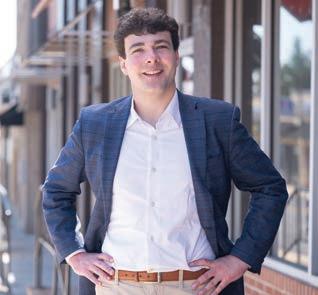
613 Seconds with Karson Kamenetz, Candidate for Baltimore County Council
BJH: Let’s be real here. Why are you running for Baltimore County Council, and why did you want to speak directly to BJH readership?
Karson Kamenetz: I’m running because the next Councilmember in this district is going to make decisions that directly affect whether observant families can continue to build their lives here.
County is losing population. More people are leaving this beautiful place we call home than are moving into it, and that means we all will pay more in tax dollars for less in return. The observant community is also the outlier in this equation: this community is growing, and Baltimore County should embrace that growth with open arms, not fight against it. I’m running because I want to be a councilmember who understands this and treats our community and these issues with the seriousness they deserve.
BJH: What are the biggest practical issues that you will focus on, if elected?
serious answer. I look forward to enabling the growth of our community through the Comprehensive Zoning process.
Third is constituent services. A lot of what the community needs from their councilmember is not ideological. It’s practical. A dangerous intersection; a trash-pickup delay; a permitting problem; a school-related transportation issue; a business owner stuck in bureaucracy. Those things matter, and they demand timely follow-through. When elected, I’ll create a Constituent Dashboard tracking all service requests, have regular neighborhood “walkthroughs” so issues are discussed in-person as opposed to behind a desk, and I’ll hire staff from our community to ensure we are all represented adequately.
BJH: What is your message specifically to the observant community?
Karson Kamenetz: My message is that I see the observant community as one of Baltimore County’s great strengths.
People often talk about county issues like zoning, roads, housing, school transportation, sidewalks, and public safety like they are separate issues. They aren’t. For a frum family, they are all connected to daily life. Can your children get to school safely? Can you walk to your shul safely on Shabbos and Yom Tov? Can the young adults in your family afford to live near their parents and shul? Can your business open without feeling like the county is working against it? When there is a problem, does someone in county government pick up the phone?
Unfortunately, and because the answers to those questions are too often “no,” Baltimore
Karson Kamenetz: Public safety has to come first. The basic promise of government is people feeling safe in their homes, in their neighborhoods, and walking to shul. I refuse to allow reckless driving, theft, break-ins, and quality of life crime to be brushed aside. Baltimore County must take enforcement seriously while simultaneously ensuring neighborhoods have the lighting, road design, and pedestrian safety measures necessary. Right now, Baltimore County is short almost 300 police officers, and we feel that reality every single day. So I will fight to close that recruitment gap, support traffic calming, and ensure we have the public infrastructure that keeps people safe and economic corridors lively.
Second is housing. This community is growing, and that is a sign of strength. But when our children get married and cannot find a place to live near their families, shuls, and schools, we are forcing the next generation to move elsewhere. Growth has to be responsible, and “no growth” is not a
This is a resilient community built around family, education, chesed, responsibility, and commitment to the next generation. Those are all values that make this place, this county we all call home, stronger.
But those values come with tangible needs, as well. Families need to feel safe walking their block. Schools need to function without constant transportation and infrastructure challenges. Shuls and community institutions need a county government that understands and appreciates their role. Young couples need housing if they are going to stay near parents, school, and
shuls. Older adults need the aging-in-place infrastructure that allows them to stay in the communities they helped build.
I want to be a partner to the community, and not just as someone who shows up during campaign season. From touring schools and shuls to participating in Menorah lightings and shabbos dinners, I am proud to be a Jew in Baltimore County. I am committed to being someone who listens, follows through, and is reachable when it matters for the community that has given me so much.
BJH: What is your closing message to BJH readers?
Karson Kamenetz: I want to earn your trust by being useful.
The observant community does not need empty praise. It needs a councilmember who understands the realities of life in Baltimore County and someone who will take those realities seriously.
My focus is on the basics. Safe streets; walkable neighborhoods; fair treatment for those paying property tax and sending their children to private schools without return on that tax investment; respect for shuls, businesses, and community institutions; a county government that returns your call.
That is my focus. Not the national scene or ideological politics, but the basics of county government. I want to work for you, because I feel called to service. I will show up, I will listen, and I will do the work. Hold me accountable to that.
The Week In News
The Week In News
Chaos After Paris Team Wins
More than 200 people were injured and one person died in Paris following Paris Saint-Germain’s second consecutive Champions League win.
A day after PSG beat Arsenal in a nail-biting Budapest penalty shootout, cementing their place on the throne of European football, fans turned out to the Champ de Mars open space near the Eiffel Tower in the French capital for a victory parade on Sunday afternoon.
But, like last year, the celebrations were partly overshadowed by hefty street violence in the night after the game in which 57 police were injured in Paris and over 400 people were taken into custody.
Some storefronts in Paris were destroyed while rioters also torched cars and stands of rental bikes.
One young man died following a motorcycle accident amid the unrest, the Paris public prosecutor’s office said.
Politicians from the far-right National Rally, leading in opinion polls ahead of next year’s presidential election, seized on the occasion to reiterate calls for firmer law-and-order policies.
“Only in France does a victory of a football club trigger riots,” said Marine Le Pen, the movement’s leader.
Last year, chaotic celebrations following PSG’s first Champions League title led to two deaths.
UAE’s Secret Strikes on Iran
According to recent reports, the United Arab Emirates launched dozens
of retaliatory airstrikes on Iran in the days after the war began until a ceasefire was reached in April.
The Gulf state, relying on U.S. and Israeli intelligence, struck targets on Qeshm and Abu Musa islands in the Strait of Hormuz, as well as the Asaluyeh petrochemical complex — a controversial attack conducted with Israel, which led to U.S. criticism — and Bandar Abbas, an oil refinery on the Persian Gulf’s Lavan island. The attacks on Iranian energy facilities were in retaliation for Tehran’s attacks on the UAE’s oil and gas infrastructure.
Iran fired over 2,800 missiles and drones at the UAE, which was more than it launched at Israel and any other country.
The UAE’s strikes, while largely symbolic, further distanced the country from its Gulf neighbors, particularly Saudi Arabia, which criticized Abu Dhabi for the attacks. In April, the UAE left OPEC, an intergovernmental group led by Saudi Arabia.
Simultaneously, Abu Dhabi has targeted Iran’s financial interests, shuttering Iran-linked schools and clubs in
Dubai, and withholding visas and transit rights to Iranian nationals.
Meanwhile, the UAE has grown closer to the United States and Israel. During the war, Israeli Prime Minister Benjamin Netanyahu, the heads of the Mossad and Shin Bet, and Israel’s chief of staff supposedly visited the UAE in secret to coordinate strikes. Additionally, Israel sent Iron Dome batteries and Israeli soldiers to help the UAE.
Iran Salvaged Missile Facility Openings
Iran has dug out 50 of its 69 underground entrances at 18 missile facilities, according to a Sunday report by CNN, with Tehran actively restoring its military capabilities as negotiations continue with the United States.
According to the report, the Islamic Republic is “poised to fire far more long-range missiles at Israel and other Middle Eastern nations after rapidly digging out its buried arsenals.” Iran
Greater Washington Weekday Minyanim Guide
6:15 am Young Israel Shomrai Emunah M-F
6:20 am Ohev Shalom Talmud Torah OLNEY M, Th
6:25 am Southeast Hebrew Cong., Knesset Yehoshua M-F
6:30 am Beth Sholom Congregation M-F
Beit Halevi (Sfardi) M, T
Chabad of Silver Spring M-F
Ohev Shalom Talmud Torah OLNEY T, W, F
Young Israel Shomrai Emunah S YGW M, Th
6:35 am Ohr Hatorah M, Th
6:40 am YGW S, T, W, F Magen David Sephardic Congregation M-Th
6:45 am Beit Halevi (Sfardi) S, T, W, F
Kemp Mill Synagogue M, Th
Ohr Hatorah T, W, F
Young Israel Shomrai Emunah M, Th
6:50 am Woodside Synagogue/Ahavas Torah M, Th Silver Spring Jewish Center M-F
Chabad of Upper Montgomery County M-F
6:55 am Young Israel Shomrai Emunah T, W, F
7:00 am Kemp Mill Synagogue T, W, F
Southeast Hebrew Cong., Knesset YehoshuaS Silver Spring Jewish Center S
BETHESDA
Magen David Sephardic Congregation [S] 11215 Woodglen Dr, North Bethesda, MD 20852
GAITHERSBURG
Chabad of Upper Montgomery County [Ari] 11520 Darnestown Rd, Gaithersburg, MD 20878 OLNEY
of Potomac [Ari]
Woodside Synagogue/Ahavas Torah T, W, F
Young Israel Ezras Israel of Potomac T, W, F
7:05 am Kesher Israel M, Th
7:15 am Kemp Mill Synagogue M, Th Kesher Israel T, W, F
Ohev Sholom Talmud Torah/The National Synagogue M-F Ohr Hatorah S
7:30 am Chabad of DC M-F
Chabad of Potomac M-F JROC M-F
Kemp Mill Synagogue T, W, F
Southeast Hebrew Cong., Knesset Yehoshua M-F
Young Israel Shomrai Emunah S
Young Israel Shomrai Emunah (Sfardi) M-F
7:45 am YGW (Yeshiva Session Only) S-F
8:00 am Beth Sholom Congregation S
Kemp Mill Synagogue S Kesher Israel S
Ohev Shalom Talmud Torah OLNEYS
Southeast Hebrew Cong., Knesset YehoshuaS Chabad of Upper Montgomery CountyS
Woodside Synagogue/Ahavas TorahS
8:00 am YGW (High School; School-Contingent) S-F
Young Israel Ezras Israel of PotomacS Young Israel Shomrai Emunah (Sfardi)S
8:05 am Ezras Israel Congregation of Rockville M, Th
8:15 am Ohr Hatorah S Ezras Israel Congregation of Rockville S, T, W, F
Kehilat Pardes / Berman Hebrew Academy S-F
Silver Spring Jewish Center M-F
8:30 am Chabad of DC S Chabad of Potomac S JROC S Ohev Sholom Talmud Torah/The National Synagogue S Silver Spring Jewish Center S YGW (Summer Only) S-F
8:45 am Young Israel Shomrai Emunah S-F
9:00 am Chabad of Silver Spring S Kemp Mill Synagogue S
2:00 pm Silver Spring Jewish Center S-F
2:10
mincha/maariv
Before Shkiah (15-18 minutes), S-TH
Beit Halevi (Sfardi)
Beth Sholom Congregation
Chabad of Potomac
Chabad of Silver Spring
Chabad of Upper Montgomery County
Ezras Israel Congregation of Rockville (20 min before, S-F)
JROC
Kemp Mill Synagogue
Kesher Israel
Magen David Sephardic Congregation
Ohev Sholom Talmud Torah/The National Synagogue
Ohr Hatorah
Silver Spring Jewish Center
Southeast Hebrew Congregation
Woodside Synagogue/Ahavas Torah
Young Israel Ezras Israel of Potomac
Young Israel Shomrai Emunah (Asheknaz)
Young Israel Shomrai Emunah (Sefarhadi)
maariv
8:45 pm YGW S-Th
9:15 pm Silver Spring Jewish Center S-Th
9:30 pm YGW S-Th
9:45 pm Ohr Hatorah S-Th
10:00 pm YGW S-Th
shacharis
By Authority: Committee for Karson Kamenetz, Samuel Shubin, Treasurer
The Week In News
reportedly has around 1,000 ballistic missiles at its disposal, the majority of which are in those 18 facilities.
According to a Channel 12 report released recently, Iran has additionally begun producing ballistic missiles, now at a faster rate than anticipated. The regime’s drone capabilities can be restored in just months, and its ballistic missile production may be majorly ramped up in around a year or less, according to Israeli defense officials.
As ceasefire negotiations continue, Iranian officials have called the U.S.’s trustworthiness into question. Iran’s chief negotiator, Mohammad Bagher Ghalibaf, declared on Sunday that Tehran shouldn’t trust the U.S., adding that a deal must only be approved if it fully guarantees the rights of the Iranian people.
Foreign Minister Abbas Araghchi, meanwhile, said that negotiations continue but cautioned the public against speculating at this time.
While U.S. President Donald Trump
has previously denied the U.S.’s reports about the negotiations’ progress. Iran has conditioned nuclear talks on the release of $12 billion in frozen assets.
While Iran, which has vowed to destroy Israel, asserts that it isn’t building nuclear weapons, the regime has enriched uranium to levels that have no peaceful application. According to experts, Iran has enough material to make 11 nuclear bombs.
Ebola Facility in Kenya
The government of Kenya, in part
posed to Ebola in the Democratic Republic of Congo (DRC).
The DRC, which is 1,500 miles away from Kenya, is the epicenter of an ongoing outbreak, which was declared on May 15 and has taken the lives of at least 238 people. Thus far, Kenya hasn’t seen any cases of the rare Bundibugyo strain, which doesn’t have an approved vaccine or treatment yet. One person has died of the disease in Uganda, and seven have been infected.
The move to establish the facility for Americans was temporarily blocked by Kenya’s high court. It was also criticized by Kenyan medical professionals and officials at the U.S.’s Centers for Disease Control and Prevention (CDC). Some claim that the move risks bringing Ebola into Kenya, accusing the U.S., which is afraid of bringing the disease into its own borders, of having a double standard.
Last Thursday, High Court Judge Patricia Nyaundi blocked Kenya from going forward with the plans, barring the country from allowing those in-
fected with Ebola from entering.
Officials from the Trump administration said the facility would be “state-of-the-art” and “designed to provide access to high-quality care for Americans who would need to quickly get out of DRC and quarantine without the risks of a lengthy transport back to the U.S.” The quarantine facility would have 50 beds.
“The U.S. Public Health Service Commissioned Corps is deploying a team of highly trained officers to Kenya to support the care, monitoring, and quarantine of American citizens departing the Democratic Republic of the Congo as part of a coordinated interagency effort with the State Department and Department of War,” a U.S. Health and Human Services Department spokesperson said on Thursday, adding that the “deployed team includes physicians, nurses, laboratory technologists, mental health professionals, and engineers, including officers with previous Ebola response experience in Liberia during the 20142015 outbreak.”
The Week In News
U.K. Blocks Anti-Israel Streamer
The United Kingdom’s Home Office revoked the travel permits and Electronic Travel Authorization (ETA) on Monday for Hasan Piker, a 34-year-old pro-Palestinian American streamer, and his uncle, Cenk Uygur, a Turkish attorney and the founder of the progressive online news show, The Young Turks, barring the two from entering the country ahead of their planned speech at the Oxford Union.
U.K. officials attributed the bans to concerns that the visit would “risk exacerbating antisemitism,” the Times reported.
Both Piker and Uygur slammed the U.K. for the move, claiming that it threatens free speech.
U.K. liberties, such as free expression and due process, “are falling by the wayside at the behest of a foreign apartheid state and its expansionist interests in the Middle East,” wrote Piker in a statement on Monday. “This is a real crisis of democracy.”
“I’ve been banned for criticizing Israel. Are we free anymore? This is oppression of Western citizens by our own governments on behalf of a different country!” Uygur posted on X.
“Are there any other countries you’re not allowed to criticize, or just Israel? If their point was to show that Israel does not get any special privileges in Western countries, they have found a deeply ironic way to deliver that message,” Uygur said in a statement.
Piker has around 6.4 million followers on X, Instagram, and Twitch, and is viewed by over 30,000 people a day, his SXSW profile purports.
The two have accused Israel of committing genocide in Gaza and have heavily criticized the Jewish state. However, Piker and Uygur deny accusations of antisemitism, claiming that they are merely “anti-Zionists.” In April, Piker declared during a podcast that Hamas is less evil than Israel. In 2019, he claimed that “America deserved 9/11,” an assertion he later lightly apologized for.
Syrian Officers on Trial in Austria
Two Syrian officers accused of torture and war crimes went on trial in Vienna on Monday after hiding in plain sight in Eu-
rope for over a decade, the culmination of a years-long search by investigators and a groundbreaking case for Austria.
One of the officers, former brigadier general Khaled al-Halabi, is the highest-ranking official of President Bashar Assad’s government to appear in a European court on charges of war crimes. He eluded investigators for years with help from members of the Israeli and Austrian intelligence services, according to prosecutors, until his detention in 2024.
Al-Halabi, 63, a member of the Druze minority in Syria, served in the Syrian intelligence service while also working as a double agent for Israeli intelligence, prosecutors said. Last year, he was charged with helping suppress protests from 2011-13, while serving as head of State Security in Raqqa, Syria.
Also charged was Musab Abu Rukbah, 54, a former lieutenant colonel who had served as the head of investigations in the local criminal police department and later led the Political Security office, an intelligence agency within the Interior Ministry, in Raqqa.
Both were granted asylum in Austria and have been living there since 2015.
The case is Austria’s first against officials from the Assad regime and comes as countries like Germany and Sweden have prosecuted other Syrians in the absence of an international tribunal for the widespread atrocities committed during Syria’s civil war.
Both face charges of aggravated coercion and inflicting bodily harm, with the purpose of suppressing the Syrian civil protest movement through force, according to an indictment prepared by the Vienna Public Prosecutor’s Office. In addition, the prosecutor said al-Halabi was charged with torture over events in early 2013 that involved two witnesses.
The two men both pleaded not guilty.
Abu Rukbah’s lawyer, Philipp Wolm, said there was little evidence against his client and that the accusations were weak because of possible misidentification.
admiring the cathedral’s towering architecture, stained-glass windows, and famous gargoyles.
Just a few feet away, however, archaeologists are looking in the opposite direction.
Beneath the busy square in front of
cooling water features to combat increasingly hot summers.
“The hope is that we are able to go back in time even further than we’ve ever been before,” Altenburg said.
2 More Soldiers
An Israeli military doctor was killed and seven other soldiers were wounded on Monday when a Hezbollah explosive drone struck an IDF armored vehicle in southern Lebanon, underscoring the growing threat posed by the terror group’s increasingly sophisticated drone
The fallen soldier was identified as Capt. Dr. Ori Yosef Silvester, 30, of Tel Aviv, who served as the battalion physician for the Givati Brigade’s Shaked Bat-
with faint reddish writing on the inside. Archaeologists have yet to decipher the mysterious symbols.
“It’s rare to find complete ceramics,” said archaeologist Valentine Breloux, explaining that centuries of soft waste in medieval refuse pits helped preserve them intact.
The dig reveals how generations literally built Paris on top of itself. Medieval homes once crowded the square where visitors now gather, while beneath those structures lie remains from the Roman city of Lutetia, the settlement that eventually evolved into modern Paris.
“Here you can see the layers — medieval Paris, Roman Paris, maybe even before that,” said archaeology student Yasmine Benali. “It makes the city feel less like a postcard and more like something still being discovered.”
The excavation is expected to continue as the city prepares a redesigned public square featuring 160 new trees and
According to an IDF investigation, two explosive-laden first-person-view (FPV) drones launched by Hezbollah targeted an armored vehicle near the town of Zawtar al-Sharqiyah shortly after noon. The drones struck directly, killing Silvester and injuring seven other troops. Among the wounded were two officers and a soldier who sustained serious injuries. Another soldier was moderately wounded, while three others, including the Shaked Battalion commander, suffered light injuries. The battalion commander is expected to return to duty in the coming days.
Silvester became the 14th Israeli soldier killed in clashes with Hezbollah since a U.S.-brokered ceasefire took effect in April. His death came less than 24 hours after another Israeli soldier, Staff Sgt. Adam Tzarfati, was killed in a separate Hezbollah drone attack.
Tzarfati, 20, of the Commando Brigade’s Maglan Unit, was from Rosh Ha’ayin.
ALAN AHARON NEWMAN
The Week In News
At around 1 a.m. early Monday morning, an explosive-laden first-person-view drone launched by Hezbollah struck a site in the southern Lebanon town of Yohmor, near the Beaufort Castle, where Israeli troops were operating. The blast killed Tzarfati and seriously wounded another soldier. Two other troops were lightly hurt in the attack.
The strike against Silvester occurred as U.S. President Donald Trump announced that Israel and Hezbollah had agreed to a renewed truce, though Israeli officials had not immediately confirmed the claim.
Despite repeated ceasefire efforts, hostilities along the northern front have continued. Hezbollah launched additional rockets and drones all through the day on Monday, targeting communities near the border, including Kiryat Shmona and military positions in southern Lebanon.
In one evening attack, an explosive drone struck an Israeli military post near Rosh Hanikra. Earlier, Israeli air defenses intercepted a rocket aimed at the Kiryat Shmona area, while two additional rockets landed near Israeli forces operating inside Lebanon. No injuries were reported in those incidents.
The IDF has struggled to counter Hezbollah’s FPV drones, which are often resistant to traditional electronic jamming systems. Military officials say the group has increasingly relied on these drones to target both troops and civilian areas.
Meanwhile, Israel continued its offensive against Hezbollah infrastructure. The IDF announced that an airstrike on Sunday killed Mohammed Mousa Mteirek, a Hezbollah missile commander responsible for directing hundreds of rocket and drone attacks against Israeli civilians and soldiers.
Defense Exports Hit $19.2B
Israel’s defense industry reached a new milestone in 2025, with military exports climbing to a record-breaking $19.2 billion, the fifth consecutive year in which defense sales have set a new high.
Figures released by Israel’s Defense Ministry showed exports rose approximately 11% over the previous year, continuing a remarkable growth streak fueled by global demand for advanced Israeli military technology amid rising international security concerns.
Defense Minister Israel Katz hailed the achievement as both an economic and strategic success.
“Israel’s defense industries have once again proven their technological superiority and operational excellence,” Katz said. “The world recognizes the quality of Israeli systems, many of which have been tested and refined under real combat conditions.”
Air defense systems accounted for a significant portion of the sales. Demand for missile-defense technologies surged following conflicts in Europe and the Middle East, with countries seeking protection against drones, rockets, and ballistic missiles.
Among the most sought-after products were systems developed by Israel Aerospace Industries, Rafael Advanced Defense Systems, and Elbit Systems. These firms manufacture some of Israel’s best-known defense technologies, including missile interceptors, surveillance equipment, precision-guided weapons, and advanced drone systems.
European nations remained the largest customers, accounting for more than half of all Israeli defense exports. The ongoing war in Ukraine and broader concerns about regional security have prompted many governments to expand military spending and modernize aging arsenals.
The Defense Ministry noted that unmanned aerial systems, intelligence technologies, cyber capabilities, and missile-defense platforms were among the fastest-growing export categories.
Officials also pointed to the impact of the 2020 Abraham Accords, which have opened new defense markets in the Middle East. Security cooperation between Israel and several Arab nations has expanded significantly in recent years, contributing to increased export opportunities.
Industry leaders say the record-setting figures reflect years of investment in research and development, as well as the growing reputation of Israeli technology worldwide.
The latest numbers reinforce Israel’s position as one of the world’s leading arms exporters. While the defense sector represents a relatively small portion of the country’s workforce, it remains one of Israel’s most influential industries, generating billions of dollars annually and strengthening diplomatic ties with dozens of countries around the globe.
The Week In News
Party Irregularities
sufficient oversight over membership fees in a way that failed to guarantee the authentication of each member’s identity and payment method. Over 40 percent of credit cards and bank accounts used to pay these dues — around 16,000 credit cards and 13,000 bank accounts — were each used for the membership fees of more than one person, and in about a quarter of these cases, the members had different family names and apparently weren’t from the same household.
Apparently, this raised the suspicion that membership fees are routinely paid for by others, a situation it characterized as “grave” since it could skew the electoral slate picked in the Likud primaries.
The report said Likud had pledged to
Meanwhile, Labor — a party that is set to be folded into the new Democrats party ahead of the upcoming election — was fined NIS 75,000 ($27,000) for receiving a prohibited loan from a corporation using a party-owned enterprise, violating the law stipulating that parties can only receive loans from the state treasury or from a banking corporation to acquire rights in real estate.
The Week In News
No irregularities were found in the financial reports of the other parties. No party was found to have illegally expended money.
The report also found that 10 factions — most of the factions currently represented in the parliament — have accumulated deficits with a combined total of NIS 81.2 million ($29 million), a figure described as “worrying.” The report found that seven parties that aren’t currently represented in the Knesset — including Balad, Jewish Home and Meretz — are still in debt after previously taking loans and receiving advance payments from the state. These parties owe a combined sum of NIS 43.8 million ($15.5 million). The largest sums are owed by Meretz — another party set to be included in the new Democrats alliance — and by Tzalash, a long-defunct faction used by Naftali Bennett as the structural basis for his New Right and Yamina parties. Two other defunct parties — Kulanu and Telem — ended their Knesset terms in 2021 with surplus funds totaling NIS 3.7 million ($1.3 million) that haven’t been returned to the state treasury as required, the report noted.
Englman said in a statement that the parties’ failure to pay their debts “doesn’t reconcile” with their public duties.
“I call on the Knesset to pay attention to this matter, to ensure the debt is paid to the state treasury and to prevent such cases from occurring in the future,” he said.
New National Security Adviser
This week, Prime Minister Benjamin Netanyahu announced the appointment of Shmuel Ben Ezra as Israel’s next national security adviser and head of the National Security Council, a key body that shapes Israeli security policies.
Ben Ezra “brings with him over 30 years of experience in the defense of the country’s security,” the Prime Minister’s Office said in a statement. “He stood as the head of the development of the Arrow 3 missile interceptor project and won the Israel Defense Prize.”
Ben Ezra also spent four years as
head of the Shin Beit security agency’s operational technology and cyber division. The statement noted that he has many years of experience working with U.S. government bodies and other international entities.
Ben Ezra will take over from Gil Reich, who has served as acting national security adviser since Tzachi Hanegbi was ousted from the role in October amid reported disagreements with the premier over policies during the war in Gaza.
The position of national security adviser is considered a “position of trust” – if Netanyahu is ousted in the next elections, Ben Ezra would be forced to leave the position. Israel is set to hold elections no later than October 2026.
Ex-Finance Minister Convicted
On Sunday, Moshe Kahlon, a former finance minister, was convicted on securities-reporting offenses in a plea deal.
In 2022, while he was chairman of Unet Credit, Kahlon was notified of “substantive irregularities” in the company’s Nazareth branch, and he was later indicted at the Tel Aviv District Court for not acting to “fully inform the company’s board of directors of all the information as required by the securities law,” according to the State Attorney’s Office. Five months after learning about the issues he notified the board, after which the company informed the public and Kahlon resigned.
A joint petition for a suspended sentence will be filed by the defense and prosecution, requesting a fine of NIS 180,000 ($64,000) and an 18-month restriction on serving as an officer in a public company.
For 10 years, Kahlon was a Knesset Likud member and minister, during which he was responsible for deregulating the cellphone industry. Later, he started the Kulanu party. From 2015 to 2020, he served as finance minister. As per the terms of the plea deal, he is allowed to return to politics.
Until the scandal led to the company’s shares getting frozen, Unet was traded on the Tel Aviv Stock Exchange.
Kahlon and the company’s compliance officer, Yoav Tsabar, are said to have intentionally withheld pertinent information from the board.
The Week In News
IDF Captures Beaufort Castle
On Sunday, the IDF seized control of southern Lebanon’s Beaufort Castle, a historic and strategic site that Israeli forces captured in 1982 during the First Lebanon War and held until their withdrawal in 2000.
“Forty-four years after the heroic Battle of the Beaufort, and on the memorial day for the Peace for the Galilee War, including the Golani soldiers who fell in the Battle of the Beaufort, IDF soldiers, led by the Golani Brigade, returned to the summit of Beaufort and once again raised the Israeli flag and the Golani flag there,” Defense Minister Israel Katz shared.
Katz declared at a memorial ceremony for soldiers who fell in the First Lebanon War that Israel would keep the castle “as part of the security zone in Lebanon,” adding that “the capture of the Beaufort and the expansion of the [ground] maneuver constitute a clear message to our enemies: Whoever threatens the citizens of Israel will lose their strategic assets one after another.”
Israel and Lebanon have fought several wars. The latest round of hostilities began on March 2, when Hezbollah retaliated against Israel for its role in attacking Iran and killing Supreme Leader Ayatollah Ali Khamenei.
The IDF expanded its campaign into the Beaufort Ridge and Wadi Saluki stream area to “destroy [Hezbollah] infrastructure and eliminate terrorists, as part of strengthening operational control in southern Lebanon and removing the direct threat to the Galilee Panhandle and Metula,” and to “expand the forward defense line,” the Israeli military said.
Although a ceasefire between Israel and Hezbollah is still technically in effect, several truce violations have compelled Israel to expand its ground offensive, the army said.
During the castle takeover, a nearby
Hezbollah attack killed Staff Sgt. Michael Tyukin, a 21-year-old fighter of the Givati Brigade’s Reconnaissance Unit, and injured four others. Tyukin was an only child who moved from Ukraine to Israel in 2020 with his mother. He lived in Ashkelon.
Florida Sues
OpenAI
Florida has become the first state in the nation to file a lawsuit against OpenAI, alleging that the company knowingly released an unsafe product and failed to adequately protect users — particular-
ly children — from potential harm. The lawsuit, filed on Monday by Florida Attorney General James Uthmeier, names both OpenAI and its CEO, Sam Altman, as defendants. State officials accuse the company of prioritizing rapid growth and profits over safety measures, despite warnings about potential risks associated with its popular chatbot, ChatGPT.
“Today, we announced the first-inthe-nation state-led lawsuit against OpenAI and its CEO, Sam Altman,” Uthmeier said. “OpenAI and Altman ignored internal and external safety warnings, put children at great risk, and allowed a dangerous product to reach millions of Floridians.”
The 83-page complaint alleges that ChatGPT has contributed to a range of harms, including encouraging self-destructive behavior, fostering unhealthy dependency among minors, and providing information that could be used to facilitate violent crimes. The lawsuit also claims OpenAI marketed ChatGPT as safe and reliable while failing to adequately disclose its potential risks.
Among the incidents cited is the
LET’S CONNECT EVENTS
Where vibrant women over 50 engage in meaningful, Torah-oriented social connections
Join Us
Because One Afternoon Can Have a Lasting Impact
Enjoy an Afternoon of Inspiration & Conversation
Watch the impactful video:
Changing the World, One Chesed at a Time
Hear Ahuvah Heyman’s inspiring presentation
Connect with other women in a warm and welcoming atmosphere.
Enjoy fresh acai bowls and conversation
one THE POWER OF
Experience Interactive Exhibits that Leverage the Power of
One Message
One Minute
One Memory and more....
SUNDAY, JUNE 7 | 2–4 PM
The Week In News
2025 mass shooting at Florida State University. Florida officials contend that the alleged shooter consulted ChatGPT before carrying out the attack, though OpenAI has previously rejected claims that the chatbot was responsible.
The state is seeking financial penalties as well as court-ordered changes to how OpenAI develops and deploys its technology. The lawsuit also seeks to hold Altman personally accountable, an unusual move in a case involving a major technology company.
OpenAI has defended its safety practices, saying its systems are designed to reject requests that promote violence and that the company works with experts to address mental health and safety concerns. The company has not yet formally responded to Florida’s lawsuit.
As artificial intelligence becomes increasingly woven into everyday life, the case is expected to be closely watched as a potential test of how far companies can be held responsible for the actions of users who interact with AI tools.
Terrorist Says He’s a “Prisoner of War”
An Iraqi national accused of helping
Iran-backed militant groups. Authorities allege he helped plan or direct at least 18 attacks in Europe and encouraged additional assaults in the United States and Canada.
The courtroom hearing briefly turned tense when Al-Saadi remained standing after entering his plea and addressed the judge through an Arabic interpreter.
“I’m not guilty in a war situation,” he said. “I’m a prisoner of war. I’m not a threat. Children and women are being killed by your rockets.”
Judge Colleen McMahon instructed him to sit down after his outburst.
Federal prosecutors allege Al-Saadi served as a commander in Kata’ib Hizballah, an Iran-backed Iraqi militia designated by the United States as a foreign terrorist organization. He is also accused of conspiring to support Iran’s Islamic Revolutionary Guard Corps.
According to court documents, Al-Saadi allegedly played a role in attacks that included the firebombing of a bank in Amsterdam, the stabbing of Jewish men in London, a synagogue attack in Canada, and a shooting at the U.S. consulate in Toronto. Prosecutors further claim he sought to target a New York City synagogue and provided maps and photographs of Jewish centers in Los Angeles and Scottsdale, Arizona, to an undercover operative.
Authorities say he used Snapchat, Telegram, and phone calls to discuss at
The Week In News
Bring Back the SAT?
More than 1,100 math and science professors across the University of California system are calling for the return of standardized college entrance exams, arguing that growing academic deficiencies among incoming students are making it increasingly difficult to maintain rigorous STEM programs.
In a letter sent last week to the University of California Board of Regents, faculty members warned that many students are arriving on campus without the mathematical foundation necessary for college-level coursework. The professors said the problem has become especially evident in science, technology, engineering, and mathematics (STEM) fields.
At UC Berkeley, nearly one-third of students enrolled in first-semester calcu-
lus were found to have “severe preparation deficits,” according to the letter.
“We now observe preparation gaps so severe that instructors must reteach middle-school mathematics while simultaneously teaching the material students need for sciences, engineering, economics, and other quantitatively demanding fields,” the professors wrote. “UC has finite resources and can help only so many students.”
The concerns echo findings from a 2025 faculty report at UC San Diego, which showed a dramatic increase in the number of students requiring remedial math instruction before they could even begin pre-calculus. The percentage of students placed into courses reviewing elementary and middle school math rose from just 0.5% in 2020 to 8.5% in 2025.
The University of California eliminated SAT and ACT requirements in 2020, joining a national movement away from standardized testing. Critics of the exams have long argued that they disadvantage students from low-income backgrounds and underrepresented minority groups.
However, some universities have begun reversing course.
The Massachusetts Institute of Technology reinstated SAT requirements in
The Week In News
2022, arguing that test scores provide valuable information about students’ readiness for demanding coursework.
Dartmouth College followed in 2024, and Yale University recently announced that applicants must once again submit standardized test scores.
Supporters of testing say the exams help identify students who may have strong academic potential despite attending under-resourced schools. They also argue that grade inflation at many high schools has made it harder for colleges to evaluate applicants fairly.
The UC professors warned that the consequences of declining preparation extend beyond the classroom.
“We are already seeing the warning signs: longer pathways through prerequisite material, reduced readiness for advanced coursework, and growing pressure to dilute quantitative rigor,” the faculty wrote.
If the trend continues, they cautioned, California could face lower graduation rates, longer times to complete degrees, and a shrinking pipeline of STEM graduates needed to support the state’s technology-driven economy.
UC Academic Senate Chair Ahmet Palazoglu said university leaders are currently reviewing admissions policies and
requirements, though no decision has been announced.
Flying High
Harry Heasman isn’t just winging it.
The 98-year-old recently landed himself in the Guinness World Records as the oldest person to perform a wing walk.
He completed the daring challenge at Duxford Airfield in Cambridgeshire.
Heasman called it “the most incredible experience” of his life and said he would do it “all over again” if he could – perhaps next year?
The nonagenarian decided to take on the wing walk to raise money for charity, after admitting it was something he had dreamed of doing since he was a young child.
He was strapped to the top of a 1940’s Boeing Stearman plane for the adventure. Heasman stood on the aircraft for nine minutes as it soared high above the ground.
During the wing walk, the plane climbed more than 3,280 feet in the air.
After landing, Heasman enthused, “I
feel 1,000 times different and 100 times better than I ever have.”
He added, “To finally live that dream at 98 years old, and to be a Guinness World Record holder, is beyond anything I could have ever imagined.”
You’re never too old for a new adventure.
Little Lawyer
Most teenagers spend their senior year worrying about pimples, driver’s licenses, and whether they remembered to submit their homework.
Jimmy Chilimigras spent his worrying about law school.
The 18-year-old Mississippi native has officially become the youngest person in Louisiana history to earn a law degree, proving once and for all that some people are simply playing a different game than the rest of us.
While most kids celebrate turning 15 by getting a learner’s permit, Jimmy started law school. By the time many of his peers were learning algebra, he had already graduated high school. At age 15, he had earned both bachelor’s and master’s degrees in accounting and became what is believed to be the world’s
youngest Certified Public Accountant. Apparently, regular childhood accomplishments weren’t challenging enough. Now, three years later, Jimmy has graduated summa cum laude from Loyola University New Orleans College of Law. Not only did he finish in the top two percent of his class, but he also earned the highest grade in more than 40 percent of his courses. Some students are thrilled to pass Constitutional Law. Jimmy practically adopted it.
His achievements didn’t stop there. He completed five separate concentration certificates—more than any student in the law school’s history—including taxation law, immigration law, international legal studies, social justice, and technology law. At this point, his résumé probably needs a table of contents.
Despite the mountain of accomplishments, Jimmy insists his success comes down to hard work and perseverance. It’s a refreshingly simple explanation from someone whose academic journey sounds more like a speedrun than a school career. And before anyone asks whether he’s finally taking a break, think again. His next stop is pursuing an advanced law degree in taxation at Northwestern University. This kid’s education is certainly not brief.
Yeshivas Chofetz Chaim –
Supervision and mentoring of Special Education staff
Collaborating with Rebbeim, teachers, administrators, parents, and outside professionals
Guidance for parents through testing, diagnosis, and placement processes
Participation in student planning and support meetings
Ongoing development and strengthening of the program to meet student needs
REQUIREMENTS
A background in Special Education
Leadership, organizational and communication skills
Experience working collaboratively with teachers, parents, and outside professionals
A deep commitment to helping children succeed within a yeshiva environment
Oversight of student support services, scheduling, and accommodations sberzon@talmudicalacademy.org
The Gedolei Hador are not staying home Neither will we
For three years, the Torah world has been under siege. With the Supreme Court upholding the drastic budget cuts and no repeal in sight, we understand this is no longer a crisis, but a new reality. But Klal Yisroel does not wait for a savior, we look in the mirror and become the yeshua we hope for
. Because without Torah, there is no us.
120,000 lomdim and their families supported
$144,000,000 budget this year 350,000 people affected 1,489 yeshivos and kollelim upheld
Torah Thought You Never Know!
By Rabbi Zvi Teichman
Atraumatic episode between the members of the royal family of Amram transpires this week.
Miriam, the heroic and devoted sister of Moshe, gets wind of Moshe separating from family life with Tzipporah, his loyal wife. Suspecting that Tzipporah has been left isolated and abandoned, she counsels with her holy brother Aharon sharing her dissatisfaction with the leader of the Jewish nation, their youngest brother, and his behavior.
Speculating that perhaps his physically distancing from Tzipporah is due to his spiritual stance as a prophet that justifies his always maintaining a level of purity which will be compromised by intimate contact with his wife, she questions why then she and Aharon is, who are also prophets, not similarly prohibited.
G-d angered, responds by distinguishing between Moshe’s heightened state of prophecy, and their lesser degree of connectivity. Miriam is punished with leprosy for her slander against Moshe, enduring a seven-day isolation, with the entire camp ceasing their journey, waiting for her to be cured and return, before traveling again.
In this entire episode there is a glaring omission of one character, Tzipporah.
Did anyone inquire about her feelings? Was she upset with her fate as a lonely spouse, lacking a bond with her esteemed and no doubt loving husband? Are we to sympathize with Tzipporah and her plight?
The Midrash describes the sequence of unfurling emotions.
In an earlier episode Moshe is frustrated with the gripes of the people. They are constantly dissatisfied and pining for pleasures they miss. Moshe appeals to G-d for assistance in managing this restless folk. G-d concedes asking Moshe to gather seventy elders who will be conferred of the spirit of Moshe, becoming prophets, fortifying them in their ability to effectively communicate the message of G-d to the nation.
The Midrash reports how the people celebrated this event by lighting candles. Miriam observing this inquires of Tzipporah as to the nature of these candles. Tzipporah reveals to her that the people are celebrating the newly appointed elders. Upon hearing this great news Miriam expresses ‘how fortunate are the wives of these elders that have merited to see their husbands attain הררש, leadership roles.’
Tzipporah reacts to Miriam’s joy by bemoaning these women’s fate, saying “Woe to them who will no longer be with their husbands.”
Miriam baffled by her response inquires how she knew that to be true, to which Tzipporah goes on to reveal to her, how since the day Moshe ‘was sanctified through his communication with G-d’ they have been separated from family life. As soon as Miriam hears this, she goes off to Aharon to take matters into her own hands. It would now seem that Tzipporah was the initiator of the resulting discontent that led to the sad conclusion.
Not quite the silent player.
If indeed Tzipporah was unhappy with her lot, then how come there was no evidence of it prior. The simple understanding according to the Talmud was that this parting of ways between Moshe and Tzipporah was already implemented after the giving of the Torah. Nearly a year has gone by before the catalyst for this discussion, the appointing of the elders, develops. Could the sensitive Miriam not have picked up on Tzipporah’s unhappiness until first now?
There is another nuance in the dialogue between Miriam and Tzipporah that needs to be addressed.
When Miriam relates to Tzipporah the significance of the candles lit in honor of the women’s husbands’ selection, it emphasizes their glee in seeing their men rise to הררש, positions of ‘authority’. Wouldn’t ‘greatness’ be more of an appropriate achievement, or perhaps ‘holiness’ having now been elevated to the exalted status of prophet?
I would like to boldly suggest that Tzipporah, who certainly sacrificed much in her role of the greatest prophet who ever lived, never batted an eyelash when that opportunity came here way. She was devoted to the will of G-d unfailingly and happily, even if it meant forfeiting a more material aspect of her life with Moshe. Just as the pain of childbirth will always be there, the dividend makes it all worth it. So too, Tzipporah would remain the loyal wife of Moshe who as a couple no doubt epitomized the ideal of
The Divine Presence dwells between a man and his wife, even lacking a component that might be a necessity for others.
But she knew that not everyone can achieve that; she understood the sacrifice as none other did. When hearing from Miriam that they were rejoicing over their ‘men’s prominence’ as leaders, perhaps she sensed that it would take a much more
heightened appreciation for the role they obtained to be satisfied and happy even if they would lose the intimacy of their husbands.
It was truly Tzipporah’s great character that felt deeply for these noble women, sympathizing with the challenge they would face, that is being portrayed here. She clearly was totally at peace and happy with her lot, never betraying that sense of privilege in the manner she continued to act with others.
It was Miriam’s misreading of Tzipporah’s comment, blinded by her misunderstanding of Moshe’s truly elevated status, that devolved into slander.
There is an ancient kabbalistic tradition that there are ‘three revealed couples’ who are buried in the Me’aras HaMachpelah, and ‘two hidden’ ones. (הנומתה רפס)
The three are Avraham and Sarah, Yitzchok and Rivkah, Yaakov and Leah, and the two not as evident, Adam and Chavah, Moshe and Tzipporah.
Although we are told Moshe was physically buried elsewhere in Mount Nevo, there are mystical attempts to explain this assertion according to kabbalah.
Perhaps the message within this notion is that one should never make assumptions. Miriam did and ended up being taken to task for it.
You never know.
What might have appeared to be an imperfect marriage, turned out to be eternalized, together with the world’s first couple, as the paradigm of a perfect union as outlined in G-d’s original plan, despite apparent deficiencies.
You never know!
You may reach the author at: Ravzt@ ohelmoshebaltimore.com
CALENDAR
Baltimore Weekday Minyanim Guide
Shacharis Mincha
Mercaz Torah U’Tefillah: EVERY 15 MINUTES
M-F: 6:15 AM, S-F:
AM, 9:45AM, 10:00AM
Neitz Beit Yaakov [Sefaradi] M-F
Mercaz Torah U’Tefillah S-F
Ohel Yakov S-F
Ohr Hamizrach [Sefaradi] S-F
6:00 AM Shomrei Emunah Congregation M-F
6:10 AM Agudath Israel of Baltimore M, Th
6:15 AM Kol Torah M, TH
Shearith Israel Congregation M, TH
6:20 AM Agudah of Greenspring M, TH
Agudath Israel of Baltimore S, T, W, F
Arugas HaBosem (Rabbi Taub's) S-F
Bais Dovid-Bais Medrash of Summit Park M-F
Bnai Jacob Shaarei Zion Congregation M-F
Kehilath B'nai Torah M, TH
Pikesville Jewish Congregation M, TH
Shomrei Emunah Congregation S, M, TH
6:30 AM Agudah of Greenspring T, W, F
Chabad of Park Heights M-F
Darchei Tzedek M-F
Kehilath B'nai Torah T, W, F
Khal Bais Nosson M-F
Khal Ahavas Yisroel/ Tzemach Tzedek M-F
Kol Torah T, W, F
Ohr Yisroel M-F
Pikesville Jewish Congregation T, W, F
Shearith Israel Congregation T, W, F
Shomrei Emunah Congregation T, W, F
6:35 AM Aish Kodesh (downstairs Minyan) M, TH
Ohel Moshe M, TH
6:40 AM Aish Kodesh (downstairs Minyan) T, W, F
Bnai Jacob Shaarei Zion Congregation M, TH
Ohr Hamizrach [Sefaradi] M-F
6:45 AM The Adas: Chofetz Chaim Adas Bnei Israel M, Th
Neuberger, Quinn, Gielen, Rubin & Gibber One South Street, 27th Floor
Ner Israel Rabbinical College - 400 Mt Wilson Ln
Campus, Country, and Conviction
A Conversation with Fleur Hassan-Nahoum
By SuSan Schwamm
If there’s one person to chat with about Israeli innovation and education, it’s Fleur Hassan-Nahoum. After years in Israeli politics, including half a decade as Jerusalem’s deputy mayor, Fleur co-founded Campus Israel, an organization that helps Jewish students from the U.S. and elsewhere study in Israel’s top universities. An outspoken supporter of the Jewish state, Fleur also serves as Israel’s Special Envoy for Trade and Innovation, an ambassadorial position in which she combats antisemitism and advocates for her country. Recently, TJH sat down with Fleur to discuss, among several topics, Campus Israel, the future of the Middle East, her years in Israeli politics, and Israel’s war on misinformation.
Fleur, can you tell us about Campus Israel –why you founded it and what is its mission?
Fleur Hassan-Nahoum: We’ve been working on it for about a year and a half. We believe that colleges around the world — not just in America — are letting down Jewish students. Fees are exorbitant, and what are you getting? Many times, it’s a hostile environment for Jews or anybody who believes in or is associated with Israel.
At the same time, there is an academic environment in Israel that is amongst the best in the world: when you look at prizes, grant money, unicorns, innovation — it’s all coming out of Israeli academia. But the message hasn’t gotten to global Jewry, to American Jewry, that college in Israel is an option. It’s much more affordable, it’s three years instead of four, and you come out with a top-notch, top-class degree. There’s a critical mass of students right now who, because of what’s going on everywhere else, would be a very good fit for a college in Israel.
And so, although we didn’t invent college in Israel for
international students, we built the missing layer, which is essentially how to make it easy to find out what the options are. Up until we built this platform, there was not one place — even ChatGPT couldn’t do it! — with a comprehensive list of what’s available. So, we’ve gathered what’s available, we’ve made it very user-friendly, and we’ve even made it a little bit gamified in the sense that if you don’t know what you want to study, you can take a quiz and explore what’s available, what you’re good at, what you like, etc.
More importantly, we help through the application process, we help through the moving process, we ensure a smooth landing, and we’re there for the student every step of the way.
Let’s say the student needs to get health insurance and, for some reason, the college didn’t help. We’re there to help them. If the student needs a place for Shabbos, we’ll connect them to the right people. The student wants an internship? We’ll organize it. The student’s negotiating a rental contract? When you have Campus Israel, we’re your advocate for everything. We’ve got lawyers
on call, psychologists — we’ve got anything you need on call in order to make your experience incredibly positive. The other thing that we do is we also keep in touch with the parents. A lot of the time, we find that it’s challenging to send your kid to the other side of the world. But once you have people that you can speak to, it’s easier.
Who’s your target demographic? Is this specifically for students doing their gap year, or is this for students who are still in high school or just graduated?
Everyone. We’ll be targeting all students, from the juniors who are thinking about college to seniors who want to apply to students who are in seminaries, yeshivas, and gap programs in Israel. Many times, halfway through the year, students during their gap year are like, “We’re staying. We love it here.” They love it there — you can be Jewish out loud, you can be Jewish with no issue. When you go to the real world of college, all of a sudden,
it’s not so fun to wear a kippah and see people look at you the wrong way. And that’s what’s happening right now, unfortunately.
Is that the argument that you’re giving for students to attend college in Israel? That it’s easier to be Jewish?
No. The best argument is that Israel presents an incredible opportunity academically and lifestyle-wise. When you look at the future, Israel, with its tech innovation, is actually really well-poised to deal with future careers. Nobody knows what’s going to happen with this AI revolution, but the point is that Israel’s got the highest concentration of AI talent in the world. We’ve got NVIDIA, building a base with 15,000 jobs. We’ve got the top Fortune 500 companies with R&D facilities in Israel. Why? Why do they come to Israel? Because universities in Israel don’t teach you what to think. They teach you how to think. And, increasingly, academia around the world is losing its critical thinking. I think that we’ve all seen that in the last few years, and I think after October 7, it’s clear that something is very rotten.
What do you think is special about Israel that it’s at the forefront of innovation?
I think that necessity is the mother of invention, . Problem-solving has become very much part of the Israeli DNA. It is Jewish DNA. I always say that Jews don’t see the world as it is; Jews see the world as it should be. That is the basis of innovation — because we think about how things could look and be better. Also, we live in a country where we can’t physically export things to our neighbors because we don’t have neighbors who wanted to live side-by-side with us. So what did we invent? An invisible export: technology. Twenty percent of Israel’s exports are technological — and that’s unheard of in terms of world economies. It’s among the highest in the world.
That is so true. When did you come up with the idea of Campus Israel?
I came up with it a long time ago. Actually, the Abraham Accords, in a way, kicked off this thinking in my head. I’m the co-founder of the U.A.E.-Israel Business Council and the Gulf-Israel Women’s Forum. At the time, I was Deputy Mayor of Jerusalem, so I felt that we could do more to connect the cities. I used to travel to Dubai a lot, and I realized that in the U.A.E., most of their young people study abroad. I myself studied abroad. I’m from Gibraltar, which is a little British territory in southern Spain, so I f went to London for university.
And then, when I was Deputy Mayor, I kept thinking: We’re the Start-Up Nation. We’re the best place to learn innovation. So, why aren’t Israel’s international schools more popular? I kept thinking about that, and I kept seeing how bad things were in universities around the time — this was way before October 7. I always felt hostility. I used to go speak around the world, and every time I spoke on college campuses, I needed security. But why does the Deputy Mayor of Jerusalem need security to speak at a college campus? So, it was already not
good. I kept thinking: Why aren’t more people studying in Israel? Maybe there aren’t enough English language opportunities? But then I looked around, and I saw that there were.
Reichmann is a university in Herzliya that has really capitalized on their international standing. We have Ivy League-standard universities. The Technion is on MIT level. The best medical innovation is coming out of Weizmann. You’ve got Tel Aviv University and Hebrew University, which are among the top 100 global universities. So, why aren’t more Jews taking this opportunity? I kept thinking, and then I realized that most Jews don’t even know that there is an opportunity to get an internationally recognized degree in Israel in English. So that’s when I started, alongside my co-founder,
“We need a narrative warfare Centcom, and we don’t have that.”
building that missing layer of information and awareness, facilitating the process and landing, and the like. After October 7 — when I saw what happened on college campuses, when I saw that all the hate was coming out of universities, when I realized that it’s going to take years to clean out the indoctrination and radicalization — I thought, “Hashem has put me here for this moment. If I don’t build this now, when are we going to build it?” And that’s when I got into proper action.
Have you had any resistance from parents who are concerned about sending their children to Israel during a war? Do you think the war with Iran will be over soon?
This is why we chose to start the launch now. Now, we’re looking at a new era. I’m a very optimistic person, and I look at a post-war world, which is what we’re going into — a free Iran world, which is what’s going to happen. It’s not if; it’s when. The Middle East is going to become an incredible environment. There are going to be new global coalitions. There’s going to be a trade corridor built connecting India, the Middle East, and Europe. I’m very excited for the future, because in that world, where innovation is going to be the most valuable currency, we are uniquely placed.
As for the war with Iran, it’s not over yet, but it will be. I don’t know if it’s going to be half a year or a year, but I think the regime is pretty cooked. I don’t see them recovering from this, and I pray they don’t, because it
will be a different world without them. The people of Iran deserve to be free. In a free Iran coalition, with Israel, Saudi Arabia, and India, this is pretty valuable stuff. Who is the leading technological superpower in the Middle East? Who is selling the best ideas in the world? Israel. Where are those ideas coming from? The universities. Where do we want the next generation of Jewish leaders to train? Where they’re told to shut up for being a Zionist? Or where they can thrive? So, that’s the way I see it.
There are about 70,000, maybe 100,000, Jewish students going to college in America every year. If 5% come to Israel, we’ve changed the face of Israel, we’ve changed the face of the diaspora, and we’ve changed the face of the relationship.
Where do most of the students that Campus Israel services come from? Yeshivas? Public schools?
Everywhere. Obviously, the low-hanging fruit are always the more Jewishly-connected kids, but we also understand that 20% of kids in college in the U.S. experience financial insecurity. Why should you have to take a loan for a million dollars to have a career? What it costs you for a year in America is the cost of a full degree in Israel. A degree costs from $3,000 to $15,000 a year in Israel. And, at the same time, I’m raising a scholarship fund or an interest-free loan fund for the kids who can’t even afford that.
In addition to targeting Jewish schools, we also go to public schools with high Jewish populations, and we reach out to college counselors there, too. They’re very receptive.
We also work to connect our students to their Jewish roots. We believe that if they’re already going to be in Israel for three years, it is incumbent on us to show them where they come from and who their people are. And so, we’re creating a whole layer of getting to know the country, including fun trips, getting to know Israelis, affinity groups with Israelis. Whatever experience you’re looking for, we’ll have.
Many of these universities in Israel are religious or majority religious. My son goes to Ariel University, and on Shabbat, it’s like you’re in a yeshiva.
What’s the biggest obstacle you’ve encountered so far?
I think the biggest obstacle, first of all, is that people don’t know. So, it’s not an obstacle. It’s just that you have to do an awareness campaign. You have to show people the benefits, you have to show people that it’s possible, you have to show people the value. But the other thing is that some parents don’t want to send their kids to the other side of the world I get that. I left my house when I was 18 years old, and I studied in London. It was the most natural thing in the world for us, because we knew that when you’re 18, you leave for college, you leave for another country. But I think in America, you want your kid to be a couple of hours away or even live at home during college. But then there are other risks. Unless you go to YU, your kid is going to be in an environment that might not be pleasant for Jews.
Tell me about your stint as Deputy Mayor. You were in politics for quite a while, right?
So, I was a City Council member for eight years, and I was Deputy Mayor of Jerusalem for almost five.
Jerusalem is the most complicated and fascinating city in the world. Jerusalem — talking about student campuses — also has the most colleges in Israel. There are tons of colleges. You have Hebrew University, which is one of the world’s top colleges. You’ve got one of the top art schools in the world, which is Bezalel Academy. You have Machon Lev, Israel College of Engineering, and so many different colleges. So, yes, Jerusalem is a fascinating city. I truly believe that m’Tzion tetzei Torah, whatever methodology you find to fix something, if it comes out of Jerusalem, it’ll resonate.
We’ve got a 30% Chareidi population and 40% Arab population in Jerusalem. It’s the most diverse city in the country, and socio-economically, it’s the most challenging because of the Chareidim and Arabs having a lower socio-economic level because of under-representation in the workplace. But we’ve found so many solutions. Necessity is the mother of invention; you have these huge challenges, you find creative ways to solve these issues.
As Deputy Mayor, I focused on tourism, foreign affairs, and economic development. I did a lot of workforce development for Chareidim and for Arabs. And when I got involved with the Abraham Accords, I tried to connect the Arab population to the whole ecosystem with what was going on in the Abraham Accords.
Jerusalem is a very unique place, because it’s so diverse and people work together. Even Jerusalem City Hall — it has 11,000 employees. Thousands of them are Arabs and thousands of them are Chareidim. When you have people working next to each other, that’s when barriers break down. That’s when you realize that the person next to you is human too, with their own issues, with their own problems.
What do you say to people who claim that Israel’s an apartheid state that doesn’t care about the Arab population?
If you say that, it’s because you’ve never been to Israel. You don’t know. You’re reading antisemitic slogans that people are throwing around on social media. Speak to the average Arab who’s an Israeli citizen and ask them where they’d rather be. Nowhere. The only place where Arabs can vote in the Middle East is Israel. There’s no real democracy in any other country.
What about people who are saying these things, but they claim they’re not antisemitic — they’re just anti-Zionist, they just don’t think that the State of Israel should exist? What do you say to those people?
It’s like saying, “I like Norwegians, but I don’t believe they should have their own country.” What does that mean? You like Jews, but they should be the only people on Earth who can’t self-determine? What does that make you?
People ask, “Is there a way to criticize Israel without being antisemitic?” And I say, “Of course.” So where’s
the line? Well, I’m going to give you a formula. It’s called the three D’s, which were proposed by Natan Sharansky.
The first is “delegitimization.” If you say, “Israel doesn’t have the right to exist,” that makes you an antisemite because you’re saying that everybody else has got the right to exist in their own country except for
“Jews don’t see the world as it is; Jews see the world as it should be.”
Jews. If you “demonize” Jews, you’re an antisemite. You know how many times a day I get called baby-killer online? Does anybody call Putin a baby-killer? No. Just Bibi. It’s not criticism; it’s demonization. “You kill babies” is a thousand years of antisemitic tropes. And the third D is “double standard.” Thousands of people were killed in Iran — was it on the news? Two people get killed in Gaza in a war that we didn’t start, and it’s on the 24-hour news cycle.
Do you miss politics?
No. Well, I loved politics. I’ll go back sometime, but I feel like this project is very important to build for the Jewish people right now. This is where I’m needed right now. I’m only interested in going back into politics if I have real influence. When the moment comes when I have the opportunity to serve my people in a more influential way, I’ll go back. But for the moment, this,
to me, is what the Jewish people need right now.
Many people say that, in addition to Israel’s wars on various fronts, it’s also fighting a information war that we’ve lost. What do you think about that?
Yes, we’ve lost. Because the Israeli government thinks that narrative warfare is a “nice to have” and not a “need to have.” They’re not doing anything about it. And I scream at my own politicians — I’m with Likud on the center-right — from the rooftops about this. Some people say that the Third World War has started, and it’s on the media front. And I tend to kind of believe that.
And this didn’t happen without a very deliberate, concerted campaign by the other side that they’ve been investing in for years. We’re not even in the arena. So, please G-d, one day when I go back to politics, it’ll be to fix this. My plan would be to depoliticize the narrative warfare response. At the moment, it’s too political. In other words, it sits in the Prime Minister’s Office, and it’s also very deconstructed. It’s in the Foreign Ministry. It’s in the Diaspora Ministry. It’s in the Prime Minister’s Office. No – you don’t fight and win a war when there’s no central command, Centcom. We need a narrative warfare Centcom, and we don’t have that!
What is your position as Special Envoy?
I’m a Special Envoy for Trade and Innovation. Basically, I am a roving ambassador tasked with building bridges in trade with the region and the world. I was appointed two weeks before October 7. And so, on October 7, my position, out of necessity, changed to advocating for Israel. If you Google me, you’ll see a million interviews. I’m trying to build a better future for Jews of the next generation.
What weapons can we give American Jewry to combat the anti-Israel sentiment that we’re all feeling and experiencing?
Well, first of all, the most important thing is helping Jews understand their own history, their own background, their own connection, their own indigeneity to the Land of Israel. Once you understand that this is where you’re from — the Jews are from Judea — and the history, not just biblically but the modern history of Israel, then you have the tools to be able to understand that everything else is hateful propaganda against Jews. When you understand that what we see today as anti-Zionism is simply a more politically correct evolution of antisemitism, when you see things clearly, you’re going to be much more resilient to it.
Just understand where you come from. Be proud of who you are. Look at how much we’ve achieved as a little people that shouldn’t even exist anymore. What is it that we have? We’re like walking dinosaurs when everybody else has gone extinct: the Romans, the Babylonians, the Ottomans — where are they all now? We’re still here. And not just still here. We’re now a technological superpower with the best universities in the world. I just want to make sure that the Jews know that they’ve got somewhere to go where they will be appreciated and they will be loved and taken care of.
At the signing of the UAE-Israel Business Council
Jewish History June 7, 1981 Silencing Saddam’s Nuclear Threat
By Larry Domnitch
It was a magnificent operation by the Israeli Air Force defying all odds. On June 7, 1981, eight F16 jets neutralized the Iraqi Osirak nuclear reactor. The reactor was located twelve miles Southeast of Baghdad.
Iraqi dictator Saddam Hussein was an avowed enemy of Israel who had harbored a deep hatred towards the Jewish State. He had often spoken of his desire to wage war against Israel and had aided Palestinian terrorist groups. Hussein was on a path towards nuclear capability; his regime would become a nuclear armed power. Hussein was on record after the outbreak of the Iran-Iraq war following Iran’s failed attempt to destroy Iraq’s nuclear reactor on September 30, 1980, stating that its reactor was for the “Zionist entity” and not Iran. He had given speeches where he hinted at the aim of the Iraqi nuclear program. In one address on August 19, 1980, Hussein had stated, “In connection with the Zionist entity’s campaign against the use of nuclear technology: The rich and glorious past of Iraq will only be appreciated when it spills its wrath upon the Zionist entity and when such technology is harnessed for the cause of the Arab nations. Iraq will use it for the freeing of Palestine and no other purpose.”
In February 1980, the reactor was activated. The International Atomic Energy Agency and others claimed it was not being used for military purposes since the IAEA had oversight of the reactor, being that Iraq was a signatory to the nuclear non-proliferation treaty in 1972. But Israeli intelligence believed the reactor was on the verge of becoming weaponized.
Exhaustive diplomatic pressure by Israel failed. Covert actions by the Israelis delayed but did not stop the program. Time was limited. The Israelis knew the
reactor would be active by the summer or fall of 1981, making an attack far more destructive, potentially causing fall-out over nearby Baghdad.
The decision was made. On June 7, ten jets took off from the Etzion base in Sinai, with two of the jets, F15s, acting as support. It was decided to bomb the reactor on Sunday since it was a day off from work for foreign workers in order to minimize casualties. The operation, code-named Opera, had begun.
Iraq’s ally, Jordan’s King Hussein of Jordan, while on vacation on his royal yacht in the Gulf of Aqaba, saw Israeli jets flying low to avoid radar detection, racing just above in the sky. Suspecting their intended target was the Osirak reactor, he attempted to contact his government with instructions to warn Iraq, but due to a communication failure, the message was not received. As they approached their target, air defense gunners near the reactor were in a nearby cafeteria eating supper. The radar systems were shut down.
Just before sunset, at 6:30 p.m. on June 7, which was the beginning of the Shavuot holiday, the planes dropped their loads. Within eighty seconds, the mission objective was accomplished: the Osirak reactor was obliterated.
All the Israeli planes returned safely. The entire operation lasted slightly over three hours. One of the pilots later stated, regarding the mission’s success, that it was “too good to be true.”
World reaction to the Israeli mission was furious. Condemnations poured in from the United Nations, individual nations, and by most of the international media. The U.N. Security Council passed Resolution 487 of condemnation on June 19, 1981, calling the action “a clear violation of the Charter of the United Nations
and the norms of international conduct.”
Secretary General of the United Nations, Kurt Waldheim, called it “a clear contravention of international law.” According to The New York Times, it was an “act of inexcusable and short-sighted aggression.” The Los Angeles Times went so far to call it “state sponsored terrorism.”
The United States administration, along with participating in UN condemnations, delayed a shipment of F-16 fighter jets for a few months as a punitive measure.
But Israel had seen a significant threat and preferred the wrath of world leaders to the consequences of a continued Iraqi nuclear program. In Jerusalem, there was great relief.
One can only imagine the dangers Israel and the world could have faced had Israel not acted.
Over time, it became apparent from various intelligence sources and defectors that there was indeed a nuclear weapons program in Iraq, and eventually, there was some expressed appreciation for the attack. In 1991, then-U.S. Secretary of Defense Dick Cheney stated that the Israeli attack succeeded in “making our job much easier in (Operation) Desert Storm” following the Iraqi incursion into Kuwait in 1990. Pennsylvania Senator Arlen Specter, speaking in support of repealing the U.N. security resolution condemning Israel for the strike, stated, “There is a strong possibility that Saddam Hussein would have
had nuclear weapons in hand.” Specter stated that the attack “may have saved the lives of millions of people, including thousands of servicemen and women deployed in the Persian Gulf region after Iraq’s invasion of Kuwait in 1990.”
Just before the Gulf War broke out in January 1991, Hussein, who had used chemical weapons in the past against the Kurds and Iranian troops during the Iran-Iraq war, threatened to incinerate half of Israel. As Israelis were sealing their safe rooms and receiving gas masks, there wasn’t the peril of Hussein possessing nuclear weapons.
The doctrine established by then-Israeli Prime Minister Menachem Begin was that any regime in the region that is hostile towards Israel would be prevented from acquiring weapons of mass destruction or nuclear weapons.
Israeli Prime Minister Menachem Begin, who had courageously ordered this daring mission, later sent a statement to U.S. Ambassador to Israel Samuel Lewis in which he affirmed, “Our action was an act of salvation, an act of national self-defense in the most lofty sense of the concept. We saved the lives of hundreds of thousands of civilians, including tens of thousands of children.”
The danger was averted.
Larry Domnitch is the author of The Impact of World War One on the Jewish People, by Urim Publications. He lives in Efrat.
The bombed reactor being toured by journalists in 2002
Massive Local Inventory
Our
Real-Time Design
We
Complete Local Control
From
We engrave everything ourselves to spot and fix potential flaws before they occur.
We build to last, so we guarantee it. We are your partners for life.
Challenge Me Tech Triumphs
As told to Rebbetzin Sara Gross
My phone is vital to my daily function. I use it for work, for communication with family, friends and basic house running. The idea of getting rid of it is not on my radar.
Nevertheless, I like to read about other people’s tech triumphs. They challenge me to keep on top of my phone use and try to keep control over my phone. To me, that is the constant battle, deciding who is in control, me or my phone.
I am a disciplined person with good habits, but I always keep in mind that billions of dollars are poured into figuring out how to keep people addicted to their devices. Keeping that fact in mind, I try to keep challenging myself to be the one in control.
TECH TIPS:
We’ve written about the risks and allures of AI chatbots before,
and the limited filtering available for this popular technology tool. The commonly recommended TAG filters, such as Techloq, Gentech, and MBSmart, make a fair attempt at catching inappropriate text and images, sometimes blocking harmful content in both the prompts users submit and the responses they receive. Based on TAG’s own testing and community feedback, however, they miss a significant amount of harmful content.
Furthermore, AI chatbots are designed to feel personal, cheering you on like a close friend or life coach, and simulating empathy for whatever challenges you bring to them. As we’ve noted before, this artificial “friendship” is unhealthy and dangerous. It cultivates dependency on technology, erodes our own ability to think through challenges and find solutions, and draws us closer to the potential for harmful, unfiltered interactions.
At the same time, AI is now being integrated into all aspects of business, the workplace, and personal life at home. While many strong families and individuals are able to abstain from AI chatbots entirely, others have found it necessary to use them to stay competitive in their careers and to manage professional responsibilities outside the home. This is a reality we cannot ignore.
We recognize the tension in what we are about to say. TAG has consistently warned against AI chatbots, and those warnings stand. But ignoring a genuine need within our community is not a solution. That is why TAG has collaborated with developers and entrepreneurs to offer something different rather than simply leaving people to navigate the secular market on their own.
Parnassa.ai is an AI chatbot platform built on the same underlying models used in
popular mainstream tools, but trained with content aligned to frum consumers. Where mainstream AI chatbots are designed to draw you in emotionally, Parnassa.ai is built to keep you focused on the task at hand. It does not flatter, encourage dependency, or simulate a relationship. Users can also customize their settings to restrict which topics are available, opting out of areas like News or Sports that do not serve a genuine need, further reducing the temptation of distraction and time wasting that conventional AI encourages.
Parnassa.ai is currently in Beta and improving daily, and community members who have used it are already finding it genuinely useful for everyday tasks. The basic version is free and open to the public, and a premium version with expanded features is available for those who need more. We invite you to try it, not as a replacement for real human connection, but as a practical tool for a world that increasingly demands one.
To Raise a Laugh
Why Not?
Iwant to take a moment to address one of the most pertinent problems of today, as measured in the amount of mail I got this month.
I got one letter, and it was from an 8-year-old.
He asked me some basic questions, such as how I got into writing, and which book I like best.
I’m not going to say which book I like best. My books are like my kids. In fact, I sometimes call my books by my other books’ names.
So that was the letter. But I did get a rash of texts and emails that I need to respond to. This morning I got a text that read, “I’m a 3rd grade rebbi in Lakewood, and I have a talmid who memorized your books. Please contact me about this.”
To be honest, it sounds a little urgent for something that shouldn’t sound so urgent.
Am I in trouble? I’m not sure what he expects me to do about this. Do I call and say, “Hi, I’m returning a call about the talmid who memorized my books?”
“Yes…”
“Well, that’s all I know.”
Then I remembered that I’d gotten a similar email two weeks earlier, from a rebbi who wrote that he had a student who was infatuated with my 4th book, Cholent Mix, and that any minute he wasn’t learning, he was studying my book and reading it aloud. To the rebbi. When he was trying to proctor recess.
Finally, the rebbi thought he would get the kid to stop by challenging him to recite a chapter of the book by heart. (This is an old rebbi tactic going back to the time of the Mishnah.)
The rebbi then picked a chapter and tested him on it in front of the class, and the kid rattled it off.
“If you have any suggestion on what I can do to detox him from Cholent Mix,” the rebbi wrote, “I would greatly appreciate it.”
Personally, I was a little offended that the rebbi called it “detox”. I don’t know if
I would use the word detox. My articles are largely nontoxic, for the most part.
I hadn’t answered that email right away, as it was sent in June, during which I mark all of my high school students’ essays from the entire year, apparently, but I did notice that the email had been sent four times. So this is either all one very panicked rebbi, or there are a lot of 3rd-grade classes in Lakewood that include a kid who memorized my book.
Either way, I should probably answer them, even though it’s already the summer, and this is now the 4th grade rebbi’s problem.
But before I do, I need to print disclaimers up here:
NOTE: I’m not a child-rearing expert, so take everything I say here with a grain of salt. Unless your doctor says you can’t have salt, in which case you should take everything I say with a blood-pressure pill.
NOTE TO PARENTS OF MY STUDENTS: Please disregard the “not a child-rearing expert” thing. I’m very professional.
But that said, my first reaction was to tell the rebbi to buy the kid my other books. I have 6 in total. Let’s overwhelm him so there’s too much to memorize.
The rebbi might not want to do that, though. In his letter, he says, “Now if this boy learned Mishnayos Baal Peh the same way, I wouldn’t have a problem.”
I love it when adults say that. Telling a person, “If only you would use those kochos for X,” makes for a nice teachable moment, but even adults know that there are certain things that are easier to memorize. If your wife said, “If only you would use those kochos to memorize shopping lists,” it wouldn’t inspire you, it would annoy you.
“Okay, then at least remember to take the list with you.”
He has the kochos for this because he enjoys this. All you have to do is get him to enjoy Mishnayos. That’s your job, just like getting kids to enjoy reading and writing is mine. I don’t know how to do your job. I don’t even know how to do my job. (NOTE TO PARENTS OF MY STUDENTS: I know how to do my job.) My job is hard enough, dealing with teenagers
By Mordechai Schmutter
who don’t want to enjoy reading because they already enjoy Gemara.
“Yeah, but what do you do when you’re tired?”
“Sleep.”
Literally. Any given day there’s at least one guy napping in the classroom.
Anyway, before I’d gotten a chance to reply, the rebbi sent me a 6th email, telling me that the kid had written me a letter the previous week.
Wait. That was the kid? And how did the rebbi know that he wrote to me? Was the rebbi the one who’d suggested it? Because that actually seems like a great way to detox him. After all, they say, “Never meet your idols.” I am not a laugh a minute. I’m more like, “You know these articles that take you five minutes to read? Those are all the jokes I make in the course of a week.”
I certainly hope the rebbi was behind this, because, besides for that move, I’m not sure he handled it the right way. He mentioned in the letter that after he’d tested the kid in front of the class, the whole class started reciting chapters. Not only that, but the chapter he’d tested the kid on was about why children ask, “Why?” and now he has a whole class of kids asking, “Why?” at every opportunity.
So now I feel bad for not responding right away, and I understand why the rebbi was panicking. Maybe in the two weeks I didn’t respond, more and more kids had gotten inspired, and now he was surrounded by little kids quoting my lines at him.
“Please stop.”
“Why?”
Which is why he didn’t have time for a full text today. Just, “Help! My student has memorized your books! Please contact me about this.”
And my first question was, “Why?”
Mordechai Schmutter is a freelance writer and a humor columnist for Hamodia and other magazines. He has also published eight books and does stand-up comedy. You can contact him at MSchmutter@gmail.com.
nspiration Nation
“WEliya Cohen & Ziv Abud
Finding Hashem in the Shadows of October 7th
By Eliyahu RosEnBERg
hen they took me out of the tunnel for the first and last time, I started to cry. I heard the sound of the street. I breathed a new air. And that’s the moment that I realized…it’s done. It’s over. I’m going home,” Eliya Cohen recounts. “It felt like the last second of a nightmare.”
Before October 7, Eliya Cohen and Ziv
Abud had a beautiful life together in Tel Aviv. They were planning to get married. They were best friends. They traveled together, enjoying every day side by side.
But then, rockets started falling. The Nova music festival descended into chaos. Terrorists began flooding the border, slaughtering the couple’s friends. Running for their lives, hordes of people headed for
In Their Words…
if you have the opportunity to spend more time with your family, hug them and kiss them, because you really don’t know what will be tomorrow. it’s so important, and your family is really all you have in your life.
if i had the opportunity to tell myself something on october 7, i would say, ‘Eliya, trust in g-d. g-d is with you. stay strong, stay brave. Do everything you can to survive, keep praying to g-d, keep believing that you are going home, and everything is going to be okay — i promise you.’
We have a mission now: to build achdut around the world, all the Jewish communities and all the Jews around the world. We share our story around the world and in israel to accomplish that.
i always believed in g-d before, and now, of course. But i think the first moment that i actually saw g-d was in that shelter. When i needed him the most, he was there.
bomb shelters, where they thought they’d be safe — but they were not. The terrorists hurled grenade after grenade at the shelter until the door swung open. Some people were grabbed and dragged away to the Gaza Strip. Others were murdered as the terrorists sprayed the shelter with bullets.
The last thing Ziv remembers before losing consciousness is screaming, “Eliya, you’re going to be okay!”
“The next thing I remember is 11:00 a.m. — the attack had started at 8:00 — and I was alone. Eliya was no longer beside me. I was in a pile of bodies,” Ziv recalls. “I stayed with those bodies for seven more hours until somebody rescued me from the shelter. I was one of only seven survivors from the 29 people in the shelter…
“When I got to the hospital, I got a thousand messages, including from my parents, friends, everyone. But half of the messages had a picture. When I opened the picture, it was the Telegram channel ‘Gaza Now,’ the news of the Palestinians. And it was a picture of Eliya, terrified, full of blood. Under that, the headline read, ‘One Israeli kidnapped to Gaza.’ And that’s the moment that I realized… Eliya was kidnapped.”
* * *
The last thing that Eliya saw before his captors dragged him out of the safe room was another terrorist going back into the shelter and shooting bullets in every direction — just to make sure that no one survived. He was sure that he had lost everyone, even Ziv.
“When we arrived in Gaza, hundreds of civilians and terrorists surrounded our car, and everyone there tried to hurt us. They threw stones at us, they beat us, they spat on us,” recalls Eliya. “But I will tell you something: Inside, I felt so grateful. And I’ll tell you why. Because less than an hour before, we were in that shelter. The terror-
ists arrived. They threw grenades and shot RPGs. And all that I asked from G-d in that moment was just to stay alive. So, I was on that truck, and the terrorists beat me, but I didn’t feel a thing. The only thing that was on my mind was to say, ‘G-d, thank You. I love You. I’m alive.’”
Eliya says he saw many miracles in Gaza — countless times when he could have easily been killed, but G-d protected him. He saw the hand of G-d constantly. And little did he know that Ziv wasn’t only alive — but that she was fighting for his return, every single day.
“Every day was difficult. I don’t remember one day that I was happy. But I never gave up,” Ziv declares. “Every day, when I went to sleep, Eliya was on my mind. And when I woke up every morning, I asked myself, ‘What am I going to do today to bring Eliya home?’ I was like a robot. I had a mission, and I was disconnected from everything. Until Eliya’s home, I’m not going to give up. Never.”
Of the 505 days that Eliya spent in captivity, every day was grueling for Ziv, but the hardest moment was 491 days in, when Eli Sharabi and Or Levy, two other hostages, were released. She heard that Eliya was in the same tunnels as them, and she saw how emaciated the two were, how they looked like Holocaust survivors. Their legs had been chained. They’d been tortured and starved, left in darkness for hundreds of days. And that’s when Ziv realized that Eliya had been going through the same unspeakable ordeal.
“They also told me that Eliya didn’t know that I was alive. I was so happy that he was alive, but nobody promised me what would happen five minutes later. And also, nobody knew what was on his mind. Did he still love me? Is he waiting for me?” Ziv recalls painfully. “I think that was the hardest
day, not just during the time that Eliya was in captivity, but in my entire life.”
* * *
When Eliya emerged from the Gaza tunnel — when he realized that he was free at last after 505 days of brutal captivity — he cried tears of joy. Standing alongside him at the exit of the tunnel were his fellow hostages, Omer Wenkert and Omer Shem Tov.
“We stood outside the tunnel for the last time — and we knew that it would be the last time. And we were blindfolded, just waiting for the car that was supposed to take us to the stage. I felt so nervous because I knew that that would be the moment when I’d go to meet my destiny — to find out how many people I knew perished on October 7,” Eliya remembers. “And it just came to me: I started to sing Shir Hama’alot because I wanted G-d to be with me. So, I started to sing, and then Omer and Omer joined me, and we were singing together. And the terrorists tried to tell us, ‘Be quiet!’ but we just sang louder and louder. And it was so powerful because we felt so Jewish in this terrible place, and it gave us so much strength to continue.”
Soon thereafter, Eliya was back on Israeli soil, greeted enthusiastically by IDF soldiers.
“Eliya, your parents are waiting for you in Kibbutz Re’im!” a soldier told him. “And Ziv is waiting for you there, too.”
Eliya stared at the soldier in shock. He didn’t believe it. Ziv couldn’t possibly be alive!
“I think you’re confused. It doesn’t make sense,” a baffled Eliya told the soldier. “I saw the terrorists return to the shelter, they shot a lot of bullets in all directions, and it doesn’t make sense. They killed everyone.”
“Eliya, I don’t know how to tell you this,” the soldier replied, “but she survived under all the bodies. And she fought for you for 505 days. She did so many things for you. And she’s waiting for you in Kibbutz Re’im.”
When Eliya
was reunited with Ziv — his best friend, the girl he wanted to spend his life with — he was overwhelmed with joy. Hashem had answered all his prayers and more. And to Ziv, it felt just as surreal. “Wow, wow, wow. I was shocked,” Ziv recalls. “I didn’t want to leave his side. I couldn’t believe it. It was a miracle, and I think that we will always appreciate what we have now.”
Before October 7, Eliya purchased an engagement ring and planned to ask Ziv to marry him. When the last hostage release deal was reached — when the final hostages were freed — Eliya decided to pop the question.
“It was so special to do that, because it was our victory,” Eliya shares. “It felt like a real victory because we did it on the land where our enemies tried to occupy us, tried to kill us, kidnap us — on the land where all of our friends were murdered. We did it there, and it felt so powerful to do that. This is our victory: to get married and build a family.”
“To do that on the same land where they wanted to break us,” Ziv adds.
Eliya and Ziv’s advice to couples is as follows: Don’t only be a husband or wife to your spouse — be best friends with them. “And appreciate everything you have,” Ziv adds.
“One of our conclusions from this experience is that your family is the most important thing in your life, and only when you lose them do you understand how much they mean,” Eliya declares. “If you have the opportunity to spend more time with your family, hug them and kiss them, because you really don’t know what will be tomorrow. It’s so important, and your family is really all you have in your life.”
* * *
Two years before the massacre, Eliya found himself facing challenge after challenge. After experiencing a major epileptic attack for the first time in his life, he wound up in the hospital. When he was released, he and Ziv got into an accident. And then, before he knew it, his grandfather passed away. One setback, one heartache, after an-
other befell Eliya, and he couldn’t understand why. So, he turned to G-d. “Why G-d? Why are You doing this to me?” he asked.
After terrorists dragged him to Gaza, Eliya asked the same question as he lay on the ground. Why did he, of all people, have to get abducted? And 505 days later, when he was finally home, he had a similar but fundamentally different question: There were 33 hostages remaining. Why did he get released before they did?
“When I was released, I asked my mother, ‘Mom, why me? Why me from 33 hostages?’ She took out a page and showed it to me,” Eliya recalls. “And on the page, it read that I had had an epileptic attack a few years before. And she told me, ‘Eliya, because you had an epileptic attack two years before October 7, you were on the humanitarian list.’ I didn’t realize why G-d did it to me — why I got an epileptic attack — but that situation released me from the worst moment of my life — from remaining in Gaza as a hostage. G-d has a reason for everything.”
So much has happened in Eliya and Ziv’s lives — and in the world — since October 7. In the shadows of that horrific day, the couple found G-d, discovering a sense of faith and purpose that they never knew before. Though they always believed in G-d through their largely secular lives, their emunah has grown in leaps and bounds since October 7.
Indeed, while in captivity, Eliya would discuss Hashem with one of his fellow hostages.
“How can you believe in G-d after what happened to us on October 7?” the other hostage asked Eliya.
But Eliya didn’t understand the question.
“How can you not believe in G-d after what happened to us on October 7?” he replied. “We’re alive! We still have the chance to go home to our families!”
One night, Eliya considered attempting an escape. He gazed over at his terrorist captor, lying nearby — a gun sat between them. But then, he paused. “If something were to happen to me while I try to escape,
what will be with my family?” he asked himself. “They’ll be heartbroken.”
So, as always, Eliya turned to G-d.
“Hashem, I know You are here. But please, give me a sign,” he pleaded. “Give me something that proves You are with me. That’s all I need.”
Ten minutes later, the terrorist’s radio suddenly started playing Radio Darom, an Israeli channel. Eliya listened closely. He heard Omer Shem Tov’s mother speaking about her son. And then, he heard former minister Benny Gantz talking about the war, about the October 7 massacre, about the 1,200 people we lost, and the 250 hostages that they were working to bring home. “It was a huge sign for me,” Eliya recalls. “And I told myself, ‘Okay, this is the sign that I looked for. I have to be more patient. G-d is with me. Eliya, everything is going to be okay.’
“If I had the opportunity to tell myself something on October 7, I would say, ‘Eliya, trust in G-d. G-d is with you. Stay strong, stay brave. Do everything you can to survive, keep praying to G-d, keep believing that you are going home, and everything is going to be okay — I promise you.’ And this is what I did there in the tunnels,” Eliya shares. “I told myself that everything will be okay; that I should just trust in G-d. Every day, I went to the corner of the room, I imagined myself putting on tefillin — because this is what I used to do before October 7, and I really missed that. At first, I said Shema Yisrael, after I said Shir Hama’alot, and then, I was quiet for around 20 seconds, and I told myself, ‘Eliya, trust in G-d. G-d is with you. Thank Him for everything you have in life. Thank Him for everything you went through, are going through, and will go through in the future. Everything is going to be okay, Eliya.’”
Likewise, if Ziv could give her past self some words of encouragement — the self that didn’t know if Eliya would be okay — she’d say the following: “You have no idea how strong you are and how much power you have,” Ziv declares. “And one day, you will be married to Eliya.
“You just have to believe.”
Reactions To Tragedy Living Kiddush Hashem
By Rabbi Shraga Freedman
On Tuesday morning, January 16, 2007, Mrs. Tirtza Amsel brought her two-year-old daughter Elisheva to the pediatrician’s office for a routine fever and cough. As Tirtza laid her daughter down on the examining table, Elisheva closed her eyes and her lips began to turn blue. “Dr. Markson!” the nurse called. “Come quick!”
The next few minutes were a blur of activity. Dr. Jay Markson ran into the room and began attempting to resuscitate the toddler. Paramedics appeared and attempted to intubate the girl. Then they rushed her to the hospital.
Before long, a Doctor approached the Amsels and somberly murmured, “We’ve been working on her for about 30 minutes and I think what I need to tell you is… that we couldn’t bring her back.”
Yehuda and Tirtza wept, then said the berachah of Dayan HaEmes. A very
distraught Dr. Markson was among the first people to arrive at the hospital. The Amsel’s tried to comfort him and expressed their gratitude for his attempt to save Elisheva’s life.
A few days later the Amsels learned from a frum social worker on the hospital staff about the profound impact of their instinctive reactions. The emergency room doctor who had dealt with the case, an irreligious Jew, had attended the funeral. She had wept openly at the funeral, and expressed her amazement at the family’s dignity and faith.
About a week after the incident, the hospital held a staff meeting to review their protocols, the staff spent most of the meeting discussing how deeply they had been affected by the Amsels and their community. The family pediatrician remarked that he had never before been thanked when a family lost a child. The entire room was silent in awed respect as they digested his comment.
“The hospital’s experience with you made them more respectful of halachah and those who observe it,” the social worker told the parents. “This experience is continuing to affect them in a positive way even now.”
Even with their hearts filled with grief, the Amsels took consolation from the immense kiddush Hashem that had come about from their loss.
In Parashas Shemini (10:3), Nadav and Avihu died during the inauguration of the Mishkan. After their deaths, Moshe told Aharon that Hashem had said, “Bikrovai ekadeish — I will be sanctified through those who are close to Me.” The Rashbam explains differently than Rashi: Aharon felt that he should cease his avodah and mourn over his loss, but Moshe instructed him not to do so.
Bikrovai ekadeish refers to Aharon and the Kohanim Gedolim, who are “close” to Hashem. Hashem is sanctified when the people who are ‘close’ to Him continue to pour their energies into serving Hashem despite the loss. The kiddush Hashem that results from a tragedy, according to Rashbam, is not a result of the tragedy itself. Rather, it stems from the reactions of those who live on and must cope with their misfortune.
When tragedy strikes, lo aleinu, it is
important to recognize that even such events are part of Hashem’s master plan to bring about kavod shem Shamayim. Aside from the fact that a display of Divine judgment can instill fear in the hearts of human beings, it also creates circumstances in which those who live with the pain can demonstrate their closeness to Hashem through their reactions of loyalty, acceptance, faith and humility.
Rabbi Shraga Freedman is the author of Sefer Mekadshei Shemecha, Living Kiddush Hashem, and A Life Worth Living.
Email LivingKiddushHashem@ gmail.com for a free sefer. Visit LivingKiddushHashem.org for more resources
Living Kiddush Hashem was founded with the goal of imbuing every Jew with a powerful sense of mission — the mission to be mekadeish Sheim Shamayim in his or her own unique way. We strive to accomplish this by raising awareness of the paramount importance of the mitzvah of Kiddush Hashem and its centrality in everything we do.
Aharon is instructed how to kindle the Menorah in the Mishkan (Tabernacle). The Levites are inaugurated to their special role. Korban Pesach was offered in the desert; those who were impure brought their offering a month later. The Jewish people prepare for their departure from Sinai and their first stops in the desert. The Jews complain a few times and are rebuked. Miriam criticizes Moshe, gets tzaraas, and is then healed.
TSorahparks
Inspiration. Everywhere.
Parshas Beha’aloscha
QUICK VORT
Quotable Quote
“I don’t need you to agree with me, I need you to care about me.”
-Rabbi Jonathan Sacks zt”l
GEMATRIA
T he Menorah is one of the iconic s ymbols of Judaism. It represents t he importance of spreading light. O ne of the primary ways of s preading light is with our VOICE, to s peak good about others. To say g ood things. Maybe the number of p esukim in our parsha (136) can a llude to this, since 136 is the same a s לוק (voice).
A t the beginning of this week’s parsha, the T orah discusses Ahron’s involvement with the M enorah. Rashi tells us that Hashem told A hron, “Your portion is so great because you w ill be in charge of kindling and preparing the f lames.”
T he order seems a bit funny — why is קילדמ ( kindling) before ביטמ (preparing/cleaning)? D on’t you clean and prepare before you k indle? Isn’t the preparation of the candles a n ecessary step for the kindling? What’s going o n?
T he Khaliver Rebbe, in his Sefer Kol M enachem, explains that when it comes to A vodas Hashem, there are two pathways, רוס ע רמ (removing the bad) and בוט השע (doing g ood). The הבטה , the preparation and cleaning o ut of the candles, represents the aspect of ע רמ רוס . The הקלדה , the kindling of the c andles, represents the aspect of בוט השע A haron Hakohen was taught that to illuminate p roperly and effectively, the קילדמ must come b efore the ביטמ . First and foremost, our main f ocus needs to be on בוט השע , doing good and h oly things. Then and only then, a person will b e in a healthy position to rid himself of the n egative aspects.
E very Yid possesses a soul, which is compared t o a flame. We all want to grow, connect, and b e great. The message of the “kindling” before t he “preparing/cleaning” teaches us that in l ife, our primary focus should be on spiritual p ositive action. Just do! The more we do, the m ore light we generate with our holy and p ositive habit stacking, and then the d arkness and negativity will go away on its o wn.
Rabbi Ori Strum is the author of “Ready. Set. Grow.” “Dove Tales,” “Karpas: The Big Dipper,“ and “VEYIDGU: The Upstream Jew.”
His shiurim and other Jewish content can be found on Torah Anytime and Meaningful Minute. He may be reached at rabbistrumo@gmail.com
Pesukim - 136
Words - 1840 PARSHA STATS
Letters - 7056
Mitzvos - 5
ThoughtsChassidus in
The Chassidic masters taught us something powerful:
just a little light pushes away a lot of darkness. Rav Itchie Meir Morgenstern shlit”a explains (see
) that this is why Yaakov Avinu switched the order of his hands and blessed Ephraim before Menashe, because he wanted to highlight the importance of tapping into the essence of Ephraim who represents
(doing good things), prior to Menashem who represents רוס
(desisting from bad).
Did You
Know?!
This week’s parsha contains two backwards/inverted NUN’s. A NUN in aramaic (אנונ) is a fish. The backwards fish represent a fish swimming backwards, against the current. This is the imagery of a Yid, living in this world, doing what’s right in the face of opposition.
PointsPonder to
The Menorah had steps for the Kohen to go up and down. If the height of the Menorah was only 18 tefachim high, why were steps necessary?
Scan the QR code to view Torah classes from R’ Ori Strum on Torah Anytime!
Belmont Stakes Trivia
1. The Belmont Stakes, which is on June 6 this year, is the third leg of what famous horse racing series?
a. Breeders’ Cup
b. Triple Turf Challenge
c. Triple Crown
d. Grand Slam of Racing
2. In which year did the first Belmont Stakes race take place?
a. 1867
b. 1922
c. 1965
d. 1981
3. How long is the traditional Belmont Stakes race?
a. 1½ miles
b. 2½ miles
c. 3 miles
d. 4½ miles
4. The iconic racehorse Secretariat won the 1973 Belmont Stakes by 31 lengths. Approximately how many football fields was his margin of victory?
a. 1
b. 2 c. 4 d. 6
5. Before the Belmont Stakes, the horses are led onto the track to a famous song. What is the name of that song?
a. “Sidewalks of New York”
b. “New York, New York”
c. “The Stars and Stripes Forever” d. “New York State of Mind”
6. Approximately how fast can a Thoroughbred racehorse run during a race?
a. 25 mph
b. 35 mph
c. 45 mph
d. 60 mph
You’re on a horse and being chased by a lion. You look to your right and you see a giraffe. To your left, you see a zebra. What should you do?
Wisdom Key:
5-6 Correct: The rest of the field is eating hay while you’re already in the winner’s circle!
3-4 Correct: You are not Secretariat, but you can compete in the Belmont Stakes.
0-2 Correct: You couldn’t pick Secretariat out of a lineup of zebras.
Answer: Stop drinking and get off the carousel.
Signs You Spend Too Much Time Around Horses
You refer to your morning commute as “heading to the starting gate.”
You describe coworkers as “high-strung thoroughbreds.”
You’ve seriously considered naming your Wi-Fi “Stable Connection.”
You secretly think horses have better personalities than most people.
You know more horse names than human names.
You describe your children as “spirited but trainable.”
You consider a horse trailer a luxury vehicle.
You refer to your morning coffee as “fuel for the stretch run.”
You can identify six horse breeds but not six state capitals.
You measure distance in “about two furlongs.”
You Gotta Be Kidding Me!
You know exactly what a farrier is but have no idea how WhatsApp works.
When someone says “stable income,” you picture a barn.
You describe your kids leaving for school as “breaking from the gate.”
You have memorized more Triple Crown winners than U.S. Presidents.
You’ve yelled “AND DOWN THE STRETCH THEY GO!” when your kids are running to catch the bus.
A farmer sold an old horse to a neighbor but warned the buyer that she didn’t look too good.
The buyer insisted she looked well enough and bought her. A few days later, the buyer came back, complaining that the horse kept bumping into things.
“The old mare’s completely blind!” shouted the buyer.
The seller replied, “Well, I told you she didn’t look too good.”
Notable Quotes
“Say What?!”
I’d ask him to name the starting lineup of the 1993 Championship team and see how he does.
- NY Gov. Kathy Hochul when asked by a reporter, “What do you say to President Trump saying he’s a lifelong Knicks fan?” (the Knicks last won the championship in 1973)
I have dreamed of doing this since I was a young child and to finally live that dream at 98 years old and to be a Guinness World Records title holder is beyond anything I could have ever imagined.
- 98-year-old British World War II veteran Harry Heasman, who officially became the world’s oldest wing walker when he stood atop a flying plane in England for more than 9 minutes
Two hundred and fifty years. It’s not anything to do with politics. I don’t know why they’re turning it into politics.
- Rapper Vanilla Ice responding to criticism that he will be performing at the official 250th birthday celebration for America
Megyn Kelly Tells Listeners They Can Save 20% On Brooklyn Bedding With Promo Code ‘ALLAHUAKBAR’
- Babylon Bee Headline
For those who do not want there to be a Jewish state, oftentimes they will predicate their views on this notion that being grounded in a religion and being a democracy can’t coexist. I think it’s important to point out the hypocrisy of that view: when there are 46 majority Muslim nations, 23 of which have Islam as their official religion either because of statute or their constitution, and only one has Judaism as their official religion, and yet we’re focused just on the Jewish state.
- Pennsylvania Gov. Josh Shapiro (D) on CNN
I’m there to tell you—the mission of your generation is to destroy AI. AI is just going to make mediocre people dumber. Have you heard how dumb people brag about how they use AI? They are always like, “Hey, do you know that AI can read my email, summarize it, and draft a response?” You know who else can do that? Me… You need Artificial Intelligence just to match me? I am [dumb person] who couldn’t even get into Harvard.
- Comedian Ronny Chieng speaking at the Harvard graduation
In the 3,000-year history of the Jewish people, those who have prospered the most have been those who have leaned into the fight [against Jew hatred].
- Rep. Randy Fine (R-FL) at the Jerusalem Post Conference
There is a new kind of Jew — the one who is not afraid, the one who is willing to fight.
- ibid.
If I had small kids today, I would rather have them smoking than allowing them to stay on their own on social media.
– Denmark Prime Minister Mette Frederiksen
Sen. Minority Leader Chuck Schumer (D-NY) at a press conference when asked about the Democrat frontrunner in Maine who is a Nazi supporter:
REPORTER: On Graham Platner. Are you satisfied with the explanations he’s given for the controversies his campaign has faced right now? Are you concerned about what we’ve heard?
SCHUMER: I met with Graham Platner today. We’re going to beat Susan Collins and take back the Senate.
REPORTER: You’re standing behind Graham Platner to clear him?
SCHUMER: We’re going to beat Susan Collins.
REPORTER: With Graham Platner?
SCHUMER: and take back the Senate.
REPORTER: Do Democrats stand behind Graham Platner? Does that hurt their credibility…?
SCHUMER: We’re going to take back – we’re going to beat Susan Collins and take back the Senate. Any other subject you got? Any other subject?
Secretary of War Pete Hegseth-central casting; he loves war.
- Pres. Trump at a cabinet meeting
If you tell me the price of gasoline on Labor Day, I’m pretty confident I can tell you about the election. If the president can get gasoline down somewhere in the $3 range and people begin to feel like it’s going to continue to come down, the Republicans will win the largest off-year election in modern times.
- Former House Speaker Newt Gingrich on “Pod Force One”
Treating stupid is really hard — and it becomes a real problem.
- Centers for Medicare and Medicaid Services administrator Dr. Mehmet Oz when asked at a White House briefing if he knows of a treatment for Trump Derangement Syndrome
So for three weeks, violent nut bags clashed with police at an ICE facility in Newark, New Jersey. New Jersey governor Mike Sherrill blames the violence on outside agitators. It’s the people from outside her state that are creating the chaos, and she wants them gone. But hold on, lady. Are you saying that people from outside your state aren’t welcome? What happened to your concept of sanctuary? Because now you just adopted the same logic that we have about illegal felons.
– Greg Gutfeld
[Democrats] hope that one or two of [the rioters] die. That’s the goal. People that have nothing to live for become martyrs for mayhem. - ibid.
It’s basically a war between our Republic and an insane asylum. - ibid.
It has to be refereed by a man, because it’s a very demanding crowd and you need a lot of strength to go against the crowd.
- Paraguayan tennis player Daniel Vallejo after he lost in the French Open, blaming the female ref for not silencing the audience
I was frightened, because I had never ever seen Joe like that before or since. Never. I don’t know what happened. As I watched it, I thought, “Oh, my G-d, he’s having a stroke.” And it scared me to death.
- Former first lady Jill Biden in a “Sunday on CBS” interview talking about her husband’s dreadful 2024 debate performance which resulted in him dropping out of the race
It scared you to death or were you just relieved that Joe still had enough life in him to have a stroke?
- Greg Gutfeld
Your hubby is having a stroke, but you didn’t bother to call a doctor? You didn’t even call yourself!
- ibid.
That same night, she brought him straight to a Waffle House. Nothing better for a person in mid-stroke than a stack of fried dough with a half a fried chicken and maple syrup on it.
- ibid.
We really need to do a thorough purging of the United States. We need a deMAGAfication— and, I’m not going over the top—that’s similar to deNazification that was performed successfully after World War II in Germany.
- Former New York Times columnist Paul Krugman
Old School
Dating Dialogue What Would You Do If…
Moderated by Jennifer Mann, LCSW of The Navidaters
Dear Navidaters,
I was hoping you could help me. I’m 32 years old and have been dating for about ten years. In general, I’m more of an introvert who enjoys my alone time (this might be important as to some details I will explain later in my question).
About five years ago, I met the most amazing girl, and we dated seriously. (For this letter, I’ll call her Miriam.) The problem is when I was in it, I didn’t see what I see now. All I saw were any flaws and small issues. They bothered me. When I wasn’t with her, I didn’t particularly miss her or want to spend all my time with her. I still really enjoyed my alone time. I didn’t have a push to want to spend more time with her. Ultimately, I ended it with Miriam... She was devastated, and I thought I made the right decision. She actually got engaged and married about a year later to someone else.
Over the course of the past few years, whenever I’m dating someone seriously, I compare them to her. They’re never as good and as amazing as Miriam was, so I end it. How could I possibly marry someone when I know I have experienced being with someone better? I feel like I passed up my bashert, and there is just nothing I could do.
I’m dating an incredible girl now who has a lot of great qualities (let’s call her Sara), and I find myself in a similar situation. I don’t feel particularly compelled to spend a lot of time with her. How can I marry someone like that? At the same time, I look back at when I was with Miriam and I felt the same thing. Except this time, I am also comparing Sara to Miriam, telling myself all the ways Miriam was better.
I really need help with this and was hoping you guys can help me sort this out. Do I have to wait until I meet someone better than Miriam was? Is it a problem to marry someone I don’t want to spend all my extra time with and still really enjoy being alone?
Please advise, Shimi*
Disclaimer: This column is not intended to diagnose or otherwise conclude resolutions to any questions. Our intention is not to offer any definitive conclusions to any particular question, rather offer areas of exploration for the author and reader. Due to the nature of the column receiving only a short snapshot of an issue, without the benefit of an actual discussion, the panel’s role is to offer a range of possibilities. We hope to open up meaningful dialogue and individual exploration.
The Panel
Dear Readers,
We want to offer YOU an opportunity to be part of the discussion!
Please email us at MichelleMondShadchan@gmail.com, subject line “reader’s response,” if you would like to participate in the new “A Reader’s Response” columnist spot. We will send you a question and publish your answer in an upcoming Navidaters edition.
If you have a question you would like the Navidaters to answer, please reach out to this email as well.
Looking forward!
Michelle, the “Shadchan”
The Rebbetzin
Rebbetzin Faigie Horowitz, M.S.
Shimi, although you have been dating for ten years, you haven’t realized something. Married people need to spend time alone, not just with their partners. Every person does, whether or not she or he is an introvert. No one person, as charming as they are, is going to cause you to want to spend a majority of time with her. Wanting to spend your available time with someone is not the only indicator of compatibility. What happens when novelty wears off? What do you have to offer? Sharing interests and opening up your own interests to a broader range will help.
So will a therapist who can help you accept and expand yourself.
I think that until you sort yourself out, you will not get over Miriam in a healthy way.
The Shadchan
Michelle Mond
Shimi, you start off your letter stating you hope we can help you. My first reaction might be the most important. We can only help you if you truly are ready to be and want to be helped, which, judging by your letter, I am not so sure you are. You see, you illustrated to our readers a romanticized story about the perfect girl, Miriam, whom you consider The Girl Who Got Away. Every relationship you have had since Miriam is compared to the damsel, the main character, in this dramatized story of your life. You explain, “How could I possibly marry
someone when I know I have experienced being with someone better?”
I will respond to this question with another question. How do you expect anyone to answer this preposterous question other than saying, “Okay, Shimi, you’re right. Wait for someone who makes you feel better than Miriam did!” After all, nobody wants to give you advice that will ultimately make you unhappy. Congratulations, Shimi. You have found the perfect excuse not to settle down. A get-out-of-jail-free card.
I have seen this type of scenario play out time and time again with men and women whom I’ve helped. It always starts with a story like yours, of the Man or a Woman Who Got Away. I like to describe this as similar to those perfectly healthy patients who walk into an urgent care, trying to convince the doctor they need a disabled parking permit. Once these patients receive the parking permit, whether or not they are actually disabled, they don’t have to do the hard work anymore. No more circling around the parking lot for a spot, no more long walks from the end of the lot to their destination. It’s easy. and it’s permanent.
This girl (now married lady with probably many children) named Miriam is your disabled parking permit. When you get to ten dates and abruptly end the relationship, you have a forever excuse. “She’s not as good as this girl Miriam was.” Now tell me, Shimi, who’s going to argue with that? You no longer need to walk from the other end of the long parking lot when there are no spots. You no longer have to face your fears of decision making. You no longer have to work through your anxieties and fears of marriage and giving yourself to someone fully as a husband. You no longer have to wonder if this girl will be able to put up with your own faults or shortcomings. All you have to do is show your disability per-
mit a.k.a., The Story Of Miriam Who Got Away. As soon as the relationship becomes serious and you need to proverbially walk from the back of the parking lot, you have the perfect excuse.
So Shimi, If your goal is to smoothly sail through dating with your perfect excuse stored in your back pocket for the moment things get serious, you have found it. But if you are really looking to settle down and get married you need to trash the permit, get rid of the story of Miriam and walk from the back of the parking lot.
Do the work. Recognize that everyone (including you) has flaws. When you were with Miriam, you couldn’t commit to her either, until she was gone and unavailable to you. It was only when she was unavailable to you that she became your pedestal of the perfect person. That is why you need to recognize it as what it is: a fictional fairy tale that you have to stop replaying in order to live your life.
Find a girl who is a great girl in her own merit, not compared to anyone. You actively have to choose to make someone your bashert, not wait for the perfect person to magically drop into your life. There will always be someone nicer, better, prettier, etc. to compare to. Your active choice to make a girl your bashert is what’s going to make her perfect for you. And of course, it goes without saying that she will ultimately do the same for you. (I mean, do you really think you’re the perfect guy?)
As for the aspect that you are an introvert and enjoy your alone time, that is completely normal. You do not have to want to spend all your time with the one you will ultimately marry. It is normal to still feel like you are enjoying your time alone, when you are not on a date with her. This is the nature of an introvert, and nothing you can do will change this. When you recognize that this is your nature, you will no longer look at this as a chisaron in your relationships.
The Zaidy
Dr. Jeffrey Galler
There is good news and some not-sogood news here.
The good news is that you are extremely self-aware and recognize that you have
some important issues that need to be dealt with. The not-so-good news is that a 500-word newspaper column may be inadequate to fully address these issues. You likely would benefit from visiting a psychologist who specializes in Cognitive Behavioral Therapy.
Let’s discuss two problems that are affecting your ability to enjoy a high quality of life.
Issue #1 – Making comparisons
Constantly making comparisons, as we go through life, is neither useful, nor helpful, nor healthy.
This is true when you buy a car and can’t enjoy it because your work colleague’s car is nicer, or if you have a comfortable home and can’t enjoy it because your neighbor’s house is fancier. It’s true when you can’t enjoy a relationship with a new girlfriend because you can’t stop comparing her to someone you knew five years ago, or when you are happily married but constantly fret that your friend’s wife is somehow better. My advice may sound overly simplistic, but you need to adopt a mindset that is able to get beyond that behavior. Comparing your new girlfriend to your old one is not fair to her and is not fair to you. It keeps you trapped in a perpetually unsettled state of mind and prevents you from fully appreciating the relationship right in front of you. If this girlfriend is as amazing as you describe, then you need to accept that at this time and place of your life, she might be the right person with whom to build a happy life.
Please do not allow yourself to go through life fretting over what could have, would have, or should have happened five years ago.
Issue #2 – Needing alone time
Every individual has different needs. For some, being alone is a horrifying prospect, and they need and enjoy constant companionship. For others, having sufficient “alone” time is crucial to their psychological well-being.
Accordingly, when thinking of getting married, prospective partners learn to understand and respect their mate’s needs and decide whether or not their needs are compatible.
There is absolutely nothing inherently wrong with your need to enjoy considerable “alone” time. You can still love someone unconditionally, while not necessarily spending all of your time together.
The key, of course, is to discuss your needs with your girlfriend, and to understand and accept her particular predilections, before getting married.
For many emotionally healthy people, love coexists quite comfortably with independence, work, hobbies, and private time.
At some point, an emotionally healthy person learns that happiness in life does not come from endlessly searching for someone, or something, better. It comes from recognizing, appreciating, and enjoying the satisfactions that are right there before us.
Reader’s Response
Rabbi Jack Abramowitz, Local Author
Hi Shimi! Thanks for your question. You have two things going on here, and I’d like to address them separately.
First, when you weren’t with Miriam, you didn’t particularly miss her or want to spend all of your time with her. Similarly with Sara, you don’t feel particularly compelled to spend a lot of time with her. You know the saying “It’s not you, it’s me”? Well, this is you. You’re a self-described introvert. You probably have an idea of romance from TV and movies, so you’re expecting fireworks that never come. That’s not necessarily a flaw in your relationships; it might just be the way you’re wired. And you know what? That’s perfectly okay. It’s just important to make sure that any girl you get serious with is on the same page, emotionally speaking. After all, it would be unfair to pair up with a woman who needs a lot more emotionally than you’re prepared to give.
The second thing is that you’re comparing Sara (and others) to Miriam. That’s perfectly normal. Lots of people compare potential mates to “the one that got away.” But that doesn’t mean it’s healthy! Every
Pulling It All Together
The Navidaters
Dating and Relationship Coaches and Therapists
Dear Shimi,
As I was reading your letter, I found myself wondering if Miriam is actually the issue, or if the issue is what happens inside of you when a relationship starts becoming real.
One thing that struck me was that you described having similar feelings with both Miriam and Sara. You enjoyed being with them, saw their wonderful qualities, but didn’t particularly miss them when they weren’t around. You didn’t feel compelled to spend every free moment with them. And that left you wondering whether something was missing.
But what if that’s not the right question?
You de - scribe yourself as an introvert. Not everyone experiences love as an over - whelming need to be together all the time. Some people genuinely need more space and solitude than others. Wanting alone time isn’t necessarily a sign that something is wrong.
What I find more interesting is what happened after Miriam was gone.
When we’re dating someone seriously, our nervous system isn’t just responding to the person in front of us. It’s responding to vulnerability. To commitment. To the possibility of making the wrong
person is a unique individual, multi-layered and multi-faceted. We don’t really compare one to another. Really, what you’re doing is idealizing Miriam, whose flaws were all you could see when you were with her. Well, now you’re doing the same thing to Sara by comparing her to Miriam. Judge Sara by Sara, not by Miriam.
What you should probably do is work on straightening out: (a) your expectations of what you should be feeling vs. what you actually feel; and (b) your tendency to romanticize Miriam and use her as the standard by which you judge all others. That may take some time and effort, but it should be achievable with some professional guidance and a little personal introspection.
Finally, I’d like to address the concept of missing out on your bashert. According to the Rambam, in his letter to Ovadya the Ger, a bashert isn’t a one-to-one match. Rather, it’s just one of a number of potential compatible mates. (I can’t get into how he reaches that conclusion here, but I have an article on the Jew in the City website on this topic, keyword: soulmate.)
I believe the woman for you is out there – and who knows? It may even be
This girl (now married lady with probably many children) named Miriam is your disabled parking permit.
Sara! – but you have to be fair to her. You have to make sure you’re compatible emotionally, so verify that she’s someone who appreciates solitude as you do, and you absolutely cannot spend your life comparing her to someone you’ve retroactively placed on a pedestal.
Work on yourself (with the assistance of a professional), and I’m confident that you will find that basherts are out there!
choice. To the reality that this person could become very important to us. For some people, that creates anxiety.
And anxiety has a funny way of disguising itself. Sometimes, it shows up as doubt. Sometimes, it shows up as focusing on flaws. Sometimes, it shows up as a nagging feeling that maybe someone better is out there.
Then the relationship ends. And suddenly there’s nothing left to decide. The vulnerability disappears. The pressure lifts. The risk is gone.
And from that safer distance, we can finally appreciate all the things we couldn’t fully see when we were in the middle of it.
I wonder whether part of what happened with Miriam is that once she was
no longer available, your nervous system relaxed. The relationship stopped feeling risky and started feeling safe. And from that place, you could finally see her clearly.
If that’s true, then finding someone “better than Miriam” won’t solve the problem. Because eventually Sara, or the next woman, may end up becoming another Miriam.
The question I would encourage you to explore is not, “Did I lose my bashert?” It’s, “What happens inside of me when a relationship starts becoming real?”
That question may hold far more answers than comparing one woman to another.
Sincerely, Jennifer
Jennifer Mann, LCSW, is a therapist and certified life coach in private practice in Cedarhurst, NY and via telehealth. She works with individuals, couples, and families, and is a part-time school social worker at Bnos Malka Academy. Her work centers on anxiety, relationships, life transitions, and narcissistic abuse. She integrates attachment-based therapy, cognitive behavioral approaches, and relational work, grounded in the belief that healing and growth emerge through honest, attuned, and meaningful human connection. To set up a consultation or to ask questions, please call 718-908-0512.
Mental Health Corner
Special Siblings
By Rabbi Azriel Hauptman
Shimon is a regular teenager who is going through all of the ups and downs that are typical of adolescence. However, Shimon is dealing with an extra challenge, and that is the challenge of having a special sibling. Shimon’s reaction to having such a sibling will be a range of emotions, including fear,
frustration, and guilt. Another common emotion is that of embarrassment.
It is a hallmark of childhood and adolescence that they are easily embarrassed. This is especially true with teens who are still trying to figure out their identity, and therefore
any association that does not align with whatever image they are trying to create for themselves will lead to embarrassment. Hence, teenagers are often embarrassed of their parents, even if there is nothing of any substance about their parents that should lead them to feel ashamed.
When a teen has a special sibling, it is even more normal for them to feel embarrassment. “What would my friends think of me if they knew about my sibling?” Many children or teens will even lie about the number of siblings that they have in order to avoid any difficult questions about their family.
Every situation is different and parents who are faced with this challenge should seek out professional guidance that is individualized to them. In this article, we will offer some general ideas about how to handle this kind of a situation.
First of all, look deep into yourself and see if there is any sense of embarrassment that you feel. Are you fully comfortable with inviting people into your house and introducing them to your special child? Are you totally fine with bringing them with you into the public arena? Any amount of embarrassment that you feel, even if it is very small, will be instantly picked up by your child who will immediately internalize the message that this is something that we should be embarrassed about.
Second of all, validate their feelings. Do not make them feel guilty that they are embarrassed about their sibling. Let them know that you recognize that what they are feeling is completely normal. In a counterintuitive way, when your child feels that it is normal to feel embarrassed, he or she will have an easier time overcoming that embarrassment.
If it is at all possible in the community where you live, connect your child with other children who are struggling with a similar situation in their family. Support groups work wonders for overcoming the shame, and most certainly with overcoming the stigma.
Another important point to remember is that one’s brain reacts in strange ways when there is something that we do not understand. Therefore, explain to your child, in an age-appropriate manner, the nature of your special child’s condition, what it is caused by, and the reasons why this condition causes him or her to act in a particular way. You would be surprised about how little your child understands unless you take out the time to explain it to him or her. Very young children might even need play therapy in order to comprehend their family’s situation better.
Also, practice with your child how to answer questions when friends innocently express their curiosity. Arming your child with the tools to communicate about their family’s special child will go a long way in mitigating the feelings of embarrassment.
Finally, remind yourself that just because your child is ashamed of his or her special sibling now does not mean that this is how it will be forever. These feelings are often temporary, and as time goes on your child will mature and most likely become a more understanding and empathetic person as a result.
All of the above are classic approaches when a sibling has a developmental disorder. When a sibling is suffering from mental illness, it is somewhat different, even though it shouldn’t be different. Our society and culture is not yet at the point where we view mental illness the same as any other illness. We are making significant progress, but we are not there yet. Nevertheless, the fundamentals are the same, except that they are an order of magnitude more difficult. Families that successfully navigate this trying challenge will hopefully be the crack that will let the light in for the rest of society and diminish the stigma around mental illness.
This is a service of Relief Resources. Relief is an organization that provides mental health referrals, education, and support to the frum community. Rabbi Yisrael Slansky is director of the Baltimore branch of Relief. He can be contacted at 410-448-8356 or at yslansky@reliefhelp.org
Health & F tness
Myths and Measurables of Recovery
By Sara Weissman
If you ask an endurance athlete what comes to mind when they hear “recovery,” it won’t be crutches and ice packs. Instead, it might be Gatorade, pasta, sleep, or perhaps a jog. For endurance athletes, recovery is a constant consideration. Hard workouts damage the body, causing microscopic tears in muscles and depleting energy stores. Recovery is where the magic happens. If the body can sufficiently recover, it will repair and become even stronger. However, if the body does not properly recover, the workout won’t lead to positive adaptations and can even leave you wrecked. Once you’ve done the hard part of actually working out, it’s silly to leave gains on the table by improperly recovering. Recovery is integral, and there are many different ways that athletes try to optimize their recovery. Some are glorified bubbe meises; some have inconclusive evidence; and some are proven to be effective.
Myths
“More pain, more gain,” right? How good could your workout have been if you aren’t hobbling around for the next few days?
Many take soreness as the certificate of achievement from their workout, but it is a myth that you need to feel sore to get stronger. Beginners often feel sore due to Delayed Onset Muscle Soreness (DOMS), a soreness you feel one to three days after a workout. DOMS is most prevalent in beginners and is more reflective of unfamiliar stress than meaningful adaptation. As your body becomes accustomed to specific movements, you will likely stop feeling this soreness after intense workouts, and that’s okay. As long as you are doing the right workouts, you will still get gains, even if you don’t feel the pain. In fact, professionals typically build their entire regimen around avoiding soreness. They seek to recover quickly and be able to attack their workouts as soon as possible, feeling as fresh as possible.
On the other side of the “no pain no gain” spectrum, some people believe that recovery equals total rest. You do not need to be in a comatose state to recover. Your body will recover even if you do light ac-
tivities like walking. You can enjoy yourself and move around without living in a state of fear that you are interfering with your recovery.
Maybes
Some athletes practice “active recovery,” where they exercise at a low intensity while recovering to increase blood flow to the muscles that are being repaired. Runners might do a light jog or cross-train the day after a hard workout. While the theory seems sound, the science is mixed on the effectiveness of recovery runs, and its effects depend on the individual. If you are well conditioned and have built up your volume, a short, slow run can add miles while still allowing your body to recover. However, they are unlikely to make you recover faster.
There are some more creative strategies that people use to speed up their recovery, such as massages, cold plunges, foam rollers, and compression garments. Of those, the only one that shows any promise in the scientific literature is compression garments, and even that is weak.
Measurables Fuel
The primary energy source during a hard workout is carbohydrates, usually in the form of glucose. During high-intensity workouts, the body prefers carbohydrates
over fats because carbohydrates are broken down quickly, which is crucial for meeting the high short-term energy demand. Muscles store glucose in long chains called glycogen and break it down when needed. After a workout, your muscles are depleted of glycogen, and it is imperative that it gets replaced. If it doesn’t, muscle repair will be impeded, and you will likely feel sluggish and perform worse in your next workout. Studies show that the best time to refill your glycogen tank is immediately after your workout, specifically within the first two hours. This is when your muscles are most receptive to incoming glucose and can efficiently replace lost glycogen. If you tend to lose your appetite after a workout, refueling with carbohydrates can be a challenge. Remind yourself that you’ve done the hard part (the workout) – don’t skimp on the easy part (eating those delicious carbs). You will feel better and perform better if you make sure to eat carbohydrates within the crucial two-hour window. Eating protein is also important and has been shown to positively affect recovery by aiding in the repair of microtears in the muscle. Eating protein immediately after a workout is less important than carbohydrates, so don’t fret over the two-hour window.
Salt
Don’t forget to wash that food down with plenty of water and ideally some
electrolytes (salts). During a hot and intense workout, athletes can lose more than two liters of sweat per hour. After you sweat buckets, you need to replace the lost fluid. Along with water, you lose salt (mostly sodium) when you sweat. Sodium helps your body retain fluid, and too little can lead to low blood pressure post-workout. Low sodium can also lead to headaches, nausea, and fatigue. Therefore, along with drinking plenty of water after a workout, consider increasing your salt intake.
Sleep
Plenty of people wake up extremely early or go to bed ludicrously late to fit their workout in. Sleep is often first on the chopping block when time is tight. However, cutting corners with sleep can impede recovery. Studies show that athletes need more sleep than non-athletes, and sleep deprivation harms performance. While you are asleep, your body is repairing itself, flushing away stress hormones (namely cortisol), and producing essential hormones. Skipping sleep leaves gains on the table and increases injury risk. Sleep isn’t a design flaw that wastes our precious time.
Over one third of American adults do not get the recommended 7-8 hours of sleep. If you are an athlete, don’t make that mistake.
How you refuel, rehydrate, rest, and even move after a workout can make the difference between gains and setbacks. As athletes, we push ourselves to our limits chasing gains. Once the hard part of actually working out is over, locking in those gains is far more pleasant: a bagel, eggs, a dash of salt, a glass of water, and a good night’s sleep.
Sara Weissman is a high school psychology teacher, biochemistry researcher, former adjunct professor of biology, and distance runner. Follow her running adventures on Strava @Sari Weissman. If you have feedback or suggestions for future articles, contact Sara at sara.lifshitz18@gmail.com.
When I wrote last week’s article, I felt frustrated knowing I was missing something. While I had spent some time discussing ways to address sibling rivalry and the subsequent fighting, I didn’t have the opportunity to focus on ways to encourage sibling connection and bonding.
While avoiding fights and friction is important, building a loving bond between siblings is even more crucial. We can avoid tension, but that only gets us so far. What truly lessens the fighting in the long-term is being connected and caring for each other.
“Forever friends” is more than “not current enemies.” It’s two people who care about each other and know they can count on one another. It’s pleasant interactions and playing together. It’s laughter and support.
We want our children to see each other as playmates and friends, someone they can count on into adulthood. This feeling of connection needs to be actively cultivated. As parents, there is much we can do to foster friendship and love, and our role is crucial in creating this attitude.
Parenting Pearls Sibling Solidarity
By Sara Rayvych, MSEd
Cooperation, Not Competition
I will make the disclaimer that not all competition is bad, but when it comes to families it’s rarely appropriate. We don’t want to put kids against each other, nor do we want to encourage a feeling of needing to beat the other. Children certainly shouldn’t be compared or forced to compete for their parents’ affection or praise.
When we give children enjoyable activities to do together, we encourage cooperation and companionship. They also begin to associate each other with fun and laughter. It’s easier to bond when you are working together towards a mutual goal and have something to occupy the group.
With a little forethought, we can add activities that encourage cooperation. Children can be given enjoyable tasks to do together, and there are many group activities that kids can do without getting in each other’s way. For example, they can decorate the house for yom tov, a birthday party or any special activity.
Kids can do classes together, learn b’chavrusa or do any number of activ-
ities together. This not only encourages teamwork; it also creates a shared experience that can unite disparate personalities. When kids can focus on something they share together, it helps bridge the gaps that divide them.
Even chores and other less fun tasks can be assigned so the kids have to work together. We need to be careful to only give jobs we know can be done without fighting. Add a little music or whatever is needed to make the atmosphere fun and relaxed.
Many toys are designed for multiple players. For example, jigsaw puzzles allow multiple children to work on different parts while contributing to the whole, and many arts and crafts projects can be done together.
Cooperative games are an underappreciated option. Rather than trying to beat each other, in cooperative games, the players work together to reach a certain goal. They may win or lose, but they do it together. The more they work together, the better they do at the game. It can be a mental adjustment for kids to move from the traditional competitive games into cooperative ones, but it’s
worthwhile and far more enjoyable of an experience. It’s been my personal anecdotal experience that children enjoy cooperative games more than competitive ones. I found that even when they lost those games, they were motivated to try again rather than become frustrated and ready to give up.
Sports are fun for kids and healthy for their bodies. But sports can be tricky because while they can be played together with mutual enjoyment, they can also create strong competition. Keep it light and playful, and choose the sport carefully.
Knowing your children is important when choosing activities, sports or games. Even if parents keep it light and fun, some children have an inherent competitive streak. The child who is calm while playing a boardgame may be vicious during soccer. The playful baseball player may become pushy while sharing a puzzle. Remembering their personalities, wisely choosing activities and providing some initial supervision can help maintain the fun camaraderie we are seeking. When parents are able to join in and play with children it creates
more fun for everyone while providing guidance and a cooperative spirit.
Team Players
Family life shouldn’t be “me vs. them.” We want it to be a “we” feeling. We work together. We communicate. We support. Some of this is unrealistic to expect from the youngest family members, but it’s a feeling we want to nurture.
We want the overall attitude in the home to be one of companionship and love. We set the tone, and we establish the attitude. Our family is one that works together, cares for each other and takes responsibility for one another.
Parents can help model positive communication. The most important way we do this is by personal example. Kids often talk how their adults do. They are little sponges and absorb what they see. We can also model healthy communication for children when they need it, providing a “script” or words they can use to express themselves with each other. What seems obvious to us isn’t natural to them. Kids will instinctively lash out physically, but they don’t inherently know how to communicate effectively. We also want to discourage
insults and encourage praise. We want to promote compliments and other positive reinforcement between siblings. Kids can cheer each other on during games and other activities at home. Children can even attend each other’s sports, competitions, plays, graduations and other events to cheer each other on and show support.
who is being asked to help so it’s somewhat fairly divided and choosing jobs that the “helper” doesn’t mind too much.
Working Together
Kids need to work together – easy to say but harder to do. Taking turns and sharing what we have is something that needs to be actively taught and not pre -
As parents, there is much we can do to foster friendship and love.
Children can help each other. Older kids can tie the younger one’s shoes. Younger children can carry something to their older siblings. Helping each other is part of what a family does. This requires balance because we don’t want to build resentment which can develop when kids feel forced to continually do things for their siblings. It helps to keep track of
sumed to be natural since kids are born taking and not sharing. This is definitely an area we need to assist in.
There are some items that parents know will become especially popular. Sometimes – especially with younger children – it can be easier to purchase one per child rather than expect sharing. This also applies to toys that are in-
herently harder to share, either because they are specifically for one child at a time or because kids each require their own to play with the group.
Kids are happy to take their turns but are generally opposed to finishing and passing on the item. Using timers or other external methods to track each child’s turn can be helpful. This lets each child know they will get their fair turn and encourages the patience needed for sharing.
We daven for shalom bayis and the love we want within our homes. Building love and friendship between children goes a long way towards shalom and creating an environment where we all flourish.
Sara Rayvych, MSEd, holds a master’s degree in general and special education. She has been homeschooling for over 15 years. Sara provides personalized parent mentoring services, addressing a variety of general and specific parenting concerns. She can be contacted at Sara.Rayvych@gmail.com with comments, questions or for private consultations.
Note: Not all submission have been published. Keep sending in your artwork for another chance to be featured!
G. Yardley
Avigayil B., 7
Adira Zalesch, 8
Chaya K., 9
Yocheved Feldman, 7
Eliana Yifrah, 5 E.C., 12
Eliana (& Ella)
Chana B., 7
Renah Massre, 5
Gitty Gross, 5
BA, 10
Michali Sherizen, 8
Rikki Hollander, 9
Yehuda Deutsch, 6
Yaakov Hoenlein, 4
Avigail Rosenblum, 9
Aryeh Kushner, 10
Tehila, 4
Aliza Wecker, 8
Eliezer S., 2
Rafi Simpson, 5
Akiva Weiner
Azi Sperling, 5
Eitan, 4 & Leora, 1 Kushner
In The K tchen
Viral No Fold Chicken Dumplings
By Naomi Nachman
Crispy-bottomed chicken dumplings with zero folding required — just press, steam, and serve.
Ingredients
• 1 pound ground chicken (½ light meat, ½ dark meat)
• 6 scallions, finely sliced
• 3 frozen ginger cubes
• 4 garlic cloves, finely minced
• 2 tablespoons soy sauce
• 1 tablespoons rice vinegar
• 2 teaspoons maple syrup
• 1 tablespoons sesame oil
• 1 tablespoons chili crisp
• 1/2 teaspoon black pepper
• 1 package wonton wrappers
• 1 tablespoon avocado oil
• 1/2 cup water (for steaming)
Topping choices
• 2 scallions
• 1 tablespoon sesame seeds
• 1 tablespoon chili crisp
• Fresh cilantro
Preparation
Mix the filling: In a bowl, combine 1 pound ground chicken, 6 scallions, finely sliced, 3 frozen ginger cubes, 4 garlic cloves, finely minced, 2 tablespoons soy sauce, 1 tablespoons rice vinegar, 2 teaspoons maple syrup, 1 tablespoons sesame oil, 1 tablespoons chili crisp, and 0.5 teaspoons black pepper. Mix well until everything is evenly incorporated.
Heat the pan: Heat a large sauté pan over medium-low heat with avocado oil.
Add the chicken mounds: Place about 1 tablespoon portions of the chicken mixture directly into the pan, spacing them apart. Work in batches if needed to avoid crowding the pan.
Brown the bottoms: Cook undisturbed for 2-3 minutes until the bottoms are lightly golden.
Top with wonton wrappers: Place a wonton wrapper over each mound and gently press it around the sides. Lower the heat to low.
Steam: Pour about ¼ cup water around the dumplings, cover, and let steam for 4 minutes. Repeat with another ¼ cup if needed until fully cooked — internal temperature should read 165°F.
Crisp the bottoms: Remove the lid and let any remaining moisture cook off, allowing the bottoms to crisp up.
Place wontons on a platter and add your favorite choice of toppings.
Naomi Nachman, the owner of The Aussie Gourmet, caters weekly and Shabbat/ Yom Tov meals for families and individuals within The Five Towns and neighboring communities, with a specialty in Pesach catering. Naomi is a contributing editor to this paper and also produces and hosts her own weekly radio show on the Nachum Segal Network stream called “A Table for Two with Naomi Nachman.” Naomi gives cooking presentations for organizations and private groups throughout the New York/New Jersey Metropolitan area. In addition, Naomi has been a guest host on the QVC TV network and has been featured in cookbooks, magazines as well as other media covering topics related to cuisine preparation and personal chefs. To obtain additional recipes, join The Aussie Gourmet on Facebook or visit Naomi’s blog. Naomi can be reached through her website, www.theaussiegourmet.com or at (516) 295-9669.