With profound sadness, we join the entire Baltimore community in mourning the passing of Mrs. Karen Cohn, ה״ע
Beloved wife of R’ Jeff Cohn, founder of Baltimore Jewish Life (BJL).
May the Cohn family be comforted among the mourners of Zion and Yerushalayim.
Friends and Staff at BJH/BJL
Dear Readers,
Parshas Naso, which we read right after Shavuos, contains one of the most repetitive sections in the Torah. The Nesiim each brought their korbanos for the Chanukas Hamishkan, and although every Nasi brought the exact same offering, the Torah writes out each one separately. The question is obvious. Why repeat the same list again and again? The Torah could have simply told us what was brought and said that each Nasi brought the same thing. But the Torah does not waste words. If it spells out each korban, there must be a message there for us.
The Ramban explains that the Torah wanted to give each Nasi his own kavod. Even if they all brought the same thing, each person deserved to be mentioned. But there is another explanation as well. The Medrash says that although the korbanos looked the same on the outside, each Nasi brought them with his own unique thought, feeling, and intention. The action was identical, but the heart behind it was different. One Nasi’s korban was not a copy of another’s. Each one had his own personal avodah.
That is a powerful message right after Shavuos. We all received the same Torah. We all have the same mitzvos. We all stood together as one nation, k’ish echad b’lev echad. But that does not mean Torah is meant to feel generic. Every person has to find his own connection, his own meaning, and his own way into Torah and mitzvos. The same Shabbos, the same tefillin, the same bracha, the same act of chesed can mean something different to every person. Yiddishkeit is not one size fits all. It is one
Torah, given to one nation, but meant to enter every heart in its own way.
At the same time, there is another side to the story. When it came to the wagons, the Nesiim brought them together, two Nesiim per wagon. That too is part of the balance. There is a place for individuality, and there is a place for doing things together. Our inner avodah has to be personal. No one can feel for us, grow for us, or connect for us. But the vehicles that carry the avodah forward, the communal structures, the schools, shuls, homes, and shared responsibilities, those are built together. A healthy Torah life needs both. It needs the personal korban and the shared wagon.
And maybe that is the message we take with us after Shavuos. It is not enough to have received the Torah yesterday, or last year, or when we were younger. Every day has to bring a renewed connection. If I do a mitzvah today only because I did it yesterday, I may be copying myself just as much as I would be copying someone else. Torah asks us to bring ourselves into it again and again, with freshness, sincerity, and heart. We may all be doing many of the same things, but Hashem sees the person behind the action. He sees the effort, the thought, the struggle, and the desire. Our job is to make sure that what we bring is not just the same korban, but our korban.
Wishing a everyone a peaceful Shabbos
Aaron M. Friedman
your: community events, articles & photos, and mazal tovs to editor@baltimorejewishhome.com to be featured in coming editions!
Mesivta Toras Chaim Celebrates A Hachnasas Sefer Torah; Mazal Tov To The Taffel Mishpacha!
What a beautiful day it was in Baltimore! Mesivta Toras Chaim was zoche to celebrate the Hachnasas Sefer Torah of the Taffel family — and what a Simcha it was!
The celebration began at Bnei Jacob Shaarei Zion with the completion of the Torah alongside Rabbi Ron, the sofer, who flew in personally from Eretz Yisrael to bring this holy Torah to its new home. The Torah was then danced through the streets by a beautiful crowd of community members, rabbanim, and the talmidim and alumni of Mesivta Toras Chaim — all the way to its new home on Clarks Lane. A true Kiddush Hashem!
The day culminated in a magnificent seudah at Bnai Jacob, where Mr. Jay Taffel shared the deeply moving story behind this Torah — sponsored l’ilui nishmas his Aunt and Uncle, Harvey and Anita Taffel ל״ז, who never merited having children of their own. May the talmidim of Mesivta Toras Chaim become their spiritual children, and may this Torah be a tremendous zechus for their neshomos.
Words of beracha and chizuk were shared by HaRav Menachem Goldberger א״טילש, Rav of Tiferes Yisroel, and Rabbi Chanina Szendro, Menahel of Mesivta Toras Chaim. May this Torah bring endless bracha to the Taffel Mishpacha, to the talmidim of MTC, and to all of Klal Yisrael!
By: BJLife Newsroom
WIN with !
Comfort Year-Round:
Experience stable indoor temperatures, and reduce drafts, with warm winters and cool summers, when you upgrade to spray foam insulation in your attic.
Save Big on Energy Costs:
Cut your heating and cooling bills by 30-50% and make your HVAC system work smarter, not harder.
Breathe Better:
Enjoy improved air quality with reduced drafts and outdoor pollutants, creating a healthier living environment.
Around the Community
JCSL By MDSC Week 4 Offers Much Excitement
As the calendar flips deeper into the spring and the standings begin to take shape, Week 4 of the JCSL by MDSC delivered everything the league has quickly become known for: late-inning drama, booming bats, and enough defensive gems to fill an old-school baseball card set. With teams now officially hitting the midpoint of the season, every game suddenly feels a little bigger — and judging by this week’s action, the players clearly got the memo.
Clothier 16 – Web Interactive Technologies 15
For the second straight week, Clothier apparently decided that spotting their opponent an early lead would make things more interesting.
After falling behind 6-0 to Web Interactive Technologies, Clothier stormed all the way back behind a monster performance from Chaim Baruch Lefkowitz, who launched a grand slam that completely shifted the momentum of the game. Menachem Blackman also put together a perfect day at the plate, going 4-for-4 and serving as the steady offensive engine throughout the comeback.
The game, however, was anything but stress-free for the Clothier faithful.
Despite building what looked like a comfortable lead, Clothier made things difficult on themselves late with a few defensive hiccups, allowing four runs in the 8th inning and another in the 9th to turn the final moments into a full-blown nail-biter. Fortunately for them, they managed to slam the door just in time and escape with a 16-15 victory.
Yankie Goldsmith, Yossi “Odie” Garfein, and Jeremy Strauss each collected three hits in the winning effort, while Hillel Stutman, Yitzy “Regency” Hyatt, and Nosson “99 bottles of beer on the” Waldman chipped in with two hits apiece in what amounted to an offensive avalanche.
At 3-1, Clothier now finds itself sitting comfortably in prime playoff position — though perhaps their fans would appreciate a week where everyone’s blood pressure remains under control.
Orshan Legal 17 – CREZLY 11
If there were an award for “Game of the Year” at the midway point of the season, this one may already have a strong case.
With both teams desperate for a win, Orshan Legal and CREZLY delivered an absolute roller coaster from first pitch to final out. Orshan Legal captain Baruch Glazer made his pitching debut and quickly discovered there’s no easing into life on the mound in the JCSL. CREZLY came out firing, building a 7-3 lead behind timely hitting and sharp defense.
But Orshan Legal refused to go quietly.
Baruch Glazer and Danny “Drysdale” Weissman battled through some rough patches but each also flashed stretches of dominance where hitters looked completely overmatched. Meanwhile, offensively, Meir Parry — yes, that “Meir & Meir” from Town Appliance — reached base seemingly every time he stepped to the plate, finishing an absurd 4-for-4 with three walks.
Defensively, Eli “Ki Imanu” Kelemer was flying all over the field making highlight-reel plays and looked, as one observer noted, like “the frum Shawn Green.” Elazar Friedman showed off a cannon from the outfield, while Yehuda “The Sword is Mightier than the” Pensak reminded everyone why veteran presence matters with clutch hitting, smart baserunning, and one particularly impressive sprint from first base all the way home on a shallow-center double.
Lefky delivered a massive two-out hit to tie the game, and Moshe Treitel preserved momentum with one of the
defensive plays of the day at home plate, cutting down a run and stopping a CREZLY rally in its tracks.
And then came the 9th.
Trailing 10-7 entering the frame, Orshan Legal gathered for a quick huddle. Whatever motivational speech was delivered deserves immediate Hall of Fame consideration. Before CREZLY could record a single out, the game was tied thanks to a combination of walks, clutch hits, and mounting chaos.
Leading the charge was Meir Samberg, while Moshe Mutterperl crushed a bases-clearing double that completely blew the game open. By the time the dust settled, Orshan Legal had exploded for nine runs in the inning and walked away with a stunning 17-11 victory.
Shlomo Rosenstein also contributed in the all-around team effort in a game that will likely be discussed at kiddushes for weeks to come.
Tov Pizza 12 – YL Waitering 10
With both teams entering the week at 1-2, this matchup carried some early-season urgency.
Tov Pizza jumped out to a 3-0 first-inning lead, only to see YL Waitering immediately answer back and trim the deficit to 3-2. From there, the game remained tight nearly the entire way, with neither team able to create much breathing room.
The turning point came in the 7th with the score tied 9-9.
That’s when Tov Pizza captain Shua Novograd stepped up and blasted a two-run homer that gave Tov the late advantage.
From there, the defense took over.
Elis Dollman and Felps locked things down in the outfield with several key plays, while Barry Rosenbluth continued his strong season on the mound. Rosenbluth recorded his league-leading 7th strikeout of the year and helped Tov close the door on a hard-fought 12-10 victory.
Now sitting at 2-2, Tov Pizza suddenly has some momentum heading into next week’s doubleheader.
Lazar Realty 12 – PsychCare 9
Lazar Realty picked up a big win this week in a tightly contested battle against PsychCare, using a combination of timely hitting, and late-game pitching.
The game stayed close throughout, but key hits from Yoni “Shovel Grease” Finkelstein helped Lazar Realty maintain just enough offensive firepower to stay ahead. Late in the game, Yacov “Jello Toast” Benzaquen came through with clutch pitching heroics to help preserve the victory and shut down PsychCare’s comeback hopes.
But the most important contribution of the day came from team sushi chef Shmuel “Hold the Cheese” Artman, who set up shop outside the dugout preparing fresh sashimi and customized sushi rolls for teammates throughout the game.
As the season continues to roll along, the standings are tightening, and every inning seems to matter a little more. With the playoff picture slowly beginning to emerge, the second half of the JCSL by MDSC season is shaping up to be mustwatch softball.
Darchei Noam Lower And Upper Elementary Boys Visit Ner Yisroel’s Rosh Yeshiva, HaRav Aharon
Feldman Shlit”a
The Upper and Lower Elementary Boys of Darchei Noam had the tremendous privilege of visiting the Rosh Yeshiva of Ner Yisroel, HaRav Aharon Feldman Shlit”a. The boys enjoyed a special tour of the Bais Medrash, where they were able to experience the atmosphere of pure Torah learning.
One of the highlights of the visit was the opportunity to meet the Rosh Yeshiva personally and to hear words of chizuk about the importance of time.
Accompanied by their rebbeim and teachers, Rabbi Issar Berkowitz, Rabbi Shmuel Kramer, Rabbi Moshe Wealcatch and Mr. Zachary Lewin, the students gained a meaningful glimpse into the Olam HaTorah and left feeling uplifted and inspired by this memorable experience just in time for the Shavuos.
Celebrate Growth, Friendship, And Community With Let’s Connect!
One year ago, Let’s Connect began with a simple but powerful question: How can women in our community of 50+ build real and meaningful connections?
What started as a small group of volunteers around a table has grown into something real, active, and exciting: a vibrant community of nearly 400 women. In just one year, Let’s Connect has become a place where women 50 and over can meet naturally, participate comfortably, and feel part of something warm, local, and growing.
The numbers tell an incredible story.
Since last May, Let’s Connect has hosted three standout events: our Inaugural Event, which welcomed over 150 women and introduced the vision behind Let’s Connect; Preparing for Rosh Hashana: Heart, Hand and Soul, a meaningful and uplifting fall program; and The Game Plan, a
winter melave malka that drew a full house despite an impending snowstorm. Each event created energy, inspiration, and a sense of community.
The Circles have become one of the strongest connecting threads of the year. Across four seasons, Let’s Connect offered 37 Circles, giving women the opportunity to connect
walking, hiking, movement, gardening, mahjong, creativity, learning, writing, needlecraft, art, The variety is intentional because connection does not happen in only one way. Different women connect through different interests, different settings, and different
Circle participation has grown tremendously. Summer began with 49 participants across 4 Circles. By spring, participation had grown to 101 a 106
percent increase in Circle participation and a 150 percent increase in the
Behind those numbers are the real moments: women walking together, learning together, creating together, sharing ideas, laughing, showing up, and forming friendships. That is the
This year also brought the launch of The Welcome Connection, spear-
headed by Joyce Litzman and Chaya Sara Cohn, helping women who recently joined the Baltimore community feel seen, included, and connected. Let’s Connect has also built a thriving WhatsApp updates group, with more than 175 women staying in the loop about upcoming programs, events, and ways to get involved.
Now, as Let’s Connect celebrates its first birthday, the momentum continues with The Power of One on June 7.
Step into an interactive experience shaped by the Power of One. One video. One act of kindness, one moment that ripples outward. Engage with hands-on stations that invite you to create your own ripple, share in the inspiration, and enjoy great food and conversation.
This first birthday is more than a milestone. It is a celebration of what can happen when one idea becomes one program, one Circle, one friendship, one invitation, and one growing community.
Greater Washington: Around the Community
Rain Couldn’t Stop Us: The Impact Of Shavuos At Yeshiva Of Greater Washington
By Rabbi Dr. Avichai Pepper
This past Shavuos at Yeshiva of Greater Washington was truly an unforgettable sight. Despite the relentless downpour outside, the Beis Medrash overflowed with life, energy, and Torah. Rain could not stop us.
The main Beis Medrash was packed wall to wall. Overflow seating in the cafeteria quickly filled, and learning could be found in every room down the hall. From chavrusos in the main Beis Medrash to community shiurim in classrooms throughout the building, every corner of the yeshiva pulsed with קול תורה.
Yet somehow, there was room for everyone.
The Yeshiva of Greater Washington serves as a true community
Beis Medrash, and nowhere was that more evident than on Shavuos night. In spite of the ongoing downpour, it was nearly impossible to find a seat as people young and old came out to prepare for their own personal Kabbalas HaTorah.
The atmosphere was electrifying. Chavrusos learned with intensity, shiurim continued throughout the night, and the uplifting sound of Torah filled the building hour after hour. Then, in the wee hours of the morning, just before Shacharis, the entire gathering erupted into dancing. Somehow, with energy no one thought they still possessed, hundreds joined together in joyous celebration before davening a beautiful and inspiring Shacharis.
Following this incredible Kiddush Hashem and display of kavod haTo-
rah, one might have expected the Beis Medrash to empty out.
But it never really did.
Throughout the day, people continued sitting and learning, pouring over sefarim, singing words of Torah, and holding onto the inspiration of the night before. Even after a full day of learning, the story was far from over.
Following the Friday night seudah, approximately fifty boys returned to the Beis Medrash for a second night of learning. Another night of קול תורה. Another night of connection.
At around 4:30 in the morning, the room once again broke into dancing. The smiles on the boys’ faces reflected exhaustion, pride, accomplishment, and joy all at once. The Shacharis that
followed was among the most uplifting many had experienced in years, as the boys pushed themselves far beyond their comfort zones in pursuit of growth and connection to Torah.
And even then, the learning did not end. The Beis Medrash remained full throughout the day.
True growth happens when a person pushes beyond comfort. This past Shavuos, the talmidim, rebbeim, of Yeshiva, and community members of Greater Washington showed what that growth can look like. Through rain, exhaustion, and long hours, they demonstrated the power of Torah, community, and genuine dedication.
Rain could not stop those that challenge themselves to grow and be inspired!
Greater Washington Weekday Minyanim Guide
6:15 am Young Israel Shomrai Emunah M-F
6:20 am Ohev Shalom Talmud Torah OLNEY M, Th
6:25 am Southeast Hebrew Cong., Knesset Yehoshua M-F
6:30 am Beth Sholom Congregation M-F
Beit Halevi (Sfardi) M, T
Chabad of Silver Spring M-F
Ohev Shalom Talmud Torah OLNEY T, W, F
Young Israel Shomrai Emunah S YGW M, Th
6:35 am Ohr Hatorah M, Th
6:40 am YGW S, T, W, F Magen David Sephardic Congregation M-Th
6:45 am Beit Halevi (Sfardi) S, T, W, F
Kemp Mill Synagogue M, Th
Ohr Hatorah T, W, F
Young Israel Shomrai Emunah M, Th
6:50 am Woodside Synagogue/Ahavas Torah M, Th Silver Spring Jewish Center M-F
Chabad of Upper Montgomery County M-F
6:55 am Young Israel Shomrai Emunah T, W, F
7:00 am Kemp Mill Synagogue T, W, F
Southeast Hebrew Cong., Knesset YehoshuaS Silver Spring Jewish Center S
BETHESDA
Woodside Synagogue/Ahavas Torah T, W, F
Young Israel Ezras Israel of Potomac T, W, F
7:05 am Kesher Israel M, Th
7:15 am Kemp Mill Synagogue M, Th Kesher Israel T, W, F
Ohev Sholom Talmud Torah/The National Synagogue M-F
Ohr Hatorah S
7:30 am Chabad of DC M-F
Chabad of Potomac M-F
JROC M-F
Kemp Mill Synagogue T, W, F
Southeast Hebrew Cong., Knesset Yehoshua M-F
Young Israel Shomrai Emunah S
Young Israel Shomrai Emunah (Sfardi) M-F
7:45 am YGW (Yeshiva Session Only) S-F
8:00 am Beth Sholom Congregation S
Kemp Mill Synagogue S
Kesher Israel S
Ohev Shalom Talmud Torah OLNEYS
Southeast Hebrew Cong., Knesset YehoshuaS Chabad of Upper Montgomery CountyS
Woodside Synagogue/Ahavas TorahS
8:00 am YGW (High School; School-Contingent) S-F
Young Israel Ezras Israel of PotomacS
Young Israel Shomrai Emunah (Sfardi)S
8:05 am Ezras Israel Congregation of Rockville M, Th
8:15 am Ohr Hatorah S Ezras Israel Congregation of Rockville S, T, W, F
Kehilat Pardes / Berman Hebrew Academy S-F
Silver Spring Jewish Center M-F
8:30 am Chabad of DC S Chabad of Potomac S JROC S Ohev Sholom Talmud Torah/The National Synagogue S
Silver Spring Jewish Center S YGW (Summer Only) S-F
8:45 am Young Israel Shomrai Emunah S-F
9:00 am Chabad of Silver Spring S Kemp Mill Synagogue S
mincha
2:00 pm Silver Spring Jewish Center S-F
2:10 pm YGW M-Th School Days
2:45 pm YGW S-Th
3:00 pm YGW Middle School M-Th School Days
mincha/maariv
Before Shkiah (15-18 minutes), S-TH
Beit Halevi (Sfardi)
Beth Sholom Congregation
Chabad of Potomac
Chabad of Silver Spring
Chabad of Upper Montgomery County
Ezras Israel Congregation of Rockville (20 min before, S-F)
JROC
Kemp Mill Synagogue
Kesher Israel
Magen David Sephardic Congregation
Ohev Sholom Talmud Torah/The National Synagogue
Ohr Hatorah
Silver Spring Jewish Center
Southeast Hebrew Congregation Woodside Synagogue/Ahavas Torah Young Israel Ezras Israel of Potomac Young Israel Shomrai Emunah (Asheknaz) Young Israel Shomrai Emunah (Sefarhadi)
maariv
8:45
9:15
shacharis
The Week In News
The Week In News
Rubio’s Trip to India
Secretary of State Marco Rubio arrived in India last week for a four-day trip that put him at the center of several major U.S. foreign policy tests, including strained ties with New Delhi, the future of the Quad, and the broader fallout from the war involving Iran
The visit included meetings with Prime Minister Narendra Modi, Foreign
Minister Subrahmanyam Jaishankar and the foreign ministers of Australia and Japan, allowing Rubio to frame the trip as both a bilateral repair effort and a broader show of U.S. commitment to Indo-Pacific diplomacy.
The trip came at a sensitive moment for U.S.-India relations, which have been strained by the Trump administration’s tariffs on Indian exports, as well as by questions over trade, energy and Washington’s engagement with India’s rival, Pakistan. At the same time, Rubio used the Quad meeting to promote cooperation on maritime surveillance, port infrastructure and critical minerals.
Rubio said the urgency was clear because a large share of global maritime trade passes through the Indo-Pacific, making secure sea lanes and freedom of navigation central concerns for the United States and its partners.
Energy security also shaped the visit. With fuel prices rising and disruptions in the Strait of Hormuz affecting trade, Rubio said his talks in India covered the conflict involving Iran and the need to reopen a waterway that is crucial to
global commerce.
Rubio also sought to emphasize India’s importance as a strategic partner, saying the two countries had signed a pact on critical minerals and rare earth supply chains aimed at expanding cooperation while reducing dependence on supply chains dominated by China
The trip’s broader geopolitical message was reinforced in a joint statement from the Quad countries — the United States, India, Japan and Australia — which opposed coercive efforts to change the status quo and highlighted concerns about freedom of navigation, offshore resource development and instability in the South China Sea
From India, Rubio traveled to Yerevan, Armenia, for a signing ceremony with Foreign Minister Ararat Mirzoyan, extending a trip that underscored how the administration is trying to project U.S. engagement across multiple regions as countries respond to war, energy disruption, and intensifying great-power competition.
IS Families Returned to Aus.
A group of Australian women and children with links to Islamic State (IS) returned to Sydney and Melbourne, Australia, on Tuesday, after being stranded for years in a Syrian camp.
A plane believed to be carrying two women and seven children landed in Melbourne on Tuesday, while four women and six children were expected to arrive in Sydney later in the evening.
Some of the women may face charges over their decision to travel to Syria about a decade ago.
One woman, who has been banned from returning to Australia for two years for national security reasons, is understood to still be in Syria with her child.
Earlier in May, three of four Australian women who returned home with nine children were arrested and charged with offenses including crimes against humanity and joining IS.
In confirming the more recent group’s return, Home Affairs Minister Tony Burke said the government “has not and will not provide any assistance to this group.”
“These are people who have made the horrific choice to join a dangerous terrorist organization and to place their
children in an unspeakable situation,” he said. “As we have said many times: any members of this cohort who have committed crimes can expect to face the full force of the law.”
Authorities have been preparing for the group’s return since 2014, Burke said, and they have “long-standing plans in place to manage and monitor them.”
This group is believed to be the last Australians in the al-Roj camp in northeast Syria where families of IS fighters have been held since 2019. They reportedly left the camp on Thursday and boarded planes to Australia on Monday in the Syrian capital of Damascus.
One of the women is Kirsty RosseEmile, who left Australia when she was 19 and who told the ABC last year it was “not my choice” to be in Syria. Others include Nesrine Zahab, who has said she was tricked into travelling to Syria by her cousin, IS recruiter Muhammad Zahab; Sumaya Zahab, Muhammad’s sister; and Aminah Zahab, Muhammad’s mother.
Earlier in May, four women and nine children from the same camp returned home to Australia, with police arresting three of the women and charging them with various offenses including crimes against humanity and entering and remaining in a declared conflict zone.
Pope Apologizes for Slavery
On Monday, Pope Leo XIV issued an unprecedented apology on behalf of the church for playing a role in the legitimization of slavery and failing for centuries to denounce it — two mistakes the Pontiff called a “wound in Christian memory.”
Although Leo’s predecessors have sought to make amends for Christians’ roles in the trans-Atlantic slave trade, Leo is the first to apologize for past popes’ complicity.
Leo, the first pope born in the United States, is a descendant of both slave owners and enslaved people. He discussed the Vatican’s role in slavery in the first encyclical, “Magnifica Humanitas,” during which he discussed the importance of preserving humanity in the age of artificial intelligence. Leo argued that new technology enables new forms of slavery and colonialism.
“The Catholic Church has never been an innocent bystander in the history of white supremacy,” said Shannen
RIDER PROFILE
SHUIE STEINHARTER
Shuie Steinharter, CEO of AEG Contracting and a Baltimore native, has been riding for over 15 years. He got into cycling when his friend, Shmuly, a cancer survivor, encouraged him to join Bike4Chai, and he quickly got hooked. It’s become a big part of his life a way to stay healthy, clear his head, and push himself. As he likes to say, it’s expensive but still cheaper than therapy.
A few months before last year s ride, Shuie had a medical emergency that landed him in the hospital for a few days. During that time, Bikur Cholim of Baltimore showed up in a big way for him and his family from Shabbos food to the Bikur Cholim rooms (he unfortunately got to experience more than one).
The Week In News
Dee Williams, a historian and author of a book about American Black Catholic nuns. “Black Catholics have waited a long time to hear the Vatican speak honestly about the church’s leading roles in the trans-Atlantic slave trade and chattel slavery and thus by extension the enduring systems of anti-Black racism in the
Mexico host the team’s base camp.
“And we said, ‘Yes, no problem. We have no issue with that,’” Sheinbaum said.
Iran’s World Cup status has been in doubt since the U.S. and Israel launched an armed conflict against the Middle East nation in late February, with the nacurrently in an unsteady ceasefire.
That made last year’s ride a lot more personal. With his doctor’s approval, he pushed himself to complete the full 100 miles partly to prove to his wife he was good, but more importantly as a way to show real hakaras hatov to an organization that was there when it mattered most.
On Saturday, May 16, a FIFA delegation led by secretary general Mattias with FFIRI officials in Istanbul, Turkey. Following that meeting, Taj expressed optimism that Iran would be able to participate in the World Cup.
Iran is scheduled to kick off its World Cup campaign against New Zealand in Los Angeles on June 15. Team Melli will also take on Belgium in Los Angeles and
November 17 Leader Released
An 82-year-old man who was serving 17 life sentences for leading a farleft Greek militant group that killed 23 people, including a CIA officer, has been released from prison, prompting angry objections from relatives of the
Greek television footage on Friday showed the man, Alexandros Giotopoulos, walking through a central Athens neighborhood carrying a plastic shopping bag, hours after he was freed Thursday evening. His lawyer said he was released because of his advanced age, among other reasons.
Iran’s World Cup Based Moved
Iran has moved its 2026 World Cup base camp from Tucson, Arizona, to Tijuana, Mexico, FIFA confirmed on Monday.
FIFA released its official list of base camps for all 48 teams, which confirmed the switch that Iran Football Federation (FFIRI) president Mehdi Taj announced over the weekend.
According to Taj, Iran made the request. Mexico President Claudia Sheinbaum said on Monday that the United States did not want the Iranian team staying overnight in the country.
“The United States doesn’t want the Iranian national team to stay overnight in the United States,” Sheinbaum told reporters.
Sheinbaum said FIFA requested
A court ruled in 2003 that Giotopoulos was the mastermind behind November 17, a militant group that was active in Greece from 1975 to 2002. It carried out bombings and assassinations, as well as bank robberies that helped to finance its operations.
Its victims included industrialists, politicians and foreign officials, including Richard Welch, a CIA station chief in Athens who was gunned down in 1975. Giotopoulos has consistently denied that he led the group or was involved in its killings.
In Greece, people sentenced to multiple, concurrent life terms in prison are generally released after about 25 years, and Giotopoulos had filed several petitions asking to be freed. A judicial panel finally agreed, citing his age, failing health and good behavior in prison, where he completed postgraduate studies, his lawyer, Vasiliki Kamilari, said
The Week In News
on Greek television.
Victims’ family members were dismayed by the news of his release.
“Let’s not forget that he’s the leader of November 17, who got 17 life sentences,” Kostas Bakoyannis, a former Athens mayor whose father, a conservative politician, was killed by the group in
generation of women in Druze society,” a Habama Shelahen prize spokesperson stated. “She succeeded in changing deeply rooted social perceptions and proved that education, leadership, and personal fulfillment can strengthen an entire community. Her impact continues to this day.”
Doctor
Thirty-five years ago, in the early 1990s, Dr. Nadia Khir became Israel’s first-ever female Druze doctor. On Sunday, she was honored with the Habama Shelahen (“Their Stage”) prize, an award that recognizes the accomplishments of Israel’s female leaders.
Khir, a 58-year-old gynecologist who lives in a Druze village in the Western Galilee, was inspired to become a doctor after growing up hearing stories of women who died or were harmed because they wouldn’t go to a male doctor. Men are not permitted to touch women other than close relatives in traditional Druze circles. As such, male doctors may not examine female patients.
Some three-and-a-half decades later, Israel has around 40 female Druze doctors.
“Choosing Dr. Nadia Khir means choosing a woman who broke barriers not only for herself, but for an entire
The event held in her honor was hosted by Israel Hayom and sponsored by Dr. Miriam Adelson.
“I was 18 and wanted to learn medicine, but at the time, it was forbidden for Druze women to go to university,” Khir said. “A young woman who studied could cause her family to be excommunicated from the Druze community.”
In 1985, Khir was admitted to the Technion-Israel Institute of Science’s medical school, but she was afraid that her studies would cause her mother, a religious woman, to be excommunicated. However, after receiving assurances from a Druze religious leader, she went forward with her academic plans.
Khir has three daughters: a 29-yearold doctor, a 23-year-old electrical engineering student, and a 22-year-old software engineering student.
About 150,000 Druze live in Israel, mostly in the Galilee, Carmel, and Golan
Israel Hunting Oct. 7 Terrorists
Israeli officials have compiled a complete list of every Gazan who invaded southern Israel during the Hamas-led October 7 massacre, using footage, photographic evidence, facial recognition software, and audio from intercepted phone calls to identify perpetrators.
The Wall Street Journal reported on the list on Wednesday, noting that Israel is committed to killing or arresting every single listed individual.
Israeli officials relied on at least two pieces of evidence before including each name on the list.
The list’s compilation began right after the massacre, with “hundreds” already eliminated or detained, according to the report. “No participant is deemed too insignificant,” it said.
According to the report, the file includes relatively “minor” offenders, such as a Gazan man who drove a tractor through the border fence, and major terrorists, such as Hamas platoon commander Ali Sami Muhammad Shakra, who played a role in abducting hostages
FESTIVAL FOR FAMILY AND COMMUNITY
Sunday, May 31, 2026 | 10:00 am - 3:00 pm
Rosenbloom Owings Mills JCC
Free Admission | Rain or Shine (Event will move inside in case of rain)
• NEW - Classic cars and cool vehicles, a full roller skating rink, rock wall, and inflatables!
• Strolling entertainment including bubble artists, balloon twisting, characters, and more!
• Live entertainment on stage - music and dance, featuring Alex and the Kaleidoscope.
• Take a stroll with LifeBridge Health providers and partners on their “Boardwalk to BetterHealth” for fun interactive games and prizes.
• Enjoy delicious food, snow cones, plus shopping for gifts, jewelry and more!
Event Parking at Stevenson University on Owings Mills Blvd., with shuttle services provided.
Thank you to our sponsors:
Media Sponsors:
The Week In News
Hersh Goldberg-Polin, Alon Ohel, Eliya Cohen, and Or Levy. Both terrorists have already been killed.
International law stipulates that countries may only kill attackers who pose an imminent threat, or else such killings would be considered extrajudicial executions. As such, the IDF has noted that every person targeted on the list has posed an “imminent threat to” nearby troops, crossed the “Yellow Line,” or was planning to attack Israel or its troops.
This list follows in the tradition of the Mossad’s campaign to kill every terrorist behind the 1972 Munich Massacre, when Israeli athletes were killed while competing in the Olympic Games.
“It will take time, just as it did after Munich,” Mossad director David Barnea declared in 2024. “But our hands will reach them, wherever they are.”
Sgt. Nehoray Leizer, Hy”d
A soldier was killed in battle on Sunday in southern Lebanon, the Israel Defense Forces announced Monday morning.
Sgt. Nehoray Leizer, 19, was killed in battle on Sunday afternoon in southern
Lebanon. Leizer, a combat engineer in the 601st Battalion, hailed from Eilat and was killed by an explosive Hezbollah drone. The drone struck an armored personnel carrier that Leizer was driving.
Another soldier was seriously wounded in the incident.
In a post to social media, the fallen soldier’s mother, Rotem David-Leizer, wrote: “They tore out my heart. Why? Why? G-d, why?”
His sister wrote, “My little brother. My whole world. My heart stopped beating together with you.”
Prime Minister Benjamin Netanyahu eulogized Leizer in a statement, saying that the “marvelous young man from the city of Eilat fought with heroism and, with self-sacrifice, defended our northern border against the Hezbollah terror organization.”
Defense Minister Israel Katz wrote on X that “Nehorai, a son of the city of Eilat,
was from the best among us — as a youth, he was already imbued with Zionism and a sense of mission, when he was a member of youth movements, and during a year of service after which he went on to serve as a combat soldier.”
Leizer was the tenth IDF soldier to be killed in southern Lebanon since the start of the ceasefire between Israel and Hezbollah, which has largely unraveled after being announced last month. He was the 23rd soldier to be killed since Hezbollah attacked Israel on March 2, in support of terror sponsor Iran, after U.S.-Israeli strikes on the Islamic Republic. A civilian contractor was also killed in southern Lebanon.
On Friday, Staff Sgt. Noam Hamburger, 23, a technology and maintenance soldier in the 401st Brigade, from Atlit in northern Israel, was killed by a drone near the Lebanese border.
“Noam had big dreams and was an entrepreneur at heart. The absurdity is that he wanted to go into the field of drones. It’s unbelievable that a drone got him first,” said his mother, Liat Hamburger, on Sunday morning.
Another soldier was reportedly seriously wounded, and a non-commissioned officer was lightly hurt in the same incident. Both were evacuated to a
hospital for treatment. A second explosive drone was said to have fallen in the same area of northern Israel roughly 25 minutes later, causing no injuries.
In a joint interview with her husband Eyal on ynet, the broken mother said, “Three of his friends were injured and I wish them all a full recovery. I hope we can already come together and understand that our strength is in unity. Enough with the division. We have lost what is dearest to us. It’s time to be united.”
Liat said about her son, “He was a gift of a child, sweet and wonderful. He was simply born with a smile. We didn’t know what to name him, but when he came out, it was clear he would be Noam [Hebrew for pleasantness]. A sweet, smiling, kind child. Wherever he went, always smiling, always managing and surrounded by friends. There was a quiet strength in him. He achieved everything he wanted in his own way, with his humility. He was an amazing brother. Being the eldest brother to three girls is a challenge, and he knew how to reach each one, lead them, teach them and support them. Truly, it still hasn’t sunk in.”
She added, “Our second daughter dealt with cancer for three years, beat it, and then fell ill again. The second time was harder, including a bone mar-
Primary Election 2026
June 2 is the deadline to register to vote or change parties
If you are not registered to vote, PLEASE register now!
The upcoming Primary Election is absolutely critical for our LOCAL community. We all have an obligation to use our vote to HELP our community. If you are not registered to vote, PLEASE register all eligible members of your household (turning 18 by Nov 3rd).
If you need to CHANGE your registration to a party where your vote can help our LOCAL community, it is a quick and easy process. Simply go to
or scan the code.
The Week In News
row transplant and travel to the United States. Noam was always there, supporting and accompanying her.
“He could have chosen differently, to be in a less dangerous unit. And every time I told him, ‘Noam, let me call, let me talk to the army, let me share,’ he said, ‘No. I want to be there. Do you understand, Mom? The soldiers are fighting there and when the tank stops working, everything stops. That’s my job. To fix the tank so they can defend themselves, that’s a huge responsibility.’”
The Israeli military has said that it has killed over 2,000 Hezbollah operatives, including hundreds of members of the terror group’s elite Radwan Force, since hostilities escalated amid the war with Iran.
During the fighting in Lebanon, Hezbollah has fired more than 5,500 rockets at IDF troops operating in the south of the country, as well as around 2,500 at Israel, according to the military. There have been at least 75 rocket impact sites in Israel. In addition, Hezbollah has launched around 300 drones, of which 25 struck Israel, according to the IDF.
On Sunday, U.S. Secretary of State Marco Rubio said, “If Hezbollah is going to launch missiles or launches missiles at them, Israel has every right to respond to that, or to prevent that from happening,” adding: “That’s always been understood. It’s being understood during the ceasefire.”
TomerYerushalmi Officially Dismissed
The IDF announced Tuesday that Chief of Staff Lt. Gen. Eyal Zamir has formally decided to dismiss former military advocate general Yifat Tomer-Yerushalmi over her role in the explosive Sde Teiman leak affair, a scandal that has shaken Israel’s military and political establishment for more than a year.
According to the military, Zamir suspended Tomer-Yerushalmi as soon as allegations against her surfaced in November 2025. The IDF said the decision to permanently remove her from service was made because of the “severity of the alleged acts and suspicions” surrounding the case, which remains under criminal investigation.
Her dismissal will also strip her of financial benefits typically awarded to se-
nior officers upon retirement. The army added that Zamir believes a demotion in rank could follow once the criminal proceedings conclude and “the facts become clearer.”
The Sde Teiman affair erupted after surveillance footage allegedly showing IDF reservists abusing a Palestinian detainee at the Sde Teiman detention facility was leaked to Channel 12 in 2024. The video sparked outrage across Israel, with critics condemning the alleged abuse while others accused those behind the leak of damaging the military and distorting the incident’s context.
The controversy intensified after military police arrested several reservists suspected in the abuse case. In response, hundreds of protesters — including coalition lawmakers and a cabinet minister — stormed the Sde Teiman base in an attempt to stop the arrests. Activists later broke into another military base where suspects were being held, clashing with soldiers. No charges were ultimately filed against those involved in the break-ins.
Months later, the scandal took another dramatic turn when Tomer-Yerushalmi herself became the central suspect in the leak she had initially been tasked with investigating. She later resigned and admitted to leaking the footage.
Investigators also accused her of attempting to destroy evidence by disposing of her cellphone in the sea. She was hospitalized for nearly a month after overdosing on sleeping pills in what authorities later confirmed was a suicide attempt.
Defense Minister Israel Katz welcomed the dismissal, calling Tomer-Yerushalmi’s actions “grave acts” that caused “severe damage.” Katz said he has asked the Attorney General’s Office to accelerate the criminal proceedings against her, including possible imprisonment and the stripping of her military rank.
Tomer-Yerushalmi remains under house arrest as the investigation continues.
Shooting Near the White House
Secret Service officers neutralized a gunman after he opened fire near the White House on Saturday. At the time, President Donald Trump was in the
The Week In News
White House, where he had spent the long holiday weekend.
The man, later named as 21-year-old Nasire Best, was previously arrested by the Secret Service in July for trespassing on restricted White House grounds, leading a judge to issue a “stay away order,” banning him from the White House’s surrounding areas.
Just after 6 p.m., after Best opened fire near 17th Street and Pennsylvania Avenue, Secret Service officials fatally shot him. He was later pronounced dead at a local hospital. One bystander was injured, though the severity of the injuries is unclear. No officials were hurt.
On early Sunday, Trump applauded the Secret Service and those who neutralized the assailant, adding that the gunman had “a violent history” and a “possible obsession” with the White House.
Two others in the last month have been arrested for opening fire near top U.S. officials. In late April, a California man attempted an attack at the White House Correspondents’ Association dinner, and in early May, a Texas man exchanged gunfire with the Secret Service near the Washington Monument.
Saturday’s gunfire led to a temporary
lockdown at the White House. About 20 to 30 gunshots were heard.
Best opened fire at the northwestern corner of the White House grounds.
Pratt for LA Mayor
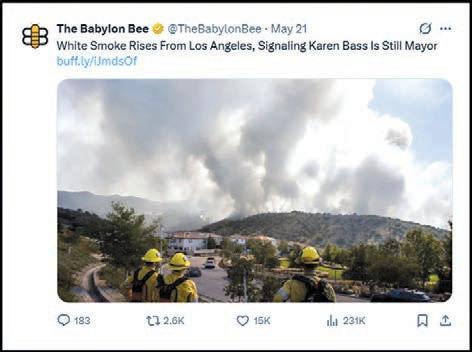
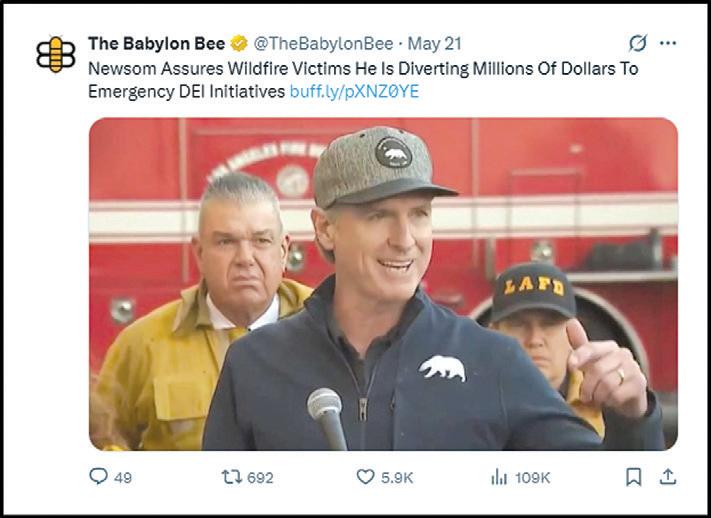
An AI-generated video in support of Los Angeles Republican mayoral candidate Spencer Pratt has gone viral, depicting incumbent Mayor Karen Bass as the Joker and Pratt as Batman. The video also portrayed California Gov. Gavin Newsom and former Vice President Kamala Harris dining with rich people while mocking LA residents begging for help.
Although Pratt’s campaign denies involvement, the video has amassed more than five million views on X and has ostensibly boosted his standing in the upcoming race. Pratt, a former cast member of a hit 2000s reality TV show, has even found himself on the radar of President Donald Trump, who told the press, “I’d like to see him do well. He’s a character.”
While Democrats claim Pratt’s online popularity won’t help him in the race, Bass has been losing ground to Pratt in
recent polls. As such, it’s increasingly likely that the race will end in a one-onone runoff between Bass and Pratt in November.
Pratt’s popularity increased last year after his and his wife’s Pacific Palisades home burned down during the Los Angeles fires, leading him to promote his wife’s album. Pratt has criticized Bass and Newsom for their handling of the fires.
“This just isn’t a campaign — this is a mission, and we are going to expose the system. We are going into every dark corner of L.A. politics and disinfecting the city with our light,” Pratt declared in January, when he officially started his campaign.
According to a poll released last week by the Los Angeles Times, 30% of voters support Bass, 22% support Pratt, 20% support City Council member Nithya Raman, and 16% are undecided. In order to avoid a November runoff, a candidate needs to win 50% of the vote in the June 2 primary.
Fifty-six percent of LA voters expressed disapproval of Bass in a Los Angeles Times poll conducted in March.
MN Fraudster Gets Prison
Aimee Bock, the founder of Feeding Our Future, was sentenced to 500 months in prison on Thursday after being convicted of wire fraud and bribery.
Her nonprofit, a Minnesota-based scam charity that embezzled government aid that it falsely said would go towards feeding schoolchildren, took over $250 million in federal funds, only $50 million of which was recovered, according to officials. In addition to her nearly 42-year prison sentence, Bock must also pay over $242 million in restitution. Her scheme took advantage of hungry children and taxpayer dollars, with the nonprofit positioning itself as a pandemic relief organization.
Just before her sentencing, Bock reportedly told the judge, “I don’t have the words to express just how horrible I feel. I know I’m responsible.”
19-related fraudsters to stand trial.
“Minnesotans are a generous people, and we believe in supporting folks who need a helping hand,” Minnesota Attorney General Keith Ellison stated following the sentencing. “It boils my blood that fraudsters are taking advantage of that generosity, and my office and I will gladly partner with all those who are also committed to holding fraudsters accountable.”
“My message to the fraudsters, is this: Eat, drink and be merry today,” Assistant Attorney General Colin McDonald said. “Because your days of frolicking and freedom are numbered. We are doing everything we can to find you, and when we do, we will prosecute you, and we will claw back every dollar you have stolen from the American people.”
Iran Hacked LA Transit System
According to Israeli researchers, Iranian hackers were responsible for a disruptive computer breach in March that forced Los Angeles’ transit system to shut down parts of its network.
The saboteurs stole at least 700 gigabytes of emails, backups, and other files from the Los Angeles County Metropolitan Transportation Authority (LACMTA), according to Gambit Security, a Tel Aviv-based cybersecurity firm that said it discovered the stolen data after it was inadvertently exposed online.
In a report published on Tuesday, the company said a digital trail of evidence tied the server where the data was discovered to a previously known hacking operation that Israeli officials and researchers attributed to Tehran.
Many of the organization’s nowcharged employees are Somali, which led the Trump administration to launch an immigration crackdown in Minnesota. The state’s governor, Democrat Tim Walz, decided not to run for a third term in part due to the controversy generated by this scandal.
Bock is among the first major COVID-
Digital security specialists have suspected an Iranian hand in the operation against the LACMTA ever since responsibility was claimed by an obscure proIran outfit calling itself Ababil of Minab. The group’s name refers to the bombing of a girls’ school in the Iranian city of Minab that officials there say killed more than 175 children and teachers.
Eyal Sela, Gambit’s director of threat intelligence, said a connection between
The Week In News
Ababil and the Iranian state “has been a working assumption.”
“What our research adds is the forensic evidence to support it,” he explained.
Gambit, a security startup founded in part by veterans of Unit 8200, Israel’s equivalent of the U.S. National Security Agency, said it had alerted relevant authorities to its findings.
The breach at LACMTA was discovered around March 16. About two weeks later, Ababil materialized online and claimed to have wiped an enormous amount of data in a destructive cyberattack, publishing a video that purported to show them rampaging through the transit system’s network.
Although Los Angeles transit officials said the breach did not interrupt circulation of trains or buses, local media said it disabled at least some arrival screens and prevented customers from putting money on their transit cards.
Ababil also has claimed credit for hacks affecting South Florida’s Tri-Rail commuter transit system, vehicle tracking company Vyncs, and Saudi infrastructure firm Unimac.
In a statement, Tri-Rail confirmed it
had been hacked “about a month ago,” but said that none of the affected data was critical. Vyncs owner Agnik said it had detected its breach on April 2 but declined to comment on the nature of the data stolen by the hackers. Both Tri-Rail and Agnik said the FBI was involved, with Agnik saying in an email that the bureau “has a pretty good understanding of who these criminals are.”
Dog Shoots Woman
In this case, the perpetrator had four legs and a wagging tail. A woman was reportedly shot while
sitting in her vehicle at a red light in Nebraska. The shooter? A dog that triggered a shotgun blast inside a truck at a nearby gas station.
The incident unfolded shortly after noon on Saturday when the vehicle pulled into Short Stop, a gas station and convenience store.
According to the police department, the dog remained inside the vehicle after the owner stepped into the store. Another passenger riding along also stepped outside but stayed near the front passenger-side door.
During that time, the dog reportedly moved around in the rear seat area and came into contact with a shotgun stored in the vehicle. The firearm appeared to have a live round in the chamber and was discharged after being triggered
The blast passed through the vehicle’s front passenger-side door, traveled out of the parking lot, and struck a woman who was stopped at a nearby traffic light several yards away. The pellet struck the upper portion of her right arm, which was resting out the window at the time. Thankfully, her injuries were not life-threatening. Ruff ride.
A Ferrari That Hums
Ferrari just did the unthinkable: it built a car with no roar. Somewhere, a middle-aged man in driving gloves just fainted into his espresso.
This week, the Italian luxury automaker unveiled the Luce — its first fully electric vehicle — proving that even Ferrari has finally accepted that the future may hum instead of growl. The name means “light” in Italian, though with a starting price of roughly $640,000, the only thing truly light will be your bank account.
Unveiled in Rome beneath a dramatic concrete stadium sail, the launch featured Formula One stars, gourmet tortellini, flashing lights, and enough
The Week In News
cinematic flair to make the Oscars feel underdressed. The car itself? Imagine if an iPhone and a spaceship had a very expensive Italian baby.
Designed with legendary former Apple designer Jony Ive, the Luce breaks nearly every Ferrari tradition. It has five seats — yes, five — making it the first Ferrari where you can bring the children and the luggage while still reaching 60 mph in under 2.5 seconds. Family road trips just became deeply intimidating.
The Luce is covered in glass, powered by four electric motors, and packed with futuristic touches. Yet Ferrari insists it still feels “analog.” Translation: there are still buttons for wealthy people who refuse to swipe left while driving 190 mph.
Of course, Ferrari knew the biggest challenge wasn’t speed. It was silence.
To soothe heartbroken purists, the company created an “external amplification system” that pumps engine sounds into the cabin and out onto the street. Essentially, the car plays Ferrari noises the way toddlers carry around toy phones pretending to make business calls.
Not everyone is impressed. Ferrari fans online have criticized the design for looking more Silicon Valley than
Monaco Grand Prix, and the company’s stock dipped after the reveal. Critics say it doesn’t look like a Ferrari. Ferrari’s response seems to be: exactly.
Still, while other luxury automakers are quietly backing away from EVs, Ferrari is flooring the accelerator. CEO Benedetto Vigna says innovation matters more than nostalgia — which is brave talk from a company that sells heritage at six figures a pop.
Whether the Luce becomes a collector’s dream or a very expensive science experiment remains to be seen. But one thing is certain: Ferrari has entered the electric age wearing Italian leather gloves and refusing to arrive quietly.
Summitting at Six-Seven
We wouldn’t recommend this as your next chol hamoed outing, but the Evermore family is not your average clan.
Joey Danger Evermore just celebrated his seventh birthday with his family –but without the cake and party hats that seven-year-olds generally wear in cele-
bration. Instead, the fearless boy spent the last weekend climbing the infamous El Capital in Yosemite National Park.
He began the climb last weekend as a six-year-old child and finished the climb on Thursday a year older, becoming the youngest person to summit the legendary 7,573-foot stone landmark.
It was a six-day feat, according to his father Joe Evermore, where he and his family had to deal with windstorms, exposure to the elements, food and water rationing, exhaustion and fear.
Much of the climbing techniques Joey had to navigate himself, said the father, using ropes to slowly scale up El Capitan while attached to the wall during the entire climb.
“Joey is gaining so much more than a record. He’s got a new identity. I can see his confidence building,” the proud father said.
Joey completed the climb alongside his older brothers, Sam Evermore and Sylvan Evermore, his father, and a documentary crew. The family is from Colorado Springs, Colorado.
Fans of Joey came to cheer for him from Yosemite Valley as he neared completion. They sang him “happy birthday” from down below.
Prior to last week, the youngest to climb El Capitan was actually Joey’s brother Sam, who accomplished the feat at age 8 in 2022. Before that, 10-year-old Selah Schneiter completed her historic ascent in 2019.
The towering monolith in Yosemite National Park was deemed un-climbable until 1958. The first ascent, by Warren Harding, took 45 days. Many have died in doomed attempts in the years since.
At least 31 people have died climbing El Capitan in Yosemite National Park since 1905, according to park records. Accidents typically stem from falls, rappelling errors, or rockfalls. El Capitan is particularly difficult to climb due to its sheer drop and technical difficulty.
After finishing the grueling climb, Joey quipped, “I summited at six-seven.”
Yeshivas Chofetz Chaim –
Supervision and mentoring of Special Education staff
Oversight of student support services, scheduling, and accommodations
Collaborating with Rebbeim, teachers, administrators, parents, and outside professionals
Guidance for parents through testing, diagnosis, and placement processes
Participation in student planning and support meetings
Ongoing development and strengthening of the program to meet student needs
REQUIREMENTS
A background in Special Education
Leadership, organizational and communication skills
Experience working collaboratively with teachers, parents, and outside professionals
A deep commitment to helping children succeed within a yeshiva environment
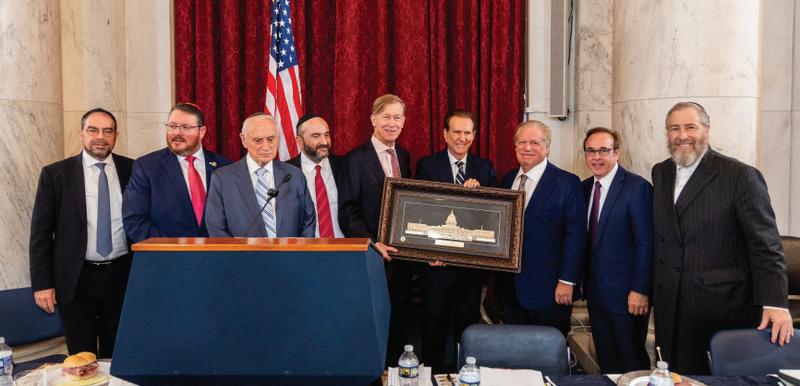
Philanthropist Elliott Broidy Presented with Visionary Award at the Jewish Heritage Celebration on Capitol Hill
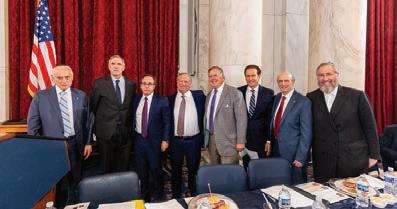
WASHINGTON, D.C. — The annual Jewish American Heritage Month (JAHM) luncheon was held May 19 on Capitol Hill, bringing together bipartisan members of Congress, foreign ambassadors, and civic, business, and religious leaders in the historic Kennedy Caucus Room of the Russell Senate Office Building to honor the enduring contributions of Jewish Americans to the United States.
The event was co-chaired by Malcolm Hoenlein, CEO Emeritus of the Conference of Presidents of Major American Jewish Organizations and Eric J. Gertler, Executive Chairman of U.S. News and World Report. It honored entrepreneur and philanthropist Elliott Broidy with the Visionary Award, Nobel Prize-winning physician Dr. Harvey J. Alter with the Dr. David Nassy Award, and Rabbi David Baron of Temple of the Arts in Beverly Hills with the Creativity in the Jewish Community Award.
In accepting the Visionary Award, Broidy reflected on the values his parents instilled in him — his father a decorated World War II veteran, turned schoolteacher, his mother a nurse — and the lesson they passed down: that success carries with it a responsibility to give back to family, community, and country. He praised Dr. Alter as an embodiment of tikkun olam for identifying a virus that was silently claiming millions of lives, and recognized Rabbi Baron’s work building curricula around altruism and empathy in young people as among the most consequential being done in America today.
Broidy described the luncheon as more than a celebration of JAHM, calling it a reaffirmation of the shared responsi-
bility to confront hatred and protect the values of tolerance, democracy, and human dignity at a moment when antisemitism has risen sharply both in the United States and around the world.
Rabbi Pini Dunner of Young Israel of Beverly Hills delivered remarks on the honorees, as did Rabbi Mordechai Suchard of The Gateways Organization and Rabbi Levi Shemtov, Executive Vice President of American Friends of Lubavitch.
Various U.S. Senators participated in the program, including Richard Blumenthal, John Fetterman, John Hickenlooper, Elissa Slotkin, Ron Wyden, James Lankford, Jacky Rosen, Pete Ricketts, Jeff Merkley, and Tim Sheehy. U.S. Represen-
tatives Randi Fine and Ken Calvert also delivered speeches.
The celebration traces its roots to the early 1980s, when Jewish Heritage Week was launched following discussions between Malcolm Hoenlein, President Ronald Reagan, and author and humanitarian Elie Wiesel, later evolving into the monthlong observance recognized today.
The event was organized by Project Legacy under the leadership of Ezra Friedlander, whose work has made the Capitol Hill JAHM luncheon one of the most visible annual expressions of Jewish American civic life in Washington. Through Project Legacy, Friedlander has built a platform that brings elected officials, faith leaders, and community figures together each year to recognize Jewish Americans whose lives reflect the breadth of that community’s contributions to the nation. “This year’s honorees reflect a deep commitment to public service, innovation, philanthropy, and the fight against hatred and intolerance,” Friedlander said.
Elliott Broidy, Rabbi David Baron, Malcolm Hoenlein, Rabbi Harvey Alter
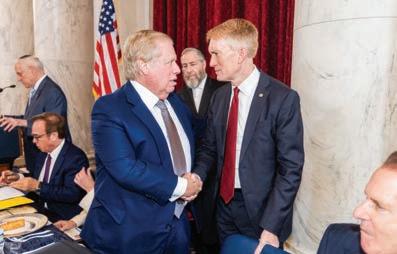
Elliott Broidy and US Senator James Lankford
Elliott Broidy Addressing the Crowd
Learn
Choose
Torah Thought It’s All Yours!
By Rabbi Zvi Teichman
One of the greatest gifts we received as a nation is teshuva, the ability to repent for our sins. Requisite to repentance is the need to admit with utter honesty and awareness our having sinned and our commitment to change, by expressing יודיו, confession. This most significant tool is placed in the context of the sin of one who had stolen and sworn falsely to his innocence, who when seeking to rectify this sin must make monetary amends, bring a sacrifice and confess his sin. It is from here that we derive to all other transgressions in the Torah the need to say vidui to effect atonement.
Why of all transgressions is this one selected as the paradigm for confession?
The Baal HaTurim points out how immediately prior to this discussion the Torah directs us to expel from the camp those contaminated by tzaraas-leprosy, zav-emission, and meis-the human corpse. These impurities reflect on the sin of the snake who was afflicted with leprous-like skin, the failure of Chava who would now be plagued internally by a monthly impurity, and the blunder of Adam who is now doomed to the dross of mortality. He further points out how directly afterward; the Torah describes the Sotah, the wayward wife being suspected of betrayal, who is reminiscent of the snake who ‘cavorted’ with Chava. In similar fashion to the guilty Sotah whose ‘thigh collapses’ upon drinking the bitter waters, the snake too, loses his former legs. Finally he points out that the laws of the Nazir which follow, extols the need to withdraw from the historical ‘forbidden fruit’ that Chava and Adam partook from, which according to many opinions was the grape, in restoring equilibrium to the world once again.
Evidently there is something of cosmic import embedded in this section.
There is one more piece to this puzzle. Sandwiched between the law of vidui, are two verses that allude to the various tithes, separations and gifts showered upon the members of the tribe of Levi, the kohanim who serve in the Temple.
The verse states, תא שיאו — A man’s, וישדק — holies, ויהי ול — shall be his. (י ה רבדמב)
The simple message here is that the gifts that are bestowed on kohanim are theirs to keep.
Rashi however brings an alternative reading on this verse.
The very next verse talks about the disloyal wife who secludes herself with a man other than her husband. Rashi asks, why is this discussion immediately following the requirement to give the appropriate gifts to a kohen? He answers, to teach us that if a man’s holies shall be his, meaning that he keeps the holies to himself and avoids the kohen to whom it is due, he will find himself having to bring his wayward wife to the kohen who will administer the bitter waters to determine her guilt.
What connection is there between the sin of withholding one’s taxes and his wife acting out immorally? Is she doomed because of the sins of her husband?
Perhaps it is not a punishment but a consequence. One who creates an environment of cheating to ingratiate his hunger for wealth will breed that behavior among the members of the household, discovering that his wife too will resort to duplicity in meeting her selfish needs.
But it is much deeper than that.
Rashi brings another angle on the same verse. A man’s holies shall be his, Rashi instructs, refers to the giver, emphasizing that although these items are inherently the property of the kohen, the Torah nevertheless gives the presenter the האנה תבוט, the privilege to choose to give it to whichever kohen he desires, so as to engender ‘good will’.
When a person gives of his own resources to another, no matter how altruistic the gift may be, it nevertheless comes with a debt. The receiver inevitably feels indebted to the sacrifice of the giver. Additionally, the giver too is challenged with a sense of paternalism that comes with giving, at times motivating the giver to feel superior to the recipient at best, or perhaps feeling entitled to allegiance from the beneficiary at worst.
In all relationships whether the mode of exchange is material, physical or emotional, the challenge we face is how careful are we to ‘give’ without creating a sense of entitlement or indebtedness. It is these ingredients that creep into our personal interactions that wreak havoc, generate anger and ultimately division.
Perhaps it is in the model of the gifts to the kohen that educate us in fine tuning this skill.
One who offers the kohen the gifts Hashem instructed us to, can never feel entitled because it is not generated by one’s desire but rather by the Torah. It is not ‘ours’, but rather Hashem’s, Who privileges us by directing us to distribute them to His proxies. By giving us the opportunity to focus on the good will we create by displaying our regard
and appreciation to those we choose to, we are creating a bond that is free from entitlement or indebtedness.
One who steals from another is often prodded by a sense of self-righteousness that he deserves it more than his victim, convincing himself that it’s an unfair world with assets distributed unfairly.
That flawed attitude will transfer into all areas of life. If a person can steal from the kohen he can most certainly not give credit or credence to those in his orbit that offer kindness, never sensing appreciation for their dedication and care. His lack of regard for those closest to him stems from his being caught up in a flood of self-importance and expectations of loyalty from those he takes under his wing, blinding him to the generosity of others.
A spouse who is never appreciated will stray to the arms of those who will provide her need for validation.
The jealous snake felt he deserved Chava. He played on her vulnerabilities since she felt underappreciated, as indeed we are taught that Adam was הבוט יופכ, ungrateful of the gift he received, as indicated in his instinctive reaction when confronted by Hashem as to why he sinned by blaming the ‘woman You gave me’.
If we would only view all our assets, talents, charm and intelligence as belonging to Hashem and graciously entrusted to us to utilize in creating ‘goodwill’ amongst ourselves, we will succeed in returning to the ‘Garden of Eden’ in our lifetime.
You may reach the author at: Ravzt@ ohelmoshebaltimore.com
Baltimore Weekday Minyanim Guide
Shacharis Mincha
Mercaz Torah U’Tefillah: EVERY 15 MINUTES
M-F: 6:15 AM, S-F: 6:30
AM, 9:45AM, 10:00AM
Neitz Beit Yaakov [Sefaradi] M-F
Mercaz Torah U’Tefillah S-F
Ohel Yakov S-F
Ohr Hamizrach [Sefaradi] S-F
6:00 AM Shomrei Emunah Congregation M-F
6:10 AM Agudath Israel of Baltimore M, Th
6:15 AM Kol Torah M, TH
Shearith Israel Congregation M, TH
6:20 AM Agudah of Greenspring M, TH
Agudath Israel of Baltimore S, T, W, F
Arugas HaBosem (Rabbi Taub's) S-F
Bais Dovid-Bais Medrash of Summit Park M-F
Bnai Jacob Shaarei Zion Congregation M-F
Kehilath B'nai Torah M, TH
Pikesville Jewish Congregation M, TH
Shomrei Emunah Congregation S, M, TH
6:30 AM Agudah of Greenspring T, W, F
Chabad of Park Heights M-F
Darchei Tzedek M-F
Kehilath B'nai Torah T, W, F
Khal Bais Nosson M-F
Khal Ahavas Yisroel/ Tzemach Tzedek M-F
Kol Torah T, W, F
Ohr Yisroel M-F
Pikesville Jewish Congregation T, W, F
Shearith Israel Congregation T, W, F
Shomrei Emunah Congregation T, W, F
6:35 AM Aish Kodesh (downstairs Minyan) M, TH
Ohel Moshe M, TH
6:40 AM Aish Kodesh (downstairs Minyan) T, W, F
Bnai Jacob Shaarei Zion Congregation M, TH
Ohr Hamizrach [Sefaradi] M-F
6:45 AM The Adas: Chofetz Chaim Adas Bnei Israel M, Th
Neuberger, Quinn, Gielen, Rubin & Gibber One South Street, 27th Floor
Ner Israel Rabbinical College - 400 Mt Wilson Ln
Ner
nspiration Nation
TDr. Yechiel Leiter
Antisemitism’s Got a New Name
By Eliyahu RosEnBERg
heodor Herzl pondered the issue of antisemitism for years, but before becoming the father of modern Zionism — the visionary behind the State of Israel’s establishment — Herzl was convinced that the solution to the Jewish nation’s problems was to, well, stop being Jewish. The reason the world hates us, he thought, is because we’re different. And so, the only cure for antisemitism is assimilation — to eliminate that which distinguishes Jew from gentile.
In His Words…
But then, one day, Herzl awoke to the sound of screaming men. He ran out to his balcony, gazed into the distance, and saw hordes of Frenchmen streaming through Paris, screaming, “Death to the Jews!” — walking through the very same streets where the French had marched just a century earlier for universal liberty and equality. This antisemitic protest happened amid France’s infamous late 19th-century Dreyfus Affair, when government officials persecuted and hurled
This is what Zionism came to say: We have the right to come and present our case like anybody else. We don’t ask for more, but don’t treat us any less.
you can’t escape your identity.
Rav Kook, the first Chief Rabbi of israel, talks in one of his letters about how special souls come down at a certain period of time, and particularly in the context of returning to the land of israel. i think this generation has been graced with those special souls.
Today, this virus called Jew hatred has mutated into something now called anti-Zionism.
unfounded, antisemitic accusations of treason at Alfred Dreyfus, a Jewish French soldier.
So, Herzl stared at his French brethren — the people he had long hoped to assimilate into — in shock. The sight left him scratching his head, grappling with a mix of disgust and astonishment. If Dreyfus were a chassid, Herzl reasoned, then the antisemitism would make sense. After all, it’s understandable why the French wouldn’t view a man with a bekeshe and peyos as one of their own. But why Dreyfus? Why would they take issue with a completely assimilated Jew? You would never even know that Dreyfus is Jewish.
And that’s what made Herzl realize that you can’t escape your identity; that, no matter what Jews do, they’ll never appease antisemites. Because, the world isn’t anti-Judaism. Antisemites don’t hate us because we’re religious or because they have qualms with our faith. They don’t hate us because of our political beliefs. They hate us for one simple, inescapable fact: because we’re Jewish. After all, antisemites don’t care if we’re frum or secular, right-wing or left-wing, identifiably Jewish or not, rich or poor, accomplished or not, intelligent or not. All of these things are excuses. At the end of the day, they hate us not for what we do, but for who we are.
“Historically, every time there’s been a surge in antisemitism, there are those Jews and those haters who say that the Jews are to blame,” Dr. Yechiel Leiter, Israel’s ambassador to the U.S., shares. “If Jews would only give up on this or give up on that — mostly dilute their identity
— everything would be fine. This is what happened in the 19th century when Jews were permitted out of the ghettos and shtetls, and, all of a sudden, there was a shift from anti-Judaism to antisemitism — it became racial. Because Jews felt that they could really dilute themselves to the point where they’d actually be accepted by their surroundings. But then this racial hatred developed, which says, ‘You can’t hide from your race.’”
So, when Herzl realized that our Jewish identity is inescapable, he switched gears. Instead of assimilating into a gentile environment, he realized, we need to find our own place in the world. In other words, we need a state. Because if we could govern ourselves — if our nation could be as powerful and independent as any other — then we need not worry about antisemitism, Herzl believed.
And he was, to a certain extent, correct. But there was one thing he miscalculated. Israel’s establishment gave us protection, yes, but it didn’t eliminate the threat of antisemitism.
“Today, this virus called Jew hatred has mutated into something now called anti-Zionism,” Amb. Leiter declares. “So, the biggest haters of Israel say, ‘We have nothing against Jews; we only have something against Zionism.’”
The accusation that the Jews are colonialists and conquerors? The elation that erupted on campuses as Jews were being slaughtered on October 7? The celebration of terror groups and regimes whose sole mission is to eliminate the Jewish people? The modern-day blood libel that Jews starve and murder innocent chil-
dren? The notion that the Jewish people don’t deserve a home of their own? The claim that the Jewish state controls the world? You could call it anti-Zionism. You could call it antisemitism. You could call it whatever you’d like. But its name doesn’t change the fact that it’s a hideous mutation of the same hatred we’ve endured for millennia.
Dr. Yechiel Leiter spent most of his childhood in Scranton, Pennsylvania, where he enjoyed a peaceful, frum upbringing.
Amb. Leiter’s passion for Israel was born one day when he was a little boy in yeshiva.
“I don’t know if I’d call it an epiphany, but in third grade, we were learning Chumash Bereishis, and I asked the teacher where all of this was taking place. Was it on Madison Avenue or Monroe Avenue or Mulberry Street?” Dr. Leiter recalls. “And he smiled and said, ‘What do you mean? It took place in Israel.’ So, I said, ‘Well, then why aren’t we there?’”
From that moment forward, he felt out of place, walking through the streets of Scranton when he knew his true home — the land his forefathers walked — was just a 10-hour plane ride away.
“I had a very strange feeling about not being part of what I was studying,” he shares. “And it was obvious to me that as soon as I could, I would go to Israel. I had never been there before, we had never traveled as a family, but it didn’t really matter to me, because I imbibed myself with history — with Tanach — and what I think is the option of living in history rather than being a passive observer of destiny.”
So, just before his 19th birthday, he hopped on a plane, flew to the Holy Land, and, in his words, “the
rest is history.” He never imagined that, some 48 years later, after a long career in politics and policy, he’d become Israel’s ambassador to the United States.
At first, when Prime Minister Benjamin Netanyahu asked him to represent Israel in Washington, Dr. Leiter didn’t quite know what to say. “I hesitated, but then he said, ‘What would your son say?’” the ambassador recounts. “And I realized that this is what I have to do now. Otherwise, I’d probably collapse from my missing my son and in the pain of having him leave.”
As Amb. Leiter says, his oldest son, Moshe Yedidya, “was larger than life.”
“At his funeral, his best friend said that Moshe was 39 but had lived the life of an 80-year-old. And that’s who he was. When I told him that he’s doing too much, he’d say, ‘Abba, I’ll add more if you nudge me,’” Dr. Leiter remembers. “He loved the story that Rabbi Steinsaltz told often about how he visited the Lubavitcher Rebbe and asked him what he should delete from his schedule, because he was doing too much. Rabbi Steinsaltz was translating and writing commentary on Tanach and on the entire Talmud, and he was writing articles and giving speeches and running yeshivas. So, he asked the Rebbe, ‘What should I eliminate from my schedule?’ And the Rebbe thought for a moment and said, ‘Add something.’ Moshe loved that story, and that’s how he lived. It was always ‘add more.’”
After the October 7 massacre, Moshe — despite being a 39-year-old doctor with six kids — decided to return to the army to fight for Am Yisrael. Tragically, he was murdered just 14 days into the war after he uncovered a booby-trapped Hamas tunnel.
“On the afternoon just before the Shabbos of Parshas Chayei Sarah, while Avraham Avinu was looking for a cave to bury Sarah, my son was looking for a tunnel, in which he was ultimately buried,”
the ambassador says. “He left me six grandchildren. He was the love of my life. He was my bechor, my firstborn. I miss him. The pain is often very physical — the degree to which I miss him. But I try to put him on my shoulders, just like when he was a little kid. Put him on my shoulders in the morning and run through the day, very conscious of his presence. I draw a lot of strength from memories and from my conversations with him,” the ambassador shares. “When he was alive, I used to consult his wisdom very often. His youthful zest for life. And somehow, I feel that he’s organizing things from above, as well. I don’t know how that works, exactly. I’m no expert in the supernatural. But I have a feeling that somewhere close to the Kisei HaKavod, the throne of glory, that he’s standing there and he’s influencing me, his siblings, and the world.”
* * *
It’s people like his son Moshe, his other children, and those in the younger generation who give Yechiel Leiter hope in these dark times. When the massacre erupted in southern Israel, the soldiers of today — the 18-, 19-, 20-year-olds — didn’t cower in fear. They risked their lives to save others.
“Rav Kook, the first Chief Rabbi of Israel, talks in one of his letters about how special souls come down at a certain period of time, and particularly in the context of returning to the land of Israel. I think this generation has been graced with those special souls,” Dr. Leiter declares.
“On October 7, we had a complete breakdown of the system. It was the perfect storm. Nothing worked. Our intel didn’t work, our Air Force didn’t work, our bases on the ground didn’t work, our infantry didn’t work. What saved the country? What saved the country was this generation — kids between the ages of 18
and 40,” he continues. “Before they knew what was going on, exactly, they took their personal weapons, many deposited their kids with their wives, said goodbye — some for the last time — ran into their cars, and went careening south into the face of danger, into fire. That’s not a normal, natural response to fear, to danger. Generally speaking, people run from danger. These people ran into the face of danger, and they saved the country.”
Dr. Yechiel Leiter speaks in depth about society’s moral deterioration; how the world has discarded rationality and objectivity and removed G-d from the picture. He discusses Western society’s failure to understand Iran’s eliminationist ideology — how the Islamic Republic is merely a continuation of the Nazi attempt to wipe the Jewish nation off the face of the Earth. He talks about the hypocrisy of antisemites such as Tucker Carlson, who refuse to recognize Israel’s miraculous existence and instead promote lies about the Jewish people. Of course, our nation is facing an endless number of challenges. But the ambassador is anything but pessimistic.
When he sees the younger generation set aside their differences and stand united for their homeland, just as we stood at Har Sinai, k’ish echad, b’lev echad, as one man with one heart. When he sees Israel enjoying a fertility rate of over double the OECD average, just three generations after the Holocaust. When he sees the Jewish state in the top 10 of the Happiness Index after two and a half years of brutal war. When he sees our gentile allies rooting for us. When he sees young people in Israel sacrificing their lives and Jewish college students in the U.S. standing up for Eretz Yisrael. All of that gives him hope.
We’re going through a tough time, but Amb. Yechiel Leiter is confident that we’ll emerge from these times stronger than ever.
This article is based on a podcast, “Inspiration For the Nation,” hosted by Yaakov Langer. To catch more of this conversation, you can watch it on LivingLchaim. com or YouTube.com/LivingLchaim or listen wherever you listen to podcasts (just search for “Inspiration For The Nation”) or call our free hotline: 605-477-2100
Massive Local Inventory
Our
Real-Time Design
We design your memorial with you in our studio. You approve it instantly, avoiding weeks of waiting.
Complete Local Control
From
We engrave everything ourselves to spot and fix potential flaws before they occur.
We build to last, so we guarantee it. We are your partners for life.
Forgotten Her es Operation Overlord and Preparing for D-Day
By Avi Heiligman
Operation Overlord was the codename for the Allied operation that defeated Nazi Germany in Western Europe. The landings called Operation Neptune occurred on June 6, 1944 and are commonly referred to as D-Day. Behind the staggering logistics required to land two million men in France by the end of August lay a vast network of specialized units and diverse individuals. Months of planning culminated in the largest amphibious invasion in history with many people, both military and civilians, working in many areas to secure the foothold that would finally topple the Nazi regime.
Operations against German forces had been going on for years, starting with the North African campaign, then moving through Sicily in 1943, and by mid-1944, the Allies were slowly making their way up the Italian peninsula. British Prime Minister Winston Churchill called it “the soft underbelly of Europe,” but Allied planners knew that the occupied countries in Western Europe would need to be invaded in order to force the Nazis to surrender. The Soviets had been pressing for another front in Western Europe, but the timing had to be right.
The tides and weather had to be perfect. The landings had to happen on a rising tide about an hour after low tide to allow the landing craft to come ashore, drop their cargo, and return to the English Channel without stranding. The winds had to be
below 15 mph, the waves had to be less than four feet high, and the clouds had to be at least 3,000 feet with low winds so the planes, gliders, and paratroopers could operate safely. The target date was June 5, 1944, but Supreme Commander General Dwight D. Eisenhower pushed back the operation for 24 hours after chief meteorologist Captain James Stagg forecasted a brief window of improved weather on June 6.
Air missions in preparation for the invasion of France started many months in advance and included the Pointblank directive. It was a combined bomber offensive that targeted German aircraft production facilities, oil reserves and Luftwaffe planes and bases. The “Big Week” occurred in February 1944 when American and British bombers relentlessly attacked German engine, aircraft and ball-bearing plants. By D-Day, the Luftwaffe was a shell of its former self and was barely seen over the landing zones. Attacks on key transportation targets in France and Belgium took place from March to June. These raids destroyed many railways and locomotives and were one of the reasons that German reinforcements included Panzer divisions were delayed in reaching the front once the Allies landed on D-Day.
Naval assets were busy at work to prepare for the largest amphibious operation in history. Close to 7,000 vessels, from landing craft to battleships, were used in the operation and gathered at English
ports. Artificial harbors known as Mulberry harbors were being prepared to be towed across the English Channel as the major French ports would be heavily guarded by the Germans. Minesweepers swept through the English Channel and marked the cleared waterways with buoys to allow the vast armada to sail safely.
The deception and misdirection strategy fell under Operation Bodyguard which consisted of several components. Operation Fortitude was a most important part of Operation Bodyguard as its goal was to convince Hitler and the German high command that the Normandy landings were a mere diversion. A fictitious unit, the First U.S. Army Group under the command of General George Patton (who in reality commanded the U.S. Third Army – a unit that was to go operational in France weeks after D-Day), used all types of tricks to make it appear as a real army group preparing to land at a different part of France. The phantom army was just a few soldiers in comparison, and they used dummy or inflatable tanks, fake radio traffic, mock airfields and other tactics to make it look like a massive gathering of soldiers. Other parts of Operation Bodyguard consisted of making it look like the Allies were preparing to land in Greece, southern France and Scandinavia. Specific messages prepared by Allied intelligence were purposely leaked to German spies and agents in what became known as the Double Cross System.
The Navy also contributed to Operation Bodyguard by building dummy landing craft and placing them in ports facing the Pas-de-Calais. Right before the landing, radar spoofing methods were used by naval and air assets to mimic large forces that were heading to areas other than Normandy and the landing beaches.
French resistance networks were hard at work in occupied France with many Jewish partisans in their ranks. They helped downed Allied pilots escape, disrupted German administrative work, and conducted many sabotage missions on targets like rail lines and communications.
These are just some of the efforts that were part of the extensive planning and preparation for D-Day. Other details of the planning phase of the operation included creating accurate maps of the French coastline. The soldiers and paratroopers drilled for weeks and months while it took an army of other military specialists to keep the plans a secret. In almost every American military operation today, lessons learned from Operation Bodyguard are still applied, proving that meticulous planning and specialized intelligence remain the ultimate tools for reducing casualties on the battlefield.
Avi Heiligman is a weekly contributor to The Jewish Home. He welcomes your comments and suggestions for future columns and can be reached at aviheiligman@gmail.com.
Mental Health Corner
The Power Differential
By Rabbi Azriel Hauptman
Yocheved and Levi have been married for ten years. The first couple of years were wonderful, but then they became preoccupied with
their jobs and familial responsibilities and they started drifting apart. They both agreed that they needed help. They started seeing a highly
recommended marriage therapist and initially they were optimistic that they were heading in the right direction. However, they started feeling that the therapist’s methods were counterproductive and they did not know how to proceed.
be very hesitant to ask questions that indicate doubt about the therapist’s methods.
This scenario is quite common and can manifest itself in different ways in all kinds of therapies and therapists. When this happens, the client (or clients in couple’s therapy) will consult with all kinds of people in an attempt to determine if this is par for the course or is this a warning sign. One of the individuals who they will often avoid asking is the therapist. This is puzzling. If someone is painting your house and you have a question about their method, wouldn’t the painter himself be the first person that you would ask? Why are people so hesitant to question their therapist? The answer lies in a concept known as the power differential.
A power differential is the perceived or actual difference in power between persons in positions of authority and those individuals in subordinate positions that result in a vulnerability on the part of the subordinate. This dynamic can exist with teachers, police officers, people with a higher social status, etc. In such a situation, people feel as if they have little control over their situation and do not feel empowered to speak up and assert their opinions or rights.
Moshe Males (Baltimore) & Shira Neumann (Monsey)
This sense of powerlessness may exist in spite of the fact that the reality is that the therapist is a merchant who is looking for customers to sell his or her service, and you are the consumer who has the money that they are looking for. Therefore, you should feel completely within your rights to verify that your hard-earned money is being put to good use. Nevertheless, our minds play tricks on us and we can have a perception of a situation that is divorced from reality.
Let us be clear. The creation of a power differential is not the result of a bad therapist. The very nature of therapy itself can create a power differential even if the therapist tries his or her best to always make you feel comfortable and genuinely urge you to always share any and all concerns that you may have. Very often, the therapist would love to address your concerns and answer your questions, but they might not be aware of your dilemma. Thus, numerous sessions may go by with the therapist not being aware of the elephant in the room.
When you have questions about how your therapy is proceeding, you are certainly entitled to ask questions. Just remember, that the therapist should not be left out. You may not be happy with your therapist’s answer, but you just might be surprised at how helpful that conversation might be.
This is a service of Relief Resources. Relief is an organization that provides mental health referrals, education, and support to the frum community. Rabbi Yisrael Slansky is director of the Baltimore branch of Relief. He can be contacted at 410-448-8356 or at yslansky@reliefhelp.org Want
When one is in therapy, the therapist asks you to be vulnerable and expose your innermost feelings and does not reciprocate by doing the same to you. Additionally, it can feel as if the therapist is the expert who holds the keys to your happiness and wellbeing and you are at their mercy. This creates a power differential that can lead a client to
Baruch Oratz & Aliza Abrams
To Raise a Laugh
It’s In The Cards
Seeing as I made a bar mitzvah a couple of months ago, some of you have probably been wondering when I’m going to get around to writing about thank-you cards.
“When are you going to write about thankyou cards?” you keep bothering me. Every day.
We bother our son too. We bought him a whole box of cards, on top of making his bar mitzvah. We also bought a bunch of clear address labels to go on them. And he hasn’t even said thank you.
“Dear Mommy and Daddy, Thank you for the thank-you cards. I think about you every time I use them.
Sincerely Yours, Schmutter”
Nothing says “thank you” like a personalized, messy, handwritten note on a card with the name of the person thanking you in a really nice fancy font on the front.
So here’s the question: What is a reasonable amount of time for a kid to send a thank you card? I don’t really pay attention to how long it takes to get them from other people. I read them once and think, “When did we go to this thing? Isn’t this kid married by now?”
Maybe he is. Maybe his wife made him write the cards.
It’s a chore to write them. It happens to be that it’s harder to be excited about something after the fact.
On the other hand, if someone sent you a present, the least you can do is write a thankyou card. In fact, if someone sent you a $50 present and each card costs a dollar, you should probably send him 50 thank-you cards. That’ll show him. And anyway, you’d think that if this is a kid who can memorize an entire parsha, he can write a few thank-you notes.
My daughter, who is a couple of years older, didn’t have to learn a parsha, obviously, so we couldn’t use that logic. But with her, we told her that if she doesn’t write thank-you cards, she doesn’t get to keep the presents.
We’ll write the thank-you notes and keep everything. So she asked if she could just have us write the ones she doesn’t want.
Everyone tries to get away with something. My son wanted to know, if 14 people got together on a gift, can he send one thank-you card to all 14 people? It seems fair.
But there are other reasons to send thankyou cards anyway. For example, if someone doesn’t come to your simcha but mails the present, you need to send a card so they know you got it. Even the people who bring actual gifts to the party -- they bring it in and set it on a pile. They don’t know if the person’s getting it. Someone else could be walking in and going, “Ooh, they have a grab bag!”
So you need to write something. And you can’t just write a note like,
“Dear _______,
I got your gift. It wasn’t stolen or anything. Love, Schmutter.”
And this is why I needed to help our son, start to finish. Our son is not a writer. He wanted to write, “Dear ________, Thank you for the _________,” and that’s it. I’m like, “No, you have to come up with at least a second sentence for each. Something specific to the gift.”
He also felt awkward writing “Love.”
So I wrote him some templates, because I didn’t want him writing things like, “Thank you for the ____. I exchanged it for store credit.”
So I have to write him a script to work off of that, as it turns out, doesn’t even help with two people’s cards. No template – for bar mitzvah or wedding -- works for all presents:
“Thank you for the lovely blender . I think of you every time I use it.”
That template also doesn’t work for knives, pincushions, garbage cans, and seforim on loshon hara.
And after he writes them, I have to sit down with him and edit each one. It takes having your kid write thank-you cards to realize how embarrassing his handwriting is. They don’t
By Mordechai Schmutter
teach handwriting in school anymore. And he didn’t know how to address the envelope either. I told him, “Just write the name of the person on the envelope, so we know who it’s for, and we’ll look up the address.” So he put their names in the top left corner, where he figured they’d be out of the way. Now what are we supposed to do? It looks like they’re the ones who sent it.
“So cover it with an address label,” you say.
Yeah, our address labels are clear.
I didn’t fight him about most of these things. It’s a big enough victory that I got him to stop writing “Love Schmutter.”
And he’s mixing and matching the templates incorrectly:
“Thank you for the lovely esrog box. It looks great on my wall.”
“Thank you for the lovely savings bond. It was exactly what I wanted.”
“Thank you for the lovely challah knife. I’m looking forward to using it on Pesach.”
“Thank you for the lovely check. I can tell you spent a lot of time picking it out.”
The main point of thank-you cards, though, is about teaching your kid to thank people. It’s not like your guests are stuck without a thankyou card. (“I bought all these you’re-welcome cards. What am I going to do with them?”) People aren’t hung up on whether you’ve thanked them yet.
Well, some people are. There are people out there who are insulted when they haven’t received a thank you card when the gift they gave cost less than the meal you gave them. I’m not keeping score, but where’s your thank-you card?
“Dear ________,
Thanks for having me at your wedding. It was awesome! Especially the grab bag!”
Mordechai Schmutter is a freelance writer and a humor columnist for Hamodia and other magazines. He has also published eight books and does stand-up comedy. You can contact him at MSchmutter@gmail.com.
Headlines Halacha
An Open Miracle Unfolding in the Negev
by Rabbi Yair Hoffman
Did anyone notice this? There is a pasuk in Sefer Yeshayahu (35:1) that for nearly twenty-seven centuries seemed to defy literal fulfillment: “Yesusum midbar v’tziyah, v’sageil aravah v’tifrach kachavatzeles, the wilderness and the parched land shall be glad, and the desert shall rejoice and blossom like the rose.” The navi continues two pesukim later: “Ki nivk’u vamidbar mayim u’nechalim ba’aravah, for waters shall break forth in the wilderness, and streams in the desert.”
To the generations who read these words in galus, they were nechemta , consolation poetry, understood as metaphor. The aravah is, by definition, the place where water is not. The midbar is, by definition, the land that does not blossom. To promise that the desert would rejoice was understood as a promise that history itself would be overturned in yemos haMoshiach
And yet, in our own days, beneath the Negev — that very aravah named explicitly by Yeshayahu — the literal pshat of the navi has begun to unfold.
The Mayim Nistarim
Beneath the Aravah
In 1973, a frum geologist named Eliezer Issar drilled 2,300 feet into the sandstone beneath the Negev and struck water that erupted to the surface under its own pressure – no need to pump. He had tapped the Nubian Aquifer — an underground reservoir holding an estimated 150,000 cubic kilometers of ancient waters.
There is a concept in the Gemara (Megillah 13a) that Hakadosh Baruch Hu prepares the refuah before the makah. This also applies to the means of geulah long before geulah itself becomes visible.
Water that fell thousands of years ago, sealed beneath the very land that
Yeshayahu would later name, waited in darkness for the precise generation that would need it. “Nivk’u vamidbar mayim” — the verb nivk’u , “burst forth,” is striking. The water bursts upward of its own pressure, exactly as the lashon of the pasuk describes.
The Two “Defects” That Were Brachos in Disguise
The water that burst forth had two characteristics that, initially, made it appear useless. It was hot — 99 to 104 degrees Fahrenheit, heated by geothermal forces in the depths of the earth. And it was brackish — salty enough to destroy wheat and conventional produce.
The hot, salty water of the Negev could not grow wheat. But Hashem had created, in tropical river deltas across the world, fish – kosher ones — barramundi, tilapia, European seabass — whose entire biology was designed for warm, and yes, slightly saline water. These fish, dwelling in the river mouths of Australia and the Mediterranean, were waiting for the day they would be brought to the ar-
avah and find that the “defective” water was, for them, gan eden
Hashem prepared the fish for the water, and the water for the fish, thousands of years before either was needed. And so they began farming fish in these pools that they had constructed from Eliezer Issar’s flow of water.
But, alas, yet another problem. In the Negev, the fish produce ammonia as waste — a substance that, in concentration, poisons the very water they swim in. Conventional farming treats this as pollution to be filtered or discarded. Something that would cost enormous sums of money.
But let’s not forget that Gemara about the yeshuah before the Makkah and the bracha in Shemoneh Esrei, “Attah chonain l’adam da’as.” Because a solution was readily at hand.
Ammonia is also nitrogen — the single nutrient that plants require most desperately, the nutrient for which the world burns two percent of its total energy supply manufacturing synthetically through the Haber-Bosch process.
And what poisons the fish feeds the tree.
Israeli engineers devised a solution where the water could flow from the fish tanks directly to the roots of olive trees and date palms, the precise two species named throughout Tanach as the signs of yishuv Eretz Yisrael. “Eretz zayis shemen u’dvash” (Devarim 8:8). The trees absorb the nitrogen, the soil filters the salt, and the water returns to the earth cleaner than when it emerged. And the salt itself — the very mineral that was supposed to destroy the agriculture — turns out to be the bracha h idden within. Olive trees and date palms grow in the saline soils of Eretz Yisrael and tolerate salinity up to 5,000 parts per million. The Negev water sits at 3,000. Mild salt stress causes these trees to concentrate sugars and oils. The dates become sweeter. The olive oil becomes richer. “U’devash mi’tzur” — “and honey from the rock” (Devarim 32:13) — the sweetness drawn out specifically by the hardness of the conditions.
The holy prophet Yeshayahu (35:7) continues: “V’haya hasharav la’agam v’tzimaon l’mavu’ei mayim, and the parched ground shall become a pool, and the thirsty land springs of water.” The navi names the precise transformation: the place defined by thirst becomes the source of water.
One million tropical fish now swim beneath the Negev. The pioneering work was launched in 1992 at Kibbutz Mash’abei Sadeh, which built a three-hectare reservoir and a series of covered rearing ponds. It became the only kibbutz in Israel to breed Australian barramundi alongside Nile tilapia and, later, yet another fish. The recycled brackish geothermal water from the fish ponds at Mash’abei Sadeh is used in its final stage to irrigate jojoba, olives, and melons — the closed loop that Yeshayahu describes in living agricultural form.
A second pillar of the industry is Re’em Farm in the western Negev, which uses the effluent from its fish rearing ponds to irrigate 120 hectares of olive trees, supplying the groves with water year-round — ten cubic meters per hour per day in winter and as much as one hundred in the summer. The integration is so seamless that the olive grove and the fish farm function as a single unit.
The largest barramundi operation in the world today is Aquatech Fisheries, operating its Negev Ecological Farm on a 35-dunam site in southern Israel. Aquatech uses local geothermal water, which enters its system at 37 degrees Celsius — the exact temperature optimal for barramundi — and produces 2,000 tons of barramundi annually using a land-based Recirculating Aquaculture System (RAS).
The water that exits the technological cycle is reused for irrigation of nearby olive groves, and the entire facility is powered by a photovoltaic solar array. Aquatech’s Israeli Barramundi brand is exported to France, Germany, and the United Kingdom — to the very European nations that, for two thousand years, watched the Land lie desolate as
proof that the Jewish people had been abandoned. Now those nations purchase fish raised in water that erupted from beneath the desert.
Other significant players in the Israeli desert aquaculture industry include AquaMaof Aquaculture Technologies, whose RAS systems were developed
was the brother of Rav Zelig Reuvain Bengis, zt”l, the Volozhin talmid who became the rav of the Eida Chareidis), the Jacob Blaustein Institute for Desert Research of Ben-Gurion University of the Negev in Be’er Sheva, founded and led for decades by Professor Samuel Appelbaum, whose research established
Land refuses to flourish for any nation other than its own. For nearly two millennia under Roman, Byzantine, Arab, Crusader, Mameluke, and Ottoman rule, the Negev remained barren. The navi promised it would blossom — but only when its people returned.
The Negev fish farms are not carbon neutral — they are carbon negative. They remove more carbon dioxide from the atmosphere than they produce. The geothermal heat that costs nothing replaces gas heating that would otherwise emit two hundred tons of carbon. The date palms and olive trees sequester additional carbon. The closed loop is, in modern terms, a literal multiplication of bracha from input to output.
in the Negev and are now exported to fish farms worldwide; Pure Blue Fish, which operates a zero-water-discharge RAS technology; and Phoenix Farm in the Negev, an indoor bio-secure facility breeding ornamental tropical fish for the global aquarium trade. Underpinning all of this is the academic engine of the industry: the Bengis Center for Desert Aquaculture (yes, their patriarch
the scientific foundations on which the entire field now stands.
Together, these farms and institutions produce over 3,000 tons of fish annually from the Negev.
The Ramban on Vayikra (26:32) makes a remarkable statement. He says that one of the proofs that Eretz Yisrael belongs to Klal Yisrael, and that the promises of Tanach are true, is that the
The pasuk does not say if. It says ki, because. Because the waters have broken forth, because the streams have come. “The wilderness and the parched land shall be glad, and the desert shall rejoice and blossom like the rose.”
This article should be viewed as a halachic discussion and not practical advice. The author can be reached at yairhoffman2@gmail.com.
Yeshiva Bochurim = Mekadshei Hashem Living Kiddush Hashem
IBy Rabbi Shraga Freedman
n Minneapolis a Conservative synagogue called B’nai Emet closed its doors. It had once been an Orthodox shul before slowly drifting from that tradition. By 2011, after years of decline, it shuttered.
A young makom Torah, Yeshiva of Minneapolis, purchased the building. It opened in 2012 with just seven local boys. Today, close to a hundred bochurim from around the country learn there. The old temple had become a vibrant yeshivah.
Recently, a ninth grader named Moshe Saad enrolled. His mother contacted the hanhalah before Rosh Hashanah and mentioned that her in-laws had friends visiting,
former members of the shul, who wanted to see what had become of their old building.
That small request grew into something remarkable. A committee formed, word spread, and more than 250 former members, children, and grandchildren came to visit the place where they had once celebrated brissim, bar mitzvahs, and weddings.
The bochurim served as guides. They walked the elderly visitors through the halls, listened to memories, and asked questions with genuine interest. An older man pointed to a corner and said, “That’s where I stood for Ne’ilah every Yom Kippur for thirty years,” and the bochur beside him listened as if hearing something precious.
The visitors were deeply moved. More than one turned to a rebbi and said, “Your boys are so mentchlich.”
They had expected one thing and found something very different: American bnei Torah who looked them in the eye, said “Yes sir” and “Yes ma’am,” and carried themselves with dignity and warmth. One woman became so emotional she said she wanted to make a Shehecheyanu.
After the tours, a full Kiddush was served, but no one wanted to leave. They stayed for hours speaking to the boys and rabbeim. Again and again they said, “We’re so proud of what you’re doing here. We’re so happy this building stayed Jewish.”
One man stopped by a sign near the beis medrash asking visitors to leave cell phones outside. He read it and said, “It’s beautiful to see the respect you have for this place.”
There is already discussion of starting a monthly shiur for former members. Scores signed up for Torah classes.
Some had once viewed the Orthodox world with distance or suspicion. But standing there, surrounded by bochurim who embodied Torah with dignity and kindness, something stirred. The pintele Yid, buried
beneath decades, flickered to life.
It had been waiting there all along, for the right moment, the right encounter, and the right bochur to make an older Yid feel proud to be a Yid again.
(Adapted with permission from an article in Yated Ne’eman, written by Rabbi Mordechai Kamenetzky, entitled “I’m Just Saying — Coming Home.”)
Rabbi Shraga Freedman is the author of Sefer Mekadshei Shemecha, Living Kiddush Hashem, and A Life Worth Living.
Email LivingKiddushHashem@ gmail.com for a free sefer. Visit LivingKiddushHashem.org for more resources
Living Kiddush Hashem was founded with the goal of imbuing every Jew with a powerful sense of mission — the mission to be mekadeish Sheim Shamayim in his or her own unique way. We strive to accomplish this by raising awareness of the paramount importance of the mitzvah of Kiddush Hashem and its centrality in everything we do.
TJH Centerfold
Knicks Trivia
1. What is the Knicks NBA Finals record?
a. 1-4
b. 2-6
c. 2-2
d. 4-2
2. Which team defeated the New York Knicks in the 1994 NBA Finals?
a. Bulls
b. Spurs
c. Rockets
d. Celtics
3. What seed were the Knicks when they reached the NBA Finals in 1999?
a. 2nd
b. 4th
c. 7th
d. 8th
4. Which team defeated the Knicks in the 1999 NBA Finals?
a. Lakers
b. Spurs
c. Pacers
d. Jazz
5. In Game 6 of the 1994 NBA Finals, John Starks had a nightmare shooting performance from three-point range. How
many three-pointers did John Starks miss?
a. 0
b. 7
c. 9
d. 11
6. Who was the head coach of the Knicks during their 1999 NBA Finals run?
a. Pat Riley
b. Jeff Van Gundy
c. Don Nelson
d. Larry Brown
9. The Knicks won their most recent NBA championship in what year?
A. 1969
B. 1970
C. 1973
D. 1977 3-D
7. In Game 7 of the 1970 NBA Finals, Walt “Clyde” Frazier scored 36 points and had 19 assists. But who was the captain that famously limped onto the court to help the Knicks win?
a. Walt Frazier
b. Dave DeBusschere
c. Willis Reed
d. Bill Bradley
8. How many blocked shots did Knicks center Patrick Ewing have in the 1994 NBA Finals?
a. 12
b. 17
c. 22
d. 30
Slam Dunk:
7-9 correct: Bing-bong!
4-6 correct: You wouldn’t be the only 3 seed to go far in life…Go, New York! Go, New York, go!
0-3 correct: So, how does it feel to be the only Brooklyn Nets fan in New York? Must be sad. They say that there’s a tree somewhere in Brooklyn; maybe hugging it will give you some comfort.
Signs that You Are Hopping on the Knicks Bandwagon Now That They are Winners
You call Madison Square Garden “The Garden” like you are boys. “Me and Friedman are going to the Garden to see if we can score cheap tickets.”
You just realized that the Nets are not a nickname for the Knicks and still don’t realize that they are not the Knicks D-League Team. Low blow, sorry Nets fans…all two of you.
You don’t even know Amar’e Stoudemire. “I know the guy who was his chavrusa when he was becoming a ger!”
You think suffering as a Knicks fan means “that rough week in February.” Some of us lived through real struggle…Charles Smith for the putback! Tries again! Tries again! Tries again…Bulls win! If you don’t know what I’m talking about, this Finals run may be fun for you, but its meaning is not as deep. Oh, the pain!
When I am analyzin,’ stylin’ and profilin’, rhymin’ and chimin’ about the Knicks, you wonder if it’s just about my rhymin’ that I have pride, not realizing; that I am imitatin’ Clive.
You keep telling people: “This team feels different.” Real Knicks fans have said that 47 times already. We will keep our mouths shut until we actually win the Finals!
The name Reggie Miller does not give you nightmares. Since the 1995 Eastern Conference Semifinals, I’ve been trying to calculate how many points per second 8 points in 9 seconds is! If you don’t know what I’m talking about…uh, never mind, it’s a math Regents thing!
You think that the Knicks long-time iconic center’s name was Patrick Eee-wing. Youuuuuu-wing….. Youuuuuu-wing
You Gotta Be Kidding Me!
Yankel is sitting at Game 1 of the NBA Finals, and the seat next to him is empty. Another fan says, “Wow, it’s unbelievable that someone would miss Game 1 of the Finals. Whose seat is that?”
The man says, “My wife’s. We bought the seats together.” The fan says, “Oh no… I’m so sorry. What happened?”
The man says, “Oh, nothing… We passed Bloomingdales on the way to the game, and she decided to go there instead.”
Notable Quotes
“Say What?!”
Thirty thousand dollars is great, but it’s not mine to keep. I like to earn my money.
- Construction worker Luis Salazar explaining to a local TV station in Florida why he returned $30,000 in cash that he found in a Wawa bathroom to the rightful owner who he tracked down
I just did the right thing; I don’t need to be put on a pedestal.
- ibid.
The media is actually boosting Iran’s bargaining power because they make them think that Trump’s backed into a corner. Trump isn’t in an underground bunker hospital with no legs and no lips. He’s building a UFC cage at the White House.
- Jesse Watters
If we ran Amazon the way New York City runs their school system, your packages would take six weeks to arrive. We’d have to charge you a $100 delivery fee. And then when the package did finally arrive, it would have the wrong item in it anyway.
- Amazon founder Jeff Bezos on CNBC’s “Squawk Box”
The man who founded 7-Eleven in Japan has died at the age of 93. Funeral arrangements have yet to be made, but for now, his body will be slowly rotating on a hot dog machine.
- Greg Gutfeld
You all have AI – Actual Intelligence!
- Apple co-founder Steve Wozniak at the Grand Valley State University Commencement Ceremony in Michigan
My entire life in the technical world, I’ve been following people who were trying to figure out how to make a brain. Software, hardware, synapse chips, and I was at a company where the engineers figured out how to make a brain: it takes nine months.
- ibid
Senator Standers.
- How the far-left senate candidate in Maine, Graham Platner, repeatedly referred to Sen. Bernie Sanders while onstage together at a rally in which the supposedly Jewish Bernie Sanders rallied for the proud Nazi supporter who has a Nazi tattoo
The Black community is so proud of you right now. George Floyd is looking up at us all, laughing so hard he can’t breathe.
- Comedian Tony Hinchcliffe at a roast of actor Kevin Hart
I wasn’t shocked. Like, that’s what they do! It happens every year when they do a roast. It’s not new. This isn’t a new agenda. It’s not a new approach to comedy.
- Actor Kevin Hart defending the joke on a radio show
I’m right now at 99% in Israel. I could run for prime minister, so maybe after I do this, I’ll go to Israel and run for prime minister.
- President Donald Trump
Most effective subpoena of all time? Piker opens a single envelope, rats on all his comrades in a single breath.
– Michael Knowles on X commenting on radical leftist podcaster Hasan Piker, who recently went to Cuba, going on air and disclosing that he is under investigation for the trip and disclosing multiple people that funded it
Maybe you’re just forcing your kids to be into what you’re into at TOOOOO early an age.
- One social media response to a post by Joey Evermore celebrating that he climbed the infamous 7,573 foot El Capitan in Yosemite National Park over six days along with his family, including his 7-yearold son, ironically named “Danger”
I think people should stop paying their credit cards. Like, is it a sin to rip off your drug dealer?
- Tucker Carlson, who sounds more like a radical leftist every day, suggesting that since credit card companies solicit customers, they are predatory in nature and people should just not pay their credit card bills
A man in Idaho set a world record for putting on 32 t-shirts in one minute. Even more impressive, it took [Chris Christie] 32 minutes to put on one t-shirt.
- Greg Gutfeld
I find that tattoo and his commentary about it to be personally disqualifying. I hope Maine voters agree with me.
- Rep. Jake Auchincloss (D-MA) breaking with his party over Maine senate candidate Graham Platner who has a Nazi tattoo
0.02
— The margin of victory by which Felix Rosenqvist won the Indianapolis 500 after 500 miles and roughly three hours of racing
They’re all talking about the picture we took when I gave you this great cologne. Just in case you ran out!
- The note from Pres. Trump to Syrian leader Ahmed al-Sharaa accompanying two bottles of Trump cologne, the type that Trump strangely sprayed on al-Sharaa when he came to the White House last year
Dating Dialogue What Would You Do If…
Moderated by Jennifer Mann, LCSW of The Navidaters
Dear Navidaters,
I guess cheesecake season isn’t the best time to be discussing this, but I think it’s important that I do. I am very into fitness, health, and wellness. I am 27 years old, a lawyer by profession, and work out in my spare time.
I’m writing because I have been dating a girl for the past month and things are going very well. Recently when I was picking her up from her house and I used the restroom before we left, I noticed in the open trash bin was a box labeled Ozempic. I asked her about it on the date, and she said her mother and sister use it. I am really avidly again these weight loss drugs, and it makes me nervous that her close relatives use it/need it. I want to stop thinking about it as a problem, but it does really bother me. If this is her family’s mentality which has trickled down to her, aka shortcuts rather than health, we may not be on the right wavelength.
I’m curious to hear the panel’s thoughts on this.
Ben*
Disclaimer: This column is not intended to diagnose or otherwise conclude resolutions to any questions. Our intention is not to offer any definitive conclusions to any particular question, rather offer areas of exploration for the author and reader. Due to the nature of the column receiving only a short snapshot of an issue, without the benefit of an actual discussion, the panel’s role is to offer a range of possibilities. We hope to open up meaningful dialogue and individual exploration.
The Panel
Dear Readers,
We want to offer YOU an opportunity to be part of the discussion! Please email us at MichelleMondShadchan@gmail.com, subject line “reader’s response,” if you would like to participate in the new “A Reader’s Response” columnist spot. We will send you a question and publish your answer in an upcoming Navidaters edition.
If you have a question you would like the Navidaters to answer, please reach out to this email as well.
Looking forward!
Michelle, the “Shadchan”
The Rebbetzin
Rebbetzin Faigie Horowitz, M.S.
Ben, there are two questions here. Your nervousness about the young woman’s attitude susceptibility to the attitude of members of her family toward Ozempic is an enigma. Why is this such a concern of yours? What else is related to this? Are you very influenced by your family? Why is it so hard to get to know her and see whether or not she is an independent person?
Second, do you have trouble trusting people?
Ask yourself these questions and please stop looking in other people’s restrooms. Refrain from doing a medicine cabinet check and sort yourself out.
The Shadchan
Michelle Mond
I can just imagine a Navidaters’ question coming from the girl’s perspective. A horrified letter suggesting that the guy she is dating was peeking through her family’s bathroom garbage bin. To me, that seems a lot more concerning!
My advice to you is to focus on the girl you are dating, how you get along and if you are connecting. She doesn’t know or ask about the medications your parents or siblings are on or have the
opportunity to look through your home medicine cabinet. If she knew, would she be completely fine with what she saw? Do you even know what medications all your family members are taking? You are overthinking, and if I were to guess, I would say you are probably an overthinker in general.
Are you the kind of guy that gets serious with someone and then suddenly finds 101 reasons why “This probably won’t work out”? I have seen this pattern in certain guys time and time again. It’s like clockwork, and I can see it a mile away. You need to get out of this habit.
Stop creating problems and focus on the amazing relationship you have in front of you. Work with a therapist or dating coach to get out of the toxic mentality that keeps you spiraling as soon as things get serious.
Hatzlacha with this inner work – it will change your life!
The Zaidy
Dr. Jeffrey Galler
Ihave heard of guys who peek into their girlfriend’s medical cabinet in order to find out if their potential mate has any medical issues. But this is the first I’ve heard of “dumpster diving” for premarital screening purposes.
For readers who have not come across the term, “dumpster diving” refers to detectives, or spies, who search through an individual’s or an organi -
zation’s garbage in order to unearth valuable confidential information like un-shredded documents, passwords, or personal data.
Well, I suppose all’s fair in love and war.
I find no fault with your passion for physical fitness and health and with your desire to find a mate who will share your particular passion and values. Do not let anyone try to convince you that your lifestyle choice is unworthy. What you personally consider important is as valid as anyone else’s.
In hoping for a happy marriage with a like-minded soulmate, your quest is similar to singles who seek a spouse who will fully share their passion for Torah studies, or for performing chesed, or for travelling extensively, or for professional development, or for working on kiruv. You are dedicated to physical fitness and a healthy lifestyle.
This is the first I’ve heard of “dumpster diving” for premarital screening purposes.
(Just as an aside, several years ago, my wife gave me a birthday present of ten one-on-one sessions with a physical trainer at a local gym. “You have to get into shape,” she admonished. “Get into shape?” I retorted. “Isn’t round a shape?”)
Of course, Ben, a truly dedicated detective would at least have checked
whose name was on the Ozempic prescription. In any event, at this point, it is still very early in your relationship. Over the coming weeks and months, you will both learn whether you can fully trust each other completely and unquestionably and whether you truly share the same goals, values, and aspirations.
In the meantime, if you lack the patience for slowly and methodically letting you and your girlfriend learn more about each other, you can try some scientific experiments.
For example, take your girlfriend to an expensive restaurant. After a hearty meal, ask the server for the dessert menu. Read it out loud alluringly and tell her to please order whatever her heart desires. Then, observe whether she orders the fruit cup and sparkling water, or the triple-decker chocolate truffle cake, with layers of dense, dark chocolate sponge cake, heavy buttercream, thick ganache, and an extra thick, delectable marshmallow topping.
Or, alternatively, take her on a fun date to a local gym.
Reader’s response
Isaiah Cox
The Curmudgeon
Ben,
You did not see anything wrong with the family’s health and activity level before you saw the Ozempic wrapper, which tells us that the use of the GLP-1 is not evidence of a behavioral or moral failing.
One of the biggest lies modern society tells us is that we are helpless victims of circumstance and upbringing and our DNA – but that weight is somehow uniquely a moral issue, showing a moral failing. In short: being overweight is a sign of weakness and inferiority. Thin people are seen as better people because
Pulling It All Together
The Navidaters
Dating and Relationship Coaches and Therapists
Hi Ben, I actually think there are two separate issues here.
One is that you clearly value health, fitness, discipline, and taking care of yourself. That matters to you and there’s nothing wrong with wanting a partner whose lifestyle generally aligns with your own.
But I’d be careful about turning a box you saw in a bathroom garbage into a bigger story about an entire family’s values or character.
The truth is, medications like Ozempic are complicated. Some people use them irresponsibly, sure. But many people use them because they’ve struggled with weight, insulin resistance, PCOS, diabetes, metabolism, or other health issues that aren’t as simple as “eat less and work out more.” Human bodies are complicated. So are people. I also think it’s important to separate this girl from her mother and sister.
they must have superior self-control.
This is simply not true.
The new GLP-1 drugs are fantastic. Study after study are showing that they help with cancer and strokes and heart disease, in addition to diabetes and – yes – weight loss. My own cardiologist says they are miracle drugs, and he prescribes them to almost all of his patients.
Nature is not perfect. We are all meant to improve ourselves and the world around us. Jews often become doctors for precisely this reason: medicine is designed to help overcome nature’s desire to kill us soon after we pass the age of procreation.
In some countries, they are considering making Ozempic (or other GLP1s) standard for ALL adults older than a certain age because the health benefits for even thin people are overwhelmingly positive. This will spread.
I think you should re-examine your prejudice against improving the natural world. You live in an air-conditioned
I think you should re-examine your prejudice against improving the natural world.
home, and drive an automobile, with all the benefits of an industrial age. Many of us even wear – gasp! – eyeglasses! If you were morally strong, you would find a way to use willpower to see regardless of vision loss!
Why would we shun those who seek to similarly address the limitations of our physical bodies?
If she is willing to date you despite your tunnel vision and prejudice, then I suggest you may be getting the better end of the deal.
You’re dating her, not her family members.
Does she share your values around health? Do you enjoy how she lives? Do you feel aligned in lifestyle, energy, discipline, attraction, and outlook?
Those are probably the more important questions.
And honestly, you’ve only been dating a month. Right now, your job is really just to stay open and curious and continue getting to know her, not to decide what a medication in a trash can mean about her future mindset, parenting, or morality.
I’d also gently ask yourself why this hit such a nerve for you. Sometimes these things become symbolic of bigger fears we have about compatibility, self-control, attraction, or values. That’s worth exploring honestly.
You may ultimately decide you’re not aligned. That’s okay, too. But I’d try very hard to make that decision based on who she actually is, not on assumptions about what this medication represents to you.
Sincerely, Jennifer
Jennifer Mann, LCSW, is a therapist and certified life coach in private practice in Cedarhurst, NY and via telehealth. She works with individuals, couples, and families, and is a part-time school social worker at Bnos Malka Academy. Her work centers on anxiety, relationships, life transitions, and narcissistic abuse. She integrates attachment-based therapy, cognitive behavioral approaches, and relational work, grounded in the belief that healing and growth emerge through honest, attuned, and meaningful human connection. To set up a consultation or to ask questions, please call 718-908-0512.
Dollar-Cost Averaging: Boring But Effective Common Cents
Dollar-Cost Averaging: The Boring Strategy That Beats Almost Everything
I’m a creature of habit. Nearly every morning for the past 14 years, regardless of whether the sun is shining or it’s pouring rain, I lace up my running shoes, I head out the door, and I put in the miles.
Some days I feel like I’m flying; other days, my legs feel like lead. But the secret to running a marathon isn’t some high-intensity, perfect workout once a month. It’s the boring, relentless consistency of showing up every single day.
In the world of investing, we have a name for this kind of “boring” consistency: Dollar-Cost Averaging (DCA)
It’s the practice of investing a fixed dollar amount into the market on a regular schedule (like $500 every month), regardless of whether the market is at an all-time high or a terrifying low. It sounds simple, maybe even too simple, but it is one of the most powerful tools in your financial arsenal.
The Strategy That Outsprints Your Brain
I love DCA because it’s a “pre-commitment” strategy. It’s designed to save you from your own worst enemy: your brain.
Our brains are hardwired for Present Bias and Loss Aversion. When the market is booming, your brain screams, “Buy more! Everyone is getting rich!” When the market is crashing, that same brain screams, “Get out! Save what’s left!”
If you listen to those screams, you end up doing the exact opposite of what builds wealth: you buy high and sell low.
Dollar-cost averaging flips the script. By automating your investments, you remove the “decision” entirely. You aren’t “choosing” to invest when the news is scary; the system is doing it for you. You’ve successfully removed your emotions from the equation, and a portfolio without emotions is a winning portfolio.
The Math of “Buying the Dip” (Without Even Trying)
Here is the technical magic of DCA: because you invest the same dollar
amount every month, you naturally buy more shares when prices are low and fewer when prices are high.
Let’s look at a hypothetical example. Imagine you invest $1,000 every month into an S&P 500 index fund:
• Month 1: The market is high. Shares are $100. Your $1,000 buys you 10 shares.
• Month 2: The market dips. Shares are $50. Your $1,000 now buys you 20 shares
• Month 3: The market recovers slightly. Shares are $80. Your $1,000 buys you 12.5 shares
Over those three months, your average cost per share isn’t $100; it’s actually lower, because you loaded up on more shares when they were on sale in Month 2. You didn’t have to “time the bottom.” You didn’t have to be a hedge fund manager. You just had to be consistent.
The Efficiency Factor
From a tax and planning perspective, DCA is the ultimate “set it and forget it” tool for building Tax-Deferred or TaxFree wealth.
Most people are already doing this through their 401(k) or 403(b) at work. Every payday, a portion of your check goes into your retirement account. That is dollar-cost averaging in its purest form.
But where many folks miss the boat is with their other accounts: IRAs, HSAs, or taxable brokerage accounts. They wait until the end of the year, check their bank balance, and try to make a single “lump sum” contribution.
The problem with the lump sum approach? It adds friction. You have to remember to do it. You have to decide if “now” is a good time to buy. You have to face the mental hurdle of moving a large chunk of money at once. By breaking that big goal into monthly, automated bites, you’re much more likely to actually follow through.
Riding the Waves of Volatility
When the market is “boring” and flat, DCA works fine. But when the market is a roller coaster, DCA shines. Every time
By Elliot Pepper, CPA, CFP®, MST
market dips, the DCA investor should quietly smile. Why? Because they are buying stocks on sale, and who doesn’t like a good deal?
Homer Simpson taught us: “You don’t win friends with salad,” but I like to teach that “You will win the money game with DCA”!
The Takeaway
Investing doesn’t have to be a highstakes game of “Guess the Bottom.” In fact, for 99% of people, the most successful strategy is the one that requires the least amount of daily thought. Dollar-cost averaging turns the scary parts of the market: the dips, the crashes, the uncertainty, into your biggest advantages. It’s boring, it’s repetitive, and it’s the closest thing to a “sure thing” in the world of long-term wealth building.
Your Common Cents Action Plan
• Automate Your After-Tax Savings. If you have a brokerage account, don’t wait for a “good time” to invest. Set up a recurring transfer of $100, $500, or $1,000 a month to happen the day after your paycheck hits.
• Max Out Your “Small Wins.”
Check your HSA or Roth IRA. Can you break the annual limit down into a monthly contribution? (e.g., $7,000 / 12 = $583/month). It feels a lot easier than writing one big check in April.
• Celebrate the Red Days. Next time you see the market is down, don’t panic. Remind yourself: “My automated investment is buying more shares today than it did last month.”
• Audit the Friction. Are you still manually moving money into your investments? If so, you’re relying on willpower. Willpower fails; systems don’t. Automate it today.
If you’re feeling overwhelmed by the headlines and unsure if “now” is the right time to put your money to work, let’s talk. We specialize in helping clients build the “boring” systems that lead to extraordinary results.
The information contained herein is intended to be used for educational purposes only and is not exhaustive. Diversification and/or any strategy that may be discussed does not guarantee against investment losses but are intended to help manage risk and return. If applicable, historical discussions and/or opinions are not predictive of future events. The content is presented in good faith and has been drawn from sources believed to be reliable. The content is not intended to be legal, tax or financial advice. Please consult a legal, tax or financial professional for information specific to your individual situation.
Subscribe to Common Cents digitally on LinkedIn.
The decision to start saving and investing is yours, but the “how” can be hard. Email commoncents@northbrookfinancial. com to schedule a financial planning consultation with our team.
Elliot Pepper, CPA, CFP®, MST is Co-Founder of Northbrook Financial, a Financial Planning, Tax, and Investment Management Firm. He has developed and continues to teach a popular Financial Literacy course for high school students.
the
Old School
Health & F tness Psychiatric Medication in Pregnancy: A More Honest Conversation
By Rivka Kramer, PMHNP-BC
Pregnancy changes the way people think about everything they put into their body. Foods suddenly feel questionable, coffee becomes a debate, Tylenol gets googled ten times before taking it, and psychiatric medication becomes one of the biggest sources of anxiety for many women.
I see this often in practice. Women who were completely comfortable taking their medication before pregnancy suddenly become terrified once they see a positive test. Some stop their medications immediately before even speaking to a doctor. Others sit in appointments feeling guilty for needing treatment in the first place.
A lot of the fear comes from the idea that there should be a completely risk-free answer, and unfortunately, medicine does not usually work that way. Pregnancy especially does not work that way. Every decision becomes about weighing benefits, risks, functioning, and overall wellbeing not just avoiding one thing at all costs.
The Part Many People Forget: Untreated Mental Health Conditions Matter, Too While many women worry about the risks of medication during pregnancy, un-
treated mental illness can also affect both mother and baby.
Untreated depression, anxiety, bipolar disorder, PTSD, or psychosis can lead to poor sleep, high stress levels, poor nutrition, substance use, difficulty functioning, and increased risk of postpartum depression or suicidality.
For the baby, untreated maternal mental illness has been linked to premature birth, low birth weight, developmental difficulties, emotional regulation problems, and higher rates of anxiety or behavioral issues later in life.
Maternal mental health also affects bonding and attachment after birth. When a mother is severely struggling emotionally, it can impact her ability to be fully present and regulated during early childhood development.
Sometimes, people talk about medications during pregnancy as though the alternative is automatically healthier. But if someone has severe anxiety, depression, bipolar disorder, OCD, panic attacks, or another psychiatric condition, stopping treatment is not always the safer option. For some women, it can lead to significant emotional deterioration during pregnancy or postpartum.
This is usually the part that helps patients start looking at things differently. The conversation is not “medication versus nothing.” It is “medication versus untreated illness.” That changes the framework entirely.
For example, a woman with severe anxiety who is barely sleeping, constantly panicking, unable to eat normally, and functioning in a state of chronic stress is not necessarily in a healthier situation simply because she stopped medication. The same goes for severe depression, bipolar disorder, or debilitating OCD.
A lot of patients also fear that taking psychiatric medication means they are somehow putting themselves before the baby. I think many women silently carry guilt around this. But maternal mental health is deeply connected to pregnancy outcomes and postpartum wellbeing. A mother who is emotionally stable, sleeping, functioning, and able to care for herself matters too.
Why Online Information Creates More Fear Than Clarity
Another issue is that information online is often presented in a very fearbased way. Someone googles a medica-
tion and immediately sees words like “risk,” “birth defects,” or “withdrawal,” without any explanation of what those terms actually mean clinically.
Most psychiatric medications are not associated with massive catastrophic risks the way people often imagine. Some medications have more reassuring pregnancy data than others. Some require closer consideration. Certain medications are avoided when possible. But the conversation is usually much more nuanced than the internet makes it seem.
What also confuses people is how statistics are presented. If something says a risk “doubles,” that sounds terrifying until you realize the absolute risk may still remain very low. Patients deserve explanations in normal language, not just alarming headlines or vague warnings.
The Search for Certainty
One thing I notice often is that women are looking for certainty when certainty does not really exist in pregnancy medicine. They want someone to tell them, “This is 100% safe,” or “This is definitely dangerous.” But most of the time the real answer is somewhere in the
middle. Medicine is often about choosing the option that creates the best overall outcome, not the option with zero theoretical risk.
The Pressure to Have a Natural Pregnancy
I also think there is a lot of pressure now surrounding natural pregnancy and motherhood. Social media has made many women feel like taking any medication during pregnancy automatically means they are doing something wrong. There is so much content around eliminating toxins, avoiding pharmaceuticals, and having the cleanest pregnancy possible.
Wanting to minimize unnecessary exposures makes sense. But sometimes women start feeling ashamed for needing legitimate medical treatment. Mental health treatment becomes viewed differently than other forms of healthcare, even though psychiatric conditions are real medical conditions.
No one thinks twice when a pregnant woman takes medication for blood pres -
Concerns About the Baby After Delivery
Another thing patients worry about is whether their baby will have symptoms after delivery if they remain on medication. These conversations need context. Many symptoms are transient and manageable.
The bigger issue is making sure women are making informed decisions rather than panic-driven decisions.
Moving Away From All-or-Nothing Thinking
I think one of the most important parts of pregnancy psychiatry is helping patients slow down enough to actually process information clearly. Fear tends to create all-or-nothing thinking. Either: “I need to stop everything immediately,” or: “If I take medication, I’m harming my baby.” But there is far more nuance than that.
Treatment decisions during pregnancy should also be individualized. Someone with mild anxiety who has been stable for years may make different decisions than someone with a history of psychiatric hospitalization, suicidality, or bipolar
Why Honest Conversations Matter More Than Perfect Answers
I also think honesty matters more than over-reassurance. Patients usually do better when clinicians acknowledge uncertainty openly while still helping them feel supported. Saying, “We cannot guarantee zero risk, but we can carefully think through what creates the healthiest and safest situation overall,” often feels more grounding than pretending there are easy answers.
And honestly, many women just want someone to speak to them calmly. Pregnancy already comes with enough fear. When patients feel judged or pressured during psychiatric discussions, it usually makes decision-making harder.
What Good Pregnancy Psychiatry Actually Looks Like
The goal should not be to scare women away from medication or convince everyone to stay on it automatically. The goal is thoughtful care, looking at symptom severity, history, functioning, support systems, previous relapses, postpartum risk, and overall stability.
For some women, staying on medica-
tion during pregnancy makes the most sense. For others, tapering or changing medications may be appropriate. Some may manage well with therapy and monitoring alone. The important thing is that the decision comes from an informed and individualized process, not shame or fear.
I think one of the most reassuring things patients can hear is that needing psychiatric treatment during pregnancy does not make them a bad mother. In many situations, taking care of mental health is part of taking care of the pregnancy.
Women deserve space to ask questions openly, discuss fears honestly, and make decisions without feeling judged from either direction. Pregnancy psychiatry is rarely black and white, and patients usually feel better once they understand that the goal is stability, safety, and overall wellbeing for both mother and baby.
Rivka Kramer is a Board Certified Psychiatric Nurse Practitioner. She has a psychiatric private practice based in Cedarhurst, NY. She serves as a member of the board of JANPPA, the Jewish American Nurse Practitioner Psychiatric Association. She can be reached at 516-945-9443.
Ienjoy when others suggest topics. I can’t always promise to use their ideas, but I do appreciate the suggestions. I was recently asked if I could write an article on the topic of sibling rivalry, particularly with younger children. I thought it was an excellent idea and one that will apply to many families.
It’s very painful for parents when their children fight. It hurts to see the friction between the kids, but it also drives parents crazy having to manage the many disagreements. Parents play the role of referee more often than they signed up for.
Most of us have siblings, and we are familiar with the role they play in our lives. Ideally, they become the ones we can rely on and know will always stand by us. We may have fought with them when we were young. Years ago, we may have questioned why our parents had them. We may have been annoyed by every single one of their actions, but today, we can’t imagine not having them in our lives. I personally feel fortunate for my own siblings.
There is a long road from “bane of our existence” to “forever friend”. We fought, we struggled, and we learned many important skills as we made our parents go gray. We may think of siblings as those “other people” who lived in our house while failing to recognize the role they played in our development. Yes, they lived in our house because it was more practical to not buy a
Parenting Pearls Sibling Skills
By Sara Rayvych, MSEd
separate house for each child, but they also taught us many important skills.
Children join a family predominantly through birth but may also come via adoption or other circumstances. They are not chosen based on personality or any specific criteria, yet they are divinely handpicked for their family. Two kids can be complete opposites yet live in the same home and need to learn to get along and work together. It’s an arrangement fraught with risk, yet it’s an important part of a child’s emotional development.
Normalizing Reality
It’s normal for parents to ask what they can do to stop the fighting between their kids. They hope for a solution that will put an end to the insanity. It’s disappointing to have to tell these stressed adults that there is no solution to completely stop sibling rivalry that I am aware of. If any of our readers have a fail-proof method to stop all fighting, then I’m open to hearing it.
What we can do is minimize the negative interactions and increase the positive ones. When working with families, I focus more on decreasing any specific problematic behaviors/interactions rather than expecting extinction of the undesired actions.
There is a simple reason why we can’t fully stop all sibling fighting, which is the same reason we can’t completely eliminate all other negative behaviors. Children are
humans, and they will make mistakes. Children, in particular, are more prone to making mistakes because they are inexperienced in the world and lack the cognitive development of an adult. Where an adult would be expected to communicate their feelings or needs, children just hit. They also may kick, spit or use foul language –none of these options being socially acceptable behaviors.
Siblings share limited resources. They share their space, their property, and their parents’ time. This need to share can result in competition and negative feelings such as jealousy. This naturally fuels whatever friction there may already be.
Sibling Skills
Before going into how to decrease negative interactions, I wanted to focus on some of the benefits that come with siblings. There may be friction, but there is growth within those struggles.
I was somewhat surprised when I heard that having siblings is associated with a lower divorce rate. Research has found that the divorce rate is lowered by each additional sibling a person has (up to seven siblings, at which point it remains steady). It seems that being forced to interact and learn to get along with many other individuals helps prepare a person for the interpersonal skills they will need in marriage.
Kids need to learn to share within a
family. They often share a room, as they share many parts of their life. There may be only one cookie left, twenty minutes of an adult’s time for homework help, or one extra inch of closet space. They need to learn to think beyond themselves and recognize there are others in this world, especially within their home and immediate environment.
Kids learn to communicate and negotiate by having siblings. They don’t pick these interlopers, but they still have to learn how to get their needs met while still keeping some level of peace. We pick our friends, but we don’t need to live with them. Our siblings drop into our lives, they may have nothing in common with us, yet we need to get along with them. It’s truly entertaining to hear some of the deals kids come up with. They become very creative, as they barter and negotiate like professionals. Parents can assist by modeling positive communication skills and providing a script when children need it. For example, “I don’t like when you take my toys.”
Ways To Ease the Tension
There are some ways parents can reduce the fighting. I’d like to mention a few. Parents should never compare kids. This is not only emotionally devastating; it’s a guaranteed way to fuel jealousy. Parents should not “play favorites.” Unfortunately, there are times parents may inad-
vertently give one child more attention, clothes, toys, or anything else. This is a recipe for hatred.
Life isn’t fair, and kids don’t need everything exactly as their siblings get. When speaking to a mother who was focused on the need to be fair, I asked if she bought her son a skirt every time she bought her daughter one. Mom smiled, recognizing how silly that can get. We should strive to meet each child’s personal needs, but we still need to ensure there is some level of overall perceived equality and not overt favoritism. It’s a hard balance, and it changes often.
We need to ensure everyone is safe –physically and emotionally. We especially need to watch out when the children are of unequal physical size or strength. It’s not hard to understand why big children are more likely to hurt smaller children. Bullying is a concern even within families, and parents should never dismiss it as regular sibling rivalry.
Babies and littles are particularly vulnerable, and even a slightly older sibling can cause serious injury, chas v’shalom Young children, in particular, are unable
and older children can help push a stroller. All ages can be encouraged to smile at, sing to or otherwise interact with “their baby.” While this needs to be done in a way that ensures the baby’s safety, it helps when they build a bond from the start.
The importance of emotional safety is often neglected. Children should feel safe in their home and know they can receive help when needed. Serious teasing and taunting can often be more damaging in the long term than physical pain.
This may seem counterintuitive, but not all disagreements require parental intervention. Kids will disagree, and that’s OK. It’s part of the learning process and helps them build those crucial communication skills. Knowing when to step back and when to intervene is a precarious balance that is dependent on the situation and players involved. A basic rule to work with is if the children are likely to work it out on their own, then let them. If they’re likely to physically or emotionally hurt each other, then parental assistance would be warranted.
Ultimately, we want siblings to be able to work things out on their own. Especially
They need to learn to think beyond themselves and recognize there are others in this world, especially within their home and immediate environment.
to accurately judge their own strength, nor are they able to anticipate the consequences of their behavior and are more likely to cause greater damage to a smaller child than they intended.
When it comes to the younger age set, there is no way to reason with them, and parents need to be present to ensure their youngster’s safety. This may mean bringing the new baby to the bathroom with you or into your bedroom when you need to grab something. It’s not pleasant, but it’s a time-limited phase. Wearing a baby in a carrier is another way to keep the youngest family member out of reach, when necessary.
Ideally, children are made part of the family and accepted as such from the start. When a new baby joins the family, the new siblings should be allowed to safely hold their baby and encouraged (not forced) to be a part of the newest member’s care. Toddlers can take pride in bringing a diaper,
as children get older, we want to encourage their independence while providing the minimal intervention necessary. We want to encourage a “we” team feeling and not “me vs. them.”
Fighting between children is painful, but some friction is, unfortunately, normal. It’s pure nachas to see older children getting along and supporting each other. May Hashem guide us in taking children from seeing each other as trespassers into recognizing their siblings as lifelong friends.
Sara Rayvych, MSEd, holds a master’s degree in general and special education. She has been homeschooling for over 15 years. Sara provides personalized parent mentoring services, addressing a variety of general and specific parenting concerns. She can be contacted at Sara.Rayvych@gmail.com with comments, questions or for private consultations.
Tehila Steinberg, 6
Kayla & Yonina Polirer
Note:
Aviel Hakimi, 7
Eliana Kushner
Meir Zev, 7 & Chaya Leah, 4 Motzen
Aviva G., 8
Liora L., 8
Azi Sperling, 5
Eliam Hakimi, 5 Khaya & Mishael
Eitan & Leora
Adira Zalesch, 8
Note: Not all submission have been published. Keep sending in your artwork for another chance to be featured!
Sweet, colorful, and bursting with fresh flavor, this Tropical Slaw is the perfect side dish for warm-weather meals. The crunchy purple cabbage pairs beautifully with juicy mango, creamy avocado, and bright pops of pomegranate seeds, all tossed in a simple citrus-honey dressing. It’s refreshing, vibrant, and comes together effortlessly just before serving.
Ingredients
• 1 mango, cubed
• 2 avocados, cubed
• 1 red onion, diced
• ½ cup pomegranate seeds
• 1 small head or 1 (10-ounce) bag purple cabbage, shredded
Dressing
• 3 Tablespoons honey
• ½ cup olive oil
• 6 Tablespoons orange juice
• 1 teaspoon kosher salt, or to taste
Preparation
In a small bowl, whisk together all dressing ingredients until smooth. Pour dressing over cabbage; let it sit for 30 minutes. Add remaining ingredients just before serving.
Cook’s Tip: If you don’t have pomegranate seeds, you can use dried cranberries instead.
Naomi Nachman, the owner of The Aussie Gourmet, caters weekly and Shabbat/ Yom Tov meals for families and individuals within The Five Towns and neighboring communities, with a specialty in Pesach catering. Naomi is a contributing editor to this paper and also produces and hosts her own weekly radio show on the Nachum Segal Network stream called “A Table for Two with Naomi Nachman.” Naomi gives cooking presentations for organizations and private groups throughout the New York/New Jersey Metropolitan area. In addition, Naomi has been a guest host on the QVC TV network and has been featured in cookbooks, magazines as well as other media covering topics related to cuisine preparation and personal chefs. To obtain additional recipes, join The Aussie Gourmet on Facebook or visit Naomi’s blog. Naomi can be reached through her website, www.theaussiegourmet.com or at (516) 295-9669.