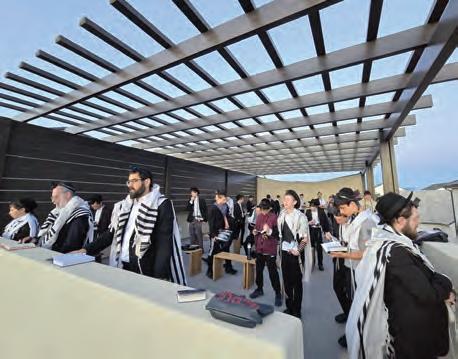
There is something about Shavuos in Yeshiva that simply cannot be replicated anywhere else. In many ways, Shavuos feels like the Yom Tov most naturally built for a Yeshiva environment. Pesach comes with weeks of cleaning, shopping, and preparation. Sukkos revolves around building sukkahs and buying daled minim. But Shavuos? The preparation for Shavuos in Yeshiva was Torah itself. Extra sedarim. Extra chazarah. Extra excitement. As the Yom Tov drew closer, there was an energy in the air that was impossible to ignore. You could feel that something special was approaching. One of the great highlights at Ner Yisroel was always the dancing after Maariv on the first night of Yom Tov. Hundreds of bochurim filling the Bais Medrash, arms linked, circling endlessly with their Rabbeim. There was no performance. No choreography. Just pure simcha shel Torah. K’ish echad b’lev echad. I still remember the powerful scene of the bochurim escorting the Rosh Hayeshiva home after davening. It felt like accompanying royalty. As a small child, I vividly remember watching Harav Ruderman zt”l walking with that regal dignity that only a true gadol possessed. Even at that young age, I sensed the awe surrounding him. The Yeshiva was not simply honoring a person. It was showing kavod haTorah itself.
The meals throughout Yom Tov were filled with lively zemiros, divrei Torah, and endless camaraderie. But everyone knew that the centerpiece of Shavuos was the night learning. Staying up all night in the Bais Medrash was not viewed as a burden. It was the event itself. The energy in the room was palpable. Somehow, even the most tired bochur became swept up in the atmosphere. There was always the same familiar spread
waiting outside the Bais Medrash. Sheet cake. Bright red punch in a pot. Coffee flowing by the gallon. Mountain Dew and energy drinks across the tables. Survival was the priority. The goal was simple: keep learning and get to the finish line.
By the time Shacharis arrived, the real battle began. Young bochurim fighting to keep their eyes open during leining became part of the annual Shavuos experience. After a brief morning rest and another Yom Tov seudah, everyone somehow returned to learning with renewed intensity. Then came the visits to Rabbeim’s homes for mesibas, more singing, more food, more Torah, and for many, another full night of learning as well. Shavuos in Yeshiva was exhausting in the best possible way. Every hour felt full. Every corner of the Yom Tov carried the feeling that Torah was not simply something we learned. It was something we lived inside of.
Today, long past our own Yeshiva years, I think many of us spend Shavuos trying to recreate those memories in whatever way we can. We try to bring a little of that Yeshiva feeling into our homes, our shuls, and our own learning. Maybe it is staying up a little later than usual. Maybe it is singing one more niggun at the table. Maybe it is learning with a child late into the night while fighting off exhaustion ourselves. Deep down, I think we are all searching for that same feeling we once experienced in the Bais Medrash on Shavuos night, when Torah filled the room, the hearts of the bochurim, and somehow the entire world itself.
Wishing a everyone a beautiful Shavuos!
Aaron M. Friedman
and mazal tovs to
in coming editions!
see back cover
Around the Community
An Evening Of Gratitude: JES Honors Baltimore’s Jewish Educators
The Baltimore Jewish community is blessed with exceptional schools, staffed by compassionate and inspiring educators who bring deep dedication both to their students and to their own professional growth. At Jewish Educational Services (JES), we are honored to support the educators who enrich our schools, and are proud to recognize their extraordinary contributions at our annual Educator Awards Ceremony, held on May 11.
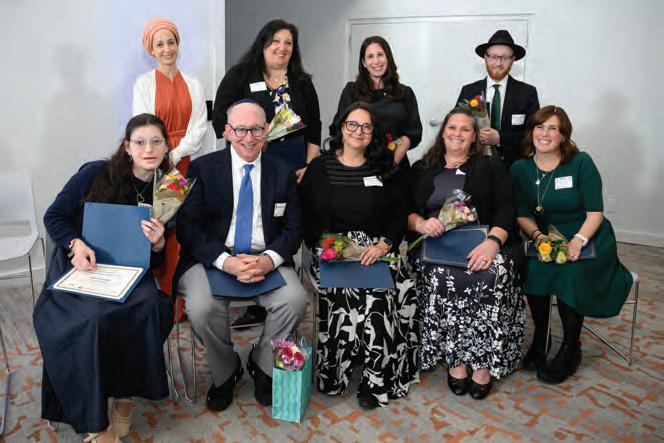
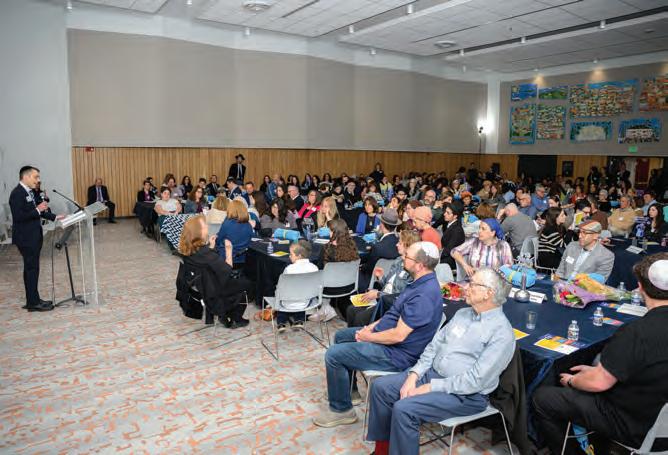
While nine outstanding educators and one exceptional student were formally honored, the evening was designed to celebrate all educators across Baltimore’s Jewish day schools, preschools, and congregational schools. Close to 200 community members, including many students of awardees, gathered to express their gratitude and support for the incredible work taking place in our educational institutions.
“Our teachers serve on the very front lines of building and guiding our children, the next generation of our community,” said Ari Krupp, JES Board President. “Each day, in classrooms across our Day Schools, Congregational Schools, and Early Childhood programs, they do far more than teach academic subjects. They instill values, nurture identity, and shape character.”
Guests were welcomed by JES staff as they arrived at the newly renovated Terrill Hall in the Associated headquarters and educators were gifted a fun JES-branded beach towel to kick off the soon-to-arrive summer season. The evening opened with a beautiful dessert reception by Chana Lavi, alongside astounding entertainment from Adam Stone, a strolling mentalist who delighted attendees with his mindreading abilities.
The heart of the evening was the recognition of the 10 awardees. Awards were presented by supervisors, colleagues, and even two students, who shared powerful stories that brought to life the impact of these educators and underscored why they were so deeply deserving of recognition. And they include:
• Havatzelet LouisChen of Darchei Noam Montessori received the Early Childhood Teaching Excellence Award Known as a loving morah, Havatzelet ensures that every child feels comfortable, supported, and empowered to learn at their own capacity.
• Mrs. Tzipporah Freedman, assistant principal at Bais Yaakov Middle School, was honored with the Innovative Educator Award. She is widely respected for her ability to innovate within an existing curriculum, expertly connecting material to students’ lives in ways that make learning relevant and engaging.
• Nina Cusner of Beth Tfiloh Dahan Community School received the Student Support Award for her unwavering commitment to helping students reach their fullest potential and gain confidence as they master new skills.
• Heather Pierce of Krieger Schechter Day School was named the Inspiring Educator Award recipient. Her belief in her students fosters the confidence they need to grow, take risks, and succeed.
• Alyse Roth of Ohr Chadash Academy earned the Excellence in General Studies Award. Her classroom prepares students not only for the next academic year, but for longterm success beyond it.
• Rabbi Yossi Keilson of Talmudical Academy received the Excellence in Judaic Studies Award. The fact that his students internalize and articulate what they learn is a true testament to his impactful teaching.
• Rachel Dressin was honored with the Ahavat Tzion Award for her signature Israel Project at the BermanLipavsky Religious School at Beth El, which deepens students’ knowledge of and connection to Israel.
• Jodi Rosen of Beth Israel Com-
munity Learning Lab received the Congregational School Educator Award. Her passion for Judaism shines through her teaching and resonates with students and colleagues alike.
• Rabbi Stuart Seltzer, Director of the Rosenbloom Religious School at Chizuk Amuno Congregation, was recognized with the Educational Leadership Award. He leads with integrity, models kindness, and shares his love of Torah with warmth and authenticity.
Educators were not the only ones celebrated. Esther Danziger, a high school student at Bais Yaakov, received the Robin F. Jacobs Student Achievement Award. Chosen for her selfmotivation and commitment to using her strengths to help others,
Esther’s story was shared through a moving video that deeply resonated with attendees.
“Last night was a beautiful, uplifting experience,” said Jodi Rosen, one of the awardees. “It was nice to be “seen” and valued as an educator in a room filled with people who value Jewish education.”
As guests departed, the energy of the evening lingered, one of joy, appreciation, and inspiration. The JES Educator Awards Celebration was more than a recognition of excellence; it was a powerful reminder of the vital role educators play in shaping the next generation and of the strong, supportive community that stands behind them, with JES at the forefront with resources for educators and families designed to strengthen learning and well-being.
OPEN HOUSE
Where Growth Comes to Life
Yeshivas Toras Simcha, founded in 1995, offers a unique environment for post–high school talmidim from abroad to grow in Torah, yiras shamayim, middos tovos, and joy in avodas Hashem.
Led by HaRav Zusha Solomon, shlita, the yeshiva emphasizes close Rebbe–talmid relationships.
Located in Yerushalayim’s Mattersdorf neighborhood, it features a vibrant, all-in-one campus with the Beis HaMedrash, dining room, and dormitories under one roof.
From Classroom To Boardroom: Beth Tfiloh 11th Graders Bring “Shark
Tank” To Life With Real-World Innovation
By: BJLife Newsroom
The Beth Tfiloh Dahan Community School 11thgrade Financial Literacy and Entrepreneurship class taught by Steven Venick recently brought the heat of the boardroom to the classroom for a live “Shark Tank” event. Taking place in the theater with an audience of parents, faculty, and peers, five student-led teams pitched original business ventures designed to solve real-world problems.
Each student had a specific job in their company from CEO, CFO, CPM and CMO and presented to the Sharks based on their role.
The event featured a diverse range of innovative products:
• Kustom: Presented Locko, an aesthetically pleasing, fashion-forward bag engineered with theft-deterrent features to give commuters and students peace of mind.
Tremendous Nachas
• Jaw Droppers: Introduced Root Flow, a specialized hairbrush that automatically applies natural, healthy oils to promote hair growth and maintenance during grooming.
• Cap-tivated Minds: Pitching Fast Flip, the world’s first dual-cap packaging system designed to eliminate product waste by allowing users to easily access every last drop of shampoo or household goods.
• Student Express: Demonstrated Ideas, Inc., an AI-powered platform providing instant, stepby-step homework guidance and fostering safe communication between students and teachers.
• Ghostbusters: Unveiled Ghosted, a Chrome extension that uses AI to log job applications and automate follow-up emails, bringing transparency and pressure to
At Beth Tfiloh:
At The National Chidon Hatanach
There was tremendous nachas at Beth Tfiloh Dahan Community School this past Sunday, May 17, as high school student Moshe L. ’28 won 1st place in the high school division at the Chidon Tanach National Finals in New York, earning him the right to, IY”H, compete in the international tournament next year on Yom Ha’atzmaut in Israel. Additionally, 7th grader Tamar L. ’31 placed 6th in the middle school division, an incredible accomplishment.
Twelve BT students traveled to New York to compete in the National Finals of the Chidon HaTanach - the Dr. Shimshon Isseroff US National Bible Contest for Jewish Youth. It was an incredibly exciting day for our students, their families, and the entire BT chevroh.
Chidon HaTanach is a prestigious international competition that challenges students on their mastery of Tanach, focusing on breadth of knowledge. Participation is voluntary, with students dedicating many extra hours outside
the modern hiring process.
Our panel of “Sharks” evaluated each team on their innovation, presentation skills, and the feasibility of their business models. The students responded to the Sharks with on point validations of how their product could be successful.
Congratulations to the winning team “Cap-tivated Minds presenting Fast Flip” and all of our 11th-grade entrepreneurs for their hard work, creativity, dedication and profession-
Moshe L. And Tamar L. Big Winners
By: BT/Michon Zysman
the regular school day to learning, chazarah, and preparation. Reaching the finalist stage reflects real commitment, discipline, and ahavas Torah.
One of the things that makes Beth Tfiloh so special is the thoughtful way Jewish learning is approached across the school. As Baltimore’s only co-educational K-12 college preparatory school, BT works hard to meet students where they are at, helping them deepen their connection to Torah and Judaism in ways that feel meaningful and personal. Students have opportunities to study Ivrit, Tanach, and a broad range of Jewish studies, while also being encouraged to challenge themselves and grow through advanced learning opportunities like the Chidon program.
Under the guidance of Chidon teacher Rabbi Leib Zalesch, students spent months preparing for the competition, learning Sefer Bereishit, Sefer Shmuel Bet, selections from Tehillim, and in the high school divi-
sion, portions of Sefer Yechezkel.
The high school competition concluded with an intense playoff round, where all three finalists tied for first place - an extraordinary accomplishment and a reflection of just how competitive the field was. Moshe’s performance earned him the opportunity to represent the United States on the international stage in Eretz Yisrael next year.
For the fifteenth consecutive year, Beth Tfiloh was represented at the national finals, something that speaks to the strong culture of serious Torah learning that continues to thrive at the school. In previous years, BT students Caleb Gitlitz ’21, Ryan Joseph ’21, and Yisrael Kaplowitz ’25 had the zechus to
Yasher koach to Tamar, Moshe, Rabbi Zalesch, and all of the students who participated in this year’s Chidon. Their hard work, dedication, and commitment to limud Torah continue to bring tremendous pride and nachas to the entire Beth Tfiloh community.
al spirit! These life skills will carry forward to college and eventually the real world.
represent the United States at the international Chidon in Eretz Yisrael.
WIN with !
Comfort Year-Round:
Experience stable indoor temperatures, and reduce drafts, with warm winters and cool summers, when you upgrade to spray foam insulation in your
Save Big on Energy Costs:
Cut your heating and cooling bills by 30-50% and make your HVAC system work smarter, not harder.
Breathe Better:
Enjoy improved air quality with reduced drafts and outdoor pollutants, creating a healthier living environment.
AIM Pregnancy Workshop – Week 4: Caring For The Mother Behind The Baby
AIM recently concluded the fourth and final session of its inspiring four-part Pregnancy Workshop Series for women in their second and third trimester. This week’s session was presented by Yael Schwarzeneberger, executive director of AIM.
The session was deeply interactive, with mothers reflecting on the many lessons and insights they gained throughout the past four weeks. One central theme emerged unanimously: the postpartum period is not meant to be experienced alone. The mothers discussed how increased support, rest, and connection can profoundly impact a woman’s recovery and adjustment to motherhood.
Yael emphasized the importance of caring for one’s mental health, explaining that emotional wellbeing is just as important - if not more important - than physical health during the postpartum period. Drawing from the Rambam in Hilchos De’os, she explained that the body and soul are deeply interconnected, and that emotional imbalance can directly affect one’s physical health. Maintaining emotional wellbeing, therefore,
is an essential part of preserving overall health.
The session also normalized the emotional shifts many women experience after childbirth. Yael explained that postpartum emotional changes are common and expected, not a sign of weakness or failure. The science behind these feelings was discussed as well. After birth, the body undergoes one of the fastest hormonal shifts in human biology. During pregnancy, estrogen levels rise dramatically, and within 24–48 hours after delivery, those hormone levels sharply decline. At the same time, oxytocin and prolactin increase to support milk production. Combined with physical recovery, sleep deprivation, and the overwhelming responsibility of caring for a newborn, these changes naturally create a significant emotional impact. Mothers were reassured that these experiences are extremely common and are part of the body’s adjustment process.
The definition and symptoms of the “baby blues” were also discussed, including how common they are during the first one to two weeks postpartum. Mothers were encouraged to
recognize that if symptoms become intense, persistent, or begin interfering with daily functioning, reaching out for help is essential. The message was clear and hopeful: with the right support and treatment, women not only get through this stage, but often emerge even stronger.
Studies highlighting the importance of postpartum support were reviewed as well. Mothers who receive physical and emotional assistance, adequate rest, and a strong sense of community tend to adjust to motherhood with greater confidence and resilience. This, Yael explained, is exactly why AIM was created within the community. The various AIM services were discussed, reinforcing the organization’s central mission of being a “second home” for mothers throughout their motherhood journey.
The importance of sleep was another major focus of the talk, with practical strategies shared to help mothers prioritize rest whenever possible. Mothers were reminded that rest is not a luxury, but rather a crucial component of postpartum healing - both physically and emotionally.
The morning concluded with empowering and reassuring words: “Your body is going through a major transition, and that takes adjustment. If challenges arise, they are temporary, and you are not alone. With the right support, you can absolutely get through this and thrive.”
The session left mothers feeling supported, empowered, and excited to embark on this next stage of life with a newfound sense of connection, both to fellow mothers and to the AIM community. AIM looks forward to continuing to provide meaningful workshops and programs that educate, uplift, and support mothers through every stage of the motherhood journey.
Week 2 Of Charm City Ballers Sponsored By Councilman Isaac “Yitzy” Schleifer Lived Up To Week 1, With 2 Excellent Games That Went Down To The Wire And Featured Big Comebacks
M&S Enterprise 54 Advanced Security Lock & Key 50
Bobker Keys Big Rally, Leads M&S to Comeback Win
Yoni Bobker scored 39 points and grabbed 17 rebounds as M&S Enterprise erased a 13 point second half deficit and defeated Advanced Security Lock & Key 54-50. Bobker was virtually uncheckable at times, with multiple three point plays and a crazy game sealing 3 pointer in the final 30 seconds as he tried to draw a shooting foul.
Mordi Spero added 5 points and
8 rebounds in the win, while Mike Khoshkerman added a pair of big 3s.
Heshey Green led the way for Advanced with 20 points, 13 rebounds, and 3 assists. Avi Yudkowsky added 12, 8, and 5 while Noach Schwartz chipped in 10 points. They drop to 0-2 despite two very strong efforts, and will be left ruing their 1-13 free throw shooting game. They’ll look to bounce back next week against King David Nursing & Rehab.
Fired Up Promotions 58 Diamond Auto Leasing 58
Wild Back and Forth Game Ends in Tie
Fired Up Promotions ran out to 19-2 and 28-12 leads early, Diamond Auto Leasing rallied and led 51-43 late in the second half, and after some late game drama this barnburner ended in an unsatisfying tie.
Fired Up came out of the gates and lived up to their team name, scored on 7 of their first 8 possessions and building a big early lead. Diamond Auto settled into the game as the first half went on, and then ripped off blistering 18-0 run to close out the half and take a 30-28 lead, buoyed by three 3s from Yitzy Hyatt.
The second half was more back
and forth, although Diamond went cold down the stretch and lost their 8 point lead, before David Raden sent the game to OT with a free throw with just 1 second on the clock. Both teams had a chance to win the game in the final seconds of overtime after an early exchange of baskets but were unable to convert.
Eitan Hariri had 29 points and 17 rebounds for Diamond, while Yitzy Hyatt poured in 6 3s on his way to 18 points. Fired Up got 20 points, 15 rebounds, and 6 assists from Avi Goldstein, with Akiva Stutman chipping in 12 points and 5 rebounds and Avner Shotz adding 11 points.
4-VOLUME SLIPCASED SET LIST PRICE: $139.99 NOW ONLY $104.99 INTRODUCTORY PRICE
New! Pele Yoeitz Vol. 4
Dedicated by: Dr. Louis and Chanie Malcmacher
He does not preach or rebuke, he teaches and discusses. He blends higher aspirations, demands for growth, and an astounding command of Torah sources with a keen awareness of human nature. Thanks to this English elucidation, it is enriching a new generation of people who strive to make their lives more meaningful and their service to Hashem more elevated. 25% OFF
Pele Yoeitz is an encyclopedia of Jewish ethics, prayer, behavior, guidance, and thought authored by the renowned 19th-century halachic authority, ethicist, and kabbalist Rav Eliezer Papo Pele Yoeitz was written two hundred years ago, but it speaks to our generation as if it were written today. The author covers a wide variety of topics, in alphabetical order, from aleph to tav.
Pre-Shavuos Event Hosted By The Newly Formed Baltimore Jewish Deaf Community
Three friends from Frederick drove into Baltimore so as not to miss an opportunity to socialize with other Deaf Jews. Janet, Ellen and Andrea heard about the Pre-Shavuos event hosted by the newly formed Baltimore Jewish Deaf Community and for them, the trip was more than worth it! “We relish any opportunity to socialize with other Deaf Jews,” they shared, describing activities where they feel not just welcomed, but fully included.
They were among 32 men and women, Deaf, hard of hearing, and sign language users, who gathered for an afternoon of wine and cheese tasting, cheesecake making, and impressively creative relay races. What set this event apart wasn’t just the warm, lively, albeit quiet, atmosphere. Unlike most social events, instead of sitting on the sidelines, all aspects of the afternoon were Deaf friendly and led by people who are Deaf themselves.
The story behind Baltimore Jewish Deaf Community begins with four Deaf activists- Yosef Gavert,Shira Zeigler,
Leah Caplan and Tchia Kastor. Many Deaf Jews, they observed, gravitate toward socializing at Deaf events outside the Jewish community forming friendships and connections that gradually pull them further from their Jewish roots.
They teamed up to found Baltimore Jewish Deaf Community, an organization dedicated to creating joyful Jewish events. We want Jewish Deaf and hard-of-hearing people of all ages and affiliations to come together without any communication barriers to strengthen Jewish values and feel pride in their Judaism,” related Mrs Kastor.
The Pre-Shavuos gathering was their third event, following a lively Melave Malka and a spirited Purim party. The organization is clearly gaining momentum.
Yosef and Shira recruited participants from all over, tracking down people with hearing loss and offering them community. And they did not disappoint!
Tchia guided the group through a de-
lightful mini cheesecake-making activity, and everyone left with their very own no-bake creation. Leah then brought the energy up a notch with a series of hilariously fun relay races cleverly tied to the Shavuos theme, from racing to craft five tissue paper flowers to filling two jars with pebbles using only the left hand. Laughter filled the room.
The afternoon was elevated by a Dvar Torah about Shavuos presented by Rabbi David Kastor in ASL and a visit from Rabbi Mordechai Shuchatowitz, Rav of Agudah of Greenspring, who moved through the room introducing himself and greeting participants warmly. A father of four young adults with hearing loss, his presence was meaningful, a quiet but powerful signal that the broader Jewish community is paying attention.
Walk into a Baltimore Jewish Deaf Community event and you’ll find a beautiful spectrum of experience. Some guests use ASL. Some lipread. Some have cochlear implants. Some wear hearing aids. And some use no assistive technology at all.
Baltimore is a magnet for Deaf Jews because of its strong core Jewish Deaf and hard of hearing community. Elana drove 2 hours to attend because she wanted to be with Deaf Jews; where she lives she has only non-Jewish friends. Malka from Silver Spring made the trip specifically because of the hushed atmosphere. She wears hearing aids but does not use sign language. “Unlike typical social events where background noise makes conversation exhausting,” she explained, “Here it’s quiet so conversation feels effortless.” Local interpreters joined the fun as well, lending their support to friends in this growing community.
At its heart, the Baltimore Jewish Deaf Community is about more than Deaf Friendly events. Their mission is to strengthen Jewish values and foster a sense of Jewish Deaf pride, by gathering people bound by the shared experiences and language to celebrate Judaism.
In true Deaf fashion, participants stayed way past the party’s end time chatting and joking amiably in the embrace of this incredible community.
Around the Community
Bais Yaakov Middle School Takes Both First Places In The CIJE Spring Robotics Competition
Bais Yaakov Middle School proudly celebrated an extraordinary victories at the CIJE Spring Robotics Competition held in Passaic, New Jersey. Competing against 15 schools and 51 robots from across the region, the Bais Yaakov teams demonstrated remarkable engineering skill, teamwork, strategy, and determination throughout the exciting day of competition.
In an incredible accomplishment, four 7th grade teams advanced to the finals, showcasing the depth and strength of the school’s growing robotics program. The excitement continued as two 8th grade teams captured BOTH first place positions with a staggering final score of 190 — an outstanding achievement that reflected months of hard work, practice, and dedication!
Throughout the season, students spent countless hours designing, building, programming, testing, and refining their robots while developing strategic driving skills and collaborative problem-solving techniques. Their perseverance, creativity, and enthusiasm were clearly evident in every round of competition.
The competition is part of the CIJE Robotics initiative run by the Center for Initiatives in Jewish Education (CIJE), sponsored by FM Home Loans. Through this innovative STEM program, students gain valuable experience in engineering design, coding, robotics, and teamwork. The school extends heartfelt appreciation to Dr. Joey Saltzman, the program’s CIJE mentor and liaison, whose guidance, encouragement, and continued support have helped the robotics program flourish and reach new heights.
Bais Yaakov Middle School is tremendously proud of every student who participated and represented the school with professionalism, sportsmanship, and excitement. The success of the program reflects not only technical skill, but also the dedication, collaboration, and spirit of the students and coaches who worked tirelessly throughout the season.
Seventh Grade
Coach: Mrs. Tanya Gerstman
Nechama Rina Albahari
Esther Braun
Judy Birnbaum
Yakira Datsenko
Racheili Edelson
Adina Goldsmith
Kayla Grier
Miri Gross
Esther Heinemann
Kayla Jakubowicz
Meital Sima Klein
Reena Levitan
Aliza Miller
Menucha Moskowitz
Shira Pickett
Chana Ray
Esther Gittel Shafranovich
Baila Shnaidman
Eighth Grade
Coach: Mrs. Rochelle Goldberg
Assistant Coach: Miss Hailey Lazar
Temimah Becker
Elisheva Copeland
Suri Goldfinger
Kayla Goodhart
Zoey Gross
Devora Lesser
Bachurei Mercaz Visit Harav Hopfer Shlit”a
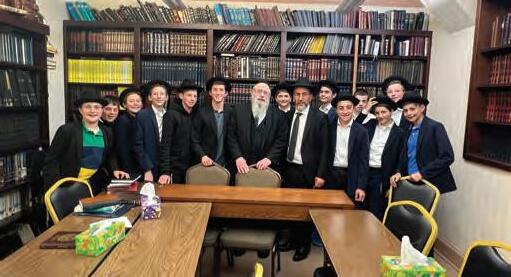
Bochurei Mercaz of Mercaz Torah U’Tefillah, marked another successful initiative inspired by the Zidichover Rebbe Shlit”a, giving middle school boys meaningful opportunities to strengthen their davening, leining, leadership, and public speaking skills. Under Rabbi Chaim Sher’s guidance, the minyan has diligently focused on maintaining Shtika during Chazaras HaShatz.
This past Friday, the bochurim earned a special outing to visit HaRav Yaakov Hopfer Shlit”a, who offered timely words of chizuk, emphasizing the importance of giving a friend a compliment and building one another up. The visit concluded with refreshements and warm smiles all around.
Tikva Niknava
Chana Leah Perelmuter
Bracha Pickett
Aleeza Schulman
Batya Schoenfeld
Sarah Solomon
Shira Steger
Robotics Middle School Supervisor:
Mrs. Gitti Horowitz
High School Robotics Leadership Coaches:
Shana Gross
Aidee Moss
Assistant Coaches:
Huvi Passe
Shani Rothschild
Leah Shnaidman
As another successful robotics season comes to a close, Bais Yaakov Middle School looks forward to continuing to inspire young women to explore STEM, engineering, coding, and leadership opportunities. The school congratulates all of the students for their remarkable accomplishments and thanks the families, coaches, mentors, and supporters who helped make this unforgettable season possible.
R’ Itche Rosenbaum
A Journey Beyond The Screen: The Utah Experience
There is something profoundly unique about immersing oneself in nature. For those of us who live in beautiful Silver Spring, MD, we are surrounded by parks, trees, and scenery that, while lovely, can sometimes feel routine. This past week however, ninth and tenth graders from the Yeshiva of Greater Washington had the opportunity to experience something entirely different, a landscape that inspired awe and a deeper appreciation for Niflaos HaBorei
This trip to Utah was not simply a getaway, but it was earned. The boys committed themselves to a year of separating from smartphone technology, choosing instead to cultivate real human connections and live more intentionally. Rashi (Vayikra 19:2) teaches that Kedusha is achieved through Pirusha, separation from the distractions around us. Their reward was not just travel, but perspective.
For many of the boys, the journey began with their first glimpse of the
desert landscape upon landing in Nevada, an eye-opening introduction to a stark yet breathtaking world. The vast deserts and towering mountains felt almost otherworldly. Hiking through the Valley of Fire just outside Las Vegas was an experience that defied expectations, with its striking and deep colors and dramatic formations.
Each stop along the way brought new moments of wonder. From hiking through the majestic beauty of Bryce Canyon, watching the sun set over endless desert horizons, or sitting beneath a crystal-clear night sky filled with stars alongside their Rabbeim and Menahel, even spotting the occasional shooting star, the boys encountered countless opportunities for reflection on Muh Rabu Maasecha Hashem. The clean desert air and the quiet vastness created a setting unlike anything they had known.
One tenth grader described the experience as “humbling”. Standing before the immense landscape, he reflected that in such a vast world,
By: Rabbi Dr. Avichai Pepper
a person’s greatness is defined not by status, but by actions, Torah, and Motzvos, a reminder of the greatness of the world that Hashem has created.
Yet, while the scenery was unforgettable and the programming exceptional, many students shared that the most powerful part of the trip was something that could not be caught on camera, the unity among the boys. The sense of achdus that developed went far beyond expectations and left a lasting impact.
As one ninth grader put it, “There are more memories made throughout this trip than the memories saved on a smartphone.”
In truth, accomplishments do not always require rewards. But in this case, the Yeshiva, with the generous help of sponsorship, used this achievement not merely as a prize, but as inspiration and encouragement for the boys to continue striving, growing, and reaching even greater heights.
Greater Washington Weekday Minyanim Guide
6:15 am Young Israel Shomrai Emunah M-F
6:20 am Ohev Shalom Talmud Torah OLNEY M, Th
6:25 am Southeast Hebrew Cong., Knesset Yehoshua M-F
6:30 am Beth Sholom Congregation M-F
Beit Halevi (Sfardi) M, T Chabad of Silver Spring M-F
Ohev Shalom Talmud Torah OLNEY T, W, F
Young Israel Shomrai Emunah S YGW M, Th
6:35 am Ohr Hatorah M, Th
6:40 am YGW S, T, W, F Magen David Sephardic Congregation M-Th
6:45 am Beit Halevi (Sfardi) S, T, W, F
Kemp Mill Synagogue M, Th
Ohr Hatorah T, W, F
Young Israel Shomrai Emunah M, Th
6:50 am Woodside Synagogue/Ahavas Torah M, Th Silver Spring Jewish Center M-F
Chabad of Upper Montgomery County M-F
6:55 am Young Israel Shomrai Emunah T, W, F
7:00 am Kemp Mill Synagogue T, W, F
Southeast Hebrew Cong., Knesset YehoshuaS
Silver Spring Jewish Center S
Woodside Synagogue/Ahavas Torah T, W, F
Young Israel Ezras Israel of Potomac T, W, F
7:05 am Kesher Israel M, Th
7:15 am Kemp Mill Synagogue M, Th
Kesher Israel T, W, F
Ohev Sholom Talmud Torah/The National Synagogue M-F
Ohr Hatorah S
7:30 am Chabad of DC M-F
Chabad of Potomac M-F
JROC M-F
Kemp Mill Synagogue T, W, F
Southeast Hebrew Cong., Knesset Yehoshua M-F
Young Israel Shomrai Emunah S
Young Israel Shomrai Emunah (Sfardi) M-F
7:45 am YGW (Yeshiva Session Only) S-F
8:00 am Beth Sholom Congregation S
Kemp Mill Synagogue S
Kesher Israel S
Ohev Shalom Talmud Torah OLNEYS
Southeast Hebrew Cong., Knesset YehoshuaS
Chabad of Upper Montgomery CountyS
Woodside Synagogue/Ahavas TorahS
8:00 am YGW (High School; School-Contingent) S-F
Young Israel Ezras Israel of PotomacS
Young Israel Shomrai Emunah (Sfardi)S
8:05 am Ezras Israel Congregation of Rockville M, Th
8:15 am Ohr Hatorah S Ezras Israel Congregation of Rockville S, T, W, F
Kehilat Pardes / Berman Hebrew Academy S-F
Silver Spring Jewish Center M-F
8:30 am Chabad of DC S Chabad of Potomac S JROC S Ohev Sholom Talmud Torah/The National Synagogue S Silver Spring Jewish Center S YGW (Summer Only) S-F
8:45 am Young Israel Shomrai Emunah S-F
9:00 am Chabad of Silver Spring S Kemp Mill Synagogue S
2:00 pm Silver Spring Jewish Center S-F
2:10 pm YGW M-Th School Days
2:45
3:00
mincha/maariv
Before Shkiah (15-18 minutes), S-TH
Beit Halevi (Sfardi)
Beth Sholom Congregation
Chabad of Potomac
Chabad of Silver Spring
Chabad of Upper Montgomery County
Ezras Israel Congregation of Rockville (20 min before, S-F) JROC
Kemp Mill Synagogue
Kesher Israel
Magen David Sephardic Congregation
Ohev Sholom Talmud Torah/The National Synagogue
Ohr Hatorah
Silver Spring Jewish Center
Southeast Hebrew Congregation
Woodside Synagogue/Ahavas Torah
Young Israel Ezras Israel of Potomac
Young Israel Shomrai Emunah (Asheknaz)
Young Israel Shomrai Emunah (Sefarhadi)
maariv
8:45
shacharis
Primary Election 2026
June 2 is the deadline to register to vote or change parties
If you are not registered to vote, PLEASE register now! Deadline to
The upcoming Primary Election is absolutely critical for our LOCAL community. We all have an obligation to use our vote to HELP our community. If you are not registered to vote, PLEASE register all eligible members of your household (turning 18 by Nov 3rd). If you need to CHANGE your registration to a party where your vote can help our LOCAL community, it is a quick and easy process. Simply go to
or scan the code.
The Week In News
The Week In News
Drone Hits UAE Nuclear Plant
A drone strike near the United Arab Emirates’ Barakah Nuclear Power Plant sparked a fire on Sunday, intensifying concerns over the shaky ceasefire between the United States and Iran and underscoring the vulnerability of critical infrastructure across the Gulf region.
Officials said the blaze was quickly contained and that there were no injuries or signs of elevated radiation levels. According to Emirati authorities and United Nations experts, the fire broke out in an electrical generator located outside the plant’s inner perimeter.
The Barakah facility, the Arab world’s first nuclear power plant, is located near Al Dhannah in western Abu Dhabi and supplies roughly a quarter of the UAE’s electricity. Emergency diesel generators were activated to maintain power to one reactor unit after the fire erupted.
“All units are operating normally, and the blaze did not impact safety or radiation levels at the site,” Abu Dhabi’s media office said in a statement.
While Emirati officials stopped short of directly accusing Iran, the attack comes amid mounting regional tensions despite a ceasefire brokered in early April between Washington and Tehran. The conflict erupted after U.S. and Israeli strikes on Iran in late February, eliciting retaliatory attacks by Iran against U.S. allies and Israel.
The UAE has faced repeated missile and drone threats throughout the conflict. According to government figures, Emirati defenses have intercepted 572 missiles and more than 2,200 drones since the war began.
The incident also renewed fears about the dangers posed by military activity
near nuclear facilities. Rafael Grossi, head of the International Atomic Energy Agency, warned that attacks near nuclear plants could “jeopardize the safety of the facilities and trigger a nuclear accident.”
Similar fears have surfaced during the war in Ukraine, where the Russian-controlled Zaporizhzhia Nuclear Power Plant has repeatedly lost outside power connections and where a drone recently damaged the protective shelter over the abandoned Chernobyl Nuclear Power Plant.
Meanwhile, diplomatic efforts between Washington and Tehran remain uncertain. Donald Trump said Saturday he would consider a peace agreement allowing Iran to suspend nuclear development for 20 years rather than permanently dismantle its program.
Tensions also remain high in the strategically vital Strait of Hormuz, where Iran has restricted shipping traffic since March. Tehran has reportedly begun imposing tolls on vessels passing through the waterway, a move condemned by the United States and international shipping organizations.
Iran continues to insist its nuclear program is intended for peaceful purposes, though Western powers maintain concern over Tehran’s uranium enrichment activities, which have approached weapons-grade levels.
Ebola Outbreak
An international response is intensifying as health officials race to contain a growing Ebola outbreak in the Democratic Republic of the Congo and neighboring Uganda that has already infected hundreds of people and caused dozens of suspected deaths.
On Sunday, the World Health Organization declared the outbreak a “public health emergency of international concern,” warning that the rapidly rising number of infections could signal a much larger crisis than currently known.
More than 100 suspected deaths have been linked to the outbreak in Congo, according to Jean Kaseya, head of the Africa Centres for Disease Control and Prevention. The U.S. Centers for Disease Control and Prevention said there are currently 10 confirmed cases and more than 330 suspected cases in the country, primarily in the remote northeastern Ituri province.
In Uganda, two confirmed cases — including one death — have been reported in the capital city of Kampala.
Health officials say the outbreak is being driven by the rare Bundibugyo strain of Ebola, for which there are currently no approved vaccines or treatments. The strain carries a fatality rate estimated between 25% and 40%, according to Médecins Sans Frontières.
Ebola symptoms include fever, muscle pain, rash and, in severe cases, bleeding. The virus spreads through direct contact with bodily fluids or contaminated materials.
The U.S. government said it is working to relocate “a small number” of Americans believed to have been directly affected by the outbreak. Reports indicated several Americans in Congo may have been exposed to the virus, though officials have not confirmed whether any U.S. citizens have tested positive.
“We are actively assessing the situation on the ground,” said Dr. Satish Pillai during a CDC briefing.
The U.S. State Department has issued a new advisory warning Americans against travel to Congo, while the U.S. Embassy in Kampala temporarily suspended visa services because of the outbreak.
Meanwhile, international aid efforts are ramping up. Nearly seven metric tons of emergency medical supplies, including protective gear, hospital beds and tents, were delivered to the city of Bunia over the weekend. Congo’s health ministry also announced the opening of three new treatment centers in the affected region.
Health experts warn the outbreak is especially dangerous because it is unfolding amid an ongoing humanitarian crisis in eastern Congo, where conflict and mass displacement have severely weakened the healthcare system.
“This raises serious concerns about gaps in infection prevention and control,” said Dr. Matt Mason after reports that four healthcare workers were among the suspected deaths.
The current outbreak marks Congo’s 17th Ebola epidemic since the virus was first identified there in 1976.
Iranian Prisoner Sent Home
charged from a cardiac care unit and sent home, weeks after being transferred from prison to the hospital following a suspected heart attack.
Mohammadi, 54, won the Nobel Peace Prize in 2023 while in prison for her campaign to advance women’s rights and abolish the death penalty in Iran.
She was sentenced to a new prison term earlier this year in the build-up to the U.S. and Israeli war against Iran.
Mohammadi suffered a suspected heart attack in late March and was transferred to the hospital a month later, first in the northwest city of Zanjan then, after a temporary suspension of her sentence on heavy bail, to Tehran’s Pars Hospital.
“Her recovery demands strict medical supervision outside prison walls. Returning her to detention is a death sentence,” Mohammadi’s daughter, Kiana Rahmani, said.
Mohammadi, whose detentions have attracted worldwide attention, was arrested in December after denouncing the death of a lawyer, Khosrow Alikordi. A prosecutor told reporters that she had made provocative remarks at Alikordi’s memorial ceremony.
Qatar’s Economic Hit
In Qatar, a desert peninsula protruding into the Persian Gulf, natural gas turned the country from a pearl-diving backwater into one of the world’s wealthiest nations.
Qatar spent three decades building supply lines, shipping tens of billions of dollars of liquefied natural gas each year through the Strait of Hormuz to ports across Asia and Europe.
The state, which derives more than 60% of its revenue from gas and gas-related exports, used that money to transform the peninsula into a gleaming metropolis.
Gas wealth funded a metro system linking the capital, Doha, to Lusail, a northern city that is home to a Parisian-style mall and a theme park with
Iranian Nobel Peace Prize winner Narges Mohammadi has been dis-
RIDER PROFILE
ELI GREENGART
Eli Greengart began cycling in 2014 through Biker Cholim, joining in its very first year and discovering a passion that would grow into something far greater. What started as a new pursuit quickly became a meaningful family experience, as he has since ridden together with his sons, Chaim, Tzvi, Gedalia, and Yitzchok Dovid, all of whom have taken part.
Having personally benefited from the vital work of Bikur Cholim of Baltimore, Eli views his participation in Biker Cholim as a meaningful way to give back. Through cycling, he is able to support the organization’s mission and contribute directly to the chesed that strengthens and sustains the community.
The Week In News
artificial snow. The riches were also funneled into the world’s most expensive World Cup and a $600 billion sovereign wealth fund.
Then, in February, Qatar’s door to the world slammed shut.
The closure of the Strait of Hormuz
In a social media post, Trump said the terror leader, Abu-Bilal al-Mainuki, had been killed Friday night in a “very complex mission” carried out at his direction by U.S. forces and the Nigerian military.
contracts. Two weeks later, Iranian missiles and drones struck Qatar’s Ras Laffan plant, damaging critical equipment and causing a 17% reduction in Qatar’s production capacity.
The damage means that even if the strait were to open tomorrow, it would take years to return to prewar output.
On Friday, President Donald Trump said that U.S. and Nigerian forces had killed one of the Islamic State group’s highest-ranking leaders in an operation in Africa. The United States has been targeting Islamic militants who are killing Christians in Nigeria.
Al-Mainuki was designated a terrorist and one of the Islamic State group’s leaders by the State Department in 2023. He was a Nigerian citizen, according to the Treasury Department’s Office of Foreign Assets Control, which had sanctioned
Three U.S. officials said on Saturday that al-Mainuki was killed in a helicopter-borne assault carried out by about two dozen Nigerian and U.S. commandos, which included members of the Navy’s SEAL Team 6. The commandos attacked him and about three dozen fighters on two small islands in Lake Chad.
Heavy fighting ensued over a nearly three-hour battle. Although the U.S. military sought to capture al-Mainuki, when it became clear he would not surrender, the Americans killed him with an airstrike rather than risk letting him escape. No U.S. or Nigerian military casual-
Military analysts are now poring through the cellphones, laptop computers and other electronic records recovered for information on the recruiting, operational and financial activities of the Islamic State branches in Africa and elsewhere in the world, according to U.S.
Al-Mainuki was the second-most-senior leader in the Islamic State group. He oversaw the group’s global operations, media, recruitment and finances and was directly involved in plots including the kidnapping of an American missionary pilot in Niger last fall.
Nigeria’s Foreign Ministry said al-Mainuki had been responsible for recent attacks on the military in the country’s northeast.
Executions Surge in Iran
According to rights groups, Iran has been escalating executions since the ceasefire. Four prisoners were killed this week on charges that include espionage and terrorism, according to Iranian news media.
Iran has long been one of the world’s most frequent users of capital punishment. The pace of sentencing and hang-
The Week In News
ings appears to have surged over the last two months, amid the war with the United States and Israel, according to several Iran-focused rights groups.
In most of those cases, the groups say, the executed prisoners did not receive due process.
“Many of these executions follow
their territory against the Islamic Republic, the officials said.
All three spoke on condition of anonymity. They declined describing the targets that were struck by the Gulf Arab nations or the exact dates of the attacks.
three executions in one day, all of whom were men arrested in relation to the January protests.
On Wednesday, Iranian state media reported that Mohammad Abbasi, who was arrested along with his daughter on charges of killing a police officer during the January protests, had been executed.
S.A. and UAE Struck Iran
Saudi Arabia and the United Arab Emirates separately carried out strikes on Iran in retaliation for attacks conducted against them during the war in the Middle East, two current and one former senior U.S. officials said.
It is the first known time that the two countries have directly attacked Iran. The strikes, which were unannounced, underscored how both monarchies were becoming more assertive in defending
Neither the Saudi nor the Emirati government has acknowledged carrying out the attacks. Both countries host U.S. military installations but have maintained publicly that they are bystanders to the war, engaged only in defensive actions. The strikes would instead appear to make them direct combatants.
The Saudi government’s Center for International Communication, which handles media inquiries, did not respond to a request for comment, nor did the Emirati Foreign Ministry.
Saudi Arabia and the UAE both have deep military relationships with the United States and have traditionally relied on the United States to defend them
Since the United States and Israel attacked Iran on February 28 — against the advice of officials in several Gulf countries — that assumption has partially unraveled. Iran has launched thousands of retaliatory missile and drone attacks at Gulf Arab nations that host U.S. military installations, causing widespread damage to energy infrastructure, airports, seaports and hotels. The attacks have killed at least 19 civilians across the Gulf countries and shaken their economic models as safe havens for business and tourism in a turbulent region.
Israel reportedly operated two covert military bases inside Iraq to support operations against Iran, according to a report published Sunday by The New York Times. The report said an Iraqi soldier and a civilian were killed in incidents tied to the secret installations.
The revelations expand on an earlier report from The Wall Street Journal,
FESTIVAL FOR FAMILY AND COMMUNITY
Sunday, May 31, 2026 | 10:00 am - 3:00 pm
Rosenbloom Owings Mills JCC
Free Admission | Rain or Shine (Event will move inside in case of rain)
• NEW - Classic cars and cool vehicles, a full roller skating rink, rock wall, and inflatables!
• Strolling entertainment including bubble artists, balloon twisting, characters, and more!
• Live entertainment on stage - music and dance, featuring Alex and the Kaleidoscope.
• Take a stroll with LifeBridge Health providers and partners on their “Boardwalk to BetterHealth” for fun interactive games and prizes.
• Enjoy delicious food, snow cones, plus shopping for gifts, jewelry and more!
Event Parking at Stevenson University on Owings Mills Blvd., with shuttle services provided.
Thank you to our sponsors:
Media Sponsors:
The Week In News
which disclosed that Israel had built a covert base in Iraq’s western desert during the recent U.S.-Israeli conflict with Iran that erupted in late February.
Satellite imagery later appeared to show a makeshift airstrip carved into a dry lakebed roughly 180 kilometers southwest of the Iraqi city of Karbala.
According to Iraqi officials cited by the Times, Israel actually maintained two bases in the area. One of the facilities had reportedly been operating since late 2024 and was used during both the June 2025 conflict with Iran and the latest round of fighting this year. The report said the United States was aware of the operation, though the base is no longer active.
The installations allegedly served multiple purposes for the Israeli military, including reducing flight time for strikes on Iran, supporting logistics operations, housing medical facilities, and stationing special forces and rescue teams in case Israeli pilots were shot down.
The Israel Defense Forces has not publicly commented on the reports. Iraq and Israel do not maintain diplomatic relations.
The Times reported that Bedouin residents in Iraq’s remote western desert re-
peatedly alerted local authorities to suspicious activity in the area. Iraqi forces reportedly monitored the situation from afar and sought information from the United States, which allegedly declined to provide details.
According to the report, Washington also urged Iraq to disable radar systems to avoid interfering with U.S. aircraft operations.
The situation turned deadly on March 3, when a Bedouin shepherd identified as Awad al-Shammari reportedly discovered one of the bases while traveling to buy groceries. Said that al-Shammari managed to alert Iraqi authorities before he was allegedly killed by an Israeli helicopter. His family later recovered his body after speaking with witnesses.
Iraqi forces later sent a reconnaissance team to investigate the site, but the mission ended after one Iraqi soldier was killed and two others were wounded by what officials believed was Israeli fire.
Senior Iraqi officials reportedly chose to minimize public discussion of the incident, though Baghdad filed a complaint with the United Nations Security Council and briefed members of parliament.
The Week In News Defense Complex on Former UNRWA Compound
On Sunday, Israel’s government approved plans to establish a new defense complex that will include an IDF museum, enlistment office, and an office for the defense minister at the site of UNRWA’s former headquarters near Ammunition Hill in East Jerusalem.
According to a joint statement from the Defense Ministry and the Jerusalem municipality, the new complex will be built on a roughly 36-dunam (9-acre) site and is intended to strengthen the defense establishment’s presence in Israel’s capital.
Defense Minister Israel Katz said the move is “a decision of sovereignty, Zionism and security,” arguing there is “nothing more symbolic or just” than establishing defense institutions “on the ruins of the UNRWA compound.”
He noted, “In a place where an organization operated that became part
of the machinery of terror and incitement against Israel, institutions will now be established that strengthen Jerusalem, the IDF, and the State of Israel,” Katz said, adding, “This is a clear message to all our enemies: we will continue to build, strengthen, and deepen our hold on Jerusalem, the eternal capital of Israel, from a position of strength.”
Israel began demolishing UNRWA’s East Jerusalem headquarters in January, following years of legislative measures against the UN agency, which Israel has long accused of colluding with Hamas and participating in terror activities, including the October 7, 2023, massacre.
The Defense Ministry signed an agreement with the Jerusalem municipality in December to establish new defense headquarters in the capital and relocate the military’s colleges to the city, among other moves.
UNRWA had not used the building since the start of last year after Israel ordered it to vacate all its premises and cease its operations.
Israel has provided evidence that UNRWA employees had participated in
the October 7 massacre, when Hamasled terrorists invaded southern Israel, killing more than 1,200 people and taking another 251 as hostages.
Israel has also alleged that more than 10 percent of UNRWA’s staff in Gaza have ties to terrorist factions and that educational facilities under the organization’s auspices consistently incite hatred of Israel and glorify terror.
In February 2024, the IDF revealed the existence of an underground Hamas data center directly beneath UNRWA’s Gaza Strip headquarters. The IDF has also repeatedly targeted Hamas command centers and gunmen hiding out in UNRWA schools.
A number of freed hostages have also testified after returning to Israel that they were held in captivity in UNRWA schools and facilities.
Maoz Israel Recanati, Hy”d
An IDF officer was killed in a Hezbollah explosive drone attack in southern Lebanon on Friday. The slain officer was
named as Cpt. Maoz Israel Recanati, 24, a platoon commander in the Golani Brigade’s 12th Battalion, from Itamar.
Recanati was set to marry his fiancée, Rani, in a month, according to a statement from Prime Minister Benjamin Netanyahu. “We all embrace her and his loved ones during this difficult time,” the statement read.
Recanati was the seventh IDF soldier to be killed in southern Lebanon since the start of the ceasefire, and the 20th since hostilities escalated amid the Iran war. A civilian contractor has also been killed in southern Lebanon.
The IDF said on Saturday that it shot down several Hezbollah drones that were flying in areas of southern Lebanon where Israeli troops are operating. The drones triggered sirens in several border communities in the Western Galilee. Additionally, Hezbollah launched
The Week In News
several rockets and mortars at troops in southern Lebanon. The IDF said the projectiles struck near the forces but did not cause any injuries. In retaliation, the IDF struck some 100 Hezbollah targets in southern Lebanon over the weekend. According to the military, the targets included surveillance posts, weapon depots, and other infrastructure used by the terror group to advance attacks.
The latest strikes come after envoys from Israel and Lebanon held negotiations in Washington, following the first direct talks in decades last month between the two countries, which do not have diplomatic relations. They agreed to extend the ceasefire for 45 days, the U.S. announced on Friday.
Hezbollah opposes the negotiations, saying on Saturday that the Lebanese government is offering a “series of free concessions” to “the enemy.”
Hamas Chief Killed in Gaza
Gaza, on Friday in a “precise strike” on Gaza City in the Strip’s north.
The military said Haddad had recently “acted to rebuild the capabilities of the terrorist organization’s military wing and to plan numerous terror attacks against Israeli civilians and IDF troops,” despite a U.S.-brokered ceasefire agreement in October.
The IDF said that it also killed two other Hamas terrorists who invaded Israel during the October 7 massacre in recent strikes in the Strip. Khamer Iyad Muhammad Al-Matouq and Khaled Muhammad Salem Jouda were killed in separate strikes in northern Gaza in the past two weeks.
The pair had recently attempted to carry out attacks on troops in Gaza and had “posed an immediate threat to the forces.”
Another strike in central Gaza last Wednesday killed Abdel Rahman Mahmoud Jumaa Shafi, a member of Hamas’s Bureij Battalion, who the military said had advanced attacks on troops in Gaza.
The terror group had not officially
tyrdom,” and Palestinian media published footage of a funeral procession and “martyr poster” for him in the Strip.
Nicknamed “The Ghost,” Haddad had survived multiple assassination attempts by Israel, according to Hamas sources.
Haddad, whom the IDF called “one of the architects of the brutal October 7 massacre,” took over his roles after the May 2025 killing of Mohammed Sinwar, the brother and successor of Yahya Sinwar, who led the terror group in the 2023 onslaught that sparked the war in Gaza.
“Throughout the war, Haddad was involved in holding many Israeli hostages in Hamas captivity. Haddad managed Hamas’s hostage captivity system and surrounded himself with hostages in an attempt to prevent his elimination,” the IDF said.
Haddad led Hamas’s Gaza City Brigade during the October 7 massacre and was one of the last remaining senior commanders “who directed the planning and execution of the October 7 massacre and the management of combat operations against IDF troops,” the IDF said.
IDF Chief of Staff Lt. Gen. Eyal Zamir hailed his killing as a “significant op-
erational success by the IDF led by the Southern Command, the Intelligence Directorate, the Air Force and the Shin Bet.”
Zamir said that “the name of the arch-terrorist” Haddad “came up again and again” in his conversations with former hostages, according to remarks published by the IDF.
“Today, we succeeded in eliminating him,” Zamir said. “The IDF will continue to pursue our enemies, strike, and settle accounts with everyone who took part in the October 7 massacre.”
Since October 7, when more than 1,200 people were killed and 251 people were taken hostage, Israel has worked to eliminate senior Hamas officials including the Sinwar brothers, Hamas politburo head Ismail Haniyeh, and longtime military chief Muhammad Deif.
Abbas’s Son Appointed
Preliminary results from the elections for Fatah’s Central Committee, the small leadership body of around 20 members that runs the movement currently controlling the Palestinian Authority,
The Week In News
showed that PA President Mahmoud Abbas was elected to the panel, Palestinian media outlets reported on Sunday.
Fatah, like the PA, is headed by the elder Abbas, whose son Yasser Abbas is seen as his possible successor.
The younger Abbas, 64, a millionaire businessman who spends most of his time in Canada, secured a place on the central committee after being appointed around five years ago as his father’s “special representative” — a role that marked his emergence on the political scene.
Yasser Abbas, who has never held an official role within Fatah or the PA, runs tobacco and contracting firms in the parts of the West Bank where the PA exercises limited self-rule. Critics have long alleged that he and his brother Tarek have used public funds to help their businesses. Both men reject those allegations.
Marwan Barghouti, seen by many Palestinians as a potential successor to Abbas, topped the preliminary results, retaining his seat on the committee with the highest number of votes. Barghouti has since 2002 been serving five cumulative life terms plus 40 years in prison for helping plan terror attacks during the Second Intifada that killed five civilians.
Jibril Rajoub was reelected as the sec-
retary-general of the committee, keeping the seat he has held since 2017, while Palestinian Authority Vice President Hussein Al-Sheikh was also reelected.
Majed Faraj, head of the Palestinian General Intelligence Service, one of the PA’s security bodies, who is also considered close to Abbas, was also reelected, as was Mahmoud al-Aloul, Abbas’s deputy in Fatah.
According to the reports, Leila Ghannam, the governor of the Ramallah district, who is also considered close to Abbas, was elected as a new member of the Central Committee.
Among the newcomers was Zakaria Zubeidi, 50, a former commander of the Al-Aqsa Martyrs Brigades terror group — Fatah’s armed wing — in the Jenin refugee camp, who was freed from Israeli prison last year under a prisoner exchange deal with Hamas amid the war triggered by the Palestinian terror group’s October 7, 2023, invasion of southern Israel. Zubeidi organized dozens of terror attacks during the Second Intifada and was one of six prisoners who briefly escaped from Gilboa prison in 2021, before being recaptured. The three-day congress, held simultaneously across Ramallah, Gaza, Cairo, and Beirut, drew 2,507 voters — a turn-
The Week In News
out of 94.64 percent, organizers said.
The PA was set up as an interim administration under the 1990s Oslo Accords between Israel and the Palestine Liberation Organization, an umbrella group still internationally recognized as the representative of the Palestinian people. The powerful Fatah party dominates both the PA and the PLO.
In recent decades, Fatah’s popularity and influence have dwindled amid internal divisions and growing public frustration. The sense of disappointment led to a surge in support for rival Hamas, which won the last legislative elections held in 2006, before going on to expel Fatah from the Gaza Strip in a bloody coup.
Did Bibi Visit UAE?
Prime Minister Benjamin Netanyahu revealed last Wednesday that he secretly visited the United Arab Emirates during the recent U.S.-Israeli war with Iran and met with Emirati President Mohammed bin Zayed Al Nahyan — a claim swiftly denied by Abu Dhabi.
According to a statement from Netanyahu’s office, the covert meeting produced a “historic breakthrough” in rela-
tions between the two countries amid the regional conflict. A source familiar with the matter said the leaders met for several hours on March 26 in the oasis city of Al Ain near the Oman border.
Despite the report, the UAE Foreign Ministry pushed back strongly, calling Netanyahu’s account “entirely unfounded.”
“The UAE reaffirms that its relations with Israel are public and conducted within the framework of the well-known and officially declared Abraham Accords,” the ministry said in a statement, adding that claims regarding undisclosed visits or unofficial arrangements were false unless announced by Emirati authorities.
Netanyahu’s former spokesman, Ziv Agmon, publicly insisted the visit took place.
“As someone who accompanied the prime minister on the historic trip that has been top secret until today, I can say that the prime minister was received in Abu Dhabi with the honor of kings,” Agmon wrote on social media.
He claimed Sheikh Mohammed personally greeted Netanyahu and even drove him from the plane to the palace in his own vehicle.
“The things the prime minister concluded during this amazing visit will be talked about for generations to come,”
Agmon wrote. “A great success!”
Iranian officials also reacted sharply to the reports. Iranian Foreign Minister Abbas Araghchi warned the UAE against cooperating with Israel.
“Enmity with the Great People of Iran is a foolish gamble,” Araghchi wrote online. “Those colluding with Israel to sow division will be held to account.”
The reports highlighted the deepening cooperation between Israel and the UAE during the war with Iran. Earlier Wednesday, reports indicated that David Barnea, head of Israel’s Mossad intelligence agency, made multiple secret visits to the Gulf state during the conflict to coordinate military operations and intelligence sharing.
Meanwhile, David Zini, chief of Israel’s Shin Bet security agency, was also reportedly sent to strengthen coordination between the countries’ security services.
U.S. officials additionally confirmed recent reports that Israel deployed an Iron Dome battery to the UAE, along with Israeli personnel to operate it.
The UAE has faced heavy Iranian missile and drone attacks throughout the conflict. According to Emirati officials, Iran launched roughly 550 missiles and more than 2,200 drones at the country, making it one of the hardest-hit nations in the region during the war.
The reported meeting would mark Netanyahu’s first known visit to the UAE since the signing of the Abraham Accords in 2020.
Trump Settles with IRS
President Donald Trump and the Justice Department have reached a settlement in Trump’s $10 billion lawsuit against the Internal Revenue Service and Treasury Department over the leak of his tax records, according to court documents filed on Monday.
The lawsuit, filed in January in federal court in Miami, accused the agencies of improperly allowing a government contractor to disclose Trump’s tax returns, along with those of his sons and the Trump Organization, to several media outlets in 2020. Trump sued in his personal capacity, while Eric Trump, Donald Trump Jr., and the Trump Organization were also named as plaintiffs.
Neither the Justice Department nor Trump’s attorneys immediately com-
T H A N K
To our generous donors, parents, corporate sponsors, and the entire Silver Spring community for making our campaign a success!
Kulam helps each boy grow individually while feeling part of something bigger—building identity, connection, and purpose through shared experiences.
The Week In News
mented on the terms of the agreement.
Last week, reports emerged that the case could be dismissed in exchange for the creation of a fund worth more than $1.7 billion to compensate Trump allies who claim they were unfairly targeted during the Biden administration. The reported arrangement has not been independently confirmed.
Following those reports, Trump’s legal team issued a statement accusing the IRS of permitting “a rogue, politically-motivated employee” to leak confidential financial records belonging to Trump, his family, and the Trump Organization to outlets including The New York Times and ProPublica.
“President Trump continues to hold those who wrong America and Americans accountable,” the statement said.
Court filings earlier this spring showed both sides requesting additional time to pursue settlement discussions and avoid prolonged litigation.
Monday’s filing included a footnote from Trump’s attorneys arguing the dismissal does not require approval from U.S. District Judge Kathleen M. Williams, who had been overseeing the case in Florida.
“No judicial analysis is appropriate,” Trump’s lawyers wrote.
Judge Williams had previously raised
constitutional concerns about whether Trump, as sitting president, could sue agencies that ultimately fall under his own administration’s authority.
“Although President Trump avers that he is bringing this lawsuit in his personal capacity, he is the sitting president and his named adversaries are entities whose decisions are subject to his direction,” Williams wrote in a prior order.
Meanwhile, 93 Democratic members of Congress filed paperwork on Monday seeking to intervene in the case, arguing that any settlement could improperly direct taxpayer money “into the pockets of the President, his family, and his allies.”
The settlement may also intersect with separate claims Trump filed last year seeking roughly $230 million in damages tied to federal investigations conducted during both his first term and the Biden administration, though it remains unclear whether those claims are included in the agreement.
Cyber Attacks at Gas Stations
U.S. officials are investigating a series of cyber intrusions into fuel monitoring systems at gas stations across multiple
states, with suspicion increasingly falling on hackers tied to Iran, according to sources familiar with the probe.
The attacks targeted automatic tank gauge systems, known as ATGs, which monitor fuel levels in underground storage tanks. Investigators said many of the systems were connected to the internet without password protection, making them an easy opening for hackers.
While the intrusions did not alter actual fuel levels or cause physical damage, officials said the breaches raised serious safety concerns. Experts warn that access to ATGs could theoretically allow hackers to hide a fuel leak or interfere with safety monitoring systems.
Officials cautioned that attributing the attacks directly to Iran may prove difficult because the hackers left behind limited forensic evidence. Still, Iran’s long history of probing vulnerable oil, gas, and water infrastructure in the United States has made it a leading suspect.
The incidents come amid heightened tensions during the recent U.S.-Israeli conflict with Iran. Analysts say Tehran increasingly views cyber-attacks as a way to pressure the United States without using traditional military force.
Cyber-security researchers have warned for years about unsecured ATG systems. In 2015, security company Trend Micro created fake online tank systems to study hacker behavior and quickly attracted attention from a pro-Iranian group. A later report cited internal Iranian documents that reportedly identified gas station systems as possible cyber targets.
Experts say Iranian cyber operations have grown more aggressive and sophisticated in recent months. Since the war began earlier this year, Iranlinked hackers have allegedly disrupted oil and gas facilities, targeted water utilities, delayed shipments at medical device manufacturer Stryker, and leaked private emails belonging to FBI Director Kash Patel.
Yossi Karadi, head of Israel’s National Cyber Directorate, said Iran’s cyber activity has shown “a significant increase in the scale, speed, and integration between cyber operations and psychological campaigns.”
Cybersecurity analyst Allison Wikoff of PwC said Iranian hackers are also becoming faster at developing destructive malware and coordinating “hack-andleak” operations targeting media outlets and civilian infrastructure.
Yeshivas Chofetz Chaim –
Supervision and mentoring of Special Education staff
Collaborating with Rebbeim, teachers, administrators, parents, and outside professionals
Guidance for parents through testing, diagnosis, and placement processes
Participation in student planning and support meetings
Ongoing development and strengthening of the program to meet student needs
REQUIREMENTS
A background in Special Education
Leadership, organizational and communication skills
Experience working collaboratively with teachers, parents, and outside professionals
A deep commitment to helping children succeed within a yeshiva environment
Oversight of student support services, scheduling, and accommodations sberzon@talmudicalacademy.org
Torah Thought Flowers Of Joy
By Rabbi Zvi Teichman
One of the Six Remembrances we are commanded to remember each day is to recall the receiving of the Torah at Mount Sinai in its full grandeur.
There is an ancient custom recorded that on the holiday of Shavuos we are to spread specifically םיבשע, grass and herbage throughout our Shuls and homes in commemoration of the apparent sprouting of foliage on the mountain. We know that there was vegetation there because the Torah later on forewarns, prior to the giving of the Second Tablets, to make sure the animals refrain from grazing on the areas facing the mountain. (ג דל תומש)
The Rama states that with this display of ‘grass’ we remember ‘the joy of the giving of the Torah’. (א"מרב ג 'יעס דסת ח"וא)
Of all the details enumerated regarding this momentous event why is the presence of ‘grasses’ singled out and how does it imply joy in particular?
A remarkable assertion is made by the Holy Alshich.
We are told earlier in the Torah that it was during םיטח ריצק, the wheat harvest that Reuven lovingly presented his mother Leah with םיאדוד, flowers (די ל תישארב).
The holiday of Shavuos is entitled ריצקה גח, Festival of the Harvest (וט גכ תומש), because of its proximity to this season. It was evidently on the eve of Shavuos that Reuven brought this gift, the Alshich alleges.
Furthermore, after Rachel asks Leah if she may partake of these beautiful flowers and Leah consents, Rachel then gives her conjugal right to be with Yaakov that night to Leah
in exchange. From that union, on the very night of Shavuos, Yissachar was conceived, the one who would for all posterity become the paradigm bearer of the yoke Torah!
Rashi points out that these flowers were of the variety called ילגיס, Viola Odorata, emphasizing that it is 'בשע', in the category of ‘grass’. The Talmud indeed states that because it is herbage rather than a tree, the blessing one makes on this particularly fragrant violet is םימשב 'יבשע' ארוב, Who creates fragrant herbage, as opposed to םימשב יצע ארוב, Who creates fragrant trees.(:גמ תוכרב )
What is the mystery behind this mystical grass and its significance?
When G-d created the trees on the third day of creation he commanded them to give forth its fruit ונימל, to its kind, so that each specie would not intermingle with another. Despite the fact that the grass was not so directed, the Torah records how it nevertheless ‘gave forth its herb yielding seed after its kind’ not intermingling even though it would more naturally be inclined to intermix. The Talmud relates how the grass logically concluded that if trees which instinctively separate from one another were commanded not to mix, how much more so should grass with its proclivity to encroach upon each other, should refrain from mingling. Upon observing this phenomenon, the chief angel exclaimed וישעמב
(אל
םילהת), The glory of the Lord will be forever; the Lord will rejoice with His works. (ס ןילוח)
There exists a tension between what is instinctive and that which logic dictates. The goal is to refine and define our instinct by what is objectively correct.
There are three principles upon which our world exists, לעו ןידה לע םולשה לעו תמאה, law, truth and peace. (חי א תובא)
Peace — םולש, represents our desire for תומלש, harmony in our lives and emotional balance. Law — ןיד, is the awareness that emotion alone cannot govern our reactions no matter how noble they may be. It is only when we submit to a higher value and intellect that we can hone and perfect our emotional responses. The product of that delicate balance is truth — תמא, the essence of Torah itself.
The word used for herbage in a collective sense is אשד, an acronym for תמא םולש ןיד, because it was the grass stifling its instinct to intermingle by allowing it to be tempered by a higher logic that produced its healthy response of evident truth. (מ"וחל
The other word that is used in creation to describe each species of grass is בשע, serves as an acronym for וימורמ
ע — He who makes peace in His high places.
When one successfully meshes emotion to intellect that’s when one experiences exquisite and heavenly calm and harmony.
Throughout the Torah and Midrash Rachel is the one who exudes enthusiasm, displaying and reacting emotionally to many situations. We are left until the redemption with the image of Rachel crying for her children to return. Leah never displays her emotion publicly but is rather depicted as always calculating and strategizing how to maximize her role as an effective matriarch. She suffers her sense of rejection silently not allowing her inner turmoil to interfere with her mission. Her son Reuven sensing her greatness, but also her quiet pain, presents her with a bouquet of violets, of the family of ‘grass’, symbolic of that sense of duty that disallows instinctive emotion to interfere with a greater goal that the grass so nobly proclaimed at its creation.
Rachel wishes to partake of this great inspiration as well. When she
requests the flowers Leah responds: “Is it a small matter you have taken my husband that you wish also to take my son’s dudaim?”
Leah certainly knew and appreciated the great sacrifice Rachel made in giving her the signs that saved her from the clutches of Esav. But Leah also knew that it was only at the last minute that Rachel implemented her plan and that she struggled to do what was ‘just’ in the face of her powerful emotions. If Rachel were to merit children Leah knew she would have to submit fully to ןיד, the strict law, in quieting the strong emotional pull in the quest for םולש — inner harmony, to finally merit bearing a child. Rachel rises to the challenge holding her ‘trophy’ flowers and proving her resolve by sacrificing her conjugal right to Leah, in testament to her powerful role as an adherent solely to the will of G-d.
From that expression was borne תמא — the ultimate truth, Torah, embodied in the great persona of Yissachar who so ably carries the mighty yoke of Torah with absolute joy!
Is it then any wonder why we spread herbage in our homes and Shul on this remarkable day?
We have discovered the secret to joy that was first revealed at creation, echoed again during the lifetime of our illustrious matriarchs and that inspired us once again by its message at Mount Sinai. We reiterate that lesson each Shavuos as we reflect on the joy G-d displays when He observes this magnificent balancing act that assures us a lifetime of happiness and accomplishment if we master this skill.
The displaying of םיבשע, herbage on Shavuos is our affirmation that by submitting to a higher intellect we will achieve true תומלש — joyous harmony in our lives, by defining our emotions and drives by the word of the One whose very essence and name is םולש — peace. It is the בשע, the very symbol of וימורמב םולש השוע, He who makes peace in His high place, which embodies this ideal.
You may reach the author at: Ravzt@ ohelmoshebaltimore.com
School of Thought
By Etti Siegel
Q:Dear Etti, My teenage son has stopped davening regularly and seems angry all the time. I’m heartbroken and afraid he’s drifting away. We’ve tried talking, but he either shuts down or gets defensive. He is still going to school, so I am grateful, but feel like it is only a matter of time. What can we do?
- Hurting Parent
A:Dear Hurting, With Shavuos approaching, struggles around ruchniyus can feel especially painful for parents. Watching a child pull away from Torah observance can feel like the floor is shifting beneath your feet. But before you panic, it’s important to reframe what’s happening. Your son’s distance may not be a religious problem at all. It may be an emotional one.
That insight comes directly from Rabbi Shmuel Gluck, founder of Areivim, in his thoughtful article “Looking from a Different Angle.” He writes that when teens struggle, adults often rush to define the problem in religious terms: “He’s not frum enough,” “She’s rebelling,” “They’ve lost respect for Torah.” But often, those behaviors are signs of something deeper going on emotionally: low self-esteem, confusion, hurt, or feeling lost.
As Rabbi Gluck puts it, “A teenager’s lack of self-esteem is not a religious issue.” The way we interpret a child’s behavior affects how we respond and whether the child feels safe enough to reconnect.
Rabbi Gluck explains that a child’s self-image is shaped in large part by how the adults around him see him. When a parent, rebbe, or teacher looks at a struggling teen and still sees goodness and potential, the child slowly begins to believe that, too. But when a child constantly feels disappointment, panic, or fear coming from the adults around him, he may begin to see himself as a failure. Eventually, children often start acting in ways that match how they believe others see them.
He writes that some adults look at a struggling child and see defiance, while others see pain. Those two approaches usually lead in very different directions. One shuts a child down. The other keeps the relationship open.
This isn’t easy, especially when a child seems angry or rejecting. But anger is often covering something much more vulnerable underneath. Many teens push away the people they most want reassurance from.
In my work with both teachers and parents, I often say that shock and awe don’t work, not for younger students, and certainly not for teenagers. Harshness and rigidity
usually just confirm a struggling teen’s worst fears: “I already disappointed everyone anyway.”
Teenagers need the opposite. They need to feel that the adults around them still see their goodness underneath the frustration and poor choices. They need to know their worth has not disappeared because they are struggling.
When a teacher tells me, “I just want to prepare them for the real world. Life isn’t fair,” I gently push back. It’s not our job to make life harder to prove a point. Our job is to help children build enough confidence and stability so that they can eventually handle a difficult world. The same is true at home.
Your son does not need constant lectures or threats right now. He needs to know you still love him, still believe in him, and are not giving up on him. He needs a home where he feels safe enough to struggle honestly.
Here are some practical ways to strengthen the connection:
1. See the child behind the behavior. Instead of reacting immediately to what he’s doing, stop and wonder what may be going on underneath it. Is this defiance? Discouragement? Anxiety? Feeling overwhelmed? Sometimes asking that question changes the whole interaction.
2. Shift from correction to conversation. Try calmer, open-ended language: “You seem really frustrated lately. What’s been hard?” “I miss spending time with you. What do you think would help us feel closer again?”
3. Even if he shrugs or gives very little back, he still feels the difference between criticism and genuine concern.
4. Notice effort, not just outcomes. If he davens once, acknowledge it warmly. If he opens up for five minutes, notice that too. Small moments matter. Children build confidence from repeated experiences of feeling seen, not from constant reminders about where they’re falling short.
5. Keep finding neutral ways to connect. Sit together during supper, drive somewhere together, run errands
together. Teenagers often talk sideways. Sometimes the best conversations happen when nobody is forcing them. Consistency quietly says, “I’m here.”
Rabbi Gluck’s message is both humbling and hopeful. Sometimes, the biggest change begins when adults stop looking only at the behavior and start paying attention to the pain underneath it. A struggling teen needs to feel that the people around him still see him as worthy, capable, and deeply loved.
Right now, the relationship matters more than winning arguments. Children come back through connection much more than through pressure.
One of the most powerful lines in Rabbi Gluck’s article is: “The way people view a struggling child determines what the child will become.”
So try to look at your son with softness and hope, even while you’re worried. Try to remember that struggling teenagers are often overwhelmed, confused, and hurting much more than they know how to express. When children feel compassion instead of panic coming from the adults around them, it becomes much easier for them to believe they are still good inside, even while struggling.
This stage does not necessarily last forever. Many parents describe the heartbreak of watching a child pull away, only to later see that same child reconnect in a deeper and more meaningful way. The warmth and steadiness you show now matters enormously, even if you cannot yet see the results.
Maybe that’s something important to think about before Shavuos. Relationships come before lectures. Children absorb Torah best from people who make them feel seen and loved.
So keep loving him. Keep believing in him. Don’t give up on his neshama. Hashem doesn’t give up on His children, and neither should we.
Good yom tov, - Etti
Mrs. Etti Siegel holds a MS in Teaching and Learning/Educational Leadership and brings sound teaching advice to her audiences culled from her over 35 years of teaching and administrative experience. Etti is an Adjunct at the College of Mount Saint Vincent/Sara Shenirer. She is a coach and educational consultant for Catapult Learning, FACTS Education Solutions, Brienza Academic Advantage, Yeled V’Yalda; is a sought-after mentor and workshop presenter around the country; and a popular presenter for Sayan (a teacher-mentoring program), Hidden Sparks, and the Consortium of Jewish Day Schools. She is a frequent contributor to Hamechanech magazine and The Journal for Jewish Day School Leaders and has a weekly column in The Jewish Home. She can be contacted for questions and comments at ettisiegel@gmail.com.
nspiration Nation
OYaakov Wasilewicz
A Mother’s Sacrifice for Torah
By Eliyahu RosEnBERg
ne afternoon, five-year-old Yaakov came home to his house in Częstochowa, Poland, and told his mother what he’d learned in preschool that day.
“Mom, tomorrow we cannot eat meat,” the little boy reported. “We’re going to church, and the priest is going to pour ashes over our heads!”
The child’s mother stared at him in astonishment.
“Kuba, sit down. I have to tell you something,” she said softly, using her son’s Polish name. “If you don’t want to eat meat tomorrow, no problem. But you will not go to church.”
The boy looked puzzled.
“Why not, Mom?”
“Because…” she whispered. “Because you are Jewish.”
In His Words…
He nodded, though he didn’t quite understand. Growing up in the early 1990s, Yaakov had never heard of the word “Jew,” and he certainly didn’t know what it meant to be one. All he knew was that his Jewish identity should be hidden. His mother implored him not to reveal it to anyone.
But the little boy figured it wouldn’t hurt to spill the beans — tell his best friend his exciting, new secret. So, he told his classmate, and almost instantly, he regretted it. The next morning, every kid in his public school class knew that he was a Jew. And just like that, the bullying — the “dirty Jew” name-calling — began.
* * *
When it came to frumkeit, Yaakov Wasilewicz’s hometown was like a bar -
Don’t give up. Do all you can, even if there are obstacles. Because, there’s hashem. you’re not alone. he will help you.
something inside was telling me, ‘i want to know what it means to be Jewish.’
i always say: hashem is the Writer. he wrote the story for every one of us. i just lived by his script.
ren wasteland. There were no Jewish schools for him to attend. He had no Jewish friends in the vicinity. There were no local rabbis, except at the Lauder camp that Yaakov attended for winter and summer vacation. His only source for Jewish knowledge was his mother, the daughter of traditional Holocaust survivors. His father, a traveling musician, was sadly out of the picture.
But despite the shortage of local Yiddishkeit, Yaakov was thirsty for Jewish knowledge. “Something inside was telling me, ‘I want to know what it means to be Jewish,’” he shares.
Riding the wave of Yaakov’s newfound enthusiasm for Judaism, his mother set out to make her son a bar mitzvah. When the boy was 12, she began preparing for the event and called Rabbi Michael Shudrich, the now-chief rabbi of Poland, asking him for help.
“Can you prepare my son for his bar mitzvah?” she asked the rabbi.
“Sure,” the rabbi replied. “But does he have a bris? ”
“No, he doesn’t,” she said, explaining that there were no local mohels.
“OK, so I’ll prepare him for his bar mitzvah. But first, he needs a bris,” Rabbi Shudrich said.
Rabbi Shudrich arranged for a mohel to fly to Warsaw to give 12-year-old Yaakov a bris. A few weeks later, the boy and his mother hopped on a train and, after a three-hour journey, reached the country’s capital. While heading for the Nozyk Synagogue, Warsaw’s main shul, the mother and son stopped by the Yiddish Theater to grab a bite.
“My mother saw her friend there. She knew that we weren’t from Warsaw, so she was surprised to see us there. She asked, ‘What are you doing here?’” Yaakov recalls. “And my mother told her, ‘My son is going to have a bris.’ Suddenly, the woman pulls me aside and says, ‘Don’t do it. Why would you do that to yourself?’ She tried to scare me, but I said, ‘I’m a Jewish boy, and if a Jewish boy has to have a bris , then I want to have a bris.’”
Yaakov and his mother departed from the theater and entered the shul, where they were greeted by Rabbi Shudrich and the mohel.
“That moment, chassidim, out of nowhere, entered the shul. And they saw there was something happening in the room. They saw it’s a bris, but not for a baby. One of the chassidim saw that my father wasn’t there, and he asked if he could be the sandek ,” Yaakov recounts. “So, he held my head. I had my bris. And I don’t know how I did it, but after my bris, I danced with the chassidim in a circle! Afterwards, the sandek, Rabbi Neuschloss, who was from Monsey, New York, said he wanted to keep in touch. He took my address and my phone number. And that was it. They went back to America, and we went back to Częstochowa.”
After the bar mitzvah, Rabbi Shudrich arranged for the boy and his mother to move to Warsaw, where Yaakov could, for the first time in his life, attend a Jewish school. He remembers his first day clearly. That morning, he took a yarmulke out of his pocket and
put it on his head, much to his mother’s surprise.
“What are you doing?” she asked her son. “You don’t have to wear that.”
“I know,” the boy replied. “But I want to.”
As Yaakov explains, he didn’t just want to be Jewish. He wanted to do something about it. It started with him wearing a yarmulke. By the end of eighth grade, he had already begun keeping Shabbos and kashrus.
After spending Pesach in the United States with Rabbi Neuschloss, his sandek, Yaakov visited Rabbi Hershel Lieber, a rabbi he knew from the Lauder camp, and expressed concern about his academic future.
“Rabbi Lieber, there are no Jewish high schools in Poland,” the young teenager explained. “And now that I’m religious, I don’t want to go to a public high school, because then I’ll have to take my yarmulke off, it won’t be easy to continue being religious, and I want to continue learning.”
“I’ll try to help you,” Rabbi Lieber replied. “I’ll try to find you a yeshiva, maybe in Israel, England, or America.”
Yaakov thanked the rabbi, went home, and spoke to his mother about the rabbi’s idea.
“When I got back home, I told my mother that I may be able to go to yeshiva,” Yaakov recalls. “‘Can I go?’ I asked. And my mother wouldn’t answer. And I kept on asking, ‘Mom, can I go? Can I go? Can I go?’ I knew that it wasn’t easy for her, because I was her only child. But eventually, she said, ‘If you want to go, go.’
“A few weeks before the summer, I got a phone call again from Rabbi Shudrich, saying that he spoke to Rabbi Lieber, and he sent me a ticket to come
to America and go to a yeshiva. And that’s what I did.
“I came to America,” he continues.
“It wasn’t easy for my mother, and it wasn’t easy for me. But she knew that it would be good for me. It was something that she couldn’t give me, because she didn’t know much. She knew that me going to yeshiva in America – even though she’ll be all alone in Poland — would be good for me. She was happy about it, but it wasn’t easy.”
* * *
It took some trial and error before Yaakov found the right yeshiva for him. After experimenting at a Bobov Yeshiva in Borough Park for a month, he visited the Talmudical Academy of Baltimore (TA) for an interview, during which the principal asked him the most elementary Tanach questions you could think of:
“Do you know who Avraham Avinu was? Sarah Imeinu? Yitzchak? Yaakov?” The boy shook his head. During the year that he attended a Jewish school in Warsaw, he learned about Jewish culture, history, and Hebrew. But he’d never studied Torah before.
So, the principal had an idea: He put Yaakov, a 15-year-old, in second grade, so he could learn Chumash. If not for his zest for learning, sitting in a class of eight-year-olds might have been too embarrassing for the teenager.
After half a year in second grade, Yaakov skipped to fourth grade, where he learned Mishnayos for the first time. Then, he hopped to sixth grade and then to eighth, before jumping to 10th and then to 12th. In just four years, Yaakov graduated from elementary school, middle school, and high school. From there, he studied at Sh’or Yoshuv.
“My mother came to my graduation,
and I spoke during the graduation. I actually asked for mechila. I said, ‘I’m sorry to everyone here, but I would like to first speak in Polish to my mother, because she doesn’t know English.’ I decided to thank my mother for what she did — for sending me away to learn Torah,” Yaakov shares. “I said, ‘Thank you, Mom.’ And then I translated it into English, so everyone could understand what I said. And everyone was crying, of course, and so was my mother.”
A few summers later, Yaakov, a musician like his father, composed an emotional song from the words of Akeidas Yitzchak. In 2017, when his mother suddenly passed away at age 70, he decided to record the song in her honor.
“I recorded it in her memory, because what my mother did can be compared to an Akeida — the sacrifices she made for me, her son. Even though she’d be all alone in Poland, she knew
this would be good for me,” Yaakov says. “She was happy about it.”
Shortly after his mother’s passing, Yaakov married and had two young daughters. The oldest — five-year-old Chayala — is named after his mother. “She brings us nachas,” he says proudly. “And I hope to my mother, as well. She sees from above.”
Throughout his journey, Yaakov faced obstacle after obstacle. And it was only through his unrelenting passion for Yiddishkeit — and support from mentors and, most of all, from G-d — that he was able to overcome his challenges and become the fulfilled, frum Jew he is today.
His advice to those struggling is as follows:
“Don’t give up. Do all you can, even if there are obstacles,” Yaakov declares. “Because, there’s Hashem. You’re not alone. He will help you.”
Boruch & Gabby Orgis on the birth of a daughter
Yoni & Dalia Bobker on the birth of a son
This article is based on a podcast, “Inspiration For the Nation,” hosted by Yaakov Langer. To catch more of this conversation, you can watch it on LivingLchaim.com or YouTube.com/LivingLchaim or listen wherever you listen to podcasts (just search for “Inspiration For The Nation”) or call our free hotline: 605-477-2100
Yosef & Shani Bizouati on the birth of a daughter
Baltimore Weekday Minyanim Guide
Shacharis Mincha
Mercaz Torah U’Tefillah: EVERY 15 MINUTES
M-F: 6:15 AM, S-F: 6:30
AM, 9:45AM, 10:00AM
Neitz Beit Yaakov [Sefaradi] M-F
Mercaz Torah U’Tefillah S-F
Ohel Yakov S-F
Ohr Hamizrach [Sefaradi] S-F
6:00 AM Shomrei Emunah Congregation M-F
6:10 AM Agudath Israel of Baltimore M, Th
6:15 AM Kol Torah M, TH
Shearith Israel Congregation M, TH
6:20 AM Agudah of Greenspring M, TH
Agudath Israel of Baltimore S, T, W, F
Arugas HaBosem (Rabbi Taub's) S-F
Bais Dovid-Bais Medrash of Summit Park M-F
Bnai Jacob Shaarei Zion Congregation M-F
Kehilath B'nai Torah M, TH
Pikesville Jewish Congregation M, TH
Shomrei Emunah Congregation S, M, TH
6:30 AM Agudah of Greenspring T, W, F
Chabad of Park Heights M-F
Darchei Tzedek M-F
Kehilath B'nai Torah T, W, F
Khal Bais Nosson M-F
Khal Ahavas Yisroel/ Tzemach Tzedek M-F
Kol Torah T, W, F
Ohr Yisroel M-F
Pikesville Jewish Congregation T, W, F
Shearith Israel Congregation T, W, F
Shomrei Emunah Congregation T, W, F
6:35 AM Aish Kodesh (downstairs Minyan) M, TH
Ohel Moshe M, TH
6:40 AM Aish Kodesh (downstairs Minyan) T, W, F
Bnai Jacob Shaarei Zion Congregation M, TH
Ohr Hamizrach [Sefaradi] M-F
6:45 AM The Adas: Chofetz Chaim Adas Bnei Israel M, Th
Neuberger, Quinn, Gielen, Rubin & Gibber One South Street, 27th Floor
Ner Israel Rabbinical College - 400 Mt Wilson Ln
Ner
Chosen nation Sarah Pachter on Living a Life of Intention and Purpose
By Malkie sChUlMan
Until the age of nine, motivational speaker and best-selling author Sarah Pachter grew up in Atlanta, Georgia, in a close, traditional family of five.
“All I knew was Friday night kiddush and challah,” says Sarah. “I didn’t even know that Shabbos included Saturday.”
The family’s journey to Orthodox Judaism began when Sarah’s sister became friendly with her Observant co-counselor at a summer camp where she worked.
“My sister told my parents she wanted to go to an Orthodox school, but my parents were not into it. Schooling was important to them, and they thought attending a yeshiva would compromise their daughter’s education,” Sarah recalls.
Baruch Hashem, in the end, Sarah’s sister managed to convince them.
Around that time, the principal of the day school, who was also the rabbi of a local shul, invited Sarah’s family to spend Shabbos with his family.
Sarah shares, “My father wasn’t interested, but my mother was. My father worked very hard, seven days a week, and my mother, who was very spiritual, always wanted Shabbat to be a day of rest for our family. For years, she’d been praying that we would one day keep Shabbat together. So, when the invitation came to spend Shabbat at the rabbi’s home, she was excited to try it out.”
The experience turned out to be wonderful and transformative for Sarah’s family, including for her dad.
After that Shabbos, her parents called a family
meeting and asked their children if they wanted to begin keeping Shabbos.
“I loved it, but I wanted to take it slow. ‘How about we just don’t watch TV on Shabbat?’ I suggested. But my parents were ready to fully commit. So, we went all the way.”
The family bought a house in a religious neighborhood, and from then on, they became Shabbos-observant.
Today, all of her mother’s children and grandchildren are shomer Shabbos . It took ten years of her mother’s heartfelt prayers, but eventually they were answered.
A Spark That Turned into a Calling
The pivotal moment that led to Sarah’s career as a motivational speaker and author can be traced back to her seminary years in Israel over twenty years ago.
“Even though I’d been religious since I was ten, after a year in Sharfmans, I decided to remain in Israel and study at Neve Yerushalayim, a school for young women seeking to reconnect to their roots. I knew I wanted to be active in kiruv by then, so I decided to go through all the levels in Neve, from Mechina through Moreshet. I wanted to learn from the best teachers and understand how they taught Judaism.”
When she returned to Atlanta, Sarah saw that there was nothing going on for women for Shavuos.
“I figured I’d start something. Even though, who was I? Just a kid out of seminary – I did it. I made sushi, invited any woman I thought might be interested and said, ‘Let’s see what happens.’” Fifty women
showed up. “I gave the class, and then we split up to learn b’chavrusa. That’s when a spark lit up inside me, and I knew this was something I wanted to do.”
Even though she was quite young, Sarah began giving lectures in people’s homes. Later, after relocating to New York to attend Stern College, where she ultimately met and married her husband, Adiv, then going for smicha at Yeshiva University, today a successful real estate developer, she continued speaking at shuls and schools.
“I had a repertoire of a total of four topics,” Sarah recalls with a smile. “One topic I loved to speak about was the power of ‘Amein’.”
At that time, all the talks Sarah gave were done on a volunteer basis.
Sarah and Adiv lived in New York for four years, where they began building their life together; for the past sixteen years, they have lived in Los Angeles. They have been married for twenty years and have five children, ranging in ages from 19 to five. “Our oldest child is our son and the younger four are daughters,” relates Sarah.
A major turning point in Sarah’s future career came when one of the JEC’s (Jewish Enrichment Center, a Manhattan kiruv organization today known as Olami) lecturers had a last-minute emergency and had to cancel. Sarah’s friend recommended her for the job.
“They were ready to hire me,” Sarah says, “but when they found out I was only twenty-one, the administration said, forget it.” Lucky for Sarah, there was no one else available, so in the end, they agreed to take the gamble and allowed her to teach the class.
After her talk, the feedback was so good that the JEC hired her to lead their women’s trip to Israel and to give weekly classes, which she did for four and a half years.
“The JEC became my life,” Sarah says. “I traveled from the Five Towns, where my husband and I lived, to Manhattan twice a week. I was the only female teacher, and I also taught kallah classes to all the JEC kallahs.”
Sarah shares a key element of her success as both a speaker and a writer.
“I’m not the type to whip out classes just like that. I don’t like wasting people’s time. I could invest 100 hours preparing a single talk.” Therefore, when the JEC asked Sarah to teach a class every week, she had no idea how she’d do it. “I only had in my arsenal the few lectures that I always gave. How would I be able to come up with all that new material?”
Nevertheless, Sarah said yes.
Sarah with her family
“I believe that when you jump before you’re totally ready, that’s the transformative and pivotal moment. I had to work really hard, but baruch Hashem, I was able to make it happen.”
When Sarah began writing, she explains, it was a similar experience.
“I was saying no to a lot of speaking engagements because I wanted to prioritize time with my children as they were growing up. I wanted to be home at night to put them to bed.”
She still wanted to contribute in a meaningful way though, so she joined a writing group and began submitting articles to local Jewish publications.
“I remember the first time an editor called me. I was standing in front of my dishwasher, loading the dishes, when the editor of The Jewish Home of Los Angeles called. He told me he enjoyed my submission very much and asked if I’d be interested in writing a column twice a month. At that point, it took me a month and a half to write one article, so I couldn’t figure out how I could do two in less time than that, but once again, I heard myself saying yes.”
Balancing Family, Purpose, and Impact
Today, Sarah’s lectures, writings, and speaking engagements span a wide range of subjects that encompass close to 200 different topics, including forgiveness, resilience, happiness, Shabbos, kosher, and Rosh Chodesh, among many others that she has developed over time. She is also the author of three books, including Is It Ever Enough?, Small Choices, Big Impact, and her latest , Just Say Yes!: Choosing a Life of Kindness, Clarity, and Connection. She observes that if you look at the overall pattern and the underlying message, relationships remain at the center of everything she teaches, speaks, and writes about.
Balancing her work with family life is something Sarah describes as very difficult. Still, as long as she keeps her husband and children as top priority, she stresses, everything else falls into place.
“When I keep that boundary, I see the right opportunities opening up.”
Naturally, this often means saying no. She shares that when she was pregnant or nursing, she’d turn down as much as 90% of speaking engagements.
“But then that was a good time for me to focus more
“I believe that when you jump before you’re totally ready, that’s the transformative and pivotal moment.”
on my writing because I could do that at home, even in my pajamas.”
Nevertheless, Sarah maintains that none of her successes would be possible without her husband’s 100% backing.
“Every time, I have a win, he’s right there with me. When people ask him how it feels to have a wife who is so out there, he’s genuinely surprised by the question. He’s like, ‘What do you mean?’ He doesn’t even understand what they’re asking. He’s just really proud of me.”
She describes their relationship as a true partnership. “We’re a team. He’s my biggest fan.” She adds that it’s been like that from the very beginning. “When we were engaged, Adiv came to one of my classes. After I delivered the shiur, he turned to me and said, ‘Wow, Sarah, you have to do this. You have to teach Torah.
I’ll do everything to support you.’ So, I really feel like it’s both of our missions.”
She adds, “He’s also a huge and humble talmid chochom. Many of the Torah ideas I speak and write about come from him.”
As Sarah describes it, they both have a mutual goal of spreading Torah. In this context, it’s just her job to be the mouthpiece.
The impact of Sarah’s work both through her books and lectures is something she often gets to witness. In one situation, after reading her book Is It Ever Enough?, a non-religious woman reached out to inform her that because of Sarah’s book, she ended an abusive relationship.
“It’s not like I even had a chapter about abusive relationships but obviously there was something in there that gave her the courage to take the step she knew she had to take. Knowing that the book inspired someone to do the right thing, even though it was so difficult, to me, that’s everything.”
In her most recent book, Just Say Yes!, Sarah explains that a healthy life depends on nurturing three relationships: with yourself, with Hashem, and with others, and finding balance between all three. She describes that balance as the “secret sauce” to success in life.
She relates that after Pesach, someone who had been going through a difficult divorce reached out to her to thank her for helping his child. Apparently, over yom tov, the child had read Just Say Yes! and had drawn tremendous chizuk from it. “I was very gratified that it’s message was helpful to him in this trying time.”
On one occasion, Sarah was speaking to an audience about keeping kosher. The only problem, she relates, “was that the kiruv director did not tell the totally secular crowd that I would be speaking about kashrus because he wanted them to show up to the event! In fact, he told me that some of the attendees had broken up with a partner because their partner wanted to keep kosher. ‘So, basically, you want them to hate me,’ I said to him.”
As it turned out, they loved the lecture and the director even overheard them talking to each other about their plans to go to Las Vegas afterwards, “Let’s try to keep kosher on this trip. It’s not that hard, we can do it,” they told each other.
She also notes that when teaching family purity, kallahs who are not interested at first often end up becoming more into the mitzvah than their husbands.
“The Torah sells itself. It’s not about me. The Torah is so deep. The way I look at it is, I have the privilege to share that wisdom. It’s very rewarding seeing families observe taharat hamishpacha because of what I’ve taught them.”
Sarah recalls giving a shiur on lashon hara which was posted on Torah Anytime in which she invited students to learn the sefer A Lesson A Day and sug-
gested they jot down each time they stop themselves from speaking lashon hara. One high school student later showed her that she had reached the one hundred mark. She’d stopped herself from speaking negatively 100 times! In another case, a principal in Maryland, shared Sarah’s Torah Anytime class with some of the students, and as a result, three girls began learning A Lesson a Day together.
“People appreciate the energy I put in,” she says, noting that many of the most meaningful lessons she teaches are ones she herself is constantly working on.
At home, her message has become part of family life. When her children want her to allow them to do something, they will jokingly tell her to “just say yes,” and her husband will sometimes say to the kids, “Is it ever enough?” She adds that the point of her messages is not about achieving perfection but recognizing that we are all trying our best and working on ourselves.
TEDx Talk
Sarah has come a long way from a 20-year-old volunteering to speak at a local shul. Last year, she was invited to give a TEDx talk on how to get along with your mother-in-law. The talk went viral.
“It’s a crazy hashgacha pratis story how it happened,” she relates. “Being a TEDx speaker has been on my vision board for four years. But it all began when I said yes to speak at a Passover program in San Diego.”
In addition to her regular speaking engagements, Sarah is often asked to participate in Pesach and Sukkos programs around the world, attending them with her family.
“A few years ago, I was speaking at a Pesach program in Arizona, and the director asked me if I’d join her the following year in San Diego. I said, ‘Sure.’ The next day, however, I received a call from the director of another program who said, ‘Hi Sarah, name your price. We want you at our Pesach event next year. Whatever it takes, let me know.’ I said, ‘Thank you so much, I’m very flattered, but I’ve already given my yes to someone else. I don’t think it would be right to take this any further.’ And that was that.”
Or so she thought.
convenes a congress in Israel to set policy, allocate budgets, and elect leadership.
Recently, Orthodox organizations in the United States began joining the congress in large numbers. Because of this, in the past year or so, many Orthodox groups, including Aish Hatorah, have been vying for a spot at their Israel event. “The challenge,” Sarah notes, “was that there were 5,000 people trying to get accepted as delegates to the congress but only 180 available spots. Within Aish alone, there were 250 candidates competing to be selected to attend the convention, most of them (social media) influencers.” Interestingly, despite not being on social media at all, Sarah was the Aish candidate who received the most votes.
Aish was hoping to send as many delegates as possible in order to secure significant funding for their programs. That spring, when Sarah attended the San Diego Pesach program she had committed to the previous year, she suggested to Aish that on Chol Hamoed they set up a table at the event. “It was a widely attended program, and I felt that with the amount of foot traffic, people would stop, learn about Aish’s mission, and be encouraged to vote for more Aish delegates to attend the WZO convention.” Aish was into it, even though
“Letting go and letting G-d is the only way to stay sane.”
Sarah made it clear that she wouldn’t be able to man the table because she would be busy giving speeches and also needed to be available for her children.
at the San Diego Pesach program. Had I gone with the other program director, I wouldn’t even have known the bracha Hashem had in store for me.”
She explains, “TEDx San Diego alone gets 80,000 applications to speak, and they approached me. Another potential TEDx speaker told me, ‘I’m so nervous, I’m falling apart from the auditions.’ I said, ‘Auditions?’ She said, ‘Yeah, I had to go three times.’ I didn’t have to do that, either. My talk was selected by TEDx global media for their promotion purposes, something they typically don’t do. At this point, it’s very saturated. The way it works today is you must be nominated, and then you still have to go through the process.
“Ultimately, I learned from this that it’s about trusting Hashem and letting Him take you where you need to go.”
Lessons that Shape a Life
Moments like these reinforce for Sarah the principles she tries to live by and teach to others. She offers two simple, practical steps for growth.
One is consistency, committing to something small, like writing for ten minutes a day. Over time, that consistency builds skill and mastery.
A second step is to verbalize what you want and daven for it, while letting Hashem decide how and when it will happen.
She also emphasizes finding ways to give every day, whether to your family or others, noting that giving is transformative, especially in relationships.
Sarah admits that she has more than one core message that she attempts to convey to her audiences. One message that is dear to her heart is about small choices, the idea that the very smallest acts are what transform your life. The tiny positive choices that we barely give credence to are the decisions that ultimately shape the biggest outcomes in our lives. She illustrates this with a story she heard from Rebbetzin Heller Gottlieb about a Jewish family that begged a gentile to hide them during the Holocaust. The gentile had seconds to decide, but in truth, the decision to hide the family was not made at that moment. It was a decision he had made long before, through every small act of kindness he had performed over the years.
The second part of the hashgacha pratis story involves an organization called the World Zionist Organization (WZO), a global non-governmental body that strengthens connections between the Jewish Diaspora and Israel and supports Jewish education and identity through funding, programming, and strategic initiatives. Every four to five years, it
“No problem,” Aish said. “We’ll give you the name of one of the other Aish candidates. Call her, and see if she’ll man the table.” “And this is where it all comes together,” explains Sarah.
The particular candidate they asked her to call also “happened” to be the head of TEDx San Diego.
“When she got on the Zoom call with me, we got to talking. She wanted to know how I made it to the top of the list of candidates. As she was an Aish candidate herself, she was able to see the back end of the voting process. She saw that I’d received the most votes. Then she said to me, ‘I’d love you to speak for TEDx San Diego.’ I was obviously thrilled at her offer and immediately sent her the videos she requested, and she got me on.
“What’s amazing and the real hashgocha in this story,” continues Sarah, “is that had I gone with the second guy’s Passover program, I would never have gotten to speak to the head of TEDx San Diego and subsequently, given the TEDx talk, something that had been on my vision board for a while already. I only met this woman because I stuck to my word to speak
Every time he bit his tongue and did not retort back to someone that he might have wanted to, every time he stood up for an elderly person, those choices made him big enough to do the kindness of hiding a stranger. He was, in a sense, flexing his kindness muscles all those years. When a journalist later asked the gentile how he had the strength to do what he did, he was baffled by the question and responded, “Isn’t that what everyone would do?”
In speaking about the challenges facing the Jewish people today, Sarah says that remembering that everything comes from Hashem is what comforts her.
“We’re here forever. We’re Am Hanetzach . It’s a true privilege to be part of a nation that will be around for all eternity.”
Although she concedes she doesn’t know the details of how it’s all going to work, “I just know that Hashem will follow His plan and that letting go and letting G-d is the only way to stay sane.”
YOUR SUMMER YOUR SUMMERActivate Activate
WITH WITS ONLINE COURSES WITH WITS ONLINE COURSES
Join the WITS summer semester to get a jump start on college and begin earning credits towards your degree.
for post-high school and post-seminary girls
Fully online summer classes
Open to WITS and NON-WITS students
Convenient class schedules
PELL accepted for degree seeking student
A wide variety of courses that meet GenEd requirements
The problem is that I find myself watching these silly videos a lot. I wanted to cut back, but it wasn’t as easy as it sounds. Then I remembered this fact about color being addictive.
There’s this nifty setting on my phone that switches everything to black and white instead of color, and it worked! Seeing the videos was not as interesting somehow. Now, I find myself watching less, and it feels nice to be in control
TECH TIPS:
As many Gmail users have discovered, a number of new AI features have quietly popped into their inbox. Smart Compose finishes your sentences as you type, while
Smart Reply offers one-tap response suggestions at the bottom of your emails. Together, they mean Google is constantly analyzing how you write and what you say — essentially doing your thinking for you. Many people aren’t okay with that level of privacy invasion, or with outsourcing their thinking to Google.
While these features have been switched on by default, the good news is you can opt out. Head to Gmail settings via the gear icon in the top right — you’ll need to choose “See all settings” too — then look under the General tab for Smart Compose and Smart Reply and turn them off. There are a number of other “Smart” features worth switching off while you’re there.
Join Our Team For School Year 2026-2027
Open Positions:
Early Learning Center:
Lead Teachers (Infant/Toddler - 3 years)
Assistants
Preschool/Elementary School:
General Studies Assistants
Full Time Receptionist
Reading Specialist
Middle School:
Kodesh and General Studies Teachers
Permanent Substitutes
Office Secretary
High School:
Limudei Kodesh Teachers
General Studies Teachers
Computer Assistants
AM and PM Tutors
Long before there was a State of Israel, there was Tevye. Not a thinker or a politician. Just a poor and lovable milkman trying to hold his family together as the world around him was crumbling.
Tevye was created by Shalom Aleichem, the pen name of Sholem Rabinovich, a Jewish writer who lived in the Russian Empire (today Ukraine) and wrote primarily in Yiddish.
Shalom Aleichem didn’t write about ideology. He wrote about life as it was lived, with sharp, self-aware humor. Tevye appears in a collection of stories, and as he
My Israel Home Fiddler on the Roof From Exile to Home
By Gedaliah Borvick
tries to make sense of an uncooperative world, he captures the voice, humor, and struggles of everyday Jewish life. Tevye’s humor is how Jews coped with poverty, uncertainty, and a world that no longer looked familiar. These stories later became the basis for Fiddler on the Roof
The world of the shtetl had endured for generations, but by the late 19th century it was unraveling. Economic hardship was constant. Younger Jews drifted from tradition. New ideas – socialism, secularism, nationalism – pulled people in different directions. The old frameworks
were weakening. And yet one constant remained: antisemitism – in the worst cases backed, and in the best cases tolerated, by the authorities.
Tevye feels that tension in his own home. His daughters make choices that challenge everything he assumed would continue unchanged. He struggles to hold on, but the ground beneath him is shifting. And then comes the final blow. The Jews of his village are forced to leave – reflecting the broader reality of pogroms, restrictions, and expulsions that made Jewish life in the Russian Empire increasingly untenable. At that point, Tevye’s story stops being about how to live in the shtetl and becomes a recognition that this life cannot continue there.
And today, Shalom Aleichem’s name appears on a street in Talbieh, Jerusalem. Nearby streets are named for Leon Pinsker and Chovevei Zion, which represent the other side of the story: the response to Tevye’s reality that had become unsustainable.
future. The Jews needed a homeland.
That idea led to the creation of the Chovevei Zion movement, in which Pinsker was a founder and later chairman. The movement quickly grew to thousands of members across Eastern Europe. They began establishing early agricultural communities in Eretz Yisrael, including Rishon LeZion and Zikhron Ya’akov. These small beginnings marked a shift: For the first time, the response to Jewish vulnerability was not adaptation or acceptance but relocation.
Pinsker was born in 1821 in Russian-controlled Poland. He initially believed that integration could solve the Jewish problem. He studied law and then medicine, and became a leading figure encouraging Jews to adopt Russian culture in the hope of acceptance.
But Russia’s state-sponsored pogroms of 1881 changed that. Pinsker came to see antisemitism not as a passing problem, but as a permanent reality. Jews, he realized, were viewed as outsiders everywhere – never fully accepted, always vulnerable. In 1882, he published Auto-Emancipation, arguing that Jews could not rely on others for acceptance. They needed to take control of their own
Seen together, these names tell a single story. Shalom Aleichem shows what life looked like as it began to unravel. Pinsker explains why the status quo in Europe could not continue. Chovevei Zion marks the first attempt to build something different.
People often assume the story of modern Israel began with Theodor Herzl. But by the time he appeared over a decade later, the conclusion had already been reached, and the wheels of change were in motion. For millions of Jews, life in Europe was no longer viable.
These streets in Talbieh represent a breaking point – and a new beginning.
Today, nearly 150 years later, many Jews again sense shifts in the global climate that leave them feeling exposed and vulnerable. However, the existence of Israel ensures that Jews will never again be entirely at the mercy of others. This time, we have a home.
Gedaliah Borvick is the founder of My Israel Home (www.myisraelhome.com), a boutique agency that guides overseas buyers through the complexities of purchasing and selling homes in Israel. To receive his monthly market updates, contact him at gborvick@gmail.com.
Shalom Aleichem in 1907
Forgotten Her es Remembering on Memorial Day
By Avi Heiligman
Memorial Day is observed on last Monday in May as a somber federal holiday to honor those who died while serving in the U.S. Armed Forces. Parades and services take place across the country in traditions that date back to the Civil War. At cemeteries, flags are placed by the graves of those killed while in uniform. However, the specific stories of Jewish servicemembers who made the ultimate sacrifice are often overlooked. It is vital that we learn about these fallen heroes.
The first Jewish person to die during the Revolutionary War was a militiaman named Francis Salvador. Born in London, Salvador was a Sephardic Jew who moved to South Carolina and, in 1774, became the first elected Jewish official in the colonies when he served in the South Carolina Provincial Congress. Known as the “Southern Paul Revere,” he rode 30 miles to warn colonists of imminent danger from Cherokee warriors. Salvador then joined 300 militiamen under Major Andrew Williamson to repel an attack from Loyalists and their allies. On August 1, 1776, Salvador was caught in an ambush, shot three times, and fell wounded from his horse. The enemy reached him before his unit could, mortally wounding the 29-year-old. Major Williamson found him 45 minutes later. Salvador was barely conscious when he was told that the enemy had been beaten. His dying words
reportedly were “I’m glad of it.”
Of the roughly 10,000 Jewish soldiers who served on both sides of the American Civil War, an estimated 500 to 600 perished. Leopold Newman was a New York attorney who joined others in forming the 31st New York Regiment. In 1862, he was home on leave when he was promoted to lieutenant colonel and returned to the front to fight under General Sedgwick during the Chancellorsville campaign. On Sedgwick’s orders, and with the regiment’s banner in one hand and a sword in the other, he charged up Marye’s Heights. Newman was struck by a shell that shattered his foot and leg. Gangrene set in, and he was evacuated to Washington in the hope he could recover. However, he took a turn for the worse and was lying on his deathbed when President Lincoln reportedly visited him. The story goes that the commander-in-chief promoted him to brigadier general, although there is no official record of the commission. Newman was buried in Brooklyn, New York, with full military honors.
Approximately 11,000 Jewish service men and women died in the line of duty during World War II. Alfred B. Weiner of New York fell mortally wounded while his unit, the 109 th Infantry Regiment, 28th Infantry Division, was fighting for France in 1944. On August 6, his company was stopped by enemy machine gun fire that poured deadly rounds into one
of the unit’s flanks. Wiener, who was on the opposite flank, volunteered to take his machine gun and clear out the enemy. German soldiers shot and missed him as he placed his gun into position and began firing. The Jewish soldier successfully eliminated four Nazis manning the weapon while two others surrendered. Another enemy machine gun unit then tried to set up to fire at the Americans, but Weiner took them out as well. The Americans then began advancing when two more enemy soldiers came rushing at him. This time, however, his machine gun jammed so he picked up a carbine and killed the Nazis. Later that day, he fell mortally wounded. Private First Class Weiner was posthumously awarded the Distinguished Service Cross for his actions during the battle.
Combat in the 21 st century has seen American service members stationed across the globe fighting a variety of enemies. Their targets are often funded by terrorist organizations or drug cartels. Since 9/11, Al Qaeda and other terrorist groups have been the primary enemies of American operations. Coast Guardsman Nathan Bruckenthal of Stony Brook, New York, was killed in a waterborne suicide attack in the Persian Gulf during the Iraq War. On April 24, 2004, a dhow (a sailing vessel) approached an oil terminal, and Bruckenthal and six Americans boarded a small boat to intercept the enemy ves-
sel. The terrorist boat exploded, killing Bruckenthal, PO1 Michael J. Pernaselli, 27, of Monroe, N.Y., and PO2 Christopher E. Watts, 28, of Knoxville, Tennessee, and wounding three sailors and another coast guardsman. Al Qaeda claimed responsibility for the attack. Bruckenthal, the first Coast Guardsman since the Vietnam War killed in action, was posthumously awarded the Bronze Star for his role in preventing another attack. He is buried at Arlington National Cemetery, and the Sentential Class Cutter, USCGC Nathan Bruckenthal, was named in his honor. As the United States prepares to celebrate its 250th birthday, it is important to remember the sacrifice of those who gave their lives in the service of their country. From Francis Salvador in the 18 th century and Leopold Newman in the 19th century to Alfred Weiner in the 20th century and Nathan Bruckenthal in the 21 st century, these service members represent a lineage of Jewish patriotism in service of the United States that spans four centuries. By recounting their stories, we ensure that these fallen heroes are never forgotten.
Avi Heiligman is a weekly contributor to The Jewish Home. He welcomes your comments and suggestions for future columns and can be reached at aviheiligman@gmail.com.
Nathan Bruckenthal
Francis Salvador Leopold Newman
Massive Local Inventory
Our memorials are already in stock. Your memorial doesn’t take six months to arrive; often, it’s already here.
Real-Time Design
We design your memorial with you in our studio. You approve it instantly, avoiding weeks of waiting.
Complete Local Control
From design to installation, we manage every step. No middlemen. No excuses. Meticulous Craftsmanship
We engrave everything ourselves to spot and fix potential flaws before they occur.
We build to last, so we guarantee it. We are your partners for life.
To Raise a Laugh
The Shavuos Seder
The Shavuos Night Seder is very special – almost as special as the Seder that we have on the night of Pesach. We all know the story of the rabbis who stayed up for the Shavuos Seder and learned all through the night until their talmidim came and said it was time for Kriyas Shema Shel Shacharis.
It’s not much of a story. One of the talmidim said brachos for everyone.
But like with Pesach, you need to prepare ahead of time. You need to decide what you’re going to learn all night. You don’t want to get to shul and make a last-minute decision based on what seforim are left that no one’s using. (“Um, I guess I’ll learn Chumash Devarim!”)
And you don’t want to spend the whole night having this discussion with your chavrusa:
“What do you want to learn?”
“I don’t know; what do you want to learn?”
If you wanted that kind of talk, you would have brought your wife.
Yes, there is no lack of things to learn ever. But it’s not like you have a kevius. If you have a seder every night from midnight to five, then you should probably just learn what you always learn. Most of us don’t have that seder. We usually learn to make up for whatever we didn’t learn yesterday or might not learn tomorrow because we’re sleeping all 3 days so we can stay up for this one night.
In fact, some people purposely fall behind on learning before Shavuos so they can make it up on Shavuos night.
“Shavuos is coming. Time to slack off on the learning.”
It’s kind of like how we don’t eat matzah for a few weeks before Pesach.
And sure, you can start something new, but do you really want to start something that you can’t continue until probably the following Shavuos, at which point you’ll have no idea where you’re up to? I actually have a pretty deep book that I read toward the end of the night every year, and as soon as I learn it, it flies out of my head, and the next year I can’t remember where I’m up to, so I start it again. I’ve been starting this book for about ten years now. It was an excellent investment.
So maybe that’s an idea.
But ideally, you want to learn something that you can start and finish in about 4-5 hours of dwindling mental faculties. Something that starts off heavy, but ends light. Many mesechtos seem to do that – they start off heavy, and near the end they’re all about the stories. But they’re a little too long for one night.
And it’s not even a long night. It’s one thing if it were Chanukah time, and the night went from like 5 PM to 7 AM. But let’s put it this way: The night is so short that if you eat a fleishig night seudah, you won’t be able to drink coffee with milk until about the time you put on your tallis. And while it’s technically okay to have coffee before Shacharis, coffee’s not a great thing to drink in a tallis.
Maybe stick to just the milk.
And I say this from experience. On the first day of Pesach, I was unable to keep my eyes open for davening, so I went into the coffee room, bent over to get the milk out of the tiny fridge, and accidentally knocked over the cup with my tallis onto my tallis. So after Pesach, I brought it to the cleaners and I learned the lesson the Ribbono Shel Olam was clearly telling me, which was, “Don’t drink coffee in a tallis.”
I don’t know for sure if that’s what He was telling me, but that’s the lessons I’m taking, because it cost $42 to clean it. Which was very expensive for a cup of coffee. The most costly thing I generally clean is my kittel, which costs $13 to clean
By Mordechai Schmutter
once a year, which doesn’t sound like a big deal until you realize I only wear it twice a year, and one of those times I’m fasting. On the other hand, $13 is not expensive for wine. On the other hand, it is expensive for the type of wines that I drink.
There’s always Tikkun Leil Shavuos. Tikkun Leil Shavuos is a nice sampler, like if you don’t know what the Torah is all about and you want to sample the different seforim to decide what you want to learn more of. It’s like one of those platters they bring out at a restaurant that has a little bit of everything. And you get to find out things like that Meseches Challah is not about the different shapes you can make with dough.
Hilchos Shavuos is also a nice thing to learn, but there aren’t that many halachos of Shavuos. It’s like one Siman in the Shulchan Orech, and it’s listed under Hilchos Pesach. Like the printer didn’t want to bother making a new heading for one page. And most of it is about what you need to add to davening.
“Hey, he agrees with my machzor! Good, I was worried I’d have to get a new machzor.”
There’s also a short mention of cheesecake.
You also might want to spend some time looking up a d’var Torah for the seudah, because you’re planning on sleeping straight through until Kiddush, and then your wife is going to want you to say something Shavuos-related. Though really you can say any d’var Torah you’ve heard the entire year, and when she says that it’s not Shavuos-related, you can point out that the entire Torah is Shavuos-related.
That can be your d’var Torah!
So now you’re back to square one.
Mordechai Schmutter is a freelance writer and a humor columnist for Hamodia and other magazines. He has also published eight books and does stand-up comedy. You can contact him at MSchmutter@gmail.com.
Sparks of Light
The Shehecheyanu We Waited Seven Weeks to Say
By Rabbi Benny Berlin
Afew years ago, a baal teshuva in Kansas City made a small party on the forty-ninth night of Sefiras HaOmer. He invited his children. He set out coffee and cake. He had counted every single night of Sefirah for the first time in his life, and he wanted to mark it. He had not yet arrived at Shavuos. He was celebrating that he was about to.
That man understood something about the Omer that most of us have never thought about.
There is a puzzle the Baal HaMaor raises at the end of his commentary on Maseches Sukkah. Why, he asks, do we not recite Shehecheyanu when we begin counting Sefiras HaOmer? We say Shehecheyanu on the first night of Chanukah, on Purim, at a Pidyon HaBen. These are mitzvahs that come once a year, and the first time we perform them we acknowledge the blessing of having reached that moment. Sefiras HaOmer is also a mitzvah that comes once a year. What makes it different?
The Baal HaMaor’s answer reframes the Omer entirely. We say Shehecheyanu only when there is genuine simcha in the
mitzvah, a felt joy at having arrived at this time. Sefiras HaOmer does not carry that joy. It carries agmas nefesh, a kind of sadness, because the mitzvah itself is a zecher, a remembrance of what we no longer have.
Every night we count, we remember that we no longer have the Beis HaMikdash, where the Korban Omer was brought on the sixteenth of Nissan and the Shtei HaLechem were offered on Shavuos as expressions of our connection to Hashem.
The prayer many add after counting, asking that the Temple be rebuilt, is a quiet acknowledgment of that absence. We do not say that prayer after shofar or after taking the lulav. We say it after the Omer because the Omer most pointedly names what is missing. You cannot say Shehcheyanu about something bound up with mourning.
But this only deepens the question. If the Sefirah cannot generate its own Shehecheyanu, where does that blessing belong? The Avudraham and the Maharil point toward an answer that reframes not just the Omer but the holiday it leads to.
The Avudraham observes that Sefiras HaOmer does not stand alone. The Torah’s own account of the counting ends not with
the counting itself but with what comes after, the bringing of the Shtei HaLechem, the two loaves offered in the Beis HaMikdash on the first day of Shavuos. That korban is the destination toward which all forty-nine nights of counting are pointed. The Maharil makes the point even more directly. Sefiras HaOmer is in essence a hechsher mitzvah, a preparatory act. Its entire purpose is to bring us to Shavuos.
The Shehecheyanu, therefore, belongs not to the beginning of the Sefirah but to its culmination. When we recite Shehecheyanu in Kiddush on Shavuos night, we are saying it, in part, on behalf of the entire seven weeks we have just completed.
Rav Soloveitchik puts the spiritual dimension of this into words. The purpose of the counting, he writes, is the anticipation of Matan Torah. We count the way someone counts down the days to an event they cannot wait to reach. There is a longing built into every night of the Omer, a feeling that we are almost there but have not yet arrived. And that longing is precisely why there can be no Shehecheyanu during the counting. You do not say Shehecheyanu –we have arrived at this moment – when
you are still on the road. You say it when you get there.
On Shavuos night, we get there.
The man in Kansas City, on the forty-ninth night, could feel the finish line. He had held on for seven weeks, one count at a time, and now he brought his children together to celebrate that arrival was hours away. The Shehecheyanu he would say the next evening in Kiddush had been earned, night by night, in a way that is easy to miss when the counting becomes routine.
This Shavuos, when you lift the Kiddush cup and reach the words “Shehecheyanu v’kiyemanu v’higiyanu la’zman hazeh,” let those words carry their full weight. They are not merely the standard blessing that marks every yom tov. They are the culmination of seven weeks. They are the answer to forty-nine nights of not yet. They are the moment we say: finally, we counted, we waited, we longed, and we made it. We are here.
Rabbi Benny Berlin is the rabbi of BACH Jewish Center in Long Beach, New York. For more information, visit, www.bachlongbeach.com.
S THE LOMDEI ORAYSA IMMERSE THEMSELVES in the sugyos of marriage, we reflect upon the anniversary of our nation’s first and eternal bond — the sacred communion between Klal Yisroel, the Mekablei HaTorah, and the Nosein HaTorah.
A LIFE SHAPED THROUGH ORAYSA is far more than a daily learning regimen. Torah studied with clarity, consistency, and depth transforms homes and families, elevating lives whose central occupation and deepest attachment is the Torah itself.
AS WE PREPARE TO GREET THE YOM TOV, with our familial bond sweetened and deepened through the clarity, consistency, and breadth of Torah, we wish the Lomdei Oraysa a freilichen Yom
Living Kiddush Hashem
Our Best Advertisement Is Our Customers
ABy Rabbi Shraga Freedman
certain store’s motto of “Our Best Advertisement is our Customers”, truly captures the motto of what it means to Live al Kiddush Hashem.
We don’t need to advertise the beauty of the Torah way of life and its value. The best advertisements are the customers/the consumers. The ones living with Torah ideals.
The Gemara tells us that the mitzvah of ahavas Hashem (loving Hashem) is fulfilled by causing others to love Hashem. The Gemara goes on to list the praises that onlookers will heap on a person who abrings love to Hashem with
exemplary conduct: They will extol him for his behavior and will praise his parents and rabbeim for teaching him. The Tanna Devei Eliyahu adds one more detail: They will be inspired to commit themselves to Torah study as well.
The late Rabbi Manis Mandel once had an experience that brought this concept to life.
Shortly after he had opened his first yeshiva, he was surprised when a Jewish man who was visibly irreligious entered his office and asked if a certain pair of brothers from the neighborhood were enrolled in the school. When Rabbi Mandel
confirmed that they were his students, the stranger declared, “In that case, I want to enroll my own sons here as well!”
Rabbi Mandel stared in surprise at the man facing him from the other side of his desk. This man seemed to have no connection at all to Judaism; he wasn’t even familiar with the word for a yeshiva. Why would he be showing interest in sending his children to a school where they would be taught Torah? Did he even know anything at all about the Torah?
Rabbi Mandel gently asked a couple of probing questions, and the man was happy to explain his request. “My wife and I are deeply impressed by the behavior of the boys I mentioned,” he said. “They are extremely refined, courteous, and respectful. This is something we don’t often see, and we want our children to grow up to be like them.”
It was impossible to turn down such a request, and the father’s decision had a far greater impact than he imagined. Fifty years later, Rabbi Mandel attested that those children had been transformed by their schooling and had become outstanding bnei Torah. Today, they are indistinguishable from the most highly respected
frum families, and even their grandchildren are stellar yeshiva students.
Thanks to the inspiring example set by a pair of brothers in a yeshiva elementary school, who may not even have realized their effect on their neighbors, generations of bnei Torah were born.
(Heard from Rabbi Zev Smith)
Rabbi Shraga Freedman is the author of Sefer Mekadshei Shemecha, Living Kiddush Hashem, and A Life Worth Living.
Email LivingKiddushHashem@ gmail.com for a free sefer. Visit LivingKiddushHashem.org for more resources
Living Kiddush Hashem was founded with the goal of imbuing every Jew with a powerful sense of mission — the mission to be mekadeish Sheim Shamayim in his or her own unique way. We strive to accomplish this by raising awareness of the paramount importance of the mitzvah of Kiddush Hashem and its centrality in everything we do.
Moshe Gottlieb & Ariella Leib
Meir Adlerstein & Eliana Dunkin
Levi Yitzchak Lowenbraun (Boro Park) & Rachael Nelkin (Baltimore)
Shmuel Ber Lurie & Chana Bracha Ehrenreich
TJH Centerfold
Cheesy Trivia
1. How much milk does it take to make one pound of cheese?
a. 8 ounces
b. 1 pound
c. 2 pounds
d. 5 pounds
2. Which state in the U.S. produces the most cheese?
a. California
b. Wisconsin
c. New York
d. Ohio
3. Why are cheeses such as Asiago, Brie, Camembert, Gouda, Gruyere and Parmesan capitalized and other cheeses, such as cheddar, feta, fontina, mozzarella and provolone, are not capitalized?
a. Only cheeses that were created before the 19th century are capitalized
b. Only cheeses that foment for 90 days or more are capitalized
c. Only cheeses that are named after cities are capitalized
d. Any cheese that is primarily produced outside of the U.S. is capitalized
4. Bitto Storico cheese, which is made in the Lombardy region of
northern Italy, is aged for how long?
a. 18 years
b. 27 years
c. 41 years
d. 149 years
5. Philadelphia cream cheese took the U.S. by storm in 1880 and quickly began outselling its competitors 10 to 1. Where was Philadelphia cream cheese manufactured?
a. Upstate NY
b. Philadelphia, IA
c. Philadelphia, MI
d. Philadelphia, PA
6. What is the biggest-selling cheese variety in the U.S.?
a. Cheddar
b. Mozzarella
c. Swiss
d. Parmesan
7. The largest cheesecake ever was made last year at the ninth annual Cream Cheese Festival in
Lowville, N.Y. How much did the cheesecake weigh?
a. 350 pounds
b. 700 pounds
c. 1,400 pounds
d. 6,900 pounds
Answers: 1-D 2-B
3-C 4-A
5-A
6-B
7-D
Wisdom key:
6-7 Correct: You are a certified cheesehead!
3-5 Correct: Not bad –you’re WHEY better than some other people!
0-2 Correct: Lactose is intolerant of you!
Well Said!
There’s no better feeling in the world than a warm pizza box on your lap. - Kevin James
You better cut the pizza in four pieces because I’m not hungry enough to eat six.
- Yogi Berra
Unless you are a pizza, the answer is yes, I can live without you. - Bill Murray
Any pizza can be a personal one if you cry while you eat it.
- Aparna Nancherla
Anyone who says that money cannot buy happiness has clearly never spent their money on pizza. - Andrew W.K.
Ideas are like pizza dough – made to be tossed around. - Anna Quindlen
I’d rather have leftover pizza than leftover feelings. - Sarah Burgess
I love pizza, meaning: even when I’m in the middle of eating pizza, I wish I were eating pizza. - Jandy Nelson
Magic is like pizza: even when it’s bad, it’s pretty good. - Neil Patrick Harris
You Gotta Be Kidding Me!
A man wakes up and finds himself isolated in a hospital room. He has no recollection of how he got there. Suddenly, the phone rings, and a doctor on the other end identifies himself.
He tells the man: “I have really bad news. You’re very sick. After your collapse yesterday, we ordered several tests and got the results back this morning. I’m afraid you have Avian flu, Ebola, Swine flu and mumps.”
Stunned, the man asks “Well, what’s next!? What are you going to do?”
The doctor replies: “Well, for starters, we’re putting you on a strict diet of only pizza.”
The patient asks: “Will that really help me, doctor?”
“No,” the doctor responds. “But it’s all we can fit under the door.”
Riddle Me This
1. What kind of cheese is made backwards?
2. What do you call cheese that isn’t yours?
3. Why didn’t the cheese get a medal at the Olympics?
Answer: 1. Edam cheese (Just in case you don’t get it—Edam backwards spells what?); 2. Nacho Cheese; 3. Because it fell at the final curdle. Well Said!
Notable Quotes
“Say What?!”
I’m a huge admirer of the innovation coming out of Israel. I think, objectively, that Israel punches far above its weight for its population. I’d say that, in terms of innovation per capita, Israel must be number one in the world by far.
- Elon Musk speaking remotely at a technology convention in Israel
U.S. and Nigerian forces teamed up to kill an ISIS leader hiding in Africa. The U.S. supplied Navy Seals, spy satellites and predator drones, while Nigeria offered a letter from a prince offering to share forty million dollars.
– Greg Gutfeld
They’ve got serious Trump Derangement Syndrome, which is actually a disease. I’m hearing it is actually a disease. It’s an honor. But I have a new way out. I’m going to propose something the opposite of what I want, and we will have massive amounts of legislation. I’m going the opposite— that whatever is bad, I’m going to go for it, and they’ll approve what’s good, finally.
– Pres. Trump talking about the Democrats
A California judge has banned a Kars4Kids jingle after ruling that the charity misleads donors. True, our investigative reporter found out that people that donate a car did, in fact, not get a kid.
- Greg Gutfeld
My show [“Seinfeld”] came on in ‘89, ‘90. “Friends” came on a few years later. I think NBC was watching my show and went, “Hey, this is working pretty well. Why don’t we try the same thing with good-looking people?” And that was a pretty good idea. I think that kind of worked.
- Jerry Seinfeld at a recent event
It gives all of the students some equity and opportunity. So if you have that student who’s not taking advanced placement classes, they can also become a scholar.
- Jericho District superintendent Robert Kravitz explaining why Jericho High School has 21 valedictorians in this year’s graduating class
In a city of 50,000, only 2,000 survived. You [do] the math – that’s 96 percent extermination.
- Pfizer CEO Dr. Albert Bourla during a talk at the Museum of Jewish Heritage talking about his parents who were Holocaust survivors
The most important thing for me was that my parents spoke to me about that. But they never spoke to me about revenge. They never told us that you should hate those that did that to us. The way that their stories were always ending was a celebration of life: “Look at us, we’re alive. We were almost dead, and we’re alive. Life is wonderful.”
- ibid.
It would be consistent with my public image if I told you that I spent the summer catching flies so we could pull the wings off the flies.
- Justice Samuel Alito at a recent conference
The story plays out the same way virtually every time. Democrats, egged on by the increasingly powerful progressive base, push some obviously unconstitutional scheme that they contended is needed to preserve “democracy.” The courts inevitably knock down the ploy…. Frustrated, Democrats ratchet up the anger, promising to “reform” the judiciary that stands in their way [by packing the Supreme Court]…. Of course, we all know that if President Donald Trump packed the court, progressives would shriek “fascism” until they had a mass stroke.
- David Harsanyi, New York Post
One of the things you learn as president is government is terrible at keeping secrets. This idea of conspiracy theories – if there were aliens or spaceships under the control of the U.S. government that we knew about, seen, photographed, I promise you some guy guarding the installation would have taken a selfie with one of the aliens.
- Barack Obama in a recent interview
Deal with it. Like I said, it’s a tool.
- Scott Borchetta, CEO of Big Machine Records, upon being booed at the Middle Tennessee State University commencement address when he mentioned AI
It’s everyone’s right in a free country to be antisemitic, but enough with hiding behind Israel or Zionism or Netanyahu. If you think, as so many do now, that when it comes to human rights, Israel is the monster country of all time, you either don’t read or you don’t care about your own hypocrisy. Because there are so many worse places. But that’s where we are these days. No Jews, no news. Ha-ha. But China, Russia, Sudan, Iran, Myanmar, Haiti, the Congo, North Korea – all way worse. And that’s how you know it’s antisemitism. It’s the inconsistency.
- Bill Maher, HBO
Democrats, where are you? If any other minority group was being talked about this way, you’d break out the kente cloth and have ten benefit concerts. But because you see that so many of your brainwashed-byTikTok constituents now have an unfavorable view of Israel, you indulge them when you should be correcting them. You don’t tell your woke idiots Israel isn’t a colonizer or an apartheid state or committing genocide, and that if you brats had to spend a week anywhere in the Middle East other than Israel, you would understand what liberalism is not. - ibid.
My house burned down. I lost everything. I can’t rebuild. As a 42-year-old man with two kids, I’ve had to move into my parents’ house, and I’m getting attacked for that?
- Surging Los Angeles mayoral candidate Spencer Pratt responding to a California journalist who wrote on X that he is not qualified to be mayor of Los Angeles since he now lives in Santa Barbara
This is journalism? This is why no decent people ever get into politics. This is why you only have goblins running everything. - ibid.
Well, he made a mistake; it was a big mistake.
- Pres. Trump ribbing Mark Cuban at the White House when a reporter pointed out that he endorsed
Harris
We closed down 800 fraudulent hospice centers. Think about this. If you’re running a business and the federal government closes down your main source of revenue, do you write a letter?
– Vice Pres. J.D. Vance talking about uncovering a massive fraud scheme involving hundreds of California hospices
Do you make a phone call? Seven hundred eighty of those that we’ve closed down, we haven’t even heard a single thing from anybody. That’s how bad the fraud is.
- ibid.
They can’t even make an argument that they weren’t engaged in fraud. So, to the point that when we shut them down, they wouldn’t even pick up the phone and try to turn those services back on. We’ve just looked where nobody else has been looking, whether it’s Gavin Newsom or anybody else.
- ibid.
Kamala
Dating Dialogue What Would You Do If…
Moderated by Jennifer Mann, LCSW of The Navidaters
Dear Navidaters,
I’ve been struggling with shidduchim since I entered it, with minimal, vague constructive feedback.
I strongly believe that one clear attribute making it hard for me is that I work a SundayThursday schedule, and my job ends in the evening. I also generally am mandated to work on federal holidays.
Despite my schedule not aligning up to the classic American work week, I strive to make it work for dating, such as dating after work, leaving work earlier, or going out on Motzei Shabbos in the winter when Shabbos ends earlier. While I should obviously avoid taking off from work, I do it when necessary to best accommodate a girl’s schedule.
Around two years ago, I met a girl I liked on a singles program who still talks to me every now and then. However, she repeatedly claims that I don’t want to date her or be with her longer on events, as I need to head back to work.
I said it to her exactly how it was: I offered to date her after work, on Fridays when she also does not work that day, but refused to take the offer, pre-arranging dates with her when she canceled it off in the end, and even taking off from work. I respectfully explained to her that I worked hard to accommodating, giving her multiple options, but she needs to do her part and be open as well.
I have since moved on; it seems like she doesn’t want to take me seriously and continues to make excuses.
Does this girl really not want to date me? Is there anything I can do to improve myself with shidduchim as a whole?
Thanks.
Jake*
Disclaimer: This column is not intended to diagnose or otherwise conclude resolutions to any questions. Our intention is not to offer any definitive conclusions to any particular question, rather offer areas of exploration for the author and reader. Due to the nature of the column receiving only a short snapshot of an issue, without the benefit of an actual discussion, the panel’s role is to offer a range of possibilities. We hope to open up meaningful dialogue and individual exploration.
The Panel
Dear Readers,
We want to offer YOU an opportunity to be part of the discussion! Please email us at MichelleMondShadchan@gmail.com, subject line “reader’s response,” if you would like to participate in the new “A Reader’s Response” columnist spot. We will send you a question and publish your answer in an upcoming Navidaters edition.
If you have a question you would like the Navidaters to answer, please reach out to this email as well.
Looking forward!
Michelle, the “Shadchan”
The Rebbetzin
Rebbetzin Faigie Horowitz, M.S.
Jake, this girl doesn’t want to date you but wants to keep you as a possibility. You may call it friendship but someone who cancels and then blames you for your work schedule is capitalizing on your vulnerability.
Yes, you could use some help with building up your self-esteem and other possible blockages. Go into therapy with a qualified seasoned professional and figure yourself out.
The Shadchan
Michelle Mond
Jake, you definitely seem to have a busy work week, but honestly, the way you balance it with dating sounds very normal and reasonable to me. Leaving work early when needed, dating in the evenings, going out on Motzei Shabbos, and even taking off from work sometimes to accommodate a girl all sound like real effort. A girl who genuinely wants to date you seriously will notice that.
Truthfully, I don’t think your schedule is the reason you are still single. I think you got stuck on this one particular girl who keeps using your work schedule as the excuse, while still keeping you emotionally invested enough not to fully walk away. It leaves you constantly feeling like, “Maybe if I just make it work
better, things will finally fall into place.”
But from what you described, it sounds like you already have tried a LOT. At a certain point, dating cannot be one person bending over backwards while the other person keeps finding reasons why it still doesn’t work. A mature girl who is truly excited about you will appreciate the effort you are making and will work with your schedule. Life is not always a perfect Sunday through Thursday, 9 to 5 setup.
I think you may be focusing too much energy on someone who is giving you mixed signals and making you question yourself in the process. That is what I am most concerned about for you. Are you self-aware enough to know when a relationship is healthy?
My advice is to move on fully and stop trying to prove yourself to this girl. There is no reason you should be made to feel like your schedule makes you undate-able when you are clearly trying hard to make time for someone. I think once you meet someone who genuinely values you, your schedule will feel completely doable with dating.
The Zaidy
Dr. Jeffrey Galler
Sorry you are having a rough time. May I suggest that there are two issues that need to be addressed here.
Problem #1 – The girl who won’t say “yes”
There is a big difference between how
a girl responds when she genuinely wants to date you and how she responds when she does not.
When a guy asks a girl out and suggests an inconvenient day and time, if she is interested in dating him, she will say something like, “Sorry, I can’t make it on Tuesday night, but I would love to go out with you. Can we please schedule it for Thursday, instead?”
By contrast, if a girl who is polite and considerate but simply does not wish to date you, she will say something like, “I am flattered. But I decline. Thank you anyway.”
In your situation, you come across as an intelligent guy with a responsible job. That is why I am very surprised that you do not understand that this girl that you met two years ago is definitely not at all interested in dating you.
Furthermore, she is leading you on and acting with great cruelty toward you. Perhaps she is building up her own fragile ego by doing so, but, please, please drop this “friend” and permanently delete her name from your smartphone contacts.
Remember the poem (1637), “Why so pale and wan, fair lover”: If of herself she will not love, Nothing can make her; The devil take her!
Problem #2 – The boy who is struggling with shidduchim
I simply don’t know enough about you to understand why you are having a rough time with dating.
Your unusual work schedule may create some logistical challenges. But, if a suitable girl is interested in you, she will consider these scheduling obstacles as solvable problems. She will go out of her way to be flexible and accommodating.
Perhaps you are too obsessed with that dud that you met at that singles event. Perhaps you should reevaluate how you present yourself: Dressing appropriately, paying attention to personal hygiene, keeping the date enjoyable without dominating the conversation, showing that you are genuinely interested in what your date says…are all very important.
It might be worthwhile to aggressively request feedback from the shadchanim
Interest shows up in behavior, not just in words.
you have dealt with and try to uncover any problems that you might be unaware of. It might be worthwhile to consult with a professional dating coach.
There are so many single women looking for a decent, sincere guy with a good job. Good luck connecting.
Reader’s Response
Rachel Shteierman A Waterbury Shadchan
Dear Jake,
I’m sorry that shidduchim have been so difficult for you, especially when the feedback you’ve received has been vague and not very constructive. That can be extremely frustrating, because when someone is trying to grow and improve, unclear feedback does not give him much to work with.
From what you describe, it does not sound like your work schedule automatically makes you “undate-able” or unable to build a relationship. Many people have schedules that do not line up perfectly with the classic Sunday-off/ American workweek model. The real question is not whether your schedule is ideal. The question is whether you are willing to be flexible, communicative, and make real space for dating and, eventually, marriage.
And it sounds like you are trying to do that.
You mentioned dating after work, dating on Fridays, going out on Motzei Shabbos in the winter, leaving work early when needed, and even taking off when necessary. Those are all signs that you understand dating requires effort and accommodation. Of course, a work schedule can be a challenge, and it is something you may need to communicate clearly early on. But a challenge is
not the same thing as a character flaw.
Regarding this particular girl, it is hard to know from the outside what she truly wants. But there is one important principle: interest shows up in behavior, not just in words. If someone says she feels you are not making time, but then does not accept reasonable options, cancels plans, and does not make an effort to meet you halfway, that may not really be about your work schedule. It may be a sign that she is unsure, not ready, not interested enough, or for whatever reason unable to show up in a serious way.
You can clarify it once, calmly and directly, either yourself or through a shadchan, depending on how the situation is being handled. Something like:
“I am open to seeing if
there is something here, and I am willing to work with my schedule to make dating possible. But I need to know if you are actually interested in pursuing this seriously. If yes, let’s choose a time that works. If not, I respect that. “
After that, I would not keep trying to prove yourself. Dating requires two people. You can be flexible, but you cannot carry the entire effort alone.
As far as improving yourself in shidduchim as a whole, it is hard to give a full answer based on one piece of the picture. Still, there are a few practical things to consider.
First, present your schedule clearly, but not apologetically. You do not need to sound defensive. You can say, “My
Pulling It All Together
The Navidaters
Dating and Relationship Coaches and Therapists
Dear Jake,
I actually think there are a few different truths living here at the same time.
The first is that dating someone with a non-traditional schedule can genuinely be hard. Most people naturally imagine marriage fitting into a certain rhythm. Friday availability, Sunday outings, long weekends, chol hamoed trips, federal holidays together. So when someone hears “Sunday to Thursday evenings plus holidays,” they may immediately start imagining the lifestyle and wondering whether it works for them emotionally, practically, or relationally. That doesn’t make you wrong. And it doesn’t make them shallow. It just means people are trying to picture real life.
At the same time, I also hear a man who was trying.
You offered alternatives. You dated
after work. You took off when you could. You suggested Fridays. You tried to meet her halfway. That matters. Relationships are not built on perfect convenience. They are built on willingness, flexibility, care, and effort from both people.
So I wonder if the deeper question here is not simply, “Does she want to date me?” but rather: “What kind of relationship dynamic was developing between us?”
Because sometimes when someone repeatedly tells us, “You don’t want me enough,” despite visible effort, it can leave us stuck in a cycle where we are constantly trying to prove our love instead of both people collaboratively solving a problem together.
And to be fair to her, she may have
schedule is Sunday through Thursday and I often finish in the evening, but I make dating a priority and I’m flexible when needed.” That is clear, mature, and solution focused.
Second, when feedback is vague, try to ask a trusted rebbi, mentor, married friend, or shadchan for specific, honest feedback. Not “What’s wrong with me?” but “Is there anything in how I come across, communicate, or handle dating that I should be aware of?” Sometimes there is something helpful to learn, and sometimes the issue is simply that the right person has not come along yet.
Third, invest your energy in girls who are showing up with sincerity. A girl does not need to have a perfect schedule either. But she does need to be open, respectful, and willing to work together.
Dating cannot be one person bending over backwards while the other person keeps finding reasons why it still doesn’t work.
So does this girl really not want to date you? I cannot know for sure. But if there is no clear willingness from her to actually schedule and follow through, then practically speaking, she is not giving you something real to pursue.
genuinely experienced your schedule as emotionally disappointing. She may have wanted more spontaneous time, more availability, or simply a partner whose lifestyle naturally aligned with hers. That is valid, too. Compatibility is not just about chemistry. Timing, schedules, emotional needs, and lifestyle matter.
But there is an important distinction between: “This schedule may not work for me” and “If you really cared, you would sacrifice more and more and more.”
One is honesty. The other can become a moving target.
The truth is, when two people deeply want to build something together, they usually begin moving toward each other. Not perfectly. Not effortlessly. But mutually.
From your letter, it sounds like you were moving toward her and often felt she was standing still while questioning your intentions.
As for shidduchim as a whole, I would
You are allowed to move on without bitterness. You can keep the lesson, let go of the confusion, and focus on finding someone who appreciates your effort and is ready to build something together.
encourage you not to over-personalize vague feedback. The system often reduces deeply nuanced human dynamics into oversimplified explanations. Sometimes, “schedule” is truly the issue. Sometimes, it is chemistry. Sometimes, lifestyle compatibility. Sometimes, emotional readiness. Sometimes, things people themselves cannot fully articulate.
I would focus less on trying to become universally appealing and more on finding someone whose vision of partnership actually fits the life you are building.
The right person may still find your schedule difficult at times. But she will sound more like: “How do we make this work together?” than: “Convince me you care enough.”
Wishing you clarity and the kind of relationship where effort flows both ways.
Sincerely, Jennifer
Jennifer Mann, LCSW, is a therapist and certified life coach in private practice in Cedarhurst, NY and via telehealth. She works with individuals, couples, and families, and is a part-time school social worker at Bnos Malka Academy. Her work centers on anxiety, relationships, life transitions, and narcissistic abuse. She integrates attachment-based therapy, cognitive behavioral approaches, and relational work, grounded in the belief that healing and growth emerge through honest, attuned, and meaningful human connection. To set up a consultation or to ask questions, please call 718-908-0512.
Mental Health Corner
Adult-Onset ADHD
By Rabbi Azriel Hauptman
Attention Deficit Hyperactivity Disorder (ADHD) is a relatively well-known disorder that is characterized by excessive amounts of inattention, hyperactivity, and impulsivity. In order to meet the official diagnostic criteria of the DSM 5 (fifth edition of the Diagnostic and Statistical Manual of Mental Disorders), several symptoms must have been present before the age of twelve.
Yet, there are studies that have shown that it is possible for adults to develop ADHD symptoms even if they never had ADHD as a child. How is this possible?
The jury is still out on this dilemma, but for the time being the explanation seems to be as follows. ADHD is a neurodevelopmental disorder, which means that some-
thing in the brain did not develop as is typical for most people, leading to symptoms that affect one’s life. In other words, one’s brain needs to be fully functional in order to have attention skills, impulse control, and behavior control in an age-appropriate manner. If one’s brain development regarding executive function is lagging behind other children of that same age group, that child might display ADHD symptoms.
Some children will eventually catch up to their peers and some will not. Thus, a certain percentage of children with ADHD will continue with their disorder into adulthood. Therefore, by definition one should not be able to develop ADHD in adulthood, since the neurological basis of ADHD stems from an incomplete development of the executive function of one’s brain in childhood.
This does not mean that one cannot develop ADHD symptoms in adulthood. This just means that one cannot develop ADHD itself in adulthood. This is because the symptoms of ADHD can result from a myriad of other factors that can begin in adulthood that have nothing to do with ADHD itself. Let us go through several of these factors.
Sleep Issues - If you are not getting enough sleep, you will have a very hard time paying attention and you might even display flashes of impulsivity. Even if you think that you are getting enough sleep, you might not be actually sleeping in a refreshing manner if you are suffering from sleep apnea.
Obesity - It is quite common for adults to put on some pounds and then bear little resemblance to their thin childhood or teenage self. Studies have shown that obesity can significantly affect brain function, although the mechanism of this relationship is not well understood. If your girth has increased over time, you might find yourself not as sharp as you once were, and this can lead to ADHD symptoms.
Digital Media - Here too, the mechanism of the relationship is not well understood, but studies have consistently shown that excessive amounts of exposure to a digital screen, whether it is on a large screen or on a small device, can cause significant brain problems, and can even lead to anxiety and depression.
Mental Health Disorders - Depression and anxiety certainly affect one’s ability to stay on task and focus. Whenever we are puzzled by the functioning of our bodies and minds, do not overlook the possible role that one’s mental health may be playing.
Substances - As different forms of chemicals are becoming legalized, there will be members of our community who will explore the possible benefits of these substances. This is happening right now with cannabis, in ways that are unregulated and understudied. Anything that you put in your body that alters your brain state will affect different people in different ways. If an onset of ADHD-like symptoms correlates with the usage of a substance, there very well might be a connection.
Age-Related Cognitive Decline - At some point in our lives, we start being not as sharp as we once were. For some people, that can start as early as age 45. Although age is a major factor, one’s lifestyle, such as diet and exercise, plays a major role. So, if you are pushing age 50, are overweight and not exercising, and then you start not being able to pay attention as you once did, it might be time to take a health inventory and start being more proactive about your physical and neurological health.
Adult Responsibilities - Sometimes, it really can be ADHD. ADHD often limits a person’s ability to act responsibly and juggle all of the different tasks that are on his or her plate. During one’s childhood and adolescence, the struggles of life are relatively minor and sometimes a mild case of ADHD can go undetected. Once one becomes an adult and starts building a family, the load of one’s responsibilities increases exponentially and if one has shortcomings in executive function, it can make itself apparent at this stage of life. Thus, it is not adult-onset ADHD, rather it is ADHD that only became apparent in adulthood.
Our bodies and brains are incredible marvels of Hashem’s creation. Literally uncountable factors must be functioning correctly in our physical system in order to fully function. Sometimes, these factors are beyond our control, but other times the ball is on our court. If you start to notice a change in your mental function at any time during adulthood, it is probably time for a comprehensive physical with your physician to see what role your life choices are playing in your experience. As a famous comedian once said, “You can’t help getting older, but you don’t have to get old!”
This is a service of Relief Resources. Relief is an organization that provides mental health referrals, education, and support to the frum community. Rabbi Yisrael Slansky is director of the Baltimore branch of Relief. He can be contacted at 410-448-8356 or at
Old School
Health & F tness
Celebrating Shavuos One Cheesecake at a Time
By Aliza Beer MS, RD, CDN
When most people think of Shavuos, one of the first things that comes to mind is dairy. Beautiful dairy meals, blintzes, pasta, and an endless assortment of cheesecakes have become a big part of the chag. While these foods are part of what makes Shavuos so enjoyable, they can also leave many people feeling overly full and uncomfortable. The good news is that celebrating Shavuos does not require sacrificing health goals or feeling like every meal needs to be a cheat day. With thoughtful planning and balanced choices, it is possible to enjoy some of the dairy favorites while still prioritizing nutrition.
Building a Smarter Dairy Meal
When planning a dairy meal, it helps to think beyond pasta, pizza, and cheesecake. While those foods are certainly part of the Shavuos experience, they are often the richest items on the table. A more
balanced approach is to build the meal around lighter foods that provide protein, fiber, and volume, and then enjoy smaller portions of the heavier dishes.
Starting the meal with a light soup is an excellent strategy. Vegetable soup, zucchini soup, mushroom soup, or onion soup can be satisfying without adding excessive calories. Soup naturally slows down eating and helps take the edge off hunger before the rest of the meal is served.
Fish should then take center stage as the main course. Salmon is an especially good choice because it provides high-quality protein and heart-healthy omega-3 fats. Protein helps promote fullness and can reduce the temptation to overeat heavier side dishes.
For side dishes, focus on fresh salads and cooked vegetables to keep the meal light and filling. Spring greens, arugula with strawberries, cucumber salad, roasted asparagus, grilled zucchini, cauliflow-
er rice, and colorful vegetable platters provide fiber, vitamins, and antioxidants while adding freshness to the meal. By focusing the meal on these lighter foods, much of the hunger is satisfied before the richer foods even reach the plate. This makes it far easier to approach heavier dishes such as lasagna, baked ziti, blintzes, and pizza with more control. Instead of focusing on these foods while hungry and piling large portions onto the plate, there is already a sense of fullness and satisfaction. As a result, these dishes can be enjoyed in moderation rather than becoming the main focus of the meal. The goal is not to avoid these foods, but to enjoy them in a balanced way. When the body is nourished with protein, fiber, and nutrient-dense foods first, there is less temptation to overeat the heavier options, and the meal remains both festive and satisfying without leaving that uncomfortable, overly stuffed feeling afterward.
Healthier Alternatives to Traditional Favorites
Many classic Shavuos dishes can be modified to be lighter and more nutrient-dense.
• Cauliflower Pizza: A cauliflower-based crust can be used in place of traditional dough to reduce refined carbohydrates while increasing vegetable intake.
• Cauliflower Mac and Cheese:Replacing some or all of the pasta with cauliflower creates a lower-carbohydrate version of this comfort food.
• Zucchini Noodles: Zucchini noodles can replace part of the pasta in baked dishes to reduce calories and increase vegetables.
• Crustless Quiche: Removing the crust and adding vegetables creates a lighter version.
• Light Blintzes: Fill blintzes with low-fat cottage cheese and top with fresh berries.
• Greek Yogurt Cheesecake: Substituting Greek yogurt and light cream cheese significantly reduces calories and saturated fat.
Spring Salad Ideas for Shavuos Shavuos falls during the spring, making it a perfect time to incorporate fresh seasonal produce.
Some excellent options include:
• Mixed greens with strawberries, toasted almonds, and balsamic vinaigrette
• Arugula with pears, walnuts, and cheese
• Israeli salad with cucumber, tomato, and fresh herbs
• Spinach salad with blueberries and pecans
• Citrus salad
• Cucumber and dill salad
The Cheesecake Reality: How High the Calories Can Go
Cheesecake is one of the most anticipated Shavuos desserts, but it is also one of the most calorie-dense foods typically served. The biggest factor is not just the recipe itself, but the portion size. A bakery-style slice is often much larger than a standard homemade serving, which can significantly change the calorie impact.
A lighter option, such as a Greek yogurt-based cheesecake or a reduced-fat homemade version, is generally the most moderate choice. These can range roughly around 100 to 150 calories per smaller slice, especially when the crust is thin or omitted and sugar is reduced.
A classic cheesecake made with fullfat cream cheese, sugar, eggs, and a graham cracker crust typically falls in the range of about 300 to 500 calories per slice, depending on thickness and portion size. Even this “standard” version can add up quickly if the slice is large or if multiple desserts are sampled.
The more indulgent versions, however, are where calories rise dramatically. Cheesecakes such as Oreo, Lotus Biscoff, dulce de leche, and chocolate peanut butter varieties often include multiple layers of added sugar, cookie crusts, spreads, ganache, caramel, and candy toppings. These additions significantly increase both fat and sugar content. A single slice of these specialty cheesecakes can easily range from 500 to 800 calories, and in many bakery or restaurant portions— especially when cut generously—it is not uncommon for a slice to reach 900 to 1,000 calories or even more.
The reality is that these numbers add
up quickly, especially after a full dairy meal. Two slices or a slice paired with other rich desserts can easily equal or exceed a full day’s worth of added calories in one sitting.
This does not mean cheesecake needs to be avoided. Instead, it high -
these foods may be tempting, especially after a long evening, it is easy to consume hundreds of extra calories without even realizing it.
The best strategy is to arrive well-nourished after the meal and continue to hydrate throughout the night.
Choosing a smaller slice, sharing a dessert, or opting for a lighter homemade version allows for enjoyment without the same level of heaviness.
lights the importance of portion awareness. Choosing a smaller slice, sharing a dessert, or opting for a lighter homemade version allows for enjoyment without the same level of heaviness. The goal is not restriction, but awareness—so cheesecake remains a treat that enhances Shavuos, rather than one that leaves you feeling overly full and uncomfortable afterward.
Tips for Staying Healthy Over Shavuos
Healthy eating on Yom Tov is often about mindful habits rather than strict rules.
• Do not arrive at the meal starving.
• Start with soup, salad, and fish.
• Fill half the plate with vegetables.
• Keep portions of carby and cheesy dishes modest.
• Choose one dessert instead of sampling several.
• If planning to indulge in cheesecake, consider enjoying it earlier in the day, such as at breakfast or lunch, rather than late at night after a large meal.
• Eat slowly and savor the meal.
• Drink water throughout the day.
• Take advantage of the beautiful spring weather by going for a walk. Even a 20- to 30-minute walk can help with digestion, increase energy, and compensate for some of the extra calories consumed over Yom Tov.
• Remember that leftovers will still be there later.
Late-Night Learning
One of the highlights of Shavuos is staying up late learning. Many shuls provide refreshments throughout the night, often including cakes, cookies, and other high-calorie snacks. While
choose lighter options such as fruit, cut vegetables, or a small handful of nuts rather than continuously grazing on cakes and pastries. Sometimes, fatigue is mistaken for hunger, so drinking water and taking a short walk around the shul can be enough to restore alertness.
Shavuos is an enjoyable chag that does not have to revolve around oversized portions of heavy dairy dishes and multiple slices of cheesecake. By focusing on fish, soups, salads, and vegetables, incorporating lighter versions of favorite dishes, and being mindful with portions, it is possible to enjoy the meals while still feeling healthy and energized. Wishing all of my readers a wonderful yom tov,and chag sameach!
Water, seltzer, or unsweetened tea can help maintain energy and alertness without unnecessary calories. Coffee can also be helpful in moderation, particularly when consumed without excessive sugar or cream.
If a snack is needed, it is best to
Aliza Beer is a registered dietitian with a master’s degree in nutrition. She has a private practice in Cedarhurst, NY. Patients’ success has been featured on the Dr. Oz show. Aliza can be reached at alizabeer@gmail.com, and you can follow her on Instagram at @alizabeer
• Shavings of bittersweet chocolate (deeBest premium chocolate in caramel flavor)
DIR eCTIONS
1. Preheat oven to 350°F. Spray a 9-inch disposable or springform round pan with nonstick cooking spray.
2. In the bowl of your food processor, blend graham crackers until finely ground and press into the pan.
3. In the food processor (or in your blender), blend cottage cheese and sugar for a few minutes, until very smooth. Add eggs, vanilla, cornstarch, and Greek yogurt, and blend again until well combined. Pour over graham cracker crumbs.
4. Bake for 38 minutes. Turn off oven. Leave cheesecake in oven for approximately 2 hours to set.
Dairy Deliciousness
By Danielle Renov
“Crab” Salad with Scallion Pancakes
How many ways can I say that I love Chinese food? American, New York, Jewish-style Chinese food, to be exact. And scallion pancakes are a staple – because they’re fried, they’re crunchy, and they’re delicious. So serve them on their own, or top them with the most delicious kani salad ever (which, incidentally, can also be served over sushi rice for a more grown-up version of a sushi salad), and you’ve got yourself a delicious bite of food!
“Crab” Salad
i ngReDient S
* 1 package mock crab sticks
* 5 cucumbers, julienned (drain strips on paper towels for 20–30 minutes to dry out)
* 4–5 large scallions, chopped
* 2 Tbsp soy sauce
* 2 Tbsp mayonnaise
* 1–2 Tbsp sriracha (I used 2)
* 1 Tbsp rice wine vinegar
* 1 tsp sesame oil
* Black sesame seeds, for garnish
DiReC tionS
1. Separate sticks of mock crab into strings.
2. In a large bowl, combine mock crab with julienned cucumbers and scallions.
3. Mix well (it’s easier to mix with your hands).
4. Add remaining ingredients and mix thoroughly.
5. Refrigerate for up to 4–5 days.
Scallion Pancakes
i ngReDient S
* 1 cup flour
* 2 tsp kosher salt
* ½ cup hot water
* 1 cup chopped scallions
* 6 Tbsp oil + 4 tsp sesame oil, mixed together
* Oil, for frying
DiReC tionS
1. In a bowl, combine flour, salt, and hot water. Mix with a spoon for 3–4 minutes, until a dough forms. Cover dough directly with plastic wrap; cover bowl with a kitchen towel. Allow dough to rest for at least 35 minutes.
2. Divide dough into 5 balls.
3. On a well-floured surface, roll 1 ball of dough into a very thin round (it’s okay if it tears a little). Spread 1 tablespoon of the oil mixture onto the dough and sprinkle with a handful of scallions. Roll dough into a long rope. Coil rope around itself into a spiral. Roll the spiral into a round pancake. (This process helps make the fried dough crunchy and flaky.)
4. Repeat with remaining dough balls.
5. Pour oil about ¼ inch up the side of a large pan
and set over high heat. Place pancake in the pan; fry for 1½–2 minutes on the first side. Flip and cook for 45 seconds more.
6. Transfer to a wire rack to cool slightly. Repeat with remaining pancakes. Cut into any shape you’d like.
note
To reheat, place pancakes in a pan in a single layer and heat uncovered until warmed through.
tiPS + tR iCkS
For a more sophisticated presentation, make mini scallion pancakes (as pictured) so you don’t need to cut the very large ones. It’s a bit more tedious — and I personally love the rustic look of cutting up a large pancake — but there’s a time and place for everything!
vaR iation
Replace the scallions with 1 cup chopped kimchi for the most flavor-bomb scallion pancakes ever. The dough becomes slightly trickier to work with once you add the kimchi, but I have faith in you!
French onion Soup
The king queen of all soups.
i ngReDient S
* 6½ lb (3 kg) yellow onions (about 14 medium onions)
* 2 Tbsp unsalted butter
* 1 Tbsp olive oil
* 1 Tbsp kosher salt
* 2 cups boiling water
* 16 grams dehydrated mushrooms (½ cup)
* 1 sprig thyme
* 3 Tbsp soy sauce
* 1 Tbsp Worcestershire sauce
* 1/3 cup red wine
* 12 cups vegetable stock
* 1 baguette, cut into ½ inch thick slices, very slightly toasted
* 6 slices gruyere cheese (or Swiss, or whatever cheese you like)
DiReC tionS
1. Add butter and olive oil to a large pot over low heat. Add onions and a pinch of salt.
2. Cover the pot; cook onions over the lowest heat for about 15 minutes until they just begin to break down. Remove the cover; stir.
3. Cook over low heat for 4-5 hours, stirring every 45 minutes. Raise heat to medium; cook for 30-35 minutes, stirring frequently, until onions are deeply golden and “melty.”
4. In a bowl, combine boiling water and dehydrated mushrooms; cover with plastic wrap and steep for 15 minutes. Strain the liquid into a second bowl; discard mushrooms and reserve the liquid.
5. Raise heat to high; to the pot, add thyme, soy sauce, Worcestershire, and wine. Cook for 2 minutes then add reserved mushroom liquid, stock, and salt.
6. Bring soup to a boil; lower heat to medium low, cover the pot, and simmer for 30 minutes.
7. During last 10 minutes of simmering, make your cheese “croutons.” Preheat oven to 400°F / 200°C; line a baking sheet with parchment paper. Lay baguette slices on baking sheet; top each with a slice of cheese.
8. Bake for 4-6 minutes, until cheese is melty and golden.
9. Ladle soup into bowls and serve with cheese “croutons.”
Spicy Sesame Peanut Zucchini noodle Salad
I love a nutty dressing. Combine it with the freshness of herbs, the crunch from the nuts, and the heat from
chilies, and I am one happy customer. My favorite part of this dish is that the longer it sits, the better it gets. So be sure to sneak some away and hide it in a small container in your fridge so that you have a secret stash for lunch the next day!
Dressing
i
ngReDient S
* 6 cloves garlic
* 1 large scallion (greens + whites), roughly chopped
* 2 red Thai chili peppers (use 1 if you don’t want the heat)
* ½ cup peanut butter
* ½ cup tahini paste
* 1 Tbsp sesame oil
* 1 Tbsp honey (if you like it sweeter, add another tbsp)
* 3 Tbsp soy sauce
* 2 Tbsp fresh lime juice (from 2–3 limes)
* ½ tsp kosher salt
* 2/3 cup cold water
DiReC tionS
1. Place garlic, scallion, and chili peppers into a food processor fitted with the “S” blade.
2. Process until minced.
3. Add remaining dressing ingredients and process until smooth and well blended.
4. Transfer to a jar or container; store in the fridge until 30 minutes before using.
Salad
i ngReDient S
* 6 zucchini, spiralized (or peeled with a julienne peeler)
* 4 carrots, julienned
* 2 cups shredded purple cabbage
* 2 cups precooked edamame beans (optional)
* 1 cup chopped scallions
* ½ cup cilantro leaves
* ½ cup salted roasted peanuts, pink skins removed and lightly crushed
* 2 Tbsp sesame seeds, lightly toasted
* 1 red Thai chili pepper, thinly sliced on an angle
DiReC tionS
1. Lay zucchini spirals on a kitchen towel to dry out for 20–30 minutes.
2. Heat a large pan over medium-high heat.
3. Add 1 teaspoon olive oil to the pan, along with a layer of zucchini and a small pinch of kosher salt. (You can fill the pan, but keep the zucchini in a single layer so it’s easy to toss.)
4. Toss constantly for 1 minute.
5. Remove zucchini from the pan (even if it doesn’t seem ready — it will continue to cook) and place into a bowl.
6. Repeat with remaining zucchini in batches.
7. Allow zucchini to cool for 15 minutes (or refrigerate until ready to assemble).
8. Toss zucchini together with carrots and cabbage.
9. Transfer mixture to a platter and top with dressing. Scatter edamame, scallions, cilantro, crushed peanuts, sesame seeds, and chili pepper over the dish. Serve family-style and enjoy.
tiPS + tR iCkS
• Dressing will stay fresh in the fridge for up to 10 days.
• Toasted sesame seeds can be stored in the freezer for up to 1 month.
• Crushed peanuts will stay fresh for 2 weeks in an airtight container in a cool, dark cabinet.
• Spiralized and sautéed zucchini can be prepared up to 24 hours ahead. (I actually prefer them cold!)
FoR a Meat Meal
Marinate 6 thin chicken cutlets in:
• 3 Tbsp soy sauce
• 1 tsp sesame oil
• 2 cloves garlic, minced
• 1 tsp sriracha
Let marinate for 5 minutes. Heat a grill or grill pan and grill cutlets for 2 minutes per side. Slice and add to the salad. Discard any remaining marinade.
vaR iation
Swap the zucchini for 1 pound of soba noodles, rice noodles, or spaghetti. Cook according to package directions, then simply replace the zucchini with the cooked noodles in the recipe.
Cannoli Cream Trifles
My father inherited his love of cannoli from his mother, my Grandma Lila, and like any good father, he kindly passed that love on to me. Now really, I love nothing more than being in my kitchen patchking away, making the wine-infused, light, crisp, air-bubble-speckled dough that the luxurious cream traditionally sits in. But… life. So instead, I took the traditional cream filling — which,
in my opinion, is the best cream ever — and trifled it with store-bought cookies to make things easier! Feel free to change up the cookies or the fruit any way you’d like.
Crumb Layer
i ngReDient S
* 32 Lotus cookies (from 1 [250 g] package)
* ¼ cup unsalted butter, melted
* ¼ tsp kosher salt
DiReC tionS
1. Place cookies into a food processor fitted with the “S” blade.
2. Pulse until cookies turn into very fine crumbs. (They should not be coarse, but more like fine sand.) Transfer crumbs to a bowl and add butter and salt. Mix with a spoon to combine.
3. Add a layer of crumbs to 8 (6 oz) jars. (Alternatively, you can use one large trifle bowl.)
4. Use a spoon or the top of a long-necked bottle to press down the crumbs. Set aside.
Cannoli Cream
i ngReDient S
* 2 cups heavy cream
* ¼ tsp kosher salt
* 1 tsp pure vanilla extract
* 1 cup ricotta cheese
* ½ cup powdered sugar
DiReC tionS
5. In the bowl of an electric mixer fitted with the whisk attachment, whip cream with salt and vanilla until stiff peaks form. Add ricotta cheese and powdered sugar. Mix again on low speed until just combined. (Do not overmix or you will lose all the air whipped into the cream!)
6. Transfer cream mixture to a large piping bag or ziptop bag. (This simply makes filling the jars much neater and easier.)
For Assembly
i ngReDient S
* 3 cups fresh blueberries (or any fruit you like)
DiReC tionS
1. Pipe the cream over the packed Lotus crumb mixture until it reaches just under the halfway point of the jars or trifle bowl.
2. Add an even layer of blueberries.
3. Top with a final layer of cannoli cream.
4. At this point, you can close the jars and refrigerate until serving, or garnish and serve immediately. I like to garnish each jar with two Lotus cookies (because who needs spoons when you can have a cookie?) and a few blueberries. Serve cold and enjoy!
Reprinted with permission from Peas, Love & Carrots by Danielle Renov, published by ArtScroll.
Ahava Esther Hosner, 11
Note:
Aliza Soskil, 5
Adina Kleinman, 6
Eli Yardley, 7
Avi E., 6
Bracha Tova Ehrman, 5
Chava Stern, 6
Chani G., 8 & Gitty G., 5
Adira Zalesch, 8
Azi Sperling, 5
Aliza Ezzatpour, 4
Note: Not all submission have been published. Keep sending in your artwork for another chance to be featured!
Chevy, 7
Audel Krintzman, 10
Emuna Livingston
Meir Moshe F., 8
Akiva Weiner, 6
Ayala Ribakow, 5
Michal Soskil, 7
Gitty Danziger
Leo, 6
Elisheva Y.
Ava, 9 & Ella, 7 Izzy, 6
Elisheva Gertel, 3
Emmy Feld, 5
Piper Rubin, 4
Leah Seidel, 7
Joshy Horowitz, 5
E Sugarman
Kayla Kovacs, 4
Esti Cherniak, 6
Gilad Markowitz, 3 Yardena Markowitz, 7
Eliana Ribakow, 7
AMS D., 10
Esther Rochel Goldstein, 8 Ariella S., 5
Parenting Pearls With One Heart
By Sara Rayvych, MSEd
We’re finally reaching the end of the countdown. For seven weeks we’ve excitedly marked each day (and week). It almost feels like a personal challenge to make it through every night.
Beyond the personal accomplishment that comes with counting sefirah, all these moments have been leading up to the day of receiving the Torah. While we are often called “the people of The Book,” it’s a misnomer to refer to the Torah as a mere “book” to us. I’ve read many fantastic novels, but I’ve never changed my life’s direction based on any of them. More than nice reading material, the Torah is our guide for life and our source of existence.
Words will never define the role the Torah has played in the past, present and future of the Jewish nation. Its teachings define us and unite us. The Daf Yomi is a prime example of how the Jewish people are united throughout the world. It was inspiring to see Jews on every continent (Antarctica being a possible exception) celebrating the completion of the Talmud together. While it seems like we only recently celebrated the last siyum, the next one is coming up in a year.
While trying to decide on a topic for this week’s article, I asked others for ideas. One child helpfully suggested “cheesecake.”While not negating the importance of cheesecake, I didn’t feel it was something I could really write a parenting article about. We all have our limitations, and I guess this is one of mine.
My husband suggested the theme of “k’ish echad b’lev echad.” Rashi (Exodus 19:2) describes the Jewish nation as standing by Matan Torah as one man with one heart. Considering the danger that comes from a nation divided, this definitely seemed like a more appropriate theme for an article. In order to respect all shitos, I advise reading this article with a piece of cheesecake nearby.
Continuity
Many have noted the miracle of the Jewish people, a nation that has defied the odds and still maintained continuity
from generation to generation. The demise of Torah Judaism was frequently predicted throughout history, many considering ancient teachings inapplicable to modern society. As our readers prepare for Shavuos, enjoying this publication geared to the Jewish Torah observant community, I think we can safely say those doomsayers were wrong.
We didn’t get here by forgetting who we are. We follow generations that continued to pass on these ancient teachings, applying them successfully to modern challenges. Parents teaching children, each continuing the mesorah one generation further. This formula of parent-to-child has served us well for thousands of years.
As the parents of the current generation, we are tasked with the holy role of passing on the Torah’s teachings, ensuring the continuity will carry over to the next. We can’t sit back assuming the mesorah passes via osmosis. It needs to come from us. It needs to be living and breathing teachings. Our children have to taste its sweetness and depths.
It’s only natural to want to do what we enjoy. We are programmed to increase that which gives us pleasure and decrease what causes pain. Keeping Torah delightful is a crucial factor in ensuring our children will want to keep it. When they see its beauty, they can’t help but want it for themselves.
This does not require being overly permissive – the Torah does include “thou shalt not”s. Even “no”s can be given with love, lacking any excessive sting or bitterness. It’s hard to be told we can’t do something, but we’ve all felt the difference between receiving a loving vs. notso-loving denial.
More Than the Sum of Parts
We are a nation of united individuals – but we are more than our divided parts. There is a strength that comes from unity and a blessing that comes from recognizing we are a part of something bigger than ourselves.
The recent events in Eretz Yisroel have brought out clearly that we are one nation, with one heart. Throughout the
world, we all feel what happens to any of our brethren. We are Am Yisroel, and what affects one affects all.
Children can see themselves as part of our nation and take pride in who they are. They can feel connected to their community and family throughout the world. We want to foster feelings of achdus and solidarity. One simple way is to daven for each other and keep all of Klal Yisroel in our tefillos.
Balance is important in life, and this is one area which we can’t ignore it. We live in a world that is overwhelmed with information, and we are exposed to anything that happens throughout the world. One would think this is great for fostering achdus. What could be more connecting than knowing of any tragedy befalling another Jew? Shouldn’t we encourage our children to be nosei ol chaveiro and daven each time someone else is in need?
As children, today’s adults had more limited exposure to painful events. We received national and world news only through what was in the newspaper or provided in specific news programs on the tv or radio. Information was slow, and updates weren’t to the minute. The newspapers and evening news shows weren’t that exciting, and most of us kids never bothered paying much attention. Any pictures were poorly pixelated, and graphics were minimal. When major events occurred, we often knew “something” was going on, but the details were few. Minor events barely crossed our radar.
Today, we are experiencing an overflow of information. News is available at
all times with “up-to-the-minute” updates and graphic videos. Kids view too much but understand very little of it. All they see are terrifying images and no context to place them into.
Children are sensitive and unable to process all the information they are exposed to. They shouldn’t hear of every tragedy, attack or other event. This overexposure makes the world seem like a scary place. While they do need to be taught personal safety, they shouldn’t view the world as overall dangerous or terrifying. Parents should limit their child’s exposure, filter what kids are shown and present to them necessary information in a way that is informative but emotionally and developmentally appropriate. They can understand to daven for another without needing to hear all the gory details. With a healthy balance, they can empathize with their brethren while maintaining their own personal emotional strength.
May we once again join together as a nation to receive the Torah as one nation with one heart, appreciating our unique privilege in passing on this eternal gift to the next generation.
Have a wonderful yom tov!
Sara Rayvych, MSEd, holds a master’s degree in general and special education. She has been homeschooling for over 15 years. Sara provides personalized parent mentoring services, addressing a variety of general and specific parenting concerns. She can be contacted at Sara.Rayvych@gmail.com with comments, questions or for private consultations.