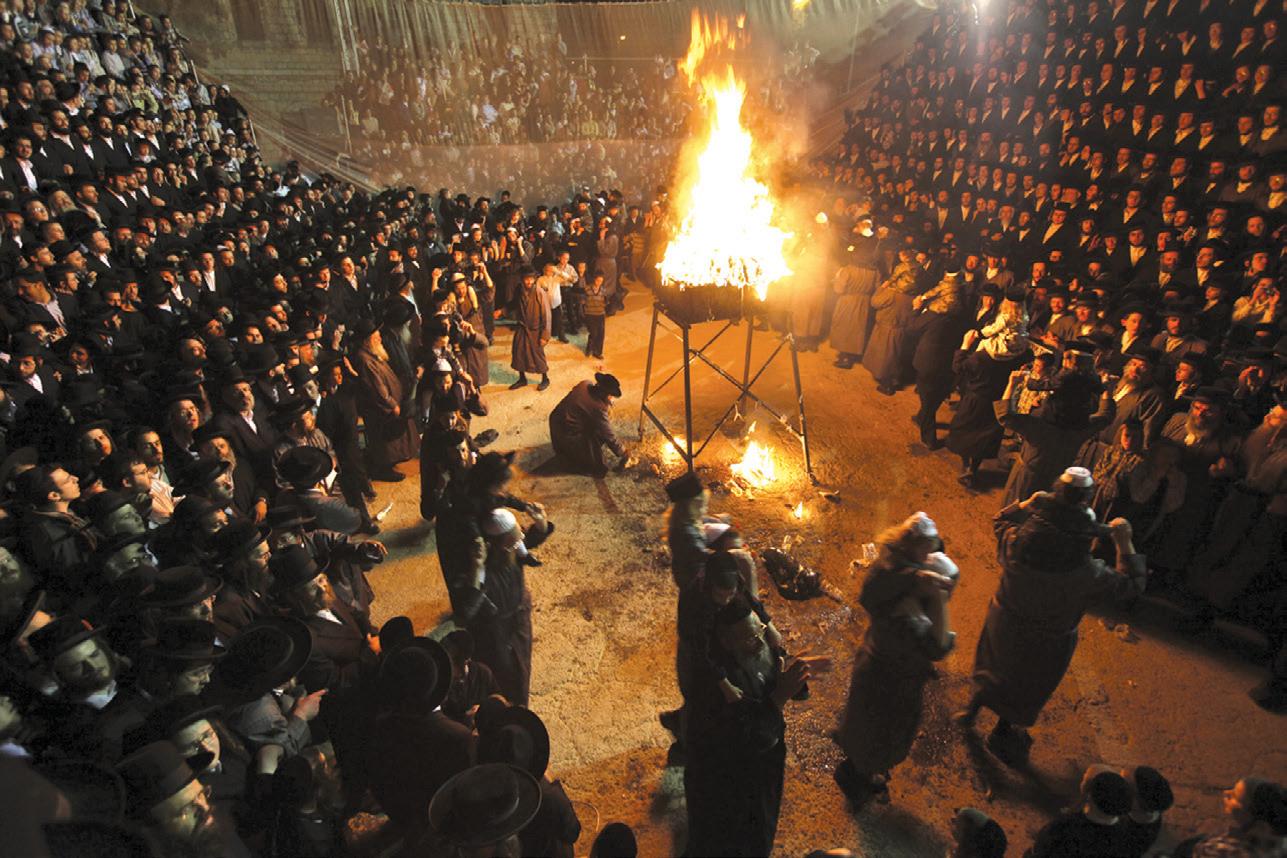
Lag BaOmer is this Tuesday. For many of us it’s the highlight of Sefirah, a chance to get outside, a bonfire, some music, and a little extra energy in the air. It’s one of those days you circle on the calendar. But this year, there’s something else that comes along with it. It’s been five years since the tragedy in Meron, where 45 kedoshim lost their lives. Five years later, it still feels hard to fully process. Time moves, but certain moments stay with you.
Then recently, I came across something I hadn’t seen before, and it stopped me. A note written by one of the kedoshim, Rabbi Shimon Matalon ל״ז. As Lag BaOmer began, he handed a sealed envelope to a friend and asked him not to open it until Sunday. Moments before his petirah, he was calmly passing along a message that would only be read after he was gone. Hours later, he was no longer with us. When the envelope was opened, inside was a single page. No context. No explanation. Just a list. And knowing when it was written makes it impossible to read it the same way you’d read anything else.
Instead of being filled with disappointment, accept everything with love.
Instead of being rigid, be flexible.
Instead of complaining, let your mind be in control. Instead of harping, be more grateful.
Instead of seeing problems, filter out negativity. Instead of drowning in worry, know it’s all from Hashem. Instead of blaming everyone, remember Who is in charge. Instead of getting angry, take a breath.
Instead of being upset, strengthen your emunah. Instead of choosing darkness, choose the light. Instead of sinking into despair, remember that everything is a test from Hashem, Who saves.
Because Hashem decides what will happen, but you
decide how you respond. That last line is the one that struck me. Maybe because it’s so straightforward. We spend a lot of time wishing things were different. Easier. More predictable. More in our control. But they’re not. What is in our control is how we respond. And that’s something we deal with every day, not just in big moments, but in the small ones that tend to define how our days actually go.
Lag BaOmer is a day of light. Not just the bonfires, but the idea behind it. In the middle of a stretch that can feel a bit heavy, there’s a break. A reminder that things aren’t always what they seem on the surface. Maybe this year, that reminder hits a little differently. Not just to celebrate, but to carry something with us. To remember the kedoshim not only by thinking about them, but by making one small shift. A little more patience. A little more perspective. A little more emunah. Nothing dramatic. Just something real.
Wishing a everyone a peaceful Shabbos!
Aaron M. Friedman
WIN with !
Comfort Year-Round:
Experience stable indoor temperatures, and reduce drafts, with warm winters and cool summers, when you upgrade to spray foam insulation in your attic.
Save Big on Energy Costs:
Cut your heating and cooling bills by 30-50% and make your HVAC system work smarter, not harder.
Breathe Better:
Enjoy improved air quality with reduced drafts and outdoor pollutants, creating a healthier living environment.
Around the Community
AIM Pregnancy Workshop: Week Two Inspires And Empowers
The energy continued to build this past week as AIM hosted the second session of its four-part pregnancy workshop series for women in their second and third trimesters. Once again, attendance was phenomenal, and the excitement in the room was palpable. Participants eagerly returned for week two, demonstrating a strong commitment to growth, preparation, and inspiration as they approach this transformative stage of life.
This week’s session featured two outstanding presenters: Dr. Sheina Hollander of Silhouette Physical Therapy and Mrs. Gratzia Atkin of Village OBGYN.
Dr. Hollander delivered an informative and practical presentation on the anatomy of childbirth. She guided participants through various laboring positions that can help facilitate a
smoother and more efficient delivery. In addition, she demonstrated beneficial stretches designed to strengthen the body during pregnancy and prepare for both labor and postpartum recovery. A key takeaway from her talk was the importance of rest after childbirth, emphasizing that the more a woman allows herself time to recover initially, the more complete and expedited her healing process will be. Preparation, along with the willingness to accept help and support, is essential for optimal recovery.
Mrs. Atkin opened her presentation with a powerful and uplifting perspective, comparing a pregnant woman carrying a baby to an aron kodesh carrying a Torah - highlighting the incredible zechus entrusted to women. She spoke about the remarkable way Hashem created the female body with an innate ability to navigate labor and delivery. Clarify-
ing commonly used medical terms such as Braxton Hicks contractions, she also stressed the importance of maintaining open communication with both a Rav and an OB when developing a birth plan.
Her practical guidance for a healthy pregnancy included maintaining regular exercise, eating nutritious foods, taking prenatal vitamins, and staying well hydrated - aiming for 8-10 cups of water daily. She emphasized that rest is not a luxury but a necessity, with 7-9 hours of sleep being ideal. Notably, she shared that studies have shown the energy demands of pregnancy can be comparable to running a marathon.
Mrs. Atkin also addressed many common questions, including how to recognize when it’s time to go to the hospital, whether labor can be sped up, and the uncertainty surrounding
a baby’s exact arrival time. Her concluding message resonated deeply: while we can prepare and take necessary steps, ultimately, Hashem runs the world and holds all the answers.
The session was filled with positivity, engagement, and a genuine eagerness to learn. AIM looks forward to welcoming participants back next week for an exciting session focused on nutrition and lactation.
Jewish Women’s Storytelling Group Hosts Successful Second Program
The Shpiel Baltimore, an amateur storytelling series for Jewish women, presented its second program. The evening’s theme, “Dayenu,” drew an audience of more than 60.
The Shpiel’s process begins with early publicity of the theme so prospective storytellers can pitch
their ideas to organizer Tova Jussim. Selected pitches receive coaching and are allotted an eight-minute slot to perform at the live event. In addition, audience members are invited to share spontaneous, three-minute stories during the program.
The April event featured four storytellers: Chana Bilek, Tova Jus-
sim, Robyn Shrater Seeman and Libby Jolkovsky. This volunteer, grassroots initiative was created to provide a vibrant space for Jewish women to find inspiration, build community, and
showcase personal narratives.
Organizers are currently selecting the next theme and scheduling the next performance.
From left to right: Chana Bilek, Tova Jussim, Robyn Shrater Seeman and Libby Jolkovsky
An Evening Of Emunah And Community At Beth Tfiloh With Jon And Rachel Goldberg-Polin, Parents Of Hersh
By: BT/Michon Zysman | Photos: Israel Orange Studios
Beth Tfiloh Congregation hosted Jon and Rachel Goldberg-Polin as the featured speakers for its annual Dahan Lecture, sponsored by the Haron Dahan Foundation. The synagogue’s 1,600-seat sanctuary was filled with people from across the Baltimore Jewish community, representing many congregations and backgrounds, who had come to hear their story and to show respect for a family whose strength and faith have inspired Jews around the world.
The program was conducted with the dignity and kavod the moment required. The thoughtful pacing of the evening and the attention to detail created an atmosphere that felt both gracious and appropriate to the significance of the gathering - hallmarks of the thoughtful care for which Beth Tfiloh is widely respected. The full sanctuary was itself a powerful statement: the community showed up.
Some in attendance had recently read Rachel Goldberg-Polin’s new book, When We See You Again, released just days earlier. Others felt a personal connection to the family and to their son, Hersh, z’l, H’yd, - a young man whose name had become familiar in Jewish homes across the world, as families davened daily for the safety and release of hostages held in Gaza and recited Tehillim on their behalf. Those tefillos created a deep sense of connection, and when news of Hersh’s murder was announced, many in the Jewish community felt that loss in a deeply personal way. It was easy to imagine him as their own child, neighbor, relative, or student.
Rachel and Jon spoke about their son with warmth and humor, sharing stories that revealed his character and the values he lived by. They spoke about his kindness, his determination, and the quiet ways he showed care for others, often making the audience laugh or smile. By the end of the evening, Hersh felt less like a name people had followed in the news and more like someone they had come to know.
Jon and Rachel spoke openly about emunah and about learning how to move forward in a life that will never
Goldberg-Polin, Z’L, H’YD
The synagogue’s 1,600-seat sanctuary was filled with people from across the Baltimore Jewish community, representing many congregations and backgrounds.
be the same. Part of that strength came from what they learned about Hersh during captivity - how his sense of purpose helped sustain others - and from the light those stories brought into their own lives. Sharing their story has also become a way of releasing some of the pain and continuing forward with meaning and purpose.
As the evening unfolded, many
in the sanctuary were visibly moved, not only by the depth of the loss, but by the composure and faith of parents who have endured so much and continue to speak with dignity and conviction. It was clear that the gathering left a lasting impression on those in attendance.
Beth Tfiloh’s annual Dahan Lecture, sponsored by the Haron Dahan
Foundation in memory of Haron Dahan, z’l, and his beloved wife, Rachel, a’h, has long reflected the congregation’s commitment to Torah values, meaningful learning, and communal life. This year’s gathering reflected that mission in a particularly powerful way and demonstrated the role a synagogue can play in bringing a community together in moments that call for reflection, faith, and connection.
Shown with Rabbi Chai Posner, Jon Polin and Rachel Goldberg-Polin speak at Beth Tfiloh’s annual Dahan Lecture, an evening of emunah, reflection, and communal unity that deeply moved the Baltimore Jewish community.
Join us for an inspiring and celebratory evening to honor all the outstanding educators, including this year’s awardees, who make a lasting impact in our Jewish schools.
Early Childhood Teaching Excellence Award
Havatzelet Louis-Chen
Darchei Noam Montessori
Congregational School Educator Award
Jodi Rosen
Beth Israel Joseph & Corinne Schwartz
Community Learning Lab
Excellence in General Studies Award
Alyse Roth
Ohr Chadash Academy
Excellence in Judaic Studies Award
Rabbi Yossi Keilson
Talmudical Academy
Student Support Award
Nina Cusner
Beth Tfiloh Dahan Community School
Monday, May 11
7:00 – 8:30 p.m.
Entertainment by a strolling mentalist
A delicious parve dessert course (Dietary laws observed)
Ahavat Tzion Award
Rachel Dressin
Berman-Lipavsky Religious School at Beth El
Innovative Educator Award
Tzipporah Freedman
Bais Yaakov Middle School
Inspiring Educator Award
Heather Pierce
Krieger Schechter Day School
Educational Leadership Award
Rabbi Stuart Seltzer
Rosenbloom Religious School of Chizuk Amuno
The Robin F. Jacobs Student Achievement Award
Esther Danziger
Bais Yaakov High School
Exclusive gift for all educators that attend the event.
Scan this code or visit bit.ly/CelebratingEducation2026 to register today!
Around the Community
Yahalom MD Hosts Rabbi Baruch Rabinowitz For Powerful And Transformative Visit To Baltimore
The Baltimore community was privileged to host Rabbi Baruch Rabinowitz, an educational consultant, renowned lecturer, and father of an adult child with Down syndrome. A talmid of Rabbi Moshe Shapiro, Rabbi Rabinowitz has made it his mission to highlight the inherent greatness of individuals with disabilities, emphasizing that what may appear as a limitation in this world reflects an especially deep and pure neshama.
The visit, organized by Yahalom MD, Agudah Maryland’s special needs division, partnering with BGCubed, began Sunday evening with a special “Sisters’ Night Out,” for middle and high school girls who have siblings with special needs. Alongside a fun activity and dinner, Rabbi Rabinowitz shared heartfelt words of chizuk, acknowledging the important role these girls play within their families. He spoke separately to the different age groups, ensuring that the message was tailored to each level. A special session of chizuk and Divrei Torah for Yahalom fathers followed and rounded out the program.
Although the formal program concluded shortly after 9:00 pm, Rabbi Rabinowitz remained until close to midnight, meeting privately with parents seeking his unique and empathic guidance and encouragement.
The next morning, Rabbi Rabinowitz embarked on a whirlwind tour of local schools, making stops at Bais Yaakov, Bnos, T.A., and T.I. At each location, he tailored his message to the audience, emphasizing sensitivity and respect, and sharing an appreciation for those who take on the meaningful role of supporting families of children with
special needs.. He encouraged volunteerism among students, highlighting how profound their involvement can be, and how much families rely on these opportunities for much-needed respite. Considering the pressing need for volunteers at our local special needs organizations, this message can serve as inspiration for these students to continue making a tangible difference in the lives of these families.
Particularly moving was his visit to Talmudical Academy, where students interact with the integrated JEWELS classes on a daily basis.
Financial Literacy At Yeshivas Toras Simcha
The third-grade class at Yeshivas Toras Simcha had a special visitor. Ryan Pinson, SVP & Senior Commercial Banker and Team Lead at WesBanco Bank, Inc., joined for a lively session on financial literacy. He spoke with the students about the importance
of saving and introduced the idea of delayed gratification - why it can be worth waiting and planning instead of spending right away. Through engaging examples and discussion, the students began to see how thoughtful money choices can make a big difference over time.
Rabbi Rabinowitz praised these students warmly, offering them a well-deserved acknowledgement and encouraging them to continue to embrace peers who have any type of disability. Reflecting on the visit, Rabbi Yaakov Schwartz, the principal, said that Rabbi Rabinowitz was “one of the most impactful, passionate speakers we have ever had in TA.”
Yahalom MD thanks the Goldenhersh and Wealcatch families for being co-sponsors of the event, bringing this remarkable opportunity to the Baltimore community.
Beth Tfiloh Students Qualify For Chidon Hatanach Nationals, Bringing Tremendous Nachas To The Community
By: BJLife Newsroom
Sixteen students from Beth Tfiloh Dahan Community School have qualified for the National Finals of the Chidon HaTanach - the Dr. Shimshon Isseroff US National Bible Contest for Jewish Youth - which will take place in New York on May 17. The Chidon challenges students to develop deep knowledge of Tanach, and participation is voluntary. These students chose to take on the extra limud, committing themselves to serious study, review, and preparation throughout the year.
At Beth Tfiloh, participation in the Chidon program reflects a genuine commitment to serious Tanach learning. Students dedicate time outside the regular school day to mastering the material. Along the way, they develop strong relationships with classmates and with their Rebbe, Rabbi Leib Zalesch, who guides their Tanach learning and helps make this
program a meaningful part of their middle school years.
This year, under Rabbi Zalesch’s leadership, 16 dedicated middle school students learned Sefer Bereishit, Sefer Shmuel Bet, and selections from Tehillim, while the school’s high school participant completed portions of Yechezkel - a significant undertaking that required discipline, persistence, and genuine commitment to Torah learning.
The students who qualified for the national finals are: Daniella B. ’31, Rafaella B. ’31, Zoe B. ’30, Yehuda B. ’30, Noah B. ’31, Ruby F. ’31, Sammy H. ’31, Oshra K. ’30, Shira K. ’31, Tamar L. ’31, Esther L. ’30, Yosef L. ’30, Yael R. ’31, Kira S. ’31, Isaac W. ’31, and Moshe L. ’28.
Special recognition goes to Daniella B., Tamar L., Moshe L., Esther
in the top 10% nationwide, earning distinction as top scorers.
For the fifteenth consecutive year, Beth Tfiloh will be represented at the national finals - a testament to the culture of serious Torah learning that continues to thrive at the school. Over the years, two Beth Tfiloh students, Caleb Gitlitz ’21 and Yisrael Kaplow-
itz ’25, earned the honor of representing the United States at the international Chidon in Eretz Yisrael.
Yasher koach to these students for their hard work, dedication, and commitment to learning Tanach with depth and enthusiasm. Their achievements bring pride to their families, their teachers, and the entire community.
Annual Event
Join us for an evening of food, cocktails, and entertainment as we honor
TA Hosts Rav Ahron Lopiansky, Shlita, For Timely Presentation On Parenting In The World Of AI
TA recently held an asifa entitled “Parenting in the World of AI.” Rav Aharon Lopiansky, shlita, Rosh HaYeshiva of the Yeshiva of Greater Washington, addressed a packed room of parents and faculty. Following his presentation, Rav Lopiansky answered both pre-submitted and live questions from the audience. Afterward, Rav Lopiansky met with TA Rebbeim, continuing the conversation and exploring the challenges and opportunities this presents within our classrooms.
The Rosh Yeshiva focused on how certain habits, while appearing benign or even helpful, can have detrimental long-term ramifications. He explained that to become a Ben Torah, a person must be an amel batorah. True growth comes from working and thinking-developing the ability to express one’s inner self clearly and to refine one’s middos through a deliberate process involving both emotions and intellect.
With that in mind, using AI to provide answers or even to “chat” can short-circuit this essential process.
While AI can be a valuable tool, it must not replace the effort necessary to become a true adam. Rather, it should enhance what we are doing, not replace “me.” Rav Lopiansky urged the participants to model for our children a careful and thoughtful approach to AI. Our minds are no different than any other muscle-if not used properly, they weaken and lose their abilities.
Rav Lopiansky concluded with a powerful message: AI can help us recognize the greatness within ourselves. Nothing can replace our authentic selves-our thinking, our expression, and our middos tovos.
Inspiring Guest Visits TA Middle School
Rabbi Gavriel Sanders, Evangelical Pastor turned Frum Torah Jew, inspired the 8th grade with a summary of his fascinating journey.
Over 1,000 Celebrate Yom Ha’atzmaut At Ohr Chadash Academy
Baltimore Community Event
Ohr Chadash Academy (OCA) once again hosted their annual community-wide Yom Ha’atzmaut celebration, welcoming over 1,000 members of the Baltimore community for a truly special day. Following a beautiful tekes, this year’s carnival-style pro-
By: BJLife Newsroom
gram focused on Israel’s rebuilding, with participants enjoying hands-on activities like decorating suncatchers, writing letters to volunteers rebuilding the south, creating an edible Kotel, exploring the shuk, and so much more.
Next year in Yerushalayim!
613 Seconds with Rabbi Shaya Mintz, Executive
Director of Bikur Cholim
BJH: Let’s start with the purpose of this conversation. Why did you want this interview to appear now, and what are you hoping to accomplish?
Rabbi Shaya Mintz: The goal is really twofold. Firstly, we want to alert the community to the new setup for our popular annual bike-a-thon. Secondly, we want to use that as an opportunity to give some background to Bikur Cholim of Baltimore. What’s happening day to day, how the organization has grown, and where we’re headed. The ride is a fundraiser, but it’s also a window into the incredible chesed taking place quietly all year long.
BJH: Let’s go back to the beginning. What’s your personal connection to Baltimore?
involved with Ner Le’Elef, where I received training in public speaking and community engagement. That experience helped shape everything that came next.
BJH: Your family has deep roots in Baltimore. Can you tell us about that?
RSM: Absolutely. My father, Harav Moshe Mintz Shlita, has been part of Ner Yisroel for over 70 years, dating back to the early 1950s. He’s truly part of the fabric of the yeshiva. My mother, Mrs. Helene Mintz A’H, was a beloved teacher in Bais Yaakov elementary for over five decades. Even now, people stop me and ask if I’m her son, and they speak with such emotion about the impact she had on them. She was nifteres just a few months ago, and her legacy continues to be felt across the community. My wife also comes from strong Baltimore roots, so for us, returning here really feels like coming full circle.
BJH: How did that lead you into communal leadership?
dedicated women who recognized that as the community grew, so did the needs. What once could be handled by a neighbor bringing a meal now required a coordinated system. They built a network that visited hospitals, supported patients, and made sure no one felt alone. Over the years, that vision expanded significantly.
Today, Bikur Cholim provides a wide range of services. We have a medical equipment gemach, patient advocacy and referrals, rides to and from medical appointments, and hospital pantries stocked daily with kosher food. We maintain hospitality apartments for out-of-town families and coordinate a discreet home-cooked meal network for local families in need. Behind the scenes, dozens of volunteers ensure that help arrives quietly and respectfully.
BJH: It sounds like the scope has grown tremendously. How do you sustain something like this?
RSM: It’s a combination of careful management and community support. We’ve gone through detailed audits, reviewed expenses line by line, and worked to ensure that every dollar is used responsibly. At the same time, the needs continue to grow, and we have to grow with them. That’s why fundraising events like the bike ride are so important. They allow us to maintain and expand these services while also bringing more people into the mission.
RSM: I grew up in Baltimore. I lived on Yeshiva Lane and I attended Torah Institute back when it was on Northern Parkway. I spent countless Shabbosos in the community, played in Yiddle League, went to camp with friends from the community, and built relationships that are still part of my life today. I continued on to Ner Yisroel, learned in the Mir, and then returned to Ner Yisroel again. Along the way, I developed a close connection with Harav Tzvi Berkowitz Shlita. After I got married, I spent time learning in Eretz Yisroel and became
RSM: After Ner Le’Elef, I moved to St. Louis to join a community kollel. My days were split between learning and working with baalei batim through shiurim and programs. Over time, I realized I had a passion for building community. I moved into programming, then administration, and eventually became Executive Director. After 12 years, I brought that experience to Toronto, where the scale was larger but the mission was the same. As my children got older and some settled back in Baltimore, the idea of returning home became more and more meaningful, both personally and professionally.
BJH: Let’s talk about Bikur Cholim of Baltimore. How did it begin, and what does it look like today?
RSM: Bikur Cholim was founded by Rebbetzin Chana Weinberg A’H and a group of
BJH: That brings us to the bike ride. What’s new this year?
RSM: This year, we’ve reimagined the entire event. It’s now called “Tour de Kindness,” and the goal is to broaden participation beyond the immediate neighborhood. We want riders from across the region to feel connected to this cause. We’re also introducing a two-day format.
The first day is Tour de Kindness Junior,
a father-and-son ride focused on safety, connection, and outdoor activity. It’s about seven miles and creates an opportunity for meaningful, screen-free time together. The second day is the main ride, with 50- and 100-mile routes. These riders take on a major fundraising role and train together leading up to the event. This year, we’re also creating a more unified finish, where riders can celebrate together with a special appreciation event.
BJH: What kind of impact do you hope this new format will have?
RSM: We’re hoping it builds a stronger sense of connection. Not just among the riders, but across the community. When people participate, they’re not just supporting Bikur Cholim. They’re becoming part of something bigger. They’re joining a movement of chesed that touches lives every single day.
BJH: How will families and children experience this around town?
RSM: We’re introducing a weekly sticker hunt tied to the event. Kids will be able to find special Tour de Kindness stickers around the community and place them on their bikes or helmets. It creates excitement, builds awareness, and helps even the youngest members of the community feel like they’re part of the mission.
BJH: If someone wants to get involved, what should they do?
RSM: The easiest way is to register online, where you can see the different ride options and join a team. Beyond that, we encourage people to spread the word, support riders, and learn more about what Bikur Cholim does. Every person who gets involved strengthens the impact we’re able to have. At the end of the day, this is about bringing the community together toward one goal, increasing kindness in a very real and tangible way.
The Week In News
The Week In News
UAE to Leave OPEC
This week, the United Arab Emirates announced that it will leave OPEC effective May 1, stripping the oil cartel of one of its largest producers.
The UAE’s decision had been rumored as a possibility for some time, as it pushed back in recent years against OPEC production quotas it felt had been too low —it wasn’t able to sell as much oil to the world as it had wanted.
The UAE has had increasingly tense relations with Saudi Arabia, OPEC’s largest producer, over political and economic matters in the Mideast, even after both countrties came under attack by fellow OPEC member Iran during the war.
The UAE’s withdrawal from OPEC won’t necessarily have any immediate effects on the markets. Currently, world oil supplies are sharply constrained by the war in Iran, which has closed off the Strait of Hormuz, a waterway through which one-fifth of global oil supplies including much of the UAE’s is transported.
OPEC’s market power had already been waning in recent years as the United States ramped up its production of crude oil. Saudi Arabia had been pumping over 10 million barrels of oil a day before the war. The U.S. pumps more than 13 million barrels a day.
The UAE, which joined OPEC through its emirate of Abu Dhabi in 1967, had been producing around 3.4 million barrels of crude a day just before the U.S.-Israeli war with Iran began on February 28. Analysts say it has capacity to produce roughly 5 million barrels a day.
The UAE will also leave the wider OPEC+ group, which Russia had led to try to stabilize oil prices.
“This decision reflects the UAE’s long-term strategic and economic vision
and evolving energy profile, including accelerated investment in domestic energy production,” the UAE said, adding that it would bring “additional production to market in a gradual and measured manner, aligned with demand and market conditions.”
Canadian
Dual Citizenship
On December 15, 2025, Canada enacted a new dual citizenship law, leading to a recent rise in efforts by United States citizens to claim Canadian citizenship.
The new rule recognizes anyone whose direct ancestor — whether that be a grandparent, great-grandparent, great-great-grandparent, etc. lived
in Canada for 1,095 days as a Canadian citizen. At that point, all one has to do is submit proof of descent in order to receive a citizenship certificate.
“You are Canadian, and you’re considered to be one your whole life,” said Amandeep Hayer, an immigration lawyer. “That’s really what you’re applying for, the recognition of a right you already have vested.”
“The best way I can put it is like, if a baby’s born tomorrow in Canada, the baby’s Canadian even though they don’t have the birth certificate,” he said.
Applying costs 75 Canadian dollars ($55), though using immigration lawyers and genealogists would cost significantly more money. Canada’s Immigration, Refugees, and Citizenship website says that certificate processing time is approximately 10 months. Over 56,000 people are waiting for a decision.
From December 15 to the end of the year, citizenship by descent was recognized for 1,480 people. In all, 24,500 Americans gained Canadian citizenship in 2025.
Greater Washington Weekday Minyanim Guide
6:15 am Young Israel Shomrai Emunah M-F
6:20 am Ohev Shalom Talmud Torah OLNEY M, Th
6:25 am Southeast Hebrew Cong., Knesset Yehoshua M-F
6:30 am Beth Sholom Congregation M-F Beit Halevi (Sfardi) M, T Chabad of Silver Spring M-F Ohev Shalom Talmud Torah OLNEY T, W, F Young Israel Shomrai Emunah S YGW M, Th
6:35 am Ohr Hatorah M, Th
6:40 am YGW S, T, W, F Magen David Sephardic Congregation M-Th
6:45 am Beit Halevi (Sfardi) S, T, W, F
Kemp Mill Synagogue M, Th
Ohr Hatorah T, W, F
Young Israel Shomrai Emunah M, Th
6:50 am Woodside Synagogue/Ahavas Torah M, Th Silver Spring Jewish Center M-F
Chabad of Upper Montgomery County M-F
6:55 am Young Israel Shomrai Emunah T, W, F
7:00 am Kemp Mill Synagogue T, W, F
Southeast Hebrew Cong., Knesset YehoshuaS Silver Spring Jewish Center S
POTOMAC Beth Sholom
GAITHERSBURG
Chabad of Upper Montgomery County [Ari] 11520 Darnestown Rd, Gaithersburg, MD 20878
OLNEY
Ohev Shalom Talmud Torah (OSTT)
18320 Georgia Ave, Olney, MD 20832
Woodside Synagogue/Ahavas Torah T, W, F
Young Israel Ezras Israel of Potomac T, W, F
7:05 am Kesher Israel M, Th
7:15 am Kemp Mill Synagogue M, Th Kesher Israel T, W, F
Ohev Sholom Talmud Torah/The National Synagogue M-F Ohr Hatorah S
7:30 am Chabad of DC M-F
Chabad of Potomac M-F JROC M-F
Kemp Mill Synagogue T, W, F
Southeast Hebrew Cong., Knesset Yehoshua M-F
Young Israel Shomrai Emunah S
Young Israel Shomrai Emunah (Sfardi) M-F
7:45 am YGW (Yeshiva Session Only) S-F
8:00 am Beth Sholom Congregation S
Kemp Mill Synagogue S Kesher Israel S
Ohev Shalom Talmud Torah OLNEYS
Southeast Hebrew Cong., Knesset YehoshuaS Chabad of Upper Montgomery CountyS
Woodside Synagogue/Ahavas TorahS
8:00 am YGW (High School; School-Contingent) S-F
Young Israel Ezras Israel of PotomacS Young Israel Shomrai Emunah (Sfardi)S
8:05 am Ezras Israel Congregation of Rockville M, Th
8:15 am Ohr Hatorah S Ezras Israel Congregation of Rockville S, T, W, F
Kehilat Pardes / Berman Hebrew Academy S-F
Silver Spring Jewish Center M-F
8:30 am Chabad of DC S Chabad of Potomac S JROC S Ohev Sholom Talmud Torah/The National Synagogue S Silver Spring Jewish Center S YGW (Summer Only) S-F
8:45 am Young Israel Shomrai Emunah S-F
9:00 am Chabad of Silver Spring S Kemp Mill Synagogue S
mincha
2:00 pm Silver Spring Jewish Center S-F
2:10 pm YGW M-Th School Days
2:45 pm YGW S-Th
3:00 pm YGW Middle School M-Th School Days
mincha/maariv
Before Shkiah (15-18 minutes), S-TH
Beit Halevi (Sfardi)
Beth Sholom Congregation
Chabad of Potomac
Chabad of Silver Spring
Chabad of Upper Montgomery County
Ezras Israel Congregation of Rockville (20 min before, S-F)
JROC
Kemp Mill Synagogue
Kesher Israel
Magen David Sephardic Congregation Ohev Sholom Talmud Torah/The National Synagogue Ohr Hatorah
Silver Spring Jewish Center
Southeast Hebrew Congregation
Woodside Synagogue/Ahavas Torah
Young Israel Ezras Israel of Potomac
Young Israel Shomrai Emunah (Asheknaz)
Young Israel Shomrai Emunah (Sefarhadi)
maariv
8:45 pm YGW S-Th
9:15 pm Silver Spring Jewish Center S-Th
9:30 pm
shacharis
Massive Local Inventory
Our
Real-Time Design
We
Complete Local Control
From
We engrave everything ourselves to spot and fix potential flaws before they occur.
We build to last, so we guarantee it. We are your partners for life.
The Week In News
Russians
to Leave Mali City
Russian mercenaries contracted by Mali’s military have reportedly agreed to leave Kidal following two days of fighting, according to the separatist Azawad Liberation Front (FLA), which says it now holds the city.
The development follows coordinated assaults carried out on Saturday by armed groups across Mali including in the capital, Bamako in which the FLA, an organization pushing for an independent Tuareg state in the north, was involved.
In attacks near Bamako, Sadio Camara, the defense minister of Mali, was killed.
Terrorist-led violence has long been a problem for Mali, which has grappled with groups connected to al-Qaeda, ISIS, and the FLA.
Clashes on Saturday were reported in Kati a key military installation near the capital as well as in the northern cities of Gao and Kidal and in the central hubs of Sevare and Mopti.
According to reports, the separatist offensive was largely concentrated
in the north, while the jihadist group Jama’at Nusrat al-Islam wal-Muslimin carried out coordinated attacks at multiple sites nationwide.
The “coordinated jihadist attack” was the largest Mali has seen in years, according to Ulf Laessing, who leads the Konrad Adenauer Foundation’s Sahel program.
According to FLA spokesperson Mohamed Elmaouloud Ramadane, Kidal hadn’t “fallen completely” in those attacks, as “elements of the Malian army and Russian mercenaries” persisted. Clashes between the FLA and Mali’s government in Kidal continued on Sunday.
“An agreement was reached between the Azawad forces and the Russian elements of the Africa Corps with a view to ensuring their secure withdrawal from the fighting,” announced Ramadane, with the FLA adding that it was escorting the mercenaries out of the city.
Since then, the group has claimed control of the city. Before late 2023, the separatist movement had control of the city, which it treated as its unofficial headquarters. But then, the Mali military, assisted by Russian mercenaries, regained the territory.
“Our main goal now is to control Gao and then Timbuktu will be easy to fall,”
said an FLA field commander, noting that the operation was planned “for months.”
Mali’s military vows to fight the rebels.
Drug-Trafficking Monks
This week, 22 Sri Lankan monks returning from Thailand were arrested at the main international airport in Sri Lanka with a record 242 pounds of powerful cannabis.
A Sri Lanka Customs spokesman said the group, returning home after a four-day vacation in the Thai capital, had Kush a potent strain of cannabis — hidden in their luggage.
“Each carried about five kilos of the narcotic concealed within false walls in their luggage,” the spokesman said.
The monks were mostly young students from temples across Sri Lanka and had been on a holiday sponsored by a businessman.
According to customs officials, it was the largest single detection of Kush at the South Asian country’s main international airport.
Last May, a 21-year-old British
woman was arrested with 101 pounds of the drug at the same airport. Charlotte May Lee had traveled from Bangkok to Colombo to renew her Thai visa. She denied knowledge of drugs in her luggage and claimed they were planted at her hotel in Bangkok.
In June 2025, Sri Lanka’s customs authorities arrested a woman and seized the largest haul of cocaine ever detected at the country’s main airport. Officials said the unnamed 38-year-old Thai woman was carrying about 22 pounds of cocaine stuffed into three plush toys
Sri Lankan authorities have also made several detections of large hauls of heroin and other narcotics smuggled in via small fishing boats in recent years.
The latest arrests aren’t the first time monks have run afoul of drug laws.
In 2022, every single monk at a Buddhist temple in central Thailand was defrocked after they tested positive for methamphetamine. The monks were sent to a health clinic to undergo drug rehabilitation. In 2017, police said a Buddhist monk was arrested in Myanmar after authorities found more than 4 million meth pills in his car and in his monastery.
Yeshivas Chofetz Chaim –
Supervision and mentoring of Special Education staff
Oversight of student support services, scheduling, and accommodations
Collaborating with Rebbeim, teachers, administrators, parents, and outside professionals
Guidance for parents through testing, diagnosis, and placement processes
Participation in student planning and support meetings
Ongoing development and strengthening of the program to meet student needs
REQUIREMENTS
A background in Special Education
Leadership, organizational and communication skills
Experience working collaboratively with teachers, parents, and outside professionals
A deep commitment to helping children succeed within a yeshiva environment
Iran FM Meets With Putin
On Monday, Iranian Foreign Minister Abbas Araghchi visited Russia to meet with the country’s president, Vladimir Putin. Before arriving in St. Petersburg, Araghchi visited Oman and Pakistan, two countries that have attempted to mediate the conflict between Iran and the United States.
The Iran ongoing war has had serious effects on the global economy, as the Strait of Hormuz remains shuttered and the U.S.’s blockade against Iran remains in effect. Iran wants to negotiate the Strait of Hormuz separately from the issue of its nuclear program and peace. Iran proposed to reopen the strait in exchange for the U.S. lifting its blockade, an idea the Trump administration is considering.
Central Command said it has rerouted at least 37 ships since the operation began.
Trump recently canceled a second round of in-person negotiations with Iran.
“Too much time wasted on traveling, too much work!” he posted Saturday on Truth Social. “Besides which, there is tremendous infighting and confusion within their ‘leadership.’ Nobody knows who is in charge, including them. Also, we have all the cards, they have none! If they want to talk, all they have to do is call!!!”
Where is Khamenei?
It is unclear if Putin offered any assistance to Araghchi in Iran’s war effort during the foreign minister’s visit. However, Western officials have accused Russia of providing Iran with intelligence on U.S. forces. Meanwhile, Putin has positioned himself as a neutral party, leveraging his relationship with the U.S. and intermediary relying aspiration for people, unleader, will trials Putin told do evinterests and the repeace is Araghchi program, though ceasefire reached this month between the United both progress in At the Strait sharply through control boats and while directblockade States
Despite assertions by Iran that Mojtaba Khamenei is fit to lead the country, he has yet to make a public appearance. Some Israeli and American officials believe Khamenei is not functioning as the Iranian supreme leader and is not in control.
According to some, the Islamic Revolutionary Guard Corps (IRGC) and its commander, Ahmad Vahidi, are essentially in control of Iran. Vahidi was appointed to replace Mohammad Pakpour, who was assassinated at the beginning of operations Roaring Lion and Epic Fury
“Members of the IRGC, and Vahidi in particular, are not figures who are willing to make concessions or be perceived as conceding,” Iran expert Nati Tuvian told the Jerusalem Post “A week after the signing of the nuclear agreement with the Obama administration, the IRGC staged a show of force and launched ballistic missiles during a drill, writing on them in Hebrew that Israel should disappear from the face of the earth.”
U.S. President Donald Trump has recently stopped referring to Khamenei. On Thursday, he said, “Iran has no idea who its leader is. They are completely confused. We have effectively eliminated three levels of leadership, and anyone who was even close to the leadership, so it’s hard for them to understand who… can speak on behalf of the country. They simply don’t know.”
Khamenei suffered serious wounds to his legs and face in a February attack. He has had operations three times on one of his legs and is set to be fitted with a prosthetic. One of his hands also needed to be operated on and is gradually regaining function. His face and lips were badly burned, making speaking difficult. Iran has claimed that Khamenei is still able to lead.
Khamenei “remains sharp and in-
For
business needs
The Week In News
volved in running the country, which is being managed like a board of directors, together with IRGC commanders,” The New York Times reported, citing Iranian sources.
Despite these claims, however, Khamenei has not been seen publicly nor has he released any audio recording since ostensibly assuming the position of supreme leader in March after his father was assassinated at the start of the war.
Iranian state television has read out several written messages attributed to him, but there has been no visual proof so far that he is actively functioning.
Opposition Leaders Join Forces
Naftali Bennett and Yair Lapid announced on Sunday evening that the two would be joining forces for the upcoming elections, running on the same “Together Led By Bennett” ticket.
Bennett, a former prime minister who is running again for the position, touted the move as the “most Zionist and patriotic act we have ever done, for the sake of our country,” declaring that “the era of division is over.” Lapid, another former prime minister, currently heads the opposition.
Bennett also invited Yashar party chairman Gadi Eisenkot, who encouraged the move, to join the ticket.
Although in the previous election Bennett relied on Arab parties to secure a majority in the Knesset, this time he has vowed to depend only on Zionist parties. He called himself a “right-wing, liberal Zionist,” adding that his government will make all Israelis, including those who don’t vote for him, feel supported.
“We’re not in the left bloc or the right bloc; we’re in the bloc of the entire Israeli nation,” Bennett claimed.
Lapid said his centrist Yesh Atid party and he were “setting ego aside and doing what is right for the State of Israel” by
supporting Bennett.
“We are uniting today to win the elections and to establish a Zionist government, strong and stable. A partnership between the center and right, between religious and secular, between north and south without draft dodging and without extremism,” Lapid said.
“Israel has the best people in the world. They deserve an efficient, functioning, honest government, one that invests in the working public that serves in the army, in reservists and their families,” he added. “A government that will provide security, focus on education, lower prices, fight corruption, and draft the Haredim.”
From 2021 to 2022, Bennett and Lapid worked together.
Bennett claimed the move to join the parties is “massive” and “bold.”
“It’s a ‘whoever dares wins’ move, because when you truly want to fix things at moments as difficult as the ones we are in, with a nation that is largely in post-trauma and needs to be lifted up you don’t do it with hesitancy. You do it with great audacity. That is what we are doing tonight. This is only the beginning, and we will win big,” he vowed.
Eisenkot, who may join the slate, praised the merger. Benny Gantz, the leader of Blue and White, also said that the merger was a positive development but cautioned Bennett and Lapid against governing without extremists, warning that a “real connection” is needed “between all segments of the people.”
Meanwhile, Prime Minister Benjamin Netanyahu’s allies ridiculed Bennett and Lapid.
Chief Rabbi of Tel Aviv
Shas-backed Rabbi Zevadia Cohen, who currently serves as the head of the beis din in Tel Aviv, was selected as the new chief rabbi of the city this week. Tel Aviv has not had a chief rabbi for eight years, since former chief rabbi Israel Meir Lau left office in 2017.
Pursuing a Master’s Degree?
NUTRITION
Fully online MS in Nutrition & Nutrigenomics. Includes internships and prepares you for Registered Dietitian licensure.
Learn about the MS IN NUTRITION & NUTRIGENOMICS
Sunday, May 10 8:00 PM
ABA
EDUCATION/SPECIAL ED
Fully live-online MS in Education & Special Ed / MPS in Applied Behavior Analysis programs with fieldwork placement support and a working-friendly schedule.
Learn about the MS IN EDUCATION & SPECIAL EDUCATION MPS IN APPLIED BEHAVIOR ANALYSIS
Sunday, May 17 8:00 PM
The Week In News
to serve as the chief religious authority for their city’s Jewish residents, signing off on documents such as marriage licenses and kosher certificates for local restaurants. They also act as a city’s spiritual leader, attending events, meeting the public and appearing in the media.
Cohen was selected by a 64-member committee featuring all the city council members (31 people, including Mayor Ron Huldai); the head of the local religious council; 21 members appointed by the Religious Services Ministry, which organized the election; and 11 members appointed by the city council.
He received 37 votes, ahead of Rabbi Chaim Amsalem, who received 22.
Rabbi Cohen, who has served as the head of the rabbinical courts in Tel Aviv since 2016, is considered a respected dayan. Among other areas, he is known for his efforts in favor of agunos.
2 IAF Mechanics
Charged With Spying
Israeli military prosecutors on Thursday charged two Israeli Air Force tech-
nicians with spying on behalf of Iran.
The soldiers, who worked at the Tel Nof Airbase as F-15 aircraft mechanics, were accused of several “security offenses on behalf of Iranian intelligence elements.”
Officials charged one soldier with aiding an enemy in wartime, providing information to an enemy, facilitating contact with a foreign agent, and additional offenses. The other soldier received charges, including contact with a foreign agent and providing information to an enemy.
The technicians, over the course of Israeli interrogations, claimed that Iranian agents cut off contact with them after they refused to do certain things.
“However, even after the contact was cut off at the initiative of the handler, they did not cease attempts to renew contact, for the purpose of financial gain,” according to the statement.
Contact began around a year ago, reported Army Radio, when an Iranian contact asked one of the men, “What monthly salary would satisfy you?” In response, the soldier said, “$1,300.”
The two “maintained contact with Iranian intelligence elements and carried out various tasks under their direction in exchange for money” over the months to come.
One soldier, according to the indict-
ment, sent “materials from his military training relating to fighter aircraft systems, as well as documentation of facilities and areas within a military base,” to his Iranian contact, including a diagram of an Israeli aircraft engine.
When the Iranian agent was unsatisfied with what the technician sent, the soldier sent more photographs, including of a base control center, without receiving compensation. To prove he was serving at an airbase, one of the technicians transferred a photo of a fighter jet to his Iranian contact.
One of the technicians was allegedly asked to kill IAF Chief Maj. Gen. Tomer Bar, a request that the soldier said he would consider.
According to reports, the soldiers were also hired to gather intelligence and photograph the streets where Prime Minister Benjamin Netanyahu, former prime minister Naftali Bennett, National Security Minister Itamar Ben Gvir, and former IDF chief of staff Lt. Gen. Herzi Halevi live, as well as information about Finance Minister Bezalel Smotrich. The Iranian agents also requested images of Tel Aviv’s Rothschild and Kaplan streets, as well as a military base, residences of senior pilots, and coordinates of Iron Dome
batteries and other air defense systems.
Before Israel’s 12-day war with Iran in June 2025, one of the technicians was reportedly bribed with hundreds of dollars to intentionally postpone an aircraft’s launch, though the soldier refused. One of the soldiers was also asked to carry out a shooting attack, which the technician also refused to do. After that, the Iranian agents cut off contact.
Eight more soldiers at the base were, according to reports, suspected of failing to report the espionage despite having knowledge of it.
The Shin Bet, Military Police, and Israel Police, which carried out the investigation, said they “again warn Israeli citizens, including soldiers, about the very act of maintaining contact with foreign elements from enemy states, let alone carrying out tasks for them in exchange for payment or any other benefit.”
Mossad’s Success in Iran
According to Mossad chief David Barnea, the agency had penetrated “the core of the enemy’s secrets” and carried
Old School
The Week In News
out “groundbreaking” operations in Iran and beyond. The chief made these statements while speaking at a ceremony honoring agents and outstanding missions from 2025.
At the Mossad headquarters, Barnea highlighted what he described as a shift in the agency’s wartime role, saying it had become a more offensive and effective organization alongside the Israel Defense Forces in campaigns against Iran and its proxy terror group Hezbollah.
“We obtained strategic and tactical intelligence at the core of the enemy’s secrets,” Barnea revealed. “We demonstrated new and groundbreaking operational capabilities in target countries. Thanks to these operations, numerous activities in the campaign against Iran and in the northern arena were made possible, and Israel’s intelligence superiority was preserved,” he added.
The Mossad had created new units and specialized capabilities in recent years, which allowed them to be so successful. He also mentioned the adoption
helped enable strikes “in the heart of Tehran,” the “thwarting of senior operatives,” and efforts to secure Israel’s air superiority and defend the homefront.
“The operations recognized this year enabled us to break boundaries in Lebanon and Iran,” he said, adding that the agency had also “carried out the covert diplomatic campaign, whose importance is critical for forging regional alliances and expanding Israel’s strategic depth.”
At the ceremony, 10 operations and projects received commendations for having “made an exceptional contribution to Israel’s security and reflected groundbreaking achievements.”
Additionally, a commendation for bravery and fortitude was awarded to a veteran operative for leading a “bold, first-of-its-kind operation.”
Barnea also noted in his speech that “the campaign against Iran will only be complete with a change of regime. It was planned in advance to continue for a long time even after the fighting subsides and ceasefi takes hold. The
cial role in Operation Rising Lion, and reportedly enlisted its agents to smuggle attack drones into Iran via trucks, shipping containers and even suitcases. Mossad agents inside Iran then gathered the equipment and handed it out to teams who prepared the drones for use within the country. Once airstrikes began, the drones took out air defense systems and hit hitting surface-to-surface missile launchers aimed at Israel.
First Ambassador to Somaliland
Israel appointed its first ambassador to Somaliland this week, months after formally recognizing the breakaway region in the Horn of Africa.
In December, Israel became the first country to recognize the independence of Somaliland since it declared its autonomy from Somalia in 1991 following a civil war.
Lotem, currently serving as economic ambassador to AfriIsrael’s envoy to Somaliland,
according to the foreign ministry. Lotem previously served as ambassador to Kenya, Azerbaijan, and Kazakhstan.
Foreign Minister Gideon Saar visited Somaliland in January.
As part of the December 26 agreement formalizing Israel’s recognition of Somaliland, both countries agreed to open embassies in the other and to appoint ambassadors.
In February, Somaliland announced the appointment of Mohamed Hagi as its ambassador to Israel.
Somaliland enjoys a strategic position on the Gulf of Aden and has its own currency, passport and army but has struggled to win international recognition, amid concerns in many capitals that this would provoke Somalia and encourage other separatist movements in Africa.
Israel’s recognition of the breakaway state sparked criticism from Somalia, which has long opposed Somaliland’s bid to secede, as well as from the African Union and the Arab League, which both said it “undermines” the territorial integrity of Somalia. The EU also criticized the move, and the United States said that it continued to recognize the territorial in-
The Week In News
tegrity of Somalia, “which includes the territory of Somaliland.”
Located in the Horn of Africa, the northern region of Somaliland is across the Gulf of Aden from Yemen, where the Houthis hold territory, making it strategically valuable. The Houthis, a terror group, began attacking Israel and maritime traffic in November 2023, a month after the October 7, 2023, Hamas massacre, drawing Israeli airstrikes. They halted attacks after a ceasefire was reached in Gaza in October 2025.
of the National Science Foundation and to advise the president and Congress on policies about science and engineering. The members are appointed for six-year terms.
Board members were told on Friday they were being ousted effective immediately.
The majority of the board members were academics. It also had representation from national labs, non-profits and the industry.
The board had planned to meet in person next week and was finalizing a report on the state of U.S. science.
According to the White House, the science foundation’s work “continues uninterrupted.”
National Science Board Fired
On Friday, the 22 members of the National Science Board were terminated.
The independent board was established in 1950 to guide the governance
S. Carolina Measles Outbreak Over
State health officials declared South Carolina’s measles outbreak
over on Monday, as 42 days passed without new outbreak-related cases.
Since October, 997 locals have contracted the disease, with at least 21 hospitalized, marking the United States’ worst measles outbreak in over 35 years.
“The outbreak was predominantly contained to one area of one county and never went statewide, thanks to timely investigations, identification of those exposed, and people’s willingness to stay home,” Dr. Edward Simmer, the South Carolina Department of Public Health’s interim director, said.
The outbreak cost $2.1 million.
Measles is an extremely contagious virus that causes high fever, cough, runny nose, and a rash. Although most
recover, some cases of measles may lead to pneumonia, brain swelling, death, or problems later in life The measles vaccine, after two doses, is 97% effective in preventing the illness.
In just January, public health officials reported over 650 cases.
From October to March, public health workers, doctors’ offices, and pharmacies administered around 82,000 measles vaccines, a 30% increase from the year before and 94% for Spartanburg County.
Cases of the virus have climbed again across the Americas following a significant outbreak that began in Canada in the fall of 2024. In the United States, vaccination rates among children for measles have been declining for years, as a growing number of parents choose to forgo the immunizations required for school attendance.
In November, global health authorities are expected to assess whether the U.S. has lost its measles elimination status, a designation it has held since 2000.
Torah Thought Return To Who You Are
By Rabbi Zvi Teichman
A man without a name.
That would seem to be the fate of the disgruntled ללקמ —Blasphemer, who is only identified as the ‘son of the Israelite woman’, with the Torah mentioning only that ‘the name of his mother was Shlomis the daughter of Divri, of the tribe of Dan.
Why the mystery?
At first glance it would seem reasonable to suggest that the blasphemer’s identity is hidden and his mother’s exposed in order to emphasize that this pour soul — who was fathered by the Egyptian taskmaster; denied membership in the tribe of Dan; unentitled to a portion in the promised land — is not to be spotlighted for his livid blasphemous behavior, and rather placing the blame for his misfortune on his promiscuous mother.
The Midrash breaks down the detailed description of his mother by first analyzing her name, תימולש. It is rooted in the word םולש that is often used in the context of greeting others with the proverbial “Shalom” — “Peace be with you!”, that she was known for. She was a socialite ‘prattler,’ indiscriminately engaging everyone in conversation.
The noting that she was a daughter of ירבד, alludes to the word רבד — plague, referring to her having been the catalyst for her son’s blasphemy that was punished by death.
Lastly, the reference to her lineage from ‘the tribe of Dan’, emphasizing her son’s circumstance and actions that brought shame to her family and the entire tribe.
The Midrash sums it all up with the following words:
a disgrace to his mother, a disgrace to himself, a disgrace to his family and tribe.
This is not simply intended to accentuate the multiple shame that resulted from this woman’s ‘friendly’ behavior that brought her attention to the lustful taskmaster.
It is much deeper than that.
Why does a person babble incessantly with those around them? A person who is unhappy with themself, seeks identity
through the validation of others. One who lives by a higher credo, confident with their personal character, accomplishments and beliefs, journeys silently through life engaging purposefully, when necessary, with others, but never simply to gain attention and attain artificial notice and worthiness.
This mother lacked a healthy sense of self-esteem. In desperation for an identity, she sought it by mindless connections and shallow validation.
In her shame and dejected status, she refused to discover her true self. Wallowing in self-pity raising a child she likely resented — as the Midrash emphasizes — he was ‘a disgrace to his mother’ — he grew up feeling unwanted and unworthy. Perhaps, when the Midrash interprets the name Divri as relating to this son’s dire status as a ‘Dever’ — a plague, it implies this son’s suspicion he was a plague upon his mother — unworthy and inconsequential.
That sense of shamefulness prodded him into further resentment towards the members of his tribe, as he felt rejected by the reality of his ineligibility to cast his lot among them. Unable to find purpose among the mosaic of the tribe, this dejection propelled him to angrily blaspheme G-d over his misfortune in life.
There are many challenging circumstances in life that can defeat a person’s ambition to plod on.
One can only succeed in overcoming hopelessness if one places one’s goals within a higher consciousness.
The sages when parting from one another in the academy of Rav Ami, heading towards their personal destinies, would wish one another, ךייחב
— “May you see ‘your world’ in your lifetime!” The world they were referring to is the World to Come, a realm where our souls will cleave in a heightened perception of G-d, in exquisite joy. When one realizes that we can perfect our souls even amidst the challenges of apparent rejection and physical disconnection, discovering joy even on earth with the awareness that G-d is with us and rejoicing over our hurtling over our personal barriers — that is when we draw from the reality of the
‘World to Come’ in overcoming the mundaneness of earthly existence.
If only his mother would have turned her challenge on its head, abandoning her pursuit of shallow connection and discover her personal greatness; accepting the child without shame, embracing him with purposeful devotion; conveying with love his worthiness in G-d’s eye’s, social standing notwithstanding — things might have turned out much differently.
The blasphemer is depicted as אציו — He went out. From where? Rebbi Levi says, אצי
— he left his ‘world’, his connection to that higher reality.
Years ago, there was a young man although raised among a family of pious scholars, was a restless child, but possessed sterling character and sensitivity. He simply was not on par with his sibling’s standard. His mother chided him, blaming his lack of success on diminished ambition and diligence.
Upon finishing high school, his parents ‘embarrassingly’ enrolled him in an out of town ‘second rate’ Yeshiva. Feeling their rejection, he felt emancipated setting himself on a fresh start, free from the disappointment of his parents.
Although he struggled in his studies, he quickly made a reputation for himself as the kindest and most devoted to others among his peers and teachers. He developed a deep friendship with one of the students who invited him regularly to his home. In contrast to his own family who belittled him, the mother in his ‘newfound’ home, always expressed admiration for his sterling middos, and evident yiras Shamayim, warmly welcoming him into the family.
He remained close with them, rarely going home, eventually finding a marvelous shidduch with the help of his ‘new family’.
They lovingly tendered the last of his Sheva Brachos in their home. The Chosson asked to say a few words of gratitude to this remarkable woman and her family that helped him discover his personal worthiness. He offered the following thoughts.
“I found in this place what a true ‘home’ is. It is not the furniture or the apartment that makes a home a ‘bayis’. I hope to emulate what I have experienced here. A place where guests are welcomed and are perceived for the unique beauty within them. I want to build a home where, where we will see only the good and the positive in the other. Others find nice and spacious apartments, but I found a ‘home’ as the mother of this family often expressed: ‘A home is a place where when you arrive, they are happy that you came, they are happy with who ‘you’ are, and when you leave, they long for your return!’”
The mother was deeply moved and turned to the young couple and spoke.
She retold how as a young wife with
small children, the family moved from Bayit V’Gan to their new home in Har Nof. One Motzei Shabbos shortly after moving they decided to make a Chanukas HaBayis. She invited a small group of her close friends and relatives, setting the table with her finest dinnerware, preparing delicious fare.
Her husband’s chavrusah who lived in Nachlaot, was close with Reb Shlomo Carlebach. He offered to bring Reb Shlomo to inspire the crowd as only he knew how. There was one catch. When Reb Shlomo held court, he had a crowd of some forty ‘chasidim’ tagging along. When she heard that forty more people were to attend, she panicked, worrying how she could properly provide the space and food for so many extra guests. She nevertheless consented and instructed her husband to pick up forty lachmaniyot from Angel’s and some naknikiyot from the local makolet. It wasn’t quite the elegant meal she intended but the spirit, song, and camaraderie were ‘mamesh’ out of this world.
At the end of the extraordinary night, she approached Reb Shlomo apologizing for having been unable to serve in a manner befitting her initial sophisticated intentions.
Reb Shlomo warmly waved her apologies away with a smile, saying that ‘aderabah’, she merited something even greater, ‘mamesh a gevald’ !
“What a merit you had, to invite so many people, to feed them and open your heart to them.
“You know what a ‘bayis’ is?”, Reb Shlomo asked, “A home is a place where when you arrive, they are happy that you came, they are happy with who ‘you’ are, and when you leave, they long for your return! You think anyone will ever remember what color napkin you set? A home is not defined by its walls but rather by how wide one opens one’s heart towards those who enter its space. What you did was truly a Chanukas HaBayis!” (As told by famed writer, Shimon Breitkoff, son of Rebbetzin Naomi Breitkoff a”h, the mother in the story)
The World to Come is described as a place where םיבשוי םיקידצ — the righteous are welcomed and situated. A place where when you arrive, they are happy that you came
ןהישארב םהיתורטעו — their crowns upon their heads. They are happy with who ‘You’ are. Each one with their unique ‘crowning’ achievement.
הניכשה ויזמ ןינהנו — deriving pleasure from the radiance of the Divine Presence. G-d’s warmth and love illuminates our souls. When you leave, they long for your return.
ךייחב הארת ךמלוע — May we each merit to sense the glow of that ‘world’ in our lives daily!
You may reach the author at: Ravzt@ ohelmoshebaltimore.com
Baltimore Weekday Minyanim Guide
Shacharis Mincha
Mercaz Torah U’Tefillah: EVERY 15 MINUTES
M-F: 6:15 AM, S-F:
AM, 9:45AM, 10:00AM
Neitz Beit Yaakov [Sefaradi] M-F
Mercaz Torah U’Tefillah S-F
Ohel Yakov S-F
Ohr Hamizrach [Sefaradi] S-F
6:00 AM Shomrei Emunah Congregation M-F
6:10 AM Agudath Israel of Baltimore M, Th
6:15 AM Kol Torah M, TH
Shearith Israel Congregation M, TH
6:20 AM Agudah of Greenspring M, TH
Agudath Israel of Baltimore S, T, W, F
Arugas HaBosem (Rabbi Taub's) S-F
Bais Dovid-Bais Medrash of Summit Park M-F
Bnai Jacob Shaarei Zion Congregation M-F
Kehilath B'nai Torah M, TH
Pikesville Jewish Congregation M, TH
Shomrei Emunah Congregation S, M, TH
6:30 AM Agudah of Greenspring T, W, F
Chabad of Park Heights M-F
Darchei Tzedek M-F
Kehilath B'nai Torah T, W, F
Khal Bais Nosson M-F
Khal Ahavas Yisroel/ Tzemach Tzedek M-F
Kol Torah T, W, F
Ohr Yisroel M-F
Pikesville Jewish Congregation T, W, F
Shearith Israel Congregation T, W, F
Shomrei Emunah Congregation T, W, F
6:35 AM Aish Kodesh (downstairs Minyan) M, TH
Ohel Moshe M, TH
6:40 AM Aish Kodesh (downstairs Minyan) T, W, F
Bnai Jacob Shaarei Zion Congregation M, TH
Ohr Hamizrach [Sefaradi] M-F
6:45 AM The Adas: Chofetz Chaim Adas Bnei Israel M, Th
Neuberger, Quinn, Gielen, Rubin & Gibber One South Street, 27th Floor
Ner Israel Rabbinical College - 400 Mt Wilson Ln
10 Electrifying Reasons for the Significance of Lag BaOmer
By Rabbi Daniel Glatstein
Lag BaOmer is a joyous day celebrated throughout the broad spectrum of the Jewish people. There is a widespread custom to come to the kever of R’ Shimon bar Yochai in Meron, where an incredibly festive event transpires annually. Thousands participate in the simchah with music, singing, and dancing. But why?
This has been the central question we have dealt with in this sefer. In this final chapter, we have gathered all the various approaches so they can be studied together. Many of them have been analyzed in greater depth in previous chapters.
Interestingly, although the Chasam Sofer declared that he did not understand the reason for celebrating on Lag BaOmer, many of the explanations we will present are posited by the Chasam Sofer himself throughout his writings.
The Chasam Sofer is astonished by the festivities. Flocking to Meron in celebration, he believed, engendered the ire of Yerushalayim, arousing her envy, which can have devastating repercussions. The Chasam Sofer wrote that the earthquake that destroyed Tzefas in 1837, killing 5,000 people, was caused by Yerushalayim’s jealousy of the attention Tzefas was receiving while Yerushalayim remained empty and desolate. Further-more, the Chasam Sofer argues, Lag BaOmer is not mentioned in Shas or poskim as a Yom Tov, and no miraculous salvations transpired at that time. It is not even hinted at anywhere in Torah Shebe’al Peh — so what is the origin of the minhag? The poskim merely instruct us to refrain from eulogizing and fasting, and even to that, the Chasam Sofer says, “I do not know why.”
1) The Deaths of the Talmidim Ceased
The Gemara relates the tragedy that transpired during Sefirah. R’ Akiva had 12,000 pairs of students in the area between the cities of Givas and Antiparis. They all died between Pesach and Shavuos because they did not accord one another the honor they warranted. The world was desolate, bereft of Torah, until R’ Akiva traveled to the south and taught Torah to five new students: R’ Meir, R’ Yehudah, R’ Yose, R’ Shimon, and R’ Elazar ben Shamua.
The Gemara clearly states: from Pesach until Shavuos. There is no indication in the Gemara that the students did not die on or after Lag BaOmer.
The Meiri, however, cites the Geonim who have a tradition that the students of R’ Akiva ceased dying on Lag BaOmer. He adds that since none of the talmidim died on that day, one is not permitted to fast then. Furthermore, the custom not to marry during this period is limited to the period from Pesach until Lag BaOmer.
The Maharil takes the Gemara’s words literally — the students died from Pesach until Shavuos. He makes the following calculation to explain why we celebrate on Lag BaOmer: The talmidim of R’ Akiva died only on days when Tachanun is recited. Between Pesach and Shavuos, there are 17 days on which Tachanun is omitted from davening: the seven days of Pesach (from the second day until the end), the two days of Rosh Chodesh Iyar, Rosh Chodesh Sivan, and the seven Shabbosos. Of the 49 days of Sefirah, there are only 32 days on which Tachanun is said and on which the students died.
When we reach the 33rd day of the Omer, then, we have arrived at the numbered day that surpasses the number of days on which the students died. To symbolize that the students died on only 32 days, we celebrate on the 33rd day of the Omer, as initially it had been a day on which Tachanun was recited.
Accordingly, the reason for celebration seems to be the cessation of death. The talmidim of R’ Akiva were no longer dying, and this is cause for rejoicing.
The Pri Chadash is perplexed by this explanation. The
reason the students of R’ Akiva were no longer dying is because there were none left! All the talmidim had already passed away. Why is the fact that the students were no longer dying a reason to celebrate?
2) Yahrtzeit of R’ Shimon Bar Yochai
Some suggest that Lag BaOmer is a Moed because it is the yahrtzeit of R’ Shimon bar Yochai.
R’ Chaim Vital records that his rebbi, the Arizal, visited the kever of R’ Shimon bar Yochai on Lag BaOmer. He testifies that he had once witnessed the Arizal’s annual trip to Meron, together with his wife and children, whereupon he remained there for three days. On another occasion he gave his son a haircut there.
R’ Chaim Vital also records the custom of R’ Avraham HaLevi to add the tefillah of Nacheim to his daily prayers. He would recite it in the bracha tishkon b’soch Yerushalayim (in the nusach hatefillah of Eidot HaMizrach; this bracha corresponds to v’l’Yerushalayim ircha b’rachamim tashuv.) This added tefillah is usually recited only on Tishah B’Av. The Arizal heard R’ Avraham HaLevi reciting Nacheim on Lag BaOmer and actually saw R’ Shimon himself expressing disappointment that someone could recite a tefillah about the sadness of the Churban on a day of celebration. Due to this improper recitation of Nacheim on Lag BaOmer, the Arizal related that Rashbi prophesied that R’ Avraham would require per-
sonal nechamah. This came to pass when R’ Avraham’s son passed away within a month.
R’ Chaim Vital adds that R’ Shimon bar Yochai was a student of R’ Akiva, and R’ Shimon’s day of joy is on Lag BaOmer.
The Chida writes in his Moreh B’Etzba, as well as in Birkei Yosef, that one should increase simchah on Lag BaOmer in honor of R’ Shimon bar Yochai, because, as we see from the writings of R’ Chaim Vital, it is his yahrtzeit.
Although the Chida does codify the practice to rejoice on Lag BaOmer based on R’ Chaim Vital, in his sefer Mar’is HaAyin, he challenges the notion that R’ Shimon bar Yochai passed away on Lag BaOmer. He writes that our text from R’ Chaim Vital is known to contain errors and misprints, and the only reliable version is that which is written by R’ Chaim’s son, the Shemoneh She’arim. Therein, R’ Shmuel Vital describes the aveilus of Sefiras HaOmer in great detail, delving into the reasons the talmidim died specifically during Sefirah. He refers to Lag BaOmer as a day of simchas R’ Shimon bar Yochai, the celebration of R’ Shimon. Glaringly absent is any mention that R’ Shimon bar Yochai passed away on Lag BaOmer.
Authentic recording of the traditions of the Arizal makes no mention of Lag BaOmer as the yahrtzeit of R’ Shimon. Likewise, the Chida argues that there is no reliable source that R’ Shimon bar Yochai in fact passed away on Lag BaOmer.
If Lag BaOmer is not the yahrtzeit of R’ Shimon, and the fact that the students were no longer dying is not a cause for celebration, why then do we celebrate Lag BaOmer as a festive day?
3) Celebrating the Rebirth of Torah
The Chida cites a different text of the Gemara in Maseches Yevamos. His girsa states that the students of R’ Akiva died min ha’Pesach ad p’ros atzeres, from Pesach until “pros” of Shavuos. He defines pros as 15 days before Shavuos — which is the 33rd day of the Omer. This girsa of the Gemara clearly indicates that they died only until Lag BaOmer.
The Chida writes that R’ Akiva then started to rebuild the very next day. He began teaching his five new students on Lag BaOmer. This, he adds, is the reason we celebrate on Lag BaOmer.
We are rejoicing in commemoration of the incredible strength of R’ Akiva who, having just lost 24,000 students, immediately recruited new talmidim and started teaching Torah.
Lag BaOmer is not a celebration of the cessation of the students dying. Rather, the Chida teaches, the source of the simchah lies in the fact that R’ Akiva established a new foundation in the mesorah. His teaching five new students ensured the perpetuity of Torah Shebe’al Peh Were it not for R’ Akiva and his five new talmidim, we would not have Torah today.
The Pri Chadash offers the same approach to explain why we celebrate on Lag BaOmer.
4) The Survival of the Rebbi
The Rema MiFano writes that while all 24,000 students of R’ Akiva had passed away, there was, in fact, one survivor: R’ Akiva.
R’ Akiva had been included in the gezeirah; he had
been sentenced to die along with his students. Hashem spared him, and that is cause for great celebration. The survival of R’ Akiva is what we celebrate on Lag BaOmer.
R’ Akiva is inextricably bound with the day of Yom Kippur, the day of his passing. How appropriate it is that shortly prior to Lag BaOmer we read Parashas Acharei Mos, the parasha that describes the avodah of Yom Kippur, the day of R’ Akiva, in preparation for Lag BaOmer, the day we celebrate R’ Akiva’s survival.
5) Sefiras HaOmer is a Paradigm of Life
The Maharsha teaches that the human life span is generally considered to be 70 years For the first 20 years, a person is not a bar onshin. He is not liable to Heaven for his actions. This leaves 50 years during which a person will be punished for his wrongdoings.
The Gemara refers to passing away at age 52 as misas Shmuel Ha’ramasi, the death of Shmuel, as Shmuel HaNavi died when he was 52.
Shmuel’s mother, Chana, had davened: He guards the steps of His devout ones (I Shmuel 2:9). The Gemara explains: Once most of a person’s years have passed and he did not sin, he will never sin.
At what age would we say that the major portion of a person’s life has passed? When does a person reach rov shenosav, the most of his years? The first 20 years are not included in the calculation, since a person is not a bar onshin until he is 20 years old.
From the 21st year until the end of the 69th year,1 which we consider to be the end of the human life span, is 49 years. This is divisible into three segments of approximately 16 years. Once the first two of these segments, totaling 32 years, have passed without sin, then we can be sure that the individual will not come to commit an aveirah. Taken together with the first 20 years of one’s life, this means that someone who does not sin for the first 52 years of his life will never sin.
The significance of Shmuel having died at age 52 is that he had never sinned, and we can then rest assured that had he lived longer, he would never have succumbed to sin.
The Maharsha explains that according to the viewpoint of R’ Yehoshua, the world was created on the 25th day of Adar. Twenty days from then, the first 20 days after Creation, represent the first 20 years of life, during which one is not held accountable min haShamayim. This takes us to the first day of Pesach.
The second day of Pesach, the first day of Sefirah, corresponds to year 21 of life. The 49 days of Sefirah represent the 49 years of life, from year 21 through 69. Sefiras HaOmer, writes the Maharsha, is a paradigm of life. Yom l’shanah — each day of Sefirah represents a year of life.
Like the years a person lives, the 49 days of Sefirah are divided into three groups of 16. In life, we celebrate after the first 32 years pass without sin, and we similarly celebrate once the first 32 days of Sefirah pass.
This, writes the Maharsha, is why we celebrate on the 33rd day of the Omer.
6) The First Day of the Mahn
The Chasam Sofer, who emphatically argued that he did not see a reason to celebrate on Lag BaOmer, indeed provides us with several proposals as to why it is a day of celebration. Although he offers numerous reasons for
the simchah, he did not feel that any of them halachically justified transforming the day into a Moed.
When Klal Yisrael left Mitzrayim, the matzos they carried with them lasted for 30 days. For an entire month, their meals consisted of matzah. The Midrash states that Hashem never places a tzaddik into a difficult predicament for more than three days. The Chasam Sofer gleans from this Midrash that when the matzah was depleted, Klal Yisrael went without food for only three days before Hashem provided them with the mahn. Thus, the mahn fell for the first time on the 18th day of Iyar, Lag BaOmer. This miraculous source of sustenance is certainly worthy of celebration. We rejoice and celebrate to commemorate the mahn that first fell on Lag BaOmer.
The Chasam Sofer provides a remez to the idea that the mahn fell for the first time on Lag BaOmer. The Torah instructs, U’sefartem lachem mi’macharas haShabbos m’yom haveiachem es omer, You shall count for yourselves — from the morrow of the rest day, from the day when you bring the Omer… (Vayikra 23:15). This phrase contains 33 letters, alluding to the fact that the mahn, of which every person collected an omer-measure daily, first fell on Lag BaOmer.
7) The Neshama Is Fully Incorporated on Lag BaOmer
The Zohar HaKadosh writes that when a child receives his bris milah, his neshama enters his body. His Jewish soul takes up residence upon circumcision, when the baby is eight days old. Similar to when a person must acclimate to a new environment, it takes time for the soul to then become comfortable in its new home. The neshama is not completely settled until the 33rd day.
The males of Klal Yisrael had their bris milah on the day they left Mitzrayim — on 15 Nissan. They received their Jewish neshamos on that day. Thirty-three days later, on Lag BaOmer, their holy neshamos were comfortably settled.
The Chasam Sofer writes that Lag BaOmer celebrates the full integration of the neshamos of Klal Yisrael into their physical bodies. The Jewish nation reached new spiritual heights when this occurred, and this is a cause for rejoicing.
8) The Beginning of the Days of Chessed
There are four kesarim, crowns: Kesser Kehunah (the crown of the priesthood), Kesser Torah (the crown of Torah), Kesser Malchus (the crown of kingship), and Kesser Shem Tov (the crown of one’s good name). The Kesser Shem Tov is superior to the others.
The Chasam Sofer writes that the first 16 days of Sefirah, from the bringing of the korban omer on day one, until Rosh Chodesh Iyar, are k’neged the Kesser Torah They represent the glory of the Torah, much of which unfortunately was lost to us after the Churban Beis HaMikdash. The Gemara teaches that while the Beis HaMikdash was standing, there were 600 sidrei Mishnah. The vast majority was lost at the time of the destruction of the Beis HaMikdash, and we are left with only six sedarim. This loss of Torah is lamented in Eichah: Her kings and officers are among the nations, there is no Torah (Eichah 2:9). These first 16 days of Sefirah are not universally observed as a period of mourning. Some have the custom to begin aveilus after these days have passed.
The next 16 days, from Rosh Chodesh Iyar until Lag BaOmer, are representative of the Kesser Kehunah
These are days when aveilus is observed by everyone. Unlike Torah, which is still present, albeit in a diminished sense, the Kehunah and the Avodah that the Kohanim performed in the Beis HaMikdash are completely lost. No Kohanim are currently engaged in the Avodah. This time period is therefore universally accepted as a time of mourning.
The third segment of Sefirah, the third set of 16 days, extends from Lag BaOmer until Erev Shavuos. This is k’neged the Kesser Malchus, which, says the Chasam Sofer, manifests as gemilus chassadim. Taking care of the needs of others, exhibiting kindness to one another — that’s malchus, royalty.
Gemilus chessed, malchus in this sense, is still present nowadays. We can never lose it. Hashem told Avraham Avinu, “Becha chosmim,” literally, In you I will be concluded, but it can also be interpreted as “Your attribute will remain until the end of time.” For although the middos of Yaakov and Yitzchak, Avodah and Torah, will not be present in their full capacity until Mashiach comes, the trait of Avraham, gemilus chassadim, started with Avraham and will be present in its fullest capacity forever.
We celebrate Lag BaOmer because it marks the beginning of the days of gemilus chassadim, an attribute that is still present and which will never be lost. It is one of the pillars upon which the world stands, and it alone is the force that was not diminished by the Churban
The gematria of lag, when the letters are spelled out, is 147 — the precise number of years that Yaakov Avinu lived. The Chasam Sofer points out that this is no coincidence. Just as Yaakov Avinu lo meis, Yaakov Avinu did not die but will live forever, so too, gemilus chessed will never disappear. Kindness and helping others is a character trait that will never become extinct.
Erev Shavuos is k’neged the Kesser Shem Tov, which is olah al gabeihem, superior to all three preceding crowns.
Lag BaOmer, according to the Maharsha, is the celebration of the pillar of chessed that will never be diminished.
9) The Secrets of the Torah Are Revealed
As mentioned in the second reason above, although we do not know the original source, we have a mesorah that R’ Shimon bar Yochai passed away on Lag BaOmer. Interestingly, the Bnei Yissaschar writes that if he was niftar on Lag BaOmer, we can presume that he was also born on Lag BaOmer.
On the day of his passing, R’ Shimon taught the Kabbalistic work, the holy Idra Zuta. Clearly, there is a connection between Lag BaOmer and learning the secrets of the Torah, which somehow become accessible on Lag BaOmer. The mystical depths of Torah, which are otherwise unable to be understood, become comprehensible on Lag BaOmer. The Chasam Sofer writes that
the number 33 is always associated with kedushah. He cites Lag BaOmer as an example. Hashem created the world with 32 pathways of wisdom, as we learn from the 32 times the name “Elokim” appears in the first perek of Bereishis. There are also 32 avos hatumah, primary sources of impurity, listed in the Rambam. Kedushah is attained after one has traveled the 32 paths to wisdom and rises above the 32 forms of impurity. The number 33 symbolizes holiness.
The Bnei Yissaschar writes that the Ohr HaGanuz, the original light of Creation that Hashem subsequently hid, was concealed inside the Torah. Hashem refers to this light as tov, goodness. This is alluded to in the pasuk: Va’ya’ar Elokim es ha’ohr ki tov, G-d saw that the light was good (Bereishis 1:4). The light, a reference to the ohr ha’ganuz, is called tov. The gematria of es ha’ohr is 613, like the 613 mitzvos contained in the Torah. The gematria of ba’Torah is also 613. The ohr that Hashem refers to as tov was hidden in the Torah.
Tov also comes after 32. The days of Sefirah are numerically equivalent to lev tov, a good heart. We start with lev, 32 days of wisdom, and then conclude with 17, tov days during which we appreciate the light, the goodness of the Torah. After the first 32 days, we can learn the secrets of the Torah. Tov has a gematria of 17, and it is 17 days before the actual Kabbalas HaTorah on Shavuos, when the secret light of Torah begins to become accessible.
The Chasam Sofer directs us to a pasuk that alludes to this idea: Gal einai v’a’bitah niflaos mi’Torasecha, Unveil my eyes that I may perceive wonders from Your Torah (Tehillim 119:18). On gal, day 33, the nun p’laos (from the word niflaos) 50 wondrous gates of Torah, can be perceived. The secrets of the Torah become accessible, ready to be learned and understood, on the 33rd day of the Omer.
This, writes the Chasam Sofer, is another reason we celebrate on Lag BaOmer. We rejoice that the secrets of the Torah begin to be revealed and are now within our reach.
This is hinted at in Parshas Acharei Mos. The Torah tells us about the sa’ir l’Azazel, the goat that is thrown from the cliff. The Ibn Ezra writes that the hidden meaning in the sa’ir is contained in the letters that follow the word Azazel: pey, ches, beis, ches and mem. The gematria of these letters is 138. This is the same gematria as the word chometz. The yetzer hara is referred to as chametz, as the se’or shebe’isah, the yeast in the dough. Furthermore, the sa’ir is taken to the midbar. The letters following the word midbar are nun, hey, gimmel and shin. The sum of these letters is 358, the same as the word nachash. This is another name for the yetzer hara. The Ibn Ezra is telling us that the sa’ir l’Azazel helps us overcome the yetzer hara
The Ibn Ezra then adds a very cryptic statement: And I will reveal to you some of the secret [of Azazel], with a hint — when you get to thirty-three, you will know it. What does he mean by saying that we can understand it when we get to 33?
The Rosh understands the Ibn Ezra to be telling us to count 33 pesukim from the word Azazel. Thirty-three pesukim from Azazel is the pasuk, They shall no longer slaughter their offerings to the [goat-]-demons after whom they stray (Vayikra 17:7). With this understanding, the Azazel is a reference to the sa’ir of Eisav. The sa’ir l’Azazel was a means of placating Eisav.
The Satmar Rebbe, however, offers another remarkable approach to understand the Ibn Ezra that correlates with the teaching of the Chasam Sofer. The 33 referred to is the 33rd day of the Omer, Lag BaOmer. Thus, the Ibn Ezra is saying that when one arrives at the 33rd day of the Omer, the day of R’ Shimon’s passing, the day on which the secrets of the Torah became accessible, then the sa’ir l’Azazel can also be understood. It is the day on which the Torah of R’ Shimon bar Yochai was revealed to the world, and it is also the day on which we will be able to comprehend the secrets of Torah, among which is the sa’ir l’Azazel
10) The Rachamim of Yom Kippur is Experienced on Lag BaOmer
As noted, the word lag, b’miluo, with the letters spelled out, is the gematria 157. The Chasam Sofer writes that this is also the gematria of zakan, which in Kabbalah is a reference to the ratzon haElyon, referring to Yom Kippur.
Lag BaOmer has the power of Yom Kippur. Hashem extends exceptional mercy toward us on Yom Kippur and, similarly, great rachamim is available to us on Lag BaOmer. As Lag BaOmer is a day on which we merit exceptional mercy from the Ribbono Shel Olam, it is cause for celebration.
The symmetry provided by this approach is beautiful. R’ Akiva, who started teaching his new group of talmidim on Lag BaOmer, passed away on Yom Kippur. The power of the day of his passing, the rachamim of Yom Kippur, parallels the day on which we celebrate his teaching that ensured the perpetuation of Torah Shebe’al Peh for eternity.
The Final Liberation of the Holocaust
When World War II ended, Dachau was the last concentration camp to be liberated. The Yidden there were freed on April 29, 1945. However, there were survivors who were on a death march at the time, and they were not liberated until May 1, 1945/18 Iyar 5705.
The final liberation of the Jews imprisoned in the concentration camps during the Holocaust, the day on which the last survivors were finally freed, May 1, 1945, was Lag BaOmer. My grandfather, zt”l, was among this last group to be liberated on this day of rachamim, Lag BaOmer.
On a personal level for my family, Lag BaOmer is certainly a day to rejoice.
May we merit the ultimate simcha with the coming of Mashiach tzidkeinu bimheirah veyameinu, amen
1The 70th year corresponds to the year of Yovel, which is the objective of one’s lifetime.
This article has been printed from Lag BaOmer: The Fire and The Soul by Rabbi Daniel Glatstein, published by Artscroll.
Rabbi Daniel Glatstein is the Mara D’asra of Kehilas Tiferes Mordechai in Cedarhurst, NY, and author of numerous seforim in Lashon Hakodesh and in English for ArtScroll. He is an international lecturer and maggid shiur. His thousands of recorded shiurim are available on Torahanytime.com, podcast, his website rabbidg.com, and other venues.
Forgotten Her es The Merchant Marine
By Avi Heiligman
The
When the United States military is at war overseas, it requires vast amounts of goods, supplies, and material to sustain combat operations. While some cargo is transported by Navy ships, the majority of these supplies are carried by a fleet of civilian owned merchant ships. These vessels are operated by the United States Merchant Marine, which utilizes civilian mariners who, during peacetime, transport commercial goods. Their origins date back to the Revolutionary War, and while their contributions are often made behind the scenes, many sailors have been recognized for bravery under hazardous conditions.
The Merchant Marine consists of American flagged vessels crewed by civilian mariners. These vessels can be operated by the federal government or managed by private entities. Their history predates the founding of the U.S. Navy and are frequently mobilized for military support years before a formal fleet existed.
Before the Revolutionary War, maritime trade was the vital link between Europe and its colonies. In June 1775, a group of patriots from Maine captured a British schooner, the HMS Margaretta, during the Battle of Machias. This bold act prompted the Continental Congress to issue letters to American privateers
to disrupt the British supply routes. Without a formal navy, this was the primary method for Congress to stifle the enemy’s supply chain, a strategy that met with significant success by capturing or destroying thousands of British merchant ships.
In the ensuing decades, the Merchant Marine expanded, and by the time of the American Civil War, the service was a major part of the Union’s war effort. The Anaconda Plan was created to
began registering their fleets with other countries to mitigate the risk of being targeted. This strategy was soon adopted globally and permanently changed the landscape of American shipping.
In the years leading up to World War II, the infrastructure for shipping goods for military purposes underwent a significant transformation. In 1920, Congress passed a law called the Merchant Marine Act, commonly known as the Jones Act, which required ships
A total of 2,710 were built by 18 shipyards with the SS Robert E. Peary being completed at a record pace of just 4 days, 15 hours and 29 minutes.
enforce a blockade on Southern ports with many merchant ships taking part in the operation. Despite their numbers, Union merchant ships remained vulnerable to Confederate commerce raiders, such as the CSS Alabama which hunted American-flagged vessels across the Atlantic and Indian Oceans. To circumvent these attacks, many ship owners
operating between American ports to be built, flagged, owned, and crewed by American citizens. This legislation allowed the Merchant Marine to maintain a consistent number of ships while providing essential legal protections for seamen. Another pivotal law, the Merchant Marine Act of 1936, established the U.S. Maritime Commission and the
U.S. Merchant Marine Cadet Corps. This federal oversight reshaped the shipbuilding landscape, paving the way for the famous Liberty Ship program.
The Liberty Ships were a class of cargo vessels built in the U.S. during World War II, and their low cost, simple construction process allowed shipyards to produce them on an unprecedented scale. A total of 2,710 were built by 18 shipyards with the SS Robert E. Peary being completed at a record pace of just 4 days, 15 hours and 29 minutes. These ships proved to be a vital lifeline for the Allies fighting across the globe. Liberty ships brought millions of tons of ammunition, fuel, and food across the Atlantic and Pacific. The logistical demands of the commanders in these theaters of war could never have been met without this massive fleet delivering supplies at a continuous and rapid rate.
To man these thousands of ships that were coming out of the ship yards at unprecedented rates, seamen were needed in large numbers. They served under trying conditions – rough seas and the constant threat of attack from airplanes, anti-shipping warships and submarines. Despite these dangers, these sailors served with distinction, and in 1942, the first Merchant Marine Distinguished Service Medal was awarded to a Merchant Marine for bravery.
SS Stephen Hopkins at her launch
Able Seaman Edwin Fox Cheney Jr. was on the SS John D. Gill off the coast of North Carolina when a torpedo from the German submarine U-158 struck the starboard side. The ship’s oil cargo poured into the ocean and ignited into a massive inferno. Despite suffering agonizing burns, Cheney dove into the flaming waters and was instrumental in saving the lives of several shipmates. President Franklin Roosevelt presented him with the medal in a White House ceremony on October 8, 1942.
Many more stories of bravery under fire were told of the Merchant Marines during the war but the story of the SS Stephen Hopkins is unique in that it became the only Liberty ship to sink an enemy surface ship. On September 22, 1942, she was sailing from Cape Town to Suriname when the Nazi auxiliary cruiser Stier and her tender appeared and ordered the American ship to stop. Despite being outgunned, the Stephen Hopkins fired at the enemy ship from her four-inch gun and soon both vessels
received heavy damage. The Stephen Hopkins sank, taking down 42 sailors, and the Stier was scuttled a few hours later. The fifteen survivors of the Stephen Hopkins survived on a lifeboat for a month before reaching Brazil. Two sailors, including the captain, received the Merchant Marine Distinguished Service Medal, while Navy reservist Lieutenant (j.g.) Kenneth Martin Willett , commander of the Armed Guard detachment, was posthumously awarded the Navy Cross
Though they often operate in relative anonymity, the contributions of these Forgotten Heroes remain essential to national security. Their legacy of courage deserves to be honored and remembered by a grateful nation.
Avi Heiligman is a weekly contributor to The Jewish Home. He welcomes your comments and suggestions for future columns and can be reached at aviheiligman@gmail.com.
An advertisement to join the Merchant Marine
Merchant Marines working in a boiler room during World War II
To Raise a Laugh
Everything Was Delicious
It’s fun to go out for Shabbos meals, because it allows you to sit and talk over food, which, as you’ve learned on shidduch dates, is great, because if the conversation goes bad, you can always talk about the food. But how do you end the conversation?
Most people don’t know. They try serving dessert, but then after dessert they can still end up talking tor hours, and the kids are climbing the walls and the husbands are missing their naps, and there has to be a way to end this.
Wait, we can sing Shir Hama’alos!
Arguably, that’s why it was invented.
But even after everyone gets up from the table, it can keep going. Even opening the front door doesn’t help. And these are great people and all, but you only get one day to sleep, or learn with your kids, or do whatever it is you do on a Shabbos afternoon for like 7 hours.
So most people, when they’re looking for a closing line to signify that they’re leaving, say, “Everything was delicious.” Even if it’s not connected to what you’ve just been talking about for an hour. And only guests can say that. You don’t get to say it, as a host. Your wife will just say, “Thanks,” and keep talking.
But when you say it as a guest, you’re clearly wrapping it up, like, “Let’s end this. So everything was delicious, as we said when you were serving it…” and the hosts are like, “They’re repeating themselves; I guess we’re out of conversation.”
You’re playing yourselves out.
You mean it as a compliment. But it sounds very fake, because everyone says it. And you’re halfway out the door. And you say it even if everything wasn’t delicious. Like if they burned something, and you
weren’t saying anything at the time because you didn’t want to upset them, and they already apologized for it. And now you’re like, “Everything was delicious… Whoops! I mean except the chicken.”
So saying, “Everything was delicious,” is kind of fake. Especially if you didn’t say it at the table. Why are you bringing up the food now? Can you at least be specific about WHAT was delicious? Also, why are you complimenting the food but not the conversation or the singing? Thanks a lot. Maybe you should say, “Anyway, the singing was lovely...”
In fact, maybe by saying, “Everything was delicious,” you’re actually saying that the singing wasn’t good. Or that their kids aren’t cute. Or that the d’var Torah was word for word what the rav said in shul.
So “Everything was delicious,” is just the code to get out of the house. If you’re looking for way to believably compliment the food, you can try taking seconds. And then the hosts will think, “Oh! He really likes that!” or they’ll think, “Boy, did he not eat yesterday?”
So what some people do if they want to compliment the host -- and what I started doing -- is I pick one specific food that I liked and ask about it: “Can I have the recipe for the kugel? You have to send me the recipe.” People say that, like, “You had me over, you introduced me to this kugel, and now you have a social obligation to tell me how to make it.” But it’s a sincere a compliment. You know they liked it, because they didn’t have to ask that. Or else they’re trying to make boring conversation. Like the conversation was so bad that they’re trying to liven it up by talking recipes. I enjoy cooking, but there are few things more boring than hearing a recipe in detail when you can’t even write it down.
So I definitely recommend asking for a recipe. You don’t even have to eventually make the recipe. They won’t wonder about it
By Mordechai Schmutter
if you don’t make it the next time they come to you, because they’ll figure, “Why would they make that food for us if we’re the ones who showed them the recipe?”
Sure, you can just say, “The kugel was good,” but then it will be conspicuous that you didn’t say that about everything else. If you’re asking for a recipe, you don’t have to worry that they’ll wonder why you didn’t ask for the recipe for everything. There’s only so much you can hold in your head. And you really can’t ask for every single recipe anyway, or you’ll be asked to leave. “What, are you opening a restaurant?”
But hosts definitely take recipe requests as a compliment. It means that your guest is sitting there, thinking, “This is a good kugel. I would like to make this kugel at home so that I could eat it without having to go to these people’s houses. No offense.”
But at least they like the food. Or maybe what they want is to be able to make it for their company, and everyone’s going to compliment them on it, and they’re not even going to do it b’sheim omro. They’ll just take credit. And then their guest will come to your house on a later occasion and you’ll make the kugel and take credit for it, and they’ll be like, “This is the same kugel that other person made.”
So what I like to do is, when I’m telling them the recipe, I leave out one key step or ingredient. That way, their guests can taste it and think, “It tastes okay,” and the hosts will go, “I don’t know what’s wrong with it. It was so good when we ate it at the Schmutters’ house.” And then they mention my name.
And then their guests will be like, “Let’s go to the Schmutters’ house.”
Mordechai Schmutter is a freelance writer and a humor columnist for Hamodia and other magazines. He has also published eight books and does stand-up comedy. You can contact him at MSchmutter@gmail.com.
Mental Health Corner
Two Types of Butterflies
By Rabbi Azriel Hauptman
We have all had that same experience. The day before something very exciting in your life, you go to sleep with butterflies in your stomach. You are wide awake, you do not have
much of an appetite, and you cannot think of much else.
Some people feel these very same butterflies, but not because of something exciting in their life. Rather, it
is due to something that they are not looking forward to at all. Someone who has a fear of flying will be ravaged with butterflies on the day before a flight. Other people will have these butterflies on the day before a test. Anything that makes you fearful of what will happen can cause butterflies.
How are these two types of butterflies related? Why does one feel the same feeling in the stomach both for something that is exciting and fearful? Indeed, the word “anxious” itself has two definitions that mirror these two feelings. According to Merriam-Webster, one definition is “characterized by extreme uneasiness of mind or brooding fear about some contingency” and the other definition is “ardently or earnestly wishing”. The answer to this question lies in the body’s nervous system.
Our nervous system has two distinct modes. One is the fight-or-flight mode (sympathetic nervous system), and the other one is the rest-or-digest mode (parasympathetic nervous system). During the rest-or-digest mode, the heart rate is not accelerated and there is a normal amount of blood flow into the digestive organs. This allows the body to slowly digest whatever we ate and it also allows the body to be in a relaxed state.
However, when our brains detect that there is something extremely urgent that requires our fast and immediate attention, our brains will instantly switch into the fight-or-flight mode. Many changes in the body happen rapidly. These include quicker and shallower breathing, sweaty palms, increased heart rate, and increased blood flow to the body’s muscles.
The reasons for all of these changes are to prepare the body for fleeing from the danger or confronting the danger. The quick and shallow breathing allows the lungs to gather more oxygen. The sweaty palms are due to the body expecting to become overheated and therefore sweats in order to cool
off. The increased heart rate and blood flow to the body’s muscles allows oxygenated blood and other important components of the blood to be rapidly supplied to the body’s muscles.
Additionally, the body diverts blood away from the digestive system. Since you need all of your energy dedicated to the danger at hand, the digestion can wait until later, and all of that blood flow can be used more productively somewhere else. Therefore, the blood vessels surrounding your digestive organs will constrict and the digestive muscles will contract. It is that drop in blood flow that feels like there are little butterflies fluttering around inside of your stomach.
There is one catch about the fightor-flight system. The brain’s method in determining what is a danger is not based on what you intellectually understand to be a danger, but rather it is based on whatever has the same presentation as a danger, whether it is dangerous or not. Therefore, if you are very excited about something, your body interprets that as a danger, due to the fact that most of the time it is a danger that causes you to become alert and attentive, and your body will then activate the fight-or-flight response.
Hence, the butterflies that are flying around inside of your tummy might be due to your anxiety about your upcoming test or it can be because you are anxious (i.e. excited) to attend your brother’s wedding. This is not limited to butterflies. Excitement can also cause headaches, nausea, sweating, etc.
Therefore, the next time you feel those dreaded butterflies emerging from their cocoons deep inside of your digestive system, keep this in mind. Maybe you are just excited!
This is a service of Relief Resources. Relief is an organization that provides mental health referrals, education, and support to the frum community. Rabbi Yisrael Slansky is director of the Baltimore branch of Relief. He can be contacted at 410-448-8356 or at
School of Thought
By Etti Siegel
Q:Dear Etti, Our daughter was diagnosed with ADHD many years ago. Baruch Hashem, she does very well in school. She’s quiet, keeps to herself, and mostly stays on the sidelines socially. She doesn’t really have a close friend group, but she hangs around girls who are generally kind to her. At home, though, it’s a very different story.
The tantrums are intense and frequent, and they’ve made our home feel tense and exhausting. She throws things, yells, and becomes furious over what seem like small requests. I’m embarrassed to say that she’s in high school. My husband and I feel like we should be past this by now.
The biggest clashes are between her and my husband. He gets angry about her procrastination, her inability to clean up after herself, and her resistance to homework. By the time she comes home, her medication has worn off, and evenings often spiral into shouting matches that leave everyone upset and discouraged.
We love her deeply, but we feel stuck. What are we missing, and how do we help our daughter without tearing our family apart? And why does she behave in school and how can we get that compliance at home?
Signed,
Exhausted and Worried
A:Dear Exhausted and Worried, What you are going through sounds so hard!
Most people think of ADHD as a school problem: difficulty paying attention, staying seated, or completing work. But for many families, the hardest part of ADHD shows up at home, after the day’s demands have already drained a child’s emotional reserves. The Child Mind Institute explains that while tantrums and defiance are not core symptoms of ADHD, they are often the result of ADHD, particularly difficulties with impulsivity, frustration tolerance, and emotional regulation.
Your daughter spends her entire school day holding
herself together. She keeps quiet. By the time she walks through your front door, her medication has worn off and her internal “brakes” are exhausted. Home becomes the place where everything she has been holding in finally spills out.
This doesn’t mean she feels safest misbehaving; it means she feels safest falling apart.
Children and teens with ADHD struggle disproportionately with tasks that are repetitive, boring, or require sustained effort, like homework, cleaning up, and getting started on tasks. When frustration spikes, their brains are less able to pause, plan, and calm down. What looks like willful defiance is often impulsive emotional overflow. Throwing something, yelling, or slamming a door is not a willful strategy; they are signs that her system is overwhelmed.
Home becomes the place where everything she has been holding in finally spills out.
structure around expectations. Children with ADHD need more external regulation than their peers, not less. This means clearer instructions, smaller steps, predictable routines, and fewer emotional power struggles. Clinicians call this “scaffolding,” when parents temporarily provide the structure and regulation that the child’s brain is still developing. This is not coddling, even if it feels like it is at first. It is skill-building.
Over time, repeated conflict around these daily demands can create painful patterns. When a child is frequently corrected, pushed, or criticized, especially for things that feel genuinely hard for them, they may begin to experience every request as a threat. Some internalize the message (“Something is wrong with me”), while others react with anger and aggression toward the people making the demands. Neither response reflects bad character. Both reflect chronic stress.
This is where I want to gently but clearly address the dynamic between your daughter and your husband. Show him this letter. Yelling, even when understandable, almost never works for kids with ADHD, especially those who are already used to being corrected. As the Child Mind Institute notes, children who are frequently yelled at quickly habituate to it. It stops working as a signal and becomes background noise. Worse, it escalates the very emotions they are struggling to regulate.
Similarly, punishment alone tends to lose its power. When a child feels like they are always in trouble, another consequence doesn’t change behavior, it actually just deepens discouragement.
What does help is a reset of the relationship and the
Equally important is intentionally rebuilding positive interactions. When most parent-child exchanges revolve around what isn’t done, what’s late, or what went wrong, behavior often worsens. Praise, warmth, and noticing effort, even imperfect effort, are powerful tools. Kids do better when they feel better. Practically speaking, this is not something you need to figure out alone. Parent training programs designed specifically for ADHD are one of the most effective interventions for these patterns. They help parents learn how to give clear directions, use praise strategically, set consistent limits, and reduce daily conflict. There are ADHD coaches who can guide you and your husband. Individual therapy or cognitive behavioral therapy can also help your daughter develop emotional regulation and coping skills. In some cases, medication timing may need to be revisited so that support extends into the late afternoon and evening.
I also encourage you to have an honest, compassionate conversation as parents, not about blame, but about alignment. Your daughter does not need louder voices in her life; she needs calmer systems. When parents present a united, regulated front, children rely on and borrow that calm until they can build their own.
With the right supports in place, evenings can become quieter, relationships can heal, and your home can once again feel like a place of safety for everyone, including you.
Hatzlacha, Etti
Mrs. Etti Siegel holds a MS in Teaching and Learning/Educational Leadership and brings sound teaching advice to her audiences culled from her over 35 years of teaching and administrative experience. Etti is an Adjunct at the College of Mount Saint Vincent/Sara Shenirer. She is a coach and educational consultant for Catapult Learning, FACTS Education Solutions, Brienza Academic Advantage, Yeled V’Yalda; is a sought-after mentor and workshop presenter around the country; and a popular presenter for Sayan (a teacher-mentoring program), Hidden Sparks, and the Consortium of Jewish Day Schools. She is a frequent contributor to Hamechanech magazine and The Journal for Jewish Day School Leaders and has a weekly column in The Jewish Home. She can be contacted for questions and comments at ettisiegel@gmail.com.
Political Crossfire
The Peril of Piloting Ships Through the Strait of Hormuz
By Jenny Gross
Capt. Silke Lehmkoster, who oversees 310 vessels
HAMBURG, Germany — Capt. Silke Lehmköster, from her office overlooking the Alster River in Hamburg, Germany, wrestles with the same question every day: Is it finally safe for her to order five of the container ships she oversees, which have been stranded in the Persian Gulf, to exit via the Strait of Hormuz?
For nearly two months, the answer was no. Then, early this week, she saw a window of opportunity and gave one of the vessels the green light to cross the strait.
Last Monday, just before midnight, under a new moon and with hardly any wind, one of her ships, the Tema Express, crossed the strait without incident. The ship, which then anchored off the coast of Oman, near Muscat, was the company’s first to pass through the waterway since the start of the war.
Other commercial vessels that tried the crossing soon after were not so lucky. Two European-owned vessels were intercepted and seized by Iranian forces Wednesday, one attacked by a gunboat without warning. They are
being held near Iran’s coast.
More than 20 commercial ships have come under attack around the strait since March. The attacks started shortly after the first strikes on Iran by the United States and Israel, which prompted the Iranian military to retaliate by throttling traffic through the vital waterway.
The strikes have killed 10 seafarers and injured many others. With shipping companies reluctant to navigate such treacherous waters, roughly 20,000 crew members aboard some 1,600 vessels have been stranded in and around the strait, where about one-fifth of the world’s oil had passed before the war.
On Thursday morning, Lehmköster, who oversees 310 vessels as the fleet managing director at shipping giant Hapag-Lloyd, assessed official advisory notices, liaised with intelligence sources and communicated with seafarers.
As reports continued to trickle in about the two seized vessels, senior leaders discussed the escalating risks for the company’s ships still stuck near the strait. The vessels that were target-
ed Wednesday were the first commercial ships that Iran had seized since the war started.
Over the past week, the U.S. Navy has boarded and taken control of Iranian-flagged ships in the Arabian Sea and Indian Ocean. On Thursday, President Donald Trump said he had ordered the Navy to shoot any boats laying mines in the Strait of Hormuz.
At Hapag-Lloyd’s six-story headquarters in Hamburg, workers speak a mix of English and German in the hallways, which feature reminders of the company’s long history, including a 9-foot-long model of the Imperator, a steamer that launched in 1912. The building sits on the grand Ballindamm boulevard, named after German Jewish shipping magnate Albert Ballin, who in the late 1800s and early 1900s helped build what is now known as Hapag-Lloyd into a global conglomerate. Today, the company is the fifth-largest container shipping group in the world.
In the company’s operations room on the ground floor, workers monitored weather patterns at their computers and
kept an eye on traffic in the Strait of Hormuz on a giant screen where vessels were tracked in real time. Similar control centers are at other shipping companies around the world, with most of the globe-spanning industry’s attention gripped by that single strait, a choke point whose influence over the global economy has become alarmingly clear.
Lehmköster said she would need clear guarantees from the United States and Iran that passage was safe and details about how to avoid the naval mines planted in the strait before giving orders for the other four ships to proceed. These assurances have not come.
“Basically, you’re sending someone unarmed into war,” Lehmköster said in an interview, noting that the stranded ships have no ability to defend themselves.
Lehmköster declined to comment on the route that the Tema Express had taken to cross the strait. Industry analysts suggest that it most likely took a route that hugged Oman’s coast, a path some vessels have taken to cross without permission from Iranian officials,
who have enacted increasingly strict controls over the strait.
For Lehmköster, 39, who worked at sea for 15 years, the decision of whether it is worth the risk to dispatch a vessel through the strait is personal, and the responsibility of overseeing ships stranded in a war zone weighed heavily.
Aboard the four stranded Hapag-Lloyd ships are roughly 100 seafarers — Ukrainians, Russians, Vietnamese, Sri Lankans, Romanians, Filipinos and others — all desperate to get home, she said.
Staying put can also be risky. Several weeks ago, the crew on a Hapag-Lloyd ship awoke in the early morning hours to fire alarms, after shrapnel from an Iranian missile or drone fell on their ship, starting a fire. Nobody was injured, and the ship is in repair, able to maneuver but with difficulty.
Ship captains are trying to keep seafarers’ spirits up with activities like barbecues, foosball tournaments, and karaoke and movie nights. They are maintaining the usual shifts for maintenance, lookouts and checks on cargo, which typically includes furniture, electronics, fruit, and frozen fish and meat.
Mixed messages from American and
Iranian authorities, who have imposed competing blockades and restrictions on traffic in the Persian Gulf, have made it difficult to gauge the risks of transiting the strait, especially from afar. During an uneasy ceasefire, now entering its third week, the strait has been declared open one moment and closed the next.
In addition to Hapag-Lloyd, other
er commodity prices have surged — is worth the risk. “Typically, if you are successful, you get a big reward,” said Jakob P. Larsen, chief security officer at BIMCO, the world’s largest shipping association.
Even in more peaceful times, the hours-long voyage through the Strait of Hormuz can be hair-raising.
when he gets through. “There is always some tension if you pass there,” he said.
Charalampos Kiakotos, a ship captain who has also navigated the strait more than a dozen times, said that it was among the most demanding passages. The risk of being stranded in a war zone would be especially stressful, he said in a call from the Port of Dos Bocas in Mexico, because of the pressure to follow directions from the head office to transit as quickly as possible while also looking out for crew members.
“If anything happens, everyone will blame the captain, and they will say it was the captain’s decision,” said Kiakotos, 45, who works for a Greek shipping company. “So at the end of the day, I will have the final decision.”
major shipping groups, like CMA CGM of France and MSC of Switzerland, have moved some ships through the strait in recent days. The ships the Iranians seized this week were owned or operated by MSC.
Danish shipping giant Maersk, which has seven ships stranded in the region, has deemed conditions too unsafe for ships to transit.
For some companies, the economic payoff — especially as oil, gas and oth-
It is narrow — 21 nautical miles wide at its narrowest — with dense traffic. Captains must navigate around small fishing vessels and oil rigs. The air is often hazy because of the heat.
Capt. Alexander Meier, 48, who most recently steered ships through the strait for Hapag-Lloyd three years ago, tries to project a sense of calm to his crews while transiting past Iran, he said. “The captain should never be nervous,” he said. But he always breathes a sigh of relief
Among the most difficult aspects for the seafarers around the strait is the uncertainty about when the standoff will end, Lehmköster said.
“What does the Filipino seafarer aboard one of our vessels have to do with the problems that Israel, Iran and the United States have with each other?” she said. “They are there to earn money to feed their families.”
Benefits Of Focusing On Kiddush Hashem Living Kiddush Hashem
PBy Rabbi Shraga Freedman
arshas Emor contains the all encompassing mitzvah of “V’Nikdashti”.
Why is it important to focus on Kiddush Hashem? If our job is to observe Torah and mitzvos regardless of outcomes, Hashem even when doing nothing technically wrong, such as raising suspicion or violating local etiquette.
3. It helps us serve Hashem lishmah, with the intent of increasing His honor, as described in Mesillas Yesharim (Perek 19).
comes from emunah and acceptance.
7. It fosters longing for the Geulah, the ultimate Kiddush Hashem, and connects us emotionally to that ideal.
8. It curbs selfishness by inspiring a sense of responsibility toward others and toward the klal.
9. In today’s hyper-public world, it keeps us mindful of how our words and actions are perceived, especially in the public eye.
10. It enhances our communication, encouraging respectful relationships with neighbors, governments, and institutions.
11. It reminds us that we are guests in galus and inspires respectful, dignified conduct even while standing firm in halacha.
12. It fosters a healthy Jewish pride, one that uplifts without denigrating others.
hadin and act with integrity even in gray areas.
17. It highlights the essential role of derech eretz and midos tovos, which are foundational to true Torah living.
18. It deepens our tefillah, enhancing our connection to Aleinu, Yehei Shemei Rabbah, Aseh Lemaancha, and Yamim Noraim, which all emphasize Kiddush Hashem.
By living with a Kiddush Hashem mindset, every action we take can align with our higher mission and help draw us closer to the ultimate Kiddush Hashem of the Geulah, bimheirah b’yameinu
Rabbi Shraga Freedman is the author of Sefer Mekadshei Shemecha, Living Kiddush Hashem, and A Life Worth Living.
Email LivingKiddushHashem@ gmail.com for a free sefer. Visit LivingKiddushHashem.org for more
Welcome to 2026. Our yeshiva day schools, Bais Yaakovs, and yeshivos are thriving. We have beautiful, state-of-the-art buildings, expanding administrations, and devoted rebbeim whom we respect, cherish, and rightly honor.
And then there are the teachers.
The truth is uncomfortable: teachers have become the overlooked backbone of the yeshiva system.
Do we value our teachers? We all say we do. But if we’re being honest, do we really?
Teachers spend more waking hours with our children than we do. They’re not just delivering curriculum; they’re shaping middos, building confidence, managing social dynamics, and often serving as a steady emotional anchor in a child’s day.
We thank them. We celebrate Teacher Appreciation Week. We send in muffins, notes, and small gifts. Those gestures are kind—and appreciated—but they are not compensation.
Let’s talk tachlis.
If we truly valued teachers, their salaries would reflect it. Their working condi-
Voice N tes
Let’s Talk About How We Value Our Teachers
By A Concerned Community Member
tions would reflect it. Their professional respect would reflect it.
Instead, many are expected to be available around the clock—fielding latenight texts about forgotten sweatshirts, missing assignments, and special exceptions. They spend hours outside the classroom planning, differentiating, and problem-solving—unpaid, unseen, and simply expected.
And still, we hear: “They only work ten months a year.” “They have summers off.” “It’s a part-time job.”
If that were true, people would be lining up to do the job. They are not.
We are watching a quiet but steady erosion of the teaching profession in our community. Talented, capable young people are choosing other careers—not because they don’t care about chinuch, but because they can’t afford to.
And who can blame them?
In some schools, teachers are told outright that raises are not part of the system. Their salaries stagnate while expectations grow. Innovation is demanded. Availability is assumed. Dedication is required. But opportunities for growth lag behind.
A young teacher has a baby? Minimal or no paid leave. Sometimes, there are even financial penalties for time off.
A teacher wants to enrich her classroom? Pay for it yourself. Basic supplies? Cut corners. Make do.
All while tuition continues to rise.
To be clear, there are schools that treat their teachers with the respect they deserve. Those institutions are leading the way—and they should be recognized. But too many others are falling short, and it’s no longer something we can politely ignore.
Here’s the bottom line:
You cannot demand excellence in education while underpaying the educators. You cannot expect passion to make up for financial strain. And you cannot build a system on the backs of teachers and call it sustainable.
If we want strong schools, we need strong teachers. And if we want strong teachers, we need to pay them like they matter—because they do.
This is not about perks or occasional appreciation. This is about salaries that reflect the critical role teachers play. It’s
about raises, benefits, and basic professional dignity.
It’s about priorities.
We say we care about chinuch. We say our children are our future.
Now it’s time to prove it.
Pay teachers like they are shaping the next generation—because they are.
And if we don’t?
We won’t just lose good teachers.
We’ll stop getting them altogether.
So what can be done, practically?
Give teachers raises. Boards should empower Heads of School, principals, and roshei yeshiva to call teachers in and say: you are doing a great job, thank you. For your hard work, we are increasing your salary—$1,000, $1,500, $2,000, or more—because we value you.
The result is obvious: teachers benefit financially, morale improves, productivity rises, and our children gain.
Common sense in 2026.
Sincerely,
A community member whose children have benefited from outstanding teachers and who wants to see meaningful change.
TJH Centerfold
911, What’s the Emergency?
The Following Supposedly Are Real 911 Calls
Dispatcher: 9-1-1, what is your emergency?
Caller: I heard what sounded like gunshots coming from the brown house on the corner.
Dispatcher: Do you have an address?
Caller: No, I have on a blouse and slacks, why?
Dispatcher: 9-1-1, what is your emergency?
Caller: Someone broke into my house and took a bite out of my ham and cheese sandwich.
Dispatcher: Excuse me?
Caller: I made a ham and cheese sandwich and left it on the kitchen table and when I came back from the bathroom, someone had taken a bite out of it.
Dispatcher: Was anything else taken?
Caller: No, but this has happened to me before, and I’m sick and tired of it!
Dispatcher: 9-1-1, what is the nature of your emergency?
Caller: I’m trying to reach nine eleven, but my phone doesn’t have an eleven on it.
Dispatcher: This is nine eleven.
Caller: I thought you just said it was nine-one-one
You Gotta Be Kidding Me!
Jimbo and Billy Bob flew from Texas to Georgia. Fifteen minutes into the flight, the captain announced, “One of the engines has failed, and the flight will be an hour longer. But don’t worry, we have three engines left.’”
Dispatcher: Yes, ma’am nine-one-one and nine-eleven are the same thing.
Caller: Honey, I may be old, but I’m not stupid.
Dispatcher: 9-1-1, what’s the nature of your emergency?
Caller: My wife is pregnant, and she’s about to have a baby.
Dispatcher: Is this her first child?
Caller: No, this is her husband.
Dispatcher: 9-1-1, what’s the nature of your emergency?
Caller: Yeah, I’m having trouble breathing. I’m all out of breath. I think I’m going to pass out.
Dispatcher: Sir, wthere are you calling from?
Caller: I’m at a pay phone. North and Foster.
Dispatcher: Sir, an ambulance is on the way.
Are you an asthmatic?
Caller: No
Dispatcher: What were you doing before you started having trouble breathing?
Caller: Running from the police.
Thirty minutes later, the captain announced, “One more engine has failed, and the flight will be two hours longer. But don’t worry, we have two engines left.” An hour later, the captain announced, “One more engine has failed, and the flight will be three hours longer. But don’t worry, we have one engine left.”
Jimbo looked at Bill Bob and said, “If we lose one more engine, we’ll be up here all day.”
Everything May
Down:
2. Samuel Morse invents the
3. May’s birthstone
4. Author of “Leaves of Grass”
5. Cinco de Mayo: day of this country’s independence
7. Nixon’s vice president, who was forced to resign
8. First bridge connecting Brooklyn & Manhattan opens in May 1883
Across:
1. In 1935, this baseball player hits his 714th and last home run.
6. Time to fire up the _______________.
9. Special day for many women
10. Remembering those who sacrificed most for the U.S.
11. First leg of the Triple Crown
12. April showers bring May __________.
13. This explorer died in poverty in Spain, 1506.
14. The first United States expedition to the Pacific Coast
A thief enters a store and threatens the clerk, forcing her to open the safe. The clerk says, “The code for the safe is different every day, and if you hurt me, you’ll never get the code.” The thief manages to guess the code on his own. What was it?
Answer: The clerk already told him the code—she said it’s “different” every day.
Notable Quotes
“Say What?!”
The last time the Alien Enemies Act was invoked, it was used to detain and deport German, Japanese, Italian immigrants during World War Eleven.
- Ilhan Omar (D-Minn.) in a recently surfaced video
I’m a New Yorker. We live with sirens and activity happening all the time. I wasn’t scared. There are hundreds of Secret Service agents hurtling themselves over tables and chairs, and I wanted to watch.
- Michael Glantz, the man who went viral for remaining seated and continuing to eat his salad at the White House Correspondents’ Association Dinner during the immediate aftermath of the shooting, in an interview with The New York Times
A lot of people said, “Why didn’t you get on the floor? Everybody else at your table and in the room was on the floor.” First of all, I have a bad back. I couldn’t get on the floor, and if I did get on the floor, they’d have to bring in people to get me off the floor. And No. 2, I’m a hygiene freak. There was no freaking way I was getting in my new tux on the dirty Hilton floor. It was not happening.
- ibid.
Our message to Florida Republicans is [mess] around and find out. If they go down the road of a DeSantis dummy-mander … the electoral tide is turning in Florida.
- House Minority Leader Hakeem Jeffries, D-N.Y., warning Florida Ron DeSantis (R) not to add Republican seats this election year, which is exactly what the Democrats just did in Viriginia
Please. Be my guest. I will pay for you to come down to Florida to campaign. I’ll put you up in the Florida governor’s mansion. We will take you fishing. There’s nothing that could be better for Republicans in Florida than to see Jeffries everywhere around this state.
- Gov. DeSantis, in response
The media would track down a granny at a Trump rally, but those clean-cut men with torches, no one has heard from them before or since.
- Greg Gutfeld, talking about the indictment of the radical left organization Southern Poverty Law Center that, it turns out, was funding “right wing” hate, including the Charlottesville KKK rally which Biden claims compelled him to run for president
They even paid an Imperial wizard from the clan a pile of money. No wonder his white hood was made by Gucci.
- ibid.
The White House Correspondents’ Association dinner erupted in chaos after a crazed gunman rushed to the security checkpoint and opened fire. The man was immediately grabbed, tackled to the ground, and offered his own prime time show on CNN.
- Greg Gutfeld
Good news though, Nancy Pelosi was safe as she was wearing a bulletproof face.
- ibid.
When reached for comment, Joe Biden said, “It’s time times like these that make me glad I’m already dead.”
- ibid.
Minnesota Governor Tim Waltz was not at the event. Yet, he still somehow fled the scene.
- ibid.
The shooting took place at the DC Hilton, the same venue where Reagan was shot. So for the rescheduled event happening in a month, organizers will look for a venue with less chance of gunfire, like Beirut.
- ibid.
Most in the media present at the event expressed shock over the incident, although CNN’s Brian Stelter wondered, why couldn’t they have held the assassination attempt until after dessert?
- ibid.
[Trump’s] been shot at so many times even rappers won’t go near him.
- ibid.
I was waiting for you to read that because I knew you would, because you’re horrible people.
- President Trump to Norah O’Donnell on “60 Minutes” when she predictably read parts of the White House Correspondents’ Dinner’s shooter’s manifesto, which baselessly accuses Trump of terribly inappropriate crimes
You read that [garbage] from some sick person? ... You should be ashamed of yourself for reading that because I’m not any of those things. You shouldn’t be reading that on “60 Minutes.” You’re a disgrace. But go ahead. Let’s finish the interview. You’re disgraceful. - ibid.
[My mother] came to America at 19, met my incredible father, we loved him so much, we all loved him, we loved her, we loved him: Fred. And they were married for 63 years.
- President Trump during a ceremony with King Charles and Queen Camilla at the White House
And, uh, excuse me, if you don’t mind, that’s a record we won’t be able to match, darling. I’m sorry, it’s just not going to work out that way. We’ll do well, but we’re not going to do that well.
- ibid, speaking to his wife Melania
My mother, I just see it so clearly, she loved — I told the King this — she loved the royal family, and she loved the Queen. And any time the Queen was involved in a ceremony or anything, my mother would be glued to the television, and she’d say, “Look, Donald, look how beautiful that is.” - ibid.
She really did love the family, but I also remember her saying, very clearly, “Charles, look, young Charles, he’s so cute.” My mom! My mother had a crush on Charles! Can you believe it? I wonder what she’s thinking right now!
- ibid.
Well, you know, I’ve studied assassinations and I must tell you the most impactful people, the people that do the most, you take a look at the people, Abraham Lincoln, I mean, you go through the people that have gone through this where they got them. But the people that do the most, the people that make the biggest impact, they’re the ones that they go after.
- Pres. Trump, responding to Fox’s Peter Doocy, who, after the shooting at the White House Correspondents’ Dinner, asked the President, “Respectfully, why do you think this keeps happening to you?”
I fled socialism with my family in 1979 and know the devastating, oppressive society it created in the Soviet Union. I don’t want California to end up in the same place.
- Google co-founder Sergey Brin telling The New York Times why he opposes California’s proposed billionaire tax
Dating Dialogue What Would You Do If…
Moderated by Jennifer Mann, LCSW of The Navidaters
Dear Navidaters,
Dear Navidaters,
My name is Moshe* and I’ve been dating this girl now for close to nine weeks. She’s sweet, kind, and caring. From the beginning of our relationship, however, I really didn’t like her sense of style and the colors she put on herself.
I recently took her to a color analyst (where they discover which colors look best on you) on a date as a “fun activity.” However, she didn’t take the advice seriously and continues wearing clothes that are not on her palette.
Is this a red flag or should I not get into what my date wears? At the end of the day, I want a fashionable wife.
Disclaimer: This column is not intended to diagnose or otherwise conclude resolutions to any questions. Our intention is not to offer any definitive conclusions to any particular question, rather offer areas of exploration for the author and reader. Due to the nature of the column receiving only a short snapshot of an issue, without the benefit of an actual discussion, the panel’s role is to offer a range of possibilities. We hope to open up meaningful dialogue and individual exploration.
The Panel
Dear Readers,
We want to offer YOU an opportunity to be part of the discussion!
Please email us at MichelleMondShadchan@gmail.com, subject line “reader’s response,” if you would like to participate in the new “A Reader’s Response” columnist spot. We will send you a question and publish your answer in an upcoming Navidaters edition.
If you have a question you would like the Navidaters to answer, please reach out to this email as well.
Looking forward!
Michelle, the “Shadchan”
The Rebbetzin
Rebbetzin Faigie Horowitz, M.S.
Moshe, your future wife’s presentation of herself is very important to you. You took two significant steps to try to influence that – you took her to have her colors done and you wrote into the column about this. You seem to have an aesthetic eye, and at the same time, her sense of fashion is important to you. It may be because you want her to look like the women in your social circle. It may be that you are very aware of what is in and know what women are currently wearing. This may be worth thinking about and exploring in therapy at a future date. However, the bottom line is that this is an important value of yours right now.
Although externals are much less important than internal values, you are stuck on appearances and already have taken big steps to influence the young woman. A woman should dress the way she wants to when she is single. Once she is committed to someone and is married, she will want to look pleasing in her husband’s eyes and his preferences will count. To try to influence her style now during the dating process is neither respectful of her nor appropriate. There may be other issues of control in this and other relationships. Work on yourself with help.
The Shadchan
Michelle Mond
Moshe, it sounds like you are someone who is highly sensory. For
some people, details like color don’t even register. For others, if someone is wearing the wrong color, it is like nails on a chalkboard. It can feel like a splinter in your thumb – theoretically not a big deal, but constantly noticeable to you. My purpose and pointing this out is to show you this is a problem you need to work through in yourself, without trying to change another person.
You cannot build a healthy relation ship while also trying to redesign the girl you’re dating. Clothing and color choices belong to the person wearing the clothing. You have every right to care about fashion and presentation, but she is equally allowed to dress in a way she wants.
Taking her for color analysis was not just a “creative date.” I am sure she knows how expensive getting a color analysis could be. I’m sure she under stood the message. My guess is that her decision not to follow through was ac tually intentional. She may be trying to see whether you value her as she is, both inside and out, or whether your approv al depends on her changing herself to fit your preferences.
Yes, you need to be attracted to your future wife, and attraction includes many factors. But if certain colors she wears are causing you to doubt everything nine weeks in, it may be worth asking yourself whether this is truly about her at all. Yes, you are sensory. But should that affect you so much that you’d be willing to end a relationship over it? If so, like I mentioned earlier, this is something you need to work through within yourself.
shade of blue she happens to be wearing. I would tell you to sit down with a therapist and discuss your past history and patterns so you can get to the bottom of this. You will hopefully overcome this challenge.
The Zaidy
Dr. Jeffrey Galler
Hmm… Is this about color, or is it about control?
Moshe, your actions and concerns are troubling. I suspect the real issue is not the color of your girlfriend’s clothing but a desire to control her. Today, it’s about color. Tomorrow, it could be
cannot build a healthy relationship while also trying to redesign the girl you’re dating.
column, she should seriously reconsider whether you could be a suitable life partner.
(I wonder how you would feel if your date would take you on a “fun activity” to Weight Watchers or to a psychotherapist who specializes in modifying the
Do not keep dating her while hoping to change her. She deserves to be appreciated as she is regardless of the
ous and specific with your compliments when they dress in a way that you like.
And then, if they understand and choose to accommodate your particular preferences, great. That would be wonderful. But, if not, you must learn to respect their autonomy and their right to make their own decisions.
Moshe, if you cannot accept this, it would be better for both of you to move on from this relationship.
Here’s a final thought. In a healthy relationship, preferences should certainly be expressed and discussed but never, ever imposed. The moment one partner feels entitled to dictate the other’s choices, something far more serious than fashion is at stake.
Reader’s Response
Rivka Halpern
Moshe, I’ve had a color palette done for myself, and I understand the practical benefits and how informative it can be. However, this isn’t really
about fashion…it’s about control, compatibility, and how you relate to another person’s autonomy.
When you took her to a color analyst “as a fun activity,” you already had a goal (to change how she dresses). This is indirect communication. I don’t mean to sound harsh, but it reads almost as passive aggressive. From her side, it can feel like subtle pressure or correction rather than shared fun. The fact that she didn’t change afterward may not be about ignoring advice. It may be her quietly asserting, “This is my style, and I don’t want to change it.”
You ask, “Is this a red flag?”
Not in the way you’re thinking. Her continuing to dress how she wants is actually a sign of a healthy boundary. The potential red flag would be if you feel a strong need to shape her presentation to fit your preference rather than accepting her as she is.
Ask yourself: What are you really evaluating?
You said you want a “fashionable wife.” That’s valid, but it raises a key question: Do you want her, or do you want a version of her that aligns with
Pulling It All Together
The Navidaters
Dating and Relationship Coaches and Therapists
Dear Moshe, I’m going to be a little more direct, because I think it will actually help you.
This isn’t really about color palettes. It’s about attraction.
You’re not fully drawn to how she presents, and instead of owning that, you tried to influence it. You set up a “fun date” that was actually meant to fix something you don’t like.
That matters.
Not be - cause it makes you a bad person, but because it’s not fully honest.
And when we’re not honest with ourselves, we start doing these subtle workarounds instead of facing what’s actually there.
And then, when she didn’t change, it became, “she’s not taking it seriously.”
your aesthetic?
If style is genuinely important to you, then this is a compatibility question, not a behavior problem to fix.
You didn’t ask this, but in every relationship, there comes a point when one party wishes they could change something about the other. What is appropriate to influence?
In a healthy relationship:
You can express preferences (“I love when you wear X color on date nights”).
You cannot reasonably expect ongoing compliance with how someone dresses day-to-day…
Style is a form of identity. Trying to manage it tends to create resentment over time.
So what’s next? Practically speaking, now that you’ve brought her to get a color palette done and she hasn’t followed the guidance, you have three options:
* Accept: Decide that her warmth, kindness, and character matter more than her fashion sense. You have to let go of the expectation that she will change how she dresses
* Communicate directly: Without manipulation, say something like: “Style matters to me more than I expected. How do you feel about that?”
Then listen, not to persuade but to hear
If she never changed her style at all, would you still want to marry her?
how she feels about this. The conversation that follows can be very telling in how both of you communicate regarding differences
* Reassess compatibility: If this genuinely bothers you now, it will likely bother you more later – not less.
A useful litmus test: If she never changed her style at all, would you still want to marry her?
If the answer is no, it’s not a red flag – it’s a mismatch.
If the answer is yes, then this is something to let go of rather than manage.
A healthy relationship isn’t built on optimizing or managing the other person. It’s built on choosing them, and being chosen back, without ongoing correction as the baseline.
But she is taking herself seriously. She went along with you, which was generous, and then she chose to keep dressing in a way that feels like her.
That’s not a red flag. That’s someone who isn’t easily molded.
So the real question isn’t: “Should I care what she wears?”
It’s: “Am I actually attracted to her as she is?”
Because if you’re not, no amount of tweaking her wardrobe is going to fix that in a lasting way.
And if you are, then this is probably
something to loosen your grip on, because trying to shape someone early on usually doesn’t stay contained. It grows.
You don’t get a great relationship by slowly editing someone into your preferences. You get it by choosing someone who already feels right to you.
So, be honest with yourself. If nothing about her style changed, would you still feel excited to be with her?
That answer is your answer.
Warmly, Jennifer
Jennifer Mann, LCSW, is a therapist and certified life coach in private practice in Cedarhurst, NY and via telehealth. She works with individuals, couples, and families, and is a part-time school social worker at Bnos Malka Academy. Her work centers on anxiety, relationships, life transitions, and narcissistic abuse. She integrates attachment-based therapy, cognitive behavioral approaches, and relational work, grounded in the belief that healing and growth emerge through honest, attuned, and meaningful human connection. To set up a consultation or to ask questions, please call 718-908-0512.
Financial DIY Bias Common Cents
The IKEA Effect: When Your Ego Outweighs Your Returns
I’ll go on the record here: I am not a “handyman.” If a piece of furniture doesn’t come pre-built, I’m calling for backup. My wife can attest that if I’m left alone with a flat-pack box and a hex key, the most likely outcome is a pile of particleboard and a very frustrated financial planner.
In behavioral economics, there’s a concept known as the IKEA Effect. It’s the tendency for people to place disproportionate value on things they helped create. While the original study focused on physical furniture, the principle applies perfectly to your portfolio, your tax return, and your savings habits.
When we build something ourselves, we stop looking at it objectively. We don’t see a “decision”; we see our own effort, time, and ego.
The Cost of “Sweat Equity.”
In financial planning, the IKEA Effect usually manifests as an irrational attachment to a subpar strategy. Because you put in the work to set it up, you’re less likely to tear it down— even when the math says you should.
Here are a few common places where this bias hides:
• The Individual Stock Pick: You spent dozens of hours researching a specific company. You read the annual reports and followed the earnings calls. The stock is now underperforming the broader market. A rational move might be to sell and move into a diversified index fund, but the IKEA Effect makes you feel like you’re “giving up” on your hard work.
• The “Legacy” Bank Account: I often see clients holding large sums in a big-box bank account earning 0.01%. When I suggest moving it to a high-yield account or a money market fund, there’s often resistance. Why? Because they’ve had that account since
college. They “built” that relationship. That familiarity feels like value, even though it’s costing them thousands in lost interest.
• The Manual Tax Return: There is a certain pride in filing your own taxes. But as your financial life gets more complex – think rental properties, ISOs, or backdoor Roths – the DIY approach often leads to “leakage.” You might save $1,000 on a professional fee but miss out on $5,000 in strategic tax planning.
Behavior vs. Math
The challenge is that loss aversion, the pain of losing being twice as powerful as the joy of gaining, kicks into overdrive when we are the ones who made the call. Selling a losing position or changing a long-held strategy feels like admitting a personal mistake.
But the market doesn’t reward effort; it rewards discipline and objectivity. Whether you spent five minutes or 50 hours choosing an investment, its future performance remains the same.
How to Get Objective
If you’re feeling a bit too attached to your current financial setup, try these three steps to gain some clarity:
1. The “Fresh Cash” Test: If you woke up today with the cash equivalent of your portfolio, would you buy exactly what you currently own? If the answer is “no,” you’re likely holding on for emotional reasons, not economic ones.
2. Quantify the Opportunity Cost: Don’t just look at what you have; look at what you’re missing. If your DIY portfolio is trailing a simple benchmark by 2%, that’s the “fee” you are paying to manage it yourself. Is the sense of control worth that price?
3. Separate Identity from Assets: You are not your brokerage account. Changing your mind when presented with new data isn’t a
By Elliot Pepper, CPA, CFP®, MST
failure; it’s the hallmark of a successful investor.
The Takeaway
The IKEA Effect makes us feel like we’ve created something special, but in finance, “hand-crafted” isn’t always better. Your financial plan should be a tool to help you reach your goals, not a monument to your own research. Don’t let the effort you spent yesterday keep you from making the right decision today.
Action Plan
• Review your “oldest” financial habit. Is it still serving you, or are you just used to it?
• Compare your cash yield. Check your bank’s current APY against a standard high-yield savings or money market rate.
• Ask for a “Code Review.” Just like a programmer has someone else check their work, have a fiduciary professional look at your DIY tax or investment strategy to spot the blind spots you’re too close to see.
If you’re wondering if your current plan is built on a solid foundation or
just “good enough,” it might be time to check in with a certified financial fiduciary to build a plan.
The information contained herein is intended to be used for educational purposes only and is not exhaustive. Diversification and/or any strategy that may be discussed does not guarantee against investment losses but are intended to help manage risk and return. If applicable, historical discussions and/or opinions are not predictive of future events. The content is presented in good faith and has been drawn from sources believed to be reliable. The content is not intended to be legal, tax or financial advice. Please consult a legal, tax or financial professional for information specific to your individual situation.
Subscribe to Common Cents digitally on LinkedIn.
The decision to start saving and investing is yours, but the “how” can be hard. Email commoncents@northbrookfinancial. com to schedule a financial planning consultation with our team.
Elliot Pepper, CPA, CFP®, MST is Co-Founder of Northbrook Financial, a Financial Planning, Tax, and Investment Management Firm. He has developed and continues to teach a popular Financial Literacy course for high school students.
It can start in ways that are easy to miss. A child who suddenly complains of a stomachache every school morning. A third grader who melts down over homework because they are terrified of getting the wrong answer. A teenager who seems irritable all the time and refuses to go to social events they once enjoyed. A child awake at 2 a.m., worrying about things far bigger than their years.
Anxiety in children does not always look like fear. Sometimes, it looks like avoidance. Sometimes, it looks like anger. Sometimes, it looks like perfectionism, clinginess, or constant physical complaints with no clear medical cause.
Anxiety disorders are among the most common mental health conditions affecting children in the United States, yet they are still often misunderstood. Parents may mistake it for defiance. Teachers may see laziness or lack of motivation. Even children themselves often do not understand what is happening inside their bodies and minds.
They are not being difficult. They are overwhelmed.
What Anxiety Actually Is
Before we talk about children, it helps to understand what anxiety actually is, biologically speaking.
Anxiety is not a character flaw or a sign of weakness. It is an alarm system, one that evolved over centuries to keep us alive. When the brain perceives a threat, real or imagined, it triggers a cascade of physiological responses: the heart rate climbs, muscles tighten, digestion slows, and the body floods with stress hormones like cortisol and adrenaline. This is the famous fightor-flight response, and it is extraordinarily useful when you are being chased by something with teeth.
The problem is that the brain doesn’t always distinguish between a lion chasing you and a math test. For children with anxiety disorders, this alarm system is mis-
Health & F tness Understanding Anxiety in Children
By Rivka Kramer, PMHNP-BC
calibrated, firing too often, too intensely, in response to stimuli that aren’t actually dangerous. The threat feels absolutely real to them, even when nothing is wrong. I will often bring up this analogy in my practice: anxiety is running from a burning building only to realize once you are a few blocks away there was no fire.
This is the piece that gets lost in conversations about anxious kids: they are not overreacting. From inside their nervous system, they are responding to what feels like genuine danger. Telling them to calm down or push through it is a bit like telling someone with a broken leg to just walk it off. Technically possible, briefly, but not a solution, and likely to cause more damage over time.
What It Looks Like in Real Life
Anxiety in children is a shapeshifter. It rarely announces itself plainly, which is part of why it goes unrecognized for so long.
In young children, anxiety often shows up as physical complaints: stomachaches that appear every Sunday night,
headaches before school, a sudden aversion to foods they used to love. These are not manipulations. The gut and the brain are in constant communication, a relationship so profound that researchers sometimes call the gut a “second brain,” and a distressed nervous system absolutely produces physical symptoms.
In school-age children, anxiety can look like perfectionism, an inability to start assignments for fear of doing them wrong, or a constant need for reassurance. It can look like the kid who asks to go to the nurse multiple times a week, or the one who never raises their hand despite knowing every answer, terrified of being wrong in front of peers.
In adolescents, it often looks like avoidance, of school, of social situations, of anything that triggers that internal alarm. It can look like irritability, which is one of the most underrecognized presentations of anxiety in teenagers. A teen who snaps at everyone and seems chronically on edge may not be a difficult kid; they may be a kid whose nervous system is working overtime every waking hour.
And increasingly, it looks like a phone. Not because technology causes anxiety in a simple, linear way, but because anxious young people often use screens as a form of escape, and because social media creates a near-constant stream of social comparison and unpredictability that pours fuel on an already-burning fire.
The Integrative View:
More Than a Prescription
When I sit with an anxious child and their family, I become a detective. I get curious. I think about sleep, nutrition, movement, and screen time. I think about their relationships, whether they feel safe at home, and whether something may be happening in the family that hasn’t been spoken about yet.
This is what an integrative approach to mental health means – not that we reject medication when it’s needed, but that we understand the human being in front of us is not simply a brain floating in a jar. They are a body, a nervous system, a family, a culture, a history.
And the research is clear.
Studies consistently show that sleep deprivation and anxiety are deeply intertwined, each one feeding the other in a vicious cycle. Children who sleep less than the recommended amount for their age group show significantly higher rates of anxiety and mood dysregulation. Getting a child’s sleep sorted out is not a small thing. It can be transformative.
Movement is another underutilized tool. Exercise has been shown in multiple studies to reduce anxiety symptoms through mechanisms that include lowering baseline cortisol and improving sleep quality. Twenty to thirty minutes of aerobic activity isn’t just good for the body. It is, quite literally, medicine for the anxious brain.
Nutrition matters too, though this is an area where nuance is essential. The gutbrain axis is real, and emerging research on the microbiome suggests that what chil-
dren eat may influence their mental health in ways we are only beginning to understand. Reducing ultra-processed foods and sugar while increasing dietary fiber and fermented foods isn’t a cure, but it is often a meaningful part of a larger picture.
And then there is therapy, specifically cognitive behavioral therapy, or CBT, which remains the gold standard psychotherapeutic treatment for childhood anxiety. CBT teaches children to recognize the thought patterns that fuel anxiety, challenge them, and gradually face the situations they’ve been avoiding. It is practical, skills-based, and for many children, profoundly effective. Acceptance and Commitment Therapy (ACT) and mindfulness-based approaches can also be helpful, especially for adolescents.
When Medication
Enters the Picture
For some children, therapy and lifestyle changes alone are not enough. The anxiety is too severe, too entrenched, or so impairing that they can’t engage meaningfully with therapy until the volume gets turned down. In these cases, medication can be a genuine lifeline.
The most commonly used medications for childhood anxiety are SSRIs, selective
serotonin reuptake inhibitors. Medications like sertraline and fluoxetine have a solid evidence base in pediatric populations and, when used appropriately and monitored carefully, can be very effective. They are not sedatives. They do not change who a child is. At their best, they quiet the alarm system enough that a child can do the real work, in therapy, in school, in relationships, that produces lasting change.
most ordinary.
Name what you see, gently, without alarm. “I notice you seem really worried before school. Can you tell me more about what that feels like?” Anxiety thrives in silence. Giving it language is one of the first steps toward dismantling its power.
Resist the urge to over-accommodate: When we reorganize our lives around a child’s anxiety – skipping
Anxiety is running from a burning building only to realize once you are a few blocks away there was no fire.
The goal is never medication indefinitely. The goal is to give a child their life back while they build the skills and resilience to carry them forward.
What Parents Can Do Right Now
You do not need to wait for a diagnosis to help an anxious child. Some of the most effective interventions are also the
events, allowing avoidance, providing endless reassurance – we inadvertently send the message that the feared thing really is dangerous. Scaffolded exposure, done with warmth and patience, teaches the nervous system something crucial: I can handle this. I am not in danger. The alarm was wrong.
Model regulation: Children are exquisitely attuned to the adults around
them. When you manage your own stress visibly – taking a breath, naming your feelings, returning to calm – you are teaching your child that emotions are survivable. This may be the most important lesson of all.
Seek help early: Childhood anxiety often does not simply go away on its own. Without support, it can grow over time and begin to affect school, relationships, and daily life. Too often, there is a long delay between a child’s first symptoms and when they finally receive care, and in that gap, suffering can quietly build.
It is also important to remember that just because a child comes in for a psychiatric evaluation does not automatically mean they need medication. A thoughtful evaluation looks at the whole child, including their environment, stressors, coping skills, and available supports, before deciding what kind of help is needed.
Rivka Kramer is a Board Certified Psychiatric Nurse Practitioner. She has a psychiatric private practice based in Cedarhurst, NY. She serves as a member of the board of JANPPA, the Jewish American Nurse Practitioner Psychiatric Association. She can be reached at 516-945-9443.
Yair Reich & Leora Strimber
Moish Frand & Blumi Rajchenbach
Netanel Zigdon & Olivia Zucker
Nolan Drazin (Baltimore) & Renee Lisbon (Tampa)
Yitzchok Meir Deutsch & Esti Glazer
Yaakov Shoob & Esther Leah Paige
Nati Halevy & Michal Eizenstat
Tuvia Moses & Esti Cortell
Parenting Pearls Assessing Responsibility
By Sara Rayvych, MSEd
Often, a parent – particularly those of younger children –will ask what to do about their child’s behavior. Perhaps the little one damaged something when left alone or snuck snacks from the cabinet. Maybe they overslept or forgot to do a particular task. Parents may even be distraught thinking something is wrong with their precious youngster.
As they contemplate all the steps they may need to take to address the issue, parents may inadvertently miss the most important one. They may forget their personal role in their child’s behavior. What could the adults have done differently that could have prevented the situation?
Conversely, children need to learn independence, and having parents step in at the wrong time can deter children from taking the necessary responsibilities on themselves. Parents can neglect to “hand over the reins,” resulting in children not learning very needed skills or failing to accept personal responsibility.
Balancing these two conflicting, and somewhat overlapping, principles is a challenge, and one that I don’t even suggest I can solve in one article. There are so many nuances that can change the answer that even a complete book would be
insufficient to address this question. Still, we can provide an overview of the topic, along with a few guidelines.
While I will provide some examples using approximate ages, each child will transition into any given stage at their own pace. It’s better to go by your child’s readiness level than any specific age guideline provided in a generalized article. Just as children reach different heights at different ages, so too they reach developmental milestones on their own timetables.
Accepting Parental Responsibility
Let’s use some common examples to illustrate. These scenarios are funny – except when they’re happening in your home.
Parents come down the stairs to find a new mural drawn with permanent markers all over their living room wall. It’s part abstract, part self-portrait.
Twenty minutes before leaving for a family simcha, the two-year-old is discovered covered in chocolate, gleefully licking the spoon. At least the little one looks happy – the parents are not. I could give enough humorous (unless it’s your child) examples that I’m tempted to make it a separate Purim-themed article.
What do these situations have in com-
mon besides parental stress? Both were up to the parents to prevent. We may be tempted to get mad at the little one, but the truth is, we couldn’t expect anything different from them. A child left alone with markers or chocolate is destined to make a mess. It’s a law of childhood physics. The main form of prevention is to supervise the child during that time.
Beyond supervision (which is always necessary), parents should keep permanent markers, scissors, knives, tempting snacks and anything that is either dangerous or irresistible away from a young child’s reach. If they can physically reach it, then they will. I’ve made it a practice to only have washable markers, safety scissors and similar items within a child’s reach – even when I’m present. This, too, is a way for parents to take responsibility and prevent potential issues.
This isn’t just relevant to toddlers; even older children can require parental support. For example, an eight-year-old can’t be expected to get up on time for shul without a loving parental wake-up call.
In the above situations, the parents could certainly have reminded the child to not color on walls or climb the kitchen counters. Reminders are appropriate, but punishment would not be. It would be an
appropriate natural consequence to expect the child to wipe down the walls or counters with a wet cloth. They will do a mediocre job – and that’s sufficient in this case – because it is still a part of chinuch for children to learn to clean up the mess they make. Still, the main responsibility rests on the adults.
Teaching Children Responsibility
The child expresses frustration at their parents for not taking them immediately to purchase the supplies for tomorrow’s school project. The child huffs and puffs, angry the adults are not doing what they’re supposed to be doing. The child already blames their parents for the teacher’s disappointed comments on the following day – after all, it’s the adults’ fault.
The above child may feel righteous indignation, but it’s their own fault for not telling their parents when they first found out about the project – two weeks earlier. The child failed to take responsibility for their own obligations. Children need to learn responsibility for their own benefit. It’s not just because parents don’t enjoy running out last minute for school supply purchases. It’s because the children need to recognize their role in their own
lives and begin to take upon themselves responsibility for their own actions, behaviors, and responsibilities.
It’s reasonable to wake up a younger child in the morning, but most older children can learn to set their own alarms and get out of bed promptly. For a child that can do so, it is appropriate for them to take on this responsibility. Similarly, elementary school children can usually pack their snacks – and eventually teens, their own lunch.
Children best learn responsibility by taking responsibility – not by lectures or “pep talks.” A child can become too dependent on their adults and not transition into independence. It can be a painful wake-up call for a young adult to be on their own and not have basic skills. For example, relying on someone else to wake them, prepare their snacks, clean for them, do their laundry and other basic tasks denies them the opportunity to take responsibility for themselves and mature into adulthood.
Understanding the Child’s Readiness
A child’s readiness for any task, responsibility, or really anything else in life is dependent on that child’s particu-
lar needs. For example, one ten-year-old can be capable of doing their own laundry, while a different 14-year-old is not yet developmentally ready or emotionally in a healthy place for that responsibility. Parents need to look at the child and see what they’re ready for at any given point –even a once-ready child may require extra support during times of stress.
Developmental readiness and emotional needs are other important criteria. While there are always ranges for when an expected milestone should be reached, each child hits developmental milestones at their own pace. As parents, it may be frustrating when our child hasn’t met a milestone on our desired timetable, but we can’t unnaturally force growth. One
Children best learn responsibility by taking responsibility – not by lectures or “pep talks.”
Age is a milestone to look at. It’s not the only one, but it’s always an important one. I don’t know of any two-year-old who is ready for the responsibility of sharp knives. That two-year-old may be a very mature toddler, brilliant with their ABCs and going potty on their own, but they’re still not going to be ready for the judgment that is required for using sharp and dangerous objects. A child’s age is an important – but not sufficient – gauge of their readiness for any given responsibility.
child may be ready for independence in a particular area, while another child would be incapable of the same task. There are ways we can support our child and help them reach that milestone, but we can’t force or pressure it.
Emotional needs may be harder to define, but they’re no less important. Emotional needs are also tricky because they can quickly change based on the situation. For example, even a child that is generally emotionally stronger may become more
vulnerable during periods of stress, such as during finals week. We each have the areas and times when we are more vulnerable, and parents need to take this into consideration when evaluating a child’s readiness for any given responsibility.
Physical health may seem like an obvious factor but can still be overlooked. The child that has a headache, toothache, congestion or any other physical ailment or discomfort may find even the most basic task too much.
As parents, we take responsibility for our children, to care for them and raise them into the incredible adults they can be. Part of that responsibility involves allowing our children to take responsibility for themselves – at their own pace. The balance of this role, along with the love and guidance we provide, is all part of our holy task.
Sara Rayvych, MSEd, holds a master’s degree in general and special education. She has been homeschooling for over 15 years. Sara provides personalized parent mentoring services, addressing a variety of general and specific parenting concerns. She can be contacted at Sara.Rayvych@gmail.com with comments, questions or for private consultations.
Eli & Malky Sonnenblick on the birth of a daughter
Moshe & Shira Heideman on the birth of a daughter
Yaakov & Avigayil Ribakow on the birth of a son
Rafi & Aviva Shenk on the birth of a daughter
Meir & Chava Hoffman on the birth of a daughter
Ezri & Shoshana Lowenthal on the birth of a son
Nathan & Adina Witztum on the birth of a daughter
Mordechai Ickovitz
Zoey Freedman, 7
Note:
Sima, 5
Racheli Hakakian, 4
Sarah Golda Cline, 7
The T. Family M, Z, G, A & R
Yosef Abramson, 9
Nati Coleman, 6
Sarah W., 6
Yonatan, 6
Yael Leah, 4 & Hadassah Benelyahou, 2
Netanel Ezzatpour, 7
Note: Not all submission have been published. Keep sending in your artwork for another chance to be featured!
Ahava Esther Hosner, 11
Avigail K., 8
Eli Eichhorn
Binyamin Tzvi, 7
Basya V., 4
Binyamin Schiermeyer, 5
Yehuda Sobel, 8
Anaelle Catan, 10
Batya Sassoon, 6
Akiva, 6
Avigayil Weber, 8
Baila Ungar, 7
Chayale Rosen, 5
Ariella Shuman, 5
Avi Winchell, 3
Atara Siegel, 7
Adina, 6
Ashira Winchell, 6
Avigail Rosenblum, 9
Goldie Tenenbaum, 7 Chana & Esther, 7 & 8
Ahuva Finkelstein, 6
Leah David
Ephraim, Yehuda & Aryeh Artman
Chana Yablonovsky, 4
Penina Gersten
In The K tchen
Dill Infused Crepes with Mushroom-Cheese Filling
By Naomi Nachman
Shavuos is all about celebrating dairy in its most delicious forms, and these delicate dill-infused crepes are a perfect addition to your holiday table. Light, fragrant, and beautifully green-speckled, the crepes wrap around a rich, savory mushroom and cheese filling that feels both elegant and comforting. Whether served as a brunch centerpiece or a first course for your Yom Tov meal, this dish brings together fresh herbs, earthy mushrooms, and creamy cheese in every bite—capturing the spirit of Shavuos in a way that feels both classic and fresh.
Ingredients
Dill Infused Crepes
• 3 eggs
• 1 cup flour
• 1½ cups water
• 1 teaspoon canola oil
• ½ teaspoon kosher salt
• ¼ cup chopped dill
Mushroom-Cheese Filling
• 1 Tablespoon canola oil
• 1 medium onion, diced
• 1 teaspoon kosher salt
• 2 ounces goat cheese or feta cheese
• 1 (8-ounce) box brown cremini mushrooms, sliced
• 1 (3.5-ounce) box shitake mushrooms, sliced
• ½ teaspoon dried thyme
• Sour cream, optional, for garnish
• Dill, optional, for garnish
Preparation
1. Prepare the crepes: Combine all crepe ingredients in a food processor; process until smooth. Let stand for 15 minutes.
2. Heat a crepe pan over high heat. Spray with nonstick cooking spray, then coat with ¼ cup batter, spreading over the surface of the pan. Cook until top is set, about 1 minute; set aside.
3. Prepare the mushroom-cheese filling: Heat oil in a large sauté pan over medium heat. Add onion; cook for about 5 minutes, until soft.
4. Add salt; cook for 2 minutes.
5. Add mushrooms and thyme; cook until soft, 5-7 minutes.
6. Add cheese; cook just until melted. Set aside to cool slightly.
7. Once the filling mixture has cooled, fill the crepes, folding over to serve.
8. Garnish with sour cream and dill, optional.
Recipe from Perfect Flavors by Naomi Nachman, published by Artscroll.
Naomi Nachman, the owner of The Aussie Gourmet, caters weekly and Shabbat/ Yom Tov meals for families and individuals within The Five Towns and neighboring communities, with a specialty in Pesach catering. Naomi is a contributing editor to this paper and also produces and hosts her own weekly radio show on the Nachum Segal Network stream called “A Table for Two with Naomi Nachman.” Naomi gives cooking presentations for organizations and private groups throughout the New York/New Jersey Metropolitan area. In addition, Naomi has been a guest host on the QVC TV network and has been featured in cookbooks, magazines as well as other media covering topics related to cuisine preparation and personal chefs. To obtain additional recipes, join The Aussie Gourmet on Facebook or visit Naomi’s blog. Naomi can be reached through her website, www.theaussiegourmet.com or at (516) 295-9669.