The Chesed Fund & Project Ezra extend sincere appreciation to the local businesses whose support enabled this year’s
Special thanks to COUNCILMAN YITZY SCHLEIFER and his staff for their coordination; the BALTIMORE CITY POLICE AND FIRE DEPARTMENTS , along with the BALTIMORE CITY SHERIFF , for their assistance; and AARON LOEB and YANKY SCHORR of THE REISTERSTOWN ROAD PLAZA for graciously hosting the event.
Kapiloff, a’h,
Bernard Kapiloff, a’h and Rabbi Norman & Louise Gerstenfeld, a’h. Project Ezra of Greater Baltimore, Inc. is dedicated in memory of M. Leo and Hannah Storch, a’h.
The Chesed Fund & Project Ezra, in conjunction with Croustille Café, present:
Helmets with a Twist!
2
Pick up your CPSC certified helmet for only $8
(Price includes tax. Valued at $16.)
3
Agree to wear your helmet whenever riding a bike, scooter, or skateboard.
Receive a coupon for a FREE Croissant or Muffin from Croustille Café (Coupon valid 4/27/26-6/30/26.) All Helmet Sizes Available in Red, Green, or Blue. This special sale price is available one day only!*
*After the sale, helmets will be available at Hats to Hose. Cost will be $9 per helmet. No coupons will be available.
Sunday, April 26th, 2026
Bnos Yisroel Parking Lot
10am - 4pm
ADULT SIZES: ONE SIZE FITS ALL FREE LED Bike Light Set (Valued at $5) In
TODDLER SIZES: XS
Limited supply available. This initiative is dedicated in loving memory of Barry Rosenbluth, ה׳׳ע.
CHILDREN SIZES: S/M or L/XL
Credit card, zelle, check and cash accepted! If paying by check, please prepare ahead of time and make check out to Project Ezra. Zelle: info@chesedfund.com
memory of Chaim Moshe Cohen, ה׳׳ע.
Dear Readers,
This week, as we move through the days of Sefira, I’ve been thinking about a quiet but powerful connection in our family, one that feels especially present this time of year. It goes back to my late great uncle, R’ Shaya Gluck. A number of years ago, my in-laws had the privilege of traveling to Eretz Yisroel and visiting him as he celebrated his 98th birthday. The photos from that visit tell a story without words. A man who had lived through darkness that most of us cannot begin to imagine, and yet carried himself with a certain calm, a quiet strength that seemed to say everything. Born in Hungary in 1925, he endured the horrors of the Holocaust, surviving camps, loss, and displacement. After the war, he rebuilt, married, and eventually settled in Eretz Yisroel. He did not have children, but he lived a full life, one marked by resilience, dignity, and a deep inner world. There was always something else about him that felt meaningful, almost symbolic. Uncle Shaya was born just one week after the passing of Reb Shayala of Kerestir. It is said that he was among the first to be given that name after Reb Shayala’s passing. And in many ways, he carried that name with a certain quiet alignment. Reb Shayala was known not only for the yeshuos people continue to speak about, but for something even more enduring. His open home, his warmth, his ability to make every Jew feel seen and cared for. That legacy of boundless ahavas Yisroel is what defined him. And perhaps it is no coincidence that someone who bore his name, who lived through so much hardship and yet remained gentle and grounded, carried a reflection of that same spirit. This past week marked the yahrtzeit of Reb Shayala, and it comes during a time on the calendar that
almost seems designed to highlight his message. The days of Sefira call upon us to refine how we relate to one another. And this week’s parsha, Kedoshim, gives us one of the most well-known and most demanding instructions in the Torah: “Ve’ahavta l’rei’acha kamocha.” To love another as yourself. It is a simple phrase, but one that challenges us in the most real ways. Not in theory, but in the everyday moments. In how we speak, how we judge, how we show up for the people around us.
When I think about Uncle Shaya, I don’t think of grand speeches or dramatic gestures. I think of a person who carried himself with quiet patience. Someone who knew pain, who could have easily turned inward, and yet remained steady. And when I think about Reb Shayala, I think of someone who made ahavas Yisroel his entire avodah. Not as an idea, but as a way of life. Together, in very different ways, they remind us that greatness is often expressed in the simplest forms. A kind word. A welcoming presence. A willingness to care without needing recognition. Maybe that is the takeaway for this week. We don’t need to be Reb Shayala to live his message. We just need to take one small step in that direction. In his zechus, and in memory of my Uncle Shaya, perhaps it means reaching out to someone who feels overlooked, offering a word of encouragement, or simply being a little more thoughtful in how we treat the people in our lives. In a time that calls for greater unity and sensitivity, those small actions matter more than we realize.
Wishing a everyone a peaceful Shabbos!
Aaron M. Friedman
WIN with !
Comfort Year-Round:
Experience stable indoor temperatures, and reduce drafts, with warm winters and cool summers, when you upgrade to spray foam insulation in your attic.
Save Big on Energy Costs:
Cut your heating and cooling bills by 30-50% and make your HVAC system work smarter, not harder.
Breathe Better:
Enjoy improved air quality with reduced drafts and outdoor pollutants, creating a healthier living environment.
Around the Community
Post Pesach Construction Update At Torah Institute-Yeshivas Kochav Yitzchak
When Torah Institute-Yeshivas Kochav Yitzchak welcomed back their םידימלת and families after Pesach break, they couldn’t help but notice that the long-anticipated construction of their new building had officially begun.
Visible across the campus are construction vehicles, heavy machinery, and newly installed fencing marking the active work zones. This progress represents a major milestone for Torah Institute and a significant investment in the future of their םידימלת and community.
Congratulations To Advanced Security On Winning The Winter 2025-26 Charm City Ballers Sponsored By Diamond Auto Leasing Championship!
Advanced Security 64 Orshan Legal Group 59
Goldstein Powers Advanced Rally, Trip to Championship
Avi Goldstein set a Charm City Ballers playoff record with 41 points, including 7 3s, as he led Advanced Security to a 64-59 win over Orshan Legal Group and a chance to play for the league title. Advanced rallied from a 9 point deficit early in the second half, turning a 44-35 deficit into a 54-46 lead with a huge run highlighted by 4 Goldstein 3s.
Orshan Legal was led by 21 apiece from Yoni Bobker and Heshey Green, with Bobker adding 12 rebounds and 6 assists, both game highs. But despite a strong effort he couldn’t quite keep pace with Goldstein down the stretch, as his squad ultimately fell short after a high flying season.
Orshan Legal was also let down by their free throw shooting, finishing just 5-13 for the night while Advanced finished 9-16, including Goldstein going
4-4 in the game’s final minute to help close it out. Green had a 3 point play to cut the game to 2 but his team failed to score on their next 3 possessions and then got buried by free throws.
Noach Schwartz added 12 points and 5 rebounds for Advanced in their win, while Avi Yudkowsky had 7 points, 9 rebounds, and 4 assists. David Raden chipped in with 8 points and 6 rebounds for Orshan Legal.
Councilman Schleifer 36 Tov Pizza 33
Councilman Schleifer Holds Off Tov Pizza, Wins Ugly for Trip to Final
Avner Shotz had 13 points and hit a pair of clutch jumpers down the stretch, each time giving his team a 2 point lead, as Councilman Schleifer upset #1 seed Tov Pizza 36-33 and punched their ticket to the final. The game was close and low scoring throughout, with Tov Pizza holding a 20-19 lead at halftime before Schleifer clamped down on defense and had enough good possessions to pull out the win.
Shotz’s second go ahead bucket gave his team a 35-33 lead with under 2 minutes remaining, and Tov Pizza was unable to score from there. Eitan Hariri didn’t have his usual strong scoring but led the game in both rebounds (12) and assists (6), and efficiently controlled the offense while dominating on defense.
Tov Pizza was led by Mordi Spero with 9 points, 10 rebounds, and 5 assists, while Isaac Beletskiy added a team high 10 points. Akiva Stutman had 8 points in the loss, while Menachem Blackman grabbed 11 rebounds and Mordy Reches snagged 8.
Advanced Security 63 Councilman Schleifer 41
Goldstein Dominates Again, Leads Advanced To Championship
Avi Goldstein scored 33 points, grabbed 14 rebounds, hit 6 3s, and was a perfect 7-7 at the foul line as Advanced Security dominated the second half on the way to a 63-41 championship win over Councilman Schleifer.
Avi Yudkowsky had 13 points and Noach Schwartz added 12, as Advanced surged in the second half after a hard fought first half left them holding just a 2 point lead at 22-20. It was 28-25 about 5 minutes into the half before Advanced went on a 16-0 run powered by 10 Goldstein points. They would extend the run to 31-7 before relenting in the game’s final minutes.
Eitan Hariri led Schleifer with his usual heroic effort, but didn’t get much help from his teammates. His 22 points, 9 rebounds, and 3 assists all led his team, but aside from 10 points from Avner Shotz there wasn’t much else going for their squad, as they took the loss after their upset playoff victory.
Torah-Guided Path to Shalom Bayis
Roy & Leah Neuberger have inspired audiences around the world with their journey from a nonobservant upbringing to a life of Torah and mitzvos. Married over sixty years, they share timeless, practical wisdom on building strong, lasting relationships through Torah principles, drawn from both personal experience and decades of teaching.
Around the Community
AIM New 4 part Pregnancy Series Is A Huge Success
AIM proudly hosted its very first Pregnancy Workshop for women in their second and third trimester - and what an inspiring morning it was.
It was truly impressive to see so many women choose to carve out time from their busy schedules to invest in themselves, be inspired, and gain knowledge as they prepare to welcome a new neshama into the world. Equally noteworthy were the devoted husbands and children who made this possible by supporting their wives and mothers in attending.
The opening session, presented by Mrs. Bluma Berkowitz, focused on the beauty and significance of being a Jewish mother, highlighting the
incredible opportunity we are given in raising the next generation of Klal Yisrael. Drawing from role models in Tanach, she shared that Devorah HaNeviah is described as “אֵם
(Eim b’Yisrael - a mother of Klal Yisrael), underscoring that her greatest legacy was her role as a mother to the Jewish people.
Mrs. Berkowitz further captivated the audience with her powerful message centered around the “4 P’s” that every mother carries with her: Positivity, Patience, Passion, and Prayer - essential tools for building a strong and nurturing home.
We’re looking forward to next week’s session!
Yeshivas Chofetz Chaim –
Supervision and mentoring of Special Education Staff.
Oversight of student support services, scheduling, and accommodations
Collaborating with Rebbeim, teachers, administrators, parents, and outside professionals
Guidance for parents through testing, diagnosis, and placement processes
Participation in student planning and support meetings
Ongoing Development and strengthening of the program to meet student needs
REQUIREMENTS
A background in Special Education Leadership, Organizational and Communication Skills
Experience working collaboratively with teachers, parents, and outside professionals
A deep commitment to helping children succeed within a yeshiva environment
sberzon@talmudicalacademy.org
Greater Washington: Around the Community
Learning To Live Chesed: A Lesson From The Yeshiva Of Greater Washington Middle School
The Seder opens with a simple yet powerful invitation: “Whoever is hungry, come and eat.” It is more than a ritualistic statement, it is a call to action, a value statement about responsibility, empathy, and community.
As educators, we invest time and energy instilling these values in our students. We work to build a kind of muscle memory in their minds and hearts, so that when real opportunities arise, they instinctively choose to act with kindness and integrity.
Several weeks ago, Rabbi Moshe Shields, principal of the Yeshiva of Greater Washington Middle School, presented a challenge to his seventh and eighth grade classes. Instead of the typical lighthearted and often unfocused Purim shtick, each class was tasked with creating a fair representing one of the major Jewish yamim tovim. The winning class would earn a barbecue lunch.
The students rose to the occasion. Working collaboratively, each class produced a thoughtful and visually engaging presentation, showcasing the beauty and meaning of the Jewish calendar. The winner was Rabbi Mendlowitz’s seventh grade class and the boys were excited! They had earned their well-deserved reward.
When the barbecue lunch was delivered the week before Pesach, something unexpected happened. The boys quickly realized that they had far more food than they could possibly eat.
In Rabbi Mendlowitz’s classroom, a discussion began. At first, some students felt that since they had won the competition, they were entitled to enjoy the reward exclusively. But as the conversation unfolded, a shift began to take place. One student spoke up, then another. The tone in the room changed.
The students began to see their situation differently. Not as a privilege to guard, but as an opportunity to give. Having extra food meant they could invite others to join them. Before long, the class reached a consensus. Rabbi Mendlowitz’s class would invite the other seventh grade to join them for lunch.
Moments like these reveal the true impact of chinuch. This was not a rehearsed lesson or a theoretical discussion. The boys displayed the values that had been taught to them in real action. The boys demonstrated that the muscle memory of responsibility, care, and chesed had taken root.
When the Haggadah extends this invitation to all who are hungry, it reflects a deep sense of communal responsibility. It is less of an invitation to a Seder and more of a communal responsibility. It reminds us that the geula is not achieved in isolation, but through acts of chesed and care toward others.
At the Yeshiva of Greater Washington Middle School, that message is not only taught, it is lived.
BY RABBI YECHIEL SPERO
New! You say it every day. But did you know that this seemingly simple berachah could change the way you see your life?
Through inspiring short stories and timeless wisdom, Rabbi Yechiel Spero shows how this short berachah holds the key to emunah, gratitude, and seeing yourself as a living miracle.
BECAUSE YOU ARE.
Greater Washington: Around the Community
A Celebration Of Commitment: Siyum On Seder Nashim Marks A Powerful Milestone
By: Rabbi Dr. Avichai Pepper
On the day before Pesach break at the Yeshiva of Greater Washington, the Yeshiva gathered for a special and uplifting Siyum on Seder Nashim. More than a ceremonial conclusion, the event served as a meaningful testament to the power of consistency, dedication, and the quiet but lasting impact of daily Torah learning.
Nearly a third of the student body participated in this remarkable achievement, joining together with the entire Yeshiva community to mark the completion of an entire Seder of Mishnayos. While the accomplishment can be measured in perakim and masechtos, its true significance lies in something much deeper: a steady, daily commitment sustained over time.
At its core, this Siyum was built on a simple but powerful idea, less than a five-minute daily commitment to extra learning. What may have seemed like a small investment of time each morning
gradually grew into something substantial and enduring. Day after day, despite the demands of busy schedules and the natural rhythms of Yeshiva life, the boys remained focused and committed to their goal.
It is precisely this perseverance that gives the Siyum its profound meaning. Each brief session of learning, each small effort, combined to create an achievement far greater than the sum of its parts. In a world that often prioritizes instant gratification and immediate results, this accomplishment stands
as a powerful reminder that meaningful growth is often built patiently, five minutes at a time, one day at a time.
At the same time, this Siyum is not only a celebration of what has been completed, but it is a call to what comes next.
This milestone extends a heartfelt invitation to others to join in this journey of learning and connection. The program demonstrates that even a modest daily commitment to extra Torah study can lead to real, measurable
growth and a deep sense of accomplishment. May this achievement bring continued Hatzlacha and abundant Nachas to all involved, and may it inspire many others to begin their own journey of growth and commitment.
Greater Washington Weekday Minyanim Guide
6:15 am Young Israel Shomrai Emunah M-F
6:20 am Ohev Shalom Talmud Torah OLNEY M, Th
6:25 am Southeast Hebrew Cong., Knesset Yehoshua M-F
6:30 am Beth Sholom Congregation M-F
Beit Halevi (Sfardi) M, T Chabad of Silver Spring M-F
Ohev Shalom Talmud Torah OLNEY T, W, F
Young Israel Shomrai Emunah S YGW M, Th
6:35 am Ohr Hatorah M, Th
6:40 am YGW S, T, W, F Magen David Sephardic Congregation M-Th
6:45 am Beit Halevi (Sfardi) S, T, W, F
Kemp Mill Synagogue M, Th
Ohr Hatorah T, W, F
Young Israel Shomrai Emunah M, Th
6:50 am Woodside Synagogue/Ahavas Torah M, Th Silver Spring Jewish Center M-F
Chabad of Upper Montgomery County M-F
6:55 am Young Israel Shomrai Emunah T, W, F
7:00 am Kemp Mill Synagogue T, W, F
Southeast Hebrew Cong., Knesset YehoshuaS Silver Spring Jewish Center S
Woodside Synagogue/Ahavas Torah T, W, F
Young Israel Ezras Israel of Potomac T, W, F
7:05 am Kesher Israel M, Th
7:15 am Kemp Mill Synagogue M, Th
Kesher Israel T, W, F
Ohev Sholom Talmud Torah/The National Synagogue M-F
Ohr Hatorah S
7:30 am Chabad of DC M-F
Chabad of Potomac M-F JROC M-F
Kemp Mill Synagogue T, W, F
Southeast Hebrew Cong., Knesset Yehoshua M-F
Young Israel Shomrai Emunah S
Young Israel Shomrai Emunah (Sfardi) M-F
7:45 am YGW (Yeshiva Session Only) S-F
8:00 am Beth Sholom Congregation S
Kemp Mill Synagogue S
Kesher Israel S
Ohev Shalom Talmud Torah OLNEYS
Southeast Hebrew Cong., Knesset YehoshuaS
Chabad of Upper Montgomery CountyS
Woodside Synagogue/Ahavas TorahS
8:00 am YGW (High School; School-Contingent) S-F
Young Israel Ezras Israel of PotomacS
Young Israel Shomrai Emunah (Sfardi)S
8:05 am Ezras Israel Congregation of Rockville M, Th
8:15 am Ohr Hatorah S Ezras Israel Congregation of Rockville S, T, W, F
Kehilat Pardes / Berman Hebrew Academy S-F
Silver Spring Jewish Center M-F
8:30 am Chabad of DC S Chabad of Potomac S JROC S Ohev Sholom Talmud Torah/The National Synagogue S
Silver Spring Jewish Center S YGW (Summer Only) S-F
8:45 am Young Israel Shomrai Emunah S-F
9:00 am Chabad of Silver Spring S Kemp Mill Synagogue S
mincha
2:00 pm Silver Spring Jewish Center S-F
2:10 pm YGW M-Th School Days
2:45
3:00
mincha/maariv
Before Shkiah (15-18 minutes), S-TH
Beit Halevi (Sfardi)
Beth Sholom Congregation
Chabad of Potomac
Chabad of Silver Spring
Chabad of Upper Montgomery County
Ezras Israel Congregation of Rockville (20 min before, S-F) JROC
Kemp Mill Synagogue
Kesher Israel
Magen David Sephardic Congregation
Ohev Sholom Talmud Torah/The National Synagogue
Ohr Hatorah
Silver Spring Jewish Center
Southeast Hebrew Congregation
Woodside Synagogue/Ahavas Torah
Young Israel Ezras Israel of Potomac
Young Israel Shomrai Emunah (Asheknaz)
Young Israel Shomrai Emunah (Sefarhadi)
maariv
8:45
shacharis
Real-Time Design
We
From
We
We
to last, so we guarantee it. We are your partners for life.
Rooted In Purpose: 613 Seconds with Yisroel & Malka Weiser, New Directors At Shoresh
BJH: So, San Diego to Baltimore? What inspired this move? Can you introduce yourselves and how your journey with Shoresh began?
Yisroel Weiser: In a word, it’s Shoresh. The meaning of the word, roots, reflects what drew us here, along with the incredible organization Rabbi Finkelstein built.
I’m Yisroel, and together with my wife, Malka, we moved from San Diego, where we spent 20 years building community through Kiruv. We served as youth directors for 13 years and taught in the local Jewish day school for 18 years, while also working as educators, administrators, and camp directors. Building relationships and growing with families has been central to our professional and personal lives.
While Baltimore is a new community for me, it feels like a natural continuation of that work. My wife began her journey here, and we were married in Baltimore 20 years ago. In many ways, this move feels full circle.
Malka Weiser: For me, Shoresh has always been personal. I worked for Shoresh when I was single as a counselor, adviser, and volunteer, and that experience deeply impacted me. It gave me experience
and a strong sense of belonging and purpose. It shaped how I think about education, outreach, and connecting with people.
Years later, I encouraged our eldest daughter to work at Shoresh because I wanted her to experience that same mission and culture.
Coming back now feels like returning to my roots. It’s not just something new; it helped shape who I am.
BJH: What specifically drew each of you to Shoresh’s mission and community?
MW: Shoresh sees the whole person and the whole family. It’s not one-sizefits-all, it’s about meeting people where they are and helping them grow in meaningful ways. The warmth and authenticity are palpable. It’s about real relationships, not just programs.
YW: What stood out to me was its visionary consistency. Shoresh isn’t about one moment, it’s about sustained growth. Rabbi Finkelstein has cultivated something organic and enduring, where investing in individuals strengthens families and communities over time.
That deeply resonates with how Malka and I have lived our lives. We built communities rooted in Torah values like ahavas chinam, consistency, and care. Shoresh reflects that same model of year-round growth, which felt like a natural next step for us.
BJH: What are your roles at Shoresh?
MW: My role is in community en-
gagement, creating meaningful educational and connective experiences that help cultivate relationships. I’m enthusiastic about helping people feel connected to Torah, to community, and to themselves.
I’m especially excited to bring creativity and depth to programming, creating experiences that are not just engaging, but truly lasting. I love taking big ideas and making them accessible, meaningful, and even a little magical.
YW: I focus on operations, strengthening the structure that allows Shoresh to grow. That includes expanding connections and helping ideas take root in practical ways.
What excites me most is contributing to an organization that already has both immediate impact and long-term significance. Creating spaces where people feel comfortable, inspired, and proud of their Jewish identity is something we both care deeply about.
BJH: Shoresh is known for its tagline, “From Baby to Bubby, going strong all year long.” What does that mean to you?
YW: It captures the essence of Shoresh. You plant roots and continue nurturing them. Judaism isn’t meant to be experienced in isolation. Moments become seasons, and seasons become years. Over time, those experiences build meaningful, lasting relationships.
MW: To me, it reflects the commitment of Rabbi Finkelstein and the entire Shoresh team. It’s about showing up consistently, not just at exciting moments, but all year long,
building real relationships that last.
BJH: How have your roots in Baltimore shaped your ability to contribute?
MW: I began my career here, teaching in Baltimore schools. Through those relationships I became connected to Shoresh. That experience was formative in shaping how I approach connection and meaningful engagement. Many of those relationships have stayed with me over the years, and being back now feels incredibly full circle.
YW: We married in Baltimore and later built on those experiences elsewhere. My connection to the community grew through Malka and through my own experiences spending time in the Baltimore-Washington area during my youth. There’s a warmth here that’s very real, and I’m excited to be part of its continued growth.
BJH: As you begin this new chapter, how do you hope to impact the community?
YW: There’s a teaching in Taanis about a flourishing tree, that the greatest blessing is for its future to continue thriving. My hope is to build upon the strong foundation already in place, strengthening connections and helping ensure continued growth that is both meaningful and sustainable.
MW: I hope to enhance the authenticity, connection, and inspiration that Shoresh already brings. If we can help create even more meaningful moments that connect people to Torah, to community, and to their own journeys, then we are continuing something truly beautiful.
The Week In News
The Week In News
co’s security cabinet said on X.
Authorities say they seized a firearm, a bladed weapon and live cartridges at the site.
Attack at Mexican Pyramids
On Monday, a gunman opened fire near Mexico’s Teotihuacán pyramids, killing one Canadian and injuring six American tourists, along with other bystanders.
According to preliminary information, a man fired shots at the popular archaeological site, killing the Canadian woman before taking his own life, Mexi-
At least 13 people were injured during the attack, with eight still hospitalized late Monday, the Secretary of Government said in a statement. Among those taken to hospitals were six Americans, three Colombians, one Russian, two Brazilians and one Canadian.
Videos on social media show people fleeing the area after gunfire was heard around Teotihuacán’s Pyramid of the Moon.
Teotihuacán is a major archaeological site and tourist destination located about 30 miles northeast of Mexico City. The vast archaeological zone, a UNESCO World Heritage Site, is lined with multiple monuments including two towering pyramids.
Mexican President Claudia Sheinbaum said authorities from federal, state and local agencies are responding to the shooting rampage.
“What happened today in Teoti-
huacán deeply hurts us. I express my most sincere solidarity with the people affected and their families. We are in contact with the Canadian Embassy,” she said.
2 U.S. Embassy Officials Die in Mexico
A deadly car crash on Monday in the state of Chihuahua in Mexico took the lives of two U.S. embassy officials and two Mexican officials as they returned from the scene of a counternarcotic operation. The two Americans had worked for the Central Intelligence Agency as part of a significantly expanded role in battling narcotics trafficking in the Western Hemisphere.
The four died as they were returning from meeting with Mexican officials in the aftermath of the operation to dismantle a clandestine drug lab in a remote area. Chihuahua’s attorney general, César Jáuregui Moreno, said that the
Americans did not directly participate in the Mexican raid on the lab, which he called “perhaps one of the largest ever located.”
Mexican officials said the car skidded off the road, fell down a ravine, and exploded.
The accident comes amid increasing pressure from President Donald Trump on Mexico to take more action against the cartels, and as the CIA has broadened its counter-narcotics operations in the country and elsewhere in Latin America.
The agency has shared more intelligence with Mexican anti-drug units and increased training for local counternarcotics units. It has flown unarmed drones over Mexico to help track cartel leaders and locate illicit drug labs.
Intelligence provided by the CIA in February was critical in helping Mexican authorities locate Nemesio Rubén Oseguera Cervantes, the drug kingpin known as “El Mencho,” according to U.S. officials. Oseguera, who headed the Jalisco New Generation cartel, died in the operation as a result of gunshot wounds.
“When the teachings of a departed talmid chacham are studied, he continues to speak.” — Yevamos 97a
to publish inspiring biographies of Jewish leaders, and stories of his own exemplary life.
Rabbi Hauer, zt”l, was a teacher at his core every interaction a lesson, every lesson rooted in his signature Torah of chesed and emes. Though we no longer hear his voice, he continues to guide us through the teachings he left us.
ou.org/hauer
The Week In News
Mexican President Claudia Sheinbaum on Monday said she would demand an explanation after the U.S. and Mexican officials died in the car accident, saying her security cabinet was not informed as required about the collaboration between the United States and the Chihuahua state government.
“There are no joint operations on land or in the air” involving Mexican and U.S. forces, Sheinbaum insisted. Sheinbaum said there is only sharing of information between Mexico’s government and the U.S., carried out within a “well-established” legal framework.
Jáuregui, the attorney general in Chihuahua, said Sheinbaum’s office was not notified because only Mexican agents — about 40 in all — participated in the seizure of the drug lab, which took about three months to plan.
He said the Americans were doing training work “about eight to nine hours away” from the location of the operation against the drug lab. After that operation, they met with personnel from Chihua-
hua’s state investigation agency, known as AEI, which participated in the raid. The accident occurred hours later.
Kuwait Citizenship Purge
Kuwait’s government has stripped more than 50,000 people of their citizenship since September 2024, according to official figures, while activists claim the true number may be far higher, potentially reaching 250,000. The sweeping campaign intensified this week after authorities issued a new decree tightening the country’s nationality laws.
The measure, published in Kuwait’s Official Gazette as Decree-Law No. 52, amends the nation’s 1959 citizenship law and grants the state broader powers over nationality decisions. Officials say the changes are meant to combat fraud and protect sovereignty. Critics, however, describe the campaign as a humanitarian
crisis that has left thousands in limbo.
Among the most controversial provisions is a rule declaring citizenship matters “sovereign acts,” effectively placing them beyond judicial review. Human rights advocates say that means many people have no legal avenue to challenge the loss of their nationality.
Another amendment redefines who qualifies as an original Kuwaiti citizen, limiting that status to people who lived in the country before 1920 and remained there until December 14, 1959. Because Gulf populations were historically mobile, opponents say the measure risks disenfranchising families with deep roots in the region.
Authorities have also introduced DNA testing and biometric checks in disputed cases, while imposing prison sentences and fines for false claims. Penalties can reach seven years behind bars for deliberate fraud.
The crackdown has particularly alarmed women’s rights advocates. Under revised rules, some women who obtained citizenship through marriage could lose it after the death of a husband or the end of a marriage if they have no children. Critics say widows should not be forced to mourn twice.
The campaign reportedly began after Emir Sheikh Mishal Al Ahmad Al Sabah dissolved parliament in May 2024 and suspended parts of the constitution. The Interior Ministry says revocations target fraudulent naturalizations involving fake tribal ties and false residency claims.
Human Rights Watch and Democracy for the Arab World Now say some stripped of citizenship have been deported in handcuffs, had bank accounts frozen, and lost access to healthcare and education.
For a wealthy Gulf state built on oil riches and generous benefits, the crackdown may also reflect financial strain. But for those suddenly left stateless, the cost is far more personal.
Fatal Water Fight
Thailand’s annual Songkran festival, billed as the “world’s largest water fight,”
turned deadly once again this year. Nearly 200 people were reportedly killed on the country’s roads in just five days.
The holiday celebrates the Thai New Year and draws millions into the streets for a mass drenching ritual meant to symbolize spiritual cleansing and new beginnings. But for some, sadly, it was the end. Thai authorities logged 191 fatalities, 951 accidents and 911 injuries between April 10 and April 14, according to data released by the Road Safety Directing Center and reported by The Nation Thailand. Bangkok posted the highest death toll at 16, while Phrae province recorded the most accidents at 45 and the most injuries at 47
The carnage falls within a stretch commonly called the “seven dangerous days,” from April 10 to April 16. During that week, law enforcement enacts a campaign called “Safe Driving, Reduce Speed, Prevent Accidents.” On April 14 alone, the country tallied 192 accidents, 202 injuries and 30 deaths, with motorcycles involved in 72.88% of crashes
Steps also include tighter restrictions on alcohol sales and a complete ban on selling alcohol to anyone under 20.
Thiraphat Khatchamart, director-general of the Department of Disaster Prevention and Mitigation, said checkpoints and rest areas are going up along key routes to reduce fatigue-related wrecks and rear-impact crashes, according to the Bangkok Post. Despite that push, traffic accidents during the first four days fell nearly 25% compared to the same period in 2025, dropping from 1,002 to 755, yet fatalities still climbed from 144 to 154.
The World Health Organization already lists Thailand as having the ninthworst road fatality rate among its member nations. During the year, the country averages 38 road deaths per day.
The festival was projected to draw roughly 500,000 foreign visitors and generate 30.4 billion baht, or $1.3 billion, in revenue.
2 Arrested for Antisemitic Arson
On Monday, police in the UK detained two teens — 17- and 19-year-old males — following an attempted arson attack on Kenton United Synagogue in Harrow, northwest London.
The Metropolitan Police’s depu-
The Week In News
ty commissioner Matt Hukes noted an emerging pattern of “thugs for hire” as the country faces “the pressure of hostile states bearing into our communities.”
On Saturday, assailants hurled a bottle containing “some sort of accelerant” through the synagogue’s window. Although smoke was seen in the room, no injuries were reported, according to police. Two teens were arrested in connection with the attack.
The attack was claimed by Iranlinked new Islamic group Harakat Ashab al-Yamin al-Islamiya (HAYI), or Movement of the Companions of the Right Hand of Islam, which said it has been targeting American, Israeli, and Jewish targets across Europe. HAYI on Sunday said it attacked the Kenton United Synagogue since it’s “one of the centers of Zionist influence in the British capital.”
British Prime Minister Keir Starmer condemned the attack, as did the UK’s chief rabbi.
“A sustained campaign of violence and intimidation against the Jewish community of the UK is gathering momen-
tum,” Chief Rabbi Ephraim Mirvis wrote on X. “Thank G-d, no lives have been lost, but we cannot, and must not, wait for that to change before we understand just how dangerous this moment is for all of our society.”
HAYI also claimed responsibility for an arson attack Friday night on a building in Hendon, London, upon which was a sign for an educational organization called Jewish Futures. No injuries were reported.
Two others were arrested for an arson attack on a Finchley synagogue on Wednesday.
Bulgarian Elections
On Sunday, the Progressive Bulgaria coalition secured an overwhelming victory, defeating the long-governing center-right party in an election dominated by the issue of corruption.
Preliminary results showed Progressive Bulgaria leading with up to 45% of
the vote, with a potential parliamentary majority. In second place was Boyko Borrisover (Citizens for European Development of Bulgaria, or GERB), which governed until December, when it resigned amid protests. In third was a liberal opposition coalition called We Continue the Change-Democratic Bulgaria, which won 13 to 14%, right behind GERB.
“It’s a victory of hope over desperation, freedom over fear,” Rumen Radev, a former president and the leader of the victorious coalition, said. “A victory, I’d say, of morale, because people rejected the arrogance of old parties and didn’t bend to their lies and manipulations.”
Turnout was at around 50%, up from 34% in 2024. Five parties qualify to participate in the new Parliament.
Widespread political dissatisfaction, accentuated by anti-corruption protests, served as the backdrop for Sunday’s historic election.
Radev, who is set to become Bulgaria’s next prime minister, resigned as president in January to run in the election. He campaigned on cracking down on corruption and the “oligarchy.”
Radev has previously spoken positively about Russia and its leader, Vladimir Putin, though the prime minister-elect’s party list is made up largely of pro-European individuals. Bulgaria is a member of the European Union and NATO.
2 School
Shootings in Turkey
Turkey was reeling last week after a 14-year-old student opened fire at a school in the southern province of Kahramanmaras, killing 10 people and wounding at least 12 others in the country’s second school shooting in as many days.
Authorities said the eighth grade student arrived at school on Wednesday carrying five guns and seven magazines in a backpack. He entered two classrooms and fired randomly, triggering panic as students scrambled to escape. Video footage from a nearby building showed children jumping from first floor windows while others ran across the courtyard as gunshots rang out.
“A student came to school with guns that we believe belonged to his father in his backpack. He entered two classrooms and opened fire randomly, causing inju-
ries and deaths,” Kahramanmaras Governor Mukerrem Unluer explained.
Officials initially reported nine fatalities, but the toll rose to 10 after one wounded victim later died in the hospital. The attacker also died during the incident. Authorities said it remains unclear whether he took his own life or was killed amid the chaos.
Police detained the suspect’s father, identified by state media as Ugur Mersinli, after officials said the weapons likely belonged to him. Investigators also said the teen had used the image of a U.S. mass shooter as his WhatsApp profile picture, raising concerns about online influences.
The tragedy came just one day after an 18-year-old gunman attacked his former high school in Siverek, in Sanliurfa province, wounding 16 people — including 10 students — before killing himself when cornered by police.
President Recep Tayyip Erdogan vowed accountability, saying those found negligent or at fault “will certainly be held accountable.” Authorities said one suspect was detained in connection with Tuesday’s shooting, and four officials were suspended.
School shootings have historically been rare in Turkey, where gun laws are stricter than in many countries and require licensing, registration, background checks and penalties for illegal possession. But two attacks in two days have shaken public confidence and left parents asking how classrooms became crime scenes.
Shooting in Kyiv
On Saturday, six people were killed and eight people were hospitalized after being wounded in a shooting by a Russian-born man in Kyiv.
The perpetrator opened fire with an automatic rifle on passersby before barricading himself in a supermarket with hostages. He was later shot dead by police.
Police stormed the supermarket after unsuccessfully trying to negotiate with the suspect for 40 minutes, although officers were initially filmed running away from the incident, prompting the resignation of a police chief.
President Volodymyr Zelensky said on Saturday that the shooting, which happened in the capital’s leafy Holo-
Old School
The Week In News
siivskyi district, injured 14 people.
“I saw how people grabbed children from the playground and ran away. They screamed: ‘Run away, hide,’” Daryna, a 31-year-old local resident, said. “People didn’t understand what was going on. They said that there was a man there, a man was shooting with a machine gun.”
Shootings of this nature are extremely rare in Ukraine. The country’s security service said the incident was being investigated as a terrorist act. Police have not yet identified a motive for the crime.
Yevhen Zhukov, the head of Ukraine’s Patrol Police, a division of the national police service whose duty is to patrol the streets, resigned on Sunday after social media circulated a video showing patrol officers running away after hearing gunfire, leaving civilians without protection.
“The police officers acted unprofessionally and disgracefully. As police officers, they should have been helping and rescuing our citizens. But they failed to assess the situation properly and left civilians in danger,” online media outlet RBC Ukraine quoted Zhukov as saying.
“As a combat officer, I have decided to submit my resignation from the position I currently hold,” Zhukov added.
Earlier on Sunday, minister Klymenko said the officers’ behavior was “a disgrace to the entire system.”
Currently, Ukrainians can only own hunting weapons. It is unclear how the gunman was able to obtain a firearms permit.
Iran Executes 2 Mossad “Agents”
This week, Iran executed two men, Mohammad Masoum Shahi and Hamed Validi, whom they accused of belonging to a spy network linked to the Mossad.
The two men supposedly had received training abroad, including in Iraq’s Kurdistan region. They were convicted on charges including “enmity against G-d” and collaboration with “hostile groups and the Zionist regime,” the news outlet Mizan said.
Their death sentences were upheld by the Supreme Court before being carried out.
Iran has carried out multiple executions since the start of war with the United States and Israel on February 28, with strikes that killed the Islamic Republic’s supreme leader, Ali Khamenei. A frag-
ile two-week ceasefire has been in place since April 8.
Iran is the world’s second-most prolific executioner after China, according to rights groups based outside the country.
Earlier this month, Iran’s hardline judiciary chief urged courts to speed up verdicts linked to the U.S.-Israeli war, including capital punishment, as activists sounded the alarm about surging hangings of convicts seen as political prisoners.
“You need to speed up the issuing of sentences for executions and the confiscation of property,” judiciary chief Gholam Hossein Mohseni Ejei told a televised meeting of senior judiciary officials.
Most of those executed are young men, including teens, alleged to have been either involved in the nationwide protests in January that were brutally suppressed by the regime — with thousands shot dead in the streets — or members of banned opposition groups.
Amnesty International has said that these executions have shown the judiciary to be “a tool of repression sending individuals to the gallows to spread fear and exacting revenge on those demanding fundamental political change.”
Japan to Export Weapons
This week, Japan unveiled its biggest overhaul of defense export rules in decades, scrapping restrictions on overseas arms sales and opening the way for exports of warships, missiles and other weapons. The move aimed at strengthening Japan’s defense industrial base marks another step away from pacifist restraints that have shaped its postwar security policy.
It is the perfect time for Japan to enter the market. Wars in Ukraine and the Middle East are straining U.S. weapons production, expanding opportunities for Japan. At the same time, U.S. allies in Europe and Asia are looking to diversify supply as Washington’s long-held security commitments look less certain under President Donald Trump.
“No single country can now protect its own peace and security alone, and partner countries that support each other in terms of defense equipment are necessary,” Japanese Prime Minister Sanae Takaichi said in a post on X.
One of the first deals could be the ex-
port of used warships to Manila.
Philippine Defense Secretary Gilberto Teodoro welcomed Japan’s export rule change, saying in a statement that it will give his country access to defense “articles of the highest quality” that would “strengthen domestic resilience” and “contribute to regional stability through deterrence.”
The revision approved by Takaichi’s government removes five export categories that had limited most military exports to rescue, transport, warning, surveillance and minesweeping equipment. Ministers and officials will instead assess the merits of each proposed sale.
Japan will keep in place three export principles that commit it to strict screening, controls on transfers to third countries, and a ban on sales to countries involved in conflict. Exceptions can be made when deemed necessary for national security.
Tokyo hopes such defense exports will shore up its industrial base by boosting production volumes, lowering perunit costs, and adding manufacturing capacity it could draw on in a military crisis.
Contractors such as Mitsubishi Heavy Industries can build advanced systems including submarines, fighter aircraft and missiles, but for decades have relied on small orders from a single customer, Japan’s Self-Defense Forces.
Tokyo is also developing a next-generation fighter jet with Britain and Italy for deployment in the mid-2030s, part of a strategy to share development costs and gain access to new technology.
Japan has steadily increased defense spending in recent years to 2% of GDP. Takaichi’s government is expected to announce further increases this year when it releases a new security strategy.
“Mem” was among four people who drowned when a boat capsized in Italy’s Lake Maggiore.
At the time, he was named by Italian media as 50-year-old Erez Shimoni, which is believed to be an alias. His real identity was not officially publicized.
“On this day,” Barnea said during a Memorial Day ceremony at Mossad headquarters, “I think about the fallen Mossad members and their choice to contribute over the years to Israel’s security.
“During Operation Roaring Lion, my thoughts and heart were filled with pride in the person and work of ‘Mem,’ who fell outside of Israel while fulfilling his duties. The operation led by ‘Mem’ combined creativity, cunning, and advanced technology and significantly influenced the success of the campaign against Iran,” Barnea said.
Italian media reported at the time that the gathering where he died was a working meeting of intelligence agents. According to the reports, 19 out of the 23 people on board were serving or past Israeli and Italian agents.
Italy’s security service said that two of the dead — a 62-year-old man and a 53-year-old woman — were its employees.
Mem’s body was transported back to Israel for burial at Ashkelon’s military cemetery.
“He was a man of values, a true friend, a dedicated and loyal person,” Barnea said at his funeral in 2023. “You worked in secret throughout your adult life — even after your death, we will not be able to tell publicly about your many significant and beneficial actions for the people of Israel. For all of us.”
He praised him as specializing in “pioneering fields and methods of operation.”
“Mem” Had Helped in Iran War
Although he died in 2023, Mossad agent “Mem” was among those who contributed to Israel’s recent successes against Iran, spy chief David Barnea revealed this week.
Claudio Carminati, the captain of the Gooduria tour boat, was sentenced to four years in a plea deal over the deaths of his passengers. When it sank, the boat was carrying 23 passengers when it could only legally hold 15. The captain’s wife was among the dead.
The boat was reportedly just 100 meters from the shore when it went down. Survivors were reportedly either picked up by other watercraft or swam ashore. Ten other Israelis were reportedly on the vessel and were said to have been quickly flown back to Israel on a private jet known to be used by Israeli authorities.
The Week In News
Milei Visits Israel
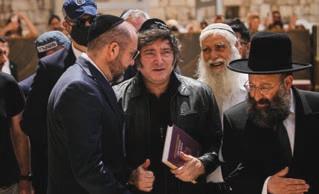
Argentinian President Javier Milei arrived in Israel on Sunday for his third trip in two years since being elected president. During his trip, Milei and Prime Minister Benjamin Netanyahu announced that direct flights would begin between the two countries by the end of the year and that Milei would move his country’s embassy to Jerusalem.
During the meeting, Milei and Netanyahu also signed the Isaac Accords, a series of strategic deals on security and AI. The name of the accords is a reference to the Abraham Accords, signed in 2020, that normalized ties with several Arab countries and aims to promote ties with countries in the Western Hemisphere.
Upon arriving in Jerusalem, the two greeted each other with a hug, then Netanyahu joked about how similar “Javier” and the Hebrew word for friend, “chaver,” sound.
In his remarks at the Isaac Accords signing ceremony at the Prime Minister’s Office, Netanyahu said that recent political changes in South America — likely referring to the election of rightwing, Western-friendly governments — mark a return of the “alliance of freedom.”
“It starts with the two of us and with the support that is always there from the U.S. for free societies,” he said, expressing hope that the Abraham Accords model can be applied to Latin America.
“We had Abraham, and now we have Isaac. What will be the Jacob Accords?” the premier joked.
Members of the accord will coordinate against “Iran’s attempts to expand its terrorist networks and operational presence across the Western Hemisphere,” the statement read. “The initiative also seeks to foster coordination and alignment in international forums and to promote a framework to expand cooperation
in innovation, technology, trade, and economic openness.”
“Israel is now a leading technological power, and Argentina has the human capital and regulatory freedom to become the world’s next AI center,” Milei said at the signing ceremony. “We will develop joint models, train experts, and work together in international forums where the future of this technological revolution is determined.”
Milei called the launch of the accords “a historic moment for our nations.”
He also revealed that Argentina will move its embassy to Jerusalem.
“Argentina and Israel are brothers in pain since the terror attack on the embassy in Buenos Aires,” he said, referencing the deadly 1992 bombing on Israel’s embassy in Argentina, blamed on Iran. “Today we are asking for justice, and will move the embassy to Jerusalem.”
Argentina’s move would make it the eighth country to relocate its embassy from Tel Aviv to Jerusalem, after the United States, Guatemala, Honduras, Fiji, Kosovo, Papua New Guinea, and Paraguay.
“I stand here alongside two of President Trump’s greatest allies,” U.S. Ambassador Huckabee said. “I know of no leaders he respects more or with whom he has a closer personal bond.”
Milei and Netanyahu also announced direct flights would begin this year between the two countries. Milei said flights should begin in December. Flights would take around 16 hours from Tel Aviv to Buenos Aires, and 15 hours to return.
Netanyahu called Milei a “personal friend and a great economic leader and great world leader” and noted that it was the first time a foreign leader had been granted the honor to light the torch at the annual state Independence Day ceremony on Tuesday evening.
Netanyahu also awarded Milei the Presidential Medal of Honor.
Milei was brought up Catholic but has a deep interest in Judaism. He visited the Kosel again during this trip to Israel.
Argentina is home to the largest Jewish community in Latin America, composed of nearly 300,000 people living mostly in Buenos Aires.
Lebanon Ceasefire
Prime Minister Benjamin Netanyahu on Friday hailed Israel’s 10-day U.S.-mediated ceasefire with Hezbollah as the start to a long road to peace, with the caveat that “we have not yet finished the job.”
U.S. President Donald Trump, in his statement announcing the truce, declared that the United States is banning Israel from bombing Lebanon.
“They are PROHIBITED from doing so by the USA. Enough is enough,” Trump wrote in a social media post that reportedly concerned Israeli officials.
Later, the Trump administration explained that Israel still maintains the right to defend itself against Hezbollah.
According to reports, Netanyahu was “stunned and alarmed” by Trump’s apparent banning of Israeli military action in Lebanon, puzzled by the statement’s implications, and concerned by the U.S.’s unprecedented exertion of authority over the Jewish state.
Later, a U.S. official clarified that Trump was merely pointing out that the ceasefire’s guidelines bar Israel from bombing Lebanon, noting that the “ceasefire agreement between Lebanon and Israel clearly states that Israel will not carry out any offensive military operations against Lebanese targets but preserves its right to self-defense against planned, imminent, or ongoing attacks.”
Meanwhile, Trump warned Hezbollah to behave “nicely and well during this important period of time.”
Lebanese President Joseph Aoun, Netanyahu, and Trump might meet at the White House in the next week or two for “the first meaningful talks between Israel and Lebanon since 1983,” the U.S. president said.
Aoun said the talks and ceasefire were “crucial,” touting the Lebanese army’s role in the future withdrawal of Israeli troops. Meanwhile, Defense Minis-
ter Israel Katz downplayed the ceasefire as a mere “temporary freeze,” noting that Israel will continue holding captured areas until its missions are accomplished.
Israel’s Home Front Command has eased most wartime restrictions across the country, allowing schools, businesses, and public events to return to normal. However, in communities near the northern border, limits are still in place, with gatherings capped at 1,000 people until Saturday at 8 p.m. Starting Saturday night, all cultural and sporting event restrictions would be lifted ahead of Independence Day, according to Culture and Sport Minister Miki Zohar.
Deadly Explosion in Lebanon
On Saturday, an explosion in southern Lebanon killed one IDF reservist and injured nine other soldiers, including one who sustained serious wounds.
Officials identified the fallen soldier as Sgt. First Class (res.) Lidor Porat, 31, of the 769th “Hiram” Regional Brigade’s 7106th Battalion, from Ashdod. Before his death, one other soldier, Warrant Officer (res.) Barak Kalfon, was killed recently despite the ongoing ceasefire with Hezbollah.
While operating in southern Lebanon, the troops drove over a bomb that Hezbollah had planted. Four sustained moderate injuries. The wounded soldiers were airlifted to a hospital for treatment. In retaliation, the IDF struck a number of nearby targets.
Porat was, according to his family, a deeply religious man with “love of the Torah and love of exceptional Torah scholars,” Ynet reported. He was an electrical engineering student who had been serving as a reservist since the Hamas-led October 7 massacre.
Porat & Kalfon were buried on Sunday.
A total of 15 IDF soldiers have been killed since fighting in Lebanon restarted roughly six weeks ago. Although a ceasefire is in effect, the IDF responds to viola-
The Week In News
tions. On Sunday, soldiers killed a Hezbollah terrorist who passed the “forward defense line and approached the troops in a manner that posed an immediate threat.”
170 Soldiers Die in 1 Year
Since Israel’s last Memorial Day, 170 soldiers have died, either in battle or by other means, in addition to 54 veterans who have succumbed to injuries from their time in the army.
Since 1860, the year Jews left the Jerusalem Old City walls and founded new communities in Israel, 25,644 people have died while fighting for the country,
including soldiers, police officers, and security officials. The figure does not include terror victims.
According to the Defense Ministry, there are 59,583 people in Israel who have lost a loved one, including 7,165 since October 7, 2023.
The figures’ release coincides with Israel’s Memorial Day on Monday, which was commemorated with a one-minute siren sounded throughout the country.
Memorial Day observances at Israel’s military cemeteries this year will be conducted under wartime guidelines set by the Home Front Command, the Defense Ministry said, citing ongoing security concerns. If in-person gatherings are not permitted, some ceremonies may instead be recorded in advance.
“We are completing preparations for Memorial Day for Israel’s fallen and preparing to commemorate the fallen and hold events in accordance with Home Front Command guidelines, out of a desire to strike the right balance between the sanctity of Memorial Day and the sanctity of life,” said Aryeh Moalem,
head of the department for the families of fallen soldiers, commemoration and heritage.
“The memory of the fallen is a foundation of our unity,” he continued. “Behind every name stand families and great pain, but also a strength that continues to pulse through and connect us all.”
Community Re-established
Defense Minister Israel Katz spoke at the ceremony, affirming the government’s commitment to restoring other communities throughout Judea and Samaria.
Finance Minister Bezalel Smotrich touted the community’s re-establishment as a “national holiday” and a “historic correction” to the “sinful expulsion from northern Samaria.”
“On this moving day, we are honored to make a historic correction to the sinful expulsion from northern Samaria,” said Smotrich. “We are abolishing the disgrace of expulsion, killing the idea of the Palestinian state, and returning to the settlement of Sa-
Sa-Nur, a community in northern Judea and Samaria, was re-established on Sunday with a ceremony attended by cabinet ministers, Knesset members, local politicians, and activists. Its re-establishment comes almost 21 years after then-Prime Minister Ariel Sharon’s 2005 Disengagement Plan forced Israelis to evacuate from the Gaza Strip and Judea and Samaria’s Homesh, Sa-Nur, Ganim, and Kadim communities. Now, 16 Jewish families have returned to Sa-Nur, including former resident Samaria Regional Council Chairman Yossi Dagan.
The Week In News
Nur. This is a day of celebration for the settlement movement and a national holiday for the State of Israel.”
Smotrich also called on Prime Minister Benjamin Netanyahu to bring about the “full occupation” of Gaza and allow Jews to resettle there.
Peace Now, a left-wing organization, labeled the communities’ re-establishment “stupid and wicked.”
Israel seized 500 dunams of privately owned land last December to construct a six-kilometer bypass road providing access to Sa-Nur while avoiding nearby Palestinian villages.
10.2M in Israel
As it approaches its 78th Independence Day, Israel’s total population stands at 10.244 million people, according to figures released on Sunday by the Central Bureau of Statistics.
The number was around 146,000 higher than last year, representing an increase of 1.4 percent. This includes 110,00 more Israelis and 36,000 foreigners, according to the data.
Of the total population, 7.790 million, or 76% of the population, are Jews and “others” — meaning non-Jewish, non-Arab citizens — while 2.157 million (21.1%) are Arabs. The remaining 296,000 (2.9%) are foreigners.
Over the past year, about 177,000 Israelis were born; 48,000 people died. A further 21,000 people immigrated from abroad.
According to the CBS, the population of Israel is more than 12 and a half times the population at the time of the state’s establishment in 1948, when it was just 806,000. Since then, 3.5 million people have immigrated to the country, though currently four out of five people in the population are Israeli-born (“sabras”).
According to other data released last week for Holocaust Remembrance Day, the second largest concentration of Jews in the world is in the United States, with 6.3 million, or around 40% of the global total of 15.8 million. France is home to the third-most amount of Jews worldwide.
Tim Cook to Step Down
This week, Apple CEO Tim Cook announced that he is stepping down from the company. John Ternus will take his place as the head of the technology giant.
Cook will become the executive chairman of Apple’s board of directors, the company said. Ternus will officially become CEO on September 1.
“It has been the greatest privilege of my life to be the CEO of Apple and to have been trusted to lead such an extraordinary company,” Cook said in a statement on Monday.
“John Ternus has the mind of an engineer, the soul of an innovator, and the heart to lead with integrity and with honor. He is a visionary whose contributions to Apple over 25 years are already too numerous to count, and he is without question the right person to lead Apple into the future,” Cook added.
Cook has served as Apple’s CEO since 2011. The company said that under his leadership, Apple has grown from a market capitalization of approximately $350 billion to $4 trillion.
Ternus has worked at Apple since 2001 and became a vice president of Hardware Engineering in 2013. He has worked on several product lines, including the iPad, AirPods, and Apple Watch.
“I am profoundly grateful for this opportunity to carry Apple’s mission forward,” Ternus said. He worked under Steve Jobs and referred to Cook as his mentor.
“I am filled with optimism about what we can achieve in the years to come, and I am so happy to know that the most talented people on earth are here at Apple, determined to be part of something bigger than any one of us,” he said.
In an interview with Michael Strahan last month, Cook said, “Twenty-eight years ago, I walked into Apple and I’ve loved every day of it since. We’ve had ups and downs, but the people I work with are so amazing. They bring out the best in me. And hopefully, I can bring out the best in them. And Michael, I can’t imagine life without Apple.”
CA Woman Arrested for Helping Iran
Federal prosecutors detained a California woman at Los Angeles International Airport on Saturday, accusing her of facilitating millions of dollars’ worth of covert weapons sales for Iran.
According to Bill Essayli, the first assistant U.S. attorney for Central California, 44-year-old legal Los Angeles resident Shamim Mafi was arrested right before boarding a flight to Turkey.
“Anyone who violates United States sanctions laws will be vigorously prosecuted by the DOJ. Great work by @FBILosAngeles and the federal prosecutors in my office,” Essayli posted on X.
Federal authorities allege that Mafi, who resides legally in the United States, acted on behalf of Iranian intelligence operations in Los Angeles. According to a detailed 69-page complaint, she is accused of creating a shell company and presenting herself as an intermediary linking the Iranian government with prospective weapons purchasers.
Prosecutors further claim that she played a key role in arranging multimillion-dollar transactions involving drones, explosives, detonators, assault rifles, and ammunition. Much of this activity, they say, was conducted through a business known as Atlas International Business LLC, as well as a similarly named company she set up in Oman.
She allegedly made a sale that included over $60 million worth of drones sold by Iran to Sudan’s defense ministry.
Her alleged activities demonstrate a broader pattern in which Iran has strengthened its finances in recent years by exporting the same drone capabilities it has deployed in attacks across the Persian Gulf — operations often described as retaliation for military actions by the United States and Israel.
Mafi, born in 1981 in Iran, gained legal U.S. citizenship in 2016, court documents show. She lives in the wealthy Los Angeles neighborhood of Woodland Hills.
According to the complaint, she remained in contact with individuals tied to Iranian intelligence whom she had known since childhood and worked in close coordination with them, as well as with senior officials in the Iranian government.
Prosecutors also say that between 2021 and 2024, Mafi was repeatedly questioned by agents from U.S. Customs and Border Protection. During those encounters, she frequently disclosed her connections to the Iranian government, including that her first husband had been an intelligence officer. She further claimed to have insight into how Iran circumvented sanctions and conducted money-laundering activities, while maintaining that her own efforts were centered on organizing shipments of medical supplies to African nations via the Gulf.
According to court documents, Mafi brokered arms deals for Iran as recently as last year. Her charges include weapons-related offenses, such as exporting weapons without a proper license. She faces up to 20 years in prison if found guilty.
Tariffs Refund
Since the Supreme Court ruled that President Donald Trump’s tariffs are illegal, companies affected by the president’s trade duties are now able to request a refund.
The administration collected over $166 billion in tariffs that the Supreme Court in February declared illegal. Over 3,000 companies, including Costco and FedEx, have sued the government for refunds.
The tariffs raised prices for companies relying on foreign goods, leading to higher prices for consumers. Some companies have said they intend to return money to consumers who bore the brunt of the high prices.
It is unclear when the refunds will be returned.
At the center of the issue are the shifting “reciprocal tariffs” that Trump introduced last year under the International Emergency Economic Powers Act (IEEPA). No previous president had used the 1977 statute to impose tariffs, a move that ultimately led the Supreme Court to rule against him in February. That decision took away what had been one of his most powerful trade tools, which he had used for a wide range of aims — from combating illegal drug flows to supporting political allies overseas.
Although the government has previously lost trade disputes and issued refunds, the scale of the repayment process now facing the government is unprecedented. According to the administration, more than 330,000 importers
The Week In News
had paid IEEPA-related duties on over 53 million import entries as of March.
Federal officials estimate that the tariffs generated more than $166 billion in import-related revenue. According to Scott Lincicome, vice president for general economics at the Cato Institute, that unpaid amount is projected to accumulate roughly $650 million in interest each month (about $22 million per day).
The financial implications led Trump to argue during the case that an unfavorable outcome could push the government into a “GREAT DEPRESSION!”
After the Supreme Court ruled against him, his administration sought to delay the refund process, but in March, the Court of International Trade stepped in and directed the government to repay importers.
According to legal filings, the trade court’s order triggered a rush among federal customs officials to build a digital system able to manage a flood of refund claims. Those documents also outlined the technical difficulties the Trump ad
limited to processing claims at a particular step in the duty payment timeline. Officials previously said this setup currently covers about 63 percent of the import entries subject to IEEPA tariffs, with plans to widen its reach over time.
Earlier guidance from customs also noted that, once an importer’s submission is approved, refunds would likely be issued within a window of 60 to 90 days.
In an effort to replace the invalidated tariffs, the Trump administration has launched investigations into the trade practices of dozens of countries under a provision of the Trade Act of 1974. Those probes are widely expected to lead to new tariffs comparable in scale to the ones struck down by the Supreme Court. Trump has also already imposed a temporary 10 percent tariff on most imports under a separate section of the same law.
That move, carried out under Section 122, is now facing fresh legal challenges from small businesses and several states. The plaintiffs are represented
Monopolizing Tickets
A federal jury in New York dealt a major blow to Live Nation and its Ticketmaster subsidiary last Wednesday, finding the companies operated as an illegal monopoly in the live entertainment business.
The verdict marks a significant victory for more than 30 states that sued the ticketing giant, accusing it of crushing competition, limiting consumer choice, and saddling concertgoers with inflated prices and endless fees. In short: fans may finally have gotten an encore.
The jury found Ticketmaster overcharged customers in 22 states by an average of $1.72 per ticket. That may sound small, but across millions of tickets, the total could balloon into hundreds of millions of dollars. A judge will now decide damages and possible penalties, which could include refunds, forced sales of venues, or even breaking up parts of the company.
California Attorney General Rob Bonta celebrated the decision, saying, “This verdict shows just how far states can go to protect our residents from big corporations that are using their power to illegally raise prices and rip-off Americans.”
Live Nation quickly pushed back, saying the ruling is far from final. “The jury’s verdict is not the last word on this matter,” the company said in a statement, adding it plans to challenge any unfavorable rulings and appeal if necessary.
The case follows a separate March settlement between Live Nation and the U.S. Department of Justice, in which the company agreed to pay $280 million and sell at least 13 amphitheaters while allowing outside companies access to its ticketing technology. But a coalition of states rejected that agreement and chose to continue fighting in court.
Ticketmaster has faced criticism for decades. A rock band famously accused the company of monopolistic practices in the 1990s, while fans of a female singer reignited public outrage in 2022 after chaotic tour ticket sales left many shut out and seeing red.
Legal experts say the jury’s decision could increase the odds of a breakup. “They’ve been making promises for decades and then breaking those promises,” said Notre Dame law professor Roger Alford. “I think [that] increases the chances of a breakup.”
Live Nation, which merged with Ticketmaster in 2010, remains a powerhouse in the industry. Its concert business gener-
ated nearly $21 billion in 2025, accounting for 83% of company revenue. But after this week’s verdict, the company may find that monopoly money doesn’t spend so well.
The Racing Robot
In a scene that felt equal parts Olympics and sci-fi casting call, a Chinese humanoid robot named Lightning sprinted into the future — and straight past humanity. The machine clocked a jaw-dropping 50 minutes and 26 seconds in the Beijing E-Town Half Marathon, smashing the human world record of 57:20 set just last month by Uganda’s Jacob Kiplimo. Apparently, “run like the wind” now includes software updates.
Developed by Chinese smartphone maker Honor, Lightning wasn’t just fast — it was suspiciously fast. The robot tore through the 13.1-mile course on a separate track from 12,000 human runners, presumably to avoid collisions and bruised egos. It also left spectators wondering whether they’d just witnessed sports history or the trailer for a movie about robots taking over the world.
To be fair, the robot contenders didn’t all glide gracefully into glory. Several competitors stumbled, crashed, or veered into barriers. One reportedly toppled near the finish line and had to be helped upright — proving even robots can hit the wall, though theirs is usually literal. Another wandered off course like it was searching for Wi-Fi.
Still, the leap in performance is staggering. Last year’s winning robot needed more than two hours and forty minutes to finish the same race. In one year, they went from “needs rebooting” to “please check for illegal enhancements.” That’s less progress and more software sorcery.
Experts say the event highlights China’s rapid advances in robotics, with machines increasingly capable of balance, endurance, and autonomous movement.
For now, humans can take comfort in one thing: robots may outrun us, but they still can’t enjoy the euphoria of accomplishment that comes at the finish line. Yet.
Hillel Lieberman & Rachel Hauer
Eli Klein (Boca) & Leeba Knopf (Baltimore)
Yehoshua Binyomin Schreibman & Rivka Sarah Sall
Meir Klein & Bracha Pleeter
Moishe Myers & Michali Mishory
Aryeh Weinberg (Monsey) & Meira Sperling (Baltimore)
Yanky Morgenstern & Esther Shapiro
Want to see your simcha here? Email mazeltov@baltimorejewishhome.com or text 443-675-6507 to submit your simcha!
Daniella & Sender Gross on the birth of a daughter
Zvi & Sori Spiegel on the birth of a son
Nachy & Yali Smith on the birth of a son
Want to see your simcha here? Email mazeltov@baltimorejewishhome.com or text 443-675-6507 to submit your simcha!
Torah Thought I Am Ready When You Are!
By Rabbi Zvi Teichman
ויהת םישודק— You shall be holy, for ינא שודק —holy am I, Hashem, your Lord (ב טי ארקיו)
G-d seems to be demanding from us to be holy simply because He is. Can our holiness approximate that of G-d? Why does G-d’s holiness compel us to be holy?
The root word שדק, which normally translates as holy, alternatively can mean to prepare oneself, as when before the giving of the Torah at Mount Sinai the nation was instructed, רחמו םויה םתשדקו— You shall prepare yourselves today and tomorrow for the upcoming Revelation. (י טי תומש)
Rabbeinu Ephraim, one of the Rishonim, renders this verse in this light as follows:
You shall prepare yourselves [to fulfill My mitzvos], for I too am prepared to hear your voices.
This interpretation certainly modifies the prior implication and seems to be simply encouraging us to be prepared to perform His will so that He too will be ready to hear our pleas and respond to them.
But what is the exact nature of this ‘preparation’? Is it just a positive attitude that suffices or is there a specific act of preparation that must be implemented to affect a reciprocal response from G-d?
The traditional understanding of this verse, in the context of holiness, we are taught refers to sanctifying ourselves through refraining from even those activities that are not specifically restricted by the Torah but nevertheless are worthy of restraint. Whether it is regarding the levels of indulgence in our relationship to food, intimacy, or manner of speech, one who sanctifies that which is otherwise permitted to him, embodies the objective of this command.
Perhaps the notion of preparation for mitzvos and this call for chasteness are two sides of the same coin.
We are summoned to create a הרותל גיס — ‘fence for the Torah’ (א
This is not just a directive to the sages in each generation to implement additional rabbinic restrictions that will help deter the violation of strict Torah law. A classic example would be the laws of Muktzeh where certain items, e.g. a hammer, are not to be handled lest one inadvertently come to utilize them in performing a prohibited work activity. It is incumbent upon everyone to apply whatever strategies vital to avoiding compromising situations.
The Talmud quotes the prophet Yeshayahu who extols one who closes his eyes from seeing evil (וט גל והיעשי)
This refers to one who when passing by washwomen, who often in the course of their arduous work bend and stretch, exposing parts of their bodies, firmly ‘closes his eyes’ so as not to be aroused. The Talmud adds that certainly this doesn’t refer to one who has the option to take an alternate route and avoid these women entirely, because if he had another option and didn’t select it, even if he succeeded in deflecting his eyes, he is classified as a עשר, a wicked sinner. It pertains only to an individual who had no recourse and found himself in this circumstance not by choice. (ם"בשרו :זנ ארתב אבב)
Why is this so? If a person had the inner strength to overcome temptation, why is he faulted?
In life we will each inevitably face myriad of challenges that are orchestrated by providence, and we are expected to rise to the challenge in overcoming our urges to succumb. But at times the odds seem so insurmountable. How can we be expected to succeed in the face of such powerful forces?
That answer is that we know G-d never puts us to a test we cannot withstand. In fact, the Talmud states that the evil inclination is so all consuming that if not for G-d’s divine help we couldn’t resist. (:בנ הכוס)
The problem is that this divinely assured assistance is only guaranteed if our challenges are G-d inspired, but not if we have created them or entered willingly into the arena of challenge.
It is for that reason one who chooses not to avoid the territory of test is deemed an evil person, for eventually he will falter in his battle against the evil inclination since he enters alone, unaided by G-d, against a formidable foe he cannot possibly overcome. (בהזה
Perhaps this is exactly what we are being taught here.
Prepare yourself — get ready; be on guard, because only then will G-d see how committed you are in avoiding the pitfalls of sin.
G-d then adds — ‘for I too am prepared’ and ready to be at your side as you valiantly conquer your challenges, which are devised by G-d Himself to prod greatness from within you, against an otherwise unconquerable enemy.
This is not merely an expression of the measure for measure reward for fulfilling His will, it is the sum total of the only game plan that can achieve success in meeting the trials we must inevitably face in our journey towards eternity and spiritual growth.
The Sifra on this verse that charges man to be akin to G-d, questions,
perhaps G-d is expecting us to be equal to Him and concludes that the words
for I alone am holy, negates that possibility, as G-d asserts
my holiness is beyond yours.
Could one contemplate even the doubt that G-d expected of us to be on the level of His holiness?
Perhaps continuing the theme, we can suggest:
G-d beckons us to be prepared to serve Him as He is prepared to hear us. I might have thought He expects us to be so equipped as to overpower the evil inclination alone without His assistance, as indeed He is so capable. G-d addresses that notion clarifying: הלעמל יתשודק — My ability from above is what infuses you with strength to defeat your archenemy, you can’t do it alone, but realize that it is contingent, םכתשודקמ — from you preparing yourself, by implementing strategies to avoid as much as is within your ability from being ensnared by his nefarious clutches.
One of the early Chassidic leaders, Reb Menachem Mendel of Vitebsk, once found himself in the great city of Minsk on Parshas Kedoshim. The townsfolk were accustomed to the many maggidim — itinerant preachers, who would frequent their city and castigate them for their deficiencies, depicting vividly before them how unless they improve their ways the fires of Gehenna will consume them.
Reb Menachem Mendel observing how downcast they were, feeling defeated, dejected and doomed to failure, rose to the podium and took a very different tack, in the tradition of the Baal Shem Tov.
“Kedoshim Tihyu, you will all be holy”, he appealed, “is not simply a demand from G-d to change your ways and become holy, but rather a loving promise that you will all reach the heights of that which is inherent within each one of you, you will each realize the greatness and beauty that emanates from your precious souls, for you are all so holy!”
He is waiting to assist us in actualizing that reality. He is ready! All we need to do is display a willingness to strive, a semblance of caution in avoiding that which is within our ability to deflect, and He will do the rest in guiding us through the dangerous road towards our ultimate success.
He is ready when we are!
You may reach the author at: Ravzt@ ohelmoshebaltimore.com
Sons and Sums
By Ra BB i Daniel Glatstein
Fundamental in a Jewish man’s life is the concept of a minyan, a quorum of ten adult Jewish men required for any davar shebikdushah, such as saying Borchu, Kaddish, and Kedushah. This concept has remarkable ramifications. You can have nine of the greatest talmidei chachamim in the world and yet … you can’t recite Kaddish. Then, if a fellow who can barely read aleph-beis enters, you suddenly become qualified to do so. Why is this? What is the secret power behind the number ten?
R’ Akiva’s Students
Let’s turn our attention to a different question. The Gemara (Yevamos 62b) teaches that between Pesach and Shavuos, twelve thousand pairs of R’ Akiva’s students died. The reason for this harsh punishment, says the Gemara, is that they did not show proper respect for one another.
The Shem MiShmuel finds this puzzling. The students of R’ Akiva can be assumed to have been great tzaddikim. Were they not capable of overcoming pettiness? Could they not bring themselves to a point where they could accord their peers the proper respect?
Another interesting point to take note of is why this would transpire only among the students of R’ Akiva. There were many great rabbis at the time and presumably they too had many students. Were they able to maintain a more refined interpersonal dynamic than were the students of R’ Akiva?
Sum of the Parts
R’ Meir’s opinion is that no matter how degraded a Jew might be — even if he is an idolater — he is still called a
“child of Hashem.” The question we must address is why this is so. Why is it that even the greatest sinner still warrants such an exalted title?
The Ran addresses this question and presents the following explanation. When numerous parts come together to form an entity, that new entity is something greater than the individual parts. For example, if you were to dismantle a car, removing the motor, transmission, battery, radiator, and so on, and then tally the value of each piece independently, you would arrive at a certain sum. However, the price of the car, which is a product resulting from the combination of all those pieces, will be significantly higher than that sum! That is because the value of the car is greater than the sum of the individual components.
No Jew lives in a vacuum, says the Ran. Each individual Jew is a part of a magnificent entity called Klal Yisrael. And, as in the car metaphor, the value of that entity is far greater than the value of all the members individually. Klal Yisrael as a unit is a reality unto itself, a reality that has a title: Children of Hashem. The reason any Jew, even a great sinner, is called Hashem’s child is because he is not viewed based on his individual merit; rather, he is viewed as a component in the great institution of Klal Yisrael.
The Chida quotes the masters of homiletics, who say that this idea is hinted to in the word tzibbur, congregation, which is an acronym for tzaddik, beinoni, rasha (a righteous one, an average one, and a wicked one).
Perspectives on Parts
The Rogatchover Gaon, however, writes that the idea that the sum is greater than the parts is not unanimously maintained. Cryptically (as is his style), the Rogatchover cites a Mishnah that records a machlokes between R’ Yose HaGlili and R’ Akiva regarding zimun for Birchas HaMa-
zon as one example of this differing opinion. In the Mavo to the Tzafnas Panei’ach al HaTorah, his underlying intention is clarified.1
The halacha is that when three men join for a meal, they bentch together, as a unit, with one of them leading the ritual. According to R’ Yose HaGlili, there is a distinction between when there are fewer than ten diners versus when there are ten or more. When ten men are bentching, they invoke Hashem’s Name as part of the zimun, saying “nevarech Elokeinu” instead of simply “nevarech.” Should the number of diners be one hundred, an additional appellation is added: “nevarech Hashem Elokeinu.” And this continues, with added references to Hashem each time the number of diners swells another tenfold. So holds R’ Yose HaGlili. R’ Akiva, however, maintains that once the number reaches ten and the appellation “Elokeinu” is added, it does not progress from there, no matter how many diners are present.
According to the Rogatchover, the dispute between R’ Yose HaGlili and R’ Akiva hinges on the question of a sum total’s value versus the value of the parts making up the sum. R’ Yose HaGlili is of the opinion that we don’t regard an entity as something separate and apart from the many parts of which it consists. Therefore, the more parts an entity has, the more valuable it will become. For this reason, he holds that the additional references to Hashem’s Name in a zimun will depend on the number of those present at that zimun
R’ Akiva, on the other hand, maintains that a unit holds its own, independent, value. When ten Jews gather, they create a formative union, and adding to that union does not change its value. Therefore, R’ Akiva holds that whether there are ten men or ten thousand, the wording of the zimun will remain the same.
In the Rogatchover’s responsa,2 he points to another dispute that seems to revolve around the same question.
The Gemara (Bava Basra 8a) cites a Baraisa stating that if one makes a vow that he will not benefit from any residents of his city, the vow will apply to anyone who dwelled within the city for twelve months. The vow will not apply to anyone who lived in the city for less than a year, as such an individual is not considered a resident.
The question now becomes, what is the status of the vow with regard to someone who joins the city after the vow was made and continues to live there for twelve months? Does the vow apply only to those who were residents of the city at the time the vow was made, or even to those who join later? The Ran (Nedarim 84a) and the Rambam rule that the vow will apply to newcomers to the city as well. The Ritva, however, takes the position that the vow will apply only to those who were residents of the city at the time the vow was issued.
This difference of opinion, says the Rogatchover, reflects the two views on the value of the sum of the parts. The Ran and the Rambam rule that the unit carries a status in and of itself. When the vow was taken, it pertained to “all residents of the city.” This can be seen as a vow regarding “the unit comprised of all residents of the city.” When a newcomer joins, he becomes absorbed into that unit. Since he is part of the unit against which the vow took effect, he will be classified as subject to that vow.
The Ritva, however, is of the opinion that the sum of the parts is valued only through the parts themselves. A vow regarding “all residents of the city” refers to each resident independently, as there is no separate entity called “all residents.” A vow taken against all residents of the city will refer to each resident independently. Thus, someone who joins later will not be included in the vow.
The Rogatchover cites many other sources for this idea, but what is important for our purposes is to note the view of R’ Akiva. According to the Rogatchover’s interpretation of the Mishnah in Berachos, R’ Akiva takes the position that the sum of the parts is indeed an entity unto itself, separate and more valuable than the parts themselves.
R’ Pinchas Friedman writes that this can explain a Gemara (Berachos 31a) that discusses R’ Akiva’s mode of davening. When R’ Akiva davened with a minyan, the Gemara tells us, he would shorten his tefillah so as not to keep the tzibbur waiting. When he davened privately, one could see him begin in one corner and return to see him in a different corner. The Gemara explains that this was an outcome of his intense bowings and prostrations.
We see from here, says R’ Friedman, that R’ Akiva’s approach to davening with a tzibbur was qualitatively different from his approach to tefillah when it was done privately. This can be understood in light of R’ Akiva’s position that the sum of the parts is a separate entity from the parts themselves. When R’ Akiva davened with a tzibbur, he was operating in a different realm. He was bonding with an “entity” formed by ten Jews and thus did not exert himself as
he did when he davened in private.
Unit of Children
The Ran explained that the idea that the Jewish people will always be seen as Hashem’s children is rooted in the concept that the sum of the parts — in this case, Klal Yisrael — is an entity unto itself. The Rogatchover noted that this was the opinion of R’ Akiva.
Thus, we have discovered that R’ Akiva’s view is consistent throughout the pages of the Talmud. R’ Akiva holds that a zimun is unaffected by swelling numbers, as the entity of the tzibbur does not change. Likewise, R’ Akiva did not add special kavannah when he davened with the tzibbur, as the entity would not thereby be enhanced. For this very reason, R’ Akiva, like R’ Meir, utilizing the above explanation of the Ran, maintains that as a unique entity, the Jewish people are always considered the children of Hashem.3
This philosophy, writes the Shem MiShmuel, can be fraught with danger. R’ Akiva felt that he could devote less time to davening Shemoneh Esrei when he davens as part of the tzibbur, since it’s the collective effort that carries the day. This can lead one to the erroneous conclusion that a fellow individual’s accomplishments need not be recognized. Each person can come to view the other as merely another “piece in the puzzle” as opposed to an independent human being deserving of such recognition.
Specifically R’ Akiva’s Students
We began by asking:
(1) How could R’ Akiva’s students sin in this manner?
(2) Why was it only R’ Akiva’s students who failed in this area?
With what we have learned, both questions can be clarified. The Shem MiShmuel teaches that R’ Akiva’s students were so ardently connected to the unit that defines Klal Yisrael as a whole that they lost sight of the fact that each member of the unit was also an independent entity. Thus, it was specifically the students of R’ Akiva, who maintains that the sum creates its own entity, who failed to recognize each other’s independence and afford their peers the proper level of individual respect.
At Specifically This Time
The Shem MiShmuel, quoting his father, the Avnei Nezer, then explains that the period in which the students of R’ Akiva died — between Pesach and Shavuos — is certainly not happenstance. Each month has its designated astrological sign, and the sign for the month of Nissan (in which we celebrate Pesach) is a ram. Sheep, says the Avnei Nezer, express themselves with a kol echad, single voice. Thus, the sheep represents individuality within the entity. The sign for the following month, Iyar, is an ox. The Gemara (Rosh Hashanah 26a) says that the horns of a cow consist of several layers and appear as “two or three shofaros.” This suggests that the cow, or ox, represents multiplicity.
The next month is Sivan, whose sign is te’omim, twins.
In Nissan, we celebrate the unit of Klal Yisrael; in Iyar, we celebrate the individual; and in Sivan, we celebrate the coming together of these two values.
Counting to the Klal
It is during this time — between Pesach and Shavuos — that we count the Omer. The Shem MiShmuel says that this, too, follows the theme of bridging the gap between the individual and the combined unit. On the one hand, the pasuk says, “U’sefartem lachem, You shall count for yourselves” (Vayikra 23:15). One interpretation of this expression is that each person must count for himself — one cannot fulfill his obligation through another’s counting. It is the task of the individual. On the other hand, each day of the sefirah builds on the previous one, with each attribute associated with the day encompassing the qualities of the day that preceded it. This represents the unifying element — the coming together of the parts.
The Shem MiShmuel further writes that this may be the concept behind counting the days and the weeks. The days represent the individual, while the weeks reflect the entities comprised of the many parts.
R’ Akiva’s students were lacking in their appreciation of the power of the individual in relation to the power of Klal Yisrael. They died during the month of Iyar, during Sefiras HaOmer, because it is during this time that we are to emphasize this very lesson.
The truth is that the duality of being recognized as individuals as well as a unit exists within the very father-son relationship we share with Hashem. The Alshich writes that two pesukim refer to the Jewish people as Hashem’s children; one speaks to the entirety of the Jewish people, and the other speaks of each individual.
The first of the pesukim is in Parashas Shemos. There, the pasuk says, “Bini bechori Yisrael, My firstborn son is Yisrael” (Shemos 4:22). The second pasuk is in Parashas Re’eh, which states, “Banim atem l’Hashem Elokeichem, You are children of Hashem, your G-d” (Devarim 14:1). The Alshich explains that the first pasuk is written in the singular, referring to the entirety of the Jewish people as a single entity. The second pasuk, which says “banim” is written in the plural, referring to every Jew as an individual. That is, we see that every individual Jew has his own unique status as a child of Hashem. These two pesukim teach us that there is an element of being Hashem’s children on a national level, as well as an element of being Hashem’s children on each individual’s level.
And so, we see that both the individual and all Klal Yisrael — the parts as well as the sum — carry an element of always being Hashem’s children.
1Tzafnas Panei’ach is a commentary on Chumash by the Rogatchover Gaon. The Mavo was written by R’ Menachem Mendel Kasher.
2She’eilos U’Teshuvos Tzafnas Panei’ach, p. 179.
3See Chapters 3 and 19; R’ Akiva is quoted in Pirkei Avos (3:18) as saying, “Beloved is Yisrael, for they are described as children of the Omnipresent.”
This article has been printed from Rebbi Meir Baal Haness and the Eternal Children of Hashem by Rabbi Daniel Glatstein, published by Artscroll. Rabbi Daniel Glatstein is the Mara D’asra of Kehilas Tiferes Mordechai in Cedarhurst, NY, and author of numerous seforim in Lashon Hakodesh and in English for ArtScroll. He is an international lecturer and maggid shiur. His thousands of recorded shiurim are available on Torahanytime.com, podcast, his website rabbidg.com, and other venues.
The Adas: Chofetz Chaim Adas Bnei Israel - 5915 Park Heights Ave
The Shul at the Lubavitch Center - 6701 Old Pimlico Rd
Tiferes Yisroel - 6201 Park Heights Ave
Tzeirei Anash - 6706 Cross County Blvd
Wealcatch Insurance - 37 Walker Ave 2nd floor
Yeshiva Tiferes Hatorah - 6819 Williamson Ave
As the United States imposes a blockade of Iranian ports, pressure is mounting on Beijing to push Tehran to accept terms that will end the war and the global energy crisis. In reality, there is little that Beijing could or would do to pressure its partner in the Middle East.
This week, as an array of leaders — including the crown prince of Abu Dhabi, United Arab Emirates, and the prime minister of Spain — visited Beijing, the question of what China could do to help resolve the crisis was the inescapable backdrop to every meeting. In these talks, China’s leader, Xi Jinping, condemned the flouting of international law as a “return to the law of the jungle” — a not-so-veiled dig at President Donald Trump — and offered “a Chinese solution” in the form of a four-point plan to resolve the crisis.
But that plan offers little more than a call for all to respect the principle of sovereignty and international law. It reflects how China, even as it grows more concerned about the war’s impact on its economy, has avoided becoming too en-
Political Crossfire Why China Won’t Lean Hard on Iran
By Lily Kuo and David Pierson
tangled in the crisis. That includes being noncommittal in its response to Tehran’s calls for China to guarantee its security, as well as not using its influence as Iran’s largest trading partner to push the country to accept U.S. demands.
Asking China to pressure Iran is to “misread China’s foreign policy and position,” said Ding Long, a professor at the Middle East Studies Institute of Shanghai International Studies University. “Helping the United States or Israel is not China’s intention because China opposed this war from the very beginning.”
China, which has long claimed that it does not interfere in other countries’ affairs, wants to be viewed as a global leader on its own terms. Unlike the United States, which has long maintained its dominance through its defense alliances, China has only one treaty ally, North Korea.
And China’s rulers have little desire to commit to another nation’s defense and risk being dragged into a costly war that ultimately undermines their own country’s strength.
“Chinese leaders tend to view U.S. interventions in the Middle East as a key driver of American decline, and they have no interest in following that model,” said Patricia Kim, a senior fellow at the Brookings Institution’s John L. Thornton China Center.
Yes, the Iran war hurts China too.
China has a lot to lose if the conflict in Iran continues. The Strait of Hormuz is a critical route for China’s energy and goods; about a third of its total crude oil imports come from the Persian Gulf. At a time when China is especially reliant on exports to prop up its economy, higher energy costs will cut into demand for Chinese goods.
“They have strategic reserves, but it’s not going to last forever,” said Yun Sun, a scholar at the Stimson Center in Washington, referring to oil reserves that China began stockpiling before the war began. “They don’t like instability. They don’t like a war that’s basically hanging over their head,” she added.
In a sign of growing concern, Chinese officials engaged in a flurry of diplomatic activity this week after talks between the United States and Iran failed to produce a peace agreement.
China’s foreign minister, Wang Yi, called on his counterpart in Pakistan, which hosted the talks, to help sustain the “hard-won momentum” of the temporary ceasefire struck last week.
Speaking with Iran’s foreign minister last Wednesday, Wang said that China continued to support Iran, but he also urged that the Strait of Hormuz be reopened, saying freedom of navigation should “also be guaranteed.”
But Washington’s distraction is also an opportunity.
In some ways, the war also benefits Beijing. The United States is bogged down in the Middle East rather than focused on the Indo-Pacific or deterring China’s threats to take Taiwan, which Beijing claims as its territory.
And China has been able to use America’s military actions as a way to cast it-
A mural in Tehran, Iran, depicting the Strait of Hormuz
self by contrast as a peaceful nation that champions global stability. The war also means that more countries, frustrated with Trump, are turning to China as a more predictable partner.
“I think it’s 50-50 good and bad,” said Xin Qiang, a U.S.-China expert at Fudan University in Shanghai. He said that while rising energy costs hurt China’s economy, dissatisfaction with Washington is pushing countries to strengthen ties with China, which helps expand Beijing’s global influence.
“It shows that China is — at least as we see it — a more responsible country
interests — such as its claims over Taiwan and in the South China Sea — China has used trade bans, tariffs and sent its military and coast guard to apply pressure on other countries.)
Also, China lacks the military might to enforce its will.
Part of China’s reluctance to get more involved in the crisis in the Middle East is also a question of capability.
China’s rapidly expanding military does not have an expansive network of overseas bases like the United States does, though its navy has stationed an
China’s rulers have little desire to commit to another nation’s defense and risk being dragged into a costly war that ultimately undermines their own country’s strength.
than the United States,” he said. “We’re more trustworthy, more rational and more peaceful.”
China doesn’t want to be blamed if peace talks fail.
When Iranian officials credited China for helping push through the ceasefire agreement last week, Beijing did not confirm or deny a role. A Foreign Ministry spokesperson said only that China was “working actively” to bring about an end to the crisis.
That sidestepping suggests that Beijing, wary of the possibility that the ceasefire might fail, played only an indirect role in the talks, according to some analysts, and at most encouraged the sides to come to the table. (Iran may be overstating China’s role in an effort to push Beijing to be more vested in any agreement with the United States, according to Sun.)
“I think it is highly unlikely China took an active role in that mediation attempt. The risks are high. It fears being blamed,” said Sarah Beran, a partner at Macro Advisory Partners who served as senior director for China and Taiwan affairs in President Joe Biden’s National Security Council.
China argues that every country has the right to govern itself without outside meddling and positions itself as a power that does not bully others. (Yet, when it comes to what it considers China’s own
anti-piracy task force in the Gulf of Aden since 2008. So far, it has not been deployed to guard Chinese vessels, a step experts say would be unlikely unless Chinese ships came under direct attack.
“China can definitely play a role, but that role remains limited,” Xin said.
“If Iran needs security guarantees, it’s very difficult for China to provide them,” he said. “If the U.S. wants Iran to abandon its nuclear program, China has no way to force Iran to give it up.”
While Beijing is eager to push for peace, it is also constrained by competing priorities. It needs to manage the economic fallout of the energy crisis, reset its relationship with Washington before a summit between Xi and Trump, and maintain its ties with Iran and the Persian Gulf States, which have come under attack from Tehran.
As the prospect of a quick victory over Iran by the United States and Israel appears less likely, Beijing’s calculus has shifted.
“Had the U.S. been victorious within a week or two, the Chinese would have gone with it,” Sun said.
Now China’s current strategy is to seek a ceasefire as quickly as possible, she said, and try to “maximize China’s role, although indirect, in the mediation so that China gains more credibility.”
Both Sides Want a Deal. Both Keep Acting Like They Don’t
By David Ignatius
Think of all the sparring ahead of the second round of U.S.-Iran negotiations as the World Series of Brinkmanship. The two sides are on a slippery slope above an abyss, and they bizarrely seem convinced that it’s the path to success rather than disaster.
The stakes heightened on Tuesday, as President Donald Trump’s negotiating team delayed its departure for a new round of talks in Islamabad, Pakistan, to force the Iranians to clarify what concessions they’re willing to make. Meanwhile, Trump’s latest ultimatum is set to expire on Wednesday. After that, Trump has said, he’s ready to attack Iranian bridges, power plants and other civilian targets.
If Trump really wants to succeed in this biggest challenge of his presidency, here’s what he should do: announce that
he will delay his ultimatum to empower Parliament Speaker Mohammad Bagher Ghalibaf to win over hard-liners who oppose the deal. He should open the door to a new Iran – not slam it shut. If Ghalibaf can’t deliver, then the world will know that grim answer and can act accordingly.
I’ve never seen a negotiation that’s quite like this one. The American and Iranian sides aren’t just bargaining over the “shape of the table,” as happens in many negotiations, but whether there should be a table at all. Both sides act as if the only way to get to “yes” is to keep saying “no.”
Trump and the Iranians both appear to enjoy this game of chicken. Both seem to want a deal but insist that they don’t need it – and that the other side wants it more. Both are hurting economically,
but they boast they’re willing to keep fighting indefinitely. Every time they near an exit ramp, they veer away.
When I visited a carpet bazaar in Tehran 15 years ago, I was advised never to hint that I wanted to buy a carpet. The only way to get a good deal was to convince the merchant that I was ready to walk away. I’ve never been in a major real estate deal, but I assume it has a similar dynamic.
These two bargainers have been working so hard to convince the other side they’re ready to walk that they may be forced to do just that – and continue the next round of war. But that would probably be a bargaining ploy, too.
Trump has relished trash-talking as he pushes for a favorable peace agreement. He’ll talk one day about “obliterating” Iranian civilization, and a week
later he’ll offer the promise, as he did Tuesday in an interview with CNBC, that Iran “can make themselves into a very strong nation again, a great nation” by making a good bargain.
Trump loves setting deadlines and making ultimatums, and the Iranian side acts unimpressed. As Wednesday’s deadline approaches, Trump has repeated his threat to bomb civilian infrastructure. When people accuse Trump of contemplating a war crime, he appears unfazed – as if the charge adds luster to his threat. Shock is part of the game.
The tit-for-tat over the Strait of Hormuz has been part of the pre-negotiation sparring. Iran announced it was closing the passage just after the first meeting in Islamabad because the ceasefire discussed there didn’t apply
nspiration Nation
Revital Moses A Peek into India’s Secret Jewish Community
By Eliyahu RosEnBERg
Many centuries years ago, a boat full of Jews — overwhelmed by the waters of the Arabian Sea — shipwrecked on the Western coast of India.
Few details of their story are known. We don’t know why they were fleeing, or from what. We don’t know where they were heading. And we can’t know what was going through their minds as they left their wrecked ship, stepped onto Indian land, and breathed in the air of their new home. What were they thinking as they felt the humid, ocean air on their skin, passed through a landscape of lush greenery dotted with coconut
In Her Words…
palm trees and tropical plants, and heard birds chirping, waves crashing, and leaves rustling in the wind?
Beyond a collection of traditions passed down through generations to their Indian Jewish descendants — who are known as the Bene Israel — we don’t know much about the survivors of the shipwreck. No historical records describe their journey or their arrival.
But we do know one thing.
“The Indian community welcomed us with open arms,” Revital Moses says.
Revital Moses, a descendant of that Jewish group, was born and raised in the Indian city of Thane, some 30 kilo -
Even now, for Jews, i think israel is the safest place to live.
Both Judaism and hinduism are very accepting and tolerant. There are two similar ideologies that they have. in hinduism, there’s a concept called Vasudhaiva Kutumbakam, which means ‘this world is one big family.’ and in Judaism, we have Tikkun olam, where we fix the world through action.
i know it can be scary but give hashem a chance to guide you. Don’t resist it. lean into it.
meters from Mumbai.
“I had a very cool upbringing as an Indian Jew, because I never once felt like I had to hide my identity,” Revital shares. “Jews, wherever they have been in the diaspora, have faced persecution and antisemitism. But India has so far been a very safe space for the Jewish community.”
And that’s how it was 2,000 years ago when the people of India saw Jews for the first time. Jews have faced intense persecution in nearly every country they’ve resided in. Locals have always felt threatened by us, governments have curtailed our rights, lies have been pulled out of a hat to justify our persecution, and violence has driven us away.
But among the countries we’ve called home, India stands out as one of the only places where Jews have never been persecuted or oppressed; where Jews have been able to live peaceful, openly observant lives in coexistence with their gentile neighbors.
The Indian community accepted the Jewish newcomers as their own, and they wound up staying in the country, building shuls and schools. Today, 4,000 of their descendants, along with members of other Indian Jewish communities, remain in India, while tens of thousands more live in Eretz Yisrael.
While Jews are among the smallest minority groups in India, Indian Jews have made significant contributions to Indian society, Revital notes. India’s General J.F.R. Jacob, who was from the Baghdadi Jewish community, led the operation to liberate Bangladesh from
Pakistan in the 1970s, and David Sassoon, a Jewish community leader in India who was known as the “Rothschild of the East,” built Mumbai into India’s financial capital.
In some ways, Revital had an ordinary, traditional Jewish upbringing. Her family went to shul every Shabbos and observed the chagim, she attended a Jewish Sunday school, and her home was strictly kosher.
“My grandparents — my father’s parents — lived with my father, my mother, my sister, and myself for some time. We always made sure to do Shabbat dinners together, light the candles, and make Kiddush and Hamotzi ,” Revital recalls. “Sometimes, it could be challenging because every other Saturday is a workday in India. But if you asked for a holiday, would your employer say no? No. The people I worked with were always accommodating. Yom Kippur was a big deal for us. We fasted, went to synagogue, prayed, and asked G-d for forgiveness.”
But being an Indian Jew also comes with a host of special customs inspired by Indian culture. For instance, the Indian Jewish community’s weddings, in addition to having a chuppah, feature other special ceremonies, including what Revital describes as a “dance competition.” Indian food is another big part of being a Jew in India: curry, chutneys, rice, naan (a type of flatbread), and the like.
On Revital’s YouTube channel, which has over 100,000 subscribers, she bridges the gap between India and
Israel through “cultural advocacy” — to show the world how similar the two countries are.
“We have shared values and shared challenges. If we discuss values, both Hindus and Jews are culturally very similar. Both communities focus on community, education, giving back to the community, learning from our setbacks, and building together. And if we talk about challenges, both India and Israel are surrounded by very hostile neighbors. So they understand our pain,” Revital explains. “Both Judaism and Hinduism are very accepting and tolerant. There are two
similar ideologies that they have. In Hinduism, there’s a concept called Vasudhaiva Kutumbakam, which means ‘this world is one big family.’ And in Judaism, we have Tikkun Olam, where we fix the world through action. Now, they sound different. But in practice, they’re very similar.” * * *
Although Revital’s family always wanted to make aliyah, she was initially against moving to Israel. She had her reasons. Israel seemed culturally overwhelming to her. For example, “As Indians, we’re very soft-spoken. Then, all of a sudden, you have an Israeli come
up to you, yelling at your face. It got too real for me,” she says with a chuckle. But also, at the time, she saw more value in moving to the United States — to pursue the American dream.
But in the end, Revital and her family moved to the Holy Land. And despite the war — despite the constant rockets — she couldn’t be happier.
“Even now, for Jews, I think Israel is the safest place to live,” she declares. Although she was happy in the Indian Jewish community, living in Israel, in a Jewish state, makes being a proud, practicing Jew all the easier.
Revital Moses has advice for Jews who feel spiritually lost, who want to lean into the spiritual side of Judaism
but are afraid.
“What I would like to tell them is to just lean into it. I know it can be scary but give Hashem a chance to guide you. Don’t resist it. Lean into it,” she suggests. “And I would also like to say: try and explore more Jewish communities, because there are communities like us that people have no idea about.
“I would like to invite you to learn more about us, our history, and our culture. For people who think that everybody is against the Jewish people, I want to tell you that there is one country in the East that supports us — that loves us.
“All you need to do is look on the other side and explore more.”
This article is based on a podcast, “Inspiration For the Nation,” hosted by Yaakov Langer. To catch more of this conversation, you can watch it on LivingLchaim. com or YouTube.com/LivingLchaim or listen wherever you listen to podcasts (just search for “Inspiration For The Nation”) or call our free hotline: 605-477-2100
but I’m not even sure where to look for the most up-to-date information.
One day, I started to type in a secular news site online, and I stopped myself. That is a slippery slope. You never know what inappropriate content you will be exposed to on a secular news site, so I usually avoid looking there. It felt good to control my choices online. I decided that as a zechus for my children in Eretz Yisroel, I would be careful to only follow frum news sites for updates and avoid the secular ones.
May it be a zechus for everyone’s safety and the geula very soon!
TECH TIPS:
For those who need access to all types of music, including secular music, for work or other purposes, while all platforms may have objectionable content, some are better than others.
Spotify is the most popular music app, but it also includes music videos, full-length movies, and podcasts on every topic — and we do mean every topic.
The second most popular music app is Apple Music, and it comes with a number of safety features that Spotify does not have. It’s also available for Android, even though it’s an Apple product. Among those features: it is focused on music only — no movies, ebooks, or podcasts like you’ll find on Spotify. There are also passwordprotected parental controls that can block music videos and explicit content. And with a content filter, even album art can be hidden, since that can sometimes include objectionable imagery as well.
For anyone trying to balance broad music needs with a safer environment, Apple Music is the safer choice.
My Israel Home Bringing the Best of Diaspora Jewry to Israel
By Gedaliah Borvick
When my family made aliyah over two decades ago, we left behind in Bergenfield, NJ, a synagogue that played a central role in our religious and communal lives. We loved our shul, our rabbi, and the close-knit community that formed around it.
Our greatest concern wasn’t employment or language. It was whether we could recreate the communal infrastructure that had shaped our family.
With that in mind, we chose the Sheinfeld neighborhood in Beit Shemesh, drawn
to Rabbi Avishai David and Beit Midrash Torani Leumi. Known widely as “Rabbi David’s Shul,” BMTL reflected a model familiar to many Anglos: a synagogue that serves not only as a place of tefillah and shiurim, but as the organizing center of communal life – chesed, friendships, youth engagement, and shared responsibility.
Several years later, we moved down the road to Nofei Hashemesh, where the inspiring Rabbi Shalom Rosner serves as its spiritual leader. There, too, serious Torah commitment exists alongside inte -
gration into Israel’s broader national life. Seeing our children, after high school, enter hesder programs – learning in yeshivot and protecting our nation in the armed forces – reminds us that while these communities may feel culturally familiar to Anglo families, they are deeply and authentically Israeli.
This approach did not begin in Beit Shemesh.
Rabbi Shlomo Riskin
Rabbi Shlomo Riskin of Lincoln Square Synagogue was among the first to embody it. In 1983, at the height of a flourishing American rabbinate, he made aliyah. His commitment to Israel was already evident. During the 1973 Yom Kippur War, under Rabbi Riskin’s guidance, Lincoln Square redirected funds designated for a synagogue expansion to support Israel in its hour of crisis. Yet solidarity from afar was insufficient. Rabbi Riskin sought to help shape Jewish life
That vision became Efrat, demonstrating that Torah commitment, inclusivity, and civic responsibility could coexist with-
Over time, similar communities developed across the country, attracting English-speaking families eager to make aliyah without relinquishing the communal framework that had nurtured them. Leaders such as Rabbi Shai Finkelstein, who reinvigorated the Nitzanim shul in Baka, and Rabbi Larry Rothwachs, now moving to Ramat Beit Shemesh, continue strengthening communities grounded in Torah while fully engaged in national life.
Rabbi Kalman Topp – senior rabbi of Beverly Hills’ Beth Jacob Congregation and formerly of the Young Israel of Woodmere – has chosen to make aliyah in the prime of his career to help establish a new kehillah in Givat Hamatos, Jerusalem’s first new
His decision reflects a much older pattern. Well before Rabbi Riskin, figures such as Rabbi Abraham Isaac HaCohen Kook and Rabbi Yitzhak HaLevi Herzog left Europe to assume rabbinic leadership in the Land of Israel. They understood that Jewish destiny was no longer centered in Europe. Torah leadership needed to stand where the Jewish future was being built.
Today, amid rising global antisemitism and uncertainty in the Diaspora, many Anglos considering aliyah are searching not only for housing but for belonging. When seasoned communal leaders relocate and invest in building strong synagogue-centered communities, they ease the transition for new immigrants and provide a framework for meaningful Jewish life.
Aliyah does not require abandoning the communities that shaped us. For my family, it has meant carrying forward the warmth and framework we once knew in Bergenfield – now part of our lives here in Israel, where we are privileged to witness the next chapter of our national story unfold.
Gedaliah Borvick is the founder of My Israel Home (www.myisraelhome.com), a real estate agency focused on helping people from abroad buy and sell homes in Israel. To sign up for his monthly market updates, contact him at gborvick@gmail.com.
To Raise a Laugh
The Science Of Parenting
School science fairs will always be a staple of our educational system, because research shows that about 78% of scientific discoveries are made by students the night before science fairs.
Well, technically, it’s the parents making the discoveries. There are almost no science fair projects that kids can do without their parents’ help. Out of the 2 kids of mine that have had projects so far, one of them involved heat sources and the other involved nighttime driving.
So since you’re the one doing it, here are some ideas for projects based on the ones that my wife and I have done. The great thing is that both of them use materials you can find around the house, provided you already went out and bought them.
PROJECT #1: LIQUIDS WITH GAS
BACKGROUND:
We all know that liquids are constantly releasing gas. Actually, I didn’t know this, but my son came home from school and told me, so now we all know. I thought it was just hot liquids and soda.
THE EXPERIMENT:
The question is how much gas they produce. Can you inflate a balloon using only gas from the liquids? And a heat source, because we don’t have all year?
Also, does it matter if the drink is an acid or a base? I don’t know why it would, but scientists like to know.
MATERIALS:
-Five different drinks. We used water, seltzer, and soda, and then, for an acid and a base, we used orange juice and milk.
-Five empty water bottles. Though technically, four empty water bottles, because one is just going to be refilled with water. We didn’t think of that ‘til after.
-Five balloons. We decided to use five of the same color – black – because the package came with blacks and when on earth would someone use black balloons? A funeral?
-A heat source. We ran out and bought something called “hand warmers”, which are little packets that look like the ones that come with your shoes and say “Do not eat,” like someone who’s going to eat an unidentified packet that came with their shoes is gonna read warnings.
-Your child. If you have to sit there and watch balloons barely inflate, so does he
HYPOTHESIS:
My hypothesis was that nothing would happen. If liquids really gave off that much gas, then anyone who drinks 8 cups of water a day would be floating around like a blimp.
PROCEDURE:
1. Fill each water bottle with a uniform amount of liquid. Cover each one with a balloon.
2. Shake the hand warmers and place one under each bottle. DO NOT EAT.
3. Sit there and watch the balloons inflate, or, in the case of the orange juice and milk, flop over and give up.
OBSERVATIONS:
There’s no way to measure how much a balloon inflates using numbers you can put on a chart. But the teacher doesn’t let you write things like “slightly bigger”, so have to make up units of measure. Like we wrote that the seltzer balloon inflated to, quote, “2 inches.” Whatever that means.
PROJECT#2: LONGEST FLIGHT
BACKGROUND:
Previous generations have proven that paper airplanes are great for throwing in class, because unlike a football, which can be confiscated, if the teacher takes away your paper airplane, you could always make more. What’s he going to do, take away all your paper? He’s the one who told you to bring 10,000 sheets to school in the first place.
THE EXPERIMENT:
Everyone has a certain style of folding an airplane that he swears is the best. The question is, which one is actually the best? My son decided to create several of the top models and find out.
MATERIALS:
-Paper airplanes. My son made 30. Some
By Mordechai Schmutter
had points, some had less pronounced points, and some did not have a point at all. I think there’s a nimshol here.
-Huge room. If you do it outside, you have the wind factor. If you do it in your house, you have obstacles in the form of furniture and siblings who just stand there like furniture as the planes specifically loop around to fly into them. So my wife called the school, and it turns out it’s totally okay to throw paper airplanes at school if you come in after school hours and do it in the gym. And clean up after yourself.
-Father-in-law. We brought along my fatherin-law (not my son’s), who I think might be a rocket scientist. We never talk about it.
HYPOTHESIS:
We were going to have a good time and pretend it was for science.
PROCEDURE:
1. Find a time that the school building is open but nothing is going on in the gym. (Allow 4-6 weeks.)
2. Have your child stand in one place and keep throwing airplanes as the adults yell, “Stop throwing them so fast! We’re trying to measure distance!”
3. Collect all 60 airplanes from the floor, except for the ones that looped around and fell behind your child. I should have brought a broom.
4. When you’re done, your father-in-law will make a paper ball and see how far that goes, as a baseline. Turns out it goes farther than some of the planes.
OBSERVATIONS:
Keeping planes in a shoebox for several weeks while you try to find a place to go throw them is not very good for airplanes.
CONCLUSION:
If you do the science project out of the house, your child will not wander away. Especially if you do it in school.
Mordechai Schmutter is a freelance writer and a humor columnist for Hamodia and other magazines. He has also published eight books and does stand-up comedy. You can contact him at MSchmutter@gmail.com.
My phone flashes and gyrates on the counter: “In the next few minutes, alerts are expected in your area. You need to find a better location that will provide the best protection. If an alert is received, enter the protected space and stay there until further notice.”
I used to call my protected space “the pit”; it’s where I write and edit, the sights and sounds of the street in front of the house inaccessible from this mostly underground fortress. We installed a regular window and screen on the inner side of the shelter window years ago and kept the latter open to the backyard to allow the peacetime sun in to brighten the office. The metal window stood open for so many years that last June, during the twelve-day war with Iran, we had trouble shutting it for all the rust that had accumulated over thirty years of winter rains. But shut it we did, and now the pit has reverted to a shelter, morphed into a cocoon, keeping my family safe. Until March 1 –that’s when the illusion of safety was shattered, together with the windows of our house.
Our son and his wife drove to our
Israel Today
Shattered
By Nomi Isenberg
home in Beit Shemesh from their apartment in Jerusalem with their four children – ranging in age from 9 years to 9 months – the evening of Saturday, February 28, a quick, 40-minute drive, this time shorter – not too many cars on the road. They hoped to dodge the missiles that Iran began launching our way following joint U.S.-Israeli airstrikes against their military and nuclear sites in the wake of the failure of negotiations to end their nuclear program. The kids would be sheltering with us for the interim since their building has no protected space. When a siren sounds at 3 a.m., it’s not ideal to grab four sleeping children and run down four flights of steps to a public shelter. Instead, we dragged two big mattresses to our cocoon, covered them with flannel sheets, down blankets, pillows, bolster cushions, and tossed a menagerie of stuffed animals into the room. The warm glow of a nightlight was soothing. My grandson carved out a space for himself under the desk, calling it his “burrow.” The children slept there every night, their sleep not interrupted by frightening sights or sounds.
We were coping pretty well, un -
til Sunday, March 1. The scene: living room – one kid playing on a tablet, one reading a book; kitchen – another having a snack; upstairs – the baby sleeping; their parents trying to grab a few quiet moments to do some work on their laptops wherever they could find a quiet space. (Yes, our economy needs to stay afloat, people still need to work!) Lots of toys, games, cards, books everywhere. I take in the scene and appreciate what great parents my kids are and how much patience and creativity they have. I focus on my gratitude and not on the mess.
Then our phones flash and beep. Expect an alert. My son calmly relocates the kids downstairs, gadgets in hand for distraction, my daughter-in-law scoops the baby out of the pack-n-play upstairs and rocks her under her blanket to encourage her to stay asleep. I wait to hear if this alert will pan out to be an alarm. When the siren sounds several minutes later, I rush downstairs and latch the door shut, raising the metal handles to a 90-degree angle.
Just as I settle myself onto the mattress on the floor, I hear the biggest boom I’ve ever heard and feel the foun-
dation of the house shake. My granddaughter is pushed back by the force of the boom, and both she and my daughter-in-law report that they saw a puff of “smoke” come in through the vent that brings air in from the interior of the house. (It wasn’t smoke, but we didn’t know that at the time.) Luckily, I had taped over a similar vent on the outside wall in the wake of the Gulf War, for fear of poisonous gas reaching us.
Some of my neighbors, also huddled in their shelters, having felt the earth rock under them, had ventured out before the all-clear to check for damage and posted shocking pictures to our neighborhood WhatsApp group: windows, walls, and roofs destroyed. When I saw those, I braced myself for what awaited me upstairs.
When we were able to leave the shelter, I instructed my daughter-in-law to stay put with the children as my son and I went to survey the scene. (My husband was not home at the time. He’s a doctor, and from day one of this war he’s been on the roads, doing house calls, treating patients who haven’t stopped being sick just because there’s a war. I had pleaded
with him that morning not to leave the house, arguing how dangerous it was. Although he’s seen many a roadside ditch over the past month, ironically that day was uneventful for him as he traveled about, safer than we were at home.)
We soon found out that a missile had hit a bomb shelter not far from our neighborhood. Nine people were killed, among them children, thirty-five wounded, five missing. (They were later found, thank G-d). The force of the blast caused damage to many homes, including ours.
My son and I stepped onto a floor covered in shards of glass of varying shapes and sizes. The dining room table glittered as the light reflected off the surface of the broken glass that lay on it. The children’s toys, games, cards, and books were strewn all over the place, tiny pieces of glass and glass dust insinuated everywhere, into and over every surface. A thick layer of dust and sand covered every surface that wasn’t already covered in glass. It had blown in when the windows shattered and was propelled throughout the house by the sheer force of the blast. That was the “smoke” that my granddaughter and daughter-in-law had seen entering the vent to the shelter.
I felt overwhelmed, but I wanted to be strong for the children, so I sucked in deep, grabbed a broom and a pair of rubber gloves, gave the like to my son, and got to work.
We worked for hours. At intervals, my daughter-in-law switched places with my son. We swept, shook out, vacuumed, and mopped. And then did it all over again. More than once. And when we finished, I bagged up the tablecloth, put a fresh one on the table, and served a hot, full-course dinner. The kids never saw the disaster that was.
In the interim, we had taped over the window frames that were now open spaces and lowered the blinds over the 3-panel sliding glass door to the patio which looked like a huge spider web. Luckily, it was double-paned glass, so, although it was cracked all over, the two layers were glued together and thus hadn’t fallen from the frame. But the frame was warped and didn’t sit properly on the track, so the doors didn’t close. We were left with open doors, windows that weren’t, and those that were, were windows whose frames were damaged or whose clasps and latches were blown off. We were vulnerable to the elements: cold, rain, insects, dust, and wind. The winds of war.
I felt very vulnerable. And cold.
Luckily, it had just drizzled one or two days. At least we had heating in the house, and some of the windows had blinds to lower to keep out some of the cold. And it wasn’t as cold as it could have been. I tried to focus on the positive and on how lucky we were that no one was hurt. But I felt very exposed and insecure without windows.
But who was I kidding? Windows cannot keep out war. The most they can
Just
fears, and then couldn’t anymore when they were drafted for extended reserve duty to the gehinnom of Gaza and beyond. The stakes had gotten higher and my nerves had become rawer, frayed. I spent the better part of two years holding my breath, and when I wasn’t, I was bargaining with G-d to spare my sons.
I adore my children and grandchildren, and it was a privilege to be able to offer them safe haven for a month.
as I settle myself onto the mattress on the floor, I hear the biggest boom I’ve ever heard and feel the foundation of the house shake.
do is muffle the sounds of airplanes that fly overhead. Yes, they can keep out the elements, and so I could take comfort in a modicum of safety, but really, it’s all an illusion. And that illusion was shattered along with my windows on March 1. If we had taken a direct hit, would my bomb shelter have kept us alive? I’m not sure, but I’d like to think so. Those who were killed that day in Beit Shemesh were both outside the shelter and within, but the door had been left open.
I still felt safe in our cocoon. I felt the need to stay close by, should I need to access it quickly. For that reason, I didn’t leave the house for a month. I question if that behavior bordered on the neurotic. I wasn’t happy about it and wanted to break free of my fear. But my confidence had been shattered, too.
Our windows have now been replaced and repaired, but I was traumatized by the possibility that they might shatter again from another blast long afterward.
I wanted to lower the blinds every time I heard a siren, to shield our windows and us with another layer of protection.
I feel much better now that I can shut the outside world out at will, even as I believe that true protection doesn’t come from glass, steel, iron, flesh, and bones; it comes from the Creator of all that. But I’m exhausted, not just by nights of sleep interrupted by missile attacks, but by years of worry for the safety of my children. First, when they traveled by bus to get to school during the Second Intifada, and later, when they enlisted, four sons over the course of ten years in and out of compulsory service. I had suppressed and denied my
the courage to venture out of the house for a quick jaunt to the dry cleaners and the supermarket, both close to home and in the same complex, one with a bomb shelter readily accessible. I accomplished my errands and returned home without incident. I’d taken my first step in the direction of freedom from my fears. As I continued to rid my house of excess belongings, junk, and junk food, I began to feel liberated from the material trappings of my life.
Spiritual liberation is the essence of Pesach, and that’s what I wanted to tap into. I cleaned by day, dreamt of a good night’s sleep where I could shake off the nightmares of the past and wake up with renewed strength to meet the day. There was much work to be done, many good deeds to do, and the days were short.
And the kids were so well behaved. But it wasn’t a natural situation, they were out of their normal routine, and everyone got a bit edgy after a while. They returned home a week before Pesach to clean their house. My cleaning lady came the day after they left, and she and I freed my house of crumbs and clutter. Despite my fears, I gathered up
So now I must rein in my fear for my son who is posted on the Lebanese border, for another son who is due to start another two months of reserve duty in another week, for all our soldiers and civilians, and keep my eye on the bigger picture.
Am I shattered? No.
Battered? Yes.
I’ve aged greatly in the past two years—the mirror doesn’t lie. And yet, the glass in the mirror remains intact.
Living Kiddush Hashem
A Policeman’s Lesson in Trust
RBy Rabbi Shraga Freedman
abbi Bernstein (name changed) was surprised to see the flashing lights of a police car in his rearview mirror as he drove down Ten Mile Road in Detroit, but he obediently pulled to the side of the road and rolled down his window. A stern-looking officer appeared within moments and demanded, “Do you know how fast you were driving, sir?”
“As a matter of fact, I do,” Rabbi Bernstein replied. “I was driving at 35 miles per hour, and the speed limit on this road is 40.”
The police officer was unmoved. “My radar showed you driving at 45 miles per hour,” he said.
“I can’t answer for your radar,” the rabbi said calmly, “but I was watching my speed very carefully, and I know that I was within the limit.”
To his surprise, the policeman decided to let him off. This was a very unusual occurrence, and the officer evidently felt that he owed Rabbi Bernstein a few words of explanation. “When I was a rookie officer, on my first night out on patrol by myself, I was driving down a residential street at three o’clock in the morning when I noticed a shadowy figure slowly entering a backyard,” he said. “I stopped my car to see what would happen next, and I saw the man rush out of the yard, leap into a waiting car, and drive off.”
The officer explained that he was certain he had witnessed a burglary in progress, and he took off in pursuit. It didn’t take long before he caught up to the man and flagged him down, and he demanded an explanation for his behavior. The visibly Orthodox Jew explained that he volunteered for Matan B’Seser, an
organization that performs acts of charity without the recipients’ knowledge in order to avoid embarrassing them. He had been leaving a check on a needy family’s back porch in the dead of night, he said, so that they would never know who had given them the money.
The officer found this story impossible to believe, and he brought the man to the police station. As the detainee continued to stand by his story, the officer had no choice but to make some phone calls to verify it. He was shocked to discover that every word of the story was true.
“I learned an amazing lesson that night,” the officer told Rabbi Bernstein before letting him go on his way. “I discovered that your people are a special people; you are the people of the light. That is why I believe that you are telling the truth, even if my instruments tell me otherwise.”
(Heard from Rabbi Leiby Burnham)
Rabbi Shraga Freedman is the author of Sefer Mekadshei Shemecha, Living Kiddush Hashem, and A Life Worth Living.
Email LivingKiddushHashem@ gmail.com for a free sefer. Visit LivingKiddushHashem.org for more resources
Living Kiddush Hashem was founded with the goal of imbuing every Jew with a powerful sense of mission — the mission to be mekadeish Sheim Shamayim in his or her own unique way. We strive to accomplish this by raising awareness of the paramount importance of the mitzvah of Kiddush Hashem and its centrality in everything we do.
Soul Searching A Network, A Phone Number, and A Connection To Judaism
By Gianna Metzger
When I made aliyah in July 2024, I knew that I wasn’t running toward something I’d always known. I was discovering something entirely new.
Originally from Tampa, Florida, I arrived in Israel in March 2025, officially completing my aliyah four months later. Now, as a student on the Aspire program at the Suzana and Ivan Kaufman Aish Institute for Women’s Education, I’m building the foundations of a life I could barely imagine possible just a few years ago.
I did not come from a religious family. In fact, religion remained a skewed and confusing concept during my childhood. However, as a teenager, something shifted. I started realizing that there was something more and that it wasn’t just me.
I began exploring Judaism, connecting with different people and organizations throughout Florida. I had the privilege to meet Jews from every background imaginable. And surprisingly, my family became my biggest champions.
One might think that a family that’s not super religious wouldn’t be so supportive, but they couldn’t have been more positive. They basically have just helped me along my way, and they’ve been my biggest supporters.
My path to the seminary came through a network of connections. I knew I wanted the kind of program that Aish offers, after deciding to make aliyah. A rabbi passed along the contact details of the Managing Director of Aish’s Women’s Programming, Michal Dubov. After hearing my story and background, Michal told me that the seminary had the perfect program.
That program turned out to be designed specifically for women without strong religious backgrounds who wanted to grow in their Judaism. It proved an ideal fit for me. Although I’ve only been here since September, the amount of
support and guidance and resources and growth that I’ve done in just that short amount of time is exponential.
The difference lies in how the material gets taught. Complex concepts that might overwhelm someone from a non-religious background get broken down into digestible pieces. Each class builds on the previous one. Even several weeks later, I realize that the information sticks.
As someone who describes myself as a logical thinker, I found unexpected growth in spirituality classes. Rivka Pesha Alter (whom students call RP) has become a particular favorite.
She takes really spiritual concepts, which I find to be the hardest to understand. I’m really good with logical concepts. Those I can break down and put on paper, but the really spiritual concepts, the Kabbalistic concepts, things that take years and years for people to even begin to grasp, she’s very good at breaking them down.
Most importantly, RP encourages students to research topics independently and even challenge her ideas. That’s such a huge thing here at Aish, that we’re encouraged to challenge the teachers who are instructing us.
This approach has helped me to break out of the box my logical thinking sometimes creates. Society tends to push logical thinkers toward purely academic pursuits while directing spiritual, artistic thinkers elsewhere. The two paths rarely intersect. Here at the seminary, I feel we are encouraged to grow in both of those things and understand that we don’t have to put ourselves in a box. I’ve learned parts of myself that I didn’t even know existed before I came.
If I could go back in time and talk to my high school self, I think I would tell her it’s OK to let go of control a little bit and just let life come. That’s definitely not something I would have said maybe
even as little as a year ago.
Control remained a central issue for the teenage me. I felt uncomfortable without logic, plans, and categories for everything in my life. I shared this struggle with the amazing staff when I arrived at the seminary, particularly with the rakezets (coordinators) assigned to check in with students weekly.
Their support helped. Over these months, I’ve developed the ability to go with the flow more and allow myself to grow naturally, without grasping for the control I understand I won’t always have.
Many prospective students worry that attending seminary means putting their lives on hold. They’re leaving jobs, families, education, and home countries. The pause feels risky.
I empathize with that concern; but my experience proved the opposite.
There is nothing but good that is going to come from this experience, and it’s very much not a pause in your life. The only thing that your time at Aish can do is help you build that life in a really healthy and positive way with some really good values and really practical knowledge and really a lot of growth internally.
I think about Aish’s core values of wisdom, love, and responsibility, which I hadn’t realized were so central to its mission, but I’ve seen them up-close in my experiences here.
The program welcomes students from every imaginable background. Normal stories mix with extraordinary ones. Every student receives the same open arms and comprehensive support.
I recently went through a difficult personal situation, which caused me to approach Dean of Students Esther Jankelow for help. The response came immediately: How can we support you? How can we make sure you’re still getting what you need? They have a saying here: “healthy before holy,” and that has been my experience.
That philosophy helps students absorb the knowledge they’re learning. It creates space to feel supported when overwhelmed. And for people experiencing major life changes and growth, that support matters enormously.
After my year at the seminary concludes, I plan to begin my army service in Fall 2026. I’ll carry forward the foundation I’m building now. As a logical thinker having previously struggled with control, I’m learning to embrace uncertainty.
I’ve discovered that sometimes the most important journeys begin with a phone number passed from person to person, leading somewhere you didn’t know you needed to go, but in hindsight couldn’t imagine your life or your journey without.
Gianna Metzger, 21, grew up in Land O’ Lakes, Florida. Prior to moving to Israel, she worked as a nanny and teacher while studying environmental science full time at St. Petersburg College. Spurred by the events of October 7, and despite having no family ties in the country, she made aliyah to Jerusalem at age 20. She is currently studying at Aish Aspire, where she is building a strong Jewish foundation to carry with her throughout her life.
TJH Centerfold
Draft Day Translator: What Scouts Say vs. What They Mean
Match the scouting phrase in Column A with what it really means in Column B
A Jets fan walks into a team’s draft war room and says, “I’ve got a foolproof system for picking the perfect player.”
The Jets GM asks, “Oh yeah? What’s that?”
The Jets fan says, “Simple. You draft the guy who’s going to be great.”
The Jets GM pauses…nods slowly…and says, “Congratulations. You’re overqualified. You clearly don’t belong here.”
NFL Draft Trivia
Just in case you think that you belong at the Draft right now
1. In 2000, one team had a historical four picks in the first round of the NFL Draft. No other team ever had that. Which team was it?
a. Jets
b. Dallas Cowboys
c. New England Patriots
d. Minnesota Vikings
2. In the 2007 NFL Draft, the Oakland Raiders held the No. 1 overall pick and selected a quarterback with what scouts called a “once-ina-generation” arm. He quickly became one of the biggest draft busts in league history. At one point, the team reportedly sent him home with a blank DVD to test whether he was actually studying game film—he wasn’t. Who was that quarterback?
a. JaMarcus Russell
b. Ryan Leaf
c. Jay Cutler
d. Tarvaris Jackson
3. What is the standard length of the NFL Draft today?
a. 5 rounds
b. 7 rounds
c. 10 rounds
d. 12 rounds
4. Why did the Minnesota Vikings miss their first-round pick in the 2003 NFL Draft?
a. They were caught spying on other teams’ draft rooms and were penalized
b. Their phone line malfunctioned
c. The draft board indicated that it was not yet their time to pick
d. They failed to submit their pick
in time while trying to negotiate a trade
5. What nickname is given to the final pick in the NFL Draft?
a. The Underdog
b. The Forgotten One
c. Mr. Irrelevant
d. The Sleeper
6. Which player, drafted 199th overall, became a 7-time Super Bowl champion?
a. Joe Montana
b. Peyton Manning
c. Drew Brees
d. Tom Brady
7. Which college has produced the most No. 1 overall draft picks?
a. Notre Dame
b. Alabama
c. Michigan
d. Ohio State
did New Orleans Saints coach Mike Ditka trade away in order to move up to the fifth overall spot and select running back Ricky Williams (who ended up playing for 11 seasons and was selected to the Pro Bowl one time)?
a. 2 draft picks
b. 3 draft picks
c. 4 draft picks
d. All 6 draft picks that the Saints had in 1999 and their 1st and 3rd round picks in the 2000 draft
8. Which position is most frequently selected with the No. 1 overall pick?
a. Running Back
b. Wide Receiver
c. Quarterback
d. Defensive End
9. Which team drafted Eli Manning and traded him to the Giants because he refused to play for them?
a. Dallas Cowboys
b. San Diego Chargers
c. Cleveland Browns
d. Chicago Bears
10. In 1999, how many draft picks
Draft Card:
8-10 correct: I would trade all of my picks for you, but that usually doesn’t work out too great.
4-7 correct: Not great, but not Mr. Irrelevant either. (BTW, San Fran QB Brok Purdy, who started the 2024 Superbowl, was Mr. Irrelevant in the 2022 draft. So never laugh at the last guy picked. Oh, and there’s also a QB by the name of Tom Brady who you may want to look up before laughing at someone who is picked close to last.)
0-3 correct: So how is life as the General Manager of the Jets?
Notable Quotes
“Say What?!”
I think if we don’t stand up and take ownership of our country, and take responsibility for it, we are slowly letting others control how we think and what we think.
- Conservative Supreme Court Justice Clarence Thomas in a recent interview
They said there was a quagmire. They said we had no strategy in the Strait. And, we took two missile guided destroyers and sailed them right up the gut. Right down the middle. And Iran didn’t do anything. They said they would do something, but they did nothing. Right now, we are doing some demining operations. And guess how many mines we found? Zero. The Iranians were bluffing.
– Jesse Watters, Fox News
Iran is closed for business completely. They can’t sell anything to anyone else; they can’t buy anything from everyone else. And, if you notice, there’s not a lot of stuff built in Iran. Especially after we bombed all of their steel and petro chemicals. They are done. They will lose about a half of a billion dollars a day. All of their oil wells will likely blow up in three weeks because they can’t store it.
– ibid.
The only leverage that they have is uranium, and it’s buried under the rubble. And we are keeping a close eye on it.
– ibid.
I pray, “G-d don’t let me hate.” But if I had a short list of people that I would consider hating, Congressman Eric Swalwell would be on it.
– Sen. John Kennedy (R-LA) talking about now former Congressman Eric Swalwell (D-CA), who resigned in disgrace this week due to his terrible indiscretions coming to light
Life is hard, but it’s harder when you are stupid.
– ibid.
Karma may be slow, but it’s almost always on time.
– ibid.
Is he claiming that he had no idea that Donald Trump held the position that he would never permit Iran to have nuclear weapons? If that’s what he’s saying today, he’s kind of a moron.
– Scott Jennings on CNN responding to Tucker Carlson (AKA QatarLson) apologizing for supporting Trump
[Canada] provided zero dollars to deal with the ongoing genocide of MMIWG2SLGBTQQIA+
- Canadian Parliament Member Leah Gazan speaking in the Canadian Parliament
She might have fallen asleep on her keyboard.
- Greg Gutfeld
It was 4,000 years ago here in Jerusalem, where G-d chose His people. He not only chose a people, but He chose a place. And then He chose for the people in this place a purpose. The people were the Jewish people, the place Israel. And the purpose was to be a light to the world.
- U.S. Ambassador to Israel Mike Huckabee in a Yom Ha’Atzmaut message
The ultimate reason for taking on Iran, given that they have been at war with us for 47 years and have said so for 47 years, is that if they get nuclear weapons and missiles that can reach the United States, they’re going to use them. I mean, when people chant death to America every day for 47 years, you have to be pretty stupid not to believe that maybe they mean death to America. So in a funny way, Donald Trump is fighting for Boston, New York, Chicago, San Francisco, in all these so-called blue cities, because he understands that they’re American cities.
- Newt Gingrich, Fox News
The Gulf countries tried everything to appease Iran, but were still attacked. This war was inevitable; the world has changed, and in this war, we are in the same trench with Israel.
- Lebanese journalist Nadim Koteich
I want to tell everybody how this happened. I sent President Trump some information. We have a gigantic opiate problem in this country, obviously. In 2024, more than 80,000 people died of overdoses. It’s a horrible number, and there are more than 5 million people addicted to opiates right now in this country. With one dose of ibogaine, more than 80% of people are free of that addiction. With two doses, it’s more than 90%. I sent him that information. The text message came back: “Sounds great. Do you want FDA approval? Let’s do it.” It was literally that quick.
- Podcast host Joe Rogan at the White House last weekend as Pres. Trump signed an executive order to allow the use of psychedelic drugs to treat mental health disorders
If the American people want the truth, they definitely should not pick up The New York Times or The Wall Street Journal or watch CNN, especially these days in the midst of this incredibly successful military operation against Iran. It’s almost like these legacy American media outlets were rooting for the Iranian regime over the American people, over our great United States military, because they are so rooted in their opposition to President Trump, rather than seeking and reporting on the facts.
- White House Press Secretary Karoline Leavitt
A robot beat the human record by several minutes in a half-marathon. Dejected Kenyans said, “Well, we are still the birthplace of Barack Obama.”
- Greg Gutfeld
I was dreading and uncomfortable with grief. And recently, I had this whole different thought of maybe grief is actually just this precious badge of love that you wear because someone has died and your love is continuing to grow.
- Rachel Goldberg-Polin in her new book about her son’s murder in Hamas captivity
Well, I do have a disagreement actually, Senator, with the President. I think, even this morning, he said that he thought I was at a central casting. I think central casting, I’d look older, grayer, and maybe show up here with a cigar of sorts.
- Kevin Warsh, President Trump’s nominee for Chair of the Federal Reserve, during a Committee hearing on his nomination, responding to U.S. Senator Elizabeth Warren (D-Mass.) who kept badgering him to name at least one area where he disagrees with the President
Forgotten Her es World War II Jewish Marine Heroes
By Avi Heiligman
While World War II was still ongoing, a major effort began to record the battles and the heroics of those who served. In addition to these initial accounts, many books, articles and oral histories have since been documented to preserve the military life of these service members and their struggle against the Axis powers. Though many of these books have been out of print for decades and the original newspaper articles are rarely consulted, the bravery of the 550,000 Jewish men and women who served in the American military remains a vital part of the wartime legacy. Among the many stories of servicemen and women are the Jewish Marines who served in the Corps during the American campaign in the Pacific.
The Marine Raiders were one of several elite special forces units founded during the war with the 2 nd Battalion becoming known for its “gung-ho” spirit. Led by Lieutenant Colonel Evans Carlson, Carlson’s Raiders pioneered light infantry operations deep into enemy territory. They became known for their raid of Makin Island and their legendary “Long Patrol” on Guadalcanal in 1942. Battalion leadership relied heavily on younger officers like Jewish First Lieutenant Jack Miller of Dallas, Texas, to set an example and lead the Raiders to success on the battlefield.
Miller was a platoon leader with Carlson’s Raiders when they embarked on their “long patrol” on Guadalcanal in late 1942. On December 3, Miller’s platoon was leading the company on an assault on Japanese positions on the island’s highest point when they ran into heavy enemy fire. Miller returned fire while leading his men to a safe position. During the engagement, he was shot and mortally wounded while leading a flank attack against the enemy machine guns. Lieutenant Miller passed away the next day from his wounds and was posthumously awarded the Navy Cross. Carlson wrote to Miller’s family, “Every officer and man of this outfit feels Jack’s loss. He was universally popular because of his quiet, friendly way with people and because of his able and efficient leadership… Please know that your son was both a man and a hero.” In 1944, the Navy launched the destroyer escort USS Jack Miller (DE-410) named in Miller’s honor.
J. Gene Hochfelder was another Jewish Marine officer decorated for bravery during World War II. Hochfelder grew up in Cedarhurst, NY, and joined the Marines after graduating from the University of Pennsylvania. In August 1942, he was commissioned as an officer and was sent to the Pacific as a replacement officer. He later transferred to the 5th Marine Division that was training in the States.
Following combat training in Hawaii, the division landed on Iwo Jima in February 1945. At this point, he was the commanding officer of Headquarters Company, First Battalion, Twenty-Sixth Marines, 5th Marine Division and was one of only two officers in his battalion to survive the battle unscathed.
On February 22, Hochfeder earned the Silver Star. His citation reads in part: “When enemy forces had outflanked the Battalion positions by counter landing and infiltration and were descending upon the Battalion near area installations, First Lieutenant Hochfelder voluntarily organized a body of men for the defense of the embattled areas. Personally killing two of the Japanese during the night, he directed his unit in cornering the remainder in a large sulphur pit and then assisted in their annihilation the following morning.” Hochfelder was also awarded the Bronze Star and the Presidential Unit Citation and assisted the Jewish chaplain on Iwo Jima as the representative for the 5th Marine Division.
Marine aviation also required pilots and aircrew for a wide variety of missions both in combat and in support roles. Miranda “Randy” Bloch was among the handful of female Marines to have been issued flight orders during World War II. Born in Jerusalem during the British Mandate, her family moved to the United
States when she was young. Her father, who had been an aide to General Pershing during World War I, originally objected to her joining the Marines; consequently, she waited until 1943 to enlist.
After basic training at Camp Lejeune, North Carolina, Bloch was selected for training on aircraft radio equipment where she learned how to inspect and repair radio gear even during flight operations. This status earned her flight orders, and she even learned how to parachute during her many hours of training. She became an instructor of sorts in supporting aircrew on radio equipment before they deployed to war zones.
The legacy of the Marine Corps is built upon the individual sacrifices and unwavering dedication of those who served in its most trying hours. By revisiting these stories of courage, we can recognize that the contributions of these men and women, both on and off the battlefield, secured victory and saved countless lives. Their devotion to duty ensures that the history of the Jewish Marine remains an indelible part of the American story.
Avi Heiligman is a weekly contributor to The Jewish Home. He welcomes your comments and suggestions for future columns and can be reached at aviheiligman@gmail.com.
Raiders standing in front of a Japanese dugout
Lieutenant Jack Miller Lt. Colonel Evans Carlson
J. Gene Hochfelder
Dating Dialogue What Would You Do If…
Moderated by Jennifer Mann, LCSW of The Navidaters
Dear Navidaters,
I have been dating for six years and frequently get the same feedback that I’m trying to analyze to further help me.
For some background, I am a very successful accountant, I’m 28 years old, I’m close with my family and still live at home. The problem is when I go out on dates, the consistent feedback I get when I ask for it after being rejected is that I open up too quickly. Yes, I do talk about the difficulties of being single, mention crazy dating stories I’ve had, and try to commiserate. Who else to commiserate with than another single? I also talk about my weight loss journey, and some other topics that other may call “hot topics.”
What I’ve been told, though, is that it makes me seem jaded, too forward , and comes across like I’m not boundaried. I certainly am very cognizant of what I bring up. I don’t want to change who I am, I am outgoing and I like to share. I believe that the right one will like me for who I am. But at this point after so many rejections, I’m trying to get to the bottom of why it’s so hard to find someone who would appreciate me coming across as my true, outgoing, open self.
What is your advice for me going forward?
I would appreciate the panel’s feedback.
Thanks Shalva*
The Rebbetzin
Rebbetzin Faigie Horowitz, M.S. Shalva, there are two areas to think about. One is the topic of rejection. Not
wanting to continue to date someone does not mean rejection of you as a person. It does mean that you are not a fit for that person even if they see your positive qualities. For whatever reason, alignment and attraction are not there, so the young men say no. But that is not rejection of you as a person. Explore this in therapy. Figuring out what is appropriate to share and at what point in a relationship to share is a learned skill, part of several social skills that can be learned and refined. Initially, your date is not your close friend with whom you share all your feelings and
frustrations. Timing one’s sharing has to do with when you feel some familiarity and connection. It’s not what one does right away. Practicing this is a good idea. You may want to role play with someone who is skilled.
You do not have to change yourself. You
Disclaimer: This column is not intended to diagnose or otherwise conclude resolutions to any questions. Our intention is not to offer any definitive conclusions to any particular question, rather offer areas of exploration for the author and reader. Due to the nature of the column receiving only a short snapshot of an issue, without the benefit of an actual discussion, the panel’s role is to offer a range of possibilities. We hope to open up meaningful dialogue and individual exploration.
someone else in order to impress others or fit their expectations. If you are naturally outgoing and enjoy connecting with people, you will probably find a partner who appreciates those qualities in you.
However, you should be mindful of timing when it comes to more personal or “hot” topics. If you find that sharing certain “heavier” subjects early on has led to repeated rejection, it may not be about what you are sharing, but when you are sharing it. Conversations about personal challenges, such as weight loss or the difficulties of dating, are important because you want to make sure that your partner is understanding and supportive.
But you probably should wait to discuss it until later on, once you have established a relationship and connection. This is not just so you don’t “overwhelm the guy with personal topics” but even for yourself –why should you have to be so vulnerable and share your deepest secrets to someone you have only met a couple times?
Additionally, while it is natural to reference past experiences, discussing other dates early on can sometimes be off-putting for a guy. It may make him feel evaluated or compared, which can create unnecessary pressure. He may be thinking, “If this date doesn’t go well, am I going to be her next
Pulling It All Together
The Navidaters
Dating and Relationship Coaches and Therapists
Dear Shalva,
Nothing about what you wrote makes me think “too much.” It makes me think… you know how to connect. You’re thoughtful, self-aware, and you don’t hide behind small talk. That’s truly rare! You’re a gem who is capable of intimacy, and your man is going to be crazy about this quality! Openness is everything. It leads to true intimacy which is what keeps a relationship alive and bursting with life.
But there’s a nuance here that’s costing you, and it’s not about changing who you are. It’s about timing
Right now, it sounds like you walk into a date and go straight to emotional closeness. Not in a dramatic way, but in a “let’s be real, let’s talk about the hard parts, let’s bond over this” kind of way.
And I get why. It’s efficient. It cuts through the nonsense. It feels honest.
But early dating isn’t built to hold that yet. So instead of it landing as depth, it can land as…heaviness. Or even a subtle sense of “she’s already tired.” Not because you are, but because that’s the tone that gets conveyed
when the content leans toward struggle.
There’s a differ- ence between being real and being immediately intimate.
You’re not doing anything wrong. You’re just skipping a few steps. And those steps matter. Because people don’t fall for your story first. They fall for how they feel with you. And then they earn the story.
Here’s the analogy that might land:
You’re walking into a first date like a beautifully set Shabbos table…but with every single course already on the table at once. The challah, the fish, the soup, the mains, the dessert, the tea. It’s all there. Generous, thoughtful, abundant.
But part of what makes that meal so special is the pacing. The anticipation. Each course arriving at the right moment, letting people enjoy, digest, and want the next thing.
When everything comes out at once, it’s not that it’s too much…it’s that nothing gets its moment.
Your depth is the meal. Let it be
‘crazy dating story’?” If you do share about your experiences, try to frame them in a more self-reflective way rather than focusing on the shortcomings of others.
You also wrote that it is natural to commiserate with someone else who is also going through the challenges of being single. It is always nice to have someone to share with, but keep in mind that the purpose of dating is to determine whether someone could be a compatible life partner. Using early dates as a space to vent won’t help accomplish that goal. In some cases, you might come across as burnt out and negative, and a potential partner usually would like to have a positive conversation on a first date. Also, the guy probably does not want to feel as though they are being used as a therapist or your “designated
served in courses.
I also want to say something that might feel a little confronting, but I think you can hold it.
When you go into commiserating mode on a first date, even subtly, there’s a part of you saying, “Let’s meet in the struggle.” But the beginning of a relationship isn’t where people want to meet you in the struggle. They want to meet you in your energy. Your lightness. Your curiosity. Your aliveness. The depth comes later, and when it comes later, it actually lands.
You don’t need to become less open. Not at all.
You need to become a little more… boundaried with your openness.
You’re not a documentary on date one. You’re a trailer.
Give enough that someone’s intrigued. Not everything so they feel like they’ve already seen the whole film.
Very practical shifts, because I know you’re trying to actually change something here:
When you feel the urge to share a full story, pause and give a line instead. “I’ve had some interesting dating experiences, I’ve learned a lot.”
Then stop.
Let him come toward you. If he doesn’t, you don’t need to fill it.
solution finder” on a first date (but later on, once you are comfortable, you may find that they are supportive and a great listener –but that is for a later date).
Again, do not feel like you have to diminish yourself. The right person will appreciate your personality and your desire to connect. It just has to be at the right pace – when initially dating someone new, be authentic and discuss your strengths, your values, your relationships with family and friends, your hobbies and interests, etc. These conversations will help someone get to know you and see you as a positive person who they want to spend more time with. Deeper, more personal topics will naturally come up as the relationship progresses.
Good luck!
Same with your weight loss journey. It matters. It’s meaningful. But it doesn’t have to carry the first impression.
And instead of bonding over what’s been hard, gently pivot to what’s been good, what you enjoy, what you’re curious about.
It’s not fake. It’s just…paced.
“The right one will like me as I am.”
Yes. And also, the right one needs the chance to experience you in a way that lets him get there. If he meets you at level ten emotionally before he’s even settled into level two, he can’t track it. It’s not about liking or not liking you. It’s about capacity.
Try this as an experiment on your next date:
Stay a little lighter than feels natural for the first hour.
Not fake. Just…restrained.
Notice what happens when you let there be space. Notice if he leans in more. Notice if you feel the urge to fill the silence.
That urge is actually the place to work.
You’re not too much. You’re just a little too fast with the best parts of you. Slow it down, and I think you’ll start getting very different responses.
And not because you changed who you are. Because you let someone discover you.
Sincerely, Jennifer
Jennifer Mann, LCSW is a licensed psychotherapist and certified trauma healing life coach, as well as a dating and relationship coach working with individuals, couples, and families in private practice at 123 Maple Avenue in Cedarhurst, NY. To set up a consultation or to ask questions, please call 718-908-0512. Visit www.thenavidaters.com for more information. If you would like to submit a dating or relationship question to the panel anonymously, please email JenniferMannLCSW@gmail.com. You can follow The Navidaters on FB and Instagram for dating and relationship advice.
Mental Health Corner
The Balancing Act
By Rabbi Azriel Hauptman
So, you want to see a therapist that will probably tap into your financial reserves and you want
to make it a worthwhile endeavor. Therefore, you have been asking yourself, “What should I look for in
a therapist?” This question has been addressed in this column many times before, and has been addressed from different angles. In this article, we want to focus on one specific aspect of an efficient therapist, and that is the importance of having a therapist who can strike the right balance.
The reason for this is that at face value, there are conflicting considerations in the entire institution of psychotherapy. On the one hand, you want your therapist to be nonjudgmental, respectful, give you their undivided attention, make the therapy room nonstressful, create a safe environment, and not just tell you what to do. On the other hand, you do not want your therapist just to make you feel good and not challenge you at all. You want your therapist to get you out of your comfort zone, and take on the difficulties that life has thrown at you.
How does a therapist balance these two considerations? How does one propel the client to change and at the same time make therapy safe, nonstressful, and empathetic? If the therapist just spends forty-five minutes with you and makes you feel good about yourself, you are probably not going to gain much. But, if your therapist pushes you too hard, you can feel judged and unsafe, which will undermine the effectiveness of the therapy.
Herein lies the secret sauce of therapy. The therapist who can strike the right balance and have just the right amounts of these clashing considerations is the therapist who will have the greatest chance of providing you with a successful outcome.
In fact, this does not just apply to psychotherapy. If one is a parent, Rebbe, or teacher, the key to success lies in achieving the right balance of the conflicting forces. If a parent is
too much of an authoritarian, he or she will lose the trust of their child. On the other hand, if the parent is not a guiding force in their child’s life, the child will not have any guidance in how to navigate the vicissitudes of life.
This is exactly what Chazal were talking about when they said (Sanhedrin 107b, Sotah 47a) that one should push with the left (and weaker) hand, but use the right (and stronger) hand to draw close. This means that even though the overwhelming energy should be focused on drawing the other person closer, there still needs to be a certain amount of nudging and prodding in order to help the other person change.
This may also be the meaning of the famous Midrash (Beraishis Rabba 10) that says that every blade of grass has a force in Shamayim that hits it and tells it to grow. We all need to grow, but we cannot truly grow unless we have someone or something that is pushing us to grow. When you choose a therapist, you similarly want that therapist to be a force in your life that encourages you to grow and reach your full potential.
As you can tell, there is a lot more to therapy than what they teach you in school. A therapist does not only need to acquire a vast knowledge base, rather he or she needs to work on themselves and become the kind of person that can integrate all of the different angles of the human experience in order to help you grow and thrive.
This is a service of Relief Resources. Relief is an organization that provides mental health referrals, education, and support to the frum community. Rabbi Yisrael Slansky is director of the Baltimore branch of Relief. He can be contacted at 410-448-8356 or
Health & F tness
Nourishing the Next Generation Early Childhood Nutrition
By Aliza Beer MS, RD, CDN
Proper nutrition during infancy and toddlerhood is critical for growth, brain development, and establishing lifelong eating habits. The first two years of life are marked by rapid physical and cognitive changes, and dietary needs evolve quickly during this time. Understanding what to feed, how much to feed, and why these needs change can help caregivers support optimal health and development.
Why Early Nutrition Matters
The first two years of life represent a critical window for growth and development. During this time, the brain undergoes rapid development, reaching about 80% of its adult size by age two. Proper nutrition supports this process by providing essential nutrients needed for cognitive function, memory, and learning.
In addition to brain development, early nutrition plays an important role in physical growth, immune function, and long-term health outcomes. Nutrient deficiencies during infancy, particularly in iron, healthy fats, and protein, can lead to delays in development, weakened immunity, and increased risk of chronic conditions later in life.
This period is also important for shaping eating behaviors. Early exposure to a variety of foods helps children develop taste
preferences and reduces the likelihood of picky eating. Establishing healthy feeding patterns early on can influence dietary habits well into adulthood.
Because growth is so rapid in infancy and early childhood, nutritional needs are higher per pound of body weight than at any other stage of life. This is why breast milk or formula, followed by nutrient-dense complementary foods, is essential to meet these demands.
Birth to 6 Months: Milk Feeding
During the first six months of life, infants rely entirely on breast milk or infant formula to meet their nutritional needs. Breast milk is considered the gold standard because it provides the ideal balance of nutrients, antibodies, and bioactive compounds that support immune function and development. For mothers who cannot or choose not to breastfeed, iron-fortified infant formula is a safe and appropriate alternative.
At this stage, infants typically consume about 2-5 ounces per feeding every 2-4 hours, depending on their age and hunger cues.
The reasoning behind exclusive milk feeding lies in the infant’s immature digestive system and developing motor skills. Solid foods are not introduced yet
because infants lack the ability to safely swallow and digest them. Additionally, breast milk or formula provides sufficient hydration, so water is not necessary.
6 to 12 Months: Introduction of Complementary Foods
Around 6 months of age, infants begin to show signs of readiness for solid foods, such as sitting up with support, showing interest in food, and losing the tonguethrust reflex. At this stage, complementary foods are introduced while continuing breast milk or formula as the primary source of nutrition.
Initial foods often include iron-rich options such as iron-fortified cereals, pureed meats, beans, and lentils. Iron is especially important because infants’ natural iron stores begin to decline around this age. Pureed fruits and vegetables, such as sweet potatoes jars, bananas, apple sauce, and carrot jars, are also introduced gradually.
Portion sizes start small, about 1-2 tablespoons per meal, and increase as the infant’s appetite grows. By 8-10 months, infants can begin eating soft, mashed, or finely chopped foods and may consume 3 small meals plus 1-2 snacks per day alongside milk feedings.
The introduction of a variety of foods during this period helps expose infants to
different tastes and textures, which can reduce picky eating later in life. It also supports the development of oral motor skills needed for chewing and swallowing.
12 to 24 Months: Transition to Family Foods
By the time a child reaches their first birthday, they are ready to transition from breast milk or formula to whole cow’s milk (unless otherwise advised). Whole milk is recommended because toddlers need higher fat intake to support brain development. Intake is typically about 16-24 ounces per day.
Toddlers at this stage begin eating a wider variety of family foods. Their diet should include fruits, vegetables, whole grains, protein sources (such as eggs, poultry, fish, beans), and healthy fats. Meals and snacks become more structured, with most toddlers eating 3 meals and 2-3 snacks daily.
Portion sizes for toddlers are smaller than adult portions. A general guideline is about one-quarter to one-half of an adult serving. For example:
• 1-2 tablespoons of vegetables per year of age
• 1 ounce of protein foods
• ¼ to ½ slice of bread or equivalent grain serving
This stage is also when self-feeding becomes more prominent. Toddlers develop fine motor skills and independence, often wanting to feed themselves with their hands or utensils. This is an important developmental milestone, even if it leads to messiness.
The reasoning behind these dietary changes is tied to slower growth rates compared to infancy. As growth slows, appetite may decrease, which is normal. Toddlers may also begin to assert independence, leading to selective eating behaviors.
Nutritional Considerations
Throughout infancy and toddlerhood, certain nutrients are especially important:
• Iron: Essential for brain development and preventing anemia. Found in meats, fortified cereals, and legumes.
• Healthy fats: Crucial for brain growth, especially in the first two years. Found in whole milk, avocados, and nut butters (introduced safely).
• Calcium and vitamin D: Important for bone development. Found in dairy products and fortified foods.
• Protein: Supports growth and tissue repair. Found in chicken and eggs. Introducing allergenic foods such as peanuts, eggs, and dairy early (around 6 months) is now recommended to reduce the risk of food allergies, as long as it is done safely and appropriately.
Feeding Behaviors and Development
As children grow from infancy into toddlerhood, feeding becomes more than just meeting nutritional needs. It starts to involve behavior, motor skills, and independence. Infants depend completely on caregivers for feeding, but toddlers begin to assert control, which can make mealtimes more interactive and sometimes more challenging. This stage is important for building lifelong eating habits, as children learn to recognize hunger and fullness, try new foods, and develop their relationship with food.
During toddlerhood, many feeding behaviors appear that are a normal part of development. One of the most well-known is food neophobia or the reluctance to try new foods. Toddlers may suddenly reject unfamiliar items or even foods they previously accepted. This is often accompanied by picky eating, where children limit the variety of foods they are willing to eat and may avoid entire food groups.
Toddlers may also experience food jags, where they request the same food repeatedly for a period of time and then
abruptly refuse it. As growth slows, appetite becomes less predictable, and toddlers may eat very different amounts from one day to the next. Behavioral expressions such as throwing food, refusing to sit at the table, or wanting to leave meals early are also common and reflect a growing desire for independence and control.
These feeding behaviors are largely driven by normal developmental changes. As growth slows compared to infancy, appetite naturally decreases, which can concern caregivers but is typically expected. At the same time, toddlers are devel-
• Keep meals structured and consistent. Serve meals and snacks at predictable times (such as every 2-3 hours). Avoid allowing constant snacking between meals, as this can reduce hunger at mealtimes.
• Limit mealtime to 20-30 minutes. If the child refuses to eat, calmly end the meal after a reasonable time and wait until the next scheduled meal or snack. This helps reinforce routine without turning meals into a struggle.
• Avoid pressure, bribing, or forcing food as this can create negative associations with food. Instead, keep the environ-
Establishing healthy feeding patterns early on can influence dietary habits well into adulthood.
oping autonomy and may use mealtime as a way to assert control. Recognizing that these behaviors are developmentally appropriate helps reduce unnecessary pressure and supports a more positive feeding environment.
Strategies for Managing Feeding Challenges
Managing toddler feeding behaviors requires structure, consistency, and patience. One of the most effective approaches is the Division of Responsibility in Feeding. In this model, caregivers decide what foods are offered, when meals occur, and where eating takes place, while the child decides whether to eat and how much. For example, a parent might serve chicken, rice, and broccoli at dinner but allow the child to choose which items to eat and how much, without pressure.
In addition to this approach, several practical strategies can help address common feeding challenges:
• Offer at least one “safe” food at each meal. Include a food the child usually accepts (such as bread, fruit, or yogurt) alongside new or less preferred foods. This ensures the child has something to eat without needing a separate meal.
• Use repeated, low-pressure exposure. If a toddler refuses broccoli, continue offering a small portion regularly without forcing them to eat it. For example, placing one small piece on the plate each night allows the child to become familiar with it over time.
gagging or choking, difficulty chewing or swallowing, or poor growth and weight gain. These may suggest underlying feeding difficulties that require further evaluation.
If concerning behaviors are observed, the first step is to consult a pediatrician to assess growth, development, and overall health. If issues persist, referral to specialized services such as feeding therapy may be appropriate. Feeding therapy is typically provided by a multidisciplinary team, including speech-language pathologists, occupational therapists, and registered dietitians.
These professionals address different aspects of feeding, including oral motor skills, sensory sensitivities, and nutritional adequacy. Early intervention is important, as untreated feeding difficulties can impact growth, nutrient intake, and long-term eating behaviors. Seeking help early allows for more effective support and better outcomes.
ment neutral and supportive so that they look forward to mealtime.
• Encourage self-feeding and independence. Allow toddlers to use their hands or utensils, even if it is messy. For example, letting a child scoop yogurt or pick up soft vegetables helps build motor skills and confidence.
• Model healthy eating behaviors. Children are more likely to try foods they see others eating. Sitting together as a family and eating the same foods can encourage imitation.
• Offer choices within limits. Giving simple choices can reduce power struggles. For example, asking, “Do you want apples or bananas?” allows the child to feel in control while still ensuring a healthy option.
• Minimize distractions during meals. Turn off tablets and phones so the child can focus on eating and recognizing hunger and fullness cues.
These strategies help create a positive and structured feeding environment while supporting the child’s independence and natural ability to regulate intake. Over time, consistency with these approaches can reduce picky eating behaviors and improve acceptance of a wider variety of foods.
When to Be Concerned
Although many feeding challenges are normal, certain patterns may indicate a more serious issue. Caregivers should be aware of signs such as persistent refusal of entire food groups, extremely limited food variety (fewer than 10-15 foods), frequent
In addition to developmental and behavioral aspects of feeding, safety is an important consideration during infancy and toddlerhood. Young children are still developing chewing and swallowing skills, which increases their risk of choking.
Foods that pose a higher choking risk include whole grapes, nuts, popcorn, hot dogs, and large chunks of raw vegetables or hard fruits. These foods should be avoided or modified—for example, cutting grapes into small pieces or cooking vegetables until soft—to ensure they are safe for consumption.
Supervision during meals is essential, and children should always be seated while eating to reduce choking risk. Caregivers should also be mindful of food textures and gradually progress from pureed to soft and appropriately sized solid foods as the child’s oral motor skills develop.
Nutrition during the first two years of life lays the foundation for long-term health. From exclusive milk feeding in early infancy to the gradual introduction of solid foods and eventual transition to family meals, each stage reflects the child’s developmental readiness and nutritional needs. By understanding these changes and the reasoning behind them, caregivers can provide balanced, appropriate diets that support growth, development, and healthy eating habits for life.
Aliza Beer is a registered dietitian with a master’s degree in nutrition. She has a private practice in Cedarhurst, NY. Patients’ success has been featured on the Dr. Oz show. Aliza can be reached at alizabeer@gmail. com, and you can follow her on Instagram at @alizabeer
So much of what we accomplish is determined by what we believe we are capable of doing. Someone who trusts they can set goals and meet them is in a very different position than a person who doesn’t. In many ways, perception defines reality.
As parents, we can easily underestimate the impact we have on our children. They value our opinions more than we realize, and they absorb our views more than we recognize. How we speak to them and relate to them has a profound impact on their overall growth and development of self.
Their opinion of themselves is first formed by us – whether or not we intended to. We often hear others – even adults – say “I’m not good at this” or “I’m this type of person.” They may not be accurate, but it’s what they believe because it’s what they heard as a child. We spend our lives walking around with a view of ourselves that may be completely inaccurate simply because that’s how others mis-defined us when we were younger.
Parenting Pearls The Impact of Our Words
By Sara Rayvych, MSEd
Understanding how to use our speech when interacting with our children is a skill that every parent needs. It’s a powerful tool to shape our children, and we need to use it wisely. The guidelines in this article may apply to our interaction with most – if not all – people, but I will be focusing on the unique ways our words affect our children.
Cautionary Speech
We always need to be careful before we speak. As Mishlei teaches, life and death are in the power of the tongue. This applies to everyone we encounter, regardless of their place in the world. If there are such risks when interacting with complete strangers, we certainly can never completely comprehend the full impact of our words on those closest to us. Our children may be the ones most vulnerable to the power of our words.
It’s easy to say the first thing that comes to mind or exactly what we think in moments of anger or frustration. It may feel momentarily good, it may be instinctive, but it’s liable to cause pain.
For the average person, that hurt may be short-lived. When it comes to our children, that pain can last for years. Some may think I’m exaggerating, but when we think back, we can often readily remember the angry or hurtful words said to us when we were young.
We should never call children hurtful or negative “names.” It feels silly to have to say this, but it’s surprising how often it happens without us intending. “What are you, stupid?” “You never think first.” “You’re so annoying – go away.” It hurts to write those lines, but they can easily be said without thinking and without recognizing the impact. As quickly as such language may flow from the mouth of an angry person, it can cause significant, long-term emotional damage to a child.
Sometimes, it’s not said out of anger or without thinking. It may be that parents say something thinking it’s innocuous. What may be intended to be “playful,” “innocent” or even “endearing” to an adult can feel offensive and hurtful to a child. Young children, in particular,
don’t understand sarcasm well and may take words that were intended to be joking or playful as serious and offensive.
It’s surprising how much of our personality and beliefs about ourselves is formed during childhood and then stays with us throughout adulthood – even if it’s inaccurate. We may believe we’re not good at science or that perhaps we’re uncoordinated. We may make choices based on these inaccurate beliefs. Perhaps we start to avoid activities that require science or coordination.
We need to be careful and avoid labeling. The more obvious form of labeling is calling children names, such as “lazy,” “mean” or “ugly.” But there are far more subtle means of labeling. This is when we describe our children in a way that makes them feel they are any of these negative labels. For example, we don’t need to call a child “lazy” to label them. When they overhear us saying, “That kid is so lazy” or describing them similarly, then it’s not much different than directly labeling them. Even implying something can be enough to give
a child a label. These hidden messages serve to limit our children and prevent them from reaching their potential. It hinders their ability to recognize their greatness and appreciate how wondrous Hashem has made them.
Correction With Love
As parents, it is our job to guide, and that often involves correction. The line between gentle correction and hurtful criticism is very narrow. In our loving efforts to educate our child, it is possible to inadvertently use less-than-loving means. These criticisms are not only hurtful but also less effective. For example, “That’s completely wrong. Why would you do it that way?” is negative. The same sentiment could be better expressed as, “Nice! I see how hard you worked. Here, let me help you,” as we demonstrate the correct way. Especially when accompanied by a friendly tone of voice this latter approach will better motivate a child to improve.
There are a number of reasons the second approach is more effective. When we emotionally build up a child,
we limit their potential. A child that is made to feel incompetent will give up on a task while a child that believes in themselves will want to tackle a challenge. Negative (or sarcastic) criticism is an excellent way to push down a child.
When our words hurt a child, they begin to shut down. Anything we then say or demonstrate to correct them will be ignored because they can no longer
maturity and self-control to respond appropriately at that point.
Building With Words
Just as words can be used to destroy, they can similarly be used to build. We can surround our child with words that are positive and help them see the best in themselves. “I appreciate how helpful you are,” “good catch, I missed that
have given them a gift they will carry throughout their lives.
The first step towards doing this requires us to see who they really are and the potential within them. We need to remove the limits we mentally apply to them. Perhaps they were irrational toddlers, and we fail to notice the calm teen they’ve become. Maybe they once behaved very disrespectfully, and we inadvertently see harshness in their future everyday speech.
As parents, we want to be cognizant of the role our words play in our child’s emotional development. We want to use our words to powerfully build our precious youth and never limit them from becoming the incredible individuals they are destined to be.
hear us. When we keep it positive, they remain focused and eager to learn.
A child that is hurt may fight back. They may yell, damage something or act passive-aggressive, but they will defend themselves when they feel under attack.
mistake in the list” and “I knew I could count on you” all encourage a child to see potential in themselves. They can begin to see themselves as helpful, having a good eye for details and someone that others can count on. Once they can recognize their potential and ability to accomplish their goals, then we
Sara Rayvych, MSEd, holds a master’s degree in general and special education. She has been homeschooling for over 15 years. Sara provides personalized parent mentoring services, addressing a variety of general and specific parenting concerns. She can be contacted at Sara.Rayvych@gmail.com with comments, questions or for private consultations.
Note:
Yonah Schiermeyer, 2
Atara E. & Chaya Bracha S.
Talia Shiman, 10
Sara O., 9
Sima, 5
Talya Z., 6
Tamar Wolf, 6
Naomi, 7 & Yonah, 3 Samuels
Zahara Wealcatch, 9
Sruli Tuchman, 4
Shimi Sheps, 6
Leora Wolf, 9
Note: Not all submission have been published. Keep sending in your artwork for another chance to be featured!
Nati Coleman, 6
Bracha Wainer, 8
Dina Khalili, 3
Noam L., 4 MC, 8
Mordechai Ickovitz, 4
Izzy L.
Meira Soskil, 4
Daniella Weinhouse, 4
Yair Hasidim, 9
Rikki Brody, 10
Yehuda Sobel, 8
Malky Bergmann, 7
Yisroel Michel Lejtman, 6
Yehudis Chait
Esti Soskil, 5
Esti & Miri Leibovitch, 7 & 5
Kayla Kovacs, 4
Moshe Hochberg, 7
Lily Rosenbloom, 9
Rena Feigenbaum
Tehilla
Leah Seidel, 7
Ruti Tuchman, 5
In The K tchen
Salsa BBQ Chicken
By Naomi Nachman
This Salsa BBQ Chicken is one of those effortless, crowd-pleasing dishes that delivers big flavor with minimal work. The combination of tangy salsa, smoky barbecue sauce, and sweet orange marmalade creates a rich, sticky glaze that caramelizes beautifully in the oven. It’s perfect for a relaxed family dinner or when you want something reliable and delicious for Shabbos or a gathering.
Ingredients
• 8 pieces chicken on the bone
• 1 cup salsa
• 1 cup barbecue sauce
• 1 jar orange marmalade
• Salt and pepper, to taste
Preparation
Preheat oven to 375°F.
Place chicken in a roasting pan. Season with salt and pepper and set aside
In a small bowl, mix sauce ingredients together. Pour sauce over chicken. Bake, uncovered, for one hour and 15 minutes till golden brown.
Note: This recipe freezes really well.
Naomi Nachman, the owner of The Aussie Gourmet, caters weekly and Shabbat/ Yom Tov meals for families and individuals within The Five Towns and neighboring communities, with a specialty in Pesach catering. Naomi is a contributing editor to this paper and also produces and hosts her own weekly radio show on the Nachum Segal Network stream called “A Table for Two with Naomi Nachman.” Naomi gives cooking presentations for organizations and private groups throughout the New York/New Jersey Metropolitan area. In addition, Naomi has been a guest host on the QVC TV network and has been featured in cookbooks, magazines as well as other media covering topics related to cuisine preparation and personal chefs. To obtain additional recipes, join The Aussie Gourmet on Facebook or visit Naomi’s blog. Naomi can be reached through her website, www.theaussiegourmet.com or at (516) 295-9669.