
IN PARTNERSHIP WITH CONGREGATION SHOMREI EMUNAH OCA INVITES YOU TO

IN PARTNERSHIP WITH CONGREGATION SHOMREI EMUNAH OCA INVITES YOU TO
JOIN US FOR A CARNIVAL HIGHLIGHTING
JOIN US FOR A CARNIVAL HIGHLIGHTING ISRAEL’S REBUILDING! ISRAEL’S REBUILDING!
WEDNESDAY, APRIL 22, 2026
5:30PM TEKES* | 6:15PM CELEBRATION
*RECOMMENDED FOR AGES 5+
FREE & OPEN TO THE COMMUNITY!
CONG. SHOMREI EMUNAH 6221 GREENSPRING AVE.
SUGGESTED DONATION: $36/FAMILY
RSVP: OCABALTIMORE.ORG/YH26
FLEISHIG DINNER AVAILABLE FOR PURCHASE












ANONYMOUS AARON AND BETH GOLDBERG YOSSI AND AMIAN KELEMER
TODD HELLER AND RUTH KLEIN YOSSI AND ESTI ZIFFER

This past week was Yom HaShoah, Holocaust Remembrance Day. A day set aside to reflect on the six million kedoshim who were murdered simply because they were Jews. But it is also a time to remember those who survived, the ones who walked out of the darkness carrying little more than their emunah and the will to rebuild. Their stories are not only about what was lost, but about the choices they made when everything was stripped away and they were forced to begin again.
My grandfather, R’ Yehuda Friedman a”h, together with my grandmother Chana a”h, arrived in Washington, D.C. after the war with nothing. Like so many survivors, he moved from job to job, trying to find something that would allow him to support a family while remaining true to who he was. He was capable and determined, but he did not speak English and he would not work on Shabbos. That alone made stability elusive. Still, he pushed forward, unwilling to compromise on the very principles that had sustained him through unimaginable hardship.
Eventually, he secured what seemed like the opportunity he had been waiting for. A well paying job at Capitol Cadillac, a prestigious dealership, working as a body shop repairman. It offered security and dignity, something every survivor desperately sought. But almost immediately, he sensed that something was off. The environment was coarse and vulgar, filled with language and behavior that clashed with the life he was trying to rebuild. Each day meant exposure to a world that threatened to erode the kedushah he had fought so hard to preserve.
So he made a decision that few could truly understand. He walked away. He gave up the paycheck, the stability, the chance to finally settle into something secure. Not because he could not handle the work, but because he understood that rebuilding a life meant more than earning a living. It meant choosing the right environment, the right influences, the right path forward. For someone in his position, there were endless reasons to justify staying. He was a survivor trying to start over. But he did not lean on excuses. He chose values.
From there, my grandfather built a different kind of life. He became the shamash at Ohev Sholom Talmud Torah, dedicating himself to the tzibur and to the steady rhythm of Torah life. He began giving a Daf Yomi shiur in 1960 and went on to complete Shas seven times. They raised a beautiful family in a community where that was far from the norm, creating a legacy of strength, consistency, and quiet greatness.
Years later, it became known that many of the workers in that very body shop developed cancer from prolonged exposure to toxic fumes. The job he left behind was not only spiritually dangerous, but physically as well. Sometimes the reward for doing the right thing is not immediately visible. But a life built on conviction carries its own protection and its own blessing, shaping not only the one who chooses it, but generations that follow.
Wishing a everyone a peaceful Shabbos!
Aaron M. Friedman
Comfort Year-Round:
Experience stable indoor temperatures, and reduce drafts, with warm winters and cool summers, when you upgrade to spray foam insulation in your attic.

Save Big on Energy Costs:
Cut your heating and cooling bills by 30-50% and make your HVAC system work smarter, not harder.
Breathe Better:
Enjoy improved air quality with reduced drafts and outdoor pollutants, creating a healthier living environment.


Before Pesach, we had Yitzy Schleifer, our Baltimore County councilman, speak at Aventura at The Heights Assisted Living. We had Yachad JUF participants join us. He talked about chametz burning (how for the first time in many years it is not in the same place it used to be by the Pimlico
Race Course, he also shared what’s going on in the Baltimore community, and spoke about the work he does.
He also brought some bright orange T-shirts and stress balls for the residents and Yachad participants, which was very appreciated. Thank you Yitzy for all you do for our community!




The Lamdeinu Director will lead and oversee Special Education services in the Elementary School,

By: BJLife Newsroom
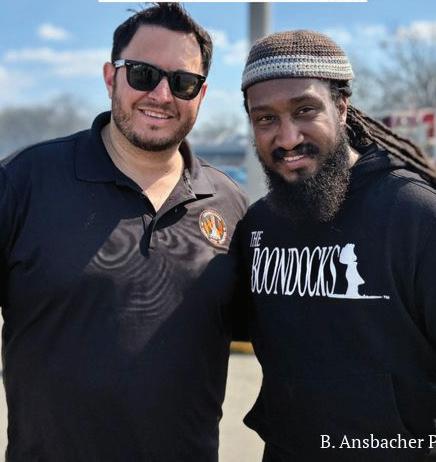
The community-wide transition for this year’s Biyur Chometz to the Reisterstown Road Plaza was a resounding success, with every logistical detail handled flawlessly. This small sampling of photos reflects just how smoothly the morning unfolded, a testament to the massive coordination that made the move from Pimlico seamless.
BJL thanks B. Ansbacher
Photography and Yosef Weil with Yocha Visuals for their photos













Try one week of our in-person classes for free! Contact our office for more details.

TUES
SUNDAY, APRIL 19TH - THURSDAY, JUNE 4, 2026
The Martus spring semester is sponsored In memory of Leah Miriam bas Moshe and Tzirel and Mendel Tzadik ben Avraham Yosef v’Shoshana and in the zechus of a refuah shelaima for Avraham Yosef ben Leah Miriam.
VIA ZOOM
10:00-11:00 am
Foundations for Life in Eretz Yisrael: Insights from Sefer Devarim
MRS. RUHAMA WELCHER
Sponsored by Devorah Urszuy as an aliyas neshama for her sister Shoshke Genendle bas Aaaron Leib and her father Aaron Leib ben Moshe.
10:00-11:00 am
Pirkei Avos
REBBETZIN BRACHA GOLDBERGER
Sponsored by Esther Weiner for the safety and healing of all of Klal Yisroel and the prompt arrival of the Geulah Shleima.
*This class will begin on Monday, April 27th
9:30-10:25 am
Topics in Sefer Bereishis
MRS. MINDI HAUER
Sponsored by Musia and Yaakov Delman in memory of Rabbi Moshe Hauer, HaRav Moshe Yisroel ben HaRav Binyamin, z”tl.
9:30-10:25 am
Rabbeinu B’Chayei al HaTorah
THURS
No Charge for 5786 Mesorah Members
Non Members $70 per course
11:15 am - 12:15 pm
Self Acceptance and Personal Redemption in the Thought of Rav Tzadok HaKohen of Lublin
RABBI YONAH SKLARE
Sponsored by Leah Edidin in memory of her father, Yosef ben Nachman z”l and in honor of her mother, Raizel bas Yenta.
8:00-9:00 pm
Sefer Shmuel
REBBETZIN ETTIE ROSENBAUM
Sponsored by Sally Wygoda as a z’chus for Yaffa Yehudis bas Tziporah and Yitzchok Simcha ben Esther as well as for a z’chus for a refuah shelaimah for Yaakov Shmuel ben Rus Rivka and in memory of Mindel bas Yaakov and by Pearl Zoimen in memory of her in laws HaRav Yisroel Zev ben Yosef and Baila Raizel bas Shimon.
RABBI MENACHEM GOLDBERGER
Sponsored by Jody Crane in memory of her father, Moshe Meir ben Yosef and in memory of Rabbi Moshe Hauer, HaRav Moshe Yisroel ben HaRav Binyamin, z”tl.
*This class will begin on Thursday, April 30th. This class will not meet May 21st, Erev Shavuos.
Classes take place at Bnai Jacob Shaarei Zion - 6602 Park Heights Avenue unless listed as a Zoom class. Mesorah Baltimore Members will receive exclusive access to class recordings. Zoom information will be sent to Mesorah Baltimore Members and pre-registered participants before each class.
For more information, membership and registration: email mesorah@mesorahbaltimore.org call 410.358.2545 online www.mesorahbaltimore.org
Rav Moshe Heinemann spoke to the talmidim at Yeshivas Toras Simcha
today. Rav Heinemann stressed how fortunate our talmidim are to be able to learn in a yeshiva with menuchas


Photos: Dovid Kapenstein
hadaas and wonderful rebeeim. The Rav encouraged the talmidim to help with pesach preparations at home.

Ohr Chadash Academy (OCA) is proud to announce that three students from our Chidon HaTanach club qualified for national finals of the Chidon HaTanach competition in New York on May 17. Mazel Tov to Gavi Erez (‘27), Anna Devorah Meles (‘28) and Ami Safren (‘27) from the Middle School National Division. The Chidon HaTanach is sponsored by the Jewish Agency and is open to students in grades 6-12. OCA is
registered in the highly competitive Hebrew Middle School division of the Chidon HaTanach for schools that learn and master the text in Lashon HaKodesh. Over 600 students from across the United States participated in the first round of tests.
Under the guidance of Rabbi Mordechai Abrahams, dedicated OCA middle school students worked hard to learn all of Sefer Bereishit, all of Shmuel Bet, as well as selected perakim from Tehillim.


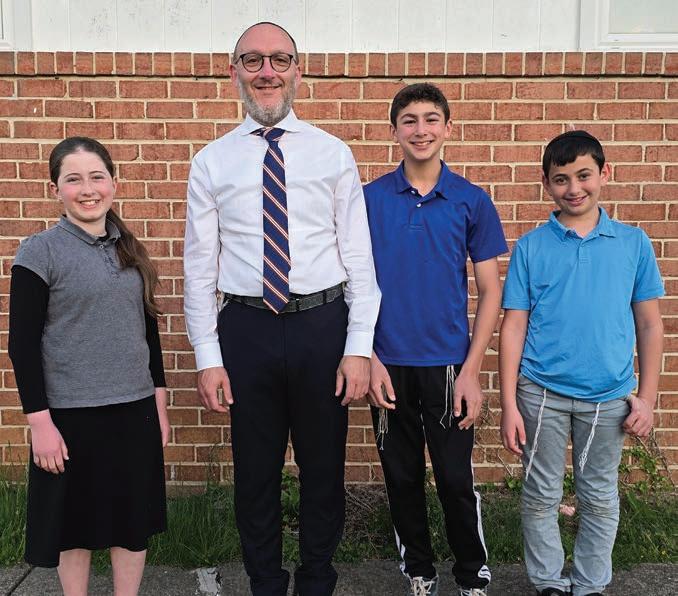
At the national finals, students will take further tests and celebrate their knowledge of these sefarim. The top four students in the nation will represent the U.S.A. in the International Chidon HaTanach competition next summer, in Israel.
OCA is thrilled that for the seventh year we will be sending representatives to the national finals. Kol Hakavod, Gavi, Anna Devorah and Ami!








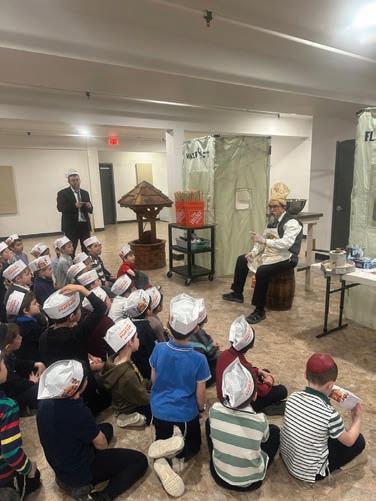
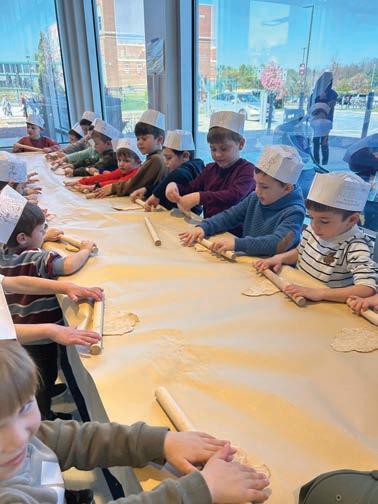
TA Students Bake Matza!

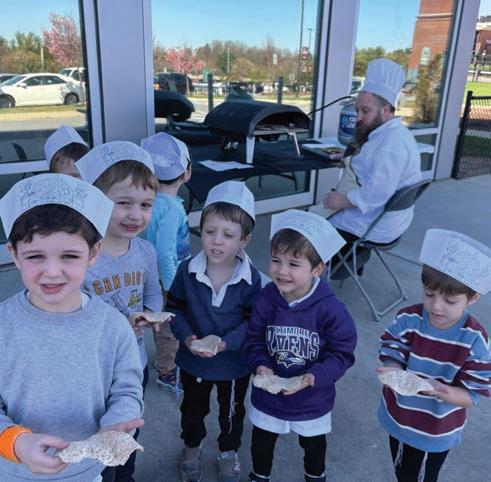
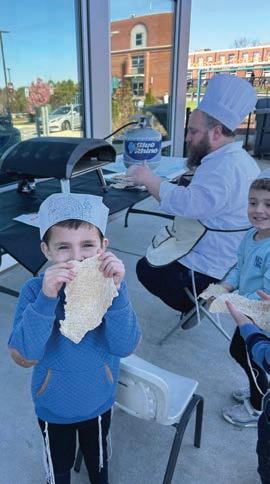


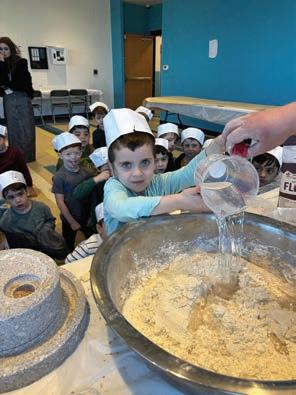



Opening day of the 2026 season of the JCSL by MDSC finally arrived this past Sunday morning, and if Week 1 was any indication, we’re in for another unforgettable spring. Under beautiful skies at the JCSL fields (sponsored by The Friendship Circle), nine teams took the field with one shared goal: to battle their way through the regular season, reach the coveted “Ashley Homes” postseason, and ultimately hoist the prestigious “Premier Financial” championship trophy.
This year’s league features a strong and competitive lineup of teams:
Clothier, CREZLY, Naftali Gerstman: Allstate Insurance, Lazar Real Estate, Orshan Legal Group, PsychCare, Tov Pizza, Web Interactive Technologies, and YL Waitering. With a blend of returning stars, exciting rookies, and retooled rosters, parity across the league may be at an all-time high.
Adding to the excitement this season are the stunning new jerseys, made possible through the generous sponsorship of Stutman Chiropractic. The uniforms brought a professional and polished look to the league on Opening Day, and players across all teams proudly took the field looking like ballplayers ready for a championship run.
A special thank you to Josh Finkelstein, whose photography once again captured the spirit, intensity, and camaraderie of the JCSL. From diving catches to clutch swings, his work helps bring these moments to life for the entire community.
Now, let’s get to the games.
Clothier 12, Tov Pizza 7
Clothier opened their 2026 campaign with a strong and balanced performance, defeating Tov Pizza 12-7 in a game that featured timely hitting, solid pitching, and standout defense.
Leading the way offensively were Yanky Goldsmith, Yossi Muller, and Ozzie Marizan, who each collected three hits in the win. Goldsmith set the tone at the top of the lineup, doubling, walking, driving in two runs, and delivering a steady outing on the mound. Marizan powered the middle of the
order, driving in three runs while also adding a walk and a sacrifice fly.
Clothier jumped out to an early lead and looked to be in control, but Tov Pizza mounted a spirited rally to keep things interesting. However, Clothier responded like a seasoned team, tacking on key insurance runs late in the game to put things out of reach.
Jeremy Strauss contributed two hits, including a triple, and made his presence felt defensively at shortstop with several impressive plays. He was joined by a host of teammates who each recorded multi-hit games, including Yitzy Hyatt, Hillel Stutman, Tzvi Schechtman, and Nosson Waldman.
Defensively, Clothier was sharp throughout, with Menachem Blackman also standing out in the outfield with strong, reliable play. It was a complete team effort and a statement win to start the season.
If there were any questions about whether the reigning champions would pick up where they left off, YL Waitering answered them emphatically on Opening Day.
In a high-scoring battle that featured multiple momentum swings, YL Waitering ultimately pulled away from CREZLY for an 18-14 victory, showcasing the depth, firepower, and championship pedigree that has made them the team to beat.
The offensive star of the game was All-Star Zack Lerner, who delivered a performance for the ages, going 5-for6 with five RBIs and finishing just a home run shy of the cycle. Every time YL needed a big hit, Lerner seemed to be at the plate—and delivering.
Yaakov Furman made his impact felt in multiple facets of the game, wreaking havoc on the basepaths with his speed while also anchoring the outfield with strong defensive play. Meanwhile, Koby Leder made a dazzling debut at shortstop, driving in three runs and flashing the kind of defensive brilliance that had fans buzzing.
Simcha Malin turned in one of the most complete performances of

the day, going 2-for-4 with a walk and two RBIs, while playing exceptional defense at second base. On the mound, Mayer Goldsmith once again proved why he is one of the league’s most decorated pitchers, delivering a composed outing and shutting things down when it mattered most.
The supporting cast also came up big. Jason Mann showed off a cannon arm at third base, while rookie Aroni Levine impressed in his debut, reaching base four times with a hit and three walks. Mendy Rauh added pressure on the bases with his speed, and both Yair Moinzada and Avrumi Friedman contributed key hits and solid work behind the plate.
The defensive highlight of the game belonged to Yoni Levin, whose sliding catch in the outfield ended an inning and prevented what could have been a game-tying rally.
With the win, YL Waitering starts 1-0 and looks every bit like a team capable of building a dynasty.
Lazar Real Estate 21, Gerstman Insurance 6
In perhaps the most dominant performance of the opening week, Lazar Real Estate sent a clear message to the rest of the league with a resounding 21-6 victory over Gerstman Insurance in a game shortened by the mercy rule after six innings.
From the outset, Lazar’s offense was firing on all cylinders. The team reached the maximum run limit in three separate innings, showcasing an explosive lineup that was relentless from top to bottom.
In a remarkable statistical feat, seven different players reached base

at least three times in the game: Ben Blackman, Captain Chaim Finkelstein, Yoni Finkelstein, Team Owner Mordy Lazar, Walter Johnson Jr., Gershon Vegh, and Moshe Tuchman. That level of production across the lineup is virtually unheard of and speaks volumes about the team’s depth.
Walter Johnson Jr. delivered the walk-off hit in the sixth inning to seal the mercy-rule victory, capping off an already dominant showing.
On the defensive side, pitcher Dany Donaty kept Gerstman’s hitters off balance all game, inducing a steady stream of ground balls. Many of those found their way to shortstop Chaim Finkelstein, who seemed to be everywhere on the field, making play after play. His performance included several highlight-reel moments and multiple double plays, anchoring a defense that backed up its offense in every way.
After Week 1, Lazar Real Estate has firmly established itself as a serious contender.
Orshan Legal Group 17, Web Interactive Technologies 7
Rounding out the Opening Day slate, Orshan Legal Group put together an impressive offensive showing in a win over Web Interactive Technologies.
Orshan’s lineup came out swinging early and often, piling up runs and keeping constant pressure on the WIT defense. With players like “Baboon Cruncher,” “Uncle Philip,” and “The Sawdust King,” OLG looks like a team to beat. It was a game filled with hits, aggressive baserunning, and consistent scoring, as Orshan steadily built a lead that proved too much to overcome.

Wednesday, April 29 8:00pm
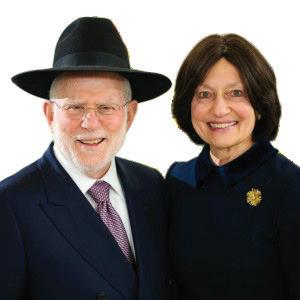


Shomrei Emunah 6221 Greenspring Ave.

Roy & Leah Neuberger have inspired audiences around the world with their journey from a nonobservant upbringing to a life of Torah and mitzvos. Married over sixty years, they share timeless, practical wisdom on building strong, lasting relationships through Torah principles, drawn from both personal experience and decades of teaching.
For men and women. Free of charge. Please contact Toby Friedman: 443-468-4598 • tpfriedman@gmail.com

The United States launched a sweeping naval blockade targeting Iranian oil shipments this week, deploying warships to restrict traffic in and out of key ports in a high-stakes effort to pressure Tehran following the collapse of ceasefire talks.
According to U.S. officials, more than 15 Navy vessels were positioned near Iranian waters beginning Monday,
marking the start of a complex operation aimed at cutting off one of Iran’s primary sources of revenue. While the ships are operating near the region, most enforcement actions are expected to take place in the Arabian Sea, away from Iran’s coastline, where American forces are less vulnerable to attack.
The blockade is designed to deter commercial tankers—particularly those tied to Iran’s so-called “shadow fleet”— from transporting sanctioned oil. However, officials acknowledged that enforcing such a restriction could prove challenging. Ships that refuse to comply may need to be boarded by specialized units, including Marines and Navy SEALs, raising the possibility of direct confrontations at sea.
“No interdictions had been reported” as of the second day of operations, underscoring the early and uncertain stage of enforcement.
The U.S. military is relying on a combination of surveillance tools, intelligence-sharing, and regional cooperation to track vessel movements through the Strait of Hormuz, a critical chokepoint for global oil shipments. If ships
are seized, additional logistical hurdles emerge, including staffing the vessels and determining where to divert them.
President Donald Trump framed the move as part of a broader strategy to economically isolate Iran after negotiations over its nuclear program broke down.
“We can’t let a country blackmail or extort the world,” Trump said on Monday. “Iran is doing absolutely no business, and we’re going to keep it that way.”
The blockade plan itself is not new. Military officials said similar strategies have long been developed by U.S. Central Command and were refined in recent months as tensions with Iran escalated.
Still, the risks remain significant. Iran retains the ability to retaliate with missiles, drones, and fast-attack boats, and has threatened to target regional shipping in response. While some U.S. officials believe Tehran may avoid direct confrontation, any clash at sea could quickly escalate into a broader conflict.
For now, the blockade represents a calculated but uncertain attempt to
force Iran back to the negotiating table without igniting a wider war.

Canadian Prime Minister Mark Carney finally secured a majority, with his Liberal party nabbing 174 of the 343 seats in the House of Commons. He returns to Parliament on Tuesday with more power after he secured the majority government by sweeping three special elections in which seats became vacant after last year’s election.
The results mean they won’t need support from opposition parties to pass legislation.
Carney’s government is the first in
6:15 am Young Israel Shomrai Emunah M-F
6:20 am Ohev Shalom Talmud Torah OLNEY M, Th
6:25 am Southeast Hebrew Cong., Knesset Yehoshua M-F
6:30 am Beth Sholom Congregation M-F
Beit Halevi (Sfardi) M, T
Chabad of Silver Spring M-F
Ohev Shalom Talmud Torah OLNEY T, W, F
Young Israel Shomrai Emunah S YGW M, Th
6:35 am Ohr Hatorah M, Th
6:40 am YGW S, T, W, F Magen David Sephardic Congregation M-Th
6:45 am Beit Halevi (Sfardi) S, T, W, F
Kemp Mill Synagogue M, Th
Ohr Hatorah T, W, F
Young Israel Shomrai Emunah M, Th
6:50 am Woodside Synagogue/Ahavas Torah M, Th Silver Spring Jewish Center M-F
Chabad of Upper Montgomery County M-F
6:55 am Young Israel Shomrai Emunah T, W, F
7:00 am Kemp Mill Synagogue T, W, F
Southeast Hebrew Cong., Knesset YehoshuaS Silver Spring Jewish Center S
Woodside Synagogue/Ahavas Torah T, W, F
Young Israel Ezras Israel of Potomac T, W, F
7:05 am Kesher Israel M, Th
7:15 am Kemp Mill Synagogue M, Th Kesher Israel T, W, F
Ohev Sholom Talmud Torah/The National Synagogue M-F
Ohr Hatorah S
7:30 am Chabad of DC M-F
Chabad of Potomac M-F
JROC M-F
Kemp Mill Synagogue T, W, F
Southeast Hebrew Cong., Knesset Yehoshua M-F
Young Israel Shomrai Emunah S
Young Israel Shomrai Emunah (Sfardi) M-F
7:45 am YGW (Yeshiva Session Only) S-F
8:00 am Beth Sholom Congregation S Kemp Mill Synagogue S Kesher Israel S
Ohev Shalom Talmud Torah OLNEYS
Southeast Hebrew Cong., Knesset YehoshuaS Chabad of Upper Montgomery CountyS
Woodside Synagogue/Ahavas TorahS
8:00 am YGW (High School; School-Contingent) S-F
Young Israel Ezras Israel of PotomacS Young Israel Shomrai Emunah (Sfardi)S
8:05 am Ezras Israel Congregation of Rockville M, Th
8:15 am Ohr Hatorah S Ezras Israel Congregation of Rockville S, T, W, F
Kehilat Pardes / Berman Hebrew Academy S-F
Silver Spring Jewish Center M-F
8:30 am Chabad of DC S Chabad of Potomac S JROC S Ohev Sholom Talmud Torah/The National Synagogue S Silver Spring Jewish Center S YGW (Summer Only) S-F
8:45 am Young Israel Shomrai Emunah S-F
9:00 am Chabad of Silver Spring S Kemp Mill Synagogue S
mincha
2:00 pm Silver Spring Jewish Center S-F
2:10 pm YGW M-Th School Days
2:45 pm YGW S-Th
3:00 pm YGW Middle School M-Th School Days
Before Shkiah (15-18 minutes), S-TH
Beit Halevi (Sfardi)
Beth Sholom Congregation
Chabad of Potomac
Chabad of Silver Spring
Chabad of Upper Montgomery County
Ezras Israel Congregation of Rockville (20 min before, S-F)
JROC
Kemp Mill Synagogue
Kesher Israel
Magen David Sephardic Congregation
Ohev Sholom Talmud Torah/The National Synagogue
Ohr Hatorah
Silver Spring Jewish Center
Southeast Hebrew Congregation
Woodside Synagogue/Ahavas Torah
Young Israel Ezras Israel of Potomac
Young Israel Shomrai Emunah (Asheknaz) Young Israel Shomrai Emunah (Sefarhadi)
maariv
8:45 pm YGW S-Th
9:15 pm Silver




Canada’s history to switch from a minority to a majority between national elections.
The Liberal Party could stay in power until 2029 after Monday’s results.
“Voters have placed their trust in our new government’s plan. We accept that support with humility, determination and a clear understanding of what this moment demands,” Carney said in a post on social media.
Carney won Canada’s election last year, vowing to reduce Canada’s reliance on the U.S. Since then, five defections from opposition parties, including four from the main opposition Conservative party, put Carney’s Liberals on the cusp of the majority.
Carney, the former head of the Bank of England as well as Canada’s central bank, has moved the Liberals to the center-right since replacing Justin Trudeau as prime minister in 2025.
In Toronto, Danielle Martin won the election for the district of Univer-
A Paris court on Monday found cement maker Holcim’s Lafarge unit guilty of charges that its Syrian subsidiary financed terrorism and breached European sanctions to keep a plant operating in northern Syria during the country’s civil war.
The case was the first time a company has been tried in France for financing terrorism. Sherpa and ECCHR, two organizations that filed the initial lawsuit, called it “a historic decision in the fight against multinational corporations’ impunity.”
Eight former Lafarge employees were found guilty, including former CEO Bruno Lafont, who was sentenced to six years in jail. He is going to be appealing the verdict.
A lawyer for Christian Herrault,

Judges determined that Lafarge paid, in total, 5.59 million euros ($6.54 million) to jihadist groups, including Islamic State and the al Qaeda-affiliated Nusra Front, both designated as terrorist groups by the European Union, between 2013 and September 2014.
The presiding judge, Isabelle Prevost-Desprez, noted that the payments made by Lafarge helped to strengthen jihadist groups that carried out deadly attacks in Syria and beyond.
“It is clear to the court that the sole purpose of the funding of a terrorist organization was to keep the Syrian plant running for economic reasons. Payments to terrorist entities enabled Lafarge to continue its operations,” Prevost-Desprez said. “These payments took the form of a genuine commercial partnership with the Islamic State.”
The cement maker was ordered to pay a 1.125 million euro ($1.32 million) fine, the maximum penalty available for a company, as prosecutors had requested.
The Jalabiya plant, located in north-
housed in the nearby town of Manbij and needed to cross the Euphrates River to access the plant. Among the payments, the court found more than 800,000 euros ($93,792) were paid to secure safe passage.
Another 1.6 million euros ($1.876 million) were used to purchase source materials from quarries that were under Islamic State control.
Lafarge became part of Switzerland-listed Holcim in 2015.
In a separate case in the United States, Lafarge admitted in 2022 that its Syrian subsidiary paid $6 million to Islamic State and the Nusra Front to allow employees, customers, and suppliers to pass through checkpoints after civil conflict broke out in Syria. The group paid $778 million in forfeiture and fines as part of its U.S. plea agreement.
Lafarge is also under investigation in France for complicity in crimes against humanity over how the company kept its factory running in Syria.
















The NWCP extends our sincere thanks to the local businesses and retailers whose generosity makes this program possible. If you would like your business to join this driver appreciation program, please email us at office@NWCP.info
Sign up to drive today! NWCP.info office@NWCP.info







nounced that it paused its transfer of the Chagos Islands to Mauritius. The decision came after President Trump recently withdrew his cooperation for the 2024 agreement.
The U.K. and the U.S. have shared a military base on Diego Garcia, the largest island in the Chagos, since the 1970s. The agreement to transfer the islands to Mauritius, which would allow for continued use of the base, stemmed from a decades-long legal battle to address Britain’s colonial past.
The British government on Saturday said it is permanently abandoning the agreement with Mauritius, stating that it cannot go forward with the transfer without U.S. support.
But the government noted that ensuring the Diego Garcia base’s “longterm operational security is and will continue to be our priority – it is the entire reason for the deal,” according to an official statement.
“We are continuing to engage with the U.S. and Mauritius,” the British government stated.
The transfer had been in jeopardy
since Trump blasted the deal earlier this year. He called it a “great act of stupidity” in January, followed by his plea that the British government “DO NOT GIVE AWAY DIEGO GARCIA!” in a Truth Social post in February.
British Prime Minister Keir Starmer hit back at Trump in January, saying the president’s “words on Chagos yesterday that were different to his previous words of welcome and support when I met him in the White House.”
Trump noted that if the U.S. and Iran don’t come to an agreement, “it may be necessary for the United States to use Diego Garcia, and the Airfield located in Fairford [England], in order to eradicate a potential attack by a highly unstable and dangerous Regime,” he wrote on Truth Social on February 18.
Starmer had criticized the conflict with Iran, initially pausing the U.S.’s use of British bases for U.S. forces deployed for “Operation Epic Fury.” Trump disparaged Starmer and other NATO allies reluctant to join the con-

Talks between the United States and Iran collapsed after 21 hours, as Tehran rejected the U.S. demand that it commit to not developing a nuclear weapon. U.S. Vice President J.D. Vance announced the breakdown on Sunday while visiting Pakistan during the third round of face-toface negotiations aimed at maintaining the war’s fragile two-week ceasefire.
“But the simple fact is that we need to see an affirmative commitment that they will not seek a nuclear weapon and will not pursue the tools needed to quickly achieve one,” Vance said. “That is the core goal of the president of the United States, and that’s what we’ve tried to


achieve through these negotiations.”
Vance said he remained in constant communication with President Donald Trump and other administration officials during the talks.
“We were negotiating in good faith,” he said. “We leave here with a very simple proposal—our final and best offer. We’ll see if the Iranians accept it.”
What will happen after the ceasefire expires remains unclear.
Vance led the U.S. delegation, while Iranian Parliament Speaker Mohammad Bagher Qalibaf led Iran’s team.
The U.S. military stated that two American destroyers moved through the Strait of Hormuz, a claim Iran has reportedly denied. Iran has since closed the strait.
Last Saturday, Trump posted that the U.S. had begun “clearing out” the strait.
“Today, we began the process of establishing a new passage, and we will share this safe pathway with the maritime industry soon,” said U.S. Central Command commander Adm. Brad Cooper.
Iran has demanded an end to the war, guaranteed control over the Strait of Hor-





muz, and a halt to fighting involving its proxy groups.
Meanwhile, Israel and Lebanon have agreed to begin talks on the disarmament of Hezbollah.

According to a Tel Aviv University report released Monday, 2025 saw the highest number of Diaspora Jews killed in antisemitic attacks since 1994, when 85 people were killed in a suicide bombing at Argentina’s Asociación Mutual Israelita Argentina (AMIA) building.
Although 2025 saw fewer total antisemitic incidents—such as vandalism and harassment—than 2024, the year saw an increase in violent antisemitic attacks. The number of incidents in 2025 remained significantly higher than in 2022, before the Hamas-led October 7 massacre.
According to Prof. Uriya Shavit, the study’s editor-in-chief, 20 Jews were killed in four attacks across three continents in 2025.
Australia and Canada experienced more antisemitic incidents in 2025 than ever before.
“The steep increase in the number of cases of severe violence is not surprising,” Shavit said. “The rule that applies to all types of crime applies here as well: when law enforcement authorities are indifferent to small crimes, the result is bigger crimes.”
In Australia, 1,750 attacks occurred in 2025—up from 1,727 in 2024, 1,200 in 2023, and 472 in 2022—including the Bondi Beach Chanukah massacre, during which 15 Jews were killed.
Canada recorded 6,800 antisemitic incidents in 2025, up from 6,219 in 2024.
New York saw 324 incidents in 2025, down from 344 in 2024.
The deadliest antisemitic attacks in the United States in 2025 occurred on May 21, when Yaron Lischinsky and Sarah Milgrim, two Israeli Embassy staffers, were murdered by a terrorist outside the
Capital Jewish Museum in Washington, D.C., and on June 1, when Karen Diamond was killed in Boulder, Colorado, after a man shouting “Free Palestine” hurled explosives at a pro-Israel march.
In Britain, two people were killed in October 2025 when a terrorist attacked Manchester’s Heaton Park Synagogue on Yom Kippur. That year, Britain recorded 3,700 antisemitic incidents, while France saw 1,320 (126 of them violent) incidents, and Germany recorded 5,729.
According to Germany’s Radicalization Monitoring System and Transfer Platform (MOTRA), a network run by the Federal Criminal Police Office (BKA), 45.1% of Muslims in Germany under age 40 implicitly or explicitly hold Islamist beliefs. These include attraction to Islamism, belief that Sharia law is superior to the constitution, and antisemitic views.
In March, MOTRA researchers found that 11.5% of young Muslims were explicitly Islamist, while 33.6% leaned toward Islamism but were not fully radicalized.
German Parliamentary State Secretary Christoph de Vries (CDU) expressed concern in an interview with Die Zeit, stating that antisemitism is four times more prevalent among Muslim youth than in the general population.
Addressing the rise in Islamist ideology, de Vries attributed it in part to the influence of online figures active on social media and gaming platforms, which he said have accelerated the spread of such views. He also described the October 7, 2023 Hamas attack on Israel as a key moment that intensified Islamist sentiment.
He further suggested that limiting young people’s access to social media may be necessary, citing cases in Germany where teenagers as young as 13 or 14 were reportedly radicalized online to the point of planning serious acts of violence.
Additionally, he called for investigations into mosques in Germany, particularly those funded or controlled by Turkey.
“In many parts of the city, they can no longer go out wearing Jewish symbols such as the kippah,” de Vries said,
referring to the prevalence of antisemitism in parts of Germany.
“For those who remain here, the fight against antisemitism must always play a role, whether in integration courses or in the naturalization process,” he added. “Anyone who lives in Germany must recognize Israel’s right to exist.”
According to a report by Iran Human Rights (IHR) and Together Against the Death Penalty (ECPM), Iran executed at least 1,639 people in 2025—an average of more than four per day—the highest number of state executions since 1989.
The report warned that if the Iranian regime “survives the current crisis, there is a serious risk that executions will be used even more extensively as a tool of oppression and repression.”
It added that protests in January and Iran’s ongoing war with Israel and the United States could lead to a broader crackdown on dissent.
The NGOs also noted that hundreds of detained protesters remain at risk of death sentences and execution.
“By creating fear through an average of four to five executions per day in 2025, authorities tried to prevent new protests and prolong their crumbling rule,” said Mahmood Amiry-Moghaddam, director of IHR.
Since the war began on February 28, Iran has hanged seven alleged participants in the January protests, six members of the opposition group People’s Mujahedin of Iran (MEK), and one Iranian-Swedish citizen accused of spying for Israel.
“The death penalty in Iran is used as a political tool of oppression and repression, with ethnic minorities and other marginalized groups disproportionately represented among those executed,” said Raphael Chenuil-Hazan, ECPM’s executive director.
Iran’s Kurdish minority in the west and the Baluch population in the southeast were among the most targeted groups.
Nearly 50% of those executed were convicted of drug-related offenses.
Of the more than 1,600 executions, approximately 48 were women—the highest number in 20 years, up from 31 in 2024.
Viktor Orbán’s 16-year tenure as Hungary’s prime minister will end when the new parliament convenes, following his party’s defeat in Sunday’s general election.
Orbán, a right-wing populist and ally of U.S. President Donald Trump and Russian President Vladimir Putin, conceded the election, congratulating his opponent while pledging not to step away from politics.
Hungary’s next prime minister will be opposition leader Peter Magyar, who campaigned on promises of political change and an end to what critics describe as “competitive authoritarianism” under Orbán’s rule.
Magyar’s party, Tisza, is projected to win 137 seats, while Orbán’s Fidesz party is expected to secure just 55. Voter turnout reached a record high, with more than 77% of registered voters casting ballots.
Orbán, 62, has been an influential global figure, inspiring other rightwing leaders despite Hungary’s relatively small size.
Magyar, a member of the European Parliament, has taken positions against “woke ideology” and has avoided emphasizing left-wing social issues in an effort to maintain broad voter appeal.
State-controlled media had warned that war could follow a Magyar victory. His win may also affect Hungary’s stance on the war in Ukraine.
In a victory speech delivered to a sea of jubilant supporters on the banks of the Danube River, Magyar reiterated his promises to rebuild Hungary’s ties with the European Union and NATO, root out corruption and cronyism and “restore the system of checks and balances.”
The country has economic incentive to do so. Since 2022, the EU has frozen billions of dollars’ worth of funding for the country because it said Orbán was violating key democratic values. Magyar said the country will “never again allow anyone to hold free Hungary captive or to abandon it.”
“Today we won because the Hungarian people didn’t ask what their country could do for them, but what they could do for their country,” he said, evoking U.S. President John F. Kennedy, as some spectators chanted, “Europe, Europe.”
Our memorials are already in stock. Your memorial doesn’t take six months to arrive; often, it’s already here.
We design your memorial with you in our studio. You approve it instantly, avoiding weeks of waiting.
From design to installation, we manage every step. No middlemen. No excuses. Meticulous Craftsmanship
We engrave everything ourselves to spot and fix potential flaws before they occur.

We build to last, so we guarantee it. We are your partners for life.

in Beirut since last Wednesday night. That decision has come as Washington attempts to advance negotiations with Tehran, as well as ahead of expected negotiations between Israel and Lebanon this week in Washington.

On Sunday night, Sgt. Maj (res.) Ayal Uriel Bianco was killed when a Humvee overturned in southern Lebanon. Three others were injured in the incident. Ten paratroopers were also wounded in a clash with Hezbollah gunmen, the military announced on Monday morning.
Bianco, 30, was a firetruck driver in the 188th Armored Brigade, from Katzrin.
“Eyal was a regular soldier before the reserves for several years. When he was called to service, he always came,” Katzrin Mayor Yehuda Dua wrote on Facebook. “That’s who he was – a man of the country, a person who gave his all to others; when it came to the country, he was the first to report to duty.”

In a separate incident, ten soldiers were wounded, three of them seriously, during a clash with Hezbollah gunmen in the southern Lebanon town of Bint Jebil overnight. The soldiers of the Pararoopers Brigade’s 101st Battalion were taken to a hospital and their families were notified
Bint Jbeil, a Hezbollah stronghold, has been the focus of IDF operations in southern Lebanon in recent days.
Meanwhile, Hezbollah carried on its sporadic attacks on northern Israel on Tuesday morning, with sirens warning of rocket fire and drones in several border communities. Thankfully, there were no reports of injuries or damage.
The Israeli Air Force struck around 150 Hezbollah targets in southern Lebanon the previous day. Those targets included rocket launchers, drones, buildings used by the terror group, anti-tank launch sites, and headquarters. The military also struck Hezbollah cells that planned attacks on troops.
The IDF has not struck any targets
Bint Jbeil is considered a symbol of Hezbollah power, and the IDF has been encircling the town in recent weeks as it seeks to extend its control of southern Lebanon after the Iran-backed group broke the ceasefire that had been in place since November 2024 to support Tehran.
During the Second Lebanon War in 2006, the IDF battled the terror group in the town but failed to capture it fully. Earlier, in May 2000, when the IDF withdrew from southern Lebanon after 18 years, then-Hezbollah chief Hassan Nasrallah delivered a victory speech in Bint Jbeil where he infamously described Israel as “weaker than a spider web.”
Thirteen IDF soldiers have been killed in southern Lebanon amid the current fight against Hezbollah, two civilians were killed by Hezbollah rockets, and an Israeli civilian was mistakenly killed in the north by Israeli artillery shelling.

was approved on Sunday to become the next director of the Mossad intelligence agency. He is Prime Minister Benjamin Netanyahu’s military secretary.
Gofman will begin his five-year term as Mossad director on June 2.
The announcement came after the Senior Appointments Advisory Committee headed by former Supreme Court president Asher Grunis gave the green light to Gofman. Most of the committee’s report dealt with an incident that occurred in 2022 while Gofman was commanding the IDF’s 210th “Bashan” Regional Division in the Golan Heights.
As commander, Gofman approved the use of a 17-year-old, Ori Elmakayes, for an Arabic-language influence campaign against Iran, Hezbollah,








and Hamas, leading to the teen’s prolonged detention by security authorities after he was accused of publishing classified information. Gofman claimed he did not know how old the teenager was, adding that he had ordered that only non-classified information be given to him for publication on social media.
Elmakayes was held in detention for 18 months before the charges were dropped, after it emerged that the classified information he had published on the internet was fed to him by intelligence officers in the Israel Defense Forces.
Gofman will replace outgoing Mossad chief David Barnea, whose five-year term is set to end in June.
The nomination has drawn criticism from current and former security officials, who have told Hebrew media that Gofman lacks the operational and intelligence background traditionally required to lead the security agency.
He is considered close to Netanyahu, having served as his military secretary for nearly two years. During that time, Gofman traveled on the premier’s behalf for various tasks and oversaw the implementation of the prime minister’s directives in the IDF.
Born in Belarus, Gofman moved to Israel with his family in 1990 at the age of 14. During his military career, he rose through the IDF Armored Corps, becoming a division commander before moving out of combat roles.
He was seriously wounded on October 7 while battling Hamas terrorists in a firefight at Sha’ar Hanegev Junction just outside of Sderot.
According to Israel’s Finance Ministry, the ongoing war with Iran has cost the country approximately NIS 35 billion ($11.5 billion) in budgetary expenses. This includes NIS 22 billion in defense and military spending—such as equipment purchases—for the Israel Defense Forces, the Defense Ministry, the National Security Ministry, and other security agencies.
“The functioning of the Finance Ministry and responsible management of the country’s economy were a critical factor in the great operational success,” Finance Minister Bezalel Smotrich said.
“The employees of the Finance Ministry



are full partners in the great successes on the front and in our tremendous achievements against Iran.”
The ministry warned that the 40-day Israeli-American campaign against Iran imposed significant economic burdens, including a decline in GDP and increased government spending, some of whose full impact may only become clear over time.
On February 28, the United States and Israel began striking Iran in an effort to weaken the regime. The joint offensive killed Iran’s supreme leader, Ayatollah Ali Khamenei.
During the conflict, the Israeli Air Force dropped more than 18,000 munitions across Iran in over 1,000 strike waves. The IDF reported that more than 10,800 individual strikes targeted over 4,000 sites, including air defense systems, ballistic missile infrastructure, weapons manufacturing facilities, nuclear sites, command centers, and senior military leadership.

the war paused with a two-week ceasefire—Iran fired an average of 10-20 missiles per day.
Sixteen or more conventional warheads struck populated areas in Israel, while approximately 50 cluster-munition warheads also hit populated areas.
Only two of the 24 casualties—including four Palestinians in Judea and Samaria—occurred outside of bomb shelters. Ten people were killed by cluster munitions, while 14 were killed by conventional missiles.
Over the course of the war, the Israeli Air Force struck Iran with more than 18,000 munitions in over 1,000 waves of attacks, hitting more than 4,000 targets such as air defense systems, ballistic missile launchers, weapons production sites, nuclear facilities, military headquarters, and senior commanders.
Meanwhile, the U.S. military independently carried out 13,000 strikes on Iranian targets.

At the outset of the war, the IDF’s Home Front Command imposed nationwide restrictions banning public gatherings and effectively halting most economic and educational activity, with only essential services permitted to operate. While workplace restrictions were relaxed after about a week, schools remained closed, forcing many people to work remotely, and large numbers of residents stayed near bomb shelters due to
During the conflict, Iran fired roughly 650 ballistic missiles toward Israel. At least 16 of these—armed with conventional warheads containing hundreds of kilograms of explosives—hit populated areas, causing significant destruction and
The Finance Ministry stated that it allocated NIS 12 billion for compensation programs, covering direct damage from missile strikes, partial financial support for affected businesses, and assistance for furloughed workers. An additional NIS 1 billion was spent on civilian-related costs, including hospital adjustments, emergency services, victim care, and expenses incurred by the Ministry of Social
Iran’s attacks killed 24 people in Israel, including civilians and foreign nationals, and wounded more than 7,000 others, according to the Health Ministry.
On the first day of the war, Iran launched around 80 missiles at Israel. It fired about 60 on day two and 30 on day three. Over the following weeks—until
Roughly 60% of Iran’s estimated 470 ballistic missile launchers were destroyed or disabled by Israel. At the start of the war, Iran reportedly possessed about 2,500 ballistic missiles; that number has since fallen to approximately 1,000 operational missiles.
Additionally, about 85% of Iran’s air defense and detection systems were destroyed, and the country’s ballistic missile production capabilities were severely degraded.
“We set out for Operation Roaring Lion to severely damage the Iranian terror regime and remove existential threats to Israel over time,” IDF Spokesman Brig. Gen. Effie Defrin said at a press conference. “We significantly struck all of its systems and capabilities, eliminated its leadership, damaged its command and control systems, eliminated many of its commanders, and severely hit its military industries, ballistic missile array, economic targets, and nuclear targets.”











voices on Capitol Hill, died last week at the age of 79.
Engel began his career in the House of Representatives in 1989. He lost the Democratic primary in 2021 to Jamaal Bowman, a defeat that underscored a broader turning point in the Democratic Party’s shifting views on support for Israel.
“If we want to effectuate change in the world, if there are things we want to see in the world, if we are going to be the world leader, there are responsibilities that come with that,” Engel told The Washington Post in a December 2020 interview. “We are the leaders, and we should act like it.”
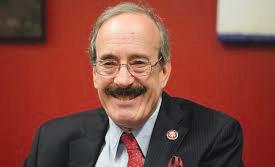
Born on February 18, 1947, in the Bronx to Jewish parents, Engel worked as a teacher and guidance counselor for New York City public schools before earning his law degree and serving in the
New York State Assembly from 1977 to 1988.
“All four of my grandparents were immigrants, Jewish immigrants from what’s now Ukraine, who fled the pogroms of the early 20th century, looking for a safe haven and opportunity. And guess what? They found it in America,” Engel told The Jerusalem Post in 2021. “They came here before World War I. If they hadn’t come here, they almost certainly would’ve perished in the Holocaust. This country has been a refuge to people who are hurting for many, many years, and I’m grateful for it.”
Representing parts of New York including Westchester County and the Bronx, Engel’s time in office was marked by a consistent focus on foreign policy, including support for the NATO-led intervention in Kosovo in 1999 against Serbia and activism to protect Syrian civilians. He chaired the U.S. House of Representatives Foreign Affairs Committee during the last years of his tenure.
In Congress, Engel also built a reputation as a committed pro-Israel lawmaker, regularly supporting strong U.S.-Israel ties and maintaining relationships with Jewish and pro-Israel groups throughout
his tenure.
“I’ve been proud to stand with our ally Israel, our closest friend in the Middle East and, I would argue, in the world, throughout my career,” Engel told the Jerusalem Post. “I believe that the United States and Israel share an incredibly important partnership. And the cornerstone of this relationship is the support it receives from both sides of the aisle… No one should play partisan politics with America’s relationship with Israel.”
Engel’s defeat drew national attention and marked a broader turning point in the Democratic Party’s longtime consensus on support for Israel.
Bowman is openly critical of the Israeli government and said that U.S. assistance to Israel should be conditioned on its behavior.
New York Democratic Rep. Ritchie Torres, who serves the Bronx and is one of the most outspoken pro-Israel voices in his party, called Engel “one of the greatest champions the Bronx has ever had in Congress” in a post on X.
“He served for more than three decades with unyielding dedication, fighting for his constituents and standing up for democracy around the world,” Torres
wrote. “He was a trailblazer for the Bronx in Washington, and a fierce advocate for Kosovo and the Albanian community at a time when few others were paying attention.”
On Saturday, three people were stabbed on a subway platform at Midtown Manhattan’s Grand Central Terminal by a man wielding a machete who called himself “Lucifer.” Police officers killed the man before he could hurt more people.
The violence erupted around 9:40 a.m. ET on a platform beneath Grand Central.
The attacker was told at least 20 times by police officers to drop the knife before he approached officers “with the knife extended.” He was identified by police as 44-year-old Anthony Griffin.
Police Commissioner Jessica Tisch said the incident was captured on police body-worn cameras, including Griffin













“repeatedly stating that he was Lucifer.”
“Random acts of violence scare everyone,” Tisch said. “Anyone can be a victim of a random act of violence, and that is why it is so important for New Yorkers to understand that the NYPD has recently upped our presence in the transit system, including right here in Grand Central station.”
Gov. Kathy Hochul said on social media that “innocent people were attacked in a senseless act of violence.” She added, “I’m grateful to our brave officers who acted quickly to stop the suspect.”
The three victims – two men, ages 84 and 65, and a 70-year-old woman – were transported to a hospital where they are expected to survive. Two victims sustained lacerations to the head and face. One suffered an open skull fracture and another a laceration to the shoulder.
Griffin was on a subway train before the incident and then moved out onto the platform. He was known to police prior to the attack and had more than a dozen arrests, including for menacing and slashing at people with a sharp object, according to two law enforcement sources. He had been arrested in 2019 for felony assault with a weapon.

On Thursday, the U.S. Postal Service announced that it would suspend employer contributions to Federal Employees Retirement System annuities for the time being, as the agency struggles to make payroll and maintain operations. Additionally, USPS asked regulators on Friday to increase the price of FirstClass Mail Forever stamps from 78 cents to 82 cents.
By pausing pension payments, the Postal Board of Governors hopes to preserve cash and liquidity amid USPS’s “ongoing, severe financial crisis,” according to Chief Financial Officer Luke Grossman. Without significant changes,
the agency is on track to run out of funds by early 2027.
“The risk to the Postal Service and the American public from insufficient liquidity for postal operations dramatically outweighs any longer-term risk to the pension funds from not making the currently due payments,” Grossman said.
USPS also temporarily suspended such payments in 2011 during another financial downturn.
Among USPS career employees, 99% are covered by the Federal Employees Retirement System.
In March, Postmaster General David Steiner told a congressional committee that USPS’s $15 billion borrowing cap—set decades ago—must be increased to $34.5 billion, which he said would “buy us the time to make the fixes we need to make.”
The Postal Regulatory Commission also approved a temporary, multi-year waiver permitting the Postal Service to redirect billions of dollars previously set aside for retiree benefits. The move is intended to provide “some breathing room and flexibility” as the agency implements contingency measures and works to avoid a cash shortfall.
Republican District Attorney Clay Fuller won Tuesday’s special congressional election in Georgia, capturing a seat recently vacated by Marjorie Taylor Greene and defeating Democratic rival Shawn Harris by 12 percentage points.
In his victory speech, Fuller—who received President Donald Trump’s full endorsement—reaffirmed his loyalty, saying, “Like President Trump said, I will never let you down.”
The race, which determined the representative for Georgia’s 14th Congressional District, was widely seen as a test of Trump’s political influence.
In his concession speech, Harris argued that his narrower loss—12%, compared to the 29-point margin by which he lost to Greene in 2024—represented a moral victory for Democrats.
In the initial round of voting, Harris received 37% of the vote, Fuller 34%, and former Georgia state senator Colton Moore 11%, triggering a runoff between Harris and Fuller.











Greene, once a staunch Trump ally, broke with the president on several issues, including foreign policy and the release of the Epstein files, and announced her resignation from the House in November. Last Tuesday, she called for Trump’s ouster after he warned that a “whole civilization will die” unless an Iran deal is reached.
Harris sought to build a coalition of Democrats, independents, and dissatisfied Republicans. Following the March 10 special election, former Transportation Secretary Pete Buttigieg traveled to Rome, Georgia, to campaign on Harris’s behalf, portraying him as a candidate capable of representing working-class interests in Washington.
In May, Harris will appear on Georgia’s primary ballot alongside Fuller, Moore, and several other Republican candidates as they compete for a full two-year term representing the state’s 14th District.

The four astronauts of Artemis II— Reid Wiseman, Victor Glover, Christina Koch, and Jeremy Hansen—returned home on Saturday, splashing down in the Pacific Ocean after a historic nineday mission that began on April 1. They were later welcomed at NASA’s Johnson Space Center in Houston by family members and staff.
The mission marked the first crewed lunar flight since the Apollo program ended in 1972. Future Artemis missions aim to land astronauts on the moon and establish a sustained U.S. presence near the lunar south pole. During Artemis II, the crew flew around the moon, observing its far side illuminated by the sun and witnessing a solar eclipse, though they did not land on the moon.
“After a brief 53-year intermission, the show goes on, and NASA is back in the business of sending astronauts to the moon and bringing them home
safely,” said NASA Administrator Jared Isaacman. “Thank you for showing us the moon again, for showing us planet Earth again, and for contributing to the greatest adventure in human history. Welcome home, Artemis II.”
“I have absolutely no idea what to say,” Wiseman remarked. “Twenty-four hours ago, Earth was out the window and we were traveling at Mach 39, and now we’re back home. Before launch, it feels like the greatest dream on Earth. When you’re out there, you just want to return to your family and friends. It’s a special thing to be human—and to be on planet Earth.”
Glover, who brought a Bible on the mission, expressed gratitude to G-d upon returning.
“I want to thank G-d again,” he said. “The gratitude of seeing what we saw and doing what we did—it’s too big to fit into one person.”
Koch reflected on viewing Earth from space.
“When we saw tiny Earth, people asked what impressions we had,” she said. “What struck me most wasn’t just Earth, but the vast blackness surrounding it. Earth felt like a lifeboat, suspended in the universe.”
She added, “I know I haven’t learned everything this journey has to teach me, but one thing I now understand is this: planet Earth, you are one crew.”
Early last Monday, the Orion capsule entered the moon’s gravitational field. About 14 hours later, it passed behind the lunar far side, coming within approximately 4,000 miles of the surface.
The mission also set a new record for the farthest distance traveled by humans from Earth—252,756 miles—surpassing the previous record set during the Apollo 13 mission in 1970.
The crew captured thousands of images and hours of video during the mission.
President Donald Trump congratulated the astronauts via radio.
“Your mission paves the way for America’s return to the lunar surface very soon,” he said. “We’re going all out. We’ll plant our flag once again—and this time, we won’t just leave footprints. We’ll establish a permanent presence on the moon and then push on to Mars.”
The crew also named several previously unnamed lunar craters, including one in honor of Wiseman’s late wife, Carroll.
“What you saw was a group of people who found joy in contributing,” Hansen
said. “But what you’re really seeing is a reflection of yourselves. If you like what you see, look deeper—this is you.”

Lady Fatou celebrated her birthday last week. On Monday, the gorilla turned 69 years old, becoming the Berlin Zoo’s longest-residing tenant and maintaining her title as the oldest gorilla in the world.
The old ape was born somewhere in West Africa in 1957. She arrived in Europe at the port of Marseilles in 1959 in the luggage of a French sailor. According to the Berlin Zoo, the sailor found himself unable to pay his bill at a tavern and gave Fatou to the landlady as payment. From there, she soon ended up in the German capital.
Fatou is a western lowland gorilla. In the wild, they usually don’t live past their 40s, and even in captivity 50 is considered advanced old age.
In 1974, Lady Fatou gave birth to Dufte, the first gorilla born at the Berlin Zoo. Although her daughter passed away in 2001, Fatou’s granddaughter M’penzi still keeps her company in Berlin. She has at least three greatgreat-great grandchildren as of 2026.
Nowadays, Fatou has her own private enclosure and staff members dedicated solely to her care. She prefers to sit back and watch the other gorillas play rather than get involved in the action, zoo workers say. She also likes to eat pre-cooked foods, as she no longer has teeth.
The joys of old age…
Age didn’t stop this old lady, though.
Recently, rescuers pulled an 89-year-old woman to safety through a 21st floor window after she was stranded hanging onto the outside of a high-rise in Beijing.
The woman, who lives alone on the 27th floor, had accidentally locked herself inside her bedroom with her phone left in the living room. Unable to call for help and unable to open the door, she decided to climb outside through her bedroom window and attempt to descend the exterior of the building.
The intrepid octogenarian used the metal grilles and railings around outdoor air conditioning units as handholds. She intended to make her way down the façade to the ground floor to regain access to the building and then head for her apartment.

One resident of the building became alarmed at seeing the whitehaired woman hanging from the 27th floor balcony. On lower floors, cleaners and security guards heard faint noises before noticing her gripping the exterior wall. She was seen around the 26th floor clinging to the metal grilles installed around air conditioning units.
Firefighters urged the woman to remain in place, but she continued moving down the building’s exterior. She descended from the 27th floor to the 21st. She stopped roughly 165 feet above the ground when she became too exhausted to continue. At that point, she could no longer move on her own and awaited assistance while still holding onto the building’s exterior fixtures.
The rescue team secured her with a safety rope through a window on the 21st floor to prevent a fall. While they were working to rescue her, she rested on an air conditioning unit. Then, she was finally brought into the building by emergency personnel.
According to rescuers, she appeared shocked and tired after the ordeal but did not suffer significant injuries.
Perhaps she can audition to be the next superhero?




By Rabbi Zvi Teichman
On the rare occasion of a Jewish leap year when we read the portion of Tazria alone, we recite as the haftorah a fascinating tale taken from the Book of Melachim regarding the mighty and arrogant general of Aram, Naaman, who was stricken with tzaraas — leprosy.
Evidently the various idolaters and sorcerers in Aram were incapable of curing his disease.
During one of his many raids on the Jews, he apparently snatched a young girl, claiming her as a maidservant for his wife. Noticing her master’s obvious distress, she suggests to her mistress that Naaman should direct his prayers to the Jewish prophet who will surely heal him from his tzaraas
She dutifully transmits this information to her husband who in turn reports to the king of Aram, saying, תאזכו תאזכ — “Such and such spoke the girl from the Land of Israel.” (ד ה ב םיכלמ)
The king of Aram sends a letter of introduction to Yehoram the king of Israel asking him to attend to his loyal general’s request. Upon reading it Yehoram suspects it is merely a ploy to lure him into another confrontation as Yehoram understands he is powerless to help him.
Elisha hearing about the request sends word to the king, that he should direct Naaman to him so he may teach him a lesson or two about the power of the ‘Prophets’ of Israel.
Naaman arrives with a whole entourage at the entrance of Elisha’s home expecting a royal reception. Elisha merely dispatches a messenger to instruct Naaman to take a dip in the Jordan river seven times, and his flesh will restore to health.
Naaman is furious with this degrading treatment. He leaves fuming while murmuring his disappointment that the prophet could not simply wave away his diseased flesh with his ‘magic wand’. He is incredulous too, with the notion that the Jordan has greater curative powers than the mighty rivers of Damascus, the Amanah and Pharpar.
His servants encourage him to give it a try, nevertheless. He accedes, and miraculously, his flesh rejuvenates like that of a young lad.
He returns to Elisha declaring emphatically his newfound belief that there is no G-d as the One of Israel. According to tradition he became a Ger Toshav — a resident alien, disavowing any taint of idolatry and affirming his belief in the One Creator. (:זנ ןיטיג)
The Talmud teaches us that חורה תוסג — conceit, is at the root of tzaraas. (.זט ןיכרע)
Naaman is an object lesson in the consequences of haughtiness. (ה ז ר"דמב)
Where did his arrogance stem from?
The verse states, And Naaman... was לודג שיא — an eminent person... for through him God had given victory to Aram. (א ה ב םיכלמ)
Rashi here refers us to the Midrash that informs us that Naaman was the archer who randomly shot an arrow that providentially entered between the plates of the armor, that killed the wicked king of Israel, Achav. (דל בכ א םיכלמ)
It was this ‘claim to fame’, having been the ‘hero’ who ‘bravely’ struck down the Jewish king, that won him the accolade as a mighty warrior.
Was Naaman so foolish as to think that his unwitting act coupled with the remarkable coincidence of it penetrating precisely between the plates of Achav’s armor, should entitle him to such fame as a valiant fighter?
In Naaman’s repeating to the king of Aram the information the ‘girl from Israel’ reported, he states, " תאזכו תאזכ" — “such and such spoke the girl...”
Such and such?! It was a very simple idea, “Go to the prophet!”
Or is there perhaps more going on here than meets the eye?
The Sifrei Zuta tells us that indeed she was being
elaborating on the details of the laws of leprosy:
— Such and such is how they purify a rich man and such and such is how they purify a poor man.
Apparently, there was a deeper message being conveyed, she was delivering a ‘shiur’ in the laws of tzaraas
What was that lesson?
There are times in life when everything seems to be going just right, finances, relationships, health and success in all our endeavors and enterprises. Things are ‘going my way!’
We tend to delude ourselves to think it is some form of validation from ‘on high’ of our worthiness.
When we feel worthy, we are inclined to act with a sense of smugness and entitlement, neglecting a sensitivity in our awareness and obligations to others.
Naaman wasn’t stupid, he was obviously a very capable general. He erred however in seeing the providence of success, from whatever force it emanated from, as an affirmation of his ‘greatness’. His ‘fortune’ in killing Achav was evidence that ‘the force was with him’.
But now he was confused, with all his success why couldn’t he shake his illness?
The ‘young girl from Israel’ taught him an important lesson in theology.
What difference is there in the method of purifying a rich man who is afflicted with tzaraas as opposed to a poor man?
There are several sacrifices that accommodate the financial standing of the one bringing the sacrifice. Instead of the pricier animal sacrifice, the disadvantaged individual can bring a cheaper alternative.
There is a set of sins that warrant preferably the bringing of an animal as a sin offering. One who cannot afford that may offer a pair of birds, and one who is impoverished may bring just a meal offering.
This is called a דרויו הלוע ןברק — the Variable offering
In the case of a Metzora he must ideally bring three animal offerings, one for a תאטח — sin-offering, another as an םשא a guilt-offering, and one more for a הלוע — elevation-offering.
If he lacks means, he may substitute a pair of birds for the sin-offering and elevation-offering.
However, when it comes to an םשא — the guilt-offering, both the rich and poor Metzora must offer a lamb, regardless of one’s means. That remains invariable.
Why the distinction? If the Torah considers affordability, then why not give him a break on the guilt-offering that the Metzora must bring as well?
Rav Samson Raphael Hirsch teaches that the guilt-offering in this case represents man’s failure in the realm of social justness.
The social sins of conceitedness and slander that brought about this malady, that seeks correction through the guilt-offering, makes no distinction between rich and poor. The duty of brotherhood and justness cannot
vary based on one’s social standing.
The sin-offering represents man’s general commitment to rid himself of moral self-determination. The elevation-offering as well emphasizes moral free devotion to all the goodness as indicated by G-d.
These are tested and proved in the different external conditions of life which indeed vary based on where fate has placed each one of us. This reality is acknowledged in the variability of the respective sacrifices.
A rich man can abuse the evidence of his success as a validation of his good standing with G-d, giving him license to act according to his own understanding without respect for others.
A poor man on the other hand may utilize his disadvantage as an excuse, giving him permission to deride those who haven’t had to suffer as much as he.
Naaman’s delusion lay in thinking that man does not contribute to the equation of success.
That arrogance is what disabled his clarity of thinking in understanding his predicament.
The young maiden from Israel instructed Naaman in a most vital idea. One’s moral standing can never be measured by the external successes one may experience in life. The privileged must see their success as an obligation. The underprivileged too, must not see their disadvantage as a rejection of worthiness. When they do, it can taint their positive view towards others.
As regards social justness we are equally obligated.
It is not only in the arena of wealth that one is often misled.
Do we see in the relative calm and safety in our lives here in America as a validation and proof of the worthiness of ‘our’ lifestyle and hashkafa?
Do we view the extremism in the ‘wild east’, often amongst our own brethren, with disdain and rejection?
Are we conceited and firmly implanted in our own philosophies and values, unwilling to explore and understand others who may see things differently than we do?
These are the seeds of tzaraas that we must avoid at all costs, so that we not be expelled from the encampment, as a Metzora is.
May we learn to appreciate every Jew and never allow ourselves to feel superior to any other.
The privileges that G-d bestows upon us should compel us to an ever greater dedication towards being more sensitive and kinder in our attitude towards others.
You may reach the author at: Ravzt@ ohelmoshebaltimore.com

Mercaz Torah U’Tefillah: EVERY 15 MINUTES
M-F: 6:15 AM, S-F: 6:30 AM, 6:45 AM, 7:00 AM, 7:15 AM, 7:30 AM, 7:45 AM, 8:00 AM, 8:15 AM, 8:30 AM, 8:45 AM, 9:00AM, 9:15AM, 9:30AM, 9:45AM, 10:00AM
Neitz Beit Yaakov [Sefaradi] M-F
Mercaz Torah U’Tefillah S-F
Ohel Yakov S-F
Ohr Hamizrach [Sefaradi] S-F
6:00 AM Shomrei Emunah Congregation M-F
6:10 AM Agudath Israel of Baltimore M, Th
6:15 AM Kol Torah M, TH
Shearith Israel Congregation M, TH
6:20 AM Agudah of Greenspring M, TH
Agudath Israel of Baltimore S, T, W, F
Arugas HaBosem (Rabbi Taub's) S-F
Bais Dovid-Bais Medrash of Summit Park M-F
Bnai Jacob Shaarei Zion Congregation M-F
Kehilath B'nai Torah M, TH
Pikesville Jewish Congregation M, TH
Shomrei Emunah Congregation S, M, TH
6:30 AM Agudah of Greenspring T, W, F
Chabad of Park Heights M-F
Darchei Tzedek M-F
Kehilath B'nai Torah T, W, F
Khal Bais Nosson M-F
Khal Ahavas Yisroel/ Tzemach Tzedek M-F
Kol Torah T, W, F
Ohr Yisroel M-F
Pikesville Jewish Congregation T, W, F
Shearith Israel Congregation T, W, F
Shomrei Emunah Congregation T, W, F
6:35 AM Aish Kodesh (downstairs Minyan) M, TH
Ohel Moshe M, TH
6:40 AM Aish Kodesh (downstairs Minyan) T, W, F
Bnai Jacob Shaarei Zion Congregation M, TH
Ohr Hamizrach [Sefaradi] M-F
6:45 AM The Adas: Chofetz Chaim Adas Bnei Israel M, Th
B”H and Mesivta of Baltimore (Dirshu Minyan) S-F
Beth Abraham M, TH
Greenspring Sephardic Synagogue M-F
Kehilas Bnei Yeshiva M-F
Ner Tamid M-F
Ohel Moshe T, W, F
Suburban Orthodox Congregation Toras Chaim M-F
6:50 AM Agudath Israel of Baltimore M, TH
Ahavat Shalom [Sefaradi] M, TH
Bais Medrash of Ranchleigh M, TH
Bnai Jacob Shaarei Zion Congregation T, W, F
Community Kollel Tiferes Moshe Aryeh M, TH
Derech Chaim M-F
Kol Torah M-F
Ohel Moshe S
Ohr Hamizrach [Sefaradi] M, TH
Shomrei Emunah Congregation M, TH
The Shul at the Lubavitch Center M, TH
6:55 AM Beth Abraham T, W, F
Kol Torah M, TH
The Adas: Chofetz Chaim Adas Bnei Israel T, W, F
7:00 AM Aish Kodesh (upstairs Minyan) M-F
Agudath Israel of Baltimore S, T, W, F
Ahavat Shalom [Sefaradi] T, W, F
Arugas HaBosem (Rabbi Taub's)S
Bais Medrash of Ranchleigh T, W, F
Community Kollel Tiferes Moshe Aryeh T, W, F
Greenspring Sephardic Synagogue S
Khal Ahavas Yisroel/ Tzemach TzedekS
Kol Torah T, W, F
Moses Montefiore Anshe Emunah M-F
Ohr Hamizrach [Sefaradi] S, T, W, F
Shearith Israel Congregation S, M, TH
Shomrei Emunah Congregation T, W, F
Shomrei Mishmeres Hakodesh M-F
The Shul at the Lubavitch Center T, W, F
Tiferes Yisroel M-F
7:05 AM Machzikei Torah (Sternhill's) M, TH
7:15 AM Kedushas Yisrael S
Kol Torah S
Machzikei Torah (Sternhill's) S, T, W, F
Ner Israel Rabbinical College S-F
Shearith Israel Congregation T, W, F
Shomrei Emunah CongregationS
Suburban Orthodox Congregation Toras Chaim S
The Adas: Chofetz Chaim Adas Bnei IsraelS
Tzeirei Anash M-F
7:20 AM Agudath Israel of Baltimore M, TH
Beth Tfiloh Congregation M-F
Kol Torah M-F
Shomrei Emunah Congregation M, TH
7:30 AM Agudah of Greenspring S
Agudath Israel of Baltimore S, T, W, F
Ahavat Shalom [Sefaradi] S
Bais Haknesses Ohr HaChaim S-F
Bais Hamedrash and Mesivta of Baltimore S-F
Bais Medrash of Ranchleigh S
Beit Yaakov [Sefaradi] S
Bnai Jacob Shaarei Zion CongregationS
Chabad of Park Heights S
Community Kollel Tiferes Moshe Aryeh S-F
Darchei Tzedek S
Kedushas Yisrael S-F
Khal Bais Nosson S
Ner Israel Rabbinical College (Mechina) S-F
Ohr Hamizrach [Sefaradi] S, T, W, F
Shomrei Emunah Congregation T, W, F
7:45 AM Bnai Jacob Shaarei Zion Congregation M-F
Talmudical Academy S-F
Darchei Tzedek M-F
Mesivta Kesser Torah S-F
Mesivta Shaarei Chaim S-F
Yeshivas Torah Simcha (school days only) S-F
7:50 AM Derech Chaim S
Ner Tamid S
Ohel Moshe M-F
8:00 AM Agudath Israel of Baltimore S-F
Bais Dovid-Bais Medrash of Summit ParkS
Beth Abraham S
Chabad Israeli Center M-F
Darchei Tzedek S
Khal Ahavas Yisroel/ Tzemach TzedekS
Kehillas Meor HaTorah S
Ohr Yisroel S
Pikesville Jewish CongregationS
Shearith Israel Congregation S
Shomrei Emunah Congregation S-F
The Shul at the Lubavitch CenterS
Tiferes Yisroel S
Tzeirei Anash S
Yeshiva Tiferes Hatorah S-F
8:15 AM Kehilath B'nai Torah S Kol Torah S
8:20 AM Bais Haknesses Ohr HaChaim S-F
Suburban Orthodox Congregation Toras Chaim S-F
8:25 AM Ohr Chadash Academy (School Days Only) S-F
8:30 AM Agudath Israel of Baltimore S-F
Chabad Israeli Center S
Machzikei Torah (Sternhill's) S-F
Ohel Moshe S
Ohr Hamizrach [Sefaradi] S
Shomrei Emunah Congregation S-F
Shomrei Mishmeres HakodeshS
9:00 AM Aish Kodesh S
Bais Haknesses Ohr HaChaimS
Beth Tfiloh Congregation S
Bnai Jacob Shaarei Zion CongregationS
Moses Montefiore Anshe EmunahS
Shomrei Emunah Congregation S-F
Suburban Orthodox Congregation Toras Chaim S-F
Mincha Gedolah Mercaz Torah U’Tefillah
Khal Ahavas Yisroel/Tzemach Tzedek
1:45 PM Ohel Moshe
Yeshivas Torah Simcha (school days only) M-Th
1 South Street, 27th Floor.
1:50 PM Wealcatch Insurance - 37 Walker Ave 2nd floor
Kol Torah Market Maven
Reischer Minyan - 23 Walker Ave 2nd Floor
10055 Red Run Blvd Suite 295
2:15 PM Pikesville Beis Medrash - 15 Walker Ave
2:30 PM Bais Medrash of Ranchleigh
Community Kollel Tiferes Moshe Aryeh Tov Pizza Mincha Minyan
Ner Israel Rabbinical College
Mesivta Shaarei Chaim (Community Kollel)
Shearith Israel Congregation
2:45 PM Kollel of Greenspring
Shearith Israel Congregation (S-Th)
3:00 PM Bais Haknesses Ohr HaChaim
Mercaz Torah U'Tefillah
3:05 PM Kedushas Yisrael
3:15 PM Hat Box
3:22 PM Ohr Chadash Academy (School Days Only, Call to Confirm)
3:30 PM Mercaz Torah U’Tefillah
4:00 PM Agudath Israel of Baltimore (S-Th) Mercaz Torah U'Tefillah
4:30 PM Mercaz Torah U’Tefillah
5:00 PM Agudath Israel of Baltimore (S-F)
Mercaz Torah U’Tefillah
5:30 PM Agudath Israel of Baltimore (S-Th) Mercaz Torah U’Tefillah
6:00 PM Agudath Israel of Baltimore (S-F)
Mercaz Torah U’Tefillah
Shearith Israel Congregation (S-Th)
6:30 PM Mercaz Torah U’Tefillah
10 Min Before ShkiAh Chabad Israeli Center
14 Min Before ShkiAh Kol Torah
Plag
8:50 PM Mesivta Shaarei Chaim (Etz Chaim Building)
8:55 PM Community Kollel Tiferes Moshe Aryeh
9:00 PM Agudath Israel of Baltimore
Arugas Habosem
Shomrei Emunah Congregation
Suburban Orthodox Congregation Toras Chaim
9:15 PM Kehilas Bnei Yeshiva
9:20 PM Kol Torah
9:30 PM Agudah of Greenspring
Agudath Israel of Baltimore
Kedushas Yisrael
9:40 PM Ahavat Shalom [Sefaradi]
9:45 PM Bais Haknesses Ohr HaChaim
Kollel Erev Birchas Yitzchok (Luries)
Kollel of Greenspring
Machzikei Torah (Sternhill's)
Ohr Hamizrach [Sefaradi]
Yeshiva Tiferes Hatorah
9:50 PM Aish Kodesh
Community Kollel Tiferes Moshe Aryeh
Ohel Moshe
10:00 PM Agudath Israel of Baltimore
Darchei Tzedek
Kehilath B'nai Torah
Kehillas Shaarei Avodah
Khal Ahavas Yisroel/ Tzemach Tzedek Ohr Yisrael
Shearith Israel Congregation
Shomrei Emunah Congregation
10:05 PM Kol Torah
10:10 PM Ner Israel Rabbinical College
10:15 PM Derech Chaim
Khal Bais Nosson
10:30 PM Agudath Israel of Baltimore
11:00 PM Agudath Israel of Baltimore
Ohel Yaakov
Shomrei Emunah Congregation
Suburban Orthodox Congregation Toras Chaim
Aish Kodesh
Agudath Israel of Baltimore
Agudah of Greenspring
Before Shkiah
Bais Dovid-Bais Medrash of Summit Park
Bais Haknesses Ohr HaChaim
Beth Abraham
Bnai Jacob Shaarei Zion Congregation
Darchei Tzedek
Derech Chaim
Kehillas Meor HaTorah
Kehilath B’nai Torah
Khal Ahavas Yisroel/ Tzemach Tzedek
Machzikei Torah (Sternhill’s), 5:00pm
Mercaz Torah U’Tefillah
Ner Tamid
Ohel Moshe
Ohr Hamizrach [Sefaradi]
Ohr Yisroel
Pikesville Jewish Congregation
Shearith Israel Congregation
Shomrei Emunah Congregation
Shomrei Mishmeres
Suburban Orthodox Congregation Toras Chaim
The Adas: Chofetz Chaim Adas Bnei Israel
The Shul at the Lubavitch Center
Tiferes Yisroel
Mercaz Torah U’Tefillah: EVERY 15 MINUTES
8:00 PM, 8:15 PM, 8:30 PM, 8:45 PM, 9:00 PM, 9:15 PM, 9:30 PM, 9:45 PM, 10:00 PM, 10:15 PM, 10:30 PM, 10:45 PM, 11:00 PM, 11:15 PM, 11:30 PM
8:00 PM Agudath Israel of Baltimore
8:10 PM Kol Torah
8:15 PM Khal Ahavas Yisroel/Tzemach Tzedek
8:30 PM Agudath Israel of Baltimore
8:45 PM Darchei Tzedek
2:00 PM Agudath Israel of Baltimore (S-F)
For edits, additions, or sponsorships, email ads@baltimorejewishhome.com
Big Al @ The Knish Shop Party Room
Ner Israel Rabbinical College (Mechina) Ohr Yisroel
Agudah of Greenspring - 6107 Greenspring Ave
Agudath Israel of Baltimore - 6200 Park Heights Ave
Ahavat Shalom - 3009 Northbrook Rd
Aish Kodesh - 6207 Ivymount Rd
Arugas HaBosem - 3509 Clarks Ln
Bais Dovid-Bais Medrash of Summit Park- 6800 Sylvale Ct
Bais Haknesses Ohr HaChaim - 3120 Clarks Ln
Bais Hamedrash and Mesivta of Baltimore - 6823 Old Pimlico Rd
Bais Medrash of Ranchleigh - 6618 Deancroft Rd
Beit Yaakov - 3615 Seven Mile Ln
Beth Abraham - 6208 Wallis Ave
Beth Tfiloh Congregation - 3300 Old Court Rd
Bnai Jacob Shaarei Zion Congregation - 6602 Park Heights Ave
Chabad Israeli Center - 7807 Seven Mile Ln
Chabad of Park Heights - 3402 Clarks Ln
Community Kollel Tiferes Moshe Aryeh - 3800 Labyrinth Rd
Darchei Tzedek - 3201 Seven Mile Ln
Derech Chaim - 6603 Pimlico Road
Greenspring Sephardic Synagogue 6611 Greenspring Ave.
Kedushas Yisrael - 6004 Park Heights Ave
Kehilath B’nai Torah - 6301 Green Meadow Pkwy
Kehilas Bnei Yeshiva - 6700 Cross Country Blvd
Kehillas Meor HaTorah - 6539 Pebble Brooke Rd
Khal Ahavas Yisroel/ Tzemach Tzedek - 6811 Park Heights Ave
Khal Bais Nosson - 2901 Taney Rd
Kol Torah - 2929 Fallstaff Rd
Kollel of Greenspring - 6504 Greenspring Ave.
Machzikei Torah - 6216 Biltmore Ave
Mercaz Torah U’Tefillah - 6500 Baythorne Rd
Mesivta Kesser Torah - 8400 Park Heights Ave
Mesivta Shaarei Chaim - 5415 Greenspring Ave
Moses Montefiore Anshe Emunah - 7000 Rockland Hills Dr
Neuberger, Quinn, Gielen, Rubin & Gibber One South Street, 27th Floor
Ner Israel Rabbinical College - 400 Mt Wilson Ln
Ner Tamid - 6214 Pimlico Road
Ohel Moshe - 2808 Smith Ave Ohel Yakov - 3200 Glen Ave
Ohr Chadash Academy - 7310 Park Heights Avenue
Ohr Hamizrach [Sefaradi] - 6813 Park Heights Ave
Ohr Yisroel - 2429 Lightfoot Dr
Pikesville Jewish Congregation - 7644 Carla Rd
Shearith Israel Congregation - 5835 Park Heights Ave
Shomrei Emunah Congregation - 6221 Greenspring Ave
Shomrei Mishmeres Hakodesh - 2821 W Strathmore Ave
Suburban Orthodox Congregation Toras Chaim - 7504 Seven Mile Ln
Talmudical Academy - 4445 Old Court Rd
The Adas: Chofetz Chaim Adas Bnei Israel - 5915 Park Heights Ave
The Shul at the Lubavitch Center - 6701 Old Pimlico Rd
Tiferes Yisroel - 6201 Park Heights Ave
Tzeirei Anash - 6706 Cross County Blvd
Wealcatch Insurance - 37 Walker Ave 2nd floor
Yeshiva Tiferes Hatorah - 6819 Williamson Ave
By Tifere T S C hafler

From the outside, the wig industry appears glam and predictable: a client comes in, a sheitel gets chosen, cut, and tweaked, and the customer leaves. What is far less visible is the complex business operating behind it. Navah Rambod, a sheitelmacher based in Queens, New York, who runs @ navahrambodwigs and her wig line Navah Wigs, and Ahuva Walkin, who runs @ahuvawalkin in Far Rockaway, New York and wig line Beau Wigs, describe an industry shaped by global supply chains, financial risk, and constant problem-solving. Their experiences show how much work is hidden behind a finished wig and how little of it may be known to those who buy and wear them.
For both women, becoming a sheitelmacher grew out of years of natural creativity and working with hair.
Navah said she was “always the type that was good with hands,” artistic and handy from a young age. Growing up with curly hair, she was constantly doing her own hair and other people’s. When she came home from seminary, she began doing wash and sets on the side for friends. Someone her sister knew was giving a wig repairs course, and she decided to take it, which catapulted her into the wig repair world. While she was in OT school, she was getting so many clients that eventually it became impossible to continue splitting her week between occupational therapy and sheitels. Navah remembers being up “until 2 or 3 a.m.” working. She realized it was time to take the daunting plunge into the industry, full time, sacrificing a predictable and set salary for the unknown.
Ahuva recalled being the girl in camp and seminary who cut everyone’s hair.
What it takes to run a sheitel business, build a wig line, and navigate an industry many people misunderstand.
“I was always handy by nature,” she shared.
But she stressed that handiness and being “good with hair” is not enough. Success in the industry requires “a flair for fashion” and a creative eye.
“You can learn how to cut methodically, but the tweaks are what make you stand out, and what give your finished wigs that look that draws people to your salon specifically,” she asserted.
When she cuts a sheitel, she can use “ten techniques in one cut,” depending on the desired look, guided more by her instinct and experience than technical training.
When she decided to start selling wigs, Walkin attended a six-week sheitel course run by the Yaffa Wigs, which, at the time – like many large wig companies – offered formal wig training programs for aspiring sheitelmachars. These courses weren’t just instructional but were also fun networking events, said Walkin. After that course, Walkin opened accounts with several wig brands, and largely taught herself, hiring professionals to refine her cutting skills, with her business growing purely from word of mouth.
Navah noted that breaking into the industry on the business side required persistence. Wig brands have limited stock and prioritize sheitelmachars who already sell high volume.
“You have to be persistent,” she said.
Companies look closely at who they take on and look at a sheitelmacher’s Instagram presence and sales numbers, before agreeing to open an account. In her early days, Navah said she repeatedly followed up with brands, sometimes calling every two weeks. One company eventually agreed to let her come in and purchase wigs upfront to try with clients, with the option to exchange them later if they did not sell but only after she
laid out the money herself. Other brands declined entirely at first. She noted that a company can be more likely to take a chance on a new sheitelmacher if there is no one else representing them in that geographic area.
As both women gained experience repairing and fitting wigs, they began to see the same structural problems again and again, which pushed them to create their own lines. Navah kept seeing wigs that did not fit properly, caps that were uncomfortable, hairlines that looked unnatural, and construction choices that caused coning and early wear.
“I wanted to be there from start to finish,” she explained, “not just fixing problems, but designing wigs that would prevent them.”
Finding a factory and supplier was one of the hardest parts.
“You can’t exactly google a wig supplier,” she quipped. “Nothing really comes up.”
The wig world can be guarded when it comes to sharing suppliers and factories. She relied on tips from friends and tested supplier after supplier, eventually testing dozens of wigs. At first, she chose virgin hair for her line but did not yet trust the quality. She trialed those wigs by offering them to friends and family at a discount, giving full disclosure that she could not stand behind them to see how they would hold up. It took about a year of trial and error before she had something she trusted.
In the beginning, Navah said, working with the factory involved a great deal of trial and error, with samples sent back and forth while she constant-
Social media can make many sheitelmachers look like masters of the trade, but ultimately, both women say, you should go with who you trust and have a good feeling about.
ly tweaked specifications for density, ear tabs, and hairline shape. She did not simply order wigs; she gave precise instructions about how each piece should be constructed. Over time, the factory learned her standards, and the process stabilized.
“At this point, the factory knows the specifications and preferences we have,” she said, making production more consistent and reliable. Even so, the work still requires constant communication. Time differences mean waking up at 4 a.m. to speak with suppliers, and international tariffs affect pricing. Inventory also remains a risk: she may pay for five wigs and only sell four.
Navah also pointed out a common misconception about mid-range wig brands: people have often said these companies are simply reselling the same hair you can find on AliExpress, a massive Chinese e-commerce platform where factories and wholesalers sell highly inexpensive goods. But, she said, this is incorrect. The AliExpress wigs are highly processed hair products made for the masses, “but the wig brands most people use work with specific suppliers and have to be involved in more parts of the process, like testing hair quality and specifics on construction and design.”
Ahuva said in her own experience, after receiving hair samples from suppliers, “choosing hair can take hours.” She personally sorts through the hair to assess texture, quality, and durability. Once she selects what meets her standards, she bundles it by hand and ships it to China for construction. Only after that does factory production begin.
But even before the hair is available to be evaluated and selected, it goes through a long journey. Hair is collected by non-Jewish agents who go door to door in villages in India, China, Eastern Europe, and South America, buying ponytails from people who need the money. Once collected, the hair is often sorted locally, by village workers or small home-based businesses. The hair is then sorted into bundles by length and texture and aligned so the cuticles face the same direction. If not aligned properly, it will tangle quickly once it is sewn into a wig. Then, it’s cleaned and sanitized and either
processed (with the cuticle removed) or preserved as virgin hair which gets no treatment on the hair itself. The hair then is (if it’s becoming a processed wig) dyed, treated with silicone, and sewn into caps. Some parts of this process can happen before it reaches the factories in China, or in the factories in China, and the process above is not all-inclusive. But, in general, before the hair even reaches China, it is often bought and resold multiple times, each transaction increasing the cost.
Hair from different regions also have different price tags as they behave differently: Brazilian hair tends to be coarser, while Eastern European and Russian hair is finer and more delicate, making for more natural sheitels. A large portion of high-quality virgin hair used to come from Eastern Europe and Ukraine, but since the war in Ukraine, that supply has sharply declined. With less hair available and demand unchanged, prices have risen, and tariffs and supply disruptions have further increased costs.
Hair color also contributes to pricing. For example, blonde hair is inherently more expensive, as naturally light hair is rarer, and often requires either sourcing scarce virgin hair or additional processing steps. Darker hair, however, is less rare and can be processed more easily and at lower cost.
Once you understand how a sheitel is actually made, the price may stop looking random and start looking like a summary of everything that came before it. By the time a woman sees a finished sheitel, it has passed through dozens of human hands across multiple countries. Much of what goes into the pricing of a wig is “is labor and time,” Ahuva pointed out.
Navah said that a massive part of the industry that people get shocked by is how much repairs cost.
“People feel confused why just taking in a wig cap could cost $200,” she said. “They feel it’s just a little bit of sewing that’s required.”
Taking in a wig is not like taking in a piece of clothing, Ahuva noted. Altering it can require removing wefts, opening seams, reshaping the cap, sewing the seams back together, and stitching everything securely so it sits properly on the head. Depending on the wig, that process can take anywhere from one hour to seven or eight hours.
“It’s very detail-oriented,” she said, and it can take hours of skilled labor.
Other common wig repairs, like lace fill-ins, also have people gawking at the price. But most of it, says the sheitelmachers, again has to do with labor and time. Sewing hair into lace must be done one at a time and in a very specific direction so it does not fall forward or backward, which affects how natural the hairline looks and how the wig wears over time. A lace fillin can take anywhere from three to twenty hours per sheitel. What people often forget, Walkin says, is that the workers doing those repairs have to be paid for those hours and that the salon also has to purchase the hair for ventilation, which can be pricey.
Ahuva emphasized that clients are also paying for the sheitelmacher’s oversight of the entire process, including hours of after-hours work to make deadlines. In one recent case, she said, she had gone back to a colorist several times in one week for just one person’s wig. “When you color, you want to start small and slow…If you color too quickly, you can overprocess the wig, and naturally going in smaller steps will take more time and oversight.” That labor happens alongside the fixed costs of running a salon: rent, utilities, cleaning, upkeep, and payroll for secretaries and repair staff.
Clients are not just paying for a finished look; they are paying for a system that can absorb mistakes, redo work, and still deliver a wig that is ready for a simcha or Shabbos. In that sense, the price of a sheitel or a repair reflects not only the hair and the stitching but the time and infrastructure of the salon.
There is also a pricing structure that limits how much competition can happen at the retail level; two sheitelmachers are not supposed to take the exact same wig from the same company and undercut each other. This means that sheitelmachers cannot compete by discounting the wig itself; they compete on service, expertise, and experience.
Both women also challenged the idea that higher price automatically
means better quality. Navah noted that some sheitels are priced high because of branding and marketing rather than hair quality alone. In her experience, a very cheap sheitel usually signals heavily processed hair, but a very expensive one does not always mean superior construction.
Ahuva pointed out that the longevity of the lace material itself can be identical on a $7,000 sheitel and a $3,000 sheitel – what is more of a determining factor is the quality of the hair itself and how much processing has been done. For the latter, you are generally getting what you pay for. Processed hair may look good for about two years, she said, while virgin hair can last five to seven.
Both women warned about pop-up wig sales that encourage buying “with your eyes.” Under certain lights and conditions, a sheitel can look great, but it doesn’t mean it will look the same way after weeks of wear.
Navah said that pop-ups can work well for women who already understand fit, color, and construction.
“The sheitelmacher is like your interior designer, in the sense that we take a wig and see if it fits you specifically, your lifestyle, your head shape, your needs, etc.,” she explained.
While pop-up sales offer a great option for many, they simultaneously remove the expertise and sense of accountability that a sheitelmacher can provide.
The industry is changing both in how wigs look and in how sheitelmachers relate to one another.
Navah said that, surprisingly, many sheitelmachers have been wishing for better developments in skin tops over lace wigs.
By the time a woman sees a finished sheitel, it has passed through dozens of human hands across multiple countries.
“Skin tops are now coming out much flatter than they used to because they can be constructed using lace-top techniques, with hair sewn in one by one, but on a skin base instead of lace,” Navah shared.
Ahuva said that she and other sheitelmachers have been trying to find a way to make skin tops work for more people, as lace tops are incredibly fragile and prone to repair needs.
Wig innovation, notes Navah, happens through experimentation rather than formal patents.
“A few times I thought of methods and I wanted to try it out and it worked,” she said, but there is no trademark protection for construction techniques. When she first made falls, she wanted to avoid a bump in the front, so she told her factory to overfill the ribbon area. “It could be I wasn’t the first person who thought of it,” she said, “but there’s no trademark, so it’s hard to know.”
Once a method works, it spreads quickly across factories.
Navah said a big cultural change in the industry is openness.
“Seven or eight years ago, the business felt much more guarded. Today, there are group chats where sheitelmachers ask each other questions about brands, troubleshoot problems, and share techniques.”
Many are now intentionally giving away what used to be industry “secrets.” Wig academies and repair courses have emerged, and instead of keeping information internal, sheitelmachers are teaching it. Navah herself runs a repair course that focuses on understanding wig structure from the inside out. She believes the shift happened when people realized the industry was big enough for everyone. “You’re not realistically going to be able to service everyone,” she said.
Ahuva said a big shift in the industry is customers’ expectations— and how much more demanding the job has become because of it. Twenty years ago, she said, the business was simpler and more streamlined.
“Everyone bought a wig, and it was taken home the same day or within a few days, either with a bang or with baby hairs,” she recalled. “People
were interested in the wig looking good: now people are more focused on it looking natural. But back then, people didn’t care as much that other people should know they’re wearing wigs.”
Over time, women began asking for lowlights, darker crowns, multi-tonal coloring, flawless hairlines.
“Today what people want is that even if you look with a magnifying glass, you shouldn’t see it’s not a real hairline.”
Custom coloring has also become a baseline. Sheitelmachers now have to work far harder to meet these expectations and contend with lace stretching, hair shedding, and increasingly delicate materials. Halachic questions have also become part of the process. Ahuva recalls “constantly calling rabbis” and some sheitels now needing to carry formal hechsheirim.
Both women stressed that longevity begins with buying correctly and cutting properly.
Navah said many women misunderstand why a good cut is necessary, thinking that cut is only relevant if you want a shorter wig.
“A sheitel can be the right length and still look wrong if it is too thick, not textured, or positioned poorly,” she explained. “Thinning and shaping determine whether a wig cones or lies naturally.”
Ahuva warned that photos can mislead people when it comes to choosing a cut.
“A lot of times people will give me a picture and want an identical cut,’” she said, “but it’s not going to look the same because it’s sewn in as rows, so it won’t have the same movement.”
A sheitel is constructed differently than natural hair, and expectations must adjust accordingly.
They also warned about red flags when choosing a sheitelmacher: not feeling comfortable asking questions, being talked over, vague answers, pressure to decide quickly, waiting long periods, or sensing that attention depends on how expensive your clothes are. Social media can make many sheitelmachers look like masters of the trade, but ultimately, both women say, you should go with who you trust and have a good feeling about.
Both women recommended storing wigs on proper heads, detangling gently with product, brushing lace carefully, and using heat protectant when styling. Coats and sweaters create friction at the nape, which leads to tangling. In winter, static-control products and even dryer sheets can help.
The emotional side of the work rarely gets discussed, but the meaningful moments in the job hold a significant place in sheitelmachers’ memories. Navah described women leaving her chair in tears because they finally “feel beautiful again.” After October 7th, she noticed many women coming in specifically to begin covering their hair in the zechus of the hostages returning.
Each year before Pesach, she runs a quiet initiative for women who cannot afford wig care. For every donated wash-and-set, her salon matches it. Once women reach out, they are not turned away. Some years, dozens participate. Donations are distributed discreetly through community networks under the label “Pesach wash and set.” Navah said she has received notes from single mothers who had not had their sheitel washed in a year.
Ahuva described another form of quiet giving. “I have people that give me old wigs, and I spruce them up and I’ll give them to someone I see doesn’t have a great wig.”
Both women shared stories of strangers paying for other women’s sheitels. Navah described situations where someone quietly covered a kallah discount. Ahuva recalled a kallah whose father had passed away and could not afford a wig; another woman who overheard the conversation later called and paid for it herself.
In the end, the work that defines the industry is mostly the part people don’t see: the after-hours work, small decisions, and special moments that happen along the way.


by Shloime Schwartz

’ve always been a city person. Growing up in Brooklyn, I was shaped by the constant motion, the noise, the ambition, the sense that something important is always happening just around the corner. A few years ago, I moved to Yerushalayim, and while the skyline changed, the rhythm did not. But even city people need to step away sometimes. Even those of us who draw strength from the hum of urban life need space to breathe, to slow down, to reset. That reset came at the Ritz-Carlton Herzliya, a place that managed to quiet the noise without dimming the spark.
The Ritz-Carlton name is synonymous with elegance, luxury, and the highest standards of hospitality. The Herzliya property, opened in 2013 by the Marriot group as the first five-star hotel in central Israel, lived up to every bit of that reputation, starting even before we walked through the door.
When we called to make our reservation, the staff didn’t simply take down our information and move on. They spoke with us, asked about our trip, our family, what we were hoping to experience. It felt less like booking a hotel room and more like being welcomed by someone who genuinely cared. That warmth, we would soon discover, was not a courtesy. It was a philosophy.
I spoke to the hotel’s marketing manager, Keren Cohen, who graciously took the time to explain to me the hotel’s approach and philosophy. The guest relations team reaches out before arrival to learn about preferences and special occasions, sometimes requesting a family photo in advance so they can prepare a personalized surprise. By the time you arrive, they already know you. Their
and graceful sailboats lining the docks, with the sea in view beyond. It is a sight that manages to feel simultaneously adventurous and serene, elegant and alive.
I walked along the marina with my children, and they marveled at the boats. Nearby, Herzliya’s beautiful beaches stretch wide with white sand and a spacious seaside promenade, perfect for a relaxed stroll. Around the
Waiting for us in the room was a handwritten note, an elegant gift bag, personalized gifts, and a bottle of wine.
goal, as Keren put it, is simple: “To make the guests feel at home.”
We arrived at the hotel midday and immediately paused to take in its breathtaking setting. By design, the Ritz-Carlton Herzliya is removed from Herzliya’s downtown district, with its glittering high-tech towers and fastpaced business scene, offering instead a setting that feels worlds away. It stands on the city’s beautiful marina, overlooking a panorama of luxury yachts
marina, charming restaurants and boutique shops complete the picture.
From the moment we checked in, the staff greeted us with genuine warmth. Drinks were offered while we waited, presented beautifully and without fanfare. Our room was spacious and stunning, with an expansive porch and sweeping view of the marina and the Mediterranean beyond. Waiting for us in the room was a handwritten note, an elegant gift bag, personalized gifts, and
a bottle of wine. We immediately felt like honored visitors that the hotel had been preparing for.
One of the quiet anxieties of traveling with children is the unspoken feeling that they are an inconvenience. At the Ritz-Carlton Herzliya, that worry evaporated entirely. Shortly after settling into our room, a hotel employee arrived with a tray of exquisite handcrafted chocolates for us and a decorate-your-own cupcake kit for the children. The kids were delighted, layering on frosting, chocolate, and sprinkles with enormous joy. Our children weren’t merely tolerated – they were guests.
The hotel’s internal culture reflects this instinct for care. Employees are not referred to as “staff” but as Ladies and Gentlemen, guided by the brand’s motto: “Ladies and Gentlemen serving Ladies and Gentlemen.”
After a walk on the beach, I made use of the hotel’s impressive gym, with state-of-the-art equipment and a sweeping aerial view of Herzliya spread out below. At six o’clock, the hotel hosts a Mediterranean tea time, where guests gather over locally sourced teas and delicate turmeric and za’atar tahini cookies. It is a small but meaningful ritual and a window into the hotel’s deeper vision: this is not a generic luxury experience. This is Israel, presented in its


most beautiful and considered form.
That vision reaches its fullest expression at dinner in the Herbert Samuel restaurant. Chef Chaim Meir Cohen has built something rare, a restaurant that functions as a work of art, where every dish tells a story of Israel, its land and people, and the chef’s own personal journey. Since October 7, the restaurant has committed to sourcing exclusively from Israeli suppliers. The fish, vegetables, meat, and boutique kosher wines are all local. Potatoes from the south, mushrooms from the north, fish from the sea and the Kinneret: each ingredient carries a geographic narrative.
We began with the Ashdod tuna bite, succulent, delicately spiced, and layered with deep, vibrant flavor. From there, we moved on to an array of fresh, beautifully composed salads, followed by exquisite fish dishes elevated with creative ingredients, nuanced spices,

and thoughtfully balanced sauces. Each course felt fresh, refined, and genuinely original.
The waitstaff were warm and knowledgeable, enhancing the experience with quiet professionalism, and even offered me a tour of the open kitchen. The mashgiach was present and approachable throughout, readily available to answer any kashrus questions with clarity and confidence.
The highlight of the meal was dessert, a creation that carries a quietly moving backstory. Following October 7, Chef Cohen was forced to leave his home in the north, and this dish is his response to that loss. Prepared with ingredients from the north, including herbs from his own garden, it transforms a painful personal experience into something beautiful on the plate. It was a perfect ending to a perfect meal.
The next morning, after davening at
a nearby shul, we returned for breakfast. The buffet was a feast: eggs prepared to order, fresh pastries, beautiful breads, vibrant salads, and freshly pressed juices, all enjoyed while overlooking the marina gleaming in morning light. As we lingered over the meal, one hotel employee noticed my younger daughter repeatedly reaching for the decorative balloons near the entrance. Without hesitation, he arranged for balloons to be delivered especially for her, which we happily carried with us on our way out. It was a small gesture, yet it captured the thoughtfulness that defined our entire stay.
My wife concluded our stay with a treatment at the spa, where the staff were both attentive and thoughtfully accommodating of every religious requirement. The soothing therapies, combined with their gracious care, created a truly luxurious and deeply pampering experience.
We were genuinely sad to leave. The Ritz-Carlton brand represents the pinnacle of luxury hospitality, but prestige alone doesn’t explain what makes this property special. It is the warmth, the attentiveness, and the feeling that every detail has been anticipated by people who actually care. By the end of our stay, I found myself joking to someone that the only place I had ever been made to feel quite so looked after might be my mother’s home. The team member I shared that with just smiled.
“That is the Ritz-Carlton service,” she said. “This is what we live every day.”
If you are looking for a place that will treat you not as a reservation number but as a cherished guest, where your children are celebrated, your preferences are remembered, and the beauty of Israel is woven into every detail of your stay, there is nowhere quite like the Ritz-Carlton Herzliya.
By Gedaliah Borvick
As Israel faces war and uncertainty, we receive constant messages of support from Jews around the world – words of encouragement, humor, concern, and solidarity. These daily messages remind us how deeply connected the Jewish people remain, bound together by a shared language, a shared faith, and a shared destiny.
That sense of Jewish connectedness – called areivus, the idea that Jews bear responsibility for one another – may well be the secret behind the Jewish people’s extraordinary staying power.
We see this connection not only in Jewish texts, but also in real life almost one thousand years ago in the travels of a remarkable Jewish explorer named Benjamin of Tudela.
In fact, a quiet street in Jerusalem’s Rechavia neighborhood commemorates Jewish history’s most famous traveler.
Benjamin of Tudela was an extraordinary 12th-century Jewish traveler whose journeys across Europe, Asia, and Africa produced one of the most important records of Jewish life in the medieval world.
Born in Tudela, in what is now Spain, Benjamin set out sometime in the early 1160s on what may originally have been a pilgrimage to the Land of Israel. Instead, his travels expanded into a journey of more than a decade. By the time he returned home around 1173, he had visited – or reported on – more than 300 cities stretching from Spain to the Middle East and North Africa.
That alone would make him remarkable. But Benjamin did more than travel. He became the chronicler of a Jewish world that remained deeply connected despite distance and exile. In city after city, he described networks of scholars, merchants, and travelers who carried

news, learning, and financial support across continents — communities that felt responsible for one another despite the distances between them. He also noted how Jewish communities welcomed visiting Jews, offering lodging, introduc -
only for Jewish history but also for the study of medieval geography, commerce, and everyday life. Long before modern censuses or communal directories, Benjamin documented the Jewish world in motion. Wherever he went, he recorded
By the time he returned home around 1173, he had visited – or reported on – more than 300 cities stretching from Spain to the Middle East and North Africa.
tions, and assistance – an early glimpse of the global Jewish network that linked far-flung communities together.
His book, written in Hebrew and known as Sefer HaMasa’ot, The Book of Travels, became a priceless resource not
how many Jews lived there, who led the community, and how Jewish life functioned. In an age when travel was slow and often dangerous, Benjamin was, in effect, mapping the Jewish people.
His travels also took place during
a dramatic period in Middle Eastern history, when Crusader rule, Muslim power, and shifting empires shaped the fate of local populations. That makes his account of the Land of Israel especially valuable, since few Jewish sources from that era describe the condition of Jewish communities living under Crusader rule.
When Benjamin arrived in the Land of Israel, he found a Jewish presence in Jerusalem, Acre, Tiberias, and throughout the Galilee. His detailed observations remind us that Jewish life in the Land of Israel never disappeared, continuing from biblical times through every era of exile.
So why name a street in Jerusalem –and also in Tel Aviv – after him?
Because Benjamin Metudela represents something larger than travel. His journey reminds us that even in exile Jews saw themselves as part of one far-flung people, connected by language, faith, and destiny. Benjamin Metudela set out from Spain to discover the Jewish world. Centuries later, Israel remembers him with streets that bear his name.
Nearly one thousand years later, the network Benjamin of Tudela described is still very much alive. It no longer depends on caravans and handwritten letters – today, things move much faster – but the values and actions remain unchanged: Jews look out for one another, wherever they may be.
Gedaliah Borvick is the founder of My Israel Home (www.myisraelhome. com), a real estate agency focused on helping people from abroad buy and sell homes in Israel. To sign up for his monthly market updates, contact him at gborvick@gmail.com.








































































This is just a reminder that April 22nd is Earth Day. Because apparently, whoever came up with Earth Day held like Rav Yehoshua that the world was created in Nissan.
Or this year, in Iyar.
But anyway, what I’m saying is that you should plan appropriately, just in case you or anyone you know lives on earth.
And yes, I know -- the last thing we need right now, between Pesach and Shavuos, is another holiday. Especially during Sefirah. Can I listen to music? That’s all I want to know.
But the holiday is not a huge deal. It’s not like there have been decorations in the stores since Presidents’ Day. I think it’s more like a Goyish Tu B’Shvat. They basically just eat dry fruit, and they totally forget it exists until their kids come home with a project about it.
So I looked into it, and it turns out that Earth Day was formed to promote awareness of things like pollution, deforestation, extinction, and so on, and it’s been successful to the point that we all know what those things are, but not all of us have heard of Earth Day.
“But how on earth did it start?” you ask.
Obviously.
The first Earth Day took place in 1970 (meaning that the earth is now over 50 years old!), and it consisted of various get-togethers in major cities where speakers talked about how, at the current rate, thanks to things such as major cities, the world wouldn’t be habitable anymore in 20 years’ time, and we’d have to find a new place to hold Earth Day. The second Earth Day, as far as I can tell, was in 1990, when everyone looked around and realized that the world hadn’t been destroyed yet. They then decided that they would hold it again ten years later, to see how things were going.
And they’ve been doing it annually ever since. What started with just a few thousand people in1970 has grown into billions of people observing Earth Day every year, which is very disappointing to the Earth Day founders, because one of the things they were upset about was overpopulation.
Not that this whole environmental concept was anything new to us. Jews are already pretty green. Look at some of the tips that environmental experts keep giving:
- Try not to use your car for one whole day every week. We already do that.
- Don’t eat anything if you don’t know where it comes from. We already do that.
- Respect Trees. We already do that. We just made Birchas Ha’ilanos on them last week.
In case you live in Brooklyn, I should explain that Birchas Ha’ilanos is a bracha that we make on fruit trees once a year to celebrate the fact that Hashem keeps renewing them. It’s like Modeh Ani. And we even make this bracha on weird fruits that you always thought were vegetables, such as avocadoes, beans, cucumbers, cloves, and olives, all of which are technically fruits, but if you put them in a fruit salad, you would be asked not to bring anything to the Lag Ba’omer pot luck anymore.
Not that I’m such an expert. Left to my own devices, I would generally forget Birchas Ha’ilanos. I can barely remember Sefirah, and that’s every night. And I don’t really see the trees on a regular basis, because I mostly work in the house. But my wife, who takes a lot of walks because I mostly work in the house, comes home and says, “Did you make Birchas Ha’ilanos?” like I’ve ever once remembered it without her saying so.
So then I go out and walk fifteen minutes to the one fruit tree in town that I know of, because I’m not going to specifically drive there and hurt the environment to make a bracha on a tree. And then last year, after about ten years of me doing this, my wife pointed out that
By Mordechai Schmutter
there’s actually another tree like 2 blocks from my house in the opposite direction, in front of the Beis Chabad. I’d never noticed it, because my eyes always just go to the menorah, and how many bulbs are burnt out, even though it’s Iyar. Point is, the menorah’s still out, so just because their tree sign is still up doesn’t mean I can still say the bracha.
But here’s my thought: Maybe Hashem had the general public make Earth Day as a reminder that we should say a bracha on the trees. And he made Tax Day as a reminder that Earth Day is coming up. Think about it: What if there was no Earth Day? Then there wouldn’t be awareness of environmental problems, people would pollute more, there’d be more global warming, the winters would be shorter, and we could start saying the bracha on Tu B’Shvat. And then we’d all remember to do it, when our kids came home from school with a bag of dried fruit featuring that same prune that the yeshiva keeps giving out every year.
So Earth Day is a pretty big deal, and it’s surprising that we only give it one day per year. Though I guess that’s pretty normal. This is also a culture that assigns one day to mothers, fathers, and groundhogs. Also, it’s not like any of the other planets have days. Though maybe they do. I haven’t lived through a whole Neptunian year yet. But, for example, it’s not like there’s a Sun Day! Well, actually, there is a Sunday. It’s once every 28 years.
In fact, last time it was on an Erev Pesach. I remember because I woke my kids up early and said, “Get out of bed! We have to make a bracha on the sun!” And my thenfive-year-old asked, “How are we going to get there?”
So I shouldn’t complain about the 15-minute walk.
Mordechai Schmutter is a freelance writer and a humor columnist for Hamodia and other magazines. He has also published eight books and does stand-up comedy. You can contact him at MSchmutter@gmail.com.














By Avi Heiligman


Operations against the Iranian regime in 2026 have unfolded with many unique situations including maneuvers that are rarely performed or haven’t been seen in decades. Recently, the dramatic rescue of two downed crewmen from an F-15E Strike Eagle have drawn comparisons to combat search and rescue operations from the past. The rigorous training for these high-risk missions involves dedicated special operators who willingly take extra risks so that those they are trying to rescue can come home safely.
Methods and equipment for search and rescue missions have evolved significantly over time. Most CSAR (Combat Search and Rescue) operations that they train for include rescuing military personnel and civilians in enemy territory, POW extractions, and sea-based rescue missions.
The first aerial rescue of a downed airman occurred during World War I. On November 19, 1915, Royal Naval Air Service Squadron Commander Richard Bell Davies rescued his downed wingman, Flight Sub-lieutenant Gilbert Formby Smylie, who was forced down during a mission over Bulgaria during the Gallipoli Campaign. Smylie set fire to his plane which had an unexploded bomb before Davies came in for a landing to rescue his wingman. Both men returned to base safely, and Davies was later awarded the Victoria Cross for his daring feat.
Many CSAR operations during World War II occurred over long stretches of the
Atlantic and Pacific oceans as well as in the English Channel as planes were often forced to make a watery crash landing. Submarines and PBY Catalina seaplanes were often put on “lifeguard” duty to search and rescue crewmen returning from missions in which their planes couldn’t make it back to base.
Lt. Nathan Green Gordon flew in a Catalina named Arkansas Traveler that on February 15, 1944 got the call that the crew of an A-20 Havoc needed rescue off the coast of Kavieng in the South Pacific.
Despite being under heavy fire from Japanese shore batteries, Gordon made four separate landings, picking up six stranded airmen initially, before receiving calls for others in distress. In total, fifteen rescued airmen were brought onboard the Catalina, including several who were wounded. Gordon dropped off the airmen at an American base before returning to his own unit. For his extraordinary rescue efforts, Gordon was awarded the Medal of Honor.
The RAF (Royal Air Force) became very adept at locating and picking up downed aircrew from the English Channel during the Battle of Britain. Other aircraft and merchant ships would signal the coordinates of floating airmen back to base – as planes were often equipped with inflatable dinghies – and a ship or seaplane would be scrambled to the rescue. Pilots who survived these rescues often joined the “Goldfish Club” which was formed exclusively for those whose lives were saved
by their lifejacket or a dinghy.
An American unit called the 5th Emergency Rescue Squadron (ERS) was soon formed in England and utilized P-47 Thunderbolts, Catalinas and B-17 Flying Fortresses to rescue close to 1,000 personnel from the 8th Air Force. Nicknamed the “Seagulls,” the squadron used the P-47s to mark locations with smoke signals to alert the Catalinas where to pick up the crews, and the B-17s would drop lifeboats to aircrews in need. Captain Jerome Adler of New York was a Jewish Catalina pilot who operated out of Halesworth and Boxted in the UK with the 5th ERS. He flew more than 30 rescue missions and received the Distinguished Flying Cross for his actions. His missions were often fraught with danger as he had to frequently land in heavy seas or near enemy positions. Time was of the essence as the downed aircrews faced the frigid temperatures of the North Sea and the constant threat of capture.
Helicopters fundamentally changed the way CSAR teams operated in the postWorld War II era. While some fixed-winged planes were able to land in confined spaces during World War II, helicopters were purpose-built for this role, eventually leading to the development of specially designed airframes utilized exclusively by CSAR teams. Throughout the Korean and Vietnam Wars, thousands of rescues were executed, with many picking up stranded service members under heavy enemy fire.
However, not all missions go accord-
ing to plan. Operation Eagle Claw in 1980 was an attempt to rescue 52 American embassy staff members held captive in Tehran, Iran. At a staging zone, a helicopter crashed into a transport plane resulting in the death of eight service members. As a result of the subsequent investigation, leaders within the special operations community realized they needed a dedicated aerial unit that trained specifically for these high-stakes missions. The 160th Special Operations Aviation Regiment (SOAR), known as the “Night Stalkers,” was soon founded and today serves as the elite helicopter support for special operations. This legacy of specialized training was evident in the recent mission in Iran, where a massive force of over 150 aircraft and hundreds of aircrew executed the successful recovery of the F-15E crew from the rugged Zagros Mountains.
The ability to perform combat search and rescue worldwide is a major asset to any military, providing a critical safety net for those in the line of fire. While their stories rarely dominate the headlines, the sheer scale of the recent mission in Iran last week serves as a reminder that these elite units can operate anywhere in the world to ensure that no one is left behind.
Avi Heiligman is a weekly contributor to The Jewish Home. He welcomes your comments and suggestions for future columns and can be reached at aviheiligman@gmail.com.


















OBy Rabbi Shraga Freedman
ne of the most fundamental principles of Jewish faith is the belief in our ultimate Redemption. We are required not only to believe that Mashiach will come, but to yearn for The sefer Meir Einei Yisrael (chelek 1 pg. 236) quotes a talmid of the Chafetz Chaim who exclaimed, “Why do we wait for Mashiach? Because we need parnassah, a cure for a disease, nachas from our children,
greatly pained by the chillul Hashem of Klal Yisrael’s exile, and he would tearfully beseech Hashem to end the galus for the sake of His honor.
Thus, we yearn for Mashiach because we yearn for kiddush Hashem. The Geulah will inaugurate an era in which all of Creation recognizes Hashem’s Kingship and the honor of Hashem fills the land.
Yearning for Mashiach is one of the 13 fundamental principles of faith because the objective of the Torah and all its mitzvos is to bring about kiddush Hashem, which will prevail when Mashiach comes. Longing for Mashiach is longing for kiddush Hashem and the more we
we will be much more cautious to avoid creating a chillul Hashem. In essence, tzipiyah l’yeshuah — longing for Redemption — constitutes a campaign for the awareness of kiddush Hashem.
May we be zocheh to live for Hashem’s honor and to see the final Redemption soon.
Rabbi Shraga Freedman is the author of Sefer Mekadshei Shemecha, Living Kiddush Hashem, and A Life Worth Living.
Email LivingKiddushHashem@ gmail.com for a free sefer. Visit LivingKiddushHashem.org for more














Benny Bernstein (Edmonton, Canada) & Rivka Lerner (Baltimore)
Yosef Dov Fisch (Flatbush) & Meira Goldstein (Baltimore)
Noach Benz (Baltimore) & Chanie Brown (Hillside, NJ)
Want to see your simcha here? Email mazeltov@baltimorejewishhome.com or text 443-675-6507 to submit your simcha!

Mr. & Mrs. Avraham and Ruchama Golish on the birth of a son
David & Elana Bondy on the birth of a son
Mr. & Mrs. Binyamin Heinemann on the birth of a daughter
Rabbi & Mrs. Aaron and Naomi Tendler on the birth of a son
Dovid & Meira Berendt on the birth of a daughter
Rivka & Ari White on the birth of a daughter
Benzy & Sorah Palanker on the birth of a son
Clara & Jay Mens on the birth of a son
Want to see your simcha here? Email mazeltov@baltimorejewishhome.com or text 443-675-6507 to submit your simcha!




“Coincidence is G-d’s way of remaining anonymous.”
“It’s not that I’m so smart, it’s just that I stay with problems longer.”
“Two things are infinite: the universe and human stupidity; and I’m not sure about the universe.”
“Life is like riding a bicycle. To keep your balance, you must keep moving.”
“If we knew what it was we were doing, it would not be called research, would it?”
“If you want to live a happy life, tie it to a goal, not to people or things.”
“The most incomprehensible thing about the world is that it is at all comprehensible.”
“Imagination is everything. It is the preview of life’s coming attractions.”
“Solitude is painful when one is young, but delightful when one is more mature.”
“I believed in curiosity. Today, curiosity means clicking through 30 statuses you didn’t want to see because maybe the last one will be good.”
“Time is relative…except when your phone says 1% battery.”
“I proved time is relative—but nothing stretches it quite like a Zoom meeting that should have been an email.”
“I once proved that energy equals mass times the speed of light—yet my WiFi still can’t load a video.”
“Imagination is more important than knowledge… unless you’re trying to remember your password.”
“I gave the world E = mc² and somehow ‘LOL’ now carries more energy than the entire equation.”
“I simplified the universe into one equation. You added two-factor authentication.”
“Why does my phone charger vanish faster than light only to reappear in someone else’s room like it achieved quantum teleportation?”
“I devoted my life to understanding light; today, the more ‘noble’ pursuit seems to be mastering the exact angle required for a decent selfie.”
“Reality is merely an illusion—especially online reviews.”
1. Where was Albert Einstein born?
a. Switzerland
b. Austria
c. Germany
d. France
2. In what year did Einstein publish his Theory of Relativity?
a. 1899
b. 1915
c. 1905
d. 1933
3. What famous equation is Einstein known for?
a. F = mc
b. E = mc²
c. PV = nRT
d. a² + b² = c²
4. Einstein won the Nobel Prize for what discovery?
a. Relativity
b. Gravity
c. Photoelectric Effect
d. Nuclear energy
5. Einstein spent much of his later life in which U.S. state?
a. California
b. New Jersey
c. New York
d. Massachusetts
6. Einstein played which musical instrument?
a. Piano
b. Guitar
c. Violin
d. Cello
7. Which country offered Einstein the presidency in 1952?
a. Germany
b. United States
c. Israel
b. Tie
c. Hat
d. Belt
Answers: 1-C

d. Switzerland
8. Which article of clothing did Einstein not like wearing?
a. Socks
Wisdom Key:
6-8 correct: Light up a pipe, stick your finger in an electrical socket (to get Einsteinian hair), and hit the lab…because you are a mini Albert.
3-5 correct: Relatively speaking, you’re not bad; you’re just operating in a slightly slower time zone.
0-2 correct: You stuck your finger in way too many electrical sockets.
A genius was asked, “What’s the difference between you and everyone else?”
He said, “I solve problems no one else can.”
“Impressive,” they replied. “So what are you working on now?”
He said, “Trying to remember why I walked into this room.”


To the Pope: you’re a good, holy man. You don’t understand the evil of Iran; you’re miscalculating here. The Catholic Church, G-d bless it, in the 1930s didn’t really get Hitler. And to the Pope: you really don’t get this regime, the Ayatollah and his henchmen.
- Sen. Lindsey Graham (R-SC) addressing the Pope’s recent criticism of the Iran war
Hunter Biden has challenged Donald Trump’s sons to a cage fight. And to show that he is serious, he already failed a drug test.
– Greg Gutfeld
Detroit is offering up to $15,000 for people to move there. That will more than cover the funeral costs.
- Greg Gutfeld
Nothing would improve the region more than the replacement of this regime in Iran. The problem is I really don’t want to see Bibi Netanyahu or Donald Trump politically strengthened by this war because they are two awful human beings.
- New York Times columnist Thomas Friedman
I was buying a Fantasy 5 ticket online, and when selecting my numbers, I mistakenly clicked 39 instead of 47, but I decided to keep it because my mother always told me: “There are no accidents.” Later that night, I saw an email from the lottery, but it wasn’t the usual email I get when I win a few dollars.
- A Michigan woman who won a $251,738 Fantasy 5 jackpot this weekend after accidentally putting in the wrong numbers than the ones she usually plays
The left can’t applaud me because their hands are in other people’s pockets.
- Argentinian Pres. Javier Milei, while addressing the Argentinian Parliament


I just went with the flow, year by year. ... I really don’t hurt at all. I am so lucky. What a wonderful life I’ve had.
- Ella Darby of California in an interview with the Today Show, days before her 105th birthday




We played Purdue in the Big Ten Championship, and their player Omer Mayer and I shared a handshake afterward. We just said, “Am Yisrael Chai.”
- Harrison Hochberg, the first Jewish member of the University of Michigan basketball team to win a National Championship, in an interview with JTA
I also have a deep respect for coach Bruce Pearl (who retired last year from Auburn). Last year, when we played them, he invited the family of Edan Alexander — who was being held in Gaza — to the game. My teammate Danny Wolf and I met with Edan’s father and brother. After the game, I went up to Coach Pearl and said, “Am Yisrael Chai.” He gave me a huge bear hug and said, “We’re in this together, brother.” It’s a small community, but we stick together.
– ibid.
When we saw tiny Earth, people asked our crew what impressions we had. And honestly, what struck me wasn’t necessarily just Earth, it was all the blackness around it. Earth was just this lifeboat hanging undisturbingly in the universe.
- Astronaut Christina Koch after returning to Earth from a historic trip around the moon on the Artemis II moonshot this week
It’s about human history. It’s the story of humanity — not Black history, not women’s history.
- Artemis II astronaut Victor Glover, who is black, when asked about being a black astronaut making history
I wanted to thank G-d in public. And I want to thank G-d again, because even bigger than my challenge trying to describe what we went through, the gratitude of seeing what we saw, doing what we did and being with who I was with...it’s too big to just be in one body.
- ibid.

We were on Air Force One the other day, and I walk in there because he wants to talk about something, and he’s got … an orange Fanta on his desk. So I say, “Are you kidding me?” And he starts to sheepishly grin. He goes, “You know, this stuff is good for me. It kills cancer cells.” And then he tells me, “It’s fresh-squeezed. So how bad could it be for you?”
- Dr. Mehmet Oz on a recent podcast with Don Trump Jr., talking about his father’s terrible eating habits
You gotta have respect for the president. Trump is the president of the United States — everyone should have respect for him.
- Bruce Springsteen’s former drummer Vini Lopez calling out Springsteen for constantly mouthing off about the president at his concerts
When Western governments and Western publics take strong positions against Israel’s actions against Iran’s operations, they believe themselves to be standing with the Arab world. In reality, they are advancing a position that the Arab world does not share and has not asked for, while ignoring the threat that Arab governments and Arab populations actually live with.
- Zineb Riboua
It looks rather as though Black Lives Don’t Matter. Also, writing about it would damage the image of the murderers who killed these poor people.
- Tweet by “Monty Python” actor John Cleese after at least 26 worshippers were killed and churches burned in three separate Easter attacks in northern Nigeria
Israel is a civilized country surrounded by uncivilized enemies. They judge Israel with their liberal democratic eyes. If you behave like that, you wouldn’t exist.
- Czech Republic Deputy Prime Minister Petr Macinka




Diplomats like ambiguity. But as President Donald Trump’s emissaries try to craft a permanent ceasefire agreement in the Iran war, they will need certainty about one essential detail: safe passage through the Strait of Hormuz. So far, that seems to be a shimmering mirage.
Trump was exulting early Wednesday about the current fragile ceasefire with the same overheated rhetoric that he used a day before with his ultimatum that “a whole civilization will die” if Iran didn’t capitulate and open the strait. A day later, he was proclaiming, “this could be the Golden Age of the Middle East!!!” In Iran, “big money will be made.”
Not so fast. By late Wednesday, Iran’s Fars News Agency reported that the strait was fully closed. And the speaker of Iran’s parliament, Mohammad Bagher Ghalibaf, suggested Tehran might withdraw from talks unless Israel halts its attacks on Lebanon. A war that began without a clear strategy for victory seemed to be converging, perhaps inevitably, on an endgame missing a formula for peace.
How did we get here? Partly it was the diplomats’ beloved ambiguity. Trump announced that a 10-point Iranian proposal was “a workable basis on which to negotiate.” Iran said it was “considering” a 15-point peace plan from the United States. The two term sheets are radically different, but never mind: A war-weary Trump had long forgotten his March 6 demand for “unconditional surrender.”
The fog of diplomacy here is thick. But officials close to the negotiations explained to me some basics. Pakistan, backed by China, has been leading a widening global coalition that for 10 days has crafted a framework for a settlement. Contacts about this peace deal between Washington and Tehran were muddled, partly because of wartime havoc inside Iran. Message exchanges that would
By David Ignatius

normally take two to three hours have stretched to 24 to 36, officials said.
Pakistan emerged as mediator because it has good relations with most of the key players – the United States and Iran, certainly but also China, Turkey, Saudi Arabia and the United Arab Emirates. Islamabad is said to regard diplomacy as more masked
ple peace agenda: cessation of hostilities, start of peace talks and, perhaps most important, “security of shipping lanes.”
The China-Pakistan initiative followed a similar effort by Turkish Foreign Minister Hakan Fidan, who met in Islamabad with diplomats from Pakistan, Saudi Arabia and Egypt for “consultations on efforts aimed
A war that began without a clear strategy for victory seemed to be converging, perhaps inevitably, on an endgame missing a formula for peace.
ball than two-person tango. And its diplomats are sometimes maddeningly adept at the art of ambiguity.
An early diplomatic marker, though not widely noticed, was a March 31 initiative by China and Pakistan “For Restoring Peace and Stability in the Gulf.” This initiative, which officials said was discussed during a March 16 phone call between Trump and Chinese President Xi Jinping, set out a sim-
at de-escalation in the region,” according to Pakistan’s foreign ministry.
A similar call for collective action to reopen the strait came from 46 former government ministers organized by the International Crisis Group. They modeled their proposal on the 2022 Black Sea Initiative that reopened shipping there in the midst of the Russia-Ukraine war.
As this diplomacy was advancing, with
the White House’s blessing, Trump was escalating his threats against Iran, including a profane Easter rant: “Open the … Strait, you crazy [people], or you’ll be living in [purgatory] – JUST WATCH! Praise be to Allah.” Pope Leo XIV called such language “truly unacceptable.”
Trump seemed almost to be narrating his own war movie, as in his Tuesday post –threatening to destroy Persian civilization and then musing: “WHO KNOWS? We will find out tonight, one of the most important moments in the long and complex history of the World.”
This erratic bombast has cost Trump support and credibility in Congress and among European allies, who have been notably uninvolved in collective action to reopen the Strait of Hormuz. But in some capitals where politics is understood to be performance art, Trump’s bellicosity was seen as “just showbiz,” as one official told me.
One problem for Trump as he searches for an exit ramp is that the final goals of the United States and Israel may diverge. The United States has tried to preserve the economic infrastructure of Iran and avoided arming ethnic rebels in ways that could fragment the country and create internal chaos. Some Israeli strategists favor an alternative approach of encouraging separatist movements among Kurds, Baluchis, Azerbaijanis, Khuzestani Arabs and others. And Israel wants to continue pounding Hezbollah targets in Lebanon, despite growing American concern.
Peace talks had been expected to start in Islamabad on Friday. Who might attend is a guessing game: Vice President JD Vance? Iranian speaker Ghalibaf? So are the items on the negotiating agenda. And most of all, so is the future status of the Strait of Hormuz, open when the war began and still effectively closed.
© 2026, Washington Post Writers Group
Moderated by Jennifer Mann, LCSW of The Navidaters

Hi,
I would like to pose the following question to your panelists:
I’m a bochur who b”H has been zoche to learn in yeshiva in Eretz Yisroel for the past year and a half, after learning in a yeshiva in Lakewood for over three years. Now I feel that it’s time to move on to BMG. More so, my entire chevra (all 3 chavrusos, my entire dirah, and every bochur from my yeshiva in Lakewood learning here in Eretz Yisroel) plans on going. However, I have an older brother learning in a similar yeshiva who doesn’t feel he is ready to start shidduchim yet and plans to stay here till Sukkos (by the beginning of winter zman he’ll be 24).
I have been strongly encouraged not to go to BMG without starting shidduchim. My brother came to me on his own initiative to offer to let me “skip him” and start dating. However, my mother won’t hear of it. In actuality, is there a real reason not to skip, especially in such a matzav?
Thanks for your time, and I hope to see this published.
Yanky*
Disclaimer: This column is not intended to diagnose or otherwise conclude resolutions to any questions. Our intention is not to offer any definitive conclusions to any particular question, rather offer areas of exploration for the author and reader. Due to the nature of the column receiving only a short snapshot of an issue, without the benefit of an actual discussion, the panel’s role is to offer a range of possibilities. We hope to open up meaningful dialogue and individual exploration.

Dear Readers,
We want to offer YOU an opportunity to be part of the discussion! Please email us at MichelleMondShadchan@gmail.com, subject line “reader’s response,” if you would like to participate in the new “A Reader’s Response” columnist spot. We will send you a question and publish your answer in an upcoming Navidaters edition.
If you have a question you would like the Navidaters to answer, please reach out to this email as well.
Looking forward!
Michelle, the “Shadchan”
Rebbetzin Faigie Horowitz, M.S.
Yanky, it is not a healthy thing to begin shidduchim without the pos -
itive feeling and support of one’s parents. Your approach to the next period of your life needs to be aligned with that of both parents, especially since you are a ben Torah who is seeking to continue his learning. Go consult with someone together with both parents.
The role of all who are advising you
not to go to BMG without starting shidduchim makes me wonder about your independent thought. Are you going to follow what everyone else says when it comes to individual shidduch prospects? Are you going to make a decision for yourself?
It may be that you are being advised to start shidduchim when you get to BMG for spiritual reasons. Or not. Maybe people are telling you this so that your value on the shidduch scene is increased.
I would suggest that you do a cheshbon hanefesh and think for yourself why you want to move on to BMG now. Know yourself, your strengths, motivations, and weaknesses. And consider the family relationships in your life. Hashem matched you with your parents who were given both you and your brother as sons. There’s a bigger picture than just what you think you want at this particular moment in time.



Know yourself, your strengths, motivations, and weaknesses.
Michelle Mond
anky, your situation troubles me. I see a young man who is very interested and ready to move forward with his life (get married, start a family) whose mother won’t allow it. Generally, the case of a younger sibling starting before an older one is of concern for sisters close in age who are both interested in

getting married. In that context, I can understand why a mother would want her younger daughter to wait a bit. But for a young, learning man like you who is eagerly ready to marry, to have to wait on an older brother who is not interested in dating, is wrong. There is no halacha or minhag that would dictate you must wait.
For a bochur like you, the next stage of life is dating for marriage. I speak to guys all the time who are in yeshiva who are dating and not yet married who feel like they are sitting in a waiting room unable to move forward with life. These boys want to start their “two years learning in Eretz Yisroel” as their first years married, so that they can then move on to the working stage, but the single years pass, leaving them still in a yeshiva. They sit around, discuss shidduchim with their friends, go to chassunahs, travel for dating, and watch all of their friends move on to a stage that they so badly want themselves. This mindset in general is worrisome and causes a lot of emotional upheaval in these young bochurim, with a heaping dose of anxiety and hopelessness. What I find even more
worrisome is that here the situation is being put on you unnecessarily.
My advice for you would be to seek counsel from a rebbi on how to proceed with your parents, while keeping “honor your father and mother” in mind. You can honor your parents without following everything they dictate. For your particular situation and place in life, you should not be facing this standstill without being able to properly do your hishtadlus, i.e., dating.
Good luck working this out with your parents. In my opinion, it is what you must do.
Dr. Jeffrey Galler
The issue of a younger child marrying before the older sibling usually involves sisters, not brothers, and is definitely not a halacha or regulation. It is merely a custom in some circles. Interestingly, this belief is also prevalent in some very
The Navidaters
Dating and Relationship Coaches and Therapists
Dear Yanky,
Thank you for writing into the panel. I am sorry that you have been innocently thrown into what I believe is an unfair situation. I cannot speak to the halachic or customary aspect of your dilemma; however, I can speak to the emotional repercussions and potential
resulting family dynamics should your mother not change her mind.
Forcing one child to wait on the other is likely to create resentments amongst the most loving of siblings in addition to children resenting their parents for stifling their growth and keeping them
different cultures and religions.
However, you are not interested in a sociology lecture. You need some concrete advice. The key point here is that your older brother does not mind being temporarily “skipped.”
You need to schedule a quiet, uninterrupted meeting with your parents and whichever rav, mentor, or influencer your mother respects. Before the meeting, send the following note to all the meeting participants:
1. The earliest Biblical references to “older sister first” are the actions of Lot’s daughters (Bereishis, 19), and generations later, the actions of the manipulative Lavan who tricked Yaakov into marrying the older Leah before the younger Rachel (Bereishis, 29).
Neither Lot’s daughters nor Lavan can possibly be viewed as moral, noble characters whose actions are worthy of emulation. Note that Yaakov was perfectly fine with only marrying the younger sister, Rachel. Should our policy mirror that of the idol-worshipping Lavan or of the righteous Yaakov?
2. In today’s modern, complex society, different individuals follow their own unique timelines. Whether because of secular or religious educational pursuits, maturity levels, changing goals
and aspirations, or differing priorities, siblings might be working with very different clocks or calendars. One sibling’s timeline shouldn’t paralyze another’s aspirations.
3. Most importantly, our respected rabbanim do not agree with your mother: Rav Moshe Feinstein, zt”l (Iggeros Moshe , Even Ha-Ezer vol. 2 no. 1): “The Bach and Shakh mean that when two siblings are engaged, the older should marry first out of respect. There are two weddings, two mitzvos , and one has to go first. Let the older sibling go first. But if only one or neither are engaged, then order does not matter. Whoever can get married, should do so regardless of anyone else’s feelings.”
From the works of the Lubavitcher Rebbe, Rabbi Menachem M. Schneerson, zt”l: “It is my considered opinion — and this is also my response to those who inquire of me regarding this matter — that with regard to sons, one is not to impede the marriage of the younger [brother] before [the marriage of] the older [brother]. This is especially so when the younger [brother] has already attained the age of twenty.”
Best wishes for success in your lobbying, in your learning, and in your looking for a soulmate.
from pursuing their dreams.
The only advice I can offer is to invite your mother to a meeting with a respected rav or rebbetzin. Explain the situation to the person of your choosing. If your mother has somewhat of a pre-existing controlling nature or personality, then this may be a bit more
challenging. Hopefully, she is simply misinformed and cares deeply about the feelings of your older brother. With the right guidance, I am hopeful she will have a change of heart.
Wishing you the best.
Sincerely, Jennifer
Jennifer Mann, LCSW is a licensed psychotherapist and certified trauma healing life coach, as well as a dating and relationship coach working with individuals, couples, and families in private practice at 123 Maple Avenue in Cedarhurst, NY. To set up a consultation or to ask questions, please call 718-908-0512. Visit www.thenavidaters.com for more information. If you would like to submit a dating or relationship question to the panel anonymously, please email JenniferMannLCSW@gmail.com. You can follow The Navidaters on FB and Instagram for dating and relationship advice.
By Rabbi Azriel Hauptman
Depression and anxiety are ubiquitous conditions that many of us deal with, either some of the time or all of the time. For this reason, for time immemorial, people have searched for
ways to alleviate the mental anguish and distress that are caused by these disorders. One of the developments in modern times for the treatment of these conditions is the advent of


medications, including the SSRIs that include some well-known names such as Prozac and Zoloft. There is a major debate in the research literature regarding the amount of effectiveness that comes from the drug itself and the amount that comes from the placebo effect.
The placebo effect is a beneficial effect that one receives from a drug or another form of treatment that is not caused by the properties of the drug itself, but rather by the patient’s belief that the treatment will help. Clinical trials are designed to control for the placebo effect by randomly assigning a placebo to half of the research participants in order to determine how much of their improvement is real and how much is merely due to the placebo effect.
The underlying assumption of these studies is that in order to develop a successful drug or treatment, the treatment needs to be significantly better than a placebo. If it is not much better than a placebo, then obviously it is not working.
However, there is a difference between trying to unblock clogged arteries and treating depression and anxiety. When one has heart disease and a placebo makes him or her feel better, the patient needs to be reminded that you still have heart disease and a temporary boost in wellbeing due to a placebo does not mean that your underlying condition has improved. When it comes to depression and anxiety, the picture is a lot less clear.

The reason for this is that one of the theories of the placebo effect is that one’s belief that he or she will feel better leads the brain to produce chemicals that are actual treatments for depression and anxiety, such as dopamine and endorphins. Accordingly, even if an antidepressant is effectively a placebo, it is still accomplishing the necessary changes you need in
your brain in order to feel better.
If so, why do researchers care if antidepressants work directly or via the placebo effect? The answer is that if you have an antidepressant that is better than a placebo, you would be better off receiving the antidepressant than a placebo, since the antidepressant works better than a placebo. But even if it were true that antidepressants are no better than a placebo, this does not mean that it is not working! It is working very well, just through a different mechanism!
When one visits a psychiatrist for the treatment of anxiety or depression, the question being implied is what medication and what dosage, based on the doctor’s vast experience, would provide the most benefit? You are not asking the psychiatrist which medication is a placebo and which one is real, since that is not the patient’s primary concern. The patient just wants to feel better. Nothing more and nothing less.
Refraining from taking an antidepressant out of fear that it is merely a placebo would be like saying that you would not kiss your young child’s boo boo after falling down, even though it always makes them feel better, since it is not a real treatment! Your child genuinely feels less pain when their boo boo is kissed as can be proven through brain scans. It is not a trick. It is an actual treatment.
Readers who want to study the vast technical literature on the efficacy of SSRIs and other psychopharmacological medications are welcome to do so. Those who want to feel better might invoke the title of this article: “Does It Really Matter?”
This is a service of
Resources. Relief is an organization that provides mental health referrals, education, and support to the frum community. Rabbi Yisrael Slansky is director of the Baltimore branch of Relief. He can be contacted at 410-448-8356 or at yslansky@reliefhelp.org
By Etti Siegel


Q:Dear Etti,
My son is a smart boy, but he can be clumsy. He hates when it’s pointed out. When he feels embarrassed or called out, he gets extremely angry and sometimes physical, with classmates, siblings, and now even his teacher, which is why I’m writing.
The school says he is ODD (oppositional defiant disorder), but I’m his mom, and my gut tells me that’s not the whole story. I don’t know exactly what it is, but I don’t feel that label fits him.
Right now, they’re saying he can’t be at recess or lunch, and if this happens again, he will be suspended. I’m scared and overwhelmed, and I need direction so I can actually help him.
From what I understand, the teacher was breaking up a fight that my son started, probably because he felt insulted. The teacher likely accused him of starting it, but my son doesn’t see it that way at all. He insists the other boy was mean and started it first.
I don’t know what to believe anymore. I just know my child is struggling, and I need help figuring out what to do next. Where do I start?
- Searching for Help
A:Dear Searching, I would trust your gut. That doesn’t mean excusing physical behavior – schools can’t allow that and neither should you – but it does mean slowing down before accepting a label that may be describing the behavior without explaining the cause.
What you’re describing doesn’t sound like a child who is looking for conflict. It sounds like a child who feels deeply threatened by embarrassment, criticism, or being
seen as “less than” and whose reactions spiral when he doesn’t have the tools to manage that feeling.
Many children who appear oppositional or defiant are not actually trying to challenge authority. They are reacting to a nervous system that is already operating on high alert. When something feels humiliating, unfair, or overwhelming, their brains shift into survival mode. At that point, reasoning shuts down, perspective disappears, and the child is operating from fight-orflight, not choice.
Emotional vocabulary is not a luxury; it’s a safety tool.
This is why your son can honestly believe the other child “started it.” In his experience, the emotional injury came first. Once that switch flips, everything that follows feels defensive, even if adults see it differently.
Here’s the part that often gets missed: children who are highly sensitive to embarrassment or criticism often look angrier than anxious. Instead of freezing or withdrawing, they explode. And because they don’t yet have the language or self-awareness to say, “I felt humiliated,” the behavior becomes the message.
That’s also why consequences like removing recess or lunch often backfire. Those unstructured times are when kids practice social skills and reset emotionally. Taking them away may reduce supervision challenges for adults, but it increases pressure on a child who is already overwhelmed, and makes future blow-ups more likely, not less.
This does not mean your son should be allowed to hurt others. It means the intervention needs to target what’s underneath the behavior, not just the behavior itself.
Here’s what I would suggest, step by step: First, seek a comprehensive evaluation, not just a be-
havioral label. You may need help from a professional for this. That means looking at anxiety, social processing, sensory sensitivities, executive functioning, and emotional regulation, not only defiance. Gather input from multiple settings, including school, because children can look very different in different environments.
Second, ask the school to shift from punishment to prevention. That might include identifying triggers, teaching him specific scripts or exit strategies when he feels insulted, and having a calm adult check in before situations escalate. When adults join a child rather than confront him mid-meltdown, everything changes.
Third, help your son build language around his experience. Kids who can say, “That embarrassed me,” or “I felt picked on” are far less likely to swing first. Emotional vocabulary is not a luxury; it’s a safety tool.
And finally, remind yourself of this: a child who melts down is a child whose skills are lagging under stress. Skills can be taught. Labels can be adjusted. Shame, especially public shame, only deepens the problem.
You are not wrong to question a diagnosis that doesn’t sit right with you. Stay curious, stay collaborative, and keep advocating for understanding alongside accountability. That combination is where real change happens.
The school wants to know you are working with them on this issue and taking the physical occurrences seriously. If they see that, without deflection and denial, they will probably be your best teammates as you help your son grow and learn better strategies to deal with his emotions.
Hatzlacha, Etti
Mrs. Etti Siegel holds a MS in Teaching and Learning/Educational Leadership and brings sound teaching advice to her audiences culled from her over 35 years of teaching and administrative experience. Etti is an Adjunct at the College of Mount Saint Vincent/Sara Shenirer. She is a coach and educational consultant for Catapult Learning, FACTS Education Solutions, Brienza Academic Advantage, Yeled V’Yalda; is a sought-after mentor and workshop presenter around the country; and a popular presenter for Sayan (a teacher-mentoring program), Hidden Sparks, and the Consortium of Jewish Day Schools. She is a frequent contributor to Hamechanech magazine and The Journal for Jewish Day School Leaders and has a weekly column in The Jewish Home. She can be contacted for questions and comments at ettisiegel@gmail.com.
There is a question I have started asking my clients almost automatically, before diagnosis, before medication, before anything else: How are you sleeping?
It sounds simple, almost too simple, like something that should not carry much weight in a psychiatric evaluation. But I have learned that sleep is often the most immediate reflection of what is happening in the mind right now. Not in theory. Not in abstraction. In real time. Sleep is not just a symptom. It is a vital sign in psychiatry.
And I think about Jonah when I say that.
Jonah did not come in talking about sleep. He came in saying he felt “off.” Not clearly depressed, not clearly anxious, just not himself. He was still functioning, still showing up to work, still responding to people. From the outside, nothing seemed urgent.
But internally, something had shifted. When I asked how he was sleeping, he said, “Fine.”
It is almost always “fine” at the beginning.
But when we slowed it down, the picture changed. He was falling asleep later without meaning to, waking in the middle of the night, checking his phone, and struggling to return to sleep. The changes were small, but they were new. And in psychiatry, new sleep change is not neutral. It is diagnostic information.
In medicine, vital signs are not interpreted in isolation. They are continuous, objective markers of the body’s current state. Heart rate tells you about autonomic activation. Blood pressure reflects vascular tone and stress response. Temperature signals infection or inflamma-
By Rivka Kramer, PMHNP-BC

tion. Respiratory rate reflects metabolic demand or distress.
They do not describe personality. They do not interpret narrative. They describe system status.
Sleep functions in psychiatry in the same way.
It is one of the only continuously changing, behaviorally observable indicators of brain state over time. It reflects neural regulation across multiple systems at once, including arousal, emotional processing, cognitive control, and circadian rhythm stability.
When sleep shifts, it often means the underlying system has already shifted. Not might be shifting – already shifted.
That is what makes it clinically powerful.
Unlike mood, which patients can often partially override or reinterpret, sleep is less negotiable. It breaks pattern before insight catches up.
A patient may still say they are “fine”
while their sleep is fragmenting. They may still function at work while their sleep latency is increasing. They may not yet identify anxiety or depression, but their sleep architecture is already changing.
This is why sleep often becomes the first measurable deviation from baseline.
It is not that sleep causes everything else directly. It is that sleep reveals dysregulation earlier than most conscious symptoms appear.
In Jonah’s case, the earliest signal was not sadness or worry. It was timing. Rhythm. Fragmentation.
His internal clock had already begun to shift before his language for distress had caught up.
Sleep is not only reflective. It is amplifying.
When sleep becomes disrupted, emotional regulation becomes less stable. The prefrontal cortex has reduced efficiency. The amygdala becomes more re -
active. Cognitive filtering weakens. This is why patients become more irritable, more emotionally sensitive, and more cognitively rigid after poor sleep.
The same underlying condition can present very differently depending on sleep status.
Mild anxiety with stable sleep can look like manageable stress. Mild anxiety with disrupted sleep can look like escalating impairment. Sub-threshold mood symptoms can begin to resemble major depressive patterns after sustained sleep fragmentation.
Sleep does not create diagnoses out of nowhere. It reveals their intensity.
This is why clinicians often see rapid shifts in presentation after even short periods of sleep deprivation. The underlying condition has not changed. The brain’s regulatory buffer has.
One of the challenges in psychiatry is that self-report is filtered through insight, language, and normalization.
Patients adapt to gradual changes. They explain them away. They normalize them. They lose the reference point for what “baseline” felt like.
Sleep is harder to rationalize.
You either fell asleep at midnight or you did not. You either woke three times or you did not. You either feel restored or you do not.
Even when patients minimize it, the pattern often persists objectively.
That makes sleep one of the least distorted data points in psychiatric assessment.
What makes sleep uniquely valuable is that it reflects regulation across systems simultaneously.
It is not just mood. Not just anxiety. Not just cognition. It is the integrated output of the
brain’s ability to downshift, consolidate, and reset.
When that process becomes unstable, it often signals that multiple systems are involved at once. That is why sleep disruption can precede a full diagnostic picture. It is often the earliest sign that regulation itself is becoming inefficient.
In Jonah’s case, that inefficiency showed up as drift. Then fragmentation. Then emotional instability that he could not easily name during the day but felt at night.
Not all sleep changes are equal. Psychiatry does not treat every poor night as pathology. What matters is pattern, persistence, and deviation from baseline.
A single bad night is noise. A shift in sleep timing over weeks is signal. Fragmentation that correlates with irritability, anxiety, or cognitive change becomes clinically meaningful.
Jonah’s sleep was not just irregular. It was progressively destabilizing.
And with that destabilization came
terns: increased irritability, reduced stress tolerance, heightened internal noise.
The sleep change was not separate from the symptom change. It was driving its visibility.
One of the most important clinical implications of treating sleep as a vital
ing mood. It can decrease anxiety intensity without directly targeting cognition. It can restore emotional flexibility without medication changes in some cases.
This is not because sleep is a “fix.” It is because sleep is foundational regulation.
When you stabilize the system at the level of sleep, downstream symptoms often recalibrate.
In Jonah’s case, we did not begin with
His nighttime cognitive noise decreased. His irritability softened. His sense of being “off” began to resolve.
What changed was not just sleep quality. It was system stability.
That is why I keep coming back to it: How are you sleeping?
Not as a routine intake question. Not as a box to check. But because it often tells you more about the current state of the mind than anything else in the room.
Sleep does not wait for diagnosis. It does not wait for insight. It shows you, in real time, whether the system is regulating or slipping.
And when Jonah answers that question now, he does not say “fine.” He describes it.
And in psychiatry, that difference is everything.

sign is that it becomes a primary intervention point rather than a secondary one.
Stabilizing sleep often stabilizes multiple symptom domains at once.
labeling or interpretation. We began with rhythm.
We focused on sleep timing. Environmental cues. Reduction of late night stimulation. Consistency over perfection.

Slowly, the pattern shifted. His sleep became more predictable.
Rivka Kramer is a Board Certified Psychiatric Nurse Practitioner. She has a psychiatric private practice based in Cedarhurst, NY. She serves as a member of the board of JANPPA, the Jewish American Nurse Practitioner Psychiatric Association. She can be reached at 516-945-9443.


It was a busy yom tov season, and I hope all our readers had a meaningful Pesach. While still enjoying our sedarim, we were already primed for the next time period – counting sefira. There is a beauty in going from mitzvah to mitzvah and the meaningful time periods that accompany them.
Counting sefira is a unique mitzvah. As much as we await many other yearly events, this is the only one with a mandatory countdown. While there are many jokes surrounding the lead-up to Pesach (six months to go, 3 months to go…), those counts are unofficial and not halachically mandated. During sefira we count not only individual days, but weeks, as well. It’s a time when we can truly appreciate having learned our seven times tables.
Often, we think of sefira as simply the time that passes without music or haircuts until the Lag B’Omer festivities. We say the count, watch the hair (not just grass) grow, and dream of cheesecake. There is much to sefira that goes beyond this, and this time period brimming with potential can be utilized as one of growth. While the lofty kabbalistic aspects are beyond many of us, there is still much we can gain and accomplish during this time as parents and individuals.
More than just a personal goal, counting the Omer can be done as a family with the lessons learned going beyond seven weeks.
Technically, counting sefira is done in shul or privately at home. It’s not meant to be a grand affair with a kiddush, gragger or dance around the table, but there is no reason it can’t become a family event. We don’t need to count along with our children, but there are many reasons we should.
It’s unexpectedly exciting for kids when they count sefira with their parents. The nightly (or next morning) ritual, getting the day right and reciting it together is both a challenge and a connection. They don’t want to miss a single night, nor do they want to get the count wrong.
Even kids that count in school will
By Sara Rayvych, MSEd

benefit from counting with their parents. School isn’t in session over Shabbos, and it’s a natural way to be mechanech a child in this mitzvah. Kids become accustomed to counting because they are actually doing it. They also build positive feelings towards the mitzvah from all the good associations we are creating. The memories we create now can still be with them when they count as adults.
It’s my personal experience that counting with kids is also an excellent way for adults to remember to do it themselves. Having to remind our kids is another association in our busy adult brains that further aids in memory. Additionally, in the unfortunate – but realistic – situation that we forget, we will still have our exuberant child as a back-up reminder. Many parents have had their count saved by a child who didn’t want to miss a single night. This is extra important for those of us who don’t attend Ma’ariv and lack that inherent reminder.
It’s become a tradition in our family that we celebrate a successful count. Once we have completed all 49 days, we usually mark the occasion in some way. Even some erev Shavuos ice cream is both exciting and mentally prepares them for the milchig yom tov. These humble treats or prizes are very motivating for kids. Many a sefira count has been saved by a child who didn’t want to miss the end-of-counting treat.
There are many books and other materials geared towards enhancing this time period. Most focus on self-improvement, whether in our middos or avodas Hashem. This can be a wonderful opportunity to work on ourselves alongside our children. The focus should be on learning together and not on lecturing or criticizing our children. We want the experience to be positive and upbeat. The more warmly they view these lessons now is how positively they will feel about them in the future.
There are many reasons behind doing mitzvos, and I’m not in any way suggesting I understand those lofty intentions. While acknowledging those major limitations, I would still like to humbly suggest a few parenting lessons that can be learned from counting the sefira.
Bonding and educating: Any act we do with our children can be used to further connect with them and show our love for them. Everything we do is also an opportunity to educate and inspire our eager charges. We don’t need to wait for big events, nor do we need a long chunk of time. Counting sefira takes mere minutes, and every moment we have can be used wisely. So much of good parenting involves effectively utilizing the time we already have instead of waiting for opportunities that may never come.
Preparing and anticipating: There is a power and greater love that comes alongside preparing for something and then anticipating its arrival. We get what we invest. The more we and our children put into something, the more we can look forward to getting back from it. This applies to all areas of our life. Our children are our greatest accomplishment. We can only imagine the benefits that come with each investment we make in them.
Each day is unique and separate from the others. Each day has its own goal for growth. Similarly, each stage of our children’s lives is distinct and unique. Infancy is different from toddlerhood, and the elementary grades are different from the teenage years. We need to focus on what our children can do at each level and not become distracted by steps they can’t yet accomplish. We also need to educate ourselves about what is appropriate for each age so we can properly utilize this time of their life.
Sefiras ha’omer is for a limited time period. It can be difficult to remember each night, as well as maintain the minhagim of mourning. It may feel like forever when we miss our music and feel our overgrown hair, but it’s only a few weeks. As overwhelming as many ages can be, our children are only so young for a relatively brief period of time. We certainly should use this opportunity to savor each precious moment.
This is a period that can be easily overlooked if we don’t take the time to focus on it, but it’s actually an opportunity to connect with our children in a relaxed and unstressed manner. May we make each day count and use each moment for maximum growth.
Sara Rayvych, MSEd, holds a master’s degree in general and special education. She has been homeschooling for over 15 years. Sara provides personalized parent mentoring services, addressing a variety of general and specific parenting concerns. She can be contacted at Sara.Rayvych@gmail.com with comments, questions or for private consultations.







THANKS FOR PARTICIPATING IN THE GREAT PESACH PHOTO RAFFLE!






































Note: Not all submission have been published. Keep sending in your artwork for another chance to be featured!





















Note: Not all submission have been published. Keep sending in your artwork for another chance to be featured!

By Naomi Nachman
This Onion Roast is the definition of slow-cooked comfort. Sweet, deeply caramelized onions melt into a rich sauce with garlic, tomatoes, and red wine, creating layers of flavor that soak into the tender brisket or chuck roast. It’s the kind of dish that fills your home with incredible aromas and tastes even better the next day – perfect for Shabbos, yom tov, or any time you want a hearty, satisfying meal.
• 3-4 lb second-cut brisket or chuck roast
• 3 large red onions, sliced into half-moon rings
• 3 large white onions, sliced into half-moon rings
• 6 garlic cloves
• 1 cup red wine
• 1 cup cherry tomatoes
• Olive oil
• Salt and pepper, to taste
Rub the brisket or roast generously with salt and pepper.
Heat olive oil in a large Dutch oven or sauté pan over high heat. Sear the meat for a few minutes on each side until deeply golden brown. Remove and set aside.
Lower the heat and add the sliced onions to the pan. Sauté slowly, stirring occasionally, until very soft and caramelized.

Add the garlic, cherry tomatoes, and red wine. Stir to combine.
Return the meat to the pot. Cover and cook on low heat for about 3 hours, until the meat is fork-tender.
Remove the meat and set aside. Increase the heat and simmer the sauce for about 10 minutes, stirring continuously. Use a fork to mash the garlic and tomatoes into the sauce, creating a rich, textured consistency.
Once the meat has cooled slightly, slice it against the grain. Return the sliced meat to the pot and coat with the reduced onion sauce.
Naomi Nachman, the owner of The Aussie Gourmet, caters weekly and Shabbat/ Yom Tov meals for families and individuals within The Five Towns and neighboring communities, with a specialty in Pesach catering. Naomi is a contributing editor to this paper and also produces and hosts her own weekly radio show on the Nachum Segal Network stream called “A Table for Two with Naomi Nachman.” Naomi gives cooking presentations for organizations and private groups throughout the New York/New Jersey Metropolitan area. In addition, Naomi has been a guest host on the QVC TV network and has been featured in cookbooks, magazines as well as other media covering topics related to cuisine preparation and personal chefs. To obtain additional recipes, join The Aussie Gourmet on Facebook or visit Naomi’s blog. Naomi can be reached through her website, www.theaussiegourmet.com or at (516) 295-9669.