




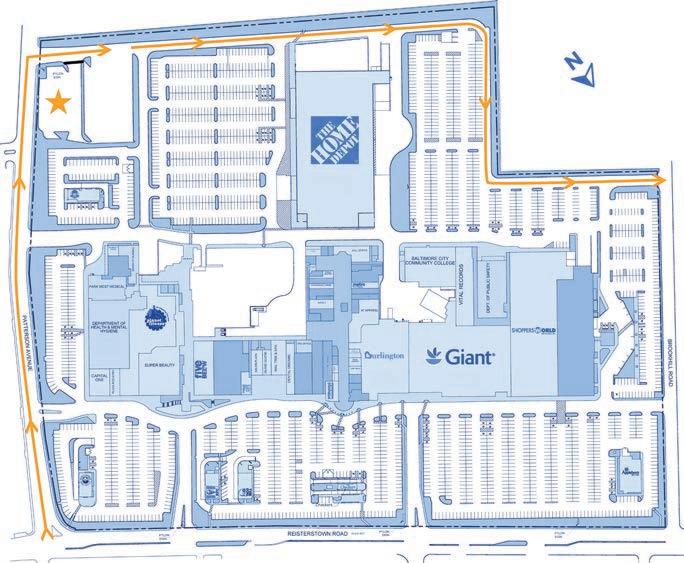
Back Lot In Front of Home Depot, Beside Wendy’s - See Map Below.

The Chesed Fund and Project Ezra invite the entire community to the Harry A. & Lillian Frid, ה׳׳ע Annual Baltimore

Wednesday, April 1, 2026 | 7:00 - 11:30 AM sharp
NOTHING WILL BE ACCEPTED AFTER 11:30AM.
WITH MUCH APPRECIATION
Driving Instructions
Entering the Plaza:
1. Entrance to the plaza MUST be from Patterson Avenue.
2. Turn onto Patterson Avenue heading southeast.
3. Continue past Wendy’s and then turn right.
4. Turn right to enter the designated parking lot.
Absolutely no parking in the Wendy’s lot
Exiting the Plaza:
1. Exit MUST be through Brookhill Road.
2. From the parking lot,turn right onto the access road.
3. Follow the access road until you reach Brookhill & Reisterstown Roads.



to City Councilman Isaac “Yitzy” Schleifer for making this year’s event possible!





The Haggadah relates the story of the Tannaim who sat together at their Seder, immersed in the telling of Yetzias Mitzrayim the entire night, until their students arrived in the morning to remind them that it was time for Krias Shema. It is striking. If these were the greatest Torah leaders of their generation, why were their students not there with them? Would it not have been more appropriate for talmidim to spend the Seder at the table of their Rabbeim? After all, what greater experience could there be than witnessing a Seder led by such giants?
I once heard a powerful answer, brought in the name of Rabbi Yakov Frand quoting the Haggadah of Harav Eliyahu Boruch Finkel zt”l. The Mirrer mashgiach, Harav Yeruchom Levovitz zt”l, was asked by a bochur who had a rare opportunity. He was scheduled to go home for Yom Tov, but he had been invited to spend the Seder with the Chofetz Chaim. It was a once in a lifetime chance, the kind of experience a person could speak about for years. Where should he go?
R’ Yeruchom answered without hesitation. Go home.
A Seder is meant to be with family. The deepest impact comes when a father tells the story to his child, when the words are not just learned but lived. A child does not only hear about Galus and Geulah. He feels it through the tone, the pauses, the memories, and the emotion of his parents. It becomes real. It becomes personal. That is why the talmidim were not at the table of their Rabbeim. They were exactly where they needed to be, at home, absorbing something that cannot be replicated anywhere else.
And that is the piece we sometimes overlook. Every family carries its own version of Yetzias Mitzrayim. Not just the story from the Haggadah, but the story of how we got here. The journeys from other countries, the sacrifices
that were made, the challenges that were faced, the quiet acts of mesiras nefesh and unwavering emunah that built the foundation of a family. Those stories are not written down in any one place. They live in the voices of parents and grandparents. They are shared in passing, in small moments, and especially around the Seder table, where they take on a deeper meaning.
But just as important as the story itself is the feeling that surrounds it. The taste of Pesach that can only come from Bubby’s kitchen, flavors that somehow carry decades of memory in a single bite. The familiar divrei Torah that make their annual appearance, sometimes predictable, sometimes even repeated word for word, yet never losing their place. The small family minhagim, and even the things that are not minhagim at all but somehow feel just as sacred. The same songs, the same jokes, the same back and forth that plays out year after year.
Because in the end, that is what we are really building. Not just a retelling of a national story, but a living family experience. The laughter, the warmth, the time spent simply being together. These are the moments that create something lasting. These are the memories that become woven into the fabric of a family, carried forward almost subconsciously, until one day the next generation is the one leading the Seder, repeating the same words, serving the same recipes, and creating that same feeling for their own children. And that is how the story of Yetzias Mitzrayim continues, not only in the Haggadah, but in the heart of every Jewish home.
Wishing a everyone a peaceful Shabbos and a beautiful Yom Tov!
Aaron M. Friedman
mazal tovs
Comfort Year-Round:
Experience stable indoor temperatures, and reduce drafts, with warm winters and cool summers, when you upgrade to spray foam insulation in your attic.

Save Big on Energy Costs:
Cut your heating and cooling bills by 30-50% and make your HVAC system work smarter, not harder.
Breathe Better:
Enjoy improved air quality with reduced drafts and outdoor pollutants, creating a healthier living environment.


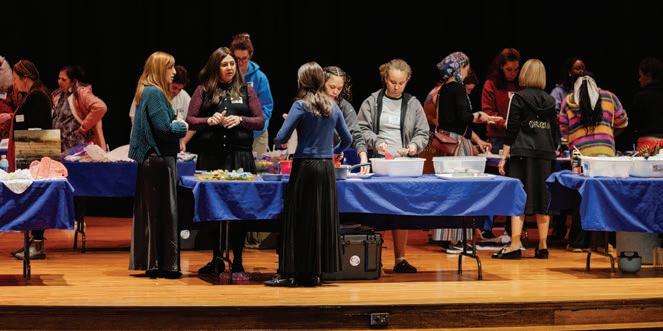
At this year’s Jewish Educational Services’ Early Childhood Conference on March 9th, the auditorium buzzed with the sounds of teachers diving into the same sensory activities they usually set up for children. Cornstarch goo, soap shavings, and simple science experiments quickly became lively moments of discovery. It reminded everyone how much learning happens when we explore, experiment, and simply play.
Lisa Murphy, known nationally as the Ooey Gooey® Lady, led the day with her signature energy, humor, and clear, practical explanations. Through hands-on demonstrations, she showed how everyday experiences give children the foundation they need for later academic success. Her research-based approach felt accessible and genuine, and educators responded with enthusiasm and laughter.
Over 260 educators from 13 preschools came together for the day
and were eager to share their feedback with enthusiasm. Many described the training as insightful and inspiring. One participant summed it up perfectly, saying, “On a scale of 1 to 10, this was a 20!” Another shared, “I haven’t had that much fun learning in a very long time. Lisa is real, funny, and approachable.” Her reminder to educators to think about what a child will remember from “their only day” in a classroom resonated deeply and became a recurring theme throughout the day.
The feedback spoke for itself. More than 90 percent of participants said they left with ideas they could use right away, whether it was a renewed appreciation for play, inspiration to adjust their teaching, or new strategies to bring back to their classrooms.
When our EC consultants visited programs the next morning, they saw early signs of impact, including fresh sensory stations, open-ended art invitations, and more opportunities for child-led exploration. The ideas were
not only understood but already being put into practice.
In addition to this conference, educators can continue building their skills through JES’s ongoing early childhood learning opportunities. Each month, JES hosts virtual sessions such as Preschool Power Hour with Morah Anne, which offers preschool educators a space to discuss real classroom behaviors and explore practical strategies, and Reading Roundtable with Debbie
Logue, where K–2 teachers share ideas and learn new ways to make reading interactive, engaging, and accessible for young learners. Both sessions provide opportunities to learn, connect, and bring fresh, research-informed practices back to the classroom.
To schedule training, including MSDE approved training for your early childhood program, contact Faye Friedman at JES for available options and support.


AGUDATH ISRAEL OF BALTIMORE
SUNDAY
SECOND DAY OF
MONDAY
TUESDAY FOURTH
FOLLOWING GENTILE CUSTOMS
USING GENTILE NAMES
WEARING GENTILE CLOTHING
Each day’s topic is an independent subject
8:00 AM Shacharis, followed by Breakfast 10:00 AM Seder
Mareh Mekomos will be provided. Bring your own chavrusah, or we can provide a chavrusah. There will also be a Hachanah Shiur available. 11:10-11:40 AM Shiur by HaRav Mordechai Frankel
LOCATION: AGUDATH ISRAEL OF BALTIMORE 6200 PARK HEIGHTS AVENUE
Breakfast sponsored by the Gibber family
Launching the spring semester with enthusiasm, Women’s Institute of Torah Seminary & College (WITS) kicked off its annual Career Mentorship Program. This initiative aims to forge connections between students, alumnae, and community members, strengthening career success for students. The program provides networking opportunities, career readiness skills, and offers invaluable insights into various fields, particularly as frum women. It is also a platform for alumnae to give back and empower the next generation.
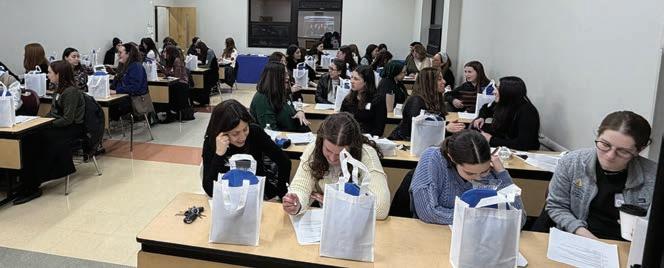
A big thank you to all the dedicated mentors: Sarala Tendler ‘16, Chani Mainstain ‘11, Sarah Mutterperl ‘14, Chevy Silberstein ‘11, Yakira Price ‘20, Oriana Kelemer ‘15, Yael Weiss ‘15, Dina Weiner, Chaya Feldman, Chaya Spero ‘12, Miriam Wetstein ‘24, Rosa Bennett ‘20, Chana Breuer, Malka Koretsky, Deena Mael, Elana Rosenberg ‘12,
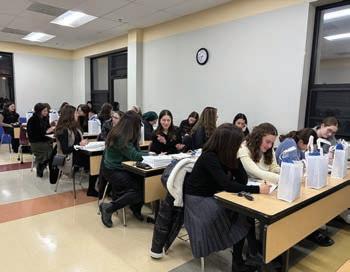
Wendy Chervony, Esther Lejtman, Ahuva Radzyner ‘06, Sarah Slater ‘23, Shoshana Gutow ‘15, Malka Zlotta Slotchiver, Sima Eastman ‘12, and Yehudis Barer.
The walls of the L’Chaim Adult Day Center were filled with a spirit of achdus this past Thursday as a unique delegation of students arrived for a morning of connection and inspi-
ration. The visit brought together local students from Beth Tfiloh High School alongside visiting peers from Budapest, Hungary, as part of the SOS International Gesher Ambassadors Program. Despite the miles be-

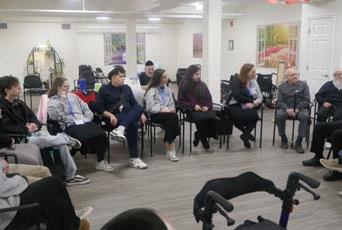
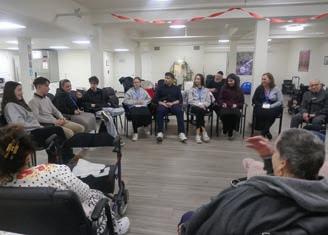
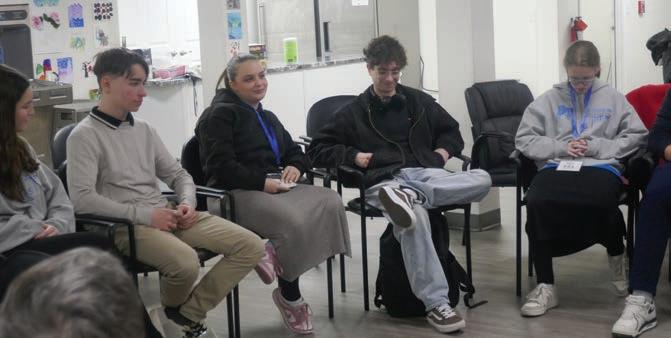
tween their homes, the young visitors and the L’Chaim participants found immediate common ground in their shared heritage. The room hummed with energy as students shared stories of Jewish life in Budapest and their preparations for the upcoming Pesach holiday, while the seniors reciprocated with rich and diverse life stories and lessons.
The atmosphere was a true Kiddush Hashem, marked by spirited singing and fun word games that transcended language barriers. Whether speaking English or Hungarian, the
students’ commitment to the value of Kol Yisrael Arevim Zeh B’Zeh was palpable. Chaperones from Beth Tfiloh and SOS International looked on as a beautiful intergenerational bond was forged, proving that the flame of Jewish identity burns brightly across all ages and borders. It was more than just a visit; it was a powerful reminder of the strength of our global Jewish family and the joy that comes when we have the opportunity to listen and learn from one another.
Special thank you to Devora Teichman for coordinating this event.

Rabbi Shmuel Iser of Kehillas Shaarei Avodah addresses the Yeshivas Toras Simcha talmidim before mincha. Rabbi Iser described how matzah can teach all of us a lesson in humility. The matzah, which is flat and does not rise, serves as a symbol to us to “flatten our egos” and allow other people to shine. Rabbi Iser encouraged the talmidim at their Pesach sedarim to allow many other brothers and sisters to share their divrei Torah even when they also have something that they want to share.

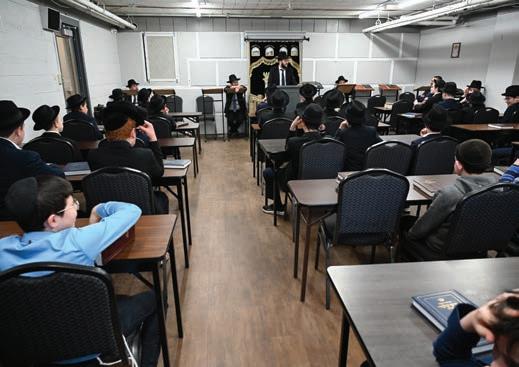
Several members of the Baltimore Jewish community competed at the Orienteering USA National Championships, held at the University of Maryland, College Park.
Among the standout performers, Yechiel Cynamon (M10-) earned a silver medal in his age category, demonstrating exceptional skill, focus, and determination. CY Berkovitz (M12-) also delivered a strong performance, finishing in second place in his category.
Orienteering is a unique navigational sport that challenges participants to use a highly detailed map and a compass to navigate unfamiliar terrain. Competitors must locate a series of checkpoints, known as “controls,” in a specific order, choosing the most efficient routes to complete the course in the fastest possible time. The sport requires not only physical endurance but also critical thinking and decision-making under pressure.
Yechiel and CY were introduced to orienteering through their involvement in local Scouting programs. Inspired by the challenge and excitement of the sport, they have continued to develop their skills and now regularly participate in competitions. In turn, they help bring that enthusiasm back to the community by introducing fellow Scouts and Cub Scouts to orienteering, encouraging others to build confidence, resilience, and outdoor navigation skills.




Much of the local orienteering scene is supported by the Quantico Orienteering Club (QOC), one of the largest and most active orienteering clubs in the country. The club regularly hosts events throughout Maryland, Virginia, and Washington, D.C., including in nearby parks such as Patapsco Valley and Wheaton Regional Park, making the sport accessible to beginners and experienced competitors alike.
Also spotted at the event was Dovid Cynamon, adding to the strong local



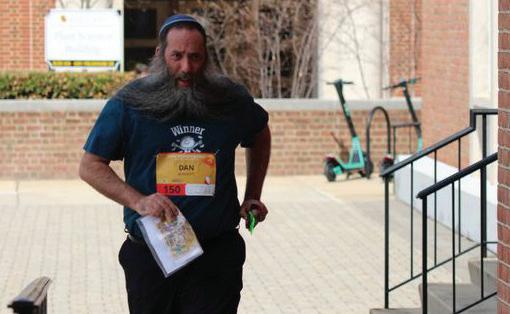
presence at the national competition. Their efforts are a source of pride for the community and highlight the
impact of youth engagement in outdoor activities and skill-building programs.









By: Dr. Moshe L. Gavant
We had a quiet Monday night. No warnings or sirens after 9:30 PM.
To my amazement, as I was getting my morning cup of coffee from the restaurant’s coffee maker—an Americano in a cup half the size I’m used to—a live toy poodle scurried by, with a small pack of pajama-clad children in pursuit.
Looking around, I saw several families eating breakfast. They certainly weren’t here yesterday in our boutique hotel in Modi’in. This place has been our quiet respite from the chaos outside.
It turns out that about 100 men, women, and children—perhaps 15 families in all—were checked in late Monday night.
There was near bedlam around me. People speaking loudly. Children running up and down the hallways, shrieking as if at recess. Not one, but at least three miniature dogs in the lobby, not all of them happy to see each other.
Who were all these interlopers, ruining the little peace and quiet of the day?
Then an onslaught of social workers and counselors in yellow vests began to clarify matters.
An undetected Hezbollah missile had landed in the driveway of an apartment building just south of Tel Aviv. There was no loss of life and no serious injuries. But windows and doors had been blown in, debris had made the building uninhabitable, and the residents would be displaced for at least a few weeks.
Our nearly empty hotel was a perfect landing place, and 30 rooms were secured for the group by an Israeli social service agency.
Bedtime for us is not, apparently, bedtime for children running up and down hallways and banging on doors.
Social services, it seems, stop at 5 PM. Social crises, apparently, do not.
Four alerts scattered through early Wednesday morning only compounded our stress and fatigue.
Perhaps these brothers—and their dogs—were too heavy?
Leah was the answer.
She arrived all alone: an elderly woman with gray roots and shoulder-length thin black hair. She was obviously scared and a little disoriented.
Who would care for Leah?
The next morning, the chaos had temporarily subsided.
Leah came to breakfast in brandnew Mickey Mouse pajamas. She proudly wore them all day. Perhaps they were the only comfortable or clean clothes she had.
By the end of the day, she was clearly stronger in spirit. As she was being escorted to her room before her cadre of social workers departed, we told her how much she had become our favorite new guest—an inspiration.
She perked up and declared, “Ani chazakah! I am strong!”
In the end, it is a choice whether to be upset or patient. We too are displaced from our home, though there is a greater likelihood that we will return to ours first—please, El Al, don’t delay our booking again.
We will, and we must, push through the physical and emotional fatigue. And in truth, Leah’s words speak not only for herself, but for us as well—and perhaps for the Jewish people altogether.
To paraphrase her: “Anachnu chazakim! We are strong!”
Strong enough to endure uncertainty. Strong enough to bear disruption. Strong enough, as Jews always have, to carry one another through fear, fatigue, and dislocation.
And so indeed:
She ain’t heavy. She’s my sister. ----------
The Beauty With No Front Teeth
One of the more meaningful undertakings while sitting in a mamad, waiting for the all-clear during a missile alert, is to recite Tehillim. Our hosts kept several well-worn copies in a basket in their shelter.
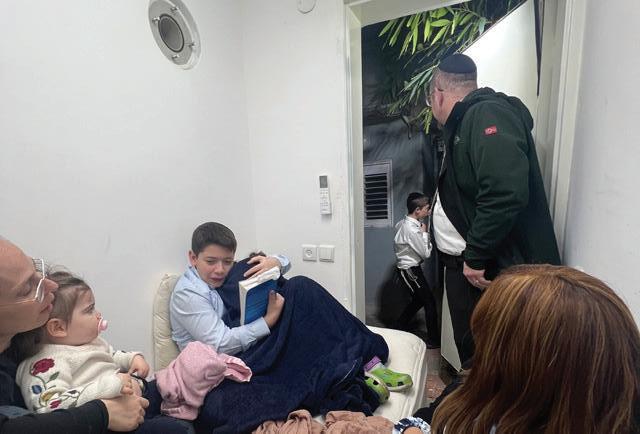


On one occasion, in order to steady the children, they suggested that each take a turn reading aloud. There is something uniquely stirring about hearing a child’s innocent neshama cry out to Hashem for protection. The children may not grasp the full weight of the moment. The adults certainly do.
It was particularly moving to hear my eleven-year-old grandson and twelve-year-old granddaughter recite familiar passages from Pesukei d’Zimrah — words that are part of their daily tefillah, now spoken with a different urgency.
Then our Israeli hosts’ six-year-old daughter — missing most of her front baby teeth — insisted that she, too, should participate. With complete seriousness she proceeded to “read” Tehillim 121 and 130. She was proud to be included alongside the older children.
At one point she accidentally dropped her sefer. And in that small, unguarded moment, it became clear: she had not been reading at all. She was reciting from memory.
Those words were not embedded in the page. They were embedded in her heart.
I crown her my six-year-old toothless beauty.



My wife and I came to Israel on February 18 for what we expected would be a brief ten-day visit, centered on the joy of celebrating our first grandchild’s wedding in Yerushalayim. After the wedding, we spent Shabbos Sheva Brachos in Rechovot, with the kallah’s family, not far from Ben Gurion Airport, and planned to fly home on Motzei Shabbos. Instead, that very Shabbos, the current war with Iran began, and we remained in Israel for nearly two additional weeks until El Al was finally able to bring us back to the United States. In the midst of missile alerts, repeated trips to shelters, disrupted plans, and mounting uncertainty, I found myself writing. These essays were, in part, a way to steady my own anxiety. But they also became a record of what we experienced: not only fear and strain, but also prayer, kindness, Jewish endurance, and the surprising depth of ordinary moments lived under extraordinary
Dr. Moshe L. Gavant, M.D. is a retired emergency radiologist who served as a professor of radiology at UT-Memphis and later practiced with Advanced Radiology in Baltimore for more than twenty years. Originally from Atlanta, Georgia, he and his wife, Ann Ellen, live in Baltimore, Maryland, and are the parents of four sons and grandparents of sixteen grandchildren. A devoted student of Torah and Jewish thought, he writes about family, faith, Israel, and the resilience and depth of Jewish life in uncertain times.
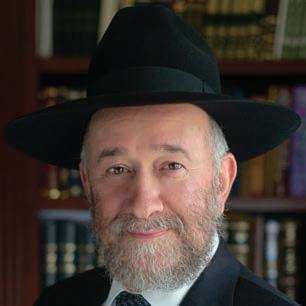
Rabbi Shimon Russell, shlit”a, LCSW
Director of training and development at Kesher Nafshi, a world-renowned psychotherapist in private practice in Jerusalem. A popular author and speaker, he is considered a premier authority on the challenges of “At-Risk” teens and young adults. He has presented on many mental health-related topics throughout the US and abroad. He holds an MSW from Rutgers Graduate School of Social Work.
RABBINIC ADVISORS:
Rabbi Yaakov Hopfer
Rabbi Menachem Goldberger
Rabbi Zvi Teichman
Focused
The Kulam Basketball League wrapped up an exciting and meaningful winter season with its highly anticipated championship game. The energy in the gym was palpable as families, friends, and community members came out to cheer on the boys. This year’s title was claimed by Team Unsimply Sourdough, led by Ami Shmerling and Moshe Merkin, whose teamwork and determination carried them through a hard-fought season. While they earned the championship, every team left the court having grown—not just as players, but as teammates and individuals. Wins and losses were part of the journey, but what stood out most was the way the boys showed up for each other, competed with heart, and built lasting connections.
Beyond the court, Kulam’s winter season was filled with impactful opportunities for growth and giving. In collaboration with Bikur Cholim of Greater Washington, Kulam boys took part in a meaningful Pesach initiative—packaging food items that will be delivered to stock local hospital pantries for patients spending Yom Tov in the hospital. Through this effort, the boys experienced firsthand what it means to give back and support others during times of need.
Kulam also continued its cherished senior visits, where participants spent time with elderly members of the community. These visits have become
a highlight for both the boys and the seniors, offering warmth, connection, and genuine chizzuk. The relationships formed in these moments reflect the deeper mission of Kulam—fostering empathy, respect, and a sense of responsibility toward others.
At its core, Kulam provides a space where every boy belongs. It is a safe, supportive environment where boys can come together, build friendships, and feel a sense of pride and confidence—regardless of any challenges they may be facing in school or at home. Each boy has the opportunity to shine in his own way.
This sense of belonging extends beyond middle school through Kulam’s growing alumni program. It has been inspiring to see boys from different schools reconnect—whether through pick-up basketball games or simply relaxing together in the lounge over food and a game of NBA 2K. These moments of reconnection highlight the lasting impact of Kulam and the strong bonds formed within it.
Located in Silver Spring, Kulam continues to serve as a hub for connection, growth, and community. This winter season was a powerful reminder of what happens when boys are given the space, guidance, and support to thrive—together.
That’s the power of Kulam.



SUNDAY, APRIL
1:00-4:00 P.M.

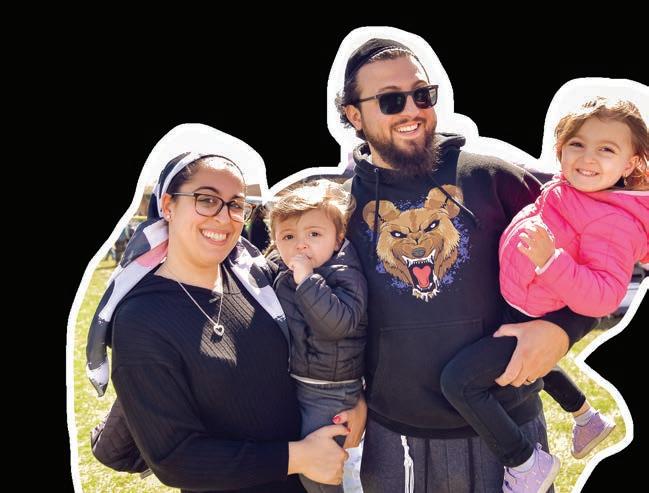

TThe Yeshiva of Greater Washington High School
A Cappella Group brought music, warmth, and holiday spirit to the Hebrew Home of Greater Washington in Rockville with a special pre-Pesach visit.
In anticipation of the upcoming holiday, the students spent time not only performing, but also connecting personally with residents. Moving from room to room and gathering in shared spaces, the boys sang a selection of beloved Shabbos and Pesach songs, filling the halls with familiar melodies that many residents knew by heart. For some, the music evoked cherished memories of family seders and past celebrations, adding an emotional depth to the visit.
Beyond the singing, what made the visit especially meaningful were the personal interactions. The students took time to speak with residents, offering warm greetings and conversation that brightened the day for many. These moments of connection reflect-
By: Rav Ezra Epstein, Yeshiva of Greater Washington Kollel
ed the group’s broader mission—not just to perform, but to uplift and engage with the community.
Now in its fourth year, the A Cappella Group has made this visit a valued tradition. They return to the Hebrew Home at least once a year, often aligning their visit with a Jewish holiday to bring timely joy and spirit to the residents. Over time, these visits have become something both the students and residents look forward to.
The impact of the group’s presence was clear. One resident, smiling after the performance, shared how much he enjoyed the visit and remarked that the group should come before every holiday—a sentiment that captures just how meaningful these encounters have become.
As Pesach approaches, the visit served as a reminder of the power of music and community to bring people together, bridging generations and creating moments of shared joy.
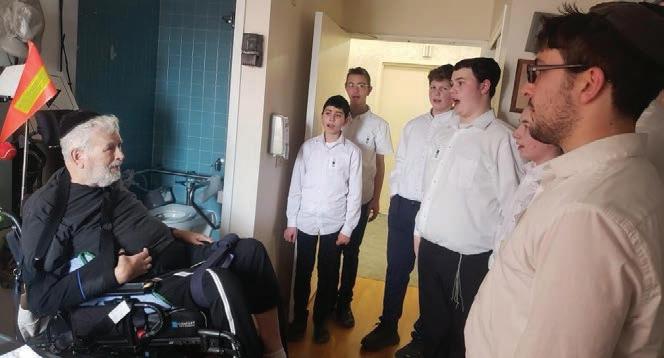





By: Rabbi Dr Avichai Pepper, Director of Educational Advancement and Community Relations at Yeshiva of Greater Washington
One of the highlights of the Pesach Seder is gathering with family, and often even extended family, and sitting around a shared table. As we discuss the miracles experienced by our ancestors since Yetzias Mitzrayim until today, sharing perspectives shaped by years of learning creates a uniquely meaningful atmosphere. It is something families look forward to all year.
Over the past few months, the Yeshiva of Greater Washington has been focusing on strengthening meaningful relationships with its high school alumni. Through this effort, there has been a growing realization of the need not only to maintain those connections but to actively help orchestrate them, especially for those students currently in Israel who may find themselves unable to return home. As the situation in Israel continues to unfold and travel remains uncertain, many families in our community are finding themselves with empty seats at their Seder tables, seats that would
normally be filled by children who have spent the past year deepening their connection to our mesorah.
This absence is felt on both sides, by those in the diaspora and those in Eretz Yisrael. This year, many will miss the opportunity to be together in person or to share these meaningful stories of Jewish survival.
In an effort to bridge that gap, my family, currently divided by the war, has begun sharing a Pesach Haggadah. Each of us contributes thoughts, perspectives, questions, and reflections. While it cannot replace sitting together at the same table, it allows us to bring each other’s voices into our Sedarim, wherever we may be. At Yeshiva, we are working on the same idea, collecting Divrei Torah from Rabbeim to share with our alumni, whether at home in the States or in our eternal home of Eretz Yisrael. Celebrating this Pesach in Yeshiva or serving in the IDF, this project aims to empower each alumnus to come to the Seder with a

piece of home in their hands.

At Yeshiva, we are working on the same idea, collecting Divrei Torah from Rabbeim to share with our alumni, whether at home in the States or in our eternal home of Eretz Yisrael. Celebrating this Pesach in Yeshiva or serving in the IDF, this project aims to empower each alumnus to come to the Seder with a piece of home in their hands.
As Pesach approaches, I encourage not only our extended yeshiva
family, but anyone who finds themselves separated this year, to seek creative ways to strengthen those connections. Reach out to parents, grandparents, and even former rabbeim. Ask them to share something meaningful, something that can be carried into your Seder.
In doing so, we can ensure that even across distances, this Pesach becomes an opportunity to deepen our relationships and strengthen the chain of our mesorah.
6:15 am Young Israel Shomrai Emunah M-F
6:20 am Ohev Shalom Talmud Torah OLNEY M, Th
6:25 am Southeast Hebrew Cong., Knesset Yehoshua M-F
6:30 am Beth Sholom Congregation M-F
Beit Halevi (Sfardi) M, T Chabad of Silver Spring M-F
Ohev Shalom Talmud Torah OLNEY T, W, F
Young Israel Shomrai Emunah S YGW M, Th
6:35 am Ohr Hatorah M, Th
6:40 am YGW S, T, W, F
Magen David Sephardic Congregation M-Th
6:45 am Beit Halevi (Sfardi) S, T, W, F
Kemp Mill Synagogue M, Th
Ohr Hatorah T, W, F
Young Israel Shomrai Emunah M, Th
6:50 am Woodside Synagogue/Ahavas Torah M, Th Silver Spring Jewish Center M-F
Chabad of Upper Montgomery County M-F
6:55 am Young Israel Shomrai Emunah T, W, F
7:00 am Kemp Mill Synagogue T, W, F
Southeast Hebrew Cong., Knesset YehoshuaS
Silver Spring Jewish Center S
Woodside Synagogue/Ahavas Torah T, W, F
Young Israel Ezras Israel of Potomac T, W, F
7:05 am Kesher Israel M, Th
7:15 am Kemp Mill Synagogue M, Th Kesher Israel T, W, F
Ohev Sholom Talmud Torah/The National Synagogue M-F
Ohr Hatorah S
7:30 am Chabad of DC M-F
Chabad of Potomac M-F JROC M-F
Kemp Mill Synagogue T, W, F
Southeast Hebrew Cong., Knesset Yehoshua M-F
Young Israel Shomrai Emunah S
Young Israel Shomrai Emunah (Sfardi) M-F
7:45 am YGW (Yeshiva Session Only) S-F
8:00 am Beth Sholom Congregation S
Kemp Mill Synagogue S
Kesher Israel S
Ohev Shalom Talmud Torah OLNEYS
Southeast Hebrew Cong., Knesset YehoshuaS
Chabad of Upper Montgomery CountyS
Woodside Synagogue/Ahavas TorahS
8:00 am YGW (High School; School-Contingent) S-F
Young Israel Ezras Israel of PotomacS
Young Israel Shomrai Emunah (Sfardi)S
8:05 am Ezras Israel Congregation of Rockville M, Th
8:15 am Ohr Hatorah S Ezras Israel Congregation of Rockville S, T, W, F
Kehilat Pardes / Berman Hebrew Academy S-F
Silver Spring Jewish Center M-F
8:30 am Chabad of DC S Chabad of Potomac S JROC S Ohev Sholom Talmud Torah/The National Synagogue S
Silver Spring Jewish Center S YGW (Summer Only) S-F
8:45 am Young Israel Shomrai Emunah S-F
9:00 am Chabad of Silver Spring S Kemp Mill Synagogue S
mincha
2:00 pm Silver Spring Jewish Center S-F
2:10 pm YGW M-Th School Days
2:45 pm YGW S-Th
3:00 pm YGW Middle School M-Th School Days
mincha/maariv
Before Shkiah (15-18 minutes), S-TH
Beit Halevi (Sfardi)
Beth Sholom Congregation
Chabad of Potomac
Chabad of Silver Spring
Chabad of Upper Montgomery County
Ezras Israel Congregation of Rockville (20 min before, S-F)
JROC
Kemp Mill Synagogue
Kesher Israel
Magen David Sephardic Congregation Ohev Sholom Talmud Torah/The National Synagogue
Ohr Hatorah
Silver Spring Jewish Center
Southeast Hebrew Congregation
Woodside Synagogue/Ahavas Torah
Young Israel Ezras Israel of Potomac Young Israel Shomrai Emunah (Asheknaz) Young Israel Shomrai Emunah (Sefarhadi)
maariv 8:45



Tour de Kindness is Biker Cholim’s signature, fully supported endurance ride, designed for experienced cyclists who are ready to take on a meaningful challenge and go the distance for a powerful cause. sunday June 28 . 50 & 100 Mile Ride



When serious illness turns a family's world upside down, fear and uncertainty take over. In those painful moments, no one should have to struggle alone.
Bikur Cholim of Baltimore is a community-powered lifeline, wrapping families in compassion and practical support when they need it most.
Services include:
• Patient advocacy and referrals, so no one feels lost in a complex medical system
• Transportation to and from hospitals, ensuring loved ones can be at the bedside
• Food for families in crisis, easing the burden at home
• Hospital kosher pantries, preserving dignity during difficult days
• Free loaned medical equipment, relieving financial strain
• Accommodations for families receiving treatment in Baltimore, offering rest and refuge
Every day, dedicated volunteers walk the halls of Baltimore's medical facilities, bringing comfort, care, and hope to families facing their hardest hours.




pivotgroup.nyc


The Simcha Fund ensures that orphans celebrate their weddings with a joyous heart, without any financial burden. Tov V'Chesed provides generous distributions for tens of thousands of families in Eretz Yisrael. Buneinu Bnoseinu provides
On Monday, it was announced that police in Hong Kong can demand the passwords of the cellphones and computers of those suspected of breaching the city’s national security law.
Refusing to comply could lead to up to one year’s jail and a fine of up to HK$100,000 ($12,773), while providing false or misleading information could bring up to three years’ imprisonment and a fine of up to HK$500,000.
The new rule announced this week are amendments to the implementation rules of the national security law imposed by Beijing in 2020, using powers to by pass Hong Kong’s legislature.
The sweeping law punishes acts, including subversion and collusion with foreign forces, with up to life imprisonment. It sparked criticism from Western governments and rights groups, but Beijing and Hong Kong officials said it was needed to restore stability after the city was rocked by months of pro-democracy protests in 2019.
The new amendments empower police to require a person under investigation suspected of endangering national security to provide any password or decryption method for electronic devices and to provide the police “any reasonable and necessary information or assistance.”
The new amendments also empower customs officers to seize items that are deemed to have “seditious intention” regardless of whether any person has been arrested for an offense endangering national security because of the items.
A Hong Kong government spokesperson said the amended rules conform to the city’s mini-constitution, the Basic Law, and its human rights provisions, and “will not affect the lives of the general
According to the Security Bureau, a total of 386 people have been arrested for national security crimes so far, with 176 people and four companies convicted.
A strike on a healthcare facility in Sudan killed 64 people on Friday. Eightynine others were wounded, according to the World Health Organization.
The UN’s humanitarian office in Sudan said it was “appalled by the attack on a hospital in East Darfur yesterday, reportedly killing dozens, including children, and injuring more.”
Sudanese rights group the Emergency Lawyers, who document atrocities in the war between Sudan’s army and the paramilitary Rapid Support Forces, reported it was an army drone strike that hit the El-Daein teaching hospital.
Since April 2023, the Rapid Support Forces has been at war with the Sudanese military. The conflict has wreaked havoc on the northeastern African country, killing over 40,000 people, according to the


United Nations. Other aid groups suggest the death toll might be much higher. Meanwhile, the war has displaced over 14 million people and caused diseases to spread, with more than 33 million people needing humanitarian aid.
The RSF dominates the vast western Darfur region, while the army is in control of Sudan’s east, center and north. Friday’s attack involved “violence with heavy weapons” and affected a secondary health care facility, medical personnel, patients, supplies and storage.
Near-daily drone strikes are now a hallmark of Sudan’s brutal war, killing dozens at a time, mostly in the southern Kordofan region.
The UN human rights chief, Volker Türk, this month said he was “appalled” after more than 200 civilians were reported killed by drone attacks within an eight-day period.
“Parties to the conflict in Sudan continue to use increasingly powerful drones to deploy explosive weapons with wide-area impacts in populated areas,” he said.
Hospitals have been targeted repeatedly during this conflict. By December,



more than 1,800 people had been killed in attacks on health facilities since the start of the war, including 173 health workers, according to the UN. This year, a total of 12 attacks on health care facilities in Sudan have been recorded, causing 178 deaths and 237 injuries.
A Colombian military aircraft transporting 125 troops and crew members crashed shortly after taking off from southern Colombia on Monday morning. At 34 people were killed and at least 77 others were injured in the crash.
According to Mayor Luis Emilio Bustos, of Puerto Leguízamo, the town where the plane crashed, at least 14 people who had been taken to the town’s hospital were in “grave condition.”
“We continue to work and continue to conduct rescue missions, taking into account that many bodies fell faraway,” he said. “Others, possibly because of the
large amount of fire, will be difficult to find.”
Gen. Carlos Fernando Silva Rueda, the commander of Colombian Air Force, said the military was still investigating the cause of the accident.
“At this time, we don’t have any more details except that as soon as it took off, the airplane suffered a problem and descended toward the ground, a couple of kilometers from the airport,” the general explained.
The plane involved in the crash was a C-130 Hercules, a large, four-engine turboprop aircraft typically used to transport heavy loads of cargo, military personnel and military vehicles.
The aircraft had taken off from Puerto Leguízamo, a riverside town in the Putumayo region, on Colombia’s border with Peru, at 9:50 a.m. before it crashed. There were 114 soldiers and police officers on board and 11 crew members, officials said.
President Gustavo Petro thanked the residents in the Putumayo area who rushed to the crash site on motorcycles and on foot to help those injured.

“That is how a homeland is built,” he said on social media, adding that locals “went all the way to the airport runway and brought water and love to the boys.”
The plane was traveling to Puerto Asis, a town about 125 miles from Puerto Leguízamo. It crashed in a region lined with farms of coca plants harvested to make cocaine, where armed groups involved in illegal drug trafficking have a large presence.
Pedro Arnulfo Sánchez, the defense minister, said that there were “no indications of an attack by illegal actors.” He added that the fire at the crash site had caused some of the ammunition being transported by the airplane to explode.

Four Hatzalah ambulances were set ablaze on Monday in Golders Green, the largest Jewish community in London, in an antisemitic arson attack.
Harakat Ashab al-Yamin al-Islamia allegedly claimed responsibility for the attack, posting footage on social media of the incident’s location and the burning ambulances. No arrests have been made yet.
Video from security cameras showed three masked individuals setting a Hatzalah Northwest ambulance on fire at 1:36 a.m. at Machzikei Hadath, a nearby shul. Charlie Richards, a community resident who lives nearby, took a video that showed a big orange explosion, likely from the ambulance’s ignited gas canisters, and smoke rising.
“What happened overnight is shocking in the extreme. The emergency services were magnificent, and we are deeply grateful. However, our phones haven’t stopped, our volunteers are responding to callouts, and our service continues unbroken,” Laurence Blitz said, speaking for Hatzalah.
Keir Starmer, the prime minister of Britain, condemned the attack as disgust-
ing and “horrific” when he spoke in the House of Commons.
“This is not just an attack on the Jewish community, but it’s an attack on all of us, on everyone who holds the fundamental British values of tolerance and respect,” he declared.
The four ambulances, which reportedly cost around $166,000, will be replaced by the British government, according to Health Secretary Wes Streeting, who added that the London Ambulance Service will give extra attention to the area.
This attack comes amid rising antisemitism, both in the United Kingdom and globally.
Last year, Starmer warned that hatred against Jews was “rising once again” and that Britain must defeat it, after two Jewish worshipers were killed in a car ramming and stabbing attack outside a Manchester synagogue.
The number of antisemitic incidents reached record levels in 2023, according to Community Security Trust (CST), a charity that monitors incidents.
Britain’s Chief Rabbi Ephraim Mirvis called the ambulance attacks “a particularly sickening assault – not only on the Jewish community, but on the values we share as a society.”
“Our Hatzola volunteer ambulance corps is an extraordinary service, whose sole mission is to protect life, Jewish and non-Jewish alike,” he said on X.
“The UK Jewish community will meet the moment with strength, pride and resolve. We will replace the ambulances and continue our service to this nation that we love. We shall not be moved,” wrote Phil Rosenberg, president of the Board of Deputies of British Jews.
Just under 300,000 people identified as Jewish in England and Wales in 2021, during the most recent census.
According to U.S. President Donald Trump, the United States, represented by U.S. envoy Steve Witkoff and Jared Kushner, held talks with an Iranian leader on Sunday. Trump said on Monday that Iran wants “to make a deal.” Additionally, he gave a five-day extension to his deadline for Iran to reopen the Strait of Hormuz.
Trump’s claim that Iran is looking to wind down the war led stock prices to rise and oil prices to fall.

Trump did not specify the Iranian leader that Witkoff and Kushner spoke to, but he confirmed that it was not Supreme Leader Ayatollah Mojtaba Khamenei.
Meanwhile, Iran contradicted Trump’s statement, claiming that the talks never happened.
“No negotiations have been held with the U.S.,” Iranian parliament Speaker Mohammad Bagher Qalibaf wrote on X. “[F]ake news is used to manipulate the financial and oil markets.”

The U.S. would confiscate Iran’s enriched uranium under a potential deal, Trump said. Previously, Iran has rejected calls to stop enriching uranium. According to experts, Iran is extremely close to producing enough weapons-grade uranium to build nine nuclear weapons.
Indirect negotiations may also be taking place, as Turkey and Egypt have said they’ve spoken to both sides.
Over the weekend, Trump vowed to destroy Iran’s power plants unless it reopens the Strait of Hormuz by late Mon-
On the Iranian side, state-controlled news outlets claim Trump is giving up.
“Since the start of the war, messages have been sent to Tehran by some mediators, but Iran’s clear response has been that it will continue its defense until the required level of deterrence is achieved,” Tasnim, Iran’s news agency, said. “With this kind of psychological warfare, neither the Strait of Hormuz will return to prewar conditions nor will calm return to energy markets.”
A wave of Iranian missile strikes killed a Thai worker in central Israel last Wednesday night, as well as four Palestinian women in Judea and Samaria.
The Thai worker was killed by a missile that carried a cluster bomb. He was identified as 30-year-old Chaiwat Waewnil, who died of critical injuries from shrapnel, according to Magen David Adom. The bomb struck the


pregnant.
A home in the nearby Israeli community of Neta was damaged by another cluster munition, though no injuries were reported.
One person was lightly injured and a residential building was seriously damaged in a munition strike on Tel Aviv. Another Iranian ballistic missile attack lightly injured a 44-year-old man and two kids, ages 13 and 12, in Petah Tikvah earlier on Wednesday.
According to the IDF, around half of the ballistic missiles Iran launched at Israel since the start of their ongoing war have carried cluster bomb warheads.
Early Wednesday, a cluster munition hit a home in central Israel in Ramat Gan, killing a couple in their 70s, Yaron and Ilana Moshe. They had been heading to the shelter when they were killed.
Iran says the cluster munitions were revenge for Israel eliminating Ali Larijani, Tehran’s security chief.
The war began on February 28, when the U.S. and Israel struck Iran, killing its supreme leader, who has since been replaced by the deceased Ayatollah’s son, Mojtaba Khamenei.
On Sunday, an Iranian ballistic missile dropped cluster munitions in central Israel, hitting Tel Aviv and nearby cities, and wounding 15 people, including one who sustained serious injuries. The ballistic missile attack was Iran’s fourth since midnight. The causes of the injuries haven’t been specified.
A number of homes and roads were also damaged.
Sunday’s first missile strike, which happened at around 7 a.m., contained a cluster bomb warhead.
The evening before, two strikes directly hit Dimona and Arad, wounding hundreds. Dozens were hospitalized.
Five of those injured in Dimona were still being treated as of Sunday morning, according to Soroka Medical Center. Additionally, 31 people, including 18 children, injured from the Arad strike are still at Soroka. Two people who were lightly injured are being treated at Sheba Medical Center.
The ongoing war with Iran has caused 4,564 people to be hospitalized in Israel, the Health Ministry says.
According to officials, the majority of those wounded in Dimona and Arad were not in their shelters during the attack. While visiting Arad, Prime Minister Benjamin Netanyahu said it was a “miracle” that no one died.
“We don’t want to rely on miracles. There was a full ten minutes from the [early cellphone] warning until the missile’s impact. If everyone had gone to protected areas in time, to the shelters that are there under every home, no one would have been wounded,” Netanyahu said. “If you’re in a shelter, you’re protected.”
He noted that, besides for one case, no one in a shelter has been killed or seriously hurt.
On Saturday afternoon, Yehuda Sherman, an 18-year-old boy from northern Judea and Samaria’s Shuva Yisrael Farms, was killed after a Palestinian driver drove into his ATV. At this time, authorities are still investigating if the incident was a terror attack or an accident, though Finance Minister Bezalel Smotrich and others have said it was “murder.”
Sherman’s brother, Daniel, was also on the ATV at the time and was injured. The victim’s brother recalled the Palestinian vehicle intentionally speeding up to hit them and ram them off a cliff.
The following day, Yehuda was buried in Elon Moreh, a community in Judea and Samaria. His funeral drew hundreds of people, including a number of top politicians.
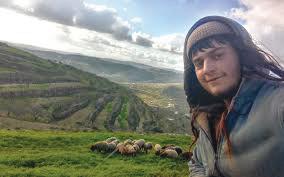
Yehoshua Sherman, Yehuda’s father, urged the government to abandon the Oslo Accords and exert complete Israeli control over Judea and Samaria, building Jewish communities throughout the territory.
Smotrich, a good friend of the victim’s family, also spoke at the funeral, pledging to work to eliminate the Palestinian Authority and ensure complete Israeli control over Judea and Samaria.
Shuva Yisrael Farms is a small community near Nablus.
“Our Yehuda — a boy who was all heart and soul, a boy from the Land of Israel, a proud sabra, who loved the Land




of Israel with all his soul, a child of the generation of redemption — ‘Earth, do not cover his blood,’” the victim’s father cried during his eulogy. “Father in Heaven… we are sending you a brave warrior, a true hero, our Yehuda.
“We will raise up new settlement outposts in northern Samaria, Tzur Yehuda, Netzah Yehuda, and Pisgat Yehuda,” he pledged after calling for the Oslo Accords’ end. “G-d willing, with joint forces, we will continue to inherit our beloved land.”
Before assassinating Iran’s Ayatollah Ali Khamenei on February 28, Israel tracked down the supreme leader by hacking Tehran’s street cameras. Ironically, Israel hacked the cameras that the Iranian regime installed to track and control their citizens.
“The irony is that the infrastructure authoritarian states build to make their rule unassailable may be what makes their leaders most visible to the people trying to kill them,” said Conor Healy,
director of research at surveillance research publication IPVM. “Do you trust who is watching?”
It is relatively easy to hack security cameras — sometimes as easy as guessing a bad password or exploiting outdated software — as many aren’t secure.

Hacking cameras is becoming a more common part of war. Before the Hamasled October 7 massacre, the terror group hacked surveillance cameras in southern Israel. Russia allegedly tried hacking Ukrainian cameras. Now, thanks to AI, militaries could easily identify people.
This isn’t the first time Iran’s security cameras were hacked. In 2021, an Iranian exile group hacked and leaked footage of the infamous Evin prison in Tehran. The following year, another group was purported to have hacked 5,000 cameras across Tehran, publishing the footage on social media. In 2025,
during the 12-Day War between Israel and Iran, the Jewish state located Iranian President Masoud Pezeshkian at a Supreme National Security Council thanks to hacked security footage.
According to sources with information on the matter, Israel has had access to nearly all of Tehran’s traffic cameras.

This week, Defense Minister Israel Katz said that Israel will maintain control of a “security zone” in southern Lebanon, up to the Litani River, until the threat of Hezbollah is removed.
Israel has been pounding targets belonging to Hezbollah, as the terror group keeps up its rocket barrages on northern Israel.
“The IDF will continue to operate in Lebanon with full force against Hezbollah. Hundreds of thousands of residents of southern Lebanon who evacuated northward will not [be allowed to] return south of the Litani River until security for the residents of the north [of Israel] is ensured,” Katz said during an assessment with IDF Chief of Staff Lt. Gen. Eyal Zamir and other top officers.

According to Katz, all bridges over the Litani River that had been used by Hezbollah to move operatives and weapons into southern Lebanon “have been blown up, and the IDF will control the remaining bridges and the security zone up to the Litani.”
He added, “The principle is clear: Where there is terror and missiles, there will be no homes and no residents, and the IDF will be inside [Lebanon].”
A November 2024 ceasefire agreement obligated the Lebanese national government to ensure there were no weapons held by non-state bodies in the area of south Lebanon between Israel and the Litani, something that the government has been unable to do. A 2006 UN Security Council resolution had already barred Hezbollah from operating in the region, but it was consistently vi-
IDF troops operating on the Leba-
nese side of Mount Dov recently located a Hezbollah tunnel shaft, as well as demolished other structures used by the terror group. The Israeli Air Force also leveled a multistory building and struck other structures in Beirut overnight Monday-Tuesday that the military said were being used by Hezbollah as command centers.
According to the IDF, the strikes in the Lebanese capital targeted Hezbollah headquarters, including one belonging to the elite Radwan Force and another of the terror group’s intelligence division. Another overnight strike in the southern Lebanon town of at-Tiri targeted a Hezbollah command center that had been embedded within a studio of the terror group’s Al-Nour radio station.
On Tuesday, Hezbollah fired a barrage of some 30 rockets from Lebanon at the Haifa Bay area. Most of the rockets were intercepted by air defenses, and there were no immediate reports of impacts in residential areas.
The Israeli military has said that it has killed over 570 Hezbollah operatives, including 220 members of the terror group’s elite Radwan Force, since March 2. More than 2,000 Hezbollah targets in Lebanon have also been struck, including 120 command centers, 100 weapon depots, and 130 missile launchers, according to the IDF

The Senate on Monday confirmed Markwayne Mullin to lead the Department of Homeland Security, installing the Oklahoma Republican at the helm of the embattled agency as a weeks-long shutdown shows no signs of easing.
Mullin was approved in a 54-45 vote, with two Democrats — John Fetterman and Martin Heinrich — crossing party lines to back his nomination. But opposition remained sharp, including from


Republican Sen. Rand Paul, who broke with his party after a tense confirmation hearing. Paul questioned Mullin’s temperament, asking whether someone with “anger issues” could effectively lead federal immigration agencies.
A close ally of Donald Trump, Mullin assumes leadership following Kristi Noem, who was dismissed just a few weeks ago.
The fallout from ICE in Minneapolis and two deaths there by ICE officers triggered a standoff in Congress. Democrats have withheld support for DHS funding, demanding stricter oversight of Immigration and Customs Enforcement and Customs and Border Protection. Among their conditions: requiring agents to display identification, limiting the use of masks, and mandating judicial warrants for certain enforcement actions.
Despite Mullin’s confirmation, lawmakers from both parties acknowledge that the leadership change alone is unlikely to break the deadlock. Democrats have made clear their objections are rooted in policy, not personnel, and have vowed to block funding unless reforms are adopted.
Meanwhile, the shutdown — now in
its sixth week — is straining the agency’s workforce. Thousands of TSA officers and other employees are working without pay, contributing to staffing shortages and long airport security lines nationwide. More than 400 TSA officers have reportedly resigned since the impasse began.
“It’s a very challenging job under the best of circumstances,” said Sen. John Cornyn. “And this may not be the best of circumstances.”
Mullin’s allies point to his independence. “This is going to surprise some people, but I consider Markwayne Mullin a friend,” Heinrich said. “He is not someone who can simply be bullied into changing his views.”

Dennis Coyle, a U.S. national, was held by the Taliban since January 2025. The week, Afghanistan’s government agreed to release him.
According to the foreign ministry, the Taliban agreed to the release after a letter from his family and said that Dennis Coyle “would be pardoned and released” for Eid, the holiday marking the end of Ramadan.
The Taliban and U.S. have been holding talks about Coyle’s release since the last week of February.
Coyle, a 64-year-old academic from Colorado, was taken by force from his Kabul apartment by the Taliban. His abduction came just six days after another American, Ryan Corbett, was released at the start of President Trump’s second term.
Coyle was being released “based on humanitarian sympathy and goodwill and believes that such steps can further strengthen the atmosphere of trust between countries,” the foreign ministry said in its statement, adding that Kabul “also expresses the hope that both countries will find solutions to the remaining problems through understanding and constructive dialogue in the future.”
Coyle, who spent nearly two decades in Afghanistan conducting language research, was being held by the Taliban General Directorate of Intelligence in near-solitary confinement with no charges filed, according to his family.
Last June, the U.S. government officially designated Coyle as wrongfully detained under the Robert Levinson Hostage Recovery and Hostage-Taking Accountability Act, a status that unlocks select government tools and elevates the priority of efforts to secure his release.
The United States does not recognize the Taliban as Afghanistan’s legitimate government and lacks a diplomatic presence in the country, complicating release negotiations that are often conducted by Qatar as an intermediary on behalf of the U.S.
Last week, Washington Gov. Bob Ferguson signed a law prohibiting law enforcement officers in the state from covering their faces to hide their identities.























Earn your degree at Lander College for Women’s New York campus, or virtually, from anywhere. Experience the same personalized attention and robust academics whichever option you choose! Knowledgeable advisors will guide you along every step of your academic journey towards highly competitive professional careers.
• Pathways programs • Fully online majors • Flexibleclass schedules
• Scholarships and financial aid available for those who qualify
• Jerusalem Track o ers the opportunity to take courses in person towards your degree from Jerusalem. Open to non-Israeli students only
Marian Stoltz-Loike, Dean
For info and to tour our campus
Contact Mrs Sarah Klugmann 212.520.4263 or sarah.klugmann@touro.edu

The law came in a response to concerns about identification during the recent immigration crackdown.
All law enforcement officers, including federal immigration officers, must show their faces while performing their official duties in the state, effective immediately.
“Law enforcement’s job, of course, is to protect us. Yet ICE is hiding from public accountability,” accused Ferguson, a Democrat. “Washingtonians must know they are interacting with legitimate law enforcement officers.”
The bill passed unanimously by Democrats, who hold a majority in the state’s Legislature, and received no votes from Republicans, who called the bill unconstitutional. The Supremacy Clause in the Constitution mandates that federal law take precedence over state law — an argument the Trump administration used to challenge a similar law in California, which was blocked last month by a federal judge. The judge said California’s “No Secret Police Act” violated the Constitution by targeting federal police and not state and local police equally.
Previous Washington state law only required law enforcement to be “reasonably identifiable” while performing their official duties, which included through a name on their badge or uniforms. It had no specifics around face coverings, which this new law aimed to clarify.
Washington’s law differs from California’s. The new legislation in Washington state applies to all federal, state and local law enforcement, potentially bolstering its chance of holding up in court.
Ferguson told reporters after the bill signing that he knew legal challenges to the law would be “inevitable,” but remained optimistic.
“I’m confident, and we did our best to structure it in a way that is defensible,” he said.
The Trump administration has taken its first concrete step toward shifting control of the nation’s massive student-loan system out of the Department of Education, announcing a new partnership with the Treasury Department to oversee portions of the $1.7 trillion portfolio.
Under the agreement, the Department of Education will begin transferring responsibility for defaulted student loans to the Department of the Treasury. The
move allows Treasury to handle collections and assist borrowers who have fallen behind on payments. Officials say the transition will be phased in, starting with defaulted loans and potentially expanding to other parts of the portfolio where legally permitted.
Roughly 9 million borrowers are currently in default — typically defined as missing payments for at least 270 days — highlighting the scale of the challenge facing both agencies.
Education Secretary Linda McMahon sharply criticized her department’s past performance, saying the system has been mismanaged for years. “Americans know that the Department of Education has failed to effectively manage and deliver these critical programs,” she said, adding that Treasury’s financial expertise could help restore order. “We are confident that American students, borrowers, and taxpayers will finally have functioning programs after decades of mismanagement.”

sentiment, arguing his agency is uniquely equipped to take on the role. He pointed to Treasury’s access to borrower tax data and its experience handling large-scale financial operations, saying it can bring “long overdue financial discipline” to the program.
The move aligns with broader goals outlined by Donald Trump, who has repeatedly floated dismantling the Department of Education and redistributing its responsibilities across other federal agencies. Previous discussions included potentially shifting the loan system to the Small Business Administration, though Treasury has now emerged as the leading option.
The timing is significant. The administration is preparing to roll out sweeping repayment changes tied to its recent spending legislation, including new repayment plans and limits on borrowing. Officials say the Treasury partnership could help bring struggling borrowers back into repayment.
Consumer advocates, however, warned the transition could create confusion. Kyra Taylor of the National Consumer Law Center said the shift raises serious questions about borrower protections and communication. “The Department
Our memorials are already in stock. Your memorial doesn’t take six months to arrive; often, it’s already here.

We design your memorial with you in our studio. You approve it instantly, avoiding weeks of waiting.
From design to installation, we manage every step. No middlemen. No excuses.
We engrave everything ourselves to spot and fix potential flaws before they occur. The Lifetime Guarantee
We build to last, so we guarantee it. We are your partners for life.
of Education hasn’t answered how it will ensure borrowers understand their rights during this transition,” she said, cautioning that the change could introduce new obstacles without clear solutions.
Late Sunday, shortly before midnight, an Air Canada aircraft hit a Port Authority fire vehicle at LaGuardia Airport shortly after landing.
The collision killed two pilots, left 39 flight passengers and two officers in the truck hospitalized, and forced the New York airport to close temporarily, with around 600 flights canceled. As of Monday, the airport reopened one runway, while its main runway, where the plane’s wreckage is, was still closed. Thirty-two of those hospitalized have since been released.
There were 72 passengers and four crew members onboard the plane at the time of the incident.
11:37 p.m. at LaGuardia. Around a minute later, the New York City Fire Department responded to a call regarding an incident between a plane and a vehicle on the runway. Moments later, the tragedy struck. At 3:16 a.m. EST, the airport was shut down.
According to Kathryn Garcia, New York and New Jersey Port Authority’s executive director, the fire truck was responding to an unrelated odor issue in another aircraft. The two officers in the truck are in stable condition.
The two pilots who were killed were named as Antoine Forest, from Coteaudu-Lac, Que., southwest of Montreal, and Mackenzie Gunther, a 2023 alum of Toronto’s Seneca Polytechnic. Forest developed an interest in aviation as a teenager. He learned to fly bush planes at 16 and later pursued a professional career in aviation.
Audio from LiveATC.net documents the critical seconds before the collision. In the recording, an air traffic controller initially authorizes the truck to cross Runway 4. Within moments, though,
“Stop, stop, stop, stop, truck 1… stop, stop, stop!” the controller is heard saying. The controller then reported an incident on the airfield and declared the runway closed.
Senate Minority Leader Chuck Schumer said the crash should lead to “much closer scrutiny” of air traffic control staffing, highlighting a persistent shortage of controllers.
New York City Mayor Zohran Mamdani said in a Monday morning post on X that the city is coordinating closely with federal, state, and local officials as the National Transportation Safety Board investigates the incident. He also commended first responders, noting that their quick actions helped save lives.
This was the first fatal crash at the airport in 30 years.
Robert Mueller, the former FBI director who later led an investigation into alleged Russian collusion in the 2016 presidential election, passed away on Friday

“With deep sadness, we are sharing the news that Bob passed away last night. His family asks that their privacy be respected,” his family stated.
President Donald Trump — in response to the death of the man whose investigation called into question the 2016 election’s legitimacy and led to several convictions of Trump campaign advisers — celebrated Mueller’s passing.
“I’m glad he’s dead,” Trump posted to social media. “He can no longer hurt innocent people!”
Mueller brought criminal charges against six of the president’s associates, including his campaign chairman and first national security adviser. His 448-page report released in April 2019 identified contacts between the Trump campaign and Russia but did not allege a criminal conspiracy. Mueller laid out details about Trump’s efforts to seize control of the investigation and even shut it down, though he declined to decide whether Trump had broken the law.
Mueller served as FBI director from 2001 to 2013, reshaping the agency in the wake of the September 11 attacks. He was appointed by then-President George W. Bush, and his 10-year term was extended



The Naomi Center provides high-quality and affordable mental health care for the Baltimore Jewish community. By merging expertise in mental health with a familiarity with the nuances of the needs and resources in our local community, we strive to provide a culturally sensitive setting for you to access the support you and your families deserve in order to thrive.

Psychiatry
Evaluations, medication management, and health and wellness consultations. Therapy

Individual, group, couples and family therapy by highly skilled and carefully selected providers.

Therapeutic mentors for adults through our PRP department.

Therapeutic big brothers & sisters for children and teens through our PRP department.
by two years by President Barack Obama. Before then, he was a Marine in Vietnam, a lawyer, and the head of the homicide division of the U.S. attorney’s office in Washington, D.C. and the Justice Department’s criminal division.
Mueller was the second-longest-serving director in FBI history, behind only J. Edgar Hoover.
Mueller was born in New York City and was raised outside Philadelphia.
After leaving his post as FBI director, he retreated from public life. Other than testifying before Congress on his final report, he never publicly spoke about the investigation.
This week, after a federal judge sided with The New York Times in a lawsuit challenging limits on reporters’ access to the building, the U.S. Defense Department said it will remove media offices from the Pentagon.
An area of the Pentagon known as
“Correspondents’ Corridor” that reporters have used for decades to cover the U.S. military will close immediately, department spokesperson Sean Parnell said. Journalists will eventually be able to work from an “annex” outside the building, which he said “will be available when ready.”
The Pentagon Press Association said the announcement “is a clear violation of the letter and spirit of last week’s ruling.”
“At such a critical time, we ask why the Pentagon is choosing to restrict vital press freedoms that help inform all Americans,” the association said.
The Times sued the Pentagon and Defense Secretary Pete Hegseth in December, claiming the agency’s new credentialing policy violated journalists’ constitutional rights to free speech and due process. Dozens of reporters had walked out of the building rather than agree to governmentimposed restrictions on their work.
U.S. District Judge Paul Friedman in Washington, D.C., last week sided with the Times. He ordered the Pentagon to reinstate the press credentials of seven Times journalists and struck
down some of the agency’s restrictions on news reporting.
Friedman said the “undisputed evidence” shows that the policy is designed to weed out “disfavored journalists” and replace them with those who are “on board and willing to serve” the government, a clear instance of illegal viewpoint discrimination.
Parnell said the Defense Department disagrees with the ruling and is pursuing an appeal. He said security concerns prompted restrictions on press access, a claim that journalists have rejected.
to convince the “spirits” that the island is uninhabited. As such, normal life is put on pause – airports close, entertainment centers remain shuttered, and there is no outdoor activity.
But Karl, an American tourist, explained to officers that he had nowhere to go. His hotel had kicked him out because his stay there expired. Officers weren’t impressed with his excuse for violating the law. He then checked into a new hotel after being warned by the police against further violations of being on the street.
He isn’t the first American tourist to break Nyepi rules.
In 2020, a U.S. national was arrested on the sacred day for refusing to stop his morning run.
Karl, when in Rome, do as the Romans do…
Karl Adolf Amrhein was taking a walk in Bali on Thursday when he was spotted by police officers who detained him.
His crime?
Taking a walk.
The country holds a Day of Silence one day a year. This year, it fell out on May 19. The Hindu holiday is supposed
The art world’s most elusive figure may finally be stepping out of the shadows—though, in true fashion, only halfway.
After decades of speculation, amateur




sleuthing, and more conspiracy theories than a late-night group chat, new claims have surfaced suggesting that the identity of Banksy has been uncovered. The anonymous street artist, whose politically charged murals have appeared overnight from Bristol to Bethlehem, has long insisted on keeping his identity under wraps—preferably spray-painted on.
The latest theory, circulating in both art circles and online forums, once again points to Robert Del Naja, a founding member of the band Massive Attack, as the elusive artist. Fans of this theory note that Banksy murals often appear in cities where the band is touring, suggesting that the artist might be hitting more than just high notes. Others, however, argue the evidence is thin—more stencil than substance.

Banksy first rose to prominence in the early 2000s with his distinctive stenciling technique and biting social commentary. Works like “Girl with Balloon” and the
self-shredding “Love is in the Bin” have cemented his place in art history—proof that even when his art self-destructs, his reputation only builds.
Despite the fresh wave of “unmasking” claims, experts remain skeptical. “Banksy’s anonymity is part of the art,” one curator noted. “Revealing him might be like taking the punchline out of the joke—or the spray out of the can.”
Indeed, previous attempts to identify Banksy have come and gone, each fading as quickly as unauthorized graffiti under a fresh coat of municipal paint. For now, the mystery remains, and perhaps that’s exactly how the artist intends it. After all, in a world obsessed with exposure, Banksy’s greatest masterpiece may be staying hidden in plain sight.
Whether this latest reveal sticks or gets brushed off, one thing is certain: when it comes to Banksy, the truth is always just a little out of reach—and perfectly framed.
Want to own a waterfall? Too bad

– the state of Oregon may have beat you to it.
Abiqua Falls recently was put up for sale on Redfin.
The spectacular waterfall, beloved by generations, is known for its 92-foot vertical drop over a columnar basalt cliff. It has been privately owned for over a century but open to the public. Its owner, a nonprofit that supports a community of Benedictine monks, put it on the market earlier this year.
Fans of the natural wonder were concerned. What if the wrong buyer ended up purchasing it and restricted access or hurt the natural habitat?
They need not have worried. This month, a bipartisan group of lawmakers in Oregon stepped in and approved $2.1 million to buy the falls and its surrounding land.
“It’s not every day where you see a waterfall come up for sale on Redfin or Realtor.com with no price,” said Travis Williams, president of the Willamette River Preservation Trust, a conservation nonprofit. “The public was really confused and fearful that the site would be closed off.”


The waterfall is about 30 miles east of the state capital, Salem, and roughly 50 miles south of Portland. It’s reached by a rough, unpaved road and short, steep hike — so steep that previous visitors have left ropes in some spots for assistance.
In a statement, Republican state Sen. Fred Girod, whose district includes the waterfall, assured the public: “Oregon is pledging that Abiqua Falls will continue to be protected and accessible for generations to come.”
The waterfall was acquired by Mount Angel Abbey in 1908 and transferred to The Abbey Foundation of Oregon, a nonprofit that supports the monks, in 2002, according to Amanda Staggenborg, the foundation’s communications director.
“We just realized that it was time,” she said. “There were a lot of people that were hiking on the property, and while we welcome that, we wanted to ensure that the proper stewardship was overseeing it.”
“It has a sense of spirituality about it,” Williams said. “It’s just gorgeous.”
Falling head over heels for this waterfall.


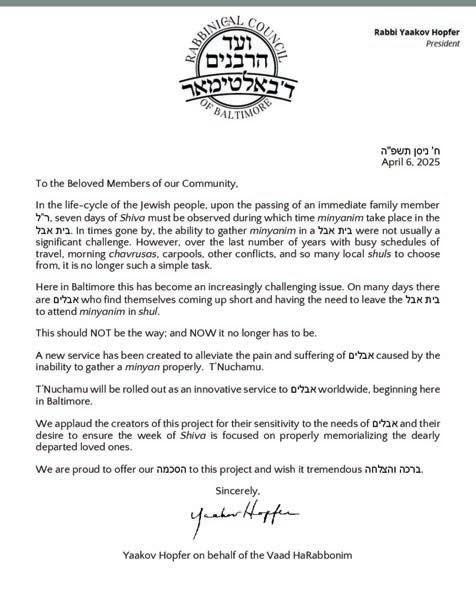
There are certain things in life we take for granted, and a shiva house having a minyan is one of them. But in reality, that is not always the case.
Too often, individuals assume someone else will attend — “Moshe will go” or “someone will show up” — yet at times, a minyan does not materialize. This creates an additional burden for families already navigating the challenges of aveilus.
In response, Baltimorean Jeff Cohn developed T’Nuchamu, a new, groundbreaking, global initiative designed to address this issue in a simple and effective way. The system allows community members to register as volunteers,

while a designated family representative takes on the responsibility of entering and keeping up to date all levaya and shiva details.
Once posted, if needed, volunteers are notified via email, SMS, or WhatsApp and can respond quickly to help complete a minyan. The goal is to eliminate uncertainty, lastminute scrambling, and added stress for aveilim.
At the same time, T’Nuchamu offers powerful, practical tools for the broader community. Users can receive real-time alerts when there are changes to a shiva they are following — such as an avel moving locations, updated minyan times, or newly added or changing visiting hours.

In addition, users can opt to receive reminders as a shiva progresses — for example, alerts when only a few days remain — helping ensure that important visits are not forgotten. Notifications can be customized by location, allowing users to stay informed about shiva homes in areas relevant to them.
The concept is straightforward, yet impactful, providing a practical solution to a long-standing challenge while strengthening communal responsibility and participation.
For more information, to participate, and/or to take part in supporting this important effort, visit: Tnuchamu.org

• Registered volunteers respond to scheduled minyan alerts
• Receive updates on Shivas from around the world – all in real time

• Customize a Plaque on our virtual wall or make a donation to support our work.




Learning the sugyos of Korbanos is considered as if one brought them;
As we await the Geulah, our limud of
becomes our Avodas Yom HaKippurim.
Join Amud HaYomi on Wednesday, 12 Iyar / April 29th as it begins Masechta Yuma, and approach Yom HaKippurim with deeper understanding and a greater appreciation of the Kedushas HaYom.








Mercaz Torah U’Tefillah: EVERY 15 MINUTES
M-F: 6:15 AM, S-F: 6:30 AM, 6:45 AM, 7:00 AM, 7:15 AM, 7:30 AM, 7:45 AM, 8:00 AM, 8:15 AM, 8:30 AM, 8:45 AM, 9:00AM, 9:15AM, 9:30AM, 9:45AM, 10:00AM
Neitz Beit Yaakov [Sefaradi] M-F
Mercaz Torah U’Tefillah S-F
Ohel Yakov S-F
Ohr Hamizrach [Sefaradi] S-F
6:00 AM Shomrei Emunah Congregation M-F
6:10 AM Agudath Israel of Baltimore M, Th
6:15 AM Kol Torah M, TH
Shearith Israel Congregation M, TH
6:20 AM Agudah of Greenspring M, TH
Agudath Israel of Baltimore S, T, W, F
Arugas HaBosem (Rabbi Taub's) S-F
Bais Dovid-Bais Medrash of Summit Park M-F
Bnai Jacob Shaarei Zion Congregation M-F
Kehilath B'nai Torah M, TH
Pikesville Jewish Congregation M, TH
Shomrei Emunah Congregation S, M, TH
6:30 AM Agudah of Greenspring T, W, F
Chabad of Park Heights M-F
Darchei Tzedek M-F
Kehilath B'nai Torah T, W, F
Khal Bais Nosson M-F
Khal Ahavas Yisroel/ Tzemach Tzedek M-F
Kol Torah T, W, F
Ohr Yisroel M-F
Pikesville Jewish Congregation T, W, F
Shearith Israel Congregation T, W, F
Shomrei Emunah Congregation T, W, F
6:35 AM Aish Kodesh (downstairs Minyan) M, TH
Ohel Moshe M, TH
6:40 AM Aish Kodesh (downstairs Minyan) T, W, F
Bnai Jacob Shaarei Zion Congregation M, TH
Ohr Hamizrach [Sefaradi] M-F
6:45 AM The Adas: Chofetz Chaim Adas Bnei Israel M, Th
B”H and Mesivta of Baltimore (Dirshu Minyan) S-F
Beth Abraham M, TH
Greenspring Sephardic Synagogue M-F
Kehilas Bnei Yeshiva M-F
Ner Tamid M-F
Ohel Moshe T, W, F
Suburban Orthodox Congregation Toras Chaim M-F
6:50 AM Agudath Israel of Baltimore M, TH
Ahavat Shalom [Sefaradi] M, TH
Bais Medrash of Ranchleigh M, TH
Bnai Jacob Shaarei Zion Congregation T, W, F
Community Kollel Tiferes Moshe Aryeh M, TH
Derech Chaim M-F
Kol Torah M-F
Ohel Moshe S
Ohr Hamizrach [Sefaradi] M, TH
Shomrei Emunah Congregation M, TH
The Shul at the Lubavitch Center M, TH
6:55 AM Beth Abraham T, W, F
Kol Torah M, TH
The Adas: Chofetz Chaim Adas Bnei Israel T, W, F
7:00 AM Aish Kodesh (upstairs Minyan) M-F
Agudath Israel of Baltimore S, T, W, F
Ahavat Shalom [Sefaradi] T, W, F
Arugas HaBosem (Rabbi Taub's)S
Bais Medrash of Ranchleigh T, W, F
Community Kollel Tiferes Moshe Aryeh T, W, F
Greenspring Sephardic Synagogue S
Khal Ahavas Yisroel/ Tzemach TzedekS
Kol Torah T, W, F
Moses Montefiore Anshe Emunah M-F
Ohr Hamizrach [Sefaradi] S, T, W, F
Shearith Israel Congregation S, M, TH
Shomrei Emunah Congregation T, W, F
Shomrei Mishmeres Hakodesh M-F
The Shul at the Lubavitch Center T, W, F
Tiferes Yisroel M-F
7:05 AM Machzikei Torah (Sternhill's) M, TH
7:15 AM Kedushas Yisrael S
Kol Torah S
Machzikei Torah (Sternhill's) S, T, W, F
Ner Israel Rabbinical College S-F
Shearith Israel Congregation T, W, F
Shomrei Emunah CongregationS
Suburban Orthodox Congregation Toras Chaim S
The Adas: Chofetz Chaim Adas Bnei IsraelS
Tzeirei Anash M-F
7:20 AM Agudath Israel of Baltimore M, TH
Beth Tfiloh Congregation M-F
Kol Torah M-F
Shomrei Emunah Congregation M, TH
7:30 AM Agudah of Greenspring S
Agudath Israel of Baltimore S, T, W, F
Ahavat Shalom [Sefaradi] S
Bais Haknesses Ohr HaChaim S-F
Bais Hamedrash and Mesivta of Baltimore S-F
Bais Medrash of Ranchleigh S
Beit Yaakov [Sefaradi] S
Bnai Jacob Shaarei Zion CongregationS
Chabad of Park Heights S
Community Kollel Tiferes Moshe Aryeh S-F
Darchei Tzedek S
Kedushas Yisrael S-F
Khal Bais Nosson S
Ner Israel Rabbinical College (Mechina) S-F
Ohr Hamizrach [Sefaradi] S, T, W, F
Shomrei Emunah Congregation T, W, F
7:45 AM Bnai Jacob Shaarei Zion Congregation M-F
Talmudical Academy S-F
Darchei Tzedek M-F
Mesivta Kesser Torah S-F
Mesivta Shaarei Chaim S-F
Yeshivas Torah Simcha (school days only) S-F
7:50 AM Derech Chaim S
Ner Tamid S
Ohel Moshe M-F
8:00 AM Agudath Israel of Baltimore S-F
Bais Dovid-Bais Medrash of Summit ParkS
Beth Abraham S
Chabad Israeli Center M-F
Darchei Tzedek S
Khal Ahavas Yisroel/ Tzemach TzedekS
Kehillas Meor HaTorah S
Ohr Yisroel S
Pikesville Jewish CongregationS
Shearith Israel Congregation S
Shomrei Emunah Congregation S-F
The Shul at the Lubavitch CenterS
Tiferes Yisroel S
Tzeirei Anash S
Yeshiva Tiferes Hatorah S-F
8:15 AM Kehilath B'nai Torah S Kol Torah S
8:20 AM Bais Haknesses Ohr HaChaim S-F
Suburban Orthodox Congregation Toras Chaim S-F
8:30 AM Agudath Israel of Baltimore S-F
Chabad Israeli Center S
Machzikei Torah (Sternhill's) S-F
Ohel Moshe S
Ohr Hamizrach [Sefaradi] S
Shomrei Emunah Congregation S-F
Shomrei Mishmeres HakodeshS
9:00 AM Aish Kodesh S
Bais Haknesses Ohr HaChaimS
Beth Tfiloh Congregation S
Bnai Jacob Shaarei Zion CongregationS
Moses Montefiore Anshe EmunahS
Shomrei Emunah Congregation S-F
Suburban Orthodox Congregation Toras Chaim S-F
Mincha Gedolah Mercaz Torah U’Tefillah
Khal Ahavas Yisroel/Tzemach Tzedek
1:45 PM Ohel Moshe
Yeshivas Torah Simcha (school days only) M-Th
1 South Street, 27th Floor.
1:50 PM Wealcatch Insurance - 37 Walker Ave 2nd floor
2:00 PM Agudath Israel of Baltimore (S-F)
Big Al @ The Knish Shop Party Room
Kol Torah
Market Maven
Reischer Minyan - 23 Walker Ave 2nd Floor
10055 Red Run Blvd Suite 295
2:15 PM Pikesville Beis Medrash - 15 Walker Ave
2:30 PM Bais Medrash of Ranchleigh
Community Kollel Tiferes Moshe Aryeh
Tov Pizza Mincha Minyan
Ner Israel Rabbinical College
Mesivta Shaarei Chaim (Community Kollel)
Shearith Israel Congregation
2:45 PM Kollel of Greenspring
Shearith Israel Congregation (S-Th)
3:00 PM Bais Haknesses Ohr HaChaim Mercaz Torah U'Tefillah
3:05 PM Kedushas Yisrael
3:15 PM Hat Box
3:30 PM Mercaz Torah U’Tefillah
4:00 PM Agudath Israel of Baltimore (S-Th) Mercaz Torah U'Tefillah
4:30 PM Mercaz Torah U’Tefillah
5:00 PM Agudath Israel of Baltimore (S-F) Mercaz Torah U’Tefillah
5:30 PM Agudath Israel of Baltimore (S-Th) Mercaz Torah U’Tefillah
6:00 PM Agudath Israel of Baltimore (S-F) Mercaz Torah U’Tefillah
Shearith Israel Congregation (S-Th)
6:30 PM Mercaz Torah U’Tefillah
10 Min Before ShkiAh Chabad Israeli Center
14 Min Before ShkiAh Kol Torah
Plag
continued
8:50 PM Mesivta Shaarei Chaim (Etz Chaim Building)
8:55 PM Community Kollel Tiferes Moshe Aryeh
9:00 PM Agudath Israel of Baltimore
Arugas Habosem
Shomrei Emunah Congregation
Suburban Orthodox Congregation Toras Chaim
9:15 PM Kehilas Bnei Yeshiva
9:20 PM Kol Torah
9:30 PM Agudah of Greenspring
Agudath Israel of Baltimore
Kedushas Yisrael
9:40 PM Ahavat Shalom [Sefaradi]
9:45 PM Bais Haknesses Ohr HaChaim
Kollel Erev Birchas Yitzchok (Luries)
Kollel of Greenspring
Machzikei Torah (Sternhill's)
Ohr Hamizrach [Sefaradi]
Yeshiva Tiferes Hatorah
9:50 PM Aish Kodesh
Community Kollel Tiferes Moshe Aryeh
Ohel Moshe
10:00 PM Agudath Israel of Baltimore
Darchei Tzedek
Kehilath B'nai Torah
Kehillas Shaarei Avodah
Khal Ahavas Yisroel/ Tzemach Tzedek Ohr Yisrael
Shearith Israel Congregation
Shomrei Emunah Congregation
10:05 PM Kol Torah
10:10 PM Ner Israel Rabbinical College
10:15 PM Derech Chaim
Khal Bais Nosson
10:30 PM Agudath Israel of Baltimore
Ohel Yaakov
Shomrei Emunah Congregation
Suburban Orthodox Congregation Toras Chaim
Aish Kodesh
Agudath Israel of Baltimore
Agudah of Greenspring
Before Shkiah
Bais Dovid-Bais Medrash of Summit Park
Bais Haknesses Ohr HaChaim
Beth Abraham
Bnai Jacob Shaarei Zion Congregation
Darchei Tzedek
Derech Chaim
Kehillas Meor HaTorah
Kehilath B’nai Torah
Khal Ahavas Yisroel/ Tzemach Tzedek
Machzikei Torah (Sternhill’s), 5:00pm Mercaz Torah U’Tefillah
Ner Tamid
Ohel Moshe
Ohr Hamizrach [Sefaradi]
Ohr Yisroel
Pikesville Jewish Congregation
Shearith Israel Congregation
Shomrei Emunah Congregation
Shomrei Mishmeres
Suburban Orthodox Congregation Toras Chaim
The Adas: Chofetz Chaim Adas Bnei Israel
The Shul at the Lubavitch Center
Tiferes Yisroel
Mercaz Torah U’Tefillah: EVERY 15 MINUTES
8:00 PM, 8:15 PM, 8:30 PM, 8:45 PM, 9:00 PM, 9:15 PM, 9:30 PM, 9:45 PM, 10:00 PM, 10:15 PM, 10:30 PM, 10:45 PM, 11:00 PM, 11:15 PM, 11:30 PM
8:00 PM Agudath Israel of Baltimore 8:10 PM Kol Torah
8:15 PM Khal Ahavas Yisroel/Tzemach Tzedek
8:30 PM Agudath Israel of Baltimore
8:45 PM Darchei Tzedek
Ner Israel Rabbinical College (Mechina)
Ohr Yisroel
11:00 PM Agudath Israel of Baltimore
Agudah of Greenspring - 6107 Greenspring Ave
Agudath Israel of Baltimore - 6200 Park Heights Ave
Ahavat Shalom - 3009 Northbrook Rd
Aish Kodesh - 6207 Ivymount Rd
Arugas HaBosem - 3509 Clarks Ln
Bais Dovid-Bais Medrash of Summit Park- 6800 Sylvale Ct
Bais Haknesses Ohr HaChaim - 3120 Clarks Ln
Bais Hamedrash and Mesivta of Baltimore - 6823 Old Pimlico Rd
Bais Medrash of Ranchleigh - 6618 Deancroft Rd
Beit Yaakov - 3615 Seven Mile Ln
Beth Abraham - 6208 Wallis Ave
Beth Tfiloh Congregation - 3300 Old Court Rd
Bnai Jacob Shaarei Zion Congregation - 6602 Park Heights Ave
Chabad Israeli Center - 7807 Seven Mile Ln
Chabad of Park Heights - 3402 Clarks Ln
Community Kollel Tiferes Moshe Aryeh - 3800 Labyrinth Rd
Darchei Tzedek - 3201 Seven Mile Ln
Derech Chaim - 6603 Pimlico Road
Greenspring Sephardic Synagogue 6611 Greenspring Ave.
Kedushas Yisrael - 6004 Park Heights Ave
Kehilath B’nai Torah - 6301 Green Meadow Pkwy
Kehilas Bnei Yeshiva - 6700 Cross Country Blvd
Kehillas Meor HaTorah - 6539 Pebble Brooke Rd
Khal Ahavas Yisroel/ Tzemach Tzedek - 6811 Park Heights Ave
Khal Bais Nosson - 2901 Taney Rd Kol Torah - 2929 Fallstaff Rd
Kollel of Greenspring - 6504 Greenspring Ave.
Machzikei Torah - 6216 Biltmore Ave
Mercaz Torah U’Tefillah - 6500 Baythorne Rd
Mesivta Kesser Torah - 8400 Park Heights Ave
Mesivta Shaarei Chaim - 5415 Greenspring Ave Moses Montefiore Anshe Emunah - 7000 Rockland Hills Dr
Neuberger, Quinn, Gielen, Rubin & Gibber One South Street, 27th Floor
Ner Israel Rabbinical College - 400 Mt Wilson Ln
TUESDAY, MARCH 31 | 13 NISSAN (NIGHT)
Bedikas Chametz ...................................After 8:20 PM (Tzais)
WEDNESDAY, APRIL 1 | 14 NISSAN EREV PESACH
Biyur Chametz NEW LOCATION! In the Reisterstown Road Plaza Back Lot In Front
of Home Depot, Beside Wendy’s .................................7:00–11:30 AM
Last time to eat Chametz .........................................10:30 AM
Last time to dispose of Chametz ..11:43 AM(Recite Kol Chamira after disposal)
Eruv Tavshilin
Chatzos ..................................................................1:11 PM
Mincha Gedolah .......................................................1:43 PM
Beginning of 10th hour ..............................................4:20 PM
Plag HaMincha ..............................6:13 PM (earliest candle lighting)
Hadlakas Neiros......................................................7:12 PM
Shkiah ....................................................................7:30 PM
Tzais HaKochavim.............................8:21 / 8:43 PM (Begin Seder)
Eat Afikomen by ...........................................1:11 AM chatzos
Last time for Kiddush Levanah ...Late Wed night/Thu morning 4:35 AM
THURSDAY, APRIL 2 | 15 NISSAN 1ST DAY YOM TOV
Tefilas Tal
Naitz ......................................................................6:49 AM
Sof Zman Krias Shema ...................................9:24 / 10:00 AM
Sof Zman Tefila ...........................................................11:03
Chatzos ..................................................................1:11 PM
Mincha Gedolah .......................................................1:43 PM
Shkiah ....................................................................7:31 PM
Tzais / Hadlakas Neiros (2nd day prep) ...................8:22 / 8:44 PM
OMER COUNT (NIGHT) DAY 1
Eat Afikomen by ............................................1:11 AM (Chatzos)
FRIDAY, APRIL 3 | 16 NISSAN 2ND DAY YOM TOV (EREV SHABBOS)
Omer Day 1
Naitz ......................................................................6:48 AM
Sof Zman Krias Shema .....................................9:23 / 9:59 AM
Sof Zman Tefila ...........................................................11:02
Chatzos ..................................................................1:10 PM
Mincha Gedolah .......................................................1:43 PM
Plag HaMincha .........................................................6:14 PM
Hadlakas Neiros......................................................7:14 PM
Tzais ..............................................................8:23 / 8:45 PM
OMER COUNT (NIGHT) DAY 2
SHABBOS, APRIL 4 | 17 NISSAN SHABBOS CHOL HAMOED
Shir Hashirim
Omer Day 2
Naitz ......................................................................6:46 AM
Sof Zman Krias Shema .....................................9:22 / 9:58 AM
Sof Zman Tefila ...........................................................11:02
Chatzos ..................................................................1:10 PM
Mincha Gedolah .......................................................1:42 PM
Shkiah ....................................................................7:33 PM
Tzais ..............................................................8:24 / 8:46 PM
OMER COUNT (NIGHT) DAY 3
We are not responsible for typographical errors.
TUESDAY, APRIL 7 | 20 NISSAN EREV LAST DAYS
Omer Count Day 5
Naitz ......................................................................6:41 AM
Sof Zman Krias Shema .....................................9:19 / 9:55 AM
Sof Zman Tefila .......................................................11:00AM
Chatzos ..................................................................1:09 PM
Mincha Gedolah .......................................................1:42 PM
Plag HaMincha ..............................6:16 PM (earliest candle lighting)
Hadlakas Neiros......................................................7:18 PM
Shkiah ....................................................................7:36 PM
Tzais ..............................................................8:27 / 8:49 PM
OMER COUNT (NIGHT) DAY 6
WEDNESDAY, APRIL 8 | 21 NISSAN SHEVI’I SHEL PESACH
Omer Day 6
Naitz ......................................................................6:40 AM
Sof Zman Krias Shema .....................................9:18 / 9:54 AM
Sof Zman Tefila .......................................................10:59AM
Chatzos ..................................................................1:09 PM
Mincha Gedolah .......................................................1:42 PM
Shkiah ....................................................................7:37 PM
Hadlakas Neiros & Prep for Acharon Shel Pesach....8:28 / 8:50 PM
OMER COUNT (NIGHT) DAY 7
THURSDAY, APRIL 9 | 22 NISSAN ACHARON SHEL PESACH
Yizkor
Omer Day 7
Naitz ......................................................................6:38 AM
Sof Zman Krias Shema .....................................9:17 / 9:53 AM
Sof Zman Tefila .......................................................10:58AM
Chatzos ..................................................................1:09 PM
Mincha Gedolah .......................................................1:42 PM
Shkiah ....................................................................7:38 PM
Yom Tov ends..................................................8:29 / 8:51 PM
OMER COUNT (NIGHT) DAY 8
We would like to extend our heartfelt בוטה תרכה for your continued support and readership of Baltimore Jewish Life (BJL) and the Baltimore Jewish Home. It is our privilege to serve as a trusted news resource for our community.
Wishing everyone a חמשו רשכ גח, and may we be zocheh to see peace in לארשי
and the
To our beloved Baltimore community community, Chag Kasher ViSameach!




Cleaning, scrubbing, up till late, All to make our Pesach great. With Yom Tov foods so elegant, And tablescapes so excellent.
Ten makos dancing on the walls, Or Yam Sufs flowing through the halls. Chol Hamoed trips—what fun to capture, With Pesach treats to savor after.
So many ways to celebrate, So many ways to decorate— Snap a pic and send it in, For your family’s chance to win!
You Could Win a $50 Amazon Gift Card! Submit a photo of your Pesach: your Seder table, a project, a Chol Hamoed trip, or anything that shows off your Yom Tov spirit!

Here are some great activities in Maryland that are family appropriate. While some you may recognize, others are off the beaten trail and can make for amazing Chol Hamoed trips. This list is just some suggestions and not an all inclusive list of things to do in Maryland.
Editor’s note: The costs and entry fees are based on information available online at the time of publishing. However prices may be different or have changed.

Antietam Battlefield
302 E Main St, Sharpsburg, MD 21782
9am - 5pm
$10/person | $20/vehicle | Annual Pass $35

CALVERT CLIFFS STATE PARK
10540 H G Trueman Rd, Lusby, MD 20657
7:30am - 7:30pm
$5/vehicle (+$2 for out-of-state residents)

CYLBURN ARBORETUM
4915 Greenspring Ave, Baltimore, MD 21209
T-S 8am - 5pm
Free Flower and Vegetable Gardens | Nature Education Center

BALTIMORE AND OHIO RAILROAD MUSEUM
901 W Pratt St, Baltimore, MD 21223
10am - 4pm
Child (2 - 12) $12 | Adult $20 | Senior (60+) $17

CLARK'S ELIOAK FARM
10500 Clarksville Pike, Ellicott City, MD 21042
S 10am - 5:30pm, T-F 10am - 5pm
$8 (Rides are Extra) Farm | Petting Zoo | Miniature Train Rides | Fairy Tale Forest

FORT MCHENRY NATIONAL MONUMENT
2400 E Fort Ave, Baltimore, MD 21230
9am - 5pm
$15 (7 day pass)
$45 (annual pass) for up to four adults (16+)
Self-guided and Virtual Tours | Special Events Scheduled On Chol Hamoed. Check Website for Details.












































GODDARD SPACE FLIGHT VISITOR CENTER
9432 Greenbelt Rd, Greenbelt, MD 20771
Th-F 10am - 3pm | Free
Research Laboratory for NASA | Spacecraft Displays and Space Technology | Model of the Hubble Space Telescope | Interactive Space Related Displays

MARYLAND SCIENCE CENTER
601 Light St, Baltimore, MD 21230
T-F 10pm - 4pm, S 10am - 5pm
Adult (12- 61) $29.95 | Child (3-12) $21.95 |
Senior (62+) $28.95 | IMAX +$5
Exhibits | Planetarium | Observatory | IMAX Theater

NATIONAL AQUARIUM
501 E Pratt St, Baltimore, MD 21202
W-S 9am - 6pm, M-T 9am - 7pm
Child (5-20) $39.95 | Adult (21-69) $49.95 |
Senior (70+) $39.95

PATUXENT RIVER NAVAL AIR MUSEUM
22156 Three Notch Rd, Lexington Park, MD 20653
T-F 10am - 5pm, S 12PM - 5PM
Child (4 - 12) $4 | Adult $10 | Active Duty and Seniors (55+) $7
Aircraft Displays | Galleries Exhibits | Flight Simulators (Sundays)

IRVINE NATURE CENTER
11201 Garrison Forest Rd, Owings Mills, MD 21117
T-F 9am - 5pm | $5 (6+) Fridays are free
Trails | Open Wetlands | Upland Forests | Meadows | Farmland | Natural Habitats for Animals and Vegetation | Exhibition Hall with Exhibits for Children

MARYLAND ZOO
1 Safari Pl, Baltimore, MD 21217
10am - 4pm | $33, Senior Discount Online

PATAPSCO VALLEY STATE PARK
8020 Baltimore National Pk, Ellicott City, MD 21043
9am - Sunset
$2/vehicle (+$2 for out-of-state residents), +$1 on Weekends and Holidays
Picnic Areas | Camping | Playgrounds | Trails + Cascade Falls

RAWLINGS CONSERVATORY
3100 Swann Dr, Baltimore, MD 21217
W-F 11am - 3pm, S 10am - 4pm Free (Recommended Donation $5/person)
Conservatory showcases many different types of flowers and other plants in five distinct greenhouse rooms.

PORT DISCOVERY
35 Market Pl, Baltimore, MD 21202
S 11am - 5pm, M 9am - 3pm, Th 10am - 3pm
$24.95
SkyClimber | Tot’s Trails | The Oasis | Overlook




AMF WOODLAWN LANES
6410 Security Blvd, Baltimore, MD 21207
Check online or call for hours.
Prices vary. Check online or call to see what special deals are currently running

BOWLERO PIKESVILLE LANES
1723 Reisterstown Rd, Pikesville, MD 21208
Check online or call for hours. Most days start at 4 PM and on Sundays opens at 12 PM
Prices vary. Check online or call to see what special deals they are currently running

MAIN EVENT
10300 Little Patuxent Pkwy Suite 2520, Columbia, MD 21044
11am - 12am (check closing times if going late)
Prices depend on activities. They run special deals from time to time.
Video Arcades | Bowlings | Pool Tables And Laser Tag

CLIMB ZONE
13200 Mid Atlantic Blvd Ste 130, Laurel, MD 20708
10am - 6pm (Special Hours for Chol Hamoed and Isru Chag, April 5 – 7 and 10)
Prices Vary


CATOCTIN MOUNTAIN ORCHARD
15036 North Franklinville Rd. Thurmont, MD 21788
9am - 5pm
Fees Vary

AMAZING GLAZE
1340 Smith Avenue | Baltimore, MD 21209
T-Th 10am - 8pm, F-M 11am - 7pm
Fees Vary
Paint your own pottery, stoneware, or canvas | Create mosics or glass fusing art

ULTRAZONE LASER TAG
7835 Eastpoint Mall #11, Baltimore, MD 21224
S-T 12pm - 8pm, W-Th 4pm - 8pm, F 4pm - 12am
$8.99 (1 Game), $19.99 (3 Games), All Day Passes
Prices Vary on the Day

PLAYERS FUN ZONE
519 Old Westminster Pike, Westminster, MD 21157
M-Th 4pm - 8pm, F 4pm - 10pm, S 11am - 6pm
Starting at $10.50 (see TA special on next page)
**Waiver Required
AN EVENING OF COMEDY, MUSIC & MAGIC WITH RABBI YISROEL JUSKOWITZ

A FREE Pesach event for the entire Baltimore Community!
AN EVENING OF COMEDY, MUSIC, & MAGIC WITH RABBI YISROEL JUSKOWITZ
MMAE - 7000 Rockland Hills Dr. Sunday, April 5th 8:30pm
CHOL HAMOED PESACH SUNDAY APRIL 5TH AT 8:30 PM
Maariv Following Program

MMAE - 7000 ROCKLAND HILLS DR, BALTIMORE, MD 21209
Free *this program is for adults only Maariv following the program THIS PROGRAM IS FOR ADULTS ONLY
SEPARATE & MIXED SEATING AVAILABLE

TA CHOL HAMOED PESACH EXCITMENT
At Players Fun Zone
Monday, April 6 1:30pm - 5:30pm
$17 if you purchase in advance, $21 at the doorAll-you-can-play Pixel, Bumper Cars, and Inflatables
$23 if you purchase in advance, $27 at the door - One game os mini-Glo Golf plus all-you-can-play Pixel, Bumper Cars, and Inflatables
*advance purchases must be placed by April 5th



By Rabbi Zvi Teichman
Once again, we will reenact the Seder as our ancestors have for generations.
Some families repeat long standing interpretations on the Haggadah that were expressed by their illustrious predecessors centuries ago. Many have unique and ancient customs associated with the various steps within the Seder. For the most part, though the central text of the Haggadah remains universal and is the greatest common denominator amongst our people on this night and testament to our mutual mission.
Reflecting on my own experience as a child having sat at a Seder table together with grandparents who were transplanted from a world so different and seemingly much more authentic than my own, I often ponder what is it that was bequeathed to me on this special night that I am now entrusted with conveying to my children and grandchildren?
Was it the special niggun they sang to Vehi She’amdah? Was it the specific type of vegetable our family used for Karpas? In what way do we represent the message of our ancestors?
Is it plausible that by simply doing the exact same thing for eighty plus generations we make it so compelling for our progeny to continue this tradition so loyally?
Wherein lays the secret of this night that has powered the survival of our people against the onslaught of all sorts of enemies, both physical and spiritual, throughout the millennia.
Each day we are commanded to remember the day we departed from the land of Egypt.
This constant reiteration is an affirmation of our absolute faith in G-d and His abilities to manipulate nature as He pleases and compel man to profess His will and our consequential allegiance to His directive because of that reality.
But on Pesach it isn’t just about Emunah, faith, per se. We avoid expounding directly on the portions in the Torah that deal more directly with the actual events that took place in Egypt prior to the Exodus. We rather read from the portion in the Torah that is recited by one who has merited to offer the first fruits of his bountiful crops, Bikkurim, in the Temple, in tribute to G-d who has brought him to this magnificent blessing of success.
That recitation begins with recalling how Lavan first sought to destroy us, causing a chain of events that led us to descend unto the land of Egypt, where Pharaoh devi-
ously turned against us enslaving us until we called out to G-d, Who came to our rescue, bringing us into the land from where these very fruits were born, concluding with utter gratitude for all that G-d has done.
It is not about our faith as much as it is about the expression of our realization of G-d’s intimate involvement in our lives, Who through both the difficult times and the successful moments is guiding us with constant love and concern.
The Rishonim point out that although we ought to recite a blessing before performing this mitzvah of Sippur Yetzas Mitzrayim, nevertheless since we minimally fulfill the command when we recall during the recitation of Kiddush, which is a Bracha itself, that the holiday is a ‘memorial of the Exodus from Egypt’, there is no need to add another blessing.
Haven’t we even earlier also remembered the Exodus at the end of the recitation of Kerias Shma at Maariv in the portion of Tzitzis, which is also part of a blessing, that of Kerias Shma? Why does this mention of the Exodus not suffice to mitigate the need for a separate blessing?
Evidently it is the mentioning of the Exodus in the context of a blessing that extols our fortune of being ‘chosen’ by G-d, Who showers us with love, and the gratitude we sense in that awareness, that mimics the fuller version of that command on this night as opposed to the mentioning of the marvelous Exodus as the reason we are beholden in duty and service to Him.
That is why the retelling of our ‘shameful’ beginning is integral to the tale for it accentuates even more so the gratefulness we feel in having arrives at our praiseworthy station vis-avis our relationship with G-d. (Siach Yitzchok)
The greatest irony in this notion is that this very concept of the vital need to express gratitude and to say thanks, find its sole source in a regard to how grateful we must be towards the Egyptian nation.
The Torah instructs that an Egyptian who seeks to join our ranks by converting, although initially is prohibited to marry from ‘the assembly of G-d’, may be permitted after three generations to marry freely from within our ranks without any exception.
The reason the Torah gives for this is, ki ger hayisa beartzo, because you were a sojourner in his land. Rashi amplifies because they hosted you in a time of dire need, when Yaakov and his family were initially hosted in Goshen during the famine.
Despite their ulterior motive, as Pharaoh himself implies when greeting them suggesting they assist ‘his’ men with their cattle herding skills, and notwithstanding their eventually displaying their true original intent when they cast the male children into the sea, we must nevertheless show gratitude for their ‘kindness’ by permitting an Egyptian convert after three generations to fully marry into the Jewish people.
The motto of Pesach is gratitude yet ironically the only direct addressing of this supernal quality in all of Torah is in its directive to be grateful even to the self-minded Egyptians. What are we to make of this?
In the story of the Exodus we learn that one must even display gratitude to inanimate items as well, as we are taught that Moshe would not smite the water nor dust of the land to initiate the plagues of Blood, Frogs and Lice out of gratitude to the water which saved him as a baby from the clutches of Pharaoh’s henchmen, as well as the dust that concealed the Egyptian he smote.
What logic could there be in the need to be thankful to soulless objects? Why would we be obligated to appreciate those whose inner desire was self-serving and malicious?
Why are we so pent-up when it comes to the formality of saying ‘thank you’, going overboard when our children don’t immediately say thank you when receiving a gift?
What is the origin of this courteous gesture?
Oddly there is nary one place in the entire Chumash where an individual offer thanks to the one who proffered a favor?
David Graeber in his book, Debt: The First 5,000 Years writes:
Saying “please” and “thank you” ... first took hold in Western society during the commercial revolution of the sixteenth and seventeenth centuries as evidence of the democratization of society - our desire to view everyone as equals. Before that, saying please and thank you was a way to show deference to a lord or master. “Thank you” derives from “think” it originally meant, “I will remember what you did for me”- and “please” is short for “if you please,” “if it pleases you to do this” ...
Like so many of our everyday courtesies, it is a kind of democratization of what was once a habit of feudal deference: the insistence on treating absolutely everyone the way that one used only to have to treat a lord or similar hierarchical superior.
In fact, the English “please” is short for “if you please,’ ‘if it pleases you to do this’. Its literal meaning is “you are under no obligation to do this.” ... This is not true; there is a social obligation, and it would be almost impossible not to comply with it. But etiquette largely consists of the exchange of polite fiction. When you ask someone to pass the salt, you are also giving them an order; by attaching the word “please” ...
In English, “thank you” derives from ‘think,’ it originally meant, ‘I will remember what you did for me’ - which is usually not true either - but in other languages... it actually
does means ‘I am in your debt’... you are symbolically placing yourself in your benefactor’s power - since a debtor is, after all, a criminal...
The habit of always saying “please” and “thank you” first began to take hold during the commercial revolution of the sixteenth and seventeenth centuries... the language of bureaus, shops, and offices, and over the course of the last five hundred years it has spread across the world... It is also merely one token of... a set of assumptions of what humans are and what they owe one another, that have by now become so deeply ingrained that we cannot see them.
In other words, ‘thank you’ is merely the currency by which we assure our own self-interest in maintaining a ‘balance of power’ so that we may continue to serve each other’s interests.
The Torah perspective however sees in an act of kindness the ‘eyes of G-d’ peering through, giving credibility to the doer of good, enabling one to serve as a conduit of G-d’s ultimate will.
We acknowledge an act of giving as evidence of the worthiness of its conveyer in acting on behalf of G-d.
When we are grateful to the dust it is ultimately a testament to G-d who operates through the agency of matter and men.
Even an Egyptian can have a spark of good that pierces through the thick layer of selfishness, although that seed may take three generations in the soul of a convert to sprout forth.
On the Seder night we reflect on all that we have been privileged to live through, the good the bad and the (seemingly) ugly. We exult that we sit privileged at our tables in the knowledge of G-d’s guiding hand throughout that process.
G-d in the very last words of the Torah refers to Moshe having broken the Tablets reminiscing the worlds of approval G-d uttered when He said: Asher Shibarta - Yeyasher Kochacha that you broke them. Asher is a language of validation. G-d is asserting that his choice was a valid representative of the will of G-d. It is not simply a ‘thank you’ but an affirmation Moshe’s worth.
The greatest legacy we can leave our children is when we express our acknowledgement of G-d’s guiding hand in all our travels, instilling within them that sense of privilege we feel in enduring for our ultimate benefit and good. That is the essence of Pesach.
My grandparents’ joy and expression of thanks to G-d on that night betrayed the difficult lives they each lived; loss of spouses; deaths of children; abject poverty, and much more. It is the joy and privilege in their eyes that reflected the very image of G-d that accompanied them in life, that inspired us at the table.
That is our role; that is our mission. May we sense and appreciate all that we represent as conduits of His will. If we do, our children will join with joy, in that march towards the final redemption.
You may reach the author at: Ravzt@ ohelmoshebaltimore.com
To our donors, generous matchers, board of directors, parents, corporate sponsors, and the entire Baltimore community for making our campaign a success!





















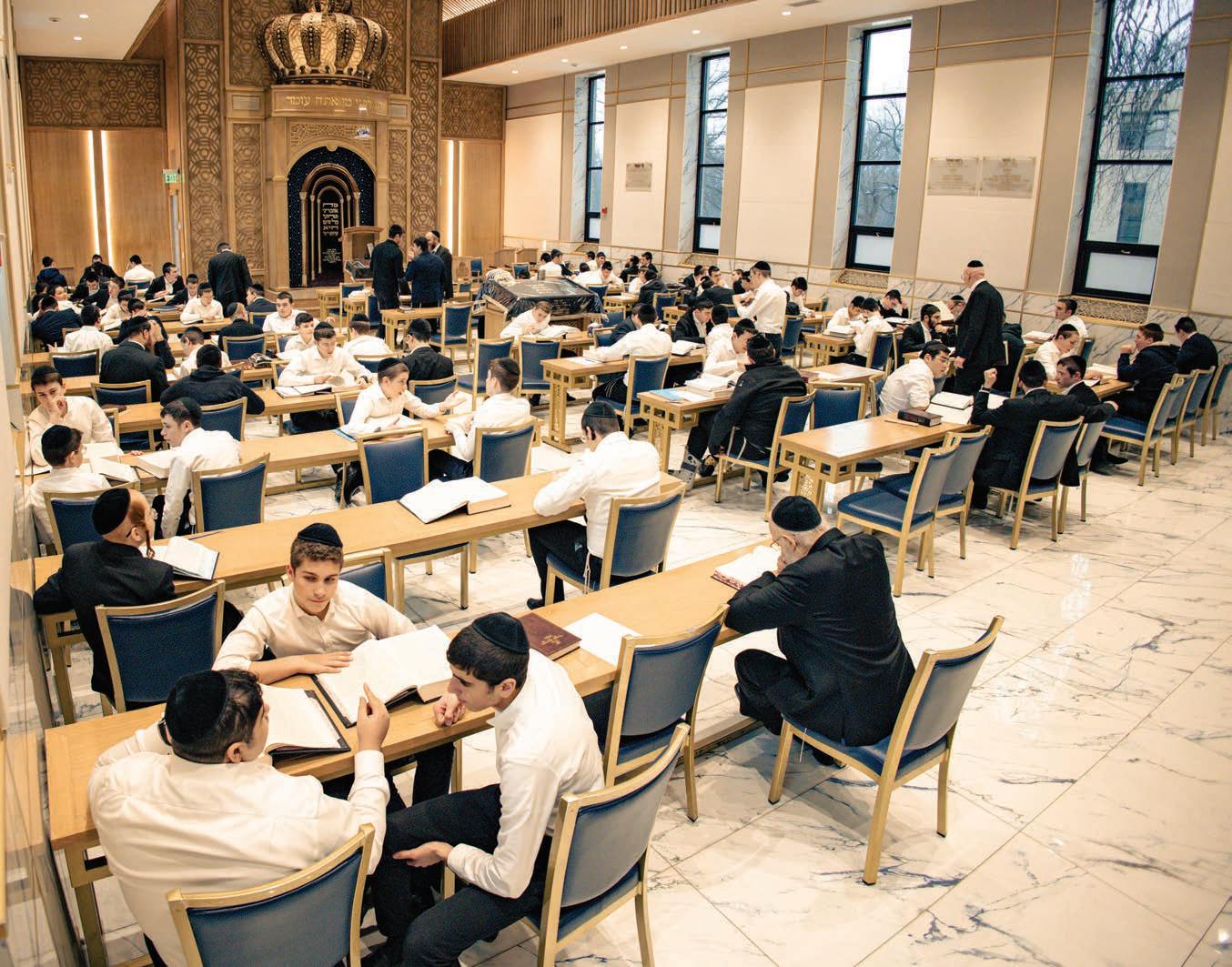









By Eliyahu RosEnBERg
n the early days of Rabbi Elyada Goldwicht’s rabbinical career, the young rabbi found himself neckdeep in his job search. He was 28, married, newly ordained, and open-minded. So, when he heard about a Sephardi moshav looking for a rabbi, he decided to try his luck. Rabbi Goldwicht recalls his visit to the community.
“I get there. And I see Sephardi rabbanim and farmers. And they start interviewing me, asking me all these different questions, and I’m answering them. And then one farmer interrupts me. He says, ‘B’mechila k’vod haRav, with all due respect…’ And you know, when someone starts a question with ‘with all due respect,’ you are finished!”
We want people to be excited and passionate about their Torah learning and that their kids should see that. i’m sure that baal habatim are excited about their learning, but it’s very hard to pour over that passion into the home.
People tell me all the time, they say they never had such a geshmak in Torah learning in their entire life. They just never before felt the sweetness of Torah.
semichas Chaver has three goals. number one is we want people to have a good time learning. it should be fun. it should be geshmak. number two is that we want the learning to be brought home. it shouldn’t stay in the Bais Midrash. Everything should be brought home. number three is we want people to remember what they learned.
Rabbi Goldwicht says with a chuckle. “And he just laid it on me.”
“With all due respect, why are you interviewing for a Sefardi moshav?!” one of the farmers blasted Rabbi Goldwicht. “Do you even know our mizmorim? Do you know anything?”
Rabbi Goldwicht paused for a moment.
“The truth is…I don’t,” he admitted. “I can’t sing your songs. I can’t do those things – not yet, at least. I would love to, eventually. But my goal is to make Torah relevant, fun, and exciting, so that your kids will want to learn.”
The interviewers, moved by his vision, gave him a standing ovation. “This is what we need!” another farmer exclaimed.
“Well,” Rabbi Goldwicht laughs. “I didn’t get the job.”
But that vision — his dream to make learning enjoyable and practical — survived the job rejection. After that, he doubled down on fulfilling his mission.
“I started thinking, ‘What could I do? Where is there a need?’ And I saw two problems. One, a lot of people don’t have a feeling of, ‘Wow, I accomplished something’ in limud Torah ,” Rabbi Goldwicht shares. “And two, your average baal habaas doesn’t really know halacha. When his wife comes in with a question in Hilchos Shabbos or Basar B’Chalav, he doesn’t know because it’s not taught in yeshiva.”
Soon thereafter, he realized what he had to do. He started a revolutionary halacha learning program called Semichas Chaver.
* * *
Rabbi Goldwicht modeled Semichas Chaver, an international halacha learning program, after the Daf Yomi movement.
“Daf Yomi is, for sure, the most successful Torah initiative for baal habatim, probably in the history of Am Yisrael. Daf Yomi has a lot of advantages, but, in my opinion, some things could be improved,” Rabbi Goldwicht explains. Its advantages are fairly obvious. For one, learning Daf Yomi feels rewarding, because it has a clear start and end — you’ll finish a masechta in a few months, and in seven-and-a-half years, you’ll complete Shas. Many learners are already familiar with certain masechtas because of yeshiva. As such, there’s little barrier to entry.
But, as Rabbi Goldwicht explains, there are two, for lack of a better term, disadvantages to learning the daf. First, retention. Because Daf Yomi is so fast paced, it’s nearly impossible to retain the learning. And second — as Rabbi Goldwicht puts it — “it’s very hard to bring home.” While there are countless lessons to be learned from the Gemara, some masechtas are, in terms of practicality, difficult to translate into a Shabbos d’var Torah.
“So, I said, ‘Let’s take the most successful Torah initiative in the history of Am Yisrael and try to make it applicable without those disadvantages, for regular baal habatim, specifically for halacha,’” Rabbi Goldwicht recalls. “With Semichas Chaver, every six months, we have a new topic in halacha where the rabbeim of local shuls go and teach it. So, every six months, there is a point
of entry. And then there’s a feeling of accomplishment because, at the end of every six months, we have a siyum on everything that we learned. It’s very practical, very l’ma’aseh. The goal is that people remember what they learned because, at the end of every zman , there’s a test on everything.
“There’s a feeling of accomplishment because, ‘Wow, I just learned Basar B’Chalav in six months,’ or ‘I just learned Hilchos Tefillah in six months.’ You don’t have the downside of not remembering it because there’s a test that pushes you to remember it,” he notes. “Also, a big part of Semichas Chaver is that it makes it home to the Shabbos table.


So, after every shiur, the maggid shiur will email the participants questions and answers for the Shabbos table and comics. So, whatever you learn in the Beis Medresh, all of that gets poured back into the home.”
According to Rabbi Goldwicht, Semichas Chaver has three goals. First, to make learning fun. Second, to make halacha accessible not only for baal habatim , but for their home, as well.
“The goal is that, at the end of the six months, we want you to know the answer for 99% of related shailos that arise in your house,” he says. And third, to make halacha memorable. The shiurim are engaging and interactive, with lively debates and discussions, and the lessons are extremely practical, focus -
ing on the most relevant concepts. Semichas Chaver’s shiurim have a unique format – they’re once a week. Beyond halacha, the shiurim delve into ethics and philosophy: why we, for example, keep Shabbos, or why we can’t eat milk and meat together. The program doesn’t only equip fathers with the tools to answer their children’s halacha questions; it also teaches them how to answer their kids’ questions on complex issues. Why we’re here. Why we have to keep the mitzvos. How to serve Hashem.
“The goal is to bring HaKadosh Baruch Hu into the learning,” he adds.
“We want people to be excited and passionate about their Torah learning — and that their kids should see that. I’m sure that baal habatim are excited
about their learning, but it’s very hard to pour over that passion into the home,” he says.
The program has hundreds of locations across the globe, with thousands of participants.
As Rabbi Goldwicht clarifies, Semichas Chaver is not a semicha program. If you pass a test, you’ll get a certificate signed by Gedolei Yisrael, but it’s not for rabbinical ordination. Rather, the certificate is a bracha for the family: a blessing that the family should be filled with ahavas haTorah
“People tell me all the time that they say they never had such a geshmak in Torah learning in their entire life,” Rabbi Goldwicht declares. “They just never before felt the sweetness of Torah.”
This article is based on a podcast, “Inspiration For the Nation,” hosted by Yaakov Langer. To catch more of this conversation, you can watch it on LivingLchaim. com or YouTube.com/LivingLchaim or listen wherever you listen to podcasts (just search for “Inspiration For The Nation”) or call our free hotline: 605-477-2100 Want to see your simcha here? Email mazeltov@baltimorejewishhome.com or text 443-675-6507 to submit your simcha!









Moshe Shmuel Leder (Baltimore) & Rivky Lichenstein (Silver Spring)
Pessie Mittelman & Aaron Gerchikov
Ashera Austen (Baltimore) & Khanan Abayev (NYC)
David Reese & Rivka Trout
Zacharya Abramowitz & Sorah Schellemberg
By Bret Stephens
For most of the postwar era, the United States has gone to war with partners whose military contributions ranged from moderately helpful to mainly symbolic. Britain in Afghanistan and Iraq comes to mind in the first case. Germany in the 1999 Kosovo war comes to mind in the second.
The war against Iran is different. As of Monday, Central Command reports that the United States had struck more than 7,000 targets inside Iran. Israel, for its part, had carried out some 7,600 strikes, according to a representative of the Israeli military. This may be the first time since the Second World War that Washington has had an equal partner with which to share the burdens of war.
That’s a good starting point from which to consider the claim that the U.S. war with Iran is really a war for Israel. Past administrations have, in fact, gone to war for other countries. In the early 1990s, we went to war in the Persian Gulf for the sake of freeing Kuwait and defending Saudi Arabia — two countries that couldn’t defend themselves — from Iraq. Later that decade, we went to war in the Balkans after Europe proved shamefully unable to police its own neighborhood.
In both cases, U.S. presidents believed they were serving the national interest. But the military helplessness of our allies was a major factor in the decision to intervene.
As for Israel, the charge that the United States has gone to war for it isn’t new.
In 1990, Patrick Buchanan insisted that the only groups in favor of a war against Saddam Hussein over his invasion of Kuwait were “the Israeli Defense Ministry and its amen corner in the United States.” (That amen corner, Buchanan later indicated, consisted of columnists
A.M. Rosenthal and Charles Krauthammer, defense expert Richard Perle, and Henry Kissinger, the former secretary of state. Spot the commonality.) Opponents of the later Iraq War also spun a tale that the Bush administration was mostly doing Israel’s bidding. And Tuesday, Joe Kent, a top adviser to Tulsi Gabbard, the director of national intelligence, announced his resignation over what he called a war started “due to pressure from Israel and its powerful American lobby.”
Those charges always sat awkwardly with the facts. Israel stayed out of the Gulf War under heavy U.S. pressure, despite being hit by Iraqi missiles. As for Iraq, Ariel Sharon, then the Israeli prime

est priorities” as president would be to ensure that Iran never became a nuclear power. Was she, also, just another of Benjamin Netanyahu’s little stooges — a manipulated American politician with no mind of her own?
That charge is now being leveled at Donald Trump, never mind that the president first expressed a desire to thwack the Iranian regime in 1980, during the hostage crisis at the U.S. Embassy in Tehran, and repeated the point over decades. Whatever one thinks about the wisdom or the timing of Trump’s decision to go to
Whatever one thinks about the wisdom or the timing of Trump’s decision to go to war, it was, plainly, his decision
minister, told journalist Nadav Eyal that George W. Bush was fighting “the wrong war.” Sharon thought Iran was the more dangerous enemy in what was then called the war on terror.
In the case of Iran, the idea that crippling its capacity to threaten its neighbors is some sort of purely Israeli interest is belied by every Iranian missile or drone that falls on Dubai, Doha, Manama or Riyadh, not to mention U.S. and NATO military bases in the region. In October 2024, Kamala Harris called Iran our “greatest adversary,” adding that one of her “high-
war, it was, plainly, his decision — one for which he needed little convincing from Netanyahu, or, for that matter, Crown Prince Mohammed bin Salman of Saudi Arabia, who, the Times reports, is urging Trump to “keep hitting the Iranians hard.”
What is true is that the United States is going to war with Israel, not for it. That’s something many Americans, MAGA-type conservatives most of all, often claim to want: an ally that pulls its weight, shares the risk and contributes meaningfully to victory.
That means that when Israel last
Tuesday took out Ali Larijani, the regime’s de facto leader and an architect of January’s massacres of Iranian civilians, as well as Gholamreza Soleimani, the commander of the Basij militia that did much of the killing, it was making a unique contribution to a joint effort to destroy Iran’s command and control system and thus its ability to harm America, Israel and Arab states alike.
Since when, one wonders, has the Pentagon or the CIA had such help from our resourceful friends in, say, Paris?
It is of course true that Israel greatly benefits from Trump’s courageous decision to join the war. Also true is that U.S. and Israeli interests, goals and tactics don’t perfectly overlap and sometimes conflict. That’s always the case whenever allies go to war. But the central point is that Israel, population 10 million, is behaving as an equal partner to America, population 342 million, in a war that the elected leadership of both countries believe is in their respective national interests. Whatever else that is, it isn’t the tail wagging the dog.
The killing of Larijani may help dispel the odd gloom that’s descended on a war that is persistently dismantling Iran’s ability to put up a meaningful fight, beyond the desperate play of seeking to shut the Strait of Hormuz. That, too, won’t last long, thanks to the United States achieving what’s known among war planners as “escalation dominance.” Good thing that, in this war, the United States for once had a bold and competent ally to help us achieve it.
© The New York Times

Recently, this author came across a mechaneches in California with the title of “Director of Student Success.” The benefits of such a position are abundantly clear, and every yeshiva high school and Beis Yaakov should perhaps consider creating such a position along with clear goals and a metric to analyze its success. When a student is struggling — academically, socially, or emotionally — there should be someone whose entire job is to make sure that that student does not fall through the cracks.
Subsequently, someone sent me a research study on singles in the charedi world, conducted by Dr. Sima Zalcberg-Block of Ariel University, and the connection became immediately apparent. We need a Director of Singles Success as well.
In every community. It is the modern day fulfillment of v’ahavta l’rei’acha kamocha.
The study interviewed thirty charedi women between the ages of twenty-five and thirty-six in Israel. What emerged
By Rabbi Yair Hoffman

was a portrait of resilience — and of inadvertent neglect.
These women are navigating crushing loneliness, family pressure, complicated feelings toward the Ribono Shel Olam, a bit of stigma in their communities, and the absence of any institutional support structure designed to address their specific situation.
I once spoke with Rav Yaakov Reisman, shlita, the son-in-law of Rav Mordechai Gifter, zt”l, about an individual in the Far Rockaway community. Rav Reisman remarked that this individual exhibited a remarkable sense of acharayus, responsibility for others. He said that it is a rare middah, sadly, and one that everyone should emulate. He was absolutely right. We can do better. And we must.
In charedi and broader Orthodox society — both in Israel and in America — marriage is not merely a personal milestone. It is understood as a religious
imperative and the foundation of a Torah life. Girls are raised from childhood with the expectation that their primary role will be as a wife and mother. Boys are told that building a bayis ne’eman b’Yisroel is among the highest callings available to them.
This is not wrong. It is, in fact, a beautiful and true reflection of Torah values. But what happens when, despite every effort, a person has not yet found his or her zivug? What systems does our community have in place to support that person?
In many communities, the honest answer is: nada – nothing. Or at best, very little.
The study documents what many of us already know anecdotally. Singles, both men and women, face layered, compounding challenges:
1. loneliness that intensifies as friends marry and drift away;
2. the anguish of watching younger siblings approach marriageable age;
3. the subtle — and sometimes not so subtle — pity of neighbors and relatives;
4. the physical and emotional deprivation that comes from years of enforced isolation
5. and the devastating feeling that the community’s institutions simply were not designed with them in mind.
The researcher coined the term “embodied deprivation” to describe the cumulative effect of years of the isolation. The loneliness seems to reshape or further highlight how a person relates to others, how comfortable she feels in social settings, and even how she behaves on dates — sometimes causing the very awkwardness that leads to a shidduch not working out. It is a cycle, and, sadly, no one in a position of communal authority is taking meaningful steps to break it.
Every Orthodox community of significant size should appoint a Director of Singles Success, a dedicated professional whose sole mandate is the welfare and
advancement of unmarried community members.
This is distinct from a shadchan, and the distinction matters.
A shadchan’s job is to make matches. The Director of Singles Success’s job is to make sure that every single person in the community is thriving — supported, informed, dignified, and never invisible.
Here is what that position should encompass:
1. Connecting Singles to Mental Health Support
The study found that therapy was one of the most powerful coping tools available to single women, but that stigma, cost, and lack of information kept many from accessing it. In our community, the same barriers exist. The Director of Singles Success should maintain a vetted list of capable people and or therapists who are both frum and professionally trained, who understand the specific pressures of the shidduch world, and who will not make a single person feel that something is fundamentally broken about them.
The Director should actively and warmly encourage singles to avail themselves of this support — normalizing it, destigmatizing it, and where possible, helping to make it financially accessible.
2. Educating Families on How to Help — and How Not to Hurt
The study found that parents, despite loving their children deeply, were often an unfortunate and inadvertent significant source of pain. Examples abound: The worried look after every failed date. The pressure around a younger sibling’s shidduch. The unspoken message that until marriage, something essential is missing. These communications are, of course, unintentional but are devastating nonetheless.
Even the joy that families experience when their married son and daughter-inlaw just got back for yom tov traveling 30 hours through Egypt can make the single child feel so judged and rejected.
The Director of Singles Success should offer workshops, shiurim, and one-on-one guidance for families of older singles. The message is how to be a source of chizuk rather than an additional weight to carry. Here is how to be the one place your child can come home to and breathe.
3. Building and Supporting Peer Networks
One of the most striking findings of the study was the organic power of community. The women who fared best were
those who had formed close friendships with other singles — whether in shared apartments, through college, or through WhatsApp groups that they themselves created. These networks gave them a sense of belonging, practical information, and the knowledge that they were not alone. We should perhaps look at WhatsApp groups as a vehicle for v’ahavta l’rei’acha kamocha rather than an evil scourge of humanity.
The Director of Singles Success should facilitate and support these networks — organizing Shabbos and yom tov gatherings so that no single person is sitting alone at a table designed for a
and the silence is causing real harm. A woman who marries at thirty-four or thirty-eight faces a very different fertility reality than one who marries at twenty-two. She deserves to have this information, to understand her options, and to make informed decisions in accordance with halacha and da’as Torah.
The study found that some women organized their own informational sessions because no one else was doing it. The Director of Singles Success should take ownership of this area — consulting with poskim to ensure that the information provided is halachically grounded, and working with medical
Any serious position requires measurable goals. Here is what the Director of Singles Success should be tracking:
• Percentage of singles in the community who are connected to at least one form of ongoing support — a therapist, a peer group, or a communal program.
• Number of singles receiving active shidduch assistance — not just names in a database, but meaningful, follow-through engagement.
• Rate of retention of singles within Torah observance and within the community. “Yetzias ha- community” is a crisis that does not announce itself.
• Number of family education sessions conducted annually.
It creates a communal infrastructure that says clearly: you are seen, you matter, and we are not going to leave you to navigate this alone.
family, creating ongoing social programming, and ensuring that the singles of the community see themselves as a kehillah within the kehillah rather than as an afterthought.
4. Reforming and Supplementing the Shidduch Process
The traditional shadchan system, whatever its merits, is not sufficient. The study documents women who felt entirely dependent on unreliable and sometimes costly middlemen, with no ability to advocate for themselves or access alternatives. In response, many formed their own WhatsApp dating networks and found them genuinely helpful. The Director of Singles Success should help coordinate and expand such initiatives, bringing them under a more organized communal framework while preserving their grassroots character.
Additionally, the Director should work directly with shadchanim in the community — not to replace them, but to ensure better coordination, accountability, and follow-through. How many shidduchim have fallen apart not because of incompatibility but because of poor communication, lost leads, or a shadchan stretched too thin? A centralized communal resource can help.
5. Providing Critical Information
This is a topic that is almost entirely absent from communal discourse —
professionals to make it accessible and understandable.
A woman should not have to find out about these options on her own, when it may already be too late.
6. Protecting the Dignity of Singles in Communal Life
The language that we use to describe singles in the community must change. The researcher notes that a prominent rabbi referred to unmarried women as “unfortunate ones” who needed to be “rescued.” This kind of language — however well-intentioned — compounds the pain rather than alleviating it. It communicates that the single person’s value is conditional on their marital status.
The Director of Singles Success should work with rabbanim, community leaders, and mechanchim to shift this paradigm. A single person in their late twenties or thirties who is working, growing, contributing to the community, and maintaining their Torah observance under difficult circumstances is not and should not be an object of pity. They are a model of emunah and strength. Our language and communal culture should reflect that. It should be no different than the Imahos who were barren precisely because Hashem wanted their closer relationship. I know a major talmid chochom who couldn’t get a deserved position as a rosh yeshiva because he was single.
• Subjective wellbeing data — through annual anonymous surveys — asking singles how supported, seen, and dignified they feel within the community.
The Chofetz Chaim writes that the mitzvah of v’ahavta l’rei’acha kamocha — loving one’s neighbor as oneself — requires us to feel another’s pain as if it were our own and to act accordingly. This is actually an obligation.
The women described in this study were davening, struggling, growing, and maintaining their emunah under conditions of real suffering. Many of them felt invisible to their community’s institutions. That invisibility is a communal failure — one we have both the ability and the responsibility to correct.
The shidduch crisis is not only a crisis of matches unmade. It is a crisis of people unsupported. Creating a Director of Singles Success does not solve the underlying problem of why so many people are unmarried — that is a larger conversation for another time. But it creates a communal infrastructure that says clearly: you are seen, you matter, and we are not going to leave you to navigate this alone.
Every yeshiva and Bais Yaakov should have a Director of Student Success. And every Orthodox community should have a Director of Singles Success. The position of the California mechaneches and the suffering of the charedi women are telling us the same thing: dedicated, professional, compassionate support structures save people. It is time to build them.
This article should be viewed as a halachic discussion and not practical advice. The author can be reached at yairhoffman2@gmail.com.
The
grass is always greener, isn’t it?
When I was a kid, I always wondered how the whole children-hiding-the-afikoman minhag is even fair. The father knows every corner of the house, there’s nowhere he can’t reach, and he’s been a kid once. Plus, he had the afikoman to begin with. How did he even lose it to the kids?
And now, as an adult, I realize that it’s actually not fair to the parents. The father can reach all the high places, but he can’t reach all the low places, especially after a huge meal, not to mention two cups of wine and a shot-glass full of marror that are not getting along. And the kids had all year to think up a hiding spot, and he has until halachic midnight to figure it out. And if he holds onto the matzah in the first place and doesn’t let the kids grab it, he’s the bad guy. And he bought the matzah in the first place! He earned the money, and matzah is not cheap. Let these kids earn their present!
“Look, I’m going to sit on it and not get up. If you can make it disappear from under me, you deserve the prize.”
I’m too tired. I just cleaned the entire house, multiple times. Just last night, Mommy hid ten pieces of bread, and I had to look for them. And tonight you’re hiding one piece of matzah and I have to look in all those same places again? Why am I always the one looking? I’m not even good at it! Last night I only found 9 pieces, and Mommy negotiated for a necklace.”
So some parents make rules. That’s one benefit to being a parent – you get to make the rules. When my wife was growing up, her parents had a rule that the afikoman had to be a in a lit room. And the only lit rooms were the living room, dining room, and kitchen, all of which my father-in-law could see from his seat. There was also the bathroom, if anyone ever thought to put the afikoman bag into a second afikoman bag,
which no one ever did.
In my opinion, that’s a good way to encourage their kids to accidentally leave their bedroom lights on for Yom Tov.
“Oops. I left the light on over the front door. The entire lawn is fair game now. See if you can get it before the animals d--Oh, never mind. The animal’s backing away from it.”
When I was growing up, my parents didn’t have any rules. Well, actually, my father had one rule: We could hide it wherever we wanted, but he wouldn’t get up to look for it. I don’t know why I kept forgetting this. I was sure I had memories of a father looking for the afikoman. It must have been someone else’s father.
So as the oldest, I used to come up with all these increasingly-elaborate hiding spots, and my father did not once get up and look. And then I would come up with something even more elaborate the next year.
For example, one year my strategy was to hide it in my bedroom at the bottom of a suit bag hanging in my closet. There is no way in a million years that he would have found that by midnight. He wasn’t even good at looking for things. Everything he ever finds is because my mother tells him where it is. His strength is that he’s more of a negotiator. So he’d sit there and bargain my sister down to him getting us small presents, and then she’d get up and retrieve it. So one year I told her where to hide it, and then I snuck away from the table and hid it somewhere else.
And the negotiations used to take hours. I’m pretty sure, looking back, that my father was trying to teach us how to negotiate, but it didn’t take. My negotiation skills are nonexistent. When someone calls me about a writing job (I’m a writer), I’m always like, “I charge X, but I can really do less.” They don’t even have to say anything. I’m very eager to please.
One negotiation tactic my father would use is he would threaten to just take a new
By Mordechai Schmutter
matzah from the box. And to this day I’m not sure whether I have any kind of halachic leg to stand on against that. It doesn’t seem right. If the matzah is supposed to represent the korban Pesach, since when can you just replace it with another lamb if your kid hides the original?
Anyway, that’s when I learned that hiding the matzah doesn’t really work unless you hide ALL the matzah.
Then I became a father, and for the first few years, I had a seriously unfair advantage. I wanted to be an easygoing father who would get his 3-year-old an afikoman present without negotiating, but there’s nowhere he could have hid it that I wouldn’t find it. I was a reigning champion who had never had my afikoman found once – even the year I hid it right under the table. So I basically had to spend a few years pretending to look for it but purposely not finding it, especially the years that we spent the Seder at my in-laws. And the year that my kids hid it on a high shelf—Well, high for them. It was directly parallel to my face.
But now my kids are old enough to make it harder for me, and they’ve gotten to asking for things that are over our price range. “Yeah, don’t worry. We’ll put it together with tomorrow night’s present.”
And my wife goes, “Hey! Who says you get to steal it again tomorrow night?”
My wife wants to steal it tomorrow night. Sure, you can say that officially the afikoman minhag is about keeping the kids awake, but maybe you also want to keep your wife awake. She’s been running nonstop. And anyway, we generally have a harder time getting the kids to go to sleep
Mordechai Schmutter is a freelance writer and a humor columnist for Hamodia and other magazines. He has also published eight books and does stand-up comedy. You can contact him at MSchmutter@gmail.com.












“Why

FBy Rabbi Shraga Freedman
or a while, the people of Solterra in Orlando Florida struggled with simmering resentment against the “Passover guests,” as they called the religious Jews who rented homes in their community on Pesach. Many of the visitor’s behaviors mystified the local residents or left them frustrated and embittered.
Avromi Perkowski has made every effort to make himself available to the non-Jewish homeowners and answer their many questions: Why do these Jews bring so many things with them? Why do they insist on covering security cameras and disabling motion detectors before the holiday begins? Why do they walk in the streets instead of the sidewalks, and why do they cut through other people’s private property on their way to shul?
“Communication is the key,” Avromi asserts today.
Perhaps one of his most memorable interactions was with Melissa (name changed), an unaffiliated Jew who served as the liaison of the local homeowners’ association in Solterra.
“There are two issues that the homeowners complain about every year,” Melissa informed him when he met with her before Pesach. “The first is the slaughtering of the lambs. This is a very big problem; it leaves blood stains on the carpets, and the homeowners are very irritated by it.”
Avromi was shocked. “Melissa,” he said calmly, “I can assure you that none of the guests are slaughtering lambs anywhere. Those stains are probably wine stains on the carpets from spills at the Seder meals.”
“The second problem is that the guests tend to walk through private backyards,” Melissa continued. “I explained to the

other homeowners that this is because the Jews have an obligation to inhabit G-d’s land and they walk through the yards to show that the land belongs to them.”
Once again, Avromi was happy to clear up a misconception. “The people are doing this only because they are not allowed to drive on the holiday, and the walk to the synagogue is very long.”

Rabbi Shraga Freedman is the author of Sefer Mekadshei Shemecha, Living Kiddush Hashem, and A Life Worth Living.
Thanks to his efforts and congenial communication, Melissa ultimately proved to be a valuable ally who secured permission for specific shortcuts, to construct an eiruv, and hold minyanim in their tent. Melissa was even moved to begin exploring her own Jewish roots and joined the Perkowski family for some Yom Tov meals.
This story was brought to life in a beautiful video. Request the link by emailing LivingKiddushHashem@gmail.com
Email LivingKiddushHashem@gmail. com for a free sefer. Visit LivingKiddushHashem.org for more resources
Living Kiddush Hashem was founded with the goal of imbuing every Jew with a powerful sense of mission — the mission to be mekadeish Sheim Shamayim in his or her own unique way. We strive to accomplish this by raising awareness of the paramount importance of the mitzvah of Kiddush Hashem and its centrality in everything we do.


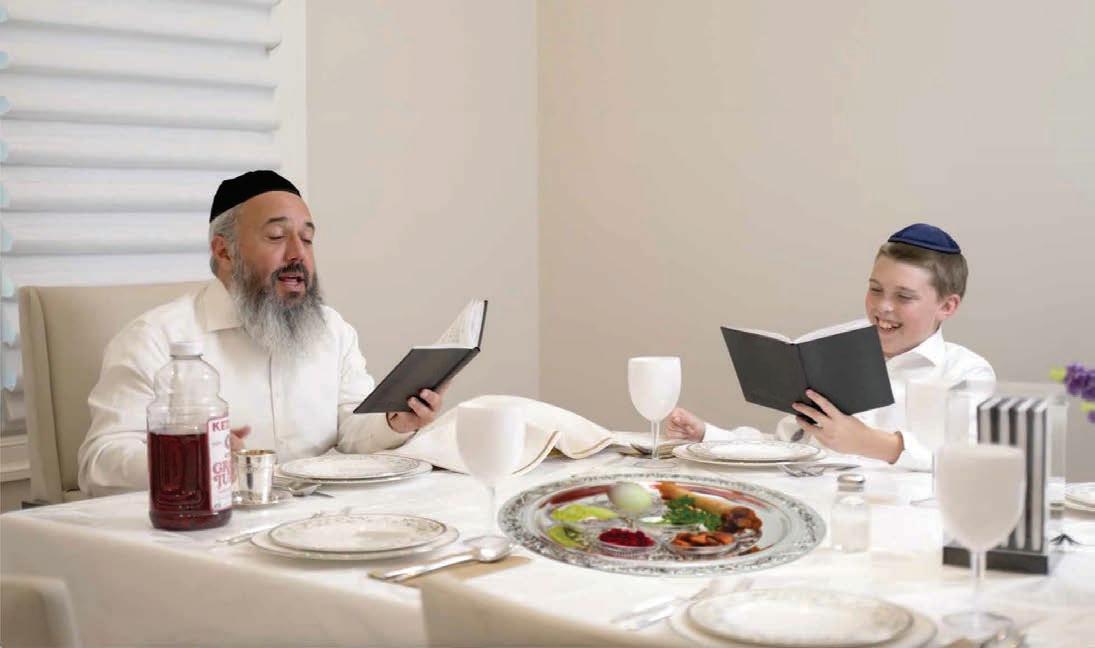
On Pesach, we remove the chametz from within, sanctifying ourselves to become pure reflections of Hashem—a nation of Mekadshei Hashem.
(Living Kiddush Hashem by ArtScroll Mesorah)
With all the pre-Pesach preparations—cleaning, and burning of chametz—let’s remember to uphold the dignity of bnei melachim, presenting ourselves and our neighborhoods as honorable ambassadors of Hashem.
Burning Chametz Without Burning Bridges – Use designated areas, keep flames controlled, and don’t leave a mess.
Coordinate with local collection schedules to dispose of the garbage in a proper manner.

Reflect Hashem’s middos of compassion, patience, and kindness within your home.
The atmosphere we create shapes our children’s lifelong feelings towards Yom Tov.
Clean with joy.
Choose patience over perfection, connection over correction.

“Why are these Jews bringing so much stuff with them?
Why do they insist on covering security cameras and disabling motion detectors before the holiday begins?
Why do they walk in the streets instead of on the sidewalks?
Why are they cutting through my private property to get to other houses?”
» When taping cabinets use removable painter’s tape, not duct tape or regular packing tape that leaves stains or residue.
When it comes to Kiddush Hashem, it’s all about communication, communication, communication.
For a free booklet of amazing stories, email: LivingKiddushHashem@gmail.com / visit: LivingKiddushHashem.org
» Dispose of garbage properly and cut up all boxes.
» PARK LEGALLY: Park ONLY in designated spots, even if it’s “just for a second.”
» Please do not walk in the streets on Shabbos and Yom Tov—PLEASE use the sidewalk.
» Do NOT cover electric stovetops with a blech or silver foil — it will crack or get damaged.
» GOLF CARTS ARE NOT FOR MINORS –Too many Hatzoloh calls EVERY YEAR for serious preventable injuries.

» When checking out, leave the home in a respectful way as if it’s your own:
» Remove all tape.
» Move furniture and appliances back to where it was upon arrival.
» Replace dishes and flatware in their original drawers and cabinets.
» Empty refrigerators and cabinets of food! (This is the second biggest complaint.)
(taken from checklist for Pesach guests in Florida)
“We must be careful not to give children the impression that Chol HaMoed is all about trips. While simchas Yom Tov is important, it is not the sole purpose of Chol HaMoed.”
“Behaving in a way befitting bnei Torah — bringing more kavod Shamayim — elevates our trips with deeper meaning and kedushah.”
“A true Kiddush Hashem also means giving chashivus to learning Torah.”
“Property owners have the right to set expectations for their premises, and we must respect them.”
“A chillul Hashem can occur even when rules aren’t enforced. For example, if a venue prohibits outside food, ignoring that policy still reflects poorly.”
— RABBI DOVID ZUCKER
Rosh Kollel, Chicago Community Kollel
“When a Yid walks through a park and keeps his gaze focused rather than looking at inappropriate sights, speaks gently instead of being demanding, or politely holds a door open for another—he becomes a living testament to Hashem’s Torah.”
“Every Jewish child, through their actions, proclaims to the world: ‘Hashem Hu Ha’Elokim!’”*
— RABBI AKIVA KLEIN
Rav of Beis Medrash of Melrose Court, Maggid Shiur in Orchos Tzvi, Lakewood
For a free booklet of amazing stories, email: LivingKiddushHashem@gmail.com / visit: LivingKiddushHashem.org
This is a letter from the Best Western Hotel, which hosted the 10th-grade traveling camp of Minneapolis Yeshiva during their break.
“Travel is not just about seeing the world — it is about shaping it.”
To Whom it may Concern,
I just wanted to drop a letter to commend your group of students that were traveling through Wyoming.
I am the maintenance supervisor at the Best Western in Hulett, WY. Late in the evening on the 3rd of July your group of students arrived to check in. Even though it was late, and the fact that they had to unload and prepare their rooms, they were polite, quiet, and considerate of the other guests.
It was very nice to have them overnight and to interact with them on a personal level. I just wanted to let someone know how they impacted us here in Hulett and had nothing but positive feedback from other staff as well.
They should be commended for their behavior, as it had a very infectious impact on all that I have talked to.
Have a blessed day, Bryce Garner
— ELIYAHU FREEDMAN
“Be patient with the staff.”
“Please arrive on time for your appointments. Many facilities operate at maximum capacity, and arriving late may mean we can no longer accommodate your reservation— causing frustration and disappointment.”
“Respect our facility: don’t leave trash behind, pick up after your child, and alert an employee if something spills.”
“Follow all policies, procedures, and staff directives.”
— MANAGER, CLIMBZONE


U
U
U
U
U

“Partly Cloudy”
We truly have no idea which way this is going.
“Chance of Rain” Somewhere, at some point, someone will get wet.
“Isolated Showers” It will rain exactly where you are.
“Scattered Thunderstorms” Bring everything: umbrella, hoodie, backup plans.
“A Passing System” This could last 20 minutes or your entire afternoon.
“Cooling Trend” You had your fun. It’s over.
U
“Unseasonably Warm” Enjoy it because it will be freezing again tomorrow.
U
U
U
U
U
U“Wintry Mix”
We’ve officially lost control of the situation.
“Light Snow” Either nothing…or 6 inches. No in-between.
“Accumulation Possible” It may just be time to panic-buy milk.
“Gusty Winds” Yes, your garbage cans are in danger.
“Developing Later” We’ll deal with this problem in a few hours.
“We’re Monitoring the Situation” Things can get bad fast!
A meteorologist says there is a 100% chance of rain tomorrow. Two people hear the forecast. One brings an umbrella and stays dry. The other does not bring an umbrella and also stays dry. The forecast turns out to be completely accurate.
How is it possible that the person who did not bring an umbrella stayed dry?

Answer: He never went outside in the rain.
1. According to Indeed, what is the average salary range for a meteorologist in the United States?
a. $71,000 to $109,000
b. $175,000 to $210,000
c. $240,000 to $270,000
d. $400,000 to $$500,000
2. What does a Doppler radar primarily detect?
a. Temperature changes
b. Air pressure
c. Movement of precipitation
d. Cloud color
3. What scale is used to measure the intensity of tornadoes?
a. Richter Scale
b. Saffir-Simpson Scale
c. Celsius Scale
d. Enhanced Fujita (EF) Scale
4. What does humidity measure?
a. Wind speed

b. Cyclone
c. Jet stream
d. Monsoon
6. What type of cloud is most associated with thunderstorms?
a. Cirrus
b. Stratus
c. Cumulus
d. Cumulonimbus
7. What is the boundary between two different air masses called?
a. Front
b. Pressure line
c. Storm zone
d. Climate barrier

Answer Key:

I tried to become a meteorologist, but I couldn’t handle the pressure.
b. Amount of water vapor in the air
c. Cloud thickness
d. Air pressure changes
5. What is the term for a fastmoving, narrow band of strong winds in the upper atmosphere?
a. Trade winds
Wisdom Key:
6-7 correct: You definitely have a weather vane on your roof, which means that you are totally not vain.
3-5 correct: You are right in the middle – need a spring jacket.
0-2 correct: You don’t even know what a meteorologist is. Is it a type of macaroon?
My weather app is like me –mostly wrong but confident. The meteorologist said “high pressure,” and I thought he meant my life.
Cloudy with a chance I stay indoors forever.
Hail is like snow’s angry cousin.
Storms come and go, but meteorologist puns reign forever.
I’ll look into the case.
- House Minority Leader Hakeen Jefferies (D-NY) when asked, “An illegal immigrant has been charged with murdering a college student in Chicago last week. Do House Democrats believe that if he is convicted, he is someone that should be deported?”
The last thing that the American people need are for untrained ICE agents to be deployed at airports all across the country, potentially to brutalize or in some instances, kill them.
- House Minority Leader Hakeem Jeffries (D-NY) on CNN when asked about ICE helping out the TSA which is understaffed because the Democrats are refusing to fund the Department of Homeland Security
But maybe the first step should be to go down to Palm Beach and see who we can bring back home because our tax base has been eroded.
- New York Gov. Kathy Hochul (D) in a recent interview laughably begging wealthy people who fled New York’s high taxes to return to the Empire State
We are saying that Iran shoots protesters. Well, so do we.
- Former CNN anchor Don Lemon equating the United States with Iran, which recently gunned down an estimated 35,000 protestors
The last time I saw Charlie Kirk on this earth was in June, in the West Wing, in the stairway, and I said hi to him, and he looked me in the eye and he said very loudly, “Joe, stop us from getting into a war with Iran.” Very loudly.
- Former National Counterterrorism Center director Joe Kent in an interview after he quit his job in objection over “the U.S. going to war with Iran for Israel”
I’m so sick of hearing about Charlie Kirk and what his beliefs were, you know, right before he died. Because I had a conversation with Charlie Kirk right before he died, and he said, “You know, I really hate Joe Kent. He’s just a bad guy.” And now, I can’t prove that, but it was the last conversation that I had with Charlie Kirk. He said, “I really think Joe Kent’s a bad guy.”
- Conservative Radio host Jeff Beck demonstrating the absurdity of Joe Kent’s claim that the last thing Charlie Kirk said to him was to make sure that the U.S. doesn’t attack Iran
Can you stop with this stuff!? Stop with the Charlie Kirk’s last conversation was, fill in the blank, please. I can’t take it. Now, if you have a text from him, you have something and we can see the whole context of it, great. But can we stop saying, you know, his final words were: “It was Israel that did it.”
- Glenn Beck
Who knows better about surprise than Japan? Why didn’t you tell me about Pearl Harbor, right? OK?
- Pres. Trump during a press conference alongside Japan’s prime minister, when asked by a Japanese reporter why the U.S. didn’t warn its allies ahead of the war on Iran
Schumer is gone; he’s a Palestinian. He should be fighting on the side of Palestine. He’s actually become a Palestinian leader.
- Pres. Trump talking about Senate Minority Leader Chuck Schumer (D-NY)


Much to my pleasant surprise, I saw emotion on the President’s face, because usually when you see him on TV, he’s just being a stern leader; I get that. But his humanity showed in that moment.
- The father of one of the U.S. soldiers killed in the Iran war, in an interview with ABC, reflecting on his meeting with President Trump
It’s the only army I’ve ever seen that warns the local population that it’s going to bomb and asks for the evacuation of civilians.
- Lebanese MP Camille Chamoun on Lebanese TV, talking about Israel
The United States and Israel began their operation against the Iranian regime just three weeks ago. Iran’s military movements now resemble the movements of a frog’s legs during dissection. The legs may twitch, but the frog isn’t going anywhere…. I give the regime another ten days or two weeks, tops.
- Roger Kimball, American Spectator



Over the weekend, Ilhan Omar’s daughter went to Cuba to show solidarity with the communist leadership. That’s a switch. Usually, when her family goes to Cuba, it’s Guantanamo Bay.
- Greg Gutfeld
It turns out that Democratic Congresswoman AOC spent $19,000 in campaign funds last year on a psychiatrist who specializes in ketamine therapy. It wasn’t for AOC, though. It was for the therapist after spending two hours listening to her.
- ibid.
Transportation Secretary Shawn Duffy warned that airport wait times are going to get much worse and warning Spirit customers to plan ahead by bringing extra meth.
- ibid.
Over the weekend, former FBI director Robert Mueller passed away at 81. His last words were, “What are you doing here, Hillary?”
- ibid.
After the death of Mr. Mueller, President Trump posted, quote, “Good. I’m glad he’s dead.” It’s part of a new line of Trump sympathy cards.
- ibid.
If we can’t get my Democratic friends on board with showing an ID to vote…they really are 10 exits past normal.
- Sen. John Kennedy (R-LA)
We’ve decided to share the ocean with Iran. We’ve given them the bottom half.
- Secretary of War Pete Hegseth at a recent press conference
Moderated by Jennifer Mann, LCSW of The Navidaters

Dear Navidaters,
I appreciate the ability to write in. Thank you.
I’m 29 years old and got engaged early on in my years of dating. It was a mismatch in many ways. Over time, though, I really am second guessing myself. He was a nice guy, and things did align, however, he had lifestyle things that were different (we are more Yekkish, he was more relaxed, we are balabatish and they were more simple...).
As the years have gone on, I have changed in many ways, and I am much more flexible. Is it crazy to reevaluate this idea? Or is it a mess bound to happen? I also don’t want to embarrass myself for asking when I was the one who broke it off to begin with.
Any suggestions would be helpful.
Thanks,
Rikki*
Disclaimer: This column is not intended to diagnose or otherwise conclude resolutions to any questions. Our intention is not to offer any definitive conclusions to any particular question, rather offer areas of exploration for the author and reader. Due to the nature of the column receiving only a short snapshot of an issue, without the benefit of an actual discussion, the panel’s role is to offer a range of possibilities. We hope to open up meaningful dialogue and individual exploration.
1110 Reisterstown Rd | 410.358.2796
S 10:30-6 M-W 10:30-7 Th 10:30-8 F 10:30-2:30 | Mincha M-Th 3:15
EXTENDED PRE YOM TOV HOURS STARTING 3/22: Sunday 10:30-7, Mon-Thurs 10:30-8, Fri 10:30-3 WE HAVE THE PERFECT SUIT FOR EVERYONE
Portly, classic, slim, extra slim, and every fit in-between
Boys’ Suit Sizes 4-20
Men’s Suit Sizes 36-60
Come early for best selection!






Dear Readers,
We want to offer YOU an opportunity to be part of the discussion! Please email us at MichelleMondShadchan@gmail.com, subject line “reader’s response,” if you would like to participate in the new “A Reader’s Response” columnist spot. We will send you a question and publish your answer in an upcoming Navidaters edition.
If you have a question you would like the Navidaters to answer, please reach out to this email as well.
Looking forward!
Michelle, the “Shadchan”
Rebbetzin Faigie Horowitz, M.S.


Rikki, do not hesitate. If there was indeed a strong connection between the two of you and you have matured, get a very skilled shadchan/mentor/friend who knows the young man well to feel him out. I would suggest a face-to-face meeting where you are upfront. Be specific about why you liked him then (and now). Be clear about what went wrong the first time and why you are swallowing your pride to try to revisit this again. This takes courage. The fact that you are ready to do it and are asking us for encouragement tells me that you really have gone through a journey since then and know
A veteran shadchan who works with “older singles” told me last week that she regularly asks new people she meets whether there was someone who fit the bill and with whom they deeply connected with in the past. It’s not only part of getting to know the person; it’s an opportunity to see if she can help the couple
This kind of situation is not uncommon. But it will take someone skillful to
maturity. Sometimes, a shidduch really can be the right idea at the wrong time. That does not mean it definitely was, and it does not mean that revisiting it will automatically lead to a happy ending, but it does mean that it is worth looking at honestly rather than dismissing the thought simply because you were the one who ended it the first time.
People grow, and things that once felt like dealbreakers can, over time, start to feel far more manageable or even insignificant. It actually says something very admirable about you that you are able to look back and say, “Maybe I was too rigid.” That kind of reflection is healthy and mature! Many people stay locked into old ways just to protect their pride. Growth requires humility, and humility can be uncomfortable.
Yes, you will need to be open to the possibility that he may not be interested. That can feel vulnerable, especially since you were the one who broke it off. I would venture to say, though, that sometimes a little vulnerability is worth it at the price of clarity.
You shouldn’t make some dramatic move on your own. This can be approached delicately through a shadchan, or someone trusted who can gently feel out whether there is openness on his end. If the answer is no, you have not embarrassed yourself. You will have given yourself an answer instead of carrying a quiet “what if” in the back of your mind.
hat you are describing is not crazy at all. In fact, it is often a sign of
Sometimes, revisiting the past is a dead end. However, sometimes, it is exactly how someone finds what they were not yet ready for the first time around. You won’t know unless you are willing to be vulnerable enough to try. Hatzlacha!
Dr. Jeffrey Galler
We can assume, I guess, that you already know that your old boyfriend is still single and available.
If so, even though it will require real courage and leave you emotionally vulnerable, I would encourage you to attempt to reach out. You might be pleasantly surprised to discover that he, too, is older, wiser, more mature, and open to reconnecting.
But, of course, prepare yourself for disappointment. He might still harbor a lot of hurt and resentment toward you and prefer not to revisit the past.
In order to minimize potential embarrassment, you might wish to ask a trusted confidant, or a mutual friend, to discreet-
ly explore the possibility on your behalf.
And, even if your old boyfriend emphatically responds, “NO, THANK YOU,” you will have still accomplished something valuable. You will have replaced uncertainty with closure, and you will never need to wonder what might have been.
As the poet wisely wrote: “Of all sad words of tongue or pen, The saddest are these: It might have been.” (John Greenleaf Whittier)
Eli Sharvit of @KallahreadywithEli
Dear Rikki,
For a shidduch to work, I truly believe it needs to be both the right
The Navidaters
Dating and Relationship Coaches and Therapists
Dear Rikki,
I really hear the thoughtfulness in your question. This isn’t coming from a place of chaos. It sounds like it’s coming from growth…and a quiet wondering. And I don’t think that’s something to shut down.
People do change. You’re not the same 29-year-old who made that decision. If you feel yourself becoming more flexible, more open, less attached to a very specific picture, that matters. That’s real.
So, no, it’s not crazy to revisit an old idea.
At the same time, I’d want you to hold this gently and not swing all the way into, “I made a mistake and need to fix it.” Be -
cause there was a reason you ended it. Even if that reason feels less loud now, it deserves your respect.
What I’m hearing is that the differences were more about lifestyle and tone than anything glaring or wrong. And those kinds of differences live in a gray area. Sometimes, they matter a lot. Sometimes, they soften over time, especially as we grow into ourselves.
I actually don’t mind the idea of a measured revisit. Not a dramatic return. Not a big emotional leap. Just a small, grounded step.
But before that, I’d want you to get a
person AND right time. I know of many couples who initially dated and ended it for various reasons, only to reconnect months or years later. In your case, particularly, it seems as though you can pinpoint the exact areas that were mismatched prior and why they are no longer of concern. Further, what you describe sounds like you have matured significantly in this process.
The real question is “what do you have to lose?” I’d argue nothing – but everything to gain. The best-case scenario is that he is also interested, and you end up happily married. Another positive scenario is that he says no, and this provides you with closure and clarity. Either way benefits you significantly.
Sometimes, a shidduch really can be the right idea at the wrong time.
My only piece of advice would be to use the right shaliach. I do recommend having someone discreet and close with him reach out on your behalf to open that conversation rather than doing it yourself. This will give him the opportunity to process the option of reconnecting with you without any pressure. It will also save you any embarrassment if he responds to the negative (immediately on the spot).
little clearer with yourself so you’re not acting from a swirl of “what ifs.”
A few things I’d be curious about if you were sitting with me:
When you think about him now, what exactly pulls at you? Is it him, or the feeling that he was “a good guy” and maybe you let something solid go?
What specifically about your flexibility feels different today? Where do you see that showing up in real life, not just in theory?
If you imagine sitting across from him again, as he was then, do you feel relaxed and yourself… or slightly tight, like you’d have to adjust?
What would you need to see or feel differently this time for it to actually work?
If, after sitting with that, you still feel a quiet curiosity, I think it’s okay to reach out in a simple, respectful way.
Not with intensity. Not with a whole story attached. Just something like, “I’ve
Wishing you success, bracha, and clarity with whatever happens.
been doing some thinking and growing, and you came to mind. I don’t know what it means, but I’d be open to catching up if you are.”
That’s not embarrassing. That’s human.
And then you let reality answer you. You don’t force it into a meaning it may or may not have.
One more thing I’ll say, gently. Sometimes, when something was almost right, it can linger in a particular way. Not because it was meant to be, but because it didn’t fully play out. So as you explore this, keep one foot in curiosity and one foot in honesty.
You’re not trying to rewrite the past. You’re just checking, from who you are now, whether there’s anything real still there.
Sincerely, Jennifer
Jennifer Mann, LCSW is a licensed psychotherapist and certified trauma healing life coach, as well as a dating and relationship coach working with individuals, couples, and families in private practice at 123 Maple Avenue in Cedarhurst, NY. To set up a consultation or to ask questions, please call 718-908-0512. Visit www.thenavidaters.com for more information. If you would like to submit a dating or relationship question to the panel anonymously, please email JenniferMannLCSW@gmail.com. You can follow The Navidaters on FB and Instagram for dating and relationship advice.
By Rabbi Azriel Hauptman
Depression is a condition that most people will deal with at some point in their lives. Sometimes, depression can come out of the blue, or depression can be triggered by a life event. Whenever
depression hits, people often question the validity of their own condition? Am I exaggerating my condition? Am I just weak? Shouldn’t I just be able to snap out of it?


Rather than attempt to address these questions in this article, we will instead share with the readers a letter from the Rambam.
The Rambam’s life had many different parts to it. During one period of his life, he dedicated his entire energy to producing his magnum opus, the sefer Mishneh Torah, a fourteen-volume work that encompasses the entirety of the Torah Shebaal Peh (Oral Law). This monumental work took him approximately ten years. During this part of his life, he was not practicing as a physician, as doing so would have made the writing of such a work impossible.
How did the Rambam support his family during this period? The Rambam had a brother, named Dovid, who was both a younger brother and a close Talmid of the Rambam. This brother took it upon himself to go into business and support the Rambam.
This came to a tragic and abrupt end when his brother died in a shipwreck in the Indian Ocean during a business trip. From that point on, the Rambam needed to support his family, and that is when he began to practice as a physician. The Rambam became so busy that he did not write much else for the rest of his life. The Rambam was therefore both faced with the pressure of supporting his family (and the widow and child of his brother) in addition to losing a dear and precious brother and disciple.
In a famous letter (Igros HaRambam, Sheilat Ed., Letter 11), the Rambam describes his emotional state in the period following his dear brother’s sudden demise.

The great calamity that has befallen me recently, which is worse than all the calamities that has befallen me from the day I was born to this day, is the death of my brother the Tzadik who drowned in the Indian Ocean, with a large amount of money in his hand, for me and him and others, and left behind a little daughter and his widow. For a year from the day the tragic tidings reached me, I remained bedridden with severe inflammation and mental confusion, and I almost died.
From then until this day, which is about eight years, I have been in a
state of disconsolate mourning. How will I be comforted? He grew up upon my knees, and he was my brother and my student. He did business in the marketplace earning a livelihood, while I studied with peace of mind… My only joy was to see him. The sun has set on all joy, but he has departed to eternal life, leaving me dismayed in a foreign land. Whenever I see his handwriting or a book from his books, my heart will turn on me and my sorrow becomes aroused.
This incredibly touching letter of the Rambam gives us a window into his personal life and his emotional state when struggling with the trauma of losing his brother. He was bedridden for a year, and even many years later did not feel that he had reached a state of consolation.
Was the Rambam suffering from depression? That is not something we can answer, and it is frankly not a question that we should even be exploring when dealing with a giant such as the Rambam. What we can glean from this is even someone as great as the Rambam did not always have it so easy emotionally, and if the Rambam can become bedridden with grief, we should not give ourselves a guilt trip when we are suffering from an emotional setback that interferes with our ability to function.
A famous quote is attributed to the Rambam from his days as a physician. “The physician should not treat the disease, but the patient suffering from it.” This perspective that we should look at the whole person and not just the symptoms is another lesson from the Rambam that can help us when the going gets tough. You are not just a machine with symptoms. You are a whole person who needs to be viewed as such. When you look at yourself using the Rambam’s perspective, you will be better suited to understand your own humanity and all that comes along with being human.
This is a service of Relief Resources. Relief is an organization that provides mental health referrals, education, and support to the frum community. Rabbi Yisrael Slansky is director of the Baltimore branch of Relief. He can be contacted at 410-448-8356 or at yslansky@reliefhelp.org



By Etti Siegel

Q:Dear Etti,
Hi! I really enjoy reading your column each week and appreciate the practical wisdom you share. I’m hoping you can offer some insight about my 13-year-old son. He is overall a pretty easygoing, respectful boy and seems to do fine socially in school. He has friends, participates in class, and doesn’t appear withdrawn or isolated during the day. Teachers have never expressed concerns.
What worries me is his approach to taking initiative outside of school. When he was younger, he played regularly with neighborhood boys and didn’t seem to feel the need to reach out to classmates for playdates. As he has gotten older, those neighbors are less available, and his social interactions outside of school have really decreased.
When I encourage him to reach out to someone from school, he hesitates, gets slightly ruffled, and says things like, “I can’t,” “Boys don’t get together like that,” or “I just don’t understand how it works.” This has been his response across different classes and even different schools, so I don’t think it’s about one specific group.
I’m concerned that maybe he doesn’t have the tools to initiate, or that he’s somehow stuck socially. Should I be pushing him to initiate plans? Do I need to seek professional help to overcome this block? Or is this simply personality or immaturity that will resolve with time?
Thank you, Concerned
A:Dear Concerned, I’m so glad you wrote in. What you’re describing is a developmental shift, and it’s a good time to evaluate whether this is something to coach, push, or simply allow to unfold.
The first thing to remember is your son is functioning socially during the school day. He is not isolated, not disruptive, not chronically excluded. That tells us something significant. The capacity for connection is there. This is not a child who cannot relate to peers. The question is if he has developed the skill, and confidence, to initiate outside of structured settings, and if not, what to do to help him.
Many boys in childhood rely on proximity for

friendships. Psychologist Michael Thompson, co-author of Raising Cain, who has written extensively about boys’ emotional development, explains that boys often form friendships through shared activities rather than through intentional social planning. When they are younger, neighbors, teammates, and classmates create automatic interaction. There is little need to arrange or organize. When those built-in opportunities shrink, as they naturally do in early adolescence, some boys don’t instinctively know how to pivot to planned outreach.
Intelligence does not always show up in expected ways.
Research on peer relationships by developmental psychologist Kenneth Rubin shows that social initiative, like inviting, suggesting, and following up, is a learned component of social competence. Some children acquire it organically. Others need modeling and rehearsal. When your son says, “I can’t” or “I don’t understand how it works,” I hear uncertainty more than resistance. He may genuinely lack a script. He may also fear rejection and protect himself by dismissing the whole idea.
Early adolescence complicates things further. The American Academy of Pediatrics notes that ages 12–14 are marked by heightened self-consciousness and shifting peer norms. Boys, in particular, can become wary of appearing eager or needy. Saying “boys don’t get together” may reflect confusion about new social rules rather than indifference to friendship.
So what do you do?
Forcing him (nagging him?) to initiate repeatedly may increase anxiety and resistance. Ignoring the issue entirely can allow avoidance to settle in. The most effective approach is gentle coaching.
Instead of broadly saying, “Call someone,” make the process concrete and manageable. Sit with him and
break it down. Who does he sit near at lunch? Who shares a similar interest? What specific activity could anchor an invitation: basketball, homework, building something, going somewhere? Boys often feel more comfortable when the invitation centers on an activity rather than a vague “hang out.” Sideby-side interaction reduces social pressure.
You might even role-play a conversation or text together. Not because he is incapable, but because rehearsal lowers uncertainty. Over time, step back and let him send the message independently. The goal is gradual ownership.
If you begin to see broader red flags, like significant loneliness, high anxiety, difficulty reading social cues, or persistent avoidance across settings, then consulting a therapist or structured social skills group could be helpful. Organizations such as the Child Mind Institute emphasize that social initiation can be explicitly taught and strengthened like any other developmental skill. But based on what you describe, I would not leap there yet.
What I hear most clearly is this: your son has been a passive participant in friendship structures that once came easily. Now the structure has changed, and he needs to build a new muscle. Muscles strengthen through repetition, not pressure.
Praise effort, not outcome. If he reaches out and it doesn’t materialize, that is still growth. Confidence builds from attempts.
This does not sound like a child who is “stuck.” It sounds like a 13-year-old learning the next layer of social maturity. With steady modeling and calm support, many boys grow into this stage just fine.
Hatzlacha,
- Etti
Mrs. Etti Siegel holds a MS in Teaching and Learning/Educational Leadership and brings sound teaching advice to her audiences culled from her over 35 years of teaching and administrative experience. Etti is an Adjunct at the College of Mount Saint Vincent/Sara Shenirer. She is a coach and educational consultant for Catapult Learning, FACTS Education Solutions, Brienza Academic Advantage, Yeled V’Yalda; is a sought-after mentor and workshop presenter around the country; and a popular presenter for Sayan (a teacher-mentoring program), Hidden Sparks, and the Consortium of Jewish Day Schools. She is a frequent contributor to Hamechanech magazine and The Journal for Jewish Day School Leaders and has a weekly column in The Jewish Home. She can be contacted for questions and comments at ettisiegel@gmail.com.








By Sara Rayvych, MSEd
“But I told him/her what I needed done!”
This statement will probably be said throughout homes over the next few weeks. We asked for help or said what we needed, and it still wasn’t done.
It’s frustrating to be ignored, and it’s time consuming to repeat ourselves. It can also set us back if we expected something to be done, and we – last minute – find out it wasn’t. It’s a busy Pesach season, and there is so much to do. We need it done now, and we need it done right!
There are many reasons why we may be ignored. Laziness is definitely one of them. Often, it’s because they kind of hope it will magically happen on its own (or by someone else) if they procrastinate long enough. Perhaps the job really is too much for them, and they don’t know how to convey that. Other times, it’s because we failed to accurately convey what we needed. We thought we were clear, we assumed we were understood, yet the message never made it from Person A to Person B.
These same issues in communication, and the reasons for them, cause problems in other areas of our life, too. There’s more to life than just needing chores completed properly. With our children, spouse, or anyone else we encounter, there are endless opportunities to convey and accept information. Correctly conveying and accepting these messages is a major area of growth in relationships but also a potential cause of friction.
Generally, our loved ones want to make us happy, just as we want to do the same for them. Accurately communicating these needs allows us to be there for each other, as well as get those good feelings that come from doing a job right. Improving these skills will not only make Pesach preparations easier, it can enhance all areas of our life.
Clarity
It’s important to respectfully state
clearly what we need. This applies to many areas, including both physical and emotional needs. Recognizing what we actually need is the first area we have to clarify. It’s surprising how often we are unable to accurately pinpoint our own needs. This is especially true when it comes to more emotional requests. For example, we might get upset over something minor our spouse said, not realizing that what we really should be saying is, “Please keep an eye on things while I go take a nap. I’m exhausted.”
Many requests are unknowingly vague. “Clean your room.” “Help me with this.” “Put this away.” Taking apart these common statements, we can recognize that “clean” means something different to adults than children, “help” doesn’t say what actions are needed, and “away” is not a specific location. A child may “clean” their room by shoving all their clothing under their bed. “Help” can mean too many bizarre options to list. “Away” can be misinterpreted to mean “drop this in a random spot – even the spot I just picked it up from.” It would be funny if it weren’t frustrating for us. The only ones more frustrated than us are the kids who sincerely think they did what we asked and can’t figure out why we’re still not happy.
“Toys in the bin, dirty laundry in the hamper, clean clothes back in your drawer, and wrappers in the trash” is an unruly statement but far more accurate of what we mean by “clean.” Even with that, you need to ensure there is a garbage bag in the pail before they drop in something gross. “Put this glass in the second cabinet next to the other ones” is a mouthful but does say where you want it to go.
I intentionally wrote the above demands how they’re normally said. Making requests is often more pleasant than issuing orders, and good manners demonstrate the middos we wish our children to emulate. We can say “please” when we make our request, and we can always say “thank you” afterwards. Phrasing things as a request or

question can be a more thoughtful wording. “Can you please put this away?” Even if children have a mitzvah of kibbud av v’aim, they’re not servants to be ordered around. We can expect a job to be done even if we are thoughtful in how we say it.
Demonstrating what we expect is another way to provide clarity. We can model what we want done or visually show what is expected. This can be helpful for many children who have trouble with verbal commands or who tend to forget or get easily distracted.
All jobs should be age appropriate. Follow-up is important. If they know we won’t check, then it is extra tempting for them to pretend we never said it.
Assumptions are so common we often fail to realize we’re making them. A certain amount of assumptions are necessary for normal living, but they can also be a hindrance when it comes to interpersonal relationships.
Many daily confusion and arguments occur because of assumptions. We assume they knew what we wanted or understood what we said. They are frustrated because they assume they did the job and we still weren’t happy.
Expectations are often not met because of false assumptions. We can communicate effectively, but it’s still not sufficient if our words were based on false assumptions. When asking anything of someone else, we have to be careful to not mistakenly assume they understand background or other information.
We also make assumptions regarding intention. We assume someone else meant to ignore us or say something hurtful. We assume they know we are hurting or need help. We assume they understood us when they didn’t. These assumptions hurt us and those around us.
It’s my humble opinion that many adults’ miscommunications derive from false assumptions. We assume others can read our mind or that something is obvious. It is when we take a step back and clearly state what we need without assuming others can read our mind that we can best get our needs met.
Using a real-life example (that really happened), a wife was overwhelmed erev yom tov balancing the cooking with bathing the little ones. She was frustrated that her husband was doing other things that weren’t necessary before the holiday. She was ready to scream at him because of his insensitivity. With Hashem’s assistance, she took a step back before verbally giving it to him and thought that perhaps he didn’t actually realize she needed help. While it was obvious to her, maybe it wasn’t to him. In a less than patient voice, she respectfully told him she really needed his help. He immediately came down, asked what was needed, and took the dirty child for a bath. What could have become an erev yom tov fight turned into a helpful spouse.
We can assume the best in our loved ones and that they really want to be there for us. Clearly stating our needs allows those close to us to show their love back for us. “Can you please help me with ___?” is a statement that allows chessed to be done by both sides. With clarity in communication and siyata dishmaya, we can keep these busy days more pleasant and loving.
Sara Rayvych, MSEd, holds a master’s degree in general and special education. She has been homeschooling for over 15 years. Sara provides personalized parent mentoring services, addressing a variety of general and specific parenting concerns. She can be contacted at Sara. Rayvych@gmail.com with comments, questions or for private consultations.






The combination of melted chocolate and cocoa powder in these brownies yields chocolate perfection in every bite. I introduced this recipe in my cookbook, Simply. Loved it so much, I converted it to gluten-free so it can be enjoyed all year round.
Pareve / Yields 1 (8-inch) square pan
Freezer Friendly
IngRedIen Ts
7 oz. good-quality pareve chocolate, such as Schneider’s or Noblesse
½ cup oil
3 Tbsp cocoa powder
3 eggs
1¼ cups sugar
2 tsp pure vanilla extract
½ tsp sea salt
½ cup potato starch
PRePA RAT Ion
Preheat oven to 350°F. Coat an 8-inch square pan with cooking spray.
In a double boiler, melt together chocolate, oil, and cocoa powder. Alternatively, microwave at 20-second intervals, stirring between intervals. Set aside.
In a medium bowl, whisk together eggs, sugar, vanilla, and salt until slightly thickened. Slowly add warm melted chocolate mixture, followed by potato starch. Continue to whisk until thoroughly combined. Transfer batter to prepared pan.
Bake 25-28 minutes on center rack, until slightly puffed. Remove from oven; brownies will become firm as they cool. Cut into squares or bars.
Recipes reprinted from Simply Pesach and Beyond by Rivky Kleiman, published by ArtScroll/Mesorah Publications.


pareve – yields 6-8 servings
Being an Australian, I couldn’t resist including a fish ’n chips recipe. I came up with this playful twist, coating the fish in these iconic potato stick “chips.” I love that this recipe is baked, not fried.
INGREDIENTS
2 eggs, lightly beaten
2 Tablespoons white vinegar
1 cup potato starch
2 (6-ounce) bags potato sticks

2 pounds fresh baby flounder, cut into strips
• oil, for frying
• lemon wedges, for serving
• tartar sauce, for serving (see recipe, below)
METHOD
1 Preheat oven to 350°F. Line a baking sheet with parchment paper; set aside.
2 Place eggs and vinegar into a bowl; whisk to combine. Place potato starch into a second bowl and potato sticks (not crushed) into a third.
3 Dip each piece of fish into potato starch, then into egg, and then into potato sticks, making sure the entire strip is fully coated. Place on prepared baking sheet.
4 Bake for 25 minutes.
5 Serve with a wedge of lemon and tartar sauce.
INGREDIENTS
4 large canned Israeli pickles
1 cup mayonnaise
1 Tablespoon pickle juice
2 Tablespoons fresh lemon juice
METHOD
1 In a food processor fitted with the “S” blade, chop the pickles.
2 Add mayonnaise and pickle juice; pulse to combine.


pareve – freezer friendly yields 8 servings in 1 (9-inch) round pan or 8-10 ramekins
This warm dessert is perfect comfort food any time of the year, from a summer afternoon to a winter evening. Serve it with a scoop of vanilla ice cream for a little extra indulgence.
Blueberry Base
3 pints (6 cups) blueberries ½ cup sugar
½ Tablespoon cinnamon

2 Tablespoons potato starch juice of 1 lemon (about 3 Tablespoons)
Crumbs
2½ cups potato starch
1 cup sugar
1 egg
1 cup oil
2 cups ground almonds or nut of your choice
METHOD
1 Preheat oven to 350°F. Prepare 1 (9-inch) round pan or 8-10 ramekins.
2 Prepare the blueberry base: Combine blueberries, sugar, cinnamon, potato starch, and lemon juice in a bowl. Toss to coat evenly. Place mixture into prepared round pan or divide among prepared ramekins. Set aside.
3 Prepare the crumbs: Combine all crumb ingredients; mix with a fork until coarse crumbs form. Spread the mixture over fruit base in prepared pan or ramekins. To prevent spillage, don’t overfill pan(s).
4 Bake for 60 minutes for 9-inch pan and 45 minutes for ramekins, until the tops are golden brown and crisp.
Cook’s Tip
To take advantage of seasonal fruits, substitute 6 cups of fruit(s) of your choice, such as apples, peaches, nectarines, pears, plums, etc. in place of the blueberries.



























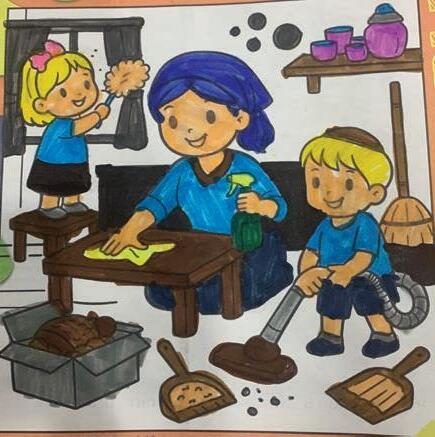







Note: Not all submission have been published. Keep sending in your artwork for another chance to be featured!
















Note: Not all submission have been published. Keep sending in your artwork for another chance to be featured!





But Hashem did more than that.
Chazal teach that the walls of the Yam Suf provided fruit and fountains for those walking through.
Even when the path ahead was difficult, the journey itself was filled with support. At United Refuah HealthShare, we believe medical challenges should be approached the same way.
Yes — members can share up to $1,000,000 per incident. But just as important is what happens along the way:
A case manager who advocates for you. Guidance through difficult medical decisions. Help negotiating fair prices with hospitals. Freedom to seek care anywhere in the world.
Because no one should have to cross the sea alone.