Zissy didn’t just build a wig brand — she redefined what luxury should cost. Our new wigs are fresh from the factory. No middlemen, no markup. Up to $2,500 less. Because high fashion shouldn’t come with a high price.
Dear Readers,
We are so used to reading about miracles that we sometimes miss when we are living through them. This past year has been filled with moments that were clearly the Yad Hashem. And yet because we are in it, because it unfolds one headline at a time, we call it news. But step back for a moment and look at what has actually happened. A nation was struck in the most brutal way imaginable and did not collapse. Within days, thousands of reservists left their homes and reported for duty. A fractured society became unified. Civilians became soldiers. Strangers became family. Entire networks of chesed and support carried a country through its darkest hours. And then came the war itself. On multiple fronts, against enemies that surrounded from every direction, Israel not only defended itself but began systematically dismantling threats that had been building for years. Leadership across the entire axis, Hamas, Hezbollah, and their affiliates, was targeted and eliminated with precision that is hard to comprehend. Figures who once seemed untouchable were removed one by one. The infrastructure of terror, carefully constructed over decades, was exposed and destroyed. At the same time, missiles filled the skies, drones crossed borders, and attacks intensified. Yet time and again, those missiles were intercepted, those threats neutralized, and tragedy was avoided. Beyond the battlefield, something deeper was unfolding. Around the world, Jews began to reconnect. Tefillin were put on. Candles were lit. Tefillos were said with a sincerity that felt different. Communities that had grown distant found themselves drawn closer. Achdus emerged in a way that cannot be manufactured. And quietly, in the background, there were
countless smaller moments. Soldiers walking out of situations they should not have survived. Intelligence arriving at exactly the right time. Attacks that never materialized. Plans that fell apart before they could begin. The kind of moments we may never fully know about, but that we sense were there.
As we approach Pesach, ונתורח ןמז, we speak about Yetzias Mitzrayim as if it belongs to another time. A world of open miracles. A sea that split. A nation that walked through. A clear and undeniable revelation of Hashem in the world. But perhaps the avodah of our time is to recognize that we are not so far from that reality. The miracles may look different. They may be layered within עבט, wrapped in strategy and human effort. But when a small nation stands against overwhelming odds and not only survives but prevails, when an entire axis of leadership is dismantled, when countless lives are saved in ways that defy logic, we are being shown something.
תורח is not only about leaving Mitzrayim. It is about seeing clearly. It is about recognizing that we are not alone, that history is not random, and that there is a Hand guiding events even when it is not immediately visible. This year, as we sit at the Seder and say לכב
perhaps we can understand those words not only as a memory of the past, but as a description of the present. We are not just remembering miracles. We are living through them.
Have a peaceful Shabbos,
Aaron M. Friedman
WIN with !
Comfort Year-Round:
Experience stable indoor temperatures, and reduce drafts, with warm winters and cool summers, when you upgrade to spray foam insulation in your attic.
Save Big on Energy Costs:
Cut your heating and cooling bills by 30-50% and make your HVAC system work smarter, not harder.
Breathe Better:
Enjoy improved air quality with reduced drafts and outdoor pollutants, creating a healthier living environment.
Around the Community
Behavior As Communication: Transformative Approaches To Student Wellness At The Jewish Educational
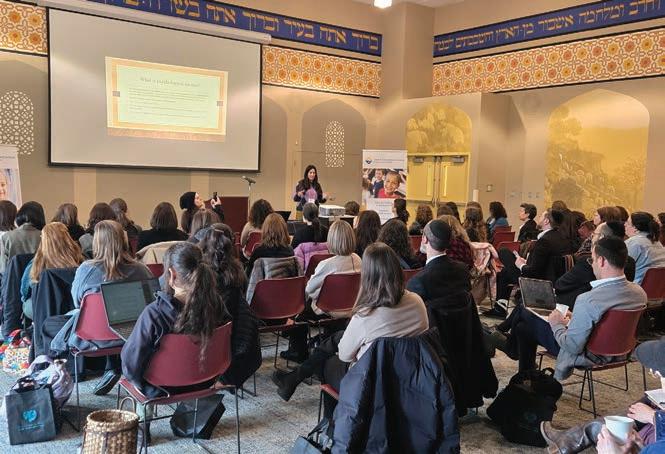
Despite the cold, drizzly weather, the scenic and serene environment that is synonymous with Pearlstone Retreat Center was the perfect backdrop for the 3rd annual Jewish Education Mental Wellness Summit, hosted by Jewish Educational Services. As attendees entered the building, they were greeted by JES staff and treated to a delicious and nutritious breakfast to give them the energy and wellbeing for the day.
The 50 attendees, representing 16 schools and other institutions from diverse backgrounds, included many school counselors and social workers who spend their days at the schools immersed in mental wellness for their students. This event provided them with new ideas, practical tools to use immediately, and a network to reach out to for support and collaboration (in addition to earning their critical CEU credits for licensing). As one participant stated, “I learned a variety of tools that I will implement both at work and with my own children at home”
Keynote speaker, Dr. Carly Namdar from OHEL, set a positive tone on understanding behavior as communication and supporting students through regulation rather than discipline. She noted that challenging
Services Mental Wellness Summit
student behavior is often a form of communication rather than defiance. Anxiety, sensory overload, trauma, or unmet emotional needs frequently drive classroom disruptions, and that students thrive when adults respond with curiosity rather than judgment. Research presented during the workshop underscored that children regulate their emotions through the adults around them, making teacher calmness and consistency essential to student wellbeing. Participants were urged to adopt trauma-informed practices, including predictable routines, opportunities for choice, and brief daily check-ins to build trust and stability. Other strategies suggested included breathing exercises, grounding techniques, and “brain breaks” to help students regain emotional control before academic learning resumes.
As a follow up from last year’s summit, Bnos Yisroel and Bais Yaakov presented their initiatives that were funded by the JES mental wellness mini-grants, one focused on parent training for childhood anxiety, and another offering small group lunchtime sessions to help middle school girls build resilience.
Participants then separated into various breakout sessions for the remainder of the day. Dr. Namdar led a series of sessions tailored to three
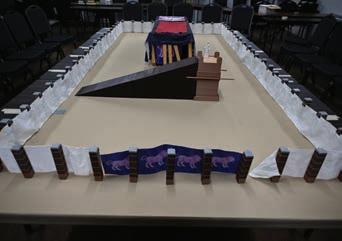
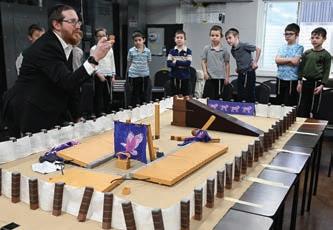
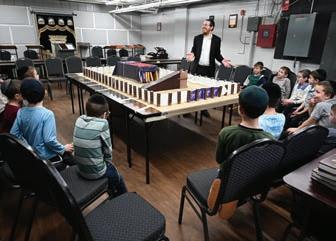
Mishkan Demonstration At YTS
Rabbi Hallel Newman
brought his replica of the mishkan to Yeshivas Toras Simcha today. The structure took a year to construct, and Rabbi Newman has visited several schools to display the model and discuss the various functionalities. Great effort was put into making the model resemble the actual mishkan, which we read about in the weekly parshios these weeks. Rabbi Newman showed the model to children in all the grades and allowed more time for the older grades to ask questions. The demonstration was also particularly appropriate for the eighth-grade students who are learning meseches Tamid.
audiences - principals, teachers, and school counselors. Each session highlighted the unique role these groups play in supporting student wellness while emphasizing the importance of shared language, aligned expectations, and collaborative problem-solving. Other popular sessions included: Regulating the Dysregulated Child with Dr. Sue Futeral school counselor at Ohr Chadash Academy, Understanding and Supporting Age-Appropriate Behaviors in Schools with Stacey Meadows from Jewish Community Services, and Supporting Students with Autism Spectrum Disorder (ASD) in the Classroom with Dr. Joseph Bechhofer.
Participants appreciated having this day to focus on mental wellness and even asked for more workshops and a longer conference. One counselor commented, “Wonderful program. It was a great way to feel connected with others who do the same work.”
The overarching message of the day was that students do not need perfect adults; they need present adults who can see past behavior and respond to the human being underneath. Those small, intentional moments of understanding are often what make the biggest difference in a child’s well-being.
Photo: JES Staff
Photo: Dovid Kapenstein
Around the Community
BCL By Columbia Group Ends An Incredible 2026 Season!
Week 6 marked the final week of the season for The Baltimore Chesed League, and the boys finished strong by pouring their hearts into a wide range of meaningful chesed projects throughout the community.
Teams helped clean the Willow Glen stream alongside the offices of City Councilman Isaac “Yitzy”
Schleifer and County Councilman Izzy Patoka, assisted at the Enclave with cleanup after the Pesach sale, and took part in a favorite annual activity, hauling shaimos on Motzei Shabbos from under the Agudah of Park Heights and loading them onto trucks to be respectfully buried. Other teams supported the shaimos burial at the cemetery itself, delivered matzah for Friendship Circle, and
participated in many other acts of chesed around town. With the season now complete, the boys are eagerly looking forward to the end-of-season banquet where they will celebrate another successful year with delicious food from The Wandering Chef, Jon Kaplan, a slideshow of memories from their hard work, and a fun trivia game to see how well the teams really know BCL.
A heartfelt thank you goes to all of the BCL partner organizations who gave these boys the opportunity to see that chesed is attainable and valued at every age, to the dedicated coaches who brought these lessons to life for their teams, and to the entire Baltimore community for cheering them on over the past six weeks as we help build the next generation of baalei chesed and community leaders.
Team Flamm Insurance finished their season on a high note, delivering meals around town for AIM to families with newborn babies.
Team Union Bridge brought their A game to the season finale at the Agudah shaimos hauling event.
Team DC Dental helped bury the shaimos that was hauled the previous night, working for 2.5 hours to ensure it received a proper burial!
Team Councilman Isaac “Yitzy” Schleifer joined forces with a bunch of teams and helped haul shaimos from the cellars of the Agudah of Park Heights
Team Richter Counseling partnered with Menucha for a fun evening of food and games.
Team Adanced Root Canal helped clean up the Willow Glen stream and then celebrated with some well-deserved Rita’s!
Team Solomon Counseling had an amazing time with the residents at North Oaks — playing bingo, sharing laughs, and building meaningful connections along the way.
Team Ivymount Clinic spent Motzaei Shabbos clearing out Shaimos at the Agudah of Park Heights
Team Kelemer Brothers helped close out the Pesach sale at The Enclave by sorting and organizing the warehouse.
Team Winner Insulation rolled up their sleeves and flexed their muscles to help shlep what seemed to be endless bags of sheimos to be buried the next day.
Team Pikesville Remodeling helped deliver Pesach/ Matza packages to local families on behalf of The Friendship Circle
Team Kove Group helped clean up the Willow Glen stream, with some leadership and oversight by Councilmen Isaac “Yitzy” Schleifer and Izzy Patoka.
Team Keren Reva visited the residents at Aventura, which included telling jokes, singing, and dancing, bringing joy to everyones’ day.
Team Kineged Glass baked brownies for Bikur Cholim while hearing about the amazing work of Bikur Cholim from their Executive Director, Rabbi Mintz.
Team Erez Seiferas joined a host of BCL teams to clean up hundreds of bags of shaimos at the Agudah
Around the Community
Excitement During CIJE Baltimore Robotics Week!
By: BJLife Newsroom
The the sound of cheering students and countdown timers filled the air as robots raced across the playing field, carefully stacking pieces while drivers and teammates strategized from the sidelines. Months of preparation came down to these exciting moments as hundreds of students gathered in Baltimore for a week of fast-paced robotics competition, teamwork, and engineering creativity.
Behind this excitement is CIJE, the Center for Initiatives in Jewish Education, an organization dedicated to bringing high-quality STEM education to Jewish schools across the country. CIJE works with more than 200 schools nationwide and supports over 40,000 students learning about engineering and technology. Through its hands-on robotics program, students design, build, and program their own robots while developing critical skills such as collaboration, perseverance, and problem-solving.
Each year, teams compete in a new robotics challenge that requires strategic thinking and creative engineering. This year’s game tasks robots with stacking cup-shaped pieces called pins to score points. Teams earn bonus points for creating stacks with multiple colors or for placing stacks into matching goals. The most difficult element is the beam piece, which is worth even more points and requires advanced robot design and precise driving to successfully complete.
“It’s inspiring to see so many students from different schools come together through robotics,” said Joseph Saltzman, CIJE Maryland Program Manager. “Students approach the challenge with creativity and determination. It’s amazing to see how their engineering skills develop as they design, build, and improve their robots. The tournament is a wonderful showcase of their hard work.”
This year, Baltimore hosted a special CIJE Robotics Week, featuring two exciting tournaments including the first ever CIJE Girls Tournament in Baltimore. The girls’ competition took place on Monday at Bais Yaakov Baltimore, followed by the boys’ tournament on Tuesday at Talmudical
Academy. Together, the events brought nearly 300 students from many schools to the playing field. Participating schools included local Baltimore schools of BY, BT, OCA, TA, TI, and YTS at their respective events. They were also joined by visiting teams from several New Jersey schools.
Hosting the girls’ competition marked an important milestone for Bais Yaakov Baltimore’s growing robotics program and highlighted the dedication and talent of its students. Over the past months, teams spent countless hours designing, building, and programming their robots in preparation for the tournament. The event was uplifting with students and coaches helping out teams from other schools in the spirit of collaboration and teamwork.
The Bais Yaakov eighth grade teams took on the ambitious challenge of building advanced robots capable of scoring the game’s most difficult element – and every one of their teams succeeded. Bais Yaakov came in fourth place and their girls left the tournament energized and eager to continue improving. In fact, as soon as the competition ended, many of the girls rushed
back to begin planning and practicing for the final tournament in May.
Mrs. Rochelle Goldberg, Bais Yaakov’s robotics coach, reflected on the event with pride. “It was a wonderful event, very fun,” she said. “The girls are motivated to improve and are looking forward to the next event.” She also expressed gratitude to CIJE for running the event and Dr. Joseph Saltzman for all his support and guidance.
RPRY captured first place in the girls’ tournament after months of refining their robot. Team member Ava shared that this victory was especially meaningful. “This is the first time I’ve won a medal at CIJE robotics,” she said. This was the third robot they built this season as they continued to learn from their experience, improve, and rebuild to improve their performance and strategy. Her teammate Hadassah agreed, adding, “Robotics is such an amazing experience – you get to learn about engineering and how to be a good sport.”
The excitement continued the following day at TA, where the boys gathered for their tournament. Rabbi Yakov Majeski, TA’s principal, reflected on
how the event has grown over the years. Having helped launch the Baltimore boys’ robotics tournament in its early days, he marveled at how much the program has expanded and expressed his enthusiasm about hosting the CIJE event once again. Dr. Insel, TI’s General Studies Coordinator, also thanked CIJE for bringing this opportunity to their students, noting that the robotics tournament is always a highlight of the year.
The boys’ competition featured strong performances from all participating schools. It was particularly impressive that all the teams from YTS and OCA advanced to the finals. In the final standings, BT and TA tied for second place, while Torah Institute secured third place. The high level of preparation and determination showed across the board. It also showed in the event itself with TI coach, Mr. Kanter, remarking how wonderfully and professionally CIJE ran the tournament.
As teams packed up their robots and headed home, many were already thinking about how to refine their designs and strategies for the next competition. For these budding engineers, the learning –and the fun – is just getting started.
The Bestselling Hebrew Sefer Now Available in English
KOVETZ
HALACHOS PESACH
Halachic rulings of Hagaon Harav Shmuel Kamenetsky compiled by Rabbi Daniel Osher Kleinman
The Hebrew Sefer Kovetz Halachos has become the trusted guide to the laws of the Yamim Tovim, based on the authoritative rulings of HaGaon HaRav Shmuel Kamenetsky shlit”a. Written by his close talmid, Rabbi Daniel Osher Kleinman shlit”a, it is widely acclaimed for its clarity, practical organization, and carefully sourced footnotes that present the halachic foundations of each ruling in depth.
This English edition, adapted and annotated by Rabbi Yechezkel Elias, provides clear and practical halachic guidance for the English-speaking reader. Essential sources and explanations have been distilled to present what is most relevant and necessary, making this an invaluable resource for every Jewish home.
Also New for Pesach
Around the Community
JWV Post 167 Marks 130 Years Of Service
Members of Jewish War Veterans of the United States of America Post 167 gathered at the Pikesville Armory on March 15, 2026, to celebrate the 130th anniversary of the nation’s oldest active veterans organization.
Founded in 1896 by Jewish veterans of the Civil War, the Jewish War Veterans organization was established to demonstrate the patriotism and service of Jewish Americans at a time when their loyalty was sometimes questioned. For more than 130 years, Jewish service members have continued to answer the call in every major conflict involving the United States.
Members of Post 167 marked the occasion with a commemorative cake and a gathering to reflect on the enduring legacy of Jewish service in the United States Armed Forces.
“Celebrating 130 years reminds us
that Jewish Americans have always stepped forward to serve our country,” said Dan Berkovitz, Commander of Jewish War Veterans Post 167. “It is a legacy we are proud to continue and encourage.”
The event served as an opportunity for members to recognize the generations of Jewish veterans who have worn the uniform and contributed to the defense of the United States, while reaffirming the organization’s ongoing mission to support veterans and strengthen our community.
Post 167 also recognized the support of its corporate sponsors, including the Pikesville Armory and the Law Offices of Andrew P. Gross dba Guidon Law.
As members gathered to mark the milestone together, the anniversary served as a reminder of the enduring commitment of Jewish veterans to service, patriotism, and community.
By: BJLife Newsroom
Massive Local Inventory
Our
Real-Time Design
We
Complete Local Control
From
We engrave everything ourselves to spot and fix potential flaws before they occur.
We build to last, so we guarantee it. We are your partners for life.
Around the Community
Bais Yaakov Of Baltimore Hosts CIJE Middle School Girls Robotics Competition!’
Earlier this week, Bais Yaakov of Baltimore proudly hosted its first CIJE Middle School Girls Robotics Competition, welcoming students, families, and educators for an exciting afternoon celebrating innovation, teamwork, and STEM learning. The historic event highlighted the growing role of girls in engineering and robotics and showcased the remarkable talent and determination of young female students.
The event took place in the Bais Yaakov High School M. Leo Storch Auditorium, where parents and family members gathered to watch the action and enthusiastically cheer on the teams. The room was filled with excitement, pride, and strong community support as students competed and showcased their robotics skills.
Teams from Baltimore and New Jersey participated in the competition, with six schools and 37 robots taking part in a full afternoon of engineering challenges, programming, and strategic teamwork. Throughout the event, students demonstrated impressive creativity, technical skill, and perseverance as they navigated various robotics tasks and worked together to solve complex challenges.
Bais Yaakov is especially proud that two of its 7th grade teams and one 8th grade team advanced to the finals.
The competition is part of the CIJE Robotics initiative run by the Center for Initiatives in Jewish Education (CIJE), sponsored by FM Home Loans. Through this program, CIJE partners with Jewish schools across the country to bring hands-on STEM education into the classroom, helping students develop skills in robotics, engineering design, coding, and collaborative problem-solving.
The school expresses deep gratitude to Dr. Joey Saltzman, the program’s CIJE mentor and liaison, whose ongoing guidance, encouragement, and support have helped the robotics program grow and thrive.
The event was supported by a dedicated team of coaches, mentors, and student leaders.
Robotics Middle School Supervisor:
Mrs. Gitti Horowitz
Seventh Grade:
Coach: Mrs. Tanya Gerstman
Nechama Rina Albahari
Esther Braun
Judy Birnbaum
Yakira Datsenko
Racheili Edelson
Adina Goldsmith
Kayla Grier
Miri Gross
Esther Heinemann
Kayla Jakubowicz
Meital Sima Klein
Reena Levitan
Aliza Miller
Menucha Moskowitz
Shira Pickett
Chana Ray
Esther Gittel Shafranovich
Baila Shnaidman
Eighth Grade:
High School Robotics Leadership Coaches:
Coach: Mrs. Rochelle Goldberg
Assistant Coach: Miss Hailey Lazar
Temimah Becker
Elisheva Copeland
Suri Goldfinger
Kayla Goodhart
Zoey Gross
Devora Lesser
Tikva Niknava
Chana Leah Perelmuter
Bracha Pickett
Aleeza Schulman
Batya Schoenfeld
Sarah Solomon
Shira Steger
Shana Gross
Aidee Moss
Assistant Coaches:
Huvi Passe
Shani Rothschild
Leah Shnaidman
Hosting the CIJE Robotics competition marks an important milestone for Bais Yaakov of Baltimore’s growing robotics program and highlights the dedication and talent of its students.
School leadership expresses appreciation to the coaches, mentors, volunteers, and families whose support helped make the event a meaningful and successful experience for everyone involved.
Yeshivas Toras Simcha 6th Grade Celebrates Siyum On Perek Hakones, Focusing On Chesed And The Jewish Caring Network By: BJLife Newsroom
Rabbi Aryeh Sternman’s 6th Grade class at Toras Simcha held a siyum today on Perek HaKones in Mesechta Bava Kamma. During the siyum, Rabbi Chaim Schwartz gave a Dvar Torah and spoke about the importance of chesed and highlighted the work of the Jewish Caring Network (JCN) in the context of tzedakah and mishpat. Rabbi Schwartz, was recently appointed as the Executive Director of Baltimore’s Jewish Caring Network and Tikva House.
613 Seconds with Dr. Yury Malachevsky, DNP, CRNP, AGNP, PMHNP
BJH: Thank you for interviewing today.
Yury Malachevsky: It is my privilege to speak with you.
BJH: We understand that your medical experience is rooted in years of primary care. How did you make this transition to psychiatry?
skill, and sensitivity to serve in this privileged role. He was the driving force for me to start my own practice. We are still very close and he serves as my collaborating expert if a need arises.
BJH: What makes your practice unique?
YM: My 12 years of experience in primary care prepared me with 3 advantages:
what the next person’s needs are and my hope is that stigma will be removed.
3) My initiation into medicine was founded on the desire to provide care for every individual who needs it. Therefore in primary care, accepting insurance is natural and essential. Now that I am practicing psychiatry, this will not change. I accept BlueCross, Cigna, Aetna, United Healthcare, Medicaid, Wellpoint, and Medicare.
BJH: What population will you serve and what conditions will you treat?
YM: After seeing so many patients struggling with mental health needs day after day with almost nowhere to direct them for support, it became my passion to strengthen this area of medicine in my primary care practice. I was also a professor at Johns Hopkins University for 6 years, and my colleagues and students shared the same struggle with me. With time, the need for this support further increased, and I felt strongly that I needed to dedicate myself to this specialty. After speaking with my Rov, Rabbi Yosef Berger, I enrolled in and completed a strong psychiatry program through the University of Cincinnatti. Most of my training was completed in rotations with a brilliant, patient, and supportive psychiatrist named Dr. Desmond M. Kaplan. Dr. Kaplan has served in psychiatry for 30 years and imparted in me the knowledge,
1) I have the training to see the totality of a person’s medical and psychological needs and appreciate the whole synthesis of their experience rather than just a fragment of their struggle.
2) I know that medical and psychological needs are inseparable. I never felt that Hypertension is my patient’s fault and I feel very strongly that depression is also not my patient’s fault. The rightful place of mental health practice belongs in the space of a medical office rather than in an independent disconnected place. Understanding this will reduce the stigma of requiring mental health support. In the waiting room of my practice, there are patients seeing primary care, cardiology, hematology, and podiatry. No one knows
YM: I will see adolescents to adults, which essentially means 12 years and above. The conditions treated will include adjustment disorders, addiction disorders, eating disorders, anxiety disorders, attention deficit & hyperactivity disorder, bipolar disorder, depressive disorders, obsessive-compulsive disorders, personality disorders, schizophrenia spectrum disorders, sleep disorders, and trauma-related disorders. My focus is on the medical intervention for these disorders.
BJH: If there would be one fundamental therapeutic concept that you would like people to take to heart, what would that be?
YM: I feel that one of the most fundamental concepts that we must take to heart is that our past and the impression of others does not define us. Whether it is past traumatic experiences, failed achievements, or
impression that we have made on others. None of these must define us or tell us that this is the totality of what we are and limit what we can achieve. No one’s impression defines who we are. Only Hashem can define and limit us, and His knowledge and trust in our ability is beyond what anyone can imagine. The only thing that can limit us is our own self-doubt. Even past failures do not stop our ability to overcome our limitations, passions, or improper middos. This is the essential lesson of teshuvathat we can change in the most absolute and permanent way and be completely separate from the person that once existed.
BJH: Would you like to share anything else?
YM: I want to thank my wife, parents, parents-in-law, Dr. Kaplan, and my dear colleagues, Dr. Yaakov Berger and Dr. Jeffrey Banker whose friendship and support made this possible.
Dr. Malachevsky is welcoming new patients in May 2026 for in-person and telemedicine appointments. The office information is:
Baltimore Wellness
2835 Smith Avenue, Suite 207, Baltimore, MD 21209
(P) 443-929-4853
(F) 667-249-3995
contact@bwpsychiatry.com
The Week In News
The Week In News
increasingly common. Officials said they are still investigating the cause, noting that a major power plant failure has been ruled out. Early indications point instead to a transmission issue within the fragile system.
Cuba’s National Grid Collapses
Cuba was plunged into darkness on Monday after the country’s national electric grid collapsed, leaving roughly 10 million people without power and underscoring the deepening energy crisis gripping the island.
The outage, confirmed by Cuba’s grid operator UNE, is the latest in a string of widespread blackouts that have become
Crews have begun restoring electricity in small pockets across the country, using isolated “microsystems” as a first step toward rebuilding the broader grid. Still, a full recovery could take time in a nation where infrastructure is widely considered outdated and overstretched.
The blackout comes amid mounting pressure from the United States, which has tightened restrictions on Cuba’s oil supply. After the capture of Venezuelan President Nicolás Maduro earlier this year, Washington moved to cut off oil shipments from Venezuela—historically Cuba’s most important supplier—and warned other countries against exporting fuel to the island.
The impact has been severe. According to shipping data, Cuba has received only two small oil shipments so far this year: one from Mexico in January and another carrying cooking gas from Jamaica in February. No major fuel deliver-
ies have reached the island’s primary import hubs in recent weeks, leaving power plants struggling to operate.
On the ground, many Cubans say the blackout, while disruptive, is no longer shocking.
“No, the news didn’t surprise me,” said Dayana Machin, 26, a resident of Havana. “We’re getting used to living like this.”
That sense of resignation reflects a broader reality in Cuba, where rolling outages—sometimes lasting hours or even days—have become part of daily life. Over the weekend, frustration boiled over into a rare and violent protest, signaling growing public anger over deteriorating conditions.
Despite the tensions, Cuban officials say they have opened talks with the United States in hopes of easing the crisis.
President Donald Trump has suggested in recent weeks that Cuba is nearing collapse and may be ready to negotiate.
For now, however, much of the country remains in the dark—literally and figuratively—as officials race to stabilize a power system that appears to be running on fumes.
Suicide Bombing in Nigeria
At least 23 people were killed and more than 100 people were wounded on Monday night in suicide bombings in Maiduguri city in Nigeria.
Three explosions were reported in crowded places in Maiduguri, the capital of Borno state, including in a major market and at the entrance of the University of Maiduguri Teaching Hospital.
“Regrettably, a total of 23 persons lost their lives, while 108 others sustained varying degrees of injuries,” Borno police spokesperson Nahum Kenneth Daso said in a statement that blamed the attacks on suspected suicide bombers.
Nigerian President Bola Tinubu, who left the country on Tuesday for a two-day state visit to the United Kingdom, expressed his condolences for the victims and directed security chiefs to move to Maiduguri to “take charge of the situation.”
“The Monday attacks were desperate acts of the evil-minded terrorist groups.
Greater Washington Weekday Minyanim Guide
6:15 am Young Israel Shomrai Emunah M-F
6:20 am Ohev Shalom Talmud Torah OLNEY M, Th
6:25 am Southeast Hebrew Cong., Knesset Yehoshua M-F
6:30 am Beth Sholom Congregation M-F
Beit Halevi (Sfardi) M, T
Chabad of Silver Spring M-F
Ohev Shalom Talmud Torah OLNEY T, W, F
Young Israel Shomrai Emunah S YGW M, Th
6:35 am Ohr Hatorah M, Th
6:40 am YGW S, T, W, F Magen David Sephardic Congregation M-Th
6:45 am Beit Halevi (Sfardi) S, T, W, F
Kemp Mill Synagogue M, Th
Ohr Hatorah T, W, F
Young Israel Shomrai Emunah M, Th
6:50 am Woodside Synagogue/Ahavas Torah M, Th Silver Spring Jewish Center M-F
Chabad of Upper Montgomery County M-F
6:55 am Young Israel Shomrai Emunah T, W, F
7:00 am Kemp Mill Synagogue T, W, F
Southeast Hebrew Cong., Knesset YehoshuaS Silver Spring Jewish Center S
BETHESDA
Magen David Sephardic Congregation [S]
11215 Woodglen Dr, North Bethesda, MD 20852
GAITHERSBURG
Chabad of Upper Montgomery County [Ari] 11520 Darnestown Rd, Gaithersburg, MD 20878
OLNEY
Ohev Shalom Talmud Torah (OSTT)
Woodside Synagogue/Ahavas Torah T, W, F
Young Israel Ezras Israel of Potomac T, W, F
7:05 am Kesher Israel M, Th
7:15 am Kemp Mill Synagogue M, Th Kesher Israel T, W, F
Ohev Sholom Talmud Torah/The National Synagogue M-F
Ohr Hatorah S
7:30 am Chabad of DC M-F
Chabad of Potomac M-F JROC M-F
Kemp Mill Synagogue T, W, F
Southeast Hebrew Cong., Knesset Yehoshua M-F
Young Israel Shomrai Emunah S
Young Israel Shomrai Emunah (Sfardi) M-F
7:45 am YGW (Yeshiva Session Only) S-F
8:00 am Beth Sholom Congregation S
Kemp Mill Synagogue S Kesher Israel S
Ohev Shalom Talmud Torah OLNEYS
Southeast Hebrew Cong., Knesset YehoshuaS Chabad of Upper Montgomery CountyS
Young Israel Ezras Israel of Potomac Young Israel Shomrai Emunah (Asheknaz) Young Israel Shomrai Emunah (Sefarhadi)
maariv
8:45 pm YGW S-Th
9:15 pm Silver Spring Jewish Center S-Th
9:30 pm YGW S-Th
9:45 pm Ohr Hatorah S-Th
10:00 pm YGW S-Th
shacharis
The Week In News
Our gallant military and civilian task forces will curtail and put them down,” Tinubu said.
So far, no group has claimed responsibility for the attacks. Still, suspicion is falling on Boko Haram, which in 2009 launched an insurgency in northeastern Nigeria to enforce their radical interpretation of Shariah, or Islamic law. Boko Haram has since become stronger, with thousands of fighters and different factions, including the Islamic State West Africa Province, which is backed by the Islamic State group.
The first explosion was recorded at about 7:30 p.m. at the entrance of the teaching hospital, while the second and third followed a few minutes later at the popular Monday Market and nearby Post Office business hub, both located about 2.5 miles from the hospital.
“This attack has been one of the deadliest in Maiduguri in years,” said Mohammed Hassan, a member of a volunteer group assisting security forces in fighting extremists. He said hospitals were “in dire need of blood” to treat victims.
Maiduguri city has been at the heart of the deadly violence but has in recent
years experienced relative peace even as the countryside is often battered by extremists. The attack took place less than 24 hours after the Nigerian military repelled attacks by militants on the outskirts of Maiduguri, in what some residents say could have been planned as a distraction.
“Maiduguri being attacked is like an insult for the security forces ... and for the (jihadi) groups, it is symbolic because it shows nowhere is out of their reach,” said Malik Samuel, a Nigerian security researcher with Good Governance Africa.
Sri Lanka: No Work
Wednesdays
Sri Lanka has declared every Wednesday a public holiday to conserve fuel as the island nation grapples with possible shortages in the wake of the war with Iran.
“We must prepare for the worst, but hope for the best,” President Anura Kumara Dissanayake said at an emergency meeting with senior officials on Monday.
Sri Lanka’s new four-day week will also apply to schools and universities, but it will not affect state institutions providing essential services, such as the health and immigration authorities.
Motorists are also now required to register for a National Fuel Pass which rations the amount of fuel that people can buy. Some Sri Lankans feel that the fuel quotas are too low.
This is the latest in a series of belt-tightening measures undertaken by Asian countries since the war choked off the Strait of Hormuz, which used to carry millions of barrels of oil from the Gulf into the region. Nearly 90% of all the oil and gas flowing through the strait last year was bound for Asia, which is the world’s largest oil-importing region.
Elsewhere in Asia, authorities have resorted to a variety of austerity measures. For example, in Thailand, the government is urging people to wear short sleeved t-shirts instead of suits to reduce the need for air conditioning. In Myanmar, private vehicles are allowed only to operate on alternates days depending on their license plate numbers. Bangladesh is introducing planned blackouts across the country.
In the Philippines, some government offices have mandated that staff work from home at least one day a week, while President Ferdinand Marcos Jr. has banned non-essential travel in the public sector. Vietnam is encouraging citizens to work from home. The government also said that people should “ride bicycles, carpool, use public transport, and restrict personal vehicle use when unnecessary.”
400 Killed in Strike in Kabul
A deadly airstrike in Kabul has sharply escalated tensions between Pakistan and Afghanistan, with Taliban officials claiming that more than 400 people were killed and hundreds more wounded in the attack in the capital city of Afghanistan.
According to Taliban spokesman Hamdullah Fitrat, the strike that occurred late on Monday targeted a staterun drug rehabilitation facility known as Omid Hospital. Afghan officials said 408 people were killed and 265 were injured, adding that most victims were civilians undergoing treatment.
Pakistan, however, strongly denied those claims, insisting that the strike was
aimed at a militant site. Pakistani Information Minister Attaullah Tarar said the military had “precisely targeted” terrorist infrastructure, not a civilian facility, and pointed to secondary explosions as evidence of weapons stored at the location.
The site in question has long been a point of confusion. Local residents say the area was once Camp Phoenix, a NATO training base later converted into a drug treatment center often referred to as “Omid Camp,” or “camp of hope.”
On the ground, the aftermath of the attack was devastating. Witnesses described fires engulfing buildings and patients trapped inside. “The whole place caught fire. It was like doomsday,” said Ahmad, a 50-year-old survivor who had been receiving treatment at the center. “My friends were burning in the fire, and we could not save them all.”
Aid groups reported seeing large numbers of casualties, though the exact toll could not be independently verified. The Norwegian Refugee Council said its staff encountered “hundreds of civilians dead and injured,” emphasizing that civilian infrastructure must never be targeted.
The strike marks a dangerous escalation in a conflict that began last month, the worst fighting between the neighboring countries in years. Pakistan has accused Afghanistan’s Taliban government of harboring militants responsible for cross-border attacks, an allegation Kabul denies.
The international community has reacted with concern. China urged both sides to show restraint and return to negotiations, while India condemned the strike, calling it especially troubling during the Muslim holy month of Ramadan.
With tensions rising just days before Eid al-Fitr, a holy day on the Muslim calendar, fears are growing that the conflict could spiral further, leaving civilians caught in the crossfire as both sides trade accusations and continue military operations.
Arrests in Oslo U.S. Embassy Bombing
Last week, a powerful blast from an IED damaged the entrance to the U.S. embassy’s consular section in Oslo. Thankfully, there were no injuries in the
The Week In News
attack. On Wednesday, Norwegian police said that they had apprehended three brothers suspected of carrying out Sunday’s bombing that investigators have branded an act of terrorism.
The three suspects, all in their 20s, are Norwegian citizens with a family background from Iraq.
“They are suspected of a terror bombing,” Police Attorney Christian Hatlo shared. “We believe they detonated a powerful bomb at the U.S. embassy with the intention of taking lives or causing significant damage.”
One of the men was believed to have planted the bomb while the two others were believed to have taken part in the plot.
“Although it is early in the investigation, it is important that the police have achieved what they characterize as a breakthrough in the case,” Norway’s Minister of Justice and Public Security Astri Aas-Hansen said.
Police are now investigating whether the bombing was done on behalf of a foreign state, Hatlo said, reiterating that they were also looking into other possible motives.
Europe has been on alert for possible attacks as the war with Iran intensifies.
On Monday, a synagogue in the Belgian city of Liege was damaged by a blast that authorities called an antisemitic attack. It was not clear who was behind it.
Al-Quds Protest in London
A protest organized by supporters of the Iranian regime drew hundreds of demonstrators on Sunday in London for the annual al-Quds Day march.
This year, authorities banned the march after Interior Minister Shabana Mahmood acted to “prevent serious public disorder,” given the ongoing Middle East conflict between Iran and the United States and Israel. The ban was London’s first since 2012.
Twelve individuals were arrested during the banned event, “including for showing support for a proscribed organization, affray and for threatening or abusive behavior,” according to Assistant Commissioner Ade Adelekan.
Al-Quds Day, also known as Jerusalem Day, is an annual anti-Israel event that takes place on the final Friday of Ramadan.
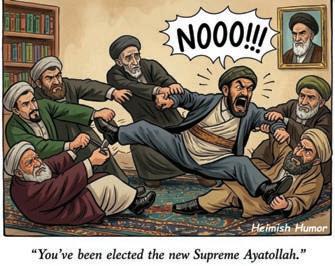
Adelekan said the police were “investigating chants made by a speaker.” Protesters held Iranian and Palestinian flags and posters of the new Ayatollah, Mojtaba Khamenei, and chanted “Death to the IDF.” The chants were led by punkrap musician Bobby Vylan, whom police investigated last year after he chanted the same phrase. Many held signs with phrases like “Stop Israeli war crimes.”
The Islamic Human Rights Commission (IHRC), the nonprofit that organizes the march, blasted British authorities for the ban, which it called “politically charged.” The organization added that the event was an “international demonstration…in support of Palestinians and all the oppressed around the world.”
Pro-U.S. and pro-Israel counter-protesters gathered on the other side of the River Thames, waving U.S. and Israeli flags, and chanting “long live the king,” in reference to the last shah’s exiled son, Reza Pahlavi, whose father was ousted following the 1979 Islamic Revolution.
Strait of Hormuz Shipping
Although Iran has blocked most ships from passing through the Strait of Hormuz, the Iranian regime is reportedly allowing some vessels to sail through.
On Sunday, Pakistan’s Karachi crude-oil tanker became the first non-Iranian ship to pass through the
Strait of Hormuz since Iran placed the Strait of Hormuz under blockade. Experts suspect that the vessel received permission from Tehran before passing.
Before Sunday, passing ships mostly belonged to Iran’s dark fleet, according to Jemima Shelley, a senior research analyst at United Against Nuclear Iran.
That same weekend, India sent through two India-bound tankers with liquefied petroleum gas following shipment negotiations with Iran. The first tanker arrived in India on Monday, while the second was expected to reach its destination on Tuesday.
Of the 17 oil-carrying tankers that passed through the Strait of Hormuz since the war’s second day until Sunday, seven flew the Iranian flag, while others were Chinese. Only one of the 17 was headed for Europe.
U.S. President Donald Trump has vowed to end the blockade by arranging for passing ships to be escorted.
Last week, the Strait saw five ships a day sail through on average. Before the war, it saw around 125. As of now, about 1,100 ships are stranded in the Gulf, including 250 petroleum tankers.
Oil prices fell on Monday, with Brent crude at around $100 a barrel.
Separating Iran and Oman, the strait’s narrowest point is only 21 miles wide, yet it is deep enough for massive tankers to navigate. Around 20 percent of global petroleum consumption –about 20 million barrels per day – pass through the waterway.
Iranian Soccer Players Withdraw Asylum
The Iranian women’s national soccer team departed Malaysia late Monday for Oman, ending several days of uncertainty following a diplomatic dispute sparked when multiple players sought asylum in Australia. The team left Kuala Lumpur after five of the seven players who had initially applied for protection visas from Australia reversed their decisions and rejoined the squad.
Players spent hours at the airport
For all your auto home life and business needs , , .
The Week In News
completing check-in procedures and waiting for their flight, largely avoiding interaction with the media. Some chatted quietly or used their phones, while one player paused several times to pray on a mat before boarding.
The Asian Football Confederation’s general secretary, Windsor John, said the team’s departure had been coordinated by the Iranian embassy. He confirmed that the players were traveling to Oman but said it was not their final destination, adding that the confederation had not been informed of the team’s complete travel plans. John said the AFC and FIFA would continue monitoring the players’ well-being in coordination with Iran’s football federation.
The controversy began after Iran was eliminated from the Women’s Asian Cup in Australia. The team flew from Sydney to Kuala Lumpur on March 10, initially leaving behind six players and one staff member who had asked for asylum protection from Australia. Since then, four players and the staffer have rejoined the squad, with no official explanation offered for the reversals. Members of Iran’s diaspora in Australia have blamed pressure from Tehran.
Concerns about player safety intensified after reports that some athletes had remained silent during the national anthem before their opening match, a gesture interpreted by some as political resistance or mourning. Team officials later sang the anthem at a subsequent match, and the players declined to clarify their earlier silence.
airports’ military bases, as well as U.S. diplomatic facilities, oil fields, and energy infrastructure, the U.S. simultaneously targets Iran-backed Iraqi militias throughout Iraq.
Iraq is reeling from this war, which has thrust it into a conflict it prefers to sit out. Additionally, Iraq is suffering from stopped exports through the Strait of Hormuz due to its economic dependence on oil.
Baghdad has sought to ease the strain by requesting exports of at least 250,000 barrels of crude per day from the Kirkuk fields through the pipeline to Ceyhan, Turkey, which passes through Kurdish territory. However, negotiations have stalled, as Kurdish officials have made their agreement contingent on lifting a current U.S. dollar embargo and reinstating trade-related economic benefits.
The U.S. has reportedly told Iraq that it wouldn’t be pulled into the war.
Iran and its proxies have also struck, nearly every day, commercial sites and hotels in Irbil, the capital of Iraq’s autonomous Kurdish region.
Iraq hasn’t had a permanent government since the November 2025 election, when the U.S. said it wouldn’t accept former Prime Minister Nouri alMaliki returning to power. Now, the country is run by a caretaker government with limited powers.
Chinese Assimilation Law
Iranian authorities have portrayed the players’ return as a political victory, while Australian officials described the situation as deeply complex. Two players remain in Australia and have been relocated to a secure, undisclosed location, where they are receiving government support.
Iraq Drawn into Iran War
The Iran war began on February 28 after the United States and Israel struck targets in Iran and assassinated scores of key officials, including Supreme Leader Ayatollah Ali Khamenei. Since then, strikes have been launched at other countries in the region. The only country that has been struck by both sides is Iraq.
While Iran strikes American interests in Iraq, such as Baghdad and Irbil
On Thursday, China’s legislature approved a major “ethnic unity” law meant to encourage assimilation. Critics believe the legislation will restrict the freedoms of minority groups.
Lou Qinjian, the National People’s Congress delegate who introduced the legislation, said the law is meant to foster “a stronger sense of community among all ethnic groups in the Chinese nation.”
“The people of each ethnic group, all organizations and groups of the country, armed forces, every Party and social organization, every company, must forge a common consciousness of the Chinese nation according to law and the constitu-
The Week In News
tion, and take the responsibility of building this consciousness,” the law reads.
The law forces all K-12 educational institutions to use Mandarin Chinese as their primary language of instruction, even though many ethnic groups speak different dialects or languages. The Chinese constitution even guarantees ethnic groups “the right to use and develop their own language.”
The law also promotes “mutually embedded community environments,” which Mingland Zhou, a University of Maryland professor of Chinese bilingual policies, says will “encourage Han and other minorities to migrate into each other’s communities,” thus breaking up minority-heavy neighborhoods.
China claims that the law will create equality, though critics disagree.
Those who hinder China’s progress toward “ethnic unity” can now face serious consequences due to this new law.
lamic Republic in Dena is part of the sacrifices of the proud nation that has emerged in this time of struggle against international oppressors,” Larijani supposedly wrote in what may have been his final missive. “Their memory will always remain in the heart of the Iranian nation, and these martyrdoms will strengthen the foundations of the Army of the Islamic Republic for years to come within the structure of the armed forces,” the statement added.
In a separate operation, Israel said it also killed Gholamreza Soleimani, head of the Basij paramilitary force, along with several senior officials. The Basij, part of Iran’s powerful Islamic Revolutionary Guard Corps, has been heavily involved in suppressing domestic unrest.
The IDF said Soleimani and other commanders were targeted at a temporary encampment near Tehran, adding that the group had been central to “repression operations” during recent protests.
In remarks released by his office, Katz praised the strikes, saying Larijani and Soleimani had joined other eliminated leaders, including Khamenei.
Iran’s Top Leader Eliminated
A senior Iranian leader was reportedly killed in an overnight Israeli airstrike on Tuesday morning, marking a major escalation in the ongoing conflict between Israel and Iran.
The IDF said that Ali Larijani, a top official and secretary of Iran’s National Security Council, was targeted and killed in a strike on Tehran. Israeli Defense Minister Israel Katz confirmed the operation, describing Larijani as a central figure in Iran’s leadership.
According to the IDF, Larijani had effectively become Iran’s top decision-maker following the death of Supreme Leader Ali Khamenei at the start of the war on February 28. The military said Larijani played a key role in directing Iran’s military and political strategy against Israel and overseeing internal crackdowns on protests.
Iranian authorities have not confirmed or denied Larijani’s death. Shortly after the Israeli announcement, Tehran released an undated handwritten statement attributed to him, though it did not address the reports of the strike.
“The martyrdom of the brave members of the Navy of the Army of the Is-
to Israel. The announcement came amid a diplomatic standoff which has worsened between the two countries over Spain’s opposition to Israeli policies, exacerbated by the U.S.-Israeli strikes on Iran’s regime.
Ambassador Ana Maria Salomon Perez was recalled to Spain last September amid a diplomatic row over Spanish measures banning aircraft and ships carrying weapons to Israel from its ports or airspace due to the war against Hamas in Gaza. Foreign Minister Gideon Sa’ar denounced the policy as antisemitic.
On Tuesday, Spain published an announcement in its official gazette that the ambassador’s position had been terminated. Spain’s Foreign Ministry said its embassy in Tel Aviv will be led by a charge d’affaires for the foreseeable future.
Israel’s embassy in Spain is also run by a charge d’affaires after Israel in May 2024 recalled its ambassador, Rodica Radian-Gordon, in protest of Spain’s decision to recognize a Palestinian state.
experts believe that seizing Iran’s enriched uranium stockpile would necessitate “the largest special forces operation in history.”
Last June, when the United States and Israel bombed the Islamic Republic’s main nuclear facilities, Western officials believed that Iran possessed around 440 kilograms of 60%-enriched uranium, which is very close to weapons-grade material (around ten nuclear bombs), as well as another 200 kilograms or so of 20%-enriched uranium. For reference, weapons-grade uranium is 90%-enriched. Iran rejects claims that it’s interested in building nuclear weapons, and yet, the regime enriches uranium to levels with no peaceful application.
About half of Iran’s 60%-enriched uranium was kept in tunnels at the nowbombed Isfahan nuclear site, according to International Atomic Energy Agency chief Rafael Grossi. However, the U.S. fears that the material could still be recovered through a “very narrow access point.”
Larijani, a longtime political insider and former parliamentary speaker, came from one of Iran’s most prominent families and had been involved in high-level strategy, including nuclear negotiations. Earlier this year, the U.S. Treasury sanctioned him for his role in coordinating the government’s response to widespread protests.
His reported death would represent another significant blow to Iran’s leadership, following the loss of several top officials in recent weeks, including senior military commanders and advisers.
The IDF also indicated this week that it had targeted additional militant figures, including senior members of Palestinian Islamic Jihad believed to be operating from Tehran. One such figure, Akram al-Ajouri, is believed to have been killed, though confirmation is still pending.
As the conflict continues, Israeli military officials said the latest strikes could have a significant impact on the broader campaign, signaling an ongoing effort to dismantle both Iranian leadership and allied militant networks operating in the region.
Spain Withdraws Ambassador
Last week, Spain said that it is permanently withdrawing its ambassador
Madrid had prohibited sales and purchases of military equipment with Israel from the start of the war against Hamas which began after the October 7 massacre in which 1,200 people were slaughtered and 251 people were taken captive into Gaza. Last September, Spanish Prime Minister Pedro Sanchez announced measures to enshrine the prohibition in law. Sa’ar criticized Spain as leading “a hostile, anti-Israel line,” after which Madrid also recalled its ambassador.
Tensions have heightened since the U.S.-Israeli strikes on Iran began on February 28, with Sa’ar accusing Spain in early March of “standing with tyrants” for opposing the war.
In May 2024, when Spain, along with Ireland and Norway, announced that it would recognize a Palestinian state, Israel’s Foreign Ministry called in the envoys of those countries, including Perez, to watch a video of Hamas atrocities committed during the October 7 assault.
Won’t Be Easy
Seizing Iran’s Uranium
According to a report published Sunday by the Wall Street Journal, security
James Stavridis, a former NATO commander, said that seizing the uranium at this time would require “the largest special operations forces in history” — as many as 1,000 military personnel, including combat troops who would secure perimeters as engineers dig through debris to check for booby traps and mines. A local airfield or makeshift airfield would be needed in order to bring equipment to the site and move the uranium out of Iran.
Iranian Foreign Minister Abbas Araghchi, the foreign minister of Iran, told CBS that Tehran has no plans of recovering the material, though he rejected talks regarding the stockpile.
U.S. President Donald Trump said recently that the U.S. doesn’t plan to seize the uranium for now.
“We’re not focused on that. But at some point, we might be,” he said. “Right now, we’re focused on knocking the … out of their missiles and their drones.”
On February 28, the U.S. and Israel began striking Iran, killing the regime’s leader, Ayatollah Ali Khamenei.
IDF Targets Hezbollah
Hezbollah launched a rocket at northern Israel on Monday evening, causing a fire and injuring six people, including two adults and four minors in Nahariya, all of whom were treated and are in good condition. Another man in his 40s was hit by
Old School
The Week In News
a blast near Kibbutz Kabri and sustained light-to-moderate injuries.
Before the strike, the IDF announced that it would be deploying troops deeper into southern Lebanon, kicking off a “targeted ground operation against key targets.” This comes around two weeks after Hezbollah joined the ongoing Iran war, which began after the U.S. and Israel launched strikes at the Iranian regime, killing the country’s supreme leader.
Israel Defense Minister Israel Katz vowed to continue the operation until residents of northern Israel are no longer threatened by Hezbollah.
“This operation is part of the effort to establish forward defense, including the destruction of terror infrastructure and the elimination of terrorists operating in the area, to remove threats and create an additional layer of security for residents of the north,” the IDF said.
“The IDF has begun a ground maneuver in Lebanon to remove threats and protect the residents of the Galilee and the north,” said Katz, adding that the IDF’s ground operation in Lebanon has the same goals as its campaign against Hamas in Gaza. “Hundreds of thousands of Shiite residents of south Lebanon who have
evacuated and are evacuating from their homes will not return to the area south of the Litani [River] until the safety of the residents of the north is guaranteed.”
The 91st “Galilee” Regional Division began a raid late Saturday in the eastern sector of southern Lebanon, during which troops encountered and killed several Hezbollah operatives, according to the military.
The IDF said the operation was aimed at expanding “the forward defense area.”
Before the troops pushed into the area, the IDF said it carried out massive airstrikes and artillery shelling “to remove threats.”
Katz has also threatened to target current Hezbollah leader Naim Qassem, who is hiding underground, and potentially seize territory in southern Lebanon.
If the Hezbollah chief misses his predecessor Hassan Nasrallah and former Iranian supreme leader Ali Khamenei, both of whom were killed by Israel, Katz said that “he will soon be able to meet them in the depths of [gehenom].”
Israeli officials have rejected recent reports of negotiations between the Jewish state and Hezbollah, an Iran-backed terror group.
6 Service Members Killed in Iraq
Many of the six U.S. service members who died last week when a refueling aircraft crashed in Iraq had dreamed of being in the Air Force from a young age, and they died doing what they loved — flying and serving their country, their families said in interviews and statements.
The service members, identified by the Pentagon on Saturday, were Maj. John A. Klinner, 33, of Auburn, Alabama; Capt. Ariana G. Savino, 31, of Covington,
Washington; Tech. Sgt. Ashley B. Pruitt, 34, of Bardstown, Kentucky; Capt. Seth R. Koval, 38, of Mooresville, Indiana; Capt. Curtis J. Angst, 30, of Wilmington, Ohio; and Tech. Sgt. Tyler H. Simmons, 28, of Columbus, Ohio.
U.S. Central Command had stated that the aircraft crashed after an incident involving another plane, which landed safely. Further details were not provided. The crash, which took place on Thursday in western Iraq, was not a result of hostile or friendly fire, Central Command confirmed.
The plane that went down was a KC135, which is used by the Air Force to refuel a wide range of aircraft while in flight. A U.S. official previously said that the other plane involved was also a KC135.
Klinner, Savino and Pruitt were members of the 99th Air Refueling Squadron, based at the Sumpter Smith Joint National Guard Base in Birmingham, Alabama, which functions administratively under the 6th Air Refueling Wing at the MacDill Air Force Base in Tampa, Florida.
In a statement, Col. Ed Szczepanik, the 6th Air Refueling Wing Command-
The Week In News
er, mourned the loss of the squadron’s members.
“To lose a member of the Air Force family is excruciatingly painful, especially to those who know them as son, daughter, brother, sister, spouse, mom, or dad,” Szczepanik said. “To lose them at the same time is unimaginable.”
Koval, Angst and Simmons were assigned to the 121st Air Refueling Wing at Rickenbacker Air National Guard Base in Ohio, the Pentagon said.
In a video posted online by the Ohio National Guard, Maj. Gen. David B. Johnson, Ohio assistant adjutant general for air, said they served with “dedication, professionalism and pride.”
“We lost three exceptional airmen in a tragic KC-135 crash in Iraq, and our hearts are extremely heavy,” he said. “Their loss is deeply felt.”
A partial government shutdown is beginning to take a visible toll on air travel across the United States, as hundreds of Transportation Security Administration (TSA) workers have quit or stopped showing up to shifts amid missed paychecks, leading to long lines and mounting frustration at airports nationwide.
According to the Department of Homeland Security, more than 300 TSA agents have left their jobs since the shutdown began in mid-February. Others are calling out at higher rates, with unscheduled absences tripling from about 2% to roughly 6%, further straining already thin staffing levels.
The impact has been immediate for travelers. At Hartsfield-Jackson Atlanta International Airport and George Bush Intercontinental Airport, wait times stretched to nearly two hours on Monday.
“Oh my G-d, are these the lines for TSA? That’s crazy,” traveler Alijah Brown said as she encountered the crowds in Atlanta.
The staffing crisis comes after TSA workers missed their first full paycheck during the shutdown, which stems from a political standoff in Washington over immigration policy. While federal employees are guaranteed back pay once the shutdown ends, many say they cannot afford to wait.
“Most Americans would quit their jobs if they didn’t get a paycheck on payday,” said Everett Kelley, president of the American Federation of Government Employees, which represents tens of thousands of TSA workers.
Some who remain on the job are struggling to make ends meet. “Officers are not just not showing up; they have reasons,” said union leader Aaron Barker. “Whether it is I can’t put gas in my car, I have to take care of my children.”
The strain is being felt nationwide, especially as spring break travel ramps up and severe weather disrupts flights. Airports in Florida, including Fort Lauderdale-Hollywood International Airport, reported security wait times of up to an hour, while hundreds of flights were canceled due to storms.
Despite the chaos, many travelers expressed sympathy for TSA officers working without pay. “I know they’re in a really tough spot,” one passenger said. “My frustration is with leadership, not the people working here.”
Airlines are also sounding the alarm. In a joint letter, executives from major carriers urged Congress to restore funding, warning that workers cannot “put food on the table” without pay.
Until a resolution is reached, both travelers and TSA agents appear stuck navigating a system under growing strain—one where delays, uncertainty, and frustration are quickly becoming the norm.
Gym Nation
Americans are increasingly spending their money on experiences rather than products—a shift that is reshaping the retail landscape across the country.
According to the Wall Street Journal, for the first time on record, service-based businesses such as salons, fitness studios, and wellness centers leased more retail space than traditional stores selling goods. According to data from CoStar Group, service-oriented tenants accounted for just over 50% of retail leasing in 2025, a sharp rise from about 40% fifteen years ago.
“Consumer dollars remain firmly
pointed at services,” said Brandon Svec of CoStar, noting there is little indication that trend will reverse anytime soon.
The shift reflects changing consumer priorities. Instead of spending on items like clothing or accessories, more Americans are investing in self-care—think Botox treatments, fitness classes, and spa services. The wellness sector alone reached $2.1 trillion in 2024, according to the Global Wellness Institute.
“A handbag used to be the luxury symbol,” Svec said. Now, he explained, status is often tied to experiences like yoga sessions or skincare treatments.
Businesses are quickly adapting. Shopping centers that once housed large retail stores are being reconfigured into smaller spaces tailored to service providers. At one suburban Philadelphia center, a former liquor store was split into multiple units now occupied by a nail salon, a stretching studio, a facial spa, and an animal hospital—together generating significantly higher rent and increased foot traffic.
Fitness, in particular, is booming. Chains like Planet Fitness are expanding rapidly, with plans to open nearly 200 new locations in 2026 after adding more than a million members last year. Group workouts and social fitness are becoming more common, with families and coworkers increasingly exercising together.
“We want you to come in here, maybe meet a friend, bring your co-workers,” said Noah Neiman, co-founder of the Rumble boxing chain, who recently launched a new group fitness concept in Manhattan. “This is the new happy hour.”
At the same time, e-commerce continues to shrink the footprint of traditional retail. Online sales now account for over 16% of total U.S. retail, roughly double their share from 2016. As a result, many clothing and goods-based retailers are downsizing or closing physical locations.
Even so, retail vacancy remains near historic lows, driven largely by demand from service-based tenants eager to meet Americans’ growing appetite for wellness, convenience, and in-person experiences.
Sugary Drinks May Lead to Teen Anxiety
A newly published Journal of Human Nutrition and Dietetics meta-analysis
points to a link between drinking sugary liquids and having anxiety in teenagers.
Researchers from the United Kingdom analyzed nine studies from 2000 to 2025 and found in seven of them that teenagers who consumed more sugary drinks than average had a 34% greater risk of having an anxiety disorder.
“With increasing concern about adolescent nutrition, most public health initiatives have emphasized the physical consequences of poor dietary habits, such as obesity and type 2 diabetes,” Dr. Chloe Casey, a study co-author and nutrition lecturer at Bournemouth University, said. “However, the mental health implications of diet have been under-explored by comparison, particularly for drinks that are energy-dense but low in nutrients.”
The study only highlights a correlation but not a causation between sugar consumption and anxiety.
“While we may not be able to confirm at this stage what the direct cause is, this study has identified an unhealthy connection between consumption of sugary drinks and anxiety disorders in young people,” Casey said. “Anxiety disorders in adolescence have risen sharply in recent years, so it is important to identify lifestyle habits that can be changed to reduce the risk of this trend continuing.”
The Centers for Disease Control and Prevention recorded that 11% of American kids ages three to 17 were diagnosed with anxiety between 2022 and 2023.
“While it’s important to note that this study is correlation not causation, I have no doubt that a better-designed study would show the same results,” said Ilana Muhlstein, a dietitian nutritionist based in Los Angeles. “Soda, aka liquid sugar — with no fiber, protein or fat to slow absorption — floods the bloodstream faster than almost any other type of food or drink.”
“The pancreas scrambles to respond, insulin spikes, blood sugar crashes and you are left in a dopamine deficit state that looks and feels just like anxiety,” Muhlstein added. “The sharper the spike, the deeper the crash.”
Terror Attack at Virginia University
An ISIS supporter named Mohamed Bailor Jalloh walked into an ROTC classroom at Old Dominion Uni-
The Week In News
versity last Thursday morning and began shooting, leading students to react instantly, fighting and overpowering the assailant.
The terrorist was killed in that fight, as a student stabbed him, though his cause of death has yet to be determined. But before the shooter died, he killed Lt. Col. Brandon Shah, an ROTC instructor, who, according to Virginia Gov. Abigail Spanberger, “didn’t just lead a life of service to our country –he taught and led others to follow that path.”
Before the assault, Jalloh yelled, “Allahu Akbar.” Jalloh was once a member of the Virginia National Guard and was later imprisoned for trying to aid ISIS in 2016.
Shah, the victim, served as a military science professor at the university’s Army Reserve Officers’ Training Corps. In 2003, he joined the army for active service and served in Operation Enduring Freedom and Operation Iraqi Freedom. Having amassed more than 600 combat flight hours, he won numerous awards, including two Bronze Stars.
Two other university members were wounded in the attack.
Authorities suspect that the assailant intentionally carried out the attack during Ramadan.
While attempting to obtain weapons for a terrorist attack in 2016, Jalloh was discovered by the FBI. In 2017, he was sentenced to 11 years in prison and was freed in December 2024.
“Our campus and our community have been truly shaken and forever impacted by this senseless act of violence, and we want to extend our thoughts and prayers to the families and the victims and those that were impacted by this act today,” Brian Hemphill, the university’s president, said during a news conference on Thursday.
The university canceled its main campus’s classes and operations for Thursday and Friday, following the attack.
Michigan Synagogue Car Ramming
On Thursday, Ayman Mohamad Ghazali, a 41-year-old naturalized citizen born in Lebanon, drove his car through a hallway at Temple Israel —
one of the United States’ biggest Reform synagogues — in West Bloomfield Township near Detroit, Michigan.
In 2011, Ghazali arrived in the U.S. on an immediate relative visa, as his wife was a U.S. citizen. According to the Department of Homeland Security, he became a U.S. citizen in 2016.
Special Agent Jennifer Runyan, who heads the FBI’s Detroit field office, condemned the attack as a “targeted act of violence against the Jewish community,” adding that the FBI was actively investigating the car ramming.
As of now, the assailant’s motive is unclear.
None of the synagogue’s early childhood center’s staff, teachers, or students were hurt, though the terrorist’s vehicle hit one security officer, who was knocked unconscious and sustained non-life-threatening injuries. Another 30 officers were treated for smoke inhalation.
According to Dale Young, the police chief of West Bloomfield, the congregation’s security officers “engaged the individual and neutralized the threat.” The terrorist was found dead inside his car.
Arianna Gordon, the head of the congregation, expressed her gratitude for the security team and law enforcement, praising them as the “true rock stars of the day.”
President Donald Trump called the attack a “terrible thing.”
“This is heartbreaking,” Michigan Gov. Gretchen Whitmer stated. “Michigan’s Jewish community should be able to live and practice their faith in peace.”
No Permit for “No Kings” Event
A recently instituted Montana rule mandates that public events at the Capitol Complex that need a permit “may only occur on weekdays and between the hours of 7 a.m. and 6 p.m., excluding holidays,” which effectively blocks the upcoming “No Kings” rally in Helena from happening as planned.
All public events, which are defined
as events that are “open to the public and to which the public will have full access,” require a permit if they use “state resources, requires setup of any structures, materials, displays, or requires clean-up.”
Thousands of demonstrators gathered in Helena at the Capitol Complex in October for the anti-Trump “No Kings” rally. The next nationwide “No Kings” rally is set for Sunday, March 28.
A spokesperson for the Montana Department of Administration told Montana Free Press that the new rules ban weekend events involving equipment like sound stages, though other types of gatherings on the Capitol grounds are still permitted.
“Setup of items like generators and sound stage equipment is only permitted during weekday business hours with an event permit issued by the General Services Division, even if the equipment is provided and set up by event organizers,” said Janna Williams, a spokesperson for the Department of Administration.
“The Department is committed to upholding the First Amendment,” Williams said. “Department lawyers reviewed the changes and determined the revised policy is consistent with the Montana and United States Constitutions.”
While the event’s organizers claim that the state is deliberately limiting their First Amendment rights, state officials maintain that the rule was only instituted to save money.
“We were told that there might be a policy coming into place that would eliminate support for permits for weekend rallies,” said Barbara Barnes, who represents Indivisible Helena, the organization behind the rally. “And so we wondered, ‘Would this be something we’d be dealing with?’ And of course, for us, changing the date on the 28th of March is not an option because this is a national event.”
Barnes noted that earlier rallies — typically held on the Capitol plaza — allowed organizers to use the building’s power supply and assemble a stage for speakers.
This time, lacking the proper permit, the group intends to shift the event to Sixth Avenue in front of the Capitol. They plan to use a flatbed trailer parked on the street as an improvised stage, while attendees may gather on the Capitol lawn so long as sidewalks are kept clear.
“ We have the right to assemble in
that way, we just don’t have a right to the sound system and all of the rest of it, and that really does inhibit our right to free speech and assembly,” Barnes stated.
Goldfish Drives Car
If a goldfish can drive a car, perhaps your toddler can, too.
Thomas de Wolf recently constructed a four-wheeled vehicle with a water tank for his goldfish, Blub. When Blub moves inside the tank, the car begins to drive. Blub, who seems to be a very talented fish, managed to drive the vehicle 40 feet in one minute to break a world record.
Nothing fishy about this feat at all.
“Normally, my job is quite monotonous, so I wanted to create something that would entertain people, turning my ‘serious’ job into something fun,” de Wolf said on Guinness World Records’ Italian TV series Lo Show dei Record
De Wolf said that while a car driven by a goldfish might not be particularly practical, the motion-sensing technology that it runs on could prove to be very useful to people with disabilities.
“The objective is to show people what is possible to achieve with this kind of technology, even when it’s not necessarily something ‘serious,’” he shared. “I would love to maybe one day be able to help people with mobility issues.”
Blub the goldfish was placed into the car and drove it for a distance of 40 feet and 3.46 inches, setting a new Guinness World Record for the greatest distance covered in a motion-sensing vehicle by a goldfish in one minute.
“How am I going to explain to Blub now that he has a world record title?” de Wolf mused.
We wouldn’t want him to be fishing for compliments…
Torah Thought The Bull, The Lamb And The Goat
By Rabbi Zvi Teichman
The first offering that is discussed at the onset of our portion is the הלוע, the elevated offering.
Rav S.R. Hirsch elaborates on the notion of a ‘striving to rise higher’; to defy the laws of ‘gravity’ in pursuit towards developing ‘perfection’; endeavoring a ‘life of goodness and spirituality’ in progressive steps ‘upwards’.
He expounds on how the animals that the Torah allows to be offered represent the character of human beings.
The רקב, the powerful bull, who ploughs the field mightily, symbolizes ‘a personality active and working in the service of a higher personality.’
The בשכ, the simple devoted sheep, whose instinctive indebtedness to its shepherd, who cares, tends and protects him, represents our resolve to devote with enthusiasm to the commands of G-d, our ultimate Shepherd
The זע, the goat, ‘who is only tame and tractable towards its master, but which obstinately shows its horn to any stranger’, typifies the ‘purest characterization of resistance, deaf to all external enticements, remains immovable, and faithfully follows the command of its master.’
(אכ-ט-וט
In one’s animal of choice lies a deeper expression of one of these three aspects of commitment to G-d; a sense of mission and purpose, a manifestation of utter devotion and indebtedness, and finally a stubborn declaration of independence from the forces that seek to deter us from this pure consciousness.
The Midrash (ט זכ ר"קיו) corresponds the רקב — the bull, to Avraham who with great zeal ‘ran to the cattle’ to prepare generous food for his angelic guests; the שבכ — the sheep, to Yitzchok whose allegiance to the ‘Shepherd’ by gladly offering his total essence at the Akeidah, was eternalized in the ram, a male sheep, that appeared in the thicket and was brought in his stead; the עז — a goat, to Yaakov who gallantly defied Esav in taking the two goats in order to provide delicacies for his father, so that he may bless him.
Remarkably, tradition maintains that each of these three episodes took place on either the eve of, or on Pesach, the fifteenth of Nissan!
(בל א"רדרפ, אי וט ר"מש ,בי חמ ר"רב)
The Holy Zohar states that if we perform the mitzvah of Matzah correctly on Pesach we can ward off the need for judgment on Rosh Hashana.
(:גפק
The Tzemach Tzadik reveals that this is hinted in the ritual of הרעקה
— to elevate the Seder plate during the Seder.
If one ‘lifts up’ each letter of the word ה-ר-ע-ק, then the letters ר-פ-ו-ש, the Shofar, will appear.
ר follows ק, פ comes subsequent to ע, ש appears after ר, and finally ה precedes the letter ו!
The Shofar asserts three basic tenets of our belief:
תויכלמ — Kingship, the existence of a Creator Who infuses it with purpose.
תונורכז — Remembrance, the notion accountability for every choice we make.
תורפוש — Shofar of Sinai, asserting that G-d blasted forth His directive for this world — the Torah, and we must adhere to its every detail.
In the Hagaddah, immediately prior to our beginning the actual account of the exodus, we recite three seemingly disparate paragraphs.
וניתובא
— the paragraph that gives a very brief history that begins with Avraham’s undertaking his ‘mission’ to bring awareness of G-d to the world.
...לארשיל
— an ‘accounting’ for the misdeeds acted against His people and the
great ‘reward’ that awaited us upon leaving Egypt.
...וניתובאל הדמעש איהו — the assertion that 'איהו' — and ‘It’: the Torah and its message of truth [— הדמעש איהו being numerically to the word תמא, ‘truth’ —] that we abide by unflinchingly even against the greatest threats from our enemies, is what preserves us through the generations.
Avraham began the mission with the vigor of a ‘bull’. Yitzchok taught us of the allegiance of a ‘lamb’ to its shepherd without question. Yaakov, who like the ‘goat’ resisted fiercely those who sought to deter him from his path.
On the night of Pesach we initiate our program of celebrating the exodus, by reiterating the greatness of the Avos whom we seek to emulate, as we progress towards the final redemption.
May we instill within ourselves and our children, not only the inspiration of the story of the exodus, but more importantly an enthusiastic sense of mission, commitment and the stubborn refusal to submit to the weakness of temptation.
If we succeed, we will yet hear following the night of Pesach, the blast of the Shofar of Moshiach!
You may reach the author at: Ravzt@ ohelmoshebaltimore.com
The Adas: Chofetz Chaim Adas Bnei Israel - 5915 Park Heights Ave
The Shul at the Lubavitch Center - 6701 Old Pimlico Rd
Tiferes Yisroel - 6201 Park Heights Ave
Tzeirei Anash - 6706 Cross County Blvd
Wealcatch Insurance - 37 Walker Ave 2nd floor
Yeshiva Tiferes Hatorah - 6819 Williamson Ave
Sharing the Truth Through Laughter and Humor
By Malkie Schul M an
Twenty-four-year-old comedian and content creator Yechiel Jacobs is the most followed Orthodox Jewish comedian on the planet. With over half a million followers on Instagram and hundreds of millions of viewers across other social media platforms, he’s built a massive audience in a very short time. Way before viral success overtook his life, his connection to Israel and the Jewish
people has been central to who he is. In fact, his love for am Yisroel and the land of Israel is what initially catapulted him into almost overnight fame.
Born in Israel, Yechiel lived in Beitar and Beit Shemesh until the age of four and a half. His family then moved to Cedarhurst, New York, where he grew up. Currently, Yechiel resides in Hollywood, Florida, although he admits he’s rarely there for very long, as he flies out of the country several times a month to perform shows worldwide.
Growing Up Funny
“As far back as I can remember, I always loved being in front of the camera. As a kid, I used to tell everyone that for sure one day I’m going to be on the Disney Channel,” Yechiel says with a laugh. “I was always conscious of whether I was being funny enough, especially in school. I did all kinds of impersonations for laughs and was definitely the class clown.”
Nevertheless, though Yechiel hasn’t made it to the Disney Channel, he has carved out his own spotlight,
building a presence on social media that in many ways surpasses his childhood dream.
“I come from a family of performers,” he shares. Sam Jacobs, Yechiel’s dad, is a well-known magician who performs regularly, and his mom, Danielle, is a dance instructor and a social media personality in her own right, known as the hilarious ultra-yeshivish rebbetzin Rivka Leah Zelwig. She’s also collaborated with Yechiel in a few of his anti-Hamas videos, where the two play off each other. Yechiel’s sister, Yocheved, presently a social worker living in Israel, shares the Jacobs’ family sense of humor and has teamed up with him several times as well.
School performances were a natural outlet for Yechiel as a child. He was always involved in skits and plays, especially Purim plays, which he took very seriously. The holiday of Purim in particular was always a big deal in the Jacobs household.
“We had crazy costumes, like something out of a movie set,” Yechiel says. “One year, we dressed up like zombies. Not amateur zombies, the real deal. I had teeth coming out the side of my face, and nails protruding from my neck.”
Another year, Yechiel, his sister, and their parents dressed up as elderly people. They looked so authentic that people offered to help them cross the street.
“The funniest part was when we had been safely walked across the street by these kind people, we’d break out into a wild dance,” Yechiel recalls, laughing.
Another Purim, they dressed up as a Six Flags roller coaster, complete with sound effects of both the roller coaster and the hysterically screaming passengers. Some of these performances were recorded and uploaded to YouTube, where they can still be found under the name “Jacobs Purim.”
“When I was young,” Yechiel recalls, “I’d sometimes join my father in his magic shows. Once, when I was twelve years old, we did a show in the chassidish town of New Square, New York. I performed a juggling act in front of four thousand people. That was cool.”
Music and dance were also part of Yechiel’s upbringing. “I took dance classes as a kid.”
And the humor doesn’t stop with his parents. Yechiel insists that his ninety-something year-old great-grandparents are a riot.
“They don’t even try to be funny. They just are,” he says.
After finishing yeshiva high school in the Five Towns, Yechiel went to Israel to learn at Ohr Yerushalayim (OJ). It was the COVID year, so he returned earlier than planned. When he came back, comedy was still not yet his focus.
“At that point, I just wanted to make money, so I went into car sales and then real estate,” he says.
When It All Clicked
The turning point came after October 7, 2023.
“The October 7 war hit,” Yechiel shares, “and I was seeing all this anti-Israel, anti-Jewish rhetoric all over social media and regular media.”
What stood out to him most was that no one seemed to be responding or challenging it. He wanted to do
something but couldn’t figure out what. Then it became clear. He could use his strength, his humor, to combat it. His thought was to use humor to highlight the insanity of antisemitic, pro-Hamas posts. It wasn’t about using dark humor, he observes, but about flipping a very dark topic and making it light so people could see it for the craziness that it is.
“When I started, my intention in posting a video was not about growing my audience,” he says. “It was just my way of responding to the hate.”
Yechiel started posting about a month after October 7 and immediately he knew something was there. That first video reached half a million views. The second reached a million.
“I felt like Hashem was telling me, forget about real estate. You’re going into comedy.”
Within a week or two, he realized that while he may not yet be a comedian, he had most certainly become a social media personality.
“People were attacking my family, the Jewish people, and I felt I had to take a stand.”
The videos spread quickly. They were funny, but they were also direct. He was calling out what he saw as the absurdity behind many of the posts attacking Israel and Jews.
“For me, it wasn’t politics,” he says. “It was that people were attacking my family, the Jewish people, and I felt I had to take a stand.”
Whether impersonating popular Italian American comedian Sebastian Maniscalco or a ditzy, woke, multicolor-haired pro-Palestinian college liberal, Yechiel began to use his humor to draw attention to hostile rhetoric that makes no sense. For example, in one reel, Yechiel takes the well-known tune “The Sun Will Come Out Tomorrow” from the Broadway show Annie and together with fellow comedian, musician, and actor Eli Staiman, humorously rewrites the lyrics as “The Time Has Come Now to Martyr,” using satire to call out antisemitic online narratives.
Yechiel confesses his online persona has a threefold goal. One is to grow his brand. The second is to make people laugh. The third, and the one he’s most passionate about, is to strengthen the Jewish community, to let them know they’re not alone, and to stand with them as a proud Jew who loves his Judaism and his country, Israel. He regularly hears from people who
say they hadn’t laughed since October 7 until they found his page. Many tell him they were in a dark place and that his videos helped lift them. Hearing that means everything to him.
Another powerful aspect of social media is its reach. When content goes viral, all kinds of people see it. Many non-Jews who knew little or nothing about Israel have been exposed to the truth through Yechiel’s videos.
“I have non-Jews reaching out to me who say thank you for sharing that information. I had no idea,” he says.
One previously anti-Israel Muslim even contacted him to say he was now questioning the rhetoric he’d been fed his whole life. Yechiel acknowledges that diehard antisemites won’t be changed by funny videos, but those whose opinions are based on misinformation can be swayed.
On another gratifying occasion after doing a show in Miami, Yechiel relates, “A young non-Jewish woman from India who was studying in the States came up to me afterwards. She said that until she started watching my videos she knew nothing about Israel. Once she began watching my stuff online, she started doing more research. She came to fall in love with the state of Israel and had recently made plans to visit there for the first time with her father.”
Going viral has also led to unexpected connections. Yechiel has met and collaborated on pro-Israel videos with vocal pro-Israel Hollywood actor Michael Rappaport and celebrity singer and dancer Montana Tucker. One of his videos, a “Jewish dance edition” sketch with Montana Tucker and well-known British influencer and comedian Zach Margs, garnered one million views and shows the three performing a dance they dub the “tefillin wrap,” as well as another called the “challah braiding” dance. He’s also gotten to know Nate Buzolic, better known as Nate Buzz, an Australian actor who isn’t Jewish but is very vocal in his support of the state of Israel.
As his anti-Hamas videos continued to expand their reach, Yechiel received a message from the Laugh Factory, a famous comedy club in Los Angeles.
“They told me they loved my videos and asked if I’d be interested in doing a ten-minute standup routine. I’d be performing with world class Jewish comedian Elon Gold, followed by the wildly popular non-Jewish comedian, Jo Koy.”
Yechiel was given two weeks to prepare.
“Standing there on stage and performing was one of the most incredible moments of my life,” he says. “Seeing positive emojis and comments on my phone is one thing. Seeing people laugh in real time is unbelievable.”
Soon after, he was asked to be the headliner for a show at the New York Comedy Club in Manhattan.
“The first show sold within the first hour of posting, then the second show sold out. I had two full shows in one night. Watching those tickets go so quickly was amazing.”
Since then, in the last almost two years, Yechiel has been traveling constantly, performing across the United States and internationally, including Canada, Australia, England, Guatemala, Panama, and Mexico. The venues vary in the amount of people they hold, he says, some
holding only 150 people while some theaters seat up to 1,500 people. If the venue is smaller, Yechiel will do multiple shows.
Every month looks different, he shares. Some months he performs every week. Other months are quieter. And on each set, Yechiel is there proudly wearing his kippah, even saying a bracha out loud on stage.
“I want people to see that I’m openly proud to be a religious Jew,” he explains.
In the beginning, almost everything Yechiel did focused on Israel. Over time, he became more intentional about branching out. Today, Yechiel estimates that about sixty percent of his content is random or character driven, while about forty percent still leans toward Israel.
“But I’ll always be there to defend the Jewish people and our country,” he maintains.
Baruch Hashem, his commitment hasn’t gone unnoticed. The Israeli Ministry of Foreign Affairs flew Yechiel to Israel twice, both as a thank you and in recognition of the exposure he was generating. The Israeli government brought together social media personalities and influencers to reignite the flame of Jewish pride and remind them why the work they’re doing matters.
“On the first trip, they took us to the Nova festival site and to the kibbutzim that were attacked,” Yechiel discloses, “to show us up close what we’re fighting against and to see what was actually happening on the ground. It was an intense and deeply moving experience.”
The second trip focused on Israel’s response to the atrocities and highlighted how the country has grown stronger, showing the light that emerged from the darkness of October 7. Yechiel reflects that these visits were helpful.
“Posting the same content even if it is dressed up in different forms can get monotonous, but seeing why I was doing it encouraged me to keep it up and even step up my game,” he says.
Early on, Yechiel received a wave of hate messages, including death threats, for his pro-Israel videos. Some threats were even sent to his mother to intimidate him, warning her that they were going to go after her son. It was scary, he acknowledges. Over time, he realized many of the threats came from bot accounts rather than real people.
“One person can set up hundreds of accounts to flag pro-Israel posts and then automatically send out hate messages,” he explains. “There was probably just one nasty hater behind it.”
Still, he needed to decide whether to continue posting or stop.
“My mom was concerned but I felt that if I was getting threats, it meant people were seeing my content and I was making a difference.”
Ultimately, Yechiel chose to continue and even increase his output. Eventually, most of the hate died down, though he still occasionally receives hostile comments.
Visibly Orthodox Jews in the media inspire Yechiel, especially prominent figures like conservative political commentator and media personality Ben Shapiro. On perhaps a less high-profile level, Yechiel views himself as a similar voice for the younger generation. “I thought if Ben can do it, so can I,” he notes.
Yechiel values the fact that Ben is seen by millions as a relatable yet openly proud religious Jew.
“It’s important that secular Jews and non-Jews not associate Orthodox Jews just as the man who won’t sit next to a woman on a plane,” he stresses.
On a more personal note, Yechiel has met Ben Shapiro on two occasions and shares that hearing Shapiro tell him he appreciated his videos was deeply affirming.
A Day in the Life of a Comedian
“I don’t have a real routine,” confesses Yechiel. “Every day looks different.”
The only structure he consistently keeps is his davening and making a daily video.
“I wake up, pray, eat breakfast, and then say to myself, ‘OK, Yechiel, what video are you making today?’”
When deciding what to turn into a video, relevance is key, Yechiel maintains. If something is happening in the news, he’ll hop on his phone and make a video about
“I want people to see that I’m openly proud to be a religious Jew.”
it. For example, the minute the news broke that Trump put Venezuelan President Nicolás Maduro under arrest, Yechiel posted a video, which – no brainer – went viral because it was so timely and intrinsically explosive.
The second thing he looks for is relatability. If people feel like the same thing happened to them or could happen to them, the video takes off.
“My most favorite character is whatever character I’m impersonating that day,” he claims. But even the funniest character can get boring after a while, which is why Yechiel loves to constantly mix things up. His content, besides his Sebastian Maniscalco impersonations, includes Trump impersonations, absurd characters, and his most viral persona to date, King Julien, the lemur from the movie Madagascar.
“King Julien is mostly just himself,” he says. “Innocently arrogant which is what makes him so laugh-outloud hysterical.”
Besides the laughs he’s looking for, Yechiel often uses his characters to slip in deeper messages. For instance, in his signature over-the-top way, as King Julien, he will say, “Remember, be a cucumber in a world full of bananas,” meaning, remember to be yourself. Don’t feel pressured to blend in.
Another great thing about characters like King Julien is that they bring in people who would never inten-
tionally watch Israel related content. “They come for King Julien, and then they see the Israel videos. They message me, ‘Bro, I know nothing about Israel, but your King Julien videos are killing me.’” From there, they’re introduced to Israel through a clear and unbiased lens.
Though Yechiel acknowledges that his audience is primarily the Jewish community, religious and secular, his reach goes far beyond that. Jews and non-Jews attend his shows, and he estimates that around two hundred thousand of his followers are non-Jewish. His audience ranges from six-year-olds asking to take a selfie with him to eighty-year-old women coming up to him after shows for an autograph. However, the main age range at live performances is generally between 25 and 45.
Not every show has gone perfectly, Yechiel concedes. He recalls a Hatzolah event for major billionaire donors where the comedy did not land well. He was supposed to do thirty minutes but ended up only doing fifteen. Instead of laughing, people were saying, “Oh, that’s interesting.” Yechiel says he remembers thinking, “Uh oh, I gotta get out of here!” While he can laugh now about it, at the time, it was a very humbling experience. Looking back, he sees it as a part of the learning process and a reminder that humor, like any form of connection, only works once trust has been established.
“Most people who come to my shows already know who I am. They’re coming to see me. They know what they’re getting into. These people had never heard of me. I was overconfident. I hadn’t earned their trust,” he admits.
Looking ahead, Yechiel plans to continue creating content and performing stand-up. He’d love to expand into acting, but he’s not willing to do anything that isn’t acceptable to his religious standards.
“I already had an had offer for a TV show that I turned down,” he maintains, “because it was completely not my cup of tea. (i.e. not ‘kosher’).”
Yechiel also mentions the possibility of moving to Israel one day, although because of his present heavy travel schedule, it doesn’t make sense right now to make aliyah. At some future date, though, “It’s something I would love to do.”
His passion for Israel is personal.
“Not only because I was born there. My great-grandparents were born in the Old City of Jerusalem. My great-grandparents are actually older than the state of Israel. I’ve had a family member participate in every war in Israel since its inception. My sister finished her army service in the IDF five years ago. Israel is my homeland. Even in America, my life revolves around it.”
Yechiel’s message to the Jewish people is clear.
“Israel is one of the smallest countries in the world, yet we are the biggest family in the world. And just like every family, we don’t always agree on everything. But it’s important that we have each other’s backs and love one another despite our differences.”
Beyond that, Yechiel’s message to the world is simple: be happy. Don’t worry. Don’t take life too seriously. Enjoy the simple things and don’t forget to laugh.
In other words, be a cucumber in a world full of bananas.
To Raise a Laugh
Cleaning Man
The cleaning lady came in today. We don’t actually have a cleaning lady, so it’s a little weird.
Okay, it’s not so weird. We’re making a bar mitzvah, and someone suggested we get help. She even lent us her cleaning lady, because that’s something you can do with human beings. Lend them.
We’ve never really had a cleaning lady. As the one who works at home, I generally do most of the cleaning in our house while I’m trying to psych myself up for writing. Then I sit down, amid the cleaning fumes, and see what I can come up with.
I’m not sure why people hire a cleaning lady in the first place. Is it because she knows how to clean things we don’t, or because she has time to scrub things because she’s getting paid? As far as I can tell, you mostly hire cleaning ladies so you can give them all the non-kosher foods you buy by accident.
I don’t even know what to do here. Should I clean before she comes?
I should clean before she comes!
And I did. I know that’s a cliché, because what’s the point, right? Well, she is a guest in our home. One that we’re paying to be here, by the hour. And I don’t need to pay her to sweep the dining room. I can do that. I pay her to scrub things that we haven’t scrubbed in months, like that area under the toaster oven where somebody apparently lost an entire piece of bread – buttered – and DIDN’T CARE.
Actually, my plan was to spend several hours cleaning before she got here, and then challenge her to find things I missed. Because as far as I can tell, one benefit of a cleaning lady – especially if she’s there only once – is that she’s a fresh pair of eyes. When you live somewhere, you kind of
get used to some things that are technically considered a mess, and it looks normal to you. But then the cleaning lady comes in and says, “What’s this pile?”
“I don’t know. There’s just always a pile there now. Should I push it more to the side?”
When you clean the house, you sweep around the pile.
Not that I was in a rush for her to be here, because the first thing I realized, once she walked into my house, was that I don’t even know how to have a cleaning lady. Do I have to stand over her and point to what I want her to clean? That definitely feels like slavery. Should I just sit around while she cleans? Maybe get some work done? Thanks to my mother, I have this guilt when someone’s cleaning my messes and I’m just sitting there, and I can’t concentrate on what I’m doing.
I know what you’re thinking: Why don’t I just give her a list? After all, my wife made me one. But it turns out that this woman didn’t speak a word of English. Which his weird, because my wife’s friend doesn’t speak a word of Spanish. I’m not actually sure how they started this relationship in the first place. How do you mime to someone that you want them to clean your house on a regular basis?
It’s possible she doesn’t even know she’s a cleaning lady. Maybe she’s just trying to be helpful while she’s here. Maybe she thinks she’s a security guard.
So I may as well clean while she’s cleaning. It’s not like I’m going to get any work done anyway, because I have to keep an eye on her so she doesn’t helpfully treif up my kitchen.
We never officially made introductions, so she called me, “Hello.” I didn’t correct her. She said “Hello?” and I came running. I like to think it’s because when I opened the door, I said, “Hello,” and she thought I was introducing myself.
By Mordechai Schmutter
I called her, “Hola.”
So for example, at some point, Hola held up an old mop that she’d found and said, “Hello?” And I said, “Yes,” and she said, “No trabajo.” I knew what “no” meant, but I didn’t know what “trabajo” was, so I thought it meant “mop.” So I was like, “Oh, okay; here’s a trabajo.”
For the most part, I kept myself busy cleaning things I didn’t want to ask her to do. For example, I replaced the water in my son’s fish bowl. Though that was the week that a notice went out around town that there was lead in the tap water, so I wasn’t sure what to replace it with. I decided to use filtered water, because we’re fancy people who can afford a cleaning lady. Anyway, turns out that filtered water is horrible for fish. They were all dead before she left the house. And I didn’t want her to see, so I lined up all the cleaning products in front of the fish bowl. Then it occurred to me that she’d think that I’d poured the cleaning products INTO the fish bowl.
But now I think I know why people hire mostly Spanish speakers. This person goes into the most embarrassing corners of your house, but who’s she gonna tell? Nobody you know.
“So I worked for a guy named Hello, and he killed his fish. Why didn’t he have ME clean the bowl? I was like “Hello? You have a cleaning lady!””
And it works both ways. Maybe the purpose of the cleaning lady is for sholom bayis. That way, if something gets moved, or dies, you can just blame the cleaning lady, and she can’t say otherwise because of the language barrier. Especially since she’s not coming back.
Mordechai Schmutter is a freelance writer and a humor columnist for Hamodia and other magazines. He has also published eight books and does stand-up comedy. You can contact him at MSchmutter@gmail.com.
Soul Searching A Network, A Phone Number, and A Connection To Judaism
By Gianna Metzger
When I made aliyah in July 2024, I knew that I wasn’t running toward something I’d always known. I was discovering something entirely new.
Originally from Tampa, Florida, I arrived in Israel in March 2025, officially completing my aliyah four months later. Now, as a student on the Aspire program at the Suzana and Ivan Kaufman Aish Institute for Women’s Education, I’m building the foundations of a life I could barely imagine possible just a few years ago.
I did not come from a religious family. In fact, religion remained a skewed and confusing concept during my childhood. However, as a teenager, something shifted. I started realizing that there was something more and that it wasn’t just me.
I began exploring Judaism, connecting with different people and organizations throughout Florida. I had the privilege to meet Jews from every background imaginable. And surprisingly, my family became my biggest champions.
One might think that a family that’s not super religious wouldn’t be so supportive, but they couldn’t have been more positive. They basically have just helped me along my way, and they’ve been my biggest supporters.
My path to the seminary came through a network of connections. I knew I wanted the kind of program that Aish offers, after deciding to make aliyah. A rabbi passed along the contact details of the Managing Director of Aish’s Women’s Programming, Michal Dubov. After hearing my story and background, Michal told me that the seminary had the perfect program.
That program turned out to be designed specifically for women without strong religious backgrounds who wanted to grow in their Judaism. It proved an ideal fit for me. Although I’ve only been here since September, the amount of
support and guidance and resources and growth that I’ve done in just that short amount of time is exponential.
The difference lies in how the material gets taught. Complex concepts that might overwhelm someone from a non-religious background get broken down into digestible pieces. Each class builds on the previous one. Even several weeks later, I realize that the information sticks.
As someone who describes myself as a logical thinker, I found unexpected growth in spirituality classes. Rivka Pesha Alter (whom students call RP) has become a particular favorite.
She takes really spiritual concepts, which I find to be the hardest to understand. I’m really good with logical concepts. Those I can break down and put on paper, but the really spiritual concepts, the Kabbalistic concepts, things that take years and years for people to even begin to grasp, she’s very good at breaking them down.
Most importantly, RP encourages students to research topics independently and even challenge her ideas. That’s such a huge thing here at Aish, that we’re encouraged to challenge the teachers who are instructing us.
This approach has helped me to break out of the box my logical thinking sometimes creates. Society tends to push logical thinkers toward purely academic pursuits while directing spiritual, artistic thinkers elsewhere. The two paths rarely intersect. Here at the seminary, I feel we are encouraged to grow in both of those things and understand that we don’t have to put ourselves in a box. I’ve learned parts of myself that I didn’t even know existed before I came.
If I could go back in time and talk to my high school self, I think I would tell her it’s OK to let go of control a little bit and just let life come. That’s definitely not something I would have said maybe
even as little as a year ago.
Control remained a central issue for the teenage me. I felt uncomfortable without logic, plans, and categories for everything in my life. I shared this struggle with the amazing staff when I arrived at the seminary, particularly with the rakezets (coordinators) assigned to check in with students weekly.
Their support helped. Over these months, I’ve developed the ability to go with the flow more and allow myself to grow naturally, without grasping for the control I understand I won’t always have.
Many prospective students worry that attending seminary means putting their lives on hold. They’re leaving jobs, families, education, and home countries. The pause feels risky.
I empathize with that concern; but my experience proved the opposite.
There is nothing but good that is going to come from this experience, and it’s very much not a pause in your life. The only thing that your time at Aish can do is help you build that life in a really healthy and positive way with some really good values and really practical knowledge and really a lot of growth internally.
I think about Aish’s core values of wisdom, love, and responsibility, which I hadn’t realized were so central to its mission, but I’ve seen them up-close in my experiences here.
The program welcomes students from every imaginable background. Normal stories mix with extraordinary ones. Every student receives the same open arms and comprehensive support.
I recently went through a difficult personal situation, which caused me to approach Dean of Students Esther Jankelow for help. The response came immediately: How can we support you? How can we make sure you’re still getting what you need? They have a saying here: “healthy before holy,” and that has been my experience.
That philosophy helps students absorb the knowledge they’re learning. It creates space to feel supported when overwhelmed. And for people experiencing major life changes and growth, that support matters enormously.
After my year at the seminary concludes, I plan to begin my army service in Fall 2026. I’ll carry forward the foundation I’m building now. As a logical thinker having previously struggled with control, I’m learning to embrace uncertainty.
I’ve discovered that sometimes the most important journeys begin with a phone number passed from person to person, leading somewhere you didn’t know you needed to go, but in hindsight couldn’t imagine your life or your journey without.
Gianna Metzger, 21, grew up in Land O’ Lakes, Florida. Prior to moving to Israel, she worked as a nanny and teacher while studying environmental science full time at St. Petersburg College. Spurred by the events of October 7, and despite having no family ties in the country, she made aliyah to Jerusalem at age 20. She is currently studying at Aish Aspire, where she is building a strong Jewish foundation to carry with her throughout her life.
Health & F tness When AI Meets the Mind
By Rivka Kramer, PMHNP-BC
Artificial intelligence is everywhere. From social media feeds to mental health apps, from recommendation engines to chatbots, AI shapes the way we see the world, often without us noticing. While these technologies promise convenience and personalized insights, they also carry risks that are only beginning to emerge. One of the most important concerns is how AI can influence the way people think, particularly for individuals already vulnerable to psychiatric illness.
In psychiatry, the way a person interprets the world matters enormously. Thoughts influence emotions, emotions influence behavior, and behavior reinforces beliefs. When artificial intelligence enters this delicate cycle, it can sometimes strengthen distorted thinking patterns rather than correct them.
AI and the Mind: Subtle Influences
AI systems are designed to recognize patterns and predict behavior. On social media platforms and digital services, they learn from what users search for, click on, and spend time viewing. The goal is to present content that feels personally relevant.
In many situations, this personalization feels helpful. But when someone is struggling psychologically, the same mechanism can reinforce unhealthy thought patterns.
Consider someone experiencing social anxiety. If they search repeatedly for topics related to rejection, loneliness, or awkward social situations, algorithms may begin presenting similar material more frequently. Over time, this curated stream of information can create the impression that these fears are constantly validated. The person begins to see selective evidence that appears to confirm the belief that something is wrong with them socially.
This dynamic can create a feedback loop. The more someone focuses on distressing thoughts, the more the algorithm shows similar content. The
more they see that content, the more convincing those thoughts may feel.
Cognitive Distortions in the Age of AI
Cognitive distortions are patterns of thinking that twist reality. They are common in depression, anxiety, trauma related conditions, and other psychiatric illnesses. These distortions are not deliberate. They occur automatically and often feel convincing to the person experiencing them.
Artificial intelligence can unintentionally amplify several of these patterns.
One example is confirmation bias. People naturally look for information that confirms what they already believe. Algorithms often reinforce this tendency by presenting content that aligns with previous interests and searches. For someone experiencing depression, who may already believe that life is hopeless or that others are happier than they are, a personalized feed may reinforce these perceptions.
Another distortion is catastrophiz -
ing. This is the tendency to assume the worst possible outcome. Online platforms frequently prioritize emotionally intense content because it captures attention. Sensational stories or alarming headlines may appear repeatedly, feeding anxiety and the belief that danger is everywhere.
Overgeneralization is another pattern. A person may take one negative experience and interpret it as a universal truth. When algorithms repeatedly highlight similar complaints or stories, individuals may feel that their struggles are inevitable or permanent.
Social comparison is another area where artificial intelligence plays a powerful role. Many digital platforms emphasize achievements, appearances, or idealized lifestyles. For someone vulnerable to low self esteem, repeated exposure to these curated images can intensify feelings of inadequacy or failure.
How AI is Appearing in Clinical Practice
Mental health professionals are in-
creasingly noticing the influence of artificial intelligence in the way patients describe their experiences.
Some individuals with paranoia or psychotic disorders interpret algorithm driven content as evidence that they are being monitored or targeted. Personalized advertisements or suggested videos can feel deeply unsettling to someone already struggling with suspicious thoughts. When a device appears to anticipate a person’s interests or questions, it can reinforce the belief that someone is watching them.
Patients with obsessive tendencies may become trapped in cycles of reassurance seeking. They search repeatedly for answers to fears about health, relationships, or safety. Because algorithms detect these repeated searches, they often present additional related material. This can deepen the cycle of worry rather than resolve it.
People experiencing depression sometimes report becoming stuck in digital environments that mirror their emotional state. If someone engages with sad or discouraging content, the platform may present similar material more frequently. Instead of helping lift mood, the environment can become an echo chamber of discouragement.
Clinicians also observe increased social comparison among young adults and adolescents. Many patients describe feeling that their lives fall short of what they see online. AI driven feeds can amplify this perception by continually presenting carefully curated snapshots of success, beauty, or achievement.
In individuals with bipolar disorder, particularly during elevated mood states, constant exposure to stimulating or opportunity focused content can intensify impulsive behavior. The endless flow of ideas, opportunities, and excitement may feed risk-taking or unrealistic plans.
Why This Matters
Artificial intelligence does not intend to harm. Its purpose is to improve efficiency, personalize experiences, and
increase engagement. Yet mental health operates within a fragile psychological landscape where perception and interpretation shape emotional reality.
When AI interacts with vulnerable minds, its effects may become amplified. A person already prone to distorted thinking may interpret algorithm-driven patterns as meaningful evidence. Because the influence is subtle and continuous, it often goes unnoticed.
Unlike medication side effects, the psychological influence of digital algorithms rarely appears in clinical charts. Yet it may quietly shape mood, anxiety, beliefs, and behavior.
For clinicians, this means that worsening symptoms may sometimes be influenced by the digital environment surrounding the patient.
Building Awareness and Mindful Use
Awareness is the most important first step. Both clinicians and patients benefit from recognizing that digital environments are not neutral. They are shaped by algorithms that respond to
on highly personalized platforms or taking breaks from social media can reduce exposure to reinforcing feedback loops.
Another approach is helping patients notice patterns between their digital activity and their emotional state. If certain types of content consistently worsen anxiety or sadness, recognizing this connection can empower individuals to adjust their habits.
vironments during assessments. Questions about social media use, search patterns, and online communities can provide valuable context when evaluating worsening symptoms.
Looking Ahead
Artificial intelligence will continue to expand into nearly every aspect of daily life. In psychiatry, it also holds
this awareness, systems designed for engagement may unintentionally reinforce the very patterns mental health treatment aims to reduce.
Artificial intelligence is shaping modern life in profound ways. In mental health, its influence extends beyond new tools and technologies. It can also affect the way people interpret themselves and the world around them.
For individuals with psychiatric illness, this influence can sometimes strengthen cognitive distortions and deepen emotional distress. Recognizing these patterns allows clinicians and patients to approach technology with greater awareness.
AI will continue to evolve. The challenge for psychiatry is not simply learning how to use it, but learning how to protect the human mind within an increasingly algorithm driven world.
Therapists can also incorporate digital awareness into cognitive work. When patients present distorted beliefs that appear repeatedly validated online, exploring the role of algorithm-driven exposure can help create distance from
genuine promise. AI may eventually help detect early signs of relapse, track mood changes, and support treatment planning.
However, thoughtful design and ethical awareness will be essential. Technology that interacts with vulnerable populations must be developed with psychological insight in mind. Without
Rivka Kramer is a Board Certified Psychiatric Nurse Practitioner. She has a psychiatric private practice based in Cedarhurst, NY. She serves as a member of the board of JANPPA, the Jewish American Nurse Practitioner Psychiatric Association. She can be reached at 516-945-9443.
Political Crossfire
Iran’s Islamic Republic 2.0 is Coming — and It Won’t Be Pretty
By David Ignatius
Maybe the answer to the gut question “so how does this end?” in Iran is simple: It doesn’t. Not for a long while.
There will probably be some sort of ceasefire, maybe soon. Tanker traffic will resume through the Strait of Hormuz. Bombing by U.S. B-52s and B-2s will stop. Iran and its proxies will refrain from drone attacks across the Persian Gulf. Tehran may haggle over ceasefire conditions, but that won’t matter much because its military power has mostly been destroyed – at least for now.
President Donald Trump will declare victory, as he always does, even when he loses. He did so Wednesday, saying, “We’ve won,” adding the caveat, “we’ve got to finish the job.” But this may be a “win” like the ones that Israel has declared for decades after wars that pounded its adversaries in Gaza and Lebanon. These military victories reflected an overwhelming advantage in firepower, but they didn’t vanquish the enemy.
If there’s one lesson America and Israel should have learned in recent decades, it’s that military success doesn’t usually translate to political victory – in
Gaza, Afghanistan or, now, Iran. The adversary keeps coming back. The Israelis have learned that they have to keep “mowing the grass,” the harsh phrase they use for the cycle of recurring violence. America, after avoiding an all-out clash with Iran for 47 years, may now be caught in a similar cycle.
The Iran war will be a tactical triumph in the short run, and all the encomiums about America’s unmatched military power will remain true. If the conflict ends tomorrow, Iran will have lost nearly all its nuclear facilities and scientists, most of its missiles and missile launchers, most of its weapons factories, most of its navy, and much of the command and control for its military, intelligence and security forces.
But the regime survives. It has taken America’s best punch, and it’s still standing. Tiers of senior military, intelligence and political leaders are dead, but they have been replaced by others. There’s no sign of a popular uprising. The cadres of the Islamic Revolutionary Guard Corps hide among piles of rubble, but they haven’t been eliminated.
This will be the Islamic Republic 2.0.
For the foreseeable future, it will be an IRGC state, working in a corrupt but pragmatic alliance with Iran’s business interests. The old theocracy had run out of gas. Ali Khamenei had no obvious successor as supreme leader after the death of Ebrahim Raisi, his preferred heir, in a 2024 helicopter crash. Khamenei’s son Mojtaba, chosen last week, lacks charisma and religious authority, but he will be driven by hatred and a desire for revenge. He has lost his father, wife and son in this war.
Perhaps a wily manipulator like the late former president Ali Akbar Hashemi Rafsanjani, who held the real power during much of the elder Khamenei’s reign, will emerge – and find a path to Trump. But that’s not the future desired by the thousands of brave protesters who were gunned down in January, back when Trump said he was coming to their rescue.
I truly wish that “regime change” were possible in Iran. This dreadful government has brought misery to its people and its neighbors and deserves to go. But that process is hard to imagine for hard-line intelligence experts in the United States and abroad who have been studying the mullahs for decades. “I don’t think we are
going to break their will,” fears one senior Gulf official who passionately opposes the regime. “They will rebuild as long as they’re alive.”
Mohammad Marandi, an Iranian professor who speaks for the regime, posted a defiant video even as the bombs fell: “The Iranians will push this war until the United States and the West recognize that attacking Iran is not an option. Not now and not ever again. So, this war is not going to end any time soon unless the other side capitulates.”
Why does the regime keep fighting?
Well, Iran’s leaders can read the financial pages, and they can chart the West’s vulnerability in a long war. They can also read the U.S. political calendar. Polls say this is an unpopular war, supported by less than half the country, and the midterm elections are coming. Iranians can even listen to Joe Rogan, the popular podcaster who’s usually a Trump fan, who said Tuesday the war was “crazy.”
But there’s a deeper reason for Iran’s persistence, and it’s a characteristic of war that the United States and Israel should have learned long ago. People who feel they have nothing left but their pride
and dignity will keep fighting even when facing an overwhelming adversary.
This persistence is mysterious. Israeli generals must have wondered as they fired tons of ordnance into Gaza why Hamas didn’t just give up. Trump’s Iran negotiator Steve Witkoff said last month that Trump was “curious … why they haven’t capitulated” as America threatened to attack. An earlier generation asked the same question about the Viet Cong and North Vietnam.
Let’s recognize the obvious: A clear pattern in modern warfare is that “strategic” bombing designed to break the popular will usually backfires. People dig in, rather than surrender. They keep fighting in what seems a lost cause. Even under a miserable government like the Iranian regime, there is national pride, identity and resistance to control by foreigners.
Trump’s war planners seem to understand the long-term danger of poisoning public sentiment in Iran. They understand that most Iranians dislike the regime and want a better future. So they’re said to have cautioned Israel against striking targets like energy facilities or the power grid that could cripple the country for decades.
But for every sensible Pentagon rec -
ommendation, there’s a comment like this from Defense Secretary Pete Hegseth: “We are punching them while they’re down, which is exactly how it should be.”
Or Trump’s nonsensical suggestion that it was an Iranian Tomahawk missile that destroyed a girls’ school. Or a report that U.S. bombs have damaged precious Irani-
reopen diplomatic channels to Tehran, or a mix of both. The United Arab Emirates, which has been hit by more missiles and drones than Israel, will likely erect a high-tech defense shield. Some vulnerable neighbors may lean toward Tehran. Oman, for example, has already sent congratulations to the new supreme leader.
ganizing a common rescue plan.
A last, deadly consequence, I fear, could be a resurgence of terrorism from Iran and its sympathizers. That’s the shoe that hasn’t dropped so far. But it could be a supremely dangerous one. Middle East watchers with long memories recall Black September, the secret, deniable terror network created by the Palestine Liberation Organization after its crushing defeat in Jordan in 1970. Iranian terror networks are much deadlier than the PLO ever was.
The curse of covering the Middle East for more than 45 years is that you feel as if everything has happened before. Consider this quote from the memoir of Kermit Roosevelt, who organized the 1953 coup that brought the shah to power and arguably began the cycle of action and reaction the world is still experiencing.
an cultural heritage sites. Such moments can breed abiding anger.
What comes next now that Trump has taken us over the waterfall? This war has so altered the old status quo that it’s hard to make predictions. But a few basics seem obvious.
Gulf states that were attacked by Iran will now have to protect themselves, one way or another. They can bolster their defenses against Iranian drones, or quietly
The United States, having been a prime mover in the conflict, will be expected to restore freedom of navigation in the Gulf. But that would be wildly expensive, putting U.S. Central Command on a permanent war footing. Trump likes the show of American power, but he prefers that others pay the bills. Unfortunately, he has burned so much goodwill among allies with his tariffs and talk of seizing Greenland that he will have trouble or -
“If we [the CIA] are ever going to try something like this again, we must be absolutely sure that [the Iranian] people and army want what we want. If not, you had better give the job to the Marines.” He was right, except about the Marines. A new Iran will be created someday, somehow, but only by the Iranian people. Let’s start thinking now how to help them.
f you ever visit the city of Prague, you may be shocked at the sight that will meet your eyes at the Charles Bridge, a 600-yearold bridge that traverses the Vltava River. There, you will find a Christian statue decorated with gold Hebrew letters that spell out the words of the pasuk “Kadosh, kadosh, kadosh Hashem
sacred words, which were then placed around the statue’s neck as a symbolic degradation of the Jewish religion. Today, over three centuries later, those letters are still there.
In this story, Rabbi Krohn draws a powerful lesson. We cannot anticipate the far reaching impact that may
homeowners keep their lawns trimmed, their properties neat, and their garbage properly contained. We might not naturally place much emphasis on how the exterior of our homes or lawns appear. To us, the things that concern our neighbors in galus may seem trivial.
Yet we remind ourselves each
Rabbi Shraga Freedman is the author of Sefer Mekadshei Shemecha, Living Kiddush Hashem, and A Life Worth Living.
Email LivingKiddushHashem@ gmail.com for a free sefer. Visit LivingKiddushHashem.org for more resources
It had been quite a Friday night, less than a week since this new round of war began. Waking up to five “Early Warning Alerts” from Israel’s Home Front Command. Booms in the distance. Running down 32 steps to our basement shelter every couple of hours, uneasily remembering the sound of glass shattering all over our house from the shock wave of the Beit Shemesh direct hit earlier in the week.
I felt like a new mother waking up to feed her baby. Only in this case, there wasn’t a beautiful infant to nurse and hug—only threatening barrages of missiles from Iran or Lebanon.
When our shul building had closed for the first time during Covid, within 24 hours our small Bet Shemesh street had organized minyanim three times a day. With Covid a thing of the past, we returned to our Beit Knesset building and closed the street minyan down—until the tense days of these last two years of war, when we’ve opened and closed more times than I remember.
This past Shabbos, with a maximum of 25 worshippers allowed in our shul building, the street minyan opened for business again. Shabbos morning, I came out to my private ezrat nashim: my front porch, where our blooming lemon tree
Israel Today Planes Roaring, Prayers Rising
By Emmy Leah Zitter
serves as a de facto mechitzah. I began with the morning prayers. The bracha that spoke to me most was “Hanoten l’yaef koach”—thank You, Hashem, Who gives strength to the weary. After the excitements of the previous night, the weary was all of us.
The prayers continued at a brisk pace; while all our homes have a mamad or
Heavens above...with the sound of a great and mighty and powerful noise....”
Just then, as the chazzan chanted those ancient and mystical words, a flock of birds suddenly streaked frantically across the blue sky—and the heavens above us exploded with sound.
One plane roared overhead. Then another. And another. And yet another.
A flock of birds suddenly streaked frantically across the blue sky—and the heavens above us exploded with sound.
miklat we could quickly run to, nobody was looking to stay outside too long. We said the blessings before Shema, stood for the silent Amidah prayer, and we were up to Kedusha
The words of Kedusha are based largely on descriptions in Sefer Yechezkel of angels singing words of praise to Hashem. “We will sanctify Your Name in this world, just as they sanctify it in the
The sound was overwhelming: a deep metallic thunder rolling across the sky, growing louder, closer, until it seemed to shake the air itself. It wasn’t the distant hum of planes we’ve grown used to hearing during two years of war. This was a deafening rush of engines, a relentless cascade of fighter aircraft tearing through the sky in formation, their thunder echoing between the hills of Beit Shemesh.
Instinctively, everyone looked up. But the planes were moving so fast that by the time we heard them they were already halfway toward their destination, leaving only the fading roar behind them.
“We will sanctify Your Name in this world, just as they sanctify it in the Heavens above…with the sound of a great and mighty and powerful noise.”
Pilots flying through the heavens above us with a sound of a great and mighty powerful noise, risking their lives to protect their people and their country.
In that moment, standing there on a quiet residential street with siddurim open in our hands, it was impossible not to feel that our prayers for their protection and their courageous flights for our protection had somehow met in the same blue sky, while, perhaps, the angels sang songs of praise of Hashem, our Protector, and praise of His people.
As our tefillot melded with the roar of the planes and the sanctification of Hashem’s Name filled the sky from below and from above, suddenly I wasn’t tired anymore.
“ Hanoten l’yaef koach”— thank You, Hashem, Who gives strength to the weary.
TJH Centerfold
That’s Awkward!
In honor of National Awkward Day on March 18, here are fifteen awkward moments that everyone experiences:
1. Waving back at someone only to realize they were waving to the person behind you.
2. Holding the door open for someone who is still 40 feet away, forcing them into an uncomfortable jog.
3. Saying “You too!” when the cashier tells you to enjoy your meal.
4. Laughing at a joke before the punchline because you were trying to make the joke teller feel good, only to have him tell you, “No, that’s not the funny part yet.”
9. Running into someone and both of you saying, “We should get together sometime” while knowing it will never happen.
10. Holding the elevator door for someone…and then riding in complete silence together for eight floors.
11. Saying goodbye, walking away…and then both of you end up walking in the same direction for another block.
5. Starting a story and then realizing that no one is listening, and you are not sure whether you should plow through and finish the story or just go silent.
6. Making eye contact with someone at the exact moment you weren’t supposed to be looking at them.
7. Trying to push a “pull” door multiple times before realizing why it isn’t opening.
8. Thinking someone is talking to you when they’re actually on their phone.
12. Trying to quietly open a bag or wrapper in a silent room and discovering it is the loudest bag ever manufactured.
13. Sending a message about someone – and accidentally sending it to that person.
14. Stopping to let someone pass, but they also stop to let you pass, creating the “no, you go…no, you go” standoff.
15. Starting a handshake when the other person goes in for a fist bump, resulting in a strange hybrid greeting.
Awkward Trivia
1. Anthropologist Edward T. Hall coined the term “proxemics” to describe the study of what?
a. Personal space and physical distance in communication
b. Facial expressions
c. Hand gestures
d. Voice tone
2. According to Hall’s research, what distance is considered “intimate distance”?
a. 0-6 inches
b. 0-18 inches
c. 0-2 feet
d. 0-3 feet
3. In Hall’s research, people from which of the following regions generally tend to stand closer during conversation?
a. Northern Europe
b. Asia
c. Latin
d. Nordic
what pattern usually forms as more people arrive?
a. People cluster in the center
b. People sit randomly
c. People fill the edges and corners first
d. People sit closest to the instructor
6. In a study conducted in 1974, researchers found that people usually interpret a pause of about how long as “awkward silence”?
a. About 1 second
b. About 4 seconds
c. About 10 seconds
d. About 30 seconds
You
Gotta
be kidding Me!
A man walks into a job interview.
The interviewer says, “Tell me about your strengths and weaknesses.”
The man says, “Well, one of my strengths is that I’m very good at avoiding awkward situations.”
The interviewer says, “Can you give me an example?”
The man replies sure, “Sure, you just may want to wipe the meatballs off of your tie first.”
* * * *
4. According to Hall’s research, when strangers enter an elevator, what behavior typically occurs?
a. They spread out evenly if space allows
b. They face forward
c. They turn toward each other
d. They look at other people’s shoes
5. When choosing seats in an empty classroom or lecture hall,
Wisdom key:
5-6 correct: You know a lot about awkwardness. Wait a second – did we once go out on a shidduch date?!
2-4 correct: You know enough about awkwardness to at least stand back and not be a “close talker.”
0-1 correct: You are............………….. awkward.
A bear walks into a bar and says, “Can I get a …………. beer.”
The bartender replies, “Sure, but why the long paws?”
Notable Quotes
“Say What?!”
I am dying…for a coffee.
- Prime Minister Netanyahu while visiting a coffee shop, responding to Iranian rumors that they assassinated him
Israeli Prime Minister Benjamin Netanyahu shared a video of him getting coffee to dispel rumors that he’s dead. Uh, meanwhile, Joe Biden did not release a video of himself getting coffee.
- Greg Gutfeld
We are trying to get out of the country. The bus driver will only take shekels, but we don’t have them… People start coming from the bus to give us shekels so we can leave. We didn’t know them. I said, “Do you want me to pay you back?” and they said, “No, no.”
- Chris Cuomo describing an incident that he had in Israel this week
What planet did you just parachute in from? You trigger my gag reflex.
- Sen. John Kennedy (R-LA) responding to David Bier, the immigration studies chair for the openborders CATO Institute, who appeared at a congressional hearing and spewed anti-American hate
I’m proud to be the most Zionist president in the world.
- Argentine President Javier Milei during an address at Yeshiva University
I largely agree with what the president said that Iran has essentially been defeated. Why don’t the Western media just demand that Iran provide proof of life of the ayatollah? I think the Iranians are doing kind of a “Weekend at Ayatollah’s.”
- Sen. John Fetterman (D-PA) on Fox News
If I were an insurance agent, I wouldn’t issue life insurance policies to these two individuals.
- Prime Minister Netanyahu on Iranian supreme leader Mojtaba Khamenei and Hezbollah leader Naim Qassem
I believe there will be surprises, and I am required to maintain some degree of combat fog at this press conference. What I can tell you is that we have the upper hand far more than we anticipated, and we will achieve all our objectives.
- ibid.
While most Iranians are jubilant over the strikes hitting the regime hard, the Washington Post is lighting a candle for the Ayatollah.
- Jesse Watters, Fox News
The lives of the Iranian women’s soccer team may be in danger after refusing to sing their national anthem. To keep their identities completely unknown, they’ve asked for asylum in the WNBA.
- Greg Gutfeld
[Pete Hegseth] has spent 15 million dollars in one month for ribeye steaks, 6.9 million for lobster tail, 225 million for furniture…all for himself.
– Paul Begala on CNN
[Paul Begala] did such a good job making this stuff up that CNN instantly gave him his own show.
– Jimmy Failla
Sec. Hegseth misappropriated $96 billion on lobster.
- Congresswoman Melanie A. Stansbury (D-NM)
Israel’s assassination of Ali Larijani, the secretary of Iran’s supreme national security council and one of the linchpins of Iranian politics, will be a devastating body blow to the country and probably a bigger reverse than the loss of the supreme leader Ali Khamenei at the outset of the war.
- The Guardian
Why haven’t we been talking about Savannah Guthrie?...This [war] is meant to get us so worked up that we are unable to see anything else.
– Whoopi Goldberg, The View
It’s a very surreal war…. It’s only been two weeks and we’re told that it’s dragging on, that it’s a forever war, that we’re losing, that the Pentagon and the Trump administration had no plans. And yet when you look at Iran, this huge country — much, much bigger and with a much larger population than Iraq or Afghanistan — it has no military left.
- Victor Davis Hanson
The Navy is dismantled. The Air Force is dismantled. The Republican Guard — all of these special contingents — are under enormous assault. The command and control is destroyed. The missile defense is destroyed. And yet people say that it’s unconquerable. It doesn’t make any sense. Its output of missiles and drones at the Gulf petrol states and Israel has dropped by 90%.
- Ibid.
Nearly 40 years ago Trump had a plan for Kharg Island [location of Iran’s oil refineries], telling the Guardian, “I’d do a number on Kharg Island.”… It explodes [the conspiracy theorists’] narrative that Trump only cares about Iran because Israel told him to.
- Greg Gutfeld
In the coming days, we intend to put an end to this story called Hezbollah. We rely first on the Holy One, blessed be He, and then on our army.
- Likud MK Miki Zohar
That’s a very interesting question. Maybe Donald Trump, right now... I’m thinking about other lives – I think my life is maybe more exciting.
- Pres. Trump when asked by Jake Paul who he would want to come back as in a reincarnation
Looking up, the IRGC and the Iranian regime sees only two things on the side of the aircraft: the Stars and Stripes and the Star of David - the evil regime’s worst nightmare
- Secretary of War Pete Hegseth
To be crystal clear, we do not know the motivations of the attacker.
- CNN’s Jake Tapper after radical Muslim terrorist Ayman Mohamad Ghazali, a naturalized U.S. citizen born in Lebanon, rammed his car into a Jewish day school in Michigan
My Israel Home War and Real Estate
Why Jerusalem Housing Prices Rarely Fall
By Gedaliah Borvick
When war breaks out in Israel, many people assume housing prices will collapse. In reality, that rarely happens – especially in Jerusalem.
When war begins, we receive many emails and WhatsApp messages asking how the conflict affects housing prices. Many people understandably assume the real estate market will crash, based on what typically happens in most countries: buyers retreat, sellers cut prices, sales activity slows down, and prices drop.
Jerusalem real estate, however, often tells a different story.
The immediate effect of war on Jerusalem’s housing market is usually not falling prices but falling activity. Transactions slow, showings become less frequent, and buyers temporarily step back while the national focus shifts to security and survival. In the first weeks of a conflict, the market often grows noticeably quieter.
However, unlike in many countries, sellers in Jerusalem rarely rush to slash prices during wartime. Instead, many simply wait. This is somewhat ironic, given that Israelis are not exactly famous for their patience. But when it comes to selling real estate during war, patience suddenly becomes a national virtue. Having seen this pattern before, most sellers understand that the conflict will eventually end and that the long-term fundamentals of the housing market will remain intact. Rather than accepting lower offers, they often choose to delay transactions until the situation stabilizes.
Another reason prices tend to hold steady is Jerusalem’s persistent housing shortage. The city’s population continues to grow rapidly, while new construction has struggled to keep pace with demand. Limited land availability and strict planning constraints place constant pressure on supply.
In Jerusalem, the housing market has been shaped more by long-term demand and limited supply than by temporary crises. These underlying conditions do not disappear during wartime.
Even when construction continues,
what economists call a “low liquidity” phase: fewer deals take place, but prices remain largely stable.
Of course, wartime uncertainty can create short-term hesitation. Buyers may want to see how events unfold be -
When it comes to selling real estate during war, patience suddenly becomes a national virtue.
war can still disrupt the supply pipeline. Permitting, inspections, and logistics often slow down, and small delays can translate into fewer apartments reaching the market on schedule. During these periods, the housing market often enters
fore committing to a major purchase, and developers may delay launching new projects until conditions stabilize. Historically, however, these pauses have tended to be temporary rather than lasting trends.
Interestingly, while domestic buyers may pause temporarily, interest from overseas can sometimes move in the opposite direction. After the October 7 attacks, for example, we experienced a surge in purchases from clients living in the Diaspora. For some, the motivation is aliyah. For others, it is emotional connection or solidarity. And increasingly, in an era of rising global antisemitism not seen since World War II, the motivation is practical: a growing number of Jewish families want a foothold in Israel, a place waiting for them should they ever need it.
As discussed in a previous column, Israel’s housing market has consistently demonstrated resilience once conflicts end. Historically, the quiet that sometimes accompanies wartime real estate activity is usually followed by renewed demand once stability returns.
For now, the wartime market is characterized less by falling prices and more by hesitation. Domestic buyers are cautious, transactions are slower, and sellers are waiting. But the overseas market is in overdrive, despite the relatively weak dollar. The underlying drivers of Jerusalem’s housing market – population growth, limited land, and enduring global Jewish demand – remain firmly in place.
Wars may sometimes slow Jerusalem’s housing market, but they rarely break it. In fact, in the markets where we are most active, demand has remained surprisingly strong.
Gedaliah Borvick is the founder of My Israel Home (www.myisraelhome. com), a real estate agency focused on helping people from abroad buy and sell homes in Israel. To sign up for his monthly market updates, contact him at gborvick@gmail.com.
Eucalyptus project under construction (Photo by Yigal Realty)
Dating Dialogue What Would You Do If…
Moderated by Jennifer Mann, LCSW of The Navidaters
Dear Navidaters,
My brother has been dating for a number of years and so far has not been successful. He’s a very specific type – he is very yeshivish and works part time for his friend’s company. He is not a go-getter. He’s looking for a simple girl from a nice family, a girl who’s not complicated or high maintenance.
I thought of a friend who would be perfect for him but she has severe allergies to certain foods. My parents won’t go for it because they say it will negatively impact his life if his wife is so limited in what she cooks/brings home. I think that’s crazy, and he should go for it.
It hurts that my parents don’t trust me on this . Why can’t my brother just make this decision for himself? Are they right? Or am I wrong?
Thanks,
Aliza*
Disclaimer: This column is not intended to diagnose or otherwise conclude resolutions to any questions. Our intention is not to offer any definitive conclusions to any particular question, rather offer areas of exploration for the author and reader. Due to the nature of the column receiving only a short snapshot of an issue, without the benefit of an actual discussion, the panel’s role is to offer a range of possibilities. We hope to open up meaningful dialogue and individual exploration.
Portly, classic, slim, extra slim, and every fit in-between
Boys’ Suit Sizes 4-20
Men’s Suit Sizes 36-60
Come early for best selection!
1110 Reisterstown Rd | 410.358.2796
S 10:30-6 M-W 10:30-7 Th 10:30-8 F 10:30-2:30 | Mincha M-Th 3:15
We want to offer YOU an opportunity to be part of the discussion!
Please email us at MichelleMondShadchan@gmail.com, subject line “reader’s response,” if you would like to participate in the new “A Reader’s Response” columnist spot. We will send you a question and publish your answer in an upcoming Navidaters edition.
If you have a question you would like the Navidaters to answer, please reach out to this email as well.
Looking forward!
Michelle, the “Shadchan”
The Rebbetzin
Rebbetzin Faigie Horowitz, M.S.
Aliza, without knowing your age and the relationships in your family, I am not going to advise you. It’s never as simple as who is right, me or my parents. The issue is not black or white. Your parents may have other reasons for saying no that they don’t want to share with you.
Your query also seems to imply that you have a fixed mindset about your brother and what he needs. Let him decide, with or without your parents. It’s his life and his choice, and I’m not sure that you are in a position to weigh in.
The Shadchan
Michelle Mond
Hi Aliza,
What you are describing is actually something I have written about many times in these pages. Very often, the people who care the most – parents, siblings, even well-meaning friends – end up becoming obstacles in the very process they are trying to help with.
Your instinct to think of a shidduch for your brother is thoughtful. You are not trying to force anything. You are suggesting what sounds like a genuinely compatible idea. That is exactly how the process should look!
At the same time, your parents’ reaction, while frustrating, is not coming from nowhere. They are thinking long term. They are imagining the practical, day-today realities of a home with significant
food allergies and wondering how that will affect their son’s life. In their minds, they are protecting him. But here is the key point. This is not their life to live.
Your brother is the one who will be married, but practically speaking, he will not be the one in the kitchen; his wife will be. If she is someone who is open and willing to cook for him despite her own allergies, then what exactly is the concern? Many people manage homes with dietary limitations very successfully. If she is capable, thoughtful, and accommodating, then this becomes far less of an issue than it may initially seem. We have to be very careful not to disqualify people on behalf of someone else.
An allergy, even a severe one, is a chal lenge. It is not a character flaw. Many peo ple build happy, functional homes around dietary limitations, whether due to aller gies or other issues. For the right person, it is simply part of life.
What concerns me more is not the al lergy; it is this typical dynamic I see often with shidduchim. When others begin to shut down suggestions before the daters themselves have a chance to explore, we limit opportunities unnecessarily. In a world where finding the right match is al ready complex, we cannot afford to narrow the field based on assumptions. So what should you do?
Rather than positioning this as you vs. your parents, try shifting the focus back to your brother. You can gently say, “I hear your concerns, but maybe he should meet her and decide for himself if this is something he can handle.” If your brother is open, that is really what matters. If he is not interested, that is also his prerog ative. But the decision should be his, not pre-decided.
One broader takeaway for our reader
ship: When someone brings a suggestion, our role is not to immediately look for reasons it will not work. Our role is to openly embrace the idea for the two people to explore whether it could.
You are not wrong to feel hurt. You are advocating for your dear brother. Now the next step is to make sure he is the one that guides the decision. If you feel like your parents are not giving him a word in, I would have a meeting with your family rav to discuss this issue.
Wishing you clarity and continued sensitivity navigating this!
The Zaidy
Dr. Jeffrey Galler
Shakespeare famously wrote, “All the world’s a stage, and all the men and women merely players.”
Let us examine the perspectives and
motivations of the various players in this shidduch drama.
Protagonist #1 – The sister
You come across as a good person who wishes to help her brother and her friend. Interestingly, your description of your brother is not especially flattering. And you acknowledge that your friend has a severe problem with allergies.
You have come up with a brilliant plot device: solving two problems with one solution by getting them to date and marry. Ah, but there are plot complications. Your passive brother, who is “not a go-getter,” won’t date her because your parents
are not inclined to go along with your brilliant machinations.
Protagonist #2- The brother
The young man is not the aggressive type and, in light of his parents’ disapproval, is not backing his sister’s plan.
The plot thickens: Is he so passive because his parents are so controlling? Or are the parents so overbearing because they recognize that he is so innately passive?
And more importantly, how likely is it that with enough convincing he will suddenly take a stand, defy his parents, and date your friend?
Protagonist #3 – The parents
In a totally unexpected and frustrating plot twist, the parents fail to recognize and support the sister’s brilliant strategy.
Why, oh why, are they such stubborn impediments? Do they suffer with an unrealistic view of their imperfect son’s ability to attract a flawless beauty?
Are they genuinely concerned that the girl’s allergies will impose unhappy restrictions on their son’s life?
Or, are they quite aware that their son is not a perfect catch but are merely counting on demographics. Because there is a perception that there are so many more young women than young men seeking mates, per -
haps they believe that a top tier woman will settle for an ordinary fellow.
Protagonist #4 – The single friend
The single friend remains in the background. Should we assume that because she likes the boy’s sister, and because the demographics are not in her favor, she would love to date the brother, even though he is “not a go-getter”?
Final act – The resolution and the invisible Director
Yes, the well-meaning sister has come up with an approach that can address two issues with one heroic effort.
And, yes, she can try to get more detailed information about the allergies and how they can be addressed with a minimal detraction from one’s quality of life.
But, Aliza, you sound like a wonderful friend and wonderful sister. Nevertheless, sometimes, our best ideas do not come to fruition. Sometimes, it’s because the idea was not as brilliant as we thought. Sometimes, it’s because we cannot prevent other people from making bad choices. Ultimately, we should accept that we can do our best, but there is a higher authority, an unseen Director, who aligns the moving pieces.
Pulling It All Together
The Navidaters
Dating and Relationship Coaches and Therapists
Dear Aliza,
I really hear how much you care here – about your brother, about this girl, and also about feeling trusted. That part hurts.
You’re not crazy for thinking this could work. Severe allergies sound dramatic when you say it like that, but in real life, people live full, normal lives with limitations. Homes adjust. Meals adjust. Life moves. If she’s a good, grounded girl from a nice family and actually fits what
he’s look- ing for, that carries real weight.
Your parents are looking at it through a differ - ent lens. They’re imagining the day-to-day. Shabbos, yom tov, guests, the practical side of running a home. They’re asking themselves if this will make his life harder. That doesn’t make them right, but it does make them understandable.
The part that stands out most to me
Your job is to suggest, not to convince, and you have done your part admirably. Now let the Director handle the rest of the script.
Reader’s Response
Mrs. Esti Ackerman, Shadchan and Dating Coach Wannabe
Ithink it’s beautiful that you’re looking out for your brother and even thought of a quality idea for him. They do say that the best ideas come from family and friends!
In terms of your parents’ concerns about the young lady’s food restrictions, I think they’re coming from a concerned place that he won’t be able to eat the stuff that he likes or he’ll be subjugated to a limited/strict diet. I can tell you firsthand, from someone who has a severe allergy to dairy, with scary reactions, I still make my husband dairy food! (And I make myself something I can have). Obviously, I can’t try it before giving it to him, but I make sure he gives me his honest feedback so I know how to improve it next time for his liking. Would this girl be able to make the foods that she’s unable to have in order to
is your question about why your brother can’t just decide. He can. But it doesn’t sound like he really is.
When someone is a bit more passive, not pushing, not leading, families tend to step in and take up that space. So it becomes everyone else having opinions, instead of him actually choosing his life.
Right now, it sounds like you’re advocating, your parents are pushing back, and he’s not really in the center of it.
You can share what you think. You can say you believe she’s a great fit. And then it really has to land with him. If he’s interested, he needs to be the one to say, I want to meet her. I’m okay with this. I’m choosing this.
Even if you’re completely right about her, it won’t go anywhere meaningful un-
Your job is to suggest, not to convince.
give your brother the foods that he likes? Or would your brother be able to eat the stuff he likes out of the house on occasion if the need arises?
I feel like in the grand scheme of marriage, there are so many aspects that are so much more important than what foods end up on the dinner plate. And I’m sure that this girl has not yet gone hungry up until this point. People with allergies get very creative with the foods that they can have, and they can make lots of delicious dishes! The most important thing to look for is middos in a person.
I encourage you to encourage your brother to stand up for himself and make this decision on his own and to communicate his feelings to his parents in a respectful way. If he’s old enough to get married, then he’s old enough to stand his ground and communicate respectfully what he wants to his parents.
Hatzlacha rabba!
less it’s coming from him.
And about the feeling of not being trusted… I get that. It’s painful. But this may not actually be about them not trusting you. It may just be about them being nervous and trying to control what they can.
You see something real here. A dynamic, and maybe something that is a bit off or controlling or overly caring and anxious.
The ultimate decision has to come from him. If he allows his parents control this, there is not much you can do other than be there for him and ask him insightful questions (if welcome) that will help him figure this out for himself.
Sincerely, Jennifer
Jennifer Mann, LCSW is a licensed psychotherapist and certified trauma healing life coach, as well as a dating and relationship coach working with individuals, couples, and families in private practice at 123 Maple Avenue in Cedarhurst, NY. To set up a consultation or to ask questions, please call 718-908-0512. Visit www.thenavidaters.com for more information. If you would like to submit a dating or relationship question to the panel anonymously, please email JenniferMannLCSW@gmail.com. You can follow The Navidaters on FB and Instagram for dating and relationship advice.
Mental Health Corner
Follow The Leader
By Rabbi Azriel Hauptman
If you open up an average periodical, you will find articles and advertisements that offer to teach people how to be a leader. Leadership seems to be all the rage in today’s day and age. Howev-
er, leaders are just one part of the equation. The other part is the followers.
Some people, by the sheer DNA of their personality, are destined to be
leaders. They will own their own business or found their own Yeshiva. Other people, by the nature of their personality, are destined to be employees in said leader’s company or institution. These “followers” form the backbone of whatever the leader accomplishes. Focusing on the leader exclusively would be similar to focusing on the driver of the car and to ignore the car itself. The engine, transmission, and many other systems in the car must work together with exact precision in order for the car to be able to move at all.
What are the characteristics of an effective follower and how does one make the most out of the tendency to not be in a leadership position?
Before we address that question, let us suggest a different term. The word follower in the English language has the connotation of the sheep that follows the shepherd which would not be an accurate description of an effective follower. Perhaps, the word supporter would be more appropriate. If I am a member of your company and I play a vital role in the success of your company, then I have played the role of a supporter, not simply a follower.
Now, let us rephrase the question. What are the characteristics of an effective supporter?
Judgment - A supporter is not going to be an essential team member if he or she is a yes-man. A supporter’s input and feedback are essential for the success of the entire institution. Furthermore, a supporter has to use proper judgment regarding what directives are ethical and moral. One cannot sell their soul just because they are not in a leadership position.
Competency - Whatever role a supporter has, he or she should make it their business to be fully competent in that position. Very often, an effective supporter is promoted to a new position that requires new skills and abilities. Making it your business to rise up to the challenge of every new situation makes you an indispensable part of the mission.
Honesty - Everyone should always be honest in all of their endeavors whether they are in a position of leadership or a supporter. Nevertheless, it is important to always point out that one’s ability to be a team player is based on a foundation of honesty.
Loyalty - The role of a supporter is to act in the best interest of the business or institution. Leaders set the tone for the entire organization and then it is the job of the staff to implement that vision with loyalty to the cause. If a supporter does not share the vision of the leadership, the best option would be to find another institution that is aligned with your values. But if you are a member of the team, it is imperative that you are a loyal member.
Ego Management - Egos can easily flare up within a shared work environment. One member might feel that another member is invading their turf, one member may be insulted by how they were treated, and so on and so forth. There are ways to deal with these issues, which may be an appropriate topic for another article, but one method that must be avoided at all costs is losing control over one’s ego. When the ego gets out of control, words may be said that cannot be taken back and actions may be committed with irreversible consequences.
At the end of the day, work satisfaction is something that we all need, whether we are in a position of leadership or not. If you are working for somebody else, your chances of achieving that satisfaction will also depend on leadership. Do they value you as a person? Do they make you feel like a partner in the process? Does leadership show appreciation? If you are fortunate to have appropriate leadership and you commit to be a dedicated supporter, you can achieve fulfillment in the supporter role if that is your natural tendency.
This is a service of Relief Resources. Relief is an organization that provides mental health referrals, education, and support to the frum community. Rabbi Yisrael Slansky is director of the Baltimore branch of Relief. He can be contacted at 410-448-8356 or at yslansky@reliefhelp.org
Forgotten Her es Making History in Operation Roaring Lion
By Avi Heiligman
The distinction between the battlefields of the 20th and 21st centuries is stark. Militaries are now focusing more on the use of advanced digital technology and AI as opposed to the reliance on the capabilities of the individual service member in wars past. However, as we have seen in several conflicts in the 21st century, combining both human versatility and technology has allowed militaries to gain the upper hand in battle. This current war with Iran is no different. While AI and other technological-based systems have provided crucial intelligence, the strategic bombing campaign by the U.S. and Israel has been marked by occurrences that many thought were a thing of wars past.
On March 4, an American submarine, identified as the Los Angeles-class nuclear-powered USS Charlotte (SSN-776), sank an Iranian warship, the frigate IRIS Dena. While dozens of other Iranian ships have been sunk in this war, this particular incident is unique since it was the first time in 81 years that an American submarine has sent an enemy warship to the bottom of the ocean. The Charlotte deployed a Mark 48 ADCAP (Advanced Capability) torpedo to sink the Dena in the Indian Ocean while it was returning from a multinational naval exercise.
Since World War II, there have been three other occurrences of a submarine sinking a warship. These occurred in the
Indo-Pakistani War in 1971, the Falklands War in 1982, and the 2010 sinking of the South Korean ROKS Cheonan by a North Korean torpedo in the Yellow Sea. The last time an American submarine sank a warship was in the closing days of World War II. While aircraft carriers were major assets on the high seas during the conflict, it was what lurked below the ocean’s surface that sank roughly a third of all ships during the war. Submarines played a huge role across the globe – from U-boats sinking Allied shipping in the Battle of the Atlantic to the American submarines choking off Japanese supplies in the Pacific.
On August 14, 1945, the USS Torsk (SS-423) sank two Japanese coastal frigates while patrolling in the Sea of Japan. The Torsk was able to navigate the shallow waters that were heavily mined. She fired a Mark 28 acoustic-homing torpedo to sink Coast Defense Ship No. 13 and three hours later sank Coast Defense Ship No. 47. A few hours later, the order to cease fire was broadcast, and the war ended soon after.
The Torsk holds the record for the most dives by a submarine in history – 11,884 – and is now a museum ship in Baltimore’s Inner Harbor, a silent witness to the end of one era and the long wait for the next.
Aerial combat has constantly evolved since the airplane was first introduced for military usage in the early 20th century. Both world wars saw hundreds of planes
in the sky locked in fierce aerial dogfights. Since the dawn of the jet age, Israel has claimed the most air-to-air kills among any air force in the world. They have downed approximately 650-700 enemy planes with the vast majority of these occurring in the Six Day War, the Yom Kippur War, and the 1982 Lebanon War. Their last aerial victories occurred on November 19, 1985, when F-15 Eagle pilots Avner Naveh and Yuval Ben-Dor downed two Syrian MiG-23s with AIM-7 Sparrow missiles.
While there have been air-to-air kills by other air forces worldwide, the landscape of aerial combat has drastically changed once again. Modern air forces rarely deploy large numbers of planes over contested territory unless they have established total air superiority. The mass deployment of drones has forced a shift in tactics. Israel went over 40 years without an air-to-air victory over a manned aircraft until the escalation of the current war with Iran. During Operation Epic Fury, an F-35I Adir fighter shot down a Russian-built Yak130 over Tehran, marking the first ever recorded manned kill for the fifth-generation fighter jet. While other F-35s have intercepted many of the unmanned drones Iran has launched toward Israel, Arab neighbors, and American assets, the downing of the Yak-130 signals a return to the pilot versus pilot engagements of the past.
Israeli Air Force commander Tomer Bar
took the quote “good leaders lead from the front” and made it a reality by personally participating in strike missions over Iran. Reports indicate that the experienced pilot flew combat missions in an F-15 as part of the large scale bombing operation codenamed Roaring Lion. In wars past, there have been only a few high-ranking officers to take part in combat air operations. During World War II, the commander of the Royal Air Force’s Desert Air Force, Air Marshal Arthur Coningham, frequently took his Spitfire fighter plane on reconnaissance missions over the front lines. There have been other generals who have taken to the skies in combat operations, but Tomer Bar is the first sitting air force commander to do so during a conflict.
New details of this conflict are emerging every day. While most of the service members from the nations participating in the campaign are not publicly known, their success against the Islamic regime in Iran is history in the making. By striking targets from the air and sinking enemy ships at sea, these service members have ushered in a new way of fighting that echoes the great naval and aerial battles of the 20th century.
Avi Heiligman is a weekly contributor to The Jewish Home. He welcomes your comments and suggestions for future columns and can be reached at aviheiligman@gmail.com.
The Iris Dena that was sunk by the U.S.
The USS Torsk
IAF chief Tomer Bar
Parenting Pearls Recognizing the Source
By Sara Rayvych, MSEd
Life is one big lesson full of teaching moments. I never claim to know what we’re intended to learn at any given moment, but I know that everything we experience is for a reason. Witnessing parts of the Purim story in modern day form made this very clear. We may not have understood the message, but we know it was a loud one.
I was discussing with a friend some of the role emunah plays in our life. Recognizing that everything comes from Hashem means that two people can be in the same situation yet experience it completely differently. One can be stressed with uncertainty, while the other is calmer, embracing the image of Hashem in control. The world is a different place with a constant awareness of Hashem’s presence. With life being so busy and overwhelming, it’s easy to lose sight of these opportunities.
Emunah and an awareness of Hashem doesn’t mean we like how everything is going, nor does it mean the result will be what we want. It means we understand that nothing is random, and everything comes from our loving Father.
This topic feels too large for me, and I don’t profess to be an expert. Still, because it’s a crucial part of our parenting, I would like to add a few humble words in this article. Today, we are once again seeing daily miracles and – regardless of our personal madreigah – it’s the perfect opportunity to focus with our children on some of the limitless opportunities to recognize Hashem in our daily life.
Why It’s Important
There are many reasons why emunah is crucial in our lives. No article can fully describe such a lofty concept. As parents, I wanted to focus on one reason why emunah is such a gift to bestow upon our children.
We can never be with our child all day – nor would that be healthy. We can’t cushion them from every fall – nor should we attempt to. We can never make promises, because we can never guarantee to fulfill them. Maybe we shouldn’t let the
kids know our secret: parents, too, are mere mortals.
We want our children to recognize that Hashem is always with them, especially when they feel all alone. No matter what happens, their fear can be better managed knowing nothing occurs through happenstance. Hashem is with them, handpicking each experience, challenge, and test. We want them to become ingrained with this awareness. “Coincidence” is not a word they need to have often in their vocabulary.
Growing Adults
Emunah is an attitude we carry with us throughout the day. More than that, it’s an awareness in our life. This is not something we can verbally throw around during the day. It needs to be entrenched within us. To whatever degree we possess it is what we can best pass on to our children.
It’s so interesting how kids think and to then hear what they repeat. Their comments are funny and clever. Sometimes, they sound scripted. It’s these particular soundbites that often tell you what they’re hearing in the world around them. Sadly, not all of it is so nice, but we are often treated to some surprisingly pleasant tidbits.
It’s both sweet and humorous to hear little kids repeating lofty hashkafic principles. The child speaks earnestly, yet it’s impossible for them to truly understand their own words. It’s cute to hear, but it’s also a
sign that the child is being exposed to these concepts. They may not understand them now, but these ideals slowly seep into their impressionable minds.
Our personal example is often our most effective parenting tool. We can speak for hours, but it’s what we do that sticks with them. As a side point, anything that takes too long to say is often ignored by kids. Young children have brief attention spans, and older kids don’t appreciate lectures. When our children hear us acknowledge Hashem throughout our day, we are setting a real example of belief being more than mere platitudes.
Being in this world means growing and improving ourselves. Knowing our children are always watching is an excellent motive for change. It forces us to look deeper within ourselves and evaluate our present lifestyle.
We may not fully feel the words we say, but I would suggest there is still growth just by conscious recognition of Hashem’s constant presence. It can be frustrating when we see how far there is ahead of us, but this is an area of limitless development, and every step is growth.
Notes On Speaking With Children
This is a world full of challenges and suffering. Many are in pain and not coping. Rather than being understanding, there are those who will imply these indi-
viduals lack emunah or belief in Hashem. They ignorantly assume that if only these individuals had the right hashkafic views then they wouldn’t have such strong negative emotions. It’s not our place to judge others, and children should be taught to be compassionate without judgement. I don’t know anyone who is like Aharon HaKohen who could experience great loss yet not ask questions.
As a side point, learning to not judge others – in all areas of life – is a skill that requires practice. Our world would be much kinder if we were less judgmental of each other. Our children will also be happier individuals when they can see the good in others and release the negative feelings that come from holding onto judgement.
Nisyonos can be very painful. It can still hurt even when someone recognizes Hashem has sent them this challenge. We should validate their feelings and not lecture. Children should be taught to acknowledge their feelings and not pretend they don’t exist.
We need to try to explain these concepts using words and examples that children will understand. Children are concrete thinkers and benefit from concrete responses. Examples that come from their daily life will also be more meaningful.
We can stress that recognizing Hashem’s role in our lives doesn’t mean we get what we want. The converse is certainly true. Not getting what we want does not negate Hashem’s role in the world or oversight of our personal lives.
The matzav in Eretz Yisroel is serious, and we daven for the safety of Klal Yisroel throughout the world. Each moment history is being made, and we can notice Hashem’s magnificent role throughout.
Sara Rayvych, MSEd, holds a master’s degree in general and special education. She has been homeschooling for over 15 years. Sara provides personalized parent mentoring services, addressing a variety of general and specific parenting concerns. She can be contacted at Sara.Rayvych@gmail.com with comments, questions or for private consultations.
by Batya Kahan
Savory French Onion Soup
The key to this comforting broth is slow caramelization. Patience is vital. This soup needs constant TLC. Keep it pareve at first; on Chol HaMoed, reheat and crown it with your favorite cheese.
Yield about 10 quarts / Freeze Friendly
IngredI ents
20 large Spanish onions, thinly sliced
8 garlic cloves, minced
½ cup olive oil
2 Tbsp fine sea salt, or to taste
½ tsp fine black pepper
5 quarts water
1 cup sherry cooking wine
6 Tbsp (2½ packets) onion soup mix (I use Goodman’s)
2 bay leaves + 2 Tbsp dried thyme, in small-mesh filter bag
Instruct Ions
Halve onions through the root; peel, keeping root end on to hold layers. Slice lengthwise (root to stem) about ¼-inch thick for best results.
In a sauté pan, heat olive oil over medium heat. Add onions and 1 tablespoon salt. Sauté for 60 minutes, stirring constantly every few minutes, until onions are a very deep golden brown. If the bottom browns, add a few tablespoons water to deglaze; add a touch more oil only if truly dry. Color = flavor — don’t rush. Stir in garlic; cook for 1 minute. Add sherry wine; simmer for 3 minutes, scraping up browned bits. Add onion soup mix.
Add bay leaves and thyme to the pot. Add water; bring to a boil.
Add remaining tablespoon salt and the pepper. Lower to a gentle simmer; simmer for 1 hour. Remove herb bag and discard.
Taste; finish with more salt and pepper only if needed.
Batya’s tI p: For meat meals, add a marrow bone to your broth after adding the water to elevate this soup even further. Mo R e Pe SAC h Se CR e TS FR oM B AT yA’S KITC hen
Mini Carrot Muffins
Our top-selling muffin at Batya’s Kitchen — loved by adults, kids, and yes…even babies. Tender, gently sweet, and perfectly spiced, these are the grab-and-go bites that disappear the moment they hit the table.
Yield 36-40 mini muffins / Freezer Friendly
IngredIents
• ½ cup sugar
• ¼ cup brown sugar
• 1 Tbsp vanilla sugar
• 5 eggs
• 2 cups mashed carrots (see note)
• 8 oz whipped topping
• ½ cup potato starch
Instruct Ions heat oven to 350°F. Lightly spray mini muffin pans with cooking spray.
In a mixer, combine sugar, brown sugar, and vanilla sugar; add eggs, one at a time, beating after each addition until light and well combined.
Add carrots; mix well. Add whip; combine till fully incorporated and smooth.
Sprinkle in potato starch, mixing until just combined — do not overmix.
Spoon batter into greased or lined mini muffin cups almost to the top.
Bake for 30-35 minutes, until set and a tester comes out clean.
note
To prepare mashed carrots, peel 3 large carrots; add to a pot, cover with water, and boil till soft. Drain; mash carrots until very smooth. (This is easily done with an immersion blender or food processor.) Set aside to cool slightly before continuing with recipe.
Chocolate Walnut Cake
There is nothing basic about this cake. I’ve been baking it since I was sixteen, and the pages of my old cookbook are still speckled with chocolate from all the times I baked it. Back then, there weren’t too many cookbooks on the shelves — this one is adapted from Spice and Spirit, the softcover yellow one. Do you remember it?
Yield 1 cake / Freezer Friendly
IngredIents
• 3 cups sugar
• 8 eggs
• 1¹/₃ cups oil
• 1 cup premium cocoa powder
• 1 cup ground walnuts
• 1¹/₃ cups potato starch
• Powdered sugar, for dusting
Instruct Ions
heat oven to 350°F. Grease a Bundt pan or a 9x13-inch baking pan.
In the bowl of a mixer, beat sugar and eggs on high speed for 2 minutes, until light and glossy.
Reduce speed to medium; slowly stream in oil and beat for 15 seconds.
Add cocoa and ground walnuts; beat for 30 seconds. Scrape down the bowl. Add potato starch; beat for 45 seconds, just until combined. Spread into prepared pan. Bake for 1 hour and 15 minutes, until set and slightly springy. If preparing a Bundt cake, invert the pan over a cake plate; dust with powdered sugar.
Fond Me Mor Ies
o nce my kitchen is ready for Pesach, the first thing into the oven is always something chocolatey. It’s the best feeling — and the best aroma.
Reprinted from Pesach Secrets from Batya’s Kitchen, with permission from the copyright holder, ArtScroll Mesorah Publications.
Want to see your simcha here? Email mazeltov@baltimorejewishhome.com or text 443-675-6507 to submit your simcha!
Nate & Perri Smith on the birth of a son
Yonason & Esti Gavant on the birth of a son
Mr. & Mrs. Aron and Rocheli Rosskamm on the birth of a twin sons
Want
Note:
Avigayil Robinson, 9
Shimon Ouazana, 8 & Naomi Ouazana, 6
Talia Rosenberg, 5
Zevi H.
Talia Kohengadol, 7
Shmuel Tzvi Silberstein, 11
Zac Siegel, 3
Yehuda Sobel, 8
Yael Leah Benelyahou, 4 Yisroel Silberstein, 8
Shmuel W., 6
Yocheved Feldman, 7
Meysi & Jared Lima
Shana Leibowitz, 16
Nina & Ava Korb
Gila Raczkowski, 6
Meira Robinson, 6 Racheli, 4
Maya Feierstein, 6
Netanel Ezzatpour, 7
Tehila Robinson, 3
Nati Coleman, 6
Maya Milner, 12
Yehuda R., 3
Yehoshua, 5
Yonatan Kohengadol, 4
Miriam Aliza, 5
Meira Soskil, 4
Yonah Schiermeyer, 2
Liana, 4
Rina Steen & Chaya Sara Munk
Michal Soskil 7
Yisroel Michel,6
Sarah W., 6
Ruthie Schindelheim, 4 & Esti Soskil, 5
Malky, 7
In The K tchen
Ultimate Pesach Cholent
Meat / Yields 8 servings
By Naomi Nachman
In order to make the “ultimate” Pesach cholent, I tried numerous versions over weeks and weeks but wasn’t so happy with the results. I mentioned my struggles to my friend Miriam (and photographer for my book Perfect For Pesach), and she told me that her father, Harry Pascal, a”h, made the most amazing Pesach cholent. His secret? He cuts potatoes into little pieces to give the cholent that bean-like texture. I tried that, and finally did have the ultimate Pesach cholent. Don’t skip the kishka in this recipe, because it really takes the cholent to the next level.
Ingredients
Kishka Layer
• 1 carrot, peeled
• 1 potato, peeled
• 1 stalk celery
• 1 small onion, peeled
• ¹/₃ cup oil
• 5 Tablespoons potato starch
• 1 cup non-gebrochts matzah ball mix
• 1 teaspoon salt
• 1½ teaspoons paprika
Preparation
1. In the bowl of a food processor fitted with the “S” blade, puree the vegetables.
2. Add remaining ingredients and mix to combine.
3. Place the mixture in a rectangular piece of parchment paper. Roll up tightly, making sure both ends are closed, to ensure that it doesn’t leak while cooking. Set aside.
4. Place kishka onto cholent at Step 4 in cholent recipe. Cook together with the cholent until ready to serve.
Ingredients
Cholent
• 1 tablespoon kosher salt
• 1 tablespoon paprika
• 1 tablespoon garlic powder
• 6 russet or Idaho potatoes, peeled and cut into ½-inch dice
• 2 sweet potatoes, peeled and quartered
• 2 onions, quartered
• 2 pounds bone-in flanken
• 2 Tablespoons potato starch
• 3 cups water
• 1 cup ketchup
• ½ cup red wine
Preparation
1. In a small bowl, combine salt, paprika and garlic powder. Set aside.
2. In a medium bowl, toss potatoes, sweet potatoes, onions and flanken with spice mixture. Place into a slow cooker.
3. In a small bowl, dissolve potato starch in the water. Add ketchup and wine. Add to slow cooker. Place prepared kishka into cholent.
4. Cook on low until ready to serve, 12 hours or overnight.
Recipe reprinted from Perfect for Pesach by Naomi Nachman, published by ArtScroll.
Naomi Nachman, the owner of The Aussie Gourmet, caters weekly and Shabbat/ Yom Tov meals for families and individuals within The Five Towns and neighboring communities, with a specialty in Pesach catering. Naomi is a contributing editor to this paper and also produces and hosts her own weekly radio show on the Nachum Segal Network stream called “A Table for Two with Naomi Nachman.” Naomi gives cooking presentations for organizations and private groups throughout the New York/New Jersey Metropolitan area. In addition, Naomi has been a guest host on the QVC TV network and has been featured in cookbooks, magazines as well as other media covering topics related to cuisine preparation and personal chefs. To obtain additional recipes, join The Aussie Gourmet on Facebook or visit Naomi’s blog. Naomi can be reached through her website, www.theaussiegourmet.com or at (516) 295-9669.