If you were asked to open a Chumash for the very first time and decide where the Torah should begin, the obvious answer might seem simple. Start with the first mitzvah given to the Jewish people. Yet the Torah of course does not do that. Instead it opens with Bereishis, the story of Creation, the lives of the Avos, and the unfolding drama of humanity. Rashi points out something fascinating. Technically, the Torah could have begun much later. In the special laining of this week Hashem tells Moshe, “םישדח
the mitzvah to sanctify the new moon. This, Rashi says, was the first mitzvah given to the Jewish people as a nation. If the Torah is a book of mitzvos, why does it spend an entire sefer before getting there?
Of course the Torah is not a law manual. Bereishis is not background information. The creation of the world, the struggles of Avraham, the courage of Yosef, and the building of the Jewish family are the foundation of everything we believe. But Rashi’s question still lingers because it highlights something unusual about this mitzvah. The command to sanctify the new moon represents the moment when the Jewish people begin to function as something entirely unique. Until this point, the Torah describes a world being built. From here on, it describes a nation with a mission.
What is so remarkable about this particular mitzvah? On the surface it seems almost technical. The Beis Din determines when the new month begins and occasionally adds an extra month to keep the calendar aligned with the seasons. But Chazal reveal that something much deeper is happening. The Jewish people were given authority over time itself. The calendar that governs
the rhythm of Jewish life, our Yomim Tovim, our sacred moments, is determined not by the sky alone but by the decisions of a Beis Din of human beings. Time, in a sense, waits for Klal Yisrael.
The Yerushalmi gives a striking illustration of this idea. Halachah recognizes that certain physical realities depend on a girl reaching the age of three. If Beis Din adds an extra month to the year, that halachic age shifts as well. Even if three solar years have technically passed, the Torah’s calculation determines reality. Think about that for a moment. The movement of the sun and moon might seem to define time. But the Torah is teaching that the deeper definition of time is shaped by the authority Hashem gave to His people.
And perhaps that is the lesson quietly sitting beneath Rashi’s question. Bereishis teaches us that Hashem created the world. But the mitzvah of the new moon teaches us something equally powerful. The Jewish people were given the ability to influence that world. Not through force. Not through power. But through Torah. When a Jew learns Torah, performs a mitzvah, or sanctifies time itself through Shabbos and Yom Tov, he is not simply living within the world as it exists. He is helping shape the ruchniyus reality of the world around him. The Torah did not begin with this mitzvah, but once it arrives, it reminds us of something extraordinary. The world may have been created by Hashem, but He entrusted its purpose to us.
Have a peaceful Shabbos,
Aaron M. Friedman
and mazal tovs to
Around the Community
Jewish Caring Network Press Release: The Rubin Tikva House
Rabbi Chaim Schwartz Appointed Executive Director of Baltimore’s Jewish Caring Network and Tikva House.
The Jewish Caring Network (JCN) and the Rabbi Ephraim & Etti Rubin Tikva House are delighted to announce the appointment of Rabbi Chaim Schwartz, as the organization’s new Executive Director. A long-time board member and respected community leader, Rabbi Schwartz will lead the organization into its third decade of service to families facing serious illness.
JCN provides vital long-term support to families navigating life-threatening/altering illness. Illness impacts every member of a fami-
ly. With a comprehensive care model, JCN supports not only the patient but the entire family, offering a wide range of services, practical assistance, and community connection.
Reflecting JCN’s growing global impact, its Tikva House is a world-class 7-suite kosher hospitality residence located a block from The Johns Hopkins Hospital and Kennedy Krieger Institute, hosting patients and their families from around the world seeking medical treatment. The Tikva House has hosted more than 10,000 overnight stays, serving families from 85 cities worldwide.
A dedicated member of the JCN Board, Rabbi Schwartz brings more than 30 years of experience in busi-
Darchei Noam Shushan Purim Carnival
Darchei Noam had an incredible carnival today in honor of Shushan Purim!
The day was filled with excitement and incredible ruach, featuring a moonbounce, petting zoo, and fun
ness, finance, and organizational leadership. He also serves as the Rabbi of Shomrei Mishmeres Congregation in Baltimore and is widely respected for his guidance, compassion, and commitment to strengthening the community.
The organization expresses enduring gratitude to Stacey Goldenberg, who served the organization as its Executive Director for 20 years. Through her extraordinary commitment and key leadership, she was a driving force in building and strengthening the Jewish Caring Network and the Tikva House.
Rabbi Schwartz shared: “I look forward to working together with Keren Traub, who served as Interim Executive Director and will now
serve as JCN’s Director of Family Services & Education, and alongside our dedicated team.” He added, “The Jewish Caring Network represents the very best of our community and cultivates a culture of Chesed that transforms how families experience illness while uniting the community through acts of compassion and support.”
The organization invites community members, donors, and volunteers to join and support this important work.
For more information about the Jewish Caring Network and the Rabbi Ephraim & Etti Rubin Tikva House, please visit www.jewishcaringnetwork.org, email info@ jewishcaringnetwork.org, and call 410.602.6075.
competitions that kept everyone smiling and cheering. The energy, laughter, and Purim spirit were felt
throughout the day as our students celebrated together and made unforgettable memories!
WIN with !
Comfort Year-Round:
Experience stable indoor temperatures, and reduce drafts, with warm winters and cool summers, when you upgrade to spray foam insulation in your attic.
Save Big on Energy Costs:
Cut your heating and cooling bills by 30-50% and make your HVAC system work smarter, not harder.
Breathe Better:
Enjoy improved air quality with reduced drafts and outdoor pollutants, creating a healthier living environment.
Around the Community
Purim Around Baltimore
By:
BJLife Newsroom | Photos: B. Ansbacher Photography
Torah Institute Celebrates Historic Groundbreaking
More than 1,000 men, women, and children gathered on Sunday, March 8, on Torah Institute’s campus for a historic groundbreaking celebration marking the start of construction on the Cheder’s new 70,000-square-foot building.
Dozens of Rabbonim and community leaders joined the event and offered words of bracha and encouragement. Divrei Bracha were delivered by HaRav Nosson Nussbaum, Yoshev Rosh of the Cheder’s Vaad HaChinuch, Menahel Rabbi Shimon Hirsch, CEO Rabbi Raphael Schochet, HaRav Yosef Berger, Rabbi Baruch Neuberger, and R’ Gil Horowitz, Chairman of the Building Committee.
The inspiring program featured spirited singing and dancing, high-
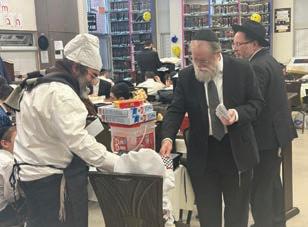
lighted by a beautiful choir of the Cheder’s Talmidim led by first-grade Rebbe, Rabbi Yaakov Horowitz. Children enjoyed special activities inside the building, and attendees were treated to refreshments. Pekalach were distributed to the children, and mementos were given to participants to mark the special occasion.
The new 70,000-square-foot facility will help accommodate the Cheder’s tremendous growth over the past several years and into the future.
Thank you to the building committee, and to all of the donors so far, for their incredible generosity!
Learn more about this vital community Torah project by visting investintorah.com.
By:
BJLife Newsroom | Photos: Creative 1080
Around the Community
BCL By Columbia Group Continues Its Season Into Week 5!
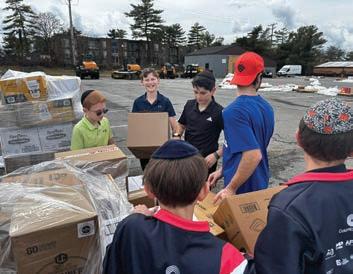
Week 5 of The Baltimore Chesed League was filled with meaningful acts of chesed as Pesach begins to appear on the horizon, creating an unmistakable “air” of preparation throughout the community.
Teams assisted Chasdei Lev by
helping load Pesach packages for rebbeim and teachers into their cars, offering appreciation and support to those who dedicate themselves to educating the community’s children. Other groups partnered with Chai Lifeline to prepare Pesach boxes for families, organized the food pantry at Khal Bais
Nosson, and helped Misaskim with important community needs.
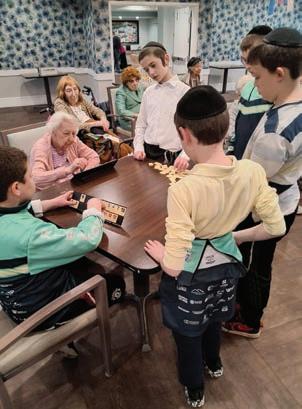
The boys also rolled up their sleeves and headed outdoors for JCA cemetery cleanup and CHAI neighborhood beautification. Other teams brought warmth and companionship to residents at Sterling Care Assisted Living, North
Oaks and Aventura at the Heights, and others spent uplifting time with members of YACHAD and Menucha.
With Pesach around the corner, the boys’ efforts highlight that beyond the physical preparations, the true spirit of any Yom Tov season is found in caring for and uplifting those around us.
Team WesBanco got a tour of the Jewish Library, helping affix stickers to help with organization and labeling, and shelving books where they belong.
Team Quarry Orthodontics visited Aventura The boys sang beautifully, danced their kishkas out, had a lively game of rummikub, and got to shmooze with the residents.
Team Sage Ventures had a great time assisting Chasdei Lev in loading pesach packages for the Rebbeim and teachers of our community.
Team JM Tax supported the Jewish Cemetery Association, helping to clean up the accumulated trash at the Hebrew Friendship Cemetery.
Team Pit Stop Tires visited the residents of Sterling, helping to bring smiles to their faces and joy to their days.
Teams AMP Solutions and Keren Reva helped support the Chasdei Lev effort by loading Pesach boxes into cars. Amazing chesed!
Team Apex Electrical Group visited the folks at the North Oaks Senior Living Community and learned all about the lives of their residents.
Team Advanced Root Canal Specialists had a great time helping pack cars with boxes for pesach at the Chasdei Lev event!
Team Hesp Solar visited Hatzalah to learn more about the important chesed they do for the community. We saw the new flyer cars and helped build some tzadaka boxes.
Team Winner Insulation helped make over 100 boxes for Chai Lifeline families, learning about the vital role CL plays in the lives of families with serious medical conditions.
Team Heideman Design had an inspirational time at King David Nursing and Rehabilitation Center in singing Pesach songs and playing board games with the residents.
Team Councilman Isaac “Yitzy” Schleifer helped Ahavas Yisrael prepare food boxes; working together to pack them carefully and then zealously load them into cars for delivery.
Team King David Nursing & Rehab Center helped organize the Misaskim van and then visited a shiva house to pick up the items that Misaskim dropped off for shiva.
Team Stellar represented CHAI, helping to clean up the upper Strathmore/ Park Heights neighborhood.
The Power Of Tefilah In Trying Times
Tefilah is often associated with the structure of our daily lives — Shacharis, Mincha, and Maariv. We think of siddurim, set נוסח, and designated times. Yet the Torah teaches us that tefilah is far more expansive than the framework of formal davening.
The Sefer HaChinuch explains that when Moshe Rabbeinu declares, “ואתחנן אל ה׳” — “And I pleaded before Hashem” , this expression itself reveals a mitzvah: the obligation to cry out to Hashem in times of need. Tefilah is not limited to scheduled moments; it is the natural, commanded response of a Jew who feels overwhelmed, vulnerable, or in need. When the heart is stirred, when words well up from a place of pain or yearning, that itself is tefilah.
Over the past two weeks, many of us have felt exactly that, overwhelmed and emotional. The weight of events has pressed heavily on our hearts. In response, something powerful has emerged: a renewed instinct to turn to Hashem together.
Across communities, events have been adapted or paused to create space for unity and prayer. Gatherings that might otherwise have been purely celebratory or competitive have taken on deeper meaning. There is a recognition
that in moments of uncertainty, our greatest strength lies not only in strategy or action, but in collective tefilah.
One particularly moving example took place before the championship basketball game between Yeshiva of Greater Washington (Silver Spring) and Yeshiva Mekor Chaim (Baltimore). What would ordinarily be a charged, competitive atmosphere was transformed. Before the opening tipoff, the entire room, spectators, players, coaches, and even the referees stood together to daven for Acheinu Bnei Yisrael. Rivalry gave way to unity. Competition became secondary to connection.
In that moment, the true power of tefilah was palpable. It was not about which team would win. It was about recognizing that we are all on the same team. When Jews stand shoulder to shoulder, hearts aligned and voices joined in prayer, something profound happens. The walls that divide us fall away, and what remains is a shared identity and a shared awareness that we are dependent on Hashem.
Tefilah does not eliminate challenge. It does not erase pain. But it reframes it. It reminds us that we are not alone — not as individuals, and not as a people. The act of crying out, of
Yeshiva Grade Of Washington Learns By Building: A Hands-On Approach To Mezuzah
Rabbi Perlman’s Gemara class recently brought their learning to life in a memorable way. As the students studied the sugyos in Meseches Menachos about the laws of mezuzah, they explored an important question: What size must a house be to require a mezuzah?
Rather than limiting their understanding to the page, the boys took out measuring tapes and building materials. To better grasp the halachic requirements, such as the minimum dimensions of a room and the qualifications of a proper doorway, they measured and constructed a model single-room house. Com-
plete with walls, a doorway, and a window, the structure allowed them to visualize the shiurim (required measurements) discussed in the Gemara. This experience deepened their appreciation not only of the halachic measurements of the home, but also of the kedushah contained within the mezuzah itself.
Through building, measuring, and witnessing the writing of a mezuzah, Rabbi Perlman’s class demonstrated that true understanding comes when learning extends beyond the classroom desk and becomes something students can see, touch, and experience firsthand.
saying ואתחנן, is itself transformative. It anchors us, humbles us, and unites us.
Perhaps this is one of the deepest lessons of tefilah: that its power lies not only in the response it may bring from Heaven, but in the change that it creates within us. In moments of overwhelm, we turn upward. In turning upward together, we draw closer to one another.
May our tefilos continue to strengthen Acheinu Bnei Yisrael, and may the unity born from heartfelt prayer carry us from moments of uncertainty to times of comfort, strength, and yeshuah.
Greater Washington: Around the Community
Chabad Of Silver Spring Celebrates 20 Years With Inspiring Gala
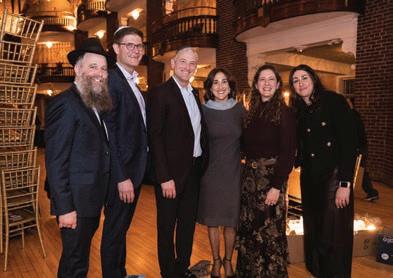
Chabad of Silver Spring celebrated 20 years of community, growth, and impact with a beautiful and inspiring evening.
The gala honored Louis and Manette Mayberg, Sharon Kober, and Dr. Caroline Friedman for their extraordinary dedication and support. Guests enjoyed exquisite catering, uplifting music by Eli Beer and Gersh, and a warm atmosphere of friendship and gratitude.
The evening was graciously chaired by Hilly and Ellie Kagan and Sam and Pam Melamed, whose leadership helped make the celebration so meaningful.
This year ’s theme, “Stronger, Louder, and Prouder,” felt especially
powerful. In today’s climate, the message resonates more than ever — reminding us to stand strong in our beliefs, proud in our Judaism, and passionate in our commitment to Torah and mitzvot.
Together, we look forward to continuing to build a vibrant Jewish future for the Silver Spring community.
Purim Around Greater Washington
Purim fun was had across the community. Yeshivas Mordechai Hatzaddik had geshmak learning and YGW enjoyed a lebedik Purim mesiba.
Exciting activities were held at Chabad of Silver Spring, and SSJC was full of costumes and cheer!
613 Seconds with Elya Rothstein
The Trainer Behind MBL: A Mind Body Approach To Health
BJH: Tell us a little about yourself.
Elya Rothstein: I grew up here in the Baltimore Jewish community, and being part of this community has always been important to me. After finishing school, I spent time in Israel where I served in the Israel Defense Forces as a medic.
BJH: What was it like serving as a medic?
ER: Serving as a medic was a powerful experience. It showed me how important the human body is and how much our health affects every part of our lives. When someone’s body is strong and functioning well, it allows them to live more fully.
BJH: How did that experience influence the way you think about health today?
ER: Seeing injuries and medical situations firsthand reinforced something important for me: taking care of the body isn’t just about appearance. It’s about building the strength and stability that allow people to live with confidence and independence.
ER: Exercise is often thought of as something we do only for weight loss or appearance. But movement plays a deeper role. When people become stronger and more capable physically, they often feel more confident, energetic, and positive in their daily lives.
BJH: How does exercise affect the way we feel emotionally?
ER: Physical activity increases circulation to the brain and stimulates the release of chemicals such as endorphins, dopamine, and serotonin, which help regulate mood and reduce stress.
BJH: What do people often notice after exercising?
ER: Many people notice that even after a short walk or workout they feel calmer, clearer, and more focused. Over time, regular exercise can also improve sleep quality and boost energy.
BJH: Who is MBL Fitness for? What clientele do you typically work with?
ER: I work with people at many stages of life, but much of my focus is helping older adults build strength, balance, and confidence in their bodies.
BJH: Why do many people start training later in life?
stiffer, and everyday movements can begin to feel more difficult.
BJH: Can exercise slow down these changes?
ER: Yes. Strength and balance training are effective ways to slow many of these changes. Building muscle helps support joints, protect bones, and maintain mobility.
BJH: How does balance training help older adults?
ER: Improving balance and coordination can reduce the risk of falls, which are a major health concern for older adults. Staying active also helps people maintain independence and continue doing activities they enjoy.
BJH: Why might someone choose to work with a trainer instead of exercising alone?
ER: A trainer provides guidance, structure, and accountability. Many people want to exercise but aren’t sure where to begin.
BJH: How does a trainer help with safety and results?
ER: Proper guidance helps ensure exercises are done correctly and safely. Trainers can also design programs tailored to a person’s goals, limitations, and lifestyle.
BJH: What is the Philosophy Behind MBL Fitness?
ER: MBL Fitness stands for Mind. Body. Life. The idea behind it is that the way we move our bodies affects how we feel mentally and emotionally, and together those things shape the life we are able to live.
BJH: Why is the connection between mind and body so important?
ER: Many people reach a point where they want to stay active, maintain their independence, and feel comfortable moving throughout their daily lives.
BJH: Why is exercise especially important as we get older?
ER: As we age, the body naturally loses muscle mass, strength, and balance. Bone density can decline, joints may become
BJH: Do people need to already be in shape before starting?
ER: Not at all. Everyone starts somewhere. The goal is not perfection, but gradual improvement.
BJH: How do people usually begin seeing results?
ER: Small, consistent steps over time
can lead to meaningful improvements in strength, mobility, and overall health.
BJH: What makes your approach different from other fitness programs?
ER: My focus is not on extreme workouts or short-term results. Instead, I emphasize building sustainable strength and movement that supports everyday life.
BJH: What does that look like in practice?
ER: It includes things like getting up from a chair comfortably, walking longer distances without fatigue, maintaining balance, and feeling confident performing daily activities.
BJH: What experience and training do you have in the fitness field?
ER: I have been helping people improve their strength and recover from injuries for over five years. During that time I have spent many hours studying how the body moves and how exercise can support long-term health.
BJH: What certifications do you hold?
ER: I am a Certified Personal Trainer through the National Academy of Sports Medicine (NASM) and I’ll be certified as a Nutrition Coach in April. I am also CPR and AED certified through the American Red Cross.
BJH: Where can people learn more about your work?
ER: You can visit www.mblfitness.com, where I share regular articles about health, movement, and practical ways people can improve their daily lives through simple habits.
The goal of MBL Fitness is to help people build strength not only in their bodies, but also in their confidence and overall well-being.
The Week In News
founder Erik Prince.
HRW’s Americas director, Juanita Goebertus, said that the rights group had documented unlawful use of lethal force, saying Haiti’s partners should stop collaborating with its security forces until they implement safeguards to protect civilians.
“Haitian authorities should urgently rein in the security forces and private contractors working for them before more children die,” she said.
Despite Kenyan, U.S. and U.N. support, armed gangs have expanded well beyond the capital. Security forces have yet to capture a major gang leader. The gangs have killed thousands of people, have displaced more than a million people, and have crippled the economy.
HRW found that the drone strikes killed 1,243 people between last March and January 21 of this year.
The strikes also injured 738 people, including 49 alleged civilians, it added, noting that from November to January there were nearly double the number of drone operations compared with the prior three months.
Of the child victims, more than half
were 3-to-12-year-olds killed last September in an attack on a sports center where a local gang was distributing gifts, HRW said.
The U.N.’s human rights chief said last October that the drone strikes were disproportionate and likely unlawful.
Iran Attacks the Gulf
In retaliation for U.S. and Israeli strikes that killed Supreme Leader Ayatollah Ali Khamenei, Iran targeted the United Arab Emirates with 1,400 ballistic missiles and fired hundreds more at other Arab Gulf countries, including Bahrain, Kuwait, Oman, Qatar, and Saudi Arabia.
In the UAE, at least three people were killed. Iran targeted U.S. military bases, critical infrastructure such as oil installations, and civilian areas.
However, a week into the attacks, on Saturday, Iranian President Masoud Pezeshkian issued an apology to the Arab countries.
“I deem it necessary to apologize
to neighboring countries that were attacked,” he said, adding that Iran would stop striking the Gulf.
Despite the apology, the strikes have yet to stop. Flights in Dubai were temporarily suspended after a drone exploded near the city’s airport. On Saturday, Saudi officials reported that a drone—likely from Iran—was launched at Saudi Aramco’s Berri oil field. Two ballistic missiles aimed at a U.S. base in Saudi Arabia were intercepted, in addition to four drones targeting the Shaybah oil field. The Islamic Revolutionary Guard Corps of Iran also announced a drone attack on a U.S. base in the UAE.
Senior Iranian officials issued statements contradicting Pezeshkian’s apology. Among them was Parliament Speaker Mohammad Bagher Ghalibaf, who declared that peace with the region was impossible as long as the countries hosted U.S. bases.
U.S. President Donald Trump said that Pezeshkian’s apology was a sign that Iran was losing, adding that Tehran’s strikes on Arab countries were the “biggest surprise” and could bring the Gulf states into the war.
A New Ayatollah
In a show of defiance against the United States, the Iranian regime appointed Mojtaba Khamenei, the second son of Supreme Leader Ali Khamenei, to succeed his assassinated father, effectively turning the Islamic Republic into a dynasty.
U.S. President Donald Trump has previously labeled the younger Khamenei an “unacceptable” choice. Despite U.S. opposition, Iran selected the son, who is expected to follow in his father’s brutal footsteps.
Shortly after the announcement, while Iranian citizens faced a blackout, state media published a four-minute documentary touting the new Supreme Leader as the country’s rightful leader. In reality, however, he has little experience in administration or leadership and has never held public office. Additionally, he was not qualified to be a vali-faqih (supreme jurisprudent) or a mujtahid due to his lack of scholarly depth.
Still, the president, parliament, and the Islamic Revolutionary Guard Corps all pledged allegiance to the new Ayatollah.
Mojtaba Khamenei was born in 1969. He received less religious training
than his brothers, seemingly leaving him unqualified to become Supreme Leader. He is married to Zahra, whose father is former parliament speaker Gholam Haddad Adel.
Despite his lack of publicity, Mojtaba is believed to have worked behind the scenes assisting his father and the IRGC. In 2019, the United States sanctioned him for allegedly working with a top IRGC commander to promote the then-Ayatollah’s “destabilizing regional ambitions and oppressive domestic objectives.”
The strike that eliminated the elder Khamenei also killed the supreme leader’s daughter, grandchild, daughter-inlaw, and son-in-law. His wife later died from injuries sustained in the attack.
In a Fox News interview, President Trump expressed that he is “not happy” with Iran’s selection of leader. “I don’t believe he can live in peace,” the U.S. President remarked.
Before Mojtaba Khamenei’s appointment, Trump maintained that the U.S. should have a role in determining the next leader of Iran, akin to previous U.S. involvement in Venezuela.
“They are wasting their time. Khamenei’s son is a lightweight. I have to be involved in the appointment, like with Delcy [Rodriguez] in Venezuela,” Trump said.
Explosion at U.S. Embassy in Oslo
An explosion on Sunday morning at the U.S. Embassy in Oslo, Norway, damaged the entrance to the embassy’s consular section. Now, Norwegian police are searching for the suspect caught on surveillance footage.
“The investigation so far has shown that this was an improvised explosive device,” the Oslo police said in a statement, adding that the IED had caused a “powerful blast.”
Images released by the police showed a hooded person, whose face was not visible, wearing dark clothes and carrying a bag or rucksack.
Police said on Sunday that one hypothesis was that the incident was “an act of terrorism” but that other possible motives were also being explored.
Among the possible leads was a 15-second video published on the U.S. embassy page on Google Maps around the time of the incident.
The Week In News
The video shows Iran’s late Supreme Leader Ayatollah Ali Khamenei leaving a room, with writings in Farsi, including the words “Where did he go?”, “he wanted to leave anyway” and “he’s gone.”
Khamenei was killed in an air strike on February 28 at the start of the U.S.-Israeli war on Iran.
Europe has been on alert for possible attacks amid U.S. and Israeli air strikes on Iran and Iranian drone and missile attacks on Israel and U.S. targets in the Middle East.
On Monday, a synagogue in the Belgian city of Liege was damaged by a blast that authorities called an antisemitic attack. It was not clear who was behind it.
2 Killed in Iranian Strike
Rustam Gulomov and Amid Murtuzov, both in their 40s and residents of Pet-
ah Tikva, were killed on Monday morning in an Iranian cluster bomb missile strike.
The submunitions from the cluster bomb warhead hit at least six locations across central Israel, including in the cities of Yehud, Or Yehuda, Holon, and Bat Yam.
The two victims were working at a construction site in Yehud when one of the cluster bomb munitions from the ballistic missile struck the area. They were not in a bomb shelter or other protective space.
Medics declared the death of one of the men at the scene and took the second to a hospital in critical condition, where he later succumbed to his injuries.
The chief of the Home Front Command, Maj. Gen. Shai Klapper, said that dozens of other construction workers survived the attack after entering bomb shelters.
“We had a difficult incident at this construction site, where several people were injured. At the same time, I want to say that there were dozens of workers whose lives were saved. Their lives were saved because they were in a protected space and followed the guidelines,” he said in a video published by the military.
Another man was seriously wounded in Or Yehuda during the attack. He was
also not in a bomb shelter when he was struck by one of the cluster munitions, first responders said.
Iran has launched multiple ballistic missiles at Israel carrying cluster bomb warheads during the ongoing conflict, indiscriminately spreading dozens of small bombs over wide areas of the country.
Speaking to the Haaretz newspaper, a crane operator who was at the Yehud building site at the time of impact emphasized the danger faced by construction workers during missile attacks.
“I came down and barely made it. I got the alert, waited for them to disconnect me from the load, closed up the crane and went down,” he told the news outlet. “It took a few minutes, and time was running out; by the time I started descending, the siren had already begun.”
Israel is 7thLargest Arms Exporter
Israel has climbed to seventh place among the world’s leading arms exporters, according to a new report released
on Monday by the Stockholm International Peace Research Institute (SIPRI).
The report compares global arms trade between 2016-2020 and 20212025 and shows Israel’s share of worldwide weapons exports rising to 4.4%, up from 3.1% in the previous five-year period. The increase places Israel ahead of the United Kingdom for the first time, whose share now stands at 3.4%.
The United States remains the world’s largest arms exporter, accounting for 42% of global weapons sales during the 2021–2025 period, up from 36% previously. Other top exporters include France (9.8%), Russia (6.8%), Germany (5.7%), China (5.6%) and Italy (5.1%), followed by Israel.
At the same time, Israel ranks 14th among global arms importers. According to the report, about 68% of Israel’s
The Week In News
imported weaponry comes from the United States, while 31% comes from Germany and roughly 1% from Italy.
Globally, the arms trade grew by 9.2% between the two periods analyzed in the report. European countries significantly boosted their purchases, with imports more than tripling and making Europe the largest regional buyer of military equipment.
The report highlights the continued dominance of the United States in the arms market. Saudi Arabia was the largest purchaser of American weapons, accounting for 12% of U.S. arms exports, followed by Ukraine with 9.4% and Japan with 8.9%. Israel ranked 12th among U.S. customers, receiving about 3.1% of American arms sales.
SIPRI researchers said Israel’s growing share of exports was driven largely by international demand for its air defense systems. The increase comes despite public statements by some governments that they would avoid purchasing Israeli weapons because of the war against the Hamas terror group in Gaza.
Several countries remain major buyers of Israeli military technology. These include South Korea, Germany, Philippines, Singapore and Morocco, where Israeli systems account for roughly 24% of the country’s arms acquisitions.
The report also noted that Israel continues to sell weapons to Britain despite political tensions and criticism in the U.K. over Israel’s war in Gaza.
Among Israel’s largest export markets overall are India, which accounts for 56% of Israeli arms exports, followed by Germany with 21% and the United States with 7.8%.
Germany’s purchases from Israel largely involve the Arrow missile defense system, one of the biggest defense deals in Israeli history.
The report also examined Iranian arms activity. Iran ranked 25th among global arms exporters, with most of its weapons shipments going to Russia, along with smaller exports to Venezuela and Houthi rebels in Yemen.
2 Soldiers Killed by Hezbollah
On Friday afternoon, Hezbollah targeted an Israeli military post in southern Lebanon with a missile attack, moderately injuring two Israeli soldiers. On Sunday, two IDF soldiers were killed in a Hezbollah attack.
Since last Monday, Hezbollah has been striking Israel, prompting a renewed Israeli offensive. The IDF has carried out 600 strikes against Hezbollah targets, and the attacks have injured at least 13 Israeli soldiers.
On Saturday, Hezbollah fired rockets at northern Israeli towns, including Haifa and Kiryat Shmona, with sirens sounding in Safed, Tiberias, the Galilee, and the Golan Heights, though no injuries were reported. One rocket landed largely intact in the parking lot of Galilee Medical Center.
The two injured soldiers from Friday’s attack are members of the Givati Brigade.
IDF spokesman Brig. Gen. Effie Defrin emphasized Israel’s goal of disarming Hezbollah: “We’re attacking many targets there, hunting Hezbollah terrorists, and destroying the terror command posts it established in the heart of the civilian population.”
Prime Minister Benjamin Netanyahu urged the Lebanese government to fulfill its responsibility to disarm the terror group. Israeli authorities have said that northern towns will not be evacuated, though the IDF has issued urgent evacuation warnings for residents of southern Lebanon.
Early Sunday morning, a Hezbollah attack in southern Lebanon killed two Israeli soldiers.
One of the deceased was identified as Sgt. First Class Maher Khatar, a 38-yearold heavy machinery operator from Majdal Shams serving in the 91st “Galilee” Regional Division’s combat engineering unit. The second soldier was later identified as Staff Sgt. Or Demry, 20, from Liman, a heavy machinery operator in the 91st Division’s combat engineering unit. Another soldier was lightly wounded.
The attack occurred near an IDF position across from Manara, an Israeli border community. The IDF suspects the soldiers were killed after Hezbollah launched an anti-tank missile or mortar at an Israeli D9 bulldozer deployed to repair a stalled tank.
Since Hezbollah began attacks on Israel in retaliation for the death of
New Spring
Arrivals
The Week In News
Iranian Supreme Leader Ayatollah Ali Khamenei, Israel has launched 600 strikes in Lebanon, killing approximately 200 terrorists. Among them were 80 Radwan Force members and 70 artillery operatives. Several high-ranking commanders were also killed, including Lebanon’s Palestinian Islamic Jihad chief.
Hezbollah rockets have caused some damage in northern Israel, though no injuries have been reported. This escalation, sparked by U.S. and Israeli strikes on Khamenei, marks the end of the ceasefire agreed on in November 2024.
Israel Attempts to Recover Remains of Ron Arad
In October 1986, Israeli Air Force navigator Ron Arad was kidnapped in Lebanon by the Shiite Amal movement after his plane was shot down over southern Lebanon. Presumed dead since the mid-1990s, Israel has yet to recover his remains.
During its expanded offensive in Lebanon, the IDF searched eastern Lebanon
for Arad’s remains amid heavy airstrikes, but the mission was unsuccessful.
“The operation carried out last night did not produce what we were looking for,” Prime Minister Netanyahu said. “But the commitment of Israel, and my personal commitment, to completing all missions concerning our prisoners and missing persons is absolute.”
Arad’s widow, Tami, emphasized that the safety of soldiers must take priority: “Our desire to know what happened to Ron stops as soon as there is risk to IDF soldiers. The sanctity of life comes before the commitment to return the remains of a fighter for burial… We prefer to live with the painful possibility that Ron’s bones are in Lebanon rather than wake up to news that an IDF soldier was injured or, G-d forbid, killed.”
Before his disappearance, Arad was likely held in the Nabi Chit area. Alongside Arad, the IDF considers Staff Sgt.
Guy Hever and Sgt. First Class Yehuda Katz as missing soldiers.
Israeli Hospitals Adapt to War
Israeli hospitals have implemented wartime measures learned after October 7, including pop-up clinics and converting underground parking lots into wards and fortified operating rooms.
When the war began on February 28, the Health Ministry ordered hospitals to enter emergency mode, relocating intensive care patients to protected areas. Hospitals continue performing operations underground despite threats from Iranian missiles.
number of American troops killed in the war with Iran to seven.
The military identified the service member this week as Army Sgt. Benjamin N. Pennington, 26, of Glendale, Kentucky. Pennington, who was injured at Prince Sultan Air Base, was assigned to 1st Space Battalion, 1st Space Brigade, a unit within Army Space and Missile Defense Command.
“Last night, a U.S. service member passed away from injuries received during the Iranian regime’s initial attacks across the Middle East,” US Central Command said Sunday on X. “The service member was seriously wounded at the scene of an attack on U.S. troops in the Kingdom of Saudi Arabia on March 1.”
“We’re now implementing everything we learned,” said Dr. Mir Maram, deputy director general at Clalit Health Services. “We learned exactly what kind of equipment, beds, and spacing we need, how to handle infection control, and which ma-
Galilee Medical Center moved its operations underground in record time. “All surgical procedures, deliveries, and cardiac and neuro catheterizations are being conducted in fortified facilities,”
Prof. Osnat Levtzion-Korach, director of Shamir Medical Center, described the temporary setup: “Having 200 patients in a parking lot is not ideal—there’s no privacy or infection control. It’s very safe but has many challenges. Thankfully, patients
She added with a touch of humor, “I’ll probably get invited to conferences to share how to handle earthquakes or other emergencies. There’s much to learn from us, and we’ll share our experience.”
U.S. Soldier Killed
A U.S. soldier died after sustaining injuries during an attack last week in Saudi Arabia, the military said, bringing the
The news of the fallen service member came a day after the dignified transfer for the six soldiers who were killed last week in Kuwait. President Donald Trump and other top officials joined the families of those troops at Dover Air Force Base in Delaware as the soldiers were brought home.
That strike, which came without warning, occurred on a makeshift operations center at the civilian port of Shuaiba in Kuwait on March 1. All six soldiers were assigned with the 103rd Sustainment Command, an Army Reserve unit out of Iowa.
The president told ABC on Sunday the meeting with the families of the six troops did not give him pause about the war.
“The parents would be upset if I did that,” he said. “The parents said to me, every one of them, ‘Please sir, win this for my boy,’ and in one case a young woman, as you know. ‘Please, win this for my child.’”
In Hardin County, Kentucky, flags are flying at half-staff at county government buildings, grounds and facilities in Pennington’s honor.
Pennington “gave the ultimate sacrifice for the country he loved,” Lt. Gen. Sean A. Gainey, commanding general of Army Space and Missile Defense Command, said in a statement. “That makes him nothing less than a hero, and he will always be remembered that way.”
Pennington enlisted in the U.S. Army in 2017 and was assigned to the 1st Space
The Week In News
Battalion, 1st Space Brigade on June 10, 2025. He received multiple awards over the course of his service and will be posthumously promoted to staff sergeant.
Uber’s WomenOnly Option
Uber has launched a feature allowing female drivers and passengers across the U.S. to request trips with other women on the ride-hailing app.
The feature was piloted in the U.S. last year and led to women feeling “more comfortable in the back seat” and “more confident behind the wheel,” Uber said.
But not everyone is comfortable with the move. Ubers drivers have filed a class action lawsuit in California, claiming that the move discriminates against men.
Uber said around one-fifth of its drivers in the U.S. are women, although the ratio varies by city.
Uber’s Women Preferences was launched on Monday in response to
woman driver in advance or set their preference in the app to increase the likelihood of being matched with a woman.
In cities where teen accounts are available, teens and their parents can also request women drivers.
Two California Uber drivers have accused the company of violating California legislation, by potentially giving female drivers access to a wider pool of passengers. Uber has filed a motion to stop litigation and move the case to private arbitration, citing an agreement the drivers signed when joining the app.
Ride-sharing app Lyft is also facing a discrimination lawsuit over its feature introduced in 2024 allowing riders and drivers to prioritize women.
Last month, a U.S. court ordered Uber to pay $8.5 million to a woman who said she was assaulted by a man driving for Uber in a legal ruling that could influence the outcome of thousands of other cases against the company. Uber had argued that it should not be held liable for criminal acts by drivers using its platform, who it says
Uber already offers the woman-matching option for drivers in more than 40 countries and for riders across seven countries, including Spain, Brazil and Saudi Arabia.
Long Lines at TSA
Long security lines at several U.S. airports this week are highlighting the strain on the nation’s travel system as a government shutdown coincides with the busy spring break travel season.
The worst delays were reported at William P. Hobby Airport in Houston, Texas, where passengers waited more than three hours to pass through security checkpoints on Sunday and Monday. Travelers at airports in New Orleans and Atlanta also faced waits exceeding an hour during peak periods.
The surge of travelers during spring break would strain airports even under normal circumstances. But the ongoing shutdown affecting the Department of Homeland Security has left many Transportation Security Administration officers working without pay, raising concerns about staffing
shortages if the situation drags on. Johnny Jones, secretary-treasurer of the TSA union’s bargaining unit, said many officers are still struggling financially after the previous 43-day shutdown last fall — the longest in U.S. history.
“Over the last 15 months, TSA officers have went through three government shutdowns,” Jones said. He warned that missing paychecks could lead some workers to take second jobs or miss shifts to cover basic expenses such as gas and childcare.
Jones said workers will miss their first full paycheck this weekend since the shutdown began February 14, adding that morale among employees “has taken a severe hit.”
The shutdown stems from a political dispute in Congress over immigration enforcement policies. Democrats have refused to fund the Department of Homeland Security until new limits are placed on federal immigration operations following the fatal shootings of two people in Minneapolis earlier this year.
Officials in the Department of Homeland Security blamed Democrats for the travel disruptions. Lauren Bis, the department’s deputy assistant
The Week In News
secretary for public affairs, said the situation has forced TSA officers to work without pay and contributed to staffing shortages.
Airlines are also urging lawmakers to resolve the dispute quickly. Chris Sununu, president and CEO of the airline trade group Airlines for America, said the delays are unacceptable.
“More than 2.7 million people cleared through TSA yesterday, but too many had to wait in extraordinarily long — and painfully slow — lines,” Sununu said.
By Monday afternoon, delays at several airports had eased. Wait times at Hobby Airport dropped to about two hours, while security lines in New Orleans fell to around 10 minutes.
Still, airport officials warn that delays could return if busy travel periods coincide with staffing shortages, leaving passengers facing long waits during one of the year’s busiest travel weeks.
Columbia Occupiers are Let Off
A New York judge has thrown out disciplinary sanctions against 22 cur-
rent and former students at Columbia University who participated in the takeover of Hamilton Hall during anti-Israel campus protests in April 2024.
Gerald Lebovits, a justice on the New York Supreme Court, ruled on February 27 that the university improperly relied on sealed arrest records when determining that the students had violated campus rules.
Because those arrests had been legally sealed, the court said the university could not use them as evidence in its disciplinary process.
“Respondent’s internal hearing panel was statutorily barred from taking into account the fact that petitioners had been arrested in Hamilton Hall,” Lebovits wrote in the decision.
“The fact of petitioners’ sealed arrests was the only evidence before the hearing panel that petitioners were in Hamilton Hall while it was occupied.”
As a result, the judge concluded that most of the disciplinary findings were “arbitrary and capricious.”
The ruling stems from the occupation of Hamilton Hall between April 29 and April 30, 2024, when protesters seized the campus administrative building during demonstrations tied to the war between Israel and
Hamas. Activists barricaded entrances, smashed glass doors, and covered security cameras while renaming the building “Hind’s Hall” in honor of a child killed during the conflict in Gaza.
Video from the scene showed demonstrators hanging a Palestinian flag from a window and chanting pro-Palestinian slogans, including “From the river to the sea, Palestine will be free.”
Two university janitors, Mariano Torres and Lester Wilson, later filed a lawsuit claiming they were trapped inside the building during the 22-hour standoff and were “terrorized,” assaulted, and mocked with antisemitic slurs.
Police from the New York Police Department eventually cleared the building and arrested dozens of protesters. The Manhattan District Attorney’s Office later dismissed misdemeanor trespassing charges against the students, citing insufficient evidence after many protesters concealed their identities and blocked security cameras.
The charges were dropped with the understanding that the university would pursue its own disciplinary proceedings. Columbia’s internal panel later found the 22 students responsible for multiple violations of campus
conduct rules, issuing punishments ranging from suspensions to expulsions and even retroactive revocation of degrees.
In his ruling, Lebovits said Columbia could reopen disciplinary proceedings if it finds evidence unrelated to the sealed arrests. The judge also granted a 30-day stay on the decision to allow the university time to seek an appeal.
A Columbia spokesperson said the school is reviewing the ruling and emphasized that the sanctioned students cannot return to campus for now.
“The order does not take effect for at least 30 days, and no student who was disciplined for the occupation of Hamilton Hall can return to campus at this time,” the university said in a statement. “Columbia is considering all of its options, including seeking a stay of the order and appealing the decision.”
If you own one of the following range models, ordering the full Passover replacement kit is simple.*
Suburban Orthodox Congregation Toras Chaim - 7504 Seven Mile Ln Talmudical Academy - 4445 Old Court
The Adas: Chofetz Chaim Adas Bnei Israel - 5915 Park Heights Ave The Shul at the Lubavitch Center - 6701 Old Pimlico Rd Tiferes Yisroel - 6201 Park Heights Ave Tzeirei Anash - 6706 Cross County Blvd
Yeshiva Tiferes Hatorah - 6819 Williamson
Torah Thought Children Of Miriam
By Rabbi Zvi Teichman
Moshe informs the nation that G-d has selected Betzalel to lead the team effort of constructing the intricate vessels and components of the Mishkan, the Tabernacle. Moshe describes how Betzalel possessed a Godly spirit that invested him with great wisdom, insight, and knowledge, who was not only a skilled artisan but a talented teacher as well.
In delineating Betzalel’s lineage, the Torah deviates from the norm in merely reporting who his father was but it lists his paternal grandfather as well.
Betzalel, son of Uri the son of Chur, of the tribe of Yehudah. (ל הל תומש) ,
Rashi seeking to address this anomaly enlightens us by apprising that Chur was 'םירמ לש הנב' — the son of Miriam. The Torah wanted us to realize that Betzalel merited this greatness due to his illustrious and pious grandmother, Miriam.
In two other places when Chur is mentioned, Rashi once again emphasizes that he was the son of Miriam.
When engaging in the enemy Amalek, after their surprise attack in Refidim, Moshe instructs Yehoshua to select worthy combatants from the nation who Yehoshua will lead in battle against the enemy while Moshe will situate himself upon the top of a hill with his arms raised to inspire the fighters towards victory. Moshe requests from his brother, Aharon, and their nephew, Chur, to assist him in supporting his ‘heavy’ hands. Rashi here tells us that Chur was ‘the son of Miriam’, and adds an additional piece of information: Chur, היה םירמ לש הנב — ‘was the son of Miriam’, הלעב בלכו — ‘and [the son of,] Calev, her husband’. (י זי םש)
Rashi felt compelled for some reason to let us know that not only was he the worthy son of Miriam, but of her husband Calev as well. Why is this fact mentioned here and not when identifying Chur as the grandfather of Betzalel?
When Moshe first ascends Mount Sinai to receive the Luchos, the Tablets, he directs the elders to remain with the people to lead and respond to their queries until he returns, with Aharon and Chur assuming the primary responsibility for them. With the mention of the name Chur, Rashi again obliges that, היה םירמ לש הנב — ‘he was the son of Miriam’, this time adding: הנופי ןב בלכ ויבאו — his father was Calev the son of Yefunah, quoting a verse in Chronicles that states: and Calev took to himself Ephras, and she bore to him Chur, citing the Talmud that reveals that Ephras is none other than Miriam. (די דכ םש)
We now have all the pieces of the puzzle called ‘Chur’. He was the son of Miriam, whose husband was Calev who was also the father of Chur.
Why in the initial reference to Chur, did Rashi word his description of Chur being the son of Miriam and her ‘husband’ Calev, and not state clearly that he was his ‘father’?
Why at the base of Mount Sinai does Rashi refer to Calev as Chur’s ‘father’ omitting that Calev was also the ‘husband’ of Miriam?
Finally, why when describing Chur as the grandfather of Betzalel does Rashi allude only to his mother Miriam with no mention now of Calev whatsoever?
Chur was clearly a remarkable young man. He was chosen together with Aharon to assist Moshe in the battle against Amalek. He was selected from amongst the entire nation to substitute for Moshe in his absence, together with his uncle Aharon, in leading the people. At the fateful episode of the worshipping of the Golden Calf, we are taught that the people first approached Chur, before confronting Aharon, to assist them with fashioning the Golden Calf. Chur resolutely refused to, exclaiming he was willing to be martyred rather than submit to their request. In frustration the sinners summarily dispensed with him by killing him.
He clearly grew up in an inspired home. What do we know of his family life being raised by the saintly Miriam and the courageous Calev?
The Talmud tells us that Miriam was a sickly woman, possessing a greenish complexion due to her illness, who was shunned and abandoned by all as a suitable marriage partner. It was Calev who altruistically married her and tended to her lovingly, nurturing her as if she was his own child, returning her to robust health and magnificent beauty.
Calev, the Talmud reports, was an extremely disciplined individual, who was uncompromising in his beliefs, and was known as a ‘straight’ person who couldn’t be influenced negatively. This trait became apparent in his struggle with the spies and his unstinting resistance to their devious plans. (.בי -:אי הטוס)
Miriam dedicated her life to the preservation of life and the continuum of Jewish survival. She brazenly took her father to task for divorcing her mother Yocheved lest they bring children into a dismal world of infanticide and slavery. She defiantly challenged her father to bring children into this world despite the bleakness of the situation and to place his faith in G-d who will assure the future. She risks her life to defy Pharaoh’s decrees, inspiring the nation to forge ahead in maintaining a family life and bringing more Jewish souls into the world despite the danger. She is indeed called תרפא — Ephras, with its connotation of being הברו הרפ — fruitful and multiplying, on behalf of her life’s mission to inspire the future of our people.
Children who are raised in a home where there are demonstrable harmony and love among the parents, will model their behaviors and attitudes towards others in kind.
Amalek seeks to cause divisiveness in the universe and within the Jewish nation. They attacked us in םידיפר — Refidim. The word םידיפר when jumbled spells םידירפ — single isolated units. They cast doubt in our minds with their sudden exposing to our vulnerability, which led to a distance from G-d and division among our unity with G-d and between themselves. Aharon, the promoter of peace, together with Chur, was inspired by the exquisite devotion his parents displayed to one another that he was witness to as he grew up, which generated within him a selfless love towards others, were well equipped and worthy of supporting Moshe’s hands in quashing the spiritual forces of Amalek. (ורתי םהרבאל דסח)
When describing Chur in this role Rashi accents Miriam, and her ‘husband’
Calev, the parents of Chur, because it was that relationship, as husband and wife specifically, that invigorated Chur to develop healthy attitudes towards others.
In assuming a leadership role in guiding the people during Moshe’s absence, the key to success is remaining steadfast in one’s beliefs. Those who waffle in their principles will be easily manipulated and influenced to act incorrectly. One of the most significant factors in raising children who can choose wisely is if they see no hypocrisy in their parents, or compromise in their core beliefs. No wonder Chur was appointed as an unflinching leader amongst his people who could be trusted to ward off the temptation to succumb to popular belief, bribes or the desire to please the populace simply to gain popularity. It was that unintimidated commitment to his values that powered him to give up his life for what he believed in.
It was thus, as Rashi here points out in this instance, Chur the son of Miriam who had a ‘father’ like Calev, who would be most worthy to be entrusted with the task of leading the people.
The merit in transmitting effectively to future progeny the values we cherish and the requisite talents they will need to survive in a world of chaos and hedonism is rooted in our spiritual genes bequeathed to us by our illustrious ancestors who breathed that hope, who longed, prayed and consistently lived by those values.
When the Torah attempts to instill that notion by displaying the supernatural skills beheld by the very young and inexperienced Betzalel and linking that ‘inherited’ talent to his grandfather Chur, Rashi directs us to the nucleus of that mighty power plant, with the simple and exquisite association to Chur his having been fortunate to be ‘the son of Miriam’ whose entire being radiated hope for the future.
Just as Betzalel embodied these qualities that enabled him to construct an abode for the Divine Presence, so too it is with these traits that we will succeed in bringing the Divine Presence into our personal Mishkan; our homes.
We are told that King David hails from Miriam as well.
May we all merit becoming ‘children of Miriam’ and help hasten the arrival of her beloved grandchild, the Melech HaMoshiach, speedily in our days.
You may reach the author at: Ravzt@ ohelmoshebaltimore.com
Forgotten Her es Israel’s Intelligence Units
By Avi Heiligman
Military intelligence has played a pivotal role in countless conflicts throughout history. Knowing an enemy’s plans can often be the difference between victory and crushing defeat. The Battle of Midway serves as a primary example: American forces were able to learn about the Japanese invasion plans through partially decrypted messages resulting in the sinking of four Japanese aircraft carriers. Conversely, later in World War II, intelligence units failed to detect Germany’s preparations for the Battle of the Bulge leading to a weeks-long struggle to stem the tide of Nazi forces at a massive cost in Allied lives. In the post-war era, Israeli military intelligence has been highly scrutinized both for its high stakes successes and notable failures. Known as Aman (Agaf HaModi’in, the Intelligence Section), this intelligence arm is often overshadowed by the Mossad but their unique analytical and collection roles make it an indispensable part of the IDF.
During the British Mandate, the intelligence operations were conducted by the Shai (the intelligence wing of the Haganah) and worked from a cramped basement in a building in Yerushalayim. Soon after Israel was declared a state in 1948, an intelligence department with the name “Special Department (Informants)” was formed under the fledgling IDF. The name was soon changed to Modi’in 10, a secretive branch tasked with cross-border infiltration, and after a number of name changes, it is now known as Unit 504. Their early activities included contacting foreign agents, organizing clandestine intelligence operations at home and in enemy territory, and interrogating prisoners of war to gain immediate tactical advantages on the shifting frontlines of the War of Independence.
Other units during the Israeli War of Independence were responsible for SIGINT (Signal Intelligence) where they decoded Egyptian military ciphers and intercepted high level military radio broadcasts and conversations. One of their most significant achievements
during the war was listening to the Egyptian Army’s internal conversations regarding the armistice agreement at the end of the war, providing Israeli negotiators with invaluable leverage. Reuven Blum was one of the formative commanders of these early SIGINT units and spent
the IDF to process vast amounts of raw data. Following the intelligence failure of the 1973 Yom Kippur War, where the research division misread Egypt’s intentions, the unit underwent a major change. They incorporated advanced algorithms to better predict enemy movements and
They were able to track leadership movements and assured commanders that the Iranian officials were headed to the fateful meeting.
failing to detect the beginning of the Yom Kippur War in 1973 and the October 7 massacre by Hamas. Reports indicate that intelligence officials had stopped listening to Hamas radios in 2022 and that they had dismissed warning signs of a buildup of terrorists near the border. New systems and protocols were put into place to prevent the same mistakes from happening again.
Unit 8200 has been heavily involved with the wars against Hamas and Iran, shifting from traditional ways of gathering intelligence to active cyber-kinetic operations. In the recent attacks on Iran, Unit 8200 AI-driven tools and data were able to plow through the massive amounts of information on the Iranian leadership. They were able to track leadership movements and assured commanders that the Iranian officials were headed to the fateful meeting. Following this confirmation, an Israeli airstrike killed Khamenei and many of Iran’s top leaders. Reports indicate that Israel had hacked traffic cameras years earlier, which allowed analysts to observe the compound and track the movements of bodyguards and drivers.
the war listening to encrypted communications from both the Arabs and the British. Later, as commander of Unit 515 (a predecessor to Unit 8200), Blum placed an emphasis on properly training radio operators who would become world-class experts in electronic intelligence and traffic analysis.
While its roots trace back to 1952 as Unit 515, Unit 8200 eventually emerged as the premier intelligence arm of the IDF. They incorporated existing signals units under one centralized command and pioneered the use of cutting-edge technology in their operations. In 1961, they integrated the use of the first computer in
eventually expanded into space-based reconnaissance, supporting the launching of Israel’s first intelligence satellite, Ofeq-1, in 1988.
Israeli SIGINT entered the world of cyber warfare in the 21st century, with their involvement in the joint “Operation Olympic Games” to deploy the Stuxnet worm in 2009. Since then, Unit 8200 has incorporated advanced AI systems to cross-reference data from social media, phone records, and surveillance footage to create real-time threat assessments.
Military intelligence units are always learning from their mistakes as was evident from the intelligence failures in
Israel’s intelligence units grew from humble beginnings to become an indispensable part of the military. Many of the soldiers in Unit 8200 are between the ages of 18 and 21 and are selected for their “out-of-the-box” thinking. After their service, they often go on to careers in other parts of the intelligence community, such as the Mossad or Shin Bet. The history of Israel’s military intelligence is the story of the merging of human intuition and signal processing that has monitored the region for decades. While many of the missions and operations often go unnoticed, their work is a part of history to be remembered.
Avi Heiligman is a weekly contributor to The Jewish Home. He welcomes your comments and suggestions for future columns and can be reached at aviheiligman@gmail.com.
Iran’s Gulf GambIt
Inside Tehran’s Strategy of Regional Pressure
By TzvI Lev
The Gulf Region
“If you have a problem you can’t solve, solve it by making it everyone’s problem” is an adage attributed to former U.S. Secretary of Defense Donald Rumsfeld. While the veteran American politician used this saying to describe the bureaucratic dysfunction he witnessed in the Washington Beltway, it also perfectly captures the logic behind the decision by the Islamic Republic of Iran to target Arab Gulf states.
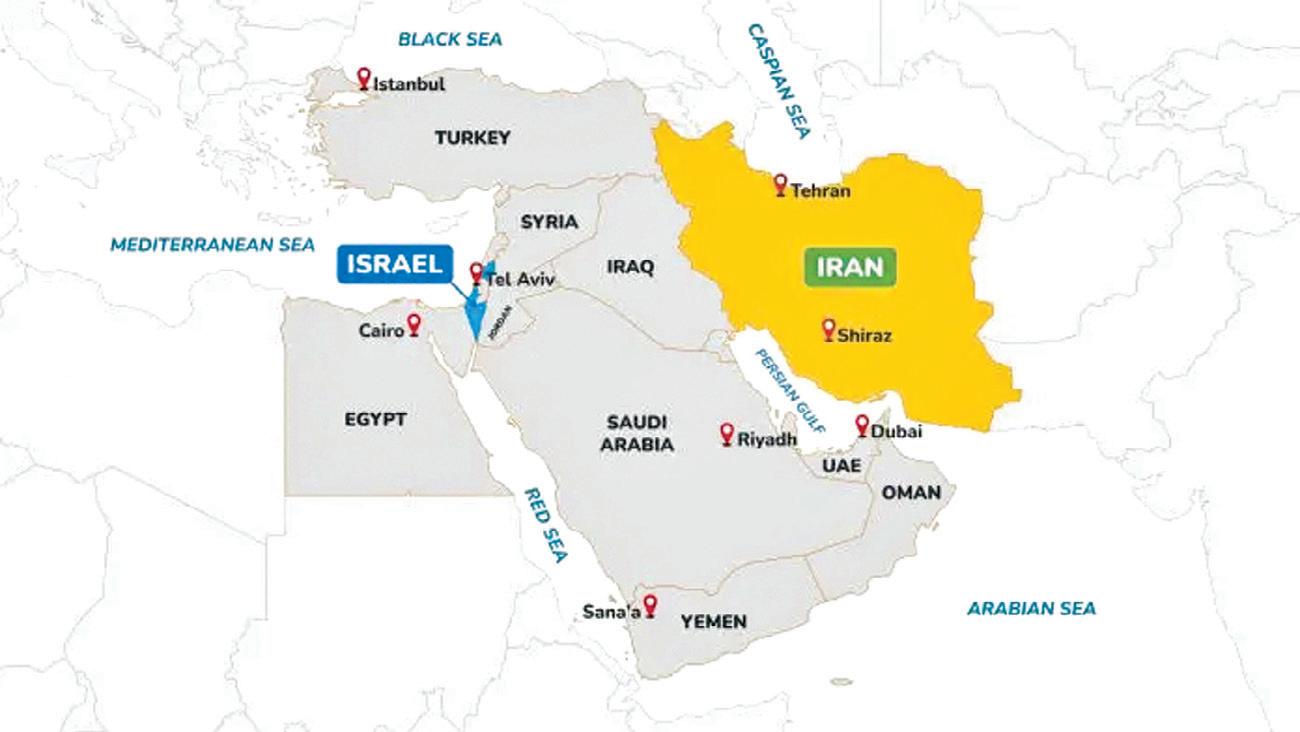
Israel had taken it as a given that it would be bombarded by Iran following the assassination of Ayatollah Ali Khameini on February 28, which kicked off the current hostilities between the two countries. The United States had fully expected that its military installations in the Kingdom of Saudi Arabia, Bahrain, Qatar the United Arab Emirates would be targeted as well, moving nonessential troops out beforehand and prepositioning air defense batteries for weeks leading up to Operation Rising Lion.
What no one expected was that the Gulf Arab States themselves would be targeted. While longstanding tensions between Iran and the aforementioned countries were well known, the Sunni Saudis, Emiratis and Bahrainis always managed to avoid matters getting out of hand when dealing with Shi’ite Iran.
Not anymore.
Iran unleashed the aerial onslaught almost immediately after Israeli warplanes obliterated the compound in Tehran during a meeting Supreme Leader Ali Khameini was chairing with high-ranking regime officials. Within
hours, the first Shahed 136 Kamikaze drones slammed into Fairmont The Palm, a glitzy 5-star resort located on the Palm Jumeirah in Dubai.
Later that day, another wave of missiles destroyed a residential building in the affluent neighborhood of City Walk, adjoining the swanky Dubai International Financial Center. Separate barrages of ballistic missiles slammed into Bahrain’s capital of Manama and Riyadh in neighboring Saudi Arabia.
The fusillade sparked mass panic in the United Arab Emirates and especially in Dubai, a glittering desert oasis and tourist destination known for its luxury and wealth. Panicked expats and tourists flooded police hotlines with inquiries as air raid sirens wailed throughout the metropolis. Never imagining that this day would come, the UAE does not have any bomb shelters.
Later that day, a pair of Iranian Shahed UAVs smashed into Terminal 3 at Dubai International Airport, halting operations for hours at the world’s busiest airport and paralyzing a crucial artery for global aviation.
“That’s when we realized that the world we knew had changed,” said Majd Al-Falasi, a senior Emirati businessman and political commentator.
This was the first salvo of an aerial blitz that left the UAE reeling and has Dubai staring into the abyss as it fights off economic collapse. Having marketed itself successfully as a haven for people and capital and a stable way for global businesses to access what is a very unstable (albeit lucrative) region, Dubai now watches in horror as its
carefully crafted image shatters.
Dubai is uniquely leveraged in a way that no other city is. Fully 90% of its residents are expats from foreign countries who can pick up and leave at any given moment.
With its last barrel of oil having been sold in 1991, no income tax and corporate tax varying from low to nonexistent, Dubai does not have any source of steady revenue and banks on the quality of life and personal safety it affords to attract international business and wealthy emigres.
For four decades now, Dubai carefully cultivated its image and Western-style openness to brand itself as the international safe haven, catapulting from an economic backwater subsiding on pearl fishing into an international financial center. Now, it all may all come crashing down together with the missiles and drones that pummel the Emirati City State.
Global capital is highly mobile.Without the sense of safety Dubai affords, nothing is keeping the foreign expats from leaving for better locales and taking their money with them. As Beirut learned in the 1970s, geopolitical change can devastate a regional business hub when multinational corporations headquartered there take flight.
In the meantime, government officials in the United Arab Emirates overall, and Dubai specifically, insist that everything is under control. State-controlled media outlets feature testimonials from residents declaring that they have no plans to leave, while influencers wax poetic about their love for the UAE to their legions of online followers. Mohamed Alabbar, the founder of Emaar Properties
and a prominent Emirati real estate developer who built the Burj Khalifa skyscraper, maintained during a prominent interview with CNBC that the current crisis would have no long-term negative impact on Dubai.
“People with true capital understand that a country like this, with stable leadership and the safety it has shown, can deliver,” said the Arab business magnate. “They will double down on this.”
In an attempt to radiate calm and hammer home the “business as usual” line promulgated by authorities, UAE President Sheikh Mohammed Bin Zayed gave his first-ever national address to residents of his nation on Saturday. In a live broadcast, the ruler highlighted that “the UAE places its security and the protection of all citizens, residents, and visitors at the very top of its priorities. With G-d’s grace, the UAE is fully prepared to confront these threats.”
Concurrently, authorities cracked down on social media in an attempt to censor news of missile strikes from the international community and thus limit the reputational damage Dubai was suffering. Official government communiques warned content creators that anything deemed liable to “harm public order” or “ hurt national unity” would result in massive fines beginning from AED 200,000 and escalating to a year behind bars. People posting videos of missile strikes or interceptions received menacing phone calls ordering them to delete them immediately or face severe penalties.
Yet initial economic data contradicted the carefully crafted narrative official state organs were putting out. In a staggering 48-hour window following the March 2026 Iranian missile strikes, an estimated $75-77 billion in UAE market wealth was erased. To prevent a total systemic collapse, regulators took the unprecedented step of shuttering the UAE’s stock exchanges in Dubai and Abu Dhabi for two days.
Upon reopening, the Dubai Financial Market was forced to slash its circuit breaker limit to just -5% – down from the usual 10% – after blue-chip anchors like Emaar Properties and Emirates NBD saw their valuations plummet by the maximum allowed daily limit. Investors, once confident in the emirate’s immunity to regional volatility, scrambled to exit positions as the risk of holding assets in an active combat zone became undeniable.
At the same time, the physical toll on Dubai’s infrastructure has struck a blow to the very heart of its identity as a global trade hub. Jebel Ali Port, the largest container facility in the Middle East and a vital artery for international shipping, was forced into a precautionary shutdown after debris from intercepted Iranian missiles ignited a towering blaze at one of its berths.
While Dubai Civil Defence teams quickly brought the fire under control, the temporary paralysis of the port sent shockwaves through global supply chains. Combined with severe damage and operational halts at Dubai International Airport, the city’s logistics network, until recently the world’s gold standard for efficiency, suddenly found itself vulnerable to the “falling sky” of modern aerial warfare.
Yet the most visceral sign of the collapse was not found in stock tickers but in the growing desperation at local supermarkets. The UAE remains a desert nation that imports over 80% of its food, a dependency that has rapidly transformed into a strategic liability as shipping routes through the Strait of Hormuz now face unprecedented disruption.
Panic buying gripped the city, leaving grocery shelves
stripped of staples like bread, dairy, and fresh produce. With major delivery services reporting indefinite delays, the fragility of a teaming metropolis cut off from its primary supply lines has been laid bare. The CEO of Swiss logistics giant Kuehne+Nagel warned that Dubai had about ten days of fresh produce left due to the transport collapse in the Arabian Gulf region if shipping in the Strait of Hormiz did not resume immediately.
The UAE is not the only Arab Gulf state suffering from Iran’s aerial blitz. The Islamic Republic has hammered targets across Bahrain, Kuwait, Saudi Arabia and Oman, blowing up critical infrastructure and energy facilities.
Yet the UAE has borne the brunt of Iran’s rocket fire and has faced a significantly higher volume of direct Iranian strikes compared to its neighbors in the Gulf Cooperation Council. As of Sunday evening, the UAE was hit with 238 ballistic missiles and 1,422 drones, far more than the 524 projectiles that hit second-place Kuwait and a 381.88% increase over the 320 projectiles targeting Israel – Iran’s main adversary.
Behind this disparity lies Iran’s entire strategy designed to enable the regime to survive the U.S.-Israeli onslaught: Stopping the war prematurely by making the UAE the main victim of a war it didn’t want or start, while systematically destroying the American air defense array protecting the Gulf and Israel.
On one hand, the fusillade of ballistic missiles and UAVs Iran unleashed on its Gulf neighbors is widely viewed as a significant miscalculation. Tehran’s unprecedented decision to attack opulent hotels in Dubai, oil infrastructure in Saudi Arabia and Bahrain’s financial district dumbfounded observers, as shocked Arabs and Westerners alike spoke of the Islamic Republic having “gone crazy” for embarking on what they predicted was a hasty move that Iran would long regret.
In a conversation with NBC News, a top Arab diplomat said that “the Gulf countries have no choice — it was a huge mistake for Iran to strike the Arab neighbors,” as former CIA Director David Petraeus called attacking the Gulf states “a serious strategic error.”
“Iran’s actions will carry serious consequences for the region,” warned Dr. Anwar Gargash, a senior diplomatic advisor to UAE President Sheikh Mohammed Bin Zayed.
Yet such a judgment error by Iran should be puzzling. Iran is not an opaque civilization half a world away like North Korea, but a country located a short distance away across the Arabian Sea, and one whose leadership possesses deep insight into the thinking of GCC movers and shakers.
Persians and Gulf Arabs have been doing business with each other for almost 1,000 years, and the United Arab
Emirates — specifically Dubai — is Iran’s second-largest trading partner, consistently ranking just behind China. Bilateral trade between the two nations reached approximately $27 billion in 2025, with the UAE acting as a vital hub for Iranian imports and non-oil exports.
Furthermore, cultural ties between Emiratis and their Farsi-speaking neighbours stretch back for hundreds of years. Persian traders founded Dubai; some of the most powerful Emirati families have Persian ancestry, and almost a million Iranians call the United Arab Emirates home today.
In other words, it would be quite strange for Tehran to suddenly make such a fatal mistake during what is the biggest test for the Mullahs’ survival since the Islamic Revolution in 1979. But what if it wasn’t a mistake? What if Iran is bombarding the UAE with lethal firepower after deciding that it is the most effective way for it to achieve its strategic aims?
Iran’s list of enemies and countries with which it maintains an uneasy relationship is long and illustrious. Yet the UAE is both more vulnerable, and far more influential, than any of the countries on the extensive list that range from Israel to Saudi Arabia, Bahrain, and Azerbaijan.
To understand what prompted Iran to detonate every diplomatic norm and Islamic tradition, it’s important to first understand what, exactly, Iran is trying to achieve. At the moment, Iran is facing the biggest challenge to the survival of the Islamic Republic since the ouster of the Shah in 1979.
The Mullahs are facing a full-on assault by the most powerful military in the world, whose naval assets and airpower can rain hellfire on Iran for months on end. Assisting the United States is Israel, which has repeatedly demonstrated intelligence domination unparalleled in modern history and showed no compunction in assassinating Ayatollah Ali Khameini in broad daylight – Iran’s Supreme Leader and one who was believed to be G-d’s personal messenger to humanity by hundreds of millions of Shi’ite Muslims.
Meanwhile, the vaunted and expensive proxy network that Iran painstakingly constructed over the course of de -
Iranian expats at the Iran Fest in Dubai in 2025
cades for this very moment is gutted. Despite being under crippling economic sanctions for the better part of its history, Tehran funded Hamas, Hezbollah, the Assad regime, and the Iraqi militias to the tune of trillions of dollars in the belief that they would rain hundreds of thousands of missiles onto Israel in the event of any direct clash between Israel and Iran.
Yet at a time where the theocratic Shi’ite regime in Tehran fights for its life, Hezbollah is engaged in limited clashes with the IDF on the Israel-Lebanon border, every single senior Hamas leader is dead, and Bashar Assad is practicing ophthalmology in Moscow. The Houthis in Yemen, meanwhile, are sitting out this round entirely.
Iran’s overriding strategic imperative in this situation is to do whatever it can to earn a temporary cessation in hostilities. Stopping the war would allow it to regroup, replan, and rebuild.
But how to do this? The obvious route of asking President Donald Trump to resume negotiations in the hope of leveraging the slow pace of diplomacy to buy time is a nonstarter.
Pausing the war prematurely to talk would ensure that the mercurial President will get the worst of all worlds; both enraging his political base and failing to “bring home the bacon.” The result would be a bloodbath in the 2026 Congressional midterms and the bottom falling out of the MAGA movement.
Launching an aerial blitz of ballistic missiles and drones into Israel, while leading to many dead Israelis, would do nothing to stop the war itself. The 3,500 kilometers separating the two countries affords Israel ample time to dispatch its citizenry into the bomb shelters, and the vast majority of whatever Iran sent Israel’s way would be shot down over Saudi Arabia or Jordan.
Should Iran still succeed in getting a few direct hits, it would not result in the Netanyahu government ordering a halt to the onslaught. What unleashing hundreds of ballistic missiles at Israel would do is lead to the destruction of the limited launchers Iran possesses, as the American and Israeli satellites maintaining their unblinking watch over the Islamic Republic would detect the launch coordinates and rapidly dispatch one of their warplanes circling above to obliterate them.
Yes, Iran could unleash its dwindling ballistic missile stockpile on Saudi Arabia in an attempt to destroy its oilfields and, by extension, the Saudi economy. But turning Saudi oil infrastructure into a raging inferno would only enrage China, whose economy depends on Saudi oil to function and remains Tehran’s only remaining ally now that Venezuelan strongman Nicholas Maduro is languishing in a New York prison cell.
Furthermore, firing an aerial blitz at Bahrain and Kuwait would accomplish little in light of their limited influence in Washington. What use is there in Iran expending its most important resource – ballistic missiles – on small and insignificant countries that don’t have the political and diplomatic capital to bring the war to a halt?
No, a different tactic would be needed to stop the war. Something like attacking the United Arab Emirates, a Gulf state well within range of cheap Iranian Shahed UAVs as opposed to long range ballistic missiles and
whose economy is built on being a haven for Western wealth and tourism.
As mentioned previously, explosions and Iranian rockets strike at the heart of the psychological foundations of a country that had spent four decades constructing that identity as one of the world’s most reliable places to do business in an unreliable neighbourhood.
The longer the UAE is targeted, the more its image as a haven for expats and foreign enterprises erodes, increasing the urgency for businesses and individuals to explore other destinations.
Dubai carefully cultivated its image and Western-style openness to brand itself as the international safe haven.
Tehran’s current campaign against the UAE is thus not just a traditional military escalation but a sophisticated form of financial warfare. The scope of this strategy is becoming increasingly clear: the objective is not merely to strike at urban landmarks but to dismantle the foundational infrastructure that allows Dubai and Abu Dhabi to operate as global financial hubs.
By disrupting airports, maritime logistics, and digital networks such as the massive, multibillion-dollar Amazon data center in Abu Dhabi Iranian missiles turned into smoldering wreckage last week, these strikes target the very connectivity that attracts international capital. Destroying a physical skyline is unnecessary to cripple a modern economy; one only needs to cultivate a climate of persistent risk.
When capital feels vulnerable, mobility becomes restricted, and the promise of operational continuity begins to fracture, the “safe haven” status of a city evaporates. Iran’s decision to turn the UAE into its main target is a deliberate attempt to “unstack” its successful economic model. By pressuring every node of this system, from energy exports to the security of its wealthy resident class, the
current strikes are testing the long-term viability of the Emirates’ position as a global sanctuary for wealth and commerce.
But on the other hand, the UAE is well-positioned to actually make the pain stop. The ruling Al- Nahyan family enjoys enormous influence in Washington and particularly within the Trump administration and the president’s inner circle of real estate developers and financiers.
Emirati Ambassador to Washington Yousef Al-Otaiba is a close associate of President Trump and wields extraordinary influence, widely viewed as the most powerful foreign diplomat in the nation’s capital. The financial ties between the UAE and the Trump family are well-documented and have evolved into a multi-billion-dollar network spanning traditional real estate, emerging technologies, and private equity.
Only last month, a Wall Street Journal expose detailed how just days before President Trump was inaugurated for his second term in the White House, UAE National Security Advisor Sheikh Tahnoon Bin Zayed bought a 49% stake for $500 million in World Liberty Financial, a crypto company owned by the Trump family. Jared Kushner, President Trump’s son-in-law and senior advisor, has raised an estimated $500 million from Abu Dhabi sovereign wealth funds as his Private Equity Fund, Affinity Partners, has become a central vehicle for Gulf capital.
Meanwhile, the real estate development company that made Donald Trump rich has been doing significant business in the UAE. The Trump International Golf Club Dubai remains a cornerstone of the family’s regional presence, while the recently announced Trump Tower Dubai will be an ultra-luxury development located on the affluent Sheikh Zayed Road and is the only Trump-branded tower in the Middle East.
In other words, Tehran is targeting the UAE inordinately because it is central to its strategy in bringing the war to a close as the only one that stands to suffer significant economic damage the longer hostilities drag on, while possessing the means to actually be able to sway the Trump administration to its thinking.
Early signs show that Iran’s strategy is bearing fruit as Abu Dhabi refrains from taking steps that would escalate matters further with Iran. According to a Bloomberg report, the UAE has been quietly lobbying the Trump administration to give Iran an off-ramp that would enable the guns to fall silent.
As per a separate report in the Financial Times, officials from Saudi Arabia, the UAE, Kuwait, and Qatar are considering scrapping mammoth investments they had planned in the U.S. that would have given President Trump significant political capital.
Notably, the UAE hotly and immediately repudiated an Israeli media report on Sunday alleging that its warplanes had attacked Iranian water infrastructure. At the same, the Emirates have as of now refrained from freezing the $300 billion in Iranian assets held in the oil-rich Sheikhdom, a move that would cripple Iran’s economy and signal that the UAE was taking off the gloves vis-avis its neighbor.
An attack near Dubai’s Jebel Ali Freeze Zone
But while Tehran hopes for an imminent end to the fighting, it is also working on Plan B: Designing a reality in which continuing the war unabated works towards its benefit and to the detriment of the United States and the Gulf States. This, by focusing its missile barrages on the radar systems and early-warning arrays that form the backbone of the U.S.-led missile defense architecture in an attempt to systematically wipe out the sophisticated sensor network protecting the Middle East.
Since the beginning of the war, Iran has destroyed at least 16 critical American radar and communication installations in Saudi Arabia, Jordan, Qatar, the UAE, Bahrain, and Kuwait. Upwards of $4 billion in high-tech defensive hardware has been neutralized, with the most significant blow involving the destruction of four AN/TPY2 (THAAD) radar units—the sophisticated “eyes” of the U.S. missile shield valued at approximately $2.296 billion.
also successfully destroyed the Fujairah Oil Industry Zone, the UAE’s primary strategic alternative for bypassing the Strait of Hormuz.
This was compounded by the hit on a singular AN/ FPS-132 Block 5 Early-Warning Radar at Qatar’s Al Udeid Air Base, an asset worth an estimated $1.1 billion. Beyond these heavy hitters, the loss of an AN/MPQ65 Patriot radar system and its associated Engagement Control Station in Kuwait added another $190 million to the tally.
This phase of the Iranian air campaign is specifically designed to “blind” regional interceptors and prioritize the destruction of high-value radar and tracking infrastructure in the aim of dismantling the Pentagon’s sensor network. Concurrently, Iran’s relentless barrages of cheap Shahed UAVs are rapidly depleting expensive interceptor stockpiles needed to stop them, as supply chains for Patriot air defense systems remain critically low after years of war in Ukraine.
It’s important to highlight that Tehran is prioritizing the preservation of its limited long-range arsenal by first exhausting its much larger supplies of drones and shortrange projectiles to neutralize enemy air defenses and deplete interceptor stockpiles. This tactical shift aims to degrade enemy defenses, ensuring that more lethal strikes can be deployed with maximum precision down the road.
While strongly denying reports that its interceptor inventory was running low, the UAE did confirm on Sunday that it has requested that South Korea expedite delivery of the Cheongung-II interceptor missile system it had purchased in 2025.
as Iran works on rendering the Gulf states, Israel, and American air defenses helpless by taking out radar systems and depleting interceptor stockpiles, it is engaged in a separate, parallel effort: ensuring that oil prices remain intolerably high, with the goal of sending the global economy into shock.
Tehran is doing this in multiple ways: Sending repeated missile volleys into Saudi, UAE and Kuwaiti oilfields and blockading the Straits of Hormuz, a critical artery needed for crude oil to leave the Arabian Gulf to international markets. To maintain the oil-soaked Gulf states’ reliance on the narrow, high-risk passage, Iran
The result is skyrocketing oil prices that have surged 35% in one week alone to cross $90 a barrel, raising fears of a recession as Goldman Sachs warned that prices will hit $100 a barrel should shipping disruptions continue. The stability of the global economy is facing a critical inflection point as Gulf Arab states exhaust their finite oil and gas storage capacities.
tehran’s current campaign against the ua E is thus not just a traditional military escalation but a sophisticated form of financial warfare
With the Strait of Hormuz effectively paralyzed, the traditional maritime export routes for crude and liquefied natural gas (LNG) have been severed. Consequently, regional energy giants have begun sharply reducing energy production, even shuttering production facilities, simply because there is no remaining logistical space to hold newly extracted resources.
With the war already unpopular among the majority of Americans, high prices at the pump will create significant political vulnerability for President Donald Trump and his Republican Party in the lead-up to the American midterm elections in 2026.
As mentioned, Iran is hoping to engineer a quick end to the U.S.-Israel war by disproportionately targeting the UAE, believing that the catastrophic economic damage Abu Dhabi and Dubai face should it continue, coupled with the leverage it has in the Trump administration, will be enough to cut things short prematurely. But should this strategy fail, Iran’s Plan B is creating a reality in which the passage of time only hurts its adversaries.
Should March turn into April with no end to the war in sight, Iran wants the Gulf Arab States, Israel and U.S. regional military installations to be powerless to stop its aerial blitz after having neutralized America’s defensive sensors and radar arrays across the Gulf and depleted missile interceptor stocks to zero. At the same time, the global economy would be facing widespread recession while President Trump faces the wrath of angry voters.
In this scenario, Iran would have the upper hand as the pain it inflicts on its foes becomes too much to bear.
A side benefit to Iran would be fracturing the alliance between Israel and the UAE and eliminating any potential normalization between Jerusalem and other Arab countries as the Emirates resent paying the price for a war it didn’t want nor desire. This is a key strategic imperiative for Tehran, as seen in captured Hamas documents showing that a key motivation behind the terror group’s October 7, 2023, massacre was derailing an expected peace deal between Israel and Saudi Arabia.
Signs that the UAE faults Israel for getting it in the difficult position it finds itself could be seen in an open letter to President Trump published on Thursday by Khalifa Al Habtoor, an Emirati billionaire often seen as a mouthpiece for official government thinking. The business magnate asked the President in a missive he published on X who “gave him the authority to drag our region into war with Iran” considering “that the ones who would pay the price would be the countries of the region themselves?”
“Was this your decision alone? Or did it come as a result of pressure from the Netanyahu and his government?” wrote Habtoor, whose business empire was one of the first to enter into partnerships with Israeli companies following the signing of the Abraham Accords in 2020.
There is no guarantee that Iran’s strategy will pay off. As legendary military strategist Carl von Clausewitz wrote, “War is the realm of uncertainty; three-quarters of the factors on which action in war is based are wrapped in a fog of greater or lesser uncertainty.”
The current sichuation is dynamic and anything can happen. Israel may very well succeed in systematically eliminating Iran’s military capabilities; we may yet find that the sustained air assault leads to the mass defections and political disintegration needed for the collapse of the Islamic Republic.
But one thing is certain: Iran believes that its chance at survival lies with leveraging the traditional Persian endurance-based outlook prioritizing patience and longterm strategic thinking. By making its problem everyone’s problem, it can survive to fight another day.
Tzvi Lev is a businessman, strategic consultant, and former diplomat with years of experience living and working in the Arabian Gulf. Previously, he ran Israel’s Economic Team for the United Arab Emirates and served on the Israeli government’s elite Abraham Accords Implementation Task Force.
An attack on Dubai’s airport temporarily closed flights
HILLEL GOLDMAN
To Raise a Laugh
Bar Mitzvah Planning
As someone who’s making a bar mitzvah for the first time, people keep asking me, “Are you excited to be making a bar mitzvah?”
Excited? I don’t know. There’s not really going to be a significant change in my life between now and after the bar mitzvah, except that I’ll have a teenager. And I teach teenagers. This is not something to celebrate.
Sure, I understand that this is a big simcha for my son, because he’s entering the age where he’s mechuyav b’mitzvos, and we’re happy for him And he has his own awkward questions to fend off too, such as the one that countless mommies asked me when I became bar mitzvah: “How does it feel?”
I don’t know that there’s a difference.
“Um… Sweatier?”
But I mostly haven’t gotten to think about how I feel because I don’t have time. I have way too much to do for this bar mitzvah. And I’m probably forgetting something.
So I’ve made a list. (The list doesn’t include food. That’s a whole separate list):
HALL
The good thing about bar mitzvahs is that you can generally do it in the kiddush room of a shul. The only thing is that you need to make sure the room is big enough for the number of people that are coming, which you don’t know until they send in the reply cards, which they can’t do until you send them invitations, which you can’t do until you have a hall.
INVITATIONS
Once you have a hall, you need to print out invitations, despite the fact that everyone you know has some other method of finding out electronically. You need to give them something concrete that they can hang on the fridge until about 3 months after the bar mitzvah.
REPLY CARDS
There are a few different formats for these. Most people either make a checklist of options –“will attend”, “will not attend”, “will attend but doesn’t eat dessert”,
etc. – or they just put “will ___ attend”, so that guests can either write “not” if they’re not coming, or, if they are coming, they can be unsure of what to do with the space. Do they write, “IY”H”? But then if they’re not coming, shouldn’t they write, “Will IY”H not attend”? Do they write “b’li neder”? “Probably”? Or do they just write “Will too attend”, like they’re having an argument about it? That’s not your problem; it’s your guests’. You’re already paying for their postage.
BENCHERS
You should probably print out benchers, because you’re serving food, and no one thinks before they go to a simcha, “Hey, they’re serving food! We might need a bencher!” But that might be because every simcha provides benchers. So if you’re not providing benchers, you should specifically mention it on the invitation.
MUSICIAN
The most cost-effective route here is to go with a one-man band, and if you get to choose the one man, I would say it should probably be a keyboard guy. But you don’t have to listen to me. I don’t mean to take parnassah away from all the harmonica players.
PHOTOGRAPHER
People question hiring photographers at all these days, seeing as everyone already has a camera. But who’s taking pictures when everyone’s dancing? It’s not like the guys who stand on the sidelines are doing it. Plus photographers have better equipment, like those ten-foot umbrella sticks. And bowties. A lot of photographers wear bowties, because regular ties get stuck in the camera straps. And because they know no one’s taking pictures of them.
TABLECLOTHS
I put this on the list at the behest of my wife, because left to my own devices, I wouldn’t have even thought of tablecloths. I know this for a fact because when we go on day trips and I pack the food, we find a picnic table and my wife goes, “Okay, where’s the tablecloth?” and I go, “Tablecloth!”
Every time.
CENTERPIECES
Centerpieces are very important, because guests spend the whole event staring at them,
By Mordechai Schmutter
especially during the speeches. It beats staring at the guy across from them. I actually read somewhere that the point of centerpieces is to provide an icebreaker for people who’ve been assigned to sit together – it gives them something to discuss. So you want to go with something weird.
“Look at those centerpieces!”
“What? I can’t hear you. The music’s too loud.”
GEMACHS
Simchas are a good time to figure out how your local gemachs work. There’s a tablecloth gemach and a centerpiece gemach and a schnapps gemach, and you have to return every item to exactly the right gemach, because they get very snippy about it.
“These aren’t our tablecloths. We gave you schnapps.”
“Yeah, well we spilled the schnapps on the tablecloths.”
WRITE SPEECHES
And the bar mitzvah boy has to have time to practice his, so he doesn’t sound like he needs to be taken out of the bar mitzvah and put into Resource Room. (What a great name. Why doesn’t the regular classroom have resources?)
The main part of the your speech, as the father, is of course all the thank yous, like thanking everyone for coming, especially since their reply cards said they were coming, and you already figured out tables. You should also thank your son’s grandparents for always being there, even when you didn’t want them to be there, and for never mixing in more than they felt was necessary. And of course, you should thank your wife for everything she did, especially the things you would have missed had you put this whole thing together yourself, such as tablecloths and centerpieces and cutlery.
Cutlery!
Every time.
Mordechai Schmutter is a freelance writer and a humor columnist for Hamodia and other magazines. He has also published eight books and does stand-up comedy. You can contact him at MSchmutter@gmail.com.
Societal Norms And Expectations Living Kiddush Hashem
EBy Rabbi Shraga Freedman
ven if we observe every halachah in the Torah to the fullest, we must still beware of another potential source of chillul Hashem: disregarding societal norms that vary based on the time and place. What may be acceptable in one neighborhood may be considered disgraceful or disrespectful in another. Derech eretz literally means “the way of the land.” Every place in the world has its own standards of behavior.
This concept can extend to our driving habits, our manners, the way we exercise proper etiquette, how and
when we greet others, and many other areas. Part of our responsibility to create a Kiddush Hashem is to remain aware of the local customs.
For example, many neighborhoods expect residents to shovel their sidewalks and clear the walk to their front doors after a snowstorm. One mailman recently left a note on someone’s door: “I just wanted to thank you for clearing your snow from in front of your mailbox. You’re one of the very few who care about my safety. This has been the hardest two weeks of my career; if there were more like you, I might not be thinking of changing routes.” Even this
simple act, respecting local expectations, is a form of Kiddush Hashem and can prevent much chillul Hashem.
A number of sources indicate that even when a certain behavior is not objectively “wrong,” the directive of Kiddush Hashem and the prohibition of chillul Hashem still applies if it will evoke disapproval or violate society’s code of conduct.
Rav Shlomo ben Rav Shimon Duran (the Rashbash) was once asked about a shul in Algiers founded by Jews from Spain, in which some mispallelim wanted anyone entering the beit knesset to remove their shoes, following the local Muslim custom. The Rashbash agreed: “It is known that a beit knesset should be glorified, exalted, honored, and protected from any disparagement. ‘Honor’ is whatever people consider to be honorable....” In a Christian country, wearing shoes in shul may not be dis-
respectful, but in a Muslim land, where removing shoes is a societal norm, one must follow that custom to honor the beit knesset, the “house” of Hashem (Shu”t Rashbash, Birkei Yosef 151:8).
Rabbi Shraga Freedman is the author of Sefer Mekadshei Shemecha, Living Kiddush Hashem, and A Life Worth Living.
Email LivingKiddushHashem@ gmail.com for a free sefer. Visit LivingKiddushHashem.org for more resources.
Living Kiddush Hashem was founded with the goal of imbuing every Jew with a powerful sense of mission — the mission to be mekadeish Sheim Shamayim in his or her own unique way. We strive to accomplish this by raising awareness of the paramount importance of the mitzvah of Kiddush Hashem and its centrality in everything we do.
Shakespeare Trivia
1. Who warned Julius Caesar to “Beware the Ides of March” in Shakespeare’s play Julius Caesar?
A) Brutus
B) Mark Antony
C) A soothsayer
D) Cassius
2. Where was Caesar assassinated?
A) The Colosseum
B) The Roman Forum
C) The Pantheon
D) The Senate chamber
3. How many plays did William Shakespeare write?
A) 20
B) 37
C) 52
D) 75
4. Which Shakespeare play contains the famous line “To be, or not to be”?
A) Hamlet
B) Romeo and Juliet
C) Macbeth
D) Othello
5. Which Shakespeare play features three witches who predict a man will become king?
A) King Lear
B) Hamlet
C) Macbeth
D) Richard III
6. Which character gives the famous speech beginning “Friends, Romans, countrymen”?
A) Brutus
B) Mark Antony
C) Caesar
D) Cassius
Riddle Me This
I
7. What is the name of Hamlet’s father’s ghost?
A) King Edward
B) King Richard
C) King Henry
D) King Hamlet
Answers: 1-C
2-D 3-B 4-A 5-C
6-B 7-D
Wisdom Key:
6-7 correct: Thou art a Shakespeare savant.
3-5 correct: You know just enough Shakespeare to say, “Et tu, Brute?” at inappropriate moments.
0-2 correct: Et tu Dummi
am an odd number. Take away one letter, and I become even. What number am I?
Answer: Seven
10 People Who Take Pi Day Way Too Seriously
The guy who refuses to eat square pizza on March 14 because “that’s mathematically disrespectful.”
The person who memorized 200 digits of π and somehow manages to bring it up in every conversation.
The person who writes 3.1415926535 instead of their actual phone number on forms.
The bakery that suddenly renames everything “pi.”
The guy who insists that cake is geometrically inferior to pie.
The person who tries to explain π at the dinner table and suddenly nobody is hungry anymore.
The person who tries to calculate the exact circumference of the pizza before eating it.
The person who celebrates Pi Day at 1:59 p.m. because “that’s the next digits.”
The guy who eats 3.14 slices of pizza and calls it tradition.
The friend who says, “Happy Pi Day!” and then expects applause.
The guy who says, “Actually, π is irrational” every time someone says Pi Day is silly.
The one friend who says, “I prefer cake” and is immediately disinvited.
(If you looked at this list and immediately realized that there are more than 10 items on it, Happy Pi Day Nerdo!)
You Gotta be kidding Me!
Sadie is sitting on the beach doing a Sudoku puzzle.
Her friend asks, “Why don’t you relax a bit?”
Sadie sighs and says, “At my age, I have two hobbies: worrying and numbers. Sudoku lets me do both at the same time.”
Notable Quotes
“Say What?!”
Trump lied about being against forever wars. He broke the most basic promise he made to his own supporters. There is no reason this war had to happen.
- Obama’s Deputy National Security Advisor Ben Rhodes, who was the architect of Obama’s failed nuclear deal with Iran, commenting on X, shortly after Operation Epic Fury began
Yes, we were much better off with a president who drew redlines and failed to enforce them. Team Obama might want to sit this one out.
- Political commentator Marc Thiessen, in response
If you’re having a tough day and want to end your race before 26.2, you can choose to take the turn at Mile 18 and head into the finish line early. You do not need to notify anyone of your decision and can opt to take this route at any time. You will still receive your finisher medal.
- From a notice to marathon runners by the organizers of the LA Marathon
People who don’t finish the Marathon can identify as people who do finish the Marathon.
- Tweet by Lisa Cusack
Faith isn’t built in a day. Faith is a gift from G-d, and faith is what gives you the ability to stand in front of these challenges, these experiences, in front of these waves.
Are you just ridiculously good-looking, as Vogue said? No, seriously, what do you do about that?
- Katie Couric to Gov. Gavin Newsom (D-CA) “in a hard-hitting interview” asking him if he is too looking to become president
You know what, I am who I am, and it’s fine.
- Newsom’s response
Tucker has lost his way. I knew that a long time ago, and he’s not MAGA. MAGA is saving our country. MAGA is making our country great again.
MAGA is America first, and Tucker is none of those things. And Tucker is really not smart enough to understand that.
– Pres. Trump in an interview with ABC News’ Jonathan Karl responding to some of Tucker Carlson’s unhinged statements
My advice to the mullahs: go back to your mosque. There’s a game in America called whack-a-mole. We’re doing “whack a mullah” right now. Everybody sticks their head up and says, “I’m in charge,” and you’re gone — history.
- FOX News analyst Lt. Gen. Keith Kellogg
If a guy can [get massive amounts of viewers] with overhead [of] about $600, and you have every big star lining up to do his show…that’s when I profoundly understood that late night shows are in trouble.
- Former late night show host Conan O’Brien talking about how podcasters have rendered late night TV obsolete
- Tamar Biton, who lost three of her four children in the missile strike that hit Beit Shemesh, in an interview with Times of Israel
Yeah, the amount of dentists that have reached out, man, it’s too many. But I’m going to get them fixed, hopefully this week.
— U.S. Olympics hockey hero Jack Hughes, whose post-goal celebration photo — featuring a missing tooth and a mouth full of blood — quickly became iconic, talking about having his teeth repaired
I think people will be [upset] if I do get them fixed. - ibid.
Two Pennsylvania teenagers crossed into New York City Saturday morning for what could’ve been a normal day enjoying the city during abnormally warm weather. But in less than an hour, their lives would drastically change as the pair would be arrested for throwing homemade bombs during an anti-Muslim protest outside of Mayor Zohran Mamdani’s home.
- A CNN news post about two radicalized Muslims who came to New York to carry out a terrorist attack but were thankfully not successful
Let me just say I predicted a lot about what’s happening right now. I’m not into saying, “I told you so,” but we did see it coming. But what I did not predict is that we would not have Jesse Jackson with us right now to help us get through this.
- Kamala Harris’s crafty way of making it all about her loss to Pres. Trump, during her speech at Jesse Jackson’s funeral
Yesterday I listened for several hours of three United States presidents who do not know Jesse Jackson.
- Jesse Jackson Jr. commenting on politically charged speeches at his father’s funeral by Presidents Clinton, Obama, and Biden
I encourage you to go to Tehran alone and drunk… Let’s see how long it will take them to hang you from a crane.
- A member of Spain’s Parliament, Isabel Díaz Ayuso, after Spain’s prime minister condemned the war in Iran
Dating Dialogue What Would You Do If…
Moderated by Jennifer Mann, LCSW of The Navidaters
Dear
Navidaters,
I’m 28 and have been dating for the past five years. I come from a more affluent family, and I have a hard time finding a guy on par with what I’m used to.
I’m writing now because I’ve been dating a guy for the past 4.5 weeks. Things have been going very well – he’s an awesome guy, has a good job and a nice family. But I’m writing because suddenly I feel deceived.
For all our dates, he came to pick me up in a really nice Tesla and dressed super nicely. This past Shabbos, I spent in his hometown, and we had a meal together. He picked me up from the train station, which was kind of him, but he came in a really old car. When I asked where his Tesla was, he responded that he had been borrowing one of his rich uncle’s cars for dating and now that he’s home, he’s using his own. He also went on to say his uncle lends him clothes as well. He said it very nonchalantly as if he knew it wouldn’t bother me. He laughed about it innocently, as if it was no big deal. But in reality, it does bother me. We had a nice time over Shabbos, but it was all tainted, knowing he was wearing borrowed clothing and seeing his real car (a real clunker) bothers me terribly. I’m tempted to end it, as he just isn’t the type I thought he was. But I wanted to first ask this panel what you all think.
Thank you,
Rachel*
Disclaimer: This column is not intended to diagnose or otherwise conclude resolutions to any questions. Our intention is not to offer any definitive conclusions to any particular question, rather offer areas of exploration for the author and reader. Due to the nature of the column receiving only a short snapshot of an issue, without the benefit of an actual discussion, the panel’s role is to offer a range of possibilities. We hope to open up meaningful dialogue and individual exploration.
The Panel
Dear Readers,
We want to offer YOU an opportunity to be part of the discussion! Please email us at MichelleMondShadchan@gmail.com, subject line “reader’s response,” if you would like to participate in the new “A Reader’s Response” columnist spot. We will send you a question and publish your answer in an upcoming Navidaters edition.
If you have a question you would like the Navidaters to answer, please reach out to this email as well.
Looking forward!
Michelle, the “Shadchan”
The Rebbetzin
Rebbetzin Faigie Horowitz, M.S.
Rachel, instead of appreciating the young man’s transparency, you are re-evaluating him based on his actual financial standing. Didn’t you try to put your best foot forward on the dates as well? Were you being deceptive?
Your about-face betrays a lack of maturity and values of depth and responsibility that go deeper than finances and the lifestyle you are used to. Do some soul searching with a lot of guidance from wise counselors and mentors.
Money comes and goes. Hashem sends challenges of all kinds to people, those that we see and those that we don’t see. If outward displays really matter to you, a person of responsibility, values, and depth like you indicate, the young man is not a fit for you.
The Shadchan
Michelle Mond
Rachel,
I am going to be very honest with you.
The man you are dating, who you’ve been spending time with, is the real person you have been getting to know. His character, his personality, his job, and the connection you described are the real things. His car and his clothing are just external details.
You wrote that he is a great guy, that he has a good job, comes from a nice fam-
ily, and that the two of you are getting along pretty well. Those are the things that actually matter when you are choosing a husband.
Right now, he is an unmarried man. As you said, he has a solid job. There is very little stopping him from upgrading his wardrobe or buying a nicer car when the time is right (i.e. when he has a wife to help him with those things). I’m sure you could easily encourage him to buy new clothes of his own and maybe even enjoy going shopping together. You might even pick out a new car together. What stands out to me even more is that he was not trying to hide anything. If he were attempting to deceive you, he could easily have continued using his uncle’s car when he picked you up from the train station. Instead, he showed up in his own car and casually told you the truth. The way he said it so naturally suggests that he genuinely did not think it would be an issue. Borrowing a nicer car or clothing for dates is actually very common.
Maturity sometimes means recognizing that the external things in life do not arrive on a silver platter. Life is hard and comes with many obstacles. You did not say the age of the guy you are dating, but I would imagine he’s around 30. This means he is probably a couple years into a good job after going to school for many years. I’m sure he has student loans to pay off as well. For now, before he is married, he’s likely saving his money wisely for when he ultimately gets married. The important qualities are the ones you already described in this young man. He sounds responsible, practical, employed, and someone you enjoy spending time with.
If the car and the clothing truly over-
shadow all of that for you, then it may be best to step away and allow him to find someone who appreciates him exactly as he is. Don’t you think he deserves that? Do you perhaps have some of your own imperfections that your future spouse may have to overlook or work with? I think you do simply because everyone does. He appreciates you for who you are; it’s time to give him the same decency. If you can look past the surface details, you may realize that the qualities that actually matter are already there.
The Zaidy
Dr. Jeffrey Galler
You are having doubts about the relationship. Is it mainly because you feel that he deceived you, or because you are concerned that he won’t be able to sup -
Maturity sometimes means recognizing that the external things in life do not arrive on a silver platter.
port you in the style to which you have become accustomed?
Issue #1 – Deceitfulness
When people go on dates, they naturally try to present themselves in the best possible light.
When you go on a date, don’t you make an extra effort to dress your best and apply your makeup especially well? You probably don’t look quite the same when you’re having an early morning cof-
Mazel Tov to our Publisher, Moshe Meir Rubin on the engagment of his son Binyamin Rubin (Baltimore) to Tziporah Sommer (Cleveland)
Want to see your simcha here? Email mazeltov@baltimorejewishhome.com or text 443-675-6507 to submit your simcha!
fee. And there’s certainly nothing unusual when girls often borrow clothes from their roommates when they wish to look special.
Your boyfriend, like any single, tried to present himself in the best light possible.
Note, however, that the way he presented himself when you visited his hometown certainly indicates that he wasn’t trying to create a misleading impression and then lie about it.
Issue #2 – Affluence
When guys start dating, smart mothers warn them to beware of wealthy, high maintenance women. Those wise mothers worry that their sons will endure unhappy lives, trying to meet unrealistic expectations.
Many accomplished and financially comfortable women are happy to marry exactly the type of man you describe: “an awesome guy, with a good job and a nice family.” They look forward to building a comfortable and secure future together
with their partner.
I hope I don’t sound judgmental, but your letter suggests that you may be focused on finding someone who is already wealthy, rather than someone who has the potential to build a successful life with you.
Issue #3 – Decision time
The guy that you are dating is, in your own words, “an awesome guy, with a good job, and a nice family.”
Unfortunately, because he has not yet earned his own Tesla and designer clothes, you feel that his current financial situation does not match what you hoped for.
My honest advice may sound harsh, but it is probably best for both of you to end the relationship.
He deserves someone who appreciates him for the person he is today. And you deserve someone whose lifestyle already matches the one you envision for your future.
And, as an added bonus, many oth-
Pulling It All Together
The Navidaters
Dating and Relationship Coaches and Therapists
Dear Rachel, I’m really glad you wrote in before making a quick decision, because something meaningful happened here and it’s worth slowing down with it for a moment.
For the first few weeks, you were getting to know a certain version of this man. The Tesla, the clothing, the overall presentation created a picture in your mind of who he was and what his life looked like. And then this past Shabbos, the picture shifted. That can feel unsettling. It’s never pleasant to realize that something you assumed wasn’t entirely accurate.
But I’d invite you to pause and ask yourself a deeper question: what exactly is bothering you?
Is it that he doesn’t have the car and wardrobe you thought he had? Or is it the feeling that he allowed you to form an impression that wasn’t quite real?
Those are two different things.
If the lifestyle piece matters to you, it’s okay to be honest about that. The environments we grow up in shape our expectations. They influence how we imagine our homes, our spending habits, and even the rhythm of daily life. Compatibility in
er single women will be delighted to find that this “awesome guy with a good job and a nice family” is once again available.
Reader’s Response
Avigail and Binyamin Lowenstein
Rachel,
Wow, that sounds like a lot of emotions! Especially because you seem to really like him; his looks, his personality, everything about him, and you seem to like the way he dresses, and to say it outright: you like it that he seemed financially well off. I can hear where you’re coming from; for a girl to feel financially stable and secure is important. You just have to realize, are you marrying someone because he has money, or are you marrying HIM?
Just because you marry someone who has money, who says they won’t lose it all?! Just because you marry someone who doesn’t have money, who says they won’t be motivated and successful and earn more money than you can ever imagine (yes, that happens more often than you’d think)?! So marry a guy who you like for who HE is and for no other
those areas can matter and pretending it doesn’t rarely works in the long run.
But there’s another piece here that shouldn’t be skipped.
Was he trying to fool you? Maybe.
Or maybe he was a little self-conscious about dating someone from a more affluent background and wanted to level the playing field. The truth is, from the outside, we can’t know his intention. And intention is an important piece of this puzzle.
Which is exactly why the next step here isn’t to end things. It’s to talk.
Tell him honestly how it landed for you. Not accusingly, but openly. You might say something like, “I have to admit, when I realized the car and clothes were borrowed, it made me feel a little
Dating is full of moments where the image cracks a little and something real appears underneath.
reason, and that will be a secure, successful marriage that will last your entire life! I do also want to add that I think you have a right to feel hurt that he wasn’t open with you about his car and clothes, etc. before you got this far along in dating. I would ask him and have an open conversation about this and share your feelings with each other and express that you want to have a relationship where you both feel comfortable sharing things with each other, even if they may seem scary. You should have clarity to see what is right from wrong and be able to make confident decisions that will lead you to be the best person you can be!
thrown. I want to understand what was going on for you.”
His response will likely tell you far more than the borrowed Tesla ever could.
Dating is full of moments where the image cracks a little and something real appears underneath. Those moments aren’t always comfortable, but they are often the moments where you actually begin to see who the other person is.
So before deciding whether he’s “not the type you thought he was,” give him the chance to show you who he really is.
And listen carefully. His honesty in that conversation will likely tell you everything you need to know.
Warmly, Jennifer
Jennifer Mann, LCSW is a licensed psychotherapist and certified trauma healing life coach, as well as a dating and relationship coach working with individuals, couples, and families in private practice at 123 Maple Avenue in Cedarhurst, NY. To set up a consultation or to ask questions, please call 718-908-0512. Visit www.thenavidaters.com for more information. If you would like to submit a dating or relationship question to the panel anonymously, please email JenniferMannLCSW@gmail.com. You can follow The Navidaters on FB and Instagram for dating and relationship advice.
School of Thought
Limiting Screen Time is Not a Religious Issue
By Etti Siegel
There are a lot more kosher options for children nowadays. Children can watch beautifully produced plays, shows, wholesome comedy, and content that has been carefully reviewed and approved and has actors who look like them. For many families, that feels reassuring and responsible. It feels like we’ve solved the problem.
However, as an educator and coach, as someone who spends her days inside classrooms watching children learn, struggle, engage, disengage, regulate, and unravel, my concern is not about Jewish versus non-Jewish, or kosher versus non-kosher. I leave those questions to the rabbanim. My concern is not religious at all. It is developmental and educational.
We live in a screen-saturated world. Screens are everywhere, all the time, woven into the fabric of daily life so seamlessly that we often don’t notice them anymore. A tablet in the car. A phone while waiting. A show during dinner prep. A “quick” video to calm down. None of these moments feels dramatic on its own. Each one seems small, harmless, even helpful.
But childhood is not a collection of random events; it’s the sum total of what fills a child’s days.
There are only twenty-four hours in a day. When a child spends time on a screen, any screen, even a kosher one, that time is being taken from something else. And that “something else” matters more than we often realize.
Recent research underscores this in a way that aligns powerfully with what educators have been seeing for years. When researchers examined what happens when screen time is replaced with shared parent-child reading, the results were not subtle. They were measurable. Children who spent more time reading with parents showed stronger language skills, better understanding of written text, and more advanced socio-emotional development. And these gains weren’t dependent on what kind of screen content was replaced. Educational screens, recreational screens, it didn’t matter. The device itself could not replicate the developmental benefits of reading together.
That means when screen time is replaced with parent-child reading, even in small chunks, children show measurable gains in language development and emotional understanding. Not just correlation, but substitution: fifteen minutes less screen time and fifteen minutes more shared reading leads to better phonological
awareness, stronger familiarity with written language, and deeper socio-emotional skills. Reverse the swap, and those skills decline.
This is important because many parents assume that educational apps or “learning shows” provide a safe harbor. We tell ourselves that if the content is enriching, the medium must be neutral or even beneficial. But the research challenges that assumption directly. Even when educational screen time replaces shared reading, children lose ground in language and emotional growth.
Why? Because development doesn’t happen through exposure alone. It happens through interaction.
When a parent reads with a child, something profoundly different is taking place. There is shared attention. There is conversation. There are questions and clarifications. There is tone, facial expression, body language, emotional connection. A book doesn’t talk at a child; it invites engagement with a child.
A parent pauses to explain a word. A parent notices confusion. A parent encourages prediction. A parent points out emotion. A parent wonders aloud. A parent responds in real time. This is not just literacy-building. It is relationship-building. It is emotional coaching. It is the slow, steady construction of a child’s inner world.
Screens, by their nature, are often passive. They are designed to deliver information efficiently, not relationally. Even when parents co-view, the interaction tends to be thinner. The screen sets the pace. The screen controls the narrative. The screen does the talking.
And this difference shows up later in classrooms.
I see it when children struggle to listen without constant stimulation. I see it when they have difficulty reading emotional cues, managing frustration, or expressing themselves with words. I see it when learning feels effortful and uncomfortable, and their tolerance for that discomfort is low. These are not moral failures. These are developmental gaps.
Language development, emotional regulation, and attention are built through what psychologists call “proximal processes” – the repeated, reciprocal interactions between a child and a responsive adult. Reading together is a gold-standard example of this. It is slow. It is human. It is inefficient in the best possible way.
Screens, by contrast, tend to shortcut the process.
They entertain without demanding reciprocity. They reward without requiring sustained effort. They provide feedback that replaces the adult’s role, cheering, buzzing, congratulating, often allowing parents to step back unintentionally. Over time, this changes the texture of a child’s learning experiences.
And again, this has nothing to do with values or messaging. A kosher show is still a show. A frum app is still an app. The medium remains the medium.
One of the most striking findings in the research is that even co-viewing, which is when parents watch screens together with children, does not outperform shared reading. While co-viewing is certainly better than solo screen use, it still falls short. Watching something together is not the same as doing something together. The shared focus on a book invites dialogue; the shared focus on a screen often limits it.
From a teacher’s perspective, this makes sense. Children who arrive at school with a strong foundation in language, emotional awareness, and attention are better equipped for everything that follows. They can follow directions, participate in discussions, manage transitions, and engage with learning even when it’s challenging. These skills don’t come from being entertained. They come from being engaged.
This is why my pushback on screens isn’t about morality or modesty or messaging. It is not a religious argument. It’s about development. It’s about protecting the kinds of experiences that actually build language, empathy, and resilience. It’s about understanding that childhood skills grow best through sustained, reciprocal human interaction, not digital input.
I’m not suggesting that screens disappear entirely. That’s probably unrealistic. But I am suggesting that we stop asking, “Is this show OK?” and start asking, “What is this replacing?”
Because when families choose books over devices, even imperfectly, even inconsistently, they are choosing conversation over consumption, connection over convenience, and development over distraction. And those small, daily choices quietly shape the kind of learners, and people, our children become.
Mrs. Etti Siegel holds a MS in Teaching and Learning/Educational Leadership and brings sound teaching advice to her audiences culled from her over 35 years of teaching and administrative experience. Etti is an Adjunct at the College of Mount Saint Vincent/Sara Shenirer. She is a coach and educational consultant for Catapult Learning, FACTS Education Solutions, Brienza Academic Advantage, Yeled V’Yalda; is a sought-after mentor and workshop presenter around the country; and a popular presenter for Sayan (a teacher-mentoring program), Hidden Sparks, and the Consortium of Jewish Day Schools. She is a frequent contributor to Hamechanech magazine and The Journal for Jewish Day School Leaders and has a weekly column in The Jewish Home. She can be contacted for questions and comments at ettisiegel@gmail.com.
Old School
PURIM PURIM
PURIM PURIM
CONTEST Contest
Honorable Mentions Honorable Mentions
& Sara Leah Nissel on the birth of a son
Avi & Malki Sharfman on the birth of a son
Menachem & Tzippora Feld on the birth of a son
Dovid
Note:
Rachelli B.
Asher Simcha Z., 8
Yonatan Kohengadol, 4
Leah Laghaei, 10
Aidel Krintzman,10
Adina Kleinman, 6
Adina Radfard, 4
Ahuva Shugarman, 12
Bella Barer, 6 Yehuda Sobel, 8
Batya Greenwald & Raizy Rubin, 7
Chaya Bracha Sambrowsky
Note:
Yonah Laghaei, 4
Aliza Goldman, 11
Nechama Chazan, 7
Ayala Ribakow, 5
Nati Coleman, 6
Naomi Laghaei, 11
Aliza Wecker, 7
Rivky Pickett, 6
Rachelli B.
Shana Leibowitz, 16
Shimon Ouazana
Riki Schabes, 2
Meira Soskil, 4
Rivka Furst, 3
Rafi Shugarman, 9
Rafi Yardley, 9
Mimi Glaser, 11
Yardena Markowitz, 7
Rivka Rosenbaum, 9
Maya B. Mari Khaver
Rina Schabes, 5
Akiva Laghaei, 9
Miriam Aliza, 5
Bassie Shulman, 8
In The K tchen
Onion Brick Roast
Meat / Yields 10 servings
By Naomi Nachman
I developed a new roast recipe that is quick and easy to make. So many roast recipes have to be timed just right so they aren’t overcooked in the center. Because this roast is cooked low and slow, it does not require constant attention after it’s in the oven. The marbling rippling through the meat makes it soft, moist, and flavorful, so you’ll get a perfect roast every time.
Ingredients
◦ 1 (4-5-pound) brick roast
◦ 6 onions, sliced
◦ 1 Tablespoon Dijon mustard
◦ 3-4 cloves garlic, crushed
◦ 1 teaspoon paprika
◦ 1 teaspoon onion powder
◦ 1 teaspoon garlic powder
◦ 1 teaspoon salt
◦ 2 Tablespoons olive oil
◦ 1 (12-ounce) bottle beer
Preparation
1. Preheat oven to 300°F.
2. Place onions into a roasting pan. Place meat over onions; set aside.
3. In a small bowl, mix together mustard, garlic, paprika, onion powder, garlic powder, salt, and olive oil to form a paste. Rub the paste all over the meat.
4. Pour beer over the meat.
5. Cover the pan tightly with foil; bake for 3 hours. Remove from oven; allow to cool.
6. After the meat has cooled, slice and serve with the onions.
Cook’s Tip: For an extra-special sauce, combine onions with pan juices in a small pot; cook over low heat until reduced and thickened. Serve over the meat.
Naomi Nachman, the owner of The Aussie Gourmet, caters weekly and Shabbat/ Yom Tov meals for families and individuals within The Five Towns and neighboring communities, with a specialty in Pesach catering. Naomi is a contributing editor to this paper and also produces and hosts her own weekly radio show on the Nachum Segal Network stream called “A Table for Two with Naomi Nachman.” Naomi gives cooking presentations for organizations and private groups throughout the New York/New Jersey Metropolitan area. In addition, Naomi has been a guest host on the QVC TV network and has been featured in cookbooks, magazines as well as other media covering topics related to cuisine preparation and personal chefs. To obtain additional recipes, join The Aussie Gourmet on Facebook or visit Naomi’s blog. Naomi can be reached through her website, www.theaussiegourmet.com or at (516) 295-9669.