Parshas Yisro teaches us a foundational truth about Torah. Yiddishkeit is not about making deals with Hashem. It is not “if I do this, then I get that.” At Matan Torah, Hashem did not offer a transaction, but a relationship. We became His people, and that connection itself was the purpose. Because Torah is about relationship, it does not treat people, and certainly not children, as a means to an outcome. Every person has inherent value. Every child is “the one.” That idea appears quietly in the story of Moshe Rabbeinu’s sons, but it defines everything that follows and shapes how we understand chinuch and responsibility today.
This week, the community will begin to learn more about Invest in BalTImore, the new capital building campaign for Torah Institute of Baltimore (TI). As this conversation begins, it is worth understanding why this moment has arrived. Torah Institute has experienced steady growth in enrollment and programming, placing real strain on its current facility. Classrooms are full and shared spaces are stretched. The question is no longer whether the school should grow, but how to expand thoughtfully while preserving the quality, warmth, and personal attention that define the Torah Institute experience. Under the leadership of Rabbi Shimon Hirsch, Torah Institute has flourished. His clear vision, steady guidance, and deep understanding of chinuch have strengthened the school academically and culturally. The leadership team,rebbeim, and teachers, have built an environment where expectations are high, relationships are strong, and every talmid is known. That success has created the need for physical
expansion. The planned facility will support a student capacity of 1,300 talmidim, include 30 new classrooms, and feature a 7,200 square foot Bais Medrash designed to be a true center of learning and growth. These are not aspirational numbers. They reflect what the school already is and what it must become to continue serving the community properly.
The building campaign has a goal of $25 million, with $18 million already raised. That progress speaks volumes about the confidence and trust that already exist. The campaign is being led by Gil Horwitz, Chairman of the Building Committee, whose leadership and dedication have helped move this effort from vision to reality. “Invest in BalTImore” is not a slogan. It is a statement of responsibility. Investing in Torah Institute means investing in the spiritual infrastructure of the city. It means ensuring that Baltimore remains a place where serious Torah education can thrive for generations.
Parshas Yisro reminds us that Torah calls on us to build lives, families, and communities with intention. This campaign is an invitation to do exactly that. It asks the community to recognize the moment, understand the need, and take part in shaping the future of Torah education in Baltimore. When we invest in Torah Institute, we affirm that every child matters, that growth deserves support, and that our city is worth building. This is not just a building campaign. It is a declaration of belief in our children and in the future they will carry forward.
Wishing everyone a peaceful Shabbos, Aaron Menachem
Comfort Year-Round:
Save Big on Energy Costs:
Cut your heating and cooling bills by 30-50% and make your HVAC system work smarter, not harder.
Breathe Better:
Enjoy improved air quality with reduced drafts and outdoor pollutants, creating a healthier living environment.
Around the Community
Torah Institue’s Mesora In Motion Recap
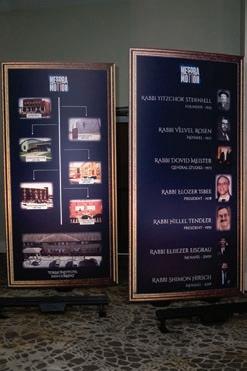
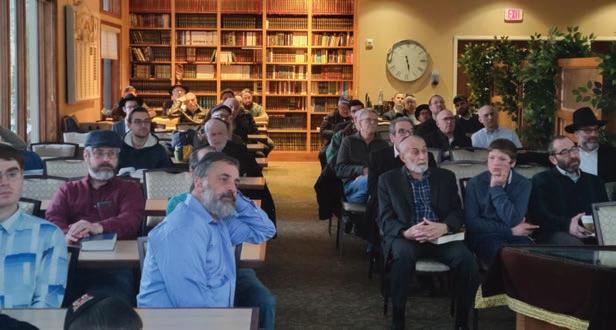
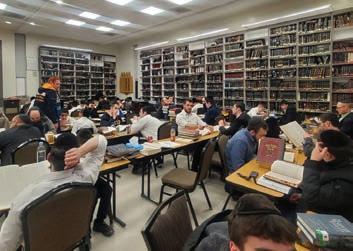
More than 600 parents, staff, alumni, supporters, and friends gathered at the Pikesville DoubleTree for Torah Institute of Baltimore’s Gala & Dessert Reception, Mesora in Motion. The evening began with a powerful two-room historical exhibit, guiding guests through the Cheder’s rich past and vibrant present. Attendees then enjoyed an elegant spread of light refreshments and desserts.
The program featured a moving video highlighting the school’s history and growth. Dr. Yehuda Lehrfeld served as master of ceremonies, and Torah Institute President Oren Hirschman addressed the audience with inspiring words. Honorees Horav Nosson Nusbaum, Rabbi Hillel Tendler, and Mr. Yaakov Milch were each recognized for their unique and lasting contributions to the Cheder, accompanied by heartfelt tribute videos.
CEO Rabbi Raphael Schochet concluded the evening by sharing the campaign’s success and an update on the new building project, followed by an exciting digital flythrough of the planned facility. Guests left with special gifts, including a thumb drive containing the digital journal and featured videos.
Thank you to Mr. Yosef Nissel and Mrs. Hindy Leeder for choreographing this gorgeous event, and to the entire executive staff for their tireless efforts in helping to make the event a success.
Yeshivas Toras Simcha Welcomes Rav Goldberger
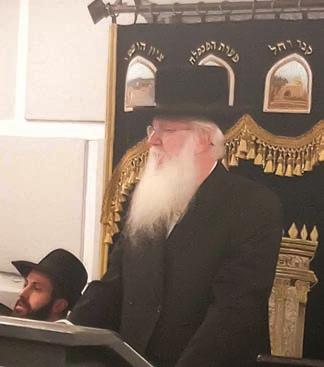
Yeshivas Toras Simcha was honored to welcome and hear Divrei Torah and Bracha from Rav Menachem Goldberger of Tiferes Yisroel Shul of Baltimore, MD. The Rav shared with the bochurim the idea that Parshas Shmos is filled with story after story of leaders of Klall Yisrael showing care and concern for their fellow Yiddin.
“And this Middah is what Klal Yisroel represents, both to ourselves and to the world around us! Being nosei b’ol im chaveiro is in our DNA all the way back to our slavery in Mitzrayim.”
Brachos Bee At Yeshivas Toras Simcha
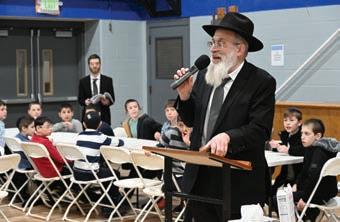
For the third year in a row, Rabbi Dovid Heber entertained the Yeshivas Toras Simcha students with stories from the frontline of kashrus supervision. Rabbi Heber shared with the students a story about Grape Nuts cereal. Rabbi Dovid Heber’s brother was working in the marketing department at Post Cereals. Rabbi Yossi Heber convinced the company executive team to produce a children’s pamphlet with fun exercises and a list of the appropriate brachos on the cereals that Post manufactures.
Rabbi Yossi Heber asked his brother Rabbi Dovid Heber to review the pamphlet before it went to print. This necessitated research into the proper bracha for Grape Nuts, which
Menucha Shabbaton
Shabbos Parshas Va’eira, Menucha hosted its annual Shabbos getaway, welcoming over 170 participants for an uplifting and rejuvenating Shabbos experience. Attendees included Menucha participants, their families, devoted staff members, and a remarkable group of dedicated volunteers.
The event staff worked tirelessly behind the scenes to ensure a seamless and exceptional Shabbos for all. Each Menucha participant was paired with a dedicated volunteer, allowing parents the rare and much-deserved opportunity to relax, recharge, and fully enjoy the Shabbos. The volunteers’ care and devotion played a central role in creating a warm, supportive, and truly memorable experience for every participant.
The davening, Shabbos seudos, and oneg Shabbos were lively, heartfelt, and deeply inspiring, enhanced significantly by our dedicated volunteers. who elevated the תוינחור of the entire Shabbos.
Throughout the weekend, attendees were moved by the thoughtfully prepared and inspiring words of Rabbi Shaul Engelsberg, Dean of Students at Bais Yaakov, whose messages resonated deeply with all present.
Beginning with the Toameha on Erev Shabbos and throughout Shab-
Photos: Dovid Kapenstein
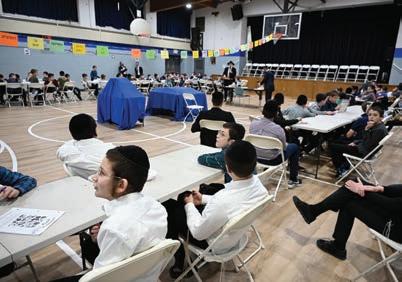
although it is made from hardened bread, nevertheless requires the mezonos bracha. Then, students in grades 3-8 participated in a Brachos Bee which tested whether they know the proper bracha for a variety of foods, not only cereals.
bos, guests enjoyed a delectable and plentiful menu expertly curated by Shabbos by Yaffa, under the direction of Hindy Leeder. Following Havdalah, the atmosphere turned joyous with spirited dancing accompanied by music from Yehuda Mond.
The Menucha Shabbaton once again proved to be an unforgettable experience of connection, inspiration, and renewal. All who attended are already eagerly anticipating next year’s Menucha Shabbaton.
Hearts & Horizons
A WEEKLY WOMEN’S INSPIRATION & GROWTH CIRCLE
Looking for a meaningful way to connect, share, and grow alongside fellow women in our community? We invite you to join us for a new, uplifting weekly gathering designed to nourish the spirit and spark inspiration. This is a warm, welcoming space where women come together to share life wisdom, find mutual encouragement, and grow together.
We are honored to have this group facilitated by
Tzipora Frager, LCSW-C
A graduate of Bais Yaakov of Baltimore, with over 25 years of experience across Johns Hopkins, the University of Maryland, and local school systems, Mrs. Frager brings a wealth of professional insight to our informal, heart-to-heart discussions. Join Us for
This program is a proud joint initiative of L’Chaim Adult Day Center and The Naomi Center, dedicated to bringing quality, private, and inspiring programming to the women of Baltimore.
No RSVP needed. We look forward to welcoming you!
When: Thursdays at 2:00 p.m. (Starting February 5th)
Where: Held privately in the Library at L’Chaim Adult Day Center
3617 Seven Mile Lane
Cost: Free of Charge
Who: Open to all women in the community.
Around the Community
STAR-K’s Dedicated Shmurah Matzah Production At Pupa-Tzelem
By: STAR-K/Margie Pensak
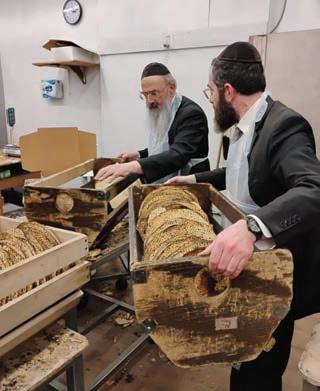
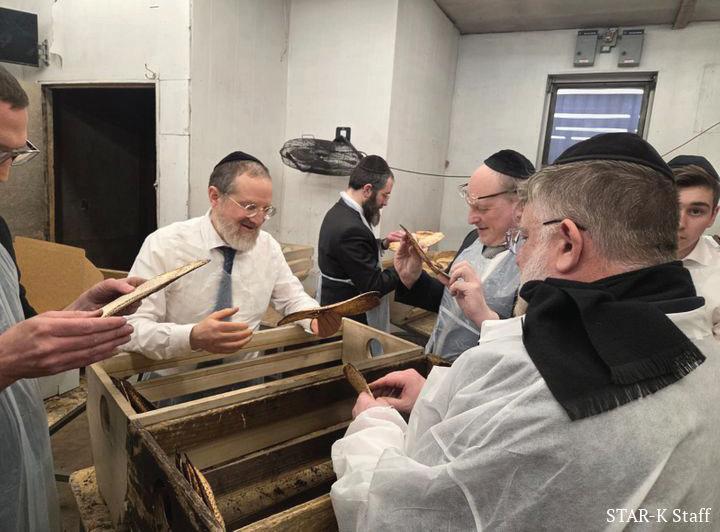
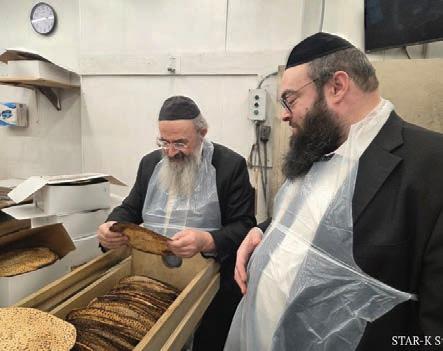
For many years, the Mechina of Yeshivas Ner Yisroel - together with STAR-K Rabbinic Administrator HaRav Moshe Heinemann, shlit”a, and STAR-K staff members - has baked hand shmurah matzah at the Pupa-Tzelem Matzah Bakery in Williamsburg. This year, STAR-K decided to make an additional run exclusively for STAR-K staff orders to take some of the pressure off from the Mechina, as demand exceeds supply. In approximately 3 hours, 350 pounds of shmurah matzah were produced and affixed with a special STAR-K run sticker.
STAR-K Kashrus Administrators members who made the trip, on January 22, were Rabbi Mordechai Frankel, Rabbi Zvi Goldberg, Rabbi Zvi Holland, Rabbi Moshe Shuchman, and Rabbi Sholom Tendler, from STAR-K’s corporate headquarters; and Rav Shmuel Heinemann, Rabbi Shlomo Chaim Heinemann, and Rabbi Tzvi Shaul Goldberg of STAR-K’s East Coast offices.
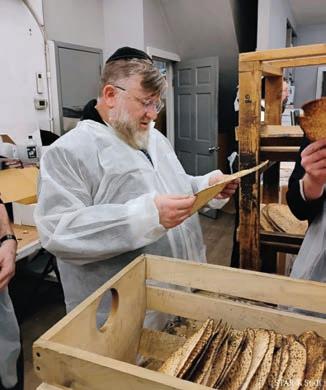
Although the bakery has its own mashgichim, STAR-K Kashrus Administrators oversaw this production to ensure it met HaRav Heinemann’s personal standards. Notes the Rav, despite all the precautions and attention to detail by bakeries involved in making matzos, it is possible that the matzos may still have issues. Although these problems can exist in both hand- and machine-baked matzos, they are more prevalent in the hand-baked matzos. Therefore the extra checking of the STAR-K staff is beneficial.
Matzah Kefula is one such problem area. If there is an area on the matzah that is bent over, the doubled over portion is not Kosher l’Pesach. According to the Rav, one must remove and discard this area together with a one-inch margin of regular matzah. This is required, even if the bent over part is very small. However, if a matzah is bent over but the two layers do not actually touch one another then the matzah remains kosher and removal of this area is not required.
In handmade matzos, the dough is rolled out manually. At times during the rolling process, some dough may get slightly doubled over, creating a crease in the dough. As the rolling process continues, the crease gets flattened, and
a noticeable line remains where the crease had been. If one finds a matzah with a line on one side of the matzah and a corresponding line on the other side, one should assume that the dough probably doubled over during the rolling process, creating the crease. Although this is not a true matzah kefula, as the creased matzah was rolled further until it had a uniform thickness, it is customary to remove and discard the creased area.
Although the matzos were primarily made by the Pupa-Tzelem matzah bakers, themselves, STAR-K staff
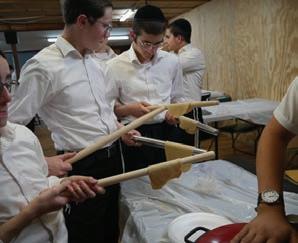
members did help with things like pouring the prepared special water into the flour -- mayim shelanu(well water which was kept overnight) is used for Pesach matzos, rather than regular municipal water. Some of the rabbonim carried the perforated matzahs on the poles towards the baking area so they could be quickly placed into the ovens. This entire process, from the time that water first comes into contact with the flour until the matzah is completely baked, takes just a few minutes.
“Matzah can sit up until 18 minutes
before becoming chometz, but you’d rather not have it sit at all,” mentions Rabbi Zvi Goldberg. “So, if you can move the matzah into the oven a little faster, all the better. We did not do the actual kneading; that was done by the professionals. I was personally very impressed by them. Even at the end of the day, they didn’t seem to be slacking off at all; they were working very hard. We just wanted to check the matzahs after they came out of the oven…It is meaningful to personally inspect the matzos that we will be using at the seder.”
A Full House And Fabulous Energy At The Game Plan Event
Despite winter weather forecasts threatening snow, Let’s Connect’s Game Plan event on Motzei Shabbos, proved to be a smashing success. Held at the Towers Club, the evening drew a full house of women who came out in droves, filling the room with warmth, laughter, and unmistakable excitement.
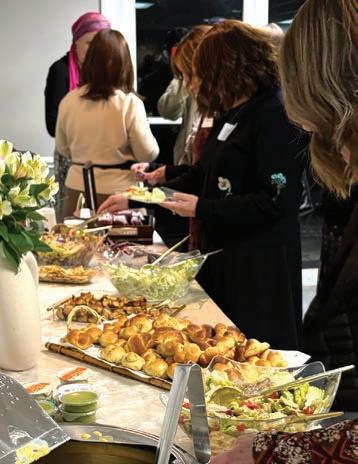
Guests were treated to a beautifully arranged Melava Malka buffet, thoughtfully prepared by Chaya Dachs, Shoshana Schmell, and their incredible team of women. The spread set the tone for an evening that felt both elegant and welcoming, giving everyone a chance to relax, connect, and enjoy being together.
The evening was guided by MC Sherri Zaslow, whose fun, energetic presence kept the program moving smoothly and added to the lively atmosphere throughout the night.
Game Plan featured a lineup of engaging games that sparked friendly competition and nonstop conversa-
tion. “The Price Is Right” at Seven Mile Market was a crowd favorite, bringing out the savvy shopper in everyone. Specially prepared rounds of Boggle and Scattergories added to the fun, creating instant camaraderie at each table and plenty of shared laughter throughout the room.
One of the most moving moments of the evening came from Leah Schiermeyer, who spoke with sincerity and grace about her husband’s recent challenges and the importance of recognizing Hashem’s kindness at every stage of life. Her words resonated deeply with the audience. This was followed by a beautiful dvar Torah from Sara Brejt, whose thoughtful message left many feeling inspired and uplifted.
The evening concluded with Herd Mentality, a game that encouraged participants to think together, sparkwomen truly get to know their table-
This event would not have been possible without the dedication and generosity of our volunteers, whose time, energy, and commitment are
the heartbeat of our volunteer-led organization. Thank you so much to our fabulous volunteers Shira Miriam Bronfin, Yaakova Major, Ranelle Kibel, Hinda Blum, Sue Herzog. And of course all you fabulous women who stayed late to clean up with us!
Thank you Mr. Avraham Klugman for your multi-media work and generosity of your time.
With every seat filled and an atmosphere buzzing with positivity, the Game Plan event was a powerful reminder of the strength, warmth, and vibrancy of the Let’s Connect community. Even with snow on the horizon, the energy in the room was undeniable and the night was nothing short of fabulous. Please be sure to check out LetsConnectBaltimore.org to find out about our programming and events.
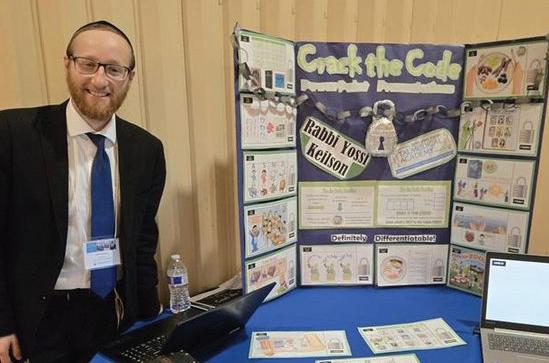
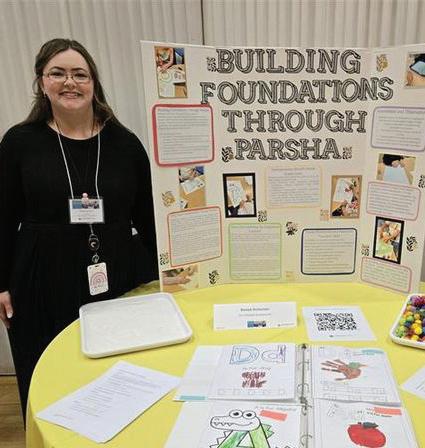
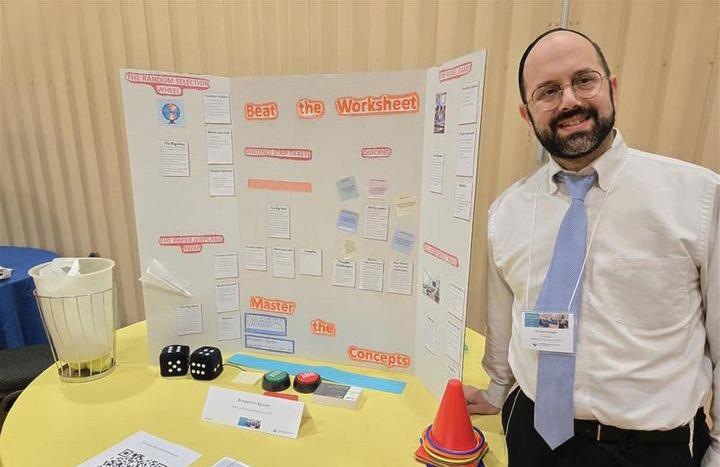
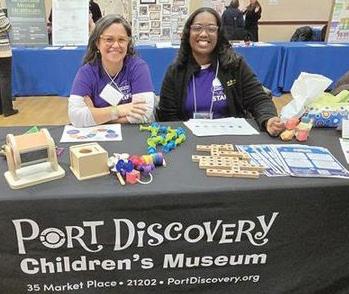
JES Educator Expo 2026 Brings Baltimore’s Jewish Educators Together For A Day Of Connection And Inspiration
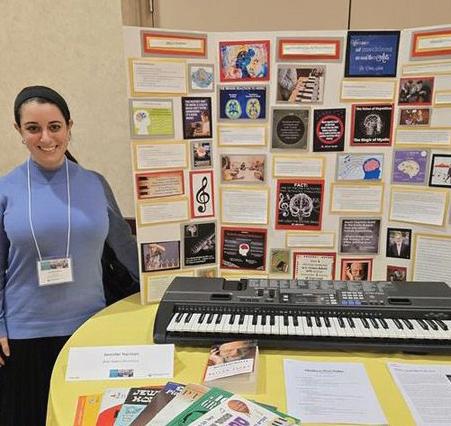
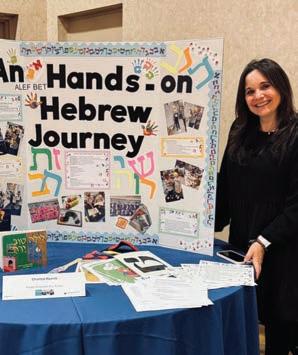
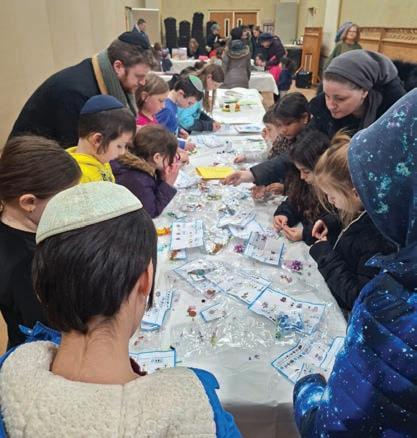
The JES Educator Expo 2026 brought together educators, families, and community partners for an afternoon that was warm, joyful, and deeply affirming. Close to 35 educators and vendors shared their work with approximately 75 attendees, creating a space that felt less like a conference and more like a celebration of teaching, creativity, and connection.
From the moment presenters arrived, there was a palpable sense of excitement. Tables filled quickly with materials, tools, and ideas that had been living—often quietly—inside classrooms across our community. Educators were eager to share approaches that had been successful with their own students and just as eager to learn from others who share a passion for excellent teaching. As one participant reflected, “This was my first time going and I will go again. Seeing what other educators do helps me grow my own skillset for teaching using tried and true techniques.”
Connections sparked easily throughout the room. Teachers and service organizations that had never worked together before leaned in, asked questions, and imagined new possibilities. The cross-pollination was exhilarating to watch as educators from day and religious schools across the spectrum of Baltimore’s Jewish community were exchanging ideas, reflecting together, and inspiring one another around shared goals of student growth and success in Jewish classrooms. One booth sparked conversations that went well beyond materials, helping educators think more deeply about what may lie beneath the surface for students who are struggling. Several teachers followed up to continue learning, and one even practiced new strategies on the spot to bring back to her classroom the very next day.
Teacher appreciation was woven into every part of the day. The Magic Mayhem Circus transformed the Expo into a truly family-friendly experience, as educators piled their children into the show where wholesome tricks, laughter, and delight filled the room. While the kids were happily entertained, parents
By: BJLife Newsroom
were free to browse the Expo, engage with vendors, and connect with colleagues. It was a thoughtful and rare gift of time that honored educators as professionals and as parents.
Creativity and fun added to the energy of the afternoon. Giveaways sparked smiles, teacher-created resources were generously shared, and Cricut® machines customized clipboards and pencil cups on the spot, turning everyday classroom tools into personalized keepsakes. Several presenters shared how meaningful it felt to be seen and valued, with one saying it made her feel “like a million dollars” to be part of
such a thoughtfully planned event.
As the Expo came to a close, there was a strong sense of gratitude and momentum. Educators left inspired by what they had learned, affirmed in the work they are doing, and excited to bring new ideas back to their classrooms. At its core, the Educator Expo reflected what Jewish Educational Services is all about. We’re here for YOU! Whether through consultation and coaching, customized workshops, the Teacher Help Line, parent support groups and lectures, Israel education, or just about anything educational, JES exists to support educators, schools,
and families in meaningful and responsive ways. We invite you to reach out, start a conversation, and let us know how we can be there for you—because when educators are supported, our school communities thrive
Greater Washington: Around the Community
Chabad Of Silver Spring Hosts Siyum Harambam
The Siyum HaRambam was a truly beautiful and inspiring event. Dovid Wolvovsky served as the master of ceremonies for this monumental occasion. Rabbi Sholom Raichik opened the evening by warmly welcoming the crowd, followed by a video of Rabbi Wolvovsky at the Rambam’s kever, encouraging everyone to take part in learning Rambam.
A powerful video of the Rebbe was then shown, emphasizing the importance of making a siyum and how it inspires others to engage in Torah learning. Rabbi Raichik continued by speaking about the uniqueness of learning Rambam as a comprehensive and organized work of Jewish law that encompasses every area of life and is accessible to all.
Rabbi Weinberg then shared how this approach enables one to gain a “bird’s-eye view” of the Torah and the world through its teachings. Following this, Yossi Kovacks made a siyum after completing three chapters a day over the past year — a truly meaningful accomplishment.
Retzufos Seder During Shovavim Inspires Students At Yeshiva Of Greater Washington
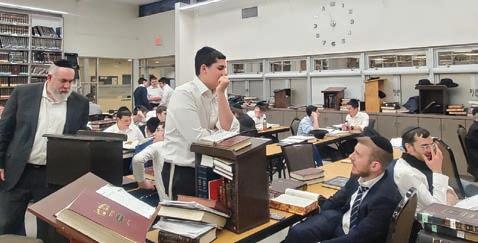
The High School and Beis Medrash divisions of Yeshiva of Greater Washington came together for a powerful retzufos seder—six full hours of uninterrupted Torah learning—held as a special initiative during the weeks of Shovavim.
For six consecutive hours, the yeshiva was filled with an unbroken kol Torah. There were no interruptions, no scheduled breaks, and no transitions—just sustained learning and deep focus. The sight and sound of so many students fully immersed in Torah for such an extended period was a profound Kiddush Hashem.
The initiative was led by Dr. Jacob Goodman, who envisioned a learning experience that would allow students to fully enter the world of Torah without distraction. During Shovavim—a time traditionally dedicated to reflection, growth, and
strengthening one’s inner avodah— this retzufos seder provided a meaningful and elevated framework for that work.
The impact on the students was immediate and tangible. Many left the experience with a sense of euphoria, clarity, and connection—both to their learning and to themselves. The sus-
and momentum that extended well beyond the
tained immersion allowed the Torah to settle deeply, creating a powerful feeling of spiritual alignment
seder itself.
Greater Washington: Around the Community
Mikvah Emunah Society Annual Dinner
Community members gathered at KMS for the Annual Dinner of the Mikvah Emunah Society. Local community members and supporters wined and dined with all the best the Knish Shop could offer. Also joining us for the evening was Dr. Kenny Friedman, of Kosher Wine Tastings, who shared his sommelier par excellence and kept the wine glasses full. The all-star dinner committee includ-
Tu B’Shevat Programs At YISE
Tu B’Shevat programs were held at YISE for students across multiple age groups. Lower School students participated in a hands-on crafts and trivia celebration, while Middle and High School girls took part in a Ceramics and Smoothies event!
A Visit With Our YGW Alumni In Israel
By Rabbi Dr. Avichai Pepper
There is something especially meaningful about standing quietly in the back of a Beis Medrash and observing former students fully immersed in Torah learning. Several weeks ago, during a visit to Israel, I had the privilege of seeing this firsthand while visiting more than 65 alumni of the Yeshiva of Greater Washington, who are now learning and leading in nearly 20 yeshivos and programs throughout Israel.
In each yeshiva visited, the same inspiring picture emerged. Our alumni were not merely attending these institutions; they were thriving. They were deeply engaged in learning, contributing positively to the Beis Medrash atmosphere, and, in many cases, assuming leadership and responsibility. Their dedication, maturity, and seriousness toward Torah study were evident and deeply impressive.
The Yeshiva is proud to have graduates learning across a broad spectrum of yeshivos and former Talmidim serving in the IDF and other programs in Israel. The visits allowed for meaningful conversations, personal updates, and words of encouragement that strengthened the bond between the Yeshiva and its graduates.
The highlight of the trip was a Melaveh Malka held on Motzei Shabbos, attended by nearly 150 Talmidim, both current and alumni,
and several rabbeim, including this year’s seniors, who were visiting Israel on their 12th-grade trip. The sense of unity, shared purpose, and mutual encouragement was palpable.
Witnessing the continued growth, success, and commitment to Torah of our alumni was a true source of pride for the entire Yeshiva community and a powerful reminder of the enduring impact of Torah education.
ed Ilana Branda, Naomi Carmel, Julia Frankston Morris, Caroline Namrow, and Elise Saks.
The Week In News
The Week In News
Spain to Legalize Migrants
The government of Spanish Prime Minister Pedro Sánchez has said it will grant legal status to approximately 500,000 illegal immigrants in Spain.
Foreigners without a criminal record who arrived before 2026 and can demonstrate that they have resided in Spain for five or more months will soon qualify for renewable one-year residence permits.
The move began as a proposal backed by approximately 700,000 people, as well as the Catholic Church and hundreds of other organizations.
Most immigrants in Spain already have legal status, but hundreds of thousands do not and therefore work informally. Sánchez has argued that mass legalization would boost Spain’s economy by increasing tax revenue, filling jobs, and strengthening the country’s social security system.
According to Jasmijn Slootjes, deputy director of the Migration Policy Institute Europe, the move was also intended to address concerns that Spain’s workforce cannot be sustained by the aging native-born population.
“If you look at the demographic decline, the fertility rate in Spain is the lowest in Europe—so it’s really, really low,” she said. “There are many skill shortages and labor shortages, and de facto, many irregular migrants are working, although in informal jobs. By regularizing them, you can, of course, generate more tax payments, and you also get better matching of skills, because people can actually
work at their skill level. So it’s a very pragmatic approach.”
“That’s something that’s mentioned time and again—this link to the economy, maintaining social welfare access, and sustaining a healthy, competitive country,” Slootjes added. “That is really a core argument in all of this, and the evidence is indeed pointing that way. I think one quote of [Sánchez’s] is very clear in clarifying their approach: he says, ‘Spain needs to choose between being an open and prosperous country, or a closed-off and poor country.’”
Currently, Spain is one of the few European countries actively encouraging immigration. Still, Sánchez’s critics have condemned the move as proof that the prime minister “hates” and wants to “replace” the Spanish people.
BC Ends Drug ecriminalization
In 2023, British Columbia launched a drug decriminalization program, shielding people from arrest for possession of
up to 2.5 grams of hard drugs. Now, the province is discontinuing the program.
“The intention was clear: to make it easier for people struggling with addiction to reach out for help without fear of being criminalized,” Health Minister Josie Osborne said on January 14. She noted that the program “has not delivered the results we hoped for.”
After the province announced the program’s expiration, Canadian media was filled with critics who said it had been mishandled.
Vancouver police chief Steven Rai said his force had been willing to support the plan, but “it quickly became evident that it just wasn’t working.”
Decriminalization “was not matched with sufficient investments in prevention, drug education, access to treatment, or support for appropriate enforcement,” he explained.
British Columbia’s experience mirrors that in the U.S. state of Oregon, which rolled back its pioneering drug decriminalization program in 2024 after a four-year trial. Like in Oregon, BC’s program faced fierce criticism, with many
Greater Washington Weekday Minyanim Guide
6:15 am Young Israel Shomrai Emunah M-F
6:25 am Southeast Hebrew Cong., Knesset Yehoshua M-F
6:30 am Beth Sholom Congregation M-F
Beit Halevi (Sfardi) M, T
Chabad of Silver Spring M-F
Ohev Shalom Talmud Torah OLNEY M-F
Young Israel Shomrai Emunah S YGW M, Th
6:35 am Ohr Hatorah M, Th
6:40 am YGW S, T, W, F
Magen David Sephardic Congregation M-Th
6:45 am Beit Halevi (Sfardi) S, T, W, F
Kemp Mill Synagogue M, Th
Ohr Hatorah T, W, F
Young Israel Shomrai Emunah M, Th
6:50 am Woodside Synagogue/Ahavas Torah M, Th Silver Spring Jewish Center M-F
Chabad of Upper Montgomery County M-F
6:55 am Young Israel Shomrai Emunah T, W, F
7:00 am Kemp Mill Synagogue T, W, F
Southeast Hebrew Cong., Knesset Yehoshua S Silver Spring Jewish Center S
Woodside Synagogue/Ahavas Torah T, W, F
Young Israel Ezras Israel of Potomac T, W, F
7:05 am Kesher Israel M, Th
7:15 am Kemp Mill Synagogue M, Th Kesher Israel T, W, F
Ohev Sholom Talmud Torah/The National Synagogue M-F
Ohr Hatorah S
7:30 am Chabad of DC M-F
Chabad of Potomac M-F
JROC M-F
Kemp Mill Synagogue T, W, F
Southeast Hebrew Cong., Knesset Yehoshua M-F
Young Israel Shomrai Emunah S
Young Israel Shomrai Emunah (Sfardi) M-F
7:45 am YGW (Yeshiva Session Only) S-F
8:00 am Beth Sholom Congregation S
Kemp Mill Synagogue S
Kesher Israel S
Ohev Shalom Talmud Torah OLNEY S
Southeast Hebrew Cong., Knesset Yehoshua S
Chabad of Upper Montgomery County S Woodside Synagogue/Ahavas Torah S
8:00 am YGW (High School; School-Contingent) S-F
Young Israel Ezras Israel of Potomac S Young Israel Shomrai Emunah (Sfardi) S
8:05 am Ezras Israel Congregation of Rockville M, Th
8:15 am Ohr Hatorah S Ezras Israel Congregation of Rockville S, T, W, F
Kehilat Pardes / Berman Hebrew Academy S-F
Silver Spring Jewish Center M-F
8:30 am Chabad of DC S Chabad of Potomac S JROC S Ohev Sholom Talmud Torah/The National Synagogue S Silver Spring Jewish Center S YGW (Summer Only) S-F
8:45 am Young Israel Shomrai Emunah S-F
9:00 am Chabad of Silver Spring S Kemp Mill Synagogue S
12:30 pm YGW S
1:00 pm Silver Spring Jewish Center S-F
2:10 pm YGW M, T, W
2:45 pm YGW S-Th
3:00 pm YGW Middle School School Days mincha
mincha/maariv
Before Shkiah (15-18 minutes), S-TH
Beit Halevi (Sfardi)
Beth Sholom Congregation
Chabad of Potomac
Chabad of Silver Spring
Chabad of Upper Montgomery County
Ezras Israel Congregation of Rockville (20 min before, S-F) JROC
Kemp Mill Synagogue
Kesher Israel
Magen David Sephardic Congregation Ohev Sholom Talmud Torah/The National Synagogue
Ohr Hatorah
Silver Spring Jewish Center
Southeast Hebrew Congregation
Woodside Synagogue/Ahavas Torah
Young Israel Ezras Israel of Potomac
Young Israel Shomrai Emunah (Asheknaz)
Young Israel Shomrai Emunah (Sefarhadi) maariv
7:30
8:15
8:45
9:00
9:45
shacharis
DIVREI CHIZUK
Rabbi Daniel Rose
February 14 8:30 PM
At the brand new Ohel Moshe Social Hall
with Yonoson Rosenblum
One of the leading voices in Orthodox Jewish thought. He helped found the English-language Yated Ne’eman and is a longtime columnist for Mishpacha magazine. He is the author of more than ten biographies of Rabbanim, exploring Torah leadership and Jewish values.
PANELISTS
Rabbi Yonoson Rosenblum
Rabbi Tzvi Teichman
Rabbi Elie Levi — recently made Aliyah from Baltimore Kumzitz
featuring Eli Atias, guitarist and singer * Milchig Spread
$25 *$40 per couple
Naava Kodesh. Here to guide you home. Register Now | naavakodesh.org/mm
Questions? Email us info@naavakodesh.org
We Are Hiring!
The Week In News
saying public safety was threatened by a tolerance of open use.
A flashpoint moment in the western Canadian province was a 2024 incident where a person was filmed smoking what appeared to be a narcotic inside a Tim Hortons, the popular coffee shop chain frequented by families across the country. Local politicians in Maple Ridge, BC, attributed the incident to a permissiveness about drugs ushered in by decriminalization.
Pakistan Targets Militants
After a series of terrorist attacks in Pakistan’s Balochistan province in which 50 people were killed, Pakistani security forces killed 145 militants during a 40hour crackdown.
On Saturday, the Baloch Liberation Army (BLA), a banned separatist group, staged a series of coordinated gun attacks and bombings across the districts of Quetta, Gwadar, Mastung, and Noshki.
The assailants, dressed as civilians, targeted populated areas, including hospitals, schools, banks, and markets, according to Pakistan’s junior interior minister, Talal Chaudhry.
Sarfraz Bugti, the chief minister of Balochistan, reported 31 civilian deaths and 17 fatalities among law enforcement personnel. He said security forces killed 41 militants on Friday and 92 more on Saturday.
“We had intelligence reports that this kind of operation was being planned, and as a result, we began pre-operations a day earlier,” Bugti said.
Ethnic Baloch separatists have long sought independence for Balochistan.
The BLA claimed responsibility for the attacks, saying it killed 84 security officials and kidnapped 18 others.
Pakistan accused its rival and neighbor India of sponsoring the attacks, an allegation New Delhi has strongly denied.
The United States, which designates the Baloch Liberation Army as a foreign terrorist organization, condemned the attacks and expressed support for Pakistan.
Turkey to Broker U.S.-Iran Talks?
Turkey is seeking to broker negotiations between the United States and Iran in an effort to prevent military es-
calation, according to Turkish officials.
Two Turkish officials, speaking anonymously, said the proposed talks would involve U.S. special envoy Steve Witkoff and Iranian officials and could take place by the end of the week. Neither Washington nor Tehran has confirmed participation.
U.S. President Donald Trump recently threatened Iran with military action following the killing of thousands of protesters. The USS Abraham Lincoln and several guided-missile destroyers have also been deployed to the Middle East, though it remains unclear whether the U.S. intends to strike.
“I’d like to see a deal negotiated,” Trump said. “Right now, we’re talking to Iran, and if we can work something out, that would be great. If we can’t, probably bad things would happen.”
During a trip to Florida, Defense Secretary Pete Hegseth was asked whether “regime change” in Iran was possible. He responded, “Not right now.”
At the same time, Trump has indicated interest in securing a new nuclear agreement with Iran. Witkoff and Israeli Prime Minister Benjamin Netanyahu were scheduled to meet Tuesday.
On Monday, Iran summoned all European Union ambassadors after the E.U. designated Iran’s Revolutionary Guard as a terrorist organization—a largely symbolic but economically significant move. On Sunday, Iran’s parliamentary speaker declared that Tehran now considers all E.U. militaries to be terrorist organizations.
According to the U.S.-based Human Rights Activists News Agency, at least 6,848 people were killed by Iranian authorities during protests, and 49,930 were detained. Iran’s official death toll, released January 21, was significantly lower, with the government claiming 3,117 deaths—2,427 of whom were civilians or security personnel—and labeling the remaining victims as “terrorists.”
China to Ban Hidden Car Door Handles
China is targeting the car door handles that Tesla has popularized.
The hidden door handles are a signa-
The Week In News
ture feature of Tesla’s vehicles. China’s ban comes as Elon Musk’s company reports declining worldwide sales and struggles with fierce competition in China, its second-biggest market.
On the outside, electric door handles sit flush against the side of the door, requiring a user to press down on the handle to release the lever; from the inside, riders press a button to open the door again.
Though Tesla is the company bestknown for this type of door handle, other electric vehicle makers in China have adopted similar designs, including some models by heavyweights Xiaomi and Aion.
The new policy, which does not single out any specific company, now requires all cars sold in China to have a mechanical release feature for both interior and exterior door handles.
In a statement released Monday, the Ministry of Industry and Information Technology cited “the inconvenience with operating the exterior door handles and their inability to open after an accident” and laid out specific requirements for how these handles should function. Exterior door handles should have enough space for a hand to operate its mechanical release from any angle. And interior handles should be “clearly visible from the corresponding occupant’s position,” it said.
The new rules come into effect on January 1, 2027.
Last September, Tesla said it was looking into redesigning the way to open its car doors in an emergency, after several accidents where passengers were reportedly killed or severely injured in burning vehicles because rescuers could not open them. Other Tesla owners have reported having to break their own car windows after buckling their children in and then being unable to get in the car again, according to an investigation by the U.S. National Highway Traffic Safety Administration.
Similar problems have cropped up in
China. Xiaomi saw its stock value tumble last year after a fatal crash involving its sedan killed three people in March – with local media and government-affiliated outlets reporting there had been issues unlocking the car door.
Israeli NBA All Star
Portland Trail Blazers forward Deni Avdija reached a historic milestone this week, becoming the first Israeli player ever named an NBA All-Star. The 25-year-old was selected on Sunday as a Western Conference reserve, capping a breakout season that has propelled him into the league’s elite.
Avdija, a native of Kibbutz Beit Zera in northern Israel, finished seventh in All-Star voting with more than 2.2 million votes — placing him ahead of superstars LeBron James and Kevin Durant. While the selection was widely expected,
it marked a watershed moment for Israeli basketball and for Avdija personally.
In just his second season with Portland, Avdija has taken his game to another level. He is averaging 25.8 points, 6.8 assists, and 7.2 rebounds per game — all career highs. His scoring and playmaking numbers rank among the NBA’s best, and he has emerged as a leading contender for the league’s Most Improved Player award.
“Obviously, I couldn’t do it without my teammates and coaches,” Avdija said in an interview released by the Trail Blazers. “The whole crew that’s been with me this season — it’s been amazing. There’s still a long season to go, but as an individual accolade, this is special.”
Reflecting on his journey, Avdija added, “I started playing basketball without a dream, just to see where it would take
The Week In News
me. To accomplish thing after thing — it’s emotional for me.”
For longtime followers of Israeli basketball, Avdija’s All-Star nod represents the culmination of years of promise. A teenage standout with Maccabi Tel Aviv, he became the first Israeli selected in the NBA Draft’s top ten and steadily carved out his place in the league.
“Deni Avdija being named an NBA All-Star reserve is an unbelievable achievement for every Israeli basketball fan,” wrote Moshe Halickman of The Sports Rabbi. “This is a dream that once felt impossible, and now feels inevitable.”
Oded Shalom, who coached Avdija in Maccabi Tel Aviv’s youth system, went even further. “Even though he’s only 25, I think he is Israel’s most successful athlete in history,” he said.
Avdija’s rise has unfolded amid the war in Gaza and a global surge in antisemitism, challenges he has acknowledged publicly.
“I’m an athlete. I don’t really get into politics, because it’s not my job,” Avdija told The Athletic. “I obviously stand for my country, because that’s where I’m from. It’s frustrating to see all the hate. Like, I have a good game or get All-Star votes, and all the comments are people connecting me to politics. Like, why can’t I just be a good basketball player? Why does it matter if I’m from Israel, or wherever in the world, or what my race is? Just respect me as a basketball player.”
That respect will be on full display February 15, when Avdija takes the court at the NBA All-Star Game in Los Angeles — not just as a standout player, but as a trailblazer.
Amb. Rift with South Africa
South Africa declared the top diplomat at Israel’s embassy persona non grata on Friday and ordered him out of the country within 72 hours, for what it called repeated violations of diplomatic norms, including insulting President Cyril Ramaphosa.
The South African Foreign Ministry accused embassy chargé d’affaires Ariel Seidman of “unacceptable violations of diplomatic norms and practice which pose a direct challenge to South Africa’s sovereignty.
“These violations include the repeated use of official Israeli social media platforms to launch insulting attacks” on Ramaphosa, as well as a “deliberate failure” to notify the South African authorities about visits by senior Israeli officials.
In a tit-for-tat, Prime Minister Benjamin Netanyahu and Foreign Minister Gideon Sa’ar decided on a reciprocal move, ordering South Africa’s ambassador in Ramallah, Shaun Edward Byneeldt, to “leave Israel” within 72 hours, and declaring him “persona non grata,” according to a Foreign Ministry statement.
South Africa has long been a vocal supporter of the Palestinian cause. It has not had an ambassador to Israel for years. It recently called Israel an “apartheid state” and in 2023 filed a charge of “genocide” at the International Court of Justice over Israel’s war against the Hamas terror group in Gaza. It has also warned its citizens who have fought in the IDF could be prosecuted if they return.
Genes Linked to Longevity
New research suggests that genetics plays a larger role in longevity than previously thought.
Conducted by researchers at Israel’s Weizmann Institute of Science and published Thursday in the journal Science, the study found that, in determining human lifespan, genes account for 50%, which is twice as much as what scientists previously estimated.
“Lifespan is undoubtedly shaped by many factors, including lifestyle, genes and, importantly, randomness — take, for example, genetically identical organisms raised in similar environments that die at different times,” said Ben Shenhar, a doctoral student in physics at the institute and the peer-reviewed study’s lead author. “In our work, we tried to give a handle on the amount of variance between different people that can be attributed to genetics. Our study tried to partition the longevity factors into genetics and ‘everything else.’ The ‘everything else’ is around 50% of the pile.”
The new study reexamined earlier Swedish and Danish twin research, much of it from the 19th century, which failed to account for deaths caused by external factors (or “extrinsic mortality”) such as accidents, violence, or infectious disease. Because those records listed only age at death and not cause, they could misrepresent the genetic role in longevity. For instance, if one twin died young from an epidemic and the other lived to old age, the difference might wrongly be attributed to heredity rather than external causes.
The study used a mathematical model to adjust for extrinsic mortality, which
The Week In News
Shenhar noted was far higher before antibiotics — about ten times today’s level — largely due to now-treatable infectious diseases. The researchers then tested their theory using newer Swedish twin data, including twins raised together and apart, and confirmed that as extrinsic mortality declines, the apparent heritability of lifespan increases.
Uri Alon, a Weismann Institute systems biologist and study senior author, noted: “Identical twins raised apart share their genes, but not their environment. This helps tease apart genetics from the environment, nature from nurture.”
“Previous twin studies used statistical methods that work well for other traits — height, blood pressure, personality traits, etc. These traits are not affected by extrinsic mortality,” Alon said. “But mean lifespan is the one special trait that is strongly affected by extrinsic mortality. Since cause of death was not recorded for the classical twin studies, it was not corrected for.”
Previously, researchers dedicated little effort to researching the link between genetics and longevity. However, these new findings may encourage further studies on the link.
“Low heritability estimates may have discouraged funding and research into the genetics of aging, suggesting it was largely random or environmental. Our work validates the search for genetic factors of longevity, showing that the genetic signal is strong but was previously hidden by ‘noise’ in the data,” Shenhar said.
“Many centenarians reach age 100 without any serious medical conditions,” Shenhar said. “It’s clear that these people have protective genes that guard against developing diseases that naturally occur with age. Some of these genes have been identified, although, like most complex traits, longevity is likely impacted by hundreds if not thousands of genes.”
High Court Freezes Army Radio Closure
On Monday, Israel’s High Court issued a conditional order ruling against the government’s decision to close Army Radio. For the closure to take effect, the government must submit proof by March 15 that shuttering the station is justified. The ruling was issued by Justices Daphne BarakErez, Alex Stein, and Yechiel Kasher.
In December 2025, Defense Minister Israel Katz unveiled a proposal to
close Army Radio by March 1, 2026, arguing that the station “creates a fundamental difficulty for the IDF, stemming from the IDF’s involuntary involvement in political discourse,” and “harms the Israel Defense Forces, its soldiers, and its unity.” Katz’s proposal was unanimously approved by the government.
Some coalition ministers, including Communications Minister Shlomo Karhi, called on the government to ignore the court’s order.
“The decision [to close Army Radio] must be implemented on March 1. Even if the High Court of Justice set a deadline for submitting responses to the conditional order after that date, this does not freeze or nullify a lawful government decision,” Karhi wrote in a post on X. “The timetable set by the High Court does not override the law or the government’s authority to govern.”
“As of March 1, any broadcast by Army Radio will be a broadcast in violation of the law and the government’s decision,” he added. “Therefore, beyond the need to treat an unlawful order with a ‘shrug’ and carry out government decisions as required by law, if G-d forbid this is not implemented for any reason, I hereby call on government ministers and members of Knesset: as of March 1, do not give interviews to Army Radio.”
National Security Minister Itamar Ben-Gvir also condemned the court, accusing it of political interference.
“Once again, the High Court of Justice is intervening in the decisions of an elected government and acting as a political body rather than a judicial authority,” Ben-Gvir said. “A conditional order against the closure of Army Radio is another step on the dangerous path of trampling the will of the voters and turning the court into a judicial dictatorship. Government policy is determined at the ballot box, not in the halls of the High Court.”
Other right-wing lawmakers similarly urged the government to defy the court’s decision.
In several petitions, critics of the government accused it of seeking to shutter Army Radio in order “to harm media outlets seen as critical of the government” and to “economically benefit the owners of media outlets close to the government.”
The Week In News
Rafah Crossing Reopens
Israel reopened the Rafah Border Crossing between Gaza and Egypt on Sunday for the first time since March 2025. The following day, a limited number of pedestrians were permitted to cross into and out of the Gaza Strip.
According to an anonymous Egyptian official, Palestinian security officers crossed the crossing into Gaza, joining a European Union mission tasked with supervising entry and exit. Additionally, ambulances passed through the Egyptian gate.
The crossing’s reopening is expected to allow entry for the National Committee for the Administration of Gaza (NCAG), the 15-member Palestinian technocratic body tasked with administering day-to-day governance in the Strip and supervised by U.S. President Donald Trump’s Board of Peace.
It is unclear when the NCAG would actually enter Gaza.
“The head of the committee was informed that Israel had approved the entry of the members into Gaza but has not yet set a date,” a committee member told the media. “We call on the mediators and the U.S. administration to accelerate operations at the crossing and increase the number of travelers.”
Fifty medical patients will be allowed to leave Gaza each day, according to Prime Minister Benjamin Netanyahu, and around fifty will be allowed to return.
Gazans hoping to leave or enter the enclave will need approval from Egypt. Meanwhile, Egypt is supposed to send a list of approved names to the Shin Bet for clearance purposes.
Israel will oversee Gazans’ exits remotely. Aided by facial recognition software, Israeli officers will confirm, from a control room, that those leaving have been approved to do so, thus preventing terror leaders from leaving the Strip. To enter Gaza through the Rafah Crossing will require an Israeli security screening.
Shekel Trading High
The shekel has been trading around a four-year high against the dollar and is close to hitting a historic 30-year peak. The rise has been fueled by continued gains in the local stock market, a bonanza of investment inflows into local tech and
defense companies, and a weakening dollar globally. So far in 2026, the shekel has gained around three percent versus the dollar and about 18% over the past year.
A strong shekel lowers the cost of imports and industrial raw materials, as well as travel, and ultimately should contribute to reducing the cost of living.
But not everyone is happy. With exports making up as much as 40% of economic activity, exporters who sell primarily to the U.S. and Europe have been vocal about their diminishing competitiveness, especially as it coincided with a 15% tariff on Israeli goods entering the U.S. and a spike in the costs of payroll, fuel, electricity, and other living expenses. Exporters, high-tech, and multinational companies earn in dollars but pay workers, taxes, and other expenses in shekels.
“The appreciation of the shekel is seriously damaging industry and hightech,” said Manufacturers’ Association of Israel (MAI) President Avraham (Novo) Novogrotzky. “Without emergency measures, this could lead to a wave of layoffs, significantly harm the industry in the periphery, and cause the economy to deteriorate into a deep recession.”
Novogrotzky and Alon Ben Zur, chairman of the Israeli High-Tech Association, have asked Knesset Finance Committee Chairman Hanoch Milwidsky to convene an urgent committee meeting, while calling on the government to formulate a national emergency plan.
Bank of Israel Governor Amir Yaron recently indicated that the central bank is not rushing to intervene in the foreign exchange market, and emphasized that it is the government’s responsibility to provide assistance to exporters affected by the local currency’s strength.
“This situation is eroding the economic viability of multinational and foreign companies to operate development centers in Israel,” said Novogrotzky. “Without a response, we expect a spike in brain drain and development centers moving abroad, which will seriously damage Israel’s brand as a startup nation, and incur huge losses in future tax revenues.”
AT MEDEX, YOU CAN:
• Meet with the Ministry of Health to apply for your Israeli medical license
• Attend relevant sessions and get your questions answered
• Network with hospitals and medical centers to discuss your career in Israel
And more!
The Week In News
events a year. Last week, President Trump announced that the performing arts space will close for two years for renovations. The space had an operating budget of $269 million in 2024. Trump said that the construction would turn the venerated national cultural institution into a “new and spectacular Entertainment Complex.”
In 1958, Congress passed legislation establishing a national cultural center in Washington, laying the groundwork for what would eventually become the Kennedy Center.
The president said the Kennedy Center will close on July 4 of this year, a date that coincides with the country’s 250th birthday, and said that the financing for the renovation is “completed, and fully in place.”
“I have determined that The Trump Kennedy Center, if temporarily closed for Construction, Revitalization, and Complete Rebuilding, can be, without question, the finest Performing Arts Facility of its kind, anywhere in the World,” Trump wrote on Truth Social on Sunday evening.
The president said he debated keeping the center open during construction but argued that a complete closure would
“produce a much faster and higher quality result.”
The closure is subject to approval by the Kennedy Center’s board, which is full of pro-Trump members. Last year, the president installed himself as the board’s chair. The board recently voted to rename the venue the Trump-Kennedy Center.
The announcement is not without its detractors.
“Once again, Donald Trump has acted with total disregard for Congress,” Rep. Joyce Beatty (D., Ohio) said. “The Kennedy Center is congressionally funded, and Congress should have been consulted on any decision to shut down its operations or undertake major renovations, especially for a two-year period.”
Musicians and other artists have sought to distance themselves from the center since Trump began exerting more control over it. Composer Philip Glass last month withdrew his Symphony No. 15, titled “Lincoln,” from its world premiere at the Kennedy Center.
“Symphony No. 15 is a portrait of Abraham Lincoln, and the values of the Kennedy Center today are in direct conflict with the message of the Symphony,” Glass wrote on social media.
TX State Senate Seat Flipped
Democrat Taylor Rehmet flipped a reliably Republican state Senate district in Texas in Saturday’s special election.
Republican Lt. Gov. Dan Patrick called it “a wake-up call for Republicans across Texas,” where the GOP controls every statewide office.
“Our voters cannot take anything for granted,” Patrick wrote on X, while noting low-turnout special elections are always unpredictable. “I know the energy and strength the Republican grassroots in Texas possess. We will come out fighting with a new resolve, and we will take this seat back in November.”
Rehmet, a labor union leader and veteran, easily defeated Republican Leigh Wambsganss, a conservative activist, in the Fort Worth-area district, which Trump had won by 17 points in 2024. With almost all votes counted, Rehmet was leading by more than 14 percentage points — a more than 30-point swing.
“This win goes to everyday working people,” Rehmet told supporters.
Democrats have been overperforming
in special elections recently. In March, they emerged victorious in a Pennsylvania legislative district made up of suburbanites and farmers that Democrats hadn’t held in a century. In November, they dominated candidate and ballot contests from Maine to California.
Texas Democratic Party Chair Kendall Scudder said Rehmet won by standing with working people and talking to Texans about the future.
“This win shows what is possible in Texas with strong organizing, great candidates, and strategic investments,” he said in a statement. “People are noticing that Democrats have the workers’ backs and are delivering results.”
The Texas Senate seat was open because the four-term GOP incumbent, Kelly Hancock, resigned to take a statewide office. Hancock easily won election each time he ran for the office, and Republicans have held the seat for decades. Rehmet’s victory allows him to serve until early January, and he will face Wambganss again in the November general election to try to keep the seat for a full fouryear term. The Texas Legislature is not set to reconvene until 2027, and the GOP still will have a comfortable majority.
Mr. & Mrs. Ephraim and Tova Cook on the birth of a daughter
Mr. & Mrs. Chaim Herbstman on the birth of a daughter
Alon & Noa Kalka on the birth of a daughter
Chaim & Lindsey More on the birth of a son
Mendel & Yaffa Orkin on the birth of a daughter
Moshe & Caryn Peiser on the birth of a daughter
Achdus, Emunah And Bais Yaakov Production
By Leah Davidson, Class of ‘26
After countless hours of practice, the students of Bais Yaakov of Baltimore presented Harvest of Hope on January 17 and 18 at Goucher’s Kraushaar Auditorium, delivering three performances that entertained and inspired the audience. The play features a young woman, Gella, who moves from her shtetl in Russia to marry the son of a Jewish family living on a homestead in North Dakota. Once she arrives there, Gella finds life on the homestead impossibly isolating, especially because her sister-in-law, Rosie, is openly hostile toward her. After a series of conflicts, the play ends happily, as Gella and Rosie move beyond their differences and become close friends.
The message of achdus written in the production’s script came to life behind the scenes.
Student director Tziporah Wolfish, who led the production with Aliza Rappaport, praised the incredible dedication of the Bais Yaakov teachers. “They gave so much of their time to make sure that production was a success,” she said. While Tziporah highlighted the commitment of the teachers, Mrs. Devora Krakauer, the producer of the show, emphasized the role of the student leaders: “The girls who are put in charge ensure that everyone in their group excels. Even if certain girls face challenges in a dance or choir, the heads are always looking out for the girls in their groups,” she said.
After speaking with several song dance and dance heads, you can clearly see the effort they put into their girls. Shari Flamm, who led the Blizzard Dance with Dassi Bondi, shared, “There were certain overwhelming and hard parts of leading the dance, but I wouldn’t trade it for anything.” Shari continued by recounting the gratifying feeling she felt onstage, performing the dance she created, “You really see all your hard work coming together. It makes me a
little emotional, because I don’t think I ever worked so hard on something, but it was so cool to see the results.”
Henni Spero, who led the Cyclone Dance alongside Shira Vegh called the first two weeks the most stressful. “Every night we needed to meet, and it was at the same time as seminary applications,” she said. “We had a lot going on at once and I felt overwhelmed.” After that, everything fell into place. I had the best girls in my dance because they were so mature and sweet!”
Sori Newman, who led the North Dakota Song Dance with Yochie Shurin said: “The whole school united around production and worked together. As I walked through the hallways, I knew so many more people from my song dance, or another part of production. The whole school had fun making the show happen.”
The heads recognized that every girl’s effort made the production a success. Esti Lurie, who headed the Masterplan Song Dance with Blimi Ciment, described her dancers, “they all did such an amazing job and it’s incredible how they put their effort into putting on a great performance!”
Esti and Blimi’s song dance highlighted the production’s second theme: emunah, the belief that Hashem controls everything. In the play, Gella’s husband, Sam, a farmer, struggles to leave his fieldwork on Shabbos, fearing the homestead would suffer from being abandoned for the day. Esti shared how the song’s message shaped her perspective on production preparations. “When you hear the song so many times, the words get drilled into you. The lyrics: ‘put down the shovel and say a prayer’ remind us to daven and do our best.”
Chayala Sher, who led sewing with Nechama Langer, Naami Malachevsky and Chayala Taub shared how one last minute costume “crisis” ended up resolving another. The story Chayala shared highlights the emunah
and achdus which shaped production.
“We ordered fabric for specific dances, but the seller sent too little without warning. We stayed positive, starting from scratch and remade the costumes in five hours, just one week before production, with extra fabric just in case.”
“Meanwhile, just three days before production, parts of another dance’s costumes started ripping onstage. It was too late to order more fabric. We needed 164 feet of fabric to re-sew them. Guess how much fab-
ric we had left over from the ones we created ourselves? Exactly 164 feet!” Hashem’s guiding Hand played so prominent a role in the show’s success, but this was no surprise to its producers. The unparalleled achdus of the students must have merited this special help from Above, as it always seems to do at Bais Yaakov programs. The program was an occasion of Kiddush Shem Shamayim in its purest form, leaving its audiences not only mesmerized, but also inspired and uplifted about our greatness as a nation.
Talmudical Academy - 4445 Old Court Rd The Adas: Chofetz Chaim Adas Bnei Israel - 5915 Park Heights Ave The Shul at the Lubavitch Center - 6701 Old Pimlico Rd
Tiferes Yisroel - 6201
Raising The Bar: From Education To Employment
What does a seminary graduate need in order to find a fulfilling and lucrative job? How do our community businesses identify qualified, dedicated, and responsible professionals to strengthen their workforce?
At WITS, these questions have sparked thoughtful conversations. The workforce and its demands continue to change, and young women seek roles that allow them to use their skills while offering opportunities for growth. WITS is committed to filling these needs both for the community and its alumnae.
To accomplish these complementary goals, WITS has launched a new initiative: The Career Hub.
The Career Hub was created with several goals:
To prepare students for the expectations and requirements of the professional world
To help students and alumnae translate their WITS degree and education into meaningful employment
To connect community organizations and businesses with capable employees
As part of this initiative, Mrs. Shira Hochheimer was appointed Director of Employer Engagement. In this role, she partners closely with employers and community organizations to understand their staffing needs and to match them with WITS students and alumnae whose skills and interests align. Since the Career Hub’s launch in December, several
students and alumnae have already accepted positions, and two employers have returned to seek additional WITS alumnae to fill new jobs.
The Career Hub also strengthens individualized career guidance for students. Mrs. Yocheved Lapidus, a long-time academic advisor, is formalizing a role she has filled for many years. Working one-on-one, she advises students towards clarifying professional goals, explores career paths best suited to each individual’s strengths and interests, and coaches them with resume writing, interview preparation, and internship selection.
In addition, the Career Hub incorporates existing programming under one umbrella. These include professional development seminars led by Elise Steinharter, a Senior Certified Professional (SHRM-SCP) of Talint Consulting LLC, the Professional Pathways full-day symposium, and
the Career Mentorship Program, which pairs students with professional women, often alumnae, who offer guidance, perspective, and support.
Together, these efforts represent WITS’ investment in its students, alumnae and the broader community. A WITS degree offers more than a diploma. Through employer engagement, structured career support, and mentorship, WITS provides the community with capable and talented young professionals by placing students on the path to success.
Employers or community organizations seeking talented, motivated employees may contact Mrs. Shira Hochheimer at shochheimer@wits.edu
Those interested in learning more about WITS and its academic programs may contact Mrs. Malka Kravitz, Director of Admissions, at mkravitz@wits.edu
Tzvi Meister (Baltimore) & Hudis Rosenbloom (Brooklyn)
Sammy Penn (Teaneck) & Ariella Kovacs (Baltimore)
BUILDING HIGHLIGHTS
1,300 Student Capacity
30 new classrooms
7,200 sq. ft. Bais Medrash
10,000 sq. ft. Gym & Indoor Recreation
SHINE Special Education Center
Copy Center & Counseling Rooms
Four Division Hallways
Sgan Menahel Offices for All 4 Divisions
Modern, accessible library
Ladies’ staff lounge & private nursing rooms
Entrance Lobby & Reception
Dedicated 7th/8th Grade
Breakfast Room
$25M
$25M Pledges required to fully fund the project
$21M Pledges required to commence construction in March 2026
$18M current amount raised SEE THE FUTURE
$18 MILLION RAISED OF $25 MILLION GOAL
“Torah Institute has been at the heart of Baltimore chinuch for over 70 years. Now, with enrollment over 850 students and community growth accelerating, we are bursting at the seams. This campaign is about more than bricks, it’s about building a future for our children, for our city, and for Torah.”
GIL HORWITZ CHAIRMAN, BUILDING COMMITTEE
Torah Thought Shuckle Up!
By Rabbi Zvi Teichman
The people saw and trembled and stood from afar. (וט כ תומש)
The word used to denote trembling 'ועניו', more literally means to physically ‘move’, referring to how when one trembles one ‘moves or jerks quickly and involuntarily up and down or sideways’. This was a result of the fear that gripped them in the awesome revelation at Sinai.
Years ago, a dear friend shared with me a very clever and insightful chassidishe vertel on this verse.
The Torah here is describing three possible versions of religious devotees and their ‘reactions’.
There are those when praying, םעה אריו, ‘see the people’ around them. In an effort to exhibit feigned piety, ועניו, ‘they begin to sway fervently’. Regarding these people the Torah firmly attests, קוחרמ ודמעיו, ‘they stand from afar’, their actions are worthless and remote from truth.
Then there are the ones who when initiating their devotions observe, םעה אריו, ‘that people are noticing’. In a sincere desire not to appear at all pretentious, ודמעיו, ‘they humbly stand still’, lest others accuse them of false righteousness. About them the Torah asserts, קוחרמ, ‘they too are far’ from the Torah’s ideal.
Finally there are the truly righteous, who despite the fact, ועניו םעה אריו, ‘that there are people around them while they are swaying’, are so oblivious to it since, קוחרמ ודמעיו, ‘they stand so far removed’ from any of these considerations because they are so focused on their absolute and undistracted devotion to G-d. This is our ultimate goal.
In this humorous interpretation of
the verse there is more than a mere morsel of truth.
The very intimation that the word ועניו here refers to ‘holy shuckling’ is indeed mentioned by none other than the Baal HaTurim who alleges that this is the source as to why when Jews delve into the study of Torah they sway back and forth. The awe inspired within us at Mount Sinai, is instinctive to any true student of Torah!
The Rama in Shulchan Aruch actually records this notion stating that ‘those who are meticulous in their observance should ‘sway’ while they are engaging in Torah study’.
(חמ 'יס ח"וא)
Is ‘shuckling’ something that is merely contrived and should be ‘acted out’, or is there something deeper and inherent within our souls that respond to this trigger?
The Holy Zohar reveals that the soul of man is compared to a flame for they share the similarity they are both in constant motion. Our mission in life is never static. Every moment and encounter is a constant call to our soul to imbue it with purpose and meaning.
Every aspect of creation is in perpetual movement at some level and so are our souls.
Our ‘shuckling’ then is the soul expressing its awareness of the ceaseless opportunities to manifest G-d’s presence in our lives.
The Chasam Sofer suggests that there is an additional element to our swaying to and fro.
Achiya HaShiloni, the prophet who sided with Yeravam in his secession from the Kingdom of Yehuda, cast a curse upon them that G-d ‘shall
smite them as a reed in the water’. The Talmud ‘extols’ this curse of Achiya, which indicates that despite their swaying in the wind, nevertheless ‘stands in the water, renews its stem, and has many roots’, remaining steadfast despite the elements assaulting it. (כ תינעת)
When we ‘shuckle’, the Chasam Sofer advises, we assert our soul’s remarkable resilience in surviving the winds of temptation and derision that attempt to constantly uproot us. (קלב
Finally the Kuzari alleges a most fascinating historical reason for this ‘learned’ behavior.
As was often the case in the Jewish community, there was a paucity of books which necessitated positioning many people around one text, with everyone craning their necks in different directions to examine the words properly. This constant movement to hungrily grab a glimpse of each precious word resulted in the masses ‘shuckling’ for position. This behavior was subsequently adopted by their children who observed it and mimicked it, even though in those later generations there was a plethora of books. (פ, טע ינש רמאמ ירזוכ)
Is this merely an interesting anthropological observation? Or maybe it represents the outstanding fortitude of our people whose souls pine constantly for that connection to the Almighty, never allowing physical limitations to impede their thirst for His presence.
The 19th Century Turkish scholar Harav Yaakov Yafeh points out a remarkable hint to this idea.
In the vision Yaakov Avinu had at the onset of his heading into exile, where he perceives a םלָסֻ, that mystical ladder with an assembly line of ascending and descending angels in constant motion alighting upon it, he suddenly observes,
And behold! G-d was standing over him, and he said... (גי חכ תישארב)
The first letters of these words spell out, precisely and in order, וּ-ע-נ-יָ-וַ , a reference to this ‘movement’ at Mount Sinai. Indeed we are taught that םלָסֻ, the ladder, and ינַיסִ, Sinai, are numerically equivalent, 130!
The ‘actions of the Patriarchs are a portent for their children’ and this presaged the driving force that would propel each one of us in that ceaseless journey, always in ‘motion’ towards achieving our goals.
The lesson is self-evident. We must remain forever conscientious in the awareness of His presence that instructs us at any given moment to move forward in our mission.
So the next time you find yourself instinctively ‘shuckling’, realize it is your soul bursting out of its container desperately seeking meaning, purpose, and direction.
When you get discouraged from the obstacles that may stand between you and your goals, remember that you will persevere, because although the reed may sway against the elements, ultimately the roots remain firmly implanted.
Nothing can stop us from ‘moving’ towards our destiny. Just start ‘shuckling’ and stir up that dauntless, resilient and driving force that abides within each one of us, our holy neshama; our soul.
Once we get in touch with that formidable power, we have no need to impress those around us, nor to worry how we may be perceived. We can just let our soul express itself joyously, standing far removed from earthly concerns as we catapult our souls ever closer to G-d.
You may reach the author at: Ravzt@ohelmoshebaltimore.com
Forgotten Her es Jewish Korean War Heroes
By Avi Heiligman
Five years after the end of World War II, the United States was fighting another large-scale battle across oceans. Since 1945, Korea had been divided by the 38 th Parallel, with the Soviet Union occupying the north and the United States occupying the south. Within a short period of time, local governments emerged – communist in the north and democratic in the south – and any hope for a peaceful unification of the Korean Peninsula disappeared.
On June 25, 1950, North Korean forces crossed the 38 th Parallel and captured Seoul in just three days. UN forces, led by the United States, intervened, and bitter fighting ensued. The war lasted until July 27, 1953, with the signing of the Korean Armistice Agreement.
Approximately 150,000 Jewish American servicemen and women served in the military during the Korean War. Many brought prior battle experience from World War II and were recognized for their bravery and courage during the conflict.
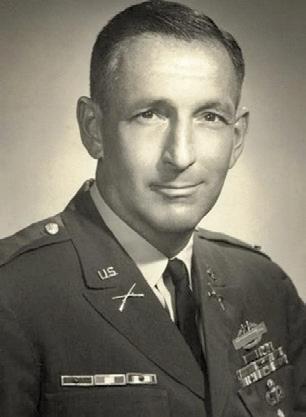
Colonel Melvin Garten from New York City was a highly decorated veteran of three wars. During World War II, he was with the 11th Airborne Division and saw a lot of action fighting the Japanese in the Pacific Theater of Operations. He earned a Silver Star while fighting in the Philippines and was part of the rescue team that rescued over 2,100 troops and
civilians from the Los Banos Internment Camp in 1945.
During the Korean War, Garten served in the 31 st Infantry Regiment, 7 th Infantry Division and was awarded the Distinguished Service Cross for actions near Surang-Ni, Korea. After observing that the assault troops of two other companies were pinned down on a hill, he went alone to assess the situation. Garten found the men in dire conditions as many had been wounded and the force lacked leadership. Taking control of the units, Garten distributed machine guns, grenades and ammunition to eight men that were still capable of fighting.
“Employing the principle of fire and maneuver,” Garten led the small group as they “stormed enemy trenches and bunkers with such tenacity that the foe was completely routed and the objective secured.” Then he organized a defensive stand and held off the enemy until reinforcements arrived. For this action, Garten was awarded the prestigious Distinguished Service Cross and was recommended for the Medal of Honor.
With regards to air power, the Korean War saw the widespread use of fighter jets for the first time in history. The Lockheed F-80 Shooting Star, America’s first operational jet fighter, was the workhorse of the air force until the superior swept-wing F-86 Sabre became operational later in the war to counter
the Soviet MiG-15. Jewish Lieutenant Leonard Levin of New York City was an F-80 pilot and was flying as wingman for Lieutenant Roscoe Anderson on a low-level strafing mission over North Korea. When Anderson’s jet was damaged by ground fire, causing its engine to overheat and his visibility to diminish, Levin took command of the situation. He gave him precise instructions over the radio on how to navigate the treacherous terrain ahead. Without the instructions, Anderson would have probably hit a mountainside; in fact, the damaged jet was flying so low that it scraped the treetops three times. The damaged aircraft ran out of fuel while in enemy territory, but Anderson avoided capture and made it back to base. Anderson credited his survival entirely to the guidance from Levin. Tragically, Levin was killed in a training accident later in the war while transitioning to fly the F-86.
Captain Richard Cohen from Philadelphia served with the 1 st Cavalry Division during the war. He was awarded several medals including the Silver Star for “conspicuous gallantry and intrepidity in action against the enemy.” While the citation does not give more details on the action, Cohen showed extraordinary leadership and bravery while operating in enemy territory. Soldiers from two companies had been cut off from the rest of the American lines for
three days. Cohen led the 200 men while they hacked their way back to friendly lines. Cohen helped carry eight wounded soldiers during the trek. The companies eventually reached a hill where they set up a radio that was found on a wrecked tank. Jewish Private First Class Herbert Lubelski from Brooklyn picked up the signals and passed on their location to headquarters. In less than an hour, a plane was circling above the group and dropped desperately needed food to the isolated companies. Instructions were given to Cohen over the radio, and soon the men reached friendly lines. Both Cohen and Lubelski were wounded later in the war but survived.
The signing of the Korean Armistice Agreement ended the fighting in Korea, although no formal peace agreement was ever signed between the two countries. There were many stories of bravery on the battlefields of Korea. The many heroes of the war will be remembered for the countless lives that they saved and the courage they displayed in the conflict early on in the Cold War.
Avi Heiligman is a weekly contributor to The Jewish Home. He welcomes your comments and suggestions for future columns and can be reached at aviheiligman@gmail.com.
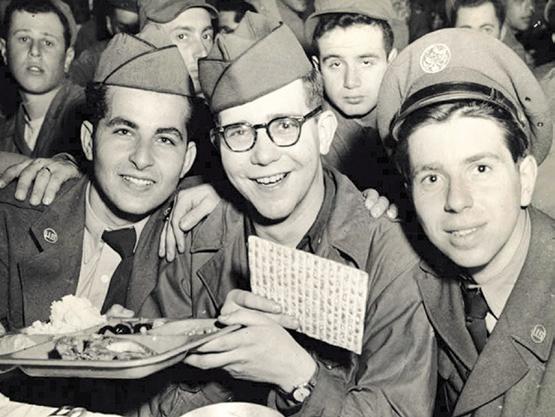
American soldiers celebrating Pesach in Seoul, South Korea, 1952
Col. Melvin Garten
To Raise a Laugh
Slightly Discomfortable
Alot of people might not know this, but it’s important to go to the doctor once in a while. Even when you’re healthy. Seriously. He won’t be upset that you wasted his time. And if the doctor doesn’t see you when you’re healthy, how will he know when you’re sick? He has to have something to measure it against. Maybe you’re always like that. You can go to the doctor and he’ll be like, “OMG, what’s that?”
And you’ll go, “That’s just my face!”
But if you’re nervous about the experience anyway, here are some tips you can use to make things easier (or, in the case of some of these tips, more difficult). You can also hand these tips directly to your doctor if you think he doesn’t know what to do. But he might know, from his other patients.
(AUTHOR’S QUALIFICATION TO WRITE THIS COLUMN: Author has gone for an annual physical over 3 times in the last 14 years alone. Or with his wife.)
MAKING AN APPOINTMENT
- Experts recommend that when choosing a doctor, you first call their office and ask vital health questions, such as, “Is he currently accepting new patients?” You don’t want to see a doctor who’s not accepting new patients. This is supposed to be a two-way relationship that will not at all be helped by a restraining order.
- Take a shower. And no, it’s not like furiously brushing your teeth before you go to the dentist, where the dentist will been able to tell that you haven’t really brushed since the last time he saw you. It’s not. But do it furiously, just in case.
- Bring a breath mint for the same reason you’re taking a shower, and pop it in right before the doctor tells you to breathe normally.
ARRIVING AT THE DOCTOR’S OFFICE
- If this is your first appointment with this doctor, make sure to show up early, because they’re going to want to scan your insurance card while you take a test that asks you to write things such as your insurance provider and account number, which you don’t know because they have your insurance card. Don’t copy answers from the person next to you, even if he looks smart and has his insurance number memorized. Also, the test has you sign a disclaimer at the bottom that says you didn’t cheat. I assume. I’ve never read it.
- One great thing to do in the waiting room is say Tehillim. They say that if you make it through the entire Sefer Tehillim before being called, you get to give the doctor a shot. I don’t know who says this, but it isn’t the Rambam.
IN THE EXAM ROOM:
- There’s no reason to get undressed. They make you do that so they can buy time while they finish up with the previous patient and get a new stethoscope out of the freezer.
- If, once you get undressed, they make you go into another room, put your wallet in your shoe. Doctors with an 8-year degree are never going to think to look in a shoe.
TALKING TO YOUR DOCTOR:
- Your doctor will ask you about your family history, so it’s important to answer honestly, because he’s not just trying to make conversation with extremely awkward topics. It’s also important to know your family medical history, which is why your mother wants you to call a few times a week so you can hear about her medical issues. Because, for example, if your great grandfather died of old age, chas v’shalom, it’s important to mention this, so the doctor knows to look out for it.
- Note that when the doctor is asking you questions, he’s actually testing things such as your memory. He’s thinking, “I can memorize the entire human body, but he can’t
By Mordechai Schmutter
remember if his back hurts in the mornings?”
So make sure to study.
- If you have any questions for your doctor, you might have to think them up on the spot. If you write them down beforehand, he might make assumptions about your memory. And don’t think you can just write them down on your arm or something, because he looks everywhere. He’ll be examining you and suddenly answer a question and you’ll be like “What?” and he’ll say, “I’m answering a question. It’s on your back. Oh, your wife must have written it.”
THE EXAM:
- In general, the doctor will check your “vitals”, such as your blood pressure, your heartbeat, and your temperature. All of these things are vital, so don’t even bother showing up for an exam unless you have them.
- There’s no way to be calm and keep your blood pressure low while they’re checking it. You’re stressing about keeping it low. The best you can do is picture yourself relaxing on the beach with your arm caught in the grasp of some sea creature that keeps squeezing it. “No, I’m checking your blood pressure!”
- When the doctor tells you, “I’m going to listen to your lungs, so breathe normally,” there’s no way you’re going to breathe normally. The doctor knows this will happen, but he has to say it anyway, because most people stop breathing when he touches them with the stethoscope. That thing is cold
- The doctor will also shine a light into your ears. If he sees the light coming through your other ear, he knows there’s a problem.
- At some point, the doctor might tell you to eat less junk food. This from a guy with 500 empty popsicle sticks in a cup in his office.
Mordechai Schmutter is a freelance writer and a humor columnist for Hamodia and other magazines. He has also published eight books and does stand-up comedy. You can contact him at MSchmutter@gmail.com.
Soul Searching
Developing an Intimate Relationship with G-d
By David Brummer
Jacob Schwebel didn’t grow up with plans to study in a yeshiva in Jerusalem or to make aliyah.
Like many Jewish teens in Marietta, Georgia, he was part of a Conservative community—attending Hebrew school, High Holiday services, and spending summers at Camp Barney Medintz in Cleveland, Georgia.
“I was brought up that way, so I’m very thankful for the foundations it gave me,” Jacob says. “The main focus was on learning the fundamentals of holidays, not as much a push toward more observance.”
After his bar mitzvah, like many kids in his community, his Jewish education came to a pause.
It wasn’t until last year, during his senior year at the University of West Georgia, that things started to shift for the better. A family friend was learning Torah with Rabbi Netanel Friedman in Dunwoody, and during a chance encounter at a restaurant, “I asked him to connect me,” Jacob recalls.
“Rabbi Friedman introduced me to something called the Podcast Fellowship, where I’d watch shiurim and then discuss them over Zoom with other Jewish students at different colleges.”
Jacob adds, “He would host sushi and shiur on Tuesdays, or pizza and shiur on Wednesdays. And then I slowly started getting pulled more into the community events.”
The rabbi eventually invited him for Shabbat, where Jacob had his first Shabbat meal in the Dunwoody community.
“It was pretty cool. He was just a friendly rabbi and super accommodating.”
Jacob started trying to keep Shabbat in his fraternity house, which created an interesting dynamic and changed something fundamental within him. The typical college social calendar meant events on Thursday and Saturday nights, with Friday nights usually quiet. Jacob realized he was missing the whole point of Friday night in Judaism: being with other people, sharing Torah, and learning together.
“At that point, I had no idea what Shabbat was,” he admits. “So I impro -
into my lifestyle,” he says simply.
After graduating in May, Jacob went to Israel on July 7 and arrived at Aish on August 25. His family has been supportive, happy that he’s found something meaningful.
“Growing up, Shabbat wasn’t really observed in my house. And as far as kashrut was concerned, we didn’t do anything; my grandparents would ship us stone crabs once a year. My Conservative community focused more on Jewish identity than on halachic details, but
“I’d watch Friday night services from Central Synagogue in New York on YouTube. Then I would try not to drive, not to spend money, and not to use technology.”
vised. I bought Shabbat candles, started making challah, and I would grab food from the dining hall beforehand (carefully separating meat and dairy, which I’d only recently started doing). I’d watch Friday night services from Central Synagogue in New York on YouTube. Then I would try not to drive, not to spend money, and not to use technology.
“I was slowly implementing Shabbat
I’m forever thankful because it helped shape me into who I am today.”
He’s also learned to be more understanding of others that aren’t on the same journey as him. “Since the beginning of my time at yeshiva, I’ve gradually learned to be less intense,” he laughs. “At first, I would tell my parents, ‘You need to keep Shabbat. You need to have a Friday night Shabbat dinner.’”
His parents encouraged him to slow down and take things step by step. His local rabbi was surprised when Jacob’s father called, asking for a letter confirming his Judaism for aliyah purposes. Jacob had always been one of the less involved kids in Hebrew school.
The hardest part about yeshiva, Jacob says, isn’t the social adjustment or even the new religious obligations; it’s learning Talmud, which is completely different from years of Hebrew school. Beyond the intellectual challenge, there’s the spiritual one: “Learning to really have a connection with G-d is way more difficult, because that just wasn’t anything I was focused on while going to High Holiday services.”
Jacob decided to make aliyah about three months ago, around the same time he committed to studying in yeshiva. The two decisions happened together, one feeding into the other.
“I sometimes think about what I would say to my younger self on the cusp of my bar mitzvah and about to drift away from Jewish learning. I would tell him to be serious in whatever education you’re going for and to firmly know the WHY behind any future decision you make in your life,” Jacob says.
He’s still figuring out what that purpose looks like, working through Talmud passages that don’t come easily, growing healthy relationships, and connecting to something he only vaguely understood growing up. But at least now he’s asking the questions, and unlike in Hebrew school, this time he’s actually interested in the answers.
Living Kiddush Hashem
From Criticism Of Chareidim To Compassion
RBy Rabbi Shraga Freedman
ecently a terrible tragedy struck Yerushalayim. Two infants, one three months old and one six months old, were niftar in a charedi daycare, apparently due to overheating. The loss was devastating.
In a raw social media post, he wrote:
“And I too participated, at least as a listener, in the collective frenzy. And I too clicked my tongue at the irresponsible parents. And I too hurried to reach a verdict.
project she created after October 7 to commemorate those who were killed in the war.
Suddenly, the charedim were no longer an abstract group. They were people. Broken parents. Fellow mourners.
“And I saw her standing before me,” he wrote. “A mother filled with pain and loss. What happened to me, a bereaved father, that I joined in this dance of blame, while the dead were still before us? And I regretted it. And I felt like tearing my clothes in mourning.”
This story holds a powerful lesson for our fractured generation. Chani Katz, with her own worldview and identity, entered the home of grieving parents and shared their pain. That simple act of human dignity shattered walls of resentment and transformed a heart hardened by grief.
This is our challenge today. To stand firmly for Torah values, while remaining faithful to Torah’s demand for compas-
We can reject ideas without rejecting people.
(This story was adapted with permission from the following article: https:// nertamid.net/sermons/praying-for-the-ayatollah-parshas-bo/)
Rabbi Shraga Freedman is the author of Sefer Mekadshei Shemecha, Living Kiddush Hashem, and A Life Worth Living.
Email LivingKiddushHashem@ gmail.com for a free sefer. Visit LivingKiddushHashem.org for more resources
Living Kiddush Hashem was founded with the goal of imbuing every Jew with a powerful sense of mission — the mission to be mekadeish Sheim Shamayim in his or her own unique way. We strive to accomplish this by raising awareness of the paramount importance of the mitzvah of Kiddush Hashem and
TJH Centerfold
The “Funnest People” to Watch a Football Game With
The TV Booth Analyst - “That was a blown coverage… They will exploit that matchup all night… They must have seen that scheme on film.” (Shush! Go get another burger and let me watch the game in peace!)
The Ref Analyst – “He was down by contact; ref blew that call.” (Uh, because the last time you ref-ed the Super Bowl YOU didn’t make any mistakes!)
The Momentum Guy – “I can’t believe Seattle won the coin toss! They have all the momentum now.” (OK, in that case, why don’t we all just call it a night?)
The Phone Watcher – Looks up only when everyone screams.
The Coach-from-the-Couch – “I would’ve called a run play here.” (You’d be frostbitten before they even finished the National Anthem – this coach has icicles coming out of his nose and you have the audacity to second-guess him?)
The Injury Overreactor – “That’s a season-ending injury” (Actually, it’s called a cramp.)
The One-Upper – “I watched a better game in ’98.” (Shame you didn’t record it on VHS. Had you done that, we could go to a pawn shop, buy a VCR, and watch it instead of this game!)
The Statistic Dropper – Quotes obscure stats with no relevance. (Yeah, we all have access to ChatGPT to make us all seem smart.)
The Volume Controller –“Hold on, guys, I want to hear what they are saying here.” (Dude, the thing has been on max volume for the past hour and a half!)
The Refs-Are-Rigging-It Person – “The refs are in the bag for the other team.” (OK, Roger Goodell, start your investigation.)
The Fantasy Addict – “I had him on my fantasy team three seasons ago, and he scored 47 points in week three.” (Guess what? We really don’t care about your fantasy team!)
The Injury Minimizer – “He’s fine. Walk it off.” (You’re one to talk. You have been complaining all night that you feel like you are going to croak because you ate too many wings for your Ozempic-sized stomach.)
The Fake Neutral – “I don’t care who wins” (You really can’t handle disappointment.)
The Timeout Beggar – “Call a time out! Call a time out!” (Well, you say that on every play, so there are no time outs left!)
The Altruist – “These people are mamish meshuga… beating each other up over a little ball.” (You are so right, yet you are sitting here riveted for four hours straight.)
Super Bowl Trivia
1. How many times have the Seattle Seahawks and New England Patriots faced each other in the Super Bowl?
a. 0
b. 1
c. 2
d. 3
2. In Super Bowl XLIX (2015), the Patriots were ahead of the Seahawks 28-24. On the final drive of the game, with 26 seconds left, the Seahawks were at their own 1 year line, on second and goal. They had the best running back in the game, Marshawn Lynch. What happened on that play?
a. Lynch ran the ball in for an easy touchdown
b. Seahawks quarterback Russell Wilson was sacked
c. Lynch was stopped short of the goal line and ran it in on the next play
d. For some reason that nobody can figure out until today, the Seahawks called a pass
play, and it was intercepted by New England, sealing their victory.
3. Including the upcoming Super Bowl, how many times did the Patriots make it to the big game?
a. 5
b. 7
c. 9
d. 12
4. Which team was Seattle QB Sam Darnold drafted by in 2018?
a. NY Jets
b. Patriots
c. Green Bay Packers
d. Seattle
5. The Patriots had a perfect season in 2007. Who did they lose the Super Bowl to that year?
a. Seattle
b. Giants
c. Cowboys
d. Kansas City
and Seahawks?
a. $5 million
b. $6.5 million
c. $8 million
d. $10 million
7. According to the National Retail Federation, how much total Super Bowl-related purchase spending is expected in the U.S. for food, drinks, apparel, parties, and decorations this year?
A) $10 billion
B) $15 billion
C) $20.2 billion
D) More than $30 billion
Touchdown!
Ten Yards To Go!
Each of the following clues refers to a word that begins with “ten.” For example, if the clue is “a game played with rackets,” the answer would be “TENnis.” Can you score a perfect TEN (I bet if you play close atTENtion, you can)?
1. Unsubstantial
2. Delicate or gentle
3. A sinew
4. Persistence and determination
5. Capable of being stretched
6. Between the bass and alto
7. Stretched tight (or stuck in traffic and late for a meeting)
8. Temporary dwelling
9. An opinion held to be true
10. Inclination
6. How much are 30-second advertising spots reported to cost for Super Bowl LX between the Patriots
6-7 correct: You are gearing up and ready to analyze this game…. “Get the food out of my face – we have a game to win!”
To those with an honest and open mind, the week’s roller coaster ride illustrated how Trump’s fondness for talking about America’s military might is often purposeful sword-rattling. The bluster, this time and often, serves as an invitation to negotiations or is so persuasive that he gets most of what he wants without having to fire a shot.
- Michael Goodwin, The New York Post
I want to say one thing clearly about this farce called the Netanyahu trial: I think it’s crazy that the prime minister has to deal with meetings at night until 2 a.m. I sit there with him and then when I tell him let’s go home — he tells me, “No, I’m going to prepare for the trial.” It’s crazy, it’s not normal. I hope President Trump will put an end to this farce. President Trump should intervene and put an end to this abuse of the prime minister.
- Israel’s National Security Minister Itamar Ben Gvir calling on President Donald Trump to intervene in Prime Minister Benjamin Netanyahu’s ongoing corruption trial
Don’t compare ICE to Nazis. That’s an unfair comparison. The Nazis were willing to show their faces.
- Late Show host Stephen Colbert (who is going off the air in May because he is not funny)
What’s Behind the Staggering Drop in the Murder Rate? No One Knows for Sure
- Headline of a New York Times article about the decline in murder and other serious crimes over the past year and positing that nobody knows the reason
Actually, I think there are a lot of people that have a really good idea: It turns out that if you actually go after criminal aliens and you deport them and enforce the law, the crime rate starts goes down dramatically.
- Charlie Hurt, Fox News
You have to understand they’re children. When they are out there, they look like adults, but they are actually children. They don’t really have a background that everybody else does. They’re frightened, insecure, they’re really worried about fitting in. So even though they will dress like a rebel, they will embrace any slogan because deep down they fear that their deficiencies will be exposed. They are basketcases. Every person in there is a basketcase worried about their imposter syndrome, and wondering when their luck will run out. So what they do, it’s amazing because everybody thinks of them as stand-out celebrities, they will do anything to fit in.
- Greg Gutfeld talking about Hollywood celebrities
You cannot simultaneously believe that (1) all borders are fake and should not be policed, and (2) that land can be “stolen.” This is one of the most braindead beliefs a person can hold.
- Tweet by Colin Wright in response to a Hollywood award show in which several speakers decried ICE enforcing the border and protested that America is stolen land
Governor Tim Walz – whatever he says, believe the opposite. I’m sorry, the man learned to lie before he learned to talk. He’s just a less masculine version of Hillary Clinton.
- Sen. John Kennedy (R-LA) on Fox News
After the episode Wednesday night, young men and boys crowded around the building. A teenager who gave his name as Yechi Hamelech, 15, had been inside when he heard the crash. “And we go look, and the police said, ‘You got to get out.’”
- From a New York Times report about the car-ramming incident at 770 last week (great job, Yechi Hamelech!)
Let’s just take Tucker Carlson… I worked with him for 6.5 years at Fox News in New York. Suddenly, in a very short period of time, a switch is split, and he has a completely different worldview, and his ideological base has completely changed. That’s not normal for someone in his 50s. It just isn’t.
– U.S. Ambassador to Israel Mike Huckabee at a recent conference
What happened? I don’t know. Is it that it is more profitable for him to do what he’s doing now than what he was doing when he was at Fox News? He wouldn’t be doing it if it wasn’t. – ibid.
I don’t know if you’ve noticed, but there haven’t been boats sunk recently because we can’t find any boats to sink.
- Secretary of War Pete Hegseth
[Antisemitism is the] most prevalent in social media. This is the new battlefield, and this is where we must counter with our own weapons. We’re late in the game, but we will win this battle, too, as we won on the battlefield.
- Prime Minister Benjamin Netanyahu
The attacks on American citizens by masked hoodlums – if you were attacked by a masked person, you might think you were being kidnapped. You’d be justified in shooting the person to protect yourself.
- Rep. Jerry Nadler (D-NY) talking about ICE agents and encouraging people to shoot them
I’m not here because the federal government has carried its mission out perfectly. We are not surrendering our mission at all. We are just doing it smarter.
- Border Czar Tom Homan at a press conference in Minnesota
I don’t understand it. I mean, I was with him every day. If he’s not a first-ballot Hall of Famer, there’s really no coach that should ever be a firstballot Hall of Fame.
- Tom Brady responding to his longtime coach Bill Belichick not getting into the NFL Hall of Fame in the first round
So far, in New York City under the new mayor, homeless deaths have reached 16 and counting. Zohran has killed so many drifters that serial killers are considering a career in politics.
- Greg Gutfeld, Fox News
Dating Dialogue What Would You Do If…
Moderated by Jennifer Mann, LCSW of The Navidaters
Dear Navidaters,
Dear Navidaters,
I love your panel and appreciate the opportunity.
I’m the oldest in a very large family (13 kids). I love my family dearly, and my parents are great. But after a lot of soul searching in seminary and thinking about what I want, I think that’s not particularly the family structure I want. I’ve been dating and I keep thinking about this as a potential question for the guys I date, but I chicken out before ever getting to it.
The thing is, I want to make sure it’s an appropriate question to ask, and if so, when is the appropriate time to ask it?
Thanks so much, Tehilla*
Disclaimer: This column is not intended to diagnose or otherwise conclude resolutions to any questions. Our intention is not to offer any definitive conclusions to any particular question, rather offer areas of exploration for the author and reader. Due to the nature of the column receiving only a short snapshot of an issue, without the benefit of an actual discussion, the panel’s role is to offer a range of possibilities. We hope to open up meaningful dialogue and individual exploration.
The Panel
Dear Readers,
We want to offer YOU an opportunity to be part of the discussion! Please email us at MichelleMondShadchan@gmail.com, subject line “reader’s response,” if you would like to participate in the new “A Reader’s Response” columnist spot. We will send you a question and publish your answer in an upcoming Navidaters edition.
If you have a question you would like the Navidaters to answer, please reach out to this email as well.
Looking forward!
Michelle, the “Shadchan”
The Rebbetzin
Rebbetzin Faigie Horowitz, M.S.
Tehilla, the context in which you can bring this subject up is pretty straightforward. When you talk about your families at the point at which you feel secure enough to be vulnerable, that is the time to
talk about your vision for your future family. Many young people talk about their own families and then what they would like that will be similar and/or different. Obviously, this means that the young man and woman have reached a level of closeness and trust.
Then you can share personal information.
Achieving this level of comfort with one another happens at different points for different couples. No one will say to you:
open up about this on the third date or the fifth date. It’s a matter of whether you have reached a deeper level of connection and you see that some of your present and future priorities are aligned. You will know when the time is ripe for the discussion about family size.
The Shadchan
Michelle Mond
Dear Tehilla,
It is completely valid to recognize that the family type you grew up in is not necessarily the one you want for yourself. That does not take away from your love for your family or from the good you experienced growing up. It simply means you’ve thought carefully about what you want your own future to look like.
The good news is that you do not need
The reason you hesitate is not because it is wrong but because it feels personal.
to worry about bringing this up until you are serious with someone. This is not a topic that belongs early on in dating, because at that point, it simply is not anyone’s business.
Once you are at a more serious stage in a relationship, conversations naturally become deeper. You will start talking more about your upbringing and family life. As the oldest of thirteen, it is very likely that he will ask you questions about your experience growing up, and that can serve as
a natural opening to share how you think about this topic.
Usually, discussions about the future and expectations will come naturally, later on in the dating process. Until then, your focus should be on getting to know him. Pay attention: do you genuinely like and respect him? Does he treat you well? The more serious stuff can be discussed later on, when your relationship has earned that level of openness.
The Zaidy
Dr. Jeffrey Galler
F
amily size is not a trivial question. It is a lot more significant than asking if someone prefers mountains or beaches.
On your very first phone conversation, or very first date, it’s probably not advisable to say, “Hi. My name is Tehilla, I just got back from seminary, I’m studying to be a speech therapist, and I do not plan on having thirteen children.”
Instead, this is the sort
of conversation you would have after a couple of dates, when you discuss values, like family, work, materialism, etc. During those talks, you can easily work into the conversation that your parents chose to have 13 children, and that even though you had a very happy and loving childhood, you would probably prefer a smaller family.
You may find that most young men will be surprisingly relieved to hear that!
Here’s a suggestion for you:
When my daughters were younger, they loved reading, “The Story of Mimmy and Simmy,” by Yaffa Ganz (available on Amazon). The story is about two best friends. Mimmy comes from a large family, and Simmy is an only child. Both girls romanticized what they did not have.
Mimmy is jealous of Simmy because she gets a lot of only-child attention and enjoys peace and quiet in her home. Simmy is jealous of Mimmy because she is always surrounded by siblings and playmates and is never lonely. They decide to switch places for one Shabbos, with very interesting results. They learn that it is not about which family size is better but that every struc-
Pulling It All Together
The Navidaters
Dating and Relationship Coaches and Therapists
Dear Tehilla,
This is such an honest question. And it makes a lot of sense coming from someone who grew up as the oldest in a very large family.
You can love your family deeply and still know that you do not want to recreate the same structure for yourself. That is not a rejection of your parents or your upbringing. It is self-awareness. Growing up where you did gave you a real understanding of what that life asks of a person, especially of the old-
est child. You are allowed to take that seriously.
Many people from big families hold this quietly. Gratitude and exhaustion often live side by side, and it can feel scary to admit that what you came from is not what you want to build. That does not make you ungrateful. It makes you thoughtful.
Yes, this is an appropriate thing to ask. The reason you hesitate is not because it is wrong, but because it feels
ture carries blessings and burdens.
You can use that story as a starting point for a heartfelt conversation about what kind of family life you fantasize about building together. This is not about rejecting your childhood. It is about responsibly planning your future grocery bill, your sanity, and the size of your dining room table.
Reader’s Response
Sholom P.
Dear Tehilla,
I am so happy to hear that you had a positive experience growing up in a large family and that you have a good relationship with your parents. I, too, grew up in a large family (12 kids) and know the pros and cons that come along with being part of a large family. Your feelings are very valid, and I think many people who grow up with a lot of siblings can resonate with your perspective.
Dating is a process, and as you get more comfortable, this is definitely a normal and important thing to discuss with a potential spouse. You should not feel insecure or uncomfortable asking this question. A person’s perspective on family planning often is influenced by their life experiences and values. As one experiences life, their values and perspectives may change, and that is true for a married couple as well.
There is not a specific point in dating
Once you are at a more serious stage in a relationship, conversations naturally become deeper.
that you can or should bring this topic up. This type of conversation can be brought up organically or you can even just ask it straight out. As a guy, I would not be offended or uncomfortable being asked this question. In fact, my wife and I discussed this topic when we were dating and had very different perspectives. I wanted 17 kids, and she didn’t (being that she is sane). As I grew wiser and had kids, my perspective has changed significantly.
If you take anything away from my uneducated perspective, just know that your question is very normal and probably every couple discusses it at some point. Don’t get stuck in your head thinking about it. Just relax, and the time will come for the conversation. If you are super stressed, you can always be super awkward and just ask him on the first date – that way you don’t have to stress about it on any other dates.
Hope this was helpful!
personal. You are sharing something real about your limits and your future, and that takes courage.
This is not a first date question, and it does not need to be asked in a blunt or technical way. It usually fits naturally a few dates in, once there is already some comfort and you are talking more about values, family, or life goals.
It often helps to share first rather than ask outright. You might say something like: “I grew up in a very large family, and I love it. At the same time, I
have realized that I do not think that is the family structure I want for myself. I am curious how you think about that.”
That opens a conversation instead of putting someone on the spot. What matters is not just his answer but how he responds to you saying something honest and a little vulnerable.
You are allowed to want what you want. The right person will not be scared by this question. He will respect it.
Sincerely, Jennifer
Jennifer Mann, LCSW is a licensed psychotherapist and certified trauma healing life coach, as well as a dating and relationship coach working with individuals, couples, and families in private practice at 123 Maple Avenue in Cedarhurst, NY. To set up a consultation or to ask questions, please call 718-908-0512. Visit www.thenavidaters.com for more information. If you would like to submit a dating or relationship question to the panel anonymously, please email JenniferMannLCSW@gmail.com. You can follow The Navidaters on FB and Instagram for dating and relationship advice.
Mental Health Corner
The Benefits Of A Summer Vacation
By Rabbi Azriel Hauptman
The summer vacation is a greatly anticipated time of year when many families go on vacation and enjoy the warm weather and abundant
sunshine. Many therapists, who have lives of their own, also engage in this time-honored practice and take time off in order to spend quality time
with their families and recharge their batteries. During this vacation, which may last a few weeks, clients are unable to attend therapy. This can be very challenging, but if used properly can actually be a time of tremendous growth and can enhance therapy when it resumes after the summer vacation.
The challenges facing the client are obvious. Therapy helps you deal with many types of difficulties that you face in life, and skipping therapy for a few weeks in a row leaves you vulnerable to life’s challenges. Therapists will commonly work with their clients to work out a game plan on how to manage this challenging period of time.
However, this coerced vacation from therapy might actually help you achieve breakthroughs in your mental health that would not have been otherwise possible. When one is immersed in therapy, one runs the risk of losing the forest for the trees and therefore not being able to properly assess one’s own progress. A break from therapy is therefore an opportunity to evaluate your accomplishments thus far and plan for the future.
you think it could have been handled differently? And so on and so forth. Real-life “experiments” can be a great way to examine what exactly you need to work on.
An additional opportunity that is offered by this break from therapy is to have some space in your brain to contemplate your personal journey in therapy. When you are attending weekly sessions, it can be hard to take a step back and ponder your progress. Now that there is a lull in your therapy, you can ask yourself the following questions. How has therapy benefited me thus far? How do I want therapy to help me in the future? Are we focusing on the right aspects in therapy?
Another positive side effect of this involuntary break in therapy is that it can help in generalizing. Generalization is a term that refers to the ability to apply a learned skill to a variety of situations. Now that you are on your own for a few weeks, it can be easier to try seeing how you can apply your skills on your own in a variety of scenarios that may not match the exact situations that you focused on in therapy.
Usually when situations arise during the week, you know that within a couple of days you will be able to discuss it with your therapist and in this way use therapy as a coping mechanism for life’s challenges. With that option off the table as your therapist is vacationing in Yellowstone Park, you can now see for the first time how well you are able to manage on your own. If you successfully navigate the challenge, you have solid evidence that you have progressed in therapy enough to handle this on your own, and now you and your therapist can fine-tune what the focus of therapy should be moving forward.
If you did not handle the situation so well, you can still use this for your benefit when therapy resumes. How exactly did it not work out? What were your emotions at that time? Do
Collaborating on all of this with your therapist by preparing before the break and processing it after the break is where the rubber hits the road in utilizing the summer vacation properly.
Winnie the Pooh once said, “I always get to where I’m going by walking away from where I have been.” In therapy as well, there is no point in remaining in one spot and not moving forward. Even when your therapist is on vacation, or especially when your therapist is on vacation, never stop progressing and growing in your emotional life.
This is a service of Relief Resources. Relief is an organization that provides mental health referrals, education, and support to the frum community. Rabbi Yisrael Slansky is director of the Baltimore branch of Relief. He can be contacted at 410-448-8356 or at
Parenting Pearls Seize the Potential
By Sara Rayvych, MSEd
We have how we wish things were, and then we have reality right there in front of us. We would love to have hours to sit with our children, talk to them, spend time together and connect. It would be great if we had endless time to laugh, speak and bond with our precious children. The reality is far from that. We rush to get our day started, get everyone where they’re going, and then we finally reconnect only to finish off the day tired and ready for bedtime. We have the l’chatchila we want for our parenting day, and then we have the bedieved of our parenting reality.
I try to keep in mind these two different paths when writing articles and speaking with families. I want parents to know the ideal, along with what to aim for, while still acknowledging the real-life experience for many families. It’s important to understand what we would like to accomplish if we could but to also have a way of accurately matching our parenting to the current reality.
The bridge between these two often very different points is to maximize what we have in our current situation. There are many things that may limit us from meeting our ideal, but we can maximize what we do have to make the most of our current reality.
We can be black-and-white thinkers and see everything as “all or none.” Either I can do it the way I want, or I can’t do it at all. It’s normal to feel this way, but it can be frustrating and limit us in our options. Breaking away from this line of thinking and seeing how we can maximize the gifts we currently have can be the most effective way to meet our family’s needs.
Seeing Reality
We all have our own biases. Sometimes that makes us see ourselves as less capable than we really are, and at other times, we fail to recognize our own limitations. We
may think we can’t do anything or, conversely, that we can do everything. Both are inaccurate. We all have incredible Divinely ordained capabilities, but we also have limitations. Honestly ascertaining our upper and lower limits permits us to accurately assess our current capabilities. Our capabilities will change and shift over time. As we go through the year, different times in our life and our daily ups and downs, we will find a continuous shifting. We need to be honest with ourselves of where we are currently holding. For example, the days before Pesach, the first weeks after birth or a time period during personal challenges are all going to be when we need to set our sights lower because we are otherwise occupied by important events.
We all have time limitations. We have so much to do each day, and much of it is directly or indirectly about our children. Work, errands, and upkeep of the home are all about fulfilling our children’s basic, physical needs. As human beings, we also need time to sleep, eat, and fulfill other personal tasks. Theoretically, we all have 24 hours in our day, but the reality is that we have far fewer than that available.
As human beings, we have physical limitations. Whether it’s obvious or not, we all have limits to what we are physically capable of doing. We may attempt to do it all and run ourselves ragged, but that’s not ideal, nor is it sustainable. As tempting as it is, we can’t ignore the limits of our physical bodies.
Understanding our emotional limitations may be the hardest. Emotional needs are not physically visible to others – or even ourselves. They’re easy to ignore, yet we truly feel it when we don’t take these needs into account. It’s too tempting to stretch ourselves thin, hoping it will workout anyway. We need to be honest in recognizing our emotional limitations and working with what we realistically have.
We also may be limited in what our child is capable of accepting. For example, toddlers will more quickly welcome a hug than a teen will, but a teen may benefit from a meaningful conversation more than a toddler. There are times when children are naturally more emotionally open and times when they are closed or hesitant. We need to acknowledge their current reality when we ascertain their ever-changing needs.
Multiple Levels
Nearly every parenting skill comes with built-in options or levels for parents to do. The key is to recognize those different levels and pick the best option for the current situation. This may be best understood from examples. In the following paragraphs, I’ll try to provide a few situations and some of the options in each one.
It’s important for children to have quality time with their parents. Ideally, parents would set aside meaningful, oneon-one bonding time with their children on all, or most, days. Unfortunately, for many adults, this is unrealistic with their daily time constraints. Some parents are able to carve out a five- or ten-minute time slot each day, perhaps at bedtime or when the other kids are not around. Parents can consciously take advantage of downtime, perhaps catching a child during a quiet moment as it pops up. Children can accompany parents on errands or sit close by during housework. It’s important to note that toddlers really enjoy matching and folding socks. A child resistant to one-on-one time with their parents may
be comfortable with their loving adult simply sitting next to them while they each do their own task (for example, reading a book or doing homework).
The parent-child bond is crucial. In addition to spending time with our child, there are many other ways to connect, such as open communication and physical affection. Ideally, we would do all of them, but that’s not always possible. Open conversation can be difficult for some parents and children. Playing games together or just “hanging out” can still create some closeness and openings for communication. Making a point of welcoming a child after they arrive from school is a bridge to communication. A child that resists hugs or is touch averse may still be comfortable with fist bumps, shoulder taps, or big smiles from their adult.
Often, we can’t change our specific circumstances. We can’t add more time to our day. We can’t create on-demand emotional or physical strength that isn’t present. We can’t force our child to be someone whom they are not. What we can control is how we respond to our limitations and how we maximize each limited moment we have.
Sara Rayvych, MSEd, holds a master’s degree in general and special education. She has been homeschooling for over 15 years. Sara provides personalized parent mentoring services, addressing a variety of general and specific parenting concerns. She can be contacted at Sara.Rayvych@gmail.com with comments, questions or for private consultations.
Old School
Health & F tness When the Past Becomes the Present in Psychiatry
By Rivka Kramer, PMHNP-BC
Psychiatry has come a long way. We now have advanced medications, genetic research and detailed diagnostic manuals. These tools have helped millions of people. They have reduced stigma and saved lives. But for all this progress, one powerful force still does not get the attention it deserves: trauma.
Trauma is often treated like a side topic. It may be mentioned in a history and then quietly placed in the background while treatment focuses on diagnoses and medications. But for many people, trauma is not just part of the story. It is the story. It shapes how the brain reacts, how emotions are regulated, how relationships feel, and how the body responds to stress.
When trauma is overlooked, psychiatry may treat the symptoms while missing the deeper cause. The result can be years of treatment that helps a little but never quite gets to the root of the issues.
Trauma in Plain Language
When people hear the word trauma, they often think of extreme events like war, violent assault, or major accidents. Those are real and serious. But trauma is also much quieter and more common.
Trauma can be growing up with emotional neglect, constant criticism, bullying, a chronically stressed home, a parent with addiction, unpredictable caregiving, medical trauma or feeling unsafe to express emotions. Trauma is not only about what happened. It is about how alone, frightened, or overwhelmed a person felt while it was happening.
Two people can go through similar events, and only one may be traumatized. That is because trauma is about the nervous system. It is about whether the body learned that the world is safe enough or dangerous. It is about whether connection feels soothing or threatening.
Trauma lives in the body, not just in memory. It shows up in startle responses, muscle tension, breathing patterns, sleep problems, and emotional reactions that seem bigger than the situation at hand.
Why Trauma Is Still Underrated
There are several reasons trauma often takes a backseat in psychiatry.
First, the medical model focuses on biology. Neurotransmitters and brain circuits are easier to measure than emotional pain. A prescription can be written in minutes. Exploring trauma takes time, trust, and emotional presence. In busy systems, time is limited.
Second, trauma does not fit neatly into categories. It can look like many different disorders depending on the person. That makes it harder to study and harder to standardize.
Third, trauma stories can be hard to hear. They force clinicians and systems to face abuse, neglect, and betrayal in places that were supposed to be safe. That can be emotionally heavy and uncomfortable.
Finally, many training programs still
treat trauma as a specialty rather than a basic lens for understanding patients. As a result, trauma may be referred out instead of integrated into everyday psychiatric thinking.
How Trauma Disguises Itself as Other Conditions
One of the biggest reasons trauma is underrated is because it often hides behind other diagnoses.
Depression may be an emotional shutdown after years of feeling unseen or powerless. What looks like a low mood may actually be a nervous system that learned to conserve energy to survive.
Anxiety may be a body that learns to stay on high alert. Panic and worry are not just thoughts. They are physical survival responses.
Attention problems may be trauma-based. A nervous system scanning for danger has trouble focusing on school or work. What looks like ADHD in some people may be hypervigilance in disguise.
Mood swings may reflect trauma-related emotional overload. Stress and relationship triggers can cause rapid shifts that look like a mood disorder.
Relationship chaos and intense
emotions often labeled as personality problems are frequently rooted in early attachment trauma. These are not character flaws. They are survival strategies learned in unsafe emotional environments.
Even hearing critical voices or feeling watched can in some people be linked to trauma memories and internalized abusive voices.
This does not mean trauma explains everything. Biology matters. Genetics matter. But trauma is often a major piece of the puzzle that is too easily missed.
The Body Tells the Story
Trauma changes the body. This is not just psychological. It is biological.
The stress system can become overactive. The brain alarm center can become more sensitive. Areas involved in calming and thinking clearly may become less effective under stress.
In real life, this looks like chronic pain, headaches, stomach problems fatigue, pelvic pain and autoimmune-like symptoms. Many people go from doctor to doctor with real physical symptoms that have no clear structural cause. A trauma-informed view recognizes that a nervous system stuck in survival mode can create real physical suffering.
Sleep is another major clue. Many trauma survivors have trouble falling asleep, staying asleep, or having restful sleep. The body may not fully relax because in the past sleep was not safe. Insomnia in this context is not just a sleep problem. It is a learned survival pattern.
Trauma and Relationships
Trauma shows up clearly in relationships.
If early caregivers were inconsistent, frightening, or emotionally unavailable, the nervous system learns powerful lessons about closeness.
Some people learn that needing oth-
ers leads to pain so they become distant and overly self-reliant. Others learn that connection is unpredictable so they become anxious, clingy, or highly sensitive to rejection. Many people swing between both.
In adult psychiatry, these patterns often get labeled as personality traits or interpersonal problems. From a trauma lens, they make deep sense. They are nervous system strategies built to protect connection and safety.
Medication Without Trauma Awareness
Medications can be life-saving and life-changing. The issue is not medication. The issue is using medication without understanding trauma.
When trauma is not recognized, people may be labeled treatment resistant. They may try many medications with partial relief while core patterns of fear, numbness, or relational distress remain.
Some medications may even worsen trauma-related symptoms like emotional blunting dissociation or sleep disruption. Without a trauma lens, this can be mis-
What Trauma Informed Psychiatry Looks Like
Trauma-informed psychiatry does not mean digging into trauma in every session. It means keeping trauma in mind when understanding symptoms. It means asking not only what is
rectly address trauma when appropriate such as IFS, somatic therapies, trauma-focused therapy and attachment-based approaches.
It also means teamwork across medicine therapy and body-based care. Healing trauma often requires helping
When trauma is overlooked, psychiatry may treat the symptoms while missing the deeper cause.
wrong but what happened to you. It means seeing behaviors as adaptations not defects. Avoiding emotional shutdown and resistance often protected someone at one time.
It means building safety and trust in the clinical relationship. Clear explanations, predictable plans ,and respecting
the nervous system learn safety again, not just changing thoughts.
Why This Changes Everything
When trauma is overlooked, patients often feel misunderstood and blamed. They may cycle through diagnoses and treatments without feeling truly seen. They may believe they are broken. When trauma is recognized, symp -
toms begin to make sense. The story becomes clearer. The shame often lifts. Hope grows because the nervous system learns these patterns to survive and can also learn new ones.
A Bigger Vision for Psychiatry
Psychiatry does not have to choose between biology and trauma. The brain and life experience shape each other.
Trauma is not a footnote. For many patients, it is the main chapter. Bringing trauma to the center of psychiatric thinking makes care more accurate, more compassionate, and more effective.
Until trauma is fully embraced as a core force in mental health, it will remain one of the most powerful and most underestimated drivers of human suffering and healing.
Rivka Kramer is a Board Certified Psychiatric Nurse Practitioner. She has a psychiatric private practice based in Cedarhurst, NY. She serves as a member of the board of JANPPA, the Jewish American Nurse Practitioner Psychiatric Association. She can be reached at 516-945-9443.
Yonatan Kohenagadol, 4
Rivka & Binyamin Baron
Esti Soskil, 5
Aliza Wecker, 7
Azriel Chanina Karp
Eliyahu I. Mordechai Gluck, 5
Naama Schiermeyer, 9
Nechama Krintzman, 5 Benny Radparvar, 6
Penina Winchell, 7
Chaya Ahuva Drabkin
Note: Not all submission have been published. Keep sending in your artwork for another chance to be featured!
Chani Gross, 8
Malky B., 7
Zehava, 5
Tova Hammelburger, 3
Leba Priluck, 6 Molly
Yosef Meir Priluck, 4
G.J., 8
Eliezer Hammelburger, 5
Shalva B., 11
Yisroel Milworm, 6
Chevi Tenenbaum, 5
Chaiyala, 7 & Kayla, 5 Drabkin
S.M., 7
Gitty Gross, 5
Esther priluck, 2
Sarah Silberstein 5
Chana Lapidus, 11
Yaakov, 7 & Ahuva Bracha, 5
Ava Korb
Talia Kohengadol, 6
Michal Soskil, 7
Basya Schiermeyer, 8
Leeba Danziger, 7
Binyamin Schiermeyer, 5
In The K tchen
Cauliflower Soup
By Naomi Nachman
With the arrival of bitter cold days, there is nothing more comforting than a steaming bowl of homemade soup. In Jewish homes, soup has always been more than just food—it is nourishment, tradition, and love ladled straight from the pot. This particular soup has become a winter staple in my kitchen: light, nourishing, and surprisingly satisfying. Made almost entirely from vegetables and broth, it is virtually calorie-free, yet full of flavor and warmth. Best of all, it freezes beautifully, making it perfect for preparing in advance and pulling out on those nights when the chill settles deep and comfort is needed most. One spoonful, and you are reminded why soup season is something to look forward to all year long.
Ingredients
◦ 1 tablespoon canola oil
◦ 3 onions, diced
◦ 6 medium zucchini, chunked
◦ 2 bags frozen cauliflower
◦ 2 can chickpeas, drained
◦ 4 cups water
◦ 1 teaspoon kosher salt, plus more for taste
Preparation
1. Sauté the onions until light brown with a teaspoon of salt.
2. Once the onions are browned, add in the zucchinis till they have some color.
3. Add in two bags of cauliflower and chickpeas (you can also use broccoli).
4. Add four cups of water – make sure you add water one inch below the top of the vegetables.
5. Cover and simmer on low for one hour. The vegetables should be fork-tender.
6. Using an immersion blender, blend the vegetables until smooth and creamy. Add salt to taste. And enjoy this (almost) calorie-free recipe!
Naomi Nachman, the owner of The Aussie Gourmet, caters weekly and Shabbat/ Yom Tov meals for families and individuals within The Five Towns and neighboring communities, with a specialty in Pesach catering. Naomi is a contributing editor to this paper and also produces and hosts her own weekly radio show on the Nachum Segal Network stream called “A Table for Two with Naomi Nachman.” Naomi gives cooking presentations for organizations and private groups throughout the New York/New Jersey Metropolitan area. In addition, Naomi has been a guest host on the QVC TV network and has been featured in cookbooks, magazines as well as other media covering topics related to cuisine preparation and personal chefs. To obtain additional recipes, join The Aussie Gourmet on Facebook or visit Naomi’s blog. Naomi can be reached through her website, www.theaussiegourmet.com or at (516) 295-9669.