Logistics under fire
by Erik Froste
During the winter and spring of 2024, Odesa in Ukraine was my home for five months. By then, the full-scale invasion had been ongoing for two years. I was there on an EU assignment to determine what needs to be done to bring the country’s maritime sector closer to Europe and prepare for future EU accession. Since then, I have continued to travel back, often for one to two weeks at a time, to work with Ukrainian authorities and transport operators. Sitting in meetings that are suddenly interrupted by wailing air-raid sirens, prompting a calm relocation of the discussion to a basement shelter, quickly becomes a surreal but necessary routine.
For us in Northern Europe, transport and logistics are a matter of efficiency, margins, and sustainability. In today’s Ukraine, it’s literally the bloodline of the nation. It is not just about keeping civil society afloat. The transport sector, and the massive export revenues it generates – not least from grain – is ultimately what covers the soldiers’ pay and buys the ammunition. Without international financial support, Ukraine would, of course, be in a brutally tight corner, but without its own export revenues, the system would have collapsed long ago. Furthermore, a heavy global responsibility rests on these logistics chains: Ukraine’s grain exports are a guarantee that parts of the world will not starve.
This is the story of a sector that refuses to stop, and the invaluable lessons we around the Baltic Sea must take to heart.
Lifeline(s)
Ukraine’s ports were the first in the 21st century to be forced to operate under a fullscale naval blockade and systematic drone & missile attacks. During the war’s first year, between July 2022 and July 2023, the Black Sea Grain Initiative, an UN-sanctioned corridor, was negotiated. It enabled the export of around 32 million tonnes, corresponding to about 30% of pre-war volumes.
But the agreement was fragile. Unsurprisingly, Russia weaponised the Bosphorus inspections; a process that should have taken 30 minutes was dragged out to three hours. Capacity dropped from 10 to 15 ships a day to a mere three. Eventually, Russia abandoned the agreement entirely, and Ukraine’s exports via the Black Sea ground to a halt.
But the deadlock was short-lived. In an impressive display of adaptability, creativity, and defiance, Ukraine soon opened its
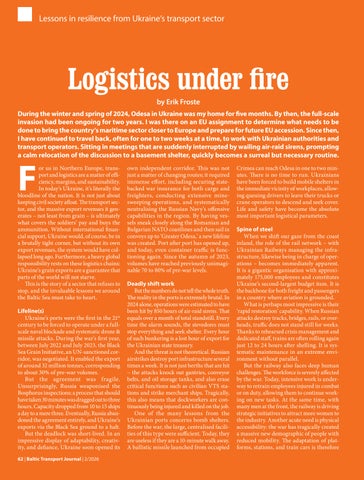
own independent corridor. This was not just a matter of changing routes; it required immense effort, including securing statebacked war insurance for both cargo and freighters, conducting extensive minesweeping operations, and systematically neutralising the Russian Navy’s offensive capabilities in the region. By having vessels sneak closely along the Romanian and Bulgarian NATO coastlines and then sail in convoys up to ‘Greater Odesa,’ a new lifeline was created. Port after port has opened up, and today, even container traffic is functioning again. Since the autumn of 2023, volumes have reached previously unimaginable 70 to 80% of pre-war levels.
Deadly shift work
But the numbers do not tell the whole truth. The reality in the ports is extremely brutal. In 2024 alone, operations were estimated to have been hit by 850 hours of air-raid sirens. That equals over a month of total standstill. Every time the alarm sounds, the stevedores must stop everything and seek shelter. Every hour of such bunkering is a lost hour of export for the Ukrainian state treasury.
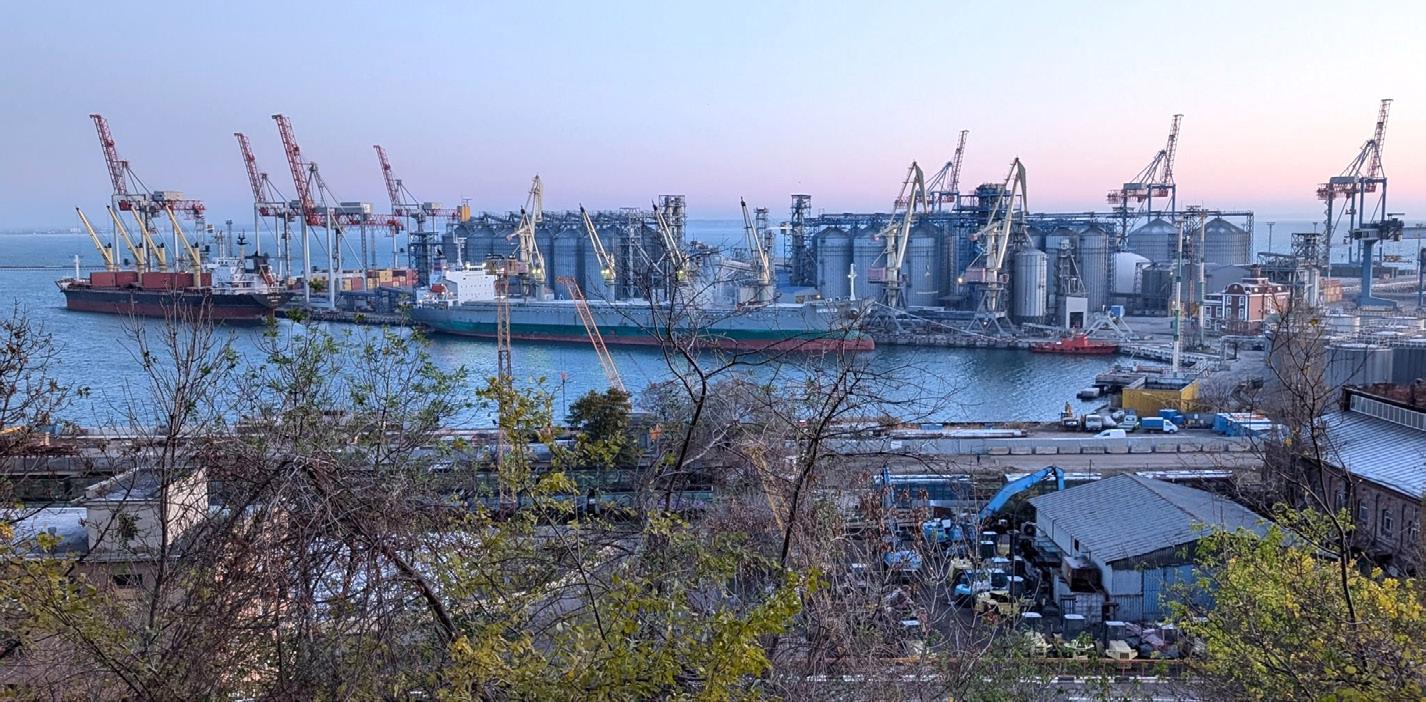
And the threat is not theoretical. Russian airstrikes destroy port infrastructure several times a week. It is not just berths that are hit – the attacks knock out gantries, conveyor belts, and oil storage tanks, and also erase critical functions such as civilian VTS stations and strike merchant ships. Tragically, this also means that dockworkers are continuously being injured and killed on the job.
One of the many lessons from the Ukrainian ports concerns bomb shelters. Before the war, the large, centralised facilities of this type were sufficient. Today, they are useless if they are a 10-minute walk away. A ballistic missile launched from occupied
Crimea can reach Odesa in one to two minutes. There is no time to run. Ukrainians have been forced to build mobile shelters in the immediate vicinity of workplaces, allowing queuing drivers to leave their trucks or crane operators to descend and seek cover. Life and safety have become the absolute most important logistical parameters.
Spine of steel
When we shift our gaze from the coast inland, the role of the rail network – with Ukrainian Railways managing the infrastructure, likewise being in charge of operations – becomes immediately apparent. It is a gigantic organisation with approximately 175,000 employees and constitutes Ukraine’s second-largest budget item. It is the backbone for both freight and passengers in a country where aviation is grounded. What is perhaps most impressive is their ‘rapid restoration’ capability. When Russian attacks destroy tracks, bridges, rails, or overheads, traffic does not stand still for weeks. Thanks to rehearsed crisis management and dedicated staff, trains are often rolling again just 12 to 24 hours after shelling. It is systematic maintenance in an extreme environment without parallel.
But the railway also faces deep human challenges. The workforce is severely affected by the war. Today, intensive work is underway to retrain employees injured in combat or on duty, allowing them to continue working on new tasks. At the same time, with many men at the front, the railway is driving strategic initiatives to attract more women to the industry. Another acute need is physical accessibility: the war has tragically created a massive new demographic of people with reduced mobility. The adaptation of platforms, stations, and train cars is therefore

no longer just a policy issue but an immediate national necessity.
Lesson learned the hard way
Helping Ukraine is not a one-way street of foreign aid; it’s a mutual exchange. We in Sweden and the Baltic Sea region have a lot to learn from how Ukraine manages logistics under maximum stress. Preparedness and resilience are often equated here at home with multi-million-dollar investments in fencing, advanced IT systems, and heavy-duty back-up generators. Ukraine shows us that true resilience is just as often about leadership, flexibility, and small, cost-effective measures that secure operations. It is about being able to switch to manual paper routines when cyber attacks knock out servers, and about the mentality of quickly finding solutions rather than surrendering to problems.
To be in Ukraine is to live in a paradox. Large parts of the country, especially in the west and in Kyiv, are seemingly open. Restaurants, hotels, and pubs serve guests in a pattern that defiantly refuses to change. But air-raid sirens, curfews, and the muffled thuds of air defence systems constantly shatter this ‘business as usual’ illusion. Yet, amidst the chaos, Ukrainian civil society displays a breathtaking determination to maintain normality and dignity. They are incredibly efficient at cleaning up after attacks. Shrapnel and debris from a nighttime strike are swept off the streets by morning. Massive craters in the roads are often patched before lunch. Even during the war, flowerbeds are watered to keep cities beautiful, and park
benches are freshly oiled for the season. Amid this raging war, Ukrainians are building the institutions required for the future.
To keep logistics running
Establishing trust and cooperation between authorities is an absolute prerequisite for the country’s path into the EU.
We around the Baltic Sea must never get used to Ukraine’s suffering, but we should be inspired by their resolve. Our support for their transport sector must not stop at words – it must continue to be translated into practical, operational action. Their fight to keep logistics running is ultimately a prerequisite for freedom in our entire region.
Erik Froste, the former CEO of the Port of Södertälje and the Swedish Transport Administration Ferry Operations, is now an independent maritime advisor. Based in Sweden, he regularly operates on the ground in Ukraine to advise on maritime and logistics resilience. As these complex realities and lessons are often best shared through direct dialogue, Erik holds lectures and presentations for companies, authorities, and management teams. Reach out to Erik via LinkedIn or mail to discuss how these operational insights can strengthen your organisation’s preparedness.
Photos: Erik Froste