Interview with Sebastian Krüger, Managing Director Baltics, Hellmann Worldwide Logistics
Connecting people, businesses, and markets by Alexa Ivy
Hellmann Worldwide Logistics is a global logistics provider with a strong presence across the Baltics, offering reliable air, sea, road, and contract logistics solutions tailored to regional and international customer needs. Sebastian Krüger runs the company’s operations across Estonia, Latvia, and Lithuania. We sat down to discuss how the region fits into global supply chains – and where logistics is headed next.
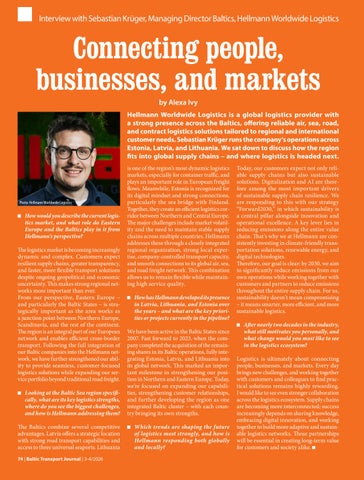
Photo: Hellmann Worldwide Logistics
How would you describe the current logistics market, and what role do Eastern Europe and the Baltics play in it from Hellmann’s perspective? The logistics market is becoming increasingly dynamic and complex. Customers expect resilient supply chains, greater transparency, and faster, more flexible transport solutions despite ongoing geopolitical and economic uncertainty. This makes strong regional networks more important than ever. From our perspective, Eastern Europe – and particularly the Baltic States – is strategically important as the area works as a junction point between Northern Europe, Scandinavia, and the rest of the continent. The region is an integral part of our European network and enables efficient cross-border transport. Following the full integration of our Baltic companies into the Hellmann network, we have further strengthened our ability to provide seamless, customer-focused logistics solutions while expanding our service portfolio beyond traditional road freight.
is one of the region’s most dynamic logistics markets, especially for container traffic, and plays an important role in European freight flows. Meanwhile, Estonia is recognized for its digital mindset and strong connections, particularly the sea bridge with Finland. Together, they create an efficient logistics corridor between Northern and Central Europe. The major challenges include market volatility and the need to maintain stable supply chains across multiple countries. Hellmann addresses these through a closely integrated regional organization, strong local expertise, company-controlled transport capacity, and smooth connections to its global air, sea, and road freight network. This combination allows us to remain flexible while maintaining high service quality. How has Hellmann developed its presence in Latvia, Lithuania, and Estonia over the years – and what are the key priorities or projects currently in the pipeline?
Looking at the Baltic Sea region specifically, what are its key logistics strengths, where do you see the biggest challenges, and how is Hellmann addressing them?
We have been active in the Baltic States since 2007. Fast forward to 2023, when the company completed the acquisition of the remaining shares in its Baltic operations, fully integrating Estonia, Latvia, and Lithuania into its global network. This marked an important milestone in strengthening our position in Northern and Eastern Europe. Today, we’re focused on expanding our capabilities, strengthening customer relationships, and further developing the region as one integrated Baltic cluster – with each country bringing its own strengths.
The Baltics combine several competitive advantages. Latvia offers a strategic location with strong road transport capabilities and access to three universal seaports. Lithuania
Which trends are shaping the future of logistics most strongly, and how is Hellmann responding both globally and locally?
74 | Baltic Transport Journal | 3-4/2026
Today, our customers expect not only reliable supply chains but also sustainable solutions. Digitalization and AI are therefore among the most important drivers of sustainable supply chain resilience. We are responding to this with our strategy “Forward2030,” in which sustainability is a central pillar alongside innovation and operational excellence. A key lever lies in reducing emissions along the entire value chain. That’s why we at Hellmann are consistently investing in climate-friendly transportation solutions, renewable energy, and digital technologies. Therefore, our goal is clear: by 2030, we aim to significantly reduce emissions from our own operations while working together with customers and partners to reduce emissions throughout the entire supply chain. For us, sustainability doesn’t mean compromising – it means smarter, more efficient, and more sustainable logistics. After nearly two decades in the industry, what still motivates you personally, and what change would you most like to see in the logistics ecosystem? Logistics is ultimately about connecting people, businesses, and markets. Every day brings new challenges, and working together with customers and colleagues to find practical solutions remains highly rewarding. I would like to see even stronger collaboration across the logistics ecosystem. Supply chains are becoming more interconnected; success increasingly depends on sharing knowledge, embracing digital innovation, and working together to build more adaptive and sustainable logistics networks. Those partnerships will be essential in creating long-term value for customers and society alike.