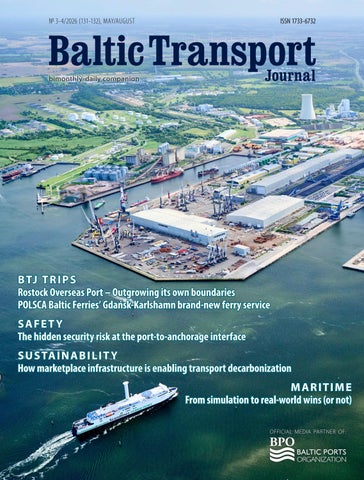
№ 3-4/2026 (131-132), MAY/AUGUST
ISSN 1733-6732
bimonthly-daily companion
Journal
Baltic Transport
B TJ T R I P S Rostock Overseas Port – Outgrowing its own boundaries POLSCA Baltic Ferries’ Gdańsk-Karlshamn brand-new ferry service SAFET Y The hidden security risk at the port-to-anchorage interface S U S TA I N A B I L I T Y How marketplace infrastructure is enabling transport decarbonization MARITIME From simulation to real-world wins (or not) OFFICIAL MEDIA PARTNER OF:
The Port of Opportunities The Port of HaminaKotka is a multipurpose seaport serving trade and industry. This major Finnish port is an important hub in Europe and in the Baltic Sea region. Welcome to the Port of HaminaKotka!
haminakotka.com
EDITORIAL
Dear Readers,
T
he summer issue should, apparently, start with something about the weather – though it’s probably early autumn when you’re reading this. And that’s actually what links the two. Alright, we had a few heat-wave days in northcentral Poland too, fair enough, but the summer of 2026 was in many places across Europe, including its northern regions, one massive, never-ending, here-to-melt-your-brain-out, scorching thermal onslaught. It was thus a bit of a tone-turbulence sharing with partners from Germany or the UK that one could endure here a bone-chilling bike ride in the morning, courtesy of milk-thick fog, ahead of a day that wasn’t all that warmer, for good measure sprinkled with rain, wind, a leaden sky – and whatever else Mother Nature felt like tossing in (a touch over-generously). Another pair that connects two seasons are BTJ Trips. First, towards the end of spring, Rostock invited us to visit their seaport, also granting the opportunity to interview, what’s quite unique in the port industry, their two managing directors. Next, in mid-August, we jumped on board Skania, one half of the duo that has been put by POLSCA Baltic Ferries (a brand that also unites two shipping lines) on the newly created Gdańsk-Karlshamn crossing. Transport folks? Quayside, captain’s bridge, rail siding, manufacturing site – we’ll come to you. Got a story? Let’s make it loud! Other than that, this year’s 3-4 issue is lavishly packed with reads on a variety of topics. The newest column, Safety, goes through the hidden security risk at the port-to-anchorage interface, what dog-tired seafarers actually need, as well as a simple yet effective innovation developed here in the Baltic (and already being exported overseas). Legal explains why even such a mundane thing as a mooring line can become a bone of contention – and by doing so, points to the importance of paying attention to the tiniest details. Focus, this time on shipping operational expenses, is also the theme of Economy. One Sustainability piece makes the case that future marine bunkers need not only increased production thereof but also a marketplace infrastructure for wider adoption. Another explains why Europe’s Industrial Maritime Strategy shouldn’t focus on alternative fuels only (spoiler alert: it should also target methane slip). The third goes into ammonia’s competitiveness, while the column’s closing one
focuses on building the vessels of tomorrow – today (with a regulatory framework still in the making or without fuel pathway maturity). As a case in point, Maritime details the relation(ship) between hydrodynamics and energy-efficiency improvements. Then there are two articles that share weather in common – and how it impacts shipping performance.
Autumn Forest by the Lakeshore by Walter Moras, photo: Artvee
Technology, somewhat perversely, asks whether the industry is drowning in the sea of data or is it still stuck in the dark ages (nothing says ‘progress’ like ‘blindly folded into the blue’). And as the closing highlight – the Baltic Ports Organization shares findings from their latest EU-backed project, this one about green shipping corridors (rare beast – one of those green initiatives that didn’t wither away after a few years – hope somebody from the Commission is reading this… Oh, I almost forgot, there’s a piece on the revision of the EU ETS, focusing specifically on the inclusion of the offshore shipping sector so it doesn’t keel over). Wishing you an autumn dripping with sweet honey, warm ochre, and fiery scarlet – not that drab grey-mud-pewter oppressive combo. With your favourite hot brew in hand, please enjoy this issue to the fullest! Przemysław Myszka
Baltic Transport Journal Publisher
BALTIC PRESS SP. Z O.O. Address: Aleja Zwycięstwa 96/98 81-451 Gdynia, Poland office@baltictransportjournal.com
Contributing Writers
President of the Board
CELINE AUDENAERDT, HANNA BACH, GEORGE BALAN, AMIT BHATNAGAR, PRADEEP CHAWLA, VICKY DOLKA, MIA ELG, JULIA HANSSON, ALEXA IVY, MARIA LACALLE MULS, PANOS MITROU, CHRISTOFFER NIELSEN-FRIIS, MATIAS NIEMELÄINEN, OSHER PERRY, ROLF REKSTEN, AKI RUOHONEN, ULRIK SANDERS, FITZWILLIAM SCOTT, JOHN SOUTHAM, IGNĖ STALMOKAITĖ, LINDA STYHRE, JUHO SUORTTI, CRAIG WEST
Managing Director
Head of Marketing & Sales
www.baltictransportjournal.com www.europeantransportmaps.com BOGDAN OŁDAKOWSKI
PRZEMYSŁAW OPŁOCKI
Editor-in-Chief
PRZEMYSŁAW MYSZKA przemek@baltictransportjournal.com
Proofreading Editor EWA KOCHAŃSKA
Art Director/DTP DANUTA SAWICKA
PRZEMYSŁAW OPŁOCKI po@baltictransportjournal.com
If you wish to share your feedback or have information for us, do not hesitate to contact us at: editorial@baltictransportjournal.com
Contact us:
PRZEMYSŁAW OPŁOCKI tel.: +48 603 520 020
Cover
Rostock Port/nordlicht № 3-4/2026 (131-132), MAY/AUGUST
ISSN 1733-6732
bimonthly-daily companion
Journal
Baltic Transport
B TJ T R I P S Rostock Overseas Port – outgrowing its own boundries POLSCA Baltic Ferries’ Gdańsk-Karlshamn brand-new ferry service SAFET Y The hidden security risk at the port-to-anchorage interface S U S TA I N A B I L I T Y How marketplace infrastructure is enabling transport decarbonization MARITIME From simulation to real-world wins (or not) OFFICIAL MEDIA PARTNER OF:
Subscriptions
Go to www.baltictransportjournal.com and click: SUBSCRIPTION or contact us at subscription@baltictransportjournal.com
3-4/2026 | Baltic Transport Journal | 3
Port of Oxelösund. Your shortcut to smarter logistics. Logistics in the Baltic Sea region are being reshaped. At the Port of Oxelösund, we’re leading that transformation. We’re investing nearly SEK 700 million in one of the largest port development projects in modern times. We call it Oxchange. An extended quay, new cranes, and a dredged harbour basin will enable larger vessels to call directly at Sweden. The Port of Oxelösund is evolving from a traditional bulk port into a flexible hub capable of handling a wider range of cargo. This gives our customers greater freedom to diversify their sourcing and build more resilient supply chains, with fewer transshipments through European logistics hubs. With an annual cargo handling capacity of 10.5 million tonnes and seamless connections between sea, rail, and road, we’re creating the conditions for shorter lead times and more reliable deliveries — today and for the future. Learn more at oxhamn.se/oxchange.
CONTENTS
40 3
REGULAR COLUMNS
3 Editorial 8 BTJ calendar of events 9 Safety news 10 Market SMS 12 What’s new? 16 Map news 18 Venture forth 20 What’s in the Cabinet 23 Chart of the issue: Baltic Port Market in 2025 24 BTJ Trip: Outgrowing its own boundaries – Rostock Overseas Port by Przemysław Myszka and Przemysław Opłocki 27 BTJ Trip: Rooted in the Baltic, tabs on today, eyeing the future – Interview with Dr Gernot Tesch and Jens A. Scharner, Managing Directors, ROSTOCK PORT GmbH by Przemysław Myszka and Przemysław Opłocki 30 BTJ Trip: “She’s a brave lady…” – POLSCA Baltic Ferries’ Gdańsk-Karlshamn brand-new ferry service by Przemysław Myszka 76 Events: Global Vehicle Logistics at a Crossroads: Summary of the ECG General Assembly & Spring Congress 2026 in Istanbul by Przemysław Opłocki 78 Who is who
34
40 Learning the ropes – Operational-turned-legal disputes over mooring lines by John Southam, and Vicky Dolka
42
34 Beyond the berth – The hidden security risk at the port-to-anchorage interface by Amit Bhatnagar 36 (Sea) dog-tired – More support instead of checklists – that’s what seafarers actually need by Pradeep Chawla 38 Simply effective – Increasing safety and capacity with MacGregor’s Balanced Lashing System by Fitzwilliam Scott
ECONOMY
42 Cunning with coin – How shipping companies can maintain their focus on opex by Ulrik Sanders and Christoffer Nielsen-friis
46 SAFETY
LEGAL
SUSTAINABILITY
46 Connecting capital to carbon – How marketplace infrastructure is enabling transport decarbonization by Maria Lacalle Muls 48 A (methane) blind spot – Why Europe’s Industrial Maritime Strategy shouldn’t focus on alternative fuels only by Panos Mitrou 50 A real choice – Green ammonia’s route to competitiveness by Alexa Ivy 52 Ahead of the rules – Building the vessels of tomorrow – today (with a regulatory framework still in the making or without fuel pathway maturity) by George Balan 3-4/2026 | Baltic Transport Journal | 5
Moves a lot. Changes everything. With a maximum lifting capacity of 1,600 tons, our travelling cargo crane TCC 78000 will drive your heavy-duty projects to success. www.liebherr.com
Maritime cranes
CONTENTS
54
MARITIME
54 From simulation to real-world wins (or not) – Hydrodynamics and energy-efficiency improvements by Matias Niemeläinen, Juho Suortti, Aki Ruohonen, and Mia Elg 60 (No longer) lost in the mist – Why real-time commercial visibility is becoming essential to modern shipping by Rolf Reksten 62 When efficiency meets volatility – Optimising shipping operations for conditions anything but ideal by Craig West 64 Shipping ≠ shipping – EU ETS/MRV design gaps and the case for reform by Celine Audenaerdt
68
TECHNOLOGY
68 Drowning in the Sea of Data? – Digitalisation benefits shipping not by piling on new software, but by finally connecting the tools the sector already has by Ewa Kochańska 72 Still stuck in the dark ages? – Addressing the next performance gap in maritime operations with visibility and active intelligence by Osher Perry
66
NEWSLETTER BPO
66 Green Shipping Corridors in the Baltic: status, barriers, and the path forward by Julia Hansson, Ignė Stalmokaitė, Hanna Bach, and Linda Styhre
74
LOGISTICS
74 Connecting people, businesses, and markets – Interview with Sebastian Krüger, Managing Director Baltics, Hellmann Worldwide Logistics by Alexa Ivy 3-4/2026 | Baltic Transport Journal | 7
BTJ CALENDAR OF EVENTS Baltic Ports Conference 2026, 2-4 September 2026, FI/Turku, balticportsconference.com
All About Ports, 2-3 September 2026, DE/Hamburg, allaboutports.com
Maritime Economy Forum Gdynia, 9 October 2026, PL/Gdynia, forum.gdynia.pl/en
ECG Conference 2026, 15-16 October 2026, DK/Copenhagen, ecgassociation.eu/activities/events
IAPH World Ports Conference 2026, 3-5 November 2026, GB-ENG/London, iaphworldports.org
8 | Baltic Transport Journal | 3-4/2026
SAFETY NEWS #LISTENINGTOSEAFARERS The Nautical Institute, in collaboration with the Lloyd’s Register Foundation, has launched an online survey to ask seafarers and other maritime professionals to share their views on where technology is helping, where it’s creating additional pressure, how it affects workload and decision-making, and whether current training gives users sufficient understanding of how on-board technology functions. The #ListeningToSeafarers survey (available in multiple languages) is part of the Seafarer Technology Engagement, Empowerment and Resilience (STEER) Project, which over the next two and a half years will work towards a better understanding of the combined impact new technological systems and changing working practices have on seafarers’ day-to-day work. “Its findings will be used to help develop practical tools and guidance that
will be offered freely to the industry, supporting safer and more human-centred technology adoption across the maritime sector,” The Nautical Institute underscored in a press brief. Captain Ann Pletschke CMMar FNI, STEER Project Lead at The Nautical Institute, commented, “Technology is changing maritime operations at pace, but the people who use these systems every day must be central to the conversation. Too often, decisions about technology are made without fully understanding the practical impact on seafarers’ work, safety, skills, and welfare.” David Patraiko FNI, Director of Projects at The Nautical Institute, added, “The maritime industry has always evolved, and technology has an important role to play in making operations safer, more efficient, and more sustainable. However, technology must support professional judgement, not undermine it.”
METHANOL AS MARINE FUEL – NEW GUIDELINES The Maritime Technologies Forum (MTF) has published guidelines to support companies in developing new safety management systems (SMS) and strengthening existing ones for ships using methanol as bunker. “As the maritime industry accelerates its decarbonisation efforts, low-carbon methanol has emerged as one of the most scalable alternative fuel options. Its liquid state under ambient conditions, compatibility with existing fuel infrastructure, and increasing industry adoption make methanol an attractive near-term solution,” MTF said in a press briefing. “However,” the organisation furthered, “its toxicity, low flashpoint, and invisible vapour and flame characteristics introduce new safety challenges for the maritime industry that require enhanced procedural controls and risk management measures for safe operations.” The guidelines place particular emphasis on risk-based decision-making, continuous improvement, and organisational agility. They also stress the importance of learning from hazardous occurrences, near-misses, and accidents involving methanol fuel. The report also highlights the importance of developing versatile SMS frameworks capable of supporting mixedfuel operations during the transition period. “Human factors are identified as a critical element in ensuring safe methanol operations. The guidelines recommend that companies assess competency, training, familiarisation, and resource requirements based on individual roles and responsibilities,” MTF added. Nick Brown, CEO of Lloyd’s Register, one of the classification societies forming MTF, said, “While IMO regulatory discussions continue, many shipowners and operators are already moving ahead with alternative fuel retrofits and newbuilds. For those choosing methanol, these guidelines provide practical recommendations to ensure safety management systems appropriately reflect its characteristics as a fuel.”
Photo: MTF
NORTHSTANDARD-SAILORS’ SOCIETY WELLBEING CO-OP The global marine insurer and the maritime charity have partnered to support seafarers’ emotional wellbeing by delivering Sea Mate, an online mental health awareness training programme. “Life at sea presents unique challenges, including isolation, fatigue, and prolonged periods away from home. Its pressures can intensify due to unpredictable events, such as geopolitical conflicts, piracy incidents, or disruptions like the COVID-19 pandemic. Recent events in the Persian Gulf underline how crews going about their daily duties can suddenly become exposed to high-stress situations that last for weeks or months,” the parties detailed in a press brief. Sea Mate offers a two-day remote training programme, available in multiple languages, aimed at training seafarers to become Wellbeing Officers who can recognise distress, provide fellow support, and respond to challenges arising at sea (Sea Mate also offers access to ongoing professional guidance, peer networks, and Sailors’ Society’s 24/7 crisis
response services). “By focusing on early intervention, open communication, and resilience, Sea Mate helps create psychologically safer working environments on board. Stronger crew wellbeing is strongly linked with improved retention, a reduced risk of incidents, and more stable ship operations, supporting safe and sustainable shipping,” the partners highlighted. Through the partnership, NorthStandard Members are eligible for one free remote Sea Mate course each year for up to 16 seafarers (as well as discounted rates for additional courses). Sara Baade, CEO, Sailors’ Society, commented, “This generous partnership with NorthStandard could see thousands of new Wellbeing Officers on board ships across the world, trained to give front-line help and support to fellow crewmates. Our Sea Mate training has been hugely popular with shipping companies who know that seafarers’ wellbeing directly affects the safety of their colleagues, the cargo, and the ship.”
3-4/2026 | Baltic Transport Journal | 9
For more Market Statistics Made Simple please visit: www.baltictransportjournal.com
Finnlines: 409,000 ro-ro cargo units carried in
The Port of Gothenburg:
The company’s fleet also transported 595,000 tonnes of non-unitised freight (+1.9% year-on-year) and 42,000 commercial vehicles (+13.5% yoy). At the same time, the ferry passenger business noted a 1.8% yoy downtick to 431,000 travellers. “The first six months of the year have been defined by structural volatility across the shipping industry. The major conflict in the Middle East, including the US and Israeli attack on Iran on 28 February 2026 and the subsequent closure of the Strait of Hormuz, significantly increased energy costs and caused volatility in energy markets,” commented Thomas Doepel, Finnlines’ President and CEO. He furthered, “The global energy crisis has not been the only cost trigger for intra-European trade. As of this year, the EU Emissions Trading System requires vessels to cover 100% of their emissions, increasing environmental surcharges. Thanks to our long-term strategy of continuously investing in new and more energy-efficient vessels, we are less exposed to escalating energy costs. In the current volatile energy environment, our ability to utilise a wide range of energy sources, together with pass-through energy surcharge mechanisms, provides muchneeded resilience. Combined with our continuous optimisation of services, capacity, and route network, this has helped ensure a satisfactory result.”
The Swedish seaport’s rail-borne container traffic amounted to 134,000 TEUs, a downtick of 1.5% on the January-March 2025 result. “Reduced handling of empty containers improves the efficiency of cargo flows. The underlying factor is a continued increase in imports, which has further strengthened the port’s already strong balance between imports and exports, now close to a 50-50 split. A good balance between imports and exports reduces the need for empty containers to be brought into the port,” analysed Claes Sundmark, VP Sales and Marketing, the Port of Gothenburg. Fewer ro-ro cargo units went through Gothenburg’s quays, -2.9% year-on-year to altogether 133,000 trucks and trailers. Conversely, the seaport saw more new vehicles, +14.5% yoy to 71,000. “The growth was partly due to the transshipment of cars normally handled in other ports,” the Swedish seaport highlighted in a press brief. The turnover of liquid bulk rose as well, +19.1% yoy to 5.6 million tonnes, as well as the handling of dry and break-bulk, +30% yoy to 91,000 tonnes. Gothenburg also welcomed more passengers in the first quarter of 2026, +7.8% yoy to 248,000 travellers (including five cruise calls vs none in Q1 2025).
H1 2026 (+2.5% yoy)
Photo: Port of Turku
226,000 TEUs handled in Q1 2026 (-2.6% yoy)
Photo: Port of Gothenburg
The Port of Tallinn: 6.48 million tonnes handled in H1 2026 (-5% yoy) Despite the overall drop, wheeled (ro-ro & ferry) cargo, Tallinn’s prime trade, advanced by 0.8% year-on-year to 3.32 million tonnes. At the same time, however, the handling of both dry and liquid bulk goods contracted – by 4.8% yoy to 1.15mt and by 33.8% yoy to 653,000 tonnes, respectively. Containerised freight also noted a decrease – by 2.2% yoy to 1.02mt. Container traffic totted up to 123,249 TEUs, down 3.7% on the H1 2025 result. The Estonian port saw more break-bulk passing its quays, up 14.6% yoy to 306,000 tonnes, as well as goods labelled as ‘non-marine,’ an increase of 20.9% yoy to 36,000 tonnes. Tallinn’s passenger traffic contracted by 2.0% yoy to 3.59 million passengers, including some 100,000 cruise travellers (+48.8% yoy). The ferry crossing to/from Helsinki totalled 3.16m (-2.6% yoy), followed by the Stockholm service with 215,000 passengers (-7.4% yoy). The Muuga-Vuosaari route, on the other hand, rose by 1.5% yoy to 94,000. There were also 15,000 passengers marked as ‘other’ (-26% yoy). TS Laevad, the Port of Tallinn’s domestic ferry subsidiary, served over 1.05 million passengers (+0.7% yoy) and transported 533,000 private vehicles (+2.1% yoy).
Photo: Andres Raudjalg/HHLA TK Estonia
10 | Baltic Transport Journal | 3-4/2026
MARKET SMS The Port of HaminaKotka: 6.31 million tonnes handled in international traffic in H1 2026 (-11.4% yoy) Exports totalled nearly 4.30 million tonnes (-14%), while imports totted up to 20.1mt (-5.3% yoy). Though there was no cabotage in June 2026, HaminaKotka’s H1 2026 domestic cargo traffic amounted to 32,300 tonnes, up 65.4% yoy. Container traffic saw 327,379 TEUs (-1.0% yoy).
POH_205_x_133.5_.qxp_(BTJ Package) 09.02.24 17:46 Seite 1 Photo: Port of HaminaKotka
HAMBURG YOUR PORT portofhamburg.com info@portofhamburg.com @portofhamburg
© iStockphotos
global transPORT solutions
3-4/2026 | Baltic Transport Journal | 11
For more news items please visit: www.baltictransportjournal.com
From Rostock to England, the Caribbean, and the Netherlands
Photos: Liebherr Maritime Cranes
First, Liebherr has supplied PD Ports with an LPS 550. The £5.4-million electric portal slewing crane, manufactured in Rostock, has joined two identical models introduced in 2023 to increase dry bulk and project cargo handling capacity at Teesport’s Tees Dock bulks quay. “PD’s objective is straightforward: keep bulk ships on schedule while maintaining berth flexibility during peaks. The LPS 550’s long outreach [jib length of 54 metres] reduces repositioning across wider hatches, while its 144-tonne capacity supports heavier lifts across mixed cargo operations. The addition of the third LPS 550 further enhances PD Ports’ capabilities and opens up new business opportunities,” Liebherr Maritime Cranes underscored in a press brief. Grant Honzik, Business Unit Director – Bulks at PD Ports, commented, “This latest investment is about building resilience and capacity into our bulk operations at Teesport for the long term.” He furthered, “The performance and reliability of the existing Liebherr cranes have been proven day in, day out, and adding a third LPS 550 gives us greater flexibility on the berth and more headroom during peak demand. For our customers, that means consistent performance, quicker turnarounds, and confidence that Teesport can keep cargo moving efficiently.” He also highlighted, “Combined with the crane’s increased lift capacity and tandem lift capability, this investment gives us the flexibility to support everything from high-volume bulk commodities through to complex project cargo, including large-scale infrastructure developments across the region.” Next, Liebherr’s site in Rostock has delivered a mobile harbour crane of the LHM 600 type to the Port of Cartagena to handle containers at Compania de Puertos Asociados’ Compas Cartagena terminal. The machinery offers a lifting capacity of 104 tonnes and a maximum outreach of 61 metres. The crane can also perform twin-lift operations. “At Compas Cartagena, where four berths support container, bulk, refrigerated, and project cargo alongside one another, operational sequencing is critical. The LHM 600 adds a layer of planning certainty by allowing higher-capacity container moves to be scheduled without disrupting parallel cargo flows. This supports more consistent berth utilisation and aligns crane performance with the terminal’s digital operating systems and inspection infrastructure,” Liebherr Maritime Cranes highlighted in a press release. Finally, the manufacturer’s Rostock site has also delivered a mobile harbour crane of the LHM 800 type to Rotterdam. Nicknamed Titan 1, Broekman Logistics’ new Liebherr machinery, engineered with a custom supporting pad, offers a lifting capacity of 308 tonnes. “The LHM 800 gives us the lifting performance and flexibility to handle larger and more complex cargo at our quayside,” said Rob van Dijk, Director Terminal & Shipping at Broekman Logistics. He added, “Combined with our indoor lifting capacity of 700 tonnes by overhead crane, it strengthens our position as a heavy-lift specialist in Rotterdam.” 12 | Baltic Transport Journal | 3-4/2026
WHAT’S NEW? Marine Alutech takes over the Port of Lappvik KN Energies to help with Poland’s FSRU By purchasing the remaining 50% from Nylunds Properties, the designer and manufacturer of aluminium and composite boats has become the sole owner of the seaport located in southwestern Finland. The Port of Lappvik Ab company was established in 2022 and manages a former SSAB industrial property and a 200-metre quay wall seaport in Lappohja near Hanko.
The Lithuanian energy company has been selected as the commercial and operational advisor for the floating storage and regasification unit (FSRU) scheduled to be up and running in the Gulf of Gdańsk as of 2028. The 6.1 billion m³ gas project is being developed by GAZ-SYSTEM and will be Poland’s second large-scale LNG terminal after the land one in the Port of Świnoujście (2015, 8.3b m³). “This selection highlights the growing need for fast-track energy supply diversification solutions and confirms KN Energies’ expertise as a leader in complex floating LNG projects across Europe. With more than 15 years of experience in FSRU projects globally – from the development phase to long-term terminal operations – we are proud to share our know-how with our partners in Poland,” said Linas Kilda, Chief Business Development Officer at KN Energies. His company added in a press brief, “Beyond the Klaipėda LNG terminal [2014, 3.75b m³], there are currently 14 floating LNG terminals in operation or under construction across the EU. KN Energies has been or is involved in projects related to eight of these terminals, representing approximately 57% of all such projects in the EU, covering project development, commercial structuring, operational advisory, and long-term terminal operations.”
PD Ports’ another made-in-the-Baltic crane
Photo: Marine Alutech
The Port of Hartlepool’s machinery park is now bigger with a new Konecranes Gottwald ESP.6 mobile harbour crane that’s able to lift 125 tonnes and has a working radius of 49 metres. Following assembly and testing in Antwerp, the crane was brought to Hartlepool on board Meriaura’s Aura.
Advertisement
BTJ’s on issuu. CLICK HERE TO START FLIPPING THE PAGES
3-4/2026 | Baltic Transport Journal | 13
For more news items please visit: www.baltictransportjournal.com
BCT Gdynia’s new heavy-duty machinery First, the Port of Gdynia-based container terminal operator has invested in six rubber-tyred gantries (RTG) capable of handling five-by-five container blocks and two 6x6 RTGs, all of which are hybrid and manufactured by Konecranes. Among other features, the new gear of the Baltic Container Terminal (BCT) Gdynia is equipped with a DGPS auto-steering system for automatic guidance of the cranes. Next, Liebherr’s factory in Rostock has supplied BCT Gdynia with two mobile harbour cranes of the LHM 550 type in container configuration, each offering a maximum outreach of 54 metres. “Equipped with Pactronic [a hydraulic hybrid drive system that boosts crane performance by storing and re-using energy], the cranes are designed to improve energy efficiency during demanding handling cycles, while electric-drive readiness enables future retrofit should operational strategy require it. The machines also feature specially dimensioned supporting pads adapted to the berth structure, reflecting the importance of precise engineering integration at quayside,” Liebherr Maritime Cranes underscored in a press release. The new machinery also has extended warranty coverage for key components, metal structures, and paint systems. The two LHM 550s have joined a pair of LHM 400s, used by BCT Gdynia for handling project cargo such as wind turbine components. Andreas Müller, Managing Director of Liebherr-Rostock, shared, “Our cooperation with BCT Gdynia is built on many years of trust, technical dialogue, and shared standards in execution. Delivering this project on schedule and to the required specification is an important result in itself, and it also sends a clear signal about what strong partnerships can achieve when both sides work with consistency and long-term intent. We see this as a continuation of a successful relationship and as a sound basis for further projects in the years ahead.” Lastly, the Chinese from ZPMC have delivered two ship-to-shore gantries to Gdynia.
Multi-million cold storage investment in Gdynia The Polish arm of MEDLOG Coldstore, a subsidiary of MSC, will set up a cold storage warehousing complex within the Port of Gdynia’s Logistics Centre at a cost of PLN223.5 million (€52.6m). The 2029-ready facility will span almost five hectares, offering 30,000+ pallet positions and over 20 loading ramps.
Photo: Arcadis
Baltic Iron enters service Baltic Shipping Company’s newbuild, a sister ship of the also recently delivered Baltic Timber, has entered traffic, offering 185,400 ft³ of capacity. The 89.7 by 12.5 metre vessel is equipped with two Econowind VentoFoils, expected to cut Baltic Iron’s fuel consumption by up to 12%. The freighter also features a battery pack.
Baltic Hub grows by 27 hectares The container terminal operator and the Port of Gdańsk have signed a 30-year lease for the ‘Deepwater’ area next to the T2 facility of the former. Baltic Hub will build a new rail siding there, with seven tracks for 750-metre-long trains. New storage yards will be erected as well. “This lease agreement represents a pivotal milestone in Baltic Hub’s long-term strategy. The expansion of our rail terminal and yard capacity, aligned with PSA Group’s Node to Network strategy, will strengthen hinterland connectivity by enabling a greater share of containers to be transported by rail. This will enhance network efficiency, reduce reliance on road transport, and support the modal shift needed to lower supply chain emissions. At the same time, it reinforces our ability to deliver the reliability, capacity, and sustainable performance that our shipping line partners and cargo owners expect,” commented Jan Van Mossevelde, CEO, Baltic Hub.
Meriaura’s first Ecotrader – delivered
Photo: Liebherr Maritime Cranes
14 | Baltic Transport Journal | 3-4/2026
Sofia VG left the Royal Bodewes shipbuilders and sailed to Rauma after taking her very first cargo from Antwerp. The 6,735-deadweight, 105-metre-long Ecotrader is the first in a series of two. “We are proud to welcome this newbuild into our fleet and grateful for the strong cooperation with Royal Bodewes and all partners involved. Sofia VG is an important milestone for Meriaura and a concrete step forward in offering more efficient and lower-emission sea transport to our customers. With her increased capacity, 1A Ice Class, and readiness to operate on biofuels, Sofia VG strengthens our ability to serve our customers’ needs while supporting our long-term sustainability targets,” commented Beppe Rosin, Meriaura’s Managing Director. The company’s Technical Manager, Jyrki Hentula, added, “The vessel has met the agreed performance targets during trials, and all critical systems – from propulsion and automation to safety and cargo handling, and the biofuel-compliant fuel system – have been tested and documented for handover. Our close cooperation with the shipyard continues, as Sofia VG’s sister vessel’s construction proceeds.”
WHAT’S NEW? GAT phase one – completed
WIND Group enters the Baltic
Premium Quality Care, on behalf of Port of Gdańsk’s stevedore, Port Gdański Eksploatacja, has erected a flat grain storage on the Szczecińskie Quay. The facility, constructed for Gdańsk Agro Terminal (GAT), stretches 140 metres and covers 6,500 m². With a capacity of 30,000 tonnes, it enables GAT to handle up to half a million tonnes of grains per year. The single-chamber structure can be divided into two or three sections. The investment totalled almost PLN14 million (€3.24 million). The next phase (2029) of GAT will see the set-up of 24 silos on the Vistula Quay in Gdańsk’s Inner Port, upping GAT’s storage capacity to 150,000 tonnes/year and annual handling to 3.0 million tonnes. These will be highly automated, serving both road- and rail-bound volumes. “GAT is part of a broader strategy to increase the competitiveness of Polish agriculture in international markets. Poland has maintained a structural grain production surplus for years – approximately 35-36 million tonnes per year versus domestic consumption of 25-26 million tonnes. Strengthening export infrastructure is essential for stabilising the market and enhancing the country’s competitiveness abroad,” the Port of Gdańsk highlighted in a press release.
The Dutch specialist in cable logistics & recovery and related services for the offshore industry has signed a long-term agreement with Smålandshamnar for establishing a dedicated cable storage and offshore service yard in the latter’s Port of Oskarshamn. “The establishment Photo: Smålandshamnar of our new hub marks an important step in the expansion of WIND’s activities in the Baltic region. By bringing together the capabilities across the entire WIND Group, we can offer clients a comprehensive range of services, including carousel rental, logistics and marshalling, alongside equipment supply, maintenance, and vessel mobilisation services through our colleagues at Draftec. This integrated approach and our new location strengthen our ability to support offshore projects with efficient, reliable solutions,” highlighted Tom Nooij, CEO of WIND. Niclas Strömqvist, CEO of Smålandshamnar, also commented, “This agreement represents much more than a new customer establishment. It is a strategic investment that strengthens Oskarshamn’s role in the rapidly growing offshore energy sector in the Baltic region. By combining WIND Group’s global expertise with the Port of Oskarshamn’s infrastructure and capabilities, we are creating a platform for future growth, new business opportunities, and long-term employment in our municipality and region. Our ambition is clear: to continue developing Oskarshamn into one of the leading ports for offshore energy, project cargo, and critical infrastructure in Northern Europe. We see this partnership as an important milestone on that journey.”
Advertisement
Onshore power facilities in the Port of Trelleborg Investments in sustainable energy systems The Port of Trelleborg, with the ambition of being Europe’s most sustainable RoRo port, is continuously improving its environmental performance. Onshore power facilities have now been installed at ferry berths no. 10 and 11, for four of TT-Line’s vessels to be able to connect. Using onshore power allows vessels to shut down auxiliary engines at berth, reducing emissions of carbon dioxide, nitrogen oxides, particles, and noise. The electricity supplied is fossil-free and generated by the port’s own wind turbines. The project has received EU co-financing through the Alternative Fuels Infrastructure Facility (AFIF) under the Connecting Europe Facility (CEF), within the project “Baltic Green NET”. More green energy on its way The port is further advancing its energy transition by installing a 4 MWh battery facility to store electricity and manage peak demand when several vessels require power atthe same time. The port already produces around 15 million kWh of renewable electricity annually from wind power, making it self-sufficient. Battery storage will ensure energy is available when demand is highest, such as during onshore power use. From 2030, EU regulations will require larger vessels to use onshore power in port, increasing energy demand. The battery facility will help to meet these requirements efficiently. The next step in the port’s green transition is to also expand onshore power to ferry berth no. 8 for Stena Line. The installation is scheduled for completion in Q2 2027. Port of Trelleborg is Scandinavia’s largest RoRo port and a node for Swedish import and export, playing an important role in the transition to sustainable freight transport.
3-4/2026 | Baltic Transport Journal | 15
For Europe-wide maps news on ro-ro & ferry container intermodal please visit: www.europeantransportmaps.com
New Poland-Sweden ferry service sets sail The first overnight departure on POLSCA Baltic Ferries’ Gdańsk-Karlshamn crossing took place on 6 July 2026, when Copernicus (room for 160 passengers, 1,830 lane metres for cargo) left the Polish seaport for a 13-hour journey. The route is also operated by Skania (900/2,170), with the ferries plying between Gdańsk and Karlshamn three times per week.
WALLENIUS SOL acquires two vessels Bothniaborg and Balticborg, previously sailing for Royal Wagenborg, will join the fleet of the Gothenburg-based shipping line. The deal also covers taking over a contract of affreightment with Smurfit Westrock, Europe’s largest kraftliner mill (a yearly output of 700,000 tonnes of unbleached and whitetop kraftliner) located in Piteå. The 153-by-21.6-metre Ice Class 1A multipurpose ships were built in 2004 by Bodewes Volharding. Each offers a carrying capacity of 1,666 lane metres/158 TEUs/678,700 ft³ (19,219 m³) grain/bale. “The partnership will evolve over time as WALLENIUS SOL integrates Smurfit Westrock’s volumes fully into its shipping network, transitioning from current stowage modes to ro-ro cassette operations and eventually connecting the Piteå flow to next-generation vessels as part of WALLENIUS SOL’s long-term newbuilding programme,” the Swedish shipowner shared in a press brief.
Photo: POLSCA Baltic Ferries
New intra-Finland rail container service The Vuosaari-Tornio route is operated by ArcticRail, with the trains carrying CMA CGM Finland’s containers with raw materials for the steel industry in northern Finland. The service runs once per week, with a capacity of 40 boxes.
New Germany-Sweden rail link As of 2 September 2026, Kombiverkehr runs twice per week between Duisburg Rail Hub and Malmö Kombiterminal CMP, with room for containers and trailers. There are already plans to double the weekly frequency starting in January 2027. “No bunker surcharge (BAF), no ETS surcharge (CO₂ surcharge), and a significantly reduced dangerous goods surcharge. And as always with Kombiverkehr: onward transport is available via the national and international network from Rail Hub Duisburg. From Malmö, your containers and swap bodies can be transported to Hallsberg, Stockholm, and Gävle,” the company underscored in a LinkedIn post.
Foundation stone for Loconi’s new inland terminal – laid The rail arm of the Polish chapter of PSA International has officially begun the construction of its intermodal terminal in Zbąszynek in west-central Poland. The 9.4-hectare site, co-funded by the EU with over €74 million, will offer four handling tracks to serve two fulllength trains simultaneously. It will also house a 4,500-TEU storage yard. Handling will be taken care of by two portal cranes and a pair of electric reachstackers. Operations are slated to start in Q1 2028. Adamietz has been appointed as the project’s general contractor.
Photo: Royal Wagenborg
Germany-Sweden rail ferry service in place for another half a decade Stena Line and the Swedish Transport Administration have signed an agreement thanks to which the former’s rail ferries will ply between Trelleborg and Rostock at least until the end of 2031. Skåne (3,295 lane metres of overall carrying capacity) and Mecklenburg-Vorpommern (3,202 lm) have been serving the route that has been in operation since 1998. In 2024-25, they transported nearly 42 thousand railcars. Roberto Maiorana, DirectorGeneral of the Swedish Transport Administration, shared, “Rail ferries have declined significantly over the past 20 years due to weak economic viability. Since the opening of the Öresund Bridge, the majority of freight trains to and from continental Europe have crossed the Öresund link rather than travelling by ferry. However, the ferries remain necessary [due to weight and width restrictions on Danish and German rail infrastructure, certain rail transports cannot cross the Öresund overland], which is why the Swedish state […] is now stepping in to secure continued operations.” He also underscored, “Through rail ferry services, we can maintain NATO’s fundamental requirement for a robust transport system that supports national resilience. The transport system must function in peacetime, crisis, and war – both for domestic traffic and for transport to and from Sweden.”
Samskip connects Halmstad with Iceland
Photo: Loconi Intermodal
16 | Baltic Transport Journal | 3-4/2026
As of September this year, the container ships Arnarfell and Helgafell call at the Swedish seaport on a weekly basis, bringing fish and seafood and taking food products, construction materials, and vehicles to the Icelandic market. The service is expected to generate approximately 250 containers per week. The current loop links the ports of Aarhus, Gothenburg, and Immingham with Reykjavík, Grundartangi, Ísafjörður, Sauðárkrókur, Akureyri, Vestmannaeyjar, and Vopnafjörður in Iceland, as well as Runavík on the Faroe Islands.
MAP NEWS Åland’s new ferry terminal – opened
Stena Nautica stays in the Baltic
Together with Finnlines, the Port of Långnäs has officially set in motion the approximately three-million-euro investment. The 16-metre-tall, 500 m² floor area facility is “[...] located right next to the dock, and the walk from the ship to the terminal is shorter than before. This speeds up and simplifies both disembarking and boarding. With the growth in cruise traffic in particular, the terminal enhances the overall customer experience,” the parties highlighted in a press briefing. Thomas Doepel, President and CEO, Finnlines, shared, “We see significant growth potential in tourism in Åland and want to be actively involved in developing the region’s accessibility and appeal in cooperation with local stakeholders. Our goal is to provide reliable transport solutions and serve as a strong partner to Åland’s tourism and hotel industry.” The company’s Head of Passenger Services, Marco Palmu, also said, “The new terminal brings the ship and passengers tangibly closer together and speeds up and streamlines the travel chain. Smooth and barrier-free movement has been taken into account even better than before, making travel more pleasant and efficient.” Finnlines’ cruise ferries, Finnsirius and Finncanopus (each offering room for 1,100 travellers), call at the new terminal within their Naantali-Kapellskär service via the Åland Islands.
The ferry, until the end of April 2026 serving the terminated Grenaa-Halmstad service of Stena Line, now plies between Långnäs and Naantali in the livery of Eckerö Link. The 1986-built ro-pax, offering room for 900 passengers and 1,265 lane metres, has replaced the 780-lane-metre Fjärdvägen from 1972.
Photo: Finnlines
The Gdynia-Södertälje ro-ro service grinds to a halt Lakeway Link, a Wallenius Lines-Greencarrier JV, stopped sailing between the two seaports as of 15 May this year. The company cited the 2026-to-2028 postponement of reconstructing the Södertälje lock as the culprit. “The lack of access to Lake Mälaren means that the fundamental conditions on which the operation is based cannot be met, making the service economically unsustainable in its current form,” Lakeway Link shared in a press brief. The Gdynia-Södertälje ro-ro service kicked off on 21 May 2024, with the 1,625-lane-metre Lakeway Express making the crossing in about 22 hours. At the beginning of November 2025, she was charter-joined by her sister ship Mistral, enabling round-trip Mondaythrough-Friday departures till January 2026. Following the reconstruction of the Södertälje lock, the service was expected to expand to include the Port of Västerås on Lake Mälaren. In 2025, the Port of Södertälje handled 6,870 ro-ro cargo units, a year-on-year increase of 328%.
3-4/2026 | Baltic Transport Journal | 17
VENTURE FORTH DELTAMARIN JOINS H4PERION • The Turku-based ship design specialists will contribute to the EU-funded Horizon Europe project, coordinated by the University of Vaasa, tasked with accelerating the transition towards zero-carbon long-distance shipping through hydrogen-based technologies. The four-year project, which officially started on 1 June 2026, brings together 16 partners from seven European countries across the maritime value chain – from ship design and engine development to vessel operation, classification, and research. Its aim is to develop and demonstrate practical solutions that reduce greenhouse gas emissions while maintaining the high reliability required for longhaul maritime transport. “Decarbonising long-distance shipping remains a major challenge, requiring solutions that combine high energy capacity with operational reliability. Hydrogen is increasingly seen as a promising zero-carbon fuel, but its practical application at sea still needs to be proven,” Deltamarin underscored in a press release. The company furthered, “H4PERION addresses this by developing and demonstrating a hydrogencapable internal combustion engine at full scale. The project brings together key elements such as fuel-flexible engine concepts, hydrogen supply systems, and advanced emissions control.” These technologies will be tested both on board Wasaline’s ferry Aurora Botnia and, in parallel, under full-scale laboratory conditions, with the results feeding into future vessel and system development. Beyond technological development,
H4PERION will also address the broader ecosystem required for hydrogen adoption in shipping, including safety, regulatory development, and training for crew and port personnel. “Deltamarin contributes to H4PERION in two key areas. Firstly, we support the integration design of the on-board installation and contribute to validating the achieved KPIs. Secondly, Deltamarin evaluates the transferability of the developed technologies by replicating them for different ship types, supporting scalability and broader industry application of the novel engine concept.” •
Photo: Wasaline
SHORELINK IMPLEMENTS GREIG CONNECT’S PORT • The Swedish stevedore – active in the seaports of Kalix, Luleå, Piteå, and Skellefteå – will see the digitalisation of vessel calls, resource planning, invoicing, statistics, data analysis, ISPS compliance, and gate activities. “The investment is a concrete step towards ShoreLink’s goal of becoming Sweden’s most productive and sustainable port operator by 2030,” the company shared
in a press brief. Its IT Manager, Mikael Lundström, added, “This is an important step for us in our work to improve and simplify our processes. With Port, we get better support for ship calls and, at the same time, create a smoother everyday life for our employees. It gives us the right tools to continue developing and meet the demands of the future.” •
SKAGEN INVESTS IN OPS FOR CRUISERS • The seaport, one of the busiest cruise destinations in Denmark, has contracted PowerCon to equip its Quay 9 with a 16-megawatt onshore power supply (OPS) station. The facility, design, and technical solution, which were checked by the Norwegian Plug, are expected to come online by the end of 2027 – ready for the following year’s cruise season. “The work includes upgrading the port’s electrical supply, burying cables, the establishment of new transformer stations by Nord Energi Net, and the construction of foundations and cable ducts for both the shore power installation and the cable management system,” the Port of Skagen detailed in a press brief. The Danes also underlined, “Long highvoltage cables on the quay will be avoided by using an energy chain system integrated into the quay structure. Ships will connect via a fully electric cable management system. The solution also supports safe and efficient operations on the quay. By eliminating long cables on the quay
area, it becomes easier to manage where guests can move and where port operators and service providers can work. This improves conditions for truck operations, supplies, and overall ship servicing during port calls. The design process has also focused on reducing both electrical noise and cooling noise. This ensures a solution that not only reduces emissions from ships at berth but also considers the surrounding environment and daily port operations.” The investment of DKK85 million (€11.4 million) is made without European or national subsidies. Willy Bent Hansen, the Port of Skagen’s CEO, commented, “The facility will be among the most advanced of its kind and will strengthen Skagen’s position as an attractive and responsible cruise destination. The future is electric. We look forward to working with PowerCon, Nord Energi Net, and their suppliers. Together, we contribute to ensuring that Skagen and the Port of Skagen remain an attractive place for guests, residents, and shipping companies alike.” •
POWERCELL SECURES A 4.0-MW ORDER • LH2 Shipping’s two forthcoming liquid hydrogen-powered cargo ships will feature fuel cells based on the Marine System 225 platform from the Gothenburg-based company, with delivery scheduled for 2028. “The parties also intend to establish a long-term service agreement with future service revenues over the vessels’ operational lifetime,” PowerCell underlined in a press brief. “This project demonstrates how fuel cells are increasingly being considered for larger and more demanding maritime applications. We continue to see growing interest from shipowners seeking solutions that combine operational performance, emissions reductions, and long-term compliance with future regulations. We are proud to support LH2 Shipping in bringing this project forward,” Stig Kallestad, Commercial Director at the PowerCell Group, commented. The company’s CEO, Richard Berkling, 18 | Baltic Transport Journal | 3-4/2026
also said, “The maritime industry is still in the early stages of its energy transition, but the pace is clearly increasing. Investments in hydrogen infrastructure, vessel development, and regulatory frameworks are beginning to translate into real projects and real vessels. This order is another important step for both PowerCell and the wider maritime industry as fuel cells become part of practical vessel energy systems.” Ivan Oestvik, CEO of LH2 Shipping, shared, “This partnership with PowerCell will strengthen the execution capability of several projects currently under development and further reinforce the industrialisation of hydrogen-based zero-emission vessels. As the maritime industry now moves from demonstration projects towards commercial deployment, strong technology partnerships such as this are essential to reducing risk, accelerating delivery, and enabling broader market adoption.” •
VENTURE FORTH ESTONIA’S FIRST E-FERRY – ORDERED • The shipbuilders from the Polish CRIST will deliver the 100-metrelong hybrid vessel, equipped with a 3.0MWh battery system and backup biodiesel generators, by end-2028. The investment by the Estonian State Fleet is worth €49.93 million, supported by the European Union Modernisation Fund with €28m, with additional financing coming from Estonia’s CO₂ funding mechanisms. Once operational, the ferry will be able to transport up to 380 passengers and 110 vehicles/eight cargo units. The battery pack will be sufficient to cover the Virtsu-Kuivastu route, with the biodiesel generators providing support in demanding weather or for longer crossings (an operating range of at least 1,000 nautical miles without refuelling). The ferry will be built to Ice Class 1B, but with her azimuth thrusters (at both ends) exceeding the minimum requirements for this ice-class level to provide additional power for operations in heavy ice. “The vessel is planned with a strong focus on functionality, passenger comfort, and contemporary design. On-board amenities will include a professional kitchen and restaurant area serving hot meals, as well as accommodation and recreational facilities for
crew members. Special attention is also given to accessibility, with dedicated solutions for passengers with reduced mobility, as well as for blind and visually impaired travellers,” the Estonian State Fleet underscored in a press briefing. Its Director General, Andres Laasma, also commented, “Investing in next-generation vessels is essential for ensuring reliable island connectivity while reducing environmental impact and long-term operating costs. Despite a challenging global economic environment, we are pleased to move forward with a vessel that combines zero-emission operation in daily service with the resilience required for Baltic operating conditions.” Kuldar Leis, the Estonian Minister of Infrastructure, shared, “Ferry connections are vital for Estonia and especially for our island communities. They support everyday life, local businesses, and access to essential services. This new fully electric ferry will make that connection more reliable, modern, and environmentally friendly. I am glad that we are moving forward with a Polish shipyard whose experience in demanding maritime conditions will support the delivery of a vessel well suited to Estonia’s needs.” •
GASUM-WASALINE BIOLNG CO-OP – PROLONGED • Thanks to the continued agreement, the ferry company will operate its Aurora Botnia between Vaasa and Umeå on the bio version of liquefied natural gas (bioLNG) through 2027. “BioLNG provided by Gasum is a fully renewable fuel with life-cycle greenhouse gas emissions that are, on average, 90% lower when compared with fossil fuel use. When produced using livestock waste, the emission reduction from biogas can even reach beyond 100%,” the bunker
provider stated in a press release. Peter Ståhlberg, Managing Director, Wasaline, commented, “BioLNG has played a central role in reducing our environmental footprint, and, together with batteries, eventually in establishing the first credible green shipping corridor across the Baltic Sea. Gasum has proven to be a dependable partner for us in this effort. Their ability to deliver stable, high-quality bioLNG is essential to our strategy, and we look forward to continuing the cooperation.” •
3-4/2026 | Baltic Transport Journal | 19
WHAT’S IN THE CABINET Last CEF Transport call under MFF 2021-27 The European Commission has put €1.1 billion on the table to build and modernise the EU’s Trans-European Transport Network within the Multiannual Financial Framework (MFF), which ends next year. Projects targeting better transport connections with Moldova and Ukraine are also eligible. The cut-off for
applications falls on 6 October 2026. According to the European Climate, Infrastructure and Environment Executive Agency, an envelope of €25.8 billion has been made available for grants under MFF 2021-27, totalling €47.2 billion for transport since the launch of the Connecting Europe Facility (CEF) in 2014.
Western Balkans won’t connect to Core TEN-T in time According to a recent report by the European Court of Auditors (ECA), despite the European Commission (COM) injecting €527 million into the Western Balkans Investment Framework (WBIF) in 2015-25 for upgrading transport infrastructure, Albania, Bosnia and Herzegovina, Kosovo, Montenegro, North Macedonia, and Serbia will miss the 2030 deadline for completing their share of the Core part of the EU’s Trans-European Transport Network. The audit, which scrutinised 12 transport projects (road, rail, and inland waterways) worth €341.6 million, found that immature project selection and shortcomings in supervision slowed progress. “[…] projects typically started with a 17-month delay. In addition, many projects faced significant delays of more than two years during implementation,” the EU’s watchdog shared. ECA further revealed, “The Commission has little power to enforce timely implementation, as it lacks effective procedures for monitoring delays and for ensuring the sustainability and visibility of EU support. For example, it failed to gather information about the degree of completeness of the transport corridors it was funding, or whether transport networks complied with EU standards.” ECA also found that COM relied on financial institutions to supervise the projects. As a result, the EU’s executive, in certain instances, transferred amounts that exceeded those warranted by the progress projects had made. “In addition, in several cases the WBIF grants – which aim to provide EU value and leverage – were not essential for raising money, as the loan contracts had been signed before the grant applications were submitted. This created a deadweight effect, as the investment would have gone ahead without the grant. At the same time, most cost estimates in the grant applications lack detail, making it difficult to assess whether they are reasonable.” The auditors also raised doubts about sustainability. “In one project, rail conditions at the time of the audit were worse than before the project started. In another, a tunnel had no connection to a road. In a third project, the railway track stopped at the border.”
Photo: ECA
EU ETS under review + Electrification Action Plan The European Commission (COM) has tabled a set of changes to the EU Emissions Trading System (ETS). The most important proposal for the shipping industry involves re-investing EU ETS revenues into the sector that generated them. The Sustainable Maritime and Propulsion mechanism is to help close the gap between fossil and alternative marine fuels. “Liner shipping has already invested over 160 billion in ships that can operate on renewable fuels, but these cleaner ships need cleaner fuels,” pointed out Simon Bergulf, VP Environment and Climate at the World Shipping Council, on the occasion of the review. According to COM, the Industrial Decarbonisation Bank will have €100 billion in funding for industrial decarbonisation across Europe, with the ETS Investment Booster available before 2030 as the first phase of the Bank (detailed allocations, including for low-carbon transport and fuels, are still pending). “The EU ETS Innovation Fund will continue to support first commercial applications of innovative clean technologies in a wide range 20 | Baltic Transport Journal | 3-4/2026
of sectors. And Member States will be required to spend 50% of their national ETS revenues on investments to decarbonise ETS sectors. This adds up to more than €100 billion in investments before 2030,” COM shared in a press brief. The European Parliament and Council are negotiating the proposals. If H1 2027 witnesses an agreement, 2028 will bring implementation. At the same time, COM also unveiled the Electrification Action Plan. “While 70% of EU electricity is now generated from homegrown clean energy sources, the electrification rate of energy demand has stalled at 23% over the past decade.” The Plan expects this share to increase twofold by 2040, cutting the “[…] EU’s fossil fuel import bill by €260 billion per year […]” The Plan will chiefly target reducing the spread between electricity and fossil energy prices by, among other things, ensuring that electricity isn’t taxed more heavily than gas. COM also wants to lower the upfront cost of electrification technologies, including in transport. Grid development is on the Plan’s to-do list, too.
Karlshamn Trelleborg
Karlshamn
Trelleborg
Rostock Travemünde
Rostock
Travemünde
Klaipėda Klaipėda
Świnoujście Świnoujście
Efficient ReliableTransport Transport Solutions Solutions Efficient &&Reliable between Germany, Poland,Lithuania Lithuaniaand andSweden Sweden between Germany, Poland, www.ttline.com/en/freight www.ttline.com/en/freight
CHART OF THE ISSUE
BALTIC PORT MARKET IN 2025 855.28mt 1
891.72mt 2
238.35mt 3 247.13mt 2
140.89mt 3 142.82mt 2
1 4
total
liquid bulk
311.35mt 3 317.65mt 2
dry bulk
containerised
93.14mt 3 100.90mt 2
wheeled (ro-ro, ferry, vehicles)
other (break-bulk)
71.54mt 3 74.17mt 2
9.84m
ro-ro cargo units
TEUs
12.10m
90.73m 4
ferry passengers
cruise passengers
4.23m 5
Eurostat (excl. Baltic Russia); 2 national statistics + Eurostat when domestic data is missing; 3 Eurostat + national Baltic Russia; international and domestic; 5 national statistics and Cruise Baltic data
3-4/2026 | Baltic Transport Journal | 23
Rostock Overseas Port
Outgrowing its own boundaries by Przemysław Myszka and Przemysław Opłocki Our 2026 trip season began on the German Baltic coast – in Rostock. Though the settlement dates back to the 1100s, joined the Hanseatic League in 1251, and thrived as a vibrant seaport already in the 14th century, what we know today as Rostock Overseas Port has its roots in 1960. Nowadays, it’s the country’s largest Baltic freight port, handling all types of goods – dry and liquid bulk, unitised and non-unitised general cargo – and serving as a major passenger hub for ferries and cruisers. The port continues to evolve, notably repurposing its original 1960s dry-bulk pier into a vehicle terminal. But there’s far more to Rostock than just ‘infrastructure recycling.’ Handling wind energy components, that modern golden-goose business for ports? Check! Being home to one of the world’s best-selling cargo handling equipment manufacturers? Check! Eyeing future fuels? That’s on the drawing board, too!
W
e reached Rostock by train on 28 May after the TOC Europe trade fair, which this year moved to Hamburg after several editions held in Rotterdam. Though the weather on Friday the 29th was rather hazy, Maike Grunwald, responsible for Corporate Communications at Rostock Port Company (the landlord of the Overseas Port), greeted us more than warmly at the doorstep of the head office. We then hopped into a car for a unique guided ride throughout much of the seaport. The grain harbour was our first destination. With over 2.4 million tonnes of various cereals and some 600,000-700,000 additional tonnes
Photos: Przemysław Myszka
24 | Baltic Transport Journal | 3-4/2026
of ‘other substances of vegetable origin’ (according to the parlance of the German statistical office), it’s one of the biggest in the Baltic and one of Germany’s main grain export gates (with Africa, Central Europe, and Scandinavia being the chief receiving markets). Upon arrival, we saw the towering grain silos, able to accommodate up to 700,000 cubic metres at any given time. Processing also takes place on site, e.g., of barley for brewing or oil production. The latter we could actually scent (an intriguing mix of cabbage and nuts). Interestingly, it’s the only oil mill in Germany operating ‘round the clock, with output ranging from canola oil to animal feed and bio petrol.
On our way again, we also talked about the energy harbour (off-limits due to its strategic importance). Following Russia’s ongoing war of aggression against Ukraine, the pipeline feeding the PCK refinery in Schwedt went offline. As a result, Rostock started handling a lot more crude oil – around 6.0 million tonnes per year (another two million is transported to Schwedt via PERN’s pipe from the Northern Port in Gdańsk). Talking about energy, Maike showed us what ‘Made in Rostock’ wind energy looks like. EEW Special Pipe Constructions has been putting together monopiles since its establishment in Rostock in 2008 (with local production capacity of over 100 m-piles per
BTJ TRIP
year across the 32,000-square-metre facility; each structure can be 120-metre long and weigh 2,500 tonnes). The paradox is that EEW needs extra space to keep the momentum; otherwise, the business is at risk of leaving the seaport (and with it its revenues, not to mention around a thousand employees). Available space was a topic we also discussed later. The next stop was the biggest employer within Rostock Port (and one of our journal’s long-standing partners): Liebherr Maritime Cranes (headcount of around 2,000). In addition to the production facility and offices, the site boasts its own academy (during TOC, we also visited the Liebherr site in Hamburg for the official launch of the Digital Solutions Campus). The other day, Liebherr approached the port operator, inquiring whether there would be 24 hectares for a heavy-duty industrial establishment. “No, not quite that much…” Maike confided. “But we ‘just’ quickly prolonged the pier by land reclamation – and did it twice,” she added as if it was a thing one does casually. The pier was extended and commissioned in 2004 and 2012. Maike also shared another ‘Bob’s-your-uncle’ story. On another occasion, it was Liebherr that was approached by an offshore business, which needed to fix one of
its vessels with an exceptionally huge crane. The issue was that there was no gantry strong enough to mount that crane. Enter centre stage TCC 78000, a 5,500-tonne heavy land-mark titan that can lift to 1,600 tonnes (at a hoist of 36 metres; 1,000t/52 m, 586t/75 m, and 250t/99 m). As the ride continued, we saw a naval base sitting vis-à-vis the commercial part of the seaport. It is NATO’s new Combined Task Force Baltic headquarters, officially opened in October 2024, hosting the Quadriga exercise the following year. For something less threatening, we focused our attention on the cruise terminal. In high season, there are three berthing spaces available, and the longest cruiser that can visit Rostock is 330 metres long. The seaport is one of the Baltic’s prime destinations, with 592,000 guests welcomed in 2025 (some 60,000 more than in 2024). Two of the three Warnemünde berths provide onshore power supply (OPS). The 20MVA facility was completed in the summer of 2020 and back then was Europe’s strongest cold-ironing station for cruisers. The OPS is of modular design, with the components stacked inside twenty-foot containers, and the cable carriers are mobile to fit the dimensions of different vessels. Maike shared that about five in 10 cruise ships ‘plug in.’
Staying on the passenger topic, we next saw one of Scandlines’ hybrid Flettner-rotorequipped ferries that ply between Rostock and Gedser. Each year, some two million ferry passengers go through Rostock’s gangways on their way not only to and from Denmark but also Lithuania and Sweden (aboard TT-Line and Stena Line, the latter operating a rail ferry to Trelleborg, the last such one between Germany and Sweden). In connection with that, we also saw the 80,000-square-metre intermodal terminal, equipped with two 45-tonne lifting-capacity portal gantries that serve five tracks (recently upgraded to take care of 680-metre sets). Rostock handles 49 intermodal trains per week, both international (to Bratislava, Oradea, Padua, and Verona) and domestic (Dresden, Halle, Herne, and Karlsruhe). Of the over half a million ro-ro cargo units that passed Rostock’s quays in 2025, around 110,000 went through the intermodal facility. Apart from the above ferry services, the German Baltic seaport also serves pure ro-ro connections – to and from Hanko, Kotka, and Rauma (with loads of paper products). Car carriers link Rostock with the Norwegian Drammen as well as Halmstad and Södertälje in the Swedish Baltic.
3-4/2026 | Baltic Transport Journal | 25
BTJ TRIP
But that doesn’t exhaust the wheeled cargo topic in Rostock. Since 2022, Autolink has been operating a vehicle terminal that spans over 70,000 square metres, including two 600-metre-long rail sidings. Vessel berthing takes place at one of those very first quays that were launched in the 1960s (rebuilt in 2020). The company hit the jackpot at the onset of the business, growing from 32,000 in 2023 to a quarter of a million (export) cars in 2024-25 (and to be precise, it specialises in taking care of high-end electric vehicles, including Teslas). We moved on and, after a short drive, saw in the distance what distinguishes Rostock, namely the fish port. Not that cutters are some otherworldly sight, but in the sense that it constitutes a separate entity from Rostock Port. The same holds for Yara Port, an independent harbour belonging to the Norwegian chemical company. That sometimes makes it a bit confusing when sourcing statistics for our Baltic Yearbook. For Yara, this is quite simple: some 800,000 tonnes in 2024 and more or less
the same volume last year. For the fish port, the official statistical office says 499 tonnes of ‘fish and other fishing products’ in 2025 (but there’s also the ‘products of agriculture, hunting, forestry, fishing’ category, with almost 2.59 million tonnes last year). To complicate matters further, a cargo harbour, too, rests outside Rostock Port. Altogether, the three ‘outsiders’ handled approximately 1.80 million tonnes in 2025, according to the port operator. On the way back to the head office, we talked with Maike about Rostock’s developmental plans. Though with its 750 hectares Rostock Port is the largest German seaport on the Baltic coast, that land is almost fully utilised. To grow, it needs to move outside its current premises. There is space for doing that, but it’s all natural land, hence the sometimes emotionally loaded ‘trees vs industry/employment/revenue’ argument. Rostock is already MecklenburgWestern Pomerania’s biggest industrial hotspot and would like to leverage that position to attract new future-oriented businesses.
Photo: Yara
26 | Baltic Transport Journal | 3-4/2026
In the past couple of years, there were talks of either starting up green ammonia production on the site or becoming an import port for it to supply Germany’s energy transition with ammonia-derived hydrogen. Such developments require infrastructure, which in turn necessitates land. The Regional Spatial Development Plan is under revision, with Rostock Port hoping to secure additional hectares before long. The port operator is willing to compensate for the losses in nature – as it already does by investing millions of euros in wetland restoration. Meanwhile, there’s a dredging project to deepen one tanker berth in the oil harbour to 16.5 metres. Though the port tour concluded, the BTJ Trip Rostock was far from over. Maike invited us to the port’s canteen for lunch ahead of meeting the port operator’s managing directors, Dr Gernot Tesch and Jens A. Scharner, for an interview. As always, it was pure pleasure to ‘touch and feel’ a seaport from the inside. Vielen Dank und viel Glück!
Interview with Dr Gernot Tesch and Jens A. Scharner, Managing Directors, ROSTOCK PORT GmbH
Rooted in the Baltic, tabs on today, eyeing the future by Przemysław Myszka and Przemysław Opłocki Rostock has time and again reached all-time highs in cargo handling, all while navigating unprecedented supply-chain reshufflings, and is positioning itself as a green-energy hub for Northern Europe. We asked the port’s two managing directors how different drivers have tested its resilience, what’s in Rostock’s development portfolio, picked their brains about onshore power supply and the green shipping corridor concept, to round up with insights into which energies will propel the future.
Photo: Rostock Port/Böhnke
What drives cargo and passenger volumes in Rostock – in the past, nowadays, and in the foreseeable future? The stevedores, shipping lines, and all other parties involved in transport and logistics in and around the port succeeded in marking the past couple of years as all-time highs for Rostock cargo-handling-wise (and the cruise and ferry passenger businesses also did not disappoint). Given its multipurpose character, Rostock Overseas Port is to a certain degree immune to Germany’s internal state of economic health. Grain exports, for instance, depend more on weather and international demand. On the other hand, crude oil imports – a major driver of volume growth lately – can be unpredictable. Nobody foresaw the
Russian war of aggression against Ukraine, and how it would reshape both regional and global supply-chain patterns. The PCK refinery in Schwedt, which in the past received its feedstock from the east by pipeline, had to switch to getting the bulk of it via our seaport. We were prepared to handle this virtually overnight. “Redundancy” is certainly a word that resonates these days – as it did when the modern history of Rostock Overseas Port began in the 1960s. Then again, we lost a lot of cargo from the east, mostly dry bulk goods like coal or grains, replaced by trades with Africa or South America. New businesses emerged as well, vehicles being the prime example. Autolink rose from 32,000 in their first year of operations (2023) to 120,000-130,000 cars per annum today.
Certain remnants of the coronavirus pandemic persist as well. While figures for the cruise sector are good, with Rostock easily claiming the title of one of Top 3 destinations in the Baltic, the traveller composition has changed noticeably. Today, we are more of a home port for German guests in contrast to having a lot more travellers from abroad in the past, including Americans and Asians who might still be too worried to be locked outside their regions should corona-bis happen. However, we sincerely hope these customers will come back to Europe eventually. Container traffic was another casualty of COVID-19. We invested considerable effort in making Rostock known in China for goods moving by rail over the New Silk Road to Kaliningrad and then to us by sea, thereby avoiding costly congestion at the BrestMałaszewicze border crossing. That was valuable traffic, and other ports in the Baltic also had to say farewell to it. Lastly, Rostock is also a NATO port, with the Organization’s new Combined Task Force Baltic HQ opening here in the autumn of 2024. Having naval vessels come in and out of the seaport is one thing; logistics for the military is another. It is a trade, a specific one indeed, but business nonetheless, with military cargo potentially routed via our intermodal terminal. Germany might see higher spending on security in the coming years, some of it channelled towards maritime infrastructure. The key challenge may lie elsewhere, though. If ports are to achieve even higher security given the current geopolitical climate and the trajectory through 2026 and beyond, someone will need to tackle that challenge. But it is the role of specialised 3-4/2026 | Baltic Transport Journal | 27
BTJ TRIP
Photos: Rostock Port/nordlicht
agencies to aid us here, not necessarily for port authorities to become quasi branches of the defence ministry. As for traffic itself, business proves to be relatively stable. However, the various cargo groups performed differently in the first quarter of 2026. Bulks, liquid and dry alike, are slightly below the previous year’s level, while ferry and ro-ro are above it. Overall, cargo handling remains at a high level. In the present challenging environment – e.g., whatever is or isn’t happening in the Strait of Hormuz – it’s virtually impossible to make reliable predictions for the full year at this time (let alone beyond). That said, Rostock benefits from a highly diversified cargo structure and therefore has comparatively strong resilience against disruptions in individual market segments. Our business is strongly rooted in the Baltic Sea region, particularly in north-south trades with Finland and Sweden. As such, we would not expect direct operational impacts comparable to those experienced by major global container hubs. Yet, geopolitical crises naturally influence the overall economic environment. The most relevant issue would be volatility in energy prices – especially oil, gas, and fuel costs. Such developments affect shipping companies, industrial customers, and logistics chains throughout Europe. How about Rostock’s hinterland, especially the intermodal part, as the rail sector has been having its fair share of troubles lately? Intermodal transport remains a key strategic business segment for us and an essential component of sustainable logistics chains between Scandinavia and continental Europe. In 2025, nearly 110,000 intermodal units were handled at the port. It was a year-on-year downtick of 1.7%, partly due to reduced service frequencies on individual routes but primarily the result of the persistently weak economic environment. 28 | Baltic Transport Journal | 3-4/2026
The rail freight sector is facing several structural challenges. Rising energy prices are increasing track access charges imposed by the German rail infrastructure manager, and numerous construction projects on the country’s railways are causing operational disruptions and longer transit times due to major detours. As always, rail freight vies with trucking, which benefits from flexibility, comparatively low costs, and well-developed road infrastructure. Nevertheless, rail and intermodal transport offer clear long-term advantages: significantly lower energy consumption and CO₂ emissions, support for climate-friendly logistics chains, and high transport capacity, with one train carrying 38-42 trailers or over 50 containers. Because of that, Rostock Overseas Port continues investing in rail infrastructure and intermodal capacity, including extending five terminal tracks to 680 metres each. The benefit will be twofold. First, longer trains equal more cargo, which results in lower transportation costs per unit. Second, it will take only one track to form an entire train set, effectively doubling the facility’s capacity. Can you walk us through the completed, running, and planned developments? As operator of Germany’s largest universal port on the Baltic Sea, we continue to invest substantial double-digit millions annually into the modernisation and expansion of port infrastructure – some €33 million last year and over €60 million in 2026 (altogether €700 million since 1990). In recent years, we have already completed major investments in the accessibility of the ferry and ro-ro terminal, in modern deep-water berths, and in the digitalisation of operational processes. One recent milestone was the modernisation of infrastructure under the EU-supported RailIT-MoS programme together with our partners from the Port of Trelleborg. This included railway refurbishment, implementing digital
trailer handling solutions, and deploying other intermodal transport operational improvements. The project was part of a broader EU Motorways of the Sea initiative between Rostock and Trelleborg. Over three years, both ports saw investments of around €15 million, with our share amounting to €6.4 million. While our Swedish friends completed the eastern harbour area as the final step of their port relocation plan, we carried out extensive hard- and software infrastructure upgrades. The rail-bound connection of berth 64 for the rail ferry of Stena Line was long-term secured through new switches (14 in total) and tracks. In addition, handling capacities were significantly increased by creating additional prestowage areas in the ferry and ro-ro terminal – west of Wharf Hall 9a and at landing-place 67 (this one necessitated gangway demolition). We also widened a ramp at berth 62, added a dolphin at berth 63 for larger vessels, and installed two new floodlight masts in the ferry terminal (which also received a passenger elevator). Parallel to these efforts, the digitalisation of port operations was advanced to ensure future readiness, particularly through upgrades to the scanning and check-in facilities at the northern trailer gate (cameras, sensors, lighting, and new kiosks), and the expansion of Wi-Fi availability on the terminal via LTE antennas, policy-based routers, and hand-held devices for tug-master drivers. Finally, an API joined the terminal management system and solutions used by the ship operators. These investments sustainably support future ferry traffic on the shortest sea route between continental Europe and Sweden, which also includes securing the operation of the only rail ferry active in the EU part of the Baltic Sea region. Currently, our most important ongoing projects include the reconstruction of berths 33 and 34 at Pier II, an investment of nearly €20 million that will bring some of the oldest quay infrastructure in the port up to speed with modern operational standards. Next, we’re redeveloping
BTJ TRIP
Photo: Autolink
approximately 10 hectares south of Basin A for future logistics and terminal expansion. We are meanwhile preparing one of our strategically most important future investments: the new deep-water berth 5 in the eastern oil port area. This project is intended to secure future energy imports, including renewable energy carriers like hydrogen derivatives, all aimed at strengthening Germany’s energy resilience. In addition, we continue investing in hydrogen infrastructure and in preparing the port for future green energy logistics. Having mentioned transport’s carbon footprint – what is your take on the green shipping corridor concept? Rostock Overseas Port benefits from relatively short port lay times, enabling more efficient use of vessels, terminal infrastructure, and overall resources. We have also been an early mover in alternative fuels, introducing LNG bunkering fairly quickly, and now exploring the initial development of hydrogen derivatives and related technologies. In parallel, shore-side electricity services are already established in the cruise sector, while similar solutions for wheeled traffic are currently under discussion together with ferry and ro-ro operators. Berthing time plays a crucial part here – ships need to stay in the port long enough to make cold ironing worthwhile. For example, Scandlines’ ferries can spend as little as 15 minutes at berth. The overwhelming majority of ferry calls do not go over the two-hour threshold, a testament to how efficiently operations are organised in Rostock (which, in addition, makes it possible to slow steam, another bonus for the environment). On the flip side, it makes the business case for cold ironing all the more difficult – particularly if we’ll be obliged to install additional stations regardless. We see shore power as an essential technology for the decarbonisation of maritime transport and expect further expansion in the
coming years. But one thing is for certain – advancing sustainable maritime operations is a team sport that requires close coordination and joint projects with shipping companies (and EU and governmental support, for that matter). We know that this can be done successfully, as evidenced by our Warnemünde cold-ironing station at two berths for cruise ships. Nowadays, more cruisers ‘plug in’ than not, and we expect the utilisation rate to keep rising. To date, the experience has been encouraging – local emissions, including noise pollution, went down significantly, which resulted in positive feedback from residents. The Warnemünde-investment also had the right logic behind it, with cruise lines creating the demand for it. From the German side, Rostock offers a unique advantage as a key option for combined railferry transport connections, supporting the continued expansion of intermodal solutions and greener end-to-end supply chains. As things stand today, a trailer can reach our quays by rail from as far as Italy or Romania, get loaded on a ferry, and then travel by rail again to Gothenburg or Stockholm via Trelleborg versus running by truck through all of Central Europe. In this sense, Rostock is already a green highway. The future focus would be on further trimming emissions, including the provision of green fuels for shipping. What developmental plans do Rostock and its partners have in the field of future energy carriers? This topic is inseparably tied to land availability, one of the key strategic issues for the long-term development of the port. This is why we are actively involved in the Zukunftshafen Rostock (Rostock’s Future Port) initiative together with the Hanseatic and University City of Rostock, regional planning authorities, and economic partners. The aim is to ensure that port development remains integrated into future spatial and
infrastructure planning. We are therefore focusing not only on expansion but also on more efficient land use, refurbishment of existing areas, and the creation of modern logistics and industrial zones within the current port boundaries. The redevelopment south of Basin A is an important example of this strategy. Future growth will probably focus on energy logistics, hydrogen infrastructure, renewable energy industries (including offshore), and high-value intermodal logistics. Rostock’s rail access and industrial hinterland connections make it a potentially attractive future hub for alternative energy logistics. We have traditionally been an energy port. Today, however, we are actively supporting the transformation towards renewable and sustainable energy systems: green ammonia, hydrogen and its derivatives, and other renewable fuels. Awarded funding as an Important Project of Common European Interest, HyTechHafen Rostock is one of the key projects in this area. It involves a 100-megawatt electrolyser for the production of green hydrogen, some 6,000 tonnes annually. At the same time, we are investigating the setup of infrastructure for importing green energy carriers. The tricky part is that, given the uncertainty of what will become of the German economy (especially its industrial component), it’s challenging to get concrete off-take commitments penned on paper. We may see some intermediate developments towards a truly green future. Before the hydrogen economy matures at scale, transitional steps are likely – such as the local coal-fired power plant switching to biomass or even being converted to use some other eco-friendly feedstock altogether. One way or another, our objective is clear – to position Rostock not only as a successful universal port but also as a resilient, innovative, and sustainable logistics and energy hub (production and import) for Northern Europe. As we see it, future-oriented growth is the only viable solution on the table. 3-4/2026 | Baltic Transport Journal | 29
POLSCA Baltic Ferries’ Gdańsk-Karlshamn brand-new ferry service
“She’s a brave lady…” by Przemysław Myszka “…with great potential remaining,” greeted us Henryk Tybuszewski, Hotel/F&B Manager at Unity Line (together with Polferries the founders of the POLSCA Baltic Ferries brand), when our other Przemek and I boarded Skania moored at the Westerplatte Ferry Terminal in Gdańsk’s Inner Port on 3 August. Built in 1995 for the Greeks from Superfast Ferries, she also plied the Mediterranean with Grimaldi Ferries before heading north to join Unity Line’s fleet in 2008. This summer, after a retouch, Skania has been entrusted, along with the more cargo-focused Copernicus, with serving a completely new crossing in the Baltic: between Gdańsk and Karlshamn. Our region’s ferry market is a fairly settled affair, so such a development doesn’t come along all that often. We were invited to experience it first-hand.
Photo: Przemysław Myszka
A
nd because of Henryk, it was a unique experience indeed. He has been sailing since the end of the 1980s, including on cruise ships in the Caribbean. With Unity Line since mid-1997, Henryk has been part of the crews of several ferries, among them Skania for almost a decade (2009-18). We had the opportunity to sail many a time during our respective tenures at BTJ, as well as privately – mostly in the Baltic but also in the Med., and on vessels somewhat younger, larger, and more cruise-oriented than Skania. But the wine-and-dine reception we received was exceptionally personal this time – and that warmth from our host really did make a difference! 30 | Baltic Transport Journal | 3-4/2026
Not that Skania couldn’t stand up for herself. At almost 174 metres long, she accommodates 900 passengers (across 196 cabins of eight size/travel quality categories, 600 beds in total, plus a few rows of airplane seats) and four decks with 2,170 lane metres for private vehicles as well as trucks and trailers (Copernicus’ capacities tot up to, respectively, 160 travellers and 1,830 lane metres). During our round trip, Skania hosted a mix – foot and motorised passengers, from both ends of the service, and ro-ro cargo units. We were, in fact, positively surprised by the number of travellers. When sailing from Świnoujście occasionally, truckers overwhelmingly dominated the manifest (truth
be told, private passengers were little more than a sideshow to the cargo business). The Gdańsk-Karlshamn crossing, at least its Skania component, much more closely resembles the neighbouring Gdynia-Karlskrona route, with plenty of tourists (including families with kids of various ages). It was a welcome sight to see people choosing a ferry over an airplane (or getting stuck in a traffic jam, say, on the way towards the Öresund Bridge). Last but not least, judging by the litter tray on one of the external decks, one can also travel with animals (in designated pet-friendly cabins). On board, Skania offers four places to dine: Cafeteria (where breakfast is served), Snack
BTJ TRIP
Photos: POLSCA Baltic Ferries
Bar, the Bon Appétit à la carte restaurant, and the One Way Truckers Club. Meat-free options are what Cafeteria and Bon Appétit share in common (and the latter’s burger, with two different veggie patties, is as tasty as it’s filling – my personal compliments to the chef!). For those who like their calories also in liquid form, Skania offers the Cocktail Bar with a wide variety of drinks. If the groove strikes, the Disco Bar has you covered with music and a dance floor. And for those feeling lucky, there’s a corner for cards or a go at the one-armed bandit. On the shopping side, there’s a perfume parlour (chiefly stocked with the ladies in mind) and a store with all sorts of souvenirs, snacks, and ‘laughing water’ (Finnish vodka matured in charred oak barrels is not something you see every day – a curtsy to whoever thought of those with a taste for the less obvious!). For admirers of sun-downs and ups alike (the Swedish archipelago, Gdańsk’s Inner Port, or just wind tousling your hair), Skania’s stern offers a viewing deck. Her current departure times (9 p.m. from Gdańsk and 5 p.m. from Karlshamn) make it easy to enjoy both (if you fancy waking up before five in the morning, that is). Thanks to Henryk, we were treated to a unique view on the evening of our departure – from the captain’s bridge, in the company of the skipper himself and his crew, with Henryk sharing his thoughts on the differences between sailing the Baltic and the Caribbean as well as how ferrying itself has changed course over the past three decades. After that, we retired to our cabins for a well-deserved shut-eye. The 4th of August greeted us with fair weather and a hearty breakfast. Afterwards, we headed to the viewing deck to observe the approach to the Port of Karlshamn and then the mooring and unloading of trucks. While all the other foot passengers hopped on buses that took them to the town, we were guided through a pivot gate and then another gate in the port’s fence (one of the undeniable advantages of BTJ Trips – you get to see places that are off-limits to others). After a few paces, we landed at the port authority’s head office doorstep, where Caroline Säfström, 3-4/2026 | Baltic Transport Journal | 31
BTJ TRIP the Port of Karlshamn’s CEO, welcomed us. We made our way to the conference room, where we also met Pär Carlsson, in charge of the seaport’s marketing & sales – and a big fan of sailing! Then came the surprise. Because taking a ferry is far more forgiving baggage-wise than boarding an airplane, I had brought along some homemade cake – an act that, we were told, went down in the port’s history as the first-ever visit where somebody did such a thing. You’re welcome! Over a few slices of cocoa-coconut cake, a cup of coffee, and some Swedish pastry for good measure, we talked business – and then some. The Port of Karlshamn is genuinely pleased to see POLSCA Baltic Ferries with its new service, keeping their fingers crossed for the volumes to continue building up. A week after our visit, on 12 August, the Polish Ambassador to Sweden, Karolina Ostrzyniewska, came to Karlshamn to attend the official opening of the Gdańsk-Karlshamn ferry crossing – an occasion to celebrate a development that strengthens trade, logistics, and tourist ties between the two Baltic neighbours. We were more than happy to have contributed our own small share over those three early-August days. Next, Pär took us on a drive across the port. We were by no means strangers to Karlshamn, thanks to our visit four years earlier, but one should never say no when an opportunity to see a seaport from the inside arises. Having arrived by ferry and driving near three of them moored at the same time (apart from Skania, also DFDS’ Optima Seaways and TT-Line’s Marco Polo – both of them plying to and from Klaipėda), I couldn’t resist asking Pär how the port feels about the EU-mandated investment in onshore power supply. The Port of Karlshamn has already installed one station (supplied by Cavotec) for DFDS’ Luna Seaways. As in other seaports, it’s tricky. Beyond the question of whether shipping lines will actually utilise the facility – they, too, need to upgrade their vessels to enable cold ironing – there’s the matter of putting in place supporting infrastructure outside the port’s premises, investments that must be borne by whoever runs the local energy infra. That and other shore-power essentials: enough electricity ‘on hand’ and at the right price. Beyond the ferry business, we also saw a lot of forestry products (treated and untreated timber, wooden logs, and pulp) and some containers (with supplies for the pulp mill of Södra in the nearby Mörrum, capacity of 470,000 tonnes/year). Pär also showed us Karlshamn’s double-track rail terminal for combined traffic. The port is counting on the Swedish Transport Administration to build the Southeast Link between Älmhult and the Blekinge Coastal Trunk Railway – a connection that would eliminate the need for freight trains to detour via Malmö. Together with a new marshalling yard, Karlshamn hopes to see a spike in rail 32 | Baltic Transport Journal | 3-4/2026
Photos: Przemysław Myszka
volumes (something that would alleviate the environment from a truly business direction). Construction start of the Southeast Link is tentatively set for 2027-29. With considerable storage space for project cargo, the Swedish seaport also would like to feel a wind of change concerning offshore wind energy. General elections are due in Sweden this autumn, so perhaps a shift in the political spectrum will bring more favourable winds. Who knows? Pär dropped us off in the centre of Karlshamn, where we had just enough free time to stock up on Swedish coffee, enjoy a cold brew at the waterfront (offering a spectacular view of an AAK factory – a producer of vegetable oils and fats – if anyone resonates with the industrial vibe), and take a short walk to admire the ceaselessly quaint Swedish architecture and street furniture.
Pär collected us a couple of hours later and deposited us in front of Skania’s ramp. Dinner, a bottle of that Suomi-distilled clarity from the on-board shop, and an evening crowned by a gorgeous sunset over the Baltic horizon. It was time to say goodbye to Karlshamn. The 5th of August greeted us with weather altogether different from what the rain-bearing forecasts had promised. After admiring the sunrise and catching a quick nap before breakfast, we were back on deck, this time drinking in Gdańsk’s Inner Port – a lot, in truth, as Skania has to sail quite a long way to turn around and berth at the Westerplatte Ferry Terminal. And that was that. Thanks to POLSCA Baltic Ferries, Unity Line, and Henryk for a more than pleasant journey. We wish you, as well as our partners from Karlshamn, fair winds and following seas!
The hidden security risk at the port-to-anchorage interface
Beyond the berth
by Amit Bhatnagar, Head of IRCLASS Academy, Indian Register of Shipping (IRClass) Maritime security, especially complying with the ISPS Code, is most often discussed in the context of ports, terminals, and shipboard compliance. The focus tends to fall on access control, cargo integrity, ISPS implementation, and the protection of critical infrastructure. These are all essential components of a robust security posture. Yet, in operational reality, some of the most persistent vulnerabilities sit outside the berth, in the space between coastal surveillance and port control.
T
he port-to-anchorage interface is not a clearly defined jurisdictional zone. It is a transition space where vessels are no longer fully within the structured environment of port operations but are not yet beyond the reach of port security frameworks. In this space, surveillance coverage can be inconsistent, responsibilities are fragmented across multiple agencies, and vessel behaviour is more difficult to interpret. For ports and maritime authorities, this is where early warning signals are most likely to be missed. Greater visibility = better understanding? Over the past decade, maritime authorities have invested heavily in surveillance infrastructure. Coastal radar networks, AIS monitoring systems, satellite imagery, and patrol assets have all contributed to improved maritime domain awareness. In many regions, vessel movements can now be tracked with far greater precision than ever before. However, greater visibility has not necessarily translated into better understanding. AIS has become central to situational awareness, providing real-time information on vessel identity, position, and movement. It is highly effective for navigation safety and traffic management, but its limitations as a security tool are often underestimated. AIS is based on self-reported data, transmitted over open channels without authentication. This makes it inherently vulnerable to manipulation. In reality, ships can switch off transponders, transmit false positions, clone identities, or generate misleading movement patterns. In confined waters or busy coastal approaches, these anomalies can be difficult to distinguish from normal operational 34 | Baltic Transport Journal | 3-4/2026
behaviour. This results in a form of false confidence: large volumes of data are available, but the ability to identify genuinely suspicious activity remains limited. This challenge becomes particularly acute in anchorage areas and coastal approaches. These zones often lie beyond the immediate perimeter of port security systems and are not always fully integrated into national coastal surveillance frameworks in a coordinated manner. The result is a patchwork of oversight, where different agencies monitor the same space with different objectives. Even when surveillance coverage is technically sufficient, fragmentation can lead to gaps in coordination. One agency may be focused on customs enforcement, another on infrastructure protection, and yet another on broader maritime security concerns. Each collects and interprets data through its own operational lens. Without a unified framework, critical signals may be overlooked or deprioritised. Within these areas, certain patterns of vessel behaviour warrant closer attention. Extended loitering near port approaches, unexplained gaps in AIS transmission, irregular routing or last-minute deviations, and unscheduled rendezvous between vessels can all indicate elevated risk. Individually, such behaviours may have legitimate explanations. The challenge lies in identifying when a combination of factors suggests something more concerning. Effective maritime domain awareness, therefore, is not simply about collecting more data. It is about integrating multiple inputs into a coherent operational picture that supports timely decision-making. A layered approach is essential. Radar networks provide persistent coverage independent of self-reported data, while AIS contributes
identity and declared intent. Electro-optical systems support visual verification, particularly in low-visibility conditions, and unmanned platforms extend surveillance reach at lower cost and risk. Both – technical & human solutions The real value, however, lies in integration. Fusion centres that combine radar, AIS, satellite data, and human intelligence are increasingly central to modern maritime operations. Advanced analytics can identify behavioural anomalies such as spoofing, repeated positioning patterns, or unusual rendezvous activity. These tools allow authorities to move from simple tracking to pattern recognition. Even so, technology alone is not sufficient. A recurring challenge in operational environments is alert overload. Large volumes of automated alerts can overwhelm operators, particularly when systems are not calibrated to distinguish between lowvalue noise and genuinely high-risk signals. In such situations, there is a real danger that critical warnings are missed. Managing this requires both technical and human solutions. Risk-based prioritisation can help focus attention on the most relevant alerts, while continuous refinement of detection thresholds reduces false positives. Meanwhile, operators must be trained to interpret signals in context, rather than relying solely on automated outputs. For ports and maritime authorities, this creates a constant balancing act. Security measures must be robust enough to detect and respond to threats, but not so intrusive that they disrupt operations. Maritime trade depends on predictable vessel flows and efficient turnaround times. Delays at anchorage or congestion at pilot stations can have immediate commercial consequences.
SAFETY
Photo: Canva
A risk-based approach provides a practical way forward. By analysing vessel behaviour and historical data in advance of arrival, authorities can prioritise resources more effectively. Low-risk ships can be processed with minimal delay, while those exhibiting anomalous behaviour can be subject to closer scrutiny. Pre-arrival information sharing and integrated port systems support this approach, improving both security and efficiency. However, the effectiveness of any system ultimately depends on the people operating it. There is a tendency to view technology as the primary solution to maritime security challenges. While investments in sensors, analytics, and automation are essential, they do not replace the need for trained personnel capable of making informed decisions under pressure. Practical capability Many failures in maritime security are not due to a lack of data, but to limitations in interpretation and response. Operators may be presented with multiple signals but lack the experience to identify which require immediate action. Coordination between agencies may be hindered by communication gaps or differing priorities. Response actions may be delayed because decisionmaking authority is unclear. Training is therefore a critical component of maritime security readiness. Effective training must go beyond certification and compliance requirements. It should focus on practical capability, including the ability to
recognise behavioural anomalies, manage information under time pressure, and coordinate effectively during an incident. Simulation-based training can support this by exposing operators to complex scenarios in a controlled environment. However, it must be complemented by realworld drills that reflect operational conditions. High-risk, low-frequency events such as security incidents or coordinated threats require particular attention. These scenarios are rare, but when they occur, response time and coordination are critical. A high-performing security operation is defined by its ability to respond effectively. This includes rapid identification of threats, clear communication among stakeholders, and decisive action to contain risks. It also requires structured debriefing after incidents and exercises, ensuring that lessons learned are fed back into training and operational planning. Looking ahead, advances in technology will continue to enhance maritime security capabilities. AI-driven analytics, improved sensor integration, and autonomous systems will enable more proactive identification of potential threats. These developments will allow authorities to detect patterns earlier and respond more quickly.
They will, at the same time, increase the complexity of the operational environment. As systems become more sophisticated, the demands on human operators will only grow. Skills in data interpretation, system oversight, and decision-making will become even more important. The human element will thus remain central to effective security. Where vulnerabilities (don’t have to) persist The maritime sector has made significant progress in strengthening security over the past two decades. Ports are better protected, surveillance is more advanced, and coordination has improved in many regions. Yet, the port-to-anchorage interface remains a space where vulnerabilities persist. Addressing these vulnerabilities requires better integration, clearer coordination, and sustained investment in human capability. Technology will continue to play an important role, but it is the trained operator, interpreting signals and making decisions in real time, who ultimately determines whether a potential threat is identified and managed effectively. In maritime security, the objective is not simply to see more, but to understand better and act with confidence when it matters most.
The Indian Register of Shipping (IRClass) is a globally recognised organisation dedicated to advancing maritime safety, environmental stewardship, and technical excellence. Founded in 1975 as a not-for-profit entity, IRClass has become a trusted partner in the maritime industry, delivering a wide range of services in ship classification, certification, and technical inspections. Visit irclass.org to discover more. 3-4/2026 | Baltic Transport Journal | 35
More support instead of checklists – that’s what seafarers actually need
(Sea) dog-tired by Capt. Pradeep Chawla, CEO, MarinePALS
Fatigue remains one of the biggest safety concerns in shipping. Its impact on judgement, concentration, and decision-making is well understood, and no one questions the importance of work and rest hour regulations. Yet, despite years of discussion, guidance, and research, the problem refuses to go away. That should prompt us to ask a simple question: are we trying to solve the right thing?
A
ccording to World Maritime U n i v e r s i t y ’s (WMU) Quantifying an inconvenient truth: revisiting a culture of adjustment on work/rest hours surveybased study of 9,000 responses, a seafarer on average works for 11.5 hours a day, with 8.5% working beyond 14 hours. Sleep averages seven hours per 24-hour period – but 37.5% report six hours or less. As much as 93.4% agreed that fatigue is the most common safety-related challenge on board, with 88.3% admitting they exceeded the working time limits at least once a month (and 16.5% – more than 10 times per month). “Fatigue is a well-recognised contributor to human error in maritime operations, yet its presence is consistently underreported in official accident investigations,” reads the Fatigue as a latent risk factor in maritime safety systems analysis from March 2026. Only in 29 cases out of 1,011 marine casualty reports (2017-25) was fatigue cited. WMU’s paper explains: 64.3% of seafarers reported adjusting their work/ rest records; 80.2% said adjustments were to avoid any findings during inspections, and 75% shared adjustments were made to avoid problems with the shipping company. Whereas 50.3% reported notifying their company of non-compliance with work and rest hours, 46.7% of these seafarers received no response. As such, fatigue is not only individual – it’s systemic. And it is fatal. Much of the industry’s response has focused on awareness, monitoring, and compliance. These measures are important and have helped improve understanding of the issue, but they do not explain 36 | Baltic Transport Journal | 3-4/2026
why so many seafarers struggle to comply with the regulations in the first place. Before we offer additional guidance or expect crews to improve their management of the situation, it’s important to first determine why it consistently emerges on today’s vessels. An impossible balance The answer is not that seafarers fail to understand the importance of proper rest. They do. Every officer knows tired people are more likely to make mistakes. The difficulty is that the work still has to be done. When the workload expected of the crew exceeds the time available to complete it, fatigue becomes an inevitable consequence. That is why fatigue cannot be discussed in isolation from safe manning. Safe manning isn’t simply about headcount. It is about ensuring that the crew available can safely complete the work expected of them while still having sufficient opportunity for rest. If the workload continues to grow while the resources available remain unchanged, it should not surprise us when compliance with work and rest hour regulations becomes increasingly difficult. We should ask whether the workload can realistically be completed with the people available, before asking why seafarers exceed limits. Today, ships operate on demanding commercial schedules. Port stays continue to shorten, and cargo operations are expected to complete without delay. Alongside this come maintenance, inspections, drills, reporting requirements, and constant communication between ship and shore. None of these responsibilities disappear simply
because regulations say someone should be resting. For many crews, this creates an impossible balance. They are expected to navigate safely, take care of cargo, maintain the vessel, prepare for inspections, and meet commercial commitments within the same limited number of hours. When the workload exceeds the time available, something has to give. In those circumstances, exceeding work and rest hour limits is often not a deliberate decision to ignore the regulations. It is simply the result of trying to complete the work expected of the crew. That distinction matters because it changes where we should be looking for solutions. Viewed only through a compliance lens, the obvious response is more training, closer monitoring, or stricter enforcement. Those measures have their place, but they do not reduce the amount of work that has to be done. Unless we recognise that reality, we will continue treating the symptoms while leaving the underlying cause untouched. Regulations – and the conditions of their application Shipping has changed significantly over the past few decades. Environmental regulations have expanded, security requirements have increased, and inspection regimes have become more demanding. Digital technology has transformed the way ships operate and improved ship-to-shore communication. These developments have delivered real benefits, making ships safer and improving environmental performance. At the same time, however, they have brought additional responsibilities for the people on board.
SAFETY
Modern seafarers are expected to comply with a growing number of regulations, respond to continuous requests for information from shore, and complete more administrative tasks than ever before – all while continuing to operate and maintain increasingly sophisticated ships. Technology has undoubtedly made many activities more efficient, but it has not removed responsibility. Equipment still has to be maintained, inspections still require preparation, reports still need to be completed, and the ship must still operate safely regardless of weather, schedules, or commercial pressures. The nature of the work has changed, but it has not become less demanding. This is why safe manning deserves far greater attention in the fatigue debate. Shipping is too diverse for a single approach to crew numbers; it is no argument that every vessel simply requires more people. On-board workload depends on many factors, including ship type, the trade it serves, port call frequency, cargo handling complexity, and operational patterns. A vessel berthing several times each week faces very different demands from one engaged on long ocean passages. Likewise, the workload on a chemical tanker cannot be compared directly with that of a bulk carrier. Safe manning should reflect these operational differences rather than rely solely on minimum numbers.
The Principles of Safe Manning already recognise that operational factors should be considered when determining crew requirements. The International Maritime Organization is currently reviewing fatigue, work and rest hours, along with proposed amendments to the International Convention on Standards of Training, Certification and Watchkeeping for Seafarers and the International Safety Management Code. This presents an opportunity to look beyond compliance alone and ask whether the Principles of Safe Manning still reflect the realities of modern shipping. If crews are consistently unable to complete the work expected of them while remaining fully compliant with work and rest hour requirements, then we need to examine not only the regulations but also the conditions under which they are expected to be applied. Commercial schedules have become more demanding, regulatory obligations have increased, and the role of today’s seafarer has expanded considerably. It is difficult to argue that the workload has remained the same, so it’s equally valid to ask whether our approach to safe manning has evolved to reflect those changes. This is not simply
a discussion about numbers on a manning certificate. It is about ensuring that the people on board have the capacity to carry out the responsibilities placed upon them safely, professionally, and without being forced into impossible compromises between completing the work and complying with the regulations. Inseparable issues The industry has spent many years discussing fatigue, yet much of the conversation continues to focus on the symptoms rather than the conditions that create it. If we are serious about reducing the problem, we also need to examine whether today’s approach to safe manning reflects the operational realities faced by modern crews. That discussion should sit alongside the current review of fatigue and work and rest hours – the two issues cannot be separated. Fatigue is not created by regulations. It develops when the workload exceeds the capacity of the people expected to deliver it. Until we are prepared to address that reality, we will continue discussing one of shipping’s most visible safety challenges without tackling one of its most significant causes.
MarinePALS is focused on applying digital technology to maritime education and bringing measurable effectiveness to seafarer training. To that end, the company uses micro-learning videos, gaming apps, VR, and online mentoring. MarinePALS also offers cognitive behavioral therapy, webinars, and long-form courses where required. Visit marinepals.com to learn more. 3-4/2026 | Baltic Transport Journal | 37
Increasing safety and capacity with MacGregor’s Balanced Lashing System
Simply effective by Fitzwilliam Scott
For carriers, damaged container corner castings create an operational hazard with potentially severe consequences for handling efficiency, cargo integrity, and vessel safety. Yet, little was known about the link between forces acting on container stacks in motion and corner-casting damage until two of the world’s top five shipping companies worked with classification societies to identify the cause.
A
ccording to their studies, the issue stems from the vertical clearance between containers. When a ship rolls, the container stack opens slightly before the twistlocks engage. This elongation transfers directly to the container stack’s upper lashing bar, which absorbs 100% of its allowable force, while the twistlock and lower lashing bar bear only around 60% and 40-50%, respectively, of their intended share of the load. As a safety-focused leader in cargohandling systems, MacGregor recognised the critical nature of these findings and set out to devise a solution. The result is the company’s Balanced Lashing System, a mechanical innovation that not only improves operational safety but also significantly increases a vessel’s cargo capacity. Huge work behind a simple solution After running a series of simulations, MacGregor’s research and development (R&D) team determined that the company already possessed the in-house equipment and expertise needed to mitigate uneven lashing forces and thereby limit damage to corner castings. Its solution is a patented elastic element based on a specialised compound 38 | Baltic Transport Journal | 3-4/2026
used in Flexipad, MacGregor’s heavyduty hatch cover. Integrated into the upper turnbuckle, this material prevents the upper lashing bar from absorbing excessive forces before the twistlock is fully active, ensuring all securing components, including the lower lashing bar, engage at the same time. Although the Balanced Lashing System may appear simple, Arto Toivonen, MacGregor’s Sales Manager for Lashings and Cargo Boost, explains that the solution is the product of a comprehensive R&D and testing process. “Arriving at this solution took three years of intensive R&D. Even though the base material was already proven in our Flexipads, adapting it for turnbuckles required rigorous UV and ozone testing, and exhaustive cycling tests to ascertain its operational lifecycle. The final product looks simple, but a huge amount of work went into its development.” Small change, big payoff Thanks to its uncomplicated design, the Balanced Lashing System is easy to install. Fitting inside a conventional turnbuckle, it requires no extra space, modified lashing eye plates, changes to
the lashing principle, or maintenance. It also has an extensive lifespan. Implementing the solution involves only minor hardware adjustments, with the elastic elements applied to the uppermost turnbuckles alone. On a standard double-cross layout, this means exchanging roughly one-third of the vessel’s turnbuckles, while on a two-level single-cross setup, around half would need to be replaced. Conveniently, the system serves both newbuilds and retrofits, since it requires no structural modifications; the turnbuckles are simply swapped and the lashing calculations updated accordingly. Despite its apparent simplicity, MacGregor’s solution has a considerable impact on a vessel’s cargo-carrying potential. Whereas in a conventional set-up, the upper lashing bar operates at its permissible limit, with the Balanced Lashing System the component absorbs just 70% of its maximum allowable force in the same loading case. “Due to the complex physics involved, reducing the force exerted on the upper lashing bar from 100% to 70% does not mean you can load 30% more cargo, but it can yield a 10% increase depending on the classification society’s rules,” explains Toivonen. “Given the size of ship the system
SAFETY
Photos: MacGregor
carry roughly 800 extra fully loaded containers per voyage. Assuming a conservative freight revenue of $2,000 per 40-foot container on an Asia-Europe route, 800 full containers generate $1.6 million in revenue per voyage – or $8.0 million over five annual round trips. “Even if we slash this estimate by 80% and evaluate the business case on just 20% of that projected benefit, the payback period for the increase in loose lashing costs is still measured in mere months – if not days,” remarks Toivonen.
is designed for, even a 1% increase makes a big difference in terms of added revenue.” Locking in the market worth To demonstrate the system’s true commercial value, MacGregor analysed a simulated loading profile for a 24,000TEU vessel under DNV rules. The model assessed an 11-high stack of 40-foot highcube containers located in bay 66, using a metacentric height of 1.9 metres to replicate heavy rolling forces. It focused specifically on the containers in the main stacks of tier 84 – the first unlashed tier above the lashing bridge – comparing the impact of four distinct lashing configurations on the capacity of those containers. In a conventional set-up, using fully automatic twistlocks with a 20-mm vertical clearance, the capacity of the
containers in question is limited to 7.5 tonnes. Where the vertical clearance is 15 mm, container capacity rises to 9.5 tonnes; with a 12-mm vertical clearance, it reaches 11 tonnes. However, when 12-mm fully automatic twistlocks are combined with the Balanced Lashing System, container capacity jumps to 20 tonnes. “Looking at the business case for a 24,000-TEU vessel, pairing the MacGregor Balanced Lashing System with premium 12-mm twistlocks enables you to carry two additional layers of fully loaded 40-foot containers,” highlights Toivonen. “A conventional system supports the same number of containers, but the uppermost tiers have to remain practically empty, offering very little value to the operator.” On a 24,000-TEU ship, adding two layers across 20 bays allows an operator to
Problem solved, order book filled Class approval, Toivonen notes, is key to convincing leading operators to invest in a new product. MacGregor’s Balanced Lashing System already holds approval from three major classification societies, with the review process and discussions under way with several more. However, the system’s safety benefits exist independently of class rules, Toivonen adds. By preventing container damage in transit, the solution eliminates the operational headache and costs of reporting and replacing compromised container hardware. “Because we solved a problem that leading container shipping companies have been trying to fix for some time, we already have 110 ships in our order book,” he says. “We also have major international classification societies actively working to integrate the technology into their frameworks.” For a company committed to optimising safety and efficiency in maritime cargo handling, receiving such interest from both operators and class serves as the ultimate endorsement of its latest lashing innovation – a solution as simple as it is effective.
MacGregor enables sustainable global maritime and offshore operations by maximising efficiency in cargo and load handling. With decades of experience, a global presence, and a strong portfolio of innovative technologies and services that are designed to perform with the sea, MacGregor creates lifetime value to its customers. Head to macgregor.com to discover more. 3-4/2026 | Baltic Transport Journal | 39
Operational-turned-legal disputes over mooring lines
Learning the ropes by John Southam, Loss Prevention Director – Greece, and Vicky Dolka, FD&D Claims Advisor, NorthStandard
Deciding on the number of mooring lines a vessel must carry is done on a case-by-case basis. The ship must prove compliance with SOLAS Regulation II-1/3-8 and its associated MSC guidelines1, which entered into force on 1 January 2024. Local regulations may, however, require more ropes – often based on the specific port situation or expected environmental conditions, as well as the need for redundancy in the mooring rope system. When seaport authorities exceed these baseline standards, operational compliance becomes complicated by questions of cost allocation. Who is then responsible when the requirement exceeds the number normally carried?
S
ome local or terminal requirements will state the exact number of lines needed on board, sometimes even stipulating the type and length (examples include Port Hedland and Hay Point in Australia, Dahej Port in India, Caleta Coloso in Chile, and terminals operated by Saudi Aramco). If a vessel fails to comply with the rules, it may not be allowed to enter the port, which in turn leads to owner-charterer disputes. On some occasions, where hiring or buying new ropes has been necessary to allow port entry, the quick fix has only led to later disputes over which party is responsible for the cost of the additional mooring lines. Even if owners have complied with SOLAS, local regulations can create an issue. And in our experience, there is a risk that expenses relating to additional mooring lines can become an owner’s problem. 40 | Baltic Transport Journal | 3-4/2026
Line of responsibility In a time-charter context, owners who have fixed their vessel to trade on a worldwide basis may face port regulations that impose mooring line requirements that go beyond their vessel’s statutory standards. This can potentially result in extra costs being incurred for the purchase or hire of additional lines and may lead to disputes under the charterparty. In such circumstances, responsibility for bearing the cost will depend on the terms of the governing charterparty and the underlying facts. For example, if the vessel has been fixed on the NYPE 2015 form, owners may say that charterers should be liable for such costs because the port’s requirement for additional lines is an unusual requirement such that trading to that port is a “special trade” for the purposes of Clause 7(c). Owners may also argue that the cost of the
extra lines arose from complying with charterers’ employment orders and that they should therefore be indemnified. In response, charterers may argue that, by fixing for worldwide trading, owners have agreed that the vessel should be properly equipped for such ports of call; or that by not having sufficient mooring lines on board, owners are in breach of their seaworthiness obligation. Charterers may also argue that owners are in breach of their maintenance obligation on the basis that this obligation includes exercising due diligence to ensure that equipment, such as mooring lines, is maintained. Arguments similar to those discussed above were considered in London Arbitration 19/01. Here, the vessel was chartered on an amended NYPE form. The charterers ordered 1
MSC. 1/Circ. 1619, MSC. 1/Circ. 1620, and MSC. 1/Circ. 1175/Rev. 1.
LEGAL
Photo: Canva
the vessel to the Port of Caleta Coloso in northern Chile, which required vessels to use 14 mooring lines, each measuring 220 metres. However, the vessel was only equipped with five 197-metre-long mooring lines, which was in accordance with the design specification. Accordingly, 14 mooring lines of the requisite length had to be hired at a cost to enable the vessel to be berthed. A dispute arose as to whether the owners or charterers were liable in respect of the hire of these 14 mooring lines. The charterparty provided that the vessel on delivery would be “[…] in every way fitted for the service” and that the owner would “provide and pay for […] all necessary stores […] and keep the vessel in a thoroughly efficient state in hull, machinery and equipment […] for and during the service.” No specific reference was made in the charterparty to the vessel calling at Chilean ports. The tribunal held that the costs of additional mooring ropes were for the owner’s account. The tribunal made the following comments in reaching its decision. First, the provision of mooring ropes for a vessel was a matter falling within the owner’s sphere of responsibility under the time charterparty. Second, the length requirement set by the port authority at Caleta Coloso was not unusual. Third, the tribunal rejected the owner’s argument that they were entitled to an implied indemnity covering the cost of hiring the mooring
lines as a consequence of the master complying with the charterer’s order. The tribunal considered that the risk of the vessel being ordered to a port requiring more than the bare classification requirements for mooring was one that should have been contemplated by the owner when entering into the charterparty with its wide trading limits. Fourth, the classification requirements were minimum requirements for trading and took no account of the practical needs of seaports such as Caleta Coloso, and many others to which the vessel might legitimately have been ordered, where local wind, current, or swell conditions called for securing arrangements of a higher level than the minimum class requirements. The tribunal noted that owners of commercial vessels plying their trade worldwide should reasonably anticipate such requirements. Although arbitration awards do not have a binding effect on other tribunals or courts, they can have persuasive value and may serve as guidance to other London arbitration tribunals in future disputes.
Best to declare intentions From a practical perspective, owners can consider conducting a full appraisal of the intended ports of call for the vessel. Locally appointed agents should be able to assist in advising owners of any local requirements. On the contractual side, owners can consider providing information on the number of mooring ropes and their length in the charterparty’s ‘Descriptions Clause.’ Whilst charterers might still argue that the number of ropes on delivery is not sufficient for ‘ordinary cargo service’ or ‘the intended service,’ a tribunal may be more sympathetic towards owners who have as part of the fixture negotiations declared to the charterers the number and length of available mooring ropes. This may also be of particular relevance if on delivery of the ship into their service, charterers did not issue a protest declaring that the number of mooring ropes carried by the vessel, or their length, were insufficient for ‘ordinary cargo service’ or ‘the intended service.’ Owners could also consider inserting a tailor-made clause in the charterparty to cater for this situation.
The marine environment and its commercial operations are constantly changing, providing opportunities – and presenting challenges – for shipowners, managers, and charterers worldwide. Regulation, tech, climate change, and political unrest all have potentially far-reaching implications on our members’ operations – at sea and onshore. Go to north-standard.com to check how NorthStandard can help you navigate these turbulent times. 3-4/2026 | Baltic Transport Journal | 41
How shipping companies can maintain their focus on opex
Cunning with coin by Ulrik Sanders, Managing Director & Senior Partner, and Christoffer Nielsen-friis, Student Analyst, BCG (Copenhagen)
In a seascape regularly buffeted by external shocks – pandemics, inflationary pressures, volatile oil prices, and shifting trade-war dynamics – maintaining tight, disciplined control over operating expenses (opex) has long been a strategic imperative for shipping firms. That’s because managing costs is key to both short-term profitability and long-term competitive advantage across the industry.
F
rom the cost-cutting imperative of 2014 to 2019, through the surge in costs driven by COVID-19, and on to the current period of restraint, the past decade has witnessed considerable volatility. As circumstances changed, shipping companies have struggled at times to master their cost base and fully understand the factors that matter most in managing their short- and long-term costs. Over the past 15 years, BCG’s Shipping Benchmark Initiative (SBI)1 has worked with 60+ shipping companies to capture spending data and analyze key trends that have affected the industry’s opex. After examining the data, we seek to answer two critical questions in this article. What trends and factors affected the industry’s opex and, thus, its profitability over the past decade? And which levers should shipping companies pull to maintain and strengthen their cost discipline and competitive advantage in the future? A decade of cost-cutting Over the past decade, opex spending across the shipping industry has been highly variable, falling from 2014 to 2019, rising for the next two years, and then falling again 42 | Baltic Transport Journal | 3-4/2026
in 2022-24 (exhibit 1). A number of positive and negative factors affected how shipping companies managed their costs. Some, such as inflationary pressures and freight rate cycles, were systemic; others, notably the COVID-19 pandemic, were one-off impacts. A cost-cutting paradigm driven by low freight rates from 2015 onward defined the pre-COVID-19 era. From 2014 to 2019, inflation-adjusted opex fell by an average of 2.7% annually, led by a 2.5% drop in crew costs, which account for 50% to 60% of total costs. This period’s focused cost-cutting trend is evident in data for all vessel classes within containers, dry bulks, and tankers, indicating a rigorous industry-wide commitment to cost discipline. In 2014-19, the industry achieved a cumulative 13% decrease in opex, adjusted for inflation. And the inflation-adjusted vessel opex as a share of charter rate – the daily amount paid to shipowners for the use of a vessel – was five percentage points lower than it would have been if opex had simply grown at the rate of inflation, making the industry more profitable overall (exhibit 2). The pandemic rewired income statements in ways that few shipping companies anticipated. From 2019 to 2021, even
after adjusting for inflation, opex rose by 2.5% annually across the industry, with the container and dry bulk segments climbing especially quickly at 3.6% and 4.0% per year, respectively. The cost increase was driven by two factors. First, as a direct result of the pandemic, two types of expenses rose significantly. In 2019-21, driven by travel restrictions, quarantining, and testing, crewing costs rose by 2.6% annually, adjusted for inflation, and freight forwarding costs increased by 11.6% annually, largely owing to pandemic-related disruptions to global supply chains. Despite representing just 60% of typical opex costs, crew and forwarding costs together caused 68% of the 2019-to-2021 rise in opex for dry bulk ships and 87% of the 2019-to-2021 rise for tankers (exhibit 3). In contrast, these costs were responsible for just 51% of the increase in opex 1
To help shipping companies navigate the ever-shifting global seascape, BCG partners with global shipping companies through SBI to run class-by-class opex analyses and to help companies maintain cost excellence. Working directly with companies to collect granular opex data, SBI serves as a value-adding clearing-house that delivers customized, actionable insights. Upward of 60 global shipowners and managers participate in the benchmark annually; all shipping companies are invited to join.
ECONOMY
for container ships. This difference was due largely to the second factor – the rapid increase in shipping revenues, which led to a relaxation of cost discipline, especially for container and dry bulk vessels. By the end of 2021, the Containerized Freight Index had risen above 5,000 points, more than 400% above pre-COVID-19 levels. This trend encouraged companies to shift their strategic focus from cost minimization to revenue optimization. As the benchmark shows, container ships and dry bulkers saw the greatest increases in revenue conditions and the largest increases in both pandemicand non-pandemic-related costs such as lube oil and insurance.
The pandemic affected not only relative industry performance between companies but also relative performance within a company’s f leet. Intra-f leet variance, which measures the variation in opex performance across similar vessels under the same owner, is a key indicator of a fleet’s overall efficiency and shipowners’ ability to predict their fleet performance. During the pandemic, this metric rose to its highest level since the benchmark’s inception, exposing many fleets’ lack of contingency plans amid disruptions (exhibit 4). It also revealed an inadequate level of sharing of effective cost-cutting practices – such as coordination of purchasing and
crewing data – among ships within the same fleet. A high degree of intra-fleet variance also correlates with opex underperformance across the entire fleet. The years following the pandemic pushed the industry back to inf lationadjusted cost decreases, in line with the pre-COVID-19 period. While consumables, lube oil, and maintenance and repair (M&R) – the line items most exposed to inf lation – increased following the pandemic, total inf lation-adjusted opex actually fell by 2.5%. This was largely because operators managed to keep crew spending f lat relative to the exceptionally high levels of 2021 by pulling renewed crew 3-4/2026 | Baltic Transport Journal | 43
ECONOMY
optimization levers, notably nationality switching. In the coming years, firms will find it necessary to be more cost-disciplined than at any time since the onset of COVID-19. Geopolitical instability, for example, will continue to affect the industry, as the conflict in the Middle East has made it all too clear. Firms’ ability to perform in this challenging market will hinge on remaining cost-disciplined and pulling the right levers. 44 | Baltic Transport Journal | 3-4/2026
Pulling the right levers As the past decade’s benchmarking results show, cost competitiveness at both the firm and the vessel level is especially responsive to two factors: the effective application of historically proven cost levers, and the ability to adapt to a dynamic operating environment. Systematic identification and implementation of critical cost-cutting levers have led to improved opex performance, and the SBI benchmark
clearly helps ensure an exhaustive, programmatic approach. Although traditional levers such as crew nationality switching and e-auctions can be effective, our benchmark results indicate that shipping companies must look beyond them. Companies seeking to achieve cost leadership in the years ahead should consider three additional focal areas. First, build contingency plans for ‘known unknowns.’ COVID-19-specific line items
ECONOMY
Photo: Canva
accounted for the vast majority of the 2021 cost increases, yielding a clear lesson: carriers should build contingency plans for ‘known unknowns’ to avoid the risk of being swamped when the next shock hits. In volatile times like the present, contingency plans must take into account a wide range of macro risks and provide levers that ensure both resilience (such as the dual sourcing of parts and consumables) and agility (such as framework agreements with dry-docking yards across multiple countries). Second, focus on crewing, M&R, and dry-docking. The industry’s overall lack of resilience and agility during the pandemic is evident in the absence of contingency plans to counter higher dry-docking costs. On average, from 2020 to 2021, inflationadjusted dry-docking costs rose by 10% to 12%, driven by a combination of the zeroCOVID-19 policy in China, higher prices for energy and key materials such as steel, and supply bottlenecks in labor and infrastructure outside China. These costs will probably continue to rise faster than inflation in the coming years. This will exert further pressure on the industry to increase its resilience while also managing other opex costs, such as crewing. Vessel fundamentals reinforce the challenging outlook on M&R and dry-docking costs. Fleets have been ageing over the course of a decade in which capacity grew by roughly one-third in the dry bulk and tanker segments and by nearly three-quarters in container shipping. According to the UN Conference on Trade
and Development, the average vessel age was 13 years in 2024, the highest average on record and two to three years higher than a decade ago, despite the order book’s recent rise to its highest level since 2016. This situation is likely to increase the importance of M&R and dry-docking in the years ahead as average-age vessels enter their third dry-docking cycle. To offset it, firms must rethink processes, including applying levers such as intelligent drydocking schedules, bundled repair campaigns, predictive maintenance, and datadriven spare-parts forecasting. Finally, lead the technological change. To remain at the forefront of cost discipline and stay competitive, shipping firms must pursue both incremental and radical technological innovation. The advent of increasingly sophisticated, cost-efficient ships running on new, lower-cost systems that can operate profitably even at lower freight rates, such as the propulsion systems used by new liquefied natural gas carriers, has increased pressure on firms with older vessels to aggressively cut their opex to remain competitive. A similar inflection point is emerging with AI and machine learning. A recent BCG survey indicates that companies across
all industries plan to increase their AI investment in 2026, with average spending more than doubling relative to 2025 levels. Within the shipping industry, firms must explore capabilities such as big-data-based predictive maintenance to reduce M&R costs and downtime, semi-autonomous ships to lower crewing costs, and live fuel optimization through weather analysis. Adjusting priorities – swiftly As our SBI benchmark shows, the shipping industry has made considerable progress in controlling opex over the past decade. Yet, the voyage has been turbulent, as demonstrated by the increase in costs during COVID-19. Even so, the industry’s ability to refocus on cost discipline following the pandemic confirms its capacity to adjust priorities swiftly in the face of changing circumstances. Shipping companies looking to remain competitive must continue to pull historical cost levers while also taking advantage of opportunities to lead through technological change, crewing, M&R, and dry-docking. Equally important are the ability to adapt and the readiness to ride out the inevitable storms that will arise in our increasingly uncertain world.
Boston Consulting Group bridges the gap between ambition and outcomes for the world’s leading companies and organizations. We are built for this era of unprecedented change – bringing strategic clarity rooted in over 60 years of deep domain knowledge, combined with applied AI shaped by our practitioners. BCG works shoulderto-shoulder with CEOs across industries and geographies to deliver transformative impact at scale: stronger returns, transferred capabilities, and change that sticks. For more information, visit bcg.com. 3-4/2026 | Baltic Transport Journal | 45
How marketplace infrastructure is enabling transport decarbonization
Connecting capital to carbon
by Maria Lacalle Muls, Head of Customer Decarbonization, Carboninsets Transport decarbonization is, at its core, a financing challenge. The fuels exist, the technologies are advancing, and the regulatory frameworks are also developing at a pace. The challenge that remains in many cases is the availability and movement of capital to speed up these projects. Book and Claim, and the marketplace infrastructure being built to facilitate it, is one of the more credible mechanisms available to close this financing gap.
T
he scale of the task is well understood. The maritime sector alone is estimated to require around $4.0 trillion in investment by 2050 to complete its energy transition. Aviation, accounting for the full atmospheric warming effect of contrails and NOx emissions, contributes roughly 4.0% of global greenhouse gas output, yet current technological progress is trimming that figure by only 1.02.0% per year. Road, rail, and sea shipping face structurally similar constraints. These are not industries that can decarbonize by swapping one energy source for another overnight. The transition is long, capitalintensive, and complicated by the current fragmentation of global supply chains. Toward the greatest impact But that complexity is precisely what makes Book and Claim so relevant. It cuts the physical dependency. Under this methodology, a fuel producer or a carrier issues an Environmental Attribute Certificate (EAC) representing a verified carbon reduction associated with a defined volume of sustainable fuel or any other decarbonization technology. The EAC buyer, usually a cargo owner or freight forwarder, purchases the certificate – not the fuel itself – acquiring the environmental attributes associated with the verified emissions reductions achieved through the use of that fuel. Therefore, EAC buyers would finance verified emissions reductions that have occurred within the transport sector, and by aligning on the applicable framework and claim guidance, they would be able to account for those reductions within their decarbonization strategy. This structure allows a European freight operator to finance a marine biofuel project in Southeast Asia, or a logistics company in North America to contribute to sustainable 46 | Baltic Transport Journal | 3-4/2026
aviation fuel development at an airport that is not necessarily connected to their value chain. As a result, geography ceases to be a barrier; capital can flow toward the projects with the greatest impact, rather than only to those within physical reach. At scale and across multiple transport modes, this demand aggregation creates something else that is currently absent from much of the decarbonization landscape: clear pricing signals. When enough buyers participate in a Book and Claim marketplace, producers gain the demand and revenue visibility they need to increase scale, and investors gain the market evidence they need to back new projects. The acceleration of sustainable fuel production, which remains one of the sector’s most acute bottlenecks, becomes an increasingly attractive investment prospect. Convergence of regulatory recognition Book and Claim is not operating in a policy vacuum. Frameworks including FuelEU Maritime and ReFuelEU for aviation are already reshaping how transport companies approach their energy mix and associated reporting obligations. These regulations create incentives as well as requirements to demonstrate credible engagement with sustainable fuels. In parallel, the recognition of Book and Claim within voluntary and mandatory reporting frameworks has strengthened considerably. The Science Based Targets initiative, the GHG Protocol, and the Corporate Sustainability Reporting Directive (CSRD) have each updated their guidance to accommodate Book and Claim as a legitimate component of a net-zero strategy. The International Organisation for Standardisation has published ISO 22095, which provides guidance on chain-of-custody models, including Book and Claim
systems, with specific attention to system boundaries, defined timeframes for certificate issuance and retirement, as well as safeguards against double-counting. This convergence of regulatory recognition represents a meaningful shift. It reduces the ambiguity that has historically made some corporate buyers cautious about engaging with Book and Claim instruments, and it creates a more consistent foundation for cross-border transactions. The integrity question Scepticism surrounding Book and Claim tends to focus on three concerns: whether the emissions savings are genuine; whether they can be claimed by more than one party; and whether the methodology is transparent enough to satisfy corporate and regulatory scrutiny. These are reasonable questions, and the answers have become considerably clearer as the market has matured. Double-counting is the most frequently cited risk and the most tractable. Independent registries, such as the 123Carbon Registry, track the full lifecycle of each EAC, from issuance through ownership transfer to retirement, ensuring that a single verified carbon reduction can only be claimed once. Engagement with reputable, independent registry infrastructure is not optional for a credible Book and Claim program; it’s foundational. Transparency remains inconsistent across the market. Buyers operating under CSRD or equivalent frameworks need assurance that the life-cycle emissions data underpinning a certificate has been rigorously calculated, independently verified, and reported consistently. The market does not yet uniformly deliver this. Research conducted by 123Carbon in collaboration with Smart Freight Centre and Normec Verifavia recently assessed 22 data
SUSTAINABILITY
Photo: Carboninsets
points across certificates from five airlines and fuel providers, as well as two major SAF suppliers. Their analysis revealed that only three data points achieved a full score across the seven assessment criteria, uncovering a significant gap in the quality and completeness of information available to buyers. Consistent, independent standards for certificate quality, alongside more effective registry interoperability, are needed to provide market assurance in the quality and transparency of the accounting data held within an EAC. Additionality remains one of the most important considerations in assessing the quality and impact of an EAC. At its core, additionality seeks to ensure that certificate revenue contributes to accelerating the adoption of sustainable technologies, rather than just monetizing activity that would have occurred regardless. While approaches vary across transport modes and regulatory environments, stronger EAC frameworks increasingly incorporate safeguards designed to strengthen additionality, helping direct capital toward projects and fuel pathways where demand can play a meaningful role in scaling deployment. Removing commercial friction Integrity alone, however, does not make a market function. Supply is distributed across different registries, fuel types,
transport modes, and geographies. Sellers, conversely, often lack visibility of where qualified demand exists. This is the market infrastructure problem that Carboninsets was built to address. We have recently launched the first marketplace for global and multimodal EACs, designed to bring verified supply and qualified demand together across road, rail, marine, and aviation decarbonization. The platform is designed to remove commercial friction by giving buyers the tools to discover supply, compare different quality levels, access transparent pricing, and transact across multiple transport modes within a single environment. Of course, all EACs that are transacted via the marketplace are already ‘compliance ready’ as they have been issued and are ready to transfer through the 123Carbon Registry. For cargo owners and freight forwarders, this means a more direct route to credible, verifiable decarbonization contributions, without being limited by the physical availability of sustainable fuels in a specific port trade lane. For fuel suppliers and carriers,
it means access to a broader demand base and the market signals needed to support investment decisions. Book and Claim, supported by robust marketplace infrastructure, represents one of the most practical mechanisms available to accelerate transport decarbonization at scale. Yet, again, market integrity alone is not enough. Buyers must be able to identify credible opportunities, suppliers must be able to access qualified demand, and both must be able to transact efficiently at scale. They need transparent access to supply, clear pricing signals, trusted data, and efficient ways to transact across transport modes and geographies. This is the role that the marketplace infrastructure is increasingly playing. By bringing together verified EAC supply and qualified demand in one marketplace, Carboninsets helps turn Book and Claim into a scalable financing mechanism – improving transparency, increasing liquidity, and accelerating capital toward the sustainable fuel projects that will underpin transport’s long-term transition.
Currently focused on accelerating transport-related supply chain decarbonization, Carboninsets is a matchmaker enabling buyers and sellers to access, compare, and transact high-quality, verified Environmental Attribute Certificates with confidence. The company provides the infrastructure to decarbonize scope 3 emissions at scale – with trust, transparency, and comparability built in. Go to carboninsets.com to discover more. 3-4/2026 | Baltic Transport Journal | 47
Why Europe’s Industrial Maritime Strategy shouldn’t focus on alternative fuels only
A (methane) blind spot
by Panos Mitrou, Chair, Methane Abatement in Maritime Innovation Initiative (MAMII), and SVP –Shipping Strategy, Lloyd’s Register The European Industrial Maritime Strategy (EIMS) sets out an ambitious vision for the future of Europe’s maritime sector. Rather than viewing decarbonisation as a compliance exercise driven by environmental regulation, it recognises the transition as an industrial transformation that will shape the EU’s competitiveness, technological leadership, and economic resilience for decades to come.
T
hat framing is welcome but incomplete. Building the industries that will underpin net-zero shipping requires investment in fuels, infrastructure, manufacturing capacity, and innovation ecosystems. That said, one important element of the decarbonisation challenge remains largely absent from the strategy: methane emissions from maritime operations. Focus without overlooking This omission matters because methane abatement represents one of the few opportunities to achieve significant climate benefits in the near term, while simultaneously strengthening Europe’s maritime innovation base and competitiveness. The EIMS rightly prioritises alternative fuels and the industrial ecosystems needed to support them. It promotes renewable fuels, clean technology deployment, and supply-chain development, including support for biomethane and renewable gas markets. These measures are essential if shipping is to reach long-term climate goals. However, fuel transitions are inherently slow. Ships remain in service for decades, and investment cycles stretch over many years. With new bunkers under development, today’s fleet continues to operate, and liquefied natural gas (LNG) remains an important part of that reality. Approximately one-quarter of newly ordered vessels are 48 | Baltic Transport Journal | 3-4/2026
LNG-capable, meaning methane emissions associated with their operation will remain relevant for many years to come. This creates a practical policy challenge. Europe cannot focus exclusively on the fuels of tomorrow while overlooking emissions reductions that can be delivered from the fleet that already exists. And methane deserves particular attention because of its disproportionate short-term warming impact. As the second-largest contributor to global warming after carbon dioxide, methane has a global warming potential approximately 28 times greater than CO₂ over a 100year timescale, meaning even relatively small releases can significantly erode the climate advantages expected from LNG as a lowercarbon marine fuel. A 45% reduction in global methane emissions by 2030 could, for example, avoid around 0.3°C of warming by the 2040s, making methane abatement one of the fastest and most effective near-term climate mitigation opportunities. As the global LNG-fuelled fleet continues to expand alongside growing LNG supply and infrastructure, reducing methane slip will be essential to ensuring LNG delivers its intended climate benefits across the value chain and remains a credible bunker option while zeroemission alternatives are scaled up. Encouraging industrial innovation Across Europe and internationally, tech developers are bringing forward systems
capable of measuring methane emissions with increasing accuracy while developing practical abatement technologies that can substantially reduce methane slip from engines and on-board operations. These solutions are progressing from laboratory concepts towards commercial deployment, supported by collaborative research programmes and industrial partnerships. The Methane Abatement in Maritime Innovation Initiative (MAMII) illustrates this potential. Working with partners across the shipping industry, fuel suppliers, engine manufacturers, technology providers, and academia, MAMII has helped identify and evaluate emerging methane measurement and abatement solutions while fostering collaboration among tech developers, ship operators, and policymakers. Early demonstrations suggest that practical methane emissions reduction technologies are becoming increasingly viable for commercial shipping. This is precisely the type of industrial innovation that the EIMS seeks to encourage. The strategy emphasises demonstration projects, tech deployment, industrial scaling, investment mobilisation and market creation. These policy priorities provide a fertile framework for accelerating methane-abatement technologies from pilot projects to commercial application across the European fleet. Yet, methane emissions are never elevated as a strategic priority. Instead,
SUSTAINABILITY
Photo: Canva
they remain embedded within broader discussions on fuel transition and emissions reduction, without dedicated policy attention. Treating methane emissions as simply another component of shipping decarbonisation risks delaying action on one of the fastest available climate interventions. Dedicated recognition would encourage improved monitoring methodologies, targeted innovation funding, harmonised regulatory approaches, and stronger incentives for technology deployment. These measures could deliver measurable emissions reductions well before complete fuel transitions occur.
methane emissions can be addressed, but whether policy frameworks evolve quickly enough to support widespread adoption. Europe’s industrial strategy should not view methane abatement as competing with investment in zero-emission fuels. The two approaches are complementary: long-term decarbonisation depends on transforming the fuel system, but nearterm climate progress depends on reducing emissions wherever practical solutions already exist. Industrial policy works best when it accelerates technologies that are ready to scale. Methane abatement increasingly fits that description.
Complementary approaches The economic case is equally compelling. Europe has an opportunity to establish global leadership in methane measurement, monitoring, and abatement technologies at a time when international attention to methane emissions is growing rapidly. European companies, research organisations, and tech developers are already building expertise in this field. Supporting commercial deployment would strengthen industrial competitiveness while creating export opportunities for solutions that are likely to be needed across global shipping markets. This aligns closely with the broader EIMS objectives, which seek to position Europe as a leader in clean maritime technologies rather than simply a consumer of innovations developed elsewhere. The challenge is therefore no longer whether
Industrial strategy for climate action The European Industrial Maritime Strategy has created the architecture for innovation, investment, and industrial deployment. What it lacks is an explicit recognition that methane abatement deserves strategic priority in its own right. Without that signal, one of the fastest opportunities to reduce the climate impact of shipping risks being overshadowed by longer-term fuel transition debates.
A practical roadmap already exists. In its report, Turning Methane Abatement into a Competitive Advantage: A Five-Point Action Plan for the EU, MAMII argues that Europe should focus on the following priorities: explicitly recognising methane abatement as a strategic objective within the EU maritime climate policy; enabling greater use of verified real-world emissions data; scaling investment and financial support for methane abatement technologies through EU funding and financial incentives; creating a multi-stakeholder platform for methane abatement trials and data sharing in the maritime sector; and strengthening Europe’s leadership in the development of international methane measurement and abatement standards. These recommendations align closely with the ambitions of the EIMS and would help translate industrial strategy into measurable climate action. If Europe wants to lead the next generation of maritime innovation, it should not only invest in the fuels of the future but also seize the immediate opportunity to cut methane emissions from the fleet that is already sailing.
Led by Safetytech Accelerator (itself established by Lloyd’s Register) since 2022, the Methane Abatement in Maritime Innovation Initiative (MAMII) has been launched to address methane emissions from ships using liquefied natural gas (LNG) as fuel. The Initiative aims to reduce the environmental impact of LNG by reducing methane slip to near zero. To that end, MAMII calls for universal standards for measuring methane emissions from ships to address regulatory voids and urges regulatory frameworks to incentivise the development and uptake of methane abatement technologies. Visit safetytechaccelerator.org/mamii-innovationinitiative to learn more. 3-4/2026 | Baltic Transport Journal | 49
Green ammonia’s route to competitiveness
A real choice by Alexa Ivy
Shipping faces an increasingly complex decarbonisation landscape. Owners must make tough decisions about which fuels will keep their vessels compliant and commercially competitive over the decades ahead. New analysis by Swiss marine power company WinGD and green energy producer Envision Energy suggests liquefied natural gas (LNG) continues to offer a compelling transition pathway today, while the economics of green ammonia are improving faster than many in the industry may realise.
A
s the International Maritime Organization’s (IMO) target of net-zero emissions from shipping by or around 2050 approaches, owners ordering ships today already need a compliance pathway in mind. But the global regulatory framework that will steer the decarbonisation journey has yet to be finalised. Shipowners must also attempt to account for fuel prices, bunker availability, and emerging clean technologies that will also impact the economics of climate compliance. With responsibilities to their investors, customers, and employees to run financially viable businesses, owners and operators need to see a clear business case to make the switch to green fuels. Some pioneers are already confident they can make it work, evidenced by strong year-on-year growth in methanoland ammonia-capable newbuild orders. But many smaller shipowners, operators, and charterers – who make up most of the market – remain cautious. Order books for vessels running on very low sulphur fuel oil (VLSFO) remain strong as owners delay investment decisions until there is greater clarity on fuel costs, availability, and future regulatory penalties or incentives. Yet, waiting for complete certainty may prove just as costly as acting too soon. According to Andrea Lazzaro, Business Development at WinGD, investment decisions made today will increasingly determine a vessel’s competitiveness throughout its operating life. “The industry is moving 50 | Baltic Transport Journal | 3-4/2026
from a question of technical feasibility to one of commercial timing,” he says. “Shipowners now need to decide how much future carbon exposure they are willing to carry.” Even while the future remains uncertain To help owner-operators weigh these decisions amid so much uncertainty, WinGD and green energy producer Envision Energy undertook an analysis of operating costs of green-fuelled vessels on the container and bulk trades between China and Australia. The findings from the Renewable Fuel Economics report suggest that, under even moderate global carbonpricing scenarios, green ammonia could approach cost parity with conventional marine fuels significantly earlier than many shipowners expect. The study used current pricing, including bunkering green ammonia in China, to model vessel performance using fuel consumption data, emissions abatement requirements, and tank-to-wake emissions based on the real-world performance of (dual-fuel) engines in WinGD’s existing portfolio: ammonia- X-DF-A, methanolX-DF-M, and LNG-fuelled X-DF. “Decisions about vessel design and propulsion systems must often be made several years before delivery, even while the future regulatory and fuel landscape remains uncertain,” Lazzaro points out. “Outside of Europe, there is currently no carbon pricing scheme in effect for greenhouse gases emitted by ships, but we do know that the IMO also intends to go in the direction of carbon
pricing if the proposed Net-Zero Framework is approved. It is important for shipowners to factor the impact of these measures into their decision-making.” Until recently, the price gap between green and conventional fossil fuels appeared too large to be covered by a carbon pricing fee, unless it were set at an unreasonably high level. However, as production capability scales up, the price trajectory of sustainable fuels such as green ammonia appears to be going steadily down. As the WinGD-Envision Energy study shows, it could reach a point where a moderate set of regulatory incentives (e.g., carbon pricing/reward system) could make it competitive on the marketplace against fossil fuels, offering a compelling business case for long-term environmental compliance to many owner-operators. Ammonia’s cost parity The results show that LNG currently remains the most cost-competitive fuel option under prevailing market conditions. “For the time being, LNG makes sense as a reduced-carbon transitional fuel,” explains Lazzaro. “For both our theoretical container ship and the bulker, LNG offers a 5.0-6.0% OPEX saving on VLSFO-fuelled vessels over the first eight-year phase of the IMO framework.” The possibility of blending increasing quantities of low-GHG bioLNG and eLNG into the mix, combined with book and claim or mass balancing, will allow LNG to remain an environmentally compliant fuel for a very long time.
SUSTAINABILITY Tab. 1. Consumables costs and IMO penalties (thousand $) for a 16k TEU container ship in 2029-36 Year/fuel 2029 2030 2031 2032 2033 2034 2035 2036 Total
VLSFO 15,449 16,186 16,922 18,542 20,163 21,783 23,403 25,023 157,471
LNG 15,862 16,056 16,250 16,726 18,348 19,970 21,592 23,214 148,018
eLNG 41,101 41,801 42,502 44,043 45,584 47,125 48,666 50,206 361,028
Green methanol 29,745 30,455 31,165 32,727 34,289 35,851 37,414 38,976 270,622
Green ammonia 14,657 15,379 16,100 17,687 19,274 20,862 22,449 24,036 150,444
Source for all tabs.: WinGD and Envision Energy’s Renewable Fuel Economics
Tab. 2. Consumables costs and IMO penalties (thousand $) for a 210k dwt bulk carrier in 2029-36 Year/fuel 2029 2030 2031 2032 2033 2034 2035 2036 Total
VLSFO 5,088 5,329 5,571 6,102 6,633 7,164 7,696 8,227 51,810
LNG 5,247 5,312 5,376 5,533 6,070 6,607 7,143 7,680 48,968
eLNG 13,546 13,778 14,010 14,519 15,029 15,539 16,049 16,559 119,029
Green methanol 9,704 9,936 10,168 10,679 11,190 11,701 12,212 12,723 88,313
Green ammonia 4,305 4,542 4,778 5,298 5,818 6,338 6,858 7,378 45,315
Tab. 3. IMO surplus1 income (thousand $) for a 16k TEU container ship and for a 210k dwt bulk carrier in 2029-36 Year/fuel 2029 2030 2031 2032 2033 2034 2035 2036 Total 1
eLNG 23,437 22,737 22,036 20,495 18,954 17,414 15,873 14,332 155,278
Container Green methanol 18,622 17,912 17,202 15,640 14,078 12,516 10,953 9,391 116,314
Green ammonia 20,622 19,900 19,179 17,592 16,005 14,417 12,830 11,243 131,788
eLNG 7,766 7,534 7,302 6,793 6,283 5,773 5,263 4,754 51,468
Bulk Green methanol 6,863 6,631 6,399 5,888 5,377 4,866 4,355 3,844 44,223
Green ammonia 7,619 7,382 7,146 6,626 6,106 5,586 5,066 4,546 50,077
Surpluses (the financial reward earned by vessels whose emissions fall below the regulatory baseline) were calculated using the Global Center for Maritime Decarbonisation’s GFI calculator
However, green fuels may have the potential to reach a lower price point when developed at a large scale. Indeed, under the initial eight-year phase of the proposed IMO Net-Zero Framework, green ammonia approaches cost parity with VLSFO – even without the extra reward for zeroor near-zero-emission fuels proposed by IMO. “This analysis shows how regulatory levers and ship type can really impact fleet economics,” notes Lazzaro. “One thing is clear: the operating cost gap between green-powered vessels and conventionally fuelled vessels is closing.” That gap narrows further beyond the initial eight-year phase. Even under a moderate regulatory trajectory, clean fuels – particularly green ammonia – begin to show big
net cost advantages over fossil-based fuels. For the first eight years, the modelled green ammonia-fuelled container vessel would cost slightly more to operate than an LNGrun ship, but across its operating life to 2050
it would cost 3.0% less. For a bulk carrier, green ammonia outperforms LNG on a cost basis even in the first phase – a result of the outsized impact of surplus-gathering against relatively smaller fuel costs (Tab. 3). According to the analysis, a green ammonia-powered container vessel reduces OPEX by around $21 million compared to an LNG-fuelled ship, or by more than $50 million compared to a VLSFO-run vessel. For the ammonia bulker, the respective savings are $18 million and $28 million. “The question is, are these savings enough to offset the premium on a cleanfuelled newbuild?” inquires Lazzaro. “At current prices, this may be a marginal call. But over the longer term, we can expect those OPEX savings to ramp as the regulatory framework evolves and ammonia prices continue to fall.” Hedging against future uncertainty Green ammonia producers are confident that pricing will fall as production ramps up. Numbers from Envision Energy, which runs the world’s largest green hydrogen and ammonia production facility in China’s Gobi Desert, suggest the current price of green ammonia bunkering on the coast of China ($710 per tonne) will reach parity with grey ammonia in a few years. This convergence of two trends – falling green ammonia prices and emerging carbon pricing – helps build the business case for green ammonia today. Lazzaro says shipowners now have a real choice when it comes to making investments in new capacity. “Engines capable of running on ammonia represent not only a potential decarbonisation pathway but, over the longer term, a hedge against future regulatory and fuel-price uncertainty.” Ultimately, the analysis suggests shipowners need not wait for perfect clarity. With green ammonia approaching cost parity sooner than expected – and regulatory frameworks likely to tighten – engine choices made today are hedging bets against tomorrow’s economics.
Swiss-based WinGD designs marine power ecosystems utilising the most advanced technology in emissions reduction, fuel efficiency, digitalisation, service, and support. With their two-stroke low-speed engines at the heart of the power equation, WinGD sets the industry standard for reliability, safety, efficiency, and environmental design. Visit wingd.com to learn more. Envision Energy is a world-leading green technology company that provides renewable energy solutions for global enterprises, governments, and institutions. Encompassing three major business sectors – Smart Wind Turbines, Energy Storage, and Green Hydrogen Solutions – the company collaboratively constructs comprehensive solutions for energy transformation. Head to envision-group.com to discover more. 3-4/2026 | Baltic Transport Journal | 51
Building the vessels of tomorrow – today (with a regulatory framework still in the making or without fuel pathway maturity)
Ahead of the rules
by PhD Eng. George Balan, Head of Shipbuilding Supervision and Plan Approval, Bluestone Group As hybrid propulsion, alternative fuels, and high-voltage systems move from concept to commercial construction, newbuild supervision is becoming a frontline decarbonisation discipline. Decisions made during construction are already determining future compliance costs, retrofit feasibility, and vessel value – and reversing them is more expensive than most owners appreciate.
W
hile future fuels, new technologies, and regulatory ambition are important for achieving shipping’s decarbonisation, there’s a more practical constraint often overlooked. The industry is not only deciding which technological solutions will define the next generation of vessels. It is also trying to build them, integrate them, and keep future options open while the rules, systems, and operational assumptions surrounding those technologies are still evolving. This is where some of the hardest decarbonisation decisions are now being made: not in strategy papers but in shipyards – where everything has to be discovered in real life for the first time. Beyond conventional Vessels ordered today incorporate multihybrid propulsion, advanced energy storage, high-voltage distribution architectures, and alternative-fuel arrangements. These are not experimental systems being tested at the concept stage. They are entering commercial contracts on vessels that will operate for 25 to 30 years, serving trades where regulatory requirements are tightening on every cycle. Less widely discussed is the regulatory position these vessels occupy at the time of construction. For ambitious projects, class-society approval for certain systems may exist only in principle when contracts are signed. Engine certification for the fuels a vessel will eventually burn may still be in progress when steel is being cut. Guidance from classification societies and European regulatory authorities on battery management system architecture may not be aligned. In short, the rules are often developing in parallel with the ships being built to meet them. On two recent projects – Monna Lisa, awarded Ship of the Year 2025 by Skipsrevyen, and Nerea, recognised with a Shippax Award 2025 – this dynamic was a central feature of the newbuild phase. The former is a 171-metre deep-water cable-laying vessel built by VARD for Prysmian, featuring DP3 capability, an enhanced energy storage system, and a high-voltage shore 52 | Baltic Transport Journal | 3-4/2026
connection enabling zero-emission in-port operations. The latter is a 110-metre ro-pax built by Sefine Shipyard for Siremar (Caronte & Tourist), combining LNG, batteries, diesel propulsion, and photovoltaic (PV) panels on routes between mainland Italy and Sicily (the Shippax jury credited the ferry with a 45% reduction in CO₂ emissions). Both projects reflected a wider reality now facing advanced newbuild programmes: regulatory guidance, class expectations, and technology integration practices are continuing to mature as these systems move into commercial application. In that environment, supervision teams are required to go beyond conventional compliance verification. Their role is to help translate evolving requirements into practical, buildable solutions, working closely with owners, shipyards, class societies, and equipment manufacturers to ensure the final on-board arrangement is safe, compliant, and operationally robust. On Monna Lisa, the battery management system architecture had to be structured into two distinct operational frameworks. One handled peak shaving and load sharing; the second controlled AC/DC grid switching and spinning reserve functions tied to the vessel’s DP3 redundancy requirements. These were developed during construction, validated against battery risk assessments, and coordinated against European safety guidance and class society requirements at the time of building. High-voltage cable segregation required continuous on-site assessment. DP3 vessels require maintained redundancy throughout. Every routing decision – from forward to aft, from the keel upward – had consequences for availability, fire-zone separation, and fault isolation. In several locations, dual-fed circuits with automatic changeover were the only viable solution within the vessel’s physical constraints. This kind of decision-making requires an engineering-led presence throughout the construction process. The Nerea ferry project raised different integration questions. Injecting PV power into the main grid required an operational matrix to be built from the ground up, specifically to
ensure that solar generation could not interfere with blackout recovery procedures. If PV supply affects emergency restart sequencing, the vessel’s ability to recover safely from a blackout could be compromised. The LNG venting arrangement had to be routed through a structural duct that was precisely dimensioned to preserve passenger accommodation without compromising safety or maintainability. For a vessel combining four energy sources within 110 metres, every spatial allocation carries consequences. Before steel is cut There is a tendency in discussions of newbuilding supervision to frame the primary objective as delivery: whether the vessel is built to specification, on time, and to class. However, a pure focus on delivery understates the real risk. The more significant issue for owners is what decisions taken during construction – often under time and commercial pressure – will mean for the vessel 10 or 15 years later. Those decisions are difficult and expensive to reverse. Choices made during construction about cable routing, spare capacity in distribution panels, the number of available penetrations through structural bulkheads, and access to battery compartments will define what is technically and economically feasible when the vessel requires upgrading. Where technical spaces are already fully utilised, or where access was not planned with future modification in mind, subsequent retrofit costs rise considerably. Main engine modifications required by future regulations are among the most expensive and disruptive to address postdelivery. Systems not originally designed for hull air lubrication, selective catalytic reduction, or more capable wastewater treatment become significantly more complex when the vessel was not built to accommodate them. The Baltic Sea region encompasses an active regulatory environment: a Sulphur Emission Control Area, NOx Tier III requirements, and EU environmental legislation that applies to vessels operating between Member State ports. Ferry operators and short-sea shipping companies that
SUSTAINABILITY at design interpretation and contract formation. The most consequential decisions in a complex newbuild are often locked in before steel is cut. Space allocations, routing assumptions, equipment selections, and access arrangements made during early design reviews define what is buildable, maintainable, and adaptable over the vessel’s life. Once compartments are closed and structures are welded, correcting them is disproportionately expensive. Documentation deserves equal attention. An as-built record that is complete, structured, and permanently owned by the buyer – rather than held within a shipyard’s proprietary system or fragmented across delivery files – is the foundation for all future engineering work. For dry-dockings and retrofits, accurate records of cable routes, foundations, ventilation paths, and commissioning data reduce uncertainty and support faster, safer engineering decisions. Where that record is absent or incomplete, future programmes begin with reconstruction and verification rather than execution, extending time in dry-dock. Acting effectively as this bridge – between what the owner has contracted, what class requires, what the yard can practically execute, and what the vessel will need across its working life – requires multidisciplinary competence across electrical systems, mechanical installation, accommodation, automation, structure, coatings, safety, hazard mitigation, commissioning, and project management. It also demands continuous learning. Staying ahead of new fuels, high-voltage systems, and evolving hybrid architectures – where the rules are still catching up with the technology – is a technical necessity.
Photos: Bluestone Group
sail here have to manage fleets with multidecade operational lives against compliance horizons that will continue to shift. In a transport system where schedules are tight, and vessel downtime has direct consequences for passengers, cargo flows, and logistics chains, the ability to plan and execute future works with minimum disruption is both an operational and a commercial concern. The decisions embedded in today’s newbuilds are already shaping how much flexibility operators will retain in the future.
The practical implication for owners is that technical oversight needs to begin earlier than most project timelines currently allow – not at the point of construction but
Long before The industry cannot wait for every regulatory framework or fuel pathway to be fully mature before building new ships. The commercial reality does not allow that. But if vessels are being built while the rules are still catching up, then the discipline of supervision becomes more important – not less. Today’s construction decisions are already locking in tomorrow’s compliance costs, retrofit options, and operational flexibility – vessel by vessel, drawing by drawing, cable route by cable route, long before service begins.
The Bluestone Group is a global provider of marine technical services with a strong focus on the selection, integration, and optimisation of clean & innovative technologies – including EPC retrofits of green technologies, plan approval & construction supervision of cutting-edge vessels, project management & design packages to enhance fleet efficiency & reduce carbon footprints, and specialised services for the construction & maintenance of offshore wind farms. Go to bluestone-group.com to learn more. 3-4/2026 | Baltic Transport Journal | 53
Hydrodynamics and energy-efficiency improvements
From simulation to real-world wins (or not) by Matias Niemeläinen, Naval Architect – Hydrodynamics, Juho Suortti, Naval Architect – Hydrodynamics, Aki Ruohonen, Naval Architect – Hydrodynamics, and Mia Elg, R&D and Consulting Services, Deltamarin
Shipowners are increasingly exploring hydrodynamic efficiency improvements – including energy-saving devices (ESDs) and hull-form retrofits – to cut fuel consumption, improve Carbon Intensity Indicator performance, and strengthen short-term returns on existing tonnage. With fuel prices and emissions pressure rising – and the International Maritime Organization’s Net-Zero Framework delayed by a year (or for who knows how long) – many owners are focused on keeping existing tonnage compliant and economically competitive for as long as possible before committing to new fuels and newbuilds.
W
hen correctly applied, targeted hydrodynamic upgrades can deliver 5.0-15% propulsion savings, sometimes more, with payback periods measured in months rather than years. Meanwhile, the performance of such measures is highly vessel-specific. Results depend on geometry, operating profile, propulsion arrangement, and historical design constraints, making case-specific computational fluid dynamics (CFD) analysis and commercial screening essential. In this 10-question article, we explain where retrofit potential is typically found, which ESD concepts deliver reliable realworld savings, how projects move from CFD to steel-in-water, how results are validated in service, and when it makes commercial sense not to proceed. The perspective reflects Deltamarin’s holistic approach to hydrodynamic optimisation, where performance is evaluated as part of the vessel’s wider propulsion and operational system – ensuring improvements are technically sound, commercially defensible, and welltimed for a fleet in transition. 54 | Baltic Transport Journal | 3-4/2026
Where can shipowners realistically expect to find the biggest hydrodynamic and propulsion efficiency gains on existing vessels? Propulsion is by far the largest single energy consumer on most ship types, which is why hydrodynamic optimisation often offers one of the most powerful levers for reducing fuel consumption and emissions on existing tonnage. However, the improvement potential varies significantly from vessel to vessel and cannot be generalised without careful analysis. One of the most important indicators is ship age. Vessels designed several decades ago typically offer lesser optimisation potential than more recent newbuilds. This is not because they were poorly designed but because the design tools available for hydrodynamic analysis were far less advanced, and design priorities were often focused elsewhere. Modern CFD-based methods can now reveal inefficiencies that were simply not visible during the original design process.
Another critical factor is the difference between design and real operating conditions. Many ships today operate at significantly lower speeds, different draughts, or with different loading patterns than originally intended. When the original design speed and today’s operational profile diverge, there is often substantial latent potential for efficiency improvements. Hull form and ship type also play a major role. Slender vessels with relatively low block coefficients and higher operating speeds often benefit most from changes to the fore or aft hull geometry (the block coefficient is a simple measure of how ‘full’ or ‘boxy’ a hull is, comparing the ship’s underwater volume to a simple rectangular box of the same length, width, and draught). In contrast, full-bodied vessels, such as bulk carriers and tankers, with high block coefficients, tend to offer smaller overall savings from hull-shape changes and are instead better candidates for ESDs acting on the propeller and rudder. Finally, historical dimensional constraints can open new opportunities.
MARITIME
Photos: Deltamarin
Some vessels were originally designed to meet strict length or draught limitations in specific ports or routes. If those constraints no longer apply due to changes in trading patterns or fairway/quay dredging developments, the vessel may suddenly become a candidate for meaningful hydrodynamic improvements. In practice, the largest gains are typically found where several of these factors coincide: older ships operating far from their original design point and initially designed under tight dimensional or technological constraints. What types of hydrodynamic efficiency improvements – including ESDs – actually deliver measurable fuel savings in real operations, and which ones are often oversold? A broad range of hydrodynamic efficiency improvements – including ESDs and hydrodynamic hull modifications – are available on the market today, but their effectiveness depends heavily on vessel
type, hull form, and operational profile. There is no universal solution that works equally well across all ship categories, and performance claims must always be assessed in the context of the full propulsion and resistance picture. Interceptors and trim wedges are among the most widely applied retrofit solutions, particularly on ro-pax vessels and other relatively high-speed ships. In suitable applications, they typically deliver fuel savings in the 5.0-15% range. On the other hand, their effectiveness drops significantly on low-speed, full-bodied vessels, like bulk carriers, where stern f low conditions are fundamentally different. Interceptors have proven especially effective on vessels that were originally too short from a hydrodynamic point of view. Bulbous bow modifications can provide notable resistance reductions when the hull form and operating profile suit the concept. They are most effective for vessels designed for moderate to high speeds but currently operating at reduced speeds, where an optimised bulbous bow can
refine the bow-wave interaction and lower wave-making resistance. These upgrades become particularly attractive when earlier dimensional constraints no longer limit the achievable geometry (e.g., one ferry began performing drastically better with a smaller bulbous bow). Ducktail extensions can yield meaningful benefits by improving stern flow and, in certain cases, stability. Unlike bulbous bow modifications, ducktails enhance performance across a broader speed range by extending the hydrodynamic hull and reducing transom wave generation. Ducktails almost always increase the overall length of the vessel and, as such, are not applicable universally. Pre-swirl stators, ducts, and other wakeequalising devices (including concepts such as Mewis-type ducts) can be effective in specific propulsion configurations by improving the inf low conditions to the propeller. Their performance is, however, highly dependent on the interaction among the hull, propeller and rudder, and they are rarely implemented successfully 3-4/2026 | Baltic Transport Journal | 55
MARITIME as generic, stand-alone retrofits. In reality, these devices must be evaluated case-bycase, typically in close cooperation with propulsion specialists. Propeller retrofits are another area of strong market interest. While at Deltamarin we don’t design propellers ourselves, hydrodynamic projects frequently include our independent assessment of whether the promised performance improvements from a propeller change are realistic for a given vessel and operating profile. In many cases, the interaction between propeller changes and other ESDs or hull modifications is as important as the propeller itself. Beyond propulsion efficiency alone, wave-making is also a critical hydrodynamic dimension in certain operating areas. For vessels operating in archipelagos, shallow waters, or environmentally sensitive coastal zones, excessive wave generation can lead to shoreline erosion, regulatory fines, or even operating restrictions. Deltamarin has developed CFD-based wave-energy analysis methods that model wave generation and shore effects in complex shallow-water environments. In such cases, specific hull and appendage modifications may be applied primarily to reduce wave impact, with efficiency benefits often following as a secondary gain. Owners also increasingly invest in hull fouling prevention and mitigation technologies, like advanced coatings, hullcleaning robots, and ultrasonic systems. While these are not ESDs per se, they have a direct impact on a vessel’s total resistance and therefore on fuel consumption. In hydrodynamic studies, we consider these measures as part of the overall resistance baseline, ensuring that the combined effect of fouling control, ESDs, and/or hull modifications is assessed realistically. Wind-assisted propulsion, such as sails or rotor systems, is gradually re-entering commercial shipping. As a retrofit solution, wind assistance typically delivers 5.0-20% fuel savings, although much higher reductions are theoretically possible under favourable wind conditions. However, true wind-driven ship concepts require fundamental changes to hull form and overall vessel design (Deltamarin’s capabilities in wind-assisted propulsion are exemplified by the new ro-ro designed for Louis Dreyfus Armateurs, featuring as many as six Flettner rotors per ship). Finally, aerodynamic optimisation of superstructures can also reduce total 56 | Baltic Transport Journal | 3-4/2026
resistance by several percentage points. While this is most often applied at the newbuild stage, targeted retrofit solutions such as windshields can, in certain cases, be optimised for existing vessels. These studies are increasingly linked with exhaust gas dispersion analysis, e.g., when scrubbers or new fuels alter exhaust f low patterns and passenger comfort must be safeguarded. In practice, hydrodynamic efficiency measures are neither silver bullets nor universally applicable technologies. Their commercial value lies in careful matching between device, hull geometry, propulsion system, and real operating conditions, as well as in assessing how different measures interact rather than evaluating them in isolation. How much fuel and emissions reduction can shipowners realistically expect from hydrodynamic retrofits – and what does that mean for return on investment (ROI)? In real-world retrofit projects, hydrodynamic improvements typically deliver fuel savings starting from around 5.0%, with several cases reaching 10% or more when the vessel and operating profile are well suited to the chosen solution.
Importantly, these reductions translate directly into lower emissions and operating costs. In one particularly illustrative case, a relatively modest structural modification involving the addition of approximately one tonne of steel resulted in an average 6.0% in propulsion savings during normal operation. Another project saw the total fuel-saving impact reaching 10%, even though the modification itself was relatively minor. In such instances, the investments paid back in a matter of months. There are also striking examples of how operational context can amplify measured savings. In one ballast-condition optimisation case on a car carrier, hydrodynamic improvements delivered fuel reductions of around 20% in ballast condition, even though no measurable gains were observed in the design condition. This underlines the importance of evaluating savings against real operating profiles rather than relying solely on nominal design points. However, not all technically promising projects translate into attractive business cases. In one bulbous-bow optimisation study, the predicted savings were commercially interesting, but the vessel was nearing retirement. As a result,
MARITIME the owner chose not to proceed despite the technical merits of the solution. In general, ROI is highly case-specific, shaped by fuel prices, remaining vessel lifetime, retrofit complexity, and shipyard costs. With ever-tighter emissions regulations, such as the FuelEU Maritime, which imposes escalating financial penalties on ships that exceed GHG-intensity limits, efficiency-improving retrofits become increasingly attractive as shipowners must account for regulatory cost pressures on top of simple fuel savings. That said, several documented cases have demonstrated exceptionally short payback periods, sometimes measured in weeks. When the right solution is applied to the right vessel, hydrodynamic retrofits can be among the most financially attractive decarbonisation measures available to shipowners today. How does a vessel’s real operational profile influence whether a retrofit project will succeed or disappoint? The real operational profile of a vessel is often the single most decisive factor in determining whether a hydrodynamic retrofit using ESDs and/or hull modifications will deliver meaningful fuel savings or fall short of expectations. Many ships today operate under conditions that differ substantially from those assumed during their original design. Changes in trading patterns, cargo profiles, speed requirements, and draughts can all shift the operating point away from the design optimum, directly affecting how interceptors, bulbs, ducktails, or stern modifications perform in practice. A common pitfall in energy optimisation projects is relying on single-point design conditions when evaluating performance. If a vessel spends most of its time operating at speeds or draughts far from the original design point, a device optimised for that condition may deliver only marginal benefits in practice. Conversely, a solution that appears modest on paper under design conditions can deliver surprisingly strong real-world gains when evaluated across the vessel’s actual operational profile. A clear example of this effect can be seen in optimisation work carried out for ballast conditions. In one documented case involving a car carrier, no measurable improvement was observed at the design condition. However, when the vessel’s real ballast operating profile was analysed, fuel savings of approximately one-fifth were identified. Without a multi-condition, energy efficiency-focused hydrodynamic analysis, this
opportunity would have remained invisible. This is precisely why CFD-based, multipoint analysis of ESD and/or hull modifications is essential for credible retrofit-investment decisions. By simulating the vessel at several representative speeds, draughts, and trims, it becomes possible to capture how hydrodynamic retrofit performance changes across the full operational envelope, rather than at a single theoretical point. How do we identify and screen retrofit opportunities before clients commit to costly feasibility studies? Before launching into detailed CFD studies on ESDs or hydrodynamic hull modifications, we typically carry out an initial screening phase designed to assess whether a vessel is likely to offer meaningful retrofit potential. This early-stage evaluation allows shipowners to gain directional insight without committing to a full feasibility project upfront. The screening process starts with a review of several key hydrodynamic and geometric markers that influence solution effectiveness. These include the age of the vessel, her main dimensions, known historical design constraints, and the relationship between the original design conditions and today’s operating profile. For instance, vessels that were originally designed under strict dimensional limitations may become strong candidates for interceptor, stern, or bulbous bow modifications if those constraints no longer apply on current trading routes. This assessment is typically carried out within Deltamarin’s own hydrodynamics and naval architecture team, drawing on direct experience from previous optimisation projects (retrofit and newbuild) across multiple vessel types. Based on this internal review, we then engage with the client in an early-stage technical discussion focused specifically on whether ESDs and/or hydrodynamic hull modification are likely to be both technically and commercially viable for that vessel. Sometimes, value can also be created with no physical modification at all. For example, a trim optimisation study can be conducted quickly and provide a practical way to improve operational efficiency without changing anything in the hull form, offering owners a fast, low-risk route to measurable savings. A key outcome of this phase is the recognition that each vessel is individual. There is no standard energy optimisation solution that can be applied across a fleet. The same device or hull modification can produce
double-digit savings on one ship and negligible gains on another that appears similar on paper. This structured screening approach helps clients focus engineering resources where the probability of commercial success is highest. What does a typical Deltamarinhydrodynamic retrofit project look like from first analysis to the steel-in-thewater phase? Hydrodynamic retrofit projects focused on ESDs and hull form modifications at our company are typically executed in two structured stages, designed to balance early decision support with detailed technical optimisation. The first stage is a hydrodynamic feasibility analysis of selected ESD or hull modification concepts. At this point, various retrofit options – such as interceptors, bulbs, ducktails, or stern modifications – are evaluated using initial CFD simulations of the vessel’s hull form. The focus is typically on a limited number of representative operating points defined by speed, draught, and trim. The objective is to identify which hydrodynamic concepts offer meaningful resistance or propulsion-efficiency improvements for the vessel’s actual operating profile. Once a viable ESD or hull modification concept has been identified, the project moves into the second stage of detailed hydrodynamic optimisation and structural design. Here, the chosen solution is refined through more extensive CFD analysis across a wider operational envelope. Based on the final optimised geometry, we prepare the steel drawings for the ESD or hull modification area, supporting direct implementation at the shipyard. To perform these studies, a 3D hull model suitable for ESD-specific CFD analysis is required. If Deltamarin originally designed the vessel, this model is already available. In other cases, the hull can be recreated from NAPA models, ship line drawings, or 3D scanning of the physical hull. In most of these cases, the hull model processing takes between a few hours and several days to prepare for the CFD study (advances in software have significantly reduced the preprocessing time required). In parallel with classical resistance and propulsion studies, we also apply specialised CFD disciplines when required, including sloshing simulations for tank behaviour; flow dispersion and ventilation modelling; and specialised local flow studies for complex retrofit geometries. These tools are increasingly relevant as ships integrate 3-4/2026 | Baltic Transport Journal | 57
MARITIME
Photo: Norsepower
alternative fuels, new exhaust systems, and more complex safety requirements alongside hydrodynamic upgrades. Why do promising theoretical savings sometimes translate into much smaller real-world gains – and how do we manage that risk? One of the persistent challenges in hydrodynamic optimisation is the gap that can arise between theoretical performance gains and real-world operational results. Even when a device, say an interceptor or hull modification such as a bulbous bow, looks highly promising in early calculations, actual fuel savings in service can sometimes be significantly lower – and occasionally higher – than expected. This uncertainty is precisely why intuition alone is not a reliable basis for retrofit decisions. In practical retrofit project experience, both outcomes have been observed. In some cases, ESD solutions initially expected to deliver only moderate improvements have produced close to 10% fuel savings once installed and validated 58 | Baltic Transport Journal | 3-4/2026
in operation. At other times, bulbous bow or stern designs that appeared capable of delivering over 10% savings under certain simulated conditions have translated into much more modest gains when assessed across the vessel’s full operational profile. Another important factor is the inherent limitations of modelling tools. While modern CFD methods have become extremely powerful, no simulation can capture every aspect of real ship operation with complete accuracy. As CFD is increasingly applied to more complex flow phenomena and operating scenarios, it’s possible that results may sometimes differ from real-world performance. Similar differences are also well known between CFD predictions and traditional model testing. For this reason, simulation results should always be interpreted as informed predictions rather than exact forecasts. The root of this variability lies in the complex interaction between hydrodynamics and the wider propulsion system. While ESDs and hull modifications, as well as operating speed, draught, trim, and environmental conditions, influence resistance and propulsion efficiency, fuel
consumption is ultimately determined by how the ship’s machinery converts required propulsion power into fuel burn. Factors such as main engine efficiency, operating load range, propulsion train losses, and auxiliary power demand all influence the final outcome (not to mention weather, which can have a profound, likewise unpredictable, impact on vessel performance one season after another). As a result, reductions in hydrodynamic resistance do not always translate directly into fuel savings. A single design condition, therefore, cannot fully represent the performance of a vessel that operates across multiple load cases and speeds. We manage this risk by placing strong emphasis on CFDbased validation across multiple operating points, explicitly focused on ESD and hullmodification performance rather than relying on a single reference condition. Shipowners can greatly benefit their own business case by supplying detailed operational data to Deltamarin for analysis and development of a matrix of representative operational conditions. Where hydrodynamic optimisation forms part of a broader ship energy efficiency
MARITIME study, we also model the vessel’s energy production and consumption in more detail. This allows the impact of hydrodynamic improvements to be evaluated in combination with machinery efficiency and other energy-saving measures, resulting in more accurate fuel-saving predictions. Even in projects that are primarily hydrodynamics-focused, our energy specialists support the work by analysing operational data to identify relevant operating points and to translate hydrodynamic gains into realistic, system-level fuel consumption outcomes. This approach altogether significantly reduces the likelihood of unpleasant surprises after installation and ensures that retrofit decisions are based on the best possible representation of real operating behaviour. How do we verify and validate that hydrodynamic improvements actually perform as predicted after a retrofit? For ESD and hydrodynamic hull modification projects, it is essential that predicted fuel savings are not only simulated but also verified against real operational data after installation. Deltamarin places strong emphasis on this post-retrofit validation phase as part of its optimisation project methodology, recognising that even advanced CFD simulations cannot capture every operational variable with complete precision. In recent retrofit projects, we have received measurement data from vessels both before and after the hydrodynamic modification, enabling direct performance comparisons. Importantly, these comparisons take into account baseline factors, such as hull fouling condition, which could otherwise distort the interpretation of the results. By normalising for such effects, it becomes possible to isolate the true impact of the ESD or hull modification itself. Where ESD-driven fuel savings exceed approximately 5.0%, the improvement is often noticeable even at crew level, with reduced required power at constant speed. However, formal data validation remains essential both for internal technical learning and for providing external credibility to owners, charterers, and other stakeholders. These real-world measurements have repeatedly shown that when properly analysed and implemented, Deltamarin’s CFD-based performance predictions are highly accurate. This continuous feedback between simulation and operation
strengthens future projects by refining modelling assumptions and improving confidence in predicted outcomes across different ship types. When does it make commercial sense not to proceed with a retrofit? Not every technically successful ESD or hull modification project leads to a commercially sound investment. While CFD studies may demonstrate attractive fuel-saving potential, the final decision must always be based on a broader assessment of economic, regulatory, and practical constraints. One of the most decisive factors is the remaining operational lifetime of the vessel. Even when a bulbous bow or interceptor retrofit shows strong predicted savings, the investment may not be justified if the ship is approaching retirement. This was the case in one documented bulbous bow study where approximately 10% fuel savings were identified, but as a strategic partner, we advised the owner not to proceed due to the vessel’s limited remaining service life. Fuel prices and regulatory developments also play a major role. The business case for ESD and/or hull-form retrofit is naturally stronger during periods of high fuel prices and tightening emissions regulations. Conversely, lower fuel prices or regulatory uncertainty can significantly extend payback periods. Finally, yard limitations, structural impacts, and retrofit complexity must be factored in. Some ESD or hull modifications require extensive steel work, long off-hire periods, or specialised yard capabilities, which materially weaken the business case. In such instances, even technically strong hydrodynamic solutions may become commercially unattractive. For this reason, our role is not only to identify ESD-driven hydrodynamic improvement potential but also to support owners in making robust commercial go/no-go decisions based on the full investment picture. How is hydrodynamic optimisation evolving – and what will multi-condition, automatic optimisation mean for future vessel design and retrofit work?
Hydrodynamic optimisation is moving beyond single-design-point analysis towards approaches that ref lect how ships actually operate across different speeds, draughts, and loading conditions. This shift is particularly important for ESD design, wave-making control, and complex retrofit work, where performance is highly sensitive to real operating conditions rather than idealised design assumptions. To address this, Deltamarin is developing parametric optimisation tools – meaning the key aspects of the hull shape and ESD geometry are defined as adjustable parameters that can be varied systematically and automatically. In practical terms, this allows the design team to test many geometric alternatives across a wide range of operating conditions, instead of tuning a solution for just one fixed design point. The benefit is greater confidence that the final solution will perform reliably in real service, not just on paper. In practice, this means that devices such as interceptors, stern modifications, or bulbous bows can be optimised not only for resistance at one speed but also for wave-making behaviour in shallow water, wind resistance and aerodynamic loads, exhaust f low dispersion, and local f low stability around appendages. This evolution has clear implications for both newbuild design and retrofit screening. In early-stage design, it allows energy-efficient hulls and ESD arrangements to be matched more closely to the vessel’s intended trade. For retrofit projects, it strengthens investment decisions by identifying which ESD solutions deliver stable savings and environmental performance across the vessel’s actual operating profile. As these tools mature, they will shorten optimisation cycles and improve consistency between projects. Combined with Deltamarin’s growing database of validated retrofit and wave-making results, this tighter link between simulation and real-world performance will make hydrodynamic improvements more predictable, more targeted, and more commercially reliable for shipowners.
Deltamarin is one of the leading companies in ship design and offshore engineering in the world. Services are offered from concept development and engineering to project management during shipbuilding and commissioning as well as a wide range of services for operating vessels to maintain the fleet in excellent condition or even upgrade it. The company has invested extensively in developing sustainable and cost-efficient designs both for cargo and passenger vessels. Please check www.deltamarin.com for more info. 3-4/2026 | Baltic Transport Journal | 59
Why real-time commercial visibility is becoming essential to modern shipping
(No longer) lost in the mist by Rolf Reksten, Commercial Lead Routing, StormGeo
For decades, voyage optimization in shipping has largely revolved around a familiar set of priorities: finding the safest route, minimizing bunker consumption, and ensuring vessels arrive on schedule. While those fundamentals remain critical, the economics behind modern shipping have become significantly more complex. Consequently, static voyage planning increasingly erodes profitability and operational flexibility. The knotwork of routing decisions concurrently demands market awareness and actionable data insights. To improve competitiveness, efficiency, and sustainability, today’s shipping turns its attention to integrated voyage intelligence.
N
owadays, a crossing is no longer shaped only by weather systems and the distance traveled. Fuel price volatility, port congestion, emissions costs, charter party obligations, and fluctuating freight markets are now directly influencing the profitability of every voyage decision. In this environment, operational efficiency alone is no longer enough. What increasingly separates strong commercial performance from missed opportunity is real-time commercial visibility. The challenge for ship operators is that many voyage decisions are still made without a fully integrated view of the commercial consequences behind them. Routing, speed adjustments, arrival timing, and bunkering strategies are often optimized independently rather than as part of a broader commercial framework. As a result, value is frequently left on the table. The end of ‘distance-based’ optimization Traditionally, voyage planning has been heavily focused on finding the shortest or most fuel-efficient route, which, just to note, does not always translate into the most commercially advantageous. A vessel taking the shortest route through adverse weather may encounter heavy seas, hence incurring increased fuel burn, speed loss, and delays that ultimately increase total voyage costs. Conversely, a slightly longer route with more favorable weather conditions may deliver lower overall bunker consumption, improved schedule reliability, and reduced operational risk. Similarly, minimizing speed to reduce fuel use may appear economically sensible in isolation, but if it results in a missed laycan window or delayed cargo delivery, the financial consequences can quickly outweigh the savings achieved at sea. Every routing decision involves 60 | Baltic Transport Journal | 3-4/2026
commercial trade-offs. The key is to understand them or, better still, do it in real time. Volatility is changing voyage economics Shipping has always been cyclical, but the pace and intensity of market volatility have accelerated in recent years. Fuel prices can fluctuate sharply within days. Port congestion patterns shift rapidly across regions. Carbon pricing mechanisms and emissions regulations are introducing entirely new cost variables into voyage planning. Meanwhile, customers are demanding greater schedule reliability and transparency across supply chains that remain vulnerable to disruption. This means voyage economics are no longer static from departure to arrival. A route or speed profile that looked commercially optimal at the start of a voyage may become significantly less efficient as market conditions evolve. For operators, this creates a growing need for dynamic decision-making supported by continuous access to operational and commercial data. The hidden costs of poor visibility One of the biggest risks in modern voyage management is not necessarily poor decision-making but an incomplete one. Consider a vessel arriving too early at a congested port. While the routing itself may have been fuel-efficient, the ship may now spend 24 to 48 hours waiting at anchorage. The result is increased emissions, wasted time, additional fuel consumption, and lost schedule flexibility for subsequent voyages. In another scenario, a vessel may slow-steam to reduce fuel costs, only to encounter worsening weather conditions later in the voyage that increase speed loss and compromise arrival commitments.
Similarly, bunker procurement decisions made without visibility into regional fuel price developments can unnecessarily increase operating costs. The same applies to canal transit choices, where the cheapest or shortest option may not deliver the best commercial outcome once delays, congestion, or schedule impacts are considered. These examples highlight a growing industry reality: optimizing one variable in isolation can unintentionally create costs elsewhere in the voyage. Commercial = operational Historically, there has often been a separation between commercial and operational teams within shipping organizations. Chartering departments focus on contracts, freight exposure, and voyage profitability, while ship operators focus on routing, weather, and execution. But the increasing complexity of voyage economics means those disciplines can no longer operate independently. Routing decisions now influence fuel exposure, emissions costs, demurrage risk, berth availability, schedule reliability, and ultimately voyage profitability. As a result, operational decision-making is becoming increasingly commercial in nature. Leading operators are beginning to adopt a more integrated approach where weather intelligence, vessel performance data, commercial parameters, and sustainability metrics are combined into a single decision-making framework. This is where the concept of voyage intelligence is gaining traction across the industry. The next evolution of voyage optimization is not simply about improving routes. It is about understanding the total economic impact of every operational decision made
MARITIME
during a voyage. Modern voyage intelligence platforms combine real-time weather and ocean forecasts, vessel performance modeling, ETA prediction, fuel consumption analysis, emissions monitoring, commercial voyage data, and VMS integration. The goal is not merely to identify the fastest or shortest route, but one that delivers the greatest overall value under current market conditions. This allows operators to evaluate multiple voyage scenarios dynamically and make informed decisions based on changing economics during the voyage itself. For example, if port congestion worsens while a vessel is underway, speed and routing decisions can be adjusted to align arrival with berth availability. If fuel prices shift significantly between seaports, bunkering strategies can be adapted accordingly. If emission costs increase on certain routes, alternative operational profiles can be considered. In this sense, voyage planning becomes a continuous optimization process rather than a fixed plan established before departure. Just-in-time arrivals and smarter port calls One area where real-time commercial visibility is becoming especially important is port arrival management. Across the industry, there is growing recognition that vessels arriving too early at seaports contribute significantly to congestion, emissions, and inefficiency. This has sped up interest in
just-in-time arrival frameworks, where ships adjust speed during the voyage to synchronize arrival with berth readiness or for canal transit booking times. Achieving this effectively requires highly accurate ETA forecasting combined with real-time collaboration between vessels, operators, and ports. The commercial benefits can be substantial in terms of reduced fuel consumption, lower emissions, minimized anchorage waiting time, improved schedule reliability, and reduced demurrage exposure. In many cases, slowing down strategically can create greater overall commercial efficiency than arriving at maximum speed only to wait offshore. Competitive advantage through decision intelligence The shipping companies best positioned for the future are likely to be those capable of combining operational expertise with commercial intelligence in real time. As digitalization accelerates, access to data alone is no longer the competitive differentiator. The real value lies in turning data sets into commercially informed decisions.
This requires greater visibility across the full voyage ecosystem: vessel performance, weather risk, market conditions, emissions exposure, port operations, and contractual obligations. Companies connecting these factors effectively will better manage volatility, protect margins, improve efficiency, and support decarbonization goals simultaneously. A more dynamic future The shipping industry is entering a period where adaptability may become as important as efficiency itself. Static voyage plans are increasingly difficult to justify in markets shaped by rapid operational and economic change. Instead, voyage management is becoming more dynamic, predictive, and commercially aware. The most successful operators will not necessarily be those sailing the shortest routes, but those making the smartest decisions as conditions evolve. In modern shipping, real-time commercial visibility is no longer simply an operational advantage; it’s becoming a strategic requirement for capturing value in an increasingly volatile and data-driven industry.
StormGeo, part of Alfa Laval, is a global provider of advanced weather intelligence and decision-support solutions for shipping, energy, and weather-sensitive industries. The company helps its clients navigate dynamic environmental conditions with powerful solutions that transform complex data into actionable insights to enable smarter, safer, and more sustainable decisions, backed by 24/7 support, deep industry expertise, and real-time guidance. Sail to stormgeo.com to discover more. 3-4/2026 | Baltic Transport Journal | 61
Optimising shipping operations for conditions anything but ideal
When efficiency meets volatility by Craig West, CEO Europe, Weathernews
The shipping industry is experiencing a historic period of investment in vessel efficiency. Hull coatings, engine optimisation, alternative fuels, and voyage analytics have all delivered measurable gains. On paper, the modern fleet is becoming leaner, cleaner, and better monitored than at any previous point in the industry’s history. Yet, for operators trading through Europe, North and South alike, recent winters have exposed an uncomfortable reality: despite all this investment, external factors are making the outcomes of a voyage harder to control.
V
essel efficiency is ultimately a static quality. Weather, geopolitics, congestion, and regulatory disruption are not. As volatility intensifies, gains achieved through improved engineering, new technologies, and voyage optimisation are increasingly being eroded in real time by wider conditions. Shipping is therefore entering an era of adaptation, where competitive advantage depends less on achieving ideal efficiency and more on preserving operational and commercial performance when conditions deteriorate. Not a commercially meaningful term This tension is becoming particularly visible across key trade corridors, where weather systems, congested ports, and compressed schedules now interact continuously. Recent North Atlantic conditions clearly illustrate the shift. Weathernews’ analysis of winter 2025-26 identified conditions across the English Channel and the Bay of Biscay comparable to the severe winter of 2013-14, one of the most disruptive periods in recent decades. Persistent low-pressure weather systems concentrated around critical transit corridors created prolonged operational bottlenecks, leaving vessels with only narrow, unreliable recovery windows between successive weather systems. What proved operationally disruptive was not simply severity but the persistence and concentration of this weather around those commercially critical routes. Analysis of three winter periods across the Bay of Biscay demonstrates what this means in practice. The winter of 2011-12 62 | Baltic Transport Journal | 3-4/2026
recorded three storm events, with the region in storm conditions for approximately 10% of the season. Eight events were recorded during the winter of 2013-14, with nearly half the season spent under storm conditions, including a single event lasting over 20 consecutive days. The winter of 2025-26 recorded 12 separate events, individually shorter but significantly more frequent, with the region experiencing storm conditions for more than a quarter of the season. All three winters could easily appear in operational reporting under the same description: heavy weather. But “heavy weather” is not a commercially meaningful term. It obscures operational differences that materially affect schedule reliability, fuel performance, and downstream logistics. The persistence of disruption, including how long conditions remain above operational thresholds, can be as commercially significant as peak severity itself. Yet current industry vocabulary still gives operators no consistent basis for measuring, reporting, or benchmarking the difference. For maritime supply chains, those differences can carry direct commercial consequences. In January 2026, Hapag-Lloyd confirmed a network-wide disruption across Northern Europe, including reduced terminal productivity at Antwerp, Hamburg, and Rotterdam, vessels waiting at anchorage, and inland transport delays, with associated costs passed through to cargo. The result was a direct transfer of weather disruption into inland logistics delays, cargo costs, and schedule instability across connected supply chains. All of this means that a technically efficient vessel can still miss fuel targets,
emissions expectations, or schedule commitments if voyages become dominated by rerouting, prolonged waiting periods, or repeated speed adjustments. In one Weathernews case study involving a vessel travelling from the UK to the Gulf of Mexico, the ship drifted for four days because no routing option could maintain schedule without exposing the vessel to materially greater weather risk. Undermined – operationally, analytically, and commercially At that point, shipping’s challenge becomes broader than weather routing alone. In today’s operating environment, risk increasingly behaves like a chain reaction rather than a discrete event. A weather deviation adds time. Time increases bunker consumption. Higher fuel burn increases emissions exposure and operating costs. Delays trigger schedule recovery measures, which affect Carbon Intensity Indicator (CII) performance. Weaker CII ratings can influence charter attractiveness and future commercial positioning. Events of this kind also expose a growing weakness in how efficiency itself is measured. Charter party frameworks have traditionally excluded periods of severe weather from performance warranties on the reasonable assumption that such conditions are exceptional. But as vessels encounter prolonged disruption more frequently, a larger share of voyages increasingly falls outside the performance measurement window altogether. For operators investing heavily in efficiency technologies, this creates a significant commercial problem. Performance may be
MARITIME
Photo: Canva
as designed, but if it cannot be measured consistently under real operating conditions, proving return on investment becomes harder. Volatility, therefore, risks undermining efficiency gains not only operationally but analytically and commercially as well. When operators try to manage those consequences through performance claims or weather clauses, they end up relying on language that arbitrators already consider inadequate. Specialist arbitrators have noted cases in which deck logs and weather-routing analyses diverge by at least one Beaufort force over most of a voyage, forcing resolution based on competing narratives rather than a common benchmark. The challenge intensifies further as geopolitical disruptions reshape global trade patterns. Recent rerouting around the Cape of Good Hope, characterised by some of the most challenging wave conditions in the world, illustrates how geopolitical disruption can rapidly alter weather exposure and operational risk simultaneously. Weathernews analysis of accumulated wave energy off South Africa across the June-toAugust period since 1986 shows variation of more than 60% between the mildest and most severe seasons on record. Thousands of tankers are now regularly transiting that route, many with limited historical exposure to it, all operating within a market that still lacks a shared framework for understanding the severity of what they are likely to encounter. This is the gap that objective severity measurement begins to address. The Accumulated Wave Energy Index, developed
by Weathernews, measures both the intensity and persistence of ocean conditions over time, benchmarked against historical data back to 1979. The principle is analogous to hurricane severity scales that transformed decision-making around tropical cyclones: by creating a consistent reference point, the conversation moves from subjective description to quantified comparison. Applied to the Bay of Biscay data, it makes immediately visible what voyage language conceals: those three winters, though all described as heavy weather, were operationally very different. Applied to South African waters, it gives operators transiting the Cape a defensible basis for contextualising seasonal variability before committing to a route, rather than discovering its significance during disputes. Only as durable as the operating environment But measurement alone is not enough. The next operational challenge is integration. Across much of the industry, weather analysis, route optimisation, emissions monitoring, and vessel performance assessment are still managed separately, often by different teams working from different assumptions and data sets. If adaptation is now the goal, fragmentation increasingly becomes the barrier.
The challenge is no longer simply forecasting disruption more accurately but understanding how environmental conditions continuously interact with vessel performance, fuel consumption, emissions exposure, and commercial obligations throughout the voyage itself. That requires operational systems capable of connecting those variables in real time rather than managing them separately. The operators most capable of protecting performance in volatile conditions are likely to be those able to connect those decision layers earlier and more consistently. For decades, shipping sought to optimise performance around expected conditions. Increasingly, the challenge is preserving operational and commercial reliability despite unstable conditions. For operators across various regions, including the Baltic, where supply chains are tightly integrated and schedule reliability is commercially critical, these concerns are already visible in congestion, cargo cost adjustments, and charter disputes. Efficiency gains are only as durable as the operating environment they are achieved in. The industry has spent a decade optimising for ideal conditions. The next decade will be defined by those who can perform, and prove it, when conditions are anything but.
With nearly four decades of experience, Weathernews is a global provider of private weather and climate services. We support organisations operating in complex, weather-exposed environments – across maritime, energy, aviation, overland transport, and other weather-sensitive industries. As climate volatility increases and regulatory pressures evolve, we help businesses anticipate disruption rather than react to it. Head to global.weathernews.com to learn more. 3-4/2026 | Baltic Transport Journal | 63
EU ETS/MRV design gaps and the case for reform
Shipping ≠ shipping by Celine Audenaerdt, Head of Environmental and Technical Affairs, Royal Belgian Shipowners’ Association (KBRV)1
Offshore shipping is a cornerstone of Europe’s energy transition. It enables the installation of wind farms, subsea cables, and marine infrastructure essential to decarbonisation. Companies such as DEME and Jan De Nul are globally recognised leaders in this field, directly supporting EU climate ambitions. Yet, despite this contribution, the sector faces regulatory misalignment under the EU Emissions Trading System (EU ETS). Designed for traditional cargo shipping, it’s now being applied to a fundamentally different operational model. The result is a growing concern that climate policy may unintentionally penalise the very actors driving the transition.
T
he EU ETS relies on the Monitoring, Reporting, and Verification (MRV) framework as the backbone for emissions reporting. Central to this framework is the concept of a “port of call,” which determines how voyages are defined and, consequently, how emissions are allocated. In the MRV system, a voyage is typically understood as a movement between two ports of call, and emissions are reported based on these port-to-port journeys. In addition, reporting obligations include information on cargo carried and/or passengers transported, as these elements are fundamental to conventional commercial shipping activity and are used to contextualise emissions performance. However, this structure does not translate well to offshore shipping. Vessels here 64 | Baltic Transport Journal | 3-4/2026
do not operate on standard port-to-port transport routes but instead perform project-based activities such as installing wind turbines, laying cables, or dredging seabeds. These operations often involve ships remaining stationary or operating within a confined offshore area for extended periods, without transporting cargo or passengers between ports in the traditional sense. As a result, a reporting framework built around port calls, voyages, and cargo/passengers metrics fails to capture the operational reality of offshore shipping, leading to ambiguity, misreporting risks, and regulatory inefficiencies. An uneven playing field The MRV framework is not only creating practical and administrative headaches for offshore operators; with the entry into
force of the EU ETS for offshore beginning in 2027, these challenges also translate into direct financial consequences. First of all, the misalignment creates contractual challenges. Emission reports generated under the MRV framework are difficult to translate into project-based billing structures, as a “port of call” does not necessarily correspond to the start or end of offshore activities or contractual milestones. As a result, operators may struggle to allocate ETS-related costs to clients transparently, complicating contract negotiations and cost recovery. 1
The main body of this article was completed prior to the publication of the European Commission’s EU ETS maritime review in mid-July 2026. The analysis and recommendations reflected the regulatory framework and stakeholder positions available at the time of writing. The article was then amended in the EU ETS under review – policy recommendations section.
MARITIME
Photo: DEME
These issues are further exacerbated by competitive distortions. For example, an EU-based operator departing from an EU port for offshore wind installation is subject to ETS costs, while a non-EU operator performing the same work from a non-EU port may not face the same obligations. This creates an uneven playing field and makes it harder for EU companies to compete in tenders. Combined with uncertainty in forecasting carbon costs, this can affect pricing, delay investment decisions, and ultimately shift offshore activity away from the EU. EU ETS under review – policy recommendations To ensure the system supports rather than hinders the offshore sector, targeted refinements are essential. The July 2026 review provides a critical opportunity. The current definition of an “offshore ship” leaves room for interpretation of what actually qualifies as one. To reduce ambiguity, it should shift from a vessel- to an activity-based approach, supported by a clear negative list of excluded activities. Next, to mitigate the risk of unfair competition between EU and non-EU operators, offshore project zones should qualify as a “port of call” through the introduction of a virtual port of call based on where the
offshore activities are performed, ensuring equal treatment in EU waters. KBRV also advocates for implementing a temporary ‘Stop the Clock’ of the EU ETS for offshore until the regulatory issues are resolved, as well as for working towards a global level-playing field via the International Maritime Organization. With the publication of the Commission’s proposal on the 17th of July, KBRV is pleased to see that two of its key recommendations have been reflected: the introduction of an activity-based approach for defining offshore vessels and the recognition of an offshore worksite within the regulatory framework. These are important steps on a path to a more workable and fair EU ETS regime for the offshore sector. However, further analysis of the proposal is necessary to fully understand its practical and economic impact, identify any remaining ambiguities, and determine where additional optimisation may be required to ensure the legislation effectively supports offshore operations.
Logic that fails to capture differences Offshore shipping is indispensable to Europe’s decarbonisation. Yet, its operational characteristics differ fundamentally from those of traditional ship-borne trade. The current EU ETS framework, rooted in conventional transport logic, fails to capture these differences adequately. Consequently, the sector faces regulatory uncertainty, competitive disadvantage, and potential disruption – despite its critical role in delivering climate objectives. The July 2026 EU ETS review and further refinements offer a unique opportunity to correct these shortcomings. By introducing activity-based definitions, rethinking the “port of call” concept, ensuring a level-playing field, and aligning with international frameworks, policymakers can create a system that is both environmentally effective and economically fair. A well-calibrated system will not only reduce emissions but also enable offshore shipping to continue driving Europe’s energy transition forward.
The Royal Belgian Shipowners’ Association (KBRV) proactively looks after the common interests of all shipowners and ship managers established in Belgium and involved in international maritime transport by sea. As the country’s maritime knowledge centre and forward-looking opinion maker, KBRV also hopes to play a pioneering role in the continuing expansion and long-term growth of the sector of international maritime transport by sea. Go to kbrv.be to learn more. 3-4/2026 | Baltic Transport Journal | 65
Green Shipping Corridors in the Baltic: status, barriers, and the path forward by Julia Hansson, Researcher, Ignė Stalmokaitė, Project Leader, Hanna Bach, Researcher, and Linda Styhre, Team leader, IVL Swedish Environmental Research Institute
Shipping contributes to about 3% of total anthropogenic greenhouse gas (GHG) emissions. In response, the International Maritime Organization’s revised GHG strategy aims to reduce emissions from international shipping by at least 20% by 2030, 70% a decade later, ultimately reaching net-zero around 2050. Decarbonizing seaborne trade requires an accelerated transition to fossil-free fuels, e.g., electricity, biofuels, and renewable hydrogen and its derivatives such as ammonia and electro-methanol. This is true both globally and around the Baltic, a region that has been actively involved in unpacking the Green Shipping Corridor (GSC) concept, a potential enabler for the maritime fuel transition.
T
he Clydebank Declaration, launched at the COP26 Climate Conference in Glasgow in 2021, is an international initiative to speed up shipping decarbonization through the development of Green Shipping Corridors (GSCs). GSCs are defined as zero-emission maritime routes between two or more ports, where at least one vessel operates on fuel that achieves net-zero GHG emissions on a life-cycle basis, accounting for emissions associated with production, distribution, and use. The Declaration commits the 27 signatory countries – including Denmark, Finland, Germany, Lithuania, and Sweden – to collaborate in establishing at least six GSCs by 2025. Remarkably, five years after its launch, the idea still resonates across the world of transport and logistics. What’s green already/soon Numerous GSC initiatives are underway worldwide, with the Baltic Sea region 66 | Baltic Transport Journal | 3-4/2026
clearly at the forefront of this development. According to the Global Maritime Forum, two out of four GSCs that reached the officially recognized realization stage (vessels and infrastructure either operational or being built/retrofitted) are here: the Vaasa-Umeå and Stockholm-Turku ferry crossings. Just outside the region’s borders, there’s another one: between Oslo and Rotterdam (and Gothenburg is also eyeing a GSC with the Dutch seaport as well as with the Belgian Ghent or Zeebrugge). A GSC between Lübeck and Trelleborg is also on the table, as is one between Estonia and Finland (Tallinn-Helsinki most probably). In August 2025, the Vaasa-Umeå corridor became the very first operational GSC, as announced by Wasaline, which plies with its Aurora Botnia ro-pax on this world’s northernmost regular ferry route. The vessel uses biomethane under a mass-balance agreement with Gasum and has substantial battery capacity (recently
upgraded from 2.2 to 12.6MWh; Kvarken Ports, the port authority of Vaasa-Umeå, also provides onshore power supply at both ends of the Finnish-Swedish corridor). Similarly, Viking Line runs gas-powered cruise ferries on the Stockholm-Turku crossing, using biomethane on a 50% dropin basis. In these cases, no major investments in new bunkering infrastructure or vessel modifications were required. The Oslo-Rotterdam GSC will be very different, as Samskip has ordered two hydrogencapable container ships here. Meanwhile, in the spring of 2024, X-Press Feeders and six North European ports – Antwerp-Bruges, HaminaKotka, Helsinki, Klaipėda, Riga, and Tallinn – joined forces to establish two North Sea-Baltic green (methanol) corridors. The Green Baltic X-PRESS (GBX) service connects the ports of Rotterdam, Antwerp-Bruges, Klaipėda, and Riga (two vessels in the 1,036-1,250 TEUs range). The Green Finland X-PRESS
Photo: Gasum/Wasaline
(GFX) loop links Rotterdam, AntwerpBruges, Helsinki, Tallinn, and HaminaKotka (a pair of 1,250-TEU feeders). Through the Nordic Council of Ministers, regional stakeholders are collaborating to establish GSCs in Northern Europe. As part of this effort, the Nordic Council of Ministers funds the Nordic Roadmap for the Introduction of Sustainable ZeroCarbon Fuels in Shipping programme. Its second phase (2026-27) focuses on the implementation and realization of GSCs and the uptake of low-carbon alternative maritime fuels in the Nordics. It seeks to support the development of several corridor consortia. Six of these have recently been selected to receive technical, commercial, and/or organizational support. They were picked based on their maturity, likelihood of deployment, stakeholder commitment, geographical spread, and ability to advance learning across various fuels and ship segments. Barriers and support Key obstacles for GSC development are consistent across the Nordic-Baltic region: costs of bunker, fuel storage, and propulsion machinery; limited availability of renewable fuels, bunkering infrastructure (on- and offshore), and handling know-how thereof; lack of customer demand for green shipping services; safety concerns; complex multi-stakeholder and cross-border coordination; and insufficient policy instruments tailored to advance GSCs. To promote low-carbon fuels, the EU has introduced several policy instruments, including the FuelEU Maritime Regulation and the inclusion of shipping in the EU
Emissions Trading System. In addition, the Alternative Fuels Infrastructure Regulation requires ports to develop infrastructure for new maritime fuels and shore-side electrification. FEUM aims to progressively reduce the fleet-level GHG intensity of marine fuels until mid-century. Its pooling mechanism allows ships to combine their compliance performance, enabling vessels that outperform the GHG intensity target to offset those that fall short. This can support the uptake of low-carbon bunkers on selected routes, as showcased in the Vaasa-Umeå corridor (which was likely a contributing factor to Stena Line’s takeover of Wasaline and its ‘FEUM compliance-generator’ ferry). The Samskip OsloRotterdam GSC highlights the importance of public funding, among others, grants for newbuilds. However, the high cost of (green) hydrogen will remain a major challenge without measures like subsidies or a carbon tax on marine fuels. Currently, there are no dedicated financial instruments or regulatory frameworks for GSCs at either national or EU level (that’s
maybe why X-Press Feeders’ methanol services do not carry the official GSC designation, as it gives no access to publicly ‘monetizing’ the concept – at least not yet). Such support mechanisms are needed to reduce the fuel price gap and facilitate the uptake of more expensive renewable marine fuels. From ambition to implementation The Baltic Sea represents a seedling bed for further GSC development, not only those involving ferries or container feeders as things stand today. Several regional ports are actively investigating the development of bunkering infrastructure for future fuels. In addition, numerous renewable fuel production projects are planned in the region (particularly methanol), and there is considerable experience in using renewable bunkers (especially biomethane, most likely ‘the’ stepping stone for other GSCs in the region). To move from ambition to implementation, GSCs must identify tangible pathways to close the fuel cost gap. Policy support, from the EU or individual governments, could prove valuable as well.
The BalticSea-GSC: Building Capacity for Green Shipping Corridor Development in the Baltic Sea Region is a seed funding project running from October 2025 to September 2026. It is funded by the Swedish Institute Baltic Sea Neighbourhood Programme and is led by IVL Swedish Environmental Research Institute, in partnership with the Baltic Ports Organization and the Port of Klaipėda. The project’s core activities include identifying the most promising shipping segments, fuel types, and routes for a follow-up GSC project in the Baltic Sea; expanding the partnership across the maritime value chain; developing a project concept and identifying relevant EU funding calls for the next phase; and mapping financial and regulatory instruments supporting GSC in Estonia, Lithuania, and Sweden. BalticSea-GSC is explicitly positioned as a launchpad toward a larger transnational EU-funded initiative. The project welcomes engagement from all organizations interested in contributing to GSC development in the Baltic Sea region and beyond. Visit ivl.se/english to learn more about the project. 3-4/2026 | Baltic Transport Journal | 67
Digitalisation benefits shipping not by piling on new software, but by finally connecting the tools the sector already has
Drowning in the Sea of Data? by Ewa Kochańska
The report The Great Integration: How connected maritime technology is unlocking compounded value across performance, compliance and operations, by Danelec and Thetius, offers an industrywide analysis of how digitalisation shapes decision-making in shipping. The assessment shows that the gap lies not in data availability but in fragmentation: disconnected systems prevent data from forming a coherent operational picture – even as commercial pressures, environmental regulation, and operational performance grow increasingly intertwined.
M
ost shipping companies have invested heavily in digitalisation, and the results are visible. From voyage optimisation and performance monitoring to emissions reporting and compliance platforms, operators today have more data at their fingertips than ever before. Yet all this investment has not delivered the expected leap in decisionmaking. Data remains locked in separate systems, forcing teams to piece together the full picture themselves. Meanwhile, a decision that once came down to choosing the most efficient route and perhaps only affected fuel costs and schedules, today affects emissions, regulatory requirements, and the commercial result. With new rules adding yet more considerations to everyday operations, the real challenge is no longer finding information but making sense of it. The next step in maritime digitalisation may therefore have less to do with investing in newer technologies and more to do with getting the ones already in place to work together. 68 | Baltic Transport Journal | 3-4/2026
Tech itself is not the problem Until recently, if a vessel underperformed, it simply triggered a routine charter party claim. Today, it can become far more complicated. In one example highlighted by the report, a performance dispute soon expanded to include liability under the EU Emissions Trading System (EU ETS). What had originated as a technical issue suddenly carried commercial and regulatory consequences, involving far more people than just the operations team. That example captures a much wider shift taking place in the sector. Operational decisions that were once made in isolation now have implications that reach well beyond a single voyage. The result is that decisions which were once considered routine have become business-critical. This does not mean the industry has fallen behind on digitalisation – quite the opposite. Over the past decade, shipowners have invested heavily in voyage optimisation, performance monitoring, emissions reporting, and compliance software. The problem is
that these tools were generally introduced to solve individual operational obstacles rather than to support a single, connected decision-making process. As the number of systems has grown, so has the complexity of using them. Every new application brings its own data, workf lows, and reporting requirements – and instead of simplifying operations, teams spend more time reconciling information across platforms. More data has not solved this: data quality varies, much of it still relies on manual input, and the proliferation of dashboards can overwhelm rather than clarify. The regulatory situation has made this even more demanding: the International Maritime Organization’s Carbon Intensity Indicator, the EU ETS, and FuelEU Maritime (FEUM) have transformed emissions from a reporting exercise into a commercial consideration. Even minor changes in fuel consumption or voyage planning can now have a direct financial impact, forcing companies to weigh operational capability, compliance
TECHNOLOGY
Photos: Canva
obligations, and business performance at the same time. As regulations continue to expand, interpretation has become almost as important as implementation, drawing legal, commercial, technical, and IT teams into decisions that were once outside their respective scope. This challenge is not unique to shipping. Other industries have found to their cost that more information does not automatically produce better decisions. Without clear governance and well-defined decision processes, additional data can simply create more noise. Shipping is particularly vulnerable because commercial and operational decisions often need to be made quickly. When information arrives late or requires interpretation, people naturally fall back on experience and judgement rather than relying on digital tools. As a result, fragmentation sits at the heart of the problem. Most shipping companies rely on specialist software for performance management, voyage optimisation, compliance reporting, and commercial planning. Each application performs its own task well, but they are rarely designed to provide a single, shared view of performance. The situation is made even more complicated by regional regulations such as the EU ETS, its UK counterpart, and FEUM, each of which requires different
calculations and reporting approaches. The result is an environment where valuable information exists but remains scattered across disconnected platforms. Technology, however, is only part of the picture. Different departments often work towards different objectives. Performance teams focus on fuel efficiency, operations prioritise schedule reliability, while commercial teams are measured against revenue and contractual performance. Although these priorities are more interconnected than ever, they are not always managed together. Decisions that improve one metric can unintentionally weaken another, particularly when regulatory obligations and commercial realities are not aligned – as is often the case. The growing compliance burden can also filter down to crews, who face an increasing number of procedures without always understanding the wider commercial purpose behind them – adding to an already heavy workload. Managing fleets with diverse technologies adds another layer of complexity. Many owners operate a combination of modern vessels loaded with advanced digital capabilities alongside older ships with more limited technology. As data quality and availability vary across the fleet, consistent, quick decision-making becomes difficult.
Prioritise decision-flow clarity before tech redesign With fragmented data as the culprit, better integration is the obvious hero. But is connecting software really enough? The actual goal is to give decision-makers a complete picture of what is happening, bringing together operational, commercial, and compliance information so they can act quickly and with confidence. However, that requires a different perspective on digitalisation, as too many integration projects focus on moving data from one platform to another, rather than on how people actually use that information. The first step is understanding how decisions are actually made. Too often, digital projects begin with selecting new technology. Instead, they should examine where information gets delayed, where responsibilities overlap, and where people still rely on experience because systems do not provide clear answers. The biggest obstacle is not a single piece of software but the gap between systems, where information has to be gathered, interpreted, and adapted before anyone can act. That is why it’s recommended that companies improve decision flows before they redesign their technology. Small, targeted projects can reveal where better data sharing genuinely helps people make faster and more 3-4/2026 | Baltic Transport Journal | 69
TECHNOLOGY
confident decisions. Early successes also establish trust, making it easier to expand new ways of working across the organisation instead of forcing change through large, expensive transformation programmes. Fragmentation should not be seen as something that can disappear overnight. During any transition, old and new systems will inevitably operate side by side. Rather than trying to eliminate that reality, companies can reduce its impact by making information easier to access, improving interoperability, and developing a consistent view of performance across multiple systems. In practice, connecting existing systems delivers greater value than replacing them. Technology alone, however, is only part of the answer. Better decisions also depend on clear ownership of data, well-defined responsibilities, and confidence in the information being used (alongside proper cybersecurity hygiene at every level). Without that, even the most excellent digital tools will fail to provide proper information for everyday operations. As the report points out, success depends just as much on people adopting new ways of working as it does on the technology itself. Perhaps the biggest lesson is that digitalisation should support the way a business makes decisions, not force the business to adapt to the technology. Systems can reduce uncertainty and make trade-offs easier to understand, but they cannot replace 70 | Baltic Transport Journal | 3-4/2026
experience or judgement. In the end, the companies that gain the most from digitalisation are likely to be those that focus less on buying the next platform and more on helping their workers make better business decisions every day. Focus on high-impact areas Since the problem seems to circle around the fragmented way in which information is collected, shared, and used, the next stage of maritime digitalisation is unlikely to be about adding more lines of code. The report lists a few handy recommendations. Start with decisions, not technology. Before investing in new systems, companies should understand how decisions (around speed management, routing, fuel selection, emissions strategies, etc.) are made today, who is involved, where information is delayed or missing, and where there is uncertainty. Focusing first on high-impact decisions allows organisations to target the areas where better integration will have the biggest effect while avoiding unnecessary system redesign. Integration should begin with the concrete aspects of daily operations, making sure that the right information gets to the right people at the right time. Next, strengthen governance and accountability. Even the best technology cannot compensate for unclear data ownership or conflicting objectives. Performance, commercial, and compliance teams often
work towards different targets, making it difficult to balance competing priorities. Clear governance, defined data ownership, consistent validation processes, and transparent decision processes help organisations make faster and more dependable decisions while building confidence in the information that supports them. Last, improve gradually. Fragmentation is a reality for most shipping companies. Mixed fleets, legacy systems, and evolving regulations mean different technologies will coexist for years. Incremental improvements – testing integration around specific decisions, demonstrating benefits, and expanding from there – reduce risk while maintaining operational stability. Make data great again! Ultimately, a shortage of digital tools or operational data isn’t what holds shipping back. The sector suffers from the absence of a clear, shared picture at the moment decisions need to be made. Genuine progress comes when technology, governance, and business priorities work together to support the decisions people make every day. However, as the Danelec-Thetius report points out, no digital platform will get rid of difficult commercial choices or eliminate competing priorities. What technology can do is make those trade-offs visible – and that may be the most valuable digitalisation the shipping industry has yet to achieve.
Addressing the next performance gap in maritime operations with visibility and active intelligence
Still stuck in the dark ages? by Osher Perry, CEO, ShipIn Systems
Shipping has spent decades making vessels more measurable. Fuel consumption, machinery health, emissions, and routing can now be monitored in extraordinary detail. Yet, much of the work that determines whether a voyage is safe, efficient, and on schedule remains invisible until something goes wrong. This is the industry’s next performance gap. A missed step, a repeated shortcut, or an overlooked warning sign can quickly escalate into an incident, delay, or loss. Traditional reports and inspections tend to reveal problems only after the opportunity to intervene has passed.
E
veryday operations represent shipping’s next performance challenge: to understand how work is actually carried out on board, recognise where risk is building, and give crew and shore teams the ability to change outcomes in real time. Shipping knows a great deal about how a vessel performs technically, but far less about how work is conducted aboard. Closing that gap will not simply require more data; it demands operational visibility. Procedures alone cannot manage risk Critical activities – from bridge watchkeeping and mooring to bunkering, from cargo handling to maintenance – are still largely documented through checklists, logbooks, and reports. These remain essential, but the insight they provide is often delayed and lacks context. Modern vessels already generate vast amounts of data from voyage data recorders, ECDIS, engine monitoring systems, alarms, sensors, and CCTV. The challenge is that these systems typically operate in silos, each answering narrow questions. They can show where a vessel was, what an alarm indicated, or what a camera recorded – but not how people, equipment, and the environment interacted in real time. Repeated PPE lapses, recurring mobile phone use on the bridge, or consistently missed safety rounds may each appear minor in isolation. Over time, however, these patterns can reveal where procedures are breaking down, where risk is becoming concentrated, and where crews may need additional support. Passive footage rarely makes those trends visible unless someone 72 | Baltic Transport Journal | 3-4/2026
reviews it continuously. The issue is not a lack of data, but the inability to convert it into timely, actionable understanding. Regulators are increasingly focused on the human element. At its 12th session in February 2026, the International Maritime Organization’s Sub-Committee on Human Element, Training and Watchkeeping advanced its review of the Convention on Standards of Training, Certification and Watchkeeping for Seafarers and continued work on fatigue and hours of rest. While training and compliance are essential, procedures alone cannot manage risks that remain unseen. Operational visibility is therefore emerging as the missing layer in maritime digitalisation. From passive records to active intelligence For decades, on-board video has functioned primarily as a passive record reviewed after incidents such as injuries, collisions, or equipment failures. While valuable for establishing facts, its benefits come too late. Using computer vision, selected video streams can be continuously interpreted to generate time-stamped operational events and flag conditions that require attention. ShipIn’s FleetVision platform applies this approach across the bridge, deck, engine room, and cargo operations. Rather than requiring crews to monitor multiple screens, it directs attention to the moments that matter. The goal isn’t more footage; it’s converting operational activity into actionable intelligence. In a traditional CCTV model, an unattended bridge or missing PPE becomes evident after the fact. In an active model,
crews can be alerted in time to correct the situation, while shore teams can provide informed support. This shifts safety management from retrospective to preventive. Serious incidents rarely occur without warning. They are typically preceded by weak signals such as small procedural deviations, repeated shortcuts, or inconsistent watchkeeping. Individually, these may seem manageable, but collectively they reveal deeper patterns in operational risk. Analysis of vessels using FleetVision shows that those with lower performance scores experienced accident rates 5.7 times higher than top-performing ships. This suggests that routine behaviour, observed over time, provides earlier and more reliable indicators of risk than lagging metrics alone. Most safety systems still prioritise outcomes such as lost-time injuries, detentions, claims, and equipment failures. While necessary, these indicators reflect risks that have already materialised. Operational visibility introduces leading indicators, highlighting whether procedures are followed consistently, where deviations occur, and which vessels or workflows require attention. These indicators can drive measurable improvements. Within months, crews on pilot ships were using the visibility provided by the platform to improve performance without requiring the office to drive each intervention. PPE compliance was the first and fastest area to improve, while Stealth Maritime’s FleetVision Score rose from 68 to 96 during the first year. The significance was not simply a higher score, but a shift from investigating safety failures after the fact to helping crews prevent them.
TECHNOLOGY
Photo: ShipIn Systems
Trusted support or (AI) surveillance? Beyond safety, the same operational intelligence can surface inefficiencies such as delays, duplicated tasks, and process friction – all without adding to the crew’s administrative workload. The aim is to make operational performance as measurable and transparent as technical performance. Yet, maritime operations remain inherently complex, shaped by professional judgement, and AI should neither override that judgement nor create a false sense of certainty. Positioned correctly, it becomes an enabler: maintaining a continuous watch over defined conditions, linking fragmented data points, and elevating only the events that matter. Masters and crew retain authority, while shore teams gain clearer insight to support decisions. The outcome is faster, more confident responses without constant manual oversight. Meanwhile, automated event capture reduces the administrative burden, allowing crews to focus on operations rather than reporting. However, operational visibility will only succeed if it is trusted. Without that trust, it risks being seen as surveillance rather than support. Clear governance is essential to cover what is monitored and why, who has access, how long data is kept, and how it may be used. Implementation must begin with the crew. Alerts need appropriate thresholds, and the focus must remain on coaching and improvement, not punitive oversight.
Stealth Maritime illustrates this approach by introducing FleetVision as a tool for crews, not a blame system. Results are shared first with the ship and then with the office, enabling masters and crews to understand emerging patterns, initiate informed conversations, and improve safety on board. Authority and responsibility remain firmly with the people operating the vessel. Far from being a secondary concern, trust determines whether operational visibility strengthens safety culture or becomes an imposed system. Understand, measure, improve Shipping has repeatedly demonstrated its ability to transform when driven by regulation, economics, and performance. Fuel efficiency has made vessel performance increasingly transparent. Decarbonisation is accelerating innovation in propulsion and energy management, while predictive maintenance is reshaping engineering practices. Operations should now follow the same path. The objective is to make critical work visible enough to understand, structured enough to measure, and timely enough to improve.
This shift is also influencing the wider assurance ecosystem. NorthStandard has included FleetVision in its Get SET! lossprevention programme and is collaborating with ShipIn Systems on research into operational risk patterns. This reflects growing insurer interest in complementing historical claims data with real-time operational insights. At Stealth Maritime, continuous operational evidence is strengthening Tanker Management Self Assessment (TMSA) assurance by showing how safety practices are applied between formal audits and vessel visits. The company reports that FleetVision has been recognised as a best practice during its TMSA engagements with oil majors, providing a more representative view of day-to-day safety performance. Shipping has become highly effective at explaining failure. Investigations are more detailed and root-cause analysis more precise than ever before. But explanation comes after the fact. The next operating standard must be built on earlier visibility and quicker action. We have optimised the vessel as a machine. Now we must bring the way it is operated out of the dark ages and into the modern world.
ShipIn Systems is the world’s first FleetVision Platform, enabling seamless ship-to-shore collaboration for maritime fleets. By deploying AI-powered cameras and real-time visual analytics, the company’s platform proactively alerts shipowners, managers, and seafarers to anomalies, reducing incidents on board by 40% and increasing cargo operations efficiency by 8%. Head to shipin.ai to learn more. 3-4/2026 | Baltic Transport Journal | 73
Interview with Sebastian Krüger, Managing Director Baltics, Hellmann Worldwide Logistics
Connecting people, businesses, and markets by Alexa Ivy
Hellmann Worldwide Logistics is a global logistics provider with a strong presence across the Baltics, offering reliable air, sea, road, and contract logistics solutions tailored to regional and international customer needs. Sebastian Krüger runs the company’s operations across Estonia, Latvia, and Lithuania. We sat down to discuss how the region fits into global supply chains – and where logistics is headed next.
Photo: Hellmann Worldwide Logistics
How would you describe the current logistics market, and what role do Eastern Europe and the Baltics play in it from Hellmann’s perspective? The logistics market is becoming increasingly dynamic and complex. Customers expect resilient supply chains, greater transparency, and faster, more flexible transport solutions despite ongoing geopolitical and economic uncertainty. This makes strong regional networks more important than ever. From our perspective, Eastern Europe – and particularly the Baltic States – is strategically important as the area works as a junction point between Northern Europe, Scandinavia, and the rest of the continent. The region is an integral part of our European network and enables efficient cross-border transport. Following the full integration of our Baltic companies into the Hellmann network, we have further strengthened our ability to provide seamless, customer-focused logistics solutions while expanding our service portfolio beyond traditional road freight.
is one of the region’s most dynamic logistics markets, especially for container traffic, and plays an important role in European freight flows. Meanwhile, Estonia is recognized for its digital mindset and strong connections, particularly the sea bridge with Finland. Together, they create an efficient logistics corridor between Northern and Central Europe. The major challenges include market volatility and the need to maintain stable supply chains across multiple countries. Hellmann addresses these through a closely integrated regional organization, strong local expertise, company-controlled transport capacity, and smooth connections to its global air, sea, and road freight network. This combination allows us to remain flexible while maintaining high service quality. How has Hellmann developed its presence in Latvia, Lithuania, and Estonia over the years – and what are the key priorities or projects currently in the pipeline?
Looking at the Baltic Sea region specifically, what are its key logistics strengths, where do you see the biggest challenges, and how is Hellmann addressing them?
We have been active in the Baltic States since 2007. Fast forward to 2023, when the company completed the acquisition of the remaining shares in its Baltic operations, fully integrating Estonia, Latvia, and Lithuania into its global network. This marked an important milestone in strengthening our position in Northern and Eastern Europe. Today, we’re focused on expanding our capabilities, strengthening customer relationships, and further developing the region as one integrated Baltic cluster – with each country bringing its own strengths.
The Baltics combine several competitive advantages. Latvia offers a strategic location with strong road transport capabilities and access to three universal seaports. Lithuania
Which trends are shaping the future of logistics most strongly, and how is Hellmann responding both globally and locally?
74 | Baltic Transport Journal | 3-4/2026
Today, our customers expect not only reliable supply chains but also sustainable solutions. Digitalization and AI are therefore among the most important drivers of sustainable supply chain resilience. We are responding to this with our strategy “Forward2030,” in which sustainability is a central pillar alongside innovation and operational excellence. A key lever lies in reducing emissions along the entire value chain. That’s why we at Hellmann are consistently investing in climate-friendly transportation solutions, renewable energy, and digital technologies. Therefore, our goal is clear: by 2030, we aim to significantly reduce emissions from our own operations while working together with customers and partners to reduce emissions throughout the entire supply chain. For us, sustainability doesn’t mean compromising – it means smarter, more efficient, and more sustainable logistics. After nearly two decades in the industry, what still motivates you personally, and what change would you most like to see in the logistics ecosystem? Logistics is ultimately about connecting people, businesses, and markets. Every day brings new challenges, and working together with customers and colleagues to find practical solutions remains highly rewarding. I would like to see even stronger collaboration across the logistics ecosystem. Supply chains are becoming more interconnected; success increasingly depends on sharing knowledge, embracing digital innovation, and working together to build more adaptive and sustainable logistics networks. Those partnerships will be essential in creating long-term value for customers and society alike.
EVENTS
Global Vehicle Logistics at a Crossroads: Summary of the ECG General Assembly & Spring Congress 2026 in Istanbul by Przemysław Opłocki The ECG General Assembly & Spring Congress 2026 took place on June 4-5 at the Çırağan Palace Kempinski, a former sultan's palace. The Polish accent in the name points to the roots of the hotel chain, which originates from the Polish-Jewish-German entrepreneur Berthold Kempinski.
Photos: ECG
L
et us leave the past behind, however, and return to the present. This year's event went down in the association's history as a record-breaking one in terms of attendance. The scale of the General Assembly itself matched that of major congresses from previous years, clearly confirming the growing importance of Finished Vehicle Logistics (FVL) in the face of global market turmoil. Participants in the event received detailed reports on the association's activities, balance sheets of the working groups, and key industry initiatives. Experts associated with the organization's structures unanimously highlighted one phenomenon: a clear return and stronger engagement of Original Equipment Manufacturers (OEMs) in direct dialogue with logistics operators. The experiences of recent crises have made manufacturers realize that even the most optimized internal logistics network can be easily paralyzed by external factors, such as bottlenecks in ports. As a result, OEMs are now much more willing to seek long-term, partnerbased cooperation that extends beyond their previous, closed operational activities. The General Assembly saw pivotal personnel changes at the highest levels of the organization's leadership. After a decade at the helm, the 76 | Baltic Transport Journal | 3-4/2026
current President, Wolfgang Göbel (MOSOLF), stepped down from his position. He has been succeeded by Mark Hindley (BCA Automotive), the former Vice-President of ECG. Marco Duato Mollera (Suardiaz Shipping Lines) was elected as the new Vice-President. Board members were also elected and re-elected for a one-year term, welcoming three new members to their ranks: Jürgen Vanhove (ICO), Axel Krichel (BLG), and Tobias Spannbauer (MOSOLF). Marc Adriansens and Krzysztof Szeligowski left the board. In his maiden speech as the new President, Mark Hindley emphasized that the industry is facing a period of massive transformation driven by the electric vehicle market, rising fuel costs, and geopolitics. However, he stressed that these challenges must be turned into new opportunities for integration and growth. The first day, filled with discussions, culminated in a formal gala dinner. It was a farewell to the outgoing President, Wolfgang Göbel, who served on the ECG board for 24 years, including 7 years as Vice-President and the last 10 years as President of the organization. In recognition of his monumental contributions to the development of the Finished Vehicle Logistics (FVL) sector in Europe, the General Assembly granted him the prestigious title of Honorary President, which will allow for his
continued involvement in selected strategic projects of the association. Following tradition, diplomas were awarded to the graduates of the prestigious ECG Academy. This year's class proved to be historic, with a record number of 42 participants graduating from the academy—a great omen for the development of managerial talent in European automotive logistics. In keeping with tradition, on the second day of the conference, a session was held focusing on forecasts for the automotive market; from the window, there was a view of the Bosphorus Strait, with ships constantly passing through it: from the Sea of Marmara to the Black Sea, and vice versa. As usual, we begin with a presentation by Justin Cox (GlobalData), who outlined forecasts for the global light vehicle (LV) market in the face of an increasingly complex situation and a slowdown in GDP growth worldwide, including in the United States, the eurozone and China. Due to the escalation of the conflict in the Middle East and the crisis in Iran, baseline global sales forecasts for 2026 were reduced by approximately 2 million units between February and April 2026. This adjustment assumes that an energy market price shock will persist into the second quarter of the year, negatively impacting Europe's already weak economic
EVENTS
outlook. Additionally, a slowdown in the growth momentum of the global plug-in electric vehicle market was observed at the beginning of 2026. A moment later, Cengiz Eroldu (representing the Automotive Manufacturers Association – OSD) discusses the position and performance of the Turkish automotive industry in 2025 and its strategic integration with the European Union. The Turkish automotive sector has an annual capacity of 2.2 million vehicles, with 2025 production reaching 1.42 million units and exports totaling 1.06 million units. The country is the thirdlargest export market for the European Union, and close cooperation (nearshoring), along with the development of the so-called Middle Corridor, plays a crucial role in ensuring the resilience and security of supply chains in Eurasia. However, the author points out operational challenges, such as road quotas, visa procedures for drivers, and freight costs driven by the closure of the Strait of Hormuz, while simultaneously advocating for the inclusion of the Turkish industry in EU support mechanisms under the "Union Origin" status. Last, but not least, Namrita Chow (ECG Business Intelligence) focuses on the shifting trade routes in finished vehicle logistics (FVL) forced by the geopolitical situation. The Red Sea crisis and disruptions in the Strait of Hormuz since February 2026 have forced Ro-Ro carriers to bypass traditional ports in the United Arab Emirates in favor of alternative hubs, such as Duqm in Oman, Aqaba in Jordan, or ports in East and South Africa (e.g., Dar es Salaam, Durban). The presentation also analyzes the dynamic growth of car exports from China, which increased by 57% year-on-year in the first quarter of 2026, as well as changes in Chinese law restricting the export of so-called "zero-mileage used cars". In the European context, the author highlights the shrinking EU trade surplus in the passenger car segment—in 2025, imports to the EU rose by 11%, while exports grew by a mere 1.6%. Regulatory stability, technological transformation, and a revolution in global logistics
routes were the main topics dominating the discussions during the press conference held as part of the ECG General Assembly & Spring Congress in Istanbul. The main topics covered in the discussion were increased manufacturer engagement and network resilience, autonomy and AI in transport, the EU ETS Effect and criticism of EU Climate Policy, Chinese exports, containerization, and port paralysis. A key trend is the clear return and stronger engagement of vehicle manufacturers (OEMs) within the ECG network structures. The experiences of recent crises have made manufacturers realize that even the best-designed internal logistics network can be easily paralyzed by external factors, such as bottlenecks in ports. As a result, OEMs are now much more willing to seek collaborative partnerships that extend beyond their own closed operational activities. The deepening driver shortage remains a key structural challenge for today's transport market. Although modern heavy goods vehicles offer the highest standards of comfort, advanced digital systems, and high job satisfaction, the sector still grapples with profound image problems among the younger generation, hindering effective workforce replacement. The development of artificial intelligence (AI) and autonomous vehicles seems to be the natural answer to this crisis; however, the industry does not expect their mass adoption within the next five years. While the technology is already fully mature, the main bottleneck remains the law. The biggest barriers blocking the large-scale implementation of autonomous transport are inconsistent international regulations, unresolved liability issues for potential accidents, and a lack of adequate charging and refueling infrastructure. Experts predict that before these systems hit the highways, automation will take hold much faster in the urban passenger transport segment. Until then, the only short-term solution to the staffing crisis remains intensive investment in training and efforts to increase the industry's appeal to youth.
The introduction of the European Union Emissions Trading System (EU ETS) to the maritime sector has begun to actively reshape global trade routes. Vessels sailing through the Suez Canal are overwhelmingly choosing Turkey as their first port of call, allowing them to drastically shorten the route reported under the EU ETS and reduce costs. Industry representatives are critical of the European regulations, pointing out that they make local transport more expensive without delivering a global environmental impact. Older, higheremission vessels and vehicles phased out of Europe are being sold and continue to operate in other parts of the world. ECG is calling for a clear, stable, and predictable timeline for changes (including regarding Euro 7 standards) to enable long-term investment planning in zero-emission assets. An immense cost challenge for operators remains the imbalance in cargo flows between Asia and Europe. Ships are delivering finished cars (from Chinese, Japanese, and Korean brands) to Europe en masse but return to China largely empty. Due to the deficit of traditional Pure Car and Truck Carriers (Ro-Ro), Chinese manufacturers and lines such as Cosco have begun transporting cars in containers (using the meccano system) on a massive scale. However, this generates severe problems at container ports (such as Felixstowe in the UK), which lack PDI (Pre-Delivery Inspection) infrastructure, storage yards, and appropriate ramps. The necessity of hauling containers inland to be unpacked drastically increases costs and operational complexity. In response to these challenges, ECG strongly appeals to manufacturers (OEMs) to move away from the short-term agreements preferred particularly by new players from Asia. Stable, multi-year contracts are the key to optimizing backhaul loads, reducing empty runs, and lowering CO2 emissions. Above all, however, they provide logistics companies with the stability required to undertake capitalintensive investments in modern, eco-friendly fleets and vessels. 3-4/2026 | Baltic Transport Journal | 77
WHO IS WHO KRISTIAN DURHUUS CEO, CMP
OSCAR EGERSTRÖM Commercial Director, TT Club
The Danish-Swedish port authority of Copenhagen and Malmö will now be led by the former chief exec of Moljslinjen (a ferry line that bought ForSea/Øresundslinjen, where Durhuus was also CEO). Earlier, he worked for, a.o., Copenhagen Airports, G4S, and Swiss International Air Lines. Durhuus holds a bachelor’s in business administration from the University of Southern Denmark and a master’s in international management & business economics from the Copenhagen Business School.
Having joined the organisation in 2013, Egerström held several positions over the years, starting as Senior Claims Executive and Business Development, then working as an Underwriter (incl. for the Nordics), and most recently Digital Lead. In the past, Egerström also worked for AIG (a.o., as Senior Marine Claims Adjuster), Trafigura, and Glencore. He has also obtained several law & insurance degrees, including from the universities of Lund, Oslo, Southampton, and Stockholm.
JOHAN EHN CEO, Scandinavian Shipping & Logistics
MIIRA JOKELA Business Consultant/Project Manager, Grieg Connect
Ehn, who holds an IHM Certificate in Organizational Leadership from the IHM Business School, has joined SSL from the Port of Gothenburg, where he was Senior Business Development Manager. Previously, Ehn was also with GAC Sweden, chaired the Swedish Shipbrokers Association, was Commercial Head at APL Sweden, and managed Georg Hansen Shipping. He is also a foot- and basketball coach, chairing the Kvarnby Lions basketball club.
Holding a master’s in business and economics, international marketing management, and business administration and management from the Lappeenranta-Lahti University of Technology, Jokela has joined the Norwegian port digitalisation company, which has been expanding its presence in the Baltic. Earlier, she worked at FLIQ as Customer Success Manager, in sales and marketing for LogiNets, and at her alma mater as Marketing Assistant & Research Assistant for Sales Management Education.
MINNA PIRKKANEN Managing Director, Port of Turku
CHRISTOFFER ROBERTSSON CFO, Cavotec
Pirkkanen – holding a master’s in Environmental and Energy Technology from the Tampere University of Technology, an international postgrad in mining and civil engineering (Technical University of Leoben), a Certificate of Business Competence (Turku School of Economics), and an Executive Management Diploma (Stockholm School of Economics) – will now head the Finnish seaport. In her rich career, Pirkkanen worked for, a.o., KONE, Sandvik, and Wallas-Marine.
Robertsson, a finance executive with international experience in business control and performance management, has joined the company from the same post at NOVO Energy, where he built the finance function from the ground up. Robertsson started his career at ABB and then became CFO of Bain Capital’s Norwegian Spenncon. He was also with Northvolt, leading finance and project control for the company’s first giga-factory.
MICHAIL STAHLHUT CEO, Rail Innovators Group
BIRNA ÖDEFORS Managing Director, APM Terminals Gothenburg
A Diplom-Ingenieur from the Hamburg University of Technology, who also completed the Harvard Business School’s Executive Education Strategic IQ programme, Stahlhut has joined the Netherlands-headquartered company as its new chief exec. Having started his career in 1998 at DB Cargo, Stahlhut had held senior leadership posts across the European rail & logistics sectors over the past few decades, including CEO roles at SBB Cargo International and the Hupac Group.
78 | Baltic Transport Journal | 3-4/2026
Ödefors started her career at Maersk in 1987 as an international management trainee, leaving the company as Sales Manager for Direct Sales in 2005. She then worked for Samskip (Managing Director – Sweden & Norway), CMA CGM (MD for the Scandinavian chapter), Transatlantic (CCO), Elof Hansson Trade (President), Panalpina (MD – Sweden, Finland & Norway), DHL Supply Chain (Area Director, Sweden South), and MSC (MD – Sweden), before rejoining Maersk in 2020 (Area MD Nordics).
BALTIC GREEN MAP 2025
Overview of products, infrastructure, services, and many more greenstuff in one place – on your wall, computer, or phone! Plus the digital BALTIC GREEN MAP CATALOGUE with plenty of wholesome details!
Introducing the platform for holistic port solutions ALL ABOUT PORTS is the first event to take a holistic view of the transition of port infrastructure and operations – and to provide solutions designed to support cutting-edge multidisciplinary approaches. Connect with industry leaders and innovators at the two-day conference and accompanying exhibition covering all aspects of port security, sustainability, logistics, autonomous port terminals, digitalisation, and smart bunkering. Join us in Hamburg, the place where tomorrow’s port technology is tested today, alongside SMM, the world’s leading maritime industry event.
Register here