
SEA TURTLE NESTING SEASON IS HERE
By Jenny Diamond
Summer is officially here!
School is out, the days are hot, the Gulf water is warm and sea turtle nesting season is here!
Sea turtle nesting season on the Gulf Coast occurs from May to October.
Female sea turtles come ashore at night, dragging themselves along the sand and digging deep nesting chambers with their back flippers, laying roughly 100 eggs before covering the nest and returning to the water. Our area sees four species of sea turtles: green, leatherback, Kemp’s Ridley and loggerhead, which is the most common species of sea turtle along the Florida Panhandle. In 2024, of the 30 turtle nests laid on county land, 29 were laid by loggerheads.
Occasionally, a turtle will nest during the day, with some species like the small Kemp’s Ridley almost exclusively nesting during the day, but the other turtle species that nest along the Gulf do so at night; thus, dedicated staff and volunteers with the Escambia County Natural Resources Management division, Perdido Key State Park and Gulf Islands National Seashore patrol the
shoreline at sunrise each morning to spot tracks and identify and mark nests. After an incubation period of roughly 60 days, hatchlings emerge from their eggs and make a daunting climb to the surface from the nest chamber and then ideally scramble toward the Gulf, where they will spend the first few years of their lives in offshore sargassum patches that provide food, warmth and protection from predators.
In addition to morning beach patrols, there are other volunteerled initiatives to support public education about turtle safety.
Volunteers walk the Pensacola Beach Pier daily, working with local anglers, pier staff and Pensacola Beach lifeguards to ensure proper protocols are followed if a turtle is hooked from the fishing pier. Turtles come to the pier because they are attracted by the fisherman’s bait, but end up getting accidentally hooked in many cases. Additionally, when a turtle washes ashore in what is referred to as “stranding,” it is typically because the turtle has ingested plastic, hooks, filament or other types of hazardous material making it difficult for the turtle to eat and swim regularly.


Florida Fish and Wildlife Conservation Commission (FWC) standards indicate that any turtle that is hooked or stranded should receive medical attention, even if it is not suffering from an obvious injury like a boat strike. The closest sea turtle hospital and rehabilitation facility is the Gulfarium’s C.A.R.E. Center located in Destin, and if the center is at capacity, then turtles must be transported to the Gulf World Marine Institute in Panama City Beach.
When turtles are hooked or stranded, pier staff reach out to the county or to Gulf Coast Turtle Watch (GCTW), a 501(c)(3) that was established in early 2024. GCTW works with permitted volunteers to transport hooked or stranded turtles to the C.A.R.E. Center or Marine Institute.
Safely and comfortably transporting a turtle that might weigh several hundred pounds is no easy feat, and volunteers often have to utilize their personal vehicles. Thus, one of the GCTW’s first initiatives was to raise funds to purchase a transport van big enough to easily transport turtles. Thanks, in part, to a recently awarded $20,000 environmental grant from Florida Power and Light, the vehicle has been purchased and is currently being prepped for action for the busy summer season.
In addition to following safety protocols while fishing and boating, the public can do their part to help protect sea turtles by following the ‘Leave No Trace’ and ‘Clean, Dark, Flat’ initiatives. Turtles are cumbersome on land and can easily become stuck if they fall into a hole or encounter beach debris, so it is important that visitors knock down any sand structures, fill in any holes, and remove chairs, canopies, umbrellas, toys or trash at the end of each day.
Turtles can also be disoriented by artificial lighting, which can range from lights from homes, businesses and passing cars to
flashlights or phone lights on the beach at night. Both nesting mothers and hatchlings instinctively follow moonlight to lead them to the water, but when disoriented, a nesting mother may crawl away from the ocean after laying her eggs and suffer from exposure. Hatchlings can additionally suffer from lighting disorientation and crawl away from the water, which puts them at greater risk of death from exposure, as well as predation from birds or ghost crabs.
As of 2018, a Barrier Island Lighting Ordinance requires all waterfacing residential and business structures to use turtle-friendly lighting practices: closing blinds and keeping outdoor lights shielded at night and using low-wavelength amber or ‘Wildlife Friendly’ bulbs available from local retailers for outside lighting.
Despite the ordinance, ambient lighting still adversely affects nesting turtles and hatchlings. In 2024, 100 percent of nests on Perdido Key and 46 percent of nests on Pensacola Beach were subject to hatchling disorientation from artificial lighting. To support the ‘dark’ element in the ‘Clean, Dark, Flat’ initiative, those who visit the beaches at night should avoid using bright lights. Many local businesses sell turtlesafe red light flashlights or red film covers for cell phone lights. If you do see a turtle on the beach at night, turn off lights, avoid making noise and keep a safe distance to avoid disturbing the nesting process.
To learn more about sea turtles and volunteer initiatives in our area, there are several social media sites the public can follow: Escambia County Natural Resources Management and Gulf Coast Turtle Watch, Inc. on Facebook.
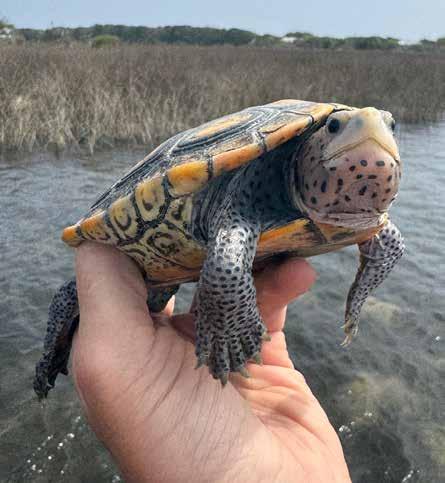
Panhandle Terrapin Project Summer is not only an active season for sea turtles, but it is also the nesting season for another turtle species in the panhandle. Diamondback terrapins are closely
related to pond turtles and thrive in brackish, marshy areas, nesting on adjacent sandy stretches. Though diamondback terrapin habitats officially stretch from coastal New England, down the Atlantic coast, and throughout the Gulf Coast to Mexico, for many years, very little information existed on terrapin existence/habits in the panhandle.
The Panhandle Terrapin Project was established in 2005 with the goal of identifying terrapins in our area and scouting potential habitats. Once it was established that terrapins were indeed active and nesting in the Panhandle, volunteer efforts expanded to nest monitoring. Now, teams of volunteers in Baldwin, Escambia, Santa Rosa, Okaloosa and Walton counties survey primary and secondary nesting sites to identify tracks, identify and monitor nests by performing visual head counts to track areas heavily populated with terrapins. On the occasion that a terrapin is caught, volunteers also contact trained coordinators to notch or satellite tag the terrapins for rerelease and future studies. The Panhandle Terrapin Project is supported by USGS, the Pensacola and Perdido Bays Estuary Program, and FL Sea Grant.
Two of the seven species of diamondback terrapin live in the Panhandle: the ornate terrapin and the Mississippi terrapin. Diamondback terrapins are identified by their light gray-bluish skin, dark speckles and distinct orange patterns on their shells.
Terrapins face distinct dangers: they often drown as bycatch in crab traps and are heavily sought in the pet trade for their unique colors and features. Crab pots can be fitted with inexpensive BRDs (bycatch reduction devices) to prevent terrapins from entering traps without hindering the catch. If you see or catch a terrapin, please contact coordinator Rick O’Connor at roc1@ufl.edu with details and photos ■
Photo courtesy of MYFWC Fish and Wildlife
Photo courtesy of Panhandle Terrapin Project
Photo courtesy of MYFWC Fish and Wildlife
PLEASE CHOOSE THE SUMMATION WEEKLY FOR ALL YOUR LEGAL NOTICES
The Summation Weekly, a publication of the Escambia-Santa Rosa Bar Association (ESRBA) produced in partnership with Ballinger Publishing, offers highly competitive insertion rates and a way to indirectly support your local bar association.
The Summation Weekly is a subscription-based community newspaper circulated to ESRBA members and made available to the general public throughout Escambia and Santa Rosa counties. The publication satisfies Fla. Stat. 50.031, which governs the requirements for publication of legal notices. In addition to the published weekly newspaper,
The Summation Weekly website –summationweekly.com satisfies Fla. Stat. 50.0211, which requires all legal notices to be made available online and on the state registry – floridapublicnotices.com.
Ballinger Publishing manages the day-to-day operations of the publication. Darien Hardy is the contact person for legal notices. She can be reached at 433-1166, ext. 25 or legals@ballingerpublishing.com.
Thank you for your support. Choosing The Summation Weekly generates non-dues revenue that helps subsidize programs and services provide to members of the EscambiaSanta Rosa Bar Association.
LEGAL EDUCATION ONLINE LIBRARY: CLE.ESRBA.COM
ESRBA’s CLE Library is now digital! Go to cle.esrba.com to get your credits. Each download comes with the audio from the seminar, the PowerPoint/handouts, and the CLE Certificate of Accreditation from The Florida Bar. The audio can be downloaded in any file type that you would like including MP3, FLAC, ALAC, AAC, Ogg Vorbis, WAV, and AIFF formats. For your convenience and ease of listening, the seminars can also be streamed directly from the library.
If you are interested in presenting a CLE seminar or being recorded for a CLE accredited podcast, please email esrba@esrba.com.
Continuing Legal Education (CLE) Audio Library Cost: $15 per credit – ESRBA members, $25 per credit –nonmembers Top Ten Probate Pitfalls
Credits: 1 Elder Law and 1 Wills Trusts Estates
and Stored Data
Car


Ways to Maintain your Mental Health
CLE Credits: 1.0 General




ESCAMBIA COUNTY CORRECTIONS EMPLOYEES
GRADUATE
FROM
FLORIDA SENIOR
LEADERSHIP PROGRAM
Two Escambia County Corrections employees have graduated from the Florida Criminal Justice Executive Institute's Senior Leadership Program, demonstrating their dedication to enhancing their leadership skills in the criminal justice profession.
1st Lt. Dennis Hurst and Lt. Jason Walker with Escambia County Corrections were among 32 program graduates representing 26 criminal justice agencies throughout the State of Florida. The two men were selected from applicants throughout the state to participate in the multi-week program, which teaches participants critical skills to be effective leaders through the challenges faced by criminal justice professionals.
Designed to prepare Florida’s criminal justice leadership for the challenging and changing demands of the future, participants in the Senior Leadership Program met for seven weeks over a 10-month period. They studied the trends and events that will challenge criminal justice professionals and the state, also examining the leadership skills necessary to create and lead the changes that lie ahead.
"I'm extremely proud of Lt. Hurst and Lt. Walker for completing this program and taking the initiative to further their leadership skills," Escambia County Chief of Corrections Rich Powell said. "The program requires a rigorous application and selection process; for these two men to be selected out of all the applicants speaks volumes about their work ethic and dedication to corrections. I appreciate FDLE offering these programs for our officers to grow within the criminal justice profession."
To learn more about Escambia County Corrections, visit myescambia.com.
About the Florida Criminal Justice Executive Institute
The Florida Criminal Justice Executive Institute, housed within the Florida Department of Law Enforcement and affiliated with the State University System, was established in 1990 by the Florida Legislature to address the need for an innovative and multi-faceted approach to the education and training of criminal justice professionals. For more information, visit the FCJEI website.
BAPTIST HEALTH CARE HONORS 2024 LEGENDS
Baptist Health Care honors its 2024 Legends on May 9 to kick off its 2025 National Health Care Week. Through careful selection, Legends of Baptist Health Care are chosen for demonstrating exemplary actions of the Baptist values of ownership, integrity, compassion, excellence and service.
The 2024 Legends of Baptist Health Care:
• Jay Hospital nurses Greg Perry and Shelly Smith came to the aid of a physician involved in a car accident on a stormy Christmas morning.
• Baptist Physician Enterprise population health care coordinator Lisa Davis paid a utility bill for one patient and helped another with nutrition and home care needs so they could focus on getting well.
• Baptist Hospital nurses Gabbi Ibarra and Carissa Foote rallied their teams to work together to grant a sacred request for a patient’s last wish. Their efforts eased his burden and gave him and his family peace.
• Andrews Institute physician assistant Tracy Fox Nelson took care of a student-
athlete at a track meet and later went the extra length to make sure he could keep running.
• Gulf Breeze Hospital emergency department manager Karen Tilton became an advocate for a woman who lost her husband suddenly. She helped her heal from depression and grief and gain confidence and independence.
• Baptist Hospital nurse Jalynn DanielakRevels met a young girl with a rare genetic condition and made it her mission to help the child cope.
A 15-person selection committee reviewed each nomination submitted by employee leaders and fellow team members. Votes were cast for the most compelling examples of Baptist values. Winners were recognized in a special celebration on May 9.
This marks the 26th year Baptist has recognized team members as Legends. This year’s Legend stories and a video showcasing each person can be found at the website ebaptisthealthcare.org/legends.
PENSAPRIDE FESTIVAL CELEBRATES LGBTQ+ CULTURE AT ALL-AGES SOBER EVENT ON JUNE 28
PensaPride is excited to announce the fifth annual PensaPride Festival, a vibrant and inclusive celebration of LGBTQ+ culture, art, and community. The festival will take place on Saturday, June 28, 2025, from 10 AM to 6 PM at the Pensacola Interstate Fairgrounds (6655 Mobile Hwy, Pensacola, FL 32526), utilizing the Expo Hall, Building 7, and the outdoor food court. This all-ages, sober event is open to the public and will showcase over 100 vendors, artists, makers, food trucks, and community organizations.
Festival Highlights Include:
• Artist & Maker Market: A curated market by Pensacola Arts Market featuring handmade goods, vintage items, artwork, and small local businesses.
• Live Performances:
• Mainstage in the Expo Hall: A full day of entertainment including bands, performances, and more.
• Acoustic Sensory-Friendly Stage (Building 7): Presented by 309 Punk Project, featuring calm, powerful sets including poetry, acoustic music, and spoken word.
ASCENSION
SACRED HEART FOUNDATION PAINT THE TOWN RED GALA PROCEEDS EXCEEDED $60,000 FOR SACRED HEART BAY HOSPITAL'S CARDIOVASCULAR SERVICES
Ascension Sacred Heart Foundation’s inaugural Paint the Town Red Gala, presented by The Chapman Family Foundation, raised $64,962.24 for Sacred Heart Bay Hospital’s cardiovascular services.
In honor of Hearth Month, guests donned their best red formal attire and gathered at the Boardwalk Convention Center to raise money while simultaneously celebrating the hospital’s 75th anniversary. Upon entry, attendees were greeted with complimentary valet and live performers before walking through the transformed event space that was “painted red” for the night’s festivities.
Inside the grand ballroom, guests took their seats for a multi-course dinner and a champagne toast to kick off the night’s programming. The Master of Ceremonies, Shane Collins, was instrumental in keeping our guests informed of the night’s festivities. Guest speakers took the stage to thank the attendees for joining the gala on this momentous occasion, including Ascension Sacred Heart Foundation President, Adrienne Maygarden, who welcomed guests, followed by remarks from Ascension Sacred Heart Bay Hospital President, Robin Godwin, and Chief Medical Officer, Dr. Kunal P. Jani.
The Atlanta Showstoppers then took the stage to entertain guests before renowned, award-winning auctioneers, Charlie and Michael Adcock, kicked off the live auction, sponsored by Loyalty Credit Union. Paddles were raised to bid on various trips and packages including a yacht rental, trip to Italy, and Churchill Downs getaway package.
Throughout the evening, guests also had the opportunity to enter to win a $5,000 shopping spree donated by Maharaja’s Fine Jewelry, along with tickets for a wine and spirits pull, sponsored by Loyalty Credit Union. Through sponsorships, the live auction, and raffle ticket sales, the inaugural event’s proceeds were $64,962.24 for Sacred Heart Bay Hospital cardiovascular services.
“Proceeds from this event will allow Sacred Heart Bay Hospital to purchase electrocardiogram (EKG) machines,” said Janet Piepul, Ascension Sacred Heart Foundation major gifts and planned giving director. “This mighty machine tests the electrical activity in a patient's heart and can detect any unusual heart rhythms or other heart conditions, thereby alerting the physician that further testing of the patient is required. We are so thankful for the community's support from the Bay Gala as their generosity helps strengthen every part of our mission and brings comfort and hope to patients and families across our communities.”
sored by Emerald Coast Hospice, and the 360° photobooth, courtesy of Encompass Health. The party continued into the night during the after-party, sponsored by Sandpiper-Beacon Beach Resort, where guests danced and enjoyed late-night bites.
“We can’t thank our partners, supporters, and sponsors enough for helping us make the inaugural Bay Gala such a success,” Piepul said. “We hope to raise even more money and have even more guests join us next February for the second annual gala –stay tuned!”
• Community Zone: Connect with nonprofit and grassroots organizations providing LGBTQIA2S+ and broader community resources.
• Family-Friendly Activities: Free arts and crafts and engaging fun for attendees of all ages.
• Photobooth Experience: Snap a keepsake photo with friends and loved ones.
Admission Details:
General admission is $3 per person, with free entry for children 10 and under. All guests will receive a wristband that allows for re-entry throughout the day.
PensaPride is committed to uplifting Pensacola’s LGBTQIA2S+ community and centering the voices of queer, trans, Black, Indigenous, disabled, and other marginalized identities. The festival is designed to be joyful, accessible, and welcoming, celebrating community, creativity, and pride. For more information, please visit pensapride.org or contact the email address contact@pensapride.org.
• Food Court: A delicious variety of food trucks and beverage vendors offering something for every taste.
PEOPLE ON THE MOVE: REID TORGERSEN, TORGERSEN CAUSEY
Reid Torgersen, President, Torgersen Causey, recently completed the course work, exams, and other requirements to become a Registered Employee Benefit Consultant (REBC). The REBC designation is a professional credential focused on employee benefits, particularly group insurance and retirement plans. It demonstrates a high level of knowledge and expertise in this field, including employer group benefits for medical, dental, vision, life, and disability. The REBC program emphasizes ethical conduct and adherence to industry standards. The designation is a recognized credential, adding credibility to an individual's expertise and setting them apart in the field. Torgersen Causey, locally owned and operated in Pensacola, FL, is a leader in benefits and insurance solutions for employer groups and individuals.
Ascension Sacred Heart Bay Hospital is the region's only Level II Trauma Center, offering the highest level of emergency care in the area for life-threatening injuries and illnesses. The hospital is nationally recognized for its cardiovascular care. It is the only comprehensive cardiovascular program in the tri-county area providing open heart surgery, minimally invasive valve replacement surgery (TAVR), and pulse field ablation and the WATCHMAN device for atrial fibrillation (AFib). Ascension Sacred Heart Bay Hospital is an accredited stroke center.
Attendees commemorated the celebration in the interactive photo booth, spon -
Ascension Sacred Heart Foundation would like to thank the local businesses and individuals who sponsored this year’s gala, including Diamond Sponsor: Vituity; VIP Sponsor: Cardiovascular Institute of Northwest Florida; Décor Sponsor: VITAS Healthcare; Special Performer Sponsor: Creative Printing of Bay County; Special Gift Sponsor: Panhandle Credit Union; Registration Table Sponsor: Dr. and Mrs. David R. Dietrich; Podium Sponsor: Bell and Company; Champagne Sponsor: Emerald Coast Hospice; Photography Sponsor: Peoples First Insurance; Valet Sponsor: Perry & Young; Program Sponsor: Innovations Financial Credit Union; Cocktail Napkin Sponsor: Jim and Nadia Smallwood; Course Sponsor: Champions First Credit Union; Course Sponsor: Cumi and Gary Walsingham; Table Sponsors: Bay Health Foundation, Clarity Mental Health, Bill Cramer Chevrolet GMC, Credit Business Services, Inc. - In Memory of Tommy M. Cooley, Dermatology Solutions Group, Esteem Wealth Partners, Florida State University Panama City, Friends of Bay, Gedd Law Firm, Gulf Coast State College, Hancock Whitney, Hand Arendall Harrison Sale, Hello Credit Union, J&J MedTech, Mayor Michael “Doc” Rohan, Sr. M.D., Medtronic, Nations Best Family Healthcare, Panhandle Pediatric Dentistry, PanCare of Florida, Platt Law Firm, RC Events, and Think Real Estate. Ascension Sacred Heart Foundation would also like to the following in-kind sponsors for being a part of this year’s event, including 30A Distilling Co., Bacardi, Bay County Chamber of Commerce, Bay Point News, Carousel Supermarket, Distillery 98, Emerald Coast Magazine, Good Clean Wine, Lamar Advertising, Panama City Beach Chamber of Commerce, Restaurant Paradis, Salty Girls Beverages, VIP 30A Magazine, WJHG News Channel 7, and WMBB My Panhandle. About Ascension Sacred Heart Ascension Sacred Heart, based in Pensacola, Florida, operates five hospitals and more than 100 other sites of care, employing more than 6,440 associates. In fiscal year 2024, Ascension Sacred Heart provided more than $193 million in community benefit and other care for vulnerable persons. Ascension is a faith-based healthcare organization dedicated to transformation through innovation across the continuum of care. As one of the leading non-profit and Catholic health systems in the U.S., Ascension is committed to delivering compassionate, personalized care to all, with special attention to persons living in poverty and those most vulnerable.
KERRY SHANAGHAN APPOINTED INTERIM DIRECTOR OF PARKS AND RECREATION FOR CITY OF PENSACOLA
The City of Pensacola is pleased to announce the appointment of Kerry Shanaghan as the Interim Director of Parks and Recreation. With a distinguished career spanning over two decades in military and recreational leadership, Shanaghan brings a wealth of experience and a deep commitment to community engagement.
Shanaghan previously served as the Morale, Welfare, and Recreation and Child and Youth Programs Director at Naval Air Station Pensacola, where he was instrumental in enhancing the quality of life for service members and their families through innovative recreational programs and events. His tenure at NAS Pensacola was marked by successful initiatives that fostered community spirit and well-being.
"I am honored to take on this role and look forward to working with the dedicated
team at Pensacola Parks and Recreation," said Shanaghan. "Together, we will continue to provide exceptional recreational opportunities that enrich the lives of our residents and visitors."
As Interim Director, Shanaghan will oversee the department's operations, including the management of parks, recreational facilities and community programs. His leadership is expected to guide the department through a seamless transition while maintaining the high standards of service that the community has come to expect.
The City of Pensacola is confident that Shanaghan's extensive experience and passion for community service will greatly benefit the Parks and Recreation Department during this interim period.
PENSACOLA NATIVE SERVES WITH THE NEXT GENERATION OF U.S. NAVAL AVIATION WARFIGHTERS
Ensign Matthew Juntunen, a native of Pensacola, Florida, is serving in the U.S. Navy amongst sailors, Marines and guardsmen at Naval Aviation Schools Command (NASC) who are developing the skills needed to be a combat-ready aviation professional.
Juntunen joined the Navy five months ago. Today, Juntunen is a student at NASC.
“My dad was in the Air Force, so I was inspired by his experiences,” Juntunen said. "Growing up in Pensacola, I was immersed in naval aviation."
The skills and values needed to succeed in the Navy are similar to those found in Pensacola.
“I learned the importance of flexibility,” Juntunen said. "In the military, there are always changes, so learning to be flexible has helped a lot."
Located at Naval Air Station Pensacola, Florida, NASC provides an educational foundation in technical training, character development and professional leadership to prepare Navy, Marine Corps, Coast Guard and partner nation officers and enlisted students to be combat quality aviation professionals, and deliver them at the right time, in the right numbers, to be the forces their nation needs.
NASC is comprised of four schoolhouses: Aviation Training School (ATS), Aviation Enlisted Aircrew Training (AEATS), Aviation Rescue Swimmer School (ARSS) and Aviation Water Survival School (AWS), with instructor cadres that provide a wellrounded curriculum of academics and physical training on topics such as aviation training, aircrew duties and assignments, survival, first aid and water rescue procedures, that produce the highest quality offi -
cer and enlisted aviation personnel for the U. S. military.
The U.S. Navy is celebrating its 250th birthday this year.
According to Navy officials, “America is a maritime nation and for 250 years, America’s Warfighting Navy has sailed the globe in defense of freedom.”
With 90% of global commerce traveling by sea and access to the internet relying on the security of undersea fiber optic cables, Navy officials continue to emphasize that the prosperity of the United States is directly linked to recruiting and retaining talented people from across the rich fabric of America.
Juntunen serves a Navy that operates far forward, around the world and around the clock, promoting the nation's prosperity and security.
Juntunen has many opportunities to achieve accomplishments during military service.
“I'm proud to be selected for pilot school,” Juntunen said. “Also, I’m proud to graduate from Officer Candidate School. Having my dad swear me in during my commissioning ceremony was an honor and a special moment for my family.”
Juntunen can take pride in serving America through military service.
“Serving in the Navy is an opportunity to be the best leader that I can be so that I can help others,” Juntunen said. "I'm honored to serve this country that I love."
Juntunen is grateful to others for helping make a Navy career possible.
“I want to thank my mom and dad for inspiring me to serve and supporting me throughout my life,” Juntunen added.
AMANDA ZIMMERMAN JOINS CATALYST HEALTHCARE REAL ESTATE AS VICE PRESIDENT OF DEVELOPMENT & CONSTRUCTION
Catalyst Healthcare Real Estate (Catalyst), a healthcare real estate development and investment firm, is proud to welcome Amanda Zimmerman as Vice President of Development & Construction. Amanda will be based in Catalyst’s Dallas, TX office.
Amanda brings over two decades of experience and a strong track record in commercial development and construction and her addition further reflects Catalyst’s ongoing commitment to innovation, strategic growth, and delivering best-in-class healthcare real estate solutions nationwide.
"Catalyst is in an exciting and significant state of growth and expansion," said Eric Fischer, Chief Development Officer. "Amanda’s leadership will strengthen our presence in Texas and the southwest markets and help us continue to elevate the quality and scale of projects we deliver nationwide."
Amanda has consistently delivered high-performing, large-scale projects across
a variety of sectors with decades of project management experience in commercial development and construction. Her recent work includes large-scale expansions, relocations, and ground-up developments across Texas for clients in the healthcare, life sciences, corporate, and retail sectors.
In her new role, she will be an integral part of Catalyst’s expanding team of development and construction leaders, partnering with executives across the organization to drive the firm’s growth and development initiatives. About Catalyst Healthcare Real Estate Catalyst is a national, healthcare real estate development and investment firm. Our platform of integrated real estate deliverables is specifically designed for the ever-evolving landscape of healthcare real estate. Our team seeks to positively impact healthcare with strategic investment in development, acquisition, and strategy services. For more information, please visit catalysthre.com.
PARKS AND RECREATION TO HOST GULF COAST RECREATION CLASSIC JUNE 23-28
Escambia County Parks and Recreation is excited to announce the start of the 2025 Gulf Coast Recreation Classic at the John R. Jones Ballpark, located at 555 E. Nine Mile Road. The games begin Monday, June 23 and last until Saturday, June 28. Game times are 5:30 p.m., 7 p.m., and 7:15 p.m. MondayFriday and Saturday games will begin at 9 a.m. Roger Scott Athletic Complex, located at 2130 Summit Blvd., will host the 10U division games June 23-24, 26-27 at 5:30 and 7:15 p.m.
62 recreation-based all-star teams will participate in the Gulf Coast Recreation Classic, including teams from Escambia County, City of Pensacola, City of Gulf Breeze, Santa Rosa County, and Okaloosa County. Teams consist of youth baseball players ages 7-15. The tournament is open to the public at no charge. All spectators are welcome to come
JAY HOSPITAL WELCOMES TIFFANY
CHAMBERS, APRN, FNP-BC, TO CENTURY MEDICAL CENTER
Jay Hospital is pleased to welcome boardcertified nurse practitioner Tiffany Chambers, APRN, FNP-BC, to its clinic at Century Medical Center. Chambers specializes in critical care and family medicine and provides quality, convenient care to Century Medical Center patients.
Chambers earned her Master of Science in nursing at the University of South Alabama in Mobile, Alabama, and her Bachelor of Science in nursing at Pensacola State College
in Pensacola. She has more than a decade of experience in health care, including leadership roles such as clinical manager, house supervisor and charge nurse. She is board certified by the American Academy of Nurse Practitioners. Chambers welcomes new patients at Century Medical Center, located at 8401 North Century Blvd. in Century, Florida. To learn more or to schedule an appointment, please visit baptistmedicalgroup.org or call 448.227.5690.
PENAIR CREDIT UNION DELIVERS OVER 7,000 SNACKS TO SUPPORT LOCAL CANCER PATIENTS
PenAir Credit Union (PenAir), in partnership with Ascension Sacred Heart Foundation and the Pensacola Blue Wahoos, delivered more than 7,500 individually packaged snacks to Ascension Sacred Heart Cancer Center on Thursday, June 12. The donation marks the successful completion of PenAir’s third annual Snack Stock initiative, aimed at providing comfort and nourishment to cancer patients and their families during treatment and appointments.
Throughout May, PenAir branches and Blue Wahoos home games served as collection points for community members to donate single-serving snack items—such as chips, pretzels, popcorn, cookies, and protein bars. The effort ensures the Cancer Center’s snack cabinet remains stocked, giving patients easy access to quick and nourishing options during a physically and emotionally demanding time.
“Our partnership with Ascension Sacred Heart Foundation has helped us deepen our impact and ensure these donations reach those who need them most,” said Connie Hansler, Sponsorships & Events Specialist at PenAir. “Teaming up with the Pensacola Blue Wahoos also brought the community together in such a meaningful way and gave
us our largest single year donation to date. This is Communerosity® in action!”
Since launching the initiative in 2023, PenAir has helped organize the donation of more than 15,000 snacks to support local cancer patients. Research from the American Cancer Society highlights the importance of nutrition during treatment, as it can help patients maintain strength, better manage side effects, and improve overall quality of life.
For more information about Snack Stock, visit penair.org/SnackStock.
About PenAir Credit Union
Established in 1936, PenAir Credit Union has been a bold force for good, uniting community, resources, and impact. With assets surpassing $2.6 billion, PenAir is dedicated to enhancing the lives of its members from Mobile, Alabama, to Tallahassee, Florida. As a member-owned institution, PenAir prioritizes individual needs, ensuring tailored solutions for financial success. Beyond financial services, PenAir actively contributes to community growth through education, development projects, and charitable endeavors. Learn more about how PenAir is building a legacy of economic empowerment and community enrichment at penair.org.
MAYOR D.C. REEVES LAUNCHES MAYOR’S CHILDCARE ACCESS PROGRAM TO EXPAND SUPPORT FOR PENSACOLA FAMILIES
Mayor D.C. Reeves unveiled the Mayor’s Childcare Access Program today, a bold new initiative aimed at expanding high-quality, affordable childcare options for families across the City of Pensacola. The program is a strategic effort to better utilize city resources and to leverage the Community Redevelopment Agency’s portion of funding from the Escambia Children’s Trust, ensuring local children and working families have the support they need.
“Access to affordable, quality childcare is not just a family issue—it’s an economic issue,” Mayor Reeves said. “By aligning city resources and targeting available funding from the Escambia Children’s Trust, we will build the kind of infrastructure to allow Pensacola families to thrive and our economy to grow.”
recent findings from the Florida Chamber of Commerce, which has identified childcare availability as a critical factor in workforce participation and economic competitiveness statewide. Employers and communities across Florida are increasingly recognizing that access to childcare is a top priority for attracting and retaining talent.
To lead this effort and other related initiatives, the city has hired Theresa Cserep as its Education and Youth Programs Officer—a newly created role under Mayor Reeves’ administration. Cserep brings a decade of experience in educational policy, youth engagement, and nonprofit coordination, and will work closely with city departments, childcare providers, the Escambia Children’s Trust, and community stakeholders to implement the new program.
support the recreation all-stars. Escambia County teams include players from Northwest Escambia Baseball, Perdido Baseball, NEP Baseball, Molino Recreation Association, and West Pensacola Baseball.
"We're thrilled to welcome these all-star teams back to Escambia County for another great year of youth sports," Parks and Recreation Director Michael Rhodes said. "It's an honor to be selected to host these teams and I'd like to give a special shoutout to our staff who works hard to make this event happen. The passion our players and their families have for youth sports is what makes events like this possible. We look forward to a great week of youth sports and invite everyone to come out and join us."
For more information, please contact Escambia County Parks and Recreation at 850-475-5220.
This initiative also reflects Mayor Reeves’ leadership on the national stage as Chair of the Jobs, Education, and Workforce Committee with the U.S. Conference of Mayors, where he has championed innovative, communitydriven strategies to address the childcare crisis facing cities across the country.
The Mayor’s Childcare Access Program will prioritize: Supporting and expanding existing childcare centers in underserved areas, particularly within the CRA district.
• Providing direct grants and technical assistance to childcare providers to improve capacity, quality, and workforce development.
• Partnering with local employers to incentivize on-site or subsidized childcare solutions.
• Connecting families with trusted childcare resources and streamlining access to available subsidies and scholarships. Expanding childcare access aligns with
“Theresa’s passion and expertise make her the ideal person to help us build a more supportive environment for Pensacola’s youngest residents,” Reeves said. “This is about investing in our future — starting with the very first years of life.”
“It’s an honor to contribute to strategic education and youth development initiatives. These are areas essential to the future of our community,” Cserep said. “I look forward to working with schools, community partners and city leaders to ensure our children and young people are supported, empowered and not overlooked.”
As a key part of the initiative’s launch, the City of Pensacola will host a Childcare Summit on May 28. The summit will bring together a diverse group of local and state experts, childcare providers, business leaders and community advocates. It will serve as a platform for collaboration, idea-sharing and actionable planning to strengthen childcare access across the region.
SRC VETERANS SERVICE PARTNERS WITH FLORIDA VETERAN SUPPORT
LINE & VETERAN-OWNED SMOOTHIE KING
The Florida Veterans Support Line (FVSL) and the Santa Rosa Veterans Service Office have partnered with local, veteran-owned Smoothie King to offer veterans a chance to learn more about local resources and get answers to questions about general benefits and compensation monthly. The event will now be held on the last Thursday of every month at the Smoothie King, 4952 Hwy. 90, in Pace, beginning on Thursday, June 26, from 11 a.m. to 1 p.m.
“Being able to offer this support every month means a lot to us," said Gwen Wilson, Community Support Director at Santa Rosa County. "It’s a simple but meaningful way to connect with our veterans, show our appreciation, and remind them that the community is here for them, every step of the way.”
Laurie Schulze, Veterans Services Officer for Santa Rosa County, also highlighted the importance of the event, saying, “We’re proud to support our local veterans—not
just in offices, but right here in the community. Partnering with a veteran-owned business like Smoothie King helps us connect with those who’ve served and remind them they’re never alone."
Veterans are encouraged to stop by Smoothie King to meet with representatives, explore available resources, and gain insights into benefits and compensation programs.
About FVSL:
The Florida Veterans Support Line (FVSL), 1-844-MyFLVet, is a toll-free number that veterans and their loved ones can call 24/7 for emotional support and information pertaining to community resources.
About Santa Rosa Veterans Service Office: Santa Rosa County Veterans Services assists in filing Department of Veterans Affairs claims or other VA benefits, as well as answering any questions you may have regarding Florida's benefits for veterans.
UWF’S DR. SHUSEN PU SELECTED AS 2025 CUR MENTOR AWARD RECIPIENT
The Council on Undergraduate Research has named University of West Florida Department of Mathematics and Statistics professor Dr. Shusen Pu the 2025 Mathematical and Computing Sciences Early Career Faculty Mentor Award recipient. The national honor recognizes his work mentoring undergraduates at UWF; it’s the first time a UWF faculty member has earned this distinction.
“I am deeply honored to receive this national award, which reflects the creativity and dedication of the students I have been privileged to mentor,” Pu said. “Supporting undergraduates as they grow into confident researchers is one of the most rewarding parts of my work. I sincerely appreciate the continued support and funding provided to our students by the Department of Mathematics and Statistics, the Hal Marcus College of Science and Engineering, and the Office of Undergraduate Research.”
The Mathematical, Computing, and Statistical Sciences Division of CUR announced three awards to honor mentors for their success in mentoring undergraduate students in research. One award was made in each of the following categories: Early Career, Mid Career and Advanced Career. Recipients are selected based on their record of undergraduate student mentoring, including the number of students mentored; evidence of professional development of students mentored; and evidence of impact and success.
Pu joined the Department of Mathematics and Statistics at UWF as an assistant
professor in 2022. He received his Ph.D. in applied mathematics from Case Western Reserve University in 2020. Before joining UWF, Pu worked as a lecturer in the Department of Mathematics at Vanderbilt University. Over the past three years at UWF, Pu has mentored more than 40 undergraduate students. His mentees have delivered more than 30 presentations at national and international conferences — including the Joint Mathematics Meetings, National Conference on Undergraduate Research, MAA MathFest and Society for Neuroscience annual meetings and have co - authored multiple peer- reviewed publications.
Pu’s current research spans mathematical statistics, neural network modeling and mathematical biology, with a particular focus on computational neuroscience and the statistical analysis of experimental data. Recently, Pu, along with his students, researched science, mathematics and computer technology to understand our brains better. Using computer simulations and advanced modeling techniques, Pu and his students constructed computational models that capture the complex interactions between brain cells.
“Conducting research with Dr. Pu has always pushed me to engage with different fields, which has allowed me to connect and convey my research effectively,” said Dylan Wright ‘24.
For more information on the Hal Marcus College of Science and Engineering, visit uwf.edu/hmcse.
GREEN FLASH AT SUNSET BOOK RELEASE
Celebrate the release of Nic Schuck’s newest novel, Green Flash at Sunset, a Key West Adventure. Starting at 2 pm on June 29, Schuck will be selling and signing books. Local singer-songwriter Pat Meusel will provide the soundtrack for the event, and artist Dan Dunn will have artwork for sale. Hosted at Pensacola Bay Brewery, the
event will also feature $5 pints of Panhandle Lager. Pensacola Bay Brewery is located at 225 Zaragoza St. in downtown Pensacola. Books can be purchased beforehand and brought to the event for signing. To purchase the book and learn more about Schuck, visit bookshop.org/ shop/panhandlebooks.
WHITE TIE ROCK ENSEMBLE: MONSTERS OF ROCK
Get ready to rock with the White Tie Rock Ensemble presenting Monsters of Rock! Get ready for a night of songs from KISS, AC/DC, Ozzy Osbourne, Billy Idol, Van Halen, Motley Crue and more! Join the ensemble for this unforgettable show on
June 28. The show takes place at the Pensacola Bay Center, located at 201 E. Gregory St. in downtown Pensacola. Doors open at 7 pm and the show starts at 8. For tickets and more information, visit the website address pensacolabaycenter.com/events.
ESCAMBIA COUNTY RECOGNIZES BLOCK-BY-BLOCK GRADUATES
Escambia County was proud to recognize graduates from the Neighborhood and Human Services Department Block-ByBlock Workforce Development Program last week, highlighting a significant milestone for these young adults as they begin their careers in HVAC.
The graduates were recognized by District 3 Commissioner Lumon May and NHS Block-By-Block Program Coordinator Joe Glover during a ceremony Tuesday, June 10 at the Brownsville Community Center, joined by family, friends and Escambia County staff to celebrate their success.
"We're excited we started the Block-ByBlock Program, because I believe in order to save a community, you go house-by-house, block-by-block, community-by-community," District 3 Commissioner Lumon May said. "All it takes is a few dedicated men, a few dedicated women, a few dedicated people, who want to make a difference, who want to be gainfully employed, who want a skillset to be trained in. To the graduates: Job well done. It's just begun. You are on the journey to a great career. On behalf of Escambia County and District 3, I want to say that I'm so proud of you."
The Escambia County Block-by-Block Workforce Development Program was designed specifically to provide entry-level training opportunities for young adults in underserved communities within Escambia County. The Block-by-Block Workforce Development Program is a career-focused initiative designed to equip students with the skills and credentials needed to succeed in the construction industry.
Through this program, participants receive hands-on training in various construction trades, such as carpentry, electrical, HVAC-R (heating, ventilation, air conditioning and refrigeration), masonry, plumbing, and welding. Each construction trade is provided through Pensacola State College, where students enrolled in an eight-week comprehensive course to obtain on-the-job training skills and extensive textbook knowledge. Additional training includes Florida Ready to Work Soft Skills Training, which is provided through CareerSource Escarosa.
"Strong communities hinge upon youth having the skills they need to secure meaningful, well-paid employment," said Joe Glover, who manages the Block-By-Block Program through the Escambia County Neighborhood and Human Services Department. "We strive to assist young people within our community in obtaining skills most desired by employers in an acceler-
ated learning environment. Building strong neighborhoods through education, training, and employment, one block at a time. Today, we celebrate the graduates of this Block-ByBlock HVAC cohort for 2025, and we look forward to their future success."
A key component of the program is the attainment of NCCER (National Center for Construction Education and Research) certification, a nationally recognized credential that validates a student's knowledge and skill level in their chosen trade. The curriculum follows NCCER’s standardized training modules, combining classroom instruction with practical, on-site experience. Upon successful completion, students earn industry-recognized certifications that enhance their employability and provide direct pathways into apprenticeships, union programs, and full-time employment in the construction sector. The program is ideal for high school students, recent graduates, or adult learners seeking to enter or advance in the skilled trades workforce.
Escambia County proudly recognizes the following individuals who graduated from the Escambia County Block-by-Block Workforce Development Program Heating, Ventilation, Air Conditioning & Refrigeration (HVAC-R) Cohort:
• Xavier Brooks - Completed Florida Ready to Work Soft Skills, OSHA 10, and the NCCER Core
• Darius Brown - Completed Florida Ready to Work Soft Skills, OSHA 10, and the NCCER Core
• Cameron Chisholm - Completed Florida Ready to Work Soft Skills, OSHA 10, and the NCCER Core
• Michael Crosby - Completed Florida Ready to Work Soft Skills and OSHA 10
• Quentin Gholston - Completed Florida Ready to Work Soft Skills and OSHA 10
• Kanye Jones - Completed Florida Ready to Work Soft Skills, OSHA 10, and the NCCER Core
• Brian Lisonbee - Completed Florida Ready to Work Soft Skills, OSHA 10, and the NCCER Core
• DeAndre Mason - Completed Florida Ready to Work Soft Skills, OSHA 10, and the NCCER Core
• Daniel Ramey - Completed Florida Ready to Work Soft Skills, OSHA 10, and the NCCER Core
• Austin Swails - Completed Florida Ready to Work Soft Skills, OSHA 10, and the NCCER Core To learn more about the Escambia County Block-By-Block Program, visit the website myescambia.com/blockbyblock.
The University of West Florida Lewis Bear Jr. College of Business and the Combined Rotary Clubs of Pensacola named Martha D. Saunders and Kevin Green as the 2025 recipients of the annual Ethics in Business Award during the 23rd Combined Rotary Luncheon at the Pensacola Yacht Club.
The Ethics in Business Award recognizes individuals who exemplify the concept of “service above self” and work to build a positive sense of self-worth within both the business community and the broader community as a whole. Criteria for the award include adherence to the high ethical standards of honesty, integrity and consistency in dealing with employees, contractors and customers, while positively enhancing the economic well-being of the firm’s stakeholders and providing jobs, opportunities and profits.
Saunders, president of the University of West Florida, was awarded the winner of the large business sector, or organizations with 50 or more employees. Since taking the helm at UWF in 2017, Saunders has elevated the University to regional and national prominence. Under her leadership, UWF has reached new heights — from record enrollment numbers and top-tier rankings in U.S. News & World Report to the prestigious Community Engagement Classification honor from the Carnegie Foundation. UWF has also achieved the designation of a Research 2 university, a marker of its expanding impact and excellence.
UWF has been named “Great College to Work For,” for six years under Saunders’ leadership. Saunders holds more than 30 years of experience in higher education and is an academic expert in public relations and crisis communication, earning numerous awards, including two coveted Silver Anvils from the Public Relations Society of America.
“This award is a huge honor for which I am very grateful,” Saunders said. “It puts me in the company of some of the most outstanding leaders I have ever known. In our business, every decision we make is a chance to do the right thing. I'm proud to live in a community that values service and integrity.” Green, winner of the small division, owns and operates The Butcher Shoppe, located on Langley Avenue in Pensacola. The business has been open for 18 years. Green has supported the Rotary Club’s signature fundraiser, Burger Battle by the Bay, for nearly a decade by donating hundreds of pounds of meat and thousands of dollars in gift certificates for the event over the years. The annual burger cooking competition is held in the spring to raise funds for Take Stock in Children and the Subwest Rotary Foundation.
“I am honored and humbled to receive this award,” Green said. “I’ve always looked up to things the Rotary stands for and try to operate my business with those same core values.”
For more information about the UWF Lewis Bear Jr. College of Business, visit the website uwf.edu/lbjcob.
Legals
Notice to Creditors
THE CIRCUIT COURT IN AND FOR ESCAMBIA COUNTY, FLORIDA PROBATE DIVISION
IN RE: ESTATE OF: SIDNEY JOSEPH ARBONEAUX, JR. DECEASED.
FILE NO: 2025 CP 000420
DIVISION:
NOTICE TO CREDITORS
The administration of the estate of SIDNEY JOSEPH ARBONEAUX, JR., deceased, File Number 2025 CP 000420, is pending in the Circuit Court for Escambia County, Florida, the address of which is 190 Governmental Center, Pensacola, Florida 32502. The names and addresses of the personal representative and the personal representative’s attorney are set forth below.
All creditors of the decedent and other persons having claims or demands against decedent’s estate, including unmatured, contingent or unliquidated claims, on whom a copy of this notice is served must file their claims with this Court WITHIN THE LATER OF 3 MONTHS AFTER THE DATE OF THE FIRST PUBLICATION OF THIS NOTICE OR 30 DAYS AFTER THE DATE OF SERVICE OF A COPY OF THIS NOTICE ON THEM.
all other creditors of the decedent and other persons having claims or demands against decedent’s estate, including unmatured, contingent or unliquidated claims, must file their claims with this court WITHIN 3 MONTHS AFTER THE DATE OF THE FIRST PUBLICATION OF THIS NOTICE.
ALL CLAIMS NOT SO FILED WILL BE FOREVER BARRED.
The date of the first publication of this Notice is June 18, 2025.
/s/ Shannon
Fax
Attorney for Personal Representative 2WR6/18-6/25NTC IN THE CIRCUIT COURT OF THE FIRST JUDICIAL CIRCUIT IN AND FOR SANTA ROSA COUNTY, FLORIDA PROBATE DIVISION
IN RE: ESTATE OF LESLIE TYREE WHITLEY a/k/a LESLIE KRAHN a/k/a LESLIE FOWLER Deceased.
File No. 2025-CP-000352 NOTICE TO CREDITORS
The administration of the estate of LESLIE TYREE WHITLEY, deceased, whose date of death was January 27, 2025, is pending in the Circuit Court for SANTA ROSA County, Florida, Probate Division, the address of which is 4025 AVALON BLVD, MILTON, FL 32583. The names and addresses of the personal representative and the personal representative’s attorney are set forth below.
All creditors of the decedent and other persons having claims or demands against decedent’s estate on whom a copy of this notice is required to be served must file their claims with this court ON OR BEFORE THE LATER OF 3 MONTHS AFTER THE TIME OF THE FIRST PUBLICATION OF THIS NOTICE OR 30 DAYS AFTER THE DATE OF SERVICE OF A COPY OF THIS NOTICE ON THEM.
The personal representative has no duty to discover whether any property held at the time of the decedent’s death by the decedent or the decedent’s surviving spouse is property to which the Florida Uniform Disposition of Community Property Rights at Death Act as described in ss. 732.216-732.228, Florida Statutes, applies, or may apply, unless a written demand is made by a creditor as specified under s. 732.2211, Florida Statutes. The written demand must be filed with the clerk.
All other creditors of the decedent and other persons having claims or demands against decedent’s
Personal Representative: THEODORE LEE WHITLEY
505 Valley Road Apt. C Brooktondale, NY 14817
2WR6/25-7/2NTC
IN THE CIRCUIT COURT OF THE FIRST JUDICIAL CIRCUIT IN AND FOR ESCAMBIA COUNTY, FLORIDA IN RE: ESTATE OF CLELLAN DAVID WHATLEY, Deceased.
File No.:2025 CP 896 Division: NOTICE TO CREDITORS
If you have been served with a copy of this notice and you have any claim or demand against the decedent’s estate, even if that claim is unmatured, contingent, or unliquidated, you must file your claim with the court ON OR BEFORE THE LATER OF A DATE THAT IS 3 MONTHS AFTER THE FIRST PUBLICATION OF THIS NOTICE OR 30 DAYS AFTER YOU RECEIVE A COPY OF THIS NOTICE.
All other creditors of the decedent and other persons who have claims or demands against the decedent’s estate, including unmatured, contingent, or unliquidated claims, must file their claims with the court ON OR BEFORE THE DATE THIS IS 3 MONTHS AFTER THE FIRST PUBLICATION OF THIS NOTICE.
ALL CLAIMS NOT FILED WITHIN THE PERIODS SET FORTH IN SECTION 733.702, FLORIDA STATUTES, WILL BE FOREVER BARRED.
EVEN IF A CLAIM IS NOT BARRED BY THE LIMITATIONS DESRIBED ABOVE, ALL CLAIMS THAT HAVE NOT BEEN FILED WILL BE BARRED TWO YEARS AFTER DECEDENT’S DEATH. The personal representative has no duty to discover whether any property held at the time of the decedent’s death by the decedent or the decedent’s surviving spouse is property to which the Florida Uniform Disposition of Community Property Rights at Death as described in sections 732.216–732.228, Florida Statutes, applies, or may apply, unless a written demand is made by a creditor as specified under section 732.2211, Florida Statues.
The address of the court where the probate is pending is 190 W Government St, Pensacola, FL 32502.
The date of death of the decedent is November 13, 2024.
The date of first publication of this notice is June 25, 2025.
Attorney for Personal Representative:
/s/ Christine A. Kelly Christine A. Kelly Florida Bar No.: 81694 EMMANUEL SHEPPARD & CONDON 30 South Spring Street Pensacola, FL 32502 Telephone: (850) 432-6977 Fax: (850) 434-5856
E-mail: ckelly@esclaw.com mcrooke@esclaw.com jgonzalez@esclaw.com
Personal Representative: Stephen Whatley 8381 Pond Ave. Pensacola, FL 32534 850-876-2481 aegisasset@outlook.com 2WR6/25-7/2NTC
IN THE CIRCUIT COURT INAND FOR SANTA ROSA COUNTY, FLORIDA PROBATE DIVISION
IN RE: ESTATE OF HARRY P. ZANG, JR., Deceased.
Case No. 2025-CP-308
NOTICE TO CREDITORS
The administration of the Estate of HARRY P. ZANG, JR., deceased, Case No. 2025-CP-308, is pending in the Circuit Court for Santa Rosa County, Florida, Probate Division, the address of which is Post Office Box 472, Milton, FL 32571 The Estate is Testate. The names and addresses of the Personal Representative and the Personal Representative’s attorney are set forth below.
All creditors of the Decedent and other persons having claims or demands against Decedent’s estate, including unmatured, contingent or unliquidated claims, on whom a copy of this notice is served must file their claims with this court WITHIN THE LATER OF 3 MONTHS AFTER THE DATE OF THE FIRST PUBLICATION OF THIS NOTICE OR 30 DAYS AFTER THE DATE OF SERVICE OF A COPY OF THIS NOTICE ON THEM.
All other creditors of the Decedent and other persons having claims or demands against Decedent’s Estate, including unmatured, contingent or unliquidated claims, must file their claims with this court WITHIN 3 MONTHS AFTER THE DATE OF THE FIRST PUBLICATION OF THIS NOTICE.
ALL CLAIMS NOT SO FILED WILL BE FOREVER BARRED.
The date of first publication of this Notice is June 18, 2025.
/s/
/s/ Rizalina Zang Rizalina Zang, Petitioner 7025 Jacobsview Lane Milton, Florida 32570
2WR6/18-6/25NTC
IN THE CIRCUIT COURT IN AND FOR SANTA ROSA COUNTY, FLORIDA PROBATE DIVISION
IN RE: ESTATE OF CHERYL ANN OAKS Deceased.
Case No. 2025-CP-303
NOTICE TO CREDITORS
The administration of the Estate of CHERYL ANN OAKS, deceased, Case No. 2025-CP-303, is pending in the Circuit Court for Santa Rosa County, Florida, Probate Division, the address of which is Post Office Box 472, Milton, FL 32572. The Estate is intestate. The names and dresses of the Personal Representative and the Personal Representative’s attorney are set forth below. All creditors of Decedent and other persons having claims or demands against Decedent’s estate, including unmatured, contingent or unliquidated claims, on whom a copy of this notice is served must file their claims with this court WITHIN THE LATER OF 3 MONTHS AFTER THE DATE OF THE FIRST PUBLICATION OF THIS NOTICE OR 30 DAYS AFTER THE DATE OF SERVICE OF A COPY OF THIS NOTICE ON THEM.
All other creditors of Decedent and other persons having claims or demands against Decedent’s estate, including unmatured, contingent or unliquidated claims, must file their claims with this court WITHIN 3 MONTHS AFTER THE DATE OF THE FIRST PUBLICATION OF THIS NOTICE. ALL CLAIMS NOT SO FILED WILL BE FOREVER BARRED.
The date of first publication of this Notice is June 18, 2025.
/s/ Marisa Andrews Marisa Andrews Attorney for Personal Representative Florida Bar No. 1016466 Willing Street Law 5218 Willing Street Milton, FL 32570 (850) 623-3200
/s/ Mark Steven Oaks Mark Steven Oaks Personal Representative 6401 Brigadier Road Milton, FL 32570
2WR6/18-6/25NTC
IN THE CIRCUIT COURT IN AND FOR ESCAMBIA COUNTY, FLORIDA PROBATE DIVISION
IN RE: ESTATE OF MARGARET J. GANTT Deceased.
FILE NO: 2025 CP 000877 DIVISION:
NOTICE TO CREDITORS
The administration of the estate of MARGARET J. GANTT, deceased, File Number 2025 CP 000877, is pending in the Circuit Court for Escambia County, Florida, the address of which is 190 Governmental Center, Pensacola, Florida 32502. The names and addresses of the personal representative and the personal representative’s attorney are set forth below.
All creditors of the decedent and other persons having claims or demands against decedent’s estate, including unmatured, contingent or unliquidated claims, on whom a copy of this notice is served must file their claims with this Court WITHIN THE LATER OF 3 MONTHS AFTER THE DATE OF THE FIRST PUBLICATION OF THIS NOTICE OR 30 DAYS AFTER THE DATE OF SERVICE OF A COPY OF THIS NOTICE ON THEM.
All other creditors of the decedent and other persons having claims or demands against decedent’s estate, including unmatured, contingent or unliquidated claims, must filed their claims with this court WITHIN 3 MONTHS AFTER THE DATE OF THE FIRST PUBLICATION OF THIS NOTICE.
ALL CLAIMS NOT SO FILED WILL BE FOREVER BARRED.
The date of the first publication of this Notice is June 25, 2025.
/s/ Marlene D. Grubbs MARLENE DEBRA GRUBBS Personal Representative
/s/ Amy Logan Sliva AMY LOGAN SLIVA SLIVA LAW FIRM, LLC Florida Bar No: 394793 313 West Gregory Street Pensacola, Florida 32502 (850) 438-6603 (850) 438-1985 Fax amysliva@slivalawfirm.com Attorney for Personal Representative
2WR6/25-7/2NTC
IN THE CIRCUIT COURT IN AND FOR ESCAMBIA COUNTY, FLORIDA PROBATE DIVISION
IN RE: ESTATE OF JERRY W. JOHNS, Deceased.
CASE NO.: 2025 CP 000479
DIVISION: U NOTICE TO CREDITORS
The administration of the estate of Jerry W. Johns, deceased, with the case number indicated above, is pending in the Circuit Court in and for Escambia County, Florida, Probate Division, the address of which is 190 W. Government Street, Pensacola, Florida 32502. The name and address of the personal representative are: Scott J. Bell, 6847 N. 9th Avenue, Suite A367, Pensacola, Florida 32504.
A personal representative or curator has no duty to discover whether any property held at the time of the decedent’s death by the decedent or the decedent’s surviving spouse is property to which the Florida Uniform Disposition of Community Property Rights at Death Act as described in [F.S.] 732.216–732.228, applies, or may apply, unless a written demand is made by a creditor as specified under [F.S.] 732.2211.
All persons having claims against this estate who are served with a copy of this notice, are required to file with this court such claim within the later of three (3) months after the date of the first publication of this notice or thirty (30) days after the date of service of a copy of this notice on such person.
Persons having claims against the estate who are not known to the personal representative and whose names or addresses are not reasonably ascertainable must file all claims against the estate within three (3) months after the date of the first publication of this notice.
Notwithstanding anything in this notice to the contrary, all claims against the estate must be filed on or before February 11, 2027.
ALL CLAIMS NOT SO FILED WILL BE FOREVER BARRED.
The date of the first publication of this notice is June 18, 2025.
David E. Hightower Florida Bar Number: 153140 Hightower Law Firm 125 W Romana St. Suite 525 Pensacola, Florida 32502 (850) 549-3812 Attorney for the Personal Representative
2WR6/18-6/25NTC
IN THE CIRCUIT COURT IN AND FOR ESCAMBIA COUNTY, FLORIDA PROBATE DIVISION
IN RE: ESTATE OF DANIEL LOUIS LOMBARDI, Deceased.
FILE NO.: 2025 CP 000541 DIVISION:
NOTICE TO CREDITORS
The administration of the Estate of Daniel Louis Lombardi, deceased, File Number 2025 CP 000541, is pending in the Circuit Court for Escambia County, Florida, Probate Division, the address of which is 190 West Government Street, Pensacola, Florida 32502. The names and addresses of the personal representative and the personal representative’s attorney are set forth below.
All creditors of the decedent and other persons having claims or demands against decedent’s estate, including unmatured, contingent or unliquidated claims, on whom a copy of this notice is served must file their claims with this court WITHIN THE LATER OF 3 MONTHS AFTER THE DATE OF THE FIRST PUBLICATION OF THIS NOTICE OR 30 DAYS AFTER THE DATE OF SERVICE OF A COPY OF THIS NOTICE ON THEM.
All other creditors of the decedent and other persons having claims or demands against decedent’s estate, including unmatured, contingent or unliquidated claims, must file their claims with this court WITHIN 3 MONTHS AFTER THE DATE OF THE FIRST PUBLICATION OF THIS NOTICE.
ALL CLAIMS NOT SO FILED WILL BE FOREVER BARRED.
The date of first publication of this Notice is June 18, 2025.
Edward Lombardi 21 Mitchell Place Port Chester, NY 10573
JOSEPH W.C. BOYLES, ESQUIRE
Attorney at Law 212 W. Cervantes Street (32501) P.O. Box 13464 Pensacola, FL 32591-3464 (850) 433-9225
FLORIDA BAR #14188
Attorney for Personal Representative jwcb@boylesandboyleslaw.com jennifer@boylesandboyleslaw.com 2WR6/18-6/25NTC
IN THE CIRCUIT COURT IN AND FOR SANTA ROSA COUNTY, FLORIDA PROBATE DIVISION IN RE: ESTATE OF Bailey Dickerson, III Deceased.
File No. 2025-CP-32 Division D
NOTICE TO CREDITORS
TO ALL PERSONS HAVING CLAIMS OR DEMANDS AGAINST THE ABOVE ESTATE:
You are hereby notified than an Order of Summary Administration has been entered in the estate of Bailey Dickerson, III, deceased, File Number 2025-CP-32; by the Circuit Court for Santa Rosa County, Florida, Probate Division, the address of which is 4025 Avalon Blvd., Milton, Florida 32583; that the decedent’s date of death was November 12, 2024; that the total value of the estate is $5,500 and that the names and addresses of those to whom it has been assigned by such order are:
Erin Dickerson Schleicher 6731 Tezel Oaks San Antonio, TX 78250
Darwin Dickerson 5212 Viking Road Pensacola, Florida 32507
ALL INTERESTED PERSONS ARE NOTIFIED THAT:
All creditors of the estate of the decedent and persons having claims or demands against the estate of the decedent other than those for whom provision for full payment was made in the Order of Summary Administration must file their claims with this court WITHIN THE TIME PERIODS SET FORTH IN SECTION 733.702 OF THE FLORIDA PROBATE CODE. ALL CLAIMS AND DEMANDS NOT SO FILED WILL BE FOREVER BARRED. NOTWITHSTANDING ANY OTHER APPLICABLE TIME PERIOD, ANY CLAIM FILED TWO (2) YEARS OR MORE AFTER THE DECEDENT’S DATE OF DEATH IS BARRED.
The date of first publication of this Notice is June 18, 2025.
Attorney for Person Giving Notice: Angela J. Jones
Attorney for Petitioner E-Mail Address: ajjones@ljslawfirm.com Florida Bar No. 096441 Locklin, Saba, Locklin & Jones, P.A. 4557 Chumuckla Highway Pace, Florida 32571 Telephone: (850) 995-1102
Person Giving Notice: Erin Dickerson Schleicher 2WR6/18-6/25NTC
IN THE CIRCUIT COURT IN AND FOR SANTA ROSA COUNTY, FLORIDA PROBATE DIVISION
IN RE: ESTATE OF Kellie Jean Ward Deceased.
File No. 2024-CP-525 Division D NOTICE TO CREDITORS
TO ALL PERSONS HAVING CLAIMS OR DEMANDS AGAINST THE ABOVE ESTATE: You are hereby notified than an Order of Summary Administration has been entered in the estate of Kellie Jean Ward, deceased, File Number 2024-CP-525; by the Circuit Court for Santa Rosa County, Florida, Probate Division, the address of which is 4025 Avalon Blvd., Milton, Florida 32583; that the decedent’s date of death was My 5, 2024; that the total value of the estate is $ 61,831.02 and that the names and addresses of those to whom it has been assigned by such order are: Ashley Myers 5742 Michael Drive Milton, Florida 32583 ALL INTERESTED PERSONS ARE NOTIFIED THAT:
All creditors of the estate of the decedent and persons having claims or demands against the estate of the decedent other than those for whom provision for full payment was made in the Order of Summary Administration must file their claims with this court WITHIN THE TIME PERIODS SET FORTH IN SECTION 733.702 OF THE FLORIDA PROBATE CODE. ALL CLAIMS AND DEMANDS NOT SO FILED WILL BE FOREVER BARRED. NOTWITHSTANDING ANY OTHER APPLICABLE TIME PERIOD, ANY CLAIM FILED TWO (2) YEARS OR MORE AFTER THE DECEDENT’S DATE OF DEATH IS BARRED.
The date of first publication of this Notice is June 18, 2025.
Attorney for Person Giving Notice: Angela J. Jones
Attorney for Petitioner
E-Mail Address: ajjones@ljslawfirm.com Florida Bar No. 096441
Locklin, Saba, Locklin & Jones, P.A. 4557 Chumuckla Highway Pace, Florida 32571 Telephone: (850) 995-1102
Person Giving Notice: Ashley Myers 2WR6/18-6/25NTC
IN THE CIRCUIT COURT IN AND FOR ESCAMBIA COUNTY, FLORIDA PROBATE DIVISION
IN RE: The Estate of Patrick Leonard Caro Deceased.
Case No.: 2025 CP 000653 Division:
NOTICE TO CREDITORS
The administration of the estate of Patrick Leonard Caro., deceased, is pending in the Circuit Court in and for Escambia County, Florida, Probate Division, the address of which is 190 Governmental Center, Pensacola, Florida 32501. The name and address of the personal representative and the personal representative’s attorney are set forth below.
ALL INTERESTED PERSONS ARE NOTIFIED THAT:
All persons on whom this notice is served who have objections that challenge the validity of the will, the qualifications of the personal representative, venue, or jurisdiction of this Court are required to file their objections with this Court WITHIN THE LATER OF THREE MONTHS AFTER THE DATE OF THE FIRST PUBLICATION OF THIS NOTICE
PUBLIC NOTICES
The administration of the estate of ELIZABETH BASKERVILLE MAJOR, deceased, whose date of death was April 17, 2025, is pending in the Circuit Court for Santa Rosa County, Florida, Probate Division, the address of which is 4025 Avalon Boulevard, Milton, Florida 32583. The names and addresses of the personal representative and the personal representative’s attorney are set forth below.
All creditors of the decedent and other persons having claims or demands against decedent’s estate on whom a copy of this notice is required to be served must file their claims with this court ON OR BEFORE THE LATER OF 3 MONTHS AFTER THE TIME OF THE FIRST PUBLICATION OF THIS NOTICE OR 30 DAYS AFTER THE DATE OF SERVICE OF A COPY OF THIS NOTICE ON THEM.
The personal representative has no duty to discover whether any property held at the time of the decedent’s death by the decedent or the decedent’s surviving spouse is property to which the Florida Uniform Disposition of Community Property Rights at Death Act as described in ss. 732.216-732.228, Florida Statutes, applies, or may apply, unless a written demand is made by a creditor as specified under s. 732.2211, Florida Statutes. The written demand must be filed with the clerk.
All other creditors of the decedent and other persons having claims or demands against decedent’s estate must file their claims with this court WITHIN 3 MONTHS AFTER THE DATE OF THE FIRST PUBLICATION OF THIS NOTICE.
ALL CLAIMS NOT FILED WITHIN THE TIME PERIODS SET FORTH IN FLORIDA STATUTES
SECTION 733.702 WILL BE FOREVER BARRED.
NOTWITHSTANDING THE TIME PERIODS SET FORTH ABOVE, ANY CLAIM FILED TWO (2) YEARS OR MORE AFTER THE DECEDENT’S DATE OF DEATH IS BARRED.
The date of first publication of this notice is June 18, 2025.
Attorney for Personal Representative: Kathleen K. DeMaria
Attorney Florida Bar Number: 503789
Kathleen K. DeMaria, P.A. 905 E. Hatton Street, Ste. B Pensacola, FL 32503 Telephone: (850) 434-2761
E-Mail: kathy@kathleendemaria.com
Secondary E-Mail: probate@kathleendemaria.com
Personal Representative: Cecile Major Seth 142 Sagamore Drive New Providence, NJ 07974
2WR6/18-6/25NTC
IN THE CIRCUIT COURT FOR SANTA ROSA COUNTY, FLORIDA PROBATE DIVISION
IN RE: ESTATE OF CLAUDIA ANN HILL
Deceased.
File No. 2025-CP-289 Division D NOTICE TO CREDITORS
The administration of the estate of Claudia Ann Hill, deceased, whose date of death was April 2, 2025, is pending in the Circuit Court for Santa Rosa County, Florida, Probate Division, the address of which is 4025 Avalon Blvd., Milton, Florida 32583. The names and addresses of the personal representative and the personal representative’s attorney are set forth below.
All creditors of the decedent and other persons having claims or demands against decedent’s estate on whom a copy of this notice is required to be served must file their claims with this court ON OR BEFORE THE LATER OF 3 MONTHS AFTER THE TIME OF THE FIRST PUBLICATION OF THIS NOTICE OR 30 DAYS AFTER THE DATE OF SERVICE OF A COPY OF THIS NOTICE ON THEM.
All other creditors of the decedent and other persons having claims or demands against decedent’s estate must file their claims with this court WITHIN 3 MONTHS AFTER THE DATE OF THE FIRST PUBLICATION OF THIS NOTICE.
The personal representative has no duty to discover whether any property held at the time of the decedent’s death by the decedent or the decedent’s surviving spouse is property to which the Florida Uniform Disposition of Community Property Rights at Death Act as described in ss. 732.216-732.228, applies, or may apply, unless a written demand is made by a creditor as specified under s. 732.2211,
NOTWITHSTANDING THE TIME PERIODS SET FORTH ABOVE, ANY CLAIM FILED TWO (2) YEARS OR MORE AFTER THE DECEDENT’S DATE OF DEATH IS BARRED.
The date of first publication of this notice is June 18, 2025.
Personal Representative: Jeffrey D. Hill 805 Rock Creek Road Wing, Alabama 36483
Attorney
IN THE CIRCUIT COURT FOR SANTA ROSA COUNTY, FLORIDA PROBATE DIVISION
IN RE: ESTATE OF BARBARA WYNELL NELSON Deceased.
File No. 2025-CP-000286 Division Probate NOTICE TO CREDITORS
The administration of the estate of Barbara Wynell Nelson, deceased, whose date of death was March 4, 2025, is pending in the Circuit Court for Santa Rosa County, Florida, Probate Division, the address of which is 4025 Avalon Boulevard, Milton, Florida 32583. The names and addresses of the personal representative and the personal representative’s attorney are set forth below.
All creditors of the decedent and other persons having claims or demands against decedent’s estate on whom a copy of this notice is required to be served must file their claims with this court ON OR BEFORE THE LATER OF 3 MONTHS AFTER THE TIME OF THE FIRST PUBLICATION OF THIS NOTICE OR 30 DAYS AFTER THE DATE OF SERVICE OF A COPY OF THIS NOTICE ON THEM.
All other creditors of the decedent and other persons having claims or demands against decedent’s estate must file their claims with this court WITHIN 3 MONTHS AFTER THE DATE OF THE FIRST PUBLICATION OF THIS NOTICE.
The personal representative has no duty to discover whether any property held at the time of the decedent’s death by the decedent or the decedent’s surviving spouse is property to which the Florida Uniform Disposition of Community Property Rights at Death Act as described in ss. 732.216-732.228, applies, or may apply, unless a written demand is made by a creditor as specified under s. 732.2211, Florida Statutes.
ALL CLAIMS NOT FILED WITHIN THE TIME PERIODS SET FORTH IN FLORIDA STATUTES SECTION 733.702 WILL BE FOREVER BARRED.
NOTWITHSTANDING THE TIME PERIODS SET FORTH ABOVE, ANY CLAIM FILED TWO (2) YEARS OR MORE AFTER THE DECEDENT’S DATE OF DEATH IS BARRED.
The date of first publication of this notice is June 18, 2025.
Personal Representative: Cathy Nelson 3695 Nelsontown Road Jay, Florida 32565
Attorney for Personal Representative: Daniel P. Saba E-mail Addresses: dsaba@ljslawfirm.com, amanda@ljslawfirm.com
Florida Bar No. 640141 Locklin, Saba, Locklin & Jones, P.A. 4557 Chumuckla Highway Pace, Florida 32571 Telephone: (850) 995-1102
2WR6/18-6/25NTC
IN THE CIRCUIT COURT FOR ESCAMBIA COUNTY, FLORIDA PROBATE DIVISION
IN RE: ESTATE OF THOMAS MASON SMITH a/k/a THOMAS M. SMITH Deceased.
File No. 2025-CP-000783 Division: “U”
NOTICE TO CREDITORS
The administration of the estate of THOMAS MASON SMITH a/k/a THOMAS M. SMITH, deceased, whose date of death was February 25, 2025,is pending in the Circuit Court for Escambia County, Florida, Probate Division, the address of which is 190 W. Government Street, Pensacola, FL 32502. The names and addresses of the personal representative and the personal representative’s attorney are set forth below.
All creditors of the decedent and other persons having claims or demands against the decedent’s estate on whom a copy of this notice is required to be served must file their claims with this court ON OR BEFORE THE LATER OF 3 MONTHS AFTER THE TIME OF THE FIRST PUBLICATION OF THIS NOTICE OR 30 DAYS AFTER THE DATE OF SERVICE OF A COPY OF THIS NOTICE ON THEM.
All other creditors of the decedent and other persons having claims or demands against decedent’s estate must file their claims with this court WITHIN 3 MONTHS AFTER THE DATE OF THE FIRST PUBLICATION OF THIS NOTICE.
ALL CLAIMS NOT FILED WITHIN THE TIME PERIODS SET FORTH IN FLORIDA STATUTES SECTION 733.702 WILL BE FOREVER BARRED.
NOTWITHSTANDING THE TIME PERIODS SET FORTH ABOVE, ANY CLAIM FILED TWO (2) YEARS OR MORE AFTER THE DECEDENT’S DATE OF DEATH IS BARRED.
A personal representative or curator has no duty to discover whether any property held at the time of the decedent’s death by the decedent or the decedent’s surviving spouse is property to which the Florida Uniform Disposition of Community Property Rights at Death Act as described in Sections 732.216732-228, applies, or may apply, unless a written demand is made by a creditor or specified under section 732.2211.
The date of first publication of this notice is June 18, 2025.
Attorney for Personal Representative H. Frank Winn, Jr.
Attorney for Personal Representative
Florida Bar# 0113430
P O Box 150
322 S. Alcaniz Street Pensacola, FL 32591-0150
Office 850-434-6214
Fax 850-434-6290
Email: h.frankwinn@att.net
Personal Representative Jack Louis Smith, Jr. 22539 Miller Edward Road Saucier, MS 39574
2WR6/18-6/25NTC
IN THE CIRCUIT COURT FOR ESCAMBIA COUNTY, FLORIDA PROBATE DIVISION
IN RE: ESTATE OF SHEILA RENAE FOX, Deceased.
File No. 2025 CP 882 Division T
NOTICE TO CREDITORS
The administration of the estate of Sheila Renae Fox, deceased, whose date of death was April 17, 2025, is pending in the Circuit Court for Escambia County, Florida, Probate Division, the address of which is 190 Governmental Center, Pensacola, FL 32502. The names and addresses of the Personal Representative and the Personal Representative’s attorney are set forth below.
All creditors of the decedent and other persons having claims or demands against decedent’s estate on whom a copy of this notice is required to be served must file their claims with this court ON OR BEFORE THE LATER OF 3 MONTHS AFTER THE TIME OF THE FIRST PUBLICATION OF THIS NOTICE OR 30 DAYS AFTER THE DATE OF SERVICE OF A COPY OF THIS NOTICE ON THEM.
The Personal Representative has no duty to discover whether any property held at the time of the decedent’s death by the decedent or the decedent’s surviving spouse is property to which the Florida Uniform Disposition of Community Property Rights at Death Act as described in ss. 732.216-732.228, Florida Statutes, applies, or may apply, unless a written demand is made by a creditor as specified under s. 732.2211, Florida Statutes. The written demand must be filed with the clerk.
All other creditors of the decedent and other persons having claims or demands against decedent’s estate must file their claims with this court WITHIN 3 MONTHS AFTER THE DATE OF THE FIRST PUBLICATION OF THIS NOTICE.
ALL CLAIMS NOT FILED WITHIN THE TIME PERIODS SET FORTH IN FLORIDA STATUTES SECTION 733.702 WILL BE FOREVER BARRED.
NOTWITHSTANDING THE TIME PERIODS SET FORTH ABOVE, ANY CLAIM FILED TWO (2) YEARS OR MORE AFTER THE DECEDENT’S DATE OF DEATH IS BARRED.
The date of first publication of this notice is June 25, 2025.
Attorney for Personal Representative: Jason A. Waddell
Florida Bar Number: 529362 Waddell Law Firm 4317 Spanish Trail Pensacola, FL 32504
Telephone: (850) 434-8500
Fax: (850) 434-0971
E-Mail: jaw@waddell.law Secondary E-Mail: jawpara@waddell.law
Personal Representative: James Harvey Fox, Jr. 1925 Burgundy Drive Minneola, FL 34715
2WR6/25-7/2NTC
IN THE CIRCUIT COURT FOR ESCAMBIA COUNTY, FLORIDA PROBATE DIVISION
IN RE: ESTATE OF ROGER ALBERT MILLS Deceased.
File No. 2025-CP-745 Division U
NOTICE TO CREDITORS
The administration of the estate of Roger Albert Mills, deceased, whose date of death was May 13, 2024, is pending in the Circuit Court for Escambia County, Florida, Probate Division, the address of which is 190 W Government Street, Pensacola, Florida 32502. The names and addresses of the personal representative and the personal representative’s attorney are set forth below.
All creditors of the decedent and other persons having claims or demands against decedent’s estate on whom a copy of this notice is required to be served must file their claims with this court ON OR BEFORE THE LATER OF 3 MONTHS AFTER THE TIME OF THE FIRST PUBLICATION OF THIS NOTICE OR 30 DAYS AFTER THE DATE OF SERVICE OF A COPY OF THIS NOTICE ON THEM.
All other creditors of the decedent and other persons having claims or demands against decedent’s estate must file their claims with this court WITHIN 3 MONTHS AFTER THE DATE OF THE FIRST PUBLICATION OF THIS NOTICE.
The personal representative has no duty to discover whether any property held at the time of the decedent’s death by the decedent or the decedent’s surviving spouse is property to which the Florida Uniform Disposition of Community Property Rights at Death Act as described in ss. 732.216-732.228, applies, or may apply, unless a written demand is made by a creditor as specified under s. 732.2211, Florida Statutes.
ALL CLAIMS NOT FILED WITHIN THE TIME PERIODS SET FORTH IN FLORIDA STATUTES SECTION 733.702 WILL BE FOREVER BARRED.
NOTWITHSTANDING THE TIME PERIODS SET FORTH ABOVE, ANY CLAIM FILED TWO (2) YEARS OR MORE AFTER THE DECEDENT’S DATE OF DEATH IS BARRED.
The date of first publication of this notice is June 25, 2025.
Personal Representative: Dustin C. Mills 5772 Guinevere Lane Milton, Florida 32583
Attorney for Personal Representative: Jack Locklin, Jr.
E-mail Addresses: jlocklin@ljslawfirm.com, melissa@ljslawfirm.com
Florida Bar No. 243167 Locklin, Saba, Locklin & Jones, PA 4557 Chumuckla Highway Pace, Florida 32571
Telephone: (850) 995-1102
2WR6/25-7/2NTC
IN THE CIRCUIT COURT FOR ESCAMBIA COUNTY, FLORIDA PROBATE DIVISION
IN RE: ESTATE OF JOSEPH ROBERT JOHNSON Deceased.
File No. 2024 CP 1706
Division
NOTICE TO CREDITORS
The administration of the estate of Joseph Robert Johnson, deceased, whose date of death was July 23, 2024, is pending in the Circuit Court for Escambia County, Florida, Probate Division, the address of which is 190 W Government Street Pensacola, FL 32502. The names and addresses of the personal representative and the personal representative’s attorney are set forth below.
All creditors of the decedent and other persons having claims or demands against decedent’s estate on whom a copy of this notice is required to be served must file their claims with this court ON OR BEFORE THE LATER OF 3 MONTHS AFTER THE TIME OF THE FIRST PUBLICATION OF THIS NOTICE OR 30 DAYS AFTER THE DATE OF SERVICE OF A COPY OF THIS NOTICE ON THEM.
The personal representative has no duty to discover whether any property held at the time of the decedent’s death by the decedent or the decedent’s surviving spouse is property to which the Florida Uniform Disposition of Community Property Rights at Death Act as described in ss. 732.216-732.228, Florida Statutes, applies, or may apply, unless a written demand is made by a creditor as specified under s. 732.2211, Florida Statutes. The written demand must be filed with the clerk.
All other creditors of the decedent and other persons having claims or demands against decedent’s estate must file their claims with this court WITHIN 3 MONTHS AFTER THE DATE OF THE FIRST PUBLICATION OF THIS NOTICE.
ALL CLAIMS NOT FILED WITHIN THE TIME PERIODS SET FORTH IN FLORIDA STATUTES SECTION 733.702 WILL BE FOREVER BARRED. NOTWITHSTANDING THE TIME PERIODS SET FORTH ABOVE, ANY CLAIM FILED TWO (2) YEARS OR MORE AFTER THE DECEDENT’S DATE OF DEATH IS BARRED.
The date of first publication of this notice is June 25, 2025.
Attorney for Personal Representative: /s/ William A Brightwell IV William A. Brightwell, IV Attorney Florida Bar Number: 0111387 Brightwell Law PLLC 236 W. Garden St. Suite 4 Pensacola, FL 32502 Telephone: (850) 332-0003
E-Mail: william@brightwell.law
Secondary E-Mail: office@brightwell.law
Personal Representative: /s/ Carol Johnson Carol Johnson 7814 Homestead Ln Pensacola, Florida 32526
2WR6/25-7/2NTC
IN THE CIRCUIT COURT FOR ESCAMBIA COUNTY, FLORIDA PROBATE DIVISION
IN RE: ESTATE OF JAMES FRANKLIN BURBANK A/K/A JAMES F. BURBANK Deceased.
Case No.: 2025 CP 836
Division: U NOTICE TO CREDITORS
The administration of the estate of JAMES FRANKLIN BURBANK A/K/A JAMES F. BURBANK, deceased, whose date of death was February 9, 2025, is pending in the Circuit Court for Escambia County, Florida, Probate Division, the address of which is 190 W. Government Street, Pensacola, Florida 32502. The names and addresses of the personal representative and the personal representative’s attorney are set forth below.
All creditors of the decedent and other persons having claims or demands against decedent’s estate on whom a copy of this notice is required to be served must file their claims with this court ON OR BEFORE THE LATER OF 3 MONTHS AFTER THE TIME OF THE FIRST PUBLICATION OF THIS NOTICE OR 30 DAYS AFTER THE DATE OF SERVICE OF A COPY OF THIS NOTICE ON THEM.
The personal representative has no duty to discover whether any property held at the time of the decedent’s death by the decedent or the decedent’s surviving spouse is property to which the Florida Uniform Disposition of Community Property Rights at Death Act as described in ss. 732.216-732.228, Florida Statutes, applies, or may apply, unless a written demand is made by a creditor as specified under s. 732.2211, Florida Statutes. The written demand must be filed with the clerk.
All other creditors of the decedent and other persons having claims or demands against decedent’s estate must file their claims with this court WITHIN 3 MONTHS AFTER THE DATE OF THE FIRST PUBLICATION OF THIS NOTICE.
ALL CLAIMS NOT FILED WITHIN THE TIME PERIODS SET FORTH IN FLORIDA STATUTES SECTION 733.702 WILL BE FOREVER BARRED.
NOTWITHSTANDING THE TIME PERIODS SET FORTH ABOVE, ANY CLAIM FILED TWO (2) YEARS OR MORE AFTER THE DECEDENT’S DATE OF DEATH IS BARRED.
The date of first publication of this notice is Jun 18, 2025.
Attorney for Personal Representative: Kathleen K. DeMaria
Attorney Florida Bar Number: 503789
Kathleen K. DeMaria, P.A. 905 E. Hatton Street, Ste. B Pensacola, FL 32503 Telephone: (850) 434-2761
E-Mail: kathy@kathleendemaria.com
Secondary E-Mail: probate@kathleendemaria.com
Personal Representative: Lawrence Heim 902 Fairway Drive Pensacola, FL 32507 2WR6/18-6/25NTC
IN THE CIRCUIT COURT FOR ESCAMBIA COUNTY, FLORIDA PROBATE DIVISION
IN RE: ESTATE OF JAMES CONNORS a/k/a JAMES J. CONNORS, Deceased.
File No. 2025 CP 873 Division U NOTICE TO CREDITORS
The administration of the estate of James Connors aka James J. Connors, deceased, whose date of death was March 13, 2025, is pending in the Circuit Court for Escambia County, Florida, Probate Division, the address of which is 190 Governmental Center, Pensacola, FL 32502. The names and addresses of the Personal Representative and the Personal Representative’s attorney are set forth below.
All creditors of the decedent and other persons having claims or demands against decedent’s estate on whom a copy of this notice is required to be served must file their claims with this court ON OR BEFORE THE LATER OF 3 MONTHS AFTER THE TIME OF THE FIRST PUBLICATION OF THIS NOTICE OR 30 DAYS AFTER THE DATE OF SERVICE OF A COPY OF THIS NOTICE ON THEM.
The Personal Representative has no duty to discover whether any property held at the time of the decedent’s death by the decedent or the decedent’s surviving spouse is property to which the Florida Uniform Disposition of Community Property Rights at Death Act as described in ss. 732.216-732.228, Florida Statutes, applies, or may apply, unless a written demand is made by a creditor as specified under s. 732.2211, Florida Statutes. The written demand must be filed with the clerk.
All other creditors of the decedent and other persons having claims or demands against decedent’s estate must file their claims with this court WITHIN 3 MONTHS AFTER THE DATE OF THE FIRST PUBLICATION OF THIS NOTICE.
ALL CLAIMS NOT FILED WITHIN THE TIME PERIODS SET FORTH IN FLORIDA STATUTES SECTION 733.702 WILL BE FOREVER BARRED.
NOTWITHSTANDING THE TIME PERIODS SET FORTH ABOVE, ANY CLAIM FILED TWO (2) YEARS OR MORE AFTER THE DECEDENT’S DATE OF DEATH IS BARRED.
The date of first publication of this notice is June 25, 2025.
Attorney for Personal Representative: Jason A. Waddell Florida Bar Number: 529362 Waddell Law Firm 4317 Spanish Trail Pensacola, FL 32504 Telephone: (850) 434-8500
Fax: (850) 434-0971
E-Mail: jaw@waddell.law
held at the time of the decedent’s death by the decedent or the decedent’s surviving spouse is property to which the Florida Uniform Disposition of Community Property Rights at Death Act as described in ss. 732.216-732.228, Florida Statutes, applies, or may apply, unless a written demand is made by a creditor as specified under s. 732.2211, Florida Statutes. The written demand must be filed with the clerk.
All other creditors of the decedent and other persons having claims or demands against decedent’s estate must file their claims with this court WITHIN 3 MONTHS AFTER THE DATE OF THE FIRST PUBLICATION OF THIS NOTICE.
ALL CLAIMS NOT FILED WITHIN THE TIME PERIODS SET FORTH IN FLORIDA STATUTES SECTION 733.702 WILL BE FOREVER BARRED.
NOTWITHSTANDING THE TIME PERIODS SET FORTH ABOVE, ANY CLAIM FILED TWO (2) YEARS OR MORE AFTER THE DECEDENT’S DATE OF DEATH IS BARRED.
The date of first publication of this notice is June 18, 2025.
Attorney for Personal Representative:
/s/ Kimberly S. Sullivan Kimberly S. Sullivan, Esquire FBN: 101408 Coastal Probate Trust & Elder Law 905 E. Hatton St., #B Pensacola, FL 32503 Telephone: 850.434.2761 E-Mail: lmanzoli@cptelegal.com
Personal Representative:
/s/ Richard M. Little
Richard M. Little
2WR6/18-6/25NTC
IN THE CIRCUIT COURT FOR ESCAMBIA COUNTY, FLORIDA PROBATE DIVISION
IN RE: ESTATE OF EDWARD C. QUINN A/K/A ED QUINN Deceased.
File No. 2025 CP 000839 Division “T” NOTICE TO CREDITORS
The administration of the estate of Edward C. Quinn a/k/a Ed Quinn, deceased, whose date of death was October 7, 2024, is pending in the Circuit Court for Escambia County, Florida, Probate Division, the address of which is 190 W Government Street, Pensacola, FL 32502 (Mailing Address: P.O. Box 333, Pensacola, FL 32591-0333). The names and addresses of the personal representative and the personal representative’s attorney are set forth below.
All creditors of the decedent and other persons having claims or demands against decedent’s estate on whom a copy of this notice is required to be served must file their claims with this court ON OR BEFORE THE LATER OF 3 MONTHS AFTER THE TIME OF THE FIRST PUBLICATION OF THIS NOTICE OR 30 DAYS AFTER THE DATE OF SERVICE OF A COPY OF THIS NOTICE ON THEM.
The personal representative has no duty to discover whether any property held at the time of the decedent’s death by the decedent or the decedent’s surviving spouse is property to which the Florida Uniform Disposition of Community Property Rights at Death Act as described in ss. 732.216-732.228, Florida Statutes, applies, or may apply, unless a written demand is made by a creditor as specified under s. 732.2211, Florida Statutes. The written demand must be filed with the clerk.
All other creditors of the decedent and other persons having claims or demands against decedent’s estate must file their claims with this court WITHIN 3 MONTHS AFTER THE DATE OF THE FIRST PUBLICATION OF THIS NOTICE.
ALL CLAIMS NOT FILED WITHIN THE TIME PERIODS SET FORTH IN FLORIDA STATUTES SECTION 733.702 WILL BE FOREVER BARRED.
NOTWITHSTANDING THE TIME PERIODS SET FORTH ABOVE, ANY CLAIM FILED TWO (2) YEARS OR MORE AFTER THE DECEDENT’S DATE OF DEATH IS BARRED.
The date of first publication of this notice is June 18, 2025.
Attorney for Personal Representative: Louis A. Maygarden, III
Attorney Florida Bar Number: 059291
Moorhead Law Group 127 S. Palafox Place, Suite 200 Pensacola, Florida 32502
Telephone: (850) 202-8522 Fax: (850) 477-0982 E-Mail: tmaygarden@moorheadlaw.com
Secondary E-Mail: aswift@moorheadlaw.com
Personal Representative: Carol L. Quinn 1721 Creighton Road Pensacola, Florida 32504
2WR6/18-6/25NTC
Notice of Action
IN THE CIRCUIT COURT OF THE FIRST JUDICIAL CIRCUIT OF FLORIDA, IN AND FOR ESCAMBIA COUNTY CIVIL DIVISION
NAVY FEDERAL CREDIT UNION
Plaintiff,
vs.
CHASE NOLAN BLAND A/K/A
CHASE BLAND, KOBY WAYNE BLAND, et al. Defendants.
Case No. 2025-CA-000256
Division NOTICE OF ACTION
TO:
CHASE NOLAN BLAND A/K/A CHASE BLAND LAST KNOWN ADDRESS 41261 WYNDCHASE BLVD CANTON, MI 48188
UNKNOWN SPOUSE OF CHASE NOLAN BLAND A/K/A CHASE BLAND LAST KNOWN ADDRESS 41261 WYNDCHASE BLVD CANTON, MI 48188
KOBY WAYNE BLAND LAST KNOWN ADDRESS 41261 WYNDCHASE BLVD CANTON, MI 48188
UNKNOWN SPOUSE OF KOBY WAYNE BLAND LAST KNOWN ADDRESS 41261 WYNDCHASE BLVD CANTON, MI 48188
You are notified that an action to foreclose a mortgage on the following property in Escambia County, Florida:
LOT 16, BLOCK “L”, SCENIC HILLS COUNTRY CLUB SUBDIVISION, A SUBDIVISION OF A PORTION OF SECTION 5 AND 6, TOWNSHIP I SOUTH, RANGE 30 WEST, ESCAMBIA COUNTY, FLORIDA, ACCORDING TO THE PLAT THEREOF, RECORDED IN PLAT BOOK 4, PAGE(S) 77, OF THE PUBLIC RECORDS OF SAID COUNTY.
commonly known as 8889 SCENIC HILLS DR, PENSACOLA, FL 32514 has been filed against you and you are required to serve a copy of your written defenses, if any, to it on George Zamora of Kass Shuler, P.A., plaintiff’s attorney, whose address is P.O. Box 800, Tampa, Florida 33601, (813) 229-0900, on or before July 14, 2025, (or 30 days from the first date of publication, whichever is later) and file the original with the Clerk of this Court either before service on the Plaintiff’s attorney or immediately thereafter; otherwise, a default will be entered against you for the relief demanded in the Complaint.
Dated: June 3, 2025.
CLERK OF THE COURT
Honorable Pam Childers, Clerk of Circuit Court, Escambia County 190 Governmental Street Pensacola , Florida 32502
By: Niki Brooks (COURT SEAL) Deputy Clerk 4WR6/18-7/9NOA
IN THE CIRCUIT COURT IN AND FOR ESCAMBIA COUNTY, FLORIDA
Lee’s Antiques & Consignment LLC, a Florida limited liability company; Plaintiff, v.
VERA PILGRIM; ESTATE OF ELINA
BELINDA LINNABARY A/K/A
BELINDA LINNABARY, her unknown heirs, devisees, grantees, creditors and all other parties claiming by, through, under, or against her
JACK E. LINNABARY, if living, or if dead, his unknown heirs, devisees, grantees, creditors and all other parties claiming by, through, under, or against him, Defendants.
Case No.: 2025 CA 000559
AMENDED (1) NOTICE OF ACTION
TO DEFENDANTS:
ELNA BELINDA LINNABARY, if living, or if dead, her unknown heirs, devisees, grantees, creditors and all other parties claiming by, through, under, or against her.
JACK E LINNABARY, if living, or if dead, his unknown heirs, devisees, grantees, creditors and all other parties claiming by, through, under, or against him.
YOU ARE HEREBY NOTIFIED that a Complaint has been filed in the above-entitled Court by Lees Antiques & Consignment LLC, a Florida limited liability company, against the above-referenced Defendants in an action to quiet title to certain real property situated in Escambia County, Florida, pursuant to Fla. Stat. §65.081, said real property being generally located at 320 West Ensley Street, Pensacola, Florida 32566 (the “Property”), and more fully described as:
LOT 12, BLOCK 32, ENSLEY, FORMERLY KNOWN AS FIGLAND PARK BEING A SUBDIVISION OF A PORTION OR SECTION 11, TOWNSHIP 1 SOUTH, RANGE 30 WEST, ESCAMBIA COUNTY, FLORIDA, ACCORDING TO THE PLAT OF THE NATIONAL LAND SALES COMPANY RECORDED IN DEED BOOK 87, PAGE 244, OF THE PUBLIC RECORDS OF ESCAMBIA COUNTY, FLORIDA.
You are notified and required to file your answer, pleadings and written defenses, if any, to said Complaint with the Clerk of the said Court, and to serve a copy thereof upon the Plaintiffs or the Plaintiff’s attorney, Travis M. Morock, Esq. of Carver, Darden, Koretzky, Tessier, Finn, Blossman & Areaux, LLC, 151 West Main Street, Suite 200, Pensacola, Florida, 32502, no later than thirty (30) days after the first publication of this Notice, otherwise a default will be entered against you for the relief sought in the Complaint.
This notice shall be published once each week for four (4) consecutive weeks in a newspaper of general circulation in Escambia County, Florida.
IN WITNESS WHEREOF, I have hereunto set my hand and affixed the official seal of said Court at Escambia County, Florida, this 3rd day of June, 2025.
PAM CHILDERS, as Clerk of the Circuit Court of Escambia County, Florida By: Niki Brooks DEPUTY CLERK
CERTIFICATE OF SERVICE
I HEREBY CERTIFY that a true and correct copy of the foregoing Notice of Action, along with the First Amended Complaint, Designation of Email Address, Civil Cover Sheet, and Amended Order to Plaintiff Regarding Required Reporting was served upon:
ELNA BELINDA LINABARRY, if living, or if dead, her unknown heirs, devisees, grantees, creditors and all other parties claiming by, through, under, or against her. 633 Powell St. Pensacola, FL 32534
JACK E. LINABARY, if living, or if dead, her unknown heirs, devisees, grantees, creditors and all other parties claiming by, through, under, or against him. 1717 David St. Pensacola, FL 32514
VERA PILGRAM. 1717 David St. Pensacola, FL 32514 on this 3rd day of June, 2025 by U.S. Mail.
PAM CHILDERS,
2WR6/25-7/2NOF


About Us:
At Taylor, Warren, Weidner, Hancock & Barnes, P.A., we pride ourselves on providing exceptional legal services to clients with a focus on personal injury, insurance disputes, and disability law. As a firm that represents policyholders and victims— never insurance companies—we are dedicated to achieving justice and ensuring our clients receive fair treatment.
Our team’s excellence is reflected in recognitions such as lifetime membership in the Multi-Million Dollar Advocates Forum and inclusion in the National Trial Lawyers Top 100. We also value our community, as demonstrated by our receipt of the Escambia-Santa Rosa Bar Association’s Michael Doubek Community Service Award. Join a firm that combines professional excellence with a commitment to making a positive impact.
Work Schedule:


Benefits: We offer competitive compensation and a comprehensive benefits package, including: 401(k) with employer matching Annual bonus
Benefits: We offer competitive compensation and a comprehensive benefits package, including: matching
• bonus Employer-paid health insurance
• Employer-paid health insurance Paid holidays and time off Other fringe benefits Qualifications:
• Qualifications: paralegal legal work or but ability deadlines a fast-
• 3+ years of paralegal or legal work experience (formal education or certification is a plus, but not required). Highly organized, with the ability to manage multiple deadlines in a fastpaced environment. Creative problem-solver with excellent communication and interpersonal skills.
• Proficient in legal research, writing, and maintaining confidentiality. Strong computer skills in a Windows environment. Ability to pass a background check.
• Creative problem-solver with excellent communication and interpersonal maintaining confidentiality. a Windows environment. pass a check.
Why Join Us?
• Monday-Thursday: 8:00 AM to 5:00 PM Friday: 8:00 AM to 1:00 PM
Work Monday-Thursday: 8:00 AM to 5:00 PM Friday: 8:00 AM to 1:00 PM
Job Responsibilities:
Job Responsibilities: Draft, review, and finalize legal documents, including correspondence, pleadings, motions, and discovery.
• Assist attorneys during trials, including witness preparation and trial strategy.
• Process and organize case documents, emails, photographs, transcripts, and evidence.
• Draft, review, legal documents, including correspondence, pleadings, motions, and discovery. Assist attorneys during trials, including witness preparation and trial Process and organize case documents, emails, photographs, transcripts, and evidence. Arrange and conduct client interviews to obtain case-related information.
• Act a liaison between clients and attorneys. Manage and maintain client files.
• Perform routine duties to support the legal
• Arrange and conduct client interviews to obtain case-related information. Act as a liaison between clients and attorneys. Manage and maintain client files. Perform routine office duties to support the legal team.
At Taylor, Warren, Weidner, Hancock & Barnes, P.A., you’ll be part of a team that values client advocacy, professional excellence, and community involvement. Our firm offers diverse and impactful cases in personal injury, insurance disputes, and disability law. You’ll also benefit from a supportive and collaborative environment where your skills are appreciated and your contributions make a real difference. How to Apply:
To apply, please submit your resume and cover letter to ajd@twwlawfirm.com. Be sure to include a favorite legal movie or television show of yours in the cover letter.
