STOKING THE FLAMES
WOODSTOKE POTTERY AND KILN FESTIVAL RETURNS
By Darien Hardy
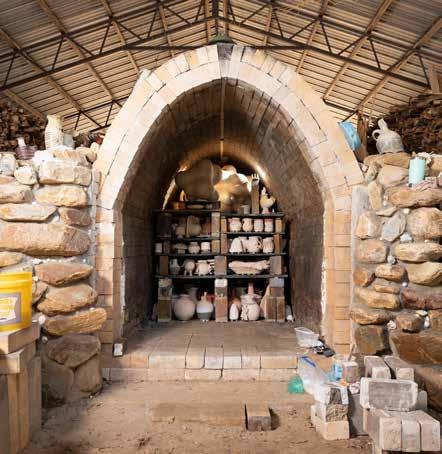
The Gulf Coast Kiln Walk (GCKW) Society is taking their annual walk through history for the 21st WoodStoke Pottery and Kiln Festival.
The WoodStoke Pottery and Kiln Festival is an annual event hosted by the GCKW Society. The festival celebrates the culture surrounding the ceramic arts and traditional wood-fired pottery by unloading historic kilns alongside local and national ceramic artists and selling unique artwork.
Attendees are invited to watch— and even participate in—the kiln unloading, buy handmade pottery from more than 30 potters and enjoy homemade food courtesy of the Navarre Beach Area Garden Club.
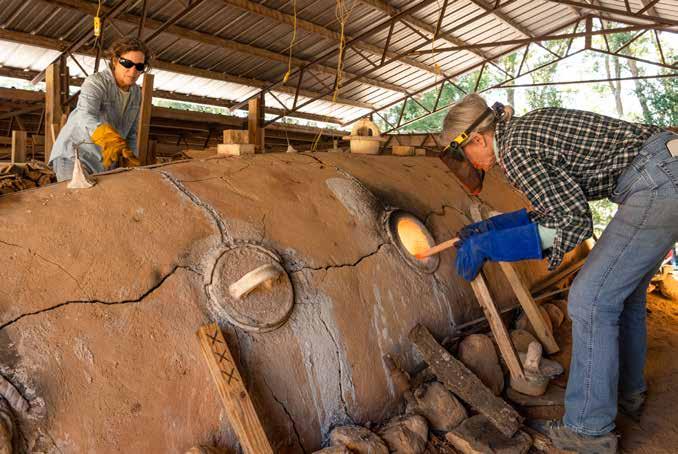
“The festival is a display of the culmination of weeks of collective work by a dedicated community of clay artists,” Pensacola State College (PSC) Assistant Professor of Art (ceramics) Micah Cain said. “The firing is truly a collaborative effort from artists, students and volunteers that all contribute to loading, maintaining and tending the kiln.”
As a participating GCKW artist, Cain actively supports PSC student involvement, working side by side with his students as they load the kilns and rotate through shifts during the multi-day firing process.
“I always enjoy the opportunity to bring PSC students to take part in the Kiln Walk’s annual wood firings,” Cain said. “For many, it is their first encounter with this traditional firing method, making the experience especially meaningful. Additionally, engaging with the broader community of artists and potters reinforces the value of collaboration within our regional arts community.”
While the festival is free to attend, event-goers are encouraged to explore a variety of ceramic art pieces on sale by the potters in attendance.
“We just started, in the last 10 years, setting up so that the participating artists can have their own booth and tables for their art,” co-owner of Holley Hill Pottery and founding member of the GCKW Society Brenda Stokes said. “At a designated time, all the artists can go collect their pieces and bring them to the table. Attendees can write their name and number on a piece of painters tape and stick it on the pieces they are interested in. That
puts it in the artists’ hands to contact interested parties about the sales.”
A limited number of commemorative bowls and mugs will be available for a $20 donation, which includes the chance to sample seafood, chili and other specialty dishes prepared by members of the Navarre Beach Area Garden Club, one of the event’s many sponsors.
Members of the public are invited to help the potters unload the 32-foot wood-fire kiln, passing freshly fired pieces hand to hand to awaiting tables where attendees can browse the pottery for sale and connect with the artists.
“The opening of the kiln is an especially meaningful moment,” Cain said. “Students, fellow artists and members of the community gather for the reveal of the finished work. Sharing in the collective excitement as each unique piece emerges from the kiln and is passed among those present is one of the most rewarding aspects of the annual firings and festival.”
All proceeds from the WoodStoke Festival support the new ceramic art center to be constructed adjacent to the historical kilns. Holley Hill Pottery owners Brenda, Marty and Jason Stokes deeded one acre of their property to the GCKW Society to begin construction on the building.
“The center will be a place where anyone can come and take lessons,” Stokes explained. “We’re going to gear lessons toward elementary age and beyond so that anyone can take art classes.”
The GCKW Society focuses on wood fire kilns over gas or electric due to the environmental benefits.
“We’re going to focus on beginning wood fire kilns, which are easier to operate,” Stokes explained.
“Beyond that, we have four different ways of firing pottery here, from Raku to salt to soda to wood fire. That’s why we call it the Kiln Walks, because you can walk through the history of different kilns.”
The center will be a public learning center for the arts, and it will be open to allow artists to come in and work at their own pace while offering lessons to anyone who is interested.
“The [GCKW Society] offers opportunities for learning, mentorship, and artistic growth for me as well as for PSC students,” Cain said. “The festival is a celebration of shared labor, tradition and the vibrant ceramics community that makes it all possible.”
The 21st annual WoodStoke Festival will be held on February 14 from 9 am to 3 pm at Holley Hill Pottery, located at 7507 Buckeye Dr. in Navarre. The festival is open to all ages, and there is no cost to attend.
For more information about the GCKW Society and its annual WoodStoke Pottery and Kiln Festival, visit their website or check out @GulfCoastKilnWalk on Facebook. Q&A with Steven Dark, 2026 Featured Artist
This year’s WoodStoke Festival featured artist is Contemporary Folk Artist Steven Dark. Dark’s career with sculpture spans more than 30 years as an Alabama Gulf Coast potter and ceramist. He is well-known for his funky, unusual, sometimes somber and humorous pieces. He usually works on a series of six to eight pieces at a time. Dark’s style focuses on throwing his primary forms on the wheel with decorative parts to make some impressive works of art. When the clay is at just the right stage of dryness, he begins the assembly process to create his one-of-a-kind masterpieces. Pensacola Magazine had the wonderful opportunity to talk more with Dark about his work and involvement with the GCKW Society. For more information about Dark or to commission his work, check him out on Facebook @Steven.Dark2. Can you describe your sculpture style, and how you discovered it?
Dark: I discovered my sculpture style with time. I’ve been making pots pretty much my whole life. One thing led to the next. I’ve always been throwing on the wheel. Most sculptors would work on solid clay, which allows them to add and subtract, add and subtract. For my technique, I throw all the parts on the wheel. The piece is hollow from the very beginning. There’s not much room for subtracting. I build these forms up off of various pieces. I’ll sit down for a session or two and make a bunch of different pieces and parts, and then they’ll dry and set to the point when I can handle them without ruining them. There are rules of working with clay that you have to abide by. Clay has to be strong enough to hold itself up, but wet enough where you can still make joints and connections. Once the clay gets too dry, you can’t really join the pieces together. I make the pieces, then I build the forms and add all the details. That would be the face, hair, a costume
of some kind, clothing or anything else. Then, I model the piece like you might think a sculptor would. Part of my style is that the thrown forms dictate the shape of the whole piece. I get a lot of variety that I might not have gotten before. I try not to over plan or overthink the art. This technique allows my pieces to have their own style, separate from what most other people do.
Why is making art important to you?
Dark: It’s a job. It’s funny. I’m trained. I did an informal apprenticeship with a man who talked me into going to college. I have two degrees. I have a bachelor’s of fine art. I have a master’s of fine art. I have a terminal degree in my field, and I think of it like whether I was a doctor, a lawyer, plumber or anything else. It’s my job. I did not want to be a factory worker—I didn’t want to be a number. I didn’t really know what I wanted to do, so the art thing kind of came out of nowhere. Now, I’m hopelessly blue collar because I work like a dog, but I didn’t want to work in a factory. Sort of backfired on me.
What part of your creative process excites you the most, and why?
Dark: I like throwing on the wheel and working the clay to its extent. With sculptures, there’s different ways to work with clay— like hand building and throwing are two different things. You can make coils, you can make slabs, you can pinch. I like to combine all of those things together. The pieces start on the wheel, and the concepts unfold as I work. It’s like constant problem solving. I don’t really try to get an exact likeness, because the forms that come off the wheel may not be exactly like the shape of your head, but still, I can reference other things.
I use a lot of context clues when I do these commissions, and somebody will say, “I’m a retired forensic scientist, I play golf and I have five kids.” I can build all these elements into the sculpture to suggest who it is, and lean on the context as much as or more than photographic likeness. That part is fun, because everyone’s totally different. When a customer requests a piece, I tend to make at least two sculptures and I work on them simultaneously even though they’re the same person. Maybe there are some variations. I’ll send [my clients] pictures along the way, talk to them about the process without giving them too many chances
to make changes and then I let them choose one that resonates with them. How did you get involved with the GCKW Society, and what has been the best part of being a featured artist for the 2026 WoodStoke Festival?
Dark: I have a kind of three legged stool. I teach, I show and sell in galleries, and then I do some outdoor arts and crafts festivals. I met Marty and Brenda really early in my career, and they too did outdoor arts and crafts festivals once upon a time. I heard Brenda talking about this idea she had about the [GCKW Society], but I wasn’t really around at the moment of building the kiln. I didn’t get to participate the very first time, but I’ve been in on it every other time since then. I’ve been involved in over 20 firings [of the kiln], basically since the start of it. I was pretty reluctant about being this year’s featured artist. I had a lot of work this year, and it kept me from getting started on this project until late. I made a lot of pumpkins this summer and that spawned right off into Christmas stuff. And all those commissions took so long that I got a late start getting ready for this kiln. I still have some nice stuff to put in there, but I wish I had more. I would much rather just be the guy carrying the wood and throwing it in the oven. I like firing the kiln. The process is probably the most important part of it. It’s an extremely arduous process. It’s labor intensive, and we burn a lot of wood to make the kiln get to the right temperature. It’s a big old longer, and it takes a lot of people. There’s a lot of hands on deck, there’s a lot of coordination, and a part of the excitement is the camaraderie and the team building that comes through. Looking to the future, what goals do you have for yourself and your art? Dark: I always want to reflect on what I’m doing and improve on it. Every time I sit down to start a new cycle, I’m building off the one before it. My ideas have all been growing off of each other for all these years. I’ve probably got 15 different things or more in my portfolio that I’d like to make. The portraits are just one of them, but that’s what I’ve been focused on most lately. And so, the goal is just to continue to improve and try to stay excited after all this time. I’ve been married to clay, basically, for 40 years, so some days I have to manufacture excitement, and some days it comes more naturally.■
Photos courtesy of Santa Rosa County Tourist Development Office
PLEASE CHOOSE THE SUMMATION WEEKLY FOR ALL YOUR LEGAL NOTICES
The Summation Weekly, a publication of the Escambia-Santa Rosa Bar Association (ESRBA) produced in partnership with Ballinger Publishing, offers highly competitive insertion rates and a way to indirectly support your local bar association.
The Summation Weekly is a subscription-based community newspaper circulated to ESRBA members and made available to the general public throughout Escambia and Santa Rosa counties. The publication satisfies Fla. Stat. 50.031, which governs the requirements for publication of legal notices. In addition to the published weekly newspaper,
The Summation Weekly website –summationweekly.com satisfies Fla. Stat. 50.0211, which requires all legal notices to be made available online and on the state registry – floridapublicnotices.com.
Ballinger Publishing manages the day-to-day operations of the publication. Darien Hardy is the contact person for legal notices. She can be reached at 433-1166, ext. 25 or legals@ballingerpublishing.com.
Thank you for your support. Choosing The Summation Weekly generates non-dues revenue that helps subsidize programs and services provide to members of the EscambiaSanta Rosa Bar Association.
CONTINUING LEGAL EDUCATION ONLINE LIBRARY: CLE.ESRBA.COM
ESRBA’s CLE Library is now digital! Go to cle.esrba.com to get your credits. Each download comes with the audio from the seminar, the PowerPoint/handouts, and the CLE Certificate of Accreditation from The Florida Bar. The audio can be downloaded in any file type that you would like including MP3, FLAC, ALAC, AAC, Ogg Vorbis, WAV, and AIFF formats. For your convenience and ease of listening, the seminars can also be streamed directly from the library.
If you are interested in presenting a CLE seminar or being recorded for a CLE accredited podcast, please email esrba@esrba.com.
Continuing Legal Education (CLE) Audio Library
Cost: $15 per credit – ESRBA members, $25 per credit –nonmembers
Top Ten Probate Pitfalls
CLE Credits: 1 Elder Law and 1 Wills Trusts Estates
Ethics and Stored Data
Legislation in Florida
Cellphone Forensics CLE Credits: 1.0 General
Car Wreck to Product Liability CLE Credits: 1.0 General
Heir’s Property for Probate CLE Credits: 1.0 General
Practical Tips for Mediation CLE Credits: 1.0 General
Equitable Distribution Credits: 1.0 General
1.0 General
Basic Estate Planning
Credits: 1 General
10 Things to Know About AI CLE Credits: 1 Technology
Cybersecurity for Professionals CLE Credits: 1.0 Technology
Portability and Property Tax
Credits: 1.0 General


In Celebrating our Newest Members

to Morgan@ballingerpublishing.com. Submissions must include the organization’s name and details about events including times, dates, locations and any costs involved. Contact information also is required. All submissions are subject to editing to comply with established standards. Items should be submitted at least one week in advance. Deadline is noon Friday for the following publication.








2025 STATE OF THE COUNTY ADDRESS
Santa Rosa County began 2025 with an unprecedented snowfall across Northwest Florida, an uncommon event that tested our preparedness and highlighted the resilience of our community. Thanks to swift coordination among our public safety team and partner agencies, essential services continued. Beyond that historic moment, our public safety team trained well over a thousand people at agencies from all over the state and various agencies with their original training table-top simulation, Critical Moves. This simulation helps first responders and other agencies walk through some of the most stressful and possibly devastating events in a simulation format. 2025 was defined by progress, partnership, and a shared commitment to making Santa Rosa County an even better place to live, work, and visit, with meaningful accomplishments made possible by our dedicated staff, elected leaders, and residents.
Our Public Works team continued to deliver essential services that keep Santa Rosa County moving. In 2025, crews resurfaced 31.2 miles of roadway and paved 3.69 miles of dirt roads, enhancing safety and connectivity for residents throughout the county. They completed 4,751 citizen service requests; maintenance efforts included cleaning and mowing 300 retention ponds, cleaning more than 82,000 linear feet of drainage ditches, . Behind the scenes, the county shop completed 1,348 preventative and routine vehicle repairs, keeping our fleet safe and reliable.
Economic growth remained strong in 2025. We celebrated the opening of the Leonardo Helicopters Florida Support Center at Whiting Aviation Park, bringing highskill jobs and long-term investment to our region. The Honoring Our Heroes Career Fair connected veterans and job seekers with employers, reinforcing our commitment to workforce development. Major milestones included the I-10 Coastal Commerce Center groundbreaking in Milton, along with new developments like Damian’s Ice Cream and ATL Cold Storage, helping diversify and strengthen our local economy.
Protecting our natural resources remains a top priority. The Navarre Beach Renourishment Project helped preserve our coastline for future generations. Santa Rosa County was also awarded a $21.7 million water quality improvement grant from the Florida Department of Environmental Protection to convert
USA
up to 900 residential septic tanks to connections to municipal sewer systems in partnership with local water utilities. Additional efforts included the Soundside Drive Land Conservation project and continued success with Household Hazardous Waste and Waste Tire Amnesty Days, keeping harmful materials out of our environment and communities.
Tourism reached new heights in 2025.
Southern Living named Navarre Beach one of the South’s Best Beach Towns, while Coastal Living recognized it as one of the Best Places to Live on the Coast. These honors, paired with strong tourism numbers throughout the year, reflect the appeal of Santa Rosa County as both a destination and a hometown.
Santa Rosa County brought back the RISE Internship Program for Summer 2025, investing in the next generation of public servants. The Board of County Commissioners approved the implementation of transportation impact fees, expanded the Rural Protection Zone, and convened a temporary Citizens’ Land Development Code Task Force to provide targeted updates and recommendations for the county’s Land Development Code, ensuring thoughtful, community-driven growth.
Our library system continued to serve as a cornerstone of community connection. In 2025, the Pace Library celebrated the opening of a new meeting room, creating additional space for learning, collaboration, and civic engagement.
Enhancing quality of life remained a priority in 2025 as the county continued investing in parks and recreation. New pickleball courts were completed at Lenny James Tolbert Memorial Park and the Pace Athletic Complex, along with a fitness court and playground at the Navarre Sports Complex, creating more opportunities for residents to stay active. The county also completed the design of the South Santa Rosa Soccer Complex, moving the project closer to construction, and began construction on Allentown Community Park, expanding access to outdoor spaces across Santa Rosa County.
As we look ahead, Santa Rosa County remains focused on smart growth, environmental stewardship, and exceptional public service. Thank you to our residents, staff, and partners for making 2025 a year of progress. Together, we are building a stronger, more resilient Santa Rosa County—today and for generations to come.
HEALTH PROVIDENCE HOSPITAL FIRST TO BRING LIFESAVING ECMO CARE TO MOBILE
USA Health Providence Hospital has launched a new program that brings lifesaving care closer to patients in southwest Alabama. The West Mobile hospital now offers Extracorporeal Membrane Oxygenation (ECMO), an advanced therapy that temporarily supports the heart and lungs for patients with severe, potentially reversible cardiac or respiratory failure.
“As the leading academic health system serving the upper Gulf Coast, USA Health has a responsibility to bring the highest level of care to our region,” said Natalie Fox, DNP, CEO of USA Health. “The addition of ECMO at Providence Hospital means critically ill patients no longer have to leave their community to access this lifesaving technology.”
This program is funded in part by the State and Local Fiscal Recovery Funds (SLFRF) program under the American Rescue Plan Act (ARPA), administered by the Mobile County Commission. The Mobile County Commission received approximately $80.26 million in SLFRF funds to address pandemic-related public health challenges, infrastructure needs, and economic recovery. The county commission’s Strategic Spending Plan guided investments toward projects with a direct impact on health and safety, including ECMO services.
“The launch of the ECMO program at USA Health Providence Hospital is a major step forward for healthcare in Mobile County,” said Randall Dueitt, District 3 commissioner. “By investing in advanced, lifesaving services like this, we’re ensuring that our residents can receive the highest level of critical care close to home when every minute matters.” ECMO temporarily takes over the work of the heart and lungs by circulating blood through a pump and oxygenator, adding oxygen, and removing carbon dioxide. While it does not treat the underlying disease, ECMO provides critical support while organs recover or serves as a bridge to transplant or other definitive therapies.
CONGRESSMAN PATRONIS & FLORIDA COMMISSIONER OF AGRICULTURE WILTON SIMPSON ISSUE STATEMENTS ON BLACKWATER RIVER STATE FOREST FIRES
Today, Congressman Jimmy Patronis and Florida Commissioner of Agriculture Wilton Simpson issued a statement regarding the Blackwater River State Forest Fires in Santa Rosa County. Both leaders urged area residents to stay vigilant, listen to area officials, and make fire safety a top priority as areas throughout the Florida panhandle are dry and susceptible to fires.
“Colder temperatures don’t eliminate wildfire danger. Dry air and seasonal winds can create conditions that allow fires to spread rapidly,” said Congressman Patronis. “Thanks to Florida’s prescribed burn program, this fire was far less intense than it could have been. That proactive approach is paying off by protecting lives, property, and our natural resources. We are heading into what is shaping up to be an active wildfire season statewide. I urge residents to reduce debris around their homes, remain alert to fire conditions, and follow all burn restrictions. I want to thank Agriculture Commissioner Wilton Simpson and the Florida Forest Service for their strong leadership and continued commitment to responsible land management and wildfire prevention across Florida.”
Florida Commissioner of Agriculture Wilton Simpson said, “These fires are a reminder that wildfire risk is a reality across Florida, especially under dry and windy condi-
tions. I’m proud of our folks with the Florida Forest Service and the local first responders who are working tirelessly to contain multiple fires and protect nearby communities. Florida’s prescribed fire program – the best in the world – plays a critical role in reducing fuel loads and helping limit the intensity of wildfires, and it’s one of the reasons these fires are being managed effectively. As dry conditions persist statewide, I urge Floridians to follow burn restrictions, stay alert, and take wildfire prevention seriously.”
At midnight on February 2, 2026, a wildfire was reported in Blackwater River State Forest near Milton. The incident includes two active burn areas, a 260-acre fire north of I-10 and east of Avalon Boulevard, and a separate 30-acre fire located on an island in the Blackwater River. Santa Rosa County first responders and the Florida Forest Service responded immediately, and thanks to their bravery and dedication, the primary fire is now 80% contained.
Wildfires are uncontrolled fires burning in natural areas like forest, grassland, or a shrubland that are extremely dangerous to the public and natural environments.
Top three causes of wildfires in Florida are:
• Arson/Incendiary
• Escaped Debris Burning
• Lightning
ESCAMBIA COUNTY EXTENSION COUNCIL SEEKS VOLUNTEERS FOR
ZONES 1-12
The Escambia County Board of County Commissioners is seeking Escambia County residents interested in volunteering to be considered for an appointment to the Escambia County Extension Council for zones 1-12. Escambia County residents interested in serving on the Escambia County Extension Council, who meet the requirements noted in the job description below, are asked to submit an information sheet indicating their desire to serve by 5 p.m. on Friday, Feb. 20.
Information sheets should be submitted to:
Tina Jones
3740 Stefani Road
Cantonment, FL. 32533
Zones and locations:
• Zone 1: North intersection of Highway 164 and Highway 97
• Zone 5: North side of Quintette Road to the south side of Molino Road
• Zone 6: South side of Quintette Road to the north side of Kingsfield Road
• Zone 7: Nine Mile to Kingsfield Road
• Zones 8-12: At large
“USA Health is fulfilling a promise to our community by providing world-class care, right here at home,” said Rick Metzger, MMHC, BSN, CEO of Providence Hospital. “Having timely access to this advanced treatment will save more lives and allow patients to have the comfort and support of their family and support system as their body heals during times of extreme illness.”
Prior to this initiative, no healthcare providers in Mobile or Baldwin County offered ECMO services, requiring patients to travel to Birmingham or out of state, often at significant risk and inconvenience. USA Health is fulfilling the urgent need to provide local access to advanced cardiopulmonary care.
“Our ability to integrate specialized clinical care, education, and research allows us to deliver complex therapies that significantly improve outcomes for patients across the Gulf Coast,” Fox said.
The service is supported by a 24/7, ECMO-trained multidisciplinary team, including surgeons, critical care physicians, perfusionists, ICU nurses, and respiratory therapists, with streamlined referral and transfer processes.
“As we strive to deliver the most advanced cardiothoracic care in our region, having ECMO support will allow our team of highly skilled physicians to take on the most complex patient cases right here in our community,” Metzger said. “This is just one more example of USA Health's commitment to helping people lead longer, better lives.”
About USA Health Providence Hospital
Part of USA Health, the academic health system for the University of South Alabama, the Flagship of the Gulf Coast, Providence Hospital is a full-service 349-bed hospital providing 24/7 emergency care and a level III trauma center as well as exceptional birthing services, surgical procedures and specialty care to residents in the region.
• Zone 2: South of the intersection at Highway 164 and Highway 97 to the north side of Tungoil Road
• Zone 3: South side of Tungoil Road to the north side of Gibson Road at Highway 97 Zone 4: South side of Gibson Road at Highway 97 to the north side of Molino Road
The Escambia County Extension Council was established in accordance with Chapter 67-1366, Section I- 8 Florida Statutes. The purpose of this council is to study the needs of the county in developing its natural resources, its families and youth; to provide for the organization of planning committees in various agricultural commodities, in youth and in all phases of home economics important to Escambia County; to provide for close liaison between the committees, county extension agents and the council; and to coordinate the reports of all committees into a single Escambia County resource development program designed to develop the county’s resources and its people through programs for which the Cooperative Extension Service has a responsibility for initiating or coordinating. Council members serve a two-year term of office.
UF/IFAS ESCAMBIA COUNTY EXTENSION COUNCIL MEMBER JOB DESCRIPTION
All Zones
General Description
Represent your organization that serves the people of Escambia County. Share their needs and concerns. Serve as a catalyst and leader in shaping the vision for Extension in support of Escambia County citizens within the scope and mission of UF/IFAS Extension.
Specific Responsibilities
Attend quarterly council meetings as scheduled.
• Seek out needs and issues of clientele you represent.
• Learn about all programs of Extension.
• Advocate for Extension as opportunities arise.
• Suggest resources to contribute to Extension educational programs.
• Contribute personal expertise, information, and time as available and needed to support Extension's efforts in Escambia County.
Time Required
• Two-year term of membership.
• May be eligible for a second term.
• 4-6 council meetings per year; 1-2 hours in length.
• Committee meetings as assigned.
Resources Available Extension Council guide
• Extension staff
• Escambia Extension Agents' Plan of Work reports
• Extension educators within the region
• Regional and State Advisory Councils Training Opportunities
Several training opportunities, including orientation, are available to council members throughout their term of service. This council operates under the Florida Sunshine Law and members are required to attend training provided by the Escambia County Attorney's staff at a regularly scheduled Extension Council meeting.
Organizational Relationships
Council members work primarily with the County Extension Director. There is generally regular interaction with Extension Agents and also staff members, as well as Extension educators who serve Escambia County. Council members may be asked for input from the regional Extension Director or other members of UF administration.
Qualifications:
• Live in the geographic area noted.
• Interest in enhancing the educational efforts of Escambia County.
• Ability to work collaboratively in an advisory capacity with Extension staff and volunteers.
BAPTIST HEALTH CARE CELEBRATES 75 YEARS
Baptist Health Care is celebrating 75 years of compassionate care and unwavering commitment to the community since opening its doors in 1951.
The founders of the organization had a bold vision to transform health care in the community, and Baptist Health Care has evolved from a single hospital into a health system that continually enhances access and services. Today, locations and services span Northwest Florida and include three hospitals, four medical parks, the Andrews Institute, the area’s largest primary care group and a robust specialist provider network. As the area’s only remaining locally rooted health care system, Baptist draws on its knowledge of and connection within the community to adapt rapidly and meet the community’s ever-changing health care needs.
“Our 75th anniversary is more than a milestone—it’s a testament to the trust our community has placed in us,” said Mark Faulkner, president and CEO of Baptist Health Care. “We are honored to have cared for generations and remain focused on advancing health care for decades to come.”
Today, more than 4,500 team members make Baptist one of the largest employers and a significant economic driver in Northwest Florida. Salaries and wages ripple through the local economy, reinforcing Baptist’s role
as a cornerstone of the community. Baptist’s commitment to care includes caring for vulnerable populations. In 2025 alone, Baptist Health Care provided more than $65 million in charity care.
Over the years, Baptist has earned accolades from CMS, Forbes, Newsweek and U.S. News & World Report, but the greatest honor remains the enduring trust of the community.
While Baptist Health Care’s official anniversary date is October 17, festivities and reflections will be held throughout the year. Baptist will share stories that celebrate the past contributions, present-day achievements and the future of care in our community at ebaptisthealthcare.org. If you’d like to share a personal story about your experience with Baptist, please visit their website and click on the 75th anniversary banner.
About Baptist Health Care
Baptist Health Care is a not-for-profit health care organization based in Northwest Florida that is committed to helping people throughout life's journey. Baptist continuously strives to be a national leader in quality and service. Baptist Health Care includes three hospitals, four medical parks, Andrews Institute for Orthopaedics & Sports Medicine and a large network of primary care and specialty physicians. Baptist Health Care is one of the largest non-governmental employers in Northwest Florida.
NAVARRE BEACH BRIDGE LANE CLOSURES FOR ROUTINE INSPECTION FEB. 18-19
The Navarre Beach Bridge will experience temporary lane closures between 9 a.m. and 4 p.m. on Wednesday, Feb. 18 and Thursday, Feb. 19, for the Florida Department of Transportation
to perform routine bridge inspections. Drivers are reminded to use caution, follow signage and flagger instructions, and obey the posted speed limit when traveling through the work zone.
SANTA ROSA ANIMAL SERVICES LAUNCHES 2026-27 KENNEL SPONSORSHIP INITIATIVE
Santa Rosa County Animal Services has launched 2026-2027 kennel sponsorships, a fundraising effort to help care for animals at the shelter who are waiting for their forever homes.
“Our kennel sponsors make a direct, meaningful impact on animals who need extra medical care,” said Animal Services Chief Randy Lambert. “Thanks to the strong community response we’ve seen, we’re looking forward to another year of partnerships that truly change lives at the shelter.”
Cat Kennel Levels:
• Gold Level - $350
• Silver Level - $250
• Bronze Level - $150
Dog Kennel Levels:
• Gold Level - $500
• Silver Level - $400 Bronze Level - $300
Sponsors will receive:
• Kennel Signage
• Sponsorship listing on the SRCAS website
• *Gold-level sponsors will receive an SRCAS tumbler*
• Sponsorship certificate
• Surprise gift!
• 'Thank you' post on social media Contact Tara DeAguilera at 850-530-5128 or tarad@santarosa.fl.gov for more information.
About Santa Rosa County Animal Services Santa Rosa County Animal Services' mission is to build a society where every animal is treated with compassion; we provide humane shelter and care for the approximately 3,500 lost, displaced and victimized animals who enter our doors every year. Our services protect animals and educate the community through outreach, intervention, and enforcement. To learn more, visit santarosa.fl.gov/animals.
CONGRESSMAN PATRONIS
& FLORIDA
COMMISSIONER OF AGRICULTURE WILTON SIMPSON ISSUE STATEMENTS ON BLACKWATER RIVER STATE FOREST FIRES
Today, Congressman Jimmy Patronis and Florida Commissioner of Agriculture Wilton Simpson issued a statement regarding the Blackwater River State Forest Fires in Santa Rosa County. Both leaders urged area residents to stay vigilant, listen to area officials, and make fire safety a top priority as areas throughout the Florida panhandle are dry and susceptible to fires.
“Colder temperatures don’t eliminate wildfire danger. Dry air and seasonal winds can create conditions that allow fires to spread rapidly,” said Congressman Patronis. “Thanks to Florida’s prescribed burn program, this fire was far less intense than it could have been. That proactive approach is paying off by protecting lives, property, and our natural resources. We are heading into what is shaping up to be an active wildfire season statewide. I urge residents to reduce debris around their homes, remain alert to fire conditions, and follow all burn restrictions. I want to thank Agriculture Commissioner Wilton Simpson and the Florida Forest Service for their strong leadership and continued commitment to responsible land management and wildfire prevention across Florida.”
Florida Commissioner of Agriculture Wilton Simpson said, “These fires are a reminder that wildfire risk is a reality across Florida, especially under dry and windy condi-
PENSACOLA AND PERDIDO BAYS ESTUARY PROGRAM AWARDED $750,000 GRANT TO ESTABLISH WATER QUALITY MONITORING COLLABORATIVE
The Pensacola and Perdido Bays Estuary Program (PPBEP) is pleased to announce the U.S. Environmental Protection Agency’s (EPA) Gulf Program has awarded a $750,000 grant to support the development of a regional Water Quality Monitoring Collaborative.
This collaborative effort will establish a comprehensive network of sentinel water quality monitoring sites across the Pensacola and Perdido Bays watersheds. Project partners include Escambia, Santa Rosa and Okaloosa counties, the City of Orange Beach, and the Poarch Band of Creek Indians.
Over the next three years, the program will collect monthly water quality data at approximately 30 sites, building on existing water quality monitoring efforts, standardizing water quality monitoring parameters and methods and ensuring consistent and comparable data across the watersheds. Data collection includes nutrient and bacteria parameters, key indicators of water quality conditions. These data will feed into PPBEP’s biennial State of the Bays Report, support the launch of a new public-facing water quality dashboard, and guide development of a water quality improvement action plan aimed at making the region’s waters swimmable and fishable
Establishing a coordinated water quality monitoring network was a priority action of PPBEP’s first Comprehensive Conservation and Management Plan (CCMP), which provides a roadmap for improving the health and resilience of our watersheds and communities. Long-term, standardized monitoring of
the Pensacola and Perdido Bays watersheds is critical for tracking environmental conditions and trends, measuring progress toward restoration goals, and informing local decision making.
The Water Quality Monitoring Collaborative will improve transparency and accessibility by making it easier to share water quality results with the public, partners, and decision makers. Local communities have continually expressed an interest in the health of their local waterways for fishing, swimming, and recreation. The new dashboard will help visualize water quality information in a clear and meaningful way - educating, informing, and connecting communities to the bays they care about.
“This collaborative came together as a direct result of several engagements with our Technical Committee and regional partners that expressed the need for consistent and comprehensive water quality monitoring,” said Whitney Scheffel, Senior Scientist with PPBEP. “By working together and standardizing how we monitor our waters, we can better track progress and support meaningful restoration efforts.
The mission of the Pensacola and Perdido Bays Estuary Program is to restore and protect the Pensacola and Perdido Bay watersheds through restoration, education, and unbiased monitoring of our bays, estuaries, and watersheds. PPBEP serves as a trusted source for residents, businesses, industry, and the community on issues relating to preserving, restoring, improving, and maintaining the natural habitat and ecosystems of the bays, estuaries and watersheds of Pensacola and Perdido Bays.
CITY TO HOST FINAL OPEN HOUSE FOR LAND DEVELOPMENT CODE UPDATE FEB. 17
The City of Pensacola will hold its third and final open house Tuesday, Feb. 17, offering the public an opportunity to provide feedback on the second draft of the updated Land Development Code.
The draft incorporates recent feedback from the Architectural Review Board, city staff, Planning Board, previous public workshops and the project website.
“This update represents a long-overdue, comprehensive review of the city’s Land Development Code," Planning and Zoning Division Manager Cynthia Cannon said. "While the city’s first zoning ordinance was adopted in 1947 and has been amended many times since, this is the first time the code has been evaluated holistically in its entirety.”
The LDC governs zoning, development review, subdivisions, parking, landscaping, and more, shaping how our city grows and evolves. Residents, property owners, and any other stakeholders who use the LDC are encouraged to join us and share their opinions at this public event.
Open House Date: Tuesday, Feb. 17
Time: 3 p.m. - 6 p.m.
Location: Pensacola City Hall, Hagler-Mason Conference Room, 222 W. Main St.
Please note that this event will be a dropin open house. No formal workshop activities are planned. Why Update the Land Development Code?
The city is updating its LDC for the first time since 1947 to eliminate duplications, clarify standards, modernize outdated regulations, and improve overall usability. By incorporating community input and addressing neighborhood-specific needs, the updated LDC will better reflect local priorities, support sustainable growth, and align with current industry practices.
Visit the project website at the address inspire-engagement.com/pensacola-ldc to learn more, read the first draft, or review the project schedule. For questions about the project or upcoming events, please contact the Pensacola Planning & Zoning at (850) 435-1670 or PensacolaLDC@cityofpensacola.com.
tions. I’m proud of our folks with the Florida Forest Service and the local first responders who are working tirelessly to contain multiple fires and protect nearby communities. Florida’s prescribed fire program – the best in the world – plays a critical role in reducing fuel loads and helping limit the intensity of wildfires, and it’s one of the reasons these fires are being managed effectively. As dry conditions persist statewide, I urge Floridians to follow burn restrictions, stay alert, and take wildfire prevention seriously.”
At midnight on February 2, 2026, a wildfire was reported in Blackwater River State Forest near Milton. The incident includes two active burn areas, a 260-acre fire north of I-10 and east of Avalon Boulevard, and a separate 30-acre fire located on an island in the Blackwater River. Santa Rosa County first responders and the Florida Forest Service responded immediately, and thanks to their bravery and dedication, the primary fire is now 80% contained.
Wildfires are uncontrolled fires burning in natural areas like forest, grassland, or a shrubland that are extremely dangerous to the public and natural environments.
Top three causes of wildfires in Florida are:
• Arson/Incendiary
• Escaped Debris Burning
• Lightning
Escambia County’s Construction Management Division is preparing to begin construction on the O.C. Phillips Bridge Replacement Project, replacing the existing bridge on O.C. Phillips Road.
Construction is scheduled to begin February 2026 and includes a full replacement of the bridge. The roadway will remain open during construction via a temporary bridge. Drivers should use extra caution and follow road crew instructions and posted signs when traveling through the work zone.
The project is expected to be completed by summer 2027, weather permitting. If roadway closures are necessary or work is delayed, another notice will be issued.
The O.C. Phillips Bridge Replacement Project is performed in partnership with the Florida Department of Transportation. The project is funded by Local Option Sales Tax, FDOT, and RESTORE funds, with construction costs totaling $5,032,813. Murphree Bridge Corporation is the primary contractor.
Community News Submissions Have a community event or announcement? You can submit information for possible publication in Community by sending an e-mail to Morgan@ballingerpublishing. com. Submissions must include the organization’s name and details about events including times, dates, locations and any costs involved. Contact information also is required. All submissions are subject to editing to comply with established standards. Items should be submitted at least one week in advance. Deadline is noon Friday for the following publication. The Summation Weekly publishes local and legal news every Wednesday and is distributed throughout Escambia and Santa Rosa counties at numerous locations.
GULF WINDS WELCOMES JACQUIE BOLINGER
AS VICE PRESIDENT OF ACCOUNTING AND CONTROLLER
Gulf Winds Credit Union is proud to announce that Jacquelyn “Jacquie” Bolinger has been named Vice President of Accounting and Controller. In this role, Bolinger will oversee Gulf Winds’ Accounting Department, managing all financial systems and day-today operations, supporting financial planning and analysis, and ensuring compliance with all regulatory standards.
With an extensive background in leading financial teams, Bolinger is prepared to grow and strengthen Gulf Winds’ accounting team and build the department strategy. She brings deep experience in financial modeling, portfolio management, monthly financial budgeting, forecasting and reporting, and audit and examiner relations.
“We are excited to bring Jacquie onboard and have her as part of our senior leadership team,” said Brad Tanberg, Chief Financial Officer of Gulf Winds Credit Union. “She brings a wealth of knowledge in both accounting and finance, and I look forward to seeing her develop our accounting team and drive operational excellence.”
As founder of several community service programs in the area including Eyes on a Better Tomorrow at the Retina Specialty Insti-
tute, and Meraki in Motion at Meraki Solar, Bolinger has a demonstrated passion for leading initiatives for those who are underserved in the community. Her dedication to supporting those around her aligns with the Gulf Winds core values and reflects her commitment to honest, caring leadership.
“I’m so excited to join Gulf Winds and make an impact on the members and communities we serve,” said Bolinger. “Strong financial leadership is often behind the scenes, but it is essential in giving members the experience they deserve, and I’m honored to join a credit union that values the importance of strategy, stewardship, and service.”
About Gulf Winds Credit Union
Since 1954, Gulf Winds Credit Union has offered products and services that Move Members Forward . As a full-service financial organization, Gulf Winds provides 12 branch locations, digital banking, nationwide surcharge-free ATMs, and the support of more than 240 knowledgeable employees committed to delivering exceptional service. Gulf Winds is also renowned for its community involvement. Membership is open to anyone who lives, works, worships, or attends school in North Florida, Southern Alabama, and Southern Georgia.
NAS PENSACOLA CLOSED TO PUBLIC VISITATION
Due to a lapse in government funding beginning Feb. 1, Naval Air Station (NAS) Pensacola’s areas of public interest are closed until further notice.
Installation areas of public interest – including the National Naval Aviation Museum (NNAM) and the Pensacola Light-
house and the National Parks Service’s Fort Barrancas – are closed until further notice.
Department of Defense (DoD) identification card holders will still be able to access the installation through either the Main Gate – at the south end of Navy Blvd. – or through the West Gate – at the south end of Blue Angel Parkway.
COX COMMUNICATIONS INVITES LOCAL NONPROFITS TO APPLY FOR COX CHARITIES GRANTS
Cox Communications is excited to announce that applications are now open for the 2026 Cox Charities Community Investment Grants. Local nonprofit organizations across the Gulf Coast are encouraged to apply by Monday, March 2, 2026, at coxcharitieseast.org.
Each year, Cox employees contribute to Cox Charities through recurring payroll donations and one-time gifts. These employee-driven funds are then awarded annually to nonprofits that support key focus areas, including:
• Youth innovation programs centered in Science, Technology, Engineering, Arts, and Math (STEAM)
• Conservation and environmental sustainability initiatives
• Efforts advancing equal opportunity These grants complement the ongoing
sponsorship support Cox provides to Gulf Coast nonprofits throughout the year.
“What makes these grants special is that they are both employee-funded and awarded based on selections made by an employee committee,” said David Deliman, market vice president for Cox Gulf Coast. “The significant impact of Cox Charities reflects the dedication to our communities and the strong partnerships we've established with local nonprofits.”
Through Cox Charities, employees help strengthen local communities and support the next generation in leading happier, more connected, and more sustainable lives.
Nonprofits doing impactful work in STEAM education, advancing equal opportunity, or sustainability are encouraged to apply before the March 2 deadline. To learn more or submit an application, visit the website coxcharitieseast.org.
LOCAL ICE DANCERS COMPETE IN CLEARWATER
Local ice dancers Houston and Cameron Konetzki from Gulf Breeze, Florida competed in the 33rd Annual Orange Blossom Open Competition which was held July 11-14. The event was hosted by the Tampa Bay Skating Club and held at the Clearwater Ice Arena in Clearwater, Florida.
Competing both their Ten Fox Pattern Dance Programs and Free Dance Programs in the Juvenile Combined Solo Dance Division, Cameron finished in 6th place and Houston finished 8th. Additionally, Cameron competed his Ten Fox and Willow Waltz Variation Dance in the Bronze Solo Pattern Dance Category, earning a personal best score, and placing 5th.
Houston competed his Fourteenstep and European Waltz Variation in the Pre-Silver Solo Pattern Dance Category, earning a personal best score, and placing 2nd. Currently, Houston is ranked 6th on the East Coast and is qualified for the National Solo Dance Final.
Houston and Cameron are both preparing to compete in Salt Lake City, Utah in August.
The U.S. Figure Skating Solo Dance Series runs March to September, with the 2024 National Solo Dance Final being held in Wesley Chapel, Florida.
Both boys are associate members of the Greater Pensacola Figure Skating Club and travel to train in Orlando and Northern Virginia during Pensacola’s off-season.
DR. GRIER WILLIAMS SCHOOL OF MUSIC PRESENTS THE UWF JAZZ
The University of West Florida Dr. Grier Williams School of Music will present the UWF Jazz Ensemble and Combo in concert. The UWF Jazz Ensemble will perform on Thursday, Feb. 12, at 7 p.m. in the Commons Great Hall on the UWF Pensacola campus. The UWF Jazz Combo will perform on Thursday, Feb. 19, at 7:30 p.m. in the Rolfs Music Hall at the Center for Fine and Performing Arts on the UWF Pensacola campus.
Join the UWF Jazz Ensemble and the UWF Jazz Combo under the direction of Dr. Joseph T. Spaniola for two performances of small and
COUNTY SEEKS APPLICATIONS FOR AFFORDABLE HOUSING ADVISORY COMMITTEE
The Escambia County Board of County Commissioners is soliciting applications for persons interested to serve as a representative to the Escambia-Pensacola Affordable Housing Advisory Committee for the term April 2026 through Dec. 31, 2029. All applications must be received no later than 3 p.m. on Friday, March 6 for consideration.
Completed applications should be forwarded to: Escambia County Neighborhood and Human Services Department Neighborhood Enterprise Division/AHAC Attn: Garett R. Griffin 221 Palafox Place, Suite 305 Pensacola, FL 32502
Please note that applications submitted for consideration are subject to public records requests and are included in Escambia County Commission meeting information, including the agenda and official meeting minutes.
The committee was established per F.S. 420.9076 for the purpose of reviewing affordable housing incentives available within the county and to make recommendations concerning those incentives to the Escambia County Board of County Commissioners and Pensacola City Council. The committee will also help in the development of the Local Housing Assistance Plan for the State Housing Initiatives Partnership program.
The Board is seeking to fill seven slots from the following categories:
• One citizen who is actively engaged in the residential home building industry in connection with affordable housing
• One citizen who is actively engaged in the banking or mortgage industry
• One citizen who is a representative of those areas of labor actively engaged in home building in connection with affordable housing
• One citizen who is actively engaged as an advocate for low-income persons in connection with affordable housing
• One citizen who is actively engaged as a
for-profit provider of affordable housing
• One citizen who is actively engaged as a real estate professional in connection with affordable housing
• One citizen who is actively engaged as a not-for-profit provider of affordable housing
• Citizen who resides in Escambia County
• One citizen who represents employers within the jurisdiction
• One citizen who actively serves on the local planning agency
• One citizen that represents essential personnel, which is defined as individuals permanently employed by a company or organization located within Escambia County, the City of Pensacola or the Town of Century as:
○ Local or state law enforcement; fire, rescue, and emergency services; public safety and emergency management
○ Teachers, educators, and school district personnel in the public, private, or university systems
○ Healthcare professionals and support personnel
○ Tourism industry professionals and employees
○ Judicial/court system management and support personnel
○ Skilled building trades personnel
The AHAC must have at least 8 and no more than 11 members representing at least six categories identified in the statute. Per statute, the local government(s) must also appoint an elected official to the committee. Both Escambia County and the City of Pensacola have chosen to appoint a representative.
The committee will meet monthly during review and development of the affordable housing incentives and the new Local Housing Assistance Plan and at least quarterly thereafter. Members will serve three-year terms unless a position is filled mid three-year cycle. Positions will be recommended to the board for approval in January.
I-COUNT EVENT CONNECTS HOMELESS WITH VALUABLE RESOURCES
Opening Doors Northwest Florida and Escambia County collaborated to host the 2026 I-Count Homeless Connect Event Thursday, Jan. 29, which drew approximately 175 attendees and over 50 vendors to help connect homeless individuals with valuable community resources and services.
The event took place at the Brownsville Community Center, with vendors offering a variety of free services including haircuts, immunizations, health screenings and more. The Escambia County Tax Collector's Office also issued 60 Florida IDs during the event, which are essential for individuals who are seeking jobs or taking other steps toward becoming self-sufficient. Olive Baptist Church and Overflow Health Alliance provided lunch during the event, donating approximately 300 meals to I-Count attendees.
Opening Doors Northwest Florida Executive Director Bruce Cady said the goal of the I-Count event is efficiency and convenience, by providing resources in a one-stop shop location for those experiencing homelessness.
“It’s very humbling to see so many highquality service providers gathered here for the common good,” Cady said. “The parking lot was full, which is a wonderful testament to the local leaders and the community at large. We had such a great turnout of service providers, and I love seeing the community come together to serve our fellow neighbors. That level of dedication is invaluable.”
In an effort to make the I-Count Homeless Connect Event accessible to all, Escambia County Area Transit provided free transportation to and from the event. Additional vendors included Florida Department of Health, Community Health Northwest Florida, Health and Hope Clinic, Re-Entry Alliance Pensacola, Ministry Village at Olive, Waterfront Rescue Mission, and many more.
“Events like this demonstrate what a strong network of service providers, nonprofits and faith-based organizations we have right here in our community who serve our residents every day,” Escambia County Deputy Public Safety Director and Emergency Manager Travis Tompkins said. “Escambia County is extremely appreciative of our partnership with Opening Doors Northwest Florida and all our community partners who participated in our event. We are proud to work with so many generous individuals and organizations that are ready and willing to lend a helping hand.”
In addition to connecting homeless individuals with community resources, the I-Count event also contributed to the annual Point-In-Time Count, which is a nationwide count of sheltered and unsheltered people experiencing homelessness on a single night in January. Data for the PIT count is submitted each year to the U.S. Department of Housing and Urban Development, or HUD.
This event was an Escambia County Real Change event, which aims to help connect the community with resources and assistance.
large ensemble instrumental and vocal jazz at the University of West Florida. The UWF Jazz Ensemble will present works by Paul Baker, Duke Ellington, Alan Baylock, Antonio Carlos Jobim, Stevie Wonder and more. The UWF Jazz Combo will present works by Cole Porter, Lerner & Loewe, Kenny Dorham, Kurt Weill and more. These events are free and open to the public. Tickets are not required for the UWF Jazz Ensemble. Tickets are required for the UWF Jazz Combo. For tickets or more information, visit uwf.edu/cfpa or call the CFPA box office at 850.857.6285.
46 SECONDS
EAST A DISTANCE OF 80.00 FEET TO THE POINT OF BEGINNING.
TOGETHER WITH AN INGRESS EGRESS
EASEMENT RECORDED IN OFFICIAL RECORDS BOOK 2580, AT PAGE 992, OF THE PUBLIC RECORDS OF ESCAMBIA COUNTY, FLORIDA. and commonly known as: 6844 COMMUNITY DR, PENSACOLA, FL 32526; including the building, appurtenances, and fixtures located therein, at public sale, to the highest and best bidder, for cash, online at www.escambia. realforeclose.com, on March 3, 2026 at 11:00 A.M..
Any persons claiming an interest in the surplus from the sale, if any, other than the property owner as of the date of the lis pendens must file a claim
this notice is required to be served must file their claims with this Court ON OR BEFORE THE LATER OF THREE (3) MONTHS AFTER THE TIME OF THE FIRST PUBLICATION OF THIS NOTICE OR THIRTY (30) DAYS AFTER THE DATE OF SERVICE OF A COPY OF THIS NOTICE ON THEM.
All other creditors of the Decedent and other persons having claims or demands against the Decedent’s estate, including unmatured, contingent or unliquidated claims, must file their claims with this court WITHIN THREE (3) MONTHS AFTER THE DATE OF THE FIRST PUBLICATION OF THIS NOTICE.
ALL CLAIMS NOT FILED WITHIN THE TIME PERIODS SET FORTH IN SECTION 733.702, FLORIDA STATUTES, WILL BE FOREVER BARRED.
NOTWITHSTANDING THE TIME PERIODS SET FORTH ABOVE, ANY CLAIM FILED TWO (2) YEARS OR MORE AFTER THE DECEDENT’S DATE OF DEATH IS BARRED.
The date of the first publication of this Notice is February 4, 2026.
ATTORNEY FOR PERSONAL REPRESENTATIVE
/s/ Richard N. Sherrill
RICHARD N. SHERRILL Florida Bar No.: 172812
KATHERINE WU Florida Bar No.: 1049565
CLARK PARTINGTON P.O. Box 13010 Pensacola, Florida 32591-3010 Telephone: (850) 434-9200
E-mail: rsherrill@clarkpartington.com kwu@clarkpartington.com
Attorneys for Petitioner
PERSONAL REPRESENTATIVE
/s/ Daniel Leith Sawhook
DANIEL LEITH SAWHOOK 7621 Mallard Drive Mobile, Alabama 36695
2WR2/4-2/11NTC
IN THE CIRCUIT COURT OF THE FIRST JUDICIAL CIRCUIT IN AND FOR SANTA ROSA COUNTY, FLORIDA PROBATE DIVISION
IN RE: The Estate of JOHN F. CONNER a/k/a JOHN FREDERICK CONNER JR, Deceased.
Case No. 2025-CP-0483
NOTICE TO CREDITORS
The administration of the estate of JOHN F. CONNER a/k/a JOHN FREDERICK CONNER JR., deceased, whose date of death was June 12, 2025, is pending in the Circuit Court for Santa Rosa County, Florida, Probate Division, the address of which is 4025 Avalon Blvd., Milton, Florida 32583. The names and addresses of the personal representative and the personal representative’s attorney are set forth below.
All creditors of the decedent and other persons having claims or demands against decedent’s estate on whom a copy of this notice is required to be served must file their claims with this court ON OR BEFORE THE LATER OF 3 MONTHS AFTER THE TIME OF THE FIRST PUBLICATION OF THIS NOTICE OR 30 DAYS AFTER THE DATE OF SERVICE OF A COPY OF THIS NOTICE ON THEM.
All other creditors of the decedent and other persons having claims or demands against decedent’s estate must file their claims with this court WITHIN 3 MONTHS AFTER THE DATE OF THE FIRST PUBLICATION OF THIS NOTICE.
The personal representative has no duty to discover whether any property held at the time of the decedent’s death by the decedent or the decedent’s surviving spouse is property to which the Florida Uniform Disposition of Community Property Rights at Death Act as described in sections 732.216-732.228, Florida Statutes, applies, or may apply, unless a written demand is made by a creditor as specified under section 732.2211, Florida Statutes.
ALL CLAIMS NOT FILED WITHIN THE TIME PERIODS SET FORTH IN FLORIDA STATUTES SECTION 733.702 WILL BE FOREVER BARRED.
NOTWITHSTANDING THE TIME PERIODS SET FORTH ABOVE, ANY CLAIM FILED TWO (2) YEARS OR MORE AFTER THE DECEDENT’S DATE OF DEATH IS BARRED.
The date of first publication of this notice is February 4, 2026.
/s/ Amy P. Slaman AMY P. SLAMAN Florida Bar No. 92052
CLARK PARTINGTON 4100 Legendary Drive, Suite 200 Destin, FL 32541
Phone: (850) 650-3304
P/E: aslaman@clarkpartington.com
S/E: hpascoe@clarkpartington.com
Attorney for Personal Representative
JOHN FREDERICK CONNER III 1492 Alabama Street Navarre, FL 32566
Personal Representative
2WR2/4-2/11NTC
IN THE CIRCUIT COURT OF THE FIRST JUDICIAL CIRCUIT IN AND FOR SANTA ROSA COUNTY, FLORIDA PROBATE DIVISION
IN RE: ESTATE OF JOHN ANDREW WORRELLS, Deceased.
File No. 2026-CP-0014 Division NOTICE TO CREDITORS
The administration of the estate of JOHN ANDREW WORRELLS, deceased, whose date of death was November 1, 2025, is pending in the Circuit Court for SANTA ROSA County, Florida, Probate Division, the address of which is 4025 Avalon Blvd., Milton, FL 32583. The names and addresses of the personal representative and the personal representative’s attorney are set forth below.
All creditors of the decedent and other persons having claims or demands against decedent’s estate on whom a copy of this notice is required to be served must file their claims with this court ON OR BEFORE THE LATER OF 3 MONTHS AFTER THE TIME OF THE FIRST PUBLICATION OF THIS NOTICE OR 30 DAYS AFTER THE DATE OF SERVICE OF A COPY OF THIS NOTICE ON THEM.
All other creditors of the decedent and other persons having claims or demands against decedent’s estate must file their claims with this court WITHIN 3 MONTHS AFTER THE DATE OF THE FIRST PUBLICATION OF THIS NOTICE.
The personal representative has no duty to discover whether any property held at the time of the decedent’s death by the decedent or the decedent’s surviving spouse is property to which the Florida Uniform Disposition of Community Property Rights at Death Act as described in ss. 732.216-732.228, Florida Statutes, applies, or may apply, unless a written demand is made by a creditor as specified under s. 732.2211, Florida Statutes. The written demand must be filed with the clerk.
ALL CLAIMS NOT FILED WITHIN THE TIME PERIODS SET FORTH IN FLORIDA STATUTES SECTION 733.702 WILL BE FOREVER BARRED.
NOTWITHSTANDING THE TIME PERIODS SET FORTH ABOVE, ANY CLAIM FILED TWO (2) YEARS OR MORE AFTER THE DECEDENT’S DATE OF DEATH IS BARRED.
The date of first publication of this notice is February 11, 2026.
Attorney for Personal Representative: Kerry Anne Schultz
Attorney Florida Bar Number: 563188 2777 Gulf Breeze Parkway GULF BREEZE, FL 32563 Telephone: (850) 754-1600
Fax: (850) 754-1601
E-Mail: kaschultz@schultzlawgrp.com
Secondary E-Mail: ashlyn@schultzlawgrp.com
Personal Representative: Jodi Lyn Worrells 2005 Jessica Way Navarre, Florida 32566
2WR2/11-2/18NTC
IN THE CIRCUIT COURT OF THE FIRST JUDICIAL CIRCUIT IN AND FOR SANTA ROSA COUNTY, FLORIDA PROBATE DIVISION
IN RE: ESTATE OF JEANNE MARIE KNIER, Deceased.
File No. 2025-CP-694 Division
NOTICE TO CREDITORS
The administration of the estate of JEANNE MARIE KNIER, deceased, whose date of death was November 1, 2025, is pending in the Circuit Court for SANTA ROSA County, Florida, Probate Division, the address of which is 4025 Avalon Blvd., Milton, FL 32583. The names and addresses of the personal representative and the personal representative’s attorney are set forth below.
All creditors of the decedent and other persons having claims or demands against decedent’s estate on whom a copy of this notice is required to be served must file their claims with this court ON OR BEFORE THE LATER OF 3 MONTHS AFTER THE TIME OF THE FIRST PUBLICATION OF THIS NOTICE OR 30 DAYS AFTER THE DATE OF SERVICE OF A COPY OF THIS NOTICE ON THEM.
All other creditors of the decedent and other persons having claims or demands against decedent’s estate must file their claims with this court WITHIN 3 MONTHS AFTER THE DATE OF THE FIRST PUBLICATION OF THIS NOTICE.
The personal representative has no duty to discover whether any property held at the time of the decedent’s death by the decedent or the decedent’s surviving spouse is property to which the Florida Uniform Disposition of Community Property Rights at Death Act as described in ss. 732.216-732.228, Florida Statutes, applies, or may apply, unless a written demand is made by a creditor as specified under s. 732.2211, Florida Statutes. The written demand must be filed with the clerk.
ALL CLAIMS NOT FILED WITHIN THE TIME PERIODS SET FORTH IN FLORIDA STATUTES SECTION 733.702 WILL BE FOREVER BARRED.
NOTWITHSTANDING THE TIME PERIODS SET FORTH ABOVE, ANY CLAIM FILED TWO (2) YEARS OR MORE AFTER THE DECEDENT’S DATE OF DEATH IS BARRED.
The date of first publication of this notice is February 11, 2026.
Personal Representative: Kerry Anne Schultz
Attorney Florida Bar Number: 563188 2777 Gulf Breeze Parkway GULF BREEZE, FL 32563
Telephone: (850) 754-1600
Fax: (850) 754-1601
E-Mail: kaschultz@schultzlawgrp.com
Secondary E-Mail: ashlyn@schultzlawgrp.com
Attorney for Personal Representative: Michael J. Butler 2606 Barefoot Creek Circle Navarre, Florida 32566 2WR2/11-2/18NTC
IN THE CIRCUIT COURT OF THE FIRST JUDICIAL CIRCUIT IN AND FOR ESCAMBIA COUNTY, FLORIDA PROBATE COURT
IN RE: ESTATE OF: JANE CAROL BRUCE, Deceased.
Case No.: 2025 CP 1142
Division: U NOTICE TO CREDITORS
The administration of the estate of JANE CAROL BRUCE, deceased, whose date of death was July 15, 2025, is pending in the Circuit Court for Escambia County, Florida, Probate Division, the address of which is 190 Government Street, Pensacola, FL 32502. The names and addresses of the personal representative and the personal representative’s attorney are set forth below.
All creditors of the decedent and other persons having claims or demands against decedent’s estate on whom a copy of this notice is required to be served must file their claims with this court ON OR BEFORE THE LATER OF 3 MONTHS AFTER THE TIME OF THE FIRST PUBLICATION OF THIS NOTICE OR 30 DAYS AFTER THE DATE OF SERVICE OF A COPY OF THIS NOTICE ON THEM.
All other creditors of the decedent and other persons having claims or demands against decedent’s estate must file their claims with this court WITHIN 3 MONTHS AFTER THE DATE OF THE FIRST PUBLICATION OF THIS NOTICE.
ALL CLAIMS NOT FILED WITHIN THE TIME PERIODS SET FORTH IN FLORIDA STATUTES SECTION 733.702 WILL BE FOREVER BARRED.
NOTWITHSTANDING THE TIME PERIODS SET FORTH ABOVE, ANY CLAIM FILED TWO (2) YEARS OR MORE AFTER THE DECEDENT’S DATE OF DEATH IS BARRED.
The date of first publication of this notice is February 11, 2026.
Attorney for Personal Representative: /s/ Jennifer Lee Bushnell
Jennifer Lee Bushnell, Esquire
Attorney for Personal Representative
Florida Bar Number: 617555
Jennifer Lee Bushnell, P.L.L.C. 1507 W. Garden Street Pensacola, Florida 32502
Telephone: (850) 466-2929
Fax: (1- 866) 466-9791
E-Mail: JLB@NWFLattorney.com
Secondary E-Mail: Paralegal@NWFLattorney.com
Personal Representative: /s/ Joie B. Lane Joie B. Lane 2WR2/11-2/18NTC
IN THE CIRCUIT COURT IN AND FOR SANTA ROSA COUNTY, FLORIDA PROBATE DIVISION IN RE: ESTATE OF ROBERT STEVEN KLUCKHOHN, Deceased.
FILE NO.: 2026 CP 000017 DIVISION: NOTICE TO CREDITORS
The administration of the Estate of Robert Steven Kluckhohn, deceased, File Number 2026 CP 000017, is pending in the Circuit Court for Santa Rosa County, Florida, Probate Division, the address of which is 4025 Avalon Blvd., Milton, FL 32583. The names and addresses of the personal representative and the personal representative’s attorney are set forth below.
The personal representative or curator has no duty to discover whether any property held at the time of the decedent’s death by the decedent or the decedent’s surviving spouse is property to which the Florida Uniform Disposition of Community Property Rights at Death Act as described in §§732.216-732.228, applies, or may apply, unless a written demand is made by a creditor as specified under §732.2211.
All creditors of the decedent and other persons having claims or demands against decedent’s estate, including unmatured, contingent or unliquidated claims, on whom a copy of this notice is served must file their claims with this court WITHIN THE LATER OF 3 MONTHS AFTER THE DATE OF THE FIRST PUBLICATION OF THIS NOTICE OR 30 DAYS AFTER THE DATE OF SERVICE OF A COPY OF THIS NOTICE ON THEM.
All other creditors of the decedent and other persons having claims or demands against decedent’s estate, including unmatured, contingent or unliquidated claims, must file their claims with this court WITHIN 3 MONTHS AFTER THE DATE OF THE FIRST PUBLICATION OF THIS NOTICE.
ALL CLAIMS NOT SO FILED WILL BE FOREVER BARRED.
The date of first publication of this Notice is February 11, 2026.
Benjamin Robert Kluckhohn 16734 E Navarro Drive Aurora, CO 80013
JOSEPH W.C. BOYLES (Florida Bar #14188)
AUBREY L. MAY (Florida Bar #1058523) Boyles & Boyles, PLLC Attorneys at Law 212 W. Cervantes Street Pensacola FL 32501 Telephone: 850-433-9225 Attorney for Petitioner jwcb@boylesandboyleslaw.com alm@boylesandboyleslaw.com jennifer@boylesandboyleslaw.com 2WR2/11-2/18NTC
IN THE CIRCUIT COURT IN AND FOR SANTA ROSA COUNTY, FLORIDA PROBATE DIVISION
IN RE: ESTATE OF NATHANIEL DAVID EUBANK, Deceased.
FILE NO.: 2025 CP 000619 DIVISION: NOTICE TO CREDITORS
The administration of the Estate of Nathaniel David Eubank, deceased, File Number 2025 CP 000619, is pending in the Circuit Court for Santa Rosa County, Florida, Probate Division, the address of which is 4025 Avalon Blvd. Milton, FL 32583. The names and addresses of the personal representative and the personal representative’s attorney are set forth below.
The personal representative or curator has no duty to discover whether any property held at the time of the decedent’s death by the decedent or the decedent’s surviving spouse is property to which the Florida Uniform Disposition of Community Property Rights at Death Act as described in §§732.216-732.228, applies, or may apply, unless a written demand is made by a creditor as specified under §732.2211.
All creditors of the decedent and other persons having claims or demands against decedent’s estate, including unmatured, contingent or unliquidated claims, on whom a copy of this notice is served must file their claims with this court WITHIN THE LATER OF 3 MONTHS AFTER THE DATE OF THE FIRST PUBLICATION OF THIS NOTICE OR 30 DAYS AFTER THE DATE OF SERVICE OF A COPY OF THIS NOTICE ON THEM.
All other creditors of the decedent and other persons having claims or demands against decedent’s estate, including unmatured, contingent or unliquidated claims, must file their claims with this court WITHIN 3 MONTHS AFTER THE DATE OF THE FIRST PUBLICATION OF THIS NOTICE.
ALL CLAIMS NOT SO FILED WILL BE FOREVER BARRED.
The date of first publication of this Notice is February 4, 2026.
Vickie Eubank 2279 Smallwood Drive Navarre, Florida 32566
JOSEPH W.C. BOYLES (Florida Bar #14188) AUBREY L. MAY (Florida Bar #1058523) Boyles & Boyles, PLLC Attorneys at Law 212 W. Cervantes Street Pensacola FL 32501 Telephone: 850-433-9225 Attorney for Petitioner jwcb@boylesandboyleslaw.com alm@boylesandboyleslaw.com jennifer@boylesandboyleslaw.com 2WR2/4-2/11NTC
IN THE CIRCUIT COURT IN AND FOR SANTA ROSA COUNTY, FLORIDA PROBATE DIVISION
IN RE: ESTATE OF MARTIN GLEN SALES, Deceased.
Case No. 2025-CP-434
NOTICE TO CREDITORS
The administration of the Estate of MARTIN GLEN SALES, deceased, Case No. 2025-CP434, is pending in the Circuit Court for Santa Rosa County, Florida, Probate Division, the address of which is Post Office Box 472, Milton, FL 32572. The Estate is Testate. The names and addresses of the Personal Representative and the Personal Representative’s attorney are set forth below.
All creditors of the Decedent and other persons having claims or demands against Decedent’s estate, including unmatured, contingent or unliquidated claims, on whom a copy of this notice is served must file their claims with this court WITHIN THE LATER OF 3 MONTHS AFTER THE DATE OF THE FIRST PUBLICATION OF THIS NOTICE OR 30 DAYS AFTER THE DATE OF SERVICE OF A COPY OF THIS NOTICE ON THEM.
All other creditors of the Decedent and other people having claims or demands against Decedent’s Estate, including unmatured, contingent or unliquidated claims, must file their claims with this court WITHIN 3 MONTHS AFTER THE DATE OF THE FIRST PUBLICATION OF THIS NOTICE.
ALL CLAIMS NOT SO FILED WILL BE FOREVER BARRED. The date of first publication of this Notice is February 4, 2026.
/s/ Roy V. Andrews Roy V. Andrews Florida Bar No. 228291 Willing Street Law 5218 Willing Street Milton, FL 32570 (850) 623-3200 Attorney for Petitioner /s/ John David Elliot John David Elliott Personal Representative 5235 Willing Street B Milton, FL 32570 2WR2/4-2/11NTC
IN THE CIRCUIT COURT IN AND FOR ESCAMBIA COUNTY, FLORIDA PROBATE DIVISION IN RE: ESTATE OF TRAVIS P. FICKLING DECEASED. CASE NO. 2025 CP 1384 NOTICE TO CREDITORS The administration of
PUBLIC NOTICES
All other creditors of the decedent and other persons having claims or demands against decedent’s estate must file their claims with this court WITHIN 3 MONTHS AFTER THE DATE OF THE FIRST PUBLICATION OF THIS NOTICE.
The personal representative has no duty to discover whether any property held at the time of the decedent’s death by the decedent or the decedent’s surviving spouse is property to which the Florida Uniform Disposition of Community Property Rights at Death Act as described in ss. 732.216-732.228, applies, or may apply, unless a written demand is made by a creditor as specified under s. 732.2211, Florida Statutes.
ALL CLAIMS NOT FILED WITHIN THE TIME PERIODS SET FORTH IN FLORIDA STATUTES SECTION 733.702 WILL BE FOREVER BARRED.
NOTWITHSTANDING THE TIME PERIODS SET FORTH ABOVE, ANY CLAIM FILED TWO (2) YEARS OR MORE AFTER THE DECEDENT’S DATE OF DEATH IS BARRED.
The date of first publication of this notice is February 11, 2026.
Attorney for Personal Representative: Marcus A. Huff Florida Bar No. 91163 Phelps Dunbar LLP 501 Commendencia Street Pensacola, Florida 32502Telephone: (850) 432-2451
Fax: (850) 469-3331
Primary email: marc.huff@phelps.com
Secondary email: sue.lamont@phelps.com
Personal Representative: Cecil C. Thorsen 1340 La Paz Street Pensacola, Florida 32506
2WR2/11-2/18NTC
IN THE CIRCUIT COURT IN AND FOR ESCAMBIA COUNTY, FLORIDA PROBATE DIVISION
IN RE: ESTATE OF JOSEPH LEWIS ROSSI, Deceased.
FILE NO.: 2025-CP-1541
DIVISION: T NOTICE TO CREDITORS
The administration of the estate of JOSEPH LEWIS ROSSI, deceased, whose date of death was March 14, 2024, is pending in the Circuit Court for Escambia County, Florida, Probate Division, the address of which is 190 Governmental Center, Pensacola, Florida 32502. The names and addresses of the personal representative and the personal representative’s attorney are set forth below.
All creditors of the decedent and other persons having claims or demands against decedent’s estate on whom a copy of this notice is required to be served must file their claims with this court ON OR BEFORE THE LATER OF 3 MONTHS AFTER THE TIME OF THE FIRST PUBLICATION OF THIS NOTICE OR 30 DAYS AFTER THE DATE OF SERVICE OF A COPY OF THIS NOTICE ON THEM.
All other creditors of the decedent and other persons having claims or demands against decedent’s estate must file their claims with this court WITHIN 3 MONTHS AFTER THE DATE OF THE FIRST PUBLICATION OF THIS NOTICE.
ALL CLAIMS NOT FILED WITHIN THE TIME PERIODS SET FORTH IN FLORIDA STATUTES SECTION 733.702 WILL BE FOREVER BARRED.
NOTWITHSTANDING THE TIME PERIODS SET FORTH ABOVE, ANY CLAIM FILED TWO (2) YEARS OR MORE AFTER THE DECEDENT’S DATE OF DEATH IS BARRED.
A personal representative or curator has no duty to discover whether any property held a the time of the decedent’s death by the decedent or the decedent’s surviving spouse is property to which the Florida Uniform Disposition of Community Property Rights at Death Act as described in sections 732.216-732.228, applies or may apply, unless a written demand is made by a creditor as specified under section 732.2211. The date of first publication of this notice is February 4, 2026.
Attorney for Personal Representative:
TO ALL PERSONS HAVING CLAIMS OR DEMANDS AGAINST THE ABOVE ESTATE:
You are Hereby notified that an Order of Summary Administration will be entered in the estate of LESLIE FREDERICK GOLEC, deceased, File No. 2025-CP-000030, by the Circuit Court for SANTA ROSA County, Florida, Probate Division, the address of which is 4025 Avalon Blvd., Milton, FL 32583; that the decedent’s date of death was December 3, 2025, that the total value of the non-exempt estate is $20,000.00 and that the names and addresses of those to whom it has been assigned by such order are:
LORIE ANN MCKNIGHT 1630 Crystal Drive Cantonment, FL 32533
KEITH JASON GOLEC 7116 SE Bluebird Circle Hobe Sound, FL 33455 ALL INTERESTED PERSONS ARE NOTIFIED THAT:
All creditors of the estate of the decedent and persons having claims or demands against the estate of the decedent other than those for whom provision for full payment was made in the Order of Summary Administration must file their claims with this court WITHIN THE TIME PERIODS SET FORTH IN FLORIDA STATUTES SECTION 733.702. ALL CLAIMS AND DEMANDS NOT SO FILED WILL BE FOREVER BARRED. NOTWITHSTANDING ANY OTHER APPLICABLE TIME PERIOD, ANY CLAIM FILED TWO (2) YEARS OR MORE AFTER THE DECEDENT’S DATE OF DEATH IS BARRED.
The date of first publication of this Notice is February 4, 2026.
Attorney for Person Giving Notice /s/ Kimberly S. Sullivan KIMBERLY S. SULLIVAN, ESQ. Florida Bar Number: 101408 Coastal Estate Planning & Elder Law 4400 Bayou Blvd., Suite 4, Pensacola, FL 32503 Telephone: 850.434.7276
E-Mail: kimberly@planwithcoastal.com Secondary E-Mail: lynn@planwithcoastal.com
Person Giving Notice: /s/ Lorie Ann McKnight LORIE ANN MCKNIGHT 1630 Crystal Drive Cantonment, Florida 32533
2WR2/4-2/11NTC
IN THE CIRCUIT COURT FOR SANTA ROSA COUNTY, FLORIDA PROBATE DIVISION
IN RE: ESTATE OF CHARLES ASHLEY RUTTER
A/K/A CHARLES A. RUTTER A/K/A CHARLES RUTTER Deceased.
File No. 2025 CP 000667
NOTICE TO CREDITORS
The administration of the estate of Charles Ashley Rutter a/k/a Charles A. Rutter a/k/a Charles Rutter, deceased, whose date of death was June 22, 2024, is pending in the Circuit Court for Santa Rosa County, Florida, Probate Division, the address of which is 4025 Avalon Blvd., Milton, FL 32583 (Mailing: P.O. Box 472, Milton, FL 32572). The names and addresses of the personal representative and the personal representative’s attorney are set forth below.
All creditors of the decedent and other persons having claims or demands against decedent’s estate on whom a copy of this notice is required to be served must file their claims with this court ON OR BEFORE THE LATER OF 3 MONTHS AFTER THE TIME OF THE FIRST PUBLICATION OF THIS NOTICE OR 30 DAYS AFTER THE DATE OF SERVICE OF A COPY OF THIS NOTICE ON THEM.
All other creditors of the decedent and other persons having claims or demands against decedent’s estate must file their claims with this court WITHIN 3 MONTHS AFTER THE DATE OF THE FIRST PUBLICATION OF THIS NOTICE.
The personal representative has no duty to discover whether any property held at the time of the decedent’s death by the decedent or the decedent’s surviving spouse is property to which the Florida Uniform Disposition of Community Property Rights at Death Act as described in ss. 732.216-732.228, Florida Statutes, applies, or may apply, unless a written demand is made by a creditor as specified under s. 732.2211, Florida Statutes. The written demand must be filed with the clerk.
ALL CLAIMS NOT FILED WITHIN THE TIME PERIODS SET FORTH IN FLORIDA STATUTES SECTION 733.702 WILL BE FOREVER BARRED.
NOTWITHSTANDING THE TIME PERIODS SET FORTH ABOVE, ANY CLAIM FILED TWO (2) YEARS OR MORE AFTER THE DECEDENT’S DATE OF DEATH IS BARRED.
LEGALS
IN THE CIRCUIT COURT FOR SANTA ROSA COUNTY, FLORIDA
IN RE: ESTATE OF WILLIAM FRANKLIN BOST, JR. Deceased.
File No. 2025-CP-708
Division Probate
NOTICE TO CREDITORS
The administration of the estate of WILLIAM FRANKLIN BOST, JR., deceased, whose date of death was October 15, 2025, is pending in the Circuit Court for SANTA ROSA County, Florida, Probate Division, the address of which is 4025 Avalon Boulevard, Milton, Florida 32583. The names and addresses of the personal representative and the personal representative’s attorney are set forth below.
All creditors of the decedent and other persons having claims or demands against decedent’s estate on whom a copy of this notice is required to be served must file their claims with this court ON OR BEFORE THE LATER OF 3 MONTHS AFTER THE TIME OF THE FIRST PUBLICATION OF THIS NOTICE OR 30 DAYS AFTER THE DATE OF SERVICE OF A COPY OF THIS NOTICE ON THEM.
All other creditors of the decedent and other persons having claims or demands against decedent’s estate must file their claims with this court WITHIN 3 MONTHS AFTER THE DATE OF THE FIRST PUBLICATION OF THIS NOTICE.
The personal representative has no duty to discover whether any property held at the time of the decedent’s death by the decedent or the decedent’s surviving spouse is property to which the Florida Uniform Disposition of Community Property Rights at Death Act as described in ss. 732.216-732.228, Florida Statutes, applies, or may apply, unless a written demand is made by a creditor as specified under s. 732.2211, Florida Statutes. The written demand must be filed with the clerk.
ALL CLAIMS NOT FILED WITHIN THE TIME PERIODS SET FORTH IN FLORIDA STATUTES
SECTION 733.702 WILL BE FOREVER BARRED.
NOTWITHSTANDING THE TIME PERIODS SET FORTH ABOVE, ANY CLAIM FILED TWO (2) YEARS OR MORE AFTER THE DECEDENT’S DATE OF DEATH IS BARRED.
The date of first publication of this notice is February 4, 2026.
Attorney for Personal Representative: Sean J. Seely
Attorney
Florida Bar Number: 106678 Lynchard & Seely, PLLC 1901 Andorra St. Navarre, FL 32566 Telephone: (850) 936-9385 Fax: (850) 936-9578
E-Mail: eservice@seely-law.com
Personal Representative: Larry Charles deVaux 374 Canterbury Ircle NW Fort Walton Beach, Florida 32548
2WR2/4-2/11NTC
IN THE CIRCUIT COURT FOR ESCAMBIA COUNTY, FLORIDA PROBATE DIVISION
IN RE: ESTATE OF ROSIE NELL SOLES
Deceased.
File No. 2025 CP 1272 Division PROBATE
NOTICE TO CREDITORS
The administration of the estate of ROSIE NELL SOLES, deceased, whose date of death was August 5, 2025, is pending in the Circuit Court for Escambia County, Florida, Probate Division, the address of which is 190 W Government Street, Pensacola, Florida 32502. The names and addresses of the personal representative and the personal representative’s attorney are set forth below.
All creditors of the decedent and other persons having claims or demands against decedent’s estate on whom a copy of this notice is required to be served must file their claims with this court ON OR BEFORE THE LATER OF 3 MONTHS AFTER THE TIME OF THE FIRST PUBLICATION OF THIS NOTICE OR 30 DAYS AFTER THE DATE OF SERVICE OF A COPY OF THIS NOTICE ON THEM.
All other creditors of the decedent and other persons having claims or demands against decedent’s estate must file their claims with this court WITHIN 3 MONTHS AFTER THE DATE OF THE FIRST PUBLICATION OF THIS NOTICE.
Attorney for Personal Representative: /s/ Robert C. Allen
ROBERT C. ALLEN E-mail Adresses: ROBERT@ROBCALLEN.COM, ROBERT@ROBCALLEN.COM
Florida Bar No. 826774
P O BOX 1270
PENSACOLA, FL 32591
Telephone: (850) 438-6800
2WR2/11-2/18NTC
IN THE CIRCUIT COURT FOR ESCAMBIA COUNTY, FLORIDA PROBATE DIVISION
IN RE: ESTATE OF PAMELA JOY JONES
Deceased.
File No. 2024-CP-839
Division:
NOTICE TO CREDITORS
The administration of the estate of Pamela Joy Jones, deceased, whose date of death was May 12, 2024, and whose Social Security Number is available upon request, is pending in the Circuit Court for Escambia County, Florida, Probate Division, the address of which is Escambia County Clerk of Court, Attn: Probate, P.O. Box 333, Pensacola, Florida 32591-0333. The names and addresses of the personal representative and the personal representative’s attorney are set forth below.
All creditors of the decedent and other persons having claims or demands against decedent’s estate on whom a copy of this notice is required to be served must file their claims with this court WITHIN THE LATER OF 3 MONTHS AFTER THE TIME OF THE FIRST PUBLICATION OF THIS NOTICE OR 30 DAYS AFTER THE DATE OF SERVICE OF A COPY OF THIS NOTICE ON THEM.
All other creditors of the decedent and other persons having claims or demands against decedent’s estate must file their claims with this court WITHIN 3 MONTHS AFTER THE DATE OF THE FIRST PUBLICATION OF THIS NOTICE.
ALL CLAIMS NOT FILED WITHIN THE TIME PERIODS SET FORTH IN SECTION 733.702 OF THE FLORIDA PROBATE CODE WILL BE FOREVER BARRED.
NOTWITHSTANDING THE TIME PERIODS SET FORTH ABOVE, ANY CLAIM FILED TWO (2) YEARS OR MORE AFTER THE DECEDENT’S DATE OF DEATH IS BARRED.
The date of first publication of this notice is Wednesday, February 11, 2026.
Attorney for Personal Representative: /s/ Nicholas R. Medley Nicholas R. Medley Attorney for Personal Representative FL Bar #: 107194 Medley Law Firm 714 N. Spring Street Pensacola, FL 32501
Telephone: (850) 607-7890 Fax: (850) 254-7872 nicholas@medleyelderlaw.com
Personal Representative: Chad Hogg 3717 Arbor Ridge Road Pace, FL 32571
2WR2/11-2/18NTC
IN THE CIRCUIT COURT FOR ESCAMBIA COUNTY, FLORIDA PROBATE DIVISION IN RE: ESTATE OF LEWIS JIMMIE TRAWICK Deceased.
File No. 2026-CP-95 Division U
NOTICE TO CREDITORS
The administration of the estate of Lewis Jimmie Trawick, deceased, whose date of death was October 22, 2025, is pending in the Circuit Court for Escambia County, Florida, Probate Division, the address of which is 190 W Government St, Pensacola, Florida 32502. The names and addresses of the personal representative and the personal representative’s attorney are set forth below.
All creditors of the decedent and other persons having claims or demands against decedent’s estate on whom a copy of this notice is required to be served must file their claims with this court ON OR BEFORE THE LATER OF 3 MONTHS AFTER THE TIME OF THE FIRST PUBLICATION OF THIS NOTICE OR 30 DAYS AFTER THE DATE OF SERVICE OF A COPY OF THIS NOTICE ON THEM.
Attorney for Personal Representative: Angela J. Jones E-mail Addresses: ajjones@ljslawfirm.com, serviceprobate@ljslawfirm.com
Florida Bar No. 096441 Locklin, Saba, Locklin & Jones, P.A. 4557 Chumuckla Highway Pace, Florida 32571
Telephone: (850) 995-1102 2WR2/4-2/11NTC
IN THE CIRCUIT COURT FOR ESCAMBIA COUNTY, FLORIDA PROBATE DIVISION IN RE: ESTATE OF JAMES EDWARD CLINE Deceased.
File No. 2025-CP-685 Division: U NOTICE TO CREDITORS
The administration of the estate of James Edward Cline, deceased, whose date of death was December 20, 2024, is pending in the Circuit Court for Escambia County, Florida, Probate Division, the address of which is 190 W Government Street, Pensacola, Florida 32502. The names and addresses of the personal representative and the personal representative’s attorney are set forth below.
All creditors of the decedent and other persons having claims or demands against decedent’s estate on whom a copy of this notice is required to be served must file their claims with this court ON OR BEFORE THE LATER OF 3 MONTHS AFTER THE TIME OF THE FIRST PUBLICATION OF THIS NOTICE OR 30 DAYS AFTER THE DATE OF SERVICE OF A COPY OF THIS NOTICE ON THEM.
All other creditors of the decedent and other persons having claims or demands against decedent’s estate must file their claims with this court WITHIN 3 MONTHS AFTER THE DATE OF THE FIRST PUBLICATION OF THIS NOTICE.
The personal representative has no duty to discover whether any property held at the time of the decedent’s death by the decedent or the decedent’s surviving spouse is property to which the Florida Uniform Disposition of Community Property Rights at Death Act as described in ss. 732.216-732.228, applies, or may apply, unless a written demand is made by a creditor as specified under s. 732.2211, Florida Statutes.
ALL CLAIMS NOT FILED WITHIN THE TIME PERIODS SET FORTH IN FLORIDA STATUTES SECTION 733.702 WILL BE FOREVER BARRED.
NOTWITHSTANDING THE TIME PERIODS SET FORTH ABOVE, ANY CLAIM FILED TWO (2) YEARS OR MORE AFTER THE DECEDENT’S DATE OF DEATH IS BARRED.
The date of first publication of this notice is February 4, 2026.
Personal Representative: Crystal Berkley 4234 Havencrest Drive Pace, Florida 32571
Attorney for Personal Representative: Angela J. Jones E-mail Addresses: ajjones@ljslawfirm.com serviceprobate@ljslawfirm.com Florida Bar No. 096441 Locklin, Saba, Locklin & Jones PA 4557 Chumuckla Hwy. Pace, Florida 32571 Telephone: (850) 995-1102 2WR2/4-2/11NTC
IN THE CIRCUIT COURT FOR ESCAMBIA COUNTY, FLORIDA PROBATE DIVISION
IN RE: ESTATE OF HENRY MORRISON MILLER Deceased.
File No.: 2026 CP 120 Division: U NOTICE TO CREDITORS
The administration of the estate of Henry Morrison Miller, deceased, whose date of death was October 4, 2024, is pending in the Circuit Court for Escambia County, Florida, Probate Division, the address of which is 190 Governmental Center, Pensacola, FL 32501. The names and addresses of the personal representative and the personal representative’s attorney are set forth below.
Personal Representative: /s/ Karen Koveleski KAREN KOVELESKI 428 Allen Street Shelby, North Carolina 28152
2WR2/4-2/11NTC
IN THE CIRCUIT COURT FOR SANTA ROSA COUNTY, FLORIDA PROBATE DIVISION
IN RE: Estate of LESLIE FREDERICK GOLEC, Deceased.
File No. 2025-CP-000030 Division
NOTICE TO CREDITORS (Summary Administration)
The date of first publication of this notice is February 4, 2026.
Attorney for Personal Representative:
/s/ Louis A. Maygarden, III Louis A. Maygarden, III
Attorney Florida Bar Number: 059291
Moorhead Law Group
127 S. Palafox Place, Suite 200 Pensacola, Florida 32502
Telephone: (850) 202-8522
Fax: (850) 477-0982
E-Mail: tmaygarden@moorheadlaw.com
Secondary E-Mail: aswift@moorheadlaw.com
Personal Representative:
/s/ Beth Hoeve
Beth Hoeve
9119 Eves Circle
Roswell, Georgia 30076
2WR2/4-2/11NTC
The personal representative has no duty to discover whether any property held at the time of the decedent’s death by the decedent or the decedent’s surviving spouse is property to which the Florida Uniform Disposition of Community Property Rights at Death Act as described in ss. 732.216-732.228, applies, or may apply, unless a written demand is made by a creditor as specified under s. 732.2211, Florida Statutes.
ALL CLAIMS NOT FILED WITHIN THE TIME
PERIODS SET FORTH IN FLORIDA STATUTES SECTION 733.702 WILL BE FOREVER BARRED.
NOTWITHSTANDING TIME PERIODS SET FORTH ABOVE, ANY CLAIM FILED TWO (2) YEARS OR MORE AFTER THE DECEDENT’S DATE OF DEATH IS BARRED.
The date of first publication of this notice is February 11, 2026.
Personal Representative: /s/ Lakeya Soles
LAKEYA SOLES
3920 BAYWOODS DRIVE PENSACOLA, FLORIDA 32504
All other creditors of the decedent and other persons having claims or demands against decedent’s estate must file their claims with this court WITHIN 3 MONTHS AFTER THE DATE OF THE FIRST PUBLICATION OF THIS NOTICE.
The personal representative has no duty to discover whether any property held at the time of the decedent’s death by the decedent or the decedent’s surviving spouse is property to which the Florida Uniform Disposition of Community Property Rights at Death Act as described in ss. 732.216-732.228, applies, or may apply, unless a written demand is made by a creditor as specified under s. 732.2211, Florida Statutes.
ALL CLAIMS NOT FILED WITHIN THE TIME PERIODS SET FORTH IN FLORIDA STATUTES SECTION 733.702 WILL BE FOREVER BARRED.
NOTWITHSTANDING THE TIME PERIODS SET FORTH ABOVE, ANY CLAIM FILED TWO (2) YEARS OR MORE AFTER THE DECEDENT’S DATE OF DEATH IS BARRED.
The date of first publication of this notice is February 4, 2026.
Personal Representative: Laura Williamson
All creditors of the decedent and other persons having claims or demands against decedent’s estate on whom a copy of this notice is required to be served must file their claims with this court WITHIN THE LATER OF 3 MONTHS AFTER THE TIME OF THE FIRST PUBLICATION OF THIS NOTICE OR 30 DAYS AFTER THE DATE OF SERVICE OF A COPY OF THIS NOTICE ON THEM.
All other creditors of the decedent and other persons having claims or demands against decedent’s estate must file their claims with this court WITHIN 3 MONTHS AFTER THE DATE OF THE FIRST PUBLICATION OF THIS NOTICE.
ALL CLAIMS NOT FILED WITHIN THE TIME PERIODS SET FORTH IN SECTION 733.702 OF THE FLORIDA PROBATE CODE WILL BE FOREVER BARRED.
NOTWITHSTANDING THE TIME PERIODS SET FORTH ABOVE, ANY CLAIM FILED TWO (2) YEARS OR MORE AFTER THE DECEDENT’S DATE OF DEATH IS BARRED.
The date of first publication of this notice is February 11, 2026. Attorney for Personal Representative: Jason R. Mosley Florida Bar No.: 386650 6706 Plantation Rd., Suite C, Pensacola, FL 32504
WITNESS my hand and the seal of this Court on this the 30th day of January, 2026.
Jason
By: Brenda Lambrisky Deputy Clerk
4WR2/11-3/4NOA
IN THE CIRCUIT COURT OF THE FIRST JUDICIAL CIRCUIT OF FLORIDA, IN AND FOR ESCAMBIA COUNTY CIVIL DIVISION
CITIBANK, N.A., NOT IN ITS INDIVIDUAL CAPACITY, BUT SOLELY AS OWNER TRUSTEE OF THE NEW RESIDENTIAL MORTGAGE LOAN TRUST 2019-5 Plaintiff, vs.
UNKNOWN HEIRS, DEVISEES, GRANTEES, ASSIGNEES, LIENORS, CREDITORS, TRUSTEES OF VIVIAN WARREN, DECEASED, SHERLYN JOHNSON, CORNELIUS JONES, KNOWN HEIR OF VIVIAN WARREN, DECEASED, CASSANDRA JONESPURIFOY A/K/A CASSANDRA JONES, KNOWN HEIR OF VIVIAN WARREN, DECEASED, CHUNDRA WARREN, KNOWN HEIR OF VIVIAN WARREN, DECEASED, et al. Defendants.
Case No. 2025 CA 001553 Division
NOTICE OF ACTION TO: UNKNOWN HEIRS, DEVISEES, GRANTEES, ASSIGNEES, LIENORS, CREDITORS, TRUSTEES OF VIVIAN WARREN, DECEASED CURRENT RESIDENCE UNKNOWN LAST KNOWN ADDRESS UNKNOWN
You are notified that an action to foreclose a mortgage on the following property in Escambia County, Florida: COMMENCE AT THE SW CORNER OF LOT 160, WEST KING TRACT, CITY OF PENSACOLA, ESCAMBIA COUNTY, FLORIDA, ACCORDING TO MAP OF SAID CITY COPYRIGHTED BY THOMAS C. WATSON IN 1906; THENCE GO NORTH ALONG THE WEST LINE OF THE SAID BLOCK A DISTANCE OF 30.5 FEET TO THE POINT OF BEGINNING; THENCE CONTINUE NORTH AND ALONG THE WEST LINE OF THE SAID BLOCK A DISTANCE ON 61.00 FEET; THENCE GO EAST A DISTANCE OF 125.00 FEET TO THE POINT OF BEGINNING; ALSO KNOWN AS LOTS 2 AND 3 OF THE SAID BLOCK 160.
commonly known as 702 N Q ST, PENSACOLA, FL 32505 has been filed against you and you are required to serve a copy of your written defenses, if any, to it on Ryan Sutton of Kass Shuler, P.A., plaintiff’s attorney, whose address is P.O. Box 800, Tampa, Florida 33601, (813) 229-0900, on or before March 6, 2026, (or 30 days from the first date of publication, whichever is later) and file the original with the Clerk of the Court either before service on the Plaintiff’s attorney or immediately thereafter; otherwise, a default will be entered against you for the relief demanded in the Complaint.
Dated: January 26, 2026.
CLERK OF THE COURT
Honorable Pam Childers, Clerk of Circuit Court, Escambia County 190 Governmental Street Pensacola, Florida 32502
(COURT SEAL)
By: Niki Brooks Deputy Clerk
2WR2/4-2/11NOA
IN THE CIRCUIT COURT OF THE FIRST JUDICIAL CIRCUIT OF FLORIDA IN AND FOR ESCAMBIA COUNTY CIVIL DIVISION
WILMINGTON SAVINGS FUND
SOCIETY, FSB, NOT IN ITS INDIVIDUAL CAPACITY, BUT SOLELY AS OWNER TRUSTEE FOR CSMC 2022-RPL2 TRUST Plaintiff,
vs. UNKNOWN HEIRS, DEVISEES, GRANTEES, ASSIGNEES, LIENORS, CREDITORS, TRUSTEES OF THE ESTATE OF WILLIAM T. WILLIAMS, DECEASED, UNKNOWN HEIRS, DEVISEES, GRANTEES, ASSIGNEES, LIENORS, CREDITORS, TRUSTEES OF THE ESTATE OF VICKIE M WILLIAMS A/K/A VICKIE
MICHELLE WILLIAMS A/K/A
VICKIE WILLIAMS, DECEASED, BRENDA M. ROOSE, AS KNOWN HEIR OF VICKIE M WILLIAMS A/K/A VICKIE MICHELLE WILLIAMS A/K/A VICKIE WILLIAMS, ERNEST
JOSEPH WILLIAMS, AS KNOWN
HEIR OF VICKIE M WILLIAMS A/K/A VICKIE MICHELLE WILLIAMS A/K/A VICKIE WILLIAMS, JAMES
THOMAS WILLIAMS, AS KNOWN
HEIR OF VICKIE M WILLIAMS A/K/A
VICKIE MICHELLE WILLIAMS A/K/A
VICKIE WILLIAMS, UNKNOWN
HEIRS, DEVISEES, GRANTEES, ASSIGNEES, LIENORS, CREDITORS, TRUSTEES OF THE ESTATE OF THOMAS MICHAEL WILLIAMS, DECEASED, et al. Defendants.
Case No. 2025 CA 000617 Division NOTICE OF ACTION
TO:
UNKNOWN HEIRS, DEVISEES, GRANTEES, ASSIGNEES, LIENORS, CREDITORS, TRUSTEES OF THE ESTATE OF WILLIAM T. WILLIAMS, DECEASED CURRENT RESIDENCE UNKNOWN
UNKNOWN HEIRS, DEVISEES, GRANTEES, ASSIGNEES, LIENORS, CREDITORS, TRUSTEES OF THE ESTATE OF VICKIE M WILLIAMS A/K/A VICKIE MICH ELLEWILLIAMS A/K/A VICKIE WILLIAMS, DECEASED CURRENT RESIDENCE UNKNOWN
UNKNOWN HEIRS, DEVISEES, GRANTEES, ASSIGNEES, LIENORS, CREDITORS, TRUSTEES OF THE ESTATE OF THOMAS MICHAEL WILLIAMS, DECEASED CURRENT RESIDENCE UNKNOWN
You are notified that an action to foreclose a mortgage on the following property in Escambia County, Florida: LOTS 6 AND 7, WHITEHEAD’S SUBDIVISION, AS SHOWN IN PLAT BOOK 2, AT PAGE 41, IN THE OFFICE OF THE CLERK OF CIRCUIT COURT OF ESCAMBIA COUNTY, FLORIDA, BEING A SUBDIVISION OF LOT 26 AND PART OF LOT 24 LYING BETWEEN THE LOUISVILLE AND NASHVILLE RAILROAD AND THE PENSACOLA FLOMATION HIGHWAY IN A SUBDIVISION OF SECTION 21, TOWNSHIP 1 SOUTH, RANGE 30 WEST, ACCORDING TO PLAT RECORDED IN DEED BOOK Ž AT PAGE 90 IN THE OFFFICE OF SAID CLERK. commonly known as 20 WHITEHEAD DRIVE, PENSACOLA, FL 32503 has been filed against you and you are required to serve a copy of your written defenses, if any, to it on Joseph Paggi of Kass Shuler, P.A., plaintiff’s attorney, whose address is P.O. Box 800, Tampa, Florida 33601, (813) 229-0900, within thirty (30) days from the first date of publication, whichever is later) and file the original with the Clerk of this Court either before service on the Plaintiff’s attorney or immediately thereafter; otherwise, a default will be entered against you for the relief demanded in the Complaint,
Dated: February 5th, 2026.
CLERK OF THE COURT Honorable Pam Childers, Clerk of Circuit Court, Escambia County 190 Governmental Street Pensacola, Florida 32502
By: Russell Long (COURT SEAL)
2WR2/11-2/18NOA
IN THE CIRCUIT COURT OF THE FIRST JUDICIAL CIRCUIT IN AND FOR SANTA ROSA COUNTY, FLORIDA
ROBERT GRAY
Plaintiff,
v.
STEPHEN HARDY; ANY PERSON OR ENTITY CLAIMING ANINTEREST IN THE 1986 52’ HATTERAS, Hull No. HATCS376J586; and SANTA ROSA YACHT CLUB OWNERS ASSOCIATION, INC., Defendants.
CASE NO. 25-CA-549
NOTICE OF ACTION
TO:STEPHEN HARDY and ANY PERSON OR ENTITY CLAIMING AN INTEREST IN THE 1986 52’ HATTERAS, Hull No. HATCS376J586:
YOU ARE NOTIFIED that an action to quiet and confirm title to certain personal property located in Santa Rosa County, Florida, has been filed against you:
1986 52’ Hatteras, Hull No. HATCS376J586
You are required to serve a copy of your written defenses, if any, to it on Megan F. Fry, the Plaintiff’s attorney, whose address is P.O. Box 13010, Pensacola, FL 32591-3010, within 30 days after the first publication of this Notice in The Summation Weekly, and file the original with the Clerk of this Court either before service on Plaintiff’s attorney or immediately thereafter; otherwise a default will be entered against you for the relief demanded in the complaint.
DATED on January 15, 2026.
JASON D. ENGLISH As Clerk of the Court
(Seal of the Court)
BY: Beverly Downer
Deputy Clerk
4WR1/21-2/11NOA
IN THE CIRCUIT COURT IN AND FOR ESCAMBIA COUNTY, FLORIDA PROBATE DIVISION
IN RE: ESTATE OF DANIEL STEVENS MURRAY, Deceased.
FILE NO.: 2024 CP 000099
DIVISION: “U”
NOTICE OF HEARING
TO: Heirs of the Estate of Daniel Stevens
Murray DATE: March 25th, 2026
TIME: 9:00 a.m. (Central Time)
TYPE: Complaint for Partition
JUDGE: Judge W. Joel Boles
YOU ARE HEREBY NOTIFIED that the Court has scheduled a videoconference hearing on the Complaint for Partition, before the Honorable W. Joel Boles in the Escambia County Courthouse, via video conference ZOOM Meeting ID: 655 221 4440 https://zoom. us/j/6552214440 or, to appear by phone, call one of the ZOOM numbers listed (312) 6266799 or (929) 205-6099 and enter the Judge’s ZOOM Meeting ID when prompted on March 25, 2026, at 9:00 a.m. (Central Time).
PLEASE BE GOVERNED ACCORDINGLY.
JOSEPH W. C. BOYLES, ESQUIRE Attorney for the Estate of Daniel Stevens Murray Florida Bar No.: 14188 Boyles & Boyles, PLLC 212 West Cervantes Street Pensacola, Florida 32501 (850) 433-9225 jwcb@boylesandboyleslaw.com alm@boylesandboyleslaw.com jennifer@boylesandboyleslaw.com
2WR2/4-2/11NOH
IN THE CIRCUIT COURT IN AND FOR SANTA ROSA COUNTY, FLORIDA 4710 JERRY DRIVE, LLC, a Florida limited liability company, Plaintiff, v.
Property Address:
UNKNOWN HEIRS OR BENEFICIARIES OF THE ESTATE OF ANNIE JERNIGAN, DECEASED, PAULINE JERNIGAN IVEY, DECEASED, KENNETH DAVID JERNIGAN, DECEASED, MICHAEL WAYNE JERNIGAN, DECEASED, JOHN SILAS JERNIGAN, DECEASED, MICHAEL DAVID SMITH, DECEASED, YVONNE JERNIGAN BELL, DECEASED; the following individuals, if living: ZINA JERNIGAN JOHNSON; ELIZABETH JERNIGAN DILLINGHAM; MARY JERNIGAN MORGAN; AMY E. LECROY; ELIZABETH JANE DORN; JOANN OWENS; KATHRYN E. YOUNG; DEBORAH L. CRAWFORD; RONDA S. STANDARD; PAUL JERNIGAN; THOMAS YANCY JERNIGAN; JIMMY JERNIGAN; SUSAN GRANT; SARAH KATHRYN MALONE; JOHN WILLIAM JERNIGAN; RICKY W. JERNIGAN; DAVID A. STAFFORD; DEBORAH LYNN JERNIGAN; KATY JERNIGAN; TAMELA MARIE LOWE, RANDOLPH BLACK, RONNIE A. BELL, RHONDA L. HALLS; if any of the foregoing individuals are deceased, their respective UNKNOWN HEIRS OR BENEFICIARIES; and ANY AND ALL UNKNOWN PARTIES CLAIMING BY THROUGH, UNDER, OR AGAINST ANY OF THE DEFENDANTS, WHETHER SAID UNKNOWN PARTIES MAY CLAIM AN INTEREST AS SPOUSES, HEIRS, DEVISEES, GRANTEES, OR OTHER CLAIMANTS, Defendants.
CASE NO.: 2025 CA 000859 Division: E-Civil NOTICE OF ACTION
TO:UNKNOWN HEIRS OR BENEFICIARIES OF THE ESTATE OF ANNIE JERNIGAN, deceased, ZINA JERNIGAN JOHNSON, ELIZABETH JERNIGAN DILLINGHAM, MARY JERNIGAN MORGAN, AMY E. LECROY, SUSAN GRANT, RICKY W. JERNIGAN, JIMMY JERNIGAN, DAVID A. STAFFORD, RONNIE A. BELL, SARAH KATHRYN MALONE, and their unknown spouses, heirs, devisees, grantees, judgment creditors, and all other parties claiming by through, under or against the Estate of Annie Jernigan, and their unknown spouses, heirs, devisees, grantees, and judgment creditors of defendants, deceased, and all other parties claiming by, through, under, or against defendants.
YOU ARE NOTIFIED that an action to quiet title, establish adverse possession, and reform deeds to the following property in Santa Rosa County, Florida to extinguish any claim of said property claimed by the ESTATE OF ANNIE JERNIGAN, deceased, or any heirs, devisees, grantees, and judgment creditors of ANNIE JERNIGAN:
COMMENCE AT THE SOUTHWEST CORNER OF THE SOUTHEAST QUARTER OF THE SOUTHWEST QUARTER OF SECTION 11, TOWNSHIP 1 NORTH, RANGE 29 WEST, SANTA ROSA COUNTY, FLORIDA; THENCE GO NORTH FOR A DISTANCE OF 100.00 FEET TO A POINT INTERSECTING THE NORTHERLY RIGHT-OF-WAY LINE OF U.S. HIGHWAY #90 (150’ R/W); THENCE GO EAST ALONG SAID NORTHERLY RIGHT-OFWAY LINE FOR A DISTANCE OF 190.00 FEET TO THE INTERSECTION OF SAID NORTHERLY RIGHT-OF-WAY LINE WITH THE EASTERLY RIGHTOF-WAY LINE OF JERRY DRIVE (APPARENT 20’ R/W), SAID POINT ALSO BEING THE POINT OF BEGINNING; THENCE GO SOUTH 87 DEGREES 30 MINUTES 21 SECONDS EAST ALONG SAID NORTHERLY RIGHT-OF-WAY LINE OF U.S. HIGHWAY #90 FOR A DISTANCE OF 521.15 FEET TO THE INTERSECTION OF SAID NORTHERLY RIGHT-OF-WAY LINE OF U.S. HIGHWAY #90 WITH THE WESTERLY RIGHT-OF-WAY LINE OF BOONE ROAD, GO NORTHER 87 DEGREES 42 MINUTES 37 SECONDS WEST FOR A DISTANCE OF 486.42 FEET TO AN INTERSECTION WITH THE AFORESAID EASTERLY RIGHT-OF-WAY LINE OF JERRY DRIVE; THENCE GO SOUTH 07 DEGREES 07 MINUTES 51 SECONDS WEST ALONG SAID EASTERLY RIGHT-OF-WAY LINE OF JERRY DRIVE FOR A DISTANCE OF 65.11 FEET TO A POINT OF INTERSECTION WITH SAID EASTERLY RIGHT-OFWAY LINE OF JERRY DRIVE, THENCE GO SOUTH 09 DEGREES 39 MINUTES 43 SECONDS WEST ALONG SAID EASTERLY RIGHT-OF-WAY LINE OF JERRY DRIVE FOR A DISTANCE OF 154.42 FEET TO THE POINT OF BEGINNING. THE ABOVEDESCRIBED PARCEL OF LAND IS SITUATED IN A PORTION OF SECTION 11, TOWNSHIP 1 NORTH, RANGE 29 WEST, SANTA ROSA COUNTY, FLORIDA AND CONTAINS 2.53 ACRES, MORE OR LESS.