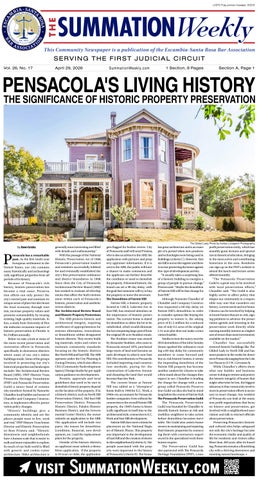
PENSACOLA'S LIVING HISTORY

By Dawn Gresko
Pensacola has a remarkable past. As the first multi-year European settlement in the United States, our city contains many historically and archaeologically significant properties from all periods of its history.
Because of Pensacola’s rich history, historic preservation has become a vital cause. Preservation efforts not only protect the city’s storied past and maintain its unique sense of place but also boost the local economy through tourism, increase property values and promote sustainability by reusing existing, high-quality materials. In fact, a study from University of Florida indicates economic impacts of historic preservation in Florida is $4.2 billion annually.
Below we take a look at some of the more recent preservation and restoration efforts in Pensacola, specifically in downtown districts where some of our city’s oldest buildings reside. Some of the groups involved in protecting our city’s historical properties and landscapes include: The Architectural Review Board (ARB), UWF Historic Trust, Pensacola Heritage Foundation (PHF) and Pensacola Preservation Guild–a newer band of community members formed by Nannette Chandler, local builder and owner of Chandler and Company Construction, to implement effective preservation policy changes.
“Historic buildings give a community identity and are the places people want to live, work and visit,” UWF Historic Trust Senior Director and Historic Preservationist Ross Pristera said. “Historic downtowns and neighborhoods have a human scale that is easier to walk and more enjoyable to explore. So much of our built world is filled with generic and cookie-cutter architecture. Older architecture is
generally more interesting and filled with details and craftsmanship.”
With the passage of the National Historic Preservation Act of 1966, Pensacola's preservation leaders and residents successfully lobbied for and eventually established the city's first preservation ordinance and district boundaries in 1968.
Since then the City of Pensacola Architectural Review Board (ARB) has worked to evaluate all developments that affect the built environment within each of Pensacola's historic, preservation and aesthetic review districts.
The Architectural Review Board and Historic Property Protections
The ARB protects historic and architectural integrity, requiring certificates of appropriateness for exterior alternation, renovations or demolitions within designated historic districts. They review building materials, styles and colors to maintain community standards focusing on the historic districts like North Hill and East Hill. The ARB operates under the City Planning & Zoning Division, which also offers a CRA (Community Redevelopment Agency) Design Studio for pre-application guidance on developments.
Permits, approvals and local guidelines that need to be met to demolish a historic property depend on the location of the property. If in a historic district, such as North Hill Preservation District, Old East Hill Preservation District, Pensacola Historic District, Palafox Historic Business District, and the Governmental Center District, the owner submits an application to the ARB. The application will include two parts: the reason for demolition (condition, financial, new development, etc.) and the replacement plans for the property.
Outside of the historic districts, an applicant must submit a demolition application. If the property is 50 years or older, the application
gets flagged for further review. City of Pensacola staff will send Pristera, who is also an advisor to the ARB, the application with pictures and property appraiser information. If it is sent to the ARB, the public will have a chance to make comments and the applicant can further describe the condition or need to demolish the property. If deemed historic, the board can set a 90-day delay, with the goal that someone will try to buy the property or move the structure.
The Demolition of Fairnie Hill
Fairnie Hill, a historic property located at 1182 E. Lakeview Ave. in East Hill, has renewed attention on the importance of historic preservation. The current home is slated for demolition to allow the lot to be subdivided, which would eliminate the last remaining large parcel from the original 20-acre Stoddart estate.
The Stoddart estate was owned by Alexander Stoddart, who came to Pensacola around 1876, purchased large tracts of land and became an early developer in what is now East Hill. His contributions to Pensacola included improving road construction methods, paying for the construction of Lakeview Avenue and donating the land that would become Bayview Park.
The current house at Fairnie Hill was added as a “showpiece” home built in 1940 for E.C. Work, a 1940s-era accountant for Pensacola lumber companies. Even without the connection to the overall Fairnie Hill property, the 1940’s home is historically significant in itself due to the architectural style, connection to E.C. Work and East Hill development.
Fairnie Hill does meet criteria for placement on the National Register of Historic Places: This property was important to the development of East Hill and the creation of streets in this neighborhood (criteria A). The people associated with the property were important to the history of Pensacola (criteria B). The house
has great architecture and is an example of a period when new products and technologies were being used in buildings (criteria C). However, Fairnie Hill is not on the register and there is no law protecting the home against this type of development activity.
“It usually takes a surprising loss of a historic building to energize a group of people to pursue change,” Pristera said. “Maybe the demolition of Fairnie Hill will be that change for East Hill.”
Although Nannette Chandler of Chandler and Company Construction requested a 60-day delay on Fairnie Hill’s demolition in order to consider options like buying the property to restore it, the asking price of $1.5 million for a reduced size of only 0.5 acres of the original 1.15-acre plot does not make a renovation feasible.
Similar to how the outcry over the 2016 demolition of the John Sunday House sparked the ordinance creating a 60-day delay for community members to come forward and buy at-risk historic homes, it seems the impending demolition of the Fairnie Hill property has become another catalyst for citizens to take a firm stand about the changes they expect to see. Chandler is leading the charge for change with a new group called Pensacola Preservation Guild–an idea she had in mind long before the events of Fairnie Hall.
The Pensacola Preservation Guild
The Pensacola Preservation Guild was founded by Chandler to identify historic homes at risk and mobilize neighbors to take action before demolition becomes inevitable. The Guild also assists homeowners in maintaining and repairing their historic properties by connecting them with contractors experienced in the specialized work these homes require.
The Preservation Guild has also partnered with The Pensacola Heritage Foundation (PHF), a non-
profit preservation entity, which has monthly guest lectures and specializes in historical education, bringing in the most active and contributing historians in the area. Residents can sign up on the PHF’s website to attend the lunch and lecture series offered monthly.
“The Pensacola Preservation Guild is a great way to be involved with local preservation efforts,” Chandler said. “The Guild is also highly active to affect policy that shapes our community in a responsible way–one that considers our history, current needs and our future. Citizens can be involved by helping to locate homes that are at-risk, signing petitions to advance the preservation agenda and investing in the preservation work directly while earning monthly interest at a higher rate of return than most investments available on the market.” Chandler has successfully restored historic buildings like The Gilded Lady in North Hill and has more projects in the works for downtown Pensacola ranging from the Lola Lee House to 211 W. Cervantes St.
While Chandler’s efforts show what one builder and business owner is doing to restore and protect the historic integrity of homes that might otherwise be lost, the biggest takeaway is that community involvement in preservation efforts is necessary to enact change. Any resident of Pensacola can look at the many non-profit organizations that focus on history and preservation, get involved with a neighborhood association and talk to elected officials about preservation.
Preserving Pensacola’s historic and cultural sites helps safeguard not only the city’s heritage but also the economic vitality and quality of life for residents and visitors alike. More than 450 years after its founding, Pensacola remains a flourishing city with a thriving downtown and stunning natural landscape. ■
The Gilded Lady. Photo by Ashley Livingston Photography
PLEASE CHOOSE THE SUMMATION WEEKLY FOR ALL YOUR LEGAL NOTICES
The Summation Weekly, a publication of the Escambia-Santa Rosa Bar Association (ESRBA) produced in partnership with Ballinger Publishing, offers highly competitive insertion rates and a way to indirectly support your local bar association.
The Summation Weekly is a subscription-based community newspaper circulated to ESRBA members and made available to the general public throughout Escambia and Santa Rosa counties. The publication satisfies Fla. Stat. 50.031, which governs the requirements for publication of legal notices. In addition to the published weekly newspaper,
The Summation Weekly website –summationweekly.com satisfies Fla. Stat. 50.0211, which requires all legal notices to be made available online and on the state registry – floridapublicnotices.com.
Ballinger Publishing manages the day-to-day operations of the publication. Darien Hardy is the contact person for legal notices. She can be reached at 433-1166, ext. 25 or legals@ballingerpublishing.com.
Thank you for your support. Choosing The Summation Weekly generates non-dues revenue that helps subsidize programs and services
CONTINUING LEGAL EDUCATION ONLINE LIBRARY: CLE.ESRBA.COM
ESRBA’s CLE Library is now digital! Go to cle.esrba.com to get your credits. Each download comes with the audio from the seminar, the PowerPoint/handouts, and the CLE Certificate of Accreditation from The Florida Bar. The audio can be downloaded in any file type that you would like including MP3, FLAC, ALAC, AAC, Ogg Vorbis, WAV, and AIFF formats. For your convenience and ease of listening, the seminars can also be streamed directly from the library.
If you are interested in presenting a CLE seminar or being recorded for a CLE accredited podcast, please email esrba@esrba.com.
Continuing Legal Education (CLE)
Library Cost: $15 per credit – ESRBA members, $25 per credit –nonmembers Focus Grouping your Premises
















Have a community event or announcement? You can submit information for possible publication in Community by sending an e-mail to Morgan@ballingerpublishing.com. Submissions must include the organization’s name and details about events including times, dates, locations and any costs involved. Contact information also is required. All submissions are subject to editing to comply with established standards. Items should be submitted at








COMMUNITY INVITED TO NORTHWEST FLORIDA RESILIENCY SEMINAR JUNE 11, 12
ESCAMBIA COUNTY HONORS WILLIE CARTER, JR. FOR NEARLY 52 YEARS OF SERVICE TO ECAT
Escambia County, in partnership with the City of Pensacola and Resiliency Florida, invites residents to attend the Northwest Florida Resiliency Seminar, providing an opportunity to learn more about resiliency efforts in Northwest Florida.
The seminar will take place on Thursday, June 11 and Friday, June 12 from 8:30 a.m. until noon at the Sanders Beach-Corinne Jones Resource Center, located at 913 S. “I” St, with lunch provided on June 11. An optional trip on the Pensacola Ferry is scheduled for Thursday, June 11 from 1-4 p.m.
Registration is required to attend the seminar and ferry trip, with a registration cost of $30.
The seminar will feature presentations and panel discussions from state, regional and local agencies and organizations covering climate resiliency topics. Panelists will also discuss how funding agencies, local government and non-regulatory organizations facilitate resiliency in Northwest Florida. This year’s agenda features additional opportunity for networking and interaction among attendees. Escambia County's Resiliency Program is a grant-funded effort housed within the Natural Resources Management department. Established in 2022, the Resiliency Program includes the Brownfields Program and project and grant management for environmental and resiliency projects in Escambia County.
ESCAMBIA COUNTY TO START FREE PENSACOLA BEACH TROLLEY SERVICE
Escambia County will begin running the free Pensacola Beach Island Trolleys, offering residents and visitors additional opportunities to explore Pensacola Beach.
Escambia County is providing the free trolley service earlier than ever this year, operated by Escambia County Area Transit in partnership with the Santa Rosa Island Authority. The Pensacola Beach Island Trolleys will run on the following schedule:
• Now through Sunday, May 17: Fridays, Saturdays, and Sundays from 2 p.m. until midnight
• Friday, May 22 through Monday, Sept. 7: Seven days a week from 4 p.m. until midnight
“I’m excited to announce that the Pensacola Beach Island Trolleys will run ahead of the summer season, just in time for some great
weather this spring,” District 4 Commissioner Ashlee Hofberger said. “We’ve seen fantastic growth in the number of visitors along the beach this season, so it’s important that beachgoers can safely travel around Pensacola Beach to explore everything our area has to offer. We invite everyone to hop aboard the free trolleys this weekend and enjoy your time on beautiful Pensacola Beach.”
Three trolleys operate concurrently, running three routes. The eastern route runs from Casino Beach to Portofino, the western route runs from Casino Beach to Park West near the entrance gate to Gulf Islands National Seashore, and the commercial core route runs from Casino Beach to Grand Marlin with stops occurring along the inner access road and at Pensacola Beach Boardwalk. The trolley system is free for all riders.
WFPL LIBRARY SEARCH CATALOG IMPROVEMENTS LAUNCH MAY 19
West Florida Public Libraries is preparing to launch a new and improved library search catalog, with features aimed at enhancing the user experience for library patrons.
The improved catalog will be available on the West Florida Public Libraries website on mobile and desktop beginning Tuesday, May 19.
Several improvements to the catalog were implemented based on feedback from library patrons, with new features including:
• A user-friendly and reliable catalog experience
• Easy access to borrowing and returning materials
• Streamlined account and service features
The library search catalog will be temporarily unavailable Monday, May 18 as part of the software migration process. All WFPL locations will be closed May 18 for staff training. All locations will reopen with regular hours Tuesday, May 19.
Interlibrary loan services are temporarily unavailable while WFPL transitions to the new search catalog. Services will resume Tuesday, May 19.
REGISTRATION NOW OPEN FOR ESCAMBIA COUNTY PLAY, LEARN, GROW SUMMER CAMP
Registration is now open for Escambia County's Play, Learn, Grow Summer Camp, a seven-week program providing local youth with a fun, educational, and recreational environment over the summer at several Escambia County community centers.
The program is open to Escambia County youth ages 5-13, with registration available now until Monday, June 1. Limited spaces are available.
This year's Play, Learn, Grow Summer Camp will take place from June 8 through July 24, Monday-Friday from 8:30 a.m. to 4:30 p.m. at the following community centers:
• Brownsville Community Center, 3200 W. De Soto St.
• Ebonwood Community Center, 3511 W.
Scott St.
• Lexington Terrace Community Center,
700 S. Old Corry Field Road
• Marie K. Young-Wedgewood Community Center, 6405 Wagner Road
The Play, Learn, Grow Summer Camp will offer fun and educational activities including English Language Arts, reading, writing, math, recreational sports and exercise, performing and visual arts, hands-on crafts, STEM activities, and more. Escambia County partners with Feeding the Gulf Coast to provide program participants with a nutritional breakfast, lunch and a snack during camp.
Last year, over 400 local youth participated in the Play, Learn, Grow Summer Camp.
CITY CELEBRATES THE LEGACY OF GEN. BERNARDO GALVEZ BEGINNING MAY 9
The City of Pensacola is celebrating the legacy of General Bernardo de Gálvez in a series of events and commemorating America’s 250th birthday, as well as Pensacola’s role in the American Revolution. Please see the following schedule and make plans to join in.
Friday, May 8, 2026
• 9:45 a.m.: The Daughters and Sons of the American Revolution (DAR/SAR) will march from Fort George down Palafox Street to the Gálvez statue at N. Palafox and E. Wright streets.
• 10 a.m.: A brief ceremony will be held with remarks from Mayor D.C. Reeves and a special song and dance from the students at Episcopal Day School.
• 11 a.m.: Te Deum Mass at St. Michael’s Basilica.
• 11:30 a.m.: A public luncheon will be held at the Pensacola Yacht Club, 1897 Cypress St. Reservations and prepayment are required.
• 3 p.m.: Joint DAR/SAR Ceremony at Veterans Memorial Park, 200 S. 10th Ave. Saturday, May 9, 2026
5 to 10 p.m.: The Gálvez Gala. An evening inspired by the Revolution and celebrating America’s 250th birthday. Requested Period Dress or black tie. Cost is $99 per person at the Sanders Beach-Corinne Jones Resource Center, 913 South I St.
Escambia County Area Transit is proud to recognize Bus Operator Willie Carter, Jr. on his retirement after nearly 52 years of service to ECAT and the citizens of Escambia County, driving over 3 million miles during his long and distinguished career.
District 3 Commissioner Lumon May presented a proclamation to Mr. Carter on Wednesday, April 15 honoring him for his many years of service, hard work, and dedication.
“It is an honor to celebrate and recognize Mr. Carter for his nearly 52 years of dedicated service to Escambia County,” Commissioner May said. “Mr. Carter is truly a living legend. Throughout his career, he was much more than a bus driver – he was a counselor, he was a friend, and he was a mentor who encouraged his passengers and colleagues to reach their full potential. Mr. Carter made sure every person, every citizen got to where they needed to go safely and with a smile. I know I speak for many of Mr. Carter’s coworkers, passengers, friends and family in wishing him a very happy retirement and thanking him for his many years of faithful service.”
Mr. Carter was hired on October 12, 1974 as a Bus Operator with the original transit system in downtown Pensacola, serving under several transit management companies throughout his career. For a brief period in 1978, Mr. Carter assisted in the customer service department before determining that his true passion was operating a bus.
Mr. Carter consistently exceeded expectations, impressing his supervisors with his commitment, professionalism, and willingness to go above and beyond. He embraced challenging assignments as opportunities to enhance his skills and expand his operational knowledge, and his talent and dedication were formally recognized by the Board of County Commissioners in November 2024 in honor of his 50 years of service.
Through his dedication and strong work ethic, Mr. Carter became a trusted resource for his colleagues, who frequently sought his
guidance in addressing complex assignments. He earned the title “The Living Legend” from passengers and employees, distinguishing himself as an exemplary bus operator during his long career.
Mr. Carter held a steadfast belief that public transportation plays a vital role in safely and efficiently connecting individuals to their destinations. He consistently demonstrated a deep commitment to hard work, taking great pride in his service and regarding the customers he served as an extension of his own family.
During hurricanes and severe storms that significantly impacted county operations, Mr. Carter demonstrated exceptional dedication, resuming service to support the community as soon as conditions improved and winds subsided to approximately 40 miles per hour. Throughout his distinguished career, Mr. Carter maintained an outstanding safety record, achieving 35 years of accidentfree driving and accumulating more than 3 million miles in service.
Mr. Carter has received numerous accolades throughout his career from supervisors, peers, and county employees in recognition of his tireless work ethic, professionalism, and unwavering dedication to public service and the citizens of Escambia County. He has also been a longstanding member of the Amalgamated Transit Union Local 1395, serving as Sergeant-at-Arms for 30 years and maintaining 50 years of active membership.
“Mr. Carter has exemplified professionalism, excellence, and a commitment to safety throughout his long career with ECAT, and we are excited to recognize him for another milestone as he begins his well-earned retirement,” Mass Transit Director Thaddeus Davenport said. “We cannot thank Mr. Carter enough for his dedication and many years of service to ECAT, our passengers, and the citizens of Escambia County. His legacy will continue to live on, and he will be greatly missed by everyone whose lives were touched by his smile and his service.”
COMMUNITY INVITED TO BEULAH REGIONAL PARK GRAND REOPENING EVENT MAY 1
Escambia County invites the community to a grand reopening and ribbon cutting event Friday, May 1 at 10 a.m. to celebrate significant improvements and new amenities at Beulah Regional Park.
The event will take place at the park, located at 7820 Mobile Highway. One or more Escambia County Commissioners will be in attendance.
"I'm very excited to reopen Beulah Regional Park to the public, which is now better than ever after numerous upgrades and new amenities," District 1 Commissioner Steve Stroberger said. "This park is a staple in the Beulah community, and I look forward to seeing families and children of all ages enjoy the new splash pad, pickleball courts, basketball court upgrades, and the many other improvements we've made throughout the park. I'd like to thank our Parks and Recreation staff for their hard work on this project, along with the public for their patience as the work was completed. I hope the Beulah community
is proud of their new and improved park and will enjoy it for many years to come."
Improvements to Beulah Regional Park include four new pickleball courts, a new splash pad, new basketball goals, new picnic table pavilions and grills, new fencing, and more. Several ADA upgrades were also made throughout the park, including the addition of two new ADA-compliant parking spaces, sidewalks to and from the parking lot, and improved connectivity to the existing amenities.
Drainage enhancements were also completed throughout the park to minimize areas with standing water and improve overall park aesthetics.
Additional upgrades were completed at the Beulah Senior Citizen Center, including a new basketball court, playground, and walking track resurfacing.
Beulah Regional Park is located at 7820 Mobile Highway, and the Beulah Senior Citizen Center is located at 7425 Woodside Road.
CITY PLANS FOR KEYLA RICHARDSON HOMETOWN CONCERT AS “IDOL” FINALS NEAR
Keyla Richardson soon could be coming home for a community concert and parade to celebrate her “American Idol” journey – but she will need Pensacola’s support to get there.
The City of Pensacola is leading the preliminary planning effort for a free homecoming concert at Community Maritime Park and Wahoos Stadium tentatively scheduled for the evening of May 6.
Each season, the top three “Idol” finalists are followed to their hometowns for a parade and concert before the season finale. The 2026 finale from Hollywood is scheduled for May 11 on ABC. Richardson is currently in the top seven, with the next cut to five coming on Monday, April 27. The top three will be decided on May 4. Those finalists are
treated to the “hometown hero” celebration.
“We as a city are so excited for her journey and we need to turn out in full support of Keyla to ensure that our ‘Idol’ makes it home for the celebration she deserves,” said Pensacola Mayor D.C. Reeves.
Reeves is working with Escambia County Commissioner Lumon May on the details of the event. Reeves already had two preliminary calls with “American Idol” producers as the field of competitors has narrowed.
“American Idol” has been a pop culture touchstone since its debut in 2002. The show launched the careers of singers Kelly Clarkson, Carrie Underwood and Jennifer Hudson. This would be the first time Pensacola has hosted an “Idol” finalist.
ESCAMBIA COUNTY EMS ACHIEVES SUCCESSFUL STATE INSPECTION
Escambia County Emergency Medical Services is proud to announce that EMS has passed its state inspection from the Florida Department of Health, with FDOH inspectors finding EMS vehicles and service records to be "outstanding."
The site visit and inspection, which noted no deficiencies or discrepancies with Escambia County EMS, was conducted by the FDOH Bureau of Emergency Medical Oversight on April 9 at Escambia County Public Safety.
Escambia County EMS met all inspection criteria, with the inspection covering numerous categories including:
• Employee training records & certifications
• Vehicle records and registrations
• Compliance with controlled substance medication storage, how medications are distributed for use by EMS and tracking of medication administration by EMS
• How EMS orders, stocks, distributes, and replaces medical equipment and supplies
• Random ambulances were selected for complete inventory inspection in compliance with state requirements
• Patient care records and storage of records
• Quality assurance and quality improvement measures with patient care and patient care reports
Training and in-service records for all EMS employees
• Compliance with state requirements for medical direction
The representative from FDOH gave EMS glowing reviews following the inspection, noting that it was "truly a joy to see more of Escambia County EMS and speak with your team members" and that they are "proud to have you serving the local community."
"This successful inspection is a testament to our dedicated team at all levels of Escambia County EMS, who work diligently every day to ensure we are providing top-tier care and service to every patient we serve," Escambia County EMS Chief Chris Watts said. "I'm very proud of our employees and leadership team for their hard work and dedication, and we look forward to continuing to accomplish great things at Escambia County EMS."
Over the past several months, Escambia County EMS has made significant improvements in several areas, including more than quadrupling the success rate for getting a pulse back after cardiac arrest from approximately 9% to more than 40%. The significant increase in the success rate is a result of the implementation of updated resuscitation protocols, which have been implemented at all levels of Escambia County EMS.
"I'm incredibly proud of our EMS team for continuing to serve the citizens of Escambia County with professionalism every day," Public Safety Director Eric Gilmore said. "Their dedication helps us maintain the highest level of service to our community, setting the gold standard for excellence in EMS service."
VALERIE’S HOUSE NORTHWEST FLORIDA HONORS FIVE YEARS OF HOPE WITH COMMUNITY OPEN HOUSE CELEBRATION
Valerie’s House Northwest Florida (VHNWFL) celebrates five years of service to grieving children and families with a Five Years of Hope Open House on April 29 from 4:30–7 p.m. at their East Gadsden Street location.
At the celebration, VHNWFL will guide our community, partners, supporters, volunteers, and families through a visual timeline highlighting growth, impact, and the shared commitment to ensuring that no child grieves alone since first opening in 2021.
“Over the past five years, VHNWFL has expanded from serving 15 children and 10 caregivers through two monthly groups to supporting more than 1,000 individuals across 18 groups each month, including school and community-based locations,” said Crista Brandt, President and Founder of the VHNWFL location “This growth reflects our strong partnerships with local schools, healthcare providers, and community organizations, thus increasing access to no-cost grief support throughout the region.”
Valerie’s House Northwest Florida offers peer-based grief support for families navigating the death of a loved one. Through facilitated group sessions, children are given tools to express grief, strengthen coping skills, and build connections with others facing similar experiences. Early intervention plays a critical role in improving emotional, academic, and long-term In 2022, the Chadbourne- DeMaria Foundation, under the leadership of Caroline and Brian DeMaria, provided a $500,000 gift to purchase a permanent location for the grief support program allowing it to serve the increasing number of children and families seeking support through Valerie’s House programs. The home, officially named Valerie’s House – The Chadbourne-DeMaria Foundation Home for Grieving Families, provides a dedicated space for connection, support, and programming.
In January 2026, Valerie’s House reached a pivotal milestone, transitioning from a chapter model to an independent entity named Valerie’s House Northwest Florida, Inc. This next phase of growth is driven by the Legacy of Hope Founders Circle, led by the Chadbourne-DeMaria Foundation with a $500,000 leadership gift. This distinguished group of community leaders and organizations is building the foundation for Valerie’s House NWFL to thrive independently—creating a lasting legacy of hope and changing the future for grieving children and families.
Founders Circle members are collectively matching this $500,000 commitment, with nearly 75% of the funding already secured. This select group is making a significant and strategic investment in the future of Valerie’s House NWFL, with a portion of funds designated to establish and seed an endowment, thus strengthening long-term sustainability and continued support for the growing number of children and families seeking care.
About VHNWFL
Valerie’s House Northwest Florida, Inc. is a 501(c)(3) nonprofit organization fully supported by community donations located at 904 East Gadsden Street in Pensacola, Florida. Valerie’s House provides a safe, comfortable place for children and their families to heal together following the death of someone they love through peer-based grief support programs.
Valerie’s House Northwest Florida was originally established as a chapter of Valerie’s House, Inc. headquartered in Ft. Myers, Florida and has since transitioned to an affiliate, continuing to serve children and families in Northwest Florida. Valerie’s House, Inc. was founded in Fort Myers in 2016 by Angela Melvin, and was named in memory of Valerie Melvin, a wife and mother of two who died in a car accident in 1987.
The Summation Weekly publishes local and legal news every Wednesday and is distributed throughout Escambia and Santa Rosa counties at numerous locations.
Community News Submissions
Have a community event or announcement? You can submit information for possible publication in Community by sending an e-mail to Morgan@ballingerpublishing. com. Submissions must include the organization’s name and details about events including times, dates, locations and any costs involved. Contact information also is required. All submissions are subject to editing to comply with established standards. Items should be submitted at least one week in advance. Deadline is noon Friday for the following publication.
NAS PENSACOLA HOSTS CNIC OPERATION MWR KANE BROWN CONCERT
More than 8,000 service members, military retirees, their families and invited guests attended a Commander, Navy Installations Command (CNIC) Operation MWR concert onboard Naval Air Station (NAS) Pensacola April 18.
Headlined by country music star Kane Brown and featuring artists Russell Dickerson and DJ Vito, the free concert was something NAS Pensacola Commanding Officer Capt. Chandra 'Mamasan' Newman said could serve to increase the well-being of the thousands of students at one of the largest training sites in the Navy.
"Being able to come out and enjoy this concert provides service members and their families not only a welcome break, but the opportunity to connect with part of the greater military community in Pensacola," she said. "Providing opportunities for our service members to recharge is essential in ensuring they remain the sharpest and most resilient fighting force in the world."
Newman added that the volunteer efforts from tenant commands for events such as this are critical, with service members given the opportunity to participate and take ownership and pride in the final outcome.
"The support from our tenant commands in helping our MWR team put this event together was unprecedented," she said. "Service members from every branch of our Armed Forces worked seamlessly with the NAS Pensacola MWR team to make sure we supported the CNIC Operation MWR mission, and their efforts ensured the thousands of guests attending were able to enjoy the event."
Newman also said the efforts of the air station's MWR team, Navy Security Forces (NSF), Fire and Emergency Services Gulf Coast (F&ESGC) and nearly every department were all critical in the success of the much-anticipated event.
"The safety and security of our service members, their families and our guests at events like this is always are primary consideration, and require an all hands on deck approach," she said. "Seeing the NAS Pensacola team in action is always humbling, and the service members and civilian employees here are committed to our mission."
The Operation MWR concert coincidently fell on the installation's 200th birthday, something Newman acknowledged to the crowd during her welcome remarks and reiterated through a video message as well as through a redesign of the air station's logo.
"Happy 200th Birthday!" she said. "We're celebrating this milestone all year - 200 Years Forged Here. The history of this installationfrom a naval shipyard into an air station - is something we hold quite dear, and share with a community who has been by our side every step of the way."
Operation MWR is a series of free events, open to installation MWR-eligible patrons, and designed to support the morale, resilience and readiness of service members and their families.
NAS Pensacola, referred to as the 'Cradle of Naval Aviation,' is designed to support operational and training missions of tenant commands. Along with an active runway, NAS Pensacola also maintains a deep-water port, directly supporting U.S. Coast Guard missions.
GULF WINDS CREDIT UNION RAISES OVER $100,000 IN CHIP IN FORE CHARITY GOLF TOURNAMENT
On Monday, April 13, the Gulf Winds Foundation proudly hosted its third annual charitable golf tournament, Chip in Fore Charity, at Pensacola Country Club in Pensacola, FL. The day brought the credit union community together for a memorable mix of golf, connection, and generosity, raising more than $100,000 to support the Gulf Winds Foundation and its ongoing impact.
A full roster of teams competed in a classic four-player scramble featuring a hole-inone challenge to win a brand-new Honda vehicle, and several on-course games, including one with the Pensacola Ice Flyers.
Through the funds raised, the tournament strengthens Gulf Winds Annual Scholarship Program and supports local non-profit partners including Manna Food Pantry, Council on Aging of West Florida, Big Brothers Big Sisters of Northwest Florida, Rally Foundation, and other organizations dedicated to creating impact throughout the region.
During the award ceremony, Paula Shell, President and CEO of Big Brothers Big Sisters of Northwest Florida, spoke about the event’s impact, emphasizing the power of community partnerships, the importance of investing in local youth, and how Gulf Winds continues to show up and put those commitments into action.
The tournament was made possible through the generosity of sponsors, including presenting sponsor, Fiserv, pre-tournament sponsor Visa, preeminent sponsors BKJ Architecture, MeridianLink, Glia, Solenture, Greenhut Construction, Pensacola Honda, and the Ice Flyers Foundation, and other key sponsors including PAI/Brinks, Experian, Allied Solutions, Route 66, Blue Mantis, Confluent Strategies, Gallagher, Nutanix & Presidio, Pensacola Ford, Audi, Ramond James Asset Management Services, NFP an Aon Company, Zest AI, and Warren Averett.
FLIGHT ADVENTURE DECK CELEBRATES 30 YEARS OF INSPIRING THE NEXT GENERATION THROUGH STEM EDUCATION
More than 125,000 students from Escambia and Santa Rosa counties have experienced the Flight Adventure Deck over the past 30 years, making it one of the region’s most impactful STEM education programs. The Naval Aviation Museum Foundation (NAMF) proudly celebrates this milestone anniversary, marking three decades of inspiring curiosity, innovation, and real-world learning.
Since its founding in 1996, the Flight Adventure Deck has served as a cornerstone of hands-on education for 6th through 8th-grade students, blending science, technology, engineering, and math with the excitement of naval aviation. The program provides a dynamic, immersive experience that connects classroom concepts to realworld applications.
“At its core, the Flight Adventure Deck is about igniting curiosity and showing students what’s possible,” said Kyle Cozad, President and CEO of NAMF. “For 30 years, we’ve been proud to partner with Santa Rosa and Escambia County school districts to deliver a oneof-a-kind experience that connects classroom learning to real-world application. We’re not just celebrating 30 years, we’re building the next 30.”
Impact by the Numbers:
• More than 125,000 students served since inception
• Up to 5,000 students participate annually
• Nearly 1,000 teachers supported through professional development
• Established in 1996, with a summer program launched in 2009
• Curriculum focused on aviation, space, engineering, and advanced science
The Flight Adventure Deck operates through a collaborative partnership between the Escambia County School District, Santa Rosa County School District, and the Naval Aviation Museum Foundation. Together, these partners have built a program that continues to evolve while remaining rooted in its mission of preparing students for future careers in STEM fields.
As the Flight Adventure Deck enters its fourth decade, the Naval Aviation Museum Foundation is focused on expanding access, enhancing programming, and continuing to inspire the next generation of innovators, engineers, and leaders.
About the Flight Adventure Deck
The Flight Adventure Deck is an immersive STEM learning program located at the National Naval Aviation Museum in Pensacola, Florida. Designed for middle school students, the program combines classroom instruction with hands-on simulation experiences to reinforce critical science and engineering concepts.
SAILDRONE RETAINS AMERICAN MAGIC SERVICES; UNVEILS
SPECTRE, A NEW CLASS OF HIGHSPEED UNMANNED SURFACE VESSEL FOR NAVAL OPERATIONS
American Magic Services, based at the American Magic High Performance Center in Pensacola, Florida, has been retained by Saildrone, the world leader and most experienced operator of unmanned surface vehicles (USVs), for their newly unveiled Spectre platform.
At 52 meters (170 feet) long, weighing 250 tonnes, and capable of up to 30 knots, Spectre is the largest, fastest, and most capable Saildrone platform to date. Spectre is optimized for anti-submarine warfare (ASW) operations, a mission set that demands extreme endurance and an ultra-quiet acoustic signature. Spectre achieves this by leveraging the proven endurance, reliability, and silent propulsion of the Saildrone wing system. However, from the outset, Spectre was also designed to operate without the wing for kinetic strike roles, which require higher sprint speeds and lowprofile stealth operations.
“Spectre is the result of 25 years of continually pushing the boundaries of what’s possible. A unique design evolved through the hard lessons of operational experience in the real world,” said Richard Jenkins, Saildrone’s founder and CEO. “Spectre is not a craft hurriedly readied to meet a particular RFP, but diligently evolved over multiple years to meet the operational requirements of our customers and fill critical capability gaps in the ASW domain.”
Like the Saildrone Voyager and Surveyor, Spectre leverages wind, solar, and diesel propulsion, but Spectre is no ordinary diesel ship. Spectre runs twin shaftlines with dual electric and diesel propulsion, enabling near-silent electric propulsion up to 12 knots, before kicking in 5,000 horsepower of Caterpillar diesel engines to propel the vessel up to 27 knots with full fuel and a 25,000 kg payload. Cruising at 25 knots with a 25,000 kg payload, Spectre has a range of 3,280 nautical miles in flat water and 2,790 nm range in Sea State 4 head sea. Controllable-pitch propellers enable extremely efficient operations throughout the speed range, allowing for controllable acoustic signatures and nearsilent slow-speed operations for tow bodies such as thin-line towed arrays and variabledepth sonar systems.
The concealed payload deck provides room for containerized payloads, ranging from dual 40-foot containers, up to five 20-foot containers, or a mixture of configurations in between. This unique configuration, close to the waterline, allows easy deployment of payloads via the transom, while the bulwarks protect them from prying eyes and the driving sea spray that will be relentless at high speeds in rough weather. Spectre’s maximum payload capacity is over 70 tonnes.
“Spectre represents a transformative step forward for naval surface warfare. Its endurance, payload flexibility, and seamless integration with advanced missile and sonar systems will give the US Navy a persistent, low observable USV that can deliver on a spectrum of maritime missions,” said Paul Lemmo, vice president and general manager, sensors, effectors, and mission systems at Lockheed Martin.
“Lockheed Martin is proud to partner with Saildrone to bring this capability to life, and we look forward to demonstrating its power at upcoming on-water, live fire demonstrations.”
Spectre performance is not just theoretical; it has been verified and tested at Force Technologies’ tow tank in Copenhagen, Denmark. Many months of testing and evolution on a 1/7th-scale model verified propulsive power requirements and seakeeping in conditions up to full speed in Sea State 5. Only through diligent physical tank tests can CFD results be verified and propulsion systems be optimized to deliver guaranteed performance at full scale.
The Spectre design has been approved in principle (AIP) by ABS, complying with the High Speed Naval Craft class certification. Two years of design and testing have entirely de-risked the Spectre design and performance. Coupled with Saildrone’s proven C2, systems control, and mission autonomy, Spectre provides a compelling turnkey and near-term solution for many critical requirements for the US and allied navies.
Spectre is constructed from aluminum and will be built in Wisconsin at the Fincantieri system of shipyards, which has the capacity to manufacture five Spectre vessels per year. Construction will begin shortly, with the first vessel undergoing sea trials in early 2027.
“Saildrone’s decades of operating unmanned surface vessels, combined with Spectre’s unique features as a multi-mission platform, represent an ideal case on which to apply Fincantieri Marine Group’s proven expertise in the serial production of aluminum vessels. We are excited to join this formidable team and swiftly deliver these capabilities to the warfighter,” said Fincantieri Marine Group CEO George Moutafis.
The 43-meter (140-foot) composite Saildrone Wing will be manufactured by American Magic Services (AMS) at the American Magic High Performance Center in Pensacola, FL. Drawing on a pedigree in high-performance America’s Cup racing, AMS brings advanced composite engineering and manufacturing capabilities to the platform. Building on its experience serving the marine, aerospace, and defense industries, AMS is capable of producing five Spectre wings per year.
“Saildrone has set the standard for innovation and performance in unmanned systems, and we’re proud to support the advancement of the Spectre platform,” said American Magic Services CEO Tyson Lamond. “At the American Magic High Performance Center in Pensacola, in close proximity to key US naval and maritime operations, we bring together elite composite manufacturing and a proven high-performance culture, positioning us to deliver at the level this platform demands.”
Working with Lockheed Martin, Saildrone has ensured Spectre design compatibility with a wide range of Lockheed Martin payloads, including thin-line towed arrays such as the TB29 and the Mk70 VLS Launcher. Spectre can carry two Mk70s and is capable of deploying the CAPTAS-4 variable-depth sonar system from Thales/AAC.
About Saildrone
Saildrone is a maritime defense company with a relentless passion for performance. Built to operate in the world’s harshest environments, Saildrone’s autonomous systems deliver payload effects and persistent, widearea intelligence, enabling informed decisions across the spectrum of defense missions.
Harnessing AI, advanced sensor suites, and renewable power for unmatched endurance at sea, Saildrone delivers superior multi-domain impact—from power projection to persistent ISR to real-time threat detection and tracking—while reducing cost and risk. With proven operational success across the world’s oceans, Saildrone is advancing the frontier of autonomous maritime operations to give decision-makers and warfighters the enduring advantage to outpace adversaries today and build tomorrow’s most decisive capabilities.
About American Magic Services
Based at the American Magic High Performance Center in Pensacola, Florida, American Magic Services (AMS) specializes in high-performance engineering, systems design, and composite manufacturing. Initially established to meet the competitive demands of the America’s Cup, AMS now provides innovative solutions for the marine, aerospace, and defense industries.
Receive Summation Weekly At Your Office Or Home
Call Darien Hardy At 850-433-1166 Ext 25 Or Email Her At Legals@Ballingerpublishing.Com
GOVERNOR DESANTIS ANNOUNCES MORE THAN 13,000 FAMILIES BENEFIT FROM NEW VPK & FLORIDA PREPAID COLLEGE SAVINGS PLANS PARTNERSHIP
Governor DeSantis announced more than 13,000 families are participating in the partnership between Florida’s Voluntary Prekindergarten (VPK) program and the Florida Prepaid College Savings Plans within the first four months of its launch. Florida was one of the first states to develop a seamless application process that allows families to apply for VPK and open a Florida Investment 529 Plan account and receive $100 to begin saving for higher education through Florida Prepaid at the same time.
“We’ve kept our world-class public colleges and universities affordable for Florida residents, and our new partnership between the VPK program and Florida Prepaid is already helping thousands of families save for higher education,” said Governor Ron DeSantis. “More than 13,000 families have already taken the opportunity to create college savings accounts while applying for VPK in the four months since this partnership launched.”
“By connecting Florida’s VPK program with Florida Prepaid College Savings Plans, we’re making it easier than ever for families to start planning for their child’s future,” said Commissioner of Education Anastasios Kamoutsas. “Higher education opens doors to new opportunities, and this partnership empowers parents to take an important first step toward saving, helping ensure more Florida students are prepared for lifelong success.”
“For many families, the hardest part of saving for college is simply getting started. This partnership meets parents right where they are—at the very start of their child’s education—and makes that first step easier,” said Kevin Thompson, Executive Director of the
Florida Prepaid College Board. “By connecting VPK enrollment with Florida Prepaid, we’re helping families take action early and plan for the future from the beginning. It’s a simple but powerful idea: when families start early, more opportunities are within reach later.”
Florida was among the first states in the nation to offer free, voluntary prekindergarten for all 4-year-olds. Since the program’s launch in the 2005-2006 school year, VPK has served more than 3.1 million children and their families with one goal in mind: to give every child a strong start in education and in life.
Governor Ron DeSantis has enhanced Florida’s VPK program by:
• Strengthening and implementing a new VPK provider accountability system to ensure Florida’s youngest learners receive highquality early education and laying a strong foundation for success in kindergarten.
• Establishing a VPK-Grade 10 coordinated screening and progress monitoring system to identify emergent literacy and early math skill deficiencies to provide students with intensive, individualized instruction and support.
• Executing a 15-hour emergent literacy training requirement for VPK teachers, ensuring that VPK educators are equipped with the necessary skills to support early literacy development.
• Creating a summer bridge program to provide VPK children identified with potential early literacy deficiencies with targeted instructional support, ensuring they enter kindergarten better prepared for academic success.
UWF CENTER FOR CYBERSECURITY AND AI
OFFERS FREE SUMMER CYBER AND AI EXPERIENCE CAMPS
The University of West Florida Center for Cybersecurity and AI is collaborating with Regions Foundation to offer free Summer Cyber and AI Experience Camps for the summer of 2026. The camps are an opportunity for rising seventh through twelfth graders who are at least 13 years old to learn about cybersecurity and its careers through hands-on experience with real-world tools and problems.
Students with an interest in cybersecurity, AI and technology will spend a week making new friends and learning about the world of cybersecurity and AI by doing. The highly interactive camp features activities, games, puzzles and hands-on computer training powered by the Florida Cyber Range®. Students will also hear from cybersecurity professionals to learn more about different opportunities within the field.
“The best way to learn anything is to do it,” said Guy Garrett, camp director and associate director of technology and training at the Center for Cybersecurity and AI. “Campers face real cyber problems and learn real cyber tools. We build confidence through competence and competence through practice.”
There will be two camp sessions:
• Foundations Camp: Hosted June 1-5, Foun-
dations Camp is designed for first-time campers or relative newcomers to cyber.
• The Guild Camp: Hosted June 8-12, The Guild Camp is designed for previous campers or students with cybersecurity, IT, programming, computer science, gaming and modeling design, or engineering coursework in middle and high school.
The camps will be offered free of charge to eligible and selected students thanks to the generous support of Regions Foundation. The Regions Foundation, a nonprofit initiative funded primarily by Regions Bank, is focused on giving more people more opportunities through economic and community development; education and workforce readiness; and financial wellness.
“This grant from the Regions Foundation allows us to continue bridging the gap between discovering potential career paths and education through hands-on practice and coaching,” said John M. Gormley, Pensacola market executive for Regions Bank. “This is an investment that will benefit the workforce of tomorrow while learning the emerging technologies of today.” Camps will be held Monday through Friday from 8:30 a.m. to 4:30 p.m. CT at the UWF Center for Cybersecurity and AI. Lunch and snacks will be provided.
GREER’S/GOODWILL GULF COAST TO HOST ANNUAL GOLF TOURNEY ON
MAY 14
Goodwill Gulf Coast is excited to announce the 37th annual Greer’s/Goodwill Gulf Coast Golf Tournament, set to take place on May 14, 2026 at Magnolia Grove Golf Course in Mobile. Sponsored by Greer’s Markets, the event will bring together local business and community leaders to enjoy a day of golf while supporting Goodwill’s mission of service to the community.
Participants will experience a challenging round of golf, a Hole-in-One competition to win a new car, exciting raffle prizes, and a delicious breakfast and lunch —all while making a positive impact on individuals and families in our community. Proceeds from the tournament will help fund Goodwill Gulf Coast’s services and programs, which provide education, skills training, early childhood development, and employment opportunities for individuals in need.
“We are incredibly grateful to Greer’s Markets for their unwavering support and generosity in sponsoring this golf tournament for over 35 years. Greer’s dedication to giving back truly embodies the spirit of making a difference, and we are
honored to have them as a longstanding partner in building brighter futures,” Barry Reed, Goodwill Gulf Coast CEO, said.
The tournament was founded in 1990 by Mitt and Sara Boyd in honor of their grandson, David Boyd Cox, along with members of the Greer family including Jack Greer and Bartee Greer. Greer’s Markets serves as the tournament’s major sponsor. Joe Bullard Chevrolet and Thames Batré Insurance serve as Hole-in-One Competition sponsors.
Sponsorships and team registration opportunities are now available.
About Goodwill Gulf Coast
Since 1956, Goodwill Gulf Coast has helped people enter the workforce through skills training and placement services, and provided support programs for children, parents, and youth. Today, Goodwill Gulf Coast serves seven counties in southwest Alabama and three counties in the Florida panhandle. In FY 2025, Goodwill Gulf Coast provided over 29,000 services to 13,857 people in need.
Legals
Notice of Sale
NOTICE OF SELF STORAGE SALE
Please take notice Old Milltown Storage located at 6250 Stewart St Milton FL 32570 intends to hold a sale to sell the property stored at the Facility by the below Occupant who is in default at an Auction. The sale will occur as an online auction via www.storagetreasures.com on 5/16/2026 at 12:00 PM. Unless stated otherwise the description of the contents are household goods, furnishings and garage essentials. Brandon Penton. This sale may be withdrawn at any time without notice. Certain terms and conditions apply. See manager for details.
2WR4/29-5/6NOS
Notice of Foreclosure Sale IN THE COUNTY COURT IN AND FOR ESCAMBIA COUNTY, FLORIDA
PARASOL WEST HOMEOWNERS’ ASSOCIATION, INC., a Florida not-for-profit corporation, Plaintiff,
v.
KENNETH LAMAR VICK, et al., Defendants.
CASE NO.: 2025 CC 008234
NOTICE OF FORECLOSURE SALE
Notice is hereby given that Pam Childers, Clerk of the Circuit Court of Escambia County, Florida, shall sell the following described property situated in Escambia County, Florida:
Lot 35, Block A, Parasol West, a subdivision of a portion of Fractional Section 6, Township 4 South, range 32 West, and a portion of Fractional Section 31, Township 3 South, Range 32 West, Escambia County, Florida, according to the Plat thereof, recorded in Plat Book 15, Page(s) 14, of the Public Records of said County.
including the structures and improvements located thereon, if any, at a public sale on the 20th day of May, 2026, at 11:00 a.m. (Central Time), or as soon thereafter as the sale may proceed, to the highest bidder or bidders for cash, except as set forth hereinafter, at www.escambia. realforeclose.com, in accordance with Chapter 45, Florida Statutes, and the Final Judgment of Foreclosure entered in a case pending in said court, the style of which is PARASOL WEST HOMEOWNERS’ ASSOCIATION, INC. v KENNETH LAMAR VICK, et al., the case number of which is 2025 CC 008234.
In accordance with the AMERICANS WITH DISABILITIES ACT, persons needing a special accommodation to participate in this proceeding should contact the Courthouse not later than seven days prior to the proceeding at (850) 623-3159.
ANY PERSON CLAIMING AN INTEREST IN THE SURPLUS FROM THE SALE, IF ANY, OTHER THAN THE PROPERTY OWNER AS OF THE DATE OF THE LIS PENDENS MUST FILE A CLAIM WITHIN SIXTY (60) DAYS AFTER THE SALE.
Dated April 20, 2026.
Moorhead Law Group, PLLC
By: /s/ Matthew F. Carbone
John “Jay” A. Fraiser, Jr.
Florida Bar No. 110741
Matthew F. Carbone
Florida Bar No. 1058003
Moorhead Law Group, PLLC
127 Palafox Place – Suite 200
Pensacola, Florida 32502
Telephone: (850) 202-8522
Fax: (850) 477-0982
jfrasier@moorheadlaw.com
mcarbone@moorheadlaw.com
aharris@moorheadlaw.com
calitigation@moorheadlaw.com
Attorneys for Plaintiff
2WR4/29-5/6NOS
Notice to Creditors IN THE CIRCUIT COURT OF THE FIRST JUDICIAL CIRCUIT, IN AND FOR ESCAMBIA COUNTY, FLORIDA PROBATE DIVISION
IN RE: Estate of DONNA KAY GILMORE, Deceased.
Case Number 2026-CP-502 Division: “U”
NOTICE TO CREDITORS
The administration of the Estate of DONNA KAY GILMORE, deceased (the “Decedent”), whose date of death was March 15, 2026, is pending in the Circuit Court of Escambia County, Florida, Probate Division, the address of which is Escambia County Clerk of Court, Attn: Probate Division, 190 W. Government Street, Pensacola, Florida 32502. The names and addresses of the Personal Representative and the Personal Representative’s attorney are set forth below.
All creditors of the decedent and other persons having claims or demands against decedent’s estate on whom a copy of this notice is required to be served must file their claims with this court ON OR BEFORE THE LATER OF 3 MONTHS AFTER THE TIME OF THE FIRST PUBLICATION OF THIS NOTICE OR 30 DAYS AFTER THE DATE OF SERVICE OF A COPY OF THIS NOTICE ON THEM.
All other creditors of the decedent and other persons having claims or demands against decedent’s estate must file their claims with this court WITHIN 3 MONTHS AFTER THE DATE OF THE FIRST PUBLICATION OF THIS NOTICE.
The personal representative has no duty to discover whether any property held at the time of the decedent’s death by the decedent or the decedent’s surviving spouse is property to which the Florida Uniform Disposition of Community Property Rights at Death Act as described in ss. 732.216-732.228, applies, or may apply, unless a written demand is made by a creditor as specified under s. 732.2211, Florida Statutes. The written demand must be filed with the clerk.
ALL CLAIMS NOT FILED WITHIN THE TIME PERIODS SET FORTH IN FLORIDA STATUTES SECTION 733.702 WILL BE FOREVER BARRED.
NOTWITHSTANDING THE TIME PERIODS SET FORTH ABOVE, ANY CLAIM FILED TWO (2) YEARS OR MORE AFTER THE DECEDENT’S DATE OF DEATH IS BARRED.
The date of first publication of this notice is April 22, 2026.
ATTORNEY FOR PERSONAL
REPRESENTATIVE
/s/ Rhett J. Williams
RHETT J. WILLIAMS Florida Bar No.: 1019567
CLARK PARTINGTON 125 East Intendencia Street Pensacola, FL 32502
P.O. Box 13010 Pensacola, Florida 32591-3010
Telephone(850) 434-9200
Fax: (850) 208-7100
E-mail: rwilliams@clarkpartington.com
PERSONAL REPRESENTATIVE
/s/ Corrine E. Kelly
CORINNE E. KELLY 636 Lakewood Rd. Pensacola, Florida 32507
2WR4/22-4/29NTC
IN THE CIRCUIT COURT IN AND FOR SANTA ROSA COUNTY, FLORIDA PROBATE DIVISION
IN RE: ESTATE OF ANDRE LACORBIER DAVIS, Deceased.
FILE NO.: 2026 CP 000181 DIVISION:
NOTICE TO CREDITORS
The administration of the Estate of Andre Lacorbier Davis, deceased, File Number 2026 CP 000181, is pending in the Circuit Court for Santa Rosa County, Florida, Probate Division, the address of which is 4025 Avalon Blvd, Milton, Florida 32583. The names and addresses of the personal representative and the personal representative’s attorney are set forth below.
The personal representative or curator has no duty to discover whether any property held at the time of the decedent’s death by the decedent or the decedent’s surviving spouse is property to which the Florida Uniform Disposition of Community Property Rights at Death Act as described in §§732.216-732.228, applies, or may apply, unless a written demand is made by a creditor as specified under §732.2211.
LEGALS
All creditors of the decedent and other persons having claims or demands against decedent’s estate, including unmatured, contingent or unliquidated claims, on whom a copy of this notice is served must file their claims with this court WITHIN THE LATER OF 3 MONTHS AFTER THE DATE OF THE FIRST PUBLICATION OF THIS NOTICE OR 30 DAYS AFTER THE DATE OF SERVICE OF A COPY OF THIS NOTICE ON THEM.
All other creditors of the decedent and other persons having claims or demands against decedent’s estate, including unmatured, contingent or unliquidated claims, must file their claims with this court WITHIN 3 MONTHS AFTER THE DATE OF THE FIRST PUBLICATION OF THIS NOTICE.
ALL CLAIMS NOT SO FILED WILL BE FOREVER BARRED.
The date of first publication of this Notice is April 22, 2026.
Keesha LeAnne Davis 7949 Shalom Way Milton, FL 32583
JOSEPH W.C. BOYLES (Florida Bar #14188)
AUBREY L. MAY (Florida Bar #1058523)
Boyles & Boyles, PLLC
Attorneys at Law
212 W. Cervantes Street Pensacola FL 32501
Telephone: 850-433-9225
Attorney for Petitioner
jwcb@boylesandboyleslaw.com alm@boylesandboyleslaw.com jennifer@boylesandboyleslaw.com
2WR4/22-4/29NTC
IN THE CIRCUIT COURT IN AND FOR ESCAMBIA COUNTY, FLORIDA PROBATE DIVISION
IN RE: ESTATE OF VIOLET MAGDALENE WATSON, Deceased.
Case No. 2026-CP-380
NOTICE TO CREDITORS
The administration of the Estate of VIOLET MAGDALENE WATSON, deceased, Case No. 2026-CP-380 , is pending in the Circuit Court for Escambia County, Florida, Probate Division, the address of which is Post Office Box 333, Pensacola, FL 32591. The Estate is Testate. The names and addresses of the Personal Representative and the Personal Representative’s attorney are set forth below.
All creditors of the Decedent and other persons having claims or demands against Decedent’s estate, including unmatured, contingent or unliquidated claims, on whom a copy of this notice is served must file their claims with this court WITHIN THE LATER OF 3 MONTHS AFTER THE DATE OF THE FIRST PUBLICATION OF THIS NOTICE OR 30 DAYS AFTER THE DATE OF SERVICE OF A COPY OF THIS NOTICE ON THEM.
All other creditors of the Decedent and other persons having claims or demands against Decedent’s Estate, including unmatured, contingent or unliquidated claims, must file their claims with this court WITHIN 3 MONTHS AFTER THE DATE OF THE FIRST PUBLICATION OF THIS NOTICE.
ALL CLAIMS NOT SO FILED WILL BE FOREVER BARRED.
The date of first publication of this Notice is April 29, 2026.
/s/ Theresa D. Messick
THERESA D. MESSICK
Personal Representative
6830 Pine Street
Milton, Florida 32570
/s/ Ronald D. Watson
RONALD D. WATSON
Personal Representative
6859 Oser Road
Milton, Florida 32570
/s/ Roy V. Andrews
Roy V. Andrews
Florida Bar No. 228291
Willing Street Law
5218 Willing Street
Milton, FL 32570
(850) 623-3200
Attorney for Petitioner
2WR4/29-5/6NTC
IN THE CIRCUIT COURT FOR SANTA ROSA COUNTY, FLORIDA PROBATE DIVISION
IN RE: ESTATE OF ZANE SCOTT GARINGER Deceased.
File No.: 25-CP-000477AXMX Division:
NOTICE TO CREDITORS (Summary Administration) TO ALL PERSONS HAVING CLAIMS OR DEMANDS AGAINST THE ABOVE ESTATE:
You are hereby notified that an Order of Summary Administration has been entered in the estate of ZANE SCOTT GARINGER, deceased, File Number 25-CP-000477AXMX, by the Circuit Court for Santa Rosa County, Florida, Probate Division, the address of which is Santa Rosa County Clerk of Court, P.O. Box 472, ATTN: Probate, Milton, Florida 32572; that the decedent’s date of death was January 23, 2025; that the total value of the estate is $0.00 and that the names and addresses of those to whom it has been assigned by such order are:
LYNZIE GARINGER
c/o Lizbeth Potts, P.A. 9385 North 56th Street, Ste. 311 Temple Terrace, Florida 33617
ALL INTERESTED PERSONS ARE NOTIFIED THAT:
All creditors of the estate of the decedent and persons having claims or demands against the estate of the decedent other than those for whom provision for full payment was made in the Order of Summary Administration must file their claims with this court WITHIN THE TIME PERIODS SET FORTH IN FLORIDA STATUTES SECTION 733.702. ALL CLAIMS AND DEMANDS NOT SO FILD WILL BE FOREVER BARRED. NOTWITHSTANDING ANY OTHER APPLICABLE TIME PERIOD, ANY CLAIM FILED TWO (2) YEARS OR MORE AFTER THE DECEDENT’S DATE OF DEATH IS BARRED.
The date of first publication of this Notice is April 22, 2026.
Attorney for Person Giving Notice: /s/ Lizbeth Potts
Lizbeth Potts, Esquire Florida Bar Number: 0137390 Lizbeth Potts, P.A. 9385 North 56th Street, Ste. 311 Temple Terrace, Florida 33617
Telephone: (813) 988-9190
E-Mail: liz@liz-law.com
E-Mail: elaine@liz-law.com
Person Giving Notice: /s/ Lynzie Garinger Lynzie Garinger c/o Lizbeth Potts, P.A. 9385 North 56th Street, Ste. 311 Temple Terrace, Florida 33617
2WR4/22-4/29NTC
IN THE CIRCUIT COURT FOR SANTA ROSA COUNTY, FLORIDA PROBATE DIVISION IN RE: ESTATE OF WARREN HARDY SCOTT, SR. Deceased.
File No. 2026 CP 000026 Division
NOTICE TO CREDITORS
The administration of the estate of Warren Hardy Scott, Sr., deceased, whose date of death was November 24, 2025, is pending in the Circuit Court for Santa Rosa County, Florida, Probate Division, the address of which is 4025 Avalon Boulevard, Milton, Florida 32583. The names and addresses of the personal representative and the personal representative’s attorney are set forth below.
All creditors of the decedent and other persons having claims or demands against decedent’s estate on whom a copy of this notice is required to be served must file their claims with this court ON OR BEFORE THE LATER OF 3 MONTHS AFTER THE TIME OF THE FIRST PUBLICATION OF THIS NOTICE OR 30 DAYS AFTER THE DATE OF SERVICE OF A COPY OF THIS NOTICE ON THEM.
All other creditors of the decedent and other persons having claims or demands against decedent’s estate must file their claims with this court WITHIN 3 MONTHS AFTER THE DATE OF THE FIRST PUBLICATION OF THIS NOTICE.
The personal representative has no duty to discover whether any property held at the time of the decedent’s death by the decedent or the decedent’s surviving spouse is property to which the Florida Uniform Disposition of Community Property Rights at Death Act as described in ss. 732.216-732.228, Florida Statutes, applies, or may apply, unless a written demand is made by a creditor as specified under s. 732.2211, Florida Statutes. The written demand must be filed with the clerk.
ALL CLAIMS NOT FILED WITHIN THE TIME PERIODS SET FORTH IN FLORIDA STATUTES SECTION 733.702 WILL BE FOREVER BARRED.
NOTWITHSTANDING THE TIME PERIODS SET FORTH ABOVE, ANY CLAIM FILED TWO (2) YEARS OR MORE AFTER THE DECEDENT’S DATE OF DEATH IS BARRED.
The date of first publication of this notice is April 29, 2026.
Attorney for Personal Representative: BRADEN K. BALL, JR. Florida Bar No. 89000 LITVAK BEASLEY WILSON & BALL, LLP 40 Palafox Place, Suite 300 Pensacola, Florida 32502
Office: (850) 432-9818
Facsimile: (850) 432-9830
Attorney for Petitioners
Primary E-mail: braden@lawpensacola. com
Secondary E-mail: mandrews@lawpensacola.com
Personal Representative: Simone Scott 5979 Happy Hollow Drive Milton, Florida 32570
2WR4/29-5/6NTC
IN THE CIRCUIT COURT FOR SANTA ROSA COUNTY, FLORIDA PROBATE DIVISION
IN RE: ESTATE OF SANDRA CHAMPAGNE WINSTON Deceased.
File No. 2026-CP-000147 Division D
NOTICE TO CREDITORS
The administration of the estate of Sandra Champagne Winston, deceased, whose date of death was February 5, 2026, is pending in the Circuit Court for Santa Rosa County, Florida, Probate Division, the address of which is 4025 Avalon Blvd, Milton, Florida 32583. The names and addresses of the personal representative and the personal representative’s attorney are set forth below.
All creditors of the decedent and other persons having claims or demands against decedent’s estate on whom a copy of this notice is required to be served must file their claims with this court ON OR BEFORE THE LATER OF 3 MONTHS AFTER THE TIME OF THE FIRST PUBLICATION OF THIS NOTICE OR 30 DAYS AFTER THE DATE OF SERVICE OF A COPY OF THIS NOTICE ON THEM.
All other creditors of the decedent and other persons having claims or demands against decedent’s estate must file their claims with this court WITHIN 3 MONTHS AFTER THE DATE OF THE FIRST PUBLICATION OF THIS NOTICE.
The personal representative has no duty to discover whether any property held at the time of the decedent’s death by the decedent or the decedent’s surviving spouse is property to which the Florida Uniform Disposition of Community Property Rights at Death Act as described in ss. 732.216-732.228, applies, or may apply, unless a written demand is made by a creditor as specified under s. 732.2211, Florida Statutes. The written demand must be filed with the clerk.
ALL CLAIMS NOT FILED WITHIN THE TIME PERIODS SET FORTH IN FLORIDA STATUTES SECTION 733.702 WILL BE FOREVER BARRED.
NOTWITHSTANDING THE TIME PERIODS SET FORTH ABOVE, ANY CLAIM FILED TWO (2) YEARS OR MORE AFTER THE DECEDENT’S DATE OF DEATH IS BARRED.
The date of first publication of this notice is April 22, 2026.
Personal Representative: James D. Winston, III 21002 Ponderosa Trail Kiln, Mississippi 39556
Attorney for Personal Representative: Oscar J. Locklin E-mail Addresses: olocklin@ljslawfirm. com, serviceprobate@ljslawfirm.com
Florida Bar No. 0015455 Locklin, Saba, Locklin & Jones, P.A. 4557 Chumuckla Highway Pace, Florida 32571 Telephone: (850) 995-1102 2WR4/22-4/29NTC
IN THE CIRCUIT COURT FOR SANTA ROSA COUNTY, FLORIDA PROBATE DIVISION
IN RE: ESTATE OF NINA JEAN HELMS a/k/a NINA JEAN SINGLETARY a/k/a JEAN S. HELMS a/k/a JEAN SINGLETARY HELMS a/k/a NINA JEAN SINGLETARY HELMS Deceased.
File No. 2026-CP- 000177 Division D
NOTICE TO CREDITORS
The administration of the estate of Nina Jean Helms, deceased, whose date of death was February 15, 2026, is pending in the Circuit Court for Santa Rosa County, Florida, Probate Division, the address of which is 4025 Avalon Boulevard, Milton, Florida 32583. The names and addresses of the personal representative and the personal representative’s attorney are set forth below.
All creditors of the decedent and other persons having claims or demands against decedent’s estate on whom a copy of this notice is required to be served must file their claims with this court ON OR BEFORE THE LATER OF 3 MONTHS AFTER THE TIME OF THE FIRST PUBLICATION OF THIS NOTICE OR 30 DAYS AFTER THE DATE OF SERVICE OF A COPY OF THIS NOTICE ON THEM.
All other creditors of the decedent and other persons having claims or demands against decedent’s estate must file their claims with this court WITHIN 3 MONTHS AFTER THE DATE OF THE FIRST PUBLICATION OF THIS NOTICE.
The personal representative has no duty to discover whether any property held at the time of the decedent’s death by the decedent or the decedent’s surviving spouse is property to which the Florida Uniform Disposition of Community Property Rights at Death Act as described in ss. 732.216-732.228, applies, or may apply, unless a written demand is made by a creditor as specified under s. 732.2211, Florida Statutes. The written demand must be filed with the clerk.
ALL CLAIMS NOT FILED WITHIN THE TIME PERIODS SET FORTH IN FLORIDA STATUTES SECTION 733.702 WILL BE FOREVER BARRED.
NOTWITHSTANDING THE TIME PERIODS SET FORTH ABOVE, ANY CLAIM FILED TWO (2) YEARS OR MORE AFTER THE DECEDENT’S DATE OF DEATH IS BARRED.
The date of first publication of this notice is April 22, 2026.
Personal Representative: Bonita Watson 7298 Howard Lane Milton, Florida 32570
Attorney for Personal Representative: Angela J. Jones E-mail Addresses: ajjones@ljslawfirm. com, serviceprobate@ljslawfirm.com Florida Bar No. 096441 Locklin, Saba, Locklin & Jones, P.A. 4557 Chumuckla Highway Pace, Florida 32571 Telephone: (850) 995-1102
2WR4/22-4/29NTC
IN THE CIRCUIT COURT FOR SANTA ROSA COUNTY, FLORIDA PROBATE DIVISION IN RE: ESTATE OF JEREMY CRAIG SMITH Deceased.
File No. 2026-CP-000086 Division D NOTICE TO CREDITORS
The administration of the estate of Jeremy Craig Smith, deceased, whose date of death was December 19, 2025, is pending in the
All creditors of the decedent and
PUBLIC NOTICES
All other creditors of the decedent and other persons having claims or demands against decedent’s estate must file their claims with this court WITHIN 3 MONTHS AFTER THE DATE OF THE FIRST PUBLICATION OF THIS NOTICE.
The personal representative has no duty to discover whether any property held at the time of the decedent’s death by the decedent or the decedent’s surviving spouse is property to which the Florida Uniform Disposition of Community Property Rights at Death Act as described in ss. 732.216-732.228, applies, or may apply, unless a written demand is made by a creditor as specified under s. 732.2211, Florida Statutes. The written demand must be filed with the clerk.
ALL CLAIMS NOT FILED WITHIN THE TIME PERIODS SET FORTH IN FLORIDA STATUTES SECTION 733.702 WILL BE FOREVER BARRED.
NOTWITHSTANDING THE TIME PERIODS SET FORTH ABOVE, ANY CLAIM FILED TWO (2) YEARS OR MORE AFTER THE DECEDENT’S DATE OF DEATH IS BARRED.
The date of first publication of this notice is April 22, 2026.
Personal Representative:
Glennis Dale Smith 724 County Road 53 Bremen, Alabama 35033
Attorney for Personal Representative: Angela J. Jones
E-mail Addresses: ajjones@ljslawfirm. com, serviceprobate@ljslawfirm.com
Florida Bar No. 096441
Locklin, Saba, Locklin & Jones, P.A. 4557 Chumuckla Highway Pace, Florida 32571
Telephone: (850) 995-1102
2WR4/22-4/29NTC
IN THE CIRCUIT COURT FOR ESCAMBIA COUNTY, FLORIDA PROBATE DIVISION
IN RE: The Estate of ROBERT EDWARD YOUNG A/K/A ROBERT E. YOUNG Deceased.
File No. 2026-CP-000536
Division U - Judge Boles NOTICE TO CREDITORS
The administration of the estate of ROBERT EDWARD YOUNG A/K/A ROBERT E. YOUNG, deceased, whose date of death was September 27, 2026, is pending in the Circuit Court for ESCAMBIA County, Florida, Probate Division, the address of which is 190 Government St., Pensacola, FL 32501. The names and addresses of the personal representative and the personal representative’s attorney are set forth below.
All creditors of the decedent and other persons having claims or demands against decedent’s estate on whom a copy of this notice is required to be served must file their claims with this court ON RO BEFORE THE LATER OF 3 MONTHS AFTER THE TIME OF THE FIRST PUBLICATION OF THIS NOTICE OR 30 DAYS AFTER THE DATE OF SERVICE OF A COPY OF THIS NOTICE ON THEM.
All other creditors of the decedent and other persons having claims or demands against decedent’s estate must file their claims with this court WITHIN 3 MONTHS AFTER THE DATE OF THE FIRST PUBLICATION OF THIS NOTICE.
The personal representative has no duty to discover whether any property held at the time of the decedent’s death by the decedent or the decedent’s surviving spouse is property to which the Florida Uniform Disposition of Community Property Rights at Death Act as described in ss. 732.216-732.228, Florida Statues, applies, or may apply, unless a written demand is made by a creditor as specified under s. 732.2211, Florida Statutes. The written demand must be filed with the clerk.
ALL CLAIMS NOT FILED WITHIN THE TIME PERIODS SET FORTH IN FLORIDA STATUTES SECTION 733.702 WILL BE FOREVER BARRED.
NOTWITHSTANDING THE TIME PERIODS SET FORTH ABOVE, ANY CLAIM FILED (2) YEARS OR MORE AFTER THE DECEDENT’S DATE OF DEATH IS BARRED.
The date of first publication of this notice is April 29, 2026.
Attorney for Personal Representative:
/s/ Kimberly S. Sullivan
Kimberly S. Sullivan, Esq.
Florida Bar Number: 101408
Coastal Probate Trust & Elder Law 4400 Baoyou Blvd., Suite 4 Pensacola, FL 32503
Telephone: (850) 434-2761
E-Mail: kimberly@planwithcoastal.com
Secondary E-Mail: lynn@planwithcoastal.com
Personal Representative:
/s/ Sherri Renee Young SHERRI RENEE YOUNG 813 596TH STREET COLUMBIA, Pennsylvania 17512
2WR4/29-5/6NTC
IN THE CIRCUIT COURT FOR ESCAMBIA COUNTY, FLORIDA PROBATE DIVISION
IN RE: ESTATE OF RUSSELL T. MCDONALD III Deceased.
File No. 2026-CP-227 Division: U
NOTICE TO CREDITORS
The administration of the estate of Russell T. McDonald III, deceased, whose date of death was July 14, 2025, and whose Social Security Number is available upon request, is pending in the Circuit Court for Escambia County, Florida, Probate Division, the address of which is Escambia County Clerk of Court, Attn: Probate, P.O. Box 333, Pensacola, Florida 32591-0333. The names and addresses of the personal representative and the personal representative’s attorney are set forth below.
All creditors of the decedent and other persons having claims or demands against decedent’s estate on whom a copy of this notice is required to be served must file their claims with this court WITHIN THE LATER OF 3 MONTHS AFTER THE TIME OF THE FIRST PUBLICATION OF THIS NOTICE OR 30 DAYS AFTER THE DATE OF SERVICE OF A COPY OF THIS NOTICE ON THEM.
All other creditors of the decedent and other persons having claims or demands against decedent’s estate must file their claims with this court WITHIN 3 MONTHS AFTER THE DATE OF THE FIRST PUBLICATION OF THIS NOTICE.
ALL CLAIMS NOT FILED WITHIN THE TIME PERIODS SET FORTH IN SECTION 733.702 OF THE FLORIDA PROBATE CODE WILL BE FOREVER BARRED.
NOTWITHSTANDING THE TIME PERIODS SET FORTH ABOVE, ANY CLAIM FILED TWO (2) YEARS OR MORE AFTER THE DECEDENT’S DATE OF DEATH IS BARRED.
The date of first publication of this notice is Wednesday, April 29, 2026.
Attorney for Personal Representative: /s/ Nicholas R. Medley Nicholas R. Medley Attorney for Personal Representative FL Bar #: 107194 Medley Law Firm 714 N. Spring Street Pensacola, FL 32501 Telephone: (850) 607-7890 Fax: (850) 254-7872 nicholas@medleyelderlaw.com
Personal Representative: Tara M. Casey 13180 Bethany Road Alpharetta, GA 30009
2WR4/29-5/6NTC
IN THE CIRCUIT COURT FOR ESCAMBIA COUNTY, FLORIDA PROBATE DIVISION
IN RE: ESTATE OF PHILLIP WALTON LANEY, JR. Deceased.
Case No.: 2026 CP 542 Division: U
NOTICE TO CREDITORS
The administration of the estate of PHILLIP WALTON LANEY, JR., deceased, whose date of death was August 24, 2025, is pending in the Circuit Court for Escambia County, Florida, Probate Division, the address of which is 190 W. Government Street, Pensacola, Florida 32502. The names and addresses of the personal representative and the personal representative’s attorney are set forth below.
LEGALS
All creditors of the decedent and other persons having claims or demands against decedent’s estate on whom a copy of this notice is required to be served must file their claims with this court ON OR BEFORE THE LATER OF 3 MONTHS AFTER THE TIME OF THE FIRST PUBLICATION OF THIS NOTICE OR 30 DAYS AFTER THE DATE OF SERVICE OF A COPY OF THIS NOTICE ON THEM.
All other creditors of the decedent and other persons having claims or demands against decedent’s estate must file their claims with this court WITHIN 3 MONTHS AFTER THE DATE OF THE FIRST PUBLICATION OF THIS NOTICE.
The personal representative has no duty to discover whether any property held at the time of the decedent’s death by the decedent or the decedent’s surviving spouse is property to which the Florida Uniform Disposition of Community Property Rights at Death Act as described in ss. 732.216-732.228, Florida Statutes, applies, or may apply, unless a written demand is made by a creditor as specified under s. 732.2211, Florida Statutes. The written demand must be filed with the clerk.
ALL CLAIMS NOT FILED WITHIN THE TIME PERIODS SET FORTH IN FLORIDA STATUTES SECTION 733.702 WILL BE FOREVER BARRED.
NOTWITHSTANDING THE TIME PERIODS SET FORTH ABOVE, ANY CLAIM FILED TWO (2) YEARS OR MORE AFTER THE DECEDENT’S DATE OF DEATH IS BARRED.
The date of first publication of this notice is April 22, 2026.
Attorney for Personal Representative: Kathleen K. DeMaria
Attorney Florida Bar Number: 503789 Kathleen K. DeMaria, P.A. 905 E. Hatton Street, Ste. B Pensacola, FL 32503 Telephone: (850) 434-2761
E-Mail: kathy@kathleendemaria.com
Secondary E-Mail: probate@kathleendemaria.com
Personal Representative: Blair M. Simpson 1585 Timber Court Helena, AL 35080
2WR4/22-4/29NTC
IN THE CIRCUIT COURT FOR ESCAMBIA COUNTY, FLORIDA PROBATE DIVISION
IN RE: ESTATE OF MICHAEL J. PHILLIPS, A/K/A MICHAEL J. PHILLIPS, A/K/A MIKE PHILLIPS Deceased.
File No.: 2026 CP 000060 Division: U
NOTICE TO CREDITORS
The administration of the estate of Michael J. Phillips, a/k/a Michael Joseph Phillips, a/k/a Mike Philips, deceased, whose date of death was November, 22, 2025, is pending in the Circuit Court for Escambia County, Florida, Probate Division, the address of which is M.C. Blanchard Judicial Bldg., 190 W Governmental Street, 2nd Floor, Pensacola, FL 32502. The name and address of the personal representative and the personal representative’s attorney are set forth below.
All creditors of the decedent and other persons having claims or demands against decedent’s estate on whom a decedent’s estate on whom a copy of this notice is required to be served must file their claims with this court ON OR BEFORE THE LATER OF 3 MONTHS AFTER THE TIME OF THE FIRST PUBLICATION OF THIS NOTICE OR 30 DAYS AFTER THE DATE OF SERVICE OF A COPY OF THIS NOTICE ON THEM.
All other creditors of the decedent and other persons having claims or demands against decedent’s estate must file their claims with this court WITHIN 3 MONTHS AFTER THE DATE OF THE FIRST PUBLICATION OF THIS NOTICE.
ALL CLAIMS NOT FILED WITHIN THE TIME PERIODS SET FORTH IN FLORIDA STATUTES SECTION 733.702 WILL BE FOREVER BARRED.
NOTWITHSTANDING THE TIME PERIODS SET FORTH ABOVE, ANY CLAIM FILED TWO (2) YEARS OR MORE AFTER THE DECEDENT’s DATE OF DEATH IS BARRED.
The date of first publication of this notice is April 29, 2026.
Attorney for Personal Representative:
/s/ Matthew C. Hoffman
Matthew C. Hoffman Florida Bar Bumber: 632164 mhoffman@carverdarden.com
Cheslee G. Mathis
Florida Bar Number: 1065260 cmathis@carverdarden.com
CARVER DARDEN 151 W. Main Street, Suite 200 Pensacola, Florida 32502
Telephone: (850) 266-2300
Fax: (850) 266-2301
Attorneys for Personal Representative
Personal Representative: /s/ Laura J. Michelli 10516 Byrum Woods Dr. Raleigh, NC
2WR4/29-5/6NTC
IN THE CIRCUIT COURT FOR ESCAMBIA COUNTY, FLORIDA PROBATE DIVISION
IN RE: ESTATE OF EARNEST LEVERT LYONS, Deceased.
File No.: 2026 CP 108
Division: U
NOTICE TO CREDITORS
The administration of the estate of EARNEST LEVERT LYONS, deceased, whose date of death was July 14, 2024, is pending in the Circuit Court for Escambia County, Florida, Probate Division, the address of which is 190 West Government Street, Pensacola, Florida 32502. The name and address of the personal representative and the personal representative’s attorney are set forth below.
All creditors of the decedent and other persons having claims or demands against decedent’s estate on whom a copy of this notice is required to be served must file their claims with this court ON OR BEFORE THE LATER OF 3 MONTHS AFTER THE TIME OF THE FIRST PUBLICATION OF THIS NOTICE OR 30 DAYS AFTER THE DATE OF SERVICE OF A COPY OF THIS NOTICE ON THEM.
All other creditors of the decedent and other persons having claims or demands against decedent’s estate must file their claims with this court WITHIN 3 MONTHS AFTER THE DATE OF THE FIRST PUBLICATION OF THIS NOTICE.
ALL CLAIMS NOT FILED WITHIN THE TIME PERIODS SET FORTH IN FLORIDA STATUTES SECTION 733.702 WILL BE FOREVER BARRED.
NOTWITHSTANDING THE TIME PERIODS SET FORTH ABOVE, ANY CLAIM FILED TWO (2) YEARS OR MORE AFTER THE DECEDENT’S DATE OF DEATH IS BARRED.
The date of first publication of this notice is April 29, 2026.
Attorney for Personal Representative: /s/ Lauren A. Merritt LAUREN A. MERRITT
Lauren A. Merritt, P.A. Florida Bar Number: 1017893 105 S. De Villiers Street Pensacola, FL 32502 Telephone: (850) 741-2999 Fax: (850) 466-0956 E-Mail: lauren@laurenmerrittlaw.com
Personal Representative: /s/ Janice M. Lyons JANICE M. LYONS 8530 Chisholm Road Pensacola, FL 32514 2WR4/29-5/6NTC
IN THE CIRCUIT COURT FOR ESCAMBIA COUNTY, FLORIDA PROBATE DIVISION
IN RE: ESTATE OF DANIEL WILLIAM JOHNSON, Deceased.
CASE NUMBER: 2026-CP000608
NOTICE TO CREDITORS
The administration of the Estate of DANIEL WILLIAM JOHNSON, deceased, whose date of death was March 17, 2026, is pending in the Circuit Court for Escambia County, Florida, Probate Division, the address of which is PO BOX 333, Pensacola, FL 32591-0333. The names and addresses of the personal representative and the personal representative’s attorney are set forth below.
All creditors of the Decedent and other persons having claims or demands against the Decedent’s Estate on whom a copy of this notice is required to be served must file their claims with this court WITHIN THE LATER OF 3 MONTHS AFTER THE TIME OF THE FIRST PUBLICATION OF THIS NOTICE OR 30 DAYS AFTER THE DATE OF SERVICE OF A COPY OF THIS NOTICE ON THEM.
All other creditors of the Decedent and other persons having claims or demands against the Decedent’s Estate must file their claims with this court WITHIN 3 MONTHS AFTER THE DATE OF THE FIRST PUBLICATION OF THIS NOTICE.
ALL CLAIMS NOT FILED WITHIN THE TIME PERIODS SET FORTH IN SECTION 733.702 OF THE FLORIDA PROBATE CODE WILL BE FOREVER BARRED.
NOTWITHSTANDING THE TIME PERIODS SET FORTH ABOVE, ANY CLAIM FILED TWO(2)YEARS OR MORE AFTER THE DECEDENT’S DATE OF DEATH IS BARRED.
The date of first publication of this notice is April 29, 2026.
Attorney for Personal Representative: DAN STEWART Florida Bar Number 319392 4519 Hwy. 90, Pace, FL 32571-2043 Telephone: (850) 994-4887 Fax: (850) 994-4541
Personal Representative: BRUCE JOHNSON 34106 Kathryn Drive Lillian, AL 36549 2WR4/29-5/6NTC
IN THE CIRCUIT COURT FOR ESCAMBIA COUNTY, FLORIDA PROBATE DIVISION
IN RE: ESTATE OF CORBETT JOHN LEE, Deceased.
File No.: 2026 CP 000540 Division: T
NOTICE TO CREDITORS
The administration of the estate of CORBETT JOHN LEE, deceased, whose date of death was May 7, 2025, is pending in the Circuit Court for Escambia County, Florida, Probate Division, the address of which is 190 West Government Street, Pensacola, Florida 32502. The name and address of the personal representative and the personal representative’s attorney are set forth below.
All creditors of the decedent and other persons having claims or demands against decedent’s estate on whom a copy of this notice is required to be served must file their claims with this court ON OR BEFORE THE LATER OF 3 MONTHS AFTER THE TIME OF THE FIRST PUBLICATION OF THIS NOTICE OR 30 DAYS AFTER THE DATE OF SERVICE OF A COPY OF THIS NOTICE ON THEM.
All other creditors of the decedent and other persons having claims or demands against decedent’s estate must file their claims with this court WITHIN 3 MONTHS AFTER THE DATE OF THE FIRST PUBLICATION OF THIS NOTICE.
ALL CLAIMS NOT FILED WITHIN THE TIME PERIODS SET FORTH IN FLORIDA STATUTES SECTION 733.702 WILL BE FOREVER BARRED.
NOTWITHSTANDING THE TIME PERIODS SET FORTH ABOVE, ANY CLAIM FILED TWO (2) YEARS OR MORE AFTER THE DECEDENT’S DATE OF DEATH IS BARRED.
The date of first publication of this notice is April 29, 2026.
Attorney for Personal Representative: /s/ Lauren A. Merritt
LAUREN A. MERRITT
Lauren A. Merritt, P.A. Florida Bar Number: 1017893 105 S. De Villiers Street Pensacola, FL 32502
Telephone: (850) 741-2999
Fax: (850) 466-0956
E-Mail: lauren@laurenmerrittlaw.com
Personal Representative: /s/ Debra Lynn Lee DEBRA LYNN LEE 5087 Via Celeste Bellview, FL 32526
2WR4/29-5/6NTC
IN THE CIRCUIT COURT FOR ESCAMBIA COUNTY, FLORIDA PROBATE DIVISION
IN RE: ESTATE OF WILMA H. HARRIS A/K/A WILMA JEWELL HARRIS Deceased.
File No. 2023-CP-001120 Division U
NOTICE TO CREDITORS
The administration of the estate of WILMA H. HARRIS A/K/A WILMA JEWELL HARRIS, deceased, whose date of death was June 25, 2023, is pending in the Circuit Court for Escambia County, Florida, Probate Division, the address of which is 190 W. Government Street, Pensacola Florida 32502. The names and addresses of the personal representative and the personal representative’s attorney are set forth below.
All creditors of the decedent and other persons having claims or demands against decedent’s estate on whom a copy of this notice is required to be served must file their claims with this court ON OR BEFORE THE LATER OF 3 MONTHS AFTER THE TIME OF THE FIRST PUBLICATION OF THIS NOTICE OR 30 DAYS AFTER THE DATE OF SERVICE OF A COPY OF THIS NOTICE ON THEM. All other creditors of the decedent and other persons having claims or demands against decedent’s estate must file their claims with this court WITHIN 3 MONTHS AFTER THE DATE OF THE FIRST PUBLICATION OF THIS NOTICE.
The personal representative has no duty to discover whether any property held at the time of the decedent’s death by the decedent or the decedent’s surviving spouse is property to which the Florida Uniform Disposition of Community Property Rights at Death Act as described in ss. 732.216-732.228, Florida Statutes, applies, or may apply, unless a written demand is made by a creditor as specified under s. 732.2211, Florida Statutes. The written demand must be filed with the clerk.
ALL CLAIMS NOT FILED WITHIN THE TIME PERIODS SET FORTH IN FLORIDA STATUTES SECTION 733.702 WILL BE FOREVER BARRED. NOTWITHSTANDING THE TIME PERIODS SET FORTH ABOVE, ANY CLAIM FILED TWO (2) YEARS OR MORE AFTER THE DECEDENT’S DATE OF DEATH IS BARRED.
The date of first publication of this notice is: April 22, 2026.
Attorney for Personal Representative: /s/ Mark A. Bednar, P.A. Mark A. Bednar, P.A. Florida Bar Number: 397733 11 East Zaragoza Street Pensacola, Florida 32502 Telephone: (850) 435-1025 Fax: (850) 434-7844 E-Mail: mab@markbednarlaw.com
Personal Representative: /s/ Elaine Tucker ELAINE TUCKER 1831 Garcon Point Road Milton, Florida 32583 2WR4/22-4/29NTC
Notice of Action IN THE CIRCUIT COURT IN AND FOR ESCAMBIA COUNTY, FLORIDA
ALVIN D. JOHNSON, a/k/a ALVIN JOHNSON Plaintiff, v.
JUNIOR FIELDS, if living, or if dead, his unknown heirs, devisees, grantees, creditors and all other parties claiming by, through, under, or against him; ROSA BELL FIELDS, if living, or if dead, her unknown heirs, devisees, grantees, creditors and all other parties claiming by, through, under or against her; GEORGE FIELDS, if living, or if dead, his unknown heirs, devisees, grantees, creditors and all other parties claiming by, through, under, or against him; CATHERINE FIELDS, if living, or if dead, her unknown heirs, devisees, grantees, creditors and all other parties claiming by, through, under or against her. Defendants.
Case No.: 2026 CA 000327
NOTICE OF ACTION
TO DEFENDANTS:
JUNIOR FIELDS, if living, or if dead, his unknown heirs, devisees, grantees, creditors and all other parties claiming by, through, under, or against him
ROSA BELL FIELDS, if living, or if dead, her unknown heirs, devisees, grantees, creditors and all other parties claiming by, through, under, or against her
CATHERINE FIELDS, if living, or if dead, her unknown heirs, devisees, grantees, creditors and all other parties claiming by, through, under, or against her
YOU ARE HEREBY NOTIFIED that a Complaint has been filed in the aboveentitled Court by Alvin D. Johnson, a/k/a Alvin Johnson, against the abovereferenced Defendant in an action for a declaratory judgment pursuant to Fla. Stat. Chap. 86 confirming Plaintiff’s fee simple title to the following describe real property, and that any interest of the Defendants in said real property is extinguished, as more fully set forth in the Complaint filed in the above-styled action:
Beginning at the Southwest corner of Lot 2, Section 40, Township 1 South, Range 30 West, thence run North a distance of 906.5 feet; thence run East a distance of 768.4 feet to point of beginning of this description; thence continue East a distance of 77.5 feet; thence run South a distance of 210 feet; thence run West a distance of 77.5 feet; thence North a distance of 210 feet to the point of beginning of this description.
Less and except any portion lying within the Right-of-Way for Angel Avenue.
You are notified and required to file your answer, pleadings and written defenses, if any, to said Complaint with the Clerk of the said Court, and to serve a copy thereof upon the Plaintiff or the Plaintiff’s attorney, Matthew C. Hoffman, Esq. of Carven, Darden, Koretzky, Tessier, Finn, Blossman & Areaux, LLC, 151 West Main Street, Suite 200, Pensacola, Florida, 32502, no later than MAY 11 2026, otherwise a default will be entered against you for the relief sought in the Complaint.
This notice shall be published once each week for four (4) consecutive weeks in a newspaper of general circulation in Escambia County, Florida.
IN WITNESS WHEREOF, I have hereunto set my hand and affixed the official seal of said Court at Escambia County, Florida, this 6th day of April, 2026.
PAM CHILDERS, as Clerk of the Circuit Court of Escambia County, Florida
By: /s/ Russell Long DEPUTY CLERK
CERTIFICATE OF SERVICE
I HEREBY CERTIFY that a true and correct copy of the foregoing Notice of Action, along with the Complaint, Designation of Email Address, Civil Cover Sheet, and Order to Plaintiff Regarding Required Reporting was served upon the last known addresses of the parties as set forth below:
JUNIOR FIELDS, if living, or if dead, his unknown heirs, devisees, grantees, creditors and all other parties claiming by, through, under, or against him Unknown Address
ROSA BELL FIELDS, if living, or if dead, her unknown heirs, devisees, grantees, creditors and all other parties claiming by, through, under, or against her Unknown Address
GEORGE FIELDS, 6739 FIELDS LANE
PENSACOLA, FL 32505
CATHERINE FIELDS, if living, or if dead, her unknown heirs, devisees, grantees, creditors and all other parties claiming by, through, under, or against her 6739 FIELDS LANE
PENSACOLA, FL 32505 on this 6th day of April, 2026 by U.S. Mail.
PAM CHILDERS, as Clerk of the Circuit Court of Escambia County, Florida.
By: /s/ Russell Long DEPUTY CLERK
Notice of Application for Tax Deed
NOTICE OF APPLICATION FOR TAX DEED
NOTICE IS HEREBY GIVEN, That THE GREEN DOG GROUP LLC holder of Tax Certificate No. 06334, issued the 1st day of June, A.D., 2023 has filed same in my office and has made application for a tax deed to be issued thereon. Said certificate embraces the following described property in the County of Escambia, State of Florida, to wit:
BEG AT SW COR OF SE1/4 OF SW1/4 E ALG S LI OF SD SE1/4 473 333/1000 FT FOR POB CONT E ALG SAME LI
423 333/1000 FT N 434 79/100 FT W
423 333/1000 FT S 434 79/100 FT TO POB LESS N 16 5/10 FT OR 1144 P 450 UNDERWOOD LESS OR 1462 P 379 UNDERWOOD
SECTION 24, TOWNSHIP 2 N, RANGE 31 W TAX ACCOUNT NUMBER 120435300 (0626-02)
The assessment of the said property under the said certificate issued was in the name of EST OF GLOVER UNDERWOOD
Unless said certificate shall be redeemed according to law, the property described therein will be sold to the highest bidder at public auction at 10:00 A.M. on the first Wednesday in the month of June, which is the 3rd day of June 2026.
Dated this 24th day of April 2026. For information regarding the Tax Deed auction, please contact the Tax Deeds Division at 850-595-3793 or email TAXDEEDS@ESCAMBIACLERK. COM.
PAM CHILDERS CLERK OF THE CIRCUIT
By: Emily Hogg Deputy Clerk