Summati
The
Escambia/Santa Rosa Bar Association
n
Summer 2017
Volume 6/ Issue 2
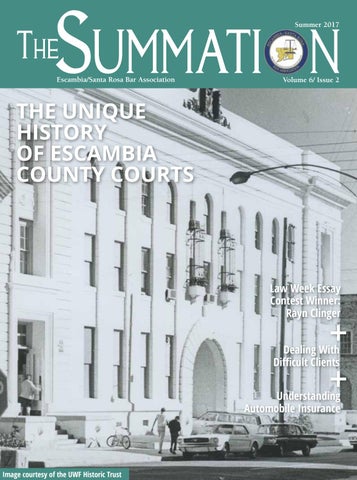
The Unique History of Escambia County Courts
Law Week Essay Contest Winner: Rayn Clinger Dealing With Difficult Clients Understanding Automobile Insurance
Image courtesy of the UWF Historic Trust
Table Of Contents From the President
Page 3
Board of Governors
Page 4
New Members
Page 5
Escambia-Santa Rosa Bar Association 216 South Tarragona Street, Suite B Pensacola, FL 32501 Phone: 850.434.8135 Fax: 850.436.8822 email: esrba@esrba.com Lawyer Referral Service: 850.434.6009
On the Move
Page 6
Judge Preferences: Darlene Dickey
Page 7
Ask a Lawyer: Automobile Insurance
Page 9
The Unique History of Escambia County Courts
Page 11
Executive Director Michael Doubek mike@esrba.com
2017 Liberty Bell Award
Page 13
ESRBA News
Page 14
Law Week Essay Contest Winner: Rayn Clinger
Page 17
The Bottom Line
Page 18
News from the Clerk
Page 19
Snapshots
Page 20
Calendar and Announcements
Page 23
Editor Patricia Buchanan Wright patriciabwright@aol.com Published quarterly by the Escambia-Santa Rosa Bar Association as a service to its membership. Any article herein may be reproduced provided credit is given both to The Summation and the author of the article. Articles appearing in The Summation are not to be construed as official expressions of the views of the Escambia-Santa Rosa Bar Association. Official positions are expressed only by formal resolutions adopted by a majority of the membership and will be so designated when published. Editorials are expressions of the opinion of the Editor. Due date for all advertisements, articles, and announcements is the first of the month for the issue you wish to advertise in. Address all editorial correspondence to the Escambia-Santa Rosa Bar Association office. For all inquiries concerning advertising rates contact Ballinger Publishing. “The Summation Committee is dedicated to providing a publication to the legal community which contains articles that are accurate, informative, entertaining, educational, relevant and timely.” Summation Committee If you have any comments or suggestions about The Summation, please feel free to express them to any of the committee members. If you would like to join the committee, please call the Bar office at 434.8135. Brooke Jones Clara Smith Caroline Peterson Susan Woolf Tanner Yea
Carrie Cromey Gerald McGill Lisa York Michele Kelley
Owners • Malcolm & Glenys Ballinger Publisher • Malcolm Ballinger Executive Editor • Kelly Oden Editor • Hana Frenette Art Director • Guy Stevens Graphic Designer & Ad Coordinator • Carly Stone Assistant Editor • Tanner Yea Sales & Marketing Geneva Strange, ext. 21 Paula Rode, ext. 28 Visit our Website at www.ballingerpublishing.com Editorial Offices: 314 North Spring Street, Suite A Pensacola, Florida 32501 850-433-1166 • Fax 850-435-9174 Member of
Reproduction or use of the contents herein is prohibited without written permission from the publisher. Comments and opinions expressed in this magazine represent the personal views of the individuals to whom they are attributed and/or the person identified as the author of the article, and they are not necessarily those of the publisher. This magazine accepts no responsibility for these opinions. The publisher reserves the right to edit all manuscripts. All advertising information is the responsibility of the individual advertiser. Appearance in this magazine does not necessarily reflect endorsement of any products or services by Ballinger Publishing. © 2017 Ballinger Publishing. All Rights Reserved.
2 The Summation www.esrba.com Summer 2017
From the President Final Letter from the President By TIFFANY SULLIVAN
Dear Fellow ESRBA Members: This is the last time I will write to you all as the President of your local bar association. The last 12 months have flown by and I could not have imagined this time last year how much things would change over the 12 month term. I have enjoyed tremendously serving alongside the Mike Doubek and the entire executive council. I am very excited to pass the torch to Jodi Cooke and confident to know what an amazing servant leader she will be to this Bar. On May 5th we celebrated Law Day here in Pensacola, Florida. For our Law Day luncheon, we were honored and privileged to have Justice Peggy Quince to deliver the keynote speech. The theme for our celebrations was “The Fourteenth Amendment: Transforming American Democracy.” Justice Quince attended segregated schools in elementary and high school. She was the first African American woman to sit on the state’s highest Court. On July 1, 2008, Quince assumed the office of Chief Justice of the Supreme Court of Florida- the first African American woman to lead any branch of Florida Government. Justice Quince spoke about the Equal Protection clause of the 14th Amendment. She reminded us that Equal Protection under the laws necessarily requires equal access to the Courts. Equal access to the Courts requires some level of equality in representation of citizens before the courts. However, the average citizen cannot afford to hire an attorney. She said that 60% of jobs in the United States pay $17 per hour or less. If the average rate of an attorney is $250 per hour, how is one who makes $17 per hour or less supposed to set aside enough money to hire representation? Justice Quince reminded us all of the oath we took and our responsibility to make sure that all have access to representation before the courts, and therefore a better chance at Equal Protection Under the Laws. During my 14 years of practice, I became keenly aware of the disparity among those who can afford representation and those who cannot. I personally witnessed parties who could not afford an attorney treated unfairly and without justice. I am sure you all have witnessed the same to some degree or another. I would encourage you all to consider the words of Justice Quince as she expressed the importance of representation of counsel to the very core of our 14th Amendment. Do your part to ensure that others have access to adequate representation… maybe its pro bono work, maybe it’s a donation to legal service… maybe it is both or something different. Just make sure you do your part. Thank you for the opportunity to serve as your President.
Summer 2017 www.esrba.com The Summation 3
Board of Governors By STEPHEN ECHSNER
Report from
The Florida Board of Governors
T
he Florida Bar Board of Governors met on May 26, 2017. The major actions of the Board and reports received included: Joshua Doyle, a Tallahassee attorney and FBI special agent, was selected to serve as the next executive director after a national search to follow John F. “Jack” Harkness, Jr., who after 37 years of service will shift from executive director to an ongoing consulting role. Doyle and Harkness will begin a six-month transition process in July. More information on Doyle’s background and experience is in the June 15 Florida Bar News. A 12-point plan to eradicate bias and address gender inequalities was presented in the report of the Special Committee on Gender Bias by President-elect Michael Higer, who chaired the committee. The report sets forth specific actions the Bar can initiate, including creating a Women in the Profession Subcommittee within the Diversity & Inclusion Committee. In addition, the plan calls for: creating CLE courses for Bar members and “toolkits” to help law firms reach gender and diversity goals; a review of ethics rules and rules of
professionality responsibility to ensure they prevent gender bias; creating a confidential way to report instances of gender bias; and creating a “Blue Ribbon Firm” designation for firms that show a commitment to diversity. Appointed in July 2016 by President Bill Schifino, committee members were leaders from major law firms, judges who served on two previous Supreme Court commissions on gender bias, members of the Board of Governors, Young Lawyer Division representatives, and others. Full coverage of the presentation to the Board is in the June 15 Florida Bar News. A proposed new procedural rule that establishes a mandatory continuance when lead counsel needs to take parental leave was approved unanimously. The request for relief must be: made within a reasonable timeframe -- would not cause substantial prejudice to an opposing party (i.e., the opposing party needs time-sensitive relief); and would not adversely impact the rights of either party. The proposed rule, which will now be sent to the Supreme Court, maintains judicial independence and autonomy, allowing judges the discretion to
4 The Summation www.esrba.com Summer 2017
accept or deny a motion for continuance based on the individual facts and circumstances of the request, while providing findings in the event a motion is denied. Read more in the June 15 issue of The Florida Bar News. Three new member benefits companies were approved including up to 30 percent discounts for Bar members by Dell and Lenovo computers and a 15 percent discount on PracticePanther cloud-based practice management software. The discounts will soon be available at www.floridabar. org/memberbenefits and through the Practice Resource Institute (PRI). Five goals to meet the Bar’s Strategic Plan objectives have been set for the coming year: using technology to connect Bar members and the public with Bar resources; enhancing communications regarding member benefits and resources; promoting inclusion in the profession and the judiciary; educating members and the public about the Constitution Revision Commission; and addressing issues relating to the health and wellness of members.
The Special Committee on the 2017 Constitution Revision is working on a program to educate and encourage participation by Bar members and the public in Florida’s May Constitution Revision Commission process. The committee has adopted the theme, Protect Florida Democracy: Our Constitution, Our Rights, Our Courts and is now creating communications tools and materials. The program will be launched in late summer/early fall. For more information on the commission, which meets every 20 years to propose amendments that will go directly on the November 2018 ballot, visit www. floridabar.org/crc. Following the close of the comment period (official notice was published in the April 15 Florida Bar News), the board approved the 2017-18 budget which keeps annual membership fees at $265 for active members and $175 for inactive members for the 16th consecutive year, and projects $41.8 million of revenues and $42.9 million of expenses, which will be adequately covered by reserves. The budget now goes to the Supreme Court for approval.
New Members Moses Aluicio Office of the State Attorney 190 West Government Street Pensacola, Florida 32502 850-595-4400 maluicio@sa01.org Matthew C. Chavers Wade, Palmer & Shoemaker, P.A. 14 North Palafox Street Pensacola, FL 32502 850-429-0755 mchavers@wpslawyers.com
On May 9th, Governor Rick Scott, appointed the following ESRBA members to the First Circuit Judicial Nomination Commission: Robert “Alex� Andrade, 27, of Gulf Breeze, is an attorney with Moore, Hill & Westmoreland. He succeeds A. Benjamin Gordon and is appointed for a term beginning May 9, 2017, and ending July 1, 2019.
Samantha D. Costas Wade, Palmer & Shoemaker, P.A. 14 North Palafox Street Pensacola, FL 32502 850-429-0755 scostas@wpslawyers.com Jerrilynn Hadley The Virga Law Firm, P.A. 111 East Garden Street Pensacola, FL 32502 850-972-8610 Jerrilynn.hadley@thevirgalawfirm. com
Pamela Langham, 52, of Gulf Breeze, is a sole practitioner with Pamela E. Langham, P.A. She is reappointed for a term beginning May 9, 2017, and ending July 1, 2020.
Benjamin T. Shell Emmanuel, Shepard & Condon 30 South Spring Street Pensacola, Florida 32502 850-444-3882 bshell@esclaw.com
Summer 2017 www.esrba.com The Summation 5
On the Move
Stephen A. Luongo has joined the Personal Injury Motor Vehicles Department at Levin, Papantonio, Thomas, Mitchell, Rafferty & Proctor, P.A.
John Adams has joined Beggs & Lane, RLLP as an associate attorney.
Gary W. Huston has become partner at William V. Linne and Gary W. Huston, Attorneys at Law, PLLC
Hadley Sander has opened a new office location at 314 South Baylen Street, Suite 112, Pensacola, FL 32502.
Garrett P. LaBorde has joined Quintairos, Prieto, Wood & Boyer, P.A. as partner at the Pensacola office.
Kelsey K. Stone has joined Clark Partington as an associate attorney
John B. Trawick with John B. Trawick, PLLC has opened a new office location at 5101 N. 12th Avenue Pensacola, Florida 32504.
Craig A. Vigodsky has opened a new office location at 221 West Cervantes Street, Pensacola, FL 32502.
Lori Prettyman has joined the Favor House as their Injunction for Protection Project Attorney.
William Nelson with Will Nelson, P.A. has opened a new office location at 221 East Government Street, Pensacola, FL 32502.
6 The Summation www.esrba.com Summer 2017
JUDGE PREFERENCES
JUDGE DARLENE F. DICKEY Division: L Jurisdiction: Circuit Court/Family Law Judicial Assistant: Noelle Martin Phone: 850-595-4445 Divisional Email Address: esc.divL.eserve@ flcourts1.gov DIVISION PREFERENCES Contacting Judge Dickey’s Office Division L will be available to answer your telephone calls between 8:30 am and 4:30 pm. The first and last half hour of each day are needed for the Judicial Assistant to prepare for hearings and conduct other administrative matters. The office has two telephone lines coming in and one Judicial Assistant to answer all calls. Therefore, please leave a message if your call is not answered, and be sure to leave the case number. Your call will be returned as soon as possible. If you do not receive a call back within 24 hours of leaving your message, please call back. Please treat Judicial Assistant Noelle Martin with the same courtesy she will extend to you. Ms. Martin will do her best to assist everyone as quickly as possible, and to provide everyone with thorough and accurate information. In this endeavor, she may have to call you back, so please be sure to leave a telephone number along with the best time you can be reached at that number. General Information All matters to be considered by a judge should be in the form of a motion filed with the Clerk of Court with copies provided to all parties of record. It is the responsibility of the moving party to set the motion for hearing and to coordinate that hearing with the judge’s office and all counsel of record. Merely filing a motion with the Clerk will not bring the matter before the judge. Scheduling Hearings To schedule a hearing, you may (1) arrange a conference call with opposing counsel and the judge’s office; (2) email the judge’s judicial assistant (copying opposing counsel) and request available times for a hearing (noelle.martin@flcourts1.gov ); or (3) obtain dates by phone from the judicial assistant to coordinate with opposing counsel. Please
state whether you need a hearing before or after a particular date. Dates will not be final until the judge’s office is notified that the hearing has been coordinated. Please have all pertinent information ready (i.e., name, case number, type of hearing) when you call to schedule. All hearings are scheduled through this office. Time allotted for the hearing: The Court will give the parties the time requested, but both parties will be limited to the time requested. If a hearing is scheduled for one hour- each party will receive 30 minutes, and the Court will add an appropriate time for its ruling.
proposed orders that have not been reviewed by opposing counsel with a request to enter the order after 5 days have passed without an objection. • When emailing a proposed order to the Court, please provide a copy in Word format to allow editing. • When sending a proposed order to the Court, the accompanying cover letter or email should cite the hearing date and state that all counsel have approved the order. • If the parties disagree, the points of disagreement should be set forth in detail. • If entered, orders will be filed with the Clerk. • If no copies or envelopes are provided, counsel may obtain copies from the Clerk’s website for distribution. • It is counsel’s responsibility to ensure that all parties receive copies. • NEVER e-file a proposed order.
Cancelling hearings: Upon determining a hearing is no longer necessary, please cancel the time set aside with the judge as soon as possible. The ONLY way this office knows of a cancellation is through your notification. If the hearing Courtesy Copies of Documents: is cancelled far enough in advance, the time The Court has delayed access to items can be made available to others. electronically filed, and the Court only has access to an electronic record. If you want Notices of Hearing: the Court to review anything before your THE PARTY REQUESTING THE scheduled hearing, please present copies HEARING SHALL FILE A WRITTEN directly to the Judicial Assistant if you are late NOTICE OF HEARING. THE NOTICE OF filing pleadings. HEARING SHALL INCLUDE: Memoranda, case law, rules and any other • ADVISING THE COURT AND ALL relevant documents must be submitted to PARTIES OF THE DATE AND TIME the Court and opposing counsel at least three • ADVISING THE PARTIES OF THE business days prior to the scheduled hearing SPECIFIC HEARING- TO INCLUDE THE to allow the Court sufficient time to review DATE THE PLEADING THAT PROVIDES and prepare. THE NEED FOR THE HEARING WAS If these materials are not provided in a FILED timely manner, the Court may cancel the hearing. Supporting case law should be Proposed Orders highlighted or underlined. Except in rare Proposed Orders cannot be filed with the instances, the Court will not accept excessive Clerk and must be emailed to the Judicial materials during a hearing. Documents may Assistant (Noelle.martin@flcourts1.gov) in be delivered by hand, mail or email. Word format. Decorum Submitting Proposed Orders Division L has adopted the Customary and Following a hearing, the Court may ask Traditional Conduct and Decorum guidelines the prevailing party to submit a proposed set forth as an Addendum to the U.S. District order along with copies for conforming and Court, Northern District of Florida Rules. stamped envelopes for all parties. “These standards are minimal and not all• Please do not submit a proposed order inclusive. They are intended to emphasize until all parties have reviewed and approved and supplement, not supplant or limit, the the proposed order. Please do not send ethical obligations of counsel under the
Summer 2017 www.esrba.com The Summation 7
Code of Professional Responsibilities or the time honored customs of experienced trial counsel.� When appearing in Div. L of Escambia County Circuit Court, all counsel and all person(s) attending hearings and trials should conduct themselves in the following customary and traditional manner: 1. Stand as court is opened, recessed or adjourned for all matters held in the courtroom. 2. Stand when the jury enters or retires from the courtroom. 3. Stand when addressing, or being addressed by the court for all matters held in the courtroom. 4. Address all remarks to the court, not to opposing counsel. 5. Avoid disparaging personal remarks or acrimony toward opposing counsel and remain wholly detached from any ill feeling between the litigants or witnesses. 6. Refer to all persons, including witnesses, other counsel and the parties, by their surnames and not by their first or given names. 7. Counsel should request permission before approaching the bench. 8. Unless opposing counsel has previously been shown exhibits, any exhibit offered in evidence should, at the time of such offer, be handed to opposing counsel. 9. In making objections, counsel should state only the legal grounds for the objection and should withhold all further comment or argument unless elaboration is requested by the court. 10. Offers of, or requests for, a stipulation should be made privately, not within the hearing of the jury. 11. Counsel shall admonish and discourage all persons (parties, witnesses and observers) from making gestures, facial expressions, audible comments, or the like, as manifestations of approval or disapproval during the testimony of witnesses, or at any other time. 12. Smoking, eating, food and drink are prohibited in the courtroom or chambers at any time; however, water is allowed. See Rules of the United States District Court for the Northern District of Florida
8 The Summation www.esrba.com Summer 2017
Ask a Lawyer
Understanding Automobile Insurance 1. What is full coverage? There really is no such thing. It’s pretty much like “beauty is in the eye of the beholder�. The coverage should mirror your economic wherewithal. In other words, I would expect an older lawyer with a greater income to have much more insurance coverage than a young lawyer just starting out. Car insurance not only protects you from liability if you cause an accident, but more importantly in Florida, you should always have uninsured motorist coverage equal to your bodily injury, since so many drivers out there only have a $10,000 limit. If you have multiple vehicles, you should always have stacking coverage. Even if you have health insurance, you should always purchase at least $10,000, if not $20,000 of med pay to compliment and supplement your PIP coverage. 2. Why do we have no fault
as opposed to just pursuing the at fault party for medical bills at the outset in a car wreck? Unfortunately, it takes most competent personal injury lawyers one to three years to resolve a bodily injury claim. Many people cannot wait that long to have their bills paid, since they may not have health insurance or have large deductibles, which is very common in this day and age. Also, there is a disability component under PIP or no fault in that they must pay 60% of your gross loss wages within two weeks of presentment. Even if you have disability through work, most disability policies have a 180 day deductible, which means you would receive no compensation unless you are out of work for over six months. If one is injured and out for only two or three weeks, there would be no compensation without no fault. It is a
really good system, although the legislature is meeting right now to do away with no fault and maybe increase bodily injury to $25,000. 3. Why would you encourage someone to have medical coverage as opposed to using health insurance, if injured in a car accident? First of all, many policies today have large deductibles. Second, most health insurance carriers utilize a gate keeper or a primary care doctor for referrals. Under your med pay, you can pretty much see anyone you wish. Many people use chiropractors initially for neck and back injuries. Many health insurance policies do not cover chiropractic or have only a very limited amount of visits authorized per year. While health insurance and med pay can both subrogate, or seek reimbursement at the end of a case, it is
By Terry Gross much easier to deal with a med pay carrier on subrogation issues than some forms of health insurance such as Medicare. Furthermore, if you look at your insurance premium, Medpay is extremely cheap and would make sure that if you had a severe accident with a lot of initial medical bills at the ER, that the vast majority of them would be taken care of in a timely fashion and thereby protect your credit. Finally, if you missed work, but had a lot of med pay from a car accident, you could designate the no fault carrier to reserve your PIP for lost wages and pay your medical bills through med pay, which is a tremendous advantage. 4. What is the most frustrating aspect of being a personal injury lawyer? Quite frankly, it is the lack of insurance coverage. All too often we encounter people that
Summer 2017 www.esrba.com The Summation 9
have been injured seriously due to the negligence of another, yet the defendant had little or no coverage and our client either rejected uninsured motorist coverage or only had very little. We still take these cases, but they are very timely in that even if the defendant and UM carrier tender early, we spend up to a year or more negotiating liens with medical facilities or health insurers that have a right to subrogate. 5. What are some of the recent changes that occurred when they had the major overhaul of PIP in 2013? There were many. First, if a person does not treat within fourteen (14) days of an accident, they have lost their no fault benefits altogether. Second, if they do treat within fourteen days, a medical doctor, dentist or physician’s assistant would have to opine that the injured party had an “emergency medical condition” before the PIP carrier would have to extend benefits from $2,500 up to the policy limits of $10,000. A chiropractor is not authorized to give an EMC certification. Furthermore, the legislature deemed that no fault carriers would no longer be responsible for massage therapy or acupuncture in relation to treatment for injuries in a car accident. It is my belief that this last provision will ultimately lead to the statute being declare unconstitutional by our appellate courts, since I doubt that there could be any scientific showing for the justification of singling out these two professions. 6. What is the most difficult aspect of your practice? Since 1996, when the Florida Supreme Court issued MATTHEWS V. BLUE SHIELD, lawyers are required to set aside funds for any subrogation interest of any potential health insurer. This has created a significant amount of additional work requiring many personal injury law firms, like ourselves, to hire additional paralegals who deal strictly with medical bills and subrogation rights. Every entity that pays has a different subrogation formula. Specifically, Medicare’s subrogation system is totally different from TriCare, which is different from VA and private insurance . Sometimes, there can be hidden medical insurance payments, especially if a claimant is using a pharmacy for prescription medications that may be unknown to the claimant’s law firm. Nonetheless, this could create a hidden Medicaid or Medicare subrogation right that
would have to be honored at some point, even if the client has already received their proceeds. If so, this would come out of the lawyer’s pocket. Many times the lawyer may settle the case and yet a year later the file is essentially still open dealing with subrogation issues. A problem that arises every now and then is when a federal entity such as Medicare chooses to bundle coverage where an elderly person who may have been treating for many different reasons also gets treatment for accident related symptoms and yet Medicare seeks reimbursement for all the treatment received. Dealing with Medicare is no easy task. 7. What can be done if the no fault carrier refuses to make payment on accident related bills?
Since the 2008 amendment of the no fault statute, a “demand letter” must be sent outlining the bills that have been denied and specifically stating what is owed. This must be filed with the representative of the insurance company that they have designated for this purpose. It gives the no fault carrier a 30 day window in which to cure the nonpayment with only a $250 penalty. Once the timeline has expired, a PIP suit could be filed and if the plaintiff is successful, then in that event the insurance company would have to pay the attorney’s fees for the claimant, as well as any costs expended. 8. If a person is injured and they don’t own a motor vehicle, can they still receive Florida PIP benefits? The answer usually is yes. The statute specifically addresses this. If the injured party does not own a motor vehicle, then the first in line potential no fault carrier would be any car insurance that has been provided to a resident relative of the injured party. If the injured party does not have a resident
10 The Summation www.esrba.com Summer 2017
relative, then in that event the PIP statute indicates that the claimant could receive PIP benefits from the car that he or she was in at the time of the accident. If the claimant is a pedestrian, with no PIP insurance available from any source, they would be able to get the no fault from the actual car that struck them. 9. Is there a loophole in the no fault law that you do not like? Yes. If you are out of the state of Florida and you are not in your own vehicle, then you would have no no fault benefits available. Furthermore, you cannot use the no fault coverage of the car that you are in, presuming it was a non-family vehicle. 10. Was there anything favorable to the citizens of Florida that was added to the 2013 amendment of Florida’s no fault law. Yes, we have always had a $5,000 death benefit. This pretty much would pay for a basic funeral up front upon the death of any person from a car accident regardless of fault. According to the 2013 amended statute, that $5,000 death benefit would not reduce PIP coverage, so $10,000 would still be available for any medical bills incurred by the decedent before he or she passed. 11. Do you have a practice tip for fellow lawyers in the community about how to possibly maximize PIP benefits? One tip would be that if you have a claimant that is injured in an auto accident while on the job, he or she obviously may pursue worker’s comp benefits. Sometimes my clients go through the authorized worker’s comp physician, but if they want to see someone not authorized by worker’s comp, PIP will pay. Furthermore, at the end of the case if the case is settled and you have to pay back worker’s comp regarding their subrogation right, you can then seek reimbursement from PIP for 80% of any monies paid by worker’s comp. Terry Gross is an injury lawyer and Florida Bar Board Certified Trial attorney with the law firm of Gross & Schuster, P.A
The Unique History of Escambia County Courts By Judge David W. Langham
T
he recent news in 2017 has been about the Constitutional Revision Commission. It is charged with meeting every 20 years to consider changes in the Florida Constitution. The Commission last proposed changes in 1998, and before that in 1978. Amendments can come at any time, but most of our current Constitution has been in place since 1972, when the 1885 Florida Constitution was superseded by our modern constitution. Much of our current Florida court system is based on the broad changes of 1972, but there were also significant changes in 1958. Interestingly , during the last 131 years, Escambia County’s courts have periodically been unique. The 1885 Florida Constitution vested judicial power in “a Supreme Court, Circuit Courts, Criminal Courts, County Courts, County Judges, Mayor’s Court and Justices of the Peace.” There were three Supreme Court Justices, elected to six year terms. There were 7 Circuits, each with one Circuit Judge. Circuit Judges were appointed by the Gover-
nor for six year terms and confirmed by the Senate. The First Judicial Circuit was comprised of “Escambia, Santa Rosa, Walton, Holmes, Washington and Jackson” counties. By comparison, the Seventh Circuit included Volusia, Brevard, Orange and Dade. There are only 39 counties listed in the 1885 Florida Constitution, compared to 67 today. Per the 1885 Constitution, the Supreme Court Justices were paid $3,000 per year ($81,278.74 in 2016 dollars), and the Circuit Judges $2,500 ($67,732.28 in 2016 dollars). Circuit Judges and Justices of the Supreme Court had to be attorneys. Judges could appoint “one or more attorneys” to be Court Commissioners, when the Judge was absent from the country. The Florida Circuit Court had exclusive original jurisdiction in all cases in equity, also in all cases at law, not cognizable by inferior courts, and in all cases involving the legality of any tax, assessment, or toll; of the action of ejectment and of all actions
involving the titles or boundaries of real estate, and of all criminal cases not cognizable by inferior courts; and original jurisdiction of actions of forcible entry and unlawful detainer, and of such other matters as the Legislature may provide.
Each county had a county court judge under the Constitution. Those judges were elected for four year terms. The Florida County Courts had original jurisdiction in all cases at law in which the demand or value of property involved shall not exceed one hundred dollars; of proceedings relating to the forcible entry or unlawful detention of lands and tenements; and of such criminal cases as the Legislature may prescribe. The County Judge shall have jurisdiction of the settlement of the estates of decedents and minors, to order the sale of real estate of decedents and minors, to take probate of wills, to grant letters testamentary and of administration and guardianship, and to discharge the duties usually pertaining to courts of probate.
Summer 2017 www.esrba.com The Summation 11
But Escambia County was singled out in the 1885 Constitution. Article V., section 24 provided: There shall be established in the county of Escambia, and upon application of a majority of the registered voters in such other counties as the Legislature may deem expedient, a Criminal Court of Record, and there shall be one Judge for each of the said courts, who shall be appointed by the Governor and confirmed by the Senate, who shall hold his office for four years, and whose salary shall be one thousand dollars a year (approximately $27,092.91 in 2016 dollars. (Emphasis added).
Brevard County later voted to establish a Criminal Court of Record, as did Dade, Duval, Hillsborough, Orange, Palm Beach, and Polk Counties. No evidence has been found to support that any other county in Florida elected to adopt this alternative. The County Court was divested of any criminal jurisdiction by the institution of the Criminal Court of Record in Escambia, and the counties that thereafter adopted that model. The Criminal Court of Record had jurisdiction over all “criminal cases not capital.” And, cases were prosecuted by a “prosecuting Attorney, who shall be appointed by the Governor and confirmed by the Senate, and who shall hold his office for four years.” The first judge was appointed to the Escambia Criminal Court of Record on August 17, 1887 and the first County Solicitor on August 19, 1887. In practice, by the 1950s, the County Solicitor and State Attorney was often the same person. But, then there arises some potential for confusion. Some present day Pensacola attorneys remember the “Court of Record” having a civil jurisdiction also, parallel to the Circuit courts. But this is not congruent with the 1885 Florida Constitution. However, in 1955, Senate Joint Resolution No. 1052 was passed, proposing constitution amendment to abolished “the Court of Record in and for Escambia County, Florida, and vest all its jurisdiction in the Circuit Court of Escambia County.” Although there were Criminal Courts of Record in eight counties, only one was thus abolished specifically by constitutional amendment in 1955. The logic for this is clear, only Escambia’s was created by the constitution, and so only the dissolution of Escambia’s required further amendment of the constitution. And, therefore, one
might presume that after 1955 there was no Court of Record in Escambia County. But, that would ignore the 1956 Committee Substitute for House Joint Resolution No. 810. The most notable effect of this Resolution was the creation of “three appellate districts of contiguous counties,” and the beginning of Florida’s intermediate appellate court system. This Resolution altered the Circuit Courts (section 6), the County Courts (section 7 and 8), and the Criminal Courts of Record (Section 9). Uniquely, for Escambia County, section 10 created the “Court of Record of Escambia County.” This provided for constitutional creation of another unique court in Escambia County. There was a mandate for at least two judges, elected for a term of six years. The jurisdiction of the new Court of Record included the jurisdiction of the former Escambia Criminal Court of Record, i.e. “exclusive jurisdiction of all criminal cases not capital.” But, this new Court of Record also had “concurrent with the circuit court,” “the same original jurisdiction of all cases and matters and the same power and authority to issue all writs as the circuit court.” The constitution even mandated the applicability of the procedural rules: “the rules of procedure and practice applicable to the circuit court of said county shall obtain in the court of record.” By that time, the Circuit Courts were using written procedural rules, but not by constitutional mandate. Those were modeled after the Federal Rules of Civil Procedure that were first adopted by the United States Supreme Court in 1937. Practitioners today might be incredulous to imagine practice without procedural rules, but that was common at one time about 80 years ago. So, in the mid-1950s, Escambia was once again designated specifically in the Florida Constitution for a unique court. Practitioners in the 1960s remember the parties and attorneys making the choice of whether to file civil proceedings in the Circuit or Court of Record. In the 1960s, the filing fee in circuit and record was $12 (about $92.80 in 2016 dollars), and there was a $5.00 charge for service of process (about $38.67 in 2016 dollars). The jurisdictional threshold for civil cases in Circuit Court back then was $300 (about $2,469.82 in 2016 dollars). Historically, Pensacola legal affairs were clustered around Ferdinand Plaza. The
12 The Summation www.esrba.com Summer 2017
courthouse was at the northwest corner of the plaza, now called “the old courthouse.” That building was originally built by the federal government and called the U.S. Customs House. The county courthouse was at the corner of Palafox and Chase Streets. In the 1930s, the county and federal government traded property and the Customs House became the county courthouse. The former county courthouse was demolished to accommodate construction of a new federal building that later became the Winston Arnow Federal Building. Across the plaza from the Customs House was city hall, in what is now the Wentworth Museum. And, across Zaragossa Street from city hall to the south, in what is now the Pensacola Little Theater, was the Court of Record. On the ground floor of that building was a courtroom and jury room. In the back of the first floor was a clerk’s office accessible through a separate outside door or through the courtroom. On the second floor was a court reporter office and judicial chambers. And on the third floor was a juvenile courtroom. Coincidentally, across Jefferson Street to the East was the city jail, which is now the Pensacola Museum of Art. The Criminal Court of Record in Escambia had one judge initially. But in 1954 a Constitutional Amendment was adopted, providing “for the appointment of one or more additional judges of said court.” So, just before the Escambia Criminal Court of Record’s demise, additional help was authorized. The need was apparently recognized because the newly formed Court of Record thereafter in 1956 was staffed by two judges. The Court of Record existed as an alternative forum for about 16 years before the 1972 Constitution became the foundation for a new and more uniform Florida court system, similar to today. In the 1960s, two judges presided in the Court of Record: M.C. Blanchard and Kirk Bealle. Cases were assigned on a rotating basis. Knowing this, attorneys reportedly commonly took three cases at a time for filing, and thus sometimes successfully manipulated the selection of judge for one of those cases. During the last decade before the review and adoption of the 1972 Florida Constitution, the local Circuit Judges were Earnest Mason and Ralph McClain. Some say that a third Circuit Judge was added in the 1960s.
There is a story, or perhaps urban legend, told of the third floor courtroom in the Court of Record. That courtroom was used for juvenile court. The presiding judge was Theo Bruno, and he or others concluded the courtroom should be enlarged. It was apparent to some that there was unused space behind the judge’s bench, and a decision was made to remove a wall. It is unclear if anyone knew at the time what lay behind. When demolition began on this wall, a space was revealed. It was in disrepair and had been long unused. But, the story goes (urban legend or not) that behind the wall was the Escambia County gallows, said to still be fitted with an intact rope. Legend holds that capital offenses in Escambia County were initially carried out in public, some say in Ferdinand
Plaza. When later generations decided that such spectacles were inappropriate, the executions were moved inside at the Court of Record. This seems a curious location, considering that capital crimes were the singular criminal activity specifically constitutionally excluded from the jurisdiction of the Criminal Court of Record. According to the Death Penalty Information Center, the practice of hanging was abandoned in Florida in 1923, when a statute substituted the electric chair and placed “all executions in Florida under state (rather than local) jurisdiction.” At that time, approximately 96 years had passed since the first recorded Florida execution in 1827. Florida became a U.S. territory through a treaty signed in 1819, and was formally occupied in 1821. That
first recorded Florida execution was purportedly Donica Benjamin, in Escambia County; the crime was murder. According to the same source, the last hanging in Escambia County was Hosie Poole, likewise for murder, on July 20, 1920. If the legend of the Court of Record gallows is true, he was its last victim. The Honorable David Langham is the Deputy Chief Judge of the State of Florida, Division of Administrative Hearings, Office of the Judges of Compensation Claims.
2017 Liberty Bell Award
T
he Escambia-Santa Rosa Bar Association (ESRBA) presented the 2017 Liberty Bell Award to the Escambia County School District at our May 4th Law Day Luncheon. The Liberty Bell award was first presented in 1963 with the purpose of “recognizing service that has strengthened the American system of Freedom under law, and accord public recognition to men and women, particularly non-lawyers for their outstanding service.” Since 1963, the Liberty Bell award has been presented to individuals, teams of people and even an institution, the Pensacola News Journal. Categories for consideration of the Liberty Bell Award include: promoting a better understanding of our Constitution and the Bill of Rights…and fostering a better understanding and appreciation of the rule of law. “I believe all of our members would agree that one of our society’s most important roles is to assure that future generations will grasp – cherish and sustain – the values set forth in our three great documents: the Declaration of Independence, the Constitution, and the Bill of Rights,” Mike Doubek, Executive Director of the ESRBA said during the
luncheon’s program. “Providing a means for easy understanding of those documents has been a cause set in motion throughout Escambia County for several years now.” Doubek then announced that the recipient of the 2017 Liberty Bell award was the Escambia County School District. The award was accepted by Superintendent Malcolm Thomas. “I was completely surprised by the announcement and honored. Our partnership with John Appleyard and his writing project is one that will continue to enhance our middle school civics classes,” said Thomas. “Having enhanced instruction in Civics leads to better informed citizens as these students get old enough to vote or maybe even to run for office someday. Adding the fifth grade classes to this project with the most recent book, adds a layer of foundation to their understanding of U.S. history.” The school district’s seventh grade civics students receive copies of booklets written by John Appleyard that cover the Constitution, the Declaration of Independence, and the Bills of Rights. Appleyard made
Superintendent Malcolm Tomas accepts the 2017 Liberty Bell award from Mike Doubek
the first delivery of each book with a presentation in one of our area middle schools. Most recently, the Escambia-Santa Rosa Bar Foundation paid for the printing of Appleyard’s latest work, “The United States is a Nation Ruled by a System of Laws,” that was distributed this year to local fifth graders to enrich their understanding of American History. The Bar Foundation also underwrote the production cost of “Learning about The Declaration of Independence” booklet in 2016.
Summer 2017 www.esrba.com The Summation 13
ESRBA News Will Dunaway Wins Ethics in Business Award
T
he University of West Florida College of Business and the Combined Rotary Clubs of Pensacola named William “Will” J. Dunaway and Connie Bookman as the 2017 recipients of the annual Ethics in Business Award on May 1 during a luncheon at New World Landing in downtown Pensacola. The Ethics in Business Award recognizes individuals who exemplify the concept of “service above self” and work to build a positive sense of self-worth within both the business community and the broader community as a whole. Criteria for the award is based on adherence to the high ethical standards of honesty, integrity and consistency in dealing with employees, contractors and customers, while positively enhancing the economic well-being of the firm’s stakeholders and providing jobs, opportunities and profits. Will Dunaway, shareholder with the law firm of Clark Partington, P.A., was recognized for the large business sector, organizations with 50 or more employees. Bookman, chief executive officer of Pathways for Change, earned the honor for the small business sector for
organizations with 49 or fewer employees. “This is the 15th year that the Combined Rotary Clubs of Pensacola and the UWF College of Business recognize community leaders who demonstrate the highest standards of honesty and integrity in their dealings with customers, employees and contractors, as well as the Rotary value of service above self,” said Dr. Ed Ranelli, professor and Dean Emeritus for the UWF College of Business. “It’s our pleasure to acknowledge Will and Connie as the 2017 winners of the Business Ethics Award.” Dunaway, a retired U.S. Navy Lt. Commander, began his association with Clark Partington more than 10 years ago. In his practice, he focuses on real property, land use and environmental issues, and he has developed relationships with governmental entities, judges, attorneys and clients throughout Northwest Florida. A member of local, state and national bar associations and real estate and environmental organizations, Dunaway also served on the Sacred Heart Foundation Development Board, and volunteers with his church and other
organizations. As an Eagle Scout, he coordinates review boards for Boy Scouts seeking to become Eagle Scouts. Dunaway’s pro bono service includes assisting the homeless and advocating for other individuals and families in need. He is a member of Rotary Club of Pensacola, Inc., Cordova chapter. “The community recognizes that ethics matters in business, because that’s what Rotary stands for,” Dunaway said. “I’m just proud to be a part of it.”
TEAM Court Graduates Its First Class
I
n the June 2015 edition of The Summation, we featured the Escambia TEAM (Teaching, Education, Accountability and Motivation) Court Program spearheaded by Judge Darlene F, Dickey. The program which began in May 2014 is designed for criminal defendants diagnosed with a mental illness and whose illness contributed to the commission of their offenses. On May 10, 2017, TEAM Court graduated its first class. In a small ceremony held at the M.C. Blanchard Judicial Building, Judge Jennifer J. Frydrychowicz, who now oversees the program, had the honor of dismissing the charges of three TEAM Court graduates who successfully completed the program requirements. “We’ve seen a lot of progress,” said Judge Frydrychowicz. “People who weren’t speaking in complete sentences, who have never really had a job, are not having their cases dismissed.” 14 The Summation www.esrba.com Summer 2017
TEAM Court is a diversionary program designed to provide treatment to criminal defendants whose diagnosed mental illness was a factor in their alleged crime. Each individual receives a personalized case management plan that addresses everything from therapy to medication to life skills to longterm family and employment goals. TEAM Court is a collaborative effort of the Office of the State Attorney, Office of the Public Defender, Regional Conflict Counsel, private defense attorneys, Escambia County Jail, Community Corrections, County Probation, Pretrial Services, Lakeview Center, Veteran’s Administration, and the presiding judge.
Backpack Buddies Program Works at Weis Elementary School
F
or many local elementary school children who participate in the free and reduced breakfast and lunch programs at their schools, the lunch they eat at school is their main meal of the day. Eight years ago, First Baptist Church created a program at C.A. Weis Elementary School, “Backpack Buddies,” to help ensure that their disadvantaged students do not go hungry over the weekend. The Program currently serves over 250 children each weekend. In addition to providing food, the Program provides a can opener and a microwave oven to help prepare the food if the household does not have those items. Over 150 FBC volunteers participate in the Backpack Buddies Program, purchasing food, packing bags, delivering containers, and filling bags at Weis. Those volunteers are students, young adults, median adults, and senior adults. There are also organizations in our community that partner with FBC to assist the Program each year, including
Volunteers at Weis Elementary School prepare backpacks the Escambia-Santa Rosa Bar Association. The Backpack Buddies Program does more than fill small stomachs. Staff and teachers at Weis say their students socialize more, perform better in school, and smile more since the Program began. When most people think of hunger, they picture Third World countries...but it could be your next-door neighbor who is
hungry! The face of hunger is changing every day. A $50 donation feeds one Weis student for an entire semester, and it is never too late in the school year to adopt a backpack. If you are interested in more information, please contact Jennifer Daniel at 850-433-8896 or at Gatormom79@aol.com.
Inns of Court Has Opportunity to Learn From One of the Best
A
t the invitation of Frederick Longmire, member of Pensacola Inns of Court “Team 7,” Fred Levin was the guest speaker at the Inns’ April meeting. As one of the truly great legal minds and trail attorneys of our time, Mr. Levin recounted his landmark Thorshov v. L&N case. The case involved the derailment of a Louisville & Nashville Railroad train on Scenic Highway in 1977. The train included two tanker cars carrying anhydrous ammonia which ruptured. The resulting fumes overtook the residence of Doctor Jon Thorshov, his wife Lloyda and their two children. Dr. Thorshov and Lloyda died from their exposure to the fumes and the children received serious lung and eye damage. Mr. Levin recalled the painstaking preparation that led up to the case - from investigating the scene of the accident before alterations or repairs could be made on the railroad track, to laying out and scrutinizing Fred Levin and Frederick Longmire the advantages and disadvantages of the case. He knew the opening statement was crucial to convincing the jury that the plaintiff’s case
was valid and the requested twelve million dollars in compensatory damages and twenty million dollars in punitive damages were warranted. “We won that case because of our opening statement,” said Mr. Levin. “We also surprised the defense on how prepared we were for trial.” That thorough trial preparation has been the trademark of Mr. Levin’s career. “Because of my tendency to be over-prepared, I have never been surprised during a trial in my career,” states Mr. Levin. On February27, 1980, the jury returned a verdict for the death of Doctor and Ms. Thorshov in the total amount of $18,085,218.11 which was a remarkable amount for that time period. Inns of Court members had an opportunity to ask Mr. Levin questions about the case and his trial techniques. He graciously shared insight and gave pointers on trial preparation. The Inns of Court and our entire local legal community are grateful to Fred Levin for his commitment to excellence and willingness to share his experience.
Summer 2017 www.esrba.com The Summation 15
16 The Summation www.esrba.com Summer 2017
Law Week Essay Contest Winner
The 14th Amendment: Transforming American Democracy By Rayn Clinger
T
he 14th Amendment, adopted in 1868, grants citizenship to every person born or naturalized in the United States and promises them equal protection under the law. Citizens enjoy all the rights and freedoms guaranteed in the Constitution and the 14th Amendment’s substantive due process clause provides citizens with even more rights. Before the 14th Amendment was ratified, life was good for rich white men but not for women and minorities. The 13th Amendment freed the slaves but didn’t make them citizens. The 14th Amendment made them citizens, but it didn’t make them equal. Both male and female slaves became citizens, but women, no matter what their race, were not allowed to vote. Change did not come with the flip of a switch and equality didn’t come for a very long time. Thirty years after the 14th Amendment was ratified, Plessy v. Furgeson held that the concept of separate but equal was lawful. It took almost a hundred years before the court in Brown v. Board of Education made it clear “separate but equal” was not equal; the court found that “separate but equal” was inherently unequal. Fast forward another six decades. Discrimination based on sex, race, ethnicity, and religion is against the law. People may marry whomever they choose. The Substantive Due Process Clause of the 14th Amendment guarantees women the right to plan when they want to have a child and guarantees them the right to abortion if they choose not to have a child. We have made great progress on many
Justice Peggy Quince with the Law Week Essay Contest winners
fronts, but there are still many questions to be answered. Does the promise of equality and freedom from discrimination really apply to everyone? What about a person who was born in the wrong body? The 14th Amendment says we can’t discriminate based on sex or gender, or even gender identity in certain cases . . . but what about bathrooms? Has separate but equal come back to haunt us? When one person’s rights to equality conflicts with another’s right to privacy, whose rights should be upheld? Gavin Grimm, is a transgender high school student in Gloucester , Virginia. In his freshman year of high school, Gavin told the world that he was a boy, trapped in a girl’s body. He legally changed his name from Christina to Gavin, and went back to school as a boy. He got permission to use the boy’s bathroom at school, just like he had been doing everywhere else, and things were going pretty well. . . at least until the parents of some other students found out. At a school board meeting about the bathroom issue, strangers were speaking publicly about Gavin’s genitals! Parents said they did not want a girl in the bathroom with their sons. Gavin felt violated and humiliated. The school board adopted a policy saying restrooms were “limited to the corresponding biological genders” and reverted to a Plessy v Ferguson, “separate but equal” standard for bathrooms. Gavin argued that separate but equal was not equal and advocated for a Brown v Board of Education idea of equality – this time, not for all races, but for all gender identities. Gavin’s case made it to the steps of the
Supreme Court, but just as he was about to go inside, the doors slammed shut and he was sent back to the 4th Circuit Court of Appeal. An executive order signed by the president changed the government’s guidance on whether Title IX applied to bathrooms in schools, rendering Gavin’s case moot. Gavin is prepared to continue his fight for equality and the school board “looks forward to explaining why its commonsense restroom and locker room policy is legal under the Constitution and federal law.” The 14th amendment has provided citizens with rights and freedoms that they have never had before. Great progress has been made in the last two centuries but a great deal of work remains to ensure that all citizens realize the 14th Amendment’s promise of equal protection under the law. Rayn Clinger is a Pensacola High School Senior enrolled in the Law & Public Service Academy
Summer 2017 www.esrba.com The Summation 17
The Bottom Line
Dealing With Difficult Clients
E
ver had a difficult client? If you haven’t, let me be the first to welcome you to the legal field. Obviously, you are new here. The best kept secret to avoiding difficult clients is not taking them on. Since not everyone in the legal field has that luxury, I will share some helpful hints to help you deal with difficult clients. Screen your clients, make sure you are asking the right questions and educating the potential client about what to expect. Listen carefully to the legal issue(s) and provide them with an accurate expectation of what services you offer. All too often, lofty goals are set on the front end. Doing so sets the clients expectations high. When they are let down later in the process, they may become irritated or even irate. During initial client meetings think “under-promise and overdeliver.” One of the easiest ways to keep a client happy is to return their calls promptly. Nothing is more frustrating than calling or emailing repeatedly with no response. Your client has
real problems which affect their daily lives and which can be very scary to endure alone. The client will have many questions. When the client seeks information or reassurance over concerns that may change their life and what these concerns will mean for their future and when no response is received from the attorney they will become distressed. Billing is another area where resentment may arise. It is important to set forth your billing practices and fees in your initial meeting with the client. Clear expectations in the beginning will help to avoid misunderstandings later. Ultimately, clients expect to pay their attorneys, whether they bill or take fees on a contingency basis. It is important that your fees are fair and reasonable. Do not charge clients for costs that should be associated with the overhead of your firm. Your time is valuable but overcharging clients is a sure way to end up with a difficult client. While you may decide not to charge
18 The Summation www.esrba.com Summer 2017
By Rebecca Sitton
your clients for every phone call, be sure that you are being fair to yourself. Many times, overzealous clients will take advantage of your accessibility if they are not seeing the charges reflected on their bills. Even though you may have screened your clients, returned calls, and set reasonable expectations, there will still come a day when you have to deliver disappointing news. Anyone who has worked in the legal field knows that the court’s ruling or a jury’s verdict cannot be foreseen. Whether your case is a total loss or just not what you and your client had hoped, you will have to be prepared to relay the news. Be compassionate as your client’s life may be changed forever, if not just substantially, by what you have to say. At some point in your career you may also need to diffuse a situation with a difficult client, below are some hints for handling these conversations: • Resist yelling, even if the client is irate and yelling at you. Most people will not continue to yell if they are met
with calm conversation. • Remain silent if a client is upset and will not let you speak. They will eventually stop and allow you to speak. • When you have that first free second to speak, express your desire to help. Calmly explain that you would like to help, but you will need them to calmly relay their concern so that you can understand their problem. • Practice active listening. Repeat the concerns back to the client to reassure them that you listening and understand their problem or goal. • If you have to deliver bad news, start by acknowledging the clients goals and feelings. Follow that by explaining how it will affect the client and the client’s options going forward. • Fully explain the options to your client. Hope overcomes fear; is the easiest way to give a positive outlook after a disappointing verdict or ruling. It is important that these are not unreasonable options that are likely to fail. That only puts the bad news off for a little longer. If the client simply will not calm down, do not subject yourself to abuse. Calmly tell the client which behaviors you find unacceptable. Explain that if they wish to continue those behaviors, the conversation will need to be postponed until they are better able to discuss their concerns. Remaining calm in a difficult situation is key. Remember you are the professional and that’s the bottom line. Rebecca Sitton is a Paralegal with the Law Firm of Levin, Papantonio, Thomas, Mitchell, Rafferty & Proctor, P.A.
News from the Clerk
Attorneys Access to a Closed Case
Y
ou’re preparing for a case and you recall previously addressing the same issue in a similar case. The file (paper, of course) is in storage across town. You’ll do anything to avoid digging through the old file warehouse. Then, eureka! You remember your cases can be accessed online through the Clerk’s website. A few key strokes later, you have your case citations and are moving on. Well, this solution will be changing soon, and here’s why. An attorney must take proactive steps to become an attorney of record in a case. Rule 2.505(e) provides three methods for an attorney to make an appearance for a party in a case: 1. Filing and serving the first pleading filed by that particular party. 2. Substitution of counsel pursuant to court order and with the written consent of the client. 3. Filing a Notice of Appearance, either as cocounsel or for a party that previously was acting in a pro se manner. Rule 2.505(f), Fla. R. Jud. Admin., states that the appearance of an attorney for a party in a proceeding shall terminate in one of the following ways: 1. Withdrawal of the attorney by court order. 2. Substitution of the attorney by court order. 3. Automatically at the termination of the proceeding, as more fully described below. 4. Filing of a Notice
of Completion where an attorney has made a limited appearance. Rule 2.505(f)(3) requires the appearance of the attorney of record be terminated automatically, without an order of the court, “upon the termination of a proceeding, whether by final order of dismissal, final adjudication, or otherwise, and following the expiration of any applicable time for appeal, where no appeal is taken.” In essence, once a matter is finalized, the attorney’s appearance will terminate in 30 days unless there is an appeal. It has not been the practice of the Escambia Clerk to automatically terminate an attorney’s access to a court file as outlined in subsection (f)(3). Historically, attorneys have remained on the case until it is reopened with a pro se filing or the attorney is relieved via court order. In the paper world, leaving the attorney of record on a case did not create a problem for the Clerk’s office. The file was housed on a shelf and required a person to have physical custody of the file to view it. Now that paper files have been discontinued and electronic files are the official court record, our office is faced with a different situation that must be addressed. Effective July 1, 2017, the appearance of an attorney for a party in a proceeding in Escambia County shall terminate as outlined in Rule 2.505(f), including
the automatic termination provision. Upon termination, the attorney’s electronic access to the case will default to public access, as defined by the Access Security Matrix. The attorney will continue to have access to court records through our website, but the attorney will have to request documents if they are not already available for view. If the case type is of a confidential nature, the attorney will no longer have any access to the court records. Access to all electronic and paper court records is governed by the Rules of Judicial Administration, the Standards for Access to Electronic Court Records, and the Access Security Matrix, as adopted by the Supreme Court in Administrative Order AOSC16-14 and Rule 2.420, Fla. R. Jud. Admin. The various rules committees are working with the Florida Courts Technology Commission (FCTC) in an effort to amend the rules to fit the electronic processes. As a result of the Access Security Matrix, the Clerks have had to modify online access to court records. If you have not already done so, we have available on our website, www. escambiaclerk.com on our Online Public Records page, the registration agreement for attorneys to view court records online. This agreement provides attorneys access to all records in their cases not sealed by the Court. No fee is involved. We
have recently updated the agreement, so be sure you have submitted the new twopage agreement. As we all continue on the path being forged by the Florida Supreme Court in their quest to convert court records from paper to electronic form, the legal community responds by adjusting procedures and practices in an effort to stay compliant. That goes for the Clerk, as well. Between the Supreme Court AOs, Standards for Access to Electronic Court Records, Access Security Matrix, User Roles, and Access Levels, it gets complicated quickly. One thing can be said for all of us going through this electronic transformation – all procedures and rules have to be carefully examined as we move forward.
Submitted by Brenda Van Brussel on behalf of Pam Childers, Escambia County Clerk of the Circuit Court & Comptroller
Summer 2017 www.esrba.com The Summation 19
Backpack Buddies As our Law Week charity, The ESRBA donated $2,400 to Backpack Buddies Ministry
First District Court of Appeals Reception
Michele Kelley presents the check to Backpack Buddies coordinater Jennifer Daniel Judge Stephanie Ray, Susan Woolf and Terrie Didier
Michael Thomas
Dr. Edward Daniel
David Jester with Judge Ross Bilbrey
Cecily Parker, Michael Thomas and Judge Timothy Osterhaus
Lou Ray, Judge Stephanie Ray and Sandy Ray Leigh Hathaway
Jodi Cooke
Law Week Events
Volunteers at the Santa Rosa Day of Service free legal clinic
Judge Clara Smith, Frederick Longmire, Judge Joyce Williams and Fred Gant at Law Day Luncheon
Judge Clara Smith, Maureen Duignan & Magistrate Keith McIver
Judges at the Church Service hosted by St. Joseph’s Catholic Church
Brett Vigodsky and Wanda Radcliff
Sally Fox, Wanda Radcliffe and Judge Jan Shackelford
Geoffrey Brodersen and Alan Bookman
Steve Traylor and Lee Elebash Summer 2017 www.esrba.com The Summation 21
Announcements IN THE COURTS OF THE FIRST JUDICIAL CIRCUIT OF THE STATE OF FLORIDA ADMINISTRATIVE ORDER NO. 2017-33 IN RE:
JUDICIAL ASSIGNMENTS APPOINTMENT OF FIRST JUDICIAL CIRCUIT ADMINISTRATIVE JUDGES ORDER
Effective July 1, 2017 the following are appointed as the First Judicial Circuit Administrative Judges for a term ending June 30, 2019: ESCAMBIA COUNTY:
Circuit Judge John Miller
OKALOOSA COUNTY:
Circuit Judge Michael Flowers
SANTA ROSA COUNTY:
Circuit Judge John Simon
WALTON COUNTY:
Circuit Judge Kelvin Wells
CIRCUITWIDE FAMILY LAW ADMINISTRATIVE JUDGE:
Circuit Judge Mary Polson
DONE AND ORDERED in chambers, Pensacola, Escambia County, Florida this 5th day of June, 2017. /S/ LINDA L. NOBLES _________________________________________ LINDA L. NOBLES CHIEF JUDGE Copies furnished to: All Judges, First Judicial Circuit All Clerks, First Judicial Circuit Honorable William Eddins, State Attorney, First Judicial Circuit Honorable Bruce Miller, State Attorney, First Judicial Circuit Robin Wright, Trial Court Administrator Escambia-Santa Rosa Bar Association Okaloosa County Bar Association Walton County Bar Association For posting at: www.FirstJudicialCircuit.org 22 The Summation www.esrba.com Summer 2017
Calendar Judge Goodman Announcement
Congratulations to Judge Ross Goodman for receiving the 2017 University of West Florida Legal Studies Adjunct Faculty Excellence Award. Pictured with Judge Goodman are Charlie Penrod, Kimberly McCorkle, Valencia Davis and Hal White
June 30 Family Law Bench & Bar Conference M.C. Blanchard Judicial Building, Multi-media Room 9:00 a.m. – 11:00 a.m.
July 4 Independence Day Bar Office Closed
July 13 Installation Banquet V Paul’s Italian Ristorante 5:30 p.m. - 7:30 p.m. August 17 August Membership Luncheon Featuring John Appleyard V Paul’s Italian Ristorante Noon – 1:00 p.m.
August 25 Technology Seminar (Series 2) M.C. Blanchard Judicial Building, Jury Assembly Room 9:00 a.m. - Noon
Law Library Offers Free Conference Rooms
The Ernest E. Mason Library located in the M.C. Blanchard Judicial Building is pleased to announce the addition of three (3) conference rooms. Each room accommodates up to eight (8) people comfortably and they are equipped with a conference table, chairs and a phone. One conference room also has a whiteboard and pull projector screen. There is not charge to use the rooms and they are available on a first-come, first-serve basis. For more information or to reserve a room (or rooms), contact the library at 595-4468.
Classifieds If you would like to place a classified ad in the next edition of The Summation, please call (850) 433-1166 ext. 29, or send an email to tanner@ballingerpublishing.com.