Summati
The
Escambia/Santa Rosa Bar Association
n Fall 2018
Volume 7/ Issue 3
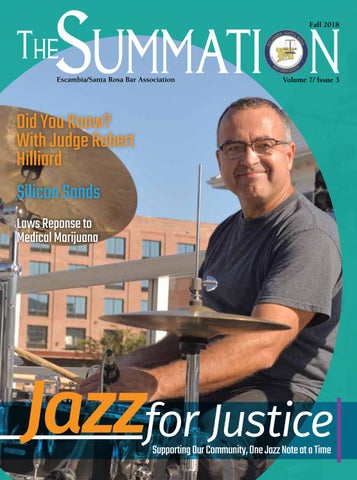
Did You Know? With Judge Robert Hilliard Silicon Sands Laws Reponse to Medical Marijuana
Supporting Our Community, One Jazz Note at a Time
Table Of Contents From the President
Page 3
Board of Governors
Page 4
Announcements Page 6 Escambia-Santa Rosa Bar Association 216 South Tarragona Street, Suite B Pensacola, FL 32501 Phone: 850.434.8135 email: esrba@esrba.com Lawyer Referral Service: 850.434.6009 Executive Director Jeff Nall jeff@esrba.com Member Services Coordinator Noah Jones noah@esrba.com Lawyer Referral Service Pat Atkinson lrs@esrba.com Published quarterly by the Escambia-Santa Rosa Bar Association as a service to its membership and the community. Any article herein may be reproduced provided credit is given both to The Summation and the author of the article. Articles appearing in The Summation are not to be construed as official expressions of the views of the Escambia-Santa Rosa Bar Association. Official positions are expressed only by formal resolutions adopted by a majority of the membership and will be so designated when published. Editorials are expressions of the opinion of the Editor. Due date for all advertisements is the first of the month for the issue you wish to advertise in. Address all editorial correspondence to the Escambia-Santa Rosa Bar Association office. For all inquiries concerning advertising rates contact Ballinger Publishing. “The Summation Committee is dedicated to providing a publication to the legal community which contains articles that are accurate, informative, entertaining, educational, relevant and timely.” Summation Committee If you have any comments or suggestions about The Summation, please feel free to express them to any of the committee members or call the Bar office at 434.8135. Brooke Jones Gerald McGill Susan Woolf Kaitlyn Peacock Michael Thomas Aurora Osborn
Carrie Cromey Caroline Peterson Noah Jones Sheryl Lowenthal Charlie Penrod Mike Doubek
2 The Summation www.esrba.com Fall 2018
Young Lawyers Division
Page 7
Law Enforcement’s Response to Medical Marijuana Page 8 Did You Know? With Judge Robert Hilliard
Page 10
Jazz for Justice Page 12 Argo Corner Page 15 News from the Clerk
Page 16
Silicon Sands Page 18 The Bottom Line Page 20 On the Move Page 22 Snap Shots Page 22 Calendar Page 23
Owners • Malcolm & Glenys Ballinger Publisher • Malcolm Ballinger Executive Editor • Kelly Oden Editor • Will Isern Art Director • Guy Stevens Graphic Designer & Ad Coordinator • Bara’ah Jaraiseh Assistant Editor • Kaitlyn Peacock Sales & Marketing Geneva Strange, ext. 21 Paula Rode, ext. 28 Visit our Website at www.ballingerpublishing.com Editorial Offices: 314 North Spring Street, Suite A Pensacola, Florida 32501 850-433-1166 • Fax 850-435-9174 Member of
Reproduction or use of the contents herein is prohibited without written permission from the publisher. Comments and opinions expressed in this magazine represent the personal views of the individuals to whom they are attributed and/or the person identified as the author of the article, and they are not necessarily those of the publisher. This magazine accepts no responsibility for these opinions. The publisher reserves the right to edit all manuscripts. All advertising information is the responsibility of the individual advertiser. Appearance in this magazine does not necessarily reflect endorsement of any products or services by Ballinger Publishing. © 2017 Ballinger Publishing. All Rights Reserved.
From the President A New Year – A New Beginning By STEVE TRAYLOR
It is a privilege to be the new president of our Association for the 2018-2019 fiscal year. I am mindful of the fact that I am merely the next person in a long line of esteemed and dedicated attorneys who have held this position before me. Standing on the shoulders of these giants, I look forward to serving our Association and our profession. The coming year will be momentous because of Mike Doubek’s upcoming retirement at the end of October. Mike has served our organization for many years with his characteristic professionalism, good judgment, quiet competence, and attention to detail. His skills and friendship will certainly be missed. I am confident that you join me in wishing Mike the very best and in thanking him for his many contributions that have helped to make our Association what it is today. As you probably heard, a search committee was formed in early 2018 to vet applicants for the Executive Director position. That process resulted in finalists being interviewed in May. Following that, the Executive Council hired Jeff Nall as our new Executive Directors in June. Jeff started soon thereafter, and we are presently enjoying the benefit of having Mike and Jeff working together to insure a smooth transition. Jeff brings many skills to our Association, having served in leadership positions in several other organizations for more than twenty years. Among Jeff’s many accomplishments is his service as state president of the Florida Public Relations Association, which is a voluntary, member-based, statewide professional organization comprised of public relations practitioners, and his service as president of Five Flags Rotary. Furthermore, Jeff also knows our community well, which is important to us. Lastly, as I said at the recent installation banquet, one of my goals as your president is to see a significant increase in our members’ active participation in our regular events – such as our monthly meetings, law week activities, CLE programs, and annual banquet. For those of you who have not been active in a while, I ask that you make it a priority to put our monthly lunch meetings on your busy calendar before other things get in the way. For those who are presently active, I ask that you continue that course – and that you reach out to your colleagues to encourage them to participate in our activities. One of the things that makes our organization strong is the congenial atmosphere that is fostered by the personal relationships and friendships among our members that is a by-product of seeing each other at bar functions. I hope to see you soon.
Fall 2018 www.esrba.com The Summation 3
News from
The Florida Board of Governors From JEREMY BRANNING
T
he Florida Bar Board of Governors met July 27, 2018, in Hollywood, Fla. The major actions of the board and reports received included: The Florida Bar has launched a new resource to assist Florida lawyers in the business of law called LegalFuel: The Practice Resource Center of The Florida Bar. LegalFuel provides critical business tools and support for all attorneys, especially small-firm and solo practitioners. The site offers law office management and technology support for Bar members, a variety of free CLEs, and assists lawyers in running the business side of their law firms. LegalFuel also features an enhanced search that can quickly find articles on specific topics such as marketing or accounting, as well as provide a curated library of free webinars, podcasts, and more. In addition, LegalFuel advisers are available via live chat to provide quick answers. Lawyers can connect and share information via the discussion boards, and advisers can assist by phone or email on practice
management or technology issues. The Florida Bar Board of Governors agreed unanimously with one abstention July 27 to support the position that a parental leave continuance rule be added to the Florida Rules of Judicial Administration by the Florida Supreme Court. The board’s input – which was requested by the Supreme Court – along with the majority and minority positions of the Bar’s Rules of Judicial Administration Committee, will be submitted to the Florida Supreme Court by August 31. The Supreme Court then could choose to consider a proposed rule on its own and, if it decides to, will publish the rule for comments and may schedule oral argument. Florida Bar members who like to provide concerns or describe any relevant experiences, may email those to Krys Godwin at kgodwin@ floridabar.org by August 15. For additional information and background on the
4 The Summation www.esrba.com Fall 2018
consideration of a parental leave rule, please see The Florida Bar News. Three new Florida Bar member benefits programs were approved and will soon be available: Law Office Support Service, Inc., which offers virtual paralegal and legal assistants for attorneys and small law firms for a monthly subscription fee; Tali, a voice-activated time tracking system for devices using Google Assistant or Amazon Alexa programs and Digital Age Marketing Group which helps lawyers with their online marketing, including website development, search engine optimization, social media management, video creation and building links to other online services. When the agreements have been finalized, these new programs will be listed with the more than 60 other discounted and free Florida Bar member benefits at www.floridabar.org/memberbenefits.
Florida Bar Foundation President Juliet Lippman and incoming executive director Dominick McKenzie discussed the Foundation’s recent strategic reset which became necessary after the recession and resulting low interest rates devastated its IOTA income. The three goals of the reset are to: collaborate with other parties in providing legal aid, including local legal aid agencies, the business community, the Bar, clerks of courts and others; act as a monitor of the health of the state’s legal aid assistance programs and be an agent of change as the legal community and marketplace undergo rapid transformations. The Bar’s proposed new trust accounting program will begin a pilot late summer or early fall with about 20 firms eventually participating in the six-month pilot program, split among solo practitioners and small, medium and large firms. After the pilot is completed, a report on the pilot program will be considered by the Board of Governors for final action.
All Bar, section and committee legislative positions from the 2016/18 biennium were sunset in accordance with Bar policy. In addition, rollover legislative positions for many Bar sections and divisions, committees and the Board of Legal Specialization and Education were approved, or agreed not to oppose; see www.floridabar.org/ legislativeactivity for those positions. The Board of Governors Legislation Committee will make recommendations on renewing expired Bar positions at upcoming board meetings. The Board Review Committee on Professional Ethics has directed Bar
staff to draft a proposed ethics advisory opinion on ways that lawyer referral services/qualifying providers can charge for their services. The committee published an official notice of intent to consider drafting a proposed advisory opinion after receiving an inquiry from a bar member about participating in a lawyer referral service that charges a flat fee per referral that varies according to the type of matter. Traditionally, lawyer referral services have charged a flat charge to lawyers for participation during a specified time period, such as a flat rate per month or year. The deadline for comments was extended to
August 31 regarding possibly amending Rule 4-7.13 to prohibit attorneys from stating or implying another lawyer is affiliated with the advertising lawyer when that is not true and from misleading a consumer to contact the advertising law firm when the consumer is searching for another particular lawyer. The proposal is in response to a bar member request for a prohibition against buying the names of other lawyers or law firms in Google AdWords that would trigger the appearance of the attorneys’ online ads when users search for those other lawyers or law firms. A recommendation to
split the Florida Registered Paralegal Committee into two separate committees, one that will deal with eligibility and compliance issues and another to work to create an awareness of the program and its benefits was approved. The new Florida Registered Paralegal Enrichment Committee’s mission will be in accordance with RRTFB Chapter 20 to enhance communication about the benefits of FRP membership, develop educational programming and create networking and social events to foster camaraderie and cohesiveness of Florida Registered Paralegals and other paralegals or legal assistants.
Fall 2018 www.esrba.com The Summation 5
Announcements The Escambia-Santa Rosa Bar Association is proud to announce the 2018/19
Executive Council
Officers President D. Steve Traylor, Jr. Vice President Warren R. Todd Secretary Heather F. Lindsay Treasurer Garrett P. LaBorde
Immediate Past President Jodi Dubose
Young Lawyer Representative
Exectutive Council
Jessica Schultheis
Doug Bates Joshua Jones Christine Kelly Fausel Rebecca Gilliland Frederick V. Longmire Aaron T. McCurdy Cecily Parker Joseph A. Passeretti
President Emeritus
Meet the 2018/19 Escambia-Santa Rosa Bar Foundation
Board of Directors Officers:
Directors:
President Robert A. Emmanuel
Sheldon Bernau Margaret T. Stopp Darryl “Steve” Traylor John F. “Buz” Windham Louis “Bo” Harper III Jodi Dubose Jeremy C. Branning Stephen H. Echsner Shekka Drayton
Vice President Adrianna M. Spain Secretary & Treasurer Kristin D. Hual
T. A. Shell
We’re Social connect With uS on Social media eSrba facebook
facebook.com/esrbafl
yld faceboook
facebook.com/esrbayld
twitter.com/esrbafl
linkedin.com/company/ escambia-santa-rosa-bar-association
6 The Summation www.esrba.com Fall 2018
Young Lawyers Division Young Lawyers Division Welcomes
New President Jessica Schultheis My name is Jessica Schultheis, and I am honored and excited to serve as this year’s President of the Young Lawyers Division! I was born and raised here in Pensacola, Fla. and attended the University of Florida for college and law school. I have previously worked as an Assistant Public Defender and also as an associate at a small firm focusing on estate planning, probate, guardianship, and criminal defense. I have been working as an Assistant State Attorney for almost five years now. I am currently assigned to one of our general felony divisions, where I prosecute a wide range of felony crimes. Two years ago, I began serving on the board for the Young Lawyers Division, and I served as the Vice President last year. We are working on making this a great year with lots of fun, networking opportunities. Over the past few years, the former YLD presidents have instituted some extremely successful events that we will definitely continue to host this year. We will continue the tradition of having a monthly Business after-hours event at a local bar on the first Tuesday of every month. These events are always a great way to relax after work, meet new attorneys, and have some delicious drinks and appetizers on us! The YLD typically has sponsors for our happy hour events that provide useful information regarding legal services such as mediation, court
reporting, e-discovery, and copying services. We will also continue the tradition of having a quarterly Lunch with Judges event. Each time, there will be a different judge to meet with and have an informal discussion over lunch with a few young lawyers. These lunches are a rare opportunity to learn from a sitting judge and ask questions in a more relaxed setting. Finally, we will continue the newest tradition of our “You’ve Got the JD, Now What?” panel discussion to cap off the year next summer. This program will include knowledgeable speakers including local attorneys who practice all different types of law as well as a
In her first introduction... sitting judge. The panel discussion is another great way to meet other attorneys, learn about new fields of law, and ask those tough questions. And of course, the Young Lawyers Division will continue to support and participate in events and causes that we really believe in, including Breakfast with Santa, Jazz for Justice, and OnBikes, just to name a few! In addition to continuing our traditions and events, I have some new goals I would like to accomplish for the year as well. First and foremost, it is important to increase our membership. We have new lawyers coming into this community every year, and the Young Lawyers Division is such a great organization to brainstorm strategies and learn new ideas from other attorneys. It is important as a young lawyer to have a group of other similar professionals to serve as an outlet for discussion and debate. The YLD board is currently working on planning a Fall Bash event to welcome new attorneys to our local legal community, celebrate their accomplishment of passing the Florida Bar, and introduce them to the benefits of joining the Young Lawyer Division.
We are also hopeful to increase membership across all different fields of law. I would specifically like to grow our membership to include more government attorneys from the State Attorney’s Office and Public Defender’s Office. Government attorneys are extremely important and necessary in the legal world, and they need to have a voice in our local bar association. I have worked as an attorney in both the public and private sector, and one issue that both have in common, that I would like to try and address as President this year, is how the job can affect our mental health. Being an attorney is one of the most stressful careers, and it can be difficult to maintain a healthy work/life balance. I am hopeful that the YLD will succeed in hosting an event focusing on mental health and how to handle the stress that comes with our career. The event will be both educational and fun! I have thoroughly enjoyed my career as an attorney in our community so far, and I love helping and advising new attorneys. The Young Lawyers Division is such a valuable group that any new attorney can benefit from, and I look forward to leading the group this year!
Fall 2018 www.esrba.com The Summation 7
Law Enforcement’s Response to Medical Marijuana By Shekka Drayton Geico Staff Counsel
Law enforcement officers consistently rely on the odor of marijuana to establish probable cause to search a vehicle. The plant has a unique fragrance that law enforcement officers undergo training to be able to identify. Having the authority to enforce laws comes with the inalienable duty to understand the law given its constant state of change. Florida Statute 381.986 legalized medical marijuana throughout the state. The use of marijuana has diversified well beyond the traditional use of smoking. Alternative methods of use are specifically designed to eliminate the distinctive odor. The high demand for marijuana drives innovation and development in the medical industry as well as the street market. Officers, and ultimately courts, are tasked with navigating a landscape where the use of medical marijuana by qualified persons is legal, yet possession of the widely available marijuana bud remains a crime. Florida Statute 381.986 defines marijuana as “all
parts of any plant of the genus Cannabis.” Often referred to as the “Compassionate Use Act”, the statute provides for the legal use of medical marijuana by patients diagnosed with at least one qualifying condition. Enumerated qualifying conditions include ailments such as cancer, epilepsy, glaucoma, and Parkinson’s disease. Per statutory mandate, qualified persons must be prescribed medical marijuana, known as a physician certification, by a qualified physician. The law also establishes a registry whereby qualified persons, their treating physicians, and their caregivers are entered into a State monitored database. In conjunction with the statute, the Florida Department of Health’s Office of Medical Marijuana “oversees the statewide Medical Marijuana Registry and licenses Florida businesses to cultivate, process, and dispense medical marijuana to qualified persons.” (Florida Department of Health, Office of Medical Marijuana, www.floridahealth.gov/programs)
8 The Summation www.esrba.com Fall 2018
The smell of marijuana has long been the telltale sign of illegal marijuana use. However, the marijuana industry has advanced well beyond the traditional use of the dried plant known as “bud.” Florida’s medical marijuana statute identifies three of the most common forms of marijuana: dried plants, oil, and edibles. Dried plant marijuana, also known as “bud”, is simply the part of the marijuana plant that is extracted from a mature marijuana plant. Cannabis oil, also known as hash oil, is a concentrated mix derived from the extraction of cannabinoids, primarily delta-9 tetrahydrocannabinol (THC). Edibles, as defined by Florida Statute 381.986, are “commercially produced food items made with marijuana oil”. Beyond bud, hash oil, and edibles, marijuana may also be applied topically as well as infused with beverages such as wine. With the advent of marijuana cooking oil, marijuana can take on a vast range of foods well
beyond the stereotypical “brownies.” Marijuana cooking oil can be used to prepare anything from eggs, to steak, to roasted vegetables. Furthermore, marijuana infused suppositories present another way to consume marijuana. Given the wide and ever expanding methods of intake, law enforcement must train beyond the mere smell of marijuana in order to detect illicit use. Ultimately, Florida’s medical marijuana statute does not, and was not intended to erode law enforcement’s ability to enforce laws pertaining to the illegal use of narcotics. The medical marijuana statute does little to interfere with an officer’s ability to establish probable cause to search a vehicle based on the presence of marijuana for several reasons. Primarily, the law prohibits medical marijuana use in vehicles, with exception to low dose cannabis. (Florida Statute 381.986(1) (j)(5)(f)) Furthermore, the statute does not allow for carte blanche use
of marijuana; the statute regulates the consumption of marijuana through the narrowly defined employment of “medical use”, the statute restricts the devices being used to those that are approved “marijuana delivery devices”, and the statute restricts the transfer of medical marijuana. Therefore, the smell of burnt marijuana coupled with a marijuana cigarette (blunt) would consistently fall outside of the scope of an approved marijuana delivery device. Furthermore, the companion crime of possession of paraphernalia would still attach to the illicit use of bongs, pipes, rolling papers, and the like. With regards to transfer, the statute provides for the
transfer of marijuana only to qualified persons and their caregivers. Therefore, there is still a cause of action against those persons wrongfully in possession of medical marijuana. Also, the statute establishes an identification card for qualified persons
officers that alert to a wide range of narcotics. Nothing on the face of the statute impedes an officer’s ability to rely on their canine’s positive alert to narcotics; marijuana, outside of the parameters of medical marijuana, is still illegal. Given these statutorily imposed restrictions, officers still possess the authority and capability to effectively enforce the illegal use of marijuana. and caregivers of qualified Medical marijuana is persons. The inability to now an established right produce such identification in the State of Florida, and is certainly a factor an oflaw enforcement statewide ficer may take into consid- are tirelessly working to eration when determining train officers to be knowlthe legality of any suspect- edgeable of that right while ed marijuana. Even still, still upholding and enforclaw enforcement officers ing laws pertaining to the have the benefit of canine illegal use of narcotics.
Fall 2018 www.esrba.com The Summation 9
Did You Know?
HAM Radio: What’s the Buzz Around the Radio? With Judge Robert Hilliard
The Summation got a chance to ask Judge Hilliard about his hobby creating and using HAM radios. In this exclusive Did You Know, learn about the history of the HAM radio, the community around the radio and how to get involved. TS: What does the word HAM mean? JRH: There is some dispute over the origin of the term “HAM,” but it is used to refer to an amateur radio operator who is licensed by the Federal Communications Commission (FCC) and is authorized to communicate using designated radio frequencies.
classes and once you have passed the exam for the first level you have your license. There is an exam for each of the three levels that is administered locally. Study materials are readily available for each of the levels as books, apps and on websites.
TS: Are you affiliated with any local amateur radio operator Clubs? TS: How exactly do you JRH: Yes, I am a member of make a QSO using ham the Milton Amateur Radio radio? Club (MARC). It meets once JRH: A QSO is simply the a month and sponsors several act of making a contact with local events including an another HAM radio operaannual “Hamfest,” which is tor. They are often quite brief a gathering of commercial with only an exchange of call and private vendors of ham signs but sometimes they can radio equipment. Also, the be quite lengthy as HAM op- club maintains a communicaerators, literally a world apart, tions network that is ready to converse with one another. activate in case of disaster or emergencies. TS: When did you become a licensed amateur radio TS: Every licensed Amateur operator? Radio operator is given a JRH: I became a licensed unique call sign. What is operator in 2013. your call sign? JRH: My call sign is KK4OPU. TS: How do you get a license, or ‘ticket’? TS: Have you ever had an JRH: There are three license Elmer (Radio Amateur men-
10 The Summation www.esrba.com Fall 2018
tor)? If so, who was your mentor, and how did they influence your passion for HAM? JRH: Many people in the Milton Amateur Radio Club helped me along the way as I progressed through the levels from Technician Class through General Class and finally all the way to Amateur Extra Class. They are very generous with their time and expertise gained through many years of experience. The enthusiasm that they have for amateur radio as a hobby and public service was a great inspiration to me. TS: The ARISS enables astronauts on the space station to communicate with groups on Mother Earth. How you ever communicated with astronauts in space? If so, tell us about your experience. JRH: No, but I have seen it done, and it is exciting and fascinating. TS: Tell us your favorite HAM story or past experience. JRH: One day several of the
club members gathered at one of the members homes to help him install a new antenna on the top of his very tall tower. One of the fellows climbed to the top of the tower with all his safety equipment in place and installed the new antenna after we hoisted it up to him. It was a great learning experience and a delight to be with so many “Elmers” throughout the day. TS: How can someone get involved with HAM? What would you suggest as the first steps to learning more about HAM? JRH: A local HAM radio club meeting is a great place to start. Here, you will meet people who have trod the path before you and are eager to assist new operators onto the airwaves. They can help with exam study tips and information on local examinations. Also, you will find much information on what equipment is suitable for beginners along with tips on how to find local radio frequencies.
8
9 Demystifying Cryptocurrenncy and
IHMC and NASA develop the next generation of exercise equipment
Arianna Simpsomoney the future of
the
STATE ofTECH also in this issue
TION WITH IN COLLABORA MIT ITEN WIRED SUM
buSinESS ClimATE
+
on THE mArkET e a real estat section
King Content ist creato rs Local conten
ITEN WIRED
logy, Innovation, Technorking Netwo Entrepreneurship and
2018 september
m agazine.co • pensacolam
Artists Working Together PENSACOLA’S CO-OP GALLERIES
COME ONE, COME ALL
Bare Hand Collective Creates A New Space For The Arts Community
30A SONGWRITE RS FESTIVAL
EmErgin Artists g LOCAL ARTISTS
BRINGING THE BEAT TO THE BEACH
4TO WATCH ALSO IN THIS ISSUE:
BUSINESS CLIMATE:
MEDICAL MARIJUA
NA
ON THE MARK
ET: A REAL ESTATE SECTION
A Fundraiser for ADVENTURES AFTERsacDolaARK
Council on Aging of West Florida
Ft. Pickens 3:20 am
explore Pen t in a Different ligh
Small Towns, Big Charm. re
Art · history · Cultu
+Receive. Rehab. Release. sanctuary
Also in : this issue
KET: ON THE MAR SECTION
+
the Wildlife a of northwest Florid
A REAL ESTATE
BUSINESS CLIM
ATE
AUGUST 2018
GAZINE.COM • PENSACOLAMA
MAY/JUN 2018
BallingerPuBlishing.com
Starring...
Troy Rafferty, Valerie Russenberger, Bob Tyler, Justin Witkin Oct. 19 • 5:30 - 10 pm New World Landing ratpackreunion.com Fall 2018 www.esrba.com The Summation 11 Summer
Jazz for Justice Supporting Our Community, One Jazz Note at a Time
By Jason Zaborske, Resource Developer, Legal Services of North Florida
In downtown Pensacola, Seville Quarter has always been an exciting experience for visitors and a Sunday tradition for live jazz music. Legal Services of North Florida (LSNF) and Seville Quarter are combining forces to bring nationally recognized jazz artists to the already popular Seville Quarter Sunday Jazz Brunch for the 4th Annual Jazz for Justice. The sound of sultry saxophone riffs and sweet percussion sounds will be combined with the lure of beignets, a decadent brunch and a custom bloody mary bar. Even the most wayward soul will want to see what’s reverberating on November 11 from 11 a.m. until 7 p.m. For more than two decades, LSNF has hosted Jazz for Justice in the panhandle, and LSNF staff, board members and volunteers are deeply rooted in justice issues which blend with the traditional and historical roots of jazz and blues music. By tapping into these roots, Jazz for Justice brings the 12 The Summation www.esrba.com Fall 2018
spirit of LSNF’s mission to the streets of Pensacola. By hosting this event every year, LSNF’s Jazz for Justice brings hope and justice for all who need civil legal representation. “This is a free event for the community, the only way we could put this on every year is through the help and support of the legal and business community in Pensacola. Jazz for Justice reminds all of us that most important thing we can do for our community, is to help those who need it the most. The vision of LSNF is to provide hope and justice for all, and although we can’t serve everyone in our community, we want people to know there is a place to turn to when they need help,” said LSNF Senior Attorney Christine Kelly Fausel. Access to courts for low-income individuals can be difficult or nearly impossible when you cannot afford attorney fees or navigate the complicated legal system. LSNF provides the critical link needed between clients who might be only
a day or two away from no home or food, fighting for their children and so much more. LSNF works with the Pensacola legal community to recruit volunteer lawyers to assist those in need of legal services, some of whom are facing serious, life-changing civil legal problems. LSNF provides their clients free legal advice and representation. LSNF’s Jazz for Justice has roots that date back more than two decades. The event started in Tallahassee when a group of LSNF supporters with ties to the jazz community thought it would be fun way to raise awareness for the organization and its services. The event has grown strong roots in the Pensacola community over the last four years, bringing thousands of attendees downtown to network and watch nationally recognized jazz artists perform. Jazz for Justice offers Pensacola residents a unique and fun opportunity to support pro bono legal services, and meet the organizations and their families that help so many people in our community. The event is free for adults, children, grandparents and families of all ages. For the fourth year in a row, Jazz for Justice is partnered with Foo Foo Festival, a 12-day arts and entertainment festival in the Pensacola that honors the community’s unique culture and creativity. Jazz for Justice is proud partner of Foo Foo Festival and strong supporter of the local arts, music and cultural events taking place during the first 12 days in November.
“Jazz for Justice is a truly a unique way to celebrate the critical importance of access to justice, the role LSNF has in improving that access
and for the clients being served. In fact, in a 2016 LSC Cost-Benefit analysis, investments in legal services in Florida resulted in the
ilies, veterans and victims of domestic violence in our community that LSNF helps who cannot resolve their legal problem on their own,
“Jazz for Justice is a truly a unique way to celebrate
the critical importance of access to justice, the role LSNF has in improving that access within our community, and the impact of that work on not just our clients individually, but the community as a whole.”
within our community, and the impact of that work on not just our clients individually, but the community as a whole,” said LSNF Executive Director, Leslie Powell Boudreaux. Each year, LSNF provides legal assistance to over 5,000 individuals and families through dedicated employees and staff attorneys, along with the numerous pro bono attorneys who give their time. The mission of LSNF staff and pro bono attorneys is to offer a chance at justice for income-eligible residents. LSNF services help clients to succeed and directly impact the economy for communities throughout Florida. A 2016 study by Legal Services Corporation (LSC) found that investments made in pro bono legal services organizations like LSNF and other partner agencies, not only resulted in thousands of individuals receiving legal benefits, but also millions of dollars being reinvested in the local economy. These kinds of benefits are tangible for our community
creation of 2,243 new jobs and $274.8 million increase in business income throughout Florida. (Source: 2018 American Bar Association, Legal Services Corporation,
and don’t have the funds to hire a lawyer. That is where LSNF comes in.” This year’s Jazz for Justice includes several events and activities including a Jazz
Cost-Benefit Analysis). Jazz for Justice committee member and attorney Sean Seely noted that “those that work in the legal field and in social services know that receiving pro bono legal advice to resolve a legal matter, can be a real life saver. There are many parents, children, fam-
Brunch, VIP Experience, silent auction and of course live music throughout the day. See below for details on the full lineup of bands and activities:
Fall 2018 www.esrba.com The Summation 13
The 2018 Jazz for Justice Lineup: • Sunday Jazz Brunch: 11 a.m. to 3 p.m. The Sunday Jazz Brunch features live jazz music and chef Cameron Mitchell’s amazing ala carte brunch menu. 2018 Jazz for Justice provides all the things you love about Sunday Brunch including live jazz music, New Orleans style beignets and a fully stocked bloody mary bar. • Silent Auction: 3 p.m. to 7 p.m. The Jazz for Justice silent auction presents a great opportunity to browse and bid on dozens of amazing local gifts, resort packages, sports memorabilia, theme park, restaurant and travel packages to some of the hottest destinations. • Main Stage: 3 p.m. to 7 p.m. Chris Godber will be the first to hit the stage at 3:00 p.m. Despite being told by doctors he wouldn’t be able to play the saxophone due to of the severity of
his asthma, Godber took to it anyway. Picking up the sax in middle school band at age 12, Godber has been leaving others breathless ever since. Now, he is a talented sax player whose albums have landed on the Amazon Best Selling charts and the Top 50 charts of smoothjazz. com. Godber’s songs are played daily on Sirius XM’s Watercolors. His sound is all his own with a dose of R&B and Gospel roots showing through. Big Daddy and Red Hot Java will perform their original blues, soul and jazz blend starting at 4:30 p.m. They have performed their music overseas in several countries over the years. Randall “Big Daddy” Webster has conducted Blues seminars and workshops at Florida State University, University College Cork Ireland and University of London Kingston (UK), among other institutions. K.C. and the Irresistibles will perform their unique blend of jazz and funk starting at 6:00 p.m. Formed by enigmatic
Flow Tribe lead vocalist and trumpeter K.C. O’Rourke, the Irresistibles are at the corner of soul and swing, bringing a fresh take on classic R&B, along with a hot batch of original tunes. • VIP Tent: 3 p.m. to 7 p.m. Got to be VIP! Our Jazz for Justice VIP attendees (sponsors and ticket holders) can gather in the VIP tent next to the stage to sample complimentary food, beer and wine with local elected officials, business and community leaders throughout the event. VIP Experience Passes are just $50. To learn more about Jazz for Justice, become a sponsor and get VIP Experience tickets, visit www.jazzforjustice. org or contact Jazz for Justice Conductor Jason Zaborske at 701-3313 or Jason@ LSNF.org
Keep Our Friends Safe Adopt -AManatee
®
Call 1-800-432-JOIN (5646) savethemanatee.org Photo © David Schrichte
Summer 14 The Summation www.esrba.com Fall 20182018
Argo Corner
UWF Legal Studies: Connecting Students with Careers in the Law by Charlie Penrod, J.D. The Legal Studies program at the University of West Florida has committed itself to high-quality legal education to prepare students for law school or for a career as a paralegal. The results are impressive. Just this past year, our students have been accepted to prestigious law schools such as the University of Notre Dame, Chicago-Kent College of Law, and the University of Florida. The Mock Trial team just completed a highly successful year competing against – and beating – teams from larger universities. Students from the Legal Studies program have also obtained employment as paralegals in firms throughout the local community. We are proud to have been recently named one of the top 10 best Legal Studies programs in the country by CollegeChoice, a nationally-recognized rating service. This is a big deal! This honor symbolizes the hard work and dedication of the faculty who provide a rich experience in the law beyond the classroom. For example, in 2017-2018, faculty were able to take students to the Florida Supreme Court in Tallahassee to view oral arguments, as well as on tours of Florida State University and Louisiana State University law schools. In February, representatives from nearly twenty law schools from around the country attended our annual Law School Recruitment Forum to meet prospective students from our program. Our goal next year is to increase the number of law schools participating to thirty. In May, the Legal Studies Program held its first annual UWF Oral Advocacy Championship, where four of our top students competed in a mock oral
argument in front of three First Judicial Circuit Court judges. This event was sponsored by the Escambia-Santa Rosa Bar Foundation. Lastly, the program has partnered with the Summation to establish a new “Argo Corner” to allow students the opportunity to publish pieces on the law as an undergraduate student. All of these opportunities are vital to give students the experiential opportunities in the law that allow them to prepare to become attorneys. But, Legal Studies is not just a program for future attorneys. We are very proud of our future paralegal students, and the program includes several opportunities to prepare them for work in a thriving law firm. First and foremost, Legal Studies students are given the option to intern in a law office or governmental agency to hone their skills and to obtain crucial experience before entering the job market. Further, all students are required to take an intensive course in Legal Research, focusing on Westlaw and computer research, that will permit students to immediately “hit the ground running” upon employment. We also maintain a continually updated list of employment opportunities for students seeking paralegal positions, and we are strongly encourage students to seek out those posted openings. The faculty in the Legal Studies program have also made community collaborations a high priority. In addition to internship placements, students frequently volunteer at clinics and events such as Justice on the Block and One Stop Life Shop, which are designed to help high-need populations with pressing legal issues. Our Legal Studies
Advisory Board, which is comprised of local paralegals, attorneys, and judges, meets every semester to provide invaluable feedback on both the direction of the curriculum and pathways for our students to connect with area stakeholders. Finally, the Young Lawyers Division of the Escambia-Santa Rosa Bar Association has graciously committed their time and efforts to speak with our students about the opportunities and challenges of newly minted lawyers. While we are proud of the bridges we have already created, we want to do more. We are always in need of additional internship placement sites from a wide variety of practice areas and locations around the Escambia-Santa Rosa-Okaloosa region. The pre-law fraternity on campus, Phi Alpha Delta, has positioned itself to be student leaders within the community and they welcome the chance to volunteer for any and all legal-oriented initiatives in the area. And, of course, the Legal Studies faculty, all of which are JDs and former practicing attorneys, are actively seeking new ways to collaborate with the local bar for new projects. Please feel free to contact me at cpenrod@uwf.edu or by phone at 850-4742777 if you are interested in seeking partnerships with our program. Charlie Penrod, J.D. is an Associate Professor in the Department of Administration and Law, College of Education and Professional Studies, at the University of West Florida. Fall 2018 www.esrba.com The Summation 15 Summer
News from the Clerk of Circuit Court and Comptroller
Risk Protection Orders On Feb. 14, 2018, the murders of 17 children and teachers at the Marjory Stoneman Douglas High School occurred. Approximately three weeks later, the Florida legislature presented Senate Bill 7026 to Governor Rick Scott for consideration and signature. Senate Bill 7026, which includes the Risk Protection Order Act, became law on March 9, 2018. In addition to creating the Risk Protection Order Act, Senate Bill 7026 also raised the minimum age to purchase a firearm to 21 years of age, banned bump stocks, and banned a person who has been adjudicated mentally defective or committed to a mental institution from owning or possessing a firearm. Since enactment, over 200 petitions for risk protection orders have been filed across the state of Florida, including two petitions in Escambia County. Section 14 of Senate Bill 7026 provides the legislative intent for the Risk Protection Order Act: “Section 790.401, Florida Statutes, is intended to temporarily prevent individuals who are at high risk of harming themselves or others from accessing firearms or ammunition by allowing law enforcement officers to obtain a court order when there is demonstrated evidence that a person poses a significant danger to himself or herself or others ... The purpose and intent of s. 790.401, Florida Statutes, is to reduce deaths and injuries as a result of certain individuals’ use of firearms while respecting constitutional rights ... The process established by s. 790.401, Florida 8 The 2018 16 TheSummation Summationwww.esrba.com www.esrba.com Summer Fall 2018
Statutes, is intended to apply only to situations in which the person poses a significant danger of harming himself or herself or others by possessing a firearm or ammunition and to include standards and safeguards to protect the rights of respondents and due process of law.” The Risk Protection Order Act creates a mechanism for law enforcement to petition a court to allow law
in the process of preparing informational brochures that will be available to the public no later than Jan. 1, 2019, as required by the statute. When a law enforcement officer or agency files a petition for a risk protection order, the agency may seek a temporary ex parte injunction, as well. When a temporary ex parte injunction is sought, the court must consider the petition for the tempo-
enforcement officers to seize and hold firearms and ammunition from a person who is considered a potential danger to himself, herself, or others. Petitions for risk protection orders may be filed by law enforcement officers or law enforcement agencies in circuit court. The Office of the State Courts Administrator is
rary ex parte order within 24 hours. The court must hold a hearing on the consideration of issuance of a final order for risk protection within 14 days of the filing of the petition. The petition, notice of hearing, and any temporary ex parte order must be served by the Sheriff’s office on the respondent. No later than three
business days after a temporary ex parte order or a final risk protection order is entered, the court shall hold a hearing to allow the respondent to provide proof that the firearms and ammunition have been surrendered. If proof of surrender is provided in advance of the hearing date, the hearing may be cancelled. A final risk protection order may be in effect initially for no longer than one year. After a final risk protection order is entered, the respondent has the opportunity to request that the order be vacated. A respondent may file a motion to vacate a risk protection order once during each time period that a risk protection order is in effect. A hearing shall be held between 14 and 30 days after service of the motion. Law enforcement is permitted to file a motion to extend a risk protection order before its expiration. The court is required to give notice to the petitioner at least 30 days before the expiration of the order, and the petitioner is permitted to file a motion for extension within 30 days before expiration of the risk protection order. A hearing must be held within 14 days after the court issues an order or notice of hearing. If law enforcement believes that a respondent has not surrendered all of his/her firearms and ammunition, law enforcement may seek a search warrant from the court. In addition to surrendering all firearms and ammunition, a risk protection order can require a respondent to surrender a carrying concealed weapons permit. The Risk Protection Order Act attempts to provide a balance between due process rights and making society safer from those who pose a significant danger to themselves or others and who own or possess firearms. Time will tell whether the Act accomplishes its stated intent. Authored by Susan Woolf, General Counsel, on behalf of Pam Childers, Clerk of the Circuit Court and Comptroller
L arry a. M atthews Certified Supreme Court Mediator • Proven experience in the resolution of civil and commercial disputes • No cancellation or administrative fees • No multiple parties fees • Professional conference & meeting rooms • Conveniently located in downtown Pensacola with ample parking • Available throughout the Florida Panhandle and South Alabama area
114 E Gregory Street Pensacola, FL 32502 | 850-434-2200 Pensacola / Panama City / Mobile, Al lmatthews@matthewshigginslaw.com
www.matthewshigginslaw.com
Fall 2018 www.esrba.com The Summation 17 Summer
Silicon Sands
A vision from a Texas transplant By J. Nevin Shaffer Jr., BS, MBA, JD
Thirty-eight years ago, Austin, Texas looked a lot like Pensacola.
do. It is my sad duty to inform them that just isn’t so. I believe the world is mostly full of folks like me. I just see problems and then I die. I would still be opening my garage door by It was the best big city in Texas hand if some visionary hadn’t said, because it was the smallest and it “That’s stupid. Put a motor on it!” But had, and for the most part still has, even though I, so far as I know, have everything the rest of Texas doesn’t never had an original idea in my life, I have: trees, hills, water and a good have had a Vision. So what, you might night life! (By the way, a whole lot ask? Well, since 1980 Austin has of Texas looks just like you think transformed from a cool country city it does, cactus and dirt.) By 2000 to an economic intellectual property though, it had changed dramatically. It juggernaut. From a state capital with still had and has the aforementioned a pretty good football team to the advantages, but it got too crowded “SILICON HILLS” proudly standing for me and my family so we moved toe-to-toe with the goliath called to Gulf Breeze. I miss Texas BBQ and SILICON VALLEY. Texmex, but I don’t miss the traffic How this happened is the point and congestion, and besides, Texas of this story. In the late ‘80’s or has no beach that compares to the so, Microelectronics Computer best beach in the U.S. Consortium (MCC), a group of high So who cares? Well, I am a patent tech companies from around the attorney, and for 38 years, I have country, had banded together to fight met and worked with clients who I the foreign participants in this field call “Visionaries.” By my definition, (mostly Japan). They needed a place a “visionary” is a person who to call home. Selection as their home encounters “problems” or “economic would be a big boost for any city opportunities” and then sees and the competition was fierce. The solutions. They are invariably under winner was Austin because it had the the mistaken impression that everyone three things MCC was looking for in else faces reality the same way they a new home: An international airport, 18 The Summation www.esrba.com Fall 2018
lots of educated young people looking to stay in the area, and cheap dirt. My family and I became Gulf Breeze residents because it is the prettiest, best place in the country to raise kids and grow old, in our opinion. And, even though I am not a visionary, I can’t help but notice we also have the same three things MCC was looking for then and every business is looking for now: An international airport, lots of educated young folks that would like to stay here and a lot prettier cheap real estate... thus in my vision, I see the “SILICON SANDS” in our future. If I am right, buckle up! It’s going to be a great ride! J. Nevin Shaffer, Jr., BS, MBA, JD. He is an AV rated lawyer and a Florida Board Certified Intellectual Property Law Specialist. As a registered patent attorney, Nevin may practice patent law in all fifty states.
Nevin Shaffer Jr. “
On Intellectual Property
A successful business will attract competitors like blood in the water attracts sharks. Patents, trademarks, copyrights and trade secrets are the four building blocks of a secure intellectual property protection plan.”
J. Nevin Shaffer Jr., BS, MBA, JD, will present an Intellectual Property Live Seminar Oct. 26 from 9 a.m. until 11 a.m in the M.C. Blanchard Building, MultiMedia Room. Key topics will include trademarks, copyrights, trade secrets and patents. Register today by e-mailing esrba@esrba.com. Late registration will be held the day of the seminar Oct. 26 at 8:30 a.m. The seminar will grant two CLES and is priced $35 for Escambia-Santa Rosa Bar Association Members and $45 for non-members.
– J. Nevin Shaffer Jr.
Summer Fall 2018 www.esrba.com The Summation 19
The Bottom Line
The Legal Profession…
Outside the Box
By Rebecca Spurgin, ACP, FRP In the modern law practice, boundaries are changing quickly. National firms are becoming the norm in today’s market, and lawyers in specialized practice areas are forming with other specialty lawyers across the country, pooling valuable resources and knowledge. Lawyers banded together across various states are a huge benefit to national clients who require assistance across multiple venues where they do business. Examples are national banks who require legal assistance in relation to mortgage closings and real estate inventory management including foreclosures, tax and various title issues. Access to a national firm with knowledge of both the client’s specific processes as well as a set of specific specialty areas is invaluable in the modern business world. Benefits of National Practice Satellite offices can be established wherein one or two legal practitioners working from a small office are joined together with a larger firm in another city, sharing access to a central
human resource department, health insurance plans and other costly overhead such as legal research accounts, software programs, liability insurance, cloud access and—the most valuable asset of all—experienced support personnel including billing department, legal secretaries, clerks and specialty paralegals. The Lead Paralegal In a national firm, a lead paralegal, working under the direct supervision of a senior partner, may act as the central point of contact for a practice group, supervising and directing work performed by legal professionals in multiple offices. Such paralegals maintain legal forms and client process directives, which are utilized across all offices. These professionals serve as the main point of contact below the busy senior partner who supervises the specialty practice group—an attorney who is already burdened with the weight and daily stress of managing a legal practice. The support provided by this lead paralegal is invaluable and, in many circumstances, those with specialty practice knowledge are in short supply. In a firm with access to a national computer network, a paralegal in one state can easily step in and provide support to a practitioner in another state within the same firm. The specialty knowledge utilized to represent a client in one state can readily be applied to the needs of a similar matter in another state—under the direction of a skilled attorney with experience in that venue. The Modern Paralegal In this environment, the paralegal profession is rapidly changing and evolving. Access to a home office can easily allow a paralegal to provide quality support to an attorney without ever entering the law firm and, in many circumstances, it makes little difference whether the distance is several miles or many thousands of miles. Provided that the legal professional is qualified, ethical and reliable and the attorney reviews and takes responsibility for the final work product, a quality legal product can be delivered in this fashion. The result is that legal support personnel are finding many opportunities to work from home and law firms are benefiting from access to qualified support personnel without borders that would have previously existed—barriers that once resulted
20 The Summation www.esrba.com Fall 2018
in the loss of a former, highly qualified legal professional. Billing professionals with specialized knowledge of legal billing software and paralegals with knowledge of a specialty practice area can easily support a national practice from home and the benefits are reaped on a short-term basis as well. Contract paralegals with specialty knowledge can easily be utilized to fill in short-term needs resulting from a temporary shortage of support resulting from either an extended absence of a full-time employee or the temporary increase in work load related to a large litigation. Modern court reporting companies are becoming legal concierge professionals, providing support to law firms throughout the discovery process and far beyond the deposition. Electronic document management of document production allows a paralegal, either full-time or contract, to access, review and tag documents produced in litigation from any location.
Simpson Mediation Services Certified Court Mediators
Time Constraints Removed Beyond the location of the legal support professional, time constraints are often removed as well. Much of the work that is provided from a home office can be provided at any time of day, allowing the legal support professional to focus upon the work to be performed at the most effective point in their work day. For some, drafting might be best completed in the evening or over the weekend. Likewise, tight deadlines can be met by a support professional who is not constrained by the 9 to 5 workday.
david siMpson
The Bottom Line The bottom line is that clients, attorneys and the associated support personnel alike can benefit from this modern legal environment where skilled, professional legal services can be provided from almost anywhere at almost any time.
Linda BuCK
Rebecca Spurgin, ACP, FRP, is a Title Examiner with Emmanuel, Shepperd & Condon. She currently serves on the Executive Committee of Northwest Florida Paralegal Association as National Association of Legal Assistance Liaison.
S M S
• More than 76 Years of Combined Civil Litigation Experience • No Rescheduling or Administrative Fees • Flexible Scheduling • No Travel Cost to Mediations Across the Panhandle
Mediation areas Business Litigation Commercial Disputes Employment and Discrimination Law Probate Litigation Personal Injury Real Property Disputes
david a. simpson, Mediator Linda Buck, Mediator P.O. Box 66 Shalimar, FL 32579 Phone: (850) 543-5601 or (850) 783-0250 Email: David@DavidSimpsonMediation.com or Linda@DavidSimpsonMediation.com
Fall 2018 2017 www.esrba.com The Summation 21
On the Move ESRBA Member Appointed New Judge to Southern District of Alabama Escambia-Santa Rosa Bar Association Member Jeffrey Beaverstock, a partner at Burr & Forman, was recently appointed as a U.S. District Judge for the Southern District of Alabama. He was sworn in Aug. 3 by Chief U.S. District Judge Kristi Dubose. Jeffrey joins other Burr & Forman alums who have gone on to become federal judges including Bess Creswell, also from Mobile, appointed just a few months ago as the United States Bankruptcy Judge for the Middle District of Alabama; Jason Woodard, appointed as a United States Bankruptcy Judge for the Northern District of Mississippi and James J. Robinson, appointed as a United States Bankruptcy Judge for the Northern District of Alabama. He was nominated to Federal judgeship by President Donald J. Trump in September 2017.
Amanda Lynch Elliott has joined My Pink Lawyer as an associate attorney. Her new mailing address is 111 S. DeVilliers Street, Ste. B, Pensacola, FL 32502.
Suzanne Blankenship has joined the firm of Emmanuel, Sheppard & Condon as an associate attorney. Her new mailing address is 30 South Spring Street, Pensacola, Florida 32502.
The McGill Law Firm has relocated to 1 South A Street, Suite 104, Pensacola, Florida 32502.
The law firm formerly known as Stephen T. Holman, P.A. has changed its name to The Holman Law Firm, P.A.
Snap Shots
ESRBA Installation Banquet
2
3 1. Brent Bradley (left) and Joe Zarzaur 2. ESRBA past Presidents Steve Echsner and Margaret Stopp 3. YLD Board Members Caitlyn Prichard and Grayson Miller with the Florida Bar Executive Director Joshua Doyle (center)
1 1. A crowd gathered to watch the naturalization of new American citizens at the National Naval Aviation Museum (NNAM) 2. (Left to right) Senior U.S. District Judge Lacey A. Collier, U.S. District Judge M. Casey Rodgers and Circuit Judge Jan Shackelford listen to a naturalized citizen speak at the ceremony
Naturalization Ceremony at NNAM
2
1
22 The Summation www.esrba.com Fall 2018 2017
Calendar Basic Personal Injury Seminar M.C. Blanchard Judicial Building Multi-Media Room Sept. 28, 9 a.m. to 11:45 a.m. Discussion on how to effectively practice personal injury law and how to handle a personal injury case. Keynote Speaker: Terrance Gross, Board Certified Trial Lawyer Cost: $50 for ESRBA members $75 for non-members Worker’s Compensation Seminar M.C. Blanchard Judicial Building Multi-Media Room Oct. 5, 9 a.m. to 11 a.m. Discussion on the basics of workers compensation and third party liability issues Keynote Speakers: Deputy Chief Judge David Langhame, Compensation Claims Aaron T. McCury Thomas F. Condon Cost: $50 for ESRBA members $75 for non-members Pro Bono Celebration 2018 Pensacola Yacht Club Oct. 24,5 p.m. to 7:30 p.m. Recognizing the outstanding contributions made by attorneys of the 1st Judicial Circuit Keynote Speaker: Florida Supreme Court Chief Justice Charles T. Canady Cost: $25 for plated dinner and on complimentary drink (beer or wine) Sponsored by: Legal Services of North Florida Escambia-Santa Rosa Bar Association Emerald Coast Legal Services Pensacola Chapter of the American Inns of Court For more information and tickets, contact Charlotte Waters at Charlotte@LSNF.org or 701-3311.
Mediation – What really happens M.C. Blanchard Judicial Building Multi-Media Room Oct. 12, 9 a.m. to noon Discussion on what really happens at mediation, what works, and what does not Presenters: Brian Kirkland Belinda de Kozan David Hiers Cost: $50 for ESRBA members $60 for non-members Intellectual Property Seminar M.C. Blanchard Judicial Building Multi-Media Room Oct. 26, 9 a.m. to 11 a.m. Discussion on patents, trademarks, copyrights, and trade secrets Keynote Speaker: Nevin Shaffer Jr., BS, MBA, JD Cost: $35 for ESRBA members $45 for non-members
Escambia-Santa Rosa Bar Association Young Lawyers Division 2018/19
Board of Directors Officers: President Jessica Schultheis Vice President Kelsey Stone Secretary & Treasurer Caitlyn Prichard Past President Cecily Parker
Directors: Michael Thomas Grayson Miller Travis Morock
Attorney Guardian Ad Litem Training Gulf Coast Kid’s House Nov. 9, 9 a.m. to noon Presenters: Magistrate Keith A. McIver David A. Carroll Gayle J. Ryba Stephanie S. White Andrea Roberts Denise Manassa Cost: $75 for ESRBA members $85 for non-members To register for any event or for more information, call 434-8135 or e-mail esrba@esrba.com.
Have you recently relocated or been promoted? Share your updates by e-mailing us at Noah@ESRBA.com
Classifieds If you would like to place a classified ad in the next edition of The Summation, please contact Geneva Strange at 433-1166 ext. 21,or e-mail geneva@ballingerpublishing.com or Paula Rode at 433-1166 ext. 28,or e-mail paula@ballingerpublishing.com. Fall 2017 www.esrba.com The Summation 23
Providing Quality Insurance Services For Over 25 Years 850-484-7011
Come see us at our new address located at 11 West Garden Street Pensacola FL 32502 www.mcmahonhadder.com
24 The Summation www.esrba.com Fall 2017