Summati
The
Escambia/Santa Rosa Bar Association
n Fall 2017
Volume 6/ Issue 3
Remembering Judge George James ‘Jim’ Roark Autumn Beck Blackledge: Skinny Ninnie’s Kitchen
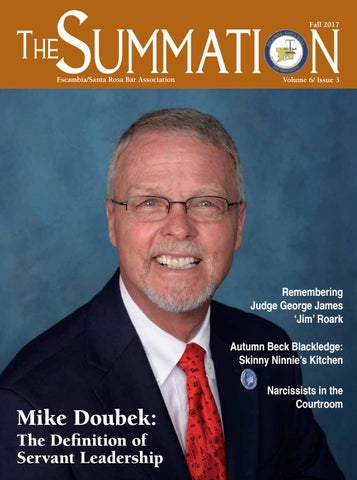
Mike Doubek: The Definition of Servant Leadership
Narcissists in the Courtroom
Table Of Contents
Escambia-Santa Rosa Bar Association 216 South Tarragona Street, Suite B Pensacola, FL 32501 Phone: 850.434.8135 email: esrba@esrba.com Lawyer Referral Service: 850.434.6009 Executive Director Michael Doubek mike@esrba.com Editor Michele Schamberger michele@esrba.com Published quarterly by the Escambia-Santa Rosa Bar Association as a service to its membership. Any article herein may be reproduced provided credit is given both to The Summation and the author of the article. Articles appearing in The Summation are not to be construed as official expressions of the views of the Escambia-Santa Rosa Bar Association. Official positions are expressed only by formal resolutions adopted by a majority of the membership and will be so designated when published. Editorials are expressions of the opinion of the Editor. Due date for all advertisements, articles, and announcements is the first of the month for the issue you wish to advertise in. Address all editorial correspondence to the Escambia-Santa Rosa Bar Association office. For all inquiries concerning advertising rates contact Ballinger Publishing. “The Summation Committee is dedicated to providing a publication to the legal community which contains articles that are accurate, informative, entertaining, educational, relevant and timely.” Summation Committee If you have any comments or suggestions about The Summation, please feel free to express them to any of the committee members. If you would like to join the committee, please call the Bar office at 434.8135. Brooke Jones Carrie Cromey Gerald McGill Caroline Peterson Lisa York Susan Woolf Michele Schamberger Tanner Yea Sheryl Lowenthal Michael Thomas Samantha Costas Charlie Penrod Aurora Osborn Mike Doubek
From the President
Page 3
Board of Governors
Page 4
New Members
Page 5
On the Move Page 6 Judge Preferences: Patricia Kinsey
Page 7
Mike Doubek: The Definition of Servant Leadership Page 10 Did You Know?: Autumn Beck Blackledge
Page 12
Chief Judge’s Award
Page 14
ESRBA News Page 15 The Bottom Line Page 17 News from the Clerk
Page 18
A Tribute To A Friend
Page 19
Snapshots Page 21 Announcements and Calendar
Page 23
Owners • Malcolm & Glenys Ballinger Publisher • Malcolm Ballinger Executive Editor • Kelly Oden Editor • Hana Frenette Art Director • Guy Stevens Graphic Designer & Ad Coordinator • Carly Stone Assistant Editor • Tanner Yea Sales & Marketing Geneva Strange, ext. 21 Paula Rode, ext. 28 Visit our Website at www.ballingerpublishing.com Editorial Offices: 314 North Spring Street, Suite A Pensacola, Florida 32501 850-433-1166 • Fax 850-435-9174 Member of
Reproduction or use of the contents herein is prohibited without written permission from the publisher. Comments and opinions expressed in this magazine represent the personal views of the individuals to whom they are attributed and/or the person identified as the author of the article, and they are not necessarily those of the publisher. This magazine accepts no responsibility for these opinions. The publisher reserves the right to edit all manuscripts. All advertising information is the responsibility of the individual advertiser. Appearance in this magazine does not necessarily reflect endorsement of any products or services by Ballinger Publishing. © 2017 Ballinger Publishing. All Rights Reserved.
2 The Summation www.esrba.com Fall 2017
From the President Practice Pointers By JODI COOKE
It is my distinct honor to serve as your ESRBA President for 2017-2018. It takes a village to do the job well, and I am so fortunate to be surrounded by a wonderful group of talented and committed colleagues on the ESRBA Board of Directors. You can expect us to continue past efforts to maximize member benefits, to encourage and enable fellowship and professionalism among members, and to support the judiciary and our system of law in a rapidly-evolving legal climate. We are also excited about upcoming opportunities to expand our Association’s impact on the communities in Escambia & Santa Rosa Counties by being part of the solution to pressing challenges. One of those opportunities is a series of “Practice Pointers” CLEs, offered in cooperation with our local Clerks and Judges in furtherance of our efforts to make justice accessible to all. The goal is two-fold – increase members’ access to good local information on basic practice procedures in specialized areas of law that seem to draw a lot of new practitioners (both young lawyers and lawyers looking to expand their practice areas), while simultaneously lowering the barriers that might prevent lawyers from taking pro bono cases in those areas because they are afraid of unknown pitfalls or practice procedures that will trip them up. Each presentation will include information about the resources available to attorneys, meaningful input from the practitioners and judges who routinely handle those types of cases, and “practice pointers” for avoiding common pitfalls. The first presentation will focus on consumer bankruptcy cases and will be held on October 24, 2017, from 2:00-5:00 p.m. at the United States Bankruptcy Courthouse on Palafox Street in Pensacola. Future presentations in 2018 will focus on basic criminal cases, domestic violence & guardianship cases, and small claims cases. Check our new ESRBA website at www.esrba.com for dates, times, and details on registration, as well as other useful information about the Association’s upcoming programs and events.
Fall 2017 www.esrba.com The Summation 3
Board of Governors By STEPHEN ECHSNER
Report from
The Florida Board of Governors
The Florida Bar Board of Governors met on July 21, 2017. The major actions of the Board and reports received included: Three new special committees were approved: the Special Committee on Mental Health will spend two years looking at Florida’s mental health laws and educating judges and lawyers on the best practices of dealing the parties and clients with mental health issues; the Special Committee on Child and Parent Representation will spend the next year looking at issues related to dependency representation; and the Special Committee on Health and Wellness of Florida Lawyers will look at mental health and practice issues facing lawyers. The lawyer’s health and wellness committee will be chaired by Board of Governors member Dori Foster-Morales, will include a judge, a mental health professional, and a member of the Young Lawyers Division Board of Governors, and is already considering input, programs, and solutions. Watch for more details on these special committees in upcoming issues of The Florida Bar News. The Standing Committee on Technology recently issued, through the Practice Resource Institute, a Quick Start Guide on Cloud Computing answering basic questions, such as what cloud computing means and where information is stored, and providing questions to ask of a potential provider. The committee also annotated a longer, more detailed, list of standards for cloud computing in its Due Diligence Considerations for Lawyers Evaluating Cloud Computing Service Providers incorporating information from the Legal Cloud Computing Association. The committee continues to focus on protecting data and client confidences for lawyers, including security for laptops and protecting electronic communications with clients. The board approved drafting an opinion to reply to a Bar member’s inquiry about the propriety of participating in a referral service that would charge a varying fee based on the
4 The Summation www.esrba.com Fall 2017
type of case referred, which would also be a feeper-case referral. The Board Review Committee on Professional Ethics will publish an official notice seeking input from Bar members and work to have the draft ready for the Board’s review at its December or January meeting. The Bar has rejected referral services that charge by the case or had different charges for different types of cases, but some other states have taken other positions on those issues. The Special Committee on the 2017 Constitution Revision will launch the public education program “Protect Florida Democracy: Our Constitution, Our Rights, Our Courts” at a September 7 news conference in Tallahassee. The program’s www.ProtectFLDemocracy.org is now available and more information is being added, including “toolkits” for lawyers who want to get involved in the education effort. The program highlights topics such as the separation and balance of powers, why the Constitution works best as a limited document, and the importance of a fair and impartial judiciary. The July 1 Florida Bar News story FloridaBarNews. TV segment and future issues will include more details. The special committee is also monitoring the activities of the Constitution Revision Commission (CRC), offering technical assistance and legal education to the commissioners. Two new technology-related services were approved to add to the Bar’s Member Benefits Program. Zola Media Website Design and Maintenance will help lawyers with their websites, and Cyber Security Insurance Product and Service will help lawyers with cybersecurity issues. The services will soon be added to the list of discounted and free products and services for members posted at www.floridabar.org/ memberbenefits. A proposed contract to enhance and modernize the online operations of the Bar’s Lawyer Referral Service was approved, but terms have not yet been finalized. Working with Legal.io, a San Francisco-based legal technology company, a new online platform
will be designed that would modernize the Bar’s existing legal referral service and allow it to utilize the most cutting edge technology. The goal is an improved member benefit with better functionality for potential clients that should result in more referrals being made to participating Bar members. The Bar’s Lawyer Referral Service will continue to only operate in those counties where a Voluntary Bar does not already operate a lawyer referral service. Any modernization of the Florida Bar’s online operations will not affect any Voluntary Bar Association Lawyer Referral Services as they will continue to operate as they have in the past. The Bar will continue to work with the Voluntary Bar Associations in an effort to coordinate, secure and enhance their own lawyer referral services. More details are included in the August 15 Florida Bar News which will be posted approximately one week before the publication date. The Communications Committee presented to the Board the new templates for all official Florida Bar emails, including the one this summary appears on, which apply the new website colors and styles. (As part of the Bar’s effort to assist members in identifying legitimate emails from The Florida Bar, please remember that emails from The Florida Bar to members will always: be from a sender email address@ floridabar.org; if the notice is for a payment, ask members to first log in to the MyFloridaBar Members Portal with their user name and password; and include contact information for a Bar department if members have questions. If you have any question about whether an email is a legitimate Florida Bar email, please call the Bar before opening any attachments or clicking any links. The Practice Resource Institute (PRI) lists tips and links to other resources for Florida Bar members to protect their computers from malware at https://pri.floridabar.org, and members may also call, email or chat with a PRI practice management adviser about cybersecurity).
New Members Jena Marie Wise Beggs & Lane 501 Commendencia Pensacola, FL 32502 850-432-2451 jw@beggslane.com Nicole Antoinette Aloi Lois B. Lepp, P.A. 902 East Gadsden Street Pensacola, FL 32501 850-435-1090 Nicole@lbl-law.com John A. Campbell Wicker, Smith, O’Hara, McCoy & Ford, P.A. 700 South Palafox Street, Suite 135 Pensacola, FL 32503 850-316-4490 jacampbell@wickersmith.com J. Langford Floyd Lloyd, Gray, Whitehead & Monroe 70 North Baylen Street, Suite 310 Pensacola, FL 32502 850-777-3322 jlfloyd@lgqmlaw.com Richard Lavery Michles & Booth, P.A. 501 Brent Lane Pensacola, FL 32503 850-438-4848 RLavery@MichlesBooth.com Luke VanFleteren Wade, Palmer, Shoemaker 14 North Palafox Street Pensacola, FL 32502 850-429-0755 Luke.vanfleteren@wpslawyers.com
In Our Legal Community Fellow Escambia Santa Rosa Bar Association Member, Jeffery “Jeff” U. Beaverstock, has been nominated to Federal judgeship by President Donald J. Trump. The White House reported the judicial nominations this on September 7, 2017. If confirmed, Jeffrey Uhlman Beaverstock will serve as a District Judge on the U.S. District Court for the Southern District of Alabama.
The University of West Florida is proud to announce that Pamela Langham will serve as general counsel starting July 31. She previously served as interim general counsel for UWF from 2002-03 and established her own law practice in 2005.
Emerald Coast Legal Aid (ECLA) recently presented Clark Partington Attorneys at Law with an award recognizing the firm’s longstanding financial support of the organization’s mission to provide legal services to those members of the community that traditionally have difficulty securing quality representation.(Accepting the award from Douglas White is Robert Powell.)
Fall 2017 www.esrba.com The Summation 5
On the Move Lisa Norris Bernau was selected to become the Assistant to the Vice President, Division of Finance and Administration, for the University of West Florida.
Sean J. Seely has become Partner at Lynchard & Seely, PLLC.
Carolyn Mae Gramlich has joined Stillwell Law Firm as an associate attorney.
Kimberly Speer Sullivan has joined the Law Office of Gary B. Leuchtman, PLLC as an associate attorney.
Lane Lynchard has become Partner at Lynchard & Seely, PLLC.
Christopher D. White has become Partner of McConnaughhay, Coonrod, Pope, Weaver & Stern, P.A.
Tiffany Woodward has joined Moore, Hill & Westmooreland, P.A. as an associate attorney.
6 The Summation www.esrba.com Fall 2017
JUDGE PREFERENCES
JUDGE PATRICIA A. KINSEY Pat Kinsey Type: County Judge County: Escambia County Division: Five Jurisdiction: County Court Judicial Assistant: Michelle Ferguson Address: M.C. Blanchard Judicial Building 190 Governmental Center Pensacola, FL 32502 Phone: 850-595-4424 DIVISION PREFERENCES This is intended as an overview of procedures in an effort to assist all parties handling cases in Division 5. This division of the County Court handles all Small Claims cases and all Landlord/tenant cases. This division has been “paperless” since May 1, 2016. Please make sure that any paperwork you file with the Clerk of Court includes your email address and, if you have it, include the opposing parties’ email address. GENERAL INFORMATION Because of the type of cases handled by Division Five, most plaintiffs and defendants are representing themselves; that is, they do not have an attorney assisting them. Please note that the Code of Judicial Conduct prohibits us from providing legal advice on your case. You cannot contact the court’s office and ask to have a “message” given to the judge about your case. Any issues regarding your case must be put in writing and filed with the Clerk of Court and a copy sent to the opposing party. If necessary, a hearing will be scheduled on your case or, depending on the issue, the court may be able to enter a written Order which will be emailed to both sides. Please include your email address on any paperwork you file with the Clerk of Court. If you know the email
address of the other party, please include that as well. Any issue which you believe needs to be brought to the judge’s attention regarding your case must be filed with the Clerk of Court in the form of a written Motion with a copy sent to the other side. An email request sent to the judicial assistant (JA) at michelle.ferguson@flcourts.gov is the preferred method for setting a hearing, cancelling a hearing, checking on the status of an Order or Judgment or letting us know if you will be filing a written response to the other side’s Motion. Be sure to copy both sides with any email to the court. If you need to contact the court by phone regarding a case, we ask that you contact us between 8:30 am and 4:30 pm (Central Time). We are generally closed between 12:00 and 1:00 pm for lunch. We do have two rotating lines so if we are unable to take your call, please leave a detailed message. We return all calls as promptly as possible. We can be reached at 850-595-4424. When leaving a voice message, please include the case number, so that the case can be pulled and we are better prepared to help you when we return your call. All hearings are conducted in a courtroom. YOU MUST WEAR APPROPRIATE CLOTHING TO BE ADMITTED TO THE COURTROOM. SHORTS, OR CAPRI PANTS ARE NOT ALLOWED IN THE COURTROOM. Please make sure your Hearing Notice directs the parties to report to the courtroom assigned to Judge Pat Kinsey that day. Please remember that there are two judges named “Kinsey.” It is important that your Hearing Notice include Judge “Pat” Kinsey so that the litigants go to the correct courtroom. We request that you include the statement that proper courtroom attire is required on your Hearing Notice. Courtroom assignments are listed by the elevators on all floors in the courthouse each day so the Hearing
Notice should direct the parties to the courtroom assigned the day of the hearing as designated on the list by the elevators. Division Five does NOT conduct any hearings in chambers. TELEPHONIC HEARINGS If you are an out-of-town attorney, plaintiff or defendant, telephonic hearings may be allowed for most hearings so long as you have a “local” or toll free number. Because of the volume of cases scheduled for Small Claims Pre-Trial Conferences, we are unable to accommodate requests for telephonic appearances at these Small Claims Pre-Trials. Please remember that we are located in the Central Time Zone when calling us and when scheduling your hearings. If applicable, we ask that all Hearing Notices include both your local Time Zone as well as our Central Time Zone to avoid confusion. If you are making a telephonic appearance, it is important that you notify the person who answers your toll-free (or local) number that the court will call at the appointed time. Please understand that because our docket is so heavy, we are setting hearings every five, ten or fifteen minutes. As a result, if the call is not immediately connected to the attorney handling the hearing, there will not be sufficient time remaining to handle the hearing. If the hearing must be rescheduled because you are not available at the appointed time, your future telephonic privileges may be jeopardized. We cannot make long distance calls from the courtroom so you must have a toll-free or “local” number or set-up a conference call (at your expense) and include that information on the Hearing Notice. We work very hard to coordinate convenient times for hearings with all interested parties, but if we cannot reach you after several tries, we will go ahead and set a time and you will be sent a Hearing Notice. Summary Judgment hearings are typically set for 5 minutes
Fall 2017 www.esrba.com The Summation 7
unless you specify additional time is required. Show Cause hearings on replevin cases are set for 10 minutes. Final hearings are set for 60 minutes on delinquent credit card cases unless you request additional time. Other Final Hearings are scheduled for a 15 minute Case Management Conference conducted in open court by the judge. The court will set your case for final hearing at the Case Management Conference so be sure to bring your calendar to the hearing or have it available if you are appearing telephonically. Telephonic hearings will not be granted for Show Cause Hearings (in aid of execution). That is, if you call to set a Show Cause Hearing because the Fact Information Sheet or postjudgment Interrogatories/Request to Produce have not been returned, you (or local counsel) must personally appear in the courtroom for the hearing. The defendant will be given an opportunity to complete the form(s) in open court. You must be present to review the completed form(s) and determine if the information is complete and acceptable for you and your client. The court cannot make this determination for you. JURY TRIALS All jury trials are scheduled for a Monday. A Pre-Trial Order will be issued once the case is set for a date certain. Each and every Monday is available for a jury trial. A venire is present and ready for selection at 8:15 am on the morning of trial. Generally, once the jury is selected we take a 10 minute break before opening statements. The lunch break is scheduled for 30 minutes. Lunch is provided for the jury in the jury deliberation room by the courthouse snack bar. Witnesses are subjected to direct, cross, and re-direct only. It is rare that a jury trial cannot be completed the same day as jury selection. A Pre-Trial Conference is conducted the Friday morning prior to the Monday jury trial. Your Pre-Trial Memorandum is due by noon (Central Time) on the Monday which is one week prior to the scheduled trial. You should be prepared to supply the court with the proposed jury instructions and verdict form with your Pre-Trial Memorandum a week before the trial. Final changes will be determined on the verdict form and jury instructions at the Friday Pre-Trial Conference. Please read and carefully consider the Pre-Trial Order issued once the case is set for a date certain. Failure to timely comply with the cut-off dates determined in the Pre-Trial Order may result in delay of your reserved date for jury trial. LANDLORD/TENANT EVICTION CASES Landlord/Tenant eviction cases are heard every day beginning at 11:30 am. When a tenant files an Answer contesting the eviction, a 5 minute Determine Rent Hearing is immediately scheduled and a Hearing Notice is emailed. We are now “paperless” and need an email address for both parties. Please make sure to include them on anything you file with the Clerk of Court. Also, please include a phone number where you can be reached during business hours. If you are a landlord, it is very important that you bring your file containing all of your records on the case to court with you. Especially important is your ledger sheet reflecting all of the payments due from the beginning of the tenancy and payments made or past due. That is, you will need to show the court how you determined the amount of past 8 The Summation www.esrba.com Fall 2017
due rent requested in the Three Day Notice. If you are a tenant, you must bring your cancelled checks or receipts or other proof you have of payments made while you have been living at this location. Once the court determines the amount of money necessary to bring the rent current, an Order will be entered and the tenant will have until 4:45 pm that same day as the Determine Rent Hearing to deposit that amount with the Clerk of Court. The money must be deposited by cash or credit card only. If the money is deposited, a final hearing (trial) will be conducted the following day at 11:30 am at which time the landlord must prove that they took the proper steps for the eviction. The tenant then has the opportunity, if necessary, to show that they have a legally sufficient defense to the eviction. The court will attempt to obtain the services of a mediator whenever possible to help resolve the case prior to beginning the 11:30 am final hearing. SMALL CLAIMS PRE-TRIAL CONFERENCES Small Claims cases are generally set for a Pre-Trial Conference (PTC) the second Wednesday of each month beginning at 1:00 pm. The court will attempt to help the parties reach an agreement whenever possible. A court-ordered payment plan is possible if the defendant agrees to accept responsibility and is able to make a “reasonable monthly payment.” If both parties are represented by counsel, a trial date is set within sixty days of the PTC unless both parties agree to waive their right to a speedy (within 60 days) trial. If both parties are representing themselves or if only one side is represented by counsel, a mediator is present to help resolve the case prior to going before the judge. There is no charge for this service. If the case is resolved, a written stipulated agreement is prepared and signed. If the case is not resolved, the parties are directed to return to the courtroom to set the case for trial. The trial must be set within 60 days of the PTC unless both parties agree to waive their right to a speedy trial. Jury trials are set for a “pick and go” trial on a Monday. Bench trials are generally set on a Tuesday or Thursday afternoon or a Friday. Be sure to bring your calendar with you so that the hearing can be set at a time convenient for you. Once a hearing is scheduled, it will not be continued absent a legally sufficient last minute unanticipated emergency. If your case settles, please notify us as soon as possible so that the time can be given to another litigant. If an issue comes up in your case and you need the court to intervene, please file a written Motion with the Clerk of Court. You must call or send an email to set your hearing as we have no way of knowing that you have filed a motion with the Clerk. PROPOSED ORDERS The Escambia County Clerk of Court will no longer accept proposed Orders through the Florida Court E-Filing Portal. All proposed Orders must be submitted directly to the presiding judge. You may either submit the proposed order via hand delivery or U.S. Mail or you may email (preferred method) it in Microsoft Word format directly to Judge Kinsey’s Judicial Assistant at michelle.ferguson@flcourts.gov. Please do not do both as it causes confusion and twice as much time to respond while we try to ascertain if there is duplication or not. Important: Please either attach supporting documents to the email or verify with
the Clerk’s website that all supporting documents have been docketed before sending your email to the JA. SCHEDULING HEARINGS The quickest and easiest way to set a hearing is to send an email to the court’s JA at michelle.ferguson@flcourts.gov. Be sure to copy the opposing party with any emails to the judge’s office. Include a copy of the Motion and proposed Order as applicable. Remember, we do not have any way to know you have filed a Motion. If you do not copy us with the Motion or call/email to let us know that you have filed it, we are unaware that you have an issue which needs the court’s attention. Your email requesting a hearing should include the case number, copy of the motion and amount of time you are requesting for the hearing. The JA will respond to the email giving available dates and times. Once the parties agree to a date and time, email confirmation should be immediately sent to the JA. We try to accommodate everyone’s schedules in setting hearings, but if you fail to respond, we will set the hearing and send out a Hearing Notice. Remember that we cover two time zones: Central and Eastern. All Hearing Notices should include the times in both time zones as applicable. Also, we have two Judges with the last name of Kinsey. Be sure to include Judge “PAT” Kinsey in the Notice to avoid confusion. Once a Hearing is scheduled, you MUST NOT add additional Motions or other matters to be included during that reserved time without the written confirmation from the JA that sufficient time has been reserved. If you are able to resolve the issues without the need for a hearing, please notify the court as soon as possible so that the reserved time can be used for other litigants. A written Cancellation of Hearing should be filed with the Clerk of Court with a copy emailed to the court at michelle.ferguson@flcourts.gov.
Fall 2017 www.esrba.com The Summation 9
Michael A. Doubek: The Definition of Servant Leadership By Jodi D. Cooke
H
e seeks no credit. He never has. Year after year, meeting after meeting, he quietly and professionally plans every aspect, attends to every detail, and handles every hiccup. He encourages the chosen leadership and enables their initiatives, while doing his best to blend into the background to give others a chance to shine. Those who have worked with him know how lucky our local bar is to have him, and this summer he received the recognition he has so long deserved from the leadership of our state bar. Our own Michael A. “Mike” Doubek, Executive Director of the Escambia-Santa Rosa Bar Association, is the recipient of the 2017 Marshall R. Cassedy, Sr. Award. Doubek has been at the helm of the Association since 2003, taking office at a time when the Association faced many challenges. With quiet grace and determination, he led the group past those hurdles, onto steady ground, and eventually to the thriving organization it is today. Doubek extended the Bar’s reach into the community, opening channels of communication with area leaders that had not previously been opened, and became the face of the organization for both those inside and those outside its ranks. Like all good leaders, his success is a combination of how much he does and the way he does it – with consistently professional kindness and humility. Much like Doubek, the namesake of the Award, Marshall R. Cassedy, was the kind of lawyer-leader whose impact lingers far longer than the tenure of his service. The first Staff Counsel to the Florida Bar and its Executive Director from 1961-1980, Cassedy led our state Bar to receive numerous national awards, to more than triple its membership size, and to conceive and construct the Tallahassee headquarters the Bar still uses today. The lawyers with whom he served described him as “an exceptional man” with a “zest for life that was unique and infectious.” Honorable Chief Judge
of the First Judicial Circuit Linda Nobles was mentored by Cassedy during her years at Florida State and credits the experience with having a profound impact on her professional path. Upon Cassedy’s death in 2011, then-President of the Florida Bar, Scott Hawkins, appointed a committee to recommend ways to honor and memorialize Cassedy’s distinctive legacy of service and the leadership attributes that made him so memorable. Those recommendations led to creation of the Award and placement of a permanent commemorative plaque in honor of Cassedy in the lobby of the Florida Bar headquarters in Tallahassee.
With quiet grace and determination, he led the group past those hurdles, onto steady ground, and eventually to the thriving organization it is today. Given by each Florida Bar President since 2012 to honor extraordinary service to a voluntary bar or the Florida Bar, the
10 The Summation www.esrba.com Fall 2017
Award recognizes bar leaders who serve with the same laudable distinction as Cassedy in what can often be a thankless and underappreciated role. Over the first five years, the Award was given to many deserving voluntary bar leaders and Florida Bar employees in honor of their extraordinary service, including the Executive Directors of the Palm Beach, Hillsborough, Clearwater, and Sarasota County Bar Associations. Doubek deservingly joins the ranks of distinctive servant leaders from around the state. On June 23, 2017, in the General Assembly, during the Annual Meeting of the Florida Bar in Boca Raton, Florida Bar President William “Bill” Schifino presented Doubek with a commemorative plaque and commended him for the number and breadth of personal letters submitted in support of his nomination. As Schifino quoted when presenting the Award, “this award was ‘made for Mike.’ ” The following are additional excerpts from many of the fourteen letters of support submitted to President Schifino with Doubek’s nomination for the Award:
selflessly given of his time and talent to assist court personnel in making our naturalization ceremonies a befitting welcome to those individuals who have made tremendous sacrifice to become citizens of our country. In addition to attending each and every ceremony on behalf of the EscambiaSanta Rosa Bar Association, Mr. Doubek coordinates with local state and county judges who also participate in the ceremonies, enlists a guest speaker, and organizes the set up of refreshments for the new citizens and their guests following the ceremony. This is but one example of Mr. Doubek’ s many community outreach efforts on behalf of the Association.” —Chief Judge M. Casey Rodgers, United States District Court for the Northern District of Florida
Chief Judge Linda L. Nobles presents Mike Doubek with the letters of recommendation “Over his nearly fifteen-year tenure as Director of the Association, Mike has quietly and confidently raised the ‘bar,’ pun intended, for the ESRBA in every possible way. He respects and responds dutifully to all members, creating a positive culture and comradery among the lawyers, judges, and support staff in our area. He actively engages and supports other constituencies in the legal community and the local community at large, thanklessly assuming countless roles that promote the legal profession and the integrity of the judiciary, whether it is part of his job description or not. Mike continues to bring professionalism, class, and respect for the rule of law to any and every task he undertakes, to the benefit of the ESRBA and the legal profession as a whole.” —The 2016-2017 Officers of the ESRBA “The Association was founded with three main objectives - honor the judiciary, promote the profession, and protect the oppressed. During Mr. Doubek’s nearly 15 year tenure as Executive Director, he has tirelessly promoted those objectives, and made our jobs look easy.” —The Past Presidents of the ESRBA “While it is not one of his designated job responsibilities as Executive Director, Mr. Doubek has, for many years,
“I participated in the hiring decision when Mr. Doubek was engaged as Executive Director of our local bar association. It is some of my best work. . . . Thanks to Mr. Doubek’s leadership we now enjoy a local bar association that provides extensive and excellent service to its members and also to our local communities. He has vastly extended our outreach programs and communications channels.” —Honorable Robert Hilliard, Santa Rosa County Judge “Mr. Doubek has put his heart into his position as Executive Director for the ESRBA. He genuinely cares about the mission of the bar and wants to support the local legal community in any manner that he can. He is forward-thinking in his approach, kind in his interactions, and open to any suggestions for ways to provide better services to the legal community and those who need the services of attorneys.” —Pam Childers, Escambia County Clerk of the Circuit Court & Comptroller “[Doubek] has lead the association to incredible growth both in membership numbers and in the impact the Association has on the legal community and panhandle communities at large. He is a vital asset to any organization and we are truly lucky to have him as a part of our great city.” —Ashton J. Hayward, Mayor of Pensacola
“As a legal services provider, I must highlight Mike’s unending support of the work we do, the clients we serve, and the role of pro bono attorneys in filling the justice gap. Whether it is asking for time on a meeting agenda, or help in recruiting pro bono attorneys to a clinic, Mike always finds a way to balance the needs and mission of ESRBA with the community needs. He goes above and beyond personally to support our work, moving tables and chairs at a clinic, taking pictures, and guiding clients.” -Leslie N. Powell-Boudreaux, Executive Director of Legal Services of North Florida “In my experience with Mike, he and the attorneys he leads have consistently given back to the proverbial “least of these,” without recognition or credit for their good works. In doing so, they have made a lasting, positive impact for the legal profession on a very vulnerable group in our community.” —Jennifer Daniel, Director of the Backpack Buddies Program at C.A. Weis Elementary If you ask him why he is so humble, how he can be so agreeable in the most contentious circumstances, he will once again (in true “Mike” fashion) give the credit to someone else -- a mentor who advised him when he first took the job that it would be much easier to do if Doubek would remember “it’s not about you.” Those were words he clearly took to heart, as he’s made it about everyone else for the last fifteen years. For once, and with sincere gratitude, it is finally all about Mike.
Jodi D. Cooke is an associate with Stichter, Riedel, Blain & Postler and the President of the Escambia Santa Rosa Bar Association
Fall 2017 www.esrba.com The Summation 11
Did You Know?
I
f you ever ask my closest friends what makes me happy, they would quickly say “good old southern cookin’!” Since I can remember, I have lived up to the old phrase: To my heart is through my stomach.
Interview with
Autumn Beck Blackledge Author of Skinny Ninnie’s Kitchen By Michele Schamberger
that she had a passion for writing. “I’ve always written articles and random things So, when I heard that local attorney, for fun. My mom says she always knew Autumn Beck Blackledge, was an author I would have a book in me”, proclaimed of a southern cook book, I had to check Autumn. As I continued to listen to out her recipes. From peach cobbler to Autumn talk about the back ground fried squirrel, Autumn’s book Skinny of her book, I learned that she didn’t Ninnie’s Kitchen had my mouth watering originally plan to write a cook book. with delight. Whether you are from the Surprisingly, Autumn admitted that she Deep South or the northern border, this did not think “this is ‘the book’, this book will let you experience a taste bud book Skinny Ninnie’s Kitchen is kind explosion from a large variety of southern of a first try” of doing something she comfort foods. Not only are these recipes actually wanted to compile. Autumn had easy, they are family and budget friendly, written other things before but hadn’t and fill-your-belly good. But most really gotten them published. Originally, importantly, I have come to learn that Autumn wanted to create a southern Skinny Ninnie’s Kitchen is much more family humor book; however, due to the than a recipe book; it is the passage of recession, her publisher advised her to go four generations of “hungry mouths” and in a different direction with her book. cherished memories. So, how did Skinny Ninnie’s Kitchen Wanting to learn more about come about if she didn’t plan on writing Skinny Ninnie’s Kitchen, I had the a cook book you ask? When Autumn wonderful pleasure of sitting down wrote Skinny Ninnie’s Kitchen, she with our featured author, Autumn Beck was a stay-at-home mom. Needing to Bleckledge, and asking her a variety of be intellectually challenged, Autumn flavorful questions. During this brief decided to start a blog, at which point time, I was able to have a small glimpse she started to write the cook book. The into Autumn’s family history. book kind of started as an aftermath of To understand this book, you a small dilemma she noticed with her must understand the background of family. While she was cooking, she the author. Being a 4th generation cooked by feel. Autumn knew how to “Pensacolian”, Autumn had the great cook, but she didn’t’ know exactly the opportunity of growing up in the South. amounts she used to come up with her At an early age of 12, Autumn learned meals. “I was just trying to get the recipes 12 The Summation www.esrba.com Fall 2017
recorded,” stated Autumn as we were talking. As a result, she would then call her grandmother ‘Ninnie’. Ninne, who turns 92 in October, always had the answer she needed. Autumn joked that she would ask Ninnie how to make something, and Ninnie would respond, “O’ there would be a dash of this. You would want to get that to a color of a copper penny.” Autumn learned that there was a lot lost in translation. And because a cooper penny color to Autumn was more of an orange hue, and cooper to Ninnie was dark brown, the recipes varied. So, when Autumn would make a roux the color of a cooper penny, it didn’t taste the same as Ninnie’s recipe. Autumn recalled how certain “funny stories would come up” as she was asking Ninnie the recipes over the phone. In Skinny Ninnie’s Kitchen, Autumn was able to relayed those funny stories on paper. Thus, what was to become a collection of recipes that were meant for a Christmas present for the family eventually became the ground work for her cook book. Even though her book did not go in the original direction she hoped for, Autumn feels that Skinny Ninnie’s Kitchen has become a “Family Heirloom” at this point. It is full of stories and memories of the conversations she has had with her family over the years.
When the book originally got published, Autumn was asked to be featured on several local TV stations. Plus, she had several book signings at Barns & Nobles. Even though her book was a local hit, Autumn humorously confessed that she isn’t the best cook; and that she was kind of “out of her element” when she cooked on TV. She even joked that her children would say that she’s the “only cook book author that mostly orders pizza”. As I continued to listen to Autumn, I learned that she is in the process of making a revised edition of Skinny Ninnie’s Kitchen, which will consist of new recipes from different extended family members. From Italian pasta to good old Southern fried cookin’, her new release has something for everyone. Which brings us to the question, “Once the revised book is released, does Autumn plan to peruse any new adventures?” As Autumn put it, “You can’t do all things in all seasons”. Having a blended family with 5 children, Autumn is always on the go. At times it’s “all hands on deck” with her kids, between sports and school. Nevertheless, Autumn is able find free time to visit with her parents and have quality time with her family. While juggling her law practice and children’s schedules, Autumn has managed to find the time to start writing a new novel. Yet, we must remember, like any good piece of art… she needs time away from her practice to be able to “be creative enough to get it out”. She is hoping to treat herself to a writers retreat sometime in 2018. During this free time, her goal is to finish her novel. After learning about Autumn’s background, I was dying to learn about this infamous “Ninnie” she kept mentioning. Her grandmother of 92 years of age sounded amazing. As I listened eagerly to Autumn describe her grandmother, it brought me back to my childhood. Some of my best memories as a child were watching my Great Grandmother, Nanny, baking homemade cookies. The imagery brought me back to a time where I could close my eyes and smell her cookies in the oven during Christmas. Listening to Autumn described her grandmother as a “very tiny person making food for everybody”
made me think about how food can bring a family together and create life long memories. Finally, after all being said and done, Autumn gave the best advice, “If you have a recipe that someone has passed down, you’ve got to test it while they are still around. Make sure not to lose it. We don’t cook much now days. That’s kind of a lost art. If there is a meatloaf you grew up with, ask the person how they made it. Write it down, so you can pass it down” for generations to come.
“Write it down, so you can pass it down”
What follows is just a sample of the tasty recipes found in this delicious book!
Justin’s Fried Oysters Serves 2 per dozen Estimated Prep Time: 15 minutes The ability to fry oysters well is truly a gift from God. Fry them too much, and you lose the taste of the oyster. Fry them too little, and the gritty little things have a slimy texture that just doesn’t go down well. Ninnie has the gift. She says that there are two keys to success in oyster frying. First, the oysters must be very dry when preparing them and second, they must only be turned once when frying. Needless to say, you only want the freshest oysters, Apalachicola oysters if possible. Also, be sure to remember the rule of thumb is that the best oysters are harvested in months with “r’s” in their name and the earlier the first frost, the better the oyster! Here is the formula for Justin’s favorite fried oysters:
Ingredients 2 oz. containers of shucked fresh oysters 1 1/4 c. medium grit self-rising corn meal 2 tbsp. Creole seasoning (optional) Salt Peanut oil Iron skillet Begin by rinsing and patting the oysters dry with a paper towel. In a separate bowl, mix corn meal and Creole seasoning with a shake of salt. Most likely, the oysters themselves are salty enough to not need much added salt, but it can always be added to taste after frying. Dredge oysters one at a time in mixture, ensuring that every bit of the oyster is well covered. In iron skillet, heat a generous amount of peanut oil on medium heat. When oil is hot, add oysters to skillet. Watch the heat level to ensure that they are not cooking too quickly and lower the heat if necessary. Once one side of the oyster is completely browned, flip. Try to flip the oyster only once. When they are done, place on a plate covered with several paper towels to soak up the excess grease. Eat them hot and be quick because the Beck’s are hovering!
Fall 2017 www.esrba.com The Summation 13
Chief Judge’s Award for Service to the Judicial System By Judge Linda L. Nobles
doggedly day and night to ensure that the data was relocated from the damaged courthouse so that the judicial system was up and running again. Over the past ten years, as all judges and lawyers have moved from a paper world to a digital world, Lendy has coordinated massive data conversions, written code, programmed bridges between applications, and provided the detailed analysis necessary to make the jump into the era of electronic court records. Lendy’s work to make this all possible includes: • converting the electronic database of court records from Courtview to Benchmark; • setting up the Escambia Clerk of Court’s ePortal website; Chief Judge Linda L. Nobles presents the • developing the program to Chief Judge’s Award to Lendy Davis provide automated e-service of judgments and orders to attorneys and The following presentation was given pro se parties; by Chief Judge Linda Nobles at the • creation of the Smartbench folder Escambia Santa Rosa Bar Association July export services to create a workflow from 13, 2017 Installation Banquet: the judicial viewer to the Clerk’s case There are people in our lives who work maintenance software; • working with the County and tirelessly behind the scenes and, in doing such, support us in a myriad of ways that CTS America (SmartCop) to develop a data exchange between the Escambia make our lives easier. This year’s award County Jail and the Clerk’s Benchmark recipient, Lendy Davis, the Director of Information Technology for the Escambia application; and • implementing the Intellidact software County Clerk of Court, works diligently for the required redaction of confidential behind the scenes at the courthouse information contained in court records. so that the judiciary, legal community, related agencies, and literally thousands While that is a short – and very of end users have the information they much incomplete – list of Lendy’s need to perform their duties. accomplishments in recent years, his Lendy has worked for the Clerk’s office outstanding dedication to his work and this legal community goes beyond the for over 20 years. Over those years, he technical duties. Lendy has the patience has been instrumental in bringing the of Job, always willing to take the time to judiciary and legal community into the answer questions and assist those who electronic world. In the late 90s, Lendy developed the original viewer application are less than computer savvy. He has participated in training at seminars for used by the legal community for viewing lawyers, legal assistants, and the judiciary. court files. When the courthouse was He takes time to assist judges and their devastated by Hurricane Ivan, judges judicial assistants one-on-one whenever were holding hearings at the Pensacola necessary. Bay Center and in temporary trailers on the courthouse lawn. Lendy worked 14 The Summation www.esrba.com Fall 2017
To give you one example of how Lendy will go the extra mile, this past spring, I was called to testify before a legislative committee concerning the budgetary needs of the judiciary. The task of being prepared to answer any number of questions concerning the minutiae of the court case counts, the trends and projections, and the details behind each statistic seemed insurmountable. I met with the Clerk’s office personnel, who were gracious with their time and assistance, answering questions and providing me with information. The next day, Lendy came to my office with a folder of organized and color coded charts and graphs that laid out the information in an easily understood and digestible format. He sat down with me and reviewed the information, answered my questions, and helped me prepare. When I arrived in Tallahassee, I was confident that I had the data I needed to provide coherent and persuasive testimony to the legislature concerning the budgetary requirements of the judiciary. I would not have been nearly as prepared without Lendy’s assistance. Chief Judge Nobles wishes to thank Lendy’s colleagues at the Clerk’s office who deeply care for and respect Lendy and each of whom enthusiastically contributed to and collaborated with Judge Nobles in the preparation of the presentation to Lendy of the 2017 Chief Judge’s Award. The Chief Judge’s Award for Service to the Judicial System was developed in 2010 to recognize individuals who go the extra mile to improve the judicial system. If you know of such an individual, you may email his or her name and a brief description of the initiative shown that has enhanced the integrity of the court system in the First Judicial Circuit to Trial Court Administrator Robin Wright at Robin.Wright@FLCourts1.gov. Nominations are accepted throughout the year in consideration of the award given in July.
ESRBA News
S
anta Rosa County is trying to make it easier to access courts and social services for those struggling to make ends meet in the south end of the county. It can take between thirty minutes to an hour to get from Gulf Breeze or Navarre to Milton. Those who need services often lack transportation necessary to make or keep appointments. Phyllis Gonzalez is the Circuit 1 Community Development Administrator for the Florida Department of Children and Families (“DCF”). She works with the Bridges out of Poverty Program, a 16 week program that can help move families from poverty to self-sufficiency by teaching financial skills. She noticed that the child support office was all the way over in Crestview, but so many in the south end of Santa Rosa County had no transportation. Other participants, including heavy representation by veterans, had old criminal charges and collections issues to clear up before getting back on their feet, but again, transportation was a problem. She proposed a once monthly one stop center and asked the Santa Rosa County Commissioners to host it rent-free at the Tiger Point Community Center. Local agencies listed below are sending staff equipped with technology to the community center. The following services are available on the first Friday of each month through December 2017: • Food stamp and Medicaid assistance through DCF
First Friday OneStop
• Free civil legal assistance from Legal was poverty. Her social security wasn’t Services of North Florida enough to pay her bills and leave her • Assistance with child support with enough for food at the end of the application and general information month. While she’s at the center meeting through the Florida Department of with a pro bono lawyer, she can apply for Revenue’s Child Support Program food stamps through DCF. • Counseling for Veterans Programs, The next First Friday OneStop will be employment, re-employment assistance held October 6, 2017, from 8:30 to 4:30 through Career Source EscaROSA at the Tiger Point Community Center • Educational Opportunity Services, at 1370 Tiger Park Lane in Gulf Breeze Veteran Upward Bound Services, and next to the Lowes and Walmart shopping Educational Talent Search through center on U.S. Highway 98. Pensacola State College • Register with the Santa Rosa County Bridges Out of Poverty Program So far the response has been a positive one. Agencies have assisted families in applying for benefits for children and in dealing with a landlord issue to maintain housing. Ms. Gonzalez is still looking to obtain resources for senior citizens. The First Friday OneStop also gives the agency representatives a chance to network and get to know what services are available to their clients. An attorney with Legal Services is helping a disabled victim of domestic violence file for divorce, but a major roadblock for her leaving the relationship Fall 2017 www.esrba.com The Summation 15
2017 Escambia-Santa Rosa Bar Association Community Service Award
E
very year the Escambia~Santa Rosa Bar Association invites its members to nominate a fellow peer for the Escambia~Santa Rosa Bar Association Community Service Award. This is an annual award which recognizes one member for their volunteer service to one or more of the community’s non-profit organizations. The service must be unrelated to the practice of law and/or unrelated to pro bono legal work. The Escambia~Santa Rosa Bar Association believes that good citizenship demands some form of community service. Lawyers are some of the most highly visible citizens in any community. While often thought of by the public as alien and predatory life forms rather than truly caring human beings, through selfsacrificing, rather than self-serving, community service, lawyers can, and often do, present themselves as positive role models, helping to improve the image of lawyers. This year the Escambia~Santa Rosa Bar Association is proud to announce that the 2017 Escambia~Santa Rosa Bar Association Community Service Award recipient is Matthew C. Hoffman. Matthew served on the ESRBA Executive Council from 2010 to 2017 and as President of the ESRBA 2015-2016. Plus, Matthew has also served on the Escambia Santa Rosa Bar Foundation Board of Directors from 2015 to present.
Over a period of 10 years, Matthew has and continues to demonstrate humility and compassion for those less fortunate. Since 2004, Matthew has served on numerous local boards which focus on giving back to the community. Several of the boards include, but are not limited to: Manna Food Pantries, Leadership Pensacola, Northeast Pensacola Sertoma, Big Brothers/Big Sisters NWFL, and Sunday’s Child. Even after rotating Jodi Cooke presents the ESRBA off several of these boards, Community Service Award to Matthew Hoffman Matthew still follows and supports the organizations. According to one of his peers, “Matthew does so much for the community and never asks for recognition.” Congrats Matthew C. Hoffman for receiving this award. The Escambia Santa Rosa Bar Association is proud to have you as this year’s award recipient.
Alex Andrade Receives William S. Meador Award
T
he Young Lawyers Division of the Escambia Santa Rosa Bar Association is pleased to announce that Alex Andrade, an associate of the Moorhead Westmoreland Firm in Pensacola, has been awarded the Bill Meador Award for 2017. The Award commemorates Bill Meador, a young attorney who exemplified the virtues of hard work, collegiality, and professionalism within the Pensacola Legal Community. Alex maintains a diverse civil Cecily Parker presents the practice and is the legal counsel William S. Meador Award to of Pensacola Young Professionals, Alex Andrade volunteers with the Big Brothers Big Sisters of Northwest Florida, serves on the Board of Directors of the Young Lawyers Division of the Escambia Santa Rosa Bar Association, co-chairs the Law Week Committee with his wife Jessica Andrade, and serves on the 1st Circuit Judicial Nominating Commission. Most notably, Alex was instrumental in founding a new organization to Pensacola, OnBikes. In the past year alone, OnBikes provided over 300 bikes and helmets to underprivileged children in the Pensacola Community. Please join the Young Lawyers Division in recognizing Alex for his contributions to the Pensacola Community.
16 The Summation www.esrba.com Fall 2017
DOWNTOWN – COMMERCIAL “TRIPLE A” CORNER LOCATION ON BUSY 9th AVE!
The Bottom Line
The Narcissist in the Courtroom
T
he phrase “A Wolf in Sheep’s Clothing” refers to someone who hides malicious intent under the guise of kindliness. The Narcissist is the wolf in the sheep’s clothing, parading through our courts. All facets of the justice system are confronted by the Narcissist in the court room. It is estimated that Narcissistic Personality Disorder affects about 1% of the general population. The Narcissist is more likely to find himself or herself in the courts than the general population due to the likelihood he or she will face criminal charges, become involved in family law matters, and/or issues of family violence. This is easily explained by referencing the Diagnostic and Statistical Manual of Mental Disorders, (DSM-IV). According to the DSM-IV (301.70), criteria include, “failure to conform to social norms or lawful behaviors repeatedly, that are subject to arrest.” In this article, I will focus more on the family law aspect, as the decisions made for a child’s welfare are, in my opinion, the most significant. If someone is deceitful, insincere, and disingenuous in their testimony and actions,
it could be hard for the court to make a decision for a child in a family law matter. Unfortunately, this is where the Narcissist does their best work. The narcissist is a skilled manipulator. It’s only with time that the façade crumbles. Awareness is the main hurdle legal professionals must overcome when facing a narcissist. Although the Narcissist may be difficult to spot due to their temporary personable nature and manners in the court room, they often will have a background/ history which shows their true character. The narcissist will often have extensive personal histories with the courts. In many ways, the family law courts are the Narcissist’s means to extend their reach into their ex-partner’s life after they part ways. Often they will stretch out divorce proceedings, file frivolous contempt motions after the divorce is final, and may have a documented history of domestic violence, restraining orders, and/or other criminal charges as well. The Narcissist views the court system as a way to control, manipulate, and force interaction with the coparent. “Fooling” the courts is a win in the Narcissist’s book.
By Rebecca Sitton The more the Narcissist feels like the “winner” in court, the more they are encouraged to return to the court room. The attorney facing the Narcissist in court should equip themselves with strategies for disrobing the wolf. Understanding NPD will help bring light to their true character, and you may even elicit a response that shows the judge the wolf that hides under the fleece. The Narcissist’s first concern is how other people perceive them. They want to be perceived as flawless, as “winners.” This is exactly how they see themselves. When facing a narcissist in court, factual or expert evidence is required to support allegations of their misdeeds and untruths. When confronted with the facts, the Narcissist will generally “lose their cool” and show who they truly are. Allowing them to talk can also lead to a revelation of their true character. They love the opportunity to try to convince everyone of their version of events, however skewed that version may be. Remember, the more they have the floor, the more likely the court will likely see the reality behind the façade. As a legal professional an often used strategy in family law by a narcissistic parent is to accuse the co-parent of “Parental Alienation Syndrome” or “PAS.” The issue of PAS has been highly debated in the field and PAS does not appear in the DSM-V. Any symptomology of PAS in the case of the narcissist parent is more often attributed to abuse by the accusing parent. The relationship with the child is usually strained by the Narcissist’s inability to put the needs or feelings of the child above their own. Often
they will miss visitations, lie, engage in abusive behaviors, make empty promises or worse. These behaviors further strain the relationship between the child and the narcissistic parent. Keeping this in mind, be sure to record all similar behaviors for use as evidence during the proceedings. If the accusation of PAS is made, be sure to have an expert witness evaluate the child with these issues in mind. It is crucial for the legal professionals in our community to understand and spot the Narcissist for a myriad of reasons, but the most important is for the welfare of the children caught up in these family law matters. Consider the repercussions of living with a Narcissist; people who are in close relationships with a Narcissist are at risk to develop mental disorders, depression, anxiety, stress related disorders and post-traumatic stress disorder. Children are no exception. Furthermore, the Narcissist is generally the perpetrator of family violence within the home, and care must be taken to protect children from living in violence. When the wellbeing of a child is at stake there is no place for a wolf in the court room…and that’s the bottom line.
Rebecca Sitton is a Paralegal with the Law Firm of Levin, Papantonio, Thomas, Mitchell, Rafferty & Proctor, P.A.
Fall 2017 www.esrba.com The Summation 17
News from the Clerk
New Statutes Concerning Confidentiality of Court Records
T
hree new laws pertaining to public records exemptions took effect on July 1, 2017. Those laws pertain to the identity of a witness to a murder (Chapter Law 2017-11), domestic violence injunction petitions that have been dismissed (Chapter Law 2017-14), and substance abuse impaired persons a/k/a Marchman Act cases (Chapter Law 201725). Each of these new laws creates a new exemption to the public records law for non-court records. However, despite the language in each statute indicating that the revised law also applies to court records, the Escambia County Clerk of Circuit Court and Comptroller will not be implementing those exemptions until further direction is received from the Florida Supreme Court. The purpose of this article is to explain why the Clerk is taking that position. The public records law for non-court records and court records differs. Public access to non-court records is described in Chapter 119, Fla. Stat. Public access to court records is controlled by Rule 2.420, Fla. R. Jud. Admin., and AOSC 16-107. The Florida Supreme Court has stated that public access to court records is determined by the judiciary and not the legislature. In Times Publishing Co. v. Ake, 660 So. 2d 255 (Fla. 1995), the Court held that the legislature could not dictate to the judiciary, a co-equal branch of the government, which court
records were confidential. This differentiation between non-court records and court records is expounded upon in the Florida Supreme Court’s decision adopting subsection (d) of Rule 2.420. In Re: Amendments to Florida Rule of Judicial Administration 2.420, 31 So. 3d 756 (Fla. 2010). In adopting the then-new subdivision (d), the Court distinguished between “Type I information” and “Type II information.” Type I information is information described in Rule 2.420(d) (1)(B), listing at that time 19 exemptions (now 22 exemptions) identified as categories of information that the Clerk has an affirmative duty to keep confidential regardless of any request by the filer. (The filer also has a duty to file a Notice of Confidential Information within Court Filing.) Type II information is information that may be confidential pursuant to a statute or other authority, but is not information that the clerks must automatically keep confidential. Filers have mechanisms through other subsections of Rule 2.420 to file motions requesting that Type II information be kept confidential. There are over 1,000 statutory exemptions to the public records law scattered throughout the statutes. Those exemptions apply to non-court records. When the Florida Supreme Court adopted Rule 2.420(d), it determined that there were 19 exemptions that were
18 The Summation www.esrba.com Fall 2017
readily identifiable by clerk personnel and applicable in the context of court records. By keeping the categories of Type I information to a finite number, the Court recognized the ministerial duties of the clerk and the practical abilities for a person not familiar with a case to redact confidential information. Since 2010, the Court has twice expanded the list to its current number of 22 exemptions. At this time, the Florida Supreme Court has not provided direction to the clerks by way of a revision to Rule 2.420 concerning the three new public records exemptions that went into effect July 1. Although they may be adopted and absorbed into Rule 2.420, there are reasons why exemptions are sometimes not adopted. For example, one exemption not contained within Rule 2.420 pertains to identifying information of certain governmental employees as described in §119.071(4). As a practical matter, clerk personnel cannot know all individuals who are current or former government employees (plus their spouses and children) entitled to have their identifying information kept confidential from public disclosure. Accordingly, if a governmental employee that falls within the categories listed in §119.071(4) wants to have that information kept confidential in court records, that person must file a motion with the court and obtain a court order. The same logic arguably applies to the new
category of witnesses to murder. At the time that a criminal case for murder is opened by the clerk, there may be no document in the court file identifying a particular individual as a witness to the murder entitled to have their information kept confidential until well into the life of the case. By that time, that witness’s information may have been made public. The Florida Supreme Court may decide that the witness to a murder exemption is best addressed through the filing of a motion by the prosecutor rather than reliance on automatic redaction by the clerk. The Clerk communicated with the State Attorney’s Office, Sheriff’s Office, and judiciary before July 1 to inform them of the Clerk’s position concerning these three new laws. Additionally, the Clerk published a notice in the Summation Weekly in the July 12 edition to notify the legal community of our position. Until the Florida Supreme Court has spoken, it will be the responsibility of the filer or the person with interest in the information to file a motion with the court requesting that the information or documents be made confidential. Submitted by Susan A. Woolf, General Counsel, on behalf of Pam Childers, Clerk of the Circuit Court and Comptroller
A Tribute From A Friend By F.T. “Tommy” Ratchford If you have ever walked the halls of the 5th and 6th floors of the judicial center where the judges’ offices are, you have noticed that the walls are decorated with dozens of semi-sepia black and white photographs. Many of these are readily recognizable as scenes of old Pensacola and others are pictures of places that are recognized by only a few. They are an eclectic collection of poignant scenes that sometimes evoke strong emotions in the viewer. The collection is a gift from the late Judge George James (Jim) Roark, III, and in many ways the photographs are a reflection of his personality. Judge Roark was a native Pensacolian, born and raised in this community. He grew up in Warrington and graduated from Escambia High School. He earned a BA in business administration from The University of Mississippi and a law degree from the University of Florida College of Law in 1976. He pursued a general practice of law
for twelve years before becoming a County Court Judge in 1988. He held this position and served the citizens of Escambia County for 21 years. He was known for his even-tempered, pragmatic approach to his duties. Jim was also a 35 year veteran of the United States Navy where he attained the rank of Captain in the Judge Advocate General Corps. There were many sides to this quiet, unassuming man. He was a serious, no-nonsense judge, but an easy-going, laid-back companion outside of the courtroom. He had a lifetime love for music that led to careers as a radio disc-jockey, a guitar player in a folk music trio and a keyboard player in rock and roll bands. He found great solace in his music and he often used it to help him relax. He set up one of his keyboards in his office in the courthouse and when contemplating a serious decision, he would often retreat to the music to help him find
the right answer. One could often hear the soft sounds of the blues coming from behind the doors of his chambers. I knew him for more than 50 years and we shared many things. We first became acquainted in high school. Later, while at Pensacola Jr. College, we were part of “The Laymen”, a popular local rock band that was known throughout the southeast. We spent many hours in a car on the way to the gigs talking about music and life. Although he always appeared outwardly calm and dispassionate, inside he was intently focused on the subject at hand. He had strong emotions but seldom showed them. In all the years I knew him, I never saw him lose his temper, and God knows that over those years, I gave him many reasons to blow his top, some in the courtroom, some on the bandstand. Judge Roark had many loves. In addition to his love for music, his greatest love was for his daughter, Danica, and his wife, Lin. He loved travelling and many of the pictures on the courthouse walls come from his trips across town and across the south. He was intrigued with the music of the Mississippi delta and how it interrelated with the civil rights movement. He wanted to visit the places that played a prominent part in that movement and in the music of the heartland. Among those photos is one of a lonely, nondescript intersection of two dirt roads. If one looks close enough, you can almost see the image of Robert Johnson standing at the crossroads. Even as his body was failing him, he continued to do his best to make our community a better place. His patience with those who appeared before him was widely known, and he was always willing to hear the pleas of those who wanted to plead “guilty, but with an explanation”. Sometimes those “explanations”
Fall 2017 www.esrba.com The Summation 19
As the crowd looked on curiously Jim leaned over and put his finger on the mute button of his microphone and in a conspiratorial tone he said: “Tom, I just bought a new keyboard.” would touch him, and sometimes they did not. Nonetheless, he administered justice with an even hand and with a consciousness of the frailty of humans. He was always aware of his duty to the people. It was only when the pain of his deteriorating bones got to the point that he could not concentrate on the things occurring in his courtroom that he decided to relinquish the position of trust he had assumed for over 20 years. When he felt he could no longer discharge that duty with the level of competence that the people deserved, he reluctantly announced his premature retirement. When he departed Division II of the county court, he left it in much better condition than it was in when he first arrived. Over years and years of mediating the controversies of the people, and the thousands of cases and decisions that he made, his decisions were seldom, if ever, appealed; and when appealed, he was seldom reversed. Even up to the last, his mind remained sharp as his body continued to fail him and forced him into a bent over posture. One day shortly before he publicly announced his retirement, he told me in private that he intended to step down. As we talked about his decision, I ran down a list of attorneys that might try to seek to replace him. During that conversation he looked at me very seriously and told me that he thought I should make a try for the job. I had never considered becoming a judge, but based on his recommendation, I made my one and only attempt. While we were both disappointed that I didn’t make the final cut, we were both pleased that the governor chose an Ole Miss graduate (Judge John Simon) for the position. When I look back over the more
than 40 years of my life as a lawyer, I’ve had a lot of experiences that I know I’ll never forget. Some are sad and heart-wrenching, some are crazy funny and some are thoughtprovoking. I have a lot of memories of Judge Roark, and the one I will always remember went like this: I stood before the judge in arraignment court as my multipleoffender DUI client stood next to me quaking in his shoes. As usual, the courtroom was packed that morning. I don’t think there was an open seat in the place. The defendant tendered a plea of no contest to his latest DUI, and Judge Roark went through the soliloquy regarding the voluntariness of his plea, whether he was under the influence of any coercion or drugs, etc. After learning that the defendant was the father of three and had been employed as a welder at a local steel company for over ten years, judge imposed the minimum mandatory sentence required by law. This involved ten days in the county jail which was much less than the state attorney had suggested. As the defendant was being finger-printed and searched prior to being taken into custody, the judge looked at me and directed me to approach the bench. I assumed that he wanted to tell me something about the man he’d just sentenced or he had something important to relay, so I stepped around the 6 or 8 lawyers who were waiting their turn to have their cases addressed and I walked to the bench as directed. As the crowd looked on curiously, Jim leaned over and put his finger on the mute button of his microphone and in a conspiratorial tone he said: “Tom, I just bought a new keyboard.” For a moment I didn’t know what to say as that was not at all what I was expecting. “Hey. That’s great!” I said. “What kind?”
20 The Summation www.esrba.com Fall 2017
“A Yamaha PSR 970, he said. “Want to start a band?” “Sure” I said. And that was the topic of our important discussion at the bench that morning. The unalterable laws of life dictate that all living things must eventually die. To some, death comes sooner than to others. Unfortunately, for those who loved him and for those who seek justice in the courts of Escambia County, the grim reaper came for Jim sooner than anyone could have expected. Certainly, sooner than it should have. On July 17, 2017 at the relatively young age of 69, Judge G.J. Roark was called to his heavenly home. In going, he left a large hole in the world. He will be missed by many, but he has gone to a better place where there is no pain, no controversy, and where he can sit up straight and play his music to his heart’s content. He was my friend.
F.T. “Tommy” Ratchford is a musician, published author and local criminal defense attorney
Snapshots Justice on the Block, hosted by Pathways for Change and other legal service agencies, helped provide free legal advice to citizens in need.
UWF Legal Studies Volunteers (L to R): Stephanie Millsaps, Marshal Thomas, Nicolas Bergosh and Hallie Diaz
Doug White with Emerald Coast Legal Aid Assisting local citizens
ESRBA Members Throughout the Community
Mike Doubek and Michael Larson (ProLegal) enjoying the September YLD Social at O’Riley’s
ESRBA Members saying the Oath of Admissions to the Florida Bar during the 2017 Installation Banquet at V. Paul’s.
Stanley Walker presenting Immigration Law at the September Luncheon
John Appleyard telling stories from the legal community’s past during the August ESRBA Luncheon.
YLD Discussion Panel presented by Cecily Parker, Jeremy Branning, Frederick V. Longmire, Jessica Schultheis, Judge J. Scott Duncan and Adam White Fall 2017 www.esrba.com The Summation 21
Mike Doubek ‘s Marshall R. Casedy, Sr. Award
Alan Bookman, Mike Doubek, and Judge Ross Goodman
Mike Doubek
Adam White, Mike Doubek and Jodi Cooke
Mike Doubek and wife Carol
22 The Summation www.esrba.com Fall 2017
Announcements Team Court Article Correction We have two corrections on the TEAM Court article that appeared in the summer edition of The Summation. It was incorrectly stated that this was the first graduating class from the program when in fact it was the seventh graduating class. Two additional people also graduated on September 13, 2017. We also misquoted Judge Frydrychowicz. The quote should read: “We’ve seen a lot of progress,” said Judge Frydrychowicz. “People who weren’t speaking in complete sentences, who have never really had a job, are now having their cases dismissed.” TEAM Court is a diversionary program designed to provide treatment to criminal defendants whose diagnosed mental illness was a factor in their alleged crime. Follow Us On Twitter The First Judicial Circuit has established a Twitter account. This account will be used to announce court closings and other urgent information for the general public. Please follow the First Circuit at https://twitter. com/1stCircuitFL or @1stCircuitFL. ESRBA Membership Dues Are Now Due Please contact the Escambia Santa Rosa Bar Assocation’s office if you should have any questions.
Calendar October 10, 2017 Escambia Santa Rosa Bar Association Luncheon Escambia Project (LSNF, FL Bar Foundation Pathways for Change) V. Pauls Italian Restorante Noon- 1 pm October 20, 2017 First Annual Sheriff’s Challenge Charity Golf Match Stonebrook Golf Club, Pace, FL High Noon October 24, 2017 Practical Pointers on Consumer Bankruptcy Seminar Winston E. Arnow Federal Building, 341 Meeting Room 100 N Palafox 2 pm - 5 pm November 3, 2017 Jazz for Justice SoGo District, Downtown Pensacola 11 am- 11 pm November 9-13, 2017 CLE Cruise Departing from Mobile, AL November 23, 2017 Thanksgiving Bar Office Closed November 24, 2017 Bar Office Closed
Classifieds If you would like to place a classified ad in the next edition of The Summation, please call (850) 433-1166 ext. 29, or send an email to tanner@ballingerpublishing.com.
Fall 2017 www.esrba.com The Summation 23
24 The Summation www.esrba.com Fall 2017