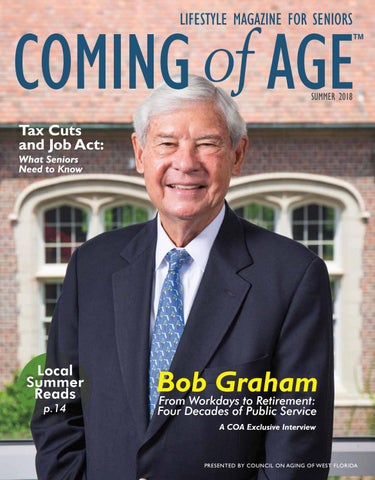
SUMMER 2018
Tax Cuts and Job Act: What Seniors Need to Know
Local Summer Reads p.14
Bob Graham From Workdays to Retirement: Four Decades of Public Service A COA Exclusive Interview
Presented by Council on Aging of west Florida
A Passion
for Serving Seniors and their Families
Homestead Village has been serving seniors in our community for over 25 years and is recognized as a prominent provider of quality Independent, Assisted, Respite, Alzheimer’s and Dementia care living. We are a uniquely designed senior living community dedicated to an “aging in place” philosophy. Our community offers a wide range of services to meet the needs of each individual resident. Whether you are independent, need an occasional helping hand or need daily assistance with life’s activities, Homestead Village has a place for you!
7830 Pine Forest Road, Pensacola, FL 32526 | (850) 941-5000 • www.hvpensacola.com Homestead Village leading tHe way in Hurricane and disaster PreParedness. The Hurricane and tropical storm season started early this year with tropical storm Alberto and rumors are it’s going to be another busy year. Storms and other events are factors of life while living on the Gulf Coast and so when the time comes it is important to carefully consider the right senior care facility for your needs. A place to call home that can appropriately provide protection, with emergency resources and a solid reputation prepared to take care of you or your loved one, no matter what the situation. Homestead Village is an award-winning Independent, Assisted, and Memory Care community with over 25 years’ experience in Pensacola who has successfully weathered many storms and natural disasters. Homestead has tried and proven emergency plans in place, reviewed annually and approved by the Escambia County Emergency Management department to ensure 100% compliance with the Department of Elder Affairs, the Agency for Health Care Administration, and other Florida statues. The Village also has met and exceeded Governor Rick Scott’s emergency rule signed into law earlier this year requiring assisted living facilities in Florida to have an alternate power source such as a generator to ensure the protection of residents’ health, safety, welfare and comfort in the event of the loss of the primary electrical power and requires a detailed emergency environmental
control plan. Homestead has always maintained a fixed automatic emergency generator with fuel storage, maintenance contracts for both fuel and load testing, and annually signs emergency fuel replenishment agreements with out-of-state suppliers. Capabilities of the generator and fuel storage system can run designated areas 100 - 104 hours on a full load and maintain HVAC systems at or below 81 degrees Fahrenheit. Living in a state like Florida that literally has a season for hurricanes makes it imperative to have a plan and resources to protect its residents and staff during times of crisis. Homestead Village maintains transportation assets, water, food, and emergency supplies to take care of its residents before, during and for up to 7 days after a disaster. Additionally, Homestead annually renews and secures commitments by signed agreement letters with national distributers and pharmacies for additional supplies if needed during an emergency. The Village has also installed Hurricane-rated Bahama Shutters on many of its exposed windows to further safe guard against the threat of high winds with a unique design to allow natural light to filter in rather than boarding up windows which means DARK rooms for the duration of the storm. Hurricane shutters are a great way to protect residents and their belongings during a hurricane. They protect windows from being broken by flying debris due to high winds and also protects
from flying broken glass or debris coming through windows into the home. If not at home, it protects personal belongings from being exposed to the elements due to broken windows. Having broken windows is dangerous for you, your loved-one, your home, and your belongings. Homestead Village is proud of its reputation and legacy for quality-safe resident care with more than a decade of perfect zero-deficiency state surveys. The Village’s highest priority is the care and protection of its residents. Interested in information about Pensacola’s premier active Independent, Assisted, and Memory Care community? Please call and schedule your tour today, 850-941-5000 and remember… stay prepared and stay safe this Hurricane season.
A New Vision for Exceptional Memory Care
Introducing YourLife ™ of Pensacola With a new name and refreshing style, Clarity Pointe™ Pensacola is proud to reintroduce itself as YourLife ™ of Pensacola! Our new brand brings along exceptional opportunities for our Memory Care residents and their families. Although some things are changing, our commitment to enhancing life for seniors with memory loss is stronger than ever.
Call today to schedule your visit!
850-316-8969
The transition to YourLife ™ of Pensacola will bring even greater opportunities for our residents to experience personally designed Memory Care. As the YourLife ™ family grows, we look forward to delivering the best support, services and connections to care for the Pensacola community.
8601 N. Davis Highway | Pensacola, Florida 32514 | YourLifePensacola.com
Assisted Living Facility License #12953
[ From the Editor ] Josh Newby
Marketing Communications Director and Editor-in-Chief
Maybe it’s just me, but it seems like this is a great time to be an aging adult in America. Sure, there are occasional funding shortfalls, fraud and other challenges that seniors face, but elderly individuals also have more access to resources than ever. We are not afraid to talk openly about the issues of aging, we have a vibrant infrastructure of government, non-profit and community-based services, and for the most part, our seniors are living longer, fuller lives than ever. In fact, many studies argue that older adults are eating better, have more emotional stability and report higher levels of general satisfaction than ever. As an organization designed to serve, support and advocate for these individuals, we read these reports as proof that we are doing our job. But there is still work to do! If you have ever found yourself wondering where your next meal is coming from, or in need of assistance with activities of daily living, or desperate for respite care, you may question if this is in fact a good time to be an older American. It breaks my heart when I meet a vulnerable elder whose life could be made so much better by the many resources available to them—if they only knew how to access them. If you know of anyone who may need services, please refer them to us, so that they can join the growing ranks of happy, healthy seniors. Part of that push for greater satisfaction among our elderly involves more age-friendly communities,
from the ways our infrastructure is laid out to the ways our cities are planned. You may not think about it, but having wheelchair-accessible sidewalks, trained wait staff and smarter ways to track vulnerable populations are all important to making our communities better for everyone. You can learn more about these exciting initiatives on page 26. In this issue, we’ll also talk about how the new tax law affects planned giving, take a look at some great summer reads, and even learn about those forthcoming ferries downtown—all ways we can be more engaged in life in important, productive ways. Our interview this issue is with Bob Graham. As I’m sure you do, I remember hearing the stories of Graham’s "workdays" during his gubernatorial campaign, and being inspired by a politician who was sincerely interested in vulnerable populations. He proved that, too, when he became part of the state and federal government, by making sweeping, positive changes to how older people are treated and cared for in this country. Summer is here, so please make an effort to stay cool. If I or the agency can be of any help, please call me at (850) 432-1475. Until next time, enjoy life— you’ve earned it!
Readers’ Services Subscriptions Your subscription to Coming of Age comes automatically with your membership to Council on Aging of West Florida. If you have questions about your subscription, call Josh Newby at (850) 432-1475 ext. 130 or email jnewby@coawfla.org. Please do not hesitate to contact Josh with any questions or comments about your service, and thank you.
Change of Address When calling or emailing us your change of address, please provide Council on Aging of West Florida with both the old and new addresses to expedite the change.
6 Coming of Age summer 2018
Back Issues Is there an issue of one of our magazines that you just have to have? Was your relative seen in a recent issue and you lost it? Give Ballinger Publishing a call at (850) 433-1166 ext. 26, and they will find one for you.
Letters Council on Aging of West Florida welcomes your letters and comments. Send letters to Council on Aging c/o Josh Newby at 875 Royce St., Pensacola, FL 32503, emails to jnewby@coawfla.org or contact editor Kelly Oden at Ballinger Publishing, P.O. Box 12665 Pensacola, FL 32591 or kelly@ballingerpublishing.com.
Writing Opportunities We are always willing to consider freelance writers and article ideas. Please send queries and/or suggestions to Kelly Oden at kelly@ballingerpublishing.com or Josh Newby at jnewby@coawfla.org.
Council on Aging of West Florida 2018 Board of Directors Officers Chair: Sonya Daniel First Vice Chair: Kathleen Logan Second Vice Chair: Rick McClanahan Secretary: Councilmember P.C. Wu Treasurer: James M. “Mick” Novota Immediate Past Chair: Caron Sjoberg Board Members Lorenzo Aguilar Malcolm Ballinger DeeDee Davis • Tammy Hardy-Fauber Rabbi Joel Fleekop • Leslie Howington Donna Jacobi, M.D. • Lois Lepp • Escambia County Commissioner Lumon May • Chaplain Larry Mosley Thomas Pace, Jr. • Jan Pacenta • Tara Peterson Santa Rosa School Board District 1 Diane L. Scott, Ph. D. Sue Straughn • Edgar M. Turner Dona Usry • Marie K. Young Members Emeriti Joe Black • Rosemary Bonifay John Brick • Kenneth Kelson Zola Lett • Charles H. Overman, III Malcolm Parker President/CEO John B. Clark Marketing Communications Director and Coming of Age Editor-in-Chief Josh Newby Published for Council on Aging of West Florida by Ballinger Publishing 314 N. Spring St. • Pensacola, FL 32501 850.433.1166 • Fax 850.435.9174 Owners Malcolm & Glenys Ballinger Publisher Malcolm Ballinger Executive Editor Kelly Oden Editor Will Isern Art Director Guy Stevens Graphic Designer & Ad Coordinator Bara'ah Jaraiseh Editorial Assistant Kaitlyn Peacock Account Executives Paula Rode • paula@ballingerpublishing.com Geneva Strange • geneva@ballingerpublishing.com
Disclaimer: Coming of Age magazine is published quarterly by Ballinger Publishing for Council on Aging of West Florida, Inc. All Rights Reserved. Reproduction or use of the contents herein is prohibited. Comments and opinions expressed in this magazine represent the personal views of the individuals to whom they are attributed and/ or the person identified as the author of the article, and they are not necessarily those of the publisher or Council of Aging of West Florida, Inc. This magazine accepts no responsibility for these opinions. The publisher and Council on Aging of West Florida reserve the right to edit all manuscripts. All advertising information is the responsibility of the individual advertiser. Appearance in this magazine does not necessarily reflect endorsement of any products or services by Ballinger Publishing or Council on Aging of West Florida. ©2018
Summer 2018 lifestyle magazine for seniors 7
What's Inside
14
23
32
Features
Summer Reading 14 Bob Graham From Workdays to Retirement: Four Decades of Public Service 32 Departments
In Every Issue
12 Tax Cut and Jobs Act 17 Pensacola Ferries Offer New Route to Beach 20 Nobody puts Brian in the Corner! 23 Protecting Against STDs 26 Age-Friendly Communities 33 Savory Salad Season
10 Advocacy 40 News from Council on Aging of West Florida 44 Our Storied Past 46 Thank You to Our Donors Stay Connected!
8 Coming of Age summer 2018
On the Cover: Bob Graham at Pugh Hall Photo by Lyon Duong/University of Florida Council on Aging of West Florida, Inc, is compliant with the Better Business Bureau’s Wise Giving Alliance Standards for Charity Accountability.
FLORIDA Therapy Services, Inc.
North Florida’s Most Trusted Provider in Community Mental Health Services On April 1st Pensacola Announces the Arrival of: BOARD CERTIFIED Geriatric Psychiatrist William Whiting, D.O. For Appointments Call Toll Free: 877-234-5351 www.flatherapy.com
Healing Lives * Helping People * Giving Hope
Anxiety? Depression? Grief and Loss?
Advocacy
A Message From
John Clark
President, Council on Aging of Northwest Florida
or more than 46 years F Council on Aging of West Florida, Inc. (COA)
has had a wonderful and strong partnership with all the branches of our local government, city and county. In fact—a little trip down memory lane—when Council on Aging was founded in 1972, an organization, which at that time was called the Intergovernmental Program Office (IPO), assisted the COA in securing funding and applying for its first grant in the amount of $29,550 from Title III of the Older Americans Act (OAA), of which $7,388 was from local county government. This planning grant was for the implementation of a comprehensive service delivery system for elders in Escambia County. At that time, COA was known as Escambia County Council on Aging and served only elder residents of Escambia County. It wasn’t until 2007-08 that Council on Aging began administering programs and services for elders in Santa Rosa County. A lot has changed since 1972, in ways too numerous to mention. Today COA reaches some 2,200 elders and their caregivers and provides a myriad of home- and community-based services from case management to adult day care, from home delivered meals to
in-home services such as homemakers and personal care, from a senior neighborhood dining program to Senior Companion and Foster Grandparent Programs, and so much more. While the budget for these services today exceeds $5 million—a long way from the original $29,550—the main goal of the agency has remained constant—helping elders remain independent and engaged within their own communities and avoid costly institutional care. Another constant has been the partnership the agency has enjoyed with our local governments. It can be said that without this partnership and support, COA could not have flourished and touched so many lives. However, some have reasonably asked a question. Is what the COA does really a function of local government and should local government be providing financial support for that function? Well, there are three ways to answer that question:
First, it is important to remember that in many cases COA helps elders in Escambia and Santa Rosa counties avoid institutional placement and remain active and engaged in our community. How is that possible? Well, by providing an array of home- and community-based services such as home
10 Coming of Age summer 2018
delivered meals, personal care services, respite care, homemakers and possibly adult day care for between $9,000 and $12,000 a year, we can help frail elders avoid premature placement in a nursing home, the cost of which could be up to $64,000 a year per person! And most of that nursing home care would be paid for by Medicaid, which is a combination of federal and state money. Those are tax dollars that everyone pays. So COA services locally and across the state are directly helping to slow the growth rate of the Medicaid program.
Second, the funds we receive from local governmental sources can be and are used for what is called “match.” So, for every $1 in local funds we have, we can receive $9 in federal and/ or state funding to serve even more local elders through home- and community-based services. Thus, local support is a good “return on an investment.” Third, not only do COA services help many frail elders avoid institutional placement, they also directly improve the quality of life for hundreds of our fellow citizens in Escambia and Santa Rosa counties. People want to stay at home or in the home of a loved one. Let’s be honest: have you
ever met someone who said they looked forward to spending their later years in an institution? I doubt it. And it is important to note that our local governments, when discussing their mission and vision, all mention the importance of quality of life, having a safe and healthy community—all of which COA does for many of their citizens! So, are we a function of local government? Well, clearly local governments must protect their citizens and they do this through law enforcement and other first responders. But local governments also want to ensure that they protect the health and welfare of their citizens and have a great quality of life. We are all in this together and we cannot provide quality of life for all if we are not willing to care for those who are in the twilight of their lives— elders. We are fortunate to live in communities which understand this imperative and have been so willing to be partners with COA towards that end. We are grateful to them and look forward to a partnership for many years to come.
Here for you, so you can be there for them. When the unexpected happens, we’re here. We serve families displaced by healthcare emergencies by providing them with free shelter, food and support. Lean on us as you care for your loved ones. Learn more, donate, or get involved at VineyardFamilyHouse.org.
850.469.1466 • VineyardFamilyHouse.org
Keep Our Friends Safe Adopt -AManatee
®
Call 1-800-432-JOIN (5646) savethemanatee.org Photo © David Schrichte
Tax Cuts and Job Act: What Seniors Need to Know by ALEC CLARK Tax reform is a hot topic in any political campaign, and the 2016 presidential election was no different. On December 22, 2017, the current administration acted on campaign promises by signing into law H.R. 1, the “Tax Cuts and Jobs Act.” The act brought a wide variety of change to the current legislation with the hope of saving people money and simplifying the tax code. As most people know, the more income an individual receives, the higher their tax rate is. The seven new tax rates 12 Coming of Age summer 2018
are as follows: 10%, 12%, 22%, 24%, 32%, 35%, and 37%. These tax rates are lower across the board compared to the previous tax rates of: 10%, 15%, 25%, 28%, 33%, 35% and 39.6%. The lower tax rates will help all individuals, regardless of income, by reducing the amount of taxes they owe.
the standard deduction was scheduled to be $6,500 for individuals who filed as single or married filing separately. The standard deduction was also scheduled to be $9,550 for individuals filing as head of households and $13,000 for married individuals filing jointly. The act almost doubled these deductions. The new standard deductions are $12,000 for individuals filing as single or married All taxpayers are entitled to a standard filing separately, $18,000 for individuals deduction that reduces a taxpayer’s adjusted gross income (AGI) to determine claiming head of household, and $24,000 their taxable income. Before the Tax Cuts for married individuals filing jointly. and Jobs Act was signed into legislation,
Not all news is good, as the Tax Cuts and Jobs Act suspended all personal exemptions. Each taxpayer, their spouse and dependents were going to be entitled to a $4,150 exemption before the law. Taxpayers with kids feared that the suspension of personal exemptions would raise their taxes, but the Act also increased the child tax credit, so it should even out for most taxpayers with children. Before the Act, a taxpayer could claim a child tax credit of $1,000 per qualifying child under the age of 17. The act increased this tax credit to $2,000 per child and increased the income level at which these credits phase out. The Tax Cuts and Jobs Act also suspended several deductions that were allowed under previous tax law. Alimony paid and moving expenses are no longer deductible under the new tax law. Also, the deduction for miscellaneous itemized deductions that were subject to a two percent floor is now also suspended. The
Act also capped the amount that could be deducted for paying state, local, sales and property taxes. A taxpayer can only claim up to $10,000 ($5,000 if married filing separately) for taxes paid. The Affordable Care Act (also known as Obamacare) required individuals that were not covered by a health plan to pay a penalty on their tax return (unless the tax payer qualified for an exemption). The Tax Cuts and Jobs Act reduced this penalty to zero for months beginning after December 31, 2018. Many non-profits and tax-exempt organizations feared that the doubling of the standard deduction would cause less incentive for individuals to donate to charitable organizations. However, there is still a way for individuals to donate to organizations and still benefit from their charitable contribution. It’s called the charitable IRA rollover. Individuals over the age of 70 ½ are required to take out minimum distributions from their Individual Retirement Accounts (IRA). The distributions are normally taxable.
However, one can donate to charities directly through their IRA. By donating through your IRA, the distribution is not taxable. Even if individuals can no longer itemize, reducing one’s taxable income reduces their tax liability. If one can itemize, then it is a double win as their taxable income is reduced and their itemized deductions are increased. The check from your IRA must be made out directly to the charitable organization you are donating to. If the check is made out the taxpayer, then it doesn’t qualify. It is recommended that one calls the financial company that holds the IRA and ask about their charitable rollover procedures to see how they handle this scenario. The goal of the Act was to simplify and reduce taxes for Americans. Most Americans should be paying less taxes and hopefully spending less time preparing their return. Any tax questions should be directed to a Certified Public Accountant (CPA). Happy Taxing!
Summer 2018 lifestyle magazine for seniors 13
Find a new local author for your favorite
By Kaitlyn Peacock
It is hot outside, the beach is crowded, children are out of school; time to curl up with a good book and enjoy the summer sun. Pensacola has a varied and rich culture, but also boasts many talented local authors to pick up for your next favorite read. From intense thrillers to meditations on living simply to Pensacola’s history in baseball, there is a local author that has a book for everyone.
Law and Disorder by Mike Papantonio
You may know Mike Papantonio as an attorney, but he is also a two-time author. Law and Disorder focuses on a radio talk show host Nicholas “Deke” Deketomis, who doubles as a lawyer striving to protect the rights of the innocent. He takes on a high-stakes case that suddenly puts his and his family’s lives in danger when he is accused of murder. The sequel Law and Vengeance is now available as well and continues the story of Deke after the hair-raising events of the first book. Mike Papantonio is a senior partner at Levin Papantonio Law Firm and host of the "Ring of Fire" radio talk show. 14 Coming of Age summer 2018
Lost Creed by Alex Kava
Published in May of this year, Alex Kava continues her Ryder Creed K9 series into this fourth book. In Lost Creed, Creed’s sister Brodie has been gone for sixteen years, seemingly vanished into thin air. However, a thousand miles away, a clue to what happened to her surfaces and Creed will do anything to get to the bottom of the mystery. The first book in the series is Breaking Creed and Kava’s critically acclaimed second series, the Maggie O’Dell series, begins with A Perfect Evil. Alex Kava is a New York Times bestselling author who splits her time between Pensacola, Fl. and Omaha, Ne.
DeLuna
by John Appleyard John Appleyard is one of the oldest and most celebrated modern Pensacola writers. Based on the letters, journals and other effects of Pensacola’s founder, DeLuna is a historical fiction account of the establishment of the first American settlement in 1559. For those who want to know more about the history before Pensacola, and how America’s first settlement was established, this book is for you. John Appleyard is the founder of John Appleyard Agency, a Cordova Squarebased advertising agency, and a local historian.
Blue Rain Morning by Jamey Jones
Chronicling Jamey Jones’ journey from Pensacola to Brooklyn, Blue Rain Morning is a poetry collection that conveys the emotional and physical transition of moving to the big city from small city streets. Jones offers rich language and musical words in this story told through verse. Jamey Jones is a fifth generation Pensacola native and Poet Laureate of Pensacola. He is an instructor at Pensacola State College and is the chief editor of the “Hurricane Review.”
Goodnight Pensacola by Anna Whibbs Theriault
With the same lyrical voice as the celebrated children’s classic “Goodnight Moon,” Goodnight Pensacola sends Pensacola landmarks off to bed with a goodnight, sleep tight. Including everything from Graffiti Bridge to the Pensacola Beach sign, this children’s bedtime book is a love letter to all the unique sites of the city. Theriault’s second book P is for Pelican, is another local children’s favorite. Anna Whibbs Theriault was born and raised in Pensacola, where she still resides raising her boys with her husband.
Baseball in Pensacola by Scott Brown
Who doesn’t love to catch a baseball game during the summer? Baseball in Pensacola details Pensacola’s history with America’s favorite pastime, sharing stories of Babe Ruth, Ted Williams, to the formation of the local Blue Wahoos team and more. You might be surprised just how much baseball history happened in our own backyard. Scott Brown, born and raised in Pensacola, is a baseball historian and president of the Mordecai Brown Legacy Foundation.
A Simplified Life by Emily Ley
Emily Ley, successful entrepreneur, mother and bestselling author, shares the secrets of managing a busy lifestyle in A Simplified Life. From managing your home, meal planning, parenting, faith and more, this book encourages readers to reach for their goals and simplify their life. The concepts build off ideas from Ley’s debut Grace, Not Perfection, which empowered and inspired women to enjoy the simple life. Emily Ley, a Pensacola native and graduate of the University of West Florida, is an award-winning entrepreneur and bestselling author.
Historic Photos of Pensacola
by Jacquelyn Tracy Wilson Pensacola was America’s first settlement. There is a lot of history here and with that history comes amazing photography. Edited by Jacquelyn Tracy Wilson, Historic Photos of Pensacola showcases Pensacola from the Civil War up to the 1960s in almost 200 archival photographs. This collection captures the true character of the city and is the perfect coffee table for any proud Pensacola native. Jacquelyn Tracy Wilson is a fifth-generation Pensacola native and works with the Pensacola Historical Society to continue her research of the city.
Summer 2018 lifestyle magazine for seniors 15
WE BRING YOUR MEDS TO YOU!
LocaLLy owned and operated for 40 years 4350 Bayou Blvd Ste 5 Pensacola Fl 32503 850.484.4338
14 W Jordan St Pensacola Fl 32501 850.433.2165
3818 Hwy 90 Pace Fl 32571 850.994.7005
2315 W Jackson St Pensacola Fl 32505 850.495.3955
mythriftdrugs.com
Pensacola ferries to offer new route to beach by Will Isern
Starting this month, the long-planned Pensacola Bay ferries will carry their first passengers from downtown Pensacola to Fort Pickens and Pensacola Beach. The service is planned to start June 15. The $3.5 million project – a collaboration between the National Park Service, Escambia County and the City of Pensacola – has the potential to transform the local transportation landscape, linking the mainland to Escambia Island
by water and offering thousands their first opportunity to experience the natural beauty of Pensacola’s waterways.
The ferries have since been taken out of dry dock and have undergone inspection and sea trials by the U.S. Coast Guard.
The ferries, named Turtle Runner and Pelican Perch, have been under wraps in Pensacola for more than a year. The National Park Service had some difficulty finding a qualified company to operate the ferries, pushing back the target start date for more than a year.
There was some public pushback when the Gulf Islands National Seashore superintendent Dan Brown announced that ticket prices to ride the ferries could be as much as $20 per person. Many complained that such prices would be too expensive for families.
The Park Service is now working to finalize a contract with North Carolina-based Gulf Coast Maritime Services, Inc. to operate the ferries. The company already operates a similar ferry service at Cape Lookout National Seashore in North Carolina.
Brown however said that the ferry operator will likely have discounts for groups, and may implement an annual pass system similar to that at Fort Pickens, where locals can pay just $40 a year for an annual pass, as opposed to the $20 daily entrance fee.
Summer 2018 lifestyle magazine for seniors 17
“We fully expect that the greater percent of passengers are going to be those folks who are coming here on vacation, they’re staying in a hotel, they have a vacation budget and after they sunburn themselves on the beach, they’re looking for other things to do,” Brown said. “People who live here locally are going to see the packages and they’re not going to pay those daily prices. If you live locally and want to ride it regularly, you’re going to take advantage of one of the packages.” The ferries will run daily from mid-May to mid-August and on weekends in the shoulder seasons. The ferries are dual-hulled catamarans, which Brown said provide a very stable and 18 Coming of Age summer 2018
comfortable ride at roughly 12 knots. Each ferry is capable of carrying 150 passengers, and will operate in opposing directions. A ferry will stop at each of the three landings – Fort Pickens, Quietwater Beach and Palafox Pier – roughly once an hour. Passengers will be free to hop on and hop off at any number of stops throughout the day that they have bought tickets.
“We want it to be successful,” Escambia County commissioner Grover Robinson said recently. “We want to do whatever we can to keep your car off the island. If we can find a way to move you from downtown to Pensacola Beach to Fort Pickens without getting in your car, that saves us, that saves you – everybody’s happy.”
For more information about the The Park Service will have rangers Gulf Islands National Seashore visit onboard to educate riders about the nps.gov/guis or Facebook.com/ habitat and wildlife found in the bay GulfIslandsNPS. and ashore. Local leaders hope that the ferries can help alleviate some of the traffic congestion that has plagued Pensacola Beach in recent summers.
Tentative Schedule Pensacola to Pensacola Beach Depart 9 a.m., arrive 9:40 a.m. Depart noon, arrive 12:40 p.m. Depart 3 p.m., arrive 3:40 p.m.
Pensacola Beach to Pensacola Depart 11 a.m., arrive 11:40 a.m. Depart 2 p.m., arrive 2:40 p.m. Depart 5 p.m., arrive 5:40 p.m.
Fort Pickens to Pensacola Beach Depart 10 a.m., arrive 10:45 a.m. Depart 1 p.m., arrive 1:45 p.m. Depart 4 p.m., arrive 4:45 p.m.
Pensacola Beach to Fort Pickens Depart 10 a.m., arrive 10:45 a.m. Depart 1 p.m., arrive 1:45 p.m. Depart 4 p.m., arrive 4:45 p.m.
Pensacola to Fort Pickens
Depart 9 a.m., arrive 9:35 a.m. Depart noon, arrive 12:35 p.m. Depart 3 p.m., arrive 3:35 p.m.
Fort Pickens to Pensacola
Depart 11 a.m., arrive 11:35 a.m. Depart 2 p.m., arrive 2:35 p.m. Depart 5 p.m., arrive 5:35 p.m.
NOBODY PUTS BRIAN IN THE CORNER! Diagnosed with Early Onset Alzheimer’s Disease in his late 40s, one man has dedicated the rest of his life to erasing the stigma associated with those living with this disease. Though Brian LeBlanc is in stage four of his disease, he not only lives independently but travels the country to inspire those diagnosed and their caregivers. Brian works tirelessly to create a world where those with Alzheimer’s disease are empowered to not just live, but to live well. Brian spoke with Coming of Age to provide insight on his journey to acceptance both from others, and himself. Written By: Brian LeBlanc Photography by Carmen Buck
“I know you may not remember, but… ,” are words often said to me before telling me something or being asked a question. “So, how’s he doing?” are words said to someone when I’m standing right there. Friends, family, acquaintances automatically assume I can’t understand or reply because I have Alzheimer’s, so they ask whoever I am with at the time. “You have Alzheimer’s? Yeah right! I get Alzheimer’s when I drink!" These words were said to me in a 20 Coming of Age summer 2018
local retail shop when the person didn’t believe I looked the part and made a joke about it. In all of these instances, I was dismissed, I was shoved in a corner as if I didn’t matter. Why is that? Because Alzheimer’s is one of the most, if not the most, misunderstood diseases in the world today. You see, we ask that you see us and not the disease. Alzheimer’s DOES NOT define us. It is not who we are, it’s just something that we
have. I’ll give you an example of what it’s like living with Alzheimer’s. Imagine your most obnoxious relative (we all have one) comes to visit at Christmas. Before you know it, it’s Easter and he is still sleeping on your couch, irritating the hell out of you every single day! If someone should be shoved into a corner and ignored, it’s that guy! This is what Alzheimer’s is like. Each day, we wake up and, like the obnoxious relative, our disease starts increasingly irritating us. It does this by causing us to forget
our words, causing us to lose our balance so we fall, and causing us to the forget names of our acquaintances, our friends, our family, our loved ones.
it took my grandfather away. I also watched as it took his daughter, my mother, away. Now, I have a disease that I’m going to die with because there’s no way to slow it down or take it away. But, I’m okay with that, and I’ve made peace with it.
Living with Alzheimer’s is not how I envisioned my retired life to be. I had no idea that by the age of 53, I would Now I fight against my disease. I be forced into retirement because I may not be a crime fighter, but I couldn’t work anymore. am a stigma fighter. I don’t fight with physical force. Instead, I use Once diagnosed, I received some very good advice about the permanence of sharing my news. I was told that “once you put it out there, you can’t take it back.” When "Now I fight I started telling family and friends against my about my diagnosis, they started to disease. I may not disappear. Phone calls stopped coming in and weren’t returned; it was like I had the plague. My two oldest brothers even accused me of faking my disease. Of course, they didn’t say that to me; they told my sister, who passed it along to me. I didn’t understand why I was being shunned. Lisa Genova, the author of Still Alice, wrote the following in the forward of a book written by a very good friend of mine, Greg O’Brien: “We’re all terrified of Alzheimer’s. This fortress of fear, shame, stigma, alienation and isolation that surrounds Alzheimer’s today is not unlike what we saw with cancer 40 to 50 years ago. We didn’t even say the word ‘cancer.’ Instead we called it ‘the big C’ in hushed voices. But something changed. We began talking openly about cancer. We began wearing ribbons and walking to raise awareness. Now, we have treatments for cancer, we have cancer survivors. Right now, we have no Alzheimer’s survivors!” These words resonated with me because I had a front row seat as
be a crime fighter, but I am a stigma fighter. I don’t fight with physical force. Instead, I use my words to bring Alzheimer’s awareness and education to anyone who is willing to listen."
ask me, how can someone with Alzheimer’s live alone? Two words: quite well! When you have no other alternative, you make it work. Don’t count us out just because we have a disease that affects our brain and makes us forget things. We’re still us inside. We may not be able to remember things from the day before, but we can still live in the moment with you. We can still enjoy life, laugh, go out to dinner, go to a movie. We’re still alive so instead of disengaging from us, engage us. Empower us. Enable us to be present with you. I only have one life—this life. It’s not exactly how I envisioned it, but it is what it is. It may sound strange, but nothing happens by chance. I firmly believe I was meant to live this life to call attention to this incredibly misunderstood disease called Alzheimer’s! I thank you for reading my words and I hope you too feel empowered to erase the stigma. I have vowed in the memory of my grandfather and my mother to continue my advocacy for as long as I am able. When I reach the point where I can longer advocate effectively, I know that I will pass the baton to a newer and younger generation.
my words to bring Alzheimer’s awareness and education to anyone who is willing to listen. Whether it be to just one person, 100 or 1,000, my message is the same: don’t count us out! I now live a life where I take care of myself. I know several other people who also have Alzheimer’s who, like me, are living by themselves and they do it quite well. This is something that the majority of society doesn’t understand. People
In the meantime, don’t try to shove me in the corner as if I didn’t matter. If you try, I won’t let you, because nobody puts me in a corner! My name is Brian LeBlanc and I have Alzheimer’s, but it doesn’t have me!
Summer 2018 lifestyle magazine for seniors 21
Anthony Sessa Senior Real Estate Specialist
Ant hony Sessa Anthony Sessa Sessa Sells
850.572.6227 Thinking anthony@sessasells.com of a Transition? Call Anthony to help Sessa Sells www.sessasells.com
guide you through your RealSessa Estate SellsNeeds! 850.572.6227 850.572.6227 anthony@sessasells.com anthony@sessasells.com www.sessasells.com www.sessasells.com
Protecting Against STDs
Never Gets Old As we age, our health needs change. But one thing that remains consistent is our need to be informed about and take precautions against sexually transmitted diseases, or STDs. STDs are all too common and are transmitted from person to person through intimate contact, like sex. For the past three years, rates of chlamydia, gonorrhea and syphilis have all increased in the US. According
to the Centers for Disease Control and Prevention (CDC), people over the age of 45 have seen an increase in infection rates for STDs since 2012, with no end to the trend in sight.
Courtesy of Florida Department of Health
There are many factors that contribute to the rise in STDs in older Americans. Many seniors remain sexually active, but some may have never had access to comprehensive sex education to learn how to prevent contracting or spreading STDs, and they may not use precautions like condoms because pregnancy is no longer a risk. Consistent use of latex or polyurethane condoms is
Summer 2018 lifestyle magazine for seniors 23
The health department in your county offers STD services at low or no cost. CDC offers a national search tool at gettested.cdc.gov to locate HIV, STD or Hepatitis testing facilities near you. highly effective in preventing the contraction or transmission of STDs. Condoms aren’t just for birth control; they provide a protective barrier between you and your partner that keeps you both safe from infection. Combined with having unprotected sex, older adults tend to have weaker immune systems than their adolescent counterparts, making them more prone to infection. This has other potential complications as well. Sometimes a person who contracts an STD may go a while without displaying symptoms. Not only does this mean the person may unknowingly spread the disease 24 Coming of Age summer 2018
to others before developing symptoms, but their body is still actively fighting the infection, weakening their immune system and leaving them vulnerable to other illnesses. If left untreated, STDs can result in severe health consequences. Many STDs can be easily diagnosed and treated with antibiotics, but while testing for STDs and HIV/AIDS is fairly common practice for younger generations, an older person’s doctor may not think to do so, and the patient may not know to ask to be tested. But getting tested to protect your health and the health of your partner is crucial at any age.
The Florida Department of Health, in conjunction with county health departments, partner clinics and private clinicians, provides screening, counseling, treatment and partner notification services to persons infected with or suspected of being infected with STDs. The health department in your county offers STD services at low or no cost. CDC offers a national search tool at gettested. cdc.gov to locate HIV, STD or Hepatitis testing facilities near you. Sex is a private issue that many people feel uncomfortable discussing, but having protected sex and being aware of your STD status is the best way to stop STD transmission and is an important part of protecting your overall health.
Call Assisted Living Locators first to save time and money.
Call John Horton at 850-542-3088 www.assistedlivinglocators.com
CARDON ESTATE SALES & APPRAISALS Your Caring Professional Team We can assist you with one piece or entire estate. Member of the International Society of Appraisers since 2001 PLEASE NOTE THE CHANGE IN PHONE NUMBER. NEW TEL 850-206-2601 • Cardonestatesales@gmail. com
ElodieCardon
nsportation Tra
Increased access to information through various methods including print, tv, and digital
Housing
Re s
Comm un i
em yst hS
Access to affordable, person-centered health care services to promote active and independent living
ion & Info icat rm n u
Appropriate and affordable housing that promotes and supports aging in place
WXC-TV
26 Coming of Age summer 2018
ct & pe
So
Actively engag celebrates t contribu adult comm
NEWS STATION
Š 2018 Florida Department of Elder Affairs
ion at
Safe and reliable transportation options to increase mobility and community participation
ort & H ea upp S lt ty
Com m
DOMAINS OF A LIVABLE COMMUNITY
Ou t
Civi cP a
Opportunities to contribute in the workplace and volunteer to make a difference in the community
aces & B r Sp uil o d do
Accessible, inviting, and safe outdoor spaces and buildings that encourage active participation and recreation
By Richard Prudom, Deputy Secretary and Chief of Staff, Florida Department of Elder Affairs
ocial In clu
n sio Participa cial tio o S
n
promotes, ges, and the valuable utions of all ts in the munity
gs in
nt me oy
r
ion & Em ipat pl c i t
Making Northwest Florida Friendly & More Supportive for Older Floridians
Easy access to social and cultural activities for increased quality of life
There are countless decisions we face during a lifetime – where to go to school, what career to choose, and when to start a family, to name a few. But one of the most important choices to be made is where to spend our later years. Most people don’t consider this or actively plan for it; however, it is so important for each of us to thoughtfully consider where we can live and live well as we age. How supportive is the community? Is it inclusive, accessible, and welcoming? I’m proud to say that Northwest Florida is all that and continues to improve year after year.
Summer 2018 lifestyle magazine for seniors 27
Making Northwest Florida Friendly & More Supportive for Older Floridians the health and well-being of older adults. By doing so, these communities are better equipped to become great places, and even lifelong homes, for people of all ages.
The Department of Elder Affairs (DOEA) is Florida’s State Unit on Aging, and it is our mission to keep older Floridians healthy, safe and independent. We can only accomplish our mission with active involvement from local communities. One focus of ours has been the creation and expansion of the Dementia Care and Cure Initiative (DCCI), which aims to create aware and dementia-sensitive communities where individuals with dementia, their families and caregivers can access supportive services while also remaining active and engaged in their community. In April of 2016, Tallahassee was announced as the pilot DCCI Dementia-Caring Community. Other major cities across Florida have since joined the initiative, including Pensacola in December 2017. This summer the Pensacola DCCI Task Force will hold their first community training, and we are encouraged by the excitement around the initiative and look forward to the great 28 Coming of Age summer 2018
outcomes ahead. DCCI education aims to share information about dementia, including an overview of the community resources that support affected individuals, including caregivers and families. Most people are not aware of these incredible resources, like the Memory Disorder Clinics and respite care programs. No one should feel isolated or left on their own following a diagnosis. These resources and programs can make a significant difference for people and provide much-needed hope, guidance and support. The Department of Elder Affairs is also partnering with AARP to promote lifelong livable communities through the AARP Network of Age-Friendly Communities. This effort encourages states, cities, towns and counties to prepare for the rapid aging of the U.S. population by paying increased attention to the environmental, economic and social factors that influence
AARP currently has 18 cities engaged in the Age-Friendly Network. DOEA is working on a strategic plan with AARP to engage more communities, including across Northwest Florida, to join the Age-Friendly Network and to follow the framework of the World Health Organization's eight domains of livability that enhances the quality of life for all. We hope to work with community leaders and advocates in Escambia and Santa Rosa Counties in these efforts. Several cities and towns across Escambia and Santa Rosa Counties previously participated in our Communities for a Lifetime Initiative, and we hope to engage them through Age-Friendly as we move forward with our goal to make Florida an Age-Friendly state. Our work continues, but we can’t do it without your support. If you would like more information on how to engage your community in the Age-Friendly Network, please contact Tracey Aittama, aittamat@elderaffairs. org. If you are interested in being a part of the DCCI, you may contact Christine Didion didionc@elderaffairs.org. For more information, please visit ElderAffairs.org.
For more information, call
850.438.2201
© 2017 Kindred at Home CSR 192475-01
www.emeraldcoasthospice.com
Balto Labrador/American Foxhound mix One year old male
Rescue Meet 5 dogs that need your love today!
Me
Fore Pensacola
an Interview with Bubba Watson
Road Trip!
Amazing Destinations along Highway 90
SPECIAL BUSINESS CLIMATE SECTION INSIDE
The Art of Archery
Tips + Techniques to Sharpen your Skills
AUGUST 2016 • penSAcolAmAGAzine.com
ballingerpublishing.com Summer 2018 lifestyle magazine for seniors 29
Savoring Salad Even though salads can be enjoyed year-round, the warmer months signal salad season for some fans of al fresco dining. Barbecues, family reunions, picnics, potlucks, block parties, pool parties or simple family dinners are a few reasons to savor the season, and all are ideal occasions to serve a salad. This versatile Middle EasternInspired Bean Salad can be assembled ahead of time and served chilled or at room temperature. Beginning with a can of READ 3 or 4 Bean Salad can help streamline prep and provide a pleasing flavor to complement the cherry tomatoes, cucumber, parsley and mint in the salad. The hummus-based dressing combined with a traditional Middle Eastern spice blend gets a bright accent from a squeeze of fresh lemon juice. Colorful Pickled Beet and Red Quinoa Salad is also an option that can be served chilled or at room temperature, and can make for a vegetarian main dish or side salad. At just the right size for a salad, Aunt Nellie's Whole Baby Pickled Beats are teamed with red quinoa and punctuated with chickpeas, almonds and feta. The fresh orange vinaigrette helps tie the flavors together. For additional salad inspiration, visit READSalads.com and AuntNellies.com.
Middle Eastern-Inspired Bean Salad Prep time: 20 minutes Servings: 6 1 1/2 1
can (15 ounces) READ 3 or 4 Bean Salad cup halved cherry or grape tomatoes small cucumber (4-5 inches long), cut in half lengthwise then thinly sliced crosswise 2 green onions, thinly sliced 1/2 cup chopped fresh parsley 2 tablespoons chopped fresh mint 1 small clove garlic, minced 1/4 teaspoon crushed red pepper flakes Dressing: 2 tablespoons prepared hummus 1 tablespoon fresh lemon juice 1/4-1/2 teaspoon za'atar seasoning blend Drain bean salad. Discard liquid. Place bean salad in large bowl. Add tomatoes, cucumber, onions, parsley, mint, garlic and red pepper flakes to bean salad. Toss to combine. To make dressing: Combine hummus, lemon juice and seasoning; set aside. Add dressing to salad just before serving; toss to combine well. Serve at room temperature or chilled.
Season
Pickled Beet and Red Quinoa Salad with Orange Vinaigrette Prep time: 20 minutes Cook time: 15-20 minutes Servings: 8 Salad: 1 1 1/2 1/2 1/2 1/2 1/3 1
jar (16 ounces) Aunt Nellie's Baby Whole Pickled Beets can (15 ounces) chickpeas, rinsed and drained cup thinly sliced green onion cup chopped fresh parsley cup red quinoa, cooked according to package directions (about 1 1/2 cups cooked) cup coarsely chopped almonds, toasted cup crumbled reduced-fat or traditional feta cheese tablespoon orange zest
Vinaigrette: 1/4 cup fresh orange juice 1 tablespoon orange zest 1/2 teaspoon coarsely ground black pepper 1/4 teaspoon salt (optional) 2 tablespoons olive oil
To make vinaigrette: In small bowl, whisk together orange juice, orange zest, black pepper, salt, if desired, and olive oil; set aside. To make salad: Drain beets. Place in large bowl; set aside. Add chickpeas, green onion, parsley and quinoa to beets. Add vinaigrette; toss to combine well. Just before serving, add almonds to salad; toss to combine well. Sprinkle with feta cheese and orange zest. Serve at room temperature or chilled. Summer 2018 lifestyle magazine for seniors 31
photo by University of Florida/ Lyon Duong
Bob Graham
From Workdays to Retirement: Four Decades of Public Service By Kelly Oden Former Florida Governor and U.S. Senator, Bob Graham is a public servant for the ages. In his four decades of elected public service and over a decade of citizen political involvement, Bob Graham has tirelessly fought for the citizens of Florida across a spectrum of issues including education, the environment, the elderly, water conservation, civic engagement and more. Born and raised on a dairy farm in South Florida, Graham jokes that he was born into politics—attending his father’s political rallies while still in the womb and being born on November 9, 1936, one week after his father was elected to the Florida Senate. After graduating from Harvard Law School, Graham returned to his home in what is now Miami Lakes and won a seat in the Florida House of Representatives. A lifelong Democrat, Graham was part of a progressive group of Democrats who focused on civil rights, the environment, public education and more. Those same principles endured and even guided Graham as he served as the 38th governor of Florida from 1979 to 1987 and a United States Senator from 1987 to 2005. A signature element of his 1978 gubernatorial campaign was Graham’s work days during which he trained and worked 100 ordinary jobs, laboring at everything from changing bedpans and cleaning invalids in a nursing home to wielding blowtorches as 32 Coming of Age summer 2018
a steelworker and going without sleep as a long-haul trucker. Graham continued the workdays as governor and then as a U.S Senator, working more than 400 workdays in his political career. As a U.S. Senator, Graham focused on domestic issues like Everglades restoration, immigration and off-shore drilling and was considered a leading expert on foreign policy and intelligence. During his last term, he was named chairman on the Senate Select Committee on Intelligence. In 2010, Senator Graham served as Co-Chair of the National Commission on the BP Deepwater Horizon Oil Spill and Offshore Drilling. Graham’s passion for public service is evident in his work with the Bob Graham Center for Public Service, which serves as a training ground for the next generation of Sunshine State leaders. Graham has been married to his wife, Adele for nearly 60 years. They have four children and 11 grandchildren, with whom they enjoy spending their retirement. Their daughter, Gwen Graham, is following in her father’s footsteps—she is running for Governor of Florida in the 2018 elections. Coming of Age had the distinct pleasure of speaking with Bob Graham about his upbringing, his accomplishments, and the importance of public service.
Archive photos courtesy of the D. Robert "Bob" Graham Political Papers, Special and Area Studies Collections, George A. Smathers Libraries, University of Florida, Gainesville, Florida
COA: A lot of people know about your political achievements and we will talk about those, but first, I wanted to know a little bit about your upbringing. I understand you grew up on a cattle farm in south Florida. What was your boyhood like? BG: Well, if I could start a little earlier than that even, my mother whose name was Hilda Simmons was born in Freeport in Walton County and grew up in DeFuniak Springs. Her father was a country doctor. As a teenager, automobiles were still in their initial stages. She used to be the one who cranked the car and was the amateur mechanic for her father when he needed to get to his patients who frequently lived in remote rural areas of the Florida panhandle. She married my father in 1936. My dad’s first wife had passed away from cancer and they had three children. The understanding was that my mother would raise the three children and they wouldn’t have any children together. Well, that lasted about 40 days. She got pregnant and I was the happy result of that. My father was in the cattle business and was having a lot of difficulty. Primarily, he was in the dairy business and later he got into the beef cattle operation. He was having a lot of trouble with a group in Hialeah that was beating up his truck drivers, stealing milk and doing other things like that. He came
to the conclusion that the only way to deal with that corruption problem was to run for the state senate at a time when the legislature had virtually complete control over all local government. He was elected and my mother said my political instincts came from her spending her whole pregnancy going to political rallies—I got a womb affliction for politics. Anyway, dad was elected and he served for eight years. One of the things he did was abolish the city of Hialeah, which was where most of the corruption was located. Then, he reestablished the city of Hialeah. He named the mayor and all the members of the city council in order to ensure they were honest people and they cleaned up the corruption in Hialeah. That was one of his proudest accomplishments. I grew up in a family that was both in the cattle business and in politics. By the time I was college age, the town had grown out close to our dairy pasture and we decided to try to develop our land as a new town, which is an English-Scandinavian design concept where you develop a total community for people to live, work, and have their religious, educational and commercial activities. So, we have been working on the new town, which is called Miami Lakes, since 1962 and we’re very proud of it.
COA: So would you say that’s the first planned community in Florida or were there others before that?
remember my parents saying, “Bob, we expect you to be a good student,” but they set their own personal example — my mother had been a school BG: There were others. teacher before she met For instance, not far from my dad and my father was Miami Lakes there’s one an engineer. They were of the earliest planned both well-educated and communities in Florida they sort of let me know called Coral Gables, but that I was expected to be we are one of the late 20th a good student. I enjoyed century new towns. We school. I ended up going are one of the newest and to school in that town of probably one of the largest. Hialeah and then I went to the University of Florida, COA: As a student in high where my two older school you were very brothers had attended successful — you won and graduated. While at best all-around boy from the University of Florida, the Miami Herald and I was aware of what was served as president of going on and wanted to the student body. What be actively involved in the motivated you to be a development of Miami successful student? Lakes. I was convinced the best graduate BG: Well, I’m certain it was education would be to go the expectations set by to law school, so I went to my parents. I can’t ever Harvard where my older Summer 2018 lifestyle magazine for seniors 33
Bob Graham | an exclusive interview brother had also gone. To the extent that I could, I emphasized city planning in my legal studies and then came back in 1962 after I graduated and have been involved in the Miami Lakes business to the extent I could. I was very involved up until the time I was elected governor in 1978. I have been less so since that time. While at the University of Florida, I met a beautiful brunette and we started dating and fell in love. During my senior year and her junior year, we were married. After I graduated, we moved up to Cambridge and lived there for our first three years of marriage. We now have four daughters and the oldest of which, Gwen Graham, is a member of Congress for the second congressional district, which is basically Panama City to Tallahassee, and she is now running for governor. So we are very excited and doing everything we can to help her achieve her goal, which I think would be a very positive step for Florida to have its first woman governor and one who is as talented as I know her to be.
that go back to my political years that have been very supportive of Gwen’s campaign, but whatever Gwen asks I try to do. COA: It would be interesting to have a woman in the Governor’s office. BG: I think it’s more than just a gender issue. I believe women have something in their DNA that makes them less
environment and the way we increase economic opportunities for our people. All those are the result of compromise and I think women are better at it than men. COA: We need compromise and understanding in these political times. BG: I said at the beginning of our conversation that we’re undergoing some really major changes in
All those things are going to require government to help us get through this transition — from what America has been to what America is becoming and we haven’t done a very good job of it, in my opinion. We’re going to need some people, and I think many of them will be women, who can help us maneuver this very significant transition to a new America. COA: Can we go back now and talk about your “workdays?” I just love the idea. What inspired you to do that and what did you learn from them?
BG: First, let me say that Gwen has also picked up that part of our family tradition and she has done almost 60 workdays. I think she is finding them to have the same value that they did to me. Workdays were the result of a series of accidents. I was in the state senate in the 1970s and was chairman of the education committee. In that position, we were holding our pre-legislative session in schools around the state. I became aware that civics was frequently Bob Graham Workdays, 1974, School Teacher not taught and even more COA: How involved are frequently, if taught, was you in your daughter’s strident and more willing who are as Americans. We not taught very well. I gave campaign? to try and find common have a population that’s a speech to a group of ground. That’s what growing older and more civic teachers about my BG: I’m doing whatever democracy is at its best; diverse. For a long time, observations. They were she asks me to do. I do people who bring their Americans have defined not happy about what I media visits — in the last own life experiences and Americans as being said. One of the teachers ten days, I’ve been on three expectations to the table Caucasian, but within got up and said, “I’m sick or four radio or television and out of many comes a your lifetime, Caucasian to death of you politicians shows and visited editorial common set of directions will be a plurality but not telling us how to do our boards. I have also been that become the way we a majority. So we are teaching better. You don’t involved in fundraising. I operate our public schools, learning to live with a much know what you’re talking have some connections the way we protect our more diverse population. about, and the only way to 34 Coming of Age summer 2018
that were familiar to him, but he wasn’t able to be independent. He needed help with dressing, feeding, all the requirements of life, and his wife was not capable of doing that. So, he ended up in a nursing home. My wife came away from the experience that she had with her father and her mother with a feeling that there should be another alternative. She thought that alternative should be that older people who aren’t fully independent should be able to live in their home and have the kind of support that they need come Bob Graham Workdays, 1994, Eglin AFB Worker to them in their home, rather than they have find out is to actually go in with the help of a young a 30 year period. It was the classroom see what it’s social studies teacher at one of the most important to go into an institution. That was somewhat like to deal with indifferent Carol City, we developed parts of my life because the genesis of the idea students, parents who a curriculum built around it shaped so much of the won’t show up for parentthe question, “What does rest of my life. I think it’s a for Community Care of teacher conferences, a citizen need to know to great preparation for public the Elderly. When I was governor, it became one of overly bureaucratic school make democracy work office because it puts you administrations and all for them?” That is the directly in contact with the my highest priorities. The legislature adopted it in those laws that you people topic that we taught for people who are affected pass that we’ve got to 18 weeks. It was a lifeby the decisions you make the early 80s and it was a very flourishing program. follow.” She also said, “I transforming experience, and it’s a tremendous challenge you to come in as the teacher had said exposure to the real world. One of the commitments that Gwen has made in the classroom and see it would be. It changed her campaign is that, as what it’s like.” Thinking she my understanding of COA: Tell me about the governor, she will restore had in mind a couple hours what it was like being a Community Care for the a strong and expanding on Tuesday afternoon, I teacher in a big urban high Elderly program that you Community Care program said yes. Well, when she school. I also learned the helped to create. Why do that will provide those called me back, she had a importance of learning by you have a passion for services that allow seniors different idea. She asked doing. It’s a much more helping seniors and what me to come to Carol City impactful experience if do you think are the most to have the dignity of living in their home, but give to Senior High School, which you are learning as you important issues facing the caregiver in the home was an almost inner-city are actually engaged in an seniors now? the support that he or she school, on the day after activity, such as teaching, Labor Day and report to and I got the idea that BG: I will have to give a lot needs in order to carry out the activities that the room 208 at 8 o’clock in there were probably a lot of of credit to my wife Adele. senior is no longer able to the morning. “You will be other things I could learn Her father, who passed do. teaching 12th grade civics about Florida by working away in the late 70s, did for the next 18 weeks,” she directly. I couldn’t do it for not have a good period said. Well, that was a little 18 weeks, but I could do it of life at the end. One of more than I had signed at least for a full day. That the reasons was because up for, but I figured I had was the beginning — that what he really wanted to accepted her challenge was work day number one do was to be at home with and I was going to do it. So, and I did a total of 408 over his wife in surroundings Summer 2018 lifestyle magazine for seniors 35
Bob Graham | an exclusive interview COA: How do you feel about the current status of Democratic policies in both the state of Florida and the nation? BG: If you mean Democratic policies such as expanding Medicaid, I and Gwen are strong advocates for that. It’s hard to think of a reason why Florida should continue to be one of the holdouts to a program that has been 100 percent financed by the federal government. Now there is going to be some state financial involvement, but it will still be overwhelmingly paid for by the federal government, which means our tax dollars are going for the programs and yet Floridians are not being given the opportunity to take advantage of expanding Medicaid. This is particularly important for older citizens because the largest segment of Medicaid in Florida is services for older Americans, such as programs like Community Care of the Elderly or, if necessary, various forms of institutional care. For elderly who were well prepared for retirement, then they had the good fortune of living so long that they used their retirement early and have reached a point where they had to have some help in order to be able to either have assistance in their home through Community Care or be a resident in an institution.
COA: How about on a national level? Where do you see the Democratic Party currently and what do you feel the Democratic Party needs to do in order to win back the American voter? BG: I think the whole country is undergoing a major transition. Americans are getting older. In Florida today, one out of five is over the age of 65. The nation will look like Florida in the next 25 years. I think that the Democratic Party needs to focus on those things that will ensure opportunities. That means education quality — education from kindergarten through high school, then the opportunity for affordable access to higher education either in skills training or an academic degree. Bob Graham Workdays, 1983, Construction Worker That’s going to be a major challenge for Florida. result in any actions that Day O’Connor Act, which restored civics throughout might actually improve COA: How do you feel the safety of students. At the K-12 curriculum, with about young people’s Stoneman Douglas, they particular emphasis on engagement in civil had enough confidence the middle school grades. discourse, especially in themselves based on recently with the students Students have to take a what they knew were formal course in civics from the Parkland school effective techniques that in either the 7th or 8th shooting in Florida? citizens could use to make grade. It’s interesting that government work for them. those students at Marjory BG: Parkland goes back The Florida legislature, Stoneman Douglas High to that experience at for the first time in many School had been in the first Carol City High School years, took the first step group of students when where I have been a to make guns safer in they were in the 7th and fervent advocate of Florida. You now have to 8th grade to have taken civic education for a be 21 to get access to a civics. They went to a variety of reasons. Civics gun and they tightened up high school that also had education was virtually the background checks an active civics program stripped from curriculum and other things that and I believe the way they not only in Florida but will be respectful of the responded to that tragedy across the country in second amendment, but at reflects that. In a number the 1970s and stayed of other school shootings, the same time recognize that way until recently. that there are legitimate students grieve and show In 2010 Florida adopted and constitutional steps their sadness, but it didn’t what’s called the Sandra
36 Coming of Age summer 2018
that will make students in school and the public in whatever place they find themselves safer from the kind of savagery that hit Marjory Stoneman Douglas High School on Valentine’s Day. When I retired from the Senate and was thinking about what I was going to do next, I decided that one of my three or four priorities, with frankly my first priority being to spend as much time as I could with my eleven grandchildren, would be to try to restore civics to the public schools of Florida and the country. To do that, I’ve written two books on effective citizenship. The current book is called America the Owner’s Manual: You Can Fight City Hall and Win, which is being used in a number of schools today. Second, at the University of Florida’s Bob Graham Center for Public Service, we are training the next generation of citizens how to be effective and hopefully encouraging some of those students to think about public service as a major part of their life. So, those are some of the things that I’m doing in the area of civic engagement. COA: You’re also the chairman of the Florida Conservation Coalition. Tell me about your work with that organization and why it’s important? BG: The FCC, the Florida Conservation Coalition, was the result of what happened in 2011. Florida, beginning in the 60s, had started to develop some very effective policies on
both water and land use. We’re nationally recognized as a leader and we should be because we are facing such a constant growth in our population. In my lifetime, Florida has gone from a state of about one million to a state of now almost 21 million and in the 2011 session of the legislature, most of that structure designed to protect our land and water was abolished. Many of us felt that was a major mistake
individual Floridians who were concerned about this. The outgrowth of that was the Florida Conservation Commission. Our greatest accomplishment to date was in 2014 when we put on the ballot a constitutional amendment to restore the states land acquisitions program, which had been an important part of that period from the 1960s up until this century. The state had been supporting it at a level of about $380
shut down by the actions of the legislature in 2011. We went to the people and by a 75 percent vote, Floridians restored the land acquisition program. We’ve been working since then to get the legislature to do what the people demanded that they do. We struck out for two or three years and finally this year, in 2018, the legislature appropriated $100 million — still well below what it had been historically at the end of the 20th century, but at least better than the zeros that had proceeded it for most of the period of Governor Scott’s administration. We hope to build on that success in future legislatures and again my daughter is fully committed to restoring the environmental programs, particularly the land acquisition program, to where they were in the 1970s, 80s, 90s and the first part of this century under both Republican and Democratic state governments. COA: How do you feel the Florida State Legislature has changed since you’ve served and maybe the state of Florida in general?
and decided that rather than the environmental organizations each working on their own, which had shown to be an ineffective strategy, that we should create a coalition of organizations as well as
million a year and some of the most beautiful parts of the Florida panhandle that are now available for public use were the result of the funding available through that program. But, it had been just about
BG: First the legislature — I served there for 12 years and my father before me for eight, so I had a lot of experience in and around the legislature. I don’t think that some of the institutional changes that have occurred have been beneficial, particularly the term limits. When I went into the legislature in 1966, there were a
Summer 2018 lifestyle magazine for seniors 37
Bob Graham | an exclusive interview number of people who had been there for 10 years or more. People like Reubin Askew, who represented Pensacola, within the state senate at that time, people like Verle Pope from St. Augustine. They helped to give a balance, bringing with them their own personal experiences in how the state had evolved and how the legislature had reacted to that evolution. I think the current legislature misses having that group of experienced people to help guide and mentor the younger members. I think another thing that concerns me is there are some important issues in Florida that require the Bob Graham Workdays, 1992, Universal Studios Conductor legislature to look beyond the specific district that our future was going to state ended up having the they represent to what’s be in areas that were in most economic damage in the statewide interests. conflict with offshore oil from the oil spill? Second One of the most important drilling. In the panhandle, only to Louisiana, was of those is our education it’s not only the tourist Florida. We’re kind of the system, which requires a industry, which comes in downstream state for oil statewide vision of what’s large part because of the spills in the Gulf of Mexico, important. most beautiful beaches so we have a big interest in the world, but also in avoiding those spills COA: You were the cothe military. The military by seeing that the drilling chair of the National uses the Gulf as a very is done at the highest Commission for the BP oil valuable training place for standards of protection spill and offshore drilling. both the Navy and the Air and safety. As we speak What are some basic Force. And those activities there are proposals to roll things you think need to back many of the safety happen to protect the Gulf are more important for Florida and the nation measures that were and Florida from things than whatever might be adopted after BP precisely like this? gained by pumping oil off to implement the lessons the coast of Florida. The we learned from BP, so BG: First, it’s easier to second thing is because I’m concerned. We need say things that shouldn’t we are so close to states to vote to continue to happen. There should not that do sanction drilling off avoid drilling off the coast be drilling for oil in the of Florida and second, Gulf of Mexico adjacent to their coast, it’s important to us that offshore drilling to ensure that when our Florida. From virtually the is done with the highest neighbors allow drilling, beginning of offshore oil standards of safety. We it’s done at world-class drilling in the Gulf, Florida saw in the BP oil spill, standards of safety. has rejected it and has something that occurred done so because there off the mouth of the was an awareness that Mississippi River, and what
38 Coming of Age summer 2018
COA: What is the one thing the average citizen can do to really be involved at the local level and make a difference in their community? BG: One is to be aware of what’s happening around them, which means among other things accessing media like your magazine, the newspaper and local television stations. These outlets alert citizens to what’s happening in their communities, their schools and their universities. If so alerted, people see something that they find unacceptable, then they need to have the skills of effective citizenship in order to do something about it. Frankly, that’s what the book America the Owner’s Manual is about. It gives a step-by-step discussion using case
COA: Is there anything else you are working on that our readers might be interested in?
photo by University of Florida/ Lyon Duong
studies of where other citizens have encountered a problem that they wanted to solve or an opportunity they wanted to take advantage of, and explains how they went about doing it.
BG: Well, I mentioned that when I retired I thought through what I wanted to spend my time on and you’ve touched on three of the things. One is grandchildren, second is civics education and Adele and Bob Graham third is the environment. "When I retired from the Senate and was thinking about what I was going The fourth item — I had to do next, I decided that one of my three or four priorities, with frankly been chair of the Senate my first priority being to spend as much time as I could with my eleven Intelligence Committee grandchildren, would be to try to restore civics to the public schools of during the 9/11 tragedy Florida and the country." and I felt because of what I knew, what I know, there connections meant and COA: Do you see the years of our 60 years of was a lot of information release of those papers as what steps are being taken marriage, and I expect the that has not been made to see that it won’t happen next 10 years to be even likely? available to the American in the future. better. people that should be BG: Eventually it’ll happen. made available. So I’ve COA: You’ve been married COA: Is that because I don’t think we should been working to get as wait. It’s been 17 years and for nearly 60 years, is that retirement gives you more much of that released I don’t think we should wait correct? time to be together? as possible. There was a another 17 years. There document that became BG: February 2, 2019, will are several places where BG: I guess more time kind of a symbol of be 60 years, yes. that information might and more opportunity information that had be made available. I’m to do things with your been withheld called the COA: What do you see is involved with a Freedom spouse. As I say, one of my “28 Pages,” which was the key to a successful of Information Act effort priorities is to spend time basically about the Saudis' marriage? How do you to get information about with our 11 grandchildren, involvement in 9/11, in make a marriage last for a situation that occurred who are scattered up and particular, the funding. I’ve 60 years? in our own state, where down the east coast from spent a lot of time in my hijackers and Saudis had Boston to Miami. That’s retirement working to get BG: You have to apparently collaborated. been a tremendous source the federal government to understand that you and The FBI has stated of joy and happiness. give the American people your partner are both that there were many more information about undergoing constant connections between an event that has shaped change and be sensitive the hijackers and the much of America since it to that and accommodate prominent Saudis, but occurred in September of that. I think that the period they, the FBI, have been 2001. in the last 10 years has unwilling to release the been one of the best 10 details of what that many Summer 2018 lifestyle magazine for seniors 39
What’s the News? Council On Aging of West Florida
EscaRosa Coalition on the Homeless launches rebrand, officially becomes Opening Doors Northwest Florida
A
fter more than 30 years of working to prevent and eliminate homelessness in Escambia and Santa Rosa Counties, EscaRosa Coalition on the Homeless (ECOH) has launched a major rebrand initiative to reintroduce itself to the public and highlight the organization’s new, centralized multi-organization system—called “Coordinated Entry”—that is changing the way homelessness is addressed here. Opening Doors Northwest Florida is the new name for the 501(C)3, and the rebrand isn’t just a logo tweak, but a new name, messaging and website to reflect the organization’s designation by the state of Florida as the lead agency in a new “continuum of care” system that unites partner organizations to attack homelessness on a local level. The multi-pronged system was designed to ensure that those experiencing a housing crisis are quickly identified, assessed, referred and connected to housing and assistance based on their individual needs. John Johnson, ECOH executive director for the past seven years, introduced the idea for a brand update. “We are not the same organization that was founded 30 years ago,” he said. “Since the late 1980s EscaRosa
Coalition on the Homeless has helped more than 78,000 people—men, women, senior citizens, children, veterans—saving and changing lives, while also saving taxpayer dollars. In 2017 we took an honest look at our brand and asked if we had the necessary tools to successfully tell our story. Our new name reflects the mission we live every day of opening doors … to reach, respond and restore those who are homeless and at-risk of becoming homeless.” The rebranding process started with an informal survey, with representatives for the organization surveying members of the community, talking to donors, the board, management and community stakeholders to gather impressions and beliefs held about the organization. “The results showed that many in the community had limited knowledge of the scope of our work,” said Johnson. “We had 30 years of brand equity but there were some gaps between our own goals and the recognition and perceptions that others had of us. It was clear that we needed to provide clearer definition.” But finding a name wasn’t as simple as it sounded. Ownership of website domains, trademarks, registered inactive organization names—all tried to derail the naming efforts. “Eventually
Rural Senior Dining Sites are underserved and looking to add clients Council on Aging Senior Dining Sites in Jay and Century are open to the public for those 60-years-old and over. These sites, located at 5259 Booker Lane and 6025 Industrial Boulevard, are looking to add participants. Seniors can visit these sites five days a week and enjoy exercise, games, socialization and a hot noon-time meal. These sites are free to all individuals, but a $2 donation is appreciated. Please call (850) 432-1475 by noon the day before you are looking to join to reserve your spot! 40 Coming of Age summer 2018
a list of potential names was generated and vetted, allowing the board and staff to discuss them to see how they aligned with our values and what we stand for,” said Serene Keiek, marketing director. Keiek and Johnson also held inoffice meetings with staff and board members, recalling there were some emotional reactions to the name change. “The team made it very clear that any name change must clearly communicate our core values and not be a change just for the sake of change,” said Keiek. As part of the rebrand, Opening Doors also launched a new website, openingdoorsnwfl.org, a hub of information for those seeking help as well as those who want to help. A digital Street Survival Guide gives immediate click-to-call access to resources and services for those in a housing crisis. Donations to cover the cost of specific items, such as a copy of a birth certificate or a hotel voucher for a family in crisis, are easy to make on the site. Johnson is pleased with the new brand, although he knows this is just the beginning. “Our new name defines us, but it’s not the end of the story. We are opening doors because everyone deserves a safe place to sleep at night.”
What’s the News? Granny Get Down food competition raises $6,000 for Senior Companions and Foster Grandparents
M
ore than 50 different foods – from prepared meats to cooked entrees and desserts – were available for sampling on April 28 at Bayview Senior Center as part of the Granny Get Down fundraiser for Council on Aging of West Florida’s Senior Companion and Foster Grandparent program. The fundraiser, facilitated by the Senior Volunteer Programs Advisory Council, netted around $6,000 in revenue for the programs. The food was judged by local celebrities: former Pensacola Police Chief David
Alexander III, Escambia County Schools Superintendent Malcolm Thomas and Great Southern Restaurant Group General Manager Jean Pierre N’Dione. “This is the first event of its kind that we have put on, and we were so excited to welcome the public to enjoy to their heart’s content some of the most scrumptiously hearty food they will ever eat,” said Leola Watts, a member of the Senior Volunteer Programs advisory council. “There’s nothing better than good ole-
fashioned country cooking, and no one does it better than our grannies.” The event was sponsored by Innovative Transport & Logistics Solutions LLC., Sackheim Dental, Anything Events & Rentals, and Straight Up Cake.
Summer 2018 lifestyle magazine for seniors 41
What’s the News? Local candidates for public office participate in March for Meals
V
ikki Garret, candidate for Florida House District One, and Alex Andrade, candidate for Florida House District Two, recently completed Meals on Wheels routes as part of the annual March for Meals celebration. Council on Aging clients welcomed each into their homes and discussed issues of importance to elders in our area. We are so grateful for the continued support of our elected leaders, and those who aspire to be.
Volunteer Coordinator Tricia Dixon wins United Way award
U
nited Way of Escambia County recently celebrated the contributions of over 1,300 volunteers whose time and talents have created a community impact of $1.2 million. Laura P. Gilliam, United Way’s President and CEO, greeted the 220 attendees with gratitude stating, “We welcome the opportunity to show you how grateful we are for all that our volunteers do.” Council on Aging’s Tricia Dixon, who is responsible
42 Coming of Age summer 2018
for managing volunteers and volunteer projects, deservedly won Workplace Coordinator of the Year. Tricia has been a long-time employee of Council on Aging, and we are so proud of her for all the hard work she accomplished to win this award.
$
DON’T M ISS COA TV! Monday s, W
ednesda Fridays a ys and t 7pm an d T uesdays and Thu rsdays a t 9am on WUWF-T V, Cox Ca ble Chan and at yo nel 4 ur conve nie tube.com nce at /coawfla
www.you
OUR STORIED PAST
The Baars Estate: The Towers
The beloved 12 Avenue tree tunnel was originally cultivated by the Baars family to serve both as a gateway to the land they owned and planned to develop and as a driveway leading to their magnificent mansion in Cordova Park, known as The Towers. The Towers required 14 servants to care for the estate, inside and out. In the beginning, The Towers was thought to be a safe retreat from the periodic epidemics of yellow fever which at that time still ravaged the area. Henry Baars was a generous man, and frequently asked his wife what she might like as a ‘present.’ Invariably, she appears to have responded, “Buy me some land.” Piece by piece, Baars acquired large acreages and placed them under his wife’s direction, ultimately assembling some 6000 acres on what would become Pensacola’s east side, an area which would become the most desirable area for residential and commercial development. Mary Ellison Baars conceived the idea of selling winter homes to northerners, developing a homeowners association and calling the area Cordova Park (after the Spanish city where a famous battle was fought in the Napoleonic Wars). Mrs. Baars had grand plans drawn for the development, but she died (in 1923) before her plans could mature.
44 Coming of Age summer 2018
Thank You.
Many thanks to our donors. We appreciate your generous support. Gifts received from Feb. 24 – May 23 Elizabeth Ahern Annie Alexander Denise Ard David Aronson Denise B Nora Bailey Audrey Baldwin Bank of America Charitable Foundation Clara Bass Delores Baxley Wilbur Bazemore BBVA Compass Charity Jennifer Bennett-Otis Louise Biernesser Bj's Restaurants, Inc. Helen Born Jacquelin Britt Casey and Peter Brueske Tyra Brunson Franklin Bryan William Buck Twila Caraway Charity Chapel Tom Chastain John B. Clark Anice Clinton Sandra Collins Rebecca Connell Ms. Crosby S. C. Darnell Doretha and Derrick Davison Yvonne Drake Beverly and Daniel Dubay Escambia County Employees Association Ron and Mary Lowe Evans
Mildred and Nathalie Farrow Carol Feuerborn First Christian Church Sam and Priscilla Forester Nancy Forshaw Herman L. Franklin Brenda Gant Laura Garrett Willia Gilliam Grandview Retirement Center Jim Green Laura Green Audrey Grill Amani Grow Gulf Winds Federal Credit Union Marguerite Gustafson Michael and Margaret Hagen Bill Hanvey Ruth Harris Arthur Hufford Innovative Transport & Logistics Solutions LLC Jewelers Trade Shop Carl Johnson Vivian Krumel Annie Kuhl Wanda Eubanks Landmon Steve Lemay Frederic Levin Lutheran Church of the Resurrection James Mattern Essie Maxwell Dennis Mayeaux Terry and Joanne Meyer Jim Miller
Larry Mosley Novella Moss Myrtle Grove Lodge NO. 352 F&AM Jeff Nall and Mark Gillman Navy Federal Credit Union Joshua Newby Charlie Nichols J M 'Mick' Novota Louise Obannon Betty Olliff Jimmie O'Neal Carol Otts Julia Tippins Parker Wayne Peacock Pen Air Federal Credit Union Rock Penfold Marie Percy Poarch Creek Band of Indians Helen Powell Powers, Lews & King, PLLC Ruth Ratchford Michael Riesberg Robert A. Benz Famly Foundation Andrea Rosenbaum Alesia Ross Sackheim Dental, PLLC Rosa Sakalarios Monica Sherman Simply Cakes Spencer Law Ruth Stewart Sue Stinson Harry Stopp Cara Stull Fred Swope
Rosa Tarlton Reberta Thurman Betty Tilton Ed Turner United Way of the National Capital Area Edward Wasdin Leola Watts Alice Whitehurst Iona Williams Brian Wynder Evernell Young Marlene Young
Council on Aging of West Florida is a local independent 501(c)(3) not-for-profit organization that has served seniors and their families since 1972. Council on Aging of West Florida helps seniors in Escambia and Santa Rosa Counties live healthy, safe and independent lives in their own familiar surroundings by providing community-based, in-home programs and services such as Meals on Wheels and Alzheimer’s respite care. For more information, call 432-1475 or visit www.coawfla.org. A COPY OF THE OFFICAL REGISTRATION AND FINANCIAL INFORMATION MAY BE OBTAINED FROM THE DIVISION OF CONSUMER SERVICES BY CALLING 1-800-435-7532 TOLL FREE WITHIN THE STATE. REGISTRATION DOES NOT IMPLY ENDORSEMENT, APPROVAL OR RECOMMENDATION BY THE STATE. THE REGISTRATION NUMBER ASSIGNED TO COUNCIL ON AGING OF WEST FLORIDA, INC BY THE FLORIDA DEPARTMENT OF AGRICULTURAL AND COSUMER SERVICES IS CH817. COUNCIL ON AGING OF WEST FLORIDA DOES NOT USE A PROFESSIONAL SOLICITOR OR PROFESSIONAL FUND RAISNG CONSULTANT FOR THE PURPOSES OF SOLICITING FUNDS. 100% OF DONATIONS GO TO COUNCIL ON AGING OF WEST FLORIDA, INC.
• Intimate, 22-bed apartment community, designed to enhance quality-of-life for those with memory loss. • Locally owned and operated by Covenant Care, a trusted provider of memory care in this community for 35 years.
You promised to take good care of them ... We do too.