SPECIAL SECTION
SPECIAL SECTION August 2018
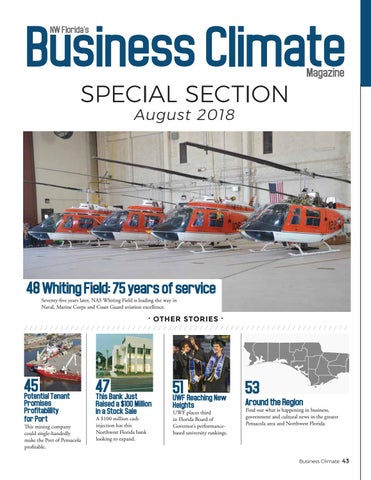
48 Whiting Field: 75 years of service Seventy-five years later, NAS Whiting Field is leading the way in Naval, Marine Corps and Coast Guard aviation excellence.
· OTHER STORIES ·
45 Potential Tenant Promises Profitablility for Port
This mining company could single-handedly make the Port of Pensacola profitable.
47 This Bank Just
Raised a $100 Million in a Stock Sale A $100 million cash injection has this Northwest Florida bank looking to expand.
51 UWF Reaching New
53
UWF places third in Florida Board of Governor’s performancebased university rankings.
Find out what is happening in business, government and cultural news in the greater Pensacola area and Northwest Florida.
Heights
Around the Region
Business Climate
43
HELP CHOOSE AMERICA’S FAVORITE BOOK
100 BOOKS. 1 WINNER. “THE GREAT AMERICAN READ” WATCH TUESDAYS SEPT 11 – OCT 23 7PM “BOOKS THAT EVERY FLORIDIAN SHOULD HAVE ON THE SHELF” PUBLIC SQUARE SPEAKERS SERIES EVENT TUESDAY, AUG 28 7PM JEFF KLINKENBERG WSRE JEAN & PAUL AMOS PERFORMANCE STUDIO FREE ADMISSION EVENT INFO & RESERVATIONS: WSRE.ORG/SPEAKERS PRESENTED IN PARTNERSHIP WITH PENSACOLA STATE COLLEGE & FLORIDA HUMANITIES COUNCIL
#GreatReadPBS | pbs.org/greatamericanread Pensacola State College does not discriminate against any person on the basis of race, ethnicity, national origin, color, gender/sex, age, religion, marital status, pregnancy, disability, sexual orientation, gender identity, or genetic information in its educational programs, activities or employment. For inquiries regarding Title IX and the college’s nondiscrimination policies, contact the Director of Institutional Diversity at 850-484-1759, Pensacola State College, 1000 College Blvd., Pensacola, Florida 32504. 42176-0718 WSRE TGAR PM-BC FP EVENT ad R.indd 1
7/26/18 8:24 AM
Potential Tenant Promises Profitability for Port by Will Isern
As the City of Pensacola works to develop a new strategic plan for the Port of Pensacola, a new company is seeking to bring a $40 million initial investment to set up operations at two of the port’s vacant warehouses. Incoa Performances Materials, a calcium carbonate mining company, is seeking to lease warehouses No. 9 and No. 10 at the port to import and process calcium carbonate from the Dominican Republic. The company processes calcium carbonate down to a microscopic size for use as an aggregate in plastics, glass, rubber and other in the works for quite a few years and it’s finally industrial applications. coming to fruition so as a company we’re excited As part of the deal, the company would be to be here and excited to work with the city of required to create 77 full-time jobs within the first Pensacola and hope to be future operators in your five years of operation. The average salary for those community.” jobs would be around $65,000. The proposed lease would see Incoa pay roughly The port has struggled since a sharp decline in $334,000 annually for 96,000 square feet of the offshore oil and gas industry and is currently warehouse space and another $70,000 to $90,000 operating at a loss. The Incoa deal would restore for a swath of vacant land on which the company the port to profitability. Unlike other companies that have sought to operate at the port, Incoa is not would build a storage facility. Additionally, the company’s importing operations are expected to seeking any financial incentive or aid from the city. “This investment entails us bringing in a Incoa CEO Steve Creamer resource that doesn’t currently exist here in said the quality of calcium carbonate that the company the United States. We believe it brings a great would produce would be benefit to the community by bringing in a unique in the market. resource that is superior to what is on the “This investment entails market in a lot of places.” us bringing in a resource that generate $80,000 in annual wharfage fees. doesn’t currently exist here in the United States,” The Pensacola City Council gave approval he said. “We believe it brings a great benefit tot in July to Mayor Ashton Hayward to enter he community by bringing in a resource that is superior to what is on the market in a lot of places.” into negotiations and conduct due diligence on Creamer has built several companies throughout the project. The prospect comes as Hayward’s administration is in the midst of evaluating the his lifetime, including a renewable energy holding port’s future. Hayward announced in June that the company called sPower. Creamer said he first became aware of Pensacola when sPower operations city had hired advisory firm Moffatt & Nichol to develop a new strategic plan for the port. The firm brought him here to purchase wind turbines from conducted a pair of public input sessions and is the General Electric plant on Scenic Highway. “That’s the original reason we came to Pensacola scheduled to present its final plan in September. If and how the Incoa deal impacts that vision was because of wind but as we searched through all the ports on the eastern seaboard and the Caribbean is thus far unclear. City administrator Eric Olson has called for a thorough review of the company’s we fell in love quite honestly with Pensacola,” he operations and finances. said. “I certainly don’t want to put a damper on what Creamer said Incoa surveyed ports in the Gulf may be a really good deal but I think we owe the and along the East Coast and settled on Pensacola taxpayers a thorough research of what’s being put as the ideal location for their operations. “It’s pretty exciting,” he said. “It’s one that’s been forward,” he said.
If the deal moves forward, Hayward’s administration may have to hand it off to the city’s next mayor. Hayward has announced he will not seek a third term and six candidates have filed to run for his office. Of them, both Drew Buchanan and Jonathan Green spoke in favor of the project as it was before the council. Not all are in favor of the project. Some have said they would rather see the port developed for private use. “We have 52 acres there at the port, if you took and made three-quarter acre patio homes there, think of how much money you could bring in and they would always be there, they wouldn’t be coming and going,” said former planning board member Leonard Swartz. “You need to consider that Pensacola has finally found its niche in this world. Palafox Street has been rated one of the finest entertainment spots in the world. Why do you want to destroy that?” Others have expressed concern about the increased number of trucks and rail cars that would move through downtown as Incoa shipped its finished product, and the potential for fine dust to escape the facility and blow over downtown. Creamer downplayed those concerns. “You’re looking at less than one truck every 20 minutes at full build out, and probably about 12 rail cars a day or 24 rail cars every other day, or however we work it out with the rail to pick them up,” he said. As for the dust, Creamer said it would be a top priority of the company that it not escape. “We sell dust, we can’t afford for it to go into the atmosphere,” he said.
Business Climate 45
Better Business Bureau®
BBB
®
Do you have what it takes to ‘make the grade?’
Experience the Halo Effect
Funded by business people who champion their belief that ethics in business matters!
Public radio program sponsors are known to experience a halo effect when they create a partnership with WUWF.
Start With Trust
Find out what the goodwill that WUWF shares with its listeners can mean for your company as a program sponsor.
®
bbb.org
BBB Accreditation is available for qualifying businesses info@nwfl.bbb.org | bbb.org/nwfl 850.429.0002
850.473.7453 | wuwf.org
rking ts Wo ther Toge LA’S
Artis
PANhANdLE fARmINg
CO PENSA ERIES P GALL
f OOd f Or T HOUgH T
CO-O
SPRINg fESTIvALS c r Aw f I SH , c HOc OL AT E
&JA zz
RS RITE ONGW STIVAL 30A S FE E BEAT
NG TH H BRINGI THE BEAC TO
ONE, COMEE ALL COM nd Ha Bare ve Collecti A Creates ace New Sp Arts e Th r Fo unity Comm
g n i g r s EmE t s i t R Ar LTOOCAWLAATCHTISTS 4
E:
:
E LIMAT ESS C NA BUSIN MARIJUA
ALSO
IS ISSU
IN TH
Viva la
Vegan
ALSO IN THIS ISSUE :
BUSINESS CLIMATE
T: ARKE
CTION THESETAM TE SE ON AL
+
MAY/JUN
2018
ON THE MARKET
A REAL ESTATE SECTION
A RE
AL
MEDIC
Back Issues Available! Call 850.433.1166 ext. 26 for more info.
This Local Bank Just Raised $100 Million in a Stock Sale By Will Isern Like financial institutions everywhere, Beach Community Bank was hit hard by the financial crisis of 2008. To make matters worse, the Deepwater Horizon Oil Spill in 2010 devastated many of the bank’s customers, causing them to default on their loans, stretching the bank’s balance sheet dangerously thin. Despite efforts to remain solvent, the bank was unable to pay its debts. Now, as part of a complex financial deal, the bank’s holding company has filed for Chapter 11 bankruptcy, and new investors have
brought in $100 million in capital to wipe out bad assets and recapitalize the bank.
Community Bank a strong infrastructure bogged down by troubled assets.
The capital injection comes in the form of a stock sale of roughly 20 million shares, effectively selling the bank to the new investors. Along with the sale, Carl Chaney, former CEO of Hancock Bank, has been brought in to serve as chairman of the bank’s board of directors, and Chip Reeves, a banking executive from the Pacific Northwest, has been installed as CEO.
“So it had very good loan operations, deposit operations, risk management and it had great markets,” Reeves said. “When you look at Northwest Florida and the demographic projections, those look very promising. This community is going to continue to grow so we knew there were good bones here.”
The transaction restores the bank to fiscal health and opens the door for substantial lending activity, said Reeves. “We have to be an integrated part of the communities we serve, and the best way for a bank to do that is to be an economic catalyst for the region,” Reeves said. “We do that through lending, so we’ve come out with a $1 billion lending pledge. That’s for consumers, for mortgage lenders, for small and medium-sized businesses. Through lending, a community bank becomes a huge economic catalyst for an area and that’s what we’re trying to do.” Reeves said roughly 40 investors from across the nation bought into Beach Community Bank as part of the deal. Reeves and Chaney served as consultants throughout the transaction. Reeves said he and the investors saw in Beach
Reeves said the bank is now among the best-capitalized in the region and poised for growth. Recent consolidation among regional banks has left a niche that Reeves said Beach Community Bank can capitalize on. “There’s been so much merger activity for community banks there’s almost no institutions between $500 million and $5 billion in size,” he said. “We think we can be Northwest Florida and maybe central Florida’s true community bank… If you look five years out, that’s what I’d love to see – a $3 to $4 billion organization headquartered here in Northwest Florida and potentially some other Florida metros, and being the leading bank in those regions and the leading mortgage provider.” Beach Community Bank can be found online at beachcommunitybank.com.
Business Climate
47
Whiting Field: 75 Years of Service O n July 16, 1943, a new U.S. Navy airfield completed construction and was dedicated as Naval Auxiliary Air Station Whiting Field. Its mission was to train aviators in basic radio instrument instruction for World War II. In 1974, the base would be redesignated as Naval Air Station Whiting Field, its mission shifting to pilot training. Seventy-five years after its dedication, NAS Whiting Field continues to serve as one of the primary bases for Navy, Marine Corps and Coast Guard aviation training in the country. “The Wing (Training Air Wing Five) is training 60 percent of the primary flight students, 100 percent of the rotary flight students,” NAS Whiting Field’s Commanding Officer Capt. Paul Bowdich said.
by Kaitlyn Peacock
48 Business Climate
All aviation students for the Navy, Marine Corps and Coast Guard go through a primary flight school, either at NAS Whiting Field or at NAS Corpus Cristi. From there, students are selected for one of three advanced schools. These schools train students to be
propeller plane pilots, jet pilots or helicopter, also known as rotary, pilots. All helicopter flight students for the Navy, Marine Corps and Coast Guard are trained at NAS Whiting Field. The legacy of generations passing through the airfield can be felt and seen in the rows and rows of students. Many helicopter pilots can trace the beginning of their training all back to the same place, and sometimes the same aircraft. “It’s always been that way for helicopter pilots,” Training Air Wing Five’s Public Affairs Officer Lt.j.g. Kyle McCarthy, who was a rotary flight student, said. “If you talk to a helicopter pilot, they’ve come through here, at Whiting Field. My Dad was a retired Navy helicopter pilot and he was a VT-2 Doerbird just like I was. It’s pretty crazy, he’s visited a couple times and well it hasn’t changed too much since he’s been here. He’s looked in his log book and we’ve
flown the exact same aircraft down at South Field.” Along with the main base located in Milton, NAS Whiting Field spans over 12 outlying fields, including Navy Field Holley, which was converted into a 320-cell solar farm last year. The fields span across northwest Florida and lower Alabama, covering almost 8,500 acres of land, with the base sitting on another 4,000 acres. The extra land is a huge asset to the base, as the fields can be used by aircraft other than the training aircraft NAS Whiting Field owns; the Blue Angels often use one of the outlying fields to practice certain maneuvers and the Air Force’s F-35s fly in from time to time using the fields. Last year, between the main base and the outlying fields, NAS Whiting Field hosted over one million flight operations and accounted for around 11 percent of combined Navy, Marine Crops and Coast Guard flight hours; the closest in comparison
we don’t have the infrastructure here. So there’s no one else in the United States that has the ability to do what we do.” Since operations began, Training Air Wing Five has “winged” over 34,400 helicopter aviators. “Winging” is the final step for all naval aviation students, conducted in a ceremony after a student graduates flight school and is given the golden wings of the naval aviation insignia,
the base frequently. The base’s students and activities accounted for over $1.43 billion for the local area in 2017, 35 percent of Santa Rosa County’s total gross regional product alone. The base also provided over 15,000 jobs between the main base and the outlying fields. From the Santa Rosa Deputy’s Office to the Pensacola International Airport, NAS Whiting Field has impacted nearly every industry in the region.
“
We have great support from Santa Rosa County. Not only Santa Rosa County but all the other surrounding communities. From up in Alabama to down in Escambia to here in Santa Rosa, the support has been tremendous. They definitely keep us viable as a location.” was Atlanta Hartsfield-Jackson Airport, considered the busiest airport in the world, at close to 880,000 flight operations. The extra land, especially land that is so close, offers the base more options when it comes to training and exercises. “The other piece of the puzzle is the area,” Bowdich said. “The fact that we have all of the outlying fields right here in northwest Florida and the lower Alabama area. We have no other place in the country that has this many outlying fields at this close of a distance. If we are to move the helicopter training to somewhere else, the infrastructure in order to build the outlying field to give them a place to go would be tremendous. On the fixedwing side, Corpus Cristi area space cannot handle the other 60 percent of the load, just like we can’t handle the 40 percent Corpus Cristi trains up here;
15,826
employed throughout the region
1200
students per year
$
35%
of Santa Rosa County’s total gross regional product
officially welcoming him or her as a pilot. This does not include the thousands of students trained on the fixed-wing aircraft who are sent to advanced training at another base and winged there. With around 1,200 students annually passing through Training Air Wing Five, the number of aviators coming through the base is set to increase in the next few years. “Many bases have seen a decrease in operations in some cases, but we’re getting increased operations here,” Training Air Wing Five’s Deputy Commodore Capt. Doug Rosa said. “In the next five years, we’re going to be training an additional 50 rotary-wing pilots and an additional 30 or so tiltwing pilots. So our demands and our production requirements are increasing, not decreasing.”
“We have a great support from Santa Rosa County,” Bowdich said. “Not only Santa Rosa County but all the other surrounding communities. From up in Alabama to down in Escambia to here in Santa Rosa, the support has been tremendous. They definitely keep us viable as a location.” Seventy-five years after its dedication, having been built for the needs of a world at war and having seen the empty fields of northwest Florida develop into the town we know as Milton, NAS Whiting Field continues to serve as a pillar of the community. With new flight simulators and new aircraft expected within the next couple of years, its legacy of aviators will continue to serve the country for generations to come.
Bowdich and Rosa acknowledged that part of their success lies with Santa Rosa and Escambia counties, who partner with Business Climate
49
UWF Reaching New Heights By Kaitlyn Peacock
The University of West Florida has broken its record in the Florida Board of Governors performance ranking, tying for third place alongside the Florida State University and the University of South Florida. The rankings began in 2014, and at that time, UWF was the lowest scoring of all the Florida schools, with a score of 21 out of 50 possible points. Now, just four years later, UWF has more than doubled its score to 86 out of 100 points. UWF President Dr. Martha Saunders said she was happy about the results, but not surprised. “We knew how good we are, and now it’s kind of nice that other people know that too,” she said. “We’re up against those who have been at it longer, have more money, and we’re still winning. It feels good.” The rankings track ten different metrics from the schools, nine assigned by the Board of Governors and one chosen by the school. The metrics include percent of bachelor’s degree graduates enrolled or employed, average cost to student, retention rates and more. UWF’s chosen metric is the percent of undergraduates who are aged 25 or more. The rankings are attached to state funding, which is allocated to the schools based on their place in the ranking. The higher a school achieves, the more money is given to them. The bottom three get no money, though this practice is under review by the Board. The funding comes from each of the universities, each of which puts their own money into a pool, which is later matched by the Florida legislature. This is what Saunders called “skin in the game.” Each school is encouraged to improve since their own money is put on the line. Sine the introduction of this program, Florida schools have seen a marked improvement in nearly all of the metrics.
“Sometimes you have to sort of change the way you do things,” Saunders said. “We have gotten better and better at tracking our data and I think that is key. All the universities will tell you that. But at a university of our size, one student can make the difference of an entire point, or two. One heartbeat! And so we don’t have the resilience that some of the bigger schools do. It is more important than ever that we know who our students are, where they are and what they are doing – and we do know.” After placing third in last year’s rankings as well, Saunders said the university is focusing on reinvesting the money they have earned to benefit the students who may be struggling to stay in school. “Right now we are really focused on making sure that nobody has to drop out of school because of money,” she said. “And so a good bit of this money is being invested into scholarships, specifically needbased scholarships for students. Sometimes it can be as little as $500 and a student will feel like they need to drop out because they don’t know that the help is there. For them, it might as well be $5 million.” The metrics race is on again for the next school year, and UWF shows no signs of relaxing. Instead, focus has shifted to a long-term plan to increase retention and graduation rates.
$36k
Median Wages of Bachelor’s graduates employed in Florida one year after graduation
51%
Graduate degrees awarded within programs of strategic importance
$15k
Average cost to the student
“We’re not going to rest easy until we are well above the state average in four-year graduation rate,” Saunders said. “That is a top priority, and of course corresponding to that is retention rate. If they don’t come back from sophomore year, the chances are they are not going to finish. Those are the two that – until we have well cleared the state average – that will be our priority. And it’s not a quick fix. I mean, on the outside it’s a four-year fix. And lots can happen to students along the way.” Although talk of numbers and metrics dominates the conversation around the performance-based rankings, Saunders always returns to the students and the fact that these numbers reflect a change in the university to their benefit. “We cannot not pay attention to this,” Saunders said. “I can’t foresee a day when I’m not talking to the campus about improving graduation rates, keeping our students, and making them successful. “It’s very much a part of our culture to care what happens to our students after they leave us,” she continued. “Just getting them a degree is all well and good, but we want a good handoff to the next chapter of their lives.”
25%
Four-year graduation rate for first time in college students
Business Climate
51
A.A. Cunningham Road paving notice ... Naval Facilities Engineering Command Southeast (NavFac SE) has awarded a contract to mill and overlay A.A. Cunningham Road on NAS Pensacola. The work is scheduled to begin the week of Sept. 12 and expected to take four weeks to complete. Watch for “Road Closed” and “Detour” signs. Detour routes to facilities in the area will be Page Road to Warehouse Road and Farrar Road to Pat Bellinger Road. Drivers should observe the warning signs and proceed with caution around the work zones. The work schedule is weather dependent. For questions or more information, contact the PWD Construction Manager Bryan Moeller at 452-3131, ext. 3077.
Vol. 80, No. 35
VISIT GOSPORT ONLINE: www.gosportpensacola.com
September 2, 2016
Fallen Special Tactics Airman honored at NASP By Capt. Katrina Cheesman Sibley’s unit. “This dedication 24th Special Operations Wing and memorial ruck is an important step for us as a brotherhood Air Force Special Tactics Air- to honor Forrest’s legacy of men dedicated a military freefall valor, and get a small bit of clotraining exercise into Pensacola sure.” Bay Aug. 26 to His teammates Staff Sgt. Forrest escorted the famSibley, a combat ily to Sibley’s controller from burial site, wearPensacola killed ing combat ruck in action Aug. 26, sacks weighing 2015, in Helmand more than 50 Pr o v i n c e , pounds to repreAfghanistan. It sent the deployed. was the first anOnce at the niversary of Sibcemetery, they ley’s death. completed a After free round of memoStaff Sgt. falling into the rial push-ups to Forrest Sibley waters of Sibley’s honor their fallen hometown, his teammates teammate. joined family members and Sibley, 31, had served in the friends to complete a memorial Air Force as a combat controller ruck march to his final resting since 2008. In his seven years of place at Barrancas National service, he received four Bronze Cemetery (BNC). Star Medals, once with valor for “When we lost Forrest, most heroism in combat, as well as a of his teammates were still de- Purple Heart for injuries susployed for another five months, tained in combat. and couldn’t attend any funeral “Forrest was one of our best or memorial event,” said Lt. Col. combat controllers, but he was Stewart Parker, commander of 21st Special Tactics Squadron, See Sibley on page 2
After parachuting into Pensacola Bay, members of the Air Force’s 21st Special Tactics Squadron make a memorial “ruck march,” a hike with full packs, from NAS Pensacola’s Bayou Grande Marina to Barrancas National Cemetery and the grave of teammate Staff Sgt. Forrest Sibley. Sibley was killed in action Aug. 26, 2015. He had served in the Air Force as a combat controller since For more photos, see page A4 2008. Photo by Mike O’Connor
CNATT: Make Labor Day weekend safety a priority Center for Naval Aviation Technical Training Public Affairs
The Center for Naval Aviation Technical Training (CNATT) safety manager is reminding service members, civilian employees and their families to maintain safety awareness as they prepare for what is generally viewed as the end of summer. CNATTSafety Manager Krystal Hancock said that Labor Day, a federal holi-
day designed to honor the achievements of American workers, includes an extended weekend, with service members and their families often electing to travel to see family and friends. “Whether taking a long road trip or simply jumping in the car to run a quick errand, driving is inherently risky, and traffic mishaps continue to
be a leading reason for lost time, days, and lives across our force,” she said. Hancock said the National Safety Council (NSC) predicts this could be the deadliest Labor Day weekend for drivers in eight years, estimating that more than 430 people could be killed in traffic accidents throughout the Labor Day weekend. She added that service members, often sepa-
rated from their families and travelling significant distances to visit during the long weekend, should take some simple precautions before and during their trips. “Get enough rest before heading outsleepy driving is as dangerous as impaired driving,” she said. “Alternate drivers or take frequent breaks to ensure that whoever is behind the wheel stays alert.” See Labor Day on page 2
‘Be There’ for your shipmates during Suicide Prevention Month 2016 By James Rosenfelder U.S. Navy Bureau of Medicine and Surgery public affairs
NAS Pensacola to host 9/11 commemoration ceremony ... In commemoration of the events of Sept. 11, 2001, Naval Air Station Pensacola will present a ceremony at the National Naval Aviation Museum aboard the base at 10 a.m. Sept. 9. The event will include a guest speaker and a musical rendition from the NATTC Choir, a traditional “two-bell” ceremony, honors performed by the NASP Honor Guard and a 21-gun volley. The public is invited to attend.
Navy Medicine recognizes September as National Suicide Prevention Awareness Month, which began Sept. 1. The theme for Suicide Prevention Month 2016 is “Be There.” Throughout the month, Navy Medicine will highlight the power of peer support and personal wellness, encouraging Sailors and Marines to be there for their shipmates. “Action starts with prevention,” said Vice Adm. Forrest Faison, Navy surgeon general and chief, Bureau of Medicine and Surgery (BuMed). “When a Sailor needs assistance, easy access to support resources and mental health treatment is essential, as is validation of help-seeking behaviors.” Suicide prevention is a yearlong effort. Suicide Prevention Month serves as a reminder that building resilience and preventing suicide requires all
members of the Navy and Marine Corps community to work together. Every life lost to suicide is one too many. “Take action if you notice anything
out of the ordinary for a shipmate; reach out to them,” Faison said. “If you are having difficulties, seek help if See Prevention on page 2
FatAlbertis getting a facelift...Fat Albert, the Blue Angels’ C-130 cargo plane used for transporting crew and equipment to air shows around the country, is currently undergoing a chemical de-paint process at Tinker Air Force Base in Oklahoma after corrosion was found. Once the de-paint process and sheetmetal checks for any other corrosion are complete, Fat Albert will fly to Hill Air Force Base, Utah, for full programmed depot maintenance and paint. Photo by Kelly White
Published by BallingerPublishing, a private firm in no way connected with the Department of the Navy. Opinions contained herein are not official expressions of the Department of the Navy nor do the advertisements constitute Department of the Navy, NAS Pensacola or Ballinger Publishing’s endorsement of products or services advertised.
52 Business Climate
GOSPORTPENSACOLA.COM GOSPORTPENSACOLA.COM GOSPORTPENSACOLA.COM GOSPORTPENSACOLA.COM GOSPORTPENSACOLA.COM GOSPORTPENSACOLA.COM
GOSPORTPENSACOLA.COM
Around the Region Triumph Board Supports $8.5M for Whiting Aviation Park The Triumph Gulf Coast board of directors gave unanimous support of $8.5 million for infrastructure improvements to Whiting Aviation Park in Santa Rosa County on July 18. “The Santa Rosa County Board of County Commissioners and our citizens wish to thank the Triumph Gulf Coast board of directors for their support of our request to help fund the creation of the Whiting Aviation Park. This project will create hundreds of new aviationrelated jobs not only for our citizens but for employment throughout the region. As important, Whiting Aviation Park provides for sustained compatible development on a 267-acre parcel on the fence line of NAS Whiting Field, enhances military value and improves the overall efficiency of operations as maintenance of the many aircraft can be performed adjacent to the base, meaning less downtime for the aircraft,” said Commissioner Don Salter, District 3. “This has been one of our county’s number one economic development projects for many years and it would not have been possible without the support of the Triumph Gulf Coast board of directors.” The next step for the Whiting project is agreement on a term sheet that will be brought back to the Triumph board for approval. The site development at Whiting Aviation Park is expected to create over 200 high-paying jobs. This project is built on the investment Santa Rosa County made to purchase 267-acres adjacent to NAS Whiting Field and an
understanding with the Navy for “through the fence” accesses for private companies. The total project cost is $17,704,975 with Triumph contributing 48 percent of those costs. Development of Whiting Aviation Park strengthens the region’s aviation cluster with Pensacola International Airport to the west and Crestview’s Bob Sikes Airport to the east. It enhances the region’s growing aviation industry by providing additional industrial space adjacent to an existing airfield, and it supports the regional strategic initiative of expanding the aerospace and defense industry cluster - an industry with a strong outlook for growth. These targeted investments in the aviation and aerospace cluster are expected to drive supply chain companies to co-locate in the region. Florida is currently second in the nation for aviation and aerospace establishments and added more than any other state in the southeast in 2017. Under the terms of Florida’s settlement with BP, the energy company has already deposited $300 million in Triumph Gulf Coast. Further payments of approximately $80 million per year will be made from 2019 through 2033, amounting to a total of $1.5 billion. Applications have been received and are under consideration to benefit all eight disproportionately affected counties. More information about Triumph Gulf Coast, Inc. is available at www. myfloridatriumph.com.
Pensacola State College Ranked Among Most Affordable in U.S. The U.S. Department of Education lists Pensacola State College as a best value among public four-year colleges and universities for the seventh consecutive year. Pensacola State is ranked 37th on the list of 71 institutions cited for lowest tuition in the U.S. Department of Education’s College Affordability and Transparency annual report. With annual tuition listed as $2,704, Pensacola State is eighth among the 25 Florida colleges to make the most affordable ranking. Average tuition is $8,022 for the nation’s 681 public four-year institutions, according to the report. In all, the report gives data for 2,606 four-year institutions, including private and private for-profit colleges and universities. “We have worked hard and continue to strive to keep tuition and fees low for our students while still offering a variety of programs ranging from university transfer and workforce programs like cybersecurity, nursing, construction trades and welding,” said Pensacola State President Ed Meadows. “Our workforce programs are designed to respond to the local employment needs.” Computations are based on data for full-time beginning students from the fall 2016 and spring 2017 terms. The report is available online at http:// collegecost.ed.gov/catc/. Pensacola State offers associate and bachelor’s degrees, career oriented certificates, college prep, adult education, GED prep and standard high school diplomas.
Gulf Power celebrates the renewal of conservation partnership with National Fish and Wildlife Foundation Gulf Power is celebrating the five-year renewal of the conservation partnership between Southern Company and the National Fish and Wildlife Foundation (NFWF). For over 15 years, the partnership has funded more than 300 projects restoring, sustaining or enhancing more than 1.7 million acres of wildlife habitat in the Southeast. Through this partnership, Gulf Power has supported nearly 100 conservation projects funded with $5.8 million across Northwest Florida. This investment has benefited thousands of acres of conservation and countless species in the Gulf Power service area. Among the projects: shoreline stabilization on Bayou Grande in Pensacola; native longleaf pine forest restoration from Perdido River to Blackwater River State Forest and east through Apalachicola; recovery efforts of the red-cockaded woodpecker, gopher tortoise and indigo snake; and coastal and wetland restoration in South Walton County and elsewhere. “Our work with Southern Company exemplifies the public-private partnership model we employ to generate measurable results for wildlife and habitats across the country,” said Jeff Trandahl,
executive director and CEO of NFWF. “This enduring partnership — one of the Foundation’s longest-running — reflects Southern Company’s strong commitment to the conservation of natural resources in the local communities it serves.” Over the past 15 years, NFWF has leveraged Southern Company’s contributions to generate more than $126 million for on-the-ground conservation impact. “Gulf Power’s support of environmental stewardship grants have kick-started or enhanced many community-involved environmental education and restoration projects that otherwise might not have gotten off the ground,” Jeff Cole, Gulf Power Stewardship coordinator, said. “These local level and regional projects benefit the area we live in by enhancing recreational areas and improving air and water quality. It’s important to be a leader by being out investing and participating in the community in which we live, work and recreate.” Many conservation professionals credit Southern Company with being the first major private funder to invest in longleaf restoration work, helping
catalyze the historic public-private partnership known as America’s Longleaf Restoration Initiative. Vernon Compton, director of the Gulf Coastal Plain Ecosystem Partnership, said the Longleaf Stewardship Fund grants the group of private and public landowners has received are critical to restoring the longleaf pine ecosystem in Northwest Florida, which once dominated in the Southeast. This year’s grant of $300,000 will restore 333 acres of longleaf pine and improve an additional 55,350 acres of existing longleaf habitat, mostly in the Blackwater River State Forest in Santa Rosa County. The grant also funds a gopher tortoise project on Eglin Air Force Base reservation aimed at preventing it from becoming listed under the Endangered Species Act. “This partnership with NFWF is very important to the restoration effort and a critical component of the many success we’re seeing on the ground across the longleaf pine range and habitat improvement,” Compton said. “Thanks to habitat restoration on these sites, they are ready for the keystone species like the gopher tortoise to be reintroduced.” Business Climate
53
Around the Region University of West Florida partners with state and local election officials to enhance cybersecurity preparations The University of West Florida Center for Cybersecurity recently partnered with the Florida Department of State and election officials across Florida to provide training for supervisors of elections and key personnel to enhance cybersecurity resiliency ahead of the 2018 elections. During the month of June, the UWF Center for Cybersecurity conducted cybersecurity training courses in Tallahassee, Miami, Orlando and St. Augustine, focusing on an introduction to cybersecurity processes, threats, vulnerabilities, risk management, policy frameworks and incident management. Course graduates learned how to thwart attacks and to understand and implement cybersecurity standards. “State and local election officials have taken significant steps to protect against the growing threat of cybercrime ahead of the
2018 elections,” said Secretary of State Ken Detzner. “The recent trainings that were conducted by the UWF Center for Cybersecurity are yet another tool in election officials’ arsenal. We appreciate the valuable partnership with their organization.” Cybersecurity preparedness is of the utmost importance in election security. The Department of Homeland Security reported that Russian hackers probed the systems of 21 states in 2016, but there was no evidence votes were altered. In January 2017, Homeland Security designated voting systems as critical infrastructure. In May 2018, Homeland Security, Federal Bureau of Investigation and Office of the Director of National Intelligence spoke to Congress about the importance of preparing state and local election officials for potential cyber threats. “We’ve seen a massive increase
Join - Connect - Grow
WWW.PENSACOLACHAMBER.COM 850.438.4081 SUPPORT@PENSACOLACHAMBER.COM
in cybersecurity awareness among election officials across the country, along with efforts to increase preparedness and resiliency,” said David Stafford, Co-Chair of the National Association of Election Officials and Escambia County Supervisor of Elections. “UWF’s Center for Cybersecurity was uniquely positioned to work with state and local election officials to design a curriculum and roll out the training, and the content and delivery of the training were outstanding.” The UWF Center for Cybersecurity utilized the Florida Cyber Range for hands-on activities and demonstrations throughout the courses. Metova CyberCENTS partnered with the UWF Center for Cybersecurity to launch the Florida Cyber Range and deliver the training. The state-of-theart platform provides advanced training and testing solutions for academic, government, military and industry use through face-to-face or digital formats. “We participated in hands-on exercises designed to prepare and
guide us in dealing with various threats,” said Bill Cowles, Orange County Supervisor of Elections. “The course guided us through an analysis of our cybersecurity defenses and provided tools for implementing a layered defense consistent with recommendations in the National Institute of Standards and Technology Cybersecurity Framework. The opportunity to exchange information and ideas in this setting is invaluable.” Following the training, a survey indicated that 95 percent of participants considered the course to be beneficial. “The UWF Center for Cybersecurity conducted a topnotch, in-depth cybersecurity training that was extremely valuable for local supervisors of elections,” said Paul Lux, Okaloosa County Supervisor of Elections. “They did an excellent job of making sure the class was beneficial to all participants regardless of their previous IT knowledge.”
Escambia-Santa Rosa Bar Association announces new executive director The Escambia-Santa Rosa Bar Association announces the recent selection of Jeff Nall as its new executive director. He succeeds Michael Doubek, who is retiring in October. Nall is responsible for working with the association’s officers and council to establish organizational strategic plans and priorities including initiatives to enhance membership, develop nondues revenue opportunities and offer robust programs and activities. He is also responsible for the daily operations and fiscal management of the association. “Jeff has a wealth of experience and fresh ideas for leading the association into what promises to be a bright future,” said Jodi D. Cooke, chair of the executive director search committee. “We are very excited to see what the next chapter holds.” Nall earned a bachelor’s degree in Business Administration from the University of Arkansas and
a master’s degree in Strategic Communication and Leadership from the University of West Florida. He also holds a certificate in Non-Profit Management from the Whitman Center for Public Service and the voluntary professional credentials of Accredited in Public Relations, Certified Public Relations Counselor and Professional Certified Marketer. Nall is actively involved in professional associations, civic organizations and the community. His volunteer leadership roles include having served as state president of the Florida Public Relations Association, a statewide professional organization comprised of public relations practitioners, and president of Pensacola Five Flags Rotary. He is a graduate of Leadership Pensacola. For more information about the Escambia-Santa Rosa Bar Association, visit www.esrba.com.