



V.
CFP®, CPWA® Founder, CEO






The Federal Reserve is navigating one of the most delicate balancing acts in recent memory. After two years of successful inflation reduction from levels unseen in four decades, markets, homeowners, and business leaders are eager for rate cuts. The White House has also voiced support for lower rates. Slower inflation and higher borrowing costs are weighing on households, and a rate cut would help mortgages, car loans, and business investment at a time when growth is slowing.
Yet the Fed knows that moving too soon risks undoing much of its progress and reigniting the very problem it worked so hard to contain. The central tension is clear: How do you support the economy without reawakening inflation?
Higher rates have cooled housing, slowed business investment, and dampened consumer confidence. On the other hand, the economy remains resilient. Employment is strong, corporate balance sheets are healthy, and consumer spending continues.
The Fed’s challenge is that inflation rarely retreats in a straight line. After steady improvement, recent data have shown pockets of stubbornness in wages, services, and housing. This keeps policymakers cautious. If they lower rates too quickly, they could add fuel to demand. If they wait too long, they risk stalling the economy unnecessarily.
Every meeting, every speech, every data release is watched closely. Investors should expect an uneven path ahead. The journey matters more than any single rate decision.

One of my favorite clichés is “ you’re only as strong as your weakest link.” In your financial life, cash flow, retirement contributions, and spending habits are all “links” that can make or break your plan.
One link in personal finance that is often overlooked is data and credit security.
While technology has brought major improvements in how we protect information, it has also given cybercriminals more tools to exploit. Leaked Social

Security numbers, birth dates, and login credentials can be used to impersonate individuals, open accounts, or take out loans in your name – all without your knowledge. Identity theft and fraud are no longer marginal risks; they are becoming common threats that you must mitigate.
No need to worry. There are several steps you can take to protect yourself. Using strong, unique passwords makes it harder for hackers to access your accounts. Enabling multi-factor authentication puts an extra layer of security between the bad guys and your data. Being cautious with suspicious links, messages, and public Wi-Fi networks helps prevent breaches.
(Continued on next page...)
By treating data and credit security as an integral part of your financial plan, you strengthen every other link in the chain. This conscious approach to protecting your

Brian Burton
Global financial markets closed out the year with a mixture of optimism and caution as investors navigate shifting monetary policy, uneven economic data, and evolving sector dynamics. U.S. equities remain near historic highs, supported by expectations of continued centralbank easing and steady—though moderating—corporate earnings growth. Recent rate cuts have boosted risk appetite, encouraging investors to rotate back into equities after a cautious period dominated by inflation concerns.
The Federal Reserve’s pivot toward a more accommodating stance has been one of the defining drivers of market sentiment. Although inflation has shown signs of cooling, it has not yet fully settled at the central bank’s target, leaving policymakers in a delicate position. Signals from the Fed point to a balancing act between encouraging growth and managing persistent inflation, prompting markets to scrutinize each comment for clues about future rate-cut timing and magnitude.
Bond markets have reacted with a decline in yields across shorter maturities, though longer-term yields remain elevated compared with pre-tightening norms. This dynamic reflects an economy that appears to be decelerating gradually rather than
information, both today and on a recurring basis, can help safeguard your financial future.

sharply. This gradual deceleration allows fixed-income investors to reassess duration exposure while equity investors weigh the prospects of improved liquidity conditions.
Sector performance has broadened beyond the mega-cap technology leaders that dominated earlier in the year. While AI-related names continue to set the tone, cyclicals, financial, and real-estate stocks have gained traction, helped by lower borrowing costs and improved confidence about the economic outlook. This broadening leadership is viewed as a constructive sign, suggesting the rally is supported by more than just a narrow group of heavyweight names.
Globally, markets are more uneven. Divergent central-bank policies,
geopolitical uncertainties, and varying growth trajectories have led to a patchwork of regional performance. Some economies face structural slowdowns, while others remain on firmer footing, creating a mixed-pace environment that investors must navigate.
In sum, today’s market environment reflects a measured sense of optimism. Easing financial conditions have buoyed sentiment, but investors continue to monitor economic indicators, particularly inflation and employment, with heightened sensitivity. The outlook moving into the new year is constructive, albeit contingent on the trajectory of policy decisions and underlying growth.

Andy Reynolds
Should I stay employed or go independent? The decision is rarely framed in such stark terms, but beneath every attractive offer, flexible contract, or entrepreneurial opportunity lies a fundamental choice between two very different economic lives. One promises structure, predictability, and protection. The other offers autonomy, uncertainty, and the possibility of outsized reward.
The distinction between W-2 employment and 1099 independent contracting is more than a tax classification. It is a division in how risk, responsibility, and reward are distributed. One shifts uncertainty onto the employer while the other places it squarely on the individual. And while independence is often celebrated, its quieter financial realities tend to surface only after the transition is made.
The following explores the tension through the experience of a single professional faced with two compelling paths. Consider Alex, a seasoned consultant in mid-career. Alex receives two offers. The first is a W-2 role with a $250,000 salary, fully paid health insurance, retirement contributions, and paid time off. The second is a 1099 contracting opportunity with higher gross pay per project, full scheduling freedom, but without formal benefits.
On the surface, the contracting offer appears superior. The income ceiling is higher, and independence is appealing. But the comparison quickly becomes more complex once taxes, benefits, and professional risks are evaluated.
As a W-2 Employee: Alex’s taxes are withheld automatically. Payroll taxes are coordinated by the employer, with half of the payroll tax obligation paid by the employer. The employer also coordinates payroll processing and remits federal, state, and local taxes. Income arrives predictably with minimal administrative
involvement from Alex.
As an Independent Contractor: Alex becomes responsible for all tax obligations, including quarterly estimated payments and the full burden of payroll taxes. Alex must also hire and coordinate vendors to manage payroll reporting, tax filings, compliance, etc.
As a W-2 Employee : While Alex may be provided with necessary business equipment, there is very little opportunity to deduct business expenses personally.
As an Independent Contractor: Alex can deduct qualified business expenses, which may include a home office, vehicle expenses, travel, supplies, mileage, computer, phone, internet, professional education, etc.
The most underestimated difference between W-2 and 1099 work is not necessarily income, it is benefits. Alex’s W-2 role includes employer-sponsored and likely fully paid health insurance, retirement contributions, paid vacation, and built-in safety nets that rarely appear in salary discussions. In addition, larger employers often secure lower insurance premiums through group underwriting compared to individual plans.
To quantify this difference, the previous simplified comparison assumes a $250,000 W-2 salary* , with several benefits paid entirely by the employer.
This chart reframes the income discussion entirely. A $250,000 W-2 role is not competing with a $250,000 1099 contract. Once baseline protections, retirement funding, and compliance costs are included, Alex would need to earn approximately $300,000+ as a contractor simply to reach comparable financial footing, excluding deductible items that Alex may already be paying for personally.
Retirement contributions may play an important role in decision making, as well. In many cases retirement contribution capacity is significantly higher for independent contractors than for employees. Contractors can establish and fund plans such as Solo 401(k)s, SEP IRAs, and Cash Balance Pension Plans, allowing for substantially higher annual contribution limits than a standard employersponsored 401(k). These plans also offer greater flexibility in contribution timing, as the contractor effectively acts as both employer and employee.
demand can vanish just as fast. There is no severance, no unemployment protection, and no institutional buffer. Every slowdown becomes a personal financial event. Employment, while not risk-free, spreads uncertainty across systems designed to absorb shock. Benefits persist through slower periods. Recovery is often smoother.
If an employer offers “W-2 or 1099” for the same role, that choice must be considered both financially and legally. In most cases, classification is determined by how the work is structured rather than personal preference. Choosing 1099 shifts payroll taxes, insurance, benefits, and liability to the worker. Unless the 1099 pay is meaningfully higher, the worker typically assumes greater financial and legal exposure without adequate compensation.
It really depends on your personal needs, desires, and opportunities. But one thing is clear, there are more variables than simply gross income!
This article is intended to provide a high-level overview of the considerations involved in W-2 employment versus independent contractor work. Please consult a qualified attorney or CPA for guidance on your specific tax or legal situation. This article should not be interpreted as legal or tax advice.
*This illustration assumes payroll taxes are applied to the full amount of income. In certain business structures, reasonable compensation rules may allow for strategies that reduce payroll tax liability.
Contracting magnifies both upside and fragility. In strong markets, income accelerates quickly. In weak ones,


Founder and Owner, Certified Public Accountant, Pavlik CPA
tax struC ture of a business
We work with many clients who own their own business or are thinking about starting a business. What advice would you give in terms of choosing a business structure?
The variety of tax issues and implications that can arise for our clients who are in business for themselves is significant. “What is the ideal tax structure for our business?” is one of the most common questions and the answer is “it depends.” There are a variety of tax structures a business can take or elect: S corporation, C corporation, partnership, sole proprietorship, etc. There are pros and cons to each. These are largely dependent on the activity they will contain and the factset for the business and owner. So, establishing all the details and overall plan is very important to determining which structure is the best fit.
importanCe of planning
After selecting a business structure, what do you see as the next most important step?
Once a tax structure is selected, tax planning is vital. Relative to a traditional W-2 employee, business income is typically much more variable from year-to-year and can also be “lumpy” or seasonal. Understanding this, planning around this, and managing tax payments for this goes a very long way in my experience to managing
the unknown – which creates fear, stress and anxiety for the client. Even if a large tax bill is coming down the pike, simply knowing this fact helps tremendously as opposed to being surprised at filing.
Even if you are not in business for yourself and have a simpler tax snapshot, by virtue of having an account with Ballast you are likely to have investment income each year. This simply means you are likely to have a stream of income that will vary from year to year, similar to a business. This again highlights the importance of having a team, like Ballast and a CPA, working with you to ensure someone has a finger on the pulse of your situation and can adjust for taxes when necessary. This is a regular exercise I do with Ballast and our mutual clients.
obbba & new legislations
There was new legislation passed in 2025. What were some of the relevant things that were added, subtracted, or changed in terms of taxes?
Likely on everyone’s radar is the fact that we have new tax legislation (One Big Beautiful Bill Act) that was passed in July. There are many provisions here and it would not be prudent to go through each item. Some items from previous legislation have been made permanent, like the increased child tax credit or the increased standard deduction. Some items have been repealed from tax law, like the energy efficient home improvement credit and other clean energy
provisions. And of course there are many new rules around overtime, tip income, new car loan interest, social security, accelerated depreciation, etc. Without detailing everything in this bill, the highlight here is simple: there will be different changes that impact different taxpayers. Working with a team of professionals helps to ensure you understand the changes that will impact you and that you continue to have a good strategy under the shifting landscape.
general adviCe
What other general advice would you like to give for people thinking about their taxes and overall financial planning?
What a taxpayer may be able to utilize in the tax code obviously depends on their situation. But this does not always have to be a complex plan. I frequently recommend strategies to clients like Qualified Charitable Distributions (QCD), charitable contribution stacking or “bunching,” donation of appreciated securities, maximizing employee retirement or 401(k) deferrals, and Roth conversions. While these may sound complex or foreign to you, most of these have a relatively clear path and checklist to execute. Even more generally, being organized and having a good understanding of your situation will pay tremendous dividends in the long run.
..WE CAN BE HIRED IN A CONSULTATIVE ROLE WHILE GUIDING BUSINESS OWNERS THOUGH PLANNING?
We are business owners ourselves, and we advise owners in many fields throughout the company life cycle. Whether you are a start-up, in growth mode, looking to step into a more passive ownership role, or teeing the company up for sale or handoff to the next generation, we have best practices to share. We’ve yet to sit down with an owner and fail to offer insight that can make their business more profitable, valuable, or lifestyle-friendly.
We are uniquely positioned to appreciate the interconnectivity between your business and your personal finances. We love helping owners grow businesses, but also love to focus on how different tax structures, succession plans, and sales structures translate to cash flow during the owner’s life and the family balance sheet across the current and future generations. Consulting with owners is a great opportunity for us to create value outside of a traditional wealth management relationship.

Ballast Book Club
BOOKS, MUSIC, PODCASTS, AND CONVERSATIONS WE’VE ENJOYED LATELY

A GOOD HANG
Podcast by Amy Poehler
“Lately I dive into finance podcasts and then unwind with Amy’s fun conversations.”Catherine Richmond


JOSIAH QUEEN
Concert
“Great show in Nashville with my daughter!” - Andy Reynolds
YouTube Channel
“Brilliant X’s & O’s basketball analysis. Completely upgraded my enjoyment watching college basketball.” - Cameron Hamilton

THE ONLY ONE LEFT
Book by Riley Sager
“A thriller about a home-health aide uncovering a decades old mystery.” - Madelyn Mozeleski

THE ART OF DISCARDING Book by Nagisa Tatsumi
“A refresh for me and good timing around the holidays. Live with less.” - Carole Simpson

THE MOUNTAIN IS YOU
Book by Brianna Wiest
“About navigating life’s challenges & creating the strongest, best version of yourself.” - Jeff Lehmann

THE END OF AN ERA
Docuseries by Taylor Swift
“The greatest of all time gives us a front seat to the magic.”Madeline Flynn
As we kick off a new year, it’s important to share a few updates and milestones from the end of 2025!
To start, and the most notable update, Ballast welcomed a new financial advocate to the team:
Catherine Richmond. Catherine brings a deep analytical background, a clientfirst mindset, and a career spanning advanced nursing, research leadership, and education before transitioning into financial planning, where she now holds her Series 65 and is pursuing her CFP®. She’s also an active community leader in Lexington—serving on the Henry Clay Memorial Foundation board, interviewing for Northwestern, and spending her free time on the tennis court or sailing the Great Lakes.
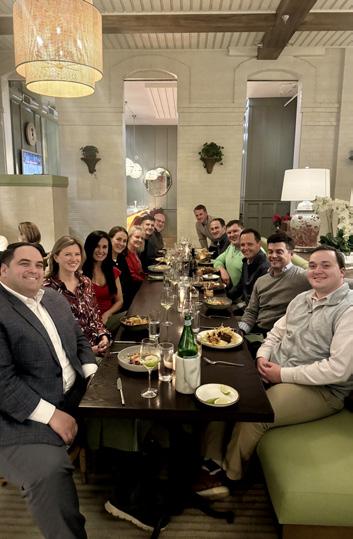
To end a wonderful year, the Ballast team celebrated with pickleball and golf at PKL Lex and ended with a special dinner at Millstone just before the holidays.
We look forward to another great year together!

Ballast Partner, COO

Madeline Flynn
Tell me a little about your path into finance and how that ultimately led you to Ballast. I knew I wanted a career that challenged me mentally, while also having an opportunity to work with and help people. While studying at Centre College and getting my MBA at the University of Kentucky, I studied the complexities of publicly traded companies, markets, and economies which certainly intrigued me. But, what really drew me to this industry was knowing that outside of someone’s health and personal relationships, their money is one of the most important aspects of their life. I enjoyed knowing I could help people in areas that were meaningful to them and had a lasting impact on those who they care for most.
What do you find most fulfilling about your role today? I love helping people, especially through challenging and unknown times. Recently a client passed away, and their CPA shared with me that the client had previously thanked them saying “introducing us to Ballast was the best gift anyone has given us.” Helping people through the unknown and to know that we had that type of impact on someone’s life is both humbling and fulfilling at the same time.
What’s something you’ve learned about yourself through leadership that turned out to
be valuable? I have learned to control the controllable. There is so much in life, the markets, the economy, our health, and beyond that we simply cannot control. I try to do my best every day, knowing that we will most likely look back and be proud of the choices we have made. Things tend to happen for a reason and work out the way they were supposed to work out. I try to stay positive, no matter the situation.
Your kids are active in sports, and you’re often coaching or cheering them on. If Ballast were a sports team, what position would you play? I have signed my kids up for way too many sports! Ha! I played quarterback in football and was a small forward in basketball. Small forwards are versatile and serve several roles depending on the situation. I think I would try to help wherever I could.
What keeps you motivated on both the good days and the challenging ones? I know what we do is important and sometimes there isn’t a clear black and white answer. But ultimately someone has to help people through challenging situations. I always think of my family and how I would want someone to treat them. I’m motivated to give everyone the best possible experience and advice, no matter the circumstances.

When you look back, what are you most proud of? I’m proud of our team and the career development they have experienced. I’m proud of (and thankful for) the early clients who took a chance with some young men building a business focused on financial planning when competitors focused largely on asset management. I’m proud of my wife and her amazing talents that allow me to coach our kids in sports (currently coaching three youth basketball teams!) and help support our business/clients.
Outside of work, where do you find your balance? Spending time with my family. We have four kids, and they certainly keep us busy. I also spend time in the basketball gym, coaching youth teams. Additionally, I volunteer with several organizations, serving as a past Board Chair and current Investment Committee Chair at the Blue Grass Community Foundation, as well as being on the Endowment Committee/Advisory Council at the Cathedral of Christ the King. I love following many sporting events, especially UK teams, the Colts, and the Pacers.

Cameron Hamilton
Management teams often implement non-cash compensation in response to two questions about their workforce:
01. How can we stretch the cash we have available for payroll to attract the best talent?
02. How can we retain good employees and incentivize them to grow the company?
Stock options are a great way for start-up and growth companies to create upside for key employees while saving cash today. The right to buy stock at a stated strike price lets employees participate in growth and lets them control their taxable income by choosing when to exercise. However, options are worthless if the stock does not perform, tying employee retention to continued stock performance.
Restricted Stock Awards (shares today not able to be sold) and Restricted Stock Units (shares promised upon vesting) are both favored by employees because they have value as long as the stock does not go to zero. This comp can motivate workers to drive growth without the negative consequence of a run for the exits during a down period. Thus, RSUs are great for a broader leadership group.
Employee Stock Purchase Plans are a great option for rank-and-file employees, where all workers can purchase up to $25,000/year of stock at a discount via payroll. ESPPs create liquidity for company shares while making even entry level employees feel the benefit of company ownership.
Business owners and their families often rely on sophisticated succession strategies, and one of the most overlooked variables is how business valuation changes depending on the intended buyer. While valuation mechanics such as cash flow, risk, and market comparables remain constant in theory, the practical value of a closely held business can vary dramatically when selling to family members, key employees, or a third-party acquirer.
When the buyer is family, valuation typically incorporates strategic discounts. Estate and gift planning frequently leverages minority-interest and lack-of-marketability discounts to transfer equity efficiently while retaining control. The objective is tax optimization and long-term stewardship, not extracting maximum liquidity. Emotional considerations and governance readiness also influence the effective value.
In contrast, a sale to employees, often via an ESOP or management buyout, reflects a balance between financial
feasibility and continuity. Valuations for these transactions may be more formulaic, driven by lending constraints and trustee oversight. Employees rarely pay full strategic value; instead, the transaction emphasizes stability, cultural preservation, and structured financing aligned with the company’s cash flow.
A third-party sale usually commands the highest valuation, particularly when the buyer is strategic or private equity. Here, multiples expand due to synergies, market position, and competitive bidding. However, these deals often require more rigorous diligence, potential operational changes, and a willingness to relinquish legacy control.
For owners, understanding how their goals, like tax efficiency, legacy, liquidity, or culture, intersect with buyerdriven valuation dynamics is essential. Aligning the exit strategy with the right buyer profile ensures the business transitions smoothly while optimizing both financial and personal outcomes.
The recent change in the SALT (State and Local Tax) deduction under OBBBA (One Big Beautiful Bill Act) has been widely publicized, yet the practical implications for business owners remain nuanced. SALT, state and local taxes, has been at the center of high-level planning since the federal cap was introduced. Although the new legislation introduces technical adjustments, it does not dismantle the framework that has driven tax strategy for passthrough entities.
The original SALT limitation restricted individuals from deducting a meaningful portion of the taxes they paid to their states and municipalities. In response, states adopted pass-through entity tax elections, shifting the liability to

the business entity, where the cap does not apply. These elections quickly became the preferred method for preserving deductions, particularly in high tax jurisdictions.
OBBBA alters the landscape at the edges, but the core incentives persist. The deduction remains more valuable when taken at the entity level, and most state systems were not rewritten by the federal law, so the infrastructure that business owners have relied on is still intact. For many partnerships and S corporations, electing to pay tax at the entity level will continue to be the most economically rational decision.
The perception that OBBBA solves SALT is overly simplistic. For business owners, the smartest course remains proactive planning at the entity level, supported by coordination between state and federal rules.
What is a safe harbor plan and how can it benefit an owner who participates in a retirement plan?
One of the most effective ways for a business owner to increase personal retirement contributions, while keeping the plan fully compliant, is by adding a Safe Harbor provision to the 401(k).
Safe Harbor satisfies the IRS testing limits that often affect owner deferrals. Many non-Safe Harbor plans are forced to refund owners and High Compensated Employees due to low employee participation and contribution rates.
Owners with a Safe Harbor plan:
• Can maximize your 401(k) deferrals (up to $24,500 in 2026, and more if age 50+).
• Can add profit sharing or a cash balance plan for even greater taxdeductible contributions.
For many employers, especially professional services, medical practices, construction firms, and family-owned businesses, Safe Harbor is the easiest way to ensure compliance while maximizing owner benefits.
What retirement plan changes are employers needing to consider based on recent legislative, SECURE 2.0, updates?
Employers who may not have made recent changes to their retirement plan should review their plan document. Unlike normal changes to maximum deferral limits, new SECURE Act 2.0 provisions like Roth Catch-Up Requirement and “Super” Catch-Up for ages 60-63, require plan updates and coordination with payroll.
Are there any optional updates you have seen be beneficial for owners or on behalf of their employees?
Secure 2.0 also includes several optional retirement plan provisions that may be beneficial to employee recruitment and retention.
• Roth Employer Contributions.
(Continued on next page...)
Plans may allow employees to elect to have their matching or nonelective contributions taxed and treated as Roth.
• Treatment of Student Loan Payments as Elective Deferrals for Matching Contributions. Plans may allow matching contributions to be made to employees who are not making 401(k) deferrals to the plan, but who are making student loan payments. Tracking student loan payments is an administrative task that should be carefully considered.
• Expanded Distribution Options Available for certain emergencies, domestic abuse victims, and Qualified LTC premiums.
Do you have any ideas that can help high-earning business owners outside of a 401k?
A handful of plan designs can be utilized depending on the makeup of the company to tax shelter or defer large amounts of taxable income, allowing for lifetime tax optimization for high earners.
01. Solo 401(k) with Defined Benefit/Cash Balance Overlay- for owner or owner/spouse firms
» Combine Solo 401(k) maximums with very high DB/CB contributions
» Creates one of the largest tax shelters available to small business owners
» Ideal for consultants, independent professionals, and small family businesses
02. Cash Balance Plans (Hybrid DB Plans) - Popular for high earners with employees
» Functions like a pension but with an account-style benefit
» Contributions can exceed $100,000–$300,000 annually for older owners
» Often paired with a Safe Harbor 401(k) for maximum allowable contributions
» Excellent for professional service firms
03. Non-qualified Deferred Compensation (NQDC) Plans for C-corps or select executives
» No IRS contribution limits, can defer large portions of compensation
» Avoids most nondiscrimination rules
» Can mirror a 401(k) but on a much larger scale
» Deferrals and earnings grow taxdeferred
» Not ideal for owners of closely held
pass-through entities unless C-corp structure is present
Are there any other services you can highlight that reduce administrative burden for the owner or enhance benefit offerings for the team?
We provide 3(16) Administrative Fiduciary Services so our clients may outsource many of the administrative tasks of a 401(k) Plan. Many clients are familiar with an investment fiduciary but are not aware of the significant administrative fiduciary responsibilities. The two most prevalent errors in 401(k) plans across the country are properly and timely enrolling new employees in the 401(k) and timely submitting contributions to the plan. McGregor can track newly hired employees and provide enrollment services at the right time. And with the expansion of automatic enrollment, beginning 401(K) deferrals has become more administratively challenging. Other services includes distributing annual notices, approving plan transactions like distributions and loans, and signing the annual Form 5500.
Exit planning is a key, but often overlooked, aspect of business ownership. When selling, owners want to maximize value while minimizing their tax burden.
One way charitably inclined business owners do this is by donating appreciated business assets, such as stock, real estate, or equipment, prior to a sale. By gifting assets directly to a charity or donor-advised fund, the business owner avoids capital gains tax while also receiving a charitable deduction for the assets’ fair market value.
In practice, the timing of the donation is critical. The gift must occur before a binding agreement to sell the business is finalized. Otherwise, the IRS may treat the transaction as if the business owner had already realized the gain prior to the donation.
When done properly, this strategy is a great way for philanthropic business owners to maximize value, limit tax liability, and support causes that are important to them.
Preparing your business for sale requires strategic planning, clear documentation, and a focus on maximizing value.
01. Ensure your financial records are accurate, organized, and up to date. Buyers want transparency, and clean financial statements help build confidence while speeding up due diligence.
02. Streamline your operations. A business that runs smoothly without heavy owner involvement is far more attractive, so document key processes and strengthen your management team where possible.
03. Evaluate your business’s market position. Highlight competitive advantages, customer loyalty, and
opportunities for growth, and be ready to explain how these factors create long-term value.
04. Address any legal or compliance issues early. Resolve outstanding contracts, intellectual-property questions, or regulatory concerns before buyers uncover them.
05. Finally, determine your business’s true market value. Consider getting a professional valuation to set realistic expectations and guide negotiations. A clear understanding of worth also helps you identify areas to improve before listing the business.
By taking these steps well in advance, you not only increase your company’s appeal but also boost your chances of securing a smooth sale at a strong price.
Join us for our upcoming live webinars to learn more and ask questions, or book a one-on-one meeting with our team. We’d love to connect!
Scan the QR code to tune in or visit BALLASTPLAN.COM/CONNECT for more.
Live Webinar Schedule:
• Tuesday, February 17th at 4:00 PM ET - Market Update
• Tuesday, March 24th at 4:00 PM ET - Navigating Medicare
• Tuesday, April 28th at 4:00 PM ET - Protecting Your Personal Data


Visit BallastPlan.com to learn more about our team, our services, or to set up a free consultation. To speak to a member of our team, call 859.226.0625 or email info@ballastplan.com. Ballast is located at 400 E. Vine Street, Suite 400, Lexington, KY 40507, however we serve clients nationwide.