project was at approach to rural and local of the city chronicle, development place, With its memoir and disempowering community, world. possible but survival, to the pedagogy for Anthropology Emeritus, Chapel Hill inspiring today.
WEAVING A FABRIC OF UNITY
Conversations on Education and Development
Conversations on Education and Development weaving a fabric of unity
Haleh Arbab
Gustavo Correa Bradley Wilson
Haleh Arbab
WEAVING A FABRIC OF UNITY
Conversations on Education & Development
Haleh Arbab
Gustavo Correa
Bradley Wilson
Copyright © 2024 by Center for Research in Education for Development,Inc.(CRED) All rights reserved.Published September 2024
ISBN 979-8-9907777-0-5
Center for Research in Education for Development,Inc. 7369Westport Place West Palm Beach,Florida 33413
U.S.A.
info@researchfordevelopment.org www.researchfordevelopment.org
Cover art:Sky Glabush, Flare and Glide Off, 2023
Cover design by:Ezra Hopkins
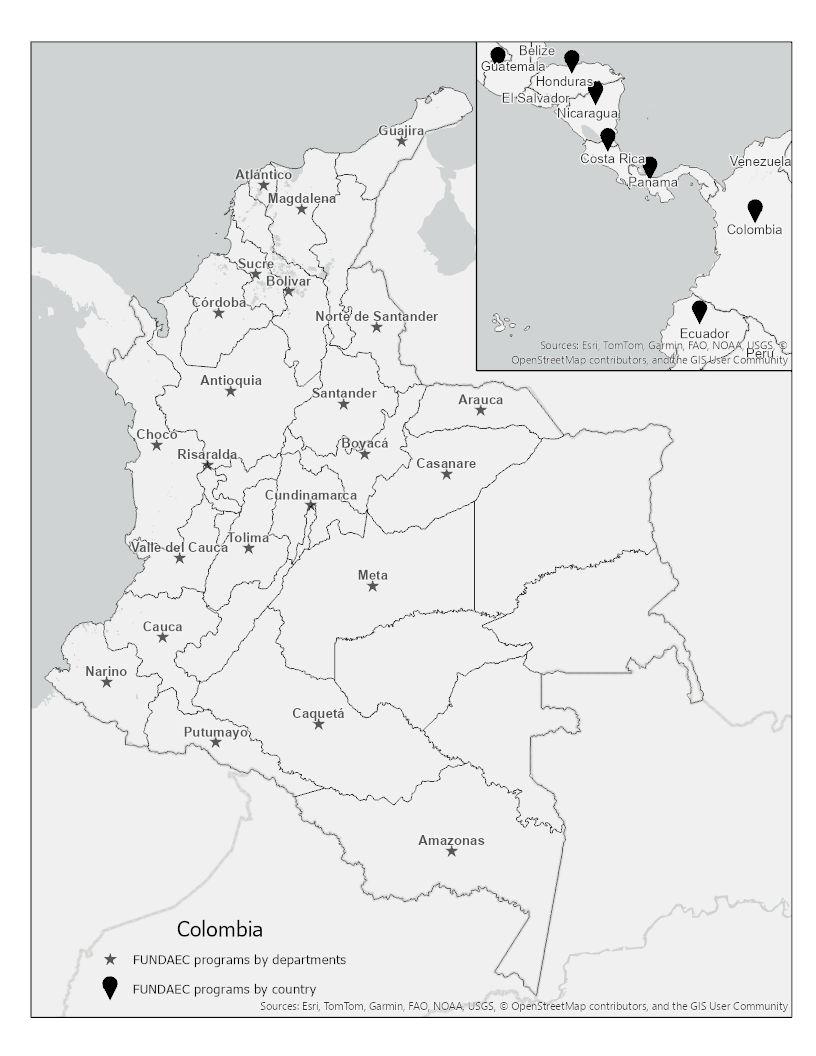
Location of FUNDAEC programs in LatinAmerica
Preface
By BradleyWilson
…the victims of these erroneous policies are not only the broken families living partly in the village and partly in the slums of the city. The entire planet has suffered from its infatuation with a certain brand of industrialization and urbanization, as its leaders and policymakers, following their dreams and living in islands of prosperity, have lost touch both with the soul of the masses and with nature.
FarzamArbab, The Lab, the Temple, and the Market (2000)1
If we look back at the human drama lived by the first generations of the 21st century, we must ask ourselves: What lessons did we learn from the last generations of the 20th century? What wisdom can our parents and grandparents offer us? What kind of insight might we draw from a close inspection of the lived experiences of these three successive generations in the life of humanity?2 Students of history, geography, and development would tell you that the generations coinciding with 1974-2024 have navigated one of the most distressing periods in human history. They have lived through one of the most intense phases of urbanization, industrialization, globalization, and other forces that have imposed new patterns of life—both sociological and ecological—the world over.
Reconsidering our path from the 1970s to the present is an exercise that is not for the faint of heart. Emboldened by both geopolitical control and technological advances resulting from major investments in a global military conflict that threatened to annihilate humanity by the end of
1 Arbab,F.(2000)‘Promoting a discourse on science,religion,and development’in Harper,S.(ed.) The lab, the temple, and the market: Reflections at the intersection of science, religion, and development. Canada:IDRC;Europe and the United States:Kumarian Press.
2The average period of a generation is considered to be about 25 years during which time children are born and grow up,become adults,and begin to have children.
19453, by 1970, a growing belief in the primacy of modern science and thesuperiorityofmodernizingdevelopmentstrategieswastakingrootin the long shadow of colonialism. Many young people who had been mobilized into social movements aspiring to fulfill the promise of global peace and an era of shared prosperity saw the retreat of formal colonialism, the advance of civil rights and gender equality, the rise of environmental consciousness, and the push for human rights in various countries. However, by the 1970s, they faced a harsh and disorienting reality that many of the gains they had achieved in the 1960s were disappearing under the pressure of, and demand for, a new global economic order. The political and economic reality they had struggled to change was still quite out of their reach.
Seenfromthevantagepointoftodayin2024,thedoubleexposureof socialandecologicaldisintegrationcausedbytheexpansionofthisglobal economic order created a level of human vulnerability unseen in previous centuries. The Green Revolution’s devastating impact on food systems and rural life, the insatiable thirst for the world’s resources, and the unquenchable demand for the world’s labor to produce commodities for an age of high consumption have created tremendous interdependencies; unimaginabledisparitiesinwealth;displacedbillionsofpeoplefromtheir ancestral homelands; and reconfigured daily life in every region of the globe. Even the most ardent proponents of this global economic vision would agree that this order was not requested; it was not the dream of the post-war generation, but rather, it was unconditionally thrust upon peoples and ecologies across the planet.4 The new order fundamentally transformed climate, forests, rivers, soils, agricultural practices and food systems, working lives, cultures and traditions, homeplaces, and families. No one left the end of the 20th century unscathed.
The all-pervading disease of the modern world is the total imbalancebetweencityandcountryside,animbalanceintermsof wealth, power, culture, attraction and hope. The former has become over-extended and the latter has atrophied. The city has become the universal magnet, while rural life has lost its savour …Theprevailinglackof balance,basedontheage-oldexploitation
3In the preparations for the Trinity Test,the first to unleash the power of atomic weaponry,Robert Oppenheimerfearedthatnuclearbombsmayinfactsettheatmosphereonfireandendtheworld. He is quoted in 1965 as saying:“We knew the world would not be the same.A few people laughed; a few people cried.Most people were silent.I remembered the line from the Hindu scripture,the BhagavadGita;Vishnu is trying to persuade the prince that he should do his duty,and to impress him,takes on his multi-armed form and says,‘Now I am become Death,the destroyer of worlds.’I suppose we [the scientists who enabled the atomic bomb] all thought that,one way or another.”
4 Many who are proponents of the present global economic order argued that it must be imposed, often through policy measures required by states, international banks, and other development agencies.In the words of some proponents,shifting the existing order required“shock therapy”to breakthetraditionalcommunitypsychologyof thepreviousgenerationtoimpressuponthemthe rules and habits of the economic growth model.
Introduction
Our collective efforts have woven a fabric of unity so resilient that its strength resonates with us even today, rallying us around the noble cause of the development of our region.
Gustavo Correa
On May 11, 2022, just as many around the world began to emerge from lockdowns, social distancing, and deep reflection on our health and well-being during the years of the global pandemic, a humble gathering of friends, collaborators, and coworkers took place in a small town to the south of Cali, Colombia. Delayed by two years due to the dangers posed by the coronavirus, the gathering had assembled at the Bahá’í House of Worship just a few minutes drive south of Puerto Tejada. The group, arriving by bus, car, bike, and motorcycle, had come to pay their respects to those special soulswhohad,inthecourseoftheirlives,madeimportantcontributions, big and small, to the well-being of the people of the rural region in which they called home, Norte del Cauca.
Norte del Cauca is a rural area south of the large metropolitan center of Cali, Colombia. A beautiful, biodiverse, and earthly-rich region of Colombia, Norte del Cauca is one of seven subregions of Cauca, composedofthemunicipalitiesofSantanderdeQuilichao,BuenosAires, Suárez, Puerto Tejada, Caloto, Guachené, Villarrica, Corinto, Miranda, Padilla, Jambaló, Caldono and Toribio, with a population of nearly 450,000.ThepeopleofNortedelCaucaprincipallytracetheirancestryto Afro-Colombian and indigenous lineage whose cultures have shaped the region for centuries. During the last five decades, traditional agriculture and family farming in Norte del Cauca—the principal source of livelihood in the region—has been radically transformed by extensive monoculture sugarcane development inspired by Green Revolution technology, displacing ancestral indigenous and Afro-Colombian agroecological production methods. The erosion and fertility loss of traditional farms of the people in the region has led to decades of livelihood insecurity—a generalized vulnerability for families across
Norte del Cauca as they seek farmwork, domestic and informal work, or move to find their fortunes in the city of Cali. But, Norte Caucanos are proud of their traditions, and the resilience of their spirit is palpable even throughtheturmoiltheyhaveexperiencedovercenturiespasttopresent.
Upon arrival, the participants walked—some alone and others in pairs—up the paths leading to the Bahá’í House of Worship, where they joined together in prayer and to remember the lives of friends who had passed on. It was, for all, a preciousmomentlonganticipated. It had been more than 45 years since these friends and coworkers first began their journey together in service to the community. Some had been lost along the way but never forgotten. These souls included Farzam Arbab, Alfaro Mina, Aldemar Valencia, Edmundo Gutierrez, Eldanurth Mina, Francineth Castro, Habib Rezvani, Hernan Mena, Javier Marin, Leonardo Laredo, Leonilde Mazabel, and Teofilo Gutierrez. There were tears and smiles, joy and sorrow, heartfelt emotions quietly held in the collective embrace of a silent moment together, sitting side by side, remembering the roads they had walked together and what they had learned along the way. This simple occasion, in many ways, marked the beginning of the end of a 50-year cycle of intergenerational action, reflection, and learning set in motion by the protagonists of FUNDAEC—the globally renowned development institution founded in 1974 by a group of young collaborators in this place, Norte del Cauca.
The most treasured guests attending the gathering included the graduates of FUNDAEC’s first educational programming: its pioneering group of Promoters of Community Well-being—the Ingenieros (the engineers). The Ingenieros, as they are respectfully and affectionately called, were the first young people in Norte del Cauca to answer the call of FUNDAEC and collaborate with and lead action-research teams. They were the first to adopt its research, learning, and action approach in service to the development of their region. Nearly fifty years since they had taken their first steps with FUNDAEC, here on this day, they had returned to honor their alma mater for its profound effects on the region and to reaffirm their commitment to serving and continuing to raise another generation of youth who could carry the mantle of this noble work to which they dedicated their lives.
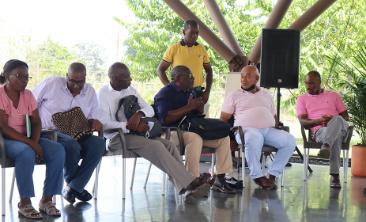
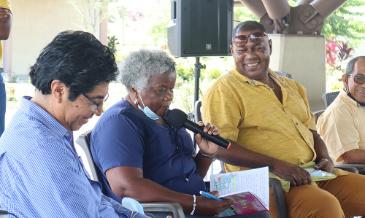
After the moment of quiet remembrance, the group—composed of generations of collaborators who established the first center of learning created by FUNDAEC—reconvened in a circle in the shade of an openair veranda surrounded by lush trees. Old friends and new ones mingled and spoke to one another. Young people and elders showed one another great respect. It was there, in that circle in time and space, that Gustavo Correa—the first director of FUNDAEC, appointed and entrusted by its founders to direct the initiative in 1974 at the young age of 27—stood before the group of his former students, now, at 74 years of age. Reminiscent of that moment in 100 Years of Solitude when Ursula
realizes that time was not passing but rather turning in a circle, Gustavo, in tones of a loving friend, reminded those assembled of the road they had walked together: the history and origins of FUNDAEC, its key concerns, its central principles, its inspiration, and the urgency of the continued work of strengthening the vision and practice of development in Norte del Cauca. We draw upon his words, as he shared them that day, to set the tone for the book you are reading, to welcome you into the circle of time, and to provide a glimpse into the context for the conversation that will progressively unfold in the pages to follow.
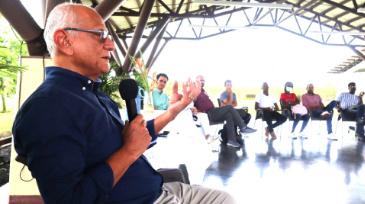
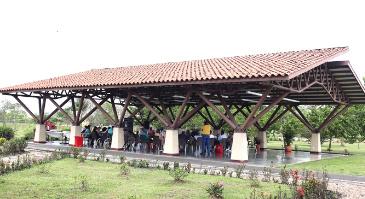
Gustavo Correa addressing participants gathered at the Bahá’í House of Worship in Norte del Cauca to reflect on nearly five decades of FUNDAEC’s efforts in the region,11 May 2022
Ingenieros,along with staff and friends of FUNDAEC, participating in the May 11,2022 gathering
WeavingOurStoriesTogether
Attachment to the land and its people is an intrinsic aspect of our humanity. I believe that the human heart has the capacity to embrace many places and many people. Having the world as our homeland means cherishing every piece of land with equal passion. Nonetheless, building and creating require dedication and unwavering commitment to a specific place. True meaning and purpose don't arise from mere drifting.
HalehArbab
Opening
One of the unique characteristics of FUNDAEC’s approach to development is the recognition of the dignity of every human being and that each person has gifts, talents, and abilities from which our communities can benefit. Through relationship building, personal storytelling, and testimony, we can hear what moves people;wecanorientoneanothertowhatunitesourstories;andthrough listening, we can recognize each other’s common intentions and commitments. By listening to stories, we also have the opportunity to question our assumptions, reach toward understanding someone else with an open mind, and perhaps gain new insight into the sense of purpose in a given endeavor. Finally, stories with ennobling themes can inspire others to undertake noble acts.
In contexts where we seek to work individually and collectively to advance the well-being of one another and the communities in which we serve, telling one’s story is a natural and vital practice wherein we acknowledge people’s distinctive sense of place in the world, their lived experiences, and the nature of the paths they have traveled. In simple terms, telling stories humanizes us. The goal here in introducing ourselves is more modest than this. We hope that through the following stories, the reader might feel closer to the conversation we are having together and understand better why it unfolded in the way it did. These introductions deepened the bonds of friendship, admiration, and mutual
understanding.17 Yet, they also offer insight into storytelling as a vital practice in strengthening one’s sense of one’s place in the world and building trust within groups accompanying one another in intellectual work and social action.
Gustavo
On many occasions, people have asked me how I became involved in the field of development, abandoning a path I had set out for myself when I decided to study mathematics, my passion during the last years of school, with the goal of becoming a university professor. Mathematics and teaching were two things that had always attracted me. I remember that one of my favorite games with my younger brothers was to “play school,” where I was the teacher.
Everything seemed to favor me when, after graduating as a mathematician from the Universidad del Valle in 1973, they offered me a position as an instructor to teach basic mathematics to students entering university for the first time. But a conversation with Farzam Arbab soon after led me to a crossroads. He, an elementary particle physicist, had come to Colombia after earning his doctorate in physics from the University of California at Berkeley, to advise the newly established physics department at the Universidad del Valle. His coming was part of the support that the Rockefeller Foundation gave the university to strengthen the faculties of science and health. I had met Farzam, who had recently arrived at the university as my professor of a physics course, which turned out to be the first course assigned to him as a newcomer.
My conversations with Farzam after class were not about physics or mathematics but development. Farzam had been participating in a multidisciplinary group at the university, where they discussed strategies for–what we then called–integrated rural development. This model recognized that aspects of agricultural production, health, employment, education, and technological development are much more interconnected in the rural sector and that, therefore, the strategies to achieve development needed to use a multidisciplinary approach. Farzam told me he had also met with colleagues from other faculties, including education, to explore the best way to impart quality scientific and technological knowledge to the rural population. We discussed these issues and maintained that the only way to achieve true development was when communities actively participate and have access to technological and scientific knowledge. He invited me to join the group in that conversation, which I enthusiastically accepted.
17 There were moments when we reconsidered the relevance of sharing these personal stories with thereadersforfearthatitover-personalizedabookthatisreallytheexperienceof thedevelopment of an institution,FUNDAEC.Yet,the basis of our dialogues together was born of mutual respect for our unique and shared experiences. Therefore we thought it was important to tell the reader some of the stories we have shared with each other.
TextilesofTrust
Our journey towards becoming true partners in the pursuit of development in Norte del Cauca was significantly aided by our conscious effort to combat any sense of superiority, and instead, appreciate the wealth of knowledge present within rural communities. We recognized the value in both the academic training and the ancestral wisdom accumulated over generations in these communities.
Gustavo Correa
Opening
One of the greatest concerns of FUNDAEC and many in the field of development has been the nature of relationships of trust within communities or regions as they pursue higher levels of well-being. Most development practitioners or advocates understand this trust-building as paramount to their work. They aspire to fulfill a deep calling to serve others and meaningfully contribute their knowledge, skills, and effort to respond to many of the ills afflicting communities. There is no doubt that there are many people— humanitarians, environmentalists, educators, social activists, and entrepreneurs—around the world who have answered this call with the best of intentions and have worked tirelessly to advance these efforts to improve human and environmental conditions.
Yet, trust building is not always at the center of development practice. The global history of development is replete with stories of the breakdown of trust and evidence of poorly conceived diagnoses and interventions, narrowly defined and even prejudiced understandings of problems,andtheexclusionofpeoplefromparticipationinplanningand decision-making. Sometimes, there is a kind of short-sighted and shortlived commitment to the places that practitioners and advocates imagine reaching higher levels of well-being. Even today, in development scholarship and practice, we remain entangled in questions about practicing genuine long-term commitments to people in places rather