Under The Mango Tree
The Story of Bahá’u’lláh as told to Abdu in Ghana
Meredith B. Folley
© 2026 Meredith B Folley
ISBN: 9798248901173
1
New Friends for Abdu
Abdu was feeling shy. Two days before, he and his parents had moved from their village to the city. Now, in this crowded, noisy neighbourhood, he missed the quiet, leafy shade of his little earthen-block home. Abdu was excited to be in the capital of his home country Ghana, but this new compound was too big, with so many family doorways opening onto this sandy centre court. A boy and girl were washing clothes, bent over their basins. Suddenly the boy stood up and smiled at Abdu. Abdu tried to smile back.
The boy and girl began to spread the wet clothes on the compound wall, and as they did, they sang.
“Let us be happy! Let us say, Yá Bahá’u’l-Abhá!”
It was such a happy tune that Abdu stepped a little closer. “Hello!” he said. “Do you like mangoes?” the boy asked.
“Come!” said the sister. She emptied her basin and led the way to a big mango tree at the back of the compound.
The brother plucked a mango and held it out to Abdu, “I’m Kossi. I’m ten.” he said. “And she’s Yawa, my sister. She’s twelve.”
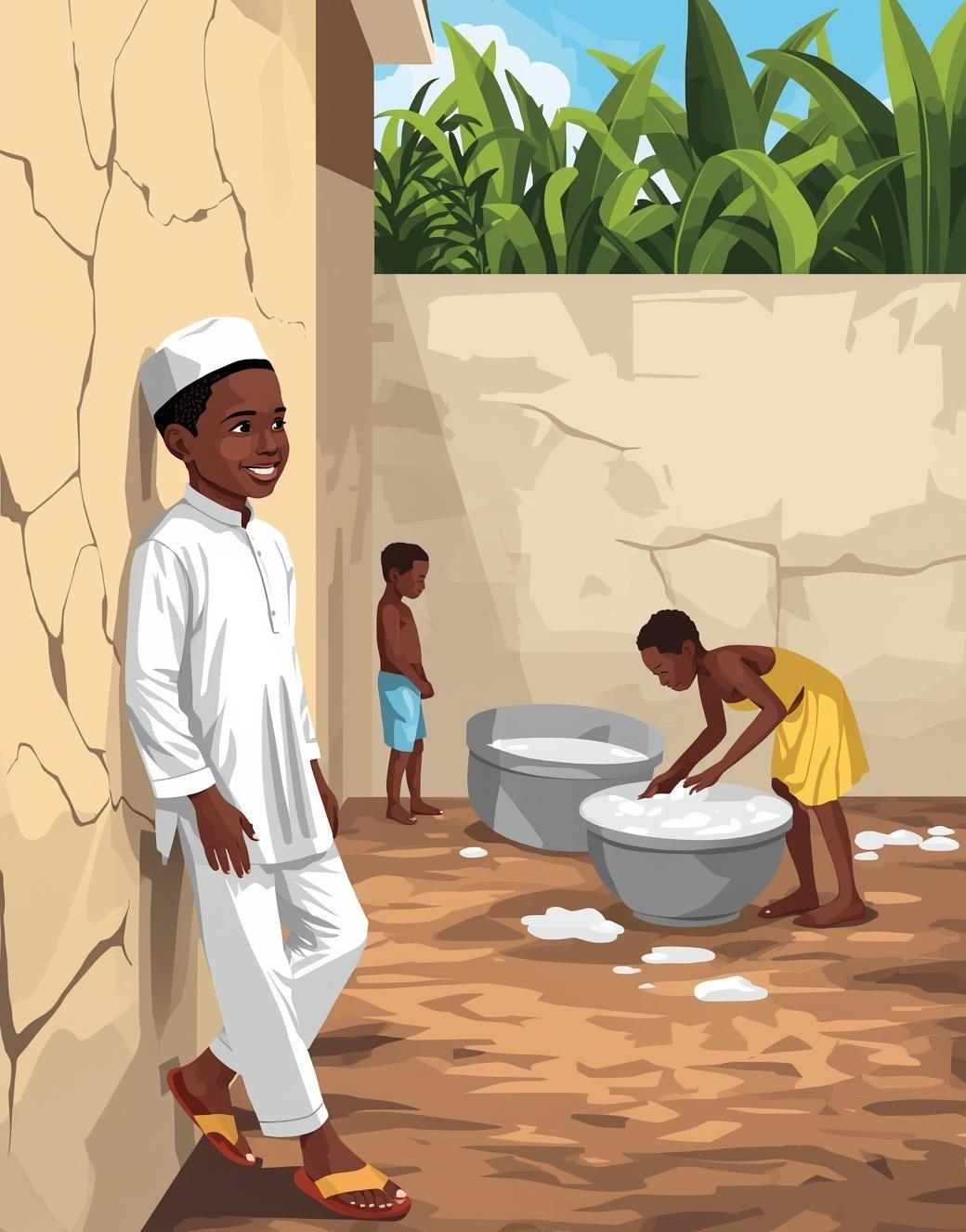
A boy and girl were washing clothes.
Yawa, Kossi and Abdu sat down under the tree to eat mangoes. “What’s your name?” asked Yawa.
“Abdu. I’m nine.” Abdu said softly. “I like your song.”
“It’s a Bahá’i song,” said Kossi. “We’re Bahá’is.”
“What’s Bahá’i?” asked Abdu.
“It’s our faith,” said Kossi, “like Christian or Muslim or...”
“Bahá’is believe in the same God as everybody else...” said Yawa. “People just call Him different names like Dieu or Mawu or Onyankopon1, or...”
“We call him Alláh,” said Abdu with his mouth full of mango. “I’m Muslim.”
“We have Muslims here, too,” said Kossi. “We’re all friends.”
“We’re like these mangoes,” Yawa said. “We’re like the fruits of one tree!”
“Fruits?” Abdu asked. “Oh! You mean, like we’re all kids?”
“Yes!” chimed Yawa. “We’re different, but we’re all God’s family!”
The brother and sister began to sing, “We are flowers of one garden. We are leaves of one tree!”
Abdu grinned. “Are you bananas, too?”
Yawa and Kossi laughed.
“Let’s go play football,” said Kossi.
“But Mama told us to clean these palm nuts,” Yawa sighed. She pointed to the big basket of bright orange palm nuts.
“I’ll help!” Abdu piped. He hoped they would sing more.
“Really? Thanks!” said Kossi.
1 Dieu, French; Mawu, Ewe; Onyankopon, Twi
“Part of a good neighbourhood is having safe, happy children!” said Tony. “We want them all to be good friends, good students, and helpful sons and daughters.”
“That’s wonderful,” said Abdu’s father. “We we’re worried about bringing Abdu here to the big city.”
Ibrahim’s father nodded, “Village life is safer . .” he said.
Abdu’s father sighed, “Even villages have problems. Tell us about these classes, Tony.”
“We already have a class in my neighbourhood,” said Tony. “We teach children how to be honest, fair, kind, generous, and hard-working.”
He held up the picture book. He showed a picture of children sharing food.
“Each week the children learn a story about how God wants us to live. They colour a picture, learn a song and a verse, and . . .”
“What kind of verse?” asked Bright’s father.
“Like this,” said Tony. He read from the book, “O Son of Spirit: Possess a pure, kindly, radiant heart.”
“Do you teach children to pray?” asked Regina’s mother.
“Oh, yes,” said Tony. “Kossi? Can you say a prayer for us?”
So Kossi closed his eyes and prayed, “Oh God, Guide me. Protect me. Make of me a shining lamp and a brilliant star. Thou art the Mighty and the Powerful.”
“Don’t you say amen?” asked Kodjo’s mother.
“Or ‘in Jesus’ name?’” asked Adjo’s mother. “Bahá’i prayers end with praising God,” said Tony. “In our classes, the children can say any prayer they like Christian or Muslim or even a prayer they make up themselves.”
“Well, that’s nice,” said Ibrahim’s father. “But we take our children to the mosque.”
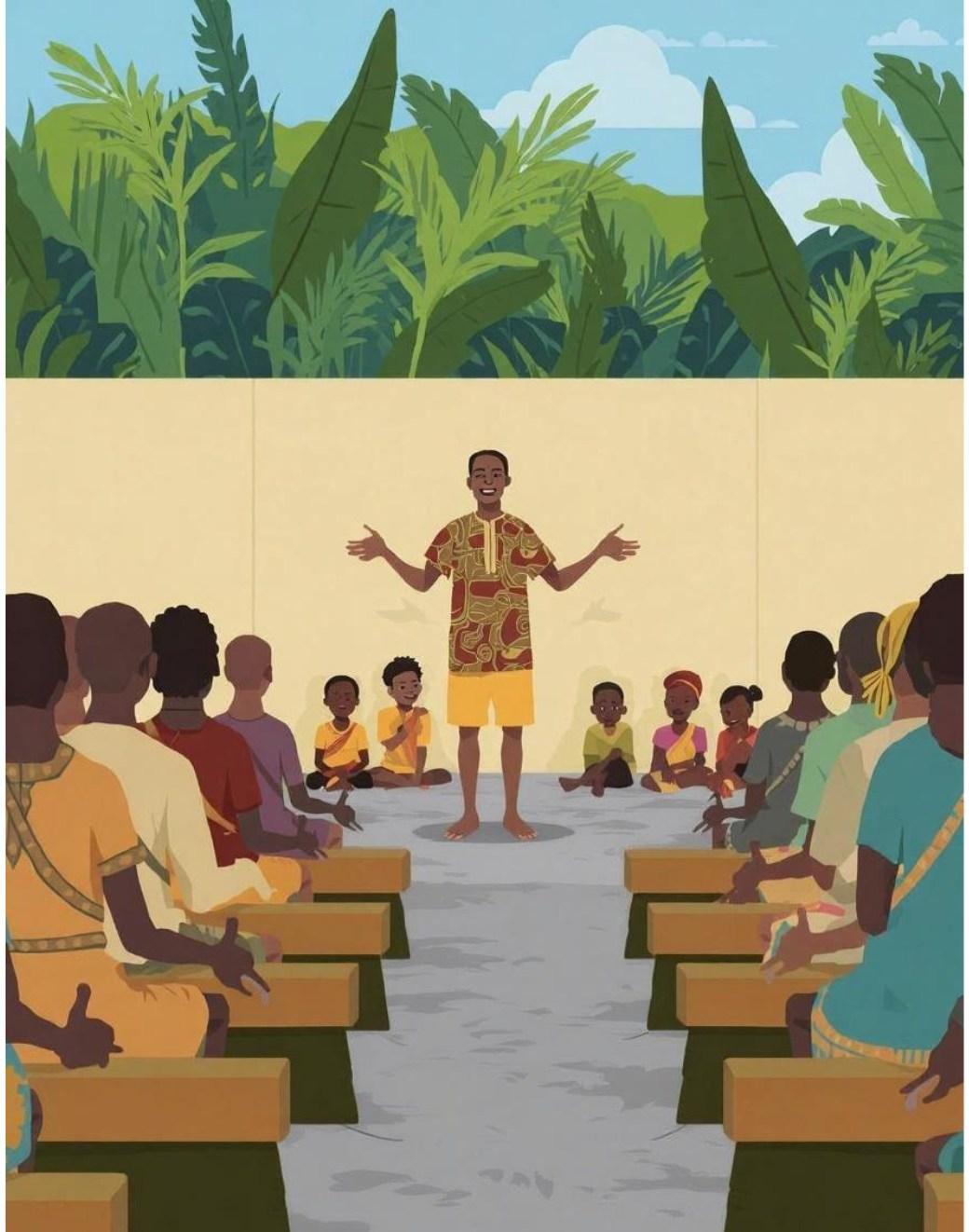
“Part of a good neighbourhood is having safe, happy children!” said Tony.
A Time to Be Happy
Yes! Baha’is love celebrations!” Tony laughed. “And truly Baghdad was a wonderful place for Bahá’u’lláh because people from many countries and many religions lived there. Bahá’u’lláh helped them to understand that all people worship the same God. They pray in different ways and worship in different places, but they all love the same Creator. Bahá’u’lláh explained that for thousands of years God had sent Messengers at different times and to different countries to teach people how to live in His ways. And now God was calling all the people of the world to live together as one big family!
“Sometimes Baha’is from America and Congo and Togo come visit us!” burst Yawa. “We have so much fun together!”
“But did Bahá’u’lláh tell his new friends He was the new Messenger?” asked Abdu.
“No,” said Tony. “Not at first! He had to teach them to be more loving. You see, people are like mirrors! We get very dusty when we think only about ourselves. You know. . .like wanting to be rich or wanting a big TV or a fancy car. . .”
“Or somebody else’s farmland?” asked Abdu.
“Or farmland,” said Tony. “Sometimes people think so much about the things they want, they fight over them or cheat. Those mean feelings are like dust
covering people’s hearts. But when people live in God’s way, the dust comes off. They start seeing all people as friends. They share and help make each other happy! Their hearts become clean, like shining mirrors!”
“And they live in peace!” added Yawa.
Just then, they heard knocking at the gate. Tony opened it. A young lady and two young men came in. They were laughing and carrying books.
“This is Mandy,” said Tony, introducing the young lady. “She teaches the little ones. I teach the middle ones. And these two are Ben and Yusuf, they teach the junior youth.”
All three smiled brightly at Yawa, Kossi and Abdu.
“Nice to meet you. You’re new to Tony’s class?” asked Mandy.
“They’re visiting today,” said Tony. “I’m telling them about Bahá’u’lláh in Baghdad.”
“Oh, don’t let us interrupt,” said Yusuf. “We’re going to greet Grandma.”
The three young people went into Tony’s home, and Tony continued the story.
“The people who believed in the Báb were called ‘Babi’s’, and they followed Bahá’u’lláh to Baghdad,” said Tony. “Back home, they had suffered so much! They were poor and broken-hearted, but Bahá’u’lláh taught them to be hopeful, helpful, and honest. Soon these Bábi’s became known all over the city for their goodness. “Wise and noble people began to visit Bahá’u’lláh.”
“Did they guess He was God’s Messenger?” asked Abdu.
“If they did, they kept it a secret,” said Tony.
“But why?” asked Abdu.
“Because” said Tony, “these wise people loved Bahá’u’lláh and His teachings very much. They knew that enemies from His country were watching Bahá’u’lláh, and these enemies were angry and jealous about how much people loved Him.”
End of this sample.
To learn more or to purchase this book, Please visit Bahaibookstore.com or your favorite bookseller.