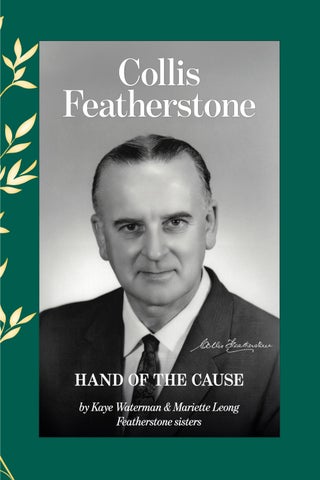
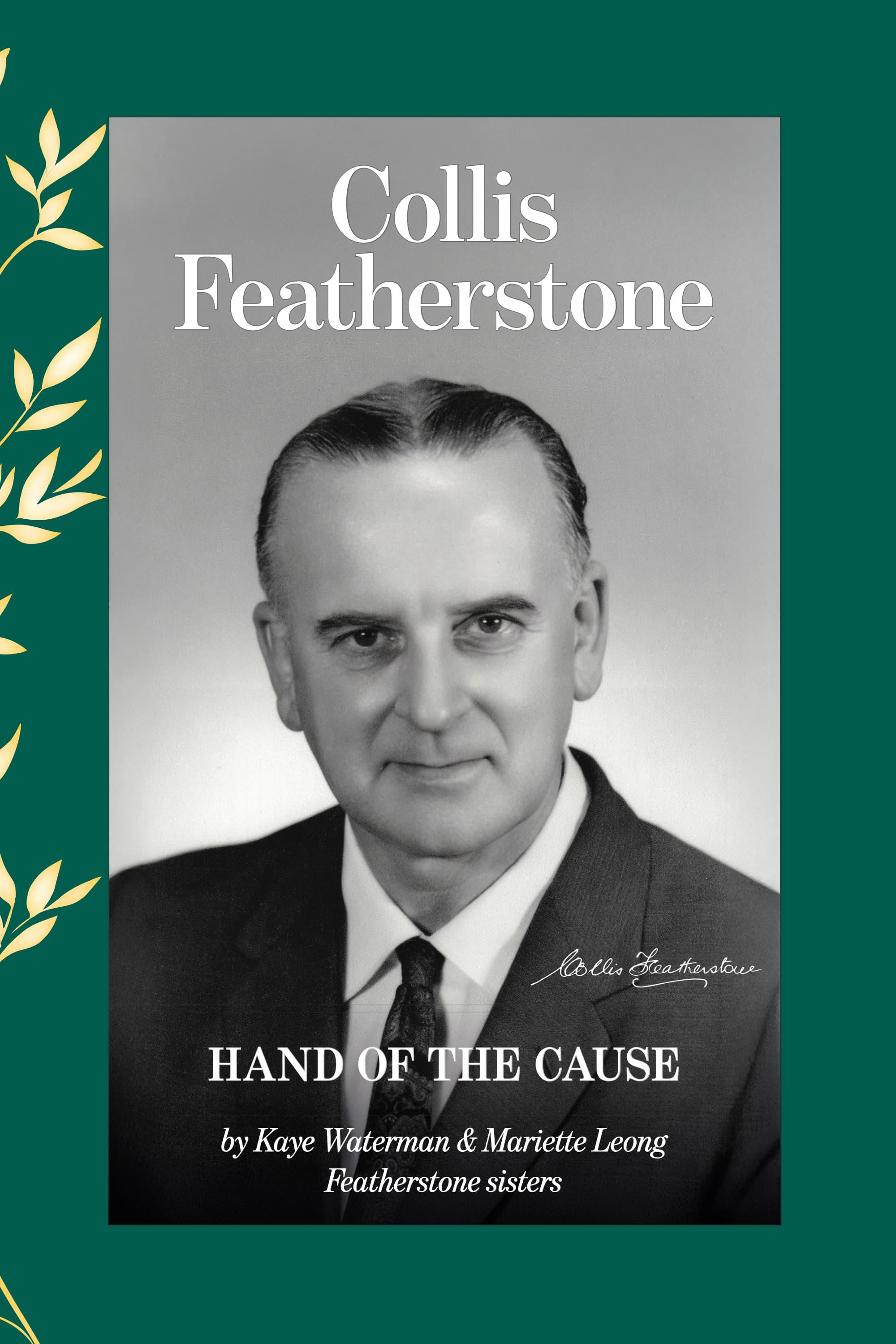
Collis
Featherstone
Kaye Waterman & Mariette Leong
Featherstone sisters
Collis Featherstone
Text Copyright © Kaye Waterman & Mariette Leong
Publication Copyright © National Spiritual Assembly of the Bahá’ís of Australia Inc.
All Rights Reserved
Bahá’í Publications Australia
ISBN 978-1-923266-30-8 (trade hardcover)
Distributed by Bahá’í Distribution Services
173 Mona Vale Rd, Ingleside, NSW, 2101 bds@bahai.org.au www.bahaibooks.com.au
Body text typeset in 11/14.5pt Minion 3
Other text typeset in Montserrat
Front-cover title in Benton Modern D
Maps sourced from OpenStreetMaps.org
Bahá’í Publications Australia
Introduction
This is the story of Collis Featherstone, the most distinguished Australianborn Bahá’í, who rose to the rank of Hand of the Cause of God. He joined a unique band of illustrious souls appointed by Shoghi Effendi, the Guardian of the Bahá’í Faith, to protect and propagate the Cause of God. This weighty and sacred charge was the moving force behind his decades of selfless service to the Faith he cherished with all his heart. He played an extraordinary role in the development of the global Bahá’í community, travelling to over 100 countries, many repeatedly, to encourage and guide Bahá’í communities as they strove to arise and fulfil the global plans. He led by example, listened with love and touched many hearts with his enthusiasm, humility and humour.
In the latter days of the Second World War, no one could have imagined what lay ahead for Collis Featherstone. From the time Collis and his wife Madge became members of the Bahá’í community, and staunch advocates of the teachings of the central figures of that Faith, the Báb, Bahá'u'lláh and ‘Abdu’l-Bahá, the question has been asked as to how it all transpired, not only by members of the public and the Bahá’í community, but quite naturally by their children and grand-children.
It is very human for people to look back from time to time on the events and incidents which shape their lives and for most people there is an interesting story to be told. From an early age Collis was a thinker — not in an academic sense — about the deeper side of life. Indeed most of us ask at some stage of our lives how it is that we are who we are and what the purpose of life is. From where do we come and where do we go?
Collis asked these questions too, until he found answers that satisfied him. Furthermore, there were a series of coincidences in his early life that he could not simply dismiss as meaningless.
What were those things that influenced him in his formative years, and in his search for answers to the meaning and purpose of life? What
characterised his actions and activities in his early days as a Bahá’í? What was it that fuelled the passion and commitment he had to promote the global vision set out in Bahá’’u’lláh’s teachings for building a unified and peaceful world civilisation? What effect did his encounter with the Faith have on the lives of his loving wife and consort, and their children?
The idea for the book took root in 1987 when Collis and Madge made a very informal cassette tape recording giving many details of their early days as Bahá’ís more than 40 years earlier. When the tape was transcribed to words on paper, it was apparent that much clarification was needed and both Collis and Madge assisted in the correction process.
Since Collis passed away, the diaries which he and Madge kept have been unearthed and have provided further corrections and many more details. In addition, he kept copies of much of his correspondence, making it possible to piece together his early days as a Bahá’í. The Australian Bahá’í Quarterly of that era has also helped to confirm some of these recollections.
Here we have an ordinary man of humble origins whose life was transformed by his unerring commitment to, and belief in, the Bahá’í Faith. His life was impelled in a new direction to the extent that he was able to take others along with him. The first few chapters trace Collis's introduction to and acceptance of the Bahá’í Faith together with his wife, and then his early life and the incidents and coincidences that had puzzled him in those early years. Convinced from the outset of the universality of the Faith, he endeavoured to promote its interests with unfailing zeal and enthusiasm.
The Bahá’í Intercontinental conferences held throughout the world in 1953 and the commencement of the Ten Year World Crusade that same year were major turning points in the annals of Bahá’í history. Members of the Australasian Bahá'í communities were invited to attend the Intercontinental Conference in New Delhi, India, and Collis and Madge decided to go. In addition, they secured approval to go on Pilgrimage to the Bahá’í Holy Places in Haifa, Israel where they would be, like other pilgrims of the time, the guests of the Head and Guardian of the Bahá’í Faith, Shoghi Effendi. The influence of these events was momentous, with lifelong implications that set in motion the train of events which make up the rest of the book.
Uplifted by the experiences of that year, Collis's commitment to the spread of the teachings of Bahá'u'lláh was further invigorated. One of
Chapter 1
Finding the answers (1944–1945)
God has given man the eye of investigation by which he may see and recognize truth. He has endowed man with ears that he may hear the message of reality and conferred upon him the gift of reason by which he may discover things for himself. 1
• ‘Abdu’l-Bahá •
It was one o'clock in the morning and Collis (then known as ‘Col’) quite literally wept with joy. He had found what he was looking for — his long search of many years had ended. More than 40 years later when he recalled that moment his voice changed and he was overcome with deep emotion as though he had just experienced it. The significance of that moment never left him.
It was the large American illustrated copy of The Dawn Breakers , a detailed history of the early days of the Bahá'í Faith, translated and edited by Shoghi Effendi, the Guardian and Head of the Faith, that impressed him. Collis had previously received some pamphlets and newsletters; he knew of the principles of the Faith, its unifying power, and that it was ‘for everyone on earth’, but that wasn’t enough to satisfy him. The night he received The Dawn Breakers, he was impressed with its size and appearance and was hungry to learn more: He started reading it. The hours went by and he read this captivating record of historical events late into the night. When he reached page 92 and read the sacred guidance in The Báb's Address to the Letters of the Living, he instantly realized his prayers to find the truth had been answered. This Faith was from God.
1 ‘Abdu’l-Bahá, Promulgation of Universal Peace
The fact that Collis had to be at work at 7:30 the following morning was far from his mind! This new discovery was a defining moment that forever changed the direction of his life. Each of us undertakes a journey of life. Sometimes we drift along as little boats on the sea without direction. At other times we take charge as the boat’s navigator on a mission, undeterred by the storms and tempests that lie ahead. Such was that moment for Collis. His early life had been punctuated by a persistent search for the meaning of life. However, by 1944 in the midst of the Second World War, working to support his family (with three young children) and to maintain a struggling business, his search had taken a back seat.
When they moved to Port Adelaide, his wife Madge, who was a regular churchgoer, prompted them to look around at the churches in their area for a suitable place of worship. There was no local Congregational Church, in which Madge had grown up. Collis didn't feel comfortable in the local Anglican Church because it was High Church and too ritualistic. Hence, they chose the local Methodist church to meet their spiritual needs. This, however, soon changed.
Introduction to the Bahá’í Faith
Early in 1944 two intrepid and stalwart Bahá’ís from the Adelaide Bahá'í Community, Bertha Dobbins and Katherine Harcus, set out by bus from Adelaide to share the glorious, unifying message of the Bahá'í Faith in the Port Adelaide area. They travelled about 14 kilometres by bus and then walked back in the direction from which they had come, hoping to find people to talk to. With little apparent success, footsore and very weary, they leaned against the posting at the railway and road intersection on Nana Terrace (now named West Lakes Boulevard), near May Street in Albert Park. There they called in prayer on the Greatest Name (‘O Thou Glory of the Most Glorious — Yá Bahá‘u’l-Abhá’) that a home would be opened where they could share the Faith.
Some weeks later, in February or March 1944, Madge met a close friend, Marion Menzies, who lived on Bottling Street, a short distance from the aforementioned intersection. At that meeting Marion extended the following invitation: ‘Madge, I met my school teacher from several years ago in
town the other day, and she said she had something important to tell me and my friends. I have no idea what it's about, but I've made arrangements for her to come to my home — would you like to come too?’ Marion then added, ‘My teacher said children are welcome’. Madge said yes.
Madge looked forward to the occasion. On a Wednesday afternoon she and her three children went to Marion's home for the first of what was to become regular fortnightly meetings.
Marion’s former school teacher was the Bahá’í Bertha Dobbins, mentioned above. Bertha was an inspiring lady and speaker. The important message she had to share was about the unifying teachings of the Faith. She commenced her introduction by reading the Tablet of Aḥmad, a rather long and, at first hearing, difficult prayer to comprehend. She then outlined some of the Faith’s main teachings and gave details of its three Central Figures: the Báb (the Gate or Way), Bahá'u'lláh (the Glory of God) and His eldest son ‘Abdu’l-Bahá (the Master).
Madge came away from the gathering with a few pamphlets about the Bahá’í Faith. She shared these and details of all the proceedings with her inquisitive husband. Madge continued to attend and enjoy her friend’s afternoon gatherings, made all the more pleasant by Bertha's very understanding acceptance of young children.
Prompted by Bertha’s reported statements that the Faith ‘was for everyone on earth’, Collis requested Madge to ask for a ‘decent book’, with real substance, to read about the Faith. At the next meeting Madge asked for a suitable book to satisfy her husband's growing appetite for detailed knowledge about the Faith. In due course he received a copy of The Dawn Breakers, a historical account of the Faith’s early beginnings, which, as noted above, was to transform the course of his life.
The pages he read described, in language that was soul-stirring, the moving story of how each of the Báb's first 18 followers came independently to recognise Him as a chosen Messenger from God. The words the Báb addressed to them in His Address to the Letters of the Living struck Collis to the very centre of his being.
The Báb’s stirring words to His disciples, that touched Collis’s heart that night, Include the following:
Learning public speaking
In order to improve his skills, for a time Collis took private lessons in public speaking from a teacher who lived in North Adelaide. To get there, he had to first catch a bus and then a tram. The lessons gave him added confidence and self-assurance. He also enlisted Madge’s help to evaluate his performances and consequently developed his speaking skills markedly. His teacher even organised for both of them to participate in a lighthearted way as Mr and Mrs Citizen in a broadcast radio program. In later years when Collis's public speaking skills were fully evident, his mother and her friends used to come to all the Bahá’í public functions when he was the main speaker. She openly expressed her pride in his accomplishments, even though she never seemed to grasp the import of the Bahá’í message.
Typing skills
To help with letter writing Collis eventually acquired a typewriter and taught himself to type, as did Madge, not a common practice in those days. They became accomplished typists.
Leadership skills
It was during these early years that Collis showed his leadership skills in the neighbourhood. It was his sincere friendship and jovial spirit that attracted his friends and neighbours to attend the firesides held every three weeks. Madge was there fully supporting him and together they made a great team. Years later, daughter Mariette learnt from Selma Galvin (daughter of Ruth Taylor, a founding member of the Woodville Spiritual Assembly) that she remembered Madge riding her bicycle to their house with baby Mariette in the basket. She said Collis was the life of the party and very well-liked. The Bahá’í friends looked forward to the talks he gave in the city of Adelaide.
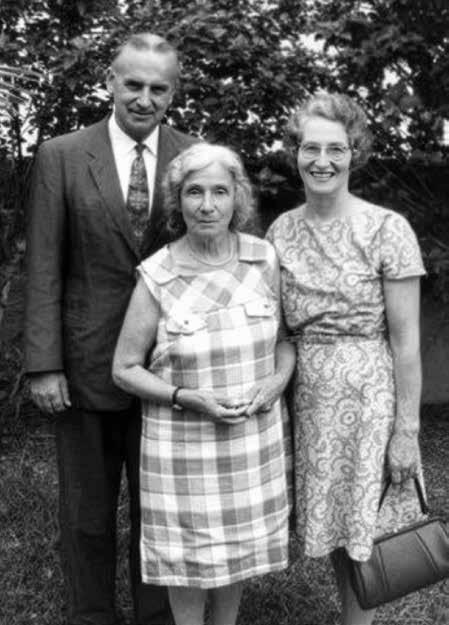
Collis and Madge Featherstone with Bertha Dobbins
Amatu'l-Bahá Rúḥíyyih Kh ánum and Collis
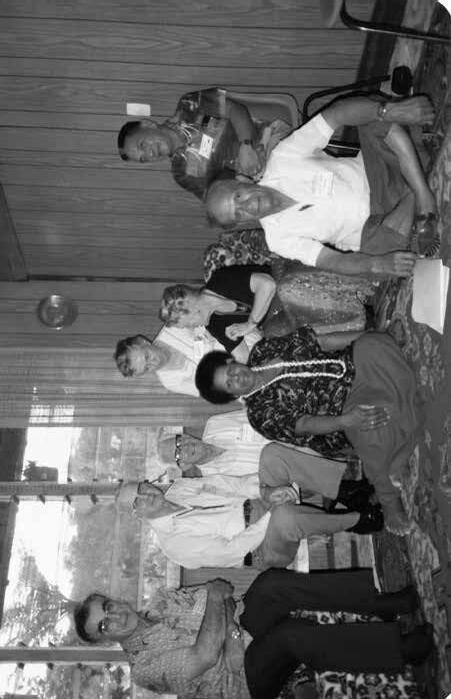
Featherstone meet with the Counsellors in Samoa
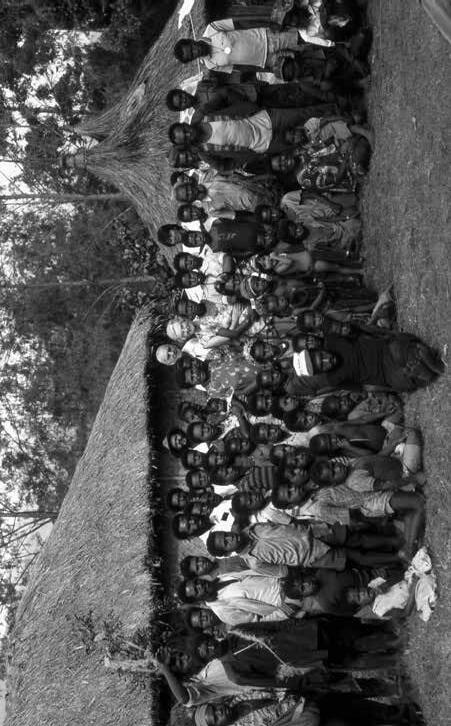
Collis and Madge, Pikossa Village, Papua New Guinea, 1984
End of this sample. To learn more or to purchase this book, Please visit Bahaibookstore.com or your favorite bookseller.