NOVEMBER 2025 / VOLUME 1 EDITION 1 / BAFFC 991
Contents 2 A Note from the Editor 3 A Message from the President 4 Board of Directors 6 Noteworthy Cases 32 En Banc Cases Awaiting Decision 33 En Banc Cases Awaiting Argument 36 Cases to Watch 40 Best One-Liners 43 From the Clerk’s Office 51 Recent Events 52 Volunteer Engagement Opportunities
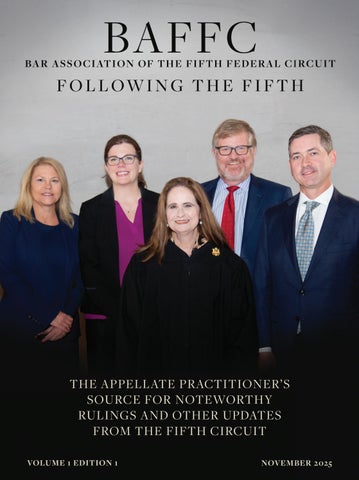
On the Cover Front Row: Chief Judge Jennifer W. Elrod Back Row from Left to Right: BAFFC Executive Committee: Deborah A. Pearce, Samantha J. Kuhn, David Coale and Michael J. Bentley Not Pictured: Aaron M. Streett
NOVEMBER 2025 / VOLUME 1 EDITION 1 / BAFFC 1
A Note from the Editor
A Message from the President Walter Woodruff Chehardy Sherman Williams Recile Hayes
Launching Following the Fifth— Chronicling a Critical Year in Circuit Jurisprudence
W
elcome to the inaugural edition of the “Following the Fifth,” a dedicated chronicle of the U.S. Court of Appeals for the Fifth Circuit’s evolving jurisprudence. Covering Texas, Louisiana, and Mississippi— a region central to national debates on immigration, energy, civil rights, and administrative governance —the Fifth Circuit continues to shape national discourse with decisions that test constitutional boundaries, Federal authority, and individual liberties. In this maiden voyage, we spotlight some of the Circuit’s most consequential rulings from the year to date, offering concise analyses and practical takeaways. The past ten months have delivered a cascade of landmark opinions, from Second Amendment expansions to immigration preemptions and regulatory reckonings. Below, I briefly highlight a few pivotal decisions, the effects of which reverberate well beyond the borders of the Circuit: • Reese v. Bureau of Alcohol, Tobacco, Firearms, and Explosives, No. 23-30033, decided Jan. 30, 2025: In a bold application of the Bruen framework, the Court struck down the Federal prohibition on handgun sales to 18- to 20-year-olds, ruling it inconsistent with historical traditions of firearm regulation. • Texas v. Bondi, No. 24-10386, decided August 15, 2025: Affirming the constitutionality of the Pregnant Workers Fairness Act, the Court rejected challenges to congressional proxy voting under the Quorum Clause, vacating an injunction that had stalled accommodations for pregnant employees in Texas. • AT&T Mobility LLC v. FCC, No. 24-60223, decided April 17, 2025: Guided by the Supreme Court’s opinion in SEC v. Jarkesy, 603 U.S. 109 (2024), the Court vacated a $57 million FCC forfeiture against AT&T for data privacy lapses, mandating jury trials for civil penalties in Federal Court rather than administrative forums. I hope you will join me in closely following these and other crucial cases as they truly exemplify why the Fifth Circuit’s jurisprudence is so vital. Lastly, you are invited to lend your voice and your expertise to illuminating the Court’s essential jurisprudence. Respectfully, Walter R. Woodruff 2 BAFFC / VOLUME 1 EDITION 1 / NOVEMBER 2025
Walter has practiced law in the Greater New Orleans area with a focus on litigation and appellate advocacy since 1997. He has handled and argued numerous state and federal appeals. Mr. Woodruff has particularly extensive experience before the United States Court of Appeals for the Fifth Circuit, having advocated a variety of cases involving wide-ranging and complex legal issues. Since 2007, he has served as the editor of the Bar Association of the Fifth Federal Circuit’s Daily Commentary, and thus has an intimate knowledge of that court’s jurisprudence. He has participated in the Bar Association of the Fifth Federal Circuit’s speaker program addressing an array of topics related to appellate practice before the Fifth Circuit. Mr. Woodruff maintains an active state and federal appellate practice including cases involving commercial litigation, federal statutory issues, administrative law, constitutional law, criminal law, insurance law, and jurisdictional issues. Woodruff received a Bachelor of Arts from the University of New Orleans and earned a Juris Doctorate from Loyola University of New Orleans College of Law. He is a member of the Bar Association of the Fifth Federal Circuit, the American Bar Association, the Louisiana State Bar Association, the St. Bernard Bar Association, and the St. Tammany Bar Association. As a native and lifelong resident of New Orleans and a member of the Knights of Columbus, Woodruff has devoted his free time to volunteer and serve in a variety of leadership roles in charitable fundraising in the community. In addition to serving as Editor of Following the Fifth, Walter serves as Editor of the Daily Commentary and authors the Fifth Circuit case summaries and monthly practice notes for appellate practitioners.
David Coale Lynn Pinker Hurst & Schwegmann David’s diverse experience ranges from sophisticated constitutional issues in the United States Supreme Court to defense of a payphone operator before a Tarrant County Justice of the Peace. He is among the few lawyers to have handled a matter in all fifteen of the Texas intermediate courts of appeal and is the only known Texas appellate lawyer who has been fictionalized in a romance-novel series as the lawyer for an outlaw motorcycle gang. A frequent commentator on legal issues, David publishes 600camp. com, a popular blog about business cases in the U.S. Court of Appeals for the Fifth Circuit, and 600commerce.com, a similar blog about the Dallas Court of Appeals and Texas Supreme Court. His recent articles have appeared in Slate, Salon, the Times of Israel, and the Cornell Law Review Online.
I
’m honored and excited to serve as the new President of the Bar Association of the Fifth Federal Circuit. It’s a tall order to succeed the capable Michael Bentley in this position, but I’ll do my best. My former colleague, the late Marvin Sloman, was the first president of BAFFC and I’ll do my best to honor Marvin’s memory. We recently had our yearly Appellate Advocacy Seminar in New Orleans, where we enjoyed two solid days of excellent CLE programming, and were honored to have Chief Judge Jennifer Elrod swear in the new officers of BAFFC. I salute our Programming Committee: Co-Chair Mara Blatt, Stephanie Cagniart, Debbie Challener, Co-Chair Samantha Kuhn, Judy Madewell, and Zachary Richter. “Following the Fifth” is our newest way to share insights and knowledge about the work of the U.S. Court of Appeals for the Fifth Circuit, joining our “lineup” along with the daily updates from Walter Woodruff and pending cases to watch from Krystil Lawton. If you have thoughts about features that we can add to our new publication, please share them with me and our dynamic new executive director, Donna Cuneo. Speaking of Donna, one of her most exciting new initiatives for BAFFC is outreach to young lawyers to become involved with our organization, and in particular, through an energetic new set of member committees focused on different areas of the Fifth Circuit’s work. If you’re a newcomer to practice and BAFFC, I encourage you to take the first step and join one of those committees. Let’s start making new friends and contacts to enhance networking opportunities amongst the circuit practitioners. The committees’ work is underway with a focus on member benefits, virtual education, and in-person training events. As they say in New Orleans, “Laissez les bon temps rouler!” I look forward to working with you in the year ahead. David Coale 2025-2027 President
? Should you have any questions, please contact: Donna C. Cuneo, Executive Director Email: donna@baffc.org Office: 504-586-8185 Physical Address: John Minor Wisdom Courthouse 600 Camp Street, Suite 102A New Orleans, Louisiana 70130
NOVEMBER 2025 / VOLUME 1 EDITION 1 / BAFFC 3
Board of Directors 2025-2026
Board of Directors 2025-2026
The BAFFC Board consists of the Officers, Emeritus Directors, a District Director representative for each of the nine districts within the circuit, two At-Large Directors from each state within the circuit, and one At-Large Circuit Director within or outside of the circuit.
David Coale President Lynn Pinker Hurst & Schwegmann
Deborah A. Pearce Treasurer Law Office of Deborah Pearce
Jennifer Ainsworth Eastern District of Texas Wilson Sheehy Knowles Robertson & Cornelius PC
Margaret Oertling Cupples Emerita Bradley Arant Boult Cummings, LLP
Jennie A. Eichelberger At-Large, Mississippi The Eichelberger Law Firm
Thomas M. Flanagan Emeritus Flanagan Partners LLP
Allison Jones Emerita Downer Jones Marino & Wilhite
Reid A. Jones Western District of Louisiana Weiner, Weiss & Madison, APC
Judy Fulmer Madewell Western District of Texas First Assistant Federal Public Defender
Pope Mallette Northern District of Mississippi Mayo Mallette PLLC
Ben L. Mesches Northern District of Texas Haynes Boone
Jeffrey L. Oldham At-Large, Texas Jackson Walker
Cynthia E. Orr Emerita Goldstein & Orr
Connie Pfeiffer Southern District of Texas Yetter Coleman
Zachary C. Richter At-Large, Texas U.S. Attorney’s Office, Western District of Texas
Martin Stern At-Large, Louisiana Adams and Reese, LLP
Macey Reasoner Stokes Emerita Baker Botts
Michael B. Victorian Middle District of Louisiana Phelps Dunbar LLP
Samantha J. Kuhn President-Elect Assistant Federal Public Defender Eastern District of Louisiana
Aaron M. Streett Secretary Baker Botts
Simon Turner Bailey Southern District of Mississippi Bradley Arant Boult Cummings, LLP
4 BAFFC / VOLUME 1 EDITION 1 / NOVEMBER 2025
JD Cooley At-Large, Mississippi Butler Snow
Michael J. Bentley Immediate Past President Bradley Arant Boult Cummings, LLP
Mara Asya Blatt Emerita Attorney at Law
Stephanie Cagniart At-Large, Circuit U.S. Attorney’s Office, Western District of Texas
NOVEMBER 2025 / VOLUME 1 EDITION 1 / BAFFC 5
Noteworthy Cases
Noteworthy Cases FDA v. R.J. Reynolds Vapor Co. 606 U.S. ____, 145 S. Ct. 1984 (2025) and
FDA v. Wages and White Lion Invs., LLC.
Cases of Interest The articles included in this section were authored by BAFFC members and highlight recent cases of interest. A particular thank you goes to the members who volunteered to contribute to this inaugural issue. Case activity reflects the status at time of publication.
604 U.S. ____, 145 S. Ct. 898 (2025) R. J. Reynolds: Supreme Court No. 23-1187. Opinion authored by Justice Barrett issued June 20, 2025. Chief Justice Roberts and Justices Thomas, Alito, Kagan, Gorsuch, and Kavanaugh joined in the opinion. Justice Jackson filed a dissenting opinion in which Justice Sotomayor joined. Oral argument: https://www.supremecourt.gov/oral_arguments/audio/2024/23-1187 Opinion: https://www.supremecourt.gov/opinions/24pdf/23-1187_olp1.pdf Wages: Supreme Court No. 23-1038. Opinion authored by Justice Alito issued April 2, 2025, for a unanimous Court. Justice Sotomayor filed a concurring opinion. Oral argument: https://www.supremecourt.gov/oral_arguments/audio/2024/23-1038 Opinion: https://www.supremecourt.gov/opinions/24pdf/23-1038_2d93.pdf
T
he Fifth Circuit has been busy since 2021 adjudicating petitions for review of FDA’s mass denial of vaping product marketing orders. Two recent Supreme Court administrative law rulings emanating from two of these cases ensure that the Fifth Circuit will get busier. R.J. Reynolds concerned the venue of the vaping industries’ petitions. The applicable venue statute, 21 U.S.C. § 387l(a)(1), affords a right of judicial review to “any person adversely affected” by a marketing denial and places venue of any petition in the D.C. Circuit or “the circuit in which such person resides or has their principal place of business.” The question arose because a Virginia vaping product manufacturer joined with a Mississippi products distributor and Mississippi trade association to file a petition in the Fifth Circuit to challenge a marketing denial. The Supreme Court in a 7-2 ruling found the phrase “any person adversely affected” encompassed the downstream interests of distributors and retailers such that venue exists if any of the petitioners are located within a Fifth Circuit state. Thus, every vaping product distributor, retailer, and impacted trade association in Louisiana, Mississippi, or Texas will now be available to join a petition for review. Wages concerned a Fifth Circuit en banc panel’s finding that FDA arbitrarily disregarded the reliance interests of vaping product manufacturers by giving mixed signals about key application requirements before a filing deadline and then rejecting their marketing applications for not deciphering those mixed signals. The en banc panel also observed in dicta that FDA violated the Tobacco Product Act’s (TCA) notice-and-comment rulemaking requirement when applying a product standard which it had not subjected to those
1
6 BAFFC / VOLUME 1 EDITION 1 / NOVEMBER 2025
requirements. A unanimous Supreme Court found that FDA’s pre-application dealings with vaping industry stakeholders put the manufacturers on notice of what their applications would require. The Court also noted the en banc panel’s dicta in stating its own dicta that SEC v. Chenery Corp.1 would require FDA to adhere to any rulemaking process provided in the TCA. This immediately created a winnable issue in pending and future cases because FDA applied the improper standard to all industry manufacturers. Using a football analogy, the combined effect of the Fifth Circuit’s en banc ruling and the Supreme Court’s ruling in Wages perfectly hiked the ball to the holder in that it teed up a viable and winnable argument in the Fifth Circuit in pending and future cases. Reynolds kicked that perfect hold right down the middle by allowing manufacturers located outside the Fifth Circuit to join an affected stakeholder within the Circuit. With at least 300 marketing applications presently under FDA review, the agency will be keeping the Fifth Circuit really busy. Both cases on writ of certiorari to the United States Court of Appeals for the Fifth Circuit. Attorney for the Respondents (Reynolds): Ryan J. Watson; Eric N. Heyer (Wages) Attorney for the Petitioner : Asst. Solicitor General Vivek Suri (Reynolds); Dept. Solicitor General Curtis E. Gannon (Wages) J. Gregory Troutman Troutman Law Office, PLLC Author
332 U.S. 194 (1947). NOVEMBER 2025 / VOLUME 1 EDITION 1 / BAFFC 7
Noteworthy Cases
Noteworthy Cases
Plaquemines Parish v. BP America Production Company 103 F.4th 324 (5th Cir. 2024), cert. granted sub nom.
Chevron USA, Inc. v. Plaquemines Parish (U.S. June 16, 2025) (No. 24-813)
Fifth Circuit No. 23-30294 c/w 23-30422. Panel composed of Circuit Judges Davis, Engelhardt, and Oldham. Opinion authored by Judge Davis issued May 29, 2024. Judge Oldham dissented. Oral argument: https://www.ca5.uscourts.gov/OralArgRecordings/23/23-30294_12-7-2023.mp3 Opinion: https://www.ca5.uscourts.gov/opinions/pub/23/23-30294-CV1.pdf
O
n June 16, 2025, the Supreme Court granted the Petition for Writ of Certiorari filed by Chevron USA Inc. and other petitioners on the issue presented by a case decided by the Fifth Circuit, Plaquemines Parish v. BP America Production Company, which provided an analysis of the test under the federal officer removal statute, 28 U.S.C. § 1442. The key issue is whether a causal-nexus or contractual-direction test survives the 2011 amendment to the federal officer removal statute. 1 The Supreme Court will also be presented with correlative issues encompassing the factors considered when applying the federal officer removal test, whether there is a split in the Circuits as to the courts’ interpretations of the federal officer removal statute, particularly, the Fifth Circuit’s own en banc decision in Latiolais v. Huntington, Ingalls, Inc., 2 and the scope of the federal officer removal statute itself. The federal officer removal statute, 28 U.S.C. § 1442(a)(1), grants federal jurisdiction by allowing “The United States or any agency thereof or any officer (or any person acting under that officer) … for or relating to any act under color of such office” to remove the action from state court to United States district court. The statute was amended in 2011 to add the “relating to” language. 3 The basic purpose of the federal officer removal statute is to provide those who carry out federal policy a more favorable forum than they might find in state court.4 It also provides for, and requires those acting pursuant to a federal officer, to demonstrate a federal defense. 5 The procedural history is as complex and confounding as Louisiana’s deltaic coastline. In 1978 the State of Louisiana enacted the State and Local Coastal Resources Management Act (“SLCRMA”)6 in tandem with the Coastal Zone Management Act (“CZMA”). 7 In 2013, various coastal parishes in Louisiana filed suit against a host of oil and gas companies under the SLCRMA, claiming damages and remediation due to violations of the SLCRMA by virtue of pre-production, drilling and extraction, and post-production activities in affected fields located in coastal areas. The lawsuits covered a broad geographic area (a total of 42 lawsuits) of the Louisiana state district courts, including some pending in Cameron Parish, and others in Plaquemines Parish. Initially, the oil and gas companies removed the cases to the federal district courts on the grounds of federal question, general maritime law, diversity jurisdiction, and the Outer Continental Shelf Lands Act. The cases were remanded, then subsequently removed again based 8 BAFFC / VOLUME 1 EDITION 1 / NOVEMBER 2025
on the federal officer removal statute, in light of an expert report issued on behalf of Plaquemines Parish - the “Rozel Report” - which implicated the activities of the oil and gas companies pursuant to conduct during World War II. The district courts designated lead cases to determine removal jurisdiction and stayed the companion cases. The district courts once again declined federal removal jurisdiction, albeit removal based on federal officer removal. Following two prior appeals to the Fifth Circuit, each time affirming the districts courts’ orders remanding the cases to state court,8 some of the oil and gas companies removed the cases yet again to federal district court, this time under a clarified theory of the federal officer removal statute. 9 (Many of the cases had also been stayed when the oil and gas companies sought Multidistrict Litigation determination by the Judicial Panel on Multidistrict Litigation which was ultimately denied.) The Fifth Circuit engaged in an in-depth analysis of the procedural background, the contracting history, the origins of the federal officer removal statute (first included in an 1815 Customs statute), and the 2011 amendment. The Fifth Circuit held in order to satisfy the federal officer removal test, the oil and gas companies were required to show that they were acting under a federal officer, and that the complained-of production activities were sufficiently connected to their federal contracts, i.e the connection-or-association test.10 The Fifth Circuit determined that while the oil companies were acting under a federal officer by virtue of the refining contracts, the contracts did not include any provisions pertaining to oil production or directing the oil and gas companies to use only oil they produced, the refining contracts did not relate to actions under a federal officer. “In sum, although [the oil and gas companies’] refining contracts indirectly required increased amounts of crude oil, that fact alone, absent some federal directive pertaining to [the oil and gas companies’] oil production activities, is insufficient to satisfy the ‘connected or associated with’ element of the federal officer removal.” The majority limited the inquiry to the “contents of the relevant federal contracts” for purposes of its application of the test and did not consider “extra-contractual sources” necessary to the analysis. Accordingly, the oil and gas companies did not meet the requirements for federal officer removal.11 The American story is our “greatest natural resource.” President Franklin Roosevelt created the Office of Petroleum Coordinator,
by Appointment Letter dated May 28, 1941, in order to coordinate existing Federal authority over oil and gas and insuring that the supply of petroleum and its products will be accommodated to the needs of the Nation and the national defense program. Government functions related to petroleum are now divided among numerous officers and agencies of the Federal Government and the principal oil-producing States. The various phases of operation in the petroleum industry itself are numerous and complex. One of the essential requirements of the national defense program, which must be made the basis of our petroleum defense policy in the unlimited national emergency declared on May 27, 1941, in the development and utilization with maximum efficiency of our petroleum resources and our facilities, present and future, for making petroleum and petroleum products available, adequately and continuously, in the proper forms, at the proper places, and at reasonable prices to meet military and civilian needs.13 The Office later became the Petroleum Administration for War by Executive Order 9276 dated December 2, 1942.14 To realize this stated goal, the United States effectuated a “Four Party Purchase Agreement” in which the Office of Petroleum Coordinator negotiated contracts with U.S. petroleum companies, the Defense Supplies Corporation (as an agency of the Reconstruction Finance Corporation) signed the contracts and funded loans, including those for increased production and facilities expansion due to the country’s need for military grade refined aviation gas to support the war effort.15 The oil and gas companies’ predecessors, Gulf Oil Company and The Texas Company, entered into contracts with the federal government for refinery production; specifically, the oil and gas companies argued that the March 10, 1942, Contract Between Defense Supplies Corporation and The Texas Company (Port Arthur Refinery – Second Contract) 100-Octane Aviation Gasoline constituted a federal government – oil company refinery contract, and that it used the crude oil produced in the coastal Louisiana fields, including those in Plaquemines and Cameron Parishes, to manufacture aviation gasoline for the U.S. military pursuant to the refinery contract during World War II. The State of Louisiana and the two parishes argued successfully before the federal district court and the Fifth Circuit that the lawsuits, i.e. the conduct complained-of, had no association with any actions for or relating to federal officers, and that the reference to contracts for refining aviation gasoline was not involved in the 1 28 U.S.C. §1442(a)(1); Removal Clarification Act, Pub. L. No. 112-51, § 2(b)(1)(A), 125 Stat. 545 (2011). 2 951 F.3d 286 (5th Cir. 2020) (en banc). 3 Removal Clarification Act, Pub. L. No. 112-51, 125 Stat. 545 (2011). 4 Plaquemines Parish, 103 F.4th at 333, n.38. 5 Latiolais, 951 F.3d at 296. 6 La. Rev. Stat. §§ 49:214.21-42. 7 16 U.S.C. §§ 1451-65. 8 Parish of Plaquemines v. Chevron USA, Inc. (Plaquemines I), 7 F.4th 362 (5th Cir. 2021); and Plaquemines Parish v. Chevron USA, Inc. (Plaquemines II), No. 22-30055, 2022 WL 9914869 (5th Cir. Oct. 17, 2022) (per curiam) (unpublished).
claimed conduct or cause of damages to the coastal zone. The oil and gas companies submitted that the refining agreement was vertically integrated with the production activities, and therefore an act within the scope of the federal officer removal provision. The Fifth Circuit analyzed the contract, and the majority determined it was too attenuated to encompass federal officer actions. The dissent respectfully disagreed, pointing out that the analysis utilized by the majority deviated from the Court’s own en banc decision in Latiolais. There, the Court held that the 2011 amendment to the federal officer removal statute eliminated any causal-nexus requirement. The majority respectfully noted it followed Latiolais, and that oil and gas companies’ challenged conduct was “not connected or associated with” a specific directive in the federal contracts. Therefore, there was no basis for federal officer removal jurisdiction. The Supreme Court now has an opportunity to refine the federal officer removal analysis. Petitioners filed their merits brief on September 4, 2025; Respondents’ brief is due November 13, 2025. Side Bar: “An order remanding a case to state court is ‘not generally reviewable.’ However, an order remanding a case under the federal officer removal statute is ‘reviewable by appeal or otherwise.’” Plaquemines Parish, 103 F.4th at 333 (citing 28 U.S.C. § 1447(d)). Certain Interest: The Supreme Court is keenly interested in federal officer removal. Its most recent decision, BP P.L.C. v. Mayor and City Council of Baltimore,16 held that 28 U.S.C. § 1447 permits the federal appellate court to review all the grounds for removal, not just the basis recited in the remand order. Notably, the Baltimore case involved claims by the City Council against various energy companies for adverse environmental damages. The defendants removed the state court lawsuit invoking federal question jurisdiction, the Outer Continental Shelf Lands Act, the admiralty jurisdiction statute, and federal officer removal. No. 23-30294 on appeal from the Eastern District of Louisiana (Hon. Jay C. Zainey). No. 23-30422 on appeal from the Western District of Louisiana (Hon. Robert R. Summerhays). Counsel for Appellants: Paul D. Clement, Clement & Murphy, PLLC Counsel for Appellees: Victor L. Marcello, Talbot, Carmouche & Marcello Kathleen Krail Charvet Galloway Johnson Tompkins Burr & Smith, APLC Author
9 “A defendant who fails in an attempt to remove on the initial pleadings can file a second removal petition when subsequent pleadings or events reveal a new and different ground for removal.” S.W.S. Erectors, Inc. v. Infax, Inc., 72 F.3d 489, 492-93 (5th Cir. 1996), cited in Plaquemines Parish, 103 F.4th at 330, n.8. 10 The Fifth Circuit expanded the scope of the fourth prong of its federal officer removal test. Specifically, it “replaced the ‘causal nexus’ test with the broader ‘connected or associated with’ test. Under the revised fourth element, a removing defendant must show that the conduct challenged in plaintiff’s complaint is ‘connected or associated with’ acts the defendant has taken under color of federal office.” Plaquemines Parish, 103 F.4th at
330, n.17 (citing Latiolais, 951 F.3d at 292–96). 11 Id. at 345. 12 David McCullough, The American Spirit: Who We Are and What We Stand For (Simon & Schuster, 2017). 13 The American Presidency Project, https://www. presidency.ucsb.edu/documents/appointment-harold-l-ickes-petroleum-coordinator-for-nationaldefense. 14 Exec. Order No. 9276, 7 Fed. Reg. 10091. 15 Petroleum Administration for War, A History of the Petroleum Administration for War, 1941 – 1945, at 361 (John W. Frey & H. Chandler Ide eds., United States Government Printing Office, Washington, 1946). 16 593 U.S. ___, 141 S. Ct. 1532 (2021). NOVEMBER 2025 / VOLUME 1 EDITION 1 / BAFFC 9
Noteworthy Cases
Noteworthy Cases
Silverthorne Seismic, L.L.C. v. Sterling Seismic Services Limited 125 F.4th 593 (5th Cir. 2025) Fifth Circuit No. 24-20006. Panel composed of Circuit Judges Smith, Clement, and Higginson. Opinion by authored by Judge Smith issued January 3, 2025. Judge Higginson dissented. Oral argument: https://www.ca5.uscourts.gov/OralArgRecordings/24/24-20006_10-9-2024.mp3 Opinion: https://www.ca5.uscourts.gov/opinions/pub/24/24-20006-CV0.pdf
I
n Silverthorne, the Fifth Circuit tackled whether it had appellate jurisdiction over an interlocutory appeal certified from the district court under 28 U.S.C. § 1292(b). The wrinkle is that the Fifth Circuit had already accepted the appeal and heard oral argument on the merits, only to reverse itself and decline to exercise jurisdiction. The underlying dispute and procedural history are straightforward. Silverthorne Seismic, L.L.C. licensed seismic data to Casillas Petroleum Resource Partners II, L.L.C. Under the arrangement, Silverthorne would first send the seismic data to Sterling Seismic Services, Ltd. for processing. Sterling, in turn, would send the processed data to Casillas. The problem was that Sterling’s process required more data than Casillas had licensed. Consequently, Silverthorne made Sterling agree to provide only licensed data to Casillas. But Sterling passed along some unlicensed data to Casillas, which Casillas then disclosed to potential investors. Silverthorne sued Sterling under the Defend Trade Secrets Act and sought a “reasonable royalty” as its damages.1 Five days before trial, the district court issued an order setting out the standard for calculating any “reasonable royalty” Silverthorne could obtain at trial, adopting the Fifth Circuit’s definition of that term in Univ. Computing Co. v. Lykes-Youngtown Corp.2 The district court’s order, however, did not dispose of Silverthorne’s claims or preclude it from recovering damages. Dissatisfied with the district court’s reasonable-royalty order, Silverthorne asked the district court to certify it for interlocutory appeal under Section 1292(b). The district court obliged, concluding that (1) the reasonable-royalty standard was a controlling question of law, (2) there was substantial ground for difference of opinion on the standard, and (3) immediate appeal would materially advance ultimate termination of the litigation. An administrative (motions) panel of the Fifth Circuit granted leave to appeal.3 At oral argument, the court and the parties spent about as much 10 BAFFC / VOLUME 1 EDITION 1 / NOVEMBER 2025
time discussing whether appellate jurisdiction existed as they did the merits of the reasonable-royalty order. Typically, of course, courts of appeals “have jurisdiction to review only ‘final decisions of the district courts.’”4 Section 1292(b) provides a “narrow exception” to the final-judgment rule, permitting a district court to certify an order for interlocutory appeal where (1) the “order involves a controlling question of law,” (2) “there is substantial ground for difference of opinion” on that question, and (3) an immediate appeal “may materially advance the ultimate termination of the litigation.”5 Given the back-and-forth at oral argument, it was little surprise that, in its opinion, the Silverthorne Court determined that it had “imprudently granted leave to appeal” because the district court’s reasonable-royalty order involved no controlling question of law and did not materially advance the ultimate termination of the litigation.6 The Court noted that it has no appellate jurisdiction where the strict requirements of Section 1292(b) are not met. And even if the motions panel grants leave for an interlocutory appeal, the merits panel must still agree. The Court began with whether the reasonable-royalty order was a “controlling question of law.” To satisfy that prong, the appellate court’s answer to the question must “immediately and materially impact an action” by, say, terminating it in the district court or reversing an incorrect termination.7 A question is not controlling, however, merely because it would “complicate a litigant’s ability to make its case” or “save the parties from a post-judgment appeal.”8 Accordingly, the Court determined that answering the reasonableroyalty damages question was not controlling because Silverthorne might not prove liability at trial, making any answer to the damages question “premature.”9 What’s more, even if Silverthorne could establish liability, the reasonable-royalty issue would not control the case because the district court’s order did not automatically
bar Silverthorne from proving damages. The bottom line is that the Fifth Circuit’s answer to the certified damages question “would be speculative and dependent on Silverthorne’s evidence.”10 The Court skipped the second Section 1292(b) factor and discussed the third: whether an “immediate appeal [may] materially advance the end of the litigation.”11 The Court held that answering the reasonableroyalty question would not “abbreviate [the district court proceedings] significantly.” 12 The Court reasoned that the parties would continue to trial regardless. After all, Silverthorne must prove liability before the jury could ever reach the damages issue. The only time savings may be for a post-trial appeal, but that logic cannot support an interlocutory appeal under Section 1292(b) because it would apply to “almost any disputed legal question.” 13 Thus, the reasonable-royalty damages question failed the third prong too. Accordingly, the Court vacated its leave to appeal and dismissed it for want of jurisdiction, remanding to the district court for trial. Judge Higginson dissented. In his view, the reasonable-royalty case law under University Computing is out of step with recent statutory text, which is why Judge Ellison certified the question in the first place. Judge Higginson noted that Section 1292(b) affords “unfettered discretion” to the court of appeals to accept an interlocutory appeal certified by a district court. Thus, from his perspective, the majority’s “constricted application” of Section 1292(b) diverged from the “pragmatic approach” under other Fifth Circuit cases.14 The dissent challenged the notion that the reasonable-royalty damages question could not be “controlling” simply because it was contingent on a finding of liability. Indeed, Section 1292(b) is designed to permit the court of appeals to review propositions of law that are prospective in nature. And because Section 1292(b) appeals are not taken from final judgments, “it is never one hundred percent certain in advance that the resolution of a particular question will determine the outcome or even the future course of the litigation.” 15 That, in turn, means a “controlling question” need not be dispositive. 16 From that perspective, Judge Higginson noted that the district court’s pretrial ruling on the reasonable-royalty standard rendered the damages question “no longer hypothetical at all.” Along those lines, Judge Higginson cited several cases in which the Court answered Section 1292(b) questions related to discovery, which generally occurs years before trial (assuming the case even proceeds to trial) and may not materially impact the trial. Thus, the reasonable-royalty issue is much more controlling—and more likely to advance the
1 Silverthorne, 125 F.4th at 597. 2 504 F.2d 518 (5th Cir. 1974) 3 Silverthorne, 125 F.4th at 597. 4 Id. (quoting Firestone Tire & Rubber Co. v. Risjord, 449 U.S. 368, 373, 101 S. Ct. 669, 66 L.Ed.2d 571 (1981)). 5 Id. at 598 (citing 28 U.S.C. § 1292(b)).
6 Id. at 598. 7 Id. 8 Id. at 599. 9 Id. at 600. 10 Id. 11 Id. at 601. 12 Id.
litigation—than the exchange of documents among the parties in discovery.17 The dissent also emphasized the fact that the Court had exercised its discretion to accept the appeal. The Court and the parties had expended time and resources briefing and arguing the appeal. As a result, Judge Higginson would have moved on to consider the merits of the reasonable-royalty dispute, and he provided an analysis of that issue with the rest of his dissent. The divergence between the majority and the dissent highlights the considerable discretion the Court has when it comes to Section 1292(b) interlocutory appeals. Mostly, the majority focused on whether an answer to the certified question would help abbreviate the trial, while the dissent zeroed in on whether an answer would “speed resolution of [the] litigation” by preventing “a useless trial and later appeal.”18 The dissent believed the district court’s reasonable-royalty order—and Fifth Circuit case law under University Computing—are “a mess” and that answering the certified question might not shorten the trial itself but might prevent a post-trial appeal. The upshot is that parties seeking an interlocutory appeal under Section 1292(b) should concentrate their arguments on how answering the certified question can shorten the trial or otherwise help abbreviate the litigation leading up to trial. Arguments that answering the certified question may shorten the post-trial appellate process (or reduce the risk of a retrial) are not as persuasive. Finally, counsel should be prepared to address the Court’s appellate jurisdiction under Section 1292(b) at oral argument, even once the Court has accepted the interlocutory appeal. The merits panel may well view the jurisdictional question differently than the motions panel did. On appeal from the Southern District of Texas (Hon. Keith P. Ellison). Attorney for the Appellant: Bradford Irelan (Irelan McDaniel, P.L.L.C.) Attorney for the Appellee: Wesley Lloyd (Freeman Mills, P.C.) Cody W. Stafford Dobrowski, Stafford & Pierce LLP Author
13 Id. 14 Id. at 604. 15 Id. at 604-05 (quoting Johnson v. Burken, 930 F.2d 1202, 1205–06 (7th Cir. 1991)). 16 Id. at 605. 17 Id. at 605-06. 18 Id. at 607 (emphasis added). NOVEMBER 2025 / VOLUME 1 EDITION 1 / BAFFC 11
Noteworthy Cases
Noteworthy Cases
Jennifer Virden v. City of Austin 127 F.4th 960 (5th Cir. 2025) Fifth Circuit No. 23-50697. Panel composed of Circuit Judges Jones, Smith, and Ho. Opinion authored by Judge Ho issued February 10, 2025. Oral argument: https://www.ca5.uscourts.gov/OralArgRecordings/23/23-50697_8-7-2024.mp3 Opinion: https://www.ca5.uscourts.gov/opinions/pub/23/23-50697-CV0.pdf
T
his case involved a First Amendment challenge to campaign contribution time limits set by the City of Austin. The City allows candidates for city office to raise funds only “during an authorized campaign period.”1 Before the authorized period, candidates can neither solicit nor receive contributions to their campaigns. Originally, the political blackout period lasted until six months before a general election. That six-month window was approved by Austin voters in 1997 as part of a series of campaign finance regulations.2 The length of the blackout period changed in 2017, when an Austin candidate successfully brought a First Amendment challenge to the six-month window. In Zimmerman v. Austin the Fifth Circuit held that “temporal limits on campaign contributions are subject to the same rigorous First Amendment standards as dollar limits, and that the city had failed to show ‘how a contribution made seven months before election day presents a different threat of quid pro quo corruption than a contribution made three months before election day’ – and that the six-month window was therefore unconstitutional.”3 When Zimmerman was pending, the City approved a new ordinance extending the fundraising window to one year. The new ordinance took effect on October 16, 2017. Jennifer Virden is an Austin small business owner who ran for city council in the 2020 election cycle and narrowly lost. In March 2021 she announced her intention to run for mayor in the 2022 election cycle. This was 20 months before the general election and seven months before she could begin fundraising under the new ordinance. The same day she announced her candidacy, she filed this First Amendment challenge to the one-year fundraising window.4 Shortly after filing her complaint, Virden moved for a preliminary injunction. The district court denied the request, finding that Virden had failed to show she would suffer irreparable harm. Virden filed an interlocutory appeal, which a Fifth Circuit panel rejected in 12 BAFFC / VOLUME 1 EDITION 1 / NOVEMBER 2025
October 2021. Before the mandate issued, the fundraising window opened. The panel then vacated its opinion, dismissed the appeal as moot, and remanded.5 Back in the district court, Virden amended her complaint to add one of her campaign contributors, William Clark, as a plaintiff. Clark was prevented from donating to Virden’s campaign due to the blackout period. After the close of discovery and the end of Virden’s unsuccessful mayoral campaign, both sides moved for summary judgment. Virden and Clark argued that the one-year fundraising window was unconstitutional and renewed their requests for prospective relief and nominal damages. The city argued that Virden’s claim was time-barred under Texas’s two-year statute of limitations because it was filed more than two years after the ordinance was adopted in 2017; that Virden lacked standing because she had no cognizable First Amendment interest in receiving campaign contributions; that the occurrence of the election in November 2022 mooted Virden and Clark’s claims; and that the fundraising window was constitutional.6 Additionally, in May 2023, after the parties filed their motions for summary judgment, Virden became aware of a candidate for the 2024 general election, Jade Lovera. Virden wished to contribute to Lovera’s campaign immediately, but the blackout period for the 2024 election would not end for six more months. Accordingly, Virden and Clark asked the district court to supplement the summary judgment record with evidence regarding Virden’s desire to donate to Lovera.7 In August 2023 the district court granted and denied summary judgment in part. It held that Virden’s claim was not time-barred because she did not begin to consider running for office until 2020. It also held that Virden and Clark had standing to pursue their challenges. The district court concluded the one-year blackout window was unconstitutional for “essentially the same reasons” that the six-month window was unconstitutional and awarded Virden and Clark nominal damages.8 The district court did not consider evidence
regarding Virden’s desire to contribute to Lovera’s campaign because her evidence was submitted after the discovery deadline. Both sides appealed.9 While the appeal was pending, the City eliminated the blackout period altogether, mooting the claims for prospective relief. On cross-appeals, the Fifth Circuit considered (1) whether the suit was untimely, (2) whether Virden and Clark had standing, (3) whether the one-year fundraising limit was unconstitutional, and (4) whether the district court was right to refuse to consider evidence regarding Virden’s desire to contribute to Lovera’s campaign. As for timeliness, under Texas law Virden had to file her § 1983 suit within two years of her cause of action accruing.10 The City argued that Virden’s cause of action accrued in October 2017, when the one-year blackout was adopted. The district court disagreed and held that Virden’s suit was timely because she began contemplating a run for office in 2020 and filed suit in 2021. The Fifth Circuit affirmed, concluding that Virden could not have been injured by the blackout period in 2017 because she was not considering running for office or contributing to a campaign at that time. Her suit was timely.11 As for the issue of standing, the Court rejected the City’s argument that Virden did not suffer an injury-in-fact from the blackout period because she was a political candidate rather than a campaign donor. Under governing precedent, “both the contributing and the contributed-to party have sufficient injuries-in-fact to challenge campaign finance restrictions.”12 The Court likewise rejected the City’s argument that Virden did not suffer a completed injury because the ordinance was not enforced against her. “[I]n the speech context, we ‘may assume a substantial threat of future enforcement absent compelling contrary evidence.’”13 Further, “a chilling of speech because of the mere existence of an allegedly vague or overbroad statute can be sufficient injury to support standing.”14 In addition, it was undisputed that Clark had standing.15 Turning to the merits, the Fifth Circuit agreed with the district court that the one-year window was unconstitutional for “essentially the same reasons” that the six-month fundraising window was unconstitutional in Zimmerman.16 Under Zimmerman the City was required to show “(1) that the . . . [time] limit serves the sufficiently
Austin Tex. City Code § 2- 2-7(G). See Zimmerman v. City of Austin, 881 F.3d 378, 382 (5th Cir. 2018). 3 Virden opinion at 4. 4 Virden at 5. 5 Id.. 6 Id. at 5-6. 7 Id. at 6. 8 Id. at 6-7. 9 Id. ar 7. 10 See Brown v. Pouncy, 93 F.4th 331, 334 (5th Cir. 2024) (citing Owens v. Okure, 488 U.S. 235, 236 1 2
important interest of preventing actual corruption or its appearance and (2) that it employs means that are closely drawn.”17 The government must produce “some evidence of actual corruption or its appearance”18 and show how contributions made right before a blackout period ends “present[] a different threat of quid pro quo corruption” than contributions made after a fundraising window opens.19 Because the City failed to make the required showing, the Court affirmed the award of nominal damages to Virden and Clark for the violation of their First Amendment rights during Virden’s mayoral campaign. Finally, the Court turned to Virden’s appeal of the district court’s denial of her request to supplement the record with evidence that she intended to donate to Lovera’s campaign. The request came months after the discovery deadline, with Virden maintaining she was unaware of the campaign until after the discovery deadline. Again, the Court affirmed. It concluded that the district court “acted within its broad discretion to refuse to consider evidence submitted after the discovery deadline.”20 This case reinforced two important principles that the Court had already established in the political fundraising arena. First, the First Amendment protects recipients of campaign contributions as well as donors. Second, any attempt to restrict donations – including the timing of a donation – is subject to rigorous First Amendment scrutiny. In the procedural realm, the case reinforced the plenary power and discretion that district courts have over their scheduling orders. On appeal from the West District of Texas (Hon. Robert Pitman). Attorney for the Appellant - Jerad Wayne Najvar, Austin M.B. Whatley Attorney for the Appellee - Renea Hicks and Meghan Lee
(1989)); Tex. Civ. & Rem. Code § 16.003 (setting a limitations period of two years for personal injuries). 11 Id. at 9. 12 Catholic Leadership Coal. of Texas v. Reisman, 764 F.3d 409, 423 (5th Cir. 2014). 13 Nat’l Press Photographers Ass’n v. McCraw, 90 F.4th 770, 782 (quoting Barilla v. City of Houston, 13 F.4th 427, 433 (5th Cir. 2021)). 14 Ctr. for Individual Freedom v. Carmouche, 449 F.3d 655, 660 (5th Cir. 2006). 15 See McCutcheon v. FEC, 572 U.S.185, 203
Kent Motamedi Motamedi Law, PLLC Author
(2014) (plurality op.). Virden at 10. 17 Zimmerman, 881 F.3d at 391. 18 Id. at 392. 19 Id. at 391. 20 Virden at 11 (citing Shepherd on behalf of Estate of Shepherd v. City of Shreveport, 920 F.3d 278, 287–88 (affirming denial of motion to supplement); Rollins v. Fort Bend ISD, 89 F.3d 1205, 1222–23 (5th Cir. 1996) (same)). 16
NOVEMBER 2025 / VOLUME 1 EDITION 1 / BAFFC 13
Noteworthy Cases
Noteworthy Cases
Ramsey v. Sheet Pile, LLC 130 F.4th 193 (5th Cir. 2025) Fifth Circuit No. 23-50911. Panel composed of Chief Judge Elrod and Circuit Judges Higginbotham and Southwick. Opinion authored by Judge Southwick issued March 3, 2025. Oral argument: https://www.ca5.uscourts.gov/OralArgRecordings/23/23-50911_12-5-2024.mp3 Opinion: https://www.ca5.uscourts.gov/opinions/pub/23/23-50911-CV0.pdf
I
s it erroneous for a court to award prejudgment interest after the jury already included prejudgment interest in its verdict? Ramsey says yes. Ramsey is, in part, a loan dispute. At trial, Ramsey testified on the amount due “as of the date of the verdict,” which included interest. The jury awarded him this exact amount. And then the trial court also awarded him prejudgment interest. But that was wrong. Since the jury’s award already included prejudgment interest—even though they were instructed against doing so—the district court’s award of prejudgment interest was a double recovery. Plus, the jury should not have included prejudgment interest in its damages verdict in the first place. That is only for the trial court to assess. So the Ramsey court remanded for the “district court…to offer Ramsey a remittitur based on the amount owed on the loan as of the date Ramsey filed suit.” Douglas Ramsey was the CFO of Sheet Pile. His employment agreement entitled him to an annual salary and a bonus “once a particular order was filled.” But he also agreed to a two-year noncomplete clause, confidentiality obligations, and that he would return Sheet Pile’s property upon termination. During Ramsey’s tenure, Sheet Pile needed a loan to meet an urgent payment deadline. So in November 2019, Ramsey took out a line of credit and loaned $100,000 to the company. The loan agreement required Sheet Pile to pay $10,000 as an “initial interest charge” and monthly interest during the loan’s term. And if Sheet 14 BAFFC / VOLUME 1 EDITION 1 / NOVEMBER 2025
Pile failed to repay the loan by December 21, 2020—the loan’s maturity date—then it had to pay an additional $1,000 per month interest until it paid off the loan. Less than a month after making the loan, Ramsey requested his bonus on December 18, 2019. Instead of paying the bonus, Sheet Pile terminated Ramsey’s email access. Sheet Pile contends it did so because Ramsey committed improprieties. It also refused to pay Ramsey’s salary for the second half of December and repay his loan on this basis. After leaving Sheet Pile, Ramsey started working with one of Sheet Pile’s competitors, though “it appears [the competitor] never formally employed” him. Sheet Pile failed to repay Ramsey’s loan, so in 2021 he sued Sheet Pile in Texas state court for the loan balance. Sheet Pile removed the case to the United States District Court, Western District of Texas. Ramsey then amended his complaint to seek his unpaid salary and bonus. Sheet Pile counterclaimed for breach of Ramsey’s employment agreement. It also sought injunctive relief forcing Ramsey to return all Sheet Pile’s confidential information. Ramsey won at trial. He testified that the total amount due on the loan was $155,878.47. This included “interest accruing up to the date of trial,” over two years after Ramsey filed suit. In fact, Ramsey testified that the amount due under the loan accounted for all “interest…accrued as of the date he testified.” The jury awarded him this exact amount even though the court
instructed them to not consider prejudgment interest. And while the jury found Ramsey had breached his employment agreement, it also found his performance was excused by Sheet Pile’s prior material breach. After trial, Sheet Pile argued that the damages award improperly included interest through the date of trial. And since prejudgment interest is the court’s “domain,” the jury’s award was improper. But the district court rejected the argument “because the jury had been instructed not to consider interest.” And it entered judgment for Ramsey and awarded him prejudgment interest. Sheet Pile appealed. While Ramsey addresses three issues, this article narrows its focus to only one of those: Does Texas law allow a plaintiff to recover contractual interest already incorporated into a jury’s damages award and also receive prejudgment interest on top of that amount? Ramsey says no. To avoid a double recovery, a jury should not include prejudgment interest—even if not doing so explicitly—in its damages award because that is the court’s domain. Ramsey’s strength is its clarity. It reiterates two brightline rules. First, the roles of judge and jury on prejudgment interest are clear: “prejudgment interest is the domain of the judge, not the jury.” Second, prejudgment interest accrues “between the date of filing and the date judgment was entered.” And while Texas statutes provide “clear rules for post judgment interest,” a contract’s interest rate will be “used up to a ceiling of eighteen percent.” So, Ramsey offers two rules that are easy to apply in future cases. And these rules are not new, but what occurred in Ramsey shows that even simple rules can be complex in practice. The Ramsey court acknowledges this reality—because sometimes juries do not follow instructions. While it is presumed they do, that presumption can be overcome. So if the record makes clear the jury ignored an instruction, then the court should act. But the trial court failed to do so. In Ramsey, simple math showed that the jury included prejudgment interest in its damages award even though they were instructed not to. The trial court should have corrected the error. Instead, it awarded prejudgment interest—creating a double recovery for Ramsey. But Ramsey offers little guidance on how to prevent similar issues in the future. What happens if a creditor testifies about a loan balance through trial and no party clarifies whether that includes prejudgment interest? Should the trial court clarify the record by questioning the witness too? Ramsey does not say. In future cases, courts and litigators alike should remain vigilant for trial testimony on damages: does the amount testified to include prejudgment interest? If so, trial lawyers should correct it on the record or courts should correct it before judgment.
But that also presents the above issue with Ramsey’s holding. Ramsey testified to the total amount due on the loan, which included accrued interest as of that date. Unless corrected, Ramsey would require jurors to do the math themselves after closing. That is, parse through what interest should be included and disregarded. But that may be unrealistic. And Ramsey offers little guidance on how to prevent juries from inadvertently including interest in their damages calculations. This could create more Ramseys in the future. In sum, Ramsey stands for a brightline rule: judges assess prejudgment interest, not juries. And while that can present complications in practice, it provides a straightforward legal rule for future cases. On appeal from the Western District of Texas (Hon. Mark Howell). Attorney for the Appellant - Kevin Terrazas and Jennifer Foster Attorney for the Appellee - Renee Yanta, Gerrit Shulze, and Robert Whitmer Nick Burns Condon Tobin Sladek Sparks Nerenberg, PLLC Author
NOVEMBER 2025 / VOLUME 1 EDITION 1 / BAFFC 15
Noteworthy Cases
Noteworthy Cases
Ethridge v. Samsung SDI Company, Limited 137 F.4th 309 (5th Cir. 2025) Fifth Circuit No. 23-40094. Panel composed of Circuit Judges King, Jones, and Oldham. Opinion authored by Judge Oldham issued May 14, 2025. Judge Jones dissented. A petition for rehearing en banc is pending. Oral argument: https://www.ca5.uscourts.gov/OralArgRecordings/23/23-40094_2-7-2024.mp3 Opinion: https://www.ca5.uscourts.gov/opinions/pub/23/23-40094-CV0.pdf
C
an a business’s ongoing sales to exclusively corporate customers in Texas create a sufficient nexus to justify specific jurisdiction in a suit brought by a Texas consumer? Ethridge says yes. James Ethridge suffered serious injuries when a Samsung battery exploded in his pocket. But he did not buy the battery from Samsung— he bought it from a Wyoming-based seller on Amazon. And while Samsung had significant sales to corporate customers in Texas, it did not have any individual consumer sales in Texas. So, the key issue was whether Ethridge’s claims “arose out of or related to” Samsung’s Texas contacts, as required by the Due Process Clause. The majority held that they did. It relied on Ford Motor Co., rejecting Samsung’s effort to distinguish between business and consumer markets. Judge Jones dissented, arguing that the majority focused too much on Ethridge’s conduct—not Samsung’s contacts with Texas. Samsung is based in South Korea. It creates and sells batteries, but it does not “have a physical presence in the United States.” Instead, it serves the United States market through subsidiaries and distribution companies. The relevant product here is the Samsung “18650” lithium-ion battery. Since January 2019, Samsung has shipped this battery to three corporate customers in Texas. But Samsung contends that it has “no control over” over what happens to its 18650 batteries after selling them to its business customers in Texas. James Ethridge lives in Texas. In October 2018, he bought an 18650 battery from a Wyoming-based seller on Amazon. In November
2019, the battery exploded while in his pocket, causing severe burns. In 2021, Ethridge sued Samsung in Texas state court. Samsung removed to federal court and then moved to dismiss for lack of personal jurisdiction. The district court granted Samsung’s motion. So Ethridge appealed on one issue: whether the district court erred in holding no personal jurisdiction over Samsung. The Fifth Circuit held that the district court erred. To reach its conclusion, the Court relied on International Shoe Company v. Washington1 and its progeny—mainly Ford Motor Co v. Mont. Eighth Jud. Dist. Ct.2 It reasoned that Samsung personally availed itself of Texas by contracting with its three business customers in Texas to ship large volumes of 18650 batteries into Texas. Though Samsung sold only to corporate customers—and not individual consumers—the Court held there was “no reason to believe” the 18650 batteries it ships to corporate customers are different than the 18650 battery that exploded in Ethridge’s pocket. And since he is a Texas resident, used Samsung’s product in Texas, and was injured in Texas, his claims “related to” Samsung’s contact with Texas under Ford. Samsung argued that the Court should endorse a “different market” theory, approved by Yamashita v. LG Chem, Ltd.3 That is, jurisdiction is lacking because Samsung’s sales were limited to business customers, not individual consumers. But the Court rejected the argument because it is unworkable and inconsistent with precedent, which focuses on a defendant’s contacts with a forum as a whole—not with specific market segments.
Judge Jones dissented. She argued that Ethridge’s purchase from a Wyoming reseller could not be attributed to Samsung’s Texas contacts. In fact, Samsung specifically structured its distribution network to avoid selling to individual consumers in Texas. Despite this, the majority held that Samsung’s sales to its corporate customers were sufficient to subject it to Texas jurisdiction. In sum, Judge Jones argues that the majority read Ford too broadly. This creates an improper expansion over jurisdiction over foreign corporations. Ethridge’s strength lies in its commitment to predictability. The majority rejected Samsung’s “different market” argument because it would force courts to slice a forum into multiple markets. And this inquiry “cannot turn on whether a defendant sells to government purchasers but not privates ones; large businesses but not small ones; businesses in one industry but not another; purchasers in one link of the supply chain but not another; businesses in Austin but not Dallas; and so on.” Jurisdictional principles need to be predictable—Ethridge appreciates that. The majority also relies heavily on Ford Motor Co., binding Supreme Court precedent. That case made plain that the “relates to” prong of personal jurisdiction does not require specific causation. A noncausal relationship between a defendant’s in-forum conduct and the plaintiff’s claims may work. That is what happened here. Samsung routinely avails itself of, and benefits from, Texas markets. To ignore this would allow Samsung to reap the rewards of Texas without subjecting itself to any risk. But the majority’s reasoning has flaws. Namely, the link between Samsung’s Texas sales and Ethridge’s injury is tenuous. Ethridge did not buy the battery in Texas. He also did not buy it from Samsung or one of its distributors. In fact, the Wyoming-based seller was not an authorized channel for distributing Samsung’s batteries. By holding that this suffices for jurisdiction, the majority risks holding that “resident plus injury” suffices for jurisdiction. The majority also sidesteps one of the dissent’s main points: personal jurisdiction analysis should focus on a defendant’s purposeful conduct, not a plaintiff’s unilateral actions. But the majority seemingly
flipped this in its analysis. It focused extensively on Ethridge’s Texas residence and his harm in Texas, instead of Samsung’s connection to Ethridge’s harm. Ethridge no doubt broadens jurisdiction, especially for large corporations whose products often end up in all 50 states. Under Ethridge, if that company sells the same product in a forum—even if only to other companies and not to individual consumers—an injury to an individual consumer may be sufficient to establish jurisdiction. While helpful to plaintiffs, it also risks unpredictability for businesses. That is, a business can be haled into a Texas court even if it meticulously avoids consumer sales in Texas. Thus, businesses should contemplate Ethridge and its implications when creating their distribution networks. On appeal from the Southern District of Texas (Hon. Jeffrey Vincent Brown). William Moye, Kevin Risley, Raymond Kutch, Jr., and Christopher Emch for Samsung SDI Co., Ltd. Allen Eiland, Angela Nehmens, and Jonathan Taylor for James Ethridge Nick Burns Condon Tobin Sladek Sparks Nerenberg, PLLC Author
326 U.S. 310 (1945). 592 U.S. 351, 359 (2021). 3 62 F.4th 496 (9th Cir. 2023). 1 2
16 BAFFC / VOLUME 1 EDITION 1 / NOVEMBER 2025
NOVEMBER 2025 / VOLUME 1 EDITION 1 / BAFFC 17
Noteworthy Cases
Noteworthy Cases
Strife v. Aldine Independent School District 138 F.4th 237 (5th Cir. 2025) Fifth Circuit No. 24-20269. Panel composed of Circuit Judges Graves, Engelhardt, and Oldham. Opinion authored by Judge Graves issued May 16, 2025. Oral argument: https://www.ca5.uscourts.gov/OralArgRecordings/24/24-20269_02-04-2025.mp3 Opinion: https://www.ca5.uscourts.gov/opinions/pub/24/24-20269-CV0.pdf
W
hen originally enacted, the Americans with Disabilities Act (ADA), set forth four (4) main purposes: 1) to provide a clear and comprehensive national mandate for the elimination of discrimination against individuals with disabilities; 2) to provide clear, strong, consistent, enforceable standards addressing discrimination against individuals with disabilities; 3) to ensure that the Federal Government plays a central role in enforcing the standards established in this chapter on behalf of individuals with disabilities; and 4) to invoke the sweep of congressional authority, including the power to enforce the fourteenth amendment and to regulate commerce, in order to address the major areas of discrimination faced day-to-day by people with disabilities.1 Fundamental to the notion of eradication of discrimination against the disabled is the requirement that an employer make reasonable accommodations “to the known physical or mental limitations of an otherwise qualified individual with a disability” unless doing so would impose an undue hardship.2 It was long understood the employer must engage in an interactive process with a qualified individual with a disability. From that inception, however, there were no clear lines as to the duration of the interactive process, much less, what it could or should entail. The Fifth Circuit in Strife v. Aldine Independent School District3 answered that question, at least in part. Reversing the lower court on the question of whether or not the 18 BAFFC / VOLUME 1 EDITION 1 / NOVEMBER 2025
employer failed to reasonably accommodate its employee, the Fifth Circuit held that an employer’s delay in implementing reasonable accommodation may be tantamount to a failure to accommodate. At issue in Strife was the accommodation request of a military veteran turned educator that she be allowed to have a service dog present to accommodate her psychological and physical impairments. Ms. Strife initially submitted a formal request for accommodation, i.e., the use of the service dog, on August 30. Her employer responded after a meeting on September 6 that it needed additional information “to determine what specific job functions were impacted” by her disabilities and “whether there were alternative accommodations.”4 In response, Ms. Strife provided communications from her treating providers, including questionnaire completed by her psychiatrist on November 1. Ten days later, the employer requested an examination which set off a volley of communications between Ms. Strife, her legal representative, the service dog certifying organization, and the employer’s legal representative. On January 6, Ms. Strife filed her Charge of Discrimination and then underwent an examination with VA medical confirming her physical impairments. The employer responded that the supplemental medical information was insufficient “because they failed to ‘provide any information regarding potential alternative accommodations.’”5 By February 1, Ms. Strife filed her lawsuit. Thereafter, her employer permitted the use of the service dog – six months after the initial request. Ms. Strife argued the delay constituted a failure to accommodate her disabilities. Acknowledging a failure to accommodate claim
consists of three elements, the Court keyed into the third element; namely, “the employer failed to make reasonable accommodations for such known limitations.” As to the first and second elements, Ms. Strife was unquestionably a qualified individual with a disability, and her disability and its limitations were known to her employer. The Court made clear Ms. Strife’s allegations were not merely ones of delay, but “they intimate a lack of good faith” by her employer to “meaningfully evaluate her request in an appropriate and timely manner.”6 Ultimately concluding the delay allegations set forth a claim upon which relief can be granted for failure to accommodate, the Court remanded the action to the lower court. Several premises were both explained and recognized by the Strife Court in this opinion. First, the Court acknowledged that a failure to accommodate claim does not require proof of an adverse employment action. Indeed, the Court noted, “[A]nd the district’s delay in granting that request undoubtedly forced Strife to ‘work under suboptimal conditions’ for those six months.”7 Instead, the focus is properly on the employer’s response to the known limitations and its obligation to reasonably accommodate the known limitations. Textually, 42 U.S.C. § 12112(b)(5) imposes that obligation on the employer regardless of whether or not the delay or even implementation (save and except in the presence of undue hardship) may be difficult. It is a stand-alone obligation in the ADA which makes sense in light of the clear aims of the ADA – the primary goal being the provision of opportunity for disabled workers to enter and succeed in the workforce. Without imposing a requirement of reasonable accommodation, an employer could simply claim a disabled worker is incapable of performing the subject job and thereby skirt the ADA. In the event there was remaining concern as to whether or not the courts would apply the Supreme Court decision in Muldrow v. City of St. Louis8 to ADA claims, the Court dispelled that notion at footnote 3. Evaluating Ms. Stife’s discrimination claim and her reference to Muldrow, the Court noted Ms. Strife suffered “no change” to her employment terms thereby distinguishing Muldrow’s command that a plaintiff need only show “some change initiated by an employer.” Globally, Ms. Strife’s allegations of hostile work environment (harassment), discrimination, retaliation, and ADA interference arose generally from the same facts of delay. While those allegations could in other circumstances perhaps support such claims if coupled with more, it is readily apparent the Court chose to place them in the more appropriate box of failure to accommodate. That claim it sent back affirming dismissal of all others. Lastly, it bears noting the ADA interference claim, albeit dismissed,
afforded the Court an opportunity to fill in the blanks as to this rather unusual claim. An ADA interference claim is codified at 42 U.S.C. § 12203(b) and, much akin to its FMLA counterpart, proscribes coercion, intimidation, threatening, or interference with one’s rights under the ADA. The Court noted the Seventh Circuit has added a fourth element of the employer being motivated by an intent to discriminate. The Ninth and D.C. Circuits added a limiting principle noting the interference provision cannot be interpreted so broadly as to elevate form over substance, meaning so broad as would translate into illegality any action hindering a member of the protected class. Yet, at footnote 5, the Court made clear that “interference can exist without the exercise of protected activity.” While acknowledging an interference claim can exist, the Court also noted the inherent problem with its application in Ms. Strife’s interference claim premised on delay. This was because the Court ultimately concluded Ms. Strife’s employer did engage in the interactive process and offered a “valid, non-discriminatory reason for not immediately granting her requested accommodation.” That “reason” was the employer’s insistence that it essentially wanted to exclude other possible accommodations instead of the service dog. By inserting what appears to be a McDonnell-Douglas burden shift to the interference claim it seems the Court is signaling its intent to apply the burden-shifting to interference claims going forward. For Ms. Strife, accommodation delayed did not mean justice denied. Instead, the Court reversed the motion to dismiss her failure to accommodate claim remanding it back to the lower court for further proceedings. The implication of the decision should serve as a cautionary tale for recalcitrant employers. As made clear, a failure to accommodate claim arises from the employer’s action or, as in this case, inaction. The statutory imposition remains with the employer, and employers would be well-served by not only initiating the interactive process but issuing reasonable accommodations expeditiously.
42 U.S.C. § 12101. 42 U.S.C. § 12112(b)(5). 3 138 F.4th 237 (5th 2025). 4 Id. at 243. 5 Id, at 245.
Id. at 246. Id. at 246-247 (citing Loulseged v. Akzo Nobel, Inc., 178 F.3d 731, 737 n.6 (5th Cir. 1999)). 8 601 U.S. 346, 144 S. Ct. 967, 218 L.Ed.2d 322 (2024) (a Title VII case).
1 2
On appeal from the Southern District of Texas (Hon. Alfred H. Bennett). Attorney for Appellant: Scott David Newar Attorney for Appellee: Charles Cory Rush Attorney for Amicus Curiae EEOC: Steven John Winkelman Jill Craft Craft Law Firm Author
6 7
NOVEMBER 2025 / VOLUME 1 EDITION 1 / BAFFC 19
Noteworthy Cases
Noteworthy Cases
Jones v. King 148 F.4th 296 (5th Cir. 2025) Fifth Circuit No. 23-50850. Panel composed of Circuit Judges Higginbotham, Willett, and Ho. Opinion authored by Judge Willett issued August 1, 2025. Opinion: https://www.ca5.uscourts.gov/opinions/pub/23/23-50850-CV0.pdf
I
mmunity comes in many flavors, and civil litigators tend to focus on the sovereign and qualified varieties. Yet the Fifth Circuit recently decided Jones v. King, an interesting case involving judicial immunity—a form of absolute immunity shielding the judicial acts of judges performed in the course of judicial proceedings. The panel majority, over a dissent, held that “presiding over [a] jury proceeding was a judicial act shielded by absolute judicial immunity.” The opinions reflect the comparative lack of treatment this rarer yet important form of immunity has received and highlight aspects of judicial immunity warranting further treatment. In a manner only he can characteristically pen, Judge Willett introduced the case as follows: Loving County in the heart of Texas’s Permian Basin is the least-populous county in the continental United States. (It was, fittingly, the last county in America to report a case of COVID-19.) But what it lacks in population, it makes up for in petroleum. Sitting atop some of the nation’s richest oil and gas reserves, this patch of West Texas—where pump jacks outnumber people—has long been home to bitter feuds among powerful families vying for political control over a massive tax base swollen by sky-high land values.1 Plaintiffs are three registered voters in Loving County, and the defendant particularly implicated in this appeal is Justice of the Peace Amber King. In 2022, Judge King summoned a panel of prospective jurors for trial. Plaintiffs “joined other registered voters in a meeting room inside the courthouse annex. No case was called. There were no court reporters, no parties, and no counsel present.”2 Speaking to the group, Judge King announced that anyone not “qualified” to serve on the jury could leave voluntarily and warned that those “unqualified” who remained would be referred for prosecution and held in contempt of court. The venire was sworn in and questioned by Judge King about their age, literacy, citizenship, criminal history, and residency. 20 BAFFC / VOLUME 1 EDITION 1 / NOVEMBER 2025
Each prospective juror confirmed their eligibility, including being a resident of Loving County. But Judge King then “declared it had ‘come to [her] attention [that] there are several jurors’—namely, Plaintiffs—‘who are not residents’ of Loving County. Because they had not left at the outset of voir dire,” Judge King held them in contempt for obstruction of justice.3 Plaintiffs were then “handcuffed, jailed for five hours, and disqualified from jury service in Loving County.”4 Plaintiffs subsequently filed suit, alleging that the defendants, including Judge King, had “orchestrated these events in calculated retaliation for Plaintiffs’ political opposition,” thereby violating “a range of constitutional rights.”5 Relevant to this appeal, Judge King moved to dismiss based on judicial immunity. The district court held that Judge King was not “entitled to judicial immunity . . . for conducting the jury proceeding.”6 The Fifth Circuit reversed, determining that Judge King was indeed entitled to judicial immunity for conducting the jury proceeding. The panel majority began by outlining the applicable law: judges enjoy absolute immunity for judicial acts performed in judicial proceedings—full stop. This immunity yields only if a judge acts (1) outside their judicial capacity or (2) in the clear absence of all jurisdiction. Only the first question was at issue here. Judges’ actions are either “judicial” or “administrative, legislative, or executive” in nature, and only judicial acts receive judicial immunity. Circuit precedent provides the “familiar, four-factor test: whether the challenged act (1) is a ‘normal judicial function,’ (2) ‘occurred in the courtroom or appropriate adjunct spaces,’ (3) is ‘centered around a case pending before the court,’ and (4) ‘arose directly out of a visit to the judge in her official capacity.’”7 And although these factors are broadly construed in favor of immunity, the judicial-immunity inquiry is not rigid—the proverbial touchstone is whether the judge is resolving a dispute between the parties or authoritatively adjudicating private rights. The panel majority then explained why judicial immunity attached here. Judge King was acting at the venire stage of jury qualification, i.e.,
when “a judge qualifies jurors and hears exemptions and excuses.”8 Plaintiffs argued that judicial immunity did not attach because juror qualification is fixed by statutory criteria, making it administrative rather than judicial in nature. The panel majority found the argument partially accurate, but ultimately held that “hearing excuses from jury service is a classic judicial function involving the exercise of quintessential judicial discretion. And presiding over a general assembly—where that discretion may be exercised—is a judicial act.”9 It did not matter that Judge King had not heard or granted any excuses—the nature and function of the act, rather than the actual act itself, needed to be considered. The panel majority then concluded that because two of the remaining three factors weighed against Plaintiffs, and given the consideration broadly in favor of immunity, Judge King was entitled to judicial immunity. Judge Ho dissented, finding Judge King’s actions to be nonjudicial and declaring them “a textbook case of ‘lawfare.’”10 He found that “Judge King qualified the venire in the same manner that court clerks qualify a jury pool—by confirming basic eligibility requirements.”11 Because this “required no exercise of judicial discretion or judgment,” Judge King’s actions were “plainly administrative, rather than judicial,” and judicial immunity should have been denied.12 Judicial immunity has a long (and sometimes misunderstood) history in federal law.13 And many have called for a reexamination of the doctrine.14 Without considering those calls here, this case highlights at least two crucial aspects of judicial-immunity jurisprudence warranting further treatment. First, is the mere possibility of discretionary judgment—the “hallmark of a judicial act”15—sufficient for an act to be protected by judicial immunity? This question appears to have been the primary sticking point between the panel majority and the dissent. They seemingly agreed, in theory, that the qualification and exemption facets of the venire process are non-judicial acts since neither involves the exercise of discretion.16 Excuses were a different story, however. The panel majority acknowledged that Judge King did not “hear[] or grant[] any excuses while presiding over” the venire, but that
148 F.4th at 298. Id. at 299. 3 Id. 4 Id. at 300. 5 Id. 6 Id. The district court determined that Judge King was entitled to judicial immunity for her contempt orders, but the Fifth Circuit dismissed that piece of the appeal for want of jurisdiction. See id. at 305. 7 Id. at 301 (citations and brackets omitted). 8 Id. at 302. 1 2
was “beside the point” since the nature and function of the act is the analytical focus.17 Judge Ho disagreed, however, maintaining that judicial immunity did not apply because (1) “‘the precise act’ at issue” must be considered, and (2) qualifying the venire here did not involve an “exercise of judicial discretion or judgment.”18 It would certainly be interesting to see if the panel would have been unanimous had Judge King heard or ruled on excuses. Second, and relatedly, how generally should an act be defined when considering judicial immunity? This question is evergreen in immunity contexts.19 Here, the opinions can be read to seemingly agree that breaking down jury qualification into three components and focusing on the venire stage was the appropriate generality level. While that decision seems intuitively appropriate, it is not clear why that is the case. The opinions can also be read, however, to disagree on this point, with the panel majority contending that the second stage of jury qualification—the venire stage—is the correct generality level, while the dissent contends that taking the composite pieces of the venire stage is more appropriate. How generally various actions are defined is often the whole ballgame in the immunity context, and further consideration of this question is warranted. Unfortunately (or perhaps fortunately), judicial immunity is a comparatively infrequent issue, and the Fifth Circuit likely won’t face these questions again for some time. In the interim, and irrespective of how the facts in these cases present themselves, it is crucial to bear in mind why this broad and potent doctrine remains: judicial immunity “is not for the protection or benefit of a malicious or corrupt judge, but for the benefit of the public, whose interest it is that the judges should be at liberty to exercise their functions with independence, and without fear of consequences.”20 On appeal from the Western District of Texas (Hon. David Counts) Attorney for the Appellant - William Christian Attorney for the Appellee - Jason Davis Griffin S. Rubin Sbaiti & Company PLLC Author
Id. Id. at 306 (Ho, J., dissenting). 11 Id. 12 Id. 13 See generally Jeffrey M. Shaman, Judicial Immunity from Civil and Criminal Liability, 27 San Diego L. Rev. 1 (1990). 14 See, e.g., Nancy Amoury Combs, Redressing Judicial Misbehavior: An Integrated Approach to Judicial Immunity, 58 U.C. Davis L. Rev. 1165 (2024); Note, Judicial Immunity at the (Second) 9
10
Founding: A New Perspective on § 1983, 136 Harv. L. Rev. 1456 (2023). 15 Jones, 148 F.4th at 301. 16 Compare id. at 302, with id. at 306 (Ho, J., dissenting). 17 Id. at 303 (majority opinion). 18 Id. at 306 (Ho, J., dissenting). 19 See, e.g., Mullenix v. Luna, 577 U.S. 7, 12 (2015) (per curiam) (qualified immunity). 20 Bradley v. Fisher, 80 U.S. (13 Wall.) 335, 350 n.16 (1871) (citation omitted). NOVEMBER 2025 / VOLUME 1 EDITION 1 / BAFFC 21
Noteworthy Cases
Noteworthy Cases
United States v. Brown 24-20095 (5th Cir. August 12, 2025) Fifth Circuit No. 24-20095. Panel composed of Circuit Judges Wiener, Douglas, and Ramirez. Opinion authored by Judge Douglas issued August 12, 2025. Oral argument: https://www.ca5.uscourts.gov/OralArgRecordings/24/24-20095_6-4-2025.mp3 Opinion: https://www.ca5.uscourts.gov/opinions/pub/24/24-20095-CV0.pdf
K
ey issues presented in this criminal case include whether a motion to suppress evidence should be granted in light of Sixth Amendment violations – and what is considered investigatory versus prosecutorial phases of litigation – coupled with attorney-client privilege and its exceptions. The Court also analyzed when the prosecution can dismiss claims on leave of court or by agreement of defense counsel, and in light of Federal Rule of Criminal Procedure 48 and Ball v. United States.1 Defendant Ronald Donnell Brown was the leader of an organization that trafficked illegal narcotics from suppliers located primarily in Mexico. Brown arranged for weekly transports between Houston, Texas, and Atlanta, Georgia. A dispute arose as to a shipment’s theft which led Brown to attempt to murder co-conspirators Eric Williams and Marcus Celestine. Brown’s organization kidnapped Williams, who later escaped, leading to a shooting incident involving Brown. Brown also orchestrated the murder of Celestine through associates. Police later arrested Brown on charges unrelated to the instant case. Brown was subsequently transferred into the custody of the United States Marshals Service.2 A federal grand jury returned a 12-count superseding indictment against Brown in November 2018. Count One of the indictment charged Brown and Clyde Williams with conspiracy to commit murder for hire, in violation of 18 U.S.C. § 1958. Count Two charged them with intentional killing while engaged in drug trafficking, in violation of 21 U.S.C. § 848(e)(1)(A) and 18 U.S.C. § 2. Counts Three and Four charged that they “did aid and abet each other and did knowingly use, carry, brandish, and discharge a firearm . . . during and in relation to a crime of violence” causing death by murder, in violation of 18 U.S.C. § 924(c) and (j) and 18 U.S.C. § 2. The predicate crime of violence for Count Three was the conspiracy to commit murder for hire as charged in Count One, while Count Four was based on the murder and intentional killing charged in Count Two.3 22 BAFFC / VOLUME 1 EDITION 1 / NOVEMBER 2025
Before trial, Brown filed a motion to suppress evidence and requested an evidentiary hearing on taint. In his motion, Brown argued that federal agents acting through a confidential informant violated his attorney-client privilege and the Sixth Amendment by intruding on two meetings that included privileged communications with Brown’s attorney. The district court denied Brown’s motion to suppress, concluding he failed to show that the communications at issue were privileged and to establish the requisite prejudice for his Sixth Amendment claim. A jury convicted Brown of the four counts pertinent here, as well as others. He subsequently moved to vacate Count One or Two on double jeopardy grounds. The district court denied the motion on the eve of sentencing. The next day, before the sentencing hearing, the government moved to dismiss Counts Three and Four under Rule 48(a), to “avoid litigation risk” and “cumulative punishment.” The district court then dismissed Counts Three and Four. It imposed concurrent life sentences on Counts One and Two, as well sentences on other the convictions. Brown appealed, challenging the district court’s rulings on his motion to suppress and the government’s motion to dismiss. On appeal, the Fifth Circuit affirmed the ruling on Brown’s motion to suppress, vacated the ruling on the government’s motion to dismiss Counts Three and Four, vacated the sentences as to Counts One and Two, and remanded for the district court to make a discretionary determination as to which convictions – Counts One and Two or Counts Three and Four – should be dismissed, and to resentence accordingly. The Court first addressed the motion to suppress. To be afforded the protections of the attorney-client privilege, a defendant “must prove: (1) that he made a confidential communication; (2) to a lawyer or his subordinate; (3) for the primary purpose of securing either a legal opinion or legal services, or assistance in some legal
proceeding.”4 As to the first element, when a communication between attorney and client occurs in the presence of a third party who is not the attorney’s client, the communication generally is not confidential, and the privilege is waived.5 An exception to this waiver exists when “a privileged communication is shared with a third person who has a common legal interest with respect to the subject matter of the communication.”6 Brown did not cite evidence suggesting that he and the confidential informant shared a common interest. The Fifth Circuit went on to distinguish Upjohn Co. v. United States,7 which concerned communications between corporate employees and corporate in-house counsel during an internal investigation. Finding no clear error, the Court affirmed the district court’s denial of the motion to suppress with respect to Brown’s assertion of the attorney-client privilege. Brown further argued the district court erred in denying his motion to suppress based on his Sixth Amendment claim. The Sixth Amendment provides in pertinent part that “[i]n all criminal prosecutions, the accused shall enjoy the right . . . to have the Assistance of Counsel for his defence.”8 “A governmental intrusion ‘through surreptitious electronic means or through an informant’ upon ‘the confidential relationship between a criminal defendant and his attorney’ violates the Sixth Amendment right to counsel.”9 However, Fifth Circuit has held that intrusions into conversations during “the investigatory phase” but before the defendant is charged are not subject to Sixth Amendment protections.10 The Court explained that the conversations at issue took place more than four years before Brown was indicted, and Brown’s right to counsel had not attached. The Court next turned to the district court’s grant of the government’s motion to dismiss Counts Three and Four under Rule 48(a). Brown first argued that the district court erred in granting the motion without his consent and over his counsel’s objection. Brown did not raise this argument before the district court, so plain error review applied. Under Rule 48(a), the government “may, with leave of court, dismiss an indictment, information, or complaint” but “may not dismiss the prosecution during trial without the defendant’s consent.”11 A plain reading of the rule required the government to obtain defendant’s consent to the motion only “during trial,” which supported the government’s contention that it merely needed “leave of court” in this case. The Court thus found that the district court did not plainly err in granting the motion to dismiss without Brown’s consent.12 Brown further argued that the district court erred in dismissing Counts Three and Four rather than Counts One and Two. If the government’s motive had simply been to avoid a potentially cumula-
470 U.S. 856 (1985). Brown opinion at 2-3. 3 Id. at 4. 4 Id. at 9 (quoting EEOC v. BDO USA, L.L.P., 876 F.3d 690, 695 (5th Cir. 2017)). 5 Id. at 9-10 (citing United States v. Pipkins, 528 F.2d 559, 563 (5th Cir. 1976)). 6 Id. at 10 (quoting Hodges, Grant & Kaufman v. 1 2
tive punishment, dismissal of either Counts One and Two or Counts Three and Four would have achieved that objective. But the issue of whether to dismiss Counts One and Two or Counts Three and Four implicated sentencing options because Counts Three and Four did not require the imposition of a minimum prison term. By moving to dismiss Counts Three and Four, the government attempted to take away the district court’s discretion to sentence Brown to anything but an aggregate life sentence.13 And the effect of the greater-offense dismissal was significant. Because Brown was subject to a mandatory term of life imprisonment for Count One, neither party offered sentencing arguments. Further, the district court did not provide analysis or findings as to the appropriate sentence, did not explain its choice of sentence, did not cite the 18 U.S.C. § 3553(a) factors, and did not discuss whether the sentences on Counts One and Two influenced the sentences on the other convictions. The record also suggested that the district court removed itself from the determination as to which of Brown’s convictions should be invalidated and allowed the government to dictate a choice that, under Ball v. United States, should have been made by the court alone.14 The district court’s failure to exercise its vested discretion necessitated remand.15 Therefore, the Court vacated the district court’s ruling on the government’s Rule 48(a) motion, vacated Brown’s sentences as to Counts One and Two, and remanded with instructions for the district court to exercise its discretion to dismiss either Counts One and Two or Counts Three and Four and to resentence Brown. This case provides a thorough discussion of the attorney-client privilege and confidentiality when a third party is present during communications, as well as analysis regarding when Sixth Amendment rights attach. It also denotes the importance of adhering to Rule 48 as it relates to the prosecution’s decision to dismiss or alter claims and the necessity for the district court to exercise its discretion in determining which charges should be dismissed. On appeal from the Southern District of Texas (Hon. Sim T. Lake, III). Counsel for Plaintiff/Appellee, Carmen Castillo Mitchell and Amy Howell Alaniz Counsel for Defendant/Appellant, Fazel, Ali R. Fazel and Kenneth W. McGuire.
United States, 768 F.2d 719, 721 (5th Cir. 1985)) 449 U.S. 383 (1981). 8 U.S. Const. amend. VI. 9 Brown at 14 (quoting United States v. Diaz, 941 F.3d 729, 738 (5th Cir. 2019) (per curiam)). 10 Id. at 15. 11 Fed. R. Crim. P. 48(a). 12 Brown at 16-17. 7
Kent Motamedi Motamedi Law, PLLC Author
Id. at 23 (citing Ball, 470 U.S. at 864 (recognizing that “sentencing responsibility resides” with the district court)). 14 Id. at 25 (citing Ball, 470 U.S. at 864, and United States v. Peel, 595 F.3d 763, 768 (7th Cir. 2010)). 15 Id. (citations omitted). 13
NOVEMBER 2025 / VOLUME 1 EDITION 1 / BAFFC 23
Noteworthy Cases
Noteworthy Cases
Norman v. Ingle 2025 U.S. App. LEXIS 20930, 2025 WL 2371174 (5th Cir. Aug. 15, 2025) Fifth Circuit No. 24-20431. Panel composed of Circuit Judges Higginbotham, Jones, and Southwick. Per curiam opinion issued August 15, 2025. Oral argument: https://www.ca5.uscourts.gov/OralArgRecordings/24/24-20431_6-3-2025.mp3 Opinion: https://www.ca5.uscourts.gov/opinions/pub/24/24-20431-CV0.pdf
T
he standard summary judgment analysis requires courts to credit the non-moving party’s version of the facts and inferences to be drawn therefrom. Clear video evidence, however, may trump rhetoric. The recent Fifth Circuit case of Norman v. Ingle highlights this principle. Evan Norman alleged that Deputies Lee Ingle and Christopher Sutton violated his constitutional rights by applying excessive force, denying or delaying medical care, failing to intervene, wrongfully arresting Norman, maliciously prosecuting him, and violating his First Amendment rights. The district court found genuine issues of fact such that summary judgment on the basis of qualified immunity was not warranted, but the Fifth Circuit, relying on video evidence of the incident, disagreed and reversed. Mr. Norman consumed at least seven alcoholic beverages within a span of two hours and fell asleep at the Bombshells Restaurant and Bar. Bar staff requested Deputy Ingalls to remove Mr. Norman, which he did, and instructed Mr. Norman to go home. Mr. Norman did not go home. He inquired if Deputy Ingle had a “little short man complex” and requested Deputy Ingle's and Deputy Sutton’s names and badge numbers. Mr. Norman repeatedly engaged with the Deputies and attempted to follow them back inside Bombshells. Deputy Ingle shoved Mr. Norman away from the bar’s entrance; Mr. Norman swung a closed fist at Deputy Ingle, and put Deputy Ingle into a headlock. Deputy Sutton then punched Mr. Norman on the head, and Deputy Ingle, free of the headlock, kneeled on Mr. Norman’s left arm and punched him in the head at least six times. Four seconds after the last punch, Deputy Ingle punched Mr. Norman in the head again. The Deputies arrested Mr. Norman. Deputy Sutton called for medical help. Mr. Norman was left facedown for around ten minutes
24 BAFFC / VOLUME 1 EDITION 1 / NOVEMBER 2025
until medical assistance arrived. Mr. Norman suffered a fractured orbital rim and orbital roof, a broken nose, hemorrhaging in his sinus cavity, and subcutaneous emphysema. Mr. Norman did not remember the incident. But video evidence captured relevant parts of the incident. Mr. Norman sued the Deputies under 42 U.S.C. § 1983 for assault, excessive force, false arrest, failure to give medical attention, malicious prosecution, wrongful prosecution, and failure to intervene. The district court denied the Deputies’ motion for summary judgment on the basis of qualified immunity, finding genuine disputes of fact as to whether Mr. Norman posed an immediate threat to the safety of the officers or others, resisted arrest, and was denied immediate medical attention. The Fifth Circuit, in a per curiam opinion, reversed. The Court first rejected Mr. Norman’s argument that the district court’s finding of a genuine dispute of fact preventing summary judgment foreclosed jurisdiction under 28 U.S.C. § 1291. To the contrary, courts have interlocutory jurisdiction to determine whether the plaintiff’s summary judgment facts state a claim under clearly established law, and the video evidence permitted the Court to review the materiality and genuineness of any disputed facts. The Court’s review of that video evidence provided sufficient clarity that no reasonable jury could find that either deputy violated Norman’s constitutional rights—clearly established or not. The Court next found that the Deputies did not use unreasonable, excessive force where Mr. Norman attempted to punch Deputy Ingle and placed him in a headlock, and the Deputies responded within a matter of seconds. The Court also found that the Deputies did not deny or delay in
providing medical care where Deputy Sutton radioed for medical assistance as soon as Mr. Norman was subdued and Mr. Norman did not submit any other authorities sufficient to establish a violation. Finally, the Court found that Deputy Sutton did not fail to intervene where the challenged conduct occurred over a period of several seconds and no analogous case indicated that a reasonable officer had a duty to intervene in similar circumstances. Ultimately, given the video evidence, the Court found no question of material fact and that no constitutional right was violated. The Court’s analysis and reasoning highlights the importance of obtaining video evidence, particularly in cases involving alleged constitutional violations. It is well-established that, in deciding a motion for summary judgment, the court must review the evidence in the light most favorable to the non-moving party and draw all reasonable evidence in its favor. Plaintiffs alleging violations of their constitutional rights at the summary judgment stage may, therefore, credibly establish genuine disputes with relatively little supporting evidence – sworn statements or affidavits or deposition testimony may suffice. However, as the Fifth Circuit held in this case, where contrary video evidence provides so much clarity that a reasonable jury could not believe the nonmovant’s account, a court may discredit the nonmovant’s version of events. Obtaining and using video evidence is therefore crucial for defendants in Section 1983 cases, particularly where a public official has made a good-faith assertion of qualified immunity. The defense shifts the standard summary judgment burden to the plaintiff, to demonstrate that the defense is not available by showing that a constitutional right was clearly established at the time of the violation. As in this case, video evidence can be used to both discredit the non-movant plaintiff’s version of the facts and inferences to be drawn therefrom, and also foreclose a finding that any genuine disputed facts exist as to whether a constitutional right was violated in the first place (regardless of whether such right was clearly established at the time). Of course, the same principles hold true for plaintiffs in seeking and using video evidence of encounters with law enforcement that allegedly violate clearly established constitutional rights. In summary, if the encounter is clearly captured on video, then the parties’ rhetoric may have little bearing on the Court’s plain viewing of the same in determining the applicable facts.
On appeal from the Southern District of Texas (Hon. Kenneth M. Hoyt). Attorney for the Appellant – Francis J. Ford, Houston, TX Attorney for the Appellee – Alexander Charles Johnson, Houston, TX John P. D’Avello Mouledoux, Bland, Legrand & Brackett, LLC. Author
NOVEMBER 2025 / VOLUME 1 EDITION 1 / BAFFC 25
Noteworthy Cases
Noteworthy Cases
Space Exploration Technologies Corporation v. NLRB 2025 U.S. App. LEXIS 21226, 2025 WL 2396748 (5th Cir. August 19, 2025) Fifth Circuit No. 24-50627 c/w 24-40533 & 24-10855. Panel composed of Circuit Judges Wiener, Willett, and Duncan. Opinion authored by Judge Willett issued August 19, 2025. Judge Wiener concurred and dissented in part. Oral argument: https://www.ca5.uscourts.gov/OralArgRecordings/24/24-50627_02-05-2025.mp3 Opinion: https://www.ca5.uscourts.gov/opinions/pub/24/24-50627-CV0.pdf
S
pace X,1 Energy Transfer,2 and FindHelp3 (“Employers”) filed individual complaints in the Western, Southern, and Northern Districts of Texas respectively, seeking injunctions of NLRB4 function. Each claimed that the NLRB’s Board members and Administrative Law Judges (“ALJ”s) were unconstitutionality protected by statute from removal by the President of the United States, thus subjecting the companies to unconstitutional proceedings. Each district court granted the request, functionally stalling ongoing NLRB proceedings against each Employer, with concomitant consequences to NLRB’s broader functionality. The NLRB warned that granting the relief requested would “subject virtually any NLRB proceeding with a connection to this Circuit to indefinite delays before charging parties may vindicate their statutory rights.”5 The district courts uniformly agreed with the claimant companies (“Employers”). The district courts relied on the Fifth Circuit’s decision in Jarkesy v. SEC6 to determine that the Employers were likely to prevail and would suffer irreparable injuries without injunctive protection. The briefing by the parties to this appeal offers excellent examples of appellate argument where dense catalogs of jurisprudence run into ever-evolving political and constitutional dynamics. In overly simple terms, the NLRB asserted that Congress expressly removed federal courts from the “labor injunction business” except in the limited circumstances set forth in the Norris-LaGuardia Act.7 The NLRB cited an extensive history of decisions supporting this position. The Employers, however, sidestepped the weight of this jurisprudence by bringing the instant challenges as stand-alone actions, procedurally disconnected from pending labor disputes. There was, technically, no labor injunction requested. The NLRB insisted that this missed the point: “the relevant inquiry is not whether these lawsuits themselves constitute labor disputes, but whether they ‘involved’ or ‘gr[e]w out’ of such a dispute.”8 As the NLRB noted, while each Employer was suing the NLRB and its officers in the three independent Texas actions, each was obviously seeking to relieve itself of NLRB obligations in other pending and future matters. Relying on an arsenal of jurisprudence, the NLRB asserted that relief based on allegedly invalid removal restrictions on board members and judges required the Employers to show actual prejudice to the President’s control of the administrative proceeding – i.e., an inability to require executive branch subordinates to faithfully execute the law. According to the NLRB’s reading, the controlling opinions 26 BAFFC / VOLUME 1 EDITION 1 / NOVEMBER 2025
required the claimants to identify a public statement by the President expressing a desire to remove an official, but for the statute limiting his power. The NLRB relied on the Fifth Circuit’s opinion in Cmty. Fin. Servs. Ass’n of Am. v. CFPB,9 to demand the Employers meet three requisites for proving harm: “(1) a substantiated desire by the President to remove the unconstitutionally insulated actor, (2) a perceived inability to remove the actor due to the infirm provision, and (3) a nexus between the desire to remove and the challenged actions taken by the insulated actor.” Relying on comparisons to the FTC and the commissioner of the Consumer Product Safety Committee that have survived similar challenges, the NLRB asserted that the Employers had no legal basis to challenge the NLRB’s structure, nor the harm required to reach a judicial determination. Space X, Energy Transfer, and FindHelp successfully disagreed. The Employers asserted that each of the district courts had properly determined that the holding in Jarkesy meant that the multiple layers of for-cause findings needed to remove an ALJ were unconstitutional. The Employers pushed further, asserting that insulation from at-will removal by the President of an NLRB Board member was equally unconstitutional. From this position the Employers asserted that “subjection to an illegitimate proceeding, led by an illegitimate decisionmaker is a here-and-now injury that is impossible to remedy once the proceeding is over.”10 On August 19, 2025, a panel of the Fifth Circuit agreed. The panel unanimously held that the dual-level for-cause removal process erected through the Merits System Protection Board for ALJs is unconstitutional. The panel expanded that holding to the NLRB Board member removal process while recognizing the precedent was less definitive on that issue. Judge Wiener dissented on the issue of irreparable harm to the Employers from an unconstitutional removal process for ALJs or NLRB Board members. The illegality of the removal provisions for NLRB ALJs and Board members was resolved without division. First, the panel dispensed with the jurisdictional question presented by the Norris-LaGuardia Act, which preceded the NLRA. The panel held that the NLRB’s effort to block the jurisdiction of the federal district courts from any cases “involving or growing out of a labor dispute” stretched the statute too far. The panel determined that a suit between the Employers and the NLRB was not a “labor dispute” as defined by the Act. In summarizing
its position, the panel noted that the Employers’ claims did not involve boycotts, union organization, or labor strikes, but a challenge to the structure of the NLRB. With that, the panel made its finding clear: “both we and the district courts have jurisdiction to enjoin the NLRB.”11 Turning to the merits, the panel first addressed the remedy of severing any constitutional aspect(s) of the NLRB statutes as an impediment to injunctive relief. Rejecting the NLRB’s position, the panel held that severance was not an available remedy until the statute was found to be inoperative or unconstitutional on the merits. The rulings below were based on findings of the likelihood of success on that question, but not an actual finding of unconstitutionality. Thus, severance could not save the NLRB from the injunctions. The panel then framed the central legal issue by acknowledging that “not all removal restrictions are constitutionally problematic.”12 The panel explained that inferior officers can have for-cause protections, but that such protections for principal officers are only allowed when they “act as part of an expert board.”13 The resulting question for the panel was “whether NLRB ALJs and Board Members are principal or inferior officers—and then ‘whether the restrictions on their removal are sufficiently onerous, that the President has lost the ability to take care that the laws are faithfully executed.’”14 Relying on its holding in Jarkesy, the panel first determined that the NLRB’s ALJ provisions were unconstitutional. Paralleling the SEC ALJ analysis in Jarkesy, the panel explained that because NLRB ALJs, (i) have substantial enforcement power without (ii) ready oversight by the agency’s principal officers, (iii) the President lacked the control necessary to ensure that the laws were faithfully executed by this executive department. The panel also rejected the NLRB’s effort to extend the Humphrey’s Executor15 exception to the general rule that the President can remove a subordinate at will. Applying Humphrey’s would allow the panel to excuse the constitutional conflict it found. But the panel analyzed the 90-year history of Humphery’s and distinguished the NLRB’s framework from the excepted examples of the Consumer Product Safety Commission, the FTC, and others that had mitigation mechanisms to offset a facial lack of political accountability. The answer was clear on the NLRB’s ALJs, but the panel recognized that the question regarding its Board members was less definitive. The panel found the Board member structure still likely to be held unconstitutional. Addressing the question of injury sufficient to warrant injunctive relief, the panel reiterated its reasoning in Cochran v. U.S. Securities and Exchange Commission.16 The panel held that being subjected to an unconstitutional proceeding was, in and of itself, “injury warranting prospective relief.” This harm, the panel reiterated, cannot be undone
Space Exploration Technologies Corp. Energy Transfer L.P. and its subsidiary and employing entity La Grange Acquisition, L.P. 3 Aunt Bertha, doing business as FindHelp. 4 National Labor Relations Board. 5 Doc. 64-1 at 30. 6 34 F.4th 446 (5th Cir. 2022), aff’d on other grounds, 144 S. Ct. 2117 (2024). 7 29 U.S.C. § 107 (Norris-LaGuardia Act); quoting 1 2
by a future ruling. As noted, Judge Wiener disagreed, arguing that the Employers did not claim the NLRB Board members were unconstitutionally appointed. An unconstitutional removal process did not render a lawfully appointed officer’s conduct illegitimate, thus tainting every action thereafter and causing immediate damage. Following the Tenth, Sixth, and Second Circuits, the dissent would require the Employers to show that the “unconstitutional removal provision interfered with the underlying proceedings.” The dissent raises arguments for limiting the reach of this opinion outside of the Fifth Circuit where an injunction is sought. But the fundamental attack on the structure of the NLRB is primed to trigger a wave of challenges to ongoing and future NLRB actions in every circuit. The NLRB admitted as much, warning that a failure to reverse the three district court rulings would indefinitely delay labor claims under the National Labor Relations Act. Whether that impact will be limited to the Fifth Circuit is a question for another day. On appeals from the Western District of Texas (Hon. Alan D. Albright), Southern District of Texas (Hon. Jeffrey Vincent Brown), and Northern District of Texas (Hon. Mark Timothy Pittman). For Space Exploration Technologies Corporation, Plaintiff - Appellee (24-50627): Michael E. Kenneally, Morgan, Lewis & Bockius, L.L.P., Washington, DC; Harry Isaac Johnson III, Esq., Morgan, Lewis & Bockius, L.L.P., Los Angeles, CA. For Energy Transfer, L.P., La Grange Acquisition, L.P., Plaintiffs - Appellees (24-40533): Amber Michelle Rogers, James Keenan Judge, Hunton Andrews Kurth, L.L.P., Dallas, TX; Trevor Stephen Cox, Hunton Andrews Kurth, L.L.P., Richmond, VA. For Aunt Bertha, doing business as: Findhelp, Plaintiff - Appellee (24-10855): Talley Ray Parker, Jackson Lewis, P.C., Dallas, TX; David A. Kelly, Jackson Lewis P.C., Reston, VA For National Labor Relations Board, Jennifer Abruzzo, in her official capacity as the General Counsel of the National Labor Relations Board, Marvin Kaplan, Chairman, National Labor Relations Board, in his official capacity as the Chairman of the National Labor Relations Board, Defendants - Appellants (24-50627): David Paul Boehm, Kevin Patrick Flanagan, Esq., Supervisory Attorney, Grace L. Pezzella, Matheus Teixeira, National Labor Relations Board, Washington, DC; Maxie E. Gallardo, Esq., National Labor Relations Board, Fort Worth, TX.
Jacksonville Bulk Terminals, Inc. v. Int’l Longshoremen’s Ass’n, 457 U.S. 702, 712–713 (1982). 8 Doc. 65-1 at 34, relying on 29 U.S.C. § 107 and United Steelworkers v. Bishop, 598 F.2d 408, 414 (5th Cir. 1979). 9 51 F.4th 616, 631–33 (5th Cir. 2022). 10 Doc. 95-1 (cleaned up) (quoting Axon Enter., Inc. v. FTC, 598 U.S. 175, 191 (2023)). 11 Space Expl. opinion, 2025 U.S. App. LEXIS
Charles F. Zimmer II Davillier Law Group Author
21226, at *17. Id. at *23. 13 Id. 14 Id. 15 Humphrey’s Executor v. United States, 295 U.S. 602 (1935). 16 20 F.4th 194, 210 n.16, 213 (5th Cir. 2021), aff’d and remanded sub nom. Axon Enter. v. FTC, 598 U.S. 175 (2023). 12
NOVEMBER 2025 / VOLUME 1 EDITION 1 / BAFFC 27
Noteworthy Cases
Noteworthy Cases
United States v. Wilson 2025 WL 2490719 (5th Cir. August 29, 2025) Fifth Circuit No. 25-30105. Panel composed of Circuit Judges Wiener, Willett, and Ho. Opinion authored by Judge Willett issued August 29, 2025. Judge Ho dissented. Opinion: https://www.ca5.uscourts.gov/opinions/pub/25/25-30105-CR0.pdf
A
t issue in this interlocutory, expedited appeal was whether the search warrant affidavit for Ricky Wilson’s girlfriend’s apartment established probable cause by showing a nexus between Wilson’s alleged crimes—possessing marihuana with intent to distribute, possessing a firearm in furtherance of drug trafficking, and possessing a firearm with an obliterated serial number—and an apartment occupied by Wilson’s girlfriend. Wilson was dining at a Waffle House restaurant on April 29, 2023, when he began arguing with another patron. At some point, Wilson pulled out a green pistol modified with a distinctive Tommy Gun-like drum magazine, which placed the other party in fear for his life.1 That victim later identified Wilson and his vehicle to investigators. Wilson was already under investigation for an unrelated offense when a detective came across the Waffle House incident. The investigator knew Wilson had a girlfriend who lived on Central Avenue in New Orleans, and on May 15, 2023, the detective saw Wilson’s car at that location. A state judge signed a warrant to search that location for “All items related to the aggravated assault investigation. Ammunition, drum magazines, firearms, backpacks containing firearms and any other evidence related to criminal activity observed during the search.”2 After searching the apartment, officers recovered ammunition, marijuana, and a firearm.3 Wilson was charged with possession of marihuana with intent to distribute, possessing a firearm in furtherance of drug trafficking, and possessing a firearm with an obliterated serial number. The district judge granted Wilson’s motion to suppress the evidence obtained through the warrant because the district court concluded the supporting affidavit “offered no nexus between the assault at the Waffle House and the search of the residence,” and was “so lacking in 28 BAFFC / VOLUME 1 EDITION 1 / NOVEMBER 2025
indicia of probable cause as to render official belief in its existence entirely unreasonable.”4 The government appealed, arguing that the good-faith exception to the exclusionary rule should permit the admission of the evidence, even if the warrant was invalid. The Court of Appeals affirmed the district judge’s order suppressing the evidence, with Judge Ho dissenting. The Court denied the government’s petition for rehearing on October 8, 2025. The government argued that the district court erred in suppressing the evidence because officers acted in good-faith reliance on a facially valid warrant supported by sufficient facts for the magistrate to find probable cause. The government maintained that the affidavit was not “bare-bones,” that the district court improperly conflated the good-faith and probable-cause analysis, and that any close question should have been resolved in deference to the issuing judge’s determination.5 Wilson argued that the district court properly suppressed the evidence because the search warrant affidavit was “bare bones,” containing no factual basis to establish a nexus between the apartment and the alleged crime. The appellee maintained that the government misunderstood the difference between probable cause to arrest and probable cause to search, improperly assumed that evidence would be at the apartment merely because Wilson had been there before, and failed to demonstrate that officers could reasonably rely on such a weak affidavit under the good-faith exception.6 The Court affirmed the trial court’s order, concluding that the good faith exception does not apply when a warrant is issued based on a “bare bones affidavit” that is “so lacking in indicia of probable cause as to render official belief in its existence entirely unreasonable.”7 The Court noted that the warrant affidavit contained no factual
basis connecting the alleged Waffle House assault to the apartment at 212 Central, offering only a conclusory statement that evidence was “believed to be located” there. The affidavit merely described the building, noted Wilson’s prior presence, and asserted a link to contraband without any supporting observations, evidence, or corroboration.8 The Court concluded that the affidavit fails because “it never connects the Waffle House contraband to 212 Central” and “nothing suggests that any crime—or evidence of one—ever touched 212 Central.”9 “[T]he affidavit never explained why evidence from Waffle House would likely be found at 212 Central—or why anything from Waffle House might be there.”10 In his dissent, Judge Ho reasoned, “Most people keep their personal possessions at home. And police officers may rely on that basic intuition when executing search warrants.”11 He opined that the warrant affidavit adequately described the Waffle House incident in which Wilson allegedly brandished a firearm and identified 212 Central Avenue—his girlfriend’s nearby apartment, where witnesses had seen him—as Wilson’s residence. The affidavit stated that firearms and other evidence related to the offense were believed to be located there, providing the basis for the search.12 Judge Ho wrote, “The point is not that probable cause to arrest automatically yields probable cause to search a home—but that it normally does.”13 Judge Ho also argued that the majority erred in treating firearms differently from other personal items, such as mail, passports, and bank records, which courts reasonably presume are kept at home. He reasoned that, given the Second Amendment’s protection of the right to “keep and bear arms,” it is equally reasonable to infer that people typically keep their firearms in their homes.14 The government’s petition for rehearing followed Judge Ho’s logic, arguing that the panel wrongly deemed the search warrant affidavit “bare bones” and ignored established precedent allowing reasonable inferences that suspects keep firearms at their residences. It contended that officers and the magistrate reasonably believed evidence would be found at Wilson’s home, and that suppression was improper under the good-faith exception.15 The government noted that the district court didn’t make a clear finding on whether Wilson lived at 212 Central. However, the record showed Wilson had a key, stayed there frequently, kept belongings, and lived there with his girlfriend and their baby, giving him standing under the Fourth Amendment. Given these facts, his possession of the firearm, and the reasonable assumption that people often keep
1 United States v. Wilson, No. 25-30105, 2025 WL 2490719, at *2 (5th Cir. August 29, 2025). 2 Id. at *2-3. 3 Id. at *3 (the opinion does not indicate if the weapon was the same one used during the Waffle House altercation). 4 Id. 5 Appellant’s Brief at 11. 6 Appellee’s Brief at 22.
guns at home, the government argued it was not unreasonable for the magistrate and officers to conclude that the weapon might be found at that address.16 The majority opinion’s chief strengths are its close adherence to constitutional principles, its demand for evidence-based reasoning, and its firm defense of the home’s protected status under the Fourth Amendment. Its shortcomings, however, arise from a somewhat rigid view of the nexus requirement and a limited recognition of the realities of good-faith police conduct. The dissent draws on established precedent and everyday logic, stressing that it is reasonable to assume people keep their firearms and other belongings at home. It offers a practical perspective regarding officers acting in good faith. But it risks extending that logic too broadly—blurring the line between arrest and search warrants—and gives too little attention to the Fourth Amendment’s demand for concrete facts linking the suspected crime to the location searched. United States v. Wilson underscores the Fourth Amendment’s demand for a clear factual link between the evidence sought and the location to be searched. The majority’s focus on the nexus requirement means warrants can no longer rely on general assumptions or proximity alone; officers must show why the evidence is likely to be found in that specific place. The decision tightens the threshold for probable cause, limits the good-faith exception, and signals less automatic deference to magistrates. While the ruling strengthens privacy and judicial oversight, it also raises the evidentiary bar for investigators and prosecutors, shaping how search warrants are drafted and defended in the Fifth Circuit and potentially beyond. On appeal from the Eastern District of Louisiana (Hon. Brandon Scott Long). Kevin G. Boitmann, Mark A. Miller, Michael Monroe Simpson, Assistant U.S. Attorneys, Megan Roberts, U.S. Attorney’s Office, Eastern District of Louisiana, New Orleans, LA, for Plaintiff-Appellant. Celia Clary Rhoads, Esq., Federal Public Defender’s Office, Eastern District of Louisiana, New Orleans, LA, for Defendant-Appellee.
7 Wilson, 2025 WL 2490719 at *3 (citing United States v. Leon, 468 U.S. 897, 923 (1984)). 8 Id. at *4. 9 Id. at *6 10 Id. 11 Id. at *7. 12 Id. at *8. 13 Id. at *9 (emphasis original) (citing United States v. Flanders, 468 F.3d 269, 271–72 (5th Cir. 2006)
Trey D. Picard Assistant District Attorney Brazoria County, Texas Author
(embracing the “general” principle that “few places are more convenient than one’s residence for use in planning criminal activities and hiding fruits of a crime”)). 14 Id. (citing United States v. Alqahtani, 73 F.4th 835, 844 (10th Cir. 2023) (people are “likely to ... ke[ep]” their firearms at home)). 15 Pet. for Rehearing at 10-13. 16 Id. at *14.
NOVEMBER 2025 / VOLUME 1 EDITION 1 / BAFFC 29
Noteworthy Cases
Noteworthy Cases
United States v. Constantinescu 2025 U.S. App. LEXIS 25676 (5th Cir. October 2, 2025) Fifth Circuit No. 24-20143. Panel composed of Circuit Judges Higginson, Willett, and Engelhardt. Opinion authored by Judge Engelhardt issued October 2, 2025. Oral argument: https://www.ca5.uscourts.gov/OralArgRecordings/24/24-20143_9-3-2025.mp3 Opinion: https://www.ca5.uscourts.gov/opinions/pub/24/24-20143-CV0.pdf
T
he government appealed the district court’s dismissal of an indictment that alleged that the eight defendants conspired to pump up the price of certain securities by posting false and misleading information on social media and then dump; i.e., sell their shares of these securities at a profit achieved by the allegedly fraudulent online campaign. The defendants are also charged with multiple counts on the alleged securities fraud itself in this “pump and dump” campaign. One defendant, Knight, pled guilty, but the other seven filed a successful motion to dismiss the indictment. The district court dismissed the indictment because it concluded that the indictment failed to allege that the defendants schemed to deprive anyone of any traditional property interest. See Ciminelli v. United States1 for the principle that the trial judge relied upon. In that case, the U.S. Supreme Court held that “the right to valuable economic information needed to make discretionary economic decisions is not a traditional property interest, . . . the right-to-control theory cannot form the basis for a conviction under the federal fraud statutes.”2 A review of sufficiency of an indictment is done de novo.3 Of the several reasons to review the dismissal of an indictment, the Fifth Circuit focused, in this case, on whether the indictment properly enumerated each element of the charged offense. “In sum, to be sufficient, an indictment must allege each material element of the offense.”4 The defendants’ counsel demurred that their clients had posted false information on social media. The defendants argued that the district court properly dismissed an indictment which did not allege a scheme to deprive anyone of a protected property interest. In sum, the defendants said that their posting of false information took no 30 BAFFC / VOLUME 1 EDITION 1 / NOVEMBER 2025
property or property interest from the alleged victims. The Court acknowledged that a defendant cannot be convicted of fraud for depriving an individual of potentially valuable economic information alone. However, the Court found that the indictment went further by alleging that the defendants’ scheme included the intent to defraud their followers of money. To the defendants’ argument that they were merely seeking to enrich themselves by a profit in their sales, not harm the alleged victims, the Court found no legal merit in that distinction. Key to understanding the Fifth Circuit’s analysis and decision in this case is its application of Kousisis v. United States.5 That case further explored the holding and principles in Ciminelli, upon which the district court had relied. In sum, the Fifth Circuit stated that the U.S. Supreme Court, in Kousisis, clarified what might have been vague or unsettled in its decision in Ciminelli. First, the Fifth Circuit held that the government’s indictment in this case alleges a traditional theory of fraud. “The indictment alleges a ‘fraudulent-inducement theory,’ under which a defendant ‘uses a material misstatement to trick a victim into a contract that requires handing over her money or property.’”6 Stated plainly, the Court is stating that the defendants induced the alleged victims to part with their money by lying about the value of the property; i.e., the securities. The defendants’ next argument was that, even if the above is true, they intended no harm to the alleged victims. Again the Fifth Circuit relied on Kousisis, pointing to the Supreme Court’s holding that a defendant violates the fraud statutes when he “schem[es] to ‘obtain’ the victim’s ‘money or property,’ regardless of whether he seeks to leave the victim economically worse off.”7 “[A] fraud
is complete when the defendant has induced the deprivation of money or property under materially false pretenses”—regardless of whether the victim suffered a net pecuniary loss.8 Thus, the Fifth Circuit reversed the dismissal of the indictment against the defendants in Constantinescu, and the case has been remanded for further proceedings. Are we entering into a whole new world of prosecution for speech in the public arena? Is every social media posting going to be screened for factual accuracy, especially if it involves promoting a product; e.g. a security, that a buyer later feels she was falsely induced to buy because a fan or promoter of the product inflated the perceived value of that product? For example, say you are a sitting President, and you promote the sale of a bitcoin that bears your image that may have little actual value other than it bears your name which appeals to your more fervent supporters. Then that bitcoin eventually turns out to be worthless and the buyers lose their investment. In this era in which Presidents pursue federal prosecutions of their predecessors, would that mean that there is a federal criminal cause of action against the former President for fraud, and would the accused President have any defense, in a post-Constantinescu, post-Kousisis world? If you find that hypothetical to be too fantastical (though twenty years ago, who would have imagined our current political situation, save the screenwriters of the movie Idiocracy?), then consider all the ads you see on social media. Whether promoting a product’s health benefits, or the efficacy of certain services, the whole point of advertising is to “pump” up the value of a product or service (dare we say lie?). How does the government demonstrate that the defendant was knowingly fibbing about a security, and will they not rely almost solely on hindsight if a buyer loses money on an investment in a security? Unlike the facts of the Supreme Court cases Ciminelli and Kousisis, in which contractors were telling lies about their ownership to gain an advantage in a competitive bid environment, the defendants in Constantinescu are salespersons, whether you call them advertisers or hucksters, who are promoting a product. They are talking up a product because they are invested in these securities and want to turn a profit when they sell their shares. It is reasonable to fear that the Fifth Circuit, in Constantinescu, is opening a whole new battleground on which the government can invade the marketplace, not as defenders against fraud, but as speech police putting every positive sales pitch in the position of criminal conduct. The indictment in this case, as we heard from the Court at the start
of oral argument in this case, has no false statement listed in the indictment, nor was any victim identified. So, is the government’s theory in the Constantinescu case that the defendants promoted a security that lost value after the defendants sold their shares, and that proves deception alone, and identifying victims of this deception is unnecessary? We may soon find out, now this case is remanded back to Judge Hanen.
1
598 U.S. 306 (2023). Id. at 307. 3 United States v. Rafoi, 60 F.4th 982, 993 (5th Cir. 2023). 4 United States v. Guzman-Ocampo, 236 F.3d 233, 236 (5th Cir. 2000). 5 145 S. Ct. 1382 (2025).
6
2
7
On appeal from the Southern District of Texas (Hon. Andrew S. Hanan). For United States of America, Plaintiff - Appellant: Andrew Laing, Jeremy Raymond Sanders, Trial Attorney, U.S. Department of Justice, Washington, DC; Anna Elizabeth Kalluri, Assistant U.S. Attorney, Harris County District Attorney’s Office, Houston, TX; Carmen Castillo Mitchell, Assistant U.S. Attorney, U.S. Attorney’s Office, Houston, TX. For Edward Constantinescu, Defendant - Appellee: Matthew Aaron Ford, Ford O’Brien Landy, L.L.P., Austin, TX. For Perry “PJ” Matlock, Defendant - Appellee: Johnny Sutton, Alexander Eugene Brown, Luis Alejandro Reyes, Esq., Ashcroft Sutton, L.L.C., Austin, TX. For John Rybarczyk, Defendant - Appellee: Quentin Tate Williams, Philip Harlan Hilder, Stephanie K. McGuire, James Gregory Rytting, Hilder & Associates, P.C., Houston, TX; Eric Samuel Rosen, Dynamis, L.L.P., Boston, MA. For Gary Deel, Defendant - Appellee: Neal Andrew Davis, Houston, TX. For Stefan Hrvatin, Defendant - Appellee: Carlos M. Fleites, Miami Beach, FL. For Tom Cooperman, Defendant - Appellee: Chip Brandon Lewis, Houston, TX. For Mitchell Hennessey, Defendant - Appellee: Laura Marie Kidd Cordova, Attorney, Jackson Walker, L.L.P., Houston, TX; Michael James Murtha, Jackson Walker, L.L.P., Dallas, TX. For Daniel Knight, Defendant - Appellee: Cordt Akers, Attorney, Akers Firm, Houston, TX. Patrick J. McLain Law Office of Patrick J McLain PLLC Author
Constantinescu opinion at 5 (quoting Kousisis, 145 S. Ct. at 1388). Id. at 6 (quoting Kousisis, 145 S. Ct. at 1392). 8 Id. at 7 (quoting Kouisis, 145 S. Ct. at 1394).
NOVEMBER 2025 / VOLUME 1 EDITION 1 / BAFFC 31
Recently Argued En Banc Cases Awaiting Decision
1.
Kentrell Parker et al. v. Tim Hooper et al. Case No. 23-30825.
This class-action civil rights suit, filed in 2015, involved inmates at the Louisiana State Penitentiary (“Angola”). Plaintiffs—represented by a class of over 6,000 current and former inmates—alleged systemic deliberate indifference to serious medical needs under the Eighth Amendment, including inadequate treatment for chronic conditions like diabetes, heart disease, and hepatitis C. They sued prison officials and the Louisiana Department of Public Safety and Corrections in their official capacities, seeking injunctive relief. The District Court issued a remedial order in November 2023 mandating healthcare improvements, which defendants appealed. The Fifth Circuit’s panel opinion partially reversed the District Court’s order, holding that while some claims of systemic failure survived, individual defendants were entitled to qualified immunity on certain deliberate indifference allegations. It narrowed the scope of required reforms, emphasizing that not all delays in care rose to
2.
Texas Medical Association et al. v. United States Department of Health and Human Services et al. Case No. 23-40605.
This consolidated appeal sought to challenge Federal rules implementing the No Surprises Act (“NSA”), part of the 2020 Consolidated Appropriations Act (Pub. L. No. 116-260). Plaintiffs—healthcare providers—sued U.S. Department of Health and Human Services, United States Department of Labor, U.S. Department of Treasury, and Office of Personnel Management, arguing the agencies exceeded their authority in setting dispute-resolution processes for “surprise” out-of-network medical bills. At issue were rules on calculating the Qualifying Payment Amount (“QPA”)—a benchmark rate insurers use in arbitration—allegedly biased toward payers by allowing exclusion of contracted rates and bonuses.
3.
constitutional violations under Estelle v. Gamble, 429 U.S. 97 (1976). Defendants filed for rehearing. They argued the panel erroneously expanded the class certification and ignored security necessities in a maximum-security facility housing violent offenders, creating a Circuit split with the Eleventh Circuit’s narrower approach to prison conditions litigation. En banc review was imperative, petitioners asserted, to safeguard state corrections authority and prevent judicial micromanagement of prison administration, especially given the case’s far-reaching implications for overcrowding and rehabilitation programs across the South. En banc rehearing was granted on April 22, 2025, vacating the panel opinion. Oral argument was heard on September 25, 2025. This case presents an issue of exceptional public importance as it addresses prison healthcare in a facility notorious for past abuses.
The Fifth Circuit’s panel opinion largely upheld the rules, rejecting claims under the Administrative Procedure Act. It deferred to agency interpretations under Chevron U.S.A., Inc. v. NRDC, 467 U.S. 837 (1984) (pre-Loper Bright Enterprises v. Raimondo, 603 US 369 (2024)), finding the QPA formula reasonable and not arbitrary, though it remanded minor aspects for clarification. En banc rehearing was granted on May 30, 2025, at Plaintiffs’ request, vacating the panel opinion. Oral argument was heard on September 24, 2025. The case is exceptionally important as the NSA affects millions in surprise billing disputes annually (estimated $40 billion in claims).
United States ex rel. Alex Doe v. Planned Parenthood Federation of America, Inc. Case No. 23-11184.
This qui tam action under the False Claims Act (“FCA”), 31 U.S.C. §§ 3729–3733, stemmed from a 2021 lawsuit filed by “Relator Alex Doe,” an anonymous anti-abortion activist. Doe alleged that Planned Parenthood defrauded the Government by billing Medicaid for fetal tissue procurement and transfer services in violation of Federal anti-trafficking laws, falsely certifying compliance to obtain reimbursements. The District Court denied Planned Parenthood’s motion for summary judgment, prompting their appeal. The Fifth Circuit’s panel opinion reversed, granting summary judgment for Planned Parenthood. It held that the organization enjoyed 32 BAFFC / VOLUME 1 EDITION 1 / NOVEMBER 2025
absolute prosecutorial immunity for its attorneys’ communications with prosecutors during investigations into fetal tissue practices, shielding those statements from FCA liability. The panel emphasized that such immunity prevents chilling Government inquiries and applies even in civil fraud contexts. Doe petitioned for rehearing en banc. It was granted on June 26, 2025, vacating the panel opinion. Oral argument was heard on September 25, 2025. This case presents a matter of exceptional importance given its intersection with abortion politics, nonprofit immunity, and FCA enforcement against Government contractors.
Recently Granted En Banc Cases Awaiting Argument
1.
Brittany Marlowe Holberg v. Eric Guerrero No. 21-70010.
Brittany Marlowe Holberg, now 50, has been on Texas death row since her 1998 conviction in Potter County for the capital murder of 59-year-old A.B. Towery Sr., her landlord. At trial, prosecutors portrayed the October 1996 killing as a brutal robbery: Holberg allegedly stabbed and beat Towery over 20 times with a hammer and knife, stole his belongings, and fled. She claimed self-defense, testifying that Towery—a transient handyman with a history of violence—attacked her first with the hammer after she confronted him about unpaid rent and theft. A jury rejected this, sentencing her to death under Texas Penal Code § 19.03(a)(2) (murder during felony robbery). Holberg filed a 28 U.S.C. § 2254 petition in the Northern District of Texas in 2015, alleging Brady v. Maryland, 373 U.S. 83 (1963), violations: the state suppressed exculpatory and impeaching evidence about three key prosecution witnesses. This included: (i) A jailhouse informant’s undisclosed immunity deal for his testimony that Holberg confessed to the murder; (ii) Mental health records and prior inconsistent statements from another witness, casting doubt on her reliability; and (iii) Evidence of a third witness’s bias and compensation for testifying. The District Court denied relief in 2021, finding no prejudice under Strickler v. Greene, 527 U.S. 263 (1999) (requiring a reasonable probability of a different outcome). Holberg appealed. In a 2-1 decision a panel of the Fifth Circuit reversed on March 7, 2025, vacating the conviction and remanding for a new trial or release. Applying Brady’s three prongs—(1) favorable evidence, (2) suppression, and (3) materiality—the Court held that the suppressed material was favorable for impeachment. The Court further found
2.
that it was willfully withheld, despite defense requests for all exculpatory evidence. Cumulatively, the suppressed information was material: In a close self-defense case hinging on witness credibility, disclosure could have undermined the prosecution’s narrative of premeditation, creating a reasonable probability of acquittal or leniency at sentencing. A dissent argued that the evidence was not outcome-determinative given the overwhelming physical evidence (e.g., defensive wounds on Towery, Holberg’s flight) and Holberg’s own inconsistent trial testimony. The dissent viewed the suppressed items as cumulative of already-known biases. The state petitioned for en banc review on June 20, 2025, arguing the panel’s decision conflicted with Circuit precedent on Brady materiality (e.g., United States v. Stanford, 589 F.3d 696 (5th Cir. 2009), requiring “substantial” prejudice) and undermined finality in habeas under the Antiterrorism and Effective Death Penalty Act (“AEDPA”), 28 U.S.C. § 2254(d). It claimed the panel overreached by second-guessing the state courts’ factual findings, potentially opening floodgates for similar claims in Texas’s 200+ death row cases. The Fifth Circuit granted en banc review on July 30, 2025, signaling the case’s exceptional importance: It addresses novel applications of Brady in self-defense capital murders. Petitioners claimed en banc review was essential to uphold finality in executions and deter meritless collateral attacks, particularly as Holberg’s scheduled execution looms and the decision could cascade to other death row inmates challenging similar nondisclosures. Briefing and argument are forthcoming.
United States v. Texas No. 24-50149.
In this appeal the Court reviewed consolidated Federal challenges to Texas Senate Bill 4 (“SB 4”), a 2023 state law that criminalizes unauthorized entry into Texas as a misdemeanor (escalating to felonies for reentry or refusal to depart) and empowers state/local officers to arrest suspects, issue removal orders, and transport individuals to the border, while providing immunities and aligning with Federal definitions but asserting state enforcement amid perceived Federal inaction. District Courts in the Western District of Texas issued preliminary injunctions blocking SB 4 on preemption grounds under the Immigration and Nationality Act (field and conflict theories, per
Arizona v. United States, 567 U.S. 387 (2012)), which a divided panel of the Court upheld, affirming Federal exclusivity over entry/removal. Texas petitioned for rehearing en banc, and on August 29, 2025, the Court granted Texas’s petition. The Court’s willingness to rehear this case en banc reflects the profound stakes of SB 4’s constitutionality, including Federalism tensions in immigration enforcement, border policy amid ongoing crises, and the panel’s 2-1 split highlighting doctrinal divides on preemption scope. Briefing and argument are forthcoming.
NOVEMBER 2025 / VOLUME 1 EDITION 1 / BAFFC 33
Recently Granted En Banc Cases Awaiting Argument
3.
Bay Area Unitarian v. Ogg No. 23-20165
This lawsuit arose from a First Amendment challenge to Texas Penal Code §§ 30.06 and 30.07, but this appeal only addressed whether a church and a coffee shop had standing to press their claims. A divided panel of the Court, in an unpublished opinion filed April 9, 2025, reversed the District Court’s dismissal of Plaintiffs’ First Amendment (and parallel Texas Constitution § 8) claims for lack of standing, holding that the Church and coffee shop owners suffered a cognizable “asymmetrical treatment” injury from Texas Penal Code §§ 30.06 and 30.07’s stricter signage requirements to exclude licensed handgun carriers (versus simpler notice under the general trespass statute, § 30.05), traceable to defendants’ enforcement and
4.
redressable by declaratory/injunctive relief. Defendants sought en banc rehearing to challenge the panel’s expansive standing ruling, arguing it improperly created an injury from optional signage without enforcement threats, risking overreach in First Amendment doctrine and conflicting with precedents like Davis v. FEC, 554 U.S. 724, 732 (2008) on pre-enforcement challenges, while implicating sensitive Second Amendment-Texas gun carry intersections amid national debates. Rehearing en banc was granted on September 29, 2025, reflecting the case’s exceptional importance in reconciling free speech burdens with firearm regulations. Oral argument and supplemental briefs are pending.
W.M.M. v. Donald J. Trump Case No. 25-10534.
This class-action habeas petition challenged President Trump’s May 2025 invocation of the Alien Enemies Act (“AEA”)—a 1798 wartime law allowing summary removal of noncitizens deemed threats—against alleged Venezuelan gang members (Tren de Aragua affiliates) entering via the southern border. Plaintiffs, all of whom were detained immigrants, sought a preliminary injunction against deportations without due process, naming Federal officials including the President, Attorney General, DHS Secretary, and ICE directors. The District Court granted relief, but the Supreme Court remanded on May 16, 2025, directing the Fifth Circuit to first assess injunction factors and class notice requirements while enjoining removals pending review. On September 2, 2025 (2025 WL 2508869), a divided panel largely sided with plaintiffs, ruling Trump’s AEA use unlawful in peacetime without a formal “invasion” declaration under Article IV, § 4, and
5.
Recently Granted En Banc Cases Awaiting Argument
requiring individualized hearings. The majority found irreparable harm from mass deportations; a concurrence emphasized equitable factors; the dissent exhaustively defended the invocation as a border security measure. The Government petitioned for en banc review, citing the case’s “compelling” national security stakes amid a border crisis. Rehearing en banc was granted on September 30, 2025. The Court voted 16-1 to grant. Judge Ho concurred, noting the Government’s preference for en banc over immediate Supreme Court certiorari and the judiciary’s limited role in “invasion” classifications. Judge Southwick dissented, arguing delay burdens due process and urging prompt Supreme Court resolution, as four other Circuits have stayed similar AEA challenges pending this outcome. Briefing and argument are forthcoming
Airlines for America v. Department of Transportation Case No. 24-60231 consolidated with Case No. 24-60373.
Major airline carriers like Delta, American, and United, plus low-cost Spirit Airlines, petitioned for review of a Department of Transportation (“DOT”) rule (89 Fed. Reg. 34620, April 2024) mandating upfront disclosure of “ancillary” fees (e.g., baggage, seat selection) during ticket booking to enhance consumer transparency. Challengers argued the rule exceeded DOT’s statutory authority under 49 U.S.C. § 41712 and burdened interstate commerce by inflating advertised prices. On January 28, 2025, a panel of the Fifth Circuit upheld the rule, finding it a reasonable interpretation of DOT’s consumer protection 34 BAFFC / VOLUME 1 EDITION 1 / NOVEMBER 2025
mandate under Chevron deference (pre-Loper Bright standards) and rejecting commerce clause claims. It emphasized the rule’s role in curbing “hidden” fees that mislead passengers. The airlines petitioned for en banc rehearing. They stressed the economic stakes for the airline industry—billions in compliance costs—and the need for en banc review to establish uniform standards preventing future regulatory overreach that burdens interstate commerce. Rehearing en banc was granted on October 2, 2025. Briefing and argument are forthcoming.
6.
Darcy Roake v. Cade Brumley Case No. 24-30706.
In June 2024, Louisiana enacted House Bill 71, a state statute mandating that every public school classroom in the state—from kindergarten through 12th grade—permanently display a poster containing the Ten Commandments. The displays must be “large, easily readable,” and include a “context statement” explaining the commandments’ historical role in American public education. The law faced immediate constitutional challenges under the Establishment Clause of the First Amendment. Plaintiffs, including parents of public school students, and students themselves, filed suit. They essentially alleged the mandate coerces impressionable children into religious observance and lacks a secular purpose. The District Court granted a preliminary injunction blocking enforcement statewide, finding the plaintiffs were likely to succeed on their claims due to the law’s overt religious favoritism and potential for coercion
7.
in a captive school audience. Louisiana officials appealed to the Fifth Circuit, seeking to stay the injunction and reverse it. A three-Judge panel heard expedited arguments and issued a published opinion on June 20, 2025. The Court unanimously affirmed the District Court’s preliminary injunction, holding that H.B. 71 facially violates the Establishment Clause. On June 26, 2025, Louisiana officials petitioned for rehearing en banc. By order dated October 6, 2025, the Fifth Circuit granted rehearing en banc. The case is exceptionally important in that it implicates core Free Exercise and Establishment balance in education. The matter will be reheard in January 2026.*
* This case summary was incorrect in the original publication and has been updated.
Spectrum WT v. Walter Wendler Case No. 23-10994
This case arose from a First Amendment challenge to West Texas A&M University’s (“WTAMU”) cancellation of a student-organized drag show event. Spectrum WT, an LGBT+ student organization at WTAMU, along with student officers Barrett Bright and Lauren Stovall, planned a charity drag performance titled “A Fool’s Drag Race” on March 31, 2023, in the university’s Legacy Hall to raise funds for The Trevor Project, a suicide prevention organization for LGBT+ youth. On March 20, 2023, WTAMU President Walter Wendler canceled the event, arguing in a campus-wide email that drag shows inherently “discriminate against women” by exaggerating and stereotyping femininity in a manner akin to blackface, thereby denigrating human dignity. Wendler supported the charity but objected to the drag format. The plaintiffs sued Wendler, seeking injunctive relief to allow future drag shows. The District Court denied a preliminary injunction, ruling that drag shows are not inherently expressive under the First Amendment, that Legacy Hall is a limited public forum, and that Wendler was entitled to qualified immunity due to potential lewdness concerns.
A divided panel of the Fifth Circuit reversed the District Court’s denial of the preliminary injunction against Wendler and Thomas, remanding for entry of the injunction, while affirming denial against Sharp for lack of standing. The majority held that the plaintiffs were substantially likely to succeed on their First Amendment free speech claim. Key reasoning included: On October 27, 2025, the full Fifth Circuit, on its own motion, granted rehearing en banc, vacating the panel opinion pursuant to 5th Cir. R. 41.3. The Court’s sua sponte grant signals that that the case presents issues of exceptional importance, not the least of which being that it directly implicates the scope of free speech protections for expressive conduct like drag performances on public university campuses, a flashpoint in ongoing national debates over LGBT+ rights, gender expression, and cultural sensitivity. The en banc Court will hear oral argument on a date to be set, with supplemental briefing to follow.
NOVEMBER 2025 / VOLUME 1 EDITION 1 / BAFFC 35
Cases to Watch
Cases to Watch
The cases included here are among those argued orally before the Court in September and October and awaiting decision as of our publication date.
Krystil Borrouso Lawton
Following the Fifth Associate Editor Krystil Borrouso Lawton is an attorney practicing in New Orleans and a graduate of the Loyola University New Orleans School of Law, where she was second in her class and first in the civil law program. She attended law school and college on full academic scholarships. Krystil served on the Loyola Law Review editorial board and was a member of the National Moot Court Team. She is a former law clerk to the Hon. Adrian G. Duplantier, Judge, United States District Court for the Eastern District of Louisiana. As online media editor, Krystil posts to BAFFC’s social media accounts about every published Fifth Circuit opinion. She also is a contributing editor of the Daily Commentary. In addition to her work for BAFFC, Krystil writes and publishes Louisiana Supreme Court Reports, a monthly digest of the decisions of the Louisiana Supreme Court.
36 BAFFC / VOLUME 1 EDITION 1 / NOVEMBER 2025
1.
2.
3.
4.
5.
Kincannon v. United Airlines, Incorporated
United States v. Holly Ann Elkins
Baylor All Saints Medical Center v. Kennedy
Dubash v. City of Houston
AbbVie, Incorporated v. Murrill
No. 24-10708
No. 24-10753
No. 24-10934
No. 24-20485
No. 24-30645
On appeal from the Northern District of Texas
On appeal from the Northern District of Texas
On appeal from the Northern District of Texas
On appeal from the Southern District of Texas
On appeal from the Western District of Louisiana
United Airlines employees brought this class action against United as a result of its COVID vaccination policy. The district court certified a Rule 23(b)(3) class of “all employees deemed customer-facing who received an accommodation due to a sincerely held religious belief[] and who were put on unpaid leave.” United appeals the class certification, asserting that the Rule 23(a) commonality and Rule 23(b)(3) predominance and superiority requirements call for decertification of the class. Certain plaintiffs crossappeal the district court’s refusal to certify (1) a Rule 23(b)(2) class, (2) a Rule 23(b) (3) class for employees who requested a religious accommodation and were forced into unreasonable accommodations, and (3) any class for employees who requested medical accommodations.
In this high-profile murder case, a jury convicted defendant of (1) conspiracy to stalk under 18 U.S.C. § 371; (2) stalking using a dangerous weapon and resulting in serious bodily injury, life threatening bodily injury, and death under 18 U.S.C. §§ 261A(2) (A), (B), and 2261(b); and (3) using, carrying, brandishing, and discharging a firearm during a crime of violence under 18 U.S.C. § 924(c)(1)(A)(iii). The victim was Alyssa Burkett, and the co-conspirator was Andrew Beard, defendant’s boyfriend. Burkett and Beard were the parents of a young daughter and had been fighting over her custody. Prior to the indictment against defendant, Beard pled guilty to the charges against him. The district court sentenced defendant to five years’ imprisonment on the conspiracy count, life imprisonment on the cyberstalking count, and life imprisonment on the firearm count, the latter two sentences to run consecutively. Defendant appeals her convictions and sentences. She argues that cyberstalking resulting in death is not a “crime of violence” under § 924(c), so that the Court should vacate her conviction under the firearm statute and her sentences for the other two convictions. She also argues that, as applied here, the cyberstalking statute exceeds Congress’s Commerce Clause powers, so that her conspiracy and stalking convictions should be reversed. She also contends the district court denied her due process by intervening in closing argument when it refused to allow defense counsel to equate finding proof beyond a reasonable doubt with the decision to remove a loved one from life support. Finally, she argues that the district court misconstrued the Sentencing Guidelines range for the firearm offense.
Under the Medicare statute, hospitals that treat a disproportionate share of lowincome patients are entitled to receive a “disproportionate share hospital” (DSH) payment, which is added to their Medicare reimbursement amounts. Eligibility for DSH payments depends, in part, on the proportion of Medicaid-eligible patients a hospital treats. A group of hospitals filed suit against the Secretary of the Department of Health and Human Services, challenging an August 2023 final rule promulgated by the Secretary that purports to change which patients are considered eligible for Medicaid for purposes of the calculation. The district court agreed with plaintiffs and found that the issue was directly controlled by Forrest Gen. Hosp. v. Azar, 926 F.3d 221 (5th Cir. 2019), and that the regulation attempting to deny DSH adjustments “contradicts the statute’s plain text.” The district court granted a universal vacatur of the regulation. The Secretary appealed. On appeal, the Secretary argues that the district court lacked jurisdiction because plaintiffs filed suit before the Secretary applied the challenged regulation to determine the total DSH payment each hospital would receive, and no provision of the Medicare statute permits that course of action. The Secretary also argues that the district court compounded the jurisdictional error by vacating the rule on a universal basis. It contends the relief was too broad and that, in any event, the rule is lawful because the Medicare statute gives the Secretary broad discretion to make the change at issue.
Discovery Green is a public park in downtown Houston and is jointly maintained by the City of Houston, its Downtown Park Corporation, and the Discovery Green Conservancy. Plaintiffs Daraius Dubash and Dr. Faraz Harsini advocate for and proselytize nonviolence against animals. Their advocacy includes showing silent videos of violence against animals in the farming industry. They filed suit contending that Park Conservancy staff and City police repeatedly expelled them from the park and ultimately arrested Dubash based on the content of their advocacy. They asserted claims under the First Amendment’s Free Speech and Free Exercise Clauses, the Texas Religious Freedom Restoration Act, the Fourth Amendment, and the Texas Constitution’s private nondelegation doctrine. The district court dismissed the federal claims for failure to state a claim because plaintiffs failed to allege the Conservancy acted under color of law. It dismissed the state claims for lack of supplemental jurisdiction. Plaintiffs appeal and argue that the Conservancy and its then-president acted under color of state law and violated plaintiffs’ constitutional rights. Multiple amicus curiae briefs were filed.
The federal 340B Program requires drug manufacturers, as a condition of participation in Medicaid and Medicare Part B, to offer certain drugs at significant discounts to certain low-cost healthcare providers. Louisiana’s Act 358, the Defending Affordable Prescription Drug Costs Act, went into effect in August 2023. Act 358, similar to legislation enacted in other states, prohibits manufacturers from restricting the delivery of 340B drugs to contract pharmacies. It provides that a manufacturer “shall not deny, restrict, prohibit, or otherwise interfere with … the acquisition of a 340B drug by, or delivery of a 340B drug to, a pharmacy that is under contract with a 340B entity.” La. R.S. § 40:2882(A). Plaintiffs here and in other consolidated cases are drug manufacturers who filed suit against the Louisiana Attorney General to enjoin enforcement of Act 358. They contend that Act 358 is preempted by federal law and violates the Takings Clause. The Louisiana Primary Care Association intervened. The district court granted summary judgment for the Attorney General. Plaintiffs appeal, reiterating their preemption and takings arguments and challenging the Louisiana Primary Care Association’s intervention. Multiple amicus curiae briefs were filed. After oral argument, a different Fifth Circuit panel affirmed the denial of preliminary injunctive relief to plaintiffs in a challenge to a similar Mississippi statute. See AbbVie, Inc., v. Fitch, 24-60375 (5th Cir. September 12, 2025). NOVEMBER 2025 / VOLUME 1 EDITION 1 / BAFFC 37
Cases to Watch
Cases to Watch
6.
7.
8.
9.
Mississippi v. Department of Energy
National Infusion Center Association v. Robert F. Kennedy, Jr.
George Anibowei v. Pamela Bondi
Jackson v. Tarrant County
No. 24-11042
No. 25-11055
No. 24-60529
No. 25-50661
On appeal from the Northern District of Texas
On petition for review of actions by the Department of Energy
On appeal from the Western District of Texas
On appeal from the Northern District of Texas
In February 2024 the Department of Energy published a direct final rule (DFR) to establish new amended energy conservation standards for consumer conventional cooking products, i.e., stoves and ovens, and opened a statutory 110-day comment period. The DFR contains a prescriptive ban on linear power supplies for ovens and performance standards for electric coil and gas cooking tops. Twenty-three states responded with objections. In August 2024 DOE confirmed the DFR. Seven states – Mississippi, Montana, Louisiana, Nebraska, Tennessee, Texas, and Utah – petition the Court to review the DOE’s “confirmation,” as well as the standards, and ask the Court to vacate them. They allege the DOE violated the Energy Policy Conservation Act and the Administrative Procedure Act. The states argue that the standards did not meet the requirements for a DFR and that the low bar for mandatory withdrawal was satisfied when 23 states responded with substantive objections. They argue the DOE acted arbitrarily and capriciously in not withdrawing the DFR. The DOE filed a motion to dismiss, which was carried with the case.
38 BAFFC / VOLUME 1 EDITION 1 / NOVEMBER 2025
This is a challenge to the drug price negotiation program of the Inflation Reduction Act of 2022 (IRA). Under the price negotiation program, the Centers for Medicare and Medicaid Services (CMS), the entity that administers Medicare on behalf of the Secretary of the Department of Health and Human Services (HHS), now negotiates the prices that Medicare will pay for certain prescription drugs. Under the terms of the IRA, drugs eligible for selection in the price negotiation program are those that account for the highest Medicare expenditures, have no generic or biosimilar competitors, and have been on the market for at least seven years. The statute sets out successive annual negotiation cycles. A drug manufacturer that does not wish to participate in the price negotiation program can withdraw from Medicare and Medicaid or face an excise tax. In August 2023 CMS selected the 10 drugs for the first negotiation cycle, with new prices to take effect January 1, 2026. Plaintiffs filed suit challenging the constitutionality of the price negotiation program. Pertinent here, the parties filed cross-motions for summary judgment, with plaintiffs asserting three distinct constitutional claims. First, they argued that the IRA violates the separation of powers and the nondelegation doctrine by delegating unconstrained authority to HHS. Second, the excise-tax penalty violates the Eighth Amendment’s Excessive Fines Clause by inflicting massive penalties on conduct the government admits is not culpable. Third, excepting key agency implementation decisions from public input and insulating them from judicial review violates the Fifth Amendment’s Due Process Clause. The district court denied plaintiffs’ motion and granted the government’s, rejecting all three constitutional challenges. On appeal plaintiffs urge the Court to reverse the district court based on their three constitutional arguments. Multiple amicus curiae briefs were filed.
Plaintiff challenges directives of the U.S. Immigration and Customs Enforcement (ICE) and Customs and Border Protection (CBP) authorizing agents to search cell phones at the U.S. border without warrants. Plaintiff is a Texas immigration attorney who has faced repeated searches of his cell phone without a warrant when crossing the border. At issue here is plaintiff’s claim under the Administrative Procedure Act (APA) seeking vacatur of ICE’s and CPB’s border search directives authorizing agents to conduct warrantless cell phone searches at the border. The district court dismissed that claim on two grounds. First, the district court held it lacked jurisdiction over plaintiff’s APA claim based on 5 U.S.C. § 704’s limitation of judicial review to those final agency actions where “there is no other adequate remedy in a court.” The district court concluded plaintiff had an alternative remedy because, in lieu of an APA action, he could have pursued a constitutional claim and sought an injunction against enforcement of the offending policies. Second, applying United States v. Castillo, 70 F.4th 894, 898 (5th Cir. 2023), cert. denied, 144 S. Ct. 410 (2023), and Malik v. U.S. Department of Homeland Security, 78 F.4th 191, 200 (5th Cir. 2023), the district court held that the directives are lawful because warrants are never required to search cell phones at the border. On appeal plaintiff urges the Court to take the case en banc and join the Fourth and Ninth Circuits in requiring warrants for many, if not virtually all, cell phone searches at the border. Plaintiff also argues that § 704 permits his suit because the APA expressly authorizes relief for violations of a “constitutional right.” 5 U.S.C. § 706. Plaintiff contends § 704 precludes judicial review only in narrow circumstances where Congress has created a special statutory mechanism for challenging the lawfulness of agency action, which is not the case here.
Under the Texas Constitution, Commissioners Courts – which consist of four commissioners elected from precincts and the County Judge – are the governing body of Texas counties. Commissioners are elected in staggered elections and hold office for four years. In April 2025 the Tarrant County Commissioners Court voted 3-2 to hire a foundation to assist in conducting a mid-decade redistricting of the commissioner precincts, although the Commissioners Court had undergone a full redistricting process following the 2020 census. According to plaintiffs, the 2025 redistricting was for the avowed purpose of dismantling the power of Black voters and silencing them because they vote for Democrats. Plaintiffs allege the new map shifts substantial numbers of Black and Latino voters from one precinct to another, packing them into a single majority-minority district and depriving the shifted voters of an election cycle. Plaintiffs filed suit challenging the new map under Section 2 of the Voting Rights Act and the First, Fourteenth, and Fifteenth Amendments. They moved for a preliminary injunction, and defendants moved for dismissal of plaintiffs’ claims. The district court denied the preliminary injunction and granted dismissal only as to plaintiffs’ First Amendment claims. On expedited appeal, plaintiffs seek review of the denial of the preliminary injunction. N.B. The Court affirmed the district court on October 29, 2025.
NOVEMBER 2025 / VOLUME 1 EDITION 1 / BAFFC 39
Best One-Liners
Best One-Liners
The U.S. Court of Appeals for the Fifth Circuit issued numerous published opinions in 2025, some of which featured Judges injecting wit, puns, or clever rhetoric into their legal analysis. These “injections” often bring levity without detracting from the incisive reasoning. Below is a selection of the wittiest one-liners (or short passages that function as such), drawn from notable cases. These are subjective highlights based on humor, wordplay, or ironic flair.
Given the complexities, we will not even try to summarize our various holdings here. So read on.” “They are controversial because, according to critics, uptiers create a zero-sum game of ‘lender-on-lender violence.’” “Some have decried the uptier transaction as ‘a cannibalistic assault by one group of lenders . . . against another.’” From In re Serta Simmons Bedding, LLC (No. 23-20181, published February 14, 2025, authored by Judge Andrew S. Oldham)
Our Founders didn’t fight a Revolutionary War to replace one king in royal garb with hundreds of kings in judicial robes.” “As Americans, we believe that we should be governed by the people— not by judges with life tenure.” From In re Gary Westcott, (No. 25-30088, published Apr. 17, 2025, from Judge James C. Ho’s concurring opinion)
“Plaintiffs have a First Amendment right to read books. They don’t have a First Amendment right to force a public library to provide them.” From Little v. Llano County, (No. 23-50224, published May 23, 2025, authored by Judge Stuart Kyle Duncan) (From Judge James C. Ho’s concurring opinion)
Simply put, our general-causation-standard caselaw is inconsistent with requiring a quantitative dosage for expert testimony to be relevant under Rule 702 or Daubert. It does not require that an expert process all of the pertinent facts, qualitative and quantitative alike, into an ultimate numerical output like ‘FORTY-TWO.’ See Douglas Adams, The Hitchhiker’s Guide to the Galaxy 303 (1986).”
We seem to have forgotten that this is a district court— not a Denny’s.” “We plunge into a discussion of each argument below.” “The district court rightly washed its hands of Corbin and Hernandez.” “The district court flushed away Gonzalez’s vicarious-liability theory.” From Gonzalez v. Walgreen Co., (No. 24-50403, published June 16, 2025, authored by Judge Edith Brown Clement)
“Judges do not roam the countryside looking for opportunities to chastise government officials for their mistakes.”
This was no case of merely ‘carrying a firearm in public.’ Officers recovered sixteen spent casings from the scene of a drive-by shooting. That volume of firepower speaks for itself.” From United States v. Morgan (No. 24-30561, published August 6, 2025, authored by Judge Don R. Willett)
“Compared to 42 minutes, however, nine days is a lifetime to decide a motion.” From AARP v. Trump, (No. 25-10534, published May 20, 2025, from Judge James C. Ho’s concurring opinion)
This is straining at a gnat while swallowing a camel.” From Texas v. United States, (No. 24-10386, published July 25, 2025, from Judge Cory T. Wilson’s dissenting opinion)
From Ruffin v. BP Exploration & Production, Incorporated, (No. 23-30854, published May 12, 2025, authored by Chief Judge Jennifer Walker Elrod)
40 BAFFC / VOLUME 1 EDITION 1 / NOVEMBER 2025
NOVEMBER 2025 / VOLUME 1 EDITION 1 / BAFFC 41
Best One-Liners
From the Clerk's Office
Integrating Artificial Intelligence in the Fifth Circuit: Opportunities and Guardrails When an agency’s structure violates the separation of powers, the harm is immediate—and the remedy must be, too.” From SpaceX v. NLRB, (No. 24-50627, published Aug. 19, 2025, authored by Judge Don R. Willett)
Finally, we note with amusement (and some dismay) the unusually over-caffeinated arguments made in this case. Judging from the rhetoric in the briefs, one would think Llano County had planned to stage a book burning in front of the library.”
The construction of the phrase ‘any sexual activity’ also warrants a broad interpretation because of the word ‘any.’” From United States v. Jimenez (No. 24-40703, published October 28, 2025, authored by Judge Carl E. Stewart)
“The library is not babbling incoherently in the voices of Captain Ahab, Hester Prynne, Odysseus, Raskolnikov, and Ignatius J. Reilly.” It would take days, if not three years of law school, to fully instruct the jury on every facet of an offense.” From United States v. Hernandez-Adame (No. 24-50533, published October 24, 2025, authored by Chief Judge Jennifer Walker Elrod)
42 BAFFC / VOLUME 1 EDITION 1 / NOVEMBER 2025
From Little v. Llano County, (No. 23-50224, published May 23, 2025, authored by Judge Stuart Kyle Duncan)
Jewell’s reaction was struthious inaction.” From Doe v. Jewell (No. 24-50480, published August 15, 2025, authored by Judge Patrick E. Higginbotham)
A
rtificial Intelligence (AI) is rapidly transforming every corner of the legal profession. Large firms, solo practitioners, and even pro se litigants increasingly use AI for legal research, drafting, and case analysis. Given this growing reliance, it is unsurprising that the judiciary, too, is exploring whether and how to integrate AI—albeit with caution, deliberation, and a strong commitment to judicial integrity. The Fifth Circuit Clerk’s Office has long focused on leveraging technology to improve court operations, and we are among the first federal appellate courts using AI to enhance case management and internal workflows. We believe AI offers a transformational opportunity to improve accuracy, efficiency, and accessibility—while preserving the values of fairness and accountability that define our legal system. I share below practical AI applications already in use in the court, and describe ongoing experiments that will, if adopted, responsibly expand AI’s role in the judicial process. Current AI Initiatives Review of Motions for Extension of Time: One of our first efforts was to use AI to simplify review of the thousands of motions for extensions we receive each year. A monitoring program continuously scans the CM/ECF system and, when a motion for extension of time is filed, retrieves relevant case information from the system. AI then compares the motion to the extracted data and generates a concise summary identifying the filer, the requested relief, whether the motion is opposed, the number of prior extensions, any claimed urgency, and whether the request aligns with the status of the appeal. This process cuts in half the time required for staff attorneys to review a typical motion, saving significant time and speeding the review. AI-Generated Submission Summaries: Docketing clerks transmitting any matter to chambers prepare an accompanying note outlining key information about the matter transmitted and the status of the appeal. AI now creates drafts of these “submission” notes, summarizing the nature of the submission, key deadlines, and the procedural posture of the case. Clerks review and edit the drafts, which significantly reduce processing time while improving consistency and accuracy in the information chambers receive. Conflict Management: The clerk’s office has modernized conflict identification by using AI to cross-reference names from Certificates of Interested Persons (COIPs) against the court’s CM/ECF recusal database. What once required hours of manual entry is now completed in seconds, saving the equivalent of more than half of one employee’s workload. Internal Court Chatbot: A natural language chatbot now assists staff in navigating the Federal Rules of Appellate Procedure, Fifth Circuit Local Rules, and Internal Operating Procedures. Through
conversational queries, staff can quickly locate relevant authority— improving both speed and confidence in internal research. Case Summarization Pilot: Seven chambers are participating in a pilot project evaluating whether AI-generated summaries of briefs filed in cases calendared for oral argument are useful. The AI summary outlines procedural history, identifies issues raised by the parties, extracts key arguments, and lists cited precedents. Early feedback suggests that these summaries assist chambers in their preliminary review of cases. Future AI Applications Under Evaluation We are now focusing on other areas where responsible integration of AI tools could benefit the court or public. Among the initiatives under development are: AI Review of Pro Se Pleadings: Roughly 35% of the court’s appeals are filed pro se. To improve efficiency and consistency, the court is developing an AI system capable of reading handwritten or typed pleadings through optical character recognition (OCR), summarizing key issues, identifying important dates, and flagging matters that require judicial attention. AI-Enabled Attorney Filing: As an alternative to current filing procedures, we soon will allow attorneys to upload a PDF and have AI automatically identify the document. If the filer confirms AI correctly identified the matter, the system will complete the filing automatically, eliminating the manual steps currently required in CM/ECF. Public Website Chatbot: Like the internal AI Chatbot described above, an AI-driven web assistant using Retrieval-Augmented Generation (RAG) will allow the public to have conversational exchanges about court procedures, access website information, and inquire about the status of pending appeals. This will greatly enhance accessibility and improve the user experience. AI-Supported Civics Outreach: The court is also evaluating whether AI-generated case summaries—based on analysis of filed briefs—can be posted online when cases are calendared. These short, neutral summaries would promote transparency and foster greater public understanding of appellate proceedings. Conclusion To be clear, the court is using AI to summarize or organize data to permit more efficient processing or communications – not to generate opinions or orders. This enhances, rather than replaces, human decision-making. We believe these initiatives demonstrate that with thoughtful integration, AI can significantly improve efficiencies. Naturally, we welcome continued dialogue with practitioners and stakeholders as we shape the responsible future of AI in our court.
NOVEMBER 2025 / VOLUME 1 EDITION 1 / BAFFC 43
From the Clerk's Office
From the Clerk's Office
The court has 17 Active and 7 Senior* Judges, in the locations noted.
The court has 17 Active and 7 Senior* Judges, in the location noted.
Quick Circuit Overview Quick Circuit Overview Nine Districts Nine Districts In Three States In Three States (28 USC § 41) (28 USC §41)
Houston
Austin
Chief Judge Elrod and Judges King*, Jones, and Smith
Judges Richman, Willett, Oldham and Higginbotham*
Dallas Judges Haynes, Ho, and Ramirez
3 Louisiana Districts:
Lyle W. Cayce U.S. Fifth Circuit Clerk of Court
Mr. Cayce became the tenth Clerk of Court for the Fifth Circuit Court of Appeals on April 1, 2010, after serving 18 months as Chief Deputy Clerk. Prior to joining the court, Mr. Cayce served 27 years with the United States Army Judge Advocate General’s Corps. Among other military assignments, he served as the Senior Litigation Attorney for the United States Army Litigation Division, where he represented the Army in appeals to 11 different Circuit Courts of Appeals. He served as the Senior Legal Officer (Staff Judge Advocate) at three Army installations; as the Senior Legal Advisor for U.S. Army forces in Hungary in 1998; as Legal Advisor of a Multi-National Division in Bosnia between September 2000 and October 2001; and as the Staff Judge Advocate for the Third - Clerk Carol L. Michel Infantry Division during the invasion Iraq in 2003. Clerk Mike of L. McConnell Mr. Cayce has assisted the Administrative Office of the Courts y - Clerk Daniel J. McCoy and Judicial Conference of the United States through service on numerous national working groups, and currently serves as chair of the Appellate Clerks Advisory Group. Cayce is an honors graduate n - Clerk DavidMr. Crews of Murray State University with majors in both History and Political - Clerk Arthur Johnston, III Science. Additional degrees include a JD from the University of Kentucky School of Law, an LLM in Administrative Law, and a Masters in Strategic Studies.
•Eastern District, New Orleans •Chief Judge Wendy B. Vitter - Clerk Carol L. Michel •Middle District, Baton Rouge •Chief Judge Shelly D. Dick - Clerk Mike L. McConnell •Western District, Shreveport •Chief Judge Terry A. Doughty - Clerk Daniel J. McCoy
- Clerk Karen Mitchell 44 BAFFC / VOLUME 1 EDITION 1 / NOVEMBER 2025
lerk Nathan Ochsner o
Judges Barksdale*, Southwick, Graves, and Wilson
New Orleans
Shreveport Judge Stewart
Judges Davis*, Wiener*, Dennis*, Clement*, Higginson, Engelhardt and Douglas
2 Mississippi Districts: •Northern District, Oxford •Chief Judge Debra M. Brown - Clerk David Crews •Southern District, Jackson •Chief Judge Halil S. Ozerden- Clerk Arthur Johnston, III
Baton Rouge Judge Duncan
4 Texas Districts: •Eastern District, Beaumont •Chief Judge Amos L. Mazzant, III - Clerk David O’Toole •Northern District, Dallas •Chief Judge Reed O’Connor - Clerk Karen Mitchell •Southern District, Houston •Chief Judge Randy Crane - Clerk Nathan Ochsner •Western District, San Antonio •Chief Judge Alia Moses - Clerk Philip J. Devlin
Quick Circuit Overview Nine Districts In Three States (28 USC §41)
t, III - Clerk David O’Toole
Jackson
Court sits in New Orleans and Fort Worth and elsewhere as required (28 USC §48)
Court sits in New Orleans and Fort Worth and elsewhere as required (28 USC §48) Panel Concurrences and Dissents
NOVEMBER 2025 / VOLUME 1 EDITION 1 / BAFFC 45
From the Clerk's Office The Life of an Appeal in the Fifth Circuit Court of Appeals*
46 BAFFC / VOLUME 1 EDITION 1 / NOVEMBER 2025
From the Clerk's Office *Does not encompass Mandamus, Original Proceedinigs or Petitions for Review
NOVEMBER 2025 / VOLUME 1 EDITION 1 / BAFFC 47
Appeals Appealsby byState State From the Clerk's Office
From the Clerk's Office
2024 2024 NEWAPPEALS APPEALS Appeals by NEW State
2025 2025NEW NEWAPPEALS APPEALS
2024 New Appeals
2025 New Appeals
July 1, 2024, to June 30, 2025
July 1, 2024 to June 30, 2025 Cases Commenced
Procedural Terminations
Total Merits Terminations
Merits Terminations After Oral Hearing
Merits Terminations on Briefs
% Placed on the Oral Argument Calendar
% Reversed
2,032
481
1,593
225
1,189
14.1
3.5
U.S. Prisoner Petitions
281
140
139
8
115
5.8
1.6
Other U.S. Civil
306
163
160
76
51
47.5
22.0
Private Prisoner Petitions
638
360
315
47
222
14.9
6.3
Other Private Civil
Criminal
1,320
553
712
407
177
57.2
15.4
Bankruptcy
53
14
58
33
12
56.9
22.2
Administrative Agency
398
141
211
56
109
26.5
9.1
Original Proceedings*
417
141
243
0
232
0.0
0.0 0.0
36
3
35
0
33
0.0
TOTAL
5,481
1,996
3,466
852
2,140
24.6
7.7
Louisiana
813
296
535
173
199
32.3%
7.7%
Mississippi
332
96
209
74
70
35.4%
11.0%
3,849
1,322
2,268
563
1,052
24.8%
6.1%
Number of Petitions for Panel Rehearing
Number of Panel Rehearings Granted
Number of Petitions for Rehearing En Banc
Number of Petitions for Rehearing En Banc Granted
Miscellaneous
Texas
Total Number of Published Opinions
Total Number of Unpublished Opinions
Fifth Circuit
444
1,947
199
9
221
7
Louisiana
76
314
37
1
49
1
Mississippi
43
106
14
0
17
0
Texas
291
1,404
131
6
136
6
*Including successive habeas corpus corpus and pro and se mandamus petitions. Total may not Total matchmay entries this excludes appeals. *Including successive habeas pro se mandamus petitions. notasmatch entriesagency as this excludes agency appeals.
48 BAFFC / VOLUME 1 EDITION 1 / NOVEMBER 2025
Number of Published and Unpublished Opinions
Numb Publish Unpub Opin
NOVEMBER 2025 / VOLUME 1 EDITION 1 / BAFFC 49
Recent Events
From the Clerk's Office
Reversal Rate
Reversal Rate
President’s Award
2025 Appellate Advocacy Seminar
Certification of State-Law Issues July 2021 to September 2025
On October 6 and 7, the BAFFC held its annual seminar at the Conference Centre on 11 located in the Pan American Building in downtown New Orleans. The 10-hour seminar provided practical advice on appellate practice from Fifth Circuit Judges, the Court, and seasoned attorneys. This seminar offered a two-hour writing workshop with the option of introductory or advanced brief writing, ethics, professionalism, artificial intelligence advancements, current issues before the Supreme Court, and updates on criminal, civil, and immigration practice. Registrants were provided an opportunity to observe oral arguments at the John Minor Wisdom Courthouse and to attend lunch in the Great Hall with Fifth Circuit Judges and their staff, Circuit Executive staff, and the Clerk of Court staff. Photo: Aaron M. Streett of Baker Bots, Houston engages with the audience during the Supreme Court Updates session.
Installation of Officers The BAFFC 2025-27 Officers were installed October 7 at a ceremony in the Great Hall of the John Minor Wisdom Courthouse. U.S. Fifth Circuit Court of Appeals Chief Judge Jennifer W. Elrod administered the oaths of office. President David Coale, President-Elect Samantha J. Kuhn, Treasurer Deborah A. Pearce and Immediate Past President Michael J. Bentley participated in the ceremony. Secretary Aaron Streett was unable to attend. Photo from left to right: Bentley, Coale, Kuhn, Pearce
50 BAFFC / VOLUME 1 EDITION 1 / NOVEMBER 2025
Mara Asya Blatt received the 2025 President’s Award. Blatt was chosen by 2023-25 BAFFC President Michael J. Bentley and was recognized for services to the Association. Blatt was recognized for exceptional contributions to the advancement of the mission over the preceding year, demonstrating excellence in her work, and providing distinguished leadership in Association activities, particularly, her leadership as chair of the Executive Director Seach Committee and as chair of the Programming Committee. Blatt was an appellate Assistant United States Attorney with the Western District of Texas from January 2003 to September 30, 2025. Her docket took in a complete range of procedural and substantive criminal issues. In addition to her appellate duties, she spearheaded her district’s responses to categorical approach statutory and guidelines issues jurisprudence and advised trials AUSAs on a wide variety of issues on a daily basis. In those roles, she actively collaborated with other appellate AUSAs from around the country, the Department of Justice, and the Office of the Solicitor General. For two years Ms. Blatt served on the Attorney General’s Advisory Committee’s USSG § 2L1.2 working group contributing to the drafting and defense of the 2016 Guideline amendments to USSG § 2L1.2. She frequently lectured at CLEs for the Fifth Circuit Conference, the Fifth Circuit Bar Association, the National Advocacy Center in Columbia, South Carolina, and the State Bar of Texas. She has served on the Board of the BAFFC since 2018. Prior to her appointment as an AUSA, Ms. Blatt was in private appellate practice specializing in civil federal and state employment, insurance, and personal injury cases. She was honored to serve as a law fellow to United States District Judge Jack B. Weinstein (ED-NY), a law clerk for United States District Judge Harry Lee Hudspeth (WD-TX), and a senior staff attorney for the 8th Judicial District Court of Appeals (El Paso).
NOVEMBER 2025 / VOLUME 1 EDITION 1 / BAFFC 51
Volunteer Engagement Opportunities
Volunteer Engagement Opportunities
2025-2026 Volunteer Leadership Focus Under the leadership of Immediate Past President Michael J. Bentley, BAFFC launched new committees to reflect the commitment, energy, and insight of the Association’s members. Committees contribute professional insight and host relevant programs providing for networking, training, and educational opportunities.
Programming Committee Prospective Speaker Form
Civil and Administrative Law
APPELLATE PRACTICE We are always looking for new speakers for our CLE programs. If you would like to be a speaker, or have recommendations of others we should consider, please submit this form. While we cannot promise a speaking invitation, all suggestions will be considered in planning future programming events.*
Criminal Law and Procedure
Young Lawyers
For each line, please click on the blue box and then begin typing. Full Name: ________________________________________________________________________________________ Firm/Organization Name: __________________________________________________________________________ Address: __________________________________________________________________________________________ City: ________________________ Co-Chair Griffin S. Rubin Sbaiti & Company PLL
Co-Chair Niles Illich Ph.D.
Palmer Perlstein
Co-Chair John P. D’Avello
Mouledoux, Bland, Legrand & Brackett, LLC
State: ______
Zip: _______________
Phone: ________________________________ Email:____________________________________________________ States and Courts Admitted to Practice Law: __________________________________________________________ __________________________________________________________________________________________________ Speaker (yourself and/or others):____________________________________________________________________ Please provide contact information for any other person(s) you suggest
Specialty (select all that apply):
Co-Chair Charles F. Zimmer II Davillier Law Group, LLC
Co-Chair Brett Ordiway
This committee studies decisions issued by the Supreme Court, the Fifth Circuit, the federal district courts, and other administrative or judicial bodies within the Fifth Circuit. They focus on the impact of these decisions on practice before the Fifth Circuit, federal district courts, and administrative decision-makers. This committee brings together members to discuss matters of mutual interest, including legislative and policy issues involving civil practice, administrative law, and regulatory practice.
This Committee monitors amendments to the Federal Rules of Criminal Procedure, the United States Sentencing Guidelines, and the Criminal Rules of the various districts in the Circuit, as well as important Supreme Court, Fifth Circuit, and district court decisions in the areas of substantive criminal law and criminal procedure.
52 BAFFC / VOLUME 1 EDITION 1 / NOVEMBER 2025
Ordiway PLLC
Co-Chair Kent Kouros Motamedi
Motamedi Law, PLLC This committee brings together newly minted attorneys to discuss issues pertinent in appellate practice and to ensure accessibility, guidance, and a streamlined introduction to the Fifth Circuit.
___ Admiralty/Maritime
___ Criminal Law
___ Intellectual Property
___ Agency/Admin Law
___ Employment & Labor
___ Professionalism
___ Bankruptcy
___ Environmental & Energy
___ Real Estate
___ Brief Writing
___ Ethics
___ Tax
___ Business/Commercia
___ Health Care
___ Technology/A.I.
___ Constitutional Law
___ Immigration
___ Wills, Trust, Probate
___ Other: _____________________________________________________ Speaking References (if possible, please provide names and contact information of those who can vouch for your speaking abilities, especially as a CLE speaker):
* Speakers for BAFFC CLE courses are all volunteers and are expected to prepare high quality materials. We do not pay honorariums or any other kind of speaker fee, but we do pay reasonable out-of-pocket expenses for travel and lodging.
NOVEMBER 2025 / VOLUME 1 EDITION 1 / BAFFC 53
Volunteer Engagement Opportunities
Volunteer Engagement Opportunities Programming Committee Proposal for Topic and Speaker Completed Form Submission: donna@baffc.org INSTRUCTIONS Please complete all relevant form fields. For example, you may only have an idea for a panel, but no or some suggestions for speakers. You will receive an email confirming BAFFC’s receipt of your form. Please do not contact any speakers listed in your submission. If your program is accepted, we will notify you to discuss potential speakers and moderators, coordinate invitations to panelists, and review critical deadlines and protocols. If you have any questions regarding your program proposal submission, please contact Donna Cuneo or email at donna@baffc.org.
SPEAKER POLICIES Speaker Requirements: BAFFC seeks speakers who are subject matter experts with well-developed presentation and speaking skills. Panel members are strongly encouraged to participate in telephone and/or video planning and preparation sessions as determined by the panel’s moderator to ensure the program’s quality and seamless presentation. To obtain CLE credit from state bars within the Fifth Circuit, BAFFC programs may require written materials, and speakers are responsible for the production of those materials. Panel participants must therefore have the time to participate fully. BAFFC prefers that no more than one speaker per firm or organization serves on a panel. Panel presentations may be recorded, in which case, speakers must be willing to sign a Speaker Release Form prior to the presenation. Proposed Moderator Full Name: ________________________________________________________________________________________
Primary Contact Information Full Name: ________________________________________________________________________________________ Firm/Company: ___________________________________________________________________________________
Firm/Company: ___________________________________________________________________________________ City: ______________________________________________State: __________________________________________ Will this speaker be requesting reimbursement? _____ Yes
_____ No
Phone: __________________________ Email : _________________________________________________________ Program Title: _____________________________________________________________________________________ Description: _______________________________________________________________________________________ ___________________________________________________________________________________________________ ___________________________________________________________________________________________________
Proposed Speaker 1 Full Name: ________________________________________________________________________________________ Firm/Company: ___________________________________________________________________________________ City: ______________________________________________State: __________________________________________ Will this speaker be requesting reimbursement? _____ Yes
_____ No
___________________________________________________________________________________________________ Sponsoring Committee (if any): ____________________________________________ Identify a program format, emphasizing creativity and audience engagement: ____ Panel Discussion
_____ Individual Lecture
_____ Interview/Q&A
Are there any resources that directly relate or support the proposed programming?
Proposed Speaker 2 Full Name: ________________________________________________________________________________________ Firm/Company: ___________________________________________________________________________________ City: ______________________________________________State: __________________________________________ Will this speaker be requesting reimbursement? _____ Yes
_____ No
If so, please list: ___________________________________________________________________________________ __________________________________________________________________________________________________ __________________________________________________________________________________________________
Proposed Speaker 3 Full Name: ________________________________________________________________________________________ Firm/Company: ___________________________________________________________________________________ City: ______________________________________________State: __________________________________________ Will this speaker be requesting reimbursement? _____ Yes
54 BAFFC / VOLUME 1 EDITION 1 / NOVEMBER 2025
_____ No NOVEMBER 2025 / VOLUME 1 EDITION 1 / BAFFC 55
John Minor Wisdom Courthouse 600 Camp Street, Suite 102A, New Orleans, Louisiana 70130
Publication of any article or statement is not to be deemed a statement or an endorsement of the views expressed therein by BAFFC or any member of BAFFC. Views expressed are those of the authors and contributors only.