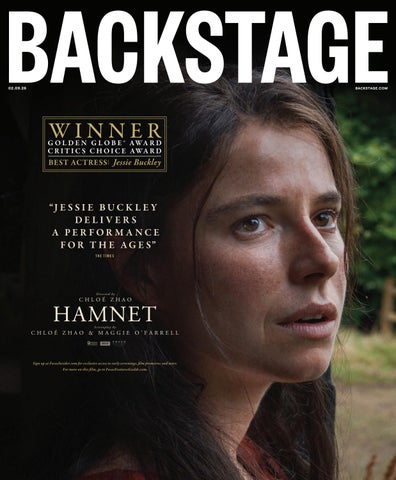
THE DREAM CAME TRUE


![]()


“THE CAST BREATHES LIFE INTO THEIR CHARACTERS.”
NEXUS POINT NEWS
“BILLY BOB THORNTON GIVES ONE OF THE BEST PERFORMANCES OF THE YEAR.”

USA TODAY
“SAM ELLIOTT IS INCREDIBLE.”
DECIDER
“ANDY GARCIA IS EXCELLENT.”
COLLIDER
“DEMI MOORE IS DOING SOME OF THE FINEST ACTING OF HER CAREER.”
MEN’S HEALTH
“ALI LARTER AND MICHELLE RANDOLPH KNOW HOW TO MAKE AN ENTRANCE.”


THE HOLLYWOOD REPORTER


How sticky tabs and sheer determination transformed Ariana Grande into Glinda—and where she’s heading next PAGE 20


8 CATCHING UP WITH Michael B. Jordan
10 A VERY ’70s OSCARS
This year’s lineup has a retro vibe‚ if you know where to look
12 TAKING THE LEAD
Why Rhea Seehorn is loving “Pluribus”
14 MEET THE MAKER
Guillermo del Toro‚ “Frankenstein” writer + director
16 BREAKING THROUGH
Peter Claffey’s journey to the Seven Kingdoms
28 THE BEST PERFORMANCES OF 2025
A voter’s guide to this year’s Actor Awards + Oscar nominees ADVICE
18 IN THE ROOM WITH
What the Academy Awards’ first casting nominees want actors to know
36 ASK AN EXPERT
Sean Astin on how actors can stay hopeful during uncertain times


BAFTA AWARD NOMINATIONS
BEST SUPPORTING ACTOR


Jacob Elordi

ACTOR AWARDS NOMINATIONS
OUTSTANDING CAST male SUPPORTING ACTOR
Jacob Elordi
“Jacob Elordi gives the best performance of the year.”
Offscreen Central


“Jacob Elordi gives a revelatory performance notable for its expressive physicality but perhaps even more so for its innocence, its deep well of yearning and the crushing emptiness that follows as the Creature comes to understand who and what he is.”
WINNER CRITICS CHOICE AWARD


BEST supporting ACTOR
Jacob elordi


PRESIDENT
Brian Wolf
Editorial
EDITORIAL DIRECTOR
Christiane Wartell
SENIOR EDITOR
Vinnie Mancuso
WRITER-EDITOR
Suzy Woltmann
EDITOR
Jacqueline Tynes
VIDEO PRODUCER + EDITOR
Nicole Della Vella
ASSOCIATE EDITOR
Jalen Michael
COPY EDITORS
Allison Hansen
Christopher Cronis
CHIEF CONTENT OFFICER
Stephanie Snipes
Production
DESIGN DIRECTOR
Jay Pollino
DESIGNER
Erica Whyte
JUNIOR DESIGNER
Rachel Geressu
PRODUCTION MANAGER
Carol Bobolts
CONTRIBUTING
CREATIVE DIRECTOR
Katherine Bryja Shady
SOCIAL MEDIA MANAGER
Sky Silverman
SENIOR SOCIAL MEDIA
ASSOCIATE
Karen Jenkins
CUSTOMER SERVICE MANAGER
Richard Burridge
CUSTOMER SERVICE ASSOCIATE
Stephanie Chung
Finance
DIRECTOR, ACCOUNTING
Jared Shaefitz
MANAGER, ACCOUNTING
Rose Sierra
SENIOR ACCOUNTANT
Marcella Valles
was founded in 1960 by Ira Eaker and Allen Zwerdling
CHIEF TECHNICAL OFFICER
Rashi Khurana
SENIOR MANAGER, MARKETPLACE CONTENT
Melinda Loewenstein
MARKETPLACE CONTENT MANAGERS
Claire Smith
Paris Stevenson
CASTING EDITORS
Elaina Crockett
Liam Farrelly
Lisa Hamil
Kevin Imajemite
Ellen Junquiera
Michael Moloney
Fabio Pereira
Samantha Theobald-Roe
Amy Vinten
REGIONAL CASTING EDITOR
Byron Karlevics
RESEARCH EDITOR
Rebecca Welch
DIRECTOR OF BUSINESS DEVELOPMENT
Susie Hanlon
BUSINESS DEVELOPMENT
Trevon Buccione
Liam Darby
Gina Hall
Sabrina Janeiro
Gerardo Maravilla
Bryony Pulizzi
Sonja Smith
Robert Stevenson
Kayshawn Wallace
Max Zillwood
VICE PRESIDENT, CASTING
Luke Crowe
Product
DIRECTOR OF PRODUCT
Sean Wregglesworth
PRODUCT MANAGERS
Alyssa Gera
Changhee Han
DIRECTOR OF PRODUCT DESIGN
Jeff Lilley
PRODUCT DESIGNERS
Jan Cantor
Tim James
Engineering
DIRECTORS, SOFTWARE ENGINEERING
Mohamed Taha
Joe Zeleny
TECHNICAL LEADS
Rob Archer
Neely Kartha
Drew Pitchford
Mike Lewis
SOFTWARE ENGINEERS
Akin Adekoya
Danilo Akamine
Andres Pra Baldi
Calvin Burns
Viktoras Chorunas
Katie Gray
Tanweer Rajwani
Carisa Tong
QA MANAGER
Kat Wootten
DEVOPS ENGINEER
Yuvraj Singh
GLOBAL IT LEAD
Paul Dorfman
SENIOR BUSINESS
INTELLIGENCE ANALYST
Madison Lukaczyk
DATA ENGINEER
Katie Vetter
VICE PRESIDENT, MARKETING
Colin Voreis
Advertising Sales
EXECUTIVE
DIRECTOR, MEDIA
Kasey Howe
CLIENT SERVICES MANAGER
Jenn Zilioli
Marketing
SENIOR MANAGER, WEB OPTIMIZATION
Dan Spero
CONTENT
MARKETING LEAD
Jen Wason
CONTENT STRATEGY LEAD
Robert Emigh
GROWTH MARKETING ASSOCIATE
Blair Davis
EMAIL MARKETING ASSOCIATE
Jalynn Wells
MARKETING MANAGERS
Lis Brum
Clarissa Tusa
MARKETING ASSOCIATES
Lauren Gearing
EDITORIAL OFFICES editorial@backstage.com
CASTING DEPARTMENT casting@backstage.com
DISPLAY ADVERTISING advertising@backstage.com
CUSTOMER SERVICE 917-725-6367 customers@backstage.com PERMISSION For one-time use of our content, as a full article, excerpt, or production prop, contact editorial@backstage.com
BACKSTAGE, VOL. 67, NO. 1 (ISSN#53635 USPS#39740) IS A BI-MONTHLY PUBLICATION (PUBLISHED 6 TIMES PER YEAR), TYPICALLY WITH ISSUES IN FEBRUARY, APRIL, JUNE, AUGUST, OCTOBER, AND DECEMBER by Backstage, LLC, 2300 Empire Ave, 5th Floor, Burbank, CA 91504, $3.99 per copy, $59.95 per year. Periodicals postage paid at Brooklyn, NY 11256 and additional mailing offices. Printed in USA. POSTMASTER: Send address changes to Attn: Backstage Customer Service, 2300 Empire Ave, 5th Floor, Burbank, CA 91504. Publication Mail Agreement No. 40031729. ©2026 Backstage, LLC. All rights reserved. No part of this publication may be reproduced, stored in any retrieval system, or transmitted, in any form or by any means, electronic, mechanical, photocopying, recording, or otherwise, without the prior written permission of the publisher. Backstage, LLC: Kasey Howe, Executive Director, Media, Luke Crowe, Vice President.


What do you remember about meeting Ryan Coogler?
I was coming back from South Africa, shooting “Chronicle.” Ryan had just finished the [“Fruitvale Station”] script. I got the script right before I flew back to L.A., read it, and cried my eyes out multiple times. We met at Twinkie Byrd’s casting office and then walked across the street to a Starbucks, and just started talking shop.
We hit it off as people, as friends, as human beings, and as athletes as well. There’s a lot we have in common, him being from Oakland, me being from Newark, New Jersey. There’s that big brother relationship with Manhattan being 15 minutes away, the same thing with him and San Francisco. I know what it’s like to grow up in a place like that and what it does to your ambition.
What was it like working on “Sinners” with the motion capture rig called the “Halo‚” which has 10–12 cameras around your face?
Once you get past the weight that is literally on your shoulders, it’s more or less like what you would be doing in your dressing room or at your house as you’re working through a scene. It’d be me on set, imagining the other lines, hearing the other characters’ voices in my head. Just continuing to work through that and giving as full of a performance as I could.
By Vinnie Mancuso
HAT DID MICHAEL B. JORDAN HAVE TO DO TO EARN his rst-ever Academy Award nomination, for best actor? Work twice as hard—literally. In Ryan Coogler’s period vampire drama “Sinners”—now the most Oscar-nominated lm of all time, with 16 nods—Jordan plays both Smoke and Stack, twins who return from a life of Capone-led crime in Chicago to open a juke joint in their native Clarksdale, Mississippi. Here, Jordan opens up about rst meeting ve-time collaborator Coogler, the particular challenges of the dual role, and why he’s so emotionally open about the art he loves.
WYou had to film nearly every scene twice‚ once as Smoke and once as Stack. How often did you regret a choice from the first take while you were filming the second?
It’s tough, because more often than not, you can’t go back. You gotta be like, Damn, why didn’t I think about that shit?
[Laughs] Obviously, if it’s something that I feel very
“That’s why I
love making movies and acting and directing. It’s trying to tap into that human emotion and build empathy for people who may not be as close to a subject‚ or character‚ or subculture.”
strongly about, I can try and make my case. But I know what that does to our day. I know what that means from a director’s standpoint, how tough that is. So I try my hardest to never do that. That’s why the prep work was so important.
If you could only be nominated for Smoke or Stack‚ which performance do you think it ’d be?
What are you doing to me, man? [Laughs] I’ll put Smoke in lead and Stack in supporting.
You’ve been very open about the art you love‚ especially anime‚ making you cry. Why is that important?
I’m an emotional person, you know? Growing up with anime, or your favorite shows, you grow attached to these characters. There are themes and messages in anime that are so layered and complex, but sometimes so simple and human. It just affects me in a real way. I’m not ashamed of it, nor do I think about pride or ego, or that I can’t show vulnerability. I think it’s healthy. Maybe it makes somebody else feel more comfortable to be able to open up, to cry if you want to cry.
That’s the beauty of art and storytelling. That’s why I love making movies and acting and directing. It’s trying to tap into that human emotion and build empathy for people who may not be as close to a subject, or character, or subculture. Being a connector and a bridge between those things is an honor and a privilege.
This interview has been edited for clarity and length.


A deeper look at the trend pulling this year’s race into retro territory
By Jason Clark

●IT MAY BE 2026‚ BUT A LOOK at the Academy Awards’ best picture and acting nominees shows an interesting trend. There’s really only one big-money “Hollywood” movie sparkling in the lineup (“F1”); the rest are lms very much taking up the mantle of the personal, character-driven lmmaking of the 1970s, with the nominated actors eschewing easy star parts for more grit-and-gruel performances that favor intensity over adoration.
directly against each other: “Marty Supreme”
most his are broadly visionary, nerveabout


of a
Two of the nominated movies pit two generations directly against each other: “Marty Supreme” powerhouse Timothée Chalamet is situated right next to the actor most people compare him to, “One Battle After Another” star Leonardo DiCaprio, who is 20-plus years his senior. Both of their lms are broadly visionary, nervejangling opuses about di erent forms of men-children—characters ripped from the 1970s playbook, where the antihero reigns—and both actors give themselves over to the roles completely. There is more than a trace of Jack Nicholson in “The Last Detail” (1973) or “One Flew Over the Cuckoo’s Nest” (1975), or “Dog Day Afternoon”–style Al Pacino, rattling around in these
portrayals. DiCaprio’s perpetually stoned revolutionary dad and Chalamet’s garrulous, uber-con dent ping-pong whiz are both antiheroes who could sit easily in a Bob Rafelson or Hal Ashby project, and both anchor lms that are de antly of their time yet somehow ageless. First-time nominee Michael B. Jordan’s double role in “Sinners” with its two clearly de ned brothersin-crime-and-life—seems to use Jordan’s movie star wattage at a lower register. His performance feels more indebted to a “Claudine”-era James Earl Jones or Burt Reynolds in 1972’s “Deliverance‚” mixed with ’70s Black action-star swagger (think Fred Williamson or Richard Roundtree), versus later luminaries like Denzel Washington or Jamie Foxx, who seem to have in uenced much of Jordan’s past work.
Joachim Trier’s Norwegian gem “Sentimental Value‚” with all four of its central performers nominated, also taps into the decade’s sensibilities. The performances and Trier’s elegant held takes and use of closeups evoke the emotional rigor of Ingmar Bergman, whose bold, un inching dramas crossed into mainstream Oscar contention with lms like “Cries and Whispers” (1972) and “Autumn Sonata” (1978).
Nothing is more inherently ’70scoded than “The Secret Agent‚” a gritty, genre-bending thriller set in
1970s posters from “Claudine‚” “Dog Day Afternoon‚” “All the President ’s Men‚” and “The Exorcist‚” at a time when character studies‚ horror films‚ and political thrillers all competed for Oscars

the decade. Its director, Kleber Mendonça Filho, a former lm critic turned lmmaker, is never shy about his in uences, from the Italian thriller “Investigation of a Citizen Above Suspicion” (1970) to the lms of Brian De Palma, whose Hitchcockian ri s like “Obsession” (1976) and “Sisters” (1972) dominated the period. A savvy moviegoer can pick up these in uences in many frames of “The Secret Agent,” right down to newbie Oscar nominee Wagner Moura’s sweaty, unbuttoned disco-era attire.
And if you haven’t been paying attention, international lms are nding audiences again and increasingly becoming a major force during awards season. This year’s Oscars even include a foreignlanguage-speaking actor in each of the four acting categories (thanks mainly to “Sentimental Value”), and it feels much like the time when François Tru aut and Federico Fellini were regulars in the awards conversation, alongside Hollywood


counterparts like John G. Avildsen with “Rocky” (1976) and George Roy Hill with “The Sting” (1973).
A few of this year’s more refreshing nominees came in the form of veteran actors in their 70s, in lms falling under the horror banner: Delroy Lindo in “Sinners,” enjoying his rst-ever Academy Award nomination for playing musician Delta Slim; and “Weapons” phenomenon Amy Madigan, whose indelible Aunt Gladys garnered the actor’s rst Oscar nod in exactly 40 years. Horror lms seem to nally be registering with the acting branch (recall Demi Moore’s nom

for “The Substance” just last year); the Academy historically has avoided spooky pics except in very rare cases, like William Friedkin’s “The Exorcist” (1973) or De Palma’s “Carrie” (1976). But as in that era, the Academy now seems to be warming to them as a viable genre for awards attention for actors.
Even those who went unnominated this year still operated in this creative climate. Major Hollywood stars embraced uncompromising and risky leading roles in dramas, like Jennifer Lawrence’s impressively erce turn as a troubled mother in “Die My Love” or Golden Globe idol Julia Roberts in “After the Hunt‚” playing a morally questionable professor caught up in a harassment scandal. This type of role aligns more closely with the thorny, emotionally volatile characters played by 1970s icons like Gena Rowlands or Glenda Jackson than, say, the lighter comedic ones that de ned the “Pretty Woman” star’s early career (a movie for which she received an Oscar nomination).
This makes for an interesting contrast to only a few years ago, when the success of Barbenheimer de ned 2023 and helped reestablish theatrical momentum. By comparison,
this year’s top nominees (“Sinners” with 16 nods and “One Battle After Another” with 13) recall a looser, funkier period completely unlike the one they’re in while still re ecting the modern moment. It makes perfect sense that these 2025 titles are more methodical and require more introspection about our dark, uncertain times, whereas the “Barbie” and “Oppenheimer” year (which also had a quite impressive best picture roster) felt more like an industry trying things out postpandemic, with lmmakers more overtly exing every tool available to them.
It remains to be seen whether the Oscars on March 15 will embrace the horror of “Sinners” or the revolutionary stance of “One Battle After Another,” or maybe even the Bergmanesque family dynamics of “Sentimental Value”; but even the steely 1970s loved an underdog. At the 1977 Academy Awards, a little movie about a Philly pugilist named Rocky Balboa bested movies such as “Network‚”“All the President’s Men‚” and “Taxi Driver.” Rocky himself probably summed it up best way back then: “It really don’t matter if I lose this ght…. ’Cause all I wanna do is go the distance.”


The three-time Emmy nominee follows her acclaimed run as Kim Wexler on “Better Call Saul” with her first leading role‚ as Carol Sturka on Vince Gilligan’s buzzy Apple TV series “Pluribus”
By Derek Lawrence
Her reaction to reading Vince Gilligan’s pilot script “This is bananas. What is happening? But I was instantly like, I would be a massive fan of the show even if I didn’t get to do it. The twists and turns.
On playing Kim Wexler vs. Carol Sturka


The massive philosophical and psychological questions it’s asking while maintaining this breathless pace of a mystery. And this physical threat that then becomes actually a psychological threat. I could also hear this undercurrent of dark comedy going through it, which just delighted me.”
Stepping into a role all her own
“I don’t want to get an opportunity like this and barely pull it o . You want to be your best. I want to deliver a performance that’s better than I did yesterday. So I try to challenge myself and come to the table with thoughts, and knowing all my lines, backwards and forwards.”


“It was instantly exciting to me that Carol’s the polar opposite of Kim. She’s so reactive, so impulsive. Although I will say that they both have this thing that if, in their gut, they know what’s right to do, they will do it.

It’s just that I think Kim would lead the brigade, whereas Carol, as Vince would remind me all the time, is a reluctant hero.”
How she felt returning to Albuquerque to film
“It was actually comforting to see people and places that I had known for seven, eight years while shooting ‘Better Call Saul.’ When you need to be away from your family to shoot something this intensely, with this workload that I had, it’s very comforting to know exactly what aisle the snacks that you like are in.”
To read the full interview‚ visit backstage.com/magazine.


Meet the Maker
By Vinnie Mancuso
●LIKE THE MAD SCIENTIST
who gave Mary Shelley’s 1818 seminal work of Gothic horror its title, Guillermo del Toro has been consumed by the idea of bringing “Frankenstein” to life for years.
“When I was a kid, I saw the creature, Boris Karloff, and thought, ‘That’s a saint. That’s my Messiah,’ ” the Oscar-winning director tells us. Now, del Toro’s monster has been unleashed on the world (or, at least, on Netflix); his adaptation is an epic allegory of fathers and sons starring Oscar Isaac as Victor Frankenstein and Jacob Elordi as his reincarnated creation.
We sat down with del Toro to dive into his thoughts on life, death, religion, and how they all combined into his decades-in-themaking masterpiece.

You were raised Catholic and then lapsed later in life. I’m very much the same. What is it about the story of “Frankenstein” that is so attractive to people with that kind of background?
I was very intrigued as a kid: Why did God send his son to be crucified? Because pain was a learning tool for God. God needed to experience death because he had created life. That blends with the Frankenstein myth.
I remember my grandmother saying, “I don’t like you reading horror stories.” And I said, “Well, then take the Bible away.” There are enslaved people, disemboweled people, people crucified upside down. The Maccabean brothers are toasted on an oven, and they amputate their legs and their hands. There’s also the component of all that being pleasurably ecstatic, because you’re offering it to God, or doing it for God. The fusion of blood and redemption, pain and redemption, all this is what fuses horror with the Catholic dogma, at least in my mind, so profoundly.
Oscar told us defiance was central to your early conversations—wanting to defy your fathers‚ death‚ religion. I have learned that life is like fishing: You gotta pull, and you gotta release, right? But I’m 60. I know Victor as a character—or me as a young director—it’s all pull; it’s all defiance. Victor is the type of person that has certainty, which is the most dangerous type of person you will encounter in your life, be it a politician or a scientist. The absolutes are where the oxygen leaves the room. When somebody has no doubt, you should truly just brace yourself, because something terrible will happen.
Oscar told us you reshot the last scene. What made you have the confidence to say‚ “Let’s try it again”? He gave me a reason. I said, “We got it; I saw you accepting the creature.” And he said, “Yeah, but I want to do it as my father. I did it as me. Can I try it as my father?” And I said, “Go ahead,” because that’s a good reason. You’re going to channel something completely new. He said, “I want to be the creature, and I want to be my dad, saying I see you and I accept
you and I ask your forgiveness.” I thought that was very powerful, very profound.
That actually makes the story he told us even more meaningful. That’s what made me do it. To me, there is no stone you should leave unturned if somebody says, “What about this?” It’s worth it, meaning you have to listen to the movie. The difference between being a young director and an old director is you listen to the movie. The real credit on a film should be a film by the film. When something goes wrong, or something needs repetition, that is the movie trying to form itself.
There’s a very powerful height difference between Oscar and Jacob. How did you use that as a storytelling tool?
With the creature, there are pointedly several moments in the film where you see it towering over Victor and yet being gentle. Then, finally, at the end, when it throws Victor against the cabinet and tosses him around… He’s not the baby anymore. You’re tracking that moment when the father and the son have a moment, and the teenager is taller than the dad, and the father, at least in the back of his mind, goes, “Uh-oh.” It was about taunting with the camera, particularly when the monster rises and Victor is crouching on the floor. You realize, Oh, this could and will go wrong at some point.
Have you thought about what the film would have been like if you made it at the beginning of your career, and what does that tell you about who you are now?
You get to a point in your life where you accept that you’re not going to always be right, and that life is going to take you by the hand and show you what is right. I think you have to access the Tao of it all in order to make a movie this size, to try to retell a story that has been told 100 times with your own voice. It’s like Johnny Cash singing [Nine Inch Nails’] “Hurt.” He was at exactly the moment where his voice could sing that and mean what he meant as an old man, very different from the regret of “Ring of Fire.” This is a man who says, “I’m here, and I realize I’m on my last lap, and this is all the pain I

feel.” If you are Mary Shelley and you are 18, or you are 60 and you’ve done things that hurt you or others, and you’re not a perfect being, I think you either rebel against the world, which is what Mary Shelley did, or you rebel against yourself, which is what I did.
You’ve talked a lot about the importance of authenticity‚ and I know you often handcraft or paint small details on your sets. What’s something you did that with in “Frankenstein”?
I painted the wooden archangel that Victor prays to in his childhood bedroom, the one that becomes a Red Angel. I repainted the wings, the face, the arms, some of the dressing, and the legs and the feet. Because I didn’t feel like it felt of the time. The paint job was very rough, so I took it home and I repainted it with my acrylic paint and completely changed the paint job. I [also] commissioned many of the props out of my own pocket because they were too extravagant.… I just think that if you don’t make an oil painting that looks of the period, or you don’t make a sculpture that looks of the period, the movie goes to hell.
This interview has been edited for clarity and length.
“The difference between being a young director and an old director is you listen to the movie. The real credit on a film should be a film by the film.”

del Toro and Costume Designer Kate Hawley
By Derek Lawrence

●PETER CLAFFEY IS ABOUT to see his life transform, whether he wants it to or not. The Irish actor leads HBO’s “A Knight of the Seven Kingdoms,” the latest “Game of Thrones” prequel, which debuted last month. “I have this hopefully not false hope that it won’t change massively,” he says, speaking weeks before the premiere, during a break from production on Season 2. “I’m terri ed for the release, not knowing what that looks or feels like.”
It’s understandable. The 29-year-old former professional rugby player made his onscreen acting debut just four years ago, and has since appeared on Apple TV’s “Bad Sisters” and Net ix’s “Vikings: Valhalla.” But for the 6-foot-5-inch actor, this is his
tallest order yet. Adapted by Ira Parker and George R.R. Martin from a series of Martin’s novellas, and set roughly 100 years before “Game of Thrones,” “A Knight of the Seven Kingdoms” stars Cla ey as Ser Duncan the Tall, aka Dunk, a lowly hedge knight whose search for purpose is complicated when he takes on a new squire, Egg (Dexter Sol Ansell).
What was it about Dunk that most appealed to you?
In “Game of Thrones,” characters nd it incredibly tough to get through a life where there’s so much politics and backstabbing. There’s a really good moral compass to Dunk, and that’s quite endearing to try and live by that in such a hard world.
Unlike “Game of Thrones” and “House of the Dragon‚” this series does not have a sprawling cast— it’s really on your shoulders. Were you intimidated by that?
It was very hard to not think about it [beforehand], because I was a huge fan of the original series, so I knew the following behind it. And the fact that it follows Dunk, I was worried about the tremendous workload. Until the second half of the shoot, it was quite nerve-racking; but, because you’re always in [scenes], you don’t have time to think about it.
How did you and Dexter develop your dynamic?
I met him in the chemistry read, and the impression that you’re talking to a 10-year-old quickly
dissipates, because he’s got such maturity to him. And he’s just a phenomenal little actor. There’s a [scene] at the end that’s some of the best acting I’ve ever seen. It was great to have a partner in crime to help each other through things. Where we were staying was right beside an arcade and bowling alley, and we used to go there to bond.
Even as you were playing rugby‚ was acting something that you were attracted to as a future path? I always loved performing, whether it was music or acting, and that got put on the back burner when rugby got serious at 13. I grew up in a small town in Ireland, and there’s a traditional macho outlook, and anyone doing acting is laughed at. If there’s anything I could tell my younger self, it’s: You don’t realize how empowering it is when you stop giving a fuck what anyone thinks about you. When I was younger, I neglected things in my own heart because I wanted to impress girls and the cool guys, and it’s all just such bullshit.
What advice would you impart to aspiring actors?
The ability to make a good short lm is in your pocket—use it. Take advantage of what an iPhone can do now. So many people are like, “Oh, I can’t write; I can’t do this.” Shut up, and just do anything. Find someone who can write and lm it with them. You have the power to get yourself out there and express and work your muscles. Get used to having a camera in your hands, and the more that you try these things, the more you will get there.
This interview has been edited for clarity and length.


They’re behind 2025’s most acclaimed ensembles. Here’s the advice they want actors to hear
By Backstage Staff
● FOR THE FIRST TIME IN ACADEMY AWARDS HISTORY‚ CASTING DIRECTORS are getting their own Oscar. To celebrate this long-overdue recognition, we’ve pulled together the advice that this year’s nominees have shared with us, and what they consider essential for any actor walking into an audition.


Cassandra Kulukundis‚ “One Battle After Another”
Gabriel Domingues‚
“The Secret Agent”
“I like it when [actors] ask good questions‚ like the right questions. That’s a thing for me. Like, ‘Let’s talk about this. Let’s discuss that. Let’s try to think about how it would be if we do this.’ That interests me a lot. And also, besides asking questions, I feel that when they’re honest and they’re vulnerable in a way that we can connect to them in their vulnerability, like in the human aspects of it, if we create a good human connection, then we can have fun.”


“Keep your information up-to-date and pay attention‚ because I was trying to search for a bunch of people, and they weren’t getting back to me, so they missed out. I’m not a social media user, but when I’m working on a movie, yeah, I’ve got this fake Instagram and I’ll DM you!”


“I personally like it when [actors] just keep [their self-tape] simple. Some people really go to town and practically make the whole film! And then it’s pretty impressive, but it’s not necessarily revealing everything you need to know about the performance. It’s fun and you remember it, I guess. But just a fairly simple‚ plain [tape] just dealing with the text and the performance‚ rather than any other stuff‚ is pretty good.”


“When people are learning lines, they get over-rehearsed a lot. It begins to sound like line-reading because they’re so focused on learning. I always [recommend] using improv to get people out of their heads‚ redirect them‚ and then bring them back to the line. I think it’s a great tool for actors just to play with. Even if a director is not going to let you improvise, I do think it’s important for actors to exercise that muscle, because it’s a good way to get warmed up and get comfortable.”


“When you get an audition, look at who’s directing it, who’s written it, [and] look at their work. There’s a tone that every director has. There’s so much information to be gotten from doing that research. Then I would say, try to make some strong choices. I feel bad for actors if they’re self-taping and not getting any direction, because they don’t know what to do; but sometimes people go just in the middle, and the middle never works. Just try to, with what you know, make a choice.”
These quotes have been edited for clarity and length.


How sticky tabs and sheer determination transformed Ariana Grande into Glinda— and where she’s heading next
By Vinnie Mancuso
HE LORE BEHIND ARIANA Grande’s lifelong pursuit of “Wicked” feels as much like a fairy tale as “Wicked” itself. The adaptation of Gregory Maguire’s revisionist prequel to “The Wizard of Oz”—existing first as a Broadway musical, and now as two films from director Jon M. Chu— has been Grande’s dream project since she first saw the stage version at 10 years old, an anecdote she’s repeated time and again.
In fact, in a 2010 interview in this very magazine— back when Backstage was still “Back Stage” and the Nickelodeon star, 17 at the time, had yet to become a pop icon with 19 Grammy nominations and 10 billion streams per year to her name—she said this: “I know this is so expected of me, but I would love to play Elphaba in ‘Wicked’ on Broadway. I have a lot of dream roles, but that’s like my main one.”
The dream shifted, as they often do—Grande eventually landed the role of the bubblegum “good witch” Glinda instead, while Cynthia Erivo was cast as the gravity-defying, green-skinned Elphaba. But it happened. The fantasy came true, and the final tally is in: 2024’s “Wicked” earned Grande her first Oscar nomination, plus nods at the BAFTAs, Actor Awards, and Golden Globes, while its 2025 sequel, “Wicked: For Good,” added two more at the Actors and Globes.
Now, Grande finds herself in a situation not unlike Dorothy Gale in the 1939 “Wizard of Oz” film, having awoken from a technicolor dream back into a sepia-toned world, changed in ways that are hard to describe. After a lifetime thinking about “Wicked,” and five years putting those thoughts into action, she’s faced with a new question: What kind of actor is she after “Wicked”?


“It’s a gorgeous g i to care so much that someti mes you get af raid.”
“It feels like a beautiful time to put it in a beautiful book on the shelf next to the other Frank Baum books that I collect,” Grande tells us, speaking in a perfectly measured tone to protect her voice during a marathon awards season. “It does feel like the right time to turn the page and to thankfully and proudly, gratefully let go.”
But moving on won’t be easy. Grande is now as inextricably tied to Glinda as the character’s Broadway originator, Kristin Chenoweth, which is a bit of a miracle, given that landing the part meant reevaluating the globally recognizable persona built on high ponytails and winged eyeliner.
“Before ‘Wicked,’ I hadn’t acted in a decade-ish. My pop music career, which I am so endlessly grateful for, had taken on a life of its own, a life that I don’t know I could have predicted or planned for,” Grande says. “The whole journey toward ‘Wicked’ and earning the role was a really uphill battle because I had a lot of convincing to do, and a lot of deconstructing the pop star Ariana that everyone knew of. I had to do a lot of deconstructing to convince a lot of people that I could disappear into her.”
The first step for Grande, an early adopter of social media as a way to connect directly with fans, was to put herself in, well, a bubble. “Getting the role [meant] having to shut out the noise from the world, a lot of whom didn’t think I could do it, or was right for it,” she says. “I had to just stay locked in and present in the work.”
What was “the work,” exactly? “I’m very much a Stella Adler girlie,” Grande says, referring to the acting philosophy that emphasizes an outside-in approach, where a performance feels truthful because the actor has imagined every detail of their character’s circumstances. (As opposed to inside-out techniques like Lee Strasberg’s Method, which encourage the actor to utilize their real memories as a way toward truth.) Talking to Grande, you do sense the reservoir of personal experiences she could pull from to play Glinda, a consummate performer whose glossy outer sheen hides layers of loss and insecurities. “I can love her through her worst moments,” she says, “because I’ve experienced similar ones myself.”
inventing them as real people for us, it’s not only really effective and helpful in the moment as an actor, but it’s really protective as a human being,” she says.
“I really do think [Glinda] is a hero in a lot of ways, and I wanted to make sure that was clear and that she was as human as possible. I wanted to know her as well as I know myself,” Grande continues. “For me, everything comes from somewhere. I do a lot of work and a lot of therapy to figure out the connective


But she didn’t want to drown in that reservoir for the duration of the 155-day shoot. “I think as much as we can do with fiction, with the character’s life and

tissue between certain triggers now that also touch on something from way back then. I wanted to do that for Glinda, too, so that when the time came, I wouldn’t have to reference my own pain. I could have hers available and know why.”
Grande developed a system to track Glinda’s emotional arc through both films, covering her notes and scripts in sticky tabs, each a different color for a different feeling. “What emotion, what undertones are showing up here for her? Does she feel genuine, pure trust and love in this scene, or is she covering up for something? Is she performing in this scene or is her guard down?” Grande says. Eventually, the colors combined to paint a bigger picture—like the rows of tulips that dot the land of Oz.
She also meticulously built bits of backstory for Glinda beyond even what Baum had imagined for her. I ask when these notes most came in handy, and Grande immediately responds with Glinda’s lowest moment, the character at her most unlikable. It comes in “Wicked: For Good.” Glinda’s husband-to-be, Prince Fiyero (Jonathan Bailey), has just fled with Elphaba on their wedding night. Reeling from the betrayal, Glinda tells the Wizard of Oz (Jeff Goldblum) and Madame Morrible (Michelle Yeoh) to use Elphaba’s sister, Nessarose (Marissa Bode), as bait.
“In those moments when you experience a shocking, traumatic event that happens quickly, your brain goes a hundred million places at the same time. So I had to figure out what would lead her to say that: ‘Use her sister,’ ” Grande explains. “I had to think about all of the times I had seen [Elphaba and Fiyero] together without me. I had to write a bunch of other times when that had happened, that you don’t even see in the movies, just for me to reference and point to for my own self. So that to get to ‘Use her sister,’ I can be remembering those things for the first time.”
She still has all the notes, the sticky tabs, the “treasure trove of memories and little secrets,” as she puts it. “I would love to go get them, but I don’t know if I’ll be able to find them in a quick enough amount of time to make the best use of the rest of our interview,” she says with a laugh. Which actually feels like a fitting metaphor for where Grande is right now. Glinda is still very much a part of her—she’s tucked away somewhere—but it’s time to talk about what’s next.
And that is something she is ready to do. “Well, first of all, I don’t even think I’ve been able to talk about this yet, so this is very exciting,” she says when the conversation turns to “Focker In-Law,” which hits theaters this November. Grande was cast in director John Hamburg’s lega-sequel to the 2000 rom-com “Meet the Parents” back in May, joining returning cast members Ben Stiller, Teri Polo, Blythe Danner, and, of course, perennial Italian American icon Robert De Niro. “It was an amazing experience being able to work with Mr. De Niro. I absolutely adore

him,” Grande says, before making sure to emphasize: “He’s Robert De Niro.”
“It’s exactly what you would expect; he’s just the greatest of all time. As a human being, it was so lovely to get to know him,” she continues. “It’s a little emotional, but I felt like he was a part of my Italian family that I grew up with. I felt like I was supposed to meet him.”
“Focker In-Law” is part of Grande’s return to juggling movies and music, but now she’s doing it on her terms, choosing projects that test her range. Starting in June, she will reconstruct her pop star persona on the Eternal Sunshine Tour, playing 41 shows across 11 arenas. On the other side of that, she’s set to reunite with “Wicked” costar Bailey for a 2027 run on the West End in director Marianne Elliott’s “Sunday in the Park With George” revival, her first time onstage since starring in a pantomime “Snow White” at the Pasadena Playhouse in 2012. Somewhere in the middle, she has a small role on the 13th season of Ryan Murphy and Brad Falchuk’s “American Horror Story.”
Speaking of that last one—did you know that Grande loves horror? The only topic that lit her up more than a chance to talk about De Niro was the opportunity to gush about “The Ring” and “Psycho,” to tell me how formative M. Night Shyamalan’s “Signs”


“I ha d a lot of conv i nci n g to do, and a lot of deconstr ucti n g the
was to her film fandom. When I tell her she needs to lead a horror movie, she beams. “I would love that. It would be such a blast,” she says. “Fingers crossed.”
It’ll probably happen. If “Wicked” taught her anything, it’s that manifestation works. But if we should learn something from Glinda, it’s that success isn’t about waving a wand. There’s a human inside the bubble. I ask Grande how often, even now, self-doubt creeps into her mind, and she interrupts to say: “You mean the monsters? The nervous monsters?
“All the time,” she continues. “To anyone reading this, it’s a gorgeous gift to care so much that sometimes you get afraid. It is a tremendous gift to have those nerves that carbonate your experience, that make you want to work harder, to challenge yourself to constantly become better, or to do the thing that people don’t believe you can do.”
For Grande, her career has been built on balancing intense focus with intense feelings. “There are exercises you can do to ask [those nerves] to leave, and they will come back later, so that you can be present and in the moment and in the work,” she says. “But in life, it’s a very healthy thing to have them there because it means that you don’t take it for granted, and that you care so much.”
If there’s one thing Ariana Grande is on the record about, it’s caring a lot. And it’s gotten her to this
pop star A r iana that ever yone k new of.”
point. “When I look back on some of the things in my career, I can’t believe they’ve happened,” she says. “And I know I did the work so that they could, but I still feel as curious and inspired as…the first day I got here. I don’t think I’ve changed, or that I’ve let what has happened in my career that has worked or been successful be too present in my head.”
Grande’s “Wicked” era is over, but she’s taking a key piece of Glinda’s final arc into the future: “Good” is doing the work, and the rest is noise. “I celebrate the good things and I say thank you when they happen,” she says. “But I don’t let them disconnect me from the little girl who had the ‘Wicked’ poster in her bedroom in Boca Raton, Florida, who taught herself how to vocal produce on GarageBand when she was 12.”


“I don’t know how much higher the stakes could be for a character. The responsibility he was placing solely on himself, truly the weight of the world was on him.”
—JESSE PLEMONS, “BUGONIA”


The of the


A voter’s guide to every acting nominee across the Actor Awards and the Oscars—and what they had to say about the work


Male Actor in a Leading Role
□ Timothée Chalamet‚ “Marty Supreme”
□ Leonardo DiCaprio‚ “One Battle After Another”
□ Ethan Hawke‚ “Blue Moon”
□ Michael B. Jordan‚ “Sinners”
□ Jesse Plemons‚ “Bugonia”
Female Actor in a Leading Role
□ Jessie Buckley‚ “Hamnet”
□ Rose Byrne‚ “If I Had Legs I’d Kick You”
□ Kate Hudson‚ “Song Sung Blue”
□ Chase Infiniti‚ “One Battle After Another”
□ Emma Stone‚ “Bugonia”
“We don’t always agree with every decision that she makes, but we actually love Per dia Beverly Hills, and it’s because she’s so human, and she’s raw, and unapologetically herself, and she stands ten toes down in what she believes.”
—TEYANA TAYLOR, “ONE BATTLE AFTER ANOTHER”


“ ‘If I Had Legs I’d Kick You’ stretched me, technically, to a place that I’ve never been before. It really has sort of changed me as an actor, because of that language with the camera and how I had to adjust and gure out what [the director] needed.”

—ROSE BYRNE, “IF I HAD LEGS I’D KICK YOU”
Male Actor in a Supporting Role
□ Miles Caton‚ “Sinners”
□ Benicio Del Toro‚ “One Battle After Another”
□ Jacob Elordi‚ “Frankenstein”
□ Paul Mescal‚ “Hamnet”
□ Sean Penn‚ “One Battle After Another”
Female Actor in a Supporting Role
□ Odessa A’zion‚ “Marty Supreme”
□ Ariana Grande‚ “Wicked: For Good”
□ Amy Madigan‚ “Weapons”
□ Wunmi Mosaku‚ “Sinners”
□ Teyana Taylor‚ “One Battle After Another”
Cast in a Motion Picture
□ “Frankenstein”
□ “Hamnet”
□ “Marty Supreme”
□ “One Battle After Another”
□ “Sinners”
Stunt Ensemble in a Motion Picture
□ “F1”
□ “Frankenstein”
□ “Mission: Impossible—The Final Reckoning”
□ “One Battle After Another”
□ “Sinners”

“I don’t have a xed process. But I do believe in this active art where you’re using your body the whole time, and your mind and your curiosity and your theories on how human beings are.”
—PAUL MESCAL,
“HAMNET”
“Maxine’s identity was in her marriage, and the moment that went away, she was like, OK, well, now who am I? In Season 1, you are seeing someone who’s trying to be someone who she’s not; and in Season 2, she’s trying to gure out who she is and be that person.”
—KRISTEN WIIG, “PALM ROYALE”

“I wanted you to go on a journey with a family who were a good, hardworking, decent, law-abiding, loving, caring family—just a normal family. And I wanted the audience to try and understand with the family: Why has this happened to us? What’s gone wrong for our boy to do such a horrendous act like this?”
—STEPHEN GRAHAM, “ADOLESCENCE”


Male Actor in a Drama Series
□ Sterling K. Brown‚ “Paradise”
□ Billy Crudup‚ “The Morning Show”
□ Walton Goggins‚ “The White Lotus”
□ Gary Oldman‚ “Slow Horses”
□ Noah Wyle‚ “The Pitt”
Female Actor in a Drama Series
□ Britt Lower‚ “Severance”
□ Parker Posey‚ “The White Lotus”
□ Keri Russell‚ “The Diplomat”
□ Rhea Seehorn‚ “Pluribus”
□ Aimee Lou Wood‚ “The White Lotus”
Male Actor in a Comedy Series
□ Ike Barinholtz‚ “The Studio”
□ Adam Brody‚ “Nobody Wants This”
□ Ted Danson‚ “A Man on the Inside”
□ Seth Rogen‚ “The Studio”
□ Martin Short‚ “Only Murders in the Building”
“I watched a lot of live performances of Patti Smith, just because of the way she expresses herself through her music and presence. Her album ‘Horses’ was something I listened to a lot when I was rst discovering Helly R.” —BRITT LOWER, “SEVERANCE”
Female Actor in a Comedy Series
□ Kathryn Hahn‚ “The Studio”
□ Catherine O’Hara‚ “The Studio”
□ Jenna Ortega‚ “Wednesday”
□ Jean Smart‚ “Hacks”
□ Kristen Wiig‚ “Palm Royale”
Male Actor in a Television Movie or Limited Series
□ Jason Bateman‚ “Black Rabbit”
□ Owen Cooper‚ “Adolescence”
□ Stephen Graham‚ “Adolescence”
□ Charlie Hunnam‚ “Monster: The Ed Gein Story”
□ Matthew Rhys‚ “The Beast in Me”
Female Actor in a Television Movie or Limited Series
□ Claire Danes‚ “The Beast in Me”
□ Erin Doherty‚ “Adolescence”
□ Sarah Snook‚ “All Her Fault”
□ Christine Tremarco‚ “Adolescence”
□ Michelle Williams‚ “Dying for Sex”

“The level of intensity that was built up throughout the process of [Episode 3], right up until the moment when Owen [Cooper] leaves the room. Keeping a lid on it and keeping my professional hat on was so much harder than I anticipated because of the genius of the writing. It naturally created this electricity, so that the minute that Owen left, I genuinely felt like I could breathe.”
—ERIN DOHERTY, “ADOLESCENCE”

“[Seth Rogen and I] do, I think, have a very funny kind of rhythm. [Episode 1 guest star] Marty Scorsese was like, ‘You guys are great. You’re like Abbott and Costello. It’s fantastic.’ ”
—IKE BARINHOLTZ, “THE STUDIO”
“I don’t know if the more thought you put into [acting], the better you are at it, necessarily. Writing and directing, the more parameters you lay out for yourself and the more articulable creative goals you have, the better it is. That’s what’s cool about acting: It’s a lot scarier, in a way, in that it’s a little bit more mysterious.”
—SETH ROGEN, “THE STUDIO”

□ “The Diplomat”
□ “Landman”
□ “The Pitt”
□ “Severance”
□ “The White Lotus”
Ensemble in a Comedy Series
□ “Abbott Elementary”
□ “The Bear”
□ “Hacks”
□ “Only Murders in the Building”
□ “The Studio”
Stunt Ensemble in a Television Series
□ “Andor”
□ “Landman”
□ “The Last of Us”
□ “Squid Game”
□ “Stranger Things”
Actor in a Leading Role
□ Timothée Chalamet‚ “Marty Supreme”
□ Leonardo DiCaprio‚ “One Battle After Another”
□ Ethan Hawke‚ “Blue Moon”
□ Michael B. Jordan‚ “Sinners”
□ Wagner Moura‚ “The Secret Agent”
Actress in a Leading Role
□ Jessie Buckley‚ “Hamnet”
□ Rose Byrne‚ “If I Had Legs I’d Kick You”
□ Kate Hudson‚ “Song Sung Blue”
□ Renate Reinsve‚ “Sentimental Value”
□ Emma Stone‚ “Bugonia”
Actor in a Supporting Role
□ Benicio Del Toro‚ “One Battle After Another”
□ Jacob Elordi‚ “Frankenstein”
□ Delroy Lindo‚ “Sinners”
□ Sean Penn‚ “One Battle After Another”
□ Stellan Skarsgård‚ “Sentimental Value”
Actress in a Supporting Role
□ Elle Fanning‚ “Sentimental Value”
□ Inga Ibsdotter Lilleaas‚ “Sentimental Value”
□ Amy Madigan‚ “Weapons”
□ Wunmi Mosaku‚ “Sinners”
□ Teyana Taylor‚ “One Battle After Another”


“I started seeing Lorenz Hart as a beating heart on the barstool. He’s that vulnerable. It’s that easy to tear. Everything hurts his feelings; everything makes his heart race.”

—ETHAN
HAWKE, “BLUE MOON”

“I felt a deep desire to be closer to Annie’s way of interacting with the world. With acting, there’s this belief in what’s not really happening, what’s not real. But what Annie believes is very real. It is very tangible, and she’s fully connected.”
—WUNMI MOSAKU, “SINNERS”


“Per the script, I’m the antagonist. I’m supposed to be the bad guy, but Gladys doesn’t think she is. Gladys is someone who’s doing exactly what she needs to do to survive. You know, it’s like the adage: A woman’s gotta do what she’s gotta do. And this woman does.”
—AMY MADIGAN, “WEAPONS”

Which film is your pick for best picture?
□ “Bugonia”
□ “F1”
□ “Frankenstein”
□ “Hamnet”
□ “Marty Supreme”
□ “One Battle After Another”
□ “The Secret Agent”
□ “Sentimental Value”
□ “Sinners”
□ “Train Dreams”
“When it comes to rom-coms or things that are supposed to bring life-a rming joy, certain people have that [ability]. I think this movie needed that type of enthusiasm. So it’s nice to be able to have that be Claire’s through line. She smiles with her whole body. She’s infectious with her joy of performing. It’s real, it’s honest, and to me, that was the thing that I knew I could bring to this.”
—KATE HUDSON, “SONG SUNG BLUE”
These quotes have been edited for clarity and length.
“There’s a real longing in Rachel that I really loved playing, and I think it was kind of essential to have her be searching and yearning to get to expose herself.”
—ELLE FANNING, “SENTIMENTAL VALUE”


“IN A TIME WHERE THERE ’ S A LOT OF uncertainty, a lot of upset—that’s when you need hope most. Hope is the coin of the realm. Hope is currency. A lot of the characters I’ve played get to give these great, sweeping speeches about [the idea that] there’s some good left in this world that’s worth ghting for: ‘Goonies never say die!’ There’s a constant refrain. I feel that in me. And I’ve gotten so much feedback from members who are excited about what the union’s going to do with me [leading it], because they associate me with being positive. It’s a feedback loop that reinforces itself, and I think that endures.
The real watchword, particularly in an age of arti cial intelligence where creators, performers, and companies are wrestling with this dragon of threat and opportunity, is ‘humility.’ People who want to push the boundaries of what’s possible for them, to push beyond the expectations that others might have or the limits others might place on them, to move into areas of work or whatever dreams may hold for them—that’s a good thing. The requisite amount of humility as a guard for that process of ambition is really what will keep our civilization intact.
My biggest advice: Be passionate about other people’s work. If you can be passionate about what someone else is doing, the dividends it pays for you are shockingly great. Emotional, creative, and business connections are created. A lot of times we feel like our job is to go in and look at a lm and critique it; I challenge people to go into a lm and nd everything that’s awesome about it.
Ambition is a good thing‚ [so] share unabashedly what your hopes and dreams and goals and aspirations are. Be passionate about other people’s work‚ be open about what you’re trying to accomplish‚ and do it all with humility.”
To read Astin’s full interview with Suzy Woltmann, visit backstage.com/magazine.
Sean Astin‚president of SAG-AFTRA


“THE
BEST PERFORMANCE OF KATE HUDSON’S CAREER.”

Kate Hudson OUTSTANDING PERFORMANCE BY A FEMALE ACTOR IN A LEADING ROLE ACTOR AWARD


“Hudson’s performance shatters our assumptions of her entirely, forcing us to reckon with a talent we’d somehow managed to underestimate.”
VARIETY
“Kate Hudson is simply sensational.”
DEADLINE