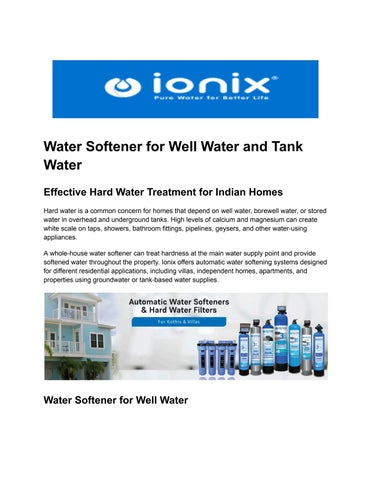
Water Softener for Well Water and Tank Water Effective Hard Water Treatment for Indian Homes Hard water is a common concern for homes that depend on well water, borewell water, or stored water in overhead and underground tanks. High levels of calcium and magnesium can create white scale on taps, showers, bathroom fittings, pipelines, geysers, and other water-using appliances. A whole-house water softener can treat hardness at the main water supply point and provide softened water throughout the property. Ionix offers automatic water softening systems designed for different residential applications, including villas, independent homes, apartments, and properties using groundwater or tank-based water supplies.
Water Softener for Well Water
Well and borewell water can contain significant amounts of hardness-causing minerals. When this water is used regularly without treatment, mineral deposits can gradually build up inside plumbing and appliances. An automatic water softener for well water uses ion exchange technology to reduce calcium and magnesium from the water. The water passes through a resin bed, where hardness minerals are captured and exchanged with sodium ions. Automatic regeneration helps restore the resin when its softening capacity is reached. Ionix automatic softeners are designed for borewell, tanker, municipal, and mixed water supplies. Depending on the model, Ionix systems can handle high-hardness water and provide whole-house softening for residential properties.
Benefits of Using a Softener for Well Water ● ● ● ● ● ● ●
Helps reduce calcium and magnesium hardness Reduces new scale formation in plumbing Helps protect geysers and washing machines Reduces deposits on taps, showers, and bathroom fittings Provides softened water throughout the property Automatic regeneration reduces manual operation Suitable for demanding groundwater conditions
Water Softener for Tank Water Many homes receive water through overhead tanks, underground storage tanks, tanker supplies, or a combination of sources. Even when water is stored in a tank, hardness does not disappear. If the incoming water contains calcium and magnesium, those minerals continue to enter the household water supply. A water softener for tank water can be installed as part of the home's mainline water-treatment setup. Ionix offers automatic softener systems and combined
filtration-and-softening solutions designed for overhead tank, pressure-pump, borewell, tanker, and mixed-water applications. For properties that require both filtration and softening, Ionix dual-vessel systems combine a ClearPro filtration stage with an ion-exchange water softener. The filtration stage can handle suspended particles and other impurities before the water reaches the softener, while the softening stage addresses hardness-causing minerals.
How an Automatic Water Softener Works An automatic ion-exchange softener generally follows these steps: 1. Water enters the system Water from a well, borewell, tanker, municipal supply, or storage tank enters the treatment system. 2. Filtration takes place Where a pre-filter or ClearPro filter is included, sediment and suspended impurities are reduced before softening. 3. Hardness is reduced The water passes through ion-exchange resin that captures calcium and magnesium. 4. Softened water reaches the property The treated water flows through the home's plumbing system to bathrooms, kitchens, geysers, washing machines, and other outlets. 5. Automatic regeneration When the resin requires regeneration, the automatic control valve initiates the regeneration cycle using the connected brine tank.
Where Can a Water Softener Be Used? A suitable water softener can be used in: ● ● ● ● ● ● ● ● ●
Independent houses Villas and kothis Farmhouses Apartments Residential buildings Properties using borewell or well water Homes receiving tanker water Homes with overhead tank systems Mixed municipal and groundwater supplies
Ionix's residential systems are available in different configurations and resin capacities, allowing the system to be selected according to water hardness, consumption, property size, and application requirements.
Choosing the Right Water Softener Before selecting a water softener, consider:
Water Hardness A water hardness test helps determine the treatment capacity required for the property.
Daily Water Consumption Larger households and villas generally require higher-capacity softening systems.
Water Source Well, borewell, tanker, municipal, and mixed supplies can have different treatment requirements.
Installation Location The available space near the main inlet, tank, pump, or utility area should be considered before installation.
Automatic Regeneration Automatic systems can reduce the need for regular manual regeneration and make whole-house softening more convenient.
Why Treat Well and Tank Water? Untreated hard water can gradually contribute to scale deposits in pipes, geysers, washing machines, shower heads, taps, and other fixtures. Softening the water at the main supply can help reduce the formation of new scale throughout the property. Ionix automatic water softeners are designed for whole-house applications and can be used with borewell, tanker, municipal, overhead-tank, and mixed water supplies, depending on the selected system.
Explore Ionix Water Softener Solutions
For homes using well or borewell water, explore Ionix's automatic water softeners for kothis and villas designed for high-hardness residential applications. For properties looking for ion-exchange softening systems, explore the Ionix Water Softener range with automatic regeneration and different capacity options. Learn More: Automatic Water Softener for Kothis & Villas: https://www.ionix-filters.com/collections/automatic-water-softners-hard-water-filters-for-kothis-vill as Ion Exchange Water Softener Range: https://www.ionix-filters.com/collections/ion-exchange-softeners
Frequently Asked Questions 1. Is a water softener suitable for well water? Yes. Ion-exchange water softeners are commonly used to treat hardness in well and borewell water. The correct system should be selected based on water hardness and consumption. 2. Can I use a water softener with tank water? Yes. Water softeners can be integrated into water systems supplied through overhead tanks, pressure pumps, and other storage arrangements. 3. Does a water softener remove calcium and magnesium? Ion-exchange softeners capture calcium and magnesium ions responsible for water hardness and exchange them with sodium ions. 4. Will a softener protect my geyser and washing machine? Reducing water hardness can help reduce the formation of new scale inside appliances and plumbing systems. 5. Do automatic water softeners require manual regeneration? Automatic models use automatic control valves to initiate the regeneration cycle, reducing routine manual operation. 6. How do I select the right softener for my home? Consider water hardness, daily consumption, water source, number of users, available installation space, and the required treatment capacity. A water test can help determine the appropriate system.
Contact Details: Phone Number: 9999012123 Email: support@ionix-filters.com Website: https://www.ionix-filters.com/
Address: Perfect Sales India, 4/15 Faridabad Industrial Park, Opposite Lakhani Showroom Near Anaj Godown, Sector - 50, Dabua Industrial Area, Faridabad, Haryana 121001