Sarah Ruhl’s
Lessons from My Teachers & Melancholy Play
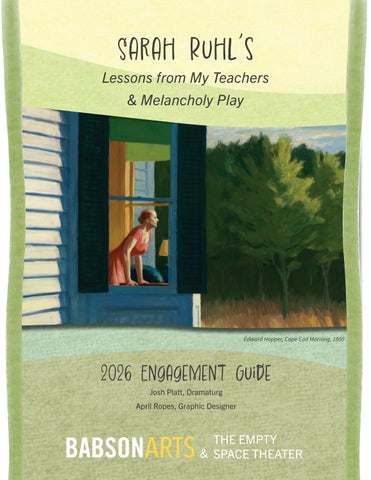
Edward Hopper, Cape Cod Morning, 1950
2026 Engagement Guide Josh Platt, Dramaturg April Ropes, Graphic Designer
ARTS
THE EMPTY & SPACE THEATER
TABLE OF CONTENTS Note from the Artistic Director .....................................................................3 Note from the Production Dramaturg ............................................................4
Lessons from My Teachers Discussion Prompts ......................................................................................5 Boston as Leader in AI Education .................................................................8 The Present Professor .................................................................................10 Bloom’s Taxonomy ......................................................................................12 Joyce Piven ................................................................................................15 The Words of My Perfect Teacher ................................................................19 Paula Vogel .................................................................................................20 Interview with Babson’s Intimacy Director and Director ...............................21 Block Island ................................................................................................27
Melancholy Play Bi Creative Icons ........................................................................................28 What is the Amygdala? ................................................................................31 On Melancholy ...........................................................................................32 Eugene Ionesco and the Theatre of the Absurd .............................................34 Friends and Farce .......................................................................................37 Melodrama in Pop Culture ...........................................................................39 A Handful of Almonds .................................................................................42
Sources ....................................................................................................43
A NOTE FROM THE ARTISTIC DIRECTOR Welcome to the world of Sarah Ruhl! Whether you are planning to read or teach Lessons from My Teachers, attend a performance of Melancholy Play, join us for Sarah Ruhl’s visit to Babson on October 6, or perhaps participate in all three, we are delighted you’re here. Melancholy Play will be the second Ruhl production I have directed at Babson. The Empty Space Theater previously produced her Dead Man’s Cell Phone in 2016. Over the years, students in my acting classes have performed scenes and monologues from Ruhl’s plays, and I regularly teach her work in my Foundations of Critical Inquiry and American Drama courses. I return to Ruhl again and again for her delightfully eccentric yet recognizable characters, her ability to weave the profound with the comic, her lyrical yet conversational language, and, perhaps most of all, her extraordinary stage directions. Stage directions occupy a curious place in the theater. Often unseen by audiences and not always realized literally in performance, they become a gift to readers, actors, designers, and directors: an invitation into the playwright’s imagination. Ruhl’s are among the most inventive I have encountered, filled with impossible images, startling transformations, and moments of theatrical magic. Here are a few favorites. As you read them, imagine you are the director: how would you stage them? “Gordon dies again. And Gordon disappears.” Dead Man’s Cell Phone “The sound of an elevator ding. An elevator door opens. Inside the elevator, it is raining...” Eurydice “Everyone in this play should be able to tell a really good joke.” The Clean House
3
Like the best of Ruhl’s theater, these stage directions are less instructions than invitations. They ask us to imagine what seems impossible and then find a way to bring it to life. We hope this guide inspires you to do the same, whether in the classroom, on the stage, or simply in the act of reading. I look forward to seeing you at the theater! -Beth Wynstra Associate Professor, English Artistic Director, The Empty Space Theater (TEST)
~
A NOTE FROM THE PRODUCTION DRAMATURG This engagement guide opens pathways into the appreciation of the work of American playwright, poet and essayist Sarah Ruhl. The first part of the guide explores topics related to her recent nonfiction collection Lessons from My Teachers: From Preschool to the Present. The second part shifts focus to Melancholy Play, first produced in 2002, when Sarah Ruhl was in her mid-20s. Some discussion questions for engaging the two works together: How has Sarah Ruhl’s imagination changed in 25 years? What are the through-lines that connect the two works? What are the different expressive possibilities of the personal essay and the theatrical comedy? Which elements of Melancholy Play might likely be autobiographical, based on the essay collection? And why might that matter in staging the play, or appreciating it as an audience member? -Josh Platt Production Dramaturg
4
DISCUSSION PROMPTS FOR LESSONS FROM MY TEACHERS • Introduction (pp. 1-4) For discussion Imagine yourself 20 years into your career. Babson College reaches out with an invitation to give a talk called “Lessons from My Teachers.” What teachers would you include in your talk? What would the lessons be?
• For My First Teacher, My Mother (pp. 7-10) For discussion How old were you when you first realized that one of your parents or caregivers had a whole life before you came into it? Did that realization change your relationship with that person? Did it change your sense of self?
• Lessons from Preschool (pp. 11-13) The story of the stolen Fat Albert book playfully recalls two famous scenes in the world’s first memoir, written by the Catholic theologian and church leader Saint Augustine. In Book II of the Confessions (397-400 CE), the young Augustine steals pears from a neighbor’s tree for the sheer pleasure of doing wrong. Toward the end of the memoir, adult and destitute, he hears a child’s voice saying, “take up the book and read” (tolle lege). He opens a Bible, and what he reads there starts him on a path to redemption and authorship. As a lapsed Catholic, Sarah Ruhl cheekily conflates the pleasurable sin of stealing with the intellectual redemption that can be found in (secular) study.
For discussion What story, lesson or parable from your own faith or culture might you use to tell your own story in a professional context?
5
• Sisterhood is Powerful (pp. 29-30) Exercise Make a list of what a sibling or long-term friend has taught you. Then make a list of what you think they’d put on their list about what you’ve taught them. You could invite that person to do the same, then exchange the lists.
• Lessons from Critics (pp. 108-111) For discussion When Sarah Ruhl began her career as a playwright in the ‘90s, independent online criticism was in its infancy. Now the majority of arts criticism happens online. The number of paid critic positions with newspapers and magazines shrinks every year. If you were an emerging playwright, which critical environment would you prefer to be working in, and why?
• Walking a dog, or a toddler (pp. 128-129) For discussion A common literary technique in the writing of personal essays is to juxtapose two disparate ideas or stories in a way that leaves it to the reader to discover the connection. How does the second section of this essay, about the bird, complicate and deepen the meaning of the first section of the essay? What is the unarticulated thought that bridges the two sections? Why does Ruhl leave it up to the reader?
• On Writer’s Block (pp. 183-189) Exercise Keep a record of your dreams for 10 days. Each night before going to bed, read the previous night’s entry (even if the entry reflects not remembering anything). Keep the record under your pillow. On the 11th day, type out the entire journal and print it. Discard the written pages of the original record. Seal the printed document in an envelope. Address the envelope to yourself, stamp the envelope, and put it in the mail. When the envelope returns to you, sleep on it unopened one more night. The next morning, open the envelope right after getting up and reread the document. Then write.
6
• Epilogue (pp. 213-216) Exercise Write to someone who taught you a meaningful lesson. Be as specific as possible about what the lesson was and how it’s been meaningful in your life. When you send it (whether by email or snail mail), say “thank you” out loud. If you can’t track down a way to contact the person, write the note, seal it in an envelope with only the person’s name on it. Stamp the envelope and drop it in a mailbox without an address.
“
rs he ac Te y M om fr s on ss Le om fr es ot Qu y Ke
bullying? Is tribal bullying an l ba tri to d lea ing lly bu old r ula How does reg child to wield power over another? e on of re asu ple ple sim the of n extensio be kind, some other instructions on how to ed ne ss cla l oo Sch y nd Su r ou d Di no method of physical torture? I was rather than lessons on the Romans’ igious mockery was new rel t bu , nd ou ygr pla the on ing lly stranger to bu to me. (pp. 26 -28) ite you ic generation. At the moment I wr You, my girls, are the unapologet years and years, before you for d an , en rte thi d an e nin are this letter, you d e big apology. You will grow up, an on re we es liv ole wh n’s me wo , rn were bo -97) you did something wrong. (pp. 93 en wh ly on e giz olo ap l wil you pe I ho a [Steinem] always emphasized ori Gl ry… sto n ow r you of ert exp You are the are e another–and to rise together…We on to en list –to cle cir the of r we the po linked, not ranked. (pp. 112-115) how much we need rituals to say of are aw ll we am I e, atr the of As a maker ual time (in my line of work, the rit of g nin gin be the is w no s: lve to ourse down, d of ritual time (the curtain comes en the is w no d an ) up es go in rta cu and people applaud). (pp. 141-143)
7
BOSTON AS A LEADER IN AI EDUCATION Boston Public Schools will soon be the first school system in a major American city to ensure AI training for all students. The initiative bridges the public education system with undergraduate teaching and learning at UMass-Boston through the Paul English Applied AI Institute. Mayor Michelle Wu announced the initiative in March.
“This is a public-private partnership between the city government, higher education and industry that will position Boston Public Schools as a leader in AI fluency and the understanding for all of our students to recognize the full context of this world….[W]e will work closely with our partners to make sure that our students know how to use AI responsibly.” The program will launch in high schools this Fall. BPS teachers will receive advanced training and support throughout the year, starting with summer classes at UMass-Boston. Translating learning to real world applications is a major emphasis of the program’s vision. Mayor Wu clarified that “[the curriculum] is really grounded in ethics and grounded in understanding how to maintain and develop creativity, leadership, to enhance the learning that’s happening, not replace or substitute for it.” The leadership and philanthropy of Peter English have made the program possible. Founder of a dozen tech companies and a handful of non-profits, English was himself born and raised in Boston, and is a graduate of UMass-Boston, where the Institute is based. He has aimed to build backwards from the emerging needs of Massachusetts businesses
8
for AI-savvy employees. He hopes that the program will help students to learn faster and improve their preparedness for the workforce. The Institute is launching in the context of other tech-forward initiatives in the Boston area, including the first-ever Boston Tech Week this past June and an investment of $200 million into Boston’s tech ecosystem by 40 Spanish biotech companies, organized by the Spanish government. Here at Babson, programs created and facilitated by The Generator, the Academic Technology Innovation Center, the Center for Engaged Learning and Teaching (CELT), and Academic Divisions are exploring what AI will mean for teaching and learning on our campus. These programs have emphasized AI literacy, creativity, human agency and voice, and ethical approaches to prompting. These offerings have also presented the possibilities for innovation with course design, assignment construction, and pedagogical tools. “AI has offered a moment for Babson faculty and students to question assumptions about what is possible in teaching and learning,” says Jonathan Sims, Associate Professor of Strategy and Faculty Director of CELT. “Here at Babson, we’ve seen curious faculty and students use AI to transform their classrooms, syllabi, and approaches to learning in ways that weren’t possible three years ago. Custom apps, improved syllabi, chatbots, just-in-time quizzes… The list of what AI makes possible grows by the day, and is one of the reasons it’s the best time ever to be an educator.”
9
THE PRESENT PROFESSOR “When you cannot be present, you cannot teach effectively,” writes educational theorist, political scientist, life coach and teacher Liz Norell. Norell defines “presence” as “the state of being that occurs when the differences in our front-stage and back-stage presentations of self narrow.”
When this happens, we’re able to bring out more effortless, more authentic selves into the spaces in which we might otherwise feel nudged to engage in impression management. We can grow when we’re present. But to do this, we must invest effort in reinforcing the hulls of our sailboats, metaphorically speaking, so that we can withstand the winds that will challenge us when we unfurl the sails of our life’s work. Put another way: when stepping into your classroom, you will be better equipped to engage students in authentic, transformative learning experiences if you are secure enough in who you are, if you have a sense of safety, connection, and self-esteem sufficient to allow yourself to be more authentic with your students. Norell encourages college-level teachers to make peace with their inner critics; to take meaningful action steps toward professional and personal goals; to use the Enneagram, a pop psychology diagram, as a self-evaluation tool; to take an inventory of their unconscious biases; to practice yoga and apply the tenants of Buddhist psychology in daily life; and to create a set of contemplative practices that are personally grounding. Norell herself practices the metta or loving kindness meditation regularly.
10
For discussion Which personality type seems like it fits you best? Do personality types stay constant or do they change over time as life circumstances change?
11
BLOOM’S TAXONOMY In the early 1950’s, educational psychologist Benjamin Bloom and several colleagues convened a research task force with the ultimate ambition of creating a more even playing field for students entering the workforce. These psychologists shared the belief – now broadly discredited – that high-performing students should be able to advance more quickly and low-performing students should be held back based on grades, regardless of age, and that this philosophy should continue after graduation. The outcome of the task force was a massive two-volume Taxonomy of Educational Objectives. The taxonomy was revised and abbreviated in 2001 by psychologists and teachers with contemporary evidence-based philosophies about the function of grades in teaching and learning. By far the most influential take-away has been a meta-structure for curriculum design and an approach to grading. This meta-structure for learning is usually what people mean when they refer to “Bloom’s taxonomy.” According to the taxonomy, a unit should progress from the bottom of this pyramid to the top.
12
An acting teacher might guide a college student through a unit on monologues using the taxonomy in this way: •
To remember: Recite the speech you’ll be working on after memorizing it on your own.
•
To understand: Write an explanation of the character’s situation – why she’s saying what she’s saying, with regard to the story overall – in a notebook.
•
To apply: Perform the speech in class using different assumptions suggested by the teacher – is the character scared? excited? energized? exhausted?
•
To analyze: Using feedback from fellow students, reflect aloud on how these different choices reshaped the meaning of the monologue.
•
To evaluate: Make a choice about which set of assumptions you will commit to. Reflect back to the teacher and to classmates why that choice seems like the right one for you as an actor.
•
To create: Perform the monologue at an invitation-only showcase at the end of the unit.
Monologue classes often stop at an “analyze” assignment, as the student absorbs feedback. A student could be graded on that ability if she were asked to write about the feedback and the experience of receiving feedback in general, which is an important learning goal. Bloom’s taxonomy posits that grading a student as she’s asked to evaluate that feedback and then make her own strong choices as she runs through the monologue in class again would be a better way to measure her learning. A deliberately created performance in front of an audience would be the best possible way to assess her progress. The theory is that as the psychological complexity of assignments increases, grading becomes more objective. Any acting teacher should be able to walk into any college-level classroom and grade that final performance and come up with the same result. The less complex and personal an assignment is, the less objective grading will be. On the level of the individual curriculum unit, this kind of objective grading is impossible. Bloom and his colleagues believed that if schools followed the taxonomy, discrepancies in grading would even out over the course of a semester or school year. If Bloom’s taxonomy were applied nationally (so the theory goes), a student applying for advanced-level training in a particular field could trust that she’d be on the same footing
13
as any other student in the country. The same would go for any employer reviewing transcripts. The idea that objectivity in grading directly corresponds to the psychological complexity of the assignment has been hard to prove, and critics of the taxonomy point out how the structure favors students who are better at working independently. Individual excellence and creativity was more valuable to employers in the 1950s. Today, the ability to learn and work in teams is more valued.
For discussion Can you think of a subject or class where you climbed Bloom’s taxonomy, so to speak? When have you been asked to achieve these different levels?
14
JOYCE PIVEN
Theater teacher, director and actor Joyce Piven became Sarah Ruhl’s mentor in childhood. Their creative and personal relationship continued until Piven’s death earlier this year. As Ruhl said in her eulogy, Joyce taught me and countless others so much. When I was a shy child, she taught me how to play without self-consciousness. When I was a teenager, she taught me how language can transform space. When I was a young woman and had lost my father, she taught me how grief can transform into art. And as a grown artist, she taught me how to defy critics….And she modeled how to balance being a mother and an artist. Piven’s approach to training and directing actors – both children and adults – combines elements from several great 20th century teachers of acting: Konstantin Stanislavski, Uta Hagen, Mira Rostova, Etienne Decroux, and above all, Viola Spolin and her son Paul Sills. Spolin developed a game-based pedagogy that privileges exploration, process and physicality over language, rehearsal and product. Spolin was herself mentored by Neva Boyd, a social worker and applied theater practitioner who ran a play-based welfare program in Chicago for immigrant adults and children. Boyd believed that play was
15
political because it involves “reciprocal responsiveness.” Play cultivates our instincts toward justice, fairness, empathy and other qualities necessary for a thriving democracy faced with the influx of many new immigrants. Spolin’s innovation was to apply Boyd’s games and her theory of play to the training of theater actors. Spolin has long been considered the godmother of American improvisational theater. Building on her technique, her son Paul Sills went on to found The Second City, a comedy club and school in Chicago. Second City performers have included Dan Aykroyd, Bill Murray, Eugene Levy, Gilda Radner, Mike Myers, Tina Fey, Stephen Colbert, and Aidy Bryant. In most acting classes, a student will typically present their exercise and receive feedback afterward. In what Spolin calls “side-coaching” – one of her great innovations – the teacher-director is also part of the game, entering halfway into the action with only her voice. A simple, direct calling out is best. Share the stage picture! See the buttons on John’s coat! Share your voice with the audience! Write with a pen, not with your fingers!....You walked through a table! Contact! See it with your feet! No playwriting! To side coach effectively, one must be able to be spontaneous and also hold rigorously to the rules of the game; to grasp the needs of the individual performer and the scene as a whole at the same time; she must stick to a common vocabulary without resorting to rote recitation; and she must allow a low level of natural competition to emerge while remembering Neva Boyd’s teaching that “[c]ompetition in the arts often causes the winner to overestimate his talents and discourage the loser and in either case, tends to kill the true incentive to creativity.” Joyce Piven and her husband Byrne distilled Spolin’s concepts and her practice over the course of their careers. They came to use side-coaching primarily as a focus tool. As Byrne put it, The purpose of calling out during an exercise or game is to stimulate, enhance, or move the group toward a point of concentration. If the call takes more than a word or two, what happens is that the flow is interrupted and the purpose defeated. It cannot stimulate because whatever energy happened to have been in the space has seeped out….[T]here is no longer any concentration, except in figuring out
16
what the teacher means. You are now into explanation, discussion land, and you might as well stop altogether and explain or discuss….[T]he call should never throw the players into their heads, interrupting the flow of bodies and beings interacting with each other. Calls should not create questions but function as stimulants and guides. Sarah Ruhl’s unusually assertive and poetic stage directions might reflect her experience of side-coaching as a young student of Piven’s, as though side-coaching the directors and actor on the page. Joyce and Byrne Piven’s approach to acting overall has five foundational principles:
Here is an example of a Piven game, from In the Studio with Joyce Piven: Theatre Games, Story Theatre and Text Work for Actors: I move from Tag to a game of Ball Toss by gathering the group into a circle and throwing an imaginary ball to one of the players. I instruct that player to throw the ball to another and then guide the group to explore throwing imaginary balls of different weights and sizes around the circle. As soon as the group is invested in the exercise, I shift gears: “When you throw the ball, also ‘throw a word’ to another player. Start with colors.” One player throws “Red.” Another throws “Tangerine.” I encourage the players to explore and heighten the quality of the
17
words. “What does ‘tangerine’ sound like?” I ask. I shift gears to new words and experiment with different rhythms by calling: “Slow motion. Double time. Short, sharp staccato throws. Leisurely playful throws.” I encourage the players to reflect the physical movement in the word: “Capture the quality of the word with your movement.” Then I instruct them to explore on their own, giving and taking the energy being passed around and building on it. Many of the calls I make are repeated over and over in the games played. The repetition helps to establish the game language that will be used throughout our work. The calls embody the universal rhythms and vocal qualities important in theatrical expression as well as the gearshifts in energy necessary to keep an audience’s attention. Over time players internalize the calls; they become a kind of non- judgmental short- hand. For example, instead of telling a player or actor, “You are speaking too fast” (a corrective that implies he is doing something wrong), the call of “slow motion” achieves the same purpose without making the player/actor selfconscious. The games played to this point get the group moving and working together. It is important to encourage the players to get their whole body involved in expressing the words. These games also introduce and reinforce the point of concentration for the class – the exploration and heightening of sounds and words expressing meaning and feeling. (pp. 77-78)
For discussion Have you ever had a learning experience where play, creativity, and using your imagination were key components? What was the experience like? What important lessons did you learn from playing?
18
THE WORDS OF MY PERFECT TEACHER In Sarah Ruhl’s play The Oldest Boy (2014), Western parents decide to allow their son to be raised by monks, after they identify the child as a reincarnation of a great lama, or teacher. As part of research for that play, Ruhl writes, “I read an entire suitcase full of books about Tibetan Buddhism and about reincarnation.” One of those books was The Words of My Perfect Teacher by the 19th century monk Patrul Rinpoche. The text begins with instructions on the best way to listen to and receive spiritual teachings. There are six “transcendent perfections,” qualities for any student to cultivate and practice throughout their learning: generosity, discipline, patience, diligence, concentration, and wisdom.
urself as someone who is sick, Noble one, you should think of yo Of the Dharma as the remedy, l doctor Of your spiritual friend as a skilfu y to recovery. And of diligent practice as the wa *
owers and cushions, Make excellent offerings such as fl your behavior, Put the place in order and control Do not harm any living being, Have genuine faith in your teacher, distraction Listen to his instructions without l your doubts; And question him in order to dispe rfections of a listener. These are the six transcendent pe
For discussion Which of the six qualities of a learner mentioned above (generosity, discipline, patience, diligence, concentration, and wisdom) do you most embody? When have you demonstrated this quality? Which of the qualities would you like most to cultivate or improve?
19
PAULA VOGEL Sarah Ruhl’s career-long mentor Paula Vogel is one of the most influential American playwrights of her generation. Her protagonists are elderly prostitutes, Shakespearean women, a working class matriarch and her teenage kids, aging twins (one good and one evil) in very bad wigs, a pregnant thrupple, a woman gradually making sense of the incest she experienced as a child, Jewish prostitutes, Walt Whitman, Eugene O’Neill, the daughter of Sir Thomas More, and a brother and sister facing a terminal prognosis. A Vogel play will not conform – to genre, to style, to technique, to geography – yet each play feels deeply personal. The one through-line in her body of work, perhaps, is an interest in how men and women are always re-building the world together, sometimes in ways that are degrading and violent, sometimes in ways that are liberatory and loving. Here is a group playwriting exercise adapted from her teaching, called Bake-Off. A bake-off is a quickly written exercise on an assigned theme with assigned elements that folks do within a 48 hour period of time….Usually, bake-offs have a group participating: when the 48 hour time period is up, the group gathers and reads the bake-offs. Living rooms are great for the gathering if a theatre isn’t available. For example, with military veterans, in a Bake-Off on Joan of Arc, everyone in the workshop wrote with the following ingredients: •
A girl in a field.
•
A visitation.
•
Convincing higher authority.
•
A philosophical defense of cross-dressing.
•
Extra-credit: a match.
There are no critiques. Bake-Offs are to theatre what sketching is to oil paintings. Enjoy each other. And applaud after every bake-off.
20
INTERVIEW WITH BABSON’S INTIMACY DIRECTOR AND DIRECTOR What is the role of the intimacy director in staging a production with college student actors? I love doing this work with college students because it feels necessary. People have hugely varying levels of experience, both in terms of performing intimacy and in terms of any sort of intimacy in their own lives. That’s especially true of college students. We are never all at the same starting point. Cassie Chapados
I teach that creativity is not hampered by guardrails. The only thing I need in the same way from everybody is what their boundaries happen to be. I need you to tell me where you can and cannot be touched. Great, we have that information. Now we can talk about how we execute this work, how we perform this intimacy. With a lot of different kinds of language.
What are some of the languages you use when staging an intimate scene? A big language piece that I use in my intimacy work is the difference between unsafe and uncomfortable. Any sort of stage intimacy, especially in a small space, and especially at a college, is inherently uncomfortable. It is whackadoo to be ten feet from your friend or your mom, making out with somebody, right? That is just goofy and weird and uncomfortable, and that is ok. I have no problem with discomfort. It is something we can work through, it is something that we can talk about. I would love students to be more uncomfortable. It’s useful and interesting and artistically pushes things
21
forward. I don’t want you to ever be unsafe, and only you can decide what is unsafe for you. Discerning that difference can be challenging sometimes. A big part of getting everybody in the same place is using language that doesn’t feel intimate. Ok, you’re gonna put your hand on her shoulder, and then it’s gonna take 3 seconds for your hands to move from her shoulder to her elbow. Some language that I have found helpful that I’ve been taught is this idea of powder paint and clay. A powder touch is really light and soft. A paint touch takes a little bit more effort to get paint to stick to something. A clay touch is like you’re molding, you’re shaping that thing. You can imagine what it feels like to hold somebody’s hand like it’s clay, as opposed to like its powder. That removes language that is connected with intimacy as we perform it in our everyday lives. It’s easier for folks to have that same starting point.
Something that I have been taught which I find effective is deloading this work from words like “sexy.” “Sexy” to me is different than it is to you, than it is to anybody else. Maybe we get lucky and we actually have sort of the same idea of what it means. There is a weird weight on it either way. If you’re not doing what I asked, it implies that I don’t think that you’re sexy or can’t be sexy, which is both not my job and also not helpful.
What are some of the things you’re thinking about around Melancholy Play in terms of intimacy? Something that Beth and I will have a conversation about is what goes in the audition announcement about what sort of things are required. In some shows, it could suggest – it might say, They kiss. But maybe that’s not important to this version of the story that Beth and I are telling. So that might not be a requirement, but it might be. Actors have to know from the get-go. If you know that is not for you, then you should not go out for the part, because Beth and I decided artistically that that can’t change. It’s the same with any sort of simulated or performed intimacy. Giving folks as much information as possible is the best safeguard we have.
22
I’m always teaching my students, The onus is on you to do your research, to read the script. Know that I’m going protect you as best as I can, but also it’s not my fault if you said you read the script and then…And you go, Oh, I didn’t know about that. I’m like, Well, that’s not my bad, actually. I am going work to keep you safe, but I’m not suddenly going change everything that we’re doing because you didn’t do your job. I think that’s important too.
Acting often involves risk-taking of one kind or another. What is the place of risk in education? Education is a great place for risk because we’re there to catch them. Especially artistic risk. Like, who cares if nobody comes to see this play? It’s not like in the professional realm, where you often feel like you can’t take big risks, with new plays or big, interesting productions of existing plays. If you don’t sell enough tickets, your company could fold. In education that’s not the case. If the university folds, it’s certainly not going to be the fault of the theater department.
So I think that encouraging students is crucial. Theater is a space to play and experiment and learn. It’s the one guaranteed safe place to do that. Safe does not mean that things won’t go badly or you won’t get your feelings hurt. Something could happen that isn’t wholly positive. But you’ll come out the other side having become a better artist, a better person. That’s what we should set education up to do.
23
We’re having this conversation a few months ahead of casting and rehearsals. Where is Melancholy Play sitting with you now? We are still in a moment – even with so many bad things happening in the world – where we’re programmed to look on the sunny side of life and to have a quick fix. I’ve become very cognizant of what’s in my own social media feed with encouragement like, “Oh, try to feel better.” But having a moment to feel your feelings is really healthy. Sarah Ruhl does a really good job of demonstrating this idea and arguing that as long as you’re not slipping into the depression/ almond-type state, big feelings can be really
Beth Wynstra, Ph.D.
healthy and really exciting.
I worry about students not wanting to feel uncomfortable. Cassie touched on this as well. And again it gets back to this idea of guardrails. That once those are in place, we should be feeling the feelings, including sometimes being uncomfortable. And seeing things that don’t match our life experience, and having to reckon with elements that do speak to our life experience. I like stepping into worlds where there are individuals that are different or have different experiences.
What is the role of leadership in your work as a director and as a teacher? A defining feature of leadership is listening. I don’t know if I would have said that as a younger faculty director. My role in both the classroom and the rehearsal room is to come with a few goals, a few objectives, a few things that I am thinking about, knowing that everything can shift and change based on what I hear and what I see. That’s the same in my teaching. I will come to the classroom with – we have our learning
24
objectives, our goals for the day. But I kind of put those as signposts. I don’t quite know what the path looks like to get to those signposts. That’s what I am very excited to discover with a cast, with my students. So I’m thinking a lot these days around creating places for exploration and then truly being present for that work to happen.
What are some of the new hurdles in your teaching now? I do not mean to do a kind of like, When I was their age. But…when I was their age! As an undergraduate actor with NO social media, NO tech, I would think nothing of being in the rehearsal studio for hours on end, even if I had multiple assignments and had other responsibilities. Like, to live in the theater was what I wanted. Even though today I have students who love theater as much as I do, these students are so over-committed and programmed. So students need to know when rehearsal is ending. On the positive side, it can make us – as directors and production team members – be really organized. I tell my actors, as I tell my students, I will never let you out late if I can help it. I want to be organized and stay as much on schedule as possible. But that is a hurdle I think a lot of us are finding.College is super expensive as well. I have students who have two jobs and are trying to make this all work. That has ramifications sometimes in the creative space.
In talking to colleagues and reading so much of what is in acting journals – this idea of flirtation is really tough for young actors. The idea of making eye contact with someone. If you are spending a lot of your life on this [imitates holding a phone] and dating on this, getting to know people that way, I think it can be hard, especially without a skilled intimacy director like Cassie, to start to do that work in the rehearsal space.
25
If there was one misconception about theater that you could dissolve, what would it be? Corporate programs and businesses constantly want workshops on improvisation because they think, Entrepreneurship! No script! I’m not denying the great connection there. But I always feel like a little bit of a buzzkill when I lead an improvisation workshop. People who come to them think, Improv! Total free for all! No! One of the most important lessons is that – when I think about Joyce Piven and her way of working with improvisation – actually no, there need to be rules and guardrails because that’s where the fun can begin. The spontaneity. Because you are not concerned with like, Am I going into unsafe places? Creativity actually happens when some of those parameters are set.
26
BLOCK ISLAND Sarah Ruhl
You watch the ship I watch you watch the ship What is it you like about the angle of distance? Stalwart fragility west wind east wind south wind… Cormorants sand divots purple shadows in the sand red bog duck crossing and the lighthouse we pass in silence
27
The Bi Flag
BI CREATIVE ICONS September 23 is Bisexual Pride Day! Bisexuality refers to the capacity for romantic or sexual attraction to
There have been many innovative and iconic artists who identify as bisexual. They include:
more than one gender. While the term is sometimes misunderstood as meaning attraction to only two genders, contemporary scholars generally define it more broadly as attraction that is not limited to a single gender. It is worth noting that the “bi” in bisexuality has itself been debated: some writers and activists have rejected the term altogether in favor of alternatives they consider less loaded, such as
Lady Gaga, Musician and Actor
“pansexual” or “pansensual.” The meaning of bisexuality has shifted considerably over time. Broadly speaking, there have been three historical answers to what the “bi” in bisexuality actually refers to: maleness and femaleness in a biological or anatomical sense; masculinity and
Virginia Woolf, Writer
femininity in a psychological sense ;
28
and heterosexuality and homosexuality — which is by far the most commonly used definition today. This shift toward the heterosexual/homosexual definition appears to have occurred largely during the 1970s, influenced in large part by the gay liberation movement and the removal of homosexuality from the Diagnostic and Statistical Manual of Mental Disorders in 1973. Bisexuality functions as an epistemological tool — a way of questioning how we know and categorize
Josephine Baker, Singer, Dancer and Actress
sexuality at all. Some scholarly work derives from the perception among bisexuals that they are “misfits” or “outsiders” who do not fit neatly on either side of the heterosexual/homosexual divide, giving rise to a suspicion of, or even hostility toward, those categories themselves. In other words, bisexuality doesn’t just describe a kind of person — it challenges the entire framework we use to sort people into sexual categories.
Lou Reed, Musician
Some scholars go further, arguing that bisexuality is inherently threatening to categorization in general, and to heterosexual/homosexual categorization in particular. Others caution against this view, noting that categories can also be strategically useful — for instance, in legal arguments for anti-discrimination protections. Tallulah Bankhead, Actress
29
Sarah Ruhl’s Melancholy Play offers an opportunity for a bisexual reading. The play centers on Tilly, a woman whose profound sadness makes her irresistible to virtually everyone around her. Men and women alike fall in love with her without much concern for the gender dynamics involved. Desire in the play is fluid, overlapping, and a little contagious. Reading Melancholy Play through a bisexual lens doesn’t require labeling any character as bisexual. Instead, it means paying attention to how the play imagines desire as something Halsey, Musician
fundamentally open: not bounded by gender, not requiring explanation, and not in need of resolution.
For discussion Using specific moments, characters, and lines from Melancholy Play as evidence, discuss the following: 1. How does the play present desire crossing gender lines — and what is notably absent from how characters respond to this? 2. What draws characters to one another in this play? Is it who someone is, or something else entirely? 3. Do the categories we normally use to describe attraction and relationships hold up in this play? Where do they break down? 4. How does the play end — or does it? What does Ruhl seem to be resisting?
30
The amygdala is an almond-shaped cluster of neurons essential to the brain’s limbic system, one of the oldest structures of the brain in evolutionary terms. The system’s principle directive is to process memory, thought and motivation in order to regulate behaviors and emotions. Sometimes referred to as the brain’s “emotional computer,” the amygdala is a center for sensory integration and emotional processing. Sarah Ruhl writes about how important the amygdala is for the story and themes of Melancholy Play in the printed script.
31
ON MELANCHOLY
Edward Hopper, Cape Cod Morning, 1950
The history of melancholy (or melancholia) begins in ancient Greece. In every period since then, the idea has been reimagined to reflect the intellectual and cultural temperament of the times. Beginning in the late 19th century, several generations of psychiatrists succeeded in eliminating the word from medical discourse, replacing it with the word “depression.” The change in vocabulary went along with a change in treatment, as some symptoms became treatable with new medications. Sarah Ruhl is one of many 21st century artists who have pushed back on the medicalization of melancholy. I feel we are losing a whole category of emotion thanks to the language of depression that surrounds us. Depression is very clinical, and it isn’t generative. But melancholy is a state with beautiful possibilities. Melancholy can be communal: like when you discuss the past with other people, or the afternoon before twilight. Depression is isolating; it’s all about the individual. If all we can talk about in our culture is depression, what happens to that other emotional quality? It’s actually quite important, because melancholy is about the passage of time, about cycles and loss, which are real things. If we can’t mourn them together, we lose a whole section of cultural life. -Sarah Ruhl, from an interview (2004)
For discussion What do you think of Sarah Ruhl’s arguments about melancholy and depression? Do you see a difference? Has there been a moment in your life where you have found melancholy to be generative or productive?
32
Melancholy by Edvard Munch (1894)
For discussion If you had to give this painting an alternative title, what would it be?
Scholar Christina Wald has written extensively about the intersection of melancholy, gender, and contemporary theatre. She notices that “[t]he issue of ‘embodiment’ and the sliding scale of deliberate performing and unconscious being performed that can be involved in the process of embodiment are central to melancholia as a performative malady.”
For discussion What are the different ways in which melancholy is embodied? How does this state show up behaviorally? How might depression be embodied? Does the embodiment of melancholy and depression show up differently depending on gender?
Sarah Ruhl’s Melancholy Play utilizes and plays with several different performance traditions/styles including: theatre of the absurd, farce, and melodrama.
33
EUGENE IONESCO AND THE THEATRE OF THE ABSURD In the middle of the 20th century, the theatre critic Martin Esslin published his groundbreaking work The Theatre of the Absurd. [E]ach of the writers in questions is an individual who regards himself as a lone outsider, cut off and isolated in his private world. Each has his own personal approach to both subject-matter and form; his own roots, sources, and background. If they also, very clearly and in spite of themselves, have a good deal in common, it is because their work most sensitively mirrors and reflects the preoccupations and anxieties, the emotions and thinking of many of their contemporaries in the Western world. Today, the most famous classic absurdist playwrights in the English-speaking world are Samuel Beckett, Harold Pinter, and Edward Albee. According to Esslin, absurdist plays typically rely on these elements: •
…[S]cenic effects as they are familiar in the circus or revue, in the work of jugglers, acrobats, bullfighters, or mimes
•
Clowning, fooling, and mad-scenes
•
Verbal nonsense
•
The literature of dream and fantasy, which often has a strong allegorical component
The Romanion-French author Eugene Ionesco was one of the major first-generation absurdists. His play The Bald Soprano has been performed five times a week in Paris since its premiere in 1950 – to this day! (Wednesday shows have English subtitles.) Before Sarah Ruhl was reintroduced to Ionesco by her playwright mentors, she absorbed his strange voice from her mother Kathy Ruhl, an actress. Kathy would perform one of the play’s weirdest speeches in an over-the-top style to entertain her daughters:
34
Elizabeth and Donald are now far too happy to be able to hear me. So I can tell you a secret. Elizabeth is not Elizabeth and Donald is not Donald. And I’ll prove it to you. The child Donald talked of is not Elizabeth’s daughter, not the same child at all. Donald’s little girl has one red eye and one white eye just like Elizabeth’s little girl. But whereas it’s the right eye of Donald’s child that’s red and the left eye that’s white it’s the left eye of Elizabeth’s child that’s red and the left eye that’s white. Consequently the whole fabric of Donald’s argumentation falls to the ground, when it encounters this final obstacle, which annihilates his entire theory. Ionesco is having a big moment in Boston right now, with one production from the Needham-based company -Arlekin! over the summer and another at American Repertory Theater in Cambridge this fall. Since Melancholy Play, Ruhl’s most absurdist work, premiered in 2002, feminist playwrights and ensembles have used the tools of the absurd to their own ends.
Women Laughing Alone with Salad, Central Theatre Group (2016)
35
Fairview, Berkeley Repertory Theatre (2018)
Here is a one paragraph essay by Ruhl that captures well what she learned from Ionesco, and perhaps from her mother.
“Satyr plays inside tragedies” In ancient Greece, comedies used to be appetizers in the form of satyr plays performed before the main course – a tragedy. Now we don’t have daylong festivals of both comedies and tragedies, so now do satyr plays need to be contained inside tragedies? (That is to say, the dark comedy?) I have never had much patience with separating genres into distinct categories. Maybe that is because I long for the time when we sat all day in the sun and laughed for a while, then wept while masked actors wailed, and both the humor and the desperation of life were illuminated on one day.
36
FRIENDS AND FARCE If you’re watching a comedy and you notice a few of these elements, you’re enjoying a farce: •
Ordinary situations spinning out into chaos
•
Absurd, improbable plots
•
Rapid pace and mechanical timing
•
Action set in a single location
•
Exaggerated, stock and two-dimensional characters
•
Mistaken identities
•
Physical humor – slapstick, accidental violence without any injury
•
Verbal humor – puns and sexual humor, often accidental; on the flip side, refined wit
•
Class-based comedy – especially mockery of upper class social conventions
•
A sense of humor with broad appeal
A brief history. The Latin word farcire means to cram or stuff. In medieval French, that became farce, which meant stuffing (as in Thanksgiving). The comic interludes stuffed into Christian religious dramas to keep the audience hooked became known as farces. As farce spread across Europe, playwrights like Shakespeare and Molière integrated farce interludes into the overall comedy in an artful way. Later, farce appeared in music halls, vaudeville, and film, and was further developed by artists like Charlie Chaplin, the Marx Brothers, and Mel Brooks. Elements of farce appear in non-Western theater as well. The chou (clown) interludes in classical Chinese opera and the kyogen interludes in Japanese Noh theater are examples.
37
For discussion What do these photos from Friends say to you about how farce is used? Can you connect characteristics of farce to what you see in these photos? Why do we like farce in television, theatre, and film? When an element of farce unfolds in everyday life, is it funny?
38
MELODRAMA IN POP CULTURE Melodrama combines heightened emotions, clear moral conflict, and spectacular theatrical effects to engage and entertain as broad an audience as possible. For much of the 19th and into the early 20th centuries, it was hugely popular on American stages. The genre had many standard elements, so that even audience members who didn’t speak much English could enjoy the show. These are the key characteristics of traditional stage melodrama: •
The characters live in a simple good vs evil world. There’s no moral ambiguity.
•
A villain poses a threat, the hero or heroine escapes danger, and the story concludes with a happy ending.
•
A highly exaggerated and physically expressive performance style. To us it would seem strange and even comic, but at the time audiences were riveted.
•
The spectator goes on an emotional journey through fear, anger, sadness, and joy.
•
Music heightened emotional impact and identified characters through signature themes. The word “melodrama” derives from “music drama.”
•
The plays had variable structures, from 2-5 acts, to distinguish them from the regular five-act structure reserved for serious drama, like Shakespeare’s plays.
•
Special effects included simulated fires, explosions, drownings and earthquakes.
A melodramatic staging of Leoncavallo’s La bohème in France in 1899.
39
Many of these elements have carried over into melodramatic movies and TV shows. One major difference is that we often identify with a hero or heroine in a melodrama because of a psychological threat. Love triangles are more common in our favorite melodramas. And a major new element in serial TV storytelling is the cliffhanger, which is our version of stage
The film Jaws, 1975.
melodrama’s tableaux. 20th and 21st century playwrights sometimes use the elements of melodrama in combination with other styles and genres to create more complicated and artful worlds. Melancholy Play combines sincere melodrama with farce. Eugene O’Neill’s Long Day’s Journey Into Night combines melodrama with the memory
The television series, Scandal, 2012-2018.
play, Greek tragedy, and 19th century fiction and poetry.
The film Titanic, 1997.
The film Superman, 2025.
40
The music video for Taylor Swift’s “All Too Well,” 2021.
The television series, Empire, 2015-2020.
41
A HANDFUL OF ALMONDS
Ferraduel
Kashmiri Mamra
Wood Colony
Marcona
42
SOURCES Boston as a Leader in AI Education AseBio. “The Ministry of Economy, Trade and Business announces a $200 million investment fund to boost Spanish biotechnology in the United States.” AseBio. April 15, 2026. https://www.asebio.com/en/actualidad/noticias/ministry-economy-tradebusiness-announces-200-million-investment-fund-to-boost-spanish-biotechnology-inthe-united-states. Chesto, John. “Tech entrepreneur Paul English gives $1 million to kick-start AI program in Boston Public Schools.” Boston Globe. March 30, 2026. https://www.bostonglobe. com/2026/03/30/business/bps-ai-teacher-training-paul-english/. City of Boston. “Tech Week Kick Off, Spotlighting the City as a Global Innovation Leader.” City of Boston. May 28, 2026. https://www.boston.gov/news/first-ever-boston-techweek-kick-spotlighting-city-global-innovation-leader. City of Boston. “Mayor Michelle Wu, Superintendent Skipper, Paul English Announce Major Public-Private Partnership Ensuring Boston is a Leader on AI Literacy for Students.” The City of Boston. March 27, 2026. https://www.boston.gov/news/mayormichelle-wu-superintendent-skipper-paul-english-announce-major-public-private. Valencia, Crystal. “Succeeding in an AI-Powered World: UMass Boston Launches Paul English Applied AI Institute with Kick-off Event.” UMass-Boston. Accessed May 31, 2026. https://www.umb.edu/news/2023/succeeding-in-an-ai-powered-world/.
The Present Professor Linehan, Marsha M. “Practicing Loving Kindness to Increase Love and Compassion.” In DBT Skills Training Handouts and Worksheets. Guilford Press, 2015. Norell, Elizabeth A. 2024. The Present Professor: Authenticity and Transformational Teaching. University of Oklahoma Press. Norell, Elizabeth A. Accessed May 8, 2026. “Liz Norell.” https://liznorell.com/. Norell, Elizabeth A. Accessed June 5, 2026. “Introducing The Present Professor.” The Liz Cast. Podcast. Episode 45. https://liznorell.com/podcast/.
Bloom’s Taxonomy Anderson, Lorin W., and David R. Krathwohl, eds. A Taxonomy for Learning, Teaching, and Assessing: A Revision of Bloom’s Taxonomy of Educational Objectives. Abridged ed. Longman, 2001. Armstrong, Patricia. “Bloom’s Taxonomy.” Vanderbilt University Center for Teaching.
43
Accessed May 15, 2026. https://health.ucdavis.edu/mdprogram/curriculum/pdfs/ blooms-taxonomy-vanderbilt.pdf. Furst, Edward J. “Bloom’s Taxonomy: Philosophical and Educational Issues.” Bloom’s Taxonomy: A Forty-year Retrospective. Ed. Kenneth J. Rehage. Yearbook of the National Society for the Study of Education 93, Part II. Ed. Lorin W. Anderson and Lauren A. Sosniak. U of Chicago P, 1994.
Plato and Censorship Blinder, Alan. “Texas A&M, Under New Curriculum Limits, Warns Professor Not to Teach Plato.” The New York Times, January 7, 2026. https://www.nytimes.com/2026/01/07/us/ tamu-plato-race-gender.html. Peterson, Martin. “PHIL 111 Contemporary Moral Issues.” Academic Syllabus. Leiter Reports: A Philosophy Blog. “Texas A&M is no longer a real university.” January 6, 2026. https://leiterreports.com/2026/01/06/texas-am-university-is-no-longer-a-real-university/. Plato. 1992. Republic. Trans. G.M.A. Grube and C.D.C. Reeve. Hackett. Plato. 2006. Plato on Love. Ed. C.D.C. Reeve. Hackett. Plato. 2022. Laws. Trans. C.D.C. Reeve. Hackett. Reeser, Todd W. Setting Plato Straight: Translating Ancient Sexuality in the Renaissance. University of Chicago Press, 2015. Whitford, Emma. “Plato Censored as Texas A&M Carries Out Course Review.” Inside Higher Ed, January 7, 2026. https://www.insidehighered.com/news/faculty/academicfreedom/2026/01/07/plato-censored-texas-am-carries-out-course-review.
Joyce Piven Boyd, Neva Leona. “Theory of Play.” Play and Game Theory in Group Work: A Collection of Papers. Ed. Paul Simon. The University of Illinois at Chicago Circle, 1971. Kromash, Wendi. “Remembering Joyce Piven, the theatre community’s ‘greatest champion.’” Evanston RoundTable. January 30, 2025. https://evanstonroundtable. com/2025/01/30/your-greatest-champion-theatre-community-remembers-joyce-piven/. Piven, Joyce and Susan Applebaum. In the Studio with Joyce Piven: Theatre Games, Story Theatre and Text Work for Actors. Methuen Drama, 2012. Proudfit, Scott. “From Neva Boyd to Viola Spolin: How Social Group Work in 1920s’ Settlement Houses Defined Collective Creation in 1960s’ Theatres.” Women, Collective Creation, and Devised Performance: The Rise of Women Theatre Artists in the Twentieth and Twenty-First Centuries, ed. Kathryn Mederos Syssoyeva and Scott Proudfit. Palgrave Macmillan, 2016. Ruhl, Sarah. 100 Essays I Don’t Have Time to Write: On Umbrellas and Sword Fights, Parades and Dogs, Fire Alarms, Children, and Theater. Faber and Faber, 2014.
44
Spolin, Viola. Improvisation for the Theater: A Handbook of Teaching and Directing Techniques. Northwestern University Press, 1963. Internet Archive. Accessed May 19, 2026. https://archive.org/details/playgametheoryin00neva/page/122/mode/2up.
The Words of My Perfect Teacher Anonymous. “[Mandala.]” Sand-art ritual. Mattie Kelly Arts Center, June, 2013. https://www.wsj.com/articles/SB10001424127887324328204578569991999762434. Rinpoche, Patrul. Kunzang Lama’i Shelung: The Words of My Perfect Teacher. Trans. Padmakara Translation Group. Shambala Publications, 1994. Ruhl, Sarah. Smile: The Story of a Face. Simon and Schuster, 2021.
Martin Buber and Dialogical Education Buber, Martin. Between Man and Man. Macmillan, 1965. The Allen Ginsberg Project. Martin Buber (1878-1965). The Allen Ginsberg Project. February 8, 2012. https://allenginsberg.org/2012/02/martin-buber-1878-1965/.
Paula Vogel Paula Vogel Playwright. “What is a Bake-Off ?” Paula Vogel Playwright. Accessed June 5, 2026. https://paulavogelplaywright.com/bakeoff. Vogel, Paula. 1996. The Baltimore Waltz and Other Plays. Theatre Communications Group. Vogel, Paula. 1998. The Mammary Plays. Theatre Communications Group. Vogel, Paula. 2004. The Long Christmas Ride Home: A Puppet Play with Actors. 2004. Theatre Communications Group. Vogel, Paula. 2012. A Civil War Christmas: An American Musical Celebration. Theatre Communications Group. Vogel, Paula. 2017. Indecent. Theatre Communications Group. Vogel, Paula. 2026. Mother Play. Theatre Communications Group, 2026.
Interview with Toby Vera Bercovici Bercovici, Toby Vera (theatre director and teacher), in discussion with the author. May 24, 2026. Transcript available upon request.
Poem Gemming, Klaus. Mohegan Bluffs. Black and white photograph. Accessed May 9, 2026. https://torijonesstudio.com/collections/block-island-summer-photography-by-klausgemming/products/klaus-gemming-mohegan-bluffs. Ruhl, Sarah. 44 Poems for You. Copper Canyon Press, 2020.
45
Bi Creative Icons De Farias, Eloisa. “The Bisexual Flag: How Was It Created?” Into. Accessed June 5, 2026. https://www.intomore.com/culture/identity/bisexual-flag-created/.
What is the Amygdala? Cleveland Clinic. “Limbic System.” Cleveland Clinic. Updated April 6, 2024. https://my.clevelandclinic.org/health/body/limbic-system. Guy-Evans, Olivia. “Amygdala: Location & Functions.” SimplyPsychology. Updated January 26, 2026. https://www.simplypsychology.org/amygdala.html.
On Melancholy Butler, Judith. The Psychic Life of Power: Theories in Subjection. Stanford UP, 1997. Edvardmunch.org. “Melancholy, 1894 by Edvard Munch.” Edvardmunch.org. Accessed May 31, 2026. Ruhl, Sarah. “More Invisible Terrains.” Wendy Wentwerth, Interviewer. Theater 34, no. 2 (2004). Ruhl, Sarah. 2006. The Clean House and Other Plays. Theatre Communications Group. Ruhl, Sarah. 2021. Smile: The Story of a Face. Simon & Schuster. Vinkensteijn, Robert. The Language of Melancholy: A Historical-Philosophical Exploration of Its Potential. Routledge, 2026. Wald, Christina. Hysteria, Trauma and Melancholia: Performative Maladies in Contemporary Anglophone Drama. Palgrave Macmillan, 2007.
Eugene Ionesco and The Theater of the Absurd American Repertory Theater. “Rhinoceros.” American Repertory Theater. Accessed June 4, 2026. https://americanrepertorytheatre.org/shows-events/rhinoceros/. Arlekin Players. “Delirium.” Arlekin Players. Accessed June 4, 2026. https://www.arlekinplayers.com/works/delirium. Ionesco, Eugene. 1958. Plays, Volume I. Trans. Donald Watson. John Calder. Ionesco, Eugene. 1964. Notes and Counter Notes: Writings on the Theatre. Trans. Donald Watson. Grove. Klein, Emily B. “A New Feminist Absurd?: Women’s Protest, Fury, and Futility in Contemporary American Theatre.” Modern Drama 65, no. 1 (2022).
A Handful of Almonds Bell, Amy. “23 Types of Almonds, Explained.” TastingTable. October 12, 2024. https://www.tastingtable.com/1679661/types-almonds-explained/.
46