
Egied Van Broeckhoven School

Page 1


from linear to circular

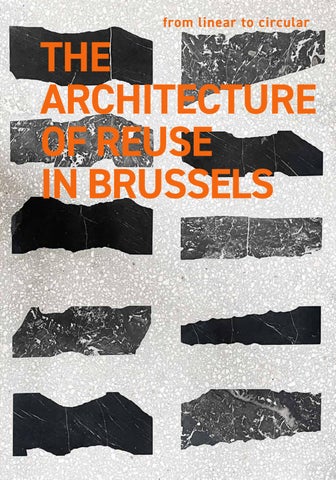
THE ARCHITECTURE OF REUSE IN BRUSSELS

AUTHORS

Kristiaan BORRET is Bouwmeester Maître Architecte (BMA) of Brussels Capital Region.

Ben DIRICKX was a member of the team BMA and now partner at VELD.

Michaël GHYOOT is working at Rotor and doing research and teaching at ULB Faculté d’Architecture.

Corentin HAUBRUGE was trained as an engineer-architect and works as photographer.

Caroline HENROTAY works at the Brussels Environment administration.

Jérôme KOCKEROLS is a member of the team BMA.

Colm MAC AOIDH worked on the Urban Maestro project at BMA and now in the research group Trace at Hasselt University.

Anton MAERTENS is working on advocacy and business development at BC materials.

Lorène MORENVAL was an intern in the team BMA and works now at Atelier Franck Boutté.

Jean-Guy PECHER is a member of the team BMA.

Mark TUFF is partner at Sergison Bates architects.

Frederik SERROEN is a member of the team BMA.

Jitse VAN DEN BERG is partner at noAarchitecten.

from linear to circular

THE ARCHITECTURE OF REUSE IN BRUSSELS

PROGRAMME AND BUILDING ALLIANCES

Building owners must be motivated to undertake renovations to transform the quality of existing buildings in the city. At the same time, public authorities play a crucial role in making these projects possible. They can act as a link between a programme and a real estate opportunity. The aim is to find the perfect alliance between the programme’s needs and the existing building’s characteristics. Two examples illustrate this approach: In Molenbeek, transforming a former art deco brewery into a secondary school (Egied Van Broeckhoven School project) reveals the successful alliance between a building and a specific programme. This adaptive reuse of the building reveals its spatial qualities while highlighting the qualities of its architecture and opening it up to the neighbourhood. In the same way, the conversion of the gendarmerie barracks into social housing (Général Jacques project, 60 social housing units on the Usquare site) takes advantage of the architectural features of the existing buildings and, through architectural acupuncture, intertwines new typologies as an extension of the initial occupation. This process involves tailoring the programme and project timetable.

EGIED VAN BROECKHOVEN SCHOOL

The story of the Egied Van Broeckhoven school is one of opportunity. It all began with the wishes of the non-profit organisation Ignatius Scholen in Beweging to open a secondary school for people from the working and middle classes, particularly those with a migrant background. Targeting the Molenbeek municipality, the essence of the project from the outset was to forge links with the neighbourhood. In 2014, Joris Tiebout, chairman of the non-profit association, embarked on a tedious search for a plot of land, which took almost four years.

At the same time, a project to build housing on the former Vandenheuvel brewery site was referred to a quality board. Although not listed, the former brewery boasts some interesting architectural features, with the art deco facade housing a beautiful concrete structure with a long span and generous volumes. This broad span could not be used for housing, so the developer proposed partially demolishing this industrial heritage.

Following the unfavourable recommendation from the regional authorities, the BMA informed the nonprofit association that the building was available for a programme capable of exploiting the existing potential and adapting these broad spans. And so the alliance between the non-profit association and the Vandenheuvel building began. However, the brewery was falling into disrepair, and the land was polluted, making a reconversion particularly complex. The nonprofit association negotiated with the owner to pay for the clean-up, enabling the school to be set up at the same time as refurbishing the building for its next life. The project’s ambitions were refined with the help of a programming agency, which defined the scope required to implement such a programme.

The non-profit association organised a competition for the conversion as part of a Design and Build contract, including in the specifications the desire to open up the building to the neighbourhood and conserve as much of the existing structure as possible. The Alheembouw — BAM PPP PGGM & B2AI consortium won the contract. In particular, the project proposes to locate the sports hall open to residents on the ground floor in the corner, in direct contact with the street, providing a visual link and

a buffer with the educational programmes. The project rooms will be on top floors, taking advantage of the building’s long spans.

The Egied Van Broeckhoven school opened its doors in September 2023 for the first secondary classes and will open one new class per year, with completion scheduled for around 2028.

GÉNÉRAL JACQUES

The Général Jacques project, the conversion of a military barracks into social housing, is part of the SLRB’s (Société du Logement de Région Bruxelles-Capitale) general strategy to significantly increase the stock of social housing. Against a housing crisis in Brussels, the SLRB delivered almost 2.000 homes between 2019 and 2024, and many projects are underway. This diversity of projects allows flexibility in terms of the typologies present in each project, which can be adapted to the qualities and potential specific to each context.

The barracks building, dating from 1950, has intrinsic qualities of habitability, with a slim corridor composed of double-oriented flats. It once housed the gendarmes’ barracks and was transferred to the land registry. In 2018, it was acquired by the SLRB, which was interested in the location, price and cost of the work. While the SLRB seized the opportunity of this land, a study of the financial profitability of the project was carried out beforehand, with the choice of a light, one-off renovation scenario that would not affect the structures. “We based our studies on this scenario from the outset. Our responsibility is to ensure an operation that does not put the SISP (Société Immobilière de Service Public) into debt and that even allows it to make a profit after a certain number of years, with the support of regional subsidies,” explains Guillaume Sokal and Déborah Tramontada, who are responsible for this project within the SLRB.

The SLRB’s approach began by paying close attention to what already existed. The typology grids and general programming requirements have been set aside to adapt the building. “Here, the choice was made to demolish as little as possible and to use the building as a mine.” Although the building no longer complies with energy standards and some rooms are now too small to be considered bedrooms, the owner retained as much of the original features as possible, right down to the Bulex kitchens and floor coverings.

This choice of light renovation costs the same as a demolition-reconstruction strategy. While savings are made on the cost of materials, this is offset by the price of the labour required to carry out the painstaking work of reuse. However, if the cost is equivalent, the result is a detailed treatment “that goes beyond the standard qualities generally found in social housing. Here, we have built-in kitchens with parquet flooring… It’s a step up in quality thanks to renovation and reuse”

Achieving this reuse goal required a longer time frame before putting the units on the market. The SLRB has carried out an asbestos inventory and, for the first time, a reuse inventory. In addition, a plan was drawn up to study the possibilities and needs of typologies.

This additional work was part of a paradigm shift. Instead of a visible, interventionist architectural operation, the SLRB aimed for an intelligent renovation: one-off interventions on the building to renovate it and refurbish the flats, achieve good energy performance and integrate outdoor spaces. Several user requirements have been formulated, such as the need for access for people with reduced mobility, the inclusion of a cycle parking area, the provision of a common room, and the need to improve urban integration, particularly by improving the treatment of the inner courtyard. The technical strategy was also important, with thermal insulation and the integration of technical installations to be defined.

In this competition, where the primary criterion was attention to circularity, the choice fell on the bid from the architectural duo Karbon-Label, who proposed the least amount of extra material. The integration of the loggias towards the interior, taking advantage of the existing slab, is of particular note. “This project raises the question of architectural quality. Does it mean looking for the perfect project in terms of its architectural expression? In this project, it’s expressed more in the technical solutions, which are much less visible, perhaps more humble.”

While renovations occur regularly for the SLRB, particularly in the heritage department, pushing the boundaries of attention at a non-listed site is a position that is becoming increasingly important. However, Guillaume Sokal notes that the assignment always evolves according to the state of the existing building: in some cases, more extensive work, including modifications to the facade, is unavoidable. In any case, the Général Jacques project is: “one of the most attractive housing projects to be let.”

CONCLUSION

These two projects embody the great leverage project owners and the authorities that support them have in reconversion programmes. One essential observation is that not all programmes adapt naturally to an existing building. Finding the right opportunity is crucial, one that combines the programme’s needs and the building’s characteristics. To facilitate this alliance, the appropriate players need to be mobilised. Public authorities, project owners and developers must be able to work closely together. BMA, the Facilities Task Force, and other similar entities can be vital in identifying buildings and carrying out successful transformation projects.

Flexibility in project programming and timing is essential when integrating them into existing buildings. Although the rules and standards are sometimes too rigid, and reuse often requires extra time in the preparatory phases, this approach offers long-term benefits such as unexpected architectural quality, preservation of heritage, savings on materials, and the project’s social impact.

EGIED VAN BROECKHOVEN SCHOOL

↑ Ground floor plan

↑ Cross section through the transformed brewery structures and the new additions

Transformation of a former brewery in Molenbeek into a school. Initially prospected unsuccessfully as a residential development in a city in search of densification, the brewery’s generous spaces proved more suitable for a different type of programme, leading to its adaptation into an educational facility.

Site

Pierre van Humbeekstraat 5

1080 Sint-Jans-Molenbeek

Year

2017 > 2024

Client vzw Ignatius Scholen in Beweging

Architect

B2Ai architects

Team

B2Ai interior design (interior design)

Stefaan Thiers (lanscape architecture)

VK architects & engineers (structural and MEP engineering)

In Brussels, we once demolished buildings without remorse, discarded materials to waste in the blink of an eye, and built for a lifespan of fifty years or less. But times have changed. Reuse architecture has emerged as a central focus in the city’s architectural agenda over the past two decades, and the mindset is shifting. Circularity is now at the forefront — yet it encompasses far more than reusing materials salvaged from demolition sites.

This book explores 14 architectural projects in Brussels, each offering a distinct take on circularity. Working with salvaged materials isn’t new — Palladio, for one, valued them for their proven strength over time. Yet today, materials that once met certification standards often lose their worth upon dismantling. How can we overcome such industrial-age challenges? And how to find meaning in the “as found”? Some buildings are saved for their heritage or emotional value, but how do we reveal the potential of the anonymous, everyday structures in our city? And when new construction is necessary, how can we design with temporality in mind — creating buildings that are not only robust but also adaptable, dismantleable, or made from materials with minimal impact on our planet?

By showcasing these architectural works, this publication aims to demonstrate that circular architecture is not niche. It’s in its infancy, but our ambition in Brussels is to bring it into the mainstream.

ISBN 978-2-9603291-1-7

D/2024/15682/01

Turn static files into dynamic content formats.
Create a flipbook
Egied Van Broeckhoven School by B2Ai architects - Issuu