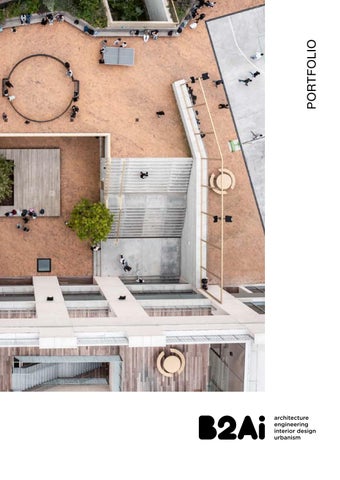
B2Ai portfolio

Page 1


B2Ai stands for a multidisciplinary team of +/- 140 architects, structural + technical engineers, interior designers & urban planners.

B2Ai is a design practice with more than four decades of experience, with its foundations in a strong multidisciplinary approach. Rooted in collaboration, we bring together architecture, engineering, interior design and urbanism.

This integrated approach allows us to tackle complex briefs; from schools and care environments to residential developments, offices, cultural projects and large-scale spatial planning. Our strength lies in the interaction between disciplines. Different departments work side by side from the earliest concept stages.

In addition to our architectural mission, our structural + technical engineering and interior design departments also operate as independent partners. Led by dedicated experts, they support fellow architects, developers and contractors with high-level design services.

B2Ai Brussels
Rue J. Jordaensstraat 18a
B2Ai Ghent
UCO Tower, Bellevue 5

Antwerp Tower, Frankrijklei 5

B2Ai Antwerp
B2Ai Roeselare

Simon Claeys CCO - Partner

adaptive reuse / mixed-use

History

Management

In 1979, the late Hendrik Vermoortel founded the renowned BURO II in West Flanders. Four years later, the Brussels based ARCHI+I of Philémon Wachtelaer saw the light of day. In 2009, BURO II opened a studio in Ghent. Based on shared values and ambition, BURO II and ARCHI+I merged in 2011 to become one architectural office with three locations.

Since 2017, the team has stood for its people-oriented approach under the name B2Ai. In 2018, Pieterjan Vermoortel became single shareholder and stepped into the role of CEO, further shaping the design practice’s strategic direction and growth trajectory. In 2025, a fourth studio opened in Antwerp.

Xavier Callens CDO - Partner design
Caroline Jacobs COO
Pieterjan Vermoortel CEO

Team Management & Partners

Photography Koen Broos

Years of practice and a solid internal organisation guarantee broad support for collaborators and maximum room for creativity.

PARTNERS

DESIGN

EXTERNAL

Creative Director

DESIGN ARCHITECTS PROJECT ARCHITECTS

Creative Director

DESIGN ARCHITECTS PROJECT ARCHITECTS

Wim Depuydt Creative Director

DESIGN ARCHITECTS PROJECT ARCHITECTS

Wim Depuydt Creative Director

DESIGN ARCHITECTS PROJECT ARCHITECTS

COMMUNICATION TENDERING

Dieter Haemers Creative Director

DESIGN ARCHITECTS PROJECT ARCHITECTS

SUSTAINABILITY KNOWLEDGE LIBRARY

Xavier Callens Chief Design Officer
Xavier Callens
Kevin D’hondt Joost Robignon
Ambroise Crêvecoeur
Vermoortel
de Jong
Simon Claeys Chief Commercial Officer
Robbe De Geyter Director
Frederik Carrein Director

Pieterjan Vermoortel Chief Executive Officer

INTERIOR DESIGN

Bart Decloedt Director

URBANISM

Joost Robignon Director

STUDIO BRUSSELS 1

STUDIO

Caroline Jacobs Chief Operations Officer

Janina Vertriest

Studio Director

STUDIO BRUSSELS 2

Nicolas Michielsen

Studio Director

STUDIO GHENT 1

Steven Martin

Studio Director

STUDIO GHENT 2

Jo Baeke

Studio Director

STUDIO ROESELARE

Frederik Popelier

Studio Director

Jo Baeke Quality Manager

You challenge. You can come to us with your unique project and your ambitions. We take on the challenge of creating added value for people, society, nature and the climate.

We rethink.

With an open mind we analyse the context and the history of the site. We dare to question the programme and your expectations and think out-of-the-box. We investigate the strengths and weaknesses and translate them into powerful concepts.

Together we create.

We do this together. From our shared passion. In open dialogue with governments, specialists, manufacturers, and researchers. In participation with users and local residents.

We create something unique, tailor-made and timeless. Subtle and self-evident. With room for emotion and imagination. We arrive at an integrated, inclusive and generous project. From concept to detail. From master plan to interior design.

You challenge. We rethink. Together we create.

Architecture in transition

B2Ai, one of the largest architectural practices in the country, has not shelved its growth ambitions. Scale matters in architecture, according to CEO Pieterjan Vermoortel. “The shift towards mixeduse projects requires expertise across multiple domains.”

Text Laurenz Verledens

B2Ai has mixed roots. The firm, which today employs 140 people, was founded in 2011 through the merger of the Roeselare-based BURO II and the Brussels practice ARCHI+I. A marriage of convenience? In any case, it was a wise and highly complementary union. BURO II was the life’s work of the late Hendrik Vermoortel. From the provincial city of Roeselare, he built his office into one of Flanders’ leading architectural practices. His contemporary Philémon Wachtelaer, through ARCHI+I, could rely on a strong network in Brussels’ key real estate sector. Following Hendrik Vermoortel’s passing in 2015, his son Pieterjan became one of four partners in the firm. In 2018, Pieterjan Vermoortel acquired the shares of the other partners and became CEO and managing director.

The buildings designed by B2Ai may well be more widely known than the practice itself. Its portfolio includes the headquarters of Vlerick Business School in Ghent, the AZ Zeno hospital in Knokke-Heist and the mixed-use Leopoldskazerne project in Ghent (in collaboration with 360 Architecten and Sergison Bates Architects in London).

For the new Club Brugge stadium, you are working with the French practice SCAU. Your partnerships with renowned international firms appear to be a winning formula. But does it not sting that those foreign firms often seem to take the credit?

Pieterjan: “It may sometimes appear that way, but you should know that we select those renowned firms ourselves. On behalf of our client, we look for partners who add specific expertise to a project. We recently completed a mixed-use development in Roeselare with Snøhetta. Why Snøhetta? Because they excel at embedding large-scale projects within their landscape context.”

“There must always be added value. For the Haren prison project, we worked with a Dutch firm that has already completed several prisons. We do not have that experience ourselves, so their expertise is highly valuable. Our role in such partnerships is not limited to execution; we usually take the lead in the design process. I am thinking, for example, of the AZ Zeno hospital in Knokke-Heist. In any case, we also complete many projects independently,

BIO

Born in 1979 in Roeselare, Pieterjan Vermoortel trained as a civil engineer–architect at KU Leuven. He later completed a Master in Excellence at the Berlage Institute in Amsterdam and a Master in Real Estate at Antwerp Management School. He joined B2Ai (then BURO II) in 2004, became a partner in 2011 and has served as CEO since 2018.

including large ones. And sometimes we are the internationally renowned architect; as was the case for the Guangzhou International Convention Centre in China.”

That project dates back to 2007. Would such a Chinese venture still be possible today?

Pieterjan: “Yes. We are capable of it. But China has changed. I was personally involved in leading that project. At the time, China was still searching and open to foreign knowledge and creativity. Today, the country is far more self-assured and no longer seeks that external input. That period has passed. However, there are other major markets where we can make a contribution. Belgian developers are also far more internationally active than they were five years ago. That, too, creates opportunities.”

Handling complex, large-scale projects requires more than design talent; it requires structure, scale and multidisciplinary expertise.

Closer to home, you are also becoming more active in Wallonia.

Pieterjan: “Indeed, there are still many opportunities for us in Wallonia, but not only there. We have offices in Brussels, Ghent, Roeselare and Antwerp. Each office has partners who actively develop their region. For large projects, we are already present throughout the country, simply because we are one of the few practices capable of handling such complexity. Our scale works to our advantage there.”

“For mid-sized projects, however, we notice that we are less active in Antwerp, Limburg, Flemish Brabant and Wallonia. We are addressing this by asking our partners to focus specifically on these blind spots. Those partners must have a strong network in their respective regions. In the longer term, this could lead to acquisitions, mergers or the opening of new branches. That should enable us to increase our turnover. The next step is to operate abroad in a more structural way. We already have some international projects, but they are limited in number and mainly opportunity-led.”

Club Brugge stadium

“The temporary decline in assignments from developers during the pandemic was partly offset by focusing more on public commissions. We won several school competitions and are involved in new swimming pool projects. Before the pandemic, 80 per cent of our work came from private developers and 20 per cent from public authorities. Today, the ratio is closer to 60–40.”

You emphasise the importance of growth and scale.

Pieterjan: “To be clear, not all of the 140 people working for us are architects. We are a multidisciplinary practice, with architectural design studios as well as departments of structural and technical engineering, interior design and urbanism. Thanks to that scale, we have far more expertise in-house than most other firms. That is essential, as we are seeing a shift from single-use to mixed-use projects. The Leopoldskazerne development in Ghent is a good example. It includes houses and apartments, but also the new provincial headquarters, a hotel and ateliers. Projects like that require knowledge across several disciplines.”

Do you expect consolidation in the Belgian architectural sector?

Pieterjan: “Architecture is a very specific sector. Architect is a protected profession. We carry significant responsibility and are bound by strict professional regulations. The Order of Architects, for example, requires that at least 60 per cent of the shares in an architectural practice be held by architects, and that the board consist entirely of architects. That makes it difficult to attract external capital. What investor would put money into a company where they have no say? For that reason, I do not foresee a wave of consolidation in our sector any time soon, unlike what we are currently seeing among engineering firms.”

How does B2Ai distinguish itself from other practices?

Pieterjan: “We have a clear vision of architecture, which we summarise in three phrases: You challenge. We rethink. Together we create. The first two relate to the process. We start from the client’s ambition, but we also seek added value for the surroundings, for society and for the climate. We engage in dialogue with the client and with other stakeholders, such as end users, public authorities and local residents. We then work together with the client to create a response to those ambitions, needs and questions.”

“We always start from a blank sheet of paper, and the outcome is always different. That is why we do not have a recognisable signature style. Each project is unique, tailor-made and fully integrated; a specific response to a specific brief.”

“In addition, we place strong emphasis on refining our organisational structure. Why? Because when the organisation and processes are clear, everyone can focus on content and quality. In a large practice like ours, dealing with complex projects, that is essential. Without a clear structure, chaos prevails, and too much time and energy is lost solving avoidable problems, inevitably at the expense of creativity.”

Europe is placing significant responsibility on the construction and real estate sectors to achieve its climate ambitions. Should architects also feel addressed?

Pieterjan: “Absolutely. Over the past decade, significant progress has already been made. In terms of energy performance, we have almost reached an optimum in new-build projects. When it comes to insulation values and the performance of technical installations, there is only limited room for further improvement. But that applies to new buildings. There is still enormous potential in upgrading the existing buildings.

“From an urban planning perspective, there are also gains to be made, for example by building more densely in well-connected urban centres, which is precisely the aim of the Flemish bouwshift.”

“The focus is also shifting towards materials: what is their environmental impact, and how can we maximise reuse?”

So you are referring to circular construction?

Pieterjan: “Indeed. We are seeing a move towards greater use of timber, as cement and steel still account for a significant share of CO₂ emissions.”

Do you expect a breakthrough in circular construction in the short term?

Pieterjan: “It is still in its infancy. We have been working with BIM (Building Information Modelling) for years, creating a kind of digital twin of a building. That is an important component in delivering circular buildings, but it is by no means the only one. Much work remains to be done, particularly in the production of circular building materials.”

“That does not mean we are not taking steps in the right direction. Renovation, for example, is gaining importance. In essence, that too is a form of material reuse. In Brussels, it is very difficult to obtain a demolition permit for buildings with a sound structure. Smart renovation delivers quick climate gains.”

As CEO of a company with 140 employees, do you still find time to design?

Pieterjan: “I remain an architect. I will never give up the creative aspect.”

Roelevard mixed-use Roeselare

At B2Ai, sustainability is a longterm commitment to shaping a built environment that responds to today’s needs and anticipates tomorrow’s challenges. We see architecture as a catalyst for societal change. As mobility shifts, demographics evolve, climate pressure increases and expectations around wellbeing intensify, the built environment must respond, intelligently and with longterm vision.

Sustainability & Innovation

International expertise

That is why we continuously invest in targeted fields of expertise that strengthen our capacity to design future-proof projects. From circular construction and energy performance to future-oriented workplaces and diverse housing, we deliberately focus on the knowledge domains that will redefine architecture. By embedding this expertise directly into our multidisciplinary teams, we ensure that innovation is not an add-on, but an integrated design driver.

Adaptive reuse & Renovation

Brussels & Metropolitan context

Future-oriented Learning & Care

Collaborative working environments

Densification & Mixed-use

Housing diversity & Habitats

BRUGES

ANTWERP

GHENT

ROESELARE

KORTRIJK

BRUSSELS

MONS

NAMUR
CHARLEROI

Projects Across Belgium & abroad

B2Ai has built up extensive know-how and its references include mixed-use, residential, office, commercial & urban projects, as well as schools and centres for (health)care, sports & culture.

With experience in both the public and private sector, B2Ai is a strong partner for Design & Build or PPP projects.

Residential

Health & Care Office

Social Housing

Civic Logistics

Bruges fire station
Waterfront mixed-use Waregem
AZ Zeno hospital Knokke-Heist
Ragheno logistics centre Mechelen
The Arch offices Brussels
Drie Hofsteden social housing Kortrijk

Education Culture

Sports Retail & Hospitality

Mixed-use Urban

ICADI mixed-use Liège
Green C mixed-use Ostend
Egied Van Broeckhoven School Brussels
Durmehal swimming pool Lokeren
Kursaal theater Ostend
Wienerberger showroom Londerzeel

Waterfront Waregem

Vertical neighbourhood as a landmark

Over the past few years, the area around the Elindus Arena, located between the Regenboogpark and the southern inner ring of Waregem, has undergone a spectacular transformation. The formerly unassigned area has been reshaped into a vibrant new urban district that combines living, working & leisure. The highlight is provided by two residential towers that present themselves as an abstract Y-shaped sculpture with their irregular facades in natural stone and serrated balconies.

By reorganising outdated structures, residual areas can be transformed into exciting urban areas that seamlessly fit into the existing fabric.

Programme Newly built apartments, offices & hotel

Location Zuiderlaan, Waregem

Surface area 27,000 m²

Client ION & Steenoven

Architect B2Ai & Wielfaert architecten

Landscape architect Atelier Arne Deruyter

Stability VK architects+engineers Building physics BM Engineering Contractor

residential towers + hotel: BAM Interbuild offices: Alheembouw

Photography

Klaas Verdu, Jami Productions & Philippe van Gelooven

Sculptural trinity in green urban space

A layered, holistic concept creates a clear balance between and private space. The ring road becomes a green, livable urban boulevard, with former stadium parking replaced by a new parking building across the road. Generous, tree-lined pedestrian crossings now lead into an urban square that ties all buildings and functions together.

The ensemble is reinforced by the careful positioning of three new volumes, office, hotel and residential towers, forming a coherent architectural triptych. While they share a common rhythm, scale and material language, each building responds differently to its context. The rounded hotel and office pavilion feature horizontal bands of architectural concrete, echoing the adjacent football stadium.

Vertical living

Because the towers widen as they rise, the footprint remains limited, and the ground level remains open, maximising the filtered views between the buildings. The square becomes a play between density and openness, between built and unbuilt, between private and . A dynamic that is further enhanced by the buildings’ all-around orientation. No volume has a front or back. They are buildings without direction.

The irregular layering is nuanced by a sober material palette of glass, sand-coloured natural stone, and bronze-coloured aluminium. The strength of the architecture lies not only in its expressive visual language but also in the humanisation of the typical anonymous skyscraper. The serrated balconies give the buildings a sculptural quality. At the same time, they encourage dialogue with the surroundings and externalise the life that unfolds within. The varied facade image reflects the diversity within the towers themselves, which seem to take on the form of stacked plots.

No balcony is the same. This variation extends indoors as well. Just as all terraces differ, all residential units offer a different experience due to the variety of orientations, views and layouts. Each apartment is a unique living space with its own identity and personality, and a connection with its respective residents. The towers are vertical neighbourhoods, claiming their place as a landmark for the area, with the balconies symbolising diversity.

The varied facade image reflects the diversity within the towers themselves, which seem to take on the form of stacked plots.

Flexibility as a sustainable starting point

The great variety of balconies and apartments is not only the result of a strong conceptual narrative. Contemporary construction primarily involves thinking about structures that transcend generations and open themselves up to future opportunities. A new resident, an ageing resident, a growing family… Each requires a different kind of flexibility from a building. The residential towers, as well as the hotel and office pavilion, are adaptable structures that encompass the element of time. The office building utilises a flexible grid of concrete mushroom columns supporting the floors. A central core with stairs, lifts and fixed amenities extends to the building’s peak. The staggered platforms surrounding it can be given various purposes according to the user’s needs.

The residential towers are also conceived as intelligent shells, rationally built around a central core. Except for three fixed load-bearing axes, there is an open floor plan that can be freely furnished or divided. On the lower floors, the core is surrounded by four units. A bit higher, there are five, and at the very top, the number rises to six. This creates a mix of residential types with one or more bedrooms. Following the principle of the intelligent shell, spaces can be easily combined to create new layouts. The diversity in outdoor spaces and perforations further specifies each unit.

Contemporary construction primarily involves thinking about structures that transcend generations and open themselves up to future opportunities.

mixed-use

De Kazerne Ghent

Former military barracks transformed into a vibrant urban district

The historic Leopold Barracks in Ghent has undergone a profound transformation in recent years, evolving from a 19th-century military bastion into an open urban district. What was once a closed enclave is now an inviting urban quarter where facilities, housing, work and social interaction come together around a new neighbourhood park.

At the heart of the two-hectare site lies the redesigned Paradeplein, one of the largest — and until recently hidden — squares in Ghent. The former paved inner courtyard has been replaced by an accessible neighbourhood park that connects seamlessly to the surrounding streets. Located on Ghent’s inner ring road, opposite Citadel Park and embedded in the museum and arts district, the site is now connected to a network of spaces and cultural institutions such as S.M.A.K., MSK, STAM and the Bijloke site.

In addition to the new Provincial Government Building of East Flanders, De Kazerne comprises a mix of apartments, houses, ateliers, classrooms, a childcare centre and a hotel.

What was once a closed enclave is now an inviting urban quarter.

Programme Conversion of barracks into provincial HQ, housing, daycare & hotel

Location Charles de Kerckhovelaan, Ghent

Surface area 43,000 m²

Client Province of East Flanders, Ciril, Matexi & Nelson group

Architect B2Ai, Sergison Bates, 360 & Spectra Landscape architect Delva & Buro landschap Stability & Building physics

SWECO, Sileghem & Partners, DUSS, Ingenium, Crea-Tec, MW Engineering & Antea Group Sustainability consultant 3E & DUSS Contractor Democo & CIT Blaton

Photography Stijn Bollaert, Karin Borghouts, Tim Van de Velde & Jami Productions

From defensive stronghold to permeable urban district

The Leopold Barracks was constructed at the end of the 19th and the beginning of the 20th century as a walled military complex in a romantic-eclectic style, designed by architects de Noyette and Geerling. The reconversion brief was clear: to open up and transform a heavily fortified complex — complete with high walls, towers, battlements and loopholes — into an inviting urban quarter.

The design team strategically breached the closed pentagonal perimeter, opened up the corners of the fortress and made the site permeable. A square along Charles de Kerchovelaan opens De Kazerne towards Citadel Park and the ring road, while the former parade ground was redesigned as a ly accessible neighbourhood park.

A layered programme

The new programme of De Kazerne follows the pentagonal layout of the former military complex. Along Charles de Kerchovelaan, opposite Citadel Park, stands the new Provincial Government Building of East Flanders, while the JAM Hotel is housed in the rear wing. Perpendicular to this, approximately 80 apartments are accommodated in the two historic buildings enclosing the parade square.

Ten new townhouses complete the residential programme along Eekhoutstraat and Kattenberg. Along the residential wings, two collective gardens — located between the historic buildings and the new ground-level houses at the edges of the site — create green intermediate zones. Together with the new forecourt, they form a fine-grained network of and semi- spaces.

Provincial Government Building

Designed by Sergison Bates architects and 360 architecten, the Provincial Government Building combines the historic southern wing with a contemporary extension. It houses a broad mix of and administrative functions and introduces a new route, reinforcing De Kazerne as an open and accessible urban hub.

Residential

The residential development by B2Ai includes apartments and family houses organised around shared terraces, gardens and a communal workshop. These collective spaces foster social interaction and support a vibrant, mixedgenerational neighbourhood.

Hotel

The JAM Hotel, in the rear wing, offers 107 rooms, a restaurant and a rooftop bar. Renovated by B2Ai and designed under the artistic direction of Lionel Jadot, it blends military heritage with circular design principles, contributing to the lively, mixed-use character of De Kazerne.

The reconversion of the Barracks is rooted in respectful reuse and reinforcement of the existing architecture.

Heritage

as the foundation of a future-oriented district

The reconversion of the listed Leopold Barracks is rooted in respectful reuse and reinforcement of the existing architecture. Historic structures were restored and complemented by carefully placed new volumes, while strategic openings improve accessibility and permeability.

The robust character of the former military complex remains legible, now reinterpreted as an open and inviting urban district.

Sustainably developed

The redevelopment combines heritage with a pragmatic sustainability strategy. Buildings are insulated within heritage constraints, geothermal energy and rainwater reuse are applied, and green, de-sealed spaces enhance infiltration and biodiversity. The site is car-free above ground, with underground logistics and ample bicycle parking.

The Provincial Government Building follows BREEAM guidelines, with the ambition of achieving BREEAM Excellent certification.

The redevelopment combines heritage with a pragmatic sustainability strategy.

Roelevard Roeselare

New life in the railway station district

Roelevard, a union of the name Roeselare and the word boulevard, transforms the old railway station district in the historic city of Roeselare into a vibrant work and living environment. As the station once divided the city, with an above-ground rail line that left few crossing points, the new complex strengthens an existing small pedestrian tunnel, highlighting connections of the green area at the front of the station to the former undeveloped grounds behind the railway tracks, tying the two parts of the city back together. The design integrates apartments, office spaces, commercial units, and an underground parking facility.

As Roeselare has experienced a significant revival as an urban area in recent years, the need for city streets, recreational areas, and meeting places increases. More than half of the ground floor building area is given to retail & hospitality functions to enhance services further, and is blending into Roeselare’s shopping street, forming a retail axis running from the market square all the way to Roelevard. As the 46-metre tall tower already is a true landmark, Roelevard also boasts a 2,141 square meter green roof, as well as planted patios on the outside of the apartments, creating a stair-step effect in the tapering high-rise.

Programme Newly built apartments, offices, retail & hospitality

Location Stationsdreef, Roeselare

Surface area 17,500 m²

Client ION & Steenoven

Master plan BUUR, Bas Smets, Snøhetta & B2Ai urbanism Architect & Landscape

architect B2Ai & Snøhetta Botanist Erik De Waele Interior designer B2Ai interior design

Stability, Building physics & Sustainability

consultant BM Engineering

Contractor Democo

Photography Philippe van Gelooven & Jami Productions

With Roelevard, we saw an opportunity to reconnect the city — not just physically, but socially. By transforming a once-divided railway zone into a vibrant, mixed-use destination, we’re helping Roeselare grow into a more cohesive and livable urban environment.

Adapting to the context

The two buildings are shaped to be in harmony with the urban topography. The south building includes the tallest part of the complex with 12 floors on the most urban edge of the site, nearest to the central train station, while the tower on the northern part of the site reaches only 4 floors to match its immediate less urban residential neighbours. The facades are thoughtfully articulated to reduce perceived mass and bulk, with treatments tailored to the distinct functions of retail, office, and residential areas.

At street level, retail spaces feature expansive glazing to foster transparency and engagement with the surrounding urban plazas. The office facades above are rendered in a more opaque and uniform style, reflecting their inward, workfocused character. On top, the residential levels are designed with a textured and porous aesthetic, incorporating generous, visible terraces that encourage social interaction and foster connections between residents and the broader urban fabric of Roeselare.

Roelevard is more than a building — it’s a new chapter for Roeselare. By prioritising sustainability, connectivity, and shared spaces, we’ve created a place where people can live, work, and meet in a way that reflects the city’s evolving identity.

New urban areas

Roelevard’s urban plazas are designed to provide destinationworthy amenities for the , including a generous amphitheater leading to a second-floor restaurant and/or café that overlook the city center. Shared and easily accessible urban areas are prioritised throughout the site.At ground level, clusters of trees with integrated seating invite not just passage, but also use — offering a place to sit, pause, or meet others.

The project exemplifies how thoughtful architecture and strategic spatial planning can elevate the urban experience. By seamlessly integrating residential and professional functions, Roelevard fosters a vibrant atmosphere that remains active and engaging throughout the day and into the evening.

The Waves Ostend

Architecture that undulates with the landscape and anchors itself in the city

The Waves is a residential ensemble in Ostend, within walking distance of the seafront and adjacent to the Wellington racecourse and golf course. The project comprises 413 apartments, a commercial plinth, collective outdoor space and underground parking and cycling facilities.

Located at the threshold between compact city and open landscape, The Waves mediates between urban fabric and coastal expanse. Rather than forming a single mass, the development consists of four organically shaped, staggered volumes arranged around a publicly accessible square. This configuration maximises views towards both sea and greenery, allows sunlight and air to penetrate deeply between the buildings, and avoids creating a closed urban wall.

There is no back here: every facade is designed as a fully-fledged front.

Programme Newly built apartments, Location Troonstraat, Ostend

Surface area 45,000 m²

Client Vastgoedgroep Degroote

Architect B2Ai Landscape architect Arne Deruyter Stability Cobe Building physics & Contractor Degroote Real Estate Construct

Photography Vastgoedgroep Degroote

Each volume is conceived as a layered composition of plinth, base and recessed lantern. Dark cornices, horizontal articulation and subtle colour accents give the buildings a readable rhythm and human scale. Materials such as glazed brick and white polished concrete with sand-coloured aggregates reference the coastal context. The volumes, named Sea, Sand, Salt and Sky, each have a distinct identity while maintaining architectural unity.

Residential quality is central to the concept. The undulating configuration ensures corner apartments with dual orientation, generous daylight and sheltered balconies that strengthen the connection between inside and outside. Typologies accommodate both permanent residents and second-home users.

A lively commercial plinth activates Troonstraat while preserving residential tranquillity above. The publicly accessible square and landscape design introduce soft contours and climate-resilient planting, creating a natural transition between architecture and coastal landscape.

The Waves offers a contemporary interpretation of living by the sea; open, light-filled and carefully embedded in its surroundings.

I.C.A.D.I. Liège

Redevelopment of industrial & cultural heritage into a vibrant urban neighborhood

The project involves transforming the site of the former Institut de la Construction, des Arts Décoratifs et de l’Infographie (I.C.A.D.I.) in Liège into a green, lively and futureoriented neighbourhood. By merging adaptive reuse with respect for heritage, a strong community focus, cultural programming, soft mobility, biodiversity, adaptability and longterm sustainability, the development seeks to reinforce social cohesion and enhance community life in the rapidly evolving Guillemins district.

The concept is anchored in generous green spaces, private gardens and welcoming public meeting places, providing the foundations for a lively and colourful new quarter that integrates with its surroundings. Cultural life and community participation are encouraged through a mix of functions and typologies. The development will include a range of housing types complemented by public amenities and workspaces. Through the reactivation and transformation of the former industrial complex and the historic I.C.A.D.I. building, the project seeks to honour the site’s industrial and cultural heritage while contributing to the renewal of the wider neighbourhood.

Programme Conversion, renovation & newly built houses, apartements, offices & public buildings

Location Guillemins district, Liège

Surface area 19,700 m²

Client UHODA Group & CAAAP

Architect Dorte Mandrup & B2Ai

Landscape architect Atelier CUP Stability & Building physics Greisch Sustainability

consultant Sureal Contractor Artes

3D Beauty & The Bit

By merging adaptive reuse with respect for heritage, a strong community focus, cultural programming, soft mobility, biodiversity, adaptability and long-term sustainability, the development seeks to reinforce social cohesion in the Guillemins district.

Deinze Mills

Conversion of industrial site into lively urban neighbourhood along the Lys

Molens van Deinze transforms the historic industrial Dossche mill site along the river Lys, in the heart of Deinze. Over time, mills and silos shaped a layered urban fabric of varied volumes and open spaces. The master plan builds on this existing logic, introducing housing, commercial functions and public programmes organised around a series of central courtyards.

Today, the site unfolds as a compact, city-like ensemble with a rich and playful diversity of scales and open spaces. A green promenade, together with new cycling and pedestrian routes, now weaves through the new urban quarter and reconnects the town centre of Deinze with the Lys.

Rather than erasing the industrial past, the master plan translates it into urban DNA, with the mills and silos shaping the framework of a new mixed urban fabric.

Programme Conversion of an industrial site; renovation & newly built housing, commercial & public spaces

Location Tolpoortstraat, Deinze

Surface area 32,800 m²

Client 3d real estate

Master plan & Architecture Reiulf Ramstad Architekter, URA & B2Ai Landscape architect Arne Deruyter & Antea Group Stability & Building physics BM Engineering Sustainability consultant Kubiek Contractor Besix

3D & Photography Reiulf Ramstad Architekter & Philippe Piraux

The master plan brings Deinze back to the Lys; stitching city and water together with new cycling and walking routes, extending the commercial heart into a green park, and transforming the former loading dock into a public mooring quay.

The buildings vary in scale, materiality and volume to prolong the site’s qualities. The buildings on the south side are lower, connecting with the adjacent residential neighbourhood and letting the sun reach the public spaces, while interventions on the north side near the silos are higher, asserting the city’s presence by the river.

An underground car park makes way for green space on the site. The public outdoor spaces are designed to offer variety and human scale: a large green park, a lively urban plaza, lush gardens, intimate pocket parks, terraces and a riverside promenade ensure an attractive and generous neighbourhood.

Neighbourhood-focused

Due to population growth and demographic changes, Belgium continues to face a major housing shortage. At the same time, available building land is shrinking, shifting the focus increasingly from expansion on the outskirts to redevelopment in central areas. In other words, urban sprawl is giving way to infill: abandoned, underused or neglected spaces within the city are being revitalised in harmony with the existing fabric. This evolution not only yields a significant spatial return, but also creates opportunities to develop high-quality, liveable residential environments that foster connections between people and their surroundings.

Many cities and towns are struggling with vacancy. Infill projects allow us to give meaning back to neglected areas. How can such projects contribute to the liveability of a town or city?

Xavier Callens: “Often, these are sites that once had a specific economic or social function— places that were important to the local community and still resonate in the collective memory. Over time, however, they were abandoned or neglected. By giving them a new purpose, we can reactivate and bring them back to life. Addressing the housing shortage is one aspect, but the real aim is to reintegrate these sites into the broader urban framework. This starts with intelligently reconnecting them to the city centre. In our designs, green public links often form the backbone of a master plan. These are typically low-traffic, permeable routes focused on cyclists and pedestrians, seamlessly connecting to the existing urban fabric and creating physical links to the wider surroundings. A fine example of this is Quarter 51, the redevelopment of the former military barracks in Damme - Sijsele.”

You can revitalise abandoned places by cleverly connecting them to the city centre.

Joost Robignon: “These existing sites are often grey areas or blind spots. By opening them up and connecting them via a finegrained network to the centre, you reintroduce movement and vibrancy. At the same time, the site itself becomes a place for interaction between local residents and passers-by. There are quiet zones, playgrounds, communal areas, and so on. Life moves back onto the streets, just like it used to be. Our society remains strongly individualised. Infill projects provide opportunities to stimulate community life and foster social engagement. Integrating a diverse programme is essential in this regard. By allowing different housing types to coexist, you promote social cohesion and truly return the space to the neighbourhood.”

Quarter 51 mixed-use Damme - Sijsele

The importance of sufficient public space also calls for extra attention to nature, biodiversity and rainwater management

Xavier: “Absolutely. It’s about the physical interweaving of site and surroundings, but also about the connection between people and nature. Our design strategies always fit into a broader spatial concept. Reducing paving is one of today’s top priorities. Every project is a chance to contribute to this. We maximise green landscaping and use permeable paving wherever possible. In Oostakker, we’re currently working on a new neighbourhood of around 120 homes. Two-thirds of the site is designated as predominantly green public space. Greenery is truly used as a lever to realise the new district and to connect to an existing green corridor. A carefully planned landscape design brings more oxygen, shade and biodiversity. We’re also installing swales to collect rainwater and reconfiguring an existing forest into a play forest. Every new neighbourhood is an opportunity to reduce hard surfaces and put nature at the centre.”

Through a balanced and neighbourhoodoriented approach, we focus on both densification and reinforcement.

By densifying in a balanced and neighbourhood-oriented way, you strengthen the urban core.

Joost: “De Stokerie in Kortrijk is another good example. Originally, it was a fully paved and built-up residential block. That paving has now been replaced by a sequence of private and shared gardens opening onto a green park at the heart of the site. The landscaping encourages a gradual transition from private to public. As a resident, you walk from your own terrace to a semi-public park garden and ultimately through gateways to the surrounding streets. You live in the city centre, but you can just as easily retreat into your own green cocoon.”

Xavier Callens CDO - Partner
Joost Robignon Partner
De Stokerie housing Kortrijk
Stroopoort housing Eeklo

A quality public space also requires a smart mobility plan. How do you approach this, given that much of the infrastructure often already exists?

Xavier: “One of the most obvious priorities here is to restrict car access as much as possible. Often it’s about working with the city to explore the options and make clear agreements. On certain sites, it’s possible to use nearby parking facilities within walking distance. In the Green C project in Ostend, for example, the former hospital parking is being reused. This reduces demolition and earthworks, which also brings significant CO2 savings during the construction phase. Understanding the context is essential for generating good ideas.”

Re-use of existing parking spaces keeps cars off the road and reinforces the city.

Joost: “Of course, a certain level of accessibility must always be maintained, but cars should be removed from the immediate surroundings as quickly as possible. In Oostakker, vehicles are directed straight to an underground car park, so you barely see any cars on the actual site. And naturally, cycling is encouraged. This is done by providing ample bicycle storage throughout the site and by connecting to existing cycling infrastructure. Increasingly, individual parking spaces are limited and shared cars are introduced as alternatives.”

A balanced public space is one thing. But a neighbourhood also requires a certain level of density. How do you reconcile the two?

Xavier: “One does not exclude the other. In fact, they reinforce each other. Infill allows you to increase residential density, but that doesn’t mean cramming the site full of buildings. It’s primarily about making smart choices and exploring how existing space can be better utilised. When we build, we do so in the right places by positioning blocks in a smart and logical way. We often work with atypical layouts.

At Eilandpark in Sint-Lievens-Houtem, for example, the street’s building line isn’t followed. Instead, buildings are positioned orthogonally to the street to create more open space and preserve access to the park behind. The multi-family homes are spread across two construction zones around a communal garden. Each home has its own outdoor space with large loggia terraces, functioning as an extra living area. At the same time, they are located on the communal passageway, fostering interaction with the public realm. This creates a certain level of activity that would otherwise remain hidden within the buildings.”

Joost: “We always opt for a mix of typologies. Many projects combine different types of housing, sometimes alongside other functions. This introduces a human scale to the development, making it more quickly absorbed by the neighbourhood. Take Green C in Ostend. It includes a variety of flats, stacked and multi-family homes, offered in different sizes. Together with several shared amenities—such as community gardens—it ensures an optimal social mix. It’s really like a village within the city.”

With a mix of housing types and functions, you are not building a project, but a village within the city.

Xavier: “We’re currently working on the Stroopoort project in Eeklo. Given the highly urban setting, we’ve primarily opted for various types of flats, combined with functions such as liberal professions and shops. The architecture of the new buildings deliberately enters into dialogue with the existing heritage. The site is located directly opposite a church that was long hidden behind buildings and had almost disappeared from view. Thanks to the specific positioning and volumetry of the new buildings, the church is now visible again and a new passageway has been created through the block, linking a rear school site with the market square. In other words, something that was already there has been brought back: the invisible has become visible again.”

How is that vision translated into the architecture itself?

Xavier: “Infill projects require low-threshold, recognisable architecture linked to the existing context. No flashy design choices or extravagant materials, but a comfortable visual language. Buildings with a simple logic and a strong sense of authenticity, allowing them to naturally integrate into the neighbourhood. Of course, you strive for a certain identity, but mainly through meaningful details. Like a canopy that offers shelter. Or a seating element that invites people to come outside and meet. Such details give architecture an individual character in a simple and subtle way.”

Infill projects require simple, recognisable architecture with authentic details that invite people to meet and interact.

Joost: “You mainly build on what’s already there. The original evolves but doesn’t disappear. At De Stokerie, the old furniture store was integrated into the project, maintaining the site’s recognisability. Combining white gateway buildings and covered walkways with reddishbrown brick homes enhances this even further. Not only the new residents, but also those already living there maintain a connection with the place. This actually ties in with what we said at the start: by giving a new purpose, you also strengthen social cohesion. It’s a human-scale project, in harmony with the existing context, where people can identify with the space and feel at home more quickly.”

Meergaard housing Oostakker

Eilandpark Sint-Lievens-Houtem

Former textile site transformed into a residential neighbourhood

Eilandpark revitalises the former SAEY textile site in the heart of Sint-Lievens-Houtem. Located within walking distance of the market square, shops and schools, the 6,500 m² site introduces a balanced mix of 26 flats, 11 single-family houses, including six social housing units, and commercial space.

The master plan is structured around a green pedestrian and cycle route, connecting the adjacent woodland with the village centre. Two residential clusters are organised around collective courtyard spaces that encourage meeting, play and shared use, while underground parking serves the apartment buildings. Each residential cluster consists of one multi-family unit and several single-family units.

High-quality outdoor space is central: each apartment has a private terrace and each house a private garden. With over 1,500 m² of structural greenery and permeable surfaces, the project prioritises sustainability. The architecture subtly references the site’s industrial past through red brick and steel detailing, giving the development a contemporary yet contextual identity.

Programme Conversion of an industrial site; newly built housing & commercial space

Location Doelstraat, Sint-Lievens-Houtem Surface area 5,800 m²

Client Municipality of Sint-Lievens-Houtem & intermunicipal association SOLVA Developer Alheembouw & Steenoven

Master plan B2Ai urbanism Architecture

B2Ai Landscape architect Denis Dujardin

Stability Studiebureau Wittouck Building physics Vinco Contractor Alheembouw

3D Joris Bourgeois

Meergaard Oostakker

A climate-resilient neighbourhood

Meergaard, Oostakker is a green, community-driven neighbourhood that combines compact density with affordability and spatial generosity. The master plan comprises 120 homes, including single-family houses, apartments, stacked dwellings and social housing, ensuring a diverse and affordable mix for different household types.

Landscape forms the backbone of the design, while the neighbourhood is conceived as entirely car-free. Two-thirds of the site will become public green space, focused on biodiversity and integrated water management. The existing forest will be maintained and developed into a play forest. Sustainability is a key focus, with the entire residential area set to be heated through a collective geothermal heating system.

Homes are organised into three residential zones with communal inner gardens and private outdoor spaces. Architecture reflects the village character through sloping roofs, limited heights and brick facades with subtle detailing.

Programme Newly built housing (120 units); single-family houses, apartments, stacked dwellings & social housing

Location Meerhoutstraat, Oostakker

Surface area 48,000 m²

Client Matexi Projects

Master plan B2Ai urbanism Architecture

B2Ai Landscape architect Studio

Basta Stability & Building physics B2Ai

engineering Contractor Vuylsteke-Eiffage

3D Bureel Visueel

urban / residential / office / hospitality /

Green C Ostend

Conversion of hospital site into resilient city district

Green C transforms former Sint-Jozef hospital site in Ostend into a sustainable, mixed-use neighbourhood combining distinctive housing, collective facilities, a reused parking structure and the new CM headquarters. The project translates ambitions of densification, depaving and greening into a permeable, car-free environment that balances vertical living with generous open space.

Existing structures are preserved to reduce waste, while abundant greenery and new pedestrian and cycling links integrate the site into its surroundings. A diverse mix of stacked and multi-family homes, collective amenities and affordable units fosters social cohesion, particularly for young residents. Shared facilities, public services and a neighbourhood grand café activate the central park throughout the day. With the Green C project, B2Ai demonstrates how an integrated comprehensive approach can lead to a successful repurposing of an old and dilapidated site.

By making smart use of available space and building more vertically, spatial efficiency is increased, creating a better balance between buildings and green spaces.

Programme Conversion of a hospital site; newly built housing (185 units), offices & public spaces

Location Nieuwpoortsesteenweg, Ostend

Surface area 15,700 m²

Client Vastgoedgroep Degroote & CM

Masterplan & Architecture B2Ai Landscape

architect Arne Deruyter Stability Cobe

Building physics & Contractor Degroote Real Estate Construct

Photography Klaas Verdru

Sustainable approach

By preserving the existing parking structure, a significant amount of construction waste is avoided. The terrain is designed to accommodate as much greenery and rainwater infiltration as possible, and the inner area is immediately made car-free. This limits hard surfaces around the buildings to walking and cycling paths, enhancing the site’s permeability. This significantly improves the site’s livability, promotes sustainable mobility and creates added value for the broader environment.

Notably, the mix of stacked and multi-family homes, offered in various sizes, along with several collective facilities and affordable prices, ensures an optimal social mix.

CM grand café

Community life

Timeless, high-quality architecture creates a calm and coherent framework for community life, unfolding within collective green spaces that range from semi-private gardens to fully public areas. Community gardens, play zones, water features, an orchard, a play meadow and a central square offer diverse places to meet and connect.

The project strongly emphasises shared and multifunctional facilities, including a communal meeting room, laundry, bike workshop and flexible spaces within the CM headquarters. The building’s ground floor accommodates public service counters and a staff canteen that doubles as a neighbourhood grand café, activating the central park.

New urban area

Green C tells an inclusive story. It goes beyond the physical transformation of a neglected site and focuses on building a sustainable and resilient community. Developed in close consultation with the city, residents and other stakeholders, the master plan lays the foundation for long-term social and spatial integration. At its core is the careful connection of the site to its wider context through new pedestrian and cycling routes. The new residential district becomes an urban link, connecting the seafront in the north, Maria Hendrika Park in the south, the historic centre in the east and the Wellington racecourse in the west.

By combining high-quality living, working and meeting within a green, permeable landscape, the project creates a vibrant environment where community life can unfold.

Sustainability

Sustainability has become a catch-all term in recent years. It is used indiscriminately and has become so diluted that its essence is often overlooked: we must stop depleting our planet so that future generations can survive in a healthy way. This concept is, of course, also applicable to the construction sector.

Building flexibly and circularly, with a focus on material reduction, reuse and interchangeable components, is the future. We spoke with Bart de Jong and Kevin D’hondt, two of our partners who help set the lines for B2Ai’s sustainability policy.

The climate goals are clear: by 2030, CO2 emissions must be drastically reduced; by 2050, construction must also be climateneutral. To meet these requirements, a different way of building is essential. What role does the architect have in this?

Kevin D’hondt: “We cannot ignore the fact that the construction sector has a huge impact on the environment. In the past decade, the focus has been primarily on energy consumption in the built environment. Buildings and appliances are becoming increasingly efficient, insulation is improving, etc. The energy consumption of new buildings is now minimal, almost zero. However, material use and waste remain enormous. If we want further change, a different design approach is needed. We need to be more innovative with our buildings: using fewer materials, promoting reuse, considering climateadaptive applications and modular systems that increase the adaptability and lifespan of buildings.”

Bart de Jong: “As an architect, you have a certain social responsibility. You are not only a designer, but also partly an educator. It is our task to convince clients to build differently. This doesn’t mean that we should suddenly stop using PUR or glues overnight, but we do need to start the conversation and explain why we, as an architectural practice, make different choices.

Sustainability is primarily a matter of mindset. We will never impose anything on a client, but we will point out the impact of their choices. It is crucial to design with nature in mind and to integrate more environment/nature into construction. This ranges from construction methods that naturally reduce energy demand to filling unbuilt space with more greenery. Many sites are so concreted over that they heat up the surroundings and cause flooding and overheating. By simply laying out enough green zones, you can provide cooling, and rainwater can penetrate the ground more easily. A simple ecological win that also offers many psychological benefits for us as humans.”

Circular construction is no longer an option but a necessity. If we really want to make the shift to a circular economy, we need to make deliberate design decisions.

Thinking long-term requires flexibility and adaptability. How does B2Ai make a difference in this area?

Kevin: “This approach is the norm in our office. A building is only truly sustainable if it is and remains relevant to its environment, now and in the future. We always design beyond a single function, so a building can be reconfigured or repurposed over time. It must be able to evolve with the times and grow with changing needs and societal challenges. From the design phase, we consider various scenarios. Many of our realisations are therefore constructed in a simple way and based on a limited footprint and flexible grid with a very rational logic behind it.”

A building is only truly sustainable if it is and remains relevant to its environment, now and in the future.

Bart: “B2Ai responds to the changing role of the architect today. Projects are becoming more complex, and expertise is expanding. More than ever, architecture today is teamwork. In this respect, the scale of our firm is a huge strength. We have over 140 people, from architects and interior designers to structural engineers and building systems engineers. All those experiences, trainings and opinions form an enormous knowledge library. There is always someone with a background in a specific field.

B2Ai is a one-stop-shop, an all-in-one partner. We can offer an integrated design approach where architecture, engineering, interior and urban planning are closely intertwined. From the first designs, all our departments work closely together. If we still have questions about a specific detail, we can always rely on a wide network of knowledge organisations, manufacturers and suppliers. By liaising with them, we sometimes achieve an out-of-thebox solution, but a solution with the necessary quality and guarantees in the long term, no experiments.”

Bart de Jong Partner
Kevin D’hondt Partner
Community centre Diest

When you discuss adaptability and flexibility, you inevitably end up talking about modular and circular construction.

Bart: “Absolutely. Our firm has been working on this for a long time. Modular systems are the basis for a transition to circular thinking and building. They allow you to work smartly and efficiently with unique building components that are interchangeable and reusable. Buildings can thus be easily moved, adapted, expanded and repurposed. This avoids demolition work and buildings retain their value longer.

In Diest, for example, we are building a community centre in a solid wood structure of columns and beams with walls and floors in CLT panels. It is constructed based on a fixed typology with a grid of 5 by 5 meters. All materials are modular and fully demountable, so they can be exchanged with other buildings in the future. This not only gives a building future value but also reduces waste and nitrogen and CO2 emissions.”

Kevin: “The construction sector needs fresh ideas. Not only from architects. Governments, construction companies and project developers must dare to look beyond their current scope. Wood construction, in my view, is the method par excellence to achieve the 2050 targets and build CO2-neutral. Recently, we developed the master plan for a site in Zelzate. The residential units are prefabricated in a workshop in Genk. Once ready, the houses are transported to the site by truck, assembled and installed. Tiles, kitchen, bathroom… Everything is included and perfectly tailored to the economic scale (think of cutting waste).

That is where we need to go: sustainable buildings based on cost-efficient, renewable raw materials, erected in a protected environment. Affordability is also part of the concept of sustainability for us.”

Modular systems are the basis for a transition to circular thinking and building.

Community centre Diest
Master plan Zelzate

As you have mentioned, material reduction is essential. In renovation projects, B2Ai increasingly inventories existing buildings. Can you explain how that works?

Bart: “In renovations, our goal is always to preserve as much as possible, from the general structure to individual materials. Everything in a building is analysed and summarised in a clear report: this many square meters of glass, ceiling, wall, and so on. Every aspect of the building is mapped out to see which resources can be reused, from furniture to a steel beam or a simple radiator element.”

Kevin: “We view an existing building as a material bank, with the zero-waste concept in mind. If we can’t reuse certain elements, we see if they can go to the second-hand market. Because, of course, not everything is reusable. That’s not necessary either, as long as components don’t end up as waste.

A good example is the Paddenhoek project in Ghent. At the request of Ghent University, the existing buildings are being transformed into a new energy-neutral complex. There, we analysed the entire building complex to see what can be reused, from tiles to fire doors, central heating elements and even toilets.

We go through this preliminary process in almost all renovation/rebuild projects nowadays. If you include the circular concept from the beginning, you can work with it more easily later. You just need to get everyone involved in the construction process on board with your story. Fortunately, a shift is slowly becoming noticeable. More and more manufacturers are open to taking back materials for reprocessing. Recycling in the form of downcycling is not enough; the cycle must be fully closed.”

What role do you see for B2Ai in sustainability? How do you promote circular building?

Bart: “B2Ai is one of the larger architectural firms in Belgium. Our multidisciplinary team, with over 40 years of experience, has built up extensive know-how, and its references include centres for healthcare, sports and culture, schools, offices, as well as commercial, residential and urban planning projects across Belgium and abroad. We can also go far in terms of scale and complexity of projects. In other words, we can realise projects with impact. A project of significant scale hopefully inspires many people to reflect on sustainability, on what a building can do.”

Kevin: “As architects, we play an important societal role. As critical minds in the construction process, it is our task not to focus solely on today’s price but also on the price we will all pay in the future. It is our task to help drive the shift towards a circular construction process. We see it as a shared responsibility to transform the construction sector from one with a huge environmental impact to one that actively contributes to a sustainable future.

We need to spark ambition, raise awareness, debunk false promises of sustainability, apply new design practices and dare to be stricter ourselves.

Drie Hofsteden Kortrijk

Ecological & architectural upgrade

De Drie Hofsteden social housing complex underwent a thorough transformation, combining deep renovation of the existing buildings with a new eight-storey block in warm bamboo that forms the new heart of the ensemble.

The two existing residential blocks (1970 and 1974) were renovated in phases, partly while still occupied. The studies aimed to achieve near-energy neutrality. The building envelope was fully insulated and fitted with new highperformance glazing. Technical installations were renewed, acoustic comfort was significantly improved, terraces were added, lifts were replaced and fire safety was upgraded to meet current standards. The apartments were redesigned in line with contemporary social housing standards, featuring larger bathrooms, more generous living areas and high levels of insulation, achieving BEN performance (E ≤ 30).

The site now includes 260 dwellings, 32 new low-energy units, a district library and a local service centre.

The configuration of the apartments was thoroughly refined to optimise and enlarge the usable floor area, thereby enhancing overall living comfort.

Programme Renovation & newly built social housing (260 units), library & service centre

Location Van Raemdonckpark, Kortrijk

Surface area 11,000 m²

Client Goedkope Woning

Architecture, Stability & Building physics

B2Ai Contractor Artes Depret – Artes Roegiers

Photography Gerald van Rafelghem

Hoost Knokke-Heist

A new Community House replaces the former town hall with a 13-storey landmark tower. Conceived as a vibrant, sculptural volume of stacked houses, the building combines public functions and housing.

The lower levels accommodate municipal services for Knokke-Heist, including a library with internet café, wedding and council chambers, police facilities and a double-height multifunctional space. A generous public square, retail and horeca spaces and an underground car park activate the base of the building.

Above the civic plinth, levels +2 to +13 integrate 90 apartments in a mix of typologies. Duplex units with doubleheight gardens, terraces or winter gardens enhance the tower’s expressive character while reinforcing residential quality. The building’s volume was carefully shaped through shadow studies to respect surrounding housing and preserve daylight access.

Stacked, mixed and porous, the project embodies the idea of a compact, multifunctional vertical neighbourhood.

Programme Newly built municipal town hall, event hall, apartments + parking

Location Maes- en Boereboomplein, Knokke-Heist

Surface area 1,600 m² footprint, 15,000 m² square

Client AGSO Knokke-Heist

Developer CAAAP

Design Architect Jakob + Macfarlane

Execution architect B2Ai Stability Establis

Building physics Ingenium Contractor Artes

Depret

3D CAAAP

Westwing Tower Roeselare

Westwing Park illustrates B2Ai’s integrated approach

The tower’s completion marks the symbolic culmination of the Westwing Park business complex. As a monumental gatehouse, it responds to today’s challenges in workplace livability and sustainability. The employees’ well-being and health are paramount. Westwing Tower can be considered one of the tallest and most sustainable office towers in West Flanders.

Adjacent to the tower, a centrally located green square emerges. The tower’s limited footprint and vertical stacking free up space for this new inviting meeting place, connecting and serving all buildings. At the same time, it acts as a catalyst for a completely renewed mobility plan on and around the site, further anchoring the project in the city.

Both the tower and the park embody the integrated vision of B2Ai, where urbanism, architecture, engineering, and interior design are meticulously intertwined.

Programme Newly built office tower

Location Westwing Park, Kwadestraat, Roeselare

Surface area 15,000 m²

Sustainability BREEAM Outstanding

Client Steenoven & Cennini Holding

Master plan, Architecture, Stability, Building physics & Interior design

B2Ai Sustainability consultant Encon

Contractor Alheembouw

Photography Klaas Verdru

Over the past two decades, Westwing Park has grown into a strategic office hub in West Flanders, positioned along the E403 on the Kortrijk–Bruges axis and serving as a gateway to Roeselare.

Growing graphic building

The 57-metre tower is divided into three stacked volumes varying in height, width, and depth. As the tower climbs higher, the volumes keep swelling more and more. This growing movement is accentuated by the recesses on intermediate levels, with deeper balconies. Furthermore, all facades are finished with glass, including the opaque parts.

A second skin of diagonal slats in bronze anodised aluminium has been drawn across the glass facades. On the one hand, they strengthen the synergy between all facade parts, on the other hand, they add extra layers by adding subtle nuances to the grid pattern.

Together with the pronounced volumetric work, they give the building a sculptural quality balancing between stateliness and dynamism. The expressive graphic form challenges perspective and presents itself as constantly changing, depending on how you approach the building. From afar, it looks rather robust and abstract, but the closer you get, the more subtlety, refinement, and detailing you experience.

Integral sustainability

High ceilings, abundant daylight, and advanced building systems contribute to a pleasant working environment. The building achieved the BREEAM Outstanding score. This is due to the integral use of renewable energy, minimised operating and maintenance costs, and meticulously measured energy consumption in areas such as lighting, cooling, and heating.

At least 70% of the exterior wall surface consists of glass, while climate ceilings combined with advanced building systems such as heat pumps and CO2-sensors ensure excellent thermal comfort and healthy indoor air quality.

East facade

At the same time, Westwing Tower approaches sustainability within a broader socio-economic framework. Contemporary building means thinking about flexible layouts that can evolve with time, changing needs, and societal challenges. The office tower is conceived as an intelligent shell offering current and future users optimal freedom of movement, allowing for alternative layouts and functions in the future.

Load-bearing columns determine the primary organisation of the building: in the car park, two cars fit between two columns, at the office level, the same space can perfectly accommodate a series of desks. Apart from the columns, the office spaces are entirely free of structural elements. The building can be divided into 39 commercial spaces ranging from 200 to 550 m², totalling 14,500 m² of office space. All the offices are organised around a central core containing elevators, stairs, and technical shafts. This structural arrangement allows for office levels that can be optimally divided into entities, which can be combined and split again in the future, depending on demand and required office space.

B2Ai itself moved into Westwing Tower. The focus is mainly on open and soundproofed volumes that stimulate all forms of work and collaboration. In addition to fixed workstations, there are focus rooms, brainstorming areas, various meeting rooms and soundproofed alcoves. The designers have tried to steer away from monofunctional rooms: the entrance hall doubles as both a café and a presentation space, circulation spaces function equally as meeting and inspiration areas, meeting rooms can transform into individual workspaces.

A sequence of open office zones and acoustically enclosed spaces divide the office floor into smaller entities. Without adding extra walls, the available space is naturally segmented into different working zones.

B2Ai interior design configured various office floors in the tower with respect for the individual company identity and the requirements of the new way of working. Each level was given its own story and formal language.

The Arch Brussels

Circular office renovation contributing to a future-oriented North District

The office situated along Boulevard du Roi Albert II was typical of the first generation of buildings in the North District: a sombre, closed-off block clad in granite and glass. The new brown brick façade is the first in the neighbourhood to break with this tradition, introducing a warmer, more vibrant urban character through its architectural expression. B2Ai’s exceptional circular renovation has transformed the office project into an open, inviting and future-proof urban building with daylight, transparency and accessibility at its core. By introducing public functions at ground level, The Arch marks an important step in the district’s transformation into a mixed and vibrant urban neighbourhood.

The Arch shows how preservation, reuse and smart additions can reinvent an existing building and anchor it in the future.

Programme Renovation offices, public facilities, auditorium, restaurant, lobby & parking

Location Koning Albert II-Laan, Sint-Joost-Ten-Node

Surface area 14,500 m²

Sustainability EPB level A, BREEAM

Outstanding, Well Platinum, CO2 Neutral, EU Taxonomy Aligned, One Click LCA

benchmark Level A & circular interventions

Client Cores Development

End User Crelan

Architect B2Ai Landscape architect Racine

Carrée Interior designer B2Ai interior

design Stability B2Ai engineering & BPC

group Building physics RVR Studiebureau

Van Reeth Sustainability consultant Sureal

Contractor BPC group

3D & Photography Bureel Visueel, Philippe van Gelooven & Marc Detiffe

From introverted block to open urban building

In addition to office space, public functions will be accommodated on the ground floor and first floor, giving the multifunctional plinth a more open identity. The doubleheight plinth acts as an active layer of encounter and forms the link between the office building and the surrounding neighbourhood. A new monumental entrance on the corner of Boulevard du roi Albert II and Rue des Croisades gives The Arch a strong presence in the streetscape. It marks the beginning of a new, continuous internal street running through the plinth.

At ground-floor level, a double-height lobby forms the beating heart of the building. From this central space, the office floors, auditorium, restaurant and the event space at the very top of the building are easily accessible.

By opening up The Arch to the city, a building is created that both anchors and innovates.

Circularity is not an incidental strategy here, but the basis on which the entire design rests.

Circular transformation

The existing office building was reimagined as a flexible, contemporary workplace, with maximum retention of the original structure and a strong focus on user wellbeing. By preserving the structural shell and introducing strategic openings in the cross-walls, large, adaptable office floors were created without extensive demolition.

Circularity extends throughout the interior, where materials from the original facade were reused and transformed into terrazzo floors, windowsills and bespoke elements. Additional components — from lighting and partitions to doors and sanitary fittings — were retained, refurbished and reinstalled wherever possible.

High-performance systems, heat pumps, triple glazing and an optimised envelope ensure very low energy demand. The Arch targets top-tier sustainability certifications, including BREEAM Outstanding, WELL Platinum and CO₂ neutrality, reflecting its ambition for circular, energy-efficient and usercentred design.

Flexible for future generations

The Arch was designed as a convertible building. The facade grid, structural organisation and placement of technical installations allow a wide range of office configurations. Future uses can therefore evolve without extensive demolition or radical change of function.

The plinth, which accommodates public functions, retains a high degree of flexibility, enabling future incorporation of additional public functions according to evolving needs and the development of the North District. The variety of office floor areas—ranging from 322 to 1,808 m² per floor—together with seven accessible terraces, creates an exceptional user experience and supports both multi-tenant and single-tenant scenarios.

Facade architecture with urban legibility

The renewed facade gives the building an inviting urban character. B2Ai opted for a red-brown brick-like appearance that deliberately distinguishes itself from the cooler office volumes around it, lending the building a recognisable, human scale. A carefully designed facade grid takes account of both the existing load-bearing structure and the flexibility required behind it. Standardised window openings combined with subtle horizontal and vertical fins temper solar gain in summer and draw in light during the winter months.

On the northern side, the building features a dark-brown aluminium curtain wall, its rhythm defined by office layouts and fire-safety constraints. The facade design maximises daylight and avoids thermal peaks—combining refined aesthetics with high technical performance.

Green roofs and smart water management

Compared to the existing 1993 building, which offered no usable outdoor spaces, The Arch has become one of Brussels’ buildings with the largest amount of accessible outdoor areas, thanks to its terraces. The project boasts more than 1,500 m² of green roofs and terraces. These act as rainwater buffers, enhance biodiversity and provide highquality outdoor spaces in a highly urbanised environment.

Adaptive reuse & Renovation

Urban spatial planning has undergone an unprecedented evolution in cities over the past decade. A strong emphasis is placed on the renovation and repurposing of outdated buildings, focusing on improving energy performance, maximising the reuse of structures and raw materials, and creating mixed-use programmes that diversify and revitalise neighbourhoods. Urban renewal projects thus provide answers to various societal challenges.

Renovation and repurposing are now indispensable in the discourse on urban renewal. In recent years, even the government has fully embraced this approach. Do you feel this is long overdue?

Xavier: “Today, renovation and repurposing projects are actively promoted by the government. This is due to various factors and is something that should be applauded. Climate concerns are one aspect, but societal challenges such as population growth and the lack of open space also imply that a new approach to urban development is necessary. Smarter construction and the reuse of existing buildings are crucial. The Flemish Government’s ‘building shift’ from a few years ago was a tipping point for these ideas, but as a practice, we had already been working on this for a long time.”

“For instance, the Arhus knowledge centre in Roeselare, a project we delivered in 2014, involved the repurposing of a former bank office with, to put it mildly, no aesthetic value. But the building’s skeleton was interesting and led to innovative design choices.

interview with Simon Claeys & Xavier
ARhus Roeselare, repurposing a bank office into a knowledge centre

Redeveloping existing buildings provides, above all, a sustainable alternative to demolition and new construction, with far less waste, CO2 emissions, and environmental impact. But it also offers opportunities to repurpose outdated structures in ways that better meet contemporary needs.”

Simon: “CO₂ reduction puts immense pressure on new construction, whose significant environmental impact is now well known. More than ever, it is essential to build sustainably, circularly and climate-resiliently. Reusing buildings is the first step in that journey. If we want to transition to a circular construction world, opting for repurposing and renovation is the only way forward. By reusing materials, resources and structural frameworks, we can integrate circular principles right from the start. There is still too little focus on this. For that reason alone, we must continue to encourage everyone, and governments, in particular, to look for unused buildings and give them a second life in new construction projects. And if we do need to build new, we must adopt a long-term mindset, designing structures with multiple lifecycles and programmes in mind. We need to think in terms of flexible and adaptable structures.”

To create affordable, socially sustainable and climate-positive buildings, we need to make the most of what already exists, either in its entirety or in parts.

Since COVID and the shift towards more remote working, the demand for office space has gradually decreased. Many office buildings now require repurposing. Coupled with the housing shortage, is this where the solution for the future lies?

Xavier: “Many existing office buildings are indeed underutilised or stand empty. At the same time, there is a need for additional housing units, particularly in large cities. That is why we advocate more than ever for multifunctionality, where multiple uses are combined within a building or district. This creates a healthy interaction between people and their environment, something often lacking in monofunctional buildings or neighbourhoods. Outdated buildings can be restructured to accommodate mixed-use programmes, focusing on affordability and social sustainability. Brussels is becoming an example in this respect, a stark contrast to its history of constructing typical glazed office towers. The need for repurposing is higher there than anywhere else in the country, but policies have already been adjusted to reflect this.

Simon Claeys CCO - Partner
Xavier Callens CDO - Partner
ARhus knowledge centre Roeselare

Simon: “Dead districts are often monofunctional. By combining different functions, you breathe new life into old buildings, creating fresh dynamics within streets or neighbourhoods. This also has a positive impact on safety. Many buildings lack architectural value, but their structural components are often perfectly reusable. Through well-considered planning, they can be upgraded into valuable buildings that evolve with the times and changing needs.”

“In Woluwe, a former 16,000 m² office building is being redeveloped into a sustainable residential project. Twin Falls will offer a mix of housing units, ranging from studios to four-bedroom apartments, as well as some office spaces.”

“In Brussels, for example, we worked on The Arch. An outdated office complex is being redeveloped into a ‘green’ building with mixed functions and minimal CO2 emissions. In addition to offices, it includes a gym, coworking spaces, an auditorium, a restaurant and a lobby, fully opening itself up to the neighbourhood. Most of the existing concrete structure is retained, with targeted interventions to the building’s plinth, replacement of facade frames and some reinforcements in steel on the floors. The natural stone of the facade was reused to produce window tiles and granito. More than 200 doors from the old building were recovered and reused.”

The evolution towards mixed-use projects requires expertise in various domains. Does B2Ai’s multidisciplinary nature give you an advantage over other architectural firms?

Xavier: “Our scale is certainly one of our greatest strengths. We have more than 140 people, not just architects but a wide range of profiles. In addition to design teams, our firm has departments for master planning, interior design, building systems and structural stability. Given the complexity that large, mixed-use projects bring, this is a significant advantage. Not only because all the necessary expertise is present, but also because we can approach projects from multiple perspectives. We need to develop our buildings so they are adaptable, demountable and climate-positive. That is only possible if all the required expertise is brought together: technical and process knowledge, smart construction methods, design capabilities and so forth.”

Simon: “A successful transformation combines urban planning with technical and creative approaches. The overlap between disciplines and knowledge of diverse programmes is something we standardly integrate from the very start of a design. In specific cases, it even extends to us as a firm helping to define the ideal use of a building. You often hear that an old building isn’t suitable for certain functions because its existing structure impacts apartment layouts, for example. But perhaps an atypical floor plan has more value than an overoptimised apartment block? Because we house all the technical and programmatic expertise, we can flexibly balance various ambitions, requirements and questions.”

Developers play a key role in redesigning and repurposing city centres. Are they readily on board with the renovation-repurposing agenda?

Xavier: “A shift is certainly noticeable. We still often encounter developers who immediately want to demolish, as they are not yet fully aware of the benefits of renovation or repurposing. That is gradually changing. Many clients are starting to see the necessity, partly because it is not always as financially disadvantageous as it may initially appear.”

Simon: “And because planning permissions are often quicker, despite the complexity of such projects. Take The Arch in Brussels again. It is located in a dense urban area where large volumes were previously permitted. This means the project’s volume has already been approved. It does sometimes mean that the existing volume needs to be adapted to ensure sufficient daylight and living quality. The planning process is therefore often much smoother than seeking approval for a new build. For developers, this is important and one of the reasons why renovation is becoming increasingly attractive.”

Xavier: “It is also one of our roles as architects to make developers and clients consider the advantages of repurposing. We have a responsibility to educate our clients (and, in turn, they educate us too). It makes sense that there is still a lot of unfamiliarity, as this remains a relatively recent phenomenon.”

We haven’t yet touched on heritage. Repurposing also provides opportunities to reintegrate significant historical buildings into the modern urban environment while preserving their cultural value. What are your thoughts on this?

Simon: “When we talk about adaptive reuse, we must distinguish between different types of buildings. There are those without architectural or cultural-historical value but with structural qualities. In the Montgomery Parc Project in Brussels, for example, we examined which structural components were reusable and started from an existing framework rather than demolishing everything outright”

“You also have historic buildings requiring a new purpose to reopen them to society. These are often outdated monumental structures with constructional issues and high energy consumption. Here, the focus lies on preserving and enhancing identity and character while respecting the soul of the building. In Sint-

A successful transformation combines urban planning with technical and creative approaches.

Jans-Molenbeek, a former bottling plant and tobacco depot were transformed into open and inclusive schools, where connection with the neighbourhood is key. The Egied Van Broeckhoven School evolved from closed, historical building into inviting, sustainable school environment.”

“Pure heritage is another, often more challenging, story. Such buildings are almost impossible to transform or require very static transformations due to the tension between economic use, energy performance and heritage value. That said, dialogue with the government has improved, creating more opportunities today.”

Xavier: “When repurposing architecturally valuable buildings, it is essential that the history of the site or structure remains legible to users and passers-by. Take the Leopold Barracks in Ghent. Everyone who lives in Ghent knows this site, but it had been dilapidated and unused for years, with no relationship to its surroundings. The entire site has been redeveloped into an open, vibrant urban district with a new neighbourhood park and multiple functions such as housing, apartments, a hotel, workshops, a nursery and the new provincial headquarters.”

“The walls of the barracks were literally and figuratively broken down by creating large openings and integrating front doors into the exterior walls. The large hip roofs, a key feature of the site’s buildings, were completely reimagined in consultation with heritage authorities to enable reuse without compromising their original characteristics. Sustainability and attention to contemporary comfort and quality are central, alongside respect for the site’s historical value.

Montgomery Parc Brussels, office renovation

Montgomery Parc Brussels

A seventies icon becomes the office of the future

Located near Montgomery Square in Woluwe-Saint-Pierre, this iconic 1970s office complex, former headquarters of INAMI/RIZIV, has been reimagined through a sustainable transformation that enhances both identity and performance. Two office buildings, linked by a central garden and basement, are reconnected through a renewed spatial and experiential logic.

At the heart of the transformation lies the revitalised secret garden, a true green lung that connects the three entities of the site and stimulates interaction. A centrally positioned pavilion housing the reception and cafeteria activates the landscape and structures user flows. From this vibrant core, the garden becomes the beating heart of the project, orchestrating movement between the buildings and generating an open, dynamic and extroverted site experience.

Montgomery Parc achieves EPB A and targets the highest international standards, including BREEAM, DGNB and WELL Platinum, setting a new benchmark for sustainable and healthy workplaces in Brussels.

Programme Renovation offices, coworking, sports facilities, retail & park

Location Tervurenlaan, Sint-Pieters-Woluwe

Surface area 24,000 m² + 5,000 m² park

Sustainability CO2 Neutral, EPB A, BREEAM Outstanding, WELL Platinum, DGNB Platinum & circular interventions

Client Kolmont

Architect B2Ai Landscape architect Michel Desvigne Interior designer B2Ai interior design Stability & Building physics B2Ai engineering Sustainability consultant Sureal Contractor Cordeel group

Photography Philippe van Gelooven

The project respects the site, taking as its starting point an optimised transformation that enhances the value of the buildings, by tackling sustainable renovation work: maximum free heights, reorganisation of underused underground volumes, respect for the existing architecture, particularly the facade, meeting technical and safety requirements, etc.

Structural interventions are implemented to preserve the existing skeleton. Circular solutions are given priority.

Kursaal Oostende

A fifties icon sets its course for the future

Kursaal Oostende is a mythical place with a fascinating history. The common thread throughout Kursaal is culture, relaxation, and encounters. All the senses have been stimulated for many years with music, dance, art, good food, entertainment, fun and the presence of the sea.

B2Ai is taking on the challenge of thoroughly renovating this iconic building. We are integrating the possibility of quickly and easily transforming the current auditorium layout into a venue with a flat floor, thereby returning to Leon Stynen’s original design. With this intervention, we are preparing Kursaal Oostende to host larger events or concerts in the future, with a sea view.

The Lounge has been carefully restored, honouring its historic character. In architect Léon Stynen’s original design, the space was conceived as a refined reading room, enriched with a curated selection of artworks.

Programme Renovation concert hall

Location Kursaal-Westhelling, Ostend

Surface area 3,000 m²

Client Flemish Government, Province of West Flanders, City of Ostend & Kursaal Ostend

Architect B2Ai Stability & Building physics

Ingenium, Laurent Ney & Daidalos Contractor Putman & Artes Depret

Baiyun International Convention Center Guangzhou (China)

Weaving landscape & city into a new urban catalyst

Guangzhou’s rapid expansion prompted the transformation of its former airport into a new northern city centre, with the BICC project acting as both catalyst and anchor. Located between a nature reserve and the urban fabric, the project seeks to reconnect the city with its surrounding mountains by weaving mountain and city together. Instead of creating a conventional closed convention centre, the design breaks the programme into five distinct volumes integrated into the landscape. Eco-bridges and a central promenade link the buildings, enabling direct access and allowing multiple events to take place simultaneously while maintaining clear circulation and operational efficiency.

Inspired by local cultural references, the architecture integrates symbolism with contemporary function. The building functions as a multifunctional complex for congresses, exhibitions and parliamentary sessions, complemented by integrated hotels. Environmental strategies such as core and buffer zones improve energy performance and comfort in the tropical climate.

Completed within just 18 months through a fully overlapping design and construction process, the project redefined the architect’s role as a multidisciplinary, multicultural mediator, framing globalisation as a platform for meaningful cultural exchange.

Programme Newly built convention center; provincial parliament hall, auditorium (2,500 seats), conference halls, foyers & hotels

Location Guangzhou, China

Surface area 272,000 m²

Client Guangzhou Baiyun International Conference Center Project Construction Office

Architect B2Ai & CITIC Design Interior designer

Lens°Ass Landscape architect Denis Dujardin & Stefaan Thiers Stability Laurent Ney & Partners

Facade engineering Van Santen & Ass (Fr)

Building physics Ingenium & Daidalos Theatre techniques TTAS

Photograpy Philippe van Gelooven

Haren prison complex

A humane prison village designed for rehabilitation, reintegration and dignity

The prison complex accommodates 1,190 inmates and is conceived as a self-contained village made up of eight buildings, including facilities for men, women, youth detention and forensic psychiatry, alongside judicial, medical, sports and work amenities. Spanning over 106,000 m², the design prioritises normalisation, rehabilitation and reintegration within secure conditions.

Rejecting the traditional panoptic prison model, the master plan introduces smaller-scale volumes organised in clusters, with living units of 25 to 30 cells and corridors limited to eight cells for greater privacy. A central town hall functions as the social heart, bringing together communal and visitor facilities. Arranged around a green village square and integrated into the site’s natural height differences, the complex combines brick architecture and landscape design to create a humane, recognisable and future-oriented detention environment focused on preparing inmates for reintegration into society.

By opting for an intelligent scale and configuration of the buildings, it is possible to create views to and from the surrounding area.

Programme Newly built prison complex

Location Witloofstraat, Haren

Surface area 106,000 m²

Sustainability BREEAM New Construction

Client Belgian Buildings Agency

End User Belgian Federal public service of Justice

DBFM Cafasso Construction (Denys / FCC Construcción) Architect B2Ai & EGM

Landscape architect ARA Stability & Building physics VK Engineering & Derveaux

Security Consultant Smits van Burgst

Photography Philippe van Gelooven

Egied van Broeckhoven School

Brussels

Circular conversion of bottling plant into an open school

In the multicultural neighbourhood surrounding the West Station in Sint-Jans-Molenbeek, the Egied Van Broeckhoven School has opened in the former bottling plant of the Vandenheuvel brewery. The brand-new Jesuit school will be rooted in the community and offers innovative Dutchlanguage secondary education focused on STEM, and Community and Well-being. Once fully operational, the school will accommodate 860 students across academic, technical and vocational streams.With this circular renovation and new construction project, B2Ai has realised the ambitions of the school, centred on sustainability, smart infrastructure and community connection.

Egied wants to truly build bridges and connect with the neighbourhood. The youth of Molenbeek can participate in a wide range of activities in the school buildings. For example, there is a boxing ring provided by the Brussels Boxing Academy.

Programme Conversion of bottling plant into school

Location Pierre Van Humbeekstraat, Sint-Jans-Molenbeek

Surface area 13,000 m²

Client Ignatius Scholen in Beweging

Project director PREO

DBFM ABC 02 (Invesis / Alheembouw)

Architect B2Ai Landscape architect

Stefaan Thiers Interior designer B2Ai

interior design Stability & Building physics

VK Architects & Engineers, part of Sweco

Contractor Alheembouw

Operations & maintenance BAM FM

Photography Stijn Bollaert, Matthias Vanhoutteghem, Alheembouw & Jami

Productions

A school that connects people

The demand for Dutch-language education is high in Brussels. For years, Flanders has invested significantly in creating additional capacity. In a city like Brussels, where space is limited and many school buildings are outdated, this challenge is even greater.

The location chosen was the former Vandenheuvel brewery near the West Station in Sint-Jans-Molenbeek. With the closure of the brewery, an important economic driver for the neighbourhood came to a halt. The conversion into a brandnew secondary school provides a powerful new impetus for both the area and its surroundings.

An open and inclusive school

A school is more than just a building. The school seeks to avoid isolation and opens itself up to the community. The new sports hall is placed adjacent to the existing building, making it visible from the street. Positioned semi-underground, the sports hall intrigues passers-by and engages with the neighbourhood.

The limited space pushed the team to think innovatively.

The playground, for instance, is distributed over multiple levels. On top of the sports hall is a large outdoor play area, separated by arches fitted with ball-catching nets. Facilities such as sports fields and the gym are available for sports clubs and community initiatives outside school hours. Partnerships have been formed with non-profit organisations such as D’Broej, the Brussels Boxing Academy, the Molenbeek Rebels, Debateville, Jeugd & Muziek, etc.

We aim to create an environment where students can develop in their own way. This school aims to be more than just a school; it aims to be a second home for students.

Innovative educational vision

The Egied Van Broeckhoven School is conceived as an open and inclusive learning environment that maximises opportunities for every student. The building supports this vision through a diverse learning landscape, combining project spaces, workshops for technical subjects, traditional classrooms and a 200-seat auditorium. Flexible group areas, individual concentration booths and quiet zones, including a Zen garden and reflection room, create a balanced environment for collaboration, focus and personal growth.

Sustainable reuse of industrial heritage

As much as possible, the existing industrial heritage has been preserved. The Art Deco facades were cleaned and insulated to meet stringent energy performance standards. The exterior joinery was replaced with new aluminium frames. Respecting the industrial heritage, a strong vertical window design with slender profiles reminiscent of the original steel windows was chosen.

When allocating architecture programmes, the unique qualities of the spaces were considered. The old bottling hall, for instance, with its high ceilings and arched roof, houses an open learning environment, workshops and an auditorium. Inside, the industrial character remains palpable. The brewery’s concrete structure has been left visible, blending old and new seamlessly. B2Ai’s interior designers combined playful elements like ochre-grey chequered flooring with warm materials such as pine wood.

Generous Architecture

Valuable buildings have been preserved, and new ones added. Unique elements like the arched roof, vertical articulation and pronounced cornice of the existing building are echoed in the new sections. Various notable spaces make the school exceptional: the bottling hall as an open learning environment with low wooden volumes;

the patio as a semi-covered outdoor space with stairs and light-reflecting walls; the semi-underground sports hall with exposed concrete ribs in the ceiling and wooden panelling; and the triple-height cafeteria with skylights and wood-clad walls.

Circular design

The decision to maximise reuse of the existing building was a crucial first step towards sustainable construction. Like the existing structure, the new sections were built with a concrete skeleton. A smart shell with high ceilings allows for interior changes over time using demountable wooden partition walls. Reclaimed materials were used; many floor tiles were given a second life in the school. New materials were selected for durability and low maintenance, in line with the consortium’s 30year maintenance obligation.

Sustainable building systems

The Egied Van Broeckhoven School also stands out in terms of energy efficiency, with energy consumption 30% lower than the prescribed EPB regulations for new buildings.

Future-oriented Learning

The pressure on space is intensifying. At a time when community initiatives are rapidly increasing and searching for space, school infrastructure offers enormous potential. At the same time, school buildings often stand empty for nearly half the year. This paradox raises an urgent question: should schools evolve into open, multifunctional hubs embedded in society?

The space in which schools operate, often referred to as their educational environment, has a profound impact on how they function, make decisions and pursue their ambitions. This environment shapes their strategies, structures and daily operations in several important ways.

Open school architecture can create fertile ground for creativity, knowledge, talent, entrepreneurship and new forms of collaboration. It contributes to the personal development of pupils, enabling them to grow not only as individuals but also as active members of the wider community. Julie Vermoortel, who specialises in educational projects at B2Ai, believes this is essential.

Comenius campus Koekelberg

A school building can mean far more than it does today.

School infrastructure is increasingly expected to do more than accommodate learning. In many neighbourhoods, schools are becoming social anchors: places that foster encounter, cohesion and shared identity. At the same time, the Flemish government is considering a decree that would oblige schools to open their infrastructure to external associations. Is this a necessary evolution?

Julie: “We need to evolve towards what we call Broad Schools, long-term, structural partnerships between schools and a wide range of actors, from early childhood organisations to services for the elderly. The ambition is to broaden development opportunities for every pupil, both within and beyond the classroom.”

“By linking education with sports, culture, welfare and local initiatives, we create a strong, intergenerational network rooted in the neighbourhood. In doing so, the school becomes more than a place of instruction;

it transforms into a dynamic environment where talents are discovered, nurtured and allowed to flourish. The result is an inspiring environment where young people find the foundations to stand strong later in life.”

“As architects, we can actively support this through infrastructure. We must think beyond the traditional school model.”

“Meanwhile, space is becoming increasingly scarce and expensive. Maintaining buildings that remain underused for large parts of the year is simply no longer sustainable. The future of our prosperity depends on maximising spatial return, both in time and in footprint. That calls for intelligent, long-term investment strategies. We must look beyond short-term needs and focus instead on creating lasting value for the wider community.”

Hardenvoort campus Antwerp
Julie Vermoortel Partner
A la Croisée des Chemins campus Brussels

Sustainability today goes beyond energy performance. It also concerns how intensively and intelligently space is used. How do you translate that into school design?

Julie: “For us, sustainability is spatial, temporal and social. We look at how a building can function optimally across the entire day and throughout the year. That means maximising the use of every square metre, including rooftops, and ensuring the infrastructure remains active 365 days a year.”

“At De Veerboot in Deinze, stacking the boarding facility above the school frees up outdoor space. Rooftop gardens serve as outdoor classrooms during the day and as living and play space in the evenings.”

“In Kuurne, at primary school Nest, the sports hall is designed for dual use. Pupils use it during school hours, while local associations take over in the evenings and weekends. The infrastructure is layered, divisible and accessible without disrupting school operations.”

“At the Pleinlaan campus in Ixelles, sports facilities and multipurpose spaces are structurally integrated into the building and managed by the VGC outside school hours, ensuring the campus continues to serve the neighbourhood.”

De Veerboot boarding- & primary school Deinze Pleinlaan campus Ixelles, conversion of an office building into a hub for education, sports and culture
Nest primary school Kuurne

How can opening up schools help vulnerable young people find their place in society?

Julie: “Because education does not exist in isolation from society. In Flanders, the number of students who leave school without a diploma is simply too high, especially among those in vocational tracks, who often become disengaged. Many of these young people have strong technical talents that remain untapped. By bringing society into the school, sports clubs, cultural organisations and local initiatives, you show them: there is a place for you in society.”

“The Egied Van Broeckhoven School in Molenbeek is a powerful example. The reconversion of a former industrial site was conceived as more than just school infrastructure. It aims to connect school, city and society. Within this Broad School model, the Brussels Boxing Academy has found a permanent home. The club keeps young people from the vulnerable neighbourhood of Molenbeek engaged and off the streets. That is what a Broad School should be: a place where education happens, but above all a safe home. And everyone benefits from that.”

Egied Van Broeckhoven School Sint-Jans-Molenbeek circular reconversion of bottling plant into open school

How does this broader social ambition influence architectural choices?

Julie: “It means thinking beyond the immediate brief. We need to listen carefully to school boards, directors and educational and supportive staf, understand their longterm ambitions and propose solutions that anticipate future needs.”

“At the Pleinlaan campus, we transformed an existing office building rather than demolishing it. That decision reduces environmental impact while embedding education within an urban ecosystem of sport and culture. At De Veerboot and Nest, compact volumes and layered programmes ensure minimal footprint and maximum flexibility.”

As architects, we cannot solve every challenge in education. But we can develop sustainable, long-term strategies together with schools. Strategies that take into account the scarcity of space and the risk of youth facilities becoming unaffordable. Collaboration, step by step, is essential.”

Ultimately, what role should schools play in the city of tomorrow?

Julie: “A strong, multifunctional school strengthens a community and a strong community strengthens its school.”

“This is a warm call to cities, villages, companies, associations and neighbours to reach out to schools and build cohesive communities together.”

Hardenvoort campus Antwerp

Klim Op School Zandbergen

A link between the school, village and society

The project envisions a pioneering school model, designed as more than infrastructure but as a place where every child can discover themselves, reflect, explore and develop a resilient attitude and open-mindedness. Inspired by traditional Belgian countryside villages, the school comprises three connected houses; administration/gym and two age-based learning volumes forming the village. A central, light-filled atrium acts as the village square, enhancing unity while providing dynamic spaces for movement and inspiration. The atrium blurs indoor and outdoor boundaries, fostering openness and community. Mezzanines create layered learning environments.

The whole campus, indoors and outdoors, is seen as continuous learning landscape. Nature and open air are central to the design and shape all the interconnecting elements which continue into the building through visual and physical connections. The outdoor spaces minimise paving and transition into green play and learning areas. Paths link the vegetable garden, compost, orchard, meadows and animal zones, making sustainable natural processes part of everyday school life.

Learning through play, movement and inspiration is the foundation of Klim Op School, designed for holistic learning.

Programme Newly built school

Location Jan de Coomanstraat, Zandbergen

Surface area 3,360 m²

Client GO! Onderwijs van de Vlaamse Gemeenschap

Architect B2Ai Landscape architect ORO

Interior designer Rosan Bosch Studio

Stability & Building physics VK Architects & Engineers, part of Sweco Contractor Alheembouw

Photography Klaas Verdru

The boundary between the indoor and outdoor play areas is blurred. Large window openings provide plenty of daylight. The atrium is the heart of the building,

From intimate focus areas to stimulating co-creation zones and flexible learning plazas, the school architecture actively supports diverse learning styles, encourages interaction and nurtures autonomy.

AZ Zeno Knokke-Heist

Ceci n’est pas un hôpital (but a healing environment)

Inspired by the surrealism of René Magritte, AZ Zeno redefines the hospital typology as a floating, cloud-like structure. Natural light and surrounding green views are central to the care project. Designed with healing in mind, the environment fosters wellbeing through its strong connection to nature, reducing stress and recovery times while enhancing the patient experience.

The new hospital, inspired on the works of René Magritte, seemingly levitates above the landscape and is dominated by nature and light as far as the rooms below the ground floor.

Programme Newly built hospital

Location Kalvekeetdijk, Knokke-Heist

Surface area 52,000 m²

Client AZ Zeno

Architect B2Ai, Aaprog & Boecks

Landscape architect Paul Deroose, B2Ai & Boeckx Interior designer B2Ai interior design Stability Greish & S.C.E.S.

Building physics Ingenium Contractor

Group Jansen Construction Management Sweco

Photography Tim Fisher & Milosz Siebert

The new health care facility contains a hospital, a rehabilitation centre, a care hotel, an outpatients’ clinic, lecture halls, public events spaces and a helipad. The challenges and ambitions of the new hospital range from being highly functional and future-oriented to sustainable and in any case, conserve the rural character of the environment.

The new hospital, inspired on the works of René Magritte, seemingly levitates above the landscape and is dominated by nature and light as far as the rooms below the ground floor. The transition between outside and inside, between the care facilities and the public spaces is almost seamless resulting in an inviting and inspiring context of care. The design is a striking example of living architecture: sustainable design and construction with a special eye for integration in the natural landscape, ecological energy and materials used.

The particular approach from a true multi-disciplinary team means a break with the traditional approach in architecture and established a precedent in open consideration and collaboration at every level: from concept and design, planning, constructing to occupation and future evolution. The design team achieves a true breakthrough away from the tradition of hospitals as functional boxes with sterile spaces and instead focuses on harmonising medical functions, personal relief and comfort and social interaction.

A clear choice has been made to use sustainable and energy saving measures, without compromising on the high comfort requirements. Among other things a biomass boiler, cogeneration and borehole energy storage contribute to sustainable energy generation. After the commissioning of the new hospital in-depth tests are carried out that exceed those of a normal delivery. Special attention is also paid to the operation and interaction of the installations, technical and structural, as to the maintenance contracts of the different technical installations.

Budalys Kortrijk

Interweaving care with city life

BudaLys is a residential care project that deliberately maximises interaction with the city. By fully opening itself up and accommodating a wide range of functions, it aims to become a vibrant node within the urban flow. It draws the city inward while allowing residents to enjoy all the life the city has to offer.

Multiple approaches, entrances, connections and a mix of programmes give the building a sense of transparency and appeal, significantly lowering the barrier often associated with care facilities. Urban routes pass through the ground floor and the internal gardens of the care centre. A public car park beneath the building generates additional movement, while the upper levels house the private residential areas. A gradient of outdoor spaces, from the collective rooftop terrace to private terraces, enhances the quality of living. The design fully embraces its unique waterfront location, offering sweeping views over the city and the river Lys.

Living goes beyond shelter; at BudaLys, it is about belonging, connection and feeling at home in your surroundings.

Programme Newly built residential care centre; care units, studios, apartments, wellness, meeting space, restaurant & parking

Location Dam, Kortrijk

Surface area 11,700 m²

Client Zorggroep H. Hart

Architect B2Ai Interior designer B2Ai interior design & Ensemble Stability & Building physics B2Ai engineering Contractor Cordeel

Photography Klaas Verdru

The seven-storey building is defined by a sober yet refined architectural language. A three-storey white plinth establishes a strong, solid base and clearly completes the urban block, while the upper levels introduce transparency and recessed terraces that optimise orientation, daylight and panoramic views. The architecture emphasises light, clarity and spatial openness.

At ground level, Grand Café Buda activates the waterfront with a contemporary, accessible programme for all generations, complemented by wellness facilities and a central service desk. The first and second floors house assisted living studios and care units, while the third floor features a versatile meeting space with a generous rooftop terrace and garden overlooking the River Leie. The top three floors contain exclusive panorama apartments with private lifts and full service options. Beneath the building, the semipublic Budabrug parking extends over four underground levels.

Club Brugge stadium

Blending iconic architecture, structural innovation, and urban sensitivity

Designed as a compact landmark embedded within a public park, the new 40,000-seat stadium for Club Brugge replaces the existing Jan Breydel Stadium with an arena that expands capacity while reducing its perceived scale. The project tackles two major challenges: build a stadium that evokes a strong club feeling in all supporters and accommodates large, loud crowds, all without disturbing the peace and quiet of the residential area Saint-Andries. Steeply raked stands, a lowered roofline and a park-embedded plinth together create an immersive football environment that amplifies atmosphere without overwhelming the neighbourhood.

We’ve given careful thought to the temporal and spatial context of the whole – the park and the stadium, in other words. It’s more of a ‘scene’ than a master plan. We want to make everyone happy: for local residents we’re limiting the visual and sound impact by letting the stadium merge into the park. And for the supporters, we’re creating an arrival experience that immediately creates atmosphere and a buzzy, exciting feeling.

Programme Newly built stadium with 40,000 seats

Location Site former Jan Breydel stadium, Koning Leopold III-laan, Bruges

Surface area 80,000 m²

Client Club Brugge KV

Architect SCAU & B2Ai Landscape

architect Jonckheere Stability

Bollinger+Grohmann Building physics

Istema Sustainability consultant Sureal

Contractor Alheembouw & Cordeel group

3D Luxigon

The design is conceived not as an isolated object but as a carefully staged scene in which park and stadium form one spatial composition. Supporters experience a gradual arrival sequence that builds anticipation and atmosphere, while local residents benefit from reduced visual impact and controlled sound emission. Although the capacity increases from 29,000 to 40,000 seats, the stadium becomes more compact through steep 35-degree stands that bring supporters closer to the pitch and intensify the collective energy of the bowl

A defining innovation is Belgium’s first stadium roof supported by an internal compression ring and an external tension ring. Unlike traditional stadium roofs, this system allows the roof edge to be kept significantly lower, reducing the overall height and helping the building blend naturally into the surrounding park. The ring reads as a floating structural line above the spectators, subtly guiding the eye toward the field and strengthening the immersive experience. Through advanced 3D modelling and parametric calculations, multiple structural options were tested, resulting in an efficient solution with reduced steel weight and simplified connections for faster assembly.

The stadium rests on a six-metre plinth, further reducing perceived scale. Rounded corners soften the mass and allow the building to blend into the park landscape. The structure is wrapped in a transparent, perforated textile membrane. This outer skin filters light, sound and weather, giving the stadium a soft and refined appearance. The translucent membrane creates a permeable boundary, transparent enough to reveal activity during events, yet discreet when the stadium is at rest.

Durmehal swimming pool Lokeren

A thriving sporty meeting cluster seamlessly woven into its surroundings

The new municipal swimming pool reorganises and expands the Lokeren sports complex through one clear architectural intervention, transforming the site into a healthy and vibrant meeting place. Carefully positioned along the Sportlaan, the building preserves existing trees and creates a logical, welcoming entrance. Its modest volume with a transparent plinth allows generous daylight, visual openness and strong social control, while natural materials such as a wooden roof structure and burnt wood facades ensure harmony with the surrounding park.

The programme accommodates competitive swimming, lessons and recreation, complemented by a restaurant, terrace and an upgraded public forecourt. Designed with sustainability at its core, the building minimises energy use, achieves a strong E-level (52) and incorporates PV panels, high-performance insulation and renewable, local materials.

The swimming pool integrates seamlessly into its surroundings and offers barrier-free access for everyone.

Programme Newly built swimming pool

Location Sportlaan, Lokeren

Surface area 5.100 m²

(swimming pool + sports hall)

Client City of Lokeren

Architect, Landscape architect & interior

design B2Ai & VenhoevenCS Stability

Sweco Building physics Boydens

Sustainability consultant Sureal Contractor

Pellikaan Water treatment Wattec

Photography Yvan Glavie

NMBS warehouse Mechelen

State-of-the-art logistics centre

Marking a step forward in the optimisation of Belgian railway infrastructure, the NMBS Centrale Werkplaats in Mechelen will soon feature a brand-new logistics centre. The project comprises a state-of-the-art, sustainable and future-oriented warehouse including offices, a restaurant and parking facilities. This automated high-rise warehouse complex will serve as the primary hub for NMBS Technics, the division responsible for the procurement, modernisation and maintenance of the railway’s rolling stock.

The logistics centre features a traditional racking system for large components, complemented by a fully automated 45-metre-high pallet warehouse. To ensure operational efficiency, the building was designed based on flows. The stepped facade integrates offices, a restaurant and a terrace, complemented by a patio that brings natural light into the heart of the building.

To ensure operational efficiency, the building was designed based on flows.

Programme Newly built warehouse, offices & restaurant

Location Motstraat, Mechelen

Surface area 180,000 m²

Client NMBS

Developer Alheembouw & Steenoven

Architect B2Ai & Delafontaine Interior

designer Brainmove Stability Boydens

Sustainability consultant Encon Contractor Alheembouw Automatisation Dematic

Awards selection

Roeselare Awards 2025

New Building category

Roelevard mixed-use Roeselare, nomination

Res Awards 2025

Semi-public Development category

De Kazerne mixed-use Ghent, nomination

Res Awards 2025

Commercial Development category

The Arch offices Brussels, nomination

laureate people’s choice award

Belgian Construction Awards 2025

BIM Award category

Montgomery Parc offices Brussels, nomination

ULI Europe Awards for Excellence 2025, Paris

Egied Van Broeckhoven School, laureate

World Architecture Festival Awards 2025, Miami

Completed Buildings - Mixed-Use category

Roelevard mixed-use Roeselare, nomination

World Architecture Festival Awards 2025, Miami

Interiors - Education category

Klim Op primary school Zandbergen, laureate

DEZEEN Awards 2025, London

Education category

Egied Van Broeckhoven School, longlisted

ARC Awards 2025, Rotterdam

Transformation & Renovation category

Egied Van Broeckhoven School, longlisted

MIPIM Awards 2025, Cannes

Best Cultural, Sports & Education Project category

Egied Van Broeckhoven School, finalist

Publica Awards 2025

Heritage & Architecture category

Egied Van Broeckhoven School, laureate

Publica Awards 2025

Heritage & Architecture category

De Kazerne mixed-use Ghent, laureate public award

Res Awards 2024

Semi-public Development category

Egied Van Broeckhoven School, laureate

Belgian Construction Awards 2024

Architecture Award category

Egied Van Broeckhoven School, nomination

Roeselare Architecture Award 2024

Big Projects category

Westwing Tower offices Roeselare, laureate public aw.

Realty Awards 2024

Residential Award category

Waterfront mixed-use Waregem, laureate

Realty Awards 2024

Societal Award category

Egied Van Broeckhoven School, laureate

Renolab 2023

Egied Van Broeckhoven School, laureate

The Plan Awards 2023, Milan

Mixed-use category

Haren Prison Brussels, nomination

Belgian Construction Awards 2023

Architecture Award category

Waterfront mixed-use Waregem, nomination

Belgian Construction Awards 2023

Architecture Award category

Roelevard mixed-use Roeselare, nomination

Belgian Construction Awards 2023

Architecture Award category

The Waves housing Ostend, nomination

Partnerships Awards 2023, London

Best Education Project category

Egied Van Broeckhoven School, nomination

World Architecture Festival Awards 2022, Lisbon

Future Project - Leisure Led Development category

Club Brugge Stadium, nomination

World Architecture Festival Awards 2022, Lisbon

Future Project - Office category

Montgomery Parc offices Brussels, nomination + highly commended

World Architecture Festival Awards 2021

Future Project - Civic category

De Kazerne mixed-use Ghent, nomination

ULI Europe Awards for Excellence 2020

Ekla housing Brussels, nomination

European Architecture Awards 2020

Healthcare category

AZ Zeno hospital Knokke-Heist, laureate

Belgian Construction Awards 2020

BIM Public Project Award category

Haren prison Brussels, nomination

BIM Awards 2019

Tertiary, Industrial, Commercial & Residential Project cat.

Waterfront mixed-use Waregem, laureate

World Architecture Festival Awards 2019, Amsterdam

Future Projects - Civic Buildings category

Haren prison Brussels, nomination + laureate WAFX Award - Power & Justice Winner

World Architecture Festival Awards 2019, Amsterdam

Completed Buildings - Schools category

A la Croisée des Chemins School Neder-Over-Heembeek nomination + highly commended

Partnerships Awards 2019, London

Best Social Infrastructure Project category

Haren prison Brussels, laureate

Publica Awards 2019

Heritage & Architecture category

Modelwijk social housing Brussels, nomination

AIT Best in Interior & Architecture Awards 2018

Health + Care category

Tandens dental office Roeselare, special mention

World Architecture Festival Awards 2018, Amsterdam

Completed Buildings - Health category

AZ Zeno hospital Knokke-Heist, laureate

Publica Awards 2018

Urbanism & Mobility category

De Kazerne mixed-use Ghent, bronze

MIPIM Awards 2018, Cannes

Best Healthcare Development category

AZ Zeno hospital Knokke-Heist, finalist

World Architecture Festival Awards 2017, Berlin

Future Projects – Leisure Led Development category

Middelkerke Casino, nomination

Be.Exemplary 2016

A la Croisée des Chemins school N-O-Heembeek, laureate

Be.Exemplary 2016

Vuurkruisen school Neder-Over-Heembeek, laureate

European Aluminium Award 2016, Düsseldorf

Architecture & Construction category

Blanco housing Oostduinkerke, nomination

European Responsible Housing Award 2016

Local Social Sustainability category

Venning social housing Kortrijk, laureate

World Architecture Festival Awards 2016, Berlin

Completed Buildings - Schools category

Hardenvoort school Antwerp, nomination

Publica Awards 2016

Most Technically Innovative Public Building category

Hardenvoort school Antwerp, second place

Roeselare Awards 2015

Renovation category

De Boterbloem housing Roeselare, laureate

FEBE Elements Awards 2015

Precast in Buildings category

Hardenvoort school Antwerp, laureate

Fidias Awards (Ainb) 2015

Eco Label category

De Zonnebloem childcare Gistel, laureate

Belgian Architecture Awards 2015

De Zonnebloem childcare Gistel, nomination

Het Schoonste Gebouw

Antwerp Monuments Award 2015

Flanders Business School Antwerp, nomination

Roeselare Awards 2015

Lifetime Achievement Award category

Hendrik Vermoortel

European Aluminium Awards 2014, Düsseldorf

Building & Architecture category

ArHus knowledge centre Roeselare, nomination

FEBE Elements Awards 2014

Precast in Buildings category

Zuidzicht housing Hasselt, nomination

Benelux Aluminium Awards 2013, Rotterdam

Utility Building category

ArHus knowledge centre Roeselare, laureate

Roeselare Awards 2012

New Construction category

B7 Accent Business Park offices Roeselare, laureate

FEBE Elements Awards 2012

Precast in Buildings category

B7 Accent Business Park offices Roeselare, laureate

Prijs Bouwmeester 2012

Healthcare category

De Zande youth institution Beernem, laureate

Fidias Awards (Ainb) 2011

Eco Label category

Valcke offices Vlamertinge, laureate

Benelux Aluminium Awards 2011, ’s-Hertogenbosch

Housing - Social Housing category

Modelwijk social housing Brussels, laureate

World Architecture Festival Awards 2009, Barcelona

Future Projects - Residential category

Mero Beach housing Dominica, laureate

Prijs Bouwmeester 2009

Conversion category

Picanolsite mixed-use Ieper, laureate

World Architecture Festival Awards 2008, Barcelona

Public Buildings category

Guangzhou Baiyun international convention centre

Guangzhou (CN), laureate

Belgian Architecture & Energy Awards 2007

Energy – Non-Residential category

De Zande youth institution Beernem, laureate

Belgian Building Awards 2003

Heritage category

Flagey culture house renovation Brussels, laureate

All rights reserved. No part of this publication may be reproduced, stored in a retrieval system, or transmitted in any form, by any means, electronic, mechanical, photocopying, recording or otherwise without the written permission of B2Ai.

B2Ai, 03/2026

+32 2 641 88 00 info@B2Ai.com

B2Ai Brussels Rue J. Jordaensstraat 18a

B2Ai Ghent UCO Tower, Bellevue 5

B2Ai Roeselare Westwing Tower, Kwadestraat 155/4.1

B2Ai Antwerp Antwerp Tower, Frankrijklei 5

Turn static files into dynamic content formats.

Create a flipbook