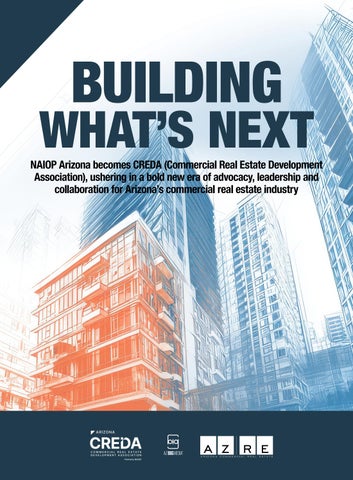
BUILDING
WHAT’S NEXT NAIOP Arizona becomes CREDA (Commercial Real Estate Development Association), ushering in a bold new era of advocacy, leadership and collaboration for Arizona’s commercial real estate industry
THE POWER OF TEAMWORK Unleashing talent with Teamwork and Craftsmanship
ROC068027 - ROC027458 - ROC068026
cannon-wendt.com | 602.279.1681
CREDA
BRACING
FOR IMPACT
O
n July 31, the U.S. Bureau of Reclamation released its final environmental impact statement (FEIS), which was met with a chorus of denuciations from leaders across the state. The Arizona Department of Water Resources published a response calling the proposed framework “unacceptable,” adding that its implementation would “devastate Arizona’s water users and its economy.” To better understand the implications of this announcement, AZRE magazine sat down with Cheryl Lombard, president and CEO of CREDA Arizona. AZRE: Cheryl, you released a statement calling the FEIS “fundamentally imbalanced,” before detailing the proactive measures taken by Arizona to be a good steward of Colorado River supplies. Does the federal government explain why it doesn’t recognize these efforts? Cheryl Lombard: Not in a way that holds up. Arizona didn’t come to this process empty-handed. Along with California and Nevada, we put forward a Lower Basin proposal offering more than 3 million acre-feet of savings over two years. The federal plan asks the Lower Basin to absorb cuts of up to 3 million acre-feet a year without comparable reductions from the Upper Basin or full use of the storage flexibility sitting in Lake Powell. That is an imbalance. The states that showed up with real conservation on the table are the ones being asked to give up the most, while the Upper Basin’s contribution isn’t proportionate to the water it uses. I understand the hydrology is genuinely difficult and there’s no version of this that’s painless for anyone. But when the burden and the effort don’t line up, “imbalanced” is the accurate word.
18 | September - October 2026
AZRE: Could a consensus agreement still be made ahead of the Oct. 1 deadline? CL: Technically, yes — and I hope so. The federal framework is built to allow a basin-wide consensus deal to be folded in even after the October guidelines take effect, since the plan is reviewed roughly every two years through 2036. That door isn’t closed. But I’d be lying if I said I was confident, given how many deadlines this negotiation has already blown past. What I’d say to the seven states is what I’d say to any group of stakeholders who’ve been circling a deal for years: the cost of continuing to negotiate through litigation and public statements is much higher than the cost of getting back to the table with real trades on it. For our industry, that uncertainty is very real. A drawnout legal fights over the river make that harder to plan around. Arizona has shown it will negotiate in good faith and put real conservation on the table. I’d like to see that effort met. AZRE: Anything else you’d like to leave readers with? CL: What gives me some optimism is watching the Arizona Energy Promise Taskforce bring 36 people together with very different interests to agree on 31 recommendations in a matter of months. I’d love to see that same spirit brought to the Colorado River table, because Arizona’s long-term competitiveness for housing, for industrial and commercial investment, for the jobs and communities our members are building all depend on getting both of these right. CREDA Arizona will be at the table for these conversations because reliable power and secure water are foundational to the projects our members are building and Arizona’s ability to keep growing.
Photos: DoorDash Corporate Office
YOUR COMPLETE MULTIMEDIA SOLUTION > azbigmedia.com > AZ Big Podcast
> 7 print/digital publications > 7 awards and recognition programs > Social media outlets For more information go to azbigmedia.com or call 602-277-6045
19
CREDA
POWERING
PROSPERITY Why solving Arizona’s resource crunch hinges on trust and collaboration
By KYLE BACKER
L
ast September, Gov. Hobbs announced the formation of the Arizona Energy Promise Taskforce with the goal of proposing consensus-driven recommendations for ensuring the state retains its reputation
20 | September - October 2026
for affordable and reliable power. Arizona’s successful economic development efforts have laid down the groundwork for greater prosperity, but the strain being placed on critical resources could snap the state’s growth streak. 21
CREDA
“
The confluence of population growth, successful economic development and extreme heat has led the state’s utilities to forecast a 40% increase in peak demand over the next 15 years. — Jim Pratt General manager and CEO of SRP
“Energy and water are the two inputs that appear on the pro forma for nearly every project our members build, and both are undergoing a moment of reckoning at the same time,” explains Cheryl Lombard, president and CEO of CREDA Arizona. “You’re either growing or you’re dying, and Arizona has spent years building real momentum in population, jobs and investment. Getting energy and water right keeps that engine running — getting either one wrong risks a setback that could take years to claw our way back from.” The final report, which was sent to Gov. Hobbs on March 1, outlines where the state should focus its resources to increase energy resiliency. Lombard, a member of the taskforce herself, says the diversity of viewpoints represented in the group only made the proposals stronger. 22 | September - October 2026
“When you put 36 people from utilities, generators, large energy users, consumer advocates and industry in the same room, you get a set of ideas that have already survived contact with everyone who has to live with them,” she continues. “That’s why the 31 recommendations actually have a chance of sticking, rather than getting picked apart the first time they hit a committee hearing.” Better, faster, stronger The approaches put forward by the taskforce touch on multiple facets of the issue, from how to handle large load users to what new energy sources should be explored. Maren Mahoney, director of the Governor’s Office of Resiliency and chair of the taskforce, notes that focusing on efficiency is the best place to start.
”
“Arizona is seeing enormous population growth and has become an international hub for the semiconductor industry. Our summers are also getting hotter, which means we must be intentional about building fast yet strategically," she continues. “We have a grid that can be used more dynamically, so we should optimize it for that use. Then, we can look at which new technologies are worthwhile investments.” Across the 31 recommendations, one recurring theme from the taskforce is the desire to modernize and streamline existing procedures, which Lombard says would have a more significant impact than people might think. “I spent time in D.C. drafting federal permitting reform legislation, and the lesson there applies just as well in Arizona: a lot of what slows down
energy projects isn’t a lack of political will, it’s agencies operating on processes that were built for a much smaller, slower-growing state,” she explains. Establishing a centralized permitting coordination council, modernizing State Land Department procedures, expanding co-location and removing barriers on available transmission capacity are steps the governor can implement quickly. “None of these recommendations require new spending or a new power plant,” Lombard adds. “They require agencies to talk to each other and update rules that haven’t kept pace.” Other ideas offered by the Arizona Energy Promise Task Force include: • Encourage responsible investments in the energy system and update incentives for large load customers. • Support generation conversions that are reliable, affordable, and sustainable.
• Increase deployment of distributed solar projects by reducing administrative barriers and supporting new tools and resource development to decrease the land and water footprint and quickly and affordably add new energy capacity.
components needed across multiple sectors is undoubtedly a boon for Arizona’s economic future, yet there are drawbacks. These facilities are classified as large load users due to their considerable power requirements, and insufficient grid capacity could stymie future investment. But the commercial buildings that attract the most negative attention are data centers because of perceptions that they require too much space, electricity and water for what the community receives in the form of permanent jobs and sustained economic activity. While cooling technology is far more water efficient than it was just a few years ago, there’s no denying that data centers are power hungry. For example, a typical big box store needs around 1 megawatt to operate, while a data center with the same footprint needs 400 megawatts.
Sharing the load Following the Great Recession, Arizona’s leaders embarked on a multiyear initiative to break out of the boom-bust cycles that harried the state’s economy for decades. These efforts reached their zenith when TSMC announced a once-in-a-generation investment in Phoenix. With the state’s semiconductor industry on the ascent, TSMC’s $265 billion acts as its gravitational center, pulling suppliers and other related businesses into its orbit. Manufacturing the critical
THE TRUE COST OF
IS PRICELESS We have a lot on our mind, and your experience is one of them.
AB EF R P
MIS CR SION ITIC AL
AD CAR VA EE HEA NC R EM LTH EN CA T R E PRO AC SA TIVE FET Y ED NC RING A V AD ACTU F U N MA
PHOENIX | TUCSON ROC 323967 | A-17 ROC 348430
23
CREDA “We used to look at 50 megawatts as a massive project, but today that’s nothing,” adds Jim Pratt, general manager and CEO of SRP. “I’m not trying to make excuses, but never in our history have we had this much demand all at once.” The confluence of population growth, successful economic development and extreme heat has led the state’s utilities to forecast a 40% increase in peak demand over the next 15 years. Put another way: it took APS 140 years to build its current generation and transmission capacity, but projections show the grid must double in size over the next decade to keep pace. Compounding the problem is unresolved issues with supply chain. Some equipment that used to take 18
24 | September - October 2026
months to deliver has stretched upward of five years. “It’s one of the worst times to try and go fast,” Pratt says. “We’re doing everything we can to speed things up, such as buying equipment even if we don’t have a specific project in mind.” Kevin Thompson, chair of the Arizona Corporation Commission, adds that the cost of turbines have increased by 700%, “so there’s a cornucopia of challenges that have hit all at once.” The biggest concern, he continues, is enusring the burden of grid expansion falls on the appropriate parties. “APS, SRP and TEP are coming up with tools, whether it’s large load user tariffs or energy service agreements. [The Arizona Corporation Commission] has made it very clear that development must pay for itself.
We’re not going to let that be put on residential consumers.” For example, Thompson points to the Project Blue development in the Marana area, which the Arizona Coporation Commission recently approved a energy service agreement for. “TEP went above and beyond because they wanted to make sure they were capturing all of the expenses,” he continues. “In the event the project doesn’t come to fruition, any assets being built are paid by the end user. A $25 million bond was included to recover that cost.” Mahoney adds that rate structures are the purview of the Arizona Corporation Commission, but the state is exploring how to keep stakeholders involved and informed when these
(Photo by Mike Mertes, AzBusiness, a publication of AZ Big Media)
INDUSTRIAL
COLD STORAGE
MISSION CRITICAL
MANUFACTURING
AUTOMATION INTEGRATION MANAGEMENT (AIM)
AVIATION
OUR FOUNDATION: YOUR SUCCESS Delivering quality projects across the nation for 40 years. Letʼs build whatʼs next.
alstonco.com 25
CREDA
Cheryl Lombard
projects are under consideration. “We can play a part in bringing communities, developers and other stakeholders together to have honest conversations,” she continues. At a time when misinformation and distrust runs rampant, Mahoney
26 | September - October 2026
Jim Pratt
Kevin Thompson
argues that open communication is the best antidote. As Arizona grapples with the symptoms of success, Lombard underscores that collaboration is the only viable way solutions can be found and enacted. “The taskforce did the hard part of
Maren Mahoney
getting 36 stakeholders to agree on 31 concrete steps,” she concludes. “The work now shifts to the legislature, the Arizona Corporation Commission and utilities, and whether they treat that consensus as a mandate or let it sit as a menu they cherry-pick from.”
ROOKIES & ROCKSTARS: Each year, young professionals in CREDA’s Developing Leaders program have the opportunity to talk with industry leaders in timed sessions. Andy Snedeker, director of business development and client relations for Suntec Concrete, recalls being paired with Sean Cummings, who pushed him to pursue an opportunity he felt unqualified for. “I still thank him every time we meet up,” he continues. “Who knows where my career would be without Sean.” (Photo licensed from Adobe Stock)
Building connections How CREDA prepares tomorrow’s leaders today By KYLE BACKER
C
ommercial real estate professionals are in the fortunate position to watch the physical representation of their hard work and dedication meld into the surrounding community. As satisfying as that may be, commercial real estate is a complex industry full of intricate financial transactions, technical jargon and differing stakeholder priorities. These nuances can be taught, but the barrier to entry can seem too high for individuals early in their career. That’s why CREDA Arizona formed its Developing Leaders program: to create a cohort of professionals age 35 and under who can learn and grow from one another. When Andy Snedeker, director of business development and client relations for Suntec Concrete, first moved to the Valley around 2010, he had work experience, but didn’t know anyone in the market. “Commercial real estate is a people business, especially in Phoenix,” Snedeker explains. “All the buildings you see aren’t there because of the concrete and steel,
but because folks trusted each other.” Having since aged out, Snedeker says he’s giving back to the Developing Leaders program so it continues to be a “relationship incubator” for new members to meet their peers and industry veterans. “Something about being out of the office makes it easier to have those more vulnerable conversations,” he adds. “It might be asking for career advice or how someone else dealt with a work challenge, but CREDA has done a great job creating an open platform for these conversations to happen naturally.” Developing Leaders also have the chance to make connections in a
Rookies & Rockstars DATE: Tuesday, October 20, 2026 TIME: 5:00 p.m. to 9:00 p.m. VENUE: Arizona Biltmore Golf Club Ballroom East REGISTRATION: visit creda-az.org
Andy Snedeker more formalized setting through the annual Rookies & Rockstars event. Each year, young professionals have the opportunity to talk with 30 or so industry leaders in timed sessions. “They have the floor to ask whatever questions they want, and when the timer goes off, they move to the next station,” Snedeker adds. “If we can pass down the skills we’ve learned, the hope is that they will become better leaders than I am today. That’s a legacy worth leaving.” On the following pages, hear from two Developing Leaders on the impact their participation has had on their careers. 27
CREDA
JENNIFER VILLALOBOS Senior associate // Cushman & Wakefield
AZRE: You’re the chair of the Developing Leaders committee. Can you tell us a bit about the program? Jennifer Villalobos: Everything centers around educating people about the market and commercial real estate industry as a whole. When I joined five or so years ago, I wanted to understand the terminology, but it also introduced me to people my same age who are experiencing the same things as I am. Being a Developing Leader helps you build a network of people who you’ll be doing business with for a long time. AZRE: A few years ago, you transitioned from a marketing and business development role at a construction firm to brokerage. Did the relationships you made through CREDA help with this career move? JL: I knew a lot of experienced brokers in the industry who were extremely supportive. And they gave it to me straight — they didn’t sugarcoat how difficult the early years can be. There are things you need to be prepared for as a broker, like having an accountant or the correct insurance. The friends I’ve met through CREDA were very helpful, and I’m so thankful because I didn’t have anyone else to guide me. AZRE: It sounds like your peers were willing to contribute to your success. I’m sure some of these people are your competitors — does that ever cause tension? JL: If the market is down, we’re all hurting. CREDA and the Developing Leaders program creates a neutral space where we can all come together and figure out how to solve the challenges facing the industry. When the pandemic hit, I was working for a contractor, and we sat down with other companies to understand what everyone was experiencing and sharing resources. Now that I’m on the brokerage side, we’re constantly sharing information with each other because we all want to bring more business to the Valley and see Phoenix flourish. AZRE: Anything else you’d like to leave readers with? JL: Just like any organization, simply paying your membership dues isn’t enough. That’s the biggest thing I tell people when they join — get involved, then the doors will start to open. It can be a little nerve-wracking at first, but after going to a few meetings you’ll start seeing familiar faces. I know that I was uncomfortable when I first started attending, but now, every time I go, I’m walking into a room full of my friends.
28 | September - October 2026
曦 望 新 都
亞 利 桑 那 州
|
鳳 凰 城
A city within a city Adjacent to the TSMC campus in Phoenix, Halo Vista represents an ecosystem where innovation is materialized, purpose-built for the future of technology and manufacturing.
Halo Vista
±2,400
Acre project
60%
Anticipated for industrial
Learn more about the districts and timeline at HaloVista.com
29
CREDA
THOMAS MAYNARD Executive vice president of business development // GPEC
AZRE: When did you get involved with CREDA? Thomas Maynard: When I started with GPEC in 2013, leaders within the organization told me that CREDA was the group I should join to meet my industry peers and build a professional network. So, I started in the Developing Leaders program around 2015 and started serving on the steering committee shortly after. AZRE: What value do professionals like yourself who work in economic development get out of participation? TM: Economic development is a relationship business. When we’re recruiting companies, they need facilities, so it’s important for us to be closely connected to the commercial real estate industry in general. For the Developing Leaders program specifically, the cool part is that we’re all in similar boats at the start — only a few years of experience and still trying to figure things out. But fast forward a decade, and many of those same peers are now in more senior positions. Now that we’re all in decision-making roles, I can pick up the phone and call someone I’ve had a relationship with for 10 years to help with a client. It makes everything easier, and that’s exactly what the program is intended to do. AZRE: Does anyone standout as a mentor figure when you first joined? TM: I was around 25 or so when I first got involved, and there was a group of people in their early-to-mid 30s who were all on an upward trajectory in their careers. Jenna Borcherding is a great example of someone I looked up to and learned from. We met through Developing Leaders, and now she’s the market lead for Cousins
30 | September - October 2026
Properties. Mike Strittmatter was the chair of Developing Leaders when I started getting heavily involved with the program, and we’ve continued our friendship over the years. I’m lucky to have built so many relationships through CREDA. AZRE: You recently served as GPEC’s interim CEO. Were you able to tap into this network for advice during what I can only imagine was a stressful, challenging time? TM: Absolutely, and a lot of people reached out first to offer help. There is some overlap between the CREDA and GPEC boards, so it was nice to see familiar faces in the crowd during those meetings. That period was a whirlwind, but I feel like I gained three years’ worth of experience in three months. Even though I was the interim CEO, that role is still responsible for things like budget and the board’s structure. It gave me a greater appreciation for everything leaders have to consider. There are a lot of mouths to feed and keeping everyone happy while making sure the ball moves forward is way easier said than done.
31
CREDA
New letters, same legacy NAIOP becomes CREDA to reflect the breadth of its membership By KYLE BACKER
O
n July 1, NAIOP announced a new name for the organization: the Commercial Real Estate Development Association, or CREDA. According to CREDA, the new branding better communicates the broad scope of commercial real estate work members engage in, such as multifamily housing, retail destinations, logistics and fulfillment facilities, offices, mixed-use developments, data centers and more. “Commercial real estate development is about far more than buildings — it is about creating the places and infrastructure that allow communities and economies to thrive,” says Cheryl Lombard, president and CEO of CREDA Arizona. “Our new name reflects the breadth of that responsibility and the evolving role our industry plays in Arizona’s future. CREDA Arizona better represents who we are today and strengthens our ability to bring together leaders across sectors to advance responsible, long-term growth.” The association’s name may have changed, but its core mission remains the same, so CREDA Arizona members will enjoy all the same benefits and event programming. That said, the new moniker means that CREDA’s annual awards program will no longer be called Best of NAIOP — though it will continue to spotlight excellence across the state. To celebrate this new era for the association and honor its past achievements, learn more about the winners of 2026’s Best of NAIOP Awards below.
2026 Best of NAIOP Award Winners AWARD OF EXCELLENCE: Molly Carson | Ryan Companies US
GENERAL CONTRACTOR OF THE YEAR: Willmeng Construction
DEVELOPING LEADER OF THE YEAR: Shelby Grant | Tpac
DEVELOPER OF THE YEAR: ViaWest Group
CAPITAL MARKETS BROKER OF THE YEAR: Will Strong | Cushman & Wakefield
LIFESTYLE DEVELOPMENT PROJECT OF THE YEAR: The Maeve Central Station & ANOVA Central Station, Layton Construction
INDUSTRIAL BROKER TEAM OF THE YEAR: Michael Haenel, Phil Haenel and Andy Markham | Cushman & Wakefield OFFICE BROKER TEAM OF THE YEAR: Williams-Medley-Corney-Robinson Office Team | JLL RETAIL BROKER TEAM OF THE YEAR: Michael Hackett and Ryan Schubert | CBRE SUBCONTRACTOR OF THE YEAR: Suntec Concrete ARCHITECTURAL FIRM OF THE YEAR: Butler Design Group
OFFICE PROJECT OF THE YEAR: Fender corporate co-headquarters INDUSTRIAL PROJECT OF THE YEAR (MORE THAN 500K SF): Park 303 Phase II INDUSTRIAL PROJECT OF THE YEAR (LESS THAN 500K SF): 17 North Corporate Center Phase II TENANT IMPROVEMENT PROJECT OF THE YEAR: EMD Electronics
BROKERAGE FIRM OF THE YEAR: CBRE
GROWING COMMUNITY: A longtime champion of Arizona’s commercial real estate industry, NAIOP has changed its name to the Commercial Real Estate Development Association, or CREDA, to reflect the diversity of projects members are involved in. “Our members are creating the housing, workplaces, logistics networks and digital infrastructure that people and businesses depend on every day. This new name more accurately reflects who our members are, what they do and the value they bring to communities across North America, says Marc Selvitelli, president and CEO of CREDA. (Photo courtesy of CREDA Arizona) 32 | September - October 2026
THE MOST IMPORTANT THING WE BUILD ISN’T MADE OF STEEL OR CONCRETE. It’s trust. Trust that every teammate goes home safe. Trust that every project serves a greater purpose. Trust that what we build today will make life better tomorrow.
THE ART & SCIENCE OF BUILDING 33
CREDA
Award of Excellence MOLLY CARSON President, Southwest region // Ryan Companies US
Arizona’s commercial real estate sector is fortunate to have wise leaders, and a collaborative community that understands prosperity begets more prosperity. “We all like to win,” explains Molly Carson, president of the Southwest region at Ryan Companies US, “but we also know that competition is a privilege. If someone else gets stronger, we’ll get stronger too. That’s the whole idea of ‘high tides raise all boats’ — it sounds silly since everyone says it, but it’s true. And NAIOP has created that environment here and will ensure it continues to grow as CREDA.” When it comes to winning, Carson knows a thing or two. During the 2026 Best of NAIOP Awards, she was honored with the prestigious Award of Excellence in recognition of her positive influence on the association and industry as a whole. AZRE magazine sat down with Carson to reflect on how Phoenix has changed since she first arrived, the relationships made possible through CREDA and what this recognition means to her. The following has been edited for clarity and length. AZRE: You first moved to Phoenix in 2010 — a difficult period for the overall economy and especially the construction industry. What was that experience like? Molly Carson: It was a scary time for everyone. My husband doesn’t work in real estate, and a few weeks after we came to Phoenix, he asked, “Why did we move here for your job? I haven’t seen a single crane yet.” Today, things are very different. Arizona’s economy used to be very cyclical, but now we have a broad diversity of job opportunities and companies here. What hasn’t changed is people’s desire to work hard and build a strong community. AZRE: Speaking of community, you were involved in CREDA before moving to Arizona. Did that help with your transition? MC: Absolutely. As soon as we got to Phoenix, I got involved. My first assignment was co-chairing Night at the Fights, and they gave me that opportunity thanks to my past experience in the Minnesota chapter — they knew I 34 | September - October 2026
would put in the effort. It was a fantastic way to meet so many people within our community. AZRE: How did folks in the Arizona chapter know you had already been participating in the association? MC: Early in my career, I met Jean Kane, who was the CEO of Colliers in Minnesota at the time. She became my mentor and gave me some wonderful advice: “Get involved. That’s how you find your people, and once that happens, the learning opportunities come along with the connections.” Later, Jean encouraged me to join CREDA at the national level and did so right before I moved, which helped me have a leg up once I got to Arizona. Jean is the reason I got — and stayed — involved with CREDA. I’m happy to say we’re still friends today. AZRE: How did you feel when you heard your name called out as the recipient of the Award of Excellence? MC: I was surprised! I’d love to tell you that I’m really confident, but if I’m honest, my first thought was that I don’t belong to the same group of people who won it before me. It didn’t feel like I had earned it yet. It’s one of the biggest honors I’ve received in my professional career, and it’s still a bit overwhelming. But I’m so grateful to be honored, and I wake up every day wanting to earn that recognition because I still have a long life left in this career.
35
CREDA
Capital Markets Broker of the Year WILL STRONG Executive vice chair // Cushman & Wakefield
2025: Total transactions: 40 | Total space: 21,647,113 square feet | Total value: $2,726,354,925 Background: The youngest executive vice chairman in Cushman & Wakefield’s history, Strong has been recognized as the top overall producer in Phoenix each year since 2020 and as the No. 1 industrial capital markets producer in North America for four consecutive years. He co-chairs the National Industrial Advisory Group and is among a select group who advise the firm’s global president and CEO. Throughout his career, Strong has participated in transactions totaling more than 140 million square feet valued over $18 billion, including some of the most complex and high-profile industrial investment transactions ever completed in the state. In the past year, his team achieved more than 90% market share of institutional industrial investment sales in Phoenix — market concentration not remotely approached in any other major U.S. market.
Big Deals PUMA at 303 Crossroads Developer: Clarius Partners General contractor: Layton Construction Architect: Butler Design Group Size: 1,023,610 square feet Location: Waddell Details: The $140,200,000 sale of PUMA at 303 Crossroads emerged as one of Arizona’s most significant industrial investment transactions of the year, directly challenging several negative narratives surrounding the Phoenix market. Many investors believed cap rates needed to move higher, the equity requirement was too large for a single-tenant asset, pricing per square foot had become too aggressive and the property’s location along the Loop 303 corridor was too far from the market’s core. Despite these headwinds, Strong navigated complex market skepticism and closed the transaction at a market-defining valuation, helping restore confidence in Phoenix industrial real estate and establishing an important pricing benchmark.
FORMATION17 Developer: Formation Interests General contractor: Willmeng Construction Architect: Deutsch Architecture Group Size: 425,280 square feet City: Phoenix Details: When the project was capitalized, development capital across the U.S. had largely frozen, with institutions on the sidelines and speculative development difficult to finance. But Strong and his team established a new investment thesis centered on regional drivers such as TSMC, Phoenix’s freeway connectivity and the surrounding labor pool. Despite broader market concerns, Strong led the sourcing of joint venture equity and construction financing, coordinating multiple capital partners to move the project forward — helping catalyze transformation along the I-17 corridor, attracting new investment, jobs and long-term economic activity. 36 | September - October 2026
37
CREDA
Developing Leader of the Year
SHELBY GRANT Business development representative // Tpac
Background: Born and raised in Phoenix, Grant grew up watching projects break ground and celebrate ribbon cuttings. Her father — who owns a construction company — would walk Grant around job sites so she could watch how commercial buildings go from plans on paper to structures made of steel and concrete. Beyond exposure to the industry, Grant says spending that time with her father instilled the principles that still guide her: integrity, accountability and the power of keeping your word. Those formative experiences developed into a deep respect for the people and processes that shape the built environment, ultimately inspiring her to pursue a career in commercial real estate. Today, Grant works closely with developers, contractors and industry partners to support projects that contribute to the continued growth of the Arizona commercial real estate market. Program impact: Being involved with the Developing Leaders program has been critical for Grant’s professional growth and leadership development. Her participation
38 | September - October 2026
allowed her to build meaningful relationships with professionals she might not otherwise have met and contribute to industry initiatives. One example is the creation of the Developing Leaders Welcome Committee, which Grant established to help new members feel connected and supported as they enter the organization. Creating a warm environment for new members, Grant explains, “strengthens the sense of community within the organization and encourages long-term engagement.” Career goal: While successful projects and professional achievements are important, Grant hopes to build a legacy defined by the people she has helped mentor and support throughout her career. Her success so far, Grant says, is thanks to the “leaders who invested their time, knowledge and guidance in me.” Those insights, Grant continues, nurtured her understanding of the industry and instilled a sense of confidence in what she could achieve. Because she gained so much from these relationships, Grant wants to create the same opportunities for others who are beginning or advancing their careers in commercial real estate.
39
CREDA
Office Broker Team of the Year JLL OFFICE TEAM
Pat Williams, vice chairman // Andrew Medley, executive managing director Chris Corney, managing director // Vicki Robinson, executive vice president 2025: Total transactions: 119 Total space: 7,874,453 square feet Total value: $385,256,975.98 Background: The JLL Office Team exclusively represents office/medical tenants in facility and site acquisition, offering services such as marketing, strategy implementation, site evaluation and selection, detailed financial analysis and lease review, and negotiations. Collectively, these brokers have represented some of the most prominent companies and largest users of office space in Arizona including Banner Health, Koch, Shutterfly, PayPal, Wells Fargo, Array Technologies, State of Arizona, City of Phoenix, Carlisle, Northern Bank, Sonora Quest Laboratories, among others.
Big Deals Bond Owner/developer: George Oliver General contractor: RSG Builders Architect: George Oliver Design Size: 287,000 square feet City: Phoenix Details: Banner Health, which employs 46,700 people statewide and operates as both the state’s largest healthcare system, executed a 78% footprint reduction — relocating from 304,000 square feet to 67,000 square feet at the recently redeveloped Bond office building along the Camelback Corridor. After implementing a flexible work policy during the pandemic, Banner Health leveraged JLL’s occupancy planning services to analyze actual space utilization patterns. These data-driven insights confirmed their hybrid work model would remain permanent, enabling substantial reductions in lease obligations and administrative overhead. The result is a right-sized headquarters that supports Banner Health’s evolving workforce strategy while generating significant cost savings for this essential healthcare organization.
Northsight Corporate Center Owner: Vertical Ventures Size: 136,000 square feet City: Scottsdale Details: As one of Scottsdale’s largest employers, Vanguard Financial Services has employed over 5,000 people at its regional western headquarters since 2000. The company needed to expand beyond its self-owned campus. The JLL Office Team was tasked with finding around 140,000 square feet of space. An opportunity was discovered adjacent to Vanguard’s campus to turn Northsight Corporate Center into an integrated extension of the regional headquarters. The transaction required the buyout of an existing tenant, and the subsequent negotiation of a long-term lease to protect Vanguard’s interests.
40 | September - October 2026
41
CREDA
Retail Broker Team of the Year CBRE RETAIL CAPITAL MARKETS TEAM
Michael Hackett, executive vice president // Ryan Schubert, executive vice president 2025: Total transactions: 20 | Total space: 2,040,621 square feet |Total value: $481,342,000 Background: In 2008, Hackett and Schubert combined their individual businesses to create a partnership that has remained strong for nearly two decades. As a team, the brokers specialize in retail investment real estate, advising owners and investors on strategic decisions for neighborhood and anchored shopping centers. They leverage market insight and transaction expertise to navigate complex retail deals and drive value across shopping centers, street retail and mixed-use assets. With more than 48 years of combined experience, they have closed over 500 retail transactions in excess of $5 billion.
Big Deals Stetson Village Developer: Pederson Group Value: $71 million Size: 144,192 square feet City: Phoenix Details: The brokers arranged the sale of Stetson Village in North Phoenix, a grocery-anchored center fully leased to national and regional tenants. The assets’ proximity to the expanding TSMC semiconductor facility and strong operating performance attracted institutional capital, underscoring the depth of demand for core retail in the submarket.
Las Tiendas Village Developer: Vestar Value: $56 million Size: 189,021 square feet City: Chandler Details: Hackett and Schubert facilitated the sale of Las Tiendas Village, a shopping center repositioned around a new anchor tenant following the departure of a former soft goods user. The deal demonstrated an adaptive leasing strategy and effective repositioning in a competitive infill market.
42 | September - October 2026
Make a BIG difference in your morning! Visit azbigmedia.com or scan the QR code and sign up for your free daily newsletter and get the hottest, most up-to-date news in Arizona business, real estate, travel, lifestyle and more!
TO DO LIST Coffee Feed the dog Read the free AZ BIG Media newsletter
43
CREDA
Industrial Broker Team of the Year CUSHMAN & WAKEFIELD INDUSTRIAL BROKERAGE TEAM Mike Haenel, executive vice chair // Phil Haenel, executive vice chair // Andy Markham, executive vice chair
2025: Total transactions: 69 | Total space: 6.5 million square feet | Total value: $680,920,368.50 Background: With more than 75 years of combined experience in Arizona commercial real estate, Cushman & Wakefield’s Industrial Brokerage Team has been a top-producing industrial team in the Phoenix office and nationally for over two decades. Together, they specialize in representing and consulting owners, developers and corporate tenants who lease, acquire, develop and dispose of industrial real estate property and land throughout the state.
Big Deals Commerce 303 Developer: SteelWave (Phase I) | EQT Real Estate (Phase II) Size: 663,367 square feet (Phase I) | 497,234 square feet (Phase II) City: Glendale Details: The team first represented the landowner in the sale of the site to a developer, positioning the property for a Class A industrial facility in Glendale along the growing Loop 303 corridor. They later secured a joint venture equity partner, enabling construction. Leveraging an existing tenant relationship, the team secured Verst Logistics for the remaining 331,683 square feet, bringing the project to full occupancy and stabilizing the asset. Following stabilization, they advised ownership on disposition and sold the fully leased 663,000-square-foot property for approximately $104.5 million to EQT Real Estate. The transaction also included a 32.6-acre adjacent site capable of supporting an additional 497,000-square-foot industrial building.
I-10 Gateway Developer: BET Investments Owner: EQT Real Estate Size: 641,906 square feet | 2.2 million square feet at buildout City: Buckeye Details: The team played a key role in securing one of the largest industrial leases completed in 2025 at I-10 Gateway. Before construction started, they began marketing the site and building. After completion, the team assisted in the $60.1 million sale of the fully vacant property to EQT Real Estate in 2024. Maintaining the leasing assignment through the ownership transition, the team secured a full-building lease with Kenco, bringing the project to full occupancy.
44 | September - October 2026
Subcontractor of the Year SUNTEC CONCRETE
2025: Total projects: 128 | Total revenue: $946.5 million |1,424,503 cubic yards of concrete poured Background: Founded in 1984, Suntec Concrete is 100% employee owned and ranked as the No. 1 subcontractor in the Southwest. The company serves markets across the Western U.S., specializing in high-quality concrete and structural work for some of the region’s most significant commercial and industrial buildings. Through Suntec Engineering and Design, Suntec additionally offers a standalone, full-service structural engineering firm focused on early engagement, providing clients with the next generation of engineering and construction integration.
Big Deals Chandler Innovation Park Developer: DPC Companies General Contractor: Alcorn Construction Architect: Balmer Architectural Group Subcontractor: Suntec Concrete City: Chandler Size: 330,540 square feet
Rambler Tempe Owner: LV Collective Developer: Drive Development Partners General contractor: Layton Construction Architect: Shepley Bulfinch Subcontractor: Suntec Concrete City: Tempe Size: 565,254 square feet
South Pier Developer: Silverstein Properties General contractor: Clayco Architect: DAVIS Subcontractor: Suntec Concrete City: Tempe Size: 1.3 million square feet
45
CREDA
Brokerage Firm of the Year CBRE
2025: Total transactions: 2,372 | Industrial: 1,018 | Office: 703 | Retail: 254 | Multifamily: 186 | Land: 131 Hospitality: 12 | Other: 5 | Total space: 107,922,867 square feet | Total consideration: $38.4 billion Background: With 155,000 employees helping clients in more than 100 countries, CBRE is the world’s largest commercial real estate services and investment firm. Four segments constitute the core of its business: advisory, building operations, project management and real estate investments. CBRE’s clients include occupiers, owners, investors, developers and lenders. The company’s clients range in size and complexity from a sole proprietor owning a single storefront to a multibillion-dollar corporation with properties spanning the globe.
Big Deals Marquis at Desert Ridge Details: CBRE successfully negotiated the sale of Marquis at Desert Ridge, a 370-unit Class A multifamily community in one of Phoenix’s premier master planned neighborhoods. Representing a national multifamily investor, the team delivered a highly competitive transaction that attracted institutional interest and underscored strong investor confidence in Metro Phoenix’s robust multifamily fundamentals and long-term growth outlook.
SkyBridge Details: The brokers completed a confidential 500,000-square-foot long-term lease at SkyBridge Arizona in Mesa for a national advanced manufacturing company expanding its Arizona operations. The tenant required immediate occupancy, 12,000 amps of power, and parking for 1,200 employees, while leveraging Military Reuse Zone tax incentives tied to the airport-adjacent location. Representing the landlord, the brokers executed the lease using a creative strategy that combined two adjacent buildings into a single lease with a shared amenity zone.
46 | September - October 2026
Architectural Firm of the Year BUTLER DESIGN GROUP
2025: Total pipeline: 332,564,531 square feet | Delivered: 4,776,760 square feet Background: For over three decades, Butler Design Group has helped shape the Valley’s built environment through thoughtful design, strategic planning and a commitment to client success. The firm has established itself as a recognized leader in large-scale industrial, logistics, office, medical office, and retail development, supporting some of the region’s most significant commercial projects. With expertise spanning industrial, retail, office, interiors and master planning, BDG has delivered more than 150 million square feet of commercial development throughout its history.
Big Deals Luke Field Developer: Lincoln Property Company General contractor: Layton Construction Architect: Butler Design Group Subcontractors: Suntec Concrete, Global Roofing, AF Steel Fabricators, Panelized Structures, JJ Sprague City: Glendale Size: 2,400,000 square feet
Banner Health Center Goodyear at GSQ Developer: Globe Ryan MOBI General contractor: Ryan Companies US Architect: Butler Design Group Subcontractors: Sazan Group, PK Associates, Olsson Civil Engineering, Laskin & Associates, Saguaro Steel City: Goodyear Size: 65,205 square feet
Orangewood Commerce Center Developer: Provident Industrial General contractor: Burton Construction Architect: Butler Design Group Subcontractors: Kraemer Consulting Engineers, McGrew Consulting Engineers, PK Associates, Hunter Engineering City: Glendale Size: 294,000 square feet 47
CREDA
General Contractor of the Year WILLMENG CONSTRUCTION
2025: Total projects: 154 | Pipeline: 26,500,115 square feet | Industrial: 22,663,261 square feet | Office: 886,235 square feet Retail: 142,415 square feet | Hospitality: 184,051 square feet | Medical office: 76,299 square feet Background: Since its founding in 1977, Willmeng Construction has grown to be the largest privately owned, Arizonabased general contractor. The employee-owned company built its reputation as a tenant improvement specialist, but now also delivers ground-up projects across the industrial, office, retail, healthcare and public sectors. Beyond taking on a broader scope of work, Willmeng has begun working in nearby states, opening offices in Salt Lake City and Albuquerque. This regional expansion allowed the firm to take on 366 projects companywide last year, generating $739 million in revenue — and the figure reaches $2.5 billion once the total contract value of those projects is tallied.
Big Deals Formation Park 10 Developer: Formation Interests General contractor: Willmeng Construction Architect: Deutsch Architecture Group City: Goodyear Size: 427,709 square feet
Deer Valley Business Campus Phase II Developer: SIHI General contractor: Willmeng Construction Architect: Balmer Architectural Group City: Phoenix Size: 303,126 square feet
Porsche North Scottsdale Developer: Penske Automotive General contractor: Willmeng Construction Architect: Penny Design Group City: Phoenix Size: 68,000 square feet
48 | September - October 2026
49
CREDA
Developer of the Year VIAWEST GROUP
AZ portfolio: 150 buildings; 9,761,026 total square feet | Industrial: 6,314,125 square feet Office: 3,055,146 square feet | Healthcare: 248,782 square feet | Retail: 142,973 square feet Background: Since its founding in 2003, the company has completed more than $3.6 billion in transactions, including strategic land acquisitions, market-leading ground-up developments, and value-add repositioning projects that have helped shape the Valley’s commercial landscape. Through strategic site selection and thoughtful development, ViaWest has helped expand modern industrial supply in Phoenix’s most active logistics corridors. These projects provide the critical infrastructure needed for logistics, manufacturing, and distribution for users to operate efficiently in Arizona, helping attract new companies to the region while enabling existing tenants to grow. In 2025 alone, ViaWest closed on $336 million in new acquisitions and developments and executed 108 new, renewal and expansion leases totaling 1,435,547 square feet.
Big Deals The Base Developer: ViaWest Group General contractor: Willmeng Construction Architect: DLR Group Subcontractors: Suntec Concrete, The Structures Group, Atwater Companies, Rummel Construction, Hawkeye Electric City: Litchfield Park Size: 1,182,877 square feet
Goodyear Crossing Phase II Developer: ViaWest Group General contractor: Stevens-Leinweber Construction Architect: K & I Architects & Interiors Subcontractors: Raven Concrete, Adobe Drywall, Suntec Concrete, Ikon Steel, Structures Group City: Goodyear Size: 86,875 square feet
Sight Logistics Park Developer: ViaWest Group General contractor: Willmeng Construction Architect: McCall & Associates Subcontractors: Atwater Companies, Star Roofing, Suntec Concrete, Bell Steel, Hawkeye Electric City: Tempe Size: 356,904 square feet
50 | September - October 2026
LIVEBRYTEN.COM
Your Goals, Our Expertise, One Trusted Partner Bryten® integrates seamlessly with your team, delivering strategic multifamily property management for your particular asset class, that strengthens performance & creates long-term value.
Bryten® is a registered trademark of Bryten Real Estate Partners LLC (BREP), a private Delaware company. The Bryten trademark is used by: (i) BREP FL LLC (ii) BREP MID ATLANTIC LLC, (iii) BREP SFL LLC, (iv) REP NY, (v) BREP JV LLC, (vi) Bryten Real Estate Partners LLC, and (vii) Morrison Ekre & Bart Management Services Inc. All these entities are separate private companies, operating individually in different regions across the U.S. Throughout this document the use of personal pronouns “we,” “our,” “us,” refer to the Bryten trademark, not to BREP or any other parent, subsidiary, or affiliate legal entity. No parent, subsidiary or affiliated entity has any authority to obligate or bind BREP or any other parent, subsidiary, or affiliate entity. Not all affiliates operate under the Bryten name. For property-specific information, 51 please contact the local community directly.
CREDA
Office Project of the Year
Fender corporate co-headquarters Owner/Developer: Fender Musical Instrument Corporation General contractor: Layton Construction Architect: SmithGroup Size: 78,000 square feet City: Phoenix Details: Located in Phoenix’s revitalized Paradise Valley corridor, the headquarters embodies minimalist sophistication aligned with Fender’s iconic rocker aesthetic. A two-story entry, skylit corridors that illuminate the brand’s history, and sculptural feature stairs create a curated spatial journey more typical of cultural institutions than of office environments.
The project consolidates two former Scottsdale locations into a single, cohesive campus designed to support Fender’s global operations and creative culture. The three-story layout was intentionally designed to balance corporate operations with experiential spaces unique to Fender. Features: Fender’s new co-headquarters stands out as a landmark achievement in workplace design, pairing corporate operations with purpose-built creative and technical environments rarely found in commercial buildings. The facility merges professionalgrade acoustic spaces, advanced R&D infrastructure, and brand-driven
architecture to create a truly categorydefining workplace. Signature innovations include a professional music studio engineered to industry- standard acoustic standards, an acoustically isolated “kaboom room” for high-decibel amplifier testing, floating floors and high-performance sound-isolation systems, and a fully outfitted model shop supporting realtime product prototyping. A third-floor outdoor performance deck offers a unique amenity for employees and artists to utilize. These specialized spaces directly reinforce Fender’s culture of innovation and distinguishes the building from conventional office development.
Build Something Exceptional
For 50 years, we’ve built more than buildings. We’ve built lasting relationships, trusted partnerships, and projects that move businesses forward. From pre-construction through grand opening, FCL delivers expert counsel and extraordinary execution with customer experiences that are second to none. Congratulations to CREDA on your exciting new chapter. We’re proud to celebrate your new name and look forward to building the future together in Arizona, and beyond. On Time • On Budget • Top Tier Workplace Safety
Celebrating 50 Years: 1976-2026
52 | September - October 2026
fclbuilders.com
Challenges: Designing spaces capable of professional-level recording, amplifier testing to the point of failure, and a full model shop within a corporate office required specialized assemblies and robust vibration isolation. These measures were essential to prevent testing and manufacturing activities from impacting adjacent residential neighbors and the office space above. Because many programmatic elements were required at ground level, the building footprint was maximized to the full extent permitted by the site. Existing utilities and required setbacks, however, made precision in the building’s location and orientation critical. Ideally, the kaboom room would have been housed in a separate structure, but site constraints necessitated its integration within the main building. To achieve the required performance, a “building-within-a-building” strategy was implemented, incorporating a fully isolated slab.
Phoenix
Portland
Vancouver
623.257.2404
503.222.4453
360.939.3311
vlmk.com
53
CREDA
Lifestyle Development Project of the Year The Maeve Central Station & ANOVA Central Station Owner/Developer: GMH Communities General contractor: Layton Construction Architect: Multistudio Financier: Phoenix Commercial Advisors Size: 1 million square feet City: Phoenix Details: Replacing the former Greg Stanton Central Station, this 1 millionsquare-foot redevelopment project brings a transit-oriented mixed-use district to the heart of Downtown Phoenix. Comprised of two residential towers, The Maeve Central Station rises 33 stories, delivering 338 residential units designed for professionals and downtown residents. ANOVA Central
54 | September - October 2026
Station, a 22-story tower, provides 629 purpose-built student housing beds serving ASU’s Downtown Phoenix campus. The project also includes 7% workforce housing within the residential mix, helping broaden access to housing in the rapidly growing urban core. The towers rise above an open, transit-integrated ground plane that connects Valley Metro light rail, bus transit bays, bike facilities, and pedestrian pathways, creating a new multimodal hub for the city. Features: Rather than treating the transit center as a separate infrastructure element, the project fully weaves mobility into the daily experience of residents and visitors. Supporting the towers is a two-level, approximately 200,000-square-foot subterranean
parking structure, engineered to accommodate residents and visitors while preserving the pedestrian-oriented character of the site above. At the ground level, the design introduces a porous civic plaza that allows pedestrians to move freely between bus bays, light rail platforms, bike facilities and surrounding city streets. More than 30,000 square feet of retail and restaurant space activates the development and supports daily activity throughout the district. This open urban framework eliminates the traditional podiumstyle barrier common in many highrise developments, instead creating a welcoming public space that connects directly to Civic Space Park and the ASU Downtown Phoenix campus.
Challenges: Constructing two high-rise towers within one of the busiest transit hubs in Phoenix presented a complex logistical hurdle. Throughout construction, bus and light rail operations needed to remain fully active, requiring the project team to carefully coordinate work with the City of Phoenix, Valley Metro and multiple transit agencies. To maintain uninterrupted service, the construction team implemented strategic phasing and sequencing plans that allowed transit infrastructure to remain operational while major structural work progressed nearby. Detailed planning ensured public safety while minimizing disruption for commuters and surrounding businesses. Another significant challenge involved constructing the large underground parking structure beneath the two towers. Excavation and structural work required extensive coordination to support the scale of the development while maintaining stability for surrounding infrastructure.
INDUSTRIAL MESA, ARIZONA
OFFICE | TEMPE, ARIZONA
RETAIL | PEORIA, ARIZONA
Thoughtful Design. Proven Results. butlerdesigngroup.com
|
602.957.1800
For three decades, Butler Design Group has partnered with forward-thinking clients to create functional, enduring spaces that support businesses and strengthen communities.
MEDICAL OFFICE | GOODYEAR, ARIZONA
B
Butler Design Group
architecture | planning | interiors
SPECIALIZING IN RETAIL, OFFICE, INDUSTRIAL AND TENANT IMPROVEMENTS SINCE 1996.
55
CREDA
Tenant Improvement Project of the Year EMD Electronics Owner/Developer: EMD Group General contractor: Willmeng Construction Architect: Deutsch Architecture Group Size: 55,500 square feet City: Chandler Details: This project was crucial for a growing company racing to keep pace with the global semiconductor market. The facility combines high-tech cleanrooms with a 20,000-square-foot assembly space, an 18,000-squarefoot warehouse and Class A office — creating an “all-in-one” headquarters that will serve the tenant well for years to come. By establishing a long-term lease from EMD Electronics, the project
56 | September - October 2026
secured a major client in a key region for the global semiconductor market as well as more than 100 new jobs for the community. Features: As a company working in a technical field, EMD Electronics requires highly specialized infrastructure for its operations. The primary 4,500-square-foot ISO 5 cleanroom features 100% ULPA filter coverage and a Gordon ceiling system with a pressurized plenum. To maintain sterile conditions, the walls were custom “stick-built” on-site using ultra-smooth FRP panels with epoxy-welded seams, a method that also bypassed modular component leadtime challenges. The facility also includes tiered contamination-controlled zones —
including ISO 5, ISO 7 and ISO 8 environments. This tiered classification structure ensures that every step of equipment production is performed under the environmental controls appropriate for semiconductor-grade performance. Challenges: The EMD Electronics project faced significant planning and construction hurdles, primarily driven by global supply chain disruptions during the pandemic and the precision required for semiconductor-grade facilities. Executing a complex build that doubled U.S. manufacturing capacity for the client while materials were unavailable required a maximum flexibility strategy. The team was forced to continually pivot from the original design as
specified materials faced extreme lead times, necessitating quick re-evaluation of design assumptions and ensuring any alternative materials were compliant with the technical specifications. Architecturally, the project had to navigate strict site height limitations. The solution was the engineering of a 12,000-square-foot structural mechanical platform that surrounded the cleanrooms, providing necessary overhead support and integration for complex systems within the building’s physical constraints. Additionally, the facility’s existing 2,000-amp electrical service was insufficient for high-tech manufacturing; the team overcame this constraint by upgrading the infrastructure with an additional 3,000 amps, bringing the total capacity to 5,000 amps.
57
CREDA
Industrial Project of the Year (less than 500,000 SF) 17 North Corporate Center Phase II Owner/Developer: Ryan Companies US General Contractor: Ryan Companies US Architect: Butler Design Group Broker: CBRE Financier: Standard Real Estate Investments Size: 186,832 square feet City: Phoenix Details: Located in the heart of the Deer Valley submarket with prominent Interstate 17 frontage, 17 North Corporate Center Phase II is the final, crowning stage of a visionary 20-year, 100-acre master-planned development.
58 | September - October 2026
This premier two-building campus is a key component of a larger, mixeduse environment that includes office, hotel, and multifamily uses, now completed with two successful phases of speculative industrial development. The project sits on 17 acres and introduces two state-of-the-art industrial buildings — the first being 102,610 square feet and the other structure spanning 84,222 square feet. The site is designed for logistics, featuring fully secured private truck courts and 44 dock-high doors. Features: Designed to meet the demands of modern industrial users,
17 North Corporate Center Phase II offers 32-foot clear heights, robust metal roof decks and 3,000 amps of power for each building. Beyond the core and shell, the speculative tenant improvements showcase a forward-thinking approach to user experience. The warehouses are equipped with 35-foot candles of high-efficiency lighting and full HVAC systems. The office suites were designed to attract and retain top talent, featuring oversized layouts with extralarge breakrooms, 12-foot ceilings for an open and airy feel, high-end LVT flooring, stainless steel appliances and premium Mecho shades.
Challenges: The development of 17 North Corporate Center Phase II required navigating significant planning and governmental hurdles. Although the property’s zoning permitted light industrial use, these were restricted by the existing CC&Rs recorded against the property. Leveraging its long-term relationships and stellar track record of quality development, Ryan Companies US successfully persuaded the other property owners to approve an amendment, unlocking the potential for industrial development. Navigating the City of Phoenix’s approval process proved to be complex, requiring two technical appeals and six variances, in addition to the standard site plan approval. Overcoming these challenges allowed the development to proceed, transforming a restricted site into a premier industrial destination.
Built on Experience. Fully Invested in Quality Commercial Real Estate. O F F I C E
|
I N D U S T R I A L
|
R E T A I L
|
M I X E D - U S E
59
CREDA
Industrial Project of the Year (more than 500,000 SF) Park303 Phase II Owner/Developer: Lincoln Property Company | Goldman Sachs Broker: Lincoln Property Company General contractor: Layton Construction Architect: Butler Design Group Financier: Affinius Size: 2.5 million square feet City: Glendale Details: Park303 Phase II is a $360 million project sitting on 71.5 acres and totaling almost 2.5 million square feet across three one-story buildings: Building A totaling 629,835 square feet, Building B totaling 483,835
SEPTEMBER - OCTOBER 2026
A PUBLICATION OF AZ BIG MEDIA™
COOL
square feet and Building C totaling 1.25 million square feet. With virtually no industrial land remaining along the Loop 303, Park303 is a premier project, fully stabilized in an extremely high-barrier-to-entry location within a Foreign Trade Zone. As the industrial market continues to expand, the development is well positioned for long-term value and returns. Features: The development combines massive scale with ample power, each building drawing anywhere from 3,000 to 12,000 amps, with underground conduits in place for future expansion. Collectively, the structures at Park303 offer 430 dock doors, 778 trailer stalls
and more than 1,556 parking spaces. These leading-edge manufacturing and distribution capabilities are paired with employee-focused amenities more commonly found in Class A office projects, such as an outdoor pickleball and basketball court. This blend reflects the increasing sophistication of both the Phoenix industrial market and the tenants choosing this location Challenges: The most significant challenge during development was securing adequate power. Lincoln worked closely with APS to establish a development and delivery plan that provided sufficient electric power throughout construction while allowing
COMING NEXT ISSUE FEATURED TOPICS INCLUDE:
OFFICES OF 2026 PAGE 104
• How economic development is driving real estate • An analysis of healthcare real estate trends
THE ART OF REINVENTION
Cheryl Lombard gives commercial real estate’s biggest organization a bold new identity as CREDA
INSIDE: CREDA 15 | Arizona Multihousing Association 63
• How commercial real estate gives back to the community • A look at the fastest-growing real estate companies in Arizona
For additional information call 602.277.6045 or visit azbigmedia.com
60 | September - October 2026
an accelerated development schedule. The project ultimately secured adequate power and substantial expansion capacity, making Park303 highly attractive to occupiers. Lincoln also partnered with two private water companies to build the infrastructure necessary for commercial water and sewer service. After negotiating a cooperating agreement between the utilities, additional coordination ensured commercial water service delivery to Park303. A further site challenge was approximately 15 feet of elevation/grade change across the property. During construction, a regional shortage of fill dirt made balancing the site difficult. The team implemented a creative solution by excavating a retention basin deeper than required, generating the additional onsite soil needed to achieve a flat site. This approach used native site resources and saved significant development costs.
Engineering & Design
Local Expertise National Support Civil/Site • Land Planning • Land Surveying Stormwater Management • Water/Wastewater Environmental • Traffic Planning • Construction Managment
602 490 0535 | colliersengineering.com
Accelerating success.
61