MARCH - APRIL 2026
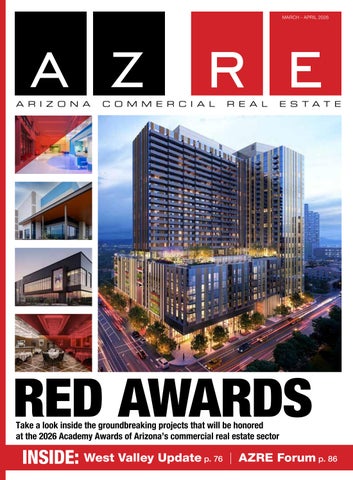
RED AWARDS Take a look inside the groundbreaking projects that will be honored at the 2026 Academy Awards of Arizona’s commercial real estate sector
INSIDE: West Valley Update p. 76 | AZRE Forum p. 86
President and CEO: Michael Atkinson Vice president and publisher: Amy Lindsey
AWARDS SEASON
T
he telltale signs of spring are upon us — the days are warming, baseball fans fill the stands at Cactus League games and desert blooms give Phoenix its distinctive Sonoran hue. But at AZRE magazine, springtime isn’t about yellow Palo Verde blossoms blanketing the Valley or the creamy white petals of Saguaro flowers. Here, one color dominates the season: RED. Each year, AZRE celebrates the best-of-the-best in commercial real estate. The 20th annual Real Estate Development (RED) Awards recognizes stand-out projects in 18 categories — from massive industrial facilities to modern mixed-use properties — along with the firms that had an extraordinary impact on Arizona’s skyline in 2025. Winners will be announced during the 2026 RED Awards ceremony on Thursday, March 19 at the Embassy Suites Scottsdale. More event details can be found at azbigmedia.com. Competition is stiff — turn to the RED Awards section and see for yourself. Even though much of this edition focuses on the hard-earned accomplishments made over the past year, our eyes are not wholly fixed on the rearview. Read more about Mack Real Estate Group’s $7 billion development Halo Vista slated to create a “city within a city” next door to TSMC, how SR-30 will be a boon for both residents and business in the West Valley, and why developers should think twice about shying away from projects on Tribal lands. Enjoy all these insights and more throughout this issue of AZRE. And be sure to soak in the beauty of spring while you can — the dog days of summer are nearly here.
Kyle Backer Associate editor, AZRE and PTK Kyle.backer@azbigmedia.com
2 | March - April 2026
EDITORIAL Editor in chief: Michael Gossie Associate editor: Kyle Backer Content editor: Christina Fuoco-Karasinski Staff writer: Lux Butler Contributing writer: Sarah Schild Interns: Ashley Aros | Emma Bradford | Alana Lynch Mackenzie Miller ART Creative services manager: Bruce Andersen Chief photographer: Mike Mertes Graphic designer: Leslie Durazo MARKETING/EVENTS Marketing and events director: Jacque Duhame OFFICE Director of finance: Sara Fregapane Operations coordinator: Michelle Zesati Database solutions manager: Amanda Bruno AZRE | PTK Director of sales: Ann McSherry AZ BUSINESS | AZ BUSINESS LEADERS Sales manager: April Rice Account executive: Tom Allen | Maria Hansen | Lula Hunteman EXPERIENCE ARIZONA | PLAY BALL Director of sales: David Harken Account executive: Lisa Allen RANKING ARIZONA Director of sales: Sheri King
AZRE: Arizona Commercial Real Estate is published bi-monthly by AZ BIG Media, 3101 N. Central Ave., Suite 1070, Phoenix, Arizona 85012, (602) 277-6045. The publisher accepts no responsibility for unsolicited manuscripts, photographs or artwork. Submissions will not be returned unless accompanied by a SASE. Single copy price $3.95. Bulk rates available. ©2026 by AZ BIG Media. All rights reserved. No part of this publication may be reproduced or transmitted in any form or by any means, electronic or mechanical, including photocopying, recording or by any information storage and retrieval system, without permission in writing from AZ BIG Media.
3
CONTENTS
FEATURES 6
Trendsetters
8
Breaking Ground
10
Big Deal
14
Executive Profile
15
After Hours
16
RED Awards
66
Butler Design Group
70
Hospitality Outlook
76
West Valley Update
82
Building Indian Country
86
AZRE Forum
RED AWARDS
8
16
AZRE FORUM
70
108 Top Producers
18 | March - April 2026
MARCH - APRIL 2026
86 RED AWARDS Take a look inside the groundbreaking projects that will be honored at the 2026 Academy Awards of Arizona’s commercial real estate sector
INSIDE: West Valley Update p. 76 | AZRE Forum p. 86
BY KYLE BACKER
B
illions of investment dollars have poured into Arizona, fundamentally changing the state’s economic trajectory. But for this hot streak to continue, the core infrastructure of growth must be secure. Today, the availability of water and power are top priorities for the industry — because without easy access to both, expansion efforts will stall. Arizona has a deep history of successful water policy, with the seminal Groundwater Management Act of 1980 acting as a lodestar for conservation efforts. But will the looming Colorado River negotiations — and the outside coverage it brings
On the cover: Sol Modern (large photo),
which was developed by LG Group, built by Layton Construction and designed by bKL Architecture, is a finalist for the 2026 RED Awards. (Photo provided by bKL Architecture) 84 | March - April 2026
4 | March - April 2026
— rattle businesses looking to locate in the state? What sort of legislative and technological solutions could fortify Arizona’s water portfolio? Since 1986, Greater Phoenix has been home to one of the nation’s largest power plants. Over the course of four decades, the Valley’s population has boomed — and so too has the demand for electricity. Can the state’s utilities keep up with ballooning power requirements in the AI age? Will dwindling capacity chip away at the region’s ability to deliver projects quickly? “The AZRE Forum, our annual commercial real estate update and forecast, will answer these questions
and more,” says Amy Lindsey, vice president and publisher of AZ Big Media, which produces AZRE magazine. “Our panels of experts represent some of the brightest minds in the industry whose insights will leave you better informed about the most pressing issues in commercial real estate today.” AZRE magazine will host the annual AZRE Forum on April 16 at The Camby Hotel Phoenix Biltmore for a lively discussion with Arizona’s top minds about the critical infrastructure issues facing the state. To get tickets or to learn more, go to azbigmedia.com and click on Awards & Events.
GO TO store.azbigmedia.com to purchase subscriptions, digital issues and plaques
ANITA VERMA-LALLIAN, CEO and founder, Arizona Land Consulting
BILL JABJINIAK, senior vice president, national community and government relation
BRAD TACKETT, vice president and business development manager, Sundt Construc COURT RICH, co-founder, Rose Law Group DAVID BEAN, vice president of sales and leasing, Commercial Properties, Inc. JOE KRAMER, CEO, Parajana Engineering
THE AZRE FORUM MODERATORS, PANELISTS AND KEYNOTE SPEAKERS INCLUDE (in alphabetical order):
MARK BAUER, vice chairman, JLL
MICHELLE DE BLASI, founder and senior counsel, Law Office of Michelle De Blasi; executive director, Arizona Energy Consortium ROCKY ANDERSON, founder and president, ADC Water SAM JONES, associate vice president, Phoenix region, Colliers International SHAWN BRADFORD, senior vice president, regulated U.S. Water, EPCOR SUZANNE FALLENDER, vice president of global impact and sustainability, Prologis
CONGRATULATIONS
TOP PRODUCERS 2
0
2
5
Todd Noel
Kyle Campbell
Phil Breidenbach
Rob Martensen
Don MacWilliam Payson MacWilliam
Brian Ackerman
Chris Reese
Dillon Hopley
Jerry LoCoco
Sam Jones
Greg Hopley
Bill Littleton
Cindy Cooke
Paul Sieczkowski
John Burns 5
TRENDSETTERS
No longer a level playing field I
n October, the U.S. Department of Transportation issued a new rule with major implications for the Disadvantaged Business Enterprise (DBE) program. In place for three decades, the initiative aims to give women- and minority-owned firms a fair shot at public contracts. Tammy Caputi, founder and president of Yale Electric West, explains why this change is a setback for businesses like hers.
NOT A GIVEAWAY “The goal of the DBE program was to allow everyone to compete on merit, not be a handout. All I get is the chance to bid like everyone else. But it’s the taxpayer who gets hurt in the long run because prices increase when there’s no competition,” Caputi says.
THE NEW RULE “All DBEs were decertified in October and told that the program is still available if you can prove why you’re economically disadvantaged without referring to race or gender. How do I prove my disadvantage that’s based on a barrier I’m not allowed to talk about? It’s a joke,” Caputi adds.
A FACADE OF FAIRNESS “Despite 99% of public contracts going male-owned businesses, people will say the ‘fair’ thing to do is make that final percent more competitive. The City of Phoenix has been tracking the data for 30 years, and that number hasn’t changed. Clearly, there’s a systemic problem that needs to be addressed,” Caputi concludes.
6 | March - April 2026
THE RIGHT SPOT TO PARK YOUR MONEY R
eal estate has long been a popular investment vehicle for growing wealth. But like other assets, real estate struggles during economic downturns. Just ask Nate Pattee, co-founder and CEO of 52TEN, who recalls “getting crushed” when
he worked as a broker in 2008. To avoid reliving that pain, Pattee chose to focus his company on manufactured housing as a profitable and tax effecient sector to invest in. Here’s what you need to know:
A UNIQUE STRUCTURE “Unlike other housing types, residents own their home but lease the land from the park. That comes with a different mentality than someone who rents an apartment and has no attachment to the property,” says Abbey Olivio, director of marketing for 52TEN. SAFE HARBOR “It just so happens that the intrinsics of manufactured housing makes it recession resistant. During the pandemic, our revenue collections dropped less than .2%, which is a testament to the stability of the product type,” Pattee explains. BREAKING THE STIGMA “Some people think trailer parks are full of drugs and crime. And yes, those do exist, but many are nice, institutional communities that are safe places to raise a family. It’s also the most affordable housing types out there, which helps solves one of the biggest issues our country is facing right now,” Olivio concludes.
7
BREAKING GROUND
A CITY ALL ITS OWN
Halo Vista brings 2,300 acres of mixed-use development to TSMC’s backyard By KYLE BACKER
T
hrough smart planning, savvy investing and stakeholder alignment, the Valley’s reputation as a nascent industrial powerhouse is spreading. TSMC’s $165 billion campus in North Phoenix is symbolic of the region’s transformation away from the boom-bust cycle that left it vulnerable during the 2008 financial crisis and towards a more resilient, diversified economy. To help meet the demand generated by TSMC’s substantial investment, Mack Real Estate Group (MREG) and McCourt Partners will host a ceremonial groundbreaking for Halo Vista — a $7 billion masterplanned mixed-use development abutting TSMC — on March 26. Billed as a “city within a city,”
8 | March - April 2026
Halo Vista’s 2,300-acre footprint aims to create an innovation hub anchored by Greater Phoenix’s growing semiconductor ecosystem, offering nearly 30 million square feet of industrial, retail, office, research and healthcare spaces, along with hotels and upward of 9,000 residential units. According to Chris Janson, president of Mack Halo Vista, the first structures to emerge from the desert will address the corridor’s immediate gaps. So far, an auto mall, Costco, Courtyard by Marriott and Residence Inn have been announced. “Additional retail and restaurants will be coming during this first phase of tenant activity,” he continues. “Thanks to [the development’s] location by the I-17, people can access the
project easily, and there is a lot of great infrastructure nearby. With all the growth happening, the area needs it.” Building on success When it comes to branding a product, the best names are both evocative and memorable. Richard Mack, CEO of MREG, explains that Halo Vista is a double reference — emphasizing how the site wraps around the TSMC campus like a crown and a nod to the views of the surrounding natural beauty and the Valley itself as it stretches southward for miles. But when MREG was in the earliest phases of the project, it was unclear how large this “halo of development” would be. When the firm won the state
HUB OF THE FUTURE: Developed by Mack Real Estate Group and McCourt Partners, Halo Vista’s 2,300-acre mixed-use master plan aspires to create a “city within a city” beside TSMC’s semiconductor campus in North Phoenix. Among the first projects announced within the $7 billion project are an auto mall, Costco, Courtyard by Marriott and Residence Inn. (Rendering courtesy of Mack Real Estate Group)
managing director at MREG, notes that he and a partner started making connections with TSMC to better understand their needs. After successfully closing on the site, the pair joined local officials on a trip Richard Mack Craig Henig Chris Janson to Taiwan. “We toured the land auction for the parcel, Mack recalls Hsinchu Science Park to see what we that it wasn’t guaranteed that TSMC could potentially replicate, or even would move forward with all three of the improve on, in Phoenix,” he says. “We initial fabs. also spoke with TSMC executives, and “The first was underway,” he continues, the buzzword that kept coming up was “and we felt it was very likely that they’d ‘ecosystem.’” build two, but we were making a bet. From these meetings, Henig gained a There was the chance that a change better understanding of the company’s in administration could reduce — or wish list for a project like Halo Vista and increase — TSMC’s investment, but relayed that information back to the we believed that chip manufacturing team upon returning stateside. Those was existential for the U.S. no matter priorities included sites for suppliers what and also critically important, within the semiconductor supply chain, geopolitically speaking, for Taiwan.” hotel rooms for visitors from Taiwan and Around this same time, Craig Henig, a multifamily component for employees.
Retail, healthcare and a full spectrum of educational institutions were also flagged as priorities by TSMC leaders With the vision of the ecosystem made explicit, the “city within a city” concept for Halo Vista began taking shape. “They wanted everything,” Mack adds, “but we had to triage [TSMC’s requests] to deliver what we could [finish] quickly first — with the understanding that we’ll be able to build everything else over the life of the project.” For example, Mack says ASU would be the natural partner to bring higher education to Halo Vista. The firm has spoken with the university about why an engineering school would be a good fit, but no deal has been finalized — yet. “Halo Vista will take 15 to 20 years [to complete],” Janson concludes. “We’re looking ahead to understand how the master plan will support all the things a ‘city within a city’ should have, while still tailoring it towards what’s immediately in front of us. In other words, we’re taking it one day at a time.” 9
BIG DEAL
Industrial-grade Insights Cognite trades snow for sunshine with Tempe relocation
AI IN AZ: Gov. Katie Hobbs addresses the crowd during the ribbon cutting ceremony for Cognite’s new global headquarters. Located on the ninth floor of the Hayden Ferry Lakeside III building in Tempe, the company reports it will create more than 100 new jobs related to the growing industrial AI sector. (Photo courtesy of Cognite).
By KYLE BACKER
O
n Dec. 3, Cognite celebrated the grand opening of its new 30,000-square-foot global headquarters in Tempe. The Norwegian company plans to add more than 100 new employees to support its suite of AI to harness, streamline and translate industrial data for businesses. “Cognite’s decision to establish its worldwide headquarters right here in Arizona is a clear endorsement of the unmatched innovation ecosystem that we have worked so hard here to build,” says Gov. Katie Hobbs during the ribbon-cutting ceremony. “What happens at Cognite is felt across the globe, and now Arizona gets to be a part of that.” According to Cognite Board Member Alysa Taylor, the industrial AI business
10 | March - April 2026
is valued at $20 billion today, with forcecasts estimating that number to swell to $90 billion over the next eight years. “That’s what Cognite and the great state of Arizona has to look forward to,” she continues. Tempe’s talent Perched on the ninth floor of the Hayden Ferry Lakeside III, Cognite employees enjoy a panoramic view of Tempe’s distinct landmarks, including A Mountain, Mill Avenue and Tempe Town Lake. Beyond the picturesque scenery, the office’s proximity to ASU was a powerful draw for the company. “Originally, Cognite wanted to be in Scottsdale,” explains Jonathan Keyser, founder and managing partner of
Keyser Commercial Real Estate. “But they had heard about Tempe’s tech ecosystem, and after touring a few buildings, they made the decision to only look at options in Tempe.” Considering AI demand is projected to proliferate in the coming years, having easy access to ASU and the talent it graduates was a primary driver for Cognite to locate in Sundevil territory. “At ASU, we’re proud to educate more than 30,000 engineers and more than 20,000 business students. These future-ready leaders are eager to contribute to the missions of companies like Cognite,” says Chris Howard, executive vice president and COO of ASU. “Tempe is the right place and Cognite is the right company.
Katie Hobbs
Alysa Taylor
I’m confident we’ve only scratched the surface of what we can build together.” Deciphering the data With the popularity of dedicated AI agents and the accelerating ubiquity of AI across products such as web browsers, phone operating systems and social media platforms, Cognite’s value proposition may not seem unique. But these models are based on the written word, which poses a challenge for many businesses that want to use AI in their operations. “Industrial data isn’t language — it’s temperature sensors, work orders and piping schematics,” explains Jason Schern, field CTO for Cognite. “That makes it difficult for AI to apply the same reasoning it typically does.” To give AI the required context it needs to generate useful insights, Cognite identifies meaningful relationships that exist within the data, creating a framework of meaning the AI can reason from. “Industrial AI is so important because many industries have grappled with siloed, unstructured data they couldn’t access to understand the health of their business,” Talyor adds. For example, Schern points to a common process called root cause analysis (RCA). When a major incident occurs, companies examine why it happened and determine a solution to prevent it from occurring again.
Jonathan Keyser
Jeff Rifkin
“It’s a difficult undertaking that takes months even at the best companies,” he continues. “That means there are many incidents that never get investigated or mitigated because RCAs take so long.” When working with a customer, Schern discovered that the most timeconsuming part of their RCA procedure was gathering and analyzing the data. By using Cognite’s Data Fusion product to contextualize the data and its Atlas AI agent to provide insights based on those records in plain English, the process was shortened from six weeks to six hours. “In reality, it only took about 30 minutes, but there’s a nice symmetry to ‘six weeks to six hours,’” he adds. “This is just one example of the hundreds of ways [these systems can be used] at a company. But it does help give a sense of what we mean by our moonshot, which is to drive $100 billion worth of value for our customers using Cognite technology.” The phrase “time is money” is a common phrase in business for a reason, but in some industries, even a small hiccup equates to a major loss of revenue. “Oil and gas companies lose something like $1,000 per second when operations are down,” explains Stein Danielsen, co-founder and chief solutions officer for Cognite. “Before AI, we’d use a query language to figure out what’s wrong [with a particular machine]. But that’s too difficult, especially if you’re losing $1,000 every second.” Today, Cognite can compile readings
Jason Schern
Stein Danielsen
and measurements together, then layer an AI agent over the top of the dataset that can answer questions from an operator. Danielsen compares it to having a conversation with a very knowledgeable person who can ask follow-up questions to determine what information is actually being requested. Say, for example, a company has factories across the world that use a specific piece of equipment. If someone asks a general question about the performance of that machine, Danielsen notes that the AI agent will prompt the user. “It might reply, ‘Which one do you mean?’” he continues. “Then, the operator can say, ‘Oh, the one at the Phoenix site,’ and then it will fetch the requested information. I can even talk to the agent in Norwegian, even if the documentation is in English since that doesn’t matter to AI.” Keyser adds that bringing the headquarters of a significant international entity to Tempe is a huge win for the state — perhaps bigger than many realize. “Cognite is the global leader in industrial AI, which is exactly the kind of business we want,” he concludes. “Of all the places in the world they could’ve picked, Arizona is where they landed. When you consider the number of companies within their ecosystem, Cognite’s decision to be here will have a lasting ripple effect.” 11
BIG DEALS Here are the biggest commercial real estate deals in Metro Phoenix from December 2025 and January of 2026
BIGGEST DEAL IN DECEMBER: BB Living at Civic Square is a 290-unit finished build-to-rent community. (Photo provided by BB Living Residential)
BIGGEST DEAL IN JANUARY: Broadstone Fashion Center Apartments is a 335-unit apartment complex in Chandler. (Photo provided by Nuveen a TIAA Company)
5 biggest deals from December 5 biggest deals from January 1. BB LIVING AT CIVIC SQUARE
1. BROADSTONE FASHION CENTER APARTMENTS
Sale price: $124,200,000 Address: 15125 W. Oak St., Goodyear Property description: 290-unit finished build-to-rent community built in
Sale price: $109,000,000 Address: 555 S. Galleria Way, Chandler Property description: 335-unit apartment complex Buyer: Stockdale Capital Partners Seller: Nuveen, a TIAA Company
2024 Buyer: BlackRock Realty Advisors Seller: BB Living Residential
2. MACK INNOVATION PARK - DEER VALLEY Sale price: $90,700,000 Address: 23869 and 23975 N. 19th Ave.; and 1775 W. Alameda Rd.,
Phoenix Property description: 332,479-square-foot industrial property Buyer: Westcore Properties Seller: Mack Real Estate Group Broker: CBRE
3. FAIRWAY COMMERCE CENTER Sale price: $89,800,000 Address: 12250 W. Corporate Dr., Avondale Property description: 450,260-square-foot distribution facility Buyer: Invesco Seller: Westfield Company Broker: JLL
4. SOLVIDA CENTRAL Sale price: $88,000,000 Address: 4848 E. Roosevelt St., Phoenix Property description: 368-unit, three-story apartment complex Buyer: Green Leaf Capital Partners Seller: Cortland Partners
5. UNION PARK AT NORTERRA Sale price: $80,200,000 Address: 25111 N. 21st Ave., Phoenix Property description: 154-unit build-to-rent community Buyer: BlackRock Realty Advisors Seller: BB Living Residential
12 | March - April 2026
2. COMMERCE@303 (ALSUP 303 INDUSTRIAL PARK) Sale price: $104,550,000 Address: 5215 N. Alsup Rd. and 15600 W. Camelback Rd., Glendale Property description: 663,367-square-foot mega warehouse Buyer: Exeter Property Group Seller: New York Life Insurance Broker: Cushman & Wakefield
3. BILTMORE AT CAMELBACK APARTMENTS Sale price: $97,350,000 Address: 2625 E. Camelback Rd., Phoenix Property description: 270-unit multifamily property Buyer: Principal Financial Group Seller: Heitman
4. VIRGIN INDUSTRIAL PARK - BUILDING A SALE PRICE: $90,579,360 Address: 15784 W. Hatcher Rd., Waddell Property description: 566,121-square-foot mega warehouse Buyer: ERMCO Seller: Invesco Broker: Cushman & Wakefield
5. SURPRISE POINTE COMMERCE CENTER Sale price: $70,035,000 Address: 13290 W. Sweetwater Ave., Surprise Property description: 418,400-square-foot industrial property Buyer: US Immigration and Customs Enforcement Agency (ICE) Seller: Rockefeller Group Development
NOMINATE TODAY!
HELP US RECOGNIZE THE PEOPLE AND PROJECTS TO KNOW IN COMMERCIAL REAL ESTATE PTK magazine highlights the people and projects that are driving and shaping commercial real estate in Arizona! We will celebrate all the People and Projects featured at the magazine launch party FALL of 2026!
NOMINATION IS EASY! Just scan the QR code or go to azbigmedia.com/awards-events
Nominations end May 21, 2026
YOUR COMPLETE MULTIMEDIA SOLUTION! 13
EXECUTIVE PROFILE
Better together Todd Hornback explains the value of cohesive communities By KYLE BACKER
P
redictions made at the dawn of the internet age promised a more integrated world where physical distance would be no match for the world wide web. But even as technological advances made the digital frontier pocket-sized, feelings of alienation are widespread. “We’re the loneliest society in human history, and it’s a serious health risk,” explains Todd Hornback, CEO and shareholder at Cohere. “We launched an impact report [in 2025], which found that only about half [of respondents] trust their neighbors or feel like they belong.” That’s why Cohere positions itself as community builders rather than property managers. The goal, Hornback continues, is to inspire residents to make the neighborhood more than just a collection of houses. AZRE magazine sat down with Hornback to learn more about his career, why cohesive communities benefit both residents and the bottom line, and how the built environment can encourage social bonding. The following responses have been edited for clarity and length. AZRE: Could you start by telling us about your career path? Todd Hornback: I began my career as a teacher working with students and coaching athletes. My plan was to continue down that path, but then I was introduced to the nonprofit sector, and I became a community organizer for a variety of grassroots organizations in L.A. and San Diego. That allowed me to take my coaching skillset into underserved communities, and I found my home in the nonprofit sector.
14 | March - April 2026
AZRE: How long did you work as an organizer? TH: I was about halfway through my career when I was recruited by a developer called DMB Associates, who are responsible for projects like DC Ranch and Verrado. They understood that what makes those places special is feeling a sense of belonging and having neighbors that care about one another. DMB believed that nonprofit leaders are natural organizers, so I was made the town manager of Verrado in 2005. I was essentially doing the same thing as before but applying my skillset for a different purpose. AZRE: When did you become the CEO of Cohere? TH: After working for DMB for 15 years, they went through a corporate restructure and Cohere was born. At the beginning, we had five communities in Arizona, and that has grown to 40. We still work with DMB wherever they are, but we have about 15 different developer clients across eight states.
AZRE: The merits of an engaged, tight knit neighborhood can be hard to quantify. How do you explain the benefits of Cohere’s work to potential clients? TH: Our business is simply translating the power of community into real estate value. We’re the experts on how to plan, design, build and ultimately operate places that thrive because of the social cohesion between residents. People will pay a premium to live in a connected neighborhood, especially with the suburban sprawl we see here in the Valley. Beyond the financial incentive, we also want to fight back against the loneliness epidemic, which has a very real impact on health and wellbeing. AZRE: What can be done to foster a sense of solidarity within a community? TH: The first thing we do is help developers understand why they should focus on people-forward design instead of putting buildings and operations first. That means shaping the built environment in a way that helps people come together, which encompasses everything from how wide the streets are to the walkability of the community. What we’re looking for are “free-range children” — if there are kids running around, that shows a high level of trust and care in the neighborhood. In the big picture, we only serve a small slice of the population, but we’re going to be relentless about creating communities based on authentic relationships and shared responsibility. There is a choice to build places that either bring people together or keep them apart.
AFTER HOURS
From job site to flight line How Anna Griffin serves her community at home and abroad By ASHLEY AROS
F
or many, the pressures of one career is enough to count the days until the weekend — but not Anna Griffin. In her primary role, Griffin is the director of construction for Ryan Companies US in Phoenix, leading project management teams in the pursuit and execution of developments throughout the Southwest. But, when duty calls, Griffin swaps out her PPE for an Air National Guard uniform, where she serves as commander of the aircraft maintenance squadron at the 165th Airlift Wing in Savannah, Georgia. Griffin has deployed twice, most recently to Jordan, where she served as director of operations for the maintenance squadron. Growing up on a 76-acre farm in a small Texas town, Griffin recalls that “my dad would use me as his toolgetter — his go-to gal to help him with things on the farm.” The experience strengthened her love of problem solving, a trait that later drew her to construction. Encouraged by her brother and needing a way to pay for college, Griffin joined the military, planning to stay for just four years. But 22 years later, she still proudly serves her country. AZRE magazine sat down with Griffin to learn more about her recent deployment to Jordan, as well as the similarities between the construction industry and the military. Portions of this interview orignally appeared on the AZ Big Podcast with Michael and Amy. The following responses have been edited for clarity and length. AZRE: Would your deployment to Jordan have been possible without a supportive company behind you like Ryan Companies US? Anna Griffin: That meant everything to me. Saying, “Hey, boss, I’m going to be gone for seven months,” and having
each other, and I’m fortunate to have a small influence on both sides of that equation. AZRE: What does your day-to-day look like as the director of construction for Ryan Companies US, and what types of projects are you overseeing? AG: That’s what I love about this job — it’s never the same. You can go from talking to the city to helping a person solve a personal problem. In our director of construction roles, we focus more on people than projects.
them respond, “Absolutely. Can we give you time off before and after so you can get everything together and have a chance to reacclimate?” And then, on top of that, “Don’t worry about your job. We’ll make sure it’s here. We’ll figure it out. People will take on the load for you. And we know you’re going to take a pay cut — let us help you make that up so you’re not financially burdened.” They did it without question. It’s about doing the right thing, and it truly embodies the spirit of what Ryan Companies is. AZRE: What are the similarities between your military and construction backgrounds? Are there lessons that carry over to both? AG: At the end of the day, it’s about executing a mission. On the building side, we’re delivering projects on time, on budget and safely to our clients. On the aircraft maintenance side, it’s about delivering safe, reliable aircraft for our operators to fly. I think both complement
AZRE: You entered two very male-dominate professions. Have there been any challenges being a women in the military or construction industry? AG: In the military, we don’t care about your skin color or sex. We care that you’ll be there when we need you, when the enemy comes around the corner. We depend on that and overlook other things. I’ve taken that same mindset into construction — meeting people where they’re at, understanding their needs and wants, and executing. I hope anyone in the industry finds support systems to help them navigate any challenges they face. AZRE: Is there one thing you look back on that gives you the most pride? AG: I’ve been deployed twice, and in both deployments, those leadership positions mean the most to me. Anytime you look out at a formation, knowing there are thousands of people behind each person who expect you to execute the mission and bring them home safely, is something I’ve always taken pride in. It’s the same on our construction sites. Everyone on that job has thousands of people who care about them, so making sure they’re safe is a point of pride. 15
RED AWARDS
16 | March - April 2026
2024 2026
RED Awards Celebrating the best of the best in Arizona’s commercial real estate industry By KYLE BACKER
A
rizona’s commercial real estate industry spent the first five years of the decade delivering regionshaping projects that will have a long-lasting impact on state — all while navigating the pandemic and its aftershocks that rattled the economy and supply chains. Despite the challenges, Arizona’s skyline looks radically different than it did in 2020. Legacy properties were repositioned as mixed-use destinations, agricultural land transformed into massive logistics hubs and new healthcare facilities were built to meet the needs of a growing population. The back half of the decade holds great promise for the state — should this hot streak stay alive. That said, the RED Awards aren’t about what may happen in the futue. They commemorate the accomplishments achieved by the teams of companies who shepherded projects of all kinds from initial concept to final delivery. Each category represents the finest the industry has to offer — state-of-the-art education buildings, chic offices spaces, lavish hotels, modern apartments and so much more. The 2026 RED Awards will honor finalists and announce winners in 18 categories on Thursday, March 19, at the Embassy Suites Scottsdale. The year’s top developer, general contractor, architecture firm and subcontractor will also be celebrated. Event details can be found at azbigmedia.com. Meet this year’s finalists on the pages that follow.
17
MARKETING
RED card
How awards recognition and strategic marketing can boost your bottom line
A
wards recognition — like AZRE’s RED Awards — is more than a moment of pride. It is a strategic business asset. When approached thoughtfully, industry programs such as the RED Awards become powerful tools that help companies drive visibility, strengthen credibility, deepen relationships and support revenue growth. One of the most important benefits of these award programs is the opportunity to document your team’s best work in a meaningful, polished way. Capturing the full project story,
18 | March - April 2026
Sarah Schild Marketing
along with strong visuals and clear outcomes, creates a content library that can be repurposed across business development efforts, presentations, proposals, social media, websites, recruiting and more. When this process is approached strategically, often with guidance from partners such as an experienced agency that specializes in these niche industry awards, it becomes far more than a submission. It becomes a long-term marketing asset. Externally, promoting trade partners, consultants and collaborators helps solidify relationships. Internally,
Great projects start with great people. We’re grateful to the clients, partners, and teams who make every CORE project possible. We’re honored to be nominated in the 2026 RED Awards.
2026 RED Award Nominations • • • • • •
Mohave College Advanced Manufacturing Training Center Arizona State University West Campus Academic Building City of Scottsdale Police and Fire Training Facility Flagstaff USD Marshall Elementary School Rebuild Marana USD Tangerine Farms K-8 School Phoenix UHSD Trevor G. Browne Sports Fields and CTE
602.494.0800 | coreconstruction.com
MARKETING awards recognition creates an opportunity to highlight the successful work being done by your team and the individuals behind it. Company leaders will say, “people are our greatest asset” — but this proves it. By expanding on the individuals behind the work, it boosts morale and builds pride, which, in turn, leads to an increase in employee retention and provides the dual benefit of attracting talent. Promotes awareness Recognition, such as being named a winner or finalist for the RED Awards, significantly increases visibility for both your company and projects. It boosts your exposure across the industry, media/publications, social platforms and other channels. Featuring accolades on your website, press releases, email signatures and in ongoing content improves searchability and strengthens your SEO footprint. Over time, this consistent visibility
20 | March - April 2026
helps position your firm as a recognized leader in its market. Builds credibility Third-party recognition carries real weight, especially in the competitive construction and commercial real estate world. RED Awards recognition tells clients, partners and stakeholders that your work has been evaluated and respected by industry peers. This builds trust and reduces perceived risk in high-stakes decisions. In pursuit environments, this credibility can be the factor that moves your firm from consideration to selection. Creates differentiation Awards provide a clear, objective way to stand apart. Being a RED Awards winner or finalist positions your company as a leader in excellence and innovation, not just another option in a crowded field. Featuring your earned awards in collateral such as a branded
coffee table book or a video highlight reel is an intentional marketing strategy to take promoting the win to the next level. Boosts the bottom line Awards should be treated as sales assets, not just marketing mentions. When used in proposals, presentations and client conversations, recognition helps justify premium pricing and reinforces the value your firm brings. It shifts the conversation away from cost and toward confidence, quality and long-term results. In the end, awards recognition is not just about celebrating past success. When paired with a thoughtful, strategic marketing approach, it becomes a tool for sustained growth and a meaningful contributor to the bottom line. Sarah Schild is content strategist at Small Giants.
21
BUILD-TO-RENT
THE VILLAGE AT CARVER MOUNTAIN
Developer: The Empire Group of Companies General contractor: Lifestyle Homes Construction Architect: Felten Group Subcontractors: Coppernail Construction, McGough Group, Coe & Van Loo, Wright Engineering, Studio Dwell City: Laveen Village Size: 267,788 square feet
Canopy at Sundance Developer: Hancock Builders General contractor: Hancock Builders Architect: Barduson Architects Owner: Blueprint White Tanks Subcontractors: Umbria Builders, Etico, Universal Group, JG Block, Sierra Verde Construction City: Buckeye Size: 36.92 acres
22 | March - April 2026
Marketside Villas at Verrado Developers: P.B. Bell Companies, Everest Holdings General contractor: P.B. Bell Companies Owner: P.B. Bell Companies City: Buckeye Size: 150 units
Canopy at Cottonwood
Verge
Developer: Hancock Builders General contractor: Hancock Builders Architect: Barduson Architects Owner: Blueprint Cottonwood Subcontractors: Umbria Builders, Etico, Lodi Garage Doors, Nikola Roofing, Sierra Verde Construction City: Casa Grande Size: 135,109,231 square feet
Developer: 29th Street Capital General contractor: Mosaic Construction Services Architect: Felten Group City: Apache Junction Size: 201 residences
23
EDUCATION (K-12)
TANGERINE FARMS K-8 SCHOOL
General contractor: CORE Construction Architect: BWS Architects Owner: Marana Unified School District Subcontractors: Amigo Electric, Divine Concrete, Comfort Systems, Foothills View Landscaping, Akowski Masonry City: Marana Size: 90,717 square feet
24 | March - April 2026
Pima High School General contractor: Danson Construction Architect: SPS+ Architects Owner: Pima Unified School District Subcontractors: SunCor, Hughes Plumbing, Arizona Corporate Buildings, Design Modular, Arizona Hardwood City: Pima Size: 67,195 square feet
Marshall Elementary School Rebuild
Sunland STEAM Academy
Goodyear High School
General contractor: CORE Construction Architect: DLR Group Owner: Flagstaff Unified School District Subcontractors: Division 3 Structures, Midstate Mechanical, T-Bar-H, Sun Valley Masonry, RKS Plumbing City: Flagstaff Size: 55,338 square feet
General contractor: CHASSE Building Team Architect: Grace Design Studios Owner: Roosevelt School District Subcontractors: Sportsmans Concrete, Corporate Air Mechanical Services, Echo Canyon Electric, Amber Steel Fabrication, Rikoshea Contracting City: Phoenix Size: 77,000 square feet
General contractor: CHASSE Building Team Architect: ADM Group Owner: Agua Fria Union High School District Subcontractors: Midstate Mechanical, Stone Cold Masonry, EF Charles, LR Cowan Concrete, Veregey DER & Electrical City: Goodyear Size: 240,000 square feet
25
HEALTHCARE
BANNER HEALTH CENTER GOODYEAR AT GSQ
Developer: Globe Ryan MOBI General contractor: Ryan Companies US Architect: Butler Design Group Subcontractors: Sazan Group, PK Associates, Olsson Civil Engineering, Laskin & Associates, Saguaro Steel City: Goodyear Size: 65,205 square feet
Phoenix Children’s Arrowhead Campus General contractor: Kitchell Architect: HKS Owner: Phoenix Children’s Hospital Subcontractors: Progressive Commercial Interiors, DP Electric, Western Millwork, Gen3 AZ, Integrated Masonry City: Glendale Size: 225,000 square feet
HonorHealth Complete Care – Lake Pleasant Developer: Anchor Health Properties General contractor: JE Dunn Construction Architect: Devenney Group Subcontractors: Diversified Interiors, Heywood Builders, Graywolf, Barrett Homes City: Peoria Size: 12,157 square feet
26 | March - April 2026
Clarence Wesley Health Center
Pascua Yaqui Health Center
Developer: San Carlos Apache Healthcare Corporation General contractor: Willmeng Construction Architect: Cuningham Group City: Bylas Size: 36,000 square feet
Developer: Pascua Yaqui Healthcare Corporation General contractor: PIMMEX-CHASSE Architect: Johnson Smitthipong & Rosamond Associates Subcontractors: Wang Electric, True Metal Solutions, Universal Piping, Amber Steel Fabrications, Crawford Mechanical Services City: Guadalupe Size: 40,000 square feet
27
HIGHER EDUCATION, WORKFORCE DEVELOPMENT
MOHAVE COLLEGE ADVANCED MANUFACTURING TRAINING CENTER General contractor: CORE Construction Architect: DFDG Architects Owner: Mohave College Subcontractors: Encore Electric, Protek Construction, Colorado River Plumbing, Midstate Mechanical, Jim’s House of Glass City: Kingman Size: 35,501 square feet
THOMAS REDEVELOPMENT PROJECT
RENOVATION REWIND B R I N G I N G S PA C E S B A C K T O L I F E 602.851.1149 renovationrewind.com
28 | March - April 2026
ASU West Academic and Office Building General contractor: CORE Construction Architect: Todd & Associates Owner: Arizona State University Subcontractors: Sun Valley Masonry, Pete King Construction, Artcraft Tile & Granite, Kearney Electric & Communications, AZ Verde Fire Protection City: Glendale Size: 52,314 square feet
Paul and Alice Baker Center Trevor G. Browne for Public Media CTE Building Addition Developer: The University of General contractor: CORE Arizona Department of Planning Design & Construction General contractor: DPR Construction Architect: SmithGroup Owner: Arizona Public Media Subcontractors: Parsons Steel Erectors, Blanco Concrete, Sun Mechanical Contracting, Wilson Electric, Global Wall Panel Group City: Tucson Size: 61,500 square feet
West-MEC Career Academy at Agua Fria High School
General Contractor: GCON Architect: SPS+ Architects Architect: ADM Group Owner: West-MEC Owner: Phoenix Union High School Subcontractors: Stone Cold District Masonry, Progressive Roofing, City: Phoenix Hawkeye Electric, Pueblo Size: 128,707 square feet Mechanical and Controls, Benson Systems City: Avondale Size: 31,000 square feet Construction
BUILD WITH CONFIDENCE
480.894.1286 | SunStateBuilders.com
Leader in Design-Build Construction Since 1973 29
HOSPITALITY
THE REMI., SCOTTSDALE
Developer: Stockdale Capital Partners General contractor: Layton Construction Architect: RSP Architects Subcontractors: Rockwell Group, IMEG, PK Associates, SEG, RVi Planning + Landscape Architecture City: Scottsdale Size: 128,000 square feet
Desert Diamond Casino White Tanks at San Lucy Developer: Tohono O’odham Nation General contractor: The PENTA Building Group and AECOM Hunt JV (Hunt-PENTA) Architect: JCJ Architecture Subcontractors: Desimone Engineering, Dowl, EXP, Suntec Concrete, Arok City: Waddell Size: 184,000 square feet
Grand Hyatt Scottsdale Resort Renovation Developer: Xenia Hotels and Resorts General contractor: Balfour Beatty Construction Architect: RSP Architects Subcontractors: Wimberly Interiors, PK Associates, Kimley-Horn, EXP, Innovative Foodservice Design Team City: Scottsdale Size: 27 acres
30 | March - April 2026
Mountain Modern Sedona Developer: Crystal Creek Capital Real Estate Advisors General contractor: Chanen, a Dick Anderson Construction Company Architect: RSP Architects Subcontractors: IMEG, PK Associates, Berghoff Art Consultants, Raeder-Whaler, Sheets Studios City: Sedona Size: 43,100 square feet
AC Hotel by Marriott and Element by Westin Phoenix North Norterra Developer: JacksonShaw General contractor: Layton Construction Architect: Cooper Carry Owner: JH Norterra Subcontractors: Colt Framing, SPG Construction, OCM Landscaping, Raven Concrete, Spectra Flooring City: Phoenix Size: 160,000 square feet
31
INDUSTRIAL (LESS THAN 100K SF)
EMD ELECTRONICS Developer: EMD Group General contractor: Willmeng Construction Architect: Deutsch Architecture Group City: Chandler Size: 55,500 square feet
South32 Hermosa
FALCO Phase II Expansion
Maxway Trucking Facility
WorkBay Glendale
Developer: South32 Hermosa General contractor: Primak Construction Group Architect: Helmut John Hammen Architecture Subcontractors: Aries General Builder, Degan Construction, Landmark Metal Builders City: Patagonia Size: 10,757 square feet
Developer: FALCO General contractor: Primak Construction Group Architect: Barry R. Barcus Architect Owner: FALCO City: Chandler Size: 14,752 square feet
Developer: Maxway Trucking and Freight General contractor: Primak Construction Group Architect: Barry R. Barcus Architect Owner: K&B Real Estate Subcontractors: Blade Runners, Arrowmark City: Phoenix Size: 40,003 square feet
Developer: WorkBay General contractor: Sun State Builders Architect: Gould Plus Architects Subcontractors: Riggs Companies, Canyon Plastering & Drywall, Arizona Corporate Builders, Fyffe Masonry, Reed Landscaping City: Glendale Size: 80,062 square feeet
32 | March - April 2026
33
LEADING OUR NEXT CHAPTER Trusted leadership. Proven expertise. A shared vision for what’s next. www.admgroupinc.com
Cutter Aviation
Arizona Public Service - Palo Verde
34 | March - April 2026
Jenifer Weskalnies COO
Wendy Odom CEO
INDUSTRIAL (100,000 TO 250,000 SF)
SUPER RADIATOR COILS
General contractor: Brinkmann Constructors Architect: Ware Malcomb Owner: Super Radiator Coils Subcontractors: Suntec Concrete, K2 Electric, Prime Mechanical, Utah Steel, NDBS City: Phoenix Size: 150,000 square feet
Phoenix QTS Data Centers
Power Commerce Park
Thunderbird Commerce Park Turbo Resources
General contractor: Clayco Architect: Jacobs Owner: QTS Data Centers Subcontractors: TLD Design Consulting, Concrete Strategies, Bel-Aire Mechanical, MKB Drywall, Helix Electric City: Phoenix Size: 108,000 square feet
Developer: Cavan Commercial General contractor: CHASSE Building Team Architect: Pinnacle Design Subcontractors: KBELL ENGINEERING, Trez Capital City: Gilbert Size: 146,000 square feet
Developer: Creation General contractor: LGE Design Build Architect: LGE Design Build Subcontractors: Phoenix Commercial Electric, Adobe Drywall, Carlson Glass, Triad Steel, Suntec Concrete City: Scottsdale Owner: Creation Size: 242,740 square feet
36 | March - April 2026
General contractor: Layton Construction Architect: K&I Architects and Interiors Owner: Turbo Resources City: Chandler Size: 245,000 square feet
Congratulations RED Awards finalists!
Super Radiator Coil Build to Suit - Mesa, AZ
The PENTA Building Group is a nationally recognized commercial general contractor, with locations in Arizona, Nevada, and Southern California. PENTA partners with owners, developers, designers, and trade partners to deliver projects of varying sizes and scopes across a wide range of markets, including gaming, education, hospitality, healthcare, commercial, entertainment, Native American, industrial, and public works.
PENTABLDGGROUP.COM
37
INDUSTRIAL (250,000 TO 750,000 SF)
XNRGY HEADQUARTERS Developer: The Boyer Company General contractor: Wespac Construction Architect: Gensler Owner: XNRGY Subcontractors: IMEG, Suntec Concrete, Colwell Shelor, HACI, Next Level Steel City: Mesa Size: 550,000 square feet
Camelback 303 Logistics Center Developer: Brookfield Properties General contractor: Stevens-Leinweber Construction Architect: Butler Design Group Subcontractors: Riggs Companies, Structures Group, IKON Steel, Scott’s Diversified Construction, McCain Construction City: Goodyear Size: 616,000 square feet
Deer Valley Business Campus Phase II Developer: Sunbelt Investment Holdings (SIHI) General contractor: Willmeng Construction Architect: Balmer Architectural Group City: Phoenix Size: 303,126 square feet
38 | March - April 2026
Formation Park 10 Phase I
VT 101 Phase I
Developer: Formation Interests General contractor: Willmeng Construction Architect: Deutsch Architecture Group Subcontractors: Kimley-Horn, Suntec Concrete City: Goodyear Size: 427,709 square feet
Developer: VanTrust Real Estate General contractor: Layton Construction Architect: Butler Design Group Subcontractors: Todd & Associates, Kraemer Consulting Engineers, McGrew Consulting Engineers, PK Associates, Kimley-Horn City: Glendale Size: 307,776 square feet
39
INDUSTRIAL (MORE THAN 750,000 SF)
GOODYEAR AIRPARK PHASE I
Developer: Lincoln Property Company General contractor: Stevens-Leinweber Construction Architect: Butler Design Group Subcontractors: Suntec Concrete, Integrity Electric, The Structures Group, Olympic West Fire Protection, Raven Concrete City: Goodyear Size: 1,600,000 square feet
C|303 Phase I
CapRock West 202
Developer: Merit Partners Logistics Phase II Developer: CapRock Partners General contractor: StevensGeneral contractor: Layton Leinweber Construction Construction Architect: Butler Design Group Subcontractors: Suntec Concrete, Architect: CAA Architects City: Phoenix Denny Clark Masonry and Concrete, Universal Piping, Brown Size: 825,000 square feet & Sons Electrical Contracting, Adobe Drywall City: Litchfield Park Size: 1,750,000 square feet
40 | March - April 2026
Luke Field
Park303 Phase II
Developer: Lincoln Property Company General contractor: Layton Construction Architect: Butler Design Group Subcontractors: Suntec Concrete, Global Roofing, AF Steel Fabricators, Panelized Structures, JJ Sprague City: Glendale Size: 2,400,000 square feet
Developer: Lincoln Property Company General contractor: Layton Construction Architect: Butler Design Group Subcontractors: Suntec Concrete, Desert Structures, Olympic Fire Protection, Pro-Low, Star Roofing City: Litchfield Park Size: 2,500,000 square feet
41
MIXED-USE
THE GOVERNOR Developer: Hyphen Communities General contractor: A.R. Mays Construction Architect: Todd & Associates City: Phoenix Size: 187,982 square feet
42 | March - April 2026
Novus Place
Saiya
Developer: Fox Restaurant Concepts / Catellus General contractor: A.R. Mays Construction Architect: Nelsen Partners City: Tempe Size: 135,448 square feet
Developer: Hatteras Sky General contractor: JE Dunn Construction Company Architect: Shepley Bulfinch Subcontractors: HACI, Suntec Concrete, IAP, SECON City: Phoenix Size: 607,465 square feet
RAINBOW ROAD APARTMENTS Developer: Intersection Development General contractor: Irwin Construction Architect: räkkhaus Owner: Rainbow Road RORO City: Phoenix Size: 41,485 square feet
Sol Modern Developer: LG Group General contractor: Layton Construction Architect: bKL Architecture Owner: 601 Central Oz Subcontractors: Thornton Tomasetti, Peterson Associates Consulting Engineers City: Phoenix Size: 1,450,000 square feet
The Maeve Central Station and ANOVA Central Station Developer: GMH Communities General contractor: Layton Construction Architect: Multistudio City: Phoenix Size: 1,033,950 square feet
43
CONGRATULATIONS! YOU’VE EARNED IT.
2026 2023
SAVE THE DATE FOR THE 2026 RED AWARDS! March 19, 2026
Embassy Suites Scottsdale 5001 N Scottsdale Rd, Scottsdale
Scan the QR code to order your official Plaque Today! Or go to azbigmedia.com and click on the shop tab. AZ Big Media is the only provider of official RED Awards merchandise. Unauthorized use is prohibited. All plaques are available in a variety of styles. Prices do not include shipping and tax.
YOUR COMPLETE MULTIMEDIA SOLUTION! 602.277.6045
OFFICIAL PLAQUES ALSO AVAILABLE FOR: > 100 Best Places to Work > 50 Most Powerful Business Leaders > AZ Big 100 > Excellence in Banking > Most Admired Companies (MAC) > Most Influential Women (MIW) > People To Know (PTK) > RED Awards > Ranking Arizona 2026
Make a BIG difference in your morning!
TO DO LIST Coffee Feed the dog Read the free AZ BIG Media newsletter
Visit azbigmedia.com or scan the QR code and sign up for your free daily newsletter and get the hottest, most up-to-date news in Arizona business, real estate, travel, lifestyle and more!
45
MULTIFAMILY
DWELL @ 5TH AND FARMER Developer: Holualoa Companies General contractor: A.R. Mays Construction Architect: WORKSBUREAU City: Tempe Size: 125,098 square feet
Northbend Developer: Banyan Residential General contractor: McShane Construction Company Architect: Todd & Associates Owner: Milhaus Subcontractors: GD and Sons Construction, Atwater Construction II, CMK Heating and Cooling, CHS Plumbing Arizona, Next Era Electric City: Tempe Size: 269,739 square feet
Ascent at The Phoenician
Alto Apartments
Everly at Morrison Ranch
Developer: Replay Destinations General contractor: Layton Construction Architect: Nelsen Partners City: Scottsdale Size: 231,696 square feet
Developer: Roers Companies General contractor: Ironmark Building Company Architect: Kaas Wilson Architects Subcontractors: Iron Horse Companies, 1Twenty Electric, US Carpentry City: Maricopa Size: 243,234 square feet
Developer: P.B. Bell Companies General contractor: MT Builders Architect: BMA Architecture Subcontractors: Offsite Sweeping, Encore Cabinets, RAPI City: Gilbert Size: 275,738 square feet
46 | March - April 2026
47
OFFICE
FENDER CO-HEADQUARTERS Developer: RED Development General contractor: Layton Construction Architect: SmithGroup Owner: Fender Musical Instrument Corporation City: Scottsdale Size: 77,000 square feet
D.R. Horton Regional Office GCON Headquarters General contractor: BPR Companies Architect: Strand Architects + Engineers Owner: D.R. Horton Subcontractors: ALD Painting, Castaldi Custom, Primary Power Electric, Elevate Plumbers, Lee Collins Air Conditioning City: Chandler Size: 42,682 square feet
48 | March - April 2026
Developer: GCON General contractor: GCON Architect: McCarthy Nordburg Subcontractors: 3 Phase Electric, Forward Tilt, Transact, Alpine Mechanical, Silver Star City: Phoenix Size: 30,000 square feet
Hines Phoenix Corporate Office
WillScot Headquarters
Developer: DPC Companies Developer: Hines General contractor: General contractor: RSG Builders Wespac Construction Architect: Phoenix Design One Architect: Corgan Owner: Columbus Properties Owner: Bridge Commercial Real Subcontractors: Forward Tilt, Estate Interface, Cambria, Turf Design, Subcontractors: Wilson Electric, RC Lurie Barrett Homes, Teknion, Wholesale City: Tempe Floors, Goodmans Size: 8,469 square feet City: Scottsdale Size: 78,992 square feet
WHERE VISION MEETS GROUNDBREAKING EXECUTION. Congratulations to Super Radiator Coils—finalist for the 2026 RED Awards for their state-of-the-art manufacturing facility in Mesa. We’re proud to support clients whose innovation and impact are recognized at the highest levels. From land acquisition to grand opening, our Real Estate and Construction lawyers help bring complex projects to life. We understand the business behind the build, supporting clients with practical, forward-thinking guidance at every stage of development. Whether it’s new construction, expansion, or redevelopment, we’re proud to partner with companies shaping the future of their industries and their communities. Ken Van Winkle Vice Chair, Phoenix, AZ t: +1 602.262.5357 e: kvanwinkle@wbd-us.com
womblebonddickinson.com
©2026 Womble Bond Dickinson (US) LLP Womble Bond Dickinson is the trade name of Womble Bond Dickinson (US) LLP and Womble Bond Dickinson (UK) LLP. For more information, please see www.womblebonddickinson.com/us/legalnotices
49
OFFICE INTERIORS
TIKTOK USDS
Developer: Stockdale Capital Partners General contractor: JT Magen Architect: Gensler Owner: TikTok USDS Subcontractors: PK Associates, Energy Systems Design, McKay Conant Hoover, Coherent Design City: Scottsdale Size: 56,000 square feet
Dutch Bros General contractor: Wespac Construction Architect: Corgan Owner: Dutch Bros Subcontractors: Walters & Wolf, Barrett Homes, T-Bar-H, Airpark, Forward Tilt City: Tempe Size: 146,000 square feet
Crest Insurance Group
Offerpad
The LEGO Group
Developer: Hines General contractor: RWI Construction Architect: Phoenix Design One Subcontractors: Maplewood Cabinetry, Accent Marble & Granite, Mirror Works, Integrity Electrical Services, American Sound City: Tempe Size: 16,819 square feet
Developer: Caliber Project Management General contractor: Wespac Construction Architect: RSP Architects Owner: Offerpad Solutions Subcontractors: Faciliteq, Transact Interiors, Pete King Construction, Maplewood Cabinetry, Pena Acoustics City: Tempe Size: 37,289 square feet
Developer: Breakwater Property Group General contractor: Layton Construction Architect: IA Interior Architects Owner: Cresa / Lego Systems Subcontractors: Fine Line, Integrity Electric, Adobe Drywall, TP Acoustics, Faciliteq City: Tempe Size: 40,000 square feet
50 | March - April 2026
CUNINGHAM.COM
Cuningham is a nationally recognized architecture and interior design firm dedicated to creating enduring value for its partners and the communities it serves.
Scan the QR code to learn more about the San Carlos Apache Healthcare Corporation and the new Clarence Wesley Health Center.
Building Impact . Together.
XNRGY Manufacturing 1 & HQ Facility, Mesa, AZ
51
LAYTONCONSTRUCTION.COM
We’re thinking beyond.
52 | March - April 2026
53
PUBLIC WORKS
MESA GATEWAY LIBRARY
General contractor: Willmeng Construction Architect: Richärd Kennedy Architects Owner: City of Mesa Subcontractors: Kimley-Horn, Dibble, Energy Systems Design, Dig Studio, Knot Studio City: Mesa Size: 28,146 square feet
54 | March - April 2026
City of Scottsdale Police and Fire Safety Training Facility
Pima County Office of the Medical Examiner
General contractor: Kitchell General contractor: CORE Architect: SmithGroup Construction Owner: Pima County Architect: Fucello Architects Subcontractors: ISEC, KE&G Owner: City of Scottsdale Construction, MKB Construction, Subcontractors: LR Cowan Parsons Steel Builders, Comfort Concrete, Aspen Drywall, EF Systems USA Charles, Comfort Systems, Diamond City: Tucson Iron Size: 34,000 square feet City: Tempe Size: 67,887 square feet
Maricopa County Kids Club Tempe Municipal General contractor: Signature Operations Center Projects Architect: GH2 Architects Owner: Maricopa County Subcontractors: KCL Engineering, Dibble, Advanced Structural Engineering, Ricca Design Studios City: Phoenix Size: 12,820 square feet
General contractor: Haydon Companies Architect: DWL Architects + Planners Owner: City of Tempe Subcontractors: Kimley-Horn, SCL Consulting, LSW Engineers, Castle Steel, M.A.G. Construction City: Tempe Size: 119,847 square feet
55
RECREATION
GILBERT WATER TOWER PLAZA General contractor: Willmeng Construction Architect: J2 Engineering and Environmental Design Owner: Town of Gilbert City: Gilbert Size: Approximately 1 acre
Marana Aquatic and Recreation Center General contractor: CHASSE Building Team Architect: Architekton Owner: Town of Marana Subcontractors: Shasta Industries, Stark Electric, Sun Mechanical Contracting, Parsons Steel Builders, Universal Wallboard City: Marana Size: 126,832 square feet
Arizona Science Center Dorrance DOME General contractor: Ryan Companies US Architect: DLR Group Owner: Arizona Science Center Subcontractors: Integrity Electrical Services, JF Ellis Corporation, Dickens Quality Demolition, Design Drywall West, American Sound City: Phoenix Size: 2,464 square feet
56 | March - April 2026
Rescue Oasis General contractor: Willmeng Construction Architect: LEA-Architects Owner: City of Surprise Subcontractors: Aqua Design International, Castle Steel, Dibble, Dig Studio City: Surprise Size: 49,530 square feet
Queen Creek Recreation and Aquatics Center General contractor: Haydon Companies Architect: DWL Architects + Planners Owner: Town of Queen Creek Subcontractors: Shasta Industries, M.A.G. Construction, Division 3 Structures, Western Building Group, Wholesale Flooring City: Queen Creek Size: 68,672 square feet
TRUE STRENGTH STANDS THE TEST OF TIME When you want a community built right, you want quality that comes from a reputation built on experience and longevity. As third-generation Arizona builders, we are defined by integrity and reliability. We are proud to build a legacy that Arizona families live in. Come build with us.
Celebrating 50 Years
50TH ANNIVERSARY Legacy Built — Future Driven
License 312892 Class B2 License 302631 Class B
57
REDEVELOPMENT
DC RANCH DESERT CAMP COMMUNITY CENTER General contractor: Haydon Companies Architect: Architekton Subcontractors: EF Charles, Cursive Carpentry, T-Bar-H, Hobbs Masonry, Coss Drywall City: Scottsdale Size: 14,822 square feet
AMPlify Chandler Developer: Phoenix Rising Investments General contractor: Willmeng Construction Architect: Cawley Architects City: Chandler Size: 40,000 square feet
I-17 & Greenway Public Storage Developer: SCBC Investments General contractor: Campbell Development Architect: Upward Architects Owner: I-17 & Greenway Storage Partners Subcontractors: Primary Power Electric, Skyce Steel, Cave’s Canopies & Steel City: Phoenix Size: 107,482 square feet
58 | March - April 2026
The Phoenix Theatre Company Dr. Stacie J. and Richard J. Stephenson Theatre Addition and Renovation General contractor: Chanen, a Dick Anderson Construction Company Architect: RSP Architects Owner: The Phoenix Theatre Company Subcontractors: The Ruzika Company, Henderson Engineering, Meyer Borgman Johnson, McKay Conant Hoover, Dibble City: Phoenix Size: 30,000 square feet
Thomas Redevelopment Project Developer: Suncore Partners General contractor: Renovation Rewind Architect: KAISERWORKS Owner: Chamberlin + Associates Subcontractors: Kaiserworks, Renovation Rewind, Reyes Construction City: Phoenix Size: 20,000 square feet
59
RESTAURANTS
THE HENRY - UPTOWN PLAZA Developer: Fox Restaurant Concepts General contractor: A.R. Mays Construction Architect: Nelsen Partners City: Phoenix Size: 8,212
Society Swan Developer: Fox Restaurant Concepts General contractor: A.R. Mays Construction Architect: Nelsen Partners City: Scottsdale Size: 7,625 square feet
60 | March - April 2026
WOLF BY VANDERPUMP Developer: HCW General contractor: A.R. Mays Construction Architect: Vanderpump Alain City: Scottsdale Size: 6,230 square feet
The Ra Ra Room General contractor: Okland Construction Architect: Gensler Owner: Player 15 Group Subcontractors: Energy Systems Design, Landmark Kitchen Design, Revel Design Group City: Phoenix Size: 5,000 square feet
61
RESTAURANTS
SPARROW
Developer: Pederson Group General contractor: Ganem Companies Architect: ALINE Architecture Concepts Owner: Sky Restaurant Concepts City: Peoria Size: 4,431 square feet
Warren’s Supper Club General contractor: LGE Design Build Architect: LGE Design Build Owner: Warren’s Supper Club Subcontractors: Integrity Electric, Sunset Acoustics, Destiny Painting, Lion Craft Millwork, Pueblo Mechanical City: Chandler Size: 7,000 square feet
HACI Mechanical Contractors, Inc. 2108 W Shangri-La Road Phoenix, AZ 85029 Phone (602) 944-1555 https://hacimechanical.com
62 | March - April 2026
63
RETAIL
PORSCHE NORTH SCOTTSDALE General contractor: Willmeng Construction Architect: Penny Design Group Owner: Penske Automotive City: Phoenix Size: 68,000 square feet
YOUR VISION. OUR EXECUTION. MULTIFAMILY • COMMERCIAL • HOSPITALITY
602-641-3800 | ROC # 341118 | ironmarkbldg.com 64 | March - April 2026
Buckeye Commons
Mercy Center
Vistancia Point Retail
GSQ Block A1
Developer: Sunbelt Investment Holdings (SIHI) General contractor: CHASSE Building Team Architect: Butler Design Group Subcontractors: PK Associates, Kraemer Consulting Engineers, Hunter Engineering, McGrew Consulting Engineers, Laskin & Associates City: Phoenix Size: 44,344 square feet
Developer: Diversified Partners General contractor: Sigma Contracting Architect: Upward Architects City: Gilbert Size: 11,479,160 square feet
Developer: Barclay Group General contractor: Campbell Development Architect: Butler Design Group Subcontractors: Sustainability Engineering Group, Laskin & Associates, PK Associates, Kraemer Consulting Engineers, McGrew Consulting Engineers City: Peoria Size: 158,522 square feet
Developer: RED Development General contractor: BPR Companies Architect: PHNX Design Subcontractors: Brown and Sons Electric, Stoll Masonry, RLS Carpentry, Shane’s Grading & Paving, Superior Steel City: Goodyear Size: 21,334 square feet
DISTINCTIVE NAME. DISTINCTIVE PROJECTS.
TRENDSETTER, INNOVATOR AND SHAPER
65
BUTLER DESIGN GROUP
A legacy by
design
How Butler Design Group built trust, culture and longevity over 30 years
Rick Butler
Kenneth Miller
Korey Wilkes
By ERIN THORBURN
B
utler Design Group (BDG) is serious about producing the highest-quality projects, fostering lasting client relationships and ensuring they provide an engaging yet laid-back work culture. It’s this combination that contributes to the architectural firm’s ongoing success over three decades. And this year is a perfect example of that ongoing excellence as BDG has nine projects that are finalists for the 2026 RED Awards — the most of any architecture firm. As BDG celebrates its 30th anniversary, principals Rick Butler, Korey Wilkes and Ken Miller discuss
66 | March - April 2026
the company’s past and present, and what’s next for the trusted Valley architecture firm. Three decades in the making A lot can change in 30 years, but what has remained constant for BDG is a strong commitment to serving clients collaboratively and creatively. The firm uses the collective talents of its workplace community to ensure the functional, aesthetic and budgetary needs of clients. This has been the notso-secret formula that has led to not only client trust but also the longevity of BDG’s business relationships. The proof
can be found in more than 150 million square feet of projects with a focus on developer-led industrial, retail, office, interiors and master planning projects. “When BDG committed to being a long-term partner rather than just a design provider, everything changed,” Wilkes says. “Trust became the foundation of our work. That trust led to deeper relationships, more complex projects and the opportunity to grow thoughtfully rather than quickly.” Wilkes, who has been with the company for more than 25 years, adds, “The reality is, this wasn’t a turning point, but a foundational principle that
PARTNER CONTENT
DESIGN EXCELLENCE: Butler Design Group Pincipal Kenneth Miller says one of the projects that gives him the most pride is Cavasson, which has redefined North Scottsdale by delivering a vibrant, walkable mixed-use destination that drives economic growth, attracts top employers and elevates the region’s live-work-play ecosystem. (Photo provided by Layton Construction)
started with the founding partners and was embraced and expanded upon by the current leadership team.” Founding principals create blueprint for success BDG’s Founders, Rick Butler and Jeff Cutberth, worked hard for years to build a solid succession plan for the firm. While Cutberth retired four years ago, Butler is still involved and contributes his talents to the planning of many projects, along with mentoring staff and cultivating client relationships. “The relationships made, built and fostered along the way are as rewarding
as the work itself,” Butler says. Those relationships came to life at BDG's 30th anniversary party, where more than 400 people from all segments of the commercial real estate industry came together to celebrate the success of BDG. “The party was really a ‘thank you’ to each and every one that attended,” Butler says. “We are deeply grateful for the opportunity to bring our clients’ ideas to life and for every project that was entrusted to us along the way.” A culture built on collaboration The spirit and mission of collaboration
runs deep throughout BDG, and it starts from the top. “My leadership style is collaborative and relationship-driven,” Wilkes explains. “Early in my career, leadership meant being deeply involved in the details. As the firm has matured, my role has shifted toward empowering others, creating clarity and removing obstacles so teams can do their best work.” Wilkes adds that today he approaches leadership less as having all the answers and more about asking the right questions, in addition to the value of listening carefully and fostering an environment where people feel supported 67
BUTLER DESIGN GROUP and challenged at the same time. As for Miller’s leadership style, he says he strives to find what fuels someone’s passion and supports their pursuit. “More importantly,” he says, “I encourage others to do the same. We are multipliers for each other’s success, and that’s an accelerating force as BDG grows.” Investing in people through mentorship “We invest in professional growth, encourage mentorship and create space for people to build careers that evolve over time,” Wilkes says. Miller explains that dialogue, handson learning and exposure to all aspects of practice, from design to client interaction to project delivery, are encouraged. “Emerging team members are given real responsibility and trust early in their tenure,” he says. Mentorship extends beyond the firm’s doors. Many of BDG’s employees have been involved in paying their knowledge forward to the next generation of design professionals, participating as mentors for the ACE Mentor Program and sharing their knowledge and experience with high school students interested in architecture, engineering and construction.
“There’s a genuine sense of teamwork, shared responsibility and respect for each person’s contribution,” Wilkes says. Thoughtful design with lasting impact Maintaining the highest design standards is as paramount to BDG as keeping collaboration a cornerstone of the firm’s philosophy. The types of designs and projects evolve over the years and decades, but the dedication to upholding these cornerstones remains constant. “We’ve moved from solving individual building problems to shaping large-scale environments and long-term development visions,” Wilkes says. “What has never changed is our commitment to practical, thoughtful design and architecture that is grounded in function, clarity and purpose.”
Miller adds, “Architecture and community shape each other. Architecture has the ability to create places that support business, foster connection and give structure to a rapidly growing region.” Wilkes and Miller are united in their belief that the Greater Phoenix community, its clients, industry partners and civic leaders continue to shape BDG by challenging the company to think bigger, work smarter and stay grounded in what truly serves the people who live and work within their community. Thinking big while staying right-size Remaining “right-sized” allows BDG to stay true to its foundations to best serve clients and the local community. In 2026, the firm plans to leverage AI, automation and analytics to ensure their approach allows BDG to remain mediumsized while still maintaining a small firm culture with large firm capabilities. “Our continued efforts are rooted in larger-scale planning and early visioning,” Wilkes elaborates, “work that sets the framework for long-term community growth, new development archetypes and evolving patterns of how people work, live and gather.”
MASSIVE MILESTONE: Butler Design Group was the architect of the 2.4-million-square-foot Luke Field industrial project, which is a finalist for this year’s RED Awards. (Photo provided by Lincoln Property Company) 68 | March - April 2026
For BDG, taking a macro view of projects, integrating entitlement strategy, infrastructure realities, market forces and design vision are what allow the firm to influence outcomes beyond the micro scale of individual buildings. It’s what positions BDG as strategic partners rather than just service providers. “At the same time,” he notes, “we are intentionally broadening our reach, both geographically and in the depth of services we provide.” Steady leadership through change A testament to the success of a business like BDG, operating over three decades, is its ability to weather the storms and scenarios that can significantly impact its success. Over 30 years, BDG has navigated the Great Recession, labor shortages and workforce gaps, periodic regulatory and entitlement complexities and, more recently, a global pandemic. “Every downturn teaches you the same lesson: relationships matter more than ever,” Wilkes says. “Leadership during those times is about staying steady, communicating honestly and making thoughtful decisions, not panicked ones.” Wilkes’ big takeaway from facing times of adversity: “We’ve learned that if you take care of your people and your clients, they’ll take care of you when things get tough.” Building on success BDG’s work across office, industrial, retail and interiors has been recognized through dozens of nominations and awards. Throughout the decades, BDG has earned Architect of the Year honors more than 20 times from NAIOP, along
with numerous RED Awards — including multiple Architecture Firm of the Year honors. But BDG is not resting on its accolades. Celebrating 30 years of business is something for which BDG shows significant appreciation, along with excitement for what comes next. “What excites me most is the opportunity to continue evolving and embracing new technologies, responding to changing development and construction patterns and expanding how we add value for our clients,” Wilkes says. BDG is ready for new markets, approaches and product types, acknowledging that firms that are flexible, curious and relationship-driven will be those that succeed in the next decade. Looking ahead In closing, BDG’s leaders share what stewarding and reaching 30 years of business means to them. “Stewarding a 30-year legacy means
understanding that what I’ve been given is something to care for, not control,” Wilkes says. “Second only to the people and relationships we cultivate are the exciting opportunities before us — to evolve, embrace emerging technologies, respond to shifting development and construction patterns, and continually add value to our clients.” “It’s an immense privilege to promote BDG’s future with 30 years of success to guide us. We know who we are, and that provides us great freedom to contemplate who we can be,” Miller says. Butler says its incredibly gratifying for him see the continuation of the firm he helped create 30 years ago. “Korey and Ken, our leadership team and talented staff are well positioned to carry our legacy into the future,” Butler says. “What we have added to the Valley’s architectural landscape is crazy to me. Thirty years ago, I really had no idea what was ahead on this journey — and it’s a journey that has a long ways to go.”
Butler Design Group’s significant milestones BDG principals Korey Wilkes and Ken Miller share a few of the firm’s top accomplishments.
2015
• Converted from AutoCAD to Revit as the primary program for developing construction documents. • Added an associate position as key advisor to the principals and owners of the firm.
2017
• Started the second generation of BDG leadership by promoting Korey Wilkes, the first new principal and owner of the company.
2020
• Integrated full remote work capability with the inclusion of laptops, VPN and cloud operations just before COVID-19, allowing the firm to quickly adapt and respond to the pandemic without skipping a beat.
2023
• E xperienced the beginning of the second generation of BDG leadership stepping into place with the retirement of Jeff Cutberth, one of the founding principals of BDG.
2025
• Added an interiors team to expand the company’s capabilities for clients.
69
HOSPITALITY
NO VACANCY Greater Phoenix’s rising reputation requires more rooms to grow By LUX BUTLER
F
rom hosting PGA tournaments and the kickoff of Taylor Swift’s world tour to an expanding tech sector ecosystem, the Valley’s calendar is packed year-round with events that draw hundreds of thousands of visitors to Phoenix and its surrounding cities. That steady stream of tourism, and the pressure it puts on lodging, has helped fuel a surge in hotel
70 | March - April 2026
construction across the metro area as developers race to keep pace. “We have a large hotel pipeline right now, and a lot of it has to do with surging demand in the market,” says Eric Kerr, vice president of insights and development at Visit Phoenix. “The major events being announced, the expansions of major headquarters and economic development in the city have
brought the spotlight on Phoenix and the growth that’s happening here.” Game on Major sporting events continue to be one of the most visible drivers of that demand. In Scottsdale, the city welcomes more than half of a million fans when Waste Management Phoenix Open — dubbed “The People’s Open”
STAY AND PLAY: Legacy Park is planned to be built over the next 20 years and is anticipated to generate approximately $56 billion in economic output and create more than 20,000 jobs, according to Vestar. (Rendering provided by MVE + Partner/Vestar)
Eric Kerr
thanks to its popularity among fans — tees off. Events of that scale require hotels and resorts across the Valley to accommodate large, short-term influxes of visitors, stretching available room supply during peak periods. Beyond leisure and sporting travel, economic development has also played a significant role in boosting hotel demand. As large technology companies continue to expand their footprints in the Valley, cities like Peoria and Mesa have seen hotel occupancy rise alongside new development. In January, TSMC purchased another 900 acres of land near Loop 303 and I-17, a move expected to bring more workers, new construction and the need for additional hotel rooms. In response, developers have announced 27 new hotel properties across the metro area, adding nearly 4,500 beds aimed at supporting
Phoenix’s growing tourism and business travel industries. Each of these 27 new properties is positioned, geographically as well as aesthetically, to address the needs of the travelers passing through its doors. “What we see is a lot of extended stay, limited-service hotels that are going in Southeast Mesa by Mesa Gateway Airport, as well as parts of Goodyear and Peoria,” Kerr notes. “A lot of those projects will cater to transient travelers coming [to Arizona] for business.” Striking a balance As hotel inventory continues to expand across the Valley, Visit Phoenix officials say the focus extends beyond adding rooms to ensure that growth aligns with long-term infrastructure, workforce and community needs. Development continues to expand
the region’s boundaries farther out in all directions, while transportation and city planning plays a growing role in the viability of new hotel projects. Kerr says coordination with state and local agencies is essential to ensure visitors can move easily and efficiently between hotels, employment centers and major attractions across the Valley. “As the city continues to grow, it’s a mix between working with state highway departments to make sure we can move people around, but also looking at infrastructure within these cities,” he continues. “If Mesa is developing Legacy Park and looking to add a luxury hotel near Mesa Gateway and the Arizona Athletic Grounds, it’s important to ask what pieces need to be in place to make that successful.” With dozens of projects planned or underway, Phoenix’s hotel boom reflects a broader period of economic diversification driven by tourism, major events and continued business attraction across the Valley. As the ribbons are cut on new properties, city leaders and developers face the challenge of ensuring that infrastructure and workforce needs keep pace with expansion. How successfully Phoenix balances that growth in the coming years will help determine not only how the region accommodates visitors, but how it competes as a national destination for events, business and leisure travel. 71
9 HOSPITALITY
Arizona hospitality developments to watch
T
he following projects highlight some of the most significant hotel developments underway or planned across the Valley, reflecting how developers are responding to both tourism demand and continued economic growth.
VAI Resort Located in Glendale, VAI Resort is expected to open in September and will include approximately 1,100 rooms across multiple towers. According to project announcements, the property will feature 11 restaurants, an 11,000-seat amphitheater, large pool area, conference center and the Mattel Adventure Park, positioning it to serve numerous types of travelers. “When we get these massive resorts, especially those that bring something novel like the amphitheater and the amusement park like VAI, it amplifies Phoenix as a new, interesting destination,” Kerr adds.
AC Element City North Located in North Phoenix near Desert Ridge, AC Element City North is expected to open in February 2027 and will include approximately 140 rooms. The lifestyle-focused hotel will support business and leisure travel tied to nearby office developments, retail destinations and major roadways.
72 | March - April 2026
BUILT FOR GUESTS. DELIVERED FOR OWNERS.
GET TO KNOW PCL’S PHOENIX TEAM — SCAN TO VISIT PCL.COM
All news. All Arizona. All the time. Az Business Magazine Az Business Leaders AZRE: Arizona Commercial Real Estate Experience AZ People & Projects to Know Play Ball Ranking Arizona azbigmedia.com Seven Corporate Events Daily Newsletter AZ BIG Podcast
YOUR COMPLETE MULTIMEDIA SOLUTION! | 602.277.6045
azbigmedia.com Print • Digital • Events
73
HOSPITALITY Denū Hotel & Spa Located in Downtown Phoenix, Denū is expected to open in September and will include approximately 236 rooms. According to project announcements, the property will feature a full spa, 22,500 square feet of meeting and banquet space, a ground-level restaurant, and a rooftop bar, pool, and lounge, positioning it well to support events at downtown attractions like the Phoenix Convention Center and Mortgage Matchup Center. “Downtown Phoenix is getting our first luxury hotel with Denū,” Kerr says. “That will be an exciting new property in downtown to support convention business, as we’ve heard from clients that we were missing that in downtown compared to some of our competitors.”
Homewood Suites by Hilton Gilbert Located in Gilbert, Homewood Suites by Hilton Gilbert is slated to open in May and will include approximately 130 rooms. The extended-stay property is planned near Mercy Road and Val Vista Drive and will cater to business travelers and longer-term guests tied to corporate offices and regional employment growth in the East Valley. StudioRes Mesa Located in Mesa, StudioRes Mesa plans for a July opening and will include approximately 124 rooms. Designed at an extended-stay hotel, the
property will target travelers seeking longer accommodations near Mesa’s growing industrial, healthcare and technology sectors along the Power Road corridor.
AC Hotel Scottsdale Old Town Located in Scottsdale, AC Hotel Scottsdale Old Town is expected to open in March and will include approximately 168 rooms. The property will feature an on-site restaurant, bar and rooftop pool, as well as meeting spaces and a business center. Its location will support events in Old Town Scottsdale and is steps from award-winning dining, boutique shopping, and the Scottsdale Arts District.
Residence Inn by Marriott Phoenix Southeast Located in Southeast Phoenix, the Residence Inn by Marriott Phoenix Southeast is slated to open in October and will include approximately 121 rooms. The extended-stay property is aimed at business travelers and professionals working in the area’s growing employment and technology corridors.
Cambria Hotel Mesa Located in Mesa near Ellsworth and Elliot roads, the Cambria Hotel Mesa hopes to open in April 2027 and will include approximately 107 rooms. The upscale hotel will cater to both leisure and business travelers, offering modern accommodations near expanding residential and commercial development in the East Valley.
The Ritz-Carlton Paradise Valley, The Palmeraie Located in Paradise Valley, The Palmeraie does not have an opening date yet — the developer, Five Star Development, filed for Chapter 11 bankruptcy in November 2025 but has stated it intends to complete the project. If it does, the resort is expected to include approximately 215 rooms, 80 branded villas, 32 estate homes, and a 29-acre luxury retail and dining district, positioning it well to be a statement luxury property in the market.
74 | March - April 2026
Gottlieb Law leverages its substantial legal experience and stature in the fields of real estate litigation and real estate transactions to achieve superior results for its clients, with a very successful track record. Gottlieb Law also has substantial experience pertaining to business law, estate planning, informal probates, business representation of estates, probate law, contract law, and more.
602-899-8188 | gottlieblawaz.com
2375 E. Camelback Road, Suite 600, Phoenix, Arizona 85016 75
WEST VALLEY UPDATE
ROAD WORK AHEAD
How development is traveling through the West Valley
By CHRISTINA FUOCO-KARASINSKI
S
tate Route 30, named the Tres Rios Freeway, is poised to play a pivotal role in the West Valley’s growth, influencing transportation efficiency, development patterns and long-term economic competitiveness across the Buckeye-Phoenix corridor. ADOT is driving land acquisition for SR-30, stitching together right-of-way along the planned corridor and locking in key parcels well before construction begins. ADOT expects to wrap up the
76 | March - April 2026
$28 billion project in 2035. The new freeway will cut through the Southwest Valley about 5 miles south of the I-10, acting as a muchneeded reliever for the busy interstate. Construction of the central segment — from Loop 303 to Loop 202 — is slated to begin in 2027, with 6 lanes planned. “In the next 15 years, we’re almost tripling in population, which is a staggering amount of growth, on our way to somewhere between 1 million
and 1.5 million when we ultimately grow out,” says Buckeye Mayor Eric Orsborn. “There’s going to be a tremendous number of additional vehicles from just the population growth we’re seeing all over the West Valley, but especially in Buckeye.” SR-30 will be a significant benefit to the City of Buckeye, as the segment from Loop 303 to SR-85 falls within its borders. In addition to the nearly 25 million square feet of industrial
CUTTING DOWN COMMUTES: With the passage of Prop 479, the $28 billion State Route 30 is set to run parallel to the overcrowded I-10, providing a muchneeded reliever for the busy interstate and making the area even more attractive for industrial development. Construction is slated to begin in 2027 with a project end date of 2035. (Photo licensed from Adobe Stock)
projects in development, the project is expected to bring more employers to the area, allowing residents to “stay close to home,” Orsborn says, instead of needing to travel east for work. Beyond the benefits for commuters and job growth, the new freeway ties into Buckeye’s Downtown Specific Area Plan, which lays out the framework for the area. “Across the board, we’ve all said we want something vibrant that serves as
a destination for people to visit small businesses and arts and culture venues, and to celebrate Buckeye’s heritage and history,” Orsborn adds. But the buck doesn’t stop with SR-30 — other drivers are keeping development moving elsewhere in the West Valley. Development savvy According to Peoria Economic Development Director Maria Laughner,
the city now directs its destiny, as staff have developed a “very close relationship with the State Land Department” to create intergovernmental agreements for the North Peoria Gateway and the Peoria Innovation Core. With these deals in place, Peoria can move through the zoning process ahead of State Land Department auctions, work closely with stakeholders and residents, and shape land uses and zoning. In return, Peoria commits the funding needed to plan and build the supporting infrastructure. That creates a mutually beneficial arrangement so Peoria can achieve its vision of making jobs, amenities and housing available for all residents — while still “allowing the state to be true to its statutory goal of selling [land] at the highest price to fund Arizona education,” Laughner continues. Driving the surge in development is a combination of abundant, relatively affordable land and the arrival of major semiconductor players such as TSMC and Amkor Technology. Their presence has accelerated industrial growth along the Loop 303 corridor, where more than 25 million square feet of industrial space is under construction. “State land is the most pristine desert in the Valley,” Laughner says. “However, without any infrastructure in the ground, it makes it more difficult for a large user to come in and go through the lengthy auction process to buy 20, 30 or 100 acres … Peoria has taken away that risk by purchasing the 834 acres in our Peoria Innovation Core and constructing all of the necessary road and utility 77
WEST VALLEY UPDATE
NEW CITY CENTER: Goodyear Civic Square (GSQ) serves as the municipality’s first downtown district — built in what once was a scallion field. The mixed-use development is a community hub, featuring the new city hall, library, park, offices, and a variety of retail and dining options, and includes the Harkins Theatres with CINÉ XL. (Photo courtesy of RED Development)
infrastructure.” The goal, Laughner continues, is to make parcels shovel-ready so employers can build their facilities quickly and begin hiring. With an average age of 41, Peoria’s population skews mature and educated, with slightly less than half of residents earning a bachelor’s degree or higher, she says. Despite these demographics, “90% of Peoria residents have to travel outside of their community to work,” Laughner says. “It has been a really big focus of our council to try to bring more jobs into the city, so our residents have a better quality of life and less windshield time.” By doing so, a win-win scenario presents itself once again — residents enjoy shorter commutes and the city increases its tax revenue as those dollars stay within the municipality. But employers will only land in Peoria if they feel confident in the availability of labor. That’s why 78 | March - April 2026
Laughner sees the passage of WestMEC’s $415 million bond as a victory for the city. A portion of these funds are planned to build two new campuses in Peoria focused on workforce development programs. “[There’s a] connection being made between school programs and career training that our residents can experience all in their hometown. And that is what employers are looking for: a pipeline of talent,” Laughner says. “With everything that Peoria is working on, 2026 is going to be amazing.” ‘Buc-ing’ the trend When asked about the development occurring within her city, Goodyear Economic Development Director Wendy Bridges pulls up a spreadsheet that tracks the sheer volume of activity flowing through her department. “We’re seeing different industries taking off,” she explains. “The majority
of the development started at the Loop 303 with the Sub-Zero and Wolf Appliances building. They were the first ones to take advantage of a Foreign Trade Zone designation.” Fairlife, Ferrero Rocher, Daimler, Dick’s Sporting Goods and REI soon followed. With the I-10 “just a few steps away,” trucks can get in and out of the facilities easily and continue their journey to other parts of the country. Even though it may seem like the Loop 303 corridor developed overnight, Bridges notes that it took about two decades to reach this point. Regardless of the timetable, she says the benefits are felt throughout the West Valley. “First, it brings jobs to the community. Second, the Loop 303 area can’t be used for too many other things because it’s in the flight path of Luke Air Force Base. We definitely can do industrial, but you wouldn’t want
ADVANCING YOUR INTERESTS IN REAL ESTATE DEVELOPMENT Valley Partnership advocates for public policies that advance the interests of the commercial, industrial and master planned real estate development industries. Our goal? To build a legacy for the future of development. We hope you’ll join us. Membership Benefits - Education + Networking - Annual Community Project - Advocacy - Recognition Become A Member valleypartnership.org l 602.266.7844
THE TRUE COST OF
EXPERIENCE
IS PRICELESS We have a lot on our mind, and your experience is one of them.
AB EF PR
MIS CR SION ITIC AL
AD CAR VA EE HEA NC R EM LTH EN CA T R E PRO AC SA TIVE FET Y ED NC RING A V AD ACTU F U N MA
PHOENIX | TUSCON ROC 323967 | A-17 ROC 348430
79
WEST VALLEY UPDATE
Eric Orsborn
Maria Laughner
Wendy Bridges
90% of Peoria residents have to travel outside of their community to work. It has been a really big focus of our council to try to bring more jobs into the city, so our residents have a better quality of life and less windshield time. — Maria Laughner, Peoria economic development director
to build a school or homes there,” she continues. For residents worried about seeing smokestacks from their backyard, Bridges says that those companies are not a good fit for the community. Manufacturing today, she adds, has “come so far” and is much cleaner and efficient than in the past. “The best fits are on the lighter side of industrial uses,” Bridges notes. “There’s so much opportunity for techindustrial, especially given Goodyear’s proximity to TSMC.” When it comes to the most anticipated project coming to Goodyear, one name stands out: Bucee’s. The Texas-born gas station chain is known for “spotless restrooms, endless fuel pumps, fresh food, quirky merchandise and its beaver mascot.” For the first time, Buc-ee’s is entering the Arizona market, with its Goodyear location expected to open in Q2 — and Bridges says the enthusiasm is palpable among residents. “When we started working with [Buc-ee’s], I was planning a trip out of 80 | March - April 2026
state. I stopped and visited one, and it is every bit as amazing as promised,” she continues. “So many people in Arizona are fans, and this is the first one in Arizona. This will bring millions of people right to our doorstep.” Using Buc-ee’s and spring training as a foundation, the City of Goodyear recently launched a tourism initiative, Visit Goodyear, to inform and attract visitors. Through preseason baseball, “we learned that not only do we have a strong weekday market for hotels, but there is a lot of opportunities to really beef up our weekend overnight stays. We’re concentrating on tourism this year,” Bridges adds. Thanks to the work of Bridges and her team, the city doesn’t lack for entertainment options that appeal to locals and visitors alike. “We’re actively recruiting the amenities our residents are asking for,” Bridges explains. “We have a dedicated team that is still focused on our core work, which is strengthening our business community and making sure that there are good
quality jobs for our residents.” Goodyear Civic Square (GSQ) is Goodyear’s walkable downtown district, at McDowell Road and 150th Drive. The mixed-use development is a community hub, featuring the new city hall, library, park, offices, and a variety of retail and dining options, and includes the Harkins Theatres with CINÉ XL. Trader Joe’s, First Watch and Firebirds Wood Fired Grill are poised to elevate GSQ’s dining scene, adding a mix of beloved staples and polished, sit‑down options. Their arrival follows the debut of BJ’s Brewhouse, which shattered the company’s record for highest opening‑weekend sales — a sign that the district’s momentum is only accelerating. “It’s very rare that you get to see a community being created and it’s even more rare to be a part of that,” Bridges concludes. “It’s definitely one of the highlights in my career — if not the highlight — to really have an impact on how our city is growing and shaping.”
Do you know an Influential Woman?
NOMINATE TODAY AND RECOGNIZE EXCELLENCE! Help us celebrate and honor the Most Influential Women in Arizona by nominating someone you know. This award is only given to a woman once in her lifetime and honors women in real estate, business, education, nonprofits and other leadership roles.
NOMINATION IS EASY!
MOST INFLUENTIAL
WOMEN
Just scan the QR code or go to azbigmedia.com/awards-events Hurry nominations end March 27, 2026
IN ARIZONA 2026
Get in front of a VIP audience! Contact Amy Lindsey at amy.lindsey@azbigmedia.com or 602-277-6045 for event sponsorship opportunities.
YOUR COMPLETE MULTIMEDIA SOLUTION! 81
INDIAN COUNTRY
SOVEREIGNTY ISN’T SCARY
How developers can work with Tribal Nations to build better By MACKENZIE MILLER
A
rizonans have the privilege of living among some of nature’s most unique landmarks — from the Grand Canyon’s sweeping scale to the pristine Sonoran Desert vistas of Saguaro National Park. This geographic diversity is partly due to being the sixth largest state by area in the U.S., containing 113,655 square miles within its borders. While many know that Arizona is home to multiple Native American communities, it’s easy to underestimate just how big their presence is — 28% of the state’s total footprint rests on tribal lands. Overlooking these sovereign entities means forgoing development prospects on more than a quarter of Arizona’s soil. In January, Local First Arizona released a report identifying $17.6 billion in unrealized economic growth in the Native Nations, adding that there are “millions of jobs waiting to 82 | March - April 2026
be created,” if only more investment would flow into these regions. “Understanding where opportunities exist helps ensure our decisions reflect our values and support the future we want for our community,” says Tonto Apache Chairman Calvin Johnson in a press release. “Having reliable data helps tribes and potential partners identify where investment can be mutually beneficial.” The report estimates that small-to mid-sized developments in Native communities would have the largest impact by meeting demand for goods and services currently being outsourced. “Rural [and tribal] communities have such a great opportunity because they can work on things that are small that make a huge difference,” says Eric Trevan, founder of aLocal.ai in a press release. “They don’t need to recruit a data center or solar farm. They can look
at something as simple as where people are buying shoes, and whether those dollars are leaving the community.” Despite the high demand, there is only a “small pool” of developers willing to take on these projects, according to Jim Bond, director at Fennemore. Many firms are wary of the nuances involved with building within Native American communities, but Bond says a little learning goes a long way. Understanding sovereignty When developing on reservations, contractors and lawyers are not beholden to state zoning and landuse regulations because of tribal sovereignty — a legal principle acknowledging the inherent right of tribes to govern themselves within U.S. borders. Because of this federally recognized status, new projects must enter into a tribal trust land lease
HERITAGE AND HOSPITALITY: Located within the Salt River Pima-Maricopa Indian Community, Talking Stick Resort (seen in the distance) is a 497-key hotel with a 240,000-square-foot gaming floor, along with other luxury amenities. The casino stands near the Community’s western boundary along a corridor reserved for commercial development — contrasting the 12,000 acres set aside for cultivation by tribal members. (Photo licensed from Adobe Stock)
Jim Bond
agreement with approval from the Bureau of Indian Affairs instead of purchasing land or leasing directly from a city or municipality. Native land can either be leased from the tribal government itself, or from individual allotted landowners who are members of the tribe. But tribal sovereignty doesn’t apply to every kind of lease agreement. In the Salt River Pima Maricopa County Indian Community, projects owned by allotted landowners without sovereign immunity are common, according to Bond. “If the tribal government owns the land you’re leasing, then sovereign immunity becomes more of an issue, but they are willing to waive it for the limited purpose of being able to enforce the lease,” Bond continues. “[Developers] hear things about sovereign immunity that spook them, even though those aren’t necessarily major issues.”
Calvin Johnson
Can’t copy/paste Just like Arizona’s other communities, no two tribes are the same, so developers must understand who they’re dealing with and how their approval process may be different. Some tribes, like the Salt River Pima Maricopa Indian Community, attract many outside businesses and are “very sophisticated” in their approach to working with developers. They have separate planning and legal departments, similar to “what you would see if you went to the City of Scottsdale or the City of Phoenix,” Bond explains. Some Native Nations, however, don’t have the bandwidth or need to be structured like a municipality. Bond says that sometimes a single department handles everything, or the tribal government will convene a committee to weigh in on whether a project should move forward. According to Carlos Muñoz, partner of PIMMEX-CHASSE, tribal decisionmaking is often more centralized than in municipalities, where approvals are handled by city staff following procedural frameworks. As such, presentations to councils, work sessions and community meetings are more common for projects on Native land.
Eric Trevan
Alongside a less standarized regulatory path requiring coordination with both tribal and federal governments, cultural design elements need to be incorporated accurately and with reverance. Given these considerations, developers should be prepared for slightly longer timelines. Tribal governments, Bond adds, are “thoughtful and diligent” about working with developers to move projects forward. Having professionals on the development team who are familiar with the intricacies of working with tribal governments — including planners, engineers, general contractors and “of course, the attorneys,” — is a competitive advantage, Bond says. Building on Native land should be the beginning of a lasting relationship based on honest, transparent and respectful communication rather than a purely transactional one. Developers should pair high-quality construction techniques with culturally responsive design that reflects tribal history and identity. Success often comes from early engagement with tribal leadership, and flexibility in scheduling and budget. “You need to have a long-term view,” Bond concludes. “Developers who do a really good job recognize that.” 83
INDIAN COUNTRY ACTION EVERYWHERE: Located inside Harrah’s Ak-Chin Casino, the newly opened Caesars Sportsbar can show up to 56 games simultaneously while serving culinary delights created by executive chef Colin Ribble and hospitality director Nathan Kinslinger. Local artists contributed pieces that reflect the importance of sports to the Ak-Chin community, along with displaying historic photos and memorabilia of Ak-Chin Lobos baseball players. (Photo courtesy of Harrah’s Ak-Chin Casino)
Harrah’s Ak-Chin Casino celebrates its legacy and the Indian Community By CHRISTINA FUOCO-KARASINSKI
T
he newly opened 3,162-squarefoot Caesars Sportsbar at Harrah’s Ak-Chin Casino builds on Harrah’s legacy while honoring the Ak-Chin Indian Community’s rich heritage. Occupying what once was the Laural Lounge, the Sportsbar features two betting kiosks, 10 TVs, six LED video walls that support up to 56 games simultaneously, and seating for 146, including 10 at the bar. Throughout the planning process, the construction team closely adhered to Caesars’ brand color code for sportsbooks and sports bars by creating a materials palette that complements the Pantone colors black, emerald green and gold, says Rick Marencic, design principal and studio leader at JCJ Architecture. “From this starting point, we selected porcelain tiles, wood, stone, vinyl and paint that subtly underscore the importance of the brand’s visual parameters. Light woods echo the colors of vintage Louisville Slugger bats, bleachers and gym floors.” Dark woods recall the nostalgic,
84 | March - April 2026
club-like atmosphere of neighborhood bars where a single-color TV with rabbit ears broadcast one game at a time, Marencic adds. The emerald green of the vinyl evokes turf, reminiscent of the “Field of Dreams.” Michael Kintner, the casino’s senior vice president and general manager, says the designers did “an excellent job” on the elevated, approachable space. Artwork is important to the project, drawing upon local artists to create pieces that reflect the significance of sports in the Ak-Chin community. Memorabilia and historic photos of Ak-Chin Lobos baseball players are displayed throughout the restaurant. “The members of the Arts and Design Committee reviewed every fabric, every tile,” says April Tawney, the casino’s director of facilities and surveillance. “It’s so meaningful that the community played a part in the selection process. You can really see that a lot of love and thought went into the process. There’s a nod to the Ak-Chin Indian Community’s sports history.”
Beyond being the City of Maricopa’s largest employer, Harrah’s Ak-Chin Casino, is notable as Arizona’s first — and only — tribal casino to partner with an international management company. The casino’s Arizona executive team works closely with the Ak-Chin Tribal Council, Kintner explains. The team reports to the council quarterly and attends annual meetings. The casino’s last major expansion, completed in 2019, was a three-year project that added a 12-story hotel tower with 529 rooms, and a spa and fitness center. It also included an 18,000-square-foot multi-use entertainment space for live shows, weddings, and banquets, a multi-story parking garage and renovations to the pool and swim-up bar. Expanded gaming and a slate of new upgrades will roll out in two phases over this year and next, including the debut of an additional bar. Between the two phases, guests will also be greeted by a striking 75‑foot monument marquee sign.
85
AZRE FORUM
The building blocks of growth The AZRE Forum gathers industry experts to discuss water and power challenges BY KYLE BACKER
B
illions of investment dollars have poured into Arizona in recent years, fundamentally changing the state’s economic trajectory. But for this record-breaking streak to continue, the core infrastructure of growth must be secure. Today, the availability of water and power are top priorities for the industry — because without easy access to both, expansion efforts will stall. Arizona has a deep history of successful water policy, with the seminal Groundwater Management Act of 1980 acting as a lodestar for conservation efforts. But will the looming Colorado River negotiations — and the outsider attention it
86 | March - April 2026
attracts — rattle businesses looking to locate in the state? What legislative and technological solutions could fortify Arizona’s water portfolio? Since 1986, Greater Phoenix has been home to one of the nation’s largest power plants — Palo Verde Generating Station. Over the course of four decades, the Valley’s population has boomed, driving up demand for electricity. Can the state’s utilities keep up with ballooning power requirements in the AI age? Will dwindling capacity chip away at the region’s ability to deliver projects quickly? “The AZRE Forum, our annual commercial real estate update and forecast, will answer these questions
and more,” says Amy Lindsey, vice president and publisher of AZ Big Media, which produces AZRE magazine. “Our panels of experts represent some of the brightest minds in the industry whose insights will leave you better informed about the most pressing issues in commercial real estate today.” AZRE magazine will host the annual AZRE Forum on April 16 at The Camby Hotel Phoenix Biltmore for a lively discussion with Arizona’s top minds about the critical infrastructure issues facing the state. To get tickets or to learn more, go to azbigmedia.com and click on Awards & Events.
ENERGY PANEL: KEYNOTE SPEAKER:
ANITA VERMA-LALLIAN, CEO and founder, Arizona Land Consulting
BILL JABJINIAK, (MODERATOR) senior vice president, national community and government relations, EdgeCore
WATER PANEL:
COURT RICH, co-founder, Rose Law Group
MICHELLE DE BLASI, (MODERATOR) founder and senior counsel, Law Office of Michelle De Blasi; executive director, Arizona Energy Consortium
DAVID BEAN, vice president of sales and leasing, Commercial Properties, Inc.
BRAD TACKETT, vice president and business development manager, Sundt Construction
MARK BAUER, vice chairman, JLL
JOE KRAMER, CEO, Parjana Engineering
SAM JONES, vice president, Phoenix region, Colliers International
LUCAS SHAW, director of water rights and strategy, SRP
SUZANNE FALLENDER, vice president of global impact and sustainability, Prologis
ROCKY ANDERSON, founder and president, ADC Water SHAWN BRADFORD, senior vice president, regulated U.S. water, EPCOR 87
AZRE FORUM Anita VermaLallian CEO and founder Arizona Land Consulting
Background: Verma-Lallian is a leading woman in AI infrastructure, data center development and large-scale land acquisitions in Arizona. Her company, Arizona Land Consulting, has a portfolio of businesses valued at $1.5 billion and specializes in highvalue land transactions for hyperscale AI data centers throughout Arizona’s West Valley, one of the fastest-growing data center corridors in the U.S. Verma-Lallian is currently leading a $51 million land acquisition adjacent to Bill Gates’ Belmont Smart City, further anchoring Arizona’s role as a global hub for next-generation technology and intelligent infrastructure. Beyond real estate, Verma-Lallian is also the founder of Camelback Productions, Arizona’s first South Asian, female-owned film production company, launched in 2023 to amplify underrepresented voices in global storytelling. The company’s debut feature, “Doin’ It” starring Lilly Singh, premiered at SXSW 2024 and was released theatrically in September 2025. Importance of AZRE Forum: “The commercial real estate industry is evolving faster than ever, and no one segment can move forward alone. Events like the AZRE Forum create a rare opportunity for developers, investors, brokers, city leaders, utilities and policymakers to sit at the same table and talk candidly about what’s actually happening on the ground in Arizona. “Arizona is experiencing sustained growth across commercial real estate, industrial development and large-scale land acquisitions, driven by population growth, advanced manufacturing and AI infrastructure. Forums like this help align public and private stakeholders early, which is critical in a market where timing, infrastructure and entitlement strategy can make or break a project. 88 | March - April 2026
“For me, the real value is collaboration. When the industry comes together, we can address challenges like power capacity, water planning, zoning and long-term land use in a more coordinated way. These conversations don’t just influence individual deals, they shape the future of Arizona’s commercial real estate landscape. Strong relationships and shared insight lead to smarter development and more resilient growth across the region.” Trend to watch: “One of the most significant trends heading into 2026 is the increasing role of AI-driven infrastructure and data center development in shaping commercial real estate markets. This shift is redefining how land is evaluated, entitled and priced, particularly in high-growth states like Arizona.
“Land value is no longer based solely on location. Access to power, water, fiber, zoning flexibility and speed to market are now primary drivers. In Arizona, we’re seeing entire submarkets emerge around hyperscale and enterprise-level demand, pushing commercial land development into a more infrastructurefirst model. “Another major shift is the growing gap between capital readiness and development readiness. Investors are moving quickly, while municipalities and utility systems are under pressure to keep pace. Developers who understand entitlement strategy, infrastructure coordination and long-term planning will have a distinct advantage. Commercial real estate leaders who approach land as a strategic asset, rather than a commodity, will be best positioned to capitalize on sustained growth and evolving market demand.”
Smart Water Solutions You Can Count On. Arizona is growing fast, and water infrastructure has to keep up. EPCOR plans, builds and operates systems that support growth and ensure reliable service for fast-developing communities. We focus on doing the work right so builders, businesses and communities can keep moving forward..
EPCOR. Reliable solutions for growing communities. epcor.com 89
AZRE FORUM Bill Jabjiniak Senior vice president, national community and government relations EdgeCore
Background: Jabjiniak leads community and government relations programs nationwide for both existing EdgeCore data center markets and prospective new markets with the goal of collaboratively supporting the key issues held by various communities and local governments where EdgeCore does business. The 30 years of resultsdriven vision and leadership in economic development, revitalization and public-private partnership that Jabjiniak brings to EdgeCore come from his time spent working for municipalities in Arizona, Virginia and New Hampshire. Importance of AZRE Forum: “Events like the AZRE Forum matter because they do something the real estate industry cannot do well in isolation: align people, capital, policy and longterm vision in real time, especially in a fast-growing, constraint-driven market like Arizona. That is why convenings like the AZRE Forum matter. They are not just networking events — they have become essential infrastructure for an industry navigating growth alongside real constraints. “For decades, Arizona’s real estate success was driven by speed and scale; population growth, job creation and relatively low costs created a powerful tailwind. In 2026, that environment has evolved — growth continues, but it is no longer frictionless. Water availability, power capacity, infrastructure timing, workforce housing and a more selective capital market now shape what can be built, where and how fast. In this context, commercial real estate is no longer a series of isolated transactions — it is an ecosystem. Development outcomes depend on coordination among private capital, public policy, utilities, planners and community leaders. “Finally, these forums help the industry look beyond the next deal to the next decade. Arizona’s future 90 | March - April 2026
competitiveness depends not just on growth, but on intentional, coordinated growth. Coming together is no longer optional; it is how the state’s real estate industry continues to move forward — responsibly and successfully.” Trend to watch: “In 2026, Arizona’s commercial real estate market is entering a more disciplined and strategic phase. After a decade of rapid growth, the dominant trend today is a pivot toward industrial intensification and infill-driven mixeduse development. “The industrial sector remains the backbone. Advanced manufacturing continues to anchor large-scale investment, but what’s changing is where and how these projects are built. Rather than pushing ever outward, developers and municipalities are prioritizing infrastructure-ready sites near existing freeways and utilities. Speed now matters more than acreage alone, and jurisdictions that can entitle land, deliver power and align workforce housing are winning deals.
“At the same time, infill is no longer a niche strategy — it’s a necessity. As costs rise, cities are encouraging redevelopment of underutilized commercial corridors, aging office parks and dead retail. The result is a new generation of mixed-use projects that blend light industrial, flex office, retail and multifamily. These projects aren’t just about density; they’re about resilience — creating places that can adapt as tenants’ needs evolve. “Office and retail — long declared ‘challenged’ — are quietly stabilizing. High-quality, well-located assets are attracting tenants, while obsolete inventory is being repositioned. The market is no longer rewarding square footage — it’s rewarding relevance. “The broader implication is clear: Arizona’s competitive advantage in 2026 isn’t cheap land or fast growth alone. It’s the ability to align economic development, land use, infrastructure and housing into a coherent strategy. Communities that think holistically and act decisively will define the next decade in the desert.”
Recognized Leaders in Energy and Water Law.
Rose Law Group pc is Arizona’s clear leader in Energy and Water Law, helping shape Arizona’s most important resource policies. The Energy Law Team helps power hungry clients find power, permit projects and solve problems. Its Water Law team advises on resource planning, regulatory compliance, water rights, and environmental permitting, with deep experience involving the Arizona Groundwater Management Act, the Central Arizona Project, and state regulatory agencies. Together, the firm’s energy and water practices provide clients with strategic insight and a distinct advantage in navigating Arizona’s complex regulatory landscape.
Our Energy and Utility Infrastructure Team is led by Court Rich, and under his more than two decades of leadership, Rose Law has become the leading firm in Arizona on energy. Court serves as counsel for many of the largest power producers and data center developers in the world. Courts team has successfully entitled over 4GW of generation and nearly as many GWs of data center load. Court has won numerous awards for his work including being named Phoenix Magazine’s Top Lawyer in Energy and Mining and Land/Use and Environmental Law in 2025.
Riley Snow leads Rose Law Group’s Water Law Department, representing clients in Arizona and Utah on matters related to water rights, real property, and resource development. He regularly appears for clients before state and federal agencies and in state and federal courts. His experience includes representing governmental entities, national and multi-national corporations, water companies, cooperatives, partnerships, and individuals. He is honored to represent land and water right owners who expand our potential and improve our quality of life in the West.
Arizona Scholastic Association Student Athlete Issues • Artificial Intelligence • Asset Protection/Estate Planning • Cannabis • Corporate • Cyberbullying • Data Centers • DUI • Employment • Equine • Family/ Parenting Rights • Government Relations/Lobbying • Homeowners’ Associations • Hospitality • Intellectual Property • Internet Fraud • Land Use • Litigation • Metaverse • Name Image Likeness (NIL) • Native American • Online Defamation/Cyber-Reputation • Management • Opportunity Zones Real Estate Transactions • Regulatory • Renewable Energy • Technology Law • Variances • Water Law • Web3 • Zoning
RoseLawGroup.com
91
GET READY FOR THE 2026 AZRE FORUM! The AZRE Forum gathers industry experts to discuss water and power challenges
SAVE THE DATE! April 16, 2026
TICKETS ON SALE NOW!
The Camby Hotel Phoenix Biltmore
Go to azbigmedia.com/awards-events
2401 E. Camelback Road | 1:00 pm - 4:00 pm
KEYNOTE SPEAKER:
ANITA VERMA-LALLIAN, CEO and founder, Arizona Land Consulting
or scan the QR code
ENERGY PANEL:
WATER PANEL:
BILL JABJINIAK, (MODERATOR) senior vice president, national community and government relations, EdgeCore
MICHELLE DE BLASI, (MODERATOR) founder and senior counsel, Law Office of Michelle De Blasi; executive director, Arizona Energy Consortium
COURT RICH, co-founder, Rose Law Group
BRAD TACKETT, vice president and business DAVID BEAN, vice president of sales and leasing, development manager, Sundt Construction Commercial Properties, Inc. JOE KRAMER, CEO, Parjana Engineering MARK BAUER, vice chairman, JLL SAM JONES, vice president, Phoenix region, Colliers International SUZANNE FALLENDER, vice president of global impact and sustainability, Prologis
LUCAS SHAW, director of water rights and strategy, SRP ROCKY ANDERSON, founder and president, ADC Water SHAWN BRADFORD, senior vice president, regulated U.S. water, EPCOR
For event sponsorship information contact Ann McSherry at ann.mcsherry@azbigmedia.com or April Rice at april.rice@azbigmedia.com
YOUR COMPLETE MULTIMEDIA SOLUTION! 602.277.6045
AZRE FORUM Brad Tackett Vice president and business development manager Sundt Construction
Background: Tackett brings more than 20 years of experience in the design and construction industry and has been a valued member of Sundt Construction since 2016. As a licensed professional engineer and design-build professional, he began his career designing water and wastewater treatment facilities before advancing to lead the construction of over $2 billion in treatment infrastructure projects. Importance of AZRE Forum: “Events like these are critical because commercial real estate and development are, at their core, relationship-driven industries. While market data, forecasts and policy updates are essential, progress depends on alignment across the
full ecosystem. Bringing owners, developers, contractors, designers, lenders and public-sector partners into the same room creates space for candid dialogue about shared challenges, emerging risks and opportunities that may not yet be reflected in headlines or reports. Forums like AZRE’s create space for shared learning and trustbuilding, which ultimately leads to smarter planning and growth that can be sustained for decades.”
Court Rich
Corporation Commission. He has negotiated numerous power purchase agreements and turnkey agreements for utility scale solar generation facilities with utilities including, among others, Arizona Public Service, Pacific Gas and Electric and Tucson Electric Power.
Co-founder Rose Law Group
Background: As director of the firm’s Energy and Utility Infrastructure Department, Rich practices in the areas of energy, utilities, municipal law, regulatory law, land use and zoning, project permitting, administrative law, real estate and handles administrative matters in front of governmental entities. He serves as counsel for many of the largest energy developers and energy users in the world working on behalf of data centers and developers of battery, solar, wind and thermal generation projects and others in the energy sector. With extensive experience helping clients solve complicated development and regulatory issues, Rich has assisted clients in some especially unique development issues 94 | March - April 2026
Trend to watch: “The shift from pure growth-driven development to value-driven development. While demand remains strong in markets like Phoenix, projects are increasingly being evaluated not just on speed and scale, but on long-term performance, resilience and community impact. “This trend is closely tied to rising capital scrutiny and operating costs. Lenders and investors are placing greater emphasis on constructability, lifecycle costs and risk mitigation early in the process. That means tighter collaboration among developers, contractors and designers from day one, with constructability, phasing and supply chain strategy playing a larger role in project feasibility. In 2026, successful projects will be built on a strong foundation of resilient infrastructure, balance market demand with operational efficiency and adaptability, and have a clear understanding of how buildings serve people over time, not just at delivery.”
related to project siting, permitting, accessing utility services, dealing with floodplains, financial assurances and routinely helps clients secure land use permission from the proper jurisdiction. On the regulatory front, Rich acted as lead counsel on innovative power supply agreements for data center developers and has represented clients in regulatory matters at the Arizona
Importance of AZRE Forum: “The answers to all our big challenges are out there somewhere in the marketplace of ideas — and these kind of gatherings allow for the trading of ideas and solutions that will advance the industry and our state.” Trends to watch: “For the first time in Arizona’s modern history, energy is not readily available to fuel all development. We are working every day on creative solutions to this unprecedented issue to make sure Arizona can continue to capture investment from around the world.”
EdgeCore Digital Infrastructure is a proud member of the Mesa, AZ community. edgecore.com 95
AZRE FORUM David Bean
Vice president of sales and leasing Commercial Properties, Inc. Background: Since he began his commercial real estate career in early 2008, Bean has continuously proven himself to be a very dedicated and driven sales and leasing agent. Bean specializes primarily in industrial sales and leasing in the Southeast Valley. His hard work, integrity and dedication have proven beneficial to his clients’ success. Importance of AZRE Forum: “The real estate market is extremely dynamic. Even subtle shifts in technology or political landscapes can trigger significant transformations in the market’s needs and demands. Our individual perspectives provide unique insights that collectively contribute
to a comprehensive understanding of the market’s intricacies. By coming together and sharing our insights, we collectively gain a broader perspective, enabling us to discern the market’s real estate needs, challenges and future opportunities. This collective understanding fosters a marketplace that attracts and nurtures businesses, facilitating their growth and success.”
Joe Kramer CEO Parjana Engineering
Background: Kramer leads a dedicated team committed to revolutionizing the way we manage and interact with water in the built environment. With a strong focus on sustainability and innovation, he is passionate about driving forward the mission to provide effective, eco-friendly solutions that address global water challenges. Kramer’s work spans various sectors, including urban development, agriculture and infrastructure, leveraging cutting-edge research, embracing technological advancements and maintaining strong partnerships with industry leaders to deliver results that exceed expectations.
96 | March - April 2026
Importance of AZRE Forum: “When developers, municipalities, engineers and investors align in the same room, decisions get made faster and with fewer blind spots. Most importantly, it helps the industry move from assumptions to verified outcomes, reducing surprises after construction and improving performance over the life of the asset.”
Trends to watch: “There is a continued need for small industrial space — under 10,000 square feet and especially under 5,000 square feet. While we have seen a significant supply of larger industrial space be developed and delivered, there has been very little ‘small bay’ industrial built recently, let alone in the past 20 years. In many cases, the current, mostly older, smaller bay market supply cannot meet the increased demands needed by businesses today. “As Arizona continues to grow and attract the TSMC’s and LG’s of the world, the hundreds of smaller companies that are needed to service these companies are often an afterthought. These small businesses are the backbone to a strong, smoothly flowing economy.”
Trend to watch: “Across Arizona, many projects must clear the 100year water supply test inside Active Management Areas, or at minimum disclose adequacy outside AMAs. That requirement is not a formality. It is becoming a gating item that can reshape land values, timelines and entitlement strategy. “At the same time, lenders, insurers and municipalities are increasingly focused on lifecycle risk, meaning how sites will perform under bigger storms, tighter water budgets and evolving standards. That is pushing developers toward solutions that deliver measurable outcomes and defensible documentation, not just plan set compliance. In 2026, winners will be teams that can prove performance and secure reliable long term water supply early, before they are deep into design and capital.”
97
AZRE FORUM Mark Bauer Vice chairman JLL
Background: Bauer serves as a vice chairman of JLL’s Data Center Solutions group, bringing expertise and strategic vision to the rapidly evolving data center landscape. With nearly three decades of experience in multitenant data center environments, Bauer has established himself as one of the industry’s most trusted advisors, guiding and assisting clients with complex investment, acquisition, leasing and development. He has negotiated over $5 billion in total consideration and facilitated more than 25 million square feet of transactions. Importance of AZRE Forum: “The commercial real estate industry relies on current market intelligence and relationships, making events like the
AZRE Forum essential for maintaining regional market vitality. These forums serve as critical knowledge-sharing platforms for understanding market supply and demand dynamics, tracking regulatory changes — which, as we experienced this past summer with the new data center zoning amendment, can evolve rapidly — and identifying emerging investment patterns.”
Rocky Anderson
space to share real-world experience, discuss challenges early and learn from what is actually working across the market. As the leader of an engineering firm that believes in providing value by looking at a variety of solutions to challenges, I find the information exchanged at these events can spark creativity for problem solving.”
Founder and president ADC Water
Background: Since founding ADC Water in 1991, Anderson has built the firm into a trusted partner for public entities and private developers delivering complex, high-demand on-site wastewater solutions. He brings deep hands-on expertise in system design, regulatory compliance, and construction oversight. Through Anderson’s leadership, ADC Water provides high-touch, solution-based engineering services to public and private development projects, with a focus on practical, environmentally responsible systems that perform over the long term.
98 | March - April 2026
Trends to watch: “AI has emerged as the most significant trend transforming commercial real estate, creating ripple effects across every sector and service line. Advanced algorithms now provide clients with real-time market analytics and hyper-localized trend forecasting. This enables more precise decisions and faster transaction cycles. “Critically, every AI-driven capability depends entirely on data center infrastructure. This creates a cycle where AI innovations drive demand for more data center capacity. Machine learning algorithms are optimizing water usage in developments, identifying power-efficient building designs and solving complex land use challenges through master-planning tools that expand beyond data center real estate. The continued expansion of data center infrastructure isn’t just supporting AI — it’s the foundation making technological growth across all sectors possible.”
Importance of AZRE Forum: “Events like the AZRE Forum are important because meaningful progress in commercial real estate and infrastructure happens through collaboration. Success depends on alignment between developers, engineers, municipalities and operators, and that alignment is best built through open, in-person conversation. Forums like these create
Trend to watch: “Water availability, utility capacity and long-term system resilience are no longer secondary considerations; they are shaping where and how projects move forward. Developers and municipalities are placing greater emphasis on lifecycle costs, operational efficiency and adaptability to future demand. Projects that integrate infrastructure planning early and treat it as a strategic asset rather than a constraint will be best positioned to succeed in a growing and increasingly complex development environment.”
99
AZRE FORUM Michelle De Blasi
Founder and senior counsel, Law Office of Michelle De Blasi Executive director, Arizona Energy Consortium Background: De Blasi is a prominent environmental and energy attorney who has decades of experience and relationships assisting clients obtain successful results with their environmental, natural resource and energy projects. De Blasi focuses on business strategy by helping clients in a broad array of industries complete their projects from start to finish, overseeing all aspects of permitting, while assessing business risks and hitting milestones on time and on budget. On the state and federal environmental regulatory levels, clients consistently rely on her knowledge of hazardous waste, air quality, water quality, environmental health and safety, real property due diligence, utility regulation, rail siting and access agreements, natural resource damage issues, land conservation, asbestos and underground storage tank regulation. Importance of AZRE Forum: “The AZRE Forum is an important event as Arizona’s energy and water challenges are being reshaped by rapid economic and population growth, particularly from high-tech industries such as semiconductors, advanced manufacturing and data centers. These sectors are major drivers of investment and job creation, but they also place significant demands on infrastructure, power and long-term water planning. Meeting those demands requires coordinated planning across industries that collectively shape Arizona’s future. “As Arizona continues to attract new residents and major employers, collaboration is essential to keeping growth aligned with available resources and infrastructure. Real estate developers, utilities, government leaders and business executives must understand how growth in one sector affects the others. The AZRE 100 | March - April 2026
Forum provides a platform to align expectations around energy resilience, water sustainability and infrastructure investment so growth can occur in a way that is both competitive and responsible. “Events like these help translate policy and regulatory frameworks into practical strategies. When industry leaders can openly discuss challenges, share data and highlight innovation, it leads to more strategic planning and fewer unintended consequences. The AZRE Forum provides an opportunity to identify challenges, while also building the relationships and shared understanding needed to support Arizona’s expanding economy, growing population and evolving resource needs.” Trend to watch: “The growing emphasis on developing powered land — parcels that are fully prepared with electricity, water, fiber and other essential infrastructure before they hit the market. As Arizona continues to attract high-tech industries such as data centers, advanced manufacturing and distribution hubs, the ability to move quickly from land acquisition to
operational facility has become a major competitive advantage. Developers and investors are increasingly valuing sites that are plug and play, where energy, water and connectivity are already secured and ready to support intensive industrial or commercial uses. “Powered land reduces construction timelines, lowers risk and provides certainty for tenants who cannot afford delays in critical operations, as well as allowing communities and municipalities to plan infrastructure more efficiently. As demand for these ready-to-use sites grows, developers who invest in prepped parcels are better positioned to attract major companies seeking rapid deployment and operational reliability. “This trend reflects a broader shift in commercial development toward efficiency, predictability and strategic preparation. Powered land is about more than just making a property buildready, it is about anticipating the needs of industries driving Arizona’s economic growth and ensuring that the state’s infrastructure can support expansion in a smart and coordinated way.”
101
AZRE FORUM Sam Jones
come together with a shared purpose. Whether it’s exchanging ideas, forming partnerships or simply reconnecting, industry events play a vital role in strengthening the networks.”
Vice president, Phoenix region Colliers International
Background: Jones is a vice president with Colliers International in Arizona, specializing in landlord and tenant representation for the leasing and sale of industrial and land properties. As a highly motivated professional with more than eight years of industry experience, Jones exceeds the expectations of clients by bringing a championship mentality to each assignment. Importance of AZRE Forum: “Bringing the commercial real estate industry together for events like the AZRE Forum is essential to strengthening the relationships and insights that drive the market forward. These gatherings create space for meaningful connection — allowing developers, investors,
102 | March - April 2026
brokers and service partners to share perspectives, explore opportunities and build trust face‑to‑face. These events also foster innovation by showcasing new technologies, design approaches and investment strategies that can reshape how we build and manage properties. Most importantly, they create a sense of community in a competitive field, reminding us that progress happens faster when people
Trend to watch: “One of the most important industrial real estate trends to watch is the continued surge in demand driven by e‑commerce, logistics expansion and supply‑chain modernization. Industrial and logistics assets remain among the strongest‑performing sectors, with increasing needs for distribution hubs, cold storage and last‑mile facilities near major population centers. Operators are rapidly adopting automation and robotics to boost efficiency, further shaping design, power requirements and facility size. At the same time, occupiers are prioritizing high‑quality modern space, fueling a ‘flight to quality’ that favors newer, well‑located facilities over older inventory.”
103
AZRE FORUM Shawn Bradford
“Forums like AZRE’s create the space for those fact-based discussions, helping projects move forward with more certainty and less risk. Ultimately, Arizona’s competitiveness depends on pairing economic strength with water security — and coming together around that shared responsibility is essential.”
Senior vice president, regulated U.S. water EPCOR Background: Bradford is responsible for the company’s current and growing footprint of regulated water utility operations in the U.S. — providing water and wastewater services to roughly 482,000 people across 10 counties and 27 communities in Arizona and New Mexico. Importance of AZRE Forum: “These events are essential because they bring developers, municipalities, utilities and regulators together to align on what responsible growth looks like in a desert economy. Arizona secured $34 billion in capital investment in 2025 alone — the largest single‑year total in state history — driven by
104 | March - April 2026
tech, semiconductor, advanced manufacturing and AI industries. With that level of momentum, collaboration becomes even more important. “At the same time, Arizona is at a pivotal moment. With less Colorado River water available in the future, diversified portfolios — blending surface water, groundwater, reclaimed water and storage — are critical to long-term resiliency.
Trend to watch: “One of the most important trends is the emphasis on water certainty as a core element of site selection. Put simply, the water must be there — without question. “When gaps exist, they must be resolved before a project can advance. Projects that proactively plan around water needs move forward with greater certainty and fewer delays. Water informed planning — integrating supply, infrastructure and responsible use — has become a defining factor in commercial development, shaping Arizona’s continued growth.”
IS YOUR COMPANY SHAPING THE FUTURE?
NOMINATE TODAY AND SHOWCASE YOUR COMPANY’S ACHIEVEMENTS AND CONTRIBUTIONS! The Most Admired companies’ awards are based on leadership excellence, workplace culture, corporate and social responsibility, customer opinion and innovation.
2026
NOMINATION IS EASY!
Just scan the QR code or go to azbigmedia.com/awards-events
SAVE THE DATE FOR OCTOBER 8, 2026 Join AZ Big Media and BestCompaniesAZ as we recognize the contributions and impact Arizona employers bring to our great state.
Get in front of a VIP audience! Contact Amy Lindsey at amy.lindsey@azbigmedia.com or 602-277-6045 for event sponsorship opportunities.
YOUR COMPLETE MULTIMEDIA SOLUTION! 105
AZRE FORUM Suzanne Fallender
Vice president of global impact and sustainability Prologis Background: Fallender oversees stakeholder engagement, public reporting and strategic initiatives, working cross-functionally to integrate and scale Prologis’ sustainability and social impact goals, including the company’s net-zero commitment. Importance of AZRE Forum: “The challenges and opportunities facing commercial real estate today — from energy reliability to decarbonization and resilient development — are too complex for any one company to solve alone. Progress accelerates results by working together with owners, developers, utilities, policymakers and
solution providers to share what works and what doesn’t. “The pace of change is also increasing. Grid constraints, climate impacts and shifting customer expectations are reshaping how and where development happens. Forums like AZRE’s create space for the industry to move beyond theory and focus on real-world solutions that can be implemented at scale.”
Trend to watch: “Energy reliability is quickly becoming one of the most defining issues in commercial real estate. In our most recent Supply Chain Outlook Report, seven in 10 executives said they fear power outages more than any other type of disruption — yet fewer than one-third of organizations have advanced backup systems in place today. Looking ahead, nearly 90% say they would pay a premium for sites with reliable, resilient energy infrastructure. “As a result, energy strategy is now inseparable from real estate strategy. More companies are investing in on-site clean energy, battery storage and intelligent building systems that provide greater control, reduce exposure to outages and lower operating emissions at the same time. These solutions are no longer viewed as optional sustainability upgrades — they’re becoming essential infrastructure for businesses.”
Local Roots. Lasting Impact. Built to Last.
WolverineBuilders.com | 480-474-2017 106 | March - April 2026
Lucas Shaw
shore up their water portfolios in the face of uncertainty. “The way we use water in Arizona is also changing with a more diversified economy, emerging high-tech industries and a desire to preserve high-value agriculture. Strategic partnerships, investments in infrastructure and strong leadership will all be needed today to meet the challenges of tomorrow and ensure Arizona continues to thrive in the years ahead.”
Director of Water Rights & Strategy Salt River Project
Background: Shaw develops solutions for water rights and water supply issues including landowner and municipal water use agreements, tribal water rights settlements, watershed water supply strategies and water rights transfers. He provides strategic direction to multiple skilled teams that deliver technical support for SRP’s participation in water rights adjudications, manage and administer water contracts and engage in strategic partnerships. Importance of AZRE Forum: “The AZRE Forum provides real estate practitioners and professionals a venue for sharing essential market insights, engaging in meaningful networking and prompting actionable strategies — an ideal event to
learn about adjacent issues and trends shaping the industry.” Trend to watch: “In Arizona, 2026 may rewrite the old real estate adage about ‘location, location, location’ to become ‘location, water, power.’ Conditions on the Colorado River are reaching critical levels after two decades of drought and overallocation. Other water supplies are tightening as water providers look to
107
TOP PRODUCERS
Top producers
Meet the dealmakers shaping Arizona’s real estate market By KYLE BACKER
C
ompetition is core to the American economy, rewarding those who work hard, find novel solutions and have the wherewithal to capitalize on lucky opportunities as they arise. To rank among the top-producing commercial real estate brokers in Arizona requires all this and more — spotting shifts in the market before they happen, staying abreast of legislative changes, and cultivating
connections with clients and the industry writ large. Top producers set themselves apart not only for their keen negotiation skills, adaptability and a relentless drive to ink deals, but through a deep understanding of what people and businesses need today — knowledge often earned by working across multiple asset classes. Those who can leverage data, new technology and local
relationships set the stage for enduring success. AZRE recognizes the top producers each year because their work is critical to the continued growth of Arizona’s economy. Not only does this celebrate the individual accomplishment of these professionals but serves as a benchmark for excellence in the field. Meet some of 2025’s top producers on the following pages.
Avison Young TOP PRODUCERS 1. James DeCremer 2. Matt Milinovich DEAL OF THE YEAR: The successful leasing of Sunrise Market in Buckeye. The nearly 40,000-square-foot retail shopping center is now fully activated with a vibrant and diverse mix of well-known and locally loved tenants, including Haymaker, Victory Medical, West Rose Wine, Torn & Kiln, Manna Movement Pilates, and Studio Linea Salon, among others.
THE WHOLE LOT: CBRE facilitated the $167.85 million sale of an 889,352-square-foot industrial portfolio, which included 46 buildings.
CBRE
TOP PRODUCERS 1. Dan Calihan 2. Kevin Calihan 3. Pat Feeney, Jr. 4. Cooper Fratt 5. John Grady 6. John Lenio 7. Jackie Orcutt 8. Mike Parker 9. Troy Tegeler 10. John Werstler DEAL OF THE YEAR: CBRE arranged the $167.85 million sale of an 889,352-square-foot, 46 building light industrial portfolio across eight parks in the Phoenix metro. CBRE noted strong demand driven by the properties’ infill locations, tenant diversity and consistent occupancy. Positioned near major highways, the parks offer flexible unit sizes, support tenant retention and provide strategic connectivity across the region.
108 | March - April 2026
Capital Asset Management TOP PRODUCER 1. Horth Hong DEAL OF THE YEAR: Spring Plaza sold just three years ago as an empty, non‑performing asset. The property underwent a top‑to‑bottom transformation and through aggressive leasing strategies and tactical tenant curation, the center was taken from 0% occupancy to 100% — twice. This ground‑up revitalization empowered the asset to trade at a 7.4% cap rate, underscoring the strength of the repositioning and the demand for stabilized retail market.
Colliers TOP PRODUCERS 1. Todd Noel 2. Kyle Campbell 3. Phil Breidenbach 4. Rob Martensen 5. Don MacWilliam 6. Payson MacWilliam 7. Brian Ackerman 8. Chris Reese 9. Dillon Hopley 10. Jerry LoCoco DEAL OF THE YEAR: Leasing 1,063,188 square feet at CapRock’s West 202 Logistics industrial park, with the transaction was handled by Payson and Don MacWilliam of Colliers.
Commercial Properties, Inc. TOP PRODUCERS 1. Ken Elmer 2. Langdon Bridges 3. Darin Edwards 4. Brandon Koplin 5. Sarge Glenn 6. Toby Campbell 7. Keith Clark 8. Craig Trbovich DEAL OF THE YEAR: Power Commerce Park, a 146,052-square-foot small-bay industrial complex, sold for $55 million. Commercial Properties, Inc. advised Cavan Commercial through the construction process, handled the pre-leasing, and once the project was fully leased, CPI promoted the property for sale. The buyer was Richard Scheinfeld of Top Ten Properties.
Diversified Partners TOP PRODUCERS 1. Marti Weinstein DEAL OF THE YEAR: Marti Weinstein signed City Winery, an acclaimed winery, restaurant and live-performance venue concept, for a ground-up lease to open a 30,000-square-foot location at The Sydney. Weinstein served as the listing agent for The Sydney, a 26.4-acre mixed-use destination in Scottsdale offering office, retail, restaurant and entertainment space.
Ignite Commercial Real Estate TOP PRODUCERS 1. Jesse Rozio 2. Daniel Tartakovsky DEAL OF THE YEAR: For more than a decade, Zaxby’s had been a highly sought-after national brand rumored to be expanding into Arizona, yet no deal had ever materialized. Ignite successfully executed the brand’s Arizona debut, bringing this long-anticipated concept to market. This transaction not only marked a major win for the Queen Creek community, but also launched a broader expansion strategy, with at least ten additional Zaxby’s locations now moving forward statewide.
Keyser TOP PRODUCERS 1. Jonathan Keyser 2. Darius Green 3. Ian Davie 4. Brian Uretzky 5. Jeff Rifkin DEAL OF THE YEAR: Working on Sprouts’ headquarters project was a major milestone for Keyser because it extended far beyond a relocation — it was a full build-to-suit headquarters. Sprouts, a Fortune 500 company that values strong tenantrepresentation brokerage, entrusted Keyser with brokerage and project management responsibilities. From site selection through development and delivery, Keyser led the process end-to-end.
COFFEE CULTURE: Cresa facilitated the transaction for the 136,000-square-foot Dutch Bros headquarters — a finalist project in AZRE’s 2026 RED Awards.
Cresa
TOP PRODUCERS 1. Gary Gregg 2. Ted Liles 3. Eric Walker 4. Cory Shepard 5. Jason Wery 6. Scott Maxwell 7. Rod Beach 8. Jason Malcolm 9. Brandon Clarke DEAL OF THE YEAR: The 136,000-square-foot Dutch Bros headquarters in Tempe. Scott Maxwell led the transaction as the primary broker, while the project management team — Cory Shepard and Brooke Mackenzie — ensured a seamless process from start to finish. The headquarters was designed to foster collaboration, innovation and community, supporting Dutch Bros’ rapid growth and vibrant culture.
109
TOP PRODUCERS
MAIL INBOUND: JLL secured a 10-year NNN with the United States Postal Service at the 450,260-square-foot Fairway Commerce Center.
Menlo Group
JLL
TOP PRODUCERS 1. Mark Bauer 2. Pat Williams 3. Regan Amato 4. Steve Larsen 5. Mike Gordon 6. Ryan Bartos 7. Andrew Medley 8. Tony Lydon 9. Riley Gilbert 10. Marc Hertzberg DEAL OF THE YEAR: The $89.8 million sale of Fairway Commerce Center. JLL industrial brokers Marc Hertzberg and Riley Gilbert represented Westfield Company on the acquisition of the Avondale land site, collaborated on development of the 450,260-square-foot trophy industrial asset and partnered with JLL tenant rep brokers Pat Harlan and Kyle Westfall to secure a 10-year NNN lease with the United States Postal Service.
LevRose Commercial Real Estate TOP PRODUCERS 1. Zak Kottler 2. Sean Lieb 3. Joe Cosgrove 4. Landon McKernan 5. Mark Cassell 6. Keri Davies and Jason Reddington 7. Aaron Norwood 8. Hunter Chasse 9. Greg Vanlerberghe DEAL OF THE YEAR: The lease transaction for Castle Biosciences in Scottsdale, with the Kottler Team representing the tenant.
Marcus & Millichap TOP PRODUCERS 1. Chris Lind 2. Steve Gebing 3. Cliff David 4. Peter Katz 5. Zack House 6. Peter Bauman and Tivon Moffitt (team) 110 | March - April 2026
10. Erik Manarino DEAL OF THE YEAR: John Stroud successfully completed the $8,365,000 sale of a 21,664-square-foot industrial property in Scottsdale, marking the highest sale price and price-persquare-foot for a Class A industrial property in the Scottsdale Airpark submarket within the last year.
7. Tyler Waller 8. Spencer Berkley 9. Hamid Panahi DEAL OF THE YEAR: The Quincy at Kierland, a 266‑unit multifamily community in Scottsdale, sold for $110.25 million. As one of only six post‑2020 assets of 100 or more units with direct frontage on Scottsdale Road, the property benefits from strong visibility and walkability to Kierland Commons and Scottsdale Quarter.
Matthews Real Estate Investment Services TOP PRODUCERS 1. Simon Assaf 2. Alex DeSoto 3. John Stroud 4. Ethan McAffee 5. Ben Tracy 6. Taylor Dintzner 7. Hudson DeJean 8. Mason Gates 9. Cayson Fincher
TOP PRODUCERS 1. Rich Andrus 2. Grafton Milne 3. Stuart Milne 4. Jason Triano 5. Tom Ellixson 6. Mark Haslip 7. Steve Berghoff 8. Nicholas Aldini 9. Andrew Wehn DEAL OF THE YEAR: Menlo Group sold a 18,768-square-foot medical office building at 740 E. Highland Ave. for $3.3 million with a 7% cap rate. The property closed within a few months of hitting the market, reflecting continued demand for welllocated medical office assets in the Phoenix metro area.
NAI Horizon TOP PRODUCERS 1. Laurel Lewis 2. Mark Wilcke 3. Larson Wilcke 4. Thomas Smith 5. Lane Neville 6. Dylan Whitwer 7. Don Morrow 8. Troy Giammarco 9. Cole Neville 10. Kevin Higgins DEAL OF THE YEAR: NAI Horizon’s Net Lease Division represented a corporate client in the successful acquisition of five newly constructed Pizza Hut locations in Mississippi and Alabama. The retail portfolio transaction closed at $8.9 million.
Your Arizona Commercial Real Estate Partner For Over 45 Years!
1,670
Sales & Leasing Transactions
$700M+ 210+
20M+
Total Consideration
Total Square Feet
Properties Managed
Congratulations to our 2025 Top Producers!
The Tyson Breinholt Team
The Leroy Breinholt Team
Ken Elmer
Langdon Bridges
INDIVIDUALS
5
Sarge Glenn
2
3
Darin Edwards
6
Toby Campbell
4
Brandon Koplin
7
Keith Clark
1
Eric Jones & John Soldo
Craig Trbovich
2
Jeff Hays & Sam Rutledge
3
8
TEAMS
1
Eric Butler & Phill Tomlinson
4
Matt Zaccardi & Katy Haug
2323 W University Dr, Tempe, AZ 85281 | 8767 E Via de Commercio, Suite 101, Scottsdale, AZ 85258 | 1729 N Trekell Rd, Suite 144, Casa Grande, AZ 85122
480-966-2301 | WWW.CPIAZ.COM 111
TOP PRODUCERS
SKY’S THE LIMIT: Beyond closing the sale of Skyline Ranch Marketplace, SRS also led pre-leasing efforts, bringing a high-quality retail center to an underserved trade area.
SRS Real Estate Partners
TOP PRODUCERS 1. Ed Beeh 2. Chuck Gibson 3. Stephanie Davis 4. Scott Ellsworth 5. Alan Houston 6. Robbie Petty 7. Greg White 8. Brian Polachek 9. Brad Balbo 10. Chris Abdayem DEAL OF THE YEAR: SRS represented both the sellers and the buyers in the $10 million acquisition of the remaining parcels at Skyline Ranch Marketplace in San Tan Valley.
NewGen Advisory TOP PRODUCERS 1. Jigar “Jay” Desai and Dinesh “Dan” Rama DEAL OF THE YEAR: Jigar “Jay” Desai and Dinesh “Dan” Rama of NewGen Advisory closed the sale of the Comfort Suites Sabino Canyon in Tucson. Despite receiving numerous offers shortly after listing, the team prioritized certainty of execution, selecting a fully pre-qualified buyer with aggressive closing terms to ensure a seamless transaction.
The Land Agency TOP PRODUCERS 1. Howard Weinstein 2. Patty Lafferty 3. Harry Lourimore DEAL OF THE YEAR: 49 acres in Talin 112 | March - April 2026
at Desert Ridge sold at Arizona State Land Department auction to a national homebuilder for residential development at $70,000,000.
Velocity Retail TOP PRODUCERS 1. Brian Gast 2. Brian Harpel 3. Darren Pitts 4. Dave Cheatham 5. Eli Castronova DEAL OF THE YEAR: Velocity Retail Group facilitated the purchase of 21 acres of land along Loop 202 at Williams Field Road for SanTan Crossing, a new restaurant and retail development that will 57,402 square feet of restaurant/retail pad space and 21,900 square feet of restaurant/retail shop space.
Western Retail Advisors TOP PRODUCERS (listed alphabetically) 1. Bryan Babits 2. Neil Board 3. Ryan Desmond 4. Jason Fessinger 5. Brian Gausden 6. Bryan Ledbetter 7. Kalen Rickard 8. Charles Skaggs 9. Eric Termansen 10. Dave Uhles DEAL OF THE YEAR: The pre‑leasing of Medina Station, SimonCRE’s new 64‑acre mixed‑use development at Signal Butte and the U.S.-60 in Mesa. Early commitments were signed years before the project’s Q3 2026 delivery, establishing a top national tenant roster including Target, Dick’s, Boot Barn, Café Zupas, Einstein Bros Bagels, GoodVets and Hawaiian Bros Island Grill.