
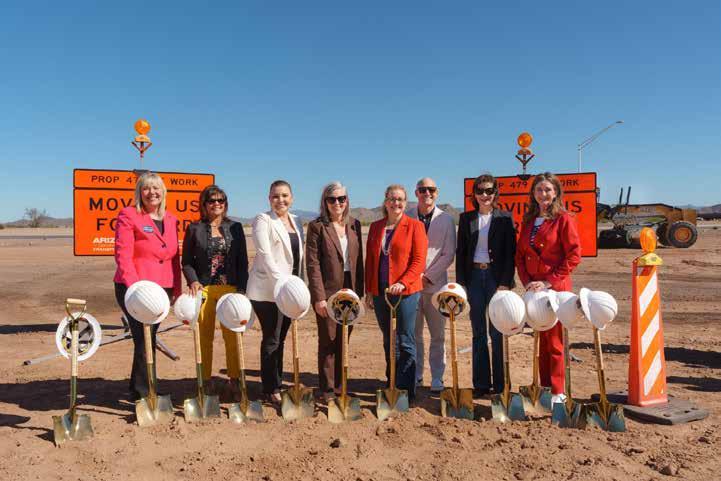
FRONT, FROM LEFT: Sarah LeFevre, Gallagher & Kennedy; Morgan Haynes, Tribal Health; Diana Gibson, REDW Advisors & CPAs; and Tre’ Palmer, Kingsman Development. BACK: Brendan Cassin, MidFirst Bank; and Bob Mulhern, Transwestern.





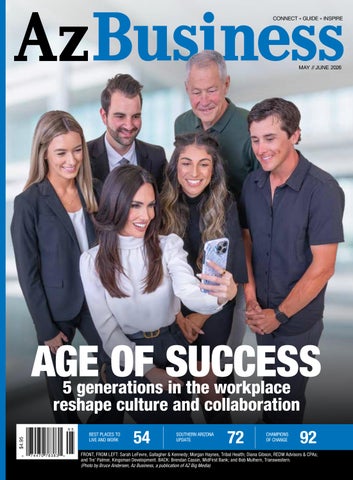
This issue of Az Business speaks to everyone.
Great leadership doesn’t belong to one generation — it evolves, adapts and thrives across all of them. That’s exactly why Az Business created the Generations of Leadership special section: To celebrate the dynamic mix of voices shaping Arizona’s future right now.
From Gen Z innovators reimagining how we work and communicate, to Millennials driving purpose-driven growth and digital transformation, to Generation X leaders balancing experience with agility, to Baby Boomers whose vision and resilience built the foundation — each generation brings something powerful to the table. And in today’s fast-changing economy, the magic happens when those perspectives intersect. Generations of Leadership isn’t just about highlighting individual success stories — it’s about showing how leadership is shifting. It’s more collaborative. More inclusive. More forward-thinking. And often, it’s being influenced just as much from the bottom up as it is from the top down.


We wanted to spotlight the leaders who are not only succeeding in their own lanes, but also learning from one another, mentoring across generations and challenging outdated ideas about what leadership “should” look like. Because in Arizona, one of the fastest-growing and most dynamic economies in the country, that cross-generational exchange is a competitive advantage.
Generations of Leadership is a celebration of that momentum. It’s a reminder that innovation doesn’t have an age limit — and that the future is being built by leaders of every generation, working together to move Arizona forward.
Enjoy this amazing issue of Az Business.
Michael Gossie Editor in chief michael.gossie@azbigmedia.com

In honor of Az Business magazine’s Champions of Change issue, we are spotlighting some of the most philanthropic companies helping shape Arizona through meaningful giving, community partnerships and long-term investments. Here they are, in alphabetical order:
APS (Arizona Public Service): APS gives an estimated $10+ million annually through APS Foundation grants and community programs focused on education, community resilience and environmental sustainability.
Banner Health: Banner invests millions each year in community benefit programs, charity care and grants that expand healthcare access, support research and strengthen community wellness.
Blue Cross Blue Shield of Arizona: AZ Blue provides millions annually through Arizona Blue Foundation initiatives centered on mental health, heat relief, preventive care and nonprofit partnerships statewide.
Freeport-McMoRan: Freeport-McMoRan contributes millions globally, supporting rural economic development, education, workforce programs and infrastructure in mining communities.
GoDaddy: Through its Social Impact program, GoDaddy makes multi-million annual investments that empower entrepreneurs, strengthen small businesses and expand digital inclusion.
SRP (Salt River Project): SRP invests millions annually in education, sustainability, water stewardship and economic development initiatives that benefit communities across Arizona.
“The finalists for the Champions of Change Awards represent the very best of Arizona — visionary leaders who turn purpose into progress. Their innovation, resilience and commitment to community impact inspire meaningful transformation, proving that bold ideas and collaborative action can shape a stronger, more inclusive future for everyone.”
Amy Lindsey Vice president and publisher AZ Big Media
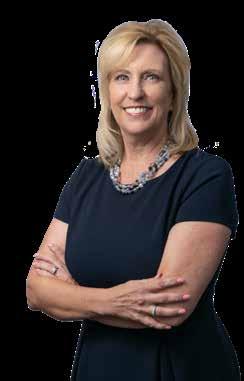
President and CEO: Michael Atkinson
Vice president and publisher: Amy Lindsey
EDITORIAL
Editor in chief: Michael Gossie
Associate editor: Kyle Backer
Lifestyle editor: Christina Fuoco-Karasinski
Staff writer: Lux Butler
Contributing writers: Alison Bailin Batz | Joshua Becker
Erin Thorburn
Interns: Emma Bradford | Alana Lynch | MacKenzie Miller
ART
Creative services manager: Bruce Andersen
Chief photographer: Mike Mertes
Graphic designer: Leslie Durazo
MARKETING/EVENTS
Marketing and events director: Jacque Duhame
OFFICE
Director of finance: Sara Fregapane
Operations coordinator: Michelle Zesati
Database solutions manager: Amanda Bruno
Office administrator: Jessica Tiller
AZRE | PTK
Director of sales: Ann McSherry
AZ BUSINESS MAGAZINE | AZ BUSINESS LEADERS
Sales manager: April Rice
Account executive: Tom Allen | Maria Hansen | Lula Hunteman
EXPERIENCE ARIZONA | PLAY BALL
Lifestyle advertising director: Tony Imperato
RANKING ARIZONA
Director of sales: Sheri King
Az Business magazine is published bi-monthly by AZ Big Media, 3101 N. Central Ave. Suite 1070, Phoenix, Arizona 85012, (602) 277-6045. The publisher accepts no responsibility for unsolicited manuscripts, photographs or artwork. Submissions will not be returned unless accompanied by a SASE. Single copy price $4.95. Bulk rates available. Copyright 2026 by AZ Big Media. All rights reserved. No part of this publication can be reproduced or transmitted in any form or by any means, electronic or mechanical, including photocopying, recording, or by any information storage and retrieval system, without permission in writing from AZ Big Media.

Behind every polished Arizona executive’s title is a surprisingly human side — from adrenaline-fueled adventures to creative passions that recharge their leadership mindset.
Nicholas Boca, managing family law attorney, DM Cantor: “I am covered in tattoos and play drums in a ’90s alternative cover band with four other dads. I grew up playing guitar and drums in local hardcore bands. In my professional life, most people only ever interact with me when I am wearing a suit. It often catches people off guard when they meet me outside the office.”
Steven G. Zylstra, president and CEO, Arizona Technology Council: “Most people don’t know I’m an amateur horticulturist with thousands of plants and tortoises — or that I’m a lifelong motorcycle enthusiast. I’ve been riding since I was 18, love cars, and even own a supercar today. I’m a true motorhead at heart.”

Jaime Leija, president and CEO, BioLab Holdings: “I have a passion for coaching. Throughout my life, I’ve leveraged my passion for coaching sports to help me recruit, develop and retain talent in business.”
MARK S. BOSCO, managing attorney, Tiffany & Bosco: “I’m passionate about boating. Most people don’t expect from a Phoenix-area native. I will boat anywhere the opportunity and timing coincide. Boating has taught me focus, patience and the importance of preparation — all qualities that translate well into my professional life. It’s also a great way to recharge, reflect and develop strategies.”
BELINDA ROSTHENHAUSLER, senior vice president, commercial lending, CDC Small Business Finance: “I love to cook. My family’s traditional Mexican dishes date back at least four generations. Everyone knows me as the queen of pozole, and I’m trying to perfect my mother’s red chile beef tamales and create a recipe book to hand down to my children, their children and future generations.”

Accomplished Arizona business leaders often embrace bold career pivots, leveraging experience, resilience and fresh perspective to reinvent themselves and ultimately achieve greater purpose, growth and long-term success. Here’s a look at some pivots that paid off.




Victoria Coley, CEO, Banner|Aetna: “In college, I had my heart set on joining the FBI as my career. After I graduated and got my first insurance role in 1999, I found my passion for problem solving and team leadership translated very well, and I never looked back.”
Tara Ostrom, MD, senior medical director, Optum Arizona : “My first career choice was Egyptology. I remain fascinated by the advanced knowledge of this ancient civilization. An ambulance ride and a three-week hospital stay changed my mind toward a career in medicine and the eventual leadership role.”


Amy Abdo, director, Fennemore: “My interest in justice and investigative work made me laser-focused on pursuing a career with the FBI. I attended law school to satisfy the FBI’s hiring requirements, but took a detour into private practice. That unexpected turn led me to a rewarding career I’m passionate about — one that allows me to strategically advocate for my wonderful clients.”




Emily Ho, MD, breast surgeon, Ironwood Cancer & Research Center : “Medicine is a second career for me. Previously, I was an engineer.”


Elizabeth M. Shabaker, co-CEO, Versant Capital Management: “In high school, I dreamed of becoming a dentist. Life guided me toward a career helping people achieve their financial and life goals. I still care about making people smile — but now it’s through building trust, growing our client’s wealth and supporting families through every stage of their journey.”
Gary M. Smith, partner, Guidant Law Firm: “When I graduated high school, I wanted to pursue science, but I couldn’t do calculus, so I had to rethink my path. Thankfully, I always had strong logic and verbal skills and crushed the reading/writing portion of the SAT.”

Beyond boardrooms and balance sheets, many Arizona business leaders have also achieved impressive athletic milestones, channeling the same discipline, resilience and competitive drive that fuels their professional success. Here is a look at some of their epic feats of strength.

Jill Chasson, partner, Coppersmith Brockelman: “I was a member of the 1992 U.S. Olympic swimming team that competed in Barcelona, Spain. My event was the 200-meter breaststroke. I am very proud to have represented our country.”
Adam Baugh, partner, Withey Morris Baugh: “I backpacked 92 miles across 12 days through the mountains of Cimarron, New Mexico.”

Randy Nussbaum, equity partner, Cavanagh Law Firm: “In 1983, as a 27-year-old, I tried out for a local ice hockey team without ever having ice skated in may entire life. Five years later, my team won the North American championship and was featured on TV, radio and the newspapers.”

Robert W. Boatman, shareholder, Gallagher & Kennedy: “I pitched for Stanford from 19771981 and played with some real stars, including John Elway.”

Heidi Jannenga, co-founder and chief clinical officer; WebPT: “I was a record-holding collegiate basketball athlete at the University of California, Davis and once scored 57 points in a game against the Chinese National Team. Being a team sport athlete honed both my competitive and collaborative spirit, which has served me well in my path to leadership.”

Taylor C. Earl, managing partner, Earl & Curley: “I am an Ironman athlete, having completed a fulllength Ironman triathlon in Texas (2.4-mile swim, 112-mile bike ride, and 26.2-mile run).”


Patrick R. MacQueen, founding attorney, Medalist Legal: “I’ve had multiple hole-in-ones, the coolest of which was when my son had one and I immediately followed him by getting one, as well.”

Steven R. Schwarz, founding partner, ViaWest Group: “I have been playing pickleball nearly weekly since 2011 before almost anyone had ever heard of it.”




1 | Caesars Republic Scottsdale, a Hilton Hotel
Background: Caesars Republic Scottsdale has quickly become one of Arizona’s standout luxury resorts thanks to its modern design, energetic atmosphere and prime Old Town location. Guests enjoy stylish accommodations, chef-driven dining concepts such as Luna by Giada, and vibrant social spaces including a rooftop pool and lounge with sweeping Camelback Mountain views. The resort blends upscale amenities with walkable access to Scottsdale Fashion Square’s shopping, nightlife and entertainment, making it easy to craft a full weekend escape. With two pools, rooftop bars and curated experiences that run from morning wellness to late-night cocktails, Caesars Republic offers a fresh, lifestyle-driven take on the Arizona resort experience. Caesars Republic Scottsdale also features acclaimed dining by Giada De Laurentiis with the upscale Italian spot Luna by Giada, the casual Pronto by Giada and the rooftop lounge SEVEN. Additionally, the hotel hosts Lisa Vanderpump’s Wolf by Vanderpump, a luxurious, desert-inspired spot offering cocktails and global cuisine with Camelback Mountain views.
Great Wolf Lodge Arizona Editor’s note: To vote for upcoming AZ Big 10 lists, visit azbigmedia.com.
GREAT GETAWAY: Caesars Republic Scottsdale, a Hilton Hotel, is a sleek luxury lifestyle resort in the heart of Old Town Scottsdale, known for its rooftop pool, vibrant dining scene and stylish, modern design. (Photo provided by Caesars Republic Scottsdale, a Hilton Hotel)

Here are the 10 best places to work in Arizona’s healthcare industry, based on public voting at azbigmedia.com
Background: HonorHealth stands out as one of the best places to work in healthcare in Arizona because of its strong culture of collaboration, professional growth and commitment to patient care. With more than 17,000 team members across hospitals, clinics and specialty centers, the Scottsdale-based nonprofit emphasizes innovation, respect and empathy in the workplace. Employees benefit from competitive pay, tuition assistance, wellness programs and opportunities for career advancement while contributing to a mission-driven organization focused on improving community health across the Valley. The organization has also earned recognition on Forbes’ list of America’s Best Employers by State, reflecting its supportive workplace culture and commitment to employees.









As Artificial intelligence (AI) is embedded in the daily work of companies of all sizes, shapes, and locations. Your employees, vendors, partners, prospective acquisition partners, suppliers, and customers are all using, knowingly or unknowingly, AI as part of their job functions and core business models. Those habits collide with two issues that many traditional confidentiality agreements do not anticipate: (1) inadvertent breach of confidentiality obligations through use of public AI tools, and (2) the ownership of AI outputs. Recent confidentiality agreement templates generally do not contemplate AI. Because courts have not provided clear guidance on the implication of AI usage, businesses have little common or statutory law to rely on. Drafting thoughtful agreements is key to protecting your valuable IP assets and

Joshua Becker Law
avoiding claims that you failed to protect the IP assets of others.
This article briefly summarizes the issues, the current legal landscape, and pragmatic moves you can make now to protect your valuable intellectual property and insulate your company from claims that you breached confidentiality obligations.
Reducing the risk of unintentional disclosures
The default setting for public facing, free versions of OpenAI, Gemini, ClaudeAI, and similar platforms allows them to use your inputs to train their models. Users must take overt steps to instruct these tools to not use those inputs for training and development. The possibility that confidential information may be used to generate additional ideas, concepts, plans, strategies, or code; and that unrelated and unaffiliated third parties may view the information — even under confidentiality agreements—may constitute an unauthorized disclosure.
Enterprise platforms (e.g., Microsoft 365 Copilot with Enterprise Data Protection, Google for Gemini Cloud, Amazon Bedrock, Anthropic Enterprise, etc.) generally operate under data processor terms, do not use prompts or content to train foundation


models, and therefore materially reduce risk of unintentional breaches that are not present in public or “free” tools. Most enterprise AI offers contractual guarantees that: (1) customer data is not used for training; and (2) data is isolated within the tenant environment.
Confidential information should not be inputted into non-enterprise or public AI systems. Employees using AI tools in their day-to-day operations might intentionally use AI to help them evaluate, organize, and use confidential information which has been shared by a third party. For example, an employee pastes a customer price list into ChatGPT to evaluate whether the pricing is consistent with market trends. Even if the prompt is later deleted, the disclosure may still violate the confidentiality agreement because the platform retains safety -monitoring logs.
Without proper education or prompts, your employees and the employees of your business partners may not understand the difference or make a conscious choice that puts your company at risk of violating its confidentiality obligations.
While there is an understandable focus on protecting the confidentiality of delivered information, confidentiality agreements must now also address conflicting ownership claims by the recipients of confidential information when that recipient uses AI tools to create summaries, analyses, reports, recommendations, or code, that are based, in whole or in part, upon another party’s confidential information.
Traditional “work product” language in vendor agreements may push AI outputs into the recipient’s ownership. This issue becomes more complicated because AI-generated content does not reliably qualify under U.S. copyright law. Under current U.S. laws, copyrights require a human author to qualify for copyright protection. Outputs produced solely by AI may therefore not be protected as derivative works under copyright law and may not be captured by “derivative works” language in a confidentiality agreement. Because derivative work protections cannot be reliably assumed, careful lawyers should rely on contract language—not copyright law — to establish ownership. If ownership provisions are unclear, the receiving party may later assert that these AI-generated outputs constitute their own work product, especially where their service agreements contain broad intellectual-property ownership clauses or ambiguous “work made for hire” language.
Vendors, consultants, developers, and even prospective acquirers may input your confidential information into an AI platform to produce summaries, analyses, drafts, recommendations, or code. The AI output from such an exercise may be valuable, novel, or an extension of your business plans and trade secrets. If your confidentiality agreement is silent, the recipient might assert that these AI-assisted outputs reflect their own independent work product or are owned under their general service-provider terms. These outputs may
not be covered by traditional “derivative works” clauses as AI outputs may not qualify as derivative works under U.S. copyright law.
To avoid inadvertent breaches and protect your company’s intellectual property, confidentiality agreements should:
• Identify clear rules for employees and contractors (no uploads of confidential information to public AI).
• Authorize only enterprise or private deployments of AI tools with contractual no- training guarantees.
• Prohibit the use of public chatbots with confidential information provided pursuant to a confidentiality agreement and further require recipients to obtain separate written authorization before inputting confidential information into a private or enterprise AI tool. This prevents both unauthorized disclosures and future ownership disputes.
• Specify that the disclosing party owns all outputs-whether created by humans or AI-based on, derived from, or generated using the disclosing party’s confidential information.
• Include language in confidentiality agreement that all return and destruction obligations apply to AI-generated analyses, drafts, summaries, recommendations, or code.
The evolution of AI tools requires confidentiality agreements to include explicit contractual language governing ownership, permitted uses, and destruction of AI-generated outputs. Clear drafting prevents disputes over ownership, scope of use, and the treatment of materials generated using a company’s confidential information.
Joshua Becker, a shareholder at Gallagher & Kennedy, is a forward-thinking adviser who anticipates how to best position his clients relative to regulatory changes, evolving market conditions, and the competitive landscape. He brings 20 years of experience in franchising and intellectual property law to clients that include companies of all sizes from a myriad of industries, among them established and fastgrowth franchisors, technology development companies, service providers, and distributors. If you have questions about confidentiality agreements, contact Becker at josh.becker@ gknet.com or (602) 530-8465.
By MICHAEL GOSSIE
For more than three decades, Paul Penzone built a reputation as one of Arizona’s most recognizable law enforcement leaders, succeeding former Sheriff Joe Arpaio and serving as Maricopa County sheriff and championing collaborative, community-focused reform. Today, as chief community relations officer for Blue Cross Blue Shield of Arizona, Penzone is applying those same principles — trust-building, prevention and servant leadership — to healthcare, mental wellness and community resilience. In an interview with Az Business, Penzone shares why he made a career pivot, how his public safety experience shapes his work at AZ Blue and what drives his mission to improve quality of life across Arizona.
Az Business: You made a significant career shift — from serving as Maricopa County sheriff to joining Blue Cross Blue Shield of Arizona. What drove that decision?
Paul Penzone: My life has always been guided by purpose. When I considered what a third term as sheriff might look like, I asked myself whether I could still have the greatest impact on the community. After more than three decades in law enforcement — and the honor of serving as sheriff — I felt it might be time to pivot.
When I met with AZ Blue’s CEO, Pam Kehaly, we talked about whether my skill set could help expand the organization’s
charitable and community work. I wasn’t just thinking about healthcare — I was thinking about mental health, arts, music, community partnerships and overall quality of life. It turned out to be the right fit, and that’s how I ended up here.
AB: Were you exploring multiple opportunities at the time?
Penzone: Honestly, AZ Blue was the only call I made. A close friend of mine, Susan Glawe, previously held this role and I saw firsthand the impact she had on the community. When she retired, I thought, “If I ever had the chance, I’d love to continue that legacy.” It felt like a natural extension of what I’ve always tried to do — serve others in a meaningful way.
AB: What skills from law enforcement have translated most directly into your work in healthcare?
Penzone: I actually go back even further — to my time working in hospitality while I was in college. That taught me what it means to truly serve people. You learn to listen, solve problems and meet people where they are.
Law enforcement reinforced that mindset. At AZ Blue, we’re trying to be more than an insurance company — we want to be a health solutions organization. That means understanding real needs, promoting preventive care and helping
reduce the rising cost of healthcare by keeping people healthier in the first place.
AB: AZ Blue has been very visible in community initiatives, especially around heat relief and preventive care. Why is prevention such a priority?
Penzone: Prevention saves lives and reduces long-term costs. Living in Arizona, extreme heat is a serious health threat. If someone suffers heat stroke and ends up in the hospital for days, the cost is significant — financially and physically.
So we partner with organizations like the Phoenix Fire Department, Tucson Electric Power and the American Red Cross to intervene early through heat relief stations, community outreach and education. The goal is to keep people safe before a crisis happens.
We also focus on early screenings for conditions like diabetes. Many people don’t even realize they have it until it becomes severe. If we can help identify issues early, people can live healthier lives — and avoid costly emergency care.
AB: Mental health has become a major part of AZ Blue’s mission. How has your background shaped that focus?
Penzone: I’ve seen firsthand how critical mental health is. During my time in law enforcement — especially in the jail system — I witnessed the heavy emotional toll on both officers and inmates. Mental health




challenges affect families, workplaces and entire communities.
If someone isn’t mentally well, they can’t be physically well. And if they’re not healthy overall, they can’t be productive or support their families. That’s why prevention and compassion are so important. We have to treat mental health with the same urgency as physical health.
AB: Can you share an example of how AZ Blue’s “boots on the ground” approach makes a difference?
Penzone: One of the things I love most about this role is that we’re not sitting behind desks — we’re out in the community building relationships.
During a heat relief effort in Tucson, our team met a family living without an HVAC unit. They had five children, including twins with autism, and the father was commuting to Phoenix for work. We couldn’t just walk away. So we partnered with Tucson Electric Power and Habitat for Humanity to get
them a sponsored unit installed.
Those moments remind you why this work matters. Sometimes it’s as simple as a bottle of water or a care kit. Other times, it’s a life-changing solution.
AB: Looking ahead, what are your top priorities for AZ Blue’s community relations efforts?
Penzone: Building sustainable partnerships. We don’t want one-time events; we want long-term impact. That includes addressing preventable deaths, including suicide and overdoses, by working closely with community organizations and experts. Substance abuse — especially fentanyl — is a major challenge. Education and prevention are key. If we can collaborate effectively, we can help people find support before they reach a breaking point.
AB: What do you enjoy most about your role today?
Penzone: Seeing someone smile because


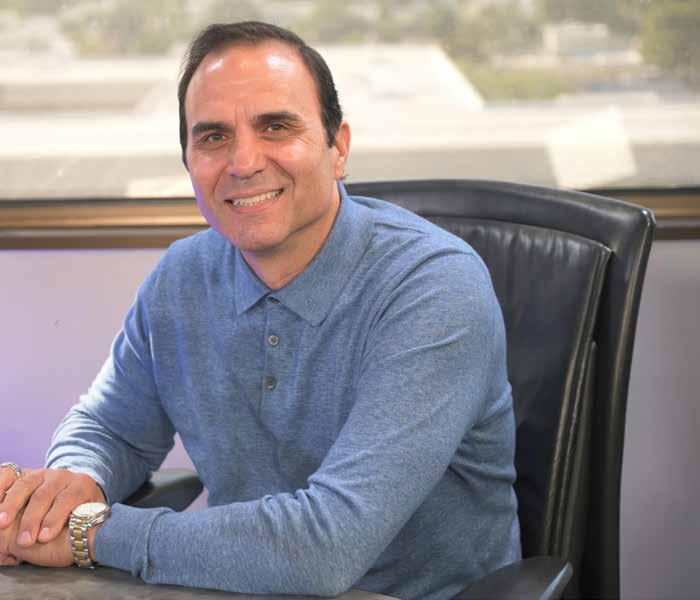
Paul Penzone is chief community relations officer for Blue Cross Blue Shield of Arizona, bringing decades of public safety leadership. Formerly Maricopa County sheriff, he is known for collaborative, community-focused strategies, operational reform and building partnerships that strengthen organizational resilience and trust across Arizona’s healthcare (Photo by Bruce Andersen, Az Business, a publication of AZ Big Media)
a need has been met. Whether it’s feeding someone at St. Vincent de Paul or helping a family find resources, those moments are incredibly meaningful.
I believe in servant leadership. No matter who someone is or what circumstances they face, they deserve compassion and respect. That’s what gives me the most fulfillment.
AB: When you eventually look back on this chapter of your career, what will define success?
Penzone: For me, success is about the people I work alongside. If our team feels empowered — if they’ve grown, taken risks and made a difference — then I’ve done my job as a leader.
It takes courage to step outside the box and try new approaches, even if there’s a risk of failure. But if those efforts help someone else, then it’s worth it. At the end of the day, leadership is about helping others realize what they’re capable of.

FRONT: Tre’ Palmer, Diana Gibson, Morgan Haynes and Sarah LeFevre. BACK: Bob Mulhern and Brendan Cassin. (Photo by Bruce Andersen, Az Business, a publication of AZ Big Media)

With up to five generations now working side-by-side — and a sixth emerging — Az Business magazine’s Generations of Leadership shows that mentorship, fresh ideas and shared experiences create stronger companies and a more resilient economy
By MICHAEL GOSSIE
For the first time in history, up to five generations — and soon possibly six — are working side-by-side in today’s workplace, bringing together decades of experience, fresh ideas and very different perspectives on leadership. From the seasoned wisdom of the Silent Generation to the digital fluency of Gen Z, the modern workforce is a dynamic blend of tradition and innovation.
“Companies today are increasingly shifting to remote work, while many new entrants begin their careers after virtual education,” says Brendan Cassin, a member of Generation Z who is vice president and private banker at MidFirst Private Banking. ”While that flexibility has benefits, a lot can be lost without in-person interaction,
especially culture and mentorship. To me, the most important thing a company can do to bridge generational gaps is focus on hiring and retaining inspiring managers who genuinely want to lead, train and motivate the next generation. I owe my success and passion for working at MidFirst to the incredible leaders I work for. Compensation attracts people, but it takes great managers and a strong culture to keep them.”
Az Business magazine’s Generations of Leadership explores how leaders across Arizona are bridging those generational differences to build stronger teams, inspire mentorship and spark new ideas. The result is a powerful reminder that when generations collaborate, businesses — and communities — thrive.
But that doesn’t come without added complexities when it comes to managing the workforce.
“One big challenge is that different generations use different platforms to communicate, to do their work and to learn about important company news,” says Richard Birke, chief architect of JAMS Pathways, a private provider of alternative dispute resolution services. “Leaders must employ multiple communication channels while maintaining consistent messaging among all groups.”
While many Arizona companies are struggling with balancing the needs and expectations of workers across multiple generations, HonorHealth is a great example of how cross-generational

cooperation can work well. HonorHealth employs healthcare professionals of all ages who collaborate in a way that provides innovative care for patients of all ages.
Sonya Velasquez, MSN, RN, director of clinical nursing at HonorHealth Tempe Medical Center, is an exceptional Generation X leader known for her adaptability, resilience and clear, consistent leadership. To support collaboration across multiple generations, she says companies should create a culture where everyone feels valued and heard.
“Offer information in different formats, encourage open dialogue and explain the ‘why’ behind decisions to build understanding,” she says. “Combine experience with fresh perspectives through mentoring and team-based problemsolving. When communication is clear and inclusive, every generation can contribute their strengths effectively.”
Ryan Kirane, vice president of supply chain services and sustainability officer at HonorHealth, says one of the ways to

maintain generational harmony within teams is to avoid assumptions.
“Sometimes a more seasoned team member may be tech-savvy,” says the member of Generation X. “Sometimes, an up-and-comer has greater wisdom. When we take time to understand each person’s strengths and align them with shared goals, people feel seen and respected and we build trust. When trust grows, collaboration and performance follow.”
Emily Borlas, a Gen Xer who is assistant vice president of IT applications at HonorHealth, says it’s important to encourage understanding of different work styles without stereotyping and to stay flexible, as employees want different things at different stages of life.
“Create genuine opportunities for crossgenerational collaboration — nothing forced because no one likes mandatory fun,” she says. “Reinforce that every generation brings value and highlight teams or projects where those perspectives come together successfully.”
From a Millennial’s perspective, Lavon
Richardson says generational connection starts in our homes and communities, where we first learn how to listen to people who see the world differently.
“When people feel respected, invited in and understood, age becomes a bridge, not a barrier,” says Richardson, HonorHealth’s supervisor of home health. “Encourage curiosity, create space for every voice and model genuine interest. Collaboration follows naturally. A little openness and humor go a long way.”
Susan Chung, a Millennial who is director of home-based services and home health administrator at HonorHealth, says when we encourage real collaboration across generations, culture and performance both get stronger.
“I try to keep it simple: Understand and use each generation’s strengths, talk openly about workload and work styles so people can do their best work, and rally around shared values while still honoring what makes each person unique,” she says. “When that happens, everyone thrives.”







Colleen Giggey, a Baby Boomer who is clinical director of perioperative services at HonorHealth Scottsdale Shea Medical Center, encourages organizations to move beyond labels and focus on individual strengths.
“Generational differences can be a competitive advantage when we lead with curiosity and mutual respect,” she says. “Encourage knowledge-sharing, reverse mentoring and shared goals. When people feel heard and respected, teams become stronger and more unified, collaboration grows — and so do results.”
The bottom line, experts say, is to forget about labels and create a workplace culture where anyone can thrive.
“Treat each person as if they were a motivated employee who wants to do a good job and not as a ‘member of a generation,’” Birke says. “Every group has outliers, so generational stereotyping may be inaccurate and problematic. Moreover, if a manager can make the job more salient than one’s generation, that’s a big win.”










By ERIN THORBURN
Desert Financial Credit Union started its journey in the Valley more than 85 years ago. Serving Baby Boomers, Gen X, Millennials and Gen Z, the credit union has evolved to meet members at every life stage.
Who better to highlight how Desert Financial meets the needs of its multigenerational members than Jeff Meshey, president and CEO of Desert Financial Credit Union, whose own family is a mix of generations. “I have four daughters,” he says. “Two are Millennials and the other two are Gen Z. I kind of get firsthand experience regularly.”
In addition to navigating the financial needs of his multigenerational household, Meshey is surrounded by different generations in the workplace.
“Gen X and Baby Boomers make up less than 25% of our staff now,” he says. “Gen Z is the highest and Millennials are a pretty close second.”
Meshey adds that experiencing a mix of generational needs makes Desert Financial a strong partner to those the credit union serves, “because we’ve got to manage the team the same way we’re trying to manage members,” he says.
To help ensure all members receive the


individualized financial services they need, Desert Financial not only researches diverse generations, but the credit union also pays close attention to what is of most value to its members.
“We want to be inclusive,” Meshey explains. “We don’t want to exclude anyone. But for us, it’s working well because there are some key differences of what people are looking for and what gets their attention. We try hard to listen to member feedback.”
Gen Z is largely identified as a digital generation. According to YouGov, 66% use mobile apps as their primary banking method. Despite a preference and reliance on electronics, many Gen Zers still want a personal touch.
“When they have a question, they want to talk to a real person,” Meshey says. “And we pride ourselves on that. We want to do both.”
Gen Z prioritizes savings, emergency funds and financial education as they begin planning for their future.
“We offer a Free Checking, no minimum balance and a lot of other features to help them,” Meshey notes.
Millennials: Balancing home, career and family
Many Millennials are balancing homeownership, career growth and starting families, often while navigating financial stress.
A recent study revealed that 74% of Millennials, “are at least somewhat stressed about managing their finances.”
To assist in its financial management endeavors, this generation prioritizes financial education and services that help them achieve balance in the areas they’re looking for.
“We’ve got some mortgage programs for first-time home buyers,” Meshey says. “We have a lot of financial education on our website.”
Desert Financial has a dedicated Financial Well-Being web category that enables members to participate in several workshops and webinars covering:
• Wills and trusts
• First-time homebuying
• Medicare
• Wealth management
“We also do a lot of work in the investment space because it’s important for those folks to start thinking about retirement,” Meshey notes, “at least investing in their 401(k)s or starting to think about putting some money aside.”



Gen X: Navigating the sandwich generation
Gen Xers, often called the “sandwich generation,” are balancing the financial and emotional demands of supporting both their children and aging parents, all while beginning to focus more seriously on their own retirement planning.
About one-third of adults in the U.S., ages 40 to 60, report significant emotional, physical and financial strain from their dual caregiving roles.
Meshey underscores that if they haven’t already, Gen Xers are “really starting to think about retirement or putting their kids through college,” adding, “Not only are you having to worry about your own retirement and your kids, now your parents need help. We help support them while they face more complex things now,” Meshey says, “offering wills and trusts. That’s something that a lot of credit unions don’t do.”
Baby Boomers: Planning for long-term security
It’s not uncommon for Baby Boomers to share in the financial burden of caring for aging parents, similar to Gen Xers. Added to this, this generation must also ensure they have sustainable retirement income and long-term healthcare funds.
“I just think there’s a lot of pressure on Baby Boomers we didn’t really think about or plan for,” Meshey says. “We’re planning for our own retirement.”
Meshey adds, “On the wealth side, we’ve got a lot of tools with wills and trusts and advisors that can help with a lot of the paperwork.”
Desert Financial Wealth Management advisors partner with Raymond James Financial Services to help members of all generations devise an investment strategy based on their goals, timeline and risk tolerance.
Gen Alpha and beyond
Desert Financial isn’t just planning for future generations; it already has nextgeneration financial programs and services in place. On the heels of Gen Z, Gen Alpha’s exposure to financial planning is starting early.
Children can participate in Desert Financial’s Kickstart checking program as early as 6 years old.
“It allows kids as young as 6 to have their own checking account jointly with their parent,” Meshey explains, adding that once they enroll in Kickstart, children can receive a debit card. “You can’t give them cash as you used to, and you didn’t want to give
them your credit card. This way, they can have their own debit card, and you can help them manage the account.”
Other ways Desert Financial is meeting diverse generational financial asks:
• Adding Zelle® as an mobile app service for eligible members
• Partnering with New York Times bestselling author and personal finance expert Nicole Lapin to help members enhance financial well-being through advice on budgeting, fraud prevention and credit union benefits
• Enabling members to buy full or fractional shares of stocks and ETFs, as well as utilize a robo-advisor through Desert Financial Digital Investing through the Desert Financial Credit Union mobile app and online banking.
Above and beyond the evolving financial services, programs and educational offerings, Desert Financial continues to anticipate the needs of every generation. Meshey says listening to members’ needs will always remain a priority. “I think for us, it’s about helping people live their dreams and be more successful through better financial management,” he says.
Learn more: desertfinancial.com
Ahmad Alatrash
Co-founder // Mesquite Fresh Street Mex
Generation: Gen Z
Background: Alatrash is a visionary restaurateur helping redefine fastcasual dining in Arizona. As co-founder of Mesquite Fresh Street Mex, he built the concept around fresh ingredients, bold flavors and a modern streetMexican experience, growing the brand into one of the Valley’s most exciting emerging restaurant success stories.
Business strategist // Arizona Department of Housing
Generation: Gen Z
Background: Bensberg is a forwardthinking business strategist helping shape housing policy and economic development across the state. At Arizona Department of Housing, she works to expand housing access, strengthen partnerships and support innovative programs that address Arizona’s growing housing needs and community development challenges.
Partner and consultant // Diversified Partners
Generation: Gen Z
Background: Brown brings a new generation’s vision to Arizona’s commercial real estate landscape. At Diversified Partners, he blends entrepreneurial insight, technology and relationship-driven leadership to advance retail development while championing innovation, sustainability and AI-powered strategies that help the firm grow and adapt in a rapidly evolving market.


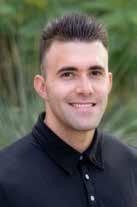
Vice president and private banker // MidFirst Bank
Generation: Gen Z
Background: Cassin represents the next generation of financial leadership, combining relationship-driven banking with a fresh, solutions-focused mindset. As vice president and private banker at MidFirst Bank, he helps clients navigate complex financing needs while staying deeply engaged in the community through initiatives like Scottsdale Leadership’s Class 37.
Senior accountant // eeCPA Generation: Gen Z
Background: Karam exemplifies the energy and collaborative spirit of Generation Z leadership. Known for mentorship, inclusivity and digital fluency, Karam fosters creativity and connection in fast-paced environments while uplifting peers and emerging professionals. With infectious enthusiasm and a people-first mindset, Karam is helping shape the next generation of Arizona leadership.
COMBINING FORCES: “One key to helping all ages and generations work together effectively is fostering a collaborative environment in which each age group can learn from the others,” says Sarah LeFevre, associate at Gallagher & Kennedy. (Photo by Bruce Andersen, Az Business, a publication of AZ Big Media)

LeFevre represents the excellence and drive of Generation Z leadership. A top graduate of Sandra Day O’Connor College of Law at Arizona State University and Order of the Coif honoree, she pairs academic distinction with real-world legal experience, public service and mentorship, positioning herself as one of Arizona’s promising next-generation attorneys.
Pinal County specialist // Land Advisors Organization Generation: Generation Z
Background: Davis is an industrial land broker with the Land Advisors Organization specializing in development opportunities across Pinal County. Since entering the industry in 2018, he has completed more than $600 million in transactions and worked with major groups including Lucid Motors, Kohler and Chang Chun Petrochemical. His expertise includes industrial site selection, power-intensive users, renewable energy projects and land positioning strategies that help create shovel-ready opportunities for manufacturers and data centers. Davis is active in regional economic development, serves on the Casa Grande Industrial Development Authority and is a member of Pinal 40, supporting responsible growth and quality job creation.
Best decision: “One of the most defining decisions in my career came during a time when I was working both in research and brokerage at Land Advisors. I made the decision to move fully into brokerage, even though I did not completely feel ready at the time. This meant stepping in to take over several client relationships and active deals that my partner no longer had the bandwidth to manage. I had to rise to the occasion quickly, take ownership, and earn the confidence of those clients. That experience pushed me to grow as a leader, trust my preparation, and ultimately close deals that helped establish my credibility as a broker.”
Learn more: landadvisors.com/team/trey-davis/



Tre’ Palmer and Landon Herndon are the managing partners of Kingsman Development, a rapidly growing civil construction company based in Arizona. Built from the ground up with no outside capital, they have scaled the company to over 30 employees and a strong project pipeline in under two years. Their leadership is rooted in faith, extreme ownership, and a commitment to servant leadership, driving both their team and projects forward. Specializing in underground utilities, mass grading, paving and concrete, they focus on delivering high-quality work while building lasting relationships. Their mission is to serve God, serve people and set a higher standard in the construction industry.
Personal strength: “Servant leadership. Our foundation is rooted in extreme ownership and accountability, and our mission is to serve God and serve people. We named our company Kingsman after the kingsmen in the army, who were often the lowest rank yet fully committed to serving the king. For us, our King is Jesus, and that defines how we lead. In civil construction, the work is tough and demands a strong team. We lead side by side, not above, solving problems together with humility, purpose, and a mindset of taking full ownership in every situation.”
Best decision: “Uncertainty is what we live in, and choosing to trust the Lord through it has shaped our leadership the most. We started with no outside capital, zero connections, and a $17,000 credit card. Nineteen months later, we have 31 employees and an $18 million–$20 million pipeline for 2026. Our favorite saying is, ‘We’re fully backed by God,’ and that mindset carries us through the moments we do not have answers. We move forward trusting where He is leading us. It has taught us that true leadership is staying faithful, taking ownership, and trusting God to guide every outcome.”
Leadership advice: “The best employees act like owners, and the best owners act like employees. We’re a people and relationship business that happens to do construction.”
kingsmandevelopmentusa.com
DIFFERENT ERA: “If we had to choose another era, it would be the early days of building America,” say Landon Herndon and Tre’ Palmer, managing partners of Kingsman Development.” It was a time when faith in God was at the center, and people leaned on that faith to push through real challenges and build something meaningful. Construction was the cornerstone of that growth, laying the foundation for everything that followed.” (Photo by Bruce Andersen, Az Business, a publication of AZ Big Media)

Project engineer // McCarthy Building Companies
Generation: Gen Z
Background: Schmader represents the energy and purpose-driven leadership of Generation Z in Arizona’s construction industry. As a project engineer at McCarthy Building Companies, she helps deliver projects across the Valley while championing women in STEM. Through mentorship, outreach and hands-on leadership, she inspires young women to pursue careers in engineering, construction and community-building.
Associate // Greenberg Traurig
Generation: Gen Z
Background: Tarr focuses her practice on corporate and securities law, mergers and acquisitions, and capital markets transactions. She advises public and private companies in a range of transactions, including equity and debt offerings, M&A deals and early-stage financings. Her experience includes advising clients across various industries on complex transactional matters and she regularly counsels clients on SEC reporting and stock exchange compliance.





Vice mayor // Town of Fountain Hills
Generation: Gen Z
Background: Larrabee has lived in Fountain Hills her whole life and is now the Town’s youngest ever Council woman at 24 years old! She is a graduate of Arizona State University with bachelor’s degrees in sports business and business law as well as a certificate in business data analytics.
Co-founder and CEO // Truthkeep.ai
Generation: Gen Z
Background: Xander represents the bold innovation and entrepreneurial drive of Generation Z leadership. As co-founder and CEO of Truthkeep. ai, he is helping shape the future of responsible artificial intelligence by developing tools that enhance transparency, trust and digital accountability. His forward-thinking vision reflects a new generation redefining how technology serves society.
Founder // Rodeo Rose Market
Generation: Gen Z
Background: Roraback represents the entrepreneurial spirit and creative energy of Generation Z leadership. As founder of Rodeo Rose Market, she has built a platform that celebrates local makers, small businesses and community connection. Through innovation and authenticity, Roraback is helping redefine modern retail while empowering fellow entrepreneurs across Arizona.
CHANGE-MAKER: “Finding a community is very difficult after you graduate and you no longer have sports or school activities,” says Trinity Roraback, founder of Rodeo Rose Market. “It’s like, ‘Now what?’ I think that’s why Rodeo Rose Market resonated right from the start. People are looking for that shared community.” (Photo by Mike Mertes, Az Business, a publication of AZ Big Media)
Associate attorney // Burch & Cracchiolo Generation: Generation Z
Background: Lewallen prides himself on being a generalist. He practices law in multiple areas, including complex criminal defense, bankruptcy, and civil litigation. He joined the firm in 2024 after previously serving as a summer associate in both 2022 and 2023.
Personal strength: “Positivity. I try to wake up every day looking forward to what the day will bring. I try to approach everyone I come across with a positive attitude, which has gotten me very far in creating great relationships with lawyers I am working with, and with opposing counsel. It is easy to be positive when you can do what you love and are passionate about your work.”
Best decision: “My decision to get my GED and enroll in community college at 19 shaped my leadership the most. I was a high-school dropout with very limited prospect. I knew that if I wanted to make something of myself, I would need to put in the work and make it happen. My early successes in college gave me the confidence to pursue my dreams, eventually graduating summa cum laude from ASU, and then cum laude from ASU Law. This taught me that I could do anything I wanted to, I just needed to get started.”
Learn more: bcattorneys.com




CEO // La Machine Consulting
Generation: Generation Z

Valdovinos is the CEO of La Machine, a national political consulting firm executing some of the most consequential elections in the country. A Gen Z leader with deep field roots, Valdovinos rose from teenage canvasser to CEO by modernizing how campaigns engage multilingual and multicultural voters at scale. With a background in electrical engineering and business, Valdovinos has led La Machine’s national growth —helping elect progressive candidates and pass ballot measures at the municipal, state, and federal levels. Today, he leads high-stakes, multi-state operations with a focus on execution, precision and winning where
“Resourcefulness. I’ve had to lead in environments where the stakes are high, timelines are tight, and there’s no room for panic. At La Machine, that has meant helping scale programs across battleground states, managing hundreds of staff and contractors and keeping operations running clean in the middle of fast-moving election cycles. Whether it was modernizing our internal systems as CFO or leading multi-state voter contact programs as CEO, I’ve learned how to stay calm, solve problems quickly and keep teams focused. In my generation, adaptability matters — but I think what really sets leaders apart is being the person who can bring order, focus and momentum when things get chaotic.”
Impactful decision: “Stepping into the CEO role at La Machine in 2024 was the biggest decision I’ve made in uncertainty. We were no longer just a strong Arizona operation — we were scaling into a national firm trusted with high-stakes work across battleground states. That year, we knocked on over 1 million doors, completed tens of thousands of voter registrations and ran large-scale programs across Arizona, Georgia, Nevada, Pennsylvania, Michigan, Wisconsin and North Carolina. It taught me that I’m at my best when I’m building under pressure, leading through complexity and creating structure in fast-moving environments where the margin for error is small.”
lamachineconsulting.com
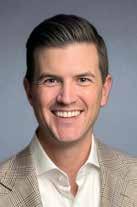
Alison Bailin
Director of client services // HMA Public Relations
Generation: Millennials
Background: Bailin stands out as a Millennial leader through her impact in communications, journalism and community service. As director of client service at HMA Public Relations, she pairs award-winning storytelling with industry leadership through PRSA and the Rocky Mountain Emmys, while dedicating decades of volunteer work supporting Arizona nonprofits and community causes.
Kari Christie
Director of UX // Oracle
Generation: Millennials
Background: Christie exemplifies Millennial leadership by shaping how global brands operate through design and technology. As a UX director at Oracle, she leads teams building AI-driven platforms for restaurants, hospitality and retail. Known for scaling design organizations and launching enterprise systems, she creates solutions that help businesses operate faster and smarter.
Renee Crawford, DO Phoenix Children’s
Generation: Millennials
Background: Dr. Crawford exemplifies Millennial leadership in medicine through innovation, compassion and systems-driven thinking. As an allergy and immunology fellow and former chief resident at Phoenix Children’s, she led groundbreaking penicillin delabeling research that improved patient care and reduced antibiotic misuse while championing health equity, education and humanitarian service.



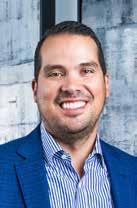
OVERCOMING OBSTACLES: “I was in an ATV accident in 2016 that resulted in the amputation of my right dominant arm, and I was left to navigate my new new normal with very little resources,” says Diana Gibson, director of client success, REDW Advisors & CPAs. (Photo by Bruce Andersen, Az Business, a publication of AZ Big Media)
John Fetherston
Vice president, state and local government relations // JPMorgan Chase
Generation: Millennials
Background: Fetherston represents forward-thinking Millennial leadership through policy expertise, collaboration and measurable impact. As vice president of state and local government relations for JPMorganChase, he shapes policy across the Southwest on issues including housing, workforce development and emerging technology while championing community service and bipartisan solutions that strengthen Arizona’s economic future.
James Goodnow
CEO // Fennemore Generation: Millennials
Background: Nearly two decades after starting his career at the firm as a file clerk, Goodnow has been at the forefront of artificial intelligence innovation, driving the launch of Project BlueWave AI, an industry-leading, proprietary, and secure system that empowers teams to deliver exceptional client service. He also helped pioneer Fennemore Forward, a bold new platform redefining workplace flexibility.

Millennials
Gibson exemplifies Millennial leadership through resilience, innovation and service. As the first director of client success at REDW Advisors & CPAs and founder of The Diana Adapted Foundation, she empowers others facing limb loss while advancing clientcentered strategy and community impact.
Nikki Badje
Background: Badje oversees human resources, employee development and strategy for the $1.7 billion credit union. She brings more than 10 years of experience in human resources, training and organizational development within the credit union industry. A passionate advocate of the credit union movement, Badje is deeply committed to leadership development and mentorship, believing that investing in people is essential to serving members and strengthening communities.
Personal strength: “One personal quality that has most helped me become a leader in my generation is showing up as my authentic self and being grounded in my strong
values. I believe leadership is less about titles and more about how consistently you show up for people. For me, that means being honest, treating others with dignity and respect, and making decisions based on principles rather than convenience. When people see that you are genuine, that you communicate clearly, and that you are willing to listen and learn, it creates an environment where others feel respected and supported. And I truly believe that kind of leadership is especially important for my generation, because people are looking for leaders who are transparent, principled and most of all, human.”
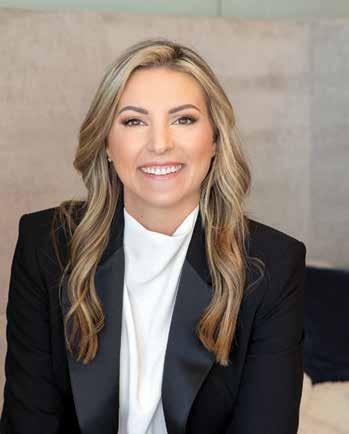

Badje “ “
~
Founder and owner // Dixxon Flannel Co.
Generation: Millennials

Dreyer is the founder and owner of Dixxon Flannel based apparel brand known for its premium flannels and deeply loyal customer base. He launched the company in 2013 with just $180 while working long hours in the Davidson service department, selling shirts at motorcycle swap meets to fund early growth. Drawing from motorcycle, skate, and punk rock culture, Dreyer built Dixxon around quality, durability and limited-edition releases. Under his hands-on leadership, Dixxon has grown from a garage startup into a globally recognized lifestyle brand while staying true to its working- class roots and community - first mindset.
“The personal quality that’s helped me most is on and grounded in the work. I never wanted to be disconnected from the product, the customer, or the culture that built the brand. I came from working with my hands, so I’ve always believed leadership starts with understanding the details and earning respect through action. Staying involved kept me honest. It helped me make better decisions, avoid shortcuts, and stay aligned with what our customers actually care about. That approach also built trust internally, because people knew I wasn’t leading from a distance, I was in it with them.”
Best decision: “The most defining decision I made during uncertainty was committing to Dixxon when there were no guarantees. I started with very little money, worked long hours, and built the brand while still holding a full- time job. There was no safety net, just belief in the product and the work ethic behind it. Choosing to move forward anyway taught me that momentum matters more than perfect conditions. It showed me I could handle risk and doubt without losing focus. That experience shaped how I lead today, I trust consistency and staying the course when things aren’t clear.”
Professional advice: “Know who you are, stay consistent, listen closely, don’t lose touch with the work and never trade your values for short- term growth.”
Learn more: dixxon.com

Founder // Phillips Law Foundation Generation: Millennials

Background: Phillips is the driving force behind Phillips Law Foundation, a 501(c)(3) dedicated to uplifting underserved communities across Arizona. What began as personally serving meals in Phoenix has grown into a powerful platform supporting nonprofits, families and individuals in need. Phillips leads with compassion and action, overseeing initiatives that address food insecurity, housing support and community outreach. Through strategic partnerships and hands-on involvement, she has helped expand the Foundation’s impact year over year. Her leadership reflects a deep commitment to service, connection and creating meaningful change where it is needed most.
“Empathy has been the foundation of my leadership. It allows me to truly listen, understand and connect with people from all walks of life. Leading with empathy builds trust, strengthens relationships and ensures that decisions are made with real impact in mind. It has helped me stay grounded in our mission while growing the Foundation in a meaningful way. When people feel seen and valued, they are more willing to come together and create change, and that is where true leadership begins.”
“Choosing to step beyond traditional philanthropy and become directly involved in the community shaped my leadership the most. Instead of simply supporting from a distance, I made the decision to show up, listen and understand real needs firsthand. That decision changed everything. It taught me that impactful leadership requires presence, consistency and action. It also showed me that meaningful change happens through relationships, not transactions, and that the most effective leaders are the ones willing to be part of the work, not just behind it.”
Alternate era choice: “I would choose to grow up during a time of major social change, where communities came together to challenge the status quo and create lasting impact. Those eras were driven by courage, unity and a shared belief that change was possible. Being part of that kind of movement would be inspiring because it reflects the same values I believe in today — showing up for others, standing for something bigger than yourself and working together to build a better future.”
phillipslawfoundation.org
ADVICE FOR LEADERS: “Lead with empathy, stay consistent, and show up for people,” says Olga Phillips, founder of Phillips Law Foundation.”Real leadership is built through action, trust, and a genuine commitment to making a difference.” (Provided photo)

President // Axon
Generation: Millennials
Background: Isner exemplifies forwardthinking leadership in public safety technology. As president of Axon Enterprise, he helps drive global strategy for innovative tools that support law enforcement and community safety. Known for his strategic vision and collaborative leadership style, Isner plays a key role in advancing technology solutions that improve transparency, accountability and operational effectiveness worldwide.
Private banker // Alerus
Generation: Millennials
Background: As a private banker at Alerus, Ofman works closely with highnet worth individuals and families to deliver customized lending, banking, and wealth management services that meet their unique and complex needs. With 25 years of experience, he provides thoughtful and thorough guidance focused on achieving both short- and long-term goals.
Founder // Perez Law Group
Generation: Millennials
Background: Perez Hesano exemplifies Millennial leadership through resilience, advocacy and community impact. As founder of Perez Law Group, she rebuilt and grew her firm despite major challenges while championing mentorship and dialogue through her podcast Verdicts & Vogue. A firstgeneration Latina attorney, Perez Hesano is redefining legal leadership with integrity, compassion and empowerment for the next generation.
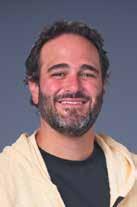
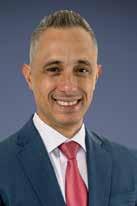


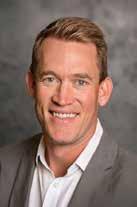
Director of business development // CHASSE Building Team
Generation: Millennials
Background: Perkins represents Millennial leadership through impactdriven growth and community engagement. As director of business development at CHASSE, she leads K-12 development while helping oversee projects totaling more than $600 million annually. Through extensive nonprofit board service and philanthropic initiatives, Perkins bridges construction, education and community to strengthen opportunities for Arizona students and families.
Executive vice president and principal // Marsh McLennan Agency Arizona
Generation: Millennials
Background: Ragland exemplifies Millennial leadership through relationship-driven impact and community engagement. At Marsh McLennan Agency, he consistently ranks among the firm’s top producers nationwide while maintaining exceptional client trust. Ragland also champions philanthropy, helping raise significant funds for Arizona nonprofits and strengthening connections between business and community.
LEADING WITH RESULTS: As CEO of Tribal Health since 2023, Morgan Haynes has driven 40% revenue growth to more than $80 million with 12.6% margins – acquiring zero debt while quadrupling its national presence. (Photo by Bruce Andersen, Az Business, a publication of AZ Big Media)

Millennials
Haynes exemplifies Millennial leadership through bold vision, operational discipline and mission-driven impact. As CEO of Tribal Health, she has expanded the organization nationwide while improving care for Indigenous and rural communities. With rapid growth, strong client retention and a passion for mentorship, Haynes is redefining healthcare leadership with purpose and results.





































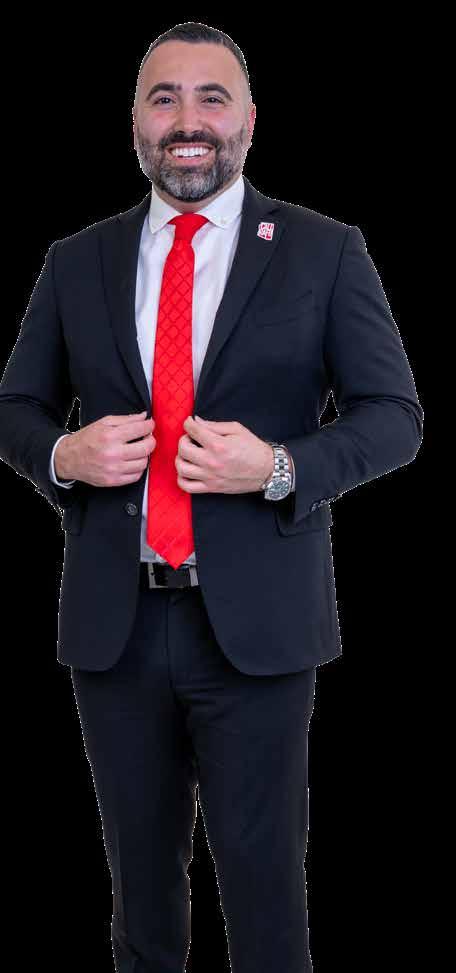
Founder and CEO // Rafi Law Group and Rafi Law Services Generation: Millennials
Background: Rafi is the founder and CEO of Rafi Law Group, Arizona’s premier personal injury law firm and one of the state’s most recognized legal brands. Since founding the firm in 2015, the team has served nearly 100,000 Arizonans. Building on that foundation, Rafi recently launched Rafi Law Services, a management services organization supporting operations, technology, and administrative functions while positioning the organization for continued growth. Known for his strategic mindset and disciplined leadership, Rafi has scaled the organization through a focus on brand, infrastructure, and accountability, while deepening its commitment to supporting children and families across Arizona.
Personal strength: “Accountability. At the end of the day, everything falls on you. The direction of the company, the decisions you make, and the standard you set. Early on, I learned that you can’t pass blame or wait for someone else to fix things. If something isn’t working, it’s your responsibility to address it and move forward. That mindset carries beyond the business too. If you’re in a position to help people, you have a responsibility to do it. Accountability isn’t just internal, it’s how you show up for your community as well.”
Best decision: “Investing early in building a recognizable brand and infrastructure, while also committing to community impact, before there were guarantees, was a defining decision. It required making long-term bets without perfect visibility. At the time, it wasn’t the conventional approach, but it created separation. It allowed us to grow with intention, and as we’ve grown, so has our responsibility to give back. That experience reinforced that leadership isn’t about waiting for certainty, it’s about making calculated decisions and standing behind them.”
Leadership advice: “Take ownership, stay consistent, and use your position to make an impact. That’s what real leadership looks like.”
Learn more: rafilawgroup.com
EARLY START: “I’d choose to grow up a generation earlier, in a time before everything was digital and instant,” says Brandon B. Rafi, founder and CEO of Rafi Law Group. “There was more emphasis on relationships, reputation, and earning trust face to face. In a business like law, those fundamentals still matter (Provided photo)


Michael Aguirre
Partner // Coppersmith
Brockelman
Generation: Gen X
Background: Consistently recognized by Best Lawyers© and Southwest Super Lawyers, Aguirre’s work has driven meaningful outcomes statewide — from advising a Native American tribe on the launch of its commercial enterprise arm and its first-ever acquisition and

Emily Borlas
Assistant vice president of IT applications // HonorHealth
Generation: Gen X
Background: Growing up before the digital age and building a career within it gives Borlas a rare ability to connect authentically across generations. She brings a calm, practical and resourceful leadership style shaped by Gen X resilience and a “let’s figure this out” mindset that’s especially valuable in the fast-changing world of healthcare technology.
Michelle Cirocco
Chief impact officer // Televerde
Generation: Gen X
Background: Cirocco has helped redefine what second-chance employment looks like in America. She leads a global business that generates revenue for some of the world’s largest companies while providing incarcerated women with education, job training and career pathways that break the cycle of poverty and recidivism.

Chief medical officer // Blue Cross Blue Shield of Arizona
Generation: Gen X
Background: Dr. Christ has distinguished herself as one of the
most influential public health leaders of her generation, guiding Arizona through complex health challenges with expertise, transparency and steady leadership. As former director of the Arizona Department of Health Services, she strengthened public health systems while championing datadriven decision-making and community
Founder and CEO // Evolve PR & Marketing
Generation: Gen X

Jolean Fleck
Senior vice president of people and organizational development // Delta Dental of Arizona
Generation: Gen X
Background: Fleck works to shape the company’s culture and create an enriching experience for employees. With a focus on building a strong, high-performing team, Fleck is also responsible for leadership development and employer branding. As an experienced talent manager, she has spent more than 25 years delivering HR solutions across diverse industries.

Background: Kaplan exemplifies Generation X leadership through steady judgment, thoughtful decision-making and a willingness to evolve alongside the people she leads. Since founding Evolve PR & Marketing in 2010, she has grown the agency from a one-woman startup into Arizona’s largest PR firm, supporting more than 140 clients across 30 markets with a 28-person team.
LEADERSHIP LESSON: “I’ve learned that reputation is the most powerful leadership asset,” says Jennifer Kaplan, founder and CEO of Evolve PR & Marketing. “It’s earned through honesty, follow-through and how you treat others.” (Az Business file photo)


Tad Gary
CEO // Mercy Care
Generation: Gen X
Background: Gary leads Mercy Care, the not-for-profit health plan serving AHCCCS members that has long worked to advance health equity across Arizona. Mercy Care serves more than 475,000 Medicaid and Medicare members. He also leads Mercy C.A.R.E.S., which has helped direct more than $33 million toward community reinvestment projects in the past five years alone.

Chief operating officer
// Child Crisis Arizona
Generation: Gen X
Background: Hughes has dedicated his career to creating brighter futures for children and families across the state. Hughes joined Child Crisis Arizona in 2016. His work in the C-suite of Child Crisis has directly impacted the organization’s transformational growth. Over the past decade, Child Crisis has grown assets from $9.1 million to more than $30 million.
Michael Kintner
Senior vice president and general manager // Harrah’s Ak-Chin Casino
Generation: Gen X
Background: Kintner exemplifies exceptional leadership and innovation for Generation X through his ability to balance operational excellence, cultural stewardship and people-first values. With 18 years at Harrah’s, Kintner leads with deep respect for the Ak-Chin Indian Community and a collaborative approach that honors tradition while driving progress.

Jaime Leija
Co-founder // BioLab Holdings
Generation: Gen X
Background: Leija exemplifies generational leadership through visionary entrepreneurship, impactful leadership and a relentless focus on the mission. As co-founder of BioLab Holdings, Leija transformed a struggling startup into a biotech force, leading the company through a challenging 2022 to achieve more than 700% growth and capture 25% of the addressable wound care market.

Erik Moses
Executive director and CEO // Fiesta Sports Foundation
Generation: Gen X
Background: Moses led a strategic evolution to Fiesta Sports Foundation in 2025, strengthening the connection between nationally recognized sporting events — the Vrbo Fiesta Bowl and Rate Bowl, which generate more than $200 million annually for Arizona’s economy — and year-round philanthropic engagement statewide. Moses is a leader and mentor who uplifts others.

Amber Smith
CEO // Pipeline Connects
Generation: Gen X
Background: Smith’s strategic vision repositioned Pipeline Connects from just a platform into Arizona’s statewide nonprofit, powering career-navigation infrastructure that generates more than $180 million in annual economic output and supports 3,000 jobs statewide. Under her leadership, Pipeline Connects now serves more than 300,000 Arizonans, with career awareness reaching one in three students in grades 6–12 while connecting 8,000-plus employers with skills-aligned talent.
Mark Stebbings
CEO // National Bank of Arizona
Generation: Gen X
Background: Stebbings has emerged as a respected financial leader of his generation by helping guide strategic banking growth across the state. Through his leadership at National Bank of Arizona, he has supported business expansion, commercial lending and community investment, strengthening relationships that help drive Arizona’s economic development and entrepreneurial success.

Sandra Torre
Co-president and CFO // LAVIDGE
Generation: Gen X
Background: Torre has become a defining financial leader of her generation by guiding LAVIDGE through growth, innovation and a successful transition to employee ownership. With more than 30 years in finance, she blends strategic discipline with transparency, operational leadership and community impact, helping shape a resilient culture while advancing the agency’s long-term success.

LaDonna Weaver
Senior vice president // Northern Trust
Generation: Gen X
Background: As a Generation X leader, Weaver exemplifies adaptability, resilience and purpose-driven leadership. With a 30-year career at Northern Trust, she brings deep institutional knowledge while continually evolving her approach to meet the needs of a multigenerational workforce. What distinguishes Weaver is her ability to bridge generations, fostering mentorship and reverse mentorship.

Jim Afinowich
Managing partner, IBG
Fox & Fin
Generation: Baby Boomer
Background: A nationally honored leader in the M&A industry, Afinowich has more than a quarter century of tested experience in middlemarket business sales spanning more than 500 mergers and acquisitions. He has provided expert witness services in cases relating to business sales practices and standards of care and has developed and led classes for M&A professionals internationally.

Tami Bohannon
CEO, AllThrive 365
Generation: Baby Boomer
Background: Bohannon is the epitome of missiondriven, peoplecentered leadership grounded in decades of wisdom gained through service. As the first female CEO in AllThrive 365’s 50-year history, she has transformed the organization by leading a complete rebrand, expanding private philanthropy, launching new strategic partnerships and elevating healthy aging as a statewide priority.

Walt Brown Jr.
Founder, CEO and designated broker, Diversified Partners
Generation: Baby Boomer
Background: Brown Jr. has cemented himself as a visionary entrepreneur shaping commercial real estate statewide and across the nation. Since founding Diversified Partners in 1996, he has developed the company from the ground up. Brown applied his professional connections and experienceled expertise to expand the firm nationwide.

Katherine Cecala
President and CEO, Junior Achievement of Arizona
Generation: Baby Boomer
Background: One of Cecala’s most significant achievements is the creation of JA Money in Motion, a program that delivers financial literacy, entrepreneurship and career readiness to underserved and rural communities at no cost to schools, helping close critical opportunity gaps. She also pioneered JA Inspire, Arizona’s premier virtual career exploration and work readiness program.

Michael Crow
President, Arizona State University
Generation: Baby Boomer
Background: Crow has emerged as one of the most influential higher education leaders of his generation by redefining what a modern public university can be. Through bold innovation, expanded access and a focus on real-world impact, he transformed Arizona State University into a global model for academic excellence, research leadership and inclusive opportunity.

Carol Elias
Founder and codirector, New Vistas Center for Education
Generation: Baby Boomer
Background: Elias exemplifies generational leadership through consistency, clarity of vision and decades of meaningful impact. As founder and co-director of New Vistas Center for Education, she has spent more than 46 years building one of Arizona’s most respected independent schools — well before personalized, high-level learning entered the national conversation.

Stewart Goldman, MD
Senior vice president of research, Phoenix Children’s
Generation: Baby Boomer
Background: Dr. Goldman oversees more than 700 active studies, 640 investigators and 90 research professionals, positioning Phoenix Children’s as a destination for discovery, education and translational medicine. Under his leadership, research has expanded in both volume and rigor, with a clear focus on moving scientific findings efficiently from laboratory to bedside.

Denise Gredler
Founder and CEO, BestCompaniesAZ Generation: Baby Boomer
Background: For 25 years, Gredler has been a pioneering force in elevating workplace culture and employer branding in Arizona. She helped introduce Arizona’s first Best Places to Work award program in 2003, in partnership with the Great Place to Work Institute — bringing national-level workplace recognition to employers across the state.

Sharon Harper
Founder and CEO, Plaza Companies Generation: Baby Boomer
Background: Harper is widely recognized as one of the most influential commercial real estate leaders of her generation, guiding transformative developments that have shaped Arizona’s healthcare, bioscience and mixed-use landscape. As founder and CEO of Plaza Companies, she has championed innovation, collaboration and communityfocused development that drives long-term economic growth.

Bill Heller
Pre-construction manager, Sun State Builders
Generation: Baby Boomer
Background: Heller is a Baby Boomer who brings a combination of knowledge and experience with a fresh perspective to his position at the more than 50-yearold company. He challenges his team to think outside the box and throw away the narrative when tasked with a new designbuild project.

Joan KoerberWalker
CEO, Arizona Bioindustry Association
Generation: Baby Boomer
Background: KoerberWalker has worked with leading tech innovators and now focuses on innovations that improve health. She supports Arizona health innovators as they create products and services that improve health and quality of life. These innovators create medicines, medical devices and health technologies, build companies that create high-paying jobs and strengthen Arizona’s economy.

Bob Mulhern
Managing director –Arizona market leader, Transwestern
Generation: Baby Boomer
Background: Mulhern’s real estate career has included leadership roles in property management, development, brokerage and brokerage management. “I’ve learned that magnanimity and humility define true leaders, and that true leadership is virtue in action,” he says. “This has allowed me to attract and retain talented people who desire to have grand purpose in their lives.”


Partner, Lazarus & Silvyn
Generation: Baby Boomer
Background: Lazarus’ expertise has helped his clients achieve successful outcomes for more than four decades. “I started out as a neighborhood activist when the mayor of Phoenix tutored me as to the complexities of running a vibrant city,” he says. “I realized I wanted to be involved in the growth of the city while also working to make it a livable place.”

Diana Thomas
Founder and CEO, The World Egg and Sperm Bank
Generation: Baby Boomer
Background: Thomas turned her personal struggle with infertility into a groundbreaking mission that reshaped reproductive medicine. As founder and CEO of The World Egg and Sperm Bank, she created the nation’s first independent egg bank, helping more than 7,000 families conceive while advancing ethical, accessible fertility care and inspiring hope worldwide.
President and CEO, Desert Financial Credit Union
Generation: Baby Boomer
Background: Meshey is a CPA who began his career at Ernst & Young, specializing in audits of financial institutions. He joined Desert Financial in 1994 and was named CEO in 2017. His extensive experience at commercial banks, savings banks and credit unions prepared him to lead a $9 billion organization built on a culture of performance, innovation and philanthropy.
“With change being a constant throughout my career, it is important to be agile when new conditions and technologies emerge,” says Jeff Meshey, president and CEO of Desert Financial Credit Union. “Being open to trying new ideas and working through problems is the best way to face challenges and make effective decisions.” (Az Business file photo)
By CHRISTINA FUOCO-KARASINSKI
Arizona’s economy has been booming. Companies — and their employees — are moving here in large numbers.
Industries such as manufacturing, aerospace, logistics and healthcare have become major pillars of the state’s identity. As Arizona has expanded, so have the state’s middle-market businesses.
Now, the way deals get done around those companies is changing. Buyers are still active, but they’re being more careful. Founders are still selling, but they’re planning years ahead. And lenders — once more cautious — are finding new ways to participate in acquisitions. Talk to bankers, advisors and deal lawyers across the Valley, and a consistent message emerges: Arizona’s M&A market isn’t slowing down. It’s simply becoming smarter and more strategic.
Even though national headlines warn of tighter capital and nervous investors, Arizona continues to stand out. Buyers want to be here — they’re just more focused on what they’re buying.
Vincent Burke, senior vice president at UMB, says buyers vary widely in what they look for, but they share one priority.
“Some buyers are agnostic to industry and are more focused on founder-based companies without transition plans,” he says. “Others are extremely focused on specific verticals. However, one thing they all have in common is that value is the top driver.”
Value means more than a good price. It means a stable business with clean financials, strong leadership and the

ability to handle economic ups and downs. Buchalter partner and former Association for Corporate Growth (ACG) Arizona chapter president Christopher Rogers sees the same shift.
“I’m seeing a renewed emphasis on execution, operational excellence and scalability rather than growth at any cost,” he says. “Buyers are more focused on businesses that do the basics well.”
Arizona has plenty of those companies — many built by founders who started small and grew steadily over decades. And the state’s ongoing population and job growth only make it more attractive to investors.
One of the biggest changes in Arizona’s dealmaking scene is the rise of private capital. Private equity firms, family offices and private-credit lenders are now major players. But banks haven’t stepped aside — they’ve evolved.
“Ten years ago, banks weren’t in this space as much,” Burke says. “But now we’re actively looking for opportunities and helping businesses structure deals that make sense for them and are still in line with our risk appetite.”
Rogers says private credit has become especially important as banks tighten lending standards.
“Private credit can often move more nimbly than banks and underwrite transactions that are harder to fit into a traditional lending box,” he says. “We see that most often in buyouts, bolt-on acquisitions and recapitalizations — deals where speed and certainty matter.”
This shift has led to more collaborative deals. Burke describes a recent situation in which a longtime client sold to a private equity firm that the bank already knew. Because UMB understood the company well, it was able to structure a loan that became part of the acquisition.
“The bank retained a valued relationship with a new majority owner,” he says. “It worked for both the borrower and the bank.”
Another major trend is the wave of founders preparing for transition. Many of Arizona’s most successful middle-market companies were started 20 to 40 years ago. Their founders are now seriously considering retirement and what comes next.
Burke says he’s seeing more conversations about employee stock ownership plans, private equity partnerships and sales to larger companies in the same industry. Rogers sees the same thing.
“Founders are being more proactive about transition,” he says. “We’re having more conversations around succession planning, recapitalizations and liquidity. Tools like ESOPs are gaining renewed attention.”
Even founders who aren’t ready to sell are preparing for the future.
“Exit readiness is a common theme,” Rogers says. “Owners are strengthening senior management, focusing on core operations and shifting toward processbased rather than personality-based management.”

Burke notes that companies that prepare early — improving financial reporting, tightening operations and building stronger governance — tend to earn higher valuations when they eventually sell.
Despite higher interest rates and more selective buyers, optimism remains surprisingly strong among Arizona dealmakers. Burke says even small rate cuts can unlock significant funding and activity.
Rogers believes the optimism comes from opportunity.
“Where there is risk, there is opportunity,” he says. “Focused buyers — those with a clear value-creation strategy — are seizing it.”
He also sees technology playing a major role.
“Artificial intelligence is going to help a lot of businesses identify marginenhancing opportunities,” he says. “By combining strong fundamentals with new technologies, some optimistic risk-takers are going to do very well.”
Strategy takes the spotlight
As the market evolves, success is becoming less about speed and more about strategy. Rogers says buyers are spending more time ensuring a deal truly makes sense in an unpredictable world.
That mindset is driving strong activity in strategic acquisitions — especially in industries such as financial services, professional services and healthcare, where
Background: The Association for Corporate Growth (ACG) Arizona is the state’s leading network for professionals in middle‑market growth, mergers and acquisitions and private capital. Its members include private equity firms, investment bankers, lenders, attorneys, accountants, family offices, corporate executives and founders — essentially the people who drive dealmaking and business expansion in Arizona. Founded in 1954, ACG Arizona serves as a hub for education, connections and deal flow, offering a place where executives and advisors can share insights, find partners and stay ahead of trends shaping the region’s business landscape.
How people can get involved: Here are the most common ways professionals plug into ACG Arizona:

buyers understand the business deeply and know how to create value.
Arizona’s middle-market M&A landscape looks very different from a decade ago. Deals take longer, buyers ask more questions, founders plan earlier and lenders play a more strategic role. But the overall story is still one of growth.
Arizona is entering a new phase — one where its business community is more experienced, more valuable and more prepared for transition. The companies that grew up with the state are now prime acquisition targets and succession stories. And the people shaping those deals are helping define what Arizona’s next decade of economic growth will look like.
• Attend monthly events: ACG hosts regular breakfast meetings, panel discussions and keynote programs featuring dealmakers, CEOs and industry experts. These events are open to members and non‑members and are often where relationships begin.
• Become a member: Membership provides access to a statewide and national network of middle‑market professionals, exclusive events and member‑only programs, opportunities to showcase expertise through speaking, sponsorship or committee work and ACG’s national resources, including research, conferences and the annual DealMAX event.
• Participate in signature events: ACG Arizona hosts several marquee gatherings each year, including its annual awards event recognizing standout deals and leaders in the state’s middle market.
Information: acg.org/arizona


By CHRISTINA FUOCO-KARASINSKI
In any business, risk management is a critical component of a transaction — one that is frequently underexamined during due diligence. When overlooked, it can influence deal confidence, valuation and post-acquisition stability, making it an essential lens for investors and acquirers assessing long-term viability.
When a seller prepares to step into the spotlight of private equity or corporate scrutiny, the most critical asset isn’t just a strong P&L — it’s a clean risk profile, says Kaylee Pizzano, associate vice president in the business insurance division of Marsh McLennan Agency Arizona in Scottsdale.
“The buyer needs to know, from a financial perspective, not just the insurance premium they’re taking on, but the total cost of the risk,” Pizzano says.
“Let’s say that the seller has open litigation, both the buy and sell side need to understand if insurance will provide coverage, and if so, how it might impact the
current program or lead to increased costs down the road,” she adds
For Arizona-based companies eyeing an exit, the work begins at least six months before going to market. It isn’t about buying new coverage; it’s about conducting a comprehensive audit. Sellers should work with their brokers to determine exactly where risk is being transferred in the transaction and which policies require an “extended period” to protect their legacy — and their proceeds.
“On the sell side, you’re going to have specific requirements of what the buyer’s asking for,” Pizzano says. “Typically, they’ll ask for a summary of your insurance, understanding loss history, and what else you’re doing from a risk management standpoint.”
Get paperwork in order Businesses looking to be purchased should ensure they have proper
documentation of their open policies and pending litigation. Pending litigation is one of three specific insurance traps that frequently catch buyers by surprise:
• Active and pending litigation: Total transparency is non-negotiable.
• Risk management culture: Clear evidence of safety protocols and mitigation strategies.
• Overall loss history: A proactive explanation of past losses and how they were resolved.
A buyer isn’t just looking for a list of policies; they are looking for a story. To survive late-stage due diligence, a seller must have a documented narrative for:
• The hidden cost of open litigation: A buyer might see the financial liability of a lawsuit, but they often miss the “tail” effect — how that litigation might spike insurance premiums for the years following the acquisition.
• The multi-state workers’ comp trap:
In a fragmented regulatory landscape, a company expanding across state lines may not have a program compliant with varying state laws, creating a regulatory nightmare for the buyer.
• The “claims-made” cliff: Many sellers believe they can simply “wipe their hands” of insurance the day the deal closes. However, for some coverages, such as cyber liability or professional liability, the policy may only pay if it is active at the time the claim is reported. Without purchasing tail coverage (extended reporting periods), a seller could be liable for a claim that arrives months after the sale for an incident that happened years prior.
Learn everything
“Some sellers do not believe they have to have coverage in place after a transaction,” Pizzano says.
“Then, they wipe their hands of the insurance, and that’s that. But a seller should work with their broker to make sure extended coverage is in place if necessary.

“That said, buyers should understand the renewal dates in case they fall between the transaction.
“And what does that mean for the buyer? Do they need to purchase separate coverage? Or can they roll the additional exposure up under their current policy? Understanding the seller’s insurance timeline is imperative, too,” she adds.
Buyers, especially, should look at the total cost of risk and study the trends in the marketplace where they are going to place coverage.
“What is the insurance market doing?” Pizzano asks. “What are the insurance carriers looking at? And understanding what drives your insurance premium. That way, the ‘buy side’ isn’t surprised by an additional cost. Buyers should make sure they’re factoring in that insurance cost, not just at a base level, but understand what the target company is doing from a risk management and safety perspective and how that dollar amount fits into the total cost of risk.”

Buyers should also consider whether additional safety investments will be necessary. If the acquiring company must implement new safety technology or hire a dedicated safety team, those costs must be factored into the transaction. Buyers should meet with employees and observe operations firsthand to understand how the business functions — and the potential risk exposure tied to its workforce.
“Learn the overall culture of the organization,” she adds. “It really does have a big impact on insurance premiums.”



From drafting motions to analyzing financial records, attorneys are using AI as a force multiplier — proving innovation is already transforming the future of legal practice in Arizona
By CHRISTINA FUOCO-KARASINSKI
When Fennemore director Emily Ward logs into work each morning, she’s not just opening case files and email threads — she’s stepping into what she calls “a completely new era of lawyering.”
Her firm isn’t merely adapting to artificial intelligence; it’s working to lead the charge.
“We call it Project BlueWave AI,” she explains. “The idea is that we’re looking for areas where the water isn’t already red — where it’s still blue. That’s where we can jump in and be the trendsetter.”
Project BlueWave AI represents Fennemore’s leap into the future, harnessing AI, automation and innovation to unlock smarter workflows and greater client value. It’s not just a technology initiative — it’s a strategic commitment to innovate, improve efficiency and empower attorneys and support staff. The firm is developing proprietary AI models with OpenAI tailored to its specific needs, including attorney-client matching, transactional document review, commercial
real estate matters, business development and arbitration.
For Ward, that wave has already reshaped the way she practices law. Her firm’s secure enterprise version of ChatGPT — built with client consent, strict confidentiality safeguards and limited data retention — has become a daily companion.
“It’s fully secure,” she emphasizes. “It doesn’t use client data to train its models, and even the documents I upload aren’t retained for long before being purged. If I come back later, I usually have to re-upload them.”
What she does with the tool is where things get interesting.
One of Ward’s most striking examples comes from a recent 15-day bench trial — one she hadn’t attended. With a new judge stepping in post-trial, she needed to distill nearly two weeks of testimony into a crisp, three-page introduction for a post-trial motion.
“If you printed the transcripts, they’d be two inches thick,” she says. “I knew the case, but I didn’t live it.”
Turning mountains of data into actionable strategy
Ward uploaded the transcript set and asked ChatGPT to draft multiple versions of an introduction: sympathetic, neutral, argument-forward and even “overly professional.”
“It felt like brainstorming with a colleague,” she says. “I’d read what it produced, pull sentences or paragraphs, and make them my own.”
The time savings were dramatic.
“Normally that would have taken me 10 hours,” she says. “Instead, it took maybe an hour and a half. And the client benefits from that.”
The tool also helped her locate transcript passages instantly.
“I can say, ‘Give me the best cites to support this argument,’ and it pulls page and line numbers,” she says. “That’s huge.”

Ward is quick to clarify that ChatGPT isn’t replacing traditional legal research platforms anytime soon.
“It’s a starting point,” she says. “Our model includes reported cases, and the version we use doesn’t hallucinate. It hyperlinks to Justia so you can verify instantly.”
Still, it has become a powerful research assistant. She even uploads draft motions and asks the platform to check case citations.
“It caught one where I was off by a single numeral,” she says with a laugh. “That alone saved me time.”
One of the most surprising benefits, she adds, is how the tool helps her think — especially when she’s too deep in a case to see it clearly.
“All lawyers get blinders on,” she admits. “We believe our client’s side so much that it’s hard to see the weaknesses.”
So she prompts ChatGPT to act like a skeptical judge.
“I’ll say, ‘Tell me the other side’s best arguments and why. Now give me my counterarguments.’ Or, ‘Act like a skeptical judge — what questions should I expect?’”
Not every suggestion is realistic, she says. But many are invaluable.
“It gets me out of advocate mode. It forces me to see the case from a neutral perspective. That’s incredibly helpful before oral argument.”
She used the technique just last week before appearing at the Court of Appeals.
In another ongoing case, Ward faced more than 600 pages of complex bank statements.
“The other side was playing around with money,” she says. “It was very hard to follow.”
She uploaded the records and asked ChatGPT to produce an Excel file mapping transfers to and from specific accounts.
“It helped me explain where the money went,” she says. “It truly is amazing that it can do that.”
For clients — especially those without legal or financial backgrounds — that kind of clarity can be invaluable.
Ward spends a significant portion of her time translating legal complexity into client-friendly updates. ChatGPT has become a go-to tool for that process.
It can be a blessing for clients
“I’ll upload pleadings and say, ‘I need to summarize this for a client,’” she explains. “And I’ll specify whether the client is inhouse counsel, an insurance adjuster or someone with no legal background.”
The summaries differ dramatically depending on the audience.
“For an adjuster, it focuses on cost and settlement strategy. For a non-lawyer, it explains the big picture,” she says. “It’s incredibly helpful.”
She also uses the tool to polish emails and documents before sending them.
“I want everything to look as polished as possible,” she says. “It’s such an easy tool for that.”
One feature that still amazes her is its integration with Outlook.
“I asked it to summarize my emails with a client for the past month,” she recalls. “It gave me a high-level summary, a bulletpoint chronology and even action items. I honestly was floored. I called it magic.”
When a client recently requested a flatfee proposal for a John Doe complaint,

Ward turned to ChatGPT again.
“I asked it for filing fees in that jurisdiction, the cost of serving a subpoena and even the bank’s typical charges for responding,” she says. “It came back with a number — $572.”
That provided a baseline of hard costs she could combine with her own time estimates to create a flat-fee proposal the client ultimately accepted.
Not all clients are immediately comfortable with AI.
“A lot of them are still apprehensive,” Ward acknowledges. “They’re not using it themselves, so they don’t understand its versatility.”
But once she explains the security protocols and they see the efficiency gains, most come around.
“I didn’t understand its potential until I started playing with it,” she admits. “And I only did that because the firm created this platform and encouraged us to use it.”
Ward is clear-eyed about the technology’s limitations.
“It’s not a substitute for legal judgment,” she says. “Sometimes it takes too big a leap, and I have to scrap what it gives me. You still need to know the case. You still need to think.”
But she’s equally clear about its value.
“It’s a backstop, it’s a brainstorming partner, it saves clients money and it helps me be a better lawyer.”
In a profession often slow to embrace change, Project BlueWave AI shows that innovation doesn’t have to be theoretical. It can be practical, secure and transformative — reshaping how legal professionals work without replacing the expertise that defines the practice of law.
And for Ward, it’s already become part of the job.
“I truly cannot believe what it’s able to do,” she says. “It’s wonderful.”
Arizona companies are proving that strong workplace culture, mentorship and collaboration are the real secret sauce behind becoming one of the 100 Best Places to Work and Live in Arizona
By MICHAEL GOSSIE

In March, DM Cantor was named Small-and-Medium Law Firm of the Year at Az Business magazine’s Excellence in Law Awards.
Firm leadership made sure every member of the DM Cantor team was able to attend the event, a testament to its status as one of the 100 Best Places to Work and Live in Arizona for 2026.
“The ‘secret sauce’ of DM Cantor’s culture lies in our unwavering commitment to intentional presence and accelerated growth,” says David M. Cantor, founding partner of DM Cantor. “While the modern trend leans toward casual flexibility and remote detachment, we have found that true excellence is forged through high-level, in-person mentorship. Our workplace is designed as a collaborative hub where seasoned expertise meets ambitious talent, ensuring that the nuances of high-stakes trial practice are passed down through direct, daily interaction.”
Cantor says that by prioritizing a structured, supportive environment, the leadership
team provides staff with the tools to excel rapidly in both their professional and personal lives.
“This focus on ‘in-the-trenches’ mentorship allows our employees to achieve their dreams at a pace rarely seen in the legal industry,” he says.
“At DM Cantor, our competitive advantage isn’t just the work we do, but the community we build — fostering a culture where high expectations are matched by the collective support needed to exceed them. We believe that by being

present for one another, we are better equipped to be present for our clients, resulting in better outcomes.”
Az Business magazine’s 100 Best Places to Work and Live in Arizona for 2026 is determined by the people who matter most — the voting public. The list is determined strictly through Ranking Arizona voting for the best places to live and work in the state. The top 100 vote-getters earn the right to call themselves the 100 Best Places to Work and Live in Arizona for 2026.
“We take pride in creating an environment where people are easy to work
with — no ego, no unnecessary friction and no politics,” says Brian Colling, CEO of Colling Media, also one of the 100 Best Places to Work and Live in Arizona for 2026. “Communication is direct, feedback is constructive, and teammates step in to help each other win.”
The most unique part of the culture at Concord General Contracting is the combination of being a 100% employeeowned company and a team that genuinely cares about one another, its work and the people it serves.
“At Concord, employee ownership
creates a level of accountability and pride that cannot be manufactured,” says Grenee Martach, CEO of Concord General Contracting. “Every employee-owner has a stake in the outcome, which drives a deeper level of commitment. What truly sets us apart is how that ownership shows up through collaboration, trust and a team-first mentality. We do not operate in silos; we lean on each other, challenge each other and support each other to do our best work.” Enjoy meeting some of the 100 Best Places to Work and Live in Arizona for 2026 on the pages that follow.

By ERIN THORBURN
Some states have earthquakes, others tornadoes — in Arizona, we get monsoons. While some monsoons are brief and cause minimal trouble, others can inflict significant damage and disrupt business operations, including power outages. When this happens, it’s reassuring to know that help is available. At SRP, dedicated Strategic Energy Managers (SEM) are there to guide companies through outages and help them prepare for future monsoon-related power problems.
From ‘nonsoon’ to monsoon: 2025 will likely see more storms
This year, Arizona is expected to see a rise in monsoons. According to the National Weather Service (NWS), monsoon season is projected to “lean above normal.”
For businesses that depend on uninterrupted services, the prospect of monsoon-related outages can be daunting. But SRP is at the ready to ensure its business partners remain informed and supported at all times.
“SRP prepares year-round for the monsoon season and summer season,” says Pedro Rios, Valued Business Customer Energy Manager (SEM) for SRP. “We do planned maintenance and have monitoring devices in place that will alert us to any interruptions in the SRP grid.”
Rios explains that alerts to the grid prompt an immediate response to safely restore power. At the same time, businesses are kept up to date on all phases of a power outage until power is restored.
businesses continuously prepared and informed
When signing up for an SRP account, business customers receive:
• eNotes: SRP sends text and email alerts to customers notifying them of an outage, its location, the reason for the outage and an estimated restoration time. “These [messages] are updated as the outage goes on, and customers receive a notification when the outage is over and power is back on,” Rios explains.
• Business outage planning checklist: Customers can access a full checklist of business continuity plans, equipment safety, emergency and safety protocols, and employee and customer preparedness for monsoon-related outages at srpnet.com/outagetraining.
• Monsoon season webinar: Just over 10 minutes, this SRP webinar instructs businesses how to proactively plan for monsoon season and beyond.
• Assigned Strategic Energy Manager (SEM): Each business has a dedicated SEM to contact regarding all SRP-related energy needs. They help companies optimize energy usage, reduce costs, improve energy efficiency and prepare and remain informed about weatherrelated outages.
“If there’s an outage, your SEM can report it on your behalf and relay key information, like the estimated restoration time and, if available, the cause,” Rios says. “Our goal is always to restore power within two hours. If it extends beyond that, outage eNotes will keep you up to date with the latest timeline.”
Stay safe during outages
Safety is among SRP’s top priorities. Downed power lines are a major safety concern, and often, individuals are unsure about what to do if they encounter one.
“We always advise SRP customers that if they’re near or around those power lines, to always assume that they’re live and stay away,” Rios says. “The guidance is a minimum of 100 feet of distance between you and the power line; think of staying ‘two semi trucks’ distance away and call 911 when it is safe to do so.”
“It’s recommended that you shuffle away from a downed power line, rather than walking or running away, to reduce the risk of shock,” Rios adds.
One of the best ways to ensure your business is monsoon-ready is to practice safety and emergency protocols throughout the year, such as assigning an emergency and safety point of contact, taking inventory of equipment and applying backup storage when needed, as examples.
“SRP recommends [companies] practice going through an outage,” Rios says. “If you can practice it, even if it’s once or twice a year, then when it does come that time, it will be almost second nature as opposed to a panic reaction.”
To learn more about how to protect your business during monsoon season and how SRP can help prepare and support your company, visit srpnet.com/ customer-service/safety/outages-storm.

Background: Colling Media is a Phoenixbased, data-driven marketing agency focused on delivering measurable growth for its clients. Specializing in industries such as education, recruiting, retail and servicebased businesses, the agency combines advanced media strategies with realtime analytics, AI-driven optimization and transparent reporting.
Secret sauce: “Our ‘secret sauce’ is built around a shared language: GOHARD. It’s not just a set of values, it’s how we operate every day. GOHARD stands for: Go the extra mile, Overcommunicate, Humbly confident, Always improving, Results driven, and Do what you say. What makes this unique is how deeply it’s embedded in our culture.
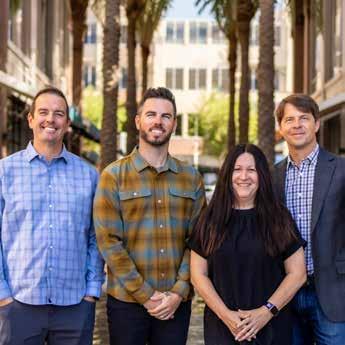
These aren’t aspirational statements, they’re actively used to guide decisions, give feedback, and recognize performance. We evaluate, reward and hold each other accountable to GOHARD, which creates clarity and consistency across the entire organization.”
Defining movie: “Moneyball reflects how we think and operate at Colling Media. It’s not about doing things the way they’ve always been done, it’s about using data, challenging assumptions and finding smarter ways to win.”
Learn more: collingmedia.com
HELPING PEOPLE SUCCEED: At its core, Colling Media and its executive team operates under a different philosophy: Helping people succeed through better advertising results. (Provided photo)

BACKGROUND: Concord stands out as one of the best places to work in 2026 by intentionally investing in its people and creating opportunities to grow, lead and make an impact. As a 100% employee-owned company, team members take pride in shaping the firm’s future while collaborating in a culture built on trust, accountability and shared success. Through mentorship, professional development and hands-on project experience, every voice is valued from field to office. Concord celebrates achievements, fosters genuine connection and supports its people at every step. The result is a workplace where employees feel empowered, appreciated and inspired to build lasting, meaningful careers.

BEST COMPANY SONG: “‘Good Life’ by OneRepublic best represents the spirit of our company because it reflects our belief in working hard while also enjoying the journey together. At Concord, we take pride in what we build, but we equally value the relationships and experiences along the way. As employee-owners, we share in the successes, support one another through challenges, and celebrate both the big wins and the everyday moments that make our work meaningful. It’s a culture rooted in ownership, connection, and a genuine appreciation for the work we do and the people we do it with.”
Learn more: concordinc.com

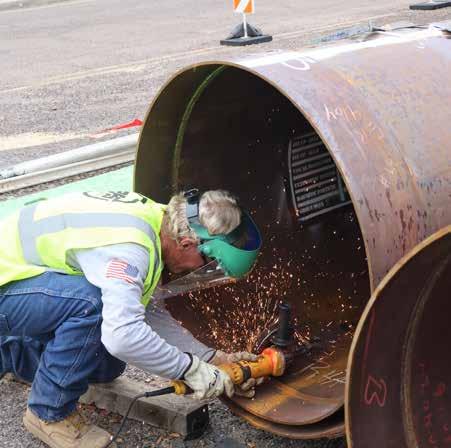
Background: PPS (Professional Piping Systems) is a Phoenix-based specialty mechanical contractor focused on process piping, plumbing, and HVAC systems for industrial, commercial, and municipal clients across Arizona. Founded on a commitment to quality craftsmanship and technical precision, PPS has built a reputation as a trusted partner on projects that demand zero margin for error. From water treatment facilities to healthcare campuses to energy infrastructure, the PPS team brings hands-on expertise and a built-to-perform standard to every job. With a skilled workforce of pipefitters, plumbers, and project professionals, PPS operates at the intersection of field-proven trades knowledge and forward-thinking project management, delivering systems that perform reliably from day one and for years to come.
Differentiator: “At PPS, we believe the best work comes from people who feel valued,
WALLS COME DOWN: “The most unique thing about PPS is that we close the gap between the field and the office. In a lot of specialty contracting companies, there is an invisible wall between craft workers and management. At PPS, that wall does not exist. Our project managers came up through the trades. Our leadership team has been on the tools. When a pipefitter raises a concern or spots a better way to run a system, it gets heard. (Photo provided by PPS)
challenged, and supported. That starts with how we treat our craft professionals in the field. As a specialty contractor, our pipefitters and plumbers are not just labor on a schedule; they are the reason our projects get built right. We invest in their training, their safety, and their growth because we know the trade skills they carry cannot be replaced. Over two years without a lost-time incident speaks to the culture we have built, one where looking out for the person next to you is expected and enforced. Safety at PPS is not a compliance checkbox; it is how we operate every single day. Beyond safety, PPS offers a stable pipeline of meaningful work, opportunities to advance from the tools to the office, and a leadership team that is accessible and direct. We are a company where your work actually
matters. Projects are real, accountability is real, and so is the recognition when a crew delivers. For people who take pride in building something that will outlast them, PPS is where they want to be.”
Song that captures the company spirit: “‘Drop It Like It’s Hot’ by Snoop Dogg. When things heat up on a job site, that is exactly what PPS does. We drop in, get to work, and handle it. High-pressure systems, tight schedules, complex specialty installations; we do not flinch. The track has a cool confidence to it, and that is the PPS mentality. No panic, no excuses, just a crew that knows what they are doing and gets it done without breaking a sweat.”
Learn more: ppsphx.com

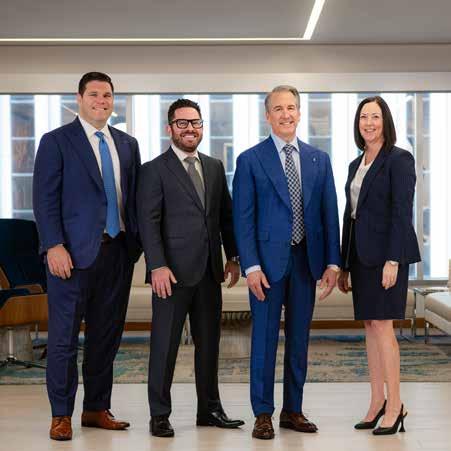
LEADING THE WAY: DM Cantor’s Jason Karpel, partner; Nicholas Boca, managing partner/ family law practice; David Cantor, founding partner; and Christine Whalin, managing partner/ criminal law practice. (Photo provided by DM Cantor)
Background: Since its founding in 1996, DM Cantor has established itself as a cornerstone of the Phoenix legal community. The firm’s success is built on a simple but powerful philosophy: by fostering an internal culture of mentorship, integrity, and collaboration, they empower their team to deliver gold-standard results for their clients. Specializing in criminal defense, family law and estate and probate, DM Cantor features a deep bench of expertise, including eight BoardCertified Legal Specialists. This high level of technical proficiency is supported by a workplace environment that prioritizes professional growth and office-based collaboration. Because the firm invests in its people and maintains a supportive, high-energy atmosphere, its attorneys are uniquely equipped to provide the high-level
representation that clients across Arizona and the nation depend on. Celebrating its recognition as a top place to work, DM Cantor remains dedicated to the people who make its premier legal services possible.
Differentiator: “At DM Cantor, our recognition as one of Arizona’s best places to work in 2026 is rooted in a culture of constant betterment. We believe that by investing deeply in our team, we empower them to provide the premier representation our clients deserve. This commitment to growth is realized through intensive mentorship and year-round internal and external training programs designed to help every employee achieve their highest professional and personal goals. Our team is unified by a singular,
profound purpose: helping people navigate the most difficult times of their lives. This shared mission creates a cohesive and active workplace where every contributor is valued and supported. To honor this dedication, we provide compensation in the top 5% of the industry for all positions and prioritize firm-wide connection through events like family picnics, regular meals together, and holiday celebrations. A true testament to our ‘all-in’ culture, we recently brought our entire team of over 60 people to the Excellence in Law Awards, where we were honored as Law Firm of the Year for the small-to-medium law firm category. At DM Cantor, we don’t just practice law; we build a community that thrives on excellence and celebrates success together.”
Learn more: dmcantor.com

ABI Multifamily: A commercial real estate brokerage focused on multifamily property sales and apartment investment transactions.
ATI Restoration: A restoration company specializing in disaster recovery, environmental remediation and reconstruction services.
Aker Ink PR & Marketing: A public relations and marketing agency that helps brands build visibility and tell their stories.
Alerus: A financial services company offering banking, wealth management, retirement and mortgage solutions.
Arizona Biltmore: A luxury resort and hotel offering upscale accommodations, dining, spa services and event space.
Arizona Central Credit Union: A memberowned financial institution providing personal and business banking services.
Arizona Financial Credit Union: A credit union offering banking, lending and financial wellness services to members.
Arizona Public Service (APS): Arizona’s largest electric utility, providing power to homes and businesses across the state.
Arizona State University: A major public research university offering higher education, research and innovation programs.
Aurora Behavioral Health System: A healthcare provider specializing in mental health and behavioral health treatment services.
azarchitecture/Jarson & Jarson Real Estate: A real estate firm specializing in architecturally significant homes and distinctive properties.
BMO: A financial institution offering banking, lending, wealth management and commercial finance services.
BOK Financial: A regional financial services company providing banking, wealth, treasury and investment solutions.
Bashas’ Family of Stores: A grocery store company operating supermarket brands throughout Arizona.
Bel-Aire Mechanical: A contractor providing HVAC and mechanical construction services.
Bennett and Porter Insurance Services: An insurance agency offering personal, commercial and specialty coverage solutions.
Blue Cross Blue Shield of Arizona: A health insurance company providing medical, dental and related coverage plans.
Blue Signal Search: A recruiting and executive search firm connecting employers with professional talent.
Burch & Cracchiolo: A law firm providing legal services across business, litigation, real estate and other practice areas.
CORE Construction: A construction company specializing in building projects for education, civic and commercial clients.
Cachet Homes: A homebuilder developing luxury and semi-custom residential communities.
Camelot Homes: A luxury homebuilder known for upscale residential communities and custom-style homes.
Canyon State Electric: An electrical contractor providing construction, service and maintenance solutions.
Capital Asset Management: A financial advisory firm focused on investment and wealth management services.
Cawley Architects: An architecture firm designing commercial, industrial and other built environments.
City of Chandler: A municipal government providing public services, infrastructure and community development for Chandler residents.
City of Goodyear: A city government serving residents through public safety, planning, parks and municipal services.
City of Mesa: A municipal government delivering city services, economic development and community programs.
City of Peoria: A local government providing civic services, development planning and public amenities.
City of Phoenix: The municipal government for Phoenix, delivering public services, infrastructure and community programs.
Background: MT Builders’ primary focus of work is in the multifamily sector and building wood frame structures, where MT Builders has worked with a diverse group of clients on multiple projects. MT Builders’ other successful projects include senior living, assisted living, memory care, schools, churches and retail projects. MT Builders is based in Scottsdale and while most of its work has occurred in the Phoenix metro area, MT Builders has completed projects throughout the State of Arizona, as well as a few neighboring states.
INDUSTRY LEADER: MT Builders has completed more than 22,000 multifamily units — including Velaire at Aspera Apartments in Glendale — totaling nearly $3.3 billion in construction costs.
(Photo provided by MT Builders)

STRENGTH OF STAFF: “Our team here is a tight group of individuals with a high level of experience in the multifamily construction. Everyone is empowered to always do the right thing and focus on the needs of our clients. Our group understands we are all a team and extend that team mentality to our clients and trade partners, knowing that we will all succeed together or fail together based on how we value each other as we work toward a common goal.”
Learn more: mtbuilders.com

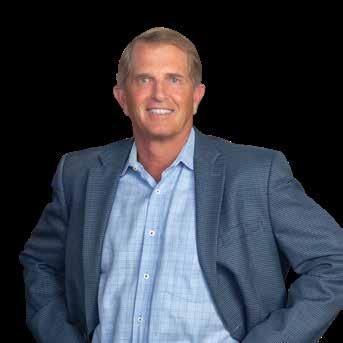
INDUSTRY LEADER: Named an ASU Distinguished Alumni and Advertising Person of the Year, Bill Lavidge founded his namesake agency in 1982 and has grown it to one of the largest in Arizona. (Az Business file photo)
City of Scottsdale: A city government providing municipal services, tourism support and economic development.
City of Tempe: A municipal government serving residents through public services, planning and community programs.
Corgan: An architecture and design firm serving aviation, commercial, education and other sectors.
Cox Media Phoenix: A media company providing advertising, marketing and broadcasting services.
DAS Technology: A technology company offering communication and customer engagement tools, especially for automotive clients.
Delta Dental of Arizona: A dental benefits company providing dental and vision coverage plans.
Desert Financial Credit Union: A credit union offering banking, lending and financial services to consumers and businesses.
Enterprise Bank & Trust: A financial institution focused on banking, lending
and wealth services for businesses and individuals.
Fairmont Scottsdale Princess: A luxury resort offering accommodations, dining, spa, golf and event experiences.
Forward Tilt: A business advisory and accounting-related firm helping clients with financial and strategic needs.
Frazer Ryan Goldberg & Arnold: A law firm serving clients in business, litigation, real estate and other legal matters.
Fry’s Food Stores: A supermarket chain providing groceries, pharmacy services and household essentials.
Gammage & Burnham: A law firm focused on business, real estate, litigation and transactional legal services.
Geneva Financial: A mortgage company offering home loan and residential financing solutions.
Gila River Hotels & Casinos: A hospitality and gaming enterprise operating casino resorts, dining and entertainment destinations.
Harrah’s Ak-Chin Casino: A casino
and resort offering gaming, dining, entertainment and hotel accommodations.
HomeSmart: A real estate brokerage company supporting residential agents and homebuyers and sellers.
HonorHealth: A healthcare system providing hospitals, medical services, specialty care and wellness programs.
I Need An Angel: A nonprofit organization that supports children and families facing serious medical challenges.
IMPACT Technology Recruiting: A recruiting firm specializing in technology and professional placement.
JPMorgan Chase & Co.: A global financial services company providing consumer banking, commercial banking and investment services.
JW Marriott Desert Ridge Resort & Spa: A resort destination offering luxury lodging, dining, spa, golf and family amenities.
Kidder Mathews: A commercial real estate firm providing brokerage, valuation, property management and advisory services.
Kiterocket: A public relations and marketing agency serving technology, real estate and professional services clients.
LAVIDGE: A full-service advertising, branding and marketing agency.
LGE Design Build: A design-build firm providing integrated architecture and construction services.
Land Advisors Organization: A real estate brokerage specializing in land sales, site selection and advisory services.
Landings Credit Union: A member-owned credit union offering banking and lending services.
Lerner and Rowe Law Group: A law firm providing personal injury and related legal representation.
Lihn Law Group: A law firm offering legal services, including business and litigationrelated counsel.
Liv Communities: A multifamily housing company that develops and manages apartment communities.
Mark-Taylor Residential: A property management company operating luxury apartment communities.

BACKGROUND: Caliente Construction is a woman-owned and award-winning commercial general contractor headquartered in Arizona, delivering high-quality construction services across a diverse portfolio of public and private sector projects. Built on a foundation of trust, integrity, and collaboration, Caliente partners closely with clients to bring their vision to life with efficiency and precision. Over the past several years, the company has experienced significant growth, expanding its annual revenue while continuing to invest in its people and community.
Differentiator: “Caliente Construction’s ‘secret sauce’ is the balance we’ve created between living our core values and making work genuinely enjoyable. Our values — Committed, Accountable, Reliable, Experts
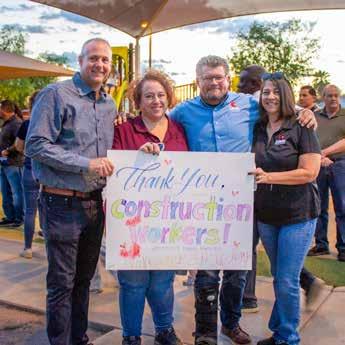
and Spirited — spell CARES and they guide how we show up for one another every day. Just as importantly, we believe a strong culture includes connection, energy and a sense of fun … At Caliente, culture is not forced or one-dimensional. It is a balance of doing great work, supporting one another and creating an environment where people are proud to be part of the team and genuinely enjoy showing up each day.”
Learn more: calienteconstruction.com
TEAM SPIRIT: Whether it is celebrating project milestones, volunteering together in the community, or participating in company sports teams, Caliente Construction’s “Spirited” value shows up in meaningful ways. (Photo provided by Caliente Construction)





Derek Wright, president and CEO of Suntec Concrete, has been with the company since 1990, starting as a carpenter and advancing to leadership. (Az Business file photo)
Mason Pro Services: A home and commercial services company focused on plumbing, HVAC, electrical or related maintenance solutions.
Midstate Mechanical: A contractor providing HVAC and mechanical construction services.
NAI Horizon: A commercial real estate company offering brokerage, property management and advisory services.
National Bank of Arizona: A regional bank providing personal, business and commercial banking services.
NexMetro Communities: A developer of build-to-rent residential communities.
ORION Investment Real Estate: A commercial real estate brokerage focused on investment sales and leasing.
OneAZ Credit Union: A credit union offering banking, loans and financial services to Arizona members.
P.B. Bell: A multifamily housing company focused on apartment development, management and investment.
Plexus Worldwide: A health and wellness company selling nutritional supplements and lifestyle products.
Precision Air & Plumbing: A home services company providing HVAC, plumbing and related repair services.
Rafi Law Group: A personal injury law firm representing accident and injury victims.
ReThinc Advertising: An advertising and marketing agency focused on creative strategy and brand growth.
Realty Executives Arizona Territory: A residential real estate brokerage serving buyers, sellers and agents across Arizona.
Realty One Group: A real estate brokerage franchise supporting residential agents and home transactions.
SPS+ Architects: An architecture firm designing education, civic, healthcare and commercial spaces.
SRS: A building products distribution company supplying roofing, landscaping and pool-related materials.
Shea Homes: A homebuilder developing
residential communities and new homes.
Snell & Wilmer: A full-service business law firm serving clients across many industries.
Suntec Concrete: A contractor specializing in concrete construction for large-scale building projects.
Taylor Morrison: A national homebuilder developing new residential communities and homes.
The CORE Institute: A healthcare organization specializing in orthopedic, spine and musculoskeletal care.
The James Agency: A marketing, branding and public relations agency.
Town of Cave Creek: A municipal government providing civic services and local administration for Cave Creek.
Town of Gilbert: A town government serving residents through public safety, planning and community services.
Town of Queen Creek: A municipal government delivering local services, development planning and community programs.
triARC architecture & design: An architecture and interior design firm creating commercial and community spaces.
Tri-City Cardiology: A medical practice specializing in cardiovascular care and heart health services.
University of Arizona: A public research university providing higher education, research and healthcare-related programs.
ViaWest Group: A real estate investment, development and property management firm.
Wallace, Plese + Dreher: An architecture firm focused on design for education, civic and commercial projects.
Wells Fargo & Company: A financial services company offering banking, lending, investing and wealth management.
Wood, Patel & Associates: A civil engineering and consulting firm providing design, surveying and infrastructure services.
Background: Founded in 1980 by Dominic Spagnuolo, SDB Contracting Services is a certified woman-owned, full-service commercial construction and general contracting firm headquartered in Tempe, with additional offices in Texas, Oregon and Idaho.
Key to culture: “At SDB, we believe the people who build Arizona’s most critical facilities deserve a workplace built with the same care. What makes us one of the best places to work starts with genuine investment in our team, comprehensive healthcare, retirement plans, paid time off, tuition reimbursement and professional development opportunities so every team member grows alongside the
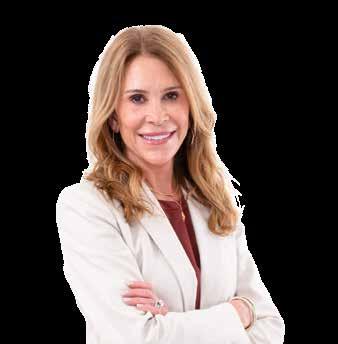
company. Beyond the job site, our team takes pride in giving back … Service and philanthropy is woven into who we are.”
Secret sauce: “What makes SDB unique is the family-like environment throughout the company. When an employee faces a crisis, the team rallies. When someone has a big idea, leadership listens. When a milestone is hit, the celebration is collective. Our team members are not treated as numbers, they are people whose lives and goals matter.”
Learn more: sdb.com
is a secondgeneration family business with more than 45 years of construction experience. (Az Business file photo)

By CHRISTINA FUOCO-KARASINSKI
Southern Arizona’s workforce needs are having an identity crisis.
Across the region, employers, educators and economic development leaders are working to build a talent pipeline that can keep pace with the industries arriving at their doorsteps.
Advanced manufacturing plants are emerging, aerospace suppliers are expanding, healthcare systems are straining under the weight of an aging population, and clean-energy technologies — from batteries to copper mining — are reshaping the region’s industrial identity.
In response, institutions like Pima Community College and Central Arizona College (CAC), along with organizations such as the Tucson Metro Chamber, are stepping up to meet the moment.
Andrew Clegg, CAC’s academic dean of Workforce Development and Skilled Trades, studies these trends closely and meets regularly with economic development professionals to ensure the college’s programs align with industry demand. Serving as the initial point of contact for new and existing Pinal County businesses, Clegg and his team operate at the center
of the region’s workforce strategy — part matchmaker, part strategist and part earlywarning system.
“I look at myself as a facilitator,” he says. “We figure out their training needs and match them to the programs we have — or we build the programs they need.”
That flexibility has become essential in a rapidly evolving economy.
CAC offers both credit and non-credit training programs, with the latter providing fast, targeted upskilling opportunities. Clegg describes these offerings as “quick and dirty” — efficient, practical programs designed to get people into the workforce quickly.
These programs cover a wide range of high-demand fields, including water and wastewater operations, law enforcement and fire department professional development, early childhood education apprenticeships, manufacturing fundamentals and skilled trades.
Clegg points to CAC’s water and wastewater program as an example of how niche training can deliver outsized impact.
“It doesn’t sound exciting, but in order to have clean water and wastewater systems, you need trained operators,” Clegg says.
“We train them, and we offer the state certification test on campus.”
CAC — with campuses in Coolidge, Winkelman, Maricopa, Apache Junction and San Tan Valley — is also expanding its footprint in skilled trades and healthcarerelated fields. New and growing programs include sonography, radiology, pharmacy technology, esthetics, phlebotomy, commercial electrical, plumbing and HVAC.
The college’s approach is rooted in responsiveness.
“In some cases, we work with businesses to build the programs they need,” Clegg says. “That’s how we stay relevant.”
While advanced manufacturing is often cited as the region’s most urgent workforce need, Clegg encourages a broader perspective.
“We build programs that encompass all ‘advanced manufacturing’ — I’m using air quotes right now because ‘advanced manufacturing’ touches every industry,” he says.
The scale of that demand is significant. Major employers are rapidly expanding their presence across the region.
“Advanced manufacturing is our largest industry right now,” Clegg says. “Lucid

ON A ROLL: The high-performance Lucid Air Sapphire is manufactured in Casa Grande, where it rolls off Lucid’s advanced production line as one of the most powerful electric sedans ever built, showcasing the state’s growing role in high-tech automotive manufacturing.
has more than 3,000 employees. LG will hire between 3,000 and 4,000. Abbott is at around 500. Frito-Lay is at 300 to 400. These are huge employers.”
To meet that demand, CAC works in close coordination with Pima and Maricopa community colleges, aligning curriculum and training standards across institutions.
“We’ve aligned our training so manufacturers know that if someone is trained at Pima, Maricopa or CAC, they’re getting the same learning outcomes,” Clegg says.
Dr. Ian Roark, Pima Community College’s provost and executive vice chancellor for academic affairs and workforce development, echoes that commitment to alignment and real-world relevance.
“We are looking at our programs in the context of a dynamic and changing labor market,” Roark says. “We’re ensuring academic programs have a direct connection to business and industry, and real-world relevance for our students.”
That includes expanding work-based learning opportunities — even within traditional transfer degree programs.

Pima Community College has also launched a network of specialized Centers of Excellence, funded in part through a revenue bond process. These centers are designed to address regional workforce shortages by offering industry-aligned training across multiple sectors.
“Our Centers of Excellence are co-located facilities where programs tied to a single industry are given the space and technology they need to grow,” Roark says.
Key facilities include the Center of Excellence in Health Professions at the West Campus, Centers of Excellence in Applied Technology at the Downtown Campus, and the Center of Excellence in Hospitality Leadership at the Desert Vista Campus.
The Aviation Technology Center — part of the Applied Technology network — stands out as a flagship asset.
“We now have one of the largest aviation training facilities in the greater Southwest, if not the country,” Roark says. “We teach aviation mechanics, powerplant structures, nondestructive testing, composite materials and more.”




The facility includes two large hangars, one capable of housing a Boeing 727 and a newer facility large enough to accommodate a 737.
While manufacturing and aviation continue to expand, another industry is preparing for significant growth: mining.
“Soon to take off is mining,” Clegg says, pointing to several projects in various stages of development across Pinal County.
Why the renewed focus? Copper.
“Copper is in everything — your cellphone, your computer, your automobile,” he says. “Arizona has always been a major producer, but now copper is on the critical minerals list. It’s profitable again.”
That shift is expected to drive hiring across multiple mining methods, from traditional open-pit operations to underground and in-situ extraction.
For workforce developers, that means preparing for a surge in demand across a wide range of technical and operational roles.
At the same time, the region faces a dual challenge: developing local talent while attracting specialized workers from outside the market.
“It’s not either/or — it’s both,” says Susan Dumon, the Tucson Metro Chamber’s chief economic development officer. “We have to train the people who live here, but we also have companies with highly specialized roles that require talent from outside the region.”
To support recruitment efforts, the chamber launched Thrive in Tucson in partnership with Pima County during the COVID-19 pandemic. The platform helps prospective employees understand what it’s like to live and work in Southern Arizona.
“If I’m being recruited for a job, I want to know about schools, healthcare, neighborhoods, cost of living and culture,” Dumon says. “Thrive in Tucson gives companies a way to tell that story.”
The region’s economic pipeline has also shifted dramatically in recent years.
Before the pandemic, roughly 35% to 40% of Southern Arizona’s projects were office-based, including back-office and customer-service operations. That segment has largely disappeared, replaced by industrial, manufacturing, logistics and research-driven projects.
“The types of projects we’re seeing now are all industrial,” Dumon says. “That’s where the opportunities for growth are.”
Programs like Ready Tech Go, coordinated through the Arizona Office of Economic Opportunity, are helping meet that demand.
The initiative includes Automated Industrial Technology (AIT), an industry-recognized program designed to prepare students for high-paying manufacturing jobs in a matter of weeks.
Students can earn their first certification in as little as two weeks and continue building toward an associate degree within two years.
For employers, that consistency is critical. For students, it creates mobility — allowing skills developed in one region to translate seamlessly into opportunities across the state.
While manufacturing and mining dominate headlines, healthcare may represent the region’s most urgent workforce challenge.
“We have an aging population,” Dumon says. “Retirees are a large part of our community, and they need more healthcare services.”
Healthcare leaders have raised concerns about their ability to recruit and retain physicians and other medical professionals.
In response, the Tucson Metro Chamber launched a physician shortage task force, bringing together hospital executives, public health officials and policymakers.
“It’s still early, but they’re looking at both policy and



challenge and opportunity.
“Talent is always at the top of the list,” she says. “But we’re leading, partnering and supporting in ways that help Southern Arizona stay competitive.”
As industries evolve and demand accelerates, one thing is certain: the future of Southern Arizona’s economy will be defined by how effectively it builds — and sustains — its workforce pipeline.


Source:
DAN GERACI, CEO of FreeFall Aerospace
By LUX BUTLER
In Southern Arizona, Pima County is defining its own economic identity rooted in innovation, collaboration and strategic positioning. Rather than competing directly with larger markets, local leaders are focused on building complementary industries that align with regional strengths and long-term planning.
“We are not just growing to grow,” says Heath Vescovi-Chiordi, economic development director for Pima County. “We want to grow intelligently and do it through planning.” (subhead)
This philosophy is shaping how the county approaches industry recruitment, workforce development and regional partnerships.
Pima County’s economic strategy centers on leveraging research institutions and established industry clusters. Aerospace
and defense remain core pillars, supported by a network of companies that has expanded over decades.
As the largest private employer in Tucson, Pima County’s largest city, Raytheon specializes in designing and producing missiles — a specialization that requires a workforce of professional engineers, manufacturing experts, IT specialists and an array of administrative, janitorial and support staff.
“Aerospace, defense and space-related technology development are huge down here,” says Vescovi-Chiordi. “Raytheon has about 14,000 employees, and they’ve created a unique ecosystem of aerospace and defense companies.”
In addition to supporting operations at Davis-Monthan Air Force Base, the aerospace and defense industry in Tucson includes major players like Ascent Aviation Services — one of the largest aircraft

storage and MRO (maintenance, repair and operations) facilities in the world — and Paragon Space Development Corp., a longtime NASA contractor.
This ecosystem continues to grow, attracting companies seeking proximity to skilled talent, suppliers and university research. The University of Arizona plays a key role in advancing space-related technologies and helping transition innovation into commercial applications.
“Space-related industries are growing because of the University of Arizona,” Vescovi-Chiordi says. “Those developments are pioneering new companies that are looking here to establish themselves.”
The University of Arizona also serves as a hub for optics and photonics innovations and is producing some of the largest and most advanced telescope mirrors for the Magellan Telescope.
Together, these sectors are helping Pima
County build a diversified economic base grounded in advanced technology and research.
Positioning as a strategic partner
While manufacturing growth accelerates in Maricopa and Pinal counties, Pima County is focusing on complementary opportunities within supply chains and supporting industries. Leaders see value in aligning with statewide growth rather than competing for the same projects.
Based in Oro Valley, Leonardo Electronics US Inc. develops and manufactures highpower semiconductor laser components and systems for major prime contractors, including Lockheed Martin Corp., Ball Aerospace & Technologies Corp., DRS Network & Imaging Systems, General Atomics and Triad National Security LLC.
Leonardo Electronics US is just one example of a supplier or support company based in this Southern Arizona county. Numerous manufacturers have chosen the region for its proximity to the Phoenix market as well as international connections along the Southern border.
“There’s friendly competition, but one of the key tenets of economic development is knowing where your strengths lie,” says Vescovi-Chiordi. “We’re leaning into the idea of being one of the hubs for suppliers and assemblers for those larger companies in the Phoenix area.”
This positioning allows the region to attract companies seeking lower costs while maintaining access to major markets and infrastructure. The approach reflects a broader effort to continue integrating Southern Arizona into the state’s expanding manufacturing ecosystem.
“Tucson is considered a tier-two market, but that’s not a bad thing,” he says. “It means we’re more cost-competitive, we have an available workforce and strong university support.”
Local leaders emphasize that economic expansion must align with community values and long-term sustainability. Planning and infrastructure coordination are viewed as essential to maintaining quality of life while supporting new industries.
“From an infrastructure standpoint, there’s the RTA Next transportation

I think we’ll see more collaboration and a unification of the way we look at economic development.
— Heath Vescovi-Chiordi
initiative,” says Vescovi-Chiordi. “Those projects are very important for future growth and maintaining existing infrastructure.”
The Regional Transportation Authority, a state-established taxing district within Pima County, has launched the 20-year regional transportation plan (RTA Next) and a $2.67 billion investment to support reduced congestion, improved mobility, expanded transit, environmental protections, bicycle and pedestrian improvements and pavement rehabilitation.
Other major investments are also reinforcing the county’s capacity to support large-scale economic activity. New manufacturing and technology projects — such as the $3.6 billion Project Blue data center, Xcimer Energy’s laser fusion manufacturing facility and the American Battery Factory project — are bringing attention to Southern Arizona as a viable destination for significant development.
“That puts us on the map in a very
significant way, showing that Pima County can handle projects of that scale,” he says.
Building a competitive workforce
Workforce development is central to sustaining economic momentum. As new industries expand across Arizona, competition for skilled labor is intensifying, prompting regional collaboration among educational institutions and employers.
“Workforce is definitely a challenge,” says Vescovi-Chiordi. “The pool itself may be kind of drying up, so there needs to be a complementary talent attraction campaign.”
Partnerships with the University of Arizona and Pima Community College are helping address these needs through training programs, certifications and industry-aligned education.
“As we attract more companies, that workforce throughout the state will be spread just a little bit thinner, so collaboration is critical,” he says.
Looking ahead, collaboration among Southern Arizona counties is expected to expand. Leaders say shared economic priorities and proximity to Mexico create opportunities for cross-border trade and coordinated development.
“I think we’ll see more collaboration and a unification of the way we look at economic development,” Vescovi-Chiordi says.
Mexico’s proximity is viewed as a significant advantage for logistics, manufacturing and supply chain connectivity.
“We also have Mexico so close to us. That market is such a great opportunity for the Tucson region and Southern Arizona,” he says. “That collaboration will facilitate growth with Mexico as a unique and independent market.”
As statewide growth continues, Pima County is carving out a distinct role built on research-driven industries, complementary partnerships and long-term planning. By focusing on innovation and collaboration, leaders believe Southern Arizona can strengthen Arizona’s overall economy while maintaining its unique identity.
Pima County’s strategy emphasizes alignment, positioning the region as both an innovation hub and a strategic partner in Arizona’s evolving economic landscape.

By CHRISTINA FUOCO-KARASINSKI
Travel expenses have skyrocketed, but Arizonans can take advantage of incredible staycation deals at top resorts from Phoenix to Flagstaff. The discounts make it easy to kick back, sleep in and relax at a spa or pool.
Here are 25 of the best staycation deals for 2026, in alphabetical order:
Locals save more: Escape to Flagstaff with the retro Americana Motor Hotel’s Arizona resident rate for locals looking to unwind. The 15% discount offers “special perks” designed for an in-state getaway. How to book: americanamotorhotel.com
Here’s the deal: Book by May 31, 2026, for a 40% discount on the best available rate for Arizona Biltmore suites, offering extra space for families, friends or extended stays. The two-night minimum stay includes a $100 nightly resort credit and complimentary selfparking. Must stay by Dec. 31, 2026. How to book: arizonabiltmore.com


Here’s the deal: Escape close to home with a sun-soaked desert retreat, with rates starting at $199 per night. The rate includes a $25 food and beverage credit per stay. How to book: arizonagrandresort.com and use promo code AZSTAYCAY.
Here’s the deal: The Truly Boulders package starts at $229 per night and includes private casita accommodations, a $25 daily dining credit, self-parking, 20% off spa services and unlimited access to the spa facility and fitness classes.
The Summer Stay & Play Golf Package starts at $369 per night and includes
SUMMER OF FUN: A staycation at Fairmont Scottsdale Princess feels like a luxurious desert escape, where sparkling pools, world-class dining, spa indulgence and unforgettable resort experiences turn an ordinary weekend into a sun-soaked Arizona getaway. (Photo provided by Fairmont Scottsdale Princess)

accommodations, one round of golf per person per night, a $25 food and beverage credit, self-parking and unlimited access to the Boulders Spa facility and fitness classes. How to book: theboulders.com
Enchantment
Sunny Days, Starry Nights package: Nestled among the red rocks at an elevation of 4,600 feet, Enchantment ushers in pleasant high-desert mornings for trail exploration, afternoons perfect for sipping margaritas by the pool, and evenings made for stargazing.
The Sunny Days, Starry Nights package offers up to 15% off the resort’s best available rate plus a $150 daily resort
credit per room. The offer applies to stays from June 1 to Aug. 31, 2026. Two-night minimum. Blackout dates apply.
How to book: enchantmentresort.com/offers
Here’s the deal: The Fairmont Scottsdale Princess Summer Day Camp returns with a weeklong luxury camp experience running May 25 through Aug. 7. Hosted at the Trailblazers Kids Club, the program offers daily adventures including arts and crafts, swimming, outdoor games and themed activities, giving children a fun, safe and engaging summer at one of Arizona’s premier resorts.
How to book: scottsdaleprincess.com/ events-scottsdale/summer-camp
The Hermosa Inn
Arizona locals package: Arizona residents receive 25% off their stay at the awardwinning resort.
Summer in Paradise Getaway: The Hermosa Inn offers a 15% discount off its best available rate and a $35 per-night dining credit at Lon’s. Complimentary poolside treats add an extra touch of summer fun.
Cool Summer Dining Escape: This getaway pairs an overnight stay in a casita at 25% off with Lon’s Cool Dining experience. Enjoy an intimate five-course dinner in Lon’s candlelit wine cellar, where each dish is paired with fine wines. Dinner starts at $165 per person, with optional wine pairings for $90. Casita rates vary. Available Thursday through Sunday evenings throughout the summer.
Third night free: Stay three nights and pay for only two.
How to book: azhideawaycollection.com/ hermosa-inn/offers
Hilton Sedona Resort at Bell Rock
Stay Longer on Us package: Make the most of summer with 25% off nightly rates when booking three nights or more. This deal is available exclusively for Hilton Honors members and reservations must be made at least four days in advance.
Book between May 14 and Sept. 1, 2026, for stays from June 14 through Sept. 6, 2026.
How to book: HiltonSedonaResortDeal
Here’s the deal: Treat yourself to a colorful Scottsdale staycation with 25% off your room and a one-time $25 food and drink credit. Stay between May 1 and Aug. 31, 2026. No deposit required and a seven-day
flexible cancellation policy avoids penalties. Must present ID with an Arizona address. Blackout dates apply. Cannot be combined with other offers.
How to book: hotelvalleyho.com
JW Marriott Scottsdale Camelback Inn Resort & Spa
The Slip Away to Sunshine package: Includes overnight accommodations, a $100 daily resort credit, early check-in and late check-out.
How to book: marriott.com; promotional code ZJL
Here’s the deal: Lodge on the Desert offers seasonal discounts — 15% off a onenight stay or 20% off two or more nights. Getaways must be booked before May 25, 2026, for stays anytime before Oct. 31, 2026. This special offer is prepaid and nonrefundable. Guests can also add amenities such as a fruit and cheese platter, champagne service, margaritas for two, a bottle of wine or spring water delivered upon check-in.
How to book: lodgeonthedesert.com
Here’s the deal: Celebrate a restorative staycation with Miraval Arizona’s Enhanced Spa Package, designed to showcase the resort’s newly reimagined Life in Balance Spa. The package includes $275 nightly resort credits, full access to spa amenities, meals and snacks throughout the day, and unlimited activities. How to book: miravalresorts.com/arizona
Here’s the deal: Arizona residents can stay between June 1 and Sept. 30, 2026, and pay $159 nightly on weekdays and $199 nightly on weekends, with the resort fee waived. No deposit is required, and a seven-day flexible cancellation policy helps avoid penalties.
How to book: mountainshadows.com
Omni Scottsdale Resort & Spa at Montelucia
Escape to Scottsdale deal: Drenched in Moroccan and Andalusian charm, Omni Scottsdale Resort & Spa at Montelucia offers a fourth night free, a $150 resort credit per stay and complimentary access to Scottsdale Fashion Square visitor savings with $750 in perks from participating stores and eateries. Rates vary by date and availability.
How to book: bit.ly/MonteluciaScottsdale

Here’s the deal: Arizona residents can indulge in a downtown staycation with 20% off accommodations and a $25 food and beverage credit. Located in Tempe, the hotel offers stylish rooms, elevated dining, a rooftop pool deck and sweeping views of the ASU campus and city skyline. How to book: bit.ly/OmniTempe
Here’s the deal: Perfect for Arizona locals seeking a summer staycation, Royal Palms Resort & Spa is offering its “Tranquil Days, Summer Stays” package. Guests receive 20% off accommodations plus a $50 daily resort credit that can be used for dining at the award-winning T. Cook’s or craft cocktails at Mix Up Bar.
With no minimum length of stay required and rates starting at $189 per night, the offer is available to book through Sept. 9, 2026, for stays between May 25 and Sept. 10, 2026. How to book: royalpalmshotel.com
Here’s the deal: This summer, escape to Paradise Valley with a weekend at Sanctuary Camelback Mountain Resort & Spa. Guests receive 15% off the best available rate plus
a $50 resort credit to use at the Sanctuary Spa or for dining at elements or Jade Bar. How to book: Use promo code AZ2026 at sanctuaryaz.com
Here’s the deal: Discounted rooms are available for bookings made through Aug. 31, 2026. A 72-hour cancellation policy applies. How to book: thescottresort.com using promo code AZSTAYCAY
Arizona Backyard Getaway package: The Scottsdale Resort & Spa offers 20% off the best available rates, with stays starting from $139 per night. Guests can also take advantage of exclusive perks such as a waived resort fee (with valid Arizona ID) and complimentary self-parking. How to book: hilton.com
Here’s the deal: Summer rates start at $299 and include resort fees and a daily $100 resort credit. The credit cannot be applied toward the room rate, taxes, resort fee, dining at Kai, rides at Koli Equestrian Center or golf at Whirlwind Golf Club.
How to book: marriott.com
GLAMOUR SQUAD: A staycation at Arizona Biltmore feels like stepping into a timeless desert oasis, where iconic architecture, sparkling pools, lush gardens and luxurious spa experiences create the perfect blend of relaxation and classic Arizona glamour. (Photo provided by Arizona Biltmore)
The Westin Kierland Resort & Spa
Stay, Play, Repeat: The Westin Kierland Resort & Spa offers a $100 resort credit per night for Arizonans to use toward dining, spa treatments, golf or leisure activities through Sept. 30, 2026. Guests can also enjoy early check-in and late check-out based on availability. Valid for stays between May 21 and Sept. 30, 2026. How to book: marriott.com
Here’s the deal: Summer staycation rates start at $139 from May 1 through Oct. 1, 2026. The offer includes a waived resort fee, early check-in and late check-out, plus 25% off cabanas, spa services and golf. Guests can also enjoy dining, gaming and entertainment just outside Scottsdale. How to book: wekopacasinoresort.com
The Wigwam
Summertime & Sunshine Package: Rooms start at $150 per night and include a $50 daily resort credit to use toward poolside cocktails, dining, LeMond’s Aveda Salon-Spa or a round of golf on one of the resort’s three championship courses. The package is valid for stays between May 15 and Sept. 2, 2026. How to book: wigwamarizona.com


Inside Three Thirty Three in Tempe, IX Sushi delivers a breathtaking dining experience where pristine seafood, inventive rolls and unforgettable dishes turn every bite into culinary perfection
By MICHAEL GOSSIE
There are elevated dining experiences and then there is heavenly. IX Sushi falls firmly into the second category, elevating the culinary journey to heights rarely seen.
Three Thirty Three, the massive Asianinspired fine-dining restaurant that resides on the border of Tempe and Scottsdale, opened IX Sushi within its walls in early spring. While IX Sushi and Three Thirty Three are together under one roof, they are entirely independent restaurants, offering distinct menus that do not cross over. Guests can expect the same elevated atmosphere and excellent customer service at IX Sushi as they receive at Three Thirty Three.
From the moment diners settle in, it’s clear IX Sushi is designed to be an experience, not simply a meal. The sleek, modern atmosphere strikes the perfect balance between refined and inviting, setting the stage for a menu that showcases both creativity and precision.
Start the evening with the IX Edamame ($14), which elevates the familiar starter into something far more exciting. Perfectly seasoned and bursting with flavor, it’s the kind of dish that instantly signals
the kitchen’s attention to detail. Equally impressive are the Tuna Cones ($15), delicate hand-held bites layered with pristine tuna and vibrant flavors that deliver a refreshing and indulgent opening to the meal.
Once the sushi arrives, the culinary artistry truly shines. The Spicy Miso Tuna Roll ($22) delivers a bold yet balanced profile, pairing the richness of tuna with the subtle depth of miso and just enough spice to keep each bite exciting. Meanwhile, the Yuzu Yellowtail Oshi ($23) offers a masterclass in flavor harmony, with bright citrus notes from the yuzu enhancing the buttery yellowtail in a way that feels both sophisticated and refreshing.
For those looking to sample a range of the restaurant’s pristine seafood, the 5 Fish Sashimi ($68) is a standout. Each slice is expertly cut and beautifully presented, highlighting the freshness and quality that IX Sushi prioritizes throughout the menu. While sushi may be the star, the kitchen’s hot dishes are equally worthy of attention. The Chicken Katsu ($28) is perfectly crisp on the outside and tender inside, offering a comforting contrast to the delicate sushi selections.
Then there is the dish that may define the entire experience: The Miso Black Cod ($37). Silky, buttery and infused with a subtly sweet miso glaze, the fish melts effortlessly with each bite. It’s the kind of dish that stops conversation at the table, leaving diners focused solely on savoring every last forkful. Quite simply, it may be one of the most mouthwatering dishes you will ever eat.
Complementing the cuisine are stunning signature cocktails crafted to be as visually striking as they are delicious. Drinks like Here Comes the Sun, Shiso Wineberry Smash and the elegant Sakura Bomb showcase vibrant ingredients and refined technique, making them the perfect pairing for IX Sushi’s bold menu.
With impeccable service, artfully crafted dishes and a menu that blends tradition with imaginative flair, IX Sushi proves that the Valley’s dining scene continues to evolve. For those seeking a sushi experience that feels truly special, IX Sushi delivers a night that lingers in memory long after the final bite.
Check it out: X Sushi is located at 430 N. Scottsdale Rd., #101, Tempe. Learn more at ninesushi.com.



• SOUTHERN (CALIFORNIA) CHARM: Hot summer spots for Arizona leaders







By CHRISTINA FUOCO-KARASINSKI
Valley of the Sun United Way has kicked off a two-year centennial celebration, and president and CEO Carla Vargas Jasa is ready to further strengthen the nonprofit’s community ties.
“100 Years of Impact,” United Way Valley of the Sun’s celebration, honors its commitment to bringing people and organizations together to tackle the Valley’s most urgent issues.
“For 100 years, this organization has been part of Arizona’s story — uniting people from every walk of life to create lasting change,” says Carla Vargas Jasa, Valley of the Sun United Way’s president and chief executive officer. She feels
“empowered” to be part of Valley of the Sun United Way during this celebration.
“Our next century begins with that same spirit of collaboration and hope. Together, we can continue building a stronger, more equitable future for everyone in our community.”
Leading an evolution
Nadia Rivera, Valley of the Sun United Way’s chief of staff and brand officer, says this milestone is a reminder of the region’s evolution, thanks to an influx of industries such as semiconductor manufacturing, AI and renewable energy.
“We need strong, trusted institutions
like Valley of the Sun United Way to ensure that growth benefits everyone in our community,” Rivera adds.
The centennial’s two-year celebration includes special events, volunteer opportunities and storytelling efforts highlighting 100 years of impact across Maricopa County. Valley of the Sun United Way’s efforts will continue. In the near term, through Mighty Change 2026, the organization hopes to slow or reverse trends in critical areas such as housing and homelessness, food insecurity, early childhood literacy and workforce development.
Rivera attributes Valley of the Sun United
1925
Valley of the Sun United Way is founded to coordinate charitable giving and support local nonprofit organizations.
Provides critical support to community charities during the Great Depression. Helps address growing community needs during and after World War II as Phoenix begins expanding rapidly.
1970s
The organization grows alongside the Valley, supporting health and social service agencies serving a rapidly increasing population. Expands partnerships with local businesses and civic leaders to strengthen coordinated community giving.

Way’s success to its broad and diverse group of stakeholders. The nonprofit has invested nearly $1.4 billion in Maricopa County by harnessing the “collective power of individuals and businesses,” she adds.
“That ability to convene — to bring stakeholders together, identify challenges and drive solutions — is truly its superpower.”
Valley of the Sun United Way is now expanding opportunities for engagement and shared leadership, including the CEO Advisory Circle and Valley 100. This model ensures Valley of the Sun United Way can tackle challenges from multiple perspectives and achieve lasting results.
“It’s how we operationalize partnership — and it’s truly our secret sauce. Community and corporate partnerships are at the heart of sustaining United Way’s mission,” Rivera says.
“In fact, Valley of the Sun United Way was recently recognized by United Way Worldwide as the highest-performing local United Way in the nation — an honor earned not just by our staff and board, but by the strength of our partners and supporters across the community.”
Some of United Way’s earliest partners — YMCA, YWCA, The Salvation Army, Catholic Charities and Friendly House —
are still supporting the nonprofit.
“What’s changed is the nature of those partnerships,” Rivera says. “They’ve become far more strategic and multifaceted, reflecting the increasing complexity and interconnectedness of the challenges we face. At the same time, funding sources are less predictable, and both corporate and individual philanthropists are more engaged and outcomes-driven, expecting clear return on investment in terms of impact.”
The 40-year-old United Food Bank is another partner, thanks to a consortium of Phoenix-area United Ways.
“Back in the early 1980s, local leaders were seeing article after article in the newspapers about how food pantries were running out of food,” says Jason Reed, United Food Bank president and chief executive officer.
“They thought there had to be a better way of doing this. Five United Ways came together and said, ‘Let’s form the United Food Bank to support food pantries throughout the East Valley.’ Valley of the Sun United Way was part of our history.”
United Food Bank has provided more than 7.7 million meals to Arizona residents in the past 15 years.
“That’s a testament to the great partnership we’ve had together,” Reed says. “We’re tremendously grateful for their
Becomes Valley of the Sun United Way consolidated from many area United Way campaigns to expand the reach across Maricopa County and strengthen its role as a regional convener.
Strengthens focus on measurable impact in areas such as education and financial stability.
Expands programs focused on economic mobility, early childhood development and housing stability.
support. All of those within our community who have supported Valley of the Sun United Way have, therefore, supported us as well.”
Arouet is another longtime partner, led by its chief executive officer Alison Rapping. When Rapping stepped into her role in 2017, Arouet was a fledgling nonprofit with limited funding and an unproven model.
Arouet empowers women and families impacted by the justice system to build strong communities.
“United Way was the second major investor that we had,” she says. “If it were not for United Way, Arouet as we know it would not exist.”
Collaboration runs deep
That early investment — following initial support from Local Initiatives Support Corporation (LISC) — gave Arouet the stability and credibility it needed to build its Thrive model, expand programming and begin serving women transitioning from incarceration into economic independence.
She says the United Way team is deeply collaborative.
“They are right by our side, giving us a listening ear and helping us brainstorm new ideas.”
Their support extends into major statewide initiatives, including the Fair Chance Collaborative, which Arouet helped
Launches the Mighty Change 2026 campaign to drive long-term improvements in education, workforce development and housing stability.
Valley of the Sun United Way celebrates its 100th anniversary, launching a two-year centennial celebration and new initiatives focused on the future of community collaboration.



conceptualize. Rapping advocated for United Way to house the collaborative because of its capacity, leadership and ability to convene cross-sector partners — qualities she believes are essential to solving Arizona’s labor and equity challenges.
Partnerships like these fuel Valley of the Sun United Way’s mission.
“As we mark 100 years of impact, we’re not just celebrating our past — we’re meeting the moment we’re in now,” Vargas Jasa says.
“Arizona has always been a place where people take care of each other. Our work has always been about bringing neighbors together to create solutions that are rooted right here in our communities.”
Establishing a United Community Fund: Created a centralized fundraising model that allowed the community to support multiple charities through one coordinated effort.
Supporting families during the Great Depression: Helped stabilize local charities and help families during one of the most difficult economic periods in American history.
Expanding community services after World War II: Supported programs addressing housing, health and family services as the Valley experienced rapid growth.
Strengthening nonprofit collaboration: Developed systems that allow nonprofits to coordinate services and avoid duplication, improving outcomes for families.
Responding to economic recessions: Mobilized emergency assistance and community support during economic downturns, including the Great Recession.
“For 100 years, this organization has been part of Arizona’s story — uniting people from every walk of life to create lasting change,” Vargas Jasa says.
“Our next century begins with that same spirit of collaboration and hope. Together, we can continue building a stronger, more equitable future for everyone in our community.”
Launching strategic community initiatives: Shifted from traditional fundraising to impact-driven initiatives focused on education, housing, health and workforce development.
Expanding volunteer engagement: Connected thousands of volunteers with nonprofit partners through service opportunities across the Valley.
Leading community response during COVID-19: Helped coordinate relief efforts and resources for families and nonprofit organizations during the pandemic.
Launching the Mighty Change 2026 Campaign: A five-year effort focused on improving educational attainment, housing stability, health and workforce opportunity across Maricopa County.
Celebrating a Century of Impact: Beginning a two-year centennial celebration while introducing new initiatives designed to strengthen community collaboration for the future.






















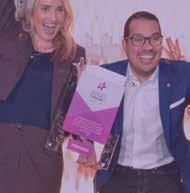






























By ALISON BAILIN BATZ
While the roar of January’s historic College Football Playoff Semifinal at the Vrbo Fiesta Bowl has faded into lifelong memories and highlight reels — and the confetti has long since been swept from the field — Arizona’s Fiesta Sports Foundation is just getting warmed up.
Formerly known as the Fiesta Bowl Organization and its charitable arm, Fiesta Bowl Charities, the organization transformed into the Fiesta Sports
Foundation last year — a strategic evolution designed to better reflect the breadth of its year-round impact on and off the football field.
Its bold mantra: “Our season never ends.”
To put that impact into perspective, the foundation delivers more than $200 million in annual economic impact through its events and has invested $35 million in charitable giving into Arizona communities over the past 15 years. From youth sports to education and public safety, its work
stretches statewide. The following eight programs — just a sampling of its epic impact — offer a glimpse into its yearround efforts.
Palo Verde Fiesta Sports Foundation Wishes for Teachers
The Palo Verde Fiesta Sports Foundation Wishes for Teachers program, which celebrated its milestone 10th year in 2025, is Arizona’s largest direct-support initiative for educators. Last year, 540 teachers
received $2,500 classroom grants and three schools were awarded $50,000 school grants, representing a record $1.5 million investment.
More than 5,000 applications came from 149 cities and 175 school districts, underscoring the demand in a state facing persistent teacher shortages — and where educators often reach into their own pockets to fund classrooms. Since launching in 2016, the program has awarded nearly $10 million to more than 3,000 educators, impacting more than 1 million students statewide.
Funded wishes range from STEM tools and robotics kits to sensory spaces, Native culture materials, musical instruments and campus gardens. Teachers also use grants for books, flexible seating, updated technology and hygiene supplies. Recipients are honored at marquee events, including on-field recognition at the Rate Bowl and participation in the annual Vrbo Fiesta Bowl Parade presented by Lerner & Rowe.
The Foundation expects to open applications for the 2026 program in September.
Beyond classrooms, the foundation’s annual grant cycle directs resources to nonprofits statewide. For the 2025-26 season, 16 Arizona organizations received funding to address urgent needs in youth, sports and education.
Projects include shelter and services for nearly 700 individuals experiencing homelessness, programs unlocking access to athletics for underserved youth, resources for families living with disabilities and essential supplies for children in foster and kinship care. Through the grant cycle alone, more than 100,000 Arizonans are projected to be impacted this season.
The 2026-27 Fiesta Sports Foundation grant recipients will be announced this fall.
Access to education remains a cornerstone of the foundation’s work. In spring 2026, the Empowering Diversity Scholarship marks its seventh year, awarding funding to dozens of Arizona minority residents across GED and postsecondary tracks with the support of Blue
Cross Blue Shield of Arizona.
Post-secondary recipients receive $5,000 scholarships plus $500 in wraparound support services through Be A Leader Foundation or Education Forward Arizona. GED recipients receive funding for assessment fees and program support through College Depot. To date, the program has supported more than 150 Arizona students, removing financial barriers and strengthening pathways to higher education and workforce readiness.
Through a growing partnership with Blue Cross Blue Shield of Arizona, the Foundation has unveiled seven Community Resource Rooms statewide, transforming outdated areas into safe, inspiring spaces for learning and leadership.
Among this year’s renovations is Boys & Girls Clubs of the Valley’s Superstition Mountain Branch in Apache Junction, where the foundation created a 750-squarefoot teen center equipped with advanced STEAM technology — including 3D printers, coding robots and VR tools — alongside collaborative workspaces and media areas. Designed with teen input, these rooms provide academic support, workforce development resources and a safe space for students after school.
Since launching its playground initiative, the Foundation has completed 17 playground builds statewide, including six in partnership with Salt River Project.
Recognizing that play fuels childhood development, a recent project at Family Promise of Greater Phoenix’s Legacy Village installed a 1,085-square-foot playground and a 640-square-foot sport court within an emergency housing community serving families facing homelessness. Across Arizona, these spaces provide opportunities for physical activity, social development and joy where stability is critical.
Recognizing gaps in school campus safety, the foundation launched the AED Assistance Program, presented by BHHS Legacy Foundation, in 2024. In its second year, 21 schools received certified cardiac-
arrest training and AED equipment, benefiting more than 9,400 students and 1,200 educators.
A foundation survey found that 27% of responding schools lacked an AED and 28% did not have properly trained staff, with cost cited as the biggest barrier. With average emergency response times around 10 minutes statewide, immediate intervention can be lifesaving. CPR alone yields roughly 40% survival odds — and when paired with an AED, survival rates can double.
As women’s flag football surges nationally and prepares for its Olympic Games debut in 2028, the foundation is helping shape its future. In April 2026, the inaugural Fiesta Bowl Flag Football Classic debuted at Arizona State University’s Tempe campus, welcoming eight collegiate teams for a two-day showcase — the first national flag football tournament featuring Division I programs.
Local teams from ASU and Grand Canyon joined Alabama State, Southern California, Charlotte, Central Florida, Florida and Georgia. The event builds on the foundation’s leadership in girls flag football, including the Copper State Invitational high school tournament and sponsorship of Arizona Interscholastic Association championships.
At the grassroots level, the foundation’s Youth Football Clinics introduce young athletes to the fundamentals of the game in free, non-contact settings. Guided by local high school athletes and former NFL players, participants rotate through drills focused on teamwork, agility and sportsmanship. Each child receives a clinic jersey and gift bag, reinforcing that participation matters as much as performance.
The largest clinic takes place in partnership with Arizona Milk Producers. In 2025, the Arizona Milk Producers Fiesta Sports Foundation Youth Football Clinic set a record with 600 students participating from eight Avondale ESD schools.
For more information, visit fiestasportsfoundation.org.









By MICHAEL GOSSIE
Every year, Arizona’s business community proves that success isn’t just measured by revenue or growth—it’s measured by impact. at spirit takes center stage in Az Business magazine’s Champions of Change, a special section that celebrates the individuals and organizations who are raising the bar for leadership, innovation and philanthropy across the state.
From healthcare pioneers and nonprofit visionaries to forward-thinking executives and community champions, this year’s







Meet the visionary leaders and purpose-driven organizations across Arizona who are redefining success through innovation, leadership and philanthropy — proving that the most powerful businesses are the ones making a lasting difference in their communities


finalists represent the best of Arizona’s bold, purpose-driven leadership. ey are the leaders who look at challenges and see opportunity. ey are the businesses that find ways to grow while giving back. And they are the innovators who believe progress should benefit entire communities—not just their bottom line. “ ese finalists truly embody what it means to be a Champion of Change,” says Amy Lindsey, vice president and publisher of AZ Big Media. “ ey are visionary leaders who are not only excelling in their




industries, but also lifting others up and strengthening the communities where they live and work.”
Across industries such as healthcare, finance, construction, technology, education and nonprofit services, the finalists share a common trait: a relentless drive to make things better. Some are transforming the way healthcare is delivered. Others are creating opportunities for underserved communities, advancing education initiatives, or leading companies that are redefining what innovation looks










like in Arizona’s rapidly evolving economy. What makes the Champions of Change especially inspiring is the diversity of stories behind them. Some finalists are entrepreneurs who built companies from the ground up. Others are leaders within major organizations who are reshaping corporate culture and redefining how businesses connect with their communities. Many are passionate advocates who use their platforms to support philanthropy, workforce development, education and social impact.





“Arizona is filled with remarkable leaders who quietly do extraordinary things every day,” Lindsey says. “Champions of Change gives us the opportunity to spotlight those individuals and organizations whose leadership is making a meaningful difference in our state.”
Ultimately, the Champions of Change section is more than a list of impressive accomplishments—it’s a reminder that Arizona’s future is being shaped by people who believe leadership comes with responsibility.











As you read through the profiles that follow, you’ll meet innovators, changemakers and philanthropists who are not only succeeding in business, but also helping Arizona thrive. ese are the Champions of Change — and their stories are just getting started.
e Champions of Change finalists and winners will be celebrated at a superherothemed awards luncheon on May 21, 2026, at Omni Tempe at ASU. Learn more at azbigmedia.com.

































CHASSE Building Team makes philanthropy a core part of its culture, giving back with the same teamwork it brings to every project. Since 2007, the company has donated more than $4.5 million and logged thousands of volunteer hours annually. From hands-on K-12 STEM engagement to largescale community initiatives, CHASSE consistently shows up, uniting its team to create lasting impact across Arizona.













LEADING WITH PURPOSE: Barry Chasse, founder of CHASSE Building Team, is a purpose-driven leader known for building both high-quality projects and a culture rooted in philanthropy, teamwork and community impact. (Az Business file photo)

APS stands out as one of Arizona’s most philanthropic companies by embedding community impact into its core mission. rough strategic giving, employee volunteerism and long-term nonprofit partnerships, APS invests millions annually to support education, housing and basic needs. Its culture of “impact giving” empowers employees to lead, ensuring meaningful, measurable change across the communities it serves.

e Arizona Diamondbacks stand out as one of the state’s most philanthropic organizations by using their platform to drive meaningful community impact. rough the Arizona Diamondbacks Foundation, the team invests millions in youth programs, education and underserved communities, while players and staff actively volunteer — proving their commitment extends far beyond the field.





Desert Financial Credit Union stands out as one of Arizona’s most philanthropic companies by consistently reinvesting in the communities it serves. Through its foundation, employee volunteerism and member-driven donations, it supports education, financial literacy and basic needs statewide — demonstrating a purpose-driven mission that goes beyond banking to create lasting, measurable community impact.




The Delta Dental of Arizona Foundation launched its first Innovation Grant, awarding $100,000 over two years to Banner Alzheimer’s Foundation to expand its ECHO dementia care program to dental professionals. In January 2026 alone, the foundation invested more than $830,000 in grants and supplies, supporting 36 Arizona nonprofits and advancing innovative, community-driven healthcare solutions.




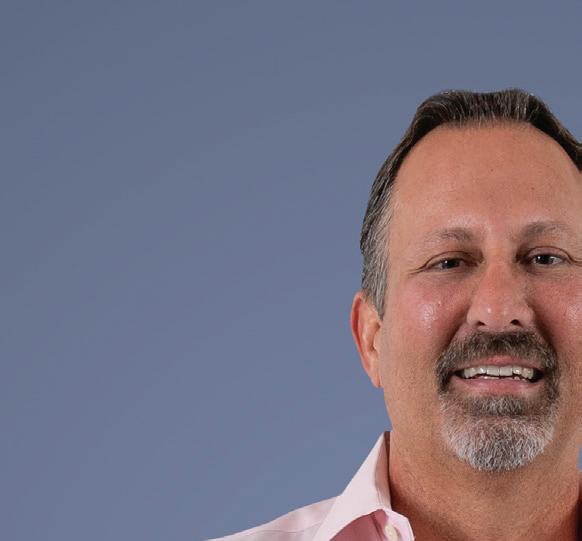

Plexus Worldwide embeds philanthropy into its core mission, making giving a defining measure of success. In 2025, the company contributed more than $1.08 million and helped provide over 3 million meals, while employees logged 2,000 volunteer hours. Through companywide initiatives and leadership-driven service, Plexus aligns purpose, people and resources to create meaningful, lasting community impact.



Lerner & Rowe embeds philanthropy into its culture through Lerner & Rowe Gives Back, driving year-round community impact. In 2025, the team distributed 6,500 backpacks and 5,600 meals, awarded $350,000 in grants and raised more than $1 million for nonprofits. Through hands-on volunteering and long-term partnerships, the organization strengthens communities while fostering a collaborative, purpose-driven workplace.
IMPACT PLAYER: Kevin Rowe, founder of Lerner & Rowe, is a purpose-driven leader who has built a successful legal firm while championing impactful philanthropy through Lerner & Rowe Gives Back, supporting communities across Arizona and beyond. (Az Business file photo)
Rafi Law Group stands out as one of Arizona’s most philanthropic companies by making community impact central to its mission. Through generous giving, grassroots partnerships and hands-on volunteerism, the firm supports youth programs, families in need and local nonprofits. Its commitment goes beyond donations, fostering real relationships and creating meaningful, lasting change across Arizona communities.
Salt River Project stands out as one of Arizona’s most philanthropic companies by investing deeply in the communities it serves. Through strategic giving, employee volunteerism and partnerships focused on education, sustainability and economic development, SRP delivers meaningful impact statewide. Its commitment to community stewardship reflects a mission that extends far beyond providing power and water.
Sundt Construction extends its impact beyond jobsites by strengthening communities through its employee-owned culture. rough the Sundt Foundation, more than $20 million has been awarded in grants, including $11 million in Arizona. In 2025, employee-owners contributed 14,000 volunteer hours and supported hundreds of nonprofits, combining financial giving, hands-on service and construction expertise to drive lasting community impact.

















Fedewa, CEO of STORE Capital, exemplifies philanthropic leadership by aligning business success with meaningful community impact. She champions strategic giving, supports initiatives that expand economic opportunity and strengthens Arizona nonprofits through active engagement. Her leadership reflects a commitment to responsible growth, empowering communities while fostering long-term partnerships that create lasting, measurable change across the state.




COMMUNITY CHAMPION: Mary Fedewa, CEO of STORE Capital, is a strategic and forward-thinking leader known for driving disciplined growth while championing community impact and responsible business practices. (Az Business file photo)

Amstutz exemplifies a philanthropic leader whose impact extends far beyond fundraising. Through decades of support for Phoenix Children’s 1 Darn Cool School, he has helped raise millions and expand access to education for young patients. His leadership inspires employees, partners and the community to give back, strengthening lives and reinforcing the power of purpose-driven business.




As chief growth officer at Wilde Wealth Management Group, Anthony pairs strategic leadership with a deeply personal commitment to service. After Phoenix Children’s saved his son’s life, he became a dedicated advocate, helping raise $2 million for pediatric care initiatives. rough leadership and philanthropy, he drives meaningful impact, supporting children, families and communities across Arizona with purpose and gratitude.




What sets Clark apart as a philanthropic leader is his holistic approach aligning the company’s business growth with measurable social good, empowering employees with paid volunteer opportunities and creating systems where customer purchases directly fuel charitable outcomes. This vision, supported by Clark’s personal philanthropic contributions, earned him a 2025 philanthropic leadership award.
Mary Foote, Arizona Office of Economic Opportunity
Foote drives innovation at the Arizona Office of Economic Opportunity by transforming how data shapes policy and expands opportunity statewide. rough strategic partnerships, workforce alignment and measurable outcomes, she connects education, industry and communities. Her leadership delivers greater transparency, stronger infrastructure investment and expanded access to economic opportunity across urban, rural and tribal Arizona.















Gibson leads with resilience, purpose and impact. After a life-altering accident, she transformed adversity into action by founding The Diana Adapted Foundation, empowering individuals with limb differences. A seasoned business leader and director of client success at REDW, she combines professional excellence with advocacy, helping others rebuild confidence, independence and opportunity across Arizona and beyond.






As vice president of site services at APS’s Palo Verde Generating Station, Hernandez pairs operational excellence with deep civic impact. A hands-on leader, he champions meaningful partnerships, helping drive more than $806,000 in support for A New Leaf and broader Valley initiatives. By fostering a culture of “impact giving,” he connects business strategy with community outcomes, proving leadership can drive lasting change.
LIFE-CHANGER: In 2016, Diana Gibson’s life changed forever after she was involved in a serious ATV accident. Surgeons were unable to save her right arm. (Photo by Bruce Andersen, Az Business, a publication of AZ Big Media)
Rowe, founder of Lerner & Rowe, leads with integrity, innovation and a deep commitment to community impact. rough Lerner & Rowe Gives Back, he has helped deliver more than $2 million, 4,200 volunteer hours and support to millions in need. By empowering his team and embracing forwardthinking leadership, he drives lasting change across Arizona and beyond.
Rowley, president and CEO of Sundt Construction, leads with a commitment to building both projects and stronger communities. Under his leadership, Sundt’s employee-owned culture drives impactful giving through the Sundt Foundation, which has awarded more than $20 million in grants. By championing volunteerism and hands-on service, he ensures lasting, meaningful impact across Arizona.
Spong, managing director of employee health and benefits at Marsh McLennan Agency, champions a culture where business success and community impact go hand in hand. Under his leadership, the firm invests heavily in Arizona through charitable giving, volunteerism and employee-driven initiatives, empowering teams and partners to support vulnerable communities and create lasting, meaningful impact statewide.



The Blue Cross Blue Shield of Arizona Foundation advances health equity by investing in programs that expand access to care, address social determinants of health and strengthen community well-being. Through strategic grants and partnerships, it supports behavioral health, food security and housing stability, creating long-term solutions that improve health outcomes for underserved populations across Arizona.





Cox Charities strengthens Arizona communities by supporting nonprofits focused on youth, education, conservation and basic needs. Funded by Cox employees and matched by the company, the program empowers local giving and volunteerism. Its grants and community partnerships create meaningful, grassroots impact, helping organizations deliver essential services and improve quality of life across the state.

The Delta Dental of Arizona Foundation expands access to oral health care through innovative funding, community grants and strategic partnerships. Focused on prevention, education and underserved populations, the foundation supports programs that improve overall health outcomes. Its investments in Arizona nonprofits and healthcare initiatives drive lasting impact by connecting oral health to whole-person wellness.

Lerner & Rowe Gives Back drives meaningful community impact by supporting youth programs, public safety and health initiatives. rough large-scale events, grants and volunteerism, the organization removes barriers for vulnerable populations. Its hands-on approach and strong partnerships enable millions of dollars in support annually, creating lasting change for families and communities across Arizona and beyond.
Desert Financial Foundation invests in Arizona communities by supporting education, financial literacy and basic needs. Through grants, scholarships and employee volunteerism, it empowers individuals and families to achieve long-term stability. The foundation’s community-first approach reflects Desert Financial Credit Union’s mission to create opportunity, strengthen neighborhoods and make a lasting difference across the state.
HonorHealth Foundation fuels innovation and patient care by raising critical funds to support advanced treatments, research and community health programs. rough philanthropic partnerships and donor engagement, it enhances access to highquality healthcare across Arizona. Its impact extends beyond hospital walls, improving lives through prevention, education and investments in the future of medicine.

community support and major fundraising efforts, it ensures children across Arizona have access to world-class medical services. Its impact extends to families, providing hope, healing and critical resources during some of life’s most challenging moments.

Phillips Law Foundation is dedicated to supporting Arizona families through initiatives focused on safety, education and community well-being. By partnering with nonprofits and funding impactful programs, the foundation helps address critical needs and improve quality of life. Its commitment to giving back reflects a mission to create safer, stronger and more connected communities statewide.

Rafi’s Hope focuses on removing barriers for underserved communities by supporting youth, families and individuals in need. Through direct giving, partnerships and grassroots initiatives, the organization addresses education, housing and basic needs. Its mission-driven approach emphasizes accessibility and dignity, creating meaningful opportunities and delivering real, measurable impact across Arizona communities.
Phoenix Children’s Foundation advances pediatric healthcare by funding life-saving treatments, cutting-edge research and compassionate care programs. rough
e USAA Foundation supports military members, veterans and their families through targeted philanthropy focused on financial security, housing and community resilience. By partnering with trusted nonprofits, it delivers resources and programs that address critical needs. Its mission-driven giving reflects a deep commitment to those who serve, creating lasting impact both in Arizona and nationwide.


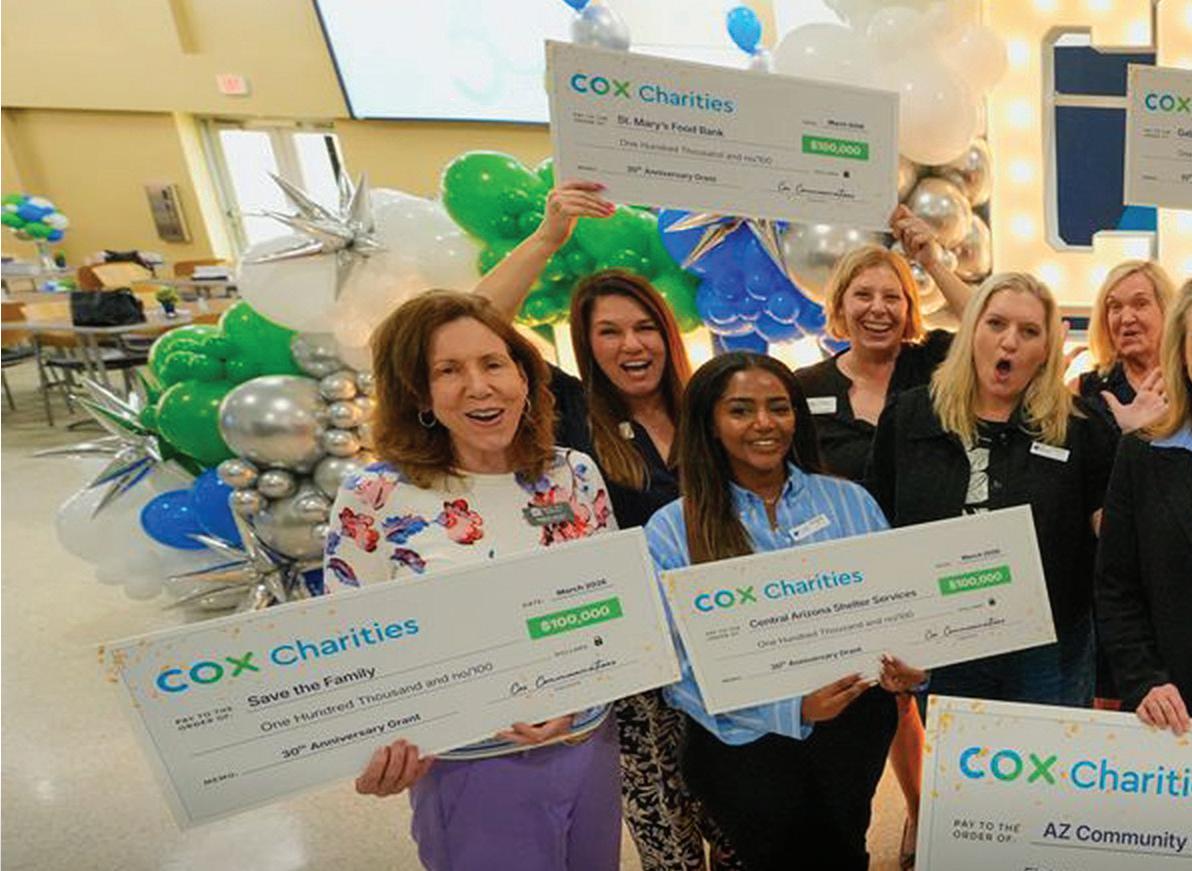
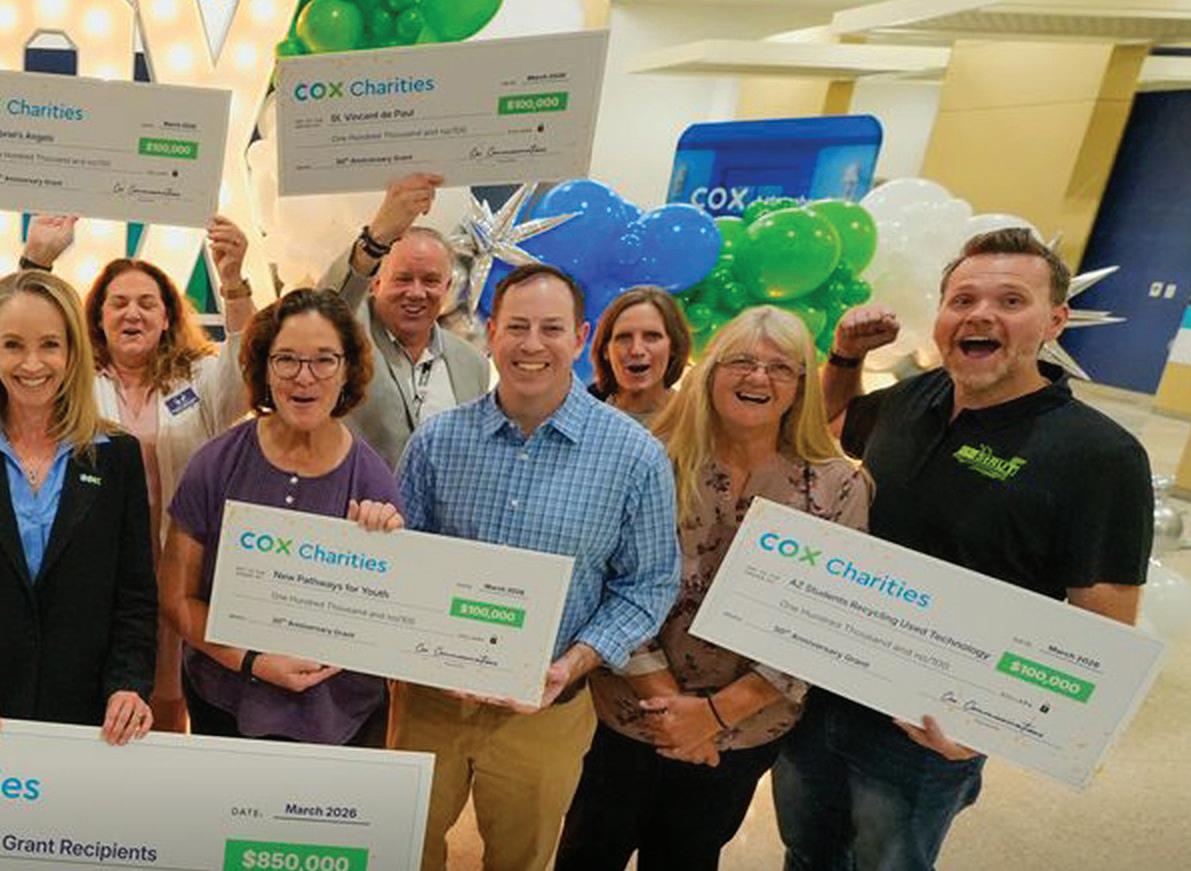



By SUSAN ANABLE
Community investment isn’t just the right thing to do — it’s a proven approach to building stronger, more successful businesses. When companies step up to support the communities where they live and work, the impact extends far beyond charitable dollars. Giving back strengthens employee engagement, builds trust, and helps businesses thrive alongside the people they serve.




ose moments reinforce why this work matters—because giving back doesn’t just strengthen our communities, it energizes our people and deepens their connection to our purpose.

At its core, community involvement creates purpose. Today’s workforce wants more from their employer than a paycheck. ey want to work for organizations that reflect their values and make a meaningful difference. Businesses that provide opportunities for employees to volunteer, serve on charitable boards and support local causes consistently see higher morale, stronger teamwork, and greater pride in the workplace. People are more motivated when they know their work contributes to something bigger.

I’ve seen this impact firsthand. When I’m alongside our employees as they volunteer, or when we come together to celebrate a significant community investment, the pride and joy are unmistakable.



Giving back also strengthens a company’s reputation. Organizations that are visibly invested in their communities earn trust—from customers, partners, and civic leaders alike. at trust translates into stronger relationships, greater brand loyalty, and a more resilient business over time. In competitive markets like Phoenix, where talent and innovation are critical, companies known for their community commitment have a clear advantage.
At Cox, community engagement fuels both purpose and performance. Our employees don’t just show up to work— they show up for our neighbors. rough volunteerism and charitable giving, they help address some of the most pressing needs in our region, from education to housing stability, food security and environmental sustainability.

A cornerstone of that commitment is Cox Charities, our employee led giving program, which this year marks its 30th
anniversary—three decades of sustained, intentional investment in the communities we serve. Since its founding in 1996, Cox Charities employees across Arizona have raised and reinvested nearly $12 million into local nonprofits, helping organizations meet critical needs, expand access to opportunity, and strengthen families statewide. at kind of long term commitment doesn’t happen by accident—it’s made possible by employees who believe in using their collective power to create lasting impact.




at legacy was on full display this March, when Cox Charities distributed $850,000 in grants to 10 Arizona nonprofits to advance vital work aligned with our core giving pillars: K 12 STEM education, food and housing insecurity, and conservation and sustainability. As we celebrate 30 years of Cox Charities, this record setting investment reflects a long-standing commitment to community impact—powered by our employees and rooted in the belief that when businesses and communities grow together, everyone succeeds.
Susan Anable is Cox Communications Phoenix market vice president.
















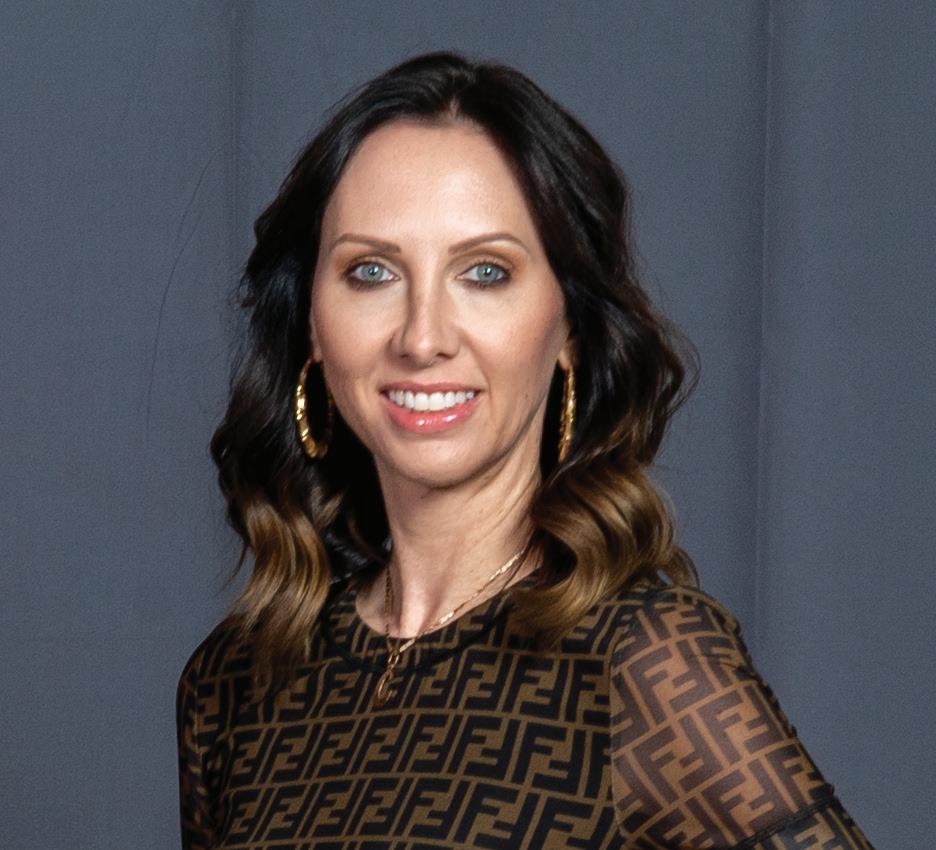

Masters, CEO of The Worker, is transforming the organization into a powerful force for economic mobility by connecting thousands of Arizonans to employment opportunities while pairing job placement with housing stability and support services that help individuals rebuild their lives. (Az Business file photo)
Carrie Masters is redefining nonprofit leadership as CEO of The Worker. By stabilizing finances, eliminating organizational debt and expanding workforce housing and employment programs, she has transformed the organization into a powerful engine for economic mobility, helping thousands of Arizonans secure jobs and rebuild stability each year.
Humphrey,

(PAL) After confronting addiction within his own family, Kim Humphrey transformed Parents of Addicted Loved Ones into a global support network. As CEO, he expanded PAL from a small Phoenix group into a nationwide movement offering free peersupport meetings in dozens of states, helping families build healthy boundaries and pathways toward recovery.


Solari Crisis & Human Services leader Justin Chase is helping transform crisis response across Arizona. rough innovative behavioral health infrastructure and compassionate human connection, Solari answers every call and text to 988 and the Arizona Crisis Line. By expanding crisis intervention, mobile response and resource navigation, Chase’s leadership ensures hundreds of thousands of Arizonans receive lifesaving support when they need it most.




As CEO of Mercy Care, Tad Gary is advancing health equity for more than 475,000 Medicaid and Medicare members across Arizona. Through innovative housing initiatives, community reinvestment and cross-sector partnerships, Gary is redefining healthcare by addressing the social determinants of health that shape long-term well-being.



Michael Hughes has spent nearly five decades strengthening Arizona’s nonprofit landscape as CEO of A New Leaf. Under his leadership, the organization has grown into a $50-million network of shelters and support programs serving thousands annually, while his strategic nonprofit partnerships and mergers have preserved vital services for vulnerable families across the Valley.


As CEO of United Food Bank, Jason Reed is tackling food insecurity across the East Valley through innovative partnerships, expanded distribution programs and community outreach. His leadership ensures millions of meals reach families in need while strengthening long-term solutions to hunger across Arizona communities.

Tony and Melody Rodarte founded Compassion Alliance to address the hidden trauma faced by first responders. rough free, confidential therapy and a nationwide support network, the Gilbert-based nonprofit is breaking stigma, expanding access to specialized care and ensuring those who protect our communities receive lifesaving mental health support.






MAKING THE GRADE: Nancy Padberg of Catholic Education Arizona is expanding access to faith-based education by championing innovative tax-credit scholarship programs that help thousands of Arizona families afford Catholic school tuition while strengthening communities through academic opportunity and values-driven learning. (Az Business file photo)
Nancy Padberg has strengthened access to faith-based education through innovative tax-credit scholarship initiatives at Catholic Education Arizona. Her leadership has expanded opportunities for thousands of students to attend Catholic schools, ensuring families across Arizona have greater access to values-based education and academic success.
counseling, support groups and wellness programs, the organization is helping families build resilience while ensuring caregivers receive the emotional support needed to sustain their critical roles.
Tracy urston helps guide the mission of Arizona’s Children Association, one of the state’s longest-serving organizations protecting vulnerable children and families. rough collaborative partnerships and trauma-informed services, urston’s leadership continues to strengthen programs that safeguard children while empowering families to build safer, healthier futures.
Todd Rogers is guiding Habitat for Humanity Central Arizona in expanding affordable homeownership opportunities for families across the Valley. rough innovative partnerships, volunteer engagement and sustainable housing development, Rogers is helping strengthen communities while empowering families to build stability through homeownership.
Amber Smith leads Pipeline Connects in building Arizona’s statewide career-navigation infrastructure. By connecting students and job seekers with thousands of education and credential pathways, Smith’s datadriven approach is aligning workforce talent with employer demand and positioning Arizona as a national leader in workforce innovation.
Megan Steckly is bridging Arizona’s digital divide through her leadership with Compudopt. By distributing thousands of computers, expanding internet access and delivering technology education, she is empowering underserved families with the digital tools and skills needed to pursue education, employment and opportunity in an increasingly connected world.
Francine Sumner turned personal tragedy into statewide impact through Kid in the Corner. After losing her son to suicide, she built a movement promoting kindness, peer support and mental health awareness, reaching tens of thousands of students and empowering youth across Arizona to recognize distress and support one another.
Leigh Zydonik is expanding the mission of Foothills Food Bank & Resource Center by pairing food assistance with compassionate, solution-based support services. rough innovative partnerships and a trauma-informed approach, she is helping individuals move beyond immediate need toward long-term stability and self-sufficiency.
Michele orne co-founded Care 4 the Caregivers to address the often-overlooked mental health needs of caregivers. rough free

LEADING THE WAY: Carrie Masters, CEO of The Worker, is transforming workforce development in Arizona by connecting individuals facing barriers to employment with stable jobs, housing support and pathways to long-term economic independence. (Provided photo)
The Worker, a Phoenix-based nonprofit, transforms lives by pairing employment opportunities with housing stability to break cycles of poverty, homelessness and incarceration. Serving more than 10,000 individuals each year, the organization connects clients to full-time jobs in an average of 23 days while expanding workforce housing initiatives across the Valley. Programs like Mom’s House support successful reentry and reinforce The Worker’s mission to restore dignity, stability and long-term opportunity.
Since launching its bold rebrand in April 2025, All rive 365 emerges as one of Arizona’s leading aging-focused nonprofits, unifying dozens of programs to help older adults, people with disabilities and caregivers thrive in health, housing and connection year-round. e organization expands weatherization services, strengthens West Valley mobility through Northwest Valley Connect, launches Wickenburg’s first intergenerational program and grows philanthropy — while earning national recognition with a Four-Star Charity Navigator rating and a Candid Platinum Seal of Transparency.
Since 1977, Child Crisis Arizona protects vulnerable children and families through prevention, intervention and education programs designed to prevent abuse and neglect. Under CEO Torrie A. Taj, the organization expands its reach with the opening of the netzero Center for Child & Family Wellness and the acquisition of Whispering Hope Ranch. Through shelter, foster care, counseling and parenting support, Child Crisis Arizona strengthens families and safeguards brighter futures.
Phoenix-based Arizona Friends of Foster Children Foundation serves as a trusted advocate for Arizona’s foster community for more than four decades, helping close critical funding gaps for youth through age 26. rough scholarships, enrichment funding, housing and employment support, AFFCF empowers foster youth to thrive. In 2025 alone, the nonprofit supports more than 3,100 young people statewide while responding quickly to urgent needs facing foster families.
Cancer Support Community Arizona ensures no Arizonan faces cancer alone. rough hundreds of free, evidencebased programs each month — from support groups and wellness classes to a wig salon and bilingual patient navigation — the organization provides vital emotional and practical support statewide. Serving patients, survivors and families from Phoenix and Flagstaff campuses and virtual platforms, CSCAZ bridges the gap between treatment and healing so Arizonans confronting cancer can find community, strength and hope.
For 45 years, Duet: Partners In Health & Aging champions stability for older adults, caregivers and grandfamilies across Greater Phoenix through compassionate, volunteerdriven support. e nonprofit provides free transportation to medical appointments, grocery assistance and caregiver resources while combating isolation through friendly visits and community connections. By helping vulnerable neighbors remain healthy, connected and safely housed, Duet empowers aging adults to thrive with dignity and independence.

Hushabye Nursery in Phoenix pioneers a compassionate, family-centered approach to treating infants born with Neonatal Abstinence Syndrome. e nonprofit integrates specialized neonatal care with prenatal education, postpartum support and social services that help families heal together. Since opening in 2017, Hushabye Nursery has cared for more than 1,150 babies and grown into a nationally recognized model for addressing the opioid crisis’ impact on newborns and families.
Lexie’s Voice, a Scottsdale-based nonprofit, advances health, education and inclusion for individuals with autism and developmental disabilities across Arizona. Founded in 2017, the organization provides advocacy, life-skills programming and community connections that help families overcome barriers and build independence. With initiatives such as the future Lexie’s Ranch, Lexie’s Voice continues expanding opportunities for individuals with developmental disabilities to thrive throughout their lives.
notMYkid empowers youth and families across Arizona through prevention programs focused on mental health, online safety and substance-use awareness. Partnering with more than 360 schools and community organizations, the nonprofit delivers education, resources and support that build resilience and strengthen families. By listening to youth and addressing root causes, notMYkid continues expanding its impact statewide and beyond, helping young people navigate challenges and thrive.
Phoenix-based e Foster Alliance ensures children in foster care have the essentials they need to thrive. As Arizona’s largest provider of foster support services, the nonprofit supplies beds, clothing, school supplies and other critical resources while preserving dignity for families. rough strategic partnerships and regional expansion into Northern Arizona and New Mexico, e Foster Alliance continues growing its impact and strengthening support for foster communities.
programs, vocational training and community engagement, Treasure House empowers residents to live with dignity and purpose. Its innovative model is redefining long-term care by creating a vibrant, inclusive community where individuals with disabilities can truly thrive.
e Rob Dollar Foundation works to improve cyclist safety across Arizona through education, advocacy and community outreach. Created in memory of cyclist Rob Dollar, the nonprofit champions initiatives such as Arizona’s “Share the Road” specialty license plate, which funds safety programs, helmet distribution, scholarships and public awareness campaigns. By partnering with community leaders and policymakers, the foundation continues advancing safer roads for cyclists statewide.
Phoenix-based St. Mary’s Food Bank stands as one of Arizona’s most powerful forces in the fight against hunger, providing millions of meals each year to families, seniors and children in need. rough an expansive network of community partners, mobile food distributions and nutrition programs, the organization delivers both immediate relief and long-term solutions — ensuring vulnerable Arizonans have reliable access to healthy food and a pathway toward stability.
e Phoenix Symphony extends its impact far beyond the concert hall through innovative community engagement and education programs that bring music to schools, shelters, healthcare facilities and community organizations across Arizona. Reaching more than 100,000 students annually, initiatives such as Mind Over Music®, the Shelter Initiative and Memory Care Initiative use music to inspire learning, foster connection and improve well-being — ensuring the Symphony truly serves all Arizonans.
Phoenix-based Treasure House provides a groundbreaking residential community for young adults with intellectual and developmental disabilities, offering a supportive environment that fosters independence, life skills and meaningful connections. rough personalized
Arizona-based Waste Not transforms food rescue into a powerful force for community impact and environmental sustainability. Since 1987, the nonprofit has redirected surplus fresh and perishable food from local businesses to nonprofits serving families in need. Working with 60-plus community partners, Waste Not rescues millions of pounds of food each year — reducing landfill waste, conserving vital resources and ensuring nutritious meals reach vulnerable Arizonans instead of being discarded.
For more than 50 years, Wildfire has worked statewide to combat poverty by connecting vulnerable Arizonans to essential resources such as food assistance, energy support and heat relief. rough policy advocacy and onthe-ground programs, the nonprofit helps thousands of households access SNAP benefits, utility assistance and cooling protections. By partnering with utilities, policymakers and community groups, Wildfire continues strengthening safety nets and advancing solutions that protect families from financial and heat-related crises.

Barrow Neurological Institute has earned international recognition for its leadership in neuroscience, advancing lifesaving treatments for brain and spine disorders. Based in Phoenix, Barrow combines elite physicians, groundbreaking research and cutting-edge technology to transform neurological care and improve outcomes for patients worldwide.
CenterWell Pharmacy is making a meaningful impact on Arizona healthcare by helping ensure lifesaving medications reach those who need them most. rough an innovative partnership with Mission of Mercy Arizona, the organization has donated millions of prescription doses, reducing waste while improving health outcomes for uninsured and underserved patients across Maricopa County.
City of Hope Phoenix is redefining cancer care in Arizona by combining advanced treatment, leading-edge research and compassionate, patient-centered care. e rapidly growing
campus delivers innovative therapies and clinical trials while bringing nationally recognized cancer expertise to patients across the Southwest.
Delta Dental of Arizona plays a vital role in improving oral health statewide by expanding access to dental coverage, supporting community health programs and investing in prevention initiatives. Through partnerships and outreach, the organization helps families and communities achieve healthier smiles.
HonorHealth continues to strengthen Arizona’s healthcare landscape through strategic expansion, innovative programs and a commitment to whole-person care. From new Complete Care facilities to initiatives like Produce Prescription and the Whole Health Institute, the nonprofit health system is expanding access while helping communities build healthier, longer lives.



Arizona is our home, and we’re stepping up to improve our state’s health. AZ Blue in Action brings health to Arizonans – out in the community, on the road, and from our offices throughout the state.
azblue.com/azblueinaction
Mayo Clinic stands as one of Arizona’s most respected healthcare institutions, known for pioneering research, patientcentered care and world-class specialists. Its Phoenix and Scottsdale campuses attract patients from around the globe, delivering advanced treatments, groundbreaking clinical trials and collaborative medical innovation.
Molina Healthcare of Arizona is redefining care for Medicaid members through

a whole-person approach that integrates physical health, behavioral health and social support. Known for its leadership in traumainformed care and innovative housing initiatives, Molina is improving health outcomes while addressing the broader community needs that shape long-term wellness.
Sun Health has become a West Valley leader in advancing healthy aging through innovative wellness programs, research and senior living communities. From its Life Plan Communities to the
Child Crisis Arizona would not be able to deliver its critical, life-changing work without the unwavering support of Arizona’s dedicated Champions of Change, whose generosity fuels services for thousands of children and families each year. at impact was on full display at the organization’s 49th annual Mixtape Magic gala this spring, where 400 guests gathered in full 1980s flair to raise over $1 million to fuel Child Crisis Arizona’s proven, award-winning continuum of care. e evening also celebrated Vala
renowned Banner Sun Health Research Institute, the organization champions longer, healthier lives while funding groundbreaking care and research for older adults across Arizona.
Tucson Medical Center stands as Southern Arizona’s leading nonprofit hospital, delivering advanced medical care, innovative treatments and compassionate service. rough specialty programs, cutting-edge technology and strong community partnerships, TMC continues to expand access and improve health outcomes across the region.
Valleywise Health continues to transform healthcare access in Arizona by expanding behavioral health services and strengthening the region’s safety-net system. With major investments in new facilities, mental health care and medical training, the public health system is addressing the state’s growing behavioral health crisis while serving vulnerable communities across Maricopa County.
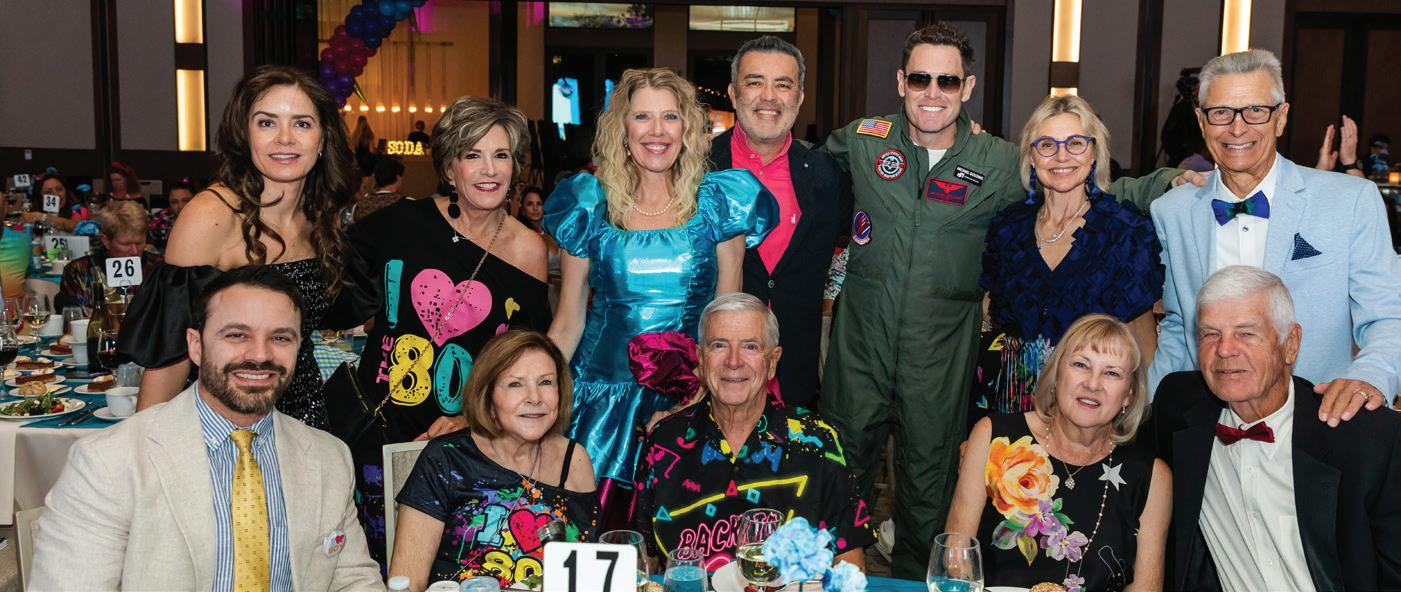
and David Lueth, recipients of the Legacy of Love Award, for their extraordinary commitment to giving back.
Sincere thanks go to sponsors who made the evening possible, including General Dynamics, Lennar Homes, America First Credit Union, Nautilus Insurance, Enterprise Bank, Nationwide, Wilde Wealth Management Group, APS, CHASSE Building Team, Sunflower Bank, JARS, BOK Financial, Crescent Crown and many additional partners committed to strengthening Arizona communities. With this support, Child Crisis Arizona
can provide emergency shelter, foster care, early education, family support, and long-term wellness services that help children and families move from crisis to stability.
Want to get involved?
Plans are already underway for Child Crisis Arizona’s milestone 50th anniversary gala in 2027, and all of Arizona is invited. Let’s make meaningful change together. For more information, email justin.duran@childcrisisaz.org or visit childcrisisaz.org.
BrainLove founder Dr. Dani Cabral is redefining Alzheimer’s care through an integrative model that blends advanced medical treatment with whole-person therapies. By combining science, empathy and community partnerships, Cabral is transforming care for patients and caregivers while setting a new standard for compassionate neurodegenerative disease treatment.
Nora Hannah, Sun Health
At Sun Health, chief engagement officer Nora Hannah champions vibrant longevity across the West Valley. With decades of leadership in business and philanthropy, she promotes prevention, connection and purpose-driven living, helping Arizonans extend not just their lifespan, but their health span and quality of life.
Jonae Harrison, Adelante Healthcare
Adelante Healthcare leader Jonae Harrison helps guide one of Arizona’s most impactful community health organizations, delivering whole-person care to more than 85,000 patients annually. rough culturally responsive programs and integrated

services, Adelante continues expanding access and advancing health equity across Central Arizona communities.
Morgan Haynes, Tribal Health
As CEO of Tribal Health, Morgan Haynes is expanding healthcare access for rural and Indigenous communities nationwide. Under her leadership, the company has rapidly grown its clinician network while delivering innovative care models that address workforce shortages and close longstanding gaps in care.
Todd LaPorte, HonorHealth
HonorHealth CEO Todd LaPorte is guiding the organization toward a future focused on wholeperson care, innovation and community well-being. rough investments in research, technology, workforce support and preventive health initiatives, LaPorte is helping transform how healthcare serves Arizona communities.
Dr. Elizabeth Lopez-Murray is a passionate advocate for health equity, dedicating her career to serving Latino and underserved communities. rough clinical care, education and nonprofit leadership, she is advancing access to healthcare while empowering families with knowledge, prevention strategies and culturally responsive medical support.
At Spectrum Medical Care

Center, Mark Moeremans champions inclusive, culturally competent care for LGBTQ+ and HIV communities. Combining business leadership with personal advocacy, he is strengthening access to affirming healthcare while guiding the organization’s continued growth and community impact.
Phoenix Children’s Foundation leader Steven Schnall has helped drive transformative growth for one of the nation’s leading pediatric health systems. Under his leadership,
the foundation has raised nearly $1 billion, fueling expansion, innovation and life-saving care for children across Arizona.
Total Care Connections founder Daniel Stringer is elevating the standard for in-home care through innovation, accountability and compassion. His company’s rapid growth, technologydriven care coordination and strong community engagement are helping families access reliable, high-quality support across Arizona and beyond.
Valleywise Health Chief Clinical Officer Dr. Michael White is transforming care for Arizona’s most vulnerable patients. rough steady leadership during crises, advocacy for expanded behavioral health services and a commitment to patient safety, he is helping modernize the county’s vital safety-net health system.
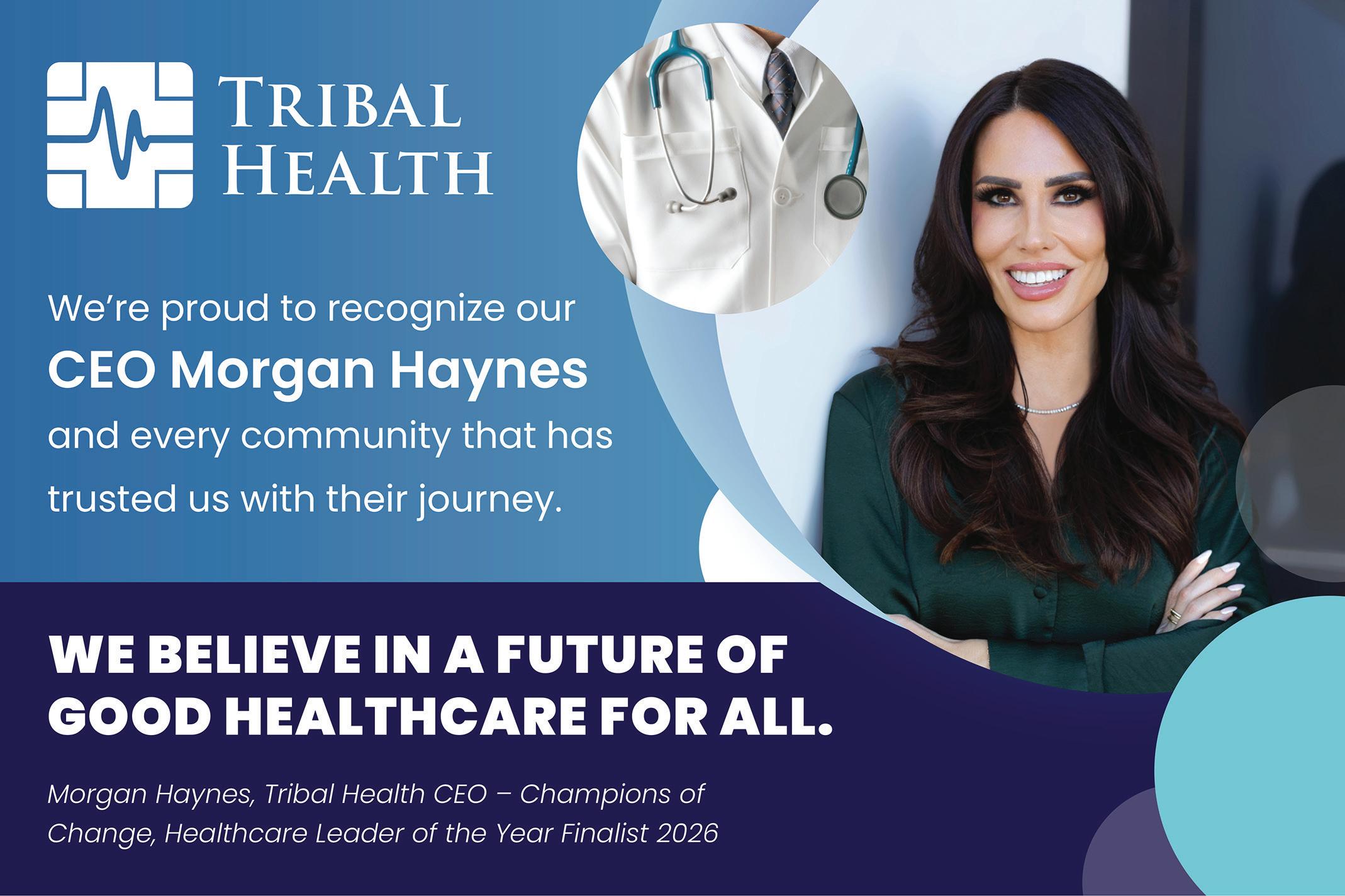
Aprio Legal is redefining modern legal services by blending strategic counsel with business-minded solutions. e firm’s innovative approach integrates legal, tax and advisory expertise, helping entrepreneurs and high-growth companies navigate complex challenges while accelerating expansion and long-term success across Arizona’s dynamic business landscape.
e Arizona Commerce Authority continues to position the state as a national hub for innovation and investment. rough strategic partnerships, industry recruitment and workforce initiatives, the ACA is driving record economic growth while attracting global leaders in semiconductors, advanced manufacturing, technology and clean energy.
Arizona State University’s Health Futures Initiative is transforming healthcare discovery by uniting researchers,
clinicians and technologists to tackle complex health challenges. By blending medicine, engineering and data science, the initiative is accelerating breakthroughs that improve patient outcomes and shape the future of health innovation.
Under artistic director Daniela Cardim, Ballet Arizona is embracing a bold new era of innovation, collaboration and artistic vision. By reshaping leadership culture, prioritizing sustainability and expanding community outreach, Cardim is redefining how a modern
ballet company operates while strengthening the organization’s creative impact across Arizona.
BioLab Holdings is emerging as a leader in regenerative medicine, developing advanced biologic therapies designed to accelerate healing and improve patient outcomes. rough scientific innovation and strategic partnerships, the company is helping expand Arizona’s reputation as a growing hub for biotechnology and medical advancement.
Caris Life Sciences is advancing precision medicine by using cutting-edge molecular science and data analytics to personalize cancer treatment. With major operations in Arizona, the company is helping transform oncology care by giving physicians deeper insights into each patient’s unique disease profile.
LGE Design Build is reshaping commercial development through an integrated design-build model that combines architecture and construction expertise under
one roof. Known for innovative projects and rapid delivery, the firm continues to drive transformative growth across Arizona’s industrial, retail and mixed-use landscape.
Paradox is revolutionizing talent acquisition with conversational AI technology that simplifies hiring for employers and candidates alike. By automating scheduling, screening and communication through its AI assistant Olivia, the Scottsdale-based company is helping organizations hire faster while redefining the future of recruiting.
PCS Forensic is redefining behavioral health and community safety in Arizona under the leadership of Dr. Brecken Blades. rough evidence-based forensic psychology, policy leadership and expanded clinical services, the woman-owned practice blends treatment, prevention and accountability—helping break cycles of abuse while advancing statewide standards for rehabilitation, public safety and behavioral change.
Solari Crisis & Human Services is transforming crisis response across Arizona by combining compassionate human connection with innovative behavioral health infrastructure. As the statewide provider for 988 and the Arizona Crisis Line, Solari delivers 24/7 support, dispatches mobile crisis teams and connects residents to essential resources that strengthen long-term stability.

Director of Facilities and Surveillance | Harrah’s Ak-Chin Casino
Congratulations to April, and all the “Champions of Change” who continue leading with passion and purpose, on being selected as finalists for the Champions of Change.
We’d like to recognize April’s many accomplishments from almost 25 years of blazing the trail as a selfless leader who thrives on helping others and by actively seeking opportunities to make a positive difference. April’s focus and strong sense of commitment towards service, stewardship and her community are truly inspirational!

























Ryan Abbott, president of the Southwest Region for Clayco, is redefining how large-scale infrastructure is delivered in Arizona. By integrating design, construction and technology-driven innovation, he has led more than $5 billion in projects while building a fast-growing team and fostering a culture of safety, collaboration and operational excellence across the region.








CONSTRUCTION KING: Ryan Abbott, president of the Southwest Region for Clayco, is driving innovation in Arizona’s construction industry by integrating design, technology and construction expertise to deliver complex projects faster, safer and more sustainably while leading billions of dollars in development across the region. (Az Business file photo)

Susan Anable is a forward-thinking communications leader helping shape innovation and community impact at Cox Communications. Known for aligning corporate strategy with community investment and stakeholder engagement, she drives initiatives that strengthen Arizona’s digital economy while expanding opportunities for connectivity, education and economic development across the state.


Tim Boothe, chief administration officer at Western Alliance Bank, led the bank’s ambitious Brand Unity initiative, unifying six banking divisions under one national brand. e complex transformation improved customer experience, strengthened digital infrastructure and aligned 3,700 employees behind a single strategy — demonstrating Boothe’s ability to execute innovation at scale.




As chief operating officer of Matthews Real Estate Investment Services, Duerk Brewer has built the operational engine behind one of the fastest-growing brokerage firms in the nation. From launching a Phoenixbased National Operations Center to developing leadership programs that cultivate talent, Brewer’s people-first strategy powers the firm’s national expansion.





Alec Clark, founder and president of Plexus Worldwide, has embedded philanthropy directly into the company’s business model. Through initiatives like Nourish One, Plexus contributes meals to families in need with every qualifying product sold, delivering millions of meals worldwide while demonstrating how business growth can drive measurable social impact.



Jody Sarchett is a respected leader at Marsh McLennan Agency, known for building trusted client relationships while advancing strategic risk management solutions. Her leadership reflects a commitment to innovation in employee benefits and insurance services, helping Arizona businesses navigate complex challenges while supporting sustainable growth.


INDUSTRY INNOVATOR: Jody Sarchett of Marsh McLennan Agency is a trusted leader in Arizona’s business community, helping organizations navigate complex risk, insurance and employee benefits strategies while building long-term partnerships that support sustainable growth and operational resilience. (Az Business file photo)

Barb Kozuh, executive director of the Delta Dental of Arizona Foundation, is advancing access to oral healthcare across the state. Through innovative partnerships with hospitals, universities and community organizations, she has directed more than $22 million in grants while championing medical-dental integration and programs that expand preventative care for underserved communities.







Joseph La Rue, president and CEO of Sun Health, is advancing a bold vision for healthy aging in Arizona. By expanding research, wellness programs and senior living communities, he is helping redefine longevity — focusing not just on lifespan but on healthspan, enabling older adults to live longer, healthier and more purposeful lives.




Daniel Stringer, founder of Total Care Connections, is elevating the standard of in-home care through technology, accountability and community engagement. By piloting AI-driven scheduling, expanding a workforce of more than 800 caregivers and supporting local nonprofits, Stringer is strengthening care delivery while ensuring families receive compassionate, dependable support.

Tawney, Harrah’s Ak-Chin

April Tawney, director of facilities and surveillance at Harrah’s Ak-Chin Casino, is redefining leadership in tribal gaming and hospitality. Overseeing a $50 million expansion and championing sustainability initiatives like Code Green, Tawney blends operational innovation with community engagement, helping position the property as a forward-thinking leader in Arizona’s entertainment industry.












INDUSTRY LEADER: Nasser Abujbarah is managing attorney at Phillips Law Group. (Az Business file photo)
Nasser Abujbarah, managing attorney at Phillips Law Group, exemplifies innovative legal leadership through a hands-on approach that blends courtroom strategy with collaborative team development. Rising through the firm’s ranks, he now leads complex litigation while mentoring attorneys, translating intricate legal theory into practical action and strengthening client advocacy across Arizona.

Daniela Cardim, artistic director of Ballet Arizona, is redefining how a modern ballet company operates. By fostering transparency, collaboration and sustainability while expanding community engagement, she is balancing artistic excellence with forward-thinking leadership, ensuring Ballet Arizona remains culturally relevant, creatively ambitious and deeply connected to audiences statewide.



Dale Cavan, founder of Cavan Commercial, is transforming industrial development through the company’s innovative neighborhood flex bay platform. By creating small-bay industrial spaces that blend warehouse, light manufacturing and storefront functionality, Cavan is helping small businesses grow while redefining how modern industrial projects integrate into mixed-use communities across Arizona.
Diana Gibson, director of client success at REDW Advisors & CPAs, exemplifies purposedriven innovation. After a life-changing accident, she founded The Diana Adapted Foundation while continuing to lead in the corporate arena. Her leadership blends resilience, relationshipbuilding and advocacy, inspiring individuals with limb differences while elevating the client experience across Arizona’s business community.
Mary Hagen, CEO of Colossal, is redefining modern philanthropy through bold, technology-driven fundraising models. Under her leadership, the Phoenix-based company has raised more than $200 million for charities while scaling rapidly and creating new jobs. Hagen’s vision proves Arizona can lead the nation in innovative, purpose-driven fundraising that amplifies charitable impact worldwide.
Jenna Ghisolfo, founder and president of Housing Consultants of America, is transforming the affordable housing landscape through mission-driven leadership rooted in lived experience. A former Section 8 resident and domestic violence survivor, she built a national consulting firm that helps housing providers ensure compliance while expanding access to safe, stable homes for families, veterans and vulnerable communities.









Nathan Hunnell is driving innovative healthcare solutions at CenterWell Pharmacy by helping lead a groundbreaking medication donation program that redirects unused prescriptions to patients in need. rough partnerships with Mission of Mercy Arizona and regulators, his work reduces medical waste while expanding access to lifesaving medications for vulnerable communities statewide.
Linus Malefors, co-founder and managing director of Coeus Consulting, is redefining how small and mid-sized businesses leverage technology. By delivering enterpriselevel cybersecurity, compliance guidance and cloud solutions through the innovative “Coeus Method,” he empowers Arizona companies to strengthen resilience, reduce risk and compete in an increasingly digital economy.
Leon Silver, founding partner of Silver Cain PLC, has built a boutique firm known for delivering sophisticated legal strategy with a practical, business-minded approach. rough mentorship, collaborative leadership and trusted counsel to entrepreneurs and companies, Silver is strengthening Arizona’s small-business ecosystem and demonstrating how thoughtful legal leadership drives long-term growth.
Kevin Walsh, a partner at Quarles, blends business law expertise with deep civic leadership. While advising companies on complex transactions, he champions education access through school board service and nonprofit leadership. His advocacy for programs supporting at-risk students reflects a commitment to strengthening Arizona’s future workforce and communities.






































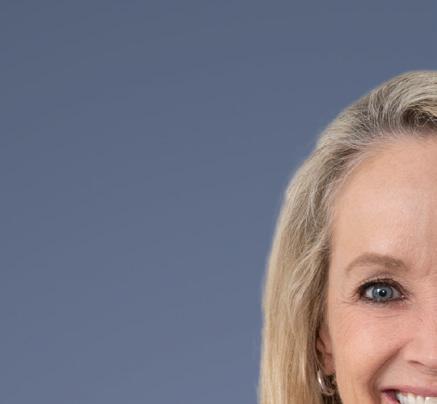



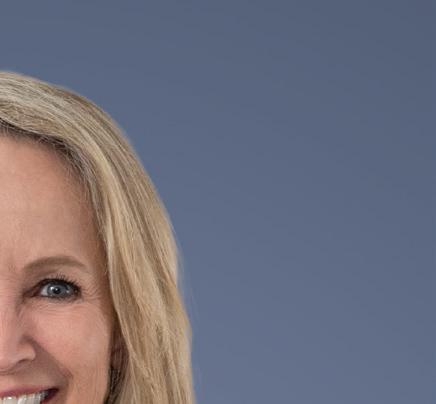




Cox Communications plays a vital role in powering Arizona’s digital economy, delivering reliable connectivity to homes and businesses statewide. Beyond infrastructure, Cox invests heavily in education, digital equity and workforce development, helping communities thrive in an increasingly connected world. Its blend of innovation, service and community engagement makes it a cornerstone of Arizona’s business landscape.



LEADER IN INNOVATION: Susan Anable of Cox Communications is a strategic leader who drives growth and innovation while strengthening community connections through a commitment to customer experience, workforce development and regional impact. (Az Business file photo)
Avnet stands as a cornerstone of Arizona’s technology economy, connecting global manufacturers with the components and solutions that power innovation. Headquartered in Phoenix, the company combines decades of expertise with forward-looking strategy, enabling advancements in semiconductors, IoT and AI. Its scale, adaptability and deep industry relationships continue to position Avnet as a global leader rooted in Arizona.
Axon Enterprise has transformed from a Taser manufacturer into one of Arizona’s most influential public safety technology companies. Based in Scottsdale, Axon leads in connected devices, cloud software and digital evidence management, helping law enforcement operate more transparently and effectively. Its innovation-driven culture continues to reshape public safety while fueling Arizona’s fast-growing tech ecosystem.
CHASSE Building Team has earned a reputation as one of Arizona’s most respected construction firms by combining craftsmanship with purpose-driven culture. Known for delivering high-quality education and communityfocused projects, CHASSE invests deeply in its people and partners. Its commitment to teamwork, philanthropy and long-term relationships has fueled steady growth and lasting impact across Arizona communities.
Desert Financial Credit Union has grown into one of Arizona’s most trusted financial institutions by putting members and communities first. Through a focus on financial wellness, education and personalized service, it empowers individuals and businesses to achieve their goals. Its strong community ties and purposedriven approach continue to fuel sustainable growth across the state.
National Bank of Arizona stands out for its deep local expertise and relationship-driven approach to banking. Focused exclusively on Arizona, the bank provides tailored financial solutions to businesses, entrepreneurs and communities. Its commitment to understanding local markets, combined with strong financial performance, has made it a trusted partner in Arizona’s economic growth.
RELATIONSHIP BUILDER: Mark Stebbings of National Bank of Arizona is a relationship-driven leader who champions local business growth by combining deep market insight with a commitment to personalized, community-focused banking. (Az Business file photo)
OneAZ Credit Union continues to expand its impact by combining financial strength with a strong commitment to community development. Serving members statewide, OneAZ focuses on financial education, small business support and local investment. Its memberfirst philosophy and growing footprint position it as a key player in advancing Arizona’s economic opportunity and financial well-being.
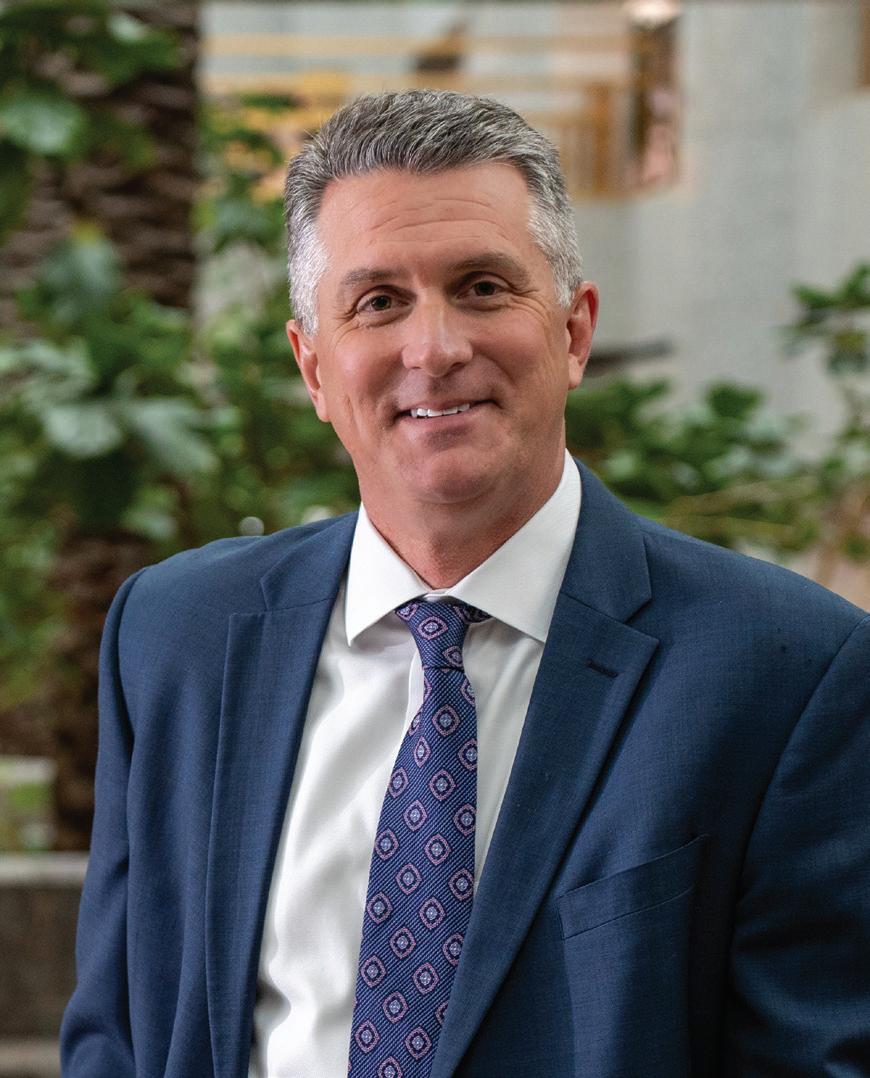
P.B. Bell has played a defining role in shaping Arizona’s multifamily housing landscape for decades. e Scottsdalebased company develops and manages communities designed to meet the needs of a growing population. With a focus on quality, innovation and resident experience, P.B. Bell continues to deliver housing solutions that support Arizona’s long-term growth.
Salt River Project is a cornerstone of Arizona’s infrastructure, delivering reliable water and power to millions while supporting economic growth statewide. Through innovation in energy, sustainability initiatives and community investment, SRP balances operational excellence with long-term stewardship. Its commitment to reliability and responsible growth makes it essential to Arizona’s future.
Western Alliance Bank, Arizona’s largest locally headquartered bank, proved itself a true Champion of Change in 2025 with the successful rollout of its “one bank, one brand” initiative. Uniting six divisions under a single identity, the effort engaged 3,700 employees, ensured seamless customer experiences and delivered measurable gains in performance, efficiency and brand clarity nationwide.