JANUARY 2026/armoneyandpolitics.com January 2026/armoneyandpolitics.com
INFLUENCERS OF THE YEAR
NLR TOURISM’S KAREN TREVINO, 2026 CLASS INSIDE: Manufacturing | Power Women | Long-Term Care
$10 $10 USD USD
Moving the earth since 1962
Site Excavation Services in Central Arkansas, North West Arkansas and Hot Springs Arkansas
Free Quotes Chris Meyer President/CEO 16800 West Baseline Rd. Little Rock, AR 72210 (501) 455-2439 info@jamesarogersexc.com
Family-Owned Fully Licensed and Insured Over 150 Years of Experience 3rd Generation Company Locally-Owned
ARKANSAS’ SOURCE FOR AGGREGATES AND EXCAVATING
Building Utility Solutions (501) 786-3113 noecutility.com NOEC Construction, LLC
McHenry Companies is a family owned and operated company. McHenry Aggregates has been in operation since 2006 and McHenry Excavating, Inc. since 1996.
994 Fox Pass Cutoff Hot Springs, AR 71901 (501) 321-4942 mchenryexcavating@cablelynx.com
Congratulations Chris Bates
for being named one of AMP ’s 2026 Influencers of the Year
Chris Bates, CEO
Are you tired of your current IT provider? As a preferred Managed Services Provider, we offer IT and cybersecurity services tailored for growing businesses that need reliable, proactive support. Let’s talk about how we can keep your technology working for you!
15 Shackleford Drive, Suite D, Little Rock PinnacleIT.com 501-907-7700
James A. Rogers, McHenry Meyer Companies and NOEC Construction welcome the opportunity to support statewide development efforts and contribute to the projects shaping Arkansas’ next generation of growth.
In 2026, James A. Rogers Excavating CEO Chris Meyer and his team are reaffirming their commitment to dig deep into Natural State communities, bringing workforce opportunities and contributing to the strong Arkansas economy of tomorrow. James A. Rogers has grown over the course of 60 years from a single operation to a statewide team with locations in central and northwest Arkansas. In 2024, the company expanded by acquiring McHenry Aggregates & McHenry Excavating in Hot Springs. The organizational talent lineup also includes NOEC Construction, a specialized division focused on drilling, underground utilities, power services, energy infrastructure reliability and more. A third-generation Arkansas-based company, James A. Rogers has continued to expand its industrial capacity, public-works investments and infrastructure modernization to ensure the company remains at the forefront not only in excavation but in supporting multidivision statewide development. Meyer and his team know the importance of workforce development in the state, boasting a continually growing workforce of more than 100 members. “We are building one of the most diverse, skilled and future-ready workforces in the state’s construction, excavation, power and utility sectors,” Meyer said.
Sponsored Content
James A. Rogers invests in Arkansans through: Partnerships with schools and workforce institutions Veteran-friendly employment Cross-division training Long-term stability and high-wage jobs Apprenticeship and training programs Skilled trade career pathways As the company continues to grow with additions such as McHenry and NOEC, it is able to hire even more Arkansas workers, train more skilled operators, support electric cooperatives, strengthen broadband and power infrastructure, deliver larger-scale projects, and, ultimately, help build stronger and more resilient communities across the state. “Workforce development is not a side initiative for us — it is a core mission,” Meyer said. “Every new project, every new division and every new investment strengthens Arkansas families, Arkansas communities and Arkansas’ economic future.” James A. Rogers’ dedication to improving both its industry and home state has not gone unnoticed among community stakeholders. The company has been continually recognized for its excellence in multiple areas, including as Best Arkansas Company, Best Construction Company, Best Excavation Company and Best Place to Work of 2025 as voted by readers of Arkansas Money & Politics.
CONGRATULATIONS, Larry Middleton For being honored as one of Arkansas Money & Politics 2026 Influencers of the Year, a recognition reserved for those whose influence inspires achievement, progress, and meaningful community impact statewide.
Larry Middleton Executive Vice President Stephens Capital Management
ASSET ALLOCATION • INVESTMENT MANAGEMENT MONEY MANAGEMENT CONSULTATION • RETIREMENT SERVICES
Stephens.com • 800-643-9691
STEPHENS INC. • MEMBER NYSE, SIPC
FEATURES JANUARY 2026
28 2026 PRIMER Gov. Sarah Huckabee Sanders sits down with Arkansas Money & Politics to discuss what Arkansans can expect from the coming year.
42
128
HUNGER IN THE BELLY
HOG HOOPS
Arkansas Foodbank picks up the pace as effects of government shutdown linger, pushing more families to the brink of food insecurity.
Coach Cal’s team has the potential to climb to the top of the SEC this season — as long as key players stay at the top of their game.
ARM O N E YA ND P O L I T I C S .COM
5
JA N UA RY 2026
January 2026 PRESIDENT & PUBLISHER
Heather Baker | hbaker@armoneyandpolitics.com
8 | Plugged In WHAT’S NEXT? 10 | Publisher’s Letter Turning the tide 12 | Discovery Economics State Dems work to push back against red wave. 13 | Viewpoint 110 | Arkansas Visionary INFLUENCERS 134 | The Digs of the Deal Notable folks 136 | The Last Word
48
52
BUSINESS SERVICES
14 IT tech
Information technology leaders discuss the latest trends in commercial IT solutions.
18 Staffing
Good help can be hard to find — but not if one knows where to look.
20 Accounting
Accountants work to add value to their services outside of tax season.
24 Exit strategies Whether for succession or a sale, planning ahead can be a good idea.
Arkansans prove themselves to be difference-makers in industry, hospitality and more.
SMALL BUSINESS Happy hatter crafts a living making unique, custom designs.
116 Soap savant Charlene Simon rose from unlikely beginnings to become toast of Bathhouse Row.
119 Growing brand Beyond Wellness establishes NWA presence with additional location.
122 Nuts and bolts
State’s business, tourism industries work to keep a good thing going.
exceptional foundation.
32 Maintaining momentum Fuller and Son builds on an 36 Live and work
Quality of life key to attracting economic development across Arkansas.
40 New landscape
Veteran educator unpacks the highs and lows of the LEARNS Act.
44
124 Condition critical Arkansas ag secretary discusses needs of state farmers.
SPORTS
JAN UA RY 2 026
EDITORIAL COORDINATOR Darlene Hebda | darlene@armoneyandpolitics.com COPY EDITOR Sarah DeClerk | sdeclerk@armoneyandpolitics.com STAFF WRITERS Doug Crise | dcrise@armoneyandpolitics.com Alex Hardgrave | ahardgrave@armoneyandpolitics.com Mary LeSieur | mlesieur@armoneyandpolitics.com MANAGING DIGITAL EDITOR Kellie McAnulty | kmcanulty@armoneyandpolitics.com ONLINE WRITER Kilee Hall | khall@armoneyandpolitics.com
GRAPHIC DESIGNERS Jerry Cordova | jcordova@armoneyandpolitics.com Lora Puls | lpuls@armoneyandpolitics.com Lee Smith | lsmith@armoneyandpolitics.com SENIOR ACCOUNT EXECUTIVE Greg Churan | gchuran@armoneyandpolitics.com Michelle Daugherty | michelle@armoneyandpolitics.com Mary Funderburg | mary@armoneyandpolitics.com Karen Holderfield | kholderfield@armoneyandpolitics.com Ryan Parker | ryan@armoneyandpolitics.com Carrie Sublett | carrie@armoneyandpolitics.com EXECUTIVE ASSISTANT Jessica Everson | jeverson@armoneyandpolitics.com ADVERTISING ASSISTANT Katie Beth Smith | ksmith@armoneyandpolitics.com PRODUCTION & AD OPERATIONS Jay Danzy | ads@armoneyandpolitics.com Lara Keck | ads@armoneyandpolitics.com
ADMINISTRATION Marissa Porter | ayoffice@armoneyandpolitics.com CEO | Vicki Vowell
TO ADVERTISE call 501-244-9700 email hbaker@armoneyandpolitics.com TO SUBSCRIBE armoneyandpolitics.com/subscribe CONTRIBUTORS
132 Love and pixels
Jane Colclasure, Jamie Lee, Lori Sparkman, Genevieve Townley
Arkansas health care industry looks ahead to an uncertain 2026.
Arkansas AG talks keeping the pressure on offenders.
ASSOCIATE EDITOR Mak Millard | mmillard@armoneyandpolitics.com
CIRCULATION circulation@armoneyandpolitics.com
AGRICULTURE
Compounding problems
46 Crime and punishment
SENIOR EDITOR Mark Carter | mcarter@armoneyandpolitics.com
PRODUCTION MANAGER Mike Bedgood | mbedgood@armoneyandpolitics.com
114 Blazing Breeze
WHAT’S NEXT?
EDITOR-IN-CHIEF Dwain Hebda | dwain@armoneyandpolitics.com
Nostalgia drives love of game design for Arkansas creator. 6
AMP magazine is published monthly, Volume VIII, Issue 8 AMP magazine (ISSN 2162-7754) is published monthly by AY Media Group, 910 W. Second St., Suite 200, Little Rock, AR 72201. Periodicals postage paid at Little Rock, AR, and additional mailing offices. Postmaster: Send address changes to AMP, 910 W. Second St., Suite 200, Little Rock, AR 72201. Subscription Inquiries: Subscription rate is $28 for one year (12 issues). Single issues are available upon request for $10. For subscriptions, inquiries or address changes, call 501-244-9700. The contents of AMP are copyrighted, and material contained herein may not be copied or reproduced in any manner without the written permission of the publisher. Articles in AMP should not be considered specific advice, as individual circumstances vary. Products and services advertised in the magazine are not necessarily endorsed by AMP. Please recycle this magazine.
ARM ON E YA N D P OL ITIC S.COM
PLUGGED IN JANUARY 2026/armoneyandpolitics.com January 2026/armoneyandpolitics.com
ON THE COV E R
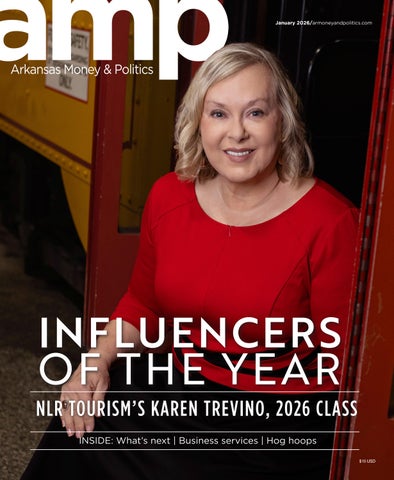
Meet North Little Rock Tourism’s Karen Trevino and other members of AMP’s 2026 “Influencers of the Year” starting on Page 52. Photo by Jamie Lee.
INFLUENCERS OF THE YEAR
NLR TOURISM’S KAREN TREVINO, 2026 CLASS INSIDE: Manufacturing | Power Women | Long-Term Care
$10 $10 USD USD
FEEDBACK A PLACE OF ABUNDANCE: COUPLE’S JOURNEY TO CREATE LIVE HEALTHY FARMS BRINGS TOGETHER WELLNESS-FOCUSED COMMUNITY Heather, John and I would like to personally thank you, Ryan, Michelle, and your entire team for creating such a beautifully captured and deeply authentic piece about our farm and home. We are truly blown away and so incredibly grateful. The piece captured the genuine essence of our intentions and the way we live our lives, and we could not have asked for a more honest or meaningful portrayal. We cannot thank you all enough. We know you didn’t have to do this as a for-profit organization, yet you chose to put faith in our story and give us a platform to shine. That generosity means more to us than we can express. We plan to frame this piece for our farm store. Thank you, thank you, thank you. John and Betty Ballard, Live Healthy Farms
Arkansas Children’s recently announced the largest philanthropic gift in its history, a $50 million contribution from philanthropist, entrepreneur and child-health advocate B. Thomas Golisano.
DIGS OF THE DEAL: LUM AND ABNER I appreciated the article about Lum & Abner and the Jot ‘em Down Store and Museum in Pine Ridge in your December issue of Arkansas Money & Politics. Chet Lauck, who played Lum, was my grandfather. I am amazed by the popularity that the Lum & Abner radio programs and the seven movies still have across the country. They had a great run for 25 years. And they are still on the air on about 20 radio stations in the United States. Please pass along my thanks to Sarah DeClerk for her good article. I am glad that she was able to connect with Donnie Pitchford of the National Lum & Abner Society for an interview. Scott Lauck, Hot Springs Derrick Smith has been named managing director of Little Rock’s Mitchell, Williams, Selig, Gates & Woodyard law firm.
2025 AMP TRAILBLAZING MEN: CHRIS MEYER Nice article. Proud to know you. David Meints
TOP ONLINE ARTICLES Dec. 8 — Jan. 5 1 Four Arkansas hospitals named to Forbes list 2 Fort Smith baseball ‘on pause’ as city slow-rolls stadium plans 3 Multifamily community going in next door to Walmart corporate campus 4 Levi Hospital, closed since August, to be demolished in spring 5 Goodwill opens new store in west Little Rock 6 2025 AMP Power Women 7 Companies announce joint venture to develop magnesium for defense in SW Arkansas 8 Arkansas Razorbacks Hockey Club is your favorite team you’ve never heard of 9 City of LR purchases building for new home of district courts 10 AMP Power Women 2025: Teach the Children Well, Mary Beth Hatch
CORRECTIONS Summit Utilities executive Vernon McNully’s name was misspelled in the December edition of AMP. We regret the error. JAN UA RY 2 026
8
Registered nurse Alex Woods has been named director of Physicians Specialty Hospital. Washington Regional took over operations of the Fayetteville facility on Dec. 1.
@AMPPOB ARM ON E YA N D P OL ITIC S.COM
WE SELL BUSINESSES.
Trusted by business owners for more than 30 years! Since 1994 the CBI Team has helped hundreds of business owners achieve their goals, utilizing a process based on the world-famous Mayo Clinic. Free, no-obligation business assessment to help determine market value and readiness for sale. Trained, professional business brokers who will meet you in person and assist you in exit planning. Confidential, because only pre-screened buyers who have been through the CBI Team Buyer Discovery session will know your business is for sale and NOT your competitors, customers, employees or vendors. 7825 Stagecoach Rd, Little Rock, AR 72204 (877) 582-5200 cbiteam.com CBITeamwesellbusinesses confidentialbusiness @cbiteam2874 N O R T H W E S T
A R K A N S A S
|
C E N T R A L
A R K A N S A S
|
M E M P H I S
|
T U L S A
FROM THE EDITOR’S DESK
W
By Mark Carter
2026, MEET YOUR AVATAR
orking for a media company pretty much ensures an inbox filled daily with press releases — press releases that seem to multiply like tribbles from Star Trek, pressers that tout startup launches, policy papers, ribbon cuttings — you name it. They arrive from everywhere from Cabot to Cambodia. For all we know, a presser from a guiltridden alien warlord warning us that the ATLAS comet is actually a Trojan horse sits unopened in someone’s inbox. Eventually, subject lines blur, but one recent tease caught my eye: “The First EUR1 Billion Theme Park Takes Shape Near Bucharest.” Turns out, it’s not Disney, Universal or Six Flags expanding to eastern Europe. Some apparently wealthy individuals in and around Romania are planning to open Dracula Land outside Bucharest, and construction is scheduled to begin in 2026. The project officially launched on Dec. 3 with a shindig — presumably in Bucharest — attended by what one could be forgiven for assuming was every cast member and extra from the John Wick franchise. Here is what entrepreneur Dragos Dobrescu is proposing to do on the roughly 400 acres of land he has acquired near the Bucharest airport: • A 780,000-square-meter (don’t ask me to try and exchange that into square feet) theme park with “six immersive zones,” including Transylvania, London Town and New Orleans, and more than 40 rides/attractions • A 22,500-seat arena that renderings depict as the love child of SoFi Stadium in LA and Tottenham Hotspur in London
• Three hotels, including the Dracula Grand, totaling 1,200 rooms • A 50,000-square-meter water park boasting one of Europe’s biggest wave pools • A luxury fashion outlet • A professional racing circuit track running for 4.5 kilometers • A 15,000-square-meter technology hub with more than 1,000 workstations for startups in gaming, artificial intelligence and digital creative industries • A metaverse-style AI platform enabling virtual visits • A digital ecosystem called DraculaCoin • And even something about “senior care” — oh, and lots and lots of parking 2026, meet your avatar. Its name is Dracula Land. Want to see more (or, better yet, invest)? Then head to draculaland.com. Will we ever see this amazing vision come to life? I don’t know, but one can hope. Ol’ Vlad (the real one, not the Bram Stoker invention) was either a psychopath or a Wallachian patriot-martyr — or both, depending on the storyteller — but he is a fascinating figure nonetheless, fictional or otherwise. And for what it’s worth, the Dobrescu venture appears to be infusing both historical and fictional elements of the count into the experience. We can see it now: Drop off Grandpa at the Daughters of Dracula buffet before dropping some serious DracCoin at the Fields of the Impaled attraction, where, presumably, shish kabob is served at the snack bar. No word yet, however, on whether Dracula Land will only be open at night.
PUBLISHER’S LETTER
W
By Heather Baker
BACK TO WORK Gov. Sarah Huckabee Sanders addresses her plans to advance her agenda in 2026, and we will also take a look at what is ahead in Arkansas for economic development, health care, education, social issues and more. Also inside, you will find our business services package with stories about information technology services, staffing, accounting and even succession planning for generational businesses. All this and more are waiting inside. Come join us as we continue our mission to shine a light on the positive stories that make Arkansas such a great place to live and work. As always, thank you for reading. Whatever you promised yourself this year, AY Media Group wants to see you accomplish it. Change is hard, but you’ve got this — stay focused, stay Heather Baker committed, and make 2026 your year!
elcome to 2026 and Arkansas Money & Politics! We made it through the holidays, and while the tinsel and the tree may stay up for some of us a while longer, the changing of the calendar tells us it is time to get back to work. The new year is a time of renewal, of taking stock of where we are in life, what we can improve and what we want to accomplish. It is a time of year where the air hangs heavy with possibilities and promise. AMP is here to help get the new year started off right. At AMP, January means influencers, as in our annual “Influencers of the Year.” Nominated by readers and selected by a panel of former honorees, our 2026 “Influencers of the Year” represent the best in Arkansas across multiple industries. Each January issue, we also look at what’s next for the coming year. Our annual sit-down with
JAN UA RY 2 026
10
ARM ON E YA N D P OL ITIC S.COM
Arkansas Money & Politics Daily Digest
– your essential e-blast, five days a week.
Get the latest on deals, leaders and trends shaping our state.
No fluff.
• Key political developments. • Breaking business news. • Every business day, get the pulse of Arkansas delivered straight to your inbox.
SUBSCRIBE TODAY
Visit
– it’s free and easy.
Just the insights you need to start your day informed and empowered.
Stay ahead in the Natural State with Arkansas Money & Politics Daily Digest.
Don’t miss what’s moving Arkansas.
armoneyandpolitics.com and sign up now.
DISCOVERY ECONOMICS
THE BIG BUSINESS OF FIGHTING THE WORLD’S TINIEST THREATS
M
By AMP Staff
odern medicine has dramatically improved quality of life. Advanced surgical procedures, implantable devices and targeted therapies have become routine, extending mobility, relieving pain and increasing life expectancy. Yet amid those breakthroughs lies a microscopic threat with outsized consequences: Staphylococcus aureus, a common bacterium that remains a leading cause of serious and sometimes fatal infections in health care settings. A key reason the pathogen has become so difficult — and costly — to manage is biofilm. Biofilms are microbial communities encased within thick, sticky matrices that allow bacteria to attach to tissues and medical devices, shielding them from antibiotics and the immune system. When S. aureus forms a biofilm, straightforward infections can become chronic, recurrent and expensive to treat. Patients often endure prolonged hospital stays, repeated surgeries, implant removal and long-term antibiotic therapy. All of those factors drive billions of dollars in health care costs each year. Biofilms are now understood to be involved in the majority of chronic and device-related infections, making them one of the most significant and underrecognized drivers of treatment failure and health care costs in modern medicine. Dr. Gyan Sahukhal at the University of Arkansas for Medical Sciences in Little Rock has spent his research career working to understand why the infections persist and how to stop them. “Clinically, we see the same pattern over and over,” Sahukhal said. “Antibiotics may temporarily reduce bacterial burden, but infections recur, wounds fail to heal, implanted devices must be removed, and patients undergo repeated procedures. Over time, it became clear to me that antibiotic resistance alone does not fully explain these outcomes.” Sahukhal and his team have developed a promising solution known as VB917, an anti-biofilm compound designed to interfere with the global regulatory systems S. aureus relies on to survive and persist in the human body. Rather than targeting a single bacterial function, VB917 disrupts two master regulatory proteins, MsaB and SarA, that control biofilm formation, virulence, stress responses, antibiotic tolerance and the development of persistent bacterial cells. “When these regulators are disrupted, the bacteria lose their ability to coordinate biofilm formation,” Sahukhal said. “Biofilms either fail to mature or become unstable, the protective matrix weakens, and stress response systems break down. This restores antibiotic susceptibility and limits bacterial persistence.” Importantly, VB917 is not designed to kill bacteria directly. Instead, it disarms them. “By shutting down these regulatory pathways, we weaken the biofilm structure, expose bacteria to immune clearance, and allow existing antibiotics to work again,” he said. “This approach treats infection while preserving the effectiveness of current antimicrobial therapies.” JAN UA RY 2 026
Rather than replacing existing antibiotics, VB917 is designed to restore their clinical effectiveness against biofilmassociated infections. By weakening biofilm defenses and sensitizing bacteria to treatment, the approach has the potential to improve outcomes with therapies clinicians already use while reducing the need for prolonged antibiotic courses, repeat surgeries, device removal, and other invasive and costly medical interventions. The potential implications are significant. Chronic wound infections, osteomyelitis and implant-associated infections affect hundreds of thousands of patients annually and cost the United States health care system billions of dollars. A therapy that reduces recurrence, limits surgical intervention and shortens treatment duration could substantially improve patient outcomes while lowering long-term health care costs. Another advantage of the approach is flexibility in how the therapy can be delivered. VB917 can be formulated for localized use such as topical treatments for wounds or incorporation into materials used in bone repair. Local delivery allows high concentrations at the site of infection while minimizing systemic exposure, which may facilitate faster clinical adoption and easier integration into existing surgical and wound care practices. That promise has led to the creation of a new Arkansas-based startup, VanGuard Biofilm. Founded by Sahukhal in collaboration with Dr. Mohamed Elasri and other UAMS colleagues, including Arkansas Research Alliance Academy member Dr. John Imig, the company was formed to translate laboratory discoveries into real-world therapies for patients with chronic biofilmassociated infections. For Sahukhal, entrepreneurship has become a natural extension of scientific discovery. “Commercialization is not about stepping away from science. It is about translating it,” he said. “Building the right team, listening to feedback and adapting your strategy are just as important as the original breakthrough.” He credited Arkansas’ innovation ecosystem with helping bridge that gap. Programs such as the Arkansas Commercialization Retreat, UAMS BioVentures, and the Arkansas Small Business and Technology Development Center provided critical exposure to entrepreneurship, regulatory strategy and market realities. Sahukhal’s work is supported in part by an Arkansas Research Alliance Impact Grant, which helps Arkansas researchers move promising ideas toward practical application. His journey illustrates how research conducted in Arkansas laboratories can generate new companies, attract investment and address global challenges while strengthening the state’s economy. To learn more about ARA Impact Grants and the Arkansas Research Alliance, visit aralliance.org. 12
ARM ON E YA N D P OL ITIC S.COM
VIEWPOINT
FIVE TAKEAWAYS FROM EXECUTIVE LEADERSHIP COACHING THAT CHANGED HOW I LEAD By Lane Gammel
E
how vision becomes culture, how priorities drive outcomes and how misalignment can quietly erode both. A leader can say all the right things about a mission, but if the calendar, meetings and measures of success are pulling in a different direction, people feel the gap. Understanding not just how to cast a vision but how to ensure daily actions support long-term strategy is critical. Alignment becomes an ongoing practice, not a one-time retreat or slide deck. 4. Lead through constant change with emotional intelligence. Change is not a choice; it is a constant. High-quality executive coachLane Gammel ing goes deeper than organizational charts and timelines. It tackles the emotional and relational intelligence required to navigate change in a healthy way. Effective frameworks for leading personal and organizational change are grounded in trust and transparency. Leaders benefit from assessing their own change response and seeing how their reactions either calm or amplify anxiety in others. Done well, change becomes an opportunity to build trust and resilience instead of a season of confusion and burnout. 5. Shape culture and steward people — without ignoring wellbeing. The most meaningful leadership work asks big questions. What truly matters? What will this leadership leave behind? Coaching helps connect core values to concrete goals and guiding principles that keep teams focused and grounded. Leaders need to identify how and what to prioritize, what to delegate and what to let go of. Leadership should be reframed not as managing tasks but as shaping culture and stewarding people. Taking care of yourself is not selfish; it is foundational to serving others well. When leaders are depleted, everyone feels it. When leaders are rooted in purpose, aligned in their actions and honest about their limits, they are better equipped to lead with clarity and care over the long haul. Wherever leaders find it, this kind of executive coaching is worth the investment not just for individual growth but for the organizations and communities they serve.
xecutive leadership programs often promise transformation, but few deliver with enough clarity and practical application to truly reshape how people think, work and lead. Executive leadership coaching at its best creates space to slow down, reflect and build healthier, more sustainable relationships. Those reflections come from a recent executive leadership coaching experience that provided both practical wisdom and the space to step back from the day-to-day. Good facilitators present with clarity and insight, not obscure dialogue that takes days or weeks to comprehend. Their approach challenges you to think differently about how you show up as a people-first, service-oriented leader and how important it is to take care of yourself so you can lead others well. That is what I experienced during a four-session executive leadership academy that connected me and other participants with executive leaders who model these behaviors in real time. You cannot put a value on being in the room with CEOs who were candid about both their successes and their struggles. Here are five key takeaways that continue to shape how I lead. 1. Start with purpose. Healthy leaders know where they are rooted, what drives them and where they are going. Coaching that begins with purpose forces you to pause and examine your foundation. A rooted leadership framework can help identify the motivations that push us forward both when things are going well and when we are in conflict. One of the biggest insights comes from recognizing our strengths but also how those same strengths can become overdone when we are under pressure. Sharing a clear personal “why” helps anchor decision-making. That simple practice can reduce burnout because it creates a steadier state of mind in the moments that matter most. 2. Integrate purpose with performance. It is one thing to talk about purpose. It is another to connect it directly to how you work. Effective coaching includes drafting leadership development plans that integrate purpose with performance — practical roadmaps that tie what matters most to the goals we set, the decisions we make and the way we lead our teams. Many leaders do not realize how much they need that until it is on paper in front of them. When purpose and performance are linked, leadership stops being an abstract ideal. It becomes a day-to-day filter for priorities, tradeoffs and commitments. 3. Align vision, priorities and daily actions. Alignment is an essential tool for leaders who want to turn vision into action. Healthy leaders communicate clearly and match their goals with the right priorities. Strong coaching explores
ARM O N E YA ND P O L I T I C S .COM
Lane Gammel is director of communications for Goodwill Industries of Arkansas.
13
JA N UA RY 2026
BUSINESS SERVICES
Staying Ahead IT companies face everything from broken machines to wrangling AI
By Doug Crise
S
uccessful information technology businesses do not just have to stay with the times; it is far more complicated than that. In reality, working in the IT industry means scrambling to get ahead of the times and making sure there is an answer for every sort of problem and threat that exists, all the while keeping an eye on what is — rapidly — coming in over the horizon. Imagine dumping a box of marbles on the floor then furiously trying to track the progress of every single marble. Welcome to the new world of IT. “I’d say the No. 1 thing has been being able to adapt,” said Austin Bates, sales manager at Arkansas-based Pinnacle IT. “When we were growing as a business during our growth phase, the main thing we focused on was fixing failed hard drives. Nowadays, everything’s up in the cloud. There’s a lot less breaking and fixing on the hardware side.” JAN UA RY 2 026
When it comes to business technology, something new seems to be emerging on a daily basis. Yet, conversely, the same people and the same companies that were rewiring hard drives in the old days are emerging as trusted leaders in a new-age field. Perhaps it is best to talk first about the foundations of the IT business. David Holzhauer, division president at Datamax, started with the company as an account executive in 1985, back when computers were large, cumbersome boxes and cybersecurity was defined as remembering to lock the door behind you when leaving the office for the day. Fast-forward to today, and concerns center on optimizing artificial intelligence while also keeping all eyes peeled on everchanging cyber threats. All of that is great, but it does not do much good if the office copier is not making copies. That is why, even while still keeping an eye on data, Datamax keeps a foot firmly planted on the hardware side of things. Keeping 14
ARM ON E YA N D P OL ITIC S.COM
“I’d say the No. 1 thing has been being able to adapt. When we were growing as a business during our growth phase, the main thing we focused on was fixing failed hard drives. Nowadays, everything’s up in the cloud. There’s a lot less breaking and fixing on the hardware side.” — Austin Bates, Pinnacle IT
Austin Bates
documents managed, phones humming and printers printing may not be the sexiest of IT services, but they remain vital to each and every business’s bottom line. “It’s super important in regard to the workflow and expenses that flow through a business,” Holzhauer said. “It is critical. Much like going to the doctor, our organization comes in and approaches it like a physician and diagnoses what the pain points are within an organization and how we might be able to plug in our technology to help them become more costeffective and efficient.” That takes knowledge, ever-evolving knowledge, because each and every busiARM O N E YA ND P O L I T I C S .COM
David Holzhauer
ness is unique with its IT needs. Sometimes data must be protected and workflows streamlined, and sometimes the printer needs to stop eating paper. “IT was a lot different in 1989,” said Ryan Flynn, CEO at Network Services Group. “It’s definitely evolved and grown. Probably the biggest part of our job is partnering with the companies that we work with, just with ways they can use technology like IT, artificial intelligence — things to help their company reach their goals. Then probably the next biggest thing that we’re doing is we’re really trying to coach people up on proper cybersecurity usage.” It is not a comforting thought, but the 15
Ryan Flynn
field of cybersecurity is in a period of hyperactive growth simply because scammers, hackers and predators continue to develop better sets of tools. The best IT companies do not just peddle security products; they enter into true partnerships with their clients, providing people, guidance, compliance training and plans to recover data in the event of a breach. All of that means a total commitment to training and professional development. Technicians have to be fluent in data, cloud storage, AI and more, and sales personnel have to speak knowledgeably enough to be able to answer a client’s questions on the spot. JA N UA RY 2026
BUSINESS SERVICES “I can’t stress it enough,” Bates said. “It’s all about getting your certifications, whether you’re in sales or tech. There’s hours and hours and hours that go into studying for these certifications on the sales or on the tech side. You have to make at least an 80 percent in most cases. You’ve got to have the knowledge there. On our sales team, we encourage them to work with our techs occasionally, to go on a ridealong, so to speak.” Given the state of modern business technology, IT businesses must be conversant in everything because seldom is one thing not connected to another. The best IT companies are called to a purpose higher than just showing up when something goes on the fritz. Instead, consultation plays an enormous role, technicians viewing a client’s business functions in full and then providing possible solutions. “We have to look at all aspects of that, from management to workflow optimization,” Holzhauer said. That has led some companies to offer an entire breadth of managed IT services. For a flat rate, businesses can consult
with an IT company and then “leave it to the professionals,” as one might say. Nowhere is that more important than in the exploding field of AI, a technology that manages to feel ubiquitous yet mysterious all at the same time. Nobody in the modern age can log on or turn on their televisions without hearing about AI, yet the ways and means of using the technology remain shrouded in mystery for many. The owner of a pet-grooming business, for example, probably knows quite a bit more about puppy shampoo than how to optimize AI. More than ever, that gap is being filled by IT services. Network Services Group, for instance, helps clients install and learn to operate Microsoft 365 Copilot, a tool that connects ChatGPT AI with traditional Microsoft apps such as Excel, Word and PowerPoint. Because there remains so much to be discovered when it comes to AI, having a gameplan to optimize the technology while also staying safe remains critically important. “AI is the buzzword of the last few years, right there with cybersecurity,” Bates said.
“The biggest thing that I see coming is just rapid adoption from the top down, and by top down, I mean from the government side all the way to the schools and your day-to-day businesses like law firms and health clinics. “The scariest part about it is the lack of controls that have been in place. A lot of people have acknowledged that it’s maybe too soon to pull the trigger on AI, but at the end of the day, we’re already there. Companies are already doing it, and they’re embracing it.” For any IT company, the end goal remains preserving and improving a client’s security, workflow and efficiency. All the things that go into that, every piece of technology and consultation, seem to add up more and more with each passing year. “I think the entire industry is changing dramatically,” Holzhauer said. “Everybody is obviously concerned about how much technology is going to replace people, but in our industry, we have to touch things to provide the services that we do. Luckily, we’re in that type of business.”
“I think the entire industry is changing dramatically. Everybody is obviously concerned about how much technology is going to replace people, but in our industry, we have to touch things to provide the services that we do. Luckily, we’re in that type of business.” — David Holzhauer, Datamax
JAN UA RY 2 026
16
ARM ON E YA N D P OL ITIC S.COM
Find Your Perfect Arkansas Home with Debbie Shamlin Today!
Discover Your Dream Home with Debbie Shamlin, Your Trusted Real Estate Expert in Turning Visions into Reality. Let's Find Your Perfect Place Today!
Contact Debbie: 501-615-5770 debbie@midsouthar.com @DebbieShamlinRealtor
Start Your Home Journey Now!
We advocate for the business matters that matter most
ARM O N E YA ND P O L I T I C S .COM
17
JA N UA RY 2026
BUSINESS SERVICES
Experts: Planning, strategy crucial when making staffing choices By Dwain Hebda
A
sk chief executives at successful companies about their operational secret weapons, and chances are nearly all of them will mention the importance of quality people in exceeding customer expectations and moving the firm’s goals forward. Yet of all the challenges that a business owner faces these days, arguably the most difficult is staffing. Not only has Arkansas stumbled through a period of extremely low unemployment, substantially reducing the labor pool, but finding the right mesh of skills, attitude and philosophical bent is as complicated as it ever was. Local staffing companies get that, which is why the best of them are busier than ever. Such firms lean on experience, instinct and behavioral science to service their clients, employing various approaches to matching the right person with the right company. One such firm, Flexion Point in Little Rock, specializes in fractional staffing, a tactic that deploys people with targeted expertise and skills without a long-term commitment. Fractional employees are typically assigned to work on a specific project but can also be retained for spot work over a longer period of time, similar to being on retainer. “We see a little of both [scenarios],” said Stuart McLendon, CEO. “A good example might be you’re a middle-market company, maybe $150, $200 million in revenue, and you’ve been purchased by private equity. Private equity is doing a roll up of you and two other manufacturing firms that are all complementary. They quickly realize, ‘Hey, we don’t really have anybody who has the bandwidth to integrate all three into one cohesive system, get everybody on the same platform, all of that.’ That’s a good example of where you need someone for six months, nine months to JAN UA RY 2 026
“I also think one of the biggest takeaways for this year is for companies to work on retention. Replacing an employee can be so much more expensive than just keeping someone, so retention continues to be really vital.” — Chris Chunn, Arkansas Talent Group
lend additional support to get over the hump. “With other situations, it may be a small business or a nonprofit or a city or some other entity that’s a stable organization that has a need but knows that it’s not enough for a full-time employee, just some help a couple times a month. Still others are facing a temporary situation, like the [chief financial officer] just left to take another job, and the CEO needs someone in right away to manage things while they move stuff around internally to cover that long term.” The fractional model borrows from several other staffing trends, most closely mimicking a freelancer or a temporary/seasonal worker. While not new, the approach has gained attention in the post-COVID-19-pandemic era and the rise of the gig economy. Companies such as Flexion not only ensure the capabilities and skill of the workers they deploy; they also act as a consultant to 18
ARM ON E YA N D P OL ITIC S.COM
the client business, analyzing current staffing levels and making suggestions that can improve efficiency and even reduce cost. “Usually within, say, 30 days of working with somebody, we’re going to have a pretty good understanding of what the job really looks like and what [the client company] needs, and we can offer our expert advice on how to staff it in a particular way,” McClendon said. “Maybe you need a full-time resource. Maybe you need a part-time resource to do Brad Hughes Chris Chunn 20 percent of what that person was doing Stuart McLendon before and then a full-time resource which costs less to do the rest. Those are different “I think people underestimate how long it can take to hire things that we try to come back to the table with to help our clisomeone, and so CEOs, CFOs and COOs have all got to plan ents understand that right labor mix to support what they need.” ahead to make sure they are all on the same page and strategizFor those looking to go the more traditional staffing route, ing intentionally with their HR teams,” Chunn said. “I also think things are loosening up somewhat in terms of talent available in one of the biggest takeaways for this year is for companies to work the market, but it can still be a tall order for companies to find on retention. Replacing an employee can be so much more exgood help. pensive than just keeping someone, so retention continues to be “[The labor pool] is a great question and one that I probably get really vital.” asked several times a week,” said Chris Chunn, co-founder of ArBrad Hughes, president of The Hughes Agency in North Little kansas Talent Group in Little Rock. “In the state of Arkansas, our Rock, echoed that sentiment, saying companies that think a little main niche is mainly accounting, finance and human resources, more creatively in regard to staffing often have better results and I would say those markets are still pretty tight. It’s way better attracting the help they need. than it was in 2020 to about 2022, the COVID-19 era, where every“Flexibility is the key to finding younger talent right now,” he thing was impossible, but the market’s still tight. said. “Sometimes the 8 to 5 just does not work for them, but that “The economy’s great, companies are still expanding and does not mean that they can’t bring something to the table. A lot of growing and creating new jobs, and we’re seeing a ton of privatecompanies are basically doing things they never used to do. Their equity-backed companies seeking highly qualified and selective philosophy is we know we need somebody, and the only way we new hires. It can still be really challenging to find the perfect can get them in the door is to catch them when they’re in college, talent in accounting and finance and HR right now.” so they let them come in over every single [semester] break. The current labor picture, according to the fundamental law of “It used to be that the only places you’d see that is in families, supply and demand, has made things a job seeker’s market. Chunn you know? If a couple owned the business, they would bring in said companies need to be prepared for what it takes to compete their niece and nephew and all their friends during the holidays for top talent, which is why Arkansas Talent Group spends a good or over the summer. Now you really are seeing that as a way to deal of time educating its clients about what constitutes table attract good talent in general for an organization.” stakes in the current environment. Hughes said even with the favorable job market, job seekers “Compensation’s still at the top of that list,” he said. “I also are still in competition for the best openings. Therefore, he and think we’re still in this world where flexibility is at the top of the his team spend as much time educating potential employees list, and that means a lot of different things to a lot of different about how to build a successful career as they do counseling people. [Employers] have pushed back on remote work so much client companies about building a good work environment. that a lot of people are going back into the office, but I think you “We 100 percent try to do that,” he said. “Don’t show up in pahave to be careful about how you do that. jamas. Research the company you’re working at and before you “We’ve found the winning ingredient is really hybrid, allowing go for an interview, drive by and look at it to see what the environsomebody to have one or two days where they get to work from ment is like. Once hired, do your best to fit in and be a part of the the house, especially if they’re a trusted person and they’re doing team. a great job. Companies need to really allow that for their top “I always think about that scene in Bull Durham when Kevin performers.” Costner is talking to the rookie pitcher, and he says something In addition, companies need to approach hiring strategically, like, ‘After you’ve been here for a while, then you can bring in your setting certain processes in place instead of merely reacting when color.’ That’s what we tell applicants all the time — get the job, a position opens up. Chunn also preached the value of retention, understand it, work hard, and then if it’s the place for you, then saying smart companies are doing everything reasonable to take you can start to show some individuality.” care of the workers already on board. ARM O N E YA ND P O L I T I C S .COM
19
JA N UA RY 2026
BUSINESS SERVICES
BY THE
BOOKS
Accountants help business owners understand their finances at tax time and year-round By Sarah DeClerk
S
avvy business owners know that an accountant can be their greatest asset come tax season, but fewer may be aware of the advantages an accountant offers outside of tax planning. Deron Hamilton, coowner of Denman, Hamilton & Associates in Little Rock, said his firm works to provide clients with a clear picture of their finances to help them manage and grow their businesses. “What I like to do is to empower business owners to be able to effectively evaluate their business so that they can make good decisions and they can create wealth and just overall build their legacy,” he said. “That’s what I’m about — building legacies for business owners.” Co-owner Neil Denman added that more firms are broadening their services as they seek to add value for business clients. “It’s not just about getting your taxes done,” he said. “What people really seem to miss out [on] is everything else that we’re capable of doing from a planning perspective, whether that’s helping to reduce a tax bill, evaluate a business decision or helping them through figuring out what’s important to the business and what their long-term strategies are.” Cassandra Forbes, owner of Forbes & Associates in Cabot, said accountants can help business owners avoid pitfalls that could derail their businesses. Comingling personal and business funds is the No. 1 mistake she JAN UA RY 2 026
Deron Hamilton
Neil Denman
20
sees small-business owners make, she said, but another common oversight is relying solely on bank statements when keeping track of finances. “We have to make sure that all monies in and out are accounted for. The credit cards have to be included. Otherwise, you’re going to leave money on the table,” she said. “You take all of the income and the expenses, do your magical math, but then you also have to factor in all of the assets that the company has. There are so many numbers that go together to paint the actual picture rather than just look at a bank account and say, ‘Oh, I have $15,000 here.’” Knowing the full story is important when it comes to making changes at the business, she added. “If you’re looking to sell a business, if you’re looking to acquire a business, if you need an injection of operating capital or a line of credit or equipment loans, you have to have those numbers,” she said. “No bank is going to give you a loan without having solid financials.” Melissa Cary, tax partner at Landmark CPAs, agreed that partnering with an accountant can help business owners make critical decisions about their businesses. For example, knowing the numbers can be key to deciding whether to open or close a location or whether it is prudent to hire more employees. “That’s where the consulting piece of our ARM ON E YA N D P OL ITIC S.COM
profession comes into play, and I feel like it’s the most valuable to business owners than just a bank reconciliation,” she said. “That stuff has to be done, too, tax returns have to be done, too, but when the CPA can help the business owner make decisions that lead to the profitability or the expansion or whatever goal they’re trying to achieve, whatever that looks like, that’s where the real value is.” That said, tax preparation is an important part of business ownership and one that is becoming increasingly complicated. The IRS is still dealing with lingering impacts from the COVID-19 pandemic on top of backups from the recent government shutdown, Cary said, and there has been a “roller coaster of changes” to tax laws since 2017. “I feel like it is important for people to rely on tax accountants to make sure that they are following the latest set of regulations and rules and getting the most benefit from them,” she said. “Because there are so many different rules, it’s hard to know them all, and that’s when relying on a CPA or tax accountant, someone to help you prepare your taxes, is really going to be beneficial, especially with the state of the IRS right now.” Waiting until tax season comes around to hire an accountant is one of the worst things a business owner can do, said Kelly Phillips, shareholder and leader of the tax department at Bell & Co. In fact, it is best to partner with ARM O N E YA ND P O L I T I C S .COM
What I like to do is to empower business owners to be able to effectively evaluate their business so that they can make good decisions and they can create wealth and just overall build their legacy. That’s what I’m about — building legacies for business owners. — Deron Hamilton, Denman, Hamilton & Associates
21
an accountant before the business has even formed. “If you wait until all of that is done and the financial person you are choosing is an afterthought, they come in at the end of the process, you’re setting yourself up to have a bunch of issues that they then have to clean up, which wastes your time and money because they’re having to go back and fix things,” she said. “It’s always a whole lot easier to bring in either your tax side or your assurance side on the front end to help you plan and establish where you’re going rather than have them try and clean up something in the end.” Talking with colleagues at professional organizations can help business owners find an accountant who meets their needs, she added. “You don’t always want to go with the person that says, ‘Yeah, I never owe any tax. I never have to pay anything,’” she said. “That is not necessarily the sign of a good accountant. You want to ask them a few questions about do they partner with you, are they available, do they have other people in the office who, if they are gone, can assist you in some way, and then meet with them, see their face.” Getting to know an accountant can be key to determining whether he or she is a good fit, Denman said. “I think in order to choose the right accountant, you’ve got to ask questions,” he added. “You’ve got to be willing to answer JA N UA RY 2026
BUSINESS SERVICES some questions. Not everybody’s the right fit. A lot of places are looking for somebody that is going to provide everything at the absolute lowest cost, and that’s not always the case. Sometimes paying a little bit more enables you to get these other services, but you’ve got to ask.” Barrett Belew, assurance partner at HoganTaylor and president of the Arkansas State Board of Public Accountancy, added that hiring an in-house accountant or working with a firm each have costs and benefits for business owners. “It’s hard for companies to find good accountants in today’s age, and so the company has to weigh the cost-benefit of trying to bring someone in-house or outsourcing that to a firm like ours,” he said. “One of the benefits of outsourcing it is that you’re getting all of the expertise and experience that a firm has versus just one person.” He added that business owners can check the state board’s website to ensure accountants are licensed and in good standing. Accountants are beginning to utilize artificial intelligence, he said, adding that it is important to mitigate potential risks to client data. Hamilton said new technology allows accountants to provide a better quality of service while allowing them to meet client needs more efficiently. “If you’re committed to using it, there’s a great opportunity there,” he said. “There’s efficiencies in software and technology that we’re using to become more efficient. We’re using AI to do things. We have some great tax planning tools that weren’t available not too long ago.” However, he and Denman added that accounting tools driven by artificial intelligence are no match for a personal relationship with an accountant. “I think it’s important that technology’s not the end all, be all of everything,” Denman said. “That’s why working in more of a partnership relationship with your accountant is very valuable because even with some of the advanced AI’s out there, it’s not always accurate, it doesn’t always give you what you’re asking for, and it’s not always interpreted and explained to you in a one-to-one manner that you might need.”
Cassandra Forbes
Melissa Cary
Kelly Phillips
Artificial intelligence has helped accounting firms accomplish more with smaller staffs, Cary said, adding that AI has also changed the role of entry-level employees, who now do more analytical work rather than data entry. “It’s almost changed their mindset and how they look at things from an analytic perspective really early on in their career, which I think has advanced our profession,” she said. “There’s just fewer of us. There’s more tax laws and more taxpayers and less CPAs than there has ever been, so we have that problem, as well, but AI is by far the biggest trend right now.” With an eye for bringing more professionals into the industry, Arkansas is in the process of changing its laws to allow an alternate path to becoming a certified public accountant, Belew said. Rather than taking extra courses to reach the 150 hours needed to sit for the exam, prospective accountants will be able to pursue licensure after earning a bachelor’s degree in accounting and completing two years of relevant experience. Arkansas was the first state to propose the change, he said, adding that other states have since enacted their own laws providing for the alternative pathway. “Now I think roughly half the states have already implemented this change, and all the states will follow,” he said. “We are proud to lead the way on this effort, and we’re also very proud that we have a supportive governor who sees the value in getting more people into accounting.” In addition, he said, the state board recently started the Arkansas Resident Initial Exam Support Program to help reimburse up-andcoming CPAs for the cost of their exams. He added that he supports efforts to integrate accounting into science, technology, engineering and mathematics programs to expose K-12 students to the profession. “There is no reason why we shouldn’t, one, for just the betterment of the student, be teaching them personal finance and teaching them basic accounting terminology and understanding at the high school level and making that mandatory through STEM,” he said. “That’s something that I think will become a fight in the future not just in Arkansas, but that’s a nationwide effort there.”
Barrett Belew
JAN UA RY 2 026
22
ARM ON E YA N D P OL ITIC S.COM
Dependability where it matters most: Denman, Hamilton & Associates CPAs With 48 years of combined experience and a reputation for responsiveness and client satisfaction, the firm takes a strategic and proactive approach to business advisory services, tax planning and cash-flow management.
Deron K. Hamilton
Neil Denman
310 Natural Resources Drive, Little Rock 501-312-9491 | dhacpa.com
SUBSCRIBE TO AMP Our mission is to provide the most relevant information in the world of business and politics. Go to armoneyandpolitics.com and click on the subscribe tab.
Only $30 a year! DECEMB
litics.com
eyandpo
4/armon
ER 202
Janu JAN UAR ary 2026 Y 2026 /armoney /armandp oneyandp olitics.com olitics.com
the
I NEFCLT T I U H C R A O F T HEEN C E R S YEAR x guiding Horn on atus Dave Vaneball to elite st Hogs bas
N LR TO U RI SM
’S KA RE N TR
EV IN O, 20 26
INSIDE: Ma nu | Energyfacturing | Powe r Women facturing $10 USD | Long-Te en | Manu rm
r Wom TOPINSIDE: Powe amp TEN
CELEBR
ATING 10
Arkansas
Money
Care
CL AS S
YEARS
& Politics
ARM O N E YA ND P O L I T I C S .COM
$10 $10 USD USD
23
JA N UA RY 2026
BUSINESS SERVICES
Strategies Whether succession planning or preparing to sell a business, thinking ahead is important By Sarah DeClerk
E
ven though he was in his 70s, longtime commercial real estate professional John Flake had not really considered what would happen at his company after he retired. “I was feeling so good, in such good health, we weren’t really thinking about it,” he said. That changed in February 2019, when he was diagnosed with constrictive pericarditis, a lifethreatening condition that affects the outer lining of the heart. He underwent open-heart surgery and spent 14 days in the intensive care unit. “It took me almost a year to recover,” he said. “Well, I made my mind up after that — I’ve got to get my daughter more involved in things because my wife had her own business and does her own things, so I needed Jessica to do it.” JAN UA RY 2 026
John Flake and Jessica Flake Dearnley (Photo by Lori Sparkman)
24
Jessica Flake Dearnley, his daughter, worked at the company, which was then called Flake & Kelley Commercial. A chartered financial analyst, chartered alternative investment analyst and certified public accountant with three master’s degrees who has worked in commercial real estate since 2006, Dearnley had the skills but no path to ownership. An existing buy-sell agreement penned long before Dearnley arrived at the business precluded her from taking her father’s position as owner, she said, so, in 2020, they decided to leave and form a new company with a long history — Flake & Co. Her father founded his company with the same name in 1979. “In commercial real estate, when ARM ON E YA N D P OL ITIC S.COM
you start out on your own, you have Cal McCastlain, partner at Wright nothing, so I literally started with Lindsey Jennings, said succession nothing,” Dearnley said. “I think planning — especially successful that’s what a lot of people don’t succession planning — is the excepunderstand is they think we’re a tion, not the rule. bigger company or that I have a “Think about the scenarios and predecessor company and I had all the factors that came together existing employees, but we are a to grow that successful business,” startup from the ground up.” he said. “The current factors and Although Flake said it is a good scenarios — market, technology, idea to start succession planning personnel — are going to be totally early rather than waiting until different, and so you’ve got to aca health scare forces the issue, cept the difference in what it took Dearney said she does not have an and what enabled the patriarch or exit strategy thought out yet. After matriarch to grow the business and all, she is still in startup mode. what’s to come, and do you have the “I do actually have a lot that I right parts there? Most often, quite should be planning,” she said, “but frankly, family businesses don’t have Pat, left, and Marshall Moon I still feel like we’re in the growth all the right parts to generate a suc(Photo by Jason Masters) stage of the graph.” cession plan, much less carry it out Succession planning is underway at to fruition.” Meridian Investment Advisors in Little Rock, where Marshall Whether the sole owner at a mom-and-pop is planning for Moon, son of managing principal Pat Moon, was made partner their golden years or a group of owners is preparing in case of last year. Pat said he has no plans to retire anytime soon, but he an owner’s exit, it is important to have a well-thought-out plan in is ready to focus on what he enjoys most — serving clients. writing, he said. It is also important to ensure the right person“There’s a lot of compliance required in the financial services nel are in place to keep the business going. industry, and that takes a lot of time,” he said. “Managing peoCal Rose, partner at Wright Lindsey Jennings, said businesses ple from day to day, that takes time … so I’m looking forward to left behind after an owner’s death can face uncertainty even if them having the opportunity to do those things and maybe me there is a child who is ready to take the reins, especially if other do less of it.” family members disagree about their fair share of the earnings. Marshall said the transition has been going smoothly thanks “You just really need to have an honest evaluation within the to his father’s forward-thinking leadership. family as to the players,” he said. “The parents should know “It’s common that something like this gets kicked down the their kids, and they should be able to hopefully navigate that, road until somebody’s hand is forced,” he said, “but I give Dad but you can’t ignore those things because you’re going to end up a lot of credit in kind of being proactive and pushing the issue with problems.” forward.” If selling the business proves to be the best option, it can be Pat added that he believes Marshall, who has worked at the helpful to hire a business broker. Business brokers help owners firm 10 years, will help make wealth management services accessible to younger generations. As the company works to add more partners who are in their 30s, providing a path to ownership can be a powerful recruiting tool, he added. “We’re viewing the succession plan as one that can entice really talented individuals, Marshall and others his age or younger, because people who come into a closely held business like this are people that understand the risk associated with owning your own business and also maybe the opportunities professionally and financially too,” he said. “It Cal McCastlain Cal Rose Stan Smith takes a different mindset.” ARM O N E YA ND P O L I T I C S .COM
25
JA N UA RY 2026
BUSINESS SERVICES determine what the business is worth, take the business to market, find the right buyer and negotiate the sale. “It’s an involved process,” said Casey Grimes, market area president at CBI Team. “I think some people don’t realize just how many moving parts there are with a business, and we do it confidentially when we take a business to market because we don’t want everybody finding out it’s for sale — vendors and competition and that sort of thing. We have to do it confidentially, which is a lot more involved than, say, putting a sign up in front of a house or putting it up on the [multiple listing service].” Shep Campbell, senior advisor at Merger & Acquisition in Little Rock, said confidentiality protects the operations at a business. Shep Campbell Casey Grimes “I think a big part of human nature is the fear of uncertainty, and if an employee or employees hear that the business is for sale, the first instinct may be, ‘Well, they’re going to fire us all. We’ve “If you have that one or more key customer that’s generating got to go find another job,’” he said. “That’s not the case at all. In the bulk of your business, is there a contract that supports that fact, part of what a buyer is buying business?,” McCastlain said. “Is the is that process that the employees contract assignable? Can it be termihave established, and so the confinated on short notice? In other words, “All it takes, really, is dential nature protects the integrity is that contract for that key customer of the business in that regard from still going to be in place posttransacmotivation on both sides. an operational standpoint.” tion? That key customer’s business is If the seller is ready to sell, Stan Smith, counsel at Wright going to be key to the valuation.” Lindsey Jennings, said a business’s Starting early can give sellers an they’ve got a good business, human capital can be an imporedge when it comes to the negotiating there’s probably going to be tant aspect of the sale. table, Rose said, so those considering “Keep key employees engaged,” selling their business in two or three a market for that business he said. “It can even be someone years should not wait two or three because, normally, buyers from the family that stays on unyears to get started. der an employment agreement or “You lose negotiating power, and are looking to either buy whatever and has the relationship you lose the ability to really go out and themselves a job, or they’re with that key customer or customtest the market and shop your business ers so that they’re comfortable to the broadest group of buyers poslooking to grow what they continuing with the new buyer besible,” he said. “My clients, especially already have.” cause they’ve got someone they’re sellers, who have just waited until the familiar with that’s going to still be very last second and have already, in — Casey Grimes, CBI Team their contact person and so on.” their head, mentally sold the business, Those who are selling a busibuyers and buyers’ attorneys will pick ness should be sure their finanup on that, and they will start dictating cials are in order, including the last terms, and you now don’t have a Plan B three years of tax returns, year-end profit and loss statements, because you’ve waited too long.” and balance sheets, Campbell said, adding that buyers should Although preparing to sell a business can be daunting, be sure to have a credit score of 650 or better and the past three Grimes said most businesses that are already in good shape have years of their personal financial documents, as well as financial a chance at finding a buyer. information for any businesses they already own. “If a business is making money, it has a proven track record of “You want to be able to present as clean of a picture of your making good cash flow, if it’s established, it’s probably a sellable business as possible,” Rose added. “I would say where I see a lot business if the owner is realistic about the purchase price,” he of people have footfalls or delays or issues, it’s where they don’t said. “All it takes, really, is motivation on both sides. If the seller have good financial statements and they don’t have consistent is ready to sell, they’ve got a good business, there’s probably gofinancial statements.” ing to be a market for that business because, normally, buyers Equally important is ensuring contracts and legal matters are are looking to either buy themselves a job, or they’re looking to handled well. grow what they already have.” JAN UA RY 2 026
26
ARM ON E YA N D P OL ITIC S.COM
Generations of Commercial Real Estate in Arkansas since 1932 Arkansas’ Women-Owned Commercial Real Estate Company
Jessica Flake Dearnley
John Flake
Charles Leon Flake “Popeye”
Pavilion in the Park 8201 Cantrell Rd #320, Little Rock (501) 503-0333 flakecompany.com | FlakeAndCo
CONGRATULATIONS
ALYSON COURTNEY FOR BEING NAMED AN AMP POWER WOMAN 2025 Alyson Courtney is the co-executive director of Stage 13 Foundation for the Performing Arts, a forward-thinking, nonprofit organization committed to innovation, education and broad community impact. We exist to evolve the theatrical experience, empower artists and collaborators, and deliver an education program unparalleled in scope and excellence. By investing in people and economic development, we drive an organization that is sustainable and that shapes the future of the performing arts in Arkansas and beyond.
501-725-0113 | 317 Main Street, North Little Rock | stage13.org stage13org people/Stage-13/61579843284911 ARM O N E YA ND P O L I T I C S .COM
27
JA N UA RY 2026
WHAT’S NEXT
2026
Primer
Gov. Sarah Huckabee Sanders shares a look ahead into new year’s agenda By Mark Carter | Photo by Jamie Lee
T
he new year will see Arkansas Gov. Sarah Huckabee Sanders embark on Year 3 as the state’s first female chief executive. Heading into the second half of her historic first term, Sanders plans to further advance an agenda that has included implementation of a school vouchers program, a continued focus on outdoor recreation as an economic driver, recruiting new global trading partners, building more prison beds and establishing a recidivism pilot program, addressing food insecurities, and more. Backed by a Republican supermajority in the Arkansas state legislature, Sanders was in lockstep with the 2025 general assembly. Lawmakers passed some signature Sanders legislation, including the Bell to Bell, No Cell bill banning personal electronic devices such as smartphones and smart watches in public schools; the Healthy Moms, Healthy Babies legislation improving access to maternity care; Arkansas ACCESS, a “higher education reform bill” designed to create stronger career pathways; legislation mandating free breakfasts for students in Arkansas public schools; and even legislation to bring bike lifts to the state’s downhill mountain bike trails. Arkansas Money & Politics sat down with the governor to talk about what is ahead in the new year, from tourism and food insecurity to crime and beyond.
Gov. Sarah Huckabee Sanders: It can be huge for that area. Not just the caverns, but the surrounding area is so beautiful — the creek and just the landscape in that whole area — and tourism is a big part of that region. Blanchard Springs had not been taken care of and run quite as well as it can be. With the resources available with it becoming a state park, it allows us to put more into it and elevate the experience. It gives us another thing to advertise and bring people into the state and get people from our own state to explore their own backyard. It’s a really unique experience that I think a lot of people will take advantage of. It will be an economic driver for that area. They got hit with the tornadoes all through that section of the state last year, so it can bring in additional revenue for the shops, restaurants and rental properties and things like that. It also just gives people something to look forward to and to be excited about after they’ve been through something really difficult. We worked closely with Sen. Missy Irvin and our federal delegation. Shea Lewis, [Arkansas State Parks director], has done a tremendous job, and it’s something that I’m really excited about and think will be a great kind of legacy project that we get to look back and say we got to be part of. AMP: Since you took office, Arkansas has solidified itself as the mountain bike capital of the U.S., if not the world. What’s the potential economic impact there? Sanders: When you think about what that area and region was even 10, 20 years ago, mountain biking wouldn’t be the first thing you think of — not at all — but we now have some world-class mountain biking not just there but in several areas around the
Arkansas Money & Politics: Recently, you announced that the iconic Blanchard Springs Caverns in Fifty-Six would become the state’s 52nd state park. Talk about your plans to continue the emphasis on outdoor recreation as an economic driver.
ARM O N E YA ND P O L I T I C S .COM
29
JA N UA RY 2026
WHAT’S NEXT state. It’s driving a lot of tourism. I mean, just last year alone, we welcomed more than 50 million visitors to the state of Arkansas. We’ve seen a 17 percent increase in our tourism industry, and it has about a $10 billion impact on the state, so that is a huge driver. What I think is really unique about the mountain biking side of tourism is the places that we’re competing with, like Colorado, Wyoming, Montana. What makes Arkansas unique is that it’s something you can do year-round because our climate is as temperate as it is. You can go out not quite but almost 365 days a year and you can ride in Arkansas. So that gives us the ability to really market beyond a lot of the people that we’re competing with in that space. That’s really unique, and the Walton family has been great about developing key parts of Bentonville but specifically the trail systems. They’ve done a really tremendous job, and with the bike lifts going in at Mena and Bella Vista, it’s just a really cool and unique element. The same thing you would find in a ski town, you can now do in Mena, Arkansas.
Medicaid but make sure that, long term, we’re not trapping them in a lifetime of poverty? That’s not what those programs were set up for. They’re supposed to help people get back on their feet and help them navigate the system so that they are no longer dependent on government assistance, so we’re doing that through some of these reform projects. I think one of the biggest initiatives that we launched this past year that we will see and have a lot more work on in the coming years is the 10:33 Initiative, [a faith-based program aimed at lifting Arkansans out of poverty]. It’s something that really provides that wraparound service. You know, people don’t come to us in pieces, so we shouldn’t expect that they’re going to function in this bifurcated system that we’ve created. It will help people have a one-stop shop, a case manager and a community advocate who can put all those pieces together. Usually, when people show up needing food stamps, that’s not the only thing they need. A lot of times, they need housing or transportation or a job or education or even something as basic as the right documents to get those things, like a driver’s license or a Social Security card. This helps put things into a much easier system to navigate and having one point of contact to simplify that process and help bring all of these services together. So often, you have people in the faith community and in community organizations who are already doing these things, but those who need their assistance don’t know they exist. We’re helping bring all that together. I think it’s going to make a really, really big difference and hopefully help us move a lot of people from being dependent on the government to standing on their own two feet.
AMP: “Conservative welfare reform” — such as the Medicaid work requirement — has been a big part of your approach to government. What can we expect from that in 2026? Sanders: A lot of the big pushes are still in process. Obviously, we have the Medicaid work requirement that we’re working closely with the Trump administration to see that move forward and implement. We were one of the first states to put that forward and work to reform the food stamp program and remove soft drinks and junk food from that program. We’re really trying to incentivize people to purchase healthier products and more nutritious food. It’s kind of crazy when you think about the fact that in the very same building in state government, we are giving out money to go purchase junk food, and then on the back end, we’re paying for the health care costs and side effects from really unhealthy lifestyles. Those things happen within a hundred feet of each other — we’re setting ourselves up for failure. Also, how do we continue to help the people who really need
AMP: Can this emphasis help those Arkansas dealing with food insecurity in the middle of food deserts? Sanders: This is one of my passion areas. Frankly, Arkansas has traditionally not done a great job when it comes to dealing with food insecurity. So many who need it are so close to where the food is being grown but don’t have access. We’ve made free breakfasts available to every single student in the state and started summer [electronic benefits transfer] programs. We’re partnering with our agriculture community and our schools, and we’re doing a couple different pilot programs. One that I think is kind of fun is called the Arkansas Plate, where schools are partnering with the Department of Agriculture and Department of Education and eating Arkansas products. They’re learning about how [food is] grown. Not only are they getting a greater appreciation for what’s here in our state, but hopefully for some of them, maybe it helps create a passion to go into agriculture. It’s still our No. 1 industry. We need that next generation of kids to step into these roles. We absolutely do. Also, I think there are a lot of smaller projects that could have a bigger long-term impact as they go into further implementation this year. AMP: Speaking of Arkansas agriculture, you’ve worked to expand the state’s network of global trading partners. How can the almost $6 billion memorandum of understanding signed with Taiwan help struggling Arkansas farmers in the new year?
Gov. Sarah Huckabee Sanders speaks during the groundbreaking of the Google data center in West Memphis. (Photo provided)
JAN UA RY 2 026
30
ARM ON E YA N D P OL ITIC S.COM
Sanders is joined by four former Arkansas governors to celebrate the 75th anniversary of the Arkansas Governor’s Mansion in Little Rock. (Photos provided)
ernment is public safety. While we have made tremendous strides and made big progress by passing the Protect [Arkansas] Act putting more state troopers back out in communities across Arkansas, we were at one of our state’s lows in terms of number of troopers that we had out on the road, and we’ve had a huge increase. We added a second troop school. We passed a plan allowing us to pay our state troopers more, which helps us recruit and bring more people in, but part of it is we just also recognized the work that they’re doing. We saw this kind of leftist push to demonize police officers around the country, and in Arkansas, we said, ‘We’re not going to do that.’ Not only are we not going to allow that type of thought to sink into our culture, but we’re going to go the opposite way. We’re going to recognize our law enforcement officers for the great work that they do by paying them more, adding that second troop school, providing more for equipment at our law enforcement divisions around the state and really just supporting them in every way that we could. So, that’s one piece of it. Then the other part is when they actually do their jobs and they arrest people, we need some place to put our criminals. Where are they going to go? So we’ve already expanded capacity and existing space by about 1,500 people. The bad part is we need a lot more space. We’ve been woefully behind, and this problem has been ignored for several decades. The last time we built a prison in Arkansas, my dad was governor, and we’ve kicked the can down the road for too long. There’s not a person in the legislature or in law enforcement who won’t tell you we need that. It’s not one of the most fun parts, but it is one of the most necessary parts of doing this job. When people break the law, they get a consequence. It’s the same thing as a parent. Whether you have a 3-year-old, a 13-yearold or a 93-year-old, if somebody breaks rules, they should know that there is a consequence that comes with it, and we want to see that happen here in the state. We have 176,000 unserved warrants because we simply don’t have a place to put them even if we were to go after and arrest them, so building a new prison, opening up capacity, whatever that looks like, that’s something that we’re going to keep front of mind. As we move into this new year, our job is to provide a greater sense of safety, and we can’t do that if we don’t have the space to put people.
Sanders: It opens up a lot of opportunity. We’ve traveled around the state, talking to our farmers and our ranchers, and the biggest thing that helps bolster them, they said — one of their biggest asks — was more federal aid. Thankfully, the president announced the $12 million at the end of the year. A lot of our row crop farmers will be direct recipients of that. The other big thing is that we have to open up new markets. We can’t continue to rely on the same trading partners that we’ve always had. They’re not buying as much. China has broken the system, so how do we open up and develop new long-term partnerships with other countries? [The Taiwan MOU] is, I think, a huge opportunity and something that I hope is the first of many different, new trading deals that will take place that will directly benefit the Arkansas ag community. AMP: How important was it for you to revisit the state’s grocery tax? Sanders: The grocery tax is one of the state’s most regressive taxes. Following the Biden administration, when the cost of food is up so high, we already have trouble with food insecurity in the state. How do we provide even just a little bit of relief for the average Arkansas family? Something everybody needs, something everyone is going to purchase, removing that tax helps put just a little bit more money back in people’s pockets so that they can put more food on their table. That’s a big difference maker for a lot of Arkansas families and is something I’m glad goes into effect this year. AMP: The state has long faced a shortage of prison beds, and the planned 3,000-bed facility in Franklin County has drawn opposition. You also launched a recidivism pilot program aimed at lowering the number or repeat offenders. How do you navigate this potential mine field? Sanders: One of the biggest responsibilities that we have in govARM O N E YA ND P O L I T I C S .COM
31
JA N UA RY 2026
WHAT’S NEXT
Photo by CBMO Creative
Maintaining Momentum Arkansas’ business, tourism communities look to stay on a roll
By Dwain Hebda
B
usiness leaders from one end of the spectrum to the other are praising 2025 as a banner year for Arkansas business, and many are also looking ahead to an equally prosperous 2026. “I’d give [Arkansas] business and industry probably an A-minus and the state’s overall economy probably a B-plus only because of weak spots in agriculture,” said Randy Zook, president and CEO of the Arkansas State Chamber of Commerce/Associated Industries of Arkansas. “Everything else is hitting.” Zook’s enthusiasm was articulated by a flurry of announcements last year as businesses both native to Arkansas and imported from across the country and around the world sought to establish or expand presence in the Natural State. Statistics provided by the Arkansas Randy Zook Economic Development Commission
JAN UA RY 2 026
32
show the list of building project announcements, 24 in all, surpass about $6 billion in investment and is expected to create more than 3,000 new jobs, as well as preserve hundreds more, as companies choose to stay in the state. Two of the announced projects eclipsed the $1 billion mark, including the Green Bay Packaging project in Morrilton ($1 billion) and the Google data center in West Memphis ($4 billion). As if that were not enough to celebrate, 10 additional projects either broke ground or held their grand openings last year. Those projects totaled roughly $2 billion in investment and are expected to create at least 1,000 new jobs. Zook said two factors have contributed to Arkansas suddenly being a hot address for companies large and small, foreign and domestic. “No. 1 is we’ve been discovered as a great crossroads for distribution and transportation of all kinds — rail, highway, river transportation. We’re the beneficiary of that as a starting point,” he said. “Secondly, you’ve got great policy that has been put in place across the last 15 to 17 years or so. ARM ON E YA N D P OL ITIC S.COM
We’re much more competitive with our income tax structure for individuals, as well as corporations. We’re a lowcost place to operate a business or to raise a family. “You’ve got all those factors, and you couple that with the stupid things going on in other parts of the country that are moving people out from the West Coast and the East Coast. They’re just determined to undermine themselves, and we’re benefiting from some of that.” The investment has had a domino effect that cuts across company size and type of industry, further underscoring the state’s strength in fundamental business measurements. It is not just an empty marketing pitch, Zook is quick to note, but a growing consensus opinion within the wider business community nationally. “David Burritt, CEO of U.S. Steel, one of the world’s largest steel producers, says the place to be for the steel business is Arkansas now that Mississippi County is the No. 1 steel-producing county in the U.S. That is a remarkable statement and a statement of fact,” Zook said. “Now we’ve got some of these data centers looking at us and poking around, and we’ll probably land a couple or three of them. “We’ve still got gas resources sitting up there, waiting on a reasonable price for gas to resume. You’ve got the lithium industry that could really be something in south Arkansas as the demand improves and pricing improves. They’re just waiting on the right number. Add all that up on top of a world-class agricultural sector and a worldclass forest product sector and the fact that Arkansas is rich in resources.” Clint O’Neal, AEDC executive director, also credited lawmakers for the number of new projects and for having bought into a vision that is now coming to fruition all over Arkansas. “As far as major wins in 2025, I’ll start with the 2025 legislative session. I would say it’s been the most successful legislative session in 20, 25 years,” he said. “It was really a priority of ours prior to the session to put together an incentives working group. We had economic development professionals and community leaders from around the state meeting several times, thinking through our economic development toolbox. Are we competitive as a state? Do we need to benchmark and study other states? Are there incentive programs or financial assistance programs that we could recommend to the legislature? “We put together what we call IMPACT, Improving Markets, Promoting Arkansas Commerce and Trade, which is basically an umbrella for several incentive programs, and it was very successful. For example, we passed data center legislation here in Arkansas in 2023 that was amended in a very favorable way in 2025. We have a lithium incentive where we wanted to make a strong statement to those considering large lithium extraction and processing projects.” O’Neal said the discussions also took into account the needs of businesses already operating in Arkansas and ARM O N E YA ND P O L I T I C S .COM
looked at how to provide financial perks that allow them to grow and prosper in place. “As a group, we said we have great incentives, but we need more. We need to do more for existing Arkansas companies that have been loyal to the state,” he said. “Maybe they have a multistate footprint and they’re thinking of making a major expansion. How do we incentivize those companies to make those investments here rather than somewhere else?” In addition to the usual retinue of tax breaks and incentives, AEDC looked at other practical elements for upping the state’s desirability for business and industry. Such improvements were not always complicated to see, such as providing more shovel-ready building sites, but all took coordinated effort at the local, county and Clint O’Neal state levels to pull off. “We noticed that we’re behind other states when it comes to site development,” O’Neal said. “There are fairly sizable industrial projects that come along where the properties owned by the city or by the economic development organization are covered in trees or need infrastructure improvements. There are other states that have invested a whole lot of money to strengthen industrial sites to prepare the way for development. “We got our start in site development in 2023, at the beginning of the Sanders administration. The governor’s office was in favor of this, and we had $10 million in that first year as kind of a pilot program. In the ‘25 session, the legislature passed $50 million, $25 million per year for the next two fiscal years, and this has really accelerated the process around the state.” Economic success has also been seen in the interrelated areas of tourism and hospitality in Arkansas. That is reflected both in number of visitors and funds generated via various surcharges related to certain tourism-related items such as marine craft rentals and short-term lodging up to and including Airbnb and Vrbo properties. Those surcharges, referred to as the 2 percent tourism tax, totaled $26.2 million for fiscal year 2025, a hair off the $26.3 million record set in FY 2024. As for visitors, Arkansas Tourism Division Director Dalaney Thomas said 52 million people had some type of travel experience in Arkansas in calendar year 2024, including both native-originating and out-of-state guests traveling for business or leisure. That was a 4 percent increase over 2023 and resulted in tourism spending of $10.3 billion. While calendar year 2025 numbers had yet to be finalized at press time, she said numbers were tracking similarly. For that, she pointed to several factors. “There’s a couple of things that I think play a part in that,” she said. “One, nothing really positive came out of 33
JA N UA RY 2026
WHAT’S NEXT COVID-19 except for outdoor recreation becoming something people sought out, and that really put Arkansas on not only a national stage but a global stage in terms of what we offer. I think we’ve continued to see some of that momentum based on the outdoor rec product. “Then we have continued to see — and this has been a strategic push of ours — how Arkansas has become a year-round destination. I’ve had the great pleasure of working alongside Dalaney Thomas the state office for about 10 years, and we used to really focus on the spring, summer and the fall. That was the sweet spot from an advertising perspective. As we’ve been able to grow our advertising impact, we’re now talking about Arkansas year-round and how, typically speaking, November and December can be milder, especially when compared to other states where we want to be competitive. I think that year-round piece is playing a really integral role in our success, as well.” Alicia Payseno One way travel and tourism has benefited from the state’s business growth overall is in how people who visit the state on work trips are very often so impressed they return for vacationing. “Business travel is a significant part of Arkansas’ success in the tourism space with the many corporate companies that are based here,” Thomas said. “A lot of our local destination offices are actively bidding on events and conferences and conventions to bring people to the state, and that’s one way to introduce people to Arkansas who otherwise may not have chosen to travel here on their own. “We’ve been working alongside cities and other organizations as partners to attract those events and conferences. We saw a couple of great successes last year with other state agencies that have hosted events, including national events.” With the increased influx of visitors comes the need for more attractions and infrastructure, something Thomas said the department is helping to develop in partnership with other divisions of the Arkansas Department of Parks, Heritage and Tourism. “We’ve seen some gaps, and there are some important developments that are happening to address them,” she said. “Certainly, cycling in this state has been a push, but one thing that has always been lacking in the cycling scene in Arkansas has been enough elevation for a mountain biker to have a big drop or a really significant elevation change. That’s been identified, and we have some really major projects on the horizon in Bella Vista to address that.” JAN UA RY 2 026
One project, a trails bike park currently under construction, will create spaces for people to develop their skills on up to a lift-served access for the most advanced riders. “A lift, kind of like a ski lift, will carry you up with your bike, and you’re able to ride down and really have that elevation change that a more experienced cyclist would want,” Thomas said. “At Queen Wilhelmina State Park, another cycling park is beginning to be developed, and when it’s completed, which we’re a few years out from that, it will be the world’s largest liftserved trail built specifically for mountain biking.” The state’s hospitality industry is also looking to capitalize on the additional visitors and new and expanded corporate citizen population. Alicia Payseno, who recently took over as chief operating officer at the Arkansas Hospitality Association, said collaboration is the watchword for 2026. She said in her previous roles as director of economic development for the city of Cabot and head of the Maumelle Area Chamber of Commerce, she has seen the impact such partnerships can have on helping smaller communities develop a whole host of amenities. “In Cabot, one of the main focuses that our administration had was in the recruitment of retail, restaurants, recreation and lodging,” she said. “I’ve spent the past five years working with national brands to recruit them not just to the city of Cabot but to Arkansas. I worked with a lot of regional organizations where we were going after the Marriotts, the Hiltons and even larger brands. “I understand the challenges that you have as a city trying to plan a restaurant or a hotel, but I’ve also seen the benefits and the tax impact that it gives back to that area. One of the major things that we’re going to be working on [via the Hospitality Association] is establishing a unified and thriving hospitality network so that as these hurdles present themselves, we are able to leverage not just a small region of the state but actually be able to leverage the entire state collaboratively.” Payseno said she looks forward to the chance to work with state lawmakers in support of bills that would make more money available statewide for incentivizing development in the restaurant, lodging and tourism space. “Other surrounding states, like Oklahoma, Louisiana and Texas, offer substantial incentives for the recruitment of those industries,” she said. “Currently, we don’t have that tool in our toolbox.” She is also eager to dig into the issues that impact the state regionally to better craft targeted solutions for addressing development and promotion challenges within the hospitality industry. “We are going to take a very collaborative approach to every initiative that comes through the legislature not just for central Arkansas but in northwest Arkansas, northeast Arkansas, the Delta,” she said. “What might be a big challenge in one part of the state may not even be understood in another. I want to make sure that we’re communicating, listening and advocating for all of our members across the state.” 34
ARM ON E YA N D P OL ITIC S.COM
WHAT’S NEXT
Steady as She Goes VC investment in Arkansas stable and NWA-centric, UA report reveals
V
By AMP Staff
enture capital investment in Arkansas startups remained steady in 2024, according to the latest Arkansas Capital Scan, released in December. As expected, most of that activity originated in northwest Arkansas. The report highlights continued concentration of investment activity in northwest Arkansas and outlines opportunities to strengthen funding for young companies and new business formation across the state. The 2024 data, the latest available, reflects a mixed but resilient landscape. Early equity rounds declined meaningfully, yet founders advanced by drawing on a broader mix of funding sources. Arkansas sustained a four-year pattern of steady venture activity, raising nearly $260 million across 18 deals. Northwest Arkansas captured 92 percent of that investment, reflecting strong confidence in the region’s high-growth sectors, according to the report. Now in its fifth year, the Capital Scan tracks financial resources directed to Arkansas startup companies. Developed in partnership with the University of Arkansas Office of Entrepreneurship and Innovation, a division of the Sam M. Walton College of Business, with support from the Walton Family Foundation the report covers angel and venture investment, crowdfunding and nondilutive federal grants. Additional key findings include: • Crowdfunding increased 37 percent, reaching founders in seven regions. • Nondilutive federal grants rose 15 percent to $16.9 million. • Angel and seed investments totaled just less than $8 million, marking a meaningful decline from 2023. The decline in angel and seed investments underscores an opportunity to strengthen the front end of Arkansas’ startup pipeline. That insight has guided recent efforts to expand support for emerging companies across the state. In 2024, the Northwest Arkansas Council launched VC Immersions to connect young companies with venture firms through curated meetings. Strong engagement informed a statewide expansion in 2025. In partnership with the Arkansas Economic Development Commission, the council evolved the model into Onward FX, a
ARM O N E YA ND P O L I T I C S .COM
35
two-day founder-funder exchange designed to increase access to capital, mentorship and market opportunities across Arkansas. Serafina Lalany, executive director of StartupNWA at the Northwest Arkansas Council, said the data shows meaningful progress alongside persistent challenges in fueling young companies. “The report shows an emerging ecosystem working through a tough year for early investment,” Lalany said. “The path forward is clear: Strengthen capital access where it matters most. Steady venture activity highlights the growth-stage opportunity emerging in Arkansas, and programs like Onward FX help founders gain momentum at the earliest stages.” Further solutions will come from updates to Arkansas’ securities law taking effect in 2026. Act 236 modernizes equity crowdfunding by increasing the amount companies may raise, widening local investor participation by simplifying compliance requirements. Entrepreneurship support organizations, including the Venture Center in Little Rock and university innovation programs, complement these efforts by helping founders build skills, validate concepts and prepare for investment. Chad Brown, co-founder and managing partner of the Venture Center Arkansas Fund, outlined opportunities emerging in several innovation-driven sectors in the report. “Arkansas’ entrepreneurial landscape continues to evolve with promising activity across multiple industries,” he wrote. “Expanding access to early capital will help convert this momentum into lasting impact.” The report also revealed that small businesses — defined as under $20 million in annual revenue — accounted for 48 percent of all employees in the state. “We’re proud to partner with the Northwest Arkansas Council to bring the Arkansas Capital Scan to founders, investors and policymakers,” said Phil Shellhammer, executive director of the UA Office of Entrepreneurship and Innovation. “The data show where capital flows are strongest, where new opportunities are emerging and how we can guide entrepreneurs toward the resources that help them grow.”
JA N UA RY 2026
WHAT’S NEXT
By Alex Hardgrave | File photos
‘Great Place to Live and Work’ Arkansas downtowns show state is a 2026 mainstay
P
eople cannot walk around Bentonville’s downtown square, Jonesboro’s Main Street, Little Rock’s River Market Entertainment District or Searcy’s historic downtown without coming across at least one or two new store fronts every couple months. “We have a very vibrant downtown,” said Mark Young, president and CEO of Jonesboro Regional Chamber of Commerce and Jonesboro Unlimited. “As you drive up and down Main Street and the associated districts there, you’ll see lots of new restaurants and new retail that continues to grow.” A quick glance at the daily headlines for any of
JAN UA RY 2 026
“
You’ll see lots of new restaurants and new retail that continues to grow. — Mark Young, President and CEO, Jonesboro Regional Chamber of Commerce and Jonesboro Unlimited
36
ARM ON E YA N D P OL ITIC S.COM
“
One of the challenges, along with all the growth and the projects, is managing the number of projects, along with city day-to-day operations. — Mayor Mat Faulkner, Searcy
the areas also often announces new ground breaks for factories, medical centers or parks. Everywhere one turns, Arkansas is growing and expanding its economy and possibilities for current and future residents. That should come as no surprise, since the state consistently ranks high on lists for top states to do business in. One 2024 ranking published in Area Development Magazine ranks Arkansas No. 12 overall and even higher when broken down by specific categories. Arkansas ranks eighth for “overall cost of doing business,” “business incentive programs” and “favorable regulatory environment.” Supporting businesses small and large across the state does not happen by accident. It involves governmental bodies working together with visitor bureaus, chambers and private companies in a complex ecosystem to make Arkansas cities places that people want to work, live and run businesses in. “‘Together, we can do so much,’” Searcy Mayor Mat Faulkner said, referencing a mural painted in Searcy that quotes Helen Keller. “It takes all these groups pulling in the same direction to get things done.” Faulkner said one of the largest industries where the area is seeing growth and plans to see continued growth in 2026 is manufacturing. One reason is Searcy’s central location in the U.S. thanks to Interstate 57. Searcy has been focused on getting sites ready for big industries that want to come to the area. The city was recently awarded a grant from the Arkansas Economic Development Commission through a new sitereadiness grant program to prepare a 44-acre area. “We hear how easy it is to work with Searcy as far as from a permit standpoint, and our fees are low,” he said. Little Rock, especially the Port of Little Rock, has been hosting many big players in the site-selection business, said Jay Chesshir, president and CEO of the
“
Having shovel-ready sites across the state of Arkansas is extremely important to us being able to be competitive and to be successful long term as a community and state. — Jay Chesshir, President and CEO, Little Rock Regional Chamber
ARM O N E YA ND P O L I T I C S .COM
37
Little Rock Regional Chamber. Jonesboro also received a grant from the AECD to get a site ready to be developed, Young said. “Having shovel-ready sites across the state of Arkansas is extremely important to us being able to be competitive and to be successful long term as a community and state,” he said. Chesshir highlighted the new 1,000-acre mega site at the port that is currently being shown to interested parties. He knows whatever businesses the site brings in will have a large impact and ripple effect on the local economy, but finding the business may not happen in 2026. “Many times those things take quite some time to actually come to fruition, but that’s one thing we’re currently working on,” he said. While new business coming into Arkansas brings a lot of attention, Chesshir stressed it is more important for chambers and cities to support and help already existing businesses grow. “That is foundational to any successful economic development program,” he said. He said the Little Rock Regional Chamber conducts about 300 visits to regional businesses a year to offer support. For both existing and new businesses to grow, so does the local workforce, both through high school and college education programs and by attracting talent from other areas. To attract workers living outside the zipcode they work in, cities have to have good infrastructure to allow for easy commutes, something all these cities have been heavily focusing on in 2025 and continue to work on in 2026. “We’re growing faster than our infrastructure can keep up with,” said Kalene Griffith, president and CEO of Visit Bentonville.
JA N UA RY 2026
WHAT’S NEXT Searcy’s government has created four master plans, one of which is specifically addressing infrastructure concerns. The others look at parks, trails and economic development. “All of these things go together to make a great place to live and work and raise a family, and people can feel that,” Faulkner said. One large infrastructure upgrade in central Arkansas was the 30 Crossing Project, which was completed in late 2024. Chesshir said that not only was upgrading this part of the highway important for the safety of the I-30 bridge, but it also helped to make the commute better for those who come from outside of the metropolitan area into Little Rock for work, helping to retain those workers. One bonus about the new design of the exits is that it opened up a greenspace in the downtown area that is going to be turned into a park. Chesshir said the city is in the early stages of looking at plans for developments there. “We don’t often look at the liveability aspect as economic development, but it wasn’t just about getting new roads built and new bridges built. It’s about what we now do with that available space that differentiates us from anywhere else in the country?” he said. Cities constantly look for ways to improve the lives of those who live and work locally. Searcy just broke ground on a new water park, community center and large trail system, in addition to starting upgrades to a baseball park, thanks to grants and a bond approved in 2024. “One of the challenges, along with all the growth and the projects, is managing the number of projects, along with city day-to-day operations,” Faulkner said. Thankfully, in 2025, the city was able to add a few new departments and positions to manage projects and initiatives. Jonesboro also has many road and city projects, including a community center scheduled for 2026. Young said he hopes the new year brings good weather so that all the projects can stay on schedule. While he does think some of the new city amenities will increase tourism to the area, he emphasized that they are first and foremost for the citizens of Searcy. “They are the ones who are funding it,” he said. Bentonville saw many new exciting opportunities and openings set to benefit citizens and visitors alike. “I love the city of Bentonville and the state of Arkansas,” Griffith said. “There is this mentality of, ‘What can we do to create the best place for our locals and our visitors?’” One large investment that has been and will continue to bring in both new citizens and visitors alike to
JAN UA RY 2 026
Bentonville is the new Walmart corporate campus. “I think that is going to be a huge draw for our travelers and our visitors to see the campus but also the business travelers who are looking to experience the campus,” Griffith said. Additionally in 2026, the Crystal Bridges Museum of American Art will complete a large expansion that will increase its overall footprint, which Griffith said will bring people back and possibly turn the museum into a two-day trip. Medical tourism and education is also a draw to the Bentonville area, especially with the new Alice L. Walton School of Medicine and the Heartland Whole Health Institute. In Jonesboro, medical schools are making waves, as well, for attracting new workforce. Young said the new ASU school of veterinary medicine will “change the landscape” once it opens. “Being the first public institution in the state of Arkansas to offer that and to be able to meet that growing need in not just our region but the entire state, we think it’s going to be incredibly important and have tremendous economic benefit,” he said. He is also optimistic about the new freshman-to-physician pathway program that started at AState. The college itself has already been around for a decade, and Young said the effects of that can be seen. “It ensures Arkansas students continue to do their training to become doctors right here in Jonesboro,” he said. Overall, 2026 is “extremely bright,” for Jonesboro and the whole state, Young said. “We’re growing fast, but we’re growing smart,” Griffith said.
38
“
I love the city of Bentonville and the state of Arkansas. There is this mentality of, ‘What can we do to create the best place for our locals and our visitors?’ — Kalene Griffith, President and CEO, Visit Bentonville
ARM ON E YA N D P OL ITIC S.COM
READY TO SAVE FOR NEXT YEAR? WE ARE
HERE FOR YOU. OPEN A 2026
CHRISTMAS CLUB
4.00
% APY *
firstcommunity.net | 1-888-780-8391
BATESVILLE 1325 Harrison St. • 3 Eagle Mountain Blvd. • 301 E. Main St. APY = Annual Percentage Yield. Rate effective as of November 3, 2025. One withdrawal allowed during the year with no fee. Any additional withdrawals $5.00 each. SOUTHSIDE 1 Allen Chapel CAVE CITY 102ofS.two Main St. Maximum deposit amount in the Christmas Club isRd. $5,000 with a limit accounts per household. NEWPORT 2525 Malcolm Ave. CHEROKEE VILLAGE/HIGHLAND 1 Iroquois Dr.
*
ARM O N E YA ND P O L I T I C S .COM
39
JA N UA RY 2026
WHAT’S NEXT
A Whole New
LANDSCAPE Veteran educator and administrator brings perspective to LEARNS and more By Doug Crise
G
ov. Sarah Huckabee Sanders championed the Arkansas LEARNS Act in 2023, raising teacher salaries but also changing the fundamental way both public and private schools do business. New changes to classroom management came this year with the Bell to Bell, No Cell Act, giving teachers some much-needed muscle to combat students’ use of cell phones during class periods. Meanwhile, the ghost of COVID-19 remains very real as educators continue to face the ripple effects of a lost year. There have been a lot of adjustments and, as it often goes with education, a lot of questions with no easy answers. Few people in Arkansas are more qualified to unpack those questions than Diane Zook. A native of Batesville, Zook advocated for abused and neglected children as a special advocate for the 16th District Court before being appointed to the Arkansas Board of Education in 2013 by then-Gov. Mike Beebe. Zook would go on to chair the state board from 2019 to 2020. During increasingly politicized times, Zook has followed her own path, conducting herself first and foremost as an advocate for children. At heart, she possesses the qualities anyone would hope to see in a teacher — warm, patient and, especially, passionate
JAN UA RY 2 026
about students facing extra challenges. It is no surprise, then, to hear Zook carefully parse through the LEARNS Act, considering each and every facet. “I think one of the concerns, neither pro nor con, on the LEARNS Act is the fact that, with the court cases that are filed and the time that passes for implementation or the enactment, it sort of keeps the schools off base about, ‘Do we do this, or do we do that?’” Zook said. It is not so much that Zook has issues with LEARNS, but she knows that schools and school districts are not designed to change on a dime. Just as most any good classroom teacher will say there is no singular method to reaching students, there is also no singular way for schools and school districts to address a new wage scale, testing demands, school choice vouchers and so much else. “You don’t know whether to put your time and resources into what’s already involved or to hold back and wait until the end,” Zook said. “It’s just being unsure about what’s going to happen because the public schools are controlled by what the legislature passes.” Zook said she is “hopeful” schools will be getting clearer marching orders in the future.
40
ARM ON E YA N D P OL ITIC S.COM
“You don’t just change or add or take away something you were already doing overnight,” Zook said. “In businesses, they can announce something coming, but then the building has to be built and people have to be hired. Nothing happens overnight.” Zook said clarity of purpose can go a long way to answering questions about LEARNS, even though a unified front on the legislative end is unlikely in the current climate. “I’m not a litigious person,” Zook said. “I tend to say, ‘Here are the regulations. Here are the rules. Let’s implement this and go forward,’ but the political climate right now, that seems to not be what people do. Lawsuits are being filed just because of a philosophical or political difference of opinion or because we didn’t win the last election. “I’m very student focused — let’s do what’s best for students — but that’s not the climate we’re in, and we have to adjust for the climate in which we find ourselves.” Zook said she is particularly concerned about any aspect of legislation that calls for holding students back a grade level if they fail to achieve certain benchmarks for aptitude. A static and inflexible rubric for gauging student success could backfire, Zook said, holding back students who may by excelling in other academic areas. “Within the law, there is a thing about retaining children at a grade level if they don’t meet the test outcome that is expected,” Zook said. “The problem that I see is that, OK, I am a third grader, and I have not been given the instruction that I need based on my needs for learning to read, so is that my fault? Is that the teacher’s fault? Is it the system’s fault? Regardless, I’m really good at math and really good at science, so are we going to make those kids who are good or maybe outstanding in other subjects repeat the grade just because they didn’t meet the reading part?” Zook said she would rather see adjustments be made by
“I’m very student focused — let’s do what’s best for students — but that’s not the climate we’re in, and we have to adjust for the climate in which we find ourselves.”
ARM O N E YA ND P O L I T I C S .COM
Diane Zook
teachers and by schools for students in need of remediation for a specific area, rather than retaining them in a grade. “Let’s work on the reading over the summer, next year with a tutor, however they decide to do it,” Zook said. “I work with some kids who are almost savants when it comes to math, but they’re still struggling with the comprehensive part of a reading problem. Therefore, it looks like they’re ‘different.’ I’m just hopeful that I live long enough to see all the schools and all the districts be 100 percent student focused.” Zook maintains a similar attitude toward the lingering effects of the COVID-19 pandemic, saying there is no one-size-fits-all solution for any student of any age who missed out on a traditional school year. “COVID may or may not have taken its toll on a lot of things,” Zook said, “particularly if the child spent more time in front of a screen. More and more, the research is saying that it is not good at a certain age. When I was teaching and doing administration, we did know there were factors. We learned that if a child is exposed to a lot of screen time, TV or whatever, before they’re 3 1/2, that will impact them going forward.”
41
JA N UA RY 2026
WHAT’S NEXT
S
ince 1984, the Arkansas Foodbank has been fighting statewide food insecurity, but after the halt of federal nutrition programs in November, the nonprofit was preparing for an even greater surge last holiday season. While the Arkansas Foodbank’s mission has remained steadfast to alleviate food insecurity within the state, the nonprofit has seen a hefty increase in those seeking help. “Every holiday season brings a surge in need, but this year is different,” said Brian Burton, CEO. “Families are still catching up, and we expect demand could rise by 50 percent in the weeks ahead.” Operating out of its 99,000-square-foot warehouse, the Little Rock branch serves 33 counties. The warehouse is fully paid off and allows for 96 percent of donations to be given back to the community rather than spent on facility-related costs. The food bank partners with more than 400 agencies across the state and, over the last few years, has expanded its reach by adding two additional branches in Lexa and Warren. The extra branches allow for food to be delivered to those in need quickly and safely, allowing the nonprofit to distribute more than 40 million pounds of food annually. Burton said his team is working at an extraordinary pace to deliver, pack and expedite to its neighbors in need, but due to the high volume of need, that is not an attainable reality. After a recent government shutdown reduced access to the Supplemental Nutrition
JAN UA RY 2 026
42
ARM ON E YA N D P OL ITIC S.COM
Hunger in the Belly
Arkansas Foodbank combats surges amid SNAP delay ry By Ma
LeSieu
and the Special Supplemental Nutrition Program for Women, Infants and Children will continue over the coming months. “During the shutdown, USDA’s ability to finalize and deliver TEFAP orders was disrupted, creating timing gaps that food banks must backfill,” Burton said. “The charitable system is built to supplement federal nutrition programs, not replace them. SNAP and WIC are the backbone — about 80 percent of the solution. When those programs are disrupted, we can absorb short-term surges but not sustained replacement at scale.” “Resilient” is the word Burton used to describe his team at Arkansas Foodbank, and he said that after witnessing the anxiety from families that rely on the nonprofit, the team’s determination is unwavering. He said dedicated employees, volunteers and donors have helped the organization weather the surge. “Hope comes from seeing Arkansans show up for one another,” Burton said. “Partners, volunteers and donors moved quickly, airport teams organized a distribution for public servants, our partner pantries launched emergency giveaways, and donors stepped in with matching gifts to keep food moving. Even after the shutdown ended and federal benefits resumed, we are in recovery mode for families still catching up. That commitment proves this community stands together long after the headlines fade. “One dollar can help provide food for five meals through Arkansas Foodbank thanks to our purchasing power and partnerships. That’s why monetary gifts are such an efficient way to help.” The nonprofit reported that more than 18,000 local volunteers have stepped up to help package goods this year, contributing more than 57,000 hours of work that saved the food bank 1.3 million in labor costs. “Food banks are the safety valve — fast, flexible, community powered — but we cannot replace the scale of federal nutrition programs,” Burton said. “When the government pauses paychecks or benefits, we respond immediately, yet long‑term stability requires Congress and [the U.S. Department of Agriculture] to keep those programs funded and predictable.”
Assistance Program, Burton said that his teams doubled from the 60 pallets they were packing and sending out to 120 a day. “When SNAP payments were delayed or reduced, families who usually rely on those benefits had to turn to the charitable system to bridge the gap,” Burton said. “Our emergency distributions and pantry partners saw increased traffic, including many first-time visitors. The uncertainty created real stress for households, and that showed up in the numbers.” He added that the effects of the shutdown were twofold. “The shutdown hit our neighbors in two ways: missed paychecks for federal employees and contractors and uncertainty around federal nutrition programs like SNAP,” Burton said. “That combination drove more people to local pantries almost overnight and prompted us to activate surge distributions across our 33-county service area.” The organization saw a 9 percent increase in new families seeking help and a 24 percent increase in SNAP recipients seeking help from the month of September to October. Burton said the food bank went from serving 240,000 people in need to 400,000 people in need within the span of a month. “In October, we stepped in for 20,000 government employees during the shutdown, and in November, more than 100,000 Arkansans who rely on SNAP faced delays and uncertainty,” Burton said. “That’s why we’re working around the clock; no one should have to wonder where their next meal will come from.” The surge response has been nothing short of impressive and meaningful, but the delayed SNAP payments created a new issue for the nonprofit. The Arkansas Foodbank receives nearly 15 percent of its food from the Emergency Food Assistance Program, a federal program that helps supplement low-income households with emergency food assistance. Although orders are placed three to four months in advance, Burton said the slippery slope caused by disruptions to SNAP ARM O N E YA ND P O L I T I C S .COM
sy of courte s o t o r | Ph
nk
odba sas Fo Arkan
43
JA N UA RY 2026
WHAT’S NEXT
‘The Problems Just Compound’ UAMS interim chancellor discusses health care challenges and what is on the horizon By Alex Hardgrave
I
t is a well-known fact that health care is not an easy field to work in. A survey of Veterans Health Administration workers shows while worker burnout rates are lower than COVID-19 pandemic levels, they still remain high compared to pre-2020. That is no surprise if one stops to consider the stakes of a job in the health care industry — someone’s health and, ultimately, their life. From funding and accessing care to workforce attraction, training and retention, hospitals are constantly having to maneuver and adapt to changing economic and social factors. Dr. C. Lowry Barnes, interim chancellor at the University of Arkansas for Medical Sciences in Little Rock, is no stranger to the issues that Arkansas hospitals are facing right now. While Barnes said he thinks about every issue facing the hospital system, what he is concerned about can be distilled down to people — the patients and the staff. For patients, it starts with making sure they can access health care. “The more rural areas of our state certainly have more challenges and problems in this area,” he said.
JAN UA RY 2 026
He said access coupled with food insecurity — which impacts about 19 percent of Arkansans, according to the U.S. Department of Agriculture, making it the highest percentage in the nation — can have a deep impact on the health of the state’s population and make it harder for people who are sick to receive care and recover. “The problems just compound,” he said. Barnes and his team have submitted recommendations to the governor’s office suggesting how to combat many of the pervasive issues in the state and have asked for funding through the Rural Health Transformation Program, a $50 billion federal initiative enacted as part of the One Big Beautiful Bill Act earlier this year. He said UAMS is continuing to work on increasing transportation and access to UAMS practitioners and clinics in rural areas. Another way to help access is by using telehealth as much as possible when internet access is available, he added. Medical access can also be increased by increasing the number of health care providers, including doctors and nurses. That starts by educating more of these workers, and education is a pillar of UAMS’ mission, Barnes said. “We train the doctors who work in Arkansas both in the medical school, as well as graduate medical education and residencies, so we have access to doctors to hire,” he said. “Certainly, we need more doctors across the state, and it’s a matter of encour-
44
ARM ON E YA N D P OL ITIC S.COM
advancements in cancer treatments, work on metabolic bone diseases, and a project related to biomarkers that may predict cancers and other genetic diseases. UAMS received $10 million in funding from the National Institutes of Health for the biomarker study late last year. Despite the money there is for research, UAMS, along with Dr. C. Lowry Barnes many other health care institutions, remains challenged financially. Although the price tag can add up for patients, health care is a low-margin business, Barnes said. The reimbursement rates in Arkansas are also low, especially compared to nearby states. House Bill 1930 seeks to raise the Medicare reimbursement rate closer to that of neighboring states. The bill cites a 2024 study that shows Arkansas as having the lowest rate in the nation, currently below 170 percent of Medicare prices, while the national average is about 254 percent. If the bill were to pass, it could help improve the stability of Arkansas health care system, as well as attract and retain health care talent, Barnes said. With reimbursement levels where they are now, Barnes added that it is hard to take care of the “UAMS family.” “Without the people working at UAMS, we can’t provide the kind of care we need to provide,” he said, “so I’m absolutely committed to doing the things we can to take care of our workforce.” Barnes’ five-year goal is to have UAMS be financially stable, and he said the best way to do so is through “organic growth” such as mergers, acquisitions and partnerships. UAMS is currently a $1.5 billion-per-year enterprise, and Barnes hopes to double that over three years. “UAMS is open for business, and we’re growing volumes every month, and we are absolutely dedicated to the state of Arkansas in not only health care but in research and education,” he said. “Our job is to make lives better for Arkansans.”
aging and incentivising doctors to work in rural Arkansas.” A positive marker in the state is the growth of medical education. A decade ago, UAMS was the only medical school in Arkansas, but now it is one of four. The others are the New York Institute of Technology College of Osteopathic Medicine at Arkansas State University in Jonesboro, the Arkansas College of Osteopathic Medicine in Fort Smith and the new Alice L. Walton School of Medicine in Bentonville. Additionally, UAMS is building an orthopedics and sports performance center in northwest Arkansas, which will open in about 14 months, Barnes said. In that region, as well, UAMS has partnered with graduate programs at the University of Arkansas in Fayetteville, as well as residencies at the major hospital systems there. “We partner with everyone to help increase education for that region,” he said. However, UAMS is still the only academic health center in the state, positioning the institution uniquely when it comes to shaping the future of health care and solving the industry’s problems of today. “We take full responsibility for being leaders in research, education and health care, and that means that we have to be committed to educating the health care workers of our state,” Barnes said. Despite many research programs being affected by widespread federal funding cuts earlier this year, Barnes said most of UAMS’ grant funds stayed intact. “Fortunately, we’ve done well through this process,” he said. “Our grant support is about where it was last year, and we’ll continue to grow that.” Some of the research projects he highlighted were ongoing
We train the doctors who work in Arkansas both in the medical school, as well as graduate medical education and residencies, so we have access to doctors to hire. Certainly, we need more doctors across the state, and it’s a matter of encouraging and incentivising doctors to work in rural Arkansas. ARM O N E YA ND P O L I T I C S .COM
45
JA N UA RY 2026
WHAT’S NEXT
B itte r F r u it Arkansas AG ups punishment for criminals, doubles down on efforts to solve and prevent crime By Sarah DeClerk
JAN UA RY 2 026
“T
he weed of crime bears bitter fruit,” as the saying goes, and the fruits of crime have been bitter indeed since Attorney General Tim Griffin took office in 2023. Over two short years, Griffin has revamped the attorney general’s office, instating new divisions to help solve and prosecute crime; created units to tackle cold cases and address cybercrime; taken steps to address human trafficking, public corruption and drug abuse in the state; and supported the legislature through the creation and implementation of the Protect Arkansas Act. That’s just for starters. “I think it’s going to take some time to see the full measure of what these initiatives can accomplish,” Griffin said. “I’m going to continue to keep the pressure on, and we’re going to stay the course.” One of Griffin’s first actions as attorney general was to establish two parallel but separate divisions — a special investigative division and a special prosecutions division — to staff the office with seasoned experts who could help address the attorney general’s priorities — priorities that include combatting human trafficking, organized crime, public corruption and financial crime. “Now we have this capacity in-house with specialized expertise, and we are able to use that not only to track down criminals in our own cases but as a resource to sheriff’s departments, state police departments, working with state police, working with federal law enforcement all over the state,” Griffin said. “That has been a game changer.” He also built upon the office’s longstanding focus of bringing awareness to missing persons by creating a cold case unit to address cases that have been unresolved for years and even decades. “We happened to have experienced homicide detectives and cold case 46
ARM ON E YA N D P OL ITIC S.COM
detectives on staff already, so we were able to take those investigators and build this cold case unit,” Griffin said. “The cold case unit has been very active since its creation and has given hope to a lot of families who are looking for missing loved ones.” In addition to taking a fresh look at high-profile cases such as the death of 18-year-old Ebby Steppach in Little Rock, the unit has helped provide DNA testing in cases where a body is discovered in a community that may not have the resources to identify it, he said. “We’re not competing with other law enforcement agencies. We’re a partner,” he added. “Sometimes fresh eyes on evidence can make all the difference, and so we don’t go in and attempt to take someone’s case. We want to work side by side with them.” Also new to the office is a cybercrime unit, which works to uncover how criminals are using technology and determine how technology can be used to solve cybercrimes such as ransomware and online fraud, not to mention child pornography.
“Do we need to lock up violent people who would hurt your family and mine? Absolutely. Do we need to help those who are getting out so that they’re equipped to succeed on the outside? Absolutely. Those are not incompatible. Those are not in conflict. Those are complementary.” Human trafficking has been a major focus for Griffin, who worked to enact harsher penalties and organized a summit to address the issue soon after taking office. “We raised that awareness, we worked hard to stiffen penalties, and then we got going on pursuing the criminals,” he said. “Where this has led us is to pursue these illicit sexual massage parlors, which are Chinese, and this has been a big focus of my office.” During raids on illicit sexual massage parlors across the state, investigators have found Chinese currency, wire transfers to China, and numerous victims, many of whom do not speak English and were brought to the U.S. with the promise of employment but were instead forced into sexual slavery, he said. “This is going on not only in the bigger cities in Arkansas but small towns,” he added. “It is estimated there are as many illicit Chinese sexual massage parlors in the United States as there are McDonald’s, so this is a really massive problem.” ARM O N E YA ND P O L I T I C S .COM
Election integrity is another priority for the attorney general’s office, he added. “We want people to have confidence in the voting process, in the election process, and one way you do that is demonstrate that you’re holding lawbreakers accountable,” he said. “You’ve got to follow the rules, and that benefits everybody, and that gives people confidence that their vote matters, and it does.” The office is also working Tim Griffin with federal, state and local agencies on a multipronged approach to combatting illegal drugs. Griffin recently launched the One Pill Can Kill initiative to teach college students about the dangers of fentanyl. Providing rehabilitation opportunities and arresting drug traffickers are also important, he said. “You’ve got to do it all,” he added. “You’ve got to raise awareness and make it clear to people that you shouldn’t play around with illicit fentanyl, for example. That’s why we have the One Pill Can Kill initiative on college campuses, but at the same time, you’ve got to fight the criminals and ensure they’re locked up for the rest of their lives if they engage in this, particularly as it relates to fentanyl.” Locking up criminals is an area of particular importance to the attorney general, who pointed to early prison releases as the reason behind a recent spike in violent crime. The state needs a minimum of 5,000 new prison beds to rectify the problem of overpopulation in its prisons, he said, adding that prisoners are most often released due to a lack of space. He voiced his support for the Protect Arkansas Act, which limits parole eligibility and works to address recidivism. “Do we need to lock up violent people who would hurt your family and mine? Absolutely. Do we need to help those who are getting out so that they’re equipped to succeed on the outside? Absolutely,” Griffin said. “Those are not incompatible. Those are not in conflict. Those are complementary.” The new efforts to combat crime at the attorney general’s office are showing great results, he added, but for every criminal caught, there are still many on the streets. For his office, that means it is more important than ever to be proactive in the fight against crime. “We’ve got a lot more to do,” he said. “Now’s not the time to switch. It’s the time to aggressively keep the pressure on the criminals, and so we will continue to do that.” 47
JA N UA RY 2026
WHAT’S NEXT
Turning the Tide
State Democrats see opportunity in 2026 By Mark Carter
JAN UA RY 2 026
48
ARM ON E YA N D P OL ITIC S.COM
I
f it so desired, the Democratic Party of Arkansas could turn back the clock and borrow one of the world’s most iconic advertising taglines: “We try harder.” In the 1960s, Avis Car Rental introduced an advertising campaign that registered immediately with consumers and made the market’s perennial No. 2 player a lot of money while closing the gap considerably on then-No. 1 Hertz. Of course, when Avis launched the campaign, it was the Democrats who owned a legislative supermajority in Arkansas, one they maintained from Reconstruction all the way to 2010. Col. Marcus Jones, Arkansas Democratic Party chairman, believes his party has indeed been trying harder and that Arkansans will begin to see tangible evidence of that in 2026. Republicans still own a solid supermajority in the state legislature, but Democrats flipped a House seat in 2024. Arkansas was the only Southern state in which the ruling GOP lost a legislative seat. Still, 15 years into the red wave that turned Arkansas politics on its head, voters continue to lean GOP at the ballot box. In addition to the legislative supermajority, all the state’s constitutional offices are filled by Republicans, and President Donald Trump carried the state with 64 percent of the vote in 2024, similar numbers to his 2016 and 2020 campaigns. Republicans are projected to take losses nationally this midterm, though, as has been the case for the ruling party in every national election save one over the past century. Arkansas Democrats believe the ’26 cycle represents their best opportunity to turn back the tide — even if it requires baby steps at first. Arkansas Money & Politics caught up with Jones to ask, “What’s next?” for Arkansas Democrats in 2026.
Col. Marcus Jones
Democrats. The chaos and failure to lead from Republicans at the national level are certainly affecting Arkansas families too. We’re expecting some wins come November of 2026 because Arkansans are ready to move past that chaos to stability and common sense. AMP: Will the party reap dividends from its successful challenge of the special-election dates for vacant House seats set by Gov. Sarah Huckabee Sanders? Jones: The most important thing to come out of the lawsuit isn’t just that the special election dates were moved, although that is so critical. It’s that democracy and voting rights prevailed. Arkansans see Democrats standing up for what is right and fighting against the corrupt Sanders administration that would rob thousands of their right to be represented in discussions about the state budget. That’s a huge victory. In the immediate sense, our legal challenge against Gov. Sanders and [Secretary of State Cole Jester] means that Democrats will flip a state house seat in North Little Rock and Sherwood and send a public servant to represent District 70 in the fiscal session. AMP: With more Democrats on the ballot, what are the party’s realistic expectations for ‘26? Jones: Democrats remain laser focused on breaking the extreme Republican supermajority. We’re excited about the opportunity to flip seats from the Delta to northwest Arkansas; that’s why we are fielding candidates in every single legislative district where we performed within 20 points in 2024.
Arkansas Money & Politics: Are Democrats gaining traction in Arkansas? Col. Marcus Jones: Arkansas Democrats definitely have traction, and we were the only state Democratic party in the South to pick up state legislative seats in the 2024 election. There’s an important point to make here: Arkansas Republicans were the only Southern state Republican party to lose a seat in 2024, an election year that they claim gave them “a mandate.” In special elections in 2025, Democrats have overperformed by more than 15 points on average. It’s clear: This election will be a much better environment for
ARM O N E YA ND P O L I T I C S .COM
AMP: What are the party’s prospects in legislative races this cycle? Jones: We have at least one pickup opportunity in the
49
JA N UA RY 2026
WHAT’S NEXT senate here in central Arkansas, and we have a few other races that we will be watching closely as they develop. We’re still a year out from the general election. We’ve got our eyes on Senate District 26, where we’re interested in seeing whether the failed Franklin County prison will result in an independent being elected in the River Valley.
Jones: Arkansas Democrats have the right ideas about how to take our state in a direction that benefits all Arkansans, not just the wealthy few. That’s our biggest strength. We’re the party of common sense, and the Republicans are doing us so many favors by repeatedly failing the people they are supposed to be serving at the state and federal level. Our biggest hurdle, which we can overcome, is that we were outspent 10 to 1 in the last election, at least, by a Republican war chest that was filled by out-of-state corporations and the top 1 percent, but we’re no stranger to needing to allocate our resources wisely, and we will do exactly that to flip seats in our state legislature come November.
AMP: How close are Dems to winning back a state constitutional office? Jones: That’s a difficult question to answer, but here’s what we know: More than 35 percent of Arkansans voted for the Democratic gubernatorial candidate in the last statewide election. Despite more than a third of Arkansans showing up and voting for Democrats, only 19 of our seats in the state House and six seats in our state Senate are represented by Democrats. Republican gerrymandering corrupted our maps, and our elected legislators are extreme and out of touch with Arkansans. That’s what happens when politicians select their voters instead of voters selecting their politicians. Any statewide constitutional office is a tough race, but we have great candidates, and Democrats are working every day to build our bench and put more public servants in the state Capitol, county courthouses and city halls across Arkansas.
AMP: Is President Trump, who remains popular in Arkansas, still an advantage for state Republicans? Without Trump, would the GOP fare as well here? Jones: Here’s what’s going to hurt Republicans in Arkansas: Everything is too expensive. Costs for health care, housing, groceries and a tank of gas aren’t going down — they’re rising because of Trump’s tariffs and inflation. Instead, Trump and congressional Republicans have shut our government down, demolished the White House and covered up for known sexual predator Jeffrey Epstein. It’s so bad, even his known allies, like Marjorie Taylor Greene, are having second thoughts. Arkansans can see and feel the failures of the Trump administration, and they’re ready for change. We obviously have to build a brand that can compete with MAGA, and that’s no small task. As Americans sour on Trump’s historically unpopular agenda, they’ll continue to turn away from the extreme Republicans here in Arkansas.
AMP: What will it take to break the GOP’s supermajority in Arkansas? Jones: It takes three ingredients to win an election: time, people and money. We need to spend the next year aggressively communicating our message and vision for a better Arkansas. Democrats are working for a future where someone with a full-time job can put food on the table and still get Christmas presents for their kids, where public funds stay in public schools, where new moms and their babies have access to health care, and where everyone has the freedom to live their own lives and to decide how and when they start a family. Meanwhile, Arkansas Republicans are wasting your tax dollars on European vacations and trips to the Super Bowl for the governor, and Republican legislators are wasting your time arguing about what haircuts 10-year-olds should have. We have a winning common-sense message. We just need the people and the funds to get it out.
AMP: What are the state party’s hot-button issues for ‘26, and where specifically do you think Democrats can gain ground? Jones: Arkansas Democrats are going to keep hammering the issues that we know folks are concerned about. We’re committed to delivering on policies that create good-paying jobs, that protect Medicare and Social Security, prioritize our public schools rather than private and corporate charter schools, and build an economy and tax system that works for everyday Arkansans. Democrats are determined to build a safer, healthier, more prosperous Arkansas, and that’s exactly what people tell us they want in their government.
AMP: What are state Democrats’ biggest hurdles and biggest strengths?
JAN UA RY 2 026
50
ARM ON E YA N D P OL ITIC S.COM
WHAT’S NEXT
Red, Blue … and Yellow Libertarians in Arkansas: Don’t forget us
S
By Mark Carter
wouldn’t have — often as the only alternative to the incumbent — and there has been a growing recognition and expectation that the Libertarians will be a participant in the state’s elections. Part of our strategy has been to have Libertarian candidates regularly appear on every ballot in the state, building our name recognition and brand over time. When I spent time collecting petition signatures last year, asking people to support the cause of putting the Libertarian Party on the ballot in 2026, I frequently heard the question, “Aren’t you already a political party?” That struck in me a bittersweet sentiment. We have achieved success in the sense of recognition by the voters, and that’s real progress, but we’re still treated as second class, unworthy of being given the recognition to be taken more seriously.
ince the days of Reconstruction in the aftermath of the Civil War, Arkansas has operated essentially as a one-state party — one party in complete control of state government, that is. Democrats held court for more than 100 years as the dominant party until the famous — or infamous, depending on one’s point of view — red wave of 2010 flipped Arkansas politics on its side. Today, Republicans in Arkansas play the same role their counterparts across the aisle did for so many decades. The Arkansas GOP has controlled the General Assembly since winning majorities in the 2012 elections. Today, it holds supermajorities in both chambers of the state legislature — 29 of 35 seats in the state Senate and 82 of 100 in the state House. Republicans control all of the state’s constitutional offices. The dominance by one of the two major political parties has left little room for “third parties” in Arkansas. Over the years, the state legislature — regardless of which party was in control — has not made it easy for other parties to gain traction. Michael Pakko leads the state’s most prominent “alternate” party. As chief economist and state economic forecaster for the Arkansas Economic Development Institute at the University of Arkansas at Little Rock and chairman of the Libertarian Party of Arkansas, Pakko and his colleagues are working to flip the script and gain ground with each election cycle. Pakko shared the goals — and frustrations — of a third party with Arkansas Money & Politics.
AMP: At their core, are Arkansans more libertarian in spirit than many realize? Pakko: I believe that most Arkansans — and most Americans for that matter — are more libertarian than they might realize. The fundamental basis for our beliefs, which we share with America’s Founding Fathers, is a skepticism and mistrust of concentrated political power and a belief in the sovereignty of individuals and families. Libertarians reject authoritarianism in all forms, and we’re committed to America’s heritage of freedom. We stand for individual liberty and personal responsibility, a free market economy of abundance and prosperity and a foreign policy of nonintervention — promoting peace and free trade. These are widely held values. Libertarians also believe in the sovereignty of the people. In that sense, our values are firmly in line with our state’s official motto, “Regnat Populus.” It doesn’t seem to matter which party is in power; each seems to seek authority to govern from a position of political superiority, minimizing the role of citizen-led input. Recent issues include attempts to limit and restrict Arkansas’ Freedom of Information Law and the ongoing obstruction of citizen-led ballot initiatives. The Libertarian Party will always stand for government transparency and will defend the right of the people to petition their government. -
Arkansas Money & Politics: How would you assess the party’s growth since you became involved? Pakko: Over the past several years, the Libertarian Party of Arkansas has grown from a brand-new presence on the Arkansas political stage to become a political party that has demonstrated longevity and commitment to participation in our state’s political process. Libertarians have been on the ballot in every general election in Arkansas since 2012. We have admittedly had limited electoral success, but our candidates have given the voters choices that they otherwise
ARM O N E YA ND P O L I T I C S .COM
51
JA N UA RY 2026
T
he word “influence” is related to “flow,” at one point literally referring to the power “flowing” from the stars to shape human destinies. The idea is that, like water, power has an inevitability about it, a direction — a vision, perhaps — from which it will not be deterred. That is why those people who seem to move mountains, shape industries and carve paths for the benefit of those around them are called “influencers.” Whether leading in the corporate, nonprofit or public-service arena, influencers can be felt from the moment they walk into a room. They are themselves “fluent” in their own industry, field or line of work, and they wield that expertise while growing organizations, building communities or simply improving the lives of their neighbors. With that in mind, suffice it to say the stars have aligned here at Arkansas Money & Politics. We are proud to unveil our 2026 list of “Influencers of the Year.” The individuals in these pages are job creators, team builders, industry leaders and cornerstones of the Natural State community. Best of all, they are being recognized for their work thanks to the very people they serve. Hundreds of nominees from AMP readers around the state were collected before being narrowed down by a selection committee made up of previous honorees. As the state’s leading publication focused on business, community and policy, it is AMP’s honor to once again present the best and brightest of Arkansas. Congratulations to all of this year’s honorees!
| James L. Acuff
| Steve Arrison
Executive Director of Finance and Nonlegal Operations The Wilson Law Group
CEO Visit Hot Springs
A
s CEO of Visit Hot Springs for the last 27 years, Steve Arrison is responsible for the creation and implementation of the advertising, promotion and marketing program for the city of Hot Springs. His duties include operating the Hot Springs Advertising and Promotion Commission, which manages Visit Hot Springs; the Hot Springs Convention Center; Bank OZK Arena; the Northwoods Biking and Hiking Trails System; and the Majestic Park baseball complex. Under Arrison’s direction, the A&P commission oversees the organization’s $15 million annual budget, which annually attracts more than 3.6 million overnight visitors to the city.
J
im Acuff is the executive director of finance and nonlegal operations at The Wilson Law Group. Acuff is responsible for all nonlegal-related departments, including finance, revenue, human resources, compliance, information technology and marketing. He is involved in each department’s day-to-day activities and works with the teams to accomplish their established objectives. He is highly involved in the development of company culture and has an in-depth understanding of the role that culture plays in the success of the organization. Acuff is also very involved with the firm’s leadership committee to enhance members’ ability to be effective leaders.
| Vanessa Cash Adams Attorney Law Office of Vanessa Cash Adams
V
anessa Cash Adams graduated from the University of Arkansas at Little Rock William H. Bowen School of Law in 2007 and was admitted to the Arkansas Bar the same year. Her undergraduate degree in journalism from the University of Arkansas in Fayetteville gave her a strong foundation in communication, while other essential skills have come through hands-on experience. Over the course of 18 years in private practice, Adams has focused primarily on consumer and business transactions, negotiations and bankruptcy. Adams is past president of the Arkansas Association of Women Lawyers and of the Debtor-Creditor Bar of Central Arkansas. She is also an active member and volunteer with 20th Century Club’s Hope Away from Home.
| Betty Ballard Co-owner Live Healthy Farms
B
etty Ballard established Live Healthy Farms in Bonnerdale with her husband in 2020. It began as a shared dream of holistic health, wellness and community but has become so much more. At the farm, Ballard focuses on using regenerative farming practices and ensuring every part of the farm reflects her love for Christ. She is a proud wife and mother.
| Dr. C. Lowry Barnes
Interim Chancellor University of Arkansas for Medical Sciences
D
r. C. Lowry Barnes, interim chancellor of the University of Arkansas for Medical Sciences in Little Rock, is a boardcertified orthopedic surgeon specializing in joint reconstruction and replacement surgery of the hip and knee. He is one of the preeminent physicians in his field. Following more than two decades in private practice, he joined UAMS, his medical school alma mater, in 2014 as professor and chair of the department of orthopaedic surgery and, in 2017, was invested in the Carl L. Nelson, M.D., Distinguished Chair in Orthopaedic Surgery. He also serves as director of the musculoskeletal service line at UAMS Health and director of the UAMS Orthopaedic and Spine Hospital.
| Chad Aduddell Market President CHI St. Vincent
C
had S. Aduddell has served as market president of CHI St. Vincent in Little Rock since 2015. Previously, he was executive vice president and chief operating officer of CHI St. Vincent and president of CHI St. Vincent Infirmary. Aduddell earned a Bachelor of Science with honors from the University of Tulsa and a Master of Business Administration in Health Care Administration with highest honors from Oklahoma City University’s Meinders School of Business. He has served on the boards of the Little Rock Regional Chamber of Commerce, the Arkansas Healthcare Transparency Initiative and the University of Arkansas at Little Rock College of Business Advisory Board.
ARM O N E YA ND P O L I T I C S .COM
53
JA N UA RY 2026
Vanessa Cash ADAMS What makes an “influencer,” in your opinion? An influencer is someone who makes people feel seen and heard. What is one secret to success you wish you had learned sooner? That you don’t need everyone’s approval to be successful. Protecting your voice and your boundaries matters more than being liked. Find where you are valued. What traits or skills are most important in your industry? I learned early on that mutual respect and courtesy are the most important traits to have with any opposing counsel on a case. How did you get to where you are now? I learned by doing – by getting into the courtroom – and listening to my mentors who taught me so much about how to be an effective lawyer. Given the chance, what is one thing you would change about your industry or field? For legal assistance to be more easily accessible to individuals and families who are financially struggling. What cause is closest to your heart? Providing help to those in financial distress due to cancer through the 20th Century Club’s Hope Away from Home. Cancer affects so many lives in Arkansas, which already struggles with rising medical and living costs. Volunteering with the 20th Century Club is one way I try to help others in Arkansas who are not only fighting cancer but are also in financial need. What is the most underrated skill you think all leaders should possess? The ability to listen and to find empathy. What are the keys to your professional success? I do love meeting and talking to people, and this allows me to relate to my clients in a personable and comforting way. This is probably the biggest key to getting me to where I am today. What do you find most rewarding about your work? It is deeply rewarding to help Arkansas families and businesses navigate the financial stress that comes with a sudden illness, job loss, divorce or tough economic conditions. I’m the last person anyone wants to call or see – the truth is that families and businesses are often forced into bankruptcy because of events they cannot control. I understand this completely, having met with hundreds of individuals, families and business owners over the course of my practice. I want my clients to feel that they are not alone and that I truly understand the stress and anxiety they are going through when having to meet with a bankruptcy lawyer. Who are your greatest inspirations or examples you strive to emulate? I am inspired by those who strive for authenticity, protect what they’ve built and leave room for humility. What do you hope to accomplish in 2026? I’d like to continue to grow as a lawyer, businessperson, mother and friend. How would you like to be remembered by your community — personally or professionally? I want to be remembered as someone who looked out for others when they needed help or support and for being a loving mom.
INFLUENCER Attorney Law Office of Vanessa Cash Adams
| Curtis Barnett
| Paul B. Benham III
C
P
President, CEO Arkansas Blue Cross and Blue Shield
urtis Barnett serves as president and CEO at Arkansas Blue Cross and Blue Shield, the state’s largest and only Arkansas-based health insurer. Not only does he serve Arkansans in communities statewide, he advocates for hundreds of thousands of policyholders/members, leads more than 3,000 employees, and represents Arkansas on local, state and national stages. On a normal day, Barnett is an ambassador for Arkansas and shares his knowledge and experience to help shape and improve the future of health care for all Arkansans. Barnett is respected in industry circles on many levels, including business and community leaders, and his influence has positively affected Arkansans of all ages in small and vast ways.
Of Counsel Friday, Eldredge & Clark
aul B. Benham III has been associated with the law firm Friday, Eldredge & Clark for more than 50 years. He has developed a rich and deep practice over the course of his career. His practice has involved mergers and acquisitions of both public and private companies and public offerings of equity, debt securities and hybrid securities. He has also represented both lenders and borrowers in sophisticated nontraditional project transactions. In addition, he has served on the boards of both CARTI and the CARTI Foundation for more than 30 years. He received his Bachelor of Arts from Vanderbilt University in Tennessee and his Juris Doctor from the University of Arkansas School of Law in Fayetteville.
| Anastasia Taylor Blaylock
| Chris Bates
Executive Vice President, Chief Strategy Officer Citizens Bank
CEO Pinnacle IT
A
| David Bazzel
| Char Boulch
A
C
s executive vice president and chief strategy officer at Citizens Bank, Anastasia Blaylock has nearly 20 years of experience in the banking industry providing vision and direction for organizational growth. She is recognized for her expertise in strategic planning, treasury management and building high-performing teams. Her background includes leadership roles at regional and national banks where she has guided major initiatives and driven innovation. Blaylock has bachelor’s degrees in finance and business administration with a minor in economics from Centenary College of Louisiana. Active in her community, she is a member of the 20th Century Club of Little Rock and Christ the King Catholic Church in Little Rock. She and her husband, Jeremy, have two children.
P
innacle IT has made a name for itself as the preferred technology solutions provider for companies across the state. Founded in 1992 as The Computer Hut, the company’s growth began when CEO Chris Bates joined in 1996 and worked to guide The Computer Hut into a thriving information technology company. Rebranding in 2023 as Pinnacle IT, the firm offers numerous technological solutions to its clients, including but not limited to managed technology services, cybersecurity, server support, backup and disaster recovery and Microsoft 365 services. Headquartered in Little Rock, Pinnacle IT has had several expansions over the years and now has offices in Lowell, Jonesboro, Fort Smith, Texarkana and Hot Springs. Host 103.7 The Buzz
former all-Southwest Conference linebacker for the Razorbacks and defensive MVP of the 1984 Liberty Bowl, David Bazzel is one of the most recognizable names and faces in Arkansas. A host for more than 20 years on 103.7 The Buzz radio network’s Show With No Name and now Morning Mayhem, he has also logged more than two decades covering Razorback football for KATV Channel 7. Bazzel is the creator of the Broyles Award, the Burlsworth Trophy and the Cliff Harris Award. Bazzel also is responsible for the Golden Boot and Battle Line trophies, as well as awards named for Arkansas football legends. Bazzel also launched the Little Rock Touchdown Club and the Tusk live mascot program for the University of Arkansas in Fayetteville.
JAN UA RY 2 026
CEO Saline Memorial Hospital
har Boulch is CEO at Saline Memorial Hospital in Benton. She most recently served as chief nursing officer for the system and in the same role at Willamette Valley Medical Center in Oregon. Since joining Saline Memorial Hospital, Boulch has led efforts to enhance patient safety, improve hospital efficiency and strengthen staff engagement. Under her leadership as CNO, the hospital achieved significant quality improvements, including reducing preventable harm, increasing inpatient and acute rehabilitation admissions, and elevating patient experience scores. She has more than 25 years of experience in the health care field.
56
ARM ON E YA N D P OL ITIC S.COM
See what’s bubbling in Hot Springs, Arkansas! to p ut th e m is s o k c C h e s n ot to event in 2 0 2 6 !
hotsprings.org
Phil BRANDON What makes an “influencer,” in your opinion? An influencer is someone people trust not because they are loud but because they are consistent. Real influence comes from doing good work, standing by your values and showing up for your community over time. What is one thing you would change about your industry or field? I would shift the focus away from growth at any cost and back toward craftsmanship, people and place. Especially in spirits, authenticity should matter more than volume. When did it click for you that this was the career you wanted to pursue? When I realized I could build something real in Arkansas that reflected who I am and that it could create jobs, pride and opportunity in my own community.
INFLUENCER Founder & CEO Rock Town Distillery
Arkansas Blue Cross and Blue Shield proudly congratulates our president and CEO, Curtis Barnett, for being named an AMP Influencer of the Year. Curtis’s dedication to our members is evident everywhere – on the frontlines and behind the scenes. He continues to champion solutions that put our members first. His leadership is helping shape conversations and policies at both state and national levels to improve access to care and peace of mind for the people we serve.
takegoodcarearkansas.com 01440.01.02-v121925-0831
JAN UA RY 2 026
58
ARM ON E YA N D P OL ITIC S.COM
Daniel R. BROWN What makes an “influencer,” in your opinion? An influencer is someone who leads with innovation and strategy while consistently delivering strong results. They inspire trust and engagement through their leadership, positively influencing both the workforce and the broader community. An effective influencer collaborates well with their teams, shares ideas and insights that spark interest, and creates meaningful impact across the entire organization. What is one secret to success you wish you had learned sooner? That you truly can achieve anything in life if you are willing to work hard for it. As I gained more experience, I came to understand and believe that there is no substitute for effort. When you commit yourself fully and stay disciplined, you can execute anything.
INFLUENCER Executive Vice President U. S. Steel Chief Operating Officer Big River Steel
ARM O N E YA ND P O L I T I C S .COM
59
JA N UA RY 2026
| Phil Brandon Founder, CEO Rock Town Distillery
P
hil Brandon is the founder and CEO of Rock Town Distillery in Little Rock, Arkansas’ first legal distillery since Prohibition. After a career in corporate America, Brandon chose a different path, leaving the corporate world behind to build something independent, local and values driven in Little Rock. He founded Rock Town with the belief that great spirits can be made outside of large corporate systems and that businesses should be rooted in craftsmanship, transparency and community. Today, Rock Town is a multipleaward-winning distillery producing a wide range of spirits, including vodka, bourbon, rum and cordials, while creating meaningful jobs and contributing to Arkansas’s economic and cultural growth.
| Daniel Brown
Senior Vice President of Advanced Technology Steelmaking, Chief Operating Officer Big River Steel
D
aniel Brown was named vice president and chief operating officer at Big River Steel in Osceola in 2021 and advanced to senior vice president of advanced technology steelmaking in 2022. In addition to Big River Steel operations, Brown has responsibility over the new mill, Big River 2. Brown has spent more than 28 years at U.S. Steel, having joined the company in 1994 as a management associate for the cold rolling division at the Irvin Plant, Mon Valley Works. Over the years, he has served at various facilities and advanced through significant leadership roles. Brown earned his Bachelor of Science degree in business logistics from Pennsylvania State University. He also earned his Master of Business Administration in finance from Duquesne University in Pittsburgh.
| John Burgess
President Mainstream Technologies
S
ince the inception of Little Rock’s Mainstream Technologies in 1996, the company has relentlessly focused on delivering results for clients while building the most talented team possible. John Burgess was responsible for designing, developing and implementing supply chain management solutions currently used throughout the world by major retailers to manage inventories and enhance reporting capabilities. Burgess has served as board chairman of the North Little Rock Chamber of Commerce and on the board of the Little Rock Regional Chamber. He currently serves on the board of advisors for the International Association of Cloud & Managed Services Providers. He actively supports various organizations that promote science, technology, engineering and math. JAN UA RY 2 026
| Renata Jenkins Byler
Owner, Vice President of Marketing and Facilities Roller Funeral Homes
R
enata Jenkins Byler is the thirdgeneration owner of Roller Funeral Homes, one of Arkansas’ oldest businesses at more than 150 years of service. She carries forward the legacy of her grandparents, Christine and Denver Roller, and her parents, Sue Roller Jenkins and Lynn Jenkins, who shaped the firm’s values. Byler previously represented Arkansas on the National Funeral Directors Association Policy Board and serves on the boards of Arkansas State University-Mountain Home and the University of Arkansas-Pulaski Technical College in North Little Rock. She is active in community service through the Baptist Health Foundation, Central Arkansas Executives Association and Bolo Bash. Under her leadership, Roller Funeral Homes has become among the most esteemed family-owned funeral homes in America and the most trusted in Arkansas.
| Joe Carter
CEO Everbranch Capital Group
J
oe Carter is the CEO of Everbranch Capital Group in Little Rock, where he leads strategic, financial and operational direction while shaping the firm’s longterm vision. With more than 20 years of experience as a stakeholder-focused operator and CEO, Carter has led Inc. 5000 companies, completed three successful exits, and built scalable M&A and integration platforms. A longtime business leader in Arkansas, he serves on the board of the Arkansas State Chamber of Commerce, previously chaired its PAC committee and formerly served on the board for Ronald McDonald House Charities of Arkansas & North Lousiana. He is a graduate of the University of Arkansas at Little Rock, has a Master of Business Administration from the University of Oxford and is an alumnus of the Harvard Business School in Boston, having completed its owner/president management program.
| Chad Causey Principal Rose Group Advisors
C
had Causey is principal at Rose Group Advisors and a member of Rose Law Firm in Little Rock. He also serves as the executive director of the Arkansas Aerospace & Defense Alliance. His expertise is in federal and state issues and their impacts on business. He works with Fortune 500 companies, farmers and everyday Arkansans. Causey started his career in Washington and worked on several key policy initiatives, including appropriations, economic development, energy, agriculture and more. He currently serves on several boards, including the First Tee of Central Arkansas, the National Aquaculture Association and the Downtown Little Rock Partnership.
60
ARM ON E YA N D P OL ITIC S.COM
Renata JENKINS BYLER What is one secret to success you wish you had learned sooner? Success came when I realized my strength is shared strength. My leadership team and the people who invested in me shaped the leader I am. Caring for my aging parents has taught me that every season of life holds lessons if we are willing to pause and learn from them. I have seen further only because I stand on the shoulders of others. What is one thing you would change about your industry or field? I would change the misleading price practices in this profession. Families deserve honesty, integrity and clarity at one of the hardest moments of their lives. No funeral home should hide fees with bait-and-switch tactics. I’m proud that Roller leads the way with integrity and has never found a family that we could not serve within their means. Funeral care is sacred work, and I want all funeral homes to shine a positive light on our profession with the same integrity.
INFLUENCER Third-Generation Owner Roller Funeral Homes
Congratulations Kim Clatworthy for being named one of AMP’s INFLUENCERS of the YEAR for 2026!
Call Elder Independence at (501) 847-6102 today for a complimentary consultation. info@elderindependence.com Online at: ElderIndependence.com ARM O N E YA ND P O L I T I C S .COM
61
JA N UA RY 2026
| Kim Clatworthy
| Esperanza Massana Crane
Owner Elder Independence Home Care
K
im Clatworthy, owner of Elder Independence Home Care in Bryant, has been in the hospitality industry her entire life. Growing up, she had an opportunity to see true care and compassion firsthand, watching her parents care for her grandmother who eventually came to live with them so she could age in place and be surrounded by people who loved her. Clatworthy became owner of Elder Independence in 2014 and is a certified dementia practitioner with the National Council of Certified Dementia Practitioners. She also studied under Teepa Snow to earn her Positive Approach to Care Trainer and Positive Approach to Care Consultant certifications.
Director of Small Business and Entrepreneurship Development Arkansas Economic Development Commission
E
speranza Massana Crane is the director of small business and entrepreneurship development for the Arkansas Economic Development Commission, having previously served as director of minority- and women-owned business enterprise and director of marketing. Prior to her time at AEDC, Massana Crane spent seven years as an account executive and research manager at CJRW. She also served as assistant to the general manager of Nine West Group in El Salvador, where she was responsible for product merchandising and oversight of marketing activities for six Nine West stores across five different countries in Central America. Originally from El Salvador, Massana Crane earned her bachelor’s degree and Master of Business Administration from Harding University in Searcy, where she also served as adjunct professor for international business.
| Cara Boyd Connors 12th Division Circuit Court Judge Pulaski County
C
ara Boyd Connors was elected as a circuit court judge in 2022. Prior to that, she began her legal journey as a hearing examiner for the Arkansas Appeals Tribunal, and then she transitioned to a role as a deputy prosecuting attorney in Pulaski County. In 2013, she began working as a revocation hearing judge for the Arkansas Parole Board, and in 2016, she moved into private practice. She earned her legal education at the University of Arkansas at Little Rock William H. Bowen School of Law. Currently, she serves on the board of Our House in Little Rock and is a co-founding board member of Sistas-in-Law. She also volunteers in various roles with Alpha Kappa Alpha Sorority, Girl Scouts of America and W. Harold Flowers Law Society.
| Frank Cuervo
Director of Athletics University of Arkansas at Little Rock
L
ittle Rock Director of Athletics Frank Cuervo has infused the Trojans with immediate energy, vision and momentum since taking the helm as director of athletics in April 2024. Over a short time, he has accelerated progress across the department through impactful staff additions, targeted facility enhancements, and the launch of a bold, forward-looking strategic plan designed to elevate Trojan Athletics on and off the field. Central to that vision are transformative capital projects, including a proposed expansion of the Jack Stephens Center, a new golf facility, and a 2,500seat baseball stadium anchored by mixed-use development that will enhance the student-athlete and fan experience. A veteran leader with nearly 30 years of experience across every level of Division I intercollegiate athletics, Cuervo has built a distinguished career focused on fundraising, comprehensive revenue generation and sport program leadership.
| Christian Crain
Vice President Crain Automotive Holdings
C
hristian Crain is shaping the future of Arkansas’ automotive industry as vice president of Crain Automotive Holdings. He took over as chief operating officer at Crain Automotive and its 16 dealerships in 2023 after the death of his grandfather. Amid family turmoil, he normalized operations and led a 62 percent increase in revenue from 2023 to 2025 to nearly $1.5 billion. Crain’s leadership has earned him statewide and national recognition, including a featured interview on the industry-setting Car Dealership Guy podcast this spring. He graduated from Little Rock Christian Academy in 2017 and the University of Arkansas in Fayetteville in 2021. He is chair of the Larry and Janet Crain Foundation.
JAN UA RY 2 026
| Todd Denton Owner, CEO FoxDen Capital
T
odd Denton is owner and CEO of Little Rock’s FoxDen Capital, which invests in lower- to middle-market enterprises spanning various sectors, including software, niche manufacturing, health care, hospitality, real estate and logistics. FoxDen’s portfolio includes notable central Arkansas businesses such as Pediatrics Plus, Yellow Rocket restaurant concepts, The Purple Cow, U.S. Pizza Co., Beyond Wellness, BioMedical Solutions, DeTaso, Conveyor Technology, multiple Dairy Queen locations, Mylo Coffee Co., Mugs Coffee Co. and Leiva’s Coffee Co. Denton is a graduate of Ouachita Baptist University in Arkadelphia.
62
ARM ON E YA N D P OL ITIC S.COM
The Best Marketing Agency to Deliver Proven ROI Old-school marketing? You won’t find it here. We’re helping next-gen automotive leaders market their dealerships for the future.
Congratulations to CHRISTIAN CRAIN
on being named an AMP Influencer of the Year 2026 11311 Arcade Dr. | Little Rock (501) 553-9318 ltdconnect.com weareltdconnect | ltdconnect ltd-connect | @ltdconnect2315
CONGRATULATIONS Andrew Faulkner
On Being Recognized As One of AMP’s 2026 Influencers of the Year
Nationwide Network Cabling. Tech Deployment. Nationwide Service. Technology Integrator.
Do it right the first time. 6101 S Shackleford Rd | Little Rock 800.280.9675 | staleytechnologies.com ARM O N E YA ND P O L I T I C S .COM
63
JA N UA RY 2026
| Dawn Eick
| Andrew Faulkner
D
A
| Mark Evans
| Ryan Flynn
Owner Copper Well Retreat
awn Eick sees personalized, holistic wellness and lifestyle medicine as the future of health care — a movement that begins with personal transformation and ripples out to strengthen entire communities. Eick founded Copper Well Retreat in Little Rock to offer something new to the world of wellness spas and clinics. Every detail, from organic materials and carefully curated aromas and sounds to the semisecluded location itself, was designed with intention. Eick and her team pioneer experiences that blend lifestyle medicine, holistic therapies and mindful living to elevate wellbeing on every level. Her hope is to inspire others to slow down, reconnect and embrace their health with intention. Senior Pastor The Church at Rock Creek Owner Mr. Wicks Men’s Clothing
F
or 45 years, Mark Evans has been helping people from all walks of life make the most of their life in their relationships, personal lives and careers. As a teenager, he worked as the clubhouse manager for the Arkansas Travelers. During college, Evans was a personal and research assistant for the Arkansas secretary of state, frequently traveling with him to official engagements. After a career in student ministry wrapped up in Florida, Evans returned to his home state in 1995 to start a new church concept in Little Rock. From an opening-day membership of 24 people, the church has grown to more than 5,000 members over the last three decades. Outside of the church, Evans spends time with his wife, children and grandchildren. He is also the owner of Mr. Wicks Men’s Clothing in Little Rock.
| Dr. Jerri Fant Surgical Oncologist CARTI
D
r. Jerri Fant is a surgical oncologist at CARTI who specializes in breast cancer management. She attended medical school at the University of Arkansas for Medical Sciences in Little Rock and also completed her residency in general surgery at UAMS. She completed a fellowship in surgical oncology of the breast at Baylor University Medical Center in Dallas. Board certified by the American Board of Surgery, Fant is a member of the American College of Surgeons, the Association of Women Surgeons and the American Society of Breast Surgeons. She has been recognized for her work numerous times, including being named to the AY About You “Best Women in Health Care” and “Best Health Care Professionals” lists.
JAN UA RY 2 026
Owner, CEO Staley Technologies
ndrew Faulkner is an Arkansasbased entrepreneur and nationally recognized business leader in the lowvoltage and technology services industry. As the owner of a national low-voltage installation company, he has built and scaled operations that serve clients across the United States while remaining deeply rooted in Arkansas. Known for his disciplined approach to growth and operational excellence, Faulkner has led large-scale, complex installations and developed teams that deliver consistent results in highly competitive markets. His influence extends beyond his own company through mentorship, leadership development and advocacy for practical, execution-driven business strategies. President Network Services Group
I
n 2013, Ryan Flynn was named president of Network Services Group, a company that provides information technology support and voice over internet protocol telephone solutions for many businesses across the state. Under Flynn’s leadership, NSG has grown from 11 employees and a single location in North Little Rock to more than 75 employees and three locations in Arkansas. Flynn also has served as president of the Cabot Rotary Club, two terms on the city council of Cabot, on the Cabot Parks and Recreation Commission, and on the Lonoke County Election Commission.
| Dr. Hayden Franks Owner Franks Dermatology
F
or his entire life, Dr. Hayden Franks has believed that every Arkansan deserves access to quality skin care. Whether treating acne, eczema, psoriasis or skin cancer, his approach combines cuttingedge medical expertise with genuine compassion. Franks and his team want every patient to feel at ease in their clinic, whether coming in for a routine skin check or something more serious. A native of Magnolia, Franks earned his medical degree and completed his dermatology residency at the University of Arkansas for Medical Sciences in Little Rock. He is a fellow of the American Academy of Dermatology, a diplomate of the American Board of Dermatology and a member of the Alpha Omega Alpha Medical Honor Society.
64
ARM ON E YA N D P OL ITIC S.COM
SKN at Franks Dermatology | 4220 N. Rodney Parham Road, Suite 102 | Little Rock | 501-859-8973 Franks Dermatology | 4220 N. Rodney Parham Road, Suite 320 | Little Rock | 501-246-1042
Dr. Hayden FRANKS
Y
our skin tells a story. Sometimes it is a story of sun-soaked summers, stress-filled weeks, or skin conditions that affect confidence and comfort. At Franks Dermatology in Little Rock, Dr. Hayden Franks and his team believe every Arkansan deserves access to expert care that helps them feel healthy and confident in their skin no matter where they live or what concerns bring them through the door. For more than 25 years, that patient-first philosophy has guided everything Franks does, from treating conditions to mentoring the next generation of health care providers. His commitment to serving Arkansas has earned recognition as one of Arkansas Money & Politics’ 2026 “Influencers of the Year,” but for his patients, the real influence shows up in personalized treatment plans, compassionate care and results that improve quality of life. “We are intentional in everything we do,” Franks said. “We strive to leave nothing to chance and to provide a facility, staff and culture that provides for healing at the highest level. Our goal every day is to be the best in our field, to listen to our patients’ questions and stories, to learn, and to have a positive impact on our patients and their health.” Recognizing that Arkansans statewide deserve exceptional care, Franks expanded his team to include board-certified physician assistants Bailey Pollock and Liz Turbeville. Together, they provide comprehensive services treating everything from acne and eczema to psoriasis and skin cancer. Understanding patients need both medical expertise and aesthetic solutions, Franks created two specialized clinics. Franks Dermatology focuses on medical and surgical conditions, utilizing cutting-edge treatments that include biologics, revolutionary medications providing effective relief for psoriasis and eczema. The team’s commitment to education means they’re constantly studying the latest research. At SKN at Franks Dermatology, registered nurse Katie Davidson and nurse practitioner Peyton Davis, along with licensed esthetician Barron Cheek, offer medical-grade aesthetic treatments. From injectables and laser treatments
to skin resurfacing and medical grade skin care, SKN provides nonsurgical cosmetic dermatology solutions for healthier skin. “Our providers and staff are curious,” Franks said, “curious about skin conditions, what could be causing a patient’s condition and how we might serve their needs.” Patients can book appointments online, making it easier than ever to fit expert care into busy schedules. Whether you are in Little Rock or anywhere else across Arkansas, Franks Dermatology and SKN at Franks Dermatology bring expert care directly to you. Being named one of AMP’s “Influencers of the Year” is not about individual achievement; it is about the collective impact on thousands of Arkansans who trust their skin to Franks and his exceptional team. Ready to experience personalized, cutting-edge care today? Visit franksdermatology.com and sknatfranksderm.com to book an appointment. Healthy skin looks good on you.
franksdermatology.com | sknatfranksderm.com
WE BUILD INSPIRING PROJECTS THAT CREATE COMMUNITY VALUE AND SOCIAL PROSPERITY. ➜ Excavation/Earthwork ➜ Concrete ➜ Underground Utilities 501-520-5200 5500 US-67 Benton, AR Garrettx.com
GarrettExcavating
➜ Trucking ➜ Asphalt ➜ Quarries/Dirt Pits 479-636-5516 805 McClain Rd. Bentonville, AR garrettexcavating
garrett-excavating-inc
CONGRATULATIONS
GRANT GARRETT FOR BEING NAMED AN AMP
INFLUENCER OF THE YEAR!
| Grant Garrett
| Donna Hall
G
D
CEO Garrett Excavating
rant Garrett is CEO of Garrett Excavating, a company founded in 1950 in Hot Springs by his grandfather Irvin Garrett. Working alongside his grandfather and father for many years, Grant honed his operational skills, demonstrating his potential to lead the company into the future. After a football career with the Arkansas Razorbacks and a stint in the NFL, Grant and his father, Gilbert Garrett, revived the business in 1999 after Gilbert sold the company in 1997. In 2015, Grant purchased his father’s shares of the business, and as of 2024, Grant and his two partners have rebuilt the culture within Garrett Excavating while expanding the company’s footprint with locations in Benton and Rogers.
Senior Vice President, Chief Financial Officer Bank of Little Rock
onna Hall is senior vice president and chief financial officer at Bank of Little Rock where she oversees financial strategy, regulatory reporting, accounting, human resources and the bank’s asset-liability and interest rate-risk-management efforts. She has been a key leader in the bank’s multiyear balance-sheet restructuring, guiding the banks capital strategy and long-term financial planning while working side by side with her colleagues to support the bank’s future growth. Hall’s work and leadership were recognized statewide in 2025, when she was named one of Arkansas Money & Politics’ “Top 100 Professionals,” honored as a “Women in Banking” recipient and selected among other accolades.
| Greg Hatcher
| Natalie Ghidotti Founder, CEO Ghidotti
N
atalie Ghidotti, who is accredited in public relations and a fellow of the Public Relations Society of America, is founder and CEO of Ghidotti, a public relations and content marketing agency she founded in 2007 that serves clients throughout the region. She serves as regional vice president of the Americas for the Public Relations Global Network. She is immediate past chair for the executive committee for the PRSA National Counselors Academy and was recently named a class of 2025 inductee into the PRSA College of Fellows, the highest national distinction in the public relations profession. She is the first woman from the PRSA Arkansas Chapter ever selected and only the fourth in the state with the fellows honor.
Owner The Hatcher Agency
G
reg Hatcher started The Hatcher Agency in Little Rock from scratch in 1990 with a bank loan, an assistant and 500 square feet of office space. He signed a three-year lease, thinking 500 square feet would be all the office space he would ever need. By the end of the first year, he had outgrown his office space, had grown to a team of seven employees and sold more insurance in his first year of business than any agent in Arkansas. Three years later, in 1993, received a “small business of the year” award and had become the largest health insurance agency in Arkansas. The Hatcher Agency has been the No. 1 producer ever since, leading the state in health insurance sales every year since Hatcher started his business in 1990.
| Gary Head
| Christian Gwatney Owner Gwatney Chevrolet
C
hristian Gwatney is owner of Gwatney Chevrolet in Jacksonville. A thirdgeneration car dealer, Gwatney graduated from the University of Arkansas at Little Rock School of Business in 2013 and was appointed to the UA Little Rock Foundation Fund Board in 2025. Gwatney currently serves on the boards of Argenta Contemporary Theatre in North Little Rock and the Arkansas National Guard Foundation. She also helps lead local safety initiatives in partnership with certified child passenger safety technicians and supports scholarships at UA Little Rock through the Bill Gwatney Memorial Scholarship.
JAN UA RY 2 026
Founder Signature Bank of Arkansas
G
ary Head founded Signature Bank of Arkansas in 2005. Under Head’s leadership, Signature has grown to more than $1.4 billion in assets. Head is a graduate of the University of Arkansas in Fayetteville and the schools of banking at Southern Methodist University in Texas and Louisiana State University. He serves on the boards of many Arkansas organizations, including the Arkansas State Chamber of Commerce, where he is vice chair; the Northwest Arkansas Council; Ozark Guidance Center Foundation; Pagnozzi Parker Charities; Goshen Fire Department; Arkansas Independent Community Bankers Board; and the Washington Regional Medical Center Foundation in Fayetteville. Head began his banking career in 1983 with McIlroy Bank & Trust in Fayetteville and was recruited in 1984 by First State Bank, where he served as vice president of commercial lending.
68
ARM ON E YA N D P OL ITIC S.COM
s n o i t a l u t a r g n Co Ryan Flynn President
STOP STRESSING ABOUT TECHNOLOGY AND GAIN SOME MOMENTUM!
501-758-6058
5105 McClanahan Drive Suite J-3, North Little Rock / nsgdv.com
Congratulations Natalie Ghidotti, APR, Fellow PRSA PUBLIC RELATIONS | CRISIS COMMUNICATIONS CONTENT MARKETING | STRATEGY
ghidotti.com
ARM O N E YA ND P O L I T I C S .COM
69
JA N UA RY 2026
| Amanda Herget
| Annemarie Dillard Jazic
Co-owner Gearhead Outfitters
Vice President of Information Technology, E-Commerce and Digital Marketing Dillard’s
A
manda Herget helped grow Gearhead Outfitters from one store to 23 locations across seven states via organic expansion and acquisitions, including Rock/Creek Outfitters, Uncle Dan’s and Summit Canyon Mountaineering. Herget helps lead operations, talent development and community partnerships that keep the brand customercentric and locally rooted. Gearhead was named Northeast Arkansas Outstanding Business of the Year in the small-business division in 2023 and continues to invest in leaders who started on the sales floor. An alum of Arkansas State University in Jonesboro, Herget co-created Project 90, a free 90-day online running program, and helps host endurance events that encourage active lifestyles.
A
nnemarie Dillard Jazic serves as vice president of information technology, e-commerce and digital marketing at Dillard’s. In that role, she oversees the company’s technology teams and strategic digital initiatives. She has held board positions for various companies, including Sapho (acquired by Citrix), Venku and Bleav, and she is also an active angel investor. In 2023, Gov. Sarah Huckabee Sanders appointed Jazic to the Arkansas Economic Development Commission. Additionally, Jazic was a past committee member for Gov. Asa Hutchinson’s Economic Recovery Task Force during the COVID-19 crisis. She sits on the board of directors for Crystal Bridges Museum of American Art in Bentonville and has served on the boards of University of Arkansas for Medical Sciences Winthrop P. Rockefeller Cancer Institute in Little Rock, the Arkansas State Fair and more.
| Ted Herget Co-owner Gearhead Outfitters
T
ed Herget, founder of Gearhead Outfitters, turned a small startup launched from a friend’s living room into a thriving retail chain across seven states. A graduate of Arkansas State University in Jonesboro with a degree in accounting, Herget built his business on a simple idea: create a place where people feel inspired to get outside and live active, authentic lives. Under Herget’s leadership, Gearhead Outfitters continues to focus on exceptional customer experiences and strong community partnerships. His journey from a single small shop to a regional retail leader exemplifies his entrepreneurial spirit and his dedication to the lifestyle he shares with his customers.
| Ledly Jennings Founder L. Jennings Law
L
edly Jennings, a native of Magnolia, is an Arkansas-based estate planning attorney and founder of L. Jennings Law, where he works with families to create plans that protect assets, sustain income and impact future generations. His approach emphasizes the integration of legal strategy with long-term financial planning, recognizing that thoughtful wealth planning strengthens not only families but the communities they are part of. Active in his community, Jennings is a member of the Arkansas Bar Association Board of Trustees and the alumni association board at Southern Arkansas University in Magnolia. He views influence as the quiet, consistent work of helping families make decisions today that endure well into the future. Jennings has offices in Little Rock and Magnolia but practices statewide.
| Kandi Hughes
Managing Senior Corporate Counsel Midcontinent Independent System Operator
K
andi Hughes is a legal strategist and public servant with almost 20 years of experience. She currently serves as managing senior corporate counsel at Midcontinent Independent System Operator. Hughes also serves as an adjunct faculty member at the University of Arkansas at Little Rock William H. Bowen School of Law. She is parent teacher student association president-elect at Little Rock Central High School; immediate past president of the American Association of Blacks in Energy Arkansas Chapter; past president of Arkansas Women in Power; a member of the National Black MBA Association; and a member of Corporate Counsel Women of Color. She has also served at the U.S. Commission on Civil Rights’ Arkansas Advisory Committee, as well as the Central Arkansas Water Board of Commission.
JAN UA RY 2 026
| Amy Johnson
Head of School Arkansas Virtual Academy
A
my Johnson graduated from Missouri State University with a Bachelor of Science in secondary education and later completed her master’s in curriculum, instruction and assessment from Walden University in Minnesota. She began teaching in 1997 and spent the next 13 years instructing students, leading teachers and serving as a schoolwide curriculum coordinator. She began her virtual education experience as a curriculum writer and reviewer for various online curriculum providers. In 2015, she began as an English teacher at Arkansas Virtual Academy, where she went on to serve as an instructional coach before stepping into the role of academic administrator. She accepted the position of head of schools at Arkansas Virtual Academy in 2018.
70
ARM ON E YA N D P OL ITIC S.COM
Bank of LITTLE ROCK What makes an “influencer,” in your opinion? An influencer creates meaningful impact by shining a light on others or important issues, not by seeking the spotlight themselves. In community banking, influence is built on trust, showing up consistently, making sound decisions, and helping people and businesses thrive. True influence happens when leaders collaborate and empower their teams to create something stronger than any one person could build alone. What is one secret to success you wish you had learned sooner? Donna Hall, senior vice president and chief financial officer: That collaboration accelerates everything. You can work hard on your own, but you go farther faster when you surround yourself with people who challenge and support you. Kim Markland, president and CEO: And that leadership doesn’t require having every answer. It requires building a team you believe in and letting them shine. What is one thing you would change about your industry or field? Markland: I would simplify banking for customers. The industry can become overly complex, and clarity builds confidence. Hall: I’d like to see more innovation tailored to the way community banks operate, with tools and products that help us serve our customers more efficiently without losing the personal touch. When did it click for you that this was the career you wanted to pursue? Markland: Being from a small town, I learned early on how deeply a community bank can impact a neighborhood or a family. Banking is about relationships, and that drew me in early. Hall: For me, it was realizing the work combined everything I love: problem solving, structure, service and the opportunity to make real, measurable differences in people’s financial lives. Where do you go for motivation and inspiration? Professionally, our team inspires us daily. Watching talented people collaborate and grow reminds us why the work matters. What is the most underrated skill all leaders should possess? Markland: Humility, because it keeps you grounded and open to new ideas. Hall: Listening — real listening. It builds trust, and trust builds strong organizations.
INFLUENCER
INFLUENCER
Donna Hall
Kim Markland
Senior Vice President, CFO Bank of Little Rock
President, CEO Bank of Little Rock
Photo by Jane Colclasure
| Jennifer Jones
| Diane LaFollette
T
D
Founder Stilo
he founder of Stilo, a holistic hair, head spa and wellness center in Little Rock, Jennifer Jones is elevating hair care into a full-body wellness experience. A master hair stylist, scalp specialist and integrated health practitioner, Jones learned about the damage that can be done by toxins frequently found in beauty products after experiencing her own health challenges. Understanding the harm that chemicals in hair care and coloring products can do to the body, scalp and hair, Jones made the switch to organic, low-tox products. Jones founded Stilo to provide a new kind of salon and head spa experience that leaves clients feeling totally rejuvenated. Microscopic scalp analysis, guided breathwork and stretching, purifying shampoo rituals, and organic hair color sessions all work together to ease daily stress and support physical, mental and spiritual wellness.
| Matthew Jones President Legacy Capital
M
att Jones serves as president at Legacy Capital and is a wealth adviser to clientele throughout the United States. His areas of expertise include asset management, estate tax, multigenerational wealth transfer planning and life insurance planning. Jones received a Bachelor of Science in Business Administration in financial management from the Walton School of Business at the University of Arkansas in Fayetteville, where he was a member of the Razorback tennis team. Jones is active in the community, serving on several nonprofit boards and ministries. He currently serves as chair of the Baptist Health Foundation Board.
| Jake Keet
Chief Operating Officer JTJ Restaurants
I
CEO Mid-America Science Museum
iane LaFollette has served as CEO of Mid-America Science Museum of Hot Springs since 2013. During her tenure, the museum has experienced significant growth in attendance and revenue after a major renovation in 2015, the addition of Arkansas’ only outdoor dinosaur exhibit in 2018 and the opening of a traveling exhibition gallery in 2020. The museum has achieved multiple awards, including the National Medal for Community Service from the Institute of Museum and Library Services. LaFollette currently serves on the advisory board at CHI St. Vincent Hospital of Hot Springs. She has a Bachelor of Science in secondary education from the University of Missouri, as well as a graduate certificate in nonprofit management and a Master of Public Administration from the University of Arkansas at Little Rock.
| Steve Landers Jr.
President Interstate Holdings Blockchain
L
ittle Rock native Steve Landers Jr. is the owner and president of Interstate Holdings Blockchain, based in Bryant and Sarasota, Florida. Interstate’s portfolio includes multiple blockchain and cryptomine operations in Arkansas, the awardwinning Warfield Distillery in Idaho, Cowboy Chevrolet GMC in Hot Springs, Leis Creek Cattle Co., bitcoin mining fund Southern Block Capital, and various real estate investments. He and his wife, Karmen, have been married for 25 years and have three children.
| Laura Landreaux President, CEO Entergy Arkansas
L
aura Landreaux is president and CEO of Entergy Arkansas, a company that has helped power life in Arkansas for 110 years. She ensures Entergy Arkansas meets the power needs of about 730,000 customers every day. She is also responsible for driving the company’s financial and operational business results, customer service, safety, resource planning, economic development, employee development, and regulatory and governmental affairs. She became president and CEO in 2018. She joined Entergy Arkansas in 2007 as senior counsel, practicing regulatory law for five years. She served as the chairperson of Junior Achievement of Arkansas’ 2019 Legacy Luncheon, was presented the 2019 Woman in Business award by the Women’s Foundation of Arkansas and was named the 2020 Arkansan of the Year by Easterseals Arkansas.
n 2008, Jake Keet returned to Little Rock after attending Florida State University to open Taziki’s Mediterranean Cafe with his partners and family members, Tommy and Jim Keet. As chief operating officer at JTJ Restaurants, Keet helped expand Taziki’s into two states and nine locations. In recent years, Keet has been involved in creating the restaurants Cypress Social in North Little Rock and Petit & Keet in Little Rock and has partnered in varying degrees in eight Waldo’s Chicken and Beer locations, one Count Porkula location, one Deluca’s Pizza, one Problem Child Pizza, two Flyway Brewing taprooms, one City Silo, and four Big Bad Breakfast locations. Keet also has a real estate broker’s license as principal broker at Keet Realty Group.
JAN UA RY 2 026
72
ARM ON E YA N D P OL ITIC S.COM
Greg HATCHER What is one secret to success you wish you had learned sooner? I could’ve been a better delegator and empowered people sooner, but the biggest secret would be to do the most important things first every day and tackle the three things that make the biggest difference each day. What is one thing you would change about your industry or field? I would take us back to the days where people answered the phone and connected with people versus going through the electronic minefield to get an answer. Health insurance is a complex field with no great answers, but great service is certainly possible. When did it click that this was the career that you wanted to pursue? In my first year at Blue Cross Blue Shield, I realized that I really liked working with people — especially business owners and their management teams. I was selling a product that everyone needed and had to have, but I really enjoyed learning from all my different business clients. You become who you are surrounded by, and being surrounded by successful management teams helped shape my future. Are you a morning person or a night person? Night person, but I get up because the best time to get something done is at the beginning of the day. Where do you go for motivation and inspiration? I like a lot of small vacations. Just getting away when I’m not in an appointment allows me to be creative. I also find a lot of creative time when stuck in an airplane. What is the most underrated skill you think all leaders possess? The ability to not only deal with people but to see things from the other person’s perspective. Who are your greatest inspirations or examples you try to emulate? My father was a good man with a good ethics and a work ethic; Roger Staubach always handled fame and fortune with class; I loved Pete Rose’s hustle; and Zig Ziglar is permanently ingrained in my head from listening to his tapes, driving in the car before we had cell phones. What do you want to accomplish in 2026? I want to get Hatcher Capital Investments’ new building finished, open up a couple more Scoops locations, be super fit, empower my staff even more and help coach my teams to success. A road trip in the RV would also be fun.
INFLUENCER CEO The Hatcher Agency Hatcher Properties Hatcher Capital Investments Twin City Limousines Scoops Ice Cream Photo by Lori Sparkman
| Frank Lawrence Partner, CEO Little Rock Athletic Clubs
| Christina Littlejohn CEO Arkansas Symphony Orchestra
F
C
| Tameka Lee
| Veronica Love
rank Lawrence is partner and CEO of Little Rock Athletic Centers where he leads multiple health and wellness clubs across central Arkansas. With a background in finance and leadership, he brings a disciplined, long-term approach to building organizations that combine strong performance with meaningful community impact. A graduate of Hendrix College in Conway and the Stonier Graduate School of Banking in Washington, D.C., Lawrence believes athletic clubs should function as modern “third places” driving health, connection and consistency. His leadership philosophy centers on people, culture and sustainable growth. Outside of work, he values faith, family and time outdoors.
hristina Littlejohn, CEO of the Arkansas Symphony Orchestra in Little Rock, started and built the Mobile Symphony Orchestra in Alabama, launched the Cleveland Orchestra’s Miami residency, and navigated the ASO from near bankruptcy in 2009 to an artistically and financially healthy orchestra that puts service to its state first. The ASO raised nearly $12 million to build the new Stella Boyle Smith Music Center in Little Rock. During the COVID-19 pandemic, ASO reached more than 1 million people in more than 30 countries with its Bedtime with Bach series, kept all fulltime musicians and staff employed, and continued its education programs to serve students across the state.
Chief Communications and Engagement Officer Central Arkansas Library System
Founder, CEO Home Health Care Agency of Arkansas President Southern Carrier Services
T
ameka Lee serves as the chief communications and engagement officer at the Central Arkansas Library System, where she leads systemwide messaging, brand strategy and community engagement initiatives for the state’s largest public library system. Since joining CALS in 2016, she has helped shape major system projects — from large-scale events and campaigns to the reimagining of the Main Library — while elevating CALS’s visibility through thoughtful storytelling and collaborative partnerships. Before joining CALS, she worked as a recruiter at Alltel and in public relations and community relations at The Design Group and the Mosaic Templars Cultural Center, both in Little Rock. Lee is known for her people-centered approach and enjoys collaborating on creative projects that invite others into the process and make community members feel like they are part of the story.
| Michael Lindsey
Director of Public Affairs and State and Local Government Relations Walmart
M
ichael Lindsey is the director of public affairs and state and local government relations for Walmart in Arkansas and Missouri. That includes working with elected officials on projects, policy and legislation at the state and local level, as well as supporting Walmart Foundation giving outside of northwest Arkansas. Prior to joining Walmart in 2013, Lindsey worked as senior vice president of government affairs at the Rogers-Lowell Area Chamber of Commerce, where he represented the chamber’s 2,000-plus members on state and federal government issues. In addition to serving on the board of the Arkansas State Chamber of Commerce, he serves on boards at the Arkansas Grocers & Retail Merchants Association, and the Arkansas Economic Development Foundation. JAN UA RY 2 026
V
eronica Love is the founder and CEO of Little Rock-based Home Health Care Agency of Arkansas and the president of Southern Carrier Services, a nonemergency medical transportation company. Love previously found success in the automotive world and became the first African American woman in Arkansas to serve as general manager for a franchise dealership while at Crain Mazda. She has now cultivated her own business into a million-dollar empire. Love’s caring heart motivates her not only in supporting those in need but in creating generational wealth for her loved ones. She leads her teams with integrity, demanding their best and empowering them to serve their communities with dignity, equality and respect.
| Kim Markland President, CEO Bank of Little Rock
K
im Markland serves as president and CEO of Bank of Little Rock, where she leads with a people-first approach and a deep commitment to strengthening community banking in Arkansas. With more than three decades of experience, Markland has helped guide the bank through a period of meaningful transformation, working closely with her leadership team to reshape the balance sheet, reinvest in technology, and deliver a banking experience that blends high-tech convenience with high-touch service. Markland’s dedication to the industry and her community has been recognized across the state. She serves on the boards of Arkansas Community Bankers Association and Barret School of Banking. Markland is known for her collaborative style, focus on relationships, and unwavering commitment to building a bank that truly serves its customers and its city.
74
ARM ON E YA N D P OL ITIC S.COM
Ledly JENNINGS What is one secret to success you wish you had learned sooner? Faith. Leaning into my faith and using the Bible as a source of knowledge first has become an integral part of how I offer advice and run my business. I’ve also learned the most durable outcomes personally and professionally are the result of disciplined consistency and long-term thinking. How would you like to be remembered by your community — personally or professionally? Personally, I want to be remembered as a man who was a fully devoted follower of God and who led my family in a way that created a lasting and purposeful impact. I want to raise children who are also devoted followers and productive members of society. Professionally, I would like to be thought of as a trusted adviser and remembered as someone who helped families think clearly, plan wisely, and leave their family and community stronger.
INFLUENCER Founder & Attorney L. Jennings Law
Amy JOHNSON Where do you go for motivation and inspiration? One habit that consistently recharges me is what I call “firing myself.” At the end of challenging days, I mentally release my role and the weight that comes with it. Then, each morning, I “rehire” myself with a fresh-start mindset. It allows me to walk into the day with clarity, energy and renewed purpose. What do you hope to accomplish in 2026? In 2026, I want to strengthen and elevate student growth even further while standing in the gap for the complex needs our students bring with them to the Arkansas Virtual Academy. I want to approach education with fresh eyes and a willingness to reimagine what’s possible — building systems, supports and opportunities that truly serve students, families and the future of learning.
INFLUENCER Executive Director Arkansas Virtual Academy ARM O N E YA ND P O L I T I C S .COM
75
JA N UA RY 2026
| Brian Marsh
| Mark McHale
President, CEO Goodwill Industries of Arkansas
B
Vice President of Public Affairs and Community Relations Ritter Communications
rian Marsh was named president and CEO of Goodwill Industries of Arkansas in 2017 after serving six months in an interim role. Marsh joined Goodwill Industries of Arkansas as chief operating officer in 2013. Goodwill Industries of Arkansas owns and operates 54 retail and donation centers across the state and, in fiscal year 2025, received more than 48 million pounds of donated goods, which accounted for 86 percent of GIA’s revenue. Under Marsh’s leadership, GIA launched the Goodwill Training and Education Centers in Little Rock and Springdale. The GTEC campuses house the Excel Center and the Academy. The Excel Center is the only adult high school in Arkansas where individuals aged 19 and older can obtain their high school diploma. The Academy, licensed by the Arkansas State Board of Private Career Education, offers job and skills training, as well as certifications that focus on the state’s top business sectors.
M
| Julia Marshall
Founder Revive Health & Wellness
Executive Chef National Park College
J
ulia Marshall is the executive chef at National Park College in Hot Springs. She works for Chartwells, the college’s dining service provider. Marshall previously served as a sous chef for Saracen Casino Resort in Pine Bluff. She has a degree in culinary arts and bakery and pastry arts, as well as a certificate in dietary management, from the University of Arkansas-Pulaski Technical College in North Little Rock.
ark McHale is vice president for public affairs and community relations at Ritter Communications in Little Rock. McHale has an extensive background in strategic communications, public policy and technology services that align with Ritter Communications’ market expansion efforts. Like Gov. Sarah Huckabee Sanders, he was a presidential appointee during the first Donald Trump administration, where he focused on telecommunications, technology modernization and technology innovation across state and federal governments. At Ritter Communications, he focuses on establishing and deepening relationships with business leaders, public officials and elected leaders in markets throughout the Mid-South. McHale also leads the company’s public policy initiatives at the state, local and federal levels.
| Courtney McKinney
N
urse practitioner Courtney McKinney brings more than a decade of expertise in family medicine, women’s health, weight management and hormone optimization to Arkansas. She founded Revive Health & Wellness in Malvern in 2024, after experiencing her own health struggles, to create a compassionate, patient-centered clinic where every individual feels heard, seen and supported. McKinney is dedicated to delivering personalized, evidencebased care that empowers patients to understand their health, restore balance and confidently move forward on their wellness journeys with clarity, confidence and a renewed sense of hope for lasting wellness.
| Dustin McDaniel
Co-Chair of State Attorneys General Practice Cozen O’Connor
| Stephanie Malone McLean
D
ustin McDaniel serves as co-chair of Cozen O’Connor’s state attorney general practice and manages the firm’s Little Rock office. America’s largest companies turn to McDaniel and his practice for counsel about consumer protection and complex regulatory matters, including antitrust oversight of major mergers and acquisitions. McDaniel served as the Arkansas attorney general from 2007 to 2015 and as a member of the Arkansas House of Representatives from 2005 to 2007. He is recognized by The Best Lawyers in America and as a Mid-South Super Lawyer. He serves on the board of the Central Arkansas Library System, as adjunct law professor at the University of Arkansas at Little Rock William. H. Bowen School of Law and as co-chair of the Society of Attorneys General Emeritus.
JAN UA RY 2 026
CEO Arkansas Trial Lawyers Association
A
native of Rogers, Stephanie Malone McLean earned her bachelor’s degree in journalism from the University of Arkansas in Fayetteville in 2000. She started her career in communications with the Fort Smith Regional Chamber of Commerce and was later named marketing director at the Fort Chaffee Redevelopment Authority. During her tenure at Chaffee, McLean was elected to the Arkansas House of Representatives and served three terms. In 2015, McLean moved to central Arkansas, where started a new career in political advocacy, including stints with AETN, Community Health Centers of Arkansas, and Arkansas Advocates for Children and Families. In 2020, McLean was named CEO of the Arkansas Trial Lawyers Association.
76
ARM ON E YA N D P OL ITIC S.COM
Congratulations to Steve Landers Jr. on being named one of AMP ’s Influencers of the year 2026
drinkwarfield.com
INFLUENCERS
TAMEKA LEE CENTRAL ARKANSAS LIBRARY SYSTEM
Influence Beyond the Algorithm By Alex Hardgrave
T
ameka Lee, director of communications and community part of her job, but the key is explaining why something is hapengagement at Central Arkansas Library System, is among pening as much as she can. Case in point: Despite the changed this year’s prestigious list of Arkansas Money & Politics’ “Influopening date, about 4,000 people still attended the grand openencers” — but what does being an influencer actually mean to ing day festivities. her? She said the favorite part of her job is putting on public “Influencing is a significant part of any marketing, commuevents, which includes designing ads and socials, talking with nication professional’s job because we are trying to get people the media and hosting the event itself. She added that she ento listen to our message and take some joys that most because “it is where you sort of action,” Lee said. get your hands on all those different Before landing at CALS in 2016, she pieces of what makes our department graduated from University of Central our department. Arkansas in Conway with a commu“While the library doesn’t have innications degree. When she arrived at finite resources, we try to develop accollege in 2001, it took her a while to tivities that feel like you might have decide what degree path to follow. paid for them somewhere else,” Lee “I’ve always been a little bit of an said. “That is one of the things that is artsy person,” she said. beautiful about the library.” With a love of writing and design, When it comes to the communicashe decided a career in public relations and public relations industry as tions and communications would a whole, Lee said if she could change tick those boxes. After graduation, something, it would be people’s unher career followed a winding road derstanding of the risks involved. through human resources to running When marketing is done right, it looks events at the Mosaic Templars Culeffortless, so the public does not often tural Center and agency work at The stop to think about all the work that Design Group, both in Little Rock. went into a marketing campaign or an She said each position and the leadevent, she said, but when something ers she met taught her and shaped goes wrong, it can feel like a very pubher as a professional. lic mistake. Last year marked a large milestone However, she said sometimes in her library colleagues' careers, as something is not a failure just because well as her own, as the main branch attendance is low or a post does not Photo provided by Tameka Lee reopened, marking the completion of get much engagement. a multiyear, $31 million renovation. “Sometimes it’s about changing how we think about what “[The opening| was such a significant part of my professionsuccess is, which is one of the things I’ve learned over the al journey,” she said. “It was such a monumental step forward years,” she said. to actually get to where we are now.” There are immeasurable successes to her job, such as chilHowever, the grand reopening was not smooth sailing. dren who attend events learning new things or someone bringAbout three weeks from the original opening date, the library ing a friend to the library for the first time. No matter what the team learned the event would have to be moved to another campaign may be, the core message of the library remains the date. Lee and her team had to pivot quickly and work hard to same. change promotional materials and reschedule the event. “The library is one of those few places that is really meant Lee said delivering negative news to the public is the hardest for everyone,” Lee said.
JAN UA RY 2 026
78
ARM ON E YA N D P OL ITIC S.COM
Frank LAWRENCE What is one secret to success you wish you had learned sooner? Focus is a force multiplier. The sooner you stop trying to do everything and start investing in great people and high-impact decisions, the faster momentum builds. What is the most underrated skill all leaders should possess? Listening. Strong leaders create alignment by paying attention before taking action. Where do you go for motivation and inspiration? Early workouts, time outdoors and quiet reflection. Physical movement and solitude help me reset and think clearly. What do you hope to accomplish in 2026? To scale high-performing, financially sound athletic clubs that function as true community hubs while continuing to grow as a husband, father and leader.
INFLUENCER
How would you like to be remembered? As someone who led with integrity, built strong teams, and left people and places better than he found them.
Partner & CEO Little Rock Athletic Centers
WELCOME TO
CALS
The New Main Library Congratulations, Tameka Lee
on being named one of AMP’s Influencers for 2026! We’re proud of the leadership behind the stories we tell. Come see what’s new at the Main Library — same address, next chapter. 100 Rock Street, Little Rock 501.918.3000 | cals.org
ARM O N E YA ND P O L I T I C S .COM
79
JA N UA RY 2026
Veronica LOVE What makes an “influencer,” in your opinion? Setting high standards and achieving goals that others dare to challenge. It requires having good character and compassion for everyone you interact with. What is a secret to success you wish you had learned sooner? I wish I had learned how to invest my savings more aggressively earlier in my career. I would have bought more assets, stepped out of my comfort zone and embraced the destiny of entrepreneurship sooner. Given the chance, what is one thing you would change about your industry or field? I would remove financial limitations for those who have a genuine need for care. When did it click for you that this was the career you wanted to pursue? Helping those who cannot give anything in return is a great reward; it provides a profound sense of purpose in serving others. Are you a morning person or a night person? I’m a midday person! I’m most effective between 10 a.m. and 3 p.m. Where do you go for motivation and inspiration — whether that is a physical place, or a habit/routine you use to recharge? I find my most spiritual guidance comes from my company chaplain and pastor of Greater New Freedom Missionary Baptist Church, the Rev. Homer Fairchild, who gives his spiritual leadership not just to my husband, Rickey, and I but to our entire staff. We take mental health very seriously, and part of that is a profound spiritual foundation. What is the most underrated skill you think all leaders should possess? Humility and meekness are very important skills that we all need in order to lead effectively.
INFLUENCER Founder & CEO Home Health Care Agency of Arkansas President Southern Carrier Service
AR Trial Lawyers Association congratulates Chief Executive Officer
Stephanie Malone McLean for being named one of
Mission Statement:
To promote a fair and effective justice system—and to protect the Constitutional rights of all Arkansans.
501.376.2852 •
Vision Statement:
To accomplish our mission for justice through education, networking, legislative advocacy, and trial practice.
ARTrialLawyersAssociation •
arkansastriallawyers •
arktla@arktla.org • www.arktla.org
CONGRATULATIONS
Brian Marsh President and CEO
At Goodwill Industries of Arkansas, we’re removing barriers and empowering individuals to become the leaders of tomorrow. Congratulations to our President & CEO Brian Marsh for being named one of AMP’s Influencers for 2026 — proof that leadership rooted in purpose can transform lives, communities and futures.
Goodwill Industries of Arkansas 7400 Scott Hamilton Drive | Little Rock www.goodwillar.org ARM O N E YA ND P O L I T I C S .COM
81
JA N UA RY 2026
| Andrew Meadors
| Michael S. Moore
A
M
CEO Sunstar Insurance Group
ndrew Meadors heads up Arkansas, one of the eight states in Sunstar Insurance Group. He leads 125 employees in 12 offices across the state. Meadors said several years ago, he was in Little Rock’s Hillcrest neighborhood and saw a marquee with the message, “Your vibe attracts your tribe.” He thought to himself, “That’s it!” “People notice and appreciate my laid-back, fun and self–deprecating humor management style,” he said. “I don’t know everything, but as a group, we do. This has really worked as we have come together to build our great team in Arkansas. Our secret? We care, and there’s not enough of that these days. We can — and we will — do something about that.”
Partner Friday, Eldredge & Clark
ichael S. Moore is the head of the labor and employment practice group and a member of the management committee at Friday, Eldredge & Clark in Little Rock. He is a board member of the Arkansas State Chamber of Commerce and is the chair of its unemployment insurance committee. Moore is well known among his peers as an outspoken advocate for recovery. He served on the board of directors for the Wolfe Street Foundation in Little Rock in the mid-2000s and returned to serve in 2020. In 2013, he was appointed by the Arkansas Supreme Court to chair the Arkansas Judges and Lawyers Assistance Program.
| Shannon Newton
| Larry Middleton
Executive Vice President Stephens Capital Management
L
arry Middleton is executive vice president in the Stephens Capital Management division of Stephens, where he serves in an advisory capacity to pensions, trusts, foundations/ endowments, family offices and highnet-worth individuals. For more than 35 years Middleton has devoted his career to developing and implementing investment strategies by providing clients access to leading private market and public fund managers. As of Dec. 31, 2025 Middleton advises and or consults on assets in excess of $10 billion. In addition, he is a lifelong resident of Little Rock and a principal of Middleton Heat & Air, a 50-year-old familyowned and -operated company based in central Arkansas.
President Arkansas Trucking Association
S
hannon Newton is president of the Arkansas Trucking Association and a leading voice in Arkansas’s transportation and economic policy landscape. Since joining ATA in 2003, she has guided strategic planning, finance, member services and the association’s awardwinning advocacy. Newton has been appointed by multiple governors to key statewide initiatives, including the Highway Funding Working Group, the Economic Recovery Task Force, the Council on Future Mobility and the state’s human-trafficking prevention working group. She serves on several industry and nonprofit boards and was recently reappointed to the Federal Reserve Bank of St. Louis Transportation Industry Council.
| Julie Nix
| David Mitchell Jr.
Corporate Vice President of Surgery and Women’s Health Baptist Health
Managing Member Rose Law Firm
A
D
s corporate vice president of surgery and women’s health at Baptist Health, Julie Nix is responsible for ensuring the system’s financial health, research and obtaining the most up-to-date technologies to best serve patients. Nix graduated from Fairview High School in Camden and earned her bachelor’s degree at the University of Arkansas at Little Rock before completing her master’s degree in health services administration at the University of Alabama at Birmingham. She has worked in health care in central Arkansas for nearly three decades and has been involved in strategic growth and development, along with initiatives to improve clinical quality, since the mid-1990s.
avid Mitchell Jr. is the youngest managing member in the history of Rose Law Firm. Mitchell focuses his practice on complex business and corporate litigation, serving as lead counsel for public and private companies, their owners, executives and directors in high-stakes disputes, arbitrations and trials. He advises a diverse range of industries, including financial services, construction, agriculture, health care, pharmaceuticals and professional services. Mitchell routinely guides clients through intricate corporate governance issues, shareholder disputes, contract breaches and business torts. He also represents clients in regulatory and administrative proceedings before key Arkansas agencies such as the Board of Pharmacy, Medical Marijuana Commission, Development Finance Authority, Bank Department and Motor Vehicle Commission.
JAN UA RY 2 026
82
ARM ON E YA N D P OL ITIC S.COM
Mark M. McHALE What is one secret to success you wish you had learned sooner? Early in my career, I focused more on “me” instead of “we.” A secret to success is winning as a team. Team wins are meaningful wins. What do you like to do outside of work? Hands-down, it’s golf. What is your favorite Arkansas golf course? My home course in Jonesboro for sure — RidgePointe Country Club — but I can’t wait to finally get the chance to tee it up at Alotian Golf Club. What is the one thing you would change about the fiber broadband industry? We immediately need state, local and federal permitting reform.
INFLUENCER
What is your personal and professional philosophy? Treat normal people special and special people normal.
Vice President, Public Affairs & Community Relations Ritter Communications
Cozen O’Connor congratulates Dustin McDaniel, co-chair of our State AG Group and managing partner for the Little Rock office, on being named one of Arkansas Money & Politics’ 2026 Influencers of the Year. 1,000 attorneys | 35 offices | cozen.com © 2026 Cozen O’Connor
ARM O N E YA ND P O L I T I C S .COM
83
JA N UA RY 2026
| Chris Norwood
| Len Pitcock
Co-owner Norwood-Day Floral Co.
C
Vice President of Government and Public Affairs Cox Communications
hris Norwood, who is accredited in floral design and a member of Professional Floral Communicators — International and the American Academy of Floriculture, began working as a florist at age 14 and has since become an authority in the industry. In 2025, he opened a flower shop in Little Rock, Norwood-Day Floral Co., alongside Christina Day-Essary. Norwood has served as national president of the American Institute of Floral Design, as well as CEO and chairman of the AIFD Foundation, in addition to being recognized as a fellow of the institute. He is past president of the Arkansas Florists Association and serves on the national board of the Society of American Florists. In 2020, he was named an honorary member of the Garden Club of America.
L
| David Peacock
CEO CDI Construction
President Hytrol Conveyor Co.
D
avid Peacock was named to the state board of education in 2025 and is the president of Hytrol Conveyor Co. Hytrol is a manufacturer of advanced conveying systems that provides solutions for customers with processing, manufacturing, and warehouse and distribution needs. A native of North Carolina, Peacock graduated as a distinguished naval graduate from The Citadel in South Carolina in 1984. In 1990, he graduated from Webster University with a master’s degree in management. Peacock and his wife reside in Jonesboro and have a daughter who lives in Austin, Texas.
en Pitcock is vice president of government and public affairs at Cox Communications, where he leads regional government relations, community affairs, philanthropic giving and media strategy across six states. With 30 years of experience, he serves on the executive committee of the Arkansas State Chamber of Commerce, the boards of the Arkansas Game and Fish Foundation and Garland County Historical Association, and multiple state cable associations. Appointed in 2024 to Arkansas’ career education and workforce development board, Pitcock previously worked in television news and communications.
| Mike Preston
M
ike Preston was named CEO of CDI Contractors in September 2025. Prior to joining CDI, Mike served as secretary of commerce for the state of Arkansas, executive director of the Arkansas Economic Development Commission, managing director at Stephens and vice president of government relations at Enterprise Florida. Preston is highly regarded as a leading advocate in economic development. In 2018, Preston was selected to join The Wall Street Journal’s prestigious CEO Council. Preston graduated from the University of Florida in 2005. He volunteers in the community through organizations such as the Children’s Advocacy Centers of Arkansas and the Cystic Fibrosis Foundation.
| Nelson Peacock
| Robert K. Raines
President, CEO Northwest Arkansas Council
N
elson Peacock is president and CEO of the Northwest Arkansas Council, a regional nonprofit that brings together business and civic leaders to advance economic development, long-term competitiveness and quality of life in northwest Arkansas. He joined the council in 2017, after serving as senior vice president of government affairs for the University of California Office of the President. Peacock previously led legislative affairs at the U.S. Department of Homeland Security and served as senior counsel on the U.S. Senate Judiciary Committee. He has a bachelor’s degree and a Juris Doctor from the University of Arkansas in Fayetteville and a Master of Laws from George Washington University Law School in Washington, D.C.
JAN UA RY 2 026
Founder, Director Gangster Museum of America
R
obert K. Raines is the founder and director of the Gangster Museum of America in Hot Springs, which he opened in 2008. Since then, he has written, directed and produced seven short documentaries focusing on the notorious visitors and residents of Hot Springs, as well as authoring the book Hot Springs: From Capone to Costello. He is a media consultant for film projects concerning Hot Springs history, and his research over the last decade has surfaced a treasure trove of truths either forgotten for generations or diluted by folklore. His studies have revealed to a broad audience the role Hot Springs played in American history. Raines has served on the board of directors of the Arkansas Travel Council and the Arkansas Tourism Development Foundation. He also regularly appears nationwide on radio, television and internet broadcasts promoting what he calls “the multifaceted jewel of the South, Hot Springs, Arkansas.”
84
ARM ON E YA N D P OL ITIC S.COM
Let our stars show you the way. 14
Locations Across the Natural State
In challenging markets, your choice of insurance agent matters. Look to Sunstar’s complete team of insurance professionals for exceptional service, boundless knowledge, trusted advice, and a wide selection of competitively priced products to protect your greatest assets. As one of the fastest-growing insurance agencies in the region, that’s the power of local. That’s the power of Sunstar. Learn more at sunstarinsuranceofarkansas.com or call us at 501-225-3454.
120
Professionals Ensuring Your Satisfaction
Andrew “A.B.” Meadors Arkansas Regional Director abmeadors@sunstarins.com
Sunstar congratulates Andrew “A.B.” Meadors for being selected as an “AMP 100 Influencers of the Year for 2025.”
Mark Evans Mr. Wicks Gentleman’s Shop 5924 R St | Little Rock
mrwicks.com ARM O N E YA ND P O L I T I C S .COM
CENTRAL ARKANSAS’ LEADING PROVIDER OF GENTLEMEN’S CLOTHING 85
JA N UA RY 2026
| Butch Rice
| Sammie Cribbs Roberson
B
S
Owner, CEO Stallion Transportation Group
orn in 1962 and raised in North Little Rock, Butch Rice learned from an early age the importance of respect, dedication, passion and loyalty. As owner and CEO of Stallion Transportation Group in Beebe, he is very involved in all aspects of the company but still makes time to help lead and serve many organizations outside the company. Currently, Rice serves on the boards of Special Olympics of Arkansas, Career Education and Workforce Development, the Arkansas State University-Beebe Development and Advisory Committee, the White County Community Foundation, the Arkansas Trucking Association, and the Arkansas Commercial Truck Safety and Education Program. He and his wife, Robin, reside in Beebe. They have three children and five grandchildren.
| Nick Roach President, CEO Stone Bank
President, CEO North Arkansas Regional Medical Center
ammie Cribbs Roberson serves as president and CEO at North Arkansas Regional Medical Center in Harrison, where she leads with a deep sense of purpose and dedication to the community. Since joining NARMC in 2007, she has served in multiple leadership roles, including director of nursing, vice president of clinical services and chief operating officer. Her leadership is rooted in compassion and a genuine desire to serve others both within the organization and throughout the region she proudly calls home.
| Reggie Rose
Community Division Executive Simmons Bank
R
eggie Rose serves as community division executive at Simmons Bank’s South Central Division, overseeing operations across Arkansas and Southern Missouri. He previously held leadership roles as president of Simmons Bank’s west Arkansas region and regional community president for north central Arkansas. Rose currently serves as treasurer for both the Arkansas State Chamber of Commerce and the Associated Industries of Arkansas. From 2010 to 2018, he chaired the Conway Advertising and Promotion Commission. Rose is a graduate of Leadership Arkansas Class XIII and brings extensive experience and a strong commitment to advancing economic and community development throughout the region.
A
fter obtaining a Bachelor of Science in economics and finance from Arkansas Tech University in Russellville, Nick Roach went on to graduate from the Southwestern Graduate School of Banking at Southern Methodist University in Texas. Throughout his career, Roach played a pivotal role in transforming Stone Bank into a player in the nationwide government-guaranteed loan sector. Under his leadership, the institution has been recognized as a Top 100 SBA Lender, originating more than $500 million in SBA loans to date across the U.S. The bank has consistently ranked among the leading FSA agriculture lenders with customers in 13 states from Vermont to Texas.
| Tracy Roark
Manager Little Rock Animal Village
| Doug Schoenrock
Director Arkansas Game and Fish Commission
D
oug Schoenrock was named the 20th director of the Arkansas Game and Fish Commission in 2025. Before joining the AGFC, he served on the Ducks Unlimited national board of directors, including terms as DU’s president from 2020 to 2022 and chairman of the board from 2022 to 2024. As director of the AGFC, Schoenrock has spearheaded several key initiatives, notably the launch of Gov. Sarah Huckabee Sanders’ innovative Arkansas outdoor education curriculum and Generation Conservation, designed to connect the next generation back to the outdoors. He is also driving the Legacy Lunker program to elevate the state’s thriving bass fishing outdoor tourism. Furthermore, he has shown a sustained commitment to executing Natural State Tomorrow.
T
racy Roark has served as manager of the Little Rock Animal Services Division — now known as the Animal Village — since 2004. He initially started as interim manager before being named to the position full-time. Under Roark’s leadership, the Animal Village moved into a new and improved facility in 2007 and has become a model for other animal shelters. Roark previously worked for the city as a housing code enforcement supervisor. A native of Texas, Roark’s family moved to North Little Rock when he was 2 years old and later relocated to Lonoke. Roark graduated from Lonoke High in 1983 and worked for seven years as an estimator for a construction company.
JAN UA RY 2 026
86
ARM ON E YA N D P OL ITIC S.COM
Julie NIX What makes an “influencer,” in your opinion? An influencer is someone who is dedicated to assisting others and identifying innovative solutions within the health care sector. My commitment to enhancing women’s access to prenatal and postpartum care led to collaborations with technology companies to develop the Hello Pregnancy app, a platform offering educational resources and the ability to communicate with a registered nurse via chat or voice. The establishment of prenatal clinics to provide care and education irrespective of a patient’s financial capacity combined with the strategy of pairing high-risk mothers with community health workers for in-home visits is significantly contributing to a positive impact on the well-being of mothers and infants. What is a secret to success you wish you had learned sooner? It is both normal and acceptable to not possess every answer to every question nor every solution to every issue or problem. I have come to understand the value of pausing and dedicating the necessary time to perform due diligence, ensuring that any question I am seeking to address or any issue I am attempting to resolve has been thoroughly researched, which leads to a more confident answer. When did it click for you that this was the career you wanted to pursue? Since an early age, I have been driven by a desire to pursue a role dedicated to helping and serving others. I have been fortunate to spend the past 21 years at Baptist Health engaged in work that I am truly passionate about: assisting others. This has ranged from guiding patients through intricate health care diagnoses and researching and implementing innovative new surgical technologies to investing in software aimed at improving maternal and infant health outcomes. How would you like to be remembered by your community — personally or professionally? I aspire to be remembered as an individual who demonstrates profound care for others, frequently prioritizing their needs over my own. Professionally, I seek recognition as an innovative, empathetic leader dedicated to the continuous development of my team, motivating them to achieve their fullest potential for both their personal benefit and the organization’s success.
INFLUENCER Corporate Vice President, Surgical Services and Women’s Health Baptist Health
| Claudia Porras Scott
| John Shaw
Director of Entrepreneurial Access and Kiva NWA Startup Junkie
Chief Human Resources Officer Garver
W
ith three decades of human resources experience, John Shaw has broad knowledge from across the health care, banking and construction industries. He also has vast experience in talent acquisition, strong relationship-building skills that help drive business, and a passion for providing “best in class” services. As Garver’s chief human resources officer, Shaw is responsible for managing Garver’s health and retirement benefit programs, recruiting, learning and development, and wellness programs, as well as a team of HR professionals who serve more than 1,500 employees, including interns, across the United States. Throughout his career, he has redefined and strategically reshaped HR teams to function as proactive business partners. He understands the multiple roles an HR leader must play — as a salesperson, educator, communicator and strategic business partner — to effectively increase the value of HR departments, transform employee and leadership perceptions of HR and build relationships.
C
laudia Porras Scott is the director of entrepreneurial access and Kiva NWA at Startup Junkie in Fayetteville, where she leads efforts to expand access to capital for small businesses and underserved entrepreneurs across northwest Arkansas. Under her leadership, Kiva lending has grown 2.5 times while maintaining strong repayment rates, and more than 80 percent of loans support underserved communities. Scott has a master’s degree in human resources and workforce development from the University of Arkansas in Fayetteville and a bachelor’s degree in business administration and strategic communication from the University of the Ozarks in Clarksville. A Costa Rica native, she is bilingual and advocates for neurodiversity.
| Megan Selman
CEO Russellville Area Chamber of Commerce, Russellville Regional Alliance for Economic Development
| Todd Shields
M
egan Selman is CEO of the Russellville Area Chamber of Commerce and Russellville Regional Alliance for Economic Development. As the first female CEO of the alliance, Selman has spearheaded $250 million in transformative projects across Russellville, including the recruitment of a Fortune 500 company and the expansion of manufacturers in cold storage and aerospace and defense. Selman co-hosts the local webcast All Things Russellville and serves on several boards, including the West Central Planning and Development Board, Arkansas State Chamber Legislative Committee, and Co-Create Innovation Hub. She also chairs Russellville School District’s Cyclone Education Foundation. She was recently elected vice president of the Arkansas Economic Developers and Chamber Executives Board of Directors.
Chancellor Arkansas State University
T
odd Shields was named the fourth chancellor and the 14th individual to lead Arkansas State University in Jonesboro in 2022. Under his leadership, the university has started many initiatives to reshape the future of higher education in the region. Before arriving at A-State, he worked at University of Arkansas in Fayetteville, where he climbed the ranks through professorship positions and administrative roles to work as dean of the largest academic unit in Fayetteville. He earned his master’s degree in political science and Ph.D. from University of Kentucky. Shields and his wife, Karen, have two adult children and welcomed their first grandchild in 2024.
| J. Larry Shackelford President, CEO Washington Regional
J
. Larry Shackelford became president and CEO of Washington Regional in Fayetteville in 2017 and has been employed by Washington Regional since 2010. Prior to joining Washington Regional, he served as CEO at Medical Associates of Northwest Arkansas. Shackelford earned a bachelor’s degree in business administration from the University of Arkansas in Fayetteville and worked for the accounting firm Baird, Kurtz & Dobson before entering health care administration. Shackelford is a certified public accountant (inactive) and a fellow in the American College of Medical Practice Executives. Shackelford is immediate past board chair at the Arkansas Hospital Association, past president at the Fayetteville Chamber of Commerce, and a member of various boards. JAN UA RY 2 026
| Stephanie Shine Partner, Co-founder Arkansas Talent Group
S
tephanie Shine is the partner and co-founder of Arkansas Talent Group in Little Rock. She has more than 15 years of recruitment experience specializing in accounting, finance, human resources and executive-level placements. In 2024 and 2025, Arkansas Talent Group was named Best Staffing Firm by readers of Arkansas Money & Politics. Throughout her career, Shine has had progressive leadership roles in HR and recruitment while also serving on several boards, including Rotary International and as current board president of the Accounting & Financial Women’s Alliance. Shine has a management degree from Southern Illinois University Carbondale and a Master of Business Administration from Missouri State University. Shine has been recognized in
88
ARM ON E YA N D P OL ITIC S.COM
v Norwood Day Floral Company was established by Chris Norwood AIFD PFCI AAF and Christina Day-Essary out of their shared love and passion for flowers, parties and events. Their commitment to providing exceptional service is driven by their dedication to their customers, ensuring that every occasion they help create is special and memorable.
CONGRATULATIONS TO
CHRIS NORWOOD
ON BEING NAMED AN AMP INFLUENCER OF THE YEAR 2026
Chris Norwood
AT THE END OF THE DAY, FLOWERS ARE MORE THAN JUST FLOWERS. THEY ARE AN EXPRESSION OF LOVE, A THING OF BEAUTY AND A SIGN OF CELEBRATION. 7509 Cantrell Road Suite 4, Little Rock | 501-255-8883 |
@norwooddayfloralco
AMP’s “Top 100 Professionals,” “Power Women” and, with her partner, “Dynamic Duos.” In 2023, she and co-founder Chris Chunn launched the Arkansas Talent Podcast, a platform that showcases influential business leaders and provides insights into professional journeys, industry trends, hiring strategies and talent development in Arkansas.
makerspace, where she helped expand STEAM education, workforce development and community impact. With more than 20 years of nonprofit leadership experience, she has produced major events, including the North Little Rock Maker Faire and a National Make48 competition, and she served as the 2006 Race for the Cure Chair in memory of her sister.
| Charlene Simon
| Wilton “Witt” Stephens Jr.
Owner Bathhouse Soapery & Caldarium, Villainess Alchemy
C
harlene Simon may not be a Hot Springs native, but she was likely meant to end up there. Discovering a passion for soap making in 2000 at just 19 years old, Simon embarked on a journey that would see her become an integral part of the renaissance of downtown Hot Springs. Bathhouse Soapery & Caldarium opened its doors in 2009, and since then, Simon’s passion project has grown into multiple boutiques, including Villainess Alchemy, as well as a manufacturing operation and two beauty brands. AY About You readers voted Bathhouse Soapery as the “Best of 2025” for Arkansas handmade products.
| Wayne Smith General Manager Oaklawn Hot Springs
A
native of Rhode Island and graduate of Northeastern University in Boston, Wayne Smith began his career in public accounting and finance before moving on to corporate accounting with ITT Sheraton, where he focused on hospitality. Smith served in senior management positions at MGM Grand Las Vegas, MGM Grand Detroit and Caesars Entertainment, Empire City Racing and Gaming in New York, and Penn National in Illinois. In 2017, Smith became only the sixth general manager in Oaklawn’s 120-year history. Since that time, he has overseen a multimillion-dollar expansion that included the addition of an expanded casino, 198-room luxury Forbes-recommended hotel, Arkansas’ only Forbes-fourstar spa, dining outlets and a multipurpose event center. He also successfully managed the transition into a new live racing schedule, extending the racing season for the first time in Oaklawn’s history.
| Errin Stanger Founder, CEO Refuge Village
CEO, Co-founder The Stephens Group
W
ilton “Witt” Stephens Jr. is cofounder and CEO of The Stephens Group. Stephens founded The Stephens Group in 2006 with the vision of continuing the family’s legacy as unique and trustworthy capital partners while developing and integrating best practices from the emerging private equity community to add greater value to future partnerships. As CEO of Stephens Group, Stephens has led his team in deploying nearly $2.5 billion in capital across more than 60 different portfolio investments, both control and minority. SG’s current private equity portfolio includes investments in more than 20 separate companies across multiple industries. Stephens serves on the board of Tall Timbers Research, is past chairman of the Arkansas Game and Fish Commission, and past board member of The Nature Conservancy of Arkansas, among other entities.
| Melissa Taverner President Lyon College
M
elissa Taverner is the 19th president of Lyon College in Batesville, the oldest independent college in the state of Arkansas. Since becoming provost and dean of the faculty in 2017, interim president in 2021 and president in 2022, Taverner’s leadership has been integral to several of the most transformational decisions in Lyon College’s 154-year history. Collaborating with Lyon College’s dedicated board of trustees, board of visitors, faculty, staff and communities, Taverner has led the college through an expansion of its mission statement to include the introduction of select graduate programs, including a master’s degree in teaching, opening the Lyon College School of Dental Medicine in Little Rock, and establishing the Lyon College School of Veterinary Medicine in Cabot.
E
rrin Stanger is the founder and CEO of Refuge Village, a nonprofit dedicated to serving chronically homeless individuals in central Arkansas. Refuge Village’s largest project, Providence Park, is a neighborhood designed to provide permanent supportive housing with wraparound services rooted in dignity, radical hospitality and unconditional love. Previously, Stanger served as director of the Arkansas Regional Innovation Hub, the state’s first and largest JAN UA RY 2 026
90
ARM ON E YA N D P OL ITIC S.COM
Congratulations to LEN PITCOCK on being named an AMP Influencer of the Year 2026
“I’m incredibly proud of where I come from and know firsthand what makes this state so special — amazing people, strong communities and limitless potential. I just want to do my part to help it grow, thrive and be recognized for its incredible accomplishments while building an even better future.” — Len Pitcock ARKANSAS PROUD In a state defined by its blend of heritage and forward-leaning ambition, few figures embody Arkansas’ spirit of quiet influence and strategic leadership like Len Pitcock. Known for his thoughtful approach, steady guidance and deep understanding of Arkansas’ political and economic landscape, Pitcock has long served as a bridge between public policy and private enterprise.
of commerce. He plays a key role in championing broadband expansion, supporting policies that promote competition and innovation, and helping secure resources for rural and underserved communities. Pitcock and his team ensure that Cox’s investments extend beyond infrastructure and into the everyday lives of Arkansans. He understands that connectivity is more than a utility — it is a foundation for opportunity.
A significant part of Pitcock’s impact stems from his leadership role at Cox Communications, where he works closely with state and local leaders to advance infrastructure, economic development and digital inclusion. Cox’s presence in Arkansas is substantial; the company contributes millions annually in economic activity, supports thousands of jobs — directly and indirectly — and continues to invest heavily in expanding and upgrading its network.
FUTURE FOCUSED This work aligns seamlessly with Pitcock’s personal passion for Arkansas. He has a deep-rooted commitment to the state’s success and believes that everyone should have access to the tools needed to thrive. Pitcock approaches each challenge with a sense of purpose anchored in service. His understanding of the state’s needs — from infrastructure to economic mobility — continue to help ensure that Arkansas remains competitive and connected.
INVESTMENTS THAT MATTER Pitcock’s work is central to ensuring the investments deliver real value for Arkansans. Under his guidance in government affairs and community engagement, Cox has deepened its partnerships with schools, cities, nonprofits and chambers
“This state has given me so much, and I’m committed to helping build a future where every community has the opportunity to succeed. Being part of Arkansas’ continued growth isn’t just work to me — it’s a calling.” Sponsored Content
INFLUENCERS
ROBERT RAINES
History Hustler
THE GANGSTER MUSEUM OF AMERICA
By Mary LeSieur
R
arely does one consider Hot Springs to be the gangster starting the Arkansas Drivers Club for golfing aficionados around hub of the United States, but the local stories made Robthe state. ert Raines, founder and director of The Gangster Museum of His videography and directing portfolio saw an intriguAmerica, fall in love after his first listen. ing twist in 1986, after he shot several episodes of a series with Raines grew up in a highly mobile household, attending award-winning actress Mary Steenburgen. While the show did more than nine schools by the time he had reached ninth grade. not make it to air, the building block became an integral part of He attended the University of Arkansas his connection to KARK. in Pine Bluff, where he studied music Through his background in advertisand regularly headlined with his band ing and marketing, Raines’ connections as head vocalist. His dreams of band go beyond state lines. Most notably, he life dwindled as he aged, and he used has promoted the state’s history on BBC, his networking skills to shift to a role in worked closely with actor and filmmakadvertising and marketing, eventually er Kevin Costner, and interviewed with landing a position at a telecomputing outlets from Seattle to New York. company. “Technology has allowed us to What came next for Raines was a spread our story without relying on the monumental shift. After a quick trip to internet alone,” Raines said. “Most of Spa City in 2007, Raines was infatuated the people I interviewed are gone now, with the history that lingered within but I’ve got their memories stored in my the stories of Hot Springs locals. He brain. That history deserved daylight.” then planned a move from Pine Bluff Having welcomed nearly 1 million to Hot Springs and later opened The visitors, The Gangster Museum has Gangster Museum of America in 2008. proudly educated both tourists and na“No one really had touched this histives alike for more than 18 years. Raines tory much,” Raines said. “They just said when the museum first opened its kind of relied on legend. The true story doors, it was surrounded by almost 30 was a lot more fascinating.” vacant buildings, and since then, the Uncovering the lurking gangster hisbathhouse and tourist scene has grown tory has been a focal point of Raines’ exponentially. career, throughout which he has writ“There were no bathhouses open in ten, directed and produced seven short 2007,” Raines said. “Now we have 2 to 3 Photo by Genevieve Townley documentaries and, in addition, remillion visitors a year.” leased his book, Hot Springs: From Capone to Costello, in 2013. His Outside of his multitudes of successes, Raines has served as a 25,000-word summation of the mob haven features the history board member for the Arkansas Hospitality Association for the of the city from the 1930s to the 1960s. past 10 years. Raines said the integral nature of his work is his drive to tell “The whole state is pretty interesting when you think about authentic stories. it,” Raines said. “It’s good for Arkansas that we bring this story “I didn’t want to tell a tall tale,” Raines said. “People walk in into the daylight.” and say, ‘My God, this is the greatest story never told.’ You know His undying philosophy is that while he has spent the last it worked when people say, ‘I can’t wait to come back.’” two decades bringing light to untold stories, perseverance and During his professional career, Raines has pursued a dozen difnetworking have been the key to success. ferent ventures, spanning from his role as the president of a hair “I was just the instrument that plays the song,” Raines said. tool manufacturing company, which he later sold to Redken, to “Somebody else is pulling the strings.”
JAN UA RY 2 026
92
ARM ON E YA N D P OL ITIC S.COM
CONGRATULATIONS
Shannon Newton on being named one of Arkansas Money & Politics Influencers of the Year. Trucking industry leadership earning statewide influence; that is the Power of Association.
The Gangster Museum of America congratulates
Director
Robert Raines for being named one of
Where you won’t be gambling on a good time,
But betting on a sure thing!
Take yourself back to the days of the 20’s, 30’s, and 40’s when mineral water, gambling, bootlegging, and other extreme pleasures brought visitors from all over the world to Hot Springs, Arkansas. The Gangster Museum of America is an historic and entertaining account of how some of the most notorious criminals in America co-existed with the quaint population of this little valley town in the mountains of central Arkansas. The audiovisual experience of the seven galleries is in itself worth the price of admission. Play in the antique casino and hear the historian in the museum theater relate who, what, when, and where stories that are fascinating, informative, and educational.
510 Central Ave, Hot Springs, AR 71901 • ARM O N E YA ND P O L I T I C S .COM
501.318.1717 • 93
director@tgmoa.com •
TGMOA • tgmoa.com JA N UA RY 2026
INFLUENCERS
BUTCH RICE
The Giver
STALLION TRANSPORTATION
W
hile some companies are measured in terms of profits made, miles covered and customers served, Stallion Transportation Group in Beebe is perhaps best understood in terms of lives touched. Founder Butch Rice said giving back is a matter of faith. “We pride ourselves on our philanthropy here,” he said. “It’s big to my heart. It always has been. Even the years that we were lean and didn’t make money, we still made our contributions like God would have intended us to do.” Rice started the company in 1992 after the owner of a trucking company where Rice was working as a sales associate decided to sell. Not one to put his own name on the door, Rice named his new company Stallion, an homage to the love of horses he shares with his wife, Robin. Distinguished by its bright yellow cabs, the fleet averages about 100, Rice said, and that is just the way he likes it. “We’ve always felt that we can be a more specialized carrier, give the service to the customer, where if you had 300 or 400 trucks, it’s a different market,” he said. “You’ve got to be running those trucks, where we can work with the customer a lot easier controlling the number, and actually, it’s better for our drivers.” The company is highly selective about its drivers, he added, and that has paid off — Stallion received the Truckload Carriers Association Fleet Safety Award in 2024. “I’ve always said it’s 18 wheels on the road,” Rice said. “There’s nobody any different than that, but what is different is the driver you put in that seat.” To date, the company has given nearly $3 million in charitable contributions. Stallion has long supported hunger relief efforts through the Arkansas Hunger Relief Alliance and
JAN UA RY 2 026
By Sarah DeClerk
Arkansas Foodbank, and the company has also supported the Make-A-Wish Foundation. Most recently, Stallion made Special Olympics of Arkansas its flagship charitable partner, including sending about 50 volunteers to the annual Summer Games. “When you’re a volunteer, that volunteerism is so much more valuable than somebody donating $1,000. There’s going to be people that are going to donate money, but it’s hard to get volunteers, and so here we have always been a big advocate for that,” Rice said. “I just think it’s from my nature that with our parents, both [my wife’s and my] parents. We’ve all been givers.” As he and some of the other senior employees prepare for retirement, Rice said he has been working on a succession plan for the business. He recently named his oldest son, Garland, president of the company, and Rice’s younger son, Colt, is director of maintenance. Several other younger employees are also in leadership positions, he said. Rice is transitioning from CEO to chairman as he takes a step back. Photo by John Sykes With the next generation in key leadership positions at the company, he said the future of Stallion is in good hands. “You can’t soar like an eagle when you’re surrounded by buzzards,” he said. “My first year in business, a gentleman told me that, and I have always lived by that. I truly, truly believe that it takes a long time to get the right people and the ones that can think like you do and the ones that are bought into it like you are, and we have an unbelievable team here.” Throughout his career, he added, he never wanted to be the biggest or the best; he just wanted to be the person God intended him to be. “Be humble,” he said. “God has created all this opportunity, not me, and I think your Christianity has a lot to say for how successful your company’s going to be.”
94
ARM ON E YA N D P OL ITIC S.COM
CONGRATULATIONS
Butch Rice
On Being Named One of AMP’s 2026 Influencers of the Year
SHIPPING WITH CONFIDENCE 2 4 0 9 We s t D ew i t t H e n r y D r i ve // P.O. B ox 1 1 1 3 // B e e b e 5 0 1 . 8 8 2 . 2 6 0 0 // 8 0 0. 5 9 7. 2 4 2 5 // r e s u m e s @ s t a l l i o n t g . c o m
ARM O N E YA ND P O L I T I C S .COM
95
JA N UA RY 2026
INFLUENCERS
WAYNE SMITH
OAKLAWN HOT SPRINGS
Exceeding Expectations By Mak Millard
B
racing, hotel, dining, entertainment, spa and event spaces all y the time he first stepped foot in Hot Springs, Wayne on property, Oaklawn could offer a complete experience rather Smith had already found his calling in casino work. The than a single evening. It allowed finalists, high school coaches, Rhode Island native had crisscrossed the country with stints in guests, sponsors and staff to fully enjoy Hot Springs while creatLas Vegas, St. Louis and New York to that point. Enticed by both ing something more memorable and immersive.” the Spa City’s illustrious history and a bit of signature SouthSmith is extremely attentive to the experience Oaklawn culern hospitality, he arrived as the new tivates not only for guests but the more assistant general manager of Oaklawn than 900 year-round employees under Hot Springs in 2016 and became general his purview, as well. Well aware of the immanager the following year. The decade portance of a strong organizational culsince has seen the state’s top tourist atture for keeping such a sizable operation traction transform into a true regional steady, Smith stressed that the resort’s hospitality powerhouse, exceeding even core values of “clean, safe, friendly and Smith’s own expectations for what the fun” are much more than mere words on place could become. a wall. “It’s been incredibly rewarding to see “When people feel supported and the expansion come to life,” he said. “We happy at work, it creates a better expenow offer something truly unique not rience for our guests,” he said. “We’re just in Arkansas but in the surroundfocused on being Arkansas’ employer ing region, and that was always the goal. of choice by investing in our people, enWhen we first began discussing the projcouraging growth and creating an enviect, we knew it would be bold, but we ronment where team members can truly wanted to prove that Hot Springs can ofbuild a career and thrive.” fer elevated destination experiences that Intrigued by the city’s past, impressed rival anything in the neighboring states.” by the people and embraced with open Completed in 2021, the $100 million arms by the Hot Springs community, expansion rounded out Oaklawn’s ameSmith has had the chance to leave his nities to about as much acclaim from own indelible mark on both Oaklawn’s Forbes as any destination could hope for history and Arkansas tourism as a whole. — a Forbes-recommended luxury hotel, Photo provided by Oaklawn Hot Springs He said he is proud to be a part of efforts two Forbes-rated restaurants, the state’s that help bring people to the state and only Forbes-rated four-star spa — and an to support the growth of such a large economic driver. Success event center to boot. The resort’s new amenities make it one of comes down, he said, to driving tourism while introducing a new the top venues in Arkansas. Indeed, thanks to Smith, Oaklawn generation to the thrill and excitement of horse racing, continuwas able to end Little Rock’s nearly 30-year tenure as host of the ing to elevate Oaklawn as a destination, expanding the resort’s annual Broyles Award ceremony. global profile, and remaining a sought-after employer. Describing the award as one that celebrates “excellence, “My hope is that the improvements we’ve made over the leadership and preparation,” Smith said those values aligned fitlast decade have helped preserve and magnify the storied histingly with Oaklawn’s. After the expansion made clear that the tory Oaklawn has had since 1904 and will continue to provide venue had the space, amenities and experience to host somean experience people appreciate and return to for generations,” thing at that level, Smith asked himself — and then the Broyles Smith said. “If we’re creating memorable experiences for guests Award organizers — the obvious question: “Why not Oaklawn?” and meaningful opportunities for our team, then we’re doing it “The idea of turning the ceremony into a multiday event was right.” a natural evolution of that conversation,” he said. “With our live
JAN UA RY 2 026
96
ARM ON E YA N D P OL ITIC S.COM
Congratulations, John! Garver proudly celebrates our Chief Human 6 Your leadership, vision, and commitment to empowering people have made a lasting impact — not only at Garver but across the industry. We’re honored to see your achievements recognized and look forward to the continued success you inspire.
GarverUSA.com
Congratulations
Matt Jones
for being named as one of AMPs’ Congratulations, Bob! 2026 Influencers of the Year! “2022 AMP C-SUITE” Arkansas Money & Politics
Congratulations to AGFC Director Doug Schoenrock for being named an AMP Influencer for 2026.
Bob Roberts
Thank you for your dedicated leadership! CHIEF OPERATING OFFICER
ARGameandFish
Making the Complex Simple
arkansasgameandfish
ArkansasGameandFishCommission
Financial Planning / Legacy Planning / Asset Management / Insurance Solutions
legacycapitalwp.com
2 Natural Resources Dr, Little Rock, AR 72205 501.223.6468 • www.agff.org ARM O N E YA ND P O L I T I C S .COM
LEGACY CAPITAL
(501) 376-7878
Legacy Capital is an SEC Registered Investment Advisory firm
97
JA N UA RY 2026
CONGR ATULATIONS
CHARLENE SIMON FOR BEING NAMED AN AMP INFLUENCER OF THE YEAR
2026
366 Central Ave., Hot Springs (501) 525-7627 bathhousesoap.com bathhousesoap bathhousesoap
INFLUENCERS
KAREN TREVINO
NORTH LITTLE ROCK TOURISM
The Welcome Wagon By Dwain Hebda
I
t makes sense that Karen Trevino, president and CEO of North Little Rock Tourism, would spend a career related to travel and tourism, considering how her life started out. Her father was in the Air Force, and much of her growing up was itinerant, including stops in Indiana, Illinois, North Dakota, Mississippi, Louisiana and at least one foreign port of call. Trevino was even a tourist of sorts during her first visit to Arkansas, where she was born a month early, forcing her parents to hole up for two days as they were moving to Mississippi. By her junior year of high school, her father had retired, and the family settled around Cabot. Yet despite the miles she had piled up by then, a career in tourism was far from being a life goal. “I always loved to travel, and I loved meeting new people, but I didn’t know anything about tourism. I’d never heard of it before. It wasn’t something that was ever on my radar,” she said. Though she would later earn both a bachelor’s and a master’s degree, college was beyond the family’s means after she graduated from high school, so Trevino went to work, first at a law firm and then in fast food before applying for a role with the Governor’s Office of Volunteer Services, where she interviewed with the late Jo Luck. Trevino did not get the job, but a couple of months later, she got a call from what was then the Arkansas Department of Parks and Tourism asking her to come in for an interview. “I didn’t know where it came from. I just went and showed up, and I got the job,” Trevino said. “It turned out that Jo Luck had actually taken my resume with her when she was appointed the executive director of the Department of Parks and Tourism, the first woman in that role. That’s one of those turning points. I immediately fell in love with tourism.”
JAN UA RY 2 026
Over the course of her career, Trevino worked her way into a number of impactful roles in hospitality and tourism, but arguably, her most lasting impact has come via two stints at thenNorth Little Rock Convention & Visitors Bureau. Times and attractions in the city were lean during her first tour of duty in 1989, but when she returned to Dogtown in 2003, it was on the cusp of a renaissance that opened one of the golden chapters of the city’s history. “In the late 1980s, early ‘90s, we had 10 hotels, we had the Old Mill, and we had McCain Mall, and that was about it. That’s all I had to sell, and it was really hard,” she said. “I do feel a lot of pride in our department and our role and what North Little Rock has become. What is now Argenta used to be someplace you didn’t go after dark. I worked very closely with community leaders, and we took a group of people, and we went to Memphis and saw how they had changed up a blighted area.” Last year, Trevino was named to the Arkansas Tourism Hall of Fame in recognition of her long service promoting the Natural State. That and the relationships she has made to give momentum to North Little Rock’s progress are the signature elements of a work life well lived. “I look at North Rock, and I see everything that we’ve accomplished, and it wasn’t the city doing it alone. It wasn’t private industry doing it alone. It wasn’t North Little Rock Tourism Photo by Jamie Lee working all alone,” she said. “We all have worked together, and we all had a common goal. We’re all very proud to be North Little Rock, and it’s more than being proud — it’s love. I can’t really explain it. “It took a lot of hard work for us to get to this point, but I just love going into a restaurant here now. I know most of the people who are in there, and everybody’s happy, and they feel safe, and they just all love being there.”
100
ARM ON E YA N D P OL ITIC S.COM
Stephanie SHINE What makes an “influencer,” in your opinion? An influencer is someone whose actions and advice shift how others think or act built on trust, expertise and value, not just visibility. Since getting into staffing in 2010, my daily motto has been to provide real value to everyone I connect with, whether that’s helping them find a career, staff their company or sharing simple market advice. Where do you go for motivation and inspiration? Besides God and my family, my biggest inspiration is my business partner, Chris Chunn. He’s the ultimate visionary — dreaming big and pushing us to leave our corporate jobs for a partnership as entrepreneurs. I may have to reel them in sometimes, but he keeps the fire lit and me aiming high for myself and the team. What is the most underrated skill all leaders should possess? Everyone might say it, but it’s true: the most underrated leadership skill is listening. In service-driven worlds especially, like recruiting, you first tune into people’s words, needs and wants to help them solve their problems. An inside joke we have in recruiting is that people will tell you everything — well, that’s a good sign to me that we are doing it right.
INFLUENCER Co-founder & Partner Arkansas Talent Group
GAMBLING PROBLEM? CALL 1-800-GAMBLER.
Located in the heart of beautiful Hot Springs, Arkansas, Oaklawn has been a premier destination for Thoroughbred racing since 1904.
CONGRATULATIONS WAYNE SMITH ON BEING NAMED AN AMP INFLUENCER OF THE YEAR
CL A SSIC R ACING SE A SON JANUARY 30 - M AY 2
In 2021, a $100 million expansion transformed Oaklawn into a world-class resort, blending rich tradition and modern amenities into a new level of luxury. Today, Oaklawn offers far more than racing. With a Forbes® recommended hotel, state-of-the-art casino, sportsbook betting, Arkansas’ only Forbes® Four-Star Astral Spa, Forbes® recommended fine dining and a variety of entertainment and event spaces, it’s the ultimate getaway where you can stay, play and get away—all in one place. ARM O N E YA ND P O L I T I C S .COM
101
JOIN THE FUN!
RACING / SMOKE-FREE CASINO / HOTEL / SPA / EVENT CENTER / DINING VISIT OAKLAWN.COM TO BOOK YOUR STAY.
JA N UA RY 2026
| Karen Trevino
| Cathy Tuggle
K
C
| Matt Troup
| Shannon Velez
M
Founder, Board Chairman Sightline Retail Professor of Practice University of Arkansas in Fayetteville Sam M. Walton College of Business
President, CEO North Little Rock Tourism
aren Trevino is president and CEO at North Little Rock Tourism, where she has served for 28 years, bringing more than 40 years of tourism experience, including roles with the Arkansas Department of Parks and Tourism, the Arkansas Hospitality Association, and as a hospitality and tourism professor. She was chair of the Southeast Tourism Society from 2023 to 2024 and president of Skål International USA in 2024. Inducted into the Arkansas Tourism Hall of Fame in 2024, she has received numerous state and national awards. Trevino has multiple tourism certifications, a Bachelor of Science from John Brown University in Siloam Springs and a Master of Arts from California University. She has been married to her husband, Tom, for 41 years and has two daughters and two grandchildren. President, CEO Conway Regional Health System
att Troup has served as the president and CEO of Conway Regional Health System for more than 10 years. Under his leadership, Conway Regional achieved an 83rd-percentile employee engagement score in 2025 and maintained a voluntary turnover rate of just 9.88 percent, physician engagement reaching 4.34 out of 5. Conway Regional has also seen historical growth in net revenue that remained above 20 percent from 2020 to 2022. Troup views health care as a faith-driven calling — a sentiment reflected in how he interacts with his team daily. Staff from every facet of the health system are inspired to be bold, exceptional and to answer their calling to help others. Conway Regional has earned best-place-to-work honors for nine consecutive years in Arkansas and eight consecutive years nationally.
| Gary Troutman
President, CEO Greater Hot Springs Chamber of Commerce
G
ary Troutman is president and CEO of the Greater Hot Springs Chamber of Commerce and the Hot Springs Metro Partnership, where he works to showcase the Spa City to potential new businesses, industries and residents. Troutman joined the chamber’s board of directors in 2010, at which time he was general manager of the Hot Springs Sentinel Record. He joined the chamber’s executive committee in about 2013. In 2015, he became vice president of the Hot Springs market at First Security Bank. He was set to become chairman of the chamber board in 2018 but instead became president and CEO as one of 24 finalists selected in a nationwide search.
JAN UA RY 2 026
Owner, Principal Broker Tuggle Services
athy Tuggle began her career in real estate 33 years ago in property management before launching her own business, Apartment Hunters. After one year in business, she started Arkansas Suites, a corporate housing company. Together, the two businesses were under the real estate entity of Tuggle Services, a real estate and relocation service. Tuggle serves as the principal broker and owner at Tuggle Services. She enjoys working with clients who are relocating to the metropolitan area and those who are moving locally. Tuggle serves on the University of Arkansas at Little Rock advisory board and real estate council, ArvestBank board, AR Kids Read, and Fifty for the Future. She is also a member of Rotary Club 99. (formerly Shannon Bedore)
S
hannon Velez, formerly Shannon Bedore, is the founder and board chairman of Sightline Retail in Bentonville, having previously served as CEO of Sightline Retail and Blue Elephant Food Group USA. She founded Sightline Retail in 2015 to provide sales, management, strategy, operations, replenishment, warehousing and administrative support for brands to have a lower-cost option than directly hiring an internal retail team. Velez completed her bachelor’s degree at Michigan State University and master’s degree at Pennsylvania State University. Most recently, she obtained her doctorate from the University of Florida, after which she joined the University of Arkansas in Fayetteville as a professor of practice in the Sam M. Walton College of Business J.B. Hunt Transport Department of Supply Chain Management.
| Calvin White Jr.
Provost, Executive Vice Chancellor Arkansas State University
C
alvin White Jr. was named provost and executive vice chancellor at Arkansas State University in Jonesboro in 2023. Before that, he served as the associate dean of the Fulbright College of Arts and Sciences at the University of Arkansas in Fayetteville and previously worked as chair of the history department and program director of African and African American studies there, as well. He completed his Ph.D. in history at the University of Mississippi after earning his bachelor’s and master’s degrees from the University of Central Arkansas in Conway. A native Arkansan, he enjoys reading, traveling and spending time with family. He considers his greatest accomplishments to be those of husband and father.
102
ARM ON E YA N D P OL ITIC S.COM
Errin STANGER What makes an “influencer,” in your opinion? An influencer is someone who guides or inspires the actions of others not through force but through example, vision and encouragement. True influence is less about visibility and more about the ability to shape hope, courage and direction in the lives of those around us. Influence at its best points beyond the individual and toward something greater, reminding us that leadership is service and impact is measured in how we lift others. Given the chance, what is one thing you would change about your industry or field? Too often, I encounter organizations and even entire cities that hesitate to share data or practices that make them successful. That reluctance holds us back. I believe we rise together. When one community thrives, it creates momentum for others. All ships rise with the tide, and our industry has the chance to embody that truth by working side by side openly and generously.
INFLUENCER CEO Providence Park
CONGRATULATIONS, MATT TROUP President and CEO
ARM O N E YA ND P O L I T I C S .COM
103
JA N UA RY 2026
Congratulations to Karen Trevino for being recognized in Arkansas Money and Politics’ 2026 Influencers Of The Year! JAN UA RY 2 026
104
ARM ON E YA N D P OL ITIC S.COM
What is Happening in North Little Rock There is always something new happening in North Little Rock, and we have so many exciting things happening in 2026!
Reach New Heights
In 2025 the Arkansas Climber’s Coalition has been working on opening and expanding the Crystal Bluff climbing area at Big Rock Quarry. With routes for all levels and stunning views of the Arkansas river and Arkansas state capital building this is a can’t miss for adventure seekers!
meet What's New
Opening in early 2026 is the North Little Rock Event Center, a 31,000-square-foot event center at 120 main street that features a ballroom, pre-function area, and a prep-kitchen. Nestled right in the Argenta Arts District, this is the perfect new venue for your next big event.
Let the Music Play
With such a deep history of music in Arkansas, North Little Rock Tourism is building the atg Pavilion at the Argenta Plaza. This will feature a statue of Johnny Cash as well as busts of other notable Arkansas native musicians.
Stay and Play in NLR Construction is already underway for two exciting new hotels with the Tempo and the Aloft. Both will feature a convenient and luxurious stay right in the Argenta Arts District as well as exciting entertainment with notable venue Willy D’s moving to the space next to the Aloft.
Explore North Little Rock: NorthLittleRock.org ARM O N E YA ND P O L I T I C S .COM
105
JA N UA RY 2026
INFLUENCERS
ERIC WRIGHT
His Own Path
WRIGHT PLASTIC SURGERY & MED SPA By Doug Crise
D
of medicine where people want to have surgery. It fits more of r. Eric Wright felt the pull — but he did not know where it my personality from the standpoint of how I love anatomy, and I would take him. love great patient outcomes.” Wright was just wrapping up his studies at the University of At Wright’s practice, there are several roads to great outcomes. Arkansas in Fayetteville, where he earned a degree in poultry Not only does Wright offer well-known plastic surgery procescience, and he figured he knew exactly what was next — or, dures such as tummy tucks and breast augmentation, but pamore specifically, what three things could be next. tients can also avail themselves of advanced med spa treatments “In the poultry industry, there’s really three big tracks,” such as Botox injections, facial chemical peels and laser skin Wright said. “There’s the science aspect, treatment. Wright has also brought relief the business aspect, and the actual field to many as one of the only surgeons in production, like farms and chickens and the state to perform migraine surgery. stuff.” Cosmetic surgery has also allowed Wright’s academic advisor at UA had a Wright to build a life with his wife, background in the science end of things, Mandy, and their children, and that is no and with more and more time in the lab, small thing. The life of a surgeon can feel Wright began to consider where this burlike a roller coaster set on fast-forward geoning interest would take him. in which emergencies take precedence “I started working in his labs and then over personal plans. Wright said he tries took more science classes,” Wright said. to maintain balance, but he is also com“Then I started hanging out with more mitted to putting in the time necessary premed students. That sort of got me in to consult with each and every patient. the medicine field.” Wright’s dedication especially shines Wright’s life reads like Dr. Seuss’ Oh, The through with patients who fly in from Places You’ll Go! Having discovered medical elsewhere — he starts off with a virtual science by semiaccident, Wright took the consultation, and then his staff makes MCAT and eventually graduated from the sure the logistics of travel and lodging all University of Arkansas for Medical Scirun smoothly. ences in Little Rock as a Barton Scholar. “My wife would say I need to slow That was good enough to land Wright a Photo provided by Wright Plastic Surgery down even more,” Wright said, “but a six-year residency at Stanford University & Med Spa year ago, we opened up our own accredMedical Center in California, where he ited surgery center at my office. That allows us to control everylearned the ins and outs of reconstructive and cosmetic surgery. thing as far as the scheduling and timing of surgery and kind of From there, Wright went to Boston for a fellowship at Massathe whole journey of the patient.” chusetts General Hospital. There, he studied the latest in breast Each and every one of those journeys is different, and Wright cancer reconstruction before eventually returning to Arkansas has handled everything from simple cosmetic touch-ups to reto found his own private practice, Wright Plastic Surgery & Med pairing wounds caused by injuries. In many ways, he remains Spa in Little Rock. very much similar to the college student he used to be, with a For someone who figured his path would lead to a farm, he keen interest in the science of medicine. had come a long way. As for what led him to cosmetic surgery, “Our practice continues to expand by word of mouth,” Wright simply got hooked on the concept of making his patients Wright said. “Patients may be motivated to do something, but feel good. surgery is still surgery. It’s a little bit of a scary thing, but when “What led me into plastic surgery is that we’re the happy they see how other patients had great outcomes, that does surgical field,” Wright said. “For the most part, surgeries aren’t make it fun. fun. People don’t want surgery. This is one of the few aspects
JAN UA RY 2 026
106
ARM ON E YA N D P OL ITIC S.COM
Leadership that makes an impact. Congratulations to Chris White and Reggie Rose, recognized as Arkansas Money and Politics 2026 Influencers of the Year. This distinction honors leaders whose influence extends beyond their organizations and into the future of Arkansas. Your dedication, perspective and ability to inspire progress set a standard for leadership across our state.
Chris White
ARM O N E YA ND P O L I T I C S .COM
Reggie Rose
107
JA N UA RY 2026
| Chris White
Executive Vice President, Chief Community Banking Officer Simmons Bank
C
hris White serves as executive vice president and chief community banking officer at Simmons Bank. In that role, White oversees all community banking, mortgage, agriculture lending, consumer and branch business, as well as business development activities, and has responsibility for driving strategy and delivery of core banking services across Simmons’ six-state footprint. Since joining Simmons Bank in 2004, Chris has served in a variety of leadership roles across Simmons, most recently as EVP, metro market development. White has been honored by local publications and is a graduate of Leadership Arkansas, Leadership Greater Little Rock, Leadership Fayetteville and Leadership Hot Springs.
| Darrin Williams CEO Southern Bancorp
D
arrin Williams’ career is a unique combination of business, law and politics. Currently serving as the CEO of Southern Bancorp, he is a CEO, attorney, legislator, mentor, advocate, husband, father — the list goes on. While the list of his goals and achievements alone could qualify him for influencer status, it is his character that makes people want to follow his lead. Williams credits his parents for his innate influential behavior and his heart for making a difference in the lives of others, all of which led him to become an attorney, to run for public office, and, ultimately, to lead Southern Bancorp and its mission-focused style of banking.
| Dr. Eric Wright
| Dr. Zachary Young
Board-Certified Plastic Surgeon Arkansas Plastic Surgery
A
native Arkansan and double-boardcertified surgeon, Dr. Zachary Young’s certifications include both the American Board of Plastic Surgery and the American Board of Surgery. He has a passion for helping patients achieve results through both aesthetic, or cosmetic, and reconstructive plastic surgery. He offers a wide range of aesthetic surgeries for the breasts, body and face. Young is also passionate about breast reconstruction and helping women recover what cancer has taken from them. While surgery is his focus, the office also provides nonsurgical options, including laser treatments, microneedling, chemical peels, neurotoxin and filler. No matter the need, Young and his team are honored to bring exceptional care and cutting-edge techniques to central Arkansas.
| Randy Zook
President, CEO Arkansas State Chamber of Commerce/ Associated Industries of Arkansas
R
andy Zook is president and CEO at the Arkansas State Chamber of Commerce/ Associated Industries of Arkansas. A few of his accomplishments during his tenure include strengthening the brand of the state chamber, increasing membership, leading two successful ballot issue campaigns and refocusing attention on the workforce development system in the state. He is currently serving on the boards of the Arkansas Public School Resource Center, Economics Arkansas, McGehee Farm & Real Estate Co., and the Arkansas Economic Development Foundation. He was recently appointed by Gov. Sarah Huckabee Sanders to the 2030 Complete Count Committee.
Owner, Board-Certified Plastic Surgeon Wright Plastic Surgery & Med Spa
D
r. Eric Wright, an Arkansas native, began his journey into plastic surgery by completing three undergraduate degrees at the University of Arkansas in Fayetteville and received his medical degree from the University of Arkansas for Medical Sciences in Little Rock. After that, he completed a plastic and reconstructive surgery residency at Palo Alto California and a fellowship at Massachusetts General Hospital in Boston, where he was a clinical instructor of plastic surgery at Harvard Medical School. Through his extensive training, Wright Plastic Surgery & Med Spa in Little Rock has become a highly regarded practice with client reviews ranging from praise for the compassionate nature of the staff to the remarkable results from his procedures.
JAN UA RY 2 026
108
ARM ON E YA N D P OL ITIC S.COM
Shannon VELEZ
(formerly Shannon Bedore) What skill or trait has defined your career so far? Stamina. Even when things were tough, I always kept on going. So many times, it would have been easier to quit and find easier work. My defining moment is a multitude of moments where I kept pushing forward. Now I couldn’t be happier with where I am at professionally and am proud of my achievements. What is something everyone gets wrong about the supply chain industry? That it’s easy — and it’s not! What do you love most about what you do? At Sightline, I loved to meet new clients and solve their challenges of launching and managing their brands at retailers. The consumer never ceased to amaze me. Now, as a professor, I’m able to solve new challenges while passing on what I know to the next generation of supply chain leaders. I can’t imagine any other job where I could achieve this level of professional accomplishment, mental stimulation and work with such a great group of people every day. There isn’t a day that goes by that I’m not appreciative of this. Is there anything you would change about your industry? I wish my industry had more diversity in terms of leadership and diversity, as a rising tide lifts all ships. Even as a female CEO at Sightline Retail, there were very few others like me, which felt isolating at times. What advice would you give to young professionals early in their careers? Stay strong, keep your chin up, and always lead with integrity. Balancing a career and your personal goals can be challenging at times. You may have to sleep less than you want at times, but working hard always pays off in the long run. What goals or milestones do you want to reach before you retire? Finishing my doctoral degree at the University of Florida had been a personal goal for some time, and it was so rewarding to see it come to fruition. I’m now able to use this degree in a collegiate setting to teach students about retail, supply chain and brand management. This has been a major milestone for me, all while still being involved at Sightline as board chairman. What does success mean to you? Knowing when enough is enough.
INFLUENCER Founder, Board Chairman Sightline Retail Professor of Practice University of Arkansas in Fayetteville Sam M. Walton College of Business
HEADER
ARKANSAS VISIONARY
HEAD OF THE GLASS Bronc-buster-turned-entrepreneur Glenn Grimes keeps it simple By Dwain Hebda / Photo by Lori Sparkman
JAN UA RY 2 026
110
ARM ON E YA N D P OL ITIC S.COM
T
here are a lot of attributes by which Ameriand you had to be a part of a high school rodeo team. cans have traditionally been defined the Little Rock did not have one, but Conway had a high world over, among them rugged individualschool rodeo team, so I competed at the high school ism, an entrepreneurial spirt, an indefatigable work rodeo level and did go to the national high school ethic and steely-eyed plainspokenness. rodeo in ‘72. Don’t ask me where that was that year Glenn Grimes could not embody that manythough. Hell, we’re talking 50-something years now.” splendored ethos any more authentically if he had A passion for rodeo and horsemanship notwithbeen created in a lab. As straight-shooting as he is standing, Grimes always knew where his professionself-depreciatingly humble, Grimes is the middle al path would lead, and it was not ranching. coupling between three generations of family own“I had fun doing it but I knew that wasn’t going ership at Capitol Glass in Little Rock, the oldest such to happen,” he said. “My entire life, everybody knew business in the city, which just finished its 75th year I was going to go work for Capitol Glass. There was in operation. Along the way, he has shown a deft never even any question. I wasn’t one of those kids touch for capitalism, having grown the family holdthat came out of school not knowing what I wanted ings through other entrepreneurial ventures that to do. I had no aspirations of going to college. I gradhave included a marina and boat dealerships. uated from high school on Friday night and went to As if that were not enough fodder for a work Monday morning.” plaque in the Red, White and Blue In fact, that first day Grimes showed Hall of Fame, the Little Rock naup as a full-time employee was tive’s first true love was speed, largely a nonevent considerGLENN GRIMES ON manifested by tearing up ing he had been hanging ENTREPRENEURSHIP and down in go-karts and around the shop for as “Running a small business is morphing into a lifelong as he could renot easy. What so many people don’t long passion for workmember, doing odd realize is when you own a business, like I’ve ing on cars. jobs that eventually always said, you’re the first one there, you’re “We grew up in gave way to more the last one to leave, and you’re the last one to southwest Little substantial work. get paid. Everything and everybody else has got to Rock,” he said. “The original be paid before you get paid. You would think after “Our house and evstore was down on 50-something years of me doing this full time, I’d come erything sat exactly Scott Street someand go as I please or whatever. Well, it don’t work that where the state powhere, and they way. Before Aaron took over, I was still the first one lice headquarters is moved into that there and the last one leave, still putting in 50, 60 now. We had horses building at Eighth hours a week on a slow week. You’ve just got to and whatever right and Broadway in 1953, be willing to do that, and so many people, there. I used to run my where we’re at now. I’ve they want the rewards, but they don’t go-kart up and down the been hanging around that want to put in the work to get it right of way, which is all shop ever since,” he said. “I done.” freeway now. If you remember would do whatever, you know the Southwest City Mall, which — clean windshields, sweep the was before the state police headquarfloor, whatever. ters, they came in and bought all that property “By the time I came on full time, it was still right there at that exit, and that’s when my dad sold a small company. Back then, we probably had one that and we moved out off of Chico. secretary, my dad, maybe five installers. I wanted to “I started elementary school in 1960. I went to work on cars. I just loved tinkering, taking stuff apart, Cloverdale Elementary the year that opened up. putting it together — always have. Even to this day, I’d Their inaugural year, I was in the first grade. Then, much rather work on a car than deal with people in my junior year [at John L. McClellan High School] the office, so when I went to work down there, I wasn’t between my sophomore and junior year, we moved in the office. I was out back, putting in glass.” to Conway.” At the beginning, the company focused on auto Grimes said part of that move was to get closer to glass and residential work when windows on homes his father’s kinfolk, but there was another major mowere still made of wood. Sometime during the 1980s, tivation, one that seals his all-American bona fides. Capitol Glass got out of the home window market “I had aspirations of being a big cowboy,” he said. and focused exclusively on auto. Back then, it was “That’s what I did my entire life is ride horses. I rode hard to imagine the technological strides the glass broncs. I rode rough stock, showed horses. I wanted industry would make that have resulted in the deto compete in the High School Rodeo Association, ceptively complex windshields of today.
ARM O N E YA ND P O L I T I C S .COM
111
JA N UA RY 2026
ARKANSAS VISIONARY “There’s so much stuff “You’ve got automatic GLENN GRIMES ON THE FUNDAMENTALS in windshields now,” braking on these cars to “Success is a slow, steady grind. You can’t Grimes said. “You have keep you from running make $100 and spend $101 or it’s not going heated windshields where over a car in front of you, to be long before you’re upside down. That’s it warms itself up and OK, that have to be pointed one of the most important things, especially melts the ice. You have at the car properly. If this in small business. You have to be disciplined condensation sensors in camera’s pointing too high, with your finances. You have to have reserves them where you don’t have what’s it going to do? It’s gobecause there’s going to be downturns. I to reach down and turn on ing to allow you to get too don’t care what business you’re in. That’s your defroster anymore. close to that car in front of what gets people in trouble; they’re blowing It’ll automatically kick it you before it ever sees a car. and going, they think everything’s great, and on there for you. You have If it’s a pedestrian, same they run out and spend, spend, spend, and heads-up display, where thing. It’s going to miss that then the downturn hits. Now what do you all of your instrumentapedestrian if it’s not pointdo? That’s the reason many of them don’t tion is presented up on the ed in the right spot, and make it, so don’t get greedy. You may not windshield. You have all of then you’re going to run get rich a year from now, but you might be your sensors for advanced over somebody. People just rich 30 years from now. A lot of people don’t driver assistance, your don’t realize how technical want to see it that way, but you’ve got to lane departure. it is, and honestly, there’s have patience in business.” “You’ve got pedestrian very few glass shops that awareness. You’ve got camhave the technology to do eras and stuff that read the it. We’re one of them.” roadside. They read miles per hour and adjust the It is somewhat ironic to see the high level of technolspeed. You’ve got adaptive cruise control, where you ogy at work in the Capitol Glass shop, considering how set the cruise and you’re gaining on the car, and the car tech averse Grimes’ father, Jack, had been in other areas will slow down to pace the car in front of you. There’s of company operations. so many systems.” “Dad is just a hardworking, middle-class owner who Of course, most motorists do not consider the many ran his business and took care of his customers and was systems wrapped up in the glass in front of them when a happy with that,” he said. “Well, after you’re there for 40 rock chips the windshield, but for Grimes, the years have years, you kind of get comfortable. He was still writing made the company’s services steadily more complex, reevery ticket out by hand when he retired in 1990. Shortly quiring extensive training to ensure pinpoint accuracy. after that, we got into the computer age.” “It’s like a rifle scope Taking over in his where you’ve got that mid-30s, Grimes was not shooting zeroed in at just motivated to bring GLENN GRIMES ON ACCEPTING CHANGE 200 yards. You take that office systems into the “I never had any trouble at all working with my scope off, and you put digital age; he also had dad. We pretty much had the same philosophy a new scope down on the ambition and enabout everything. My son and I don’t necessarily it. Can you expect it to ergy to want to grow the have the same philosophy about business. When shoot at the same spot? company, building on its he came back, we talked about it, and I said, ‘OK, No, you’ve got to sight longstanding reputation I’m not going to immediately say no to anything that scope in,” he said. for quality and experyou want to do.’ I still had control of it, but at the “Well, it’s the same thing tise, tailored for modern same time, I needed to listen to him. You’ve got when you take off the audiences. to be open to communicating with each other, old windshield and you “In the 1990s, I beand I had to learn how not to be so dogmatic put in a new windshield, came a certified auto about things, you know — this is the way we’ve you know? If the bracket glass instructor, nationalways done it. I had to get away from that and it attaches to is a milally qualified,” he said. let him do things the way he wanted to do it, limeter off, that’s 3 or 4 “I taught continuing and it’s been really good. He’s doing super well feet at 50 yards, so that’s education courses to with it, and the more I back up and look at some why all this stuff has to insurance agents who things, it’s like ‘Yep, you’re right. I should have be recalibrated really had to have a certain done that 25 years ago.’ Like they say, if you carefully. amount of continuing don’t change, you’re going to go away.”
JAN UA RY 2 026
112
ARM ON E YA N D P OL ITIC S.COM
education. That was kind of twofold; it was to educate, obviously, that there’s more to putting in auto glass than a guy with his name on the side of the truck. “It also gave me an in to meeting most of the insurance agents in central Arkansas and putting names and faces together. It honestly gave us a good leg up on the competition because the agents all knew me and they trusted me, so when their customers called them and said, ‘Hey, I broke my windshield. What do I need to do?’ they’d say, ‘Take it to Capitol Glass.’” Grimes’ lifelong expertise and overall business smarts have routinely been stretched as new challenges have presented themselves in the life of the business. Glass today is not only impregnated with more technology, but the combination of possible features that can be built in has meant a greatly expanded inventory to keep track of, far more than most shops can keep on hand. “As cars in general have become more technical, the glass has done the same thing,” Grimes said. “When I started, there were basically four windshields that fit almost every single General Motors car, whether it be Cadillac, Oldsmobile, Pontiac — whatever. Today, there are some cars that have up to 25, 30 different windshields that fit that same car, same year, same model — everything — depending on what accessories they have on that car. You’ve got 20 different things that could be in this windshield and a combination of any of them. “In years past, GM had a two-door sedan, two-door hardtop, four-door sedan, four-door hardtop plus one pickup windshield. Five different windshields would cover 95 percent of every General Motors running down the road. Now five different windshields won’t even cover one car, and there’s hundreds and hundreds of models of cars.” The multiplying levels of complexity and the addition of various other business ventures would eventually lead Grimes to make up his mind to sell the glass company to help reclaim some work-life balance. Instead, his son, Aaron, approached him somewhat unexpectedly about keeping the legacy business in the
family. Glenn said he was surprised by the offer, given that Aaron already held his degree and had started his career in pharmacy. GLENN GRIMES ON VISION
“A lot of people want to become Walmart, but they have no idea how to get there. Before you jump off into business, do your homework. Know what it’s going to take to succeed. For instance, if you grow too fast, you’re going to lose quality control. A lot of companies shoot up like a rock star. Then they come down real fast too. Also, when you start your business, don’t put all your eggs in that one basket, you know — ‘Oh my gosh, I landed a big account, I’m rich.’ Well, next week, that big account hires a new buyer, and he’s got a friend in your business. Now what are you going to do? So have a plan, and have a backup plan. Take care of your employees — that’s a big deal. Most of all, when things are tough, pick yourself up and keep going. The sky’s the limit for any entrepreneur if he does it right.”
“Well, he’s not like me at all,” Glenn said. “I always tell everybody, you know, I’m just a dumb old man. All I was interested in was working on a car and riding my horses. I did OK in school, but I wasn’t my son, who graduated at the top of his class, got his doctorate and became a pharmacist at St. Vincent’s — and he’ll tell you he can’t put on a lug nut. “Well, about three years ago, I was going to sell Capitol Glass because something had to give, and that’s when Aaron came to me and he said, ‘I want to come back and run it.’ I said, ‘Well, we’ll give it a chance.’ I guess it’ll be four years this coming spring. He still works at St. Vincent’s, but he’s running [Capitol Glass] now for the most part.” Today, Grimes exudes a peace that comes from perspective and experience. He speaks in reverent tones about his father, who turned 100 last fall, and swells a little talking about how Aaron has GLENN GRIMES ON COMMITMENT grown the company by 10 percent and has “With the number of hours you have to work and the dedication designs on more. While his entrepreneurial you have to have as an entrepreneur, you’ve got to love what you spark burns just as brightly as ever, he has do. I mean, you can’t wake up every morning and say, ‘Oh my God, also enjoyed finding a lower gear, the better I’ve got to go back down there again,’ because you’re not going to take in the things going on around him. to put in 60, 70, 80 hours a week if you hate it. Why would you? “I’m fortunate,” he said. “I’m 7,1 and I have You’ve got to love what you’re doing to spend that kind of time no desire to retire. I mean, I’d be dead if I reand effort. I mean, you’re not going to get rich overnight starting a tired. You know, you’ve got to have a purpose in life, and purpose is not sitting on the back small business or whatever. There’s a few but not as many as those porch, beer in hand. You’ve got to keep going who are just making a living working for themselves, and there’s — got to keep going.” not a thing in the world wrong with that.”
ARM O N E YA ND P O L I T I C S .COM
113
JA N UA RY 2026
SMALL BUSINESS
Igniting the Hat Scene ‘Happy hatter’ scratches itch to craft By Mary LeSieur | Photos provided by Bree Adams
T
he “happy hatter” by day and cowgirl by heart, Bree Adams has brought a new meaning to being a crafty entrepreneur. The creative force and owner of Blazing Breeze offers custom hats galore and attributed her calling to an undying urge to craft. A fourth-generation farmer, Adams said her Southern upbringing ingrained in her not only skill but a drive to craft and burn. “I grew up in the Western industry, and I’ve always been a super crafty person,” Adams said. “I loved to doodle, shade and customize things. It’s just what I do.” She added that her business philosophy was shaped directly by the poor customer service experience that led her to buy her first burn tool. After spending a significant amount of money on a hat she could not give her daughter in good conscience, Adams decided to fix it herself. That is how Blazing Breeze got its official start in 2023. “I thought I could do better than this,” she said, “not just in quality but in how people are treated.” Based in Berryville, Blazing Breeze offers an array of hand-etched and burned hats with meticulous detailing, and Adams’ freehand designs speak for themselves. While many makers sketch patterns or rely on stencils and branding irons, Adams burns directly onto each hat without guides.
ARM O N E YA ND P O L I T I C S .COM
“That’s what makes it art,” Adams said. “Even if someone chooses a design they’ve seen before, it’s never going to be the same. It’s one of a kind, just like the person wearing it.” Adams’ business is not just her own, she said, and has become a full-fledged family affair. Adams designs and burns each hat herself, while her husband handles setup, tear-down and customer support at events. Their oldest son helps steam and shape hats, their daughter assists with design elements such as bands and feathers, and their youngest child proudly serves as the brand’s unofficial mascot. “I want everything we do to feel personal,” Adams said. “That’s how we live our lives, and that’s how I want people to feel when they work with us.” Her designs range from A fourth-generation farmer, Bree Adams purchased her first burn tool after a negative experience buying a hat florals and Western motifs for her daughter. to Christian imagery and personalized monograms. Sunflowers, cactus patterns and barbed said she is willing to experiment. wire are some of her most requested Although her crafting began on her styles. kitchen table, Adams has expanded into One of her specialties, however, is logo a custom-designed trailer her husband recreation. Businesses can hand Adams remodeled. The space functions like a logo, and she recreates it freehand, a hat bar where clients choose bands, matching fonts and details with striking feathers, charms and other details while accuracy. Adams works. “I love that challenge,” she said. “To Blazing Breeze now travels far beyond look at a business card and turn it into Berryville. The business has appeared at something wearable, it’s a sense of pride local rodeos and fairs, as well as national for me.” events such as the Country Music AssoBeyond hats, Adams customizes a ciation’s CMA Fest in Nashville and the wide range of materials. Using the same National Finals Rodeo in Las Vegas. Adburn tool, she works on suede ball caps, ams said those opportunities have reinfelt wide-brim hats, straw and wool cowforced her belief that people are drawn boy hats, boots, cowhide purses, and walnot just to the product, but to the story lets. If the surface can be burned, Adams behind it. 115
JA N UA RY 2026
SMALL BUSINESS
Changing the narrativE Hot Springs entrepreneur succeeds on her terms By Mary LeSieur | Photos by Genevieve Townley
¢ “I never fit into traditional boxes like school or college paths. I was completely self-taught back before the internet was really a thing. I spent a lot of time in libraries and books.” ∫
C
harlene Simon could possibly lay claim to being the most interesting person in Arkansas. Her titles are many — business owner, serial entrepreneur, Mrs. Arkansas America title holder, Food Network’s Cupcake Wars participant and devoted mother. Simon has indeed changed the narrative when it comes to success. A powerhouse female entrepreneur and soapery savant, Simon has built a national name for herself and spent several decades creating Hot Springs hotspots. Becoming a wife at the age of 15 and a mother of three by the age of 20, Simon’s path was not a common one. At 19, she earned a GED certification and launched her first business venture, Bathhouse Soapery & Caldarium, but her entrepreneurial quest did not end there. “I never fit into traditional boxes like school or college paths,” Simon said. “I was completely self-taught back before the internet was really a thing. I spent a lot of time in libraries and books.” She soon grew her Bathhouse Soapery & Caldarium brand into a whopping seven-store empire. From an oil and vinegar shop to Bathhouse, Simon specializes in niche industries. After opening her flagship soap shop, Simon opened Fat Bottomed Girl’s Cupcake Shoppe and Evilo Oils & Vinegars. Capitalizing on her passion for creating makeup and aromatic scents, Simon added five Bathhouse locations across the South ARM O N E YA ND P O L I T I C S .COM
¢ “Being on Cupcake Wars was one of the coolest experiences of my life.” ∫
and acquired Hot Springs businesses Villainess Alchemy and Plenty Mystic. In 2014, Simon received a call she never thought she would get. On the other line was a Cupcake Wars scout who was interested in Simon’s shop. The community rallied around her, and Simons submitted an audition tape and was booked on the show. “Being on Cupcake Wars was one of the coolest experiences of my life,” Simon said, “but even though the cupcake shop was wildly successful, my heart was always in soap and cosmetics.” Simon said the backbone of her various successful ventures had nothing to do with luck and everything to do with listening to her instincts. The one time she ever went against her gut, she soon found out her first instinct had been right all along, she said. “I wasn’t afraid of new cities, and I approach new locations very intuitively,” Simon said. “I go somewhere and feel the town, the energy, the vibe. Most of the time, my intuition was spot on. I did go against it once. My gut said no, but logic and outside opinions convinced me otherwise. Three months in, I knew my intuition had been right. I stayed for three years, but it was a lesson I won’t forget.” The Illinois native said that while she enjoys her vastly different ventures, her real passion lies in people. One of the most amazing features of the Natural State is that it offers beauty beyond the cities, she said. “Hot Springs really is the perfect place for what I do,” Simon said. “Most of our customers are tourists, and that’s intentional. 117
JA N UA RY 2026
SMALL BUSINESS
¢ “It ’s OK to change your mind, redefine what fulfillment means and choose joy over scale. You don’t need to know how it will work. Action is your job. You can always stop, but you can’t undo not trying. The first step always reveals the next.” ∫
“It’s OK to change your mind, redefine what fulfillment means and choose joy over scale. You don’t need to know how it will work. Action is your job. You can always stop, but you can’t undo not trying. The first step always reveals the next.” Outside of her businesses, Simon served as the president of the Handcrafted Soap and Cosmetic Guild, a national nonprofit trade association for small businesses. Through the guild, Simon was able to empower, educate and endorse those in the soapmaking, fragrance and candle world. “Helping other entrepreneurs grow was incredibly fulfilling,” Simon said. Her growth as an entrepreneurial mogul has reshaped the Hot Springs soap scenery. While she has taken a step back from more than half of her ventures, she said she still keeps plenty busy. “Today, I have one brick-and-mortar soap shop in Hot Springs, an online business, and a make-your-own makeup store next door,” Simon said. “Somehow, those three keep me just as busy as the seven once did.”
People come into the shop relaxed, curious, open, and that changes the entire energy of the business. “I’ve always modeled my shops in historic districts where people want to slow down, smell things, take their time and enjoy themselves. People are walking, browsing, talking and enjoying the moment.” Simon’s entrepreneurial streak was passed on to her daughter, who bought the cupcake shop and has since started other ventures. “She’s now owned it longer than I ever did and has opened additional locations on her own,” Simon said. “Entrepreneurship runs deep in our family. They all grew up immersed in business. People say owning a business means you sacrifice family, but for us, family became the business.” Having sold a number of her businesses, Simon said downsizing is the scariest thing she has ever done, and stepping away from what the world views as successful was a new chapter she was fearful of. “I realized I was giving everyone else self-care while neglecting my own,” Simon said. “Now I recalibrate daily. I ask myself, ‘Is this aligned with my heart?’ Money and recognition don’t mean much if you’re not happy.” She added that letting go taught her a valuable lesson about success and how it is not always linear. “Success looks different at different stages of life,” Simon said.
JAN UA RY 2 026
118
ARM ON E YA N D P OL ITIC S.COM
SMALL BUSINESS
Above and
BEYOND Beyond Wellness preps to open doors at new NWA location By Alex Hardgrave | Images provided by Beyond Wellness
B
eyond Wellness is more than just a spa but also side effects and their own issues. While seeking holisnot just a medical clinic. Its tic care in Arkansas, she recognized website says it best, calling it “a there was a gap at the time. total health destination that elevates The concept of holistic health the traditional wellness experience is becoming increasingly popular by serving individuals seeking a cusacross the U.S. Holistic health care is tom and holistic lifestyle.” defined as an approach to health care The flagship location opened in that addresses the psychological, faLonsdale near Hot Springs Village in milial, societal, ethical, spiritual and 2022, and the company will open its biological dimensions of health. fourth location in northwest ArkanIt emphasizes that each patient is sas in February. unique, the Western Journal of MediBeyond Wellness CEO and cocine states. owner Ashley Huneycutt had her A study from the National Inown health battles in the past and stitutes of Health shows the numwas seeking alternatives to traditionber of Americans using alternative al medicine, which can come with healing methods, especially for Ashley Huneycutt
ARM O N E YA ND P O L I T I C S .COM
119
JA N UA RY 2026
SMALL BUSINESS
pain management, increased from 19.2 percent in 2002 to 36.7 percent in 2022. She said people seem to be turning to more preventative medicine rather than waiting until they get sick. “I think there is always a place for standard medicine, but I don’t think it should always be the first option,” she said. Because of this increase in need and her own personal journey, Huneycutt and her husband, Matt, shifted an original business they had into a wellness clinic, creating Beyond Wellness. Business at the original location quickly boomed as clients came seeking the same help Huneycutt herself had been looking for during her health journey. Soon after opening up the original Hot Springs location, the team opened up two additional locations in Little Rock. One office is located on Chenal Parkway, and another is in the Hillcrest neighborhood. “It’s been amazing how fast we’ve grown,” Huneycutt said. “There really seems to be a big shift in wellness and medicine in general.” The company’s patient-centered approach has attracted not only a wide range of loyal clientele but also
Known for holistic wellness services, Beyond Wellness will soon open its fourth location in Rogers.
a base of experienced, highly regarded practitioners. The owners are still in the process of hiring staff for the soon-to-come northwest location because they are determined to keep the quality of care that they have at the other locations. Beyond Wellness offers a large menu of both clinical and aesthetic services. Huneycutt said some of the most common treatments patients come for include hormone replacement therapies, weight management help, laser treatments and IV therapies. “There really seems to be a big shift in wellness and medicine in general,” Huneycutt said. “People are just looking for options to feel better.” Another aspect of the business is the aesthetics side, for which Beyond Wellness’s experienced nurse injectors and aestheticians use top-of-theline products. “Usually, what you can see on the outside is a reflection of what’s happening inside,” she said.
The location will provide the services clients have come to love at the other locations, as well as some additions.
JAN UA RY 2 026
120
ARM ON E YA N D P OL ITIC S.COM
Whether a client comes in seeking medical care or skincare, Huneycutt said the skilled practitioners start with a thorough consultation to assess the patient’s individual goals and needs, as well as how comfortable they are with alternative medicines. “[The providers] do an amazing job at taking into account each person and personalizing care,” she said. “We have patients who are very alternative, with specialized needs, who want to do things some might consider very alternative medicine to people who are just getting started in the more holistic approach to wellness.” She said practitioners meet patients where they are and lead the way. The locations see all ages, from teens to 90-year-olds, but most people fall within the 35 to 65 age range, Huneycutt said. She added that while a majority of patients are women, Beyond Wellness also caters to men. “Men aren’t the ones jumping to go to doctors, so sometimes they’re the ones who need the care more,” she said. “It’s not as scary as they may think.” The new location grew out of a desire to bring care closer to patients in northwest Arkansas. Huneycutt said the company already had people coming from the area to visit Beyond Wellness in central Arkansas, and now they will not have to travel to do so. She also said northwest Arkansas has already embraced the holistic health care trend, so she and the other owners had been looking for a location in that area for a while. They found a good place for a new office at 4100 W. Oak St. in Rogers and began renovations on the building there, which are coming to a completion soon. Barring any unforeseen complications, the location will open in February. There, Beyond Wellness will offer all the same services as the othExpert care and top-of-the-line er locations, as well as a products set the company apart. few exciting additions.
ARM O N E YA ND P O L I T I C S .COM
The company plans to open the Rogers location in February, making its services more convenient to clients in northwest Arkansas.
One treatment Huneycutt is eager for clients to try out is called the Exomind. It is a transcranial magnetic stimulation device she said can help with the symptoms of brain fog, anxiety and seasonal depression. Another feature that sets the Rogers location apart from the others is that it will offer a garden space with a screened-in, climate controlled porch, creating a large, indoor-outdoor multiuse room. It will be used as a waiting room for clients to relax in between treatments and while getting IV treatments, as well as for Beyond Wellness events. Huneycutt said the garden will even be rented out for other companies’ events. “We’re hoping to be a community space,” she said. The garden will look out onto a wooded area, offering a tranquil environment for people who visit Beyond Wellness, allowing staff to continue “redefining health and beauty,” as the company motto states. Updates on the new location’s official opening can be found on the Beyond Wellness social media and website, beyondwellnessar.com.
121
JA N UA RY 2026
SMALL BUSINESS
Fuller and Son Hardware & Lumber builds on legacy By Mak Millard Photo by Lori Sparkman
Bobby Fuller with sons J.R., left, and Jeff
N
o business passes the century mark without having gotten at least a few things right. For four generations of the Fuller family, the key to success looks just as it did on opening day 105 years ago, even if the same cannot be said for some of the products on the shelves or other aspects of the hardware business. “It’s that we don’t just have a business here,” said Jeff Fuller, owner of Little Rock’s Fuller and Son Hardware & Lumber alongside his father and brother. “This is where we live. This is our community.” That mindset has persisted since Walter “Pop” Fuller first opened his feed and farm supply shop at the corner of 28th and Arch streets in 1921. Now at the helm are grandson Bobby Fuller and his sons, Jeff and J.R., each generation passing down an example of customer service that has kept people coming back long enough to bring their own grandchildren to the store. Knowing how to treat people is an aspect of business acumen that is as easy to say as it is difficult to find, but it has been the guiding tenet for decades at Fuller and Son. “There’s never been any like, ‘OK, here’s the secret,’” Jeff said. “It’s all kind of pretty straightforward. You be honest. You be upfront. You take care of people. The rest of it just tends to work itself out.” One-hundred-plus years of family tradition, while impressive, can also pose the risk of becoming a burden for the next generation. Perhaps unsurprisingly, that is not the case at Fuller JAN UA RY 2 026
and Son. It made good sense to Jeff to join the family business, he said, but there was never any pressure for either him or his brother to do so. His and his brother’s children will have the same opportunity to come aboard or not. “We want it to be there for them if it’s something they want to do someday, but it would kill me to think I put any kind of strain or limitation on what they really wanted to do,” Jeff said. Paired with the store’s time-tested “help people” philosophy is each of the Fullers’ individual strengths. Jeff said he deals more with personnel and day-to-day operations, while his brother handles many billing and number-crunching tasks. He also mentioned his father’s knack for planning where to put stores, as evidenced by five Little Rock locations and another in North Little Rock. Even that growth reflects the larger Fuller and Son attitude of letting things fall into place and waiting for the right chance to emerge instead of straining to expand for expansion’s sake. “For instance, the last store that we opened is our store in the Heights,” Jeff said. “That’s a place that my dad’s speaking of; he just always wanted a store up here … but, you know, retail space up here is so limited. The space that we’re in now we even passed on. It was too small. “We go to these hardware shows, and they always have demo stores. Well, they had a store called One Stop Hardware, and the headline was, ‘How to fit 8,000 square feet of traditional retail space into 2,500 square feet.’ We’re like, ‘OK, hold the phone 122
ARM ON E YA N D P OL ITIC S.COM
here,’ and we went to them and said, ‘We want to try this.’ The drill bits and tools are all on sliding shelves, so you really double your shelf space with these merchandising aids that they found. “I don’t want to say that there’s not some grand plan to open, you know, X, Y, Z amount of stores, but we’re always looking for the right opportunity. Thankfully, a lot of times, they just seem to manifest.” In many respects, Fuller and Son rightfully comes across as a service-based business that simply happens to sell hardware. Inventory is not the end but the means by which the store does its real work. While doubtless some customers come in knowing exactly what they need and why, there are many situations in which Fuller and Son gains an edge thanks to a personal touch and unmatched depth of institutional know-how — finding out what a customer’s problem is and how they can solve it. “There’s a guy that’s been working for us that worked for my great-grandfather, and his name’s Big John,” Jeff said. “He’s retired, but he works out at our Baseline store mostly. I still call Big John routinely when I don’t know something because there’s very little that he doesn’t know. Big John and James Carter are two of the most knowledgeable people that I’ve ever met. If they ever retire, I’m still going to be calling them, asking them questions, because there’s just very, very little that they don’t know. When you have that kind of knowledge free to gather from, it’s fantastic.” That is not to disparage the quality of the products Fuller and Son does sell, however, since the complete hardware and lumber provider also has a large selection of rental tools and operates its own small engine repair shop to boot. In 99 percent of cases, Jeff said, the store has exactly what customers are looking for, and even the 1 percent will be happy they stopped by. “Let’s say we just absolutely do not, we don’t have it, we can’t make it,” he said. “Then we, at least, having been around here for this long, know where to send them, and therefore, they are better off when they’re leaving than when they came in.” In the face of big-box competitors such as Lowe’s and The Home Depot, Fuller and Son’s ability to hold its own in the realms of product availability and price is no mean feat. Asked by customers how the store always seems to have what they need, Jeff points to product knowledge and a bit of stocking savvy. “The simple one I say is insecticides,” he said. “I have at least three different insecticides that are the exact same thing — the
exact same chemical, the exact same concentration — but I stock those three because someone will ask for one of those three. If I tell them this is the same as the other one without having the other one, they don’t believe me a lot of times, so I stock those three, and I will actually try to sell them the cheapest one. I can show them, ‘Hey, you’re getting a better deal here.’ Now the big box store, they may have 20 of the same ones and not know it.” Explaining to customers that they are, in fact, getting a good deal shopping at Fuller and Son is another regular facet of the business. Contrary to popular belief, the store’s prices are not any higher than its larger competitors. That is thanks to a strong supplier relationship and a retail-first pricing structure. Rather than working from production costs up, the distributor starts with the price the customer sees and figures profit margins backward from there. “Our supplier does a really good job of making us price competitive,” Jeff said. “After years of fighting that perception [and] people being like, ‘Well, you know, I don’t mind paying more here because I get good service,’ well, I hate that, because the assumption that you’re paying more here for the good service is incorrect. “I want you to know you’re getting the good service without having to pay more. We have price match centers in all of our stores that if you think maybe it’s a little higher than what it should be, we will price match like the big boxes. That way they know for sure they’re not having to pay more, so that’s helped a big part of the price perception. We call our triple guarantee: ‘price, service, selection.’” At its core, Fuller and Son is the embodiment of a vanishingly rare business model — one where the simplest, honest answer is often the right one and where business is not a game to be won but an instrument for helping others. Success has come in many forms, from sheer longevity to accolades from such publications as Popular Mechanics and Arkansas Money & Politics. Still, the sweetest reward might just be those customers who bring their children and grandchildren back time and again. “I know there’s got to be people out there that have gotten away with whatever, but I can’t see that being a satisfying way to live,” Jeff said. “At the end of the day, man, just trust what God has and try to be honest. Again, so much of the other stuff seems to work out when you do it that way.”
“It’s that we don’t just have a business here, this is where we live, this is our community.” –Jeff Fuller, Owner, Little Rock,
Fuller and Son Hardware & Lumber
ARM O N E YA ND P O L I T I C S .COM
123
JA JANNUA UARY RY 2026
AGRICULTURE
Condition CRITICAL
Arkansas ag took a beating in 2025, pushing many to the breaking point By DWAIN HEBDA
E
ven in an industry used to taking it on the chin and still hitting back, 2025 was a knee-wobbler for America’s farmers. Lacking a formal Farm Bill and rocked by tariff-induced market rolls, the nation’s agricultural mettle was stretched to its limit last year. President Donald Trump announced on Dec. 8 a $12 billion aid package to help farmers purchase the seed, fertilizer and other materials needed to get a crop in the ground this spring, as well as nurtured warming relations with China he said will boost demand for American farm goods. The most recent round of assistance was due to farmers by last October but was delayed due to the disastrous 43-day government shutdown brought on by congressional Democrats. During his first term, Trump gave about $23 billion in aid to farmers nationally, per Reuters, and all told, producers received about $40 billion in government payments in 2025. Some experts worry, however, that it is too little too late, and as a 55 percent spike in Chapter 12 farm bankruptcies last year suggests, per The Daily Overview, for many, they may be right. The Food and Agricultural Policy Research Institute at the University of Missouri estimates net farm income could fall by more than $30 billion in 2026 due to a decline in government payments and low crop prices. In Arkansas, producers are once again facing the reality of living on government subsidies and short-term credit in order to maintain operations. According to The State of the Arkansas Crop Economy in 2025, produced by the University of Arkansas Division of Agriculture Research and Extension, the mood entering 2026 is decidedly gloomy. “Like the United States agricultural economy, the Arkansas agricultural economy has experienced a sustained cost–price squeeze, with production expenses exceeding total cash income JAN UA RY 2 026
for the third straight year in 2025,” wrote the study’s authors. “After roughly breaking even in 2022, prior to receiving ad hoc government assistance, expenses rose above all crop cash income in 2023, 2024 and have remained elevated through 2025, despite a projected record in supplemental and ad hoc additional disaster assistance in 2025. “Using projected commodity program payments triggered in 2025 to be received in 2026, all cash income for Arkansas crop farmers is expected to remain below all cash expenses into 2026. This multiyear gap implies negative operating margins, tighter working capital and greater reliance on short-term credit for many crop operations.” The report notes crop cash receipts, the product of state-average yields, acres harvested and marketing year average price, were projected to fall by $465 million in 2025. Corn leads the downturn with a $194 million decline, down 31 percent year over year and off 42 percent over two years. Soybean receipts are pegged to slip 6 percent YOY, or $101 million, a 25 percent loss over two years. Rice is down $130 million, or 8 percent year over year, and cotton is down $6 million, which represents a 1 percent year-over-year decline and an 11 percent slip over two years. The scenario has affected the number of acres in production as producers start to farm less ground to save costs. Commodity prices, of course, play a big role, and again, the situation is not in farmers’ favor. Corn prices were down about 17 percent in 2025, per UA, soybean prices were off about 20 percent over the previous two years, and rice prices declined 7 percent and 18 percent since 2024 and 2023, respectively. Arkansas Money & Politics sat down with Arkansas Secretary of Agriculture Wes Ward to discuss the situation on the farm that is applying enormous pressure to producer families throughout the Natural State. 1 24
ARM ON E YA N D P OL ITIC S.COM
ARKANSAS MONEY & POLITICS: The president announced his farm aid plan in December. How is this going to help the rank and file? SECRETARY WES WARD: I think everyone right now is really doing the numbers and trying to see where this puts us from an individual producer and broader ag industry perspective. To give a little bit of background, the row-crop industry in general has seen losses the last couple years. Not only was 2025 very, very difficult and very challenging, but 2024 and 2023 were very similar in that cost of production is higher than what commodity prices are reflecting. Just about every row-crop commodity — corn, cotton, rice, soybeans — they’re all taking losses per acre. [The president’s] announcement, certainly we’re very appreciative of that. The Arkansas leadership certainly weighed in on that; I know the governor had direct conversations with the president about it and also with U.S. Secretary of Agriculture Brooke Rollins. Sen. John Boozman has done the same thing. It is certainly a little bit of good news for the ag industry since we’re looking, for this year alone, at estimated losses between $1.1 billion and $1.4 billion on the row-crop commodity side. When a state takes a hit like that, it’s very significant. AMP: How much of the $12 billion can Arkansas producers expect to receive? WARD: There have been a couple of programs where Arkansas got some assistance last year that came out to about $350 million, and I would anticipate Arkansas will probably get somewhere in the $300 million range of that $12 billion. Combined, that’s about $650 million, but out of a nearly $1.5 billion dollar loss, there’s still a lot of hurt out there for our row-crop farmers in particular. AMP: How does that apportionment get to the front lines, the family farmers? WARD: The U.S. Department of Agriculture asked for row-crop producers to verify their production records with USDA by midDecember [2025]. By the end of December, the USDA has said it would release individual commodity formulas, so essentially a number per acre for cotton or corn or rice that they will allocate. Those payments are supposed to come out in February, and that should be a direct payment from USDA to Arkansas producers. AMP: Are you confident that we will get, at last, a Farm Bill in 2026 or merely hopeful that we get one? WARD: I’ve talked about this with both Gov. Sanders and Sen. Boozman. The One Big Beautiful Bill that was passed this year covered a lot of what historically comes through a Farm Bill — ARM O N E YA ND P O L I T I C S .COM
your commodity programs and those payments, the reference prices, crop insurance. Those were all added to that. I think the estimate is probably 80 percent of a traditional Farm Bill was passed through that bill. They’ll still come back through, and I think there’s a good chance they’ll get the rest of what is traditionally in a Farm Bill completed in 2026. We’ve got a very good Arkansas congressional delegation, and I know they’re all very supportive of trying to get that done. We’ll see. To back up a little bit, that $12 billion announcement is considered a bridge payment essentially. The One Big Beautiful Bill increases some of the reference prices to make them more reflective of the current market and current ag industry, but they won’t be effective until Oct. 1 of next year, so this $12 billion is intended to take these producers who’ve taken these significant losses and help them through that period until October, when those higher reference prices will take effect. Hopefully, it’ll be enough to get them through and make it into the programs that are more impactful and beneficial next year. AMP: Tell me a little bit, perhaps even anecdotally, about how these farm families are hanging on. Are they holding down other jobs? Does one spouse work in town? Are they getting creative with different ancillary-type businesses? What are you hearing from the front lines? WARD: The industry continues to do a great job, and we produce more than we ever have, but following the law of supply Wes Ward and demand, that certainly drives prices lower when you have large production. I think in response to that, there have been more producers saying we’ve got to find a way to add value to whatever it is we’re producing. If you’re a cattle producer, you know, instead of just taking my cattle to a sale barn, what do I do to further process on my own or sell to a local restaurant or do something to add more value? We’ve seen on the cattle side more processing facilities that have popped up as people are trying to do that. With rice, in particular, instead of just taking their rice to an elevator and dropping it off and taking whatever price that they get that day, we’re seeing operations like Ralston Family Farms [in Atkins] that are doing their own rice mill, their own marketing, their own packaging, their own branding and have been very successful in that. You see Isbell Farms [in England], which is growing a unique Japanese variety of rice that goes into sake. Those are examples of people looking for new opportunities, of not just doing things the way they’ve always done it but finding ways where they can add value. They’re great at production. 125
JA N UA RY 2026
AGRICULTURE Now how do they capture the extra value in those markets as opposed to letting someone else do it from somewhere else?
people have to have timely, up-to-date information in order to make good business decisions — no doubt about it.
AMP: What have the events of the last 12 months done to your schedule in terms of international communication? WARD: Trade is certainly one big piece of the ag industry, and we’re seeing a growing emphasis on trade because we’re able to produce so much on one hand, and then, on the other, China has for a long time been the No. 1 export market for U.S. agricultural products. I think most people are aware or becoming more aware that China has become increasingly adversarial to the United States. Knowing that’s not a market that we can depend on every year has increased the emphasis on expanding those trade opportunities.
AMP: What are some of those other systemic issues that, if addressed, would have an immediate positive impact? WARD: Having a good workforce that’s capable and knowledgeable to work on farms and work on agricultural-type jobs is paramount. It doesn’t necessarily have to be someone putting seed in the ground. There are a broad range of things that are required for an agricultural operation to be successful. Water is another big one. If a community doesn’t have reliable water and wastewater infrastructure, people aren’t going to live there. The governor has certainly championed that, as well. I think we’ve done about $2.7 billion worth of water and wastewater projects since she’s been in office, trying to make sure in these rural areas that they’ve got reliable water and wastewater so that people want to stay in those communities. Helping rural communities address even those basic fundamental challenges is incredibly important.
AMP: During the period that the U.S. and China were in a spitting match over tariffs, how successful were you in developing other trade relationships? WARD: I think there’s a growing interest in the U.S. as a trading partner. The United States is not the only one that has recognized that China is becoming increasingly aggressive and adversarial throughout the globe. Even in some of the traditional Asian markets, they prefer the United States over China. Being open in our communications with [potential partners] has been one big piece, making sure they’re aware that we want to do business. It gives them an alternative to their big neighbor who doesn’t treat them well. That’s one piece of it. The governor has participated in a few different trade missions representing the state of Arkansas, and at every single one of those, she talks about Arkansas agriculture, whether it’s rice or soybeans or poultry or beef. She has taken that message on all of the trips that she’s taken. Additionally, I was fortunate to get to serve as president of the National Association of State Departments of Agriculture last year, so as part of that, I got to participate in some trade missions, as well, where I could represent Arkansas. We also hosted our big annual meeting in September last year that had, I think, 33 different attaches from different countries that came into Arkansas. That was a great opportunity, and the governor visited with each of them, talking about how we want to do business with them. That direct sales pitch from the governor to those countries and their ag representatives is incredibly important, so there’s a lot of good things happening. We’ve just got to keep doing it. AMP: Specific to Arkansas’ rural areas, its farms and its small towns that rely on those farms, what is still missing infrastructurally that you believe would help lift these communities and these producers in terms of bringing technology up to par? WARD: It’s a real challenge and something we’ve continued to grapple with. Access to global markets via broadband is crucial;
JAN UA RY 2 026
AMP: As you look to the coming year, what’s on tap? What will you be pushing for? WARD: With the ag economy the way that it is, the governor has challenged all of us to think of ways we can help at the state level that will be impactful and beneficial. Trade’s going to be important, value-added processing is going to be important, and we’re going to continue to focus on those, but we think we need to focus on domestic consumption, as well, and how we can open that up to Arkansas row crops, cattle and poultry. The governor has moved nutrition programs from the Department of Education to the Department of Agriculture specifically for that purpose. She’s announced a Rice in Schools pilot program that’s really trying to take on those nutrition programs and pair them with the state’s agriculture. We’ve got schools. We’ve got kids. We feed people every single day. Why are we not getting more Arkansas agricultural products into schools for these kids? I think that’s a big one.
1 26
ARM ON E YA N D P OL ITIC S.COM
ARM O N E YA ND P O L I T I C S .COM
1 27
JA N UA RY 2026
SPORTS
Coach John Calipari is counting on freshman Darius Acuff and senior Trevon Brazile (7) to lead the Hogs back to the second weekend of the dance and beyond. (Photos courtesy of Arkansas Athletics) JAN UA RY 2 026
128
ARM ON E YA N D P OL ITIC S.COM
AS SEC PLAY DAWNS,
BIG PICTURE COMING INTO FOCUS Hardwood Hogs have high ceiling in Year 2
By Mark Carter
A
s John Calipari’s Arkansas Razorbacks — it still feels a little strange to type those words in succession — enter the grind of another SEC slate, the big-picture view is starting to come into focus. The Hogs were 11-3 and ranked 14th following a critical win at home against No. 19 Tennessee in the SEC opener. That win, in which Hog freshman point guard Darius Acuff Jr. laid down his early bona fides for SEC Player of the Year with 29 points, softened the blow of a competitive, neutralcourt loss to No. 8 Houston in December. UH coach Kelvin Sampson would tell reporters that Arkansas was the best team his squad had faced so far this season, and the Cougars lost to Tennessee in November. The Hogs’ three losses (as of Jan. 5), were to ranked teams on the road or on a neutral court (though Hog fans made each one feel a little less neutral): by three to Michigan State on the road; by nine (after leading a big chunk of the game) to Duke in Chicago; and then by nine to Houston in Newark. The Hogs notched a pair of early high-profile wins: 89-80 over then-No. 6 Louisville at Bud Walton in which the Hogs led big and a 93-86 redemption win in Dallas over Texas Tech, the team that nipped them in overtime in last year’s Sweet 16. The current Hogs are the first team ever to face every member of the previous season’s Elite Eight in the regular season. Having already faced half of the 2024 tournament’s quarterfinal field in Michigan State, Duke, Louisville and Houston, the Hogs await defending national champ Florida, Alabama and Auburn in SEC play after opening the league slate with Tennessee in Fayetteville on Jan. 3.
ARM O N E YA ND P O L I T I C S .COM
The Tennessee win gave the Hogs a 2-3 mark against the 2025 Elite Eight, and it did two other things, as well. It eased Hog fans’ concerns about another slow league start, and it propelled Acuff firmly onto the national radar. In Cal’s first year on the Hill, the Hogs dug themselves a 0-5 SEC hole before finishing strong, sparked by a huge win at Kentucky, and earning a 10 seed on the way to the second weekend of the tournament, the program’s fourth Sweet 16 run in five years. Following Tennessee, the Hogs were looking at a run of Ole Miss and Auburn on the road (tough but winnable games) before returning to Fayetteville to face South Carolina. The SEC remains very good — though not as ridiculously good as 2024-2025, when 13 league teams went dancing and national media called that version of the league the best college hoops conference ever — but the Hogs started January off looking like legit league title contenders. What the big picture was starting to reveal as the calendar turned is that the Hogs will go as far as Acuff will take them. Cal’s second crew at Arkansas is arguably one of the most talented teams ever on the Hill, and Acuff is the best freshman/ point guard the program has ever seen. That last point is not up for debate. To realize its ceiling of competing for SEC and national titles, Arkansas will need the following: · A SportsCenter Top 10 version of Trevon Brazile to stick around, stay healthy and stay out of foul trouble. · Big men Malique Ewin and Nick Pringle to provide gravy on offense but, most importantly, consistent resistance un-
129
JA N UA RY 2026
SPORTS der the glass on defense (and Ewin to continue knocking down free throws). Both are experienced seniors who previously were important contributors at Florida State (Ewin) and Wofford, Alabama and South Carolina (Pringle). · Karter Knox and Billy Richmond III to be “dogs.” Each of the 6-6 sophomore guards looks and plays like Nolan’s big, harassing frontcourt monsters from the ‘90s. (Knox seems to have been in his own head too much early this year as roles evolved, but he can drop 30 on a given night.) · Freshman phenom Meleek Thomas to let the game come to him. His smooth stride and stroke is reminiscent of former Hog great and then-future hall-of-famer Joe Johnson. Thomas has not been as consistent as his freshman classmate Acuff, but his stroke is as pure as it gets, and he seemed to break out of a minislump with 28 dropped on James Madison in late December and 18 against the Vols. · D.J. Wagner to be the experienced, calming and crafty influence the team needs. Wagner can be trusted with the ball in crunch time, and though he is no longer a focal point of
the offense, he can drop 20-plus easily — and he will win a game (or more) for the Hogs down the stretch. · And, of course, Acuff to stay healthy. The 6-3 pit bull of a player is a four-time SEC Freshman of the Week, as well as a Dick Vitale Diaper Dandy Freshman of the Week. Over the six games heading into the JMU contest, Acuff averaged 21 points, eight assists, had an assist-to-turnover ratio of four and shot 43.8 percent from three. He put up 21 points on Duke, 17 (with 10 assists) against Louisville, 17 on Fresno State, 20 on Texas Tech, 23 against Queens (10 assists) and 27 on Houston. Of course, another March run will have to be free of the “zones of silence” in which the offense has occasionally been mired, and opponents are getting to the rim much too easily, but there have been times when the Hogs play lock-down D. By the time March rolls around, players — great players — like Duke’s Cameron Boozer and JT Toppin of Texas Tech, each of whom tormented the Hogs inside, will not benefit from refs swallowing their whistle on travels and hooks. Could the Hogs use an extra big? Sure, but the ingredients are there as is for a healthy Arkansas to make another run. As of Dec. 29, the Razorbacks ranked in the top 50 of all 360-something DI schools in 11 of 17 statistical categories. The Hogs were 32nd nationally in scoring offense at 89.5 points per game; 49th in scoring margin at +14.6; 31st in 3-point field goal percentage (a preseason concern) at 38.3 percent from range; 39th in free throws attempted per game at 25.4; 31st in FTs made per game at 19.2; 16th in assistto-TO ratio at 1.8; 44th in assists per game at 17.7; 27th in turnovers a game at 9.8; 40th in bench points per game at 33.7; and, finally, this team’s bread and butter, fourth nationally in fast break points per outing at 21.4. Other notable numbers — heading into JMU, the Hogs were 59th nationally in FG percentage at 48.7 percent; 58th in 3-point FG defense at 30 percent; 63rd in FT percentage (75.4 percent); 57th in blocks per game (4.5); and 60th in effective FG percentage at 56 percent. (The last category takes into account the additional difficulty of 3-point shots.) Improvement will have to come in a few areas, most notably scoring D. As of late December, the Hogs ranked 218th, giving up 74.9 points a game. Arkansas will also need to pull down more offensive rebounds (11.3 per game for 190th), and a bit surprisingly, turnovers forced were not where they could be (11.9 a game for 235th). Lots more positives than negatives though, and these stats represent just 12 games. When the Hogs are running, good Hogs Billy Richmond (24), Meleek Thomas (1), Darius Acuff Jr. (5) and Nick Pringle (23) celebrate during a break in the action against Louisville (top); Guard D.J. Wagner drives against Texas Tech (left); and Thomas launches a 3 during his 28-point outing against JMU.
JAN UA RY 2 026
13 0
ARM ON E YA N D P OL ITIC S.COM
Hogs’ Remaining SEC Slate Jan. 17 Saturday
at Georgia
ESPN/2/U 3 p.m.
Jan. 20 Tuesday
Vanderbilt
ESPN/2/U 8 p.m.
Jan. 24 Saturday
LSU
SEC Network 7:30 p.m.
Jan. 27 Tuesday
at Oklahoma
ESPN/2 6 p.m.
Jan. 31 Saturday
Kentucky
ESPN 5:30 p.m.
Feb. 7 Saturday
at Mississippi State
ESPN/2 11 a.m.
Feb. 10 Tuesday
at LSU
SEC Network 8 p.m.
Feb. 14 Saturday
Auburn
ESPN/2 7:30 p.m.
Feb. 18 Wednesday
at Alabama
ESPN/2/U 6 p.m.
Feb. 21 Saturday
Missouri
ESPN/2 3 or 3:30 p.m.
Feb. 25 Wednesday
Texas A&M
ESPN/2/U 8 p.m.
Feb. 28 Saturday
at Florida
ESPN/2 7:30 p.m.
Mar. 4 Wednesday
Texas
ESPN/2/U 6 p.m.
Mar. 7 Saturday
at Missouri
ESPN/2/U 11 a.m.
Mar. 11-15
SEC Tournament Nashville, Bridgestone Arena SEC/ESPN
Mar. 19 & 21
NCAA 1st/2nd Rounds: Buffalo • Greenville • Oklahoma City • Portland
Mar. 20 & 22
Tampa • Philadelphia • San Diego • St. Louis
Mar. 26 & 28
NCAA Regionals SOUTH: Houston • WEST: San Jose
Mar. 27 & 29
EAST: Washington, D.C. • MIDWEST: Chicago
April 4 & 6
NCAA Final Four: Indianapolis, Lucas Oil Stadium
things happen — SportsCenter dunks, kick-outs for rainmaking 3s or free throws. Sports are not scripted (we’re pretty sure, anyway), so one can never be sure what to expect, but heading into the new year, Arkansas is a consensus inclusion among the SEC teams to beat. The SEC may not have a truly great team over the first half of the season, but it has several very good ones, a few of which may end up being great by March. As a program, Arkansas can boast a national title, two title game appearances, six Final Fours, 11 Elite Eights, 15 Sweet 16s, 31 conference titles, 33 all-Americans, 37 NCAA berths,
ARM O N E YA ND P O L I T I C S .COM
four Naismith hall-of-famers and 49 NBA draft picks, a number sure to rise by two (Three? Four? Five?) this summer. Is it a Kentucky, Kansas or Duke? Of course not, but Arkansas is at a level just below those historic bluebloods. Why shouldn’t Hog fans expect Sweet 16 — or deeper — runs? Following 15 years or so of mediocrity (and I hate to include the great Mike Anderson’s run here, but numbers are numbers), Hog fans were not just hungry but desperate to climb back to the college hoops penthouse. Eric Musselman took ‘em back, and now the legendary Coach Cal appears to be carving out a suite once again for Arkansas in that elusive club.
13 1
JA N UA RY 2026
SPORTS
ise
ug
By
Do
Cr
Love and
Pixels
R
Randy Pixler never forgot his first video games. NOW HE MAKES HIS OWN
Randy Pixler is old school. He is not sure if it was his birthday or if it was Christmas. What he does remember is opening a box to find a Nintendo Entertainment System. It was the original, the little gray box that hit America like a tsunami in the mid 1980s. The system came with two classic games — Super Mario Bros. and Duck Hunt — as well as a rectangular controller and a light gun that was reliably accurate about 50 percent of the time. For Pixler, it was everything. “We spent hours playing that,” said Pixler, now 30. “If you would have told me back then that games would look like the way they do now, that would have blown my mind as a 5-year old. Back then, the games we were playing, we were like, ‘Oh my gosh, look at how pretty it is.’ Now someone who isn’t from this generation would look at it and think ‘This looks like pixel-y crap.’” Pixler laughed. “Don’t hit me in the childhood like that,” he said. To say video games have evolved from a blocky, pixelated Super Mario stomping on turtles would be an understatement. Games are productions now, carrying more than a whiff of Hollywood blockbuster-style hype. When Rockstar Games released the smash hit Grand Theft Auto V in 2013, the total development cost hovered at about $260 million. The beauty of modern gaming is how there is a place at the table for everybody. Established and time-tested gaming engines are available to allow independent creators to build their own games without having to write mountains of complex code.
JAN UA RY 2 026
Better still, the gaming market has evolved, and consumers now demand more than just pretty graphics. By example, in 2015, developer Toby Fox used Kickstarter donations to scrape together enough to make Undertale, a roleplaying PC game with simple graphics that called back to the mid ‘80s. Despite the chunky, old-school look — or maybe because of it — Undertale grossed more than $50 million in sales, sold close to 10 million copies and has been lauded as one of the greatest games of all time.
His current project is Undead Nightmare, a PC survival horror game partially inspired by classics of the genre, such as the Silent Hill series. That is the space Pixler occupies as a game designer. It is not his job — he runs a storage center — and he does not want it to be. It is an intricate hobby for the graduate of Harding University in Searcy and a testament to how far technology has come that people like Pixler can make their own games and offer them on the same market platforms as the big boys. “There are some people along the way that I’ve learned stuff from,” Pixler said, “but I picked up a lot of stuff on my own. It’s
1 32
ARM ON E YA N D P OL ITIC S.COM
been a big learning experience as far as best practices and learning the best way to do things.” Pixler primarily uses the 3D graphics-development tool Unreal Engine, the same design format that has produced blockbuster action franchises such as Fortnite and Gears of War, role-playing classics such as Final Fantasy VII, and the racing simulator Assetto Corsa Competizione. His current project is Undead Nightmare, a PC survival horror game partially inspired by classics of the genre, such as the Silent Hill series. For the uninitiated, survival horror blends action and strategy in spooky settings in which the character must survive with limited weapons and resources. The emphasis is not so much button-mashing shootouts as it is resourcefulness. Undead Nightmare is Pixler’s love letter to the games he played growing up as he moved beyond the simple NES with graphics that harken back to earlier-generation game systems. He said he was inspired to try his hand at game design starting in his teenage years, playing the first-person shooter franchise Call of Duty online and wondering how the experience could be better. “Mostly, it was the online play, playing games against other people, that frustrated me so much,” Pixler said, “the way people did things, like how easy it was to cheat the system and stuff like that. I wanted to make something that was like Call of Duty but not as exploitable.” At first, Pixler was longer on want-to than he was on knowhow, but it did not take him long to get up to speed. The Unreal Engine community has exploded since the tool’s humble 1998 beginnings, revision after revision making it more accessible and user friendly. Pixler also discovered a thriving community of design dabblers and hobbyists dedicated to producing helpful articles and how-to YouTube videos. Other creators offered premade visual effects for purchase, and even Epic Games, the inventor of Unreal Engine, made tutorials available for wouldbe creators. “There’s a lot out there,” Pixler said. “There’s official documentation from Epic, and there’s tons of tutorials. There’s premade templates on the market you can buy.” Pixler has been tinkering around ever since. He enjoys watching how his projects come together, but he has also gotten a kick out of feeling himself become more and more proficient. Any game-building engine, including Unreal, is still a complex tool, and the only way to learn is to keep at it and gradually absorb knowledge. “I mostly focus on the code side of things,” Pixler said. “I can’t do models and stuff like that that other people can. I rely heavily ARM O N E YA ND P O L I T I C S .COM
Screenshots from Randy Pixler’s Undead Nightmare video game.
on the marketplace as far as that goes. I do what I’m good at. I’ve learned a lot, and it’s taken me this long to learn as much as I have.” Part of Pixler’s education has been learning on the fly just what makes a good survival horror game. As much as video games have evolved, the foundation remains pretty much universal. Do the graphics and sound hold up? Does the world of the game avoid repetition and present a variety of engaging settings? Does the menu interface avoid making players want to tear their hair out? Then there are more specific concerns. Just how difficult should the game be? In gaming, the line between challenge and frustration can be razor thin. Not many people typically have to wrestle with the question of just how many flaming crossbows should be made available to an imaginary protagonist. For Pixler, that is all part of the fun, and as long as it remains fun, he will continue to create the kind of games that his younger self would have played for hours. “It’s all about how much commitment you have to your project and how much love you put into it at the end of the day,” Pixler said, “because you can tell, playing games side by side, who threw something together to make a quick buck and who actually took the time to carefully build the world and do the programming and make it fun to play.” 13 3
JA N UA RY 2026
THE DIGS OF THE DEAL
Better to
Burn Out?
The Rise and Fall of Napoleon, Arkansas By Mark Carter | Images courtesy of Encyclopedia of Arkansas
W
hen the Mississippi River is extremely low, the ruins of a ghost town are visible on the sandbars at its confluence with the Arkansas River, locals say. For a brief time in the mid-19th century, the former town — Napoleon in Desha County — was close to becoming another St. Louis or even a mid-Muddy New Orleans. Like old cars abandoned to rust in ponds, Napoleon eventually slept with the fishes after Civil War skirmishes rerouted the Big Muddy’s main channel. Within a decade of war’s end, both rivers had swallowed up what was left of Napoleon. But for about 20 years from the late 1830s until war broke out, Napoleon was on its way to becoming a major western outpost. It was the Desha County seat and home to one of a handful of U.S. marine hospitals dedicated not to actual U.S. Marines but to treating sick and injured boatmen, the unofficial corps of grunts who served as the pistons of westward expansion. The U.S. government opened the first “marine hospital” in Boston in 1799, followed by one in Norfolk, Virginia, in 1801. In 1837, Congress authorized the opening of seven more such posts in what was then still considered the western frontier — three along the Ohio River, three along the Mississippi and one on the shores of the Great Lakes. Occupying a strategic spot on the country’s fledgling western flank, Napoleon was poised to become an important way station for pioneers, explorers and merchants looking to tame the Wild West and, of course, ultimately profit from it. Thanks to the dysfunction seemingly native to the Natural State soil, the marine hospital at Napoleon finally saw the light of day a decade after the feds bought the land on which to build it. Hiccups were related to problems with the deed to the land JAN UA RY 2 026
that were not cleared up until 1848 and warnings about the area’s propensity for flooding, which went unheeded. (State amateur historian Skip Rutherford has noted this Arkansas “dysfunction,” pointing out the divergent paths of the two states admitted to the Union in 1836, Arkansas and Michigan. Inside the Michigan capitol in Lansing that year, lawmakers laid the groundwork for what would become the University of Michigan; down in what was then called the Bear State, two Arkansas legislators dueled it out on the floor of the Old State House.) Construction commenced in 1850, floodwaters be darned. Of course, throughout April and May of that year, the construction site was flooded. That, in tandem with weather and other delays, led to the hospital’s completion in 1854. Steven Teske in the Encyclopedia of Arkansas wrote that the Napoleon marine hospital likely did not see a patient until the following year. Meanwhile, construction on the hospital notwithstanding, the town of Napoleon was growing and thriving, registering an estimated population of perhaps 2,000 at its peak. Writes Teske: “Among the citizens registered were carpenters, doctors, grocers, merchants, attorneys and workers on the river. Businesses that served the town included coffeehouses, bars, hotels and restaurants. Farm owners registered a total of 310 slaves for the area in 1860, 84 of which lived in town and worked in the houses of planters who also maintained city dwellings.” Teske also cited this disconcerting passage about Napoleon from Edward King’s The Great South: “Murder daily was the rule and not the exception. Brawls always ended in burials.” In 1851, U.S. Supreme Court Justice Peter Daniel spent a few days in town, waiting for a mail boat to Little Rock. Of Napoleon, 13 4
ARM ON E YA N D P OL ITIC S.COM
he wrote, per Teske, that it was a “most wretched” place consisting of “a few slightly built wood houses, hastily erected no doubt under some scheme of speculation and which are tumbling down without ever having been finished.” He also complained about the “muschetos” and “the Buffalo Gnat, an insect so fierce and so insatiate that it kills the horses and mules, bleeding them to death.” Mark Twain wrote about Napoleon is his 1883 memoir, Life on the Mississippi, remembering it as a “town of innumerable fights — an inquest every day; town where I used to know the prettiest girl … and the most accomplished in the whole Mississippi Valley.” Before there was Dodge City, Tombstone or Fort Smith, there was Napoleon. The town was established by French traders and the land under it sold to a New York entrepreneur in the 1830s, and a post office was established in 1837. Two years later, the state chartered the Napoleon and Little Rock railroad. It breathed every ounce of life — and death — from the rich alluvial soil it could. Then came the war and the last days of Napoleon. ARM O N E YA ND P O L I T I C S .COM
From Teske’s account: “On Feb. 12, 1861, even before Arkansas had voted to secede from the Union, Gov. Henry Massie Rector had state troops seize the marine hospital and any ammunition shipments in Napoleon to prevent them from falling into Union hands. By September 1862, Union troops occupied Napoleon, and most of its citizens had abandoned the town. In January 1863, Union soldiers destroyed the county courthouse in Napoleon, using its wood to fuel their fires in the midst of a blizzard. “Meanwhile, Confederate guerrillas were using the wooded peninsula east of the town as a base to attack Union boats. The main channel of the Mississippi River swung east and then west along what was called the Beulah Bend. The turning was so abrupt that the guerrillas were able to use the same cannon to fire on boats as they entered the bend and again when they left it. “Lt. Cmdr. Thomas O. Selfridge, seeking a way to avoid this ambush point, had the men under his command dig a channel across the peninsula. The work took only a day, since the land was soft, the distance only a few hundred yards, and the current of the river itself assisted their work. In fact, on the day after the work was completed — in the first week of April 1863 — Selfridge was able to pilot his steamship, the USS Conestoga, through the new channel. The following month, a Union expedition ventured very close to Napoleon while traveling the Mississippi River.” Though intended as a bypass around potential CSA guerilla ambushes, the rerouting accomplished much more than was intended. Beulah Bend was turned into an oxbow lake, and the new main channel pointed right at Napoleon. In 1868, flooding led the marine hospital to “crumble into the river” and another flood in 1874 finished it off. The county government was relocated to Watson, eventually settling in Arkansas City, and Napoleon was left to the historians such as Teske. “The iron church bell once used in Napoleon is now in the Catholic church in McGehee,” he wrote. “At times when the level of the Mississippi is unusually low — as it was in the summer of 1954 — the remains of the town can still be detected in the sandbars of the river.” 1 35
JA N UA RY 2026
LAST WORD
ROBOTIZING THE NATION’S BERRY-PICKING POWER
I
By Jeremy Harper
magine a sea of wild berry bushes shimmering in the sun, the day’s harvest nearly done. Farm workers pack up after long hours in the summer heat, leaving behind berries that have ripened too late to pick, but as the field quiets, something shuffles busily between the rows — a small robot designed to keep working through day and night, gently plucking the fruit human hands did not reach. The economics of berries in the U.S. are significant: U.S. fruit, tree nut and berry farms reported $34.2 billion in sales in 2022, and hired-labor expenses on berry/fruit specialization farms were $7.6 billion, 26 percent of production costs. Meanwhile, the labor supply that underpins hand-harvested crops is shrinking. New-entrant crop-farm workers now represent only about 3.6 percent of the hired crop labor force, down from around 22 percent during the late 1990s. For labor-intensive crops, reductions in labor supply translate into real losses: One study found a 10 percent decline in labor supply could reduce production by roughly 4.2 percent in key U.S. hand-harvested regions. For farms where fruit must be picked by hand to avoid bruising and value loss, a dwindling workforce is not just a cost issue; it is a threat to harvest volume, grade and, ultimately, price. Anthony Gunderman, an assistant professor of mechanical engineering at the University of Arkansas in Fayetteville, is an Arkansas native. He grew up in Batesville, where he was inspired to pursue engineering at UA by his parents, both of whom are electrical engineers. Gunderman eventually arrived at Georgia Tech, where he nurtured his curiosity in robotics. When he accepted a position at the UA, he reconnected with a pair of colleagues, Renee Threlfall and Amanda McWhirt, who were destined to reintroduce him to the Natural State’s multimillion-dollar berry industry. However, Gunderman’s agricultural exploration started during his graduate degree under the supervision of his then-advisor, Yue Chen. “Dr. Chen had wanted to use soft robotic grippers in agriculture, and he was looking for a practical use,” Gunderman said. “Dr. Renee Threlfall, who’s a food scientist at UA, realized that this type of device could solve a big problem with harvesting fresh-market blackberries.” Blackberries have a 30-day harvesting window, and they ripen in a staggered fashion. One variety might ripen early, one variety might ripen later, so growers and laborers frequently revisit plants to determine the time of harvest. It is a costly allocation of labor, but what if farmers could automate the process without damaging the fruit? “That’s where the soft-touch robotic element comes into play,” Gunderman said, holding a three-pronged soft robotic gripper made of silicon and smaller than a human hand. The device was created by Gunderman and Chen while Gunderman was a Ph.D. candidate in Chen’s lab. The challenge extends beyond creating what is arguably the best gripper for picking fruit, however. The robot must also distinguish between a ripened and nonripened berry, traditionally an exclusively human skill. Gunderman and his team are exploring a myriad of robotically measurable parameters to determine berry ripeness, including berry detachment force, infrared imaging and camera images. That exploration is aided by an Arkansas Research Alliance Impact Grant. JAN UA RY 2 026
“To determine what makes a berry ripe, we picked and measured nearly 2,000 berries,” Gunderman said. “Each berry was first imaged, provided a unique serial number and harvested using a custom-designed detachment-force-measuring gun. Each berry was then brought back to the lab for soluble solids and pH analysis. “Our colleague, Dr. Dongyi Wang, performed near-infrared reflectance analysis so that we could identify which wavelength a ripe blackberry reflects most strongly. Dr. Ngan Le and Dr. Chase Rainwater are analyzing camera images of berries to see if images provide enough information to detect the nuance of berry ripeness.” Artificial intelligence also plays a crucial role in the robot’s development, serving as a necessary tool to analyze the camera and near-infrared images and answer the question, “Is this berry in this image ripe, or is it not?” The process of developing a berry-picking robot has given Gunderman even greater respect for growers and laborers. “Humans are incredibly fast at picking berries,” he said. “On our first harvesting day, we only harvested 60 berries over eight hours. However, that helped us better understand the hurdles we had to overcome. How do you image the berry first? What is your protocol for that? How do we harvest the berry in an efficient manner? How do we store them? How do we get them back to the lab? It was interesting to me to see how many hurdles we had to overcome after that first day, but even as we optimized our workflow, we were only able to harvest about 700 berries over the course of five to six hours.” No matter how smart the technology becomes, Gunderman said he does not see robotics replacing laborers. “Ideally, I see robots as a tool that works alongside pickers. The main objective is just to augment the harvesting capacity so that you maximize yield because fruit that gets knocked off or picked by birds reduces profit. After seeing how fast humans can harvest, I’m not sure we’ll ever be able to match that efficiency, but we can develop multiple robotic systems that can harvest all throughout the night and day, providing consistent harvesting capability.” Should Gunderman’s project reach its fullest potential by becoming a fully automated and effective agricultural tool, what ultimate benefits would his research achieve? “Our hope is that over the next five years, we walk away with a robotic system that can either harvest autonomously or can come just short of that,” he said. “The cool thing about this is that if it works for blackberries, there’s no reason we can’t extend that to raspberries and other types of fruit. Long term, I’d like to see some sort of franchise-based system or a company that leases the use of that robot to the growers to augment their labor force in a reliable way that maximizes yield.” A franchise like that born from Arkansas research could create new high-tech jobs, attract investment and open new opportunities for value-added innovation across the state’s agricultural economy. It is a reminder that innovation does not just happen in labs; it starts in the field, where problems meet curiosity. The ground floor for building Arkansas’ next generation of high-tech companies begins with research like that led by Gunderman and supported by the Arkansas Research Alliance. 13 6
ARM ON E YA N D P OL ITIC S.COM
(501) 590-8445 (501)-615-5770 candctreear.com CC-Tree-Services-of-Arkansas-LLC
Tree Services and Land Clearing in Central, Arkansas Family Owned and Operated for 45 Years Welcome to C&C Tree Services, where we specialize in delivering top-notch tree services, limb removal, land clearing, storm clean-up, gravel spreading, driveway installation, brush hogging and skid steer mulching. Our skilled team is dedicated to transforming your outdoor spaces efficiently and affordably, ensuring your property’s safety and aesthetics without breaking the bank.
Call Chase Shamlin today.
Not mass-produced health care. Curated care. At Conway Regional Cardiovascular Clinic, we bring together expert providers, innovative treatments, and advanced technology to deliver highly intentional, refreshingly personal patient experiences. With one of the state’s best door-to-balloon ratios for emergency heart care, our interventional cardiologists provide life-saving treatment and long-term support to protect and strengthen heart health.
501-506-2747 conwayregional.org