AUGUST 2026/armoneyandpolitics.com
EMMITT
SMITH
GOES TO ARKANSAS HALL OF FAMER PART OF LITTLE ROCK TOUCHDOWN CLUB’S BLOCKBUSTER LINEUP INSIDE: LRTDC | Economic Development | Healthcare $10 USD
building arkansas three Companies. one commitment.
• Aggregate Supply & Processing
• Underground Utilities (Water, Sewer, Storm)
• Crushed Stone, Sand & Gravel
• Pipe Installation & Repair
• Quarry Operations
• Trenching & Excavation
• Highway & Road Construction
• Material Delivery Services
• Power & Communication Infrastructure
• Heavy Equipment Fleet
• Site Logistics
• Utility Locating & Maintenance
• Commercial Earthwork • Site Prepartation & Grading • Mass Excavation & Soil Stabilization
Expert Site Preparation, Excavation, Grading, and Utility Work with the Precision and Reliability Your Project Deserves. Serving Arkansas statewide since 1962
(501) 455-2439 | info@jamesarogersexc.com
CELEBRATING 5O YEARS OF CARE CARTI began in 1976 with a singular focus: delivering high-quality radiation therapy to cancer patients in Arkansas. In the decades since, our mission has grown, but our purpose has remained the same: to make trusted cancer care accessible for every patient we serve. Since those early days, we’ve expanded into a comprehensive network with 18 locations across the state. Today, CARTI offers a full spectrum of services, including medical, surgical and radiation oncology, research, imaging, urology and much more, all grounded in leading-edge, compassionate care and clinical excellence. As we mark 50 years of service, we honor the trust of our patients, the legacy of our founders and the dedication of countless team members and volunteers. While treatments continue to evolve, our lasting commitment to those facing cancer will never change.
CARTI.com | 501.906.3000 |
Leading the way in Pancreatic Cancer CHI St. Vincent Infirmary has been designated as a NPF Center of Excellence for the treatment of pancreatic cancer and pancreatitis. This honor recognizes the exceptional gastroenterology team, led by Dr. Abdelrahman Attili and Dr. Sven Hida who focus on providing the highest quality and most innovative care possible. An approved NPF Center must meet the criteria that includes having the required expert physician specialties such as gastroenterologists, pancreas surgeons, and interventional radiologists, along with more patient-focused programs such as a pain management service, psychosocial support and more.
WE BUILD places for healing For over 75 years, Nabholz has upheld our purpose: Grow our people. Serve our clients. Build our communities. Our extensive work on healthcare facility projects aligns with just that by giving medical professionals and the surrounding communities the tools they need to succeed.
1.877.NABHOLZ | nabholz.com
WE BELIEVE
a healthy team makes a healthier Arkansas.
Our firm offers the state’s deepest and most experienced bench of attorneys serving the healthcare industry, providing strategic and comprehensive legal counsel to healthcare organizations, professionals and specialized practice groups across the region. WLJ’s Health Law Team is trusted by Arkansas’s healthcare leaders because we understand the unique challenges and increasingly complex regulatory environment facing the industry. From malpractice defense and product liability litigation to employment matters and government relations, WLJ’s advocacy makes us a valuable ally for our healthcare clients.
FEATURES AUGUST 2026
26 DESTINATION Arkansas is becoming more and more known as a place to visit, this year being named one of the best places to go in North America by Condé Nast Traveler.
48
64
RELATIONSHIPS
CHANGING LANDSCAPE
Before the fun parts — the ribbon cuttings, galas and grand openings — any chamber of commerce must first nail the relationship aspect.
The shape of healthcare education in Arkansas is changing as several new schools have welcomed their first groups of students.
ARM O N E YA ND P O L I T I C S .COM
5
AUG UST 2026
B
August 2026 PRESIDENT & PUBLISHER
Heather Baker | hbaker@armoneyandpolitics.com
8 | Plugged In 9 | Publisher’s Letter 10 | Discovery Economics 11 | Viewpoint 146 | Arkansas Visionary 160 | The Last Word SPORTS
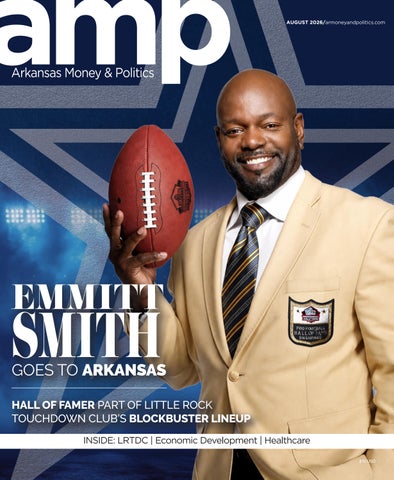
12 Emmitt One of the greatest to wear the star on his helmet, Emmitt Smith, visits central Arkansas as part of LRTDC’s stacked 2026 lineup.
16
HEALTHCARE
EDITOR-IN-CHIEF Dwain Hebda | dwain@armoneyandpolitics.com
70 50 and counting
SENIOR EDITOR Mark Carter | mcarter@armoneyandpolitics.com
Central Arkansas Radiation Therapy Institute opened its doors in April 1976 and began treating patients in Little Rock.
84 Unlocking potential A decade ago, building a Conway hospital was bold thinking on Baptist Health’s part with its flagship hospital about 25 minutes away.
of 98 Champions Healthcare
In this special section, AMP recognizes those healthcare Touchdown, Little Rock leaders in various positions around the state who go above and beyond.
ARKANSAS ELITE EXECUTIVES
127
The Little Rock Touchdown Making it work Club, one of the country’s most distinguished and largest clubs of In this special sales section, its kind, kicks off its 2026 season AMP ’s recognizes those elite executives who make business Aug. 24. and industry run so well in Arkansas. The continued Silverfield humming along of economic development in Arkansas would Ryan Silverfield knew what not happen without them. he was getting into when he accepted the job as head Hog, and he also knew what could be OUTDOORS accomplished on the Hill.
156
ECONOMIC DEVELOPMENT
34 Get outside
Outdoor recreation contributed $7.3 billion to the state’s gross domestic product in 2023 alone, according to the Arkansas Department of Parks, Heritage and Tourism.
38 The foundation
Education, healthcare and municipal projects represent the heart of infrastructure projects that greatly impact local communities.
143 Keeping it natural
The 35th annual Arkansas Outdoor Hall of Fame Banquet will again honor those who protect the “natural” in the Natural State.
EDITORIAL COORDINATOR Darlene Hebda | darlene@armoneyandpolitics.com COPY EDITOR Sarah DeClerk | sdeclerk@armoneyandpolitics.com STAFF WRITERS Doug Crise | dcrise@armoneyandpolitics.com Alex Hardgrave | ahardgrave@armoneyandpolitics.com MANAGING DIGITAL EDITOR Kellie McAnulty | kmcanulty@armoneyandpolitics.com ONLINE WRITER Kilee Hall | khall@armoneyandpolitics.com PRODUCTION MANAGER Mike Bedgood | mbedgood@armoneyandpolitics.com GRAPHIC DESIGNERS Jerry Cordova | jcordova@armoneyandpolitics.com Lora Puls | lpuls@armoneyandpolitics.com Lee Smith | lsmith@armoneyandpolitics.com SENIOR ACCOUNT EXECUTIVES Greg Churan | gchuran@armoneyandpolitics.com Michelle Daugherty | michelle@armoneyandpolitics.com Mary Funderburg | mary@armoneyandpolitics.com Karen Holderfield | kholderfield@armoneyandpolitics.com Ryan Parker | ryan@armoneyandpolitics.com Carrie Sublett | carrie@armoneyandpolitics.com EXECUTIVE ASSISTANT Jessica Everson | jeverson@armoneyandpolitics.com ADVERTISING ASSISTANT Katie Beth Smith | ksmith@armoneyandpolitics.com ADVERTISING OPERATIONS MANAGER Jay Danzy | ads@armoneyandpolitics.com ADVERTISING OPERATOR Maggie Holloway | ads@armoneyandpolitics.com CIRCULATION circulation@armoneyandpolitics.com ADMINISTRATION Marissa Porter | ayoffice@armoneyandpolitics.com CEO | Vicki Vowell
TO ADVERTISE call 501-244-9700 email hbaker@armoneyandpolitics.com
SMALL BUSINESS
150 Starting over
Even though Hunter Lauderdale, 28, comes from a long line of entrepreneurs in his family, he did not see a clear-cut path for himself when he was younger.
POLITICS
42 Power check
152 Been there, doing that
Electricity is an amenity that most people in the country take for granted, yet in Arkansas, statewide electrification is actually a fairly recent thing.
French Hill believes in the value of stability, something born of his status as a ninth-generation Arkie and more than a decade serving the state in Congress.
AUGUST 2 026
ASSOCIATE EDITOR Mak Millard | mmillard@armoneyandpolitics.com
6
TO SUBSCRIBE armoneyandpolitics.com/subscribe CONTRIBUTORS
Jane Colclasure, Jamie Rayford, DeWaine Duncan, Michael Main, Ryan Parker
AMP magazine is published monthly, Volume IX, Issue 4 AMP magazine (ISSN 2162-7754) is published monthly by AY Media Group, 910 W. Second St., Suite 200, Little Rock, AR 72201. Periodicals postage paid at Little Rock, AR, and additional mailing offices. Postmaster: Send address changes to AMP, 910 W. Second St., Suite 200, Little Rock, AR 72201. Subscription Inquiries: Subscription rate is $28 for one year (12 issues). Single issues are available upon request for $10. For subscriptions, inquiries or address changes, call 501-244-9700. The contents of AMP are copyrighted, and material contained herein may not be copied or reproduced in any manner without the written permission of the publisher. Articles in AMP should not be considered specific advice, as individual circumstances vary. Products and services advertised in the magazine are not necessarily endorsed by AMP. Please recycle this magazine.
ARM ON E YA N D P OL ITIC S.COM
ATTRACT AND RETAIN TOP TALENT
Employers are choosing to help employees save for education through after-tax direct deposits into their Arkansas Brighter Future 529 account. So little by little, with each paycheck, employees can build their education savings. Best of all, offering this innovative benefit requires no
added costs, systems or contracts. Bottom line: it’s a win-win for you and your employees. Look into adding the Arkansas Brighter Future 529 Plan to your benefits package today. It is a great way to show current and potential employees you support their dreams.
BrighterFutureDirect529.com 1.800.587.7301
PLUGGED IN AUGUST 2026/armoneyandpolitics.com
ON THE COV E R Dallas Cowboys great Emmitt Smith will talk about his Hall-of-Fame career when he speaks to the Little Rock Touchdown Club.
Coverage starts on page 12. Photo provided by Rich Desrosiers, Pro Football Hal of Fame
EMMITT
SMITH
GOES TO ARKANSAS HALL OF FAMER PART OF LITTLE ROCK TOUCHDOWN CLUB’S BLOCKBUSTER LINEUP INSIDE: LRTDC | Economic Development | Healthcare $10 USD
FEEDBACK Dear Sarah, while in the waiting room at McFarland EyeCare, I read your article, the Last Word, “Do Good Robots Go to Heaven”. March issue of Arkansas Money and Politics. Oh, how entertaining, thought provoking, and cleverly written!!! I actually read the part of the story about Oppy singing Happy Birthday to himself on Mars to the doctors when having my eyes examined. We all had a good chuckle. When I got home this afternoon I went on the website for AY Mag and Arkansas Money & Politics and found more cleverly written articles by you. It is so refreshing and somehow renewing to find a journalist who has such diverse interests and has such an amazing command of the language!!! Rare qualities. I am glad to have found you and will continue to follow your writings. Keep up the good work!!! Vicki Crisp
Jay Meador has been named president of Little Rock’s Medical Assets Holding Co.
Sarah DeClerk, Thank you for the thoughtful and well-rounded way you incorporated my interview comments into your America 250 article. It was a pleasure to contribute. Given my strong social science background, I like the way you brought the topic’s history, significance, and spirit to life in an engaging and meaningful way. I also appreciate the time and attention you devoted to presenting multiple perspectives with fairness and context. Thank you again for including my perspective and for producing such an exceptional piece. I wish you continued success as you cover the many significant stories that are certainly coming your way. The following comment was texted to me by another reader: “One of my favorite lines from the article is that we ‘can’t pay back those who developed us, but we can pay it forward.’ That’s a philosophy worth living by. Thank you for continuing to serve and for setting such a great example for the rest of us. Congratulations on the recognition, Dawson.” Looking forward to reading more of your work in the future. Dawson Williams MATCH MADE IN MILITARY HEAVEN: JACKSONVILLE, LRAFB We are so proud of having the Base in J’ville. The entire state should be too. We pray for our men and women in uniform and their families as they continue to keep us safe both home and abroad. Annabelle Moore Davis
Arkansas State University is set to reach a historic milestone as its new College of Veterinary Medicine prepares to welcome its inaugural class of students in August.
ARKANSAS VISIONARY — A HEAD FOR BUSINESS: GARY HEAD’S BANKING EMPIRE RESTS ON RELATIONSHIPS He’s an inspiration to us all! A great person! Patricia Higgs
TOP ONLINE ARTICLES July 7 — August 2 1 AMP’s ‘Future Icons’ 2026 2 Taylen Green leading camp at LRAFB, ready for new chapter 3 Declining enrollment has hit small colleges across the country; Hendrix may have an answer 4 Murphy USA’s ‘Store of Tomorrow’ coming to Jacksonville 5 Jay Meador named president of LR’s Medical Assets Holding Co. 6 Buffalo River Aviation receives FAA nod for private charter service 7 AMP Best of 2026
AY Media Group sparkles at Diamond Journalism Awards, where Sarah DeClerk, from left, Heather Baker and Dwain Hebda were all awarded.
8 Kimbel Mechanical Systems headquarters in Fayetteville sells for $27.85M 9 Colliers | Arkansas closes $10.3M sale of Clorox building in Bentonville 10 AMP Future Icons 2026: Noah Perry AUGUST 2 026
8
@AMPPOB ARM ON E YA N D P OL ITIC S.COM
FROM THE EDITOR’S DESK
R
By Mark Carter
ARKANSAS LEFT BEHIND? HOGWASH
azorback fans, God love us, are bipolar. Sports on the Hill are either sitting on the precipice of a national title or ablaze in a dumpster fire. Unfortunately, Razorback football currently is perceived to be burning. That is what 2-10 and winless SEC seasons will get you. Never mind the “but we were so close against top teams and had a top 10 offense” counterpoint. Fact is perception is reality. And the perception holds that a giant bonfire is ablaze inside the Fred W. Smith Football Center. As college sports continue to evolve and the prospect of an SEC-Big Ten split from the NCAA lives on — at least for football — now is not a good time to not be good in football, the bell cow sport that makes virtually all others possible. Arkansas’ historically bad stretch on the gridiron — and it is historic — could not have come at a worse time. Some Hogs fans, maybe a lot of ‘em, are afraid Arkansas will be left behind if a superleague is formed. Because of football. Relegated to whatever is left behind. I say hogwash to such a nightmare scenario. If a superleague is formed, it is likely both top leagues will expand to 24 teams, and the top remaining ACC and Big 12 teams will be cherry-picked. (North Carolina to the SEC and Notre Dame to the Big Ten, for example.) By every metric, Arkansas is among the top 48 in the nation. Ticket revenue, sales revenue, attendance, football pedigree (last two decades notwithstanding). Even brand power. [Insert Houston Nutt quote here.] Football’s lapse has impacted Arkansas’ financial bottom line, sure, but Fayetteville still ranks among the top 15 schools in FY25 earning — royalties, licensing, advertising and corporate sponsorships, according to research from our friend Matt Brown at Extra Points. If Ryan Silverfield is able to even initiate a turnaround this fall, money will follow, impacting not only the revenue list but also significant things like available NIL. Arkansas was late to the game in this new era of college ball, but it will get to the main table. Still, we might want to go ahead and initiate that turnaround this fall.
PUBLISHER’S LETTER
T
School Name FY25 Royalties revenue University of Texas $51,956,322 Ohio State University $42,770,263 University of Michigan $35,556,501 University of Tennessee $33,004,839 Texas A&M University $30,337,025 University of Oregon $26,607,027 Pennsylvania State University $25,114,673 University of Wisconsin $24,757,630 University of Louisville $24,645,765 University of North Carolina $23,973,222 University of Georgia $23,506,854 University of Washington $21,732,337 Arizona State University $20,425,234 Texas Tech University $20,209,486 University of Arkansas $19,416,571 University of Oklahoma $19,200,045 University of Nebraska $17,941,341 Clemson University $17,906,491 University of Alabama $17,233,822 University of Utah $15,717,133 Virginia Tech $14,961,055 Mississippi State University $14,716,195 Michigan State University $14,240,446 Florida State University $14,187,618 University of Central Florida $13,883,426 Source: Extra Points (As of this writing, the Senate bill that would possibly deter the formation of a superleague had gained new life with support from the SEC and Big Ten.)
By Heather Baker
GETTING READY FOR FOOTBALL
a look at the growing list of labor and delivery he August heat may try to trick us into units being closed in Arkansas. Plus, awardthinking summer is here to stay, but the truth winning journalist Sarah DeClerk profiles is football is just around the corner. Angie Longing, the new president and CEO Arkansas Money & Politics is once again proud to be at Conway Regional Health System; our Ryan a media sponsor of the Little Rock Touchdown Club, Parker spoke with local healthcare experts, which launches what promises to be another successful who considered the ramifications of legal speaker series on Aug. 24 with Ryan Silverfield. peptides; and our Arkansas Visionary this Silverfield, the new caretaker of the Razorback month is Arkansas radio-broadcasting legend football program, will open the 2026 club season, Neal Gladner. which the head Hog traditionally does. This year’s We also visit with incumbent 2nd District speaker lineup is headlined by former Dallas Cowboy congressman French Hill; we feature the latest and pro football hall-of-famer Emmitt Smith, one of inductees into the Arkansas Game and Fish the greatest running backs to ever play the game. Foundation Hall of Fame; and our Digs of the Other luminaries include Heisman winner Doug Deal remembers what could be considered Flutie, Steeler great Lynn Swann, and what is sure to Little Rock’s first college. Before there was Little be the most talked-about appearance of the year, a dual bill of Dallas Cowboys owner Jerry Jones and Heather Baker and David Bazzel Rock Junior College, Little Rock University and (Photo by Ryan Parker) the University of Arkansas at Little Rock, there former President Bill Clinton. We also preview the was Little Rock College in the Heights. ‘26 club lineup and preview Silverfield’s upcoming first season as Just as we hope the Razorback defense does this fall, this issue an SEC coach. packs a punch. As always, thanks for reading. Hit me up with This August issue also includes packages devoted to economic comments or story ideas at hbaker@armoneyandpolitics.com. development, chambers of commerce and healthcare, including ARM O N E YA ND P O L I T I C S .COM
9
AUG UST 2026
DISCOVERY ECONOMICS
POWERING THE FUTURE
Arkansas research propelling tomorrow’s electric-driven economy
A
By AMP Staff
s AI data centers multiply, electric vehicles become commonplace, renewable energy expands and industries demand ever-increasing amounts of electricity, one question looms over every innovation: Can the electrical grid keep up? At the University of Arkansas in Fayetteville, Arkansas Research Alliance Impact Grant beneficiary Yue Zhao believes the answer lies in rethinking the electronics that control and protect the world’s power systems. Supported by an ARA Impact Grant, Zhao and fellow researcher Xiaoqing Song are developing next-generation solidstate circuit breakers that operate significantly faster than conventional mechanical breakers. Their work could make future electrical systems safer, more reliable and better equipped to handle the demands of an increasingly electrified economy. “The biggest advantage is speed,” Song said. Traditional mechanical circuit breakers rely on moving contacts that physically open and close to interrupt electrical current. By replacing those mechanical components with semiconductor devices, the team’s design can react up to 100 times faster, isolating electrical faults before they can cascade into larger failures. The improvement has implications far beyond research laboratories. Today’s electrical grid is undergoing one of the largest transformations in its history. Massive artificial intelligence data centers require enormous amounts of power within limited building footprints. Electric vehicles, renewable energy systems and industrial automation all demand equipment that is smaller, lighter, more efficient and capable of safely managing increasingly complex electrical loads, especially when relying on the 800-volt or 1500 volts direct current distribution. “Power density and efficiency are both very important,” Zhao said. “Whether you’re talking about electric vehicles or AI data centers, there is limited space. You want electronics that deliver more power in less space while remaining highly efficient.” The project extends beyond hardware. Zhao’s team also applies artificial intelligence and machine learning to monitor equipment health, predict failures and identify electrical faults more quickly. As data is collected from the circuit breakers during testing and eventual field deployment, AI models can help optimize system performance while improving long-term reliability. The ARA Impact Grant played an important role in moving the technology beyond proof of concept. Zhao describes the award as a “seed project” that increases the technology’s readiness for commercialization by allowing the team to validate its designs using commercially available medium-voltage semiconductor devices supplied through industry collaboration. The collaboration includes Wolfspeed, a global leader in silicon carbide semiconductor technology. The company has provided AUGUST 2 026
technical support and advanced components while maintaining an active interest in the project’s progress. Equally important is the research ecosystem surrounding the work. Zhao credits the University of Arkansas Power Group, an interdisciplinary collection of faculty, laboratories and research facilities, for creating an environment where experts in power
electronics, computer engineering and artificial intelligence can collaborate naturally. The circuit breaker project exemplifies the collaborative partnership between Zhao and Song and serves as one of many joint efforts spanning power electronic converters and power semiconductor module packaging. The undertaking has already produced multiple conference papers, increased the visibility of Arkansas research internationally and strengthened relationships with industry partners. Graduate students who contributed to the project have gone on to careers with companies that include Wolfspeed, while others continue internships working on similar technologies. The commercial opportunity is substantial. Solid-state circuit breakers will be essential wherever electricity is becoming more digital, more distributed and more demanding — from AI data centers and electric vehicle charging networks to renewable energy installations and future direct-current power systems. As those markets continue to expand, technologies that improve reliability, reduce downtime and protect critical infrastructure will become increasingly valuable. Research such as Zhao’s demonstrates how university innovation can attract industry partnerships, develop high-value intellectual property, train a technically skilled workforce and position the state within rapidly growing global markets. This is the essence of discovery economics — transforming fundamental research into technologies that create jobs, attract investment and strengthen Arkansas’ role in tomorrow’s economy. Sometimes the biggest breakthroughs are not the ones people notice immediately. Sometimes they are the ones quietly protecting everything else. 10
ARM ON E YA N D P OL ITIC S.COM
VIEWPOINT
STRENGTHEN EARLY LEARNING, STRENGTHEN ARKANSAS BUILDING BRIGHTER FUTURES FOR STUDENTS, FAMILIES AND COMMUNITIES
W
By Jamie Rayford to deliver these experiences sustainably? Those are the urgent questions driving our efforts at the Center for Early Learning Solutions. Last fall, Forward Arkansas conducted a landscape analysis to examine access, affordability, quality and workforce conditions within our state’s early childhood field. We found significant barriers for both families and providers, from long waitlists and limited seats to operational inefficiencies, but we also uncovered latent opportunities for improvement, such as expanding providers’ access to high-quality instructional materials and shared services and modernizing their tools and data systems. Today, working alongside early childhood providers, local leaders, state agencies and other partners, the Center for Early Learning Solutions is addressing these arJamie Rayford eas of impact by piloting practical solutions to help the mixed-delivery system operate more effectively and sustainably. That includes testing technologyenabled business supports that can reduce administrative burdens, improve compliance and reporting, and strengthen subsidy-payment tracking and revenue capture — all to give providers better, clearer information for more strategic decision-making. In partnership with early childhood local leads, we are also helping elevate best practices to enhance peer learning and complement, rather than duplicate, assistance already available across the state. By helping providers spend less time navigating fragmented systems and more time supporting children and families, our goal is to strengthen quality and preserve access. Historically, early childhood and K-12 have been positioned as either/or investments, but it should be a both/and strategy. Since 2015, Forward Arkansas has focused on strengthening education across our state by ensuring students have access to high-quality learning opportunities and educators have the necessary support to help kids thrive in their classrooms. Expanding our efforts to the foundational years that shape school readiness is a natural progression of that commitment. By strengthening the early childhood system, we can accelerate our progress to deliver better outcomes for students, communities and our state.
e have all heard the phrase “built to last.” It evokes images of strength and durability. It means taking the time to lay a solid foundation, whether we are building a house, onboarding new team members or tilling fields in preparation for a crop. The same principle of building a strong base should guide how Arkansas structures its support for students, families and educators. At the recent annual Arkansas Department of Education Summit in Hot Springs, Deputy Commissioner Stacy Smith challenged attendees to think differently about our state’s education system. As she noted, far too often, we take a remediation-first approach, working to help students catch up after they have already fallen behind. Instead, she urged the crowd to think in terms of acceleration. How can we collectively create the conditions that allow every student in our state to progress and achieve? At the Center for Early Learning Solutions at Forward Arkansas, we firmly believe the most effective acceleration strategy is one that provides children and educators with a sturdy foundation. It is a viewpoint backed by decades of scientific research showing that the greatest opportunity to shape a child’s future does not begin in kindergarten but in the years before. According to the Center on the Developing Child at Harvard University in Massachusetts, nearly 90 percent of brain development occurs before age 5. During those early years, responsive interactions with parents, caregivers and educators expand the neural connections that inform children’s future learning, behavior and health. Those experiences are the building blocks of school readiness and beyond, boosting language development, executive functioning, problem-solving and social-emotional skills. In short, early learning sets the stage for lifelong learning, workforce readiness and economic prosperity. Leaders across Arkansas’ mixed-delivery early childhood system understand that reality firsthand. Public school districts, Head Start programs, nonprofits, faith-based programs, family child-care homes, and community and private providers all play essential roles in meeting the varied needs of children and families. Many sustain these crucial services despite persistent staffing, administrative and financial pressures because they see the difference early learning makes for children and their communities. They know that when students begin kindergarten with robust language, literacy, executive functioning and social-emotional skills, teachers can spend more time building on those strengths to extend learning from day one. How can we help ensure children and families across our state have access to high-quality early childhood care and education that set them up for lasting success? Just as crucially, how can we equip early childhood providers with the operational tools and infrastructure necessary ARM O N E YA ND P O L I T I C S .COM
Jamie Rayford is the executive director of the Center for Early Learning Solutions at Forward Arkansas, which is focused on strengthening access to high-quality, sustainable early childhood care and education. 11
AUG UST 2026
COVER
Dallas Cowboys great Emmitt Smith gets 2026 Little Rock Touchdown Club off to a running start By Dwain Hebda
M O N T H 2 02 2
12
ARM ON E YA N D P OL ITIC S.COM
S
ports revolve around statistics as generally the best way Cowboys fans there are here in Arkansas, this is going to get our to gauge something, be it the greatest who ever played speaker series off to a really fast start.” or as a measuring stick for everyone else. While stats are not always foolproof — the evolution of training, A STAR IS BORN equipment and changes in playing rules, among other factors, Emmitt James Smith III was born and raised in Pensacmake apples-to-apples comparisons between eras tricky — ola, Florida, on May 15, 1969. Following graduation from there are some accomplishments that transcend time. Escambia High School, he landed at the University of Last year, Fox Sports listed the 10 Florida, where, over three seasons, he most unbreakable records in sports, amassed nearly 4,000 rushing yards a list that included Cal Ripken’s 2,632 over 31 games for a gaudy average of 127 consecutive games played for MLB’s Balyards per game. He also had nearly 60 retimore Orioles; swimmer Michael Phelps’ 28 ceptions for another 463 yards, as reported by Olympic medals, 23 of them gold; NFL Hall of Sports Reference. Famer Jerry Rice’s 22,895 receiving yards and NHL In 1990, a rebuilding Dallas Cowboys franchise legend Wayne Gretzky’s 2,857 career points and drafted Smith 17th overall. He played in all 16 games, 1,963 career assists. 15 as a starter, during a rookie season that would Ranking fourth on that distinguished list: see him gain 937 yards on the ground, 228 yards Emmitt Smith, holder of the most career rushreceiving and a combined 11 TDs. He would ultiing yards in NFL history. Smith’s 18,355 rushing mately be voted AP Offensive Rookie of the Year. yards, more than 10 miles in total, came over 226 For four of the following five seasons, Smith games in 15 seasons, including a record 11 consecutive 1,000-yard outrushed the league, the high-water mark coming in 1995, when campaigns for the Dallas Cowboys. he racked up 1,773 rushing yards, 111 rushing yards per game, 25 As the football gods had it, the season that ended the streak rushing scores and 2,148 yards from scrimmage, personal single— 2002, his last in Dallas, by a mere 25 yards — was the one season records that also led all running backs. in which Smith passed Chicago Bears great Walter PayAs much as all those numbers mean to Dallas Cowboys ton, otherwise known as “Sweetness,” for his place fans, they all pale next to the mark he set in a 17-14 home in the record books. By the time he hung up loss to the Seattle Seahawks on October 27, 2002. his cleats, Smith held a dozen NFL records, including 164 rushing touchA SWEET ACCOMPLISHMENT downs and 5 rushing TDs in Super By then, the team’s glamour days, gilded by himself and Bowl play, and owned three chamHall of Fame teammates Troy Aikman, quarterback, pionship rings for Super Bowls and wideout Michael Irvin, both of whom had XXVII, XXVIII and XXX. retired, were gone and the ‘Boys were reIn fact, the only time Smith building. The biggest record in football appears to be second in his career would happen during a decidedly mecomes in 2026, when he will be diocre stretch in team history. the Week 2 speaker on the Little Smith’s eclipsing Payton’s 25-yearRock Touchdown Club’s roster. old record of 16,726 yards that seaSmith will be on hand Aug. 31 at the son was all but a certainty from the Doubletree Hotel in downtown Little first game. He entered the year Rock. Doors open at 11 a.m. needing just 540 rushing yards “Every year, I say the lineup is the to do it, roughly half of what he best we’ve ever had, and every year, we would produce year in and year find a way to top ourselves,” said David out for 14 of his 15 seasons. BarBazzel, former Razorback, current media ring injury, it was a question of personality and founder of the club. “We have when, not if. a tradition of reserving the first week for the Hogs’ Therein lies the rub: As a 2024 head coach, and after that, we get into our lineup, retrospective by The Dallas Morning and boy, what a way to kick that off this year. News noted, the Seattle game was “Emmitt Smith has done just about everything the last home stand for the Cowboys a football player can do in a career, starting with before two road contests and a bye the rushing record, which is something that may week. Coming into it with just 93 yards never be broken. During the Cowboys’ last heyto go, the game would, for all intents day period in the 1990s, there was no bigger star and purposes, be Smith’s last chance to set (Photo courtesy of in the NFL than he was. Knowing how many the record before a home crowd. Pro Football Hall of Fame)
ARM O N E YA ND P O L I T I C S .COM
13
AUG UST 2026
“Let me just say that it was a big opportunity, and knowing that if I did not do it in Dallas that we were going to be on the road for the next couple of weeks, I would have to break it on the road, which is something that I didn’t really want to do,” he told the The Dallas Morning News. “I was committed, and I brought every bit of energy that I could possibly muster at the age of 33 into that game, trying to do whatever I could to make it happen in Texas Stadium.” In anticipation of the event, whenever it came, Smith’s management team purchased extra helmets and jerseys and ordered more cleats so he could change during the game. Some of the items would go to the Pro Football Hall of Fame, the paper reported. A NFL Films camera crew was on hand as he neared the mark to capture, seemingly, his every step. Media coverage all started on the same note, his chase of Sweetness. AUGUST 2 026
As the frustrating season wore on — the Cowboys were just 3-4 coming into that game and would finish the season 5-11 for the third straight year — the hoopla eventually started to get to everyone. “I’ll just be honest with you, man, and, you know, hopefully Emmitt doesn’t get offended by this, but I could give a [expletive] about that record,” Darren Woodson, Cowboys safety and the team’s all-time leading tackler told The Dallas Morning News. “I mean, we sucked. We were a bad football team. We were demoralized. The culture within our organization was in a shamble. My thought process — it wasn’t on Emmitt breaking the record. Matter of fact, I thought it was a distraction to what we were trying to get accomplished as far as trying to get a win.” “It was just so much focus and energy. I know that everybody was ready to get it over with,” said Pam Oliver, Fox Sports 14
Photos: Instagram emmittsmith22
broadcaster who covered the game. “Everybody’s like ‘Get it over with. Get it over with.’ I think it’s one of those situations where the offensive line wanted it done, of course, Emmitt wanted it done, and then you can kind of focus on the task at hand.” The Seattle matchup lined up well for the record run to conclude as the Seahawks fielded the worst run defense in the league that year. However, in the previous week’s loss to Arizona, Smith mustered only 82 yards on 22 carries, so nothing was assured. ARM ON E YA N D P OL ITIC S.COM
AY Media Group President and Publisher Heather Baker with Emmitt Smith (Photo by Ryan Parker)
As it happened, by the end of the first quarter, Smith had more than half of what he needed. The play everyone had paid to see came midway through the fourth quarter, when, on 2nd and 7 from the Dallas 30, Smith darted between the guard and tackle and ran 11 yards into immortality. “It’s the most unreachable football record,” longtime Cowboys play-by-play announcer Brad Sham told ESPN in 2022. “I think the only thing that I could really correlate it to would be [Major League Baseball pitcher] Cy Young winning 511 games, and second on the list is Walter Johnson at 417. ... No one’s going to pitch long enough or enough innings to get anywhere near Cy Young, and no one’s ever going to carry the ball enough to get anywhere near Emmitt. A RUSHER’S RETIREMENT After Smith’s history-making season, the running back landed in Arizona as a free agent, where he would spend two middling years toting the ball for the Cardinals. In 2005, he announced his retirement from the game. He left having been named an All Pro four times and All NFC five times, both categories earned consecutively, and was named to eight Pro Bowls. He was named NFC and league Offensive Player of the ARM O N E YA ND P O L I T I C S .COM
Year, as well as the league’s Most Valuable Player in 1993 and MVP of Super Bowl XXVIII in 1994. “I’ve given everything I can to the game on and off the field,” he said at the time, describing his career as “a tremendous ride.” Life after football has been a mix of broadcast work and accolades. Smith was enshrined, along with Aikman and Irvin, into the Dallas Cowboys Ring of Honor in 2005 and was the last of the trio to enter the Pro Football Hall of Fame, inducted in 2010 in his first year of eligibility. Team owner and Arkansas native Jerry Jones presented him that day, calling him “Dallas Cowboys royalty. He’s NFL royalty.” “Emmitt Smith evokes in my heart and in my mind God’s will of taking advantage of every gift that you’ve been given,” Jones said in his remarks. “He hasn’t left a yard on the table of his life.” HOWDY, ARKANSAS Smith never suited up against the Hogs, since Arkansas did not join the SEC until 1992. He has also never previously appeared at the LRTDC, although he did serve as grand marshal of the World’s Shortest St. Patrick’s Day Parade in Hot Springs two years ago. 15
Photo: Instagram emmittsmith22
As Bazzel noted, Smith’s rookie appearance joins a long line of Cowboys luminaries on the club dais, 16 in all, a roster that includes Irvin, Tony Dorsett, Cliff Harris, Randy White, Ed “Too Tall” Jones, Roger Staubach and Jimmy Johnson, among others. Smith, the greatest of them all, is sure to pack the house come end of August. “I was counted out many times in my years here, and I’m probably still counted out,’’ Smith said in an interview after setting the record, “but I believe truly in my own ability. I believe my talent stacks up with the next man. I’m very confident I’m one of the best to ever play the game, but once you talk about the greatest, how can you define greatest?’’ Jones answered the question definitively during an on-field awards ceremony following Smith’s accomplishment. “There’s only one NFL rushing champion,” Jones said then, presenting his star with a silver football, “and there’s only one Emmitt Smith.’’ For tickets or to become a member of Little Rock Touchdown Club, visit lrtouchdown. com. AY Media Group is proud to once again serve as media sponsor for LRDTC. AUG UST 2026
SPORTS
A Fall
CLASSIC Little Rock Touchdown Club announces star-studded lineup
By Mark Carter and Dwain Hebda
T
he Little Rock Touchdown Club, founded in 2004, has grown into one of the country’s most distinguished and largest clubs of its kind and an influential source of news and insight during the football season. The club, for which AY Media Group is media sponsor, is a phenomenon that even its founder, former Razorback and current central Arkansas radio host David Bazzel could not have imagined in his wildest dreams. “In the beginning, there was a group of folks who thought it had potential,” he said. “When I started this, along with Rex Nelson, I thought it had a chance, and if I’m going to do something, I want it to be the best. It’s become everything I had hoped for and more.” The primary reason for the club’s sustained popularity has been the caliber of guest speakers LRTDC features week in and week out from late August through November, but even by the organization’s lofty standards, the 2026 iteration is one for the record books. Of all of the heavy hitters on this year’s roster, the event that is sure to have the country talking will be the dual appearance of former President Bill Clinton and Dallas Cowboys owner Jerry AUGUST 2 026
Bill Clinton
Jerry Jones
Jones. Bazzel said the two, who are both taking the LRTDC stage for the first time, will share thoughts on a range of topics, including the state of collegiate and pro sports, the status of athletics at the University of Arkansas in Fayetteville and the steps required to help bring Razorback football back into prominence. “There’s no question this is going to be the biggest thing to 16
ARM ON E YA N D P OL ITIC S.COM
happen to the Little Rock Touchdown Club in its history,” Bazzel said. “Bringing arguably two of the most recognized Arkansas natives together — one who led America and the free world and one who’s leading America’s Team — to talk about the Hogs and the university they both attended and love so much, it’s going to be really special.” Another big player on the state of the Hogs is John Tyson, who was instrumental in luring John Calipari to Fayetteville to head the men’s basketball team. Tyson, chairman of Tyson Foods, will also speak on winning in the new era of college sports both from a competitive and financial standpoint. Legendary athletes once again dot much of this year’s roster, starting in Week 2 and including a former Dallas Cowboy who needs no introduction, Emmitt Smith. He is followed in subsequent weeks by Pittsburgh Steelers legendary wideout and fellow Hall of Famer Lynn Swann; former Heisman Trophy winner Doug Flutie; and former Razorbacks and standout pros Frank Ragnow and Jason Peters. As is tradition, several of the state’s Division 1 head football coaches will also appear, including the rookie appearance of head Hog Ryan Silverfield to open the season Aug. 24. Nathan Brown, coach at the University of Central Arkansas in Conway, and Butch Jones, skipper at Arkansas State University in Jonesboro, will also appear during the season. Rounding out the coaches room is former ASU and Auburn coach Gus Malzahn. Two very special appearances by members of the sports media are on tap, including a roast and toast of longtime Arkansas sportswriter Wally Hall and CBS Sports voice and producer Lance Barrow, a member of the Sports Broadcasting Hall of Fame. Nelson, veteran journalist and columnist at the Arkansas Democrat-Gazette who has spent most of his adult life chronicling what makes the state unique, said LRTDC meetings have evolved into one of the places where well-connected Arkansans go to see and be seen. “I can honestly say that in the fall, there is no bigger weekly lunch gathering in the state than the Little Rock Touchdown Club,” he said. “That’s not the case with football clubs in other states.” The club’s annual speaker lineups through the years have captured the sports world’s attention far beyond the state’s borders. Last year, Arkansas AD Hunter Yurachek, who declined to speak this season, made national waves at his annual appearance when he was brutally honest about Arkansas’ name-image-likeness fundraising in a critique of the current college sports landscape. The club has made national news with other speakARM O N E YA ND P O L I T I C S .COM
2026 LITTLE ROCK TOUCHDOWN CLUB Bill Clinton, 42nd President of the United States* Jerry Jones, owner, president and general manager, Dallas Cowboys* Frank Ragnow, former Razorback and Detroit Lion* * Apperance confirmed, dates pending at press time
Aug. 24 Ryan Silverfield, Head football coach, University of Arkansas Aug. 31 Emmitt Smith, Pro Football Hall of Fame running back Sept. 8 Lynn Swann, Pro Football Hall of Fame receiver Sept. 14 Gus Malzahn, Former head coach, Arkansas State, Auburn, University of Central Florida Sept. 21 Doug Flutie, 1984 Heisman Trophy winner (Boston College) Sept. 28 Jason Peters, Former Hog; 19 seasons as elite NFL lineman Oct. 5
John Tyson, Chairman, Tyson Foods
Oct. 12 TBD Oct. 19 Wally Hall, Arkansas Democrat Gazette sportswriter/columnist Oct 26 Butch Jones, Head football coach, Arkansas State University Nov. 2
Nathan Brown, Head football coach, University of Central Arkansas
Nov. 9
TBD
Nov. 16 Lance Barrow, CBS Sports producer/broadcaster Nov. 23 TBD
17
AUG UST 2026
SPORTS ers over the years, having hosted Super Bowl-winning coaches and former broadcasters Jimmy Johnson and Jon Gruden, the former of whom played on the 1964 Arkansas national championship squad and the latter who made his first public appearance at the club after his firing as coach of the NFL’s Las Vegas Raiders. Also dotting the roster over the years have been Peyton and Eli Manning; Super Bowl-winning QB, hallof-famer and broadcasting legend Terry Bradshaw; ESPN/ABC/Amazon broadcaster Kirk Herbstreit; legendary broadcaster Verne Lundquist; renowned ESPN broadcaster Holly Rowe; Kelli Finglass, director of the Dallas Cowboys Cheerleaders; and SEC commissioner Greg Sankey. NFL greats have included Ray Lewis, Brett Favre, Eric Dickerson and Lawrence Taylor, who all reside in the Pro Football Hall of Fame, as well as Arkansas native Keith Jackson, former Washington Commanders “Hogs” offensive lineman-turned-analyst Mark May and Super Bowl-winning quarterback Jim McMahon, among many others. Razorback legends are also numerous, including Darren McFadden, Madre Hill, Anthony Lucas and many more. Held over that many years, the LRTDC has produced a trove of memorable moments. Particularly noteworthy, according to Nelson: • Former Razorback interim coach John L. Smith referring to Arkansas as “the state of Alabama.” • Legendary broadcaster Paul Finebaum playfully asking Lunsford Bridges, president of the former Metropolitan National Bank, then a club sponsor, if he had a job open. • The standing ovation given Hogs coach Bobby Petrino in his first appearance before an Arkansas audience after his dismissal in the wake of the motorcycle wreck that will live in Razorback infamy. • The “Tennessee Tiff” of Johnny Majors taking a shot at Phil Fulmer. • T he great NLR running back Earl Campbell staying long after the luncheon to sign every autograph. “You never really know what someone is going to say or what’s going to happen week to week,” said Bazzel, who leads most guests in a question-and-answer session. “It’s live and unscripted, and about the only thing we know for sure is the sports world is listening.” Launched with 17 founding members back in 2004, the club has grown to more than 500 members, and its weekly gatherings typically draw hundreds, more than 1,000 for big names, making LRTDC meetings mark-your-calendar events in the fall. Little Rock’s 103.7 The Buzz, for which Bazzel co-hosts the morning drive show, broadcasts live from LRTDC each Monday AUGUST 2 026
Past guests have included, clockwise from top left, ESPN personality Holly Rowe, and NFLers Peyton Manning and Ray Lewis. (Photos by DeWaine Duncan)
during the season, and meetings are live streamed on Facebook, YouTube and Arkansas PBS. No other club in the country can match such coverage. LRTDC also is unique in making speakers available for photos with members. Doors open each week at 11 a.m., and Bazzel said he may find 100 people lined up as early as 9:30 a.m. some weeks to hear big-name speakers and especially when the head Hog is in town. The luncheons are open to everyone — $35 per luncheon for members and $45 for nonmembers. Annual membership packages are available on five levels, four of them entailing voting rights in the Arkansas Sports Hall of Fame and College Football Hall of Fame. Another LRTDC perk is its awards lineup, an inevitability with Bazzel at the helm. Bazzel created the Golden Boot and Battle Line trophies awarded to the winner of the Arkansas-LSU and Arkansas-Missouri football games, respectively, as well as the national Broyles and Burlsworth awards, presented to the top college football assistant coach and the nation’s top college football player who started out as a walk-on. The club itself presents several awards at its annual year-end banquet recognizing the state’s most valuable high school players, the state’s best high school and college broadcast play calls, and the national Cliff Harris Award to the nation’s small college defensive player of the year. For more information about tickets and membership, visit lrtouchdown.com. 18
ARM ON E YA N D P OL ITIC S.COM
WE BROKE THE MOLD.
ON PURPOSE. M A R KE TI NG
·
B RA NDI NG
·
D IGI TAL
·
S OCI AL
·
P UB LI C R ELA TI O NS
·
WEB
YOUR BRAND. ELEVATED.
501.413.1174 THEFLYOVERAGENCY.COM
ECONOMIC DEVELOPMENT
A PEEK AHEAD
INDUSTRY LEADERS TALK EXPECTATIONS, STRATEGY, PRIORITIES
F
By Mark Carter
ive years can represent the blink of an eye or use of artificial intelligence and data-informed inan eternity, depending on various factors. struction to support student success, but the most The COVID-19 pandemic needed no successful institutions will be those that use techtime at all to turn the world on its head. Three nology to enhance — not replace — the personal, months is all it needed, from the announcement human relationships that are essential to learning. of the outbreak in December 2019 Students in Arkansas, I believe, are to the global shutdown in March of in an advantageous position because 2020. Name, image and likeness transof the unique needs of this state relaformed the world of American college tive to many others. Education at every sports in a similar fashion and timelevel will continue becoming more foframe. cused on economic and workforce deThen again, the past five years have velopment, and Gov. [Sarah Huckabee] felt like an eternity for Razorback Sanders and her team were ahead of football fans. But with almost all asthe curve on making this a priority. As pects of everyday life now dependent industries evolve and new opportunion technology — and with tech adties emerge in areas such as healthcare, vancing at an unprecedented rate — a Lt. Gen. Jay Silveria agriculture, advanced manufacturing, lot can happen in five years. transportation, cybersecurity and data Arkansas Money & Politics visited with science, educational institutions will a few Arkansas industry leaders about be expected to respond more quickly what the next few years holds for their and strategically to meet workforce businesses, institutions and industries. and training needs in their communiRepresenting healthcare is Dr. C. Lowry ties and regions. Barnes, chancellor of the University of At the same time, prioritizing innovaArkansas for Medical Sciences in Little tion and research will be vital to driving Rock; retired U.S. Air Force Lt. Gen. Jay discoveries that improve lives, strengthSilveria, president of the University of en communities, and contribute to Arkansas System, based in Little Rock, economic and cultural development in represents education and representing Dr. C. Lowry Barnes areas like basic science, applied techmanufacturing is Patrick Schueck, presinologies, policy analysis, agriculture, dent and CEO of Little Rock’s Lexicon. healthcare, education, the arts, humanities and social sciences. Arkansas Money & Politics: What will I feel strongly that lifelong learning the next five years have in store for will become the norm. The idea that your industry? education ends with a degree or a cerLt. Gen. Jay Silveria: Over the next five tificate and a student has a long career years, Arkansans can expect education in the same field doing the same tasks at every level to become more personalwill give way to more continuous skill ized, more technology-enabled and more development throughout a person’s caclosely connected to workforce and comreer and adapting to new technologies Patrick Scheuck munity needs. The traditional boundarand skill sets. It’s imperative that those ies between K-12, higher education and careers will in education at all levels are there with accessible, continue to blur as students seek flexible pathways affordable and relevant programs to respond to this that allow them to learn, earn credentials and enter trend the workforce more efficiently. We will see greater Patrick Schueck: I believe the next five years will
AUGUST 2 026
20
ARM ON E YA N D P OL ITIC S.COM
be an exciting time for American manufacturing. Continued investments in infrastructure, energy, domestic manufacturing and advanced technologies are driving demand for high-quality steel fabrication, and industry forecasts point to continued growth. I also believe northeast Arkansas will continue to emerge as one of the country’s most important manufacturing hubs. Lexicon has been proud to help shape the state’s steel industry, building the first steel mill in Mississippi County in the 1980s and every major mill there since. Today, we continue building and maintaining those facilities in northeast Arkansas while purchasing the steel they produce to fabricate projects across the country. As more industries look to reduce input costs, transportation expenses and supply chain risks, I believe we’ll continue to see manufacturers choose to locate near the steel they depend on. That creates a powerful competitive advantage for Arkansas and strengthens the entire manufacturing ecosystem. Dr. C. Lowry Barnes: The next five years will bring some of the most significant changes healthcare has seen in decades. Advances in artificial intelligence, precision medicine and digital technology will continue to transform how we diagnose disease, personalize treatment and deliver care. While technology will play an increasingly important role, it will never replace the expertise, compassion and judgment of healthcare professionals. Instead, I believe we’ll see healthcare increasingly leverage technologies such as generative AI as a force multiplier, helping clinicians work more efficiently, reducing administrative burdens and expanding access to care as we face growing demand and a nationwide shortage of healthcare providers. Arkansans can also expect remarkable advances in treating some of the most complex and difficult diseases through new therapies, precision medicine and research that moves discoveries to patients more quickly than ever before, but innovation alone isn’t enough. We owe every patient pathways that truly work for them, from ARM O N E YA ND P O L I T I C S .COM
University President Lt. Gen Jay Silveria said the near future will see prioritized innovation and research at schools like the University of Arkansas’ flagship campus in Fayetteville. (Photo provided by The University of Arkansas)
their first point of access through diagnosis, treatment and recovery. That means creating a healthcare system that is more connected, more personalized and easier to navigate, ensuring people receive the right care at the right time regardless of where they live. AMP: What are your industry’s next big challenges and opportunities? Schueck: The biggest opportunity will continue to be our workforce. Technology like advanced robotics will help us work smarter and take on more complex projects, but it won’t replace the need for people. In fact, as robotics expand our capabilities, they’ll also increase demand for highly skilled team members. That’s why we’re investing in workforce development through our Lexicon University training program and high school-focused programs like Steel Days and the Lexicon Academy of Advanced Manufacturing and Construction, both of which spark student interest in rewarding careers in the trades. Barnes: Technology alone cannot solve the workforce challenges facing healthcare. Meeting the needs of our communities will require educating, recruiting and retaining the next generation of healthcare professionals who are essential to delivering high-quality care. Building and sustaining that workforce will be one of the most important investments we make over the next five years. Silveria: There are always sizable challenges facing higher education institutions. The key is to adopt a strategic approach that quickly recognizes and responds to our challenges. Among the biggest of these challenges include funding and overall financial concerns. We are looking at a generation of 21
Lexicon head Patrick Scheuck said technology such as advanced robotics will help companies work smarter but will not replace the need for people. (Photo provided by Lexicon)
AUG UST 2026
ECONOMIC DEVELOPMENT
fewer high school graduates combined with an increasing attitude of mixed feelings generally about the role and value of higher education. Those factors paired with rising inflation and the relatively flat rate of public funding means our future will be defined by adaptability and value. Students and families are increasingly focused on outcomes, affordability and return on investment, and it’s up to us to provide, communicate and innovate to find successes in these areas. Our institutions will continue to provide the broad educational foundation that prepares graduates to be productive citizens and leaders, but they will also expand opportunities for internships, experiential learning, industry partnerships, certificates and short-term credentials that further align with workforce demands.
The future of healthcare is not simply about new technology or new treatments. It is about creating a healthcare system that is more connected, more personalized and more accessible to help people live healthier lives while strengthening the health of our communities. Silveria: At the University of Arkansas System, we believe the future requires us to be both innovative and responsive. When I arrived in 2024, it was a top priority of mine to travel to each of our 22 campuses, divisions and units and listen to challenges, successes and visions and to see for myself what we’re currently doing and how we can improve.
AMP: How has your business or institution managed to maintain growth in sometimes volatile environments? Barnes: For states like Arkansas, where many communities are rural and access to specialty care can be challenging, innovation will be especially important. We can expect continued growth in telehealth, remote patient monitoring and stronger partnerships between health systems like UAMS and community hospitals to bring high-quality care closer to where people live. At the same time, healthcare will continue shifting its focus from treating illness to preventing it, with greater emphasis on chronic disease management, mental health, wellness and addressing the social factors that influence health.
—Lt. Gen. Jay Silveria, University of Arkansas System
“The key is to adopt a strategic approach that quickly recognizes and responds to our challenges.” With more than 80,000 students and 30,000 employees across the state, leading the state’s largest higher education system means we serve Arkansans in incredibly diverse ways — what makes sense at our flagship institution doesn’t necessarily translate to our regional universities or two-year colleges or to one of our public-service units like the agriculture research stations in every county of the state. What I learned was impressive. The effectiveness and responsiveness within the communities we touch is incredibly strong, yet I wanted to identify ways to
make it stronger as a cohesive unit, so we developed an updated mission and six strategic pillars that are pointed enough to specifically target areas to improve but also general enough to be inclusive of the diversity of the UA System’s many parts. The uniqueness of our institutions and the breadth of our geographic reach are among our greatest strengths. Within the six strategic pillars — access, student success, innovation, stewardship, responsiveness and collaboration — there is a premium put on shared areas of mission and responsibility across the system that provides a common framework to allow our institutions to advance their unique missions while working collectively toward systemwide goals. I think our ability to thrive in the current environment reflects our ability to collaborate, while our future success relies on continuing in this spirit to educate effectively, operate efficiently and respond nimbly. Ultimately, the system, including the flagship campus, has managed to grow by adapting and evolving with the trends I’ve mentioned. One of our pillars is to be responsive to the needs of our state and the communities we serve. While this looks different for each institution, ultimately, our success and growth depends on our ability to respond quickly to the rapidly changing higher education landscape. As leaders in public higher education, we bear a profound responsibility to strengthen the economy, health and cultural vitality of the communities we serve. Ultimately, Arkansans should expect higher education to be more accessible, more flexible and more connected to the state’s future prosperity than ever before. The institutions that thrive will be those that prepare students not just for their first job but for a lifetime of learning, adaptation and leadership in a rapidly changing world. Schueck: As an employee-owned company, our future is tied to the success of our people. If we continue investing in them while embracing innovation, I believe the future of both Lexicon and American manufacturing will remain strong. UAMS Chancellor Dr. C. Lowry Barnes said he expects continued partnerships among health systems and community hospitals. (Photo provided by UAMS)
AUGUST 2 026
22
ARM ON E YA N D P OL ITIC S.COM
A Look at Lithium By Mark Carter
A
ECONOMIC DEVELOPMENT
burgeoning energy sector in Arkansas is positioned to provide longterm economic development for the state. Arkansas Commerce Secretary Hugh McDonald returned in late July from the prestigious Fastmarkets Global Lithium, Battery & Critical Minerals Conference, where he explored possible business opportunities around the lithium play in the Smackover Formation of south Arkansas. The event, which drew participants from across the globe, took place July 22 to 25 in Las Vegas. McDonald visited with Arkansas Money & Politics about his takeaways from the trip. Arkansas Money & Politics: How was the conference? Secretary Hugh McDonald: The Fastmarkets Global Lithium, Battery & Critical Minerals Conference was a great opportunity to share our message that Arkansas is open for business, it has the resources that companies need, it’s ready for investment, and it’s a state that welcomes the lithium industry. During the conference, I had the opportunity to speak with industry executives as part of a roundtable focused on Arkansas’ lithium industry, learning more about their priorities and perspectives. The conference was not only an excellent networking opportunity but a chance to learn about the latest developments in the lithium industry. Arthur Orduña, president of the Venture Center in Little Rock, also attended and coordinated a new program for the Fastmarkets conference as part of which the latest cohort of companies in the Arkansas Lithium Technology Accelerator participated in a live Shark Tank-like pitch program further highlighting the innovation happening in the industry in Arkansas. AMP: What can Arkansans expect from the lithium industry over the next five years? McDonald: Lithium companies are already in Arkansas, making investments and launching pilot projects. In the next five years, we expect to see more investments and more companies enter the space and scale-up operations as companies move from the pilot stage to full production. With the Lithium Learns and Lithium Works programs in place, Ar-
ARM O N E YA ND P O L I T I C S .COM
23
kansas is building a talent pipeline that will be ready to fill the new jobs created by this new industry. We can also expect new businesses to spring up around the industry through programs like the Arkansas Lithium Technology Accelerator. AMP: Does the lithium play have any similarities to the El Dorado oil boom of the 1920s? McDonald: It’s hard to say because we’re still in the early stages of the development of an industry around lithium production in southwest Arkansas. Lithium is actually a fairly common mineral, but extracting it and converting it to a lithium hydroxide and lithium carbonate at scale and at a competitive cost is the key. Based on analysis we’ve had done, Arkansas can be competitive on the production-cost curve given the state’s relatively low costs of doing business and low costs of energy. We believe there is no reason Arkansas couldn’t become a hub for the upstream and midstream lithium battery supply chain, but there are many pieces of the puzzle that have to fall in place for that to happen. One of the most critical components is ensuring the current federal 45X production-cost tax credits remain in place and do not sunset in 2032, and maintaining U.S. tariff policy on China. These instruments are essential to be able to compete with the Chinese lithium-battery industry that has been heavily subsidized for decades. AMP: Could lithium deliver long-term benefits? McDonald: As the need for critical minerals continues to rise, southwest Arkansas is well positioned for significant longterm growth. U.S. and global demand is continuing to rise at a rapid pace. Two major shifts have occurred in the industry lately. One is the shift toward LFP battery chemistry, which has seen significant cost and performance improvements. Many of the gigafactories are therefore converting their manufacturing from NCM to LFP chemistry, which, in turn, support the exponential growth happening in the energy storage markets to support AI data centers. This shift all bodes well for the future Arkansas Smackover lithium-carbonate production. AUG UST 2026
CONGRATULATIONS TO
AY MEDIA GROUP FOR WINNING 29 AWARDS AT THE ARKANSAS PRESS ASSOCIATION BETTER NEWSPAPER EDITORIAL CONTEST, INCLUDING
We clean. Replace. Or install your gutters.
THE APA’S TOP AWARD — GENERAL EXCELLENCE!
Jeff Hatfield, owner Clockwise from left:
Alex Hardgrave, Staff Writer Dwain Hebda, Editor-in-Chief Heather Baker, President & Publisher Mark Carter, Senior Editor Doug Crise, Staff Writer Mak Millard, Associate Editor Sarah DeClerk, Staff Writer & Copy Editor
N Hills Blvd 1305 Unit 407 • North Little Rock • 501.258.8479 ArkansasSolarSolutions
AUGUST 2 026
24
ARM ON E YA N D P OL ITIC S.COM
Proud to Invest in the Place We Call Home 5,000 jobs 242 homes bigriversteel.com
500+ Arkansas-based businesses
ECONOMIC DEVELOPMENT
TOUCH GRASS Outdoor recreation drives tourism in Arkansas By Sarah DeClerk
A
rkansas is becoming more and more known as a place to visit, this year being named one of the best places to go in North America by Condé Nast Traveler. According to the Department of Parks, Heritage and Tourism, the state has more than 50 million visitors each year for an economic impact of $10 billion in direct spending. What is the secret to the Natural State’s success as a tourism destination? Dalaney Thomas, director of Arkansas Tourism, said it is in the name. “Outdoor recreation is something that is abundant across the entire state. It is the one thing every corner of Arkansas shares,” she said. “We really live up to that name of the Natural State.” Some outdoor destinations have been drawing tourists for decades, namely Hot Springs National Park, the oldest federally protected land in the national parks system, and the Buffalo National River, America’s first national river. Another time-tested tourism draw is Petit Jean State Park, the state’s flagship state park, which is more than 100 years old. Thomas said there has been increased investment at the park in recent years, including renovations at the Mather Lodge and the construction of a new via ferrata climbing route that will make accessible parts of the Dalaney Thomas park that were previously untouched. More recent is Arkansas’ growing acclaim as a mountain biking destination. In Bella Vista, the state’s first lift-served mountain bike park, OZ Trails Bike Park, recently opened, while a second lift-served bike park is slated to open further south in Mena. Meanwhile, on the eastern edge of the state, the Delta Heritage Trail State Park, a rails-to-trails initiative that has been in the works since the 1990s, is set to be complete by the end of the year, Thomas said, adding that the Arkansas Graveler cycling event will journey through parts of the park in October. “It connects these really rich cultural experiences across the Delta area together,” Thomas said of the park. “There are going to be areas in this trail system that have been more difficult to reach. We’ll have bridge experiences that allow travelers to travel across the White River, the Arkansas River. It’s just been a long time in the making, so we’re excited to see that project come to fruition in the Arkansas Delta later this year.” (Photos provided by Arkansas Department of Parks, Heritage and Tourism)
AUGUST 2 026
26
ARM ON E YA N D P OL ITIC S.COM
While there are plenty of cultural experiences that help set Arkansas apart, from music and Southern cuisine to state-of-the-art museums, Thomas said people continue to be drawn to outdoor experiences as an escape from a fastpaced, tech-driven world. “You’ll hear the term ‘touch grass,’ right?” she said. “There’s this whole movement and this trend of people disconnecting and getting outside. We know it’s good for us. It’s good for our kids. It’s good for our family to spend time in the great outdoors, and people are certainly prioritizing wellness and wellness tourism.”
“You’ll hear the term ‘touch grass,’ right? There’s this whole movement and this trend of people disconnecting and getting outside. We know it’s good for us. It’s good for our kids. It’s good for our family to spend time in the great outdoors, and people are certainly prioritizing wellness and wellness tourism.”
Floating the Buffalo National River
— Dalaney Thomas, Arkansas Tourism OZ Trails chairlift
It is not just about visitors either. Plenty of people want to live in a place where they can pursue their outdoor hobbies 24/7, as shown by the droves of people moving to northwest Arkansas and other parts of the state. That is where tourism plays a vital role in economic development, Thomas said, since showing off the Natural State’s charm is one way of attracting talent. “There’s a famous saying out there that says that people want to live in places that they want to visit, and once they live in a place that they visited, they have to work there,” she said. “There’s this whole cycle that connects back to each other.” What follows is a closer look at how a few Arkansas cities are handling tourism in their communities. ARM O N E YA ND P O L I T I C S .COM
Arkansas Graveler cycling event
Delta Heritage Trail 27
AUG UST 2026
ECONOMIC DEVELOPMENT
Bathhouse Row
Oaklawn racing
Running of the Tubs
Lake Hamilton
Hot Springs As mentioned, Hot Springs National Park is one of the state’s top tourist draws, and with the park being right downtown, it is easy for visitors to experience everything else Hot Springs has to offer, as well. Devin Heath, president and CEO of Visit Hot Springs, agreed with Thomas that outdoor experiences are highly sought after among travelers right now and said Hot Springs should be at the top of the list for potential visitors seeking time in nature. However, he also praised the diverse array of experiences available in Hot Springs. In addition to outdoor attractions such as the Northwoods Trails for mountain bikers, he named Oaklawn Hot Springs and the city’s legacy as the birthplace of spring training baseball as two notable tourism drivers, not to mention events such as the World’s Shortest St. Patrick’s Day Parade and Stueart Pennington’s World Championship Running of the Tubs. Tourism, along with residents and investment, is a key component of economic development, he said. With that AUGUST 2 026
in mind, his goal is to share with new audiences the story of Hot Springs’ history and the unique experiences that can be enjoyed there. “How do we tell that more broadly to the world — not just to other Arkansans or other people in the region, but how do we tell that to the world?” he said. “How do we tell that narrative to people in Europe and to people in northeast America and then Canada and then Mexico and then other destinations that we want to have come visit, and then how do we balance those experiences so that they can be enjoyed by our residents equally as they are enjoyed by visitors?” Having just recently assumed his post at Visit Hot Springs, Heath said his priority right now is getting to know the community and soliciting their input for a strategic plan that will guide the city’s trajectory going forward. “The people here are incredible. You can really see the passion that everybody has for this community and the belief that they have in it, and that’s a wonderful 28
Devin Heath (Photos provided by Visit Hot Springs)
“The people here are incredible. You can really see the passion that everybody has for this community and the belief that they have in it, and that’s a wonderful foundation for us because it’s all about our people.” —Devin Heath, Visit Hot Springs foundation for us because it’s all about our people,” he said. “No matter who’s in my seat, no matter who’s in a lot of roles in this city, if you don’t have a community that believes in tourism, believes in our community, believes in us as an exciting place to be, we won’t amount to anything.”
World’s Shortest St. Patrick’s Day Parade ARM ON E YA N D P OL ITIC S.COM
ECONOMIC DEVELOPMENT
North Little Rock Things are buzzing in North Little Rock, where, on any given night, people of all kinds can be seen enjoying galleries, shops, restaurants and nightlife in the Argenta Arts District downtown. With the new event center now up and running and the new atg Pavilion honoring Arkansas culture being built at Argenta Plaza, development has snowballed in Everett Gaither recent years. “There’s still plenty of construction in response to that growth and, I think, the resident and visitor response, that they enjoy being in our downtown, enjoy being in our city,” said Everett Gaither, vice president of marketing and communications at North Little Rock Tourism. “They see it as a place where things are happening, and so that led to restaurants, businesses, even apartments and other housing being built.” Some of the most exciting changes are taking place in the Arena District near Simmons Bank Arena, where the Tempo by Hilton and Aloft hotels are being constructed, along with the new building for Willy D’s Dueling Pianos, a downtown Little Rock staple set to move across the river. Downtown is not the only part of the city relevant to tourism, however. Everett said plenty of visitors come for sports tournaments at Burns Park, and Crystal Bluff Climbing Area recently opened, bringing a unique urban climbing experience to Big Rock Quarry just a short drive from downtown. “I think the beauty of Arkansas is it is kind of a hidden gem,” Everett said. “You don’t really know what to expect until you’ve been there. You say, ‘Oh, OK, there are all of these really cool things, and there’s probably not a line to get in.’ I think that kind of gets overlooked, but I think that there are more people that are wanting it because it leads to a more authentic trip too. You know, they’re not just there Live music in the Four Quarter Bar for the photo op.”
Crystal Bluff Climbing Area (Photo by Johnathan Childs)
Arkansas Travelers baseball (Photos provided by NLR Tourism)
Argenta Arts District ARM O N E YA ND P O L I T I C S .COM
29
AUG UST 2026
ECONOMIC DEVELOPMENT
Bentonville Crystal Bridges Museum of American Art (Photos provided by Visit Bentonville)
As the home of Walmart’s corporate headquarters, Bentonville for years welcomed a tourist who came not with flipflops but with a briefcase, said Kalene Griffith, president and CEO of Visit Bentonville. Within the last 10 or 15 years, however, people have started coming to the city not just for work but for play. “I think the investments in arts, the investments in trails, the investments in culinary, continued investment in the music industry, the investments in the film industry — all of those things have allowed us to elevate as a destination for the leisure traveler,” Griffith said. The trail systems that made Bentonville the Mountain Biking Capital of the World, arts encounters at the newly expanded Crystal Bridges Museum of American Art, a growing restaurant scene, and concerts at The Momentary and the forthcoming Bentonville Ballroom all contribute to the rich experiences to be had in the city. With the presence of the Alice L. Walton School of Medicine and the Heartland Whole Health Institute plus more health institutions to come, Griffith said she expects Bentonville to become not just a medical destination but a wellness destination. AUGUST 2 026
Kalene Griffith
Mountain biking
The Scott Family Amazeum 30
“I think you’re going to see the opportunity as a wellness destination with arts, cycling and the food scene,” she said. “All of those can be tied into wellness if you want to make that part of it, and so you have this physical, emotional and mental aspect of it that I think is going to elevate our opportunity as a wellness destination.” Furthermore, she said, being connected to the rest of the region means a visitor can come to northwest Arkansas for a multiday trip and not run out of things to do. Its status as the Natural State gives Arkansas as a whole an advantage when it comes to growing its tourism industry, she added.
“I think you’re going to see the opportunity as a wellness destination with arts, cycling and the food scene.” — Kalene Griffith, Visit Bentonville “People are not looking to go somewhere and sit,” she said. “They’re looking to go somewhere and get outdoors and have a unique experience in this area. That is one of the benefits we have as Arkansas is we can create an experience for almost anybody that’s looking for one, especially from the outdoors, in the Natural State.” ARM ON E YA N D P OL ITIC S.COM
ECONOMIC DEVELOPMENT
AMFA
Gina Gemberling
Even as other cities help put Arkansas on the map in terms of tourism, Little Rock is not to be discounted. The state’s capital city is home to the William J. Clinton Presidential Library & Museum, the Arkansas Museum of Fine Arts, and Robinson Center, not to mention the many other attractions that lend the city its charm. “There’s just so many things, you know, the trails and the outdoor scene, our history, our arts and culture here in Little
Museum of Discovery
Earth Fund, is also set to enhance the look and feel of downtown. Further west downtown, the newly renovated B. Finley Vinson Plaza outside the DoubleTree by Hilton has created an outdoor gathering space that helps enhance the area’s walkability and connectivity. Investments have been made to upgrade the Statehouse Convention Center, as well. “Tourism is a competitive business both on the leisure side, as well as on the conventions and meetings side,” she said, adding that the competitiveness will only increase as communities across the country vie for tourism dollars. “We need to continue to invest in our current product and our assets we do have and look for new ways to be relevant to those leisure travelers, as well as to the convention planners that are looking at all different types of destinations to host their meetings and events.”
Little Rock
Rock,” said Gina Gemberling, president and CEO of the Little Rock Convention and Visitors Bureau. “You see sculptures and murals and things all over, sprinkled all throughout our community, which is pretty special.” One of the most exciting projects underway is the renovation of the Ottenheimer Market Hall, which anchors the River Market. “I really feel the hall was such an important part of the River Market and the whole downtown 30 years ago when it opened that it helped renovate and rejuvenate that whole area,” she said. “I think that’s going to put a fresh face on our downtown riverfront area.” The LRCVB is planning to open a new visitor experience center in the River Market in fall. In addition, the planned 30 Crossing Park, which recently received a $30 million investment from the Bezos ARM O N E YA ND P O L I T I C S .COM
Big Dam Bridge (Photos provided by LRCVB) 31
AUG UST 2026
Experience Gilbert on the buffalo river Visit Gilbert, Arkansas, the middle of the Buffalo National River. Learn why Gilbert is the “Coolest Town” in Arkansas and let Buffalo Camping and Canoeing help plan your family adventure. • Day floats to Gilbert are floatable all year long. • All of our cabins are walking distance from the river and multiple hiking trails.
Closest Cabins To The River! #1 Frost Street, Gilbert gilbertriverfun@gmail.com 870.439.2888 // GilbertStore.com Paid for by combination of state and Ozark Mountain Region funds.
|
MEMBERSHIP MEANS MORE.
The North Little Rock Chamber of Commerce is dedicated to supporting businesses, fostering connections and driving economic growth in North Little Rock and beyond.
100 Main Street North Little Rock, AR 72114 AUGUST 2 026
|
501-372-5959
|
nlrchamber.org 32
|
|
#NLRChamber
ARM ON E YA N D P OL ITIC S.COM
There’s one name in trout fishing, and it is Gaston’s. America’s #1 trout fishing resort has specialized in corporate retreats since 1958, luring anglers from coast to coast to gather, unwind and connect. For business or for leisure, come fish in style and comfort as part of the Gaston’s family.
Lat 36° 20’ 55” N Long 92° 33’ 25” W 1777 River Road, Lakeview, AR 72642
• FIRST-CL ASS GUIDE SERVICE
• SWIMMING POOL
• LODGING
• NATURE TRAILS
• ONE OF THE SOUTH’S FINEST RESTAURANTS
• CONFERENCE LODGE
• PRIVATE CLUB
• L ANDING STRIP FOR FLY-IN GUESTS
• TENNIS COURTS
• FLY FISHING LESSONS
Gastons.com | 870-431-5202 gastons@gastons.com
ECONOMIC DEVELOPMENT
The Call of the Wild Outdoor recreation is not just an Arkansas hallmark but a major driver of the state’s economy By Doug Crise
B
en Fruehauf IV may very well have the best side gig in all of Arkansas. “I tell people that I’m an attorney,” Fruehauf said. “I tell them that, and they don’t care, but when I say my family runs a canoe rental, they’re like, ‘That’s awesome. Tell me more about that.’” There are plenty of family-owned businesses out there, but few are like Buffalo Camping & Canoeing. Nestled in north Arkansas in Searcy County, Buffalo Camping & Canoeing operates out of the Gilbert General Store and has served as a doorway to Arkansas’ breathtaking Ozarks region for decades. It is where Arkansans and tourists alike rent canoes, kayaks, cabins and accessories or simply stop for advice on the top spots to explore on the Buffalo River. That may sound quaint, but it is part of a booming — and necessary — business. Data provided to the Arkansas Department of Parks, Heritage and Tourism by the Bentonville-based community development think tank Heartland Forward found that outdoor recreation contributed $7.3 billion to the state’s gross domestic product in 2023 alone while supporting or creating more than 68,000 jobs. Almost 8 percent of Arkansas’ tax revenue comes via outdoor recreation, and $26.9 million was generated in 2026 alone via a 2-percent tourism tax. “It’s just like any other business,” said Deke Whitbeck, president of the Arkansas Game and Fish Foundation. “It is a relaAUGUST 2 026
tionship business. Arkansas is such a small state. I say we’re a phone call and a half away from everybody in this state. It is important for us to connect with those who are passionate about the outdoors, about preserving and conserving the outdoors for the next generation. That’s really what it’s all about.” Fruehauf knows a thing or two about generations. His grandfather, Ben Fruehauf Jr., was a decorated Air Force colonel who had served in the Vietnam War. His final post was at Tinker Air Force Base in Oklahoma City, and he caught the outdoors bug floating on the Illinois River with his two sons, Billy and Ben Fruehauf III.
The Buffalo has proven to be a generational river.
34
ARM ON E YA N D P OL ITIC S.COM
The Buffalo National River is a major tourism driver for the state.
“They heard about the Buffalo River, and they went to go floating,” Fruehauf said. So they did, spending a day in the Arkansas August heat. Love at first paddle, it was not. “My dad would always tell me it was an awful trip,” said Fruehauf. “He said he never wanted to see the place again because they took a raft out in August.” Not only that, but what was planned as a two-day trip ended up taking three. But that third day brought them to Gilbert, and the three clambered out of their canoe to the nearby Gilbert General Store to take a breather. It was all Ben Fruehauf Jr. would need. “Take a look around, Biff,” he told his son, referring to a longrunning family nickname. “This is heaven on earth.” “He took some time and decided, ‘Hey, I want to buy some land out here before it becomes a national park,’” Ben Furehauf IV said. Things took off from there. Dyed-in-the-wool river rats and Buffalo newbies alike find their way to Buffalo Camping & Canoeing, loving not only the one-stop-shop convenience of Gilbert General Store but also the close proximity to the river. Stories such as Fruehauf’s, stories of a distinct love for the Arkansas wilderness that gets passed down from generation to generation, matter deeply to Trey Reid. As assistant chief of communications for the Arkansas Game and Fish Commission, ARM O N E YA ND P O L I T I C S .COM
Ben Fruehauf IV of Buffalo Camping & Canoeing in Searcy County with Ben Fruehauf V. (Photos provided by Fruehauf)
35
AUG UST 2026
ECONOMIC DEVELOPMENT
Reid has written about the Arkansas outdoors for most of his life, and also hosts The Wild Side on 103.7 The Buzz. Like anyone connected to the Arkansas outdoors scene, Reid recognizes and appreciates the truckload of revenue generated from the Natural State’s wild attractions. It runs deeper than just money, however; it is the memories. Children learn the basics of fishing from their parents or grandparents. Lifelong friends gather to go on annual hunting trips. College students looking for a fun and inexpensive weekend experience love to get out on the water. With all that is offered and so many places to find it, it is hard to imagine anyone logging serious time in Arkansas without being touched by nature one way or the other. “Beyond the economic importance, it’s culturally important,” Reid said. “It means a lot to Arkansans. I mean, we are the Natural State, and we love our natural places.” AUGUST 2 026
“Beyond the economic importance, it’s culturally important. It means a lot to Arkansans. I mean, we are the Natural State, and we love our natural places.” — Trey Reid, Arkansas Game and Fish Commision
36
Reid said revenue generated from hunting and fishing sales has remained relatively predictable, while those numbers are decreasing in other parts of the country. “Honestly, across the nation, if you look, you’ll see downward trends in hunting and fishing license sales,” Reid said. “We haven’t seen as much of that.” In fact, Arkansas’ numbers for certain specific pursuits continue to grow. “One thing we’ve seen is that Arkansas is immensely popular among waterfowl hunters,” Reid said. “Participation is really at an all-time high in regards to duck hunting.” According to a study from the U.S. Fish and Wildlife Service, expenditures from migratory bird hunters in Arkansas totaled $306.39 million — about $4.25 million per day over a single waterfowl season. Those numbers are likely to continue well into the future, just like the steady stream of floaters making their way to ARM ON E YA N D P OL ITIC S.COM
“There is a lot of hard work and energy and effort that goes into making those places accessible to Arkansans who wouldn’t otherwise have public access. I think the No. 1 challenge for the agency — and for conservation or wildlife, period — is access.” — Deke Whitbeck, Arkansas Game and Fish Foundation
ARM O N E YA ND P O L I T I C S .COM
Gilbert and Buffalo Camping & Canoeing, yet nothing is a given. Over at the Game and Fish Foundation, Whitbeck spends a lot of time thinking about access. Activities like hunting and fishing are a way of life for many Arkansans, but for newcomers or the curious, things such as equipment, designated seasons and licenses can feel complex and even a little intimidating. “There is a lot of hard work and energy and effort that goes into making those places accessible to Arkansans who wouldn’t otherwise have public access,” Whitbeck said. “I think the No. 1 challenge for the agency — and for conservation or wildlife, period — is access.” Whitbeck lauded the Arkansas Game and Fish Commission for its extensive educational resources, which include online guides for fishing, boating, hunting and other pursuits. Just like the Fruehaufs, other families are out there, waiting to experience their own stories of wonder and bonding in the Arkansas outdoors. “Arkansas’ greatest resource is not outdoor recreation,” Fruehauf said. “It’s not its mountains. It’s not its rivers. It’s not its lakes. It’s the people who service it.”
37
Fruehauf believes the people who service and work to protect the Buffalo are the state’s greatest resources.
AUG UST 2026
ECONOMIC DEVELOPMENT
Here to
Stay
Infrastructure projects represent a never-ending market
Recent Baldwin & Shell projects include new student housing at A-State, a new fire station in Rogers and ER expansion at Saline Memorial. (Photos provided by sources)
By Mark Carter
B
aldwin & Shell Construction Co.’s current flagship project, the new Little Rock West High School, is scheduled for a March 2027 completion with students set to begin classes that fall. The $147 million, state-of-the-art school will house 1,200 of them, and it represents the latest education project for the longestablished, Little Rock-based construction firm. The company is also busy completing a $25 million expansion at Little Rock’s Robinson High, a $24 million expansion of Bryant High, a new $22 million building for Brinkley High and a $15 million new elementary school in Helena. For Bobby Gosser, Baldwin & Shell’s president and CEO, large education projects such as these represent the heart of infrastructure and greatly impact local communities. AUGUST 2 026
“A school is really like a city unto itself,” he said. “Building a new school, you’ve got the master facilities planning, water, sewer, dining and playground facilities, which are like designing a park. You’ve got everything you’d find in a city.” Other recent and ongoing infrastructure projects at the firm include Lyon College’s dental school in Little Rock, a $30 million project, and veterinary school in Cabot, a $57 million job, as well as a new $24 million junior high in Fayetteville. The firm, which has been helping build Arkansas infrastructure for 80 years, also built the new emergency room at Saline Memorial Hospital in Benton and Station No. 4 for the Rogers Fire Department. For many contractors, builders and suppliers, schools and other municipal projects represent booming market segments. 38
ARM ON E YA N D P OL ITIC S.COM
“Many municipalities we work for are planning big projects,” Gosser said. “Our medical customers are planning big projects too. Medical is the next big push. The K-12 market is still good in Arkansas, and I don’t see an end in sight.” Gosser, in his 34th year with the firm, said he hopes his industry can continue to keep up with the demand. As has been the case over the past decade in manufacturing, the construction field is seeing older workers age out with no one coming up to replace them. “The biggest challenge for all construction companies is the burning out of employees,” he said. “We’re overworking the workforce we’ve got.” Gosser said he believes modern-day culture “lost sight of the value of a trade,” though initiatives both public and private are working to promote skilled labor jobs and get high school graduates into high-paying jobs right away. The infrastructure projects are not going anywhere, and until mankind can 3-D print a school or fire station, they still require people to do the work. Lingering issues related to supply-chain procurement are also having an impact, Gosser added. “Any time you have large projects, you can expect to go more than 12 months now,” he said. “We’re seeing it more and more — projects that used to take 12 months now take 16 to 18 months.” Regardless of the construction timeframe, schools and other
Bobby Gosser at Baldwin & Shell’s flagship project, Little Rock West High.
facilities associated with infrastructure operation still need to be built or renovated. Education, of course, is an essential component to the functionality of any municipality, and schools are the conduit through which it is delivered. Infrastructure, however, extends far beyond education to the things most take for granted on a daily basis — like water. Central Arkansas Water is renovating the state’s largest water treatment plant and has another major project planned in the next five years. A $230 million renovation is underway at the Jack H. Wilson Water Treatment Plant in west Little Rock. The facility will remain open during the renovation, which will “completely overhaul the plant, allowing it to produce more drinking water on a daily basis while improving efficiency,” said Douglas Shackelford, public affairs officer at CAW. The renovation will be completed in phases over the next five years. “The plant was built in the 1950s and was really starting to show its age,” Shackelford said. “We just hit a milestone with this project by reopening one of the four treatment basins at the plant. That basin was out of service for the past year but is now back in operation and can produce more drinking water on a daily basis than ever before.”
Central Arkansas Water is renovating the state’s largest water treatment plant. ARM O N E YA ND P O L I T I C S .COM
39
AUG UST 2026
CAW within the last decade completed a $32 million renovation of its Ozark Point Water Treatment Plant in midtown Little Rock. Once work is complete at Jack Wilson, the utility’s daily treatment capacity will increase to 157 million gallons. On the horizon for CAW, which serves roughly 450,000 customers within 360 square miles of the Little Rock metro, is the construction of a 72-inch diameter raw water line from Lake Maumelle to the Wilson plant.
“The next five years will show continued investment into the system, major upgrades to CAW facilities and infrastructure and continued growth as a regional water system.”
ECONOMIC DEVELOPMENT
Douglas Shackelford
meantime, CAW opened temporary headquarters at the Simmons Tower just down Capitol Avenue. CAW manages almost 3,000 miles of pipeline, 22 booster pumping stations, 23 remote storage facilities, multiple elevated storage tanks and pump stations, the Wilson and Ozark Point treatment plants, and five duty stations where employees work. It also owns two source-water reservoirs — lakes Maumelle and Winona — as well as an auxiliary impoundment, Jackson Reservoir, which is just off bustling Cantrell Road and known to locals simply as “the reservoir.” For public utilities, no news usually translates to good news. People generally do not think about a utility until there is an outage, a shortage or a problem with
— Douglas Shackelford, Central Arkansas Water “Currently, there is a 72-inch line and a 48-inch line sending water from the lake to the plant,” Shackelford said. “These pipelines are still in daily use. CAW evaluates our infrastructure constantly and, in looking at the age of the current pipes plus the potential for growth in our region, determined that the system would be more secure with an additional pipeline instead of just replacing one of the current pipelines. This provides a level of redundancy and security for our system, as these are our most critical infrastructure pieces. Without them, we cannot move water from the lake to the plant, which means we cannot produce drinking water.” The third line will ensure that CAW has access to its largest water source, he added, even if one of the pipelines is out of service for repairs or “something catastrophic happens.” CAW is also renovating its James T. Harvey Administration Building in downtown Little Rock. Built during the 1960s, the building was also showing its age, Shackelford said. Work there is expected to be complete in 2027. In the AUGUST 2 026
CAW has begun a $230 million renovation at the Jack H. Wilson Water Treatment Plant in west Little Rock.
40
ARM ON E YA N D P OL ITIC S.COM
a bill. To ensure that customers can continue to enjoy the luxury of not thinking about it means CAW must be in constant planning and adaptation mode. That means more big things coming down the pipeline at CAW. “The next five years will show continued investment into the system, major upgrades to CAW facilities and infrastructure and continued growth as a regional water system,” Shackelford said. “It is a large responsibility to manage a system of this size, but we take the responsibility seriously, and it is managed to the point where CAW is nationally recognized as an award-winning leader among water utilities. Our drinking water has been recognized as the top five in the country for many years, but there is always work to be done to maintain that level of success and investment to ensure it remains the best for generations to come.” Infrastructure projects not only enable society to function as needed; they provide a lifeline for many businesses. American Concrete Concepts, based in Conway with offices in Dallas, Denver and Knoxville, Tenn., supplies custompolished concrete floors for a wide array of commercial uses, including schools, hotels, corporate offices, municipal buildings, grocery stores, retail outlets and manufacturing plants. ACCI’s portfolio includes the University of Central Arkansas in Conway, Arkansas State University in Jonesboro, Mena schools, Amazon and defense contractors in Camden. Owner Brent Schmiegelow said as long as society needs schools, offices and government buildings, his company will have a customer base. Business is rolling, and he does ARM O N E YA ND P O L I T I C S .COM
Brent Schmiegelow’s ACCI provides polished concrete floors for Arkansas factories, schools and more.
“The state of the economy is strong, and business is very good. Next year is looking even better.” — Brent Schmiegelow, American Concrete Concepts
41
not expect things to slow down. “The state of the economy is strong, and business is very good,” he said. “Next year is looking even better.” Polished concrete is durable, versatile, cost-effective, aesthetically appealing and environmentally friendly, Schmiegelow added. Schools and offices will always require clean floors, and “we make floors shiny,” he said. Infrastructure work demands attention to detail, forward thinking and the ability to stay ahead of the game. After all, the pipelines, wiring and “guts” that make societal necessities such as schools, hospitals and fire stations function are only new once. For utilities such as CAW, replacing old pipes and investing in upgrades are a constant responsibility. Shackelford said the team at CAW is always looking for what is changing in the industry so it can stay ahead of any potential issues. “Regulatory changes are always something we have to monitor, whether it’s changes to the Lead and Copper Rule or the Safe Drinking Water Act or local changes in how our utility must operate,” he said. “We work closely with our elected officials, with organizations like the American Water Works Association, the Arkansas Department of Health, the U.S. Environmental Protection Agency and others to make sure that we not only meet all requirements but that we exceed them if possible. We also continually monitor our lakes to ensure that they remain healthy and have done a good job over the past few years in making our reservoirs healthier through best management practices and protections.” AUG UST 2026
ECONOMIC DEVELOPMENT
Lighting the Way Electricity a key factor in economic development, business attraction By Dwain Hebda
E
lectricity is an amenity that most people in the country take for granted, yet in Arkansas, statewide electrification is actually a fairly recent thing. Less than 100 years ago, in 1930, only 2.1 percent of Arkansas farms had electricity, and those that did paid more per kilowatt hour to cover the cost of supplying the power, the Encyclopedia of Arkansas states. Electrification would not begin in earnest until the late 1930s thanks to the formation of electric cooperatives in the wake of the federal Rural Electrification Act. Still, even as 18 such cooperatives popped up statewide, fewer than 7 in 10 farms had electricity by 1950. It likely would have been hard for people living during that period to envision how electricity generation would grow into an industry where Arkansas shines. According to the 2026 Arkansas Advanced Energy State of the Industry Report, the state produced 61.5 million megawatt hours in 2023, of which 49.9 million were sold to 1.7 million ultimate customers across residential, commercial and industrial sectors.
AUGUST 2 026
42
ARM ONE YA N D P OL ITIC S.COM
Even with such robust electrical production, the state is actually a net energy importer, the report states. Arkansas’ total energy production from all sources was 671 trillion British thermal units, representing only about 40 percent of the state’s total consumption in 2023. The state’s electrical generation can only make up for so much of that deficit; the U.S. Energy Information Administration reported sales of electricity grew 7.4 percent from 2015 to 2024, while total generation capacity grew by 8.2 percent, statistically staying neck and neck. What is more, between 2020 and 2024, demand increased 8.1 percent while power generation grew only 6.7 percent. The situation is presently complicated by the fact electricity usage in the United States as a whole is on a tear. The U.S. trails only China in total consumption of the world’s electricity, 43 percent to 16 percent, as reported by SolarTech. After years of stagnant growth from 2008 to 2021, U.S. consumption bumped 3 percent in 2024 alone. Nearly 40 percent of that electricity is gobbled up by residential users, half of that going to power outdated and thus less efficient heating and cooling units. Other factors pushing demand include increased electrical vehicle adoption and the national economic recovery spurring expansion of business and industry — which, of course, also tracks directly to the rise of data centers and their enormous appetites for power. In fact, experts warn that the recent bump is nothing compared to where the trendline is headed, due primarily to the rapid expansion and proliferation of data centers powering artificial intelligence development. A new BloombergNEF analysis projects U.S. data centers, which currently consume about 6 percent of the nation’s electricity, will roughly double that percentage in just four years and consume about 20 percent of the nation’s electricity by 2035. All of that adds up to Entergy Arkansas and power companies like it being under more pressure than ever before to mitigate the impact on ratepayers and delivery systems. It also speaks to the larger issue of affecting the state’s desirability from an economic development perspective, of which affordable, reliable power is one of the most important incubators. “Since energy is an input for almost all economic activity, we can safely conclude that the quality and cost of its provision will greatly impact economic output. Mounting evidence suggests energy consumption is a necessary enabler — and driver — of economic growth,” wrote Todd Moss and Jacob Kincer for Energy for Growth Hub. The duo went on to note that electricity shortages “were found to reduce the likelihood of an individual being employed in a high-skilled job by 35 to 41 percent and of being self-employed by 32 to 47 percent.” To their credit, Entergy officials have not been timid in their approach or shy in touting the steps taken to meet the demands of the future. Appearing at the Arkansas Economic Development Foundation luncheon in May, Entergy Arkansas CEO Laura Landreaux and Entergy Corp. CEO Drew Marsh highlighted the investment being made to power a future landscape that includes data centers. Landreaux noted that the company added almost 3 gigawatts ARM O N E YA ND P O L I T I C S .COM
of new power generation with construction of the Cypress Solar facility and Jefferson Power Station near Pine Bluff, as well as the construction of the Ironwood natural gas turbine at Lake Catherine near Hot Springs. She also said the utility is considering converting its White Bluff coal plant to a natural gas-fired power plant, in addition to other equipment upgrades systemwide, and would not rule out the possibility of additional capital expansion. “This all-of-the-above approach helps us not only ensure that we’ve got the megawatts to serve all the growth, but we’re doing it in the most cost-effective way,” Landreaux told the audience. “We’re having to make some of those same hard decisions today in order to see what the next generation of Arkansas is going to look like.” To delve deeper into Entergy’s vital role in economic development and the ramifications of forecasted higher demand, Arkansas Money & Politics sat down with Danny Games, former executive vice president, global business at the Arkansas Economic Development ComDanny Games mission, who, for the past 8 1/2 years, has served as vice president of business and economic development at Entergy Arkansas. Arkansas Money & Politics: Any time the announcement is made introducing Company XYZ that is going to create hundreds of jobs and occupy all this square feet, an awful lot has happened leading up to that point. What does that process look like, and at what stage is somebody calling you, saying, “Hey, we’re really trying to court Company XYZ, and we’d like you to be in these discussions”? Danny Games: It’s in what we call, in the economic development world, the “site-selection process.” You can think of it as a funnel; at the top of the funnel, a prospective company is working with internal resources and possibly engaging a site location consultant or a real estate broker or a combination thereof. They’re coming up with what their drivers are for making a decision about where to establish a facility for manufacturing, warehouse, distribution or otherwise. As they begin to go through their priorities and criteria, one part of that is geography. They may narrow it down to, “Well, we’re going to do business in Asia, so we want to be on the West Coast,” or “We’re purely exporting to Europe; we want to be on the East Coast,” or “The central U.S. is more conducive to our customers or suppliers or both,” so there are some geographical considerations. They also go about determining how big of a facility they will need, how many acres they will need, what are the cost drivers? Obviously, if you’re in the steel industry right now, being in close proximity to the Mississippi River, high-voltage transmission lines and rail are the three biggest drivers. Any state or a community that doesn’t have those doesn’t have a competitive site. Once that company determines what sites meet most or all of their criteria, they reach out, and Entergy is usually involved at the very beginning of most initial requests for information. 43
AUG UST 2026
ECONOMIC DEVELOPMENT AMP: Obviously, power is critical to successful operations, but be able to be more responsive and take what was an 18-month it is not the only consideration. How often are electricity conor longer timeline and compress it down to six months. That siderations the deciding factor among a much longer list of became the Generating Arkansas Jobs Act that put a regulatory needs? structure in place that’s also a philosophical viewpoint. Not just Games: We are a bigger driver than we’ve ever been before. I within Entergy, but among our state’s leaders, the message is, would say up until a few years ago, it was workforce, workforce, “OK, here’s Arkansas’ opportunity. Let’s enable that.” workforce, and companies just assumed all the others, including electricity, would be a given. AMP: What do you say to the ratepayers today who are worThen you saw some of the developments over the past several ried about what attracting new large-load users, especially years where geopolitical interests, particularly in Europe right data centers, will do to their monthly bill, capacity and relinow, see North America as the best place in the world to locate, ability of service? and within North America, it’s the United States. The decision Games: I would make one other point about how we’ve built a of companies to grow and expand here on the basis of it being framework that allows us to contract for large loads in a way that much safer to export from the United States protects other customers and helps generand from North America than it is elsewhere ate revenue and savings that not just prohas attracted a lot of foreign direct investtects customers but actually benefits cus“That formula ment. tomers. Our Fair Share Plus pledge, which is proving itself So what has that done? It gets back to sounds kind of soft because it’s actually a electricity because it’s really accelerated decommitment, shows up in our contracts in out. We already mand in the United States, and obviously, the way that we contract with those [large, have two projects data centers have played a part in that, as corporate] customers in terms of monthly well. As a result, we are brought to the table billing provisions, securitization and even contracted under much sooner, and the questions are much upfront capital. those terms that more direct about timing, about capacity That formula is proving itself out. We and about cost. already have two projects contracted unare going to spin Arkansas has always been very affordable der those terms that are going to spin off off $1.7 billion in on the cost equation, so that is rarely an issue $1.7 billion in savings for all of our cusfor us. It’s more about do you have enough tomers. Those are decisions that are made savings for all of power, and can you get it to me soon enough? internally that basically say, “What does our customers.” it take to win on behalf of our customers AMP: To what degree does that process and our company and the states that we run both ways, meaning how valuable are serve?” I would like to say I’m very proud these discussions for internal Entergy audiences in determinof our leadership and our approach to some of those things. ing how to do things better or in long-range planning to meet what these companies are looking for? AMP: What are companies looking for besides being able Games: That’s a good question. I would go back to the comto reliably flip that light switch, and what is it going to cost ments from the Arkansas Economic Development Foundation me? What other definitions of value do these users have, and luncheon when Drew Marsh, our chairman and CEO, and Lauwhat are some expectations today that maybe were not talked ra Landreaux, Entergy Arkansas president and CEO, sat on the about just 10 years ago? stage and said we’ve been very open to our customers and our Games: It should not surprise you to hear the one thing that has state about embracing the opportunity to go after the growth elevated to the top more than anything is that of certainty. The that parts of the United States are seeing right now. To do that, geopolitical state of affairs and some of the dynamics in business you have to evaluate everything within your company that enand industry that I never expected we would be dealing with ables you to pursue that kind of growth. What we were doing means companies are having to learn to work in an environfive years ago doesn’t solve the puzzle, and it doesn’t secure the ment where predictability is less and less of a given. There’s this wins for our state. phrase, “Capital is a coward,” meaning capital wants to go where it’s going to be safe. From our standpoint, that means they want AMP: How has Arkansas’ political leadership weighed in to reliable, affordable electricity, and they want to know there’s gohelp make the state more attractive for internal growth or exing to be stability in our cost and regulatory environment. ternal company recruitment from an infrastructure perspecThat’s not a given in other states, and if Arkansas can protive, including utilities? vide that environment and capitalize on that, then the message Games: That’s been huge, and it resulted in a different dynamic that we send to companies is you are welcome in Arkansas, and pursuing large-load customers that we didn’t have five years ago. you’re going to be treated well. It used to be we were one of 45, Along with other utilities, we went to the state legislature and to maybe 46 states known as welcoming to business, and as that list the governor and presented them a construct that allows us to has gotten smaller, Arkansas needs to stay near the top. AUGUST 2 026
44
ARM ON E YA N D P OL ITIC S.COM
Job power New jobs and economic growth
Arkansas is having more success than ever securing major economic investment across the state. Affordable, reliable power is a critical factor in attracting new industry, and Entergy is working with state leaders to help unleash the economic growth envisioned in the General Assembly’s Generating Arkansas Jobs Act of 2025. We’re helping our state compete nationally for once-in-a-generation tech and industrial economic development opportunities. Entergy is supporting major expansions at U.S. Steel and Hybar, as well as new investments from companies like Google and AVAIO that will deliver more than $1.7 billion in net benefits for our customers. Learn more about how we’re powering real job growth for Arkansans at EntergyArkansas.com/NextGen.
A message from Entergy Arkansas, LLC ©2026 Entergy Services, LLC. All Rights Reserved.
COMMUNITY BANKING From family-owned shops and local farms to growing companies and established industries, for the last twenty-nine years we’ve
built lasting relationships by providing the personalized service, local decision-making, and financial solutions businesses need
to succeed. Whether you’re just getting started or planning your next stage of growth, First Community Bank is here for you.
HERE FOR YOU EVERY STEP OF THE WAY
1-888-780-8391 | firstcommunity.net
Congratulations
Scott W. Daniel
on being recognized for five straight years, 2022-2026! Your financial path deserves professional navigation “Its What We Do” 501-671-6690 2228 Cottondale Lane, Suite 250, Little Rock
SCOTT W. DANIEL, AIF® CEPA®
Managing Director /Advisor
Advisory services offered by World Investment Advisors, LLC. Securities offered by St. Bernard Financial Services, Inc. member FINRA & SIPC. World Investment Advisors, LLC is affiliated through common ownership with World Investments, LLC. St. Bernard Financial Services, Inc. is not an affiliated entity of World Investment Advisors, LLC or World Investments, LLC. A comprehensive list is then compiled, consisting of influential individuals who have significantly impacted their respective fields. That list is then presented to a board of past influencers chosen to determine the new class. It is a rigorous and thorough process that ensures that only the most deserving individuals receive this esteemed recognition. AUGUST 2 026
46
ARM ON E YA N D P OL ITIC S.COM
From Intern to CEO Fowler’s journey reflects a culture of opportunity
W
hen Dan Fowler joined Cromwell Architects Engineers as a 19-yearold intern, he likely was not thinking about becoming the firm’s future CEO. Like many architecture students, he was looking for an opportunity to learn, gain experience and build the foundation for a successful career. More than three decades later, Fowler serves as CEO of one of Arkansas’ oldest and most respected architecture and engineering firms. This journey reflects something deeply rooted in Cromwell’s culture: a commitment to investing in people and creating opportunities for employees to grow. After graduating cum laude from the University of Arkansas Fay Jones School of Architecture and Design in 1997, Fowler built his career at Cromwell through a combination of design excellence, leadership and a willingness to embrace new challenges. Over the years, he advanced from architect to firm leader, serving as president for five years before being named CEO in June 2026. In recent years, Cromwell has more than doubled in size, expanded into new markets, opened additional offices and strengthened its presence across healthcare, education, federal, industrial, civic and commercial sectors.
“Cromwell has always encouraged their people to grow,” Fowler said. “The mentors who invested in me throughout my career made all the difference, and that’s something we continue to prioritize today. We want people to build careers here and plant roots with the firm.” Rather than following a one-size-fits-all career path, Cromwell encourages employees to pursue roles that align with their strengths and interests. Team members have grown from interns to executives, technical specialists to department directors and designers to market leaders. The firm supports employees who want to explore new career paths, recognizing that the right opportunity can unlock new talents and create stronger teams. Professional development remains a cornerstone of that philosophy. Employees are supported through mentorship, licensure, continuing education, leadership development and opportunities to work alongside multidisciplinary teams on projects across the country. As Cromwell continues to grow, Fowler’s journey serves as a reminder that the firm’s greatest investment has never been in building; it has been in people.
CHAMBERS OF COMMERCE
Hand in Hand
State’s top chambers of commerce know they cannot do it alone
By Doug Crise and Mark Carter (Photos provided by sources)
B
efore the fun parts — the ribbon cuttings, galas and grand openings — any chamber of commerce must first nail the relationship aspect. Without the requisite people skills, nothing else matters. Dr. Robin Hickerson knows that better than most. For 34 years, Hickerson worked in the public school system, first as a teacher and later as an administrator. Anybody familiar with that line of work can vouch for just how much interpersonal communication is required. Whether it is 30 or more students shuffling in and out of classrooms every day or the steady drumbeat of parents, teachers and students reaching out to principals and assistant principals, meeting people where they are is a skill that comes directly to the fore. In a way, Hickerson is now doing as president and CEO of the Texarkana USA Chamber of Commerce what she has always done: making people feel important and heard. Hickerson spends her days responding to concerns, celebrating victories with area stakeholders and promoting a vision for a thriving Texarkana. When Hickerson talks about Texarkana, she truly is talking about all of it. Texarkana In a unique setup, the Texarkana USA Chamber of Commerce fully lives up to its title, since it functions as a resource for both Texarkana, Arkansas, and Texarkana, Texas. A chamber cannot cross civic boundaries, much less state boundaries, without people willing to listen to every voice involved. “I have watched the relationship between the two cities evolve over time,” Hickerson said. “There certainly have been times throughout history when we were a very high-functioning team, and there have been times when it’s been a struggle.” At this moment, where south Arkansas meets north Texas, the cooperative vibe is flourishing. Hickerson has been too busy at her new post to learn how Texarkana post office and federal courthouse many other chambers of commerce are covering two cities. All she knows is that Dr. Robin Hickerson, right now, teamwork works. President and CEO, Texarkana USA Chamber “I feel very fortunate to be the chamber president and CEO at this moment AUGUST 2 026
48
ARM ON E YA N D P OL ITIC S.COM
CHAMBERS OF COMMERCE Benton
Benton Event Center Gary James, President and CEO, Benton Area Chamber
“I think the No. 1 thing is we kind of erase the city boundaries. It’s easy to say Benton is doing great or Bryant’s doing great or Haskell, Bauxite and Glen Rose. Everybody just works together, and I think that’s been the strength of what we’re doing.” — Gary James
North Little Rock
Old Mill Derrell Hartwick, President and CEO, NLR Chamber
ARM O N E YA ND P O L I T I C S .COM
49
in time,” Hickerson said. “We have very strong leadership in both cities. We have very strong leadership among our city councils, among the city directors and our mayors.” It always helps when all parties involved row in the same direction, and that sure becomes a lot easier when there is palpable growth all around. “When I think about where we’re at over the last 15 years, the No. 1 thing is relationships,” said Gary James, president and CEO of the Benton Area Chamber of Commerce. James, who has been at the Benton chamber since 2011, gives off positive energy in waves, and why not? For decades, the city was projected for growth, given the population takeoff in Saline County and the city’s location on the Interstate 30 corridor. In 2026, it is safe to say those projections have come true. Benton is booming and was designated as central Arkansas’ fastest-growing city in 2025 by the Little Rock-based civic planning group Metroplan, showing city growth of 8.2 percent. Most of the headlines regarding Benton have centered on the arrival of convenience store megafranchise Buc-ee’s, part of a $77 million development. To be sure, James is thrilled with the arrival, but he said he wants to make sure people know there is strong growth everywhere. Like Hickerson, James is firm in his belief that when all cities in an area succeed, everybody succeeds. “I think the No. 1 thing is we kind of erase the city boundaries,” James said. “It’s easy to say Benton is doing great or Bryant’s doing great or Haskell, Bauxite and Glen Rose. Everybody just works together, and I think that’s been the strength of what we’re doing. We live in a good place. People are wanting to move here. People are looking all around the country for a great place to live, and Arkansas is jumping up there.” Not too far away, North Little Rock is seeing similar commercial growth. With more than 1,300 members, the North Little Rock Chamber of Commerce is experiencing an all-time high in participation. “I think you’ll continue to see development,” said chamber President and CEO Derrell Hartwick. “I think that everybody AUG UST 2026
CHAMBERS OF COMMERCE has seen how great North Little Rock is to work with as far as business.” The positive growth can be found all over the metro. Diamond Baseball Holdings, in its first year as the controlling ownership group for the Arkansas Travelers, has already been investing in the area, Hartwick said. A brand-new event center opened up in March and has already logged more than 70 events, and two new hotels are slated for the downtown area. It is impossible to discuss the growth in North Little Rock without mentioning the thriving Argenta Arts District, but at the same time, the rest of the city is enjoying unprecedented progress, as well. “You’ve got things going on in all parts of our city,” Hartwick said. “We love what’s happening in Argenta. It’s easy to tout that, but as a chamber, as a city, we look at how all parts of our city are doing. You can see what’s happening in Ward 2, which is downtown east Broadway. Park Hill is continuing to thrive. “We just make it as easy as possible to do business here. We keep it safe. We keep it clean. Our elected officials do a great job with that, and so we really get to ride that wave,” Further north, Fayetteville has been riding a wave for quite some time as northwest Arkansas continues to experience unprecedented growth with more on the horizon. Chamber Fayetteville boasts more than 1,300 members, and the numbers point to more ahead. The city has experienced 14-percent employment
Fayetteville
Old Main Mark Goodman, Director of Economic Development, Chamber Fayetteville
growth since 2021, which translates to about 39,200 workers. According to Statista, Fayetteville is now in the top 100 of the nation’s municipal economies. Fayetteville’s growth often gets lumped in with the regional boom that involves northwest Arkansas’ three other large cities — Bentonville, Springdale and Rogers. At Chamber Fayetteville, that is perfectly fine.
“In the last 10 or 15 years, there has been a larger concept of this area being a region,” said Candy Harrell, chief of staff. “It’s not one chamber sticking to its town and you don’t go beyond those boundaries. Now it is a more relational type of business atmosphere because we depend on each other. What one does in one city is generally good for all the cities here.” Mark Goodman, Chamber Fayetteville’s director of economic development, arrived in the city from Little Rock three years ago. While he expected a thriving city, he was pleasantly surprised by the civic relationships throughout the region. If there is one thing the state’s top chambers have in common, it is that they are not having to work alone, nor would they want to. As Arkansas’ cities grow, teamwork has become the most valuable commodity. “I’m wondering if that hasn’t been going on for some time,” Goodman said. “That was one of the first things that people said, that the communities and the chambers and all the other partners really do collaborate.”
Fayetteville Town Square AUGUST 2 026
50
ARM ON E YA N D P OL ITIC S.COM
CHAMBERS OF COMMERCE Searcy
Downtown mural Tara Cathey, President and CEO, Searcy Regional Chamber
Searcy: Working Both Sides Local chambers of commerce exist to do a couple of things. They attract new businesses while promoting existing ones and providing the resources necessary for them to grow, and they work to enhance local quality of life. When it comes to those two things, the Searcy Regional Chamber “works both sides of that equation at once,” said Tara Cathey, president and CEO. “On the business-attraction side, we’re the connective tissue for the businesses already here,” she said. “We advocate for a pro-business climate with local, state and federal leaders; run business-education and leadership-development [programs] like Leadership Searcy and our Accelerate Learning series; and work to keep the local workforce pipeline strong through partnerships with area schools, programs like the Connecting Educators to Industry and events like our annual ‘You’re Hired’ signing day for graduating seniors. We’re also pursuing ACT Work Ready Community Certification for White County, which gives site selectors real workforce data when they’re comparing us to other communities.” ARM O N E YA ND P O L I T I C S .COM
As for quality of life, Cathey sees the chamber as the city’s storyteller. “Between our ribbon cuttings, social media, newsletters, the Searcy Visitor’s Guide and our upcoming Searcy Newcomer’s & Relocation Guide, we’re constantly putting a spotlight on what’s opening and what’s growing here,” she said. “There’s genuinely a lot to point to right now — recent additions like Cheddar’s Scratch Kitchen and Unity Health’s new adolescent recovery and wellness facility, the first of its kind in the state; our new dog park; recent upgrades to Berryhill Park; plus the upcoming opening of Target; and a wave of new locally owned businesses are all signs of a community that businesses want to be part of.” The Searcy chamber — which boasts 535 members, 90 percent of whom are local to White County — works with Forward Searcy and the Searcy Regional Economic Development Corp. to enhance the local economy. While the chamber works with both groups, Cathey stressed that the chamber is there to help only, not lead economic development projects. “While we work closely together, we 51
own different lanes,” she said. “Forward Searcy/SREDC leads business recruitment and targeted industry attraction, site and product readiness, incentives and competitive positioning and investor relations tied to economic development strategy. Since its formation, Forward Searcy/ SREDC has secured around $1 million in grant funding for site readiness, putting land and infrastructure in position for the next wave of business investment. The chamber owns public policy advocacy, business education, and leadership development, member engagement, and networking and promotion of local businesses and events.” Cathey said where things can get interesting is when the city’s business retention and expansion efforts overlap. “The chamber focuses on small, medium and emerging businesses, while Forward Searcy/SREDC focuses on industrial, logistics and strategic employers,” she said. “We also coordinate closely on workforce pipeline and talent attraction, entrepreneur support, and keeping Searcy’s community brand aligned across organizations.” Cathey added the chamber, Forward Searcy and the SREDC work closely with Main Street Searcy, Harding University, and the Searcy Advertising & Promotion Commission. “Three organizations, two distinct missions, one shared goal of moving Searcy forward,” she said.
Harding campus (Photo provided by Harding University)
AUG UST 2026
CHAMBERS OF COMMERCE Stuttgart: The Chamber as Closer The ducks or rice usually bring them in, but the Stuttgart Chamber of Commerce is often the closer when it comes to attracting a new business or industry to town, said Bethany Hildebrand, chamber president and CEO. She said the chamber is usually the first call prospective businesses make. “We pride ourselves on selling our community to potential businesses,” she said. “We also manage the industrial park, so [we] receive many inquiries wanting information on the property or potential opportunities available. We always try to offer a support system to anyone looking at our community and play an integral part in connecting people and businesses.” In the case of small cities such as Stuttgart, local chambers often serve dual roles as business advocate and municipal tourism arm. “Not only do we host the largest tourism event for our community, the Wings Over the Prairie Festival, we also serve as the front door of our community,” Hildebrand said. “If someone is wanting to visit our community, they will call to request information or ask for recommendations. People stop in our office all the time just passing through. We are always interested in learning what brings people to Stuttgart and want to make sure they see the best of us while they are here.” Billed as the “Duck Hunting Capital of the World,” Stuttgart sees hundreds of thousands of visitors each year who flock to the Mississippi Flyway for the waterfowl hunting. The festival, officially the World’s Championship Duck Calling Contest and Wings Over the Prairie Festival, is the state’s oldest-running festival. It will run for the 91st time later this fall. “Each year, we host around 40,000 people from across the country on Thanksgiving weekend,” Hildebrand said. “It is a tradition that we are incredibly proud of and take very seriously. It is very important for people to enjoy their visit so they keep coming back year after year.” Stuttgart stands out as a unique Arkansas destination even without the festival and ducks. Founded by a German immigrant and situated on the ricefriendly Grand Prairie, its skyline of rice AUGUST 2 026
Stuttgart
Downtown Stuttgart Bethany Hildebrand, President and CEO, Stuttgart Chamber
storage silos can be seen for miles. Home to Riceland Foods, the world’s largest cooperative of rice growers, Stuttgart is also known as the “Rice Capital of the World.” The ducks and the rice do not necessarily make her job easy, but Hildebrand and her team enjoy a couple of built-in economic development ringers. That is not all that draws folks to town, however. The seat of Arkansas County, Stuttgart serves as a regional hub of commerce, its downtown home to many unique shops, restaurants and, as Hildebrand put it, “amazing people.” “We truly want everyone visiting our
community to experience the great things we have to offer,” she said. “We have so many things that other communities only wish they could replicate, and we are always excited to show ourselves off. So many Delta communities find themselves struggling in so many different areas. Stuttgart has been lucky to hold its own. We have a fantastic downtown with so many unique shops. We have industries that operate here and help keep our job opportunities stable. We have new businesses and industries looking at Stuttgart all the time and are always working to grow our community.”
Duck hunting 52
ARM ON E YA N D P OL ITIC S.COM
CHAMBERS OF COMMERCE
Chambers Complement Cities’ Economic Development Efforts
T
he fast-growing Benton County cities of Rogers and Bentonville anchor the equally fast-growing northwest Arkansas metro, and each city operates a tourism arm to complement its local chamber of commerce and help drive economic development. Especially in high-profile places such as northwest Arkansas, home to multiple Fortune 500 companies and a growing list of attractions that draw visitors from around the globe, these hyperlocal tourism offices tend to swallow up most of the headlines. Their work, however, represents just one component of a city’s economic-development efforts. The Rogers Lowell Chamber and Bentonville Area Chamber of Commerce work to ensure the cities benefit from their tourism efforts. Their job is to attract, keep and nurture the businesses that help the cities grow and remain viable tourist destinations. Carrie Chambers, vice president of marketing and communications at the Rogers Lowell Chamber, said Destination Rogers — the city’s tourism arm — helps bring people to Rogers through tourism and events, which has a direct economic impact. “The chamber’s role is to support the businesses that make our community strong every day,” she said. “Whether it’s advocating for business, developing leaders, supporting workforce initiatives or helping businesses build relationships, the chamber is focused on creating an environment where businesses can grow and succeed. Together, those efforts help drive Rogers’ continued economic growth.” Brandom Gengelbach, president and CEO, Bentonville Area Chamber of Commerce, said his team’s role is simply to help local businesses succeed. “We serve as the voice of business and bring together leaders from the private sector, education, local government, philanthropy and nonprofits to strengthen ARM O N E YA ND P O L I T I C S .COM
By Mark Carter
Rogers
Walmart AMP Carrie Chambers, Vice President of Marketing & Communications, Rogers Lowell Chamber
“The chamber’s role is to support the businesses that make our community strong every day. Whether it’s advocating for business, developing leaders, supporting workforce initiatives or helping businesses build relationships, the chamber is focused on creating an environment where businesses can grow and succeed. Together, those efforts help drive Rogers’ continued economic growth.” — Carrie Chambers our economy and quality of life,” he said. “One of the things that makes Bentonville so unique is that organizations know their roles and genuinely work together. Whether it’s the chamber, Visit Bentonville, Downtown Bentonville Inc., the city of Bentonville, Bentonville Schools, NorthWest Arkansas Community College, the Walton Family Foundation or our regional partners across northwest Arkansas, there’s a shared commitment to making this community even better. That collaborative spirit is one of Bentonville’s greatest strengths.” 53
The Rogers chamber plays an important role in bringing together business, government and community leaders to help shape the future of the city, Chambers said. “Through government affairs, we advocate for policies that support a strong business climate and keep our members informed on issues that impact them,” she said. “We also invest in community development through leadership programs, workforce initiatives and partnerships that help make Rogers an even better place to live and do business.” AUG UST 2026
CHAMBERS OF COMMERCE Bentonville
Bentonville Square Brandom Gengelbach, President and CEO, Bentonville Area Chamber
“We serve as the voice of business and bring together leaders from the private sector, education, local government, philanthropy and nonprofits to strengthen our economy and quality of life.” — Brandom Gengelbach The Bentonville chamber hosts two of the region’s signature business events, the Business Women’s Conference and the Northwest Arkansas Tech Summit, but Gengelbach said its mission extends well beyond hosting events. “Everything we do is about helping businesses build relationships, develop leaders and create opportunities for growth,” he said, adding that being in Walmart’s backyard enables the city to participate in one of the country’s most dynamic business ecosystems. “Companies have access to global opportunities while also benefiting from an entrepreneurial culture, incredible quality of life and a community that genuinely believes in working together,” he said. “I believe one of Bentonville’s greatest competitive advantages is our culture of collaboration. Across Bentonville and throughout northwest Arkansas, businesses, educators, nonprofits, philanthropies and local governments choose AUGUST 2 026
partnership over competition because we know long-term success is a team effort.” That sort of regional teamwork is not necessarily the norm and has enabled each of the metro’s four anchor cities to grow. Rather than being anchored by one primary city with secondary cities fighting for scraps, the NWA metro more resembles an equal partnership of municipalities. The key is thoughtful growth, and the chambers that set the table for local businesses are a big part of that. “We’re incredibly blessed to be part of a community that’s experiencing tremendous growth,” Gengelbach said. “Our responsibility isn’t simply to grow — it’s to grow thoughtfully so Bentonville 54
continues to be one of America’s most special places to live, work, visit and raise a family. That only happens when businesses and community partners work together to preserve what makes this place so special while creating opportunities for future generations.” NWA remains one of the fastest growing U.S. metros and now boasts one of the nation’s fastest-growing economies, the Northwest Arkansas Council states. The biggest challenge these days for local chambers is keeping up with the growth. Chambers said the biggest opportunity on the horizon for Rogers is simply preparing for the future. “As northwest Arkansas continues growing toward a region of 1 million people, we’re focused on ensuring Rogers is positioned to lead,” she said. “Our five-year strategic plan is centered on supporting businesses, growing our workforce, investing in leadership, strengthening partnerships and advocating for the infrastructure our community will need. Growth is exciting, but our goal is to make sure it’s intentional, so Rogers continues to be a place where businesses succeed, people want to live and opportunities continue to expand.”
Crystal Bridges Museum of American Art (Photo by Tim Hursley)
ARM ON E YA N D P OL ITIC S.COM
CHAMBERS OF COMMERCE
Feeding the
Economic Cycle
Interim chamber leader talks investment, economic development in Hot Springs By Sarah DeClerk
Bathhouse Row (File photo)
E
conomic development does not exist in a bubble. There are myriad factors that bring new businesses to town or allow existing businesses to expand, a skilled workforce, adequate real estate and a business-friendly community among them. Adequate housing and quality-of-life amenities for residents are a must, and it helps if there are a couple visitor-friendly bragging points to wow location scouts. Getting the ball rolling can be tough, but each investment spurs countless other investments as the increase in workforce, residents and visitors brings about a need for additional products, services and amenities, perpetuating the economic cycle. Perhaps no one knows that better than Cole McCaskill, interim president and CEO of the Greater Hot Springs Chamber of Commerce and Hot Springs Metro Partnership. First joining the chamber as an intern in 2013, McCaskill spent about nine months as director of customer service before becoming downtown development director in the wake of the Majestic Hotel fire in 2014. In that role, the Hot Springs native helped transform the once boarded-up downtown area into the thriving community hub that exists today. After being promoted to vice president of economic development in 2017, he continued to champion downtown while encouraging other aspects of business life in the city. He assumed the interim role in May. Arkansas Money & Politics caught up with McCaskill to pick his brain about the state of the city and the finer points of economic development. Cole McCaskill
Arkansas Money & Politics: How are you settling into your new role as interim president and CEO? Cole McCaskill: Great. I’ve been here 13 years. I started as an unpaid intern. I’ve done just about every job on the way up. I know exactly what needs to happen and have worked with the boards and the leadership for many years. I was vice president of economic development for the last nine years, functionally involved in economic development activities, so I’d say real well. AMP: What are some of your Day 1 priorities? McCaskill: As interim, I’m not really making a lot of big changes. I’m really just serving AUGUST 2 026
56
in the transition capacity. There will be a national search for a new president and CEO, so really, just kind of a transition time right now. AMP: Do you hope to be considered during the national search? McCaskill: Oh, yeah. I’m going to throw my hat in the ring. We definitely want the best person for Hot Springs, and I think it will be a great process. AMP: What are some initiatives currently underway at the chamber and partnership? McCaskill: Workforce development is one of the biggest ones. A few years ago, a lot of our businesses brought us an issue that there was a labor shortage, and in economic development, we like to help private businesses create new jobs. That’s the No. 1 goal in economic development, and our businesses were saying, “We can’t create new jobs because we have so many existing job openings we can’t fill. We can’t get enough people hired for those jobs.” That’s a big obstacle for economic development. If we can’t help private companies create new jobs, we’ve got to work on the obstacles that are in the way for that, so we started looking and researching and came up with a new workforce development program. ARM ON E YA N D P OL ITIC S.COM
Oaklawn, left, and Xpress Boats are two of Hot Springs’ largest employers and economic drivers. (File photos)
The goal was to try to capitalize on all of the graduating seniors in the seven local independent school districts in Garland County and to let them know about all the great job opportunities that exist in Hot Springs and Garland County at all different skill levels, whether they’re wanting to go into the workforce right out of high school or they want to get some kind of technical training certificate, an associate’s degree, a bachelor’s degree or an advanced college degree. We really started breaking down that barrier between the private sector and the public education center to communicate, “Here are some of the great career paths that exist in Garland County.”
We’re really excited about the continued success of downtown. It’s really become an attraction all of its own for folks all over Arkansas and the region who want to come visit a cool downtown that has all the things that they want to do — lodging, shopping, eating, bathing, the spas. We have a great heritage of thermal bathing, spas in Hot Springs. It’s just a great place to come and relax, have a great weekend. There’s something for everybody to do. AMP: What allowed you to beat the national average for small-business survival by 22 percent? McCaskill: I know without question it’s the tourism, the demand that’s brought here by 9.7 million visitors a year. There’s a huge demand for all kinds of products and services that come along with those folks. There’s a huge market to do business. The national park has a symbiotic relationship with downtown Hot Springs; I think last year’s national park visitor numbers were about 2.5 million folks, and you can’t visit Hot Springs National Park without also visiting the commercial strip of downtown. The national park doesn’t have any parking — 2.5 million visitors a year and no parking — so the city and the private businesses and the county service a lot of that tourism infrastructure, which is places to stay, places to eat, places to shop, the roads — all that. There’s private infrastructure to support all that demand, and there’s also public infrastructure that we have to support that demand.
AMP: What are some employers you are working to highlight? McCaskill: Oaklawn Park and CHI St. Vincent Hot Springs are two of our large employers. Xpress Boats and Veranda Luxury Pontoons, both under the same ownership, they’re our largest manufacturer. We have five companies in the aerospace industry. Of course, aerospace and defense is a very important industry in the whole state of Arkansas. Mountain Valley Water — major employer in our area. AMP: What other initiatives are currently underway? McCaskill: We’ve had a downtown development initiative going for a little bit over a decade. It’s had a lot of success. We’ve had 260 new businesses open downtown since 2014. Of those 260 new businesses, 72 percent are still open. The national smallbusiness survival rate is about 50 percent, so we’re really proud that we’re beating that national average in a big way. There has been about $230 million invested into downtown Hot Springs in that same time period, since 2014. That investment has all been from the private sector, and it was to bring in new business. A lot of those were building renovations, property renovations, some new construction but all for the purpose of opening new businesses downtown, and there’s quite a bit underway. There’s a brand-new hotel, a new Hampton Inn, under construction right now, and the National Park Service is investing in the Maurice Bathhouse downtown. That’s a little over $30 million right now to bring that building up to modern standards to attract a new business into it. The Maurice Bathhouse has been the only remaining vacant bathhouse along Bathhouse Row. ARM O N E YA ND P O L I T I C S .COM
AMP: What plans are in the works for the Majestic Hotel site? McCaskill: There were two proposals delivered to the city of Hot Springs by the Majestic committee for ideas to develop the former Majestic Hotel site. One of those was a private development, kind of a mixed-use development to establish new construction, to house new retail on the site. The other was the idea to build a new main Garland County Library branch on that site. Currently, the library is asking for a property tax new millage on the November ballot to see if the voters will approve that new construction project, so that’s really the latest there. It’s going to be up to the voters of Garland County to see what the next step is there at the Majestic site. 57
AUG UST 2026
CHAMBERS OF COMMERCE
2026
AEDCE Awards honor
4 Committed
By AMP Staff Photos provided by AEDCE
to Their Communities
Chamber group recognizes four with annual awards
A
rkansas Economic Developers & Chamber Executives, an affiliate of the Arkansas State Chamber of Commerce/Associated Industries of Arkansas, annually recognizes outstanding individuals and their contributions across both volunteer and professional sectors within community and economic development in Arkansas. This year’s honorees will be recognized at a special awards luncheon Aug. 24 during AEDCE’s 10th Anniversary Conference. The event, titled Business in the ‘Boro, is slated for Aug. 23 to 25 at Embassy Suites in Jonesboro. The four awards celebrate honorees’ leadership, professionalism and measurable positive impact in Arkansas communities. Arkansas Money & Politics joins with AEDCE in congratulating this year’s distinguished slate of winners.
Maria Haley Lifetime Leadership
Russell Harris is an accomplished economic development professional whose career has advanced major industry projects, strengthened local communities and supported long-term growth across Arkansas. In his role at Entergy Arkansas, he manages relationships with the utility’s largest industrial customers, guiding complex service and commercial initiatives that enhance reliability, customer satisfaction and economic competitiveness. Before joining Entergy, Harris served as executive director of the Newport Economic Development Commission, where he led efforts to secure multiple state and federal funding grants for infrastructure projects that were instrumental in securing private sector job creation opportunities. He also supported multiple community revitalization and branding efforts that strengthened Newport’s economic development efforts. Earlier in his career, Harris held key roles at the Arkansas Economic Development Commission managing investment and expansion projects across a 16-county region. He worked on projects that generated more than 3,300 new jobs and about $270 million in capital investment. His contributions to the redesign and administration of the Arkansas Communities of Excellence program helped improve community readiness for growth statewide. Harris has a Bachelor of Arts in political science and a Master of Public Administration from Arkansas State University in Jonesboro. He is a Certified Economic Development Finance Professional and a graduate of Leadership Greater Little Rock Class XXXIV.
FOR ECONOMIC DEVELOPMENT
Russell Harris Entergy Arkansas
AUGUST 2 026
58
ARM ON E YA N D P OL ITIC S.COM
Outstanding
In his role at the Conway Area Chamber of Commerce and Conway Development Corporation, Jamie Gates leads government relations, strategic initiatives and special projects aimed at enhancing the quality of life and economic opportunities in Conway and surrounding communities. His efforts have helped bring thousands of new jobs and significant infrastructure investment to Conway and the surrounding region and have supported the attraction and retention of businesses. His carer in economic development started in 2000 as a community developer for the Arkansas Economic Development Commission, followed by roles as executive director of the Conway Downtown Partnership from 2001 to 2004 and assistant to the mayor of Conway from 2004 to 2008. He was also assistant to the speaker of the house in the Arkansas House of Representatives from 2008 to 2010. Gates holds a bachelor’s degree in finance from the University of Central Arkansas in Conway and is a certified chamber executive through the Association of Chamber of Commerce Executives.
ECONOMIC DEVELOPER
Jamie Gates
Executive Vice President Conway Area Chamber of Commerce/ Conway Development Corporation
Outstanding
As president and CEO of the Maumelle Area Chamber of Commerce, Kellie Wall is dedicated to strengthening the local business community and driving economic growth throughout central Arkansas. With a passion for community development, Wall works closely with business leaders, elected officials, educators and nonprofit organizations to create opportunities that enhance the quality of life for residents while supporting business success. Under her leadership, the chamber has expanded programs focused on workforce development, entrepreneurship, business retention and expansion, and community engagement. She spearheaded the Build Maumelle and Accelerate Maumelle initiatives, creating opportunities for entrepreneurs, developing future leaders, fostering innovation, and building strategic partnerships that drive long-term economic growth and investment in the region. Wall is distinguished by her collaborative leadership style, strategic vision and commitment to bringing together the public, private and nonprofit sectors to create lasting community impact. She is passionate about developing leaders, supporting local businesses and ensuring Maumelle remains one of Arkansas’s premier places to live, work and do business.
CHAMBER EXECUTIVE
Kellie Wall
President/CEO Maumelle Area Chamber of Commerce
Volunteer
A first-generation college graduate and registered dietitian, Amy Finster began her career at White River Health before advancing into community leadership and later transitioning into the construction industry. In her role as community development director at FARCO and Precise Contractors, she leads community engagement, strategic partnerships, workforce development and marketing initiatives across Arkansas. Widely recognized for her talent in connecting people, organizations and resources to strengthen communities, she is well invested in her community. As director of the Cave City Watermelon Festival, she has helped grow the annual event into one of Arkansas’ premier festivals, attracting more than 20,000 visitors, generating significant support for local charities, and promoting tourism, agriculture and economic development. Following the 2025 EF3 tornado that struck Cave City, Finster led the community’s volunteer and donation command center, coordinating volunteers and resources to assist families during recovery efforts. She has also raised more than $90,000 for local school food pantries through the White River Health 5K and helped support public safety initiatives through the Cave City Easter Run. She currently serves as vice president of Keep Arkansas Beautiful Foundation and serves on multiple committees in Cave City and Batesville. Through her professional and volunteer leadership, she demonstrates her passion for building stronger communities, creating workforce opportunities and making a lasting impact across Arkansas.
OF THE YEAR
Amy Finster Community Development Director FARCO/Precise Contractors
ARM O N E YA ND P O L I T I C S .COM
59
AUG UST 2026
659 Ouachita Ave., Hot Springs 501-321-1700 hotspringsmetropartnership.com HSMPartnership hs_chamber hot-springs-metro-partnership
AUGUST 2 026
60
ARM ON E YA N D P OL ITIC S.COM
CHAMBERS OF COMMERCE
CHAMBERS OF COMMERCE IN
ARKANSAS
CROSSETT AREA CHAMBER OF COMMERCE
Texarkana
D DARDANELLE AREA CHAMBER OF COMMERCE DECATUR CHAMBER OF COMMERCE DERMOTT CHAMBER OF COMMERCE DES ARC CHAMBER OF COMMERCE DEWITT CHAMBER OF COMMERCE DIERKS CHAMBER OF COMMERCE DOVER AREA CHAMBER OF COMMERCE DUMAS CHAMBER OF COMMERCE
E EL DORADO-UNION COUNTY CHAMBER OF COMMERCE ENGLAND AREA CHAMBER OF COMMERCE EUREKA SPRINGS CHAMBER OF COMMERCE
A ALMA AREA CHAMBER OF COMMERCE ALTUS CHAMBER OF COMMERCE
BULL SHOALS LAKE/WHITE RIVER CHAMBER OF COMMERCE
F FAIRFIELD BAY CHAMBER OF COMMERCE FLIPPIN CHAMBER OF COMMERCE
C
FORDYCE CHAMBER OF COMMERCE
ARKADELPHIA REGIONAL ECONOMIC DEVELOPMENT ALLIANCE AND AREA CHAMBER OF COMMERCE
CABOT AREA CHAMBER OF COMMERCE
FORREST CITY AREA CHAMBER OF COMMERCE
CALICO ROCK AREA CHAMBER OF COMMERCE
ARKANSAS CITY AREA CHAMBER OF COMMERCE
CAMDEN REGIONAL CHAMBER OF COMMERCE
FORT SMITH REGIONAL CHAMBER OF COMMERCE
ARKANSAS STATE CHAMBER OF COMMERCE/ ASSOCIATED INDUSTRIES OF ARKANSAS
CARLISLE AREA CHAMBER OF COMMERCE CAVE CITY CHAMBER OF COMMERCE
GENTRY CHAMBER OF COMMERCE
AUGUSTA AREA CHAMBER OF COMMERCE
CHAMBER FAYETTEVILLE
GLENWOOD REGIONAL CHAMBER OF COMMERCE
CHARLESTON CHAMBER OF COMMERCE
GRANT COUNTY CHAMBER OF COMMERCE
CLARENDON CHAMBER OF COMMERCE
GREATER BERRYVILLE AREA CHAMBER OF COMMERCE
B BALD KNOB AREA CHAMBER OF COMMERCE BATESVILLE AREA CHAMBER OF COMMERCE
CLARKSVILLE-JOHNSON COUNTY CHAMBER OF COMMERCE
BEEBE CHAMBER OF COMMERCE
CLINTON CHAMBER OF COMMERCE
BELLEVILLE AREA CHAMBER OF COMMERCE
CONWAY AREA CHAMBER OF COMMERCE
BENTON AREA CHAMBER OF COMMERCE
CORNING AREA CHAMBER OF COMMERCE
BENTONVILLE AREA CHAMBER OF COMMERCE
COTTER AREA CHAMBER OF COMMERCE
BRADLEY COUNTY CHAMBER OF COMMERCE
COTTON PLANT AREA CHAMBER OF COMMERCE
BRINKLEY CHAMBER OF COMMERCE
CROSS COUNTY CHAMBER OF COMMERCE
AUGUST 2 02 5
62
G
GREATER BRYANT CHAMBER OF COMMERCE GREATER EUREKA SPRINGS CHAMBER OF COMMERCE GREATER FARMINGTON AREA CHAMBER OF COMMERCE GREATER GRAVETTE CHAMBER OF COMMERCE GREATER HOT SPRINGS CHAMBER OF COMMERCE ARM ON E YA N D P OL ITIC S.COM
CHAMBERS OF COMMERCE GREATER SEARCY COUNTY CHAMBER OF COMMERCE
MARIANNA REGIONAL CHAMBER OF COMMERCE
GREEN FOREST CHAMBER OF COMMERCE
MARION CHAMBER OF COMMERCE
GREENBRIER CHAMBER OF COMMERCE
MARKED TREE CHAMBER OF COMMERCE
GREENWOOD CHAMBER OF COMMERCE
MAUMELLE AREA CHAMBER OF COMMERCE
GREERS FERRY AREA CHAMBER OF COMMERCE
MAYFLOWER AREA CHAMBER OF COMMERCE
GURDON CHAMBER OF COMMERCE
MCCRORY AREA CHAMBER OF COMMERCE
R RANDOLPH COUNTY CHAMBER OF COMMERCE RECTOR CHAMBER OF COMMERCE REDFIELD CHAMBER OF COMMERCE ROGERS LOWELL CHAMBER RUSSELLVILLE AREA CHAMBER OF COMMERCE
MCGEHEE AREA CHAMBER OF COMMERCE
H
S
MENA/POLK COUNTY CHAMBER OF COMMERCE
HAMBURG AREA CHAMBER OF COMMERCE
MISSISSIPPI COUNTY CHAMBER OF COMMERCE
SALEM CHAMBER OF COMMERCE
HARRISBURG CHAMBER OF COMMERCE
MONTICELLO/DREW COUNTY CHAMBER OF COMMERCE
SEARCY REGIONAL CHAMBER OF COMMERCE
MORRILTON AREA CHAMBER OF COMMERCE
SHERWOOD CHAMBER OF COMMERCE
MOUNT IDA AREA CHAMBER OF COMMERCE
SILOAM SPRINGS CHAMBER OF COMMERCE
MOUNTAIN HOME CHAMBER OF COMMERCE
SMACKOVER CHAMBER OF COMMERCE
MOUNTAIN VIEW AREA CHAMBER OF COMMERCE
SOUTH LOGAN COUNTY CHAMBER OF COMMERCE
MURFREESBORO CHAMBER OF COMMERCE
SPRING RIVER AREA CHAMBER OF COMMERCE
HARRISON REGIONAL CHAMBER OF COMMERCE HAZEN CHAMBER OF COMMERCE HEBER SPRINGS AREA CHAMBER OF COMMERCE HOLIDAY ISLAND CHAMBER OF COMMERCE HOPE-HEMPSTEAD COUNTY CHAMBER OF COMMERCE HOT SPRINGS VILLAGE AREA CHAMBER OF COMMERCE HUNTSVILLE AREA CHAMBER OF COMMERCE
N NASHVILLE AREA CHAMBER OF COMMERCE
I IZARD COUNTY AREA CHAMBER OF COMMERCE
NEWARK CHAMBER OF COMMERCE NEWPORT AREA CHAMBER OF COMMERCE
SEVIER COUNTY CHAMBER OF COMMERCE
SPRINGDALE CHAMBER OF COMMERCE STAR CITY AREA CHAMBER OF COMMERCE STEPHENS CHAMBER OF COMMERCE STUTTGART CHAMBER OF COMMERCE
NEWTON COUNTY CHAMBER OF COMMERCE
J JACKSONVILLE CHAMBER OF COMMERCE JONESBORO REGIONAL CHAMBER OF COMMERCE
L LAFAYETTE COUNTY CHAMBER AND ECONOMIC DEVELOPMENT COUNCIL LAKE VILLAGE CHAMBER OF COMMERCE LAVACA AREA CHAMBER OF COMMERCE LAWRENCE COUNTY CHAMBER OF COMMERCE LEAD HILL & DIAMOND CITY AREA CHAMBER OF COMMERCE LINCOLN AREA CHAMBER OF COMMERCE LITTLE RIVER CHAMBER OF COMMERCE LITTLE ROCK REGIONAL CHAMBER LONOKE AREA CHAMBER OF COMMERCE
M MAGNOLIA-COLUMBIA COUNTY CHAMBER OF COMMERCE
NORFORK LAKE CHAMBER OF COMMERCE NORTH LITTLE ROCK CHAMBER OF COMMERCE
O
TEXARKANA USA REGIONAL CHAMBER OF COMMERCE TRUMANN AREA CHAMBER OF COMMERCE
OSCEOLA/SOUTH MISSISSIPPI COUNTY CHAMBER OF COMMERCE OZARK AREA CHAMBER OF COMMERCE
V VAN BUREN CHAMBER OF COMMERCE VILONIA AREA CHAMBER OF COMMERCE
P
W
PARAGOULD REGIONAL CHAMBER OF COMMERCE
WALDRON AREA CHAMBER OF COMMERCE
PARIS AREA CHAMBER OF COMMERCE
WARD CHAMBER OF COMMERCE
PERRY COUNTY CHAMBER OF COMMERCE
WEINER AREA CHAMBER OF COMMERCE
PHILLIPS COUNTY CHAMBER OF COMMERCE
WEST MEMPHIS AREA CHAMBER OF COMMERCE
PIGGOTT AREA CHAMBER OF COMMERCE
WHITE HALL CHAMBER OF COMMERCE
PINE BLUFF REGIONAL CHAMBER OF COMMERCE PRAIRIE GROVE CHAMBER OF COMMERCE PRESCOTT-NEVADA COUNTY CHAMBER OF COMMERCE
Y YELLVILLE AREA CHAMBER OF COMMERCE
Source: AEDC
MALVERN/HOT SPRING COUNTY CHAMBER OF COMMERCE ARM O N E YA ND P O L I T I C S .COM
T
63
AUG UST 2025
HOSPITALS AND HEALTHCARE
Roll Call New schools set to enhance healthcare education in Arkansas By Sarah DeClerk
T
he shape of healthcare education in Arkansas is changing. Lyon College School of Dental Medicine in Little Rock, the state’s first dental school, welcomed its inaugural class last year. Likewise, the Alice L. Walton School of Medicine in Bentonville hosted its first white coat ceremony last year, ushering in its first class of students. On top of that, Arkansas State University College of Veterinary Medicine in Jonesboro just welcomed its inaugural class of students, and Lyon College School of Veterinary Medicine in Cabot is completing the accreditation process. The dental and veterinary schools and the new medical school are set to revolutionize care across Arkansas, expanding access to communities that need it most.
Lyon College School of Dental Medicine The dental school welcomed its first class of 80 students last year and this year brought on its second cohort of students from across the state and country with backgrounds ranging from healthcare and research to athletics, military and community service. “The dental school will have a lasting impact on Arkansas by educating future dentists, creating high-quality jobs, attracting research and investment, enhancing oral health literacy, expanding access to care, and improving oral health outcomes,” said Dr. Burke Soffe, founding dean. “Beyond the economic impact, we hope to inspire future generations to pursue healthcare careers while strengthening communities through service, outreach and healthier smiles. This is an investment that will benefit Arkansas for generations.” The state previously relied on educating dentists through out-of-state partnerships and regional agreements that ultimately Clinical sciences professor Dr. Geoff Halversen demonstrates a dental technique on student-dentist Bernard Kennetz as student-dentists Forrest Kelly, proved unable to meet Arkansas’ growing left, and Mason Huie look on. (Photo by Terry Clausen) workforce needs, he said. “Today, Arkansas ranks last in the nation in dentist-to-population ratio, and many than competitors. We believe collaboration produces better communities continue to face significant barclinicians, stronger leaders and healthier communities. Our riers to accessing oral healthcare,” he added. exceptional faculty, staff and student-doctors truly are our “Establishing a dental school requires exgreatest strength.” traordinary vision, financial commitment As Arkansas continues to experience significant shortand long-term planning. Lyon College made ages of dental providers, particularly in rural areas, educatthat investment because improving Arkaning dentists within the state, partnering with healthcare orsas’ health demanded it.” ganizations statewide and exposing students to underserved The 36-month, year-round Doctor of Dencommunities will help build a sustainable workforce that tal Medicine curriculum integrates biomediimproves access for years to come, he said. cal sciences, simulation, clinical care, commuIn fact, the students are already making an impact, he Dr. Burke Soffe nity outreach and interprofessional education added. During the school’s first year, Lyon dental students from the start of the program, allowing students to begin develparticipated in outreach initiatives that reached all 75 counties oping clinical skills early while gaining hands-on experience in of Arkansas. a collaborative environment that emphasizes efficiency, profes“The Lyon College School of Dental Medicine is about much sionalism, leadership and lifelong learning, he said. more than educating dentists. We are helping build a healthier The state-of-the-art facility offers an advanced simulation Arkansas,” he said. “Every student we educate, every patient clinic, digital dentistry technologies, collaborative learning we serve and every partnership we establish strengthens our spaces and a comprehensive patients care clinic that recently healthcare system and improves lives. The impact of this instiopened to the public. Soffe said the school will eventually intution will ultimately be measured not only by the dentists we clude surgical suites for individuals with special healthcare graduate but by healthier communities, expanded access to care needs and additional clinical spaces designed to educate future and brighter futures for generations of Arkansans.” dentists while providing high-quality care. “Our program combines a highly efficient three-year curriculum with ex- Our program combines a highly efficient three-year curriculum tensive clinical experience, advanced with extensive clinical experience, advanced technology and a technology and a strong emphasis on strong emphasis on person-centered care. person-centered care,” he said. “Just as –Dr. Burke Soffe, Dean importantly, we intentionally built a cul- Lyon College School of Dental Medicine ture where students are colleagues rather
ARM O N E YA ND P O L I T I C S .COM
65
AUG UST 2026
HOSPITALS AND HEALTHCARE
Just how great is the need for veterinarians in Arkansas? Banse said 26 of the state’s 75 counties are considered underserved, 12 counties have only a single practicing veterinarian, and nine have no veterinarian at all. “The college of veterinary medicine was created to help address that need by educating the next generation of veterinarians here in Arkansas,” she said. “Research consistently shows that students who attend veterinary school in a state are more likely to establish their careers there after graduation.” Situated in the Arkansas Delta, ASU has already served the needs of agricultural proStudents Briley Finster and Caroline Pennywitt examine a patient at the ASU ducers for more than a cenCollege of Veterinary Medicine in Jonesboro. (Photo provided by ASU) tury, Banse said. ASU already has the academic, research Arkansas State University College of Veterinary Medicine and agricultural resources needed to support a high-quality veteriThe ASU College of Veterinary Medicine just welcomed its inaugural class of 120 nary program, she added, and as a Carnstudents with a white coat ceremony Aug. 8, beginning the education of some of the egie R2 doctoral-granting university, refirst veterinarians to earn their degrees in Arkansas. search and discovery are central to the Until now, students from Arkansas seeking to become veterinarians had to leave the ASU mission, creating opportunities for state, often paying significantly higher out-of-state tuition, said Dr. Heidi Banse, inaucollaboration across multiple gural dean. While many of those students returned to practice in Arkansas, disciplines. she added, others established their careers where they completed school, The 240-acre university farm, making it more difficult for Arkansas to retain talent and meet its workthe agriculture teaching and reforce needs. search center, and several exist“Having a veterinary school in Arkansas changes that. It gives Arkaning animal facilities will provide sas students who are aspiring to be veterinarians the opportunity to earn hands-on learning and research a world-class education closer to home, often at a more affordable cost opportunities for students, who through in-state tuition,” she said. “Just as importantly, it allows students to can also pursue interdisciplinbuild professional relationships and complete clinical training throughout ary education and research at Arkansas, strengthening their connections to the communities they may the New York Institute of Techone day serve.” Dr. Heidi Banse nology College of Osteopathic Each college of veterinary medicine was once uniformly established Medicine and the Arkansas Biosciences with a teaching hospital, which created a huge expense in both building infrastructure Institute, she said. The school is also partand personnel, Banse said. The more modern community-centered model pursued by nering with state agencies and local aniASU in which the majority of students’ clinic training occurs in existing clinics reduces mal health organizations to support the the amount of startup funding required, making the vet school feasible. community in Year 1 of the program. “The college will help address a critical workforce shortage while expanding edu“Overall, we seek to improve and supcational opportunities for Arkansas students and positioning both Arkansas State and port our communities’ animal health Jonesboro as a destination for professional health science education, research and inneeds where we can — in Arkansas, the novation,” she added. “We believe the timing is right because the need has never been mid-South and beyond,” she said. greater, and the university is uniquely prepared to meet it.” AUGUST 2 026
66
ARM ON E YA N D P OL ITIC S.COM
HOSPITALS AND HEALTHCARE Alice L. Walton School of Medicine Philanthropist Alice Walton founded AWSOM in 2021 to improve health and well-being by creating a new pipeline of physicians for the future. According to information provided by the school, Walton recognized the need for a whole-person approach that includes physical, behavioral, spiritual and socioeconomic well-being based on her own healthcare experiences. “Alice L. Walton School of Medicine trains physicians who are devoted to transforming the health of medically underserved and rural communities in Arkansas, its surrounding states and beyond,” the statement reads. “AWSOM physicians make a difference by pioneering whole-health principles, deploying contemporary technologies and developing novel partnerships to bridge the gaps to high-quality medical care and to promote health and well-being for all individuals and communities.” The new state-of-the-art facility on the campus of the Crystal Bridges Museum of American Art adjacent to the Heartland Whole Health Institute was designed by Polk Stanley Wilcox Architects with outdoor features designed by New York-based Office for Strategy + Design. The site’s landscape includes healing gardens, outdoor classrooms, an urban farming space, and a green roof that connects to a cafe and amphitheater. The 154,000-square-foot building has four levels and includes learning halls, a public gallery, clinical teaching spaces, administrative offices, a student lounge, covered bicycle parking, and recreation and wellness areas. The building, though, is not nearly as unique as the M.D. program pursued by the students within it. “Health primarily happens outside of the clinic,” the statement reads. “Whole-health principles and practices are incorporated throughout the four-year curriculum, teaching
The Alice L. Walton School of Medicine is housed in a state-of-the-art facility in Bentonville.
AWSOM recently welcomed the class of 2030. (Photos courtesy of AWSOM) ARM O N E YA ND P O L I T I C S .COM
67
students to see beyond the walls of the doctor’s office and into patients’ lives. Students learn the fundamentals of whole-person care, taking the physical, behavioral, spiritual and socioeconomic aspects of a person’s life experience into account.” Students develop skills such as shared decision-making, collaborative care planning and interprofessional teamwork grounded in respect for patient values, meaning and life context, the statement reads, adding that the curriculum emphasizes patient empowerment, relational presence, and the integration of conventional and complementary approaches within an evidence-informed framework. “Through structured reflection, coaching and applied clinical learning, students explore the role of personal well-being in sustaining effective clinical practice,” the statement reads. “This curricular thread prepares students to incorporate wholehealth principles into clinical care, community partnerships and evolving health care environments, enabling students to advance the principles of whole health throughout their careers.” In addition to required clinical clerkships, the students engage in early clinical experiences within their first and second years. Partnerships that provide clinical training include Mercy Hospital Northwest Arkansas in Rogers, AWSOM’s primary education partner; Washington Regional Medical Center in Fayetteville; Arkansas Children’s Northwest in Springdale; the University of Arkansas for Medical Sciences in Little Rock; and many others. “The art of healing emphasizes curiosity, care, connection and creativity through sustained engagement with the health humanities,” the statement reads. “Through the arts and humanities, students examine professionalism, professional identity formation, ethical reasoning, tolerance of uncertainty, communication, empathy, perspective taking, resilience and cultural dimensions of healing. This curricular thread fosters reflective practice and humanistic clinical judgment while supporting students’ development as physicians.”
AUG UST 2026
A Better World. Starting in Arkansas.
For more than 150 years, Lyon College has prepared Arkansas students to lead lives of purpose and make meaningful contributions to their communities, their professions and the world. Today, Lyon alumni are leaders and changemakers in healthcare, education, business, science, technology, the arts, public service and countless other fields, strengthening Arkansas and making an impact around the world. We remain committed to developing graduates who lead with integrity, serve with compassion and help create a better future. At Lyon College, we are creating a better world, starting in Arkansas. Lyon College 2300 Highland Rd. Batesville, AR 72501
Lyon College School of Dental Medicine 5 Allied Dr. Little Rock, AR 72202
lyon.edu • 1-800-423-2542
FROM SKILLS LABS
Where you start doesn’t define you. What you do next does. At UA Little Rock, students become leaders, innovators, and changemakers. You have big goals. We help you get there.
AUGUST 2 026
EXPECT MORE
UALR.EDU
TO SAVING LIVES 68
ARM ON E YA N D P OL ITIC S.COM
HOSPITALS AND HEALTHCARE
A Team Sport
Dr. Austin Cole
Conway Orthopedic & Sports Medicine Center By Sarah DeClerk | Photo provided by Conway Regional Health System
W
hen an athlete is injured during a game, time stops — and not just on the clock. Dr. Austin Cole, orthopedic surgeon at Conway Orthopedic & Sports Medicine Center, said he understands the frustration that comes with wondering whether an injury will take a player out of the game or even an entire season. His goal is to get athletes of all sorts back to their chosen activities as soon as possible. “A lot of our training — and my training, especially — is even if it is something serious, how do we get you back quickly and efficiently, even trying to do same season and to the same level of play?” he said. Cole said two factors contributed to his interest in sports medicine: his time on the Wampus Cats football team at Conway High School and his pedigree as a fifthgeneration physician. The mentorship of fellow COSMC orthopedic surgeon Dr. Thomas Roberts further solidified Cole’s desire to go into the field. After graduating from the University of Arkansas in Fayetteville and earning his medical degree from the University of Arkansas for Medical Sciences in Little Rock, Cole headed to South Carolina for an orthopedic residency at Prisma Health. There, he gained hands-on experience at The Steadman Clinic and by helping care for athletes at Clemson University. He went on to complete a fellowship in sports medicine at the University of Kansas Health System, which gave him the opportunity to work with the Kansas City Chiefs during their recent Super Bowl seasons, as well as the Kansas City Royals and the University of Kansas athletics program. After completing his fellowship, he returned to Conway to practice at COSMC.
ARM O N E YA ND P O L I T I C S .COM
“Coming back home was rewarding in the fact of knowing many people in this area and giving back to the community I grew up in, so it’s more meaningful than many other places I had looked at,” he said. Beyond just lending his skills to the community that raised him, he said he was excited to join COSMC because of the investments the health system continues to make in its sports medicine program. “I think all of us at this orthopedic clinic, as well as in the hospital, pride ourselves on trying to offer the most up-todate things,” he said. “What has allowed us to do that is mainly Conway Regional being willing to make a substantial investment, whether it be the equipment or the extra training we want or hiring extra personnel to make that possible.” 69
He praised the sports medicine clinic’s multidisciplinary approach in which representatives from various fields of medicine come together to improve access to care and the efficiency of treatments for athletes. Athletic trainers and physicians from COSMC have close relationships with local schools, colleges and universities, helping bring on-site medical treatment to athletes, providing sideline care during sports events, and teaching students and coaches about staying healthy, he added. “The big thing is getting them care quickly,” he said. “I am proud of the partnerships we have with area schools so we can get injured athletes in as soon as we can, rather than somebody typically having to call a clinic, and they may tell them, ‘We’re booked out three or four weeks.’” His is a constantly evolving field, he said, and he has seen incredible advancements that include an antigravity treadmill for rehabilitation, laser therapy and biologics to promote healing, enhanced 3D imaging, and advanced surgical techniques. He said he plans to stay at COSMC for the long term and hopes to see the clinic grow its staff and community partnerships. He added that he enjoys having a positive impact on the health of his patients, whether they are student-athletes or adults with active hobbies. “My ultimate goal is to really build a practice where I’m managing mainly the active individual, whether it’s somebody in high school or college or somebody that’s just out and enjoys activities to keep them active and fit,” he said. “That’s what provides me, I think, a lot of joy in my practice is being able to assist in getting them back to doing the things that they want to do.” AUG UST 2026
HOSPITALS AND HEALTHCARE
Just Getting Warmed UP By Dwain Hebda
CARTI celebrates 50 years with eyes on what lies ahead
AUGUST 2 026
70
ARM ON E YA N D P OL ITIC S.COM
I
n 1976, against the joyful backdrop of America gorging itself on celebrations of its national bicentennial, about 335,000 people in the U.S. died from all forms of cancer. That year, more than 47 women out of 100,000 would develop breast cancer, the Surveillance, Epidemiology and End Result Program states. Additionally, between 60 and 70 individuals per 100,000, according to SEER Cancer Statistics Review, were diagnosed with lung cancer. The numbers, while shocking, were merely a harbinger of what was to come, touching off a 20-year upward march that would peak in 1993 at 555,000 deaths from all forms of cancer before beginning a slow, undulating trend downward that continues to this day. It was into that medical environment that Central Arkansas Radiation Therapy Institute opened its doors in April 1976 and began treating patients in Little Rock. Five decades later, the war on cancer remains just as intense, and the combatants that wage it look very different, including CARTI, as it is now known. However, the group’s mission — to make trusted, cutting-edge cancer care accessible — has remained unchanged throughout, even as the organization maintains a decidedly unique structure and enhanced services. “I have been able to work in leadership in various aspects of healthcare, and CARTI, as an organization, is unlike any of the others that I’ve ever had a chance to be a part of,” said Adam Head, who came aboard as president and CEO in 2017. “We’re unique in the healthcare space in general in the way that we’re organized as an independent, nonprofit, nonphysician-owned,
CARTI’s 50-year anniversary provides a chance to reflect on where the organization has been — and where it will go in the future. (Photos provided by CARTI)
ARM O N E YA ND P O L I T I C S .COM
71
AUG UST 2026
HOSPITALS AND HEALTHCARE
In the state of Arkansas, [CARTI has] gone from one cancer center and a number of different clinics to now seven cancer centers that are hubs where multiple services are available at single locations. — Adam Head, president and CEO
nonoutside-managed entity. We’re governed by a community-based board that is solely driven by our mission. “At the same time, I would say we’re trying to set the tone for the future of cancer-focused and cancer-adjacent care, which are those other services surrounding cancer care, provided in a completely different way than has been provided previously. It’s difficult to put the way that we operate and the way that we’re organized in a traditional box.” The organization has always carried the tag of groundbreaker proudly. The idea that became CARTI was hatched in the 1960s, when local hospitals were looking for a way to provide cancer patients with state-of-the-art radiation therapy, the Encyclopedia of Arkansas states, technology that hospitals in the state found too costly to provide individually. In 1968, CHI St. Vincent Infirmary, the University of Arkansas for Medical Sciences, Baptist Health and the John L. McClellan Memorial Veterans’ Hospital chipped in to establish a centralized provider of radiation therapy. In 1973, tax-exempt bonds were sold to build the organization a facility designed especially for such treatments at St. Vincent Infirmary’s school of nursing building. Design specs for the original space included treatment vaults with concrete walls and a roof up to 6 inches thick in places to house radiation therapy equipment. Meanwhile, leadership and medical expertise were assembled, to include
AUGUST 2 026
board-certified radiation oncologists, certified radiation therapists, dosimetrists, medical physicists, nurses, patient liaisons, transportation assistants and other support staff. A decade later, CARTI became the first freestanding radiation therapy center in the nation to be accredited by what was then the Joint Commission on Accreditation of Healthcare Organizations. It also built its first satellite campus in Searcy in 1988. Today, CARTI offers various medical and diagnostic services in Clarksville, Clinton, Crossett, Conway, El Dorado, Heber Springs, Little Rock, Magnolia, North Little Rock, Pine Bluff, Fordyce, Saline County, Searcy, Stuttgart and Russellville. About 1,200 people are employed by the nonprofit systemwide. Expansion has been a recent watchword for the Little Rock headquarters, as well. In 2015, CARTI opened its current facility in midtown, a $90 million, 175,000-square-foot comprehensive cancer center that increased the group’s annual patient capacity from 3,000 to 20,000. Three years ago, the organization christened a 57,000-square-foot surgery center and followed that with The Bridge, which houses various companion services for cancer patients and their families, both of which are part of the cancer center campus. The new brick and mortar also houses continuing innovation in diagnostic and treatment services, such as CARTI recently branching into general urology,
72
and is leading the organization to additional medical areas, as well. “We’ve got some pretty big ideas about the field of research in general,” Head said. “So much is evolving, and we’re very encouraged, based on seeing how patients have responded to the CARTI model throughout the state, that we can do so much more than has ever been done. We think that means a lot in the world of research, which opens up opportunities for patients in new therapies and technologies, creating more access than has ever been seen or expected in the state. That’s what we think is going to make the most impact.” Head said one challenging side effect of the growth of the organization, from number of locations and breadth of services to the size of facilities, is maintaining unrelenting focus on its culture. He described CARTI’s ethos as a balance of one-on-one attention to patients and working with a sense of medical urgency upon which the organization was founded. Those chapter-and-verse core values are what the CEO and former Army medical service officer preaches wherever he goes. “Cancer care is relationship based, and we believe in forming relationships with all of our patients, whether they’re coming in for a simple screening or for treatment,” he said. “We’re also taking care of a lot of patients that don’t have a cancer diagnosis, and those are patients who we have the opportunity, the privilege, to serve for a long period of time. That is something unique and something very special. “At the same time, our culture has been established over time, and as CEO I have been privileged to help set that culture where we like to get things done. We probably ask more of all of our leaders, our physicians, of all of our team members, perhaps, than other organizations do. That’s a generalized statement; I’m not saying that other organizations don’t have high expectations for their teams, but the stakes here are so high and the
ARM ON E YA N D P OL ITIC S.COM
mission is so important that I think we approach things differently. Healthcare can traditionally work pretty slowly at times. We don’t like to do that here. We like to make things happen.” Decades of research and billions of dollars have been spent on the war on cancer in the U.S. since CARTI opened its doors, and it has not been without its progress. Lung cancer mortality, resulting in 34 deaths for every 100,000 Americans in 1976, was reduced to 20 per 100,000 in 2022, the World Health Organization reported. Colon cancer deaths also dropped from 19 to 9 per 100,000, and breast cancer deaths plummeted from 14 to 7 per 100,000 over that same time period. In Arkansas, the news is mixed. According to statistics of the National Cancer Institute of the Centers for Disease Control and Prevention, Arkansas posted an average incidence rate for all cancers in all stages of 476 per 100,000 people from 2018 to 2022, nearly 29 people more than the national average. Over 22 cancer categories, Arkansas
Today, CARTI offers various medical and diagnostic services in Clarksville, Clinton, Crossett, Conway, El Dorado, Heber Springs, Little Rock, Magnolia, North Little Rock, Pine Bluff, Fordyce, Saline County, Searcy, Stuttgart and Russellville. ARM O N E YA ND P O L I T I C S .COM
outpaced the nation in 11, showing the widest margin in colon, renal and lung cancers. However, the state did better than the national average in nine categories, notably breast, thyroid and childhood cancers, and was on the number in two cancer categories. While not taking anything away from the advancements, Head bristled at the number of areas in which Arkansas still trails the country, taking the statistics as marching orders to continue to expand CARTI’s reach and execute its mission. “I would say we’re probably in the midst of more change right now than we’ve probably been in 20 years, seeing more of an evolution in the world of cancer care,” he said. “In the state of Arkansas, [CARTI has] gone from one cancer center and a number of different clinics to now seven cancer centers that are hubs where multiple services are available at single locations. We now have the surgery center, so if a patient needs a onetime surgery, they could potentially have that and then get all their follow-up treatment close to home. “We believe that the future, especially for a state like Arkansas, where over 40 percent of the population is living in rural communities, is in providing care that is more accessible than ever before. It’s
got to be easy for the patient. Otherwise, we’re not really going to change things.” Visiting any one of the organization’s sites, it does not take much effort or time to be reminded why the group exists, as Head well knows. Not long ago, he was making the rounds at the CARTI facility in El Dorado when he noticed a volunteer working nearby. Head stopped to thank the man for giving of his time, only to receive a reply that has reverberated in his mind ever since. “It turned out he had been on the receiving end of our services, and because of what he had been through and how he was treated, his answer to me was, essentially, ‘How could I not?’” Head said. “You know, we’re encouraged by having had an impact because we see it in our model and in how the mortality rate from cancer in Arkansas is staying relatively stable, but we also have to remember to always do what we do with understanding and respect. “It’s projected that over 20,000 Arkansans are going to receive a new cancer diagnosis this year. Everybody knows someone affected by cancer. That’s a sobering statistic, but it fuels us in our efforts of walking patients and their loved ones through a really tough journey.”
The CARTI Cancer Center in El Dorado is one example of how the organization has expanded to better serve rural communities.
73
AUG UST 2026
HOSPITALS AND HEALTHCARE
Striving for Excellence New health system head wants Conway Regional be a regional leader in healthcare By Sarah DeClerk
A
s the new president and CEO of Conway Regional Health System, Angie Longing said her goal is to champion the health system’s status as a regional leader in central Arkansas while keeping patients at the center of everything Conway Regional does. Beginning her career as a labor and delivery nurse at CHI St. Vincent Morrilton more than 30 years ago, Longing soon advanced to become chief nursing officer at that hospital and two additional facilities. She went on to serve as executive director of nursing at CHI St. Vincent Infirmary in Little Rock before spending a year covering the Arkansas market at CommonSpirit Health’s Physician Enterprise. From 2016 to 2022, she served as chief nursing officer at Conway Regional through an affiliation agreement with CHI St. Vincent. During that time, she helped the health system gain Magnet recognition from the American Nurses Credentialing Center despite challenges presented by the COVID-19 pandemic. She was then promoted to
market chief nurse executive for the Arkansas market at CHI St. Vincent and continued to advance her career, serving as president of the Morrilton hospital and interim president at CHI St. Vincent Infirmary while still market chief nurse for the four-hospital system. Following the departure of Matt Troup, who had led Conway Regional for more than a decade, the health system announced Longing as the president and CEO in July. Arkansas Money & Politics caught up with Longing to discuss her plans for the role.
Through that, St. Vincent was named as the top in quality for all of CommonSpirit — over 140 organizations — in 2025. That was quite the accomplishment for us to do that, so I would bring very similar things to this role and to this organization in always putting patients at the center and quality care as the top priority. AMP: What are your Day 1 priorities coming into this role? Longing: Listen, listen, listen. Sit down with as many people as I can. I have a lot of physician meetings, meetings with our employees, our board members. It’s really, I guess, getting around and getting in front of people and talking to them about what’s going well, what are some of the things that might need to be my priorities as I move into this role. People are really wanting to get in front of me, and that’s exciting for me. I want to listen to as many people as possible. Over my career, I would say building relationships is a key for me, and it’s not even about just getting to know someone, but it’s how we can work together and do things better.
Arkansas Money & Politics: How does it feel to be the new president and CEO at Conway Regional Health System? Angie Longing: It has been so humbling. It’s an honor to be named the president and CEO. I have been a nurse for over 32 years and have been in healthcare for that amount of time. To get that call to talk about becoming the president and CEO of Conway Regional has just been a very exciting and, like I said, humbling experience for me. AMP: What were some of your big wins while you were serving as chief nursing officer at Conway Regional? Longing: We went through the COVID-19 pandemic. That alone really talks about your team, about the character of the team and the resiliency that a team can have. To accomplish anything during that time was a huge accomplishment because we had to shift and adjust in the way that we provided care to our patients, so for us to achieve the Magnet designation during that time, I would say, would be one of the top accomplishments in my career. It’s about having excellence in your practice, even through those trials and a pandemic, so I would put that at the top and just learning how to adjust and shift how we provided care to those patients through the pandemic. AMP: What takeaways from your leadership roles at CHI St. Vincent will you bring to this position? Longing: For me, it’s about putting your patients at the center of all the decisions you make. It doesn’t matter what organization I’m working in; that’s always going to be my ultimate goal — to put those patients at the center of the decisions that I make. There are always going to be opportunities, and so constantly thinking about that and how we can do that is really very important to me as a clinician and just as a community member. While I was at CHI, we had improvements in employee engagement, we had improvements in our patient experience. At every touchpoint, we asked, ‘What could we do to make a difference for our patients?’
ARM O N E YA ND P O L I T I C S .COM
Angie Longing
75
AUG UST 2026
HOSPITALS AND HEALTHCARE
AMP: What are your key strategies for continued growth at Conway Regional? Longing: There’s a lot of great things in place at Conway Regional, and we want to continue to grow on those. We want to strengthen our partnerships throughout the communities. We have a lot of other facilities and other organizations that we partner with today, and we want to strengthen that. We want to grow our access throughout the central Arkansas area, be the regional leader in healthcare. That’s certainly going to be one of my key strategies, to become that by providing care locally and not necessarily having to go down the road for it. How can we grow any of our service lines, whether it be specialty service lines or primary care? How can we utilize that and have the things here locally for our communities that they need?
There are so many things that we have done for the employees, and we’ll continue to grow and do those things. It helps with those shortages and makes it where you want to work here. AMP: What other trends are you watching in the medical community, and what impact do you expect them to have on Conway Regional? Longing: Certainly, the challenges across healthcare and the role of the bedside physician and caregivers, but probably the growing technology and [artificial intelligence] and the digital tools for improving care are things that we really need to keep our eyes on. There’s so much there that can be done. You have to work with value-based care and improving quality while managing the cost; there’s the aging population and the increasing prevalence of chronic disease. When we talk about needing to provide care and wellness in your community, all of these things are certainly trends and concerns that we need to keep our eyes on. We do a community-based needs assessment, and so from that, we plan for how we’re going to do these things over the next few years, but these are some of the things that we’re keeping our eyes on.
AMP: What are some areas of need you have identified, and how do you plan to address them? Longing: Like I said, enhance and strengthen relationships, looking at what the needs are of the community, whether it be behavioral health and how we can strengthen that or growing our graduate medical education to add a pipeline of physicians into the organization and grow doctors for our communities. We want to be a good partner, and we want to keep people well, but what can we do when people need us when they’re sick? Of course, that’s what a hospital is, right? We’re here for you when you need us, but how can we keep them well and keep them out of this? What preventative screenings and things can we offer? We have a mobile unit that we’d like to utilize a little bit more. How can we utilize that a little bit more in our community for wellness?
AMP: What are your long-term goals for the future of the health system? Longing: Being the regional leader in healthcare is really the position we want Conway Regional to be in, so we’ll continue our access and strategic growth throughout the central Arkansas area. It’s vital to provide the excellent-quality patient care in order for us to continue to have that growth. Maintaining our financial stability and growing our technology — all of these things really contribute for us to be able to sustain things from a long-term standpoint.
AMP: Healthcare across the country is experiencing a shortage of labor. What is your philosophy when it comes to recruiting and retaining talent? Longing: If you treat your employees well, then that certainly helps. Ultimately, that’s the key to it is we’re taking care of people, so we need to take care of our people. We’ve been a best place to work for the last 10 years. When I was here as chief nursing officer, we achieved it for the first time, and it’s continued on, so I think that that alone is very significant for this organization. I mentioned the graduate medical education program. That’s our pipeline of physicians, so continuing to grow that, I think that is vital for our future. There are physician shortages, nursing shortages, other specialty shortages, so having that program is very significant for us. Partnering with other educational programs is also important. Like I said, taking care of our people and making it a place where you want to work is very important and vital to our future. We try to develop our leaders, and we have things for our employees, whether it’s tuition reimbursement or scholarships. AUGUST 2 026
AMP: What do you hope to get out of this role personally and professionally? Longing: Can we ultimately improve the wellness of central Arkansas? It’s not change that happens overnight, but can we help with chronic disease? Can we do those things? Can we be that access point? Those things are all very important to me. I’m a part of this community, and so how do we come together and help educate people and provide that access and help drive the changes? AMP: What else would you like our readers to know about you? Longing: I’m born and raised in Arkansas, and so that’s important to me because it’s personal to me. At every touchpoint, I’m dealing with someone in the community that I might know. I’m dealing with my family. I think it’s important that I’m born and raised here, and the things that we do ultimately make a difference because I’m personally invested in it. 76
ARM ON E YA N D P OL ITIC S.COM
Not mass-produced health care. Curated care. Conway Regional has a vision. For more than a century, our team has brought together key service lines, providers, and technologies to create patient experiences that are highly intentional and refreshingly personal. It’s about blending access and excellence. Familiarity – and fierce commitment. Advocating for patients while providing the services our communities deserve. See what curated care looks like for you.
501-506-2747 conwayregional.org
HOSPITALS AND HEALTHCARE
Heart & Soul
Dr. Aswini Kumar & Dr. Aswanth Reddy Mercy Fort Smith
By Dwain Hebda | Photo provided by Mercy Fort Smith
D
rs. Aswini Kumar and Aswanth Reddy represent two of the brightest medical stars on the roster of physicians at Mercy Fort Smith, a husband-andwife duo who are the new faces of medical care in the River Valley. Kumar, a double-board-certified cardiologist, was educated at Chengalpattu Medical College in Tamil Nadu, India, and completed her residency in internal medicine at State University of New York Upstate Medical University Hospital, followed by a fellowship in cardiovascular disease at Hartford Hospital in Connecticut. She has worked in Fort Smith for the past seven years. Reddy, who joined his wife at Mercy six years ago, also completed medical school at Chengalpattu Medical College. He then completed his residency in internal medicine at St. Vincent Hospital in Massachusetts and his fellowship in hematology/ oncology at the University of Connecticut School of Medicine. He has three board certifications. Both professionals said the area needs more practitioners to better serve the region. “We are always short staffed,” Kumar said. “Heart disease remains the No. 1 cause for death worldwide, and to come see a cardiologist [in Arkansas], people often have to travel from far away. In the past, we used to serve people through small clinics that were more rural, but we don’t do that anymore, and we see a lot more patients here in Fort Smith. Having more doctors will help bridge that gap.” “Same thing for oncology,” Reddy said. “Access to care is our biggest challenge. We see a huge volume of patients from eastern Arkansas and western Oklahoma, and the nearest cancer center in the
AUGUST 2 026
east is Little Rock and Tulsa on the west. Other than that, there’s really no big cancer centers or cancer programs. We have gone from three oncologists to seven now, which is tremendously improved, but we still have huge wait times. Access to care is our biggest challenge.” Part of the challenge of recruiting new physicians is the perception among some that a smaller state lacks the latest medical technology and sophisticated diagnostic and treatment modalities. Both physicians said that is a misconception, especially where they work. “Oncology runs on research,” Reddy said. “When I started six years ago, we were not doing research, and now four of our oncologists are doing active research. There’s a new drug for pancreatic cancer, and 78
we were able to get that drug even before [Food and Drug Administration] approval through Mercy’s extended access program we just initiated, so the institution is really supportive of new innovations.” Kumar agreed, saying similar innovations are at work in her field. “In cardiology, we have some of the newer stents and balloons in our field. We have a special electrophysiologist, so we can do complex ablation procedures for arrhythmias. We have some of the most advanced pacemakers and defibrillators, and we are making a lot of progress here in the cardiology field,” she said. “More than that, we are pioneering artificial intelligence for reading echocardiograms. Typically, it’s read by a cardiologist, so we’re going to see if AI can do a preliminary read that we’ll supervise and see what that does. We have used AI technology and CT angiograms of coronary arteries to pick up plaque and give us a plaque analysis too. We think it will it definitely improve patient care from that standpoint.” Both physicians said Arkansas’ current challenges in healthcare are a draw in and of themselves because it gave each of them a sense of purpose. They also said the state has intangibles that can be a powerful draw for outsiders to give the state a hard second look when weighing job offers. “It was definitely a major change for us, moving to Arkansas from Connecticut, from a metropolitan city, but when we moved here, we said this is probably our calling. We need to help patients get this specialty care closer to home,” Kumar said. “Also, we were really tired of cold weather.” ARM ON E YA N D P OL ITIC S.COM
HOSPITALS AND HEALTHCARE
Purpose Driven
Dr. Eric Paul Baptist Health
By Dwain Hebda | Photo provided by Baptist Health
W
hen looking back on his personal and professional life in medicine, Dr. Eric Paul immediately tracks to two major experiences that directed him to a career in healthcare. “I was in college when I decided to pursue medicine,” he said. “My parents came to a parents’ weekend, and my mom had a herniated disc in her back. I couldn’t help her, and she was in pain. I decided I was going to do something to fix that. I guess you could say I went into medicine out of spite.” A second impactful encounter came later, during his third year of medical school at the University of Arkansas for Medical Sciences in Little Rock. Unsure what his medical path was going to be, he became interested in surgery. “I got into an operating room for the first time, and I witnessed neurosurgeons taking a brain tumor out of somebody’s head via a microscope through their nose. I was like, ‘OK, that’s really cool,’” he said. “Laparoscopic surgery was really big; we were trying to do these big surgeries through small incisions, so I did a minimally invasive fellowship, and minimally invasive fellowships typically involve a lot of different things. “At that time, bariatric surgery really didn’t ruffle my feathers that much, but there was a particular patient that I saw who took a huge amount of insulin every single day. We did a gastric bypass on this patient, and she was down to a very modest amount of insulin a month after surgery. Three months after surgery, she was off insulin completely, which was revelatory.” Paul joined Baptist Health in 2010, having completed his fellowship in advanced laparoscopic surgery and bariatric surgery at Emory University in Atlanta. He has served in the Baptist Health Surgical Clinic of Central Arkansas and performed weight
ARM O N E YA ND P O L I T I C S .COM
“Today we’ve had several patients that we’ve done surgeries on who are getting themselves off of dialysis, which, to me, is fantastic.” loss surgery at Baptist Health Bariatric Center-Little Rock. In the latter capacity, he has changed the lives of thousands of patients by helping them regain control of their weight, improve 79
overall health and reduce the risk of serious health concerns in the future. He said the specialty imparts a special feeling of purpose that he still feels today. “Between college and medical school, I worked for the UAMS Division of Nephrology, where I did a lot of clinical research with people on hemodialysis,” he said. “The common denominators in people who are on dialysis almost always are hypertension and diabetes. [Bariatric surgery] is a tool that I can use to help people, that can potentially cure them of both of those things and prevent them from getting on dialysis. “Today we’ve had several patients that we’ve done surgeries on who are getting themselves off of dialysis, which, to me, is fantastic.” Asked what has kept him with one medical institution for the entirety of his working career, Paul’s rationale is similarly purpose driven. He said he feels gratified to be working in a state that needs him, given Arkansas’ traditionally high obesity ranking nationwide. “The main thing that keeps me at Baptist is the people I work with,” he said. “There’s so many people there that truly want to do a good job, and they want to take care of people. I could very easily be making way more money somewhere else, but that’s not really my drive. My drive is to be able to provide quality care for patients who, in a lot of instances, can’t get it anywhere else. “[Baptist is] one of the very few places in the state that takes Medicaid, and we do a lot of revisional surgery, as well. That’s just something that a lot of other places don’t do. It’s a vocation to take care of these people who are desperate for this help. We’re going to continue to try to build this practice and provide as much comprehensive care as we can.” AUG UST 2026
HOSPITALS AND HEALTHCARE
Peptides in Arkansas Access expands as quality and safety take center stage By Ryan Parker
“Not everything that glitters is gold.” — Dr. Jeanne Wei, University of Arkansas for Medical Sciences
AUGUST 2 026
80
ARM ON E YA N D P OL ITIC S.COM
P
eptide therapeutics for healing, metabolic health, recovery and wellness have entered a new chapter in Arkansas. Following the Food and Drug Administration’s Pharmacy Compounding Advisory Committee meetings July 23-24, the panel recommended six peptides for inclusion on the Section 503A Bulk Drug Substances List, clearing a key advisory hurdle toward regulated compounding. The committee voted in favor of BPC-157, KPV, TB-500, MOTSc, Epitalon and Semax. EmideltidHe, also known as DSIP, was not recommended. The recommendations are advisory and nonbinding; the FDA must still complete formal notice-and-comment rulemaking before the peptides can be legally compounded by 503A pharmacies. The process typically takes months. Demand in Arkansas has been strong. Dr. Missy Clifton, a triple board-certified dermatologist specializing in laser surgery and
Dr. Missy Clifton
antiaging and regenerative medicine at Premier Dermatology, said patients at her northwest Arkansas clinics frequently request BPC-157, TB-500, GHK-Cu, retatrutide, ipamorelin and tesamorelin for weight management and muscle support. Requests also include Thymosin Alpha-1 and LL-37 for immune support, Selank for anxiety, and SEMAX for mental clarity. Dr. Jeanne Wei, chair of the Donald W. Reynolds Department of Geriatrics at the University of Arkansas for Medical Sciences and executive director of the Reynolds Institute on Aging, said interest tends to be stronger among younger patients while remaining more measured in geriatric populations focused on longevity. Trent Hollensworth, pharmacist at Little Rock’s Westside Pharmacy, reported consistent inquiries and that BPC-157 was, by far, the most requested. “Daily phone calls inquire if we’re making them or can make them,” he said. ARM O N E YA ND P O L I T I C S .COM
Dr. Jeanne Wei
81
AUG UST 2026
HOSPITALS AND HEALTHCARE The FDA’s 2023 Category 2 restrictions had limited traditional compounding of many peptides and contributed to gray-market activity. The late July advisory votes represent a significant step toward regulated pathways for the six recommended substances. Clifton said she supports expanded compounding with clear safeguards. “I believe that the FDA should allow the compounding pharmacies to make peptides as long as there is appropriate Trent Hollensworth standardization in dosing and thirdparty testing on each vial,” she said. “I
believe peptides should stay in the supplement category rather than FDA-regulated drugs.” Hollensworth, who operates under 503A patient-specific rules, had expressed optimism heading into the meetings. “I’m very skeptical of the quality,” he said of the gray market, adding that regulated compounding can provide a higher-quality option with transparency — patients can observe processes and review testing results and certificates of analysis. Wei said she supports broader access when guided by healthcare professionals and encouraged patients to consult physicians and pharmacists. The experts stressed that recommendations must be paired with caution and evidence. Wei noted that anecdotal reports, while compelling, are not a substitute for rigorous data. “One anecdotal account is used 500 times over in the absence of real data,” she said, advising caution among older adults. Hollensworth highlighted the difference between licensed compounding and unregulated sources. Legitimate pharmacies offer measurable quality controls that online research-only products often lack, he said. Clifton said she integrates peptides judiciously in aesthetic and regenerative treatments, emphasizing verified sourcing and third-party testing. Arkansas Board of Pharmacy oversight continues to protect consumers through thorough inspections of in-state and out-ofstate operations. The recommendations carry direct implications for the state. Growth in wellness and aesthetics continues in northwest Arkansas, while compounding pharmacies such as Westside are positioned to expand once formal rulemaking is complete. Reaching rural communities remains essential, Wei said, calling for education efforts “grid square by square.”
“I believe peptides should stay in the supplemental category rather than FDA-regulated drugs.” — Dr. Missy Clifton, Premier Dermatology
Challenges remain, including sourcing high-quality materials, formulation development, dosing standardization and affordability. “I have to find that balance,” Hollensworth said. “If patients can’t afford it, then this is all for naught.” With six peptides now recommended for the 503A list, the focus shifts to the FDA’s formal rulemaking process, standardization, third-party testing and collaboration among patients, providers and pharmacists. “Not everything that glitters is gold,” Wei said. Peptides offer meaningful potential to support healing and wellness for many Arkansans. By drawing on local expertise — from UAMS to specialized clinics and ethical compounding pharmacies — the state can pursue these options responsibly as regulatory clarity develops. AUGUST 2 026
82
ARM ON E YA N D P OL ITIC S.COM
Designing Care: Arkansas Healthcare Symposium
Sponsored by DIRTT + MillerKnoll + Evo Business Environments
For Healthcare Facility Leaders
Cindy Carpenter Smith
Carpenter-Smith Southwest
For Architects and Designers
Shelbye Maynard MillerKnoll
Clayton Mitchell
Yale New Haven Health
Chris Burke DIRTT
EXCLUSIVE 40-ATTENDEE SESSION | EMAIL BRI@EVOARKANSAS.COM TO REGISTER!
THURSDAY, NOVEMBER 5 | 8AM - 6PM | 1 RIVERFRONT PLACE, NORTH LITTLE ROCK
UAMS Proudly Celebrates our Champions of Healthcare We congratulate the outstanding individuals and teams across UAMS recognized as Champions of Healthcare. From providers to community health leaders, they are everyday heroes making a difference. Healthcare CEO C. Lowry Barnes, M.D.
Cancer Care Provider Konstantinos Arnaoutakis, M.D.
UAMS Chancellor
UAMS Winthrop P. Rockefeller Cancer Institute
Health Care Administrator Michelle Krause, M.D., MPH
Health Care Advocate UAMS Institute for Community Health Innovation
CEO, UAMS Medical Center
Registered Nurse Terri Imus, BSN, RN UAMS Digital Health
Large Hospital (100 beds or more) UAMS Medical Center
Physician Omar Atiq, M.D. UAMS Winthrop P. Rockefeller Cancer Institute
At UAMS Health, we’re here to provide you with the best care, right here close to home. With a staff of the best and brightest, personalized medicine, and convenient access to clinics, you can feel confident knowing the state of your health is in exceptional hands.
To find a doctor, visit UAMS.Health/Champs or call 501-686-8000. ARM O N E YA ND P O L I T I C S .COM
83
AUG UST 2026
HOSPITALS AND HEALTHCARE
A Perfect 10
Baptist Health Medical Center-Conway celebrates a decade of care By Dwain Hebda
S
ix years ago, while the world went under lockdown and healthcare workers from one end of the country to the other girded their loins for battle daily with an unseen and largely unknown assailant, April Bennett arrived in Conway to join Baptist Health as chief nursing officer. As Bennett remembered, she did not know a soul, having not grown up in Arkansas, but almost immediately, she found her tribe in the committed men and women who stood a line of demarcation between COVID-19 and the community. Today, as Baptist Health Medical Center-Conway reaches the 10-year mark, Bennett has risen to the office of president. Yet she still carries with her the feeling of camaraderie and esprit de corps that welcomed her into a group that she considers as much family as coworkers. “My husband and I moved to central Arkansas with two small boys at the time, right in the middle of the pandemic. It was both
personally and professionally a very challenging move in a lot of ways but also very rewarding,” she said. “What I saw day in and day out, night in and night out was truly the commitment and dedication of the team to our mission. It was very humbling to see, regardless of the volume, regardless of the staffing, regardless of the challenges that presented themselves, our frontline team members and our providers showApril Bennett ing up every single time. “To see everyone pull together to take exceptional care of our patients and really just be dedicated to what our mission was to serve the community was really incredible.” That devotion to duty has been a hallmark of the hospital and a mission Bennett knows well, one she has spearheaded during her leadership of the facility into one of the elite care centers in Arkansas. “What I and my leadership team talk often about is our motto, ‘There’s nothing more important than our people and our patients,’ which very much aligns with our mission, vision and values of Baptist Health,” she said. “We use that to truly drive everything that we do, from day to day operations to our strategic planning to looking for ways to celebrate our team and our successes. It is also how we look at what our opportunities are,
Devotion to duty has been a hallmark of the hospital. (Photos provided by Baptist Health Medical Center-Conway) AUGUST 2 026
84
ARM ON E YA N D P OL ITIC S.COM
knowing that we’re not perfect and we have opportunities to learn and grow. “That culture, aligned with our overall mission to provide quality, compassionate care, really drives what we do.” A familiar sight now, building the Conway hospital itself was bold thinking on Baptist Health’s part a decade ago. Not only was the flagship hospital about 25 minutes away, but the city was already being ably served by another health system. The strikingly modern 120-bed Baptist project, which includes a Level III trauma center, may have seemed to many as overkill in the local market, but time and growth of area medical needs have proven otherwise. Now, 10 years later, Baptist Health Medical Center-Conway continues to grow into its potential, having expanded to include Arkansas Cardiology Clinic-Conway and Baptist Health Rehabilitation Institute-Conway, as well as various services in surrounding communities, providing an increasing number of medical specialties while staying true to its core principles. “Our primary focus has always been goals around our quality metrics and patient experience,” Bennett said. “Even as we’ve seen significant growth, we still want to always maintain a very high level of quality and the exceptional, compassionate care that we’re known for. “There are several indications that our team has done an exceptional job, even with our growth, of maintaining a very high level of care, from focusing on our internal metrics to being recognized externally, such as becoming primary stroke certified or being baby-friendly designated. Again, that goes back to our team, and I’m very proud of the work that they’ve done on that.” Serving one of the state’s fastest-growing communities and bringing quality, accessible care into surrounding rural enclaves did not happen by chance. Bennett said the service footprint central Arkansans see today is the result of years of long-range planning and strategic investment. “When I stepped into this role, we were still a new hospital, still adding specialties, still looking at, ‘How do we meet the needs of the community?’ but our focus was really around growth,” she said. “At that time, I and our senior leadership team here in Conway sat down and pulled together all of the data of what had been done and what we saw as needs and the feedback from our community needs assessment and many other sources. We were able to build out a strategic growth plan looking specifically at different specialties and the logistics of opening more beds within the hospital as we continued to grow. “There’s absolutely more to come. Something our team has definitely had a lot of discussions around is addressing access. We’re having those conversations where, while Conway is the hub for our hospital, we also recognize there are smaller communities that we want to have a footprint in and want to be able to provide access to. We’ve been able to do that. Our obstetrics team goes to Heber Springs regularly, and we’re able to provide different specialists that go to Russellville, for example.” Bennett said while many people automatically think of a standalone clinic or a mobile mammogram unit as providing healthcare to outlying communities, Baptist Health Medical ARM O N E YA ND P O L I T I C S .COM
Ten years later after it opened, Baptist Health Medical Center-Conway now includes Arkansas Cardiology ClinicConway and Baptist Health Rehabilitation Institute-Conway. 85
AUG UST 2026
Center-Conway has taken a more holistic view of what communities need and thinks creatively about how to fill overlooked gaps in services. Bennett said her team recognizes the convenience of having local access to a physician is blunted if a community does not have a drugstore by which to fill the prescription medications that may come out of that treatment. “The conversations that we have been having, for quite some time now, actually, are trying to put together plans even where we know we have some restraints, whether it’s legislation or regulations,” she said. “Pharmacy is a great example of how we can improve that access. “We’ve also had many conversations around technology and how we can use that to provide access in the more rural areas. There have also been conversations around patients who are discharged from the hospital and how we might be able to provide them with a device to help continue to monitor their vital signs or different health statistical points that we want to track and try to keep them from being readmitted to the hospital. “Being able to provide that access to those who can’t necessarily come to us has definitely been a focal point for us. Those are conversations that are happening routinely, looking at both the physical challenges and how we get to those areas to provide that access but also from an innovation standpoint.” Amid all the talk of what is to come, Bennett said there is still plenty that the hospital has already accomplished that is worth celebrating. She said she takes great pride in teams having developed certain centers of care that equal or even surpass the much larger, much more established big-brother hospital just up the road in Little Rock. “One of the things I have really loved about the size of our hospital, along with the culture, is our willingness to try new things,” she said. “I think we’re a little more accepting of change, a little more adaptable, and that has allowed us to be a leader in several different initiatives. “We’ve been the first to try different technologies throughout the system, using things like the da Vinci robot system for robotic-assisted surgery. We were the AUGUST 2 026
HOSPITALS AND HEALTHCARE
The Baptist team in Conway thinks holistically about what communities need and how to fill gaps in services.
first in the state of Arkansas to use the Inspire Implant, which treats obstructive sleep apnea. Our inpatient rehab unit and the technologies they have, using things like virtual reality to help with therapy, are incredible.” In fact, of all the medical specialties that Baptist Health Medical Center-Conway has cultivated and grown, the rehab unit is arguably the headliner and is a department that Bennett puts up against any system in the state. “To walk through that unit and see not only the day-to-day interactions and
hear the feedback from patients that are actively receiving therapy but to see the progress that is made over the course of sometimes just 10 to 14 days is remarkable,” she said. “A patient that wasn’t able to hardly stand up is now walking down the hall because of some of the technologies and the incredible team that is helping with that therapy.” Bennett said one way the hospital has staved off “corporate creep” and maintained its small-town ethos even in the face of growth in services and square footage is through a well-defined system
The system of accountability runs through every department at Baptist Health-Conway.
86
ARM ON E YA N D P OL ITIC S.COM
for feedback and accountability regarding front-line employees. That system starts at the top and runs down to the fingertips of every single department. “My leadership philosophy is that I should not be making decisions that affect those who are actually performing the work without their input,” she said. “It should not be me behind a desk telling you how to change your workflow when you are definitely the expert in that field. Our leadership team firmly believes in the value of visibility and intentionality of our team members. “There are a couple of concepts that we use to ensure we know our team is engaged — different things like town hall sessions to invite everyone around the hospital to hear what’s going on but also open that to feedback and sharing of ideas. We also have an expectation that each of our leaders meets one on one at least once a quarter with every one of their team members where we’re able to receive that feedback and work through ideas and concepts.”
The Conway hospital has been named a best place to work for three years running.
In addition, the company does an annual employee engagement survey, which contributed to the Conway hospital recently being named a best place to work for three years running based on employee feedback. That kind of endorsement from
within is among the most satisfying accomplishments, Bennett said, as the team rounds the corner into its second decade. “The thing that I really have been trying to emphasize with our 10-year anniversary is that we truly believe it is not just within the halls of our hospital that we are here to serve our community but to be a part of our community,” she said. “Our anniversary is an opportunity to not only reflect back on the ways in which we have lived and worked and been a part of our community, but how we can continue to be really engaged in service and try to give back. “That’s why we are commemorating our anniversary with what we’re calling the 10 for 10 Initiative, which is an employee-led effort to address social determinants of health and also doing 10 different community service opportunities. We’re really looking for those ways to serve our community not just within the walls of our hospital but by being out there and being a part of those places and people that we’re trying to serve.”
Baptist employees celebrated the grand opening in 2016. ARM O N E YA ND P O L I T I C S .COM
87
AUG UST 2026
HOSPITALS AND HEALTHCARE
Sounding the
Alarm
Birthing hospitals in Arkansas becoming few and far between By Mark Carter
H
ealthcare providers in Arkansas are sounding the alarm over an issue many believe has reached crisis level — access to birthing hospitals. Since 2019, 10 Arkansas hospitals have closed their obstetrics units, leaving the state with just 30 general acute care hospitals out of 122 equipped to deliver babies, data from the Arkansas Center for Health Improvement shows. In some rural areas of Arkansas, expectant mothers are more than 45 minutes away from the nearest birthing hospital. Yet even today, when one thinks of a hospital, the first thing that comes to mind, oftentimes, is the maternity ward. Arkansas hospitals are not closing their labor and delivery units due to a declining birth rate, though both the state and national fertility
“I believe we are already at a critical point in many areas of Arkansas. Nearly half of Arkansas counties no longer have labor and delivery services, and many communities have become maternity care deserts.” — Dr. Nirvana Manning, UAMS AUGUST 2 026
88
rates are falling. In 2024, the last year for which data is available, Arkansas’ fertility rate was 58.8 births per 1,000 women aged 15 to 44, according to the U.S. Centers for Disease Control and Prevention, down from 59.2 the previous year. The national average was in the low 50s. Almost half of Arkansas counties qualify as maternity-care deserts, above the national rate of 35 percent, according to a recent report from March of Dimes. The report also found that expectant mothers travel 22 minutes to reach the closest hospital with labor and delivery services. Women in maternity care deserts travel 2.3 times longer to reach a hospital that provides maternity care, the report revealed, while 91,000 Arkansas women live more than 30 minutes from such a hospital. Dr. Nirvana Manning, chair of the department of obstetrics and gynecology at the University of Arkansas for Medical Sciences in Little Rock, said the problem is twofold — financial and staffing. Many hospitals, especially in rural areas, are ARM ON E YA N D P OL ITIC S.COM
struggling to stay open as it is, and the healthcare professionals needed to deliver obstetric services — OB-GYNs, maternity nurses and anesthesiologists among them — do not come cheap. “I believe we are already at a critical point in many areas of Arkansas. Nearly half of Arkansas counties no longer have labor and delivery services, and many communities have become maternity care deserts,” Manning said. “If additional hospitals stop delivering babies, we will continue to see increasing travel distances, greater strain on regional hospitals, delayed emergency care, and growing disparities in maternal and infant outcomes. We also risk losing the healthcare workforce needed to support women’s health in rural communities because obstetric providers, nurses and anesthesia professionals often leave when delivery services disappear. “This is not simply about where babies are born. It is about preserving access to comprehensive women’s healthcare across the lifespan.” It is not just rural hospitals that are leaving the maternity game. CHI St. Vincent in Little Rock stopped offering maternity services roughly 20 years ago, but “big name” hospitals in larger Arkansas cities joined the trend as recently as July. In the spring, Baptist Health announced it would no longer offer the services at its Fort Smith hospital, formerly Sparks Regional Medical Center, and National Park Medical Center in Hot Springs followed suit. Freeman Health System’s Springdale Medical Center, formerly Northwest Medical Center, no longer operates an obstetrics unit, though its sister hospital just up the road in Bentonville does. The lack of easy access to care runs much deeper than simple inconvenience, Manning said. “Labor and delivery closures represent far more than the loss of a hospital service; they represent the loss of an entire maternity care ecosystem for a community,” she said. “When obstetric units close, women often lose access not only to delivery services but also to local prenatal care, postpartum care, lactation support and providers experienced in caring for pregnant patients. For many Arkansas families, particularly in rural communiARM O N E YA ND P O L I T I C S .COM
National Park Medical Center is one of the latest Arkansas hospitals to close its maternity ward. (Photos provided)
ties, this means traveling an hour or more for routine prenatal visits and even farther when emergencies arise. Those additional barriers often translate into delayed prenatal care, missed appointments and delayed recognition of pregnancy complications.” Arkansas continues to see maternal and infant mortality rates among the highest in the nation. Its maternal mortality rate as of 2022, the latest year for which data was available, was 38 deaths for every 100,000 live births, ACHI states. Arkansas’ infant mortality rate of 8.2 deaths for every 1,000 live births ranks second in the country. “We know that the vast majority of pregnancy-related deaths are preventable,” said Manning, a member of the Arkansas Maternal Mortality Review Committee. “Improving timely access to care throughout pregnancy and especially during the postpartum period is one of the most important opportunities we have to improve outcomes. Every additional closure widens existing disparities and places more women and infants at risk.” Dr. Donya Watson, associate professor of the UAMS Department of Family and Preventive Medicine and program director of the UAMS Family Medicine Rural Track Residency Program, said the impact of the closures runs deeper than most might realize. “Closures are having a tremendous impact on access to prenatal care and delivery services for women all across Arkansas,” she said. “Drive times for prenatal care, delivery and access to emergency services often needed for women in labor are greatly increased. This is leading to fewer women able to find transportation and afford the time off work or the gas needed to travel to access prenatal care at all. Despite local emergency rooms remaining open, most rural emergency departments are not equipped to provide emergency care for pregnant women. These resource limitations will further increase the neonatal and maternal morbidity and mortality Arkansans already face.” 89
“Drive times for prenatal care, delivery and access to emergency services often needed for women in labor are greatly increased.” — Dr. Donya Watson, UAMS
AUG UST 2026
HOSPITALS AND HEALTHCARE
“Every time a unit closes, we panic, especially since our unit is a similar size.” — Dr. Shannon Case, Johnson Regional Medical Center
AUGUST 2 026
The Arkansas shortage extends to doctors specializing in obstetrics and gynecology, especially in rural areas. Along the Interstate 40 corridor through the River Valley, there are two full-time OB-GYNs, four family practice-obstetrics physicians (FP-OB) and one certified nurse midwife providing obstetrical care — a total of seven obstetrical providers and four hospitals that still operate maternity wards between Fort Smith and Conway. Dr. Shannon Case, the only full time OB-GYN at Johnson Regional Medical Center in her hometown of Clarksville, said the shortage is causing a strain on those remaining labor-and-delivery units. “Every time we hear of another unit closing, we feel a sense of panic, especially since our unit is a similar size,” she said. The closure of the Baptist Health unit in Fort Smith is particularly alarming, she added, since that unit saw similar numbers to Johnson Regional. Add in the loss of several Russellville providers, who left for larger facilities, and Johnson Regional is left with a significant increase in volume with no increase in staff. The Clarksville hospital has averaged between 250 and 300 deliveries each of the past three years but is on track to see 400 this year. Case said she is cautiously optimistic that things will improve but challenges remain. One of the most significant involves how FP-OB and OB-GYN residents are trained. Current training uses a laborist model (the OB equivalent to the hospitalist model), which allows doctors to share workload in 12- or 24-hour shifts with no other responsibilities during that shift. The laborist models are an updated diversion from older, traditional call models and provide much needed work relief to obstetrical providers, Case said. Financial and staffing limitations make it difficult for rural labor and delivery units to adopt the laborist model, however. “Rural hospitals struggle to recruit new providers to our facilities in part because we cannot currently provide new providers with the work-life balance that can be found at larger facilities,” Case said. “Given these recruiting struggles, existing rural providers have seen an increase workload that feels unsustainable.” The closing of the Baptist maternity ward may be just the beginning in Fort Smith as Baptist Health is considering the future of the hospital itself. The Fort Smith hospital and surrounding facilities such as Baptist Health Van Buren lost roughly $25 million in 2025 and had lost 90
UAMS Medical Center in Little Rock
$7 million in the first quarter of 2026, said Doug Weeks, Baptist Health executive vice president, chief strategy and innovation officer, who reported the numbers to a local civic group this past spring. He attributed the losses to poor payor mix and underinvestment in the hospital from the previous owners. Most maternity ward closures, however, boil down to a lack of human resources. Generational issues play a major role, Case said. Doctors — and especially specialists — are wary of launching a practice in rural areas, where the hours are longer and the amenities lacking. “This generation seems to be a little different,” she said. “They’re more focused on time and lifestyle and are not as motivated by money. We need to increase the amount of training available in rural settings so they can see it’s not as scary as they think it is.” In the meantime, Case and her smaller market colleagues continue to “work their butts off.” Asked if she would choose medicine as a career again, she said she did not know. “I’m not sure I would choose it again in today’s environment,” she said. Interests both public and private are working to address the issue. One of the reasons why the Arkansas Colleges of Health Education in Fort Smith launched in 2017 was to address the need for more healthcare providers in rural Arkansas. ACHE’s Arkansas College of Osteopathic ARM ON E YA N D P OL ITIC S.COM
HOSPITALS AND HEALTHCARE
ACHI on Maternity Ward Closings
T
he Arkansas Center for Health Improvement in Little Rock is a nonprofit healthcare think tank that gathers and studies data, analyzes policy, and conducts research about ways to improve health outcomes in the state. It has performed much of each activity regarding the recent trend of Arkansas hospitals closing their labor and delivery units. Arkansas Money & Politics visited with ACHI President and CEO Craig Wilson about the shortage. By Mark Carter AMP: What are the prospects of a hospital reopening its unit Craig Wilson or a new unit being opened? Wilson: As is the case with any line of service, patient volume, workforce supply and sufficient reimbursement for services will have to be a certainty. I think it’s more likely that hospitals will partner to develop regional models to support care throughout the birthing journey.
Arkansas Money & Politics: Has the shortage of labor and delivery units in Arkansas reached crisis stage? Craig Wilson: In the absence of a crisis, you get the status quo. Compared to where we were several years ago, we don’t have the status quo. In response to poor maternal and infant outcomes compared to the nation and other economically developed countries — and the closure of roughly 25 percent of labor and delivery units across the state since 2019 — there was a real sense of urgency and focused attention on the maternal and infant health challenges we faced as a state. That galvanized action by the executive and legislative branches, community leaders, philanthropy, and the healthcare community. We did have a crisis that saw a concerted response, and we continue to have a crisis that will require a continued sense of urgency and collective action.
AMP: Is the demand for midwives about to skyrocket? Wilson: Increasing the supply of certified nurse midwives will certainly expand the workforce for providing care throughout the birthing journey, including deliveries. Arkansas heavily relies on physicians and, in particular, OB-GYNs to deliver babies. Our analysis has shown that OB-GYNs deliver more than 95 percent of babies in Arkansas. Developing team-based approaches to delivering care throughout the birthing journey will be critical as more certified nurse midwives are introduced into the workforce, particularly in rural areas where high-risk pregnancies are more prevalent and travel time to specialist care is greater. Expanding obstetrics fellowships for family medicine physicians is also critical in the development of a maternal care workforce. Family practice physicians are already highly trained in the work that they do, and a one-year fellowship offers a shortened pipeline to equip those physicians with surgical skills and obstetrical expertise to extend clinical capacity in rural areas.
AMP: What can be done in the short term? Wilson: A lot has been done already with enactment of state policy changes and federal- and state-funded programmatic efforts supporting regionalization of care, but those actions take time to implement and see the impact. There are other efforts, such as safety bundles to reduce C-section rates by the Arkansas Perinatal Quality of Care Collaborative and the postpartum call center through the Arkansas Center for Women and Infants’ Health, that early data show are supporting improved outcomes and patient experience. The closure of labor and delivery units is largely a math problem — lower delivery volume means less revenue to support services that require an obstetrical workforce that is on-call 24/7. We should borrow from models like the rural emergency hospital, which provides standby payments from Medicare that support those 24/7 necessities to maintain a point of access to care.
AMP: What are the missing incentives attracting new doctors to practice in rural areas? Wilson: They have the same lack of incentives to practice in rural areas as any other healthcare provider. There must be enough patient volume and sufficient reimbursement to support their practicing in rural areas. They also need the help of at least one other colleague — and ideally more than one — to support the 24/7 nature of these types of specialty services. Otherwise, there’s quick burnout. Patient volume in rural areas is also a challenge for training OB-GYNs, which requires a sufficient number of deliveries and a training physician. Many rural areas can’t support these residency programs due to those challenges. Physicians are more likely to practice where they trained, and the training opportunities for this specialty and many others are concentrated in urban areas.
AMP: Do you expect any more closures in Arkansas? Wilson: My hope is that there’s not, but there is a patient volume threshold below which other hospital service lines can’t offset the revenue loss for providing labor and delivery services. In many of these rural areas, younger populations of birthing age are out-migrating. More women are not having children, and for those who do, they are waiting until later in life. Those factors have a slower impact that can result in the decision to cease labor and delivery services. A more immediate decision must be made when you lose a delivering provider, as has been the case in several of these situations. ARM O N E YA ND P O L I T I C S .COM
91
AUG UST 2026
HOSPITALS AND HEALTHCARE
“We are proud of the role ACHE plays in developing the next generation of physicians and healthcare leaders who will make a lasting impact in rural and underserved areas.” — Jo Alice Blondin, ACHE
AUGUST 2 026
Medicine trains osteopathic doctors and providers to help fill the void. It has graduated more than 600 doctors since it opened, the majority of whom remain local. “One of ACHE’s founding commitments is addressing the healthcare workforce needs of Arkansas and the surrounding region, particularly in rural and underserved communities,” said Jo Alice Blondin, ACHE interim president. “We know that where physicians train often influences where they choose to practice. By providing exceptional medical education, meaningful clinical experiences and strong partnerships with healthcare systems throughout the state, ACHE is helping prepare physicians who are equipped — and inspired — to serve the communities that need them most.” Blondin added that ACHE’s mission extends to improving health outcomes and expanding access to care. “We are proud of the role ACHE plays in developing the next generation of physicians and healthcare leaders who will make a lasting impact in rural and underserved areas,” she said. The UAMS Department of Family and Preventive Medicine launched the rural track residency program in El Dorado to recruit, train and retain family physicians who can provide prenatal and postnatal care, Watson said. “While their local hospital may not provide delivery services, we hope to develop a hub-and-spoke model of prenatal care and communication between physicians and hospitals to at least allow women to be seen, evaluated and stabilized in the event of an emergency to facilitate transfer to the regional delivering hospital,” she said. “Women could be seen for prenatal visits close to home and either transfer care to the delivering physicians in the third trimester or be seen virtually as delivery time approaches to best provide for seamless transfer of care to the delivering hospital and its physicians. This training model could be further developed and duplicated across the state to provide basic, essential services to women of childbearing age across rural Arkansas.”
92
ARKANSAS’ INFANT MORTALITY RATE OF 8.2 DEATHS FOR EVERY 1,000 LIVE BIRTHS RANKS SECOND IN THE COUNTRY.
Manning said UAMS is “uniquely positioned to help redesign how maternity care is delivered across our state.” In addition to the rural residency program, the UAMS Arkansas Center for Women & Infants’ Health is developing innovative models to strengthen postpartum care, improve care coordination and expand access for women in rural areas that do not have birthing hospitals. “By combining workforce development, regional partnerships and new models of care, UAMS can help ensure that where a woman lives does not determine the quality of maternity care she receives,” she said. That lack of access boils down to something of a perfect storm — rural hospitals facing financial pressures, declining birth rates and the difficulty in attracting specialists to rural areas. “Even when a hospital wants to maintain obstetric services, it may simply not have the workforce necessary to safely provide 24-hour coverage,” Manning said. “Addressing this challenge will require sustainable reimbursement, workforce development, regional collaboration and innovative care models rather than expecting every hospital to solve the problem independently.” She stressed that improving overall maternal health in Arkansas will require more than just preserving the existing system. “We need to redesign maternity care for a rural state by investing in regional networks, telemedicine, mobile care, postpartum outreach, transportation solutions and sustainable reimbursement models,” she said. “The goal should not simply be maintaining access — it should be ensuring that every Arkansas mother receives the right care at the right time regardless of where she lives.”
ARM ON E YA N D P OL ITIC S.COM
HOSPITALS AND HEALTHCARE
A
rkansas is home to 30 “birthing” hospitals — those which provide labor and delivery services. Since 2019, 10 hospitals have closed their obstetrics units, the most recent being National Park Medical Center in Hot Springs. Sixty percent of the state’s rural hospitals do not offer maternity services, the Arkansas Center for Health Improvement states. According to ACHI, Arkansas hospitals that provide labor and delivery services as of July 2026 include:
· Arkadelphia: Baptist Health Medical Center-Arkadelphia · Batesville: White River Medical Center · Benton: Saline Memorial Hospital · Bentonville: Freeman Health System — Bentonville Medical Center · Blytheville: Great River Medical Center · Clarksville: Johnson Regional Medical Center · Conway: Baptist Health Medical Center-Conway · Conway: Conway Regional Medical Center · Dumas: Delta Memorial Hospital · El Dorado: Baptist Health Medical Center-El Dorado · Fayetteville: Washington Regional Medical Center · Forrest City: Forrest City Medical Center · Fort Smith: Mercy Hospital Fort Smith · Harrison: North Arkansas Regional Medical Center
And Then There Were
· Hot Springs: CHI St. Vincent Hot Springs · Johnson: Willow Creek Medical Center · Jonesboro: NEA Baptist Memorial Hospital · Jonesboro: St. Bernards Medical Center · Little Rock: Baptist Health Medical Center-Little Rock · Little Rock: University of Arkansas for Medical Sciences Medical Center · Mena: Mena Regional Health System · Monticello: Baptist Health Medical Center-Drew County · Mountain Home: Baxter Regional Medical Center · North Little Rock: Baptist Health Medical CenterNorth Little Rock
30
· Paragould: Baptist Memorial Hospital-Paragould · Pine Bluff: Jefferson Regional Medical Center · Rogers: Mercy Hospital Northwest Arkansas · Russellville: St. Mary’s Regional Health System · Searcy: Unity Health — White County Medical Center · Stuttgart: Baptist Health Medical Center-Stuttgart
ARM O N E YA ND P O L I T I C S .COM
93
AUG UST 2026
HOSPITALS AND HEALTHCARE
More Than Skin Deep
Courtney McKinney Revive Health & Wellness
By Dwain Hebda | Photo provided by Revive Health & Wellness
B
y every conventional measurement, Revive Health & Wellness in Malvern is an unqualified success, growing its clientele in less than three years to the threshold of opening a second location to meet demand — which is interesting, considering the visionary behind the practice said she never wanted to open her own place to begin with. That is, until someone approached her with a novel suggestion. “I was approached about working with people who are underserved, underprivileged and living with drug addiction, alcoholism, things like that,” said founder and nurse practitioner Courtney McKinney, who worked in emergency rooms and intensive care units before opening the business. “Those people are very near and dear to my heart, so it weighed upon me to try to help in some capacity.” Wellness clinics such as Revive are not typically among the centers of care for such populations; however, “typical” is not a word easily applied to the clinic, which emphasizes wellness services as the path to optimal living, regardless of patient background. Revive’s primary care includes routine wellness exams, physicals and screens; mental health support; women’s health; and care coordination, including referrals to other specialists. The business also offers hormone replacement therapy, weight loss management, functional medicine and other services. McKinney said such offerings are generally out of the reach of many people in the community, which is why she structured the business to be accessible to virtually anyone. “A lot of these people have never had AUGUST 2 026
access to true healthcare because they either didn’t have insurance or they were embarrassed to go to a provider because of their addiction,” she said. “Anybody that has an addictive personality or is underserved or underprivileged still needs the same basic services that you and I do.” As far as the type of medicine she practices, McKinney said personal experience led her to hormone replacement and other elements within the field of functional wellness. “I had a hysterectomy at age 29 and went into menopause,” she said. “I was a medical practitioner at the time, and six years after I had my hysterectomy, I was not OK. Medically, mentally, physiologically — I was not OK all around. I went to multiple providers, trying to see what was going on, and nobody could ever give me a definitive clear answer.” 94
Through continuing education about hormone replacement therapy, McKinney’s eyes were opened to some of the fallacies that were being sold to the public through the channels of conventional medicine. “I was dumbfounded because I had been doing this for so many years myself at that point, and I was so stuck in mainstream traditional practices,” she said. “I really was disappointed with myself because I felt like there had been patients in the past that I failed; they weren’t really seen or heard because they didn’t fit the normality of what we were trained to do. “It was a huge awakening for me to be able to really see and respect and understand that treatment is truly not a one size fits all and that we really need to take a functional approach with individualized care for every single patient that walks through the door. I never want any patient to ever feel the way that I did and not be able to get answers they need.” McKinney said her next venture is to create a development through her nonprofit that will provide a community center for disadvantaged and homeless individuals locally. The center will serve as a hub for other services, providing a holistic means of addressing homelessness. “Those patients that are underserved and underprivileged, a lot of times, they need additional care that’s not under the medical realm,” she said. “My nonprofit helps with housing, a food pantry, clothing, and I have purchased a piece of property locally for a community hub that I’m going to open up for us to have a homeless shelter and a warming station for the winter. We’ve got multiple things that we’re working on.” ARM ON E YA N D P OL ITIC S.COM
HOSPITALS AND HEALTHCARE
No Shortcuts
Dr. Lewis Porter Saline Health System
By Dwain Hebda | Photo by Jane Colclasure
F
ew medical fields have transformed as profoundly and with such rapidity of late as weight loss thanks to the emergence of GLP-1 medications. Dr. Lewis Porter, general and bariatric surgeon with Saline Health System, has seen the impact of the new drugs locally. “Those medications have definitely inspired many people to push forward with trying to lose the weight that they need to, to get help,” he said. “Because of the success of some of these medications, and now you have a lot of famous, high-profile people using them, it has increased the exposure of these medications to the general population.” While welcoming the GLP-1 medications as one more tool in the clinical weight loss toolbox, Porter said the drugs are not a panacea for every weight loss patient. “It’s definitely not a one size fits all,” he said. “There are significant side effects in some of these medications, including pancreatitis, abdominal pain, loss of lean muscle. There’s a lot of things we still do not know about them. We don’t know how long can people really be on them. We don’t know what the end point is.” Porter said for those reasons, GLP-1s should be viewed as complementary treatments for obesity, joined in some cases by surgical options. “Some people who are severely obese have to lose a moderate amount of weight in order to be good candidates for surgery. These [medications] have served as a good bridge to get people to where they need to be so they can do that,” he said. “Surgery has endured as the most effective way for weight loss, and so what I see as the long-term role for these medications is I think the answer’s going to be a combination of surgery and periodic use of these GLP-1s.”
ARM O N E YA ND P O L I T I C S .COM
“I tell my patients when I put them on [GLP-1], ‘I need you to exercise. It goes hand in hand.’ People want this to be a magic fix, and it’s just not.” Another negative side effect to the drugs, Porter said, is one of perception. He said some people taking GLP-1s are looking at them as a silver bullet to weight loss and therefore are not taking the required companion steps of changing their diet and upping their exercise. 95
“That’s been the Achilles heel for weight loss for decades; people are looking for a magic solution, and there is not one,” he said. “Anything that really works is something that helps people stick with lifestyle modifications. That’s why surgical weight loss works well, because by altering your anatomy, we help you alter your lifestyle.” Porter, who serves Saline Health System as director of trauma services, received his doctorate of medicine from Howard University in Washington, D.C., and his general surgery training from the Mayo Clinic in Minnesota. Board certified in general surgery, he launched the hospital’s bariatric program. He said the field of bariatric surgery has evolved to offer patients and physicians more options. However, he said the most important advancement in his field is not found in the pharmacy or the surgical suite but in society, specifically the destigmatization of obesity and treatment. “What I think is important right now, the trend that we’ve seen, is we are definitely seeing society recognizing that obesity is an epidemic and a lot of the stigma associated with weight loss surgery seems to be leveling off,” he said. “People are starting to understand that obesity is a multifactorial problem, and it is extremely common, and it’s not something to look down upon someone for; it’s something that has to be addressed medically. “I tell people weight loss is mathematics; one pound is 3,200 calories. If you create a 3,200 calorie deficit, you will lose a pound, but by what means do we do that? As people continue to use the GLP-1, the medical community has to step up. I tell my patients when I put them on that, ‘I need you to exercise. It goes hand in hand.’ People want this to be a magic fix, and it’s just not.” AUG UST 2026
HOSPITALS AND HEALTHCARE
ADMINISTRATORS OF THE STATE’S LARGEST HOSPITALS Chris Barber
Marcy Doderer
St. Bernards Medical Center Jonesboro Chris Barber is president and CEO of St. Bernards Healthcare, which serves 23 counties in northeast Arkansas and southeast Missouri. In his three decades with St. Bernards, Barber worked his way up from intern to administrator before assuming his current role; he has now overseen the corporate operations of the nonprofit healthcare system for 14 years.
Arkansas Children’s Hospital Little Rock Marcy Doderer was named president and CEO of Arkansas Children’s, the state’s only pediatric health system, in 2013. Prior to joining Arkansas Children’s, Doderer held various leadership positions at hospitals in Texas, including at CHRISTUS Santa Rosa Health System in San Antonio, CHRISTUS St. Joseph’s Health System and McCuistion Regional Medical Center in Paris and Presbyterian Hospital of Dallas.
Char Boulch
Melanie Edens
Saline Memorial Hospital Benton Char Boulch is CEO of Saline Memorial Hospital in Benton. She most recently served as chief nursing officer for the system and in the same role at Willamette Valley Medical Center in Oregon. She has a Bachelor of Nursing from South University in Georgia and is currently working on earning her doctorate degree in nursing practice.
NEA Baptist Memorial Hospital Paragould As chief operating officer at NEA Baptist Health System, Edens has operational responsibility for all NEA Baptist Clinic operations and is the top executive at NEA Baptist Paragould. Edens is also responsible for operations in various departments within the hospital. She has been a member of the NEA Baptist Memorial Hospital team since 1998.
Kory Browning
LaDonna Johnston
Freeman Health System — Springdale Medical Center Springdale Kory Browning is the interim CEO and market president for Freeman Health System — Springdale Medical Center, formerly Northwest Medical Center. He brings a strong background in healthcare operations including previous executive leadership experience as chief operating officer. Browning is recognized for his collaborative, teamcentered approach and commitment to achieving strong outcomes for patients, employees and the communities Freeman serves.
Unity Health Searcy, Newport, Jacksonville LaDonna Johnston serves as president and CEO of Unity Health. Johnston was appointed to her role in 2024 and previously served as vice president of patient services for the system and administrator of Unity Health-Newport. As a registered nurse, Johnston brings clinical expertise to her role and has served in the organization for more than three decades.
Dr. Lucas Campbell
Dr. William Jones
Washington Regional Medical Center Fayetteville Dr. Lucas Campbell earned his medical degree and completed his residency in anatomical and clinical pathology at the University of Arkansas for Medical Sciences in Little Rock and at St. Louis University in Missouri. He then completed fellowships in gastrointestinal and hepatic pathology at the University of Chicago and surgical pathology at Washington University in St. Louis. Campbell has board certifications in anatomic and clinical pathology.
CHI St. Vincent Infirmary Little Rock Dr. William Jones is market president at the CHI St. Vincent network and its flagship St. Vincent Infirmary in Little Rock. Jones previously served as interim president of CHI St. Vincent and Arkansas market president of CHI St. Vincent Infirmary. He joined the organization in 2019 as vice president for medical affairs and also served as chief medical officer.
Jeff Carrier
Dr. Michelle W. Krause
UAMS Medical Center Little Rock Dr. Michelle W. Krause was named CEO of UAMS Medical Center and senior vice chancellor of UAMS Health in 2023, having occupied both roles on an interim basis since 2022. She previously had numerous administrative positions, including ambulatory medical director, vice chair for clinical programs of the department of internal medicine and director of the integrated medicine service line.
Baptist Health-Fort Smith Fort Smith Jeff Carrier became president of the Baptist Health Western Region in 2022, assuming responsibility for Baptist Health’s hospitals in Fort Smith and Van Buren. A registered nurse, Carrier previously served as president and CEO of Centura Health in Kansas, as well as holding multiple leadership positions over a span of 12 years at Freeman Health System in Joplin, Missouri.
AUGUST 2 026
96
ARM ON E YA N D P OL ITIC S.COM
Angie Longing
Scott Smith
Sam Lynd
Danna Wagnon Taylor
NEA Baptist Memorial Hospital Jonesboro Sam Lynd was named administrator and CEO at NEA Baptist Memorial Hospital and NEA Baptist Health System in 2020. Lynd previously served as chief operating officer at Baptist Memorial Hospital-Memphis and administrator of Baptist’s emergency services systemwide. Lynd joined the Baptist Memorial healthcare system in 2011.
South Arkansas Regional Hospital El Dorado Danna Wagnon Taylor is president of South Arkansas Regional Hospital in El Dorado. Taylor previously served in other leadership roles at the Medical Center of South Arkansas, as well as in administrative roles at the University of Arkansas for Medical Sciences in Little Rock and the Arkansas Department of Health. She graduated from Ouachita Baptist University in Arkadelphia and earned a master’s degree in healthcare administration from Trinity University in Texas.
Mike Perkins
Brian Thomas
Ron Peterson
Cody Walker
Baxter Health Mountain Home Ron Peterson is president and CEO of Baxter Health, formerly Baxter Regional Medical Center, in Mountain Home and has served in that capacity since 2007. Previously, Peterson served as president and CEO of Regional Medical Center, a division of Trover Health System in Madisonville, Kentucky.
Baptist Health Medical Center-North Little Rock North Little Rock Cody Walker is president of Baptist Health Medical Center-North Little Rock. Walker previously served as vice president of hospital operations at the Little Rock medical center. Before joining Baptist Health in 2020, Walker had various titles at Brookwood Baptist Health in Alabama, including market administrator, interim chief operating officer and associate administrator.
Sammie Cribbs Roberson
Steven Webb
Conway Regional Health System Conway Angie Longing is the president and CEO of Conway Regional Health System. She previously served as interim president of CHI St. Vincent Infirmary in Little Rock. Prior to her executive leadership roles at CHI St. Vincent, Longing served as chief nursing officer at Conway Regional Health System from 2016 to 2022.
National Park Medical Center Hot Springs Scott Smith has served as CEO of National Park Medical Center in Hot Springs since 2020. Smith also serves in the expanded leadership position of market CEO; he oversees both National Park Medical Center and Saline Memorial Hospital in Benton, which are both LifePoint Health facilities. Prior to joining National Park Medical Center, Smith was CEO of Western Plains Medical Complex in Kansas.
Baptist Health Medical Center-Little Rock Little Rock Mike Perkins is president of Baptist Health Medical Center-Little Rock with additional oversight of Baptist Health Rehabilitation Institute, Baptist Health Extended Care Hospital and Baptist Health College Little Rock. Perkins has been at Baptist Health for more than three decades in various positions, including president of the North Little Rock medical center and vice president and administrator of Baptist Health’s rehabilitation institute and extended care hospital.
Jefferson Regional Medical Center Pine Bluff Brian Thomas has served as president and CEO of Jefferson Regional Medical Center since 2017. Thomas first joined Jefferson Regional in 1998 as the director of physician practices and operations support. He then went on to hold various leadership positions at other hospitals, including in Arkansas at Howard Memorial Hospital in Nashville as well as out-of-state at J.F.K. Memorial Hospital in California and Crestwood Medical Center in Alabama.
North Arkansas Regional Medical Center Harrison Sammie Cribbs Roberson was appointed president and CEO of North Arkansas Regional Medical Center in Harrison in 2022. Cribbs was previously named chief nursing officer in 2014, as well as vice president of clinical services and chief nursing officer in 2016. She joined the hospital in 2007 and has served in leadership roles since 2011.
White River Health Batesville Steven Webb serves as president and CEO of White River Health in Batesville. Appointed in 2025, Webb previously had the role of chief operating officer at WRH. A fellow of the American College of Healthcare Executives, he has a Bachelor of Business Administration from East Texas Baptist University and a Master of Health Services Administration from the University of Arkansas at Little Rock.
Rhett Stover
Casey Willis
Mercy Hospital Northwest Arkansas/ Mercy Hospital Fort Smith Fort Smith Rhett Stover serves as president of Mercy Northwest Arkansas Communities. He leads operations and strategy for Mercy’s hospitals and clinics across the northwest Arkansas region and works with community leaders through Mercy’s 30-year collaboration with the Alice L. Walton Foundation and Heartland Whole Health Institute. Stover previously served in president and CEO roles for Proactive MD, Healthcare Highways and Oklahoma State University Medicine.
ARM O N E YA ND P O L I T I C S .COM
St. Mary’s Regional Medical Center Russellville Casey Willis is CEO at St. Mary’s Regional Health System and St. Mary’s Regional Medical Center in Russellville. She previously served as chief operating officer of National Park Medical Center in Hot Springs. She serves as a healthcare expert on the Federal Reserve Council for Arkansas. She earned a bachelor’s degree in management and human relations from Trevecca Nazarene University and a master’s degree from Martin Methodist College in Tennessee.
97
AUG UST 2026
2026
CHAMPIONS OF HEALTHCARE This year, readers of Arkansas Money & Politics selected 100 healthcare professionals and institutions to honor in this year’s “Champions of Healthcare.” From surgeons to physician assistants and from large health systems to small clinics, this year’s group of honorees covers a wide swath of the healthcare industry, but all share a commitment to improving health in Arkansas. Congratulations to this year’s “Champions of Healthcare.” LLIED HEALTHCARE A PROVIDERS CHRIS BLACKMON, D.C. Blackmon Chiropractic Clinic Under the skilled leadership of chiropractors Chris Blackmon and Reid Clark, Little Rock’s Blackmon Chiropractic Clinic is dedicated to providing chiropractic solutions to patients’ unique needs in head, neck and muscular pain. MICHAEL DEVLIN, M.D. Devlin Cosmetic Surgery MICHAEL KACZKOWSKI The Center for Alloplastic Facial Reconstruction WHITNEY MELTON, APRN White River Health Whitney Melton is a certified family nurse practitioner with more than 20 years of healthcare experience at White River Health, including previous roles as a patient care technician and registered nurse. She earned her Bachelor of Science in Nursing and Master of Science in Nursing from the University of Central Arkansas in Conway. Melton provides primary and preventive care, including wellness exams, to AUGUST 2 026
patients of all ages at White River Health Family Care in Batesville. JENNA PARDOE, PA-C OrthoArkansas Jenna Pardoe is a national boardcertified physician assistant. Originally from Texas, Pardoe started her career in medicine in 2015, earning a bachelor’s degree in allied health from Texas A&M University. She continued her education with the physician assistant program at Harding University in Searcy in 2017, graduating with a master’s degree in physician assistant studies. Pardoe began as a practicing PA at OrthoArkansas in 2018 and works directly with hand surgeons Dr. Jeanine Andersson and Dr. Matthew Burn in diagnosing and treating orthopedic hand and upper extremity issues. She is an active member of the American Association of Physician Assistants, the Arkansas Academy of Physician Assistants and American Society for Surgery of the Hand.
ANCER CARE C PROVIDERS KONSTANTINOS ARNAOUTAKIS, M.D. University of Arkansas for Medical Sciences Dr. Konstantinos Arnaoutakis is a hematologist and oncologist at the Winthrop P. Rockefeller Cancer Institute at the University of Arkansas for Medical Sciences in Little Rock, where he is a professor of medicine and fellowship program director in the department of internal medicine division of hematology and oncology. Board certified in internal medicine, hematology and oncology, Arnaoutakis is a member of the American Medical Association, American College of Physicians, American Society of Clinical Oncology, American Society of Hematology and the International Association for the Study of Lung Cancer. In addition to his clinical and research work, he has served as faculty for the Harvard Macy Institute in Boston and as a facilitator with the Academy of Communication in Healthcare, which focuses on improving communication in health care. BRAD BALTZ, M.D. Genesis Cancer and Blood Institute
98
ARM ON E YA N D P OL ITIC S.COM
Care for All Mellie Boagni
CEO, and Founder, Arkansas Rural Health Partnership Executive Director, Rural Health Association of Arkansas By Dwain Hebda | Photo provided by ARHP
M
ellie Boagni grew up in a home that not only valued public service but put that value into action every single day. The daughter of a judge, she gained an appreciation for finding a career at the intersection of what one is passionate about and what provides a sense of purpose. For Boagni, that intersection manifested itself in healthcare, leading her to found Arkansas Rural Health Partnership in 2008. “After moving to Lake Village in 2002, I witnessed firsthand the tremendous challenges facing small hospitals and the people who depend on them,” she said. “At the same time, I saw the resilience of the community. From there, I saw an opportunity. “What began as a collaboration among five critical access hospitals has grown into a statewide network of 43 member organizations and growing. They represent the full continuum of rural healthcare, from hospitals, federally qualified health centers, ambulance services and long-term care organizations to medical schools, universities and statewide associations.” A graduate of Spring Hill College in Mobile, Alabama, where she studied English and psychology, Boagni also has a graduate degree in leadership and tourism from the University of South Alabama. She said while her degrees seem at first an ill fit to
AUGUST 2 026
run a nonprofit focused on healthcare, they actually prepared her exceptionally well for the work. “My education consistently challenged me to think outside the box, to question assumptions, consider different perspectives and recognize connections others might overlook,” she said. “It taught me how to communicate complex ideas, use storytelling to create understanding, and appreciate the human dynamics that shape organizations and communities. My graduate education further strengthened my abilities in leadership, strategic thinking and community development.”
“I never dreamed that what we started would grow into the Arkansas Rural Health Partnership as it exists today.” The nonprofit reaches rural communities through regional partnerships, workforce training, technical assistance, telehealth, chronic disease programs, behavioral and mental health initiatives, emergency medical service development, leadership education, and rural hospital sustainability efforts. Since 2008, ARHP has trained more than 45,000 healthcare and frontline professionals and secured more than $96 million to advance rural healthcare transformation. “I would say there is tremendous momentum, even though the challenges remain significant,” she said. “However, momentum is not the same as resolution. Rural communities continue to face severe shortages and retirements, burnout, and increasing demand for care continue to place pressure on an already limited workforce.” 100
That said, ARHP has notched some substantial wins, including greater recognition that the rural provider shortage cannot be solved through recruitment alone, Boagni said. “The focus is shifting toward building sustainable workforce pipelines by introducing students to healthcare careers earlier, training people closer to home, supporting rural residency programs, investing in scholarships, and creating the professional and community infrastructure providers need to stay,” she said. “We are seeing stronger collaboration among healthcare providers, educational institutions, policymakers and community leaders. “At ARHP, we see that momentum through our Arkansas Rural Health Academy, more than 500 workforce scholarships, new mobile training capabilities, and our partnership with Ashley County Medical Center and the University of Arkansas for Medical Sciences [in Little Rock] to develop a rural residency program in Crossett. That gives me hope that we are moving in the right direction.” Boagni said the organization is prepared to tackle whatever challenges lie ahead in bringing wider access to more medical expertise in Arkansas’ rural areas. “I never dreamed that what we started would grow into the Arkansas Rural Health Partnership as it exists today, but that is what can happen when you remain committed to bringing everyone to the table, listening to every voice and uniting people around a shared purpose,” she said. “For me, this has never been simply a career or an organization I helped build. It is my life’s work. It is where my passion, purpose and commitment to serving others come together. It reflects my mission to serve others, my deep love for rural communities and my unwavering belief that everyone deserves access to high-quality healthcare, regardless of their zip code.” ARM ON E YA N D P OL ITIC S.COM
Congratulation�! SALUTING
Mellie Boagni
FoundeR, President & CEO, Arkansas Rural Health Partnership IN RECOGNITION OF BEING NAMED ONE OF AMP’S 2026 CHAMPIONS OF HEALTHCARE
ARHP MEMBERS & AFFILIATES • Ashley County Medical Center • Baptist Health – Arkadelphia • Baptist Health – Drew County • Baptist Health – El Dorado • Baptist Health – Heber Springs • Baptist Health – Hot Spring County • Baptist Health – Magnolia • Baptist Health – Stuttgart • Bradley County Medical Center • Chicot Memorial Medical Center • Dallas County Medical Center • Delta Memorial Hospital
• DeWitt Hospital & Nursing Home • Forrest City Medical Center • Helena Hospital • Howard Memorial Hospital • Jefferson Regional • Little River Memorial Hospital • McGehee Hospital • Mena Regional Health System • Ouachita County Medical Center • Sevier County Medical Center
• Southwest Arkansas Regional Medical Center • St. Bernards Medical Center • White River Health – Batesville • 1st Choice Healthcare • Arcare • DePaul Community Health Center • East Arkansas Family Health Center • Healthy Connections • Mainline Health Systems, Inc. • Mid-Delta Health Systems, Inc. • Olly Neal Community Health Center
• River Valley Primary Care Services • Community Health Centers of Arkansas, Inc. • Lifetouch Health • Pafford Medical Services • Pro Med Ambulance • Arkansas College of Osteopathic Medicine • Arkansas State University Institute of Rural Initiatives • NYIT at Arkansas State University • University of Arkansas for Medical Sciences
INFO@ARRURALHEALTH.ORG WWW.ARRURALHEALTH.ORG
“
Stay by Their Side
”
Staying with him up until his surgery would have given both of us so much peace.
at Our New Outpatient Surgery Facility
— Erin
It’s different here. Our new outpatient surgery facility, Champions Pavilion, keeps your child’s comfort in mind, allowing you to stay
Griffin & Erin
with them in a private room before surgery. With multiple surgery specialties, a state-ofthe-art sports facility and family centered care, we created what you imagined.
Imagine what’s next.
Learn more.
Thank you for selecting CEO Char Boulch and Saline Memorial Hospital
AUGUST 2 026
102
ARM ON E YA N D P OL ITIC S.COM
CHAMPIONS OF HEALTHCARE 2026 J. THADDEUS BECK, M.D. Highlands Oncology Group Dr. J. Thaddeus Beck is a founding physician and medical director at Highlands Oncology, where he has played a pivotal role in transforming cancer care in northwest Arkansas. He earned his Doctor of Medicine from the University of Arkansas for Medical Sciences in Little Rock and went on to complete a fellowship in hematology and oncology at Duke University Medical School in North Carolina. In 1996, Beck, alongside Drs. Daniel Bradford and Malcolm Hayward, founded Highlands Oncology with a shared vision: to provide patients in their home community access to the same advanced, innovative cancer care available at major academic centers. As medical director, Beck built Highlands Oncology’s clinical research program from the ground up into one of the largest and most successful communitybased clinical trial programs in the country. Many patients are pleasantly surprised to learn that the same cuttingedge clinical trials offered at major academic medical centers are also available at Highlands — a testament to the depth and strength of the research program Beck has built. S. THOMAS KANG, M.D. University of Arkansas for Medical Sciences A fellowship-trained, board-certified colorectal surgeon, Dr. Thomas Kang joined the University of Arkansas for Medical Sciences in Little Rock in 2023 as an assistant professor in the UAMS College of Medicine Division of Colorectal Surgery. Before joining UAMS, Kang completed a colon and rectal surgery fellowship at the University of Alabama Birmingham Medical Center. He completed his residency in general surgery at TriHealth Good Samaritan Hospital in Cincinnati, where he was chief resident and resident of the year. Kang is also a cancer researcher and conducts studies on health disparities and surgical education. He has authored several textbook chapters on general surgery and has presented his work at national medical conferences DIANE WILDER, M.D. CARTI Dr. Diane Wilder is a board-certified, fellowship-trained medical oncologist. A graduate of the University of Texas Health Science Center in San Antonio, she completed her internal medicine residency and medical oncology fellowship at Baylor University Medical Center and a fellowship in lymphoma research at Baylor Scott & White Charles AUGUST 2 026
A. Sammons Cancer Center — Dallas. She is affiliated with the American Board of Internal Medicine, the American Society of Clinical Oncology, the American Society of Hematology and the Pulaski County Medical Society.
HEALTHCARE ADMINISTRATORS MARCY DODERER, FACHE Arkansas Children’s Marcy Doderer is president and CEO at Arkansas Children’s, where she leads the state’s only pediatric health system. Under her dynamic leadership, Arkansas Children’s is advancing specialized clinical, research and academic programs to create a healthier future for children, especially in the American heartland. In more than a decade, Doderer has extended the health system’s reach through an expanded physical footprint to better serve the children and families of Arkansas. REBEKAH FINCHER Conway Regional Health System Rebekah Fincher is chief administrative officer at Conway Regional Health System, where she leads strategic growth and business development initiatives that support the organization’s mission of delivering high-quality healthcare across central and north central Arkansas. She has overseen physician recruitment, the acquisition of multiple primary care and specialty clinics, and Conway Regional’s graduate medical education programs, which train more than 30 physicians annually. Fincher has been recognized by many local publications in addition to Arkansas Money & Politics and AY About You. She is also an active community leader and an alumna of the University of Central Arkansas in Conway. DAVID FOX, FACHE, FAHRA Stone County Medical Center David Fox serves as vice president and administrator at Stone County Medical Center in Mountain View. He brings experience in healthcare executive leadership, hospital operations and strategy, along with hands-on experience in laboratory and radiology settings. Fox earned his Master of Business Administration from Oklahoma City University and his Bachelor of Science from the University of Central Arkansas in Conway. He is a fellow of the American College of Healthcare Executives and the American Healthcare Radiology Administrators. TRACI HAMPTON Highlands Oncology Group Traci Hampton is director of marketing and communications at Highlands Oncology, bringing more than 25 years 104
of leadership experience in oncology and pediatric healthcare. Her career spans operations, strategic planning, physician relations and healthcare marketing with a passion for building strong brands, advancing patientcentered initiatives and supporting organizational growth. She works closely with physicians and executive leadership to develop innovative programs, strengthen community engagement, and communicate the organization’s mission with clarity, purpose and impact. Hampton is passionate about advancing patientcentered care, strengthening healthcare organizations and driving meaningful growth through strategic vision and effective communication. NORTH ARKANSAS REGIONAL MEDICAL CENTER North Arkansas Regional Medical Center is guided by a leadership team committed to ensuring exceptional healthcare remains accessible to the communities it serves. President and CEO Sammie Cribbs Roberson, Chief Operating Officer Josh Bright, Chief Nursing Officer Donna Boehm, MSN, RN, and Chief Financial Officer Andrea Smith each bring unique expertise to the organization while working toward a shared vision for the future of healthcare. Together, they believe the strongest organizations are built by investing in people, listening to the needs of their communities, and creating an environment where patients and team members can thrive. Their leadership helps ensure NARMC continues to grow thoughtfully, invest in the services its communities need, and remain a trusted healthcare resource for North Central Arkansas. MICHELLE W. KRAUSE, M.D., MPH University of Arkansas for Medical Sciences Dr. Michelle W. Krause has served as senior vice chancellor of UAMS Health and CEO of UAMS Medical Center at the University of Arkansas for Medical Sciences in Little Rock since 2022. She is responsible for UAMS Health’s 559bed hospital, The Orthopaedic & Spine Hospital, central Arkansas outpatient clinics, digital health services, and clinics at regional campuses across the state. Krause joined UAMS in 2002. She received her medical degree from the University of Cincinnati College of Medicine and completed an internal medicine residency and fellowships in nephrology and research nephrology at the University of North Carolina. She earned her master’s in public health in epidemiology at the University of North Carolina School of Public Health. ARM ON E YA N D P OL ITIC S.COM
Thank You!
For voting us as one of AMP’s Champions of Healthcare
At Good Shepherd Nursing and Rehabilitation we are committed to providing the highest quality of patient care. Our qualified staff is here giving support for the tasks of day-to-day living, allowing for the enjoyment of more pleasant and carefree activities.
NURSING & REHABILITATION CENTER at
GOOD SHEPHERD Jennifer Siems, Administrator 3001 Aldersgate Road, Little Rock AR 72205 • Phone 501-425-3137 • Fax 501-232-4229 www.goodshepherdnr.com
Have You Heard? Mary Chatelain, Au.D. Pinnacle Hearing
By Dwain Hebda | Photo by Jane Colclasure
“I really wasn’t sure what I wanted to do, so I kind of just got my basics out of the way while I learned about different careers,” she said. “Someone suggested speech pathology to me, and when I started researching that, I came across audiology, both of which required the same bachelor’s degree before you go on to graduate school.
T
o understand how new the field of audiology is relative to other medical specialties, consider that audiologist Mary Chatelain, founder of Pinnacle Hearing, earned her degree from Louisiana Tech University in 2007 as a member of that school’s very first doctoral class. Six years later, she opened her practice’s first location in Little Rock and has spent the time since changing both public stereotypes and patients’ minds about hearing loss. “There’s such a stigma. It takes the average patient seven years between when they have hearing loss and when they actually say, ‘I have a problem,’ and move forward with an assistive device,” she said. “Being able to change people’s mindset just really motivates me, to take that fear and that hesitation and really make it something people can get excited about.” A native of Magnolia, Chatelain was inspired to one day open her own business by watching her father, who had his own roofing company. However, even up to the time she was a student at her hometown Southern Arkansas University she did not know what that would look like.
AUGUST 2 026
“What really intrigued me was it was a fairly new profession, really originating after World War II, when we had so many people coming back with noise-induced hearing loss.” “What really intrigued me was it was a fairly new profession, really originating after World War II, when we had so many people coming back with noise-induced hearing loss. I was really intrigued by it. I saw a lot of growth potential, and I thought it was really neat that helping people hear wasn’t life or death; it dealt in quality of life.” Chatelain made a couple of stops before opening her own practice. She started out working for a practice in Florida to learn how a hearing clinic was supposed to run and then came back to Arkansas
106
in 2009 to work for a large company that showed her some of what she did not want her company to be. “When I moved back here, I worked for [a company] for about five years where it wasn’t about the community, it wasn’t about giving. Patients just became a number,” she said. “I was like, ‘No, I’m going to do this on my own and do it the right way.’” Chatelain’s compassionate, patientfirst approach was a hit right out of the gate, quickly leading to an invitation by a hospital in Camden to provide audiology services there on a once-a-month basis. Monthly became weekly, and soon, business was brisk enough to open a second clinic there in 2024. At both locations, patients are introduced to cutting-edge hearing aids, as well as new innovations in diagnostics and treatment for hearing conditions, including tinnitus. She said she is happy operating two physical locations at the moment but can envision future expansion thanks to technology. “In 2020, we were able to pivot to doing some telehealth and teleaudiology that allowed us to provide more services,” she said. “We were able to do hearing aid adjusting remotely where the patient came into the office and a tech got them connected and got the doctor on the screen. That really changed what we were able to offer communities that are difficult to get doctors to move to in service to patients. “Now the telehealth portion has opened up a lot of new avenues for us. It’s really exciting because a lot of the time, you have patients that if they have to drive for their healthcare, they’re just not going to get it. I think that if we found a community or a situation where we could fill a need, I think we definitely would be open to that.”
ARM ON E YA N D P OL ITIC S.COM
Pinnacle Hearing is Honored to be named a CHAMPION OF HEALTHCARE Pinnacle Hearing believes in restoring connection through better hearing. We are committed to providing world-class hearing healthcare that empowers people to communicate confidently, strengthen relationships, and live life to the fullest.
Mary Chatelain, Au.D
Little Rock
501-225-6060
Camden
870-837-2823
• Comprehensive Hearing Evaluations • Prescriptions Hearing Aid Technology • Tinnitus Management Kristy Loftin, Au.D
• Personalized Follow-Up Care
pinnacle-hearing.com
Thank You!
for voting us one of AMP’s Champions of Healthcare
SPONSORED CONTENT
Revive Health & Wellness • 1517 S. Main St., Malvern • health-revived.com • 501-382-1577 ARM O N E YA ND P O L I T I C S .COM
107
AUG UST 2026
CHAMPIONS OF HEALTHCARE 2026
HEALTHCARE ADVOCATES ARKANSAS ADVOCATES FOR CHILDREN AND FAMILIES ARKANSAS ADVOCATES FOR NURSING HOME RESIDENTS ARKANSAS MEDICAL SOCIETY SOLACE UNIVERSITY OF ARKANSAS FOR MEDICAL SCIENCES INSTITUTE FOR COMMUNITY HEALTH INNOVATION The Institute for Community Health Innovation at the University of Arkansas for Medical Sciences in Little Rock is a team of passionate leaders transforming health in Arkansas. Its mission is to improve health through bold innovation and collaborative partnerships to create a better state of health for all. Its work is focused on four strategic areas: maternal and child health; health transformation; health, hunger and nutrition; and diabetes and cardiometabolic diseases. By bringing together experts across disciplines and partnering with community leaders and organizations throughout Arkansas, the institute creates sustainable solutions that improve access to care, strengthen the healthcare workforce and advance health outcomes. Together, we are building healthier families, stronger communities and a brighter future for all Arkansans.
HEALTHCARE CLINICS CABOT HEALTH & WELLNESS FRANKS DERMATOLOGY For more than 25 years, Dr. Hayden Franks has believed every Arkansan deserves exceptional skin care. That belief shapes everything at Franks Dermatology and SKN at Franks Dermatology in Little Rock, where patients always come first, whether for a routine skin check, an advanced medical procedure or a cosmetic consultation. At Franks Dermatology, Franks and physician assistants Bailey Pollock and Liz Turbeville deliver expert medical and surgical care. Downstairs at SKN at Franks Dermatology, registered nurse Katie Davidson, nurse practitioner Peyton Davis and licensed esthetician Barron Crank bring the same dedication to cosmetic, medical and aesthetic treatments. Together, the two clinics work as one so every patient feels cared for from the start. A native of Magnolia, Franks leads ongoing education for both teams and recently brought the full Sciton laser platform — MOXI, BBL HEROic, HALO TRIBRID and AUGUST 2 026
OMNI — to the practice, giving patients access to the most advanced laser technology available in the state. GASTROARKANSAS LITTLE ROCK FAMILY PRACTICE PINNACLE HEARING Founded by audiologist Mary Chatelain,, Pinnacle Hearing exists to restore connection through better hearing. The company believes meaningful communication is the foundation of strong relationships, confidence and a life fully lived. Hearing loss can create distance between people, but it does not have to define life’s most important moments. Pinnacle’s mission is to help every patient reconnect with the people and experiences that matter most. Through compassionate care, personalized treatment and advanced hearing technology, the clinic restores confidence, strengthens communication and changes the way people experience hearing healthcare — because when hearing is restored, connection is restored.
HEALTHCARE EXECUTIVES C. LOWRY BARNES, M.D. University of Arkansas for Medical Sciences Dr. C. Lowry Barnes was named chancellor of the University of Arkansas for Medical Sciences in Little Rock on Feb. 5, 2026, after serving as interim chancellor for seven months. A fellowship-trained, board-certified orthopaedic surgeon specializing in hip and knee joint reconstruction and replacement, he joined UAMS in 2014 as professor and chair of the department of orthopaedic surgery and rehabilitation. Barnes is founding director of The Orthopaedic and Spine Hospital at UAMS, which opened in 2023 to bring leading orthopaedic, spine and pain specialists together under one roof. Internationally recognized as a leader in joint replacement, he has published more than 350 peer-reviewed articles, lectures worldwide, and holds seven patents for orthopaedic devices and implants. MELLIE BOAGNI Arkansas Rural Health Partnership, Rural Health Association of Arkansas Mellie Boagni is the founder, president, and CEO of the Arkansas Rural Health Partnership and executive director of the Rural Health Association of Arkansas. A nationally respected rural health leader, she has dedicated more than two decades to strengthening healthcare access across rural Arkansas through collaboration, innovation and 108
strategic partnerships. Leveraging trusted relationships with state and federal agencies, legislators, healthcare leaders and national organizations, she has secured and managed more than $100 million in funding to expand healthcare workforce development, behavioral health, telehealth, hospital sustainability and community-based care. Under her leadership, ARHP has grown into one of the nation’s leading rural health networks, driving transformative initiatives that improve health outcomes and ensure sustainable, high-quality healthcare for rural Arkansans. CHAR BOULCH Saline Health System Char Boulch is CEO of Saline Health System, where she leads efforts to advance quality care, strengthen community partnerships and support workforce engagement across the organization. Since joining Saline Health System in 2023, she has helped drive improvements in patient safety, operational performance and patient experience. Prior to becoming CEO, Boulch served as chief nursing officer for the system and previously held senior nursing leadership roles at hospitals in Oregon and other markets. She brings more than 25 years of healthcare experience and is committed to fostering a culture of compassion, collaboration and excellence in patient care. MARCY DODERER, FACHE Arkansas Children’s Marcy Doderer is president and CEO at Arkansas Children’s, where she leads the state’s only pediatric health system. Under her dynamic leadership, Arkansas Children’s is advancing specialized clinical, research and academic programs to create a healthier future for children, especially in the American heartland. In more than a decade, Doderer has extended the health system’s reach through an expanded physical footprint to better serve the children and families of Arkansas. TROY WELLS Baptist Health
HEALTHCARE VOLUNTEER/ PHILANTHROPIC ORGANIZATIONS ARKANSAS CHILDREN’S FOUNDATION Because of the generous support of Arkansas Children’s benefactors, 850,000 children in Arkansas have access to nationally recognized care close to home at Arkansas Children’s two pediatric hospitals, statewide clinics and many community programs. ARM ON E YA N D P OL ITIC S.COM
Since 1985, Superior Senior Care has helped Arkansas families remain safe, independent and comfortable at home. From companionship and meal preparation to personal care and medication reminders, we provide the support that brings peace of mind to the entire family.
HOUSEKEEPING
MEAL PREPARATION
SHOPPING/ ERRANDS
TRANSPORTATION
MEDICATION REMINDERS
PERSONAL CARE
27 locations serving ALL of Arkansas
501.663.CARE (2273) superiorseniorcare.com C O M P A S S I O N A T E P E O P L E . T R U S 109 T E D C A R E . P E A C E O F M I N D AUG . UST 2026
ARM O N E YA ND P O L I T I C S .COM
Investing in the Future Conway Regional Health Foundation
By Sarah DeClerk | Photo provided by Conway Regional Health Foundation
now might be supporting the care that you or your family receive in the future.” Although the foundation Conway Regional Health Foundation is celebrating has awarded scholarships its 30th anniversary with a scholarship initiative. throughout its 30-year history, the impact has grown exponentially in recent years. In 2022, the founonway Regional Health Foundadation awarded about $44,000 in scholartion is dedicated to fundraising for ships to 21 students, she said. This year, the what Maegan Dyson, chief develfoundation awarded $117,500 in scholarships opment officer, called “the gap” — namely, to 57 students, partly because of money the gap between available resources and raised through the CARE Initiative. what is necessary to meet the needs of the Conway Regional Health System and the communities it serves. While the foundation does that in a number of ways, its focus lately has been on the CARE Initiative, a $1 million scholarship initiative set to double the number of students awarded foundation scholarships that is particularly poignant given the foundation’s 30th anniversary this year. “The foundation was actually started because of a scholarship,” Dyson said. “In 1996, a physician was retiring. His name was Dr. James Garrison. Another group of physicians wanted to honor him by starting a scholarship in his name, and they had nowhere to house this scholarship, so that’s what started the foundation here at Conway Regional.” The CARE Initiative, which stands for Creating Access and Resources through “Our purpose in this is really to grow Education, is all about investing in the futhe endowment so that we can have these ture of healthcare by investing in people, scholarships remain in perpetuity and conshe added. As the shortage of healthcare tinue to grow them to impact students and workers in the state continues alongside the healthcare workforce,” she added. rising tuition costs, providing scholarships Much of the money has been raised is more important than ever, she said. through major gifts, but two annual events “For the foundation, our goal has always also support the foundation’s scholarships: been to help students pursuing degrees in the Conway Regional Golf Classic in June health-related fields,” she said. “Today’s and Tribute Tree, an event that takes place students are going to become tomorrow’s around the holidays and allows donors to caregivers, and so supporting a scholarship
C
“These scholarships are truly helping to enhance and support healthcare for central Arkansas and the entire state, not only for Conway Regional and our service areas.”
AUGUST 2 026
110
honor a specific person with a gift. In addition, proceeds from the annual Arkansas Duck Derby in January help support the scholarships. The CARE Initiative, which launched in October and will continue until March, is already halfway to its goal, Dyson said. She added that she hopes to grow the number of students given scholarships to 75 and then increase the scholarship amounts after that. The scholarships can be awarded to any student who is from Arkansas or attending school in the state. “Although, of course, we would love for some of these students to come work with us at the health system, that is not a requirement,” she said. “These scholarships are truly helping to enhance and support healthcare for central Arkansas and the entire state, not only for Conway Regional and our service areas.” In addition to scholarships, the foundation supports Conway Regional by raising money for facilities and equipment and by funding programs for employees, patients and the community. Dyson said she looks to be proactive in anticipating the health system’s needs as Conway Regional continues to grow its services. “We’re very community driven,” she said. “We have a great connection to the health system so that we have a high awareness of the needs of the health system and the community.” A dedicated team of people passionate about improving health in central Arkansas is what has allowed the foundation to excel for the past 30 years, she added. “We truly feel that we are doing good work that’s making a positive impact on the place that we all live, play and work,” she said. “I think that is really what helps us continue to grow and move forward and do even better and bigger work in the future.” ARM ON E YA N D P OL ITIC S.COM
Not mass-produced health care. Curated care.
HEALTHCARE ADMINISTRATOR
PHYSICIAN ASSISTANT
NURSE PRACTITIONER
Rebekah Fincher Chief Administrative Officer
Jared Elmquist, PA Conway Regional Surgical Associates
Necie Reed, APRN Conway Regional Hendrix Medical Clinic
Conway Regional Health Foundation: Healthcare Volunteer/Philanthropic Organization Conway Regional Home Health: Home Healthcare Conway Regional Health System: Hospital System Conway Regional Medical Center: Large Hospitals - 100 beds or more
501-506-2747 ARM O N E YA ND P O L I T I C S .COM conwayregional.org
111
AUG UST 2026
CHAMPIONS OF HEALTHCARE 2026 FAVOR HOME CARE Yet the work is not complete. By most national measures of child health and well-being, children in Arkansas are among the least healthy. Gifts ensure Arkansas Children’s is always available to help children and provide resources to meet the needs of each family who arrives seeking treatment. BLUE & YOU FOUNDATION FOR A HEALTHIER ARKANSAS CARELINK CONWAY REGIONAL HEALTH FOUNDATION The Conway Regional Health Foundation, established in 1996, advances healthcare across central Arkansas by supporting the mission of Conway Regional Health System through philanthropic giving. As the fundraising arm of the health system, the foundation invests donor support in innovative technology, facility enhancements, patient care programs, employee education and community health initiatives. Every dollar raised helps expand access to high-quality, compassionate care while strengthening the health and well-being of the communities Conway Regional serves. Through the generosity of individuals, businesses, and charitable organizations, the foundation helps support Conway Regional’s ability to meet the region’s evolving healthcare needs. RONALD MCDONALD HOUSE ARKANSAS & NORTH LOUISIANA
HOME HEALTHCARE ANGELIC HOME HEALTH CARE CONWAY REGIONAL HOME HEALTH Conway Regional Home Health delivers skilled, compassionate care in the comfort of patients’ homes, helping patients recover safely while maintaining independence. The multidisciplinary team of physicians, nurses, therapists, nursing assistants and support staff provides personalized care tailored to each patient’s needs. Services may include skilled nursing; physical, occupational and speech therapy; wound and ostomy care; IV therapy; pain management; and nutritional support when ordered by a physician. Conway Regional Home Health has earned a 4.5-star quality rating from the Centers for Medicare & Medicaid Services and was named one of Newsweek’s “America’s Best Home Health Agencies 2026,” reflecting the health system’s commitment to delivering exceptional, patient-centered care. AUGUST 2 026
SUPERIOR SENIOR CARE Superior Senior Care has proudly served Arkansas families for more than 40 years by staying focused on what matters most — people. The company remains ahead in home care by adapting to the evolving needs of seniors, supporting compassionate caregivers and providing personalized care options that help clients remain independent at home. With offices across Arkansas, staff members are honored by the trust families have placed in them and are committed to maintaining the high standards that have defined the company’s reputation for decades. Superior Senior Care believes healthcare champions lead with compassion, integrity and reliability. Looking ahead, Superior seeks to continue expanding access to quality in-home care, strengthening caregiver support, and embracing innovative solutions that help more Arkansans age safely and comfortably at home. SYNERGY HOMECARE
HOSPITAL SYSTEMS ARKANSAS CHILDREN’S Arkansas Children’s is a nationally ranked health care system dedicated to caring for families across the region, including Arkansas’ 850,000 children. The private nonprofit organization includes two pediatric hospitals with 361 licensed beds, a pediatric research institute and U.S. Department of Agriculture nutrition center, a philanthropic foundation, a nursery alliance, statewide clinics, and many education and outreach programs — all focused on fulfilling a promise to define and deliver unprecedented child health. BAPTIST HEALTH CHI ST. VINCENT Headquartered in Little Rock, CHI St. Vincent provides comprehensive care through a network of hospitals, clinics and specialty services. The health system’s hospitals in Little Rock, Sherwood, Morrilton and Hot Springs, along with a growing 37-acre ambulatory campus in west Little Rock, ensure access to high-quality care. With 80 primary care and specialty clinics, more than 300 affiliated physicians, the state’s largest team of cardiologists, and 4,300 dedicated employees, CHI St. Vincent is committed to serving its communities with excellence and compassion.
across central and north central Arkansas. Centered on a 180-bed acute care medical center, Conway Regional provides comprehensive services that include heart care, orthopedics, women’s health, gastroenterology, surgery and primary care. The health system operates an expansive network of primary and specialty care clinics, as well as Conway Regional Rehabilitation Hospital, Conway Regional Health & Fitness Center, and Dardanelle Regional Medical Center. Recognized for excellence in healthcare and workplace culture, Conway Regional has been honored by many publications in addition to Arkansas Money & Politics and AY About You, including earning Best Places to Work honors from Modern Healthcare. SALINE HEALTH SYSTEM Saline Health System is made up of Saline Memorial Hospital, a 177bed acute care facility, and Saline Clinics, a network of primary care and specialty clinics. For more than 70 years, Saline Memorial Hospital has served Saline County and surrounding communities, offering a broad range of services, including women’s health, orthopedic care, behavioral health and rehabilitation. The hospital has been recognized with four consecutive Leapfrog Grade A patient safety ratings and the Healthgrades Patient Safety Excellence Award for its commitment to delivering safe, highquality patient care.
I NNOVATION IN HEALTHCARE ADVANCED PHYSICAL THERAPY ARKANSAS SURGICAL HOSPITAL Arkansas Surgical Hospital is Arkansas’s premier destination for orthopedic, spine and interventional pain management care. Located in North Little Rock, the physicianowned hospital features 41 private patient suites and 13 state-of-the-art operating rooms designed to deliver an exceptional patient experience. The hospital’s specialists provide advanced care in orthopedics, spine surgery, breast oncology, urology and interventional pain management. Arkansas Surgical Hospital performs more joint replacement procedures than any other hospital in the state while maintaining a lower-than-average infection rate and earning national recognition for outstanding patient outcomes and satisfaction.
CONWAY REGIONAL HEALTH SYSTEM Conway Regional Health System is a locally governed nonprofit healthcare system serving an eight-county region 112
ARM ON E YA N D P OL ITIC S.COM
Thank you for selecting Dr. Lewis Porter
THANK YOU for voting us
Allied Health Care Provider Champion of Health Care
Jenna Pardoe, PA-C
Gordon Newbern, MD
OrthoArkansas Innovation in Health Care
501-500-3500 OrthoArkansas.com ARM O N E YA ND P O L I T I C S .COM
113
AUG UST 2026
Community First David Fox
White River Health By Dwain Hebda | Photo provided by White River Health
Fox should know, having been recruited there to his current position in January. The Jacksonville native and alum of the University of Central Arkansas in Conway, who has spent more than three decades in healthcare, said White River Health offers something unique among Arkansas health care systems.
L
ike many healthcare organizations in Arkansas, attracting and retaining quality personnel is an operational priority and ongoing challenge for Batesville-based White River Health and its subsidiary Stone County Medical Center in Mountain View. Fortunately, said David Fox, vice president of operations at White River Health and administrator at Stone County Medical Center, once he gets a prospective employee to Mountain View for an interview, the town and surrounding area practically sell themselves. “I’ll tell you, it is gorgeous here,” Fox said. “We’re in the Ozarks. We have the beautiful Sylamore Creek, the White River, Blanchard Springs Caverns right here. We have so many activities, festivals and music events up here in Mountain View. It is just fantastic. “It’s a real family environment with a lot of very friendly folks who will speak to you daily on the street. It’s just a very friendly community. That’s an appeal for physicians that are coming from environments where they don’t have rivers and lakes and hiking and biking trails. The community is easy to sell, and the healthcare system is easy to sell.”
AUGUST 2 026
“We don’t get mired in a great deal of red tape. We can make decisions quickly and act on those decisions.” “From my perspective, I’m a valuesdriven-type leader,” he said. “When I listened and learned more about their values and why they do what they do and how they serve their mission to provide quality healthcare, it aligned with my personal values of compassion and accountability and respect, excellence and safety. Those things were paramount for me. “I had also had the opportunity in the past to work together with [CEO] Steven Webb, and I felt very comfortable following his leadership. I saw this as a great opportunity for me to help support him in driving his own mission and agenda for improving the quality of healthcare for the communities we serve.” These are challenging times for small community hospitals in Arkansas and 114
nationwide, but Fox said White River Health holds one particular advantage over other health systems. He said the organization’s nimbleness allows it to be more responsive to community needs, something generally more difficult for larger health systems to achieve. “The most important attribute is that we are independent,” he said. “That allows us to make decisions fairly quickly, to be able to implement strategic initiatives and changes, to be very tactical or purposeful in what we provide in our market. That comes from being locally governed by a board of businesspeople who genuinely care about the healthcare of the communities of which they serve. “For White River Health in Batesville and Stone County Medical Center in Mountain View, that’s an absolute strength because we don’t get mired in a great deal of red tape. We can make decisions quickly and act on those decisions, be it strategic initiatives or beginning a new service line.” Fox said another competitive advantage his organization has is an open mindedness of leadership to consider innovation. He said despite being the new administrator in town, he has received nothing but support for making changes where necessary from the community. “I’ll be very honest, there have not been any sacred cows,” he said. “No one has pulled me aside and said, ‘Hey, listen, we’re glad you’re here. We’re glad you’re bringing this knowledge and experience, but we like things how they are. Don’t change X, Y, Z.’ We have a much more collaborative relationship with the mayor, the county judge, the chamber of commerce, and different boards and committees to improve quality of life and embrace new opportunities to drive economic development.” ARM ON E YA N D P OL ITIC S.COM
WE ARE HONORED TO BE COUNTED AMONG THE
Healthcare Administrator
Allied Healthcare Providers
David Fox, FACHE, FAHRA
Whitney Melton, APRN
White River Health Vice President & Stone County Medical Center Administrator
Innovation in Healthcare
White River Health Family Care Provider (Batesville)
HORMONE THERAPY | JOINT INJECTIONS | WEIGHT LOSS | LONGEVITY | TOTAL HEALTH FUNCTIONAL WELLNESS | SKIN HEALTH | AESTHETIC SERVICES | MEMBERSHIPS
15% OFF New Aesthetic Patients
Offer valid for a limited time. Mention or show ad at checkout! Cannot be combined with any other offers. Membership not required for aesthetic appointments.
Call 501-476-7171 to schedule an appointment or visit beyondwellnessar.com Hot Springs 25255 AR-5 K Lonsdale, AR 72087 *outside of HSV east gate ARM O N E YA ND P O L I T I C S .COM
Little Rock (West) 23816 Chenal Pkwy Little Rock, AR 72223
Hillcrest 623 Beechwood Little Rock, AR 72205
115
You’re Invited! Rogers Grand Opening Celebration, 9/10/26!
Rogers 4100 W Oak St,. Rogers, AR 72758 Now Open! AUG UST 2026
Telling It Like It Is Traci Hampton Highlands Oncology
By Dwain Hebda | Photo provided by Highlands Oncology
She brought that experience with her to northwest Arkansas, where she and her husband relocated in 2016, joining Highlands Oncology in an operational role. Six years ago, she made the switch to her current position, director of marketing and communications, for which she gets to combine her accumulated knowledge with storytelling to spread the word about the clinic’s cutting-edge cancer care. She was also recently tasked with resurrecting Highland Oncology’s foundation.
G
rowing up in College Station, Texas, Traci Hampton never envisioned a life in healthcare, nor did she have that in mind when attending college at the University of Memphis and Central Bible College in Springfield, Missouri. In fact, she pointed to her organizational management degree as proof of how she was prepared for anything but decided on nothing. Still, for as little as she sought a career in healthcare, one found her anyway. “All through college, I had been working summers at a physician’s office,” she said. “It just so happened I had a contact there that when I graduated, she offered me a position at a cancer clinic. I began working at West Clinic in Memphis, and I ended up being there almost 12 years.” Hampton’s role as director of administrative services covered all aspects of the clinic, especially understanding the patient experience, operational elements and even some marketing duties. She followed that up with a two-year stint at Le Bonheur Children’s Hospital downtown as manager of operations over its pediatric clinics, where she gained even more operational expertise across 16 different specialties.
AUGUST 2 026
“I enjoy a challenge, and I guess my natural curiosity coupled with the willingness to dig in keeps me just pulling the thread until I get the answers I need.” “I see myself as a healthcare professional first, who executes that role through communication,” she said. “I certainly do not want to sound braggadocious or anything, but I’ve always been really good at writing and speaking and talking to people. I’m very much a people person, so engaging verbally, as well as in the written form, comes fairly easy to me. “My background in operational roles has helped me in this role tremendously. 116
I know what patients expect, I know what happens at each step of the way through the entire clinic process. I know all the people involved. I’m fully vested in the culture and understand all of those pieces, and that, I think, really does help inform me in how I write, speak in interviews and do other things.” Hampton said she brings the same expertise to internal communications as she does crafting messages for the outside world, right down to streamlining forms and documents to make things easier for patients and their families. “I make sure that everything that goes out of this office, whether it’s a patient-facing form or any kind of communication or education that we’re doing, is as it should be,” she said. “I enjoy that because I really understand all the nuances of what we do from having my hands in a little bit of everything. When you know a little bit about everything, you can help people with a little bit of everything.” For as much knowledge and expertise she has accumulated in her career, Hampton was quick to point out that there’s much more learning left ahead of her. It is something she embraces on a near daily basis in her role, be it preparing a press release about targeted therapies, designing an advertisement or producing Highland Oncology’s 30th anniversary celebration last month. “I would just say that’s part of my personality, part of my DNA. I just have a natural curiosity, I am a problem solver, and I’m a Type A person,” she said. “If I’m going to do something, I want to know as much as I possibly can. A lot of it is self-teaching, but I don’t mind it. I enjoy a challenge, and I guess my natural curiosity coupled with the willingness to dig in keeps me just pulling the thread until I get the answers I need. That’s when I am most invested.” ARM ON E YA N D P OL ITIC S.COM
Only nationally accredited breast cancer program in the region. When you need expert care close to home, there is one name to trust and it’s Highlands. At Highlands, your breast cancer care is comprised of fellowship-trained breast surgeons and an oncology team with over 120 years of combined expertise. With 30 years of research experience and 120+ published studies, we deliver advanced, collaborative treatment backed by national accreditation. That’s the Highlands advantage. (479) 587-1700 highlandsoncology.com
ESTABLISHED IN 1976 Thank you, Central Arkansas, for trusting us with your healh for five decades.
50 YEARS
– OF HELPING OUR – COMMUNITY LIVE WELL
501-663-4101
Christopher R. Blackmon, D.C. William Reid Clark, D.C.
blackmonchiropractic.com
7000 Cantrell Rd • Little Rock
ARM O N E YA ND P O L I T I C S .COM
117
AUG UST 2026
CHAMPIONS OF HEALTHCARE 2026 ORTHOARKANSAS OrthoArkansas is Arkansas’ largest physician-owned orthopedic practice, offering comprehensive orthopedic care with providers across every specialty, including joint replacement, sports medicine, spine, hand and upper extremity, shoulder, foot and ankle, rheumatology and more. Built on a model of physician leadership and independent practice, OrthoArkansas offers care at 10 locations across Arkansas and three urgent care centers, making it easier for patients to receive care when and where they need it, all close to home. WHITE RIVER HEALTH Based in Batesville, White River Health is a leading not-for-profit regional healthcare system serving north central Arkansas. With hospital campuses in Batesville and Mountain View alongside a wide network of outpatient facilities and clinics, WRH provides comprehensive inpatient and outpatient care. Driven by core values of compassion, accountability, respect, excellence and safety, the health system remains dedicated to improving regional health outcomes, fostering a welcoming healing environment and delivering high-quality medical services close to home. WRIGHT PLASTIC SURGERY & MED SPA
LARGE HOSPITALS (100 BEDS OR MORE) BAPTIST HEALTH MEDICAL CENTERLITTLE ROCK CONWAY REGIONAL MEDICAL CENTER Conway Regional Health System is a locally governed nonprofit healthcare system serving an eight-county region across central and north central Arkansas. Centered on a 180-bed acute care medical center, Conway Regional provides comprehensive services that include heart care, orthopedics, women’s health, gastroenterology, surgery and primary care. The health system operates an expansive network of primary and specialty care clinics, as well as Conway Regional Rehabilitation Hospital, Conway Regional Health & Fitness Center, and Dardanelle Regional Medical Center. Recognized for excellence in healthcare and workplace culture, Conway Regional has been honored by many publications in addition to Arkansas Money & Politics and AY About You, including earning Best Places to Work honors from Modern Healthcare.
AUGUST 2 026
NORTH ARKANSAS REGIONAL MEDICAL CENTER North Arkansas Regional Medical Center in Harrison is an innovative nonprofit healthcare system consisting of a central hospital in Harrison and 13 clinics serving the rural communities of north Arkansas. More than 750 NARMC employees, including 32 physicians, physician assistants and APRNs, work together to provide a comprehensive range of healthcare services. The notfor-profit hospital is guided by four sets of values: safety, quality, integrity and community. Those values go hand-in-hand with the mission of the medical center, which is to provide comprehensive healthcare in northwest Arkansas, and with its vision to be the most trusted and preferred healthcare provider in the area. UNIVERSITY OF ARKANSAS FOR MEDICAL SCIENCES MEDICAL CENTER For more than 146 years, the University of Arkansas for Medical Sciences has been serving the people of Arkansas. What started as a medical school and charity hospital in Little Rock has evolved into the state’s only health sciences university, offering five colleges and a graduate school, a nationally recognized hospital with a statewide network of regional campuses and clinics, and cutting-edge research into the diseases that most affect Arkansans. UAMS applauds its 2026 “Champions of Healthcare” as they lead the way to a healthier Arkansas. Those Champions embody UAMS’s commitment to improving the health and well-being of every Arkansan. WASHINGTON REGIONAL MEDICAL CENTER
ONG-TERM CARE L FACILITIES BRIARWOOD NURSING & REHABILITATION CENTER A 120-bed facility that specializes in both short-term rehabilitation and long-term care, Briarwood Nursing & Rehabilitation Center in Little Rock has provided a trusted place where residents can feel comfortable for more than 30 years. ELDER INDEPENDENCE THE NURSING AND REHABILITATION CENTER AT GOOD SHEPHERD The Nursing and Rehabilitation Center at Good Shepherd is a trusted provider of skilled nursing, rehabilitation and long-term care in central Arkansas. Dedicated to compassionate, personcentered care, the center helps patients recover from illness, injury or surgery while supporting those 118
who require ongoing nursing services. An experienced team of healthcare professionals delivers individualized treatment plans focused on restoring independence, improving quality of life and promoting overall well-being. Through clinical excellence, innovation, and a commitment to dignity and respect, Good Shepherd continues to be a trusted healthcare partner for patients, residents and families throughout the community. PRESBYTERIAN VILLAGE SHERWOOD NURSING & REHABILITATION CENTER
ENTAL HEALTH M FACILITIES THE BRIDGEWAY NATURAL STATE RECOVERY CENTERS PEAK STATE RECOVERY PINNACLE POINTE HOSPITAL RENEWAL RANCH
NURSE PRACTITIONERS WILLIAM GOZA, APRN Arcare COURTNEY MCKINNEY, APRN, FNP-C Revive Health and Wellness Nurse practitioner Courtney McKinney brings more than a decade of expertise in family medicine, women’s health, weight management and hormone optimization to Arkansas. She founded Revive Health & Wellness in Malvern in 2024, after experiencing her own health struggles, to create a compassionate, patient-centered clinic where every individual feels heard, seen and supported. McKinney is dedicated to delivering personalized, evidencebased care that empowers patients to understand their health, restore balance and confidently move forward on their wellness journeys with clarity, confidence and a renewed sense of hope for lasting wellness. NECIE REED, APRN Conway Regional Hendrix Medical Clinic Necie Reed is a certified family nurse practitioner at Conway Regional Hendrix Medical Clinic, where she provides compassionate, community-focused care to college students and the broader Conway community. A graduate of the University of Arkansas for Medical Sciences in Little Rock, she has both a Bachelor of Science in Nursing and a Master of Nursing Science. Before her current role, she served as director of student health services at Hendrix College in Conway for 12 years.
ARM ON E YA N D P OL ITIC S.COM
I N - H O M E C A R E • CO NWAY, A R K A N S A S
Care That Feels Like Family FAMILY-OWNED, NON-MEDICAL IN-HOME CARE SERVING CONWAY AND CENTRAL ARKANSAS WITH DIGNITIY, COMPASSION AND DEPENDABLE SUPPORT.
About Us
How We Help
Executive Home Care provides dedicated, non-medical care services designed to support aging clients, disabled clients, and individuals managing chronic illnesses. Our caregivers assist with daily living activities to ensure clients stay safe, comfortable, and independent in their own homes—or provide supplemental care and companionship for loved ones residing in independent or assisted living facilities.
PERSONAL CARE
HOME AND HOUSEHOLD
ERRANDS AND COMPANIONSHIP
Personal Care and Hygiene Bathing, Grooming and Dressing Support Medication Reminders Mobility Assistance/ Toileting Assistance Alzheimers and Dementia Care
Meal Preparation/Feeding Assistance Light Housekeeping Laundry Other Activities of Daily Living Respite Care for Family Caregivers Recovery Support After Illness or Surgery
Companionship Visits Hospital and Facility Bedside Sitter Groceries, Shopping and Errands Transportation Transferring Assistance Specialized Care Plans
conway.executivehomecare.com
FREE IN-HOME ASSESSMENT
L E T ’ S TA L K A B O U T C A R E
501-205-0044
C A L L TO DAY
Why families choose us locally owned and family operated Flexible scheduling Free, no-obligation assessment Serving Conway and Central Arkansas
Owners: Bailey Smith, COO | Chase Smith, CFO | Jessica Lawson, CEO
930 Wingate Street | Suite D3 | Conway
executivehomecareconway
ehc.conway
Tough Love Joan Robbins
Briarwood Nursing & Rehabilitation Center By Dwain Hebda | Photo provided by Briarwood Nursing & Rehab
I
n her own words, Joan Robbins, administrator at Briarwood Nursing & Rehabilitation in Little Rock, described herself as a stickler for details and someone who sets high standards for her employees. She is not the kind of boss that one would consider buddy-buddy with her staff. That is what happens when someone’s work is personal, the way Robbins’ has been to her, and not just over the 43 years she has served the residents of Briarwood and their families. For Robbins, it goes even deeper than that. “My mother was the administrator here before me. I grew up here, watching her,” she said. “Back then, kids were scared of old people, but I was never, ever afraid of them because I was around them so much. I would spend all my time with them, sit in their rooms with them and talk to them forever.” Robbins knew she not only wanted to become a nurse but that she would spend her career in elder care. She did not plan for it to play out at Briarwood specifically, not wanting to be seen as a nepo hire. “We didn’t mean to work together; it just happened that way,” she said. “I was a certified nursing assistant first, a licensed practical nurse and then a [registered nurse]. I was going to go out on my own, but they didn’t have a director of nurses. I was just going to help for a little while until they found one, but I just couldn’t leave.”
AUGUST 2 026
Wanting to be taken on her own merits nonetheless, she kept her married name after her divorce so people would not connect her with the administrator. She also distinguished herself from her mother by the way she went about her job.
“I have people tell me, ‘I’m a better nurse because of how you were when I worked under you.’ People tell me that they have higher expectations and they learned that from me.” “My mother was very particular and very stern, but I think I was even more so,” she said. “I think she was much more patient than I was. I’ve always run a very tight ship, and if you didn’t want to do it that way, you know, you could go. I still feel that way today, but it’s a little different because of the shortage of nurses. I’ve actually had to relax somewhat. “It’s funny though; I have people tell me, ‘I’m a better nurse because of how you were when I worked under you.’ People
120
tell me that they have higher expectations and they learned that from me. When they go off and they’re a director of nurses somewhere or something, they understand what I was trying to instill in them. I’ve had people come back 20 years later and say, ‘Now I understand why you were so strict with us.’” As she approaches the end of her remarkable career, the line she took up after her mother is set to continue as Robbins’ daughter, assistant administrator Brooke Martin, has been groomed to step into the role. Talking about it brings a note of pride into Robbins’ voice. “I’m fixing to turn 70, and I will be retiring soon, though I haven’t announced any particular time. When I do, my daughter, who’s been here 24 years, will be taking over,” she said. “We have had several generations of workers here, you know, but I think we’ll probably be the only set of three-generation administrators.” As she talked, Robbins shifted easily between stories of her work family, the accomplishments of her biological family and the residents they care for. That is probably because there is not much distance among the three, despite her hardedged reputation. “Most rewarding to me is when you do something so tiny for [a patient], and they turn around and tell you they love you and thank you,” she said. “Most patients don’t expect a lot from you; they just expect to be treated with dignity and respect. The same goes for my team. I know about them not friendwise so much as knowing when their grandmother’s sick or their kids are sick. I love my staff; that’s probably the strongest suit I have, caring about my staff so much.”
ARM ON E YA N D P OL ITIC S.COM
NURSING & REHABILITATION LIVING PROFILE
Briarwood Nursing and Rehab is a 120-bed skilled facility located in an urban setting within the heart of Little Rock, in the neighborhood of Briarwood. We are located just minutes from downtown Little Rock and are only one block off interstate 630. We provide long-term care and short-term rehab care. All residents are monitored throughout the day with assistance in providing daily care as is needed: bathing, dressing, feeding and providing medications. Briarwood staff also work at ensuring the best care for residents through individual care plans of residents' needs, as well as daily activities, which allow for a variety of interests and abilities. Nearly all - 98 percent - of our rehab residents return to the community as a result of positive, caring therapists. Briarwood's approach has provided healing to many people in the community. At Briarwood Nursing and Rehabilitation Center, we are committed to ensuring that the best possible care is given to you or your loved one in an atmosphere that is calm, quiet and focused on healing. We endeavor to ensure that all aspects of your well-being — mental, physical and spiritual — are cared for in a peaceful and safe environment. Our staff strive to promote dignity, respect, and independence as much as possible, in a beautiful, soothing enviornment that was designed with our residents' comfort in mind. Briarwood's service-rich environment is made possible by its dedicated staff, from our nursing staff and therapists, to our operations and administrative employees. At Briarwood, our residents enjoy three generations of staff and families. That is over 30 years of service to the community!
501.224.9000 • 516 S. Rodney Parham Rd., Little Rock • briarwoodnursingandrehab.com
CHAMPIONS OF HEALTHCARE 2026 KAYLA SANDERS, APRN, FNP-C Beauty Boss Co. STEPHANIE YOUNG, MSN, APRN, WHNP-BC Practical Wellness
PHYSICIAN ASSISTANTS EVA BARLOGIE, PA-C Arkansas Children’s Eva Barlogie graduated with honors from the University of Arkansas for Medical Sciences in Little Rock in 2015. She began her career in plastic surgery at UAMS in 2016 and has been with the burn surgery team at Arkansas Children’s Hospital in Little Rock for the past seven years. Eva treats pediatric and adult patients, guiding them from critical care to rehab. Outside of work, she enjoys outdoor exercise and spending time with her two children, Oliver and Charley. TARA BRUNER, PA-C Harding University JULIE DINH, PA Washington Regional Interventional Pain Management Clinic JARED ELMQUIST, PA Conway Regional Surgical Associates Jared Elmquist is a physician assistant at Conway Regional Surgical Associates. He earned his bachelor’s degree from the University of Central Arkansas in Conway in 2013 and completed his Master of Physician Assistant Studies at the University of Arkansas for Medical Sciences in Little Rock in 2021. Elmquist brings 12 years of experience in the operating room and is eager to support patients in any way he can. He also serves as a preceptor for physician assistant students from various programs. ADA SOCHANSKA, PA-C Baptist Health
PHYSICIANS OMAR T. ATIQ, M.D. University of Arkansas for Medical Sciences Dr. Omar T. Atiq is a medical oncologist at the University of Arkansas for Medical Sciences Winthrop P. Rockefeller Cancer Institute in Little Rock and a distinguished professor at the UAMS College of Medicine Department of Internal Medicine Division of Hematology and Oncology. He also holds the Omar T. Atiq, M.D., MACP, Distinguished Chair in Physician Leadership at UAMS. The founding director of the Arkansas Cancer Institute in Pine Bluff, Atiq also served as the medical director of the cancer AUGUST 2 026
treatment program and chief of staff at Jefferson Regional Medical Center in Pine Bluff. Atiq is a past president of the American College of Physicians, the largest medical specialty organization in the United States. He was the first Arkansan elected to that office.
been at Saline Health System 20 years. He launched the hospital’s bariatric program and has served as chief of surgery. He is currently director of trauma services and a member of the hospital’s advisory board. He is also a fellow with the American College of Surgeons.
KEITH MOONEY, M.D. FACS CARTI Dr. Keith Mooney is a board-certified urologist with nearly 40 years of experience. He is a graduate of Hendrix College in Conway and the University of Arkansas for Medical Sciences in Little Rock, where he completed residencies in both surgery and urology. He is a fellow of the American College of Surgeons and a member of the American Association of Clinical Urologists, American Board of Urology, American Urological Association-South Central Section, Arkansas Medical Society and Arkansas Urological Society.
CARROLL SCROGGIN, M.D. NEA Baptist Fowler Family Center for Cancer Care.
GORDON NEWBERN, M.D. OrthoArkansas Dr. Gordon Newbern has been practicing orthopedics in Little Rock since 1992. His subspecialty training is in reconstruction of the hip and knee. After completing medical school at the University of Arkansas for Medical Sciences in Little Rock and orthopedic residency at Georgetown University Medical Center, he completed fellowship training in hip and knee replacement at The Franciscan Health Center for Hip & Knee Surgery in Indiana. The goal of his practice is to provide expert treatment of hip and knee problems with use of arthroscopy; partial or unicompartmental, and total knee replacement; total hip replacement; mini-incision hip replacement; realignment procedures, which help avoid joint replacement; and revision hip and knee replacements when the prosthesis has failed. Newbern is consulted on unusually difficult joint replacement cases from around the state. His research articles have been published in The Journal of Arthroplasty. He performs more than 500 joint replacement procedures per year. After raising and educating their four children, Newbern and his wife, Linda, enjoy getting out in the Ozark mountains, exploring local bicycle trails, traveling and visiting their children. LEWIS PORTER, M.D. Saline Health System Dr. Lewis Porter received his doctorate of medicine from Howard University in Washington, D.C., and his general surgery training from the Mayo Clinic in Minnesota. He is board certified in general surgery and is a fellow with the American College of Surgeons. He has 122
REGISTERED NURSES WENDY ENGLAND, RN The Batson Clinic BRADLEY HEIRD, MHA, BSN, RN Baptist Health TERRI IMUS, BSN, RN University of Arkansas for Medical Sciences Registered nurse Terri Imus, who recently retired as a digital health coordinator at the University of Arkansas for Medical Sciences in Little Rock, has been involved with telehealth since the development of the Center for Distance Health at UAMS. In addition to telehealth, her nursing background includes experience with high-risk obstetrics, adult critical care and postanesthesia care. Throughout her career, she has played a central role in developing programs to improve patient access to care, particularly in rural areas. Imus was instrumental in the development of UAMS’ statewide telemedicine stroke program. She helped coordinate statewide training for satellite programs of the South Central Telehealth Resource Center at UAMS and worked with the UAMS Trauma Image Repository, as well as the hand trauma and burn consultation telemedicine programs. PAIGE KELLY, BSN, RN Wright Plastic Surgery ROSA ZAMORA, BSN, RN, CPN, NE-BC Arkansas Children’s Rosa Zamora began her career at Arkansas Children’s Hospital in Little Rock and earned a Bachelor of Science in Nursing from the University of Central Arkansas in Conway in 2011. She has worked in various care settings and has a passion for professional development. As nursing excellence manager, she supports nursing education, nursing research, transition to practice programs, career progression and magnet efforts. She is a 2024 “40 Nurse Leaders Under 40” honoree and enjoys traveling to new cities for concerts.
ARM ON E YA N D P OL ITIC S.COM
Dr. Dana Abraham Surgeon
Small Hospital & Innovation in Health Care Arkansas Surgical Hospital
Thanks for voting us Champions of Healthcare
Thanks for voting us Champions of Healthcare
RULE
THE ROCK BUY BASKETBALL SEASON TICKETS @LRTrojans LRTrojans.com | 501-916-3257 ARM O N E YA ND P O L I T I C S .COM
123
AUG UST 2026
CHAMPIONS OF HEALTHCARE 2026
RURAL HOSPITALS BAPTIST HEALTH MEDICAL CENTERSTUTTGART CHI ST. VINCENT MORRILTON CHI St. Vincent Morrilton is a 28-bed, faith-based, not-for-profit community hospital committed to serving the healthcare needs of rural communities across west central Arkansas. Originally known as St. Anthony’s Hospital, it has evolved into CHI St. Vincent Morrilton, providing trusted care to the local community for decades. As part of CHI St. Vincent, patients have access to an extensive range of specialized services, including a heart institute, a neuroscience institute, gynecology, general surgery, home health, an intensive care unit, lab services, orthopedics, outpatient surgery, radiology, rehabilitation, a sleep lab, urology and wound care. MERCY HOSPITAL BERRYVILLE NORTH ARKANSAS REGIONAL MEDICAL CENTER North Arkansas Regional Medical Center is a nonprofit healthcare system serving North Central Arkansas through its hospital in Harrison and 13 primary and specialty care clinics. More than 750 employees, including physicians, physician assistants, APRNs, nurses, therapists, and support staff, work together to provide high-quality care close to home. From primary and emergency care to maternity services, surgery, cancer care, cardiac care, therapy, and rehabilitation, NARMC offers a broad range of services that help patients receive exceptional care without leaving the region. Guided by the values of safety, quality, integrity, and community, NARMC is committed to improving the health and well-being of the communities it has proudly served for more than 75 years. OUACHITA COUNTY MEDICAL CENTER
SMALL HOSPITALS (LESS THAN 100 BEDS) ARKANSAS CHILDREN’S NORTHWEST Arkansas Children’s Northwest is the region’s only children’s hospital. Situated off Interstate 49 in Springdale, the hospital offers convenient access to families and visitors. In addition to offering a full range of pediatric medical services, the hospital provides expertise, compassion and amenities to allow the best outcomes for patients and families.
AUGUST 2 026
ARKANSAS SURGICAL HOSPITAL Arkansas Surgical Hospital is Arkansas’s premier destination for orthopedic, spine and interventional pain management care. Located in North Little Rock, the physicianowned hospital features 41 private patient suites and 13 state-of-the-art operating rooms designed to deliver an exceptional patient experience. The hospital’s specialists provide advanced care in orthopedics, spine surgery, breast oncology, urology and interventional pain management. Arkansas Surgical Hospital performs more joint replacement procedures than any other hospital in the state while maintaining a lower-than-average infection rate and earning national recognition for outstanding patient outcomes and satisfaction. CHI ST. VINCENT NORTH CHI St. Vincent North is a 68-bed, faithbased, not-for-profit hospital dedicated to serving the health care needs of central Arkansas. Offering private patient rooms and 24-hour emergency care, the hospital is supported by a team of more than 200 physicians and staff committed to providing highquality medical care to Sherwood, North Little Rock, Jacksonville and surrounding communities. Located on the same campus as CHI St. Vincent Rehabilitation Hospital, CHI St. Vincent North is also proud to be home to the renowned Arkansas Neuroscience Institute. MAGNOLIA REGIONAL MEDICAL CENTER UNITY HEALTH — JACKSONVILLE
SURGEONS DANA ABRAHAM, M.D. FACS Arkansas Surgical Hospital Dr. Dana Abraham is a surgeon at Arkansas Surgical Hospital and the owner of Abraham Breast Clinic in Little Rock, which she founded in 2007. A Little Rock native, she graduated from Dartmouth College in New Hampshire in 1989 before completing a general surgery residency and breast fellowship at Baylor University Medical Center in Dallas. She is a fellow of the American College of Surgeons, a member of the American Society of Breast Disease and a member of the Association of Women Surgeons.
School of Medicine in Mexico City. He completed general surgery residencies at the National Institute of Medical Sciences and Nutrition in Mexico City and at the University of Chicago Medical Center, as well as fellowships in surgical oncology at the University of Chicago Medical Center and in minimally invasive surgery at the Mayo Clinic. He is a fellow of the American College of Surgeons. ALI KRISHT, M.D. FACS Arkansas Neuroscience Institute at CHI St. Vincent Dr. Ali Krisht is director of the Arkansas Neuroscience Institute at CHI St. Vincent North in Sherwood and chief editor of the Contemporary Neurosurgery journal. An acclaimed neurosurgeon, he was presented with the Herbert Olivecrona Award, one of the most prestigious awards for neurosurgery, in 2019. He is certified by the American Board of Neurological Surgery and completed medical school and a residency at the American University of Beirut. ADAM NORWOOD, D.O., FAAOS Baptist Health LEWIS PORTER, M.D Saline Health System Dr. Lewis Porter received his doctorate of medicine from Howard University in Washington, D.C., and his general surgery training from the Mayo Clinic in Minnesota. He is board certified in general surgery and is a fellow with the American College of Surgeons. He has been at Saline Health System 20 years. He launched the hospital’s bariatric program and has served as chief of surgery. He is currently director of trauma services and a member of the hospital’s advisory board. He is also a fellow with the American College of Surgeons.
J. CAMILO BARRETO, M.D. FACS CARTI Dr. J. Camilo Barreto is a fellowshiptrained, board-certified surgical oncologist specializing in complex cancers of the digestive tract, skin and soft tissues. He earned his medical degree from Anahuac University 1 24
ARM ON E YA N D P OL ITIC S.COM
24/7 Emergency Hotline
Immeasurable Impact
(501) 758-2845
New school year brings new chance to change lives
E
YOUR TRUSTED PARTNER
very school year has its rhythm, and by August, educators can feel it stirring. The slower pace of summer gives way to the energy of preparation as classrooms are rearranged, lesson plans are refined and campuses come back to life. Teachers, coaches, counselors and administrators look forward to welcoming students and the promise they bring. These days, public conversation about education often focuses on the LEARNS Act, standardized testing, budgets, curriculum debates, or the impact of technology and artificial intelligence. Those issues matter, but they are not what occupies the minds of most educators as they prepare for another school year. They are thinking about students. Schools are, above all else, human organizations. Too often, we reduce them to measurable outcomes such as test scores, college matriculation, enrollment or impressive facilities. While those indicators are important, they do not fully capture the character of a school. Great schools are built on relationships because every meaningful aspect of education begins with trust. Students are most willing to embrace challenge when they know they are known. They take intellectual risks, persevere through Dr. Jamie Griffin setbacks and grow in confidence because they trust the adults who believe they are capable of more. Long after they have forgotten a lesson or concept, they will remember the educators who believed in them. If you really want to understand a school, listen to its conversations. Listen to the exchanges between teachers and students, colleagues learning from one another, parents and teachers partnering to support students, and counselors helping students through difficult days. Within those conversations are stories of compassion, perseverance, redemption and grace. They reveal that the work of education extends far beyond the classroom and is forged through acts of kindness, steady encouragement and the small victories that help young people flourish. Technology and artificial intelligence will continue to influence education in meaningful ways, changing how information is accessed and how teachers design instruction. Yet no innovation can replace the trust between students and the teachers who truly know them. At its heart, education has always been rooted in relationships, and it always will be. That is why educators look forward to August. They know that the most meaningful work will take shape gradually through the trust they earn, the high expectations they set, the encouragement they offer and the relationships they build over the course of the school year. Dr. Jamie Griffin is the head of school at Episcopal Collegiate and has a Doctorate of Education from Vanderbilt University in Tennessee.
FOR COMMERCIAL RESTORATION FIRE | SMOKE | WATER | STORM | ENVIRONMENTAL
CONTENTS | RE-CONSTRUCTION
SUBSCRIBE TO AMP Our mission is to provide the most relevant information in the world of business and politics. Go to armoneyandpolitics.com and click on the subscribe tab.
Only $30 a year! 6/ar JULY 202
moneyan
dpolitic
s.com
AUGUST
2026/arm
oneyandp olitic
s.com
EMMIT
T
SM ITH G N I AIM HIGH
GOES TO ARKANSA S
, HALL OF t Echard Col. Bre FAMER PA ce Base k Air For Wing RT OF TOUCHD le Roc LIT 19th TLAirlEiftROCK OWN CL ComLitt mander, UB’S BL OCKBUS TER LINEU P INS
INSIDE
s Se : Busines
Educ rvices |
IDE LRTD ns ture: Ico C | Econom$10 USD ation | Fu ic Develop ment | He althcare $10 USD
episcopalcollegiate.org • 501-372-1194 Episcopal Collegiate School ARM O N E YA ND P O L I T I C S .COM
125
AUG UST 2026
Train with the best! Become a boxer or learn to box for exercise. Award winning coach of former champion Jermain Taylor!
Central Arkansas Boxing Club 800 W. 8th St., Little Rock 501-240-5993 centralarkansasboxing/mentions
AUGUST 2 026
1 26
HOURS Monday through Friday Saturday and Sunday
5-8 p.m. Closed
ARM ON E YA N D P OL ITIC S.COM
T
he continued humming along of economic development in Arkansas — or anywhere else for that matter — is not guaranteed. That seems especially true of late as forces ranging from supply lines to changing consumer tastes and even geopolitical events half a world away continuously knock the economy back and forth. Little can be promised except that every year brings factors both good and bad to the marketplace both here at home and far afield. Very little happens by accident when it comes to business. Each win or each loss is powered by decisions — sometimes many, sometimes one. The base commonality can be found at the executive level. It is Arkansas’ elite executives that so often make those decisions, who pull the levers of growth and action. As summer moves into winter and more people look ahead to 2027, Arkansas stands to benefit from a number of businesses and enterprises, all expertly helmed by executives who combine up-to-the-second knowledge with good old-fashioned, time-tested entrepreneurial spirit. As financial challenges and opportunities come and go at warp speed, these are the men and women committed to keep the Arkansas economy humming, no matter what comes next. Here’s to the 2026 class of AMP’s“Arkansas Elite Executives.”
LAURA ABBOTT Founder
A
retired health educator, Laura Abbott said she had the privilege of teaching nearly 10,000 young people how to care for their mental, physical and social well-being. Now as a leading voice in victims’ rights advocacy, Abbott is committed to a different kind of education, having turned her own story of survivorship into a platform from which to urge policy change, consolidate resources and bolster support infrastructure for victims of crime and their loved ones. “My personal journey reinforced what I had always believed as an educator — that knowledge, support and compassionate communities can change lives,” Abbott said. “Crime can profoundly affect a person’s mental, physical and social well-being, and victims’ rights, resources and trauma-informed support help individuals rebuild safety, stability and hope. I believe education empowers people, collaboration strengthens communities and victims’ rights help rebuild lives.” To date, Victims’ Rights Arkansas has created or been a part of more than 10 pieces of victims’ rights legislation. The group’s statewide educational efforts have also helped increase public understanding of victims’ rights and resources, in addition to how Arkansas’ protections compare with those of its neighbors. Statewide initiatives, meanwhile, have equipped professionals and communities with practical knowledge regarding enforceable victims’ rights and successful practices implemented in other states plus a number of other topics, such as resilience, healthy relationships, trauma and suicide prevention. Abbott’s work with numerous state stakeholders also resulted in the creation of Laura’s Card in 2015. An Arkansas victims’ rights card, Laura’s Card informs domestic violence survivors of their rights and available resources. More than 200,000 cards have been distributed thanks to the dedication of law enforcement, prosecutors, victim advocates, healthcare professionals, community organizations and survivors who have shared them with others, Abbott said. “Watching Team Arkansas come together to help victims understand their rights, connect with trusted resources and find support has been one of the greatest privileges of my career,” she said. “The most meaningful moments are hearing someone say, ‘I was given a Laura’s Card, and it changed my life.’” Leadership in victim services requires a unique combination of strength and sensitivity. One must be collaborative, victim centered and trauma informed — able to bring together law enforcement, prosecutors, advocates, policymakers, educators, chaplains, mental health and substance use professionals, healthcare providers, and community organizations — all with a vision to improve outcomes for victims and enhance public safety. At the foundation of her own philosophy is a commitment to servant leadership.
AUGUST 2 026
“People thrive when they understand the mission, know they are valued and have a voice in a shared purpose,” she said. “Strong organizations are built through trust, collaboration and shared ownership. In victim advocacy, leadership means leading with compassion while remaining steady during crisis; recognizing how trauma influences behavior, memory and trust; and bringing multidisciplinary partners together to improve outcomes. I believe healthy leaders model healthy boundaries because sustaining this work requires caring deeply for others without losing yourself. My faith continually inspires my leadership.” While great strides have been made, there is still much work to be done for victims in Arkansas. A trend Abbott is following closely on the national level is known as Marsy’s Law. First passed in California in 2008, Marsy’s Law is the strongest and most comprehensive constitutional victims’ rights law in the country, and similar laws have been enshrined in other state constitutions. The Marsy’s Law initiative seeks to give crime victims meaningful and enforceable constitutional rights equal to the rights of the accused, according to the group behind the movement. “The citizens of Arkansas deserve to have enforceable victims’ rights enshrined in the Arkansas Constitution,” Abbott said. “Victims deserve their rights to be protected as vigorously as those of a defendant. There are currently neighboring states in the process of enhancing their state constitutions with the strongest level of enforceability, Marsy’s Law, while Arkansas remains one of a handful of states without enforceable victims’ rights.” Over the course of her work, Abbott has also seen steady improvement in the quality and capabilities of victim advocacy as the movement has grown. That essential work of connecting the right people, places and resources helps ensure victims remain at the center of their own healing journeys, in addition to keeping victims’ voices heard in decisions affecting public safety and recovery. Abbott believes in the power of systems to work together for victims, and her work as a leader makes her a key figure in fulfilling that vision. “Every stage of my journey reinforced one lesson: Meaningful leadership is measured not by individual achievement but by building systems that continue serving people long into the future,” she said. 128
ARM ON E YA N D P OL ITIC S.COM
Victims’ Rights Arkansas victimsrightsar.com laurascard.ar.gov
ARM O N E YA ND P O L I T I C S .COM
T
he story of Victims’ Rights Arkansas begins in 2012, when founder Laura Abbott’s near-fatal encounter with domestic violence gave her a firsthand look inside the legal system from a victim’s perspective. Seeing the empowering value of victims’ rights when properly provided and implemented, Abbott set to work on improving victims’ rights advocacy in Arkansas. Victims’ Rights Arkansas has since become a leading voice for victims of crime throughout the Natural State. The grassroots group works with survivors, policymakers, law enforcement, service providers and community partners to educate Arkansans about their rights and available resources at the local, state and national levels. Like Abbott, many of the dedicated volunteers and team members behind Victims’ Rights Arkansas are survivors themselves who have experienced the journey through the court system. 129
AUG UST 2026
VERONICA LOVE Founder, CEO
F
ew greater testaments exist to one’s credentials as an executive than the proven ability to recreate success in multiple industries. That has been the journey of Veronica Love, whose career trajectory encompasses markedly different lines of work. The through line of her professional life has been a foundation of faith, business savvy and the determination to help others, no matter the arena in which she finds herself. “I was helping grow other people’s businesses before starting Home Health Care Agency of Arkansas,” Love said. “I finally asked myself, ‘What if I used those same skills to build something of my own — something with purpose?’ Now I’m doing something that makes a difference for people who can’t give anything back in return, and that feels right.” Love opened Home Health Care Agency of Arkansas in Litlte Rock in 2019. Prior to that, she spent a quarter century in the automotive industry, during which time she became the first African American woman in Arkansas to serve as general manager for a franchise dealership. Since entering the home healthcare space, Love has built her organization into a million-dollar enterprise, and indeed, one key motivation in her move was to create generational wealth for her family. Deeper than that, however, was another, even more foundational drive, one connected to her loved ones in a different way. “Our family has a long history of being caretakers,” Love said. “I took care of my grandmother, I took care of my father, my aunt, and I took care of my grandmother’s siblings. We had to learn that being a caretaker was a part of being a united family.” The shift from finance director and general manager to founder and CEO can be a big step, to say nothing of making one’s entrepreneurial debut just before 2020 threw wrenches into many people’s plans. Undeterred, Love overcame the early challenges of business ownership, navigated the COVID-19 pandemic and, all the while, set her sights on growing Home Health Care Agency of Arkansas into a statewide leader. From a few clients around Little Rock to more than 100 clients across urban centers and rural towns spanning Stuttgart and West Memphis to Fayetteville, the agency provides personal care, companionship and transportation to elderly and disabled individuals — plus much-needed support and relief for countless family caretakers. “We try to build relationships not just with the client but with the family,” Love said. “The family has to be involved. When you have a senior in the home, you try to get them involved in their senior’s life.”
AUGUST 2 026
Love credited her company’s growth to more than strategy and staffing. Faith is a central part of her life and her leadership. Every workweek at the agency begins with prayer and a group discussion rooted in John Maxwell’s leadership books. She also provides her staff access to an on-call chaplain for spiritual support. “This is a faith-based business,” she said. “Everything I have, God gave me. I want that to be reflected in how we treat people, both clients and staff.” Another critical component of Love’s role is the need for vision. It is not enough to simply have all the right pieces in place today; as a founder and someone called to leadership, Love must also constantly be looking out for the future and the evolving needs of the community she serves. One such example of her keen eye for opportunities in that respect is Southern Carrier Services, which Love founded after recognizing a dearth of nonemergency medical transportation providers. Not every business decision can be straightforward, but one thing Love has learned after so much time leading others is that making the right choices — even and especially when it is uncomfortable — is what sets executives apart. “Sometimes you have to make a tough decision when it doesn’t feel so good because it’s the best decision,” she said. “Strengthening myself with that makes me a better leader and a better business owner. At the end of the day, though, it’s not about what I did for me; it’s about what I did for others. The thing that makes my businesses work over any other business is that it’s easy for my heart to care. Caring for people is easy for me.” Love’s wide-ranging experience has also given her the opportunity to share what she has learned with others exploring their own professional paths. Whether investing in building up her team internally or contributing to the development of fellow leaders and business owners, the successful entrepreneur continues to be defined in business and in life by her servant mentality. “I try to pour into people like people have poured into me,” Love said. “I’ve been poured into by so many people, so I try to put that into my staff so the people that use our services can see that.”
13 0
ARM ON E YA N D P OL ITIC S.COM
Home Health Care Agency of Arkansas 10310 W. Markham St., Suite 197, Little Rock 501.553.1953
hhcaoa.net
ARM O N E YA ND P O L I T I C S .COM
H
ome Health Care Agency of Arkansas, founded by Little Rock native Veronica Love alongside administrator and business partner Constance R. Jarrett, a registered nurse, exists to provide Arkansans with compassionate, professional, nonmedical care. Home Health Care Agency of Arkansas offers support for the elderly and disabled adults 21 and older. Love and her team carefully select caregivers based on experience and compassion, and background checks are done on every employee. The company distinguishes itself from other in-home care options by its ability and motivation to go above and beyond for its clients, and its hands-on, personalized approach means that no two care plans are the same. Love has a lifelong passion for helping others, and her guiding principle is simple: “Caring for your family like our family.” 13 1
AUG UST 2026
CHRIS MEYER President, CEO
C
hris Meyer’s introduction to the company founded in 1962 by his grandfather James A. Rogers Sr. was on the ground level. James A. Rogers Excavating had by then already become a respected name in central Arkansas construction. Meyer learned the excavation trade under the tutelage of experienced equipment operators and became well versed in the kind of quality work expected of the operation. “My first day on the job in 2006 put me behind a flag, flagging traffic on Maumelle Boulevard,” Meyer said. “That day taught me more than just getting out of the way of a moving vehicle. It taught me awareness, and I had to learn to multitask quickly. Once I started running equipment, it only amplified.” Having worked his way up through the team and learned the business from the inside out, Meyer bought the company from his grandfather in 2016 and has served as president and CEO ever since. Still, stepping into the C-suite came with challenges of its own. Meyer found himself balancing both the weight of a family legacy and his personal vision for growing beyond the company’s comfort zone, all while getting a handle on managing organizational needs from the office rather than the field. “This business is not for the faint of heart,” Meyer said. “It is truly one of the most competitive, most rewarding but most stressful jobs I think there is. One split-second can change the outcome of an entire situation. I had to learn to slow down and really understand the situation before I reacted.” As he grew into his position at the top of the org chart, Meyer set the tone and direction for the future of the James A. Rogers name across the region. Meyer has taken the company from a $4 million operation to a $30 million one, now with a statewide footprint and sister companies rounding out the organization’s capabilities. The operation has expanded well beyond central Arkansas and developed a team of talented professionals right alongside. “The team we have in place is the foundation of our company,” Meyer said. “The success we are reaping right now is due to their dedication and drive.” Smart acquisitions, such as quarry operation McHenry Cos. — now McHenry & Meyer Cos. — and utilities infrastructure stalwart NOEC Construction, have allowed James A. Rogers to extend its lineup of services and position itself as a capable partner for projects of all kinds, from residential site prep to complex highway and municipal work. The company has likewise deepened its industrial capacity, public-works investments and infrastructure modernization to ensure it remains at the forefront in supporting statewide development.
AUGUST 2 026
“Our team is made up of experts who know how to use their equipment effectively while staying safe, on schedule and on budget,” Meyer said. “We bring decades of experience and personal investment in every project we take on. Clients trust us not only because of our track record but because we treat each job as if it were our own, ensuring it’s done right the first time.” Key to Meyer’s leadership has been a focus on people — both those currently part of the James A. Rogers family of companies and those who may join in the future. Helping train up-and-coming professionals is just as important to the business as implementing the latest technologies and industry standards. “Every project brings new challenges and opportunities, and it’s rewarding to watch our people gain experience and confidence with each job,” Meyer said. “There’s a lot of pride in knowing you played a part in building something that will serve your own community.” In addition to supporting Be Pro Be Proud, an industry group that works to elevate the trades as a viable career path, the company hires and trains young workers just beginning their professional journeys. Meyer and his executive team also make it a point to pour into employees, encouraging them to make meaningful contributions not simply in the workplace but in their personal lives, as well. “I have always kept my team in mind and respected them,” Meyer said. “This business does not work with just one person. It takes a team of people to have a successful project. We try to really have a family atmosphere at work where everybody feels like we’re taking care of each other, and it’s a team aspect, rather than just a ‘me’ aspect.” The company’s focus on philanthropy can be seen from the road — literally. James A. Rogers Excavating is involved in some form or another with more than 15 nonprofits benefiting a wide range of causes, and the company’s dump trucks are even wrapped with nonprofit logos to help spread awareness even further. It is important that James A. Rogers Excavating, NOEC Construction, and McHenry and Meyer Cos. truly strive to be invested in the communities they serve, Meyer said. “What are we doing this for if we’re not giving back to the people that built us?” he said. “Without our community, we’re nothing.”
1 32
ARM ON E YA N D P OL ITIC S.COM
James A. Rogers Excavating, McHenry & Meyer Cos.
16800 West Baseline Road, Little Rock Offices in Hot Springs, Little Rock and Springdale 501.455.2439
jamesarogersexc.com
ARM O N E YA ND P O L I T I C S .COM
J
ames A. Rogers Excavating in Little Rock began as a small, family-run operation and has grown over the course of six decades into a respected and established name in the Arkansas construction and excavation industry. Chris Meyer purchased James A. Rogers Excavating from his grandfather in 2016 and has been hard at work building upon the foundations laid by James A. Rogers Sr. back in 1962. Combining a traditional work ethic with modern technology, James A. Rogers Excavating uses advanced equipment to deliver precise, efficient results. The team of more than 100 skilled professionals is known for handling projects of all sizes — from residential site prep to complex highway and municipal work — with a focus on safety, timeliness and customer satisfaction.
13 3
AUG UST 2026
VA N E S S A CASH ADAMS Founding Attorney
O
ver the course of nearly two decades of practice, Vanessa Cash Adams has helped hundreds of individuals, families and businesses work through the various hurdles of financial hardship. Whether it be bankruptcy, divorce, the death of a loved one or property disputes, Adams has built her reputation on giving clients the tools they need to escape the cycle of debt and better their situation. “I want my clients to feel that they are not alone and that I truly understand the stress and anxiety they are going through when having to meet with a bankruptcy lawyer,” Adams said. Before opening her eponymous practice in Little Rock, Adams was one of the founding attorneys behind ARlaw Partners. Then as now, Adams has always striven to take a collaborative approach to leadership, understanding that a workplace culture that accepts and encourages individuality sets up not only the members of her team for success but the organization as a whole. “My team and I work toward the same goal for our clients — achieving a new start — from the first phone call or email all the way to the courtroom,” Adams said. “It takes the entire team to make it happen.” In addition to learning how to be an effective lawyer from mentors over the years, Adams also learned much from opposing counsel early on, such as the importance of mutual respect and courtesy when working on opposite sides of an issue. As with any corner of the legal profession — though perhaps all the more so in fraught areas such as bankruptcy — Adams has also had to develop a thick skin. “Throughout my career, I’ve had to learn to take nothing personally and to let trivial things go so I can focus on what’s important: figuring out the ultimate goal for my clients and determining how to achieve and attain those goals,” she said. Unexpected circumstances can blindside a family emotionally, as well as financially, so Adams’ role is just as much about education as it is about empathy. While her depth of experience allows her to provide the best solutions to her clients, it is Adams’ careful and caring approach that enables individuals to take those tools and embark on a new chapter. “It’s so cliche but true — the most rewarding part of my work is helping people and businesses navigate the complexities of bankruptcy law during one of the most difficult times and finding the pathway that works best to achieve a new start,” Adams said. Adams also spends time investing in the future of her profession outside of the office. She is past president of the Arkansas Association of Women Lawyers and the debtor-creditor division of the Arkansas Bar Association, having served on the AAWL board and a number of committees over the years. With her eager involvement in these and other groups, the Little Rock native embodies the advice she would offer to young professionals getting started in their own legal careers. “Don’t try to limit yourself,” she said. “The more you learn, the better equipped you’ll be to handle things in the future.”
AUGUST 2 026
13 4
Law Office of Vanessa Cash Adams 111 Center St., Suite 1200, Little Rock 501.400.7395
vanessacash.org
W
ith 19 years of experience in consumer and business bankruptcy litigation, Vanessa Cash Adams plays a key role in helping Arkansans navigate the complexities involved in debt reorganization and asset protection. A 2007 graduate of the University of Arkansas at Little Rock William H. Bowen School of Law and 2004 graduate of the University of Arkansas in Fayetteville, Adams was admitted to the Arkansas Bar in 2007. Her undergraduate degree in journalism gave her a strong foundation in communication, while other essential skills have come through handson experience. Adams has spoken at various legal conferences within the state on nuances and evolving issues in bankruptcy law, and she served as past president of the Arkansas Association of Women Lawyers and the debtor-creditor division of the Arkansas Bar Association.
ARM ON E YA N D P OL ITIC S.COM
KATHERINE BLACKMON CARROLL Founding Attorney
W
hen Katherine Blackmon Carroll founded the Law Offices of Katherine Blackmon in 1997, she wanted to build more than a successful law practice. She wanted to build a culture. Today, nearly three decades later, that culture remains centered on a simple philosophy: clients deserve both unwavering support and formidable legal advocacy. Carroll often says, “There are great lawyers, and there are great lawyers with compassionate hearts. We strive to be the latter.” That belief guides every decision her practice makes, from how staff members serve their clients to how they build their team. Leadership, Carroll said, is about helping people become the best version of themselves. She intentionally surrounds herself with intelligent, compassionate people and then challenges them to pursue excellence every day. The members of her team collaborate, learn from one another and deeply believe constructive feedback is one of the greatest gifts one can give another professional. “The greatest privilege of leadership is watching someone realize they are capable of more than they believed possible,” Carroll said. “Whether it is an experienced attorney refining trial strategy or a law clerk growing into the next generation of legal advocates, I view developing people as one of my greatest responsibilities. Their success ultimately becomes our clients’ success.” Over the past three decades, family law has evolved significantly, but one of the most meaningful developments for Carroll’s practice came from an unexpected source. Several years ago, after a particularly complex case involving profound childhood trauma, a respected therapist remarked to Carroll, “You need to use the term ‘trauma informed’ because what your firm did for this client was extraordinary.” “At the time, I wasn’t looking for a label,” Carroll said. “We were simply practicing according to a philosophy we had embraced for years: that exceptional legal representation begins with understanding the person behind every file.” Nearly every family law case carries some element of trauma, whether it is the grief of a marriage ending, the uncertainty of a custody dispute, the effects of addiction, or mental illness or emotional wounds that began long before the legal case itself. Those experiences shape how people make decisions, respond to conflict and navigate the legal process. The Law Offices of Katherine Blackmon believes clients deserve not only formidable legal advocacy but attorneys who recognize those realities with compassion, respect and understanding. “Long before trauma-informed became a buzzword in the legal profession, it was a cornerstone of our firm’s culture,” Carroll said. Carroll said what she hopes will leave a lasting impact is not simply the cases her team has won but a culture of excellence, compassion and integrity that lives on through the people she has had the privilege to mentor. After all, Carroll’s goal was not to simply build a successful law firm. It was to build people. “We are developing leaders who will shape the future of family law, serve Arkansas families with the same unwavering commitment and continue this mission for generations to come,” Carroll said. “If that is my legacy, I will consider my life’s work a success.”
ARM O N E YA ND P O L I T I C S .COM
1 35
Law Offices of Katherine Blackmon 715 W. 2nd St., Little Rock 501.372.7636
A
t the Law Offices of Katherine Blackmon in Little Rock, the focus has always been on providing unwavering support while delivering formidable legal advocacy when it matters most. The firm has spent nearly three decades guiding individuals and families through divorce, custody disputes, property division and high-conflict litigation. With a traumainformed, client-centered approach, the practice has grown into one of Arkansas’ most respected family law firms and is known not only for results but for the way clients are treated throughout the process. At its core, the Law Offices of Katherine Blackmon remains committed to delivering advocacy that is both fierce and humane, helping clients move forward with strength, clarity, hope and a reminder that there truly is light at the end of the tunnel.
AUG UST 2026
R YA N F LY N N President
R
yan Flynn has been president of Network Services Group since 2013. He spent 15 years prior to that working his way up through the ranks of the information technology leader, from cleaning offices as a high schooler to installing systems, making sales and earning his place among the leadership team. Under Flynn’s tenure, NSG has grown from 11 employees and a single location to more than 83 employees and offices across the state. “Clients are not buying technology for technology’s sake,” Flynn said. “They are trying to care for a patient, teach a student, protect a community, run a bank, serve a nonprofit mission or grow a business. The demand is different because the pace is relentless and the stakes are immediate. A technology leader must be calm in a crisis, curious about what is next, disciplined about security and able to translate complexity into clear decisions.” Flynn described himself as a people-first, client-centered and practical executive. Outcomes are more important than titles or industry jargon, and above all, he wants the NSG team to “understand the client’s goal, tell the truth clearly and do the next right thing,” he said. His role is to set the direction, remove obstacles, develop leaders and protect an organizational culture where people can do their best work. “Technology changes constantly, but trust, communication and follow-through are still the foundation,” Flynn said. “Our team should never have to guess where they stand or why their work matters. When employees feel supported and understand the mission, they create the reliable, human experience clients deserve.” The transition into leadership was not always smooth for Flynn, whose tendency early on was to jump in and solve every problem himself. He realized that approach was not only ineffective at scale but not conducive to teaching others how to step up for themselves. Flynn said given the chance, he would have started delegating tasks, investing in others and documenting processes sooner. “Growth exposes every place where knowledge lives in one person’s head or decisions bottleneck with one leader,” he said. “The sooner a company builds clear systems and gives good people real ownership, the sooner it can serve clients better and create more opportunities for employees.” The trajectory of Flynn’s career has seen him move from newcomer to technician, from technician to guide and, finally, from guide to builder of guides. Learning each corner of the business on his way to the president’s office gave him a respect for the countless details that go into seamless IT support and services, while his place at the top has given him perspective on why “seamlessness” is so important in the first place. “I am most proud when our work becomes almost invisible because a client’s people can focus on their mission instead of fighting technology,” Flynn said. “Reliable IT can help a clinic care for patients, a school teach, a municipality serve residents, a nonprofit extend its reach or a business create jobs. That is the hero of the story. NSG’s role is to provide the people, process and technology that reduce risk and restore confidence.
AUGUST 2 026
13 6
Network Services Group
5105 McClanahan Drive, Suite J-3, North Little Rock 501.758.6058
2928 N. McKee Circle, Suite 126, Fayetteville 479.308.5450
2211 Hill Park Cove, Jonesboro 870.327.5392
nsgdv.com
N
etwork Services Group got its start in 1989 as an outgrowth of a telecommunications consulting firm. Founded by Gary Flynn and Richard Beard, the business worked to save clients money on longdistance phone service before branching into selling, installing and servicing business phone systems. From the start, NSG has been committed to quality — a focus that has not changed over more than three decades, even as the technology they work with has evolved at a rapid clip. Now providing managed information technology services and cybersecurity solutions to businesses across industries such as healthcare, finance, education and more, the North Little Rock-based organization also has an office in Fayetteville and expanded into Jonesboro in 2026. ARM ON E YA N D P OL ITIC S.COM
HUNTER L AUDERDALE Founder
A
t just 28 years old, Hunter Lauderdale already has more than a decade’s worth of experience in outdoor services. He may not be the typical young businessman, but he does have more than a few of the typical traits crucial to success in any line of work — drive, hunger and an unrelenting commitment to improving his craft. “I’ve had the opportunity to experience every level of the business, from hands-on labor in the early days to now managing crews, overseeing projects and driving long-term growth strategy,” Lauderdale said. “That progression has shaped a leadership approach centered on accountability, efficiency and delivering measurable value to clients.” At 17, while his peers contemplated professional possibilities still years down the road, Lauderdale had already built up an impressive client list more than 100 names deep. With only a pickup truck and the willingness to keep going, he set to work making his dreams a reality, steadily expanding the business and furthering his track record of top-notch work. The discipline that spurred Lauderdale on then remains today, and he expects the same level of dedication from every person representing the Lauderdale Outdoor Services brand. “There is no dead weight on the crew,” he said. “Everyone is as driven as me.” The call to business ownership, especially starting from scratch, is not for everyone. Lauderdale gets it honestly, coming from a long line of entrepreneurial-minded family members. Lauderdale Outdoor Services continues in that vein and is a family affair through and through. Lauderdale’s wife, Maci, handles the administrative side of the business, and she is the “backbone” of the company, he said. Lauderdale said he is especially proud to see the family name on the side of his company’s vehicles as they roll onto countless jobs across central Arkansas. Lauderdale Outdoor Services has steadily expanded its footprint by focusing on reliable execution and reinvesting into equipment, personnel and operational growth. Lauderdale has solidified a reputation for utilizing the latest in landscaping technology and techniques to transform homeowners’ outdoor spaces. Referrals from satisfied customers, meanwhile, have only given him and his team the opportunity to show more people what they are capable of. “Every project reflects a commitment to quality, efficiency and long-term value,” Lauderdale said. Lauderdale also credited the many local businessmen along the way who helped him by letting him borrow equipment, investing money in him and imparting wisdom. The strength of Arkansas’ small business community lies in collaboration, and Lauderdale has taken up the call to pass on lessons to others, as well, whether they are new additions to his team or other young entrepreneurs eyeing a similar path. Among the most important pieces of advice he has to share are nonnegotiables for setting oneself apart, such as consistency, punctuality — “early is on time, and on time is late,” he said — and fulfilling one’s word. While he still has a long road ahead of him and plenty left to learn, the journey so far has been more than worthwhile. “There is no sleeping for me because I am a problem solver,” Lauderdale said. “It takes everything you’ve got, but I wouldn’t change it for the world.”
ARM O N E YA ND P O L I T I C S .COM
1 37
Lauderdale Outdoor Services 3604 W. 29th St., Little Rock 501.413.1181
L
auderdale Outdoor Services was established in 2021, and from the start, the Little Rock-based landscaping outfit has focused on providing high-quality services to clients across a wide range of outdoor needs. The Lauderdale Outdoor Services team offers consistent, beautiful and functional results, from custom patios, concrete work and landscaping to sod installation, retaining wall construction and even dump truck hauling. Lauderdale Outdoor Services boasts a fleet of 10 trucks and a growing crew of team managers and laborers to keep up with the high demand for its services. Founder Hunter Lauderdale described himself and his team as having a no-quit attitude, meaning every project gets done right no matter what it takes.
AUG UST 2026
ANGIE LONGING President, CEO
F
or Angie Longing, president and CEO at Conway Regional Health System, healthcare is not just a career but a calling. Longing said she knew she would pursue nursing from a very young age. “My nanny always told me I had a servant’s heart and I would make a good nurse,” she said. “Everything my nanny said was always true, so I decided this had to be true, as well. I am very blessed to have been called to be a nurse and to work alongside many dedicated and talented healthcare workers who continue to inspire me.” Longing began her career at CHI St. Vincent Morrilton as a labor and delivery nurse more than 30 years ago, after graduating from the University of Central Arkansas in Conway with a Bachelor of Science in Nursing. It only took a few years before she became chief nursing officer at the rural hospital, eventually expanding the role to two additional facilities. She then became executive director of nursing at St. Vincent Infirmary in Little Rock, where she oversaw medical, labor and delivery, and intensive care, before spending a year at CommonSpirit Health’s Physician Enterprise, where she led the entire Arkansas market for hospital-based physician practices. In 2016, she became CNO at Conway Regional, a role she continued for six years through an affiliation agreement with CHI St. Vincent. During that time, she helped the health system achieve Magnet recognition from the American Nurses Credentialing Center. She then became market chief nurse executive for the Arkansas market for CHI St. Vincent in 2022, continuing to serve the four-hospital system in that capacity even as she served as president of the Morrilton hospital and later as interim president for the Little Rock hospital. She became president and CEO of Conway Regional in July. “Conway Regional thoughtfully brings together local expertise, advanced technology and specialized services to create experiences that are highly international and refreshingly personal,” she said. “As a locally governed health system, our decisions are made by people who live and work in the communities we serve, allowing us to respond quickly to local healthcare needs while delivering advanced, high-quality care.” Born and raised in Arkansas, Longing said her work has personal significance. “Every patient we care for could be someone from my own community or even my own family,” she said. “That’s what drives my commitment to ensuring patients’ experiences are highly intentional for every person who walks through our doors.” She added that she considers contributing to the development of those around her to be one of her strengths and feels it is essential for any leader to build strong relationships and strong teams to deliver strong results. Working in healthcare allows her to positively impact each individual in need of the health system’s services, she said, and although she cannot be at the bedside for each interaction, she strives to be a part of providing comfort and well-being to every patient. “It brings me great joy to know that our team makes a difference in the lives of those who need us most — whether it was one of their happiest days or one of the most difficult situations to navigate.”
AUGUST 2 026
13 8
Conway Regional Health System 501.506.2747
conwayregional.org
C
onway Regional Health System has answered the call to help others with bold leadership, exceptional services and an always-compassionate approach since 1921. Centered on a 180-bed acute care medical center, the health system provides a wide range of services, in addition to operating an expansive physician enterprise that includes 10 primary care clinics and seven specialty clinics. The Conway Regional team has a strong sense of accountability to the communities it serves, and that is what continues to drive the health system after more than 100 years. From providing unmatched primary and specialty care today, to training the skilled clinicians and medical leaders of tomorrow, Conway Regional’s world-class providers plan to continue caring for north central Arkansas, central Arkansas and the River Valley for decades to come.
ARM ON E YA N D P OL ITIC S.COM
BRIAN MARSH President, CEO
W
ith 13 years at Goodwill Arkansas and nearly a decade in the chief executive’s chair, Brian Marsh has overseen a transformative chapter at one of the state’s foremost nonprofits. One of the most prominent achievements during Marsh’s tenure has been the development of The Excel Center®, a tuition-free high school for adults 19 and older and the only setup of its kind in the state. GA currently funds two Excel Centers in Little Rock and Springdale. “If I were to look at what I feel my legacy will be, it is The Excel Centers,” Marsh said. “There are 300,000 adults in the state of Arkansas without a high school diploma. Being able to change the law here in Arkansas and work with legislators to do that in 2015, to allow them that opportunity, but then opening and now operating two high schools and having more than 400 graduates, I think that is absolutely the best.” A mechanical engineer by trade, Marsh has learned to tailor his leadership style to suit the singular challenges of nonprofit work. From a heavily prescriptive, systems-based mindset in the earliest days, he later came to embrace an approach grounded in casting a vision, supporting his team members and trusting them to make good decisions as they work toward a common goal. He also emphasized the importance of leading with humility and grace at every level of the organization. “We’re the first ‘yes’ many people get, so we have a number of employees that don’t have an employment history,” Marsh said. “They don’t really know what it’s like to work and work in a team environment. There’s a lot of grace that has to be given there, and it’s really a learning environment while we’re also working.” Each stage of Marsh’s career, across engineering, operations and leadership roles, has allowed him to put more tools in his toolbox, he said. Having built up a wealth of insight into what it takes to succeed in the nonprofit space — especially with the unique demands of an organization such as Goodwill Arkansas — he is also able to share that with others around the nation and the world. “We actually had a hundred individuals from Goodwills across North America come to Arkansas in June to learn different ways to process donated goods more efficiently,” he said. “We were blessed to be able to host that. It’s doing those things to help the organization and the network get better.” Marsh was recently elected to the executive council for Goodwill Industries International, making him a member of the board of directors. As co-chair and co-founder of the emerging trends task force, Marsh also works alongside a group of Goodwill CEOs from across the nation to keep the organization at the forefront of innovations in workforce development, retail trends and more — all while ensuring individual Goodwill operations stay true to the needs of their local communities. “It’s making sure that people understand better who Goodwill is,” Marsh said. “How do we stay relevant in our thrift operation, that social enterprise that powers Goodwills across the nation? As far as the messaging, it’s trying to become more consistent state to state, territory to territory so that people hear the message.”
ARM O N E YA ND P O L I T I C S .COM
1 39
Goodwill Arkansas 877.372.5151
goodwillar.org
G
oodwill Arkansas was founded in 1927 and has been on a mission to change lives through education, training and employment ever since. Behind the retail operations and donation apparatus is an organization committed to improving the very fabric of communities across Arkansas, leaving legacies of transformation and opportunity in its wake. Over the course of nearly a century, Goodwill has grown tremendously, expanding from just a handful of employees to a team of more than 1,500 people statewide — not to mention tens of millions in economic impact, tens of thousands of individuals served and hundreds of millions of pounds of product kept out of landfills. Much more than a thrift store, Goodwill provides individuals with the opportunity to lead independent, successful and productive lives.
AUG UST 2026
LEWIS PORTER, M.D.
General Surgeon, Director of Trauma Services
D
r. Lewis Porter has a careful balance to keep in the course of his work at Saline Clinics. On the one hand, as a general and bariatric surgeon, Porter has the day-to-day, “bread and butter” procedures filling his schedule. As director of trauma and a member of the advisory board, meanwhile, he must also step back from time to time to assess the direction of the trauma program and the hospital’s place in the wider Saline County community. “It’s very important to care for the patients individually, but we also have to try to raise the overall healthiness and health awareness of the entire county,” Porter said. “It’s great to be able to treat people when they’re ill; it’s even more important to try to be able to prevent illnesses, prevent accidents, prevent cancers and things of that sort. I think, really, it’s a holistic approach to caring for the entire community.” Porter also knows that fundamental to any discussion, whether with community members, patients or even other providers, is trust. That foundation of trust is part of what makes Saline Clinics special, he said. Providers and staff have local roots, giving them a vested interest in providing the best care possible to their own community. “We’re in a unique situation in that we care for our families and our friends, and who best do you trust to take care of you but your family and your friends?” he said. In a time when healthcare can often be treated more like a business, Porter said he strives to provide an example — to students who train under him, colleagues, team members and everyone else — of compassionate, person-first healthcare. “My father once told me something: When it comes to what I do, as far as caring for patients, he said, ‘People don’t really care how much you know until they know how much you care,’” Porter said. “People need to know that you really genuinely care about them overall — their health, the health of their families, things of that sort. I do try to lead by showing that I not only care about the prosperity of the hospital, but I care about the prosperity of my patients.” Porter has also come to see his role in a new light over the course of his career. As he took on greater responsibilities within the health system, it became apparent to him that he could have an equally significant impact by being a leader as he could seeing individual patients. Helping to establish a bariatrics program, for example, has allowed Saline Clinics to position itself at the forefront of a growing need for weight-loss services, while continued education efforts mean that, in some cases, would-be patients can avoid coming to the hospital in the first place. “Being able to get out and educate people about accident prevention, or what we do with the blood drive, and how it affects your population where you are — I mean, those are the kind of things that allow the overall general health of a community to improve,” Porter said. “For me, just being a physician caring for patients is great, but now, being a part of a program where I take a leadership role allows me to affect even more patients who never even see me.”
AUGUST 2 026
140
Saline Clinics
1 Medical Park Drive, Benton 501.776.6000
salinememorial.org
S
aline Clinics in Benton has grown up quite a bit over 70 years, going from 43 beds to 177 and from 25 employees to more than 850 team members. At the core of it all is a commitment to local, personal community care, and that is what drew Dr. Lewis Porter to the hospital 20 years ago. Since joining Saline Clinics, the Mayo Clinic-trained surgeon has become director of trauma services and splits his time at the hospital’s weight loss clinic. Throughout the health system, staff members work together to take care of their neighbors, families and friends. The hospital’s aim is to make the community healthier through education and by providing the best highquality health care services at its disposal.
ARM ON E YA N D P OL ITIC S.COM
CALEB TALLE Y Executive Director
S
ince 2019, Caleb Talley has made it his mission to scale the impact of the Startup Junkie Foundation, whose initiatives and outreach help turn today’s budding entrepreneurs into tomorrow’s successful startups, industryshaping innovations and world-changing ideas. Connecting people and resources at every stage of development, Talley and the Startup Junkie team play a vital role in putting Arkansas on the map as an ideal place to start and grow businesses. “To me, leadership in this line of work is a generous offering of yourself to others with no expectation of anything in return,” he said. “The people who move this industry forward give away their time, their networks and their hard-won lessons for free, and the return shows up later in somebody else’s win.” Talley explained that contrary to many other fields, the job of a leader in the startup space is not merely to capture value but to “give it away and trust that the ecosystem returns it.” The scoreboard, he said, belongs to someone else because Startup Junkie’s wins are one and the same with those of its clients. The startup mindset infuses every aspect of the team’s work, including Talley’s outlook on leading others. “I’d like to think my approach to leadership is shaped by a team culture of moving quickly and getting things done,” he said. “In terms of team size compared to the scale of the work and responsibility, they’re punching well above their weight class. As long as the right butts are in the right seats, the best thing I can do is give them the agency to get after it.” Being in the right place at the right moment has also defined Talley’s professional trajectory. He has always been ready to take advantage of new opportunities as they arise, regardless of how far afield they might seem at the time. That willingness to “fall upward,” as he described it, has led him from his earliest days as a beat reporter to helping empower Arkansas’ startup talent. “They say it’s better to be lucky than good, and I tend to agree,” Talley said. “I’ve tried to put myself in the position to take on a little more responsibility than expected, work myself to the edge of what I thought I could handle and deliver as much value as I could for the people who trusted me with each of the positions I’ve been placed in.” One thing Talley keeps front of mind is the true nature of the work he and his team do at Startup Junkie. Serving entrepreneurs and small business owners is about more than helping them achieve their dreams. Those successes compound to improve countless other lives, from families and employees to customers and clients. Setting up others for success — whether it is the members of his team or the next wave of Arkansas startup leaders — has been a cornerstone of Talley’s story. “If I had the chance to go back and give my younger self advice about my career path, particularly on what to change, I probably wouldn’t say much other than to enjoy the journey,” he said. “It all leads somewhere special.”
ARM O N E YA ND P O L I T I C S .COM
1 41
Startup Junkie Foundation 1 E. Center St., Fayetteville 479.310.6261
startupjunkie.org
S
tartup Junkie Foundation is a nonprofit entrepernuerial support organization that has served thousands of entrepreneurs across Arkansas. One of the foundation’s marquee program, Fuel Accelerator, has accelerated nearly 100 companies from 11 countries, helping them raise upward of $260 million and create more than 180 Arkansas jobs since launching in 2018. The organization operates at an impressive scale, hosting more than 250 events each year and distributing more than $2 million in capital to underserved small business owners through the Kiva Northwest Arkansas Hub program, among several other offerings. Between the group’s consulting arm and the foundation, Startup Junkie works to be a bridge between local talent and global innovation, proving every day that Arkansas is a place where big ideas can take root and grow.
AUG UST 2026
JAHON ZEHTABAN, DDS Owner
D
r. Jahon Zehtaban’s career path has been far from linear, even if he settled on the general trajectory early on. Zehtaban’s initial focus fresh out of school was on becoming well rounded and exploring which aspects of the work he enjoyed most. That led him to areas such as orthodontics and temporomandibular joint, or TMJ, therapy, both of which he considered making his specialty. In time, he realized his strengths and passions were pulling him in a different direction. “I found that cosmetic dentistry and implant dentistry combined the technical precision, creativity and life-changing impact that I was looking for,” Zehtaban said. “I’m grateful I stayed open to new opportunities rather than trying to force a career path that wasn’t the right fit.” The moment that has come to define Zehtaban’s career since, however, had little to do with teeth at all. Purchasing Smile Arkansas in Little Rock and stepping into sole leadership of the practice was an exciting prospect, but it was also “one of the biggest leaps of faith I’ve ever taken,” he said. Not only tasked with excelling in his chosen line of work, Zehtaban now had to shoulder the responsibilities of business ownership and organizational leadership. In hindsight, he said, buying the practice is what ultimately allowed him to transform from a clinician into a true leader. “Leadership in dentistry takes many forms,” Zehtaban said. “My philosophy has always been to lead by example rather than by telling others how to practice. I strive to hold myself to the highest standard so that whether colleagues see my work through presentations or in the smiles of my patients, they see what is possible when excellence is the goal.” One core principle of Zehtaban’s approach is to meet people where they are, understanding that every member of his team has different strengths, learning styles and motivations. The goal is to have everyone contribute to the overall success of the practice, and Zehtaban said his role is to recognize those differences in order to help each individual grow, succeed and become the best version of themselves. “I’m a big sports fan, so I often look to great coaches for leadership inspiration. One person who immediately comes to mind is Andy Reid,” Zehtaban said. “He’s coached through multiple generations of players and has remained one of the NFL’s most successful coaches because he’s willing to evolve. Rather than forcing every team into the same system, he adapts his approach to maximize the strengths of the people he has. I try to lead my team the same way.” Zehtaban said he also sees it as his responsibility to invest in the next generation. He is eager to share what he has learned through real-world experience, welcoming young dentists to shadow him and encouraging them to participate in the free dental clinics at which he volunteers. In addition to elevating his own clinic and team, Zehtaban is mindful of the need to constantly raise the standard for his profession as a whole. “I’m most proud of creating dentistry that not only looks beautiful but also stands the test of time,” he said. “I want every patient to leave our office with a positive experience. For many people, visiting the dentist has been associated with fear or anxiety, and I take great pride in helping change that perception through compassion, education and exceptional care.” AUGUST 2 026
142
Smile Arkansas
16524 Chenal Parkway, Little Rock 501.821.4200
smilearkansas.com
S
mile Arkansas provides state-of-theart, comprehensive dentistry services to patients in Little Rock and beyond. With a 40-year track record of clinical excellence, the practice has built a reputation for crafting exceptional smiles through a thoughtful blend of artistry, advanced technology and patient-centered care. In addition to general dentistry, Smile Arkansas specializes in cosmetic and restorative procedures such as no-prep veneers, whitening, fullmouth rehabilitation and implant restoration. As a part of the American Academy of Cosmetic Dentistry, the clinic utilizes the latest proven techniques on the way to giving patients their dream smiles. Patients also appreciate the combination of convenience and expertise Smile Arkansas offers, allowing them to receive both dental and orthodontic care under one roof.
ARM ON E YA N D P OL ITIC S.COM
OUTDOORS
WATER, WOODS AND
WILDLIFE
By Dwain Hebda
2026 AGFF Outdoor Hall of Fame honors servants of the wild ARM O N E YA ND P O L I T I C S .COM
143
AUG UST 2026
OUTDOORS
T
he 35th annual Arkansas Outdoor Hall of Fame Banquet, sponsored by the Arkansas Game and Fish Foundation, will again honor those who protect the “natural” in the Natural State. Presented by Banded, the event is slated for Aug. 29 at the Statehouse Convention Center in Little Rock. This year’s inductees include former Arkansas State Conservationist of the Natural Resources Conservation Service Mike Sullivan; radio host and fishing ambassador Mark Hedrick; and the late Pat Fitts, former Arkansas Game and Fish Commission director. Also to be honored is the Arkansas Waterfowl Association, recipient of the 2026 Steve Smith Spirit of Giving Award. Established in 1982, AGFF is the fundraising arm of the commission. It also supports complementary programs of its own, including Get It for Game Wardens, which purchases equipment not covered by the AGFC’s budget, and Arkansas Outdoor Society, a member-led nonprofit engaging younger working adults in outdoor activities. AGFF also supports the Arkansas Youth Shooting Sports Program and the Arkansas Duck Stamp program, among other mission-driven initiatives. The Outdoor Hall of Fame Banquet, the group’s main fundraiser and largest annual event, is a testament to the enduring appeal of the outdoors and the passion of those who partake of it. In return, AGFF has developed a sterling reputation for stewardship of dollars donated. For every dollar spent, the foundation raises $7. The foundation has raised more than $1 million through events and generated more than $1.5 million through its impact fund. For more information about how to support the work of the foundation, visit agff.org.
AUGUST 2 026
Pat Fitts (1965-2025)
John Patrick “Pat” Fitts not only discovered his abiding love for the outdoors early in life but got to spend the entirety of his career protecting and enhancing Arkansas’ wild spaces. The Jacksonville native worked as a fisheries technician at the Joe Hogan State Fish Hatchery in Lonoke in summers during high school before heading to Arkansas Tech University in Russellville. He graduated with a Bachelor of Science in fisheries and wildlife management in 1989 and then made a beeline back to the AGFC, where he would serve as a fish culturalist and fisheries biologist. He also served as an enforcement officer, for which he was awarded Wildlife Officer of the Year in 2003, received the Life Saving Award for heroic action in the face of grave danger, earned the Outstanding Officer Award from the Southeastern Association of Game and Fish Commissioners, and was honored as the Waterfowl Officer of the Year several times. In 2018, Fitts was appointed as the 18th director of the AGFC. Over the course of four years, he led the commission through major advancements in conservation and infrastructure renewal. He presided over the construction and opening of the J.B. and Johnelle Hunt Family Ozark Highlands Nature Center in Springdale and spurred establishment of the Arkansas Game and Fish Foundation’s Get It for Game Wardens program. “His life’s goal was to work in the conservation area and work for the Arkansas Game and Fish Commission,” said his widow, Alice Fitts. “He felt like that the good Lord had put him on this earth to fight for conservation. He always said he would never work anywhere else.”
Mark Hedrick
Mark Hedrick’s journey from Lake Maumelle to the state’s airwaves made him a leading voice of Arkansas outdoors. A universally respected resource for everything fishing, from habitat improvement to enhancing Arkansas Game and Fish Foundation programs that reignite the love of the activity among young people, he has been integral to the fishing culture in the state. “Mark is one of the best friends the foundation has ever had and one of the best friends Arkansas fishing ever had,” said Deke Whitbeck, foundation president. “From the time I arrived at the foundation, he has been ready and available to offer his expertise and assistance to help support the commission. Even today, if it has to do with fishing in the state, he’s my first call.”
144
ARM ON E YA N D P OL ITIC S.COM
OUTDOORS
Hedrick, the well-known co-host of “The Wild Side” radio program on Little Rock’s 103.7 The Buzz, frequently uses his media platform to drum up support for agency and foundation programs and to promote the state’s fishing culture in general. He conceived of and tirelessly promoted the foundation’s Commissioners’ Cup Youth Bass Fishing Tournament, an event that has become the premier platform for young anglers. He has also promoted AGFF programs that equip adults with the skills to mentor children in ways that allow families to experience the joy of fishing together. “It’s all stewardship,” he said. “It’s not only about making sure the activity is out there and accessible but that kids want to do it and know how to do it. I want more families in Arkansas to experience kids going out with their granddad, older brother, whoever is mentoring them in that boat. That’s a priceless afternoon on the water.”
Mike Sullivan
North Little Rock native Mike Sullivan did not have to look far for a role model of his life’s work in conservation. The University of Arkansas-trained engineer and past Arkansas State Conservationist for the Natural Resources Conservation Service had his father, Gene, for that. “My father, who was also an engineer, had a career with the Natural Resources Conservation Service,” he said. “Seeing what he did, it was a pretty easy decision for me to go to work for NRCS.” After starting in Arkansas, Sullivan served the NRCS in Arizona and Mississippi. During the latter assignment, he led the Mississippi River Basin Healthy Watersheds Initiative, an $80 million per year program improving water quality, wildlife habitat and agricultural productivity in the Mississippi River Basin. Returning home, he spent 15 years as state conservationist, a role his father had before him. Highlights included implementing and improving various federal funding programs and leading NRCS participation in Grand Prairie and Bayou Meto projects to protect groundwater. He also helped create the Arkansas Game and Fish Commission’s Waterfowl Rice Incentive Conservation Enhancement program, which provides financial incentives to rice farmers who implement wildlife-friendly practices and allow public hunting access during the winter months. Today, Sullivan owns his own consultancy, which provides guidance on water and natural resources conservation. He called his induction into the Arkansas Outdoor Hall of Fame a capstone achievement. “It’s a great honor,” he said. “I love the outdoors, and to receive recognition like this feels like I’ve come full circle in my career as a public servant. I’ve always considered myself a steward of the land, and I’m still working in areas I think we need to focus on to make a difference.”
ARM O N E YA ND P O L I T I C S .COM
1 45
2026 Steve Smith Spirit of Giving Award
Arkansas Waterfowl Association
Formed by a group of dedicated duck hunters in 2002, the Arkansas Waterfowl Association has reached hundreds of young people through its youth summer camp program, where skills and ethics are introduced to ensure the next generation of Arkansans understand how to properly access outdoor activities. Each year, the camp exposes about 70 young people to classes ranging from basic Waterfowl 101 to hunt management, science and restoration, wrapped in a fun experience that also includes fishing, hunting, shooting sports, archery, trapping, hiking, boating and more. “At no point did any of us ever think about a Hall of Fame honor of any kind, so obviously, it’s very humbling,” said Ronnie Evans, a co-founder and current board member. “We have such an abundance of opportunities for the outdoors. We wanted to leave it better than we found it by educating the next generation on how to treat the outdoors right and with integrity. “We are proud to tote that flag of really pushing and loving the outdoors in this state by showing and teaching young people how to take care of the resources the good Lord has given us.”
AUG UST 2026
HEADER
ARKANSAS VISIONARY
GOOD MORNING, ARKANSAS! Neal Gladner prepares to sign off after decades in broadcasting By Dwain Hebda / Photo provided by Neal Gladner
AUGUST 2 026
146
ARM ON E YA N D P OL ITIC S.COM
I
t only takes about four words in any conversation with Neal “I still remember, it was a fellow named Craig Sanders, Gladner, executive director at the Arkansas Broadcasters and he was also responsible for what was brand new at the Association, to reveal a God-given tool kit for the airwaves. college, which was the radio station, KBCS,” he said. “I told Gladner’s voice, a rolling baritone in a mahogany barrel, was him I wanted to be the sports editor of the paper, and he just made to be heard, and heard it has been. kind of said, ‘Well, you know what? I need more people to In fact, if Gladner’s life had taken any different turn — if he take radio classes. If you’ll take a radio section, I’ll let you be had never been involved in broadcasting, never sat in a booth the sports editor.’” to deliver the news, never felt the microphone millimeters Gladner fell in love with being on the air in college, and his from his lips as he ran through headlines or gave weather and enthusiasm for the medium and drive to be a news reporter traffic every 10 minutes — it would have been a criminal waste soon landed him an internship and then employment at a staof resources. tion in a Seattle suburb and then a big market gig in the city Yet it came dangerously close to happening itself. It was not, however, a journey without its growing pains. “I grew up in New Jersey, and WABC was the radio station “I remember taking a tape I put together, a newscast, to a I listened to as a kid, but I didn’t grow up wanting to be a disc guy at a rock station in Seattle. He was doing news there, and jockey or anything like that,” he said. “We moved to Seattle by this time, I was getting interested in doing news,” he said. when I was 14, and I went to high school in Redmond, which is “I put together one of my college newscasts, and I took it over a suburb of Seattle. I got involved there with the yearbook and to him. Not only did I think it was outstanding, I thought, boy, with the high school newspaper, and that’s really this guy’s going to listen to this and say, ‘We’ve got where I got a love of journalism. to hire this guy. I’m going to go find the news NEAL GLADNER ON “I got into radio by mistake. I wanted to director right now.’ Instead, he just laid MENTORS be a journalist.” me low and let me know in every way “I would tell anybody who’s Gladner was born at a flashpoint possible just how awful I really was. getting into business, whether it’s in the history of American media. “That was a long drive home radio or television or whatever, to get some Radio had been the dominant after that very first session, but I mentors. Get some people who don’t work in mass communications medium was lucky in that he said, ‘If you your building who can be truthful with you about for decades before a nondewant to come back, you can,’ yourself. I was blessed to be born with a decent voice, script new technology, televiand he and one other person a good set of pipes, as they like to say in our business, sion, began to seep into Amerthere helped me get better. I but I didn’t know how to use them when I was starting ican homes in the 1940s. By didn’t realize how bad I was out. The mentors I was fortunate to have taught me how the time Gladner came along until people who I admired to use them, and they taught me better news writing. I in the 1950s, TV ownership were kind enough to pretty mean, they were really, really kind and generous with was exploding coast to coast. much tell me I stunk.” their time to just take me under their wing, so my “When I was a kid, I liked Gladner proved an apt pupil advice to anybody getting into any business — both radio and TV,” he said. “We and got jobs on the air at stations obviously, you’ve got to listen to your boss, had, as did many families at that in Seattle and Spokane, at both but also to get some mentorship from time, a small black-and-white TV, stops moving from anchor-reporter somebody who’s not in your and there’s certain things you just positions to various supervisory roles, building if you can do it.” remember. I remember being out someincluding news director and programwhere as a family and having to rush home ming director and even the occasional stint on a Sunday evening, Feb. 9, 1964, to see the apin sales. Along the way, he also experienced the pearance of a British band on The Ed Sullivan Show. It was my facts of life in the business, that of stations being sold, which first introduction to a big event on television, The Beatles on brought new formats and new upper management cleaning Ed Sullivan, but I didn’t care that much. I was only 9 years old. house from time to time. “I remember Saturday morning cartoons and Superman, “When I was director of news and programming in Seattle, which was a black-and-white series that was not a cartoon. I we got a new general manager, and he had somebody who was remember when the teachers wheeled a television into our his news director somewhere else, so he wanted that guy to be classroom when President Kennedy was assassinated.” the news director, which was not uncommon,” he said. “That After high school, Gladner landed at what was then Bellevwas my first experience of being terminated in the business, ue Community College in Washington, where he made a beebut back then, you wore termination as a badge of honor. I line to the advisor of the school newspaper and made a pitch mean, everybody got terminated and went on to a better job, to be sports editor. It was a fateful play that would forever alter and that’s what happened to me. I became a news and program his career path. director in Spokane.”
ARM O N E YA ND P O L I T I C S .COM
147
AUG UST 2026
in the rapidly evolving world of media. At the same time, Eventually, the call came from 102.9 KARN in Arkanhe said the challenge for the broadcasters in Arkansas is to sas, and Gladner landed in the Natural State as news and think progressively to maintain that relevance. program director at the station in 1984, moving to general “I think you still have to remember, No. 1, whether you’re manager three years later, and stayed there until 2008. a radio station or a TV station, what brings us together is KARN was purchased by Citadel, which was, in turn, purthat we’re content providers first and foremost,” he said. chased by a Wall Street group, retaining the name but not “Our essential role is to develop great content, which starts the culture, which led Gladner to seek other options. with knowing your audience and then developing content His long stint at KARN had created a number of connecthat your audience wants. Then we need to remember that tions and relationships, which resulted in jobs for people there’s different ways of deliverhe knew, including auto magnate Larry Crain Sr., who had ing that content. NEAL GLADNER ON diversified into radio stations “There are television staTRANSITIONING TO LEADERSHIP in Arkansas; a Little Rock coltions that have these secondary “I remember as a reporter thinking to league who had set up shop in channels that are available on myself, ‘What’s the news director doing Louisiana; and, finally, returnthe internet or on smart TVs or in his office all the time?’ Then, when I ing to a media company based on your phone that have conbecame one for the first time, the station in Hot Springs before taking tent that they build, something sent me to a management seminar put on over the Arkansas Broadcasters they might not be able to use by the Radio and Television News Directors Association in late 2023. on their linear channel. It’s not Association. “That sounds like a lot of over the air; it’s over the inter“I’m paraphrasing, but the guy leading moving,” he said, “but for a net, but it’s delivering content it said, ‘Let me start out by saying this to radio career, it’s not that many that people want. I think the you new news directors: Most of you don’t moves.” biggest thing that’s impacted belong in this room. You got here by either Gladner said the association the industry is the desire to being the best anchor or the best reporter, job was another payoff of his listen to something or watch and you don’t realize yet that you’ve been years spent in the local market something when you want it, through a complete career change. It’s no and the many relationships he not when the station wants to longer your job to be the best reporter; forged in previous gigs. He said give it to you. That’s the busiit’s your job to get the best out of other as he approaches the end of his ness we’re in today.” people, and you should not think that career, he likes the symmetry As for radio specifically, it because you got promoted, other people that the executive director’s role is clear he believes something are going to start working harder.’ represents. has been lost to the decades of “I still remember that as a real wake-up “This, to me, was a tremenconsolidation of Main Street call. You find out pretty quickly that success dous opportunity to really be independent stations into vast in management is success through others. of service to the industry that corporate warehouses, driving It’s no longer your success; it’s your success had treated me so well,” he efficiencies at what he sees as determined by what your team does.” said. “There were some things the cost of local connection. For that the association needed, every person in society today such as significantly improving who fears being replaced by arour annual convention and to be of better service to our tificial intelligence, there is a handful of radio lifers who membership and to bring radio and television together as have already had a taste of something similar in preformatbroadcasters. ted playlists and voice tracking, created and piped in from “We addressed those through a combination of improvwell outside a given market. ing member communications, expanding some of the “I remember, I think it was ‘97, but it might’ve been ‘98, things the association was already doing for its members where radio companies might turn over twice in a day. They and then making sure members knew that those services might get bought in the morning and then bought again were available.” that afternoon,” he said. “I remember at the National AsGladner said it was understood up front that he was sociation of Broadcasters meeting, one of the most popular a short-term hire and plans to retire this fall. As he apbuttons that people were wearing said, ‘Are You My Boss?’ proaches full-time golf and family time, he is as convinced “As this has happened, you get things like voice trackas ever of the important role traditional broadcasting plays ing, which is a computer program that allows you to lay
AUGUST 2 026
148
ARM ON E YA N D P OL ITIC S.COM
NEAL GLADNER ON SECRETS OF SELLING
“Lots of different organizations will train, in their own language, on, ‘If you take care of your customer, your customer will take care of you,’ meaning spend a whole lot less time wondering what you can sell them and a whole lot more time wondering what they need that your product can solve. “I think all those years as a reporter helped me become more successful as a salesperson and then, later, a sales leader because I was good at asking questions. You can ask people about their business in a truly curious way and understand which part of their business is strong and which part of their business needs help. An established business has a different set of needs than a startup, so there are different answers to those questions. “When I was hiring folks, give me someone who knows how to really serve a client, how to relate to a business owner and who cares about the business owner’s challenges, and I’ll teach them the radio business. The key to success is solving a problem.”
that still separate the most successful stations from merely the largest. “From the time I got into radio until today, you look at the people who are super successful — one of the things they all exude is authenticity,” he said. “The days of being a great announcer are long gone. The days of being a personality who has relatability, has relational experiences with the audience, those are the people who do really well. When I was evaluating talent, I always evaluated what I referred to as the three P’s: pleasant, presence and personality. They don’t have to have great 1950s pipes, but their presence just emanates out of the radio, commands your attention, makes you think ‘That’s somebody I would enjoy going to have a beer with.’ “Radio done well is still very personal, you know? It’s a
NEAL GLADNER ON RESILIENCY
“There was a time when I was working in corporate radio that I was fairly unhappy and really thought about leaving the business. I talked to a friend who, at the time, ran an ad agency in town, and I asked him about it. He gave me some good advice about knowing your core competencies, your best skills, and knowing which ones are transferable to something else. “The point he was making is you have to take stock of what you have, a skill that’s of value to somebody even in another industry. How can you use those skills to still take care of your family, to get a paycheck or to become an entrepreneur with some backing or something of that nature? “For me, tenacity has been a great characteristic to have, and the time to have tenacity is when you don’t need it so that it becomes a habit. Then, when you’re facing a roadblock that seems insurmountable, you’ve got your tenacity to fall back on.”
down your voice tracks. Let’s say you’re doing 2 p.m. to 6 p.m. or 3 p.m. to 7 p.m. or whatever your shift is. Voice tracking allows you to do that whole shift in under an hour. You’re playing three or four songs, and then you talk, and then three or four songs and then you talk. You add in your breaks. What’s happened with some of the bigger conglomerates now is that it might be a midday person on a corporate radio station in Little Rock is really in some city in Tennessee or some city in Texas.” Despite all of the changes in format, platforms and business plans, Gladner said he still sees, however faintly, the strands of magic that first attracted him to the broadcast booth, elements
NEAL GLADNER ON DEALING WITH CHANGE
“When [102.9 KARN] was first sold to Citadel, that was a massive change from being an individually owned radio station. One of the things I learned is when change comes about, study and understand the change before you react to it. Try to put off the emotional desire to react to it right away because I think people would often find that the change does not turn out to be exactly what they thought it was at first.”
ARM O N E YA ND P O L I T I C S .COM
lot more than just free. The very best radio stations are the ones that still talk about the things that matter to people in their community. I’ve talked to a lot of mayors, and they don’t get calls about the five-year strategic plan or the city budget. For the most part, mayors get calls about trash not getting get picked up or potholes in the road. People still want to know what’s going on in their communities, and radio has the ability to deliver that uniquely.”
149
AUG UST 2026
SMALL BUSINESS
‘WHATEVER IT TAKES’
Owner of Lauderdale Outdoor Services not slowing down soon
By Alex Hardgrave Photos by Jane Colclasure
AUGUST 2 026
E
ven though Hunter Lauderdale, 28, comes from a long line of entrepreneurs in his family, he did not see a clear-cut path for himself when he was younger. “My plan was either prison or dead,” he said. “I was in and out of juvenile detention centers as a kid.” He knew he was living recklessly and was “troubled,” but his trajectory changed when the Little Rock native was sentenced to the Civilian Student Training Program when he was 15 years old. The residential program runs like an Army boot camp, and Lauderdale credited his time there with instilling in him discipline and rules that he still relies on to this day. “That was the best thing that could have ever happened to me,” he said. 150
“I was in and out of juvenile detention centers as a kid.”
ARM ON E YA N D P OL ITIC S.COM
various ventures. He said he is happy his business is booming and bringing recognition to the Lauderdale name. “I just wanted to see my name go far,” he said. “The equipment and the cool trucks with my name on them, seeing those roll down the highway is really cool.” In his small amount of free Jobsite foremen Cody Enlow, from left, Christopher Bradshaw and time, he cherishes being a father to owner Hunter Lauderdale are some of the dedicated team members his three children and husband to behind Lauderdale Outdoor Services in Little Rock. his wife, Maci, who also does the paperwork side of the business. Now focused on building a life for him- can. There is always a way.” “She takes care of everything I can’t,” self, he started working hard and connectWhile Lauderdale and his team ened with Steve Hardeman, who owned a joy delivering top-notch work for their Lauderdale said. “She’s the backbone of lawn service. Lauderdale worked for Har- clients, he said being a business owner this company.” Lauderdale thanked many people deman for about a year and a half before comes with its own set of challenges. setting out on his own. “It’s a headache,” he said. “Everything throughout his journey for the success he “Steve told me, ‘You’re too good to be breaks. There is never a clear blue sky. sees today but pointed specifically to Hardeman and local businessmen Supreet working for me,’” Lauderdale said. Something is always broken.” From there, thanks to some help from Being a business owner is a 24-hour Momi and David Shatley. “Those three guys are everything you Hardeman, Lauderdale began to blaze job, he said. his own path. His clientele grew, and he “There is no sleeping for me because need to start a business,” he said. As he continues to build his business, was soon working on 117 yards by the I am a problem solver,” he said. “It takes time he was 18. Even though the business everything you’ve got, but I wouldn’t he plans to stay in Little Rock. He said he likes the area and sees it as a place with was successful, he dreamed of more. change it for the world.” “That wasn’t my passion,” he said. “It Lauderdale does not let the constant “endless opportunities.” He is leaving the future of the compawas kind of just a way to make income.” grind of the job faze him or affect his Instead, his interests lay in building team’s work. He said he got his “don’t ny up to God, he said. “I just do whatever he calls for me to yards and outdoor spaces and running quit” mindset from watching his parents do,” Lauderdale said. “I never planned large equipment. His expertise and pas- and from his mentors. sion came together when he founded LauLauderdale’s relatives began a roof- this. I saw me doing it, but I never planned derdale Outdoor Services in 2021. ing company back in the 1920s, and since for it to be like this. We’ve just got to keep He hired three people he knew from then, members of his family have owned growing. I ain’t going nowhere.” high school who were as hard working and passionate as him. Since then, the business has grown to a fleet of 10 trucks and 13 people leading projects. “The team has grown together,” he said. “Everybody I work with is like me. We get things done, and we get them done in a timely fashion, and we don’t quit. Any of my customers would agree.” The company has made a name for itself doing everything from custom patios and concrete work to landscaping solutions, dump truck hauling, sod installation and retaining wall construction. “Our motto is, ‘Whatever it takes,’” Lauderdale started the company from the ground Lauderdale said. “I don’t like the word no, up, and he has no plans to stop growing. saying you can’t do something. Yes, you ARM O N E YA ND P O L I T I C S .COM
151
AUG UST 2026
POLITICS
U.S. Rep. French Hill (R-Ark.) chairs the House Financial Services Committee. (Photos courtesy of Rep. French Hill)
Experience Matters Rep. French Hill touts track record, seniority in reelection bid
By Dwain Hebda
AUGUST 2 026
152
ARM ON E YA N D P OL ITIC S.COM
A
rkansas’ U.S. House Representative French Hill believes in the value of stability, something born of his status as a ninth-generation Arkansan, more than a decade advancing the state’s agenda in the halls of Congress, and 30 distinguished years in Arkansas’ banking and finance industry. Seniority has its privileges, which, in Hill’s case, means influential committee seats, including chairman of the House Financial Services Committee, one of the most powerful standing committees in the chamber, having broad authority over the nation’s financial system and related economic sectors ranging from banking and finance to securities, housing, insurance and consumer protection. Hill, a Republican, also serves on the House Permanent Select Committee on Intelligence, a key strategic body charged with oversight of intelligence and intelligence-related activities of 18 government programs, including the CIA, FBI and Department of Homeland Security, among others, as well as military intelligence within the U.S. Armed Forces. Prior to being elected, Hill forged a stellar reputation in national politics through various roles. He served on the staff of then-U.S. Sen. John Tower, as well as on the staff of the U.S. Senate Committee on Banking, Housing and Urban Affairs. He then went on to serve thenPresident George H.W. Bush as deputy assistant secretary of the treasury for corporate finance from 1989 to 1991. In 1991, Bush appointed Hill, at the time only 34, to be executive secretary to the President’s Economic Policy Council, where he coordinated all White House economic policy. Over his career in banking, Hill founded and served as chairman and CEO of Delta Trust & Banking Corp. from 1999 until 2014, ultimately merging the company with Simmons Bank. Since first being elected to Congress, Hill has been an active lawmaker, enacting into law more than 20 bills in areas of drug enforcement, trafficking, wilderness preservation and foreign policy, including the Ukraine Reconstruction Act passed in the 188th Congress. His most recent win has been the 21st Century ROAD to Housing Act, a landmark housing bill
increasing supply and making home ownership more affordable. Hill crafted broad bipartisan support for the measure, which cruised through the Senate 85-14 and the House 358-32. Passed in partnership with U.S. Sen Tim Scott (RS.C.), the legislation is the first comprehensive federal housing overhaul in decades. The new law combines more than 40 measures aimed at encouraging home construction by expanding lending to homebuilders via nine community banking bills, as well as improving access to home financing, including modernizing programs of the U.S. Department of Housing and Urban Development. Notably, the act also supports one of President Donald Trump’s priorities of placing a 350-unit cap on how many single-family homes that can be owned by deeppocketed investors. “This legislation strengthens community banks, modernizes building codes and cuts red tape,” Hill said in a press release. “More houses will be built, more families will enter the market, and homes across the country will be more affordable. The bill also delivers on one of the president’s goals by restricting institutional investors from outcompeting American families for homes.” Another Hill measure, the Main Street Capital Access Act targeting local bank formation and community lending to revitalize Main Street, recently passed the House. “As a former community banker in central Arkansas, I know how important our Main Street banks are to our local economy,” Hill said in a press release. “From growing cities like Conway to our smallest rural towns, community banks drive economic growth. “Yet for decades, Washington has forced these local banks to operate under rules written for the nation’s largest institutions, stifling local lending, accelerating industry consolidation and making big banks even bigger. This bill fixes that. It rightsizes regulations for our community banks, freeing them up to lend so entrepreneurs can invest, businesses can grow and families can build wealth.” Hill has proven a reliable, even dominant candidate during his runs to Congress. During six elections to the House, he has enjoyed an average margin of victory of 15 percent of the vote, including blowouts of 20-plus
From growing cities like Conway to our smallest rural towns, community banks drive economic growth.
ARM O N E YA ND P O L I T I C S .COM
1 53
AUG UST 2026
percent in 2016 and 2022. His narrowest wins, his inaugural run in 2014 and his 2018 reelection bid, saw him prevail by 8.3 and 6.3 percent, respectively. Most major aggregate polling sources, such as PollingSource and 270 to Win, favor Hill to handily defeat Chris Jones come November, continuing Arkansas’ deep red run over the past 12 years. Arkansas Money & Politics caught up with Hill to discuss his record, current events and his vision for the future of the state. Arkansas Money & Politics: Let’s start with some of the major things going on right now. The U.S. has obviously won the war in Iran. What is your assessment of our progress in winning the peace? Rep. French Hill: Well, first, since 1979, the theocracy in Tehran has been at war with the United States, taking our hostages, attacking our Marines throughout the Middle East, particularly in the 1983 Marine barracks bombing, funding their proxies of Hamas and Hezbollah principally but also the Houthis to harass American allies in the region and directly killing Americans in Iraq during the Iraq conflict. So we’ve been at war with Iran for 50 years. Despite decades of diplomacy by the Clinton, Bush and Obama administrations to try to end Iran’s nuclear weapons program and their export of terror through their proxies and stop their ballistic missiles, none of that diplomatic work has been successful. Obama’s [Joint Comprehensive Plan of Action], in fact, was purely a path to a nuclear weapon. I was supportive of President Trump’s effort to end Iran’s aggression in the region and their pursuit of a nuclear weapon. The timing was important because with the government in Damascus falling, this was one of the principle Iranian government partnerships in the region. When the Assad regime [in Syria] fell, it was the perfect opportunity for Israel and the U.S. to press Iran harder. It is important that we block Iran from getting a nuclear weapon, block and neuter Iran’s ability to fund its proxy groups, which have created the chaos in Gaza,
AUGUST 2 026
Hill has been an active lawmaker, enacting into law more than 20 bills.
in Syria, Lebanon and Yemen, and try to bring Iran once and for all into a regional partnership. Those are the things I want out of the peace process, and I view that as very much in process as opposed to remotely concluded. AMP: Most of us in the West, when we consider the nations of the Middle East, I think it’s fair to say many of us picture these tribes that have been at each other’s throats for thousands of years. Do you think there is a feeling among those nations that now is the time to finally sit down and put aside these generational conflicts for the good of the region? Hill: Well, I do believe the United States and others have been instrumental in trying to maintain a balance between the Gulf States, which are, for most purposes, Sunni Muslim kingdoms versus Shia Islam, which is a portion of Iraq and Kuwait. The Persians, 70 million people in Iran, of course, are, for the most part, Shia, and they’ve had an intra-Islamic fight over the predominance of that sect in the faith. The U.S. and the United Kingdom have been very involved in keeping them from being at war with each other, particularly since the IranIraq war of the 1980s. President Trump, because of the work
154
he did in his first term through the Abraham Accords, of having Islamic states recognize diplomatic relations with Israel and open up trade and economic ties, is one of the game-changing things that’s happened since Oslo during the Clinton administration. I have real hope for it, but as you point out, given thousands of years of volatility, nothing is for certain. We don’t have any historical precedent to say that we have a high likelihood of seeing this be successful, but I think there’s a chance to see the Abraham Accords expand, freedom of navigation in the Gulf return, and some level of detente between Tehran and the Sunni capitals across the Gulf. AMP: Bring the focus back home. Walk me through the 21st Century ROAD to Housing Act. Hill: You bet. This is the first major housing bill passed in the Congress in probably two decades. It directly focuses on increasing accessibility for all Americans to housing, both rental housing and housing ownership. It directly attacks how to reduce the cost per square foot of building new housing, and it holds HUD accountable. My views on what’s been happening in Little Rock is that I think HUD has not done a good job in being ARM ON E YA N D P OL ITIC S.COM
held accountable. This bill has some new accountability standards for HUD, which I think is very important. The other component of it is it can really help the local Main Street community banks we have all over Arkansas by making them more competitive and offer more capital for lending, particularly in housing. Six out of 10 home construction loans in this country are made by banks under $10 billion, and that’s the target of what we have in this bill. AMP: Shifting to November, what issues do the midterms turn on for the majority to remain in control of Congress? Hill: President Trump was reelected in 2024 because he committed to fight back against big government bureaucracy and the big cost of government by right-sizing regulations and trying to reduce compliance burdens on the free enterprise of the country. Secondly, to end the open border, where some estimate between 10 and 20 million people entered the country during the Biden administration without any screening or questions asked. President Trump gave a firm commitment to closing the border and trying to deport serial felons or border violators. Finally, he said, ‘I want to make sure you don’t get a big tax hike,’ because the tax rates were going to expire and that he would work to make sure Americans don’t have a big tax increase. My judgment is we should be campaigning on those results. I was with some wonderful young women from Arkansas the other day working at the Huddle House in Greenbrier who told me how big their tax refunds were. They’d never gotten a refund before, and it’s all because there’s no tax on tips. I’ve advocated for a better job done by the Federal Reserve; my bill, the Price Stability Act that I passed in committee, says the No. 1 thing that the Federal Reserve should do is fight inflation. So when you think about this campaign question, the messaging is simple: We’ve stopped a major tax increase. We’ve reduced regulatory burden. We’ve secured the border. We’ve restarted American leadership and gotten Europe to do ARM O N E YA ND P O L I T I C S .COM
Hill’s Main Street Capital Access Act targets local bank formation and community lending.
more in funding their own defense. We have lowered the cost of housing through our 21st Century Housing Act, and we’re fighting every day to rightsize and redirect federal spending that we hope will also help fight inflation in the future. AMP: Much has been said in recent years about qualified, competent people avoiding public office due to the divisiveness of having one’s name run through the mud, etc., yet here you stand looking for reelection. Why are you looking to come back for more? Hill: Well, I love serving others. I grew up in Little Rock. I went to Catholic High School. I was very involved in scouting. I believe that we have a responsibility to serve our fellow man through public service. My dad and granddad were both Rotarians. I love Rotary, and the motto of Rotary is “Service Above Self.” Now you don’t have to be in elected office to do that, and that’s why we have such a great country, because we’ve got people who volunteer in church, in civic organizations, in good causes every day to help their fellow citizens, but No. 1, I believe in service, and I believe public service is a high responsibility and fiduciary obligation. Secondly, I’ve just been elected chairman of the Financial Services Committee, and I think I’m in a position to make a 1 55
big difference for Main Street companies and Main Street families in changing our financial policies to allow us to keep more of what we earn and allow us to have more freedom to form businesses. The work I’m doing in my district is so important to me; I’m passionate about growing the opportunities at Little Rock Air Force Base and Camp Robinson. We work on that in my office daily, on what we can do to advance the mission for Americans defense there. Also, how do we help our veterans? We have so many veterans that I’ve worked with over my years in Congress. We’ve gotten almost $100 million dollars back in earned benefits for veterans just by the persistent work of my great team in Little Rock. The final area that I stay focused on is one I share with Gov. [Sarah Huckabee] Sanders, which is we live in the most beautiful state in the country, a great outdoor recreation state. I’m dedicated to continuing to enhance that through the work I do to improve our outdoor recreation experience, whether it’s in hunting and fishing or in backpacking, climbing, or the use of our national forests. That’s what gets me up every morning and why I love what I get to do. AMP: What specific message do you have for the people of Arkansas as they head to the polls this fall? Hill: Well, I would conclude by pointing to my years of starting and operating businesses in Arkansas; serving as a citizen volunteer in Rotary and scouting and the chamber of commerce; and my empathy and fellowship for what it takes to start a business, run a business, recruit employees, keep them happy, live the American dream. I just want voters to know how dedicated I am to making that successful for every Arkansas family and that I would really appreciate their support in the fall election. AUG UST 2026
SPORTS
By Mark Carter | Photo provided by Arkansas Athletics Silverfield debuts as head Hog on Sept. 5 in Fayetteville against North Alabama.
B
attered Hog Syndrome is an affliction that Ryan Silverfield intends to cure. Despite the bad optics — the Arkansas football program he was hired to lead last December is coming off its third winless SEC season of the past decade — the successful former Memphis coach arrived in Fayetteville ready to work. He sees the program’s history, its passionate fan base, even its available resources, and sees no reason for the Razorbacks to bring up the SEC rear. NIL and the transfer portal fundamentally changed the landscape of college sports, and the Arkansas administration’s decision to take the high road — or, perhaps more accurately, the purist’s path — left the football program playing catch-up to most every other Power 4 program and certainly to its SEC brethren. Silverfield, who had no previous ties to Arkansas outside of recruiting for Memphis, was not deterred by those optics. All it takes is what the 46-year-old head Hog calls “total alignment.” As have many Hog fans over the past couple of seasons, he cited defending national champion Indiana, far from a traditional blue blood, as an example of what can be done. “Indiana is a great example of what total alignment can achieve. With everyone bought in and pulling in the same direction, it’s amazing what can be accomplished really quickly,” Silverfield said. “Now you still have to make smart decisions and build your program and roster the right way, but what they’ve done is prove the point that alignment from all parties at a university is the key to success.” In this case, “total alignment” refers not to just how things are done inside the Fred W. Smith Football Center but from the University of Arkansas System Board of Trustees and the office of Athletics Director Hunter Yurachek on down. Whether or not it is true, the perception strongly suggests that Ra-
zorback football, the UA brass and Hog fans have not been on the same page for a while. That perception did not scare away the Silverfield clan, which includes his wife, Katie, and young twin daughters, Adeline and Cecilia. Besides, the Hogs were competitive in all but one loss last fall and fielded a top-10 offense. Historically, Arkansas remains a top-30 program in categories such as all-time wins, conference championships and bowl games despite the slide of the last 15 years, and across the board in both men’s and women’s sports, Arkansas is highly competitive. Through June 2025, Arkansas had claimed 55 NCAA titles overall, second only to SEC newcomer Texas at 62. That includes 45 men’s titles — thank you, John McDonnell — which far outpaces second-place Florida’s 26. Despite the program’s historic run through the valley, it recently ranked No. 23 nationally in The Athletic’s first attempt to rank the monetary valuation of Power 4 football programs. Arkansas came in at $690 million — good for just 10th in the SEC — while Texas was first at $2.46 billion. The SEC and Big Ten make up nine of the top 10 most valuable programs, The Athletic states. (It should be noted that Indiana’s 2025 title run elevated its projected worth from $386 million to $696 million, which placed it one spot ahead of Arkansas at No. 22.) Silverfield has been adamant in pointing out that he was not going to leave Memphis for any Power 4 job. Indeed, he was a candidate for the open job at UCLA before withdrawing his name. He is saying what he is supposed to say, of course, but also exuding a quiet and contagious air of confidence. And that’s been missing in Fayetteville of late.
New head Hog eager to turn things around in Fayetteville ARM O N E YA ND P O L I T I C S .COM
1 57
AUG UST 2026
“Indiana is a great example of what total alignment can achieve. With everyone bought in and pulling in the same direction, it’s amazing what can be accomplished really quickly.” — Ryan Silverfield “Why can’t we be successful in everything? It’s great we’ve had the success we’ve had in all the other sports, but it’s time we get football in that conversation too,” he said. “We can do it if we get everyone to buy in and do their part. It’s my job to get everyone going in the same direction, and we’re working every day to make that happen.” Football, of course, is a different animal, but Silverfield seems convinced success is there for the taking inside Razorback Stadium — again, just look at Indiana. Prior to Curt Cignetti’s arrival in Bloomington from James Madison two years ago, IU was by no means a football school — far from it, in fact. Silverfield said he could see what was potentially bubbling below the surface in Fayetteville. “You see it from the outside, and we saw it a lot in Memphis, but the passion of the entire state for the Razorbacks is truly amazing,” he said. “There aren’t too many states you can walk into any Walmart in the state and there is only gear from one college. That’s Arkansas.” Silverfield, of course, experienced the passion of Razorback fans firsthand last fall when Sam Pittman’s Hogs rolled into Memphis and accounted for half the ticket holders inside Simmons Bank Liberty Stadium. Arkansas dominated for much of the game but could not close and lost it in the last minute. Hog fans left Memphis that day impressed with the grit displayed by Silverfield’s Tigers. Memphis showed plenty of it over the course of his seven years at the helm, during which the Tigers went 50-25 with four bowl wins and posted consecutive 10-win seasons, as well as a 5-2 record against Power 4 teams. Silverfield attributes much of the success he found at Memphis to his combined seven years as an NFL assistant line coach — on both sides — with the Vikings and Lions. The relationships between coaches and players at the collegiate and pro levels look much more similar to each other than they did a few years ago. “Working at the professional level, you learn how to carry yourself when you watch elite athletes and coaches handle their business and keep their feelings out of decisions for the
AUGUST 2 026
betterment of the team,” he said. “That’s been helpful in handling lots of situations that come up now.” Since his arrival in December, Silverfield has recruited as much as coached. Immediately upon that arrival, he was tasked with salvaging a top-30 high school recruiting class in which he was able to flip several highly rated in-state prospects and lure a top-20 portal class, but his biggest challenge, perhaps, was recruiting the state back from the cusp of football apathy. The new-look Hogs will open the 2026 season Sept. 5 in Fayetteville against North Alabama, but Silverfield will get a proper reintroduction on Aug. 24, when he opens the 2026 Little Rock Touchdown Club speaker series, which the head Hog traditionally does. Silverfield has toured the state since his hire, drumming up excitement — and fundraising — among a fan base that is eager to reenter the ranks of the relevant in college football. He may not have been the sexiest hire of the 2025-2026 coaching carousel, but Silverfield has gone about his business quietly and confidently, rebuilding a team from the ground up, if not from scratch. The proof will be in the pudding, of course, but from an optics standpoint, Silverfield and his staff have checked a lot of boxes. At his debut appearance at SEC Media Days in late July, Silverfield exuded quiet confidence not necessarily befitting of a coach inheriting a 2-10 team picked to finish last in the SEC. He said he recognizes that Job 1 is simple — positive steps forward. “I think every head coach is going to tell you they want more, they need more,” Silverfield told Arkansas reporters upon arriving in Tampa for SEC Media Days in late July. “I’ll say this: that everybody understands the importance of it. Whether it’s the administration, the donors, all those people that are involved have understood, and I’ve certainly have leaned right into it myself. I’m hitting the ground running fundraising and doing all those things that are important. “I think, every year, we’re going to continue to take steps in the right direction. It’s an ongoing battle, but we’re appreciative of those people that have poured into this program so far.” Arkansas, which took the high road early on and thus arrived late to the NIL game, is catching up. The university has upped its funding game, and insiders now believe the Arkansas program sits in the middle of the pack and top 15-20 nationally in terms of funds available for players. It also helps that Silverfield was a highly effective fundraiser at Memphis. “I think it’s part of the job,” Silverfield said. “I think any coach
158
ARM ON E YA N D P OL ITIC S.COM
2026 Arkansas Football Schedule that sits there and complains, whatever that job entails, shame on them. I’ve got the greatest job in the country. I’m head coach at the University of Arkansas, and whatever’s asked of me, right? If it’s to go raise $100 million, if it’s to go pick up trash, if it’s to go and teach the safeties to backpedal or whatever is asked of me, I’m going to do. “Sometimes it’s more leaning toward fundraising. Sometimes it’s more coaching X’s and O’s. Sometimes it’s more a relationship-building with our players in the locker room, so whatever’s asked me, put a smile on my face and go to work.” Though Arkansas fielded a top-10 offense in 2026 and lost six one-score games, bad defense, lack of discipline and what could only be described as inexplicable bad luck combined to further cement the perception of Arkansas as a football bottom-feeder in the SEC. While careful not to disparage the previous staff, Silverfield said last season’s close losses revealed three primary issues: lack of discipline, lack of effort, in some cases, and turnovers. “We can [fix] those things immediately,” he said. Since his arrival on the Hill, the new head Hog has stressed that details matter, even the little ones. “How you do anything is how you do everything,” he said in Tampa. “We’ve got to figure out why football has not had recent success. We looked at everything and asked ourselves how we make this a better place. Why not football?” Silverfeld said he and his wife had their eyes on the Arkansas job as soon as it became open. Despite the couple having no Arkansas ties, the Razorbacks were “at the top of our list,” he added. “I recruited the state of Arkansas really hard [at Memphis], but that’s really my only tie to the state until now,” Silverfield said. “Our family is tied here now though. We love it and are so thankful to be here.” Some have compared Silverfield’s move to Arkansas with Houston Nutt’s return home from Boise State in 1998. What Hog fans wouldn’t do for a repeat of that run. Silverfield is eager to experience the craziness that will ensue once the program is truly turned around. “Bring it on,” he said. “Our program can’t wait for our fans and state to get back to those feelings and experiences. We’re working hard to get back to that.”
ARM O N E YA ND P O L I T I C S .COM
Saturday Sep. 5
North Alabama Lions
3:15 pm SECN
Saturday Sep. 12
at 18 Utah Utes
9:15 pm ESPN
Saturday Sep. 19
3 Georgia Bulldogs D
11 am ABC
Saturday Sep. 26
Tulsa Golden Hurricane
7 pm SECN+
Saturday Oct. 3
at 10 Texas A&M Aggies
2:30-7 pm TBA
Saturday Oct. 10
25 Tennessee Volunteers
2:30-7 pm TBA
Saturday Oct. 17
at Vanderbilt Commodores
2:30-7 pm TBA
Saturday Oct. 24
OFF
Saturday Oct. 31
Missouri Tigers (HC)
2:30-7 pm TBA
Saturday Nov. 7
at Auburn Tigers
11 am-12 pm TBA
Saturday Nov. 14
South Carolina Gamecocks
2:30-7 pm TBA
Saturday Nov. 21
at 5 Texas Longhorns
2:30-3:30pm TBA
Saturday Nov. 28
11 LSU Tigers
11 am-12 pm TBA
Saturday Dec. 5
SEC Championship, Atlanta
3 pm ABC
Source: fbschedules.com
1 59
AUG UST 2026
LAST WORD
ODE TO BILLY RAY B
By Michael Main
illy Ray Smith Jr. liked what he saw when he strolled around Notre Dame’s snowy campus as a high school senior in 1978. Smith, who died recently at age 64, had been a state champion in football and student body president at Plano High in Texas. The best of the best from each corner of the nation wanted him. That included Oklahoma, Texas, Southern Cal and even Yale knocking at his door. Notre Dame had won the national championship the year prior — its 10th in program history and third since Arkansas’ triumph in 1964. In the Cotton Bowl, the Fighting Irish beat an undefeated Texas team that handed the Hogs their only loss of the year. All that head coach Dan Devine had to do was seal the deal when the blue-chip recruit came into his office, but the College Football Hall of Famer fumbled the ball at the 1-yard line with one snide comment: “With your transcript, you should be thinking of a better school than Arkansas.” Big mistake. “I doubt he’d done his homework,” the Fayetteville native told Orville Henry of the Arkansas Gazette in 1982. “My mother and father went to the University of Arkansas. He said the wrong thing.” They were not just any old grads either. His father, Billy Ray Smith Sr., was also a Natural State native, hailing from the small town of Augusta. The elder Smith was an AllSouthwest Conference standout for the Hogs in the 1950s and went on to play 13 years in the NFL, winning a Super Bowl with the Baltimore Colts along the way. He taught his son the art of pass rushing when he was a boy, setting up dining room chairs as blockers and showing him how to read offensive linemen. Both Smiths were named to Arkansas’ All-Century Team in 1994. “It was a real toss-up between us and Texas,” former assistant coach Jesse Branch said of the younger Smith’s recruitment. “Then his dad told him he could either drive a new car to Fayetteville or walk to Texas.” That was that. From then on, Billy Ray Jr. was a Razorback — born and bred, through and through. Smith’s two-time consensus All-American nods give him an undisputed spot on the Mount Rushmore of legendary Arkansas defenders. Bruce James, an AllAmerican Arkansas edge rusher in his own right, put him right up there with Phillips. “Loyd Phillips was obviously the standard in regards to the fact that he won the Outland Trophy,” James told Best of Arkansas Sports, “but both of them had all the attributes that you were looking for in a defensive football player. They certainly had the mentality, the want-to. They could think on the run.” “You can’t coach a lot of things that Billy Ray did,” he added. “You just sort of have it like that. They both had consistency in every game they played. They didn’t have bad games.”
AUGUST 2 026
All-American interior lineman Dan Hampton, who was named SWC Defensive Player of the Year the season before Smith’s arrival, also merits a place on Razorback Rushmore — especially after he went on to earn five All-Pro nods and a spot on the NFL All-Decade Team in the 1980s. Hampton, fourth overall in 1979, is the only Razorback defender to ever be drafted higher than Smith.
Billy Ray Smith Jr. (Photo provided by Arkansas Athletics)
Pro Football Hall of Famer Steve Atwater feels like a natural inclusion, but while he was a three-time All-SWC selection, he never garnered All-American honors at Arkansas. For that reason, Ken Hamlin — a two-time First Team All-SEC selection and 2002 First Team All-American, College Football News reported — may be the best pick to represent the secondary. Linebacker Ronnie Caveness, a two-time All-American who anchored the Arkansas defense during the 1964 national title season, warrants an honorable mention, as does Drew Sanders. While he only played one season at Arkansas after transferring in from Alabama, he is the only Razorback defender in the last 23 years to earn First Team All-American honors. Billy Ray Smith — both father and son — sit high up in the pantheon of Hog Heaven. This is an excerpt of an article that first ran at bestofarkansassports.com.
160
ARM ON E YA N D P OL ITIC S.COM
NEARLY 60 YEARS BUILDING AMERICA ALWAYS DELIVERING FOR ARKANSAS
With expertise in steel fabrication and erection, mechanical installation and maintenance, construction management, golf course construction, and more, Lexicon delivers integrated capabilities that help drive Arkansas infrastructure safely and on schedule.
We’re proud to be a major force in Arkansas’s economic development.
800-925-4565 / Lexicon-Inc.com
Not mass-produced health care. Curated care. When you need emergency care, you deserve a team that's ready for you. We bring together emergency physicians, experienced nurses, advanced technology, laboratory and imaging services, and immediate access to specialists to create patient experiences that are highly intentional and refreshingly personal. It's about blending access and excellence. Urgency and understanding. This is not mass-produced healthcare. This is your health care.
501-506-2747 conwayregional.org