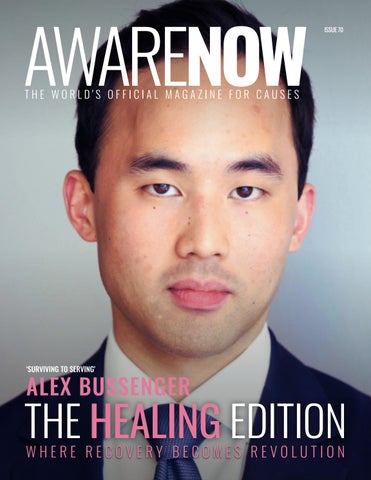
AwareNow: Issue 70: 'The Healing Edition'

Page 1


AWARENOW

THE WORLD'S OFFICIAL MAGAZINE FOR CAUSES

‘SURVIVING TO SERVING’

WHERE RECOVERY BECOMES REVOLUTION

ALEX BUSSENGER

THE HEALING EDITION

ON THE COVER: ALEX BUSSENGER PHOTO BY: NAME

AwareNow Magazine is a monthly publication produced by AwareNow Media™, a storytelling platform dedicated to creating and sustaining positive social change with content that inspires and informs, while raising awareness for causes one story at a time.

HEALING

The wound is the place where the light enters you.
Rumi

Healing isn’t quiet. It isn’t passive. And it isn’t meant to be done alone.

In this Healing Edition, we don’t just explore recovery, we challenge it. We look at what happens when healing moves beyond the individual and becomes something bigger… something shared.

Because when one story is told, it gives another permission to begin.

CEO & Co-Founder of AwareNow Media

Allié McGuire began her career as a performance poet, transitioned into digital storytelling as a wine personality, and later produced the Hollywood Film Festival. Now, as co-founder of AwareNow Media, she uses her platform to elevate voices and champion causes, connecting audiences to stories that inspire change.

JACK McGUIRE

President & Co-Founder of AwareNow Media

Jack McGuire’s career spans the Navy, hospitality, and producing the Hollywood Film Festival. Now, he co-leads AwareNow Media with Allié, focusing on powerful storytelling for worthy causes. His commitment to service fuels AwareNow’s mission to connect and inspire audiences.

The views and opinions expressed in AwareNow are those of the authors and do not necessarily reflect the official Any content provided by our columnists or interviewees is of their opinion and not intended to malign any religion, ethnic group, political group, organization, company, or individual. Stories shared are not intended to vilify anyone or anything. Their intent is to make you think.

* Please note that you may find a spelling or punctuation error here or there, as our Editor-In-Chief has MS and lost vision in her right eye. That said, she still has perfect vision in her left and rocks it as best as she can.

Photo Credit: Reza Kargar

‘REDEFINED & DEFINED’ EXCLUSIVE COLUMN BY JACK MCGUIRE

HEALING THE RISE BEYOND RETURN

heal· ing /ˈhē-ling/ (n.) the process of becoming whole not by returning to who we were, but by rising into who we are meant to be

I don’t want to trouble your mind with my imperfect design. For what I bring, though shaped by scars, is no less vital than the stars.

Not a return to who I was, but a becoming, just because the breaking carved a deeper view of all that I am growing into.

With a seat at the table, now heard in the room, our voices once silenced now echo and boom. Each story unfolding, each truth unconfined, not lost in the past, but newly defined.

No need for permission, no need to erase, what lives within us was never misplaced. Inclusion begins with the self we reclaim, connection ignites when we honor our name.

Make room for difference, let it resound, not something to fix, but something profound. For in this becoming, we finally see we are not who we were, but who we’re meant to be.

THE GRIEF OF AN IMAGINED LIFE

HOLDING GRATITUDE AND GRIEF IN THE SAME BREATH

Next month, I will be turning 45.

For some reason, this milestone is hitting harder than I ever expected.

When I was younger, I assumed my life would follow a familiar script: marriage, kids, and the white picket fence. That vision was always there, tucked away in my mind. I always wanted children of my own. Now, as I approach 45 without any of that, I find myself beginning to spiral.

I know I shouldn’t compare my life to those of my friends, but I can’t help it. I see them with their beautiful families and gorgeous houses, and while I am genuinely proud and happy for them, I struggle with a sense of shame. Shame that I’m not in that position. Shame that I’ll probably never be in that position.

It feels like I’m grieving the loss of an imagined life. The hardest part is that I don’t have any children and likely never will. This hits hard, and it hurts. I’ve always wanted to be a mother. Now, I find myself loving my friends' kids as if they were my own, knowing that’s the closest I’ll come to that kind of love.

The weight of these thoughts is heavy. I cry. I wonder, "Why me?" I look back on my life with a fine-tooth comb, wondering if things would be different if a certain relationship had worked out. But I have to learn not to do that; nothing will change the past or the situation I’m in now.

I also feel for my parents. They’re watching their friends have grandkids, and I haven’t been able to give them that experience. It adds another layer of grief.

People often say, "Oh, you can adopt" or "You can get a surrogate," but none of these are realistic options for me. My health and financial circumstances have closed those doors, along with the career I once imagined for myself. It’s a bitter pill to swallow when people offer "solutions" that only highlight how far out of reach that life has become.

I’m sure there are others in my situation. But I’ve never felt more lost and alone, having only con fided these feelings to three friends. So I sit in my grief for the life I’ll never have, wondering what I can do to leave a mark on this world if I can’t leave a legacy in the form of children.

Don’t get me wrong: I am grateful for the life I have. Two things can be true at once. You can love your life but still grieve the one that passed you by. It’s like a delicate dance, and reaching 45 has made the music louder.

AwareNow Podcast

THE GRIEF OF AN IMAGINED LIFE

Written and Narrated by Erin Macauley https://go.awarenowmedia.com/podcast/the-grief-of-an-imagined-life

Maybe this path was meant for me all along. But I want others in this situation to know they aren’t alone, and it is normal to feel how you feel.

“Feel it to heal it" is my motto, and I know one day this will pass. It’s just heartbreaking right now, and there’s nothing I can do to change that.

To anyone going through the same thing, I see you and I hear you. ∎

ERIN MACAULEY

International Director of Advocacy for #SameHere Global www.awarenowmedia.com/erin-macauley

ERIN MACAULEY is passionate about all things mental health and is a compassionate voice for those who are struggling with mental illness. Driven to help those most in need, through her vulnerable and open blogging about her own personal struggles, she lifts up others up and gives them hope.

TAP/SCAN TO LISTEN

Photo Courtesy: Alex Bussenger

SURVIVING TO SERVING A

JOURNEY TOWARD HEALING INNOVATION

Alex Bussenger didn’t choose the path that would define his career — it chose him. Facing not one, but two life-threatening medical emergencies, Alex emerged from recovery with a radical new perspective on what healing truly means and a mission to transform how we prevent and navigate illness. From the loneliness of recovery to the creation of tools that connect survivors and a venture capital fund aimed at proactive health solutions, his story is a testament to turning survival into service.

ALLIÉ: Let’s go back. Before your health crisis, Alex, who were you? And I don’t mean the resume version, but the internal version. What drove you? What worried you? What did you believe about strength and success before your body stopped you in your tracks?

ALEX: Well, thank you again for having me. Back then, I will admit, I was definitely a lot leaner and fitter. I grew up playing sports my whole life, worked out probably five or six days a week, and did a lot of heavy lifting and high intensity cardio. That was a great analogy for the rest of my life. I was going very intensely, very focused on short term

Photo Courtesy: Alex Bussenger
ALEX
“There is a difference between isolation and loneliness.”

ALEX: (continued) I would say the biggest difference was awareness. The awareness of death was so far distant. I felt invincible and never really thought about it. I was definitely one of those people who had not been to the doctor for a checkup in years. I was focused on short term results and what was going to happen next, and I did not think much about the long term future.

ALLIÉ: But then that changed. So let’s go to a different moment in your life. Would you mind taking us back to the day you nearly died for the first time? What did it feel like, not just physically but emotionally, to confront your own mortality in real time?

ALEX: Yeah, it was really intense. I was driving home late on a Sunday night. Luckily, I had made it home from Connecticut. I live in New York City. I came upstairs to my apartment and had been home about 15 minutes when it started.

It began as low intensity but very quickly ramped up. Within minutes, I felt pain in my neck and chest, and the intensity escalated extremely fast. It was one of the worst pains of my life. It was an aortic dissection. The main artery from my heart tore, the one that delivers blood to the rest of my body. It has an extremely high fatality rate. Many people die on the spot or on the way to the hospital.

My case was unique because it also cut off blood flow to my left leg. The worst pain was actually in my leg. It was unbearable. I was on the ground and could not even get up. When the paramedics arrived, I could not crawl to the door to let them in. They had to go back down, get my key, and come in.

It was around one in the morning, and I was screaming at the top of my lungs. I truly felt like I was going to die. I grew up Catholic, though I had not followed it closely, but in that moment I was screaming to God, begging to stay alive.

ALLIÉ: And if that does not change your perspective on everything, let’s go there. Was there a moment when fear gave way to something else, like clarity? Did everything suddenly become clear?

ALEX: I would say that clarity came during recovery. In the moment, you are in survival mode. I do not remember the ambulance ride, but I do remember arriving at the hospital. I had to sign documents and gave them my parents’ phone number.

The clarity came later. After a twelve hour open heart surgery, months of recovery, and inpatient rehab, I was just trying to make it through each day. But a few months later, looking back, I realized something important.

I was not isolated. I had friends, family, and colleagues visiting me in the ICU. I had a stack of cards this big. But I still felt incredibly lonely.

That is when it hit me. There is a difference between isolation and loneliness. I reached out to over one hundred patients, people who had gone through surgery, chronic illness, or cancer. What I learned was that people crave connection with others who have been through something similar. And there was no strong personalized solution for that. That is what led me to create Heal Together, which we have now rebranded to Heal.

We launched a venture fund, and about a year and a half later, after my second near death experience, we created Heal.

Photo Credit: Brendon Cook
“It gave me clarity that I wanted to work in preventative, personalized healthcare.”

ALLIÉ: I love that you said there is a difference between isolation and loneliness. Because you had all the cards and all the visitors, and still felt alone. That must have been the moment you realized the system is failing people and that you could help change that. Tell us more about the platform you have built.

ALEX: It gave me clarity that I wanted to work in preventative, personalized healthcare. We launched a venture fund, and about a year and a half later, after my second near death experience, we created Heal

It started as a one to one connection platform. For example, if you are a younger person recovering from cardiac surgery, you might only know older individuals who have gone through it. You may not share lifestyle or recovery experiences.

So we created an algorithm that matches people based on a range of criteria, including lifestyle, preferences, and medical experience.

What we realized quickly is that people also want group connection. So now we offer moderator led peer groups with six to twelve people and a trained facilitator. This has been valuable for individuals, employers focused on wellness, and hospitals that want to improve patient recovery experiences.

ALLIÉ: I love this, using technology to facilitate real human connection.

Let’s pause and go back. The second time you almost died. Bring us into that moment.

ALEX: About a year and a half later, I had complications. I had lost blood flow to my left leg during the first event. After my heart surgery, they installed a synthetic graft to reroute blood.

That graft became infected and dislodged. I had extreme pain and needed surgery. It was supposed to be a two hour procedure. While I was on the operating table, my arteries ruptured. I lost a massive amount of blood. My surgeon said blood shot up and covered his face. He had to bring in four additional surgeons immediately.

He later told me that if I had been anywhere else, even the emergency room, I would have died within fifteen minutes. But because I was already on the operating table, they were able to control it.

I see that as an incredibly lucky blessing.

ALLIÉ: Absolutely!

Let’s shift for a moment. If someone listening is in the middle of their own medical crisis, scared and feeling alone, what would you want them to know about healing, not clinically but humanly?

ALEX: Two things.

First, listen to your body. When I had pain and some bleeding from an incision, my doctors said we could wait a month. The scan did not show anything wrong. But my body told me something was off. I went in a week later instead of waiting, and that decision saved my life.

Photo Courtesy: Alex Bussenger

SURVIVING TO SERVING

Exclusive Interview with Alex Bussenger https://go.awarenowmedia.com/podcast/surviving-to-serving

ALEX: (continued) Second, you are not alone. Our studies show that many people feel lonely during recovery. Many ask themselves if what they are experiencing is normal and have no one to talk to. Some even make unnecessary calls to the emergency room because they cannot connect with someone who understands.

So if you feel that way, you are not alone.

ALLIÉ: That is so important to hear.

One last question. What have you learned about life that you would not have discovered if your heart had not forced you to listen?

ALEX: It may sound cliché, but two things.

First, our time is limited. Before all this, I never thought about death. It felt distant. But when you go through near death experiences, the line between life and death is not separate. It feels like one.

That realization is not scary. It is freeing. It pushes you to do what you want to do now. I heard a quote that said the longer you wait to do something you want, the less of a future you have to spend doing it.

Second, I used to care too much about what people thought. But when you are in an ICU bed, completely vulnerable, you realize that none of that matters.

At the end of your life, you are not thinking about impressing people. You are thinking about whether you spent enough time with people you love and whether you made a positive impact.

Every second spent worrying about others’ opinions is time taken away from that. It is a costly trade. ∎

TAP/SCAN TO LISTEN

‘MS-ABILITIES’ EXCLUSIVE COLUMN BY FOX RIGNEY

WE ALL GO TOGETHER ADVOCACY,

POLICY, AND THE POWER OF HOPE

“Ring. Ting. Ting.”

The alarm confirms it: 2:45 a.m. I am already awake, anxiously anticipating the days ahead. I move quietly so as not to wake my sleeping wife or Jesse, our Blue Heeler pup, who will spend nearly three confused, aimless days waiting for my return. Leaving him weighs on me, but my course is set. I begin the journey to Washington, D.C.

As the airport gradually fills with other sleep-deprived travelers, I pass through security with the calm focus that comes only from repetition. Travel, even when seamless, extracts a cost. By the time I arrive in Washington, fatigue has already begun to settle into my bones. Catching a glimpse of the cherry blossoms as I leave the airport is always a moment of quiet beauty, though never one I have enough time to fully absorb. An early hotel checkin grants me the rare luxury of a short, deeply appreciated power nap—less indulgence than necessity.

Friends and fellow Multiple Sclerosis advocates soon arrive for the opening session of the 2026 National MS Society Public Policy Conference. Having participated in 2023 and 2025, it is both an honor and cherish responsibility to once again represent Michigan. The Society’s leadership opens the conference with clarity and purpose, grounding us in both the urgency of the work and the privilege of being entrusted with lived experience. Their message is simple and profound: policy shapes lives.

The room reflects the breadth and determination of the MS community. Beside me sits Allie McGuire, a brilliant Michigan advocate and cofounder of AwareNow Media, whose leadership consistently elevates voices too often unheard. Nearby are Mark and Everett—a father and son experiencing their first Public Policy Conference together. Their partnership is striking, marked by open conversation, mutual support, and a shared commitment that embodies what advocacy at its best can look like.

Monday is devoted to preparation. We study and discuss the two policy priorities that will guide every meeting: fully funding the Department of Defense Multiple Sclerosis Research Program (MSRP) and protecting access to affordable, comprehensive healthcare. MSRP funding is far from abstract. Service members are signi ficantly more likely to develop MS than civilians, and more than 70,000 U.S. veterans live with the disease. Research supported through MSRP has already delivered meaningful breakthroughs—from early diagnostic blood tests to clinical trials addressing fatigue, cognition, and mobility. Fully funding MSRP at $22 million ensures these advances continue, bene fiting veterans and civilians alike. Advocating for increased MSRP funding has been a priority every year I have attended this conference.

Equally urgent is healthcare affordability. The average annual cost of living with MS in the United States approaches $90,000, driven largely by medical care and prescription therapies. For many, barriers such as prior authorization requirements, step therapy, and high deductibles delay or deny care altogether. Protecting patient-centered insurance coverage means ensuring people with MS can access neurologists, diagnostics, diseasemodifying therapies, and holistic care without being forced into financial instability. This policy priority not only serves the MS community—it affects everyone navigating the American healthcare system.

Tuesday—Hill Day—brings these priorities into sharp focus. Our Michigan delegation meets with staff from the of fices of Senator Elissa Slotkin, Senator Gary Peters, and Representatives Jack Bergman and Tom Barrett. Each meeting weaves personal stories together with evidencebased policy requests, reinforcing the truth that legislative decisions ripple outward into real lives.

Written and Narrated by Fox Rigney https://go.awarenowmedia.com/podcast/we-all-go-together

Navigating between Senate and House office buildings is a formidable task for a group managing limited energy. Still, 175 MS advocates, clad in orange, attend several hundred meetings each year. We move from one Senate building to another, then through underground tunnels to the House side of the Capitol, constantly evaluating energy levels and physical limits. I am always astonished, not by the difficulty, but by our collective ability to persevere and show up fully.

Each meeting unfolds as a carefully planned yet unrehearsed choreography of storytelling and policy explanation. Midway through conversations, I find myself marveling at the seamless collaboration among advocates. Every office listens. Every staffer accepts our leavebehind materials. And every meeting af firms that our presence matters—that these conversations equip them with the stories and context needed to inform future policy discussions. Their repeated validation provides an unexpected but powerful boost as our energy wanes.

By evening, we are back at the hotel, gathering bags and heading toward the airport once again. In the early hours of the morning, after calming an overjoyed Blue Heeler and finally settling into bed at 2 a.m., I reflect on the exhaustion and the fulfillment. Advocacy is not easy, but it is necessary. Another year. Another Hill Day. Another affirmation that when we raise our voices together, we move closer to a future where MS no longer dictates the limits of anyone’s life.

With the National MS Society, we say it plainly and with purpose: “MS ends with us.” ∎

Disability Advocate, Author & Corporate Healthcare Professional www.awarenowmedia.com/fox-rigney

FOX RIGNEY is a leader in the Michigan Multiple Sclerosis (MS) and disability community. He holds positions as Committee Chairperson of a MS Community Engagement Committee, board chair of Corewell Health’s disability focused resource group, member of a MS Government Relatiions Action committee, and leader of a

TAP/SCAN TO LISTEN
Every one is a part of everyone.

Miles to go before we sleep…

STELLA PECOLLO
ACTRESS, SINGER, DANCER & WRITER
Photo Credit: Jonny Marlow

EXCLUSIVE INTERVIEW WITH STELLA PECOLLO

IN HER OWN SKIN FREEDOM, FEMININITY & THE COURAGE

TO BE FULLY SEEN

There’s something about Stella Pecollo that feels both grounded and untethered at the same time. Like she knows exactly where she comes from… but refuses to be defined by it. From a small town in Italy to stages and cities around the world, her journey isn’t just about becoming an actress. It’s about becoming herself, fully and unapologetically. In You, Me, & Tuscany, she steps into a story rooted in love, family, and discovery. Off screen, she’s living one of her own… one that challenges expectations, embraces expression, and invites others to do the same.

ALLIÉ: You have lived all over the world, Stella, stepping into different cultures, different versions of yourself, different languages. Where did you feel most at home? Of all the places you called home, what felt most like home?

STELLA: Good question. It changes, really. Right now, I would say that LA is probably the place where I feel most at home. But in second place, I would say Puglia, which is south of Italy. I don’t know if you’ve ever been. You should, because it’s beautiful. Even though I’m from the north of Italy, so there’s no reason why. Apart from just that I love

Photo Credit: Jonny Marlow
STELLA PECOLLO ACTRESS, SINGER, DANCER & WRITER

ALLIÉ: Nice. So next question to that then, Stella, is when did you realize that home might not be a place at all, but rather a decision about who you allow yourself to be?

STELLA: I love this question. And I actually know very well when. I have a journey where my body has always been a topic of discussion, good or bad. And I think our body is our home.

That time when I really felt like I was in the right place, meaning in my body, it was thanks to my second acting teacher, Gloria. It was back in 2006, I think. She said something that made me click and made me realize that actually my uniqueness is my strength. My body is part of it, and I just have to love and accept my body, because that’s my home. So that was the time.

ALLIÉ: I love that. I imagine then if you were to hug yourself, it would be sort of saying “home sweet home,” right? That you are home.

Let’s switch gears for a moment to speak about You, Me and Tuscany. You play Francesca, who is surrounded by love, family, tradition. When you stepped into her world, did it feel like returning to something familiar or stepping into something quite different?

STELLA: I think it was a little bit of both. Obviously, being Italian and the movie being filmed in Italy, that was a big part of who I am. Another thing that I kind of had to accept growing up is that the more I live abroad, the more I feel like I’m so Italian, so that’s another topic.

But the big family is something that I never really had, that I dream of. So that part was really something new to me, but really exciting and heartwarming. It was mentioned in an interview recently, that the feeling of family was so strong that we used to hang out even after filming, all together. The dynamics between us were very similar to a real family. And still now, we get in touch, we meet for lunch. That was definitely something new to me, but beautiful.

ALLIÉ: Yeah, that is beautiful. And that just speaks to what I think we all realize at some point, that we have the family we’re born into and then the family that we choose.

Let’s talk more about body positivity. It’s often talked about, but I think very much on a surface level. Living it is something else entirely. I feel like it’s something every one of us wrestles with, to one degree or another, at some point in our lives.

But for you, Stella, what did it take for you to feel at home in your own body, not as an idea but as a truth? Was it your teacher? Was that the moment, or did it take time to really feel it?

STELLA: No, it’s a long journey. And it’s not a journey that goes straight. It goes up and down depending on what happens to you. And actually, I’m glad you asked me this question because in this movie something happened that people probably don’t know. It’s like a behind the scenes moment where, for me, it’s very important to bring what I fight for, whether it’s the body positive movement or just the acceptance of everybody, into my work.

That’s why sometimes I don’t accept certain jobs, or I ask to change certain things. In this movie, I was so lucky because Kat Coiro, the director, who also worked on the writing and creating the characters, had an idea at the beginning. She wanted to give my character more space, and in the very first draft there was an idea that maybe my husband might be cheating on me.

She asked me what I thought about it, and I said I’m not really happy about that because I don’t want to portray the image of a woman who gets cheated on, especially a woman with my body type, because it’s a stereotype I really don’t want to reinforce.

Photo Courtesy: Universal Pictures
“It made me understand that femininity and sensuality are not bad. They are part of who we are.”

STELLA: (continued) She was so happy I told her that because she agreed. She’s a big advocate for women’s rights and disability rights, and to see it in practice, not just someone talking about it, she actually changed the script.

There’s a funny story about that. I don’t know if you’ve had the chance to watch the movie yet, but there’s a little spoiler. There’s a plumber in the movie. Basically, we switched from the idea of my husband cheating on me to me being the woman with all these opportunities, and maybe, maybe cheating on my husband with a plumber. We don’t know.

I really love that because she listened, and we created a new character who wasn’t even in the original script. He ended up being one of the funniest parts of the movie. A lot of plus-size and body positive in fluencers who saw previews texted me saying they love the way I show a woman who is con fident, sexy, sassy, and embraces her curves, her body, her everything. I dance in the movie, I do so much, and it’s all beautiful and positive.

ALLIÉ: I love that. I love that a whole character was created just to support this position. I think that’s really powerful.

You’ve explored expression in ways many people are still afraid of, especially through burlesque, a craft that carries a lot of misconceptions. Did that experience feel more like vulnerability or power?

STELLA: I would say both. I decided to try burlesque while I was living in London. It was a moment in my life and career where I felt like I was getting closer to acceptance but wasn’t fully there yet.

I had this thought: what happens if someone asks me to play a role that requires nudity? How would I react? I wasn’t sure I would be ready.

I went to see a burlesque show. London is probably one of the best places in the world for it. I was in awe, and I decided right away to do the scariest thing and join a class.

It was the best thing for my journey toward acceptance. It was such a vulnerable experience, surrounded by women who were all different, all with their own insecurities and stories. But we shared the same goal, performing at the end of the class.

When that moment came, it was so liberating and fun. It made me understand that femininity and sensuality are not bad. They are part of who we are. It’s fun. I would recommend it to anyone, boys, girls, everyone.

Exclusive Interview with Stella Pecollo https://go.awarenowmedia.com/podcast/in-her-own-skin

ALLIÉ: All right, I’ll let Jack, my husband, know what I’m signing up for next.

STELLA: Yes, let me know how it goes.

ALLIÉ: I will. One more question for you today, Stella. If you could sit right across the table from a younger version of yourself, the girl just beginning to question where she belongs in this world, what would you tell her about the life she’s allowed to live?

STELLA: Beautiful question. I would tell her that she can be anything she wants and that she’s perfect as she is. The way she is, she’s perfect. She doesn’t have to change anything about herself. The more she follows her dreams, her instincts, and her pure heart, that’s the right way to go.

ALLIÉ: I love that. And I want every young girl to hear those words, to believe them, to trust them.

Thank you so much, Stella, for joining me here, for sharing your story, and for helping all of us become a bit more aware now.

STELLA: Thank you. You asked me the most beautiful questions, so I’m really happy. It’s very important, and I’m trying to spread the message as much as I can because people sometimes forget that just by loving yourself, you can literally have the world. ∎

TAP/SCAN TO LISTEN
Photo Courtesy: Elsar Dwiman

EXCLUSIVE INTERVIEW WITH ELSAR DWIMAN

CARRY YOUR PAIN LOVE, LOSS, AND WRITING THROUGH THE UNTHINKABLE

Grief has a rhythm. Sometimes it’s quiet. Sometimes it breaks through without warning. For Elsar Dwiman, it became a song that carries more than pain. It carries love that never left.

ALLIÉ: You’ve shared your voice with the world in a way that invites people to listen beyond what they see. Elsar, when did music stop being something you did and start becoming the way you told your story? When did you start using it as a storytelling tool?

ELSAR: I think from the very beginning, songwriting is about telling something that you cannot broadly tell. I started writing my own songs, I think, two years ago. And as you know, in our last conversation, I said that I had this song, Take a Shoulder, that was like a practice song. But in the end, I ended up pouring my feelings into it.

So I think since the very beginning, the story in my heart has always sought a way to get out. I always write because that’s the basic thing in songwriting and art in general. It’s pouring your soul into it and pouring your story.

ALLIÉ: Yeah, I love that. Taking your soul and pouring it into these songs of yours, which are so beautiful and so

I think whenever I can sing a song and sing it well enough, that’s when people start feeling a deeper connection, instead of just seeing a man who looks different.

Photo Courtesy: Elsar Dwiman
“Whenever I upload my singing videos… that’s when people start to realize that there is something beyond appearance.”

ELSAR: Ichthyosis, yeah.

ALLIÉ: That means the world has often noticed your appearance before your artistry. So when was that moment? When did people stop only looking at you and really start listening to you? When did your songs truly capture people’s attention?

ELSAR: I think if people just see me, it makes sense that the first thing they would notice is my appearance. It’s pretty obvious. Whenever I upload my singing videos on the internet, on my social media, that’s when people start to realize that there is something beyond appearance.

If you ask when that happened, I think whenever I can sing a song and sing it well enough, that’s when people start feeling a deeper connection, instead of just seeing a man who looks different.

ALLIÉ: Let’s shift gears and talk about something very personal. Losing your mother to cancer is a kind of heartbreak that reshapes everything. How did you process your grief before you poured it into a song?

ELSAR: Yeah, thank you so much for bringing that up. I’m starting to share this song of mine, Carry Your Pain. It will be out in May, hopefully. And yes, as you said, it’s about my late mom. She passed away because of cancer.

If you ask how I processed it, the interesting thing is that when I started sharing the song, people told me, “I’m sorry for your loss. I know it’s hard.” And it is hard. But people treat it as if I’m still holding onto that grief.

Maybe at some point I still am. But what I want to say is, if I think about it deeply, the fact that I can pour this grief into a song is a sign that I’m healed enough to deal with it.

I’m dealing with the grief, especially when it first happened in 2017. But as time goes by, you start to realize there’s nothing you can do about it. That grief begins to shift into something else. It’s not completely healed, but it’s healed enough for me to put it into something vivid, which in my case is a song.

ALLIÉ: We’re very much looking forward to it. I know it’s not released yet, but tell me about it. When you wrote Carry Your Pain, who were you speaking to? Your mother? Yourself? Or something beyond both of you?

ELSAR: I think the answer is all of them. In this song, if you read the lyrics, I would say “you,” but there are many “you’s” in this song. Of course, that refers to my late mom. I imagine I’m talking to her in the afterlife, somewhere else. So when you hear “you” in the song, that’s me talking to my mother. At the same time, it’s also me speaking about something beyond us.

In the chorus, you’ll hear: “Mama, is it my fate to never see you again?”

And then I say:

“Once I do see you again, in the next life… what would I say?”

So the song is me here, her there, and at the same time, imagining what we would do when we meet again somewhere beyond us.

Photo Courtesy: Elsar Dwiman

CARRY YOUR PAIN

Exclusive Interview with Elsar Dwiman https://go.awarenowmedia.com/podcast/carry-your-pain

ALLIÉ: Thank you so much for sharing all that you have, Elsar. It’s so beautiful.

Before I let you go today, I have to ask one more question. For someone listening right now who is carrying a loss they don’t know how to hold, what would you want them to hear, not just from this beautiful song of yours, but from you?

ELSAR: I want them to know that it’s always hard to deal with grief. No one is ever really ready for it.

Even for me, my mom was in bed for more than a year before she passed away, and still, I wasn’t ready.

For people dealing with that, please know that you are not alone. I hope this song can be at least a small offering of solace.

If you’re dealing with grief right now, just know that at some point, you will meet again. We will meet them again. And while you are still here, please live on. As long as God blesses us with life, that means He wants us to live it.

If I can offer you any comfort, I hope this song becomes one of the things you turn to. But please know that you are not alone. You’re not alone. ∎

TAP/SCAN TO LISTEN
Photo Credit: Name

THE RALLY

2026 EASTERSEALS DISABILITY FILM CHALLENGE ENTRY

On a very special occasion, a young woman waits for a certain guest to arrive, but will they show?

Summary

Leah Johnson’s terminally ill mother is having a good day. To celebrate, Leah has called all the important people in her life. But the one person she wants there more than anything isn’t answering. Will Leah’s sister show up? Or will she leave Leah hanging?

Director's Statement

The Rally is a poignant, darkly comedic exploration of the messy intersections between chronic illness, neurodivergence, and anticipatory grief. At its heart, the film is about Leah, an autistic woman attempting to curate a perfect "celebration" for her mother, Janet, who is battling cancer. The tension of the film lives in the gap between Leah’s unmet expectations and the chaotic, fluid reality of end-of-life care. Our continuous, frantic opening shot means to visually capture this chaos and lack of control. Another primary goal of this film is to challenge the pervasive cinematic trope of the "dependent" autistic protagonist. With Leah as the person "in charge of everything," the film highlights that for many neurodivergent individuals, the challenge isn't a lack of capability, but rather the exhaustion of managing a world, and a family, that doesn't always meet them halfway. When Leah’s sister Ava doesn’t show up in the end, the disappointment forces Leah to confront a difficult truth: the people who actually "show up" in our moments of need are often the ones we least expect.

Producers: Vickie Anderson, Tal Anderson Writer: Nicole Betz Director: Jessica Cabot Director of Photography:

Photo Courtesy: Discover Ag

IN THE FIELD

WHERE TRUST IS GROWN AND STORIES ARE TOLD

Trust doesn’t come from headlines. It’s built in the field, in the work, and in the people who show up every day to feed the world. Natalie Kovarik and Tara Vander Dussen are bringing us there, inviting us to see agriculture through a new lens with Discover Ag On The Road.

ALLIÉ: Let’s talk about what you’ve built. You two have built something that feels rare in agriculture. Not just informative, but magnetic. Discover Ag on the Road doesn’t just show us where food comes from, it pulls us into the lives behind it. So, my first question for you is, what was the moment when you realized this couldn’t just be a podcast anymore, that it needed to be seen, to be felt, and experienced from the road?

TARA: Natalie and I have an interesting story. We do not live anywhere near each other. I live in New Mexico and Natalie lives in Nebraska. There are so many pieces of our story that are just wild, that we ended up together podcasting from thousands of miles apart. But very early on in our friendship, and then ultimately our business and

Photo Courtesy: Discover Ag
TARA VANDER DUSSEN
“One thing we both believe is that the closer you are to your food system, the more you trust it and understand it.”

TARA: (continued) Agriculture is very visual. It’s beautiful. It’s amazing to see the landscapes where we grow food, the families, the people, everything behind it. From the beginning, we wanted to bring that to people. Not just talking behind a mic, but actually showcasing what agriculture really looks like. That vision has been with us for a long time, and now we get to bring it to life through our YouTube series, where people can see where their food comes from, but more importantly, the people and the stories behind it.

NATALIE: Tara and I are very much go-getter personalities. To her point, we knew this was something we eventually wanted to do, go out on the road and explore and share. But instead of waiting until we could get to that point, we took baby steps from the beginning just to get started. That’s something we both really believe in. That’s why the podcast kicked off three years ago. We’re in completely different states, different parts of the country, and this was something we could realistically do at that time. We could share our passion for agriculture from our own operations, my ranch and her dairy farm, and then work toward the bigger goal of taking it on the road and bringing everyone along with us.

ALLIÉ: It’s awesome what you’re doing and how you’re doing it. Let’s talk about trust. There is a trust gap in the food system right now. People want to understand, but they don’t always know who or what to believe. When you’re standing face to face with farmers, ranchers, producers, what do you see that the rest of the world is missing?

TARA: It’s interesting you use the word trust because a lot of what Natalie and I talk about is that if people got to know each other, there would be that trust. There is a ton of misinformation on the internet. There are reels designed to grab your attention and lock into your fears so they go viral, but they’re not always accurate and they don’t build trust. One thing we both believe is that the closer you are to your food system, the more you trust it and understand it. You’re not fearful of your food. That’s really at the heart of what we want to do. If you can get to know the people and the stories behind agriculture and how your food is grown, that trust starts to build. Then the next viral reel you see, you might not immediately take it as the whole truth. You start to recognize there is more nuance to the conversation.

NATALIE: You gain so much perspective. When Tara and I are out on the road, whether we’re on farms or even out at sea, I always leave with a deeper understanding of why things are done the way they are. Why a farmer uses a certain practice. Why food costs what it does. Everything starts to make more sense when you’re there, talking to people, asking questions, hearing the answers. That level of connection changes everything. Not everyone can go out and experience that firsthand, so we hope that by bringing people along with us, they can gain that same understanding and connection. And ultimately, that leads to greater trust in the food system.

ALLIÉ: Along with trust, I hear appreciation. The closer you get to something, the more you can appreciate it. What I love about what you’re building is that it doesn’t feel like education. It feels like connection, like curiosity over judgment. How intentional are you about using storytelling as a tool to shift perception and not just share information?

Photo Courtesy: Discover Ag
KOVARIK
“If you Google a farmer, the stereotypical image is an older man in overalls. And while that absolutely exists, we are two millennial women telling this story in a different way.”

NATALIE: I’m so glad you pointed that out, because that’s something Tara and I feel strongly about. We all should probably take time to sit down and educate ourselves more, but that’s not always how people want to engage. Storytelling is such a powerful way to connect and learn. Part of it is intentional. We want Discover Ag on the Road to feel fun and lighthearted. We want people to come into the space knowing they’ll get information, but also laughs and beautiful scenery. That part is very intentional. But the other side is that we are learning too. Yes, we’re in agriculture. I’m a cattle rancher. Tara is a dairy farmer. We grew up in this lifestyle. But my job is completely different from an oyster farmer or a fisherman or an orange grower. We’re experiencing it firsthand as well. That’s why it feels so real. We’re asking the same questions viewers would ask. We’re trying things for the first time. It’s raw, and I think that makes it more enjoyable for us and hopefully for the audience too.

ALLIÉ: That’s exactly it. We get to learn with you. You’re not talking at us, you’re talking with us. You’re not just documenting agriculture. You’re redefining what it looks like, who belongs in it, and how it shows up culturally. For the next generation watching this, maybe for the first time thinking, this could be me, what do you hope they see in you?

TARA: That’s such a good point. If you Google a farmer, the stereotypical image is an older man in overalls. And while that absolutely exists, we are two millennial women telling this story in a different way. We bring humor to it in a different way because of who we are. Even growing up in agriculture, I think there’s so much value in seeing people from different backgrounds in this space so you can see yourself in it. I hope people watch our show and think, I want to learn more about agriculture or I want to be part of it. Agriculture often gets put in a box of cows, corn, and tractors. We always say Discover Ag on the Road is agriculture off the beaten path. There are so many ways to be involved in this industry. It’s at the forefront of technology and innovation. I hope it sparks curiosity, not just about where food comes from, but about what it actually looks like to be part of agriculture.

ALLIÉ: How about you, Natalie?

NATALIE: I’ve always been drawn to the idea of pioneering. Not in the old-fashioned sense, but pioneering with innovation. That’s something Tara and I try to weave into everything we create. Agriculture can feel outdated in how people perceive it. There’s this image of a red barn and a very nostalgic version of farming, like it’s stuck in another era. But agriculture today is evolving. It has to be innovative to keep up with society. Whether you’re producing food or consuming it, innovation matters on both sides. We need to talk about agriculture in a fresh, engaging way and also embrace the technology that’s shaping it. I hope when people watch us, they feel that sense of innovation and are inspired to bring that same mindset into their own lives, whether in agriculture or in whatever field they’re in.

Photo Courtesy: Discover Ag

TARA
DUSSEN
Photo Courtesy: Discover Ag

Exclusive Interview with Discover Ag https://go.awarenowmedia.com/podcast/in-the-field

ALLIÉ: One more question for you both today. If Discover Ag on the Road is the beginning of something bigger, not just a series but a shift in how we relate to food, to land, to each other, what does success actually look like when you zoom all the way out?

TARA: I’ve been thinking about this a lot lately. It’s a bit of a funny analogy, but I think about Chip and Joanna Gaines. What started as a show about flipping houses became a cultural movement. Suddenly, you saw their in fluence everywhere. I would love for Discover Ag to do something similar for agriculture. Not just a show, but something that influences culture. That makes people more curious. We always joke that we want to make agriculture sexy again. We want agriculture to become part of the cultural conversation. Where people are asking, where does my food come from, who are the people behind it, what does that journey look like. Food and agriculture are actually really fun. I just want people to feel more connected to it.

NATALIE: I completely agree. At one point, there was a statistic that we were three generations removed from our food. Now it’s probably even more, maybe four or five generations removed from growing it. When I think about success, it’s reversing that. It’s bringing people back to a place where they’re not so disconnected. Where they know what’s happening on farms and they care about it. Where they feel that connection again. If we can help shift that, if more people feel aware of and connected to their food, that’s success.

ALLIÉ: That would be phenomenal. Thank you both for making agriculture sexy again.

NATALIE: I bet you never thought you’d say that. ∎

TAP/SCAN TO LISTEN

Photo Courtesy: ReelAbilities

EXCLUSIVE INTERVIEW WITH ISAAC ZABLOCKI

MORE THAN A SCREEN WHERE FILM BECOMES A BRIDGE

TO UNDERSTANDING

Film has the power to entertain, but at its best, it has the power to connect. For Isaac Zablocki, that connection is the point, using storytelling to close the distance between lived experience and public perception. Through ReelAbilities, he’s not just showcasing films, he’s inviting us into a deeper, more human way of seeing.

ALLIÉ: You’ve spent your life, Isaac, spent your career creating space for stories that the world hasn’t always made room for. So first question is, was there a moment early on when you realized that this wasn’t just about film for you, but about changing how people see each other?

ISAAC: I think I’ve always felt that film is an amazing tool to help give people access into worlds and windows that we normally don’t see into in a very, very powerful way. The emotional experience, the impact on our senses is so strong, and good storytelling can really, I mean, this is something I’ve experienced my whole life, it’s amazing how storytelling can really pass along a message.

Just last night, I was reading my daughter a story for bedtime, and I was experiencing through her how she wanted a story that had a moral and how a good and exciting story can really teach that lesson that otherwise would be hard to

The Americans with Disabilities Act, which was passed over 30 years ago, created a legal change that disability inclusion has to happen. I’m hoping now that the cultural change will happen.

Photo Courtesy: ReelAbilities

ISAAC: (continued) I feel that with the power of film, with great power comes great responsibility. So we need to present the right films. And unfortunately, disability specifically has been misrepresented when it is actually presented, mostly not presented, and often overlooked and forgotten. And if we’re not seeing these images in our films, then we’re not going to see them in real life either.

ALLIÉ: Yeah, no, that’s powerful and that’s right on. So let’s talk more about that. ReelAbilities doesn’t tell safe storybook stories about disability, it tells human ones. Complex, funny, uncomfortable, real. So what do you think we get most wrong as a society when we try to tell stories about people we don’t fully understand? Where do we miss the mark so much?

ISAAC: My God. How much time do we have? I’ll say first of all, I love that you put, you know, in quotations, this idea. There are so many misconceptions when it comes to disability. So I’ll get started and throw out some of the big ones.

First of all, I think that disability is difference, and people fear difference. So I think that’s part of where this all stems from, and the misrepresentation often comes from there.

Disability traditionally has been, when it’s presented, either as something, in the best cases, extremely heroic, or in most cases as something negative. Often the bad guys will have a disability while the good guys will be able-bodied. There’s also the misrepresentation of pity. A lot of big Hollywood films love to present some side of disability as being pitiful, and that’s not a good representation for our very, very diverse community.

But most offensive, I’ll say, is that Hollywood has often presented disability as a life not worth living. There are big movies, Oscar-winning films, Million Dollar Baby as an example, Me Before You, another one, where disability comes with a kind of dehumanization.

And that’s why I love the movies that show disability in every way, in the most normal way. Eating breakfast, the girlfriend, the love interest, the best friend, the doctor, whatever it might be.

But also, let’s take it further. Disability doesn’t have to be just in whatever forms you expect. Let them be the bank robber. Let us be a character that is completely out there, and not because of their disability. Really show that diversity that exists within our community.

ALLIÉ: Yeah, I love that. Absolutely. So let’s be the bad guy. Let’s be the sexy star. We can be all these things. And I love that you point out that disability is just eating breakfast. What does that look like? It doesn’t have to be about the difficulty of it. It can be just how it’s you living life, just in a different way.

ISAAC: It’s funny. I think it was our first year, we had a film called, I’m trying to remember its name, it was about a guy who was making a movie about a group of young people with disabilities, I think teenagers.

They were kind of exposing all the clichés that exist there. And one of the big ones was the “climbing the mountain” cliché. Let’s have a group of disabled people climb a mountain and show how they overcome their obstacles. And all of those words are offensive to our ReelAbilities ears.

This movie made fun of that concept. And to this day, we get so many “climbing the mountain” movies about the disability community. It is such a cliché.

The emphasis on the obstacles is really not something that needs to be the focus. I think you need obstacles for drama, but not the disability obstacles. Those are not the ones that create drama.

And let’s not reward our community for doing simple tasks or doing them merely because they have a disability. Let’s reward our community for the great and amazing things that are done regardless of our disabilities.

ALLIÉ: Yeah, I agree a thousand percent. So let’s talk about someone who has never experienced ReelAbilities before. In your words, what does it feel like to come into that space for the first time?

Photo Courtesy: ReelAbilities
“We try to present it as seamlessly as possible. My favorite is when it’s just baked into everything. The captions feel like part of the movie, or the audio description is built into the script.”

ISAAC: So first of all, I hope that they would feel like they’re coming into a professional film festival setting like any other. You might be greeted at the door by a person with a disability, because much of our staff are people with visible disabilities and invisible disabilities as well.

You’re going to enter a space that’s going to be as accessible as possible. But just to give the contrast, we want it to be seamless. We want you possibly not to notice that this is not a “special environment.” We want it to be a great film environment. That’s what’s special about us.

For instance, our films are shown with open captions. The captions are there, but hopefully they feel normal. I turn on captions on my screen constantly. Mainstream movies offer this too, and of course foreign films. So there should be nothing too challenging there.

Our audio description is not open. People can use a special headset or follow it on their phones. We have sensoryfriendly spaces, so people, if they need to leave, can do that.

Our conversations include an ASL interpreter next to me when I introduce a film, and we have live stenography called CART, live captions for the entire conversation before and after the film.

Again, we try to present it as seamlessly as possible. My favorite is when it’s just baked into everything. The captions feel like part of the movie, or the audio description is built into the script.

One thing you might notice, which is amazing, is the community. We aim for everybody to join, including a mainstream audience, but you will see a lot more people with disabilities than you normally would.

At some screenings, we’ll have 40 wheelchair users. If you go to a typical theater, you might not even find that many accessible seats.

We screened a film called Deaf President Now last year, and the majority of the audience was deaf. If you were a hearing person, you were in the minority. The conversation was moderated by a deaf woman, and the interpretation was there for the hearing audience. It flipped everything on its head. It was an amazing experience.

ALLIÉ: That is beautiful. That’s so wild to flip the narrative. There’s something really powerful about seeing yourself reflected on the screen for the first time in an authentic way.

Could you share a story? Have you witnessed a moment at one of your festivals where you thought, this is why I do all of this?

THAN A SCREEN

Exclusive Interview with Isaac Zablocki https://go.awarenowmedia.com/podcast/more-than-a-screen

ISAAC: That’s exactly it. Those are my favorite moments. It happens every year. Either we present a disability that’s never been shown before, or someone comes for the first time and sees themselves.

To hear people say, “This is the first time I’m seeing myself on screen.”

One year, we showed a film about nonverbal men with autism. They were there for the Q&A, and everything was done through live typing on the screen. There was a child in the audience who was also nonverbal. He had an iPad and asked a question. He felt so connected to seeing people like him. And of course, his question was profound, much better than most, because it came from lived experience. The answers that came back were things you would never get even from professionals. It was beautiful.

Another moment was a mother who saw a film about a child with a disability. She told us, “I now understand my daughter in new ways.” She had new language to describe what her daughter experiences. That’s incredible.

ALLIÉ: It really is. It just blows my mind that we don’t know what we don’t know until we see it, until we feel it. One more question for you. Beyond all of this, beyond the films, beyond the festivals, beyond the movement, how do you hope people see each other differently because of what you’ve built?

ISAAC: I hope that people will have more comfort.

I’ll go back to another screening where we had two nonverbal men in a Q&A. Both were brilliant, poetic, completely self-aware. But if you saw them on the street, you might cross to the other side because they make sounds and don’t communicate verbally.

Through these films, you get to see the humanity, as you mentioned, and hopefully that takes away our fear of difference. It’s okay to be different. Our instinct is to fear what’s out of the ordinary. But out of the ordinary can be some of the most beautiful things in this world.

I hope people will be able to disclose their disability more easily, that people will hire more inclusively, and that disability will be visible in our real world and not something we whisper about or hide. The Americans with Disabilities Act, which was passed over 30 years ago, created a legal change that disability inclusion has to happen. I’m hoping now that the cultural change will happen. Hopefully, there’s no better way to change culture than through film. ∎

TAP/SCAN TO LISTEN

EXCLUSIVE COLUMN BY DAMKIANNA SUPPORTED BY TRUTH & JUSTICE LEAGUE

THE INTELLIGENCE THAT HEALS WHERE HEALING REMEMBERS ITSELF

My journey with healing is not linear

It’s a web of mycelium

Expanding through the dark, heavy, pressure of earth.

Healing unfolds without agenda.

Healing blossoms from within.

Healing is not something you acquire. It is something you return to.

When a muscle tears, it heals by reconnecting its fibers. When skin is wounded, it closes by forming new layers that meet again. When a bone breaks, the body does not search outside itself for instruction. It reorganizes – restoring continuity from within.

At every level of the physical body, healing is reconnection. This is more than a metaphor. It is a pattern.

And once you begin to see it, you cannot unsee it.

Let’s step outside for a moment…

Imagine a piece of land that has been disturbed—overworked, polluted, or stripped of nutrients. The soil feels lifeless. What once held vitality now feels depleted.

And yet… it does not stay that way.

Without anyone intervening, something begins to grow.

At first, it may not look like much. Low, resilient plants begin to spread—what many would call weeds. Species like clover quietly take root, drawing nitrogen from the air and returning it to the soil. Dandelion sends deep taproots down through compacted earth, breaking it apart, pulling minerals upward, restoring movement where there was stagnation.

What looks like disorder is actually precision.

These plants are not random. They are responsive.

They arrive because the soil is calling for exactly what they provide. They don’t analyze the land. They don’t attempt to fix it.

They simply express their magic, their medicine. And through that expression, the soil begins to heal.

Now step into a forest... You stand beneath an oak tree—ancient, grounded, expansive. At first glance, it appears singular. A powerful presence rooted in its own strength.

But look closer.

At its base, clover and other low-growing plants spread across the earth, enriching the soil with nutrients the oak depends on. Beneath the surface, mycelial networks thread through the roots, extending the tree’s reach, carrying water, minerals, and subtle signals across the ecosystem.

The soil is protected. Moisture is held. Life is stabilized. And the oak is not simply receiving.

Its canopy casts a cooling shade, creating conditions where other plants can survive. Its leaves fall and return to the earth, feeding the soil that sustains the entire system. Its roots anchor the ground, creating structure for everything around it.

Nothing here is separate. Nothing here is accidental. Each element is in relationship—responding, exchanging, supporting. No single organism is responsible for healing the land.

The land heals through connection. And every part participates, not by striving… but by expressing its nature in coherence with the whole.

Now let’s clarify what we mean by coherence: it is the state where all parts of a system are communicating, aligned, and working in harmony rather than fragmentation or conflict. In coherence, nothing is forced—each part expresses its nature while remaining attuned to the whole, allowing intelligence to move through the system with clarity and ease. The same intelligence that governs ecosystems exists within you.

There is something in you that already knows how to restore balance, how to integrate disruption, how to return to coherence.

Healing begins when you reconnect to that intelligence.

When we look through the lens of mental and emotional healing, this becomes even more profound. Trauma does not mean something is broken beyond repair. It means something has been separated for the sake of survival. The mind and nervous system fragment so that you can continue functioning. Sensations, memories, and responses become compartmentalized. This is intelligence at work.

Nature doesn’t heal in isolation. If we remain fragmented, parts of our mind, body and spirit are cut off from the nourishment they require to thrive. Healing is the reconnection after such fragmentation.

It is the moment when the part of you that learned to stay small meets the part of you that now has capacity. When the body begins to feel what it once had to suppress. When awareness returns to places that were once closed off. Healing is not forgetting what happened.

It is restoring communication within yourself. It is integration. And this integration does not happen in isolation. Because you are not isolated.

Modern physics and ancient wisdom converge on this understanding: you are part of a continuous field. Even when you are not touching another person, you are interacting. The human body generates an electrostatic and electromagnetic field that extends beyond your skin. The earth itself carries a vast field, and you exist within it, constantly exchanging information.

You are not separate from your environment. You are in constant relationship with it, which means your healing is not a private event happening inside your mind or body alone. It is a relational process within a living system. And that system is always responding to you.

If you are healing from something—a wound from childhood, a pattern of disconnection, a place where safety was disrupted—life does not ignore that. It organizes around it.

Sometimes the medicine for your healing arrives as support. As people, places, or moments that feel nourishing and stabilizing. And sometimes the medicine arrives in forms that are more confronting. Through friction. Through challenge. Through relationships that push against the exact edge where healing is needed.

This doesn’t mean that something is going wrong. It means, the universe is listening. It means, the universe is responding. In nature, the soil is often disturbed before it becomes fertile again. Old structures must break down so that new life can emerge. In the same way, life will draw out what is unresolved within you—not to harm you, but to integrate it. The medicine is always specific. And it is always present. The question is whether you are relating to it as resistance… or as intelligence.

Because healing does not begin with control. It begins with connection.

First, a deep connection to yourself. To your body, your sensations, your inner signals. The places where your own intelligence is already speaking.

And then, a deeper connection to the reality that you are not separate from the intelligence that created life itself. You are in communion with the earth. You are communicating with the field. You are dancing with the cosmos. You are co-creating, 24/7.

Which means you do not have to force healing into existence. Allow it.

Open to it.

AwareNow Podcast

Written & Narrated by Damkianna https://go.awarenowmedia.com/podcast/the-intelligence-that-heals

Recognize that the pathways already exist. That the intelligence is already present. That the medicine is already here.

Healing is not something you achieve. It is something you receive—through connection.

And beneath every layer of protection, every adaptation, every pattern that once served you… There is something that has never been broken. A deeper coherence. Ancient intelligence. An innate knowing.

Healing is not something you acquire. It is something you return to. ∎

@thedamkianna www.damkianna.com DAMKIANNA Advisor, Speaker, Creative Director, & Founder of RITE Productions www.awarenowmedia.com/damkianna

Damkianna is a private advisor to visionary leaders and founders devoted to precision, presence, and higher intelligence. She is the creator of The ALIGN Method, a body-based approach that restores clarity, decisionmaking, and leadership from within. Through private council, speaking, music, and immersive experiences, her work supports leaders in moving with coherence rather than force.

‘PEQ PERFORMANCE’ EXCLUSIVE COLUMN BY SONJA MONTIEL

COMMUNITY & COLLABORATION BY DESIGN ELLIOT FELIX’S VISION FOR A CONNECTED COLLEGE

The story of Elliot Felix began in a middle school art room filled with scraps of cardboard, the hum of creativity, and the steady encouragement of a teacher who saw possibility everywhere.

As a sixth grader, Elliot took an elective course taught by Mr. Bida, an art teacher who taught his students as if they were budding architects. He pushed his students to see the structure and purpose of spaces, where others saw only shapes. Elliot remembers one assignment where they brought in board games, analyzed their underlying logic, and rebuilt them in three dimensions. On another occasion, Elliot remembers the day Mr. Bida sliced open a flower just to show the beauty of its structure inside. Of all the incredible memories Elliot had as a middle schooler, he remembers the feeling of an art room that was more like a clubhouse. A place where curiosity was a shared language, and everyone exercised the freedom to explore.

Elliot likes to say his work today as a student success author, speaker, and consultant, is really about helping students find the place, their people, and their path. Over the years he’s worked with more than a hundred colleges and universities, nudging a million students toward success by reshaping the environments around them. Whether it’s the spaces they live in, the services that support them , or the technology that connects them, the foundation for all of Elliot’s work was planted when he was a young student himself.

During his college days at the University of Virginia, Elliot experienced the same spirit of curiosity and exploration as part of the architecture program. The program was designed to nurture a tight-knit community with opportunities to work side-by-side in the studio, visit real sites, and learn from professors who practiced what they taught.

It wasn’t until after college that something shifted. When Elliot began working for an architecture firm, he realized that architects were often asked to solve problems that weren’t fully defined, or worse, problems that miss the point entirely. Architects were proposing solutions before truly understanding the culture, curriculum, and campus. He saw inspiring buildings being placed in the wrong locations and designs for today that missed opportunities to rethink how people live, learn, and work. He knew what was missing: conversations to understand the people and the purpose behind the spaces.

That realization sent Elliot to graduate school at MIT, where the focus of his work moved from buildings to the people inside them. He also served in student government, surveying peers, hosting town halls, benchmarking other departments, and proposing changes that improved life for entire cohorts on campus in work that foreshadowed the consulting work he's done since. They reorganized the academic schedule, doubled TA pay, and better supported and celebrated thesis projects. By blending human-centered design with opportunities to reshape policies and places, Elliot gained the proof he needed that meaningful change happens when a community designs solutions together.

“The challenge is rarely a lack of passion or good ideas. It’s the weight of structure and tradition, or the systems built long ago that shape habits without anyone realizing it.”

Through Elliot’s work as a consultant, he has seen that most people in higher education are deeply committed, hardworking, and student-focused. “The challenge is rarely a lack of passion or good ideas. It’s the weight of structure and tradition, or the systems built long ago that shape habits without anyone realizing it. If I can help clear those pathways to help colleges and universities improve what they offer, how they operate, and the way they are organized, then my work can make a real difference for students and society.”

That belief eventually led to his book, The Connected College. He wrote it to reach more people within and beyond the profession of architecture. To offer a playbook grounded in evidence, example, and lived experiences, Elliot knew he could ignite curiosity that would help learning institutions imagine something better for their students.

At the heart of the book are five essential connections that must be considered in design:

Connection to Community (Belonging)

Connection to Holistic Support

Connection between Courses and Careers

Connection Through Internal Collaboration

Connection Through External Partnerships

Elliot believes these connections can be seen in the focus of a strategic plan, the design of a first-year experience, the structure of a student services hub, and even the interface of a next-generation digital portal. To invest in a thoughtful process of design will lead to success measured by not only stronger retention and graduation rates, but also in how students take initiative, explore identities, and work on projects that stretch them and their peers.

When he reflects on the future of higher education, he returns to a sentiment reminiscent of Churchill's idea that democracy is the worst system of government – except for all the others: “Higher education may be imperfect but it remains the best system we have to help people discover opportunity, purpose, community, and identity. If colleges and universities can rise to the challenge to become more affordable, supportive, and career-ready, then the future will be bright.”

COMMUNITY & COLLABORATION BY DESIGN

Written by Sonja Montiel and Narrated by Elliot Felix https://go.awarenowmedia.com/podcast/community-and-collaboration

What excites Elliot most is the idea of applying design thinking not just to solve problems for people but as a way for students to find their paths. Seen this way, every experience – from the class project to the club activity to the internship – is a way for students to prototype their future. College becomes a kind of sandbox where students can explore before committing, play before defining, and ask questions before choosing a path.

It’s no wonder his favorite line from the Kirkus review of his book highlights his optimism:

“The author’s enthusiasm for his subject is evident throughout, making it easy for readers to believe it’s possible to overcome institutional inertia for the benefit of everyone – especially the students.”

In many ways, The Connected College is a tribute to the belief that he inherited from a middle school teacher who turned an art room into a world of possibility. May this be a reminder that when we design environments with intention and heart, learning becomes a place where students discover who they are meant to be. ∎

Learn more about Elliot Felix: www.elliotfelix.com

SONJA MONTIEL

Co-Founder of PEQ Performance Consulting www.awarenowmedia.com/sonja-montiel

SONJA MONTIEL (MA Education) is a cofounder of PEQ Performance Consulting LLC and cohost of “The DH Effect” podcast. She and her partner, Hilary Bilbrey, guide individuals, families, and teams to consistently reach successful outcomes through positive and emotional intelligence strategies. During Sonja’s 23 years working with thousands of teens and young adults worldwide, she began to witness many societies creating an unhealthy hyper-achieving culture that misguides our young people in their pursuit of living a life of fulfillment. Sonja is changing that narrative highlighting educators around the world who dare to think differently about education. (www.peq-performance.com)

www.IamAwareNow.com

TAP/SCAN TO LISTEN

‘RELEASE

THE GENIE’ EXCLUSIVE COLUMN BY PAUL S. ROGERS

WE ARE OUR PLANET’S TENANTS RETHINKING OUR

ROLE FROM OWNERSHIP TO STEWARDSHIP

Release the Genie Fact: The Genie told the 4 Non Blondes what’s up.

There is a subtle but powerful shift in perspective that transforms how we relate to the Earth. The recognition that we are not its owners, but merely its tenants. Ownership implies control, entitlement, and permanence. Tenancy, on the other hand, suggests a responsibility, care, and temporary stay. When we see ourselves as tenants of this planet, our role changes from one of consumption to one of stewardship.

A tenant does not inherit a space to exploit without consequence. A good tenant maintains what they are given, respects its limits, and ensures it remains livable for those who come next. This mindset is in stark contrast to our definition of progress. This has often been equated with expansion and conquest. The over developing of land, exploitation of resources to produce more and ever larger systems to serve our human convenience. While this has brought undeniable benefits, it appears that the bill is now due.

The signs are all around us. Changing climates, declining biodiversity, polluted waterways, and strained ecosystems. These are not isolated issues but symptoms of a deeper imbalance. They re flect a relationship with the Earth that has been shaped by ownership thinking rather than tenancy awareness. When we believe something belongs entirely to us, it becomes easier to overlook the consequences of how we treat it.

Being a tenant reminds us that we are part of a larger system that existed long before us and will continue long after us. It brings a duty of accountability.

This perspective should introduce a sense of humility. No tenant would claim to have built the foundation of the home they inhabit. Similarly, humanity did not create the complex systems that make Earth habitable. The balance of gases in the atmosphere, the cycles of water and nutrients, the diversity of species that stabilize ecosystems. These are the result of billions of years of natural evolution. We are beneficiaries of this intricate design, not its architects.

What is a good tenant of the planet?

Taking responsibility for the space we occupy. On a practical level, this includes reducing waste, conserving energy, protecting natural habitats, and supporting systems that replenish rather than deplete. It involves making choices that consider long-term impact rather than short-term convenience. These actions may seem small in isolation, but collectively they represent a shift toward responsibility.

It means respecting boundaries. Just because there are plenty of resources doesn’t mean they are in finite. Every home has limits, and so does the Earth. Ecosystems can only absorb so much pollution. Resources can only regenerate at certain rates. Ignoring these boundaries leads to degradation, extinction and deterioration. Recognizing limits is not restrictive; it is essential for sustainability.

A tenant understands that their time in a space is temporary. There is an implicit agreement to leave it in good condition for the next occupant. We have fallen into bad habits of borrowing from tomorrow without thoughts of the consequences. Future generations will inherit the consequences of our actions. The quality of the air they breathe, the stability of the climate they experience, and the richness of the natural world they encounter are all shaped by the choices we make today.

AwareNow Podcast

WE ARE THE EARTH’S TENANTS

Written and Narrated by Paul S. Rogers

https://go.awarenowmedia.com/podcast/we-are-the-planets-tenants

Walking in a forest, listening to the rhythm of waves, feeling the texture of soil in your hands. Our Earth is not an abstract concept but a living environment that supports and sustains us. From this awareness, care arises naturally.

It is important to realize being a tenant does not mean we should withdraw from progress or development. Instead, it calls for progress that aligns with the health of the planet. Renewable energy, sustainable agriculture, circular economies, and ecological design all reflect ways of living that honour the principles of a responsible tenancy.

The challenge does not raise in the absence of solutions, but in the willingness to adopt them. Putting our interests into the proper context, that of a wholly symbiotic relationship with the planet.

Cultural values, economic systems, and individual habits all in fluence how we interact with the Earth. Changing these patterns requires both collective effort and personal commitment. It asks us to reconsider what we value and how we define success. Is success measured by how much we accumulate, or by how well we sustain the world around us?

Looking at ourselves as tenants of the planet is an invitation to rethink our place in the larger story of life. It moves from us from a mindset of taking to one of caring, from entitlement to responsibility, from disconnection to relationship. People talk about legacy. Whilst our time here is limited, our impact is lasting.

When we embrace our role as tenants, we do more than just preserve the planet. We participate and enrich its ongoing story. The reward is profound… a thriving Earth where both nature and humanity flourish together. ∎

PAUL S. ROGERS

Transformation Expert, Awareness Hellraiser & Public Speaker www.awarenowmedia.com/paul-rogers

PAUL S. ROGERS is a keynote public speaking coach, transformation expert, awareness hellraiser, life coach, Trauma TBI, CPTSD mentor, train crash and cancer survivor, public speaking coach, Podcast host “Release the Genie” & best-selling author. His journey has taken him from corporate leader to kitesurfer to teacher on a first nations reserve to today. Paul’s goal is to inspire others to find their true purpose and passion.

TAP/SCAN TO LISTEN

Always remember that when someone with autism is having a difficult time, they are having a difficult time, they are not giving anyone a difficult time.

Photo Courtesy: Jennifer Kaufman

EXCLUSIVE INTERVIEW WITH JENNIFER KAUFMAN

BRIDGING THE GAP

EDUCATION, EMPATHY, AND THE WORK THAT MATTERS

There’s often a gap between intention and impact, between what we say and what we actually do. When it comes to autism, Jennifer Kaufman is working in that space, building bridges that make inclusion real.

ALLIÉ: You live in two worlds that don't always intersect, Jennifer, as a school principal, that lens, and then as a grandmother navigating autism at home. So my first question for you today is, how has that dual perspective changed the way that you lead?

JENNIFER: So is it the way that I lead or the way that I grandparent?

ALLIÉ: Let's look at both.

JENNIFER: Okay. So in terms of my leadership, I always thought that I was supportive of families and that I understood their journey and tried to really let them know that we were there for them in terms of school. But when it came down to it, once I had somebody with autism in my own family, it really shifted that perspective to understand that although we're trying to support them in school, they are with their child and they are concerned about their child

“No matter how much knowledge I brought to the table, when it came down to it, my daughter and her husband needed to be acknowledged as the experts.”

ALLIÉ: So having that lived experience outside of the classroom, outside of school, but then in home as well. Let's talk then, because there is a difference between understanding autism academically and experiencing it personally. What did you have to unlearn once autism became part of your family's story?

JENNIFER: I really had to define to myself, and eventually to my family, what my role was because I had certain expectations as a grandmother going into it. And then I brought my expectations as a professional in the field and what I thought I knew he needed and what I thought I could bring to the table, expecting that it would be readily accepted. I was surprised because it wasn't. It was through trial and error that I really learned a lot and what ultimately motivated me to write the book.

ALLIÉ: Absolutely. So let's talk about the book. Grandparenting on the Spectrum is not just about awareness. It is not simply saying here is the issue, but rather pushing beyond that. What is the most important shift that you hope people make after reading your book?

JENNIFER: That is such a good question. The shift for me, and the one I hope to share with grandparents and extended family members, is to shift expectations and to understand that the parents of that child are the experts on that child. No matter how much knowledge I brought to the table, when it came down to it, my daughter and her husband needed to be acknowledged as the experts.

ALLIÉ: Let's talk about a word. Inclusion. It is something we hear often, but it is not always felt and not always practiced. In your opinion, in your words, what does true inclusion look like when it is done right?

JENNIFER: Inclusion is incredibly important. I almost wish there was an autism inclusion month. Inclusion is providing opportunities for someone with autism, or any kind of neurodiverse operating system, to be part of their community in a way that does not differentiate them or set them apart. It is about giving opportunities to truly be part of and to immerse themselves in their communities, their activities, their schools, and everything that comes with that.

ALLIÉ: I love that, to be part of, not to find a part and place it off to the side. I think that is the mistake we often make. I can speak personally. When I grew up, I was the only Black girl in my community. On Diversity Day, they said let's celebrate and be inclusive. They used the word inclusive, but what did they do? They sent me, being a girl of color, to another place where they gathered others from different communities and said, here, you go enjoy. I think we see something similar with autism. Someone says, oh, you are autistic, you should meet this person because they are autistic too. But we do not have to exist only within those circles. Our children should not be limited to that either. It is so important that they are around all children and feel truly welcomed.

JENNIFER: I agree with you so much. Something that comes to mind is here in New Jersey, where I am located, we are building these beautiful parks for children with disabilities, including autism. They are wonderful and funded by corporations and community efforts. But again, they are separate. They create a space that says this is your park and this is your equipment. It would be so much more meaningful to have shared spaces where all children can play together, with equipment that supports everyone.

BRIDGING THE GAP

Exclusive Interview with Jennifer Kaufman https://go.awarenowmedia.com/podcast/bridging-the-gap

ALLIÉ: Exactly. Not this is your park, but this is our park.

JENNIFER: Right.

ALLIÉ: What has been the hardest part of being a grandparent of a child on the spectrum?

JENNIFER: As in any family, relationships need to be navigated carefully. I have had to recognize that with all of my background, education, experience, and years of attending IEP meetings, there is a time and a place for my expertise. Sometimes, the role of grandma is simply what I need to be. No matter what that voice in the back of my head is saying, I have to be present. I have to enjoy the experience with my family and my grandchild, and set the professional part of myself aside.

ALLIÉ: That is such important advice. With the best intentions, we often want to fix or help, but sometimes we just need to be. Just be. One more question for you today. If you could change one thing about how communities show up for individuals with autism and their families, what would it be?

JENNIFER: There are so many things, but I would say acceptance, support, and inclusion. Maybe you do not understand what you are seeing, whether it is a behavior or a child communicating with a device, but do not shy away. Ask questions. Be supportive, caring, and kind. We have encountered people who are not kind, and it makes everything more difficult. Always remember that when someone with autism is having a dif ficult time, they are having a difficult time, they are not giving anyone a difficult time. ∎

Learn more about Jennifer on her website: grandparentingonthespectrum.com

Get her book Grandparenting on the Spectrum: https://go.awarenowmedia.com/book/grandparenting-on-the-spectrum

TAP/SCAN TO LISTEN
PATTY CONWAY
BEAUTIFY PULLMAN VOLUNTEER
Photo Courtesy: Beautify Pullman

EXCLUSIVE INTERVIEW WITH PATTY CONWAY

BEAUTIFY PULLMAN

BUILDING COMMUNITY THROUGH BEAUTIFICATION

Beautify Pullman was never just about beautification—it was about connection, restoration, and the quiet power of showing up. Founded in 2020 to bring people together around meaningful change, the organization continues to transform both spaces and lives. Patty brings us inside that movement, where every project tells a story of belonging.

ALLIÉ: When you think about Pullman, Patty, not just as a place but as a feeling, what does it mean to you personally, and how has your connection with the community shaped the way you show up in the work that you do with Beautify Pullman?

PATTY: That is an excellent question. Let me think about it for a minute. Pullman is a small rural community where everybody knows everybody. My husband and I chose to retire there because it's absolutely beautiful. There are lakes and forests and beautiful farmland, and it's a welcoming community. However, it is a victim of things that happened in the past. Decades ago, a factory moved away, and it’s been the victim of disinvestment for quite a while. So although there's a lot of natural beauty, there's not a lot of resources, there's not a lot of infrastructure, but

Photo Courtesy: Beautify Pullman

ALLIÉ: How long have you been in Pullman now?

PATTY: I have been in Pullman full time for 10 years. However, I've been visiting the area for 40 years because I have family in the area.

ALLIÉ: And you said it's a small population. What kind of population are we looking at?

PATTY: So Pullman is a community. It's not a village, it's not a town, but it makes up most of Lee Township. And Lee Township is about 3,800 people. Most of the people in Lee Township have a Pullman address, so Pullman is probably about 3,500 people.

ALLIÉ: All right. Let’s talk more about Beautify Pullman. It isn't just about making things look better, it’s about restoring spaces that belong to everyone. Was there a moment when you realized that this work was about something deeper than beautification, something more human maybe?

PATTY: Absolutely, and that’s also an excellent question. I moved to Pullman full time just before COVID started happening. Once we were all there and not able to do much, I met some women and we would get together outside in people's yards.

Two of the women I met have lived there for a long time. One is a fifth generation Pullmanite. The other has been there for a few decades. They told me some of the history of the community and that they were working to better the community by making it more beautiful. They wanted to landscape downtown. They remembered when Pullman had a department store, a factory, and a large grocery store. We have a few small grocery stores now. Back in the 70s, Pullman was quite prosperous.

But many of these things moved away when the factory moved away. So I met these women, and they had a vision that was wonderful. I joined them and brought some background that I have in nonpro fits. We decided to incorporate and create a nonprofit.

We really did just start with beautification. We started by landscaping, installing some planters, downtown concrete planters. One of the planters is on a very prominent corner and it says, “Welcome to Pullman.” In our first year, we also hired a well known muralist out of Kalamazoo named Conrad Kaufman to take a building that was very nondescript and paint a mural about the history of the area, starting from the Native American mound builders, through the loggers, through the farmers, to the very diverse community that we have today. That really helped us define Pullman. This is where we live, this is where we want to invest. This is the heart of our community.

Then we thought, people are really interested in what we're doing. This community needs more. We were very fortunate that within about 16 months of being formed, we were awarded a large grant from the Of fice of Agriculture and Rural Development, a rural development grant to create a park right downtown in Pullman at the main intersection. We felt the community needed a place to gather, both formally and informally, a place to hold events, a place for the community to come together, a hub. So we built that in 2022, and since then, we’ve had a lot of activity.

The park has a 2,400 square foot pavilion, so we were able to bring in concerts. We're going to start movie nights this summer. Once we opened up the park, the VFW approached us about having a corner for a veterans memorial. We worked with them to build the veterans memorial. It has over 500 names of locals who served, all the way back from the War of 1812 to those who are serving today. We hired an artist to make a beautiful statue, and we have an honor wall that names as many of the veterans as we could identify.

ALLIÉ: That's incredible. It sounds like it rings very true, going back to the Field of Dreams. If you build it, they will come. If you build it, the community will come together.

Photo Courtesy: Beautify Pullman

PATTY: Absolutely. We wanted everyone to feel invested in the place, especially children. Growing up, they would know that when they finished high school or moved away, they have something to come back to that they remembered. So we had this idea that turned out to be wonderful. We gave every child in the community a four inch circular tile to paint.

Then we hired an artist to make a beautiful mosaic of a tree. It’s about nine feet wide and five or six feet high, and it’s right in the park. That was four years ago, and kids are still going up saying, “There’s my tile. I did that in first grade or third grade.”

We had the art teacher at the school help us, and we also had many days where we would just have the paints out in the park and people could come and paint their tile. We didn’t restrict who could participate. We have people who come every summer, and of course they should have a tile because they’re going to keep coming back.

There are hundreds of tiles, and it’s absolutely a beautiful mosaic. It’s something the kids can return to with their own children one day and point to what they did to help make this park what it is.

ALLIÉ: What an incredible thing to truly feel physically part of a community.

So, it sounds like so much of this work is driven by volunteers, by people choosing to care. What have you learned about people, about generosity, about pride, about belonging through this process of building something together?

PATTY: That’s another excellent question. Our community is really volunteer driven because we have very minimal government. We have a part time supervisor and a part time board of trustees. Many of the improvements in the community are driven by volunteers.

For example, the Memorial Day Parade is run by the VFW, but it’s all volunteer. We have a disc golf course that some people years ago just decided to create behind the school along the river. It’s a wonderful course.

We knew it was a community driven by volunteers. What we did not know was the extent to which people would rise up and help us. The park had hundreds, possibly thousands of volunteers who helped. Churches called us and said they wanted to donate flowers and plant gardens. People built structures. We have a beautiful 34 foot train in the park that kids can climb all over.

We put a call out to contractors, and they brought their teams for free. We built it over a weekend. They brought generators, trucks full of tools. It was amazing.

That train also reflects Pullman’s history. The town grew because of the train, just like many logging communities. The mills opened up, logging began, and ultimately it led to the farmland we have today.

We estimate over 200 volunteers help us every year. In 2025 alone, over 200 people answered our call and came out to support what we do.

ALLIÉ: That is so awesome. Communities like Pullman, where resources aren’t abundant, often have something stronger, this connection. How have you seen that truth play out, especially when progress felt uncertain or slow? Can you share a moment where community carried something forward?

PATTY: Communities like ours, when they suffer from disinvestment over decades, lose pride and civic participation. But that’s largely because of a lack of social connection and cohesion. Building this park helped bring that back. Although we own the property, the park is always open. Everything there is free. We don’t want anyone to miss out because they can’t afford admission.

BEAUTIFY PULLMAN

Exclusive Interview with Patty Conway https://go.awarenowmedia.com/podcast/beautify-pullman

PATTY: (continued) When we were building the park, we received a $100,000 grant, but it cost $165,000 to build. In the end, we’ve invested well over $200,000. People showed up to move dirt, landscape, build structures. Someone donated the flagpole. We have a 30 foot flagpole by the Veterans Memorial.

Every year we have a planting day in May, where people come out and plant flowers throughout the community. It kicks off the summer, and by Memorial Day, everything looks beautiful.

ALLIÉ: That’s incredible. One more question for you, Patty. If someone who has never heard of Beautify Pullman were to walk through one of these spaces, what would you hope they feel? And what would you want them to understand about what it took to create this?

PATTY: I would hope they feel the same pride that we have, that we are a community that shows up for each other. I want them to know that we don’t have a lot of resources, but we can accomplish a lot by working together. I want them to feel like Pullman is a welcoming place, a place that is open to everybody.

ALLIÉ: I think that’s a beautiful response. There are so many times when you walk into a community and feel unsure if you belong. I love that you said you hope they feel your pride and feel welcomed to be part of that.

PATTY: The park is just a beautiful space. We have a gazebo, a large pavilion, and areas where people can simply sit and have lunch. It’s beautifully landscaped. By mid summer, there are flowers blooming everywhere.

We’ve had trees donated that are starting to create shade. You’ll see children playing. We want people to come in, feel our pride, feel welcome, and feel like it’s a place where they can relax, meet a friend, or attend a concert or movie. The gates are always open.

We also installed and support a public hotspot because Wi-Fi is expensive. People come to apply for jobs or communicate. We recently had fiber installed, but until then, internet access was unreliable and expensive. This is just another way we try to make the space welcoming. ∎

TAP/SCAN TO LISTEN

In a world where messages disappear quickly, a handwritten letter can still carry emotion, memory, and meaning that lasts.

‘GLOBAL

GOOD’ EXCLUSIVE COLUMN BY ERIN INDIA

THE WEIGHT OF A LETTER A RETURN TO WORDS THAT DON’T DISAPPEAR

In a time when most of our communication happens through screens, Daak Chithi is working to slow down and bring people back to something more human: handwritten letters. What began as a personal discovery has grown into a cross-border initiative creating spaces for connection, reflection, and honest conversation through writing.

I spoke with members of the Daak Chithi team about how the project began, the emotions people express when they write by hand, and what they hope the future holds for this growing community.

ERIN: Can you start by telling us about the project and how it came about?

RAMEEN: The idea of Daak Chithi came about when we realised that writing had become almost archaic when it came to community and connection. We wanted to bring that back to the people around us and into the spaces that make up our communities.

MAHNOOR
DAAK CHITHI

RAMEEN: (continued) It became a means not just of communication, but also advocacy for causes that were close to our hearts. Now we’re operating across several countries and working with ambassadors in different regions. I’m the country director for Pakistan, while Murshid does similar work in Bangladesh. I was asked to build a team here, and I knew of Mahnoor and her connection to poetry, so I brought her on as a curator.

We’re all writers from different backgrounds and different worlds, but we’re deeply connected through this cause.

MAHNOOR: At the moment we’re in a bit of a pause. Our last event was in December and the winter months were slower. It’s Ramadan right now, so after Eid we’re planning something new. Rameen and I are hoping to host something in Lahore as well. Right now our team is based in Islamabad, but Lahore is a much stronger cultural hub, so it feels like a natural place to expand. We’ve had such a lovely response. A lot of people feel frustrated by everything being digital now. They’re drawn to analogue things, to vintage experiences. It’s something we really look forward to, and it keeps us going.

ERIN: In a world of instant messages and social media, what do handwritten letters offer that digital communication often cannot?

RAMEEN: From the beginning, the idea of intimacy really can’t be replicated digitally. We organised an event centred around grief where we worked with midwives from Sindh. We sat together and explored grief, loss, love, and the experience of bringing new life into the world. We received such beautiful responses and so many different perspectives on emotion.

Those small emotional details eventually grow into deeper feelings, and I feel like that kind of experience is dif ficult to create in digital spaces. It happens through something as tender and intimate as writing letters.

MAHNOOR: At one of our events in a library in Islamabad, one participant wrote a letter to his lover. We invited a few people to read their letters out loud. When he read his, it was such an intimate, personal moment. It felt almost like we were looking directly into his emotions. It felt forbidden to hear what he spoke.

He was actually shivering while he read it. You could feel what he felt when he wrote it.

As a curator, I still have many of the letters people wrote at our events. When you read them on your own, you feel the sadness, the grief, the emotion they’ve written down. The way the words are scribbled and formed, the way they’re written, you can even sense the hesitation in the writing.

It’s such an intimacy that you don’t find in digital life. When you’re typing, communication is quick and impulsive. With letters, there is patience. You know the words will stay, so you think carefully about what you’re writing. It’s like a beautifully crafted emotion, you just let people see what’s in your soul and your heart. It’s cathartic and so personal.

RAMEEN: There’s a beautiful sense of humanness to writing letters. I don’t think it can be replicated through anything else. Sitting down, practising patience and letting those pauses come to you in all their awkwardness. People need to know that it’s okay to feel things fully, in all their essence.

ERIN: Many people say modern communication is fast but emotionally shallow. Do you see Daak Chithi responding to a deeper emotional need in society?

RAMEEN: Yes, definitely. A lot of people feel disconnected even though we’re constantly communicating online. When people come to our events, they realise they can slow down and express themselves in a deeper way.

Another thing we’ve noticed is that many people think they need to be writers or poets to participate, but that’s not true. The simple ability to read and write is enough. There’s a lot of poetry in just being human.

Watching people discover that for themselves has been really powerful.

MAHNOOR: So many people come in saying they can’t write, but once you give them a pen, paper, and a prompt, they don’t stop. Some people end up writing three-page letters even though they were unsure at the beginning. It’s really beautiful to see that happen.

ERIN: What were some of the biggest challenges you faced when you first launched Daak Chithi?

RAMEEN: One of the hardest things has been understanding where to begin and where to stop, because our community touches so many different experiences and emotions, so many different wounds that need catering to. There are many stories and many perspectives, you learn a lot from it.

Another challenge was helping people understand that going back to older practices is okay. Getting this stigma out of the conversation allows you to go back in time and practice tradition in a way that feels real and true to you. Some people questioned whether this kind of project could be sustainable or long-term. Proving that over time, one project at a time, has been important.

MAHNOOR: At first we thought we might not have many participants, but in some events we ended up with people waiting in line. We even had to create waiting lists for people who wanted to write letters or share poems. At one event we brought typewriters as well, and people were amazed that people still use them. It became part of the experience.

A challenge we noticed was that people sometimes struggled with vulnerability. When you’re writing a message online, you can edit or rely on predictive text. Writing by hand requires you to sit with your thoughts and choose your words carefully.

RAMEEN: A lot of people think they need to be a writer or a poet to come and write, but through the process, we saw people step into that space naturally. It’s amazing to watch people come into their poethood. It was almost like watching a transformation happen in front of us. All they needed was a pen, a paper and a prompt. Some of them ended up writing 3 page letters.

ERIN: Daak Chithi has now grown from Bangladesh to Pakistan. How has this cross-border collaboration shaped the project and its community?

RAMEEN: It has shaped the project in a very meaningful way. We all come from different creative backgrounds, but we’re connected through the same purpose of bringing people together through writing. Working across countries has helped us understand how universal these emotions and experiences are. It also shows how important community spaces like this can be.

MAHNOOR: It has also created real friendships. People attend events and realise that someone else has experienced something similar to them. That connection is very powerful. Another important part is preservation. Many families might throw old letters away without realising their value, but letters can last for generations. They hold memories in a way that digital communication sometimes doesn’t.

ERIN: For the team members hosting letter-writing events, what have you noticed about the emotions people choose to express when they write by hand? Have there been any moments that really stayed with you?

RAMEEN: At our workshops, we usually begin with a very simple prompt: “How are you really?” I learned this from a facilitator who once led a workshop I attended. Starting with such an open question gives people space to re flect honestly. Even if they don’t follow the other prompts, they can always return to that one.

Sometimes people write about things completely unrelated to the prompts, and that’s completely fine. The goal is simply to create a space where people feel comfortable sharing.

MAHNOOR: One of the most beautiful things we’ve seen is people writing letters to themselves. It’s something many people don’t normally do openly. Often these are thoughts that stay hidden in journals or remain unspoken. When people write them out, it feels like they are releasing something they’ve been holding onto.

AwareNow Podcast THE WEIGHT OF A LETTER

Exclusive Interview with Dark Chithi https://go.awarenowmedia.com/podcast/the-weight-of-a-letter

ERIN: Looking ahead, what role do you hope Daak Chithi will play in helping people reconnect, communicate more deeply, and heal through writing?

RAMEEN: We have many ideas for the future, and they continue to evolve. We want to organise more workshops and expand collaborations with organisations and communities around us.

We also believe letter writing can be a form of advocacy. In today’s world, many people feel like they don’t have a voice. Writing can help change that.

At its core, Daak Chithi is about giving people a platform where they can express things they might not otherwise say. It’s about allowing people to feel and communicate in a way that feels authentic to them.

We’re also looking at expanding projects that bring letter writing into schools and communities where young people might not normally have access to spaces like this.

As Daak Chithi continues to grow across borders and communities, its message remains simple but powerful: slowing down to write, reflect, and connect can open conversations that fast communication often leaves behind. In a world where messages disappear quickly, a handwritten letter can still carry emotion, memory, and meaning that lasts. ∎

Find & follow Daak Chithi on Instagram: @daakchithi

Director of Youth Development & Projects, Legacy Project

Erin India is the Director of Youth Development and Projects at Legacy Project, a global organisation supporting young people who are creating positive change in their communities. She works closely with the Global Change Ambassador network and leads initiatives that amplify youth voices, grassroots projects, and emerging leaders from around the world.

TAP/SCAN TO LISTEN

‘MEDICINE WITH WORDS’ EXCLUSIVE COLUMN BY ELIZABETH BLAKE-THOMAS

TO FEEL OR NOT TO FEEL WHEN LOSS MAKES

THE HEART QUESTION EVERYTHING

I don’t want to feel love again.

Yes, this is extreme. But it is how I feel. I am all for expressing true feelings, and this is how I feel right now, in this moment. I do not want to go through the deep love I once felt only to have it torn away and taken from me. That is the truth of it. That is what grief and loss do to you.

Why do I keep repeating the word “feel”? It is because, as a society, we are rarely given the time to truly acknowledge our emotions. The first thing we feel is not always honest, or we shove it under the carpet. It takes time to recognize our real feelings. Speaking them aloud and allowing ourselves to be vulnerable is the next step, and that can be hard. Friends, family, outsiders often want to know that our emotions can be neatly packaged. It makes them feel balanced and safe. So sometimes we share how we are feeling, but within limits, within what feels socially acceptable.

“How are you?”

“I’m fine, thanks. How are you?”

“Yeah, great.”

How often do we actually have that conversation each day? What would happen if we spoke our truth about how we feel? I also have people who try to convince me that my feelings are not real.

“I don’t want to love again.”

“You feel that way now, but you won’t in the future.”

“I’m sure you don’t mean that.”

“It’ll be good for you to get another dog.”

When someone is vulnerable and shares their heart, do we sit quietly and listen or do we try to change their mind?

Right now, I am writing a lot of children’s books about grief, love, loss, and neurodivergency. One of the books I have just finished is called The Suitcase, the Rucksack, and the Purse. It is a story inspired by how I saw myself during one of my deepest moments of grief. I am learning to sit with my feelings. I lost my best friend and soulmate, my fourlegged white Maltese. The shock of her sudden passing was enormous, but it was the depth of that loss that left me unmoored, something I had never felt before.

I want to share this with you before it is published because it feels right. I hope it helps someone feel unafraid to share, to show, and to acknowledge how they are feeling. Then to take the next step: to explore why they feel that way, what it means, and finally, to be okay with the answer even if it changes. There is no right or wrong.

Once upon a time, there was a lady who carried a suitcase, a rucksack, and a purse. She was not from the town, yet every day she came and sat on the park bench. Her hair was long, her shoulders heavy, and her eyes sad.

She would talk to the butterflies, pet the dogs, and smile at the children running past. She would smell the roses and sit on a blanket, close her eyes, and feel the warmth of the sun on her face.

One sunny day, a little girl stood at the top of the slide and noticed the lady. She slid down and walked over. The lady looked up and smiled. The little girl sat down next to her and said nothing, simply sitting in the shared silence.

“Would you like to hear a story?” the lady asked.

“Yes, please,” the girl replied eagerly.

“Once upon a time, there was a young girl.”

“Like me,” the little girl interrupted.

“Maybe. She would wear hats and long, floaty dresses, and she did not have a care in the world. She would come to the park with her little fluffy white dog, her best friend. They did everything together: chased butterflies, played with other dogs, and watched the children run past. They would sit among the roses and smell them and have picnics on the blanket.”

She paused.

“They would sit on this very park bench together.”

Silence fell. The little girl looked up at the lady.

“You have a lot of bags. What is inside them?”

“Feelings, thoughts, memories, love, hurt, sadness, anger, confusion, my tears, my smiles.”

“That is a lot to carry,” whispered the girl softly.

“Is it heavy?” she asked.

“Some days it is heavier than others,” sighed the lady.

“What would happen if you unpacked the bags?” asked the girl.

“I am scared to. So I choose to carry them. Sometimes people offer to help, and other days I carry them alone.”

“I am not very strong, so I do not think I can help you,” said the little girl, concerned.

“You have helped me just by sitting here with me while I rest. You listened and shared this moment with me.”

The little girl reached for the lady’s hand. She held her fingers, clasped her thumb, and smiled, looking deep into her blue eyes.

“I will watch your bags for a moment if you want to go on the swing.”

The lady stood, leaving her bags behind. She walked to the swing, took a deep breath, let her shoulders fall, and for a few moments, let it all go. The swing lifted her high into the sky, higher and higher, her bags far below. She felt like she was flying. In that moment, she was as light as air. Looking down, she saw not her bags, but her little white dog, smiling up at her, full of love.

THE END

If it is difficult to explain how you feel, creative tools can help clarify things. Painting, drawing, writing, journaling, or simply sitting with your thoughts without worrying about what others think can make your feelings more tangible. Be brave enough to sit with them. It is important not to let the body absorb unresolved emotions, because you will only have to face them later. ∎

ELIZABETH BLAKE-THOMAS

Storyteller, Philanthropist & Official Ambassador for Human Trafficking Awareness www.awarenowmedia.com/elizabethblakethomas

Elizabeth Blake-Thomas is a British award-winning storyteller and philanthropist based in Los Angeles. She is the founder and resident director of entertainment company Mother & Daughter Entertainment, whose motto is “Making Content That Matters”, putting focus on each project starting a conversation amongst viewers. She is also the creator of the healing methodology Medicine with Words which is designed to help “spring clean” your mind and help free yourself from unnecessary noise so that you can live a more purposeful, peaceful life. She is the author of Filmmaking Without Fear which is a multi-medium resource curated for indie filmmakers. Her FWF podcast is available on all streaming platforms, and the book of the same name is available on Amazon. She is a regular on panels at Sundance, Cannes and Toronto International Film Festival, Elizabeth mentors wherever possible, ensuring she sends the elevator back down to all other female storytellers.

www.IamAwareNow.com

Photo Courtesy: Lisa Velez-Batista

FALLING FORWARD REDEFINING STRENGTH, STORY, AND

SELF

There are moments in life where falling isn’t failure. It’s transformation. For Lisa VelezBatista, every chapter has been an invitation to redefine what strength truly looks like. This is a story about living fully, even when the path is anything but predictable.

ALLIÉ: Lisa, you’ve been living with SMA (Spinal Muscular Atrophy) for decades, which means your relationship with your body has likely changed over time. My first question for you is this: how has that evolution shaped the way you understand strength?

LISA: Well, when I was younger, I always felt like I was different from everyone else. I was weaker and couldn’t do everything. I tried to ignore it and do what I could, trying to be like everyone else. As I got older, I learned to accept and mourn the losses, but also accept what I still can do. That’s when I realized how strong I really was.

ALLIÉ: Let’s pause for a moment. With the expansion of newborn screening, most babies with SMA in the U.S. are

Photo Courtesy: Lisa Velez-Batista

LISA: I was born with it, but I was diagnosed late because SMA was hard to diagnose back in the 60s and 70s. Primary doctors didn’t have a clue. It was brushed off as, “Give her vitamins, have her exercise, she’s just a skinny little weak kid.” That went on until my grandmother intervened when I was 20. I was in college and fell in front of a bus, scraped my knees, ripped my pants. I went to her for bandages, and I saw sadness in her eyes. When I was a little girl, I had asked her, “What’s wrong with my legs?” and she had that same look. Now I was almost 20, and it was still happening.

She contacted my aunt, and they found a hospital in Manhattan. That’s where I was finally diagnosed. Until then, I was just dealing with it, trying to do my best. It felt like I lived in two worlds. I could do a lot, but things like climbing stairs, walking long distances, or getting up from the floor were very difficult. I could do them, but I struggled. So I ignored it and kept going until I finally got the diagnosis.

ALLIÉ: That diagnosis can be both a blessing and a curse. It hurts, but at least you understand what you’re dealing with instead of living in the unknown. I have MS, so I understand that feeling.

LISA: Yes. When I was young, people brushed it off. Some even said I just wanted attention. When I finally got diagnosed, I felt validated. There was a name for it. It was real.

Then came the devastation. It was progressive. There was no cure, no treatment. I received a pamphlet saying many patients end up using a wheelchair within ten years. I was 20 years old thinking, “I have to beat the clock. I have to do everything now before that happens.”

ALLIÉ: Following your diagnosis, your life continues with SMA and also with a book. In Falling, you invite readers into moments many might keep private. What made you decide your story wasn’t just yours to hold, but something others might need?

LISA: I started journaling, and one day I thought, this could be a book. Something others might find interesting or helpful.

A lot of children grow up feeling different, like no one is like them. I felt that way most of my life. I wanted people to know that even if you face adversity and live in a world not made for you, you can still be successful. You can accomplish anything. I wanted to inspire people not to give up. These things don’t de fine us. If anything, SMA made me stronger inside.

ALLIÉ: Let’s talk about all the facets of your life: motherhood, career, and a progressive diagnosis. Each of those is a full life on its own. How did you navigate all three without losing yourself?

LISA: When I became a mom, it was about my children. It made me fight even more. I couldn’t carry my son up the stairs. I had to hold onto the banister and pull myself up. I relied on neighbors. I became a single mom after rushing into a marriage that didn’t work out.

I was raising two boys, 19 months apart, on my own. It was very difficult physically, but I did it for them. I struggled through it. They made it clear to me that this wasn’t going to stop me. It wasn’t going to stop me from being a mom or doing anything I wanted.

ALLIÉ: Let’s talk about independence. It’s often defined by what we can do alone. How have you redefined independence in a way that feels honest to you?

LISA: Over time, I lost different aspects of independence. But I found tools and ways to adapt. I use a high stool so I can get up easily. I have a chair lift for stairs and ramps at home.

When I was younger, I thought using a wheelchair meant I lost the battle. Now I welcome using my scooter. It keeps me safe, helps me move quickly, and prevents injury. Independence, to me, is being who you want to be and doing what you want to do. If you need tools or help from others, it doesn’t take away your independence.

Exclusive Interview with Lisa Velez-Batista https://go.awarenowmedia.com/podcast/falling-forward

ALLIÉ: I love that. If someone living with SMA or any progressive condition is struggling to see a full future, what would you want them to believe is still possible?

LISA: Anything is possible… I was a young single mom with two children, struggling. I wanted more for them and for myself. I went back to college, earned my bachelor’s and then my master’s, and became a speech and language therapist in the school system.

My children saw me fall. One time, my nine-year-old son had to help me up off the street. It broke my heart to feel vulnerable in front of them. I worried they would see me as weak. Instead, I showed them strength by going back to school, building a career, and doing everything I set out to do. You can do anything you want. This doesn’t have to stop you.

ALLIÉ: I believe that too. We do what we can do simply because we can. Lisa, I know there’s one more important piece you want to share. There are so many who would want to hear about treatment. Can you tell us?

LISA: My whole life, I felt like I was struggling alone, like a soldier on a battle field with no weapon and no shield. That’s how I lived with this disease. Then, finally, treatment became available. It was the day before Christmas Eve in 2016. We were gathered for a Christmas party. At the end of the night, I looked at my phone and saw that treatment had been FDA approved.

It gave us so much hope. Maybe we could gain some strength back, or at least slow the progression. Spinraza was the first treatment ever approved. I was so grateful to receive it. It helped slow the progression. I had experienced many falls, and I believe that without that treatment, I would have lost my ability to walk completely.

ALLIÉ: You’ve been through so much and continue to move forward with hope. Thank you for sharing your journey and helping us become more aware now.

LISA: Thank you. ∎

Turn static files into dynamic content formats.

Create a flipbook
AwareNow: Issue 70: 'The Healing Edition' by AwareNow™ - Issuu