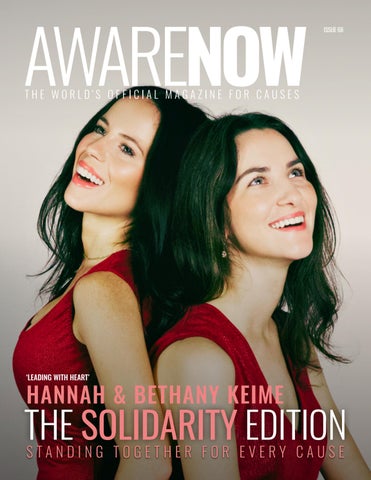
AwareNow: Issue 68: 'The Solidarity Edition'

Page 1


AWARENOW

THE

WORLD'S

OFFICIAL MAGAZINE FOR CAUSES

‘LEADING WITH HEART’ HANNAH & BETHANY KEIME

THE SOLIDARITY EDITION

ON THE COVER: HANNAH & BETHANY KEIME PHOTO BY:

AwareNow Magazine is a monthly publication produced by AwareNow Media™, a storytelling platform dedicated to creating and sustaining positive social change with content that inspires and informs, while raising awareness for causes one story at a time.

WALKING WITH JOEL

JØN KENT

THE

PAUL S. ROGERS IN

HANNAH & BETHANY KEIME

WHEN

JEREMY DAVID ENGELS

DANIEL BURCHFIELD, SONJA MONTIEL

WHERE

SAGE GALLON

THE

JACK MCGUIRE

BATTLING BEDLESSNESS

LUKE MICKELSON

FARIA ALAM, MURSHID ALAM BHUIYAN YOUR THOUGHTS ARE NOT YOURS DR. ROB PACE

JOHN’S CRAZY SOCKS

solidarity: (n.) the understanding that our strength is multiplied when we refuse to stand alone

There is power in a single voice. There is transformation in a unified one.

The Solidarity Edition is a reminder that while change may begin with one, it is sustained by many. No injustice has ever been dismantled alone. The Human Cause is not a collection of separate battles. It is a shared commitment to one another.

Our cover story featuring Hannah and Bethany Keime reflects this truth. Their journey shows how adversity, when met together, becomes advocacy. It reminds us that when one of us rises, we all rise.

In February, solidarity carries deeper resonance as we honor Black History Month. The legacy of those who stood against injustice teaches us that solidarity is not passive. It is active, courageous, and necessary. Progress has always belonged to those who refused to stand alone.

Solidarity is not a trend. It is a decision. A daily one.

This is The Solidarity Edition. This is who we are. AwareNow. More than ever.

ALLIÉ McGUIRE

CEO & Co-Founder of AwareNow Media

Allié McGuire began her career as a performance poet, transitioned into digital storytelling as a wine personality, and later produced the Hollywood Film Festival. Now, as co-founder of AwareNow Media, she uses her platform to elevate voices and champion causes, connecting audiences to stories that inspire change.

JACK McGUIRE

President & Co-Founder of AwareNow Media

Jack McGuire’s career spans the Navy, hospitality, and producing the Hollywood Film Festival. Now, he co-leads AwareNow Media with Allié, focusing on powerful storytelling for worthy causes. His commitment to service fuels AwareNow’s mission to connect and inspire audiences.

The views and opinions expressed in AwareNow are those of the authors and do not necessarily reflect the official Any content provided by our columnists or interviewees is of their opinion and not intended to malign any religion, ethnic group, political group, organization, company, or individual. Stories shared are not intended to vilify anyone or anything. Their intent is to make you think.

* Please note that you may find a spelling or punctuation error here or there, as our Editor-In-Chief has MS and lost vision in her right eye. That said, she still has perfect vision in her left and rocks it as best as she can.

Photo Courtesy: Sanctuary Farms

WITH JØN KENT

ROOTED WHERE FOOD BECOMES FOUNDATION

Sanctuary Farms did not begin with a blueprint. It began with a belief that access to healthy food is not a privilege, but a right, and that land can be both a teacher and a refuge. In this conversation, jøn kent shares how cultivating connection, between people, resources, and purpose, became his way of restoring community and self alike.

ALLIÉ: Let's go back to the beginning of all of this. Before Sanctuary Farms was land, plans, or possibility, I imagine it was a feeling. Can you take me back to the moment when you first realized that this wasn't just something you wanted to do, but something you had to build?

JØN: I've always been a very caring person. My grandmother says that at a very young age she was aware that I had a conscience, but she was also alluding to her being a very spiritual woman.

Growing up in the city of Detroit, I got to experience and see a lot of divestment that was going on in the city. I had the experience of the tale of two cities, because though my parents weren't very wealthy, they were sure to show me a life in which people had. I want to be very clear, I didn't miss any meals. I was very fortunate. We were very wise about

Photo Courtesy: Sanctuary Farms
“…I saw that we were causing harm to something that has given us life.
That has always stuck with me.”

JØN: (continued) I went on to do theater and acting, and acting is what I call the art of empathy. Acting is all about putting yourself in another person's shoes and being unjudgmental about why the character acts the way they do, which really opens up your own understanding of self and invites you to investigate who you are. There, I found that love is true to the core of my being, and I think that is true for many others, however it may manifest differently.

I became aware of the Anthropocene, this epoch we're living in, as a teenager. Wanting to understand more about myself and what I cared about, I realized I cared deeply about this because I saw that we were causing harm to something that has given us life. That has always stuck with me.

I went on to college at SMC, where I met Parker Jean, who is a dear friend and brother. We got involved in Associated Students, the student government at our community college. I would also meet my wife there, unbeknownst to me at the time. I have a lot of love and appreciation for SMC.

During our time in Associated Students, we were heavily involved in sustainability projects. Fast forward, I moved back home to Detroit. I had moved out to Santa Monica when I was a young teenager to pursue acting. When I moved back home, Parker was here, and we picked up where we left off on sustainability conversations.

We were both in our late twenties and not happy with our positionality in the world. We didn't feel like we were really doing anything to give back. We also didn't feel like we had power within our respective roles at the time. For us, it was asking how we could do something that we were passionate about, something we had agency in, and something that was actually good.

Parker got into landscaping, and he mentioned that composting wasn't being done at the level it could be in the city. That sparked everything, and here we are now.

ALLIÉ: And here we are now. The Sanctuary Farms story seems to be one about working in harmony with the land, not just cultivating food, but building relationships, stewardship, and community. Working with the land, what has it taught you about patience, trust, or leadership? What has it taught you that no traditional classroom or course could ever teach you?

JØN: I want to be very clear and hold up the contradictions, because I'm not a farmer, and I don't spend as much time on the land as I'd like to.

When Parker and I first started, I leaned on his ability and farm experience to help guide us. It began with building things together. I'm also very big on brain trust and speaking with elders, so I spoke with many people to understand the context of this work, what the gaps were, and how we could join in to make an impact, build upon their triumphs, and learn from their failures.

In doing so, I realized that both of us being on the farm full time was not going to get us to the next level.

Photo Courtesy: Sanctuary Farms

Photo Courtesy: Sanctuary Farms

JØN: (continued) I’m really good at connecting with people. I am a storyteller. I know how to write. I'm relentless when it comes to reaching out to people and making the vision happen.

Parker works more directly on the land, while I'm behind the scenes putting the pieces together and making sure everything works as it relates to policy, funding, and bringing on team members. The goal is eventually to get to a place where we have such a robust team that I can sit down more and enjoy it.

I think if I'm the viewer, it would beg the question, why are you so passionate about this if you hardly get to enjoy it?

Because I have enjoyed it. I do continue to enjoy it. It's not that I'm never at the farm.

The closest I've been to divinity is in nature.

There have been many pivotal moments in my life where I wasn't sure where I was going to go or where life was going to take me. Going into nature, deeper nature, mountains, Santa Cruz, the beach in Santa Monica, it has always informed me and endowed me with the spirit of resilience and connection.

I want to be part of something that I didn't necessarily have access to growing up in Detroit.

I became far more connected with nature when I moved across the country to a space that was very well resourced, but didn't have a lot of people who looked like me. This work is very important to me because I want to ensure all humans have access to that.

I'm not here to save the world. I don't think one person can do that. But I am here to help my community the best way that I can.

I believe the way we are doing it, through food sovereignty, nature equity, and creating quality soil, is our way.

ALLIÉ: I love everything about what you just shared. Sanctuary Farms isn't just helping people, it's restoring access, agency, and dignity. How do you personally define food justice? And what do you think most people misunderstand about that?

JØN: Food justice is ensuring that people who historically have not had power within the system are helping create that system and have agency within it.

Food access and food security mean there is enough food. But you could have food security in prison. That does not mean food justice.

Food sovereignty means people have ownership and equity within the land or business that produces food.

Together, these create a transformative food system.

ALLIÉ: That is so brilliantly defined.

JØN: I didn't come up with that. I'm a student. It is important to iterate what one has learned and emphasize that this comes from many works within the past. What I'm here to do is help make sure it is implemented where we have control.

ALLIÉ: The word sanctuary carries a lot of weight. When someone steps into Sanctuary Farms for the first time, what do you hope they feel?

Photo Courtesy: Sanctuary Farms

Exclusive Interview with jøn kent https://go.awarenowmedia.com/podcast/rooted

JØN: Home. Peace. Connection. Appreciation. Respect. Love. Community. Confidence. Responsibility. Accountability. Sanctuary was fitting because it spoke to the sacredness of the land and this space being a refuge.

ALLIÉ: Creating something rooted in equity, healing, and community is powerful, but rarely easy. What has been the hardest truth you've had to sit with as a founder?

JØN: Is the work enough?

Are we replicating models that are still part of harmful systems?

Sanctuary Farms does not exist in a vacuum. We must constantly examine ourselves and ensure we are not operating in ignorance of our misalignments.

Intention does not correlate to impact.

Ignorance is not an excuse. It is an opportunity to learn and grow.

ALLIÉ: Years from now, long after seasons change, Sanctuary Farms will leave something behind. When future generations tell its story, what do you hope they say it stood for?

JØN: The love of land and people.

Love is responsibility. It is honesty. It is trust. It is care. Love is the redemptive force that allows us to rise again. ∎

We

‘RELEASE THE GENIE’ EXCLUSIVE COLUMN BY PAUL

THE POWER OF UNITY

WHEN WE RISE TOGETHER

There is a quiet kind of strength that doesn’t announce itself loudly or demand attention. It doesn’t arrive with fanfare or force. Instead, it grows steadily when people choose to stand together, even when standing apart might feel easier. This strength is unity and throughout history, across cultures, and in everyday life, unity has proven to be one of the most powerful forces humanity possesses.

At its core, unity is not about sameness. It’s about connection and resonance. It’s the understanding that differences don’t weaken us; they enrich us. When individuals come together, they bring unique perspectives and create something far greater than any one person could achieve alone. As individuals, we are the threads in life’s tapestry. The transformation into unity is when these threads start to weave together to form a fabric strong enough to endure strain, change, and time.

These fabrics don’t just appear; they were their all along without fuss and attention. They only reveal themselves when the cold light of challenge is shone upon them. The truth is that a burden shared becomes infinitely lighter than carrying it by yourself.

Have you ever started worrying about something at night? It always seems that the problem is so much bigger and more frightening. When a problem feels too big, a good way of breaking it down to size is to share that with others. A problem shared is a problem solved.

If we need proof of this we only need to look at our own History. Social movements, humanitarian efforts and cultural transformations have rarely succeeded because of a single voice. They succeed because people aligned their intentions, trusted one another, and moved forward collectively. Even when opinions differed, a shared purpose created momentum. Unity didn’t erase disagreement; it gave people a reason to work through it.

In the face of circumstances outside of our control it is easy to feel helpless and discouraged. Instead, focusing on the things we can control gives us the feeling that we can make a difference. We, as individuals, can choose understanding over resentment, helping without being asked, collaboration instead of competition and being kind instead of right. These small acts of unity are the invisible thread bridges that weave communities and people together. They are the ripples that become the crashing waves.

Unity is a powerful reminder that we belong. In a world which seems to want to try and outdo itself every day, this can be a very needed grounding experience. It is the perfect antidote to fear and loneliness. It reassures us that, even while we may be struggling, we are not alone. We feel seen and supported. It frees us from our own invisible prisons and connects us to something far greater than ourselves. In that freedom we are more willing to show up, not just for ourselves, but for others as well.

AwareNow Podcast

THE POWER OF UNITY

Written and Narrated by Paul S. Rogers https://go.awarenowmedia.com/podcast/the-power-of-unity

Anyone who has had the joy of collaboration can tell you that this is where the true magic really happens. Ideas and new perspectives flow like water. We stop thinking in linear terms of us v them and start thinking of how can we do this together. We thrive when we are tested and challenged. Nature shows us that pressure provides us with valuable stones and metal. Challenge is the essential ingredient to unlock our superpower of unity. As the saying goes, “don’t bless me with an easy life. Bless me with the strength to endure a difficult one.”

One of the great things about unity is that it’s always available to us. We are just one phone call, text or email away from unity. We are always just one step away from ending our own torment by reaching out. This requires courage to ask and accept assistance. It requires us to choose empathy over ego and understanding over assumption. This kind of unity is active and intentional. And because of that, it transforms everyone it touches and strengthens the collective whole.

In the end, unity is not just a concept; it’s a practice. It is an organic living thing. It is cared and nurtured for daily through our words, actions, and intentions. When we choose to be ourselves, show kindness over indifference, we discover that together, we are stronger, wiser, and more capable than we ever imagined. The power of unity lies not in how loud it is, but in how deeply it holds us. Reminding us that we rise highest when we rise together. ∎

PAUL S. ROGERS

Transformation Expert, Awareness Hellraiser & Public Speaker www.awarenowmedia.com/paul-rogers

PAUL S. ROGERS is a keynote public speaking coach, transformation expert, awareness hellraiser, life coach, Trauma TBI, CPTSD mentor, train crash and cancer survivor, public speaking coach, Podcast host “Release the Genie” & best-selling author. His journey has taken him from corporate leader to kitesurfer to teacher on a first nations reserve to today. Paul’s goal is to inspire others to find their true purpose and passion.

TAP/SCAN TO LISTEN

Photo Credit: Karina Rodriguez

IN THIS TOGETHER

HOW TWO SISTERS TURNED SURVIVAL INTO SOLIDARITY

Solidarity is often spoken about in crowds, but it is forged in private. For sisters Bethany and Hannah Keime, it was born in hospital rooms, when two athletic high school girls were suddenly diagnosed with Hypertrophic Cardiomyopathy, the leading cause of sudden death in student athletes. Now living with implanted defibrillators and a profound gratitude for early detection, they have transformed uncertainty into purpose as co-founders of HeartCharged, advocating for cardiac screening and emergency preparedness. Their mission is simple and urgent: to ensure that no child faces a silent heart condition alone, and that every life that can be saved is.

ALLIÉ: Before HeartCharged had a name, before advocacy had this platform, there were just two sisters navigating something terrifying together. I want to go back there for a moment. When everything felt uncertain and fragile, what did solidarity look like between you in the quiet moments when no one else was there to see?

CLICK, TAP OR SCAN
HANNAH
Photo Courtesy: HeartCharged
“As young women, we’ve faced criticism, doubt, and people telling us that what we’re doing won’t make a difference.”

BETHANY: For me, it was pulling over in the car and crying. There were many days like that. With eight other siblings, finding a quiet place in the house was nearly impossible at the time of our diagnosis. So I would find those moments alone just to release everything I was holding inside.

I was confused. We both were. We didn’t know what our future would look like. There was so much uncertainty. Taking those moments to release the fear and emotion was necessary just to keep moving forward.

ALLIÉ: Your journeys with HCM have not unfolded identically, and yet you carry this mission side by side. How have you learned to hold space for each other without letting comparison or guilt creep in?

HANNAH: We’ve always been lifelines for each other. It feels like we’re tied together by an invisible string, the only two in our family with this condition. In many ways, it brought us closer and gave us a shared sense of purpose.

My diagnosis progressed more quickly, while Bethany’s developed more gradually. But instead of comparing our experiences, we focused on our shared gratitude. We realized we could channel that gratitude into something meaningful.

People often ask what it’s like to run an organization with your sibling. For us, it’s been a gift. We share the same vision and values. We also have different strengths and talents that complement each other.

We’ve never resented each other or compared timelines. We’ve been close our entire lives. We’ve always known each other’s strengths and weaknesses, and we’ve always wanted the other to live a full, happy life.

ALLIÉ: You’ve both chosen visibility in a space where silence is often more comfortable, especially for women. There is power in that choice, but there is also a cost. What has it personally required of each of you to keep showing up as educators and advocates while also being patients?

BETHANY: It has taken a toll on my mental health at times. Some days are incredibly hard. As young women, we’ve faced criticism, doubt, and people telling us that what we’re doing won’t make a difference.

We’ve seen ideas we developed to help save lives taken and used by others. That has been painful. There are days when it feels exhausting to keep fighting.

Photo Credit: Karina Rodriguez

Solidarity often gets reduced to posts, hashtags, or moments that fade quickly. In your work, you ask people to move beyond awareness into action. What does real solidarity look like in saving lives?

Photo Courtesy: HeartCharged
HANNAH KEIME CO-FOUNDER OF HEARTCHARGED
Photo Courtesy: HeartCharged

Exclusive Interview with Hannah & Bethany Keime https://go.awarenowmedia.com/podcast/in-this-together

HANNAH: Social media can be challenging, but it’s also powerful. Even when someone simply shares our posts, it introduces this reality to people who may have never heard of it before.

Someone might recognize symptoms in themselves and seek medical care. That alone can save a life.

We realized early on that awareness has to come first. We could ask people for support, but without awareness, they didn’t understand the urgency.

We also recognized that our generation gets information through social media. So we needed to meet people where they are.

We strive to create content that is accurate, hopeful, and honest. Content that makes people pause and reflect.

At first, we thought simply sharing our story would be enough. But we realized there was also power in creativity. Sometimes humor or parody helps capture attention and opens the door to deeper understanding.

BETHANY: We also learned that waiting for others to create change isn’t always effective. We believed initially that policymakers or institutions would solve these problems.

But we realized meaningful change often begins at the individual level.

We recognized that we have the power to create change ourselves. We didn’t have to wait for someone else to act. That realization was empowering. Instead of waiting, we began building the change we hoped to see. ∎

TAP/SCAN

Photo Credit: Anna Sunderland Engels

WHEN THE SNOW GLOBE SETTLES

MINDFULNESS, CIVIC LIFE & THE COURAGE TO STAY PRESENT

We live in a time of constant motion, where reaction often outruns reflection and clarity can feel just out of reach. In his book On Mindful Democracy, Jeremy Engels invites us to see democracy not as a system we inherit, but as a practice rooted in attention, compassion, and how we show up for one another each day. This conversation is a reminder that when we pause long enough to let the snow globe settle, we can see more clearly, and perhaps, see each other again.

ALLIÉ: Before we talk about democracy or mindfulness, I want to start with you. What moment or experience first made you realize that the way we're taught to do democracy wasn't actually working for you?

JEREMY: I think it's probably a series of moments, actually, in the classroom with my students. A lot of my inspiration comes from my students. I am fortunate to work with tomorrow's leaders; people who really want to do a good job, want to make the world a better place. And I found that the model we have of democracy is this political battle between two parties for influence. And it wasn't what my students were interested in doing, it's not what I'm interested

Photo Credit: Anna Sunderland Engels

JEREMY: (continued) At one point, the students asked me, why are we doing this? Why can't we do something different? Why can't we do something better? And I said, well, why don't we throw out the syllabus for the whole semester and spend time together thinking about what it would mean to actually do something better?

What would it mean to become a community and empower each other to think about the world that we want, not the world that we have? I teach a lot of my classes like that where we're trying to really approach this as collaborators. And I think that's what's convinced me that not only that things aren't working, I mean that's apparent to everyone, it's very clear, but that things could be different and that things could be better, and that if we work together and we empower each other, perhaps we can, in our own small ways, build that kind of world that we want.

ALLIÉ: Well, I love that word that you said, contributors, and what if constituents were viewed more as collaborators and given that agency to look at things differently and to do things differently.

JEREMY: I think that a lot of us just feel really disempowered right now, and I don't know that we necessarily know what it means to take that power back. But I think it's local and I think it starts by building communities together.

ALLIÉ: Yeah, absolutely. Well, I think we can all agree that democracy isn't a destination and it is a way of being, right? So when did that shift happen for you? Like, personally, when democracy stopped feeling like a system and really started feeling personal to you?

JEREMY: I've been really fortunate, I've always gone to large public universities where I attended school and got my PhD, and then I've worked at Penn State where I've been at for 20 years. And these universities are all organized, at least theoretically, around the idea of educating citizens for democracy. And so I feel like I've been really fortunate to encounter the writings of thinkers and to work with people who believe exactly what you just said, that democracy doesn't just happen on election day. Democracy is a way of life. And it's a way of life that starts with how we relate to ourselves and to other people. And so, I've been studying meditation and yoga for a long time as well. It's kind of the other side of my personality that I bring together in this new book. These two aspects of scholarship and scholar, teacher practitioner.

But I've been around yoga studios that were organized in very undemocratic ways, very hierarchical ways, ways that allowed people in positions of power to really abuse that power. And I've seen that firsthand in a very, very real way, enough to deliberately and consciously make a pledge that I don't want that and I don't want to replicate that. And so, my wife and I have opened up a yoga studio in this little town we live in with some friends, and we consciously made the decision that we're going to run this like a democracy. We're going to speak from the heart, we're going to listen to each other, we're going to treat each other with respect and dignity, we're going to value equality, we're going to practice inclusion. And so it's personal for me in that way that, thinking about in a very literal way, what kind of community do I want to build?

ALLIÉ: So, you mentioned your book a moment ago. Tell me more about the book, what it is and how it came to be.

JEREMY: So the book just came out this week which is really exciting. It's called On Mindful Democracy, A Declaration of Interdependence to Mend a Fractured World. And so the book was inspired in part by the fact that 2026 is the 250th anniversary of the signing of the Declaration of Independence. And so this year is a huge anniversary for us in this country. And I wrote my dissertation about the Declaration of Independence, actually, so I know quite a bit about it. And the enduring power of the Declaration of Independence is that it's a document of empowerment. It's a document meant to empower people to take some control over the world that we share. And when it was written originally, the life, liberty and pursuit of happiness that Jefferson spoke about was meant for a very small sliver of the population.

I don’t think that we can mend a fractured world unless we take the time to mend ourselves.

Photo Credit: Anna Sunderland Engels

JEREMY: (continued) It was not meant for very many people, but through the work of activists and people who've really put themselves out there and suffered for equality, that sense of who's included in life, liberty, and the pursuit of happiness has expanded greatly over the course of our history. It's not perfect. It's being rolled back right now in some very powerful ways but that's something that we can - I don't know, that means a lot to me. The sense of expanding, of who's included in the empowerment of democracy. But I feel like if we're going to take that next step and I hope that we can as a culture, it can't just be about independence. It also has to be about interdependence; about recognizing all the ways that we are connected, all the ways that we support each other. I make a joke in the book. I don't know if it's a very good joke, but I feel like a lot of times in our country, we treat happiness like an apple pie with a limited number of slices. So it's like, if you get a slice, I don't get a slice. But happiness isn't like that. There's enough slices for everyone, and I think we have to realize in fact, that if you suffer less, I will suffer less. And if we suffer less, everyone will suffer less. And so there's an incentive actually to care for each other and care for the world because we are each other and we are the world. And so that's really the inspiration behind the book; to outline a practice and a philosophy of interdependence.

ALLIÉ: I love that. And yes, we are the world, just like the song says.

JEREMY: Absolutely. It's a cliché for a reason. Right?

ALLIÉ: Right. Well, look at the word like everyone, everyone is part of every one of us, everyone. And so I love this idea. I'm so thankful that you wrote this, but we need more of this. So you connect mindfulness, compassion, and civic engagement in a way most people never hear framed together. I certainly didn't. I'm like, what, what? So what does paying attention to your own inner life have to do with how we show up for each other in the public? I'd love for you to talk about that connection.

JEREMY: Sure. I don't think that we can mend a fractured world unless we take the time to mend ourselves. Because if we are torn asunder and rendered from ourselves, if we don't have a good relationship with ourselves, it's difficult to have a good relationship with others and also with the world. And so I think that mindfulness, a lot of people understand it as being a form of stress relief or calming and it is, but it's more than that. I don't think this thought is original to me as a meditation teacher, I'm pretty sure it's not. But, the mind is kind of like a snow globe. Have you ever seen a snow globe before? One of those little things you get on vacation where you shake it up and there's all the stuff floating around.

And I feel like that's what we're like most of the time. We're in the past, we're in the future, we're thinking about social media, the flood of information. There's all this bad news. It's just everything is really tense. So we're like that snow globe. But practicing mindfulness allows us an opportunity to stop and slow down so things settle. And once they settle, it becomes possible to look more deeply at ourselves and our relationship to others and to the world. And that's where the real insights of mindfulness come and we start to realize that actually things are constantly changing. They're changing together in this interrelated dance and it makes it possible to see past some of the illusions that keep us apart from each other. And so I think that mindfulness actually becomes a really wonderful, gentle and brilliant form of civic education.

ALLIÉ: For the next book you write, can you title it ‘When The Snow Globe Settles’? Because I love this metaphor.

JEREMY: That's a good title.

ALLIÉ: I never thought of it that way, but that's such a powerful metaphor because to your point, when we give it time and space to settle, all of a sudden there's this clarity that was there all the time that we couldn't see because there was so much. So yeah, if you would do me that favor, write that book next.

Photo Credit: Anna Sunderland Engels
“If you’re exhausted and you’re burned out, you're not alone. There are many of us who feel that way. It’s a lot.”

JEREMY: I'm going to write that title down. I like it.

ALLIÉ: So if democracy actually lives in everyday actions, not election days alone, like you refer to, what's one small ordinary practice that you believe has the power to change how fractured we feel right now?

JEREMY: Community. Build community, participate in community. Community is the gymnasium where we learn to practice democracy. It's where we learn how to care for ourselves and each other and the world that we share. And so I think that if we want to renew and rebuild our democratic culture, it's going to have to start locally, and it's going to have to start with us building really strong, healthy, inclusive, vibrant communities. So I would encourage people to look for communities where they are. These communities often exist. They don't always advertise themselves. Or start one, yeah.

ALLIÉ: That's great advice. And I think that makes it a little more attainable, right? Like, to change the world, we just have to change what's around us, what we can touch and what we can feel here, and that ultimately will, yeah.

JEREMY: In mindfulness we talk about how the present is really all there is. The future has not happened yet. The past is gone. And so if mindfulness is a practice of returning to the here and now, the here and now is going to be where the work happens and that's going to be local. And so I think that's one of the things I've learned about studying democracy for 20 years or so, is that, we're encouraged to think nationally or globally, we think about these big things that are happening and those are real and they're important but there are also things happening locally and when we work together with our friends and neighbors and strangers and community members, those are the things that we can often change.

ALLIÉ: That's where we have the chance, right?

JEREMY: I think so.

ALLIÉ: So for someone listening tuning in who feels exhausted, cynical or disconnected from civic life, what would you want them to know about their place in this story, even if they don't feel political at all? What would you want them to know to give them hope?

JEREMY: If you're exhausted and you're burned out, you're not alone. There are many of us who feel that way. It's a lot. But every single one of us can make a difference and every single one of us matters. And I say that with absolute certainty because of the practice of mindfulness itself. The practice shows that all of us have the ability to pause to let the snow globe settle, and to see things a little more clearly. All of us have that ability, and we can train it, we can cultivate it. And so when people say that, there's nothing that we can do that matters, there's nothing we can ever change, I point to that and say, absolutely we can change things. But in terms of hope, and I think hope is so important, the conclusion of my book actually is called, If We See Things Clearly, There Is Always Hope.

WHEN THE SNOW GLOBE SETTLES

Exclusive Interview with Jeremy Engels https://go.awarenowmedia.com/podcast/when-the-snow-globe-settles

JEREMY: (continued) Hope, to me, is a practice. It's something that we cultivate. It's something that we build together often. And so I invite people at the end of the book to think about a time from their life where they've made a change that made a difference. It didn't have to be big. Or a time from someone else's life when someone else made a change that made a difference. It doesn't have to be big. Or to look at history itself and look at those moments where the forces of the status quo were so powerful but yet people worked together against long odds, often sacrificing a lot in order to make changes that benefited all of us. And those moments exist in our history. They're not always the ones that we pay attention to because they're more positive than negative. And so look at history and then talk with others. This becomes a really great conversation topic in a community. What gives you hope? I love hearing that from people. I love to hear my students tell me what gives them hope or people that I meet in the community.

ALLIÉ: I love that. And sometimes at the end of the day, all we have is hope, and sometimes that's enough.

JEREMY: I think it's right. ∎

Get ‘On Mindful Democracy’: go.awarenowmedia.com/book/on-mindful-democracy Learn more about Jeremy: www.jeremydavidengels.com Follow Jeremy on Instagram: @jeremy_david_engels

I’m singing it to people who feel left out, scared, alone, and who are yearning for connection and unity.
JAYME HOINESS SINGER & SONGWRITER
Photo Courtesy: Jayme Hoiness

LOUDER THAN HATE

A SONG BORN IN SILENCE & SHARED WITH COURAGE

Some songs are written to be heard. Others are written to survive. For Jayme Hoiness, Louder Than Hate began not as a performance, but as a lifeline during one of the darkest seasons of her life, when postpartum depression, identity loss, and a fractured world left her searching for something solid to hold onto. What emerged was more than a song. It was proof that even in our quietest breaking, something within us is still brave enough to sing.

ALLIÉ: Before Louder Than Hate ever existed as a song, perhaps it existed as a feeling. Could you take me back to the version of you who was sitting in the dark navigating postpartum depression, grief, disorientation, the space you were in. What did that season of your life feel like from the inside, especially in the quiet moments when there was no one else who could see it?

JAYME: I remember this as clear as day. It was March last year, so almost a year ago. I wrote this song when I was in

SINGER & SONGWRITER

JAYME HOINESS
Photo Courtesy: Jayme Hoiness
“So in my mind, I’m filling myself with all these hateful things and thinking, I need to be louder than this hate I have toward myself.”

JAYME: (continued) I remember sitting in the tub. After looking through my things, I saw the lyrics and thought, that was a really good song. I was trying to find hobbies, trying to figure out new things to do because they say that keeping yourself busy can be a great way to get through postpartum depression. So I decided I was going to work on this song.

Originally, the lyrics were similar to what they are now. It was about how we have these dreams, and sometimes that’s all we have, but doesn’t that make life pretty sad? But with dreams, at least we get by. In the end, all we can do is try. No more fighting, no more drugs. Don’t you think we’ve had enough? No more lies, no more thinking our dreams can do enough. No more killing, no more fear. I won’t sit by anymore. I can’t take it. We are turning our world into war.

What I did was take that and apply it to how I felt about what we were going through politically, and how I felt about our society and what most of us were thinking.

And when you’re in postpartum depression, what you feel is resentment and hatred. It’s not against anyone else. It’s against yourself, because you feel like you’re not doing enough. You feel like you’re barely getting by. Am I a good mom? Of course you are, but you don’t see it at that time.

So in my mind, I’m filling myself with all these hateful things and thinking, I need to be louder than this hate I have toward myself. And as I was in the tub thinking about it, all I could hear was my daughter screaming, because she was doing something with my husband outside of the room. I thought, I can’t think, she’s so loud. And then it hit me. That’s actually the whole point. It was kind of nice not having to hear myself thinking so badly about myself, and instead hearing my daughter screaming happily in the other room, having a good time.

That’s when I thought: louder than hate. And it clicked. There’s so much hatred going on in the world, not just inside, but outside too.

So that’s a long-winded story. But it started with something I wrote in high school, over 10 years ago. It just goes to show, you keep those things from years ago and they become relevant again.

ALLIÉ: That’s a beautiful story. And I love how something from so long ago can still speak so clearly to right now. Thank you for sharing that the way you did. I think so many women experience postpartum depression, and having it is hard enough, but admitting it can feel like a burden on top of a burden. So thank you for taking us back there, into that moment. Even into your bathtub. That takes guts.

JAYME: Yeah, come join me in my tub. But yes, that is exactly where it started. It was a lightbulb moment. I realized, I need to start working on this. And that’s what I came up with, Louder Than Hate.

ALLIÉ: That’s where things start. I’m so glad you did. Let’s talk about the fact that every single voice has a history long before the world ever has a chance to hear it. How long have you been singing? Not just publicly, even privately. Were you always someone who used your voice to process life? Or did this song mark the first time you allowed yourself to truly be heard?

JAYME: I’ve been singing ever since I can remember. My family would do karaoke at all of our parties. My aunt is a big singer. My dad is a big singer. Stephen Foster is somewhere in the ancestor line, so we come from a family of singers.

SINGER & SONGWRITER

Photo Courtesy: Jayme Hoiness

JAYME: (continued) As a little girl, I had my own karaoke machine. I would sing and teach myself. It was all selftaught. In elementary school, I tried choir, I signed up for solos, but I never got picked.

I had a hard time growing up in school, from elementary through high school. I dealt with a lot of bullying, so singing was my way to get through it. I remember in fourth grade I would hum to myself, and people would say, can you stop humming? And I’d think, no, it’s the only way I can get through everything. Singing has always been my outlet.

Even through happy times and sad times. My grandmother passed away this last Sunday, and on her deathbed, I sang to her. It was Close to You by the Carpenters. Singing is very important to me.

I’ve always used my voice. I just don’t think it was heard much in school, because I was bullied so much. I started to feel like it must be a bad thing to be singing. So I didn’t showcase it.

And when I did try, like signing up for solos, and I never got chosen, I started thinking maybe I wasn’t as good as I thought. My mom would always say, you need to do The Voice. But I’ve always been afraid of someone saying, sorry, you’re not that good, we’re moving on. So I don’t try.

ALLIÉ: What an incredible outlet, though. If someone is facing something hard, like bullying, there are so many different ways they could cope. The fact that you sang through it. Singing is healing. Art is healing. Singing is a salve.

JAYME: Singing is healing. It really is. So when postpartum depression happened, I thought, okay, this is the only outlet I know. And it was funny, because I had to really work my voice. I had to get it back up and running. When you’re pregnant, it’s hard to sing. You don’t have that diaphragm control. So I had to work at it.

It became a new passion. I had something to focus on. And it brought me out of that deep depression.

ALLIÉ: So let’s talk about that. There’s a difference between writing something to survive it, and sharing something to be seen. When you first wrote this song last year, was it meant to be a private lifeline? Or did some part of you already know it was meant to find other people who were hurting too?

JAYME: When I first wrote it, I heard it with the instrumentation. Just so we’re aware, the instrumentation was done through AI. But I created the melody. I created the lyrics. I created everything. I just needed the background because I’m not a full orchestra.

I found software that said, sing your song and we’ll create the background for it. So I did. The first version was a rough draft, but when I heard it, I thought, this is incredible.

That’s when I realized I didn’t like how it started. So I kept working. I changed lyrics. I adjusted things. But the first time I heard it, I knew it had potential.

I did upload it back then, but it was still early in the process and it got no views. I think my friends were like, Jayme posted another song. No big deal.

So I kept working on it. And I didn’t even feel like it was ready to post again this year, but with everything going on in the world, I decided to do it anyway, despite how I felt, because maybe it would help one person.

So yes, I believed it had potential. I just didn’t think there would be an audience that wanted to listen.

ALLIÉ: Well, the crowd is there. You know that now.

You also mentioned struggling with your identity during that time. Motherhood changes you. Pain changes you. Purpose changes you. Who were you before that season, and who did you discover yourself becoming in that process?

JAYME HOINESS SINGER & SONGWRITER

Photo Courtesy: Jayme Hoiness
“During postpartum, it was hard because you feel it, but nobody else feels it. Nobody else can see it.”

JAYME: That is an amazing question, because I look back and I still see glimpses of the person I used to be.

Before I got pregnant, my husband and I owned a beautiful home here in Washington. And he got unemployed shortly after we closed on our home, maybe three or four months later. So we decided to get roommates. We made that work for a year until we found out we were pregnant.

I lost myself in that first pregnancy because it turned into a miscarriage. I had what’s called a blighted ovum. I had to take misoprostol, and I also had to get a DNC because my body wasn’t doing what it needed to do. I lost myself in that moment. And after that, it felt like a downhill decline.

When everything was done, we planned to go back to Ireland and travel, and hold off for a year. But the next month I was pregnant again. It was bittersweet, because we wanted to be pregnant, we just wanted to wait after everything we’d been through. And I don’t think I had enough time to grieve. And then even in that pregnancy, I was holding fear. We had a scare where they couldn’t find the baby at first. But they found her. She was there. She’s here today.

It was a roller coaster. And when we found out we were pregnant, I didn’t want to have roommates with a newborn baby. So we rented out our home and moved into an apartment. It felt like a backward step, but we did what we could for our family. Since then we’ve been in apartments, trying to get back to our home. Hopefully we’ll be moving back this April. I’m really hoping we can move back with no roommates.

Before postpartum, there were challenges. During postpartum, it was hard because you feel it, but nobody else feels it. Nobody else can see it.

My husband and I did couples therapy. We struggled. And then he got laid off, and I actually call that day a blessing. Right when that happened, my work started picking up, so things began to shift. And I started feeling like I had time to do things I love again. That’s when I started working on songs and released this one.

And postpartum changes you. It changes a lot about you. I think what it changed most about me is that I accept myself more now. I know I can make mistakes and it’s okay. I can say no. I can put myself first, and I can put my family first. I struggled with that before. It’s a new found respect. And my gosh, the amazing things our bodies can do. It’s incredible. I took a lot from those experiences.

And at the end of the day, I learned: count your blessings. Be thankful for what you do have, because you have a lot more than what you think.

ALLIÉ: What a journey you’ve been on, and what a journey is ahead of you.

You’ve said that what ultimately gave you the courage to share your song was witnessing the courage in others. Courage has a way of helping you recognize it in yourself.

What was the moment you realized this song didn’t belong only to you anymore, that it became something bigger than your own healing?

Photo Courtesy: Jayme Hoiness

LOUDER THAN HATE

Exclusive Interview with Jayme Hoiness https://go.awarenowmedia.com/podcast/louder-than-hate

JAYME: Because it’s on my public Facebook, people started reaching out and saying, thank you so much for this song. At first, I saw it gaining momentum and people wanted the song, but it wasn’t on streaming platforms yet. I wanted people to have it. I told people to reach out and I’d send them a copy, because to me it’s more than just a song. It’s a message, and I wanted people to have that message.

Then the requests kept coming. People were saying, this should be our national anthem. This should be played at the Super Bowl. People told me, this song got me out of a four-year depression after I lost my son. This song is getting me through cancer.

The responses were overwhelming. That’s when I realized there is something to this. I’m not crazy. It’s healing people. It was surreal. There was one night my husband and I went through all the messages together. I told myself I’m going to respond to every single one. I haven’t yet, because there are so many, but I’m doing my best and I’m still working through them. I’m reading them. I’m taking them to heart. I’m saving them. And hearing that it’s getting people through tough times means so much.

ALLIÉ: And now that millions of people have heard your voice and found pieces of themselves inside your words, I’m curious how it’s changed the way you hear yourself. When you sing, “we are louder than hate,” who are you singing to now? The world? Your child? Or the version of yourself who needed to hear it the most?

JAYME: I haven’t been asked to sing it live yet, and I’m getting over a cold right now. So I’m hoping soon I’ll be able to officially debut it live. Right now all I have is the recording.

But when I think of it, and when I sing it to myself, I feel like I’m singing it to my younger self… to that little girl who was bullied and didn’t feel important, didn’t feel like she had many friends.

I’m singing it to people who feel left out, scared, alone, and who are yearning for connection and unity. That’s what the song is about to me. Unity. Coming together as one and facing whatever struggles we’re dealing with. And when I say, “you speak with fear,” it doesn’t necessarily mean somebody. It could be something. It’s poetic. So when I’m singing that song, it’s for people going through struggles. And it seems like it’s reached a lot of them. ∎

NICOLE
Photo Courtesy: Nicole Williams

EXCLUSIVE INTERVIEW WITH NICOLE WILLIAMS

PLAYING BOTH SIDES

LIVING WITH MS AS BOTH A CAREGIVER AND A PATIENT

Nicole Williams lives at the place where care and courage meet. As a registered nurse, wellness advocate, mother of three, and woman living with multiple sclerosis, she brings both clinical insight and lived truth to every conversation. In this interview, Nicole shares what it means to educate, empower, and show up fully for others while learning, every day, how to do the same for herself.

ALLIÉ: Let's go back to the beginning before the titles of nurse, mom of three, wellness advocate, or even a woman living with MS entered the picture, who was Nicole Williams at her core? Like what did an ordinary good day look like? What was your life like back then?

NICOLE: Well, before nurse, before mom, before all of the things, I was actually a bartender. My friends and I would get dressed up and go out. I did fashion shows because at one point, I was into modeling. We wore stiletto heels and were just living life.

CLICK, TAP OR SCAN

Photo Courtesy: Nicole Williams

ALLIÉ: And then life happened and things changed a bit. So, where you're at now, you live at this intersection of science and lived experience. As a registered nurse who also has MS, how did your diagnosis change the way you understand the body, the way you trust medicine and advocate for yourself inside a system that you once only served from the outside?

NICOLE: That is an amazing question. It was hard becoming the provider and never really being sick, I don't have any other diagnosis to being diagnosed with MS and becoming the patient. So now I get to see it from both perspectives. I get to see it as the patient who may be a little bit afraid, don't know what's going on, worried a little bit about the future as well as the provider. And not that I wasn't compassionate, but I became a whole lot more compassionate in understanding those patients who are in that seat, who's being told about these diagnoses that they have. It made me a better nurse, to be honest with you. It made me a better nurse overall, especially, and I know this is a little bit off the point, but I'm going for my MS RN, so I'm going to be a multiple sclerosis certified registered nurse and I have a mentor I'm working closely with right now. But I just want to hold space with others who do have MS because now I feel like I've been through this. I can lead, I can guide, and I can help others a little bit better now than I when I was a registered nurse without MS.

ALLIÉ: There's something that's so huge about that lived experience and that layer of understanding that doesn't come from a textbook. So much of your work online is about educating without overwhelming. Your posts, they're empowering without sugarcoating. When you sit down to share something about MS, what do you most want someone newly diagnosed or silently struggling to feel when they're scrolling and stop to read your post?

NICOLE: A lot of the times when I post, it's based on how I'm feeling. So if I'm posting about MS fatigue, I was probably having a rough fatigue day. And I think to myself, if I'm having these symptoms and there's many others with this same diagnosis, I'm sure someone else may be experiencing the same thing and I just wanted to share, like, again, you're not alone. There's others who're going through this, and these are some of the things that I do to help get me through this. So it's not that I'm having these symptoms and I'm going to accept defeat. There's nothing else we can do about it. I'm big on mindset. Let's change our mindset because our words have powers. Our body listens to what our mind says. And I just want others to understand that there are other ways that we can help cope with multiple sclerosis.

ALLIÉ: Yeah, that's for sure and that's powerful… the body listens to what the mind says. Well, then they say that, right? The mind and the body, they work as one. So let's pay attention to that.

NICOLE: Yes.

ALLIÉ: I want to switch gears a bit to motherhood. You're a mom, I'm a mom. Motherhood has a way of sharpening both, I would say our fears and our strength. Question here is, how has raising three children while living with MS, how has that reshaped the way you define resilience, not as perfection, but as presence?

NICOLE: Oh, man. So it has made a huge difference in the way that I define resilience, because before I was the mom who can do it all, you know, everything. And now I'm grateful to be able to do some of the things that I can do and the things that I can't do, it's not the end of the world. I talk a lot about self-love and listening to your body, not overexerting yourself and things like that. Being a mother with multiple sclerosis, it has taught me to teach my children compassion. You never know what another person's going through. I have a 14-year-old son, and he wouldn't want me to say this, but he's such a sweetheart, because he's this tough basketball player guy. But, he's like, mom, are you okay? Or he'll walk behind me if I'm going up the steps and like little things like that. But I honestly feel like, and oh my gosh, I can't believe I'm saying this, MS has made me become a better person because I turned my pain into purpose and it allowed me to use my voice to improve so many different things in life from being a mother to using my voice to educate online or whatever the case may be.

Photo Courtesy: Nicole Williams

Exclusive Interview with Nicole Williams https://go.awarenowmedia.com/podcast/playing-both-sides

ALLIÉ: I hear you so much and I feel the same. You bring up a good point when you talk about how your journey with MS has affected your children and I think that's something for people to be mindful of. When someone is diagnosed with MS, it's not just their world that changes, it's the worlds around them, their brothers, sisters, certainly their children, their spouses, their everyone. So I do have one more question for you today, and that is, if someone is sharing this and standing like we all were at some point at the beginning of the MS journey and feels scared, unseen, unsure of who they are becoming, what one truth, do you wish someone would have looked at you right in your eye and told you sooner?

NICOLE: I wish someone would've said to me, it's not over. You're just going to be different. After this diagnosis, you're going to have to redefine who you are, but you're still that same person reinvented, that's the word I like to use. And on some of my posts, I might put Nicole RN Reinvented because I'm not the same exact person I was before multiple sclerosis, but I feel I'm as bigger, better version of myself because of the things - the compassion, the so many different things, and again, turning that pain into purpose and mindset. ∎

TAP/SCAN TO LISTEN
Every one is a part of everyone.

Miles to go before we sleep…

‘PEQ PERFORMANCE’ EXCLUSIVE COLUMN BY SONJA MONTIEL

WALKING WITH JOEL

A FATHER’S JOURNEY OF SOLIDARITY AND HOPE

It was a rainy day on January 31, 1996, in Moorpark, California. Dan Burchfield was searching for his 11-year-old son, Joel, when he didn’t come home after school.

At first, he was searching alone, later his close friend Mike Hiserman was by his side walking every street, trail, and road he could find. He walked around town in a fog of shock and confusion. He doesn’t remember a lot of details that night; however, he has a clear memory of the mass of people pouring theirs hearts out with the search. “It seemed like the whole town of Moorpark just came together while I was frantically trying to find my son.”

Neighbors, friends, and strangers filled the streets, passing out flyers, praying, and combing through fields and trails. It was solidarity in its purest form. His community didn’t need permission or an invitation. Dan didn’t have to ask for anything. When he and his family was in need, one phone call led to another, led to another.

When Joel was found, the grief was unimaginable. Walking home from school on that rainy day, he drowned trying to cross the 70-foot-wide channel with a rapidly rising creek.

As Joel’s family leaned into one another during their darkest times, the community continued to gather and coordinate, raising nearly $10,000 for his family practically overnight. “I didn’t know what to do with that money,” Dan remembers. “It’s amazing to look back and realize that the funds raised were the seeds of the Joel Burchfield Memorial Fund.”

The Joel Burchfield Memorial Fund began humbly, giving out $250 scholarships for two students the first year. Over time, it grew into $1,000 to $2,000 awards for 10 to 20 students annually, supporting young people who have overcome adversity. “I’d read their essays as part of the application process and was inspired by their stories of loss and resilience. I thought, this is why we keep going,” Dan shares. Today, the fund has provided over $140,000 to students who are pursuing their dreams. Later the Joel Burchfield Memorial Fund would expand to giving out scholarships to Moorpark Little League, Moorpark Softball and Moorpark Youth Football.

The fund also sparked advocacy. Dan and the community fought for a pedestrian bridge to prevent future tragedies by attending every city council meeting. At least a dozen people would join him. During the time when the bridge was being built, a group of parents would stand at the access points of the channel during rainy days to make sure that kids would not cross. “The solidarity of my community just came together at every time of need, during and after. It was like them wrapping their arms around my family and I.”

Through relentless perseverance, the Joel Burchfield Bridge, known as Joel’s Bridge, was built in 1997 and was officially dedicated to Joel on February 5, 2022.

Grief didn’t just change Dan’s mission. It changed his career. He coached Joel’s Little League baseball team and will always remember attending the team’s remaining games of the season without Joel. “Watching my son's friends on the Moorpark Little League All Star team persevere their way through a miraculous run to the Little League World series in Williamsport brought me out of my stupor grief. They displayed my son's banner in the dugout before each game. They would run out to second base and pray for my son before each game. Watching this unfold before my eyes helped mend my heart. Watching the solidarity of that ritual at every game was a calling for me.”

AwareNow Podcast WALKING WITH JOEL

Written by Sonya Montiel & Narrated by Dan Burchfield https://go.awarenowmedia.com/podcast/walking-with-joel

Although the Spirit Walk helps maintain the Fund, the experience is more spiritual for Dan. “At first, I walked to be alone with Joel. Now, I walk to help others. It’s about being in the moment, feeling Joel and God with me, and noticing the smallest miracles on this Earth. I feel gratitude.”

He journals during these walks, writing letters to Joel and reflections that became his book, My Journey With Joel. “Walking taught me presence,” he says. “It’s where grief turned into purpose.”

From one family’s tragedy grew a model of community, resilience, and hope. Joel’s name lives on, not just in scholarships and walks, but in every student who dares to dream because someone believed in them. As Dan reflects, he smiles: “I look back on all I’ve done the last 25 years, and I’m glad I stayed the course. Perseverance and hope. That’s what it takes, and this is what I want to pass on to every young person.” ∎

To learn more about Dan and The Joel Burchfield Memorial Fund: myjourneywithjoel.org www.instagram.com/myjourneywithjoel www.facebook.com/myjourneywithjoel

SONJA MONTIEL

Co-Founder of PEQ Performance Consulting www.awarenowmedia.com/sonja-montiel

SONJA MONTIEL (MA Education) is a cofounder of PEQ Performance Consulting LLC and cohost of “The DH Effect” podcast. She and her partner, Hilary Bilbrey, guide individuals, families, and teams to consistently reach successful outcomes through positive and emotional intelligence strategies. During Sonja’s 23 years working with thousands of teens and young adults worldwide, she began to witness many societies creating an unhealthy hyper-achieving culture that misguides our young people in their pursuit of living a life of fulfillment. Sonja is changing that narrative highlighting educators around the world who dare to think differently about education. (www.peq-performance.com)

www.IamAwareNow.com

TAP/SCAN TO LISTEN

WHERE THE WAVE BEGINS

INSIDE THE HOLOMOVEMENT & THE RISING TIDE OF HUMAN CONNECTION

In a time when the human experience can feel fragmented and isolating, when communities feel divided and purpose can feel hard to locate, there is a deeper remembering taking place.

Today, I invite you to meet Laura Rose and Emanuel Kuntzelman, founders of the Holomovement, a movement of movements devoted to the good of the whole. Partners in life and in mission for more than thirty-five years, Laura and Emanuel have dedicated their work to bridging what is often kept separate: individual purpose and collective responsibility, inner alignment and global action. Through organizations such as Purpose Earth, they have helped resource, mentor, and amplify changemakers around the world, supporting grassroots leaders who are responding to humanity’s most pressing challenges with creativity, integrity, and care.

From that work emerged the Holomovement, not as an ideology, but as a living framework, one that recognizes that the challenges we face cannot be solved in isolation and that real transformation begins when we remember our interconnection. This conversation reflects the heart of ALIGN, where personal purpose becomes a catalyst for collective transformation.

DAMKIANNA: Thank you both so much for joining me. I want to dive right into our first question. We’re going to learn about the Holomovement, but first, you both come from such different paths. You’re partners in life and partners in this work, and you’ve arrived at this shared vision that you’re stewarding together. Can you reflect on a moment, or a series of moments, when you realized your personal purpose was no longer just individual, but connected to something greater, something collective?

EMANUEL: That’s a very good question. Thank you for having us here today. It’s a pleasure to speak with you. This is probably the universal philosophical question of all time: Are we here for ourselves, or for the good of the whole?

For me personally, it became clear early in my life, and continued to deepen over time, that we are here to be in service to the whole. At the end of our time in this incarnation, the only thing truly left is what we gave in service while we were here. That is what we leave behind, and that is also what we take with us. It is what the whole gave to us, and what we gave back, that shapes the evolution of our soul.

Nature itself evolves through cooperation, not competition. The same is true for the human psyche and for our deepest spiritual nature.

EMANUEL: (continued) This is a collective experience. While human history, survival, and culture have often emphasized individuality, the deeper moral and spiritual truth is that our purpose is rooted in the collective. Now more than ever, as we witness fragmentation, division, and antagonism in society, there is an urgent need for peace, collaboration, and shared understanding.

Nature itself evolves through cooperation, not competition. The same is true for the human psyche and for our deepest spiritual nature. This truth is available to anyone who is willing to listen. I believe it is one of the defining themes of our time: being in service to the collective good.

DAMKIANNA: That’s so beautiful, and you can tell you truly embody it. Thank you for sharing.

EMANUEL: Thank you.

DAMKIANNA: The Holomovement is described as a “movement of movements.” How did that idea emerge? What shifted internally when you realized the work was bigger than any one organization or cause?

EMANUEL: If there is going to be a movement of movements, and there is, our concern was to identify it and give it language. But we also wanted to refrain from over-organizing it. The Holomovement is not an entity. It is not an organization. It is a sociological phenomenon, a coming together of partnerships united around a shared vision.

It should neither be owned nor centralized by any one person or group. Its nature is to be inclusive, open, and available to all. That is its original definition and its natural flow.

And I would love to hear Laura’s perspective as well.

LAURA: Thank you for these beautiful questions. It’s such an honor to be part of this AwareNow movement, and to witness how you connect extraordinary people across the world.

Emanuel and I came from very different backgrounds. Meeting him was one of the greatest awakenings of my life. Like so many people, my spirituality had been suppressed. It wasn’t something that was encouraged or validated. Yet from a very young age, I experienced powerful dreams and moments that felt like messages, though I didn’t know how to interpret them.

I sensed that my purpose was much bigger than simply fulfilling my own desires. Growing up, I also became aware of disparities around me. I attended an inner-city school and saw firsthand how differently people lived, even within the same environment. It made me realize that our responsibility extended far beyond ourselves.

LAURA: (continued) The Holomovement emerged from this recognition of interconnectedness. We are part of a mycelial web of connection, a living ecosystem of love and awareness. Everything reflects this unity—the breath we share, the cycles of the moon, the rhythms of the ocean, the flow of life itself.

As we begin to understand this oneness, we also begin to understand our role—not just as individuals, but as expressions of a much larger organism. The Holomovement exists to help people remember and live from that truth.

DAMKIANNA: That’s so beautiful. You mentioned that meeting Emanuel was such an awakening. How long have you been on this journey together?

LAURA: Thirty-five years. I met him when I was twelve. (laughingly)

DAMKIANNA: Young love.

LAURA: Yes. And there is so much magic behind that meeting. It truly felt orchestrated.

DAMKIANNA: When I first encountered the Holomovement, someone specifically told me I needed to connect with it. I later attended your annual gathering, The Holo Wave, in Asheville. Walking into that space was profoundly moving. People from all over the world had come together, united by a shared message of love in action. It was deeply felt. Thank you for creating that.

EMANUEL: Thank you for being there. It was a beautiful experience.

DAMKIANNA: For the AwareNow community just learning about the Holomovement, many people passionate about causes feel overwhelmed or fragmented. What invitation does the Holomovement offer for this moment in human history?

LAURA: That is such an important question.

Many people feel disconnected and overwhelmed. Even as they see suffering in the world, it can feel easier to shut down. I recently read that 45 percent of high school students in the United States feel a deep sense of hopelessness and disconnection.

The essence of the Holomovement is not about doing something grand. As Mother Teresa said, we are not all called to do great things, but we are all called to do small things with great love.

What we offer is the opportunity to truly see one another. When people gather in spaces like The Holo Wave, they experience a profound sense of belonging. It is a community built on acceptance, without judgment or requirement. It reminds people of their deepest connection—not just to one another, but to the whole of existence.

It is the shift from “me,” to “we,” to “the whole.”

EMANUEL: We also offer tangible ways for people to participate. One example is Holons—groups of three or more people working together on a shared project. These small groups allow people to put love into action.

Taking action, even in small ways, reduces feelings of separation and despair.

The Holomovement is both spiritual and action-oriented. It represents an evolution in our understanding of purpose. It integrates wisdom traditions while remaining inclusive and accessible.

From the creation of the universe, to the emergence of life, to the development of human self-awareness, evolution has unfolded in waves. Now we are at the threshold of another great transformation.

EMANUEL: (continued) There is vast creative and spiritual potential within every human being. Our hope is to help people access that potential and share it collectively, creating deeper meaning and fulfillment in their lives.

LAURA: There are also many ways to get involved through our website, holomovement.net. People can join as synergists, ambassadors, or Holon members.

Ambassadors help spread awareness. Holons are small collaborative groups formed around shared purpose. Alliances are larger organizations aligned in service to unity and healing.

Together, these networks form a collective torch of light, illuminating a path toward a more connected and compassionate world.

DAMKIANNA: You also host annual global gatherings. Can you share about the next one?

LAURA: Yes. Our fourth annual gathering will take place May 29 through June 2 in Portugal.

Last year’s event focused on the “Overview Effect,” inspired by astronauts who described seeing Earth from space and realizing its profound unity.

This year’s theme explores diving deeper into our inner potential, symbolized by the ocean. The gathering will guide participants through reflection, connection, and ultimately, love in action.

Participants will engage in music, movement, dialogue, and collaboration, culminating in the sharing of individual gifts and collective creation.

DAMKIANNA: That is so powerful.

As we close, if you could leave our audience with one message about living in service to the whole, what would it be?

EMANUEL: We are living at a profound turning point in human history.

From the creation of the universe, to the emergence of life, to the development of human self-awareness, evolution has unfolded in waves. Now we are at the threshold of another great transformation.

Each of us has the opportunity and the responsibility to contribute to

AwareNow Podcast

WHERE THE WAVE BEGINS

Exclusive Interview with Laura Rose and Emanuel Kuntzelman https://go.awarenowmedia.com/podcast/where-the-wave-begins

EMANUEL: (continued) Each of us has the opportunity—and the responsibility—to contribute to this turning.

This is not just a moment in time. It is an invitation to help shape the future of human consciousness and to bring humanity back into alignment with its deeper purpose.

We simply hope people will say yes.

LAURA: I would add that this moment is filled with opportunity.

Each of us has the chance to experience the joy of connection—to love, to support one another, and to recognize the beauty and uniqueness within every person.

When we release fear and judgment, we discover a profound sense of belonging and purpose.

It is a beautiful experience, and it is available to all of us.

DAMKIANNA: Thank you both so much for your hearts, your vision, and your work.

I look forward to seeing you in Portugal. And for everyone listening, visit holomovement.net and discover how you can be part of this collective evolution. ∎

DAMKIANNA Advisor, Speaker, Creative Director, & Founder of RITE Productions www.awarenowmedia.com/damkianna

Damkianna is a private advisor to visionary leaders and founders devoted to precision, presence, and higher intelligence. She is the creator of The ALIGN Method, a body-based approach that restores clarity, decisionmaking, and leadership from within. Through private council, speaking, music, and immersive experiences, her work supports leaders in moving with coherence rather than force.

TAP/SCAN TO LISTEN

THE TABLE OF CAUSES

A FRAMEWORK FOR SOLIDARITY IN A DIVIDED WORLD

AwareNow Media is a multimedia company devoted to supporting the Human Cause that connects us all.

H + U = Humanity. That equation is simple. But it changes everything.

We are a storytelling platform dedicated to creating and sustaining positive social change. We inspire and inform while raising awareness, one story at a time. Through our magazine, podcast, films, and events, we work with leaders on local, national, and global levels to educate and empower an audience of millions.

At the center of it all is a belief: Every cause matters. And every cause connects.

The Official Table of Causes was created from that belief.

Inspired by the periodic table of elements, each square represents a cause. Each carries a number, often a statistic like 1 in 8, 1 in 5, or 1 in 36. But those numbers are not just data. They are people. Families. Lives.

Behind every square is a story. Different names. Shared humanity.

At the top of the table are two foundations: Human. Unity.

Human sits first because without people, there are no causes. Unity stands beside it because without unity, there are no solutions.

For too long, causes have been siloed, separated into categories and competing for attention, funding, and visibility. But suffering does not happen in silos. A person navigating chronic illness may also face depression. A veteran may experience homelessness. A child who is bullied may grow into an adult fighting anxiety.

We overlap because we are human.

Storytelling is deeply intertwined with the essence of our collective journey. It transcends entertainment. It becomes a vehicle for empathy, understanding, and connection. When we listen to someone’s story, we step into their world. We expand our perspective. We recognize ourselves in someone else’s experience.

It is a framework for solidarity.

Stories do not divide causes. They connect them.

Throughout history, stories have ignited movements. They have challenged norms. They have driven awareness, activism, and advocacy, from civil rights to environmental protection to healthcare equity. Stories mobilize people. Stories move people.

And movement creates change.

The Official Table of Causes is not just a design. It is a framework for solidarity. A visual reminder that compassion does not need to be divided. It can be multiplied.

You can explore the interactive Table of Causes on our website, where each square leads to stories, facts, resources, and ways to help. Because awareness is powerful. But awareness connected to action is transformative.

H + U = Humanity.

When we stand together, every cause rises. ∎

LUKE MICKELSON
FOUNDER OF SLEEP IN HEAVENLY PEACE
Photo Credit: Sleep In Heavenly Peace

EXCLUSIVE INTERVIEW WITH LUKE MICKELSON

BATTLING BEDLESSNESS

TURNING A HIDDEN CRISIS INTO A MOVEMENT OF DIGNITY

We talk often about homelessness, but rarely about what happens inside homes where something essential is missing. In this conversation, we meet Luke Mickelson, founder of Sleep In Heavenly Peace, whose work shines a light on the quiet crisis of bedlessness affecting children across our communities. This is a story about dignity, rest, and how something as simple as a bed can change the trajectory of a life.

ALLIÉ: Before Sleep in Heavenly Peace existed, who were you? What did your life look like then, and what did you believe your purpose was before this work found you?

LUKE: I’m a farm kid from Idaho. That sums me up pretty well. I grew up in a small town of about 4,000 people where you know everybody and they know you. There’s beauty in that. You learn community, friendship, and looking out for each other.

On paper, my life was great. I was married, had great kids, a good job, made good money. I coached, served in my

Something I had been missing for a long time.

Photo Credit: Sleep In Heavenly Peace

LUKE: (continued) But around 33 or 34, I started feeling this emptiness. It was confusing because I was a pretty happy guy. I felt guilty that I felt that way. I was also going through a faith crisis. I didn’t know what I believed anymore. My job was fine, and I’m not the kind of guy that’s satisfied with fine.

Back then, I measured success by how much money I made. I was the kid who played sports, the quarterback, the guy people counted on. At work, I was a top salesman. I craved success and I thought I knew what it looked like. But something still felt missing.

ALLIÉ: I think a lot of us relate to that. Society tells us what success is supposed to look like, and then you get there and realize it’s still not enough. That happened for you?

LUKE: It did. That hole that was developing in my heart just wasn’t me. I tried to talk myself out of it. You tell yourself, smile, you have nothing to complain about. It didn’t help.

Then one day I was in a meeting at church with other leaders. We were talking about families we were helping. Someone brought up a family in my town that lived in an apartment complex I didn’t even know existed. That alone shook me because in a town that small, you think you know everything.

Then they said the kids didn’t have beds.

I remember thinking, I didn’t hear that right. Maybe they meant mattresses. No. These kids were sleeping on the floor. It hit me like a ton of bricks. I thought of my own kids who were nine and six at the time. The idea of children sleeping on the floor day in and day out, especially in my own community, I was like, no. That’s a problem we can solve.

And as a youth leader, I was always trying to find activities that did not involve screens. So the thought hit me. Let’s get an Xbox controller out of their hands and put a drill in it. Let’s build a bed.

ALLIÉ: So this is the origin story. The very first bed.

LUKE: Yes. I went home, measured my daughter’s bunk bed, and tried to figure out how to build something similar. I told the boys, come over this week. We’re building a bed for kids who are sleeping on the floor.

I had never built a piece of furniture in my life, but I wasn’t a stranger to tools. We figured it out together. It was fun watching those kids problem-solve. And I think they cared because they knew what it was for.

ALLIÉ: How did that one bed become an organization with chapters across the country?

LUKE: We built the bed and it got delivered, but I missed the delivery because I was cleaning out my garage. The next day at church I heard the story, how the kids reacted, how the parents reacted. And I noticed something in myself. That hole in my heart was gone.

I didn’t call it purpose yet, but it was fulfillment. Something I had been missing for a long time.

Then I went back to life, back to work, and I could feel myself slipping again. It almost felt worse because I had tasted that fulfillment, and then it disappeared.

One night my kids and I were watching The Big Bang Theory and a commercial came on for a video game. My kids asked for it, which is normal, but for me it was a perfect storm. I remember thinking, I can sit here and tell them stories about helping others, or I can get up and show them.

So I stood up, walked to the garage, and said, Big Bang is going to have to wait. I’m going to build another bed, and you’re coming with me. We built a bunk bed together. I’ve got pictures of my daughter in a pink tutu drilling screws, and my son in his Boise State jersey hammering wood.

When we walked into their house, there was nothing. No couch, no table. There was a milk crate with a hot plate and a can of soup. That was it.

Photo Credit: Sleep In Heavenly Peace

LUKE: (continued) But then I realized something. I only knew about the one family. I didn’t even know child bedlessness was a real issue. So now I had a bed and nowhere to take it.

Someone suggested I post on a local Buy, Sell, Trade Facebook group. I wrote something simple. We built a free bed. We’re not carpenters. If there’s a child sleeping on the floor, it’s yours.

And then everything changed.

People started sharing story after story. Kids sleeping on concrete. Kids on crates. Kids three or four to a bed. I had no idea.

And at the same time, people started offering help. Mattresses. Sheet sets. Pillows. Friends I had not seen in 20 years were showing up in the comments. The community wanted to help. They just needed a way to help.

ALLIÉ: A bed seems like such a simple thing until you don’t have one. In your words, what does a bed mean for a child beyond sleep?

LUKE: I’ll answer that with Hailey.

A friend of mine who was a social worker called and said, Luke, I have the perfect family. Hailey was six years old and had never slept on a bed. She slept in the backseat of her mom’s car. They were homeless.

When we walked into their house, there was nothing. No couch, no table. There was a milk crate with a hot plate and a can of soup. That was it.

Hailey grabbed my hand and took me to her room. It was rough, but the hardest part was the corner of the room. There was a pile of clothes. That’s what she slept on. She’d come home from school, change into pajamas, sleep on her school clothes, then put them back on and go to school.

It broke me. At first I was angry. Not in my town. Then it turned into joy because we were there with what she needed.

As we brought the pieces in and started building, you could see Hailey’s eyes change when she realized what it was. She erupted. Hugging strangers. Hugging the bed. Kissing the bed.

And her mom stood there crying. Not just a few tears. Six years of tears. The worry, the frustration, the guilt of not being able to provide something as basic as a bed. She had shelter, food, and clothes, but beds were out of reach.

In that moment, I knew this was way more than a bed. A bed is dignity. It’s safety. It’s a place that belongs to you. Kids without beds often do not have sleepovers. They do not invite friends over. They do not have that comfort we all go to when life is hard.

We have a saying with a story someone told me. They said they had an SHP growing up, their safe hiding place, and it was their bed. Think about that. When adults have a rough day, where do we go? We go to bed. These kids don’t have that.

And there are real consequences. Kids struggle in school, struggle emotionally, struggle developmentally. It affects everything.

ALLIÉ: You’ve been doing this for how many years now?

LUKE: We started in 2012. We’re in our 14th year.

ALLIÉ: This kind of work changes the families, but it also changes the people doing it. What has it taught you about dignity, humanity, and the quiet ways families carry hardship?

Photo Credit: Sleep In Heavenly Peace

LUKE: You can tell people stories, show photos, but until you’re in the room, you don’t fully get it.

On deliveries, kids are often scared at first. Strangers in their room, loud tools, it’s unfamiliar. But the minute they realize we’re building a bed, everything changes. They come out from behind their parents and they want to help. They grab slats, they want to hold the drill, they want to be part of it.

Sometimes at three in the afternoon, those kids fall asleep. That tells you something. They are exhausted.

And it changes volunteers too. Big strong guys will go on a delivery and cry. Some of them say they almost cannot go again because it hits so hard.

In 2018 we got a big break. There was a Facebook Watch series called Returning the Favor hosted by Mike Rowe. We were featured, season two episode nine. He gave us a warehouse, but the real impact was the exposure. It was viewed by about 10 million people. That’s when things really started to grow.

We took Mike on a delivery into a basement with concrete floors, exposed framing, blankets laid out where kids slept. I watched his face change. Shock. Anger. Disbelief. Then the reality, this is real and it’s closer than you think.

ALLIÉ: This conversation is hitting home for me. When I was three, my mom took me and my sister and left a dangerous situation. There was a period of time we lived in a tent in a park in Philadelphia. Even then, my mom still had pride. The cleanest, most pristine tent, because dignity matters. So when you speak about bedlessness, I think about how many people are living without what they should not have to live without.

LUKE: That’s exactly it. And the reality is, child bedlessness is not even something most people think exists. Mike Rowe said it best. “Bedlessness is not a real word, but a real problem.”

There are no national statistics because no one is tracking it. The only statistics we have are what we’ve gathered based on the work we do. On average, it’s more than 3 percent of the population in any given city.

So if you live in a town of 100,000 people, that could mean 3,000 kids sleeping on the floor somewhere. It does not care about economics, culture, or anything else. It can show up in any neighborhood, at any time, because of circumstance.

Today we’re in 47 states, four countries, and we’ve trained over 430 chapter presidents. In 2025, we built almost 90,000 beds. We are committed to going after this problem harder than anyone else.

Early on, after Hailey’s delivery, I told my buddy Jordan, no kid is going to sleep on the floor in my town if I have anything to do with it. That’s on the back of our shirts now. No kids sleep on the floor in our town. And we want our town to be everybody’s town.

ALLIÉ: There’s something you said earlier that I keep thinking about. That emptiness you felt when success was measured by money, by titles, by what should be enough. And then service changed everything.

LUKE: I do keynote speaking and my main point is tiny moments. We all have tiny moments that pop into our mind, something we could do, something that requires action, and we dismiss them because we’re busy, or we think someone else will handle it, or we don’t know how.

Don’t dismiss those moments. They may not turn into a huge nonprofit, but if you don’t do something, something won’t happen.

We also discovered something else. There are millions of good-hearted people who want to serve. They just do not know how. Sleep in Heavenly Peace gives them a platform. We build beds for kids, yes, but it also gives people the fulfillment that comes from hard work and service, and I think that’s something our culture is missing.

BATTLING BEDLESSNESS

Exclusive Interview with Luke Mickelson https://go.awarenowmedia.com/podcast/battling-bedlessness

ALLIÉ: Thank you for choosing the garage over the couch that night. Truly. Thank you for the work you’ve done and the work you keep doing, and for helping all of us become a bit more aware now.

LUKE: Thank you. And if I can ask one thing of your audience, it’s this. Please help us raise awareness. This problem is real and it’s right next door.

Go to shpbeds.org. The site is set up so it connects you to your local chapter based on where you are, so you can see local events and ways to get involved. This will not be solved by a farm kid from Idaho. It will be solved by people in their own communities.

We also designed our model so donations stay local. We keep 10 percent to keep the lights on and cover insurance, but at minimum 90 percent stays in the community you donate to. The beds stay there too.

We treat every dollar as sacred. I wanted to build the kind of charity I would trust.

ALLIÉ: I love that. And I’ll be honest, when our seven-year-old gets home today, he’s going to want to go straight to Minecraft. But I might tell him there’s a different kind of crafting we can do in the real world.

LUKE: Yes. Amen. ∎

Learn more about Sleep In Heavenly Peace: shpbeds.org

Follow on Instagram: @shpbeds

TAP/SCAN TO LISTEN

Photo Credit: John’s Crazy Socks

FEATURE STORY WITH JOHN’S CRAZY SOCKS

THE R-WORD

WHY DIGNITY, RESPECT & LEADERSHIP DEMAND THAT WE REJECT IT AGAIN

The renewed use of the R-word is abhorrent, and we need to stand against it.

The The New York Times reported on the resurgence of the R-word, a term long understood to demean people with intellectual disabilities and one that many of us worked hard to remove from everyday use.

For decades, people with intellectual disabilities, their families, and advocates fought to push this word out of our culture, not because of “political correctness,” but because it hurts. Because it dehumanizes. Because it’s been used to justify exclusion, mockery, and lowered expectations.

At John’s Crazy Socks, we have always stood firmly against the use of the R-word. Why? Because we know the people it hurts.

Our colleagues with differing abilities come to work every day. They pack orders. They serve customers. They contribute to a growing business. They bring joy, pride, and purpose to what they do. And many of them have heard this word used to dismiss them, laugh at them, or tell them they don’t belong.

This conversation isn’t about free speech. It is not about wokeness. No one is being silenced. It’s about leadership, responsibility, and respect.

The Times reports that use of the R-word on social media has exploded in recent years, especially after being used by people with large platforms. What leaders normalize becomes culture and culture affects real people in real workplaces. People use it purposely as a form of power believing they will face no consequences.

When President Trump used the term to insult a governor, we wrote to him, asking him to find different language and we invited him to meet John and our colleagues so he could understand firsthand what people with different abilities can do and how that term hurts them.

We’ve seen the impact firsthand. Hearing this word doesn’t feel abstract to our team. It brings back memories of being bullied in school, excluded from opportunities, or underestimated.

We believe in showing the world what people with differing abilities can do.

Inclusion is not a trend. Dignity is not optional. And progress only lasts if we defend it.

We’ll keep standing up. We’ll keep building jobs. And we’ll keep choosing words that lift people up, not tear them down. Because that’s who we are. Please join us. It will take all of us go reverse this trend. ∎

Photo Courtesy: Dr. Scott Cairns

EXCLUSIVE INTERVIEW WITH DR. SCOTT CAIRNS

THE POWER OF SOUND MIRACLES, MUSIC & THE LIGHT WITHIN

When we talk about healing and transformation, it’s easy to imagine something complicated — a mountain to climb or a long, winding journey. But sometimes the most profound shifts come in small, consistent steps, rooted in practices that touch not just the mind, but the heart and the spirit. In this conversation with Dr. Scott Cairns, we explore miracles, transformation, and the light within us all.

ALLIÉ: Scott, for those who are just meeting you for the first time, can you take us inside your story a bit? Who are you, and how did you find this path, this Dr. Scott Method? Just bring us up to speed.

SCOTT: There have always been spiritual and psychic things in the family. My mom, her mother, my greatgrandmother, and it was always accepted and encouraged, which I was lucky about, because in some families it isn’t.

TAP OR SCAN

SCOTT: When I was a little kid, my mom and I could have telepathic conversations sitting in the living room. To this day, when I go shopping for my parents, who are in their eighties now, let’s say something is missing on the shopping list, my mom will send the message. I’ll walk in the door and she’ll say, “Did you get the…” and I’ll say, “Milk.” Yes, I got the message on the psychic highway. My dad is like, “You guys are scary.”

My spiritual path has been mostly solo my whole life. People would mention this workshop and that workshop, but I hadn’t taken any of those things.

I was in London doing my PhD in international history, and in the Dr. Scott Method, I work with clients in those five challenge areas of life: health, love, wealth, personal power, and spiritual power. These are the things people go to psychics for. Health, love, money, and power.

For myself, I was having both a healing crisis and a spiritual crisis. Spiritually, I was having the St. John of the Cross dark night of the soul. I didn’t know what to do next with my spiritual practice. I was having relationship problems. I thought I had met the person I was going to marry. That didn’t work out.

My professor was saying, “Mr. Cairns, I don’t think you are going to finish your thesis,” and I thought, my God, I’m five years into this. You’ve got to be kidding me. Finances were tough at the end of the PhD. I didn’t want to hit up the bank of mom and dad because they were saving for retirement. Personal power was down. Spiritual power was way down. Finances were tough, relationships were tough.

And then the fifth domino fell, which was health. I found myself in the hospital in London with a diagnosis of pneumonia. At first they thought I had a heart attack, which at 39 would have been pretty scary. When I got the better diagnosis, I went down to the chapel in the basement of the Royal Free Hospital in Hampstead. I got down on my knees and said, “God, send me a teacher.”

A couple months later, I was at a mind, body, spirit shop in Central London. I picked up one of those free newspapers you see all over the world, opened it up, and there was a picture of an Indian guru who was coming to London. I had the lightning bolt experience. That’s my guru.

I met him about two months later. I put together a couple events for him, and I got an invite to his hotel. His assistant called a few hours later. My guru said, “Sit down.” There were two chairs in the suite. He closed his eyes, touched his finger to his third eye, and said, “Close your eyes.”

I had a full third-eye opening experience. We went to different plane levels of existence. We went backwards and forwards in time. We met gods and goddesses. He showed me how to do the spiritual work, without saying a word. It was a true life-changing experience. I could probably write a 500-page book about that less-than-10-minute experience.

That propelled me to start doing this work. I was teaching college for many years, and then nine years ago, universities across America had low enrollment, and there was no more teaching. That really propelled me to start doing this full-time. That was nine years ago, and I developed the Dr. Scott Method to help people with health, love, wealth, personal power, and spiritual power.

ALLIÉ: It’s quite a journey, Scott.

SCOTT: Yes, it was the rocket sled.

ALLIÉ: Let’s talk about a word you use often. You use the word miracle in your work, but not in the casual way it’s often thrown around. When you say miracle, what does that really mean to you?

SCOTT: To me, it’s when we pull the spiritual realm into everyday life, and something happens that cannot be explained by science. Something powerful, unusual, and life-changing. It’s like the lightning bolt experience.

“When we combine different vowels and consonants, it creates vibration and resonance. It can make us like a lighthouse or a broadcast tower.”

SCOTT: (continued) This is what I like to do with my clients. The lineage I come from is about miracles and helping people manifest what they want. I work on creating miracles for people. What people love about what I do, and what I love about the lineage, is that as a spiritual master, we’re taught how to do about 90 percent of the work for people. I just ask for a nine-minute-a-day commitment, and I think that’s something most people can do.

At one point, my guru had me meditating three hours a day for nearly 19 months, until he told me to stop. That wasn’t three hours in one sitting. I would do an hour and a half or two hours in the morning, and an hour at night. Eventually, it became easy to do four or five hours.

About 19 months into that assignment, gurus give tests to make sure you’re ready for the energies and powers they’re going to give you. He said, “Okay, you can stop now. Just an hour a day, or half an hour a day, is good.” But he warned me. He said, “I don’t want you to do 12 hours a day because you’ll just disappear, and you have work to do. You’re on this earth plane.”

ALLIÉ: Part of what makes your method unique is the way you weave sound, vibration, and music into it. Storytelling is my language, but sound is its own kind of story. Why do music and chanting matter so much in this work?

SCOTT: The basic idea is that sound is the building block of the universe. Without sound, nothing would exist.

It’s been fascinating in recent decades to see what’s coming out of astronomy. When I was growing up, the idea was that the universe was cold, dead space, with planets, stars, and galaxies floating in darkness. We’re still trying to figure out dark matter.

But all these things produce sound. Quasars, black holes, the moon, Mars. All heavenly bodies produce sound.

The mind itself is a collection of sounds, images, and movies. When we combine different vowels and consonants, it creates vibration and resonance. It can make us like a lighthouse or a broadcast tower, sending out what we want and receiving what we want.

We are all broadcasting all the time. We are all manifesting all the time. Most of the time, it’s negative, because the earth plane is mostly negative. Tibetan Buddhists talk about this. The ancients talked about this. They said we are one plane above the hell plane. But this is where you come to take on a body, change your karma, and change your energy.

The sound of the universe is OM. I’d like to chant OM so people can experience it.

[ Scott chants. ]

We want to be in touch with the universe, not just our intellect and rational mind. That’s where problems begin.

THE POWER OF SOUND

Exclusive Interview with Dr. Scott Cairns https://go.awarenowmedia.com/podcast/the-power-of-sound

SCOTT: (continued) There’s another Sanskrit sound for attraction. If we want something, we must ask. Swami Yogananda said we must ask, ask, ask. That sound is KLEEM. K-L-E-E-M. This sound makes us a magnet. Let the sound fill your mind, body, and soul. Let it fill the picture of what you want to manifest.

[ Scott chants. ]

And finally, the sound for peace, SHANTI.

[ Scott chants. ]

Peace to the mind. Peace to the body. Peace to the soul. Stay in the energy. All spiritual practices must be experiential. Otherwise, they are a waste of time. Open your eyes. Come back to your body. Relax.

ALLIÉ: That was lovely. I appreciated the invitation to step outside of logic and surrender to something beyond it.

SCOTT: The more we get out of our rational mind, the better it is for the soul, especially in turbulent times. We need tools, whether mine or someone else’s, practical spiritual tools to make life easier.

The easiest way to access that non-rational state, what Buddhists call no mind, is through the arts. For me, it’s sound, because I’m also a musician.

ALLIÉ: One last question before we close. I want to talk about choice. Transformation and miracles are always available, but they require us to say yes. For someone standing on that edge right now, what is the first yes they can give themselves today?

SCOTT: It starts with belief. It requires faith that there is another way, another path. It could be what I do or what someone else does. Something that complements your life and opens you to miracles.

It also requires action. Karma is the law of action. If you want new karma, you need new thoughts, new feelings, and new actions.

That’s how you step back from the edge. You make the choice to follow your dharma, the path you are meant to walk in this lifetime. ∎

TAP/SCAN
ELIZABETH BLAKE-THOMAS STORYTELLER, PHILANTHROPIST & OFFICIAL AMBASSADOR FOR HUMAN TRAFFICKING AWARENESS
Photo Credit: Elizabeth Blake-Thomas

‘MEDICINE WITH WORDS’ EXCLUSIVE COLUMN BY ELIZABETH BLAKE-THOMAS

THE NEW NORMAL

LEARNING TO LIVE IN THE SPACE LOVE LEFT BEHIND

We can plan, organize and arrange our schedule and still life throws curveballs. Let me explain. 2026 is a new beginning. The expectation that many of us put on ourselves is to be able to start afresh at the beginning of the year and put in place new ideals and ways of doing things. But sometimes we have absolutely no control over the external elements that take place. The only thing we can control is our reactions and how we feel and respond to them.

Life isn’t all it’s cracked up to be. In all honesty, I believe we were led by a bit of a lie. When I was younger, I wanted to be older. When I didn’t have any money, I wanted to earn lots. When I didn’t have a job, I wanted one. This is the grass-is-greener phenomenon. The irony of everything that we think we want can be misleading. So how about we sit in the “now”? What does that feel like? Can we also just be totally present in the moment? Or is there a happy medium and this just means doing the best we can?

The reason I’m asking all these questions is not because I’m having a midlife crisis (again, another lie we are told we have, sounds negative, right?). Actually, it’s a natural thing to question where you’re at in your life and how you want to live the rest of it. We become aware of time going quicker and getting shorter. Maybe people around us pass away, or maybe we have life-changing moments that occur, like a divorce. So questioning how we live is ok. I give you permission to take a look at the life you have and consider if this is how you want to be living right now and for the rest of the year. Let’s rename it and call it “A mid life transformation.” This is so powerful. You also don’t need to have it at mid life, this might happen every few years. It’s important to allow yourself to check in with the way your life looks every few years.

The only certainty we have is death. We just don’t know when it’s going to happen. So, imagine living every day like it’s your last. What would that look like?

Chai, my best friend and four-legged partner, decided to leave me in her physical form 6 months ago. The shock of her passing caused me to reassess my life and how I want to lead it. All our plans for the next five years disappeared in a poof of smoke. I was unable to live the life I had planned with her.

Many people have commented, “Are things going back to how they were?”, “Am I feeling better?”, “Everything will be the same soon.”

But I don’t want that, and that’s ok. Things will never be the same. This was a moment in time, a thirteen-year incredible love story. I now need to look at this life in a different way. I need to work out what my new normal will be. I’m going to take my starting point from Chai. I’m going to continue her legacy in my life. She deserves that.

Artwork by: Elizabeth Blake-Thomas

So what did Chai teach me? That’s the first thing to look at. Chai would wake each morning and stretch, go out for fresh air and head to the bathroom, smelling and looking at everything, just taking in the world. She would eat her home-cooked vegan food (which she loved), then she would rest, maybe taking a nap. Then we would head out for the day, and during that time she would walk, rest, listen, watch, smell, utilizing all her senses. Then the day was over and she would know it was time to end, eat her final vegan meal and have kisses and hugs and just allow herself to wash away the day ready to start a new one. Now that sounds pretty good to me.

So the lessons I’m taking from this are to live like Chai. My new normal is to live like Chai. Her legacy lives on, and she deserves to still be present in everything I do and think about. She changed my life and I am so grateful for that.

What does my New Normal look like? My new normal is that I get up in the morning, I no longer have to make her vegan food, but I do still check her water bowl is full. I take her from my chest (her ashes in her bag), where she slept all night, and place her with her teddy squirrel on her chair. If Isabella isn’t in, then she comes with me in her bag, but if Isabella is there, I leave her on her chair, which is as it was when she was here in physical form. I head out for my walk. Once I return from my walk, I miss being greeted by her and hearing her barking at me as if I’ve been gone for days. My day begins at a much sadder, slower pace. I don’t consider her bag that will match my outfit anymore. I don’t consider taking her to the loo and how long I need to be gone and packing up her lunch and packing everything that she will need for the day.

I will either work from home a lot more than ever before, or I will head to one of two places, the Soho House houses. This is where I sit, and the people I haven’t seen for awhile will comment and come up to me and remind me of my loss. Or I will sit there quietly doing my work with her in my bag (her ashes in her bag) next to me as she always was. She always came with me in a bag, and so I will continue to take her in a bag.

I no longer need to get up halfway through my day and take her out. Nobody stops and talks to me and asks me about Chai. Nobody begins a conversation with me because of Chai. It’s a much more melancholic way of living and I sit and think about her all the time. I have her photos with me and I have her with me, and I try to keep my smile on all day long because otherwise it gets too hard.

She would love arriving at Soho House and would bark in the car to greet everybody. Her excitement was always there because she knew I was happy and she felt like we were going to work together. We did everything together. We were a 2! For her to no longer be part of that brings me deep sadness.

When I arrive home, I do not need to feed her. She no longer sits in the kitchen waiting for something to fall on the floor. She no longer lies on the sofa wanting to be hugged, tired from her day of work, and we no longer have to go for a little walk with her. My day is sad. At the end of it, I have nobody to kiss good night or hug.

For those that know me, know I have an incredible daughter, Isabella, she is amazing and kind and thoughtful, and she lives her life, and we give each other a hug that used to be a family of three. We would literally say “family hug,” with Chai barking if I hugged Isabella first, and now I just give Isabella a hug and we hug each other knowing what’s missing from that hug, knowing the other heartbeat that is no longer with us.

I lie ready to go to sleep to begin my next day without her, and this is all part of the new normal, the cycle. Each day I have to decide whether I’m brave enough to do things without her. Am I ok with this routine? It’s not as fun. It doesn’t bring me as much joy. I don’t dress in the same way that I did with her. I don’t eat in the same way and I don’t have the same routine that I had.

It has altered my pattern of life because she was the reason I did things. The decisions now on whether my routine continues or whether I consider going to events always comes down to still considering Chai. I ask myself, “Would I have gone with her?” She still helps me make those decisions. Everything has become a very different experience.

podcast is available on all streaming platforms, and the book of the same name is available on Amazon. She is a regular on panels at Sundance, Cannes and Toronto International Film Festival, Elizabeth mentors wherever possible, ensuring she sends the elevator back down to all other female storytellers.

Original Artwork by: Sage Gallon

FEATURE STORY WITH SAGE GALLON

THE BRUSH REMEMBERS

HOW BLACK ARTISTRY PRESERVES THE PAST & PAINTS THE FUTURE

Black History Month is not only a time to remember, but a time to recognize the artists who have always served as historians of truth.

Long before stories were welcomed in textbooks, they lived in brushstrokes, in color, in form. Art became a language of survival, preserving moments that others tried to erase and honoring lives that refused to be forgotten. Through artistry, the past does not remain behind us. It stands beside us, reminding us of where we have been and illuminating where we can go.

For AwareNow Official Ambassador Sage Gallon, painting is not simply an act of creation. It is an act of reclamation. Once homeless and struggling with addiction, Sage found his way back to himself through art, producing hundreds of paintings that reflect truth, humanity, and growth. His work does not hide the darkness he has known. Instead, it transforms it. Each canvas becomes evidence that resilience is not abstract. It is tangible. It can be seen. It can be felt. His journey reflects the broader story of Black artistry itself, where creativity has long served as both refuge and resistance, preserving personal and collective memory even in the face of invisibility.

Art does more than remember. It redefines what is possible. When Sage paints, he is not only telling his story. He is creating space for others to see themselves differently, to believe in transformation, to imagine futures once thought out of reach. This is the enduring power of Black artistry. It carries forward the voices of those who came before while opening doors for those yet to arrive. It ensures that history is not confined to the past, but alive in the present, still unfolding, still being written, still being painted. ∎

SAGE GALLON

Multi-Media Artist, Author & AwareNow Ambassador www.awarenowmedia.com/sage-gallon

SAGE GALLON is a published & award winning multi-media artist. His paintings, photographs, books, music and films present common themes of our humanity with ingenious artistry and inspiring articulation. Despite the losses he’s endured in his life, the wins he’s gained along the way serve as a light for so many lost in the dark.

Original Artwork by: Sage Gallon

‘BERTHO’ EXCLUSIVE COLUMN BY MURSHIDUL ALAM BHUIYAN

DAAK CHITHI FARIA ALAM ON ROMANCE SWAYING IN ENVELOPES

We live in a world that promises closeness; instant replies, lightning-fast updates, endless access. Yet somewhere in all this speed, something timeless slipped through the cracks. Something that once asked us to slow down, to sit with our thoughts long enough that they stopped sounding like noise and began sounding like truth. And no computer screen knows what to do with the tear that would have soaked a page so quietly that there was nowhere to strike the pen. We scroll through our numbness, double-tap our admiration, and abbreviate feelings because we are too overwhelmed to feel. In the midst of the chaos called life, when was the last time we wrote something that took time to write? Something intentional? Something unapologetically emotional and raw?

It is from this quiet grief that Daak Chithi was born. The idea was sparked by a deeply personal moment when its founder, Murshidul Alam Bhuiyan, stumbled upon letters in his mother's almirah. Dozens of them, from her siblings, friends. Watching her occasionally bring them out, read them slowly, revisiting memories folded into paper and very softly putting them all back revealed something profound: letters carried more than ink. They carried promises. Weight. Warmth, the romantic interlude. They held the pauses, the moments where the heart needed a second to gather courage before continuing. Those pauses were visible through the dripping ink where the pen lingered a second too long. Today, they have been replaced by grey signs, blue ticks, a blinking cursor, and a strangely annoying ringtone urging us to be quick, not honest. That moment shaped Daak Chithi’s core belief: handwritten words weave generations together, a craft modern electronic media miserably fail to master.

In Bangladesh, the pilgrimage of Daak Chithi started with Murshidul Alam Bhuiyan, Jannatul Maida, Sharafa Tonmona, Faria Alam, Saima Ali Fariha, and Tasfia Rahman Piyal, supported in its early stages by the YCM Seed Fund, which they won through the YCM Challenge 2025. Daak Chithi grew into a letter-writing initiative that creates space for these pauses to return. What began with postcard-style designs expanded into letter-writing corners at events; quiet pockets in loud spaces where strangers could sit, write, remember, and feel again. Starting online with theme-based letters, the initiative moved into letter-writing events at universities in Dhaka and later into workshops held in institutions across Bangladesh, including orphanages and madrasas in Cox’s Bazar. Now, through this platform, people are connecting and reconnecting. Friends who've moved abroad confess their fears and wishes, a mother sharing unsaid love and affection for her son and spouses reconnecting, or a grandchild talking to their grandad as if he were still with her; Daak Chithi has become the haven of love and silent bearer of unsaid stories.

After the fire was raised in Bangladesh, the torch was passed to Islamabad, Pakistan, where the vision found new caretakers and voices. The Pakistan chapter is led by Rameen Bajwa (Country Director), alongside curators Muhammad Abdullah, Mahnoor Rehan, Emaan Qasim, and Namra Sheikh. Multiple letter-writing fairs and storyfocused gatherings have since been organised in the heart of the city, reviving a love for handwritten words while building connections between people who may not have otherwise met.

Handwritten words weave generations together, a craft modern electronic media miserably fail to master.

Through initiatives such as Daak Baithak, Daak Umeed, Daak Station, and Daak Dastan, Daak Chithi brings handwritten words back into everyday life. Daak Baithak hopes to create a communal writing space where people come together to slow down, reflect, and put their feelings on paper. Daak Umeed (Umeed stands for hope) is a step focused on nurturing the habit of letter writing in young people. Through workshops and youth-led projects, Daak Umeed will encourage reflection, empathy, and a return to intentional communication. Daak Station would be a pop-up stall designed to bring the experience of letter writing into public spaces where visitors can write, customise, and send letters, making meaningful moments accessible to everyone. Lastly, Daak Dastan is a storytelling series in which individuals narrate their letters, giving voice to memories, emotions, and untold stories. Each episode preserves the intimacy of written words through spoken expression. These spaces allow people to slow down together, write with intention, exchange letters in public spaces, and preserve personal stories through spoken narration.

The reception of Daak Chithi in Islamabad has been immediate and efficacious. Students have found solace in handwritten notes. Strangers have exchanged gratitude and quiet encouragement. Friends who had drifted apart reconnected. Husbands and wives found new ways to express care. Mothers and sons bridged silences that conversations had long avoided. Each letter became a small but powerful thread, weaving a connection where it had long been missing. Children brought their parents back to their childhood. Friends reminisced about those who had left, shed a tear, and a sprinting life came to a standstill for a moment. In Islamabad, Daak Chithi slowed the everrunning city; it disrupted the plans of tomorrow for the moment of today.

Beyond letter-writing, Daak Chithi’s work extends into social care. The organisation has raised funds to provide period relief kits for women and girls in flood-affected areas, while proceeds from events support their TNVR campaign dedicated to caring for and protecting stray dogs in Islamabad. Different causes, the same instinct, to notice vulnerability and respond with kindness.

Inspired by tegami, the Japanese tradition of slow, intentional letter-writing, Daak Chithi is not just a platform. With its 17 core members and over 100 members, it is resistance; a refusal to let speed replace sincerity. It offers more than paper and ink. It offers permission. To pause. To feel deeply. To speak honestly. Because sometimes, the slowest messages are the ones that live the longest. ∎

About Faria Alam

Faria Alam preserves her days on the backs of receipts, writing letters to that day to capture fleeting moments—a habit that mirrors her approach to storytelling. She is the Managing Coordinator of Daak Chithi and a contributing writer with Team Bertho. Currently in her senior year studying Electrical and Electronic Engineering at BRAC University, Bangladesh, she explores the emotional undercurrents of everyday life. Her work usually delves into nostalgia, identity, and the quieter complexities of feeling.

About Daak Chithi

Daak Chithi is a global youth organization that brings the age-old, golden tradition of letter writing back, with a modern twist, by making your words reach everyone’s doorsteps.

LinkedIn: www.linkedin.com/company/daakchithi

Facebook: www.facebook.com/daakchithi

Instagram: www.instagram.com/daakchithi

MURSHIDUL ALAM BHUIYAN

Founder of Team Bertho & Official Ambassador for the Human Cause www.awarenowmedia.com/murshid

Forming "Team Bertho”, Murshid is a true leader. Believing in the truest essence of teamwork, he works relentlessly side by side with his teammates. Murshid is passionate about collecting human wisdom from every corner possible and spreading it throughout the world.

Thoughts exist as patterns of energy.

THE RESONANT MIND WITH DR. ROB PACE

YOUR THOUGHTS ARE NOT YOURS UNDERSTANDING THE SIGNAL BENEATH THE NOISE

Thoughts feel personal. They feel definitive. But beneath their urgency lies something far less fixed, patterns of energy interpreted through the ever-changing lens of our internal state. When we learn to recognize the difference between the signal and the story we assign to it, we begin to loosen the grip thoughts were never meant to have. Here to explain is Dr. Rob Pace.

Your thoughts are not yours.

Your brain doesn't build them like it's a factory, it receives them like it's a radio.

Thoughts exist as patterns of energy.

And our brain takes those and creates certain experiences, internal experiences with them.

THOUGHTS ARE NOT YOURS

Feature Story with Dr. Rob Pace

https://go.awarenowmedia.com/podcast/your-thoughts-are-not-yours

“Our

emotional state is what determines the tuning.”

Energy comes in, it gets transduced by a specific thing into a specific signal. It's just the transducer for thought is a little more complicated, and therefore the signal is less stable.

So when we see a table, it appears as the same table time after time.

And when other people see that table, they experience it in roughly the same way.

But our thoughts appear wildly different and changing moment to moment.

And that's because our internal state is giving them different character and plot lines and tones and settings.

Our emotional state is what determines the tuning.

And once you understand how that works, it becomes so much easier to navigate. ∎

Find & follow Dr. Pace on TikTok: www.tiktok.com/@rjpacer

Turn static files into dynamic content formats.

Create a flipbook