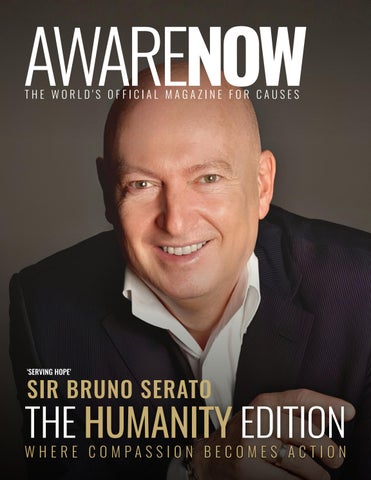
AWARENOW THE WORLD'S OFFICIAL MAGAZINE FOR CAUSES
‘SERVING HOPE’
SIR BRUNO SERATO
THE HUMANITY EDITION
WHERE COMPASSION BECOMES ACTION
THE HUMANITY EDITION
ON THE COVER:
SIR BRUNO SERATO
AwareNow Magazine is a monthly publication produced by AwareNow Media™, a storytelling platform dedicated to creating and sustaining positive social change with content that inspires and informs, while raising awareness for causes one story at a time.
006 HUMANITY JACK MCGUIRE
028 DON’T BE SO SERIOUS ALLIÉ & JACK MCGUIRE
056 THE SHADOW’S NAME MARGE WAKEFIELD
010 THERE IS NO PATH
030 THE STRENGTH AFTER
BURT KEMPNER
BRIAN WALLACE
DUFF ARCHIE
042 WHAT STILL GROWS
070 THE LAST GOODBYE
012 SERVING HOPE
066 THOUGHTS ON THE EVENING OF
SIR BRUNO SERATO
KRYSTAL DURAN
ELIZABETH BLAKE-THOMAS
024 THE LAST HUMAN SIGNAL
048 RIGOR & HUMANITY
074 WHAT WE BUILD TOGETHER
YULY GROSMAN
WILSON LEE, SONJA MONTIEL
VILLAGE OF BYRON
SUBSCRIBE FOR FREE: AWARENOWMEDIA.COM/SUBSCRIBE www.IamAwareNow.com
If we have no peace, it is because we have forgotten that we belong to each other. Mother Teresa
Humanity is found in the moments when we choose to see one another, to care, and to act. Inspired by those who turn compassion into something tangible, The Humanity Edition explores the people, stories, and causes that remind us how much change can begin with one simple decision to help. Because when we lead with humanity, even the smallest act has the power to feed hope, restore dignity, and move the world forward.
ALLIÉ McGUIRE CEO & Co-Founder of AwareNow Media Allié McGuire began her career as a performance poet, transitioned into digital storytelling as a wine personality, and later produced the Hollywood Film Festival. Now, as co-founder of AwareNow Media, she uses her platform to elevate voices and champion causes, connecting audiences to stories that inspire change.
JACK McGUIRE President & Co-Founder of AwareNow Media Jack McGuire’s career spans the Navy, hospitality, and producing the Hollywood Film Festival. Now, he co-leads AwareNow Media with Allié, focusing on powerful storytelling for worthy causes. His commitment to service fuels AwareNow’s mission to connect and inspire audiences.
WAIVER/DISCLAIMER
The views and opinions expressed in AwareNow are those of the authors and do not necessarily reflect the official policy or position of AwareNow Media. Any content provided by our columnists or interviewees is of their opinion and not intended to malign any religion, ethnic group, political group, organization, company, or individual. Stories shared are not intended to vilify anyone or anything. Their intent is to make you think. * Please note that you may find a spelling or punctuation error here or there, as our Editor-In-Chief has MS and lost vision in her right eye. That said, she still has perfect vision in her left and rocks it as best as she can. www.IamAwareNow.com
Hope is something we do. JACK MCGUIRE
CO-FOUNDER OF AWARENOW MEDIA Photo Credit: Ruhul Amin Akash www.IamAwareNow.com
‘REDEFINED & DEFINED’ EXCLUSIVE COLUMN BY JACK MCGUIRE
HUMANITY
BEYOND THE CHAPTERS PEOPLE SEE
humanity (n.) the choice to see ourselves in one another; to recognize that beneath every belief, border and difference, we belong to the same human cause The choice to see ourselves in one another. To recognize that beneath every belief, border and difference, we belong to the same human cause. Humanity is compassion made conscious, and awareness turned into action.
WHAT IS IT TO BE HUMAN? Perhaps there has never been a more important time to ask. We are living through a difficult moment in the story of our species. We have become remarkably good at defining what separates us, and dangerously comfortable forgetting what connects us. Politics. Race. Religion. Gender. Geography. Identity. But before all of these things, we are human. And humanity is more than what we are. It is what we choose to do. To see another person. To care. To stand beside them. To turn compassion into action. We are the only species capable of looking at the world we have created, imagining a different one, and deliberately choosing a new path forward. That is our gift. And our responsibility. Because once we become aware of what we cause, we become responsible for what we choose next. Maybe we have learned enough from anger. Enough from division. Enough from deciding whose life, voice, rights, pain or future matters more. 7
www.IamAwareNow.com
AwareNow Podcast
HUMANITY Written and Narrated by Jack McGuire https://go.awarenowmedia.com/podcast/humanity
TAP/SCAN TO LISTEN
The future of humanity will be written by the choices humans make today. Because there is no environmental cause, human rights cause, racial cause, gender cause, animal cause or health cause that exists completely on its own. They intersect. They connect. They are the Human Cause. So this edition is not about ignoring the worst of humanity. It is about choosing the best of it. The people who care when it would be easier not to. Who help when no one is watching. Who understand that hope is not something we wait for. Hope is something we do. The future of humanity will be written by the choices humans make today. So choose compassion. Choose action. Choose each other. Choose humanity. We will no longer ask for permission to change the world. But we will ask for your help to change it. ∎
8
www.IamAwareNow.com
You are walking in your own truth… BURT KEMPNER
WRITER & PRODUCER 10
www.IamAwareNow.com
‘JUST BURT STORIES’ EXCLUSIVE COLUMN BY BURT KEMPNER
THERE IS NO PATH “Traveler, there are no paths. Paths are made by walking.” - Antonio Machado This is what I’ve learned over the course of a long life: the finest teachers and mentors can only take you so far. There comes a point at which the next step is yours and yours alone. To take another person’s journey as your own would be as unnatural as wearing someone else’s skin. So you lift one foot and the questions descend. Can I do this alone? What if I don’t like it? What if I do? Your heart is pounding. You lift your other foot and place it in front of you. There is no turning back now. You need no one’s permission. You have no idea where the path will lead you, what sights and sounds you will experience, what triumphs and tragedies await you. You grow more confident with each new step. Let whatever is going to unfold happen. You are walking in your own truth to find your own happiness and, succeed or fail, that sets you apart from the incurious herd. ∎
AwareNow Podcast
THERE IS NO PATH Written and Narrated by Burt Kempner https://awarenow.us/podcast/there-is-no-path
TAP/SCAN TO LISTEN
11
www.IamAwareNow.com
It takes zero money to be a kind human being. SIR BRUNO SERATO
CHEF & OWNER OF THE ANAHEIM WHITE HOUSE AND FOUNDER OF CATERINA’S CLUB Photo Courtesy: Caterina’s Club 12
www.IamAwareNow.com
EXCLUSIVE INTERVIEW WITH SIR BRUNO SERATO
SERVING HOPE
ONE PLATE, ONE CHILD & ONE LIFE AT A TIME Sir Bruno Serato is an internationally recognized chef, humanitarian, and founder of Caterina’s Club. His life changed forever when his mother looked at a hungry child and said, “If he’s hungry, feed him pasta.” Those few words became the foundation of a mission that has fed millions of children, housed hundreds of families, and reminded the world that compassion is often measured one person at a time. ALLIÉ: Let’s go back to 2005, when you met a little boy whose only dinner was a bag of potato chips. What do you remember most about that moment, and what changed inside you? BRUNO: I remember every detail. My mom was visiting from Italy, and after lunch I said, “Mom, let’s go to the Boys & Girls Club,” because I knew how much she loved children. The director at the time, Mike Baker, showed my mom around the facility. Then there was this eight-year-old boy. Mike said, “Bruno, this is Billy. He’s eating potato chips right now, and that could be his only dinner.” I asked, “Why do you say that could be his only dinner?”
SERVING HOPE EXCLUSIVE INTERVIEW WITH SIR BRUNO SERATO BY ALLIÉ MCGUIRE
CLICK, TAP OR SCAN
TO WATCH NOW
13
www.IamAwareNow.com
Photo Courtesy: Caterina’s Club 14
www.IamAwareNow.com
BRUNO: (continued) He explained that some of the children came from low-income families. Sometimes they were living in motels. Sometimes ten people were living in a single room. Their mothers might not be available to cook for them, so the children ate whatever they could find. Sometimes, that was all they had. I was shocked. I translated everything Mike had told me to my mom, and the first thing she said, like an Italian mama, was, “Why don’t you feed him pasta?” I said, “Yeah, Ma. You’re right.” When I was a little boy, my family was also very poor. Whenever my friends, brothers or sisters came over, my mom always had something for them. Pasta. Bread. Maybe just a little sugar on top. There was always something. So I went back to the restaurant and prepared pasta for some of the children. Billy was the first one. And we never stopped. We’ve done it every single day for 21 years. Recently, we celebrated serving our 12 millionth meal. I’m proud to say that what started with one location, one city and one club has now expanded to 30 cities and 150 locations. People sometimes think it’s only Anaheim, but we’ve served children in many other communities as well. It expanded because children are in need everywhere. It isn’t just one city or one location. When we served the 12 millionth meal, I invited 300 children from different clubs and cities to come to the Anaheim White House. The restaurant was packed. We had games, a jumping house and so much fun. And on top of that, I served French fries. The kids went crazy. They love French fries. I thought, “Uh-oh. I have to double the order!” ALLIÉ: Who doesn’t love French fries, especially when they’re done well? But let’s pause for a moment. It all began with what your mom said: “If he’s hungry, feed him pasta.” It’s one thing to have that mission, but how did you actually accomplish it? Twelve million meals is extraordinary. What did it take to do this work? BRUNO: I tell people this when I give speeches around the world about Caterina’s Club, which is named after my mom. We started with one location. Then two. Then ten, fifteen, twenty. We didn’t begin by serving 3,000 or 4,000 meals a day. You would go crazy. We started small. We went from one location to two, then three, four and five. Every three or four months, we added another location and another pasta program. Eventually, we started counting the meals because we needed the numbers for auditing. Personally, I never cared about counting. I just served, prepared and fed the children. But they told us we needed to keep track of every meal, so the women in my office started counting everything. At first, I thought they were crazy. I said, “It’s impossible.” They said, “No, that’s what we do!” When I serve a meal, I might put pasta in the container along with chicken or beef and vegetables. Sometimes there’s an extra piece of chicken or something else. We count the individual portions that go onto each plate. After so many years, I look at those numbers and think, “Wow.” Of course, we also have to be careful because it’s costly. The food is free for the children, but it isn’t free for Caterina’s Club. Our costs continue to increase because of food prices, gas and transportation. I have four full-time drivers traveling throughout Orange County, Los Angeles County and even into San Bernardino County. We used to go as far as San Diego County, but eventually I had to say, “It’s too far. It takes too much time for the drivers.” 15
www.IamAwareNow.com
When I see Billy, it’s hard to hold back my tears. SIR BRUNO SERATO
CHEF & OWNER OF THE ANAHEIM WHITE HOUSE AND FOUNDER OF CATERINA’S CLUB Photo Courtesy: Caterina’s Club 16
www.IamAwareNow.com
BRUNO: (continued) We do what we can. Sometimes I wish I could go all the way to New York. ALLIÉ: And you have actually served pasta in New York. BRUNO: Yes. I don’t tell too many people that. I think you’re one of the first people I’ve told. I served pasta at the Madison Boys & Girls Club in Brooklyn with the help of Barilla. They had a restaurant in New York, and they helped me serve pasta there. They also did something similar in Chicago. A friend of mine did it in Texas, and other people have done it in Oklahoma. I focus on Orange County and Los Angeles County, but people around the country and around the world have taken part. People have served pasta in Mexico, Africa, Italy and other places. I think I have spread the virus of kindness and feeding children. It’s a really special part of my life. I believe it’s the mission God gave me. ALLIÉ: It’s so beautiful, Bruno. I love that it’s spreading. If we’re going to talk about a virus, this is the kind of virus we actually need in the world. Let’s talk about that number again: 12 million. When you think about 12 million meals, do you still see the face of that first boy you served? BRUNO: I still see his face because I see him once in a while. I invited Billy when we served our 10 millionth meal, and I had him cut a big cake for the children who came to the restaurant. When I see Billy, it’s difficult to hold back my tears. The best part is that he’s a good man. He has worked for the City of Anaheim, the same city where I first met him. Sometimes children go in different directions, but Billy went in the right direction. I’m very happy about that. There’s another girl I can never forget because she was such a kind and wonderful girl. Her name is Alejandra. Her brother passed away recently. I wished her a happy birthday, and she sent me a message saying, “I never forget what you did for all the children in the area.” They used to live in a mobile home park, and I went there every day to deliver pasta. At Thanksgiving, I also delivered turkeys to the families. There were about 150 mobile homes. That girl has a special place in my heart. There are some stories I can never forget. One day, I gave her socks because she told me there were holes in all the socks she owned. When she saw me a month later, after we had delivered socks to her and the other children, she hugged me and cried for ten minutes. I was concerned. I thought something bad had happened. But she was crying tears of joy and gratitude because we had given her socks. Those are the kinds of moments I will never forget in my life. I will carry them with me all the way to heaven. ALLIÉ: It’s beautiful, this work you’ve been called to do, because it isn’t just spaghetti. It’s turkeys. It’s socks. It’s seeing what a child and a family actually need. When did you realize that feeding a child also meant helping create a safer and more hopeful future for the entire family through things like housing and jobs? BRUNO: That’s a good question. About 12 or 13 years ago, I was at the Boys & Girls Club and noticed two children, Carlos and Maria, who always looked sad. When you go to a Boys & Girls Club, children usually play. Even if they’re poor, they play and smile. I was very poor growing up with my brother and sister, but we weren’t sad. We were happy. We had spaghetti, leftover bread and milk at night, and we were happy.
17
www.IamAwareNow.com
Sometimes you don’t understand someone’s situation until you see it yourself. SIR BRUNO SERATO
CHEF & OWNER OF THE ANAHEIM WHITE HOUSE AND FOUNDER OF CATERINA’S CLUB Photo Courtesy: Caterina’s Club 18
www.IamAwareNow.com
BRUNO: (continued) But these two children were different. They always had sad faces. I talked to the director and asked, “Is there something wrong with those two children? I don’t see them playing very much, and they always look sad.” When you see a child with a sad face, you notice it. It reminded me of my little niece, Anna. She lost her mother, my niece. When I went back to Italy this year, Anna wasn’t the same child I had known when her mother was alive. She was very sad. I spent two weeks in Italy trying to help her. I took her to school and picked her up. By the second or third day, when she came out of school and saw me and my sister Flavia waiting for her, she had a smile on her face. That makes me emotional even now, because there’s nothing better than seeing a child smile. When I talked to the director about Carlos and Maria, he told me, “Bruno, they live in a motel room.” I asked, “And?” He said, “There are six of them.” Their mother, father and four children were all living in one room. Two or three would sleep on the bed, and two or three would sleep on the floor. Eventually, I went to see their motel room. Their entire life was in that one room. Boxes were stacked all the way to the ceiling and around the walls. I asked the father, “Why have you been living here for so long?” He was a handyman. He told me, “Bruno, I make enough money as a handyman to pay the monthly motel rent, but I can’t save enough for the first and last month’s rent needed to move out.” I had never thought about that before. Sometimes you don’t understand someone’s situation until you see it yourself. I asked him, “If I pay your first and last month’s rent, will you move out?” He asked me, “Why do you want to help me?” He was almost scared. I told him, “Because I’m a good man, and I want to help you. You have beautiful children.” When I saw those four children, I remembered myself, my brother and my sister. I told him, “Let me help you pay the first and last month’s rent. You move out, and we’ll stay behind you for one year because you need time to get used to paying the electricity, water and all the other expenses.” I paid the first and last month’s rent, and they moved into an apartment. They were very happy. I’m not saying every motel is bad, because there are some nice ones, but some of these environments can expose children to drugs, prostitution and other dangerous situations. Think about the children. That was the first family I helped in this way. Since then, I’ve done it many times when I find a family who qualifies. They have to have children because we’re doing this for the kids. The parents also need to have a job because they have to be able to continue paying the rent every month. I’m proud to say that I’ve paid the first and last month’s rent for 280 families. ALLIÉ: What?! Oh my goodness!
19
www.IamAwareNow.com
No child should go to bed hungry… SIR BRUNO SERATO
CHEF & OWNER OF THE ANAHEIM WHITE HOUSE AND FOUNDER OF CATERINA’S CLUB Photo Courtesy: Caterina’s Club 20
www.IamAwareNow.com
BRUNO: I think I may be the only person in the world who has done that on this scale, just as I may be the only person who has served 12 million meals. I’m not saying that to brag about myself. I just wish more people would do things like this. The world would be a better place. No child should go to bed hungry, and no child should have to live in one room with seven, eight, nine or ten other people. I’ll tell you another short story. One little girl once told me, “Chef Bruno, I do my homework sitting on the toilet.” I asked, “Why?” She said, “It’s the only quiet place where I can do my homework.” Think about that. We might sit on the toilet and play with our phones, but children like her were doing their homework there because it was the only quiet place they had. When six, seven or eight people live in one room, it’s difficult for anyone to concentrate. That’s another part of what I call the Welcome Home program at Caterina’s Club. ALLIÉ: And you mentioned there was a third part. BRUNO: Yes. The third one is something I’m very proud of. It’s called Chef Bruno Hospitality. After doing this work for so many years, I realized that after children leave the Boys & Girls Club, they often go home or spend time in parking lots and other environments that may not be good for them. So I decided to bring teenagers from school into my restaurant and teach them how to work. They start with basic jobs such as being a busser, working in the kitchen, peeling potatoes and cleaning the floor. We usually take seven, eight, ten or twelve kids at a time for a three-month training program. They earn about $150 a week while they’re training. After three months, they leave because I want to train another group of ten kids. So far, I’ve graduated more than 1,000 young people. The best part is that some of the kids improve so much and show us that they really want to work. We then hire some of them as employees at the restaurant. I have three or four of them working for us now. It’s a gift because you get to know them for three months. They practice, learn from you, work with your crew and interact with customers. They receive real-world training. When you finally say, “Okay, it’s your time to go out on your own,” it’s a great feeling. Some of them have gone on to build their own careers. One boy graduated from the Culinary Institute of America in Napa Valley. Another girl opened a small pastry shop. Another works at the Cambria Hotel in Anaheim. There are many stories like that. I don’t know what happened to every single one of them, but some have gone on to do great things. This is what Caterina’s Club does. ALLIÉ: It’s absolutely phenomenal, all that you’ve done and all that you continue to do. I hope your story inspires other people to mirror the good you’re putting into the world. For one last question today, this is for the person watching who believes they’re only one person and couldn’t possibly make a difference. What have 12 million meals taught you about the power of beginning with one act of kindness? What would you say to someone who simply doesn’t know where to start?
21
www.IamAwareNow.com
Everywhere you look, there is always someone who needs help. SIR BRUNO SERATO
CHEF & OWNER OF THE ANAHEIM WHITE HOUSE AND FOUNDER OF CATERINA’S CLUB Photo Courtesy: Caterina’s Club 22
www.IamAwareNow.com
AwareNow Podcast
SERVING HOPE Exclusive Interview with Sir Bruno Serato https://go.awarenowmedia.com/podcast/serving-hope
TAP/SCAN TO LISTEN
BRUNO: If you turn around and look, you will see someone in need. Everywhere you look, there is always someone who needs help. Don’t tell me you don’t know where to start. Open your eyes. Someone may be in need next door, in your neighborhood, at a school, at a church or at work. There is always somebody. Open your eyes and listen. And don’t think you have to serve 4,000 or 5,000 meals a day. Just give someone a little pasta. You can even say, “Hello. How are you?” One of the things I teach students around the world is simply to say hello to an elderly person. Many elderly people are abandoned by their families. Just say, “Hello. Good morning. Good night.” You’ve done something without spending any money. It takes zero money to be a kind human being. ∎
Follow Sir Bruno Serato on Instagram: @serato7 Learn more about Caterina’s Club: caterinasclub.org Visit the Anaheim White House: anaheimwhitehouse.com
23
www.IamAwareNow.com
Different industries. Different decades. Different continents. The same pattern. YULY GROSMAN
SITUATIONAL INTELLIGENCE ADVISOR, KEYNOTE SPEAKER & AUTHOR Photo Courtesy: Yuly Grosman 24
www.IamAwareNow.com
FEATURE STORY BY YULY GROSMAN
THE LAST HUMAN SIGNAL NOTHING HAPPENS SUDDENLY
Just before sunrise, the Maasai Mara in Kenya is strangely quiet. Just before sunrise, the Maasai Mara in Kenya is strangely quiet. The first time you experience it, you notice the beauty long before you understand what you're seeing. A thin layer of morning mist hangs above the grasslands. The air is cool. Acacia trees stand motionless against the horizon while the first light slowly reveals one of the most studied ecosystems on Earth. To an outsider, nothing appears to be happening. Then something changes. Not dramatically. Not all at once. A bird that had been calling moments earlier suddenly falls silent. A zebra lifts its head and freezes. A giraffe, feeding peacefully seconds before, turns toward a place where there is apparently nothing to see. Even the wind seems different. If you're visiting the Mara for the first time, you probably keep taking photographs. Everything still looks peaceful. The animals know better. Several minutes later, a lion starts his morning hunt. Tourists often describe what follows as a sudden attack. It isn't. The attack only looks sudden to those who failed to recognize the signals that came before it. Nature rarely communicates with certainty. It communicates through small changes that, taken individually, seem insignificant. Together, they tell a story. For years, I believed this lesson belonged only to the African savannah. But for three decades I saw the same pattern in places that seemed to have nothing in common with wildlife. I saw it while building Kenya's flower export industry, where a missed operational signal could destroy millions of dollars' worth of fresh flowers before they ever reached Europe. I saw it while owning a nightclub in Tel Aviv, where changing customer behavior quietly reshaped an entire industry years before market research explained why. I saw it while advising executives whose organizations were struggling, even though every dashboard suggested business was healthy. And I saw it again recently while speaking at Microsoft Garage in New York, at a conference on artificial intelligence and creativity, where one question kept resurfacing: what remains uniquely human as machines become more capable? Different industries. Different decades. Different continents. The same pattern.
Example 1: The Micro-Behavioral Signal In the late 1990s, as a co-owner I saw itTel Aviv nightclub. It illustrated this perfectly. In that business, the door policy decided who got in, but the real metric was human behavior. The door staff, the "face controllers”, weren't security alone; they were frontline data points. One wrong crowd on one bad weekend could sink a season. By the mid-2000s, the dance floors quietly started shrinking. Clients wanted seating and food menus instead of floor space. Nobody announced the shift - the market quietly rewrote itself based on live human experience, years before the data caught up. A recent large-scale banking analysis of consumer spending finally quantified what behavior had already revealed: fitness spending rising, night clubs and night life spending declining. 25
www.IamAwareNow.com
The ripple ran far beyond nightlife, striking import-export suppliers, sound equipment companies, and frozen food distributors - absorbing a financial shift that had started years earlier as a quiet change in how a generation wanted to spend a Saturday night. The signal arrived first. The data arrived late.
Example 2: The Macro-Operational Signal A decade and a half later, the same pattern appeared from a completely different vantage point. In the global trade of fresh-cut flowers, where time is measured in hours and a delay is the difference between a shipment and a total loss, the margin for missing a signal is zero. In 2014, when geopolitical tensions flared around Ukraine's Maidan Square, most global executives expected the impact to stay isolated. They were watching their margins, not movement on the ground. But the operational signal flashed instantly. Within months, SWIFT banking access became uncertain. Payments paused before anyone had a backup system ready. Routes that had worked for years suddenly failed. Airlines carrying perishable freight had to be avoided overnight, and new carriers vetted under extreme pressure. Customs procedures that once took hours started taking days. None of this was unpredictable. The signal was visible early, in the region's political friction and the fragility of routes running through a single point of failure. The organizations that survived were the ones whose people were trained to read that signal before it became a headline. More than a decade later, the same instability is still reshaping supply chains far beyond that region. Analysts, including Atlantic Council senior fellow Richard D. Hooker Jr., have outlined scenarios for how the conflict's pressures could extend further into Europe's Nordic and Baltic security calculations. Regardless of how those specific scenarios unfold, the underlying lesson holds: instability in one corridor rarely stays contained. Parts of Africa, including Kenya, are still absorbing higher air-freight costs tied to disruptions that began years ago. Instability around Middle East oil and shipping corridors is already affecting fertilizer and fuel imports that African food systems depend on. The signal is visible now, in freight costs and shipping routes, long before it becomes a supplychain headline. 26
www.IamAwareNow.com
The Blindspot That Costs Everything Different industries. Different decades. Different continents. Same pattern: the signal arrives quietly, long before the outcome does. Today, conflict continues to reshape supply routes and energy lanes. Rising global heat is quietly altering how people work, travel, and move. Yet many decision-makers remain insulated, making critical choices based entirely on reports compiled by teams who rely on machines. They have outsourced their awareness and called it efficiency. The leaders and organizations that last are the ones who train their people, not just their executive boards, to read the field early. Executives are rarely closest to the signal. Their managers are. Their frontline teams are the people talking to customers, handling logistics, and facing the market every day. Nothing happens suddenly. The signal is always there first. The only real question is whether anyone in the organization has been trained to work with it effectively, before it becomes the headline. After years of seeing the same pattern in completely different environments, I realized I wasn't studying leadership, risk, communication, or organizational behavior as separate disciplines. I was studying one capability that connected all of them: the ability to recognize meaningful signals before they become obvious. I call that capability Situational Intelligence. Or reading signals. The human signals. As AI adoption accelerates, this capability matters more, not less. A well-known limitation of customer-facing AI tools is their difficulty recognizing urgency or distress from non-native English speakers, a gap that has already created both safety risks and corporate liability where clear situation recognition matters most. The tool is not the danger. What we bring to it, and what we still train our people to notice around it, is. We have automated almost everything… supply chains, medical analysis, financial decisions. But one capability remains stubbornly resistant to automation: the ability to send, listen to, and respond to human signals. In a world becoming more automated, most of us are getting worse at this, not better. ∎
YULY GROSMAN Situational Intelligence Advisor · Keynote Speaker · Author Yuly Grosman works at the intersection of human behavior and high-stakes decision-making — training executives and global leaders to master the one capability automation cannot replace: the ability to send, read, and respond to human signals. With 30 years of field experience across five continents — including helping grow Kenya's flower export industry from $278 million to $800 million, before anyone else saw it was possible — his methodology was not built in a classroom. It was built in environments where missing a signal had real consequences. He has trained both C-suite executives and special forces in the same methodology, discovering they were solving the same problem. Not security. Not leadership. Signals. He is the author of The Most Beautiful and Dangerous Business: Uncommon Lessons for Unstoppable Leadership and creator of the Look. Listen. Respond. framework, used by executives, teams, first responders, and special forces. His work has been presented at Harvard GlobalWE, S&P Global, and Microsoft Garage NYC. His work is built on one premise: nothing happens suddenly. The signal is always there first. Website: www.yulygrosman.com LinkedIn: linkedin.com/in/yuly-grosman
27
www.IamAwareNow.com
Catch me when I fall… ALLIÉ MCGUIRE
CO-FOUNDER OF AWARENOW MEDIA 28
www.IamAwareNow.com
ORIGINAL POEM BY ALLIÉ & JACK MCGUIRE
DON’T BE SO SERIOUS In serious times when humanity’s course correction is required for us to survive and thrive, it’s hard to know what to do in order to be part of the solution as opposed to the problem. This we know for sure, we need catch one another when we fall and together fly ever upward and onward. Don’t be so serious.
Don’t be so serious.
But serious you can’t help but be In times of such uncertainty When the survival of our humanity Is threatened by unjust casualties.
Too many gone before their time, While there’s no reason, I’ll rhyme, In hopes that hope will chime From our will to redefine…
Don’t be so serious.
Humanity.
You say people die every day But not like this, not this way On both sides there’s a cost they pay As the innocent in the ground they lay.
It’s the human cause, That binds us all with reason to pause, Reflecting on our innate laws To love each other despite our flaws.
Don’t be so serious. Catch me when I fall… You can’t unhear a call once heard Despite the norm preferred. Be of your heart, be of your word. When called to fly, you are a bird.
DON’T BE SO SERIOUS ORIGINAL POEM BY ALLIÉ & JACK MCGUIRE
CLICK, TAP OR SCAN
TO WATCH NOW
29
www.IamAwareNow.com
Everybody has a situation. You’ve just got to figure it out. BRIAN WALLACE
MS ADVOCATE & HOST OF ‘MS MICHIGAN MAN 64’ Photo Courtesy: Brian Wallace www.IamAwareNow.com
EXCLUSIVE INTERVIEW WITH BRIAN WALLACE
THE STRENGTH AFTER
WHEN THE GAME CHANGES, SO DOES THE MEANING OF WINNING Long before multiple sclerosis entered his life, Brian Wallace knew what it meant to fight, first as a University of Michigan football player, and later through a diagnosis that changed everything at just 27 years old. Nearly three decades later, through MS Michigan Man 64, Brian is creating honest conversations about chronic illness, mental health, community, and a different kind of strength: the kind that comes from learning who you are when life asks you to become someone new. ALLIÉ: Well, right back at you. It was wonderful to meet in person and to continue the dialogue and the relationship as we move forward, both of us being storytellers and hearers and sharers of stories. But today, I want to speak just about you. Brian, before MS, your body had taken you places most people can only imagine, from championship hockey to Michigan football to completing a triathlon. And then you’re diagnosed with a disease capable of making that same once-reliable body unpredictable. Beyond the physical changes, what did MS do to the relationship you had with your own body and the person you believed yourself to be? BRIAN: Well, like you said, I played a lot of sports growing up, so I was always very strong and very in command of my body. When I was diagnosed, I was 27 years old and five years out of playing in the Rose Bowl. When I got diagnosed with MS, it felt like a part of my life left me because I couldn’t run anymore.
THE STRENGTH AFTER EXCLUSIVE INTERVIEW WITH BRIAN WALLACE BY ALLIÉ MCGUIRE
CLICK, TAP OR SCAN
TO WATCH NOW
31
www.IamAwareNow.com
I was brought up and trained playing football to go as hard as you can. BRIAN WALLACE
MS ADVOCATE & HOST OF ‘MS MICHIGAN MAN 64’ Photo Courtesy: Brian Wallace 32
www.IamAwareNow.com
“As my disease progressed and I lost my ability to work, I had to kind of redefine myself.” BRIAN: (continued) But I didn’t let that stop me, Allié. I just said, “You know what? Okay, it is what it is. I can’t run, but I’m going to figure out a different way to get the exercise I enjoy.” I got into the gym and found an elliptical where I was able to hold on for balance, and I just kept moving. The hardest part for me was the mental part. Losing the ability to walk and run, those changes mentally were very, very hard. ALLIÉ: Yeah. I can only imagine being at that peak, at the top, and then having to shift so quickly and so suddenly. Let’s talk specifically about football, because I’ve never played, but from what I’ve heard, football teaches you to push through pain, to get back up and to keep going when everything in you wants to stop. MS can demand almost the opposite. It can force you to rest, to adapt, to ask for help, or to accept that sheer determination can’t always change what your body is doing. After nearly three decades with this disease, has learning when not to keep pushing been one of the hardest lessons of all? Or has it been something else? BRIAN: It has been a hard lesson because I was brought up and trained playing football to go as hard as you can. You go to failure. Early in my disease, that’s still the way I attacked it. I pushed myself as hard as I possibly could, and I learned that my body was different. It needed a different amount of time to recuperate, so I had to adjust the way I worked out. It was trial and error. I’ve been doing this for almost 30 years, and there were times when I had to take a break from exercise. I’d take a month or two off just to let my body recuperate. I tried to learn to listen to my body, Allié. If I felt good, I went as hard as I could. But on the days when I wasn’t feeling good, I learned to just rest and take it for what it was. You learn to slow down. I learned to slow down. ALLIÉ: Yeah. And I can relate to that a thousand percent because there are days I can go out for a run and other days when just walking around the house is about it. As athletes, that’s a hard pill to swallow. Personally, though, I feel I’ve enjoyed the slowing a bit. I used to have just one gear: fast, fast, fast. What about you? Have you found some comfort in giving yourself permission to slow? BRIAN: Absolutely. I’m 56 years old, and if you went back 10 years, I live in Ohio, I’ve got Lake Erie, I’ve got beautiful sunsets, and I never appreciated that kind of stuff. I didn’t appreciate being out in nature because I was working, doing the regular thing. I had kids and I was raising them. But as my disease progressed and I lost my ability to work, I had to kind of redefine myself, Allié, and find things that I loved and appreciated, things that occupied my mind. I go up to the lake a lot. I go fishing now. I go up there and just watch sunsets. I slowed my brain down enough to enjoy the small things in life that I missed for the last 20 years. ALLIÉ: Mm-hmm. In every loss, there’s something to be gained, and I think MS is a very good example of that. You talk openly about attitude and the mental side of living with chronic illness, but I want to go underneath the idea of being a warrior. You’re someone people look to and see strength in. 33
www.IamAwareNow.com
It doesn’t matter what this disease takes from you. You can always figure out a way to keep going. BRIAN WALLACE
MS ADVOCATE & HOST OF ‘MS MICHIGAN MAN 64’ Photo Courtesy: Brian Wallace 34
www.IamAwareNow.com
ALLIÉ: (continued) So what happens on the days when Brian doesn’t feel strong? When the helmet comes off, when nobody’s watching and attitude alone isn’t enough? Tell us about those days, those harder days. BRIAN: I take a lot of time to sit back and think and try to look at my life, where I’ve been and what I’ve done with my MS. I raised two kids who never even knew me before MS. They were born with me having MS, so they grew up learning what it was like to have a father with this disease. I appreciate the fact that I’ve been able to do that and just keep pushing, day after day, and try to teach people about this disease. When I am having a bad time, I spend a lot of time meditating on my successes and what I have accomplished. Nobody can take that stuff away, Allié. Nobody can take away the fact that I played in three Rose Bowls and a Gator Bowl, won four Big Ten championships, worked for 20 years for the State of Ohio and raised two kids who are now 27 and 24. When I’m having a bad time, I think about that. I think about all the success I’ve been able to have with this disease, and I just keep saying, “FU, MS.” ALLIÉ: I love that. And you’re right, those are things that can’t be taken. MS can take a lot, but it can’t take all the accomplishments we make along the way. Through MS Michigan Man 64, you’ve spent so much time asking other people to tell you the parts of their MS stories that matter. How many have you done now? Like 50, 60? BRIAN: I’m over 160 now. Before I joined with Hail Media Group, I had 101 on my own. Since I joined with Hail, I’m up to about 57 or 58, so I’m right around 160. ALLIÉ: Wow. So that’s 160 lives, 160 stories, 160 windows you’ve been able to look through. You’ve heard about fear, loss, isolation, relationships, mobility, mental health and people rebuilding lives they never expected to have. What have all of those people, perhaps unknowingly at the time, taught you about your own story, Brian? BRIAN: It doesn’t matter what this disease takes from you. You can always figure out a way to keep going. I’ve met people who have lost their voice because of this disease, and I see how positive they are. They figure out ways to communicate through AI apps or however they’ve figured out how to still communicate. It’s the resilience people have to keep going and to keep figuring out how to do things. MS takes something away, and they figure out another way. There’s a guy in Colorado named Jeff. He’s permanently in a wheelchair, and he only has the use of one hand, his left hand. The amount of art this guy can do, the sculpting and drawing, it’s unbelievable. He only has the use of one hand. I use him as an example all the time. It doesn’t matter what this disease takes. You can still figure it out. He always says MS stands for “My Situation,” and everybody has it. Everybody has MS. Everybody has a situation. You’ve just got to figure it out. ALLIÉ: I love that. “My Situation.” Everybody has one. I have one more question for you today, Brian. You’ve been the football player, the Michigan man, the person diagnosed with MS, the MS warrior, the interviewer and the advocate. You’ve been so many things. But if you take away all the jerseys, all the titles, every diagnosis and every label, who is Brian Wallace now? And what does winning look like today? 35
www.IamAwareNow.com
We’re all the same. We’re all fighting a fight and just trying to live the best life we can. BRIAN WALLACE
MS ADVOCATE & HOST OF ‘MS MICHIGAN MAN 64’ Photo Courtesy: Brian Wallace 36
www.IamAwareNow.com
AwareNow Podcast
THE STRENGTH AFTER Exclusive Interview with Brian Wallace https://go.awarenowmedia.com/podcast/the-strength-after
TAP/SCAN TO LISTEN
BRIAN: Brian today is a lot different than Brian 30 years ago, before MS, because all of my experiences have led me up to this. Working in the prison, I got to learn a lot about people. Black, white, Hispanic, it didn’t matter. And with this disease, I learned a lot about people and how you’re treated when you have a chronic disease. I saw other people, whether they were inmates or staff members, who had chronic diseases, and I watched how they were treated. I noticed there’s such a difference in how people are treated when they have a disability, and it’s sad. I’ve been treated unfairly because of a disability, and I just think it’s wrong. When I was playing football at Michigan, Allié, I had people who wanted to be around me. They thought I was a big deal and all that. Then I got done playing and got diagnosed with MS. I’m the same person. I’m that same person I was when I was 19 years old. Why are you treating me differently because I got diagnosed with MS? That’s the part that really confuses me about society. And that’s what I’m trying to do. I want to change that. I want people to be treated the same regardless of whether they’re white, Black, Hispanic or whether they have a disability. We’re all the same. We’re all fighting a fight and just trying to live the best life we can. You know, I think that in the almost 30 years I’ve been dealing with this disease, Allié, the biggest thing that’s been most frustrating to me is the lack of understanding about what it’s like living with a chronic disease. It’s the ignorance people have about chronic disease. Their family, their friends, the people who are around us all the time, they don’t understand, and they don’t always want to gain that knowledge. I think that’s the most frustrating part of living with this disease. It’s not very well understood. And that’s why I do what I do with my podcast. It’s just a matter of people listening to us because all of our stories are different. How we handle it is different. How we fight the fight is different. I just think people need to listen to us so they can understand us a little bit better. ∎
Find & follow Brian on Instagram: @msmichiganman64 Tune into his podcast on YouTube: go.awarenowmedia.com/podcast/ms-michigan-man-64
37
www.IamAwareNow.com
Miles to go before we sleep…
Every one is a part of everyone.
FIND STORIES, STATS & SUPPORT
FOR THE CAUSES THAT TIE US ALL TOGETHER WWW.TABLEOFCAUSES.COM
There’s no rushing your growth. KRYSTAL DURAN
PLANT EDUCATOR & AUTHOR Photo Credit: Kat Schleicher 42
www.IamAwareNow.com
EXCLUSIVE INTERVIEW WITH KRYSTAL DURAN
WHAT STILL GROWS
FINDING RESILIENCE, COMMUNITY & OURSELVES AMONG THE LEAVES Sometimes the things we care for have a way of caring for us right back. For Krystal Duran, the creative force behind Plants with Krystal, nurturing plants became more than a passion—it became a place to hold grief, rediscover purpose, and connect with thousands of people navigating their own seasons of change. With her debut book, More Than Just A Plant, Krystal explores what happens when plant care becomes self-care, growth becomes healing, and something as simple as a leaf reminds us that life can continue after loss. ALLIÉ: You’ve shared that it was after losing your husband in 2022 that caring for plants became part of how you moved through your grief. Was there a particular moment when you realized that you weren’t only helping the plants survive, but that somehow they were helping you survive too? KRYSTAL: Yeah. I remember taking a step back one day. I got up from bed just long enough to water a couple of my plants, and it was a better day than the day before. At that moment, I knew that at least it gave me some reason to get up again.
WHAT STILL GROWS EXCLUSIVE INTERVIEW WITH KRYSTAL DURAN BY ALLIÉ MCGUIRE
CLICK, TAP OR SCAN
TO WATCH NOW
43
www.IamAwareNow.com
Being able to grow those plants, see and reflect on that growth, and then reflect on their own growth was a beautiful thing. KRYSTAL DURAN
PLANT EDUCATOR & AUTHOR Photo Credit: Kat Schleicher 44
www.IamAwareNow.com
“Through growing plants, I’ve learned that I’m not alone in this.” KRYSTAL: (continued) The following day, I had that same realization: Okay, now I have the energy to actually get up and repot a plant. And it just went from there. ALLIÉ: That’s what it comes down to so often. It’s having a reason. And you found that even if it was just the smallest of reasons, it was still a reason. I’d like to talk about your book. The title is More Than Just a Plant. Can you finish that thought for us personally? When you look at the plants that surrounded you during some of your hardest days, what were they more than? KRYSTAL: More Than Just a Plant is really about community. Through growing plants, I’ve learned that I’m not alone in this. I’ve heard other people’s stories, and they’ve told me how plants helped them through some of the hardest parts of their lives. For me, “more than just a plant” means it’s not simply about the plants sitting on your desk. It’s about what they bring to us. ALLIÉ: I love that. And like I said, I’m the opposite of a green thumb over here. You were saying just a moment ago that this is something that can be taught. It’s something that can be learned. Even if you weren’t born with a green thumb, you can find it. KRYSTAL: Absolutely. I’ll speak for myself: I had the opposite of a green thumb. I killed every plant that I had in my home. So if I can grow these plants, everyone can grow these plants. Sometimes you’re looking at them for too long. You have to ignore them for a little bit. ALLIÉ: This gives me hope because even succulents can’t survive me. I’m like, “What am I doing?” This is an issue. I’m either too much or too little. I don’t know. Let’s go back to something you said a moment ago. After sharing your own grief journey, thousands of people began telling you how plants had carried them through their own challenges. What did hearing those stories teach you about the ways we sometimes find healing in places where we never expected? KRYSTAL: Initially, it was very overwhelming for me because I hadn’t yet processed my own loss. But in that same breath, it also made me feel less alone. The more I spoke to people, the more I realized that they, too, were looking to plants as an outlet. Being able to grow those plants, see and reflect on that growth, and then reflect on their own growth was a beautiful thing. It’s amazing to see how we can correlate our own life journeys with the growth of the plants we care for. ALLIÉ: Absolutely. You spent years in social work before becoming known for plant education, and both worlds seem to be rooted in care, patience, and helping something grow. How much of the person you were in social work still shows up in the way you teach and build community today? 45
www.IamAwareNow.com
46
www.IamAwareNow.com
AwareNow Podcast
WHAT STILL GROWS Exclusive Interview with Krystal Duran https://go.awarenowmedia.com/podcast/what-still-grows
TAP/SCAN TO LISTEN
KRYSTAL: All the time. I have to have patience. I have to have self-awareness. You’re also observing everything around you. When you’re working with people, you’re observing different emotions. With plants, you’re observing how they’re drooping or how they’re perked up. It’s a little different, but some of the things I learned working with individuals carry over. Although they’re certainly not the same, there are similarities when it comes to growing plants as well. Definitely patience. Definitely self-awareness. ALLIÉ: Patience in all things. Patience is a virtue. I’m not there yet, but I am trying. Maybe plants will help me through that. I don’t know. KRYSTAL: They’ll give you some “oops” moments. There’s no rushing your growth. ALLIÉ: Right? You have to meet yourself where you are and grow as you can. This final question for you today, Krystal, comes from the fact that plants teach us that growth isn’t always visible. Sometimes everything important is happening beneath the soil, beneath the surface. So, in this season of your own life, what do you believe is growing in you that the world may not be able to see just yet? KRYSTAL: I’d say the expansion of who I am outside of Plants with Krystal, and really recognizing who I am as an individual in all of this. I’m growing my confidence and understanding that I have the skills to go out and teach outside of the screen and see people in person. I’m a little bit of an introvert, so I’m practicing those skills to get myself out there and speak in person. ALLIÉ: To have you blossom out in the world, I think that’s amazing. KRYSTAL: Yes, exactly. ∎
Find & follow Krystal on Instagram: @_plantswithkrystal_ Learn more about her work & her book online: www.plants-with-krystal.com
47
www.IamAwareNow.com
I knew that I couldn’t sustain a quality of life where my work ethics determined everything. WILSON LEE
IMMEDIATE PAST PRESIDENT, INTERNATIONAL ACAC COLLEGE COUNSELING PROGRAM MANAGER, SINGAPORE AMERICAN SCHOOL Photo Courtesy: Wilson Lee 48
www.IamAwareNow.com
‘PEQ PERFORMANCE’ EXCLUSIVE COLUMN BY SONJA MONTIEL FEATURING WILSON LEE
RIGOR & HUMANITY
LESSONS FROM A LIFE IN EDUCATION AND LEADERSHIP “I just sat there, and I was like, does it have to be that hard?” Wilson remembers the last day of school as the director of college counseling in Korea. He was alone in his apartment, finally quiet and suitcases packed for a summer trip to the United States. His first year counseling was intense, and his commitment to succeed matched that. He had absorbed every expectation, pushed through every demand, and done what he believed was required. Wilson always relied on his work ethics and commitment as an educator, but in this moment, he questioned why he hadn’t seen the signs of complete burnout that nearly broke him. That afternoon in his apartment marked the beginning of a deep reexamination of the values he had inherited from his father. His father was the oldest son, and was placed as the head of the household after losing his father at a young age. As a child, he learned what it meant to endure and persist in order to survive the scarcities of the Korean War. Through relentless hard work and studying when he could, Wilson’s father eventually became a math teacher in Korea after joining the military. The lessons passed down to Wilson were simple:
Work hard. Work smart. But always do both. Wilson recalls a childhood that was shaped by that philosophy, where even rest carried a lesson. Holidays and snow days were opportunities to work and learn more. While Wilson’s friends played, he was encouraged to learn. As a middle schooler, Wilson remembers asking his father for help with one particular math problem. Since he was a math teacher, Wilson figured his dad would quickly share the solution. Instead, he began with the history of arithmetic, filled sheet after sheet of paper as Wilson began to doze off. When his father asked Wilson if he understood, Wilson didn’t have a choice. He nodded yes. Then, his father crumpled up the papers, handed Wilson a blank sheet, and said, “Now you do it.” Throughout Wilson’s childhood, he developed a mindset that was unforgiving and inflexible. “It was never about completion, but instead, it was about precision. About doing things right.” That mindset followed Wilson into his career without question. Early in his years as a school counselor in Korea, he immersed himself completely into the work. Work was everything. The environment demanded it, and his own internal voice reinforced it. He pushed himself to the edge of sustainability, believing that his effort measures outcomes and commitment. However, as Wilson sat in the apartment, he decided that he would not repeat that kind of year where he sacrificed self-care, relationships, and dignity. “What kind of life is that? I knew that I couldn’t sustain a quality of life where my work ethics determined everything.” Wilson could not accept that achievement and success relied only on his capability. He began to see that certain things were worth holding tightly, while others were not. His health, his well-being, and his family moved to the center of his priorities. He still had drive, but he decided to reshape it, striving for excellence with boundaries that honored himself and the relationships around him. 49
www.IamAwareNow.com
They believed in me, more than I believed in myself. WILSON LEE
IMMEDIATE PAST PRESIDENT, INTERNATIONAL ACAC COLLEGE COUNSELING PROGRAM MANAGER, SINGAPORE AMERICAN SCHOOL Photo Courtesy: Wilson Lee 50
www.IamAwareNow.com
“There were people who had come before me who were giants in the industry. I was not on that level. Looking back, it was my colleagues that pushed me forward.” That shift arrived on time when he was encouraged to serve on a committee with the National Association for College Admission Counseling (NACAC). Before the shift, Wilson would have never considered for himself the opportunity, convinced that he couldn’t lead with excellence. However, he was at a different time, and said yes, did well, and faithfully served two terms as a NACAC delegate. The idea of running for the presidency of the International Association for College Admission Counseling (International ACAC) felt almost unimaginable. “There were people who had come before me who were giants in the industry. I was not on that level. Looking back, it was my colleagues that pushed me forward. They believed in me, more than I believed in myself.” If anything, Wilson believed in connection above all. He realized that schools, universities, and counselors cannot be adversaries. Instead, they were collaborators, all working toward the same purpose. With this belief, Wilson built relationships by showing up, listening, and contributing. He spent years in spaces where trust was earned through consistency. Over time, people began to experience his capabilities, reliability, and most importantly, care. That care became Wilson’s defining value. Even now, he emphasizes that no major decision in his life has been made alone. His wife, Julie, has been his sounding board. Close colleagues, some of them spanning decades, have offered perspective and guidance. “I know what resources I have, and these people are the best at it. Why would I rely on anything else?” As president of International ACAC, access sits at the heart of Wilson’s work. He has been careful to acknowledge the privilege of his professional environments, where he has worked for institutions with abundant resources, from Singapore to Korea. Having access to that privilege, Wilson holds a great deal of responsibility. This principle has guided his approach to leadership within international education. It is why he has championed processes that improve connection with regions, information-sharing, and how knowledge is communicated beyond traditional boundaries. One of his most significant contributions has been seeing the Regional Council within International ACAC come to fruition. Instead of relying on centralized knowledge, Wilson supported regional representation that reflects the diversity of the global community. “I know East and Southeast Asia from my experience. I do not know Europe or the Middle East in the same way. We need people who do, and we have people who do.” The result has been more responsive communication, more meaningful support, and an expanded sense of belonging. It has also created new pathways for collaboration across regions, particularly when challenges arise. Whether addressing documentation concerns or navigating geopolitical shifts, the council allows for informed, localized insight, throughout the college admission professional communities, worldwide. 51
www.IamAwareNow.com
I once believed that good intent would often be enough, that people would always naturally support the work. But leadership is more complex. WILSON LEE
IMMEDIATE PAST PRESIDENT, INTERNATIONAL ACAC COLLEGE COUNSELING PROGRAM MANAGER, SINGAPORE AMERICAN SCHOOL Photo Courtesy: Wilson Lee 52
www.IamAwareNow.com
As Wilson recently stepped away from his presidency at the end of his term, he shares how his leadership journey has been more demanding, and more transformative, than he ever anticipated. He also shares how timing and discernment helped him to navigate through stressful challenges, keeping his boundaries clear while always trying to prioritize self-care. He has learned that leadership carries both visibility and responsibility. And while success is shared, accountability is personal. “In leadership, when things go wrong, the finger gets pointed at you. I once believed that good intent would often be enough, that people would always naturally support the work. But leadership is more complex.” For Wilson, how one manages that complexity of leadership will directly affect influence and impact. In particular, his empathy is constantly thinking about how students are learning from their educators and each other. We cannot count on everything going as planned, and it is important to believe that “uncertainty” is not a flaw. “Today’s college process intentionally teaches us that there is no single pathway. However, what can be more consistent is how we model how to manage that uncertainty for our students.” 53
www.IamAwareNow.com
AwareNow Podcast
RIGOR & HUMANITY Written by Sonja Montiel & Narrated by Wilson Lee https://go.awarenowmedia.com/podcast/rigor-and-humanity
TAP/SCAN TO LISTEN
Through the college admissions process and beyond, Wilson invites us all to act with purpose, move with intention, and always allow space for the unexpected. He will sometimes discover his tendencies to push too hard, and acknowledges that he continues to learn how to balance drive with care. In the end, Wilson recognizes his evolution as an educational leader, learning to hold both rigor and humanity because both are needed to increase access, justice, and quality of life for everyone. ∎
To learn more about Wilson Lee: linkedin.com/in/wilsonlee1776 www.sas.edu.sg www.internationalacac.org Wilson Lee has spent 24 years in education—first in the classroom, then developing the counseling program at Yongsan International School of Seoul as the Director of College Counseling, and is now at Singapore American School as their College Counseling Program Manager. Outside of institutions, Wilson served eight years as an executive board member of International ACAC, has co-chaired the Mentors Committee for four years, the Opportunity Grants Committee for six years, and chaired the Governance & Nominating Committee this past year. In 2020, he helped launch The Mentor Year Program, which was recognized with the NACAC Rising Star Award in 2022. Wilson also sits on advisory boards for The Common Application, The College Board, The University of Pennsylvania, Baylor University, and the International School of Bangkok. This year, he was proud to have served the members of International ACAC as their immediate past president.
SONJA MONTIEL Co-Founder of PEQ Performance Consulting www.awarenowmedia.com/sonja-montiel SONJA MONTIEL (MA Education) is a cofounder of PEQ Performance Consulting LLC and cohost of “The DH Effect” podcast. She and her partner, Hilary Bilbrey, guide individuals, families, and teams to consistently reach successful outcomes through positive and emotional intelligence strategies. During Sonja’s 23 years working with thousands of teens and young adults worldwide, she began to witness many societies creating an unhealthy hyper-achieving culture that misguides our young people in their pursuit of living a life of fulfillment. Sonja is changing that narrative highlighting educators around the world who dare to think differently about education. (www.peq-performance.com)
54
www.IamAwareNow.com
You are worthwhile. So don’t give up… Just don’t ever give up. MARGE WAKEFIELD
SERIOUS MENTAL ILLNESS & MENTAL HEALTH ADVOCATE Photo Courtesy: Marge Wakefield www.IamAwareNow.com
EXCLUSIVE INTERVIEW WITH MARGE WAKEFIELD
THE SHADOW’S NAME
A STORY OF SCHIZOPHRENIA, SERVICE, AND HOPE Marge Wakefield grew up in Lake Linden, Michigan, a small town in the Upper Peninsula, where she came to know herself as a “Yooper” and, from a very young age, came to know something else she called “the shadow.” At nineteen, while studying piano in Philadelphia, she was hospitalized for the first time and saw the word “schizophrenia” written on her chart. What might have frightened someone else brought Marge a sense of hope, because for the first time, what she had carried had a name, and if it had a name, she believed something could be done. ALLIÉ: Marge, there is something so powerful in the way you describe your diagnosis, not as the end of your life, but as the beginning of your next. I'd love to start there with the shadow you felt as a child and the moment you finally had a name for it. You've shared that, at the age of seven, you knew something was wrong and called what you felt "the shadow." Can you take us back to that time and describe what the shadow felt like as a child? MARGE: Yes. I remember we used to go as a family every summer to South Dakota, where my grandparents lived. They had a big city park with a swimming pool and a river and all sorts of events, firecrackers going off, and all the kids were running around playing with each other and having a great time. I remember, and it was either seven or nine, we were there both summers, but I think I was seven, I didn't want to play with the other kids. I didn't want to run around. I didn't want to shoot off fireworks. Even my grandmother knew that something was wrong. You know how little girls do tea parties? She tried to set me up with tea parties with other neighborhood girls, and I just wasn't into it. What I was into was reading and playing the piano, neither of which made me a lot of friends. But even at that age, I remember that Fourth of July picnic in the park when I was seven. I just had an epiphany. I knew EXCLUSIVE INTERVIEW WITH MARGE WAKEFIELD BY ALLIÉ MCGUIRE something was wrong.
THE SHADOW’S NAME
CLICK, TAP OR SCAN
TO WATCH NOW
57
www.IamAwareNow.com
I was good in school. I made good grades because I liked to read. But the shadow was always there. MARGE WAKEFIELD
SERIOUS MENTAL ILLNESS & MENTAL HEALTH ADVOCATE Photo Courtesy: Marge Wakefield 58
www.IamAwareNow.com
MARGE: (continued) I didn't want to run around. I didn't want to shoot off fireworks. Even my grandmother knew that something was wrong. You know how little girls do tea parties? She tried to set me up with tea parties with other neighborhood girls, and I just wasn't into it. What I was into was reading and playing the piano, neither of which made me a lot of friends. But even at that age, I remember that Fourth of July picnic in the park when I was seven. I just had an epiphany. I knew something was wrong. Because I didn't have a name for it, I just named it. I called it "the shadow." And the shadow stayed with me all the way through grade school. I was just that quiet loner kid who walked down the hallway and didn't have friends. I was depressed, but I didn't know what that word was either. I came from an abusive family situation. There was a lot of abuse, physical, sexual, emotional, everything. It wasn't a happy home, and I was not a happy child. So I just stayed in my room. I was good in school. I made good grades because I liked to read. But the shadow was always there. I was a piano prodigy, and my mom and my piano teacher used to take me around to different towns to women's meetings where I would play the piano. But I wasn't happy doing that. It was a forced performance by my mother. So I just went through school like that. One of the trips I took with my mom and my piano teacher was to Lower Michigan, about 300 miles south of where I lived. I played the piano there and did okay. At the end of the day, they took out a recording and played a video of a camp in Lower Michigan for young musicians, artists, and writers. It was called Interlochen. I watched it and thought, "This is it. This is my escape.” So one day at lunchtime at school, I went home. I knew nobody would be there because my parents both worked. I took out the reel-to-reel tape recorder and made a tape of my piano playing. I sent it off to Interlochen, Michigan, and about a month later I got a letter saying I had a full scholarship to the camp and to the academy. The academy was live-in, so that was it. I was like a bird out of a cage. I went to that school for two years. ALLIÉ: Did that make you happy? MARGE: I was happier than I'd ever been, but the shadow was still there. I couldn't get away from the shadow. I used to see things other people didn't see. I was hallucinating. I just wasn't right. After Interlochen ended and I graduated from high school, my piano teacher at the school moved to London to teach piano. So I lost my father figure in my life. Another student and I said, "Well, why don't we go to London and study with Mr. Vajany?" So we did. We took a ship from Montreal, where her parents lived. I mean, two 17-year-olds, maybe I was 16, but I think I was 17 at the time. We went with the blessing of her parents. My parents barely knew what I was doing. My mother came briefly to Montreal and finally said, "Well, I guess you can do it.” We got to London and studied piano with him, but we hadn't planned ahead. We arrived in September. It was cold. We were freezing. We didn't have any money. We didn't have any food except for what her parents sent us money for. I just started decompensating and hallucinating more and more as I rode around the city on the red buses. One day I came home and I couldn't see anything in the room. I was having an acute psychotic episode. I couldn't see a table or a chair. Nothing. It was just this wavy yellow energy. I told my friend who had come there with me, and she called the teacher. He happened to be home on a leave of absence. They came and talked to me and realized I wasn't functioning right, so they sent me back on a plane to the United States. I got to New York City and somehow made my way to a friend's house in Philadelphia. I asked if I could stay the night. I had no plans. My life was totally unstructured. That night, I hallucinated. I heard voices coming from the ceiling. I heard my radio playing in the room, and the next morning I realized the radio wasn't even plugged in, and it wasn't a battery radio. I was hallucinating symphonies and music and choruses. In the morning, I told my friend what was happening. He took me down to Philadelphia City Hospital. The doctors were all gathered around me in a circle, asking me, "What is your name? How old are you? Where are you?" You know, questions of orientation. 59
www.IamAwareNow.com
I didn’t even know who I was, much less my name or my age. MARGE WAKEFIELD
SERIOUS MENTAL ILLNESS & MENTAL HEALTH ADVOCATE Photo Courtesy: Marge Wakefield 60
www.IamAwareNow.com
MARGE: (continued) I didn't even know who I was, much less my name or my age. I didn't know anything. So I was hospitalized. I think it was on the eighth floor, I'm not sure. But I was so confused. I was just a lost soul. I had no grounding, no family support. I was just a lost soul. ALLIÉ: A lost soul. I can't imagine, because for so long the only title, the only name you had for what was going on was "the shadow," and now you were in this state. So let's really dig in here. When you were hospitalized in Philadelphia and saw your chart with your name and the word "schizophrenia," I think many people might imagine that moment as terrifying. But for you, perhaps, it was something of a relief. Can you take us to that moment, Marge? MARGE: I was up early and pacing the hallway to get rid of the anxiety I felt. I walked past the nurses' station. It had a slanted glass wall, and behind it was a desk. I saw a chart on the desk, and it had my name on it. I thought, “Hmm." So I walked closer, and the chart said my name, Marjorie, with a different last name at that time, and it said "schizophrenia." And I was happy. I just thought, if it has a name, then something can be done about it. I was happy. I didn't know what schizophrenia was. Back then, in the late '60s, it wasn't like hospitals today. Nobody asked me, "Do you want to take medicine?" Nobody asked me anything. My doctor, Dr. Groff, who I'm sure is no longer with us, just gave me the medicine. At that time, all there was was Thorazine. I remember it was either 300 or 600 milligrams four times a day. I hated it. But I knew I needed to take it. Even at that point, I didn't trust myself, but I trusted the doctors. So I took it. It didn't make me feel very good. It made me feel like I was walking under 10 feet of water. It was a funny feeling. But it did help. It started to help. Another thing that was different then from hospitals now is they kept me for a total of three months. They don't have long stays like that anymore. But I began to realize there was a routine. There were people in charge who knew what they were doing, or seemed to, and I began to feel like there was structure. I'd never felt that before because my family was very chaotic. I began to feel safe, like nobody was going to touch me without my permission. I'd grown up with a different set of rules. So that was the beginning of my recovery, identifying it, having a word for it. Giving it a name. ALLIÉ: Let's talk more about the fact that, as you pointed out, your childhood was difficult, to say that lightly, with both of your parents living with mental illness in different ways. How did growing up in that environment shape the way you understood yourself, your family, and mental health in general? MARGE: When I was four years old, I remember sitting on the floor of my bedroom, cross-legged on the carpet, going, "Is it him? Is it her? Is it him? Is it her?" I knew somebody was wrong in this equation of a family. But the good thing about me is I had enough strength that I never asked myself, "Is it me?" I knew it wasn't me. It was outside of me. So I had some kind of sense of being a person at that point. I had some kind of identity. About 40 years later, I realized it was both of them. It wasn't me, thank God, but it was both of them. It wasn't one or the other. I had a lot of hospitalizations. I went from that hospital to the Philadelphia Psychiatric Center, which was out in the countryside. It was really pretty, really nice, and I had good treatment. Again, I was there for months, not just three days. I also saw a lot of things I didn't like. They were giving lobotomies then and shock treatments that weren't done humanely. But I just kept taking the medicine. I trusted my doctor. He was like a grandfather. So I began to collect a semblance of family, and I did that all my life. My family of birth had no cohesiveness. I had three siblings. We didn't bond at all because there was no bonding at the top. We hadn't learned to bond. 61
www.IamAwareNow.com
It was tough… but I just did it. MARGE WAKEFIELD
SERIOUS MENTAL ILLNESS & MENTAL HEALTH ADVOCATE Photo Courtesy: Marge Wakefield 62
www.IamAwareNow.com
MARGE: (continued) My family kind of exploded. I left home around 15. I know I turned 16 that year. I was a year ahead in school. But I was on my own as far as growing up. I wasn't even allowed to pick out my own clothes. I was in a very strict, regimented environment, and if I disobeyed, it meant physical punishment. At night, there was sexual abuse. It was just a horrible, horrible experience. But I don't know, I just never gave in. I was stubborn. That's what did it. I was a really stubborn little kid, and I refused to give in to the craziness around me. Somehow, inside myself, somewhere, I knew this was not right. So I got into a cult at that point, looking for a family. I'm not going to mention the name of the cult. It was a religious cult, sort of psychological and religious, and I spent 12 years in it. As destructive as it was, it was like a family. So I had the knowledge of what it felt like to be in a place where there was structure, where there was a hierarchy, where there were parents and children. I don't say anything good about the cult because it was very vicious. But I got something from that structure. Through a series of events, I ended up in Tampa, Florida. I had a psychiatrist there who was very kind. I think I was working some odd jobs then, and she told me, "What you really should do is go back to school and learn a trade." She said, "The best thing you can do is become a social worker." She knew I liked to travel around, and she said social workers can go anywhere and work. I didn't have my undergraduate degree, but there was a school in St. Petersburg called Eckerd College that let you do the four-year degree on your own. You'd pick up your books and assignments once a month, take them home, do the work, submit it, and I got a four-year degree. The funny thing was, they evaluated me to see what credits I might already have satisfied. They gave me four credits for Religion 101 for being in a cult. It was a religious group to them. ALLIÉ: Take what you can get, yes? MARGE: Whatever. And they gave me four credits for Psychology 101. So I had instant credits. I got through that school and got my BA in 1984. It tells you how old I am. Then the same psychiatrist said, "Well, why don't you take the GRE and see if you can get a scholarship?" So I took the GRE and got a 1300, which was a really high score then, and I got a full scholarship to Florida State University. I was in Florida all this time because I had joined a class action suit in Florida against the cult. I went back to school at Florida State and ended up with an MSW. It wasn't easy at any point. I still had hallucinations, and every time I had a vacation from school, like summer break or Christmas or whatever the holiday was, I was back in the hospital. I called them my tune-ups. ALLIÉ: How hard was that? MARGE: It was tough… but I just did it. I was so happy to have a credential that wasn't any part of the cult. It just kept me going. I ended up being a hospice social worker, taking care of people. ALLIÉ: That had to take a lot. MARGE: I loved it. I just felt like, I can help somebody with something. But going back to where we started, yes, seeing my name and the word "schizophrenia" together gave me a framework and an idea about recovery. I had an excellent male psychiatrist in the hospital. It's sort of funny to me now how it was done because nobody asked me anything. They just brought the pills to me in a glass of water and said, "Take this.” 63
www.IamAwareNow.com
“We have to talk about our experiences. Those of us who have a little recovery, or some recovery, have to talk about it because what I went through, doing it all on my own, is not the way it should be.” ALLIÉ: That's wild to me. And if you don't mind, I'd like to talk for a minute about the fact that there is still so much stigma around schizophrenia, even among people who speak openly about mental health. What do you wish more people understood about schizophrenia and the people who live with it? MARGE: First of all, it's not the person's fault. I believe I had a genetic predisposition to having a mental illness because my father was clinically depressed. He had a very serious depression, always. And my mother had a psychotic disorder. So some of that was genetic. But it wasn't my fault. I mean, the amazing thing is that I survived it. One of the reasons I'm so passionate about families right now is that I didn't have any family support. I paid for my own therapy sessions when I started out, when I realized what was going on, that I needed therapy and I needed to take medicine. I didn't have family support. That's why now I'm so interested in what this organization is doing, because families need help as well as the adult children or children. And there are so few resources. There aren't enough resources for the families or for the people with the diagnosis, whom I call peers. ALLIÉ: Yeah. So the National Shattering Silence Coalition, the organization you're speaking of, is doing this work because, to your point, there aren't enough resources, and mental health isn't being addressed in the way that it needs to be or to the degree that it needs to be. The fact that you can take your lived experience and share your story to help people know they're not alone, I love what you're doing. What your story shows is that there is a way to live with it. There's a way to move through it. It's not easy, but it's possible. And I think having that hope matters. So here's the last question I had for you today, Marge. For someone listening who may be living with their own version of "the shadow," what do you want them to know? MARGE: I want them to know that, number one, it is not your fault. It's not your fault. It's like a card game. You drew a bad card. So did I. 64
www.IamAwareNow.com
AwareNow Podcast
THE SHADOW’S NAME Exclusive Interview with Marge Wakefield https://go.awarenowmedia.com/podcast/the-shadows-name
TAP/SCAN TO LISTEN
MARGE: (continued) But number two is for the family. Please realize that you are so important to this adult child or younger child who has this illness, and don't give up on the child. It may take a long time, but there is some help available. We have to make more help available. We have to talk about our experiences. Those of us who have a little recovery, or some recovery, have to talk about it because what I went through, doing it all on my own, is not the way it should be. It was a horrifying journey. It's taken my whole life to have a nice apartment. Right now it's kind of messy because we're having a community sale this weekend. But just know that it's not your fault, that there is hope, and that you do need to take the medications. Sometimes you have to experiment until you find the right one, or the right combination. That can be frustrating. But there is recovery. I've written one book called I Survived, and I'm writing another book now, which is a rewrite of that book. In the back, I'm putting my contact information because I want people who read my book to know they can call me and I will encourage them. Importantly, suicide is not the answer. You can have a life that is worthwhile. You can be worthwhile. You are worthwhile. So don't give up… Just don't ever give up. ∎
Learn more about serious mental illness and how you can help: www.nationalshatteringsilencecoalition.org
65
www.IamAwareNow.com
Recent files (on his iCloud account) were clinical: temperature readings, O2 levels & handwritten healthcare notes. That is what endof-life care actually looks like inside someone’s personal account. DUFF ARCHIE
FOUNDER OF EXPEDITION MS www.IamAwareNow.com
‘EXPEDITION MS’ EXCLUSIVE COLUMN BY DUFF ARCHIE
THOUGHTS ON THE EVENING OF WHAT MS TAKES IN SILENCE
If you read the last post, you might think you know Tim Archie. The humor. Root Man. Exit stage left. We Crack Ourselves Up. The man who met every stage of PPMS with a walking stick, a one-liner, and a whole lot of patience. This is what he didn’t show us… For years, it’s been a running Archie family joke that while we somehow always had access to Netflix, Hulu, and half a dozen other streaming services, we could never recover the passwords because they were all tied to my dad’s old mac.com email address from the dawn of the internet. The account had been locked since he died. We’d long given up on ever getting back into it. Then Netflix cracked down on password sharing, and after riding the family account for over a decade, I got kicked off. The screen went black: Who’s watching? followed by You are not part of this household. I called Ben to help a brother out, literally. My younger brother had, at some point, quietly appointed himself the family’s IT department, managing Disney+ logins and streaming passwords with the competence of someone who genuinely enjoyed holding the keys to the castle. I tried calling Mom to try something through her Xfinity account. Ben called back. We merged. “You’ll thank me later,” he said. He’d called our uncle, Andrew, my mom’s younger brother, who ended up with Dad’s old iPhone after he passed. The phone was still connected to the same Apple account. Twenty minutes and some forgot-your-passcode miracle later, we were in. It was the evening of March 18, 2025. His death anniversary. Seven years to the night. And here we were, my mom, my brother, and me, on a merged call, staring at our late father’s iCloud account because I couldn’t believe the audacity of Netflix to call me a “household member.” The recent files were clinical: temperature readings, O2 levels, and handwritten healthcare notes. That is what end-oflife care actually looks like inside someone’s personal account. Somewhere in there, there’s probably an essay in that alone.
THE OTHER TIM But go back further, years further, and the other Tim appears. Jokes. One-liners, knock-knock jokes, a whole section of cow Q&A jokes. The man was the king of “Dad Jokes.” “Where do you find a dog with no legs? Right where you left him.” There was Scripture, Psalms, quotes from Emerson, Thomas Paine, and Shakespeare. A note titled “MS.” A packing list. A note with my name on it from when I left for college. A note with Ben’s name on it with an itemized list of his schoolwork. Clipped articles and family email chains going back to the early 2000s, before the word “meme” existed in common internet slang. 67
www.IamAwareNow.com
Hidden among all of it was a note titled Thoughts on the Evening of. It had two updates. The first, dated February 17, 2012, was titled “A Realization.” Those around me all have their lives, interesting and different. I am interested in what they do and how they did it. My days are the same. I am alone, all day every day. My dreams, ideas and goals are kept to myself. Silent. I know this will always be the same. How can I change it? What should I do differently? If I do anything with anyone, it is time paid for or time someone would rather be doing something else. It is not time shared together. I am tired of being alone. Eleven days later, he must’ve opened the same note and added a second entry for context. I found out tonight that J, D&B are going to Scotland in addition to England. [Remaining text is clipped in the supplied source.] He never showed it to anyone. Not my mom. Not Ben. Not me. I’m not going to sugarcoat how hard it was for the three of us to sit there silently on the phone together as we read such a personal thought. But two things can be independently true. The dad I wrote about in the last essay, the one who named Root Man, who deflected a stranger’s accusations on King Street with a one-liner, who looked at his doctor and said “exit stage left” to a terminal prognosis, who let a group of veterans manhandle him down a granite slope and filed the “last great mission” framing as quality material, and the one who wrote “I am tired of being alone” were the same person. My mom had a global partner meeting in Cambridge, England, that July. The plan was for Ben and me to tag along, and afterward we’d head up to Scotland for a few extra days. This was a bucket-list trip. As you may remember from The Ring, the Archies have heritage in the Highlands, and it just so happened to be the trip Dad had talked about in one way or another for years, top of his list… And he would be home. He wrote what he felt and then he went back to cracking jokes. Because that’s what he did. That’s what we did. We crack ourselves up.
THE UNLIVED LIFE A former professor of mine, turned mentor, turned friend, who lives with MS herself, put a name to this recently: The Unlived Life: the grief for the parts of yourself that are lost She’s a sailor who can no longer sail, a skater who can no longer skate. Those things were how she approached life and how she defined herself. More things have been lost than she could possibly gain back. She told me she protects the people closest to her from some of it. And they’re okay with that, either unconsciously or consciously. When I told her about the iPhone note, she said the quiet part out loud: “He kept it from you on purpose. You were his kid. He was protecting you from the weight of it.” Of course he did. You want to protect those closest to you from the “stupid” disease. The person with the condition is helping manage everyone else’s experience of it. March was MS Awareness Month, and the National MS Society’s campaign this year was “MS Unseen.” They mean invisible symptoms. Fatigue, pain, cognitive changes, depression. And they’re right. But my dad’s note is a different kind of unseen. 68
www.IamAwareNow.com
AwareNow Podcast
THOUGHTS ON THE EVENING OF Written & Narrated by Duff Archie https://go.awarenowmedia.com/podcast/thoughts-on-the-evening-of
TAP/SCAN TO LISTEN
THE INVISIBLE PERSON It’s what happens over years underneath all of it. The hobbies that go quiet. The family trips that leave without you. The gap between the Tim everyone saw, the jokes, the resilience, the family motto, and the Tim who wrote that note is the entire thesis of Expedition MS. Identity erosion happens invisibly. Most support systems miss it entirely. I found my dad’s note because I needed a Netflix password. ∎
I’m building Expedition MS, a nonprofit that puts people with MS on the water through sailing expeditions and tells their stories through professional documentary filmmaking, so fewer people have to write notes like that to themselves. More on that soon. This is the second in a series. The first, “You Can’t Be Sad in a Mexican Restaurant,” tells the progression of my dad’s twenty years with PPMS. If this story found you, we’d love to hear your story as well. Visit us online: www.expeditionms.org
DUFF ARCHIE Founder of Expedition MS www.expeditionms.org Duff Archie is a writer and lifelong sailor whose essays move between the water and the living room, racing and yacht deliveries on one side, family and chronic illness on the other. He spent twenty years watching his father, Tim, live with Primary Progressive MS, and much of his work turns on what that taught him: that disability is more often a design problem than a tragedy, that humor is how a family survives a long decline, and that grief doesn't end so much as change shape. He's the founder of Expedition MS, a global sailing-and-storytelling nonprofit for the MS community, where every crew is mixed and every port is a community stop. His writing lives in the ordinary adjustments that hold people together when the body stops cooperating.
69
www.IamAwareNow.com
What happens when we don’t get closure? ELIZABETH BLAKE-THOMAS
STORYTELLER, PHILANTHROPIST & OFFICIAL AMBASSADOR FOR HUMAN TRAFFICKING AWARENESS 70
www.IamAwareNow.com
‘MEDICINE WITH WORDS’ EXCLUSIVE COLUMN BY ELIZABETH BLAKE-THOMAS
THE LAST GOODBYE THAT NEVER HAPPENED WHAT HAPPENS WHEN YOU DON’T GET TO SAY GOODBYE?
Last month, I received the news that my grandpa had unexpectedly and tragically passed away. Someone might think he was old and that this was simply the natural way things happen. However, he had an accident that meant he left us too early, aged 89, nearly 90. I’m fortunate because my grandparents have all been relatively healthy and young enough to become greatgrandparents, with the possibility that they might even have reached great-great-grandparent status. I remember the last time I saw my grandpa. It was a wonderful afternoon at his house with my grandmother, who we call Nan. We looked at photographs and drank tea. As I drove away, they both stood at the end of the garden and waved me off. It’s a lovely memory to have. Unfortunately, that isn’t the kind of memory I have from a couple of other losses. I remember saying goodbye to someone who was dying of cancer in hospital. They were unaware we were there, and my final image of them was lying in a hospital bed surrounded by tubes. In both situations, I said a version of goodbye. One because it was the end, and one because I believed I would see them again. Knowing I made the effort to go and see my grandpa allows me to feel some sense of calm and peace. I would often say I do an Irish goodbye, basically leaving without anyone knowing. I thought this was the best way to live. Saying goodbye to lots of people can be exhausting and can often take over an hour. So, at parties and events, I would simply disappear. When I left the UK for LA, I didn’t even know I was leaving properly, so I never really got to say goodbye to my life there. I think that gave me the feeling that, if it didn’t work out, I could come back and no one would know I had “failed”. Somehow, that felt like the safer option. When my marriage ended, I remember the last time I saw my husband before I knew we were not going to stay married. It was at the airport. We kissed and said we were going to try to make it work. Then, the next time he came back, he had already asked for a divorce. I remember that being a very different goodbye. That goodbye felt unfair because I hadn’t been given the time for closure. But we don’t always get that. What happens when we don’t get closure? Psychologically, it has an impact on the brain, especially my autistic brain. When you don’t get to say goodbye to someone, whether because of sudden loss, estrangement or unexpected distance, it can result in a complicated grieving process. It can leave you with a lingering sense of unfinished business and heighten feelings of shock, regret, anger or sadness. 71
www.IamAwareNow.com
Sometimes life changes direction without warning. And yet we carry on. ELIZABETH BLAKE-THOMAS
STORYTELLER, PHILANTHROPIST & OFFICIAL AMBASSADOR FOR HUMAN TRAFFICKING AWARENESS 72
www.IamAwareNow.com
Navigating the emotional impact of a missed farewell means understanding that psychological response and finding ways to create closure on your own terms. So, are endings of any sort difficult to navigate? What do they mean to us? Do we need endings in order to move on and make space for new beginnings? Are they necessary for us to move forward? Do I regret not seeing my grandfather again? What is it like to live with regret? I think about the memory of the last moments I spent with Chai, but are those memories clear, or is my brain playing tricks on me? Have I reconstructed them over time into something that feels easier to hold onto? How many times has someone left my life without me knowing it would be the last time I would ever see them? Can we live with the fear of constantly thinking, What if this is the last time? Perhaps that is the real challenge. We cannot live every interaction as though it is the final one because fear would stop us from fully living. Yet maybe there is something to be learned from remembering that every goodbye carries significance, even when we don’t realise it at the time. Most of us never get the perfect ending. We rarely get all the words we wanted to say, the explanations we hoped for or the chance to prepare ourselves. Sometimes people leave suddenly. Sometimes relationships end before we are ready. Sometimes life changes direction without warning. And yet we carry on. Perhaps closure is not something another person gives us. Perhaps it is something we create for ourselves. A quiet acceptance that not every story will end neatly and not every goodbye will be spoken. As I grieve my grandfather, I am grateful that our last goodbye was one filled with tea, photographs and a wave from the end of the garden. It reminds me that, while we cannot control when the final goodbye comes, we can choose how present we are for the moments that come before it. ∎
ELIZABETH BLAKE-THOMAS Storyteller, Philanthropist & Official Ambassador for Human Trafficking Awareness www.awarenowmedia.com/elizabethblakethomas Elizabeth Blake-Thomas is a British award-winning storyteller and philanthropist based in Los Angeles. She is the founder and resident director of entertainment company Mother & Daughter Entertainment, whose motto is “Making Content That Matters”, putting focus on each project starting a conversation amongst viewers. She is also the creator of the healing methodology Medicine with Words which is designed to help “spring clean” your mind and help free yourself from unnecessary noise so that you can live a more purposeful, peaceful life. She is the author of Filmmaking Without Fear which is a multi-medium resource curated for indie filmmakers. Her FWF podcast is available on all streaming platforms, and the book of the same name is available on Amazon. She is a regular on panels at Sundance, Cannes and Toronto International Film Festival, Elizabeth mentors wherever possible, ensuring she sends the elevator back down to all other female storytellers.
73
www.IamAwareNow.com
That little park was the catalyst that started change in our village. DEBRA BAKER-MURPH
VILLAGE OF BYRON DDA CHAIR 74
www.IamAwareNow.com
FEATURE STORY WITH ROB VANDEMARK & DEBRA BAKER-MURPH
WHAT WE BUILD TOGETHER
HOW COMMUNITY, COLLABORATION & RESOURCEFULNESS ARE BUILDING A PATH FOR BYRON
In small communities, big change rarely begins with big budgets. It begins with people who care deeply enough to imagine what could be. In the Village of Byron, that vision is taking shape through collaboration, resourcefulness, and a commitment to creating greater connection between the community and the place it calls home. For Debra Baker-Murph and Rob Vandemark, the work is about more than a boardwalk. It is about finding the people, partnerships, and possibilities that can help a village move forward without losing what makes it special. There are places we live, and there are places that become part of who we are. For Rob Vandemark, Byron is both. He was born and raised there. His family business has been part of the community for nearly 60 years. His children were raised there. His investment in the future of Byron, then, is not simply civic. It is personal. Rob shared, “I would like other families to enjoy all that our small community has to offer.” For Debra Baker-Murph, the connection runs through generations as well. Byron is where she lived and raised her children. It is where her husband has roots. Now, another generation of their family is being raised there. That kind of connection changes the way you look at a community. You don't simply see what exists today. You begin asking what will be there tomorrow. And in Byron, one of those questions began at the river.
SEEING WHAT WAS ALREADY THERE In 2012, a major fire destroyed several of the remaining buildings in downtown Byron. In the years that followed, the Village created its Downtown Development Authority, asking Rob to serve as its chair. The challenge was significant. How does a small community with limited staff, limited resources and no extensive economic development infrastructure begin rebuilding not only its downtown, but a vision for its future? One answer was hiding in plain sight. Water. The Shiawassee River runs directly through downtown Byron. With the guidance of Phil Hathaway, who helped the new DDA develop its development and tax increment financing plans, community leaders began looking differently at the natural resource flowing through the center of their village. Rather than seeing the river as something that simply passed through Byron, they began imagining it as something that could bring people into Byron. One of the DDA’s first river-focused projects was the installation of a proper canoe and kayak launch on school property. But the vision continued to grow. 75
www.IamAwareNow.com
76
www.IamAwareNow.com
What if people could do more than launch a kayak? What if they could walk along the river? Sit beside it? Fish from it? Gather near it? What if the river could become not only part of Byron’s geography, but part of its community life? Early concepts explored a much larger riverwalk project, with an estimated price tag of millions of dollars, an intimidating number for a village of fewer than 600 residents. So the question changed. Instead of asking, “How do we build all of this?” They began asking, “What can we build first?”
STARTING SOMEWHERE The answer was a small piece of land tucked between buildings downtown. The space already contained an Eagle Scout project, but little activity happened beyond it. Debra and the DDA began imagining what the area might become if it were refreshed and connected more intentionally to the river. Plans started taking shape in phases: a pocket park. An overlook deck. A fishing platform. A small riverwalk. A pavilion. And, eventually, perhaps the larger riverwalk they had once imagined. The enormous project became a series of possible projects. Possibility became something people could begin acting on. As Debra explained, “We have to actually pull the trigger and do something in order for anything to be different.” That decision led the DDA to Patronicity, a crowdfunding platform through which Byron would have 60 days to raise $50,000 in order to receive a matching $50,000 grant from the Michigan Economic Development Corporation. For a community Byron’s size, $50,000 was no small goal. So they did what small communities often do extraordinarily well. They got creative. There were sponsorship letters. Wreath-making workshops. Trivia nights. Music. Community events. Facebook posts. Conversations with neighbors. Invitations to participate however people could. Debra remembers standing in the space during one of those early events and wondering what it might look like a year later. Maybe they wouldn't raise everything. Maybe the result would only be a bench. A picnic table. A small pavilion. But it would be different. And sometimes change begins simply by proving that change is possible. A year after fundraising began, Byron celebrated the ribbon cutting of what is now Eagle Park. The former Eagle Scout project was respectfully relocated to a spot near the cemetery pond, while its original engraved bricks were incorporated into a sitting wall at the entrance of the new park. Landscaping, picnic areas, electricity and a mural celebrating Byron helped transform a once-underused space into somewhere people could actually gather. But something else was happening too. The community was beginning to gather around more than a park. It was gathering around possibility. 77
www.IamAwareNow.com
78
www.IamAwareNow.com
FINDING THE PEOPLE WHO KNOW HOW Vision alone, however, doesn't navigate grant applications, government funding or environmental permits. Rob knew Byron needed help. He first reached out to leaders in other small communities that were successfully investing in their downtowns. Those conversations eventually connected him with Justin Horvath of the Shiawassee Economic Development Corporation, who understood one of Byron’s greatest challenges: the village had ambition, but not necessarily the staff or specialized knowledge required to pursue complex state and federal funding opportunities. That connection eventually introduced Byron to Lionbear Ventures and Ashley Connelly. For Rob, the difference was immediate. Ashley understood small communities because she came from one herself. More importantly, Lionbear brought the technical knowledge and persistence necessary to help turn community ideas into projects capable of being funded and completed. Rob said, “Without these partners, we would still have little to no progress in Byron.” Through the partnership, Byron has been able to pursue funding for community planning, public amenities and components of its broader riverfront vision. But getting money is only one part of the process. Keeping a project moving can require something else entirely. Resourcefulness.
WHEN THE PLAN CHANGES Ask Debra about the riverfront project and eventually the conversation reaches one particularly unexpected character: A snake. Specifically, the potential presence of the Eastern Massasauga rattlesnake created additional environmental permitting considerations for work near the river. Plans for the fishing platform and connecting riverwalk could not simply proceed according to the community’s preferred schedule. Permitting requirements, construction limitations and funding deadlines collided. For Debra, who had stepped into the DDA chair role, that meant confronting a difficult question. If the money could not immediately be used for the project they had planned, could it be used to move another piece of the vision forward? Rather than surrendering momentum, the team pivoted. Funding helped advance other public amenities, including the overlook deck and pavilion, while Lionbear continued assisting Byron through the permitting process for future riverfront work. It wasn't the original sequence. But progress rarely follows a perfectly straight line. Sometimes leadership is not knowing exactly what comes next. Sometimes it is refusing to let an obstacle become an ending.That persistence has produced an extraordinary amount of visible change in a remarkably short period of time. And perhaps the greatest return has been something no grant application could fully calculate. People started showing up.
79
www.IamAwareNow.com
THE SPARK When Byron held a concert at the new park, something happened that Debra hadn't necessarily planned. People wanted another one. As they left, they asked what was next. Another local musician came to perform. Another band expressed interest. Small vendors began appearing. People walked through the park and out toward the overlook. Families spent time together by the river. New energy began moving through the village. A coffee shop opened. Local pop-ups appeared. People found reasons to linger downtown instead of simply passing through it. For Debra, Eagle Park had become much more than a completed project. Debra shared, “That little park was the catalyst that started change in our village.” Infrastructure had created invitation. Invitation had created connection. And connection was beginning to create community in new ways. Not everyone embraces change immediately. Debra acknowledges that some residents have questioned it. But she has also seen far more people become excited about what Byron could become. For a community where many residents commute elsewhere for work, creating reasons to come home and stay awhile matters. Maybe it is an evening concert. Maybe it is ice cream with the kids. Maybe it is coffee downtown. Maybe it is pizza after a walk. Maybe it is celebrating a milestone under the pavilion. Or maybe it is simply sitting beside the river and remembering why this place feels like home. Debra shared, “It has been the most rewarding thing to be part of when you see people out there and enjoying it.”
THE VIEW FROM FIVE YEARS FROM NOW Ask Rob what he hopes someone experiences walking through Byron five or ten years from now, and his answer doesn't begin with economic development terminology. It begins with a feeling. Rob shared, “I hope they see the beauty of the river, hear the quiet sounds of the water moving downstream, see the wildlife and feel the stress of busy life slip away.” Then, perhaps, they keep walking. They wander through downtown. They stop for ice cream or coffee. They pick up a pizza. They notice what has changed. And maybe they find themselves thinking what Rob hopes they will think: This would be a great place to live. 80
www.IamAwareNow.com
That may ultimately be the greatest measure of what Byron is building. Not simply a park. Not simply an overlook. Not simply a pavilion, fishing platform or future boardwalk. A reason to stay. A reason to return. A reason to belong. Because the story of Byron isn't about one person having a perfect plan or one organization arriving with all the answers. It is about residents, volunteers, local leaders, schools, businesses, economic development partners and organizations like Lionbear Ventures each bringing something different to the table. One brings the history. Another brings the idea. Someone finds the funding. Someone understands the permits. Someone organizes the fundraiser. Someone performs the concert. Someone opens the coffee shop. Someone brings their children to the park. And little by little, a place changes. Perhaps that is the lesson hidden inside everything Byron has accomplished: Small communities do not have to think small. They simply have to start somewhere. And then keep building. Together. ∎
Learn more about the village of Byron: byronmi.com
81
www.IamAwareNow.com