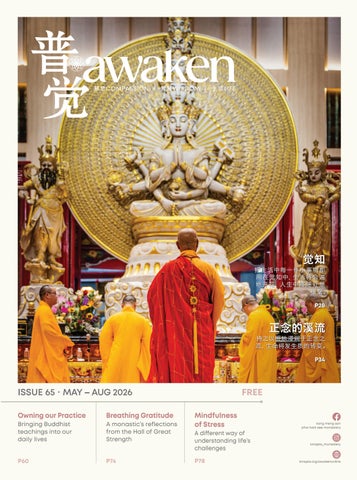
Awaken Issue 65|普觉65期

Page 1


觉知

把生活中每一件小事物都 用在觉知中,生活将会遍 地开花,人生中将随处是 禅堂。 P28

正念的溪流

持之以恒地浸润于正念之 流,生命将发生质的转变。

Owning our Practice

Bringing Buddhist teachings into our daily lives

Breathing Gratitude

A monastic’s reflections from the Hall of Great Strength

Mindfulness of Stress

A different way of understanding life’s challenges

FOUNDER / MANAGING DIRECTOR

创刊人 / 董事总经理

Venerable Kwang Sheng

广声大和尚

AWAKEN CHIEF EDITOR (CHINESE)

普觉执行主编(中文版)

Venerable Chuan Xiong

传雄法师

AWAKEN TEAM 普觉团队

Alvin Goh 吴衍庆

Christina B. 黄秋蘋

Dennis Chew 周国栋

Frankie Chew 周金祥

Koh Rui Ying 许瑞莹

Mabel Tan 宽智

Ong Geok Boon 王翊文

Tay Kim Thia 郑金锭

AWAKEN CONTRIBUTORS 撰稿人

• Ajahn Chah • Ajahn Sumedho • Ajahn Viradhammo

• Thanissaro Bhikkhu • Venerable Chang Chi

• Venerable Kwang Sheng • Venerable Shan De

• Jos Tan • Law Wen Hui • Robert Yeo • Sarah Napthali

• Wong Kee Yew

• 慈诚 • 昌臻法师 • 董良 • Glenn Low • 恒广 • 净慧法师

• 空源 • 蓝郁 • 隆珩 • 门正 • 如愿 • 慎独 • 释法如 • 心 明

• 张家提

PRINTER 印刷

KepMedia International Pte Ltd

PUBLISHER 出版

Kong Meng San Phor Kark See Monastery

Awaken Publishing

88 Bright Hill Road Singapore 574117

Tel : 6849 5342

E-mail : publication@kmspks.org

Website : kmspks.org/awakenonline

COPYRIGHTS & REPRINTS 版权所有,翻印必究

Awaken is owned, published and distributed tri-annually by Kong Meng San Phor Kark See Monastery. All material printed in Awaken is protected under the copyright act. All rights reserved. No material may be reproduced in part or in whole by any means, electronic or mechanical and retrieval system, without the prior written consent of the publisher. Permission may be requested through Awaken Publishing. 《普觉》杂志由光明山普觉禅寺拥有、出版及发行,每四个月 一期。所有刊登在《普觉》杂志的内容均受版权法保护。未 获得正式书面同意前,请勿通过任何形式,包括电子媒体或 搜索系统,自行翻印。有意翻印者,请事先联系普觉出版社 征求同意。

DISCLAIMER 免责声明

The views and opinions expressed or implied in Awaken are strictly those of the authors and contributors and are not necessarily the views of the publisher. Although every reasonable care has been taken to ensure the accuracy and objectivity of the information provided in this publication, the publisher, editors, employees and agents of Awaken shall not be responsible for any actions taken based on the views expressed or information contained within this publication. 所有在《普觉》杂志发表的意见和言论纯粹属于个别作者 或贡献者的观点,未必代表光明山普觉禅寺的立场。因此, 纵然我方尽全力确保杂志内容的真实性和客观性,但因杂 志内所表达的意见或讯息而引起的任何事故,我方,包括所 有的编辑、职员和受委托者,一概不承担责任。

ISSN: 1793-298X

MCI (P) 038/10/2024

卷首语

Abbot’s Message

光明法讯 Buddhist News

意解人生

 因为爱,我们都说谎了

 成人之美

 风华正茂——每一个年龄,都有它的光

 公共交通里的自我修炼

菩提清韵

 东寺游记

 无字真经

 正清和雅

 瓦砾下的希望

 禅观感悟三则

竹林夜话

Calendar of Events /02 /04 /08 /18 /34 /46

 须知烦恼处,悟得即菩提

 本来成现事,何必待思量

法海拾贝

 正念的溪流

磐陀钟磬

 《善生经》中的善知识

 心地与命运

本寺活动

Feature

 Patience

 Making the Dharma our own

Did You Know?

On carrying the Dharma

Buddhist Tales

 Vengeance

 Cultivate wisdom, not supernatural powers

 The worn robe

Something to Ponder

 Wild chickens

 Breathing gratitude in the Hall of Great Strength

 Compassion with discernment

Wellness Insights

The practice of mindfulness and stress

Q&A

Not yet enlightened, not yet apart

Mindfulness Parenting

Family holidays

Savour

 Mod Café – big heart, with big flavours

 Where kaya toast goes green

Recipe

A touch of freshness

Great Reads

An offering of clarity /54 /64 /68 /72 /78 /80 /82 /84 /86 /87 /88

Books for your well-being

What’s New

卫塞节,是我们缅怀佛陀诞生、

成道与涅 槃 的殊胜时刻。然而,

这一天的真正意义,不仅在于追

思往昔的圣迹,更在于体悟我们

生命中潜藏的觉醒力量。

觉醒,并非总是惊天动地。

它或许源于一瞬间的耐受,源于

在冲动时选择克制,亦或是在 不求回报中施予一份善意。

愿这个卫塞节成为一份静谧

的提醒:让我们安稳修行,净化

自心,以赤诚与慈悲笃定前行。

On Vesak, we commemorate the Buddha’s birth, enlightenment and parinirvāna. Yet the true meaning of this day is not only in remembering these sacred events, but in recognising the potential for awakening within our own lives.

Awakening does not always appear extraordinary. It may arise in a moment of patience, in choosing restraint over reaction, or in offering kindness without seeking recognition.

May this Vesak be a quiet reminder to practise steadily, purify the mind, and walk the path with sincerity and compassion.

Sik Kwang Sheng (Ven.)

THE FIRST STEPS IN PLUM VILLAGE MINDFULNESS

On 7 March, 2026, the Mindfulness Workshop was held in the Prajna Meditation Hall. About 100 attendees participated in the session, learning simple and practical foundations of meditation practice.

Led by Venerable Chan Pháp Từ, a monastic Dharma teacher based at the Plum Village International Practice Centre in Thailand, the session kicked off with a brief reference to the Ānāpānasati Sutta, where mindfulness practice begins with the awareness of breathing in and breathing out.

Participants were then guided through a

short mindfulness song accompanied by gentle hand movements. The exercise encouraged them to return to the present moment by following the rhythm, observing their breath, and noticing their state of mind.

The group also experienced walking meditation, where they were invited to slow down their pace and bring attention to each step. Through this practice, participants were encouraged to cultivate calm awareness and reconnect with the present moment.

In the latter part of the session, Venerable Chan Pháp Từ shared reflections

on the restless nature of the mind. At intervals, the sound of a bell invited attendees to pause, settle their thoughts and return their attention to their breathing.

The session was warmly received by the participants. One participant shared how she appreciated the gentle community practice of the session, which allowed her to enter the weekend in a calmer state of mind.

Han, another attendee, also shared that the most meaningful aspect of this session was the opportunity to continually return to awareness of himself.

云端寄深情·线上续孝思

2026 年 2 月 15 日(农历十二月 廿八),正值辞旧迎新之际, 光明山普觉禅寺圆满举办了 年度「春节线上祭祖」活动。

这充满感恩与期盼的 时节,本寺秉持慎终 追远与孝亲报恩之美德,透 过数码平台协助信众跨越时 空阻隔,以至诚之心遥祭先 祖,共同开启吉祥平安的新 春序幕。

这项线上祭祖服务的初衷, 可追溯至新冠疫情期间。当 时为了配合防疫措施,信众无 法亲临寺院祭拜,本寺遂推出

线上代拜服务。随着时代变 迁,这一形式已演变为本寺每 逢腊月廿八的年度惯例,特别 为旅居海外、身体欠安或因 事务繁忙无法亲自前来的信 众提供了极大的便利。

祭祖仪式当天,法师领众至 诚念诵《阿弥陀经》。随着庄 严的梵呗声缭绕殿堂,信众 透过线上直播远程参与,在 荧幕前同步合十感念。通过 称念阿弥陀佛名号及诵经功 德,信众将清净的善业回向 给历代祖先及往生亲友,祈 愿先人离苦得乐、往生净土, 同时也为现世眷属祈福,体 现了佛法中冥阳两利的慈悲 本怀。

为了让更多信众能够参与, 今年的登记费用维持往年水 平,48 元即可登记五位先人 名字。每位先人的名字,都跨 越了地理的阻隔,凝聚着后 辈身处远方,却从未褪色的 绵长思念。

祭祖形式虽在变,但慎终追 远的诚心不变。在科技与信 仰的交织中,孝道精神得以在 云端延续。愿此祭祖善缘,化 作世间温暖,守护每一个家 庭在新的一年里福慧增长、 和乐安康、法喜充满。

Qing Ming 2026

Gratitude in Remembrance

From 21 March to 12 April, 2026, Kong

Meng San Phor Kark

See Monastery observed the Qing Ming festival with ancestral prayers and offerings. Devotees visited the monastery to pay respects to their ancestors, expressing gratitude and filial remembrance through simple offerings of fresh flowers, fruits, vegetarian food, and incense.

One devotee shared, “Even though there are many visitors on Qing Ming, the arrangements here are always thoughtful and well organised. It allows families to come together and pay respects to our loved ones conveniently.”

In keeping with the monastery’s environmental efforts, the burning of joss paper boxes was

discontinued since 2017 and remains discouraged. While such customs have long been practised across generations, the essence of remembrance in Buddhist practice lies not in the form of offerings, but in the sincerity of gratitude and wholesome intentions behind them.

For many visitors, Qing Ming is not only a time to honour those who have passed on, but also an opportunity to reflect upon the kindness and care of our parents and ancestors. This practice nurtures a deeper appreciation of the preciousness of life and the conditions that sustain it.

On the actual day of Qing Ming, 5 April, 2026, the monastery held “The Dedication of Merits to the Departed” puja.

Prayers began at 8.20am with the chanting of the Compassionate Samadhi Water Repentance Sutra, generating merits and offering prayer for the liberation of beings across the six realms.

The puja concluded with the “Releasing the Flaming-Mouths” ritual, reminding devotees to extend compassion beyond their own families to all beings who continue to wander within the cycle of existence.

Through remembrance, repentance and the dedication of merits, Qing Ming becomes not merely an act of mourning, but a meaningful opportunity to cultivate gratitude, and through it, deepen compassion and wisdom.

2026

年清明超度法会:忆念深恩

清明时节,光明山普觉禅寺于

2026 年 3月 21日至 4月 12 日开放 予大众前来祭祖扫墓。

四 众弟子及广大信众依期 共赴道场,敬献香花时 果与清净素斋,以至诚心追思 先祖,实践孝亲之道。

一位信众分享道:“尽管清明 期间人潮众多,但寺院的安排 一如既往地周到且井然有序, 让家属们能便利地相聚,一同 祭奠亲人。”

为守护道场清净并践行环保, 寺院自 2017 年起已停止焚烧大 型纸扎衣箱,并希望大众以更 清净的方式进行祭祀。虽然这 些民间习俗流传已久,但在佛 教的修习中,追思的精髓不在 于供品的形式,而在于其背后 真诚的感恩之心与清净善念。

对许多到访者而言,清明不仅 是追思已故亲友的时刻,更是

忆念父母祖辈关怀与养育之 恩的契机。这份反思能让我们 更深刻地体悟生命的珍贵,以 及成就生命的种种因缘。

2026 年 4 月 5 日,寺院举行了 「清明超度法会」。上午 8 时 20 分,大众齐声共诵《慈悲三 昧水忏》开启序幕,以此积聚 资粮,祈愿六道众生皆能离苦 得乐。

法会最后以「瑜伽焰口」施食 仪轨圆满收束,借此提醒信众 将慈悲心从家亲眷属扩展至 法界一切有情,救拔仍在轮回 中漂泊的众生。

通过追思、忏悔与功德回向, 清明不仅是哀悼逝者的日子, 更是长养感恩、慈悲与智慧的 殊胜因缘之日。

走 过医院长廊时,突被 缓和医疗病房的王医 师拦住说:“师父!病房里住 着一位笃信天主教的陈女 士,见她闷得发慌,我把你介 绍给她了,说你是来陪她聊 天的,不是来宣教的。她说 能接受佛教临床宗教师的陪 伴。”我说好啊!

在病房中,家属提供的数据, 除了疾病史,更包含宗教信 仰与家族树。这有助于我们 尊重每个末期病人的信仰, 也能了解其与家庭其他成 员的关系连结。尤其是家族 树,可以了解病人在家中的 位置。

陈女士 62 岁,罹患肺癌,经 两位专业医师诊断,肺癌已 无法治愈,且有多处转移迹 象,生命余期有限。为了让她 得到更好的医疗照顾,其主 治医师建议转到缓和医疗病 房。

当我走入病房,映入眼帘的 是一位温文儒雅的女士。 虽卧病在床,但优雅依然如

故。她见我步入病房,便回以 温柔的微笑,我也报以微笑 响应。通过自我介绍,好让 她理解我在缓和医疗病房里 的角色。

从口述中得知,大家习惯叫 她阿岚。她曾在县政府当公 务员,拥有退休俸,生活上没 有金钱焦虑。先生阿其是名 退役军人,独子阿智是一名乐 手,自组乐团小有名气。儿子 的成就是她这辈子的骄傲。

了解她母亲仍健在,但没见 来过,便问缘故?阿其说,妻 子对母亲的孝顺是无法言喻 的。不论是岳母的就医、逛 街,都是妻子陪着,母女感情 很深。而这次没告诉岳母妻 子的情况,岳母不断地打电 话和询问小女儿,妻子为何 没去看她。

此时已泪流满面的阿岚说: “很想念妈妈,这样做是保 护她老人家。因她 85 岁了, 还罹患三高,而且她的情 绪 容易激动,担心她无法接 受。”

阿其补充说:“我们已说定 了,打算等妻子的后事办完 再告诉她。”

我建议说:“还是让她来探视 吧!趁着彼此还惦记着,让母 亲能摸到你有温度的双手。

这样的探视才是有意义的, 而不是等到剩下一张照片。

我们可以尝试用减敏法来让 她逐渐知道你目前的状况。

事实上,我们这一代经常把 老人家想成是脆弱的,无法 接受打击。但我们别忘了,她 们那一代的女性是如何的坚 强勇敢,守护着一家人。他们 的心理建设比我们都还要坚 硬许多,因此我们不要小看 老人家的意志力。”

阿岚与阿其终于软化了,不再 坚持己见。我又说:“你们可 以先告诉妹妹,透过她来测 试母亲的接受度。首先,让妹 妹告诉母亲,你生病住进了 加护病房,因有门禁,不方便 母亲前来。接着,再过几天 告诉老人家,已经从 ICU 转 到普通病房了,可以探视了。 然后让妹妹问母亲是否有 意愿来探。若母亲表示有意 愿,那么请妹妹与她约法三 章,来看你时要有心理准备。 这意味着我们把探病的选择 权,交给母亲自己。”

周六我再度到病房探视阿 岚,看到了她妹妹前来探视。 我趁机询问妹妹是否同意之 前的建议,用减敏法以逐步 释放消息的模式,让母亲做 好心理准备,再前来探视阿 岚。没想到妹妹非常同意我 的建议,表示母亲已经多次 怀疑,肯定有事情瞒着她,且 不断询问为何阿岚消失那么 长时间,从频繁地陪伴她, 到突然杳无信息。她还一度 怀疑自己是否得罪了阿岚,导 致阿岚不再理会她。

看似善意的谎言,殊 不知让长辈,失去了可 以好好道爱、道谢、道 歉、道别的黄金时光。

妹妹尤其赞同“把探病的选 择权交给母亲自己选择。” 于是当下,便打了通电话给 弟弟,当消息转达给母亲后, 母亲表示想要来见阿岚。

周日一早,便看见阿岚的老 母亲,前来病房。因其母亲笃 信天主教,为了尊重他们的 信仰,我不便到病房去。但我 从阿岚儿子那里得知,他母 亲再度看见许久不见的阿岚 时,并没有情绪失控,只是紧 紧握住阿岚的手落泪,阿岚

见到她心里一直罣碍,当思 念的母亲来看她时,同样是 潸然泪下,母女相望,一切尽 在不言中。

对长辈隐瞒病情,在缓和医 疗病房中,并不少见。这大多 发生在,上有白发长辈 、下有 晚辈的中间阶层人士身上。

这类“夹心层”的人,一旦生 病了,尤其是罹患重症,都会 想方设法隐瞒长辈。

隐瞒的主因,大都是担心长 辈,无法承受晚辈生重病的 事实。尤其是可能会发生“白 发人送黑发人”的场景,让长 辈精神受打击,造成情绪波 动,更担心长辈因此丧失意 志力而倒下,或因而诱发各 种病痛旧疾。家人之间心知 肚明,事件终究还是会纸包 不住火,但他们宁愿且战且 走,希望保持秘密到底,认定 这是在保护老人家。这看似 善意的谎言,殊不知他们让 长辈,失去了可以好好道爱、 道谢、道歉、道别的黄金时 光,徒留遗憾。

释法如

成人之美

《论语》言:“君子成人之 美,不成人之恶。小人反 是。”意思是说,君子成全别 人的好事,而不促成别人的 坏事。小人则与此相反。此 后,“成人之美”便成为一个 固定成语,意为成全别人的 好事。在日常生活中,成人之 美是指帮助别人实现自己的 愿望,但这种愿望必须是美 好善良的。假如帮助坏人干 违法乱纪之事,虽然他人的 愿望最终得以实现,也不能 称为成人之美,顶多是助纣 为虐。

所谓“君子成人之美”,就是 指有德行的人,总是想着让 别人好,尽力为别人创造条 件,成全别人的好事。这种 “助人达成善良愿望”的思 想,体现了儒家“推己及人” 思想,也是佛教饶益有情精 神的最好体现。君子成人之 美,是出于对他人的关怀和 尊重,是一种博大的情怀。 这种助人达成美好愿望的情 怀,不但给人带来情感上的 慰藉,还能给人以生活或事 业上的帮助,是一种自利利 他的善行。

印光大师十分推崇成人之 美的美德,他在法语中说: “无论在家出家,必须上敬 下和。忍人所不能忍,行人 所不能行。代人之劳,成人

之美。静坐常思自过,闲谈莫 论人非。”大师指出一个人不 论在家,还是出家,都应当具 有的基本品格修养。这些品 格修养包括,对上要恭敬, 对下要谦和。在为人处事方 面,应当做到难忍能忍,难 行能行。与人相处,应当做到 代人之劳,成人之美。无人 时常思己过,与人闲谈不说 人是非。在人的各种品格中, 大师认为成人之美是一个人 最美好的品格。因此,大师 要求弟子在日常修行中要做 到成人之美。

君子成人之美,

是出于对他人的 关怀和尊重,是一种 博大的情怀。

在中国历史上,有很多至今 仍被人津津乐道的成人之美 典故。“逢人说项”便是一 例:项斯是晚唐著名诗人,年 轻时曾在家乡朝阳峰前结庐 隐居,终日读书吟诗,研讨格 律,与寺僧再阳私交很好。

项斯热衷于功名,多次参加 科举考试,均落第而返。项 斯虽然胸怀壮志,但却功名 不就,为此愁闷不已。

会昌三年( 843 ),项斯听说 国子祭酒杨敬之十分爱惜人 才,喜欢提携后进,于是便带

着自己平日所作的诗作登门 拜谒。杨敬之阅读后,果然 大加赞赏,作诗赞云:

几度见君诗总好, 及观标格过于诗。 平生不解藏人善, 到处逢人说项斯。

从这首诗歌可知,杨敬之对 项斯的诗歌和人品极为赞 赏,认为项斯不仅诗歌作得 好,而且人品比他的诗歌还 要好。杨敬之对这位有培养 前途的年轻人十分器重,逢 人便讲说项斯的诗歌和人品 优点。正是由于杨敬之的宣 扬和四处推荐,项斯因此声 名鹊起,诗达长安。

会昌四年 ( 844 ) ,项斯再次参 加科举考试,一举进士及第, 官授润州丹徒(今镇江)蔚, 晚年卒于任所。后来,逢人说 项成为固定成语,比喻到处为 某人某事吹嘘,说好话。

董良

轻时,我们被“风华 正茂”这四个字迷惑 太久——误以为它只属于青 春的领地。那时的世界像一 张尚未测绘的地图,每一次 心跳都在丈量生命的广度。

直到六十岁回望,才明白: 风华,不在年岁之上,而在 心之所向。

为写作寻找旧照片时,我发 现一个秘密:每一张照片都 在进行双重曝光——既定格 了曾经的容颜,也显影着此 刻的心境。那个在校园钟楼 下奔跑的少年,那个在异国 街头摆 pose 拍照的旅人, 那个在新谣舞台上高歌起舞 的身影,他们如此真实又如 此遥远。年轻时我们总在追 逐下一个目标,却不知道最 珍贵的正在当下发生。

如今步履缓慢,鬓角飘起初 雪。但在这具逐渐褪色的皮 囊里,我却找到了生命最真 实的重量。六十岁的风华, 是历经淬炼后的通透。它不 再是喷薄的朝阳,而是温煦 的秋阳;不是喧哗的瀑布, 而是静默的深潭。

退休后的时光像缓缓展开 的山水长卷,终于可以按照 自己的节奏着墨。见识过承 诺的重量,也掂量过谎言的 轻薄,如今更愿意以慈悲的 眼光看待过往。那些还在 身边的,是岁月筛选后的知 己;渐行渐远的,就让它化 作天边的云霞。

年轻时,我们把美丽穿在身 上;年长后,才明白最美的 是灵魂的纹理。青春是未

经雕琢的璞玉,岁月则是匠 心独运的雕刻师——每一 道皱纹里,都藏着光阴的故 事。年轻时,我们以为时间 是向前的;到了六十,才懂 得它其实是环形的——那些 以为走远的风景,终会以另 一种姿态回到身边。

到了这个年纪,终于明白重 要的不是对抗地心引力,而 是修炼生命的磁场。你选择 与谁共享晨昏,就是在编织 怎样的余生。要像园丁修剪 枝条般整理社交,远离消耗 能量的关系,把所剩的热情 留给值得的风景。那些能让 你眼睛发亮的人,才是生命 真正的滋养。

当我不再紧握双手 想要留住什么, 反而接住了整个 生命的丰盈。

二十岁的风华,是待放的花 蕾;四十岁的风华,是沉甸 甸的麦穗;六十岁的风华, 是陈年的佳酿。它懂得在独 处中品味生命的醇香,也懂 得在失去中收获智慧的珍 珠,更懂得与不完美的人生 温柔和解。

当我不再紧握双手想要留住 什么,反而接住了整个生命 的丰盈。风华,从未离去。它 只是从张扬的外显,转为内 敛的底蕴——在与年轻人分 享经验时的会心一笑里,在 老友无需言语的默契里,在 深夜与自己对话的宁静里。

风华正茂,从来不是某个年 龄的奖章,而是一个人仍然

愿意去爱的能力。愿我们在 岁月深处,依然眼中有光, 心中有歌。

Glenn Low

风华正茂

这 是不久前在巴士上目 睹的一段小插曲。

巴士在快速公路上奔驰,再 过一段路就到下一站。差不 多要到站的刹那,坐在我后 面的一名年轻男乘客突然按 了车铃,示意要下车。幸好 巴士车长及时把车停靠在车 站,只是离车站的台阶有些 距离。

车长显然有些不悦,做了一 个无法把巴士停靠在“标 准”距离的手势。年轻乘客 看了很不爽,下车前毫不客 气地回了一句:“难道是我的 错?”。车长也不甘示弱碎碎 念几句。

原以为事情就此了结,没想到 男乘客下车后又走到巴士门 前,双手叉腰表达不满,像是 要与车长理论。车长没时间 理会,随即将巴士开走,车厢 里的乘客这才松了一口气。

我猜测这名男乘客当时可能 正忙着看手机,或一时走神, 直到巴士几乎要到站才恍然 大悟,匆忙按铃。这种情况对 任何人来说都相当危险,万 一巴士紧急煞车发生意外, 后果不堪设想。

我后来把这件事分享给补 习班的中学生,问他认为是 谁的错。所幸学生很理智 地回答,是男乘客。因为课

本里正好有“相互理解”这 个词汇,我便趁机告诉他, 遇到类似情况,最重要的 是学会把别人的处境放到 自己身上来思考。英文常说 的 “Put yourself in others’ shoes”,正是这个意思。

当时我其实更体恤巴士车 长。驾驶巴士需要高度专 注,还要确保全车乘客的安 全,加上停车本有一套标准 作业程序,压力想必不小。

即便车长因乘客临时按铃而 唠叨几句,身为乘客的我们 只要道个歉、快快下车,事情 也就过去了,何必拉扯到伤 了和气。

社会有责任保护老幼 这件事让我联想到去年在台 北捷运车厢里引发热议的 一起事件。一名女士,因坐 在博爱座(优先座)而遭到 一名 73 岁老妇要求让座,老 妇还用手上袋子撞击她的膝 盖。没想到女乘客数秒后起 身给老妇两个强而有力的脚 踢,导致老妇失去平衡,跌 坐在对面的座椅上。

据报道,这名老妇精神状况 不稳定,常刻意挑衅坐在 博爱座的女性乘客,甚至会 攻击对方,她还是窃盗通缉 犯。虽然如此,我仍认为女 乘客不该以暴力回应。从视 频画面看,她将随身携带的 名牌手提袋交给隔壁乘客后

才起身动手,更像是带着情 绪的报复,而非情急之下的 自卫。

将“人生十有八九

都如意”当作我们的 座右铭, 就会发现 烦恼减少了。

即使老妇精神不稳定,也不 应诉诸暴力,社会有责任保 护老幼。若说老妇做出不当 的行为,应立即走开,或向有 关当局举报,这是比较明智 的做法。

以上两件事无独有偶皆发生 在公共交通上,让我不禁思 考,究竟是什么造成这些负 面情绪的爆发?更令人心寒 的是,当事人都抱着“我没有 错”的强硬态度,毫无一丝 歉意和反省。

我很能理解,当被指责或挑 衅时,那种怒气上涌的感觉 确实难以避免,这是人之常 情。难处在于如何在当下控 制好情绪,尤其在大庭广 众,这股怒气往往会影响周 围的人。

看清“我”非站在中心 每当忍不住要动气时,我通 常会先深呼吸,再转个念,把 自己放在他人的处境中,反 思问题的根源。如果是自己 的错,就勇敢道歉;若是对

方的错,则视情况尝试理性 沟通,若无法沟通,退一步 也未尝不是智慧。有时,无声 胜有声。

当然,说的总比做的容易。若 能在平日里修身养性,面对突 如其来的状况便较能稳住情 绪,从容应对。对我而言,这 份力量来自佛法的启发。“无 我”的观念提醒情绪只是念 头的起伏变化;当不再过度 执着于“我”的感受,怒气自 然少了,心也随之安定下来。

“无我”并不是否定自我,而 是看清“我”并非永远站在 中心。许多冲突其实源于不 肯退让的执意。若能在当下 稍作停顿,换个角度思考,很 多不快未必需要出口,便已 在心中悄然化解。

在公共交通或任何场合,面 对突如其来的状况时,莫让 愤怒控制情绪,理智的回应 往往能把大事化小,从而体现 一个人的修养。我们的社会需 要多些体恤和同理心,以确保 每趟路程通畅无阻。

蓝郁

自我 公共交通里的 修炼

东寺里的五重塔,算是从 古以来,京都的地标了。

那个时候,这里叫做平安京。

平安京的建造,参考了大唐 的长安城和洛阳城。有罗城 门、宽阔的朱雀大道、平安宫 和若干横向的街道(一条,二 条,三条……),大一点的区 域叫做坊,小一些的社区叫 做町。

那时,在罗城门的两侧,有一 座东寺、一座西寺。西寺烧毁 以后,再没有重新建造,罗城 门也消失了,皇宫则转移到了 现在的京都御所。而东寺经 历过四次焚毁,一番沧海桑 田之后,于今依然存在。

一进入东寺,就会被高高的 五重塔吸引。这个塔最大的 特点是,它的每一层大小都 一致,而不是越上面的那一 层就越小。

塔内可以参观,是以围绕大 日如来为中心建造的塔身的 主柱。在塔内墙壁上,也是 可以见到空海大师(弘法大 师)的画像。

这座寺院是空海大师建造 的,他本人中文造诣极高 (流传下来的有他书写的风 信帖)。当时,他随遣唐使进 入大唐,在青龙寺拜惠果大 师为师,学习密宗。

传说,惠果大师一见空海, 便惊叹:“我等待多时之人 终于来了。”据《弘法大师行 状记》记载,惠果当即说: “汝来迟矣!吾之密法,应付 之人久未得见。今观其相,汝 可承之。”

据说,他们初次见面以后,仅 仅六个月内,空海就完成了 所有的师承,接受并传承了 最完备的密宗。惠果大师将 青龙寺珍藏的经典、曼荼罗、 锡杖、金刚杵、法衣等,悉数 交给空海,这意味着将唐密 正统全部托付给了空海。而 后,空海回到日本,开创了真 言宗。而东寺从此以后,便成 为了真言宗的寺院,没有其他 任何佛教门派进入过这里。

这里的目光充满了温 暖的慈悲,用期待和 鼓励包围着每一个面 前的生命。

空海在建造这间寺院的时 候,也花了很多心思,呈现出 了一个立体的曼荼罗。东寺的 主要结构为五重塔、金堂、讲 堂、御影堂(空海的居所)和 食堂(修行场所,非用餐的地 方)。

虽然我对密宗不是很了解, 但是进入东寺的各个建筑内 参观后,大大感叹于大唐遗 留下的辉煌和密宗寺院所特 有的布局。

金堂内供奉的,是药师如来、 日光菩萨和月光菩萨。这尊 药师如来和传统中国流行的 造像很不一样,他的手中没 有装药的罐子,而且两边是 日光和月光菩萨。我从没在 国内的寺院里,见过这样的 造像布局。

金堂这个建筑,内部看起来 非常的陈旧。人站在里面, 仿佛置身于过去的时光中。

光影的交错与移动,好像在

东 寺 游

告诉你,时间一直在这金堂 里流淌着、逝去着。然而,这 三尊佛像却从来没有离开过 这里,不受时空的束缚,注视 着从古至今的生命,来来去 去、反反复复地出现在他们 的面前。

这里仿佛是我的家一样,只 要来到这里,就能感受到三

尊佛像带来的巨大能量。他 们的目光充满了温暖的慈 悲,用期待和鼓励包围着每 一个面前的生命。在这里, 心就有了归处,有家人眷顾、 呵护与慈爱的感觉。仿佛菩 萨的眼光就是温暖的空气, 围绕周身,被大大地拥抱着, 有满满的幸福感。坐在金堂 里,舍不得离开,注视着佛菩

萨,流连忘返,充分享受着舒 适的感觉、回家的感觉和被 慈爱包围的感觉。

金堂后面,就是讲堂。讲堂 是空海大师带领僧众们讲 经说法的修行场所,也是做 法事的地方。讲堂里一共供 奉着21尊佛像,形成以大日 如来为中心的立体曼荼罗。

右侧是金刚般若波罗蜜多菩 萨,左侧是不动明王,还有四 大天王镇守东南西北,梵天 和帝释天作为诸菩萨的护法 分立两侧。

这种造像的摆放,我也是第 一次见到。走在讲堂里,觉得 十分震撼,这些塑像据说是 由空海大师从唐朝带回东寺 的,包括两幅曼荼罗(胎藏界 曼荼罗与金刚界曼荼罗)。这 也体现了密宗的思想,大日 如来是世界的中心,诸菩萨 都是他的化身,他代表了即 身成佛的思想。

寺院里,随处可见的金刚杵, 这是密宗的重要法器。每一 幅空海大师的画像里,都能 看到他手里拿着一个金刚 杵。

金刚杵象征以智慧的利刃, 断除烦恼,获得金刚不坏的 觉悟。如同《金刚经》的寓意 一样,坚不可摧的智慧,可以 拨云见日,去除一切种种因 为无明障碍才有的自己给自 己招来的烦恼。

其实,也没有所谓的“无明” ,如果真的有“无明”,就无 法即身成佛了,所以没有“无 明”。但是,会有被所谓“无 明”障碍的时候,那就是纯 粹的一时糊涂。不过,这一 时糊涂可能会因人而异,有 人糊涂很久很久,也有人能 极快地醒悟。不管快慢过程 如何,最终大家都能醒来。

一旦醒来,便不会再睡去,反 而觉得自己糊涂的时候好糊 涂,明明醒过来就很简单。

这里随处可见的金刚杵,就 是在告诉大家,想要清醒、

觉悟,就要痛下决心改变自 己的观念和看法。障碍自己 觉悟的,从来都是自己。狐 疑不信也好,信心不坚定也 罢,归根结底,自己从迷糊中 醒过来,还需要一个过程, 要经历一些事情,遇到不同 人来做自己的师父。不管是 好事还是坏事,师父是打你、 骂你、爱你,还是折磨你,经 历过后,要好好去琢磨,去 体会,命中注定的相遇是要 让我明白什么道理。

如果你愿意想一想:我到底 如何才能和佛菩萨一样?我 怎么才能即身成佛?那么, 欢迎你到东寺走一走,看一 看。这里是诸佛菩萨的家, 也是你永远的家。回家看 看,让心有了归宿。

空海大师像是把自己的身心 都化作空气,围绕着、呵护着 这座寺院。他心里的光,已 融入到了这座寺院的一砖一 瓦、一草一木之中。他把他的 心血浇筑在了这里,建造了 诸佛菩萨在人间的居所,请 他们常驻于此,度化众生。信 心与坚心造就而成的血肉, 永世不可磨灭。

我想,做人要做他那样的 人——终一生,要做好一件 事,发大愿,许下此生的诺 言。而后,尽心尽力地去完 成。如此度过一生,无怨无 悔,胸怀坦荡,那真是再好不 过了。

心明

《西游记》的最后,唐僧师 徒历经千辛万苦,终于来到 了灵山大雷音寺。摩诃迦叶 和阿难陀尊者,将无字的经 书传授给了他们。燃灯古佛 见此情形,笑曰:“东土众生 愚迷,不识无字之经,却不枉 费了圣僧这场跋涉?”于是, 命白雄尊者前去散落经卷, 好让唐僧师徒发现。

为什么如来要传授无字经 书给唐僧呢?这是因为无字 经,乃真经也!禅宗的“教 外别传,不立文字,直指人 心,见性成佛”,即此境界。

《五灯会元》中记载的世尊 拈花,迦叶微笑,亦是异曲同 工。

不论无字经,还是拈花微 笑,其实都在借此表义,而这 个义,是无法用语言文字描 述和形容的。也正因如此, 佛总会用“不可说,不可说” 来表达。不立文字,并不是 说不需要文字。反对文字,实 则为不执着文字的表相。如 果太过执着于经典的字面意 思,其结果不是落于偏激、偏 执,就是有如雾里看花,终 隔一层,难窥堂奥之妙,终无 法领悟佛法真谛。

如来本想给东土大唐传去最 上乘的佛法,这一点在《西 游记》开头,观世音菩萨变 作云游僧人送给唐僧锦斓袈 裟时,就埋下了伏笔。只可 惜,唐僧师徒不能理解,找 回来兴师问罪,如来这才又 传授了有字经书。

《六祖坛经》云:“菩提般 若之智,世人本自有之,只缘 心迷,不能自悟,须假大善 知识,示导见性。当知愚人智 人,佛性本无差别。只缘迷 悟不同,所以有愚有智。”既 然唐僧师徒无法参透无字真 经的真意,如来就只好因材 施教、因病与药,让有字的三 藏十二部经典作为善知识, 使东土众生转迷为悟,因指 见月。

不立文字,并不是说 不需要文字。反对 文字,实则为不执着 文字的表相。

无字经也好,有字经也罢,

如来煞费苦心,目的只有一 个,就是希望众生都能够和 他一样,明心见性。因为只有 觉悟,心中的明珠才得以显 现、发光。彼时,才算看到世 间万物的本来,才能于滚滚 红尘中不迷、不染、不贪,才 是真正的大自在、大解脱!

我有明珠一颗,久被尘劳关 锁。今朝尘尽光生,照破山 河万朵。

如愿

字 真 经 无

正 雅 和 清

作为中国文化的一部分, 禅茶文化是中国传统 文化之精神在人生日用中的 落实与升华。有学者认为,中 国传统文化中,儒家文化的 精神集中体现在一个“正” 字上,道家文化的精神集中 体现在一个“清”字上,佛家 文化的精神集中体现在一个 “和”字上。也就是说,儒家 主正气,道家主清气,佛家主 和气。那么,作为中国文化中 的茶文化的精神是什么呢? 我想,“雅”字可以体现它。

古今茶人无不以品茗谈心为 雅事,以茶人啜客为雅士。

正、清、和、雅四个字,四种 气,大致可以概括中国传统 文化的主要精神。作为禅与 茶相结合而形成的“禅茶文 化”,既有儒家的正气、道家 的清气、佛家的和气,更有 茶文化本身的雅气。正、清、 和、雅的综合,完整地体现了 禅茶文化的根本精神。

禅的精神在于悟,茶的精神 在于雅。悟的反面是迷,雅的 反面是俗。由迷到悟是一个 长期参悟的过程,由俗到雅 也是一个持久修养的过程。

迷者迷于贪嗔痴,悟者悟于 戒定慧。贪嗔痴乃人生修 行必除之三毒,戒定慧乃人 生成就必修之三学。人生执 三毒而不觉,是为迷失之人 生;人生修三学而恒觉,是为 觉悟之人生。人生执三毒而 迷,不离日用事;人生修三学 而觉,亦不离日用事。人生在 日用事中迷,人生亦在日用 事中觉。

迷失与觉悟,同在一件事情 上起作用,同在当下一念之

间的迷惑与觉照。禅茶文化, 作为一种特殊的心性修养 形式,其目的就在于通过强 化当下之觉照,实现从迷到 悟、从俗到雅的转化。一念 迷失,禅是禅,茶是茶;清者 清,浊者浊;雅是雅,俗是 俗。一念觉悟,禅即是茶,茶 即是禅;清化浊,浊变清;雅 化俗,俗变雅。

将正气溶入感恩中, 将清气溶入包容中, 将和气溶入分享中, 将雅气溶入结缘中。

禅茶文化的精神是正、清、 和、雅,这一精神决定了禅茶 文化具有一种不同于哲学和 伦理学的特殊的社会化育功 能。禅茶文化离不开人文关 怀,离不开人生日用,离不开 禅的观照与感悟,离不开茶 的精清、淡洁、涤烦、致和之 修养功夫。从这个角度来看, 我觉得,将禅茶文化的功能 定位在感恩、包容、分享、结 缘这八个字上最为恰当:既 理事圆融,又雅俗同归,具 有在人生日用事中普遍落实 和操作的现实意义。

感恩——用感恩的心态喝这 杯茶,这杯茶就不仅仅是一 碗茶汤,而在其中充满了人文 精神,充满了天地万物和谐 相处、相互成就、共融共济、 同体不二的精神,从而化解 戾气、发扬正气、成就和气。

包容——用包容的心态喝这 杯茶,人间的恩恩怨怨都会 像片片茶叶一样,把芳香甘美 溶化到洁净的淡水中,变成有 益于优化彼此身心气质的醍

醐甘露,人间的正清和气就 会在把盏相敬中得到落实。

分享——用分享的心态喝这 杯茶,培养我们推己及人的 仁爱胸怀,想到人间还有诸 多苦难,想到社会还有种种 缺陷。每个人都有责任把爱 心奉献给对方,少一点私欲、 多一分公心,少一点冷漠、 多一分慈爱。

结缘——用结缘的心态喝这 杯茶,以茶汤的至味,同所有 的人结茶缘、结善缘、结法 缘、结佛缘,让法的智慧、佛 的慈悲、茶的香洁、善的和谐 净化人生、祥和社会。

禅茶文化的精神——正、清、 和、雅;禅茶文化的功能—— 感恩、包容、分享、结缘。将 正气溶入感恩中,将清气溶 入包容中,将和气溶入分享 中,将雅气溶入结缘中;在弘 扬禅茶文化的四大精神和落 实禅茶文化的四大功能的具 体实践中,要不断开创新境 界,总结经验,不断发挥禅文 化凝聚人心、化解矛盾、优化 自身素质、和谐自他关系的 潜移默化的作用。这是弘扬 禅茶文化的根本社会价值所 在。

净慧法师

一月二十六日的夜晚, 本该是水陆法会期 间一个寻常而肃穆的夜晚。

一如既往,当时的我已结束 工作回到家中休息。晚饭期 间,手机屏幕却急促地闪烁 起来。WhatsApp 工作群 组里,一张张照片与视频打 破了夜晚的宁静——宏船老 和尚纪念堂的屋瓦大面积滑 落,大量瓦砾砸落在方丈楼 后方。

隔着屏幕,那满地的碎瓦残 砖惊心动魄,好似爆炸后的 断壁残垣。我的心猛地一 沉,脑海中浮现出那道连接 两栋建筑物的梯阶,那是内 坛参与者的必经通途。若事 故早发生一些,或是迟发生 片刻,后果将不堪设想。在 焦灼的等待与不断的讯息往

来中,我与同事们默默祈愿。 当得知仅有一人受轻伤时, 心中的大石才缓缓放下。

翌日清晨,受影响的区域已 拉起了封锁线。当我再次踏 入寺院时,人潮比往常稍多 了一些。大家聚在警戒线外, 仰头观望着那缺了一大片的 屋顶,议论声中夹杂着担忧。

然而,当我收回视线,望向四 周,看到的却是另一番景象: 好多同事与护法义工都彻夜 未眠,一直在奔波忙碌中。

无相殿封锁了,大家就地协 调法事动线;办公区受影响 了,大家连夜紧急转移所需 用品;信众们惴惴不安,护法 们也耐心给予安抚。

那一刻,我被深深地震撼了。

这栋伫立了二十二年的建

筑,此刻殿顶虽满目疮痍, 但那些穿梭其间的忙碌身 影,却构成了一座比建筑更 稳固的“殿宇”。面对意外, 大家没有一句抱怨,唯一的 念头就是如何让这场水陆法 会,在变数中依然保持庄严 与圆满。在疲困中升起的无 言默契,让原本惊心动魄的 事故,化成了足以安定人心 的愿力。

有的协助安排参与者住宿、 有的忙于应对媒体受访、有 的则奔走在警戒线内外,尽 速调查建筑与事发情况。原 本设在受影响区域的坛口必 须迁移,核心的内坛也紧急 转至禅堂。那一天,寺院里看 似“兵荒马乱”,实则静水流 深。法师的沉稳、义工的专 注、职员的默契,让所有变

数在繁乱的情况下,变得井 然有序。

感触最深的,其实不是繁 琐的调度,而是信众们的包 容。我们做好了面对公众焦 急询问,甚至埋怨投诉的心 理准备。可迎面而来的,却是 无数句轻声却有力的“辛苦 了”。我亲眼看着数位信众, 紧握同事双手,眼里闪着泪 光说:“你们辛苦了,真的很 感恩!”那一刻,我真切地感 受到,虽然建筑的屋瓦坍塌 了,但信众们用善意撑起了另 一片比屋顶更宽广、更明亮 的晴空。

法事虽因安全考量稍有更 动,但那份流淌在道场里的 慈悲,比任何时候都更像一 场真正的“甘露法雨”。原来

最圆满的法会,不在于大殿 有多宏伟、布置有多精美,而 在于危难时刻,众人一心共 度难关的那份愿力。

那些轰然倒塌的 瓦砾,让我们重新 看见了散落在寺院 各处的希望。

法会圆满送圣那天,队伍庄 严地绕行寺院。大家不禁望 向方丈,心想作为寺院的领 航人,他这几日又承受了多 少不为人知的担忧?然而,他 在开示时却如一汪平静的湖 水,抚平了所有人心中的疑 问与躁动。他说:“当屋瓦坍 塌时,我的心是很平静的。这 些瓦片在这里为我们遮风挡 雨了二十二年,已是莫大的功

德。如今因缘消散,而事发当 下没有造成严重伤亡,这是 诸佛菩萨的护佑,是不幸中 的大幸。真的,非常感恩。”

这番话,像是拂过心头的一 阵清风,吹散了积压在大家 心底的焦灼。在逆境中不看 失去,而看给予;在残缺中不 看灾殃,而看因缘。这二十二 年的守护是恩,这一刻的示 现亦是法。

今年的水陆,或许在形式上 没有往年的“完美”,但恰是 因为这份“不完美”,而显得 格外圆满。建筑会老,屋瓦 会碎,但那份彼此成就、共 克时艰的愿心,才是真正撑 起道场、不坍不塌的脊梁。 那些轰然倒塌的瓦砾,让我 们重新看见了散落在寺院各 处的希望。

无常从不打招呼,它只是在光 影流转中悄然掠过,提醒我 们生命的脆弱与坚韧。生活 有时也像这地散落的瓦砾, 但不论好坏,这一切都是无 常赠予我们的礼物。只要心 灯不灭,我们一定能通过智 慧,在那一地破碎的裂缝中 看见不一样的光亮。愿我们 在不同的生命碎裂中,都能 生出更坚韧的慈悲与智慧。

在水声中看见自己的心 走进一片寺院的角落,我最 先注意到的不是建筑,也不 是小沙弥的雕像,而是持续 的水声。从水池传来的持续 声响,它不大,却一直在。

我以为“听清楚”,但越想听 清反而越觉得凌乱。此时下 的节奏,不断泛起的涟漪。 我发现,声音本身没有杂乱, 是我的心把它译成“杂乱”。

我试着放下分析,不是单纯 让水声进入耳朵,而是让我 稳定于当下。仿佛从来就是 这样的。

声音与我,一切都在当下变 化。

当我不刻意聆听,也会每一 分钟都在变化。有时大,有 时轻,有时小,有时重。所谓 “觉知当下”,就是敏锐地 察觉到这种变化。

禅修不是离开杂音,而是在 杂音中保持安住。不夹杂评 价,不抗拒水流,而是在水流 中看见自己的心流。

觉知水 初观察这个水池,里面有三 个喷泉:一大两小,中间的水 柱些许高一些,两边的些许 矮一些。

周边有各种施工器械的声 音,又加上这三个喷泉发出 的声音,不意间感觉有些吵 闹,有些噪杂。

然后接着观察和觉知,注意 到水池一边有一些青翠的灌 木的围绕,而另一边则是类 似半圆形的桥,上面协助地 摆放着五个“小和尚”。

惊喜突然联想到佛经中的此 岸与彼岸。众生要想从此岸 到达彼岸,必然经历一定的 磨砺,而不停流动的水流就 是最好的证明。

内心中的那份不安慢慢消 散,转而内心是一种平静和 欣赏,欣赏像水一样的坚韧 和努力。

另外,水像一座桥梁,连接此 岸彼岸,承载着众生从此岸 到彼岸,水的这份柔软和坚 持令人敬佩。

觉知 坐在花园中冥想,看到扫地僧 的雕像,突然感觉到这何尝 不是一种修行呢?我们生活 在寺院中除了生活以外,还有 很多很多修行觉知的机会。

很多人以为闭眼坐在禅堂是 修行,其实生活中每一个细 小的事物都可以成为我们的 修道途径,重要在于我们如 何去观察和觉知这些事物。

在修禅时精进,平时散慢, 我们的修行则会非常缓慢进 行。就像在寺院或在自己家中 扫地,每时每刻都去觉知它, 观察当下,观察呼吸,我们就 会从中得到深刻的体验。

在古印度大阿罗汉的传记中 也有很多,都是以各自的方 式与因缘去做观修行而得解 脱。

把生活中的每一件小事物都 用在觉知中,生活将会遍地开 花,人生中将随处是禅堂。

我们追寻佛法并不一定在修 行殿,寻找自己的内心才是 最重要的。

做一名扫地僧,时时扫除我 们内心的灰尘,带领众生共 赴佛国净土。

空源

三则 禅观 感悟

夏日,武岗云山堂大雄 宝殿里,当地宗一禅 师在悟道前专注一心,常年 参禅不止,坐破了好多个蒲 团。虽然坐禅习定,但知见 心若有若无,心中烦恼依然 存在,挥之不去。有位高僧 于是点拔说:“还是行脚去 吧!”宗一听其建议,芒鞋踏 遍高山平原、江河湖海,结果 仍是一无所悟。

一日,他经过玉器作坊,聚 精会神看着工匠将一块粗糙 的顽石打雕成美玉,心中若 有所思。夏日,他经过湖边 看到一只打捞污泥的船从湖 中捞出一坨坨又黑又稀的烂 泥,当下大悟说:“烦恼即菩 提,此话实是不错,大千世界 无处不成正觉,只在于悟与 不悟之间。”

宗一深知“烦恼即菩提”之

理,一日上堂开示说:“美玉 藏顽石,莲华出淤泥。须知 烦恼处,悟得即菩提。咄!” 美玉是从顽石中提炼出来, 莲花生于污泥之中。修行者 要知道,身处烦恼之处,若能 觉悟就能证得菩提。

美玉藏顽石,

莲华出淤泥。

须知烦恼处,

悟得即菩提。

烦恼,又称为惑,就是使有 情之身心发生恼、乱、烦、 惑、污等精神作用的总称。 《大智度论》云:“烦恼者, 能令心烦,能作恼故,名为 烦恼。”人类于意识或无意识 间,为达到我欲、我执的目 的,常沉沦于苦乐境域,而 招致烦恼束缚。在各种心的 作用中,觉悟为佛教最高目

的。准此而言,妨碍实现觉 悟的一切精神作用都通称为 烦恼。佛陀为了使众生了解 烦恼所导致的恐怖情形,常 以随眠、缠、盖、结、缚、漏 等词语来表示烦恼,并将贪 嗔痴三惑作为一切烦恼的根 源。

菩提,意译为觉。广义言,就 是断绝世间烦恼而成就涅槃 的智慧。

从表面看,烦恼和菩提似乎 是呈相反的。然而烦恼与菩 提并非是对立的两个概念, 而是相即、同一的,是相辅相 成关系。有烦恼才有求取菩 提一说,若无烦恼则不用再 求菩提,即离却烦恼,便无菩 提。菩提不能脱离烦恼而存 在。贪嗔痴等烦恼,其当体 为菩提。离此菩提法性外, 则别无诸法可言,故于烦恼

之性立菩提之名。当修行者 烦恼没有断除时就是众生; 一旦烦恼断尽,趋入涅槃之 境,就能证得菩提。

有情众生欲证得菩提觉悟, 就需要去除无明,明了自性 本自清净,洞悉世间一切诸 法实相,了悟诸法自性皆空, 从而破除一切烦恼障碍。就 如莲花要在污泥里才能生长 一样,菩提也要在世间众生 烦恼的泥沼中才会生起。因 此我们应懂得,世间一切烦 恼都是如来种,这如同不入 大海就无法得到无价宝珠一 样,不进入到烦恼的大海就 获取不了菩提觉悟妙法。烦 恼即菩提就是菩萨“示行诸 烦恼,而心常清净”、“行于 非道,是为通达佛道”的用 意所在及智慧所在。

对于烦恼与菩提的关系,

《六祖坛经》云:“凡夫即 佛,烦恼即菩提,前念迷即凡 夫,后念悟即佛,前念著境 即烦恼,后念离境即菩提。” 更有“若识自性,一悟即至 佛地”之令人如若醍醐灌顶 的精妙见解。一切众生悉有 佛性,心本自清净,若是前一 念执迷于诸法相,停住于诸 境便会被烦恼所困,若是后 一念开悟,心无所住便是菩 提,到了佛地。所以说如若认 识了自我性空之实相,一悟 就是到达了佛之境界。烦恼 与菩提的转化只是在悟与不 悟之间。

明白了烦恼与菩提相即的关 系并不意味着身处烦恼间不 作为就能获菩提觉悟。众生 要于诸烦恼间获得菩提觉 悟,需要明白心本纯明清净。

烦恼由念生,由无明生,去烦 恼先去无明,还需要更进一

步的修行和参悟。首先必须 接受于烦恼中才能得菩提的 事实,安心于现实苦海中听 闻佛法,去掉心中无明。在 凡俗之事中不舍弃对于菩提 道法的参悟,在世间一切烦 恼中坚持修行,正是“火中生 莲花”、“在欲而行禅”。其 次,要于世间诸法中体悟其 自性,即参透了悟诸法性空 之实相。认识诸法实相便可 破除对世间诸法相的执迷以 及去除自身无明,就能从根 本上消除烦恼,心归于清净 不受污染,复得真如自性,超 越流转直至解脱。

张家提

须知 烦恼 处

本来

何必待思量 成现事

神照本如禅师是北宋著 名高僧,幼年出家于国 宁寺,师事知礼法智法师,精 通天台宗三观十乘之法,并 十分推崇净土宗。本如曾以 《法华经》经义向知礼请教, 知礼大声说:“汝名本如。” 经过一声大叫,本如当下领 悟,作偈:“处处逢归路,头 头达故乡。本来成现事,何必 待思量。”北宋大中祥符 4 年 ( 1011 ),本如禅师住持东掖 山承天寺,居住 30 年,大振 法幢,门徒多达数百人。他 曾召集百僧,修学《法华忏》, 礼忏期间,屡见祥瑞。庆历 2 年( 1042 ),获赐号“神照 法师”及紫方袍。皇祐 3 年入 寂,世寿 70 ,僧腊 53 。

“处处逢归路,头头达故乡”, 指道无所不在,处处都是明 心见性之处。“归路”指回归 真心本性之路,是彻底证得 宇宙人生真相之路,就是成 佛之路。“故乡”指证得真心 本性,彻底明白宇宙人生真 相。可见,日常生活中所遇到 的一切事物,往往都能成为 修行者明心见性的因缘。所 谓“青青翠竹尽是法身,郁郁 黄花无非般若。”

“本来成现事,何必待思 量。”明心悟道本来就是现 成之事,何必要等待思量后 才能见性。“成现事”,即现 成之事,表示现前成就之意。 即绝对真理不假造作安排, 自然呈现,当体即是。禅宗 认为,日常饮茶吃饭,或当前 所有“悟”的境界,并非来自 特别的修行或工夫,属于自

然而有。本如禅师认为,人 人都具有清静自性,不待思 量当下即可见性,若待思虑 衡量,就难以见性。

明心悟道本来就是 现成之事, 何必要等待思量后 才能见性。

禅宗史上有很多禅师都以佛 法一切现成来开示弟子,劝 诫不要执著于语言文字,不 要拟议思维,以便在言语道 断,心思路绝时触缘开悟。

五祖弘忍召集弟子,让大众 通过书写偈颂的方式来勘验 弟子是否见性。如果其偈颂 能够见性,就会将衣钵传付 此人,为第六代祖师。五祖 还特别告诫弟子,真正见性 的人,一言之下即能见性。若 是在作偈颂时还要思量卜度 是不中用的。

五祖“思量即不中用”的观 点,正是对本如禅师“何必 待思量”的最好注解。禅宗 所讲的“不立文字、直指人 心、见性成佛”的修学宗旨, 告诉禅者,禅法的修行关键 在于观照自心,自见本性,若 是执著语言文字,或是思量 算计,心中就有妄想执念,就 与悟道无缘。

禅宗祖师认为,不立文字,壁 立万仞,开口即错,拟议即 乖,“向上一着,千圣不传”。 众生一心,本来是佛,直下无 事,各各现成,若说修证,则

成魔话。众生若能得清净自 性,随顺无染,二六时中,行 住坐卧,心都无异,就是现成 的佛,不须用心用力,更不要 有作有为,用不着纤毫说思 维。因此,祖师劝导禅子,放 下一切,善恶都不思量,个个 可以立地成佛。

六祖从五祖接法后,惠明前 往追赶,六祖便将衣钵放置 石头上,任由搬取。惠明无 论如何用力,衣钵依然纹丝 不动,便请求开示法要。六 祖云:“汝既为法而来,可屏 息诸缘,勿生一念,吾为汝 说。”明良久,六祖云:“不 思善,不思恶,正与么时,那 个是明上座本来面目。”惠明 言下大悟。六祖“不思善,不 思恶”的法语,告诉惠明自性 直下即见,“何必待思量”。

对于一个禅者来说,佛法本 来现成,不需思量计较。若 要参禅见性,需是当下即证, 非思量所得,非从语言文字 可解说,非不现见相,非错乱 所见相。因此,由思量而知, 经考虑而得,不是宗门的自 家珍宝。后代宗师的指导作 略,见人拟议,便直接间接 地来个否定,或毫不留情地 加以棒喝,要求截断思流,去 除妄想执著,在棒喝否定下 顿见自性。

在喧嚣浮华的现代社 会,“正念”一词,如 同清泉,悄然渗入大众心灵 的荒漠。然而,当它被简化为 减压技巧或效率工具时,我 们是否遗失了其最深邃的根 源与最丰厚的底蕴? 溯源而上,正念(巴利语: sati ,梵语:smŗti )是佛陀 智慧传承中,一条清澈的溪 流。它不仅是「注意当下」, 而是一套完整、深刻的生命 觉照艺术,引领行者们从散 乱无明的此岸,渡向清明自 在的彼岸。

在佛陀的教法中,正念有其 严谨的定义与崇高的地位。 它意味着“忆念不忘”,是 心灵对所缘境不断地觉知。 《杂阿含经》所言:“念,心 不忘。”,在八正道中,正念 居七,是导向正定与正慧的 关键枢纽;在七觉支中,念 觉支更是启发其余六支的根 基。佛陀于《大念住经》中 开示:“诸比丘!为众生之清 净、度脱忧悲、灭除苦恼、成 就正道、体证涅槃,唯一之 道即四念住。”

由此可见,佛教正念从初始 便与解脱苦痛的终极目的紧 密相连,是一条系统性的修 行道途,而非零碎的心理练 习。

如何于生活中培养这般深刻 的正念?

首先,“安般念”(巴利语: anapanasati)——出入 息,是最为根本的锚定之 道。将注意力温柔而坚定地 置于鼻端或腹部的呼吸起伏 上,觉知气息的长、短、冷、 暖。呼吸是生命最实时、中 性的现象。观呼吸时心念随 之飘散是自然之事,无需懊 恼,只需如实觉察,并一次次 慈悲地将注意力引回便可。 这简单的练习,能迅速收摄 散乱,培育心的稳定与专注 力,是正念大厦的第一块基 石。

持之以恒地浸润于 正念之流,生命将 发生质的转变 。

进阶则踏入“四念住”的修持 领域,即身、受、心、法四个 观察的所缘。

“身念住”中,从头至脚,不 带评判地觉察每一部位的感 受,或于行住坐卧中觉知全 身动作,打破对身体“是我、 我所”的坚固执取。

“受念住”是觉察各种乐、 苦、不苦不乐的感受生起、停 留、消散,了知它们无常变迁 的本质,而非盲目沉溺或抗 拒。

“心念住”则如实观察心 中不断生灭的念头与情 绪——贪婪或慈悲,昏沉或

的 溪 流 念 正

清明——明白“心”本身亦是 流变的过程。

“法念住”则更深一层,观 察一切现象共通的无常、苦、 无我真理。四念住的修习, 是将正念之光,从专注一点, 逐步扩展至生命经验的全部 范畴。

佛教正念的深邃,更在于它 必须与智慧和慈悲共同运转 方能圆满。正念若缺乏智慧 的观照,可能沦为仅对现象 的呆滞凝视;若缺乏慈悲的 滋养,则可能变得严苛而抽 离。

真正的正念,伴随着“正知” 明晰的洞见。在觉知呼吸 时,同时了知呼吸的无常; 在观察疼痛时,洞见其无实 体、依缘而生的本性。此即 “观”的智慧。同时,修习中 对自身散乱、烦恼的接纳, 对一切众生苦痛的理解,自 然滋长出无量的慈悲。这份 慈悲,首先流向自己,继而润 泽他人。

最殊胜的实践,是将正念融 入行住坐卧、语默动静的日 常生活。佛陀曾教导,比丘 当“于行时了知:我正在行。

于住时了知:我正在住。” 这意味着,洗碗时全然觉知 水流与碗盘的触感;聆听时 全神贯注于对方的言语与神 情;甚至面对冲突时,亦能先 觉察自身情绪的涌动,而非 立即反应。此即“动中禅”,

让正念从蒲团延伸至生命的 每一寸时空,将平凡琐碎,转 化为觉醒的道场。

持之以恒地浸润于正念之 流,生命将发生质的转变。

起初,心灵如暴风雨中的湖 面,浑浊激荡;透过正念,渐 渐风止浪歇,得以照见湖底 景象——我们开始清晰辨识 惯性的思维与情绪模式,不 再被其盲目牵引。

更深层的是对无常、苦、无 我真理的亲身体证。我们终 于真切领悟,一切感受、念 头、乃至“我”的概念,皆如 流水、如闪电,生灭变迁, 无一物可永久抓取。这份洞 见,并非带来虚无,而是导 向真正的自由与宁静。执着 的枷锁松脱,对顺境的贪爱 与逆境的瞋拒减弱,一种深 刻、平等、无条件的平静与慈 悲从心底自然涌现。

佛教的正念,是一盏古老的 明灯,至今依然能照亮现代 人纷乱的心灵迷宫。从昏睡 中醒来,以清明、觉察、智慧 与慈悲,重新拥抱每一个当 下,活出生命的本来丰盈与自 在。这条溪流,始终在此,等 待每一位愿意俯身饮用、并 随其流向智慧之海的行者。

佛佛法流传二千余载, 以破迷开悟、离苦得 乐为核心宗旨,在修行路上, 善知识的指引是连接凡夫与 正道、迷惑与觉悟的关键桥 梁。《善生经》被视为佛陀为 在家、出家二众开示修行与 生活正道的根本经典,对善 知识的定义、特质与重要性 有着精准详尽的阐释,其义 理穿越千年,仍是佛弟子修 行的指南。

唯有契合教法、

导人正道, 无论出家在家, 皆是善知识。

一、何谓佛教中的善知识? 佛教所言善知识,并非世俗 意义上品行端正的普通人, 亦非言辞巧辩、威仪浮华者, 其核心要义则以《善生经》教 诫为标尺,方能精准把握。这 表明善知识的本质是佛法正 道的传递者、修行实践的引 导者、生命解脱的助缘者,其 价值不在于自身名利,而在 于以教法开示生死真相、指 明解脱路径。这也彰显了佛 法“以法为尊”的本质,唯有 契合教法、导人正道,无论出 家在家,皆是善知识。

结合《善生经》,真正的善知 识必具三大特质:其一,持戒 清净,以身作则,不犯五戒、 远离贪嗔痴,言行合一方能 令人信从;其二,明达义理, 善能开示,通达四圣谛、三 法印等根本教法,可依众生 根机破除疑惑、直指人心;其 三,慈悲利他,无有私心,见 众生迷惑便主动开示,见恶 行则诃止,见善行则赞叹,唯 以众生解脱为念。同时,《善 生经》明确辨析善恶知识: 恶知识者,教人造恶、赞叹 恶行、毁谤善行、妄言邪法; 善知识者,诃止恶业、赞叹善 行、传授善法、共修精进。可 见,辨别善知识的关键是其 言行是否契合教法,而非外 相威仪,切勿被表象迷惑。

二、佛门之中善知识的重要性 善知识是发菩提心的引路 人。凡夫被无明遮蔽,难自 己发起“上求佛道、下化众 生”的菩提心,易被邪见误 导。只有善知识能以言传身 教唤醒众生善根,引导其明 白修行真谛,才可以护持初 心不被世俗诱惑动摇。故无 论是出家众的耳濡目染,还 是在家居士的正见引导,皆 是能让学佛者的菩提心生根 发芽的主要因素。

善知识是遮止恶业、增长善 根的守护者。凡夫烦恼根深 蒂固,修行中难免犯戒懈怠。 善知识依《善生经》教诫及 时诃止恶业、劝进善行,如园 丁拔除杂草、浇灌幼苗。经中 强调善知识“见弟子作恶即 时诃止,告弟子善法令其修 学”。唯有如此,修行者才能 净化身心、护持戒体,避免罪 障积累,不断增长善根。

善知识是传承佛法正脉的接 力者。佛法传承并非文字传 递,而是“以心传心、以法传 法”。佛教义理能流传至今, 全赖历代善知识代代相传、 精准阐释、践行不辍。出家 修行者所依止的善知识,传 承的不仅是经律论义理,更 是修行心法与佛法精神;若 无善知识传承,佛法便会沦 为僵化文字,失去破迷开悟 的力量,逐渐导致佛门慧命 亦难以延续。

再来,善知识也是助成解脱 的舟航。我们学佛人修行终 极目的是脱离生死、成就涅 槃。然而凡夫仅凭自身难以 破除无明烦恼,因此无论是 初发心学佛者,还是精进修 行者,皆需善知识指引路径、 解答疑惑、印证境界,这样

即便是钝根之人,依善知识 教诲亦能渐次修行,成就解 脱。由此可见,学佛人必须结 合经义与修行感悟,以亲近 善知识贯穿修行始终,才是 佛法传承的根本保障。

三、结语 《善生经》对善知识的阐 释,是佛门传承千年的智慧 瑰宝。善知识者,以法为尊、 持戒清净、明达义理、慈悲 利他;于佛门,他们是佛法 传承的根基;于修行者,他们 则是初发心的引路人、修行 道业守护者。可见,学佛人当 知亲近善知识是修行第一要 务,而成为善知识亦是佛弟 子的责任使命。因此,学佛 人当依《善生经》的教诲,明 辨善恶知识,诚心亲近善知 识,以其为榜样持戒行善、 慈悲利他,方能令佛陀的教 法照亮世间,使一切众生离 苦得乐,成就究竟解脱。

恒广

地又叫心田,心像田 地,能播种善恶种子, 生长善恶苗子,最后结成善 恶的果实。《华严经》云:“若 人欲了知,三世一切佛,应观 法界性,一切唯心造。”古德 解释“心”字:“三点如星相, 横钩似月斜,披毛从此得,作 圣也由他。”说明十法界不离 一念心。六祖惠能大师说: “一切福田,离不开自己的 心;能从自己的心田去寻找, 决无得不到感通的。”正如种 地一样,种什么得什么,种善 因结福果,种恶因结苦果。

命运指一个人一生的吉凶祸 福,富贵贫贱等现象,就是 业因果报的体现。本来我们 这个身体就是由业报所生, 是来受善恶业报的,所以 叫“报身”或“业报身”。一 个人的相貌气质,贵贱穷富 等属于“正报”。所处的社会 和家庭环境、亲属子女及生 活享受等属于“依报”。正报 有福,依报自然丰富圆满; 正报无福,依报必定贫困恶 劣。我们今生所受用的正报 和依报,都是过去种的“业 因”现世结的“果报”。正如 《涅槃经》所说:“善恶之 报,如影随行;三世因果,循 环不失。”可知一个人的命 运,并非由天神掌握,也不由 别人操纵,完全是自种因自 受果。

佛法从根本上揭示“命”和 “相”的由来与原理,却不 教人去算命、看相,因为这 是舍本逐末,徒劳无益的。

“命”和“相”算也是这样, 不算也是这样;但佛教又不 同于宿命论,认为因果律是 活泼泼的,不是什么“铁板

数”。我们在受果报的同时, 又不断在种业因,只要改变 “业因”就可以转变“果报” ;而转变的关键又在于“心 地”。所谓“业由心造”、“业 由心转”、“相随心转”、“命 自己立”的道理。正是“心能 造作一切业,由心固有一切 果;如是种种诸心行,能生种 种诸果报。”

古德说:“行藏虚实自家知, 祸福因由更问谁;善恶到头 终有报,只争来早与来迟。” 儒家也认为:“作善降之百 祥,作不善降之百殃”,故教 人“自求多福。”宋代理学家 朱熹说得好:“人与器皿不 同,如笔只能是笔,剑不能变 琴。所以它们存在和毁灭时 间的长短,是有一定的。人便 不一样,因为有的人,昨天还 是盗跖,今天可成为大舜;他 的吉凶祸福,也便随着改变, 很难说得定。”宋代隐士陈 抟的《心相篇》说:“心者貌 之根,审心而善恶自见;行者 心之发,观行而祸福可知。”

这些都说明善业恶业,唯心 所造;福报祸报,惟人自召。

归根到底说明命运掌握在自 己手中。

流传的一首《心地与命运之 歌》;

心好命又好,富贵直到老。

命好心不好,福变为祸兆。

心好命不好,祸转为福报。

心命俱不好,遭殃且贫夭。

心可挽乎命,最要存仁道。

命实造于心,吉凶惟人召。

信命不修心,险阳恐虚矫。

修心一听命,天地自相保。

印光大师对于此诗,深为赞 赏,常书写赠人,并说:“此

心地 命运 与

诗于心命二义,发挥周到。如 果能依之行,则命自我作,福 自我求,造化之权不归于天 地鬼神矣。”星云大师也高度 评价此诗,劝人依此修心,忏 悔罪障,不造恶业,广种善 缘,培植福德,如此我们的 命运必定是光明平坦的。

此诗前八句,把心地与命运 的关系,概括为四种不同的 情况。后八句,揭示“命由心 造”、“境随心转”和“祸福 无门,惟人自召”的道理,最 后指出对待这个问题的两种 态度,两种结果。

下面分别就心地与命运的四 种不同情况,加以简要说明。

一、心好命又好,富贵直到 老。这类人,过去生中,善根 福德比较深厚,今生善缘成 熟,享受大富大贵。但是他 们深信因果,崇尚道德,廉 洁奉公,摒拒骄奢淫逸的腐 败生活,同时乐善好施,救 济贫穷,广种善因。不仅一生 富贵到老,而且子孙昌达,家 族兴盛,甚至经历几百年都 不衰败。

二、命好心不好,福变为祸 兆。这类人,过去生中种植 善根福德,今生享受富贵荣 华。当享富贵时,贪恋五欲, 纵情享受,穷奢极欲;同时 仗权势,损人利己,造种种 恶业。所以富贵愈大,恶业 愈重。一旦福报耗尽,恶业 现前,不仅身败名裂,甚至 秧及子孙。老子说:“福兮祸 所倚,祸兮福所伏。”说明祸 与福本来是互为倚伏,也可 以互相转化的,而转变的关 键在于一心。心能造业,心 能转业。命运虽然很好,如

果心地太坏,那么美满的福 报,终将变为悲惨的遭遇。 古往今来,这类事例很多。

三、心好命不好,祸转为福 报。这类人,过去生中造作 恶业,今生恶业先成熟,遭受 种种恶报。但是有的人相信 三世因果,能够不怨天,不尤 人,安分守贫;有的更能忏悔 宿业,随缘行善。一旦恶业消 除,善缘成熟,否去泰来,必 然使贫穷困苦的厄运,转化 为美好幸福的佳境。

四、心命俱不好,遭殃且贫 夭。这类人,过去生中多造 恶业,未种善因。今生大多 愚痴,不信因果,遭遇不好, 环境困厄。但是又不知道 反思忏悔,总是愿人穷,恨 人富,总想采取损人利己, 违法犯罪的活动,来谋取财 富,来实现自己的美梦。其结 果总是事与愿违,往往遭受 横祸,或者终身贫困,或者 短命身亡。这种事例随处可 见。社会上的犯罪分子中,有 部分人因为环境贫困,自己 好吃懒做,不安分守法,不 勤奋谋生,而是采取偷盗、 赌博、抢劫等损害别人身命 财产安全、破坏社会治安秩 序的手段,妄图改变自己的 命运。其结果难逃:“以害人 开始,以害已告终”这一因果 规律。

究竟应该怎样对待命运问 题?目前,社会上一般人都相 信命运,有的人时常都在算 命、看相、求签、问卜,把自 己的前程,未来的命运,都 寄托在这上面,却不反躬自 责,修省心地;有的人到处跑 寺庙,挂红放炮,烧香拜佛, 祈求佛菩萨保佑自己官升三

级,腰缠百万,却不想一想自 己究竟种了什么业因?是否 能够获得这种果报?这种人 都是舍本逐未,不遵循佛陀 的教诲,不修省内心,不从自 己心田上去下种、耕耘,却向 外驰求,想获得福果,获得 好的命运,是绝不可能的。

我们学佛的人,首先必须深 信因果,持戒修行,以三皈五 戒净化身心,以四摄六度利 益众生,最后达到心不随境 的地步。如果命运不好,应该 反求诸己,忏悔今生或前世 的罪愆,虚心改过迁善,决 不怨天尤人。这样恶业日消, 善缘日增,冥冥中常蒙护持, 自能转祸为福,获致吉祥。

如果命运美好,应当了知,富 贵荣华;如梦幻泡影,转眼 成空,不堪留恋。这样泰然 处之,不为物累,任运逍遥, 安详自适。真要了生死,出 轮回,生净土,成佛道,也必 须从深信因果、止恶行善做 起。这是作为佛弟子对命运 问题应持的态度。

昌臻法师

寺院活动

大悲忏法会

5月13日 | 6月12日 | 7月11日|

8月9日 (每逢农历廿七日)

上午10时至11时30分

地点: 大悲殿

佛教礼仪班—中文 (有待确定)

5月9日 (农历三月廿三)

7月25日 (农历六月十二)

上午9时至11时

地点: 聚缘坊

三皈五戒预备班—中文 (有待确定)

5月9日 (农历三月廿三)

7月25日 (农历六月十二)

下午1时至3时

地点: 聚缘坊

授三皈五戒典礼 (有待确定)

5月10日 (农历三月廿四)

7月26日 (农历六月十三)

中午12时至下午2时30分

地点: 药师殿

线上念诵释迦牟尼佛圣号

5月17日至6月14日 (农历四月初一至四月廿九)

诚心念诵“南无本师释迦牟尼佛"

卫塞佛光普照吉祥灯

5月23日至6月1日

(农历四月初七至四月十六)

地点: 大悲殿与光明殿

费用: 每盏 $68 挂于大悲殿 (个人/合家)

每盏 $368 挂于光明殿 (公司宝号/合家)

传灯与许愿仪式

5月23日 (农历四月初七)

下午6时至晚上10时

地点: 大悲殿

三步一拜

5月30日 下午5时30分至

5月31日 上午7时

(农历四月十四至十五)

地点: 多层停车场|一楼

参加券分发详情(现场领取)

5月24日|上午9时

地点: 净土堂旁 (长廊尽头)

浴佛

5月24日 (农历四月初八)

上午 6时至下午2时

地点: 大雄宝殿

5月30日 (农历四月十四) 下午6时 至

5月31日 (农历四月十五) 下午5时

地点: 大悲殿

素食慈善义卖会

5月30日 | 下午5时至晚上11时

5月31日 | 上午9时至下午4时

(农历四月十四至十五)

地点: 长廊, 光明殿, 净土堂前

亲子活动区

5月31日 (农历四月十五)

上午9时至下午4时

地点: 光明青年中心

亲子乐活工作坊

5月31日 (农历四月十五)

上午10时至下午4时

地点: 宏船老和尚纪念堂 | 三楼

光明青年互动区

5月30日 (农历四月十四)

下午5时至晚上10时

5月31日 (农历四月十五)

上午9时至下午4时

地点: 光明青年中心

卫塞节庆典—礼拜千佛法会

5月31日 (农历四月十五)

上午8时30分至下午4时

地点: 大悲殿

线上念诵修持六字真言

7月14日至8月10日

(农历六月初一至六月廿八)

诚心念诵“唵嘛呢叭咪吽”

观世音菩萨成道日法会 8月1日 (农历六月十九)

上午10时至11时

地点: 大悲殿

国庆日祈福法会—礼诵慈悲三昧水忏 (有待确定)

8月8日 (农历六月廿六) 上午8时至下午11时30分 地点: 大悲殿

地藏追思报恩法会 8月13日至21日 (农历七月初一至七月初九) 晚上8时至9时30分 地点: 大悲殿

线上念诵地藏菩萨圣号 8月13日至9月10日 (农历七月初一至廿九)

诚心念诵“南无地藏王菩萨"

寺院生活体验 (3至14天)

请浏览 kmspks.org 查看活动内容。

短期静修 (1个月至1年) 请浏览 kmspks.org 查看活动内容。

禅学入门

舒心 . 正念 . 静坐班 (有待确定)

下午2时至3时30分

晚上7时45分至9时15分

地点: 般若禅堂

正念禅修 (有待确定)

地点: 般若禅堂

禅修营 (有待确定)

地点: 般若禅堂

报名方式 欢迎游览 kmspks.org kmspks.org/activities/

接待处 9am 4pm ( 午休 : 11.30am 12.30pm )

普觉坊 11.30am 6pm (Bras Basah Complex #03-39)

佛学课程

2026普觉中文佛学班

晚上7时30分至9时

地点: 宏船老和尚纪念堂 | 一楼课室

费用: $120 (每学年)

请浏览 kmspks.org/dharma 查看详细课程内容。

第一学年

3月2日至11月2日 (每逢星期一)

第二学年

3月4日至11月4日 (每逢星期三)

第三学年

3月4日至11月4日 (每逢星期三)

地藏经—解读与实修

2月28日至10月17日 (每逢星期六)

下午1时30分至4时

地点: 宏船老和尚纪念堂 | 一楼课室

费用: $130

深入忏法好修行系列:《梁皇宝忏》

3月2日至11月2日 (每逢星期一)

晚上7时30分至9时

地点: 宏船老和尚纪念堂 | 一楼课室

费用: $120

佛法系列课程

单元一《维摩诘经》六堂课 4月18日至6月13日 (每逢星期六)

单元二《大乘起信论》六堂课 9月12日至10月17日 (每逢星期六)

上午9时30分至11时

地点: 宏船老和尚纪念堂 | 一楼课室

费用: $25

佛法系列修持课程 (二) 6月6日至8月8日 (每逢星期六)

上午9时至11时

地点: 宏船老和尚纪念堂 | 三楼课室

费用: $40

社区活动

社区活动 

捐血活动

5月3日|8月2日

上午9时至下午3时

地点: 聚缘坊

联络: 新加坡红十字会 redcross.sg

电话: 6220 0183

正念描绘佛像 (系列一)

5月17日至6月21日 (每逢星期日)

上午9时至11时

地点: 万佛宝塔, 四楼课室

费用: $30

书法班(系列二)

6月27日至9月19日 (每逢星期六)

下午2时30分至4时"

地点: 万佛宝塔, 四楼课室

费用: $220

成人书法基础班《楷书》系列二

7月5日至9月13日 (每逢星期日)

下午12时30分至2时

7月6日至9月14日 (每逢星期一)

上午9时至10时30分

普觉坊活动

普觉坊书法班

4月30日至7月2日 (每逢星期四)

下午3时至5时

晚上 7时至9时

费用: $165 (10堂课)

材料费: $27

线上乐龄基础佛学班 6月18日

下午2时至3时

免费,欢迎随喜乐捐。

安宁教育一日线上课:生命的告别 6月21日 上午10时至下午5时30分 费用: $70

“活得好,老得好” — 营养健康管理 (双语体验课) 5月17日及24日 下午2时至6时 费用: $190 (2堂课)

身心健康体验—半日静修 (双语) 6月14日 上午10时至下午4时

费用: $140

“食物可成为药物” — 实体营养课程(双语) 8月16日 下午2时至6时 费用: $130

环境保护

修福轩 星期一至星期天 上午10时至下午3时 地点:斋堂外

义卖站 5月13日、30日、31日 | 6月12日 7月11日| 8月9日 上午9时至中午1时30分 地点: 宏船老和尚纪念堂|二楼 修福站 — 环保物品回收 星期一至星期天 上午8时30分至下午4时30分 地点:宏船老和尚纪念堂 |一楼 回收物品: 金属 / 衣服和背包/ 铝罐 纸张 (书籍,报纸,杂志,纸皮)

更多法会与活动 详情欢迎联系

6849 5326 | sed@kmspks.org

6849 5346 | meditationhall@kmspks.org

6849 5345 | ded@kmspks.org 6849 5300 | gratitude@kmspks.org

6849 5359 / 6849 5317 | community@kmspks.org 6849 5339 | joyousheart@kmspks.org 6849 5351 | counselling@kmspks.org 6336 5067 | awarenesshub@kmspks.org

MONASTERY EVENTS

Lunar 27th Great Compassion Repentance Puja

13 May | 12 Jun | 11 Jul | 9 Aug

10am to 11.30am

Venue: Hall of Great Compassion

Buddhist Etiquette Class — Mandarin (TBC)

9 May | 25 Jul

9am to 11am

Venue: Ju Yuan Fang

3 Refuge 5 Precepts Preparatory Class — Mandarin (TBC)

9 May | 25 Jul 1pm to 3pm

Venue: Ju Yuan Fang

3 Refuge 5 Precepts Ceremony (TBC)

10 May | 26 Jul

Noon to 2.30pm

Venue: Hall of Medicine Buddha

Online Pledge of Namo Shakyamuni

Buddha’s Name Chant

17 May to 14 Jun

Recite the sacred chant of “Na Mo Ben Shi Shi Jia Mo Ni Fo”

Vesak Auspicious Lanterns

23 May to 1 Jun

Venue: Hall of Great Compassion & Hall of Universal Brightness

Fee: $68 at HOGC (Individual / Family) $368 at HOUB (Family / Company)

Light Transference & Aspiration-Making Ceremony

23 May | 6pm to 10pm

Venue: Hall of Great Compassion

Bathing of Prince Siddhartha

24 May | 6am to 2pm

Venue: Hall of Great Strength

30 May 6pm to 31 May 5pm

Venue: Hall of Great Compassion

Vegetarian Food Fair & Charity Booth

30 May | 5pm to 11pm

31 May | 9am to 4pm

Venue: Long Corridor, Hall of Universal Brightness & in front of Hall of Pureland

Three Steps, One Bow Ceremony

30 May 5.30pm to 31 May 7am

Venue: Multi-storey Car Park, Level 1

Ticket Distribution (On-site redemption)

24 May | 9am

Venue: Hall of Pureland (Long Corridor)

Family Experiential Workshop

31 May | 10am to 4pm

Venue: Hall of No Form

Ven. Hong Choon Memorial Hall, Level 3

Family Activities Corner

31 May | 9am to 4pm

Venue: Bright Youth Centre

Bright Youth Engagement Station

30 May | 5pm to 10pm

31 May | 9am to 4pm

Venue: Bright Youth Centre

Vesak Day — Thousand Buddhas Repentance Puja

31 May | 8.30am to 4pm

Venue: Hall of Great Compassion

Online Pledge of the Six-syllabled Sanskrit Mantra

14 Jul to 10 Aug

Recite the sacred chant of “Om Mani Padme Hum”

Enlightenment Day of Avalokiteshvara Bodhisattva —

The Great Compassion Puja

1 Aug | 10am to 11am

Venue: Hall of Great Compassion

National Day Puja (TBC)

8 Aug | 8am to 11.30am

Venue: Hall of Great Compassion

Ksitigarbha Bodhisattva Prayer

13 Aug to 21 Aug

8pm to 9.30pm

Venue: Hall of Great Compassion

Online Pledge of Ksitigarbha Bodhisattva’s Name Chant

13 Aug to 10 Sep

Recite the sacred chant of “Na Mo Di Zang Wang Pu Sa”

Temple Stay (3 to 14 days)

Please visit kmspks.org for more information.

Short-term Retreat (1 month to a year)

Please visit kmspks.org for more information.

MEDITATION

Relaxation and Mindfulness

Meditation (TBC)

2pm to 3.30pm

7.45pm to 9.15pm

Venue: Prajna Meditation Hall

Mindfulness Meditation Group Practice (TBC)

Venue: Prajna Meditation Hall

Meditation Retreat (TBC)

Venue: Prajna Meditation Hall

DHARMA CLASSES

2026 English Buddhism Course (Year 2)

3 Mar to 10 Nov (every Tuesday)

7.30pm to 9pm

Venue: Ven. Hong Choon Memorial Hall, Level 1 Classroom

Fee: $120 (per year course)

Please visit kmspks.org/dharma for detailed courses information.

Walking the Path to Liberation — based on the Satipatthana Sutta

5 Mar to 12 Nov (every Thursday)

7.30pm to 9pm

Venue: Ven. Hong Choon Memorial Hall, Level 1 Classroom Fee: $120

Beginning the Buddhist Path

19 May to 7 Jul (every Tuesday)

7.30pm to 9pm

Venue: Ven. Hong Choon Memorial Hall, Level 1

Fee: $35

COMMUNITY

General

Blood Donation Drive 2026

3 May | 2 Aug

9am to 3pm

Venue: Ju Yuan Fang

Contact: Singapore Red Cross at 6220 0183 or visit redcross.sg

Hub 11.30am to 6pm (Bras Basah Complex #03-39)

AWARENESS HUB

CHILDREN

Mindfulness for Kids — Dot B (Age 11-17)

1, 8, 15, 22 Jun

1pm to 2.30pm

Fee: $125 per pax for 4 sessions

Children’s Art Class 11 Jul to 12 Sep (every Saturday)

2pm to 3.30pm

Fee: $65 per pax for 10 sessions

WELLNESS

Introduction to Watercolour Painting

3 & 10 May

2.30pm to 4.30pm

Fee: $70 per pax for 2 sessions

Class Material: $5 (payable to the instructor)

Senior Art Sessions

6 May | 3 Jun | 1 Jul | 5 Aug

1.30pm to 3pm

Fee: $10 per pax per session

Mindfulness Based Stress Reduction

8, 15, 22, 29 May | 5, 12, 19, 26 Jun

7pm to 9.30pm Retreat: 7 Jun | 9.30am to 4pm

Fee: $400 per pax for 8 sessions, includes 1 full-day retreat

Live Well, Age Well” – Nutri-health Management Course (Bilingual physical experiential course)

17 & 24 May

2pm to 6pm

Fee: $190 per pax for 2 sessions

Mind & Body Wellness Experience

Half-Day Retreat (Bilingual) 14 Jun | 10am to 4pm

Fee: $140 per pax

Zentangle® 5 & 12 Jul

10am to Noon

Fee: $70 per pax for 2 sessions

Class Material: $8 (payable to the instructor)

Food can be Medicine

16 Aug | 2pm to 6pm

Fee: $130 per pax

Seeing Clearly, Living Wisely

An Introduction to Insight Meditation (Vipassanā)

23, 30 Aug | 6, 20, 27 Sep

2pm to 4.30pm

Fee: $100 per pax for 5 sessions

Pastel Nagomi Art

23 & 30 Aug

10am to Noon

Fee: $70 per pax for 2 sessions

Class Material: $8 (payable to the instructor)

YOGA

Hatha Yoga

Monday Class:

11 May to 20 Jul

27 Jul to 5 Oct

6.45pm to 8.15pm

Fee: $184 per pax for 10 sessions

Walk in: $27 per session

Wednesday Class:

22 Apr to 1 Jul

8 Jul to 9 Sep

6.30pm to 7.45pm

15 Apr to 8 Jul

15 Jul to 16 Sep

7.45pm to 9pm

Fee: $174 per pax for 10 sessions

Walk in: $25 per session

Friday Class:

24 Apr to 3 Jul

10 Jul to 11 Sep

11am to 12.15pm

Fee: $174 per pax for 10 sessions

Walk in: $25 per session

Saturday Class:

6 Jun to 8 Aug

15 Aug to 17 Oct

9.30am to 11am

Fee: $184 per pax for 10 sessions

Walk in: $27 per session

Gentle Hatha Yoga

Tuesday Class:

30 Jun to 1 Sep

2.30pm to 4pm

Fee: $164 per pax for 10 sessions

Walk in: $24 per session

Friday Class (Elderly):

3 Jul to 4 Sep

2.30pm to 4pm

Fee: $164 per pax for 10 sessions

Walk in: $24 per session

Beginners' Hatha Yoga

Saturday Class:

13 Jun to 15 Aug

22 Aug to 24 Oct

6.30pm to 8pm

Fee: $184 per pax for 10 sessions

Walk in: $27 per session

Yin Yoga

Tuesday Class:

12 May to 21 Jul

28 Jul to 29 Sep

6.30pm to 7.45pm

Fee: $174 per pax for 10 sessions

Walk in: $25 per session

Yoga for Seniors

Thursday Class:

21 May to 23 Jul

30 Jul to 1 Oct

10.30am to 11.30am

Fee: $124 per pax for 10 sessions

Walk in: $17 per session

Relax & Recharge Yoga

Tuesday Class:

30 Jun to 1 Sep

12.20pm to 1.20pm

Fee: $164 per pax for 10 sessions

Walk in: $24 per session

GREENISM

Gratitude Shop Monday to Sunday 10am to 3pm

Venue: Ven. Hong Choon Memorial Hall (outside Dining Hall)

Mobile Kiosk Sale 13, 30, 31 May | 12 Jun | 11 Jul | 9 Aug 9am to 1.30pm

Venue: Ven. Hong Choon Memorial Hall, Level 2

Gratitude Corner Donation Items

8.30am to 4.30pm

Venue: Ven. Hong Choon Memorial Hall, Level 1

Accepted items: Paper products (books, newspapers, magazines & cardboard) / metal / clothing and bags / aluminium cans.

For enquiry

6849 5326 | sed@kmspks.org

6849 5346 | meditationhall@kmspks.org

6849 5345 | ded@kmspks.org

6849 5300 | gratitude@kmspks.org

6849 5359 / 6849 5317 | community@kmspks.org

6849 5339 | joyousheart@kmspks.org

6849 5351 | counselling@kmspks.org

6336 5067 | awarenesshub@kmspks.org

Programmes, dates and venues are subject to change. Details are correct at the time of printing. Please visit kmspks.org for up-to-date information.

CAREER OPPORTUNITIES

一瓦一椽 共筑伽蓝

宏船老和尚纪念堂瓦片供 养 屋顶修缮工 程

Roof restoration at the Venerable Hong Choon Memorial Hall has begun. We invite devotees to cultivate the Bodhi mind and join in planting seeds of merit.

今逢宏船老和尚纪念堂屋顶修缮,诚邀十方信众发 菩提心,同植福田。让我们重铺屋瓦——为如来撑 起吉祥伞盖,亦在人间共筑一座不退转的道场。

We value your comments and welcome your suggestions.

我们十分重视每位读者的反馈与意见。

Let us know how Awaken magazine is working out for you. Your responses will help us understand what you like and contribute to our continued effort to spread the teachings of the Dharma and bring benefit to all sentient beings. May everyone cultivate love, kindness, wisdom, and compassion in our lives.

您的宝贵意见,将有助于我们更加了解普觉杂志进步的 方向。在您的帮助下,我们定能更好的宣扬佛法,愿你 我一起播下善种,待善根发芽茁壮,为众生种福德田。

To donate 捐赠方式:

• e-Payment 电子支付:

Please scan QR code to take our survey.

欢迎扫描QR码访问 我们的问卷调查。

• Cash Donation 现金捐款: KMSPKS Front O ice 光明山普觉禅寺寺务处 9am — 4pm

Published three times a year by Kong Meng San Phor Kark See

Postage will be paid by addressee.

For posting in Singapore only.

BUSINESS REPLY SERVICE PERMIT NO. 08598

AWAKEN Magazine

88 Bright Hill Road Singapore 574117

KONG MENG SAN PHOR KARK SEE MONASTERY

The Gift of the Dharma Excels All Other Gifts — Buddha

佛说:一切布施中,法布施为最

Let us honour The Buddha and share his teachings with others by supporting the production cost of Awaken Magazine for free distribution.

如果您想和大家分享无上布施(法施)的喜悦,欢迎赞助印刷《普觉》杂志。

Simply fill in the donation form below and mail it back to us together with your cheque and money order. All cheques and money orders should be made payable to “Kong Meng San Phor Kark See Monastery” 可填妥以下赞助表格,并将划线支票或汇款单据回寄给我们。

划线支票抬头或汇款单据需写明 “Kong Meng San Phor Kark See Monastery”

For overseas readers, please send bank drafts in Singapore currency. Please include S$10 for bank charges.

Please note that the monastery is NOT able to accept cheques in foreign currency.

由于本寺不接受外币支票,故海外读者如发心赞助本刊,请使用银行汇票(新加坡币)并附上 10元手续费用。

You can also donate via 您可通过以下方式完成捐款

Cashless 无现金支付

To make an online donation, please visit: 您可通过以下网站完成捐赠: kmspks.org/make-a-donation

(*Please select “Printing of Dharma Materials” and type in the donation amount.) (*请在 “Printing of Dharma Materials” 栏目注明捐款数额)

Cash 现金支付

Please visit our Front Office to make cash donations.

可到访本寺的寺务处现款捐献。

Opening Hours 营业时间: 9am to 4.30pm You will be issued a receipt for the donation. 完成捐款后,我们将会签发正式收据。

If you have any enquiries, please call (65) 6849 5342 or e-mail: publication@kmspks.org 如有任何疑问,请拨电 (65) 6849 5342 或电邮至 publication@kmspks.org 了解更多

Name 英文姓名: Chinese Name 中文姓名:

Gender 性别: Age 年龄: Email 电邮:

Address 地址:

Tel 电话: (H 住家) (O 办公室) (Hp 手机)

Amount 数额: (*Cash 现金/Cheque No 支票号码: )

Do you require an official receipt? 您是否需要收据? (Yes* 需要 / No 不需要) Please delete where appropriate

* Every donation counts towards the propagation of the Dharma and we want to thank you for sharing this journey with us. May the blessings of the Triple Gem always be with you and your loved ones.

您的善款将有助于佛法的弘扬与传播,感谢您与我们共赴这趟难忘的旅程。愿佛法的人生伴随您,三宝的愿力加持您。祝法喜充满,一切圆满。

* By submitting this donation form, you agree that KMSPKS may collect, use and disclose your personal data for the purposes of processing donations and performing donor relations activities and communication in accordance with the Personal Data Protection Act 2012 and the monastery’s privacy policy available at www.kmspks.org/privacy.

通过提交此捐款表格, 您同意光明山普觉禅寺可以根据 2012 年个人资料保护法令以及本寺的隐私政策 (可在 kmspks.org/privacy 获取) 收集、使用、 或披露您的个人资料以用于处理捐款与维系捐赠关系及沟通目的。

Lead a righteous life; lead not a base life. The righteous live happily both in this world and the next.

Buddha

行正法善行,勿行于恶行; 依正法行者,此世他世乐。

May all sentient beings have happiness and its causes. • May all sentient beings be free of su ering and its causes. • May all sentient beings not be separated from sorrowless bliss. • May all sentient beings abide in equanimity, be free of bias, attachment and anger and practise compassion with others.

Lee Chee Wei & Chen Hualai & Family

Patience

PRestlessness is a common problem because the sensory realm is a restless realm.

eacefulness and tranquillity can be incredibly boring, and a lot of restlessness and doubt can come up as a result. Restlessness is a common problem because the sensory realm is a restless realm; bodies are restless, minds are restless. Conditions are changing all the time, so if you are caught up in reacting to change, you are restless.

Restlessness needs to be thoroughly understood for what it is; the practice is not one of just using the will to bind yourself to the meditation mat. It is not a test of your becoming a strong person who has to conquer restlessness — that attitude just reinforces another egotistical view. It is a matter of really investigating restlessness, noticing it and knowing it for what it is. For this we have to learn and work with patience.

Patience is a very firm foundation for my insight and understanding of the Dharma.

When I first went to Wat Pah Pong I could not understand Lao. In those days, Ajahn Chah was at his peak and giving three-hour desanās every evening. He could go on and on and on, and everybody loved him, he was a very good speaker, very humorous and everybody enjoyed his talks, but if you could not understand Lao, it was another matter. You would be sitting there thinking. “When is he going to stop, I’m wasting my time.” I would be really angry, thinking, “I’ve had enough, I’m leaving.”

But I could not gather enough nerve to leave, so I would just sit there thinking, “I’ll go to another monastery. I’ve had enough

of this, I’m not going to put up with this.” Then, he would look at me — he had the most radiant smile — and he would say: “Are you all right?” Suddenly, all the anger that had been accumulating for those three hours would completely drop away. That is interesting, is it not? After sitting there fuming for three hours, it would just go.

So, I vowed that my practice during this time would be to

develop patience. I would come to all the talks and sit through all of them as long as I could physically stand it. I was determined not to miss them or try to get out of them, and just practise patience. By doing that, I began to find that the opportunity to be patient was something that helped me very much. Patience is a very firm foundation for my insight and understanding of the Dharma; without it I would just have wandered

about, drifting as you see so many people doing.

Many Westerners came to Wat Pah Pong and drifted away from it because they were not patient. They did not want to sit through three-hour desanās and be patient. They wanted to go to the places where they could get enlightenment quickly and easily.

Because we can be driven by selfish desires and

ambitions even on the spiritual path, we cannot always really appreciate the way things are. When I actually contemplated and reflected on my life at Wat Pah Pong, I realised that it was a very good situation: there was a good teacher, there was enough to eat, the monks were good monks, the laypeople were very generous and kind, and there was encouragement towards practising the

Dharma. This is as good as you can get; it was a wonderful opportunity, and yet so many Westerners could not see that because they tended to think, “I don’t like this, I don’t want that”, “It should be otherwise” and “What I think and what I feel, I don’t want to be bothered with this and that.”

What is really bad is what I am making out of it, what is really miserable is my mind.

I remember going up to Tam Saeng Phet Monastery, which was a very quiet secluded place in those years, and I lived in a cave. A villager built me a platform, because in the depths of this cave was a big python. One evening I was sitting on this platform by candlelight; it was really eerie, and the light cast shadows on all the rocks. It was weird. I was sitting there, and I started to get really frightened, and then suddenly I was startled. I looked up and there was a huge owl right above, looking at me. It looked immense — I did not know if it was really that big, but it looked enormous in the candlelight, and it was looking straight

at me. I thought, “Well, what is there to be really frightened of here?” and I tried to imagine skeletons and ghosts, or Mother Kali with fangs and blood dripping out of her mouth, or enormous monsters with green skin; and I began to laugh because it became so amusing. I realised I was not really frightened at all.

In those days I was just a very junior monk, and one night Ajahn Chah took us to a village fête. I think Satimanto Bhikkhu was also there at the time. We were all very serious practitioners and we did not want any kind of frivolity or foolishness — so of course, going to a village fête was the last thing we wanted to do, because in these villages they love loudspeakers. But Ajahn Chah took Satimanto and me to this fête, and we had to sit up all night with the raucous sounds of the loudspeakers blaring and monks giving talks all night long. I kept thinking,

“Oh, I want to get back to my cave — green-skinned monsters and ghosts are much better than this.” I noticed that Satimanto, who was incredibly serious, was looking really angry and critical, and very unhappy. We just sat there looking miserable. I thought: “Why does Ajahn Chah bring us to these things?” Then I began to see for myself. I remember sitting there thinking, “Here I am getting all upset over this. Is it that bad? What’s really bad is what I’m making out of it, what’s really miserable is my mind. Loudspeakers and noise, and distraction and sleepiness, one can put up with them, but it’s that awful thing in my mind that hates them, resents them and wants to leave — that’s the real misery!”

That evening I could see what misery I could create in my mind over things that one can bear. I remember that as a very clear insight of what I thought

was miserable, and what really is miserable. At first, I was blaming the people, the loudspeakers, the disruption, the noise and the discomfort — I thought that was the problem. Then I realised that it was not, it was my mind that was miserable.

If we reflect on and contemplate the Dharma, we learn from the very situations which we like the least — if we have the will to do so.

Excerpt from: “Ajahn Sumedho Anthology Volume 3 — Direct Realization”, pp. 65-68. Ajahn Sumedho

In Buddhism, we gain a type of experientially acquired knowledge that grows in our hearts through what we call “practice”. We use the word “practice” in Buddhism much more than we use the word “belief”. We do not say to each other: “How’s your belief going?” Instead, we ask, “How’s your practice going?” It is a different way of learning.

Just because we have read or memorised the instructions, it does not mean we are going to be successful.

Some of our Sri Lankan friends studied Buddhism as a subject in high school. Here in the West, you might decide to take a course in Comparative Religion to learn about it. When you learn about Buddhism’s history and its various beliefs through formal study, you end up with an academic knowledge of Buddhism. You might even get an A+ on the final exam; but then when you arrive home, you get into a furious argument with your brother. Although you have what is called an “explicit knowledge” of Buddhism

that is easily shared with others, it has not helped to liberate you, has it?

Intellectual learning gives us intellectual knowledge. Having an intellectual knowledge of Buddhism is akin to memorising instructions on how to cook rice. Just because we have read or memorised the instructions, it does not mean we are going to be successful at cooking rice. To put it simply, we will not really know how to cook rice until we have done it ourselves. To be successful at it, we need to put into practice the knowledge we have gained.

Make an effort to bring your energies, personal narratives and habits in line with the Buddha’s teachings.

This second, more experiential way of learning is called “implicit learning”, which gives us “implicit knowledge.” Implicit knowledge is not the kind of superficial information that we can jot down on an examination paper as a result of having memorised it. It is much

deeper and harder to put into words than that. Implicit knowledge is something we learn for ourselves through practice, through trial and error. Implicit learning involves a particular type of process for acquiring knowledge. For example, we might read a set of instructions and then decide to apply them. So, we proceed to try to follow the instructions in real life but then discover that things are not working out well. Consequently, we go back and reread the instructions to figure out what we may have done wrong. Eventually, there is that “Aha!” moment when we are able to carry out the instructions successfully. But to reach that point, we have to keep putting the instructions into practice until we get things right.

As your practice deepens, the implicit knowledge you attain into the nature of whatis becomes even more profound.

Right Understanding

We develop insight into the Dharma, the truth of the ways things are, through the implicit knowledge we acquire from practice. To live our lives in accordance with the Dharma, we have to understand certain ideas, just as we have to understand the cooking instructions on the packet

of rice before attempting to make the rice. The ideas that we first need to grasp include that of impermanence, causality, the cause of suffering, and so on. We achieve this preliminary understanding by taking up the Buddha’s teachings and asking, “What do they really mean?” We have to ponder them and work through them. When we use the intellect in this way to study the Buddha’s teachings, we begin to establish what we call “Right Understanding” (sammā-diṭṭhi), which is the first part of the Noble Eightfold Path. Right Understanding is the deep grasp of the Dharma that we acquire from reflecting on the teachings of the Buddha and then applying them to our own lives.

So, gaining an intellectual comprehension of the Buddha’s teachings from studying or reading books about Buddhism is the beginning of the process of developing right understanding. Then you can begin to make an effort to bring your energies, personal narratives and habits in line with the Buddha’s teachings. It is important to bear in mind that the intellectual knowledge we have acquired about Buddhism is not meant to be left as just a set of interesting ideas. What would be the benefit of that? Therefore, we try to apply our understanding of the teachings to our lives. As we do this more

and more, different types of insights into the truth of the way things are start to arise within ourselves. They represent the kind of implicit knowledge we have been talking about. For instance, the First Noble Truth asks us to understand suffering not just intellectually, but as a concrete, lived experience. Thus, we are being asked to patiently observe the various forms of discontentment that arise in our mind until we have gained an intuitive understanding of the nature of our inner stress and conflict.

As your practice deepens, the implicit knowledge you attain into the nature of what-is becomes even more profound. Even if you cannot articulate this knowledge, you certainly have it. You have it because you have done the work of observing your inner world, which has enabled you to glean insights into the workings of your mind. After all the trial and error, you may have had some success, which gives you confidence. You think, “I know this way of inner reflection works.” Then if someone says to you, “That’s a load of rubbish,” you think, “That’s OK because I know

this works.” That is because you have seen the results for yourself. You have had some deep insights into the causes of human suffering and how you can begin to let go of them.

Ajahn Viradhammo is the Abbot of Tisarana Buddhist Monastery, Ontario.

Excerpt from “The Contemplative’s Craft”, pp. 19-21.

Do you know that a statue of Master Xuanzang, has recently been instated at Kong Meng San Phor Kark See Monastery (KMSPKS)?

When people hear the name Xuanzang, they often think immediately of his long journey to India to obtain Buddhist scriptures.

While this journey is remarkable, the presence of his statue at KMSPKS invites us to notice something quieter and perhaps more meaningful than the story we already know.

Master Xuanzang did not set out in search of adventure or recognition. His journey arose from a deep concern that the teachings of the Buddha be understood correctly.

At a time when many scriptures were incomplete or inconsistently translated, he felt a responsibility to seek the original sources, to study them carefully, and to bring them back with clarity and integrity. What he returned with was not only a collection of

texts, but a spirit of careful learning and deep respect for the Dharma.

This aspect of his life is easy to overlook. Much of his life was devoted to careful study, comparison and translation, carried out patiently over many years. His work reminds us that learning the Dharma is not about speed or quantity, but about sincerity and steady cultivation. Even today, when information is readily available, genuine understanding still requires time, effort and attentiveness.

The stillness of the statue offers a gentle contrast to Master Xuanzang’s life of travel and study. Standing beneath the Bodhi tree, it reminds us that the path of practice, after much effort and seeking, often settles into calm and reflection.

texts, but about making the teachings accessible while remaining faithful to their essence. In a community as diverse as ours, this legacy continues to resonate.

Located within KMSPKS, the statue quietly echoes the monastery’s role as a place of learning, practice and transmission. It reminds us that the Dharma continues not only through great journeys, but through collective care and everyday effort. Each generation carries the teachings in its own way, through study, service and daily conduct.

In its quiet presence, we may find ourselves reflecting on a simple question. What are we carrying in our own practice, and how do we carry it each day?

Master Xuanzang was also a bridge between cultures. Through his translations, the Dharma was able to take root in new lands and languages. His work shows that transmission is not simply about preserving Christina B.

负 笈 求 法

你是否留意到,最近在光明 山普觉禅寺的菩提树下, 多了一尊玄奘大师的圣像?

提起玄奘大师,大家总会瞬间 联想起那段横跨万里的西行史 诗。然而,当这尊圣像静谧地伫 立在光明山普觉禅寺,它的那份 沉默与坚定,仿佛在引导我们穿 透故事的烟云,去照见一份更 沉静、也更纯粹的修行真意。

当年,玄奘大师并非为了挑战或 名望而出发。他的步履,源于一 种深刻的忧虑——他担心佛陀 的教法在流传中被错读。在那个 经文残缺、译笔芜杂的年代,他

深感肩头负有一种重要的责任: 去寻回源头的清流,去严谨地研 读,并将那份纯粹与完整的佛法 带回国土。他最终带回的,不只 是厚重的经卷,更是一种求索的 至诚,以及对佛法的敬畏。

比起那场举世瞩目的西行,大 师一生最动人的底色,其实深 埋于那些隐于静默、不为人知 的时光——在译台前伏案长达 数载,于孤独中字斟句酌、耐心 考证的每一个朝暮。这段岁月 无声地启迪着后学:修学佛法, 从来不是一场关乎速度与数量 的竞逐,而是至诚与持之以恒 的耕耘。即便在信息唾手可得

的当下,真正的悟境,依然需要 交付时间去沉淀,用心力去守 护,以专注去淬炼。

圣像的静谧,与大师生平的奔 波求索形成了温柔的对比。伫 立在菩提树下,它仿佛在告诉我 们:修行在历经万水千山的寻觅 之后,终会沉淀为一份内在的 安稳。

玄奘大师亦是文化的桥梁。通 过他的译笔,法音得以跨越疆 界,在新的土地与语言中生根。 他的行持向我们证明:传承,不 只是刻板地保存文字,而是在 忠于本真的同时,让智慧变得可

向心而行

亲、可学。在光明山普觉禅寺这 样一个多元的大家庭里,这份跨 越时代的历史,至今仍在共鸣。

这尊圣像在寺院里,无声地呼 应着光明山普觉禅寺作为学 习、修持与传承之地的初心。它 提醒着我们:佛法的延续,不仅 依靠伟大的远征,更依靠我们 每一个人日常的努力。每一代人 都在用自己的方式——无论是 在书本中的研习、在道场里的 服务,还是在日常的一言一行 中,默默地续写着这份智慧。

在那份静默的陪伴前,我们或 许可以试着问问自己:在这场名

为修行的远行里,我们的肩头 正荷担着什么?而我们,又是如 何通过每一天的点滴,去延续 这份智慧呢?

面对这份静穆的守候,或许我们 可以试着叩问内心:在这场名为 修行的远行里,我们承载着怎样 的愿心?而我们,又是如何在每 一个平凡的朝暮间,去延续那抹 跨越千年的智慧之光?

衍庆

Vengeance

Booboo, why are you angry and upset?

If I suffer, you will suffer with me!

Siha! I have an arch-enemy and I am seeking revenge! I need to punish him. An eye for an eye! He deserves it!

I need to make him suffer because he has made me suffer. Only when I see him in pain will I feel better! My revenge is justified!

Booboo, having vengeance does not bring any happiness. It only brings pain to yourself. Don’t lock yourself into this prison of anger.

Time and again, we bring suffering upon one another. In this endless cycle, who can truly claim to be righteous?

You attacked first!

I will make you pay for it!

I have the right to get angry! My actions are justified!

No! You! Because you did that first!

I will make you and your family pay for it!

I have the right to get angry! My actions are justified too!

Most people have narrow,short-term views, and are easily manipulated by anger. Only compassion and wisdom bring peaceful closure to conflicts. We build our society with love, not with vengeance.

�Hatred never ceases through hatred. Only through love alone can it cease. This is an eternal law.�

With compassion and wisdom, we try our best to understand others. Everyone faces their own karmic consequences.

When we live a virtuous life, our future will always be bright.

Cultivate wisdom, not supernatural powers.

Tobeabletoperform suchsupernatural featsshowshe’sa “livingBuddha”.
Wow! AlivingBuddha.

No matter which Dharma practice one cultivates, the Buddha taught that we should be developing wisdom, not supernatural powers. The Buddha discouraged practitioners from cultivating such unusual powers primarily because they could mislead or corrupt others. Amituofo!

Illustration: Robert Yeo | Translator: Oh Puay Fong

TThe Worn Robe

here was once an elderly monk who wore the same robe for many years. Whenever it tore, he did not sigh or complain. He simply took a needle and thread, and mended it by the lamplight. Over time, the robe became a patchwork of colours, each sewn with patient hands.

One day, a young novice asked, “Master, why not replace your robe with a new one? This one looks so old, tattered and torn.”

The old monk smiled. “It is old, yes. But this robe has journeyed with me through

many seasons. Each stitch reminds me that nothing truly ends when it’s cared for with mindfulness. What is frayed can be mended. What is worn can still serve. That is how we learn to care for the fragile parts of our own heart.”

The novice was silent for a long while. As he watched the old monk fold his robe neatly, he felt a quiet understanding arising within him. He saw that true beauty lies not in perfection, but in patience. It does not live in what is new, but in what has been tended with mindfulness, care and love.

Reflection: In the mending of what is worn, we learn that healing is not about hiding our scars but honouring the journey that shaped them.

We all know what wild chickens are like. There is no animal in the world more wary of human beings than they are. When I first came to this forest, I learnt many lessons from the wild chickens by observing them.

At first, only one would come past me while I was doing walking meditation. When it came close, I did not look in its direction. Whatever it did, I did not look at it. I made no movement that might startle it. After some time, I tried stopping and standing still and looking at it. As soon as my eyes met it, it ran right off. When I stopped looking, it returned to scratching in the dirt, searching for food as before. But each time I looked at it, it would run away immediately.

After a while, it probably began to notice how quiet I was and gradually let down its guard. But as soon as I tossed some rice in its direction, it ran right off again. I did not mind. I simply kept tossing rice for it. After some time it would return, but it did not dare eat the rice. It did not know what it was. It might have thought I was planning to kill it and curry it. But whether it ate or not did not bother me.

Eventually, it began scratching around in the dirt right there. It probably started to sense what the rice was. The next day, it came back to the same spot and ate the rice. When the rice was gone, I tossed out more. It ran off once again. But as I continued doing this again and again, it reached the point where it would only walk a short distance away, then return to eat the rice. That was when it understood.

At first, the chicken saw the rice as an enemy because it was unfamiliar with it. It did not see it clearly, and so it kept running away. As it became more accustomed, it returned to look more closely at what the rice actually was. Then it knew, “This is rice. This is not an enemy. It is not dangerous.” From that time on, the wild chickens would come to eat rice in this way.

From the wild chickens, I learnt an important lesson. We are just like them. Sights, sounds, smells, tastes, tactile sensations, and ideas are all means giving us knowledge of the Dharma. They offer teachings to anyone who practises. If we see them clearly, in accordance with the truth,

we will understand them as they are. But if we do not see them clearly, they will always seem like enemies, and we will keep running away from them again and again.

Venerable Ajahn Chah is a revered meditation master and one of the most influential teachers of the Thai Forest Tradition. Renowned for his profound wisdom and simple, direct style of teaching, he played a key role in bringing Theravada Buddhism to the West. His legacy lives on through his disciples, monasteries and timeless Dharma teachings.

Excerpt from “In Simple Terms: 108 Dhamma Similes”. (Translated from Thai by Thanissaro Bhikkhu). Scan the QR Code to learn more.

In this personal reflection, Venerable Shan De describes a moment of quiet contemplation in the Hall of Great Strength at Kong Meng San Phor Kark See Monastery, where mindfulness of memory, sound and breath give rise to gratitude and insight into interdependence.

As I sit on the east side of the Hall of Great Strength looking, my mind returns to the past few years. This hall is where we used to practise daily chanting, both in the morning and in the afternoon. At times, we also shared Dharma talks with Vietnamese Buddhists. As these beautiful memories arise, I become aware of a deep sense of gratitude.

From this hall and the other halls surrounding it, I can feel the energy of compassion and loving-kindness naturally blending with the environment. In this scene, I see the Abbot, the teachers, the monastics, and everyone else. In that moment, I experience the characteristic of interdependent origination — all in one, one in all — the true nature of all phenomena.

With awareness present, I mindfully observe everything that is happening. Through hearing, I notice the sound of water and the sound of the nearby construction. These sounds do not disturb me; they arise as they truly are, and I observe them just as they are. The sounds rise and fall, come and go, arise and cease. I then realise that disturbance does not come from the sounds themselves, but from the mind — from a disturbed mind.

As I continue to observe nature with my eyes, everything feels settled and peaceful. I take a deep breath and sense how the trees and the natural environment give me oxygen, supporting my life. They are my breath, they are my life. In this awareness, I do not perceive a “self” or an “ego” — all is interdependent, all is empty.

Venerable Shan De is a student at the Buddhist College of Singapore.

/ SOMETHING TO PONDER

Vesak reminds us of the birth, enlightenment and Parinibbāna of the Gautama Buddha. His life reflects the deep integration of compassion and wisdom. They were never separate. They matured together.

In practice, compassion often feels straightforward. We try to be patient. We try to be understanding. We try not to cause harm. Yet over time, many of us discover that compassion alone can feel incomplete. When it is not guided by discernment, it may become hesitant, or it may avoid what is uncomfortable.

I have come to see that harmony is not the same as silence. Silence can sometimes preserve peace. But it can also conceal uncertainty or unspoken strain. Real harmony feels different. It allows space for sincerity. It makes room for respectful truth.

The Buddha’s teaching on right speech asks more of us than gentleness alone. Speech should be truthful, timely and beneficial. This requires us to examine our own intentions carefully. Are we speaking from care? Are we remaining silent from wisdom, or from fear?

Compassion with discernment is steady. It does not rush to smooth over difficulty, nor does it rush to criticise. It listens deeply. It reflects. When it speaks, it does so with goodwill and clarity.

Like two wings of a bird, compassion and wisdom must rise together.

Vesak gently reminds us to cultivate not only warm hearts, but clear minds, trusting that when compassion and wisdom support one another, harmony becomes deeper than agreement. It becomes trust.

/ WELLNESS INSIGHTS

There is a TED Talk by Dr. Kelly McGonigal, a psychologist and author from the United States, who offers practical insights for daily life. Most of us tend to view stress as something negative or harmful. Interestingly, Dr. McGonigal used to think the same way. But over time, and supported by research, she began to change her view.

She discovered that the way we perceive stress plays a vital role in how it affects

us. If we treat stress as something to fear or avoid, it can indeed be damaging to our health. However, if we see stress as a challenge or an opportunity to grow, it can be beneficial. People who adopt a more positive attitude towards stress tend to live longer. This highlights the power of our mindset and how it shapes our mental and emotional well-being.

Something interesting I often notice when watching interviews on

local broadcast channels, is the difference in phrasing between Chinese and English programmes. On Chinese channels, the common question asked is “您面对什么困 难” (which translates to “What difficulties do you face?”). However, on English channels, the question is usually phrased as “What challenges do you face?” rather than using words like “difficulties” or “troubles”. The word “difficulty” tends to carry a heavier, more discouraging

tone. It suggests struggle and hardship. In contrast, “challenge” conveys a sense of resilience and determination. This subtle difference in language reflects a shift in mindset — from helplessness to empowerment.

Many people believe that meditation helps with stress, and it certainly does. But it is not just about calming the mind, your attitude is equally important. The practice of mindfulness helps build

the inner strength needed to face stress. If you see meditation merely as an escape from stress, then the approach is misguided. The point is not to avoid, resist or react to stress, but to face it mindfully. Through meditation, we learn to observe stress directly before responding to it. This act of calmly facing challenges is what develops inner resilience.

The mind is incredibly powerful. I recall a story shared in a psychological context: A wealthy woman lost her husband and had to raise and educate her children on her own. Despite her poor health, she took it upon herself to see her children through their education. When her youngest child finally graduated from university, she quietly told herself, “I’ve fulfilled my mission; now it’s time to go.” The very next day, she passed away. This story illustrates how the mind can give us strength during difficult times and also how it can let go when the time is right.

This is where meditation becomes relevant. One of its key aspects is learning to relax. Not just in the casual sense of listening to music or taking a nap, but in a conscious, deliberate way. True relaxation in meditation means softening the body while keeping the mind awake and clear. This is very different from simply dozing off.

When we meditate, we become more aware. Our worries and problems will not disappear, but internally we will know how to respond with greater clarity and calm. The mental fog lifts, and we no longer feel as overwhelmed or vexed.

Meditation is not about eliminating thoughts. It is about watching them without being carried away. Do not be discouraged if you do not feel peaceful straight away. Like any practice, it takes time. Be consistent. Even ten minutes a day can make a difference.

Start by learning to relax from the top of your head down to your toes. With practice, this process becomes almost immediate. Just as we train our muscles, we must also train ourselves to release tension. There have been times when I thought I was resting, only to realise my muscles were still tense. But once I told myself to relax, I could feel my whole body begin to soften. Try this, just ten minutes a day, you may find it makes a remarkable difference in how you feel and how you face life.

Venerable Kwang Sheng

Abbot, Kong Meng San Phor Kark See Monastery.

Q:

I have been a practising Buddhist since childhood, and my beliefs have been a grounding force in my life. However, my wife recently embraced a new religion, and she is eager for our kids and I to follow her on this new path. I have tried to keep an open mind, attending a few services and listening to her with patience. But the truth is, I do not feel comfortable adopting her beliefs as my own. This difference in faith has started to cause tensions in our home, and the once-stable foundation of our marriage feels shaky. I wonder if I am being unfair by holding my ground, or if it is reasonable to ask her to make sacrifices for the sake of my spiritual journey, too. Is there a way to find harmony without either of us feeling pressured to give up our beliefs? Or am I asking too much?

:ASpiritual harmony do not always mean sharing the same path but walking together with respect. You have shown openness by exploring her faith; now invite her to understand yours. Buddhism teaches non-attachment, that includes honouring our own path without force. Share how your beliefs guide your values and parenting. Instead of debating, listen deeply. Encourage shared values over shared labels. If both of you act with love and understanding, your home can hold space for difference without conflict. Harmony is not sameness, it is mutual care. Let faith deepen your connection, not divide it.

Venerable Chang Chi is a Dharma Advisor at Kong Meng San Phor Kark See Monastery.

You may have developed a pattern over the course of your life of looking forward to your hard-earned holiday getaway as a time for self-indulgence, for pleasing yourself and creating the very best of memories. The average family holiday is a somewhat different deal. In the earliest years of parenting, “family holiday” is the cruellest of oxymorons — although they do vastly improve as the children grow older. It is just that everyone has a different vision of how the holiday should unfold. Cling too tightly to that vision and you destroy any possibility of enjoying your holiday.

The Buddha’s Second Noble Truth is that desire, or craving, is the cause of suffering. When we insist the holiday take a specific shape, we become tense and more likely to engage in conflict in order to defend our mental image of the perfect holiday.

The family holiday is about unpredictability, negotiation and frequent squabbles. The successful family holiday is about compromise, flexibility and letting go. Control freaks need not apply.

Extracted from the book "Buddhism for Parents on the Go".

In Singapore’s vibrant vegetarian café landscape, Mod Café stands out not just for its food, but for its personality. Rarely do you find a café housed in a standalone building shared with a hair salon — quirky and memorable.

The dishes that stand out are:

Double Fillet-no-fish ($17.90) : A vegetarian take on a nostalgic classic that absolutely delivers. The double fillet stack gives it that hearty, indulgent bite, while the creamy, tangy sauce ties everything together beautifully. It is comforting, familiar, and surprisingly convincing.

So-baaa So-good ($12.90) : A refreshing, nourishing bowl that is as colourful as it is satisfying. This dish features Japanese buckwheat soba tossed with edamame, shredded carrot, sweet peas, sautéed mushrooms, sesame seeds, and seaweed. You can choose sesame sauce for a richer, nutty flavour or soy vinaigrette for something lighter and more zesty.

Egg-drop Sandwich ($7) : Soft, fluffy and wonderfully comforting. The eggs are creamy and perfectly cooked, paired with toasted bread that is golden with slightly crisp edges. This simple yet carefully crafted sandwich is ideal for a satisfying brunch.

BIG HEART, WITH BIG FLAVOURS MOD CAFÉ

Carrot Cake ($8.50) : This western style baked carrot cake — not chai tow kway — is a real treat: moist, fragrant and generously filled with shredded carrots, topped with a smooth, lightly tangy cream cheese frosting. It is comforting, well balanced and the kind of dessert that quietly wins you over.

With only 14 seats and typically just one crew member running the entire café, dining here is an intimate experience in the best way. It feels personal, almost like being welcomed into someone’s cosy home café.

Reservations are highly recommended if you want to secure a spot.

Overall Rating: Food: 9/10 I Service: 8/10

Address: 1A Kuo Chuan Avenue, Singapore 426888

Operating Hours: Monday, Wednesday, Thursday, Saturday, 11.30am to 9pm Sunday, 12pm to 9pm

Text and Photos by Joslovesfood

WHERE KAYA TOAST GOES GREEN

In SingPost Centre, if one follows the familiar smoky aroma of kopi, they will find Pang Pang. Amid the comforting steam from the boiler, traditional Hainanese breakfasts are served with a vegetarian twist.

The menu is fuss-free, with the essentials done right. The Traditional Toast Set ($4.80) is affordable and offers crisp, thin toast slathered in a caramelly Nyonya kaya, with a thick slab of butter inside.

For something with extra flair, the Pang Pang Kopi Bun Set ($5.20) transforms

toast into a fragrant, coffee-flavoured bun. Pillowy yet toasty round the edges, the kaya and butter inside melt together into a rich custard-like consistency, offering a touch of indulgence.

For mains, the Hainanese Curry Cutlet Rice ($8.80) is

the crowd favourite. Fluffy rice, stir-fried cabbage, deep-fried cutlet, creamy curry, and sunny-side-up egg blend into a rich, hearty mix of textures and flavours with every mouthful.

If the curry rice brought wholesome richness, the Original Gyoza La Mian Soup ($8.80) leaned into soothing comfort, with springy noodles, jammy egg and crunchy vegetables in a rich, umami “tonkotsu” stock. Its variation, the Truffle Gyoza La Mian Soup ($10.80) adds depth with its earthy aroma. The dumplings in this bowl were a standout — the generous vegetarian meat filling, studded with black fungus for extra chew, echoed the broth’s rich flavours.

For dessert, the Teh with Kopi Jelly ($3.80) was a refreshing treat. The smooth, springy jelly added a roasty edge to the sweet milk tea, rounding off the meal with balance.

Overall Rating: Food: 8/10 I Service: 7/10

Address: 10 Eunos Road 8, #01-151 SingPost Centre, Singapore 408600

Operating Hours: Daily: 8am to 8.30pm

A TOUCH OF FRESHNESS

Amidst platters of heavier dishes, a cold plate of vegetable salad brings balance at the table. Simple yet essential, it cuts through the richness with a touch of freshness.

Fragrant, crunchy and lightly sweet, these sesame-pickled carrots offer contrast that brightens the flavours of the meal. In their simplicity, they show how a small, humble dish can quietly hold everything together.

Sesame-pickled Carrots

Ingredients:

200g carrots, shredded

100g cucumbers, sliced

3 tbsp black and white sesame

2 tbsp organic soy sauce

1 tbsp sesame oil

Method:

• In a large bowl, combine all ingredients and toss until well-mixed. Marinate in the fridge overnight.

• Serve chilled.

This recipe is courtesy of Wong Kee Yew, a vegetarian nutrition teacher who conducts classes at Awareness Hub.
Scan to find out more about Kee Yew

Big Panda and Tiny Dragon Affirmation Cards

Daily Inspiration for Strength and Serenity

S$29.50

From the bestselling book, “Big Panda and Tiny Dragon”, this set of affirmation cards distils its gentle wisdom into bite-size reflections. Each beautifully illustrated card offers simple, often whimsical reminders inspired by Buddhist thought, encouraging presence, friendship and inner strength. A comforting companion for readers of all ages navigating life’s changes.

The Snail is Slow but Never Late Meditations on Finding Joy in the Present Moment

S$31.90

In this book, Jung-mok, a Korean Buddhist nun, reflects on what it means to live gently in a hurried world. Drawing on meditation practice and everyday experience, she shares practical ways to ease stress and cultivate contentment. The book’s short, thoughtful passages invite mindfulness in ordinary moments, reminding us that slowing down does not mean falling behind.

Book titles that are beneficial to your well-being and worth reading!

Available at all Awareness Place outlets.

6 Myths We Live By And How to Overcome Them

Karuna Cayton explores six common beliefs that quietly shape our experience of suffering and fulfilment. Drawing from Buddhist psychology, meditation and clinical practice, he challenges these myths with clear examples and gentle inquiry. A thoughtful guide towards greater clarity, freedom and self-understanding.

Work Like a Monk A Buddhist Guide to Embracing What Matters

S$28.50

Japanese Buddhist monk Shoukei Matsumoto reflects on what gives work meaning when routines become relentless. Through a series of imagined conversations between a temple priest and a business professional, he offers insights on simplicity, care and mindful habits. A reflective guide for bringing intention and serenity into daily work life.

AN OFFERING OF CLARITY

Elevate your incense practice with this beautifully crafted ceramic incense tray. Available in a variety of designs, each piece features smooth edges to protect surfaces and a stable, non-skid base that keeps it perfectly in place.

Designed to hold each stick securely, the tray allows wisps of smoke to rise steadily, guiding one’s attention back to the breath. Lightweight and versatile, it fits seamlessly on altars, in meditation corners or within any living space.

Simple in form yet thoughtful in design, the tray turns the everyday act of lighting incense into a mindful ritual, inviting moments of reflection, serenity and gentle pause amidst daily life.

To find out more, visit any Awareness Place stores or call 6337 7582 / 6452 1732

Turn static files into dynamic content formats.

Create a flipbook