
1 “A break in continuity”, “Erosion of the Rule of Law and threat to freedoms” and “Concentration of powers and security drifts”
AyearhasnowpassedsincePresident Saied’s power grab on July 25th,2021 and the announcement of "emergency measures” (freezing of the parliament, dismissal of the government) on the basis of a very broad interpretation of Article 80 of the 2014 Constitution. Whereas Parliament should have remained in an open session and the (non existent) Constitutional court should have revised these provisions within 30 days, the exception lasted overtime.
legislative bodies, through a thorough scenario,Severalbackedreturndeeplyfrombornarbitrariness.enshrinedwhosethedismantlingofStateinstitutions,allwithsupportofasecurityapparatusmethodscontinuetobeinimpunity,illegalityandThefragileruleoflawafter2011,andmorespecificallythe2014Constitution,hasbeenweakened,raisingfearsofatoanauthoritarianrégimebyapolicestatefactorsseemtoconfirmthisstartingwith the
1

The President of the Republic has continuously broadened his powers to the detriment of the judiciary and the
PhavemarkedayearofundividedruleofresidentKaisSaied.
While there is still debate on how to qualify Kais Saied’s enterprise (coup, power grab, halt to democratic transition, etc.), the facts confirm the hypothesis already formulated in the bulletins issued by the Alliance for Security and Liberties bulletins on 50, 100and200daysafter1
concentration of powers of a President of the Republic who governs by decree laws not subject to appeal under Decree 117, as well as through thebrutalblowsontheindependenceofjudiciary and attacks on independent constitutional bodies; all this while numerous violations of fundamental rights and freedoms

165 days have passed since ASL's previous bulletin: steps of the roadmap presented by President Saied in December have continued (an online consultation largely ignored by citizens, a “dialog” from which the President excluded the overwhelming Julyscheduled,constitutionversionondialogfromdraftingmajorityofcivilandpoliticalsociety,theofadraftConstitution-differentthetextthatemergedfromthepublishedintheOfficialJournalJune30th,andinanamendedonJuly8).Thedraftwassubmitted,astoreferendumon25thof2022, inacontextofanelectoral process marred by numerous irregularities and a dismantled Independent High Authority for Elections(ISIE).
Anticipated and feared by many observers the draft constitution enshrines a hyperpresidentialisation of the Tunisian politicalsystem,placingthePresident of the Republic above any public, political or legal accountability while Theentirelythetootherpowersarehollowedout,reducedmere'functions'anddependentofexecutivebranch,whichis,inturn,underthePresident'scontrol.presentbulletinwillfocuson the Tunisiaconcludemajoreventsofthelast165daysthatayearofexceptionin through an analysis of the political and institutional scene (I), the theconstitutionsomeTunisiaasrightsandfreedomssituation(II)aswellananalysisofthereactionsinandabroad(III),whilemakingreferencestothedraftsubmittedtoreferendumon25thofJuly2022.
2
participation rate of 30.5% according totheresultsof theISIE3 .
3
some regional offices (which were allegedlyswapped bymistake) and the preliminary results announced by the ISIE. To the day of the publication of this report, these preliminary results have not been published on the ISIE website yet.
2 See the 200 days bulletin, page 3 and https://nawaat.org/2021/12/16/la feuille de route de kais saied en 5 dates/ 3 3&set=a.343986361https://www.facebook.com/photo/?fbid=42691253614171100998
a. Closing of the national consultation:
The nationalconsultation4 resultedin a total of 534,915 participants (7.6% of (31.5%).(69.5%)older),theelectorateenlargedto16yearsandofwhich366,210weremenand168,705werewomenCivilsociety
7 https://www.leaders.com.tn/article/33190 consultation nationale ce que nous disent les tunisiens
As already set out by President Kais Saied in mid December 20212, the roadmap’s steps followed their course with the closing of the online national consultation on March 20th, the announcement and appointment of committees responsible for drafting a proposal of a draft Constitution under the leadership of Dean Sadok Belaid, and the submission of the proposal to the President of the Republic for "revision" before publication in the Official Journal of the Republic of Tunisia (JORT) on June 30th to be submitted to referendum. Finally votesreferendumJORT,creptamendedonJuly8,dueto"errors[that]in",andpublishedagaininthethetextwasvotedbyonJuly25with94.6%offor,5.4%against,and a
6
The results of the consultation7 , although representing only a small sample of the Tunisian population, endorse the plans for a "presidential regime" (80% of respondents are in 5 1878150494917&id=2162835327065900https://www.facebook.com/permalink.php?story_fbid=556 6 diabolisationconsultationhttps://www.middleeasteye.net/fr/opinionfr/tunisienationalekaissaiedfaibleparticipationoppositiondemocratie
This figure has raised doubts, as the discrepanciesshortlyremovedtheandoperationISIEannouncedattheendofthevotingaparticipationrateof27.54%thatthefirstdocumentpresentingpreliminaryresultsbyregionwasfromthesiteoftheISIEafteritspublicationbecauseofbetweenthefiguresof
SCENETHEPOLITICALANDINSTITUTIONALAFTER365DAYSA.AlonePresidentincommand:
5 has repeatedly denounced the consultation, from the undetermwhiledescribingnotthepersonalconcernsthequestions,approachtransparency,problemsoutset,whichwasmarredbynumeroussuchasacompletelackofanonparticipatoryintheelaborationofthedelaysinthelaunchingofplatform,accessibilityproblemsandregardingsecurityanddata.Thelowturnout,despitemobilisationofstateresources,didpreventthePresidentfromtheexerciseasasuccess,denouncinga"sabotage"frominedparties
4 Statistics available here : https://www.e istichara.tn/home. Analysis available here : https://inkyfada.com/fr/2022/04/28/consultation itichara chiffres tunisie/
11 https://www.rfi.fr/fr/afrique/20220502 tunisie le pr%C3%A9sident sa%C3%AFed annonce un dialogue national uniquement avec la soci%C3%A9t%C3%A9 civile
13, as long as it takes place within a framework that includes all national actors and without
The president of ONAT, Brahim Bouderbala, was enthusiastic about currentinitiativedeclaredthisproposalfordialog,whiletheLTDHthatitcouldtakepartin"anythatwouldputanendtothesituation"
12 .
8http://www.espacemanager.com/consultation nationale les resultats presentes au president de la republique.html
4 favour), uninominal voting 70.7%), electoral mandate withdrawal (92.2%), and the revision of the electoral law as the main institutional reforms (60.8%). amendingwhileonlyTherevisionoftheLawonAssociationsgathered44.4%ofendorsement38%expressedsupportfortheconstitutionand only 36.5% called for a new constitution 75.7% of voters consider that the judiciary has failed to establish a aspect"regardingobjectiverepresentation,Despiteconsultation.apparatusthegenuinejusticeandnoquestionsaboutnecessaryreformofthesecuritycouldbefoundontheonlinethelowdegreeofitseemsthattheoftheonlinequestions"thepoliticalandelectoralwastosurveycitizensonthe
10 To understand the major differences between the 2014 Constitution and the one voted on July 25th, 2022, see:
presidentialization of power, the hypothesiselectedtheParliament,Districts"theforabolitionofdirectuniversalsuffragetheelectionofthemembersof"CouncilofRegionsand(newchamberinalongsidetheARP)andpossibilityofwithdrawingthemandatevalidatesthis
https://www.hrw.org/news/2022/07/14/qa tunisias constitutional referendum
9 1st version published on June, 30th https://idaraty.tn/fr/publications/projet:constitution tunisie 2022 ; revised version published on July, 8th 2022.pdfhttps://www.businessnews.com.tn/bnpdf/JournalArabe077:
12 https://radioexpressfm.com/fr/a la une/sami tahri/
13 https://www.tap.info.tn/en/Portal Politics/15179220 national
The content of the final draft Constitution published in the JORT on July 8th9 and now adopted by referendum, based on a hyper-
President’s political project; the Presidency has indeed only communicated the results of the consultation regarding the political and electoral system8 and disregarded the majority of the other results, which according to several observers indicates that theconsultationwasin fact intended to legitimize a predetermined political project from thePresidentoftheRepublic
10 . b. dialogue?Whataboutthenational
theOnMay1st,PresidentSaidannouncedestablishmentof acommissionto draft the constitution of the "New Republic", following a national dialogue led (according to President Said) by the 2015 Nobel Peace Price NationalQuartet (UGTT,UTICA,LTDH and ONAT)11. The UGTT opposed this "dialog", with its Deputy Secretary General Sami Tahri denouncing the lack of clarity about the structure and objectives of the dialog desired by the President. It is worth noting that the shouldtheunionhasalreadyrejectedtheideathatresultsofthenationalconsultationserveasabasistoanydialog
au dialogue national avec des
With the exception of the President of ONAT, who was in favour of the process (but criticized internally), these unilateral appointments advisorywouldtotheimmediatelyattractedrejectionfromUGTT,whereastheLTDHagreedparticipateonconditionsthatitbeincludedinthelegalcommittee.
The members of the various committees were also (unilaterally) appointedbydecree:
16. As for the deans of the universities appointed to the legal advisory commission, they said they were "honored" by the appointment but refused to participate, considering that they had to ensure the neutrality of the faculties17 and not to interfere in political affairs. The majority of political parties, totally excluded from the process, denounced the "national dialogue" and its process (Ennahda, PDL, the Trio of Attayar, Ettakatol, Al Joumhouri, Afek Tounes as well as Tunisia Forward, a party that is ThehoweverfavorabletothePresident).dialogbeganonJune,6th2022
17 doyenshttp://www.leconomistemaghrebin.com/2022/05/24/lesdesfacultesdedroitdisentnonasaied/
14 decide de participer conditions/ securite.tn/law/105267
- The legal advisory commission is composed of the deans of the universities of law and juridical and political sciences of the TunisianRepublic(Article12).
On May 20th, President Saied ratified by decree law the creation of the National Consultative Commission for a New Republic15, led by Dean Sadok Belaid. Accordingtothe decree, this body ‘“shall submit, at the request ofthePresident,aproposalconcerning the preparation of a draft Constitution’” [...] and ‘“shall comply with the principles and objectives laid down in Article 22 of Presidential Decree No 2021-117 [...] as well as the results of the national consultation’”. This consultative body is subdivided into three entities: the Advisory Commission on Economic and Social andAffairs,theLegalAdvisoryCommissiontheNationalDialogueCommission.
https://africanmanager.com/la ltdh
16 https://www.tunisie tribune.com/2022/05/23/la ltdh decide de participer au dialogue national/
15 https://legislation
The National Dialogue Committee, whose members are those of the two committees aforementioned, shall, by virtueofthedecree law, synthesizethe proposals and its coordinating thechairmanshallsubmitthefinalreporttoPresidentbyJune20th,2022.
The consultative commission on economic and social affairs is chaired by the president of ONAT and is composed of a representative of the UGTT, the UTICA, the Tunisian Union of Agriculture and Fisheries (UTAP), the National Union of Tunisian Women (UNFT), and a representative of the LTDH (Article7of thedecree).
TheTunisian human rights league also dialogstatedofexpresseditsconcernaboutthebrevitythenationaldialogprocessandthatitrefusedtoparticipateinawithpredefinedoutcomes
5 predefinedrules14 .
The proposed constitution was
6 with the presence of 42 "personalities''. Little information has been made constitutioncontributionandpublicontheworkofthecommitteesitisdifficulttoquantifytheirtotheproposed submitted by Sadok Belaid and Amine Mahfoudh to the denouncednotedPresidencyoftheRepublic.Itshouldbethatseveralobservers theopacityofthisdialog, compared with the constituent periodof2011-2013; anopacitywhich was sought by the President of the Republic, who explicitly stated in his decree-law on the establishment of the dialog commission that the results of the latter’s work may be published only under instruction from the President of theRepublic18
JORTthereforeeffectivelypublishedintheonJune,30th2021 19 . Sadok Belaïd, in an interview with the French newspaper Le Monde, denounced its content, explaining that the version finally published by the President is completely different from the one resulting from the work of the National Consultative Instance -released on June 20th and made public in the newspaper Essabah on July 3rd , calling the president's project "dangerous"20 . OnJuly8th, asecond publishedversionofthedraftConstitutionwasintheJORT 21 , containing both formal and substantive changes22 . https://idaraty.tn/fr/publications/projet tunisie 20 dangereux_6133181_3212.htmllehttps://www.lemonde.fr/afrique/article/2022/07/03/tunisieprojetpresidentieldenouvelleconstitutionest
18 Article 22 of the decree law: https://legislation security.tn/law/105267 19
constitution
c. A rushed and flawed electoralprocess:
Beyond the changes made to the functioning of the ISIE (see part II) within a few months of the referendum date amendments largely denounced makingcharacterizedplannedelectionssuccessfullyanbythepoliticalclassandcivilsocietyasattempttotakeoverabodythathasorganizedseveralthereferendumprocessforJuly25th,2022wasbymanyirregularities, the process contrary to the standards relating to free and independent elections. These irregularities can be described as follows: 21 72022.pdfhttps://www.businessnews.com.tn/bnpdf/JournalArabe07
22 https://www.aa.com.tr/fr/politique/tunisie une version amend%C3%A9e de la nouvelle constitution publi%C3%A9e au journal officiel/2633779
2022
7 23 2367662272/4991454610952999/https://www.facebook.com/Mourakiboun/photos/a.12436 24 zOgT_MTbasPAZSx1NGKmlE2/?fbclid=IwAR1_5avZstsla1WzCtrLnHxKphu4s4wmQIfs6https://haica.tn/ar/%d8%a8%d9%84%d8%a7%d8%ba 25the elements of this timeline are based on the long interview of Raja Jabri, President of the Mourakiboun network published in the newspaper Alchara3 Al Magharibi on June 14th, 2022. 26 559121434040/?t=2https://www.facebook.com/RadioExpressFm/videos/374 27 https://www.tunisienumerique.com/tunisie abdelkefi afek tounes empeche de tenir une activite dans le cadre de la campagne du referendum/ 28 irregularitéssiehttps://directinfo.webmanagercenter.com/2022/07/25/tunireferendumlobservatoirechahedconstatedesdanscertainsbureauxdevote/ 29 https://www.aa.com.tr/fr/afrique/tunisie linstance %C3%A9lectorale va enqu%C3%AAter sur les %C3%A9ventuelles irr%C3%A9gularit%C3%A9s constat%C3%A9es lors r%C3%A9f%C3%A9rendum/2645422du ; irregularities also pointed out by the HAICA https://www.tap.info.tn/en/Portal: Politics/15407849 referendum haica 30 2367662272/511https://www.facebook/com/Mourakiboun/photos/a.124368940161537776/ 31 oBNFSbpBnAHSTppb1oL7UDkGv1XHJ7RYNXd4imt2Sb1WFuxicgaJThttps://www.facebook.com/snjt.tunisie/posts/pfbid0gEAJbdjQom2l

They were accompanied by numerous contradictory statements by members of theISIE32 aswellasinternalclashes that were made public, including between the new member Sami Ben PresidentdismissalBenbySlamaandFaroukBouasker,promotedthePresidentoftheRepublic.SamiSlamawaseventhesubjectofarequestsubmittedtotheoftheRepublicbytheother members of the Authority’s board and was denied access to the Congress Palace on the day of the referendum results. More importantly, civil society observers and political figures condemned "the lack of impartiality of the administration and the exploitation of State resources and institutions in the referendum campaign and for electoral propaganda"33 as well as the political publicity and urban posters in favour of the draft Constitution of the
B. Continuation of the dynamics ofconcentrationofpower:
8 toagainstbyextremelyabusesTheseirregularities,aberrationsandpredictableinlightofthetightdeadlinesimposedthePresidentoftheRepublic-gostandardsandnormsrelatedfreeandtransparentelections
It should be noted that according to its spokesperson, the administrative court will only consider appeals lodged by participants listed in the referendum campaign36
The process of widening the perimeter of presidential power, already initiated by the ratification of decree 117, the successive attacks by the President of the Republic on independent bodies or the dissolution of the High Judicial Council, widely describedinthepreviousbulletins, has continued in parallel with the implementation of the President of theRepublic'sroadmap.
ItPresident.should
34Advisory body to the Council of Europe.
35 DLhttps://www.venice.coe.int/webforms/documents/?pdf=CPI(2022)026f
36 securite.tnhttps://www.observatoire/fr/2022/07/27/tribunal administratif seuls les participants au referendum ont droit au recours/8/
constitutional amendments and consequently postponing the date of thereferendum; specifyingwhetherthe referendum is advisory or decision making and consequences in case of rejection of the text, as well as the necessity to return to the previous composition of the for the organization of thereferendum.
be noted that the whole process described above has been widely criticized by the Venice Commission34 - of which Tunisia is a member in an urgent opinion issued on May 27th 202235, at the request of the EU Delegation in Tunisia. The Commission has thus suggested (inter alia), as a minimum, extending the deadlines for the preparation of
All these factors seriously tarnish afterConstitubythecredibilityofthereferendumand,extension,thelegitimacyofthetionifitweretobeadoptedthereviewofappeals.
32 dissensionshttps://www.leconomistemaghrebin.com/2022/05/18/isiebouaskerbenslama/ 33 2367662272/5068778743220585/https://www.facebook.com/Mourakiboun/photos/a.12436
.
38 http://www.icj.org/tunisia investigating parliamentarians for conspiracy against the state a new low for president saied/ 39 compositionhttps://www.businessnews.com.tn/nouvelledelisiepardecretpresidentiel,519,118994,3
37 https://lapresse.tn/126964/kais saied annonce la dissolution du parlement/ ; article 72 of the 2014 Constitution : “The President of the Republic is the Head of the State and the symbol of its unity. He guarantees its independence and continuity, and ensures respect of the Constitution”.
a call by the ARP office, an online plenary session was held on the 30th of March in the presence of 120 MPs (out of 217) in order to adopt decreeexceptionaladraftlawaimingatoverturningthemeasuresandthe-laws issuedbythePresidentof the Republic since July25th 2021. The proposal, adopted by 116 MPs, provoked animmediatereactionfrom the President of the Republic, who qualified this vote - during a meeting of the National Security Council held the same day as a “failed coup attempt” and announced the dissolution of the institution in order to “preserve the State and its institutions", invoking Article 72 of the 2014 Constitution37 . President Saied asked the Ministry of Justice to open investigations against the MPs concerned; six of them were summoned by the counter terrorism pole38. Although under Article 89 of the 2014 Constitution, parliamentary elections must be held within 45 to 90 roadmap.optionthedaysafterthedissolutionofParliament,Presidentneverconsideredthisandstucktotheoriginal
b. Stranglehold on the continues:constitutionalISIE:thedismantlingofbodies AugustFollowingtheclosingoftheINLUCCon20 th, 2022 by security forces and without any explanation from the authorities, President Saied continued his attacks on the independent constitutional institutions during the past period. Despite being praised at the national and international levels for ensuring four free and transparent electoral appointments, the ISIE did not escape the efforts of the President of theRepublictoexpand hispower,who,bymeansofadecree law, changed the composition of the ISIE bureau by reducing its number from 9 to 7 members while granting himself authority to appoint three of those (including the President of the board) from among former or current members. Three others are proposed by the judiciary (which President Saied has also taken control of) and the seventhmemberisanIT specialist.The members of the now reformed ISIE were appointed on May 9th, 202239 , and president Nabil Baffoun a critic of Saied was replaced by Farouk Bouasker. Thus, the new ISIE team took office only 77 days before the 2022referendumscheduledforJuly25th, .
ArticleThismeasure,intotalcontradictionwith70oftheTunisianConstitution,
9
a. parliament:Dissolutionof
The legislative body, suspended since the introduction of the measures accompanying the state of exception, has experienced new twists and turns during the period covered by this Followingbulletin.
At the international level, decree law 2022 22 amending and supplementing the ISIE Organic Law gave rise to numerous reservations, especially from the Venice Commission. In its urgent opinion issued on May27th, the Commissionstated:
40 is above all
This new measure is problematic both in terms of form (modification of a law governing a constitutional body by decree and in a period of exception) detrimentalandbodyofandintermsofsubstance(appointmentthePresidentandmembersofthebythePresidentoftheRepublic)isaboveallfundamentally" theindependenceof the electoralbodyandthecredibilityoftheentireprocess ", as noted by Mourakibounnetwork41 .
referendum"(item72);
DissolutionoftheCSM:
systemwhichexcludesthefieldoftheelectoralfromdecreelaws
the incompatibility of decree law 22 with the Constitution, decree 117 and international standards (item 71 of the urgent opinion) and that therefore the said decree shouldberepealed(item75);
10
c. Dismantling the judiciary:
42 See page 9 : https://asf.be/publication/eng 200 days after article 80_ concentration of powers and security drifts/
Let us recall that, as alreadydiscussed inthepreviousbulletins42 , theprocess initiated by President Saied took as a main target the independence of thejudiciary. This is evidenced bythe suspension of the benefits and remuneration of the members of the High Council for the Magistrature (CSM), the announcement of the suspension of the latter from the headquarters of the Ministry of Interior until its effective suspension and its PresidentreshuffledthereplacementbyaProvisionalCouncilofJudiciary(CSMP)largelyforthebenefitoftheoftheRepublic.These
40 http://www.tunisie constitution.org/fr/article 70 0 41 https://africanmanager.com/mourakiboun critique le changement de la composition de lisie/
Furthermore, the Commission stresses that it would be preferable to hold parliamentary elections as soon as possible in order to "restore the existence of parliamentary power" and that the amendment of the electoral law if taking place before the parliamentary elections should becarried out in the framework of a 22compositionorganizedElectionspartiesbroadconsultationofpoliticalandcivilsociety.shouldbebytheISIEinitspriortoDecree(item73).
that "it is not realistic to plan to hold a credible and legitimate constitutional referendum on the 25th of July 2022" in the absence of "clear rules established well in advance" and "especially in the absence of the text of the new Constitution that will be submitted to the
contrary to good practices relating to free and independent elections
serious attacks on the judiciary have provokedstrongreactionsfromnational magistrates’ representatives and international civil society as well as from Tunisia's international partners and the United Nations, which have urged "the Tunisian President to reconsider his decision to dissolve the High Judicial Council"43. Despite this strongopposition,KaisSaiedcontinued to fuel a ‘"vitriolic’" discourse against the judiciary and to lead initiatives to weakenitsindependence44
11
50 Ibid. Regarding foreign reactions, see B, III.
Visibly dissatisfied with the performanceoftheCSM P,whichgives the President the right by virtue of decree No. 11 2022 to request the dismissal of any magistrate who has failed in his or her duties, President periagainstSaieddeliveredanothercriticalblowthejudiciaryinthepastod
51 https://www.businessnews.com.tn/57 magistrats revoques lamt organise un conseil national urgent ,520,119740,3
These dismissals and this decree law provoked an outcry and an unprecedented crisis within the judiciary50. A general strike of magistrates was also announced after the organization of an urgent National Council on June 4, 202251 at the initiative of the Association of Tunisian Magistrates (AMT). Following the National Council a statement mannerbringingtogether-inanunprecedentedthemainmagistrates'unions
Onandparticipationinalcoholicmeetings.thesameevening, the list of 57 judges was issued46 . Published simultaneouslyintheJORT,decree-
43 http://www.aa.com.tr/fr/afrique/l onu appelle le pr%C3%A9sident tunisien %C3%A0 annuler sa d%C3%A9cision de dissoudre le conseil sup%C3%A9rieur de la magistrature /2497395 44 https://www.icj.org/fr/tunisie le president doit renoncer a son plan de dissolution du conseil superieur de la magistrature/ 45 6053415829https://www.facebook.com/Presidence.tn/videos/500024
46 _2980http://www.iort.gov.tn/WD120AWP/WD120Awp.exe/CTX56syVgbOmgnq/AfficheJORT/SYNC_362418062
48
48. In addition and by virtue of the same decree law, thePresident has made the dismissal of magistrates immune to any form of direct appeal as stated in a press release issued by a group of international organizations in reaction to this measure49. Furthermore, “public action is set in motion” judgeautomaticallyagainstanydismissedaccordingtothedecreelaw
. In a speech at the Ministerial Council of June 1st 202245 , President Saied announced his decision to remove 57 judges on the basis of various charges ranging from “corruptio“financial‘“obstructingterrorisminvestigations”tocorruption’tochargesofnofmorals”suchasadultery
law 2022-3547 also grants the revocations,Presidentthepossibilitytocarryout further extending the President of the Republic’s reach over the judiciary. The latter can now remove judges and prosecutors at will, functioning"judiciary,"jeopardizecountry",security"[judges]"competentonthebasisofreportsfromunidentifiedauthorities"whentheyposeathreatto"publicortothe"higherinterestoftheorforactionsthatwouldthereputationoftheitsindependenceoritsproper
49https://www.hrw.org/news/2022/06/10/tunisia arbitrary dismissals blow judicial independence
Dismissalofjudges:
47 Ibid. Ibid.
generated
. 53https://www.mosaiquefm.net/fr/print/1065729/greve de la faim deux magistrats rejoignent le groupe 54 https://www.businessnews.com.tn/journee de colere desmagistrats jeudi 23 juin,520,120269,3
strike, two others replaced them at the beginning of July53) and on June 23, a day of anger was organized by the coordination of judicial structures (formed by magistrates' associations


The mobilization of the judges and more particularly the hunger strikers a lot of support, especially from national and international civil society
12 and associations was published, firmly mostaccusinginterfdenouncing"thePresident'spermanenterenceinthejudiciary"andthePresidentofviolating"thebasicrightofdefense,guaranteed in the Constitution”52 The strike continued for three weeks in a row. Three magistrates went on hunger strike on June 22nd (after the health of two magistrates deteriorated andthey had tosuspend their hunger 52https://www.france24.com/fr/afrique/20220606 tunisie les magistrats en gr%C3%A8ve pour d%C3%A9noncer l ing%C3%A9rence permanente du pr%C3%A9sident ka%C3%AFs sa%C3%AFed
Instanceandunions)infrontoftheCourtofFirstofTunis 54 .
It should be recalled, as mentioned above, that “criminal proceedings” are automatically initiated against any judge who has been dismissed by decree 35 2022 of June 1st. As recalled in the press communiqué "Arbitrary dismissals of judges, a hard blow against the independence of the judiciary" signed by 10 international organizations: "The automatic initiation of criminal proceedings against judges doing,administrativeonthesegroundsamountstoconfusingandcriminalcases.Inso the decree-law arbitrarily departs from the usual Tunisian Penal Code and is contrary to the principle of equality before the law andequalprotectionprovidedbythe law”56
55
Defamation campaign against oneoftherevokedjudges:
A sword of Damocles on the headsofmagistrates:
In return, there was no reaction or opening of dialogue from the authorities; only an announcement by the Minister of Justice on June 20th declaring that she launched the payment procedures for compensating authoritiesmagistrates'hadtodisruptionjudgeswhoweredismissedbutthattheoftheworkofthecourts(duethestrikethatwaswidelyfollowed)preventedthetransferofthefilestothejudicial
The expression “competent authorities” empowered to submit reports enabling hypothesis.judgesmeasurejudges.prosecutor'swillinmentionedsecuritytomagistratesthePresidentoftheRepublictodismisshasledseveralobserversindicatethatthePresidentreferstoauthorities.Theabove-infographicclearlyshowsagnessforcontroloverthepublicofficeandtheinvestigatingTheabsenceofanydisciplinarytakenagainstthedismissedseemstoconfirmthis
decision. Following this testimony, she caseundertakendocumentRepublicsupportingsocialwassubjectedtoasmearcampaignonmediabybloggersandpagesthePresidentoftheonthebasisofanofficialattestingvirginitytestinthecontextofanadulteryclosedin2020.
56https://www.hrw.org/news/2022/06/10/tunisia arbitrary dismissals blow judicial independence
55 https://www.businessnews.com.tn/le ministere de la justiceannonce le versement des indemnites aux magistratsrevoques,520,120231,3
Furthermore, “The decree-law also fails to respect the principle of legality [...] the grounds for which a judge may be subject to criminal prosecution are identified in general and vague terms, making it impossible for judges to know what conduct on his andpartwouldconstituteacriminaloffense, allowing the executive to act
Isthejudiciaryavictimof the security shift operated by PresidentKaisSaied?
A very disturbing fact occurred during behindandNationalofthejusticecrisis.KhiraBenKhelifa,onethedismissedjudges,testifiedattheUrgentCouncilofMagistratesgaveherversionofthestoryherdismissal,accusingthefirst lady’s sister for being behind the
13
lackjusticeofdescribedindependenceTheprocessofdismantlingtheofthejudiciaryaboveaddsanotherlevelcomplicationtoatransitionalprocessthatcontinuestopoliticalsupport
59
57Ibid. 58
60 See page 6, https://asf.be/publication/eng 200 days after article 80_ concentration of powers and security drifts/ 61https://asf.be/publication/arabic policy brief recommendations to the president of the tunisian republic on the economic reconciliation initiative/ 62https://legislation securite.tn/law/105244
Yet the President of the Republic has not shown support for this crucial issue but has taken decisions that run against it. For example, in August 2021, he appointed two senior security officials who are part of a list of accused individuals in front of the specialized chambers59. More dangerously, he published a decree-law on criminal reconciliation in March 202260 which could jeopardize the entire transitional justice process. Indeed, penal reconciliation contravenes the principles of truth revelation and accountability a sine qua non condition for the guarantee of non repetition61
arbitrarily”57. It should also be noted that the president of the AMT, Anas Hmedi, was summoned twice by the General Inspection of the Ministry of Justice58. He appeared on June 28th but was not received, according to the press release issued by the ratifyPresidentdraftTheassociation.factremainsthat,withregardtotheConstitutionadoptedonJuly25th,Saiedwasabletodefinitively his plan to dismantle the judiciary and to subjugate it to the executive turning the judicial (counter ) power into a mere « function strike.»whileprohibitingjudgesfromgoingon
process of drafting the new Constitution and its content are also
C. stillAtransitionaljusticeprocesswidelythreatened:
specialized chambers in several cases andthe absenceof theaccusedbefore them.
Since then, the President has issued decree law No. 20 2022, on the 9th April 2022, establishing the Fidaa Foundation62. The text was widely disapproved by many victims' families because it not only violates the principles of transitional justice but it also effectively puts perpetrators and victims of the revolution at equal Finally,footing.the
14
Transitional justice remained in a worrying situation during the period covered by this report as the process was not part of the priorities of the President of the Republic. It is important to note that until July 25, President Kais Saied showed empathy towards the situation of victims and process)least2021Therecommendations.etillmartyrsandinteresttowardsthefilesofgottengoodsandtheInstanceVéritéDignité(IVD)finalreportmainissuebeforethe25thofJulyregardingtransitionaljustice(atwithregardtothejudiciarywastheperformanceofthe 74224249445/2325574180916116/https://www.facebook.com/AmtTunisie/photos/pcb.23255 One of them was quickly dismissed, see the 100 days bulletin
15
worrying: Ahmed Friaa, Minister of the Interior during the revolution and accused before the specialized chambers, participated in the Advisory Committee in charge of drafting the proposal submitted to the President63 The inclusion of an accused (who does not even attend trials) in the drafting of a new Constitution further enshrines impunity and demonstrates the contempt of the current leadership towards guaranteestransitionaljusticemechanismsandofnon-repetition.
66https://www.hrw.org/news/2022/03/11/tunisia looming curbs civil society must be stopped 67 https://omct tunisie.org/wp content/uploads/2022/01/Le projet de reforme du decret loi regissant les associations menace gravement la liberte dassociation et doit etre retire .pdf 68 6XYhttps://www.youtube.com/watch?v=KYa5Gnz&t=1089s
organization of associations, which was widely denounced by national civil society organizations such as the feminist dynamic, which expressed its "categorical rejection of the draft revision of Decree No. 88 of 2011 [for what it entails of] restrictions on freedom of association and freedom of associative work in Tunisia"65 - and internationally via a statement issued from 13 international associations that described the text as “a major setback to the progress made on freedom of association following the Tunisian revolutionof 2011"66 .
As for the draft Constitution itself, it contains no mention of transitional justice, whereas the 2014 Constitution endorsed in Article 148 the State's commitment to implementing the transitional justice system in all its areas process.afundamentalguaranteeforthe
The Observatory for the Protection of placedialoguetheasincepossiblyacquirethethatHumanRightsDefendersalsostressedthisreformprojectseemstoreflectTunisianauthorities'desiretolegaltoolstocontrolandtomuzzlecivilsociety,especiallyitcomesinacontextofincreasingttacksonhumanrightsdefendersincountryandintheabsenceofanybetweentheauthoritiesinandcivilsocietyactors
67
Since this strong mobilization, as well as the statement of Michelle Bachelet, the UN High Commissioner for Human Rights, on the occasion of the 49th session of the Human Rights Council, who expressed her "great concern" about these decisions that risk "profoundly damaging civic and democratic space"68 , it seems that planstorestrictcivicspacethrough
D. Threats against civic space andcivilsociety:
63 https://lapresse.tn/132224/dialogue national les participantsinvites a presenter leurs visions de lavenir du pays/ 64 931436749https://www.facebook.com/Presidence.tn/videos/959141 65 presse/revisionhttps://www.aswatnissa.org/communiqueofdecreeno88of2011athreat on civil society freedoms/
CouncilRepublicpreviousDecreeShortlyaftertheleakofadraftreformof88,whichwasreportedinthebulletin,thePresidentofthestatedattheMinisterialofThursday,February24, 2022, the need to establish “a text prohibiting any foreign funding for associations”, which are equivalent to, according to the President, “extensions of foreign forces”64. This statement followed the leak of a draft reform of the decree governing the
legislative reform have been suspendedforthetimebeing.
these were granted very late). They were also invited to submit their "declarations" of participation in the referendumcampaign. However, out of the more than 20,000 registered associationsinTunisia, only27 rather present at the local level submitted their request to participate in the Inreferendumcampaign.acountrywhere
69 09&https://www.facebook.com/photo/?fbid=3983522456644 70 radionationale.tn
Beyond a few isolated attempts to restrict civic space or aggressions somecardswcomplicationsofassociationdiscourageBIL:LPMminors)aharassmentinwecommittedbystaterepresentativesthatobserved/havebeenreportedtousrecentmonths,suchastheandaggressionsufferedbygroupofyoungpeople(includingduringagraduationpartyoftheassociation;attemptstothecreationofanewbythedirectorate-generalassociations;additionalforassociationstaffishingtorenewtheirnationalidentityortheharassmentsufferedbyLGBTQI++activists, the civic dexchangetoreducedspaceinTunisiahasbeendrasticallysinceJuly25thmainlyduethesuppressionofanyspaceforbetweencivilsocietyandecision-makers
16
civil society is questionsoutparticularlyactiveandusedtospeakingonmajorpublicissues,manyarise: will the most vocal associations known for their opposition to President Saied’s project be prosecuted for their media appearances or for events organized around the draft constitution? This is at least what seemsAhmedTliliMnasri,memberoftheISIE,toindicate 70. If so, will they be it?constitutionapplytheprosecutedundertheElectoralCodeorPenalCode?WillthesamerulestoCSOswhoareagainstthedraftandtoCSOswhoapprove
With regard to the referendum of the 25th July, 2022 national and international civil society were invited to take part in the observation of the referendum by the ISIE and submit their applicationsforaccreditation69 (only
. The dialog announced by the President of the Republic on the 2nd May 2022 and subsequentlyformalized bydecree law (Decree Law No. 2022 30 of 19 May 2022, on the establishment of the "National Consultative commission for a New Republic") largely excluded civil society as it did with political parties (Part I.b).
dismissals, 18
In addition to the above mentioned out of 24 been SaiedsinceJuly25th, 13of whomonJune6th,
17
2021,
202271:
Map of the by President Saied since July 25th, 2021.

governors have
governors appointed
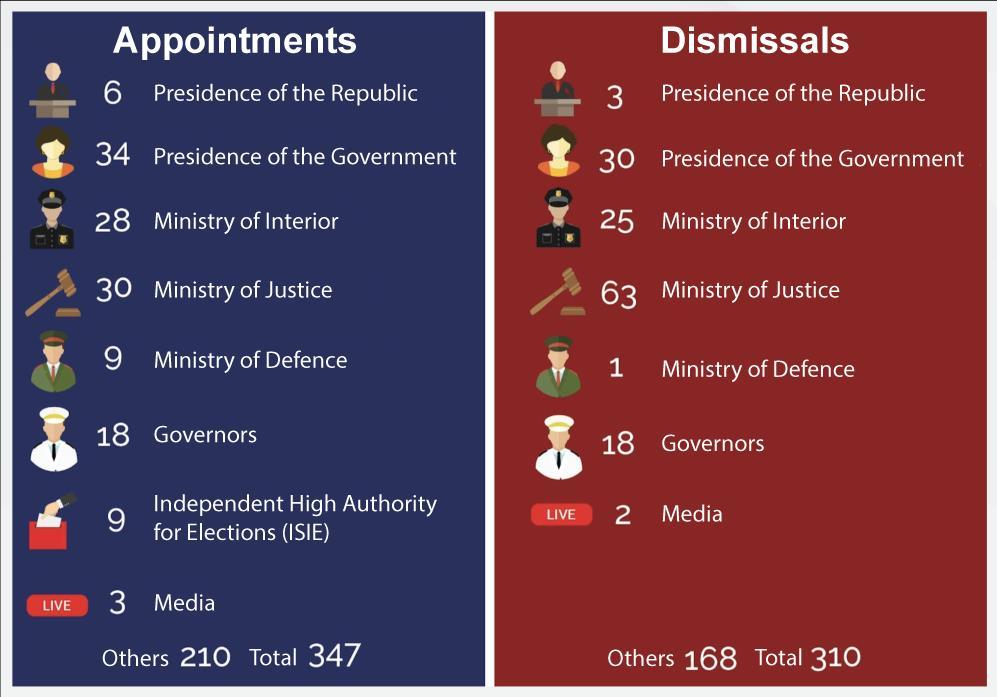
many
E. Dismissalsandappointments:
replacedbyPresident
71https://fr.wikipedia.org/wiki/Liste_des_dirigeants_des_gouvernorats_tunisiens#cite_note mouv2233 1
Inaddition, overthe365days, dismissalsandappointmentsareworthnoting:
78https://www.aa.com.tr/fr/afrique/d%C3%A9but des n%C3%A9gociations officielles entre la tunisie et le fmi/2628447
76, the IMF announced on June 22nd that it was ready to start more formal discussions for the elaboration of a program77. A new IMF mission started on July 4th78 and ended on July 18th "withsatisfactoryprogress"79 .
The war has indeed had a very strong impact on the economy and on the prices of raw materials, both the price of a barrel of crude oil and that of wheat (Tunisia imports most of its TunisiantheFinanceonexacerbateconsequenceswarnedCentralMarouanewheatfromUkraine)havesharplyrisen.Abassi,thepresidentoftheBankofTunisia(BCT)hasonseveraloccasionsthattheofthewarwillthealreadystrongstrainsthestatebudget.TheMinistryofdeclaredattheendofAprilthatwarinUkrainecouldcostthestate4billiondinarswhenit
F. Economicdevelopments:
In parallel with the political developments described above, negotiations on the financing opportunities (by foreign debt) of the TunisianState havecontinuedto make theheadlines.
74. The prospect of a debt default has thus been raised several times75, making the urgency of a financing solution all the stronger and certainly the only one that the country hastodate.
72 https://finance.yahoo.com/news/refile ukraine crisis causes 1 133707356.html?guccounter=1 73 See Al Bawsala’s policy brief, published in November 2021 2pqgoQ89kAwIK%20AFrJpKd132%20?fbclid=IwAR2PXS4f1jxzQuiMHiZMNe1whXS5PEhttps://www.albawsala.com/ar/publications/rapports/20225:UQyxz0oU 74 https://inkyfada.com/fr/2021/12/16/reprise negociations recours fmi tunisie/ 75 By Morgan Stanley and Bloomberg Economics.
toMacroeconomicindicatorscontinueddeteriorateoverthelastperiod : downgrading of Tunisia's sovereign ofthemajorcountrypublicinflation18th,ratingtoCCCbyFitchagencyonMarchgrowingpublicdebt,galloping(7.8%inMay)andincreaseddeficit(9.7%ofGDP).ThealsoexperiencedasecondexogenousshockthefirstbeingCOVID-19crisis-withtheoutbreaktheconflictinUkraine.
34
7 tunisia imf staff concludes mission to tunisia with good progress
comes to the energy sector72 These financial difficulties make the Tunisian authorities' room for maneuver particularly limited. In the context of difficulties in mobilizing resources73 and increasing funding needs, the State struggles to close its spendingthanservants2022budgetandtopaysalariesforcivilsalariesthatmakeupmore50%ofthecountry'spublic
79https://www.imf.org/en/News/Articles/2022/07/19/pr2226
The "technical" negotiations with the IMF, suspended after the 25 of July of last year resumed last November, on a basis similar to the reformproposals made byformer head oftheandseveralFollowinghisofgovernmentHichemMechichibeforedismissalon25July2021.multipleIMFvisitsandweeksoftechnicaldiscussionsthepresentationinearlyJunebyheadofgovernmentNajlaBoudentheenvisagedreformproject
76 https://www.aa.com.tr/fr/afrique/tunisie le gouvernement d%C3%A9voile les grandes lignes de son programme national des r%C3%A9formes /2605718 77 conclusiontunisiahttps://www.imf.org/fr/News/Articles/2022/06/22/pr22220statementbydirectorjihadazourattheofavisittotunisia
35
the dissemination of "fake news or information" that could distort the market. According to Amnesty International83, the decree "contains vaguely worded provisions that could result in prison sentences ranging from 10 years to life imprisonment, including for publicly discussing the economy". The penalties are indeed particularly ofprosecutions"thesevere.FortheNGO,thedecreepaveswayfor"unfairandabusiveandunderminesfreedomexpression.
These structural reforms would essentially consist of reducing public expenditure by restructuring the public service (early retirement, freezing of salaries for public servants) systems on taxing and subsidies (on food and energy) and state owned enterprises. These fiscal austerity measures are widely criticized by UGTT80 and civil society81 who participatorynegotiationsalsothesociocontentcontinuetoopposethem-intermsof-fortheirverylikelymajor-economicconsequencesformostvulnerablecategoriesbutintermsofformgiventhattheareconsiderednon-andnon-inclusive .
80https://lapresse.tn/132906/negociations entre la tunisie et lefmi le gouvernement espere le fmi confirme et lugtt sinquiete/ 81 AlBawsala and the FTDES started the “Yenzi ma rhentouma” campaign in 2021 https://www.webmanagercenter.com/2022/03/16/482421/l:
a societe civile tunisienne veut sinviter dans les negociations avec le fmi/ 82 https://legislation securite.tn/law/105237 83 expression/newhttps://www.amnesty.org/fr/latest/news/2022/03/tunisiaantispeculationlawthreatensfreedomof
The approval of the UGTT remains a prerequisite for the IMF to conclude such an agreement (USD 4 billion in StillitsotherforfinancialreleasingApartforwardlikelygiventheloansareforeseen).Thisapprovalfromunionmightbehardtoachievethecurrenttensions,anditisthattheTunisianStatemoveswiththedealwithoutit.fromthebudgetaryurgencyofthesebillions,theIMF'ssupportisinfactaguaranteethecountrytobeabletoborrowfromdonorsandtoreducetheriskondebt.ontheeconomicfront,a decreelaw on speculation became enacted on March 21st82. As part of President Saied's “hunt against the speculators”, thedecreecriminalizesspeculationand
In the continuity of the observation already made in previous bulletins, freedom of information and expression continue to be underminedsinceJuly25. The fall of Tunisia from 73rd to 94th place in the byworldpressfreedomrankingcarriedoutReportersWithoutBorders(RSF) 84 isverytellingof thefreefallthat Tunisia is witnessing since President’s Saied
Union of Tunisian Journalists (SNJT) and the General Federation of Information (part of the UGTT) reacted stronglyto this ranking, denouncingthat ‘freedomofthepress and freedom of expression are facing imminent danger’, recalling that the loss of 21 places is the RSF ranking is a direct consequence of ‘the decline in the indicators of freedom of the press, the high frequency of
86 content/uploads/2022/05/resume%CC%80http://snjt.org/wp rapport.pdf
Several incidents have marked the periodcoveredbythisreport86: On March 18th, the journalist Khalifa Guesmi (Mosaïque FM) was arrested and detained for a week for refusing to disclose his sources after publishing unitauditionedofainformationonthedismantlingofterroristcellinKairouan.Twohisfellowco-workerswerebytheantiterrorist
violations against journalists, trials and arrests [against them], the continued prosecution of civilians before military courts, the lack of communication from the government in power and the infringement of citizens' right to information"85

87. A sit in was organized in frontoftheSNJT insolidarity,its president Mahdi Jlassi denouncing "the pressure and harassment suffered by journalists" and the "shameful"
36 RIGHTSANDFREEDOMMeasurestakenagainstpublicfiguresand(ex)seniorofficials.A.Mediaandpress:
87 https://lapresse.tn/126550/khalifa guesmi remis en liberte/
84 https://rsf.org/fr/classement?year=2022 85 https://lapresse.tn/129450/le snjt et la federation generale de linformation tirent la sonnette dalarme la liberte de la ccupait%20le%2073e%20rangmenacee/#:~:text=Elle%20a%20perdu%2021%20places,opresse
Thepowergrab.National
OnJuly22nd,journalistssuchas Yosra Chikhaoui94 and members of the SNJT board and its President Mahdi Jlassi were violently attacked by security forces during a demonstration against the referendum in the Habib Bourguiba Avenue95. These attacks were denounced by the Syndicateinapressrelease96
stating, in particular, that President Saied had requested military intervention against the UGTT92. He was taken into custody because of his refusal, justiceagainstdetentionthehisaccordingtohislawyer,torevealsources,andforoffendingarmyandincitingviolence.Awarrantwasissuedhimbythemilitary 93
The HAICA called on the media in early June to guarantee freedom of expression by extending media coverage to
Additionally,
35 practices88
90 13/10160053438771214/https://www.facebook.com/nawaat/photos/a.4236355362 91 https://www.article19.org/resources/tunisian activist jailed facebook posts/ 92 declarationstunisiehttps://www.lemonde.fr/afrique/article/2022/06/13/enunjournalisteengardeavueapresdessurlarmee_6130075_3212.html
On March 23rd, twojournalists from Nawaat, Seif al-Kosani and Tarek al-Abidi, were arrested while reporting on the citizen initiative ‘T3allem 3oum’ in memory of Omar Laabidi89, who was killed by police officers in 2019. Even though they had the necessary permits, plainclothes police officers prevented them from filming and confiscated their identity documents. Their reporting material was seized and taken to the police station, who allegedly contacted Nawaat’s editor in chief in order to identify who had encouraged themtocarryout the report. The two journalists were given a subpoena to appear on April 14th, and the case was subsequently closed. The newspaper strongly condemned these practices in a press release90 . Blogger and activist Amina Mansour was sentenced to six months' imprisonment in military custody in late May following a Facebook post from 2021 criticizingPresident Saied91 . In mid June, journalist Salah Attia was arrested by the authorities after making comments on Al Jazeera, 202https://twitter.com/Ghaya_BM/status/1506666184258867
88 Ibid. 89
.
The SNJT has once again denounced the authorities' lack of transparency, while only a dozen journalists were able to attend the press conference organized by Ms Bouden and her Egyptian MaycounterpartMrMadboulyinmid 97 .
93 https://www.businessnews.com.tn/Mandat de d%C3%A9p%C3%B4t contre Salah Attia,520,120049,3 94 73&set=a.1716986868523980https://www.facebook.com/photo/?fbid=31784064590486
95 https://www.businessnews.com.tn/mehdi jelassi tabasse par la police,520,121269,3 96 556773034/3203685179905488https://www.facebook.com/snjt.tunisie/photos/a.1501676 97 https://www.tap.info.tn/en/Portal Politics/15191431 snjt decries ban on
military trials against journalists and impunity for attacks on journalists made by security forces;
the repeated declarations of the President of the Republic regarding his intention to "regulate the media sector" and to promulgate decrees in this sense; the opacity of the government, which does not address the Tunisian people, does not organize press conferences and does not appoint a media adviser to facilitate the work of journalists and protect the right toinformation; the publication of circulars n°19 and 20 by the Presidency of the government, which infringes on internationalbytherighttoorganize,guaranteedtheConstitutionandpacts.
99. It will nevertheless be impossible for HAICA and ISIE to exercise an ex ante control over all media appearances. What will happen to people who speak out about the referendum without being registered in the official campaign and under which law will they be sanctioned? Will those who spoke in favor of the boycottway'Yes'votebetreatedinthesameasthosewhocalledforaora'No'vote?
As mentioned in the section on the referendum, the ISIE’s decision to require public figures, associations and political parties wishing to express their views on the referendum to register beforehand (and the resulting HAICA/ISIE guidelines) is highly likely to restrict freedom of officialhebeforefromMassarSecrspeechinTunisia.FaouziCharfi,etaryGeneraloftheAlparty,wascanceledaradiobroadcastonehourhisappearancebecausewasnotregisteredforthecampaign
TVPresidencyintheplanningoftheJournal;
In its annual report published on May 3rd, 2022100 on the occasion of World Press Freedom Day, the SNJT also made a number of observations theregardingpressfreedomviolationsoverpastyear:
36
For the SNJT, this is an attempt by the Presidency of the Republic and the government to influence the editorial line of the media, in total disregard of journalists’ rights and the right toinformation.
Interventions from the 98 1&set=a.25588709https://www.facebook.com/photo/?fbid=350988990495023338545
99 bCvZLszDhFXkhqbwof2cTHMFUMLf6Zsks9ih8UMJa5w8Y32GpEXTDonhttps://www.facebook.com/faouzi.charfi/posts/pfbid0tENTHmoqBl
actors from all political backgrounds98
100 http://snjt.org/2022/05/05/23525/
les manifestations politiques a lavenue habib
Aquitedifferent treatment hasbeen reserved for President Kais Saied’s opponents. The demonstration on June 4th 2022 in front of the ISIE headquarters was repressed with tear gas and the historical left wing opponent Hamma Hammami was brutalized by law enforcement officers103 The Free Destourian Party (PDL) was also banned from demonstrating in front of the ISIE on tunis interdit bourguiba/ tunisie heurts lors une manifestation contre le r%C3%A9f%C3%A9rendum %C3%A0 tunis https://www.businessnews.com.tn/abir moussiinterdite de manifester devant par les forces delordre,520,120800,3
37
101 https://news.gnet.tn/tunisie le gouverneur de
104
lisie
107. Similarly to the 14th of January demonstrations, The Ministry of the Interior blocked all accesses to the main artery of the city with barriers and installed water Thecannons.11demonstrators were released within 24 hours following the However,mobilizationofcivilsocietyandlawyers.thetestimonyofSaifAyadi,a 105 6556773034/3201381013469238/https://www.facebook.com/snjt.tunisie/photos/a.150167 106 hNvkT45GsPeLqPmaJ1pTUQihflfbid02mzEWh2GtGqkJmtcMVrmU8NCcux9DtETitSTmk8Chttps://www.facebook.com/ahmed.zarrouki.1272/posts/p 107 uS6Bn4v7f6RWBGPMzrhlgLZqzFdo4yMQHFVpZaXrbCu1k8ZaRu3UDR2vdgFD8Uphttps://www.facebook.com/jlassi.mahdi/posts/pfbid02Dx
Hamma Hammami, and Samia Abbou of the Ettayar party, were assaulted on July 22 during a demonstration organized by the Civil Coalition for Freedom, Dignity, Social Justice, and Equality105. Security forces, deployed en masse and heavily equipped, violently assaulted the demonstrators with tear gas, batons and foot beatings106. During the same demonstration 11 activists were arrested, and as mentioned above, rangewasMahdidemonstratorsjournalistsaswellasotheractivistsandwereattackedincludingJlassi,presidentofSNJT,whosprayedinthefaceandatclosewithteargas
B. Freedom of protest and violenceagainstopponents:
The freedom to demonstrate has been anfurtherunderminedinrecentmonths.Inunprecedenteddecision, the new governor of Tunis who is close to President Kais Saied, Kamel Fekki, banned political demonstrations on Habib Bourguiba Avenue, the city's main artery and the epicenter of the January 2011 protests, reserving it for "tourist, cultural or artistic activities" only101. Nevertheless, Kamel Fekki, who previously called anti-power demonstrators "people from the past", went to support pro Kais Saied demonstrators on May 8th 2022, accompanied by law enforcement officers102
July 7, 2022 by a large number of security forces which “repressed and injuredmembersoftheparty”according toastatement issued bythe latter. The president of the partyAbir Moussi, who declared that she took all legal procedures for the demonstration, was taken to the clinic following a fainting duringthedemonstration104
Double standards when it comes to freedom of demonstration:
d
102 56035949840346/?t=https://www.facebook.com/waelbangader2008/videos/356 103 https://www.france24.com/fr/afrique/20220605
In Regueb, Afek Tounes party was prevented from holding its meeting statementbyonJuly3rdaspartofits"No"campaignothercitizens.Accordingtoapublishedontheparty pour le boycott du referendum denonce les agressions des milices de kais saied,520,120417,3
110 9196/www.facebook.com/1095355399/videos/507872600890
111 https://news.gnet.tn/tunisie afek tounes empeche de tenir un meeting populaire a regueb/ 112 https://www.facebook.com/AfekTounes.PageOfficielle
New worrying trends have emerged in recent months as several opponents of President Saied's project have been attacked by civilians during public events. The 5 parties of the national campaign to stop the referendum were brutally attacked verbally and physically (stoning) during a demonstration organized in Sousse on June 26th2022byyoung mencarrying pro KaisSaiedbanners109 .
108 022&set=a.102918723082240https://www.facebook.com/photo/?fbid=8025033444204 109 https://www.businessnews.com.tn/le collectif
It is important to note here that the three political events mentioned above (rally, demonstration and campaign for the No vote) were werelegallyorganizedandtheauthoritiesnotifiedoftheirconduct. A further worrying commonality was the fact that the three aggressed parties denounced the passivity and even complicity of the local and law enforcement authorities in dealing with theseassaults.
38 queer activist from the association DAMJwhowasalsoarrested, recounts some harrowing facts: illegal detention for several hours, denial of access to a lawyer for several hours (in total violation of custody procedures) illtreatment, intimidation, sexual harassment, DNA extraction under threat etc108
Passive attitude of the authorities in the face of violence committed by PresidentSaied'ssupporters:
Harassment of critics and opponentsofPresidentSaied:
Similar events occurred during a meeting organized by the "Citizens Against the Coup" collective on June 4th in Tozeur, where a dozen individuals broke into the hall and prevented the meeting from taking placewhileinsultingtheorganizers110
In line with observations made in previous reports, opponents of President Saied's project - activists and political figures - continue to face online and offline harassment withcompleteimpunity.Asaresultof this impunity, smear campaigns and lynching are taking on a new twist. As mentioned in the justice section, Judge Keira Ben Khelifa was the victim of a very violent campaign on social
leader's page, the organizers of the meeting were threatened by men armed with sticks and stones and thecitizenswerepreventedfromaccessingmeetingvenue 111. Amember of the same party was attacked in Teboulba on July 17th 2022, while distributing flyers campaigning for the "No", by 12 individuals who physically and verbally assaulted him and severely damaged his vehicle with stones, as indicated in apressreleaseissued bytheparty112 .
Zyna Mejri, a columnist on Mosaïque FM and founder of Falso platform, was also the victim of a defamation campaign on social media following a chronic115 she produced on the President's misleading speeches and the fake news published by his
115
Severalsupporters.prominent
All these campaigns are led by pages on social networks, such as the page
118
“Mouvementdu25Juillet2021”120 orby "bloggers" claiming to be supporters of the President of the Republic, such as BenArfa121.Thesecampaignshavenot led to any investigation by the prosecutor's office. Severalobservers also attribute this climate to the PresidentviolentanddivisivediscourseoftheoftheRepublic , who has neverdenouncedsuchpractices122
119 87333&set=pb.100020495133322.https://www.facebook.com/photo.php?fbid=97072496022207520000..&type=3 120 https://www.facebook.com/revolution2021tunis 121 https://www.facebook.com/BenArfa 122 https://www.businessnews.com.tn/le discours de kais saied suscite une vive polemique,519,113495,3 123 SANAD is the OMCT direct assistance program for victims of
The security pressure on S listed individuals has seen a worrying upsurge in recent months. InrestrictionsworkplacetofreedomAdministrativesearches,restrictionsonofmovement,arbitrarysummonspolicestations,harassmentintheandotherarbitraryonfreedomhaveincreased.thefirsthalfof2022alone,SANAD 123
https://omct
public and political figures such as Abir Moussi116 (President of the PDL), Nourredine Tabboubi117 (Secretary General of the UGTT), Mahdi Jlassi118 (President of the SNJT) or Souad Abderrahim119 (Mayor of Tunis) have also been the victims of the same type of methods following positions or decisions they havetakenagainst thePresident of the Republic andhiscircle.
networks after she testified about the Anasreasonsforherdismissal.Hmaidi,president of the Association of Tunisian Magistrates113 , was also the victim of a smear campaign on social networks, as was the honorary president of the same association, Raoudha Karafi, and her family114. These campaigns took place in parallel with President Saied's decisiontodismiss57 magistrates.
113 64315&set=pb.100020495133322.https://www.facebook.com/photo.php?fbid=96462180752207520000..&type=3 https://www.facebook.com/watch/?v=2797566787053190 48129&set=pb.100020495133322.https://www.facebook.com/photo.php?fbid=96378366762207520000..&type=3 75904&set=pb.100020495133322.https://www.facebook.com/photo.php?fbid=96983925032207520000..&type=3 23622&set=pb.100020495133322.https://www.facebook.com/photo.php?fbid=96702873732207520000..&type=3
C. Persistence of arbitrary restrictionsoffreedom:
116
39
117
114
took over 21 new S registered beneficiaries without any link to a terrorist activity or any other threat to public order having ever been established. Some victims of such cases citizens,affectunderbeforewidespreadcontrolThehadalreadybeenacquittedbythecourts.arbitrarinessofsuchadministrativemeasureswhichwerealreadyagainstpeopleonSlists25July2021-isatthemomentthespotlightbecausetheynowawiderspectrumofTunisianincludingMPs,politicians, xvVh1Sw2bhG8wa2QhRl&id=1494972305YZXP5L9JsBTEyaU2UAeEo8bRxuLzN16mmdFgvo3kboFhttps://m.facebook.com/story.php?story_fbid=pfbid08qQ torture : tunisie.org/assistance directe/
124 See the OMCT position paper : https://omct tunisie.org/wp content/uploads/2021/09/Lettre de positionnement.pdf
125 https://www.tunisienumerique.com/tunisie une ancienne ministre nahdaoui interdite de voyager/ 126 https://www.espacemanager.com/interdite de voyage jamila ksiksi denonce une violation de ses droits fondamentaux.html
When they become so prevalent as to constitute police harassment, the administrative control measures asufferedbythepersonsregisteredhave profound and lasting impact on these individuals, as well as on their families and in particular their children Thewhoaretraumatizedbyhousevisits.mediaalsoreportedseveralcases of personalities prevented from leaving the country by simple administrative decisions. This is the case of the former minister and leader of the Ennahdha movement, Saïda Ounissi125. She went to Tunis airport on June 15th to travel abroad. According to a statement by Samir Dilou, a lawyer and member of the Ennahdha,parliamentbylegalinformallearnedfreedomfindherrequiredEnnahdhamovement,theborderpoliceajudicialauthorisationtoallowtotravel.Afterseveralattemptstoouttheoriginofherrestrictionofofmovement,Ms.Ounissithatitwastheresultofanadministrativedecisionwithnobasisandnotadecisionorderedajudge.JamilaKsiksi,amemberoffromthesamepoliticalparty was prevented from traveling without a judicial order on July16th, 2022126 .
On July 4th, it was Noureddine Ben Ticha, the former adviser to former PresidentoftheRepublicBejiCaïed
40 judgesandbusinessmen/women124
Essebsi, who declared that he had been banned from traveling with his wife because of the profession on his passport adviser to the Presidency of the Republic - and his national identity card127. He was accused of not having changed his profession onhisTunisian Lastidentitydocuments.March, the Minister of the Interior, Tawfik Charfeddine, had denied the arbitrary nature of the restrictive measures, explaining that all the people who are under house arrest, or placed under house arrest, are concerned by criminal investigations128. Some restrictions on freedom of movement have indeed been ordered by magistrates, as is the case of the ban on leaving the country imposed on Rached Ghannouchi. onlyTheInterior,judiciaryonHowever,inmostcases,restrictionsfreedomarenotorderedbythebutbytheMinistryofthewithoutanylegalbasis.administrativecourtremainsthesafeguardagainstabuse. wereadministrativeinemergencyOMCT'sassistance2021,all,accessHowever,thereareobstaclestovictims'toadministrativejustice.Firstofitisslow;forexample,inDecemberSANADElhaq,thelegalgroupforvictimsoftortureofSANADprogramme,filedappealsfor11beneficiariesordertoobtainthesuspensionofthecontrolmeasurestheysubjectedto.Itwasonlyfive
127 https://www.webdo.tn/2022/07/05/noureddine ben ticha interdit de voyager/ 128 https://www.businessnews.com.tn/taoufik charfeddine accuse ennahdha de propager les rumeurs et les fausses informations,520,117760,3
The lawyers had argued that the administrative control measures against the persons were illegal because they were presumably based on the 1975 decree governing the powers of the Ministry of the Interior, a decree (which is not a law) and which restrictionsdefinedalsogivestheMinistry'sagentsvaguelyprerogativeswithregardtooffreedom.
MP Yassine Ayari, sentenced again (in absentia) to 10 months on February 18th for "undermining the morals of the army" and "offending the Head of State"133
Moreover, the four dangerousdecisions,althoughpositive,includereasoning.
Thecourtonly found that the Ministry did not admissible.libertywereorder,concernedprovideevidencethattheindividualsposedathreattopublicimplyingthatifsuchevidencepresented,therestrictionsofagainstthemwouldbe
Recent attacks on the judiciary have raised concerns that magistrates, including those of the administrative court129, are increasingly engaging in self-censorship in order to avoid retaliationfromtheexecutive.
MP Issam Bargougi was sentenced in absentia to 10 months' imprisonment at the beginning of March for "offending the morals of the army", "offending the President of the Republic" and "harming others through telecommunications networks”
The trend, identified in previous ASL bulletins130, of a substantial increase
See the 200 days bulletin, page 15 16 and the 100 days one, page 5 6.
41 maximum.forrendered,ofmonthslaterthatthefirstfourdecisionssuspensionofexecutionwerewhereasthelegaltimelimitrulingisnormallyonemonth
132 https://www.aa.com.tr/fr/politique/tunisie le d%C3%A9put%C3%A9 seifeddine makhlouf condamn%C3%A9 %C3%A0 un an de prison avec sursis %C3%A0 lex%C3%A9cution/2506166
133 https://www.aa.com.tr/fr/politique/tunisie le d%C3%A9put%C3%A9 du parlement suspendu yassine ayari condamn%C3%A9 par contumace %C3%A0 10 mois de prison/2507034
D. Military trials against civilians:
129 See the 200 days bulletin, page 8.
included:Developmentsinthelast100dayshave
131
in the use of militaryjustice against civilians since 25 July has been confirmed. In the majority of cases, these trials are generally related to freedom of expression following criticism towards the President of the Republic. The LTDH, which has denounced these practices at many occasions, published a new statement at the end of March, stating that "The League refuses to adhere to a legislativesystemthat leadsciviliansto forbeexposedtomilitarytrials"andcallingtheamendmentoftheselaws 131
MP Seifeddine Makhlouf, sentenced to a one-year suspended prison sentence and afive yearbanonpracticinglaw on February 17th, 2022 for contempt of court132
See the policy brief published by ASF, Kawakibi and ADLI on November https://asf.be/fr/blog/publications/francais2021: policy brief le jugement des civils par les tribunaux militaires une menace a la democratie et a letat de droit/
130
The lawyer and former chairman of the Tunisian bar, Abderrazak Kilani, was summoned by the military court on February 23rd, placed in preventive detention on March client,visitofficersinwereThe2ndandreleasedonMarch21st.proceedingsagainsthimpromptedbyanexchangeearlyJanuarywithpolicewhilehewastryingtohisarbitrarilydetainedNourredineBhiri
134 https://www.webdo.tn/2022/03/06/le depute gele issam bargougui condamne a 10 mois de prison ferme/
May.
As already pointed out by the ASL Alliance in the previous bulletins, most of these cases represent an instrumentalization of military justiceforthepurposeof censoring any critical remarks against the decisions and the person of President Saied. It should also be noted that the draft constitution voted on July 25 thetheremovestheprovisionsofArticle110of2014constitutionwhichstatesthatjurisdictionofmilitarycourtsis
135 https://www.hrw.org/fr/news/2022/03/14/tunisie un tribunal militaire emprisonne un eminent avocat 136 https://lapresse.tn/130832/abderrazek kilani condamne a un mois de prison avec sursis/
139 https://www.businessnews.com.tn/Mandat de d%C3%A9p%C3%B4t contre Salah Attia,520,120049,3
137 https://kapitalis.com/tunisie/2022/04/08/tunisie ameur ayed et abdellatif aloui condamnes a 4 et 3 mois de prison/
following critical statements against thePresident134
42
135. He was finally sentenced to a one month suspended prison term for contempt towards a public official136 .
In early May, Al Karama MP Mohammed Affes, who was prosecuted in the airport case, was heard by the Tunis Military Court, where he turned himself in after nine months on the run. The examination of the airport case was postponed to mid
Journalist Ameur Ayed and MP Abdellatif Aloui were sentenced in early April to four and three months' imprisonment respectively by a military court for "undermining the morals of the army" after comments made on Zitouna TV in October 2021 against the President of the Republic. They have appealed thedecision137
In mid May, 4 MPs and the lawyer Mehdi Zagrouba were sentenced to 6 months in prison for Mr Zagrouba, 5 months for MPs Seifeddine Makhlouf and Nidhal Saoudi and 3 months for MPs Mohammed Affes and Maher Zid in the airport affair. MP Abdellatif Aloui was acquitted138 .
As reported in the media in mid June, journalist Salah Attia was arrested by the authorities after comments made on Al Jazeera. A detention warrant was issued against him by the military justice139, while blogger AminaMansour wassentenced in May to 6 months imprisonment following a Facebook post on President Saied.
138 https://www.aa.com.tr/fr/afrique/tunisie des peines de trois %C3%A0 six mois de prison dans laffaire de la%C3%A9roport/2590368
the victims (arbitrarily deprived of their liberty) to further violations of their fundamental rights. The detention at the El Ouardia center is punitive, arbitrary and illegal according to the Tunisian administrative justice. Tunisian authorities continue to use it nevertheless142
Migrants,andrefugees:asylumseekers and refugees continue to be exposed to territoryviolationsoftheirrightsonTunisian
144 See the press release signed by 27 civil society organizations: https://asf.be/fr/blog/publications/fr communique de presse en tunisie refugie e s et demandeur se s dasile abandonnes dans une situation humanitaire critique/ See also the press release published for the World Refugee https://asf.be/fr/blog/publications/20Day:juin pour la protection des refugie e s et demandeur se s dasile/
141
142 https://asf.be/fr/blog/publications/fr communique de presse le centre del ouardia zone de non droit ou 9 personnes sont arbitrairement privees de leurs libertes/ 143 demandinghttps://inkyfada.com/en/2022/04/23/demonstrationsasylumhcrzarzistunistunisia/
The situation also remains difficult for the hundreds of refugees and asylum seekers in Tunisia who live in an extremely critical situation. On April 16th 2022, around 214 refugees, asylumseekersandstatelesspeople including women, children and unaccompanied minors - began a sit(UNHCR)CommissionerofininfrontoftheTunisheadquarterstheUnitedNationsHighforRefugees
Some continue to be victims of arbitrary detention. In July 2020, the Administrative Court suspended the detention of 22 migrants at the El possibilitydetention,notificationlawyer,judicialbyDetentionandthedetention,Beyondtheirindividualsdetaincontinuedthecommitments.TunisiandeprivationOuardiacentreonthegroundsthattheiroflibertywascontrarytolawandTunisia'sinternationalDespitethisdecision,MinistryoftheInteriorhastousethecentretoarbitrarilypeople.InMay,atleastninewerearbitrarilydeprivedoflibertythere.thedeplorableconditionsoftheproblemliesaboveallinprinciplesthatgovernthiscenteritslackofanylegalbasis.inthiscenterischaracterizedtheabsenceoflegalproceduresorreview,limitedaccesstoatheabsenceofwrittenofthelegalbasisfortheaswellastheabsenceofthetoappeal,whichmayexpose
143. This demonstration is a continuation of the sit in initiated on February 9, 2022 in Zarzis, in an act of protestagainstthedifficultconditions144 in which these people have been living for several years and after the expulsion of several asylum seekers and refugees from an accommodation center managed by the UNHCR in Zarzis. Faced with the negligence and failures of the Tunisian authorities on the one hand (although they are signatories to the Geneva Convention seekers,theotheronRefugees)andoftheUNHCRonthehand,theagencyresponsibleforprotectionofrefugeesandasylumtheygatheredinasitinfortwo
E. Violations of the rights of migrants, asylum seekers
43 limitedonlytomilitaryoffenses140
141. Tunisians attempting to reach Europe are also exposed to forcedrepatriationfromItaly.
140 tunisias referendum subsahariensinsulteshttps://www.lemonde.fr/afrique/article/2022/02/22/raflesviolencesletraitementdesetudiantsempireentunisie_6114762_3212.html
https://www.hrw.org/news/2022/07/14/qa
constitutional
OnfromTunisia.Saturday
While Tunisia, financially supported for this purpose by European Union member States, is committed to strengtheningitsborders, it isconfining hundreds of migrant people to a country that does not have a reception, care, protection and integrationpolicy.
In a socio economic context that continues to deteriorate, the migration of Tunisians to Italy continues, with at least 2,206arrivinginItaly,i.e.11%of all arrivals in the country150. At the same time, as a result of the readmission agreements concluded between Tunisia and Italy, at least 431 people were forcibly repatriated to Tunisia, while at least 24 Tunisians were turned back at Italian border points(airandsea)151 .
44
months demanding their evacuation
number of ‘"illegal’' departures to the 2021comparedinincreasedbyEU.ThenumberofinterceptionsatseatheTunisiancoastguardhasindeedsubstantiallyinrecentyears:2018,4,519peoplewereintercepted,tonolessthan25,657in
151 Page 27 and fs/cms/documents/efaf5dcb6ffcf3a58172badee56bb73a.pdhttps://www.garantenazionaleprivatiliberta.it/gnpl/resource30,
148. The trend remains the same this year, with at least 7 250 people intercepted during the first five months 515of2022,withveryhighpeaksinApril(1people)andMay(2658people) 149 .
145. While a group of persons were transferred to a shelter, several were subject to verbal and physical assaults and at least three persons, including refugees and asylum seekers, were arrested and taken into custody, while all others were dispersed to unknown destinations. In early July, violence was committed against Senegalese citizens at the Tunis-Carthage airport by security forces146 Passengers had been blocked for several days while many flights to sub Saharan Africa were canceled by Tunisair. These incidents were denounced by the FTDES in a statement publishedonJuly7th147
mainlymanagement"thusexceptionbordersofItshouldalsoberecalledthatthepolicyoutsourcingtheEuropeanUnion'stothirdcountriesisnoinTunisia.Thecountryisengagedina"migrationsystemwhichisbasedon border control and in particular on the reduction of the
149 Page 6, https://ftdes.net/rapport mai 2022 des mouvements sociaux suicides violences et migrations/ 150 Page 2022.pdfdefault/files/allegati/cruscotto_statistico_giornaliero_31http://www.libertaciviliimmigrazione.dlci.interno.gov.it/sites/7,05
147 https://ftdes.net/ar/aeroport tunis WPyVPiWKJrssb17DReTykxeOAJWrQcarthage/?fbclid=IwAR2DpP75j6dTjyG91N8hkZGBGlbNe6
June 18th, 2022, an evacuation with an excessive use of force by the police dispersed the sit-in of the remaining demonstrators in front of the UNHCR headquarters, at the request of the UNHCR who did not byconsiderthewholegrouptobecovereditsmandate
146 https://english.alaraby.co.uk/news/outrage senegalese passengers assaulted tunis airport
145 https://www.infomigrants.net/fr/post/41358/a tunis fin du sitin des demandeurs dasile devant les locaux du hcr
148 https://ftdes.net/annual report on irregular migration tunisia 2021/
154 https://www.aa.com.tr/fr/afrique/tunisie le front du salut national informe lambassade des etats unis de ses activit%C3%A9s/2609209
The Tunisian political scene post 25 July is particularly complex to map. President Said's decisions did not lead to a binary dichotomy between variousallegianceandoppositionwithinthepoliticalformations (parties Atprocesswhetheraccordingiscomplexinorothers);onthecontrary,thepositionsreactiontohisactionsbecamemoreandshiftedovertheweeks.ItimpossibletopresentthepositionstoasimpleinterpretationofornottheyareopposedtothesetinmotionbySaied.thesametime,ifPresidentSaied's coup de force and his person have benefited from an important support from citizens on July 29th, 87% of those polled said they supported Kais Saied's decisions152 . This support is gradually eroding (64.8% in January 2022)153, although he is still the winner if presidential elections were organized today according to the same polls. These figures should be nuanced however, given that 15% of the people surveyed do not communicate their voting intention for the presidential elections and that the polls are conducted by telephone. It should also be noted that there is no control over Thisofthesurveyprotocols,giventheabsencealawregulatingpolls.evolutionofthepositioningof
152 decisions/
TheNationalSalvationFront: An initiative announced in a press conference on May 30th 2022 and chaired by Nejib Chebbi. It represents for its founders a response to the 10 months of "coup d'Etat" and aims to unifythe struggle against the regime of Kais Saied by becoming a political andtheTunisia,Tunisiansd'Etat,Coalition,Harak,namelycogetcounterweightto"save"thecountryanditoutofthecrisis.Thisinitiativeismposedofelevenpoliticalforces,Ennahdha,AlAmal,HizbelQalbTounes,AlKaramaCitizensAgainsttheCoupNationalMeetingforSalvation,forDemocracy,MeetingforCoordinationofDeputiesandMeetingofYouthforDemocracySocialJustice
ABROADREACTIONSINTUNISIAANDA.InTunisia:
https://lapresse.tn/104654/sondage emrhod 87 des tunisiens soutiennent kaies saied et approuvent ses
153 https://www.facebook.com/Insights 889579043102899135046354/photos/pcb.324240062912259/324238TN
political/social actors is due to several factors; a (small) change in public opinion on the one hand, and a reshuffling of the positions of political actors in the country in parallel with an increase in the number of initiatives created; while some have positioned themselves while others went in coalitions. Nevertheless, the tipping point of this mutation among political actors (parties and civil society) is surely the dialogue proposed by the President and described above for the foundation of a "New Republic" who largely excludedthem.
45
154. The Front
Developments in terms of positioning:
Abir Moussi and the Parti DestourienLibre(PDL):
156 Ibid.
46
158 https://www.observatoire securite.tn/fr/2022/06/02/cinq partis lancent une campagne pour le boycott du referendum/ 159 https://www.jeune independant.net/tunisie cinq partis dopposition manifestent contre kais saied/ 160 https://www.webdo.tn/2022/04/01/sondages kais saied et le pdl de abir moussi poursuivent leur domination/
163 https://www.mosaiquefm.net/fr/actualite midi show/1048997/moussi saied n a pas le droit de gouverner avec l article 80 164 See the 200 days bulletin, page 17.
organized its first demonstration on May 15th , with slogans rejecting the national dialogue deemed as "false and theatrical" and a deceptive referendum "instrumentalized" in order entiretoimposethewillofanindividualonanpeople
National campaign against thereferendum:
155. The Front declared its support for the independence of the judiciary, the independence of national organizations, the defense of freedoms and the rejection of military trials against civilians156 .
This initiative is an extension of the trio of social democratic parties (Attayar, Ettakatol and Al Jouhoumri)157 with the QotbintegrationoftheWorkers'PartyandAl-
155 alaraby.co.uk/politics
IinSofThemaintenancesoluneverthelessmembershipUGTTentitiesmadedialogue"TheFTDES.UGTT,andAninitiativebornattheendofJuly2021initiallycomposedoftheSNJT,theONAT,ATFD,AMT,LTDHandItsformathassinceevolved.positionstakenonthe"nationalandthereferendumhaveitimpossibleforthesedifferenttoworktogether.Althoughthequicklysuspendeditsfromthecoalition,itcontinuedtoproposetionsandtodemandtheofacollectiveprocess.announcementoftheorganizationthenationaldialoguebyPresidentaiedhasmeanwhileplacedtheUGTTadirectpowerrelationshipwithhim.ncontrast,thecurrentpresidentof 161 link&v=739262843645513https://www.facebook.com/watch/live/?ref=watch_perma 162 demoussihttps://www.leconomistemaghrebin.com/2022/05/19/abirkaissaiedveutchangerlaloipourmempechergouverner/
158. Launched on June 2nd during a press conference, its leaders reaffirmed their boycott of the referendum and their categorical refusal of any contact with President Saied andhis regime, recallingthat the process of July 25 did not come to "correct" the trajectory of the revolution but seeks to establish the regime of a "populist individual hostile to freedoms". On June 4th, the initiative organized a demonstration in front of the ISIE headquarters, which was repressed by the security forces who preventedaccesstoprotesters159 .
ThePDLanditspresident AbirMoussi, who continue to lead the polls in case of legislative elections (34% of voting intentions, against 25% for Saied's “party”160), remain among the main opponents to President Saied. If Moussi is considered as the biggest opponent of political Islam and Ennahda, and although she called on Saied to accelerate the dissolution of the Parliament161, the president of the PDL denounces a desire to oust her in(viatheamendmentoftheelectorallawparticular) 162 and qualifies the use of article 80 and the referendum process asillegal163
157 See the 200 days bulletin, page 18.
Civic coalition (or Civil Alliance)164:
On the specific subject of the referendum, the Tunisian political scenewas dividedinto4poles166:

The powerful trade union center UGTT has, like most national organizations, has supported the popular movements while demanding from President Saied
President'sCivilsocietyconfrontstheblunders:
165 https://www.webdo.tn/2022/07/13/fij le projet de la nouvelle constitution menace la liberte des medias/
a well defined and constitutionally compliant timetable167 One year after the President's coup de force, the UGTT has crescendoed its position towards President's maneuvers: the pressure has notably increased when, despite Nourredine Taboubi's public tunireferendumhttps://inkyfada.com/fr/2022/07/13/constitution25juilletkaissaiedvoteboycottouinonsie/ 167 ugtt.org.tn
Source:INKYFADA
165, and is currently led by theFTDES, ATFDandSNJT.
The position on the referendum:
166
47 constitutionwakeorganizationscoalitionasupporttheONAT,whowasappointedpresidentofConsultativecommissionopenlyPresdentSaied'sdecisions.Asresultofthesechanges,thecivilexpandeditsmembership(39arenowmembers)intheofthepublicationofthenewdraft
173 https://www.webdo.tn/2022/07/14/tunisie lugtt salue la revision du projet de la constitution mais/ 174 https://www.mosaiquefm.net/fr/actualite national tunisie/1065483/saied et taboubi se rencontrent a alger 175 3 members of ASL. 176 https://ftdes.net/ar/tunisie/ 177 62/https://www.facebook.com/ftdes/videos/3699091586023
178 https://kapitalis.com/tunisie/2022/07/15/sana ben achour avertit contre linstabilite politique en tunisie/ 179 bJ8DLp1QGtRYsz9AZtlbvGdp1fLsms2ga1UvU4mVx7dMNt37T75FN5h9CmAcTmhttps://www.facebook.com/snjt.tunisie/posts/pfbid0296U
168 https://www.mosaiquefm.net/fr/actualite national tunisie/1057316/taboubi non a un dialogue sans transparence
UGTT have escalated tensions with President Saied during the last period draftchangetheinternationalandmonthnotablyandinparticularregardingthedialogue,byholdingmeetingsduringtheofJunewithpoliticalopponentsrepresentativesofnationalandorganizations.However,syndicateseemstohavemadeafollowingthepublicationoftheconstitutionas
35 byKaischargerefusaltoparticipateinthecommitteeinofdraftingthenewconstitution,Saiedneverthelessappointedhimdecree
168. Apublicsectorstrikewas organized by the UGTT and well followed on June 16th169, as the union denounced the breakdown of dialogue with the Presidency as well as the ofadoptingrevisionAlthoughtheopacityoftheongoingnegotiationswithIMFtheUGTTwelcomedtheofthe2014ConstitutionbytheprojectoftheTunisSchoolPolitics
169 news_newshttps://www.shemsfm.net/fr/actualites_tunisienationales/362581/lugttannonceune greve generale le 16 juin dans le secteur public 170 https://news.gnet.tn/tunisie ahmed idriss presente le projet damendement constitutionnel de lept adopte par lugtt/ 171 jethttps://www.mosaiquefm.net/fr/referendum/1067340/prodelaconstitutionlesreservesdelugttoccultees 172 news.tunisiatv.tn
regardingthefreedomtomaketheirownmindthedraftconstitution 172 and also by considering the changes powersreservationsmaintainingasmadetothedraftconstitutionofJuly8th"boldimprovements"-whileacertainnumberofabouttheseparationof 173. It should be noted that Kais Saied and Nourredine Tabboubi met in Algiers, on the occasion of the 60th anniversary of Algeria's Independence Day, at the invitation of Algerian President AbdelmajidTebboune174 .
itleftitsmembers
Onanotherhand, theATFD,theSNJT, the FTDES and the LTDH175 as well as 36 other associations announced176 onJuly14th thecreation of the Civic Coalition for Dignity, Social Justice and Equality177. The associations denounced the process initiated by Saied a year ago, the referendum process and a "liberticidal" draft constitution178. They demanded the abandonment of the referendum, the organization of a global dialogue
171 .
Pagainstdemonstrationstoanddeclaredthemselvesfullypreparedorganizeallformsofpeacefulthattheydeemusefultheprocessimposedbytheresident.
170, itconsideredthat thenew draft submitted to referendum enshrines a monopolization of powers by the President and authoritiessuppressionaccouanytheexpresseditsreservationsregardingexemptionofthePresidentfrompoliticalorcriminalntabilityaswellastheofindependent
The coalition called for a demonstration on July 22nd 2022, which was largely obstructed and repressedasdescribedabove179
In early March, Michelle Bachelet expressed once more the OHCHR's concern about the dissolution of the CSM, the attacks on civic and democratic space through threats to civil societyto ban foreign funding, and deploring "the rapid erosion of key institutions"186. On the other side of the Atlantic, the tone is also getting tougher: a group of 23 Democratic membersofcongresssentaletter187 on suspensionNGOsletterparticulargrantedamountJulydemocraticAntonyMarch25thtotheUSSecretaryofStateBlinkencallingforthebackslidingobservedsince25thtobetakenintoaccountintheoffinancialsupporttobetoTunisianextyear,andintoitssecurityforces.InatoBlinkenattheendofApril,50calledforanimmediateofmilitaryaidtoTunisia 188
182 35222338226/?d=nhttps://www.facebook.com/234212308225/posts/101587 655373https://twitter.com/ambuetunisie/status/1498343878784
voted in early March in favor of a UN forceanGeneralAssemblyresolutioncallingforimmediateendtoRussia'suseofinUkraine 184, the country abstained in early April in a vote to CouncilsuspendRussiafromtheHumanRights 185 .
In the wake of the dissolution of parliament and threats to prosecute MPs, Ned Price expressed the US concern189 and called for a return to "constitutional governance" including an elected parliament as it “will ensure 186 escalatingupdatehttps://www.ohchr.org/fr/speeches/2022/03/globalbacheleturgesinclusioncombatsharplymiseryandfear
Tunisia's position on the Ukrainian-Russian conflict was also criticized attheendofFebruarybythe European Union ambassador. Ambassador Marcus Cornaro declared in a tweet "to remain neutral between stand!"theaggressorandthevictimistakinga 183, referring to the fact that Tunisia had not taken a firm position against Russia in the conflict, calling more for "dialogue" and "negotiations" during a meeting with the Russian ambassador in Tunisia. While Tunisia
B. Abroad:
184 https://information.tv5monde.com/info/vote de la resolution de l onu sur l ukraine une abstention des pays africains remarquee 447179 185 https://www.businessnews.com.tn/La Tunisie sabstient de voter contre la Russie %C3%A0 lONU,520,118124,3
187 _Final.pdf67dd0a232ee5/03.25.2022_Letter_to_Blinken_on_Tunisia2/files/1b4b2041https://mcusercontent.com/e711646c72c197262ff8d3d39e50a30f89ed
The political developments of the last February,tohundreddaysinTunisiahavenotfailedgeneratereactionsabroad.Inearly thedissolutionoftheCSM andhasparticularlycrystallizedcriticismconcern from Michelle Bachelet, the United Nations High Commissioner for Human Rights180, the Biden DepartmentPrice,administrationthroughthevoiceofNedspokespersonfortheState 181 as well as the heads of mission of the G7 in Tunisia and the European Union182, who stressed that "a transparent, independent and efficientjudiciary aswellasrespectfor theprincipleofseparationofpowers is essential for the proper functioning of Infundamentalbaseddemocracyattheserviceofthepeople,onrespectfortheruleoflawandrightsandfreedoms."parallel,
183
36
180 https://news.un.org/fr/story/2022/02/1113852
181 https://www.state.gov/briefings/department press briefing february 7 2022/#post 312152 TUNISIA
188 https://dawnmena.org/faith anti war and progressive organizations urge biden to suspend military assistance to tunisia/ 189 https://tn.usembassy.gov/statement by ned price spokesperson/
195 sup%C3%A9rieurer%C3%A9formed%C3%A9clarationhttps://www.eeas.europa.eu/eeas/tunisiedelaporteparolesurladel%E2%80%99instanceind%C3%A9pendante_fr?s=126 196 https://www.youtube.com/watch?v=grCkXjCkz88&t=1s 197 nomd%C3%A9clahttps://www.eeas.europa.eu/delegations/tunisia/tunisierationduhautrepr%C3%A9sentantaudelunioneurop%C3%A9enne_fr?s=126 198 https://www.reuters.com/world/africa/european union disburses 300 million euro loan tunisia
OntheUnitedNationsside, theattacks on justice have continued to provoke strong reactions. A few days after the visit to Tunisia of Mr. Christophe Régnard, Honorary President of the International Union of Judges, the Special Rapporteur on the independence of judges and lawyers, Mr. Diego García Sayán, "expressed judiciaryfairhisdeepconcernabouttherighttoatrialandthestatusoftheinTunisia" while expressing his extreme worry “about the health of thejudges"onhungerstrike191
190 https://tn.usembassy.gov/statement by ned price spokesperson 3/ 191 releases/2022/07/tunisiahttps://www.ohchr.org/fr/presspresidential decrees undermine judicial independence and access
192 https://www.webdo.tn/2022/04/04/erdogan la dissolution du parlement un coup a la volonte du peuple tunisien/
193 https://www.mosaiquefm.net/fr/actualite national tunisie/1034759/erdogan s insere la tunisie reagit 194 https://tn.ambafrance.org/Tunisie Extrait du point presse du Quai d Orsay 5 avril 2022
Thereformbydecreeof theISIE did not fail to prompt reactions from the European Union195 as well, for whom this amendment "risks reducing [the] independence [of the ISIE] at an important political moment and shortly beforekeyelectoraleventsforTunisia". The EU, through its delegation in Tunisia, then asked the Venice Commission to give an urgent opinion onthedecree law(seeabove), an opinion that provoked the wrath of Saied, who declared the Commission members "persona non grata"196. The EU did not react to this attack by Kais Saied and even declared through a declaration bythe High Representative on behalf of the European Union on July 12 that the 25th July (the date of the referendum) “should be an important milestone in the process towards institutional normalcy and democraticbalance"197 .
widespread and lasting support for needed reforms to help Tunisia’s economy rebound'' seemingly referring to conditional IMF support. In early June, Ned Price spoke again about the continued erosion of democratic institutions after Saied's dismissal of 57 judges190 No substantial reaction from the European side or from the Member States following the arbitrary dismissal of the 57 judges was reported
FromTurkey, PresidentErdoganalso said in early April that he regretted thedissolutionoftheparliament and the opening of investigations against the deputies who participated in the virtual plenary, calling these developments a "coup against the will
of the people"192. Tunisia, through its Foreign Minister Othman Jerandi, rejected the Turkish President's statement, denouncing it as "foreign interference"193. France expressed its wish to see a return "as soon as possible, to the normal functioning of institutions"194
In addition, the European Union has released a new loan of €300 million for Tunisia198, the second installment 2022 05 25/
37
203 199 https://www.tap.info.tn/en/Portal Top News EN/14058052 eu disburses 300 200 https://tn.ambafrance.org/Entretien telephonique entre les Presidents Emmanuel Macron et Kais Saied 201 algeriecouphttps://www.courrierinternational.com/article/diplomatiedefroiddanslesrelationsentrelatunisieetl 202 tebbounehttps://www.businessnews.com.tn/abdelmajidlemeteorologuedelatunisie,519,119532,3
President Saied also seems to continue to look towards the East, fromEgypttotheGulfStates,bothfor possible funding and for political support. On the 31st March, the day after the dissolution of the Parliament, Egyptian President Sissi and President Saied held a telephone exchange204 about their common desire to strengthen ties between the two countries. In mid June, a delegation from the United Arab Emirates met a delegation led by the head of government Najla Bouden to discuss investment and development opportunities205. During his visit to Algeria in early July, Saied also met with Syrian Foreign Minister Faisal Mekdal; President Saied conveyed his "greetings" to President Bashar alforces"struggleAssadandcomparedthetwocountries'against"darkandreactionary 206
203 https://information.tv5monde.com/afrique/l algerie annonce la reouverture des sa frontiere avec la tunisie 463338 204 https://www.tap.info.tn/en/Portal Politics/15054225 saied and al sissi 205 https://www.tap.info.tn/en/Portal Economy/15295045 gov t members uae 206 Ct2dHao4AB6HzLeVKbzlASkWnXcaM4arbLTBYUyNwWcLYDgdsT4Z7cwzWZ2idbhttps://www.facebook.com/Mofaexsy/posts/pfbid02QZX
Following the referendum, US Secretary of State Antony Blinken issued a press release stressing that the vote was marked by a low voter turnout, that the United States shares the "concerns expressed by many Tunisians that the process of drafting the new constitution limited the scope for genuine debate" and that the new constitution could "weaken Tunisia’s democracy and erode respect for human rights and fundamental freedoms"; this at atime when "Tunisia
38
of the €600 million foreseen in May 2020 to help the country overcome the Covid 19crisis199.Thisaidisthelargest amount that Western countries have madeavailablesinceJuly25th, 2021.
France has been more measured, not mentioning the ISIE directly, President Emmanuel Macron expressed during a telephone conversation in early May with Saied "his concern at the scale of the institutional, economic and social challenges facing the country, which can only be met through dialogue and unity”200
More surprisingly for the Tunisian authorities201 , Algerian President Tebboune made a remarkable declaration at end of June on the sidelines of a press briefing with his Italian counterpart Mattarella, saying that the Algerian state was “ready to help Tunisia to get out of the difficult situation in which it has sunk and to return to the democratic path, just like neighboring Libya"202. The situation seems to have improved following the visit of President Kais Saied to Algiers on July 4th 2022; a visit during which President Tebboune announced the reopening of land borders between the two countries and even wished in passing Tunisia"towards"astronginfluxofTunisiansthenewconstitutionof
209
stancetheHowever,onJuly22nd,MEPscalledonCommissiontotakeafirmer 209, arguing that the EU's quo"support"sign"weak"stanceisseenbysomeasaof"tacit"acceptanceorforPresidentSaid'sstatus andinternationalthatcalleTwitterdialogue.reformseparationdemocraticconditional,andcallingforEuropeanaidtobeonthereestablishmentofinstitutions,respectfortheofpowersandconstitutionalbasedonaninclusivenationalThispositionwasechoedonbyMEPMariaArena,whodontheEUtoexpressconcernthereferendumdidnotmeetstandardsoftransparencyindependence .
210
TheCONCLUSIONpastperiod
europhttps://www.euractiv.com/section/globale/news/mepsurgeborrelltotakestand against tunisias slide to autocracy/ 210 86720https://twitter.com/MariaArenaEU/status/155188211623701767809https://twitter.com/MariaArenaEU/status/155188208737
On the side of the European diplomacy and the EU Commission, partrespectfunctioningoftheelectionsforthcominglowreferendumnoteJosepBorellassuredthattheEU"takesoftheprovisionalresultsofthe[whichwas]markedbyaturnout",dwellingmoreontheelections(thelegislativeinDecember):"theelectionofParliamentwillbethecornerstonethecountry'sreturntotheregularoftheinstitutions,infullofdemocraticprinciples,iniculartheseparationofpowers"
207 https://www.state.gov/tunisias july referendum/?fbclid=IwAR2XT3Z81Ga1cjTE0LZOA2Iig4gX25_YnpI8mTgpYiPp6bRYLDDuGb5XU8F0 208 constitutionalrepresentativreleases/2022/07/27/tunisiahttps://www.consilium.europa.eu/fr/press/pressdeclarationbythehigheonbehalfoftheeuropeanuniononthereferendum/
shows with increasing precision President Saied's authoritarian design a design which is corroborated by the content of the text of the Constitution submitted to referendum on July 25, 2022. In retrospect, all the events described in this bulletin and the previous ones - especially the ones linked to the decisions taken by taken by the President of the Republic shows the logic and dynamics behind the process initiated on July 25, 2021. Everyone questioned at that time what the President wanted to do, the legitimacy of his decisions and of his way of legislating (by decree-law, in disregard of the hierarchy of legal norms and sometimes in incoherence with his own legislative productions) and especially on the capacity of his "exceptional" actions to answer the multi-factorial crisis (social, economic andpolitical)that shakesthecountry.
208
In the continuity of his total appropriation of power, recently confirmed by the dissolution of Parliament and the latest blow to the independence of the judiciary, and supported bya meticulousenterprise of dismantling of the various independent authorities, his project now seems clear: he wishes, through the vote of the referendum to ratify the implementation of his autocratic and hyper-presidentialist political project
39 has experienced an “alarming erosion of democratic norms over the past year"207
President Saied has authoritariandemonstratedhisabilitytorevivethestate in the continuity as we wrote 50 days after his coup de force of a power that is exercised with dangerous.thereforewithimpunityoperatingthecomplicityofasecurityapparatusinfreewheelandintotalHisproject,nowprovidedaconstitutionalbasis,willonlybecomeallthemore
40
while concomitantly establishing his project of construction from below/inverted pyramid. No counter power could survive the Constitution voted on July 25 and "political Islam", until then embodied by Ennahda and ofwillpastreviledinthenameofthefailuresofthedecade,willbestatized:theStateensure(alone)the"concretizationtheaimsofIslam",losing de facto its association,topersonaltherestrictionstrialsFromconstitution).civilcharacter(consecratedinthe2014harassedjournaliststomilitaryagainstcivilians,arbitraryonfreedomofmovement,dismantlingofthejudiciaryandattacksondismissedjudgesthreatsagainstfreedomof
In parallel, the economic crisis that has hit the country continues to worsen and Tunisia is losing gradually each week the little room of maneuver that it could have had in the face of a plan of "structural reforms" that will be imposed by the IMF in exchange for a loan a plan whose outcome will probably be more painful for the most vulnerable segments of the population. This economic situation is likelyto lead in turn to a social crisis and social conflicts. In a climate of increasing
polarization of society under the effect of the collapse of the institutions, laws and rules that are supposed to absorb and regulate societal divergences but also under the effect of a hate speech fueled by the highest representative of the state, Tunisia could enter into a cycle of political and social instability difficult to measure in termsofamplitudeandtheduration.
41


