
FEBRUARY 2026


ISE 2026 breaks records MAY 2026 Digital
NAB 2026 highlights: media and entertainment in the future
Digital signage enters the age of intelligence
Photo by Greg Willson on Unsplash
FEBRUARY 2026
ISE 2026 breaks records MAY 2026 Digital
NAB 2026 highlights: media and entertainment in the future
Digital signage enters the age of intelligence
The first meeting of the day starts in thirteen minutes. A facilities coordinator is behind the display, cycling through input sources. A colleague stands by the door, coffee going cold, watching. Nobody says anything out loud, but everyone is thinking the same thing.
The first meeting of the day starts in thirteen minutes. A facilities coordinator is behind the display, cycling through input sources. A colleague stands by the door, coffee going cold, watching. Nobody says anything out loud, but every-
This scene plays out every day across offices, hospitals, government buildings, and shared spaces. That gap between technology that disrupts and technology that disappears is the defining challenge of AV in 2026. And the organisations closing it aren't just buying better hardware, they're rethinking what reliability actually means.
For years, the AV industry has treated reliability as a hardware question. Is the display bright enough? Does it connect quickly? Will it survive heavy use?
These are necessary questions. But they are not sufficient ones.
The deeper challenge facing organisations today is not whether individual rooms perform. It’s whether the experience holds together across different rooms, different devices, different users, and different moments throughout the day.
A teacher who presents confidently in one classroom should feel equally confident in the next. A sales team that runs flawlessly in their home office should walk into a client board-
one is thinking the same thing.
By 9:02, the system has rebooted twice. By 9:15, the meeting has moved to someone’s desk cluster, the presentation has been emailed out, and another support ticket has been logged, likely to sit in a queue for days.
Later that morning, across town, a teacher walks into her classroom thirty seconds before the bell. She touches the panel, her lesson appears, and class begins. Same category of technology but completely different experience.
room without thinking twice. A facilities manager overseeing fifty meeting rooms across four buildings should be able to maintain, update, and troubleshoot all of them without learning fifty different systems.
When that consistency exists, technology becomes invisible. When it doesn’t, the room becomes the problem.
Reliability is not a premium feature reserved for executive spaces; it is the foundation of every successful AV deployment.
Clear, readable content is critical in spaces that operate continuously and serve diverse audiences. Whether in a small huddle room, large conference space, collaborative hub, or public lobby, AV systems must perform consistently.
A display that looks impressive in a dimly lit boardroom but becomes unreadable in a bright, high-traffic area fails the test of operational reliability. Similarly, collaboration tools that perform flawlessly during IT demonstrations but confuse end users in daily use are unsustainable.
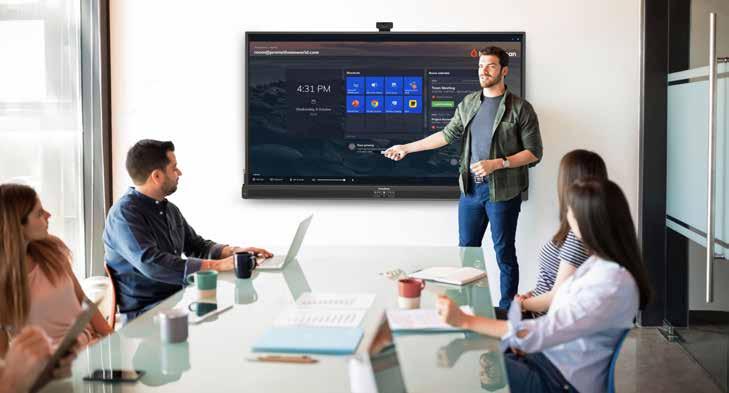

Poor visibility or inconsistent performance doesn’t just disrupt meetings—it erodes trust in the technology. Users adopt workarounds, bypass systems, and revert to inefficient habits like emailing decks instead of sharing screens. IT teams become consumed with troubleshooting instead of focusing on innovation.
The benchmark for AV vendors must be proven, consistent performance in real-world conditions—across varying light levels, room sizes, usage intensity, and technical expertise. This reflects Promethean’s focus on enabling shared environments that support people at work without distraction or fragility.
The true value of AV technology lies in simplicity and intuitive operation. Yet many systems are still chosen based on feature checklists rather than daily usability. Overly complex collaboration tools that require expert configuration or displays that degrade under heavy use introduce unnecessary friction.
Simple, reliable AV systems reduce support overhead, free IT teams to focus on strategic initiatives, and empower end users to share information effortlessly. Consistent workflows across rooms ensure users can walk into any space and focus on the meeting agenda, not the mechanics of the technology.
Complexity is a major barrier to adoption and loyalty. It turns collaborative spaces into technical obstacle courses, draining time and energy. In environments with continuous use and diverse users, simplicity is not a luxury it is a necessity.
Large organisations rarely deploy a single room type. They scale across huddle rooms, boardrooms, training spaces, shared work areas, and public environments. The challenge is expanding AV deployments without reinventing solutions for each space.
Consistency across displays, collaboration software, and integrations enables predictable deployments, reduces training needs, and simplifies support. Familiar interfaces build confidence and accelerate adoption, while interoperable systems allow IT teams to manage environments efficiently rather than juggling incompatible point products.
Scalability does not mean using identical systems everywhere. It means maintaining flexibility while preserving clarity, reliability, and simplicity, the qualities that make enterprise-wide deployments manageable. This approach is central to Promethean’s vision of shared environments that grow organically with organizational needs, without unnecessary customization or operational overhead.
Accessibility, security, and regulatory compliance are essential particularly in public-sector and enterprise environments where failures carry legal and reputational risk. However, compliance should not create additional complexity or hinder usability.
Effective AV technology embeds compliance into system design rather than layering it on as an afterthought. Systems

must meet standards while remaining intuitive and efficient. When compliance aligns with everyday workflows, adoption increases and administrative burden drops.
Promethean solutions are designed to support accessibility and regulatory requirements without introducing friction. In contrast, overly complex compliance features increase deployment time, maintenance costs, and support needs, often leading users toward insecure workarounds. Sustainable compliance arises from technology built for real operational conditions.
For AV integrators and resellers, operational reliability is critical to credibility and long-term success. Partners benefit from solutions they can confidently stand behind, systems that deliver consistent experiences across hardware, software, and integrations.
Fragmented ecosystems create friction, necessitate workarounds, and erode customer trust. Vendors that offer cohesive, scalable, and field-proven solutions enable partners to focus on solving customer challenges and building lasting relationships rather than troubleshooting avoidable issues.
Reliability strengthens partner reputations, simplifies deployment conversations, and builds trust with end users across diverse environments.
Organisations increasingly depend on AV technology to function smoothly throughout the day. Reliable, manageable systems improve productivity, drive adoption, and deliver real return on investment.
When reliability fails, the impact ripples outward, support demands rise, user confidence drops, and technology intended to enable collaboration becomes a source of frustration. Over time, this undermines trust in technology investments altogether.
Success today requires partnering with vendors who prioritise operational reliability, scalability, and real-world usability over surface-level features. This focus improves IT efficiency, strengthens user confidence, and supports sustainable growth.
The future of workplace and public-sector AV belongs to solutions that disappear into the background while amplifying communication and collaboration. Reliability, clarity, and scalability are not optional enhancements, they are operational necessities.
Organisations deserve AV systems designed to perform day after day, across diverse spaces, for users of all technical skill levels. When technology connects predictably, displays clearly, scales smoothly, and operates intuitively, everyone can focus on what truly matters: doing their work.
This foundational philosophy—central to Promethean’s narrative—enables every other capability to succeed.

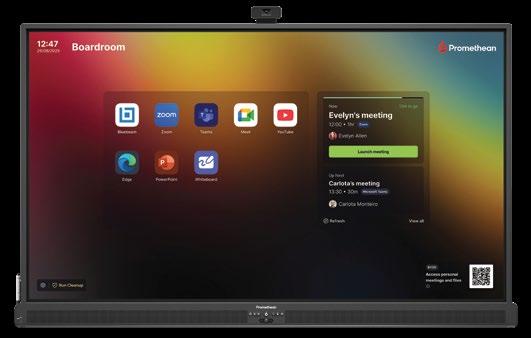
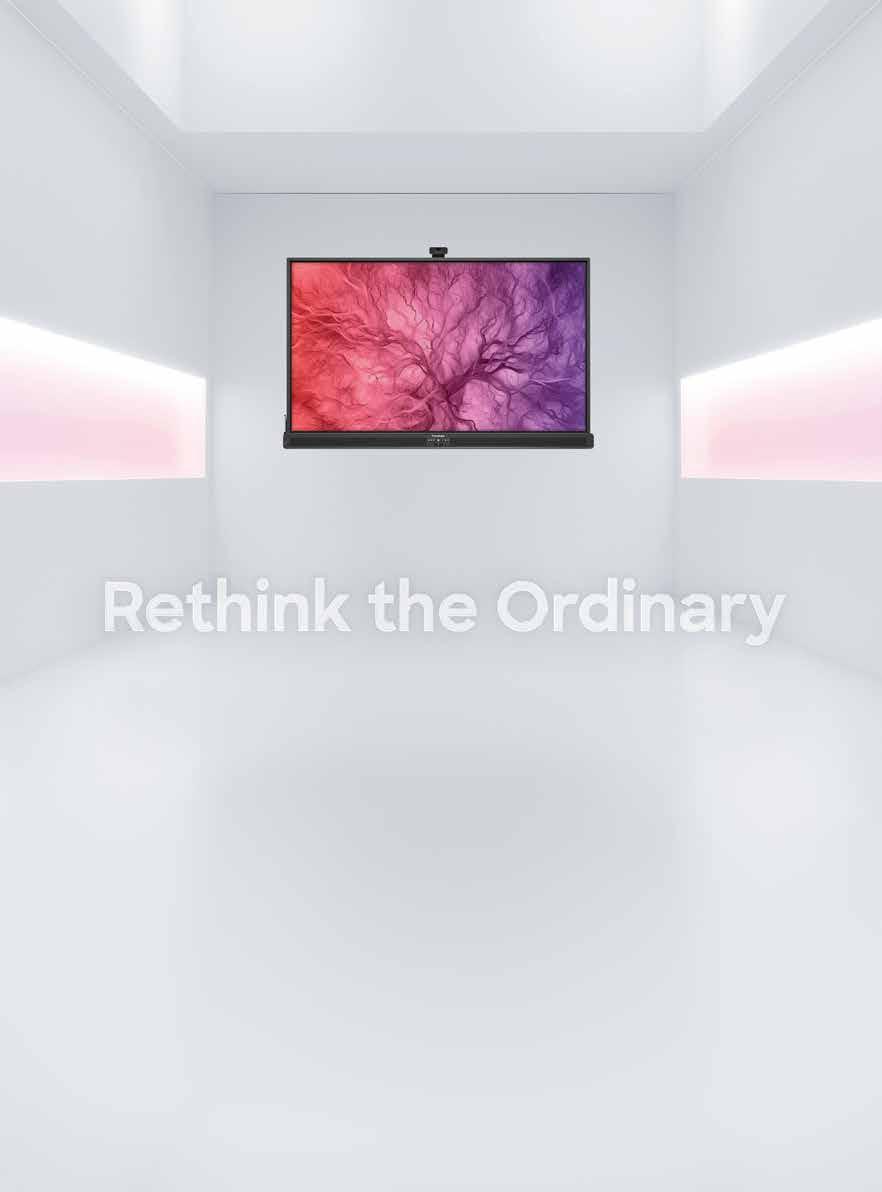
Collaboration should feel natural, not like a workaround.
When teams can share ideas clearly across meeting rooms, devices, and workstyles, decisions move faster, and momentum builds. The spaces where people work together should support focus, flexibility, and forward progress.
Promethean designs a cohesive technology ecosystem for shared workplaces, helping collaboration happen smoothly as teams and needs evolve.

We're going to be exhibiting at InfoComm June 17-19 in Las Vegas! Click here and add our VIP code, PRO255 for a free exhibit hall pass

Scan or click to learn more about Promethean’s award-winning interactive displays for the workplace
TPV Technology and AOC, together with PPDS has further strengthened its global commitment to social sustainability and the human rights of workers by partnering with leading not for profit organisations The Mekong Club and the EPRM. Continuing to meet the requirements of the EU Corporate Sustainability Due Diligence Directive (CSDDD), these new memberships, focused on social sustainability and human rights, form part of TPV Technology’s unwavering, long held, and deeply ingrained commitment to people, communities, and the planet – a philosophy shared across all business units. Stefan van Sabben, Global Director of CSR and Sustainability at TPV Technology, commented: “We are a production-oriented organisation with a worldwide network of locations and suppliers. Our responsibility focuses not only on our own sphere of influence but also on processes further down the supply chain. We believe in working both as a community and as a part of communities to amplify our efforts. That is certainly the case with our social responsibility.” Founded in 2011 in Hong Kong, The Mekong Club is a leading not for profit organisation that works together with member companies to combat modern slavery, forced labour, and human trafficking. Recognised and respected globally, its members span multiple industries, including manufacturing, finance, and hospitality, reflecting a shared determination to drive meaningful change. Members include renowned global brands, including Mattel, Decathlon, Unilever, Amazon, and The Walt Disney Company. Membership provides access to expert guidance, practical tools, and a network of like-minded organisations committed to addressing these complex challenges. Commenting on the new membership, Stefan commented: “We strictly prohibit all forms of forced labour and modern slavery in both our own operations and in our supply chains. Membership of the Mekong Club will help us ensure forced labour is never used in the scope of our business.” He continued: “To address modern slavery challenges across sectors and industries, collaboration with other organisations is key. We look for-
ward to collaborating with The Mekong Club and fellow members to deepen our knowledge and to exchange ideas and learnings with other businesses that are serious about making a difference.”
TP Vision, MMD Monitors and Displays, AOC, and PPDS rigorously follow the human rights and labour standards set by the United Nations Global Compact (UNGC), the International Labour Organisation (ILO), and the Responsible Business Alliance (RBA). Meanwhile, the European Partnership for Responsible Minerals (EPRM) concentrates on human rights and environmental challenges linked to mineral extraction and processing, an area at the very start of TPV Technology’s supply chains. Set up in 2016, key areas of focus for the ERPM include artisanal and small scale mining (ASM) in conflict affected and high risk areas. By bringing together companies, governments, and civil society organisations, the EPRM works to improve working conditions and environmental practices. It also promotes responsible sourcing of key minerals such as tin, tantalum, tungsten, and gold. Through on the ground projects and collaborative support, the initiative helps supply chain participants strengthen their responsible sourcing practices. Members include blue chip organisations such as Royal Philips, NXP, Samsung, Intel, and Fairphone, as well as other supply chain actors, such as Valcambi (a refiner), Gold by Gold Colombia (a gold purchaser and trader), and the Re-
sponsible Minerals Initiative (RMI – of which TPV is also a member). Civil society members include Solidaridad, Terre des hommes, and Pact.
TPV Technology publishes an annual Conflict Minerals report that outlines its commitment, policy and procedures regarding the responsible sourcing of minerals, with the company committed to not purchasing raw materials, subassemblies or supplies that are known to contain conflict minerals that directly or indirectly finance or benefit armed groups in the DRC or other CAHRAs (conflict affected and high risk areas). Furthermore, the company has been a member of the Responsible Minerals Initiative (RMI) since 2015 and a member of the International Tin Supply Chain Initiative (ITSCI) since early 2023. Since December 2023 – and recently renewed for another three years – it has actively funded and supported ITSCI’s responsible and inclusive mining governance projects in the Democratic Republic of Congo. Marcella Klinker, Sustainability Specialist – Human Rights and Supply Chains at TPV Technology, said: “For us at TPV Technology, joining the EPRM reinforces our commitment to responsibly sourcing the minerals used in our products and continuously strengthening our mineral due diligence practices. We look forward to collaborating with the EPRM and other members on developing innovative partnerships and initiatives that enhance due diligence practices and support more responsible mineral supply chains.”
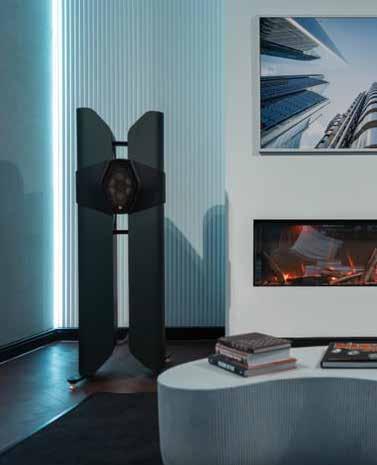
When Monitor Audio set out to create a new Experience Centre at its headquarters in Rayleigh, Essex, the objective was clear: to build a space that would redefine how the brand is experienced by integrators, designers, architects and clients, while authentically demonstrating its expertise and range of high performance audio capabilities in home cinema, media and listening room and outdoor entertainment space applications. To deliver this vision, Monitor Audio entrusted local CEDIA member, The Cinema Company with the project, a company renowned for its custom design and installation services. What followed was an impressive collaboration that has completely transformed underused spaces and rooms in Rayleigh into a state-of-the-art, fully immersive, multi-zone showcase for the brand.
The Experience Centre was required to fulfil several roles at once. It firstly needed to operate as a reference-level demonstration space for both cinema and music, while also embodying Monitor Audio’s distinctive design language, heritage and engineering ethos. Additionally, the Experience Centre was intended to serve as a hub for training and education. Seamless integration with lighting, blinds, AV distribution and control systems throughout was essential.
From the outset, Monitor Audio provided high-level creative direction. For the cinema space, the brief was to remain visually aligned with the Monitor Audio brand. For the music suite, the inspiration was ‘the interior of a Porsche’, engineered, refined and purposeful without feeling overly technical. This open brief allowed The Cinema Company to take a holistic role encompassing cinema design, acoustic engineering, interior concepting and project coordination. The concept and design brief was understood perfectly by the team and 3D visualisations were developed and approved on the first presentation, allowing them to move quickly into the construction phase.
It was clear that the build would require close co-ordination between the architect, builder, electrician, HVAC and joinery contractors with The Cinema Company acting as overall project manager. The build was situated within an active warehouse, which posed considerable acoustic isolation challenges and necessitated a roomwithin-a-room construction method to maintain performance integrity. The cinema and music suite were constructed as fully isolated rooms within the warehouse shell. Walls approaching 600mm in depth, multiple material layers and specialist construction techniques were employed to mitigate external noise from warehouse operations and ensure consistent acoustic performance.
The Cinema Room was meticulously designed to function at reference performance levels, offering the flexibility to showcase a variety of system scales and budgets. Among its standout features are Monitor Audio Cinergy Series loudspeakers, strategically positioned for the front, surround, and rear channels. The room also
boasts sixteen 15-inch subwoofers, arranged in a mirrored front-and-rear layout, with advanced WaveForming optimisation developed in partnership with Trinnov. This configuration enables multiple operational modes, allowing demonstrations using 2, 4, 8, or 16 subwoofers to suit different requirements. The visual experience is enhanced by a Sony professional cinema projector and a large-format Cinema Build Systems projection screen, both complemented by acoustically transparent fabrics and track systems throughout the space. The seating is provided by Infinity Seating, which is hand-crafted in the UK, ensuring optimum comfort and luxury. The entire system was engineered to meet CEDIA’s RP22 Recommended Practice guidelines, with the final calibration executed in collaboration with Trinnov’s engineering team.
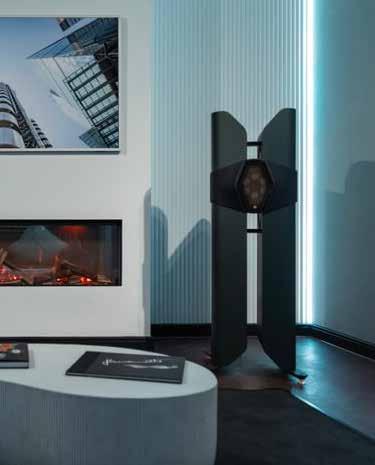
In contrast to the Cinema Room, the Music Suite was conceived to evoke the atmosphere of a genuine, highend living space, abstaining from an overtly treated studio aesthetic. Taking inspiration from the engineered elegance of a Porsche interior, the timeless design incorporates dark greens, deep blacks and rich walnut for a subtly luxurious space. Acoustic treatment was thoughtfully and discreetly integrated, utilising recessed ceiling diffusers, a sculptural 3D parametric rear wall for diffusion, as well as soft furnishings and suede finishes to replicate the acoustics typically found in residential environments and mirror the premium Porsche upholsteries.
This room also features Monitor Audio’s flagship Hyphn loudspeakers, paired with high-end amplification and premium cabling, enabling critical listening in a setting that authentically reflects how clients experience music in their own homes. The Experience Centre offers much more than the two principal rooms, with it incorporating a range of additional spaces designed to enhance the visitor journey. Among these is a Brand Immersion Gallery that guides visitors through Monitor Audio’s heritage and evolution, while dedicated training and presentation areas support education and professional development. The lounge and reception zones are fully equipped with distributed audio to create a welcoming atmosphere, and the entire building is illuminated by multi-zone lighting, featuring sophisticated DMX control and colour-tunable LED systems. All these systems are seamlessly integrated via Control4, ensuring intuitive management of audio, video, lighting, and blinds throughout the facility. “Working with Monitor Audio on their Experience Centre has been a fantastic experience and a real honour to have been asked to deliver it. From start to finish, the collaboration has been excellent. We never felt like we were delivering to a client, the relationship was such that we were one team, working towards the same goals. Absolutely everyone was welcoming, knowledgeable and clearly passionate, and it is evident that everyone loves being a part of it. We’re proud to have played our part.” explains James Brown, Managing Director of The Cinema Company. The completed Experience Centre offers much more

than a conventional showroom, providing Monitor Audio with a certified environment for demonstrations and training, as well as a versatile venue suitable for CPDs, integrator education, and client events. It presents a compelling narrative which secures Monitor Audio’s position within the smart home industry. For The Cinema Company, this project stands as a flagship collaboration, showcasing not only exceptional technical expertise but also the importance of design-led thinking, real-world performance, and a close partnership with the manufacturer. “This Experience Centre brings everything Monitor Audio stands for into one place: reference performance, beautiful design and a seamless smart-home journey. From the moment you arrive, each space is designed to guide visitors through our heritage, our engineering and the real-world experiences our products are built to deliver. It’s a facility created not only to demonstrate what’s possible today, but to train, inspire and support our partners for what comes next. We’re grateful to The Cinema Company and every partner involved for their expertise, collaboration and commitment in making this vision a reality.” comments Michael Johnson, Global Marketing Director at Monitor Audio Group.
Solstice AV has announced a new UK distribution partnership with Amino, bringing Amino’s enterprise IPTV and digital signage platform to AV resellers across the UK. The partnership expands Solstice AV’s portfolio into enterprise video distribution, enabling resellers to deliver centrally managed live TV, digital signage and internal communications across large estates and multi-site organisations.
Amino’s platform allows organisations to securely deliver live and on-demand video, digital signage and internal communications across corporate campuses, healthcare facilities, hospitality venues and customer-facing environments. For AV resellers and systems integrators, the addition of Amino creates new opportunities to design integrated video and communications environments as part of wider AV deployments including displays, collaboration systems and LED installations. The platform combines media distribution, digital signage and remote device management within a single system, enabling IT and AV teams to monitor, control and scale across hundreds or thousands of endpoints with ease
Typical applications include:
• Single-solution, centrally managed live TV with digital
signage: perfect for QSR and retail settings
• Live TV distribution across hospitality venues, sports bars and hotel rooms
• Corporate communications and IPTV across office campuses and meeting spaces
• Patient information and entertainment systems in healthcare environments
• Digital signage and information displays across large multi-site organisations
Michael Tulip, Managing Director at Solstice AV, said: “Solstice has grown by carefully selecting vendor partners that help our resellers win more ambitious projects, and Amino is a great example of that strategy in action. Demand for centrally managed video, communications and signage is growing across corporate, hospitality and healthcare environments. Amino gives our partners a powerful platform to deliver those solutions as part of wider AV deployments. It’s a natural addition to the Solstice portfolio and another step in strengthening the solutions we can support our resellers with as they take on larger, more integrated AV projects.”
Amino’s technology has been widely deployed across enterprise and service provider environments, helping organisations manage media delivery, digital communications and signage across distributed locations while maintaining centralised control and security. Jonny McKee, VP Product Management & Customer Support at Amino, said: “Solstice AV has built a strong reputation in the UK AV channel for helping resellers deliver ambitious technology projects. Their focus on expertise, technical support and partner success makes them a natural
distribution partner for Amino. As organisations look to deliver video, communications and digital signage across increasingly complex environments, the demand for solutions which bridge the gap between video, IPTV and signage continues to grow. We’re excited to give Solstice partners access to Amino’s enterprise video platform and help them unlock new opportunities across retail, hospitality and healthcare environments.” Amino solutions are available immediately through Solstice AV.
To bring their product solutions to AV resellers across the UK. “As a distributor with a traditional focus on customer experience and excellence through dedication and expertise, this partnership with Northamber aligns well with our values and principles”, said Keith Dutch, Managing Director EMEA, Peerless-AV. “This agreement is about more than expanding distribution—it’s about developing the level of technical expertise across the entire UK market. By working with a partner that prioritises detailed knowledge and a complete solution approach, we can ensure our technologies are deployed efficiently, reliably, and at scale.”
With comprehensive coverage to over 5,000 resellers,
with dedicated account managers, this agreement creates several exciting new opportunities in multiple verticals across the Northamber Group within the UK. This represents an important step in strengthening Peerless AV’s strategy and reinforces our commitment to delivering high-quality solutions to every customer through the channel. “The opportunity to add a brand like Peerless-AV, with a strong reputation and award-winning products, to our existing portfolio is one that we are excited about”, comments Matthew Light, AV Director of the Northamber Group. “We’re eager to begin work with Peerless-AV, and the team are enthusiastic to learn more about the market leading features of the range and how these products can elevate and enhance our every project.” Under the terms of the agreement, Northamber Group (PLC) will serve as an authorised UK distributor, leveraging its established network and local expertise to bring Peerless-AV’s offerings to a broader customer base. The collaboration is expected to enhance customer access and strengthen both companies’ positions in the market.
Bridge Technologies used the NAB 2026 show to announce that its VB440 production probe has been integrated into NEP Platform, the new software orchestration system launched by NEP Group. The full functionality of the VB440 will be deployable on a software basis through the platform, enabling NEP customers to instantiate Bridge’s best-in-class monitoring and visualisation tools – alongside a range of other production tools from leading broadcast manufacturers – all from a single, virtualised location.
The VB440 is a comprehensive suite of production tools contained within a single appliance. It provides full video scopes - waveform, vectorscope and histograms, whilst for audio, it supports Dolby Atmos with 64-channel monitoring across unlimited flows, plus LUFS and Gonio meters, along with stereo down mixes and single channel isolation. Network engineers gain packet capture, PTP timing analysis, ST 2022-7 redundancy monitoring, and event logging, to name only a few of the multitude of tools contained within the probe. These elements are all managed within the Canvas workspace, where users can place any number of components on a single screen, in an arrangement that best suits their personal workflow.
On top of these already extensive functionalities, an ongoing range of features are introduced every year, with NAB 2026 seeing Bridge focus on the addition of multi-service AV sync capability, a feature which allows production teams to ensure perfect alignment between different sources of the same service, in cases where they have been transported via different paths for redundancy purposes. Within NEP Platform, every one of these capabilities will be available as a deployable software application, running on shared commercial offthe-shelf compute.

NEP Platform represents a fundamental shift in how live production infrastructure is deployed and managed. Rather than building fixed, dedicated systems per function, the platform provides an orchestration layer that deploys and runs trusted third-party broadcast software on shared COTS compute in modern IP environments. Application versions and configurations are validated before deployment, lifecycle management - spinning up, scaling, shutting down - is fully automated, and telemetry delivers real-time visibility into health, performance, and resource usage.
For Bridge, this integration provides a further way in which production teams can instantiate VB440 monitoring, wherever they need it, for as long as they need it, scaling to meet the specific context of the broadcast or event in question. The same deep analysis and best-inclass production tools that broadcasters have relied through a dedicated VB440 (which itself can be access in real time, by up to eight users, through any HTML5 browser, from anywhere in world) are now available on demand, scaling up or down with the production itself. “From the very beginning NEP and Bridge Technologies shared the same pioneering spirit when it came to exploring what software-defined production could become, and how it could transform media infrastructure,” said Dan Murphy, VP of NEP Platform. “Bridge has been one of the valuable partners whose technolo-
gy has been integrated into NEP Platform at launch, helping us achieve the level of transparency and operational insight that large-scale remote production demands. What has made the partnership so strong over the years is Bridge’s ability to work closely with our engineers, translating real operational challenges into practical solutions for our customers and continuously evolving alongside the development of NEP Platform.”
“The working relationship between Bridge and NEP goes back a very long way,” said Simen K. Frostad, Chairman of Bridge Technologies. “For years, NEP has relied on Bridge to meet their own production needs, and they have been a crucial testing ground each time we introduce new features. Indeed, much of our production roadmap has been developed in direct conjunction with them. That level of trust doesn’t come easily. It comes from years of collaboration, from listening to feedback from engineers who use the platform every day, and from constantly refining the product based on real-world demands. To now see the VB440 included as a software-deployable application on NEP Platform is a genuine honour. It reflects not just the strength of our technology, but the strength of a partnership built on mutual respect and a shared vision for where live production is heading.”
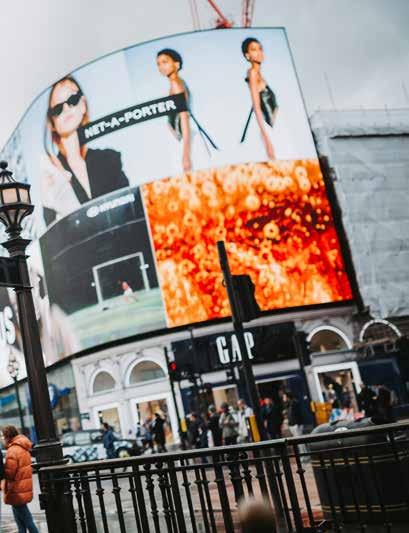
Out-of-home (OOH) gives luxury brands a far greater return-on-investment (ROI) than any other advertising channel, according to new data from econometrics agency Independent Marketing Sciences (IMS). Data analysed from over 270 IMS campaigns utilising 24 different advertising channels over the last decade shows that OOH delivers, an average ROI of 12.8x for luxury brands - meaning every £1 spent directly translates into £12.80 in revenue. Across all 24 channels, luxury’s average advertising ROI was 4.7x. “Luxury doesn’t tend to follow the typical product playbook, and with luxury advertising, a lighter touch is often more,” said Alex Vass, founder and CEO at IMS. “A heavily performance-driven, conversion-led approach risks brands undermining their own appeal. Out-of-home on the other hand can, through exclusive, high-impact environments, drive brand awareness, fame and an exceptional ROI - without the pressure of immediate conversion.”
According to ad spend analysis by Vivvix, investment by luxury brands into OOH nearly doubled between 2019 and 2023. Meanwhile, JCDecaux showed that 86% of audiences who see a luxury apparel OOH advert engaged with that brand, including by visiting its website or social media channels. After OOH, the channels delivering the highest ROI for luxury were consumer retargeting (8.6x ROI) and Google Ads’ Performance Max (8.2x ROI). The channels delivering the lowest ROI for luxury included content syndication (0.7x ROI), brochures (1.2x ROI) and video on demand (1.5x ROI). “These results show that the creativity of Out of Home drives real-world emotional connection for luxury brands to the public,” said Tim Lumb, Director Outsmart. Other industries where OOH has a high return on investment include utilities and infrastructure (9.1x ROI) and over-the-counter pharmaceuticals (4.8x ROI), according to IMS. IMS uses econometric modelling to quantify the relationship between various factors such as seasonality, product promotions, and economic trends, in order to calculate the effectiveness of different marketing channels for specific brands.
Sportway Media Group, an AI-automated sports production company and Broadcast Broadcast Solutions, a leading system integrator and provider of innovative solutions for the broadcast media industry, has announced that they have jointly acquired Studio Automated, a leading AI technology provider for automated and remote live sports production. With this acquisition, Sportway and Broadcast Solutions take a significant step toward building one of the world’s most advanced and scalable platforms for live sports production. By combining AI-driven technology, software-defined workflows, premium broadcast hardware, and global operational expertise, the partnership aims to cover the entire spectrum of live sports production - from grassroots competitions to top-tier international events.
Studio Automated brings industry-leading AI software that already operates thousands of cameras across venues throughout Europe. Its technology enables a high level of automation in multicamera live production and remote workflows and supports a wide range of sports including football, ice hockey, basketball, and handball. The platform has become a key building block for efficient, scalable, and sustainable live sports production, supporting global green production targets. Sportway contributes to one of the world’s largest live sports production footprints, delivering hundreds of thousands of matches per year across multiple sports, leagues, and markets. Through its large-scale operations, Sportway provides real-world production environments in which AI-based workflows are continuously trained, refined, and deployed at scale — enabling reliable, proven automation in demanding live conditions.
Broadcast Solutions adds another critical dimension through its long-standing presence at the highest level of live sports production worldwide. As a leading system integrator and technology provider, Broadcast Solutions delivers OB vans, remote production infrastructures, VAR solutions, and premium broadcast workflows for major international events. Through its acquisition last year of Egripment B.V., a global specialist for camera movement technologies in sports, live entertainment, and broadcast, the partnership gains direct access to

premium camera hardware, engineering expertise, and an extended end-to-end value chain. All three parties — Sportway, Broadcast Solutions, and Studio Automated - have worked closely for several years with DMC Production in live sports environments. DMC has played a key role in refining Studio Automated’s AI-based multicamera production software across sporting events. This long-term collaboration has ensured that the technology is not only innovative, but also proven in real-world, high-pressure production conditions. Together, the acquisition enables a truly integrated, glass-to-glass production ecosystem — combining AI-driven production, software control layers, camera systems, infrastructure design, and scalable content distribution.
Looking ahead, the shared technology roadmap will further expand the platform’s capabilities. By enabling real-time event detection directly from live video feeds, the ecosystem will allow the creation of instant highlights, clips, and replays during live matches. This enhances fan engagement, unlocks new content formats, and creates additional monetization opportunities for broadcasters, leagues, and rights holders. The joint platform brings together:
• AI production continuously trained on real, large-scale live data
• Tight integration of software, hardware, and production workflows
• A unified ecosystem where premium broadcast pro-

ductions and automated workflows coexist
• Real-time event detection powering instant highlights and replay experiences
• A single partner for rights holders — from grassroots level to top-tier productions
“It is a major step in the evolution of Sportway Media Group to bring core software capabilities fully in-house across the production value chain,” said Daniel Franck, CEO of Sportway. “We have worked closely with Studio Automated for more than seven years. A shared technology roadmap allows us to further strengthen our offering and deliver even more scalable and reliable live productions to our clients.”
“Live production is in our DNA,” commented Rainer Kampe, CTO of Broadcast Solutions. “We have been actively looking to embrace software-defined and AIbased production tools for multi-tier and high-volume live sports environments. Combining Studio Automated’s world-class AI algorithms with our specialist camera technology and premium broadcast workflows creates strong and tangible synergies.” “Our global activities open up a much larger international market for Studio Automated’s solutions,” added Stefan Breder, Co-CEO of Broadcast Solutions. “By integrating these AI-based technologies directly into our project, rental, and systems workflows, we significantly expand their reach and practical application across all levels of live sports production.” Studio Automated co-founders Paul Valk and Paul van den Haak see the acquisition as a
key step to accelerate growth, expand market presence, and strengthen the company’s position in AI-driven live sports production. “We are very proud of what we’ve built over the past six years and fully support the vision of Sportway Media Group and Broadcast Solutions to take Studio Automated to the next level,” said Paul Valk. By combining deep technology expertise, global operational scale, and premium industry access, Sportway, Studio Automated, and Broadcast Solutions are uniquely positioned to define the next generation of live sports production.
Shure has become a minority investor in EDGE Sound Research, a start-up company who is developing new experiential audio technologies that redefine how many audiences consume sound. The company was founded in 2019 by two University of California, Riverside students, Ethan Castro and Valtteri Salomaki. Castro was inspired by his life experiences as a hard-of-hearing music producer and engineer. Salomaki has been focused on information systems and marketing strategy. Together, they have grown into an innovative organization working to revolutionize entertainment.
Shure and EDGE Sound Research have already been collaborating on new innovations. Shure’s DCA901, the first array microphone tailored for broadcast, brings an improved immersive experience to every home with the help of EDGE Sound Research’s Virtual Sound Engine. Fans watching from their couches can now hear the game with the same sense of presence once exclusive to premium seating. Virtual Sound Engine software analyses the detailed audio from games captured by the DCA901 and automatically identifies and isolates the sound objects that define emotion, pace, and connection. The combination of DCA901 and Virtual Sound Engine moves the fan experience from observation to participation, creating meaningful value for every stakeholder. “Through this partnership, Shure aims to leverage EDGE Sound Research’s groundbreaking developments to further its mission of delivering exceptional audio quality and innovation,” said Chris Schyvinck, President and CEO of Shure. “By combining Shure’s
100-plus years of expertise and market presence with EDGE Sound Research’s breakthrough technologies, this collaboration aligns perfectly with Shure’s commitment to pushing the boundaries of audio technology and creating extraordinary listening experiences.”
Shure and EDGE Sound Research are working to deliver something new for specific groups. For sports leagues, broadcasters, teams and venues and fans. The NBA, MLS, and U.S. Tennis Association have all been working with EDGE Sound Research to enhance their broadcasts for fans. EDGE Sound Research’s technology has potential applications in a number of other areas beyond sports. “We’re excited to be partnering with such an established audio leader like Shure,” said Valtteri Salomaki, Co-Founder and CEO of EDGE Sound Research. “The most iconic moments in history have been captured by Shure microphones, and we’re thrilled about the possibilities of creating the new generation of sound experiences.”
Industry-leading audio technology companies L-Acoustics and d&b audiotechnik have teamed up with SoundPLAN to develop the SDE standard. A considerable step towards reliable noise prediction, SDE provides a revolutionary, neutral standard for noise prediction across multiple sound systems. As outdoor events continue to grow in urban areas, effective noise management has become critical. Until now, predicting noise emissions from festivals and events with systems from different manufacturers has been challenging, as each system relied on its proprietary tools. The lack of interoperability often resulted in inconsistent noise predictions, making it difficult to meet environmental requirements.
The SDE standard directly addresses this challenge by providing a unified method and file format to ensure reliable, consistent, and comparable predictions in environmental noise software. It defines how to export data from system design software, such as d&b’s ArrayCalc or L-Acoustics’ Soundvision and details the methodology for calculating complex acoustic interactions. This includes calibration and decoherence factors, ensuring the highest level of accuracy at any distance –something that hasn’t been possible until now.
With SDE, system technicians can export their designs as standardised SDE files, which can then be imported into environmental noise software like SoundPLAN. This streamlined, secure and fast workflow as well as the consideration of complex acoustic summation for the correct calculation of coherent sources (considering phase), allow consultants and event organisers to perform equivalent calculations in order to accurately predict noise emissions for festivals with multiple stages and systems from different manufacturers. In the future, the SDE format will be made available to other manufacturers and other noise pollution software. “The SDE standard is a huge step forward in addressing the noise management challenges of large-scale events,”
says Florian Hahn, Product Manager Application Software at d&b audiotechnik. “With SDE, we’re making effective and comparable noise management accessible, ensuring that audiences can enjoy their favourite artists while respecting nearby communities, public facilities and natural habitats.”
Yann Gaël Gicquel, Director of Product Management, Spatial Systems at L-Acoustics adds: “Organizing a festival today means navigating real tension between the energy that makes live music special and the legitimate expectations of the communities hosting it. Using SDE gives everyone at that table - promoters, consultants, local authorities - one shared, reliable source of truth for those conversations. That’s what makes it meaningful.”
“SDE will set a new benchmark for noise prediction in the audio industry,” concludes Jochen Schaal, Managing Director at SoundPLAN. “Its innovative, collaborative approach promises to establish SDE as an industry standard, simplifying workflows and delivering the most reliable and accurate prediction of noise emissions from different sound system manufacturers to date.” The new SDE standard is available as of now. For L-Acoustics users, SDE is currently available to consultants trained and certified by L-Acoustics, and through the company’s Environmental System Design service.
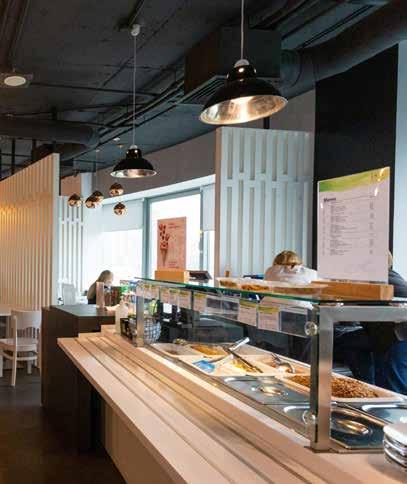
The latest research by BPS London has found that London office workers are more interested in better quality workspaces than superficial perks such as free breakfasts and lunches, with 63% saying they would be more willing to work from the office more regularly if their workplace was more modern, comfortable and better equipped. BPS London commissioned a survey of over 1,000 London office workers to understand how often they currently work from the office, how they feel about their workplace environment and what would encourage them to spend more time there.
The survey found that while office attendance has returned to some extent, around half of London office workers still spend two days or less in the office each week. At the same time, just 47% said they enjoy their current office environment, with the remainder describing it as simply “okay” or worse. When asked what would make them more likely to work from the office more often, location, commute and flexibility ranked highest overall. However, when it came to the office itself, workers placed far greater importance on the quality of the environment than on free food or social events. Better outdoor space was one of the most attractive workplace improvements, alongside more comfortable breakout areas, gyms and wellbeing facilities, and quiet
areas where employees could work away from the noise and distraction of the wider office. Better ventilation, improved technology and more natural light also ranked highly amongst London workers. In contrast, the commonly touted free breakfast or lunch, often used by employers to reward or incentivise workers, was found to be the least attractive workplace incentive.
The survey also found that workers would rather see employers invest in higher quality office facilities and design, as well as more wellbeing benefits outside of the office, than in staff perks or gifts, office parties and social events, or free lunches. According to BPS London, the findings highlight a growing disconnect between what London workers now expect from the workplace and what many existing office environments currently provide. The firm believes that while employers continue to focus on superficial perks, many workers are looking for workplaces that support their wellbeing, productivity and day-to-day experience, particularly in the post-pandemic era where employees have become more selective about when and why they travel into the office. BPS London and Purestone Capital are currently responding to this shift through their recently announced acquisition of a landmark office building on Tottenham Court Road in Fitzrovia, where plans include delivering a more modern, amenity-led workplace environment designed around the needs of today’s workforce.
Commenting on the findings, Mahir Vachani, Director at BPS London Developments, said: “Too many employers are still focusing on surface-level perks in the hope of tempting people back into the office, but our research shows that workers are looking for something much more meaningful. Free breakfasts and occasional lunches might be appreciated, but they are not enough to persuade people to spend more time in an office that feels outdated, uncomfortable or poorly designed. Today’s workforce wants offices that support how they actually work and live, whether that means more natural light, outdoor space, quiet areas, better wellbeing facilities or simply a more enjoyable environment. There remains a significant disconnect between what workers want and what much of London’s current office stock is offering. We believe that is creating a major opportunity to deliver the kind of fit-for-purpose workspace that businesses and their employees increasingly expect.”
Project Audio Visual (PAV) has relocated its UK headquarters to the heart of Reading town centre, marking the next step in the company’s continued growth and evolution. The move to Quadrant House places PAV within one of the UK’s most prominent technology clusters and positions the business alongside a thriving community of innovative and creative organisations. The move reflects PAV’s continued growth and its focus on scaling operations to meet increasing demand for
hybrid workplace solutions.
Renowned for driving the digital transformation of the workplace, PAV’s relocation reflects the same principles it delivers for its clients. The new headquarters has been designed to complement hybrid working from a more accessible base for the team, clients and partners. This will enhance collaboration, efficiency and service delivery across the management, business development, support and AVITdirect teams. Steve Hudson, COO at Project Audio Visual, said: “We spend our days designing, installing and supporting AV and IT technologies that help our clients operate more efficiently and a huge part of that is making sure hybrid working practices are as seamless as possible. Making this move is us doing exactly the same for ourselves. It’s also a more formal environment for the business to operate from, which gives us more options to grow and adapt as needed. We’re excited for people to come and see us in our new home.”
Located less than a ten-minute walk from Reading’s main station, with direct links to London in under 30 minutes, Quadrant House offers excellent transport connectivity for both staff and visitors. The new space also includes dedicated facilities for hosting clients, product demonstrations and collaborative planning sessions, supporting PAV’s consultative approach to delivering workplace technology solutions. The relocation also supports the continued growth of PAV’s wider ecosystem, including its AVITdirect ecommerce business, which expands the company’s ability to provide a full turnkey AV and IT solution to customers. Alongside its UK operations, PAV continues to strengthen its international presence with its European office, demonstration and pre-staging facility in the Netherlands, led by Head of European Operations, Leroy Seket.The move to Reading marks another milestone in PAV’s journey as it continues to evolve its own workplace in line with the solutions it delivers for clients.
Wildwood Plus, the integrated B2B communications agency specialising in the built environment and technology sectors, has announced a strengthened Senior Leadership Team (SLT) as it enters its 32nd year in business. The new structural changes reflect the company’s continued evolution from a founder-reliant business into a thriving, team-led agency, focused on delivering outstanding service, long term client partnerships and sustainable growth. As part of the update, Will Houston moves from Operations Director to Managing Director, working alongside the agency’s Divisional Directors; Jenny Parker, who leads the Build Division, and Samantha Ward, who heads up the Tech Division. Tanya Houston continues as Chief Executive Officer, with overall responsibility for strategy, culture and the

agency’s long-term direction. Jeff Hayward, Chief Commercial Officer, leads commercial growth and client development, while John Houston, Executive Director, focuses on content, governance and future tech innovation.
The strengthened SLT brings together sector expertise, operational leadership and a shared commitment to service excellence, ensuring clients benefit from clear accountability, senior oversight and specialist focus across the agency’s core markets. “This is a natural and important step in our ongoing transformation,” said Tanya Houston, CEO of Wildwood Plus. “We have been intentionally building a leadership team that reflects the agency we are today, collaborative, resilient and future focused. Will’s appointment as Managing Director, alongside our divisional leadership and experienced executive team, reinforces our commitment to being a genuinely team-led agency that consistently delivers for our clients.” Will Houston, Managing Director, added: “Wildwood Plus has a strong reputation built over three decades, and this next chapter is about harnessing the collective strength of our people. With clear divisional leadership and a shared focus on quality and innovation, we are well positioned to continue supporting clients as their markets evolve.”
The leadership announcement follows the agency’s recent internal strategy day, which brought together its 24-strong team, drawing on extensive skills, experience and industry contacts. The day also saw the company celebrate its annual CORE Awards – recognising indi-

viduals who consistently demonstrate the company’s values in their work and behaviour.
This year’s Wildwood CORE Award winners are:
• Creativity: Elissa Medhurst, Partnerships Manager
• Openness: Lauren Goward, Senior Account Manager
• Resilience: Lorraine Nugent, Account Director
• Excellence: Shereen Russell, Senior Account Director
The awards highlight the agency’s belief that longterm success is driven not only by results, but by the behaviours and culture that underpin them.
As Wildwood Plus enters its 32nd year, the strengthened SLT and continued focus on values mark a clear statement of intent: a confident, modern agency built around people, partnerships and performance.
Executing Pro AV projects in Brazil has long forced international integrators into a difficult position: navigate a complex and often opaque logistical and tax environment alone or rely on local partners who may ultimately compete for the end client relationship. D2S DSCBS was founded to eliminate that dilemma. Positioned as a strategic extension for global AV teams, D2S DSCBS delivers a comprehensive Logistics-as-a-Service (LaaS) model designed to make international deployments into Brazil predictable, technically precise, and commercially secure.
Headquartered in Miami with deep operational roots in
Brazil, the company bridges the gap between global system design and local execution. “International AV projects shouldn’t come with uncertainty or risk to client relationships,” said Cristiano Mazza Director for D2S DSCBS. “Traditional AV integrators can design and deploy, but they can’t always protect the relationship globally. Local Brazilian integrators execute well but often compete. Logistics companies move products but lack AV expertise. No one brings all three together seamlessly—until now. We built D2S to give integrators full control while we handle the complexity on the ground in Brazil.”
D2S DSCBS is purpose-built to support integrators, not compete with them ensuring that global partners retain full ownership of their client relationships while benefiting from local expertise and execution.
Key differentiators include:
• Commercial Protection D2S DSCBS does not resell equipment or pursue end customers. Integrators maintain 100% control of the client relationship while D2S manages logistics and deployment.
• Specification Integrity through its Miami-based consolidation hub, D2S ensures that the exact hardware specified is delivered and deployed in Brazil eliminating the need for local substitutions that can compromise performance.
• Transparent Landed Costs The company provides fixed, all-inclusive pricing that covers taxes, customs clearance, and in-country logistics, removing the uncertainty and cost variability often associated with Brazilian imports.
• Sustainable Compliance (ESG) D2S integrates Green Logistics into every deployment, optimising routes to reduce environmental impact and ensuring full compliance with Brazil’s National Solid Waste Policy (PNRS). Certification of Final Disposal (CDF) is provided to protect both legal standing and brand reputation regarding e-waste.
With more than 30 years of experience operating within Brazil, the D2S team combines deep local fiscal expertise with AVIXA-aligned technical standards. From single-site deployments to multi-location rollouts, the company supports projects of all sizes with the same level of precision and transparency. Rather than acting as an integrator, D2S DSCBS positions itself as a logistics and deployment partner handling importation, warehousing, delivery, and optional on-site support, so integrators can remain focused on system design and client experience. Cristiano added: “By removing barriers related to importation, compliance, and local execution, D2S DSCBS enables AV pros to confidently extend their reach into Brazil without sacrificing control, quality, or profitability. For organizations seeking a more secure, transparent, and sustainable way to execute AV projects in Brazil, we offer a new standard, one built on efficiency, governance, and complete respect for the integrator-client relationship.”
Audinate Group Limited, developer of the Dante AVoIP platform, in collaboration with Futuresource Consulting, has published the results of a global survey that reveals AVoIP has reached a critical inflection point, with strong current usage, near-universal adoption projected over the next few years, and growing emphasis on secure, interoperable, and cloud-enabled platforms. The research indicates that AVoIP adoption has now entered a new sophisticated phase of development and deployment — dubbed AVoIP 2.0.
The study surveyed 370 end users and 100 integrators across North America, Europe, and Asia-Pacific, spanning key verticals including corporate, media, healthcare, education, and government. The findings show that Audio-over-IP (AoIP) is firmly established, with 67% of respondents currently using IP networks to deliver audio and a further 18% planning deployments within the next two to three years. Video-over-IP adoption is close behind, with 59% already transmitting video over IP and another 26% planning near-term adoption. Beyond connectivity, previously considered the baseline deliverable of AVoIP, participants now identify operational scalability and future proofing as the top drivers for adoption, followed closely by security and the ability to support remote and hybrid workflows. The paper drills deeper into the importance of each of these areas, identifying that secure, authorized access and cloud-based remote monitoring and management were rated as highly important for integrators and end users alike. Broad interoperability is another defining factor, with most enterprises actively seeking solutions that support open frameworks and multi-vendor integration to avoid proprietary lock-in and to better support complex, evolving use cases. “The AV market has spoken,” said Joshua Rush, Chief Marketing Officer at Audinate. “It has been said that broad interoperability is non-negotiable and that end-users and integrators require solutions that are dynamic, flexible and secure. AVoIP has clearly become a critical infrastructure that acts as
the foundation layer for a wide cross section of use cases and applications, and as such needs the features and flexibility to solve not just the challenges of today, but where the industry is going.”
“The conversation around AVoIP has fundamentally changed. End users aren’t asking ‘should we do this?’ anymore, they’re asking ‘which platform grows with us?’ added Joyce Wang, Lead Analyst, Professional Broadcast at Futuresource Consulting. “Scalability, IT integration, and cloud-based management have gone from nice to haves to hard requirements, and vendors who haven’t caught up are feeling it.” Together, the findings confirm that AVoIP has become foundational to modern audiovisual infrastructures, now central to how organizations plan, deploy, and future-proof their AV ecosystems.

Ocean Outdoor UK redefines the DOOH attention model
Ocean Outdoor UK enters a new era in Digital Out of Home with Ocean Portal, a new format which redefines how brands show up in the real world. Developed by Ocean Studio and Ocean Labs, the Portal transforms high-footfall indoor environments into immersive, walkin experiences, placing audiences at the centre of the story. The Portal was launched in the UK at London’s Battersea Power Station with a bespoke entertainment showcase and content produced by Ocean Studio. It includes an interactive game with audio which challenges players to jump from floating ice blocks before they melt.
Measuring 4.5 metres wide x 3 metres high, the freestanding half cube stage is composed of five high-definition LED screens - three interior including the floor and two on the exterior. The Portal is equipped with Ocean Labs technology, including real-time motion tracking and mixed reality, and features Ocean Studio’s 3D DeepScreen capability. It is powered by high perfor-
mance gaming and film industry hardware including Unreal Engine and Unity. Brands and agencies can book the Portal either as an exclusive, custom-built installation for a single activation, or as part of a curated tour concept, allowing multiple advertisers to share scheduled time slots at a single high footfall location. These can include retail destinations, shows and festivals, transport hubs and stadiums.
Using LiDAR technology and structured light cameras, audiences can interact with the content displayed in real time. Integrated sensors track movement, allowing brands to respond dynamically to both individual gestures and group responses. Data from these interactions can be used for analysis and brand learnings, whilst the on-screen content can be extended across social media as part of integrated campaigns. Ocean Outdoor UK CEO Nick Shaw says: “Ocean Portal redefines DOOH as we know it. It’s a cornerstone of our evolving innovation programme to design and develop big experiential environments that serve as programmable stages. Rather than asking audiences to stop and look, the Portal invites them to step inside, becoming active participants. For brands, it’s a flexible, fully mobile experience zone which integrates premium screen inventory, physical space and real-time virtual production into a single, hybrid offering.” The Portal is also available to brands and agencies in the German market. Last year, Ocean unveiled Ocean Showcase, another freestanding DOOH format built for outside spaces. The Showcase made its debut at Westfield Stratford City in partnership with Warner Bros. Pictures UK, who presented a bespoke 3D version of their DC Studios Superman film trailer with soundtrack.
In modern workplaces, professionals are using digital tools and platforms to communicate, share, and co-create with colleagues, clients and partners, like never before. Today’s workforces are reliant on these digital tools and platforms to enable successful communication, including clear calls where both sides of the conversation can be heard. Video collaboration tools have gained popularity very quickly, where high picture quality is paramount. It could be argued audio is even more important though, as if you can’t be heard then the communication is over!
Every interaction matters more than ever, whether on a video call, standard call or collaborating with a colleague. Customer and staff expectations continue to rise where everyone has to remain as professional as possible. Voice pickup is the number one factor with high quality microphones at the heart of this process. Voice authenticity is crucial for effective and effortless conversations.
For more than 115 years we’ve been recognising why consistent audio matters – today even more than ever. ‘The Power of Audio’ is much more than just a buzzword, it’s become a way of life! A wide-ranging EPOS study and scientific whitepaper entitled: The Effects of Industry Leading Voice Pickup on Conversation Quality and Efficiency, highlights the importance of voice. It revealed with microphone noise reduction ‘on’, conversation dynamics such as turn-taking and pauses were part of a much more natural collaborative experience.
Measured benefits for study participants of microphone noise reduction were:
• 21% reduction in listening effort: participants reported a significant reduction in listening effort when the noise-reducing voice pickup was activated.
• 18% reduction in concentration difficulty: participants reported a reduction in the difficulty they experienced while trying to focus on the conversation, helping them to engage more easily in the discussion.
• 9% increase in conversation efficiency: participants can better understand and predict the end of their partner’s turn speaking while simultaneously planning their own response.
In addition, our acclaimed BrainAdapt advantage encompasses a group of pioneering technologies that work together to significantly improve cognitive performance. Did you know that while we hear with our ears, we listen with our brain? At EPOS we put this principle at the heart of our product design process – an approach we call EPOS BrainAdapt. This group of technologies work together to improve cognitive performance,

minimising the amount of energy it takes your brain to process sound – leading to less brain fatigue due to less concentration and effort. It’s clear in today’s world what matters most is effective communication and being heard crisply and clearly with minimum effort. How important is your message? Users need to hear and respond in a natural way through microphones and speakers. Equally important is comfort so users can wear devices, even all day, if necessary without even realising. Often headsets are used on video calls with a camera. They need to be discreet, seamless and stylish in design. But overall consistent audio will firmly remain one of the most important parts of modern business communication.
With more people returning to offices on a regular basis, this inevitably creates more noise and annoying distractions. So, a headset becomes a vital tool in blocking out unwanted interference but still keeping workers connected with their colleagues. Hybrid ANC ensures the best of both worlds, where users can still hear some background sound, as it’s very important not to block out everything and leave them feeling isolated and trapped from the outside world. They might need to hear a fire alarm being triggered or respond to a question being asked by a colleague, for example. From industry-wide conversations with distributors, resellers and their end users, we have identified how

noise disruption and distraction is the number one problem. These concerns have been endorsed by a recent exclusive EPOS online customer survey, which revealed what matters most:
Minimising distractions – 34%
Microphone performance – 31%
Active Noise Cancellation to keep focus – 21%
Managing noise levels – 14%
As more teams return to shared spaces, the rhythm of work changes. Conversations are closer and background noise and general random distractions inevitably fluctuate. Minimising these problems matter most. The findings point to a simple truth. In open offices, focus is fragile and being heard matters more than ever. Clarity and concentration have become daily problems, not occasional annoyances. Companies need to prioritise a great audio experience to make workers more productive, engaged and their days run smoother. A headset is now an essential business ‘friend’ for millions of people around the world - and the quality of their equipment really matters to optimise performance, wherever they are working and how they collaborate.
With more people returning to offices on a regular basis, this inevitably creates more noise and annoying distractions. So, a headset becomes a vital tool in blocking out unwanted interference but still keeping workers connected with their colleagues.

Pixel Global operates as a global AV partner but is currently taking a more focused and visible approach to the UK. AV News (AVN) spoke to Danielle Myburgh, UK sales director at Pixel Global (PG), about the company’s plans for the UK and overseas and its progressive policies for inclusivity and customer interaction.
AVN: Pixel Global AV has a strong global footprint, but a growing focus on the UK. How would you describe Pixel’s identity in the UK market today and how is that evolving?
PG: Pixel Global AV has a strong global foundation, but in the UK we’re now taking a more focused and visible approach. We’re positioning ourselves as a global AV partner with a genuinely local, personal service. That means a UK-based team, a single point of contact, and a strong emphasis on long-term relationships.
We’ve delivered projects internationally for many years, and we’re now placing greater emphasis on engaging directly with the UK market, particularly with end users, consultants and IT teams. It’s about demonstrating that we combine global scale and expertise with a flexible and approachable way of working.
AVN: With over 20 years of global experience and projects delivered across multiple countries, what lessons has Pixel learned about delivering consistency at scale?
PG: One of the biggest lessons is that true consistency isn’t about replicating the same solution everywhere, it’s about delivering the same experience. That requires clear global standards, but also the flexibility to adapt locally.
Whether a project is delivered in London, Singapore or Bangalore, the client should experience the same level of quality, communication and reliability. That ultimately comes down to having the right people, partners and processes working together.
AVN: You highlight the importance of having a trusted partner network. How does this model support global delivery?
PG: Our partner network is fundamental to how we deliver globally. We have four offices in the UK, Ireland, Singapore and India, supported by a trusted partner network across North America, South America, the Middle East, China, Australia and New Zealand.
Our partners are well established in their regions, with a strong understanding of local regulations, culture and logistics, while working to the same standards we do. This ensures we maintain consistency and quality across every project.
As a result, clients don’t feel like they are managing multiple suppliers. Instead, they experience one seamless, joined-up delivery model, with Pixel’s central hub in Epsom managing everything.
AVN: Are we overcomplicating meeting room design? What does “good” actually look like in 2026?
PG: Good meeting room design in 2026 should be almost invisible. It should just work, without delays, without fuss and without the need for staff training. That means consistent user interfaces, reliable technology, and a focus on the experience. The best spaces are the ones where people walk in, connect instantly, and focus on the meeting, not the tech.
But what’s also key is what happens after installation. Ongoing maintenance and support are just as important as the initial design. Without that, even the best systems will start to fail

over time. We’re also seeing growing demand for AV audits, helping organisations understand what they have, what’s working and where improvements are needed to ensure technology continues to perform consistently long term.
AVN: Hybrid working is now the norm, yet many spaces still don’t support it effectively. Why is the industry still getting this wrong?
PG: Many organisations have invested in technology, but the industry is still getting it wrong because the focus has been on the tools, not the user experience. We continue to see disconnected systems, inconsistent room setups and low adoption, with experiences varying from room to room.
Standardisation is often misunderstood. It’s not about forcing the same kit everywhere; it’s about removing friction. If people must relearn the room every time, it hasn’t worked. Hybrid working only succeeds when the experience is seamless and consistent. That requires a clear, user-focused approach, balanced with local flexibility, along with good design and ongoing support.
AVN: Do you believe AV is finally being recognised as a strategic function within IT or is it still undervalued?
PG: It’s definitely moving in the right direction, but it’s not fully there yet. AV has often been treated as a bolt-on, something brought in towards the end of a project, but that mindset is starting to change.
There’s now a much better understanding of the value AV brings, especially when it comes to collaboration, productivity and overall workplace experience. Organisations are also realising they’re not just competing with other offices, but with the experience people have working from home.
If the technology in the office is harder to use or less effective than what employees have at home, it quickly becomes a
reason not to come in. That’s why AV is starting to take a more central role within the IT ecosystem, even if there’s still some way to go.
AVN: Global delivery often comes at the expense of local understanding. How do you challenge that assumption at Pixel?
PG: It’s a common assumption that global delivery comes at the expense of a local, personal approach, but that doesn’t have to be the case.
At Pixel, our UK team works closely with clients on the ground, supported by experienced project managers who oversee delivery and ensure everything stays on track. We’re also agile in how we work, able to respond quickly when we foresee potential challenges.
At the same time, our global network provides consistency, scalability and access to wider expertise. It’s about combining both, giving clients the confidence of local understanding with the strength of global delivery.
AVN: With so many vendors and platforms in the market, is the AV landscape becoming too fragmented for end users?
PG: I wouldn’t necessarily say the AV market is becoming more complex. There is more choice, but that’s not a bad thing. It’s less about the technology itself and more about achieving the right outcome for the customer.
What’s really changed is the expectation. Employees are no longer adapting to technology; technology needs to adapt to them. That shift is driving manufacturers to develop more user-focused solutions, which is why it can feel like there’s suddenly a lot more in the market.
The real value comes from cutting through that choice and focusing on what works for the end user, creating solutions that are simple, effective and easy to use.
AVN: There’s a lot of talk about “futureproofing” AV systems. Is that realistic or just industry jargon?
PG: I think “futureproofing” is often overused. The reality is, you can’t truly futureproof technology, and most customers understand that. In many cases, it’s not even what they’re looking for.
What matters more is flexibility. Designing systems that can adapt, be upgraded and evolve over time, rather than need-
ing to be completely replaced.
That means focusing on open systems, scalable infrastructure and making sure the technology can move with the business as needs change.
AVN: The industry continues to face supply chain and delivery challenges. What has that exposed about how AV projects are planned and managed?
PG: Supply chain disruption isn’t new, but it has highlighted the need for better planning, earlier engagement and more strategic thinking around procurement and lifecycle management.
It’s also made clients more aware of the importance of working with partners who can anticipate challenges and build resilience into projects from the outset, rather than reacting to issues later.
AVN: With hybrid working now standard, ongoing supply chain disruption, and Gen Z reshaping workplace expectations, is the AV industry evolving fast enough to keep up?
PG: The industry is evolving, but expectations are moving faster. Hybrid working and ongoing disruption are continuing to shape how workplaces need to function, and there’s still a gap between what’s possible and what’s consistently delivered.
Gen Z is also bringing a new perspective into the workplace. They’re often quicker to adopt technology and find efficient ways of working, which is pushing expectations higher. At the same time, experience still matters, and that’s where more established teams bring real value. The two need to work together.
Closing the gap comes down to focusing less on the technology itself and more on how people actually use spaces day to day, creating environments that support different working styles and expectations.
AVN: You’re also an advocate for supporting women in AV. Technical roles have historically lagged behind other sectors in terms of diversity. Are we making real progress, or just talking about it more?
PG: There has been progress, but there’s still more to do. I don’t think this is just an AV or technical industry challenge; it’s something that has existed across many industries over time. I’ve seen the workplace evolve over the years, often without people even realising the challenges that were there. What’s encouraging now is the shift in culture. We’re seeing more women stepping forward, but also more awareness, understanding and respect across the industry. It’s less about blame and more about progress. Events like Rise AV and the AVIXA Women’s Council show positive steps, and it was great to see increased female attendance at ISE 2026.
Real change comes from creating opportunities, supporting career development and making the industry more accessible at every level. There’s also a stronger sense of women supporting each other, which is making a real difference.
I’m proud to be part of initiatives like the Girls with Drive programme this year, which helps build confidence in environments like the golf course, an important space for networking and relationship building. Ladies involved include representatives from Absen, Yorktel-Kinly, Samsung, Sharp, Tempura, Cisco, Re-Sauce, WoopJobs, Presentation Media, Workplace Creations, Dataflow AV and, of course, Pixel Global AV. It’s been great fun so far and such a positive initiative, with our corporate graduation day on 8th June.
For further information about Pixel Global please visit: www.pixelglobalav.com
NAB is a different kind of show to ISE and InfoComm, featuring far more content geared to media and entertainment creativity both inside and outside broadcast. Nonetheless, the event attracts similarly big numbers of visitors, some 58,000 registered attendees in fact. Driven by an expanding community of creators, enterprise media teams and leaders in sports media, NAB has brought in new audiences and sparked new collaborations. The 2026 show didn’t just reflect where the industry status quo; it pushed it forward, strengthening its status as the must-attend marketplace for the future of storytelling and content innovation. “The 2026 NAB Show captured the energy and transformation driving today’s media and entertainment landscape, unveiling powerful new tools and technologies that put storytelling in everyone’s hands,” said Karen Chupka, executive vice president of NAB Show. “This year, we brought together a truly global community to spark innovation, elevate new voices and ignite the conversations shaping what comes next - where anyone, anywhere, can create and share stories that matter.”
Naturally there was some overlap with the other major shows, but the major point of differentiation is an emphasises on content creation. Jonathan Liu, CEO of Zhong explained: “The NAB Show is a great place to get both sides of the production workflow. It is incredibly strong on the content creation process and with sessions on the business sides of how to manage your content creation business as a general thing.” Media and entertainment content creation is an international business, a fact reflected in the demographics of show attendees. NAB Show attendees hailed from 146 countries, with almost one in four participants traveling from outside the U.S. (22%), with 48% attending the event for the first time, a measure of the growing diversity among content creators. The number of registered attendees who are content creators increased 140% over 2025. More than 13,000 attendees reported that they are corporate media professionals, almost double the 2025 number. The 2026 NAB Show included attendees from about 75 professional sports teams, 22 professional leagues and governing bodies, 30 sports venues, 15 esports/gaming organizations, 35 collegiate athletic departments, and 15 sports content producers/distributors.
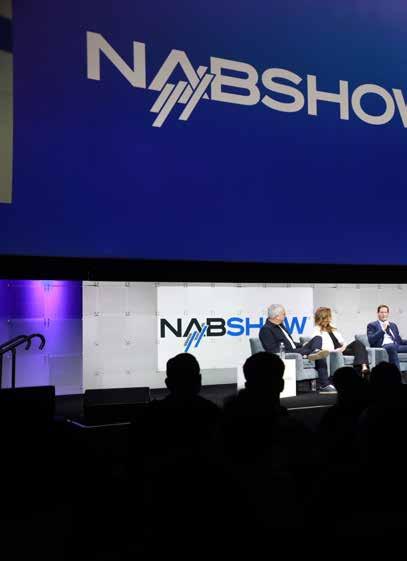
The NAB Show defined the future of the evolving media and entertainment landscape, with key trends such as artificial intelligence, creator economy and the intersection of sports and technology at the forefront. The Show featured more than 1,100 exhibitors from around the globe, spanning the equivalent of nearly eight soccer fields and highlighting 132 firsttime participants showcasing their innovations. Exhibitors from around the world brought the latest breakthroughs to life on a dynamic Show floor. The exhibition became a high-energy hub of discovery, connection and opportunity, reinforcing NAB Show’s position as the global epicentre for industry professionals and where business gets done. The NAB Show brought together a broad spectrum of thought leaders, including representatives from major corporations like Microsoft, NBC Sports, FIFA, Warner Bros. Discovery and Netflix. Some of these appeared in the 530 conference sessions featuring some 900 speakers from across the global media and entertainment ecosystem. An influx of new voices and emerging topics underscored NAB Show’s commitment to championing innovation and driving forward-looking conversations.
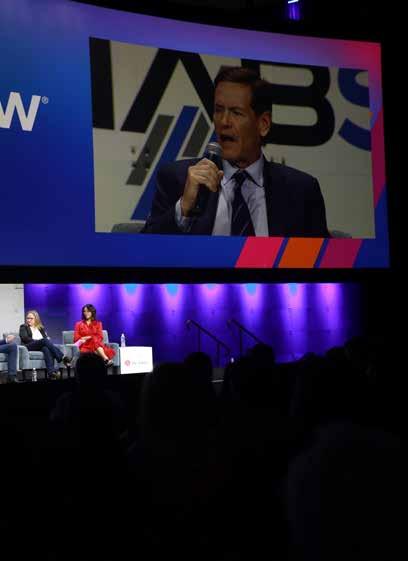
Aside from the work of commercial content creators, the role of Fortune 1000 and enterprise teams building in-house studios was acknowledged in addition to executive insights on strategy, investment and monetisation where the creation of paid-for content was the raison d’etre of the enterprise. AI was, of course, a major concern for content creators, and this was reflected in the content of NAB 2026. In particular with cloud workflows and media asset protection. There were two dedicated AI Pavilions and hundreds of exhibitors showcasing real-world applications across the content lifecycle. What follows are our selection of highlights from the NAB 2026 show floor.
Adobe unveils a sweeping set of innovations at NAB
Adobe’s presence at NAB marked a decisive step toward AI-driven creative workflows. Building on its Firefly platform, Adobe introduced new generative video tools, a reimagined approach to colour grading in Premiere Pro, and infrastruc-
ture upgrades through Frame.io Drive. Creators can now prototype and finish projects in Firefly, making it more than just a generative playground. Kling 3.0 models bring advanced AI video control. These models position Firefly as a serious tool for narrative creators.
Premiere Pro was introduced with “Color Mode” - this beta feature democratises colour grading, making it accessible to editors who previously relied on specialists. After Effects accelerates with AI object matte. These updates streamline post-production, making After Effects more efficient for high-volume projects. In another announcement, Frame.io Drive was said to ‘redefine collaboration’. Frame.io Drive simplifies cloud workflows, aligning with professional expectations. Finally, Firefly AI Assistant represents Adobe’s vision for intelligent, connected production pipelines.
Adobe’s NAB announcements are said to reflect a broader industry shift toward AI-assisted production. By embedding generative tools into Firefly, simplifying colour grading in Premiere Pro, and redefining collaboration with Frame.io Drive, Adobe is building a unified ecosystem for modern storytelling. For filmmakers, editors, and content creators, these updates offer a scalable foundation for the next era of creative work.
Audinate Group, developer of the Dante AVoIP platform, showcased how Dante brings together audio, video, and control for modern broadcast and AV production environments at NAB 2026. Demonstrations featured interoperable solutions designed to simplify networked production as the company marks the 20th anniversary of Dante networking technology. Dante evolved from an audio networking protocol into a broader AV networking platform for use in multiple environments. More than 4,500 Dante-enabled products from over 700 manufacturers are now available worldwide, reflecting two decades of ecosystem growth. “The industry is quickly moving towards broadcast-level AV systems that demand high-end production value, and we’re seeing this shift across the board, particularly in corporate installations, higher edu-
cation, and without question in live productions,” said Joshua Rush, Chief Marketing Officer at Audinate. “At NAB 2026, we’re showcasing Dante solutions that give integrators and end users the interoperability and flexibility needed to connect and deliver on this evolving landscape, including cloudbased solutions like Dante Director Pro, Iris PTZ camera control, Dante AV, and our native ST 2110 workflows. These solutions give customers the confidence to scale, adapt, and modernize at their own pace.”
Demand is rising for interoperable, network-based production solutions that deliver the reliability and precision required across diverse environments. At NAB 2026, Audinate demonstrated how Dante is redefining what’s possible by unifying audio, video, and control on a single platform supporting both modern broadcast and installed AV workflows. Announced last fall, Dante’s enhanced ST 2110-30 updates support integration across varied environments, from traditional broadcast studios to mobile and event-based productions. The latest capabilities, including 96 kHz sample rate support, additional configuration options for RTP flows and PTPv2 clocking, and expanded multicast address ranges, are available across Dante-enabled products. Updates can be configured directly in Dante Controller. Visitors will get a closer look at these new capabilities and at how Dante fits natively into ST 2110 workflows and supports hybrid production environments spanning broadcast and AV.
Demonstrations featured Dante’s monitoring, management, and cloud solutions for distributed production environments. Teams can centrally monitor and manage AV systems across venues and global facilities using Dante Director Professional, a SaaS solution for monitoring and securing networked devices. Additional demonstrations will highlight how Dante supports cloud-based production environments, including Grass Valley’s AMPP platform. Making its NAB debut on the Audinate booth, Iris introduces a cloud-based platform that replaces traditional hardware controllers with a browser-accessible interface. This allows cameras to be controlled remotely across a range of production environments. From boardrooms to houses of worship and sports productions, Iris enables teams to orchestrate multi-camera workflows across locations and connected environments using any camera, without additional infrastructure. AI-powered automation handles tracking, framing, and presets so teams can focus on production, not camera operation.
Dante AV enables high-quality, low-latency video distribution over standard Gigabit Ethernet networks, extending the simplicity of Dante audio workflows to video. For example, in live events or multi-room broadcasts, teams can route high-quality audio and video signals over existing Dante-enabled networks, reducing the need for separate audio and video networks. Attendees will learn how Dante AV supports the transition to networked video, from integrating existing SDI equipment onto the network to connecting Dante-enabled cameras and software endpoints. Dante Controller provides device discovery and routing while supporting native Dante audio channels, enabling unified audio and video workflows.
Matrox video enables the next era of media production
Matrox Video showcased its vision for the future of live production at NAB, highlighting how broadcasters and media organizations can evolve toward modern, software-defined infrastructures designed to enhance operational flexibility
and efficiency. At the centre of Matrox Video’s NAB presence was Matrox ORIGIN, an asynchronous media framework and deployment-ready foundation for the European Broadcasting Union’s (EBU) Dynamic Media Facility (DMF) vision. Running on standard IT infrastructure—on-premises or in the cloud—Matrox ORIGIN replaces bespoke hardware interconnected by clocked, synchronous protocols such as ST 2110 or SDI with distributed media services operating in COTS environments. At its core, Matrox ORIGIN Fabric provides an MXL-compatible, uncompressed media exchange layer that enables secure, application-level content sharing across vendors.
By decoupling media processing from dedicated hardware and combining high-performance transport with integrated control, Matrox ORIGIN enables low-latency, resilient, and highly scalable workflows, empowering customers to operationalize the DMF model today, far beyond transport alone.
“The broadcast industry is moving toward software-defined and IP-based production models,” said Alberto Cieri, Senior Vice President of Sales and Marketing at Matrox Video. “With Matrox ORIGIN and our comprehensive IP portfolio, we enable customers to achieve greater flexibility and operational efficiency while maintaining the performance and reliability expected in live broadcast environments.”
Complementing Matrox ORIGIN at NAB is Matrox Video’s IP-based production tools that support live production workflows from capture through delivery. This includes Matrox Monarch EDGE for secure, low-latency encoding and decoding for remote production and distribution workflows; Matrox ConvertIP, enabling zero-latency bridging between SDI and ST 2110/IPMX workflows; and Matrox Vion, a multi-channel
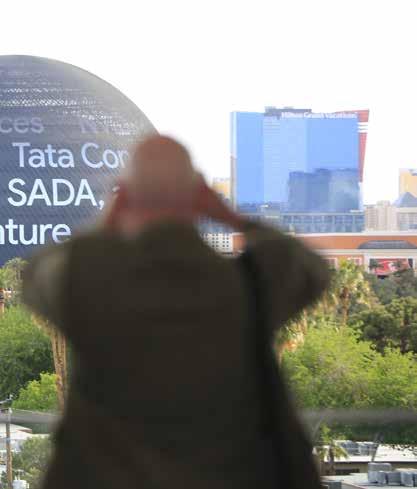
4K IP gateway for encoding, decoding, transcoding, and cross-conversion across live and cloud production environment; Matrox Vion for high-performance encoding, decoding, and transport; and Matrox Avio 2, an ST 2110/IPMX and NMOS-enabled IP KVM extender supporting high-resolution extension over standard networks. Together, these devices provide practical, scalable pathways to IP within existing infrastructures.
The portfolio is further complemented by Matrox Video’s broadcast developer solutions, including SMPTE ST 2110 network interface cards, SDI input/output video cards, and high-density H.264 encoders and decoders. As Matrox Video marks 50 years of innovation, the company reinforces its position as a trusted supplier of open, interoperable IP production technologies. With devices supporting IPMX, SMPTE ST 2110, and NMOS, Matrox Video enables seamless integration within multi-vendor environments while upholding its legacy of reliability and engineering excellence.
Ross video demonstrates MXL interoperability at NAB
Video highlighted its support for the Media eXchange Layer (MXL) initiative and the Joint Taskforce on Dynamic Media Facilities (JT-DMF) through interoperability demonstrations and technology previews at NAB. The Dynamic Media Facility (DMF) is an emerging architecture designed to make media systems more flexible, scalable, and interoperable by separating media processing into modular “functions” that can be dynamically deployed and connected across on-premises and cloud environments.
MXL (Media eXchange Layer) is the transport layer within DMF, providing a standardised way to move media between functions using shared memory rather than traditional streaming. This enables efficient, reliable interoperability between vendors while reducing processing overhead and avoiding vendor lock in. At NAB, Ross participated in an 11-vendor MXL interoperability demonstration hosted by AWS, while also showcasing software-based, containerised workflow control at its booth using RPM and DashBoard via the Catena control plane. Ross has also proposed a Security Workgroup within the JT-DMF, with several prominent partner companies already engaged.
PlexusAV, the professional AV division of Sencore, providing a suite of human-focused AV-over-IP solutions, highlighted its growing ecosystem of standards-based AV-over-IP solutions at NAB 2026 demonstrating how open technology and IPMX interoperability are simplifying AV system design. Built around IPMX, PlexusAV’s portfolio is designed to remove vendor lockin and give integrators greater flexibility when designing scalable, future-ready AV environments across corporate, education, broadcast and live event applications.
Steven Cogels, Director of Business Development at PlexusAV, commented, “IPMX changes the game, giving customers the freedom to build, scale and evolve their AV systems on their terms. Everything we’re showcasing at NAB is built on open standards. No proprietary ecosystems. No lock-in. Just scalable AV-over-IP that integrates with the network you’re already running. With a strong line-up debuting in North America, we’re set for a packed booth and back-to-back live demos.”
Showing for the first time in North America was be the IPMX-certified P-AVN-4E encoder and P-AVN-4D decoder, delivering high-quality, ultra-low latency video over IP for demanding AV environments utilizing JPEG-XS. All three are validated to comply with published IPMX transport, control and interoperability standards. Also on display, was be the IPMX-certified P-AVN-4 Transceiver, a versatile, high-performance AV-over-IP device capable of both encoding and decoding video, and the P-AVN-2E encoder and P-AVN-2D decoder, which provide efficient H.264/5 streaming options for projects where bandwidth and cost need to be carefully balanced, without compromising performance.
PleusAV continues to make the transition to AV-over-IP more practical with solutions that integrate seamlessly into existing environments. The P-AVN-3-HDBT IPMX Gateway Transceiver - the fourth IPMX-certified product to date - and P-AVNWP301H wall plate extends HDMI and USB-C connectivity by leveraging HDBaseT 3.0 technology. That technology enables seamless in-room experiences for installations of all sizes and scopes.Designed with usability in mind, the P-AVN-CL100 USB-C hub – now shipping - reduces cable clutter and simplifies connectivity in meeting spaces, supporting a cleaner, more intuitive user experience.
Additional solutions on show included the P-AVN-VA (AVover-IP management and control system), P-AVN-SCG (Stream Conversion Gateway), and P-AVN-SPK IPMX speaker line-up; demonstrating PlexusAV’s continued expansion towards complete, end-to-end AV-over-IP system design.
Sencore advances video delivery, decoding, and IPTV
Sencore addressed the demand for reliable, cost-effective and scalable video workflows that serve operators across broadcast, distribution and IPTV markets. Attendees could watch hands-on demonstrations of the MRD 8000, AFN Platform, new at NAB VB440, OmniHub 6/16, OmniHub PLAY, TXS 3800, and Centra Gateway - all designed to address the real demands of video delivery, distribution and monitoring. “As server and component costs continue rising, engineers are being asked to do more with tighter budgets. Cost-effective doesn’t mean compromising on capability,” said Seth VerMulm, Director of Product Management, Sencore. “The AFN Platform, MRD 8000, and Centra Gateway are designed for broadcast-grade performance without the overhead of costly server infrastructure.”
Many operators are running aging receiver decoders that were never designed for today’s multichannel, multiformat demands. Sencore addressed this with the MRD 8000, its newest and most capable receiver decoder, built on a GPU-accelerated platform in a compact 1RU chassis. On the contribution side, the AFN Platform is designed for live production and news gathering, delivering ultra-low latency encoding and decoding up to 4K/UHD with 12G-SDI. Its native SRT support allows engineers to simultaneously run satellite uplink and IP delivery from a single, future-proof 1RU chassis. Showing for the first time at NAB, the VB440 is a high-density monitoring and analysis platform designed for SMPTE 2110 and IPMX environments. Fully NMOS-certified and capable of monitoring up to 80Gbps of simultaneous streaming, engineers have the visibility to maintain signal integrity at scale. The VB440 also adds signal generator functionality and lip sync measurements for precise production setup verification.
OmniHub 6/16 is a modular, hot-swappable video processing platform available in 1RU and 4RU chassis, capable of handling dense multi-channel encoding, signal reception, digital turnaround, and simultaneous IPTV and QAM distribution from a single system. Paired with OmniHub PLAY, operators can deliver a fully managed IPTV experience to the PLAY-STB, Sencore’s Android-based set-top box, all controlled from a single web interface. Ideal for multi-site and commercial IPTV deployments where reliability and ease of management are critical. The TXS 3800 addresses two critical needs with a new ATSC 3.0 passthrough transcoding mode that increases service capacity to up to 20 services and a new ATSC 1.0 backward compatibility mode that allows engineers to demodulate ATSC 1.0 today and transition to ATSC 3.0 later without a hardware swap.
Completing Sencore’s NAB lineup, the Centra Gateway is an ideal solution to rising server costs. It handles video stream reception, transmission, conversion, and orchestration across multiple protocols and is deployable on-premises or in the cloud.
At NAB, Shure pushed deeper into the broadcast space with the DCA 901, a planar array microphone designed to handle complex, high-noise environments with precision. The DCA
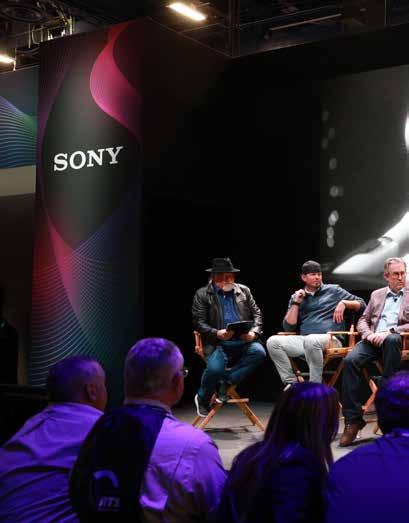
901 features 78 transducers arranged in a concentric pattern, enabling eight steerable beamforming zones within a single form factor. The concept is simple but powerful: capture exactly what you want while rejecting everything else. Think of it as directing a flashlight at sound, isolating subtle audio even in acoustically challenging environments like live sports or large venues.
While the design may feel familiar to those who’ve worked with Shure’s MXA series, the shift here is intentional. The DCA 901 removes onboard processing and introduces a broadcast-focused control interface, aligning more closely with production teams that need flexibility, speed, and integration into larger workflows rather than all-in-one DSP solutions. Use cases are already expanding. From NBA and NCAA basketball to baseball, marching bands, and even houses of worship, the microphone is proving its versatility. In large worship spaces, for example, teams are using it to recreate the depth and energy of the room for remote audiences, a growing priority as live streaming continues to evolve.
Beyond individual deployments, the DCA 901 is starting to integrate into broader ecosystems. Partnerships and third-party software integrations seen on the show floor signal that this isn’t just a product launch, it’s part of a larger shift where AV and broadcast technologies continue to converge, opening new opportunities for scalable, flexible audio capture in production environments.
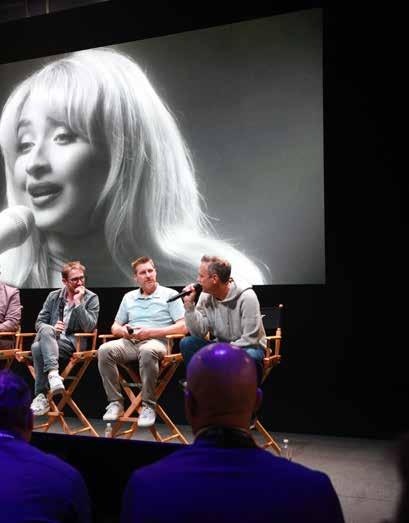
JB&A, a leading value-added distributor of broadcast, AV and IP workflow solutions, has announced its highly anticipated Pre-NAB Technology Event, returning for its 20th year, April 17-18, at the Flamingo Las Vegas. “Pre-NAB has become the ultimate curtain-raiser, offering attendees and exhibiting partners the chance to get ahead of the curve before the pace of NAB kicks in,” said Greg Burgess, Executive Vice President, JB&A. “With this event, we’re creating a hub for previewing the technologies, trends and product launches set to define this year’s main show. Now at a fresh new venue, we look forward to welcoming visitors in a few weeks’ time.”
With momentum building quickly, JB&A confirmed a strong first wave of exhibitors, including: Ashly Audio, Backblaze, Barco, Bitfocus, Bolin Technology, CAD Audio, Christie, Elgato, ENCO Systems, INFiLED, LiveU, Lumens, Matrox Video, Mark Roberts Motion Control, NETGEAR, On-Stage, PTZOptics, Quantum, VITEC and Vizrt. Designed to maximise time and value in a busy show week, Pre-NAB provides a focused, exhibition space where attendees can expect to get hands-on with technologies spanning the full broadcast and AV ecosystem, including video walls and projection, PTZ cameras, live production and graphics, AV over IP networking, contribution and encoding, captioning and accessibility workflows, storage, robotics and more. Megan Zeller, Senior Director of Business Development, Peerless-AV, said, “The JB&A pre-
show is an incredibly valuable opportunity for us to get in front of our customers and their customers in a more focused setting. As AV and broadcast continue to converge and evolve at pace, having dedicated time with integrators and consultants ahead of the scale and noise of NAB is essential. This preview event offers a more personal, boutique experience that really sets the tone for the week ahead.”
Shotoku USA, Shotoku Broadcast Systems’ North American operation, introduced the world to its PTZ Prompter Panner (P2) at NAB 2026. The latest addition to Shotoku’s Aura suite of advanced PTZ-centric solutions, P2 will be showcased alongside the TR-XPTZ control system. The Aura range joins several other major introductions, including the North American debut of the Swoop robotic crane family, and the launch of Quick-Ref, a revolutionary referencing system.
As PTZ cameras grow increasingly popular in broadcast and high-end AV environments, their use with teleprompters has remained restrained. In traditional PTZ/prompter setups, pan movement is limited to prevent the prompter hood from entering into the frame – restricting creative flexibility. The P2 overcomes this compromise. Its novel design mounts the prompter on a precision-controlled rotating platform, allowing the prompter and PTZ camera to pan together as a unified system The result is full unrestricted pan movement without frame intrusion, opening new possibilities for presenter-led productions.
Engineered to support larger PTZ and prompter payloads than earlier solutions, P2 delivers smooth, broadcast-quality on-air movement. When combined with the TR-XPTZ, prompter rotation and PTZ axes are combined in one camera channel control, enabling operators to adjust, store, and recall shots with ease manually or via automation, eliminating the need for manual intervention. According to James Eddershaw (CEO, Shotoku USA), “It’s clear that technical and commercial distinctions between broadcast and Pro AV have become blurred if not entirely removed. Cameras and lenses (and their remote-control systems) are some of the more obvious areas impacted by this shift through the expansion of improved PTZ systems. Shotoku, as a well-established leader in remote camera control, understands the pros and cons of these traditional vs modern approaches. Aura is a 100% direct result of specific customer demands, and now very much a part of the wider Shotoku solution. Aura is clearly more than just another cool product - it is the beginning of a new eco-system. TR-XPTZ with P2 are just the start of the Aura evolution.” Aura joins Shotoku’s Swoop robotic crane family, making its North American debut, along with QuickRef - a simple yet transformative advancement in robotic pedestal navigation for Shotoku’s SmartPed and Swoop-SP.
Cobalt Digital a founding partner in the openGear initiative, introduced the COBALT blueCORE, family of standalone processors at NAB. Designed to bridge the gap between SDI and ST 2110/IPMX, blueCORE delivers powerful, multi-function audio and video processing in a self-contained form factor –
bringing unmatched flexibility and efficiency to workflows in transition. It joins numerous other additions to Cobalt’s endto-end IPMX and ST 2110 ecosystem.
The COBALT blueCORE family combines all the audio and video processing functions required for live production in one single 1RU device. Its compact form factor, ease of operation and low power requirements (less than 80W for the ST 2110 version) make the blueCORE family ideally suited for live production in trucks, OB-vans and other space constrained environments. blueCORE’s self-contained form factor makes deployment fast and simple; power it up, connect the signals, and the device is ready to operate - with or without a computer. Support for both SDI inputs and outputs (copper and fiber), four channels of 3G processing - or one channel up to 12G, along with access to ST 2110/IPMX inputs and outputs make blueCORE a ‘must have’ for infrastructures transitioning to IP.
blueCORE units are fitted with a large touchscreen front panel for effortless, local configuration of all processing functions, an essential advantage in small OB vans, and fly packs where configuration changes from event to event. Besides the front panel, blueCORE includes four illuminated knobs, making it straightforward to perform functions such as color correction directly at the unit, without needing an external control panel. The unit can also be deployed in traditional fixed environments and be controlled remotely through a Web GUI, adding to its flexibility.
Capabilities include up/down/cross conversion, color correction, several flavors of HDR processing, audio routing and mixing, per-channel frame sync, frame rate conversion, audio embedding and de-embedding, SCTE-104 insertion as well as logo insertion – and many more base features, delivering extensive functionality in a single, compact unit. According to Suzana Brady, SVP of worldwide sales and marketing, “blueCORE answers the need for a fully featured processor that fits into even the most compact spaces while delivering an exceptional range of capabilities. With support for both SDI and ST 2110/IPMX, it is especially attractive to those transitioning from SDI to IP – everything they need is contained in one small unit.”
COBALT blueCORE joined Cobalt’s comprehensive NAB Show lineup, including the COBALT PACIFIC compression line, new 9925-FSx Frame Sync and 9981-LUTx Color Processor openGear cards, COBALT® ARIA Audio Monitor series, COBALT UltraBlue MV-SW multiviewers, COBALT SAPPHIRE ST 2110 Mini Converters, and COBALT INDIGO IP Gateways.
Panasonic showcased advanced video-production solutions
Panasonic showcased next-generation solutions that offer creative new possibilities for the increasingly diverse video-production landscape. High-impact venue productions using LED displays are becoming standard for sports and other live entertainment events. However, high-end visual productions typically require extensive equipment and a large team of specialists, often leading to increased costs as creative ambitions grow. The Arena Zone will present a stage surrounded by LED displays to demonstrate capture, staging and streaming solutions that offer ways for overcoming these challenges. Visitors will learn about innovative workflows cantered on the IT/IP platform KAIROS and advanced camera systems, clearing operational hurdles while maximizing crea-
tive impact.
The Arena Zone also presented a complete camera ecosystem that supports every stage of production, from capture to presentation and streaming. The NAB exhibit focused on two objectives: improving visual quality and optimizing production workflows for sports and live-entertainment venues. The AK-UCX100 4K Studio Camera was described as the world’s first studio camera to feature a built-in autofocus (AF) function. Visitors were able to preview a significant firmware update for the AK-UCU700 Camera Control Unit (CCU) scheduled for release this month, supporting high-speed shooting within SMPTE ST 2110 environments. The update will contribute to system simplification and enhanced operational efficiency at live venues.
The AK-UBX100 4K multi-purpose camera is built on the same high-performance platform as the AK-UCX100. This box-style camera provides studio-grade capabilities in a highly flexible form factor. The 2026 NAB Show was one of the world’s first opportunities to experience the update’s new features, including AF, Low Skew mode and optical transmission of SDI signals. A diverse range of cameras tailored for events of all sizes was also be on display, allowing visitors to experience lineup’s superior image quality and intuitive operability firsthand:
Panasonic also unveiled Image Adjust Pro, a powerful software plug-in for the Media Production Suite that enables status monitoring and image adjustment for studio and PTZ cameras from a PC or tablet. Visitors were able to connect to cameras throughout the booth and experience operations in
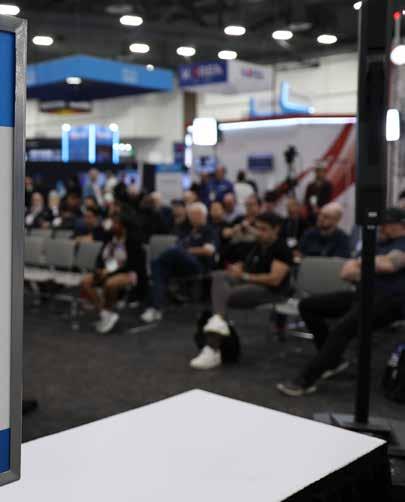
a simulated live production environment. Panasonic presented the groundbreaking capabilities of KAIROS for live entertainment at hands-on stations in the booth. KAIROS redefines the traditional functions of live switchers by offering an IT/IPbased architecture for selecting any desired resolution—not just the standard 16:9 aspect ratio for supporting LED displays of various shapes and pixel pitches. This flexible capability of KAIROS were on full display in the booth’s visual productions.
In response to the rising demand for podcasting and social media video content, there is an increasing need for high-quality production in compact spaces with simplified operations. Panasonic created a dedicated streaming studio. Visitors could learn about the latest production-efficiency solutions, cantered on Panasonic PTZ camera systems and the Media Production Suite - a flexible software platform that allows users to activate various features as needed. Advanced Auto Framing software uses AI-based detection of human subjects and sophisticated PTZ camera control to automatically deliver professional-grade framing. The result is stable, high-quality compositions without manual camera operation, even for moving subjects. Video Mixer software uses advanced AI to create various image compositions during live streaming. It includes AI Keying for seamless subject extraction and background compositing without a green screen and an AI Effect Filter for real-time, automated mosaic processing.
Visitors had an opportunity to see the new AW-UE5, the successor to the compact AW-UE4 with ultra-wide angle capabil-
ities but now supporting 4K/60p (including 2160/60p, 2160/59.94p and 2160/50p) for a broader range of high-end streaming environments. With NDI HX support, the AW-UE5 enables highly flexible, IP-based video production workflows. It is also the first Panasonic PTZ camera to feature Group Framing, which automatically adjusts the view angle to keep all subjects in the frame, as well as Preset Framing, which makes automated framing changes when a person enters a designated area. The new AW-UE5 is ideal for error-free visuals, even in small-scale operations.
And finally, to audio. In this area, Panasonic presented its comprehensive professional audio lineup, featuring the WXAM800 Ceiling Array Microphone, the WR-AV800 AV Processor, and various handheld and gooseneck wireless microphones combining clear sound quality and operational convenience. Visitors could also see Panasonic ecosystem that integrates Panasonic’s ceiling microphones and PTZ cameras into immersive meeting rooms with voice tracking that automatically keeps the camera angle focused on the active speaker.
Sony announced a new spatial capture solution that creates high-quality 3DCG (3D Computer Graphics) assets based on its “XYN” (/zin/) spatial capture suite of hardware and software solutions. Due to be available to professional customers in the United States starting summer 2026, the first release of this solution comprises three software tools: a smartphone application ‘XYN Spatial Scan Navi’ to assist with shooting spatial content; cloud application ‘XYN Spatial Scan’ for generating real-world spaces as high-quality 3DCG assets; and a rendering plugin ‘XYN Spatial Renderer Plugin’ for achieving high-quality, stable image display.
The spatial capture solution supports capturing, generating, and utilizing 3DCG assets optimized for virtual production in film, drama, and commercial production. It enables the efficient use of production-quality photorealistic 3DCG assets designed for use with large LED walls and real-time rendering environments in virtual production. Future plans include expanding multi functions and applications beyond virtual production, aiming for broader adoption in fields like gaming, animation, architecture, manufacturing, digital twins, and cultural heritage archiving. Furthermore, it will roll out plugins and services designed to integrate with standard 3DCG production tools and game engines across industries, contributing to the creation of seamless workflows.
Key features of XYN spatial scan include AR navigation functionality assists real-time shooting. By connecting to a Sony Alpha camera and a smartphone, it visualizes the required shooting position and angle using AR (Augmented Reality), guiding users to the optimal shooting position. It enables capturing the necessary photos to generate a complete, high-quality 3DCG asset. The peal-time preview feature visualizes the shooting status to minimize missed shots.
Adobe’s presence at NAB marked a decisive step toward AI-driven creative workflows.
Audinate Group, developer of the Dante AVoIP platform, showcased how Dante brings together audio, video, and control for modern broadcast and AV production environments. Panasonic showcased next-generation solutions that offer creative new possibilities for the increasingly diverse video-production landscape.
The overall global digital signage market was valued at USD 31.09 billion in 2025 and projected to reach USD 58.42 billion by 2033, a CAGR of 8.2% from 2026 to 2033. The outdoor signage market has the potential to grow beyond the current level of 30-40% of the total digital signage market, with advances in the technologies of both digital billboards and kiosks. Bryan Denyer, editor of AV News reports, with additional reporting by Martin Lienau, Product Manager, Sharp Display Solutions.
While most surveys of the market for digital signage tend to group indoor and outdoor solutions together, further analysis reveals that outdoor signage typically accounts for 30–40% of the total spend on digital signage. Spending on outdoor digital signage accounts for a higher-than-average cost per installation for a number of reasons, including increased hardware costs (to account for weatherproofing and higher brightness); larger display formats; and infrastructure requirements.
Nonetheless, the current market for outdoor digital signage (DOOH) was valued (2025 estimate) at USD 9 – 12B, rising to USD 15 – 20B in 2030. This growth in the market can be attributed to increased demand for video walls and interactive outdoor kiosks (including both touchless and gesture based solutions). Improved energy efficiency of these solutions will encourage new applications for both LED and solar powered displays. In addition to signage hardware developments, we can expect to see further improvements to programmatic DOOH advertising and real time data driven content (such as weather reports and traffic updates) to increase engagement of consumers. We can also expect to see incremental improvements in visual display quality with large format LED video walls increasingly present in urban centres.
The outdoor digital signage market is rapidly expanding, driven by DOOH advertising, smart city investments, and advances in display and connectivity technologies. Global digital signage revenues are forecast to approach USD 50 – 60B by 2030. “Alongside technological innovation, we are also
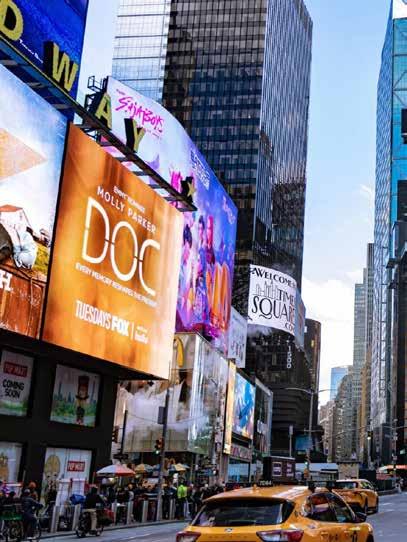
seeing move in the advertising market back to out of home advertising, as companies look to tie together their online presence with their physical presence, with a range of new creative techniques to reframe the way we use digital signage. The combination of the two is leading to a very exciting time for the digital signage industry, and we are proud to be part of this growth”, said Martin Lienau, Product Manager, Sharp Display Solutions Europe.
While the forecasts are almost universally positive, there are some technological constraints on outdoor digital signage. These constraints shape how reliably, visibly, and securely outdoor digital signage can operate in real-world environments. At the top of the list are the inevitable environmental and weather constraints. Outdoor digital signage screens must survive heat, cold, moisture, dust, and UV exposure. Outdoor displays typically need IP65-rated enclosures to protect against rain, dust, and humidity. Extreme heat or cold can damage LCD and LED panels. Enclosures often require active cooling or heating systems to maintain safe operating temperatures. Direct sunlight can wash out screens or de-
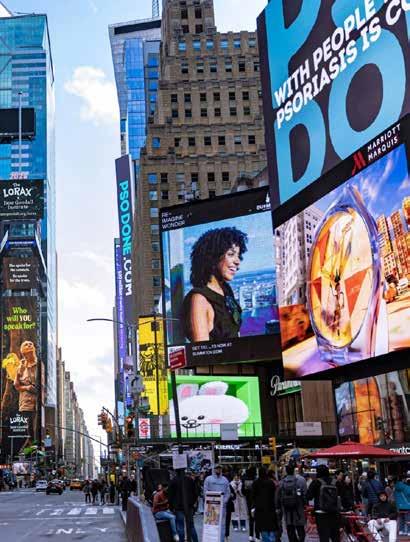
grade materials. Modern systems use anti-reflective glass and UV-resistant coatings. Finally, outdoor display mounts must withstand wind loads and vibration, especially for freestanding totems or roadside billboards.
Outdoor digital signage screens must remain fully readable in full daylight. Outdoor LCDs often exceeding 2,000 nits to stay visible in sunlight. This poses something of a conundrum when it comes to energy efficiency, partially offset by sensors which adjust brightness automatically to reduce glare and save energy. Anti-glare or anti-reflective coatings can be essential for readability in direct sunlight.
“Our Sharp Q Series Outdoor Direct View LED modules are IP65-rated, operate across a temperature range of -30°C to +50°C, and deliver up to 5,500 cd/m² brightness, so the image holds up in direct sunlight rather than disappearing into it. Those specs translate directly into customer confidence, and that matters when you’re asking someone to invest in a permanent outdoor installation”, comments Martin Lienau.
Constraints imposed by the display hardware itself are sometimes joined by environmental, logistical and social factors. For example, outdoor digital signage installations require stable power and network access, which is not can-
not always be taken for granted. An appropriate power supply, for example, might require the installation site to be trenched, or surge protection to be installed. Reliable wired or wireless connections are needed for content updates. 5G connectivity is increasingly provided as an alternative means of connectivity.
e availability of power and data connections to outdoor locations remain as limitations on the growth of outdoor digital signage. But the potential still exists, with both current and projected deployment of video walls in public spaces and transportation hubs, including airports, train stations, and bus to provide travellers with real-time information, advertisements, and entertainment. Large-format displays are highly effective for displaying schedules, wayfinding information and emergency alerts, ensuring that critical messages reach large audiences clearly and efficiently. Video walls are widely used in sports arenas and entertainment venues, where they enhance the overall spectator experience by offering high-definition replays, live feeds and interactive content.
Technical issues aside, fulfilling the purpose of outdoor digital signage means that the installation cannot be hidden away in secure or protected environments. Outdoor digital signage screens are exposed to the public and almost always run the risk of cybercrime and vandalism. Toughened glass, steel casings, and tamper-proof designs are standard for virtually every display likely to attract damage, as are secure mountings. Cybersecurity issues pose a much more diverse threat. At the very least, networked signage must be protected from unauthorised access to the CMS. Beyond these deliberate threats to the safe and efficient operation of outdoor digital signage, those charged with operating such an installation or network must contend with the usual pitfalls that are present with many IT solutions. Outdoor digital signage hardware must operate continuously with minimal downtime. Outdoor-rated LEDs and LCD screens degrade faster due to heat
and UV exposure. Cleaning, firmware updates, and hardware checks are essential, and often require remote health checks to detect failures early. “Remote management changes the economics of outdoor signage, particularly when you’re operating across multiple sites. If updating content or diagnosing a problem means sending someone out, the operational cost adds up fast. Our ePaper displays connect via Wi-Fi, Bluetooth, or USB and work with selected CMS partners, so content can be updated without anyone needing to physically visit the installation. This increases the potential ROI and also means displays can be used in locations that previously may have been impractical or too expensive to consider,” said Lienau
Outdoor environments, however, govern how people interact with screens; for example, outdoor touchscreens must work in rain, with gloves, and in varying temperatures. Motion, contrast, and font size must account for distance, glare, and ambient light. AI-driven CMS can adapt content to weather, time, or audience, but requires robust data and connectivity. Unfortunately, the more sophisticated the solution and installation, the more they are likely to attract an operational cost penalty. For example, high brightness and cooling systems consume significant amounts of power. LED displays are more energy-efficient than older technologies but still require substantial power outdoors.
For years the technology of digital signage was dominated by LCD, but as the advantages of LED became apparent in the technological paradigm has been apparent. Transparent LED is expected to continue to grow at a significant CAGR. Trans-
parent LED screens can offer transparency levels beyond 80% and high resolution. In addition, they are adequately efficient in terms of energy, thus reducing energy consumption and optimising the overhead expenditure of users. All these factors are anticipated to catapult the demand for transparent LED screens to 2030, thereby supporting the growth of the segment as a whole.
“Energy efficiency is going to be an increasingly important part of the conversation, both because of cost and because more clients are being asked to account for their energy consumption. The solar-powered ePaper totem we demonstrated at ISE is a good illustration of where this can go. No mains connection, battery storage, wireless communication, fully self-contained. That’s not a concept for a distant future, it’s something we were showing to customers in Barcelona last year, and it won a ministerial award in Japan for its energy performance,” explains Lienau.
He adds: “ePaper is worth mentioning because it works on entirely different principles. Where LCD struggles in bright light, [ML1] ePaper performs better, the same way a printed poster does. Not all ePaper technologies are meant for outdoor and sunlight, but the latest ones are focusing on this market. A plus point of ePaper is that it only draws power when content changes, which makes it a realistic option for locations where running costs or cabling are a constraint. It’s a different tool for a different job, but it’s opening up parts of the market that weren’t accessible before.”
But, Lienau acknowledges ePaper displays are unlikely to be the ideal solution in every instance: “For high-brightness, high-footfall environments, direct view LED is still the right answer, and the technology will keep improving. But the next wave of growth probably isn’t in replacing existing large-for-
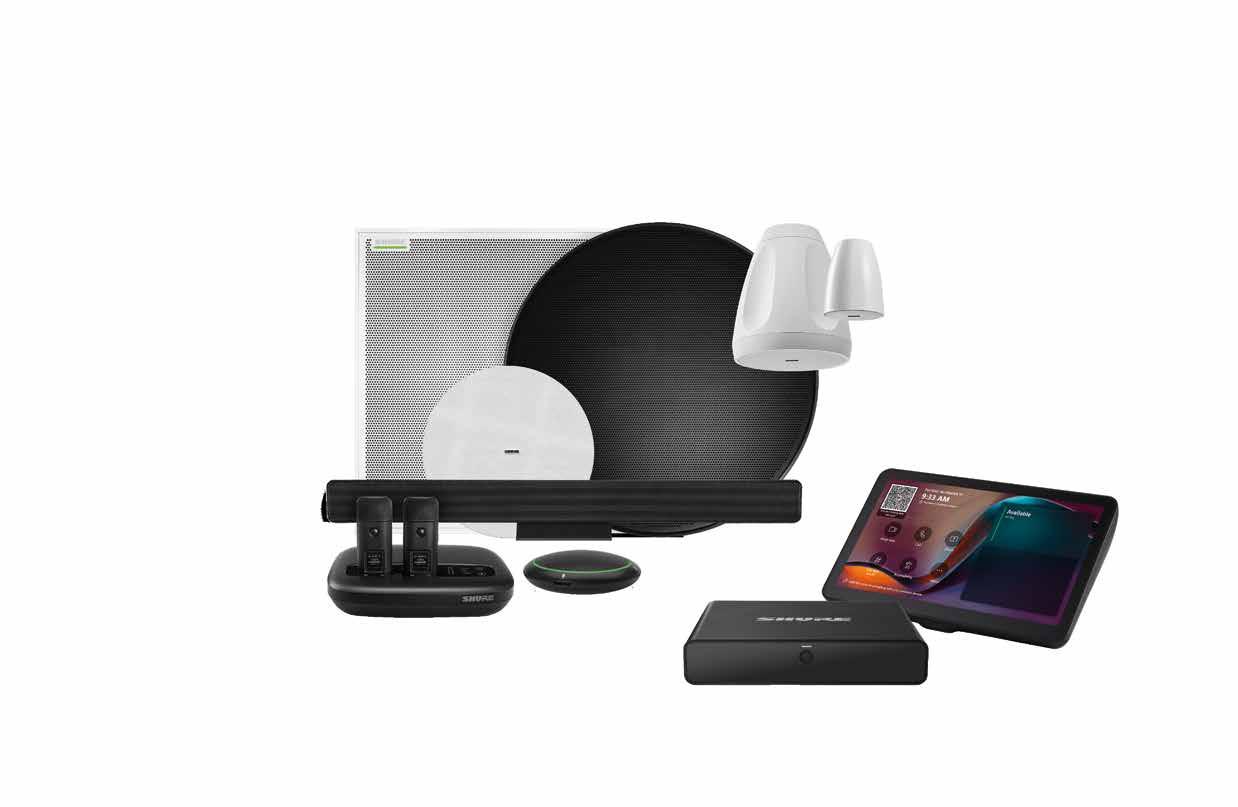
Seamlessly design, deploy and manage custom AV solutions for Microsoft Teams Rooms of all shapes and sizes and deliver pristine audio quality with unmatched scalability, effortless integration, and simplified management. The Windows-based Compute with built-in IntelliMix® Room DSP and intuitive Touch Panel provide a powerful base kit optimized for flexible use with the comprehensive Microflex® Ecosystem portfolio of conferencing audio solutions.
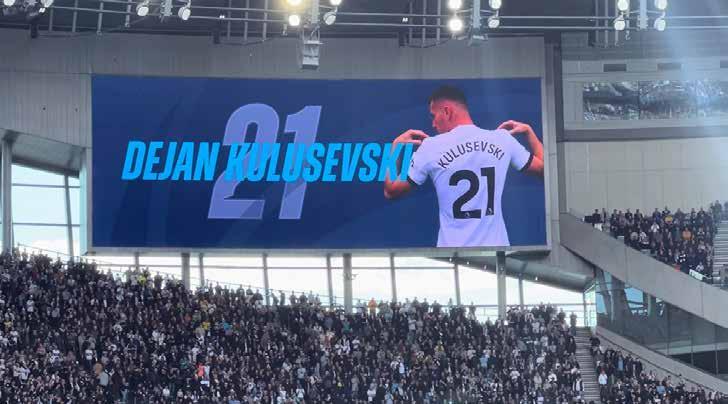
mat LED screens. It’s in bringing digital signage to locations and applications where it wasn’t viable before, and that’s where lower-energy technologies have a real role to play. Real-time, data-driven content is also part of this. A display that shows relevant, live information is more useful than one cycling through static creative, and that’s a straightforward argument to make to any operator thinking about return on investment.”
One further trend sees demand for 4K digital signage displays with embedded software and media players rising. These solutions offer customers an affordable Ultra HD digital signage solution, which is also expected to drive demand. The evolution of marketing for innovative. sophisticated products, such as complicated financial products, that need informative and succinct advertisement content are also predicted to drive demand. Digital signage offers the necessary quality information, to a large number of viewers, by utilising large display screens across locations with concentrated target audiences. In the not too distant future, the integration of biometric technology into digital signage has will lead to the development of kiosks and video walls with features including such as gaze tracking. Gaze tracking helps to track consumer behaviour for effective marketing and product positioning.
Technological advances have led to the enhancement of the quality of advertisement content, so creating a favourable impact on the target audience. The adoption of these emerging technologies by digital signage providers is anticipated to boost overall industry growth. Recent product innovations focused on sustainability and energy efficiency further illustrate
how advanced display technologies are reshaping the digital signage landscape. The uplift in the quality of advertising quality is reflected in forecasts for growth in the OLED sector. OLED displays are particularly effective because of their superior visual quality, making them highly engaging.
Retailers and luxury brands use OLED screens to create unique, eye-catching advertisements and product showcases that engage customers and enhance the shopping experience. OLED displays can be used for everything from displaying high-definition product images and videos to interactive touch interfaces that guide customers through product information, or allow them to customise their shopping experience. The rapid increase in OLED adoption is expected to accelerate demand for advanced digital signage solutions, driving higher investments and innovation across the overall market.
Displays in the categories above 52 inches are expected to grow at a significant CAGR. The demand for larger outdoor digital signage is also driven by the adoption of innovative marketing strategies focusing on visual storytelling and experiential marketing. Large-format displays, which with screen sizes of 52 inches and more, allow businesses to use high-resolution video, eye-catching graphics, and interactive content that engages viewers and encourages them to interact with the brand. This has led to a surge in investment by companies that want to stand out in a crowded market and deliver powerful, impactful messaging.
The 4K resolution segment dominated the digital signage industry, in general, accounting for the largest revenue share last year. The availability of 4K video cameras, production tools, and content management systems has made it easier for businesses to create high-quality, 4K-compatible media.











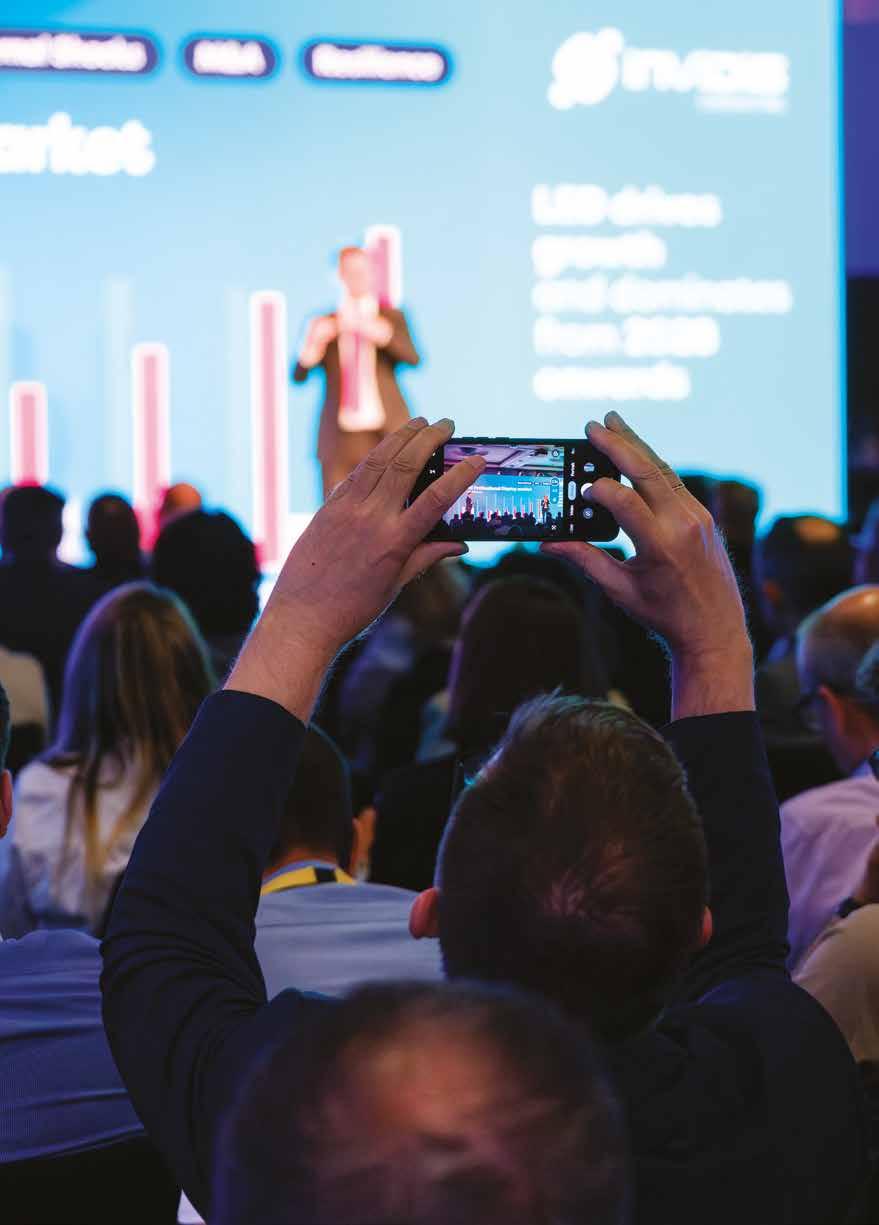

This trend is important as companies can leverage more visually engaging content tailored for 4K displays without facing significant production barriers. Industries that rely heavily on visual presentations, such as retail, entertainment and hospitality, have quickly adopted 4K technology to offer richer, more impactful advertising and customer experiences.
But it will not stop at 4K. The 8K segment is expected to grow at a significant CAGR. The adoption of 8K displays is driven by brands seeking to create highly engaging, visually striking experiences that capture consumer attention. As content creation tools and media players increasingly support 8K resolution, businesses can deploy ultra-high-definition signage for premium retail spaces, luxury showrooms, and large-scale public installations, enhancing brand perception and customer engagement. This trend is expected to encourage greater investment in advanced display technologies within the market.
While the hardware component of outdoor digital signage consumes the lion’s share of the budget, the software component is anticipated to grow at a significant CAGR. The growth of omnichannel marketing strategies has also driven demand for comprehensive digital signage software solutions. Brands are increasingly seeking ways to create a seamless, integrated experience across physical and digital channels. Digital signage software is a crucial tool for ensuring messaging is consistent and synchronised with other marketing efforts, whether online, on mobile apps, or in-store. The ability to manage and deploy content that aligns with digital and social media campaigns helps create a unified brand identity, improving brand recall and enhancing customer loyalty. Manu-
facturers are increasingly combining hardware with advanced software to simplify content management and support largescale digital signage deployments.
The outdoor digital signage sector is expected to grow at a significant CAGR. The demand at outdoor locations is expected to rise owing to the growing transportation sector, especially in developing countries. In addition, the need to promote products effectively and on a large scale and emerging popular trends, such as election campaigns, introductory offers on products and services, and the increasing number of live concerts and shows, are likely to boost the adoption of digital posters in open locations, thereby augmenting the outdoor segment growth. For future growth applications in the outdoor signage market, Lienau believes that: “Transportation is an obvious one, and it’s where we’re seeing consistent demand. Airports, rail stations, and bus terminals all need displays that can handle bright, variable ambient conditions while running reliably with minimal downtime. For semi-outdoor installations, the MultiSync P Series is targeting integrators working on totem installations for transport hubs.” Furthermore, Lienau argues: “Beyond that, there’s a category of smaller, more distributed outdoor locations, bus stops, pedestrian areas, retail forecourts, where the barrier has historically been infrastructure. Running power and data cabling to every site is expensive. A self-contained solar or battery-powered ePaper totem removes that barrier, which is why we think that’s a genuinely interesting growth area, even if it’s still early days.”

Conveniently located at Lord’s Cricket ground in Central London. The AV Showcase event brings together manufacturers, leaders, innovators, and professionals to share insights, spark collaboration, and shape the future of the AV industry. This year promises even more new technology, impactful education programme and valuable networking opportunities.
REGISTRATION IS NOW OPEN!








The retail segment dominates the market currently, accounting for the largest revenue share last year. The retail sector demands digitised advertising to market and promote products and services as a factor in an omnichannel strategy. The competition among retailers, owing to the variety of product offerings in the industry, has led to the growing awareness of effective marketing strategies. To capitalise on these benefits, retailers are increasingly investing in advanced digital signage solutions that allow dynamic content display, targeted promotions, and real-time updates to engage customers more effectively. “There is huge opportunity in the growth of smart cities for outdoor digital signage, as the expectation of the modern city-goer is an increasingly digital experience. With infrastructure becoming more-and-more connected, outdoor digital signage is the key link between an individual’s digital world and the physical city. We are excited about the creative uses of digital signage that these smart cities open up and are working closely with infrastructure sectors such as transport to develop the best experiences for end users”, comments Lienau.
But retail is by no means the only developing market. The healthcare sector is projected to grow at the fastest CAGR from 2026 to 2033. The integration of interactive digital signage has driven growth within healthcare. Interactive kiosks and touchscreen displays allow patients and visitors to access information, find directions, schedule appointments, and even complete basic administrative tasks independently. This self-service capability helps reduce wait times, improve time management, and enhance the patient experience. Interactive kiosks gather patient feedback in real time, providing healthcare facilities with valuable insights to improve service quality and care.
Educational campuses are also deploying digital signage to relay event information, emergency announcements and wayfinding guidance. HD facilities, meanwhile, rely on digital signage to enhance patient experiences, manage queues, and support telehealth messaging. These applications highlight the versatility of outdoor digital signage and its ability to deliver timely, relevant content across both public and private spaces. The European market benefits from adopting interactive kiosks as part of broader efforts to enhance customer service and streamline business operations. These kiosks can be integrated with loyalty programs, enabling businesses to offer targeted promotions and personalised discounts that appeal to individual customers.
Locally, the UK digital signage market is expected to grow significantly to 2030. The UK’s sports and entertainment industry is driving digital signage growth by adopting advanced displays to enhance fan and visitor experiences. Football stadia, music venues, and theaters are using dynamic outdoor signage for live updates, interactive content, and targeted advertising, creating new revenue streams. These installations not only enhance audience engagement but also offer sponsors high-impact advertising opportunities. As the sector continues to invest in modernising facilities, the demand for innovative and immersive digital signage solutions is steadily increasing.
Also in Europe, the outdoor digital signage market in Germany held a substantial revenue share last year, driven by its robust retail landscape, advanced transportation systems, and a strong push toward sustainable tech innovations that enhance customer engagement and operational efficiency. Businesses here widely adopt interactive displays and AI-integrated solutions to deliver tailored content, reducing traditional signage while boosting energy savings and user satisfaction in high-traffic areas such as stores and public hubs. “AI-driven content is revolutionising the industry, and it is changing so fast it is hard to predict its effect. As content quality increases and becomes more democratised, people expect more from their signage, a trend we expect to see
echoed with AI-driven content. We predict that digital displays will become more-and-more pivotal as businesses look for innovative ways to showcase the new content that they are generating,” adds Lienau.
Asia Pacific held a significant share of the global market in 2025. The growth can be attributed to the growing awareness regarding the benefits of digital signage. Japan and China are anticipated to witness significant growth primarily due to the rising application in retail stores, corporate offices, hospitals, and hotels. Increasing disposable income has surged the visitors to malls and multiplex stores in the emerging countries in Asia Pacific. Enterprise is therefore leveraging this opportunity to promote its offerings through large displays, which helps it attract the targeted audience in a better manner. With the rising number of shopping malls and multiplexes, the adoption of digital signage in the hospitality industry is expected to increase over the forecast period.
The Japan outdoor digital signage market is expected to grow significantly to 2030. Japan’s extensive railway and subway systems also rely heavily on digital signage for real-time passenger communication. Digital boards at stations and on trains display arrival times, service disruptions, platform
changes, and multilingual instructions. This is particularly crucial in cities like Tokyo, where millions of passengers rely on accurate and up-to-the-minute information to navigate the transit network efficiently. The digital transformation of Japan’s public transport system has made these signage installations functional and essential to urban mobility. Beyond transportation, growing innovation in interactive and engagement-driven digital signage solutions is further expanding the market’s use cases across entertainment and public spaces.
For integrators seeking to exploit the opportunities available in outdoor digital signage, Lienau believes that: “Serviceability is underrated. An outdoor display in a busy public location that goes dark is an immediate problem, and if fixing it requires specialist access or a long wait for parts, that reflects badly on everyone in the chain. The Q Series Outdoor modules are designed for both front and rear servicing, which keeps maintenance straightforward and minimises downtime in practice, not just on paper”.
Lienau adds: “Flexibility also matters. The 1:1 modular format of the Q Series means the display scales to the space rather than the other way around, which gives integrators more options when specifying. And as sustainability starts to appear in more procurement criteria, being able to offer a product like ePaper for the right use case, rather than defaulting to LED for everything, is worth having in the toolkit.”
Clear-Com has highlighted its support for worship teams through professional communication solutions, with the deployment of its EQUIP wireless system at Youth With A Mission – Korea Branch (YWAM Worship South Korea). YWAM Worship Korea is an international training and mission organisation that regularly hosts worship services and mission-focused gatherings. Like many Korean churches, YWAM relies on video content to share its mission and promote activities, and their production team needs clear, dependable communication to coordinate directors, camera operators, and lighting staff during both rehearsals and live services.
Clear-Com worked with its local Partner, Sama Sound, to demonstrate the EQUIP wireless intercom system at Sinyongsan Church. The system included one EQUIP base station, two transceivers, and five EQUIP dual-channel all-in-one headsets, which connected the technical director, three cameramen, and a lighting engineer. One transceiver was positioned near front-ofhouse and the second near the stage to ensure reliable coverage across the 30-metre hall, enabling seamless roaming between transceivers as team members moved throughout the space while maintaining stable full-duplex communication. EQUIP operates in the 5GHz band, providing interference-resistant coverage well suited to YWAM’s active production space.
The EQUIP system delivered low-latency, stable, and high-quality audio, enabling the production team to communicate clearly and respond to cues in real time. By providing hands-free communication, the system allowed the team to coordinate efficiently, maintain focus on tasks, and ensure a smooth worship experience for attendees. “Our filming environment is usually very noisy, but it was great to hear everything clearly without any disconnections” said Kim Ju Nam, a member of the Jesus Mission Media Team at YWAM. Edan Kwon, Product Manager at Sama Sound, added, “Many worship teams have never experienced a professional intercom system before and rely instead on office communication
tools. When they experience the EQUIP system for the first time, the difference in audio quality and reliability is immediately clear. It’s a scalable, professional solution that fits well within the needs and budgets of worship production teams.”
The demonstration also reinforced the broader impact of Clear-Com solutions in worship environments. Brian Chow, Regional Sales Manager, North Asia at ClearCom, noted, “Projects like YWAM Worship Korea underscore how Clear-Com solutions can make a meaningful impact in worship environments. By working closely with Partners like Sama Sound, we’re helping worship teams improve communication and streamline production workflows.” Through this collaboration, Clear-Com’s EQUIP wireless intercom system continues to provide worship teams with dependable, high-quality communication that enhances coordination and elevates live worship production.I
In the heart of Lyon’s historic old town, Cour des Loges, a five-star Radisson Collection Hotel, has recently reopened following an extensive two-year renovation, which includes a fully integrated audio system designed to enhance every guest experience across the venue. Located within a renaissance complex dating back to the 14th century, the landmark hotel features 61 unique rooms and suites, two restaurants (including Les Loges, (which recovered its Michelin star following the renovation) as well as a collection of spaces designed for an exceptional hotel experience. To unify every area with a consistent yet adaptable sound atmosphere, integrator PLUG’In Design delivered a complete audio solution centred on six Powersoft MEZZO 604 AD compact amplifiers.
Headquartered south of Lyon and with offices across France (in Montpellier, Nantes and Paris), PLUG’In Design is an AV integrator specialising in professional environments, from workspaces to high end restaurants and hotels. For Cour des Loges, the objective was to design a fully customised sonic environment across all areas of the hotel, including inner courtyards, lounges, both restaurants, reception and retail spaces. Preserving the architectural integrity of the historic structure was paramount. The property’s original stone walls and Renaissance features limited cable routing options and restricted conventional installation approaches. “Working with a heritage building presents a true challenge. It demands expertise and specific solutions to turn those challenges into a successful project,” says Joshua Bednarski, CEO of PLUG’In Design. “The historic architecture made cable routing through the walls particularly complex, requiring us to carefully adapt to existing constraints while delivering a solution that remained simple, intuitive and reliable for daily operation by hotel staff,” Bednarski explains.
The result is a discreet yet powerful audio infrastructure that integrates seamlessly into the hotel’s refined aesthetic. At the core of the installation are six Powersoft MEZZO 604 AD amplifiers. Each unit is a 600 W, four-channel compact amplifier with integrated DSP and Dante networking, delivering the reliability and sound quality associated with the Powersoft brand in a chassis half the size of a standard 1U amplifier. The AD version extends networking capabilities with Dante and AES67, enabling remote control and monitoring while ensuring flexible signal routing throughout the property. The compact form factor, combined with the included mounting kit, allows the amplifiers to be installed discreetly within constrained technical spaces, a crucial advantage in a centuries-old building. “The Powersoft amplifiers provide flexible multi-zone control and precise management of different sound atmospheres throughout the property,” says Bednarski.
The amplifier system powers Biamp ENT203-BK, ENT220-BK and ENT206-BK loudspeakers, supporting clear and balanced audio reproduction tailored to each
area of the hotel. Centralised control is delivered via intuitive touchscreen tablets, allowing staff to manage audio levels and zoning easily without requiring technical expertise. “Our installation is based on three things,” Bednarski says. “Firstly, it centralises control, using touchscreen tablets for easy management. Secondly, the speakers provide exceptional audio clarity and a discreet design, seamlessly blending in with the space’s décor. And finally, we use a modern network infrastructure that includes Powersoft amplifiers, enabling flexible control of the different sound atmospheres across the entire property.”
Throughout commissioning, the focus remained on achieving clarity and tonal balance while preserving conversational comfort in lounges and dining areas. The system allows distinct ambience profiles to be created for different zones, ensuring the atmosphere aligns with the hotel’s identity. Operating seamlessly daily, the new sound system delivers consistent audio performance while remaining visually unobtrusive within the historic setting. “Today, the system fully meets the client’s expectations, delivering everything they’d hoped for from a user experience perspective,” Bednarski enthuses. “And that’s our greatest source of satisfaction.”
Yves Grardel, Cluster General Manager of Radisson Blu Lyon & Radisson Collection Cour des Loges Lyon, concludes: “The audio installation carried out by PLUG’In Design at Cour des Loges, a Radisson Collection hotel, stands out for its discretion and its quality. The integration perfectly blends with the architecture of the venue while delivering an immersive and elegant sound experience. Having a high quality audio system is essential in a venue like Cour des Loges: it plays an integral part in shaping the atmosphere, enhancing guest comfort, and elevating every space.’” By combining compact, network-enabled amplification with careful integration planning, PLUG’In Design has demonstrated how modern, high-performance audio solutions can be deployed successfully within even the most architecturally sensitive environments.
ST Engineering Antycip (Antycip), a European specialist in simulation and immersive visualisation solutions, has delivered a three-sided immersive CAVE at the ICube laboratory at the University of Strasbourg, marking a new milestone in the development of immersive academic infrastructures in France. This new installation enhances the InVirtuo platform, part of ICube’s GAIA research cluster (Computer Graphics, Analysis and Artificial Intelligence), and forms part of the national EQUIPEX+ CONTINUUM programme, which focuses on enabling collaborative continuity between digital systems and human interaction.
Designed and integrated by Antycip, the CAVE config-
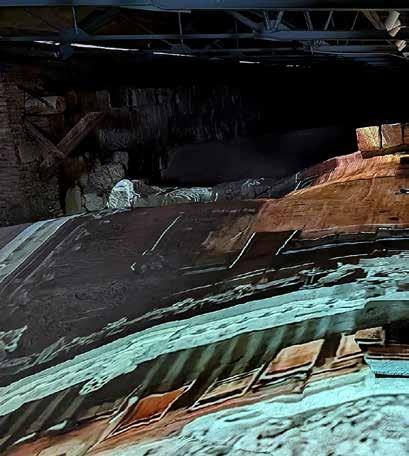
uration presents three specialist projection screen faces, a custom mechanical support structure, next-generation BARCO I600 projectors and a high-precision custom floor surface. The entire system has been carefully calibrated to deliver seamless visual and geometric continuity, ensuring a stable and realistic immersive experience. Thanks to this architecture, users can move freely within a real-time rendered 3D environment that dynamically adapts to their viewpoint, enabling fully immersive interaction and collaboration. Developed to support both research and teaching, the CAVE will contribute to the work of the IGG team (Geometric and Graphical Computing) in areas such as human-computer interaction, scientific visualisation and virtual reality. It will also support teaching activities within the Image and 3D Master’s programme and the Computer Science Engineering Master’s track – Image, Virtual Reality, Interaction and Games.
In addition, the facility will be used for industrial services and collaborative research projects conducted through the GAIA platform. “This immersive CAVE provides us with a state-of-the-art platform for both our research and teaching activities. It enables us to explore new forms of collaboration and experimentation by combining different immersive technologies, from the CAVE environment to VR headsets, creating rich and interactive hybrid environments,” explained Dominique Bechmann, Professor of Computer Science, University of Strasbourg. Johan Besnainou, Director France &
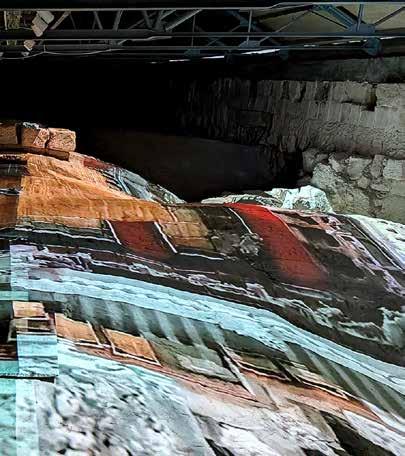
Spain, Antycip
added: “This project perfectly illustrates our commitment to supporting academic institutions in adopting the most advanced immersive technologies. We are delighted to have supported the University of Strasbourg in delivering this installation.” With this installation, Antycip further reinforces its role as a trusted partner for academic institutions across Europe, designing bespoke immersive systems that place technology at the service of knowledge, collaboration and scientific innovation.
Salamanca Cathedral has opened a striking immersive audiovisual installation combining large scale video mapping, lighting and spatial audio as part of an engaging exhibition programme. Titled ‘Casa/Refugio/Protección para todos’ (‘Home/Shelter/Protection for All’), the experience transforms the cathedral’s vaulted architecture into a dynamic narrative environment for attendees to enjoy in Spain’s Golden City. Set within the rarely accessed space above the nave of the 16th century New Cathedral, the project posed a series of technical challenges. The installation spanned a long, arched space which required projections on opposing sides of the
structure to create a fully immersive visual narrative. Six high brightness projectors arranged in two banks of three were specified to create seamless, edge blended imagery across the high-resolution 3600 × 3840-pixel projection canvas: the historic stone surfaces. Absolute synchronisation and pixel accurate playback were essential, while all equipment needed to operate discreetly and reliably within a protected heritage setting, despite fluctuating temperature and humidity levels.
To meet these requirements, two Datapath FX4 video wall controllers were selected as the central video distribution platform. Receiving high resolution content from a Touch Designer based media server, the FX4 units split and distribute video across all six projector outputs with frame accurate precision, ensuring image consistency across the full projection canvas. The FX4’s flexible output configuration enabled the creation of two continuous projection surfaces, while its proven reliability supported the installation’s autonomous daily operation. The system runs on a programmed schedule with automated startup and shutdown and supports motion-triggered daytime playback as well as manually controlled guided presentations in the evening. Working within the Touch Designer environment, the FX4 allows real-time content control and synchronisation with DMX controlled lighting and a spatial 4.1 audio system, delivering a fully immersive visitor experience.
Since launch, the ‘Home/Shelter/Protection for All’ installation has been operating successfully as part of the IERONIMUS multimedia exhibition programme, welcoming thousands of visitors and offering a unique perspective on Salamanca Cathedral’s architecture. By combining creative technology with careful technical design, the project demonstrates how modern video systems can enhance cultural heritage spaces without compromising their integrity. “Delivering an installation of this scale inside a historic cathedral required absolute confidence in the video infrastructure,” says Markus Schroll (Esther Pizarro Studio), Technical Director on the project. “With multiple projectors, high resolution content and a challenging heritage environment, reliability and precision were critical. Datapath’s FX4 gave us the control and stability we needed to manage complex video distribution seamlessly, allowing the creative and architectural details of the space to take centre stage.”
“We’re extremely proud to have been involved in a project of this cultural and historical significance,” says Carmen Jerez, Regional Sales Manager at Datapath. “Working within a landmark such as Salamanca Cathedral is both a privilege and a responsibility, and it’s rewarding to see our technology supporting an installation that enhances the visitor experience while respecting the integrity of the space.”
French rapper Tiakola has rapidly become one of the country’s most influential young artists, drawing millions of listeners with a melodic approach to rap that blends rhythm, emotion and cinematic production. When planning the visual identity for one of his recent tours, the creative team behind the show sought to build a stage environment that could evolve continuously throughout the performance. At the centre of that design was the Naostage K SYSTEM, the world’s first and only beaconless performer tracking ecosystem that enabled lighting, video and automation elements to respond dynamically to the artist’s performance and the stage architecture around him.
The scenography and lighting design for the production were led by Julien Peyrache and Micha Berzon of ALIEN le studio, who were brought into the project by Nonstop Productions. Early discussions with producers Morgan Antonutti and Marie-Sandrine Martin focused on creating a highly kinetic stage environment where the artist, musicians and scenographic elements could move freely throughout the performance. The resulting design incorporated motorised musician lifts, suspended lighting pods and a large, automated LED screen, alongside a custom mirror-clad sphere that served as the centrepiece of the show’s opening sequence. With so many moving elements interacting within the same performance space, the team required a powerful tracking platform capable of maintaining precise spatial awareness across the entire 8 x 22 metre main stage and 4 x 11 metre B-stage. They accomplished this using two KAPTA tracking sensors mounted on the overhead truss structure. “We’d been following Naostage for some time, but everything really clicked when we saw the system demonstrated in the field at the Poupet Festival,” says Peyrache. “What immediately stood out was how flexible it was. You can shape the system to work with almost any type of fixture, which meant we could integrate it directly into the creative process.”
The Naostage K SYSTEM is built around three core components – the KAPTA tracking sensor, the KORE AI deep-trained processing server and the KRATOS control software. Together, these form a beaconless tracking platform that identifies performers directly on stage using several cameras and artificial intelligence rather than wearable transmitters or markers. Mounted above the stage, KAPTA sensors use a combination of visible-light cameras, infrared cameras and thermal sensors to generate a real-time 3D representation of the performance space. Data from these cameras and sensors is sent to the KORE server, which processes the information using AI algorithms to determine each performer’s position, movement and speed in real time. The resulting spatial data is then distributed to external show systems through protocols such as PosiStageNet (PSN), OSC and Art-Net.
For the Tiakola tour, the tracking system managed five human targets alongside six machine trackers linked to the stage’s automated elements, resulting in a network of 23 PSN trackers controlling lighting and video behaviour across the show. As the production evolved, the design team began to view the tracking system as something more than an automated followspot tool. “It
quickly became the nerve centre of a massive 3D interactive ecosystem,” Peyrache says. “We weren’t just tracking performers. We were tracking the entire stage architecture.”
To coordinate the large amount of spatial data generated by both performers and moving set pieces, the production integrated the Carrot Industries PSN Toolbox into the workflow. Integrated into the setup by lighting operator and developer Jérémy Dufeux, the software acted as a central processing layer between Naostage, a Raynok automation system and the show’s lighting and video control platforms. The PSN Toolbox collected tracking data from the Naostage system alongside positional information from Raynok, which controlled elements such as the LED screen, mirror sphere, musician lifts and overhead lighting pods. The software then merged and transformed these data streams before sending clean positional data to the grandMA3 lighting console and the SMODE media server. Calibrating the system required precise alignment between the physical stage and its virtual representation within the lighting console. “To calibrate the space, we defined six reference points on the floor and entered their exact coordinates into the system,” explains Berzon. “That
allowed the tracking environment to match the 3D space used by the lighting console, ensuring that everything was speaking the same spatial language.”
In total, more than 120 lighting fixtures were calibrated individually within the tracking environment. This represents a new record for the K SYSTEM, as it’s the largest number of lighting fixtures ever managed by the platform on a single production. These fixtures included 108 Starway Baracca 360 fixtures, alongside a large complement of Chauvet and Robe products distributed across the stage and moving pods. The spatial tracking network also allowed the team to explore new creative approaches to lighting and video interaction. Integration with the SMODE media server enabled the creation of generative video elements that followed the performer across the stage. “We programmed a virtual halo of light that moved in real time behind Tiakola,” Peyrache says. “As he moved left or right, the halo translated across the LED screen to stay perfectly aligned with his position, merging the physical and digital worlds.”
The production also drew on the expertise of a number of specialist teams. RCube served as technical director, with AIM Motion acting as technical provider. Construction was handled by Eddy May and Fer & Défaire, and automation was overseen by Mash. Media creation was the work of Les Vandales, with SMODE operation managed by Pixel Priority, alongside Romain Fior and Romain Delaplace. Lighting console operation was handled by Loris Illouz, and Naostage system operation by Corentin Courcoux. For Peyrache, the success of the production ultimately came from the way complex technical systems could be harnessed in service of a clear artistic concept. “The real achievement was making the technology disappear,” he concludes. “We were managing a huge amount of data and tracking information in real time, but the audience never saw that complexity. What they experienced was a stage that felt alive, where light, movement and performance all responded to each other naturally.”
PPDS has an announced that 30x Philips MediaSuite TVs have been selected to bring personalised home comforts to patients and their families staying at the Sternenbrücke children’s and youth hospice in Hamburg. Carrying the motto ‘We can’t give life more days, but we can give more life to the days’ the Sternenbrücke hospice opened its doors in 2003. The hospice focuses on providing specialist care and a safe environment for children, adolescents, and young adults suffering from life shortening illnesses. With an outdated TV system with minimal capabilities and often experiencing obstructed channels, the Sternenbrücke team turned to AV integration specialists, AVARA, and PPDS, to deliver a modern solution. Key requirements included bringing the familiarity and ‘barrier free’ accessibility of a range of entertainment services similar to those enjoyed at home. In addition, the hospice required the ability to create and share important information directly to patients, collectively in communal areas, via the TV screen, rather than paper.
A deployment of 30x Philips MediaSuite TVs (32”55”), as well as a Philips Business TV, was installed inside a range of environments around the hospice, including private and communal areas, each tailored around the needs of the patients within those spaces. AVARA’s system delivered simple and clear operation and menu navigation with a diverse range of age-appropriate entertainment, including the option for subtitles, and a simple remote control. AVARA connected Philips Professional Displays using PPDS’ CMND server, implementing a network that significantly reduces workload by enabling the control and updating of all TVs centrally, eliminating the need for individual management in each room.
Each room is now equipped with access to a wide range of apps and streaming services, allowing families to tune in to their favourite films and series, browse
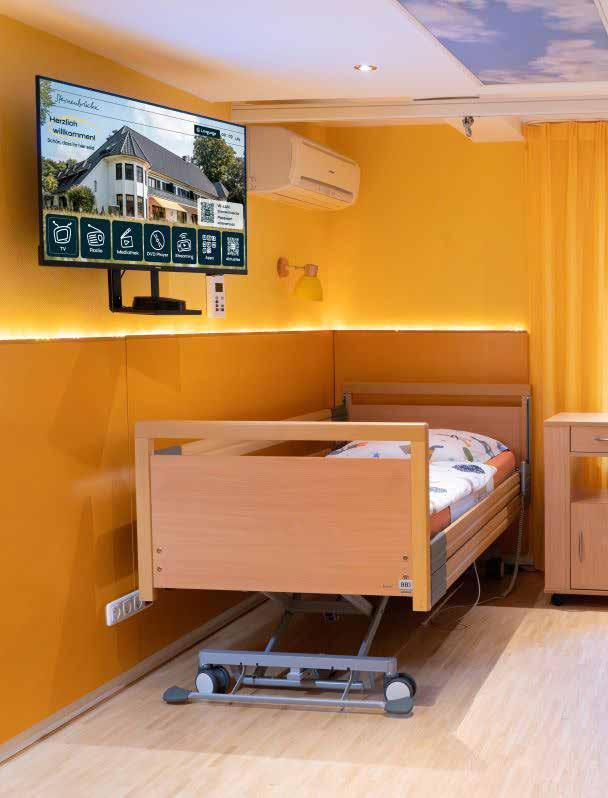
media libraries, listen to the radio, or enjoy gaming on the connected PlayStations. In addition, AVARA integrated a dedicated information portal for parents, providing access to general details about Sternenbrücke, as well as up to the minute news and information. By modernising the TV system, AVARA has helped create a home from home environment where patients and families can come together without concern. The modern, intuitive technology enables families to share valuable moments focused entirely on comfort, ease of use, and joy.
Peer Gent from the management team at Stiftung Kinder-Hospiz Sternenbrücke commented: “Our new Philips MediaSuite TVs give our guests joy, distraction from the often-stressful everyday life, and precious moments together. Thanks to the committed cooperation of all those involved, we were able to implement a barrier free and easy to use TV system that goes beyond technical improvements. We are thrilled and would like to thank AVARA and PPDS for their generous support in realising this project.”
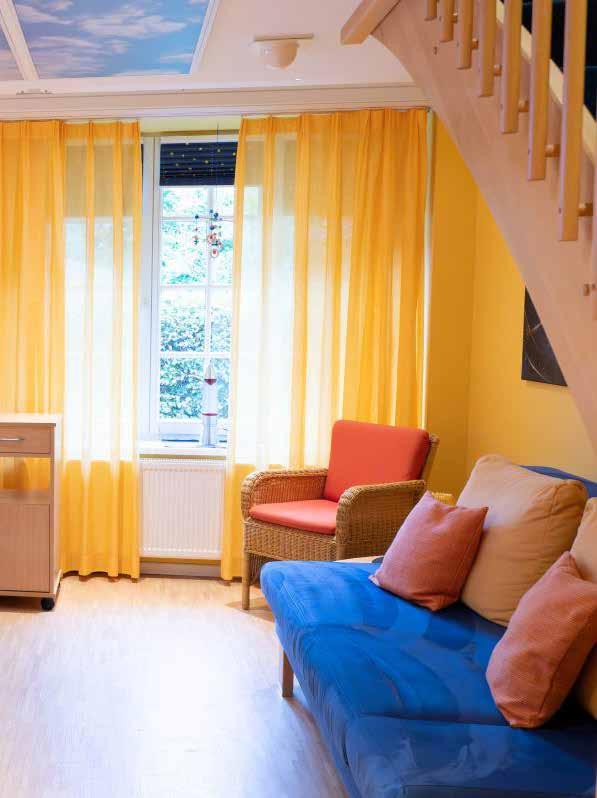
Christie has announced that its RGB pure laser projectors are at the heart of a breath-taking new light and sound show at Rani ki Vav, the 11th century stepwell and UNESCO World Heritage Site in Patan, Gujarat, India. Commissioned by the Government of Gujarat and inaugurated by Indian Prime Minister Narendra Modi, the large scale projection mapping spectacle transforms the 500 foot long subterranean monument into an immersive canvas of history and art, marking one of the most technically sophisticated heritage shows ever executed in India.
Recognised as one of the world’s most extraordinary subterranean monuments and a global symbol of India’s architectural and artistic heritage, the façade of Rani ki Vav is illuminated using 10 Christie RGB pure laser projectors, including the Griffyn 4K35 RGB and M 4K25 RGB models, delivering up to 36,500 lumens per projector. The projectors’ exceptional 4K resolution and wide colour gamut were essential in faithfully reproducing the stepwell’s intricate carvings, stone textures, and
subtle colour variations from warm sandstone hues to deep indigo night skies. The project was supported by Design Factory India as consultant, with Aura Bright Light supplying and installing the projectors, while Knownsense Studios led content creation. The monument was digitally captured and mapped to a massive 22,000 pixel wide content canvas, one of the largest ever created for an Indian heritage site. A multidisciplinary team of artists, animators, and heritage researchers collaborated to develop visuals and narratives that celebrate the story, philosophy, and cultural roots of Rani ki Vav.
Working under strict guidelines set by the Archaeological Survey of India (ASI), no permanent or visible structures were permitted on site. To meet these requirements, a unique solution using hydraulic lift based projector mounts concealed below ground was engineered. Each lift rises six metres (19.6 feet) to its precisely pre aligned position during showtime and retracts afterward, ensuring zero visual intrusion during the day while delivering millimetre accurate alignment for night performances. “Rani ki Vav demanded a technological solution that could match the monument’s extraordinary craftsmanship,” said Siddharth Bathla, director and co-founder, Design Factory India. “Christie’s RGB pure laser projectors were the clear choice, delivering the resolution, brightness, and colour fidelity needed to honour every carving and contour, while the concealed hydraulic infrastructure ensured the monument’s sanctity was fully preserved.”
Shailesh Patel, managing director, Aura Bright Light, added, “Executing a project of this scale within the constraints of a UNESCO World Heritage Site is a rare challenge. The innovative deployment of the Christie Griffyn 4K35 RGB and M 4K25 RGB projectors on hydraulic lifts enabled us to achieve spectacular results with precise alignment, while adhering to every conservation guideline set by ASI.”
“We treated Rani ki Vav not as a backdrop, but as the protagonist of the story,” said Mandeep Sharma, head
of Production and Animation, Knownsense Studios. “Christie’s 4K RGB projectors allowed our ultra high resolution content and 3D animations to blend seamlessly with the stone architecture, creating an emotional, immersive experience that feels both contemporary yet deeply rooted in history.” The projections draw their inspiration from Patan Patola textiles, historic water structures, and spiritual symbols
Blending motifs inspired by Patan Patola textiles, ancient water architecture, and spiritual symbolism, the projection is paired with an evocative soundtrack and narration. Traditional Indian instruments merge with cinematic orchestration, echoing the rhythm of chisels and flowing water to guide audiences through moments of creation, devotion, and rediscovery.
Rishubh Nayar, ProAV sales director for India, Christie, commented, “This project exemplifies how technology can elevate heritage storytelling with dignity and precision. Our RGB pure laser projectors are designed for demanding environments where colour accuracy, fine detail, and long term reliability are non negotiable. Rani ki Vav powerfully demonstrates how light can connect past and present on a global stage.” By uniting 4K RGB pure laser projection, 4K resolution content, and culturally authentic storytelling, the Rani ki Vav light and sound show has elevated digital heritage experiences to greater heights. More than a spectacle, it is a living dialogue between centuries where stone, sound, and light come together to celebrate India’s legacy with reverence, innovation, and global impact.
TVC Technology Solutions has completed a comprehensive audiovisual installation for Waterside Holiday Group at the Arena Sports Bar within its Bowleaze Cove Holiday Park. The project highlights how a carefully designed AV environment can transform leisure venues into immersive social spaces capable of supporting live sport, entertainment and evolving guest expectations. Building on an established working relationship with the operator, TVC was tasked with delivering a cohesive, future-ready AV system providing impactful visuals and adaptable audio throughout the venue, while remaining simple for staff to control during day-to-day operations. Waterside Holiday Group operates a portfolio of premium holiday parks across the UK, combining accommodation, leisure and entertainment to create vibrant coastal destinations. Having engaged TVC on previous AV projects, the group enlisted the Bolton-based integrator to rejuvenate the Arena Sports Bar at Bowleaze Cove. “Having worked with Waterside before, we knew the client wanted a complete AV install that would transition Bowleaze from relaxed daytime dining to high-energy evening trade, showcasing major live sporting events,” said Andy Greaves, Sales Director at TVC Technology Solutions, “The vibe had to be modern, with AV flexibility for various themes in a multi-use venue and
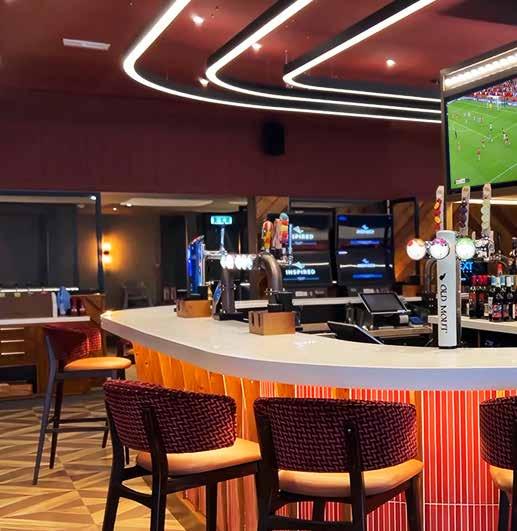
integrating cutting edge signage in a platform that was super-easy to control for venue staff.”
To create a strong visual experience across the Sports Bar, TVC installed a network of LG commercial displays throughout the venue. A carefully selected mix of screen sizes, ranging from 32 to a centrepiece 86-inch display, ensures clear sightlines from every position, with larger displays acting as focal points in key viewing areas while additional screens across the main bar and seating zones maintain visibility during major sporting events. Smaller displays within booth seating areas provide a more personal viewing experience for smaller groups. Audio was treated as a central element of the design, with a full Audac loudspeaker system delivering balanced, immersive sound across the venue. Higher-output loudspeakers and subwoofer reinforcement were incorporated within the stage area to provide additional energy during live entertainment and peak trading periods, while distributed loudspeakers across the bar and dining areas ensure consistent coverage throughout the day. To manage this multi-zone environment, TVC implemented an Optimal Audio control system, giving staff intuitive control over audio levels and sources across the venue. This allows the Sports Bar to maintain relaxed background audio during quieter periods while creating a more energetic atmosphere around the bar and stage during live sports and evening entertainment. At the core of the installation sits a WyreStorm AV-overIP distribution platform, providing a flexible infrastructure for routing content to displays across the venue. Using WyreStorm’s NetworkHD app, staff can synchronise content across all screens for major sporting events or distribute different sources to different areas based
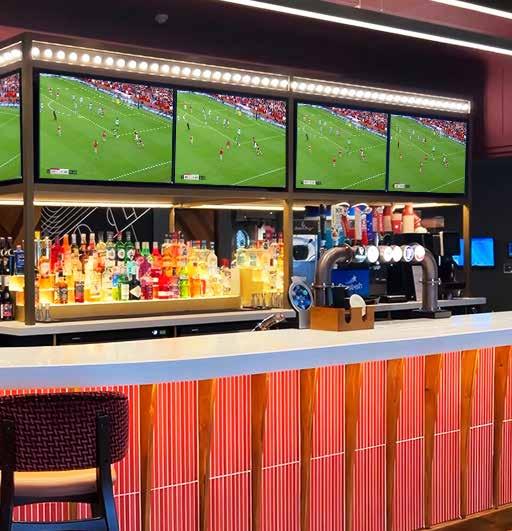
on audience preferences. To further enhance engagement, a TVC’s own MySign digital signage platform was integrated into the wider AV system, enabling the venue to promote food and drink offers, advertise upcoming events and deliver branded messaging across dedicated displays. The result is a flexible and immersive AV environment that supports the full spectrum of activity within the Arena Sports Bar, from daytime hospitality through to high-energy sporting events and live entertainment. “This is another exciting TVC project for the Waterside Group,” added Andy. “Aside from our AV and extensive signage expertise in hospitality, it demonstrates how fully understanding the client’s needs and vision remains so important for AV integrators. Get a project right, exceed expectations and future business will follow. We are looking forward to the next exciting project with the waterside team.”
When the Santa Barbara International Film Festival opened the McHurley Film Centre, it opened with something the cinema world hadn’t seen before: a five-screen complex outfitted entirely with Meyer Sound, anchored by ASTRYA cinema loudspeakers in its three Dolby Atmos auditoria. For the festival, which has operated its single-screen Riviera Theatre with Meyer Sound for a decade, the decision was never in doubt. “State-of-theart projection, sound, and curated programming are the three things that we think keep movie theaters thriving. That was what led to our decision of going with Meyer
Sound,” says SBIFF Managing Director Sean Pratt.
The McHurley Film Centre is SBIFF’s permanent home for year-round screenings, filmmaker events, and education - a five-auditorium expansion of a mission that began with the Riviera acquisition ten years ago. The building, a former Metropolitan Theatres multiplex, was fully gutted and rebuilt over nine months at a cost of approximately $20 million, with Dolby Vision projection, Dolby Atmos in three of its five auditoriums, and Meyer Sound throughout. Systems were designed and installed by Southern California Cinetech, whose principal, Michael Golin, has worked with SBIFF since the Riviera project. The brief, he says, was direct: “They wanted the best.”
The first order of business was optimising the venue’s acoustics. The team performed studies and applied treatments to eliminate bleed between theaters. But gutting the former multiplex revealed the site’s defining constraint almost immediately. Built beneath a parking structure, the theaters had limited overhead clearance. An acoustic isolation lid installed across the full ceiling to manage sound transmission from the parking deck above reduced that margin further - with direct consequences for height speaker selection in the Atmos rooms. The wide-coverage Meyer Sound ULTRA-X23XP loudspeaker was the ideal solution, fitting within the remaining clearance without breaking the projection plane. “We have almost no room to play with from the top of the projection image to the ceiling,” Golin says. “The ULTRA-X20 series are the only speaker of that size with that kind of power that will work in an Atmos installation. If a speaker was bigger, it would be interfering with the image.” All ULTRA-X20 loudspeakers feature wide 110-degree horizontal coverage and measure only 7.44 inches (189 mm) in height when oriented horizontally.
The three Atmos auditoria are anchored by ASTRYA-140 screen channel loudspeakers with ULTRA-X23XP overhead arrays and HMS-10 side surrounds; the two 7.1 rooms feature Acheron Studio screen loudspeakers and HMS-5 surrounds. Clusters of X-800C high-power cinema subwoofers serve all five screens; USW-210P compact narrow subwoofers provide bass management in the Atmos rooms. For SBIFF, the investment runs deeper than audience experience. “It’s not just about the attendees’ experience—it’s about the filmmakers’ art that you’re showing,” Pratt says. “If they’re putting their blood, sweat, tears, and money into it, shouldn’t the exhibitor do the same?” That commitment has earned SBIFF a new place in the industry. “Studios we’ve never booked with are knocking on our doors,” Pratt says. Filmmakers now come not just for the festival but to present independent films for theatrical runs—drawn by the programming, and by the rooms themselves. With six screens now operating across Santa Barbara, SBIFF has built the infrastructure to match its ambitions—and a sound system designed to present every film the way its makers intended.
The Parramatta Eels, one of Australia’s premier rugby league clubs, recently opened its new multi-million-dollar Centre of Excellence (COE). Designed to be a hub for the club and the wider Western Sydney community, this cutting-edge facility – the largest of its kind in the world – was funded by a partnership between the New South Wales government, Australian government, and the Hills Shire Council. The complex features five full-sized rugby league fields and is Australia’s first gender-equal elite training facility. While the new campus provides a world-class physical infrastructure, the Eels realised that to fully leverage the new facilities to enhance fan engagement, the club required a robust, intuitive, and centralized digital content delivery system.
The Eels needed a system that had the flexibility to create and deploy dynamic content seamlessly across the main stadium and the connected facilities. The solution would need to deliver a first-class spectator viewing experience, while also empowering management and staff via intuitive tools for efficient content management, especially during live events. Awarded through a competitive tender, the Ci Group, a Melbourne-based systems integrator, designed and installed a tailored AV solution at the COE to fully meet the demands of this elite sporting environment. The solution features LG displays, QSC audio and a VITEC IPTV & Digital Signage platform. The result is an AV system that not only supports the Eels’ daily high-performance training but also enhances the experience for fans and wider community users.
The Ci team implemented a comprehensive VITEC IPTV and Digital Signage platform. The VITEC solution creates a seamless and dynamic flow of content, beginning with the various sources. Live terrestrial and satellite broadcasts, as well as local feeds from press conferences and other events, are captured by VITEC IP gateways. Once captured, streams are encoded into high-quality IP streams and sent over the stadium’s network. For the main game broadcast, a VITEC MGW Ace
encoder ensures ultra-low latency, so fans see the action as it happens. At the heart of the operation is the VITEC AvediaServer, which acts as the central management platform, controlling content displayed on screens throughout the facility in areas such as the community gym, football lounge, and office spaces. From a single user interface, operators can effortlessly control all the content, from TV channels to digital signage. This content is then distributed to the various displays via VITEC media players. Each media player receives its designated stream, decodes it, and delivers a high-quality, low latency viewing experience on the connected displays, ensuring every fan and visitor is always engaged and informed.
A key feature of the system is its ease of use, enabling staff to utilise tablet-controlled presets to efficiently manage and switch between digital signage and live TV content in real-time. This intuitive control provides the Eels staff with the ability to respond instantly to the evolving needs of spectators, audiences and others as required. This comprehensive system allows the Eels to easily manage all their digital screens from a central point, no matter where they are located. Staff can now switch between live TV and custom-made digital sig-
nage with simple, tablet-based controls. This gives the club complete flexibility to show live game highlights in one area, display player stats on another, and run promotional messages on a third, all while ensuring a consistent and engaging experience for everyone in the facility.
Since the installation of the VITEC system, the Parramatta Eels have experienced significant improvements in both fan engagement and internal communication. The team can now create a wide variety of new and dynamic content, which was previously impossible. During a recent fan day event, the Eels leveraged the system to display a dynamic storyboard on a large LED screen at the entrance, allowing fans to take photos that were instantly showcased. The event passed without incident, demonstrating the solution’s reliability. By leveraging the variety of signage options available, the Eels can effectively engage their staff, players, guests, and partners during numerous events held at their facilities, thereby maximizing their overall engagement. The solution’s benefits extend across both the whole complex and ensure a consistent and high-quality content experience throughout the entire campus.
Shakespeare’s Globe is one of the most acoustically and architecturally singular performance spaces on earth. A meticulous reconstruction of the open-air Elizabethan playhouse where Shakespeare himself premiered Hamlet, Julius Caesar and King Lear, it is built from English oak using 16th-century mortise and tenon joinery. And it holds the distinction of being the only building in London permitted to have a thatched roof since the Great Fire of 1666. Its circular structure wraps the audience on three sides around a wide, thrust stage, with 600 standing audience ‘Groundlings’ in the open pit and 1,000 seated in the three tiers of gallery seating rising steeply above them, with the closest boxes barely metres from the actors. It is a space designed from the outset for the unaided human voice. The intimacy and acoustic directness of the design are treated as fundamental to the experience of Shakespeare’s theatre.
In December 2025, the Globe staged a brand-new musical, Pinocchio, as part of its festive season run in the open-air theatre. This new smash-hit production was aimed at families, and Pinocchio’s creative team recognised that a live band, songs and young audience members called for temporary sound reinforcement –without changing the fabric or aesthetic of the theatre, and with respect to the unique Globe audience experience. Amplification has been used across the years of the Globe’s history, especially for special events such as music gigs, comedy shows, poetry events, etc. and as one of the last-remaining unamplified theatres, the Globe is proud to champion the power of the unamplified human voice across its year-round activity. However, a musical during winter in the open-air presented real challenges for ensuring they produced a worldclass experience for families coming to the theatre.
The goal was therefore clear - the solution had to be transparent, with sound that audiences would feel rather than notice. L-ISA Hyperreal’s object-based spatial audio, which distributes individual sound sources
across a multi-array configuration to align what audiences hear with what they see on stage, made that level of naturalness achievable. Pinocchio’s producer, Shakespeare’s Globe, approached Olivier Award-winning sound designer Tony Gayle after hearing his work on My Neighbour Totoro, a production which earned Gayle an Olivier Award for Best Sound Design. “The team were looking for something similar for Pinocchio. It needed to be transparent and natural, particularly for the vocals,” says Toby Chester, Global Application Lead for Musicals at L-Acoustics. “Gayle’s expertise was a welcome addition.”
“The decision to amplify this production at the Globe wasn’t taken lightly,” says Will McGonagle, Hire Manager at Autograph. “Since re-opening in 1997, the theatre has championed an unamplified acoustic space. Its audiences come to the Globe expecting an experience that’s akin to Shakespeare’s time – acoustic, lively big story-telling. We knew that any sound design would need to earn its place without drawing attention to itself. The brief was therefore to achieve intelligibility and musical clarity for a family audience, while remaining entirely invisible.”
The Globe presented a unique set of challenges to Gayle, Chester and Autograph. Its open-air, circular auditorium means sound behaves differently to a conventional enclosed theatre, contending with wind, the weather and the natural reverberation of the room. It is also a challenge to achieve consistent coverage across the pit and the three gallery tiers. “The biggest issue was probably how it was going to look,” Chester says. “The technology couldn’t appear too industrial. The theatre is a deeply historic, wooden building. Understandably, the production team didn’t want to see lots of equipment in there.”
To find the right solution, L-Acoustics and Autograph used L-Acoustics Soundvision software in cohorts with Gayle to model the space and present multiple configuration options to the Globe and Pinocchio teams. They even brought physical speakers to the venue so the Globe could assess their size and visual impact before any commitment was made. The speakers chosen, which had L-Acoustics distinctive dark brown colour, ultimately disappeared into the architecture entirely. The final system was supplied by Autograph and prepped and installed by a team of audio professionals who closely work with Gayle. Five X12 formed the main Scene system, flown across the front of the stage. Two KS21 subwoofers underpinned the low-end, keeping bass tight and controlled in the open-air environment.
The most distinctive element of the design, however, was the spatial fill system deployed across the gallery boxes. With speakers arranged across three tiers encircling the auditorium, every individual box was equipped with three 5XT — 113 in total — making it the largest L-Acoustics spatial fill system of its kind deployed to date. For audience members seated in the upper-tier boxes, where the main stage audio system is obscured,
these fills carried the entire audio experience. To manage this complexity, the system was built around an L-ISA Processor II, with LA7.16 amplified controllers and LS10 switches handling signal distribution via a redundant Milan-AVB. Chester adds: “Using the LA7.16 amplifiers reduced our overall power consumption significantly and meant that our footprint in the tech space was significantly reduced, by more than half, when compared to traditional amplifiers. The amplifiers were built in L-Acoustics LARAKIII which are prebuilt with dual redundant ABV connectivity using LS10 network switches along with additional AES/analogue fallback capability which reduce the time needed to prepare and program equipment in the warehouse.”
Four discrete Sound Spaces were configured within L-ISA: a main sound space for the primary Scene system, and one dedicated space for each of the central boxes. This along with using the Source Trims feature to adjust the mix for those seated closer to the stage who hear more of the band acoustically allowed the team to deliver a tailored mix to every area of the house. The
source trims feature within L-ISA proved to be invaluable. The result was everything the creative team had hoped for. Audience feedback was overwhelmingly positive, with the musical director and creative director among those who praised the system’s performance. Most importantly of all, Gayle’s sound design achieved what had been asked of it: audiences were absorbed in the story of Pinocchio without ever being distracted by the technology making it possible.
For Chester, the project proved something important about the relationship between L-ISA’s spatial distribution and the perception of naturalness. “The 5XT is a remarkably compact speaker. Small enough to sit inside a gallery box without disrupting the architecture. That physical discretion is what made the fill system possible at the Globe in the first place,” he notes. “Together with Autograph, we were able to deliver subtlety through a professional sound system that served the production without compromising the Globe’s identity or the audience’s experience.”
Since 1984, we have been continuously innovating to
shape the future of sound. Our European-designed solutions optimize Source, System, and Space—unleashing creative possibilities in content, perfecting audio technology, and harmonizing with venue acoustics to guarantee exceptional performance. Our global team of over 1,000, with 20% dedicated to R&D, has pioneered breakthroughs like the V-DOSC line array, L-ISA immersive solutions, and the eco-conscious L Series— innovations that have both transformed our industry and transcended our auditory perceptions. The world’s most demanding stages trust us: Adele’s Las Vegas residency, the Philharmonie de Paris, the Zaha Hadid-designed Guangzhou Opera House, and over 13,000 premium venues worldwide. We’ve earned this trust by consistently delivering extraordinary audio in every venue and any space.
Leading premium DOOH operator BackLite UK has expanded its deluxe large-format outdoor advertising portfolio with the launch of The Knightsbridge, a revamped flagship installation located on the busy tunnel connecting London’s most affluent areas. The Piccadilly Underpass site, which sits alongside Hyde Park Corner, incorporates two new 2.8m x 14.4m screens, which between them generate more than 3 million fortnightly impacts. Positioned on the eastbound and westbound approaches, the displays are visible to both vehicle and foot traffic moving around the high-end shopping and leisure destinations of Knightsbridge, Belgravia and Mayfair. The site’s upgrade was aimed at enabling BackLite UK to incorporate The Knightsbridge, which is surrounded by renowned retail outlets such as Harrods and Harvey Nichols, into its most exclusive collection, the Landmark Series. Designed to appeal to upscale advertisers, this range also includes the iconic The Cube @ Flannels, the Shoreditch Stack and the Wandsworth Roundabout. While BackLite UK now handles all media sales for the site, the assets are owned by Wildstone. The latter, the world’s largest owner of outdoor advertising infrastructure, secured a long-term licence for the underpass in a competitive tender process run by Westminster Council last year.
The Knightsbridge is one of more than 10 prime London locations included in an agreement struck last year between Wildstone and BackLite UK’s parent company, UAE-based Multiply Media Group (MMG). The companies have since begun a refurbishment programme of these super-premium assets, with the overhaul of the Hyde Park Corner site among the early priorities. Central to the site’s revamp was the installation of 1440 x 280-pixel digital screens, which were provided by leading LED manufacturer Daktronics. BackLite UK chose the US-based firm’s 10mm Outdoor Blue displays due to their high quality and contrast, strong sustainability
features and industry-leading processing.
The premiumisation of the site has already led to a number of high-profile brands taking out advertising space, including Burberry, Club Med and Franck Muller. Jack Fleming, Head of Sales at BackLite UK, said:
“The Knightsbridge is a fantastic addition to our Landmark Series as it fits perfectly within our most prestigious collection. There are very few OOH assets in the vicinity and certainly no others of this size and calibre. We quickly recognised the site was much more than an underpass and we worked closely with Wildstone to develop it into something that really stands out.” Andrew Foster, Group Partnerships Director at Wildstone, said:
“With its location in the heart of prime central London, we always believed this site was ideally suited to the premium end of the market. We were therefore really excited to secure BackLite UK as our media partner as its focus on luxury brand advertisers meant we were completely aligned on what the upgrade should entail.
This is just one of a number of high-end refurbishments we’re carrying out in partnership with BackLite UK and given our success here, we’re excited to see what the future holds.”
The Aronoff Centre for the Arts in downtown Cincinnati has upgraded its main performance space with a new Meyer Sound LEOPARD system in its 2,700-seat Procter & Gamble Hall. Designed and integrated by Ovation Audiovisual, the installation builds on the venue’s 30year relationship with Meyer Sound, delivering uniform coverage and the flexibility demanded by today’s Broadway tours and high-impact productions. Opened in 1995 and designed by architect César Pelli, the Aronoff Centre serves as Cincinnati’s primary Broadway stop while also hosting concerts, symphony performances, ballet, and special events. As the home of First Financial Bank Broadway in Cincinnati, presented by TriHealth, Procter & Gamble Hall regularly welcomes national touring productions with exacting technical expectations. The venue must support dialogue-driven musicals, high-energy concerts, and orchestral programming - often within the same week - requiring equal emphasis on clarity, headroom, and uniform coverage across all seating areas.
The hall originally opened with a Meyer Sound system that served reliably for three decades. With advancements in loudspeaker technology and networked processing, the organization elected to modernize while building on that legacy. “We knew we wanted to move to a line array to get more even coverage,” explains Mike Meuche, audio engineer at the Aronoff Centre, noting that coverage was only part of the equation: “The previous system was more suited to light reinforcement and lectures. Anytime we had louder one-nighters coming in
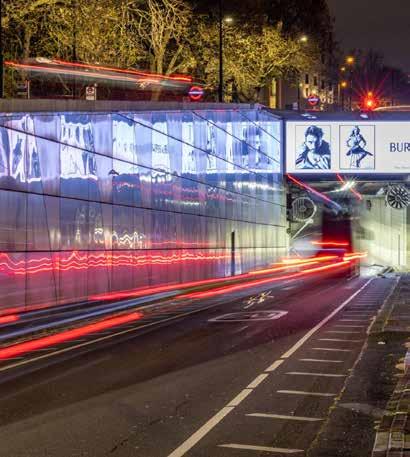
who wanted to push upward of 90 or 100 dB, we were renting a system. That took significant time to put in.”
The hall’s multi-tiered seating geometry presents distinct coverage challenges, particularly in the upper balcony. The upgrade provided an opportunity to apply modern modelling and system design tools to refine tonal consistency throughout the space. The new system centres on 28 LEOPARD compact linear line array loudspeakers, supported by eight 900-LFC and four 2100-LFC low-frequency control elements and three ULTRA-X82, one ULTRA-X80, and two ULTRA-X40 loudspeakers as fills. Everything is driven by the Galileo GALAXY Network Platform, with support for Milan networking to accommodate touring and in-house workflows. From the outset, Ovation prioritised measurable uniformity. The system was extensively modelled using Meyer Sound’s MAPP 3D system design and prediction tool to verify coverage and predict performance before installation began.
That predictive precision translated directly into real-world experience. From orchestra to upper balcony, the new system delivers consistent tonal balance and impact across seating areas while maintaining clarity throughout the hall. “We were able to show from the beginning that the system would perform within plus or minus a dB and a half throughout the space,” says Ovation co-owner Bob Cochran. “That modelling gave everyone confidence. We knew the system would hit the
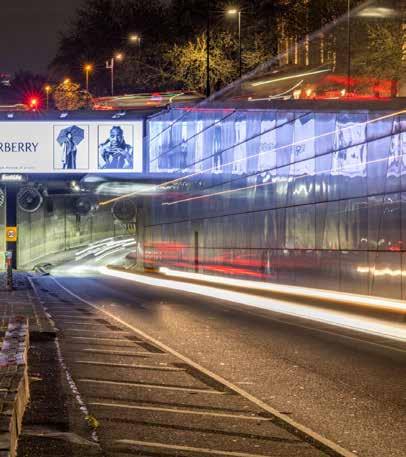
target.” Rigging constraints required creative engineering—particularly in the low-frequency domain. Limited hang points and overhead positions prioritized for touring productions forced the design team to rethink subwoofer deployment. “The real estate where we ideally would have flown the subs was unavailable, so we engineered a gradient array to steer low end up into the balcony,” Cochran explains. “That’s one of those tricky scenarios where Meyer Sound’s depth of understanding around the physics of sound was instrumental in solving a challenging scenario.”
For Ovation, the project represents the beginning of a partnership, says Cochran. “We really understand how they’re using the space and how they’re using the system,” he explains. “That context allows us to bring more accurate solutions than if we just installed a P.A. and walked away.” Hybrid operation was fundamental to the system design. Broadway tours frequently arrive with their own main systems while relying on in-house delays and fills. GALAXY processing provides touring engineers with a familiar control environment, enabling efficient alignment between visiting and house infrastructure. Presets allow venue staff to optimize the system for ballet, symphonic, or high-SPL concert use without reconfiguring the core architecture.
The day-to-day operational impact has been immediate. With system control accessible at front of house, staff can make adjustments more efficiently, and tour-
ing productions that once required supplemental rentals now rely confidently on the house system’s capabilities. “The Aronoff Centre presents hundreds of events each year,” says Maddie Regan, general manager of the Cincinnati Arts Association. “Our new Meyer Sound LEOPARD system affords us the flexibility to provide world-class audio experiences for a wide range of events, including lectures, symphonies, Broadway productions, and choral events. Everybody who’s come through has been happy with it,” adds Meuche. “For one-nighters, we haven’t had to rent a system this year. I love the sound in the room.”
A fully integrated Kramer control and AVoIP ecosystem, delivered by system integrator, and Platinum Partner, Rea Sound, has transformed Mid Ulster District Council’s chamber and meeting spaces into a future-ready environment supporting seamless hybrid governance, intuitive control and centralised AV monitoring
Mid Ulster District Council in Magherafelt, Northern Ireland has modernised its council chamber and five associated meeting rooms with a fully integrated Kramer AV ecosystem designed to support modern governance, hybrid participation and streamlined system management via Kramer’s next-gen Panta Rhei platform.
The council’s previous chamber conference system had become outdated and unreliable, even prone to failures during critical meetings. It also lacked the ability to support modern hybrid or remote participation formats that have become increasingly important across public sector organisations.
To add to previous issues, the legacy infrastructure required manual reconfiguration for each meeting type significantly increasing staff workload. Following guidance from the Northern Ireland government encouraging digital accessibility and improved remote capabilities across the public sector, the council recognized the need for a comprehensive technology upgrade.
The challenge was to modernise the council’s meeting infrastructure while preserving the integrity of traditional in-chamber proceedings. The system also needed to accommodate architectural and heritage constraints within the chamber while supporting professional-quality streaming, recording and secure remote participation.
To deliver the project, Mid Ulster District Council partnered with award-winning system integrator Rea Sound, with a demanding requirement to complete the entire installation within a strict 90-day timeline driven by council scheduling commitments. Delivering convenient flexibility
Central among the Council’s needs was the ability to
support traditional, hybrid and fully remote meetings with a single-touch setup process that eliminated manual system configuration.
Ensuring inclusive participation was equally important. Councillors attending remotely needed to retain the same speaking and voting rights as those physically present in the chamber, enabling the council to preserve full democratic function regardless of meeting format.
At the core of the installation is a Kramer control system, centered around a custom-programmed Kramer KT-2010 touch panel that acts as the operational command centre for the entire AV environment.
Working closely with the council, Rea Sound developed bespoke control programming that unifies multiple technologies into a single intuitive interface. The system integrates a Bosch wireless conference system, Allen & Heath digital matrix audio, Panasonic and Samsung displays, LED lighting and Kramer’s AVoIP distribution platform into one cohesive environment.
With a single touch on the control panel, staff can now select the desired meeting format — traditional, hybrid or fully online. The system automatically configures all required technologies, activating cameras, routing audio, adjusting display settings and controlling lighting without the need for specialist technical knowledge.
“The most exciting aspect of this project is the innovative way in which all AV equipment has been brought together under one intelligent, centralised control system,” said Roger McMullan, Director at Rea Sound, adding: “And at the heart of this integration is the Kramer control system.”
Video distribution throughout the facility is handled by Kramer AVoIP encoders and decoders, including the KDS-17 and KDS-100, which provide flexible, network-based signal routing. The IP-based architecture ensures high-quality video delivery to displays within the chamber while simultaneously supporting streaming and recording for remote participants.
To provide enterprise-level management, the installation also incorporates Kramer’s Panta Rhei AV ecosystem platform.
Working alongside Kramer control, Panta Rhei’s Session Manager enables unified meeting initiation, content management, third-party application launching and wireless presentation. The platform provides secure access to collaboration tools and conferencing environments, ensuring meeting spaces can easily support video conferencing and hybrid workflows.
In addition to user-facing functionality, Panta Rhei provides advanced infrastructure oversight and remote system management. IT teams can monitor device status, system health and performance in real time through a centralised interface, allowing potential issues to be identified and resolved before they affect meetings. “Panta Rhei gives the council confidence that their AV systems are always performing reliably,” McMullan added. “Remote monitoring reduces the need for onsite intervention, saving time and resources.”

Beyond the main chamber, five additional meeting rooms were upgraded with hybrid meeting capabilities and integrated into the same Panta Rhei ecosystem. Staff training was simplified through the deployment of a consistent user interface across all spaces, enabling users to operate any room without learning different systems.
A change for the better
The modernised AV infrastructure has transformed how Mid Ulster District Council manages meetings and public engagement.
Automated setup through Kramer control has virtually eliminated preparation time and the need for technical expertise during meeting configuration. Processes that previously required extensive manual intervention can now be completed instantly through a single touch, allowing staff to focus on higher-value operational tasks. Remote diagnostics via Panta Rhei allow IT teams to maintain system reliability across all six meeting spaces while identifying potential issues proactively. To add to the man hours cost saving, automated shutdown functions further contribute to operational efficiency by reducing energy consumption.
Importantly, the system preserves the full integrity of democratic processes. Councillors joining meetings remotely retain complete participation rights, including managed speaking requests and secure voting capabilities. This ensures governance procedures remain consistent regardless of how participants attend.
The installation has also improved public transparency. Citizens can now follow meetings via live streaming or access recorded sessions on demand, strengthening civic engagement and improving public accountability.
Strategic Director JJ Tohill of Mid Ulster District Council welcomed the project’s success - “I am very pleased with system functionality and look forward to the Council availing of and benefiting from its investment in the coming years,” he said. “I also wish to acknowledge the professionalism, commitment and quality of Rea Sound in delivering this project within a tight deadline.” In recognition of their innovative approach at streamlining a complex AV support brief with Mid Ulster Council, Rea Sound was awarded ‘Public Sector Project of the Year’ at one of the premier AV industry awards, reflecting the professionalism of their approach and ability to deliver a user-friendly system that supports a range of requirements.
When Roald Dahl’s Charlie and the Chocolate Factory first delighted readers in 1964, few could have imagined the scale of theatrical spectacle it would inspire decades later. Today, the Asia touring production, directed by Matt Lenz, presented by Broadway International Group, brings Roald Dahl’s fantastical world to audiences across Shanghai, Beijing, Taipei, Singapore, Hong Kong, Manila, Seoul and beyond. It is a rare gift to be able to return to a beloved and familiar project like this and be given the opportunity to reimagine it,” says Matt Lenz, director of the Asia touring production. “I wanted this production to be even more magical and more visually engaging than ever before. I wanted the show, like Willy’s factory, to be surprising at every turn and to take the audience on a journey of imagination.”
Designing a production of this scale for an international tour presents a unique challenge. How do you preserve the visual magic and storytelling precision of a Broadway favourite while adapting to constantly changing venues, sightlines and technical constraints? For this global tour, the answer lay in reimagining the show’s visual language from the ground up, all centred around INFiLED’s AR Series LED panels. Earlier iterations of the production relied heavily on projection mapping and 9 mm pitch LED walls. While effective at the time, those technical limitations shaped the aesthetic in restrictive ways.
“”The projection was used to differentiate the various rooms of the chocolate factory with lots of shadow work and delicate accentuations of the scenic piece,” says Jeff Sugg, video and projections designer, who has been involved with the show since its Broadway debut in 2016.
However, resolution constraints proved limiting. “The aesthetic was bound by the fact that the walls were a 9 mm pitch,” Sugg states. “As a result, it was imperative that the content didn’t lean on gradients or soft edges within the fades and design structure.”
FFor the global tour, the creative team, which includes Sugg, video system designer Mogzi and lead integrator Stage Sound Services of Cardiff, Wales, sought a richer, more cinematic approach. The system needed to support large-scale spectacle, while also delivering intimate, nuanced storytelling moments. Crucially, it also had to be entirely roadworthy. “The tour is designed as a fully self-contained theatrical world,” says Drew Cipollone, Broadway Asia production stage manager and resident director. “It has to be capable of landing in vastly different venues without losing its magic or cohesion.”
The production introduced 136 INFiLED AR Series panels, forming a 7.5 x 6 metre main LED back wall and two automated tracking sliders, each measuring 2.5 x 6 metres. The system is driven by Brompton Technology Tessera SX40 processors and Tessera XD data distribution units, ensuring consistent image processing and colour fidelity across varying environments.
The INFiLED AR Series (now upgraded to the ARmk2 Series) was selected for its fine 2.9 mm pixel pitch, lightweight cabinet design and flexible installation system. Panels can be stacked to big heights while retaining stability, curved up to 10 degrees and accessed from both front and rear for efficient maintenance. These are all essential attributes for an international touring production. “As a video designer, my primary concerns with LED wall products are big depth for colour rendering, viewing angle, weight, fades and gradients, and adaptable installation,” says Sugg. “The panels also have to be non-reflective for this production to accentuate black levels and to disappear on a dark stage. All in all, it is vital to get higher resolution LED panels and high-quality processing to make this happen.”
The AR Series addressed these concerns directly. Its fine pixel pitch and high bit depth allow for smooth gradients, soft fades and detailed textures that feel dimensional rather than screen based. The low-reflective surface preserves deep blacks, enabling the panels to virtually disappear when the narrative focus shifts to performers. And wide viewing angles ensure consistent image quality, even when panels are integrated into angled scenic elements. For Lenz, the agility of the screens was central to the production’s storytelling. “They allowed us to keep the transitions very alive and fluid,” he says. “The play requires the characters to be in many different locations and to get there quickly, so the video element was a real life-saver.”
“Creatively, the challenge we faced is that the panels needed to support dynamic, cinematic, and at times, surreal storytelling without overwhelming the core action onstage,” says Cipollone. “Practically, they had to be tour-ready. They had to be reliable, flexible and efficient to install and maintain. The INFiLED AR2.9 achieves this balance, fulfilling both the artistic vision and the operational demands of this international tour.”
The selection process was notably collaborative, as Cipollone states, “While the producers at Broadway Asia provide their final approval, input came from the creative team too, including the scenic designer, lighting designer, the video/projection design team and production management.”
Mogzi, an experienced system designer with West End credentials, played a key role in aligning the technical configuration with artistic intent. Meanwhile, Stage Sound Services, known for its theatre and live production expertise, delivered the touring system, which is capable of handling frequent international transport. “The panels are highly resilient, handling frequent loadins, load-outs and long-distance transport with ease,” says Cipollone. “Installation and striking are efficient, helping keep the show on schedule.” Beyond technical reliability, the LED system has become an active narrative device. “We genuinely love working with video and projection, but it’s easy to let video pull focus and overwhelm the proceedings,” says Lenz. “Jeff Sugg is a master at providing just the right amount of interest and movement. He knows it’s a balance. Everything onstage can have its time and place to shine, but ultimately the goal is to get all departments and elements telling the same story at the same time.” Cipollone echoes that perspective “They act as a storyteller themselves, allowing the stage to expand, contract and morph in real time,” says Cipollone. “They create cinematic moments, heighten the theatrical illusion and help every audience member feel fully immersed in the magic, without ever overshadowing the performers or the story.”
The response from cast, crew and audiences alike has been overwhelmingly positive. “Designers praise how the screens integrate seamlessly with lighting, scenery and illusions,” Cipollone adds. “Cast members benefit from the clarity and consistency of the visuals, which help them orient themselves and connect with the
space. Production staff value the system’s reliability and efficiency. And audiences often comment on how immersed and transported they feel to Wonka’s world.” With multiple Tony wins and Olivier nominations associated with its broader production history, Charlie and the Chocolate Factory continues to evolve technically and artistically. For its global tour, the INFiLED AR Series has proven to be more than a backdrop. It’s an integral part of the storytelling fabric, delivering scale, clarity and a renewed sense of wonder to every city it visits.
Completed in 1967 during Canada’s Centennial year, All Saints Roman Catholic Church in Toronto stands as a distinguished example of mid-century modern architecture. Its sweeping, semi-circular sanctuary was designed to emphasise spiritual clarity and architectural symmetry, providing an unobstructed visual focus for congregants. When OMS Canada was invited to modernise the church’s sound system, the mandate was not simply to install more loudspeakers. The stated aim was to deliver exceptional speech intelligibility, provide even and natural coverage across the large open sanctuary and integrate the technology without interfering with the building’s architectural character. EM Acoustics’ Reference series, supplied by Contact Distribution, proved to be instrumental in achieving this vision.
The sanctuary seats approximately 800 people and is arranged in five triangular seating ‘wedges’, each accommodating around 150 worshippers. “Speech intelligibility is absolutely critical for worship spaces, and this is a very live, reverberant space,” explains Jeff Shorthouse, Co-Founder of OMS Canada. “It wasn’t about increasing the volume; the audio needed to be clearer, more natural and provide complete-
ly even coverage across the congregation.” Historically, the church relied on a system of around fifteen distributed loudspeakers, which suited an earlier era of sound reinforcement but created challenges for today’s services. Visually, the previous system disrupted the sanctuary’s clean mid-century sightlines. Acoustically, the multiple loudspeakers produced inconsistent coverage, with competing, confused arrival times and compromised clarity. The church leadership, who are all technically knowledgeable themselves, had high expectations for the project.
Before any final design decisions were made, OMS Canada and Contact Distribution arranged on-site demonstrations of EM Acoustics loudspeakers directly in the sanctuary so that the parish leadership could evaluate their performance in the actual worship environment. “The two onsite demos helped the parish leadership to make a confident and informed decision,” continues Shorthouse. “We put in the EM Acoustics R8s, powered them up, and honestly, they sounded incredible right out of the box. We didn’t even feel the need to EQ them.” The staff, many of whom had backgrounds in recording and audio production, immediately recognised the exceptional natural voicing of the system which reinforced EM Acoustics’ reputation in a very acoustically demanding room. Initially, the client believed that they would require a secondary ring of delay loudspeakers, following the precedent set by the previous system. Instead of simply agreeing and adding unnecessary cost, OMS Canada took a different approach: “Adding an additional delay ring wouldn’t have been the right solution,” confirms Dave Misener, Co-Founder of OMS Canada. “Instead, we took the approach of ‘let’s see what the R8s can really do before we add more sound sources.’ It’s not about how much you can sell. It’s about giving the client what they actually need.” This approach aligned perfectly with the philosophy shared by OMS Canada and EM Acoustics of favouring fewer loudspeakers, precisely placed to deliver high-quality and natural-sounding audio.
The structural realities of the church added further complexity to the installation. The sanctuary contains no vertical columns, instead featuring four major overhead beams at varying heights, ranging from sixteen to twenty-five feet high. The client was concerned about preserving the room’s aesthetics and made it clear that any sound equipment needed to integrate into the environment rather than dominate it. “They wanted the loudspeakers mounted above the congregation and tied in visually with the beams, without disrupting sightlines,” continues Shorthouse. “The room is too beautiful to clutter, so the goal was to have the technology disappear into the background as much as possible.”
EM Acoustics Reference Series, and in particular their R8s, provided the perfect balance of performance and compact form factor. The loudspeakers blended in naturally with the wood finish of the beams, whilst their output is powerful enough to eliminate the need for extra reinforcement in the form of moreloudspeakers. The outstanding frequency response and controlled pattern of the R8 allow it to deliver natural, full-range audio, all while remaining unobtrusive to the eye.
OMS Canada redesigned the sound system entirely rather than reusing any of the previous loudspeaker locations. The new system is based around five EM Acoustics R8s mounted in a semi-circle above the sanctuary, each carefully oriented to serve one of the five wedge-shaped seating zones. Uniquely, Reference Series enclosures ship with two interchangeable rotatable waveguides. OMS Canada utilised the 110 x 50-degree option to achieve optimal coverage for each audience section. Initially confirmed through EASE modelling, real-world implementation gave the team the confidence that an extra line of delay loudspeakers was not necessary. The system is powered by EM Acoustics’ Di20 installation amplifier, whose proprietary FIR filters provide precise tuning and exceptional phase coherence. Supporting EMS-51X loudspeakers for the choir organist and choir monitor, and an EMS-41 for the dais complete the audio system. A Soundcraft Si Performer console provides intuitive day-to-day control for clergy members, musicians and trained volunteers.
Given the sacred nature of the space, the installation required careful planning and thoughtful execution. OMS Canada removed the previous fifteen-speaker infrastructure, rerouted wiring through existing structural pathways and manoeuvred heavy-weight equipment through the sanctuary without the need to remove any pews. The team also ensured that any wood surfaces previously covered by the old loudspeakers remained visually consistent, preserving the integrity of the mid-century design. All of this was completed with minimal disruption to services, ensuring that the parish church could continue its work uninterrupted. “At the end of the day, this wasn’t about making the system any louder. It was about making it right,” confirms Shorthouse. “The EM Acoustics solution fits the architecture, respects the worship experience and gives the church exactly what they need in terms of the character of the voicing.” Misener echoes these sentiments, stating, “When you walk into the room now, you don’t see the sound system. That’s exactly what you want in a house of worship.”
All Saints Roman Catholic Church continues to serve a vibrant and engaged congregation with a sound system that combines careful engineering, expert decision-making and industry-leading loudspeaker performance, demonstrating how modern audio technology can enhance spiritual spaces without overwhelming them.
Lights Camera Action (LCA) France is has announced the appointment of Jean Charles Pasquier as Business Development Manager for France, further strengthening the company’s presence in one of Europe’s most important film and broadcast markets. With more than two decades of experience in professional lighting, Pasquier brings extensive expertise across multiple sectors including film production, television studios, theatre, museums, and entertainment lighting. Since entering the industry in 2001, he has developed a strong reputation for combining technical knowledge with a deep understanding of lighting design and studio infrastructure. Throughout his career, Pasquier has worked closely with rental companies, lighting designers, broadcasters, and system integrators. At LCA, Pasquier will focus on expanding the company’s activities in Francophone countries, supporting rental houses, broadcasters and production companies, while also contributing his experience in studio design and system integration projects across the LCA group.
Alexander Bergdolt, European Manager at LCA, commented: “We are very excited to welcome Jean Charles to the LCA team. His deep industry knowledge, combined with his experience in studio design and technical infrastructure will strengthening LCA’s ability to support complex studio projects as well as the rental and production community.” Pasquier will be based in Paris, working closely with the broader LCA Europe team across Germany, Spain, and the United Kingdom.
Renkus-Heinz is continuing to expand its Tech Support operations with the latest addition of Tony Jacques as Applications Engineer. He will serve as a key technical resource for integrators, consultants, and end-users, providing hands-on guidance and supporting the deployment of Renkus-Heinz solutions across a wide
range of applications. Jacques’ audio background has taken him all over the world, working in a range of fields that have provided him with the expertise to strengthen the customer support of one of the world’s leading loudspeaker manufacturers.
His career spans live sound, touring, installation, broadcast, and event production, giving him a comprehensive understanding of the challenges audio professionals face every day. “Joining the Renkus-Heinz team is an exciting opportunity to blend my audio and networking experience,” says Jacques. “I hope to bring a unique perspective and skill set to the technical support team that will help guide our customers through challenges they face during system design, deployment, and beyond. I look forward to collaborating with colleagues across departments to refine support processes and contribute to future product development.”
From contracting engineering gigs and serving as front of house engineer for festivals, to DJ Technician for some of the world’s biggest artists – as well as performing his own DJ sets across the US – Tony Jacques joins Renkus-Heinz with a breadth of knowledge that will further elevate the company’s commitment to expert service. Monika Smetona, President of Renkus-Heinz commented: “As a trusted leader in audio technology, our customers rely on our knowledge and support to guide them through their work in the field,” added Smetona. “We are thrilled to welcome Tony as Applications Engineer as we continue to expand the Tech Support team to guarantee consistent, expert assistance throughout every stage of the customer journey.”
Shure is welcomes two new Vice Presidents and announces the appointment of a longtime company officer to its executive staff. Phil McPhee has joined Shure as Vice President of Operations and Chief Supply Chain Officer. He will be a member of the Executive Staff. Phil brings more than two decades of global leadership experience across operations, manufacturing, sourcing, and product-driven organizations in the pro and consumer audio industries. He has led complex, multi-site operations across North America, Europe, and Asia, with a strong track record of scaling global supply chains, strengthening operational excellence, and aligning manufacturing strategy with long-term business growth. In this role, Phil will be responsible for the Com-

pany’s global Operations Division and Supply Chain functions. His leadership will be pivotal, as Shure continues to strengthen operational foundations, drive scalable innovation efforts, and ensure resilience and excellence across our global supply network. “Phil is known for having a collaborative leadership style, a deep technical background, and a strong commitment to building high-performing, globally connected teams,” said Chris Schyvinck, President and CEO at Shure. “His experience and perspective will be a valuable addition to our Executive Leadership Team as we continue to invest in our Associates, our capabilities, and our future.”
Jerome Nolasco has been named Vice President of Information Technology. Nolasco brings to Shure more than 25 years of enterprise IT leadership experience

across multiple industries, with a strong track record of delivering large-scale digital transformation, modernising core technology platforms, and partnering closely

Phil McPhee has joined Shure as Vice President of Operations and Chief Supply Chain Officer. Jerome Nolasco has been named Vice President of Information Technology. Nolasco brings to Shure more than 25 years of enterprise IT leadership experience across multiple industries. Althea Ricketts has been appointed to the Executive Staff in her current capacity as Vice President of Corporate Initiatives.
with business leaders to drive measurable outcomes. He has deep expertise in ERP and CRM transformation. He is also recognized for establishing enterprise AI governance and advancing practical AI use cases with business partners across sales, marketing, supply chain, and finance. His approach emphasizes strong business cases, disciplined execution, and alignment with enterprise strategy. “We are eager to have him on board and look forward to his leadership as we continue to strengthen our technology capabilities to support our business and long-term growth objectives,” said Bruce Skof, Executive Vice President and Chief Financial Officer at Shure.
Althea Ricketts has been appointed to the Executive Staff in her current capacity as Vice President of Corporate Initiatives. In this expanded role, Althea will continue to lead Shure’s Inclusion, Diversity, Equity, and Access strategies and the Company’s Sustainability efforts, as well as oversee the Program Management Office. “Althea’s journey at Shure spans more than 30 years, with impactful leadership across Global Marketing, Global Sales, Customer Service, Strategic Planning, and Support Services,” said Schyvinck. “Her experience and customer-centric approach have shaped key transformation initiatives across all facets of Shure’s business processes.” Outside of Shure, Ricketts is a recognized voice in AV, frequently representing Shure at industry events. In 2025, she was named President of WAVIT (Women in AV/IT), underscoring her dedication to industry leadership and inclusion.
AllAllient Inc. appoints Cory Morton as Corporate Controller
Allient Inc. is a global designer and manufacturer of speciality Motion, Controls and Power products and solutions for targeted industries and applications, has today announced the appointment of Cory Morton as Corporate Controller. An experienced finance and accounting leader, he brings expertise in technical accounting, SEC reporting, internal controls, and financial planning. In his new role, he will draw on this experience to support Allient’s operational and growth objectives.
Cory began his career in public accounting, auditing large-scale international companies, and has since held leadership roles guiding finance teams in complex organisational environments. He is a Certified Public Accountant and earned both his B.S. in Accounting and Master of Business Administration from St. John Fisher University. “Cory brings extensive financial expertise and leadership to Allient,” said Jim Michuad, Chief Financial Officer at Allient. “His experience will help strengthen our financial foundation and support the company’s ongoing growth.”

Proton welcomes Tod Musgrave bringing miniature camera expertise to the role
German miniature camera specialist Proton Camera Innovations has announced the appointment of seasoned broadcast professional Tod Musgrave as US Sales & Marketing Director. Widely recognised across the industry for his leadership in the miniature camera sector, Musgrave brings more than a decade of experience from Marshall Electronics, where he established and led the company’s Camera Division as Senior Director. During that time, he directed camera design, product lifecycle management, marketing and global sales activities, helping to expand the adoption of compact broadcast cameras across a wide range of production environments.

has announced the appointment of seasoned broadcast professional
In his new role with Proton Camera Innovations, Musgrave will focus on advancing the company’s miniature camera technologies across the United States, helping to further educate the market, expand Proton’s reach and build on the company’s recent growth. His responsibilities will include leading sales and marketing initiatives while working closely with customers and partners to support new broadcast and production workflows. “We are excited to welcome Tod to Proton Camera Innovations,” said Stephane Ducobu, EVP Sales & Marketing at Proton Camera Innovations. “His deep knowledge of miniature camera technology, combined with a genuine passion for the industry, aligns perfectly with our mission to deliver premium camera solutions built around comparatively larger broadcast sensors within the smallest possible form factors.”
INFiLED has announced a series of leadership changes within its North American operations. Henry Ambrose has been promoted to President and General Manager, while Chris Donaldson joins as Senior Vice President of Sales, North America, and Bryan Boehme takes on the role of Senior Business Development Manager for Location Based Entertainment in the Americas. The appointments reflect INFiLED’s continued investment in its US team as it looks to build on growing demand across rental, fixed installation, and location-based entertainment markets. Ambrose originally joined INFiLED as Vice President of Business Development to launch its North American operations and has since built the business from the ground up, developing strategic market initiatives, assembling a high-performing cross-functional team, and positioning the company as a trusted provider of LED display solutions across rental, fixed installation, and experiential environments. His promotion to President and General Manager recognizes more than three decades of experience in engineering, product development, and executive leadership, including nearly 14 years at Video Equipment Rentals (VER), most recently as the Executive Director of LED Install, and earlier in roles at Barco and Sharp Electronics. “It’s an exciting time for our industry, where display technology is no longer just supporting experiences – it’s defining them,” says Ambrose. “I’m honoured to step into this role and continue building an organization and ecosystem that pushes what’s possible, delivers measurable value to our partners, and helps shape the future of immersive visual environments.”
“Henry’s promotion reflects the kind of leadership that defines the future of our industry,” says Eddie Guo, Founder of INFiLED and CEO of INFi Group Inc. “He combines deep technical mastery with strategic vision, and he understands how innovation must translate into real-world performance for our partners. Under his leadership, the organization is positioned not just to grow, but also to help shape the next era of visual display technology across the Americas.” Joining the expanded North American leadership team, Chris Donaldson brings more than 27 years of professional AV industry experience to his new role as Senior Vice President of Sales, North America. Donaldson has built a strong reputation for developing high-performing sales teams, strengthening channel partnerships, and delivering sustained commercial growth in competitive markets. In his new position, he will lead US sales strategy and execution, with a focus on channel development, expanding market share, and aligning INFiLED’s portfolio with the evolving needs of the North American AV community. “I’m excited to join INFiLED at such a pivotal point in its growth trajectory,” says Donaldson. “The company’s commitment to engineering excellence, product reliability, and customer support resonates strongly with the needs of today’s AV professionals. I
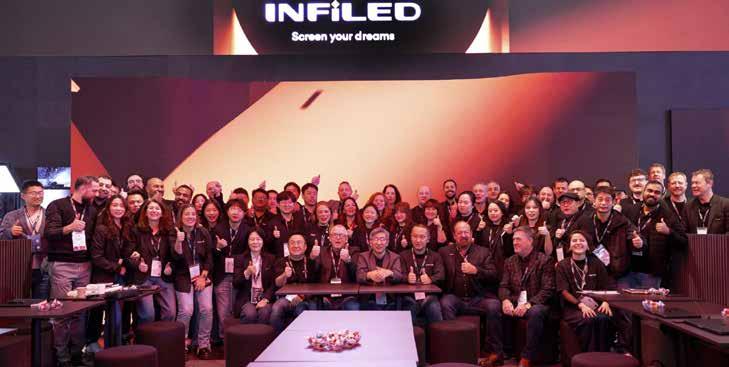
look forward to collaborating with our partners and customers to accelerate growth and deliver innovative LED solutions that create impactful experiences.”
Also joining the team is Bryan Boehme as Senior Business Development Manager for Location Based Entertainment in the Americas.
Sphere has announced that David Dibble has been elevated to Vice Chairman
Sphere Entertainment Co. has announced that David Dibble, a seasoned technologist and business leader, has been elevated to the role of Vice Chairman, Sphere. Mr. Dibble most recently served as Special Advisor to the Executive Chairman and CEO of Sphere Entertainment, which followed his role as CEO of MSG Ventures, a wholly owned subsidiary of the Company. In this elevated role, Mr. Dibble will work with executive leadership to explore opportunities to advance Sphere’s proprietary technologies and deliver immersive experiences that fully leverage Sphere’s capabilities as an experiential medium. Sphere’s technologies include a 16K x 16K interior display plane – the world’s highest-resolution LED screen; Sphere Immersive Sound – a proprietary audio system that delivers crystal-clear sound to every seat in the venue; and 4D multi-sensory technologies that enable guests to feel the experience – such as vibrations, wind, and scent.
The Company has an expansive portfolio of patents issued both in the U.S. and internationally, and other intellectual property, spanning areas including Sphere venue design, audio delivery, video capture and display, and 4D technologies. Mr. Dibble will report to Jim Dolan, Executive Chairman and CEO of Sphere Entertainment. “David Dibble has been integral in helping shape the vision for Sphere from the very beginning,” said Mr.
Dolan. “His commitment to technological innovation and his relentless drive to redefine what’s possible will be incredible assets as we extend Sphere’s leadership position, including across a global network of venues.”
“Sphere has always been focused on using advanced technologies to create experiences that are unlike anywhere else in the world,” said Mr. Dibble. “The technologies that power Sphere are truly transformative, and I look forward to continuing to work closely with Jim as we keep pushing boundaries and continue to solidify Sphere’s position at the forefront of immersive experiences.” Mr. Dibble joined Sphere Entertainment in 2016 as CEO of MSG Ventures, which is focused on developing live entertainment technologies to innovate the way fans, artists, and athletes engage and connect. This role extended across the MSG Family of Companies – which in addition to Sphere Entertainment includes Madison Square Garden Entertainment Corp. and Madison Square Garden Sports Corp. – and he was responsible for helping deliver technology solutions across a diverse portfolio of venues and entertainment properties. He also had oversight for the overall technology function across the companies, including application development, technology strategy, infrastructure, and operations.
As part of his role, Mr. Dibble was instrumental in bringing Sphere to life, from concept to execution. It was in a conversation with Mr. Dibble in 2016 where Mr. Dolan first outlined his vision for Sphere as a new experiential medium powered by advanced technologies. From that time forward, Mr. Dibble oversaw the development of the audio, video, and connectivity technologies for Sphere that now enable the immersive experiences redefining live entertainment. This includes Sphere Immersive Sound, which beyond Sphere in Las Vegas has also been introduced at New York’s Beacon

Theatre and Radio City Music Hall. Prior to joining Sphere Entertainment in 2016, Mr. Dibble was Chief Technology Officer of Cablevision Systems Corporation, where he guided the company’s technology infrastructure and enterprise-wide data architecture. This included leading the corporate engineering, information technology, network operations and software teams, as well as overseeing a wide range of company systems, including its industry-leading Wi-Fi network, while also supporting the design and development of Cablevision’s various products and services.
Before Cablevision, Mr. Dibble spent six years at Yahoo! serving in multiple executive roles. As Executive Vice President of Central Technology, he led all aspects of global technical infrastructure design, science, platforms, engineering and operations. During his tenure at Yahoo!, he also designed and built the world’s most efficient data centre and helped unify the central technology and core platforms groups into one team for improved efficiencies and greater alignment. Prior to Yahoo!, he held senior technology roles at companies including First Data Corporation, JPMorgan Chase & Co., Charles Schwab & Co., Fidelity Investments and FMC Corporation. Mr. Dibble is a graduate of the University of Kansas, where he earned his B.S. in quantitative economics and completed three years of graduate studies in economics, mathematics, and computer science.
AtlasIED has announced two appointments to its international team to enhance growth and strengthen relationships with distributors and clients. Bartosz Pętlak has been appointed as Applications Engineer for the EMEA region, while Roger Lim has taken on the role of Applications Engineer for the APAC region. Based in Poland, Pętlak joins the AtlasIED team with 17 years of AV and digital signage experience, supporting regional growth through technical expertise, tailored solution design, and close collaboration with customers and partners to deliver successful deployments. “The AtlasIED team and the company’s extensive product catalogue are responsible for an impressive amount of applications in the EMEA region, and I’m honoured to join the
efforts,” said tlak. “I look forward to leveraging my experience in the industry to deliver solutions that address a wide range of complex customer requirements and drive successful project outcomes.” Simon Godfrey, Director of Sales – EMEA commented: “Bringing Bartosz onto our team is a significant step in enhancing our technical sales capabilities across the EMEA region. With his strong connections, we are confident in the expertise he will bring to the area. His experience and customer-focused approach will contribute to successful outcomes for our partners and clients.”
As the Applications Engineer for the APAC region, Roger Lim will support customers and partners by providing solution design, implementation, and technical expertise to ensure successful deployments across the region. With over 30 years of experience as a seasoned AV and pro audio specialist, Lim is well-equipped to excel in this role at AtlasIED. His extensive background in acoustics, sound reinforcement, and signal flow aligns perfectly with the strengths of AtlasIED’s technology offerings.
“I am excited to build and nurture strong relationships with customers in the APAC region. Being able to assist them in person is empowering, and I take pride in the strong presence that AtlasIED has established and will continue to expand in this area,” said Lim. “I am passionate about ensuring that our solutions perform well in real-world environments and provide long-term value. I look forward to directly supporting our customers in my region.” “Adding Roger to our team greatly strengthens our ability to support customers throughout the entire project lifecycle,” said Glenn Lin, Director of Sales- APAC. “His significant experience in application support will play a critical role in expanding our presence across APAC.”


Returning for a 6th Year the Peerless-AV Showcase is the must attend event in the UK Pro AV calendar
AV technology pioneer Peerless-AV, this year celebrating its 85th anniversary, announced the return of the AV Showcase, the premier UK industry tradeshow, taking place on 12th & 13th May at Lord’s Cricket ground in Central London. Now in its sixth year, the event will once again bring together leading AV manufacturers, innovators, and decision-makers for a dynamic program of exhibits, insights, and networking.
“Since we organised our inaugural event in 2021, the AV market have responded positively, so now reaching our sixth consecutive year feels like a significant milestone”, said Keith Dutch, Managing Director EMEA, Peerless-AV. “The continued growth and development of our event reflects the unbelievable ongoing support we receive within the AV community – from the market leading manufacturers who exhibit, the industry voices that deliver seminars and panels to the diverse range of attendees from across the Professional AV spectrum and End User vertical markets.”
Each year Peerless-AV strive to evolve the showcase, retaining and refining popular components, such as the keynote speakers & education sessions from previous years, whilst adding new elements. The 2026 AV Show-

“Since we organised our inaugural event in 2021, the AV market have responded positively, so now reaching our sixth consecutive year feels like a significant milestone”, said Keith Dutch, Managing Director EMEA, Peerless-AV
case will continue to exceed expectations with fresh brands added to the show floor, bringing exciting developments and unique solutions in the areas of audio, LCD/LED displays, workplace technology, signal processing, digital signage, AVoIP, video signal management and much more.
A dynamic thought leadership programme will continue to be a fundamental constituent in the exhibition, providing attendees the opportunity to deepen their understanding of the key challenges and potential opportunities ahead in the AV industry. The platform allows leading industry specialists to share their valuable insights in the topical subject areas with speakers and panellists to be announced in the coming weeks. This year coincides with LDSW ’26 (London Digital Signage Week) to further broaden the reach of the Showcase to an expanded audience and additional markets.
To drive End User engagement Peerless-AV are offering a unique VIP experience to go behind the scenes at ‘The Home of Cricket’ with an ex-England International leading a dedicated tour of the ground. The Showcase will also play host to Rise AV in cooperation with their 2026 mentorship programme designed to support and empower women in the commercial AV, live events, and production technology sectors.
At the close of day 1, exhibitors and visitors are invited to enjoy a ‘mix & mingle’ networking drinks reception with stunning views of the ground. An essential element of the Showcase it brings together a diverse cross section of attendees, sparking new ideas, creating opportunities and building relationships that can drive meaningful collaboration and ongoing innovation.
Registration is officially open for the 2026 AV Showcase! Sign up here and find more information on the event home page and watch the 2025 video here. Follow us on X, and LinkedIn for the latest updates. For more information on the full range of Peerless-AV mounts and solutions visit www.peerless-av.com.
Registration: TheAV Showcase 2026 Tickets,
Tuesday, May 12, 2026 at 09:30 Wednesday, May 13, 2026 at 16:00 | Eventbrite
Event page: https://eu.peerless-av.com/pages/The-AV-Showcase-2026
2025 video: https://vimeo.com/1084961719

With the geopolitical situation in the Middle East remaining unpredictable, AVIXA has revised its plans for AV industry engagement in the region. InfoComm EDGE, originally scheduled for October 2026 at the Festival Arena in Dubai, will now take place October 27-28, 2027, at the same location. AVIXA will also host a highly curated, invitation-only EDGE Preview in Dubai, Q4 2026. Positioned as a focused working forum, EDGE Preview will bring together senior decision-makers and end users across key sectors - government and enterprise, leisure and entertainment, education, and retail - alongside AV industry stakeholders and international consultants.
Through a collaborative, co-creation-led format, participants will actively shape the role integrated AV can play in supporting regional recovery, growth, and long-term value creation. The focus will be on fast-tracking measurable outcomes— from enhancing human engagement and productivity to strengthening talent retention, investor confidence, and destination appeal. “The positive response to our announcement of InfoComm EDGE earlier this year reinforced a clear market need for a different kind of event—one focused on how integrated AV delivers real-world outcomes,” said David Labuskes, CTS, CAE, CEO of AVIXA. “After close consultation with our partners in the region, we’ve taken a deliberate decision to move the full event to 2027 to ensure it lands with maximum impact—particularly at a time when government bodies are aligning investment decisions with long-term strategic priorities. At the same time, this year’s EDGE Preview will be a focused, high-value forum designed for the current moment. By bringing together senior decision-makers, end users, and consultants, we will be creating a space to explore how AV can actively support regional regeneration, productivity, and engagement - and to shape the direction of InfoComm EDGE 2027 through real collaboration and shared insight.”
Planning for InfoComm EDGE continues, with regional integration firms now beginning to submit design proposals for the event’s core activations—each focused on demonstrating how integrated AV performs in real-world environments and delivers measurable outcomes. Central to this process is the InfoComm EDGE End User Council, a growing collective of regional organizations providing direct input into the design and evaluation of these activations through the lens of enterprise and operational impact. The Council now includes a dozen confirmed participants, including Emirates Airlines,
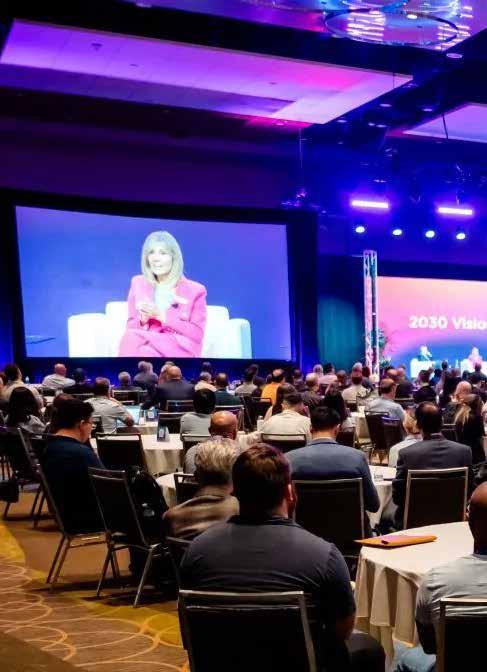
du, Dubai Roads and Transport Authority, Sharjah Education Academy, Atlantis, Miral Asset Management, and Jollibee. “Our commitment to AV in the Middle East remains clear, and this approach ensures we remain closely aligned with the needs and priorities of the region at a critical time,” added Labuskes. “The EDGE Preview this year is a deliberate step— bringing together the right stakeholders to focus on how AV can deliver meaningful impact now, while shaping the foundation for InfoComm EDGE 2027.” Date and location for the EDGE Preview will be confirmed shortly, with a limited number of partnership opportunities to be made available to vendor brands.
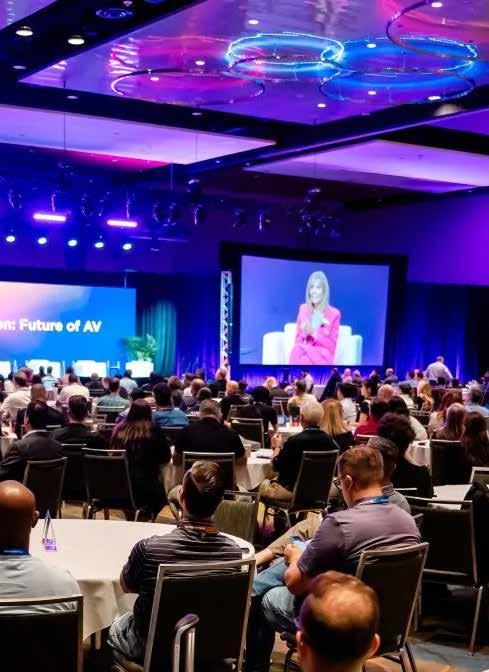
At InfoComm 2026, the world’s most essential destination for AV, IT, broadcast, and AI-driven systems, Espen Løberg, Vice President and General Manager of Collaboration Devices at Cisco, will deliver a keynote address at the Las Vegas Convention Center in Las Vegas, Nevada. InfoComm 2026 takes place June 13–19, with exhibits June 17–19. As organizations reimagine how and where work happens, the systems that power collaboration – from AV and IT infrastructure to workplace analytics and AI-driven experiences –are often managed separately. The result can be complex deployments, inconsistent user experiences, and limited visibility into how workspaces actually perform. During his keynote, Løberg will explore how organizations can unify these environments through Cisco’s vision of Connected Intelligence – an approach that brings together collaboration platforms, devices, networks, and AI-enabled infrastructure to deliver more seamless, scalable, and intelligent workplace experiences.
Attendees will hear how converged AV-over-IP networks and
intelligent collaboration technologies can simplify management, deliver richer insights into workspace performance, and enable better collaboration outcomes across distributed teams. Løberg will also discuss how Cisco is partnering with technology leaders including NVIDIA, Microsoft, Zoom, Apple, and Samsung to advance the next generation of connected workplace solutions. “By bringing together collaboration devices, services built-in with Agentic AI, and secure network infrastructure, organizations can deliver experiences where people, technology, and intelligent systems work seamlessly together,” said Løberg. “We’re excited to share how Cisco is helping customers build future-ready workplaces at InfoComm 2026.”
Løberg leads Cisco’s global Collaboration Devices business, overseeing the strategy, development, and delivery of the company’s portfolio of video conferencing systems, desk devices, and intelligent peripherals designed to support modern hybrid work. Since joining Cisco through the acquisition of Tandberg in 2010, he has played a key role in advancing Cisco’s collaboration technologies and AI-powered meeting experiences. “InfoComm is where the pro AV and IT communities come together to explore how technology is transforming real-world environments,” said Jenn Heinold, Senior Vice President, Expositions, Americas, AVIXA, producer of InfoComm. “Cisco’s perspective on connected infrastructure and intelligent workplace solutions reflects the broader convergence happening across AV, IT, and AI—and will offer valuable insight for organizations designing the next generation of collaboration experiences.”
InfoComm 2026 brings together technologies and people reshaping how we work, play, learn, communicate, and experience the world. The show will feature a new Work/Play show floor experience, with immersive activation hubs, expanded learning opportunities, and the latest innovations across conferencing and collaboration, enterprise IT, broadcast workflows, and live events – along with a growing focus on how AI is being applied across AV systems, collaboration, and production.
CEDIA Expo/Commercial Integrator Expo (CIX) is where the residential and commercial sides of the integration industry converge, driving better ideas, stronger partnerships, and a clearer understanding of where the market is heading. The same is true for the CEDIA Expo/CIX Smart Stage. The Smart Stage is designed as a forum for the industry to examine key shifts, bringing together integrators, manufacturers, designers, architects, and business leaders to dig into the shifts shaping the market right now—and what they mean for growth, profitability, and competitive advantage. From Wednesday, September 2, to Friday, September 4, Smart Stage programming will offer attendees perspectives on the technologies redefining projects, the business challenges reshaping operations, the workforce initiatives influencing longterm growth, and the trend discussions spotlighting excellence across the channel.
In addition to educational programming and industry discussions, the Smart Stage will also host key industry awards and recognition events throughout the week, including the BEST Product Awards, Integration Awards, the Home of the Year Awards, the Women to Watch 2026 celebration, the Best Booth Awards, and Trendspotting, where industry experts share key takeaways and technologies generating the most momentum across the show floor. Smart Stage sessions focus on future-forward opportunities shaping the integration industry. Covering immersive home cinema, energy management, lighting and shading, light commercial solutions, and productivity-driving AI tools, the program is aligned with where the market is going and where integrators are achieving measurable growth.
Artificial intelligence will be a major focus, with sessions exploring how AI is entering the rack, powering intelligent security systems, and helping integration businesses operate more efficiently through tools that automate workflows and save time. Security and connected systems will also be examined, including how AI-driven monitoring, edge processing, and smarter surveillance technologies are expanding opportunities for integrators. Energy management will be another key topic, addressing how power reliability, energy usage, and system performance are becoming increasingly connected, and why energy is emerging as one of the most important considerations in smart home system design. Sessions focused on video and entertainment will explore the continued rise of ultra-large residential displays, video walls, and immersive home cinema experiences that combine high-performance audio and visual design.
Design and aesthetics will be recurring themes throughout the Smart Stage program, with sessions examining architectural and design-friendly audio solutions, collaboration with architects and designers, and strategies for getting involved earlier in projects through the design-build process. Business growth and diversification will also be covered, including how lighting and shading can serve as entry points for larger projects, how integrators can expand into light commercial opportunities, and how companies are adapting their business models as technology and customer expectations evolve.
“The Smart Stage is central to the CEDIA Expo/CIX experience,” said Jason McGraw, Group Vice President and Show Director for CEDIA Expo/CIX. “It’s where the important conversations happen, where industry leaders share the insights professionals need to make smarter decisions to stay competitive in a rapidly evolving market.” CEDIA Expo/CIX will return to Denver from Tuesday, September 1, to Friday, September 4, 2026. In 2026, the show dates will shift one day earlier than in previous years, ending on Friday ahead of the Labor Day weekend.
For decades, digital signage has been defined by its ability to broadcast on bigger screens with sharper images and faster networks. But a fundamental shift is now underway. Screens are no longer passive display endpoints; they are becoming intelligent, responsive, and contextually aware systems. As artificial intelligence moves from the cloud to the edge, digital signage is transforming into a living platform, one that can
see, learn, adapt, and act in real time. There is no better moment to understand what this shift means for the industry than the 20th anniversary edition of The Digital Signage Summit (DSS) 2026.
Traditional digital signage operated on a one-way model: centrally planned content pushed to distributed screens. Success was measured in reach, dwell time and recall. Today, AI introduces feedback loops between people, places, data, and content; fundamentally reshaping that broadcast paradigm. This shift from signage as media to signage as infrastructure is redefining competitive advantage across digital signage and DOOH. Industry leaders are increasingly focused on how intelligence, data, and platform architecture are converging to shape the next phase of the market.
At the centre of this evolution is the rise of AI at the edge, where processing happens closer to the screen rather than in the cloud. This enables ultra-low latency, privacy by design, and systems that can adapt instantly to changing conditions, even in disconnected environments. Across retail, transport, campuses, and public spaces, organisations are already applying situational intelligence to respond to movement, density, time of day, and environmental context. The result is a shift away from individual targeting toward contextual optimisa-
tion, where relevance is derived from the environment, not the individual.
As screens become more intelligent, they also become part of increasingly complex data ecosystems. Footfall analytics, content performance, sensor inputs, and operational telemetry are converging into real-time decision environments. The challenge is no longer data collection, but governance, architecture, and actionability. Market dynamics reflect this shift. Consolidation, regulatory pressure, and accelerating technological change are forcing organisations to rethink how signage systems are designed, deployed, and managed. Data is no longer a byproduct of signage networks, it is becoming their core operating layer.
As intelligence becomes the differentiator, value is shifting away from pure hardware or network management toward platform orchestration. The new screen “superpowers” combine AI-optimised hardware, edge computing, secure data pipelines, API-driven interoperability, and content systems capable of dynamic decision-making. This platform shift is driving convergence across digital signage, retail media, and DOOH. Open ecosystems, interoperability, and service-led architectures are becoming more important than standalone solutions. Content itself is evolving from static creative into a system output, selected or generated based on live environmental signals.
AI-driven signage is already delivering tangible impact. In retail, predictive models align promotions with shopper flow and inventory. In QSR, menu boards adapt dynamically based on queues, weather, or availability. In campuses and corporate environments, agent-based systems prioritise safety alerts, events, and operational messages across thousands of endpoints. Even in DOOH, programmatic buying and AI-driven optimisation are reshaping monetisation, optimising campaigns based on real-time conditions rather than assumptions. The common thread is clear: digital signage is moving from message delivery to situational intelligence. As digital signage enters the age of intelligence, the industry is moving beyond content delivery toward systems that sense, respond, and adapt in real time. This shift is redefining how screens are used and how value is created across retail, transport, public spaces, and enterprise environments. From infrastructure to experience, signage is becoming a core component of the intelligent, connected physical world. The Digital Signage Summit 2026 brings together the leaders driving this transition, from technology providers and system integrators to brands and strategy teams, to examine what comes next and how the industry can design for a future where screens no longer simply display content, but actively interpret and respond to it.
Save 30% of the cost of attending The DSS 2026
Join industry leaders at The DSS 2026, taking place 20–21 May in Munich, to explore the technologies, strategies, and business models shaping the next era of digital signage.
Use code dss2026-AVNews30 to receive 30% off your ticket and be part of the conversation defining the industry’s next chapter.
For more information visit: https://digitalsignagesummit.org/
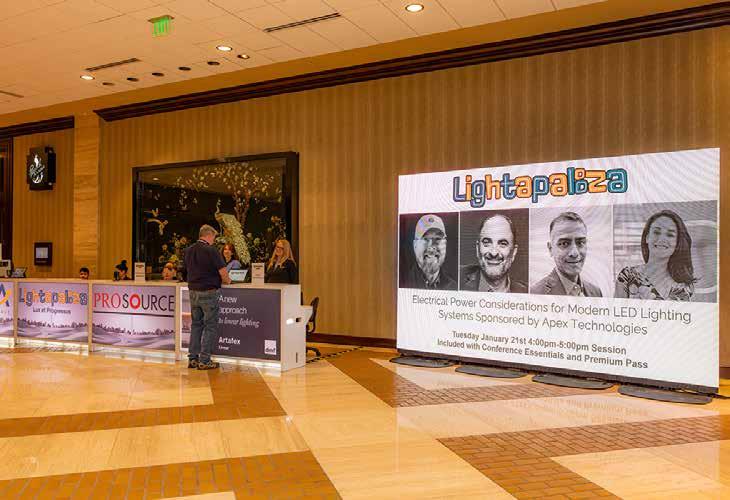
Registration Code - dss2026-AVNews30
https://www.badge-registration.com/ISE_Shop/DSS-Munich2026/Register/dss2026-AVNews30
30% off your ticket to The DS with AV News and be part of the conversation defining the industry’s next chapter.
AVIXA, the Audiovisual and Integrated Experience Association, has announced the acquisition of Lightapalooza from HTSA, the Home Technology Specialists of America. The next edition of Lightapalooza will be co-located with InfoComm 2027 in Orlando, Fla. Lightapalooza is a conference and trade show focused on residential illumination, energy control, and natural light optimization. HTSA launched Lightapalooza in 2022 for custom electronics integrators, lighting manufacturers, lighting designers, specifiers, buying groups, architects, and designers to connect, share ideas, and establish new partnerships.
The event grew from 225 attendees in its first year to more than 1,600 in 2026, drawing manufacturers, integrators, and allied partners from across the industry. In that time, it became a catalyst for a broader shift: lighting has emerged as the fastest-growing category in residential custom integration, and Lightapalooza has been at the centre of that conversa-
tion, connecting the people and brands driving it forward. “HTSA saw a need for its community to connect in exploration of business growth opportunities. They created this space to bring the channel together to do that through product demonstrations, training, education, and professional networking,” said David Labuskes, CTS, CAE, RCDD, Chief Executive Officer of AVIXA. “As the trade association for the AV industry, one of AVIXA’s roles is to help facilitate the marketplace. We do this in many ways, most notably through our trade shows around the world-the premier forum for connection.”
“AVIXA prides itself on producing experiential shows that connect solution providers and buyers while delivering education excellence to AV professionals,” said Jenn Heinold, Senior Vice President, Expositions, Americas, AVIXA. “Bringing Lightapalooza into the AVIXA portfolio and co-locating it with InfoComm 2027 is a meaningful step in creating a more powerful platform for the lighting community to connect, learn, and grow.”
“The acquisition places Lightapalooza inside an organization whose structure is designed to reinvest in the communities it serves,” said Tom Doherty, Founder of Lightapalooza and Director of New Technology Initiatives for HTSA. “As a non-profit trade association, the surplus from AVIXA’s events flows back into education, certification, research, and professional development for the industries it represents, which will further support the growth of Lightapalooza and the residential lighting community.”